ORGANIZATIONAL BEHAVIOR
                                      S T E P H E N P. R O B B I N S
                                          WWW.PRENHALL.COM/ROBBINS

                                            T    E   N   T   H   E   D   I   T   I   O   N


© 2003 Prentice Hall Inc. All rights reserved.                                           PowerPoint Presentation by Charlie Cook
O B J E C T I V E S
                       AFTER STUDYING THIS CHAPTER,
                       YOU SHOULD BE ABLE TO:

                        1. Describe institutionalization and its
                           relationship to organizational culture.
                        2. Define the common characteristics making up
                           organizational culture.
L E A R N I N G


                        3. Contrast strong and weak cultures.
                        4. Identify the functional and dysfunctional
                           effects of organizational culture on people and
                           the organization.
                        5. Explain the factors determining an
                           organization’s culture.
                      © 2003 Prentice Hall Inc.
                      All rights reserved.                             18–2
O B J E C T I V E S (cont’d)
                                AFTER STUDYING THIS CHAPTER,
                                YOU SHOULD BE ABLE TO:

                                 6. List the factors that maintain an organization’s
                                    culture.
                                 7. Clarify how culture is transmitted to
                                    employees.
                                 8. Outline the various socialization alternatives
                                    available to management.
L E A R N I N G


                                 9. Describe a customer-responsive culture.
                                 10. Identify characteristics of a spiritual culture.

                               © 2003 Prentice Hall Inc.
                               All rights reserved.                                18–3
Institutionalization: A Forerunner of Culture
 Institutionalization: A Forerunner of Culture


© 2003 Prentice Hall Inc.
All rights reserved.                             18–4
What Is Organizational Culture?


                            Characteristics:
                            Characteristics:
                            1. Innovation and risk
                             1. Innovation and risk
                               taking
                                taking
                            2. Attention to detail
                             2. Attention to detail
                            3. Outcome orientation
                             3. Outcome orientation
                            4. People orientation
                             4. People orientation
                            5. Team orientation
                             5. Team orientation
                            6. Aggressiveness
                             6. Aggressiveness
                            7. Stability
                             7. Stability

© 2003 Prentice Hall Inc.
All rights reserved.                               18–5
What Is Organizational Culture? (cont’d)


© 2003 Prentice Hall Inc.
All rights reserved.                       18–6
What Is Organizational Culture? (cont’d)


© 2003 Prentice Hall Inc.
All rights reserved.                       18–7
What Is Organizational Culture? (cont’d)
 Culture Versus Formalization
   – A strong culture increases behavioral consistency and
     can act as a substitute for formalization.
 Organizational Culture Versus National Culture
   – National culture has a greater impact on employees
     than does their organization’s culture.
   – Nationals selected to work for foreign companies may
     be atypical of the local/native population.


© 2003 Prentice Hall Inc.
All rights reserved.                                   18–8
What Do Cultures Do?


      Culture’s Functions:
      Culture’s Functions:
      1. Defines the boundary between one
       1. Defines the boundary between one
         organization and others.
          organization and others.
      2. Conveys aasense of identity for its members.
       2. Conveys sense of identity for its members.
      3. Facilitates the generation of commitment to
       3. Facilitates the generation of commitment to
         something larger than self-interest.
          something larger than self-interest.
      4. Enhances the stability of the social system.
       4. Enhances the stability of the social system.


© 2003 Prentice Hall Inc.
All rights reserved.                                     18–9
What Do Cultures Do?


              Culture as a Liability:
              Culture as a Liability:
              1. Barrier to change
               1. Barrier to change
              2. Barrier to diversity
               2. Barrier to diversity
              3. Barrier to acquisitions and
               3. Barrier to acquisitions and
                 mergers
                  mergers


© 2003 Prentice Hall Inc.                       18–
All rights reserved.                            10
Keeping Culture Alive
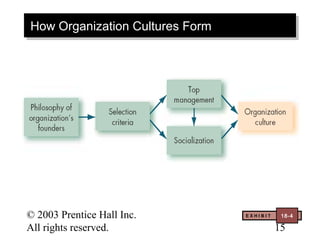
 Selection
   – Concerned with how well the candidates will fit into the
     organization.
   – Provides information to candidates about the
     organization.
 Top Management
   – Senior executives help establish behavioral norms that
     are adopted by the organization.
 Socialization
   – The process that helps new employees adapt to the
     organization’s culture.

© 2003 Prentice Hall Inc.                                18–
All rights reserved.                                     11
Stages in the Socialization Process


© 2003 Prentice Hall Inc.             18–
All rights reserved.                  12
A Socialization Model


© 2003 Prentice Hall Inc.   EXHIBIT   18–
                                       18-2

All rights reserved.                  13
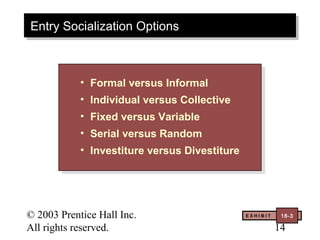
Entry Socialization Options


            •• Formal versus Informal
                Formal versus Informal
            •• Individual versus Collective
                Individual versus Collective
            •• Fixed versus Variable
                Fixed versus Variable
            •• Serial versus Random
                Serial versus Random
            •• Investiture versus Divestiture
                Investiture versus Divestiture


© 2003 Prentice Hall Inc.                        EXHIBIT   18–
                                                            18-3

All rights reserved.                                       14
How Organization Cultures Form


© 2003 Prentice Hall Inc.        EXHIBIT   18–
                                            18-4

All rights reserved.                       15
How Employees Learn Culture


    •• Stories
        Stories
    •• Rituals
        Rituals
    •• Material Symbols
        Material Symbols
    •• Language
        Language


© 2003 Prentice Hall Inc.     18–
All rights reserved.          16
Creating An Ethical Organizational Culture
 Characteristics of Organizations that Develop
  High Ethical Standards
   – High tolerance for risk
   – Low to moderate in aggressiveness
   – Focus on means as well as outcomes
 Managerial Practices Promoting an Ethical
  Culture
   –   Being a visible role model.
   –   Communicating ethical expectations.
   –   Providing ethical training.
   –   Visibly rewarding ethical acts and punishing unethical
       ones.
© 2003 Prentice Hall Inc.                                 18–
All rights reserved.                                      17
Creating a Customer-Responsive Culture
 Key Variables Shaping Customer-Responsive
  Cultures
   1. The types of employees hired by the organization.
   2. Low formalization: the freedom to meet customer
      service requirements.
   3. Empowering employees with decision-making
      discretion to please the customer.
   4. Good listening skills to understand customer
      messages.
   5. Role clarity that allows service employees to act as
      “boundary spanners.”
   6. Employees who engage in organizational citizenship
      behaviors.
© 2003 Prentice Hall Inc.                              18–
All rights reserved.                                   18
Creating a Customer-Responsive Culture

  Managerial Actions:
   Managerial Actions:
  •• Select new employees with personality and
      Select new employees with personality and
     attitudes consistent with high service
      attitudes consistent with high service
     orientation.
      orientation.
  •• Train and socialize current employees to be
      Train and socialize current employees to be
     more customer focused.
      more customer focused.
    •• Change organizational structure to give
        Change organizational structure to give
       employees more control.
        employees more control.
    •• Empower employees to make decision about
        Empower employees to make decision about
       their jobs.
        their jobs.
© 2003 Prentice Hall Inc.                       18–
All rights reserved.                            19
Creating a Customer-Responsive Culture

 Managerial Actions (cont’d) ::
 Managerial Actions (cont’d)
 •• Lead by conveying a customer-focused vision
     Lead by conveying a customer-focused vision
    and demonstrating commitment to customers.
     and demonstrating commitment to customers.
 •• Conduct performance appraisals based on
     Conduct performance appraisals based on
    customer-focused employee behaviors.
     customer-focused employee behaviors.
 •• Provide ongoing recognition for employees who
     Provide ongoing recognition for employees who
    make special efforts to please customers.
     make special efforts to please customers.


© 2003 Prentice Hall Inc.                      18–
All rights reserved.                           20
Spirituality and Organizational Culture


                            Characteristics:
                            Characteristics:
                            • • Strong sense of
                                 Strong sense of
                                purpose
                                 purpose
                            • • Focus on individual
                                 Focus on individual
                                development
                                 development
                            • • Trust and openness
                                 Trust and openness
                            • • Employee
                                 Employee
                                empowerment
                                 empowerment
                            • • Toleration of employee
                                 Toleration of employee
                                expression
                                 expression

© 2003 Prentice Hall Inc.                         18–
All rights reserved.                              21
How Organizational Cultures Have an Impact
on Performance and Satisfaction


© 2003 Prentice Hall Inc.          EXHIBIT   18–
                                              18-7

All rights reserved.                         22

Ch18

  • 1.
    ORGANIZATIONAL BEHAVIOR S T E P H E N P. R O B B I N S WWW.PRENHALL.COM/ROBBINS T E N T H E D I T I O N © 2003 Prentice Hall Inc. All rights reserved. PowerPoint Presentation by Charlie Cook
  • 2.
    O B JE C T I V E S AFTER STUDYING THIS CHAPTER, YOU SHOULD BE ABLE TO: 1. Describe institutionalization and its relationship to organizational culture. 2. Define the common characteristics making up organizational culture. L E A R N I N G 3. Contrast strong and weak cultures. 4. Identify the functional and dysfunctional effects of organizational culture on people and the organization. 5. Explain the factors determining an organization’s culture. © 2003 Prentice Hall Inc. All rights reserved. 18–2
  • 3.
    O B JE C T I V E S (cont’d) AFTER STUDYING THIS CHAPTER, YOU SHOULD BE ABLE TO: 6. List the factors that maintain an organization’s culture. 7. Clarify how culture is transmitted to employees. 8. Outline the various socialization alternatives available to management. L E A R N I N G 9. Describe a customer-responsive culture. 10. Identify characteristics of a spiritual culture. © 2003 Prentice Hall Inc. All rights reserved. 18–3
  • 4.
    Institutionalization: A Forerunnerof Culture Institutionalization: A Forerunner of Culture © 2003 Prentice Hall Inc. All rights reserved. 18–4
  • 5.
    What Is OrganizationalCulture? What Is Organizational Culture? Characteristics: Characteristics: 1. Innovation and risk 1. Innovation and risk taking taking 2. Attention to detail 2. Attention to detail 3. Outcome orientation 3. Outcome orientation 4. People orientation 4. People orientation 5. Team orientation 5. Team orientation 6. Aggressiveness 6. Aggressiveness 7. Stability 7. Stability © 2003 Prentice Hall Inc. All rights reserved. 18–5
  • 6.
    What Is OrganizationalCulture? (cont’d) What Is Organizational Culture? (cont’d) © 2003 Prentice Hall Inc. All rights reserved. 18–6
  • 7.
    What Is OrganizationalCulture? (cont’d) What Is Organizational Culture? (cont’d) © 2003 Prentice Hall Inc. All rights reserved. 18–7
  • 8.
    What Is OrganizationalCulture? (cont’d) What Is Organizational Culture? (cont’d)  Culture Versus Formalization – A strong culture increases behavioral consistency and can act as a substitute for formalization.  Organizational Culture Versus National Culture – National culture has a greater impact on employees than does their organization’s culture. – Nationals selected to work for foreign companies may be atypical of the local/native population. © 2003 Prentice Hall Inc. All rights reserved. 18–8
  • 9.
    What Do CulturesDo? What Do Cultures Do? Culture’s Functions: Culture’s Functions: 1. Defines the boundary between one 1. Defines the boundary between one organization and others. organization and others. 2. Conveys aasense of identity for its members. 2. Conveys sense of identity for its members. 3. Facilitates the generation of commitment to 3. Facilitates the generation of commitment to something larger than self-interest. something larger than self-interest. 4. Enhances the stability of the social system. 4. Enhances the stability of the social system. © 2003 Prentice Hall Inc. All rights reserved. 18–9
  • 10.
    What Do CulturesDo? What Do Cultures Do? Culture as a Liability: Culture as a Liability: 1. Barrier to change 1. Barrier to change 2. Barrier to diversity 2. Barrier to diversity 3. Barrier to acquisitions and 3. Barrier to acquisitions and mergers mergers © 2003 Prentice Hall Inc. 18– All rights reserved. 10
  • 11.
    Keeping Culture Alive KeepingCulture Alive  Selection – Concerned with how well the candidates will fit into the organization. – Provides information to candidates about the organization.  Top Management – Senior executives help establish behavioral norms that are adopted by the organization.  Socialization – The process that helps new employees adapt to the organization’s culture. © 2003 Prentice Hall Inc. 18– All rights reserved. 11
  • 12.
    Stages in theSocialization Process Stages in the Socialization Process © 2003 Prentice Hall Inc. 18– All rights reserved. 12
  • 13.
    A Socialization Model ASocialization Model © 2003 Prentice Hall Inc. EXHIBIT 18– 18-2 All rights reserved. 13
  • 14.
    Entry Socialization Options EntrySocialization Options •• Formal versus Informal Formal versus Informal •• Individual versus Collective Individual versus Collective •• Fixed versus Variable Fixed versus Variable •• Serial versus Random Serial versus Random •• Investiture versus Divestiture Investiture versus Divestiture © 2003 Prentice Hall Inc. EXHIBIT 18– 18-3 All rights reserved. 14
  • 15.
    How Organization CulturesForm How Organization Cultures Form © 2003 Prentice Hall Inc. EXHIBIT 18– 18-4 All rights reserved. 15
  • 16.
    How Employees LearnCulture How Employees Learn Culture •• Stories Stories •• Rituals Rituals •• Material Symbols Material Symbols •• Language Language © 2003 Prentice Hall Inc. 18– All rights reserved. 16
  • 17.
    Creating An EthicalOrganizational Culture Creating An Ethical Organizational Culture  Characteristics of Organizations that Develop High Ethical Standards – High tolerance for risk – Low to moderate in aggressiveness – Focus on means as well as outcomes  Managerial Practices Promoting an Ethical Culture – Being a visible role model. – Communicating ethical expectations. – Providing ethical training. – Visibly rewarding ethical acts and punishing unethical ones. © 2003 Prentice Hall Inc. 18– All rights reserved. 17
  • 18.
    Creating a Customer-ResponsiveCulture Creating a Customer-Responsive Culture  Key Variables Shaping Customer-Responsive Cultures 1. The types of employees hired by the organization. 2. Low formalization: the freedom to meet customer service requirements. 3. Empowering employees with decision-making discretion to please the customer. 4. Good listening skills to understand customer messages. 5. Role clarity that allows service employees to act as “boundary spanners.” 6. Employees who engage in organizational citizenship behaviors. © 2003 Prentice Hall Inc. 18– All rights reserved. 18
  • 19.
    Creating a Customer-ResponsiveCulture Creating a Customer-Responsive Culture Managerial Actions: Managerial Actions: •• Select new employees with personality and Select new employees with personality and attitudes consistent with high service attitudes consistent with high service orientation. orientation. •• Train and socialize current employees to be Train and socialize current employees to be more customer focused. more customer focused. •• Change organizational structure to give Change organizational structure to give employees more control. employees more control. •• Empower employees to make decision about Empower employees to make decision about their jobs. their jobs. © 2003 Prentice Hall Inc. 18– All rights reserved. 19
  • 20.
    Creating a Customer-ResponsiveCulture Creating a Customer-Responsive Culture Managerial Actions (cont’d) :: Managerial Actions (cont’d) •• Lead by conveying a customer-focused vision Lead by conveying a customer-focused vision and demonstrating commitment to customers. and demonstrating commitment to customers. •• Conduct performance appraisals based on Conduct performance appraisals based on customer-focused employee behaviors. customer-focused employee behaviors. •• Provide ongoing recognition for employees who Provide ongoing recognition for employees who make special efforts to please customers. make special efforts to please customers. © 2003 Prentice Hall Inc. 18– All rights reserved. 20
  • 21.
    Spirituality and OrganizationalCulture Spirituality and Organizational Culture Characteristics: Characteristics: • • Strong sense of Strong sense of purpose purpose • • Focus on individual Focus on individual development development • • Trust and openness Trust and openness • • Employee Employee empowerment empowerment • • Toleration of employee Toleration of employee expression expression © 2003 Prentice Hall Inc. 18– All rights reserved. 21
  • 22.
    How Organizational CulturesHave an Impact How Organizational Cultures Have an Impact on Performance and Satisfaction on Performance and Satisfaction © 2003 Prentice Hall Inc. EXHIBIT 18– 18-7 All rights reserved. 22