Organizational Theory, Design,
and Change
Text and Cases
Fourth Edition
Gareth R. Jones

Copyright 2004
Prentice Hall
Learning Objectives
1.

2.

To understand why organizations
exist and the purposes they serve
Describe the relationship between
organizational theory and
organizational design and change,
and differentiate between
organizational structure and culture

Copyright 2004
Prentice Hall
Learning Objectives
3.

4.

5.

Understand how managers can utilize the
principles of organizational theory to
design and change their organizations to
increase organizational effectiveness
Identify the three principal ways in which
managers assess and measure
organizational effectiveness
Appreciate the way in which several
contingency factors influence the design of
organizations
Copyright 2004
Prentice Hall
What is an Organization?




Organization: a tool used by people
to coordinate their actions to obtain
something they desire or value
Entrepreneurship: the process by
which people recognize opportunities
to satisfy needs, and then gather and
use resources to meet those needs
Copyright 2004
Prentice Hall
How Does an Organization
Create Value?








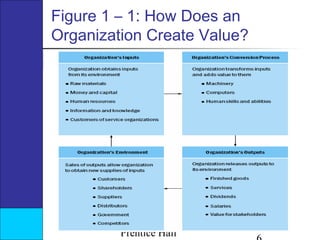
Value creation takes place at three stages:
input, conversion and output.
Inputs – include human resources,
information and knowledge, raw materials,
money and capital
Conversion – the way the organization
uses human resources and technology to
transform inputs into outputs
Output – finished products and services
Copyright 2004
Prentice Hall
Figure 1 – 1: How Does an
Organization Create Value?

Copyright 2004
Prentice Hall
Why Do Organizations Exist?




To increase specialization and the
division of labor
To use large-scale technology




Economies of scale : cost savings that
result when goods and services are
produced in large volume
Economies of scope : cost savings that
result when an organization is able to use
underutilized resources more effectively
Copyright 2004
Prentice Hall
Why Do Organizations Exist?



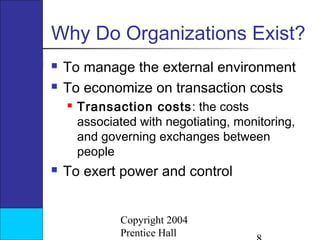
To manage the external environment
To economize on transaction costs




Transaction costs: the costs
associated with negotiating, monitoring,
and governing exchanges between
people

To exert power and control
Copyright 2004
Prentice Hall
Figure 1-3: Why
organizations exist

Copyright 2004
Prentice Hall
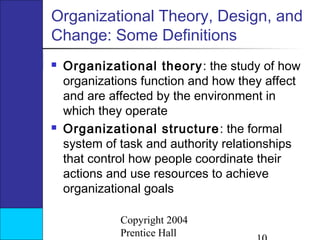
Organizational Theory, Design, and
Change: Some Definitions




Organizational theory : the study of how
organizations function and how they affect
and are affected by the environment in
which they operate
Organizational structure : the formal
system of task and authority relationships
that control how people coordinate their
actions and use resources to achieve
organizational goals
Copyright 2004
Prentice Hall
Definitions




Organizational culture : the set of shared
values and norms that controls
organizational members’ interactions with
each other and with suppliers, customers,
and other people outside the organization
Organizational design : the process by
which managers select and manage aspects
of structure and culture so that an
organization can control the activities
necessary to achieve its goals
Copyright 2004
Prentice Hall
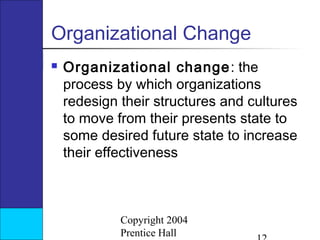
Organizational Change


Organizational change : the
process by which organizations
redesign their structures and cultures
to move from their presents state to
some desired future state to increase
their effectiveness

Copyright 2004
Prentice Hall
Figure 1-4: Relationships Among
Organizational Theory, Structure, Culture,
Design and Change

Copyright 2004
Prentice Hall
Importance of Organizational
Design and Change


To deal with contingencies




Gaining competitive advantage





Contingencies are events that might occur
and must be planned for.
Ability to outperform other companies
because of the ability to create more
value from resources

Managing diversity
Promoting efficiency, speed, and
innovation
Copyright 2004
Prentice Hall
Consequences of Poor
Design





Decline of the organization
Talented employees leave to take
positions in growing organizations.
Resources become harder to acquire.

Copyright 2004
Prentice Hall
How Do Managers Measure
Organizational Effectiveness?


The external resource approach:
Control




Method managers use to evaluate how
effectively an organization manages and
controls its external environment.
Use of indicators such as stock price,
profitability and return on investment

Copyright 2004
Prentice Hall
Measuring Organizational
Effectiveness


The internal systems approach:
Innovation






Method that allows managers to evaluate
how effectively an organization functions
and operates.
Organization needs to be flexible to
rapidly create products and services.
Indicators such as amount of time to get
new products to market or time spent on
decision making can be used.
Copyright 2004
Prentice Hall
Measuring Organizational
Effectiveness


The technical approach:
Efficiency




Method managers use to evaluate how
efficiently an organization can convert
some fixed amount of organizational
resources into finished goods and
services.
Use of indicators such as increase in the
number of units produced without
additional labor
Copyright 2004
Prentice Hall
Table 1-1: Approaches to
Measuring Effectiveness

Copyright 2004
Prentice Hall
Measuring Effectiveness:
Organizational Goals






Official goals: guiding principles that the
organization formally states in its annual
report and in other public documents.
Mission: goals that explain why the
organization exists and what it should be
doing
Operative goals: specific long- and shortterm goals that guide managers and
employees as they perform the work of the
organization
Copyright 2004
Prentice Hall
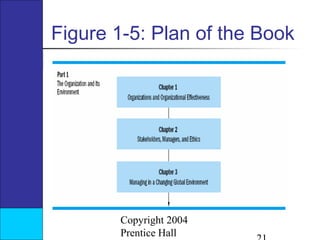
Figure 1-5: Plan of the Book

Copyright 2004
Prentice Hall
Part 2: Organizational Design

Copyright 2004
Prentice Hall
Part 3: Organizational
Change

Copyright 2004
Prentice Hall

Ch01

  • 1.
    Organizational Theory, Design, andChange Text and Cases Fourth Edition Gareth R. Jones Copyright 2004 Prentice Hall
  • 2.
    Learning Objectives 1. 2. To understandwhy organizations exist and the purposes they serve Describe the relationship between organizational theory and organizational design and change, and differentiate between organizational structure and culture Copyright 2004 Prentice Hall
  • 3.
    Learning Objectives 3. 4. 5. Understand howmanagers can utilize the principles of organizational theory to design and change their organizations to increase organizational effectiveness Identify the three principal ways in which managers assess and measure organizational effectiveness Appreciate the way in which several contingency factors influence the design of organizations Copyright 2004 Prentice Hall
  • 4.
    What is anOrganization?   Organization: a tool used by people to coordinate their actions to obtain something they desire or value Entrepreneurship: the process by which people recognize opportunities to satisfy needs, and then gather and use resources to meet those needs Copyright 2004 Prentice Hall
  • 5.
    How Does anOrganization Create Value?     Value creation takes place at three stages: input, conversion and output. Inputs – include human resources, information and knowledge, raw materials, money and capital Conversion – the way the organization uses human resources and technology to transform inputs into outputs Output – finished products and services Copyright 2004 Prentice Hall
  • 6.
    Figure 1 –1: How Does an Organization Create Value? Copyright 2004 Prentice Hall
  • 7.
    Why Do OrganizationsExist?   To increase specialization and the division of labor To use large-scale technology   Economies of scale : cost savings that result when goods and services are produced in large volume Economies of scope : cost savings that result when an organization is able to use underutilized resources more effectively Copyright 2004 Prentice Hall
  • 8.
    Why Do OrganizationsExist?   To manage the external environment To economize on transaction costs   Transaction costs: the costs associated with negotiating, monitoring, and governing exchanges between people To exert power and control Copyright 2004 Prentice Hall
  • 9.
    Figure 1-3: Why organizationsexist Copyright 2004 Prentice Hall
  • 10.
    Organizational Theory, Design,and Change: Some Definitions   Organizational theory : the study of how organizations function and how they affect and are affected by the environment in which they operate Organizational structure : the formal system of task and authority relationships that control how people coordinate their actions and use resources to achieve organizational goals Copyright 2004 Prentice Hall
  • 11.
    Definitions   Organizational culture :the set of shared values and norms that controls organizational members’ interactions with each other and with suppliers, customers, and other people outside the organization Organizational design : the process by which managers select and manage aspects of structure and culture so that an organization can control the activities necessary to achieve its goals Copyright 2004 Prentice Hall
  • 12.
    Organizational Change  Organizational change: the process by which organizations redesign their structures and cultures to move from their presents state to some desired future state to increase their effectiveness Copyright 2004 Prentice Hall
  • 13.
    Figure 1-4: RelationshipsAmong Organizational Theory, Structure, Culture, Design and Change Copyright 2004 Prentice Hall
  • 14.
    Importance of Organizational Designand Change  To deal with contingencies   Gaining competitive advantage    Contingencies are events that might occur and must be planned for. Ability to outperform other companies because of the ability to create more value from resources Managing diversity Promoting efficiency, speed, and innovation Copyright 2004 Prentice Hall
  • 15.
    Consequences of Poor Design    Declineof the organization Talented employees leave to take positions in growing organizations. Resources become harder to acquire. Copyright 2004 Prentice Hall
  • 16.
    How Do ManagersMeasure Organizational Effectiveness?  The external resource approach: Control   Method managers use to evaluate how effectively an organization manages and controls its external environment. Use of indicators such as stock price, profitability and return on investment Copyright 2004 Prentice Hall
  • 17.
    Measuring Organizational Effectiveness  The internalsystems approach: Innovation    Method that allows managers to evaluate how effectively an organization functions and operates. Organization needs to be flexible to rapidly create products and services. Indicators such as amount of time to get new products to market or time spent on decision making can be used. Copyright 2004 Prentice Hall
  • 18.
    Measuring Organizational Effectiveness  The technicalapproach: Efficiency   Method managers use to evaluate how efficiently an organization can convert some fixed amount of organizational resources into finished goods and services. Use of indicators such as increase in the number of units produced without additional labor Copyright 2004 Prentice Hall
  • 19.
    Table 1-1: Approachesto Measuring Effectiveness Copyright 2004 Prentice Hall
  • 20.
    Measuring Effectiveness: Organizational Goals    Officialgoals: guiding principles that the organization formally states in its annual report and in other public documents. Mission: goals that explain why the organization exists and what it should be doing Operative goals: specific long- and shortterm goals that guide managers and employees as they perform the work of the organization Copyright 2004 Prentice Hall
  • 21.
    Figure 1-5: Planof the Book Copyright 2004 Prentice Hall
  • 22.
    Part 2: OrganizationalDesign Copyright 2004 Prentice Hall
  • 23.