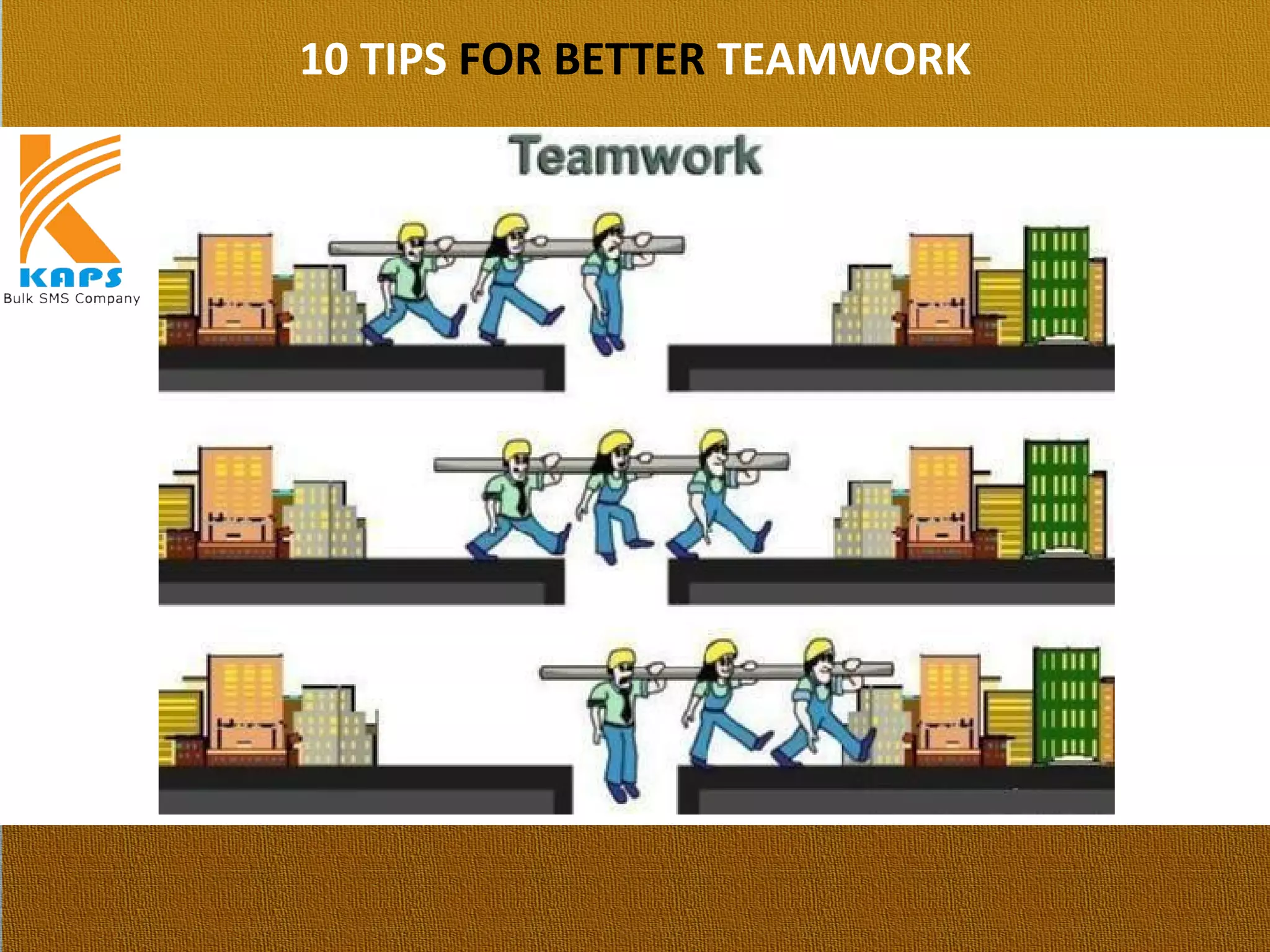

The document outlines ten essential tips for improving teamwork, emphasizing the importance of clear goals, open communication, and a supportive environment. It highlights the value of diverse perspectives, participative leadership, and the commitment of team members to decision-making and conflict resolution. Continuous self-examination and improvement are also critical for enhancing team dynamics and effectiveness.
10 TIPS FORBETTER TEAMWORK
Keys to Successful Teamwork
•The team understands the goals and is committed to attaining them.
This clear direction and agreement on mission and purpose is essential
for effective teamwork.
This team clarity is reinforced when the organization has clear
expectations for the team's work, goals, accountability, and outcomes.
•The team creates an environment in which people are
comfortable taking reasonable risks in communicating, advocating
positions, and taking action. Team members trust each other. Team
members are not punished for disagreeing.
3.
10 TIPS FORBETTER TEAMWORK
• Communication is open, honest, and respectful. People feel free to
express their thoughts, opinions, and potential solutions to
problems. People feel as if they are heard out and listened to by
team members who are attempting to understand. Team members
ask questions for clarity and spend their thought time
listening deeply rather than forming rebuttals while their co-worker
is speaking.
• Team members have a strong sense of belonging to the group. They
experience a deep commitment to the group’s decisions and actions.
This sense of belonging is enhanced and reinforced when the team
spends the time to develop team norms or relationship guidelines
together.
4.
10 TIPS FORBETTER TEAMWORK
• Team members are viewed as unique people with irreplaceable
experiences, points of view, knowledge, and opinions to contribute.
After all, the purpose for forming a team is to take advantage of the
differences.
Otherwise, why would any organization approach projects, products, or
goals with a team. In fact, the more that a team can bring out divergent
points of view, that are thoughtfully presented and supported with facts
as well as opinions, the better.
• Creativity, innovation, and different viewpoints are expected and
encouraged. Comments such as, "we already tried that and it didn't
work" and "what a dumb idea" are not allowed or supported.
• The team is able to constantly examine itself and continuously improve
its processes, practices, and the interaction of team members. The team
openly discusses team norms and what may be hindering its ability to
move forward and progress in areas of effort, talent, and strategy.
5.
10 TIPS FORBETTER TEAMWORK
• The team has agreed upon procedures for diagnosing, analyzing, and
resolving team work problems and conflicts. The team does not
support member personality conflicts and clashes nor do team
members pick sides in a disagreement. Rather, members work
towards mutual resolution.
• Participative leadership is practiced in leading meetings, assigning
tasks, recording decisions and commitments, assessing progress,
holding team members accountable, and providing direction for the
team.
• Members of the team make high quality decisions together and have
the support and commitment of the group to carry out the decisions
made.