

10 STEP Marketing Plan for Red Ribbon CakesJoanne WolcottFebruary 2011Product Photo herePut yourBlog AddressHere. 1
This 10 Step Marketing Plan is part of the mandatory requirements of  Prof. Remigio Joseph De Ungria’s AGSB marketing management class.The data included in this report are based on publicly available data such as those on internet websites, news, package declarations, public reports.When appropriate, data are “masked” so as not to create unexpected conflicts.The reports are posted and linked on slideshare, blogs and facebook so that there is easier sharing among students from different marketing classes.Disclaimer
Primary Target Market	What do they need, want, demandWhat are they choicesWhere is the opportunityHow big is the market (3Cs)Steps 1 to 5Summary headline of  your PTM and market
Class A and B  Families who want to celebrate togetherness and make it specialThey need a good tasting cake that suites the specialty of the occasionFor the longest time goldilocks has the market share for commercial cakesThe gap competition is always about great tasting foodThe market size is with in the class A and BCelebrates Life Beautiful Moments
ProductPrice Promo  Place Generic Winning Strategy of MixSteps 6 to 10Summary headline of the marketing mix & strategy
Products- there are cakes, pastries, breads, pasta miryenda meals, set meals, custom cakes,rollsPrice cakes are from Php 350-595Cake rolls 210-300Pastries Php120-350Miryenda meals average Php 150 Marketing Mix and Strategy
Promo- print, tv and radio. More emphasis on printPlace- major malls, inside jolibee stores and free standing stores with in food district Appeals to the emotion of the customers
1. Describe the primary target market (PTM)*Demographics (Age range: must have a start and end age*, sex, social class, marital status)Lifestyle (what they do)Behavior (when consumed, how much, how frequent, special concerns)*Exclusion of a certain demographic group in PTM does not mean  they do not buy the product. Some do buy, but majority don’t which is why limited marketing resources are best focused on PTM
They are targeting families that are in the class A and B. Has emphasis on the women who chooses food for the familyThey are well to do in the society. All of the commercials are in EnglishThey target people who views food as a sign for to gather people and have “bonding time”Class A and B families who want to make their togetherness special
6.1 percent upper class, 4.2 percent upper-middle class, 57.1 percent middle class (http://opinion.inquirer.net/inquireropinion/columns/view/20100710-280190/NSCB-tries-to-count-the-rich)Total pop of the Phil 92 million approximately 62,008,000 target market (adding all the upper class, upper middle, and middle class)
2. My PTM’s NWDNeeds from Maslow’s hierarchyWants determine choiceDemands for them to buy the productNote: There may be  multiple answers for needs, wants demands.  Of these answers, underline and use bold font for the best answers. See examples that follow
Describe your PTM needsI am happy with my familyI want to belong to a loving familiyReference: Maslow’s Hierarcy of Needs  Marketing Management, 11th ed, Philip Kotler12
2. PTM’s needs, wants & demands Needs: list of needs from Maslow’s hierarchy that the product meets. Wants: what variables are used by the primary target market to choose among several products that can satisfy the same needs.Demands: for the PTM to finally decide to buy the product, what characteristics, values, benefits or selling propositions must the product have?** for needs, wants & demands, underline the top 1or 2 variables that are most important to the PTM
3a. Direct and indirect products that address my PTM’s NWDList of Competitors products/ brandsDetermine the variables that affect choice of product, brand
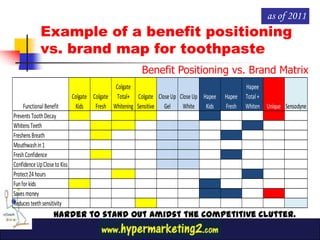
3b. Create 2 Positioning Maps1st Map: 2 x 2 Matrix showing the 2 Most Critical Variables for Consumer choice   This 1st Map should allow differentiation/ non-clustering of the direct competitorsExample: Price vs. AgeSize of bubbles= represent relative market shares of the brands2nd Map: Functional Benefit vs. Brands/ Variants
Example of a 2x2 competitive position map for toothpasteas of 2011Price vs. Age MatrixColgateFreshColgateSensitiveColgatekidsColgateTotal + whitenCloseUpwhitenCloseupSensodyneHapeeFreshHapeeComplete + whitening HapeeUniqueUnique
as of 2011Example of a benefit positioning vs. brand map for toothpasteBenefit Positioning vs. Brand MatrixHarder to stand out amidst the competitive clutter.
4. Identify the gap between customers and competitionWhere is the marketing opportunity?What NWDs are not being addressed?What can be the unique selling proposition for the new product (totally new or repositioned.)
5a. Estimate the market size using competitor data1. Top 7000 Corporation Data or newsTotal Sales from 1 product companies% of sales from multi-product 2. vs. known Industry size comparisons3. vs. 1-1 suppliers4. Visual observation- warehouse5. Pirating personnel or garbage6. Illegal interview7. “Share of Shelf”
5b. Estimate the market size using company dataClaimed market shareGuesstimate on  market shareFair share of marketDistribution extentHistorical sales
5c. Estimate the market size using customer dataUsage per day or per yearPer personPer household
5. Decide on market size in pesos, not in number of peopleCompetitor data=Company data = Customer Usage data = Use instinct and best business judgment to finalize market size
6a. Photo of product categoryShow a product shotYour product and your competitorswith, without box as they look in the supermarketAll pack sizesAll variantsAll major brands
6a. Show how  product looks vs. competitionProduct shot 1 of direct competitorsProduct shot 2 of indirect competitorsHow product looks in supermarket shelves or point of sales
6b. Product DescriptionDescribe the physical features, specifications, attributes of the product.Info may be in product packaging, label, brochures or website.
7. PriceGet prices of your product Creatively compare vs. competitors across different pack sizes and variantsQuantify the price difference in % terms vs. competitorsConclude on what pricing strategy is being used
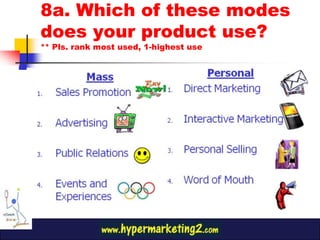
8a. Which of these modes does your product use?** Pls. rank most used, 1-highest use
8a. Your products PromotionsDescribe what you propose to do/ product is currently doing vs. the 8 modes of communications.Show executions of this (from websites, print ads, actual commercials)
8a. Samples of PromoSamplesThis can be in multiple slides
8b. Competitor promoShow also how your key competitors communicateTheir commercialsTheir websitesAnd why your communication stands out
8b. Competitor promoSamplesCan be multiple slides
9. PlaceWhere is your product available?Supermarkets, sari-sari stores, convenience outlets, drugstoresNationwide or in key areas only?Method of delivery (some products can be delivered to your home, ordered via internet, phone orders, etc.)
10. What is the generic winning strategy?Which of the 4 strategies are being used? (bold and underline to most dominant strategy)Low Cost ProducerSupply and Distribution LeverageDifferentiationNiche
34SUMMARY
Identify your target (PTM)What do they need, want, demand (NWD)What are they choices (competitors)Where is the opportunity (gap)How big is the market (3Cs)Steps 1 to 5Summary headline of  your PTM and market
ProductPrice Promo  Place Generic Winning Strategy of MixSteps 6 to 10Summary headline of the marketing mix & strategy
37YOUR ASSIGNMENT AS A MARKETING STUDENT
Your AssignmentUse this template to make your marketing plan for a product or company that will also be the topic of your STRAMAFollow power presentation principles
GradingCustomers (PTM, NWD)- 20%Competition (Positioning Map, Market Size) 30%Company (4Ps, Strategy)- 40%Power Principles Formatting- 10%

10 step marketing plan draft wolcott

  • 1.
    10 STEP MarketingPlan for Red Ribbon CakesJoanne WolcottFebruary 2011Product Photo herePut yourBlog AddressHere. 1
  • 2.
    This 10 StepMarketing Plan is part of the mandatory requirements of Prof. Remigio Joseph De Ungria’s AGSB marketing management class.The data included in this report are based on publicly available data such as those on internet websites, news, package declarations, public reports.When appropriate, data are “masked” so as not to create unexpected conflicts.The reports are posted and linked on slideshare, blogs and facebook so that there is easier sharing among students from different marketing classes.Disclaimer
  • 3.
    Primary Target Market Whatdo they need, want, demandWhat are they choicesWhere is the opportunityHow big is the market (3Cs)Steps 1 to 5Summary headline of your PTM and market
  • 4.
    Class A andB Families who want to celebrate togetherness and make it specialThey need a good tasting cake that suites the specialty of the occasionFor the longest time goldilocks has the market share for commercial cakesThe gap competition is always about great tasting foodThe market size is with in the class A and BCelebrates Life Beautiful Moments
  • 5.
    ProductPrice Promo Place Generic Winning Strategy of MixSteps 6 to 10Summary headline of the marketing mix & strategy
  • 6.
    Products- there arecakes, pastries, breads, pasta miryenda meals, set meals, custom cakes,rollsPrice cakes are from Php 350-595Cake rolls 210-300Pastries Php120-350Miryenda meals average Php 150 Marketing Mix and Strategy
  • 7.
    Promo- print, tvand radio. More emphasis on printPlace- major malls, inside jolibee stores and free standing stores with in food district Appeals to the emotion of the customers
  • 8.
    1. Describe theprimary target market (PTM)*Demographics (Age range: must have a start and end age*, sex, social class, marital status)Lifestyle (what they do)Behavior (when consumed, how much, how frequent, special concerns)*Exclusion of a certain demographic group in PTM does not mean they do not buy the product. Some do buy, but majority don’t which is why limited marketing resources are best focused on PTM
  • 9.
    They are targetingfamilies that are in the class A and B. Has emphasis on the women who chooses food for the familyThey are well to do in the society. All of the commercials are in EnglishThey target people who views food as a sign for to gather people and have “bonding time”Class A and B families who want to make their togetherness special
  • 10.
    6.1 percent upperclass, 4.2 percent upper-middle class, 57.1 percent middle class (http://opinion.inquirer.net/inquireropinion/columns/view/20100710-280190/NSCB-tries-to-count-the-rich)Total pop of the Phil 92 million approximately 62,008,000 target market (adding all the upper class, upper middle, and middle class)
  • 11.
    2. My PTM’sNWDNeeds from Maslow’s hierarchyWants determine choiceDemands for them to buy the productNote: There may be multiple answers for needs, wants demands. Of these answers, underline and use bold font for the best answers. See examples that follow
  • 12.
    Describe your PTMneedsI am happy with my familyI want to belong to a loving familiyReference: Maslow’s Hierarcy of Needs Marketing Management, 11th ed, Philip Kotler12
  • 13.
    2. PTM’s needs,wants & demands Needs: list of needs from Maslow’s hierarchy that the product meets. Wants: what variables are used by the primary target market to choose among several products that can satisfy the same needs.Demands: for the PTM to finally decide to buy the product, what characteristics, values, benefits or selling propositions must the product have?** for needs, wants & demands, underline the top 1or 2 variables that are most important to the PTM
  • 14.
    3a. Direct andindirect products that address my PTM’s NWDList of Competitors products/ brandsDetermine the variables that affect choice of product, brand
  • 15.
    3b. Create 2Positioning Maps1st Map: 2 x 2 Matrix showing the 2 Most Critical Variables for Consumer choice This 1st Map should allow differentiation/ non-clustering of the direct competitorsExample: Price vs. AgeSize of bubbles= represent relative market shares of the brands2nd Map: Functional Benefit vs. Brands/ Variants
  • 16.
    Example of a2x2 competitive position map for toothpasteas of 2011Price vs. Age MatrixColgateFreshColgateSensitiveColgatekidsColgateTotal + whitenCloseUpwhitenCloseupSensodyneHapeeFreshHapeeComplete + whitening HapeeUniqueUnique
  • 17.
    as of 2011Exampleof a benefit positioning vs. brand map for toothpasteBenefit Positioning vs. Brand MatrixHarder to stand out amidst the competitive clutter.
  • 18.
    4. Identify thegap between customers and competitionWhere is the marketing opportunity?What NWDs are not being addressed?What can be the unique selling proposition for the new product (totally new or repositioned.)
  • 19.
    5a. Estimate themarket size using competitor data1. Top 7000 Corporation Data or newsTotal Sales from 1 product companies% of sales from multi-product 2. vs. known Industry size comparisons3. vs. 1-1 suppliers4. Visual observation- warehouse5. Pirating personnel or garbage6. Illegal interview7. “Share of Shelf”
  • 20.
    5b. Estimate themarket size using company dataClaimed market shareGuesstimate on market shareFair share of marketDistribution extentHistorical sales
  • 21.
    5c. Estimate themarket size using customer dataUsage per day or per yearPer personPer household
  • 22.
    5. Decide onmarket size in pesos, not in number of peopleCompetitor data=Company data = Customer Usage data = Use instinct and best business judgment to finalize market size
  • 23.
    6a. Photo ofproduct categoryShow a product shotYour product and your competitorswith, without box as they look in the supermarketAll pack sizesAll variantsAll major brands
  • 24.
    6a. Show how product looks vs. competitionProduct shot 1 of direct competitorsProduct shot 2 of indirect competitorsHow product looks in supermarket shelves or point of sales
  • 25.
    6b. Product DescriptionDescribethe physical features, specifications, attributes of the product.Info may be in product packaging, label, brochures or website.
  • 26.
    7. PriceGet pricesof your product Creatively compare vs. competitors across different pack sizes and variantsQuantify the price difference in % terms vs. competitorsConclude on what pricing strategy is being used
  • 27.
    8a. Which ofthese modes does your product use?** Pls. rank most used, 1-highest use
  • 28.
    8a. Your productsPromotionsDescribe what you propose to do/ product is currently doing vs. the 8 modes of communications.Show executions of this (from websites, print ads, actual commercials)
  • 29.
    8a. Samples ofPromoSamplesThis can be in multiple slides
  • 30.
    8b. Competitor promoShowalso how your key competitors communicateTheir commercialsTheir websitesAnd why your communication stands out
  • 31.
  • 32.
    9. PlaceWhere isyour product available?Supermarkets, sari-sari stores, convenience outlets, drugstoresNationwide or in key areas only?Method of delivery (some products can be delivered to your home, ordered via internet, phone orders, etc.)
  • 33.
    10. What isthe generic winning strategy?Which of the 4 strategies are being used? (bold and underline to most dominant strategy)Low Cost ProducerSupply and Distribution LeverageDifferentiationNiche
  • 34.
  • 35.
    Identify your target(PTM)What do they need, want, demand (NWD)What are they choices (competitors)Where is the opportunity (gap)How big is the market (3Cs)Steps 1 to 5Summary headline of your PTM and market
  • 36.
    ProductPrice Promo Place Generic Winning Strategy of MixSteps 6 to 10Summary headline of the marketing mix & strategy
  • 37.
    37YOUR ASSIGNMENT ASA MARKETING STUDENT
  • 38.
    Your AssignmentUse thistemplate to make your marketing plan for a product or company that will also be the topic of your STRAMAFollow power presentation principles
  • 39.
    GradingCustomers (PTM, NWD)-20%Competition (Positioning Map, Market Size) 30%Company (4Ps, Strategy)- 40%Power Principles Formatting- 10%