Case Analysis
GEB 4890
Dalton Williams, Richard Poole, Meredith Capps, Ashley Pepe
2
Table of Contents
Executive Summary 3
The Company 4
Competitive Environment 8
Internal Strengths and Weakness 14
SWOT analysis 15
Recommendations 19
Implementations 22
Evaluations 23
Works Cited 25
3
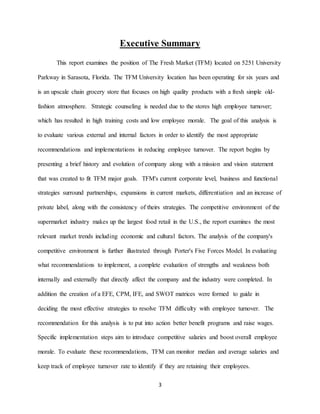
Executive Summary
This report examines the position of The Fresh Market (TFM) located on 5251 University
Parkway in Sarasota, Florida. The TFM University location has been operating for six years and
is an upscale chain grocery store that focuses on high quality products with a fresh simple old-
fashion atmosphere. Strategic counseling is needed due to the stores high employee turnover;
which has resulted in high training costs and low employee morale. The goal of this analysis is
to evaluate various external and internal factors in order to identify the most appropriate
recommendations and implementations in reducing employee turnover. The report begins by
presenting a brief history and evolution of company along with a mission and vision statement
that was created to fit TFM major goals. TFM's current corporate level, business and functional
strategies surround partnerships, expansions in current markets, differentiation and an increase of
private label, along with the consistency of theirs strategies. The competitive environment of the
supermarket industry makes up the largest food retail in the U.S., the report examines the most
relevant market trends including economic and cultural factors. The analysis of the company's
competitive environment is further illustrated through Porter's Five Forces Model. In evaluating
what recommendations to implement, a complete evaluation of strengths and weakness both
internally and externally that directly affect the company and the industry were completed. In
addition the creation of a EFE, CPM, IFE, and SWOT matrices were formed to guide in
deciding the most effective strategies to resolve TFM difficulty with employee turnover. The
recommendation for this analysis is to put into action better benefit programs and raise wages.
Specific implementation steps aim to introduce competitive salaries and boost overall employee
morale. To evaluate these recommendations, TFM can monitor median and average salaries and
keep track of employee turnover rate to identify if they are retaining their employees.
4
The Company
History: The Fresh Market, Inc.
Their current Chairman of the Board, Ray Berry, established The Fresh Markets on March 5,
1982 in Greensboro, North Carolina. Berry’s vision was to create a grocery store that brought
back the old-world charm of the traditional European style market. Moving past the commonly
used over-commercialized stores of the day; to create a warm inviting space with rustic decor,
wooden and glass displays that carry high quality fruits, vegetables and meats from local
farmers. Throughout the 1980’s and 90’s, The Fresh Market extended its presence across the
southeastern United States. In the late 90’s, the company was able to enter Florida eventually
resulting in 40 stores statewide making their presence in the Sun Shine state their largest market
compared to another region. As of January 2015, The Fresh Market operates in 27 states
including the recently added states of Texas, Missouri and Delaware equaling a total of 169
stores nationwide. They have plans to expand into new geographical markets in the Midwest.
Even though this organization has extended its reach across the United States, Berry has kept the
corporate office at the heart of their beginning in Greensboro, North Carolina. The history of
Fresh Market Inc. has been characterized by growth and their innovative approach to fresh
product contribution. The typical store has a staff of 70-80 full and part time employees, with a
store manager, 2 to 3 assistant managers and five department heads. Based on the total number
of stores and the number of employees per location, The Fresh Market currently employs
approximately 7,800 individuals. The Fresh Market store being evaluated in our project is the
Sarasota location. This location was the first to open in Southwest Florida at Kohl’s-anchored plaza on
University Parkway in 2009.
Mission & Major Goals
5
The Fresh Market does not have a vision or mission statement available; as a result our group
created statements that we felt would suite the nature of the organization and their goals. A
vision statement decelerates what a company wants to become. The vision our group created
expresses The Fresh Market's desire to be best known for excellence in customer service and
high quality products. The mission statement includes almost all 9 components except
characteristic number 4 based on technology. Giving the firm's desire to keep the old feel and
simplicity we felt that this component would not fit appropriately.
Vision
Our vision is to be your neighborhood grocer that's focused on our valued customers shopping experience
and providing the freshest local ingratiates and products.
Mission:
The Fresh Market is dedicated to delivering a superior shopping experience by offering fresh
premium grocery products (2,7) with a passion to provide a higher level of service to customers
(1). We maintain a work environment that fosters fairness, respect and integrity (6); that
continuously strives to engender employee pride and enthusiasm by fostering relationships and
promoting within (9). We are devoted to continuous growth (5) with a diverse geographical
presence (3) along with a commitment to being an active part in each community that we serve
(8).
Current Strategies
Corporate Level Strategies: This past year, The Fresh Market has announced their national
partnership with The Coalition of Immokalee Workers (CIW), promoting fair farm labor
6
conditions and worker-driven social responsibility in US agriculture. The partnership helps The
Fresh Market look for ways to provide the highest quality product sources, while promoting
socially responsibility and allowing them to provide products that customers can feel good about
purchasing while improving profitability and future growth. The Fresh Market is also taking
strategic action, considering the analysis of their anticipated future cash flows, and the long-term
stability of stores. To accomplish this goal, The Fresh Market decided to close their three
remaining stores located in California by the end of March 2015. The company feels it can
accomplish more dependable financial results, plus better return on its investments through
continuing to grow in markets closer to its current markets.
Competitive/ Business Strategies: The Fresh Market Business strategy is focused on
differentiating oneself from its competitors. To set them apart in the industry, The Fresh Market
offers healthy and fresh alternatives including organic, non-GMO and gluten free products
provided by local food sources. They carefully select foods based on taste, color, size, grade and
freshness. These products are carefully selected to delight customers’ senses and embraces clean
living. From Porter's Generic Strategies, The Fresh Market is focusing on differentiation generic
strategy Type 3. Aiming to provide products that are unique in quality compared to competitor’s
along with consumers that view this differentiation as valuable, who are not sensitive to price.
Functional Strategies: Continuous store growth will allow The Fresh Market greater profitability
and leverage over buying cost, supply chain costs, and gross margins. Their marketing strategy
relies significantly on word-of-mouth versus traditional advertising. In the fiscal year 2014, The
Fresh Market's total marketing expense was only .3% of annual revenue, which is significantly
lower than their competitors. Research constructed on in-store customers revealed that about
only 2% of its customers shop at its stores on a weekly routine. In efforts to increase regular
7
customer visits, The Fresh Market has spent most of their marketing expenses on signage,
cooking demonstrations and sampling; thus enhancing and increasing market share with regular
visits from customers who are already shop there. Another strategy is to add real and perceived
value to the fresh market brand by implementing strategies to further their scope with relative
diversification. In order to gain a larger market share, they have diversified by providing a
greater of solutions for meal occasions, expanding products under their private label brands,
increasing selection of local and regional products, and utilizing in-store cross merchandising.
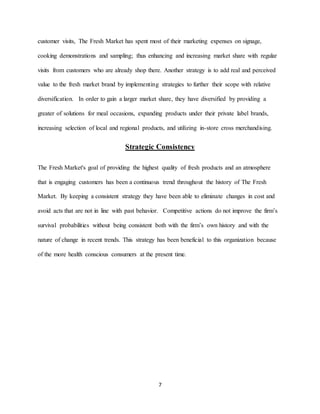
Strategic Consistency
The Fresh Market's goal of providing the highest quality of fresh products and an atmosphere
that is engaging customers has been a continuous trend throughout the history of The Fresh
Market. By keeping a consistent strategy they have been able to eliminate changes in cost and
avoid acts that are not in line with past behavior. Competitive actions do not improve the firm’s
survival probabilities without being consistent both with the firm’s own history and with the
nature of change in recent trends. This strategy has been beneficial to this organization because
of the more health conscious consumers at the present time.
8
Competitive Environment
According to IBISWorld, "The Supermarkets and Grocery Stores industry makes up the
largest food retail in the United States. Establishments in the industry retail general lines of food
products, including fresh and prepared meats, poultry and seafood, canned and frozen foods,
fresh fruits and vegetables and various dairy products. Delicatessens primarily retailing food are
also included."
The most relevant trends affecting the supermarkets and grocery store industry are
economic and cultural factors.
Economic Factors
Per capita disposable income is expected to increase by a compound growth rate of 2.5%
over next 5 years, which leaves money for consumers to spend at the grocery store. The volatile
agricultural price index is expected to be consistent, and therefore allows stores to predict and
budget costs of food and to increase profit margins. Health concerns have increased the demand
for healthy, all-natural, and organic foods; more people are eating healthier to stay healthy.
Competition is growing more intense with more and more non-traditional grocery stores selling
food. Supermarkets and grocery stores are now competing against supercenters such as Wal-
Mart, warehouse clubs such as Costco, and even with convenient and dollars stores for food
sales.
Supermarkets and grocery stores have increased promotions and discounts to get
consumers in their stores and to nurture customer loyalty, but these discounts reduce profits. To
increase foot traffic and keep customers in their stores, some grocery stores are offering non-
9
food related amenities such as ATM machines and movie rentals, and advanced mobile apps are
expected in the near future.
Cultural Factors
The culture in the United States is eating healthier according to the healthy eating index.
Thanks to the Internet and advertisements, people are more knowledgeable about their health and
about what is in their food. Many popular documentaries and news reports point out that
processed foods, trans fats, and sugary beverages are not only making us fat, but they are also
making us unhealthy. Even the first lady, Michelle Obama, has made it one of her missions for
children to eat healthier and schools to serve healthier lunches. The trend in the country of being
health conscious has increased substantially, and people today are choosing to eat healthier foods
than they in the past.
Porters Five Forces
Rivalry among competing firms
Although the homogenous nature of retail food and beverage business creates strong
competition amongst rivals, the industry is also non-cyclical and therefore demand is fairly
consistent. Evaluating the competitive environment of the supermarkets and grocery stores
industry using Porter's five forces of competition, fierce competition is evident. Rivalry among
competition is fierce and high. Much of the food and items sold in grocery stores are
commodities, so companies compete on price. Slim profit margins of an average of 1.2% are an
obvious effect of extreme rivalry.
10
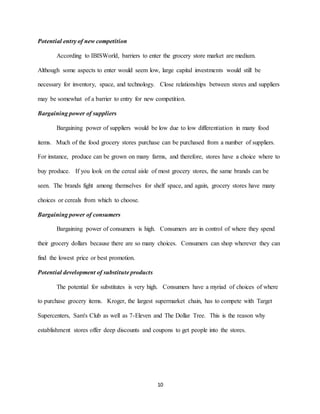
Potential entry of new competition
According to IBISWorld, barriers to enter the grocery store market are medium.
Although some aspects to enter would seem low, large capital investments would still be
necessary for inventory, space, and technology. Close relationships between stores and suppliers
may be somewhat of a barrier to entry for new competition.
Bargaining power of suppliers
Bargaining power of suppliers would be low due to low differentiation in many food
items. Much of the food grocery stores purchase can be purchased from a number of suppliers.
For instance, produce can be grown on many farms, and therefore, stores have a choice where to
buy produce. If you look on the cereal aisle of most grocery stores, the same brands can be
seen. The brands fight among themselves for shelf space, and again, grocery stores have many
choices or cereals from which to choose.
Bargaining power of consumers
Bargaining power of consumers is high. Consumers are in control of where they spend
their grocery dollars because there are so many choices. Consumers can shop wherever they can
find the lowest price or best promotion.
Potential development of substitute products
The potential for substitutes is very high. Consumers have a myriad of choices of where
to purchase grocery items. Kroger, the largest supermarket chain, has to compete with Target
Supercenters, Sam's Club as well as 7-Eleven and The Dollar Tree. This is the reason why
establishment stores offer deep discounts and coupons to get people into the stores.
11
Identification and evaluation of ethical challenges, social responsibility, and legal
challenges
Grocery stores have the additional challenge of much of their inventory is perishable.
Having to take a loss on fruits, vegetables, breads, dairy and meats that spoil contributes to low
margins. Grocery stores have a moral and legal obligation to the public to sell food that in not
spoiled, expired, or tainted. Although grocery stores have benefited from the increase in sales of
healthy and organic foods, they have to also take a higher loss on these more expensive items
when they have to be thrown away. Due to some local and state regulations, grocery stores
throw away over ripe produce, foods or day old bread that actually could be used by food banks
and the like. Other legal issues that face the retail food industry have to do with labeling. Food
producers, governmental regulators, and consumers have differing opinions on how to best label
and educate the consumer about the foods they are consuming. Organic produce is labeled
differently that non-organic produce. Two current labeling legalities are whether or not the FDA
should require labeling of GMO's, genetically modified organisms, and meat or dairy that came
from cloned animals. These labeling issues are ethical challenges as well as legal challenges.
The controversy lies in whether it is ethical and socially responsible for the FDA and food
producers to decide that GMO's and clones are perfectly safe and in the consumer's best interest
to leave this information off labels.
12
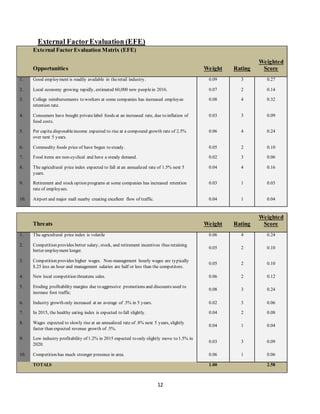
External FactorEvaluation (EFE)
External Factor Evaluation Matrix (EFE)
Opportunities Weight Rating
Weighted
Score
1. Good employment is readily available in theretail industry. 0.09 3 0.27
2. Local economy growing rapidly, estimated 60,000 new peoplein 2016. 0.07 2 0.14
3. College reimbursements to workers at some companies has increased employee
retention rate.
0.08 4 0.32
4. Consumers have bought privatelabel foods at an increased rate, due to inflation of
food costs.
0.03 3 0.09
5. Per capita disposableincome expected to rise at a compound growth rate of 2.5%
over next 5 years.
0.06 4 0.24
6. Commodity foods price of have begun to steady. 0.05 2 0.10
7. Food items are non-cyclical and have a steady demand. 0.02 3 0.06
8. The agricultural price index expected to fall at an annualized rate of 1.5% next 5
years.
0.04 4 0.16
9. Retirement and stock option programs at some companies has increased retention
rate of employees.
0.03 1 0.03
10. Airport and major mall nearby creating excellent flow of traffic. 0.04 1 0.04
Threats Weight Rating
Weighted
Score
1. The agricultural price index is volatile 0.06 4 0.24
2. Competition provides better salary, stock, and retirement incentives thus retaining
better employment longer.
0.05 2 0.10
3. Competition provides higher wages. Non-management hourly wages are typically
$.25 less an hour and management salaries are half or less than the competitors.
0.05 2 0.10
4. New local competition threatens sales. 0.06 2 0.12
5. Eroding profitability margins due to aggressive promotions and discounts used to
increase foot traffic.
0.08 3 0.24
6. Industry growth only increased at an average of .5% in 5 years. 0.02 3 0.06
7. In 2015, the healthy eating index is expected to fall slightly. 0.04 2 0.08
8. Wages expected to slowly rise at an annualized rate of .8% next 5 years, slightly
faster than expected revenue growth of .5%.
0.04 1 0.04
9. Low industry profitability of 1.2% in 2015 expected to only slightly move to 1.5% in
2020.
0.03 3 0.09
10. Competition has much stronger presence in area. 0.06 1 0.06
TOTALS 1.00 2.58
13
The lowest possible weighted score in the external factor evaluation matrix is 1.0; the highest
weighted score is 4.0 and the average weighted score is 2.5. The score reflects how The Fresh Market is
responding to opportunities and threats in the supermarket and grocery store industry. The Fresh Market
weighted score of 2.58 indicates that it is doing barely an above average job at seizing opportunities and
avoiding threats presented to the industry. The Fresh Market definitely has room to improve to strive
toward a competitive edge.
Competitive Profile Matrix
The Fresh Market Publix
Critical Success Factors Weight Rating Score Rating Score
Location .10 3 .30 3 .30
Breadth ofProduct .10 2 .20 3 .30
Customer Service .10 3 .30 4 .40
Quality of Product .20 4 .80 3 .60
Market Share .05 1 .05 3 .15
Advertising .15 1 .15 4 .60
Price Competitive .20 2 .40 3 .60
Customer Loyalty .10 2 .20 3 .30
Total 1.00 2.40 3.25
The Competitive Profile Matrix, CPM, is a ranking tool used by companies to see how they are
responding to factors considered necessary for success compared to their competitors. The
critical success factors can vary by industry. The Fresh Market has a lower total score of 2.40
compared the 3.25 score for Publix. The lower score indicates there are some areas where The
Fresh Market needs to strengthen in order to be more competitive. The two biggest spreads are
in market share and advertising.
14
Internal Strengths and Weakness
Looking into our company internally, we provide some major strengths and weaknesses
that can help The Fresh Market become resilient from the inside with improving factors that
affect day-to-day business and employees. To do this we used an IFE Matrix.
Internal Factor Evaluation Matrix (IFE)
Strengths Weight Rating Weighted Score
Strong sales of Organic product 0.05 4 0.20
Located in a heavy populated area 0.07 3 0.21
Donating $400,000 back into the community 0.02 3 0.06
Growing average basket price (last year little over $28, this year
around $29.30)
0.05 4 0.20
Scored a 83 on consumer reports 0.02 3 0.06
Tripled store count since 2004 0.03 3 0.09
Customer loyalty 0.05 4 0.20
Introducing new and innovated products 0.03 3 0.09
Offers specialty foods hard sought elsewhere 0.10 4 0.40
Growing extension of private brand 0.04 4 0.16
Weaknesses Weight Rating Weighted Score
Stock price has dropped nearly 50% in last 6 months causing talks of a
possible acquisition
0.10 1 0.10
New compensation plan has many employees
confused.
0.05 2 0.10
Employee turnover 55% in a
year
0.15 1 0.15
Low wages 0.07 2 0.14
Low employee morale 0.05 1 0.05
Poor stock options compared to competitor 0.02 2 0.04
Products are targeted more towards the higher class consumer 0.03 2 0.06
Low advertising 0.03 2 0.06
Organizational rewards low 0.02 2 0.04
Salary of department mangers 39,000 year(Nearly double at local
competitor)
0.02 2 0.04
TOTALS 1.00 2.45
15
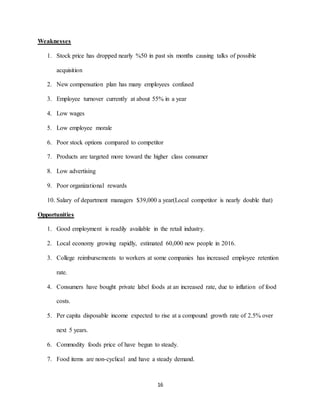
The IFE Matrix shows a score of 2.45, which is below the average score of 2.5; this
means that the factors that make up The Fresh Market are weaker than normal internally. We
can tell from this score that this might be why The Fresh Market has lost employees to the
competitors. The Fresh Market needs to look at these internal factors and improve on the
weaknesses and capitalize on the strengths, so they can stay competitive in the market.
To compare the internal and external factors, we performed a SWOT analysis. This will
show The Fresh Market's major Strengths, Weaknesses, Opportunities and Threats. From the
SWOT analysis, we can determine the best options for The Fresh Market to remain successful
and to gain a competitive advantage.
SWOT Analysis
Strengths
1. Strong sales of organic product
2. Located in a heavily populated area
3. Donated $400,000 back to the community
4. Growing average basket price (last year $28 and change this year around $29.30)
5. Scored an 83 on consumer reports
6. Tripled store count since 2004
7. Strong customer loyalty base
8. Introduces new and innovative products
9. Offers specialty foods hard sought elsewhere
10. Growing extension of private brand
16
Weaknesses
1. Stock price has dropped nearly %50 in past six months causing talks of possible
acquisition
2. New compensation plan has many employees confused
3. Employee turnover currently at about 55% in a year
4. Low wages
5. Low employee morale
6. Poor stock options compared to competitor
7. Products are targeted more toward the higher class consumer
8. Low advertising
9. Poor organizational rewards
10. Salary of department managers $39,000 a year(Local competitor is nearly double that)
Opportunities
1. Good employment is readily available in the retail industry.
2. Local economy growing rapidly, estimated 60,000 new people in 2016.
3. College reimbursements to workers at some companies has increased employee retention
rate.
4. Consumers have bought private label foods at an increased rate, due to inflation of food
costs.
5. Per capita disposable income expected to rise at a compound growth rate of 2.5% over
next 5 years.
6. Commodity foods price of have begun to steady.
7. Food items are non-cyclical and have a steady demand.
17
8. The agricultural price index expected to fall at an annualized rate of 1.5% next 5 years.
9. Retirement and stock option programs at some companies has increased retention rate of
employees.
10. Airport and major mall nearby creating excellent flow of traffic.
Threats
1. The agricultural price index is volatile.
2. Competition provides better salary, stock, and retirement incentives thus retaining
better employment longer.
3. Competition provides higher wages. Non-management hourly wages are typically
$.25 less an hour and management salaries are half or less than the competitors.
4. New local competition threatens sales.
5. Eroding profitability margins due to aggressive promotions and discounts used to
increase foot traffic.
6. Industry growth only increased at an average of .5% in 5 years.
7. In 2015, the healthy eating index is expected to fall slightly.
8. Wages expected to slowly rise at an annualized rate of .8% next 5 years, slightly
faster than expected revenue growth of .5%.
9. Low industry profitability of 1.2% in 2015 expected to only slightly move to 1.5% in
2020.
10. Competition has much stronger presence in area.
18
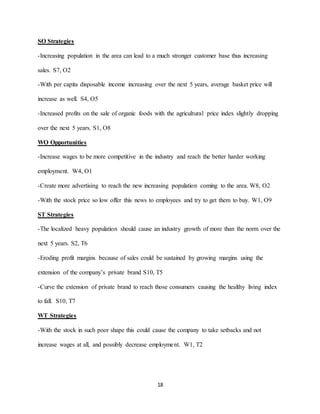
SO Strategies
-Increasing population in the area can lead to a much stronger customer base thus increasing
sales. S7, O2
-With per capita disposable income increasing over the next 5 years, average basket price will
increase as well. S4, O5
-Increased profits on the sale of organic foods with the agricultural price index slightly dropping
over the next 5 years. S1, O8
WO Opportunities
-Increase wages to be more competitive in the industry and reach the better harder working
employment. W4, O1
-Create more advertising to reach the new increasing population coming to the area. W8, O2
-With the stock price so low offer this news to employees and try to get them to buy. W1, O9
ST Strategies
-The localized heavy population should cause an industry growth of more than the norm over the
next 5 years. S2, T6
-Eroding profit margins because of sales could be sustained by growing margins using the
extension of the company’s private brand S10, T5
-Curve the extension of private brand to reach those consumers causing the healthy living index
to fall. S10, T7
WT Strategies
-With the stock in such poor shape this could cause the company to take setbacks and not
increase wages at all, and possibly decrease employment. W1, T2
19
-With competitor’s salaries and incentives being better, this causes the high employment
turnover at the store (Why would people work for less). W3, T2
-If wages aren’t increased with the expected natural wage increase over the next 5 years, this will
cause turnover to continue and morale to be low, as well as attract less capable employment.
T8,W3, W5
-With the increased number of stores, and better compensation Publix causes a decent amount of
the employee loss. (T2,T10,W3/4)
Recommendations
The Fresh Market has the ability to be a leader in the local grocery store market. Because
of the stores weaknesses and strengths, however, their success is currently getting held back or at
a plateau. We have two strategies to recommend that could improve The Fresh Market's success,
profitability, and competitive advantage. First, we would recommend implementing a better
benefits program for their employees to help retain them. Secondly, we would recommend
raising employee wages to retain them as well, considering that pay is very low in comparison to
competitors. In retrospect, this move could actually save the company money in the long run
because funds wouldn't be spent to constantly train new employees, and there wouldn’t be near
as much time taken out of managers shift for interviewing and communicating with new hires.
This would ultimately make the employees happy and drive morale, which would make them
more friendly and happy when dealing with customers, which would then draw more customers
thus, driving sales.
20
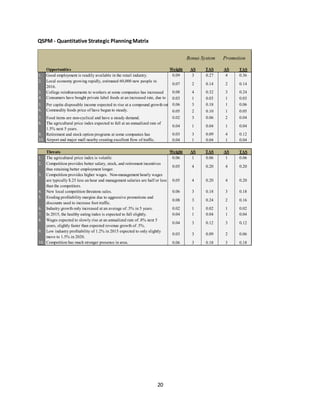
QSPM - Quantitative Strategic PlanningMatrix
Opportunities Weight AS TAS AS TAS
1. Good employment is readily available in the retail industry. 0.09 3 0.27 4 0.36
2. Local economy growing rapidly, estimated 60,000 new people in
2016.
0.07 2 0.14 2 0.14
3. College reimbursements to workers at some companies has increased 0.08 4 0.32 3 0.24
4. Consumers have bought private label foods at an increased rate, due to
inflation of food costs.
0.03 1 0.03 1 0.03
5. Per capita disposable income expected to rise at a compound growth rate of 2.5% over next 5 years.0.06 3 0.18 1 0.06
6. Commodity foods price of have begun to steady. 0.05 2 0.10 1 0.05
7. Food items are non-cyclical and have a steady demand. 0.02 3 0.06 2 0.04
8. The agricultural price index expected to fall at an annualized rate of
1.5% next 5 years.
0.04 1 0.04 1 0.04
9. Retirement and stock option programs at some companies has 0.03 3 0.09 4 0.12
10. Airport and major mall nearby creating excellent flow of traffic. 0.04 1 0.04 1 0.04
Threats Weight AS TAS AS TAS
1. The agricultural price index is volatile 0.06 1 0.06 1 0.06
2. Competition provides better salary, stock, and retirement incentives
thus retaining better employment longer.
0.05 4 0.20 4 0.20
3. Competition provides higher wages. Non-management hourly wages
are typically $.25 less an hour and management salaries are half or less
than the competitors.
0.05 4 0.20 4 0.20
4. New local competition threatens sales. 0.06 3 0.18 3 0.18
5. Eroding profitability margins due to aggressive promotions and
discounts used to increase foot traffic.
0.08 3 0.24 2 0.16
6. Industry growth only increased at an average of .5% in 5 years. 0.02 1 0.02 1 0.02
7. In 2015, the healthy eating index is expected to fall slightly. 0.04 1 0.04 1 0.04
8. Wages expected to slowly rise at an annualized rate of .8% next 5
years, slightly faster than expected revenue growth of .5%.
0.04 3 0.12 3 0.12
9. Low industry profitability of 1.2% in 2015 expected to only slightly
move to 1.5% in 2020.
0.03 3 0.09 2 0.06
10. Competition has much stronger presence in area. 0.06 3 0.18 3 0.18
PromotionBonus System
21
Strengths Weight AS TAS AS TAS
1. Strong sales of Organic product 0.05 4 0.20 4 0.20
2. Located in a heavy populated area 0.07 3 0.21 3 0.21
3. Donating $400,000 back into the community 0.02 2 0.04 3 0.06
4. Growing average basket price (last year little over $28, this year
around $29.30)
0.05 4 0.20 3 0.15
5. Scored a 83 on consumer reports 0.02 3 0.06 3 0.06
6. Tripled store count since 2004 0.03 4 0.12 4 0.12
7. Customer loyalty 0.05 3 0.15 4 0.20
8. Intrducing new and innovated products 0.03 3 0.09 3 0.09
9. Offers specialty foods hard sought elsewhere 0.10 3 0.30 3 0.30
10. Growing extension of private brand 0.04 3 0.12 4 0.16
Weaknesses Weight AS TAS AS TAS
1. Stock price has dropped nearly 50% in the last 6 months causing talks
of a possible acquision
0.10 1 0.10 1 0.10
2. New compoensation plan has many employees confused 0.05 1 0.05 1 0.05
3. Employee turnover 55% in a year 0.15 1 0.15 1 0.15
4. Low wages 0.07 1 0.07 1 0.07
5. Low employee morale 0.05 1 0.05 1 0.05
6. Poor stock options compared to competior 0.02 1 0.02 1 0.02
7. Products are targeted more towards the higher class consumer 0.03 2 0.06 1 0.03
8. Low advertising 0.03 1 0.03 1 0.03
9. Organizational rewards low 0.02 1 0.02 1 0.02
10. Salary of department managers 39,000 year(Nearly double at local
competior)
0.02 1 0.02 1 0.02
TOTALS 4.66 4.43
Bonus System Promotion
22
Implementation
1. The Fresh Market would provide a competitive salary to compete with other
supermarkets to keep employee turnover at a low. To reward and retain managers, The
Fresh Market would increase salaries by implementing a new bonus system for managers
to receive an inventory bonus every fiscal quarter, which would improve their income up
to $10,000 annually. This bonus program would be is just like the bonus program at the
major competitor, Publix. Managers at Publix derive much of their salary as bonuses.
Increasing salary by inventory evaluation would be attractive for associates and managers
to stay with The Fresh Market and be more accountable with products.
2. To boost employee moral, we would implement new advantages for working for The
Fresh Market, such as better retirement and stock option programs. The Fresh Market
will encourage upper management to show that they care about employees and what the
employee's goals are even if the goals are not related to the company. The Fresh Market
should promote from within the company, and know and value each employee’s talents
and strong points. An employee appreciation day would be implemented and take place
annually for management to spend a day thanking employees for all the hard work and
devotion they have provided. A strong human relations department is vital to keeping
moral up.
23
Evaluation
Data indicates that The Fresh Market pays it employees less on average than Publix pays
its employees. According to the compensation data collection company, PayScale, the national
hourly rate range for The Fresh Market is $9.08 - $14.70 and the range for Publix is $8.48 -
$16.17. Although The Fresh Market average starting pay is almost 7% higher than Publix, the
top end pay for The Fresh Market is almost 10% lower. Some other hourly employee wage
disparities at the highest average pay rate are as follows and are seen in the graph below:
The Fresh Market Publix
Baker $14.96 $16.77
Bakery Manager $16.43 $20.45
Butcher $16.63 $18.76
Sales clerk/cashier $11.75 $14.79
24
The trend of Publix employees making more money for the same job than at The Fresh
Market was seen almost across departments. There were only a couple exceptions to this rule.
Differences are also found in salaries and bonuses of management. For instance, the median
salary for a deli manager for The Fresh Market is $38,000, and the median salary for a deli
manager for Publix is $52,381, that is a 27% variance. Grocery store managers at Publix receive
an average $14,000 annual bonus, whereas the same managers at The Fresh Market only receive
an average $3,000 annual bonus, that is a 466% difference.
The recommendations are to incentivize managers at The Fresh Market by increasing
salaries, bonuses, and stock and retirement options. The result expected by implementing these
recommendations is to retain qualified experienced managers. To evaluate how The Fresh
Market is doing regarding these recommendations is to monitor median and average salaries on a
quarterly and annually basis. The reason for measuring and comparing salaries and bonuses is
because low pay, and the resulting low morale, is the main cause of employment turnover.
PayScale is a reliable source to evaluate management salaries and bonuses compared to Publix.
The PayScale index is reported quarterly.
The employee turnover over rate would also be an excellent measurement tool to use to
evaluate how well The Fresh Market is doing at retaining employees. Publix voluntarily reports
full-time employee turnover rate, which was 3% in 2013 according to Forbes magazine. We
could not find a reliable source that collects data on The Fresh Market's employee turnover rate,
but we would recommend they collect this data internally and include in their annual reports.
The last measurement tool we would utilize is an employee morale survey. The survey
would allow employees to rate on a scale of 1 to 5, 1 being lowest, on how they feel towards a
variety of aspects of their jobs. Included would be how they felt regarding their pay and being
25
valued by management. This survey would be conducted and evaluated semi-annually, and will
give management a clear picture of current employee morale.
Works Cited
http://www.pwc.com/us/en/retail-consumer/financial-performance-report/financial-performance-report-
download.html
“Retail & Consumer Insights: 2015 Financial Benchmarking” 10/10/15
http://globaledge.msu.edu/global-insights/by/industry
“Retail: Introduction”; "Retail: Background”; “Food and Beverage:Introduction”; “Consumer Products:
Introduction”. 10/10/15
http://www.gmaonline.org/file-manager/A_Hard_Road-
Why_CPG_Companies_Need_a_Strategic_Approach_to_Transportation-GMA-
BCG_Report_July_2015.pdf
“A Hard Road: Why CPGCompanies Need a Strategic Approach to Transportation” 10/10/15
http://www.mckinsey.com/client_service/retail/case_studies/renewing_store_formats_for_a_major_grocer
y_retailer
“Renewing store formats for a major grocery retailer”. 10/10/15
http://clients1.ibisworld.com.ezproxy.lib.usf.edu/reports/us/industry/default.aspx?entid=1040
“IBISWorld Industry Report 44511Supermarkets and Grocery Stores in the US June 2015 Will
McKitterick”.
http://www.foodnavigator-usa.com/Markets/US-organic-food-market-to-grow-14-from-2013-18
“US organic food market to grow 14% from 2013-18”, By Stephen DANIELLS,03-Jan-2014.
IBISWorld Business Environment Report: Per capita disposable income. IBISWorld. October 2015.
http://www.payscale.com/research/US/Employer=The_Fresh_Market,_Inc./Hourly_Rate 11/22/15
http://archive.fortune.com/magazines/fortune/best-companies/2013/snapshots/77.html 11/22/15
Dennis, C. (2015, January 8). BREAKINGNEWS: Fresh Market signs Fair Food agreement with CIW!
Retrieved November 2, 2015, from http://www.ciw-online.org/blog/2015/01/fresh-market-signs/
David, F. (2015). Strategic management concepts: A competitive advantage approach (15th ed.). Boston:
Pearson.
Form 10-k Fresh Market, Inc. (2015). Morningstar® Document Research.
History. (2013). Retrieved October 24, 2015, from http://www.thefreshmarket.com/history/
Floras, O. (2015, March 7). The Fresh Market in Santa Barbara is Closing. Retrieved November 3, 2015,
from http://www.keyt.com/news/the-fresh-market-in-santa-barbara-closing/31653712

Final Final Paper

  • 1.
    Case Analysis GEB 4890 DaltonWilliams, Richard Poole, Meredith Capps, Ashley Pepe
  • 2.
    2 Table of Contents ExecutiveSummary 3 The Company 4 Competitive Environment 8 Internal Strengths and Weakness 14 SWOT analysis 15 Recommendations 19 Implementations 22 Evaluations 23 Works Cited 25
  • 3.
    3 Executive Summary This reportexamines the position of The Fresh Market (TFM) located on 5251 University Parkway in Sarasota, Florida. The TFM University location has been operating for six years and is an upscale chain grocery store that focuses on high quality products with a fresh simple old- fashion atmosphere. Strategic counseling is needed due to the stores high employee turnover; which has resulted in high training costs and low employee morale. The goal of this analysis is to evaluate various external and internal factors in order to identify the most appropriate recommendations and implementations in reducing employee turnover. The report begins by presenting a brief history and evolution of company along with a mission and vision statement that was created to fit TFM major goals. TFM's current corporate level, business and functional strategies surround partnerships, expansions in current markets, differentiation and an increase of private label, along with the consistency of theirs strategies. The competitive environment of the supermarket industry makes up the largest food retail in the U.S., the report examines the most relevant market trends including economic and cultural factors. The analysis of the company's competitive environment is further illustrated through Porter's Five Forces Model. In evaluating what recommendations to implement, a complete evaluation of strengths and weakness both internally and externally that directly affect the company and the industry were completed. In addition the creation of a EFE, CPM, IFE, and SWOT matrices were formed to guide in deciding the most effective strategies to resolve TFM difficulty with employee turnover. The recommendation for this analysis is to put into action better benefit programs and raise wages. Specific implementation steps aim to introduce competitive salaries and boost overall employee morale. To evaluate these recommendations, TFM can monitor median and average salaries and keep track of employee turnover rate to identify if they are retaining their employees.
  • 4.
    4 The Company History: TheFresh Market, Inc. Their current Chairman of the Board, Ray Berry, established The Fresh Markets on March 5, 1982 in Greensboro, North Carolina. Berry’s vision was to create a grocery store that brought back the old-world charm of the traditional European style market. Moving past the commonly used over-commercialized stores of the day; to create a warm inviting space with rustic decor, wooden and glass displays that carry high quality fruits, vegetables and meats from local farmers. Throughout the 1980’s and 90’s, The Fresh Market extended its presence across the southeastern United States. In the late 90’s, the company was able to enter Florida eventually resulting in 40 stores statewide making their presence in the Sun Shine state their largest market compared to another region. As of January 2015, The Fresh Market operates in 27 states including the recently added states of Texas, Missouri and Delaware equaling a total of 169 stores nationwide. They have plans to expand into new geographical markets in the Midwest. Even though this organization has extended its reach across the United States, Berry has kept the corporate office at the heart of their beginning in Greensboro, North Carolina. The history of Fresh Market Inc. has been characterized by growth and their innovative approach to fresh product contribution. The typical store has a staff of 70-80 full and part time employees, with a store manager, 2 to 3 assistant managers and five department heads. Based on the total number of stores and the number of employees per location, The Fresh Market currently employs approximately 7,800 individuals. The Fresh Market store being evaluated in our project is the Sarasota location. This location was the first to open in Southwest Florida at Kohl’s-anchored plaza on University Parkway in 2009. Mission & Major Goals
  • 5.
    5 The Fresh Marketdoes not have a vision or mission statement available; as a result our group created statements that we felt would suite the nature of the organization and their goals. A vision statement decelerates what a company wants to become. The vision our group created expresses The Fresh Market's desire to be best known for excellence in customer service and high quality products. The mission statement includes almost all 9 components except characteristic number 4 based on technology. Giving the firm's desire to keep the old feel and simplicity we felt that this component would not fit appropriately. Vision Our vision is to be your neighborhood grocer that's focused on our valued customers shopping experience and providing the freshest local ingratiates and products. Mission: The Fresh Market is dedicated to delivering a superior shopping experience by offering fresh premium grocery products (2,7) with a passion to provide a higher level of service to customers (1). We maintain a work environment that fosters fairness, respect and integrity (6); that continuously strives to engender employee pride and enthusiasm by fostering relationships and promoting within (9). We are devoted to continuous growth (5) with a diverse geographical presence (3) along with a commitment to being an active part in each community that we serve (8). Current Strategies Corporate Level Strategies: This past year, The Fresh Market has announced their national partnership with The Coalition of Immokalee Workers (CIW), promoting fair farm labor
  • 6.
    6 conditions and worker-drivensocial responsibility in US agriculture. The partnership helps The Fresh Market look for ways to provide the highest quality product sources, while promoting socially responsibility and allowing them to provide products that customers can feel good about purchasing while improving profitability and future growth. The Fresh Market is also taking strategic action, considering the analysis of their anticipated future cash flows, and the long-term stability of stores. To accomplish this goal, The Fresh Market decided to close their three remaining stores located in California by the end of March 2015. The company feels it can accomplish more dependable financial results, plus better return on its investments through continuing to grow in markets closer to its current markets. Competitive/ Business Strategies: The Fresh Market Business strategy is focused on differentiating oneself from its competitors. To set them apart in the industry, The Fresh Market offers healthy and fresh alternatives including organic, non-GMO and gluten free products provided by local food sources. They carefully select foods based on taste, color, size, grade and freshness. These products are carefully selected to delight customers’ senses and embraces clean living. From Porter's Generic Strategies, The Fresh Market is focusing on differentiation generic strategy Type 3. Aiming to provide products that are unique in quality compared to competitor’s along with consumers that view this differentiation as valuable, who are not sensitive to price. Functional Strategies: Continuous store growth will allow The Fresh Market greater profitability and leverage over buying cost, supply chain costs, and gross margins. Their marketing strategy relies significantly on word-of-mouth versus traditional advertising. In the fiscal year 2014, The Fresh Market's total marketing expense was only .3% of annual revenue, which is significantly lower than their competitors. Research constructed on in-store customers revealed that about only 2% of its customers shop at its stores on a weekly routine. In efforts to increase regular
  • 7.
    7 customer visits, TheFresh Market has spent most of their marketing expenses on signage, cooking demonstrations and sampling; thus enhancing and increasing market share with regular visits from customers who are already shop there. Another strategy is to add real and perceived value to the fresh market brand by implementing strategies to further their scope with relative diversification. In order to gain a larger market share, they have diversified by providing a greater of solutions for meal occasions, expanding products under their private label brands, increasing selection of local and regional products, and utilizing in-store cross merchandising. Strategic Consistency The Fresh Market's goal of providing the highest quality of fresh products and an atmosphere that is engaging customers has been a continuous trend throughout the history of The Fresh Market. By keeping a consistent strategy they have been able to eliminate changes in cost and avoid acts that are not in line with past behavior. Competitive actions do not improve the firm’s survival probabilities without being consistent both with the firm’s own history and with the nature of change in recent trends. This strategy has been beneficial to this organization because of the more health conscious consumers at the present time.
  • 8.
    8 Competitive Environment According toIBISWorld, "The Supermarkets and Grocery Stores industry makes up the largest food retail in the United States. Establishments in the industry retail general lines of food products, including fresh and prepared meats, poultry and seafood, canned and frozen foods, fresh fruits and vegetables and various dairy products. Delicatessens primarily retailing food are also included." The most relevant trends affecting the supermarkets and grocery store industry are economic and cultural factors. Economic Factors Per capita disposable income is expected to increase by a compound growth rate of 2.5% over next 5 years, which leaves money for consumers to spend at the grocery store. The volatile agricultural price index is expected to be consistent, and therefore allows stores to predict and budget costs of food and to increase profit margins. Health concerns have increased the demand for healthy, all-natural, and organic foods; more people are eating healthier to stay healthy. Competition is growing more intense with more and more non-traditional grocery stores selling food. Supermarkets and grocery stores are now competing against supercenters such as Wal- Mart, warehouse clubs such as Costco, and even with convenient and dollars stores for food sales. Supermarkets and grocery stores have increased promotions and discounts to get consumers in their stores and to nurture customer loyalty, but these discounts reduce profits. To increase foot traffic and keep customers in their stores, some grocery stores are offering non-
  • 9.
    9 food related amenitiessuch as ATM machines and movie rentals, and advanced mobile apps are expected in the near future. Cultural Factors The culture in the United States is eating healthier according to the healthy eating index. Thanks to the Internet and advertisements, people are more knowledgeable about their health and about what is in their food. Many popular documentaries and news reports point out that processed foods, trans fats, and sugary beverages are not only making us fat, but they are also making us unhealthy. Even the first lady, Michelle Obama, has made it one of her missions for children to eat healthier and schools to serve healthier lunches. The trend in the country of being health conscious has increased substantially, and people today are choosing to eat healthier foods than they in the past. Porters Five Forces Rivalry among competing firms Although the homogenous nature of retail food and beverage business creates strong competition amongst rivals, the industry is also non-cyclical and therefore demand is fairly consistent. Evaluating the competitive environment of the supermarkets and grocery stores industry using Porter's five forces of competition, fierce competition is evident. Rivalry among competition is fierce and high. Much of the food and items sold in grocery stores are commodities, so companies compete on price. Slim profit margins of an average of 1.2% are an obvious effect of extreme rivalry.
  • 10.
    10 Potential entry ofnew competition According to IBISWorld, barriers to enter the grocery store market are medium. Although some aspects to enter would seem low, large capital investments would still be necessary for inventory, space, and technology. Close relationships between stores and suppliers may be somewhat of a barrier to entry for new competition. Bargaining power of suppliers Bargaining power of suppliers would be low due to low differentiation in many food items. Much of the food grocery stores purchase can be purchased from a number of suppliers. For instance, produce can be grown on many farms, and therefore, stores have a choice where to buy produce. If you look on the cereal aisle of most grocery stores, the same brands can be seen. The brands fight among themselves for shelf space, and again, grocery stores have many choices or cereals from which to choose. Bargaining power of consumers Bargaining power of consumers is high. Consumers are in control of where they spend their grocery dollars because there are so many choices. Consumers can shop wherever they can find the lowest price or best promotion. Potential development of substitute products The potential for substitutes is very high. Consumers have a myriad of choices of where to purchase grocery items. Kroger, the largest supermarket chain, has to compete with Target Supercenters, Sam's Club as well as 7-Eleven and The Dollar Tree. This is the reason why establishment stores offer deep discounts and coupons to get people into the stores.
  • 11.
    11 Identification and evaluationof ethical challenges, social responsibility, and legal challenges Grocery stores have the additional challenge of much of their inventory is perishable. Having to take a loss on fruits, vegetables, breads, dairy and meats that spoil contributes to low margins. Grocery stores have a moral and legal obligation to the public to sell food that in not spoiled, expired, or tainted. Although grocery stores have benefited from the increase in sales of healthy and organic foods, they have to also take a higher loss on these more expensive items when they have to be thrown away. Due to some local and state regulations, grocery stores throw away over ripe produce, foods or day old bread that actually could be used by food banks and the like. Other legal issues that face the retail food industry have to do with labeling. Food producers, governmental regulators, and consumers have differing opinions on how to best label and educate the consumer about the foods they are consuming. Organic produce is labeled differently that non-organic produce. Two current labeling legalities are whether or not the FDA should require labeling of GMO's, genetically modified organisms, and meat or dairy that came from cloned animals. These labeling issues are ethical challenges as well as legal challenges. The controversy lies in whether it is ethical and socially responsible for the FDA and food producers to decide that GMO's and clones are perfectly safe and in the consumer's best interest to leave this information off labels.
  • 12.
    12 External FactorEvaluation (EFE) ExternalFactor Evaluation Matrix (EFE) Opportunities Weight Rating Weighted Score 1. Good employment is readily available in theretail industry. 0.09 3 0.27 2. Local economy growing rapidly, estimated 60,000 new peoplein 2016. 0.07 2 0.14 3. College reimbursements to workers at some companies has increased employee retention rate. 0.08 4 0.32 4. Consumers have bought privatelabel foods at an increased rate, due to inflation of food costs. 0.03 3 0.09 5. Per capita disposableincome expected to rise at a compound growth rate of 2.5% over next 5 years. 0.06 4 0.24 6. Commodity foods price of have begun to steady. 0.05 2 0.10 7. Food items are non-cyclical and have a steady demand. 0.02 3 0.06 8. The agricultural price index expected to fall at an annualized rate of 1.5% next 5 years. 0.04 4 0.16 9. Retirement and stock option programs at some companies has increased retention rate of employees. 0.03 1 0.03 10. Airport and major mall nearby creating excellent flow of traffic. 0.04 1 0.04 Threats Weight Rating Weighted Score 1. The agricultural price index is volatile 0.06 4 0.24 2. Competition provides better salary, stock, and retirement incentives thus retaining better employment longer. 0.05 2 0.10 3. Competition provides higher wages. Non-management hourly wages are typically $.25 less an hour and management salaries are half or less than the competitors. 0.05 2 0.10 4. New local competition threatens sales. 0.06 2 0.12 5. Eroding profitability margins due to aggressive promotions and discounts used to increase foot traffic. 0.08 3 0.24 6. Industry growth only increased at an average of .5% in 5 years. 0.02 3 0.06 7. In 2015, the healthy eating index is expected to fall slightly. 0.04 2 0.08 8. Wages expected to slowly rise at an annualized rate of .8% next 5 years, slightly faster than expected revenue growth of .5%. 0.04 1 0.04 9. Low industry profitability of 1.2% in 2015 expected to only slightly move to 1.5% in 2020. 0.03 3 0.09 10. Competition has much stronger presence in area. 0.06 1 0.06 TOTALS 1.00 2.58
  • 13.
    13 The lowest possibleweighted score in the external factor evaluation matrix is 1.0; the highest weighted score is 4.0 and the average weighted score is 2.5. The score reflects how The Fresh Market is responding to opportunities and threats in the supermarket and grocery store industry. The Fresh Market weighted score of 2.58 indicates that it is doing barely an above average job at seizing opportunities and avoiding threats presented to the industry. The Fresh Market definitely has room to improve to strive toward a competitive edge. Competitive Profile Matrix The Fresh Market Publix Critical Success Factors Weight Rating Score Rating Score Location .10 3 .30 3 .30 Breadth ofProduct .10 2 .20 3 .30 Customer Service .10 3 .30 4 .40 Quality of Product .20 4 .80 3 .60 Market Share .05 1 .05 3 .15 Advertising .15 1 .15 4 .60 Price Competitive .20 2 .40 3 .60 Customer Loyalty .10 2 .20 3 .30 Total 1.00 2.40 3.25 The Competitive Profile Matrix, CPM, is a ranking tool used by companies to see how they are responding to factors considered necessary for success compared to their competitors. The critical success factors can vary by industry. The Fresh Market has a lower total score of 2.40 compared the 3.25 score for Publix. The lower score indicates there are some areas where The Fresh Market needs to strengthen in order to be more competitive. The two biggest spreads are in market share and advertising.
  • 14.
    14 Internal Strengths andWeakness Looking into our company internally, we provide some major strengths and weaknesses that can help The Fresh Market become resilient from the inside with improving factors that affect day-to-day business and employees. To do this we used an IFE Matrix. Internal Factor Evaluation Matrix (IFE) Strengths Weight Rating Weighted Score Strong sales of Organic product 0.05 4 0.20 Located in a heavy populated area 0.07 3 0.21 Donating $400,000 back into the community 0.02 3 0.06 Growing average basket price (last year little over $28, this year around $29.30) 0.05 4 0.20 Scored a 83 on consumer reports 0.02 3 0.06 Tripled store count since 2004 0.03 3 0.09 Customer loyalty 0.05 4 0.20 Introducing new and innovated products 0.03 3 0.09 Offers specialty foods hard sought elsewhere 0.10 4 0.40 Growing extension of private brand 0.04 4 0.16 Weaknesses Weight Rating Weighted Score Stock price has dropped nearly 50% in last 6 months causing talks of a possible acquisition 0.10 1 0.10 New compensation plan has many employees confused. 0.05 2 0.10 Employee turnover 55% in a year 0.15 1 0.15 Low wages 0.07 2 0.14 Low employee morale 0.05 1 0.05 Poor stock options compared to competitor 0.02 2 0.04 Products are targeted more towards the higher class consumer 0.03 2 0.06 Low advertising 0.03 2 0.06 Organizational rewards low 0.02 2 0.04 Salary of department mangers 39,000 year(Nearly double at local competitor) 0.02 2 0.04 TOTALS 1.00 2.45
  • 15.
    15 The IFE Matrixshows a score of 2.45, which is below the average score of 2.5; this means that the factors that make up The Fresh Market are weaker than normal internally. We can tell from this score that this might be why The Fresh Market has lost employees to the competitors. The Fresh Market needs to look at these internal factors and improve on the weaknesses and capitalize on the strengths, so they can stay competitive in the market. To compare the internal and external factors, we performed a SWOT analysis. This will show The Fresh Market's major Strengths, Weaknesses, Opportunities and Threats. From the SWOT analysis, we can determine the best options for The Fresh Market to remain successful and to gain a competitive advantage. SWOT Analysis Strengths 1. Strong sales of organic product 2. Located in a heavily populated area 3. Donated $400,000 back to the community 4. Growing average basket price (last year $28 and change this year around $29.30) 5. Scored an 83 on consumer reports 6. Tripled store count since 2004 7. Strong customer loyalty base 8. Introduces new and innovative products 9. Offers specialty foods hard sought elsewhere 10. Growing extension of private brand
  • 16.
    16 Weaknesses 1. Stock pricehas dropped nearly %50 in past six months causing talks of possible acquisition 2. New compensation plan has many employees confused 3. Employee turnover currently at about 55% in a year 4. Low wages 5. Low employee morale 6. Poor stock options compared to competitor 7. Products are targeted more toward the higher class consumer 8. Low advertising 9. Poor organizational rewards 10. Salary of department managers $39,000 a year(Local competitor is nearly double that) Opportunities 1. Good employment is readily available in the retail industry. 2. Local economy growing rapidly, estimated 60,000 new people in 2016. 3. College reimbursements to workers at some companies has increased employee retention rate. 4. Consumers have bought private label foods at an increased rate, due to inflation of food costs. 5. Per capita disposable income expected to rise at a compound growth rate of 2.5% over next 5 years. 6. Commodity foods price of have begun to steady. 7. Food items are non-cyclical and have a steady demand.
  • 17.
    17 8. The agriculturalprice index expected to fall at an annualized rate of 1.5% next 5 years. 9. Retirement and stock option programs at some companies has increased retention rate of employees. 10. Airport and major mall nearby creating excellent flow of traffic. Threats 1. The agricultural price index is volatile. 2. Competition provides better salary, stock, and retirement incentives thus retaining better employment longer. 3. Competition provides higher wages. Non-management hourly wages are typically $.25 less an hour and management salaries are half or less than the competitors. 4. New local competition threatens sales. 5. Eroding profitability margins due to aggressive promotions and discounts used to increase foot traffic. 6. Industry growth only increased at an average of .5% in 5 years. 7. In 2015, the healthy eating index is expected to fall slightly. 8. Wages expected to slowly rise at an annualized rate of .8% next 5 years, slightly faster than expected revenue growth of .5%. 9. Low industry profitability of 1.2% in 2015 expected to only slightly move to 1.5% in 2020. 10. Competition has much stronger presence in area.
  • 18.
    18 SO Strategies -Increasing populationin the area can lead to a much stronger customer base thus increasing sales. S7, O2 -With per capita disposable income increasing over the next 5 years, average basket price will increase as well. S4, O5 -Increased profits on the sale of organic foods with the agricultural price index slightly dropping over the next 5 years. S1, O8 WO Opportunities -Increase wages to be more competitive in the industry and reach the better harder working employment. W4, O1 -Create more advertising to reach the new increasing population coming to the area. W8, O2 -With the stock price so low offer this news to employees and try to get them to buy. W1, O9 ST Strategies -The localized heavy population should cause an industry growth of more than the norm over the next 5 years. S2, T6 -Eroding profit margins because of sales could be sustained by growing margins using the extension of the company’s private brand S10, T5 -Curve the extension of private brand to reach those consumers causing the healthy living index to fall. S10, T7 WT Strategies -With the stock in such poor shape this could cause the company to take setbacks and not increase wages at all, and possibly decrease employment. W1, T2
  • 19.
    19 -With competitor’s salariesand incentives being better, this causes the high employment turnover at the store (Why would people work for less). W3, T2 -If wages aren’t increased with the expected natural wage increase over the next 5 years, this will cause turnover to continue and morale to be low, as well as attract less capable employment. T8,W3, W5 -With the increased number of stores, and better compensation Publix causes a decent amount of the employee loss. (T2,T10,W3/4) Recommendations The Fresh Market has the ability to be a leader in the local grocery store market. Because of the stores weaknesses and strengths, however, their success is currently getting held back or at a plateau. We have two strategies to recommend that could improve The Fresh Market's success, profitability, and competitive advantage. First, we would recommend implementing a better benefits program for their employees to help retain them. Secondly, we would recommend raising employee wages to retain them as well, considering that pay is very low in comparison to competitors. In retrospect, this move could actually save the company money in the long run because funds wouldn't be spent to constantly train new employees, and there wouldn’t be near as much time taken out of managers shift for interviewing and communicating with new hires. This would ultimately make the employees happy and drive morale, which would make them more friendly and happy when dealing with customers, which would then draw more customers thus, driving sales.
  • 20.
    20 QSPM - QuantitativeStrategic PlanningMatrix Opportunities Weight AS TAS AS TAS 1. Good employment is readily available in the retail industry. 0.09 3 0.27 4 0.36 2. Local economy growing rapidly, estimated 60,000 new people in 2016. 0.07 2 0.14 2 0.14 3. College reimbursements to workers at some companies has increased 0.08 4 0.32 3 0.24 4. Consumers have bought private label foods at an increased rate, due to inflation of food costs. 0.03 1 0.03 1 0.03 5. Per capita disposable income expected to rise at a compound growth rate of 2.5% over next 5 years.0.06 3 0.18 1 0.06 6. Commodity foods price of have begun to steady. 0.05 2 0.10 1 0.05 7. Food items are non-cyclical and have a steady demand. 0.02 3 0.06 2 0.04 8. The agricultural price index expected to fall at an annualized rate of 1.5% next 5 years. 0.04 1 0.04 1 0.04 9. Retirement and stock option programs at some companies has 0.03 3 0.09 4 0.12 10. Airport and major mall nearby creating excellent flow of traffic. 0.04 1 0.04 1 0.04 Threats Weight AS TAS AS TAS 1. The agricultural price index is volatile 0.06 1 0.06 1 0.06 2. Competition provides better salary, stock, and retirement incentives thus retaining better employment longer. 0.05 4 0.20 4 0.20 3. Competition provides higher wages. Non-management hourly wages are typically $.25 less an hour and management salaries are half or less than the competitors. 0.05 4 0.20 4 0.20 4. New local competition threatens sales. 0.06 3 0.18 3 0.18 5. Eroding profitability margins due to aggressive promotions and discounts used to increase foot traffic. 0.08 3 0.24 2 0.16 6. Industry growth only increased at an average of .5% in 5 years. 0.02 1 0.02 1 0.02 7. In 2015, the healthy eating index is expected to fall slightly. 0.04 1 0.04 1 0.04 8. Wages expected to slowly rise at an annualized rate of .8% next 5 years, slightly faster than expected revenue growth of .5%. 0.04 3 0.12 3 0.12 9. Low industry profitability of 1.2% in 2015 expected to only slightly move to 1.5% in 2020. 0.03 3 0.09 2 0.06 10. Competition has much stronger presence in area. 0.06 3 0.18 3 0.18 PromotionBonus System
  • 21.
    21 Strengths Weight ASTAS AS TAS 1. Strong sales of Organic product 0.05 4 0.20 4 0.20 2. Located in a heavy populated area 0.07 3 0.21 3 0.21 3. Donating $400,000 back into the community 0.02 2 0.04 3 0.06 4. Growing average basket price (last year little over $28, this year around $29.30) 0.05 4 0.20 3 0.15 5. Scored a 83 on consumer reports 0.02 3 0.06 3 0.06 6. Tripled store count since 2004 0.03 4 0.12 4 0.12 7. Customer loyalty 0.05 3 0.15 4 0.20 8. Intrducing new and innovated products 0.03 3 0.09 3 0.09 9. Offers specialty foods hard sought elsewhere 0.10 3 0.30 3 0.30 10. Growing extension of private brand 0.04 3 0.12 4 0.16 Weaknesses Weight AS TAS AS TAS 1. Stock price has dropped nearly 50% in the last 6 months causing talks of a possible acquision 0.10 1 0.10 1 0.10 2. New compoensation plan has many employees confused 0.05 1 0.05 1 0.05 3. Employee turnover 55% in a year 0.15 1 0.15 1 0.15 4. Low wages 0.07 1 0.07 1 0.07 5. Low employee morale 0.05 1 0.05 1 0.05 6. Poor stock options compared to competior 0.02 1 0.02 1 0.02 7. Products are targeted more towards the higher class consumer 0.03 2 0.06 1 0.03 8. Low advertising 0.03 1 0.03 1 0.03 9. Organizational rewards low 0.02 1 0.02 1 0.02 10. Salary of department managers 39,000 year(Nearly double at local competior) 0.02 1 0.02 1 0.02 TOTALS 4.66 4.43 Bonus System Promotion
  • 22.
    22 Implementation 1. The FreshMarket would provide a competitive salary to compete with other supermarkets to keep employee turnover at a low. To reward and retain managers, The Fresh Market would increase salaries by implementing a new bonus system for managers to receive an inventory bonus every fiscal quarter, which would improve their income up to $10,000 annually. This bonus program would be is just like the bonus program at the major competitor, Publix. Managers at Publix derive much of their salary as bonuses. Increasing salary by inventory evaluation would be attractive for associates and managers to stay with The Fresh Market and be more accountable with products. 2. To boost employee moral, we would implement new advantages for working for The Fresh Market, such as better retirement and stock option programs. The Fresh Market will encourage upper management to show that they care about employees and what the employee's goals are even if the goals are not related to the company. The Fresh Market should promote from within the company, and know and value each employee’s talents and strong points. An employee appreciation day would be implemented and take place annually for management to spend a day thanking employees for all the hard work and devotion they have provided. A strong human relations department is vital to keeping moral up.
  • 23.
    23 Evaluation Data indicates thatThe Fresh Market pays it employees less on average than Publix pays its employees. According to the compensation data collection company, PayScale, the national hourly rate range for The Fresh Market is $9.08 - $14.70 and the range for Publix is $8.48 - $16.17. Although The Fresh Market average starting pay is almost 7% higher than Publix, the top end pay for The Fresh Market is almost 10% lower. Some other hourly employee wage disparities at the highest average pay rate are as follows and are seen in the graph below: The Fresh Market Publix Baker $14.96 $16.77 Bakery Manager $16.43 $20.45 Butcher $16.63 $18.76 Sales clerk/cashier $11.75 $14.79
  • 24.
    24 The trend ofPublix employees making more money for the same job than at The Fresh Market was seen almost across departments. There were only a couple exceptions to this rule. Differences are also found in salaries and bonuses of management. For instance, the median salary for a deli manager for The Fresh Market is $38,000, and the median salary for a deli manager for Publix is $52,381, that is a 27% variance. Grocery store managers at Publix receive an average $14,000 annual bonus, whereas the same managers at The Fresh Market only receive an average $3,000 annual bonus, that is a 466% difference. The recommendations are to incentivize managers at The Fresh Market by increasing salaries, bonuses, and stock and retirement options. The result expected by implementing these recommendations is to retain qualified experienced managers. To evaluate how The Fresh Market is doing regarding these recommendations is to monitor median and average salaries on a quarterly and annually basis. The reason for measuring and comparing salaries and bonuses is because low pay, and the resulting low morale, is the main cause of employment turnover. PayScale is a reliable source to evaluate management salaries and bonuses compared to Publix. The PayScale index is reported quarterly. The employee turnover over rate would also be an excellent measurement tool to use to evaluate how well The Fresh Market is doing at retaining employees. Publix voluntarily reports full-time employee turnover rate, which was 3% in 2013 according to Forbes magazine. We could not find a reliable source that collects data on The Fresh Market's employee turnover rate, but we would recommend they collect this data internally and include in their annual reports. The last measurement tool we would utilize is an employee morale survey. The survey would allow employees to rate on a scale of 1 to 5, 1 being lowest, on how they feel towards a variety of aspects of their jobs. Included would be how they felt regarding their pay and being
  • 25.
    25 valued by management.This survey would be conducted and evaluated semi-annually, and will give management a clear picture of current employee morale. Works Cited http://www.pwc.com/us/en/retail-consumer/financial-performance-report/financial-performance-report- download.html “Retail & Consumer Insights: 2015 Financial Benchmarking” 10/10/15 http://globaledge.msu.edu/global-insights/by/industry “Retail: Introduction”; "Retail: Background”; “Food and Beverage:Introduction”; “Consumer Products: Introduction”. 10/10/15 http://www.gmaonline.org/file-manager/A_Hard_Road- Why_CPG_Companies_Need_a_Strategic_Approach_to_Transportation-GMA- BCG_Report_July_2015.pdf “A Hard Road: Why CPGCompanies Need a Strategic Approach to Transportation” 10/10/15 http://www.mckinsey.com/client_service/retail/case_studies/renewing_store_formats_for_a_major_grocer y_retailer “Renewing store formats for a major grocery retailer”. 10/10/15 http://clients1.ibisworld.com.ezproxy.lib.usf.edu/reports/us/industry/default.aspx?entid=1040 “IBISWorld Industry Report 44511Supermarkets and Grocery Stores in the US June 2015 Will McKitterick”. http://www.foodnavigator-usa.com/Markets/US-organic-food-market-to-grow-14-from-2013-18 “US organic food market to grow 14% from 2013-18”, By Stephen DANIELLS,03-Jan-2014. IBISWorld Business Environment Report: Per capita disposable income. IBISWorld. October 2015. http://www.payscale.com/research/US/Employer=The_Fresh_Market,_Inc./Hourly_Rate 11/22/15 http://archive.fortune.com/magazines/fortune/best-companies/2013/snapshots/77.html 11/22/15 Dennis, C. (2015, January 8). BREAKINGNEWS: Fresh Market signs Fair Food agreement with CIW! Retrieved November 2, 2015, from http://www.ciw-online.org/blog/2015/01/fresh-market-signs/ David, F. (2015). Strategic management concepts: A competitive advantage approach (15th ed.). Boston: Pearson. Form 10-k Fresh Market, Inc. (2015). Morningstar® Document Research. History. (2013). Retrieved October 24, 2015, from http://www.thefreshmarket.com/history/ Floras, O. (2015, March 7). The Fresh Market in Santa Barbara is Closing. Retrieved November 3, 2015, from http://www.keyt.com/news/the-fresh-market-in-santa-barbara-closing/31653712