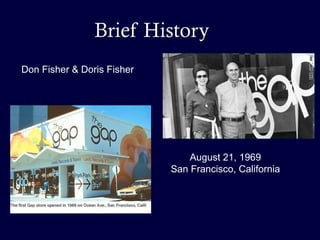
Don Fisher & Doris Fisher
August 21, 1969
San Francisco, California
History
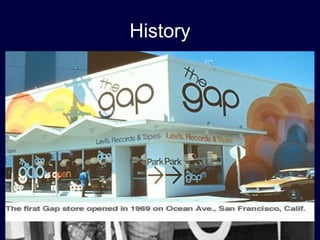
• In 1969, Don Fisher and his wife Doris opened the first GAP
store in San Francisco. The company took name from
“generation gap” and targeted the late-teen customers.
• By the end of 1970, there were six GAP stores already.
Sales reach $2 million.
• In 1974 GAP introduced private label lines to pull it out of
price-based competition with larger retailers. Private-label
clothing lines gave GAP control over the entire supply chain.
• In 1976 GAP went public offering 1.2 million shares of stock
on the New York and Pacific Stock Exchanges.
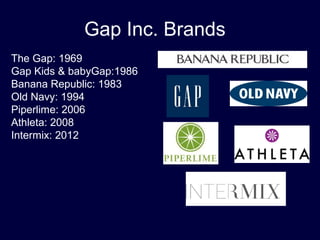
Gap Inc. Brands
The Gap: 1969
Gap Kids & babyGap:1986
Banana Republic: 1983
Old Navy: 1994
Piperlime: 2006
Athleta: 2008
Intermix: 2012
Today
• Single store grew into major company which oversees
Old Navy, Banana Republic, Forth & Towne, Piperlime,
Gap brands and sub-brands
• Over 3,100 Gap Inc. stores in five countries
• Headquarters remain in San Francisco
• 2006 Business Ethics Magazine Top 100 Company
• 2005 & 2006 Top 30 Companies for Executive Women
• 2007 CRO Magazine 100 Best Corporate Citizens
Mission Statement
• Mission: GAP is a brand-builder. “create emotional
connections with customers around the world through
inspiring product design, unique store experiences and
compelling marketing.” It’s goal is to simply make it easy
for customers to express their personal style throughout
their life.
• Vision: GAP hoped that effective Web initiative could let
company to solidify its brand, improve customer
relationships, serve markets that could not support a
store and cut costs. Company also believed that going
online would attract new customers and steal market
share from competitors.
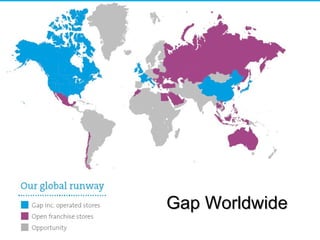
Company-operated stores
• Gap operate stores-
1) USA
2) Canada
3) Europe
4) Asia
5) Australia
Gap WorldwideGap Worldwide
Forms of Retailing
1) FRANCHISE:
The Gap, Inc. also has franchise agreements with unaffiliated
franchisees to operate Gap or Banana Republic stores in
Philippines, Singapore, Malaysia, United Arab Emirates, Korea,
Kuwait, Qatar, Bahrain, Oman, Saudi Arabia, Cambodia,
Indonesia and Australia.
2) OUTLET:
Gap Inc. launched its first international Outlet stores in the United
Kingdom in 1996 and has continued to grow its international
store base. The company plans to continue growing its global
outlet store fleet during 2012.
3) ONLINE:
In 2009, Gap Inc. shipped to one country, the United States.
Currently, Gap Inc. products are available to more than 90
countries through its dedicated websites and third-party
shipping providers.
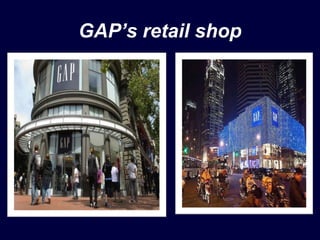
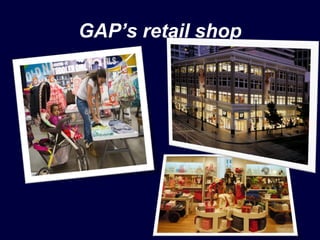
GAP’s retail shop
GAP’s retail shop
Global Apparel RetailGlobal Apparel Retail
MarketsMarkets
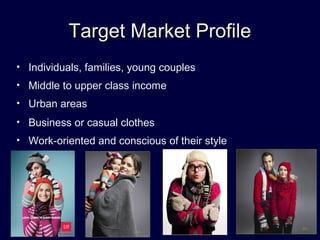
Target Market ProfileTarget Market Profile
• Individuals, families, young couples
• Middle to upper class income
• Urban areas
• Business or casual clothes
• Work-oriented and conscious of their style
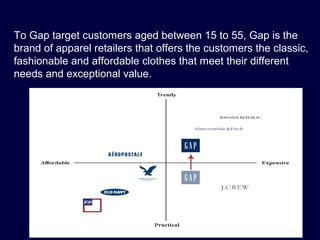
To Gap target customers aged between 15 to 55, Gap is the
brand of apparel retailers that offers the customers the classic,
fashionable and affordable clothes that meet their different
needs and exceptional value.
Marketing Mix - Product
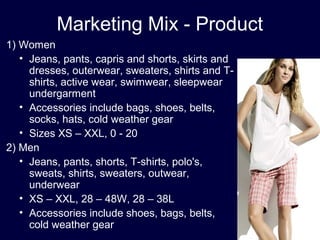
1) Women
• Jeans, pants, capris and shorts, skirts and
dresses, outerwear, sweaters, shirts and T-
shirts, active wear, swimwear, sleepwear
undergarment
• Accessories include bags, shoes, belts,
socks, hats, cold weather gear
• Sizes XS – XXL, 0 - 20
2) Men
• Jeans, pants, shorts, T-shirts, polo's,
sweats, shirts, sweaters, outwear,
underwear
• XS – XXL, 28 – 48W, 28 – 38L
• Accessories include shoes, bags, belts,
cold weather gear
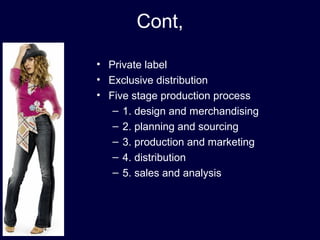
Cont,
• Private label
• Exclusive distribution
• Five stage production process
– 1. design and merchandising
– 2. planning and sourcing
– 3. production and marketing
– 4. distribution
– 5. sales and analysis
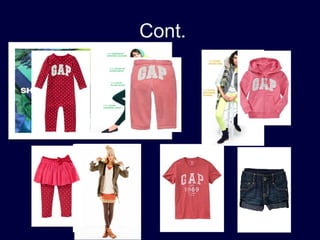
Cont.
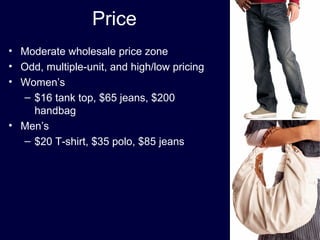
Price
• Moderate wholesale price zone
• Odd, multiple-unit, and high/low pricing
• Women’s
– $16 tank top, $65 jeans, $200
handbag
• Men’s
– $20 T-shirt, $35 polo, $85 jeans
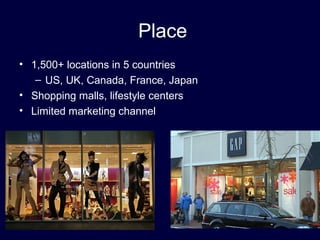
Place
• 1,500+ locations in 5 countries
– US, UK, Canada, France, Japan
• Shopping malls, lifestyle centers
• Limited marketing channel
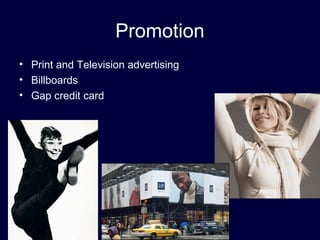
Promotion
• Print and Television advertising
• Billboards
• Gap credit card
GAP-Suppliers & Products
in Asia
As seen Asian market is major outsourcing unit of GAP
worldwide, the following are the major supplier and
merchandize that GAP deals with in Asia.
• Best Industries
1) Poppy's international
2) Shahi Exports
3) SNQS International
4) Primax
5) Gokaldas Images & Exports
6) Eastman Exports
7) KPR International.
NationalNational
CompetitorsCompetitors
ForeignForeign
CompetitorsCompetitors
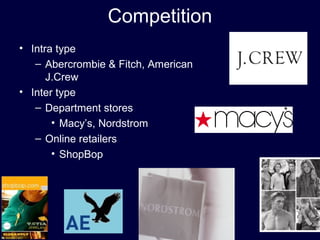
Competition
• Intra type
– Abercrombie & Fitch, American Eagle,
J.Crew
• Inter type
– Department stores
• Macy’s, Nordstrom
– Online retailers
• ShopBop
Goals and strategies
1) In e-commerce GAP used the same strategy that had
worked for it offline – establishing new markets, focusing on
stylish, value driven product offerings, and controlling value
drivers in-house.
2) GAP also sought to control an increasing share of the
consumer’s apparel dollars.
3) Company integrated technology into Web sites so they
could enhance the customer experience.
4) GAP also was trying to provide the best customer service
that they can and guide their success with values such as
integrity, respect, open-mindedness, quality and balance.
5) GAP also believed that it can manage the conflict between
its online and offline channels.
• GAP decided to use multichannel strategy.
• Company saw its bricks-and-mortar stores not as an
impediment, as many Internet pure-plays liked to assert, but
as a key asset that it could leverage to give consumers a
complete shopping experience:
Consumers benefited in several ways:
• Customers could return products to stores even if they bought
them online.
• Banana Republic offered free alterations.
• Customers could do product research first on the Web and
then buy at brick-and-mortar store.
• Customers were more comfortable buying online because of
GAP’s well-established brand and reputation.
E-Commerce opportunities
1) In e-commerce GAP used the same strategy that had
worked for it offline – establishing new markets, focusing
on stylish, value driven product offerings, and controlling
value drivers in-house.
2) Company integrated technology into Web sites so they
could enhance the customer experience.
3) GAP also was trying to provide the best customer service
that they can and guide their success with values such as
integrity, respect, open-mindedness, quality and balance.
4) GAP also believed that it can manage the conflict between
its online and offline channel.
Bibliography
• Gap Inc. (n.d.a). For landlords and developers.
Retrieved February 27, 2007 from
http://www.gapinc.com/public/Investors/inv_re_landlords.shtm
.
• Gap Inc. (n.d.b). How are clothes are made. Retrieved
February 6, 2007 from
http://www.gapinc.com/public/About/abt_howourclothesa
remade.shtml.
• Gap Inc. (n.d.c). Our brands. Retrieved February 6, 2007
from
http://www.gapinc.com/public/OurBrands/brands.shtml.
• Gap Inc. (n.d.d). Store count. Retrieved February 27,
2007 from
http://www.gapinc.com/public/Investors/inv_re_storecount.sht
.

Gap presentation (1) [recovered]

  • 2.
    Don Fisher &Doris Fisher August 21, 1969 San Francisco, California
  • 3.
    History • In 1969,Don Fisher and his wife Doris opened the first GAP store in San Francisco. The company took name from “generation gap” and targeted the late-teen customers. • By the end of 1970, there were six GAP stores already. Sales reach $2 million. • In 1974 GAP introduced private label lines to pull it out of price-based competition with larger retailers. Private-label clothing lines gave GAP control over the entire supply chain. • In 1976 GAP went public offering 1.2 million shares of stock on the New York and Pacific Stock Exchanges.
  • 4.
    Gap Inc. Brands TheGap: 1969 Gap Kids & babyGap:1986 Banana Republic: 1983 Old Navy: 1994 Piperlime: 2006 Athleta: 2008 Intermix: 2012
  • 5.
    Today • Single storegrew into major company which oversees Old Navy, Banana Republic, Forth & Towne, Piperlime, Gap brands and sub-brands • Over 3,100 Gap Inc. stores in five countries • Headquarters remain in San Francisco • 2006 Business Ethics Magazine Top 100 Company • 2005 & 2006 Top 30 Companies for Executive Women • 2007 CRO Magazine 100 Best Corporate Citizens
  • 6.
    Mission Statement • Mission:GAP is a brand-builder. “create emotional connections with customers around the world through inspiring product design, unique store experiences and compelling marketing.” It’s goal is to simply make it easy for customers to express their personal style throughout their life. • Vision: GAP hoped that effective Web initiative could let company to solidify its brand, improve customer relationships, serve markets that could not support a store and cut costs. Company also believed that going online would attract new customers and steal market share from competitors.
  • 7.
    Company-operated stores • Gapoperate stores- 1) USA 2) Canada 3) Europe 4) Asia 5) Australia Gap WorldwideGap Worldwide
  • 8.
    Forms of Retailing 1)FRANCHISE: The Gap, Inc. also has franchise agreements with unaffiliated franchisees to operate Gap or Banana Republic stores in Philippines, Singapore, Malaysia, United Arab Emirates, Korea, Kuwait, Qatar, Bahrain, Oman, Saudi Arabia, Cambodia, Indonesia and Australia. 2) OUTLET: Gap Inc. launched its first international Outlet stores in the United Kingdom in 1996 and has continued to grow its international store base. The company plans to continue growing its global outlet store fleet during 2012. 3) ONLINE: In 2009, Gap Inc. shipped to one country, the United States. Currently, Gap Inc. products are available to more than 90 countries through its dedicated websites and third-party shipping providers.
  • 9.
  • 10.
  • 11.
  • 12.
  • 13.
    Target Market ProfileTargetMarket Profile • Individuals, families, young couples • Middle to upper class income • Urban areas • Business or casual clothes • Work-oriented and conscious of their style
  • 14.
    To Gap targetcustomers aged between 15 to 55, Gap is the brand of apparel retailers that offers the customers the classic, fashionable and affordable clothes that meet their different needs and exceptional value.
  • 15.
    Marketing Mix -Product 1) Women • Jeans, pants, capris and shorts, skirts and dresses, outerwear, sweaters, shirts and T- shirts, active wear, swimwear, sleepwear undergarment • Accessories include bags, shoes, belts, socks, hats, cold weather gear • Sizes XS – XXL, 0 - 20 2) Men • Jeans, pants, shorts, T-shirts, polo's, sweats, shirts, sweaters, outwear, underwear • XS – XXL, 28 – 48W, 28 – 38L • Accessories include shoes, bags, belts, cold weather gear
  • 16.
    Cont, • Private label •Exclusive distribution • Five stage production process – 1. design and merchandising – 2. planning and sourcing – 3. production and marketing – 4. distribution – 5. sales and analysis
  • 17.
  • 18.
    Price • Moderate wholesaleprice zone • Odd, multiple-unit, and high/low pricing • Women’s – $16 tank top, $65 jeans, $200 handbag • Men’s – $20 T-shirt, $35 polo, $85 jeans
  • 19.
    Place • 1,500+ locationsin 5 countries – US, UK, Canada, France, Japan • Shopping malls, lifestyle centers • Limited marketing channel
  • 20.
    Promotion • Print andTelevision advertising • Billboards • Gap credit card
  • 21.
    GAP-Suppliers & Products inAsia As seen Asian market is major outsourcing unit of GAP worldwide, the following are the major supplier and merchandize that GAP deals with in Asia. • Best Industries 1) Poppy's international 2) Shahi Exports 3) SNQS International 4) Primax 5) Gokaldas Images & Exports 6) Eastman Exports 7) KPR International.
  • 22.
  • 23.
    Competition • Intra type –Abercrombie & Fitch, American Eagle, J.Crew • Inter type – Department stores • Macy’s, Nordstrom – Online retailers • ShopBop
  • 24.
    Goals and strategies 1)In e-commerce GAP used the same strategy that had worked for it offline – establishing new markets, focusing on stylish, value driven product offerings, and controlling value drivers in-house. 2) GAP also sought to control an increasing share of the consumer’s apparel dollars. 3) Company integrated technology into Web sites so they could enhance the customer experience. 4) GAP also was trying to provide the best customer service that they can and guide their success with values such as integrity, respect, open-mindedness, quality and balance. 5) GAP also believed that it can manage the conflict between its online and offline channels.
  • 25.
    • GAP decidedto use multichannel strategy. • Company saw its bricks-and-mortar stores not as an impediment, as many Internet pure-plays liked to assert, but as a key asset that it could leverage to give consumers a complete shopping experience: Consumers benefited in several ways: • Customers could return products to stores even if they bought them online. • Banana Republic offered free alterations. • Customers could do product research first on the Web and then buy at brick-and-mortar store. • Customers were more comfortable buying online because of GAP’s well-established brand and reputation.
  • 26.
    E-Commerce opportunities 1) Ine-commerce GAP used the same strategy that had worked for it offline – establishing new markets, focusing on stylish, value driven product offerings, and controlling value drivers in-house. 2) Company integrated technology into Web sites so they could enhance the customer experience. 3) GAP also was trying to provide the best customer service that they can and guide their success with values such as integrity, respect, open-mindedness, quality and balance. 4) GAP also believed that it can manage the conflict between its online and offline channel.
  • 27.
    Bibliography • Gap Inc.(n.d.a). For landlords and developers. Retrieved February 27, 2007 from http://www.gapinc.com/public/Investors/inv_re_landlords.shtm . • Gap Inc. (n.d.b). How are clothes are made. Retrieved February 6, 2007 from http://www.gapinc.com/public/About/abt_howourclothesa remade.shtml. • Gap Inc. (n.d.c). Our brands. Retrieved February 6, 2007 from http://www.gapinc.com/public/OurBrands/brands.shtml. • Gap Inc. (n.d.d). Store count. Retrieved February 27, 2007 from http://www.gapinc.com/public/Investors/inv_re_storecount.sht .