10 STEP  Marketing Plan for  McDonald’s SM Fairview Alfredo B. Corpuz Jr. Feb 2011 Product  Photo here Put your Blog Address Here.
This 10 Step Marketing Plan is part of the mandatory requirements of  Prof. Remigio Joseph De Ungria’s AGSB marketing management class. The data included in this report are based on publicly available data such as those on internet websites, news, package declarations, public reports. When appropriate, data are “masked” so as not to create unexpected conflicts. The reports are posted and linked on slideshare, blogs and facebook so that there is easier sharing among students from different marketing classes. Disclaimer
McDonald’s SM Fairview’s primary target market are shoppers of the mall Who want to satisfy their hunger fast Can choose Jollibee and KFC Gap is nearby fast-food restaurants are always crowded and food is served slower How big is the market (3Cs) Steps 1 to 5 Summary headline of  your PTM and market
Product Price  Promo  Place  Generic Winning Strategy of Mix Steps 6 to 10 Summary headline of the marketing mix & strategy
1. McDonald’s SM Fairview’s Primary Target Market are shoppers of SM Fairview  Ages 17-40; Male and Female; social class lower B,C and D, single and married College students and middle-aged parents Go to malls to shop, relax or meet friends/family
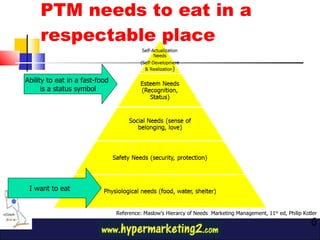
PTM needs to eat in a respectable place Reference: Maslow’s Hierarcy of Needs  Marketing Management, 11 th  ed, Philip Kotler I want to eat  Ability to eat in a fast-food is a status symbol
2. PTM’s needs, wants & demands  Shoppers need to satisfy their physiological needs, the need to belong and gain self-esteem. They prefer McDonald’s because of reasonable price of products and value meals, the place enjoys a higher class stature not being lowly branded as “for masses” or “for kids” fast-food. They demand fast service, good food quality and  a convenient place to dine
3a. Direct and indirect products that address my PTM’s NWD List of Competitors products/ brands Determine the variables that affect choice of product, brand
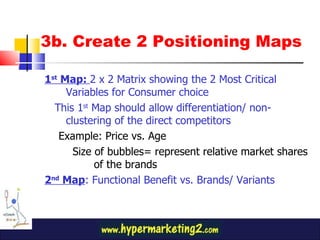
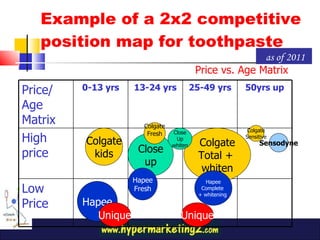
3b. Create 2 Positioning Maps 1 st  Map:  2 x 2 Matrix showing the 2 Most Critical Variables for Consumer choice This 1 st  Map should allow differentiation/ non-clustering of the direct competitors Example: Price vs. Age Size of bubbles= represent relative market shares of the brands 2 nd  Map : Functional Benefit vs. Brands/ Variants
Example of a 2x2 competitive position map for toothpaste Close up Colgate kids Colgate Total +  whiten Sensodyne Hapee Unique Hapee Complete  + whitening  Price vs. Age Matrix as of 2011 Hapee Fresh Close Up whiten Colgate Sensitive Colgate Fresh Unique Price/ Age Matrix 0-13 yrs 13-24 yrs 25-49 yrs 50yrs up High price Low Price
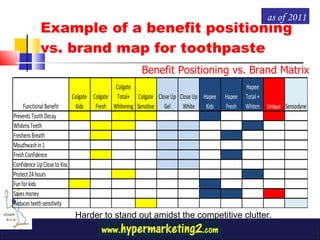
Example of a benefit positioning vs. brand map for toothpaste Benefit Positioning vs. Brand Matrix as of 2011 Harder to stand out amidst the competitive clutter.
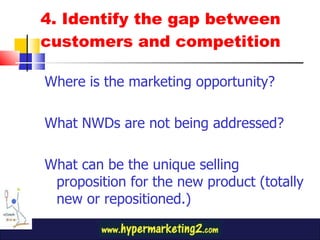
4. Identify the gap between customers and competition Where is the marketing opportunity? What NWDs are not being addressed? What can be the unique selling proposition for the new product (totally new or repositioned.)
5a. Estimate the market size using competitor data 1. Top 7000 Corporation Data or news Total Sales from 1 product companies % of sales from multi-product  2. vs. known Industry size comparisons 3. vs. 1-1 suppliers 4. Visual observation- warehouse 5. Pirating personnel or garbage 6. Illegal interview 7. “Share of Shelf”
5b. Estimate the market size using company data Claimed market share Guesstimate on  market share Fair share of market Distribution extent Historical sales
5c. Estimate the market size using customer data Usage per day or per year Per person Per household
5. Decide on market size in pesos, not in number of people Competitor data= Company data =  Customer Usage data =  Use instinct and best business judgment to finalize market size
6a. Photo of product category Show a product shot Your product and your competitors with, without box as they look in the supermarket All pack sizes All variants All major brands
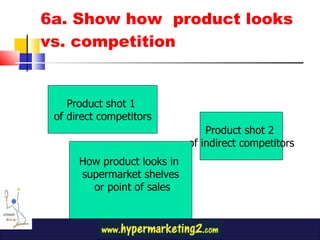
6a. Show how  product looks vs. competition Product shot 1  of direct competitors Product shot 2  of indirect competitors How product looks in  supermarket shelves or point of sales
6b. Product Description Describe the physical features, specifications, attributes of the product. Info may be in product packaging, label, brochures or website.
7. Price Get prices of your product  Creatively compare vs. competitors across different pack sizes and variants Quantify the price difference in % terms vs. competitors Conclude on what pricing strategy is being used
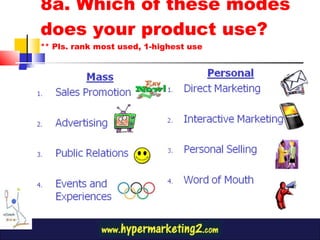
8a. Which of these modes does your product use? ** Pls. rank most used, 1-highest use
8a. Your products Promotions Describe what you propose to do/ product is currently doing vs. the 8 modes of communications. Show executions of this (from websites, print ads, actual commercials)
8a. Samples of Promo Samples This can be in multiple slides
8b. Competitor promo Show also how your key competitors communicate Their commercials Their websites And why your communication stands out
8b. Competitor promo Samples Can be multiple slides
9. Place Where is your product available? Supermarkets, sari-sari stores, convenience outlets, drugstores Nationwide or in key areas only? Method of delivery (some products can be delivered to your home, ordered via internet, phone orders, etc.)
10. What is the generic winning strategy? Which of the 4 strategies are being used? (bold and underline to most dominant strategy) Low Cost Producer Supply and Distribution Leverage Differentiation Niche
SUMMARY
Identify your target (PTM) What do they need, want, demand (NWD) What are they choices (competitors) Where is the opportunity (gap) How big is the market (3Cs) Steps 1 to 5 Summary headline of  your PTM and market
Product Price  Promo  Place  Generic Winning Strategy of Mix Steps 6 to 10 Summary headline of the marketing mix & strategy
YOUR ASSIGNMENT AS A MARKETING STUDENT
Your Assignment Use this template to make your marketing plan for a product or company that will also be the topic of your STRAMA Follow power presentation principles
Grading Customers (PTM, NWD)- 20% Competition (Positioning Map, Market Size) 30% Company (4Ps, Strategy)- 40% Power Principles Formatting- 10%

Alfredocorpuzv5310stepmarketing

  • 1.
    10 STEP Marketing Plan for McDonald’s SM Fairview Alfredo B. Corpuz Jr. Feb 2011 Product Photo here Put your Blog Address Here.
  • 2.
    This 10 StepMarketing Plan is part of the mandatory requirements of Prof. Remigio Joseph De Ungria’s AGSB marketing management class. The data included in this report are based on publicly available data such as those on internet websites, news, package declarations, public reports. When appropriate, data are “masked” so as not to create unexpected conflicts. The reports are posted and linked on slideshare, blogs and facebook so that there is easier sharing among students from different marketing classes. Disclaimer
  • 3.
    McDonald’s SM Fairview’sprimary target market are shoppers of the mall Who want to satisfy their hunger fast Can choose Jollibee and KFC Gap is nearby fast-food restaurants are always crowded and food is served slower How big is the market (3Cs) Steps 1 to 5 Summary headline of your PTM and market
  • 4.
    Product Price Promo Place Generic Winning Strategy of Mix Steps 6 to 10 Summary headline of the marketing mix & strategy
  • 5.
    1. McDonald’s SMFairview’s Primary Target Market are shoppers of SM Fairview Ages 17-40; Male and Female; social class lower B,C and D, single and married College students and middle-aged parents Go to malls to shop, relax or meet friends/family
  • 6.
    PTM needs toeat in a respectable place Reference: Maslow’s Hierarcy of Needs Marketing Management, 11 th ed, Philip Kotler I want to eat Ability to eat in a fast-food is a status symbol
  • 7.
    2. PTM’s needs,wants & demands Shoppers need to satisfy their physiological needs, the need to belong and gain self-esteem. They prefer McDonald’s because of reasonable price of products and value meals, the place enjoys a higher class stature not being lowly branded as “for masses” or “for kids” fast-food. They demand fast service, good food quality and a convenient place to dine
  • 8.
    3a. Direct andindirect products that address my PTM’s NWD List of Competitors products/ brands Determine the variables that affect choice of product, brand
  • 9.
    3b. Create 2Positioning Maps 1 st Map: 2 x 2 Matrix showing the 2 Most Critical Variables for Consumer choice This 1 st Map should allow differentiation/ non-clustering of the direct competitors Example: Price vs. Age Size of bubbles= represent relative market shares of the brands 2 nd Map : Functional Benefit vs. Brands/ Variants
  • 10.
    Example of a2x2 competitive position map for toothpaste Close up Colgate kids Colgate Total + whiten Sensodyne Hapee Unique Hapee Complete + whitening Price vs. Age Matrix as of 2011 Hapee Fresh Close Up whiten Colgate Sensitive Colgate Fresh Unique Price/ Age Matrix 0-13 yrs 13-24 yrs 25-49 yrs 50yrs up High price Low Price
  • 11.
    Example of abenefit positioning vs. brand map for toothpaste Benefit Positioning vs. Brand Matrix as of 2011 Harder to stand out amidst the competitive clutter.
  • 12.
    4. Identify thegap between customers and competition Where is the marketing opportunity? What NWDs are not being addressed? What can be the unique selling proposition for the new product (totally new or repositioned.)
  • 13.
    5a. Estimate themarket size using competitor data 1. Top 7000 Corporation Data or news Total Sales from 1 product companies % of sales from multi-product 2. vs. known Industry size comparisons 3. vs. 1-1 suppliers 4. Visual observation- warehouse 5. Pirating personnel or garbage 6. Illegal interview 7. “Share of Shelf”
  • 14.
    5b. Estimate themarket size using company data Claimed market share Guesstimate on market share Fair share of market Distribution extent Historical sales
  • 15.
    5c. Estimate themarket size using customer data Usage per day or per year Per person Per household
  • 16.
    5. Decide onmarket size in pesos, not in number of people Competitor data= Company data = Customer Usage data = Use instinct and best business judgment to finalize market size
  • 17.
    6a. Photo ofproduct category Show a product shot Your product and your competitors with, without box as they look in the supermarket All pack sizes All variants All major brands
  • 18.
    6a. Show how product looks vs. competition Product shot 1 of direct competitors Product shot 2 of indirect competitors How product looks in supermarket shelves or point of sales
  • 19.
    6b. Product DescriptionDescribe the physical features, specifications, attributes of the product. Info may be in product packaging, label, brochures or website.
  • 20.
    7. Price Getprices of your product Creatively compare vs. competitors across different pack sizes and variants Quantify the price difference in % terms vs. competitors Conclude on what pricing strategy is being used
  • 21.
    8a. Which ofthese modes does your product use? ** Pls. rank most used, 1-highest use
  • 22.
    8a. Your productsPromotions Describe what you propose to do/ product is currently doing vs. the 8 modes of communications. Show executions of this (from websites, print ads, actual commercials)
  • 23.
    8a. Samples ofPromo Samples This can be in multiple slides
  • 24.
    8b. Competitor promoShow also how your key competitors communicate Their commercials Their websites And why your communication stands out
  • 25.
    8b. Competitor promoSamples Can be multiple slides
  • 26.
    9. Place Whereis your product available? Supermarkets, sari-sari stores, convenience outlets, drugstores Nationwide or in key areas only? Method of delivery (some products can be delivered to your home, ordered via internet, phone orders, etc.)
  • 27.
    10. What isthe generic winning strategy? Which of the 4 strategies are being used? (bold and underline to most dominant strategy) Low Cost Producer Supply and Distribution Leverage Differentiation Niche
  • 28.
  • 29.
    Identify your target(PTM) What do they need, want, demand (NWD) What are they choices (competitors) Where is the opportunity (gap) How big is the market (3Cs) Steps 1 to 5 Summary headline of your PTM and market
  • 30.
    Product Price Promo Place Generic Winning Strategy of Mix Steps 6 to 10 Summary headline of the marketing mix & strategy
  • 31.
    YOUR ASSIGNMENT ASA MARKETING STUDENT
  • 32.
    Your Assignment Usethis template to make your marketing plan for a product or company that will also be the topic of your STRAMA Follow power presentation principles
  • 33.
    Grading Customers (PTM,NWD)- 20% Competition (Positioning Map, Market Size) 30% Company (4Ps, Strategy)- 40% Power Principles Formatting- 10%