Copywriting I
The ten step marketing plan
overview
Class 1
• Course outline
• Points of business
• Assignment
• Contact info
Contact Info

celiberal@georgebrown.ca
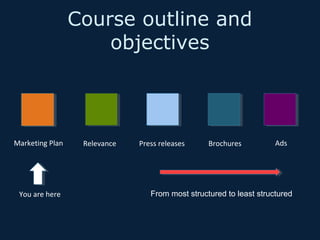
Course outline and
objectives

Marketing Plan

You are here

Relevance

Press releases

Brochures

Ads

From most structured to least structured
Goals
• Define Copywriting
• Define Marketing plan
• Understand relationship between
marketing plan and target audience
• Understand relationship between target
audience and the copy we write
SECRET

PROMISE
PAIN
Copywriting
• Motivates
• Educates
• Inspires
• Informs

and copywriting Sells
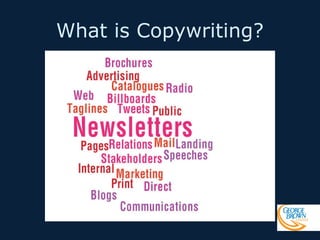
What is Copywriting?
All writing is:
Purposeful
Audience -oriented
Economical
ALL writing is:

CONTENT
Content Objectives
• Overcome resistance
• Create a connection
• Motivate or inspire
• Mobilize or reinvigorate
• Introduce new directions
• Show value proposition (UVP or USP)
Content Objectives
• Increase customer spend
• Educate about an aspect of offer
• Break into a new market
• Create leads or keep feeding them
• Enhance loyalty
• Increase market share
Copywriter Wanted
•

The Marketing team for Loblaw
Companies, is seeking a talented
copywriter, working in a fast paced,
food-focused environment, working
closely with our team to produce
beautifully cutting-edge product and
marketing creative copy to support
our numerous banners and brands.
Responsibilities
• Write customer-facing copy in a variety of
product categories
• Ensure timelines are met
• Leverage multiple resources (books,
magazines, web, product developer, chefs,
etc) to conduct research for effective and
creative writing.
• Must be capable of creating, impactful,
targeted messaging with a minimum of
words
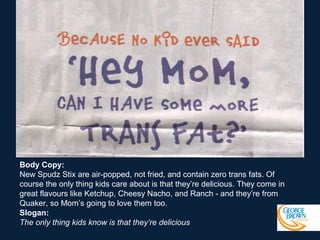
Because no kid ever said,
“Hey Mom, can I have some more
trans fat?”
Marketing plan – why?
1. Where are we now?
2. Where do we want to go?
3. How can we go there?
4. How can we control it?
What does a marketing plan
do?
• Tracks Costs / Measures Value
• Helps with Focus
• Charts Success
• Serves as a Business Handbook
• Captures Thinking on Paper
• Reflects the Big Picture
• Becomes a Document to Build On
The Marketing Plan
1. Market research
2. Target market
3. Product
4. Competition
5. Mission statement
6. Market strategies
7. Pricing, positioning and branding
8. Budget
9. Marketing goals
10. Monitor your results
Market research
Understand your market
 Are there segments in my market that are
being underserved?
 Are the segments big enough to make money?
 How much share of that market do I need to
capture, to just break even?
 Is there too much competition in the segment
of my market to be competitive?
 What is my competition’s weaknesses?
Market research
Consider:
• Market dynamics, patterns including
seasonality
• Customers – demographics, segment,
target markets, needs (wants), buying
decisions and habits
• Product - what's out there now, what's the
competition offering
• Current sales in the industry
• Benchmarks in the industry
Target Market
A defined segment of the market that is the strategic focus of a
business or a marketing plan. The members of this segment (or
segments) possess common characteristics and a relative high
propensity to purchase a particular product or service.
Because of this, the members of this segment represent the greatest
potential for sales volume and frequency.
Target market is often defined in terms of geographic,
demographic, and psychographic characteristics.
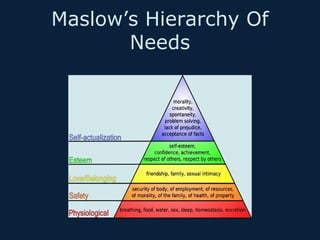
Maslow’s Hierarchy Of
Needs
Target Market
• Geographic
physical location
• Demographic
age, gender, sexual orientation,
income bracket, and/or education
• Psychographic
psychological traits, characteristics,
or lifestyle
Psychographics
• Lifestyle— interests, hobbies,
activities, interests, opinions, values,
media preferences.
• Everyone has two lifestyles, the one
they are in now, and the one they
aspire to, which is usually better
than the current one.
• Almost all decisions are influenced by
the buyer’s current and desired
lifestyle.
Psychographics
• Personality traits
• Sincerity.
• Excitement.
• Competence.
• Sophistication.
• Ruggedness.
• Social class
Psychographics
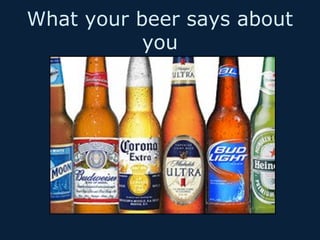
What your beer says about
you
Target market
• Find niche or target markets for your
product and describe them.
• If you say that your target customer
is "everybody" then nobody will be
your customer.
Choose a niche
• Make sure to choose a niche that interests
you and that is easy to contact. I can’t
stress this point enough. Don’t pick
a niche that you can’t communicate with
or that costs you a ton of money to
contact.
• You could be a "writer that specializes in
financial services" or a "C.P.A. for used car
dealers" or a "dry cleaner for a specific
condominium development."
Product
• Describe your product.
• How does your product relate to the
market ?
• What does your market need?
• What do they currently use?
• What do they need above and
beyond current use?
Competition
• Describe your competition
• Develop your USP (unique selling
proposition)
• What makes you stand apart from
your competition?
• What is your competition doing about
branding?
Mission statement
Write a few sentences that state:
• "Key market" - who you're selling to
• "Contribution" - what you're selling
• "Distinction" - your unique selling
proposition
Marketing Tactics
• Networking and Word-of-mouth - go where your market is
• Direct marketing - sales letters, brochures, flyers, posters
• Advertising - print media (newspaper ads), electronic media
(television ads, radio ads, infomercials), OOH (out of home –
transit ads, billboards) directories
• Training programs - teleclasses, webcasting
• Write articles, public speaking, give advice, seminars, newsletter
(print or electronic), become known as an expert in your chosen
field.
• Direct/personal selling, door-to-door, telemarketing
• Publicity/press releases, articles
• Trade shows, contests, sweepstakes, charity events, special
events
• Web site (banner ads)
• Incentives (Take-one box, gift certificates)
• Yellow pages
Pricing, positioning and branding
From the information you've
collected, establish strategies for
determining:
• the price of your product
• where your product will be positioned
in the market
• how you will achieve brand
awareness.
Budget
• What strategies can you afford ?
• What can you do in-house, what do
you need to outsource?
Marketing goals
• Establish quantifiable marketing
goals.
• For instance, your goals might be to
gain at least 30 new clients or to sell
10 products per week, or to increase
your income by 30% this year.
• Your goals might include sales,
profits, or customer's satisfaction.
Monitor your results
• Test and analyze. Identify the
strategies that are working.
• Survey customers.
• Track sales, leads, visitors to your
web site, percent of sales to
impressions.
• Establish ROI (return on
investment).
Body Copy:
New Spudz Stix are air-popped, not fried, and contain zero trans fats. Of
course the only thing kids care about is that they’re delicious. They come in
great flavours like Ketchup, Cheesy Nacho, and Ranch - and they’re from
Quaker, so Mom’s going to love them too.
Slogan:
The only thing kids know is that they’re delicious
Define the product or
service
• Describe the attributes of your
product in terms of features and
benefits
Features
Benefits
Positioning
Choose your target
market
• Age
• Gender
• Income
• Other Factors
Know your competition and
USP
• Competition
• USP (what we have that the
competition does not)
Unique Selling Proposition
• Your USP is the key to everything
• Once determined, your slogan,
advertising campaign, and design
projects all reflect it
Understand business
environment
• Economic
• Political
• Legal
• Social/Cultural
• Technological
Promotional Strategy
Objective
• Fulfillment
• Target Market’s esire
• Brand Awareness
Write your sales
message
• Inform target market what they can
get
• Slogan: The only thing kids know is
that they’re delicious
Select Promotional Media
• Media must reach defined target
market and allow us to accomplish
our promotional strategy.

Copywriting i pp

  • 1.
    Copywriting I The tenstep marketing plan overview
  • 2.
    Class 1 • Courseoutline • Points of business • Assignment • Contact info
  • 3.
  • 4.
    Course outline and objectives MarketingPlan You are here Relevance Press releases Brochures Ads From most structured to least structured
  • 5.
    Goals • Define Copywriting •Define Marketing plan • Understand relationship between marketing plan and target audience • Understand relationship between target audience and the copy we write
  • 6.
  • 7.
    Copywriting • Motivates • Educates •Inspires • Informs and copywriting Sells
  • 8.
  • 9.
  • 10.
  • 11.
    Content Objectives • Overcomeresistance • Create a connection • Motivate or inspire • Mobilize or reinvigorate • Introduce new directions • Show value proposition (UVP or USP)
  • 12.
    Content Objectives • Increasecustomer spend • Educate about an aspect of offer • Break into a new market • Create leads or keep feeding them • Enhance loyalty • Increase market share
  • 13.
    Copywriter Wanted • The Marketingteam for Loblaw Companies, is seeking a talented copywriter, working in a fast paced, food-focused environment, working closely with our team to produce beautifully cutting-edge product and marketing creative copy to support our numerous banners and brands.
  • 14.
    Responsibilities • Write customer-facingcopy in a variety of product categories • Ensure timelines are met • Leverage multiple resources (books, magazines, web, product developer, chefs, etc) to conduct research for effective and creative writing. • Must be capable of creating, impactful, targeted messaging with a minimum of words
  • 15.
    Because no kidever said, “Hey Mom, can I have some more trans fat?”
  • 16.
    Marketing plan –why? 1. Where are we now? 2. Where do we want to go? 3. How can we go there? 4. How can we control it?
  • 17.
    What does amarketing plan do? • Tracks Costs / Measures Value • Helps with Focus • Charts Success • Serves as a Business Handbook • Captures Thinking on Paper • Reflects the Big Picture • Becomes a Document to Build On
  • 18.
    The Marketing Plan 1.Market research 2. Target market 3. Product 4. Competition 5. Mission statement 6. Market strategies 7. Pricing, positioning and branding 8. Budget 9. Marketing goals 10. Monitor your results
  • 19.
    Market research Understand yourmarket  Are there segments in my market that are being underserved?  Are the segments big enough to make money?  How much share of that market do I need to capture, to just break even?  Is there too much competition in the segment of my market to be competitive?  What is my competition’s weaknesses?
  • 20.
    Market research Consider: • Marketdynamics, patterns including seasonality • Customers – demographics, segment, target markets, needs (wants), buying decisions and habits • Product - what's out there now, what's the competition offering • Current sales in the industry • Benchmarks in the industry
  • 21.
    Target Market A definedsegment of the market that is the strategic focus of a business or a marketing plan. The members of this segment (or segments) possess common characteristics and a relative high propensity to purchase a particular product or service. Because of this, the members of this segment represent the greatest potential for sales volume and frequency. Target market is often defined in terms of geographic, demographic, and psychographic characteristics.
  • 22.
  • 23.
    Target Market • Geographic physicallocation • Demographic age, gender, sexual orientation, income bracket, and/or education • Psychographic psychological traits, characteristics, or lifestyle
  • 24.
    Psychographics • Lifestyle— interests,hobbies, activities, interests, opinions, values, media preferences. • Everyone has two lifestyles, the one they are in now, and the one they aspire to, which is usually better than the current one. • Almost all decisions are influenced by the buyer’s current and desired lifestyle.
  • 25.
    Psychographics • Personality traits •Sincerity. • Excitement. • Competence. • Sophistication. • Ruggedness. • Social class
  • 26.
  • 27.
    What your beersays about you
  • 28.
    Target market • Findniche or target markets for your product and describe them. • If you say that your target customer is "everybody" then nobody will be your customer.
  • 29.
    Choose a niche •Make sure to choose a niche that interests you and that is easy to contact. I can’t stress this point enough. Don’t pick a niche that you can’t communicate with or that costs you a ton of money to contact. • You could be a "writer that specializes in financial services" or a "C.P.A. for used car dealers" or a "dry cleaner for a specific condominium development."
  • 30.
    Product • Describe yourproduct. • How does your product relate to the market ? • What does your market need? • What do they currently use? • What do they need above and beyond current use?
  • 31.
    Competition • Describe yourcompetition • Develop your USP (unique selling proposition) • What makes you stand apart from your competition? • What is your competition doing about branding?
  • 32.
    Mission statement Write afew sentences that state: • "Key market" - who you're selling to • "Contribution" - what you're selling • "Distinction" - your unique selling proposition
  • 33.
    Marketing Tactics • Networkingand Word-of-mouth - go where your market is • Direct marketing - sales letters, brochures, flyers, posters • Advertising - print media (newspaper ads), electronic media (television ads, radio ads, infomercials), OOH (out of home – transit ads, billboards) directories • Training programs - teleclasses, webcasting • Write articles, public speaking, give advice, seminars, newsletter (print or electronic), become known as an expert in your chosen field. • Direct/personal selling, door-to-door, telemarketing • Publicity/press releases, articles • Trade shows, contests, sweepstakes, charity events, special events • Web site (banner ads) • Incentives (Take-one box, gift certificates) • Yellow pages
  • 34.
    Pricing, positioning andbranding From the information you've collected, establish strategies for determining: • the price of your product • where your product will be positioned in the market • how you will achieve brand awareness.
  • 35.
    Budget • What strategiescan you afford ? • What can you do in-house, what do you need to outsource?
  • 36.
    Marketing goals • Establishquantifiable marketing goals. • For instance, your goals might be to gain at least 30 new clients or to sell 10 products per week, or to increase your income by 30% this year. • Your goals might include sales, profits, or customer's satisfaction.
  • 37.
    Monitor your results •Test and analyze. Identify the strategies that are working. • Survey customers. • Track sales, leads, visitors to your web site, percent of sales to impressions. • Establish ROI (return on investment).
  • 38.
    Body Copy: New SpudzStix are air-popped, not fried, and contain zero trans fats. Of course the only thing kids care about is that they’re delicious. They come in great flavours like Ketchup, Cheesy Nacho, and Ranch - and they’re from Quaker, so Mom’s going to love them too. Slogan: The only thing kids know is that they’re delicious
  • 39.
    Define the productor service • Describe the attributes of your product in terms of features and benefits Features Benefits Positioning
  • 40.
    Choose your target market •Age • Gender • Income • Other Factors
  • 41.
    Know your competitionand USP • Competition • USP (what we have that the competition does not)
  • 42.
    Unique Selling Proposition •Your USP is the key to everything • Once determined, your slogan, advertising campaign, and design projects all reflect it
  • 43.
    Understand business environment • Economic •Political • Legal • Social/Cultural • Technological
  • 44.
    Promotional Strategy Objective • Fulfillment •Target Market’s esire • Brand Awareness
  • 45.
    Write your sales message •Inform target market what they can get • Slogan: The only thing kids know is that they’re delicious
  • 46.
    Select Promotional Media •Media must reach defined target market and allow us to accomplish our promotional strategy.

Editor's Notes

  • #12 UVP/USP what differentiates your product or service from others on the market Unique Value Proposition/Unique Selling Proposition
  • #20 Collect, organize, and write down data about the market that is currently buying the product. you will If you try to sell something that people don’t want, they won’t buy it. So, a profitable market consists of people who have wants that are being unmet, so much so that they will jump to buy your solution.
  • #22 Psychographics, the analysis of consumer lifestyles.
  • #23 Motivation causes behaviour that satisfies needs. Marketers try to arouse these needs.
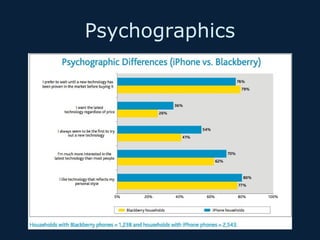
  • #27 Compare iiPhone and Blackberry in-class
  • #28 http://www.washingtonpost.com/blogs/govbeat/wp/2014/01/08/what-your-beer-says-about-your-politics-in-one-chart/
  • #29 The marketplace is jam packed with competition. Carve out a specific niche and dominate that niche, then you might consider moving on to a second niche. Make sure to choose a niche that interests you and that is easy to contact. I can’t stress this point enough. Don’t pick a niche that you can’t communicate with or that costs you a ton of money to contact. You could be a "writer that specializes in financial services" or a "C.P.A. for used car dealers" or a "dry cleaner for a specific condominium development."
  • #36 Your marketing budget can be developed several ways depending on whether you want to be more exact or develop just a quick-and-dirty number. It’s good to start out with a quick-and-dirty calculation and then to support it with further details. First, if you have been in business for over a year and tracked your marketing-related expenditures you could easily calculate your "cost to acquire one customer" or "cost to sell one product" by dividing your annual sales and marketing costs by the number of units (or customers acquired) sold. The next step is to take your cost to sell one unit or acquire one customer and simply multiply it by your unit sales or customer acquisition goal. The result of this simple computation will give you a rough estimate of what you need to invest to meet your sales goals for the next year.
  • #38 a recent Direct Marketing Association study found e-mail marketing has an ROI of $57.25 for every dollar spent, over 150 percent greater than the ROI for non-e-mail online marketing
  • #39 Ask if the copy: · Knows the audience · Uses language the target market understands · Uses a great headline · Makes an impact and strikes a nerve · Magnetizes or draws customers to the product · Demonstrates product knowledge · Uses short sentences and runs from pompous words · Educates - not sells · Focuses on benefits · Focuses on the client · Conveys a particular image · Brings out personality · Flows logically (is organized) · Demonstrates consistency Does the copy: · Start with the prospect (target market) in mind? · Gain attention? · Make the ad FABulous – features, advantages, benefits? · Differentiate the product from the competition? · Be the 3 C’s: Clear, Compelling, Conversational? · Overcome objections, suspicion and doubt? · Involve writing for readers, but format or design for scanners? · Ask for action? · Suggest (include) visuals? And to all that, might I add: Is the copy poetic? Can you find a theme woven throughout the copy?
  • #41 older and younger groups.
  • #44 Difficult to get into some schools that sell vending machine space to one company; will have distribution implications. There are those who want to restrict the use of caffeine in pop; we meet legal limits but we don’t want to overplay kick and get opponents of caffeine in cola in a lather. It is part of our USP so can’t ignore it. Let word of mouth work in our favour? There is a move to healthier eating and it may work in our favour as it's aimed at the boomers (once the counter culture). We are positioning VCVC as the new counter culture pop – the pop your parents will not drink. Also, there is a move away from alcohol on university campuses, especially at frosh parties, initiations, and sanctioned events; VCVC can fill that gap. other current technology. VCVC will launch a Web site with chat rooms, develop cell phone ring tones and pop-culture news alerts
  • #45 Maslow's need is thirst, but target market does not need VCVC. They can drink water! So the ad should play on a personal desire and associate drinking VCVC with fulfillment of that desire. To be perceived as cool, aloof, above the fray. Desires friends and fun. Wants to be seen as counterculture, intelligent, active – but not with Mom and Dad. Peers and image with peers are important. Target market is not aware of brand, but they drink pop. Make them aware and persuade potential early adopters to switch.
  • #47 Full-page ads in selected college and university newspapers and in magazines read by target market. · No TV, radio or transit ads initially. Creative will influence future transit ads and the VCVC Web site (which will have cool contests, games, entertainment news, chat rooms and so on). · Posters in university washrooms can replicate full-page ads. · Deliverable: concept and related image/graphic ideas; headline, subhead, body copy, slogan.