PERFORMANCE APPRAISAL,
STAFF GRIEVANCES & NEGOTIATION,
HUMAN RESOURCE DEVELOPMENT
PRESENTED BY:
GOVINDA ROKKA
UNNATI MAHARJAN
BPH,TU
CONTENTS
1.Performance Appraisal
2.Purposes of Appraisal
3.Methods of Appraisal
4.Staff Grievances and Negotiation
5.Human Resource Development
PERFORMANCE APPRAISAL
 Performance appraisal is one of the oldest and
most universal practices of management.
 It refers to all the formal procedures used in
working organization to evaluate the personalities
and contributions of group members.
 The term denotes and integrated process that
consolidates employee goal-setting, employee
development, rewarding performance into a
single common system with the ultimate aim of
contributing to organizational success.
Purposes of Appraisal
 It can serve as a basis for job change or promotion. By
establishing whether the worker can contribute still more in a
different or higher job, it helps in suitable promotion and
placement.
 By identifying the strength and weakness of an employee, it
serves as a guide for formulating a suitable training and
development program to improve his quality of performance in
his present work.
 It serves as a feedback to the employee. By letting the
employee know how well he is doing or where he stands with
his superiors. It tells him what he can do to improve his present
performance and go up in the management hierarchy.
 It serves as an incentive to all the employees who are
by existence of an appraisal system assured of the
management’s continued interest in them and their
continuous possibility to develop.
 The existence of a regular appraisal system tends to
make the supervisors and executives more observant
of their subordinates because they will be expected
periodically to fill out rating forms and would be call
upon their estimates. This knowledge results in
improved supervision.
 Performance appraisal often provides the rational
foundation for the payment of piecework wage,
bonuses etc. It also serves as a means for evaluating
the effectiveness of devices for the selection and
classification of workers.
Designing performance
management System
The specific design of performance management
system differs from one organization to another.
However the steps are common across all
organizations:
1. Identifying the criteria and standards of
performance appraisal
2. Determining the frequency of appraisals and the
appraiser
3. Choosing the appropriate methods of
performance appraisal and
4. Conducting post appraisal interview.
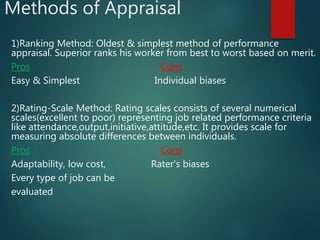
Methods of Appraisal
1)Ranking Method: Oldest & simplest method of performance
appraisal. Superior ranks his worker from best to worst based on merit.
Pros Cons
Easy & Simplest Individual biases
2)Rating-Scale Method: Rating scales consists of several numerical
scales(excellent to poor) representing job related performance criteria
like attendance,output,initiative,attitude,etc. It provides scale for
measuring absolute differences between individuals.
Pros Cons
Adaptability, low cost, Rater’s biases
Every type of job can be
evaluated
3)Checklist Method: Checklist of statements of traits of
employee in the form of Yes or No based question is prepared.
Each statement is given value depending upon its importance.
 Example: Is employee regular Y/N
Pros Cons
Ease of administration Difficult to prepare checklist
Standardization Improper weighs by HR
4) Forced – choice Method: It consists of series of statement
grouped (two, three or four) in which the rater indicates
whether it is true or false. He/she is made forced to make a
choice. Individual rating is found by adding predetermined
values of checked statement.
Pros Cons
Absence of bias
5) Field Review Method: Appraisal of workers is done by outside from
own department (HR department) by collecting oral ratings about
them.
Pros Cons
Useful for promotion Outsiders may not be familiar with
employee work environment
6)Critical incident Method: It is focused on certain critical behaviors of
employee that makes the difference in the performance. Supervisors
observe and record it.
Pros Cons
Evaluation are based on Negative incidents can be prioritized
job behaviors
Criteria Rating
1.Regularity on the job Most
Least
 Always regular
 Inform in advance for delay
 Never regular
 Remain absent
7) Confidential Records: Mostly used by the governmental
departments which is a major determinant of the
subordinates promotion/transfer.
8)Essay Appraisal : It is a very common method, where the
rater(former employee, teacher or associate of candidate)
is requested to give in writing an informed & honest
account of candidate’s strength,potential,qualification,
weakness,etc.
Pros Cons
Useful in filling the Dependent upon the
information gaps about writing skills of rater
the employee
Staff Grievances and
Negotiation
 Staff grievances may be any genuine or imaginary
feeling of dissatisfaction or injustice which an
employee experiences about his job and it’s
nature, about the management policies and
procedures. It must be expressed by the
employee and brought to the notice of the
management and the organization.
 Grievances take the form of collective disputes
when they are not resolved. Also they will then
lower the morale and efficiency of the employees.
Unattended grievances result in frustration,
dissatisfaction, low productivity, lack of interest in
work, absenteeism, etc.
Different approach to manage
Grievances
 Quick action- Grievances should be identified
and resolved. Training must be given to the
managers to effectively and timely manage a
grievance.
 Acknowledging grievance-
Acknowledgement by the manager implies
that the manager is eager to look into the
complaint impartially and without any bias.
 Gathering facts- The managers should gather
appropriate facts explaining the grievance’s
nature. A record of such facts must be
maintained so that these can be used in later
stage of grievance readdressal.
 Examining the causes of grievance- The actual
cause of grievance should be identified &
remedial actions should be taken to prevent it’s
repetition.
 Decisioning- After identifying the causes of
grievance, alternative course of actions should be
thought of to manage the grievance. The effect of
each course of action on the existing and future
management policies and procedure should be
analyzed and accordingly decision should be
taken by the manager.
 Execution and review- The manager should
execute the decision quickly, ignoring the fact,
that it may or may not hurt the employees
concerned. After implementing the decision, a
follow-up must be there to ensure that the
Negotiation
 Negotiating may be thought of as a process
of bargaining to reach a mutually acceptable
agreement.
 Good negotiating skills are essential to the
smooth running of your business. You need
to be able to negotiate with many different
types of people in many different business
situations whether you are negotiating a loan
from your bank manager or the next pay rise
with a union or staff representative.
Steps in Negotiation
1. Your own objectives
2. Other person's objectives
3. Basis for negotiation
Firstly, you need to know your own objectives. Then you need
to plan and prepare for your negotiations. It is assumed that
you have a thorough knowledge of the subject under
negotiation. This will often be the case, for example, when
dealing with customers or suppliers. However, you will also
find yourself negotiating leases on property or loans from the
bank and may not feel totally confident about your
knowledge. You should try to find out as much information as
possible, from various sources, prior to the meeting.
Human Resource
Development
 Human Resource Development (HRD) is the
framework for helping employees develop their
personal and organizational skills, knowledge,
and abilities.
 It includes such opportunities as employee
training, employee career development,
performance management and development,
coaching, mentoring, succession planning, key
employee identification, tuition assistance, and
organization development.
 It provides the 'coaching' needed to strengthen
and grow the knowledge, skills, and abilities that
an employee already has.
 Human Resource Development can be formal
such as in classroom training, a college
course, or an organizational planned change
effort.
 Or, Human Resource Development can be
informal as in employee coaching by a
manager or internal training and
development classes taught by internal staff
or a consultant. Mentoring by more
experienced employees is also recommended
for employee development.
Importance of HRD
i. Growth of Organization: It is associated with the
development of its workforce
ii. Development of work culture: Improving the efficiency of
employees, better communication, development of
mutual co-operation and creativity of all the members.
iii. Developing potentialities: HRD manager focuses on
enabling people to self actualize through a systematic
approach leading to development of their talents.
iv. Growth of employees: Helps employees to know their
strengths and weakness and enable them to improve
their performance.
References:
 Principles of Management; P C Tripathi & P N
Reddy,2012
 http://www.managementstudyguide.com/employee-
grievance.htm#
 http://www.shell-livewire.org/home/business-
library/employing-people/management/resource-
management-working-with-suppliers/Negotiation-1-
Successful-negotiation/
 https://www.thebalance.com/what-is-human-resource-
development-hrd-1918142
 https://www.linkedin.com/pulse/20141030184448-
208256548-hrm-performance-appraisal-methods

Performance Appraisal and Human Resource development

  • 1.
    PERFORMANCE APPRAISAL, STAFF GRIEVANCES& NEGOTIATION, HUMAN RESOURCE DEVELOPMENT PRESENTED BY: GOVINDA ROKKA UNNATI MAHARJAN BPH,TU
  • 2.
    CONTENTS 1.Performance Appraisal 2.Purposes ofAppraisal 3.Methods of Appraisal 4.Staff Grievances and Negotiation 5.Human Resource Development
  • 4.
    PERFORMANCE APPRAISAL  Performanceappraisal is one of the oldest and most universal practices of management.  It refers to all the formal procedures used in working organization to evaluate the personalities and contributions of group members.  The term denotes and integrated process that consolidates employee goal-setting, employee development, rewarding performance into a single common system with the ultimate aim of contributing to organizational success.
  • 5.
    Purposes of Appraisal It can serve as a basis for job change or promotion. By establishing whether the worker can contribute still more in a different or higher job, it helps in suitable promotion and placement.  By identifying the strength and weakness of an employee, it serves as a guide for formulating a suitable training and development program to improve his quality of performance in his present work.  It serves as a feedback to the employee. By letting the employee know how well he is doing or where he stands with his superiors. It tells him what he can do to improve his present performance and go up in the management hierarchy.
  • 6.
     It servesas an incentive to all the employees who are by existence of an appraisal system assured of the management’s continued interest in them and their continuous possibility to develop.  The existence of a regular appraisal system tends to make the supervisors and executives more observant of their subordinates because they will be expected periodically to fill out rating forms and would be call upon their estimates. This knowledge results in improved supervision.  Performance appraisal often provides the rational foundation for the payment of piecework wage, bonuses etc. It also serves as a means for evaluating the effectiveness of devices for the selection and classification of workers.
  • 9.
    Designing performance management System Thespecific design of performance management system differs from one organization to another. However the steps are common across all organizations: 1. Identifying the criteria and standards of performance appraisal 2. Determining the frequency of appraisals and the appraiser 3. Choosing the appropriate methods of performance appraisal and 4. Conducting post appraisal interview.
  • 10.
    Methods of Appraisal 1)RankingMethod: Oldest & simplest method of performance appraisal. Superior ranks his worker from best to worst based on merit. Pros Cons Easy & Simplest Individual biases 2)Rating-Scale Method: Rating scales consists of several numerical scales(excellent to poor) representing job related performance criteria like attendance,output,initiative,attitude,etc. It provides scale for measuring absolute differences between individuals. Pros Cons Adaptability, low cost, Rater’s biases Every type of job can be evaluated
  • 11.
    3)Checklist Method: Checklistof statements of traits of employee in the form of Yes or No based question is prepared. Each statement is given value depending upon its importance.  Example: Is employee regular Y/N Pros Cons Ease of administration Difficult to prepare checklist Standardization Improper weighs by HR 4) Forced – choice Method: It consists of series of statement grouped (two, three or four) in which the rater indicates whether it is true or false. He/she is made forced to make a choice. Individual rating is found by adding predetermined values of checked statement. Pros Cons Absence of bias
  • 12.
    5) Field ReviewMethod: Appraisal of workers is done by outside from own department (HR department) by collecting oral ratings about them. Pros Cons Useful for promotion Outsiders may not be familiar with employee work environment 6)Critical incident Method: It is focused on certain critical behaviors of employee that makes the difference in the performance. Supervisors observe and record it. Pros Cons Evaluation are based on Negative incidents can be prioritized job behaviors
  • 13.
    Criteria Rating 1.Regularity onthe job Most Least  Always regular  Inform in advance for delay  Never regular  Remain absent
  • 14.
    7) Confidential Records:Mostly used by the governmental departments which is a major determinant of the subordinates promotion/transfer.
  • 15.
    8)Essay Appraisal :It is a very common method, where the rater(former employee, teacher or associate of candidate) is requested to give in writing an informed & honest account of candidate’s strength,potential,qualification, weakness,etc. Pros Cons Useful in filling the Dependent upon the information gaps about writing skills of rater the employee
  • 17.
    Staff Grievances and Negotiation Staff grievances may be any genuine or imaginary feeling of dissatisfaction or injustice which an employee experiences about his job and it’s nature, about the management policies and procedures. It must be expressed by the employee and brought to the notice of the management and the organization.  Grievances take the form of collective disputes when they are not resolved. Also they will then lower the morale and efficiency of the employees. Unattended grievances result in frustration, dissatisfaction, low productivity, lack of interest in work, absenteeism, etc.
  • 18.
    Different approach tomanage Grievances  Quick action- Grievances should be identified and resolved. Training must be given to the managers to effectively and timely manage a grievance.  Acknowledging grievance- Acknowledgement by the manager implies that the manager is eager to look into the complaint impartially and without any bias.  Gathering facts- The managers should gather appropriate facts explaining the grievance’s nature. A record of such facts must be maintained so that these can be used in later stage of grievance readdressal.
  • 19.
     Examining thecauses of grievance- The actual cause of grievance should be identified & remedial actions should be taken to prevent it’s repetition.  Decisioning- After identifying the causes of grievance, alternative course of actions should be thought of to manage the grievance. The effect of each course of action on the existing and future management policies and procedure should be analyzed and accordingly decision should be taken by the manager.  Execution and review- The manager should execute the decision quickly, ignoring the fact, that it may or may not hurt the employees concerned. After implementing the decision, a follow-up must be there to ensure that the
  • 21.
    Negotiation  Negotiating maybe thought of as a process of bargaining to reach a mutually acceptable agreement.  Good negotiating skills are essential to the smooth running of your business. You need to be able to negotiate with many different types of people in many different business situations whether you are negotiating a loan from your bank manager or the next pay rise with a union or staff representative.
  • 22.
    Steps in Negotiation 1.Your own objectives 2. Other person's objectives 3. Basis for negotiation Firstly, you need to know your own objectives. Then you need to plan and prepare for your negotiations. It is assumed that you have a thorough knowledge of the subject under negotiation. This will often be the case, for example, when dealing with customers or suppliers. However, you will also find yourself negotiating leases on property or loans from the bank and may not feel totally confident about your knowledge. You should try to find out as much information as possible, from various sources, prior to the meeting.
  • 24.
    Human Resource Development  HumanResource Development (HRD) is the framework for helping employees develop their personal and organizational skills, knowledge, and abilities.  It includes such opportunities as employee training, employee career development, performance management and development, coaching, mentoring, succession planning, key employee identification, tuition assistance, and organization development.  It provides the 'coaching' needed to strengthen and grow the knowledge, skills, and abilities that an employee already has.
  • 25.
     Human ResourceDevelopment can be formal such as in classroom training, a college course, or an organizational planned change effort.  Or, Human Resource Development can be informal as in employee coaching by a manager or internal training and development classes taught by internal staff or a consultant. Mentoring by more experienced employees is also recommended for employee development.
  • 26.
    Importance of HRD i.Growth of Organization: It is associated with the development of its workforce ii. Development of work culture: Improving the efficiency of employees, better communication, development of mutual co-operation and creativity of all the members. iii. Developing potentialities: HRD manager focuses on enabling people to self actualize through a systematic approach leading to development of their talents. iv. Growth of employees: Helps employees to know their strengths and weakness and enable them to improve their performance.
  • 28.
    References:  Principles ofManagement; P C Tripathi & P N Reddy,2012  http://www.managementstudyguide.com/employee- grievance.htm#  http://www.shell-livewire.org/home/business- library/employing-people/management/resource- management-working-with-suppliers/Negotiation-1- Successful-negotiation/  https://www.thebalance.com/what-is-human-resource- development-hrd-1918142  https://www.linkedin.com/pulse/20141030184448- 208256548-hrm-performance-appraisal-methods