History of performance appraisal
In this file, you can ref useful information about history of performance appraisal such as history
of performance appraisal methods, history of performance appraisal tips, history of performance
appraisal forms, history of performance appraisal phrases … If you need more assistant for
history of performance appraisal, please leave your comment at the end of file.
Other useful material for you:
• performanceappraisal123.com/1125-free-performance-review-phrases
• performanceappraisal123.com/free-28-performance-appraisal-forms
• performanceappraisal123.com/free-ebook-11-methods-for-performance-appraisal
I. Contents of getting history of performance appraisal
==================
Judging people's work has occurred informally for centuries. Evaluating employees to improve
productivity has its roots in the work of Frederick Taylor, a mechanical engineer. Appraising
employee work became common during World War II. Modern performance management
systems provide structured environments to help managers provide employee evaluations that are
fair, defensible and accurate, and that adhere to local, state and federal regulations.
Scientific Management
Technical work in the early 1900s was usually performed by skilled craftsmen. In 1911,
Frederick Taylor described how the application of the scientific method to management could
improve productivity in manufacturing. Additional research by Frank Bunker Gilbreth, a
management engineer, helped managers learn to identify the procedures required to accomplish
work. These techniques helped managers optimize the way tasks were performed. The strategies
allowed managers to simplify the work so that workers could be trained and evaluated on
performing short tasks in a consistent manner, without having to produce the whole product. By
providing training to new employees so they could accomplish short, simple tasks or functions,
management could hire unskilled personnel to do the work.
Performance Appraisals
Early performance-appraisal systems didn't take morale and motivation into consideration.
Modern companies use employee evaluation activities to identify training and development
needs. Managers also use performance appraisals to make decisions regarding promotions or
terminations. Managers may also use employee evaluations to justify paying some workers more
than others based on their productivity.
Ranking
In the 1990s, Ford Motor Company tried to implement a system in which the lowest-ranked
employees lost their jobs. While that practice has been eliminated, rankings still play a role in the
employee evaluation process. Managers need to identify high performers, not only so that they
can reward them, but also so that those employees can coach and mentor other employees.
Employee evaluation rankings also help workers know how well they're doing relative to their
peers. By identifying their strengths and weaknesses, employees can learn how to improve their
production rate.
Current Issues
Managers usually conduct employee evaluations for their direct subordinates. Without effective
recordkeeping or documentation, managers who rate employees below par run the risk of not
being able to prove their allegations. Managers may fear that providing negative comments will
result in legal action or employee retaliation, so they often avoid dealing with poor performers.
Additionally, critics observe that executive leadership tends to disregard employee evaluation
results and conducts evaluations inconsistently. In general, though, organizations usually agree
that a well-designed performance management plan benefits both the company and the
employees. Mandating that employees develop an annual plan to improve their technical and
professional skills allows them to manage their own careers, as well as contribute to overall
company success.
==================
III. Performance appraisal methods
1.Ranking Method
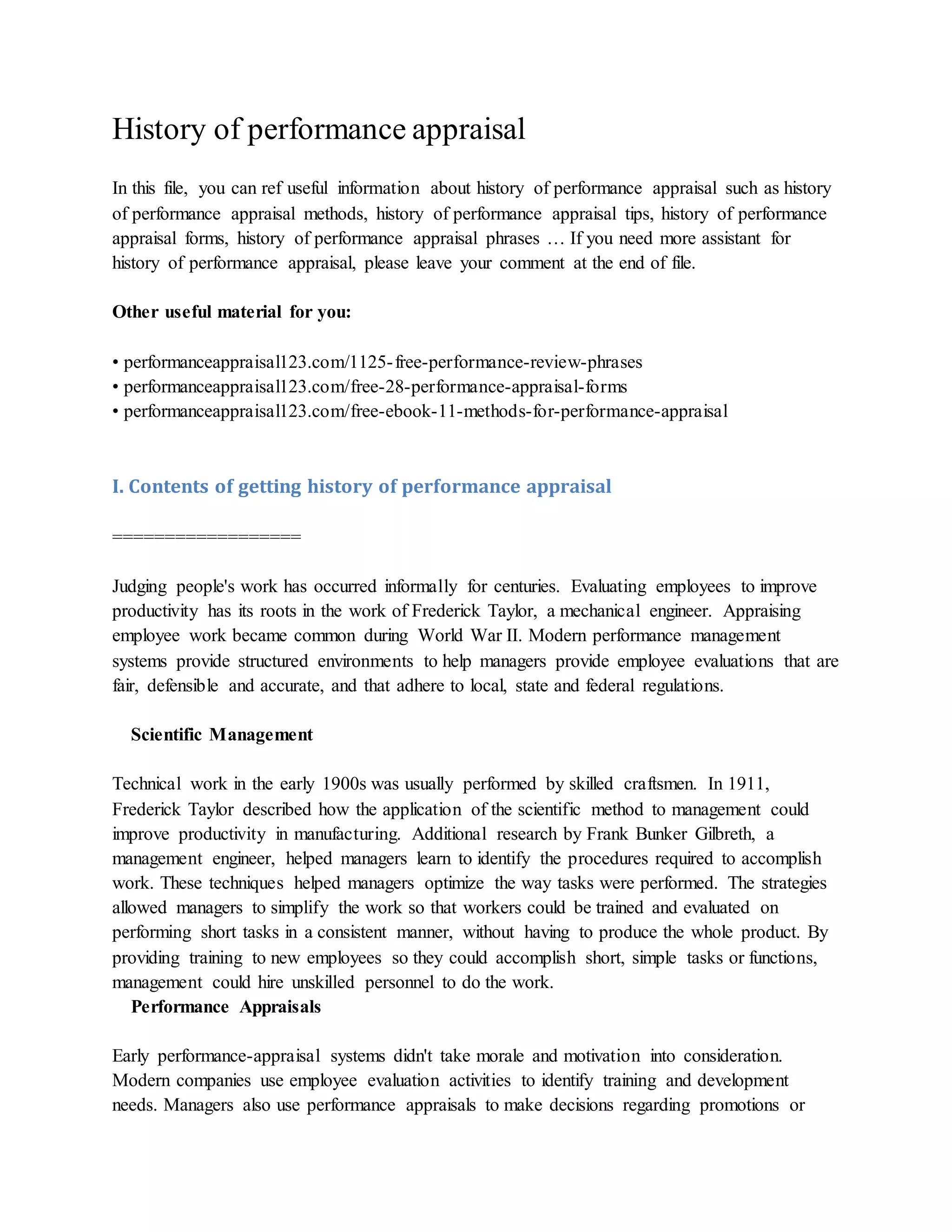
The ranking system requires the rater to rank his
subordinates on overall performance. This consists in
simply putting a man in a rank order. Under this method,
the ranking of an employee in a work group is done
against that of another employee. The relative position of
each employee is tested in terms of his numerical rank. It
may also be done by ranking a person on his job
performance against another member of the competitive
group.
Advantages of Ranking Method
i. Employees are ranked according to their performance
levels.
ii. It is easier to rank the best and the worst employee.
Limitations of Ranking Method
i. The “whole man” is compared with another “whole man”
in this method. In practice, it is very difficult to compare
individuals possessing various individual traits.
ii. This method speaks only of the position where an
employee stands in his group. It does not test anything
about how much better or how much worse an employee
is when compared to another employee.
iii. When a large number of employees are working, ranking
of individuals become a difficult issue.
iv. There is no systematic procedure for ranking individuals
in the organization. The ranking system does not eliminate
the possibility of snap judgements.
2. Rating Scale
Rating scales consists of several numerical scales
representing job related performance criterions such as
dependability, initiative, output, attendance, attitude etc.
Each scales ranges from excellent to poor. The total
numerical scores are computed and final conclusions are
derived. Advantages – Adaptability, easy to use, low cost,
every type of job can be evaluated, large number of
employees covered, no formal training required.
Disadvantages – Rater’s biases
3. Checklist method
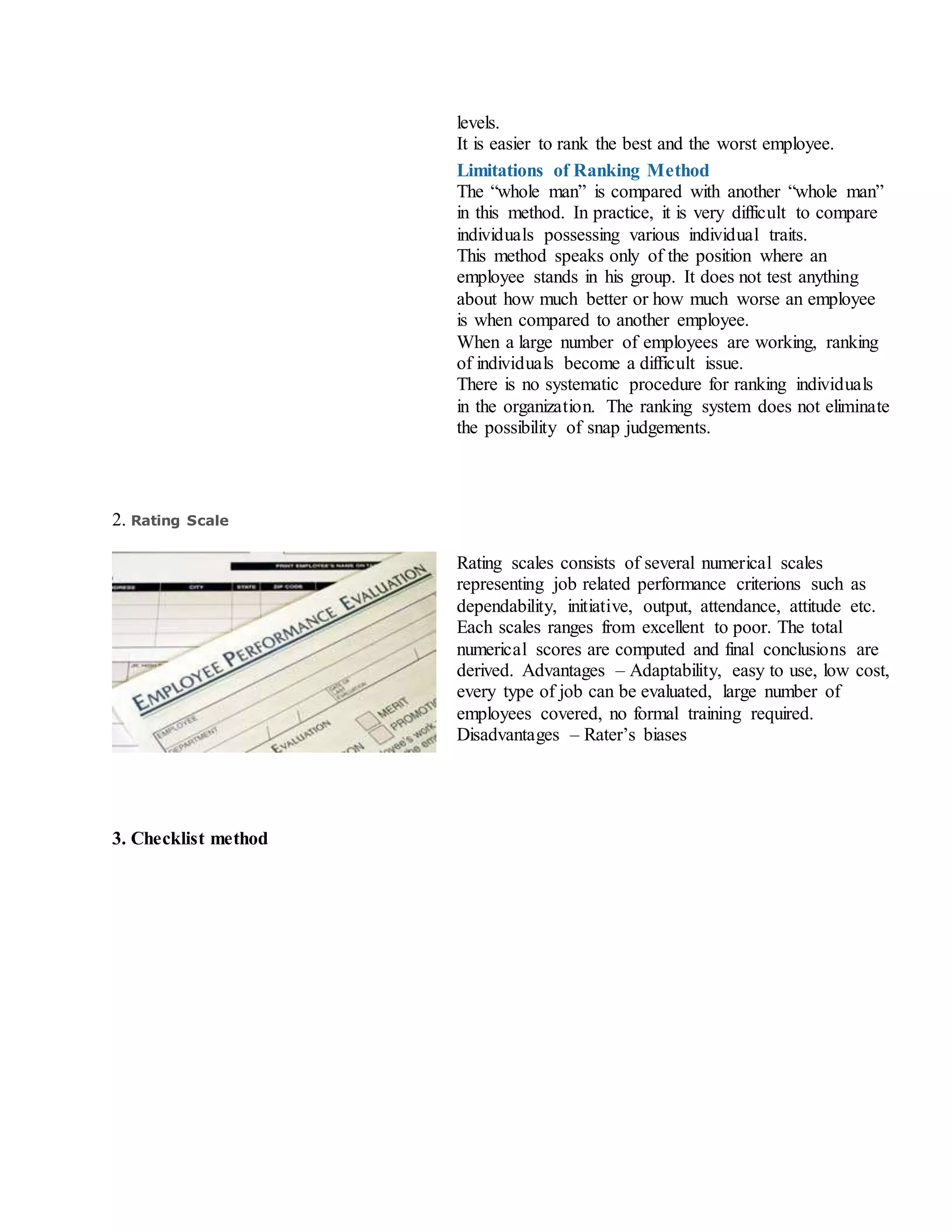
Under this method, checklist of statements of traits of
employee in the form of Yes or No based questions is
prepared. Here the rater only does the reporting or
checking and HR department does the actual evaluation.
Advantages – economy, ease of administration, limited
training required, standardization. Disadvantages – Raters
biases, use of improper weighs by HR, does not allow
rater to give relative ratings
4. Critical Incidents Method
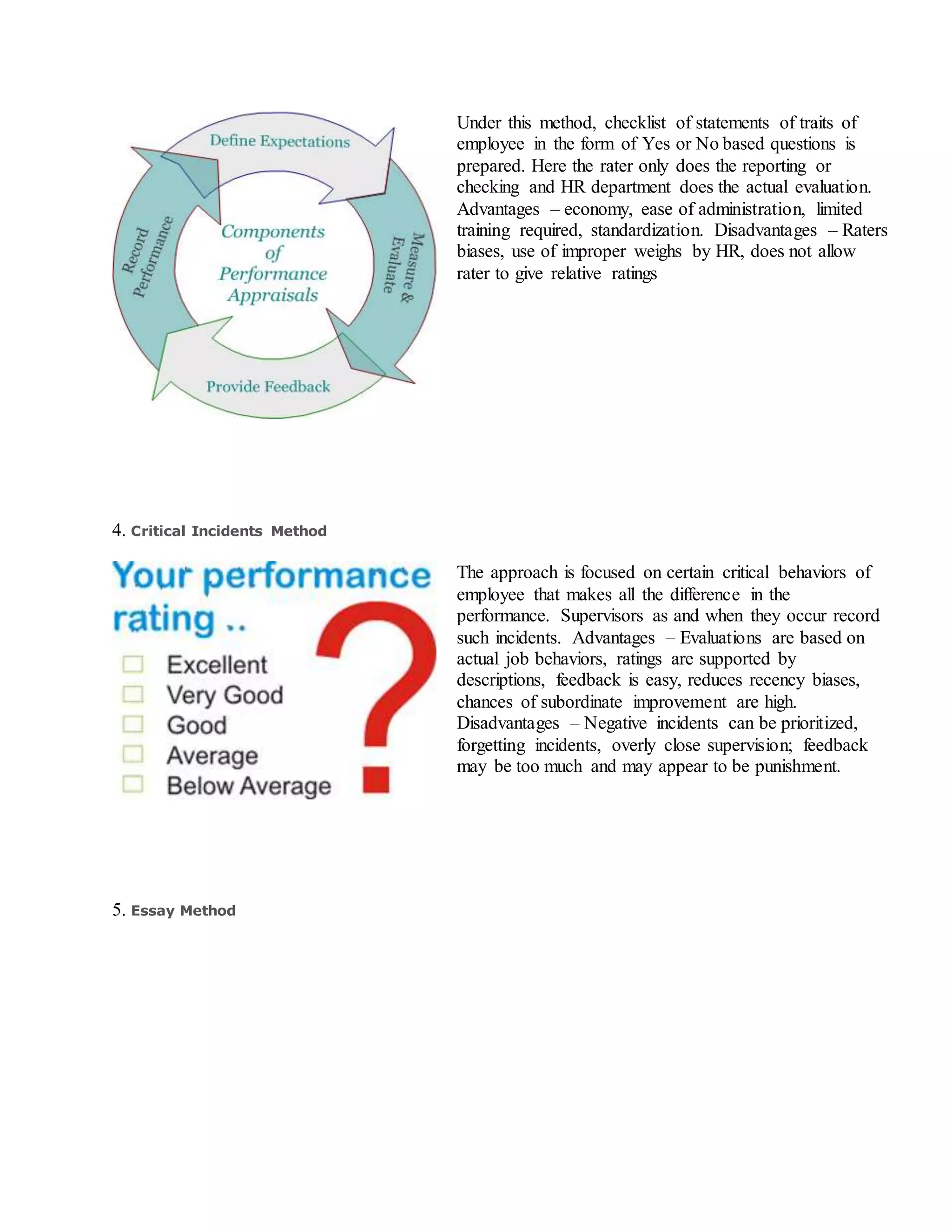
The approach is focused on certain critical behaviors of
employee that makes all the difference in the
performance. Supervisors as and when they occur record
such incidents. Advantages – Evaluations are based on
actual job behaviors, ratings are supported by
descriptions, feedback is easy, reduces recency biases,
chances of subordinate improvement are high.
Disadvantages – Negative incidents can be prioritized,
forgetting incidents, overly close supervision; feedback
may be too much and may appear to be punishment.
5. Essay Method
In this method the rater writes down the employee
description in detail within a number of broad categories
like, overall impression of performance, promoteability
of employee, existing capabilities and qualifications of
performing jobs, strengths and weaknesses and training
needs of the employee. Advantage – It is extremely
useful in filing information gaps about the employees
that often occur in a better-structured checklist.
Disadvantages – It its highly dependent upon the writing
skills of rater and most of them are not good writers.
They may get confused success depends on the memory
power of raters.
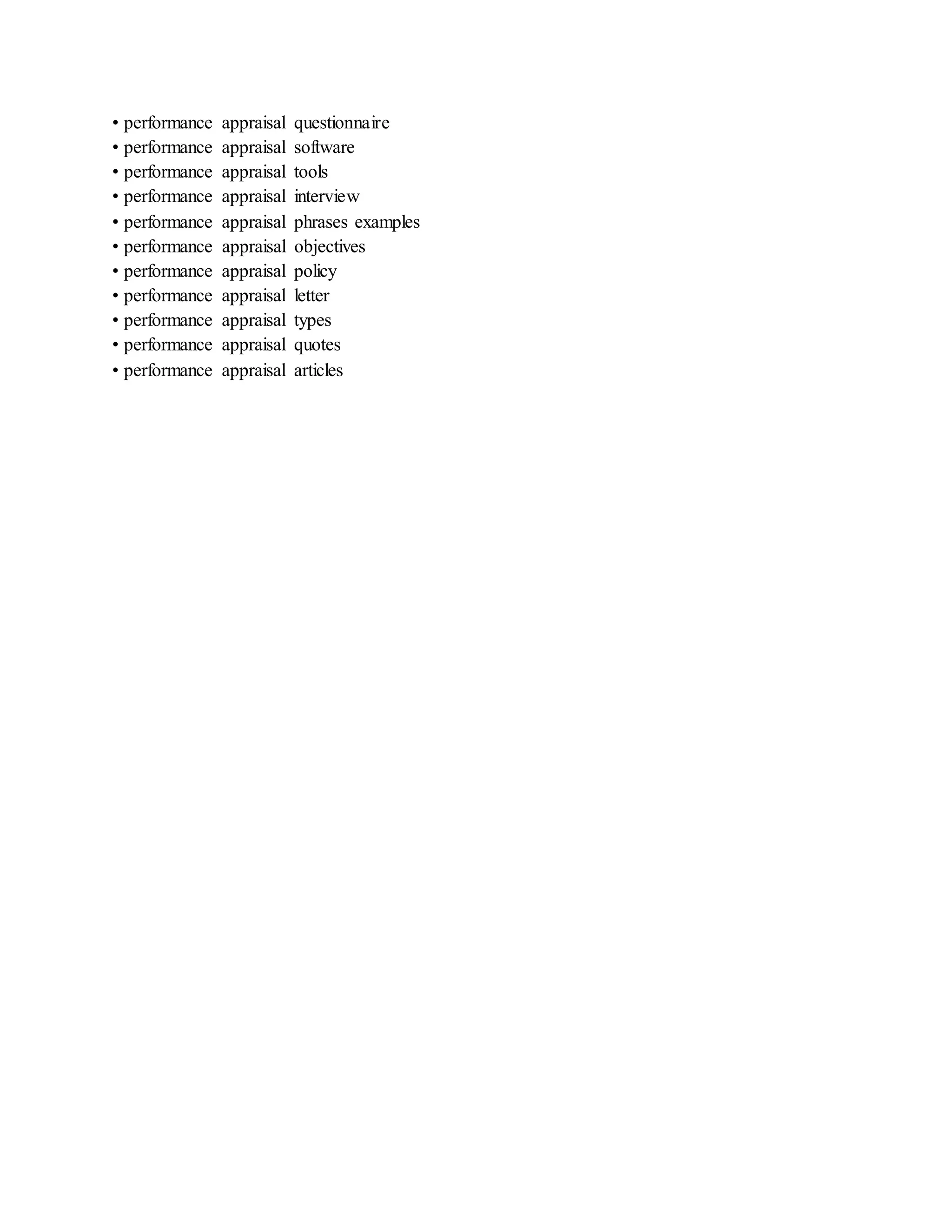
6. Behaviorally Anchored Rating Scales
statements of effective and ineffective behaviors
determine the points. They are said to be
behaviorally anchored. The rater is supposed to
say, which behavior describes the employee
performance. Advantages – helps overcome rating
errors. Disadvantages – Suffers from distortions
inherent in most rating techniques.
III. Other topics related to History of performance appraisal (pdf download)
• Top 28 performance appraisal forms
• performance appraisal comments
• 11 performance appraisal methods
• 25 performance appraisal examples
• performance appraisal phrases
• performance appraisal process
• performance appraisal template
• performance appraisal system
• performance appraisal answers
• performance appraisal questions
• performance appraisal techniques
• performance appraisal format
• performance appraisal templates
• performance appraisal questionnaire
• performance appraisal software
• performance appraisal tools
• performance appraisal interview
• performance appraisal phrases examples
• performance appraisal objectives
• performance appraisal policy
• performance appraisal letter
• performance appraisal types
• performance appraisal quotes
• performance appraisal articles

History of performance appraisal

  • 1.
    History of performanceappraisal In this file, you can ref useful information about history of performance appraisal such as history of performance appraisal methods, history of performance appraisal tips, history of performance appraisal forms, history of performance appraisal phrases … If you need more assistant for history of performance appraisal, please leave your comment at the end of file. Other useful material for you: • performanceappraisal123.com/1125-free-performance-review-phrases • performanceappraisal123.com/free-28-performance-appraisal-forms • performanceappraisal123.com/free-ebook-11-methods-for-performance-appraisal I. Contents of getting history of performance appraisal ================== Judging people's work has occurred informally for centuries. Evaluating employees to improve productivity has its roots in the work of Frederick Taylor, a mechanical engineer. Appraising employee work became common during World War II. Modern performance management systems provide structured environments to help managers provide employee evaluations that are fair, defensible and accurate, and that adhere to local, state and federal regulations. Scientific Management Technical work in the early 1900s was usually performed by skilled craftsmen. In 1911, Frederick Taylor described how the application of the scientific method to management could improve productivity in manufacturing. Additional research by Frank Bunker Gilbreth, a management engineer, helped managers learn to identify the procedures required to accomplish work. These techniques helped managers optimize the way tasks were performed. The strategies allowed managers to simplify the work so that workers could be trained and evaluated on performing short tasks in a consistent manner, without having to produce the whole product. By providing training to new employees so they could accomplish short, simple tasks or functions, management could hire unskilled personnel to do the work. Performance Appraisals Early performance-appraisal systems didn't take morale and motivation into consideration. Modern companies use employee evaluation activities to identify training and development needs. Managers also use performance appraisals to make decisions regarding promotions or
  • 2.
    terminations. Managers mayalso use employee evaluations to justify paying some workers more than others based on their productivity. Ranking In the 1990s, Ford Motor Company tried to implement a system in which the lowest-ranked employees lost their jobs. While that practice has been eliminated, rankings still play a role in the employee evaluation process. Managers need to identify high performers, not only so that they can reward them, but also so that those employees can coach and mentor other employees. Employee evaluation rankings also help workers know how well they're doing relative to their peers. By identifying their strengths and weaknesses, employees can learn how to improve their production rate. Current Issues Managers usually conduct employee evaluations for their direct subordinates. Without effective recordkeeping or documentation, managers who rate employees below par run the risk of not being able to prove their allegations. Managers may fear that providing negative comments will result in legal action or employee retaliation, so they often avoid dealing with poor performers. Additionally, critics observe that executive leadership tends to disregard employee evaluation results and conducts evaluations inconsistently. In general, though, organizations usually agree that a well-designed performance management plan benefits both the company and the employees. Mandating that employees develop an annual plan to improve their technical and professional skills allows them to manage their own careers, as well as contribute to overall company success. ================== III. Performance appraisal methods 1.Ranking Method The ranking system requires the rater to rank his subordinates on overall performance. This consists in simply putting a man in a rank order. Under this method, the ranking of an employee in a work group is done against that of another employee. The relative position of each employee is tested in terms of his numerical rank. It may also be done by ranking a person on his job performance against another member of the competitive group. Advantages of Ranking Method i. Employees are ranked according to their performance
  • 3.
    levels. ii. It iseasier to rank the best and the worst employee. Limitations of Ranking Method i. The “whole man” is compared with another “whole man” in this method. In practice, it is very difficult to compare individuals possessing various individual traits. ii. This method speaks only of the position where an employee stands in his group. It does not test anything about how much better or how much worse an employee is when compared to another employee. iii. When a large number of employees are working, ranking of individuals become a difficult issue. iv. There is no systematic procedure for ranking individuals in the organization. The ranking system does not eliminate the possibility of snap judgements. 2. Rating Scale Rating scales consists of several numerical scales representing job related performance criterions such as dependability, initiative, output, attendance, attitude etc. Each scales ranges from excellent to poor. The total numerical scores are computed and final conclusions are derived. Advantages – Adaptability, easy to use, low cost, every type of job can be evaluated, large number of employees covered, no formal training required. Disadvantages – Rater’s biases 3. Checklist method
  • 4.
    Under this method,checklist of statements of traits of employee in the form of Yes or No based questions is prepared. Here the rater only does the reporting or checking and HR department does the actual evaluation. Advantages – economy, ease of administration, limited training required, standardization. Disadvantages – Raters biases, use of improper weighs by HR, does not allow rater to give relative ratings 4. Critical Incidents Method The approach is focused on certain critical behaviors of employee that makes all the difference in the performance. Supervisors as and when they occur record such incidents. Advantages – Evaluations are based on actual job behaviors, ratings are supported by descriptions, feedback is easy, reduces recency biases, chances of subordinate improvement are high. Disadvantages – Negative incidents can be prioritized, forgetting incidents, overly close supervision; feedback may be too much and may appear to be punishment. 5. Essay Method
  • 5.
    In this methodthe rater writes down the employee description in detail within a number of broad categories like, overall impression of performance, promoteability of employee, existing capabilities and qualifications of performing jobs, strengths and weaknesses and training needs of the employee. Advantage – It is extremely useful in filing information gaps about the employees that often occur in a better-structured checklist. Disadvantages – It its highly dependent upon the writing skills of rater and most of them are not good writers. They may get confused success depends on the memory power of raters. 6. Behaviorally Anchored Rating Scales statements of effective and ineffective behaviors determine the points. They are said to be behaviorally anchored. The rater is supposed to say, which behavior describes the employee performance. Advantages – helps overcome rating errors. Disadvantages – Suffers from distortions inherent in most rating techniques. III. Other topics related to History of performance appraisal (pdf download) • Top 28 performance appraisal forms • performance appraisal comments • 11 performance appraisal methods • 25 performance appraisal examples • performance appraisal phrases • performance appraisal process • performance appraisal template • performance appraisal system • performance appraisal answers • performance appraisal questions • performance appraisal techniques • performance appraisal format • performance appraisal templates
  • 6.
    • performance appraisalquestionnaire • performance appraisal software • performance appraisal tools • performance appraisal interview • performance appraisal phrases examples • performance appraisal objectives • performance appraisal policy • performance appraisal letter • performance appraisal types • performance appraisal quotes • performance appraisal articles