Digital Pathology and
its importance as an
omics data layer
Yves Sucaet, PhD
A word from our sponsors
Personal financial disclosure
• I’m a co-founder and
shareholder in Pathomation.
• I’m affiliated with HistoGeneX in
the role of data scientist
Permit me a
small trip down
memory lane
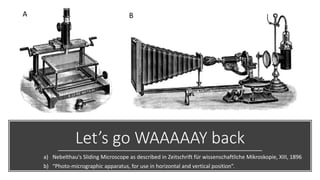
Let’s go WAAAAAY back
a) Nebelthau's Sliding Microscope as described in Zeitschrift für wissenschaftliche Mikroskopie, XIII, 1896
b) “Photo-micrographic apparatus, for use in horizontal and vertical position”.
My educational
background
• BS. Computer science
• MS. Biological sciences
• Replication between transcription termination and
replication initiation through in vivo and in silico
study of Autonomous Replication Sequences
• 2003: Keynote by Manolis Kellis at YGMB Göteborg
• PhD. Bioinformatics
• Network biology with plant modeling systems
• In silico pathway integration of heterogeneous
datasets: TAIR, AraCyc, atPID
After graduation
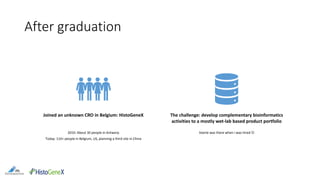
Joined an unknown CRO in Belgium: HistoGeneX
2010: About 30 people in Antwerp
Today: 110+ people in Belgium, US, planning a third site in China
The challenge: develop complementary bioinformatics
activities to a mostly wet-lab based product portfolio
Veerle was there when I was hired 
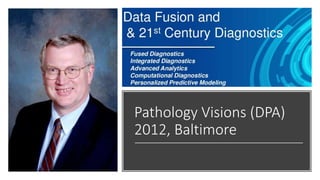
Pathology Visions (DPA)
2012, Baltimore
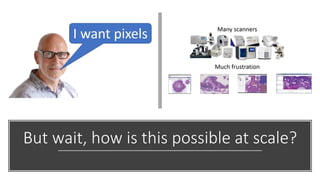
But wait, how is this possible at scale?
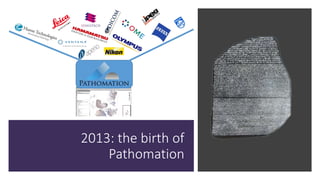
2013: the birth of
Pathomation
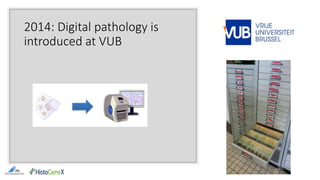
2014: Digital pathology is
introduced at VUB
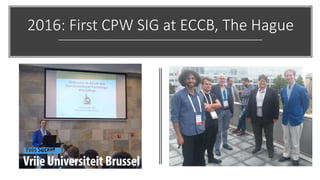
2016: First CPW SIG at ECCB, The Hague
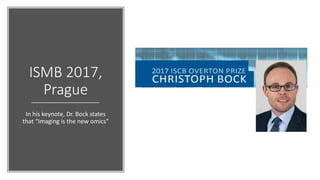
ISMB 2017,
Prague
In his keynote, Dr. Bock states
that “Imaging is the new omics”
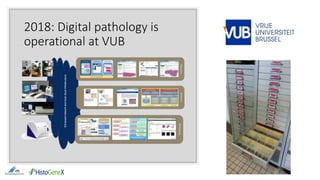
2018: Digital pathology is
operational at VUB
Where are we
now?
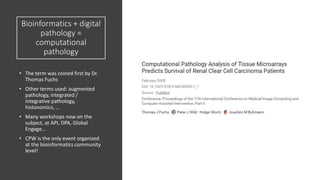
Bioinformatics + digital
pathology =
computational
pathology
• The term was coined first by Dr.
Thomas Fuchs
• Other terms used: augmented
pathology, integrated /
integrative pathology,
histonomics, …
• Many workshops now on the
subject, at API, DPA, Global
Engage…
• CPW is the only event organized
at the bioinformatics community
level!
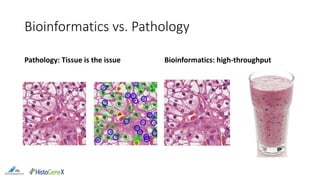
Bioinformatics vs. Pathology
Pathology: Tissue is the issue Bioinformatics: high-throughput
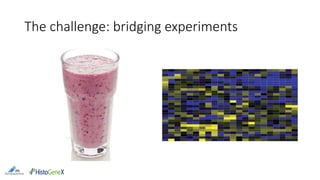
The challenge: bridging experiments
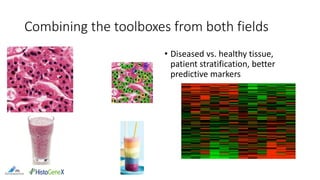
Combining the toolboxes from both fields
• Diseased vs. healthy tissue,
patient stratification, better
predictive markers
A concrete example (from CPW 2016)
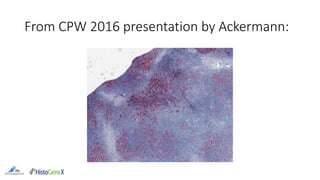
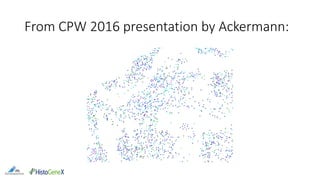
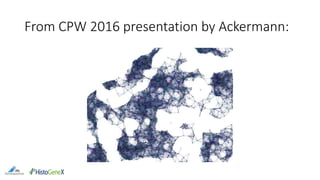
From CPW 2016 presentation by Ackermann:
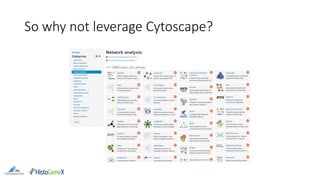
So why not leverage Cytoscape?
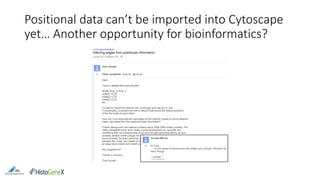
Positional data can’t be imported into Cytoscape
yet… Another opportunity for bioinformatics?
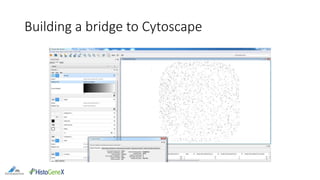
Building a bridge to Cytoscape
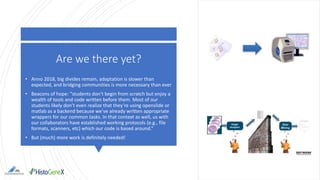
Are we there yet?
• Anno 2018, big divides remain, adaptation is slower than
expected, and bridging communities is more necessary than ever
• Beacons of hope: “students don’t begin from scratch but enjoy a
wealth of tools and code written before them. Most of our
students likely don’t even realize that they’re using openslide or
matlab as a backend because we’ve already written appropriate
wrappers for our common tasks. In that context as well, us with
our collaborators have established working protocols (e.g., file
formats, scanners, etc) which our code is based around.”
• But (much) more work is definitely needed!
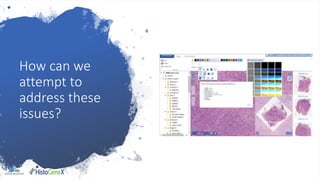
How can we
attempt to
address these
issues?
Attend a
workshop
1) Don’t build software for a single scanner
• It’s (still) about the file formats
• Build your software on a digital pathology abstraction layer
• PMA.start, OpenSlide, OMERO,…
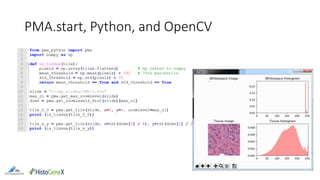
PMA.start, Python, and OpenCV
2) Don’t reinvent the wheel
• But you can still improve the cars!
• Network analysis:
• Cytoscape plugins for digital pathology?
• Expand AI environments so they become friendlier for image analysis:
• AzureML Studio
• Contribute content, tutorials, presentations:
• a DataCamp or Coursea MOOC on digital pathology?
• Talk to Pavel Pevzner for a new section in the UCSD Bioinformatics
curriculum?
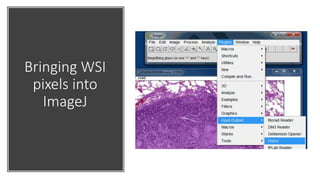
Bringing WSI
pixels into
ImageJ
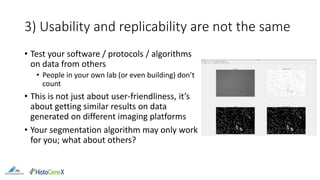
3) Usability and replicability are not the same
• Test your software / protocols / algorithms
on data from others
• People in your own lab (or even building) don’t
count
• This is not just about user-friendliness, it’s
about getting similar results on data
generated on different imaging platforms
• Your segmentation algorithm may only work
for you; what about others?
Tremendous opportunities still abound!
Welcome to Athens!

Digital pathology and its importance as an omics data layer

  • 1.
    Digital Pathology and itsimportance as an omics data layer Yves Sucaet, PhD
  • 2.
    A word fromour sponsors
  • 3.
    Personal financial disclosure •I’m a co-founder and shareholder in Pathomation. • I’m affiliated with HistoGeneX in the role of data scientist
  • 4.
    Permit me a smalltrip down memory lane
  • 5.
    Let’s go WAAAAAYback a) Nebelthau's Sliding Microscope as described in Zeitschrift für wissenschaftliche Mikroskopie, XIII, 1896 b) “Photo-micrographic apparatus, for use in horizontal and vertical position”.
  • 6.
    My educational background • BS.Computer science • MS. Biological sciences • Replication between transcription termination and replication initiation through in vivo and in silico study of Autonomous Replication Sequences • 2003: Keynote by Manolis Kellis at YGMB Göteborg • PhD. Bioinformatics • Network biology with plant modeling systems • In silico pathway integration of heterogeneous datasets: TAIR, AraCyc, atPID
  • 7.
    After graduation Joined anunknown CRO in Belgium: HistoGeneX 2010: About 30 people in Antwerp Today: 110+ people in Belgium, US, planning a third site in China The challenge: develop complementary bioinformatics activities to a mostly wet-lab based product portfolio Veerle was there when I was hired 
  • 8.
  • 9.
    But wait, howis this possible at scale?
  • 10.
    2013: the birthof Pathomation
  • 11.
    2014: Digital pathologyis introduced at VUB
  • 12.
    2016: First CPWSIG at ECCB, The Hague
  • 13.
    ISMB 2017, Prague In hiskeynote, Dr. Bock states that “Imaging is the new omics”
  • 14.
    2018: Digital pathologyis operational at VUB
  • 15.
  • 16.
    Bioinformatics + digital pathology= computational pathology • The term was coined first by Dr. Thomas Fuchs • Other terms used: augmented pathology, integrated / integrative pathology, histonomics, … • Many workshops now on the subject, at API, DPA, Global Engage… • CPW is the only event organized at the bioinformatics community level!
  • 17.
    Bioinformatics vs. Pathology Pathology:Tissue is the issue Bioinformatics: high-throughput
  • 18.
  • 19.
    Combining the toolboxesfrom both fields • Diseased vs. healthy tissue, patient stratification, better predictive markers
  • 20.
    A concrete example(from CPW 2016)
  • 21.
    From CPW 2016presentation by Ackermann:
  • 22.
    From CPW 2016presentation by Ackermann:
  • 23.
    From CPW 2016presentation by Ackermann:
  • 24.
    So why notleverage Cytoscape?
  • 25.
    Positional data can’tbe imported into Cytoscape yet… Another opportunity for bioinformatics?
  • 26.
    Building a bridgeto Cytoscape
  • 27.
    Are we thereyet? • Anno 2018, big divides remain, adaptation is slower than expected, and bridging communities is more necessary than ever • Beacons of hope: “students don’t begin from scratch but enjoy a wealth of tools and code written before them. Most of our students likely don’t even realize that they’re using openslide or matlab as a backend because we’ve already written appropriate wrappers for our common tasks. In that context as well, us with our collaborators have established working protocols (e.g., file formats, scanners, etc) which our code is based around.” • But (much) more work is definitely needed!
  • 28.
    How can we attemptto address these issues?
  • 29.
  • 30.
    1) Don’t buildsoftware for a single scanner • It’s (still) about the file formats • Build your software on a digital pathology abstraction layer • PMA.start, OpenSlide, OMERO,…
  • 31.
  • 32.
    2) Don’t reinventthe wheel • But you can still improve the cars! • Network analysis: • Cytoscape plugins for digital pathology? • Expand AI environments so they become friendlier for image analysis: • AzureML Studio • Contribute content, tutorials, presentations: • a DataCamp or Coursea MOOC on digital pathology? • Talk to Pavel Pevzner for a new section in the UCSD Bioinformatics curriculum?
  • 33.
  • 34.
    3) Usability andreplicability are not the same • Test your software / protocols / algorithms on data from others • People in your own lab (or even building) don’t count • This is not just about user-friendliness, it’s about getting similar results on data generated on different imaging platforms • Your segmentation algorithm may only work for you; what about others?
  • 35.
  • 36.