Open Sharing, Global Benefits April 17, 2008 Terri Bays How to Start and Run an OCW  Project Director, Notre Dame OCW At Your Institution Program Manager, OCW Consortium
170+ OCWC Institutions  Over 6,000 OCW Courses Online ~2,000,000 visitors/month
Making the OCW Case at Your Institution Structuring Your OCW Team Technologies for OCW OCW Curriculum and Content Intellectual Property OCW Assessment Questions
Making the OCW Case at Your Institution University Culture  Scope of the Project Benefits to Faculty, Students, Learners, University Existing Processes Pain Points
University Culture Mission alignment MIT: Best serve nation and world JHSPH: Improve global public health Utah State: Land grant institution Notre Dame: Catholic social mission Michigan State: World-grant mission
Scope of Project Institution-wide Departmental Showcase Other models
Benefits to Faculty, Students, Learners, University Lifelong learning Prospective students, current students, alumni A catalyst for academic improvement Collaboration; organization; use of technology A tool for resource development and international engagement Fundraising; faculty, department reputation; global collaboration
Existing Processes Educational materials “lifecycle” IP management Faculty support teams Research and communication
Pain Points Stakeholder buy-in Faculty time Materials ownership Scarce resources
Making the OCW Case at Your Institution Structuring Your OCW Team Technologies for OCW OCW Curriculum and Content Intellectual Property OCW Assessment Questions
Structuring your OCW Team —Considerations Size and Structure of Institution Institutional Culture Flow of OCW Support Existing E-learning Resources Financial Resources Financial Sustainability Project Goals Work Flow
Structuring your OCW Team —Sustainability Cost-Benefit Models Reduce costs Increase benefits Third-Party Funding Models Foundations, Government Sponsorships Donations Endowment Value-Added Models Fees for goods and services Membership
Examples —Considerations at Notre Dame Project Support from Provost’s Office, Faculty Tension between Graduate and Undergraduate Needs Minimal Distance Education in Institution In-Project Planning rather than Top-Down Direction Start with Grant, Need to Develop Grass-Roots Support  Goal Not to Publish Everything, but to Showcase Strengths Flexible Work Flow
Examples —OCW Structure at  Notre Dame Project Director Hosted by Center for Teaching and Learning Strategic Recruitment of Faculty Training and Supervision of Course Production Assistants Resolution of Intellectual Property issues Technical Oversight of Project Outreach, Assessment and Development  Efforts Coordination with other parts of the Campus Community  Communication with Consortium and Broader OER Community. A Variety of Campus Professionals Intellectual Property Consultation with General Counsel’s Office Assessment via Office of Institutional Research University Librarians, Museum Curators, etc.
Examples —OCW Structure at  Notre Dame Course Production Assistant (at Notre Dame this is usually a Graduate Student in the relevant discipline) No html skills necessary Focus on familiarity with the discipline, so as to best adapt/develop the strengths of the course to suit the online environment Basic intellectual property management Undergraduate Student Workers Routine clerical work (e.g., metadata entry) Photography, Videography Some coding and/or design work (e.g. flash module) Intellectual Property Training by Reference Librarian Work Flow sometimes too flexible, requires close monitoring
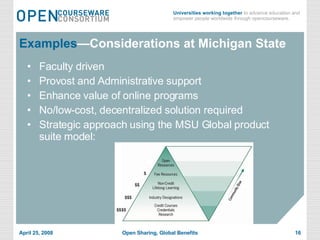
Examples —Considerations at Michigan State Faculty driven Provost and Administrative support Enhance value of online programs No/low-cost, decentralized solution required Strategic approach using the MSU Global product suite model:
Examples —OCW Structure at  Michigan State Facilitators MSU Global Libraries Computing and Technology Office of Intellectual Property   Internal Advisory Group   Faculty Program Leaders Faculty Development Office University Relations Stakeholders
Examples —OCW Structure at  Michigan State Make existing LMS materials open and findable LCT Virtual University Design and Technology support faculty to enable their ANGEL courses to be open MSU Global staff make non-credit program content available MSU Global staff maintain a catalog of OCW Make existing web materials open and findable License, tag and catalog existing material  Find solutions to co-create content Wikieducator wikieducator.org/International_Finance Wikiversity en.wikiversity.org/wiki/Trade_Finance
Examples —Considerations at MIT Initial commitment First-mover funding advantage Must succeed Minimal faculty impact essential Heterogeneous technology environment
Examples —OCW Structure at  MIT Reports to provost Big central organization Outsourced data entry Staff imbedded within departments High touch, high-quality process
Structuring Your Own OCW Team   —Considerations What is the Size and Structure of Your Institution? What Factors in Your Institutional Culture Might Contribute to OCW Production? In What Direction(s) does Your OCW Support Flow? What Are Your Existing E-learning Resources? What are Your Financial Resources Now?  In the Future? What Kind of Work Flow is Feasible in Your Circumstances?
Making the OCW Case at Your Institution Structuring Your OCW Team Technologies for OCW OCW Curriculum and Content Intellectual Property OCW Assessment Questions
Mixed economy Open source Learning Management System (LMS) Proprietary Learning Management System (LMS) Content Management Systems (CMS) Overview of OCW technologies
Interoperability and standards Audio/visual – an open approach? Web 2.0 - social networking, bookmarking, folksonomies, blogs, wikis Delivery – RSS, metadata, print Accessibility Overview of OCW technologies - formats
Making the OCW Case at Your Institution Structuring Your OCW Team Technologies for OCW OCW Curriculum and Content Intellectual Property OCW Assessment Questions
Course Curriculum and Content Factors to consider Intellectual Property: is there enough publishable content to make a ‘good course’? Does it showcase our institution’s ‘speciality’? Does the course meet General Education needs? Quality of content Remove or replace 3 rd  party copyrighted materials? What kinds of things would need to be localized? How enable re-use, re-mix and re-publish?
Curriculum and Content —Notre Dame Quality of Content Topical Coherence with Other Offerings Compatibility of Course Methodology Intellectual Property Appeal to Users, Especially Prospective Students and Alumni Potential for Improving On-Campus Teaching  Potential for Expanding Range of Tools and Methods
Curriculum and Content —Michigan State Strategic Product Suite Decision MSU Quality MSU Brand Intended Use Intended Community
Structured Learning Units Portion of entire course Intellectual property New vs archived materials Interest to partners—e.g. BBC Introductory level to postgraduate OCW curriculum and content - OpenLearn
Making the OCW Case at Your Institution Structuring Your OCW Team Technologies for OCW OCW Curriculum and Content Intellectual Property OCW Assessment Questions
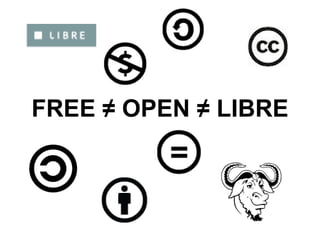
FREE ≠ OPEN ≠ LIBRE
Intellectual Property —Wiley’s 4R’s  Reuse use the work verbatim, just exactly as you found it Rework alter or transform the work so that it better meets your needs Remix combine the (verbatim or altered) work with other works to better meet your needs Redistribute share the verbatim work, the reworked work, or the remixed work with others
Intellectual Property —Choices Attribution Commercial Share Alike How Usable? Re-use  Re-work (derivative works) Re-mix (mixing licenses) Re-distribute (mixing licenses)
Intellectual Property —The Basics IP Law varies from country to country, but it generally provides legal protection—over a stated period of time—for original works of authorship fixed in a tangible medium of expression. Both published and unpublished works usually are protected. IP Law generally reserves to the creator of a work the right to authorize who may: Create derivative works from the original work Distribute originals or copies of the work, or Publicly display or perform the work. Once the stated period of time is over, the work enters the “public domain.”
Intellectual Property —The Basics IP Law and OCW—Creative Commons License Attribution (Non-Commercial) Share-Alike Intellectual Property Rights must be determined before they can be shared Relative Values of Licensing Consistency and Content Richness Very Limited Fair Use Coverage—Murkiness of the Law
Intellectual Property —Getting to Know Your General Counsel Develop a License Request You Both Can Live With Determine Your Institution’s Attitude Toward IP Ownership of Faculty Course Materials  Determine How Much IP Adventure Your Institution Can Bear Establish a Good Faith Relationship Understand that Fair Use Determinations Generally are Handled on a Case-By-Case Basis: Seek and Document Advice Before Embarking on a Fair Use Argument.  The documentation establishes your “good-faith effort” not to infringe.  (at least in the US) A License Request does not undermine a fair use argument
Intellectual Property —Navigation Documentary Tools: Standard Object License Request Database and/or spreadsheet for tracking all objects and their status Other Licenses: Participant License for Instructors, Students Work-For-Hire License for OCW Employees Clear chain of responsibility for IP Management
Making the OCW Case at Your Institution Structuring Your OCW Team Technologies for OCW OCW Curriculum and Content Intellectual Property OCW Assessment Questions
Assessment —Evaluation and Communication Why evaluate? Business decision Funders and stakeholders Evaluation vs. research Communicating is essential
Assessment —Evaluation and Communication—Considerations Whose buy-in is essential? How are you funded? What resources are available for evaluation and communication?
Assessment —Evaluation Develop a plan Keep it simple: Access, Use, Impact Hook into other evaluation on campus Make the effort for qualitative data Keep the resources on it
Assessment —Communication Identify key stakeholders Develop key communication documents Develop communications schedule Stories are important
Thank You! Visit The OpenCourseWare Consortium portal at http://www.ocwconsortium.org Contact the Consortium at: [email_address]

How2 Start Ocw

  • 1.
    Open Sharing, GlobalBenefits April 17, 2008 Terri Bays How to Start and Run an OCW Project Director, Notre Dame OCW At Your Institution Program Manager, OCW Consortium
  • 2.
    170+ OCWC Institutions Over 6,000 OCW Courses Online ~2,000,000 visitors/month
  • 3.
    Making the OCWCase at Your Institution Structuring Your OCW Team Technologies for OCW OCW Curriculum and Content Intellectual Property OCW Assessment Questions
  • 4.
    Making the OCWCase at Your Institution University Culture Scope of the Project Benefits to Faculty, Students, Learners, University Existing Processes Pain Points
  • 5.
    University Culture Missionalignment MIT: Best serve nation and world JHSPH: Improve global public health Utah State: Land grant institution Notre Dame: Catholic social mission Michigan State: World-grant mission
  • 6.
    Scope of ProjectInstitution-wide Departmental Showcase Other models
  • 7.
    Benefits to Faculty,Students, Learners, University Lifelong learning Prospective students, current students, alumni A catalyst for academic improvement Collaboration; organization; use of technology A tool for resource development and international engagement Fundraising; faculty, department reputation; global collaboration
  • 8.
    Existing Processes Educationalmaterials “lifecycle” IP management Faculty support teams Research and communication
  • 9.
    Pain Points Stakeholderbuy-in Faculty time Materials ownership Scarce resources
  • 10.
    Making the OCWCase at Your Institution Structuring Your OCW Team Technologies for OCW OCW Curriculum and Content Intellectual Property OCW Assessment Questions
  • 11.
    Structuring your OCWTeam —Considerations Size and Structure of Institution Institutional Culture Flow of OCW Support Existing E-learning Resources Financial Resources Financial Sustainability Project Goals Work Flow
  • 12.
    Structuring your OCWTeam —Sustainability Cost-Benefit Models Reduce costs Increase benefits Third-Party Funding Models Foundations, Government Sponsorships Donations Endowment Value-Added Models Fees for goods and services Membership
  • 13.
    Examples —Considerations atNotre Dame Project Support from Provost’s Office, Faculty Tension between Graduate and Undergraduate Needs Minimal Distance Education in Institution In-Project Planning rather than Top-Down Direction Start with Grant, Need to Develop Grass-Roots Support Goal Not to Publish Everything, but to Showcase Strengths Flexible Work Flow
  • 14.
    Examples —OCW Structureat Notre Dame Project Director Hosted by Center for Teaching and Learning Strategic Recruitment of Faculty Training and Supervision of Course Production Assistants Resolution of Intellectual Property issues Technical Oversight of Project Outreach, Assessment and Development Efforts Coordination with other parts of the Campus Community Communication with Consortium and Broader OER Community. A Variety of Campus Professionals Intellectual Property Consultation with General Counsel’s Office Assessment via Office of Institutional Research University Librarians, Museum Curators, etc.
  • 15.
    Examples —OCW Structureat Notre Dame Course Production Assistant (at Notre Dame this is usually a Graduate Student in the relevant discipline) No html skills necessary Focus on familiarity with the discipline, so as to best adapt/develop the strengths of the course to suit the online environment Basic intellectual property management Undergraduate Student Workers Routine clerical work (e.g., metadata entry) Photography, Videography Some coding and/or design work (e.g. flash module) Intellectual Property Training by Reference Librarian Work Flow sometimes too flexible, requires close monitoring
  • 16.
    Examples —Considerations atMichigan State Faculty driven Provost and Administrative support Enhance value of online programs No/low-cost, decentralized solution required Strategic approach using the MSU Global product suite model:
  • 17.
    Examples —OCW Structureat Michigan State Facilitators MSU Global Libraries Computing and Technology Office of Intellectual Property Internal Advisory Group Faculty Program Leaders Faculty Development Office University Relations Stakeholders
  • 18.
    Examples —OCW Structureat Michigan State Make existing LMS materials open and findable LCT Virtual University Design and Technology support faculty to enable their ANGEL courses to be open MSU Global staff make non-credit program content available MSU Global staff maintain a catalog of OCW Make existing web materials open and findable License, tag and catalog existing material Find solutions to co-create content Wikieducator wikieducator.org/International_Finance Wikiversity en.wikiversity.org/wiki/Trade_Finance
  • 19.
    Examples —Considerations atMIT Initial commitment First-mover funding advantage Must succeed Minimal faculty impact essential Heterogeneous technology environment
  • 20.
    Examples —OCW Structureat MIT Reports to provost Big central organization Outsourced data entry Staff imbedded within departments High touch, high-quality process
  • 21.
    Structuring Your OwnOCW Team —Considerations What is the Size and Structure of Your Institution? What Factors in Your Institutional Culture Might Contribute to OCW Production? In What Direction(s) does Your OCW Support Flow? What Are Your Existing E-learning Resources? What are Your Financial Resources Now? In the Future? What Kind of Work Flow is Feasible in Your Circumstances?
  • 22.
    Making the OCWCase at Your Institution Structuring Your OCW Team Technologies for OCW OCW Curriculum and Content Intellectual Property OCW Assessment Questions
  • 23.
    Mixed economy Opensource Learning Management System (LMS) Proprietary Learning Management System (LMS) Content Management Systems (CMS) Overview of OCW technologies
  • 24.
    Interoperability and standardsAudio/visual – an open approach? Web 2.0 - social networking, bookmarking, folksonomies, blogs, wikis Delivery – RSS, metadata, print Accessibility Overview of OCW technologies - formats
  • 25.
    Making the OCWCase at Your Institution Structuring Your OCW Team Technologies for OCW OCW Curriculum and Content Intellectual Property OCW Assessment Questions
  • 26.
    Course Curriculum andContent Factors to consider Intellectual Property: is there enough publishable content to make a ‘good course’? Does it showcase our institution’s ‘speciality’? Does the course meet General Education needs? Quality of content Remove or replace 3 rd party copyrighted materials? What kinds of things would need to be localized? How enable re-use, re-mix and re-publish?
  • 27.
    Curriculum and Content—Notre Dame Quality of Content Topical Coherence with Other Offerings Compatibility of Course Methodology Intellectual Property Appeal to Users, Especially Prospective Students and Alumni Potential for Improving On-Campus Teaching Potential for Expanding Range of Tools and Methods
  • 28.
    Curriculum and Content—Michigan State Strategic Product Suite Decision MSU Quality MSU Brand Intended Use Intended Community
  • 29.
    Structured Learning UnitsPortion of entire course Intellectual property New vs archived materials Interest to partners—e.g. BBC Introductory level to postgraduate OCW curriculum and content - OpenLearn
  • 30.
    Making the OCWCase at Your Institution Structuring Your OCW Team Technologies for OCW OCW Curriculum and Content Intellectual Property OCW Assessment Questions
  • 31.
    FREE ≠ OPEN≠ LIBRE
  • 32.
    Intellectual Property —Wiley’s4R’s Reuse use the work verbatim, just exactly as you found it Rework alter or transform the work so that it better meets your needs Remix combine the (verbatim or altered) work with other works to better meet your needs Redistribute share the verbatim work, the reworked work, or the remixed work with others
  • 33.
    Intellectual Property —ChoicesAttribution Commercial Share Alike How Usable? Re-use Re-work (derivative works) Re-mix (mixing licenses) Re-distribute (mixing licenses)
  • 34.
    Intellectual Property —TheBasics IP Law varies from country to country, but it generally provides legal protection—over a stated period of time—for original works of authorship fixed in a tangible medium of expression. Both published and unpublished works usually are protected. IP Law generally reserves to the creator of a work the right to authorize who may: Create derivative works from the original work Distribute originals or copies of the work, or Publicly display or perform the work. Once the stated period of time is over, the work enters the “public domain.”
  • 35.
    Intellectual Property —TheBasics IP Law and OCW—Creative Commons License Attribution (Non-Commercial) Share-Alike Intellectual Property Rights must be determined before they can be shared Relative Values of Licensing Consistency and Content Richness Very Limited Fair Use Coverage—Murkiness of the Law
  • 36.
    Intellectual Property —Gettingto Know Your General Counsel Develop a License Request You Both Can Live With Determine Your Institution’s Attitude Toward IP Ownership of Faculty Course Materials Determine How Much IP Adventure Your Institution Can Bear Establish a Good Faith Relationship Understand that Fair Use Determinations Generally are Handled on a Case-By-Case Basis: Seek and Document Advice Before Embarking on a Fair Use Argument. The documentation establishes your “good-faith effort” not to infringe. (at least in the US) A License Request does not undermine a fair use argument
  • 37.
    Intellectual Property —NavigationDocumentary Tools: Standard Object License Request Database and/or spreadsheet for tracking all objects and their status Other Licenses: Participant License for Instructors, Students Work-For-Hire License for OCW Employees Clear chain of responsibility for IP Management
  • 38.
    Making the OCWCase at Your Institution Structuring Your OCW Team Technologies for OCW OCW Curriculum and Content Intellectual Property OCW Assessment Questions
  • 39.
    Assessment —Evaluation andCommunication Why evaluate? Business decision Funders and stakeholders Evaluation vs. research Communicating is essential
  • 40.
    Assessment —Evaluation andCommunication—Considerations Whose buy-in is essential? How are you funded? What resources are available for evaluation and communication?
  • 41.
    Assessment —Evaluation Developa plan Keep it simple: Access, Use, Impact Hook into other evaluation on campus Make the effort for qualitative data Keep the resources on it
  • 42.
    Assessment —Communication Identifykey stakeholders Develop key communication documents Develop communications schedule Stories are important
  • 43.
    Thank You! VisitThe OpenCourseWare Consortium portal at http://www.ocwconsortium.org Contact the Consortium at: [email_address]