Welcome to Kindergarten
       at IST
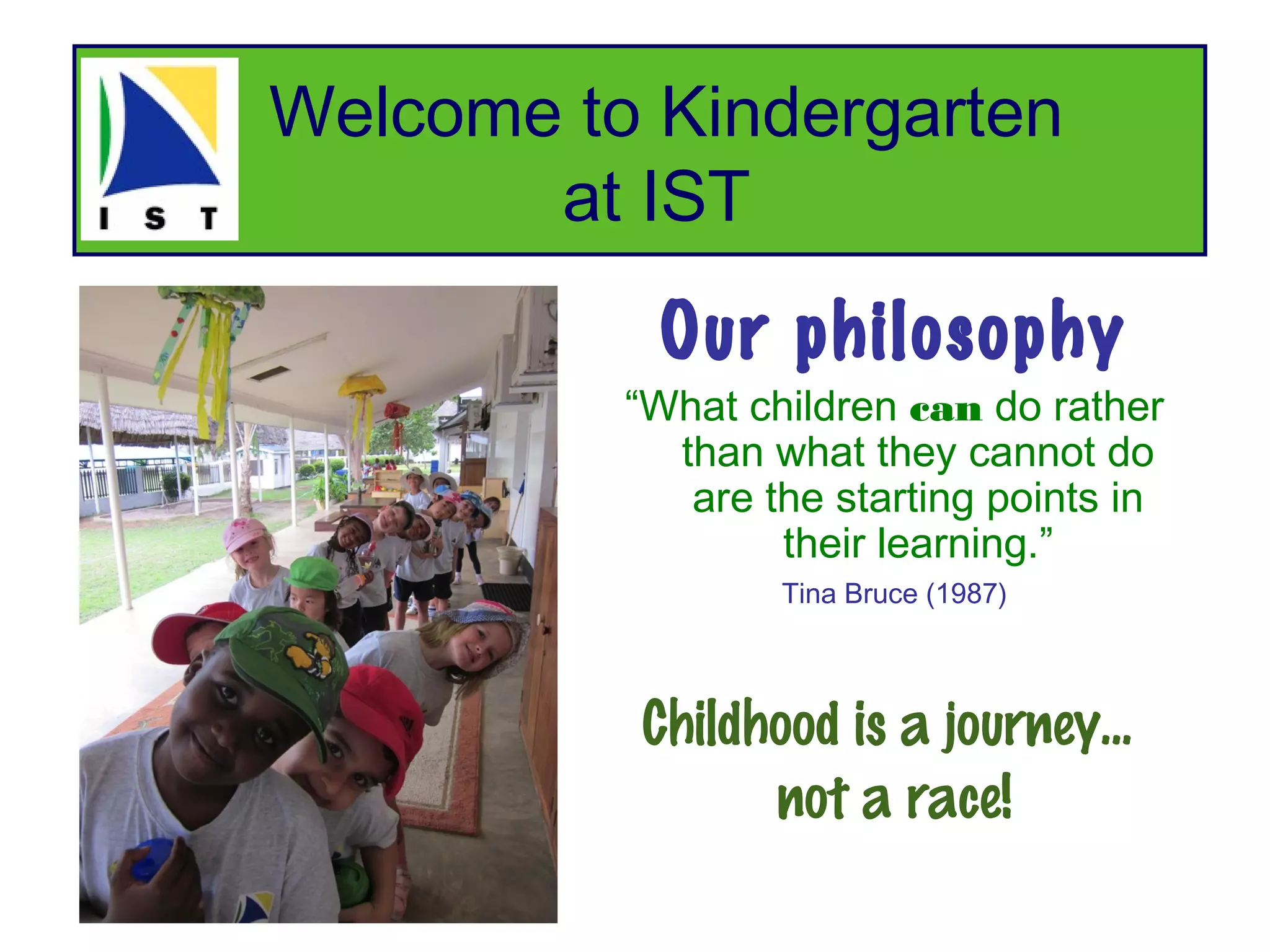
           Our philosophy
          “What children can do rather
            than what they cannot do
             are the starting points in
                  their learning.”
                  Tina Bruce (1987)


          Childhood is a journey...
                not a race!
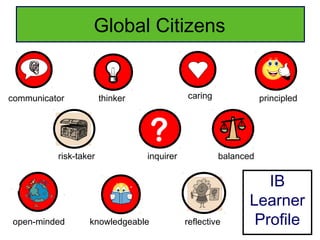
Global Citizens


communicator           thinker              caring              principled


                                  ?
          risk-taker             inquirer            balanced


                                                               IB
                                                            Learner
open-minded       knowledgeable             reflective       Profile
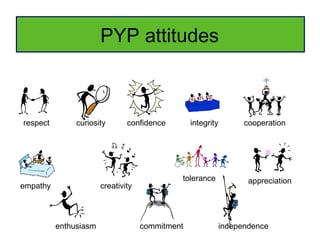
PYP attitudes


respect        curiosity       confidence        integrity         cooperation


                                             tolerance              appreciation
empathy                creativity


          enthusiasm                commitment               independence
How best will my child learn?
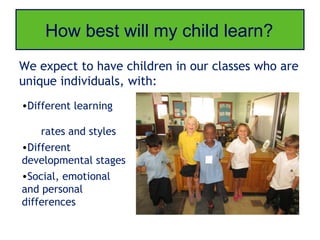
We expect to have children in our classes who are
unique individuals, with:
•Different learning

    rates and styles
•Different
developmental stages
•Social, emotional
and personal
differences
How best will my child learn?
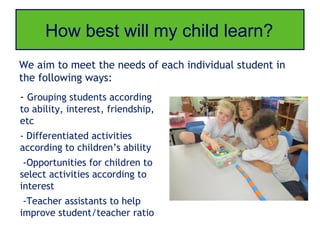
We aim to meet the needs of each individual student in
the following ways:
- Grouping students according
to ability, interest, friendship,
etc
- Differentiated activities
according to children’s ability
 -Opportunities for children to
select activities according to
interest
 -Teacher assistants to help
improve student/teacher ratio
How best will my child learn?
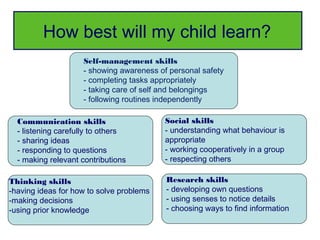
                    Self-management skills
                    - showing awareness of personal safety
                    - completing tasks appropriately
                    - taking care of self and belongings
                    - following routines independently

  Communication skills                    Social skills
  - listening carefully to others         - understanding what behaviour is
  - sharing ideas                         appropriate
  - responding to questions               - working cooperatively in a group
  - making relevant contributions         - respecting others

Thinking skills                           Research skills
-having ideas for how to solve problems   - developing own questions
-making decisions                         - using senses to notice details
-using prior knowledge                    - choosing ways to find information
Reading Development
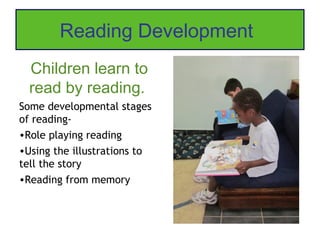
  Children learn to
  read by reading.
Some developmental stages
of reading-
•Role playing reading
•Using the illustrations to
tell the story
•Reading from memory
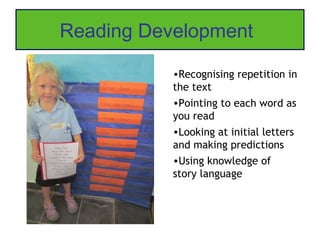
Reading Development

           •Recognising repetition in
           the text
           •Pointing to each word as
           you read
           •Looking at initial letters
           and making predictions
           •Using knowledge of
           story language
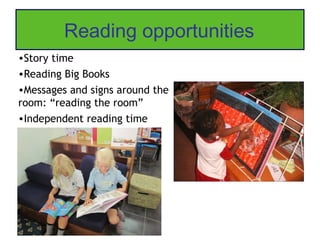
Reading opportunities
•Story time
•Reading Big Books
•Messages and signs around the
room: “reading the room”
•Independent reading time
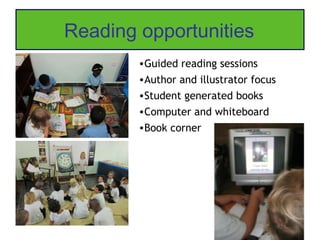
Reading opportunities
        •Guided reading sessions
        •Author and illustrator focus
        •Student generated books
        •Computer and whiteboard
        •Book corner
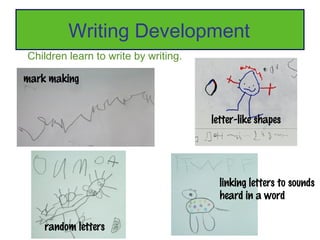
Writing Development
Children learn to write by writing.

mark making


                                      letter-like shapes


                                        linking letters to sounds
                                        heard in a word

    random letters
Writing Development


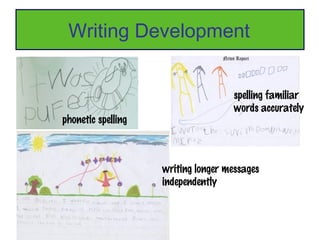
                                     spelling familiar
                                     words accurately
phonetic spelling


                    writing longer messages
                    independently
Writing opportunities
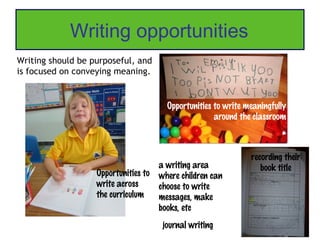
Writing should be purposeful, and
is focused on conveying meaning.


                                        Opportunities to write meaningfully
                                                      around the classroom


                                                                recording their
                                      a writing area               book title
                   Opportunities to   where children can
                   write across       choose to write
                   the curriculum     messages, make
                                      books, etc
                                       journal writing
Mathematics
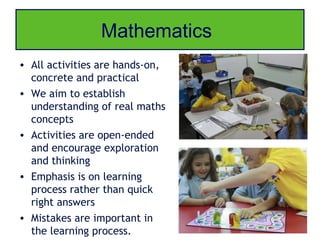
• All activities are hands-on,
  concrete and practical
• We aim to establish
  understanding of real maths
  concepts
• Activities are open-ended
  and encourage exploration
  and thinking
• Emphasis is on learning
  process rather than quick
  right answers
• Mistakes are important in
  the learning process.
Mathematics
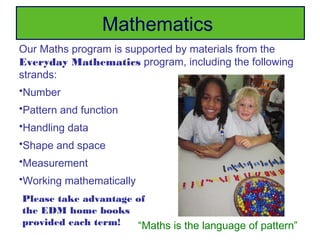
Our Maths program is supported by materials from the
Everyday Mathematics program, including the following
strands:
•Number
•Pattern and function
•Handling data
•Shape and space
•Measurement
•Working mathematically
Please take advantage of
the EDM home books
provided each term!   “Maths is the language of pattern”
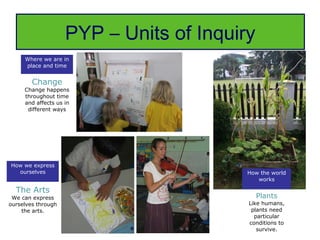
PYP – Units of Inquiry
     Where we are in
     place and time


        Change
     Change happens
     throughout time
     and affects us in
      different ways


How we express
  ourselves                              How the world
                                            works

  The Arts
 We can express                              Plants
ourselves through                        Like humans,
    the arts.                             plants need
                                           particular
                                         conditions to
                                            survive.
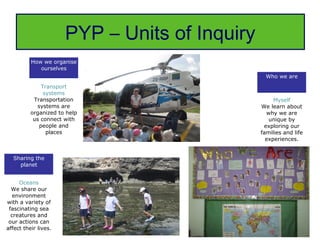
PYP – Units of Inquiry
          How we organise
             ourselves
                                                 Who we are
              Transport
               systems
           Transportation                           Myself
            systems are                        We learn about
          organized to help                      why we are
           us connect with                        unique by
             people and                         exploring our
                places                         families and life
                                                 experiences.


  Sharing the
    planet


     Oceans
  We share our
   environment
with a variety of
 fascinating sea
  creatures and
 our actions can
affect their lives.
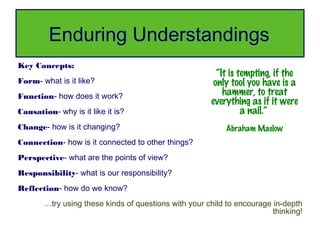
Enduring Understandings
Key Concepts:
                                                        “It is tempting, if the
Form- what is it like?                                 only tool you have is a
Function- how does it work?                               hammer, to treat
                                                      everything as if it were
Causation- why is it like it is?                                a nail.”
Change- how is it changing?                                Abraham Maslow
Connection- how is it connected to other things?
Perspective- what are the points of view?
Responsibility- what is our responsibility?
Reflection- how do we know?
       …try using these kinds of questions with your child to encourage in-depth
                                                                        thinking!
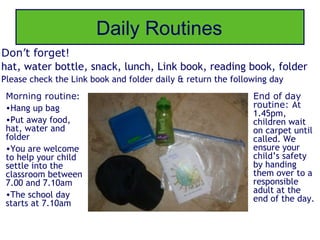
Daily Routines
Don’t forget!
hat, water bottle, snack, lunch, Link book, reading book, folder
Please check the Link book and folder daily & return the following day
 Morning routine:                                             End of day
 •Hang up bag                                                 routine: At
                                                              1.45pm,
 •Put away food,                                              children wait
 hat, water and                                               on carpet until
 folder                                                       called. We
 •You are welcome                                             ensure your
 to help your child                                           child’s safety
 settle into the                                              by handing
 classroom between                                            them over to a
 7.00 and 7.10am                                              responsible
 •The school day                                              adult at the
                                                              end of the day.
 starts at 7.10am
Our day
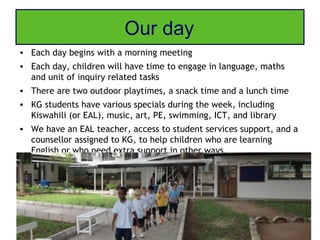
• Each day begins with a morning meeting
• Each day, children will have time to engage in language, maths
  and unit of inquiry related tasks
• There are two outdoor playtimes, a snack time and a lunch time
• KG students have various specials during the week, including
  Kiswahili (or EAL), music, art, PE, swimming, ICT, and library
• We have an EAL teacher, access to student services support, and a
  counsellor assigned to KG, to help children who are learning
  English or who need extra support in other ways.
Food, food, food!
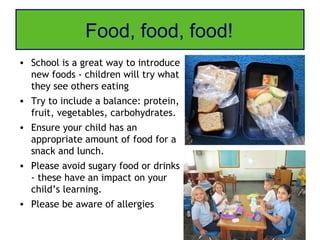
• School is a great way to introduce
  new foods - children will try what
  they see others eating
• Try to include a balance: protein,
  fruit, vegetables, carbohydrates.
• Ensure your child has an
  appropriate amount of food for a
  snack and lunch.
• Please avoid sugary food or drinks
  - these have an impact on your
  child’s learning.
• Please be aware of allergies
How can I help at home?
• Read every day! Children will bring home a class library
  book daily - the focus is on reading for pleasure. Take
  them to the library - it is open from 6.50am-2.30pm.
• Maths activities may be sent home at certain times and
  will focus on a concept that is being discussed in class.
  Use the EveryDay Maths Mathematics at Home booklet
  to pick up ideas for “playful” maths activities for you
  to do together with your child
• Unit of inquiry discussion questions, and other ideas for
  activities to do at home, will be posted on the KG blog.
Some reminders
• Please try to bring your child to school and collect them on time.
  Report to the Elementary office if you are late.
• Please let us know if someone different is collecting your child.
  Please wait in the KG quad to collect your child. It is distracting
  for children to see adults outside windows and doors before the
  bell.
• Please support us by ensuring your child follows school rules whilst
  under your supervision.
• You are welcome to send cakes to school for birthdays - please
  notify your child’s teacher in advance. Individual pieces are easier
  to hand out. Send invitations only if they are for every child in
  class.
• Help your child to practice getting changed into swimwear and
  back into uniform. They are encouraged to swim every week.
• Keep your child at home if they are really sick.
Keeping in touch
• Please use the link book or email to communicate with the
  teacher
• Save the dates for the KG assemblies: 5th October and 17th April
• Informal chats with teachers before and after school
• Make an appointment if you’d like a longer chat about your child
• Look out for parent-teacher conferences in October and student-
  led conferences in March
• Parent representative: two parents needed per class
• Action at home? …please share with us

   – Encourage independence... “OUR CHILDREN CAN!”
      “Children who are encouraged to think for themselves
               are more likely to act independently.”
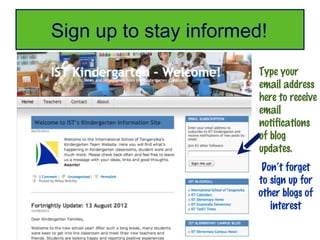
Sign up to stay informed!
                        Type your
                        email address
                        here to receive
                        email
                        notifications
                        of blog
                        updates.
                        Don’t forget
                       to sign up for
                       other blogs of
                          interest

Open house pp 2012

  • 1.
    Welcome to Kindergarten at IST Our philosophy “What children can do rather than what they cannot do are the starting points in their learning.” Tina Bruce (1987) Childhood is a journey... not a race!
  • 2.
    Global Citizens communicator thinker caring principled ? risk-taker inquirer balanced IB Learner open-minded knowledgeable reflective Profile
  • 3.
    PYP attitudes respect curiosity confidence integrity cooperation tolerance appreciation empathy creativity enthusiasm commitment independence
  • 4.
    How best willmy child learn? We expect to have children in our classes who are unique individuals, with: •Different learning rates and styles •Different developmental stages •Social, emotional and personal differences
  • 5.
    How best willmy child learn? We aim to meet the needs of each individual student in the following ways: - Grouping students according to ability, interest, friendship, etc - Differentiated activities according to children’s ability -Opportunities for children to select activities according to interest -Teacher assistants to help improve student/teacher ratio
  • 6.
    How best willmy child learn? Self-management skills - showing awareness of personal safety - completing tasks appropriately - taking care of self and belongings - following routines independently Communication skills Social skills - listening carefully to others - understanding what behaviour is - sharing ideas appropriate - responding to questions - working cooperatively in a group - making relevant contributions - respecting others Thinking skills Research skills -having ideas for how to solve problems - developing own questions -making decisions - using senses to notice details -using prior knowledge - choosing ways to find information
  • 7.
    Reading Development Children learn to read by reading. Some developmental stages of reading- •Role playing reading •Using the illustrations to tell the story •Reading from memory
  • 8.
    Reading Development •Recognising repetition in the text •Pointing to each word as you read •Looking at initial letters and making predictions •Using knowledge of story language
  • 9.
    Reading opportunities •Story time •ReadingBig Books •Messages and signs around the room: “reading the room” •Independent reading time
  • 10.
    Reading opportunities •Guided reading sessions •Author and illustrator focus •Student generated books •Computer and whiteboard •Book corner
  • 11.
    Writing Development Children learnto write by writing. mark making letter-like shapes linking letters to sounds heard in a word random letters
  • 12.
    Writing Development spelling familiar words accurately phonetic spelling writing longer messages independently
  • 13.
    Writing opportunities Writing shouldbe purposeful, and is focused on conveying meaning. Opportunities to write meaningfully around the classroom recording their a writing area book title Opportunities to where children can write across choose to write the curriculum messages, make books, etc journal writing
  • 14.
    Mathematics • All activitiesare hands-on, concrete and practical • We aim to establish understanding of real maths concepts • Activities are open-ended and encourage exploration and thinking • Emphasis is on learning process rather than quick right answers • Mistakes are important in the learning process.
  • 15.
    Mathematics Our Maths programis supported by materials from the Everyday Mathematics program, including the following strands: •Number •Pattern and function •Handling data •Shape and space •Measurement •Working mathematically Please take advantage of the EDM home books provided each term! “Maths is the language of pattern”
  • 16.
    PYP – Unitsof Inquiry Where we are in place and time Change Change happens throughout time and affects us in different ways How we express ourselves How the world works The Arts We can express Plants ourselves through Like humans, the arts. plants need particular conditions to survive.
  • 17.
    PYP – Unitsof Inquiry How we organise ourselves Who we are Transport systems Transportation Myself systems are We learn about organized to help why we are us connect with unique by people and exploring our places families and life experiences. Sharing the planet Oceans We share our environment with a variety of fascinating sea creatures and our actions can affect their lives.
  • 18.
    Enduring Understandings Key Concepts: “It is tempting, if the Form- what is it like? only tool you have is a Function- how does it work? hammer, to treat everything as if it were Causation- why is it like it is? a nail.” Change- how is it changing? Abraham Maslow Connection- how is it connected to other things? Perspective- what are the points of view? Responsibility- what is our responsibility? Reflection- how do we know? …try using these kinds of questions with your child to encourage in-depth thinking!
  • 19.
    Daily Routines Don’t forget! hat,water bottle, snack, lunch, Link book, reading book, folder Please check the Link book and folder daily & return the following day Morning routine: End of day •Hang up bag routine: At 1.45pm, •Put away food, children wait hat, water and on carpet until folder called. We •You are welcome ensure your to help your child child’s safety settle into the by handing classroom between them over to a 7.00 and 7.10am responsible •The school day adult at the end of the day. starts at 7.10am
  • 20.
    Our day • Eachday begins with a morning meeting • Each day, children will have time to engage in language, maths and unit of inquiry related tasks • There are two outdoor playtimes, a snack time and a lunch time • KG students have various specials during the week, including Kiswahili (or EAL), music, art, PE, swimming, ICT, and library • We have an EAL teacher, access to student services support, and a counsellor assigned to KG, to help children who are learning English or who need extra support in other ways.
  • 21.
    Food, food, food! •School is a great way to introduce new foods - children will try what they see others eating • Try to include a balance: protein, fruit, vegetables, carbohydrates. • Ensure your child has an appropriate amount of food for a snack and lunch. • Please avoid sugary food or drinks - these have an impact on your child’s learning. • Please be aware of allergies
  • 22.
    How can Ihelp at home? • Read every day! Children will bring home a class library book daily - the focus is on reading for pleasure. Take them to the library - it is open from 6.50am-2.30pm. • Maths activities may be sent home at certain times and will focus on a concept that is being discussed in class. Use the EveryDay Maths Mathematics at Home booklet to pick up ideas for “playful” maths activities for you to do together with your child • Unit of inquiry discussion questions, and other ideas for activities to do at home, will be posted on the KG blog.
  • 23.
    Some reminders • Pleasetry to bring your child to school and collect them on time. Report to the Elementary office if you are late. • Please let us know if someone different is collecting your child. Please wait in the KG quad to collect your child. It is distracting for children to see adults outside windows and doors before the bell. • Please support us by ensuring your child follows school rules whilst under your supervision. • You are welcome to send cakes to school for birthdays - please notify your child’s teacher in advance. Individual pieces are easier to hand out. Send invitations only if they are for every child in class. • Help your child to practice getting changed into swimwear and back into uniform. They are encouraged to swim every week. • Keep your child at home if they are really sick.
  • 24.
    Keeping in touch •Please use the link book or email to communicate with the teacher • Save the dates for the KG assemblies: 5th October and 17th April • Informal chats with teachers before and after school • Make an appointment if you’d like a longer chat about your child • Look out for parent-teacher conferences in October and student- led conferences in March • Parent representative: two parents needed per class • Action at home? …please share with us – Encourage independence... “OUR CHILDREN CAN!” “Children who are encouraged to think for themselves are more likely to act independently.”
  • 25.
    Sign up tostay informed! Type your email address here to receive email notifications of blog updates. Don’t forget to sign up for other blogs of interest

Editor's Notes

  • #2 Kat - ongoing medical issues - they are of a private nature. At this time, earliest possible return Wednesday 5th September. I am here to support KG team in the absence of the team leader, and provide any clarification needed.
  • #5 We expect to have children in our classes:- with different learning rates and styles at different developmental stages with social, emotional and personal differences We meet their needs in a variety of ways… Variety of grouping strategies, including ability, interest, friendship, individual, pairs or whole class Differentiated activities according to children’s ability Opportunities for children to select activities according to interest Teaching assistants
  • #6 We expect to have children in our classes:- with different learning rates and styles at different developmental stages with social, emotional and personal differences We meet their needs in a variety of ways… Variety of grouping strategies, including ability, interest, friendship, individual, pairs or whole class Differentiated activities according to children’s ability Opportunities for children to select activities according to interest Teaching assistants
  • #7 We expect to have children in our classes:- with different learning rates and styles at different developmental stages with social, emotional and personal differences We meet their needs in a variety of ways… Variety of grouping strategies, including ability, interest, friendship, individual, pairs or whole class Differentiated activities according to children’s ability Opportunities for children to select activities according to interest Teaching assistants
  • #8 Reading strategies: Reading from memory, Using the pictures as clues to the text, Pointing to each word as you read to help focus on each word, Recognizing repetition in the text, Looking at initial letters and making sensible predictions, Using knowledge of story language, Building on a bank of common words read on sight. Looking at the picture and reading from memory is not ‘cheating’, it is an important stage of learning to read. The p urpose of reading: enjoyment and meaningful
  • #10 Reading strategies: Reading from memory, Using the pictures as clues to the text, Pointing to each word as you read to help focus on each word, Recognizing repetition in the text, Looking at initial letters and making sensible predictions, Using knowledge of story language, Building on a bank of common words read on sight. Looking at the picture and reading from memory is not ‘cheating’, it is an important stage of learning to read. The p urpose of reading: enjoyment and meaningful
  • #12 Mark making Role play writing Letter-like forms Random letters Linking letter forms to sounds heard in a word Inventive spellings Able to spell familiar words When children have a purpose to write it makes them eager to write.
  • #16 Wherever possible we have built Maths into our Units of Inquiry. All activities are hands-on, concrete and practical and we aim to establish understanding of real Maths concepts. Activities are often open-ended and leave opportunities for exploration and thinking at their own level. Emphasis is placed on the learning process rather than quick right answers. Mistakes are viewed as an important part of the learning process.