ADMISSION OF PATIENT IN THE
HOSPITAL
Ms. RIWANKA.K
ASST. PROFESSOR
CON, NEMCARE FOUNDATION
ADMISSION OF PATIENT
Definition:
Admission is defined as allowing a patient to
stay in hospital for observation, investigation,
treatment and care.
PURPOSES OF ADMISSION
To welcome the patient
To provide comfort and safety to the patient
To provide immediate care
To be ready for any emergency
To establish nurse-patient relationship
To undergo evaluation & treatment
PURPOSES OF ADMISSION (CONT..)
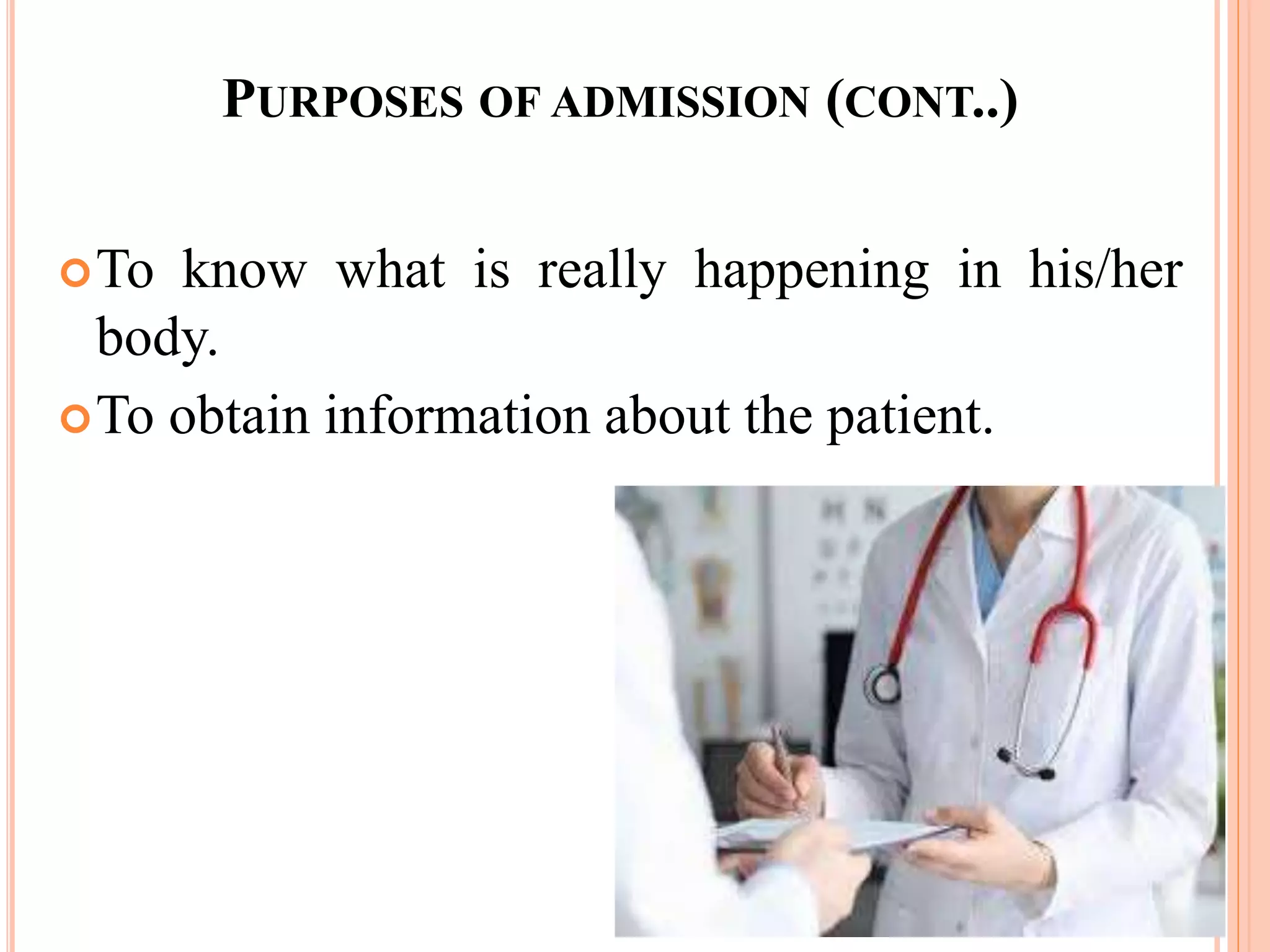
To know what is really happening in his/her
body.
To obtain information about the patient.
TYPES OF ADMISSION:
1. Emergency admission
2. Routine admission
Emergency admission: In this, patients are admitted
in acute conditions requiring immediate treatment.
Examples. Patient with RTA, Poisoning, burns and
cardiac or respiratory emergency.
TYPES OF ADMISSION(CONT..)
Routine admission: In this, patients are
admitted for investigation, diagnostic and
medical or surgical treatment. Treatment is
given according to patients problem. E.g. Patient
with hypertension, diabetes mellitus etc.
PREPARING THE UNIT FOR ADMISSION
1. Keeping the bed ready
2. Position the bed
3. Assemble necessary equipment and supplies
4. Assemble special equipment and supplies
PREPARING THE UNIT FOR ADMISSION (CONT..)
Keeping the bed ready:
Open the bed, fold back the bedspread, top
blanket, and topsheet.
Cover the bed with a full bed-length
mackintosh and 2 bath blankets in order to
protect the bed from soiling.
PREPARING THE UNIT FOR ADMISSION (CONT..)
Position the bed:
Ambulatory clients, the bed should be in
normal position.
If the clients has to arrive on a stretcher, the
bed should be in lowest position.
Make sure that the furniture in the room has
been arrange to ensure easy access to the
bed.
PREPARING THE UNIT FOR ADMISSION (CONT..)
Assemble necessary equipment and supplies:
A hospital admission pack, which contains
items such as bath basins, drinking glass,
thermometer, paper and lotion should be
ready at bedside.
A hospital gown should be available, although
the clients may choose to wear personal
clothes
PREPARING THE UNIT FOR ADMISSION (CONT..)
Assemble special equipment and supplies:
Oxygen therapy, cardiac monitoring, or
suction equipment.
Make sure that the equipment is functioning
properly and is ready for the patient’s use on
arrival.
PREPARATION OF ARTICLES
Articles Rationale
 All articles for an open bed, bottom
sheet, draw mackintosh, draw-sheet,
top-sheet, blanket, counterpane.
 To keep the bed ready to receive the
patient in a calm manner.
 Full bed length mackintosh.  To protect the bed from soiling with
excreta/blood/dirt.
 Two bath blankets/bed sheets.  To cover the bed length mackintosh and
another to cover the patient.
 Hot water bags in cold weather.  To keep the bed warm before hand.
 Other articles required for daily care of
the patient e.g. temperature tray, sponge
bath tray, a set of hospitals clothes.
 To be ready to give care to the patient.
It can save time and energy for the
nurse.
 Any other special equipment such as
oxygen suction, monitoring equipment.
 To meet emergency in life-saving
situations.
RECEPTION OF THE PATIENT
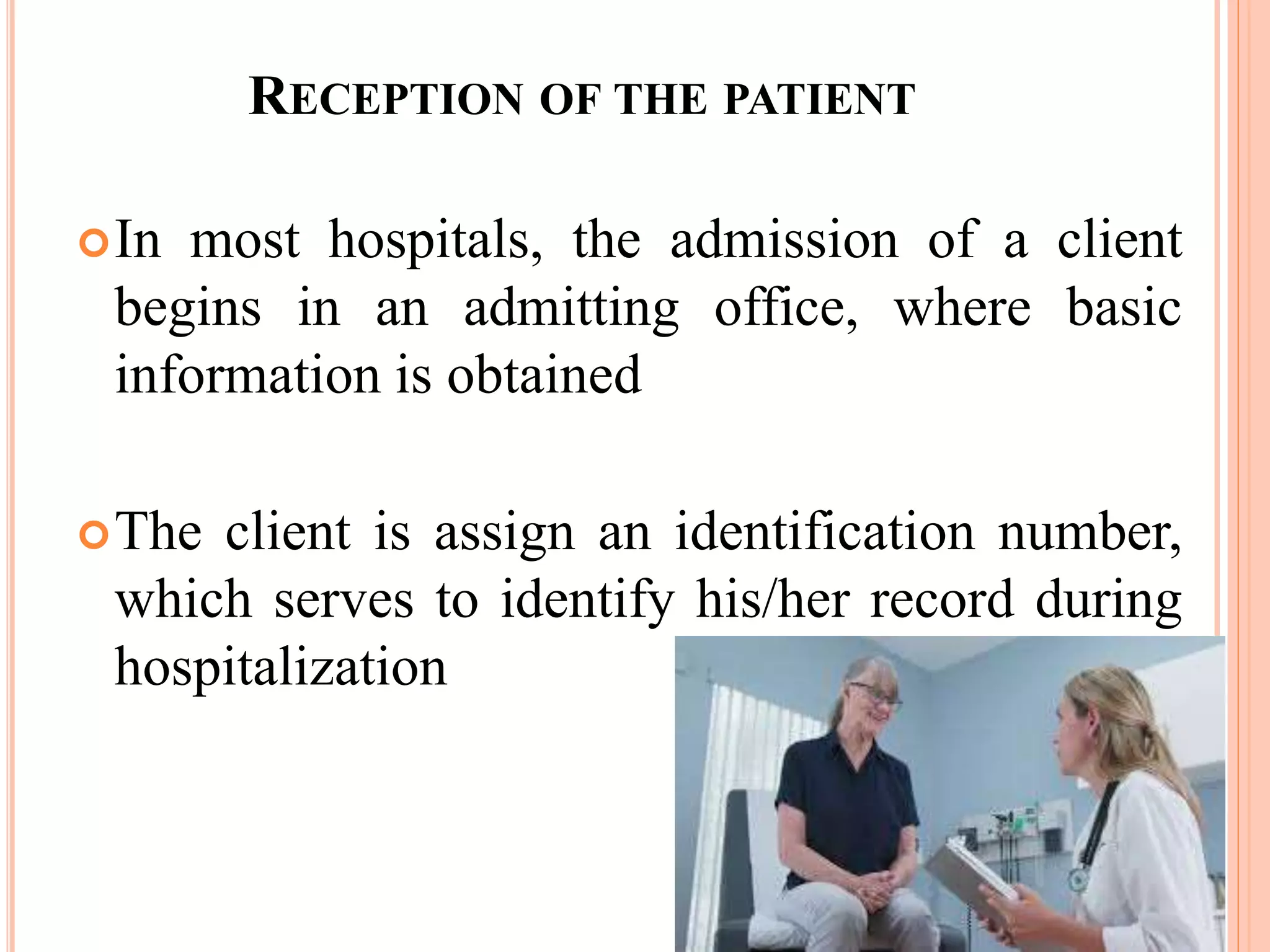
In most hospitals, the admission of a client
begins in an admitting office, where basic
information is obtained
The client is assign an identification number,
which serves to identify his/her record during
hospitalization
RECEPTION OF THE PATIENT (CONT..)
Clients are directed to the unit. If a stretcher or
wheel chair is required, it is provided to the
patient.
Now-a-days due to the rising cost in private
hospitals many of the investigations are
completed before the person is admitted from
the outpatient department itself, so that the
hospitals stays can be shortened
STEPS OF THE PROCEDURE, SCIENTIFIC
PRINCIPLES & NURSING PRINCIPLES
Steps Rationale Scientific principles Nursing
principles
Prepare the room with
care and arrange all
items in place and
adjust height of the
bed.
To feel safe and
secure and for easy
transfer from stretcher
to bed
To relieve fear and
anxiety and
encourage
adjustment
(psychology)
Comfort &
safety
Check the client’s
identification and greet
him/her and relatives,
introduce yourself.
To help them to feel at
ease and provide
room for care of the
client.
To help the clients
to adjust to a new
environment
(psychology)
Comfort &
individuali
ty
STEPS OF THE PROCEDURE, SCIENTIFIC
PRINCIPLES & NURSING PRINCIPLES (CONT..)
Observe the client’s
vital signs and
symptoms and collect
speciment for
laboratory test, if
required.
To know the
condition of the
patient on admission.
To assist the
physician in the line
of treatment.
To detect any
variation from
normal.
(anatomy&
physiology)
Therapeutic
effectiveness
Provide privacy. Give
admission baths, if
need. Change to
hospital clothes.
To relax and make
the patient
comfortable. To make
important
observations.
To help in
relaxation of the
patient.
(psychology)
Comfort &
therapeutic
effectiveness
STEPS OF THE PROCEDURE, SCIENTIFIC
PRINCIPLES & NURSING PRINCIPLES (CONT..)
Explain use of
bathroom and other
equipment in the room
or ward.
Place a call bell and a
locker in easy reach of
the client.
Explain meal times and
visiting hours to the
client and relatives.
To help the client be
at ease and knowing
how to use equipment
to prevent accidents.
Helps in adjusting
to the new
environment.
Reduces anxiety
Helps in preventing
accidents.
(principle of
psychology and
sociology)
Comfort &
safety
Answer queries of
clients and relatives
Helps in decreasing
anxiety and fear
Helps to avoid
stress (psychology)
Comfort
STEPS OF THE PROCEDURE, SCIENTIFIC
PRINCIPLES & NURSING PRINCIPLES (CONT..)
Complete necessary
records according to
agency policy which
includes nursing history
and assessment.
The information
optained is an
important part of the
client’s permanent
record.
-- Individuality
and
Therapeutic
effectiveness
SPECIAL CONSIDERATION
 Admission cause undue stress (emotional factors as
well as financial capability must given utmost
importance)
 Be observant consider the individual patient needs
 Provide an individual admission procedure
 Show may efficiency and concerns
MEDICO – LEGAL CASES
 It can be defined as a case of injury or ailment, etc., in
which investigations by the law-enforcing agencies are
essential to fix the responsibility regarding the
causation of the said injury or ailment.
 In simple language it is a medical case with legal
implications for the attending doctor where the
attending doctor, after eliciting history and examining
the patient, thinks that some investigation by law
enforcement agencies is essential
CASES THAT ARE TO BE TREATED AS
MEDICO-LEGAL CASE
 Accidents like Road Traffic Accidents
 Cases of trauma with suspicion of foul play
 Electrical injuries
 Poisoning, Alcohol Intoxication
 Burns and Scalds
 Sexual Offences
 Attempted suicide
 Case referred from court
MEDICO –LEGAL ISSUES
 A medico legal case should be registered as soon as a
doctor suspects foul play and the same is applicable
on later stage of admission or even if it is brought
after several days of the incident.
 Issuance of the discharge certificate is the mandatory
duty of the treating doctor; failure to do so renders the
doctor liable for "negligence" and "deficiency of
service
PRECAUTIONS TO BE TAKEN
a) Consent
b) Confidentiality
c) Collection and preservation of samples
PROCEDURE OF REGISTERING A MLC
 MLC case rests solely with the attending medical
practitioner.
 In the casualty, while attending to an emergency, the
doctor should understand that his first priority is to
save the life of the patient.
 He should do everything possible to resuscitate the
patient and ensure that he is out of danger.
 All legal formalities to be suspended till the patient is
resuscitated.
REGISTRATION AND REPORTING
 The attending doctor is duty bound to inform the police
about the case
 Reports must be prepared in proper pro-forma giving all
necessary details
 Age, sex, father’s name, complete address, date and
time of reporting, time of incident, brought by whom
 Reports must be submitted to the authorities promptly
REGISTRATION AND REPORTING (CONT..)
 Avoid abbreviations, over writings. Correction if any,
should be initialed with date and time.
 Identification marks and finger impressions
 Medico-legal documents should be stored under safe
custody for 10 years
 All MLC to be informed to the police for taking legal
evidence
RESPONSIBILITIES OF A NURSE IN ADMISSION
PROCEDURE
 Nurse should deal every effort to be friendly and courteous
with the patient and family members
 Make proper observation of patients condition
 Orient patient and relatives regarding hospital polices
 Deal with patient carefully who is suffering from
communicable disease or illness. Isolate if necessary
 Patients valuables and clothes should be handed over to
relatives with proper recording.
LET US JOIN HANDS TOGETHER TO SAVE THE
WORLD AGAINST COVID-19
THANK YOU..

1 yr bsc ppt

  • 1.
    ADMISSION OF PATIENTIN THE HOSPITAL Ms. RIWANKA.K ASST. PROFESSOR CON, NEMCARE FOUNDATION
  • 2.
    ADMISSION OF PATIENT Definition: Admissionis defined as allowing a patient to stay in hospital for observation, investigation, treatment and care.
  • 3.
    PURPOSES OF ADMISSION Towelcome the patient To provide comfort and safety to the patient To provide immediate care To be ready for any emergency To establish nurse-patient relationship To undergo evaluation & treatment
  • 4.
    PURPOSES OF ADMISSION(CONT..) To know what is really happening in his/her body. To obtain information about the patient.
  • 5.
    TYPES OF ADMISSION: 1.Emergency admission 2. Routine admission Emergency admission: In this, patients are admitted in acute conditions requiring immediate treatment. Examples. Patient with RTA, Poisoning, burns and cardiac or respiratory emergency.
  • 6.
    TYPES OF ADMISSION(CONT..) Routineadmission: In this, patients are admitted for investigation, diagnostic and medical or surgical treatment. Treatment is given according to patients problem. E.g. Patient with hypertension, diabetes mellitus etc.
  • 7.
    PREPARING THE UNITFOR ADMISSION 1. Keeping the bed ready 2. Position the bed 3. Assemble necessary equipment and supplies 4. Assemble special equipment and supplies
  • 8.
    PREPARING THE UNITFOR ADMISSION (CONT..) Keeping the bed ready: Open the bed, fold back the bedspread, top blanket, and topsheet. Cover the bed with a full bed-length mackintosh and 2 bath blankets in order to protect the bed from soiling.
  • 9.
    PREPARING THE UNITFOR ADMISSION (CONT..) Position the bed: Ambulatory clients, the bed should be in normal position. If the clients has to arrive on a stretcher, the bed should be in lowest position. Make sure that the furniture in the room has been arrange to ensure easy access to the bed.
  • 10.
    PREPARING THE UNITFOR ADMISSION (CONT..) Assemble necessary equipment and supplies: A hospital admission pack, which contains items such as bath basins, drinking glass, thermometer, paper and lotion should be ready at bedside. A hospital gown should be available, although the clients may choose to wear personal clothes
  • 11.
    PREPARING THE UNITFOR ADMISSION (CONT..) Assemble special equipment and supplies: Oxygen therapy, cardiac monitoring, or suction equipment. Make sure that the equipment is functioning properly and is ready for the patient’s use on arrival.
  • 12.
    PREPARATION OF ARTICLES ArticlesRationale  All articles for an open bed, bottom sheet, draw mackintosh, draw-sheet, top-sheet, blanket, counterpane.  To keep the bed ready to receive the patient in a calm manner.  Full bed length mackintosh.  To protect the bed from soiling with excreta/blood/dirt.  Two bath blankets/bed sheets.  To cover the bed length mackintosh and another to cover the patient.  Hot water bags in cold weather.  To keep the bed warm before hand.  Other articles required for daily care of the patient e.g. temperature tray, sponge bath tray, a set of hospitals clothes.  To be ready to give care to the patient. It can save time and energy for the nurse.  Any other special equipment such as oxygen suction, monitoring equipment.  To meet emergency in life-saving situations.
  • 13.
    RECEPTION OF THEPATIENT In most hospitals, the admission of a client begins in an admitting office, where basic information is obtained The client is assign an identification number, which serves to identify his/her record during hospitalization
  • 14.
    RECEPTION OF THEPATIENT (CONT..) Clients are directed to the unit. If a stretcher or wheel chair is required, it is provided to the patient. Now-a-days due to the rising cost in private hospitals many of the investigations are completed before the person is admitted from the outpatient department itself, so that the hospitals stays can be shortened
  • 15.
    STEPS OF THEPROCEDURE, SCIENTIFIC PRINCIPLES & NURSING PRINCIPLES Steps Rationale Scientific principles Nursing principles Prepare the room with care and arrange all items in place and adjust height of the bed. To feel safe and secure and for easy transfer from stretcher to bed To relieve fear and anxiety and encourage adjustment (psychology) Comfort & safety Check the client’s identification and greet him/her and relatives, introduce yourself. To help them to feel at ease and provide room for care of the client. To help the clients to adjust to a new environment (psychology) Comfort & individuali ty
  • 16.
    STEPS OF THEPROCEDURE, SCIENTIFIC PRINCIPLES & NURSING PRINCIPLES (CONT..) Observe the client’s vital signs and symptoms and collect speciment for laboratory test, if required. To know the condition of the patient on admission. To assist the physician in the line of treatment. To detect any variation from normal. (anatomy& physiology) Therapeutic effectiveness Provide privacy. Give admission baths, if need. Change to hospital clothes. To relax and make the patient comfortable. To make important observations. To help in relaxation of the patient. (psychology) Comfort & therapeutic effectiveness
  • 17.
    STEPS OF THEPROCEDURE, SCIENTIFIC PRINCIPLES & NURSING PRINCIPLES (CONT..) Explain use of bathroom and other equipment in the room or ward. Place a call bell and a locker in easy reach of the client. Explain meal times and visiting hours to the client and relatives. To help the client be at ease and knowing how to use equipment to prevent accidents. Helps in adjusting to the new environment. Reduces anxiety Helps in preventing accidents. (principle of psychology and sociology) Comfort & safety Answer queries of clients and relatives Helps in decreasing anxiety and fear Helps to avoid stress (psychology) Comfort
  • 18.
    STEPS OF THEPROCEDURE, SCIENTIFIC PRINCIPLES & NURSING PRINCIPLES (CONT..) Complete necessary records according to agency policy which includes nursing history and assessment. The information optained is an important part of the client’s permanent record. -- Individuality and Therapeutic effectiveness
  • 19.
    SPECIAL CONSIDERATION  Admissioncause undue stress (emotional factors as well as financial capability must given utmost importance)  Be observant consider the individual patient needs  Provide an individual admission procedure  Show may efficiency and concerns
  • 20.
    MEDICO – LEGALCASES  It can be defined as a case of injury or ailment, etc., in which investigations by the law-enforcing agencies are essential to fix the responsibility regarding the causation of the said injury or ailment.  In simple language it is a medical case with legal implications for the attending doctor where the attending doctor, after eliciting history and examining the patient, thinks that some investigation by law enforcement agencies is essential
  • 21.
    CASES THAT ARETO BE TREATED AS MEDICO-LEGAL CASE  Accidents like Road Traffic Accidents  Cases of trauma with suspicion of foul play  Electrical injuries  Poisoning, Alcohol Intoxication  Burns and Scalds  Sexual Offences  Attempted suicide  Case referred from court
  • 22.
    MEDICO –LEGAL ISSUES A medico legal case should be registered as soon as a doctor suspects foul play and the same is applicable on later stage of admission or even if it is brought after several days of the incident.  Issuance of the discharge certificate is the mandatory duty of the treating doctor; failure to do so renders the doctor liable for "negligence" and "deficiency of service
  • 23.
    PRECAUTIONS TO BETAKEN a) Consent b) Confidentiality c) Collection and preservation of samples
  • 24.
    PROCEDURE OF REGISTERINGA MLC  MLC case rests solely with the attending medical practitioner.  In the casualty, while attending to an emergency, the doctor should understand that his first priority is to save the life of the patient.  He should do everything possible to resuscitate the patient and ensure that he is out of danger.  All legal formalities to be suspended till the patient is resuscitated.
  • 25.
    REGISTRATION AND REPORTING The attending doctor is duty bound to inform the police about the case  Reports must be prepared in proper pro-forma giving all necessary details  Age, sex, father’s name, complete address, date and time of reporting, time of incident, brought by whom  Reports must be submitted to the authorities promptly
  • 26.
    REGISTRATION AND REPORTING(CONT..)  Avoid abbreviations, over writings. Correction if any, should be initialed with date and time.  Identification marks and finger impressions  Medico-legal documents should be stored under safe custody for 10 years  All MLC to be informed to the police for taking legal evidence
  • 27.
    RESPONSIBILITIES OF ANURSE IN ADMISSION PROCEDURE  Nurse should deal every effort to be friendly and courteous with the patient and family members  Make proper observation of patients condition  Orient patient and relatives regarding hospital polices  Deal with patient carefully who is suffering from communicable disease or illness. Isolate if necessary  Patients valuables and clothes should be handed over to relatives with proper recording.
  • 28.
    LET US JOINHANDS TOGETHER TO SAVE THE WORLD AGAINST COVID-19 THANK YOU..