What is Psychology
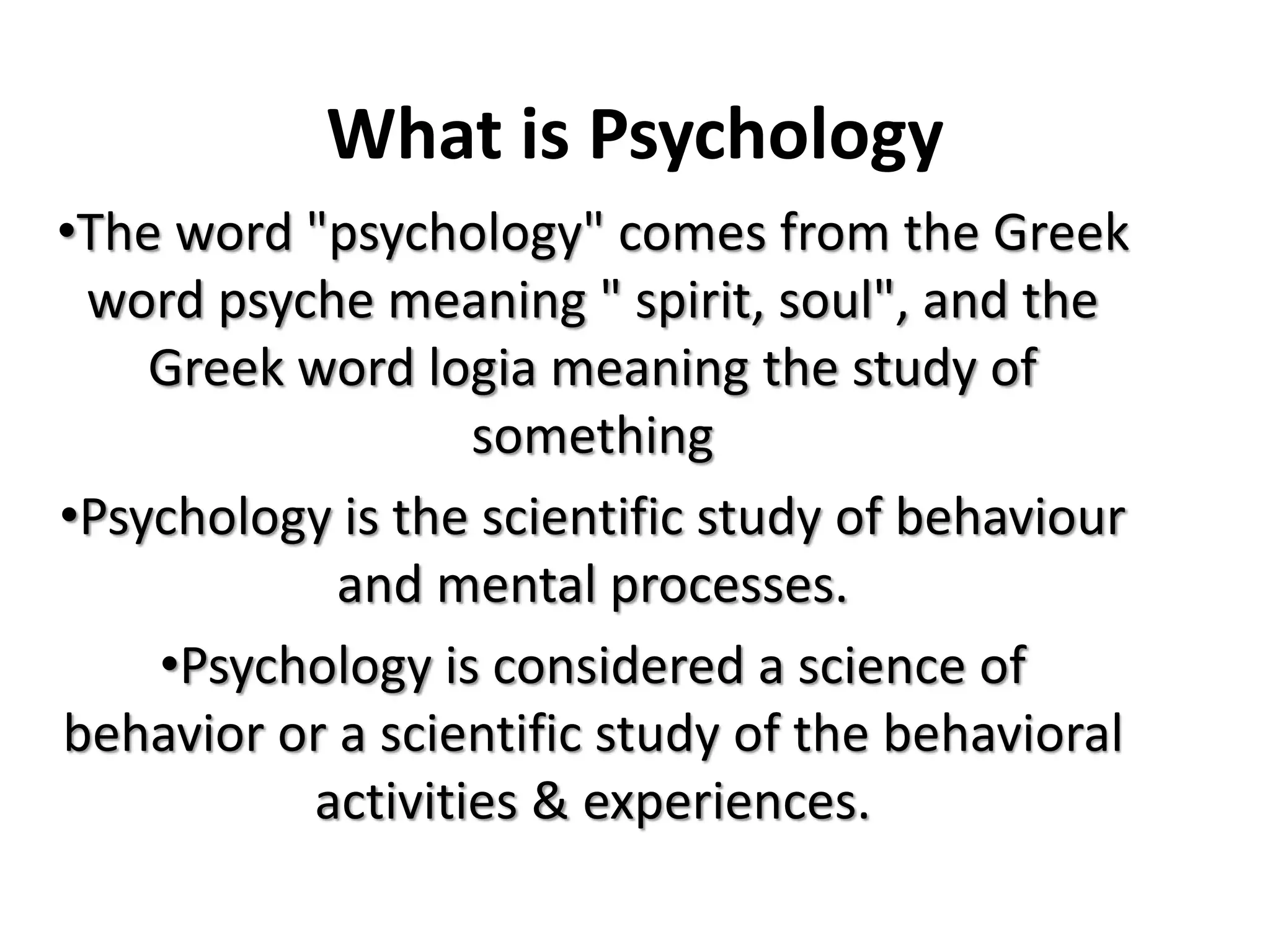
•The word "psychology" comes from the Greek
word psyche meaning " spirit, soul", and the
Greek word logia meaning the study of
something
•Psychology is the scientific study of behaviour
and mental processes.
•Psychology is considered a science of
behavior or a scientific study of the behavioral
activities & experiences.
Psychologists study
• Overt or observable behaviour, as well as
• Covert behaviour – private mental
processes that cannot be directly
observed or measured and must be
inferred from overt behaviour.
The primary goals of psychology are
to:
• Describe behaviour – what is the nature
of this behaviour?
• Understand and explain behaviour - why
does it occur?
• Predict behaviour– can we forecast when
and under what circumstances it will
occur?
• Control behaviour - what factors
influence this behaviour?
Applied Psychology
• Applied psychology uses the various
fields of basic psychology to improve the
quality of life of the human being in
various fields like school, industry,
hospital, consultancy and community.
Clinical psychology
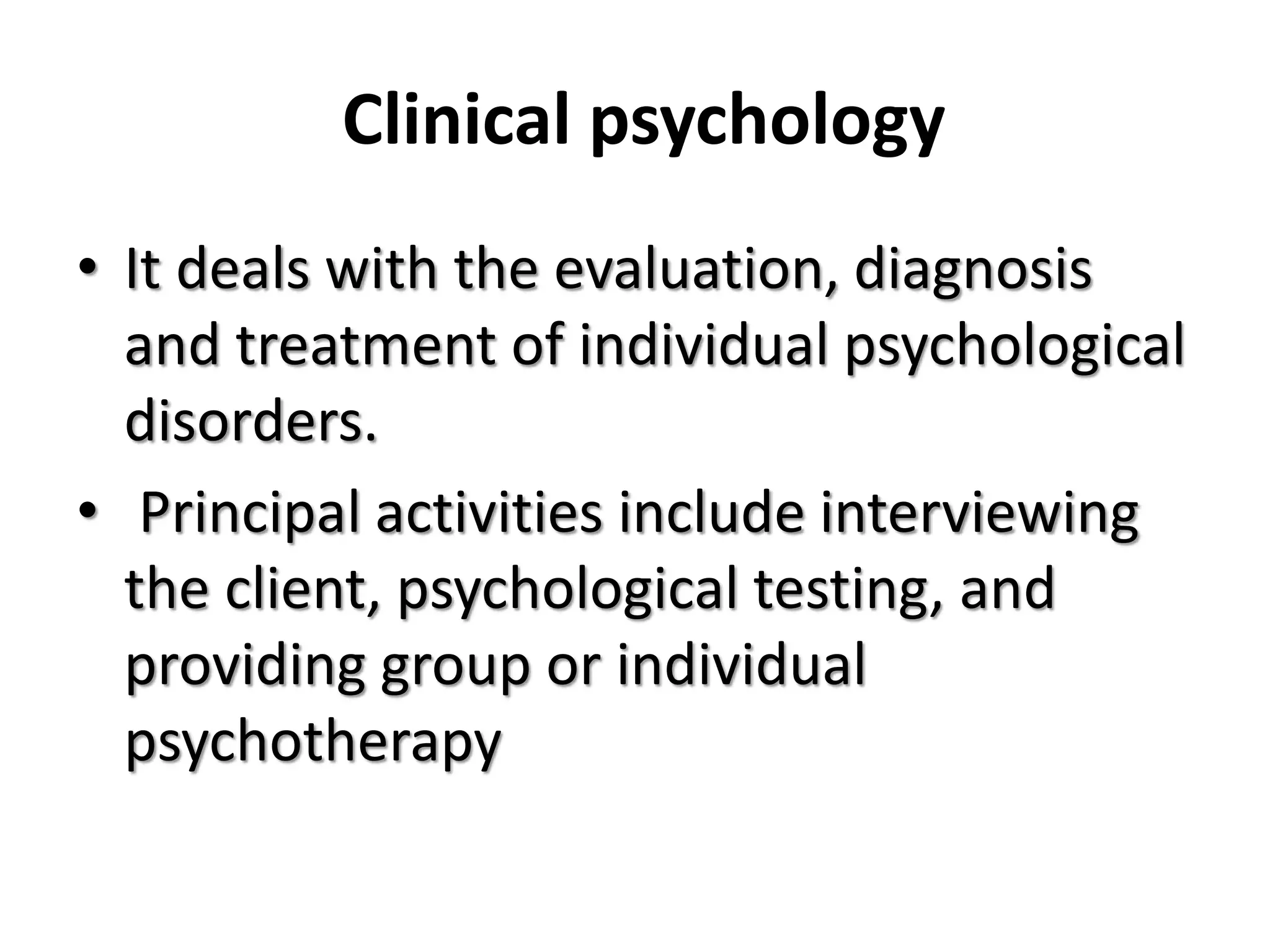
• It deals with the evaluation, diagnosis
and treatment of individual psychological
disorders.
• Principal activities include interviewing
the client, psychological testing, and
providing group or individual
psychotherapy
Counseling Psychology-
• it usually works with a somewhat
different clients, providing assistance
to people struggling with everyday
problem of moderate severity. Thus
they often engage in family, marital
and career counseling
Social psychology
• It deals with interpersonal behavior and
the role of social forces in governing
behavior.
• It primarily focuses on attitude
formation, attitude change, prejudice,
leadership, conformity, attraction,
aggression, intimate relationships and
behavior in groups.
Organizational Psychology
• It tries to study and solve the different
organizational problems exist in the school,
hospitals, university, military, companies etc.
• Here it tries to solve the problems of
leadership, group conflicts, conflicts,
organization culture, organization
development etc.
Educational psychology
• is mainly devoted to an understanding of the
different aspects of the teaching-learning
process.
• It is concerned with the application of the
principles, techniques and methods of
psychology to the teaching-learning process.
Environmental Psychology
• The study the effects of the physical and
social environment on behavior.
• Environmental psychologists work in
school, industrial and governmental
settings.
• They design work environment and
study the effects of crowding, noise and
air pollution on behavior
Health psychology
• Health psychology examine how biological,
social and psychological factors influence
health and illness.
• Health psychologist use psychological sciences
to promote health, prevent illness and
improve health care
Forensic psychology
• Forensic psychology is a branch
of psychology which relates to the law.
• The main part of forensic psychology is
working with the criminal justice system.
• Forensic psychology is the use
of psychological practices and principles
and applying them to the legal system,
mainly in court.
Sports and Exercise Psychology
• It involves the study of how
psychological factors affect performance
and how participation in sport and
exercise affect psychological and physical
factors.
• Sport psychologists teach cognitive and
behavioral strategies to athletes in order
to improve their experience and
performance in sports.
Schools of psychology
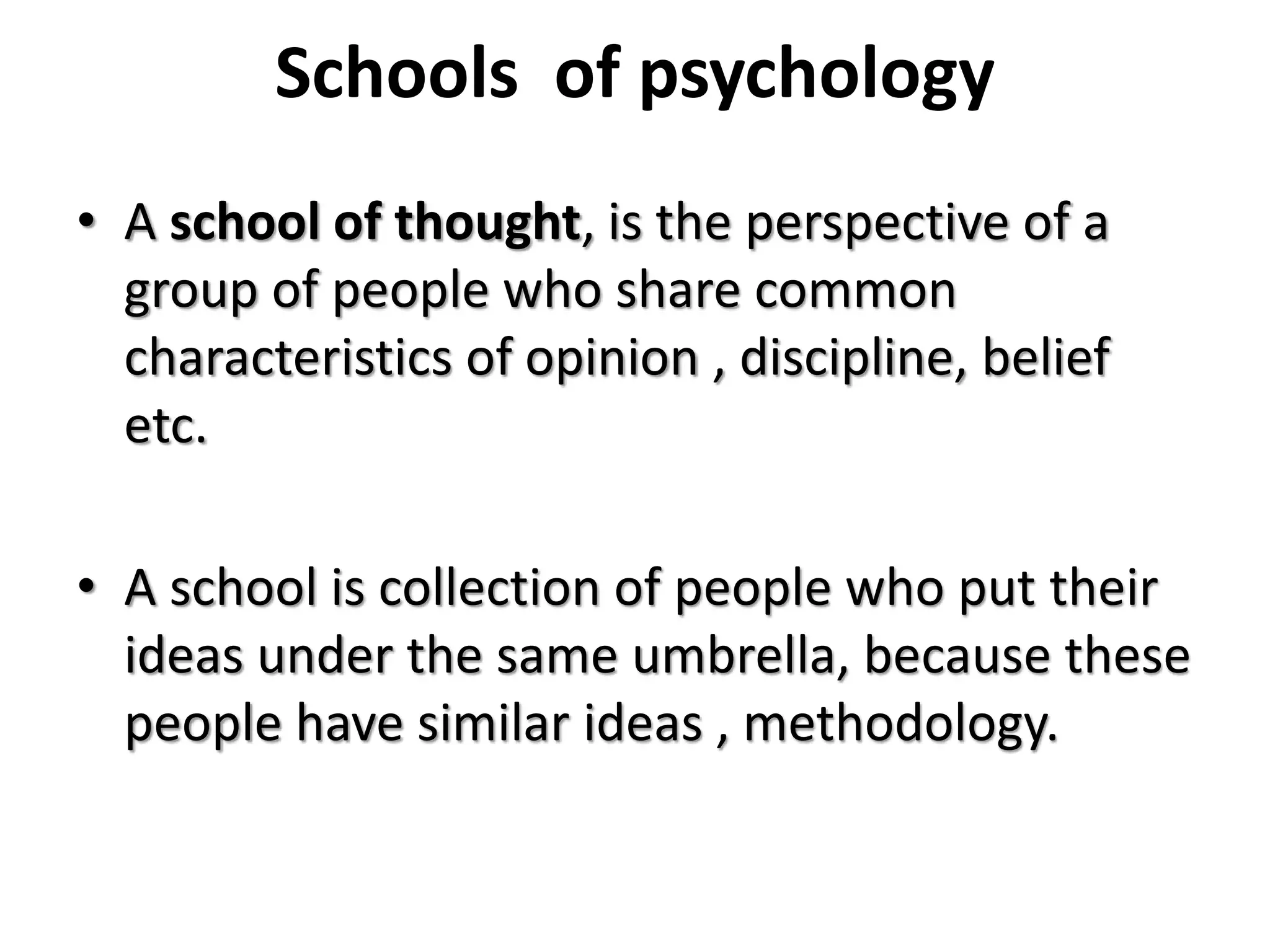
• A school of thought, is the perspective of a
group of people who share common
characteristics of opinion , discipline, belief
etc.
• A school is collection of people who put their
ideas under the same umbrella, because these
people have similar ideas , methodology.
Structuralism
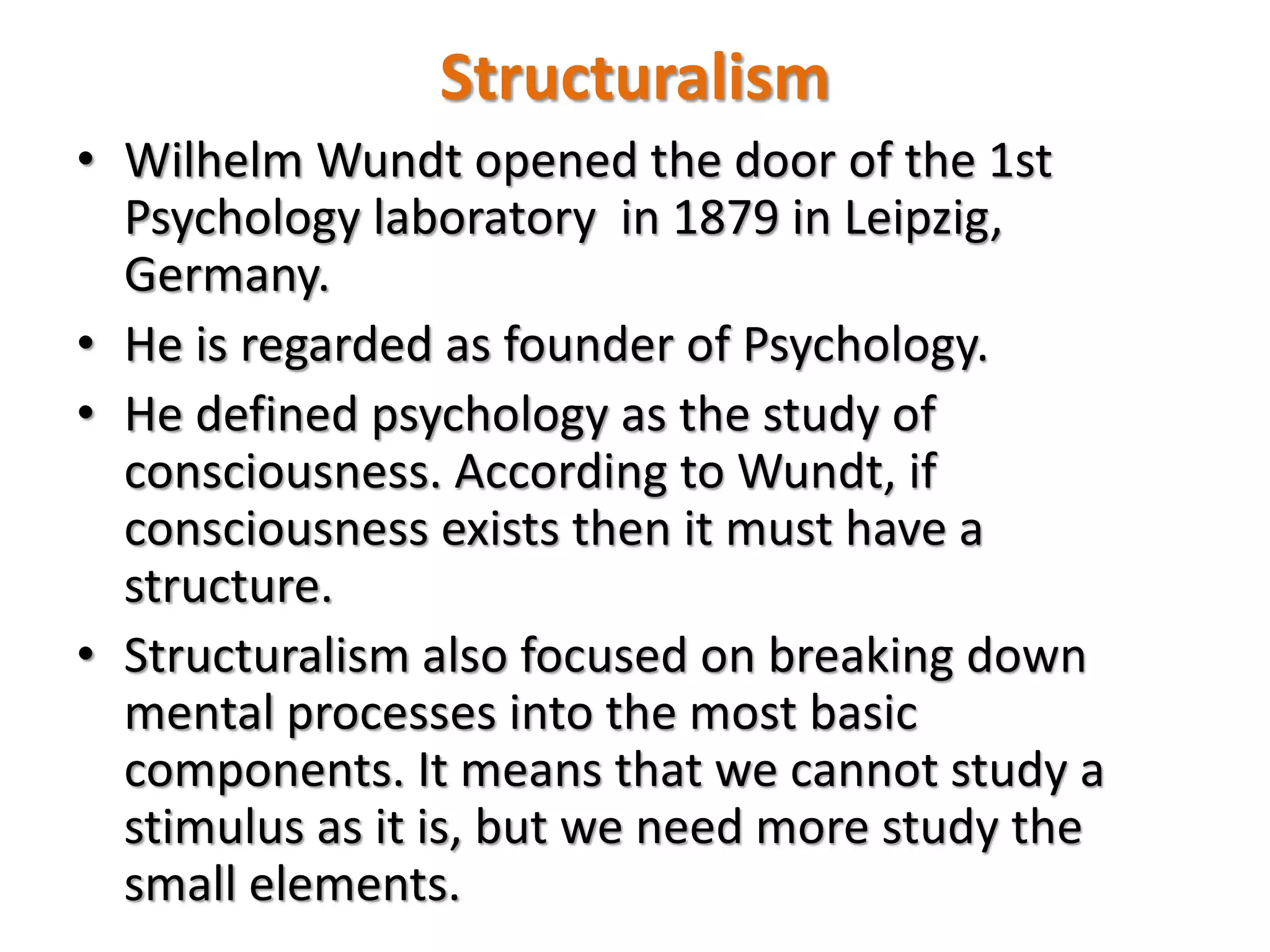
• Wilhelm Wundt opened the door of the 1st
Psychology laboratory in 1879 in Leipzig,
Germany.
• He is regarded as founder of Psychology.
• He defined psychology as the study of
consciousness. According to Wundt, if
consciousness exists then it must have a
structure.
• Structuralism also focused on breaking down
mental processes into the most basic
components. It means that we cannot study a
stimulus as it is, but we need more study the
small elements.
• He thought that consciousness could be studied
by INTROSPECTION
• It describe that what a person is feeling, after
providing a stimulus to somebody and then
ask him to tell about his/her feelings is called
introspection.
• INTROSPECTION It refers to the observation
and recording of the nature of one’s own
perception, thoughts and feelings; looking into
one’s mind; a mental self- analysis.
criticism
• Introspection can not be regarded as a
reliable, objective and valid technique.
Functionalism
• Founder: William James.
• Functionalism school of thought was emerged
as a reaction to structuralism.
• Functionalism emphasized function rather
than structure of human consciousness.
To study function
1) How the mind operates i.e how the elements
of mind works together.
2) how mental processes promote adaptation.
• mental tests , questionnaires, physiological
measures in addition to introspection.
• common with structuralists & functionalist
Both structuralists and functionalists still
regarded psychology as the science of
conscious experience.
Behaviorism
• Founder: John B. Watson
• Define School of psychology that studies only
observable and measurable behavior.
• You cannot define conscious any more than you
can define a soul.
• You cannot locate or measure consciousness, and
therefore it cannot be the object of scientific
study.
• Objectively studies through observable actions
rather than thoughts and feeling that cannot be
observed.
criticism
• They limited psychology to the study of the
observable behavioral response given by
organism to a stimulus.
• They did not explain consciousness and sub
consciousness.
Gestalt Psychology
• Proponent: Max Werthiemer
• School of Psychology that studies how people
perceive and experience objects as whole
patterns.
• According to Gestalt thinkers, the whole is
greater than the sum of its parts.
• Example When we see a tree, we see just that,
a tree, not a series of branches.
criticism
• Gestaltists perform only in the area of
perception.
• There approaches were not purely scientific.
Psychoanalysis
• Sigmund Freud
• Studied hypnosis and found the unconscious
• Believed that much of our behavior is
governed by hidden motives and unconscious
desires
• Maintained that many unconscious desires
and conflicts are sexual.
• Believed that childhood experiences especially
5 years determined adult personality.
• 1.Psychoanalytic theory proposes that most of
the mind is unconscious–filled of conflicting
impulses, urges, and wishes.
• 2. Freud asserted that the sex urges in the
unconscious constitute the main human drive.
This is known as the “libido” theory.
• 3. People are motivated to satisfy this impulses,
ugly as some of them are. But at the same time,
people are motivated to see themselves as
decent, and hence may delude themselves about
their true motives
• Methods
Dream interpretation, clinical investigation, free
association.
Criticism
• Psychoanalytic theory is not scientific.
• Too much emphasis on sex and aggression but
did not fully explain consciousness and human
behavior.
Humanism
Proponent, Ibraham Maslow and Carl Roger
• It is developed in response of psychoanalysis
and behaviorism
• Humanist psychologists viewed humans as a
free agents capable of controlling their own
lives, making their own choices , setting goals
and achieves them.
• Humanistic psychology focused on individual
free will, personal growth and the concept of
self-actualization.
cognitivism
Proponent: Edward Tolman and Jean Piaget
• Cognitive psychology is school of
psychology that studies mental processes
including how people think, perceive,
remember and learn.
• Cognitive Psychology studies man’s
thinking, Perception, Language,
Attention, Memory, Problem-Solving,
Decision-Making, creativity and
Judgment Intelligence
The end

1 What is Psychology.pptx

  • 1.
    What is Psychology •Theword "psychology" comes from the Greek word psyche meaning " spirit, soul", and the Greek word logia meaning the study of something •Psychology is the scientific study of behaviour and mental processes. •Psychology is considered a science of behavior or a scientific study of the behavioral activities & experiences.
  • 2.
    Psychologists study • Overtor observable behaviour, as well as • Covert behaviour – private mental processes that cannot be directly observed or measured and must be inferred from overt behaviour.
  • 3.
    The primary goalsof psychology are to: • Describe behaviour – what is the nature of this behaviour? • Understand and explain behaviour - why does it occur? • Predict behaviour– can we forecast when and under what circumstances it will occur? • Control behaviour - what factors influence this behaviour?
  • 4.
    Applied Psychology • Appliedpsychology uses the various fields of basic psychology to improve the quality of life of the human being in various fields like school, industry, hospital, consultancy and community.
  • 5.
    Clinical psychology • Itdeals with the evaluation, diagnosis and treatment of individual psychological disorders. • Principal activities include interviewing the client, psychological testing, and providing group or individual psychotherapy
  • 6.
    Counseling Psychology- • itusually works with a somewhat different clients, providing assistance to people struggling with everyday problem of moderate severity. Thus they often engage in family, marital and career counseling
  • 7.
    Social psychology • Itdeals with interpersonal behavior and the role of social forces in governing behavior. • It primarily focuses on attitude formation, attitude change, prejudice, leadership, conformity, attraction, aggression, intimate relationships and behavior in groups.
  • 8.
    Organizational Psychology • Ittries to study and solve the different organizational problems exist in the school, hospitals, university, military, companies etc. • Here it tries to solve the problems of leadership, group conflicts, conflicts, organization culture, organization development etc.
  • 9.
    Educational psychology • ismainly devoted to an understanding of the different aspects of the teaching-learning process. • It is concerned with the application of the principles, techniques and methods of psychology to the teaching-learning process.
  • 10.
    Environmental Psychology • Thestudy the effects of the physical and social environment on behavior. • Environmental psychologists work in school, industrial and governmental settings. • They design work environment and study the effects of crowding, noise and air pollution on behavior
  • 11.
    Health psychology • Healthpsychology examine how biological, social and psychological factors influence health and illness. • Health psychologist use psychological sciences to promote health, prevent illness and improve health care
  • 12.
    Forensic psychology • Forensicpsychology is a branch of psychology which relates to the law. • The main part of forensic psychology is working with the criminal justice system. • Forensic psychology is the use of psychological practices and principles and applying them to the legal system, mainly in court.
  • 13.
    Sports and ExercisePsychology • It involves the study of how psychological factors affect performance and how participation in sport and exercise affect psychological and physical factors. • Sport psychologists teach cognitive and behavioral strategies to athletes in order to improve their experience and performance in sports.
  • 14.
    Schools of psychology •A school of thought, is the perspective of a group of people who share common characteristics of opinion , discipline, belief etc. • A school is collection of people who put their ideas under the same umbrella, because these people have similar ideas , methodology.
  • 15.
    Structuralism • Wilhelm Wundtopened the door of the 1st Psychology laboratory in 1879 in Leipzig, Germany. • He is regarded as founder of Psychology. • He defined psychology as the study of consciousness. According to Wundt, if consciousness exists then it must have a structure. • Structuralism also focused on breaking down mental processes into the most basic components. It means that we cannot study a stimulus as it is, but we need more study the small elements.
  • 16.
    • He thoughtthat consciousness could be studied by INTROSPECTION • It describe that what a person is feeling, after providing a stimulus to somebody and then ask him to tell about his/her feelings is called introspection. • INTROSPECTION It refers to the observation and recording of the nature of one’s own perception, thoughts and feelings; looking into one’s mind; a mental self- analysis.
  • 17.
    criticism • Introspection cannot be regarded as a reliable, objective and valid technique.
  • 18.
    Functionalism • Founder: WilliamJames. • Functionalism school of thought was emerged as a reaction to structuralism. • Functionalism emphasized function rather than structure of human consciousness. To study function 1) How the mind operates i.e how the elements of mind works together. 2) how mental processes promote adaptation.
  • 19.
    • mental tests, questionnaires, physiological measures in addition to introspection. • common with structuralists & functionalist Both structuralists and functionalists still regarded psychology as the science of conscious experience.
  • 20.
    Behaviorism • Founder: JohnB. Watson • Define School of psychology that studies only observable and measurable behavior. • You cannot define conscious any more than you can define a soul. • You cannot locate or measure consciousness, and therefore it cannot be the object of scientific study. • Objectively studies through observable actions rather than thoughts and feeling that cannot be observed.
  • 21.
    criticism • They limitedpsychology to the study of the observable behavioral response given by organism to a stimulus. • They did not explain consciousness and sub consciousness.
  • 22.
    Gestalt Psychology • Proponent:Max Werthiemer • School of Psychology that studies how people perceive and experience objects as whole patterns. • According to Gestalt thinkers, the whole is greater than the sum of its parts. • Example When we see a tree, we see just that, a tree, not a series of branches.
  • 23.
    criticism • Gestaltists performonly in the area of perception. • There approaches were not purely scientific.
  • 24.
    Psychoanalysis • Sigmund Freud •Studied hypnosis and found the unconscious • Believed that much of our behavior is governed by hidden motives and unconscious desires • Maintained that many unconscious desires and conflicts are sexual. • Believed that childhood experiences especially 5 years determined adult personality.
  • 25.
    • 1.Psychoanalytic theoryproposes that most of the mind is unconscious–filled of conflicting impulses, urges, and wishes. • 2. Freud asserted that the sex urges in the unconscious constitute the main human drive. This is known as the “libido” theory. • 3. People are motivated to satisfy this impulses, ugly as some of them are. But at the same time, people are motivated to see themselves as decent, and hence may delude themselves about their true motives
  • 26.
    • Methods Dream interpretation,clinical investigation, free association. Criticism • Psychoanalytic theory is not scientific. • Too much emphasis on sex and aggression but did not fully explain consciousness and human behavior.
  • 27.
    Humanism Proponent, Ibraham Maslowand Carl Roger • It is developed in response of psychoanalysis and behaviorism • Humanist psychologists viewed humans as a free agents capable of controlling their own lives, making their own choices , setting goals and achieves them. • Humanistic psychology focused on individual free will, personal growth and the concept of self-actualization.
  • 28.
    cognitivism Proponent: Edward Tolmanand Jean Piaget • Cognitive psychology is school of psychology that studies mental processes including how people think, perceive, remember and learn. • Cognitive Psychology studies man’s thinking, Perception, Language, Attention, Memory, Problem-Solving, Decision-Making, creativity and Judgment Intelligence
  • 29.