Design of Shaft
Design of Shaft
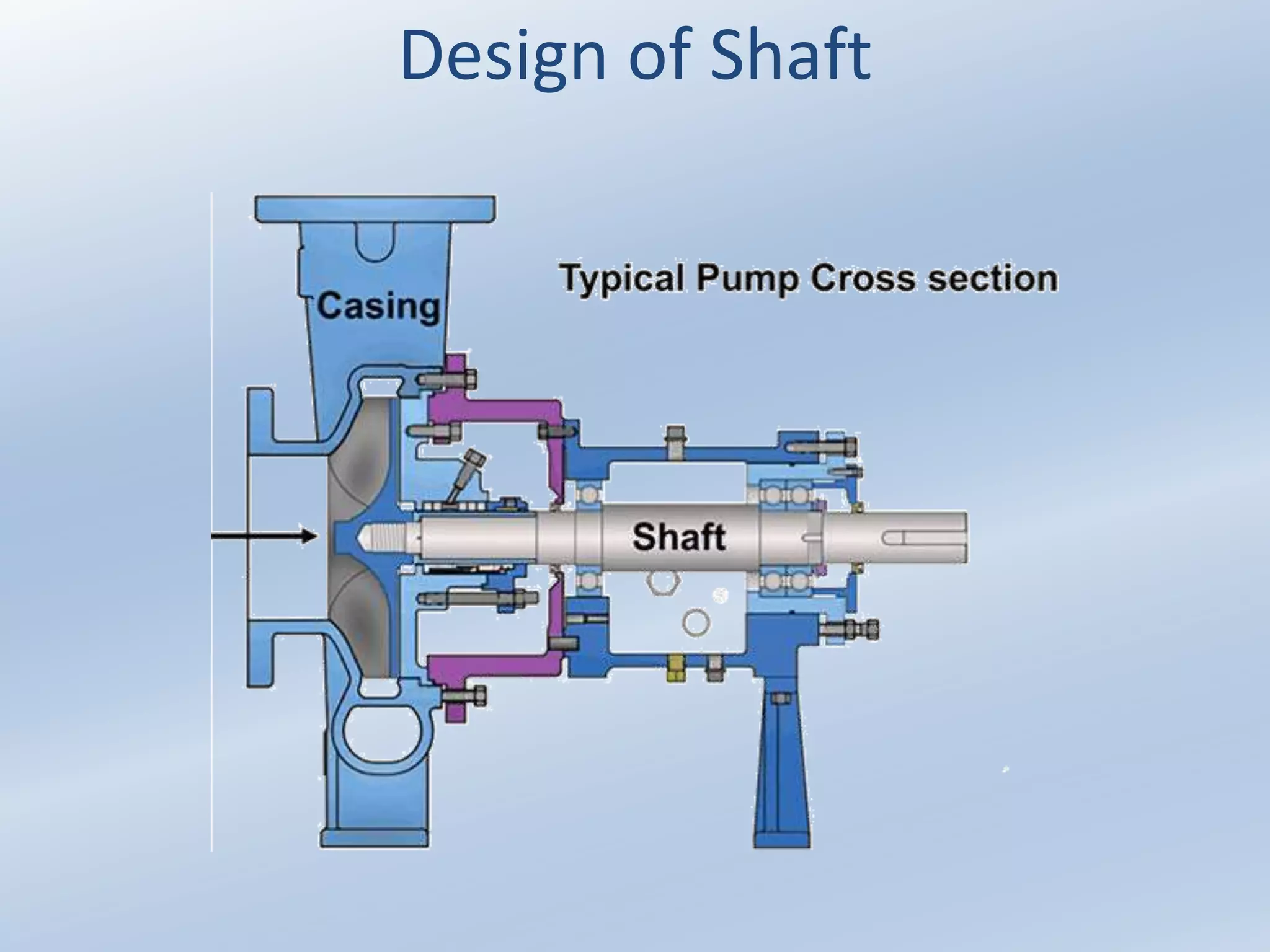
A shaft is a rotating member usually of circular cross-section (solid or
hollow), which transmits power and rotational motion.
Machine elements such as gears, pulleys (sheaves), flywheels, clutches,
and sprockets are mounted on the shaft and are used to transmit power
from the driving device (motor or engine) through a machine.
Press fit, keys, dowel, pins and splines are used to attach these machine
elements on the shaft.
The shaft rotates on rolling contact bearings or bush bearings.
Various types of retaining rings, thrust bearings, grooves and steps in the
shaft are used to take up axial loads and locate the rotating elements.
Couplings are used to transmit power from drive shaft (e.g., motor) to the
driven shaft (e.g. gearbox, wheels).
The connecting shaft is loaded primarily in torsion.
1.The shafts are usually cylindrical, but may be square or cross-
shaped in section. They are solid in cross-section but sometimes
hollow shafts are also used.
1.An axle, though similar in shape to the shaft, is a stationary machine
element and is used for the transmission of bending moment only. It
simply acts as a support for some rotating body such as hoisting drum,
a car wheel or a rope sheave
1.A spindle is a short shaft that imparts motion either to a cutting tool
(e.g. drill press spindles) or to a work piece (e.g. lathe spindles).
MaterialUsedforShafts
The material used for shafts should have the following properties :
1.It should have high strength.
2.It should have good machinability.
3.It should have low notch sensitivity factor.
4.It should have good heat treatment properties.
5.It should have high wear resistant properties.
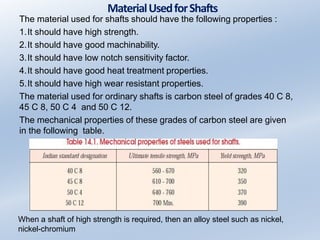
The material used for ordinary shafts is carbon steel of grades 40 C 8,
45 C 8, 50 C 4 and 50 C 12.
The mechanical properties of these grades of carbon steel are given
in the following table.
When a shaft of high strength is required, then an alloy steel such as nickel,
nickel-chromium
Manufacturing of Shafts
Shafts are generally manufactured by hot rolling and
finished to size by cold drawing or turning and grinding.
The cold rolled shafts are stronger than hot rolled shafts
but with higher residual stresses.
The residual stresses may cause distortion of the shaft
when it is machined, especially when slots or keyways are
cut. Shafts of larger diameter are usually forged and turned
to size in a lathe.
Types of Shafts
1.Transmission shafts. These shafts transmit power between the
source and the machines absorbing power. The counter shafts, line
shafts, over head shafts and all factory shafts are transmission shafts.
Since these shafts carry machine parts such as pulleys, gears etc.,
therefore they are subjected to bending in addition to twisting.
1.Machine shafts. These shafts form an integral part of the machine
itself. The crank shaft is an example of machine shaft.
Standard Sizes of Transmission Shafts
25 mm to 60 mm with 5 mm steps; 60 mm to 110 mm with
10 mm steps ; 110 mm to 140 mm with 15 mm steps ; and
140 mm to 500 mm with 20 mm steps. The standard length of
the shafts are 5 m, 6 m and 7 m.

1 shaft introduction

  • 1.
  • 2.
    Design of Shaft Ashaft is a rotating member usually of circular cross-section (solid or hollow), which transmits power and rotational motion. Machine elements such as gears, pulleys (sheaves), flywheels, clutches, and sprockets are mounted on the shaft and are used to transmit power from the driving device (motor or engine) through a machine. Press fit, keys, dowel, pins and splines are used to attach these machine elements on the shaft. The shaft rotates on rolling contact bearings or bush bearings. Various types of retaining rings, thrust bearings, grooves and steps in the shaft are used to take up axial loads and locate the rotating elements. Couplings are used to transmit power from drive shaft (e.g., motor) to the driven shaft (e.g. gearbox, wheels).
  • 3.
    The connecting shaftis loaded primarily in torsion.
  • 4.
    1.The shafts areusually cylindrical, but may be square or cross- shaped in section. They are solid in cross-section but sometimes hollow shafts are also used. 1.An axle, though similar in shape to the shaft, is a stationary machine element and is used for the transmission of bending moment only. It simply acts as a support for some rotating body such as hoisting drum, a car wheel or a rope sheave 1.A spindle is a short shaft that imparts motion either to a cutting tool (e.g. drill press spindles) or to a work piece (e.g. lathe spindles).
  • 5.
    MaterialUsedforShafts The material usedfor shafts should have the following properties : 1.It should have high strength. 2.It should have good machinability. 3.It should have low notch sensitivity factor. 4.It should have good heat treatment properties. 5.It should have high wear resistant properties. The material used for ordinary shafts is carbon steel of grades 40 C 8, 45 C 8, 50 C 4 and 50 C 12. The mechanical properties of these grades of carbon steel are given in the following table. When a shaft of high strength is required, then an alloy steel such as nickel, nickel-chromium
  • 6.
    Manufacturing of Shafts Shaftsare generally manufactured by hot rolling and finished to size by cold drawing or turning and grinding. The cold rolled shafts are stronger than hot rolled shafts but with higher residual stresses. The residual stresses may cause distortion of the shaft when it is machined, especially when slots or keyways are cut. Shafts of larger diameter are usually forged and turned to size in a lathe.
  • 7.
    Types of Shafts 1.Transmissionshafts. These shafts transmit power between the source and the machines absorbing power. The counter shafts, line shafts, over head shafts and all factory shafts are transmission shafts. Since these shafts carry machine parts such as pulleys, gears etc., therefore they are subjected to bending in addition to twisting. 1.Machine shafts. These shafts form an integral part of the machine itself. The crank shaft is an example of machine shaft.
  • 8.
    Standard Sizes ofTransmission Shafts 25 mm to 60 mm with 5 mm steps; 60 mm to 110 mm with 10 mm steps ; 110 mm to 140 mm with 15 mm steps ; and 140 mm to 500 mm with 20 mm steps. The standard length of the shafts are 5 m, 6 m and 7 m.