Design of Solid and Hollow Shafts
subjected to Different type of Loads
1
Introduction
Shaft is a rotating member and is used to transmit power. The
shaft may be hollow or solid.
In general, shaft has a circular cross-section.
The shaft is supported on bearings and it rotates a set of gears or
pulleys to transmit power.
The shaft is generally acted upon by
 Bending moment
 Torsion
 axial force.
Other two similar forms of a shaft are axle and spindle.
 Axle is a non-rotating member used for supporting rotating wheels
etc. and do not transmit any torque.
 Spindle is simply a short shaft. However, design method remains
the same for axle and spindle as that for a shaft.
2
Difference between Shafts, Spindle and Axle
3
SHAFT
4
Standard sizes of Shafts and Materials
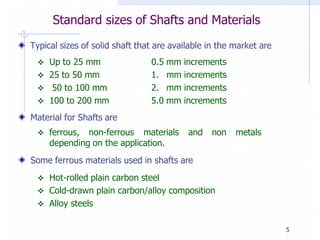
Typical sizes of solid shaft that are available in the market are
0.5 mm increments
1. mm increments
2. mm increments
5.0 mm increments
 Up to 25 mm
 25 to 50 mm
 50 to 100 mm
 100 to 200 mm
Material for Shafts are
 ferrous, non-ferrous materials and non metals
depending on the application.
Some ferrous materials used in shafts are
 Hot-rolled plain carbon steel
 Cold-drawn plain carbon/alloy composition
 Alloy steels
5
Standard sizes of Shafts and Materials
In many cases, the surface of the shaft needs to be wear resistant
 Case hardening and carburizing
 Cyaniding and nitriding
6
Design considerations for shaft
Design based on Strength
 Design is carried out so that stress at any location of the shaft
should not exceed the material yield stress.
 No consideration for shaft deflection and shaft twist is included.
Design based on Stiffness
 The design is based on the allowable deflection and twist of the
shaft.
7
Design based on Strength
Bending stress
𝑏 𝐼 𝜋𝑑3
𝜎 = 𝑀𝑏𝑦
= 32𝑀𝑏, for solid shaft
𝑀𝑏 : Bending moment at the point of interest
d : Outer diameter of the solid shaft
𝐼: Area Moment of Inertia of shaft =
64
𝜋
𝑑4
𝑦: Distance of farthest fibre from neutral axis = 𝑑
2
𝜎𝑏 𝐼
= 𝑀𝑏𝑦
= 32𝑀𝑏
𝑜
𝜋𝑑3 1−𝐶4 , for hollow shaft
𝑀𝑏 : Bending moment at the point of interest
𝑑𝑜: Outer diameter of the hollow shaft, 𝑑𝑖: inside diameter of the hollow shaft
𝐶: Ratio of inside to outside diameter = 𝑑𝑖
𝑑
𝑜
𝐼: Area Moment of Inertia of shaft =
64 𝑜
𝜋
𝑑4
1 − 𝐶4
𝑦: Distance of farthest fibre from neutral axis = 𝑑𝑜
8
2
Design based on Strength
Axial stress
𝑡
𝜎 = 𝑃
=
4𝑃
𝐴 𝜋𝑑2
, for solid shaft
𝑃 : Axial force (tensile or compressive)
d : Outer diameter of the shaft
𝜋
4
𝐴: Area of cross section of shaft = 𝑑2
𝜎𝑡: Axial stress
𝑡
𝜎 = 𝑃
=
4𝑃
𝑜
𝐴 𝜋𝑑2 1−𝐶2
, for hollow shaft
𝑃 : Axial force (tensile or compressive)
4 𝑜 𝑖
9
𝐴: Area of cross section of shaft = 𝜋
𝑑2 − 𝑑2
𝜎𝑡: Axial stress
𝑑𝑜: Outer diameter of the hollow shaft, 𝑑𝑖: inside diameter of the hollow shaft
𝐶: Ratio of inside to outside diameter = 𝑑𝑖
𝑑
𝑜
Design based on Strength
Stress due to torsion
𝐽 𝜋𝑑3
𝜏 = 𝑀𝑡𝑟
= 16𝑀𝑡 , for solid shaft
𝑀𝑡 : Torque on the shaft
𝜏 : Shear stress due to torsion
𝑟: Radius of shaft
𝑑: Diameter of shaft
𝐽: Polar moment of inertia of shaft= 32
𝜋
𝑑4
𝐽
𝜏 = 𝑀𝑡𝑟
= 16𝑀𝑡
𝑜
𝜋𝑑3 1−𝐶4
, for hollow shaft
𝑀𝑡 : Torque on the shaft
𝜏 : Shear stress due to torsion
𝑟: Radius of shaft = 𝑑𝑜
2
𝐽: Polar moment of inertia of shaft= 𝑑4 − 𝑑4 =
𝜋
32 32
𝑜 𝑖 𝑜
𝜋
𝑑4
1 − 𝐶4
10
𝑑𝑜: Outer diameter of the hollow shaft, 𝑑𝑖: inside diameter of the hollow shaft
𝐶: Ratio of inside to outside diameter = 𝑑𝑖
𝑑
𝑜
Design based on Strength
Shafts subjected to Combined Load
1) Shaft subjected to a combination of axial force, bending moment
and torsional moment
2)Shaft subjected to a combination of bending moment
and torsional moment
The principal stress is given by,
The principal shear stress is given by,
11
Design based on Strength
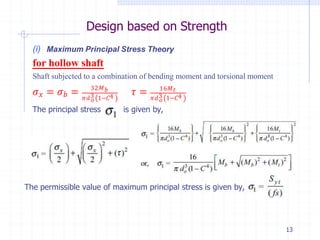
(i) Maximum Principal Stress Theory
for Solid shaft
Shaft subjected to a combination of bending moment and torsional moment
The principal stress is given by,
or
The permissible value of maximum principal stress is given by,
is called ‘equivalent’ bending moment.
principal stress theory gives good predictions for brittle
Maximum
materials.
12
Design based on Strength
(i) Maximum Principal Stress Theory
for hollow shaft
Shaft subjected to a combination of bending moment and torsional moment
32𝑀𝑏
𝑜
𝜋𝑑3 1−𝐶4
𝜎𝑥 = 𝜎𝑏 = 𝜏 = 16𝑀𝑡
𝑜
𝜋𝑑3 1−𝐶4
The principal stress is given by,
The permissible value of maximum principal stress is given by,
13
Design based on Strength
(i) Maximum Shear Stress Theory
For Solid Shaft
Shaft subjected to a combination of bending moment and torsional moment
The principal shear stress is given by,
or
The permissible value of maximum shear stress is given by,
is called ‘equivalent’ torsional moment.
Maximum shear stress theory gives good predictions for ductile
materials.
Maximum shear stress theory is applied for shaft design
14
Design based on Strength
(i) Maximum Shear Stress Theory
For Hollow Shaft
Shaft subjected to a combination of bending moment and torsional moment
is given by,
or
The permissible value of maximum shear stress is given by,
32𝑀𝑏
𝑜
𝜋𝑑3 1−𝐶4
𝜎𝑥 = 𝜎𝑏 = 𝜏 =
The principal shear stress
16𝑀𝑡
𝑜
𝜋𝑑3 1−𝐶4
is called ‘equivalent’ torsional moment.
Maximum shear stress theory gives good predictions for ductile
materials.
Maximum shear stress theory is applied for shaft design
15
Design based on Strength
ASME CODE FOR SHAFT DESIGN
• For the shaft without keyways,
• If keyways are present, the above values are to be reduced by
25 per cent.
• The ASME code is based on maximum shear stress theory of
failure.
• For shaft design according to ASME code
where
16
Q.1.: The layout of a transmission shaft
carrying two pulleys B and C and
supported on bearings A and D is shown in
Fig. Power is supplied to the shaft by
means of a vertical belt on the pulley B,
which is then transmitted to the pulley C
carrying a horizontal belt. The maximum
tension in the belt on the pulley B is 2.5
kN. The angle of wrap for both the pulleys
is 180° and the coefficient of friction is
0.24. The shaft is made of plain carbon
steel 30C8 (Syt = 400 N/mm2) and the factor
of safety is 3. Determine the shaft diameter
on strength basis.
17
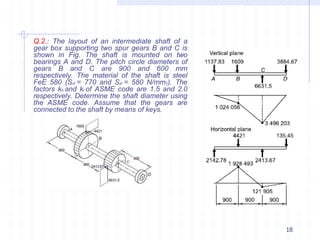
Q.2.: The layout of an intermediate shaft of a
gear box supporting two spur gears B and C is
shown in Fig. The shaft is mounted on two
bearings A and D. The pitch circle diameters of
gears B and C are 900 and 600 mm
respectively. The material of the shaft is steel
FeE 580 (Sut = 770 and Syt = 580 N/mm2). The
factors kb and kt of ASME code are 1.5 and 2.0
respectively. Determine the shaft diameter using
the ASME code. Assume that the gears are
connected to the shaft by means of keys.
18
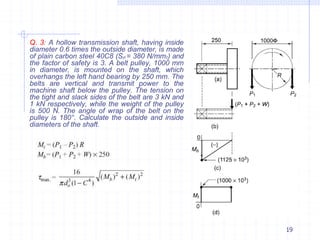
Q. 3: A hollow transmission shaft, having inside
diameter 0.6 times the outside diameter, is made
of plain carbon steel 40C8 (Syt = 380 N/mm2) and
the factor of safety is 3. A belt pulley, 1000 mm
in diameter, is mounted on the shaft, which
overhangs the left hand bearing by 250 mm. The
belts are vertical and transmit power to the
machine shaft below the pulley. The tension on
the tight and slack sides of the belt are 3 kN and
1 kN respectively, while the weight of the pulley
is 500 N. The angle of wrap of the belt on the
pulley is 180°. Calculate the outside and inside
diameters of the shaft.
19
Q. 4: A propeller shaft is required to transmit 50kW power at 600 rpm. It is a
hollow shaft, having an inside diameter 0.8 times of the outside diameter. It is made
of steel (Syt = 380 N/mm2) and the factor of safety is 4. Calculate the inside and
outside diameters of the shaft. Assume (Ssy = 0.5Syt)
20

99999599.pptx

  • 1.
    Design of Solidand Hollow Shafts subjected to Different type of Loads 1
  • 2.
    Introduction Shaft is arotating member and is used to transmit power. The shaft may be hollow or solid. In general, shaft has a circular cross-section. The shaft is supported on bearings and it rotates a set of gears or pulleys to transmit power. The shaft is generally acted upon by  Bending moment  Torsion  axial force. Other two similar forms of a shaft are axle and spindle.  Axle is a non-rotating member used for supporting rotating wheels etc. and do not transmit any torque.  Spindle is simply a short shaft. However, design method remains the same for axle and spindle as that for a shaft. 2
  • 3.
    Difference between Shafts,Spindle and Axle 3
  • 4.
  • 5.
    Standard sizes ofShafts and Materials Typical sizes of solid shaft that are available in the market are 0.5 mm increments 1. mm increments 2. mm increments 5.0 mm increments  Up to 25 mm  25 to 50 mm  50 to 100 mm  100 to 200 mm Material for Shafts are  ferrous, non-ferrous materials and non metals depending on the application. Some ferrous materials used in shafts are  Hot-rolled plain carbon steel  Cold-drawn plain carbon/alloy composition  Alloy steels 5
  • 6.
    Standard sizes ofShafts and Materials In many cases, the surface of the shaft needs to be wear resistant  Case hardening and carburizing  Cyaniding and nitriding 6
  • 7.
    Design considerations forshaft Design based on Strength  Design is carried out so that stress at any location of the shaft should not exceed the material yield stress.  No consideration for shaft deflection and shaft twist is included. Design based on Stiffness  The design is based on the allowable deflection and twist of the shaft. 7
  • 8.
    Design based onStrength Bending stress 𝑏 𝐼 𝜋𝑑3 𝜎 = 𝑀𝑏𝑦 = 32𝑀𝑏, for solid shaft 𝑀𝑏 : Bending moment at the point of interest d : Outer diameter of the solid shaft 𝐼: Area Moment of Inertia of shaft = 64 𝜋 𝑑4 𝑦: Distance of farthest fibre from neutral axis = 𝑑 2 𝜎𝑏 𝐼 = 𝑀𝑏𝑦 = 32𝑀𝑏 𝑜 𝜋𝑑3 1−𝐶4 , for hollow shaft 𝑀𝑏 : Bending moment at the point of interest 𝑑𝑜: Outer diameter of the hollow shaft, 𝑑𝑖: inside diameter of the hollow shaft 𝐶: Ratio of inside to outside diameter = 𝑑𝑖 𝑑 𝑜 𝐼: Area Moment of Inertia of shaft = 64 𝑜 𝜋 𝑑4 1 − 𝐶4 𝑦: Distance of farthest fibre from neutral axis = 𝑑𝑜 8 2
  • 9.
    Design based onStrength Axial stress 𝑡 𝜎 = 𝑃 = 4𝑃 𝐴 𝜋𝑑2 , for solid shaft 𝑃 : Axial force (tensile or compressive) d : Outer diameter of the shaft 𝜋 4 𝐴: Area of cross section of shaft = 𝑑2 𝜎𝑡: Axial stress 𝑡 𝜎 = 𝑃 = 4𝑃 𝑜 𝐴 𝜋𝑑2 1−𝐶2 , for hollow shaft 𝑃 : Axial force (tensile or compressive) 4 𝑜 𝑖 9 𝐴: Area of cross section of shaft = 𝜋 𝑑2 − 𝑑2 𝜎𝑡: Axial stress 𝑑𝑜: Outer diameter of the hollow shaft, 𝑑𝑖: inside diameter of the hollow shaft 𝐶: Ratio of inside to outside diameter = 𝑑𝑖 𝑑 𝑜
  • 10.
    Design based onStrength Stress due to torsion 𝐽 𝜋𝑑3 𝜏 = 𝑀𝑡𝑟 = 16𝑀𝑡 , for solid shaft 𝑀𝑡 : Torque on the shaft 𝜏 : Shear stress due to torsion 𝑟: Radius of shaft 𝑑: Diameter of shaft 𝐽: Polar moment of inertia of shaft= 32 𝜋 𝑑4 𝐽 𝜏 = 𝑀𝑡𝑟 = 16𝑀𝑡 𝑜 𝜋𝑑3 1−𝐶4 , for hollow shaft 𝑀𝑡 : Torque on the shaft 𝜏 : Shear stress due to torsion 𝑟: Radius of shaft = 𝑑𝑜 2 𝐽: Polar moment of inertia of shaft= 𝑑4 − 𝑑4 = 𝜋 32 32 𝑜 𝑖 𝑜 𝜋 𝑑4 1 − 𝐶4 10 𝑑𝑜: Outer diameter of the hollow shaft, 𝑑𝑖: inside diameter of the hollow shaft 𝐶: Ratio of inside to outside diameter = 𝑑𝑖 𝑑 𝑜
  • 11.
    Design based onStrength Shafts subjected to Combined Load 1) Shaft subjected to a combination of axial force, bending moment and torsional moment 2)Shaft subjected to a combination of bending moment and torsional moment The principal stress is given by, The principal shear stress is given by, 11
  • 12.
    Design based onStrength (i) Maximum Principal Stress Theory for Solid shaft Shaft subjected to a combination of bending moment and torsional moment The principal stress is given by, or The permissible value of maximum principal stress is given by, is called ‘equivalent’ bending moment. principal stress theory gives good predictions for brittle Maximum materials. 12
  • 13.
    Design based onStrength (i) Maximum Principal Stress Theory for hollow shaft Shaft subjected to a combination of bending moment and torsional moment 32𝑀𝑏 𝑜 𝜋𝑑3 1−𝐶4 𝜎𝑥 = 𝜎𝑏 = 𝜏 = 16𝑀𝑡 𝑜 𝜋𝑑3 1−𝐶4 The principal stress is given by, The permissible value of maximum principal stress is given by, 13
  • 14.
    Design based onStrength (i) Maximum Shear Stress Theory For Solid Shaft Shaft subjected to a combination of bending moment and torsional moment The principal shear stress is given by, or The permissible value of maximum shear stress is given by, is called ‘equivalent’ torsional moment. Maximum shear stress theory gives good predictions for ductile materials. Maximum shear stress theory is applied for shaft design 14
  • 15.
    Design based onStrength (i) Maximum Shear Stress Theory For Hollow Shaft Shaft subjected to a combination of bending moment and torsional moment is given by, or The permissible value of maximum shear stress is given by, 32𝑀𝑏 𝑜 𝜋𝑑3 1−𝐶4 𝜎𝑥 = 𝜎𝑏 = 𝜏 = The principal shear stress 16𝑀𝑡 𝑜 𝜋𝑑3 1−𝐶4 is called ‘equivalent’ torsional moment. Maximum shear stress theory gives good predictions for ductile materials. Maximum shear stress theory is applied for shaft design 15
  • 16.
    Design based onStrength ASME CODE FOR SHAFT DESIGN • For the shaft without keyways, • If keyways are present, the above values are to be reduced by 25 per cent. • The ASME code is based on maximum shear stress theory of failure. • For shaft design according to ASME code where 16
  • 17.
    Q.1.: The layoutof a transmission shaft carrying two pulleys B and C and supported on bearings A and D is shown in Fig. Power is supplied to the shaft by means of a vertical belt on the pulley B, which is then transmitted to the pulley C carrying a horizontal belt. The maximum tension in the belt on the pulley B is 2.5 kN. The angle of wrap for both the pulleys is 180° and the coefficient of friction is 0.24. The shaft is made of plain carbon steel 30C8 (Syt = 400 N/mm2) and the factor of safety is 3. Determine the shaft diameter on strength basis. 17
  • 18.
    Q.2.: The layoutof an intermediate shaft of a gear box supporting two spur gears B and C is shown in Fig. The shaft is mounted on two bearings A and D. The pitch circle diameters of gears B and C are 900 and 600 mm respectively. The material of the shaft is steel FeE 580 (Sut = 770 and Syt = 580 N/mm2). The factors kb and kt of ASME code are 1.5 and 2.0 respectively. Determine the shaft diameter using the ASME code. Assume that the gears are connected to the shaft by means of keys. 18
  • 19.
    Q. 3: Ahollow transmission shaft, having inside diameter 0.6 times the outside diameter, is made of plain carbon steel 40C8 (Syt = 380 N/mm2) and the factor of safety is 3. A belt pulley, 1000 mm in diameter, is mounted on the shaft, which overhangs the left hand bearing by 250 mm. The belts are vertical and transmit power to the machine shaft below the pulley. The tension on the tight and slack sides of the belt are 3 kN and 1 kN respectively, while the weight of the pulley is 500 N. The angle of wrap of the belt on the pulley is 180°. Calculate the outside and inside diameters of the shaft. 19
  • 20.
    Q. 4: Apropeller shaft is required to transmit 50kW power at 600 rpm. It is a hollow shaft, having an inside diameter 0.8 times of the outside diameter. It is made of steel (Syt = 380 N/mm2) and the factor of safety is 4. Calculate the inside and outside diameters of the shaft. Assume (Ssy = 0.5Syt) 20