PREFORMULATION STUDIES: PREFORMULATION
STUDIES OF DRUG SUBSTANCES, PROTEINS AND
PEPTIDES. PREFORMULATION WORK SHEET.
CHAVAN KHUSHAL
CONTENTS:
 Preformulation studies
 Significance of Preformulation Studies
 Types of Preformulation Studies
 Physical Characterization: Insights into Drug Properties
 Chemical Characterization: Unveiling Drug Properties
 Solubility Studies: Determining Drug Availability
 Permeation Studies: Assessing Drug Penetration
 Stability Studies: Ensuring Drug Shelf Life
 Compatibility Studies: Preventing Interactions
 Conclusion: Preformulation Studies – A Cornerstone for Drug Development
 References
PREFORMULATION STUDIES:
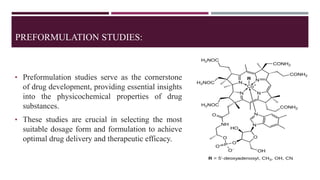
• Preformulation studies serve as the cornerstone
of drug development, providing essential insights
into the physicochemical properties of drug
substances.
• These studies are crucial in selecting the most
suitable dosage form and formulation to achieve
optimal drug delivery and therapeutic efficacy.
Preformulation studies are crucial in the pharmaceutical development process, as they provide essential information about the physical,
chemical, and biological properties of a new drug substance. This information guides the formulation development process, ensuring the
creation of a stable, effective, and safe drug product.
Some key areas of preformulation studies:
• Physicochemical properties: This includes solubility, pKa, partition coefficient, melting point, hygroscopicity, polymorphism, and
particle size distribution.
• Solid-state characterization: This involves techniques like X-ray diffraction, differential scanning calorimetry, and thermogravimetric
analysis to understand the drug's crystal structure and thermal behavior.
• Compatibility studies: This assesses the interaction between the drug and potential excipients to ensure stability and prevent adverse
reactions.
• Biopharmaceutical properties: This involves evaluating factors like dissolution rate, permeability, and stability in biological fluids to
predict the drug's bioavailability and absorption.
• Analytical method development: This involves developing methods to quantify the drug substance and its impurities in various
matrices.
Preformulation studies are essential for several reasons:
• Optimizing formulation design: Understanding the drug's properties allows scientists to choose appropriate excipients and design a
formulation that ensures optimal drug delivery and absorption.
• Predicting drug performance: Preformulation data helps to estimate the drug's pharmacokinetic and pharmacodynamic
properties, allowing for better prediction of its efficacy and safety in humans.
• Reducing development risks: Identifying potential problems with stability, compatibility, or bioavailability early in the development
process can save time and resources in the long run.
• Regulatory compliance: Preformulation studies are required by regulatory agencies to ensure the safety and efficacy of new drugs.
SIGNIFICANCE OF PREFORMULATION STUDIES
• Preformulation studies hold immense significance in the drug
development process:
1. Dosage Form Selection: They aid in identifying the most
appropriate dosage form, considering factors like solubility,
permeability, and stability.
2. Excipient Selection: They provide valuable information for
selecting suitable excipients that enhance drug stability,
solubility, and bioavailability.
3. Stability Assessment: They assess the drug substance's stability
under various conditions, ensuring its shelf life and efficacy.
4. Problem Identification: They help identify potential formulation
challenges early on, preventing costly delays and
reformulations.
5. Manufacturing Process Development: They provide critical data
for developing a robust and efficient manufacturing process.
Preformulation studies play a crucial role in the pharmaceutical development process. Their significance can be summarized in the
following points:
1. Optimizing formulation design:
Preformulation studies provide essential data about the physicochemical, biopharmaceutical, and compatibility properties of the drug
substance.
This information allows researchers to choose appropriate excipients and design a formulation that ensures optimal drug delivery and
absorption.
Factors like solubility, pKa, particle size distribution, and compatibility with excipients are crucial for creating a stable, effective, and
safe dosage form.
2. Predicting drug performance:
Preformulation studies help predict the pharmacokinetic and pharmacodynamic properties of the drug.
This includes understanding factors like drug release rate, absorption, distribution, metabolism, and excretion.
By predicting how the drug will behave in the body, scientists can make informed decisions about dosing regimens and potential side
effects.
3. Reducing development risks:
Identifying potential problems with stability, compatibility, or bioavailability early in the development process can save time and
resources.
Preformulation studies can help avoid costly late-stage failures and significantly reduce the overall cost of drug development.
This is particularly important for expensive and complex drug candidates where failure can have significant financial repercussions.
4. Regulatory compliance:
•Regulatory agencies like the FDA require preformulation studies as part of the drug approval process.
•These studies provide evidence that the drug substance is safe and suitable for further development and eventual clinical testing.
•Without adequate preformulation data, it is impossible to gain regulatory approval for a new drug.
5. Facilitating formulation optimization:
•Preformulation studies provide a strong foundation for optimizing the formulation during later stages of development.
•This includes understanding the impact of excipients, manufacturing processes, and storage conditions on the drug's properties.
•By using preformulation data as a starting point, scientists can develop a formulation that is stable, effective, and cost-effective to
manufacture.
6. Enhancing product quality:
•Preformulation studies contribute significantly to the overall quality of the final drug product.
•By ensuring that the drug substance is well-characterized and compatible with other components, preformulation studies help to prevent
problems with stability, bioavailability, and safety.
•This ultimately leads to a higher quality drug product that is safe and effective for patients.
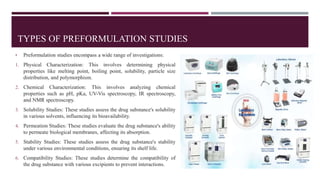
TYPES OF PREFORMULATION STUDIES
• Preformulation studies encompass a wide range of investigations:
1. Physical Characterization: This involves determining physical
properties like melting point, boiling point, solubility, particle size
distribution, and polymorphism.
2. Chemical Characterization: This involves analyzing chemical
properties such as pH, pKa, UV-Vis spectroscopy, IR spectroscopy,
and NMR spectroscopy.
3. Solubility Studies: These studies assess the drug substance's solubility
in various solvents, influencing its bioavailability.
4. Permeation Studies: These studies evaluate the drug substance's ability
to permeate biological membranes, affecting its absorption.
5. Stability Studies: These studies assess the drug substance's stability
under various environmental conditions, ensuring its shelf life.
6. Compatibility Studies: These studies determine the compatibility of
the drug substance with various excipients to prevent interactions.
Preformulation studies encompass a wide range of investigations designed to gather crucial data about a new drug substance. These
studies can be broadly categorized into five main types:
1. Physicochemical Characterization:
Solubility: Analyzing the drug's solubility in various solvents and buffers at different pH levels and temperatures.
pKa: Determining the dissociation constant of the drug, which influences its solubility and absorption.
Partition Coefficient: Assessing the drug's distribution between water and organic solvents, which affects its absorption and metabolism.
Melting Point/Boiling Point: Determining the temperature at which the drug changes state, essential for storage and formulation
considerations.
Hygroscopicity: Investigating the drug's tendency to absorb water, impacting stability and dosage form design.
Polymorphism: Identifying different crystal forms of the drug, each with potentially unique properties.
Particle Size Distribution: Determining the size and size distribution of the drug particles, influencing dissolution rate and
bioavailability.
2. Solid-State Characterization:
X-ray Diffraction (XRD): Identifying the crystal structure of the drug and detecting potential polymorphic forms.
Differential Scanning Calorimetry (DSC): Measuring the thermal behavior of the drug, including melting point, heat of fusion, and glass
transition temperature.
Thermogravimetric Analysis (TGA): Determining the composition and volatilization characteristics of the drug substance and
excipients.
3. Compatibility Studies:
•Drug-Excipient Compatibility: Evaluating potential interactions between the drug and various excipients used in the
formulation.
•Drug-Container Closure Compatibility: Assessing the interaction between the drug and the packaging materials to
ensure stability.
•Stress Testing: Analyzing the drug's stability under various stress conditions like heat, light, and humidity to predict
shelf life.
4. Biopharmaceutical Characterization:
•Dissolution Testing: Determining the rate at which the drug dissolves from the dosage form, impacting its absorption.
•Permeability Studies: Assessing the ability of the drug to cross biological membranes, influencing its bioavailability.
•Stability in Biological Fluids: Evaluating the drug's stability in simulated gastric and intestinal fluids to predict
absorption and metabolism.
5. Analytical Method Development:
•Identification and Quantification: Developing analytical methods to accurately identify and quantify the drug substance
and its impurities in various matrices.
•Assay Validation: Ensuring the accuracy, precision, and specificity of the developed analytical methods.
PHYSICAL CHARACTERIZATION: INSIGHTS INTO DRUG
PROPERTIES
• Physical characterization provides valuable insights into the drug
substance's physical properties:
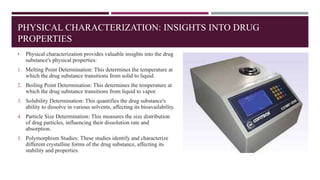
1. Melting Point Determination: This determines the temperature at
which the drug substance transitions from solid to liquid.
2. Boiling Point Determination: This determines the temperature at
which the drug substance transitions from liquid to vapor.
3. Solubility Determination: This quantifies the drug substance's
ability to dissolve in various solvents, affecting its bioavailability.
4. Particle Size Determination: This measures the size distribution
of drug particles, influencing their dissolution rate and
absorption.
5. Polymorphism Studies: These studies identify and characterize
different crystalline forms of the drug substance, affecting its
stability and properties.
Physical Characterization: Key to Understanding Drug Properties
Physical characterization is a critical step in the drug development process, providing valuable insights into the physicochemical properties of a drug
candidate. These properties have a profound impact on various aspects of the drug, including:
1. Solubility and Bioavailability:
•Solubility determines how much drug can dissolve in a given volume of liquid, directly influencing the drug's bioavailability.
•Physical characterization techniques like solubility assays and partition coefficient determination help assess solubility and predict how readily the
drug will be absorbed into the bloodstream.
2. Stability and Shelf Life:
•Physical properties like melting point, hygroscopicity, and polymorphism significantly impact the drug's stability and shelf life.
•Techniques like differential scanning calorimetry (DSC) and thermogravimetric analysis (TGA) provide crucial information about thermal behavior
and degradation profiles.
3. Formulation Design and Processing:
•Particle size distribution, surface area, and flowability are crucial parameters for developing a stable and successful formulation.
•Physical characterization techniques like particle size analysis and powder flow testing help optimize formulation design and processing methods.
4. Delivery and Targeting:
•The physical properties of a drug can influence its delivery to the target site and its ability to interact with biological membranes.
•Techniques like dissolution testing and permeability studies help predict the drug's release profile and absorption characteristics.
5. Regulatory Compliance:
•Regulatory agencies require comprehensive data on the physicochemical properties of a drug for approval.
•Physical characterization studies provide the necessary evidence to ensure the safety and efficacy of the drug product.
Here are some specific examples of how physical characterization techniques offer insight into drug properties:
• X-ray diffraction (XRD) can identify different polymorphic forms of a drug, each with potentially unique solubility
and dissolution rates. This information is crucial for ensuring consistent drug performance and bioavailability.
• DSC can be used to determine the melting point and heat of fusion of a drug, which helps in formulation design and
stability testing. High melting point drugs might require special formulation strategies, and understanding the heat of
fusion can predict potential degradation pathways.
• Particle size analysis provides information about the size distribution of the drug particles, which significantly
impacts the drug's dissolution rate and bioavailability. Smaller particles tend to dissolve faster, leading to faster
absorption into the bloodstream.
By understanding the physical properties of a drug through characterization techniques, scientists can make
informed decisions about:
• Formulation design: Choosing appropriate excipients and dosage forms to optimize drug delivery and bioavailability.
• Manufacturing processes: Developing methods that ensure consistent production of a high-quality drug product.
• Storage and packaging: Implementing appropriate storage conditions and packaging materials to maintain the drug's
stability and shelf life.
• Clinical development: Designing clinical trials and interpreting data based on the drug's physicochemical properties.
Overall, physical characterization plays a vital role in understanding drug properties and guiding various aspects of drug
development. It contributes significantly to the development of safe, effective, and stable drug products for improving
patient health.
CHEMICAL CHARACTERIZATION: UNVEILING DRUG
PROPERTIES
• Chemical characterization unveils the drug substance's chemical
properties:
1. pH Determination: This measures the acidity or alkalinity of the
drug substance, influencing its solubility and stability.
2. pKa Determination: This determines the dissociation constant of
the drug substance, affecting its ionization and solubility.
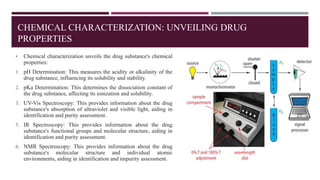
3. UV-Vis Spectroscopy: This provides information about the drug
substance's absorption of ultraviolet and visible light, aiding in
identification and purity assessment.
5. IR Spectroscopy: This provides information about the drug
substance's functional groups and molecular structure, aiding in
identification and purity assessment.
6. NMR Spectroscopy: This provides information about the drug
substance's molecular structure and individual atomic
environments, aiding in identification and impurity assessment.
Chemical Characterization: Unraveling the Secrets of Drug Properties
Chemical characterization is an integral part of the drug development process, shedding light on the molecular structure and composition of a drug
candidate. This information plays a crucial role in understanding various critical aspects of the drug, including:
1. Identification and Purity:
Chemical characterization techniques like nuclear magnetic resonance (NMR) and mass spectrometry (MS) help identify the exact structure of the
drug molecule and quantify its purity.
This information is essential for ensuring the drug's identity and verifying its compliance with regulatory standards.
2. Stability and Degradation Pathways:
Chemical characterization techniques can identify potential degradation products and pathways, helping to predict drug stability and shelf life.
Understanding degradation mechanisms allows for the development of appropriate formulation strategies and storage conditions to maintain the
drug's efficacy and safety.
3. Mechanism of Action:
Knowledge of the drug's chemical structure can provide clues about its mechanism of action, revealing how it interacts with biological targets.
This information is crucial for optimizing drug design and developing effective therapies.
4. Impurities and Toxicity:
Chemical characterization techniques can detect and quantify impurities in the drug substance.
This information is essential for assessing the potential toxicity and safety of the drug.
5. Drug Metabolism and Pharmacokinetics:
Understanding the chemical structure and functional groups of the drug helps predict its metabolic pathways and pharmacokinetic properties.
This information allows for optimizing dosing regimens and predicting potential interactions with other medications.
Here are some specific examples of how chemical characterization techniques unveil drug properties:
• NMR spectroscopy provides detailed information about the drug's molecular structure, including its functional
groups and conformational flexibility. This information can be crucial for understanding the drug's mechanism of
action and predicting its interactions with biological targets.
• MS can be used to identify and quantify impurities in the drug substance, ensuring the purity and safety of the final
product. This technique can detect even trace amounts of impurities, which can have a significant impact on the
drug's efficacy and toxicity.
• Elemental analysis can determine the composition of the drug molecule, providing valuable information about its
stability and potential interactions with excipients and other drugs. This information can be helpful for optimizing
formulation design and predicting potential drug-drug interactions.
By revealing the chemical properties of a drug through characterization techniques, scientists can:
• Develop targeted therapies: Design drugs that specifically target the disease-causing molecules.
• Optimize drug delivery: Develop formulation strategies that improve the drug's bioavailability and effectiveness.
• Predict potential side effects: Identify potential toxicities and side effects associated with the drug.
• Improve drug safety: Develop strategies to minimize impurities and ensure the safety of the drug product.
SOLUBILITY STUDIES: DETERMINING DRUG AVAILABILITY
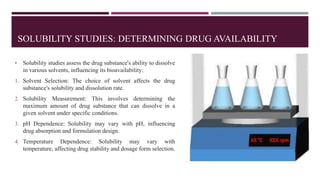
• Solubility studies assess the drug substance's ability to dissolve
in various solvents, influencing its bioavailability:
1. Solvent Selection: The choice of solvent affects the drug
substance's solubility and dissolution rate.
2. Solubility Measurement: This involves determining the
maximum amount of drug substance that can dissolve in a
given solvent under specific conditions.
3. pH Dependence: Solubility may vary with pH, influencing
drug absorption and formulation design.
4. Temperature Dependence: Solubility may vary with
temperature, affecting drug stability and dosage form selection.
Solubility studies are crucial in the drug development process as they directly impact the bioavailability and efficacy of a drug. Solubility refers to the
maximum amount of a drug that can dissolve in a specific solvent under defined conditions. High solubility is essential for a drug to be readily absorbed
into the bloodstream and exert its therapeutic effect.
Here's how solubility studies determine drug availability:
1. Impact on Absorption:
Solubility directly affects the drug's ability to dissolve in gastrointestinal fluids, which is the first step in absorption.
Poorly soluble drugs often have limited bioavailability due to slow dissolution and incomplete absorption.
Solubility studies help identify potential bioavailability limitations and guide formulation strategies to improve drug dissolution.
2. Prediction of Bioavailability:
In vitro dissolution tests simulate the gastrointestinal environment and measure the drug's release rate from the dosage form.
This information can be used to predict the drug's bioavailability in vivo.
Together with solubility data, dissolution testing helps estimate the amount of drug that reaches the systemic circulation and becomes available to its target
site.
3. Design of Formulations:
Understanding the drug's solubility profile allows scientists to design formulations that enhance drug dissolution and bioavailability.
This can involve incorporating solubilizing excipients, modifying the pH of the formulation, or utilizing different dosage forms like oral suspensions or
injectables.
4. Optimization of Dosing Regimens:
Knowledge of the drug's solubility and dissolution profile helps determine the optimal dose and dosing regimen for maximal therapeutic effect.
For poorly soluble drugs, frequent dosing or higher doses might be necessary to achieve the desired therapeutic concentration.
5. Regulatory Compliance:
Regulatory agencies require solubility and dissolution data as part of the drug approval process.
Demonstrating adequate solubility and bioavailability is crucial for ensuring the safety and efficacy of the drug product.
Here are some specific examples of how solubility studies determine drug availability:
• Determining the minimum effective concentration (MEC) of the drug: Solubility studies help determine how much
drug needs to be dissolved to achieve the desired therapeutic effect.
• Identifying potential solubility challenges: Early identification of solubility limitations allows for proactive
formulation strategies to be implemented.
• Selecting appropriate excipients: Solubility studies guide the selection of excipients that can enhance the drug's
solubility and dissolution.
By understanding the impact of solubility on drug availability, scientists can:
• Develop effective and bioavailable drugs.
• Design optimal dosage forms for maximum therapeutic benefit.
• Minimize potential side effects associated with high doses or frequent dosing.
• Ensure compliance with regulatory requirements.
Solubility studies play a critical role in determining drug availability and shaping various aspects of drug development.
They provide invaluable information that contributes to the development of effective, safe, and patient-centered drug
therapies.
PERMEATION STUDIES: ASSESSING DRUG PENETRATION
• Permeation studies evaluate the drug substance's ability
to penetrate biological membranes, affecting its
absorption:
1. Membranes Used: Various biological membranes, such
as skin or intestinal mucosa, are used to assess
permeability.
2. Permeation Coefficient: This measures the rate at which
the drug substance crosses the membrane.
3. Diffusion Mechanism: The mechanism of drug
permeation, such as passive diffusion or facilitated
transport, is determined.
4. Permeability Enhancers: The effect of excipients or
formulation modifications on permeability is evaluated.
Permeation studies play a crucial role in understanding how a drug penetrates biological barriers, such as the skin, gastrointestinal tract, and blood-
brain barrier. These studies provide valuable information about the drug's ability to reach its target site and exert its therapeutic effect.
Here's how permeation studies access drug penetration:
1. Measuring Drug Transport:
Permeation studies use various techniques, like Franz diffusion cells and in vivo models, to measure the rate at which the drug crosses a biological
membrane.
This information helps predict how much drug reaches the target site and how quickly it takes effect.
2. Identifying Absorption Mechanisms:
Permeation studies can help identify the mechanisms by which the drug crosses biological barriers.
This includes determining whether the drug passively diffuses through the membrane or requires active transport mechanisms.
Understanding the absorption mechanisms allows for targeted formulation strategies to enhance drug penetration.
3. Predicting Tissue Distribution:
Permeation studies can be used to predict how the drug will distribute in different tissues throughout the body.
This information is crucial for assessing potential side effects and ensuring the drug reaches its intended target.
4. Evaluating Prodrug Strategies:
Prodrugs are inactive drug derivatives that are designed to be converted into active drugs after they penetrate a specific biological barrier.
Permeation studies can help evaluate the effectiveness of prodrug strategies and optimize their design for improved drug delivery.
5. Optimizing Formulations:
Understanding the drug's permeation profile allows scientists to develop formulations that enhance its penetration into specific tissues.
This can involve incorporating penetration enhancers, modifying the drug's structure, or utilizing targeted delivery systems.
Here are some specific examples of how permeation studies access drug penetration:
• Identifying potential barriers to drug delivery: Permeation studies can identify tissues with limited drug penetration,
prompting the development of targeted delivery strategies.
• Developing transdermal drug delivery systems: Permeation studies help optimize the design of transdermal patches
and other formulations that deliver drugs through the skin.
• Evaluating the efficacy of topical drug products: Permeation studies can assess how much drug penetrates the skin and
reaches its target site, providing valuable information about the potential effectiveness of topical medications.
By understanding how drugs penetrate biological barriers, scientists can:
• Develop targeted therapies that deliver drugs to specific tissues.
• Minimize potential side effects by reducing drug exposure to non-target tissues.
• Design more effective and efficient drug delivery systems.
• Predict the therapeutic efficacy of drug candidates.
Permeation studies offer a window into the complex world of drug penetration. They provide vital information that
guides drug development, optimizes formulation design, and ultimately leads to more effective and targeted therapies for
patients.
STABILITY STUDIES: ENSURING DRUG SHELF LIFE
 Stability studies assess the drug substance's stability under
various environmental conditions, ensuring its shelf life:
1. Temperature Stability: This evaluates the drug substance's
stability at different temperatures, including accelerated
conditions.
2. Humidity Stability: This assesses the drug substance's stability
under varying humidity levels, preventing moisture-induced
degradation.
3. Light Stability: This evaluates the drug substance's stability under
exposure to light, preventing photodegradation.
4. pH Stability: This assesses the drug substance's stability at
different pH values, ensuring stability in the formulation.
5. Storage Conditions: Based on stability data, appropriate storage
conditions are determined for the drug product.
Stability studies are essential in the pharmaceutical industry to ensure that drug products maintain their quality, safety, and efficacy
throughout their shelf life. These studies involve exposing drug samples to various environmental conditions, such as temperature, humidity,
and light, and monitoring changes in their physical, chemical, and biological properties over time.
Here's how stability studies ensure drug shelf life:
1. Identifying Degradation Pathways:
•Stability studies help identify potential degradation pathways of the drug molecule and its excipients.
•By understanding how the drug degrades, scientists can develop strategies to minimize degradation and extend shelf life.
2. Establishing Shelf Life:
•Stability data is used to establish a realistic and reliable shelf life for the drug product.
•This information is crucial for ensuring that the drug remains safe and effective for patients throughout its intended storage period.
3. Optimizing Formulations:
•Understanding degradation mechanisms allows for the selection of appropriate excipients and formulation strategies to stabilize the drug
molecule.
•This can involve adding antioxidants, adjusting pH levels, or employing specific packaging materials.
4. Regulatory Compliance:
•Regulatory agencies require comprehensive stability data as part of the drug approval process.
•Demonstrating adequate stability is crucial for marketing and commercializing the drug product.
5. Monitoring Batch-to-Batch Consistency:
•Stability studies are performed on multiple batches of the drug product to ensure consistent quality and performance.
•This helps to identify any potential variations or stability issues that might arise during the manufacturing process.
Here are some specific examples of how stability studies ensure drug shelf life:
• Identifying potential interactions between the drug and excipients: Stability studies can reveal interactions that lead to
degradation, prompting the selection of alternative excipients or formulation adjustments.
• Developing accelerated stability studies: These studies expose drug samples to harsher conditions than expected
storage conditions to predict long-term stability in a shorter timeframe.
• Setting storage and handling instructions: Based on stability data, appropriate storage conditions and handling
instructions are provided on the drug product label to ensure proper use and maintain its quality throughout its shelf
life.
By ensuring drug stability, scientists can:
• Protect patients from the risks of using degraded drugs, which can be ineffective or even harmful.
• Minimize drug waste and economic losses associated with expired medications.
• Enhance patient confidence in the quality and reliability of drug products.
• Maintain the integrity and reputation of the pharmaceutical industry.
Stability studies are a cornerstone of quality assurance in the pharmaceutical industry. They provide invaluable
information that guarantees drug shelf life, safeguards patient health, and contributes to the development of safe and
effective medications.
COMPATIBILITY STUDIES: PREVENTING INTERACTIONS
• Compatibility studies determine the compatibility of the drug
substance with various excipients to prevent interactions:
1. Excipient Selection: Excipients are evaluated for their potential
to interact with the drug substance, affecting stability or efficacy.
2. Physical Compatibility: This assesses physical interactions, such
as precipitation or complexation, between the drug substance and
excipients.
3. Chemical Compatibility: This evaluates chemical interactions,
such as hydrolysis or oxidation, between the drug substance and
excipients.
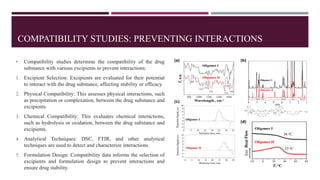
4. Analytical Techniques: DSC, FTIR, and other analytical
techniques are used to detect and characterize interactions.
5. Formulation Design: Compatibility data informs the selection of
excipients and formulation design to prevent interactions and
ensure drug stability.
Compatibility studies are crucial in the pharmaceutical industry to prevent undesirable interactions between drug substances, excipients,
packaging materials, and other components of a drug product. These interactions can lead to various problems, including:
• Physical instability: Degradation of the drug molecule, leading to loss of potency, discoloration, or precipitation.
• Chemical instability: Formation of toxic or harmful degradation products.
• Biological instability: Loss of biological activity or even immunogenicity.
• Reduced efficacy and safety of the drug product.
Here's how compatibility studies prevent such interactions:
1. Identifying Potential Interactions:
Compatibility studies involve exposing the drug to various excipients, container closure systems, and other potential interacting
components under different conditions.
This allows scientists to identify any interactions that might occur during storage, handling, or administration of the drug product.
2. Selecting Appropriate Excipients:
Based on compatibility data, suitable excipients are chosen that are compatible with the drug molecule and do not negatively impact its
stability or efficacy.
This ensures that the excipients contribute to the desired formulation properties without compromising the drug's quality.
3. Optimizing Formulation Design:
Understanding the drug's compatibility profile allows for the development of formulations that minimize potential interactions and
optimize stability.
This can involve adjusting pH levels, incorporating stabilizing agents, or employing specific packaging materials.
4. Regulatory Compliance:
Regulatory agencies require comprehensive compatibility data as part of the drug approval process.
Demonstrating that no significant interactions occur is essential for ensuring the safety and efficacy of the drug product.
5. Ensuring Patient Safety:
By preventing interactions, compatibility studies help to ensure the safety of patients using the drug product.
This minimizes the risk of adverse reactions and other potential health risks associated with drug degradation or interactions.
Here are some specific examples of how compatibility studies prevent interactions:
• Identifying interactions between the drug and excipients: Compatibility studies can reveal interactions that lead to degradation, prompting
the selection of alternative excipients or formulation adjustments.
• Evaluating container closure systems: Studies are conducted to assess the compatibility of the drug with the packaging materials to ensure
that they do not leach chemicals or interact with the drug in any harmful way.
• Developing strategies to prevent interaction with light: If the drug is light-sensitive, compatibility studies help to identify appropriate
light-protective packaging materials and storage conditions.
By preventing unwanted interactions, compatibility studies contribute to:
• Developing stable and effective drug products: Ensuring the drug maintains its quality and efficacy throughout its shelf life.
• Enhancing patient safety: Minimizing the risk of adverse reactions associated with drug interactions.
• Reducing potential manufacturing and development costs: Preventing problems related to instability and ensuring a smooth production
process.
• Fulfilling regulatory requirements: Demonstrating compliance with safety and quality standards.
Compatibility studies play a vital role in safeguarding the quality and safety of drug products. They provide the necessary information to
prevent undesirable interactions and contribute to the development of reliable and effective medications for patients.
CONCLUSION: PREFORMULATION STUDIES – A CORNERSTONE
FOR DRUG DEVELOPMENT
 Preformulation studies serve as a cornerstone for successful drug development:
1. Early Identification of Issues: They enable early identification of potential
challenges, preventing costly delays and reformulations.
2. Informed Decision-Making: They provide a wealth of information for making
informed decisions about dosage form selection, excipient selection, and
formulation design.
3. Enhanced Drug Delivery: They contribute to the development of effective drug
delivery systems, ensuring optimal drug delivery and therapeutic efficacy.
4. Improved Drug Stability: They contribute to improved drug stability, ensuring
the drug product's shelf life and maintaining its potency and efficacy.
5. Reduced Risks of Regulatory Issues: They help minimize the risk of regulatory
issues related to drug stability, impurities, and interactions, facilitating a
smoother regulatory pathway.
6. Accelerated Drug Development: They expedite drug development by providing
early insights that guide formulation selection and optimization,
REFERENCES
1. Martin, E. W. (2005). Physical pharmacy: An introduction to pharmaceutical sciences (4th ed.). Lippincott Williams &
Wilkins.
Link: https://www.amazon.com/Physical-Pharmacy-Introduction-Pharmaceutical-Sciences/dp/0781744873
2. Gibson, C. (2004). Principles of pharmaceutical preformulation. John Wiley & Sons.
Link: https://www.amazon.com/Principles-Pharmaceutical-Preformulation-Christopher-Gibson/dp/0471470311
3. Qiu, Y., Zhang, Y., & Zhao, Y. (2009). Preformulation studies of drug substances. In Y. Zhang, G. Zhou, & T. A.
Layman (Eds.), Pharmaceutical dissolution and bioavailability: Principles and practice (pp. 1-34). Springer.
Link: https://link.springer.com/chapter/10.1007/978-0-387-74208-6_1
4. Khan, K. A., & Rhodes, N. J. (2009). Preformulation studies. In A. K. Gupta & A. K. G. Achuthan (Eds.), Handbook of
pharmaceutical analysis (pp. 73-108). Elsevier.
Link: https://www.sciencedirect.com/science/article/pii/B9780444527040000041
5. Shah, N. H., & Rahman, A. (2015). Preformulation studies. In B. A. Siddiqui, M. D. Singh, & K. K. Mathur (Eds.),
Pharmaceutical preformulation and formulation (pp. 27-56). CRC Press.
Link: https://www.taylorfrancis.com/books/9781466576321
• Pharmaceutical Preformulation: The Science and Technology of Dosage Forms (Second Edition) by Aulton, Michael E. (Publisher: Pharmaceutical Press)
• Preformulation Studies of Solid Dosage Forms (Second Edition) by Lachman, Leon; Lieberman, Herbert A.; Kanig, Joseph L. (Publisher: Taylor &
Francis): https://www.slideshare.net/boreddysunilkumarreddy/preformulation-testing-of-solid-dosage-forms-26810458
• Modern Pharmaceutics: Concepts and Principles (Fourth Edition) by Banker, Gilbert S.; Rhodes, Christopher T. (Publisher: CRC Press):
https://www.amazon.com/Modern-Pharmaceutics-Fourth-Pharmaceutical-Sciences/dp/0824706749
• Pharmaceutical Dosage Forms: Tablets, Particulates, and Capsules (Third Edition) by Kibbe, Arthur H. (Publisher: Informa Healthcare):
https://www.coursehero.com/file/26262840/Pharmaceutical-Dosage-Form-Answer-Key-BLUE-PACOP1pdf/
• Encyclopedia of Pharmaceutical Technology (Third Edition) by Swarbrick, James (Publisher: Taylor & Francis): https://www.routledge.com/Encyclopedia-
of-Pharmaceutical-Technology/Swarbrick-Swarbrick/p/book/9780849393914
• Aulton's Pharmaceutics: The Design and Manufacture of Medicines (Fifth Edition) by de Vos, Paul; Timmins, Peter; Andrews, Gareth P. (Publisher:
Elsevier): https://www.eu.elsevierhealth.com/aultons-pharmaceutics-9780702081545.html
• Handbook of Pharmaceutical Excipients (Sixth Edition) by Rowe, Raymond C.; Sheskey, Paul J.; Cook, Marian E. (Publisher: Pharmaceutical Press):
https://www.amazon.com/Handbook-Pharmaceutical-Excipients-Rowe/dp/0853697922
• Solid State Characterization of Pharmaceuticals (Second Edition) by Newman, Anthony W. (Publisher: John Wiley & Sons):
https://onlinelibrary.wiley.com/doi/book/10.1002/9780470656792
• Drug Stability: Principles and Practices (Third Edition) by Carstensen, Jens T. (Publisher: CRC Press): https://www.amazon.com/Drug-Stability-Principles-
Practices-Pharmaceutical/dp/0824796357
• Development and Validation of Analytical Methods (Second Edition) by ICH Harmonised Tripartite Guideline:
https://database.ich.org/sites/default/files/Q2%28R1%29%20Guideline.pdf
In addition to the above books, there are numerous online resources and scientific journals that provide valuable
information on various aspects of preformulation studies.
Some helpful links include:
• FDA Guidance for Industry: Preformulation Considerations for Drug Products:
https://www.fda.gov/media/69923/download
• American Association of Pharmaceutical Scientists (AAPS): https://www.aaps.org/
• The International Pharmaceutical Excipients Council (IPEC): https://www.ipec-europe.org/
• Journal of Pharmaceutical Sciences: https://onlinelibrary.wiley.com/journal/15206017
• International Journal of Pharmaceutics: https://www.sciencedirect.com/journal/international-journal-of-pharmaceutics
These resources offer a wealth of information and can be valuable tools for scientists and students working in the field of
preformulation.

1. Preformulation studies AYP.pptx

  • 1.
    PREFORMULATION STUDIES: PREFORMULATION STUDIESOF DRUG SUBSTANCES, PROTEINS AND PEPTIDES. PREFORMULATION WORK SHEET. CHAVAN KHUSHAL
  • 2.
    CONTENTS:  Preformulation studies Significance of Preformulation Studies  Types of Preformulation Studies  Physical Characterization: Insights into Drug Properties  Chemical Characterization: Unveiling Drug Properties  Solubility Studies: Determining Drug Availability  Permeation Studies: Assessing Drug Penetration  Stability Studies: Ensuring Drug Shelf Life  Compatibility Studies: Preventing Interactions  Conclusion: Preformulation Studies – A Cornerstone for Drug Development  References
  • 3.
    PREFORMULATION STUDIES: • Preformulationstudies serve as the cornerstone of drug development, providing essential insights into the physicochemical properties of drug substances. • These studies are crucial in selecting the most suitable dosage form and formulation to achieve optimal drug delivery and therapeutic efficacy.
  • 4.
    Preformulation studies arecrucial in the pharmaceutical development process, as they provide essential information about the physical, chemical, and biological properties of a new drug substance. This information guides the formulation development process, ensuring the creation of a stable, effective, and safe drug product. Some key areas of preformulation studies: • Physicochemical properties: This includes solubility, pKa, partition coefficient, melting point, hygroscopicity, polymorphism, and particle size distribution. • Solid-state characterization: This involves techniques like X-ray diffraction, differential scanning calorimetry, and thermogravimetric analysis to understand the drug's crystal structure and thermal behavior. • Compatibility studies: This assesses the interaction between the drug and potential excipients to ensure stability and prevent adverse reactions. • Biopharmaceutical properties: This involves evaluating factors like dissolution rate, permeability, and stability in biological fluids to predict the drug's bioavailability and absorption. • Analytical method development: This involves developing methods to quantify the drug substance and its impurities in various matrices. Preformulation studies are essential for several reasons: • Optimizing formulation design: Understanding the drug's properties allows scientists to choose appropriate excipients and design a formulation that ensures optimal drug delivery and absorption. • Predicting drug performance: Preformulation data helps to estimate the drug's pharmacokinetic and pharmacodynamic properties, allowing for better prediction of its efficacy and safety in humans. • Reducing development risks: Identifying potential problems with stability, compatibility, or bioavailability early in the development process can save time and resources in the long run. • Regulatory compliance: Preformulation studies are required by regulatory agencies to ensure the safety and efficacy of new drugs.
  • 5.
    SIGNIFICANCE OF PREFORMULATIONSTUDIES • Preformulation studies hold immense significance in the drug development process: 1. Dosage Form Selection: They aid in identifying the most appropriate dosage form, considering factors like solubility, permeability, and stability. 2. Excipient Selection: They provide valuable information for selecting suitable excipients that enhance drug stability, solubility, and bioavailability. 3. Stability Assessment: They assess the drug substance's stability under various conditions, ensuring its shelf life and efficacy. 4. Problem Identification: They help identify potential formulation challenges early on, preventing costly delays and reformulations. 5. Manufacturing Process Development: They provide critical data for developing a robust and efficient manufacturing process.
  • 6.
    Preformulation studies playa crucial role in the pharmaceutical development process. Their significance can be summarized in the following points: 1. Optimizing formulation design: Preformulation studies provide essential data about the physicochemical, biopharmaceutical, and compatibility properties of the drug substance. This information allows researchers to choose appropriate excipients and design a formulation that ensures optimal drug delivery and absorption. Factors like solubility, pKa, particle size distribution, and compatibility with excipients are crucial for creating a stable, effective, and safe dosage form. 2. Predicting drug performance: Preformulation studies help predict the pharmacokinetic and pharmacodynamic properties of the drug. This includes understanding factors like drug release rate, absorption, distribution, metabolism, and excretion. By predicting how the drug will behave in the body, scientists can make informed decisions about dosing regimens and potential side effects. 3. Reducing development risks: Identifying potential problems with stability, compatibility, or bioavailability early in the development process can save time and resources. Preformulation studies can help avoid costly late-stage failures and significantly reduce the overall cost of drug development. This is particularly important for expensive and complex drug candidates where failure can have significant financial repercussions.
  • 7.
    4. Regulatory compliance: •Regulatoryagencies like the FDA require preformulation studies as part of the drug approval process. •These studies provide evidence that the drug substance is safe and suitable for further development and eventual clinical testing. •Without adequate preformulation data, it is impossible to gain regulatory approval for a new drug. 5. Facilitating formulation optimization: •Preformulation studies provide a strong foundation for optimizing the formulation during later stages of development. •This includes understanding the impact of excipients, manufacturing processes, and storage conditions on the drug's properties. •By using preformulation data as a starting point, scientists can develop a formulation that is stable, effective, and cost-effective to manufacture. 6. Enhancing product quality: •Preformulation studies contribute significantly to the overall quality of the final drug product. •By ensuring that the drug substance is well-characterized and compatible with other components, preformulation studies help to prevent problems with stability, bioavailability, and safety. •This ultimately leads to a higher quality drug product that is safe and effective for patients.
  • 8.
    TYPES OF PREFORMULATIONSTUDIES • Preformulation studies encompass a wide range of investigations: 1. Physical Characterization: This involves determining physical properties like melting point, boiling point, solubility, particle size distribution, and polymorphism. 2. Chemical Characterization: This involves analyzing chemical properties such as pH, pKa, UV-Vis spectroscopy, IR spectroscopy, and NMR spectroscopy. 3. Solubility Studies: These studies assess the drug substance's solubility in various solvents, influencing its bioavailability. 4. Permeation Studies: These studies evaluate the drug substance's ability to permeate biological membranes, affecting its absorption. 5. Stability Studies: These studies assess the drug substance's stability under various environmental conditions, ensuring its shelf life. 6. Compatibility Studies: These studies determine the compatibility of the drug substance with various excipients to prevent interactions.
  • 9.
    Preformulation studies encompassa wide range of investigations designed to gather crucial data about a new drug substance. These studies can be broadly categorized into five main types: 1. Physicochemical Characterization: Solubility: Analyzing the drug's solubility in various solvents and buffers at different pH levels and temperatures. pKa: Determining the dissociation constant of the drug, which influences its solubility and absorption. Partition Coefficient: Assessing the drug's distribution between water and organic solvents, which affects its absorption and metabolism. Melting Point/Boiling Point: Determining the temperature at which the drug changes state, essential for storage and formulation considerations. Hygroscopicity: Investigating the drug's tendency to absorb water, impacting stability and dosage form design. Polymorphism: Identifying different crystal forms of the drug, each with potentially unique properties. Particle Size Distribution: Determining the size and size distribution of the drug particles, influencing dissolution rate and bioavailability. 2. Solid-State Characterization: X-ray Diffraction (XRD): Identifying the crystal structure of the drug and detecting potential polymorphic forms. Differential Scanning Calorimetry (DSC): Measuring the thermal behavior of the drug, including melting point, heat of fusion, and glass transition temperature. Thermogravimetric Analysis (TGA): Determining the composition and volatilization characteristics of the drug substance and excipients.
  • 10.
    3. Compatibility Studies: •Drug-ExcipientCompatibility: Evaluating potential interactions between the drug and various excipients used in the formulation. •Drug-Container Closure Compatibility: Assessing the interaction between the drug and the packaging materials to ensure stability. •Stress Testing: Analyzing the drug's stability under various stress conditions like heat, light, and humidity to predict shelf life. 4. Biopharmaceutical Characterization: •Dissolution Testing: Determining the rate at which the drug dissolves from the dosage form, impacting its absorption. •Permeability Studies: Assessing the ability of the drug to cross biological membranes, influencing its bioavailability. •Stability in Biological Fluids: Evaluating the drug's stability in simulated gastric and intestinal fluids to predict absorption and metabolism. 5. Analytical Method Development: •Identification and Quantification: Developing analytical methods to accurately identify and quantify the drug substance and its impurities in various matrices. •Assay Validation: Ensuring the accuracy, precision, and specificity of the developed analytical methods.
  • 11.
    PHYSICAL CHARACTERIZATION: INSIGHTSINTO DRUG PROPERTIES • Physical characterization provides valuable insights into the drug substance's physical properties: 1. Melting Point Determination: This determines the temperature at which the drug substance transitions from solid to liquid. 2. Boiling Point Determination: This determines the temperature at which the drug substance transitions from liquid to vapor. 3. Solubility Determination: This quantifies the drug substance's ability to dissolve in various solvents, affecting its bioavailability. 4. Particle Size Determination: This measures the size distribution of drug particles, influencing their dissolution rate and absorption. 5. Polymorphism Studies: These studies identify and characterize different crystalline forms of the drug substance, affecting its stability and properties.
  • 12.
    Physical Characterization: Keyto Understanding Drug Properties Physical characterization is a critical step in the drug development process, providing valuable insights into the physicochemical properties of a drug candidate. These properties have a profound impact on various aspects of the drug, including: 1. Solubility and Bioavailability: •Solubility determines how much drug can dissolve in a given volume of liquid, directly influencing the drug's bioavailability. •Physical characterization techniques like solubility assays and partition coefficient determination help assess solubility and predict how readily the drug will be absorbed into the bloodstream. 2. Stability and Shelf Life: •Physical properties like melting point, hygroscopicity, and polymorphism significantly impact the drug's stability and shelf life. •Techniques like differential scanning calorimetry (DSC) and thermogravimetric analysis (TGA) provide crucial information about thermal behavior and degradation profiles. 3. Formulation Design and Processing: •Particle size distribution, surface area, and flowability are crucial parameters for developing a stable and successful formulation. •Physical characterization techniques like particle size analysis and powder flow testing help optimize formulation design and processing methods. 4. Delivery and Targeting: •The physical properties of a drug can influence its delivery to the target site and its ability to interact with biological membranes. •Techniques like dissolution testing and permeability studies help predict the drug's release profile and absorption characteristics. 5. Regulatory Compliance: •Regulatory agencies require comprehensive data on the physicochemical properties of a drug for approval. •Physical characterization studies provide the necessary evidence to ensure the safety and efficacy of the drug product.
  • 13.
    Here are somespecific examples of how physical characterization techniques offer insight into drug properties: • X-ray diffraction (XRD) can identify different polymorphic forms of a drug, each with potentially unique solubility and dissolution rates. This information is crucial for ensuring consistent drug performance and bioavailability. • DSC can be used to determine the melting point and heat of fusion of a drug, which helps in formulation design and stability testing. High melting point drugs might require special formulation strategies, and understanding the heat of fusion can predict potential degradation pathways. • Particle size analysis provides information about the size distribution of the drug particles, which significantly impacts the drug's dissolution rate and bioavailability. Smaller particles tend to dissolve faster, leading to faster absorption into the bloodstream. By understanding the physical properties of a drug through characterization techniques, scientists can make informed decisions about: • Formulation design: Choosing appropriate excipients and dosage forms to optimize drug delivery and bioavailability. • Manufacturing processes: Developing methods that ensure consistent production of a high-quality drug product. • Storage and packaging: Implementing appropriate storage conditions and packaging materials to maintain the drug's stability and shelf life. • Clinical development: Designing clinical trials and interpreting data based on the drug's physicochemical properties. Overall, physical characterization plays a vital role in understanding drug properties and guiding various aspects of drug development. It contributes significantly to the development of safe, effective, and stable drug products for improving patient health.
  • 14.
    CHEMICAL CHARACTERIZATION: UNVEILINGDRUG PROPERTIES • Chemical characterization unveils the drug substance's chemical properties: 1. pH Determination: This measures the acidity or alkalinity of the drug substance, influencing its solubility and stability. 2. pKa Determination: This determines the dissociation constant of the drug substance, affecting its ionization and solubility. 3. UV-Vis Spectroscopy: This provides information about the drug substance's absorption of ultraviolet and visible light, aiding in identification and purity assessment. 5. IR Spectroscopy: This provides information about the drug substance's functional groups and molecular structure, aiding in identification and purity assessment. 6. NMR Spectroscopy: This provides information about the drug substance's molecular structure and individual atomic environments, aiding in identification and impurity assessment.
  • 15.
    Chemical Characterization: Unravelingthe Secrets of Drug Properties Chemical characterization is an integral part of the drug development process, shedding light on the molecular structure and composition of a drug candidate. This information plays a crucial role in understanding various critical aspects of the drug, including: 1. Identification and Purity: Chemical characterization techniques like nuclear magnetic resonance (NMR) and mass spectrometry (MS) help identify the exact structure of the drug molecule and quantify its purity. This information is essential for ensuring the drug's identity and verifying its compliance with regulatory standards. 2. Stability and Degradation Pathways: Chemical characterization techniques can identify potential degradation products and pathways, helping to predict drug stability and shelf life. Understanding degradation mechanisms allows for the development of appropriate formulation strategies and storage conditions to maintain the drug's efficacy and safety. 3. Mechanism of Action: Knowledge of the drug's chemical structure can provide clues about its mechanism of action, revealing how it interacts with biological targets. This information is crucial for optimizing drug design and developing effective therapies. 4. Impurities and Toxicity: Chemical characterization techniques can detect and quantify impurities in the drug substance. This information is essential for assessing the potential toxicity and safety of the drug. 5. Drug Metabolism and Pharmacokinetics: Understanding the chemical structure and functional groups of the drug helps predict its metabolic pathways and pharmacokinetic properties. This information allows for optimizing dosing regimens and predicting potential interactions with other medications.
  • 16.
    Here are somespecific examples of how chemical characterization techniques unveil drug properties: • NMR spectroscopy provides detailed information about the drug's molecular structure, including its functional groups and conformational flexibility. This information can be crucial for understanding the drug's mechanism of action and predicting its interactions with biological targets. • MS can be used to identify and quantify impurities in the drug substance, ensuring the purity and safety of the final product. This technique can detect even trace amounts of impurities, which can have a significant impact on the drug's efficacy and toxicity. • Elemental analysis can determine the composition of the drug molecule, providing valuable information about its stability and potential interactions with excipients and other drugs. This information can be helpful for optimizing formulation design and predicting potential drug-drug interactions. By revealing the chemical properties of a drug through characterization techniques, scientists can: • Develop targeted therapies: Design drugs that specifically target the disease-causing molecules. • Optimize drug delivery: Develop formulation strategies that improve the drug's bioavailability and effectiveness. • Predict potential side effects: Identify potential toxicities and side effects associated with the drug. • Improve drug safety: Develop strategies to minimize impurities and ensure the safety of the drug product.
  • 17.
    SOLUBILITY STUDIES: DETERMININGDRUG AVAILABILITY • Solubility studies assess the drug substance's ability to dissolve in various solvents, influencing its bioavailability: 1. Solvent Selection: The choice of solvent affects the drug substance's solubility and dissolution rate. 2. Solubility Measurement: This involves determining the maximum amount of drug substance that can dissolve in a given solvent under specific conditions. 3. pH Dependence: Solubility may vary with pH, influencing drug absorption and formulation design. 4. Temperature Dependence: Solubility may vary with temperature, affecting drug stability and dosage form selection.
  • 18.
    Solubility studies arecrucial in the drug development process as they directly impact the bioavailability and efficacy of a drug. Solubility refers to the maximum amount of a drug that can dissolve in a specific solvent under defined conditions. High solubility is essential for a drug to be readily absorbed into the bloodstream and exert its therapeutic effect. Here's how solubility studies determine drug availability: 1. Impact on Absorption: Solubility directly affects the drug's ability to dissolve in gastrointestinal fluids, which is the first step in absorption. Poorly soluble drugs often have limited bioavailability due to slow dissolution and incomplete absorption. Solubility studies help identify potential bioavailability limitations and guide formulation strategies to improve drug dissolution. 2. Prediction of Bioavailability: In vitro dissolution tests simulate the gastrointestinal environment and measure the drug's release rate from the dosage form. This information can be used to predict the drug's bioavailability in vivo. Together with solubility data, dissolution testing helps estimate the amount of drug that reaches the systemic circulation and becomes available to its target site. 3. Design of Formulations: Understanding the drug's solubility profile allows scientists to design formulations that enhance drug dissolution and bioavailability. This can involve incorporating solubilizing excipients, modifying the pH of the formulation, or utilizing different dosage forms like oral suspensions or injectables. 4. Optimization of Dosing Regimens: Knowledge of the drug's solubility and dissolution profile helps determine the optimal dose and dosing regimen for maximal therapeutic effect. For poorly soluble drugs, frequent dosing or higher doses might be necessary to achieve the desired therapeutic concentration. 5. Regulatory Compliance: Regulatory agencies require solubility and dissolution data as part of the drug approval process. Demonstrating adequate solubility and bioavailability is crucial for ensuring the safety and efficacy of the drug product.
  • 19.
    Here are somespecific examples of how solubility studies determine drug availability: • Determining the minimum effective concentration (MEC) of the drug: Solubility studies help determine how much drug needs to be dissolved to achieve the desired therapeutic effect. • Identifying potential solubility challenges: Early identification of solubility limitations allows for proactive formulation strategies to be implemented. • Selecting appropriate excipients: Solubility studies guide the selection of excipients that can enhance the drug's solubility and dissolution. By understanding the impact of solubility on drug availability, scientists can: • Develop effective and bioavailable drugs. • Design optimal dosage forms for maximum therapeutic benefit. • Minimize potential side effects associated with high doses or frequent dosing. • Ensure compliance with regulatory requirements. Solubility studies play a critical role in determining drug availability and shaping various aspects of drug development. They provide invaluable information that contributes to the development of effective, safe, and patient-centered drug therapies.
  • 20.
    PERMEATION STUDIES: ASSESSINGDRUG PENETRATION • Permeation studies evaluate the drug substance's ability to penetrate biological membranes, affecting its absorption: 1. Membranes Used: Various biological membranes, such as skin or intestinal mucosa, are used to assess permeability. 2. Permeation Coefficient: This measures the rate at which the drug substance crosses the membrane. 3. Diffusion Mechanism: The mechanism of drug permeation, such as passive diffusion or facilitated transport, is determined. 4. Permeability Enhancers: The effect of excipients or formulation modifications on permeability is evaluated.
  • 21.
    Permeation studies playa crucial role in understanding how a drug penetrates biological barriers, such as the skin, gastrointestinal tract, and blood- brain barrier. These studies provide valuable information about the drug's ability to reach its target site and exert its therapeutic effect. Here's how permeation studies access drug penetration: 1. Measuring Drug Transport: Permeation studies use various techniques, like Franz diffusion cells and in vivo models, to measure the rate at which the drug crosses a biological membrane. This information helps predict how much drug reaches the target site and how quickly it takes effect. 2. Identifying Absorption Mechanisms: Permeation studies can help identify the mechanisms by which the drug crosses biological barriers. This includes determining whether the drug passively diffuses through the membrane or requires active transport mechanisms. Understanding the absorption mechanisms allows for targeted formulation strategies to enhance drug penetration. 3. Predicting Tissue Distribution: Permeation studies can be used to predict how the drug will distribute in different tissues throughout the body. This information is crucial for assessing potential side effects and ensuring the drug reaches its intended target. 4. Evaluating Prodrug Strategies: Prodrugs are inactive drug derivatives that are designed to be converted into active drugs after they penetrate a specific biological barrier. Permeation studies can help evaluate the effectiveness of prodrug strategies and optimize their design for improved drug delivery. 5. Optimizing Formulations: Understanding the drug's permeation profile allows scientists to develop formulations that enhance its penetration into specific tissues. This can involve incorporating penetration enhancers, modifying the drug's structure, or utilizing targeted delivery systems.
  • 22.
    Here are somespecific examples of how permeation studies access drug penetration: • Identifying potential barriers to drug delivery: Permeation studies can identify tissues with limited drug penetration, prompting the development of targeted delivery strategies. • Developing transdermal drug delivery systems: Permeation studies help optimize the design of transdermal patches and other formulations that deliver drugs through the skin. • Evaluating the efficacy of topical drug products: Permeation studies can assess how much drug penetrates the skin and reaches its target site, providing valuable information about the potential effectiveness of topical medications. By understanding how drugs penetrate biological barriers, scientists can: • Develop targeted therapies that deliver drugs to specific tissues. • Minimize potential side effects by reducing drug exposure to non-target tissues. • Design more effective and efficient drug delivery systems. • Predict the therapeutic efficacy of drug candidates. Permeation studies offer a window into the complex world of drug penetration. They provide vital information that guides drug development, optimizes formulation design, and ultimately leads to more effective and targeted therapies for patients.
  • 23.
    STABILITY STUDIES: ENSURINGDRUG SHELF LIFE  Stability studies assess the drug substance's stability under various environmental conditions, ensuring its shelf life: 1. Temperature Stability: This evaluates the drug substance's stability at different temperatures, including accelerated conditions. 2. Humidity Stability: This assesses the drug substance's stability under varying humidity levels, preventing moisture-induced degradation. 3. Light Stability: This evaluates the drug substance's stability under exposure to light, preventing photodegradation. 4. pH Stability: This assesses the drug substance's stability at different pH values, ensuring stability in the formulation. 5. Storage Conditions: Based on stability data, appropriate storage conditions are determined for the drug product.
  • 24.
    Stability studies areessential in the pharmaceutical industry to ensure that drug products maintain their quality, safety, and efficacy throughout their shelf life. These studies involve exposing drug samples to various environmental conditions, such as temperature, humidity, and light, and monitoring changes in their physical, chemical, and biological properties over time. Here's how stability studies ensure drug shelf life: 1. Identifying Degradation Pathways: •Stability studies help identify potential degradation pathways of the drug molecule and its excipients. •By understanding how the drug degrades, scientists can develop strategies to minimize degradation and extend shelf life. 2. Establishing Shelf Life: •Stability data is used to establish a realistic and reliable shelf life for the drug product. •This information is crucial for ensuring that the drug remains safe and effective for patients throughout its intended storage period. 3. Optimizing Formulations: •Understanding degradation mechanisms allows for the selection of appropriate excipients and formulation strategies to stabilize the drug molecule. •This can involve adding antioxidants, adjusting pH levels, or employing specific packaging materials. 4. Regulatory Compliance: •Regulatory agencies require comprehensive stability data as part of the drug approval process. •Demonstrating adequate stability is crucial for marketing and commercializing the drug product. 5. Monitoring Batch-to-Batch Consistency: •Stability studies are performed on multiple batches of the drug product to ensure consistent quality and performance. •This helps to identify any potential variations or stability issues that might arise during the manufacturing process.
  • 25.
    Here are somespecific examples of how stability studies ensure drug shelf life: • Identifying potential interactions between the drug and excipients: Stability studies can reveal interactions that lead to degradation, prompting the selection of alternative excipients or formulation adjustments. • Developing accelerated stability studies: These studies expose drug samples to harsher conditions than expected storage conditions to predict long-term stability in a shorter timeframe. • Setting storage and handling instructions: Based on stability data, appropriate storage conditions and handling instructions are provided on the drug product label to ensure proper use and maintain its quality throughout its shelf life. By ensuring drug stability, scientists can: • Protect patients from the risks of using degraded drugs, which can be ineffective or even harmful. • Minimize drug waste and economic losses associated with expired medications. • Enhance patient confidence in the quality and reliability of drug products. • Maintain the integrity and reputation of the pharmaceutical industry. Stability studies are a cornerstone of quality assurance in the pharmaceutical industry. They provide invaluable information that guarantees drug shelf life, safeguards patient health, and contributes to the development of safe and effective medications.
  • 26.
    COMPATIBILITY STUDIES: PREVENTINGINTERACTIONS • Compatibility studies determine the compatibility of the drug substance with various excipients to prevent interactions: 1. Excipient Selection: Excipients are evaluated for their potential to interact with the drug substance, affecting stability or efficacy. 2. Physical Compatibility: This assesses physical interactions, such as precipitation or complexation, between the drug substance and excipients. 3. Chemical Compatibility: This evaluates chemical interactions, such as hydrolysis or oxidation, between the drug substance and excipients. 4. Analytical Techniques: DSC, FTIR, and other analytical techniques are used to detect and characterize interactions. 5. Formulation Design: Compatibility data informs the selection of excipients and formulation design to prevent interactions and ensure drug stability.
  • 27.
    Compatibility studies arecrucial in the pharmaceutical industry to prevent undesirable interactions between drug substances, excipients, packaging materials, and other components of a drug product. These interactions can lead to various problems, including: • Physical instability: Degradation of the drug molecule, leading to loss of potency, discoloration, or precipitation. • Chemical instability: Formation of toxic or harmful degradation products. • Biological instability: Loss of biological activity or even immunogenicity. • Reduced efficacy and safety of the drug product. Here's how compatibility studies prevent such interactions: 1. Identifying Potential Interactions: Compatibility studies involve exposing the drug to various excipients, container closure systems, and other potential interacting components under different conditions. This allows scientists to identify any interactions that might occur during storage, handling, or administration of the drug product. 2. Selecting Appropriate Excipients: Based on compatibility data, suitable excipients are chosen that are compatible with the drug molecule and do not negatively impact its stability or efficacy. This ensures that the excipients contribute to the desired formulation properties without compromising the drug's quality. 3. Optimizing Formulation Design: Understanding the drug's compatibility profile allows for the development of formulations that minimize potential interactions and optimize stability. This can involve adjusting pH levels, incorporating stabilizing agents, or employing specific packaging materials.
  • 28.
    4. Regulatory Compliance: Regulatoryagencies require comprehensive compatibility data as part of the drug approval process. Demonstrating that no significant interactions occur is essential for ensuring the safety and efficacy of the drug product. 5. Ensuring Patient Safety: By preventing interactions, compatibility studies help to ensure the safety of patients using the drug product. This minimizes the risk of adverse reactions and other potential health risks associated with drug degradation or interactions. Here are some specific examples of how compatibility studies prevent interactions: • Identifying interactions between the drug and excipients: Compatibility studies can reveal interactions that lead to degradation, prompting the selection of alternative excipients or formulation adjustments. • Evaluating container closure systems: Studies are conducted to assess the compatibility of the drug with the packaging materials to ensure that they do not leach chemicals or interact with the drug in any harmful way. • Developing strategies to prevent interaction with light: If the drug is light-sensitive, compatibility studies help to identify appropriate light-protective packaging materials and storage conditions. By preventing unwanted interactions, compatibility studies contribute to: • Developing stable and effective drug products: Ensuring the drug maintains its quality and efficacy throughout its shelf life. • Enhancing patient safety: Minimizing the risk of adverse reactions associated with drug interactions. • Reducing potential manufacturing and development costs: Preventing problems related to instability and ensuring a smooth production process. • Fulfilling regulatory requirements: Demonstrating compliance with safety and quality standards. Compatibility studies play a vital role in safeguarding the quality and safety of drug products. They provide the necessary information to prevent undesirable interactions and contribute to the development of reliable and effective medications for patients.
  • 29.
    CONCLUSION: PREFORMULATION STUDIES– A CORNERSTONE FOR DRUG DEVELOPMENT  Preformulation studies serve as a cornerstone for successful drug development: 1. Early Identification of Issues: They enable early identification of potential challenges, preventing costly delays and reformulations. 2. Informed Decision-Making: They provide a wealth of information for making informed decisions about dosage form selection, excipient selection, and formulation design. 3. Enhanced Drug Delivery: They contribute to the development of effective drug delivery systems, ensuring optimal drug delivery and therapeutic efficacy. 4. Improved Drug Stability: They contribute to improved drug stability, ensuring the drug product's shelf life and maintaining its potency and efficacy. 5. Reduced Risks of Regulatory Issues: They help minimize the risk of regulatory issues related to drug stability, impurities, and interactions, facilitating a smoother regulatory pathway. 6. Accelerated Drug Development: They expedite drug development by providing early insights that guide formulation selection and optimization,
  • 30.
    REFERENCES 1. Martin, E.W. (2005). Physical pharmacy: An introduction to pharmaceutical sciences (4th ed.). Lippincott Williams & Wilkins. Link: https://www.amazon.com/Physical-Pharmacy-Introduction-Pharmaceutical-Sciences/dp/0781744873 2. Gibson, C. (2004). Principles of pharmaceutical preformulation. John Wiley & Sons. Link: https://www.amazon.com/Principles-Pharmaceutical-Preformulation-Christopher-Gibson/dp/0471470311 3. Qiu, Y., Zhang, Y., & Zhao, Y. (2009). Preformulation studies of drug substances. In Y. Zhang, G. Zhou, & T. A. Layman (Eds.), Pharmaceutical dissolution and bioavailability: Principles and practice (pp. 1-34). Springer. Link: https://link.springer.com/chapter/10.1007/978-0-387-74208-6_1 4. Khan, K. A., & Rhodes, N. J. (2009). Preformulation studies. In A. K. Gupta & A. K. G. Achuthan (Eds.), Handbook of pharmaceutical analysis (pp. 73-108). Elsevier. Link: https://www.sciencedirect.com/science/article/pii/B9780444527040000041 5. Shah, N. H., & Rahman, A. (2015). Preformulation studies. In B. A. Siddiqui, M. D. Singh, & K. K. Mathur (Eds.), Pharmaceutical preformulation and formulation (pp. 27-56). CRC Press. Link: https://www.taylorfrancis.com/books/9781466576321
  • 31.
    • Pharmaceutical Preformulation:The Science and Technology of Dosage Forms (Second Edition) by Aulton, Michael E. (Publisher: Pharmaceutical Press) • Preformulation Studies of Solid Dosage Forms (Second Edition) by Lachman, Leon; Lieberman, Herbert A.; Kanig, Joseph L. (Publisher: Taylor & Francis): https://www.slideshare.net/boreddysunilkumarreddy/preformulation-testing-of-solid-dosage-forms-26810458 • Modern Pharmaceutics: Concepts and Principles (Fourth Edition) by Banker, Gilbert S.; Rhodes, Christopher T. (Publisher: CRC Press): https://www.amazon.com/Modern-Pharmaceutics-Fourth-Pharmaceutical-Sciences/dp/0824706749 • Pharmaceutical Dosage Forms: Tablets, Particulates, and Capsules (Third Edition) by Kibbe, Arthur H. (Publisher: Informa Healthcare): https://www.coursehero.com/file/26262840/Pharmaceutical-Dosage-Form-Answer-Key-BLUE-PACOP1pdf/ • Encyclopedia of Pharmaceutical Technology (Third Edition) by Swarbrick, James (Publisher: Taylor & Francis): https://www.routledge.com/Encyclopedia- of-Pharmaceutical-Technology/Swarbrick-Swarbrick/p/book/9780849393914 • Aulton's Pharmaceutics: The Design and Manufacture of Medicines (Fifth Edition) by de Vos, Paul; Timmins, Peter; Andrews, Gareth P. (Publisher: Elsevier): https://www.eu.elsevierhealth.com/aultons-pharmaceutics-9780702081545.html • Handbook of Pharmaceutical Excipients (Sixth Edition) by Rowe, Raymond C.; Sheskey, Paul J.; Cook, Marian E. (Publisher: Pharmaceutical Press): https://www.amazon.com/Handbook-Pharmaceutical-Excipients-Rowe/dp/0853697922 • Solid State Characterization of Pharmaceuticals (Second Edition) by Newman, Anthony W. (Publisher: John Wiley & Sons): https://onlinelibrary.wiley.com/doi/book/10.1002/9780470656792 • Drug Stability: Principles and Practices (Third Edition) by Carstensen, Jens T. (Publisher: CRC Press): https://www.amazon.com/Drug-Stability-Principles- Practices-Pharmaceutical/dp/0824796357 • Development and Validation of Analytical Methods (Second Edition) by ICH Harmonised Tripartite Guideline: https://database.ich.org/sites/default/files/Q2%28R1%29%20Guideline.pdf
  • 32.
    In addition tothe above books, there are numerous online resources and scientific journals that provide valuable information on various aspects of preformulation studies. Some helpful links include: • FDA Guidance for Industry: Preformulation Considerations for Drug Products: https://www.fda.gov/media/69923/download • American Association of Pharmaceutical Scientists (AAPS): https://www.aaps.org/ • The International Pharmaceutical Excipients Council (IPEC): https://www.ipec-europe.org/ • Journal of Pharmaceutical Sciences: https://onlinelibrary.wiley.com/journal/15206017 • International Journal of Pharmaceutics: https://www.sciencedirect.com/journal/international-journal-of-pharmaceutics These resources offer a wealth of information and can be valuable tools for scientists and students working in the field of preformulation.