IPOM & Introduction to
Extraperitoneal ventral hernia
repair techniques
Jagpreet Singh Deed
FRCS, FACS, MS, DNB (General Surgery)
Specialist General Surgery, Zulekha hospital, Sharjah
Adjunct Clinical Tutor, College of Medicine, University of Sharjah
Honorary Clinical Tutor for University of Edinburgh
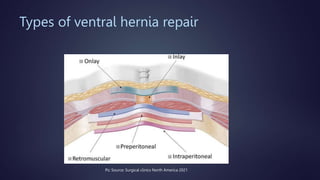
Types of ventral hernia repair
Pic Source: Surgical clinics North America 2021
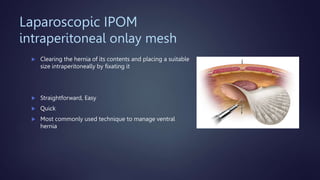
Laparoscopic IPOM
intraperitoneal onlay mesh
 Clearing the hernia of its contents and placing a suitable
size intraperitoneally by fixating it
 Straightforward, Easy
 Quick
 Most commonly used technique to manage ventral
hernia
IPOM steps
 Contents reduced, adhesions managed, hernial orifice is examined
 Size of mesh is decided based on the size and number of hernia defects, overlap
more than 4cms
 Mesh inserted
 orientated- coated surface is placed against the viscera
 centered over the hernial orifice
 Fixation
 tackers
 Trans-fascial suture
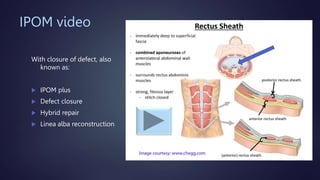
IPOM video
With closure of defect, also
known as:
 IPOM plus
 Defect closure
 Hybrid repair
 Linea alba reconstruction
Drawback of intraperitoneal mesh
placement
 regardless of the material and coating used coupled with great progress in mesh
technology, nearly all types of meshes- a varying level of tissue reaction to produce:
 Mesh adhesion
 fistula formation
 mesh migration into hollow organs including the small bowel, large bowel, and
oesophagus
 Long term pain
Current guidelines (latest)
 Guidelines for treatment of umbilical and epigastric hernias from the
European Hernia Society and Americas Hernia Society
 As an intraperitoneal mesh may cause adhesions, placement of the mesh
in the preperitoneal or retromuscular position is suggested, when
possible.
 BJS 2020; 107: 171–190
Retro-rectus (extraperitoneal)
approach
 retro-rectus space is limited by its fascial compartment
 Linea alba needs to be disconnected, incised and repaired to allow the
mesh to place across the right and left retro-rectus space
 Each right or left retro-rectus compartment limits the size of the mesh to
be placed.
 For larger mesh lateral extension puts important neurovascular bundle
running posterior to the internal oblique muscle at risk
 the muscle should be freely gliding within this space- mesh causes
adhesion between the muscle and fascia compartment
Preperitoneal mesh placement:
advantages
 least or no structural disruption of our abdominal wall architecture
 Mesh placement in preperitoneal space induces adhesions between the
peritoneum and posterior fascia
 Peritoneum flap keeps mesh away from abdominal viscera
 Replicates the natural abdominal wall anatomy closely

 Also known as PPOM
Drawback of preperitoneal techniques
 Technically demanding, longer operative time
 Longer learning curve
 Holes in peritoneum, especially near the hernial defect
 Skin injury possibility over hernia sac
Other extraperitoneal techniques
 MILOS (mini and less open sublay) and
 EMILOS Approaches (endoscopic mini/less open sublay) by Reinpold
 Subcutaneous Onlay Laparoscopic Approach (SCOLA)
 Endoscopic-Assisted Linea Alba Reconstruction (ELAR)
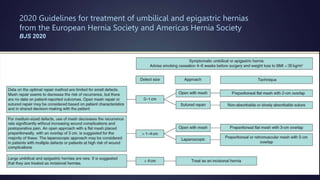
2020 Guidelines for treatment of umbilical and epigastric hernias
from the European Hernia Society and Americas Hernia Society
BJS 2020
Thanks for kind attention
Being ignorant is not so much a shame
as being unwilling to learn
Benjamin Franklin

1 IPOM and extraperitoneal techs.pptx

  • 1.
    IPOM & Introductionto Extraperitoneal ventral hernia repair techniques Jagpreet Singh Deed FRCS, FACS, MS, DNB (General Surgery) Specialist General Surgery, Zulekha hospital, Sharjah Adjunct Clinical Tutor, College of Medicine, University of Sharjah Honorary Clinical Tutor for University of Edinburgh
  • 2.
    Types of ventralhernia repair Pic Source: Surgical clinics North America 2021
  • 3.
    Laparoscopic IPOM intraperitoneal onlaymesh  Clearing the hernia of its contents and placing a suitable size intraperitoneally by fixating it  Straightforward, Easy  Quick  Most commonly used technique to manage ventral hernia
  • 4.
    IPOM steps  Contentsreduced, adhesions managed, hernial orifice is examined  Size of mesh is decided based on the size and number of hernia defects, overlap more than 4cms  Mesh inserted  orientated- coated surface is placed against the viscera  centered over the hernial orifice  Fixation  tackers  Trans-fascial suture
  • 5.
    IPOM video With closureof defect, also known as:  IPOM plus  Defect closure  Hybrid repair  Linea alba reconstruction
  • 6.
    Drawback of intraperitonealmesh placement  regardless of the material and coating used coupled with great progress in mesh technology, nearly all types of meshes- a varying level of tissue reaction to produce:  Mesh adhesion  fistula formation  mesh migration into hollow organs including the small bowel, large bowel, and oesophagus  Long term pain
  • 7.
    Current guidelines (latest) Guidelines for treatment of umbilical and epigastric hernias from the European Hernia Society and Americas Hernia Society  As an intraperitoneal mesh may cause adhesions, placement of the mesh in the preperitoneal or retromuscular position is suggested, when possible.  BJS 2020; 107: 171–190
  • 8.
    Retro-rectus (extraperitoneal) approach  retro-rectusspace is limited by its fascial compartment  Linea alba needs to be disconnected, incised and repaired to allow the mesh to place across the right and left retro-rectus space  Each right or left retro-rectus compartment limits the size of the mesh to be placed.  For larger mesh lateral extension puts important neurovascular bundle running posterior to the internal oblique muscle at risk  the muscle should be freely gliding within this space- mesh causes adhesion between the muscle and fascia compartment
  • 9.
    Preperitoneal mesh placement: advantages least or no structural disruption of our abdominal wall architecture  Mesh placement in preperitoneal space induces adhesions between the peritoneum and posterior fascia  Peritoneum flap keeps mesh away from abdominal viscera  Replicates the natural abdominal wall anatomy closely   Also known as PPOM
  • 10.
    Drawback of preperitonealtechniques  Technically demanding, longer operative time  Longer learning curve  Holes in peritoneum, especially near the hernial defect  Skin injury possibility over hernia sac
  • 11.
    Other extraperitoneal techniques MILOS (mini and less open sublay) and  EMILOS Approaches (endoscopic mini/less open sublay) by Reinpold  Subcutaneous Onlay Laparoscopic Approach (SCOLA)  Endoscopic-Assisted Linea Alba Reconstruction (ELAR)
  • 12.
    2020 Guidelines fortreatment of umbilical and epigastric hernias from the European Hernia Society and Americas Hernia Society BJS 2020
  • 13.
    Thanks for kindattention Being ignorant is not so much a shame as being unwilling to learn Benjamin Franklin