Pre-pregnancy 101 Melissa Stoffel D.O. Marshfield Clinic OB/GYN May 26, 2009
Preconceptual Counseling Definition:  Identify and modify biomedical, behavioral, and social risks to a woman’s health or pregnancy outcome through prevention and management. Goal:  Help the mother maintain her well-being and achieve a healthy outcome not only for herself, but for her unborn child.
Preconceptual Counseling Optimal time to assess, manage and treat many conditions/complications before conception. Improves pregnancy outcomes. Reduced maternal/neonatal morbidity and mortality.
Components Identification of pregnancy related risks Pt education regarding pregnancy risks, management options, and reproductive alternatives Initiation of interventions, when possible, to provide optimum pregnancy outcome
What to Expect Complete medical/family history Physical exam laboratory
Comprehensive History Age Teens – nutritional/emotional needs, STD’s >35 yrs – increase pregnancy risks Father >age of 55
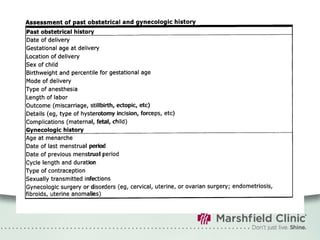
Comprehensive History Reproductive history  (obstetrical/gynecologic) May identify factors that may contribute to infertility or pregnancy complications Menstrual calendar (accurate dating is critical for obstetric decision making)
 
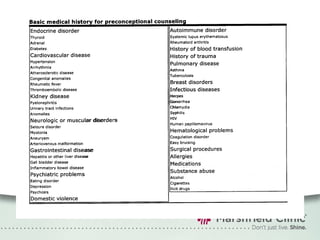
Personal Medical History Medications STI hx Chronic medical conditions Immunization hx – up to date Surgeries Mental Health
 
Family History Helps identify genetic risks to fetus and maternal medical risks Ethnicity
Psychosocial Issues Stress, financial issues, mental health Maternal suffering can lead to poor compliance, nutrition, substance abuse, or disturbed relationship between mom and baby
Weight and pregnancy Obesity is associated with decreased fertility Normal Pre-pregnancy  BMI 19.8 – 26.0 Increased pregnancy complications with extremes of BMI Weight reduction attempted prior to pregnancy
Exercise Mild – moderate exercise while pregnant is not harmful if done on a regular basis prior to pregnancy Do not initiate a strenuous exercise regime during pregnancy  Low impact routine
Substance Use Tobacco Increase miscarriage, prematurity, and low-birth weight infants, IUGR, placenta abruption,  Smoking cessation/decreased amount during pregnancy improves pregnancy outcomes Chantix not used in pregnancy
Substance Use Alcohol and Illicit Drugs Increase preterm delivery, IUGR, FAS, neonatal withdrawal Avoidance of all  = better pregnancy outcomes Methadone Clinic
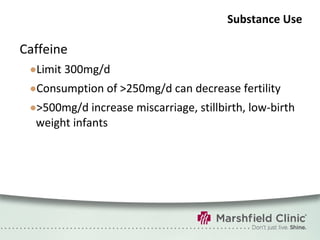
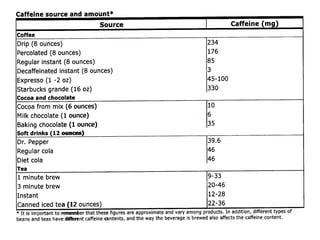
Substance Use Caffeine Limit 300mg/d Consumption of >250mg/d can decrease fertility >500mg/d increase miscarriage, stillbirth, low-birth weight infants
 
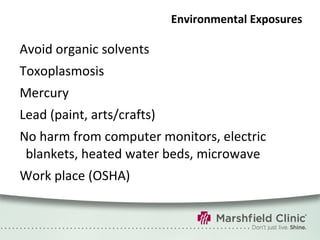
Environmental Exposures Avoid organic solvents Toxoplasmosis Mercury Lead (paint, arts/crafts) No harm from computer monitors, electric blankets, heated water beds, microwave Work place (OSHA)
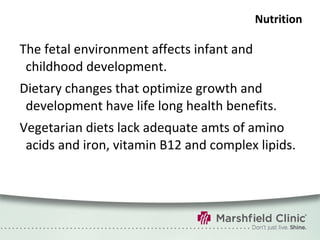
Nutrition The fetal environment affects infant and childhood development. Dietary changes that optimize growth and development have life long health benefits. Vegetarian diets lack adequate amts of amino acids and iron, vitamin B12 and complex lipids.
Nutrition Discontinue megavitamins, non-essential dietary supplements, and herbal preparations. (not studied to evaluate fetal risk) No evidence that Nutrasweet, Splenda, Sweet N’ Low increase risk of birth defects above the general population. Multivitamin/prenatal vitamin with 400mcg (0.4mg) of folic acid needed
Physical Exam General head/toe exam Thyroid/dental carries Pelvic exam Pap Gonorrhea/chlamydia cultures
Laboratory Rubella titer Varicella titer Hepatitis B CBC (anemia) Blood type and RH factor HIV Glucose screen Toxoplasmosis CMV
Maternal Medical Conditions -Optimal management -Change in medications that are safer in pregnancy prior to conception
Maternal Medical Conditions Diabetes Referral to endocrinology Achieve tight glycemic control prior to conception Dietary consultation Hypertension BP control prior to pregnancy Safer meds (no ACE inhibitors)
Maternal Medical Conditions Asthma Good control prior to pregnancy Most meds safe in pregnancy Thyroid disease Close monitoring of thyroid function Adjusting medication dose common Neuropsychological impairment
Maternal Medical Conditions Epilepsy Neurology referral for drug adjustments Frequent blood levels Extra folic acid 1gram Vitamin K (36wks – delivery) Lupus Better prognosis for both mom and baby is quiescent for 6 mos before conception Better prognosis if normal renal function
Maternal Medical Conditions Anemia HGB 6g/dl (decreased AFI, abnormal FHT, increase fetal death) Depression If controlled and doing well on medication = continue taking drug
Prenatal Education Pt education leads to better self-care and pregnancy outcomes. Radiologic studies (dental/radiologic) Can be performed when indicated Delay if elective Medications Take only medications approved or prescribed by your doctor.  When in doubt…ask!
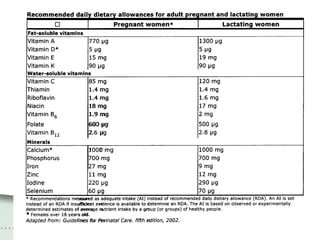
Prenatal Education Nutrition Iron 30mg/d  (take between meals, empty stomach) Necessary for fetal/placenta development and to expand the maternal RBC mass Calories: increase by 340 – 450 kcal/d Calcium 1000mg/d Three servings of dairy daily
 
 
Weight Gain 3-6# wt gain in first trimester 0.5 – 1#/wk in last 2 trimesters Inadequate wt gain during pregnancy is associated with increase low-birth-weight infants, and preterm delivery.
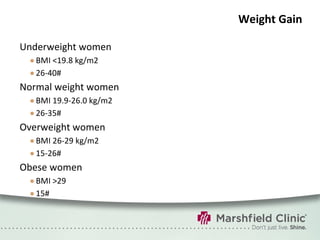
Weight Gain Underweight women BMI <19.8 kg/m2 26-40# Normal weight women BMI 19.9-26.0 kg/m2 26-35# Overweight women BMI 26-29 kg/m2 15-26# Obese women BMI >29 15#
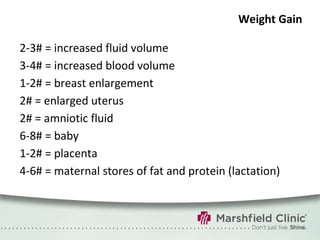
Weight Gain 2-3# = increased fluid volume 3-4# = increased blood volume 1-2# = breast enlargement 2# = enlarged uterus 2# = amniotic fluid 6-8# = baby 1-2# = placenta 4-6# = maternal stores of fat and protein (lactation)
Prenatal Education Activity and Employment Avoid heavy lifting (25-30#) Most are able to maintain normal activity level Travel Avoid prolonged sitting in car/plane (clotting risk)  Support hose Seat belt Driving 6 hours/d (stop every 2 hours for 10 min)
Prenatal Education Nausea and vomiting Avoid greasy/spicy foods Frequent small meals Crackers at bedside Protein snack at night GERD Relaxation of esophogeal sphincter Don’t eat before lying down Worse with overeating and spicy foods Hemorrhoids Varicose veins of rectum Avoid constipation/straining/prolonged sitting Regress after delivery (not go away completely)
Prenatal Education Constipation Decrease bowel transit time Fresh fruit/veggies/water Metamucil/colace Urinary frequency Growing uterus and fetal head increase pressure on the bladder. Round ligament pain Sharp groin pains = spasm of round ligament associated with movement Right > left Local heat, gradual rising/sitting, avoid sudden movement
Prenatal Education Syncope Compression of veins in legs from the growing uterus causes venous pooling with prolonged standing = faint Compression stockings Back ache Prevented by excessive weight gain Exercises to strengthen back muscles Posture, sensible shoes Intercourse Usually no restrictions May cause increase uterine activity and spotting
Prenatal Education Breast feeding Avoid soap/lotions on breasts  Preparation for childbirth Studies have shown that prepared childbirth can have a beneficial effect on performance in labor and delivery
Questions How long after a miscarriage should I wait before trying to get pregnant again?
Questions Are there any cosmetics or body lotions that should be avoided if I’m trying to get pregnant?
Questions When in the menstrual cycle would I most likely get pregnant?
Questions How long after a person stops taking oral contraception do recommend waiting before trying to get pregnant?
Questions Do women who have had abnormal pap smears and a colposcopy have problems getting pregnant or delivering a baby?
Questions How often during the menstrual cycle should I have intercourse?
Questions Can I use natural planning to help get pregnant?
Questions If you are considering getting pregnant or are already pregnant and you need to choose a doctor what are the reasons to choose an OB versus choosing a family practitioner, what things should a person think about when making that decision?
Questions If you had a pre-term delivery in the past would there be something you would recommend to do differently during the pre-pregnancy planning stage or during the first trimester?
Questions Hot tubs in pregnancy?
Questions How much fish can I eat during pregnancy?
Questions What about using sunscreen when you’re pregnant?
Questions Is there anything out there to help prevent stretch marks?
Questions I’ve seen some women where a belt during pregnancy, what is that for?
Questions What about chiropractic care or messages during pregnancy?
Questions When can I begin to slim down post pregnancy?

Pre Pregnancy-101

  • 1.
    Pre-pregnancy 101 MelissaStoffel D.O. Marshfield Clinic OB/GYN May 26, 2009
  • 2.
    Preconceptual Counseling Definition: Identify and modify biomedical, behavioral, and social risks to a woman’s health or pregnancy outcome through prevention and management. Goal: Help the mother maintain her well-being and achieve a healthy outcome not only for herself, but for her unborn child.
  • 3.
    Preconceptual Counseling Optimaltime to assess, manage and treat many conditions/complications before conception. Improves pregnancy outcomes. Reduced maternal/neonatal morbidity and mortality.
  • 4.
    Components Identification ofpregnancy related risks Pt education regarding pregnancy risks, management options, and reproductive alternatives Initiation of interventions, when possible, to provide optimum pregnancy outcome
  • 5.
    What to ExpectComplete medical/family history Physical exam laboratory
  • 6.
    Comprehensive History AgeTeens – nutritional/emotional needs, STD’s >35 yrs – increase pregnancy risks Father >age of 55
  • 7.
    Comprehensive History Reproductivehistory (obstetrical/gynecologic) May identify factors that may contribute to infertility or pregnancy complications Menstrual calendar (accurate dating is critical for obstetric decision making)
  • 8.
  • 9.
    Personal Medical HistoryMedications STI hx Chronic medical conditions Immunization hx – up to date Surgeries Mental Health
  • 10.
  • 11.
    Family History Helpsidentify genetic risks to fetus and maternal medical risks Ethnicity
  • 12.
    Psychosocial Issues Stress,financial issues, mental health Maternal suffering can lead to poor compliance, nutrition, substance abuse, or disturbed relationship between mom and baby
  • 13.
    Weight and pregnancyObesity is associated with decreased fertility Normal Pre-pregnancy BMI 19.8 – 26.0 Increased pregnancy complications with extremes of BMI Weight reduction attempted prior to pregnancy
  • 14.
    Exercise Mild –moderate exercise while pregnant is not harmful if done on a regular basis prior to pregnancy Do not initiate a strenuous exercise regime during pregnancy Low impact routine
  • 15.
    Substance Use TobaccoIncrease miscarriage, prematurity, and low-birth weight infants, IUGR, placenta abruption, Smoking cessation/decreased amount during pregnancy improves pregnancy outcomes Chantix not used in pregnancy
  • 16.
    Substance Use Alcoholand Illicit Drugs Increase preterm delivery, IUGR, FAS, neonatal withdrawal Avoidance of all = better pregnancy outcomes Methadone Clinic
  • 17.
    Substance Use CaffeineLimit 300mg/d Consumption of >250mg/d can decrease fertility >500mg/d increase miscarriage, stillbirth, low-birth weight infants
  • 18.
  • 19.
    Environmental Exposures Avoidorganic solvents Toxoplasmosis Mercury Lead (paint, arts/crafts) No harm from computer monitors, electric blankets, heated water beds, microwave Work place (OSHA)
  • 20.
    Nutrition The fetalenvironment affects infant and childhood development. Dietary changes that optimize growth and development have life long health benefits. Vegetarian diets lack adequate amts of amino acids and iron, vitamin B12 and complex lipids.
  • 21.
    Nutrition Discontinue megavitamins,non-essential dietary supplements, and herbal preparations. (not studied to evaluate fetal risk) No evidence that Nutrasweet, Splenda, Sweet N’ Low increase risk of birth defects above the general population. Multivitamin/prenatal vitamin with 400mcg (0.4mg) of folic acid needed
  • 22.
    Physical Exam Generalhead/toe exam Thyroid/dental carries Pelvic exam Pap Gonorrhea/chlamydia cultures
  • 23.
    Laboratory Rubella titerVaricella titer Hepatitis B CBC (anemia) Blood type and RH factor HIV Glucose screen Toxoplasmosis CMV
  • 24.
    Maternal Medical Conditions-Optimal management -Change in medications that are safer in pregnancy prior to conception
  • 25.
    Maternal Medical ConditionsDiabetes Referral to endocrinology Achieve tight glycemic control prior to conception Dietary consultation Hypertension BP control prior to pregnancy Safer meds (no ACE inhibitors)
  • 26.
    Maternal Medical ConditionsAsthma Good control prior to pregnancy Most meds safe in pregnancy Thyroid disease Close monitoring of thyroid function Adjusting medication dose common Neuropsychological impairment
  • 27.
    Maternal Medical ConditionsEpilepsy Neurology referral for drug adjustments Frequent blood levels Extra folic acid 1gram Vitamin K (36wks – delivery) Lupus Better prognosis for both mom and baby is quiescent for 6 mos before conception Better prognosis if normal renal function
  • 28.
    Maternal Medical ConditionsAnemia HGB 6g/dl (decreased AFI, abnormal FHT, increase fetal death) Depression If controlled and doing well on medication = continue taking drug
  • 29.
    Prenatal Education Pteducation leads to better self-care and pregnancy outcomes. Radiologic studies (dental/radiologic) Can be performed when indicated Delay if elective Medications Take only medications approved or prescribed by your doctor. When in doubt…ask!
  • 30.
    Prenatal Education NutritionIron 30mg/d (take between meals, empty stomach) Necessary for fetal/placenta development and to expand the maternal RBC mass Calories: increase by 340 – 450 kcal/d Calcium 1000mg/d Three servings of dairy daily
  • 31.
  • 32.
  • 33.
    Weight Gain 3-6#wt gain in first trimester 0.5 – 1#/wk in last 2 trimesters Inadequate wt gain during pregnancy is associated with increase low-birth-weight infants, and preterm delivery.
  • 34.
    Weight Gain Underweightwomen BMI <19.8 kg/m2 26-40# Normal weight women BMI 19.9-26.0 kg/m2 26-35# Overweight women BMI 26-29 kg/m2 15-26# Obese women BMI >29 15#
  • 35.
    Weight Gain 2-3#= increased fluid volume 3-4# = increased blood volume 1-2# = breast enlargement 2# = enlarged uterus 2# = amniotic fluid 6-8# = baby 1-2# = placenta 4-6# = maternal stores of fat and protein (lactation)
  • 36.
    Prenatal Education Activityand Employment Avoid heavy lifting (25-30#) Most are able to maintain normal activity level Travel Avoid prolonged sitting in car/plane (clotting risk) Support hose Seat belt Driving 6 hours/d (stop every 2 hours for 10 min)
  • 37.
    Prenatal Education Nauseaand vomiting Avoid greasy/spicy foods Frequent small meals Crackers at bedside Protein snack at night GERD Relaxation of esophogeal sphincter Don’t eat before lying down Worse with overeating and spicy foods Hemorrhoids Varicose veins of rectum Avoid constipation/straining/prolonged sitting Regress after delivery (not go away completely)
  • 38.
    Prenatal Education ConstipationDecrease bowel transit time Fresh fruit/veggies/water Metamucil/colace Urinary frequency Growing uterus and fetal head increase pressure on the bladder. Round ligament pain Sharp groin pains = spasm of round ligament associated with movement Right > left Local heat, gradual rising/sitting, avoid sudden movement
  • 39.
    Prenatal Education SyncopeCompression of veins in legs from the growing uterus causes venous pooling with prolonged standing = faint Compression stockings Back ache Prevented by excessive weight gain Exercises to strengthen back muscles Posture, sensible shoes Intercourse Usually no restrictions May cause increase uterine activity and spotting
  • 40.
    Prenatal Education Breastfeeding Avoid soap/lotions on breasts Preparation for childbirth Studies have shown that prepared childbirth can have a beneficial effect on performance in labor and delivery
  • 41.
    Questions How longafter a miscarriage should I wait before trying to get pregnant again?
  • 42.
    Questions Are thereany cosmetics or body lotions that should be avoided if I’m trying to get pregnant?
  • 43.
    Questions When inthe menstrual cycle would I most likely get pregnant?
  • 44.
    Questions How longafter a person stops taking oral contraception do recommend waiting before trying to get pregnant?
  • 45.
    Questions Do womenwho have had abnormal pap smears and a colposcopy have problems getting pregnant or delivering a baby?
  • 46.
    Questions How oftenduring the menstrual cycle should I have intercourse?
  • 47.
    Questions Can Iuse natural planning to help get pregnant?
  • 48.
    Questions If youare considering getting pregnant or are already pregnant and you need to choose a doctor what are the reasons to choose an OB versus choosing a family practitioner, what things should a person think about when making that decision?
  • 49.
    Questions If youhad a pre-term delivery in the past would there be something you would recommend to do differently during the pre-pregnancy planning stage or during the first trimester?
  • 50.
    Questions Hot tubsin pregnancy?
  • 51.
    Questions How muchfish can I eat during pregnancy?
  • 52.
    Questions What aboutusing sunscreen when you’re pregnant?
  • 53.
    Questions Is thereanything out there to help prevent stretch marks?
  • 54.
    Questions I’ve seensome women where a belt during pregnancy, what is that for?
  • 55.
    Questions What aboutchiropractic care or messages during pregnancy?
  • 56.
    Questions When canI begin to slim down post pregnancy?

Editor's Notes

  • #4 More important than prenatal care for prevention of congenital anomalies since 30% of women begin prenatal care in the second trimester (&gt;14wks) after which organogenisis is complete. (3-10wks).
  • #5 Benefits of identifying and treating medical conditions before pregnancy occurs.
  • #7 Infertility, fetal aneupoloidy (chromosomal risks), GDM, preeclampsia, stillbirth Preeclampsia increases at extremes of ages
  • #8 Prior miscarriage, surgeries, pregnancy outcomes.
  • #10 Immunizations – live –attenuated viral vaccines not given in pregnancy Flu – ok after first trimester If recent vaccination – wait one month before conceiving
  • #12 NTDs, heart defects, cleft palate/lip, Downs Syndrome, cystic fibrosis, PKU, Hemophilia, kidney disease,
  • #13 Community support available – badger care, WIC, public health nurses
  • #14 Gestational HTN, preeclampsia, GDM, Preterm premature ROM, preterm/post-term delivery, macrosomia, operative vaginal delivery, congenital anomalies, c-section, stillbirth, increased childhood obesity and DM
  • #20 Toxo – avoid changing cat litter, don’t eat under cooked meat, wear gloves gardening, when preparing food – frequent hand washing Mercury – bottom feeder fish, once weekly Increased levels can lead to CNS damage, intellectual/motor/psychosocial impairement OSHA – organization that enforces work places to provide workplace free from recognized hazards, frequent audits
  • #22 Nutrasweet = aspartame Splenda = sucralose Sweet N Low = sucharin
  • #23 Oral disease increases preterm labor/delivery
  • #24 Glucose screen – hx macrosomic infant &gt;9#), personal hx of GDM, overwt, family hx of DM CMV- work in child care area
  • #26 Increase glucose it the most important determinent of increase fetal risk in pregnancy. Decrease glucose levels decreases spont AB, congenital malformations. (heart/limbs.etc) BP meds = aldomet/methyldopa
  • #30 Medication list.
  • #31 Iron containing foods – liver, red meat, egg, dried beans, leafy green veggies, dried fruit, whole-grain bread
  • #36 Edema in legs is normal as pregnancy advances = venous compression by wt of uterus
  • #38 Increase fiber in diet. May take fiber supplement.
  • #41 Breastfeeding support class Childbirth preparation class Fathers in training Happiest baby on the block Infant care basics/infant safety Sibling celebration Early pregnancy fair Mommy mondays…move it, make it, manage it Mommy café Infant massage and nurturing touch