Introduction to Database 
Management System
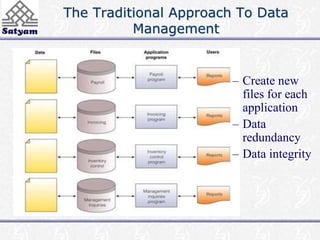
The Traditional Approach To Data 
Management 
– Create new 
files for each 
application 
– Data 
redundancy 
– Data integrity
Disadvantages of File Processing 
• Program-Data Dependence 
– All programs maintain metadata for each file they 
use 
• Data Redundancy (Duplication of data) 
– Different systems/programs have separate copies of 
the same data 
• Limited Data Sharing 
– No centralized control of data 
• Lengthy Development Times 
– Programmers must design their own file formats 
• Excessive Program Maintenance 
– 80% of of information systems budget
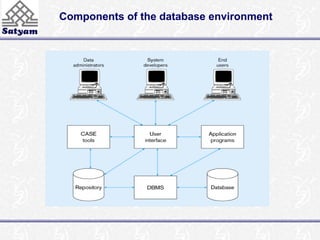
Components of the database environment
Components of the 
Database Environment 
• CASE Tools – computer-aided software engineering 
• Repository – centralized storehouse of metadata 
• Database Management System (DBMS) – software 
for managing the database 
• Database – storehouse of the data 
• Application Programs – software using the data 
• User Interface – text and graphical displays to users 
• Data Administrators – personnel responsible for 
maintaining the database 
• System Developers – personnel responsible for 
designing databases and software 
• End Users – people who use the applications and 
databases
Disadvantages of DBMS 
• Databases used in enterprises may involve additional 
risks as compared to a conventional data processing 
system in some areas 
• Confidential, Privacy and Security : When 
information is centralized and is made available to 
users from remote locations, there is a possibility of 
unauthorized users accessing sensitive information. 
• It is necessary to take technical, administrative and 
legal measures.
Disadvantages of DBMS 
• Data Quality : Since database is accessible to users 
remotely, adequate controls are needed to control users 
updating data and to control data quality. 
• With increased number of users accessing directly, 
there is an opportunity for users to damage data.Unless 
there are suitable controls, the data quality may be 
compromised. 
• Data Integrity : Since a large number of users cloud 
be using a database concurrently, technical safeguards 
are necessary to ensure that data remain correct during 
operation.
Overall System Structure
Overall System Structure 
• A database system is partitioned into 
modules which handles different 
responsibilities of over all system. 
The functional components of a database 
system are 
 Query processor Component 
Storage manager component
Query Processor Component 
• DML Compiler : It translates DML statements 
into a lower level instructions that the query 
evaluation engine understands 
• Embedded DML precompiler : It converts DML 
statements embedded in an application program 
into normal procedure calls in the host language. 
• DDL Interpreter : It interprets DDL statements 
and records them in a set of tables 
• Query evaluation engine : It executes lower level 
instructions generated by the DML compiler
Storage manager component 
• It is an Interface between the data stored in the database and 
the application programs and queries submitted to the 
system. 
• Authorization and Integrity manager : It tests for 
satisfaction of integrity constraints and checks the authority 
of users to access data. 
• Transaction Manager : It ensures concurrent transaction 
executions processed without conflicting. 
• File manager : It manages the allocation of space on disk 
and the data structures used to represent information. 
• Buffer manager : Which is responsible for fetching data 
from disk storage into main memory.
Application Architectures 
Two-tier architecture: E.g. client programs using ODBC/JDBC to 
communicate with a database 
Three-tier architecture: E.g. web-based applications, and 
applications built using “middleware”

1. intro

  • 1.
    Introduction to Database Management System
  • 2.
    The Traditional ApproachTo Data Management – Create new files for each application – Data redundancy – Data integrity
  • 3.
    Disadvantages of FileProcessing • Program-Data Dependence – All programs maintain metadata for each file they use • Data Redundancy (Duplication of data) – Different systems/programs have separate copies of the same data • Limited Data Sharing – No centralized control of data • Lengthy Development Times – Programmers must design their own file formats • Excessive Program Maintenance – 80% of of information systems budget
  • 4.
    Components of thedatabase environment
  • 5.
    Components of the Database Environment • CASE Tools – computer-aided software engineering • Repository – centralized storehouse of metadata • Database Management System (DBMS) – software for managing the database • Database – storehouse of the data • Application Programs – software using the data • User Interface – text and graphical displays to users • Data Administrators – personnel responsible for maintaining the database • System Developers – personnel responsible for designing databases and software • End Users – people who use the applications and databases
  • 6.
    Disadvantages of DBMS • Databases used in enterprises may involve additional risks as compared to a conventional data processing system in some areas • Confidential, Privacy and Security : When information is centralized and is made available to users from remote locations, there is a possibility of unauthorized users accessing sensitive information. • It is necessary to take technical, administrative and legal measures.
  • 7.
    Disadvantages of DBMS • Data Quality : Since database is accessible to users remotely, adequate controls are needed to control users updating data and to control data quality. • With increased number of users accessing directly, there is an opportunity for users to damage data.Unless there are suitable controls, the data quality may be compromised. • Data Integrity : Since a large number of users cloud be using a database concurrently, technical safeguards are necessary to ensure that data remain correct during operation.
  • 8.
  • 9.
    Overall System Structure • A database system is partitioned into modules which handles different responsibilities of over all system. The functional components of a database system are  Query processor Component Storage manager component
  • 10.
    Query Processor Component • DML Compiler : It translates DML statements into a lower level instructions that the query evaluation engine understands • Embedded DML precompiler : It converts DML statements embedded in an application program into normal procedure calls in the host language. • DDL Interpreter : It interprets DDL statements and records them in a set of tables • Query evaluation engine : It executes lower level instructions generated by the DML compiler
  • 11.
    Storage manager component • It is an Interface between the data stored in the database and the application programs and queries submitted to the system. • Authorization and Integrity manager : It tests for satisfaction of integrity constraints and checks the authority of users to access data. • Transaction Manager : It ensures concurrent transaction executions processed without conflicting. • File manager : It manages the allocation of space on disk and the data structures used to represent information. • Buffer manager : Which is responsible for fetching data from disk storage into main memory.
  • 12.
    Application Architectures Two-tierarchitecture: E.g. client programs using ODBC/JDBC to communicate with a database Three-tier architecture: E.g. web-based applications, and applications built using “middleware”