M. S. P. Arts, Science & K. P. T. Commerce College Manora Dist. Washim
Topic: Genetic Code
on
B. Sc. III ( Sem VI)
Subject Zoology
Date:23/05/2021
By
Dr. S. N. Padghane
Department of Zoology
Assistant Professor, MSP & KPT College Manora
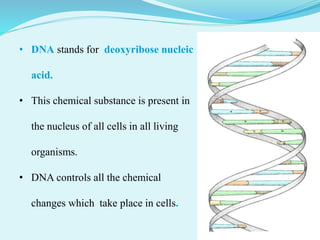
• DNA stands for deoxyribose nucleic
acid.
• This chemical substance is present in
the nucleus of all cells in all living
organisms.
• DNA controls all the chemical
changes which take place in cells.
DNA is a very large molecule made up of a long
chain of nucleotides.
Each nucleotide is made up of
• a sugar called deoxyribose.
• a phosphate group and,
• an organic base.
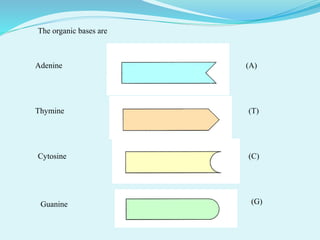
The organic bases are
Adenine (A)
Thymine (T)
Cytosine (C)
Guanine (G)
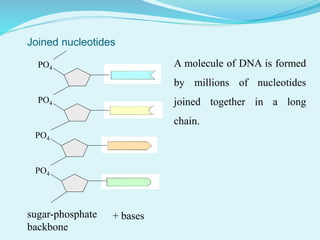
A molecule of DNA is formed
by millions of nucleotides
joined together in a long
chain.
PO4
PO4
PO4
PO4
sugar-phosphate
backbone
+ bases
Joined nucleotides
What is Genetic code?
• Genetic code is a dictionary that corresponds with sequence of
nucleotides and sequence of amino acids.
• Genetic code is a set of rules by which information encoded in
genetic material(DNAor RNAsequences) is translated into
proteins by living cells.
• Term given By ″ Goerge Gamow ʺ
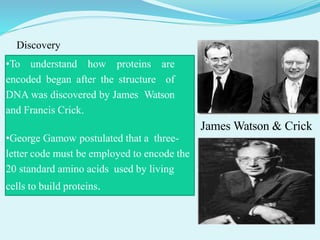
James Watson & Crick
•To understand how proteins are
encoded began after the structure of
DNA was discovered by James Watson
and Francis Crick.
•George Gamow postulated that a three-
letter code must be employed to encode the
20 standard amino acids used by living
cells to build proteins.
Discovery
Introduction of genetic code
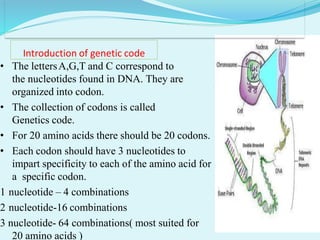
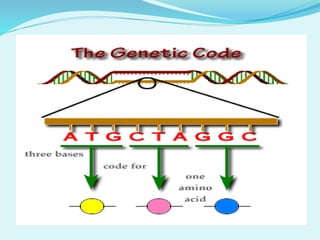
• The lettersA,G,T and C correspond to
the nucleotides found in DNA. They are
organized into codon.
• The collection of codons is called
Genetics code.
• For 20 amino acids there should be 20 codons.
• Each codon should have 3 nucleotides to
impart specificity to each of the amino acid for
a specific codon.
1 nucleotide – 4 combinations
2 nucleotide-16 combinations
3 nucleotide- 64 combinations( most suited for
20 amino acids )
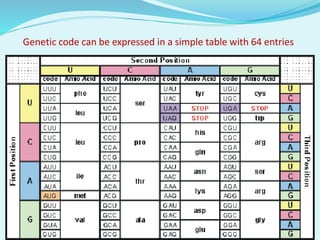
Genetic code can be expressed in a simple table with 64 entries
Codon and its type
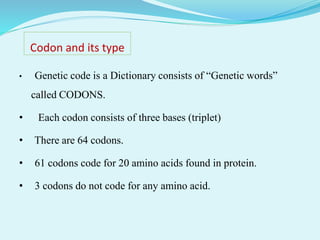
• Genetic code is a Dictionary consists of “Genetic words”
called CODONS.
• Each codon consists of three bases (triplet)
• There are 64 codons.
• 61 codons code for 20 amino acids found in protein.
• 3 codons do not code for any amino acid.
Type of codon
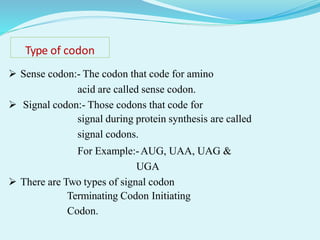
 Sense codon:- The codon that code for amino
acid are called sense codon.
 Signal codon:- Those codons that code for
signal during protein synthesis are called
signal codons.
For Example:-AUG, UAA, UAG &
UGA
 There are Two types of signal codon
Terminating Codon Initiating
Codon.
…..
“Terminating Codons”
UAA, UAG & UGAare termination codons or
nonsense codons & are often referred to as amber, ochre & opal
codons.
“Initiating codon”
AUG is the initiation codon. It codes for the first amino acid in all
proteins.
At the starting point it codes for methionine in
eukaryotes & formyl methionine in prokaryotes.
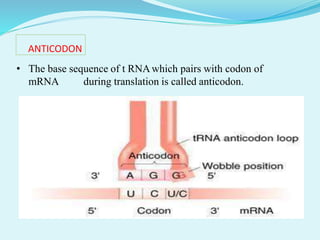
ANTICODON
• The base sequence of t RNAwhich pairs with codon of
mRNA during translation is called anticodon.
Different between codon and anticodon
• Codon could be present in both DNA& RNA, but anticodon
is always present in RNA& never in DNA.
• Codons are written in 5 to 3 direction whereas anticodons are
usually written in 3 to 5 direction.
• Anticodon of some tRNAmolecules have to pair with more
than one codon.
1. Genetic Code.pptx

1. Genetic Code.pptx

  • 1.
    M. S. P.Arts, Science & K. P. T. Commerce College Manora Dist. Washim Topic: Genetic Code on B. Sc. III ( Sem VI) Subject Zoology Date:23/05/2021 By Dr. S. N. Padghane Department of Zoology Assistant Professor, MSP & KPT College Manora
  • 2.
    • DNA standsfor deoxyribose nucleic acid. • This chemical substance is present in the nucleus of all cells in all living organisms. • DNA controls all the chemical changes which take place in cells.
  • 3.
    DNA is avery large molecule made up of a long chain of nucleotides. Each nucleotide is made up of • a sugar called deoxyribose. • a phosphate group and, • an organic base.
  • 4.
    The organic basesare Adenine (A) Thymine (T) Cytosine (C) Guanine (G)
  • 5.
    A molecule ofDNA is formed by millions of nucleotides joined together in a long chain. PO4 PO4 PO4 PO4 sugar-phosphate backbone + bases Joined nucleotides
  • 6.
    What is Geneticcode? • Genetic code is a dictionary that corresponds with sequence of nucleotides and sequence of amino acids. • Genetic code is a set of rules by which information encoded in genetic material(DNAor RNAsequences) is translated into proteins by living cells. • Term given By ″ Goerge Gamow ʺ
  • 7.
    James Watson &Crick •To understand how proteins are encoded began after the structure of DNA was discovered by James Watson and Francis Crick. •George Gamow postulated that a three- letter code must be employed to encode the 20 standard amino acids used by living cells to build proteins. Discovery
  • 8.
    Introduction of geneticcode • The lettersA,G,T and C correspond to the nucleotides found in DNA. They are organized into codon. • The collection of codons is called Genetics code. • For 20 amino acids there should be 20 codons. • Each codon should have 3 nucleotides to impart specificity to each of the amino acid for a specific codon. 1 nucleotide – 4 combinations 2 nucleotide-16 combinations 3 nucleotide- 64 combinations( most suited for 20 amino acids )
  • 10.
    Genetic code canbe expressed in a simple table with 64 entries
  • 11.
    Codon and itstype • Genetic code is a Dictionary consists of “Genetic words” called CODONS. • Each codon consists of three bases (triplet) • There are 64 codons. • 61 codons code for 20 amino acids found in protein. • 3 codons do not code for any amino acid.
  • 12.
    Type of codon Sense codon:- The codon that code for amino acid are called sense codon.  Signal codon:- Those codons that code for signal during protein synthesis are called signal codons. For Example:-AUG, UAA, UAG & UGA  There are Two types of signal codon Terminating Codon Initiating Codon.
  • 13.
    ….. “Terminating Codons” UAA, UAG& UGAare termination codons or nonsense codons & are often referred to as amber, ochre & opal codons. “Initiating codon” AUG is the initiation codon. It codes for the first amino acid in all proteins. At the starting point it codes for methionine in eukaryotes & formyl methionine in prokaryotes.
  • 14.
    ANTICODON • The basesequence of t RNAwhich pairs with codon of mRNA during translation is called anticodon.
  • 15.
    Different between codonand anticodon • Codon could be present in both DNA& RNA, but anticodon is always present in RNA& never in DNA. • Codons are written in 5 to 3 direction whereas anticodons are usually written in 3 to 5 direction. • Anticodon of some tRNAmolecules have to pair with more than one codon.