Industrial Ecology:
Implementing the Green Economy
Prof. Suren Erkman
University of Lausanne, Switzerland
Green Academy Master Class, Astana, 1st October 2013
Three main reasons:
Secure access to resources, minimize pollution
Secure access to foreign and domestic markets
Sustain growing international
constraints/oppportunities
Green Economy:
why care? what is the point?
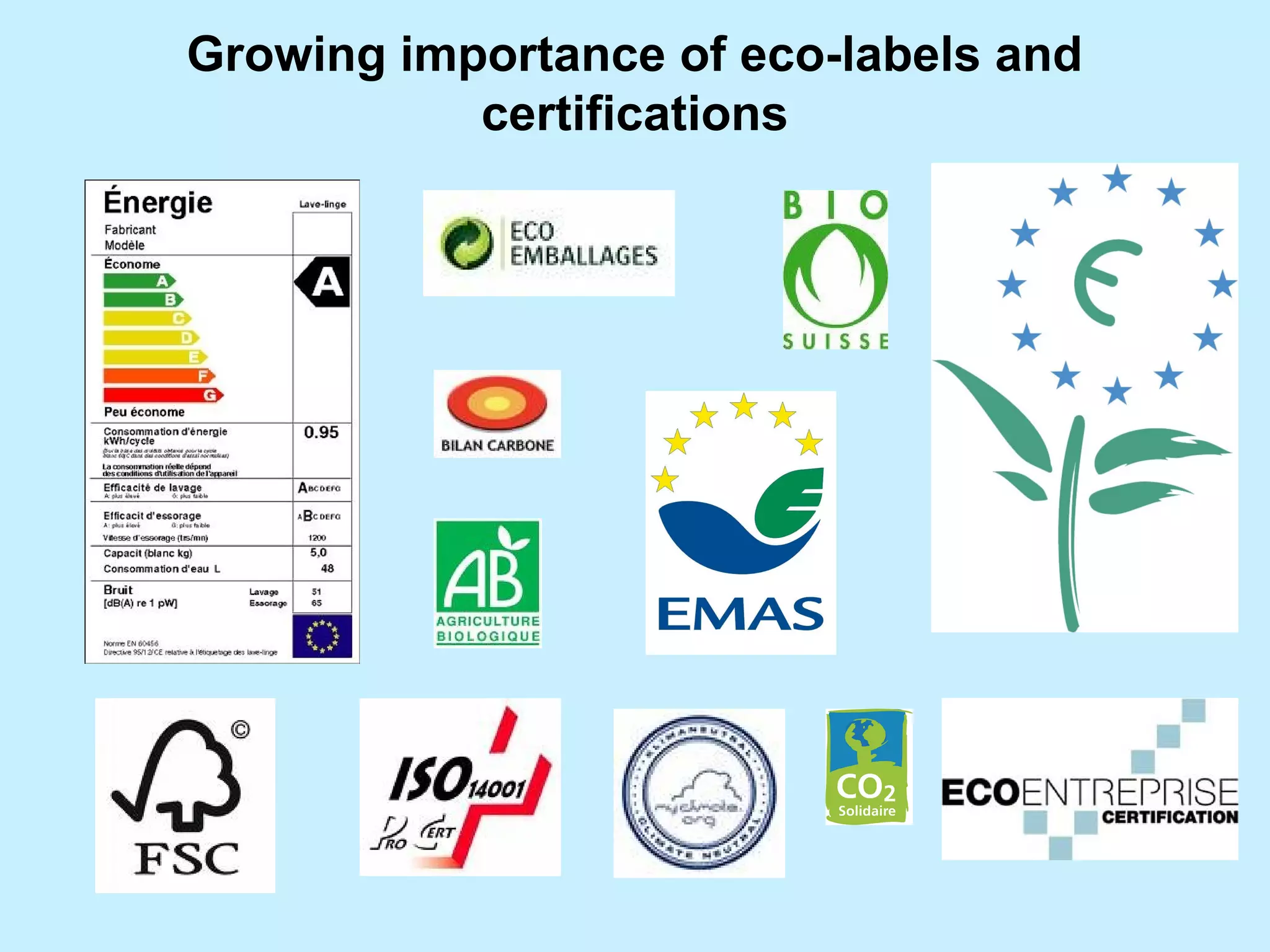
Growing importance of eco-labels and
certifications
: “…that results in improved human well-being and
social equity, while significantly reducing
environmental risks and ecological scarcities.”
“…new model for economic development aimed at
achieving improved wellbeing and social equity while
simultaneously diminishing environmental risks and
reducing ecological scarcities.”
 “…low carbon, resource efficient & socially
inclusive.”
UNEP Green Economy: definition
To provide more value with less environmental
impact
To de-link advances in welfare from the natural
resource use
To improve both economic and ecological
efficiency
= ECO-EFFICIENCY
(Dematerialization of our society, Resource
productivity)
UNEP / UNIDO Green Economy Strategy
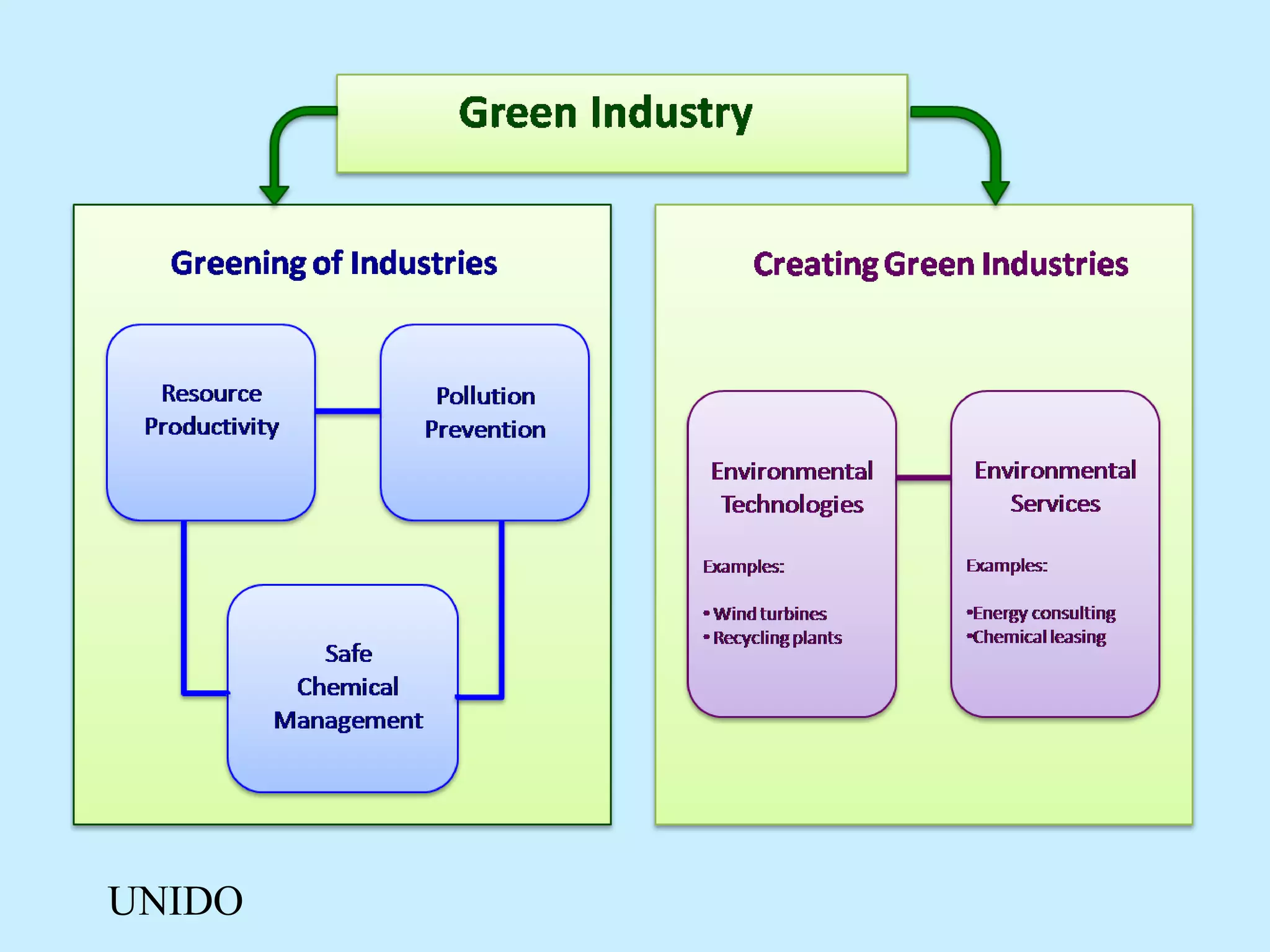
UNIDO
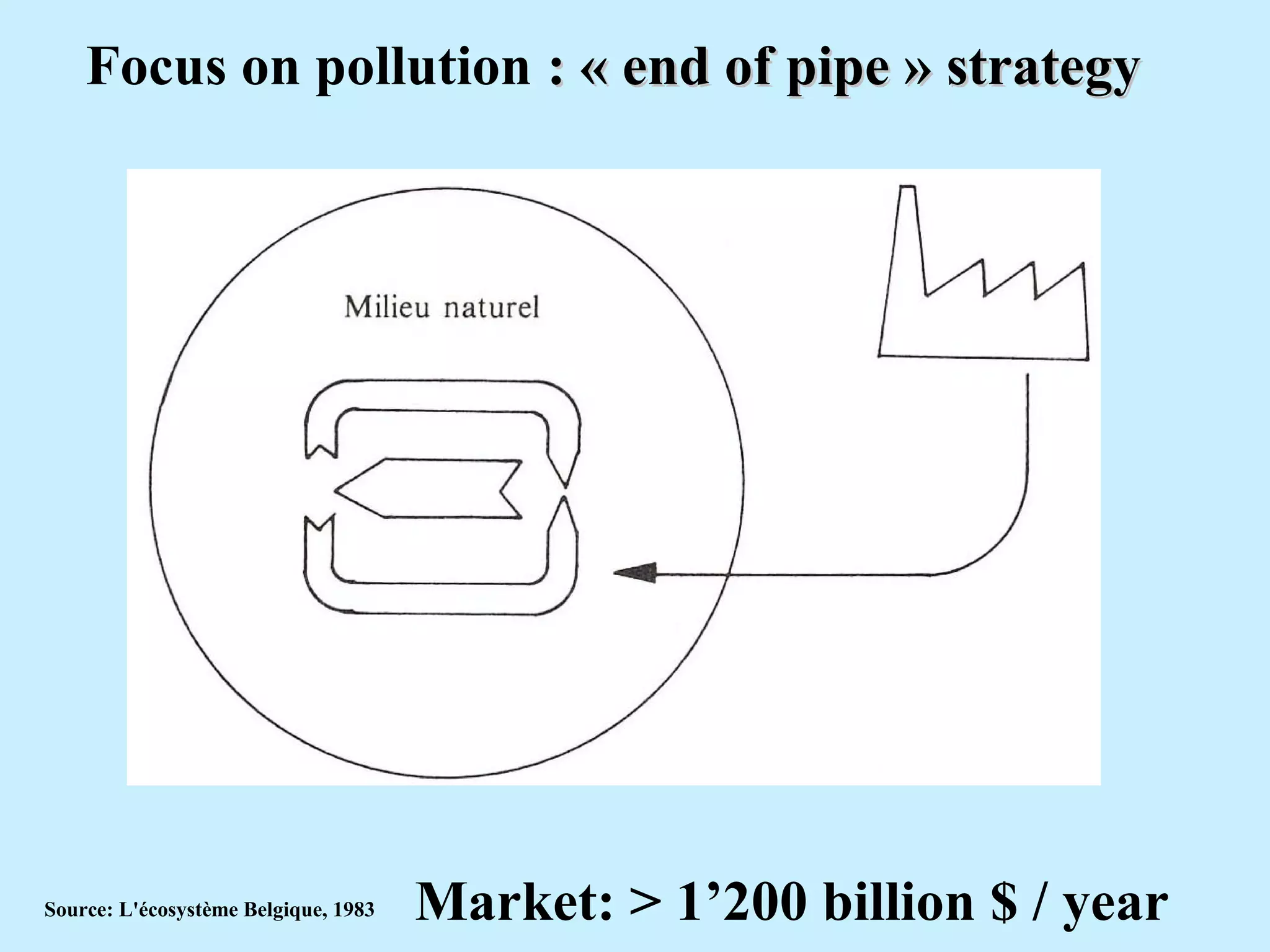
Focus on pollution : « end of pipe » strategy: « end of pipe » strategy
Source: L'écosystème Belgique, 1983 Market: > 1’200 billion $ / year
The market of pollution treatmentThe market of pollution treatment
( « end of pipe » approach):( « end of pipe » approach):
3 components:3 components:
1. Technical equipement for waste treatment
(filters, etc.)
The market of pollution treatmentThe market of pollution treatment
( « end of pipe » approach):( « end of pipe » approach):
3 components:3 components:
2. Buildings, facilities, etc., needed to
operate the technical equipment
The market of pollution treatmentThe market of pollution treatment
( « end of pipe » approach):( « end of pipe » approach):
3 components:3 components:
3. High value added services: monitoring,
control of performance and quality,
consulting, impact studies, etc.
The «end of pipe» approach is very useful,The «end of pipe» approach is very useful,
but… :
- It is too narrow
- It does not really solve the problems
- It is not in favour of developping countries
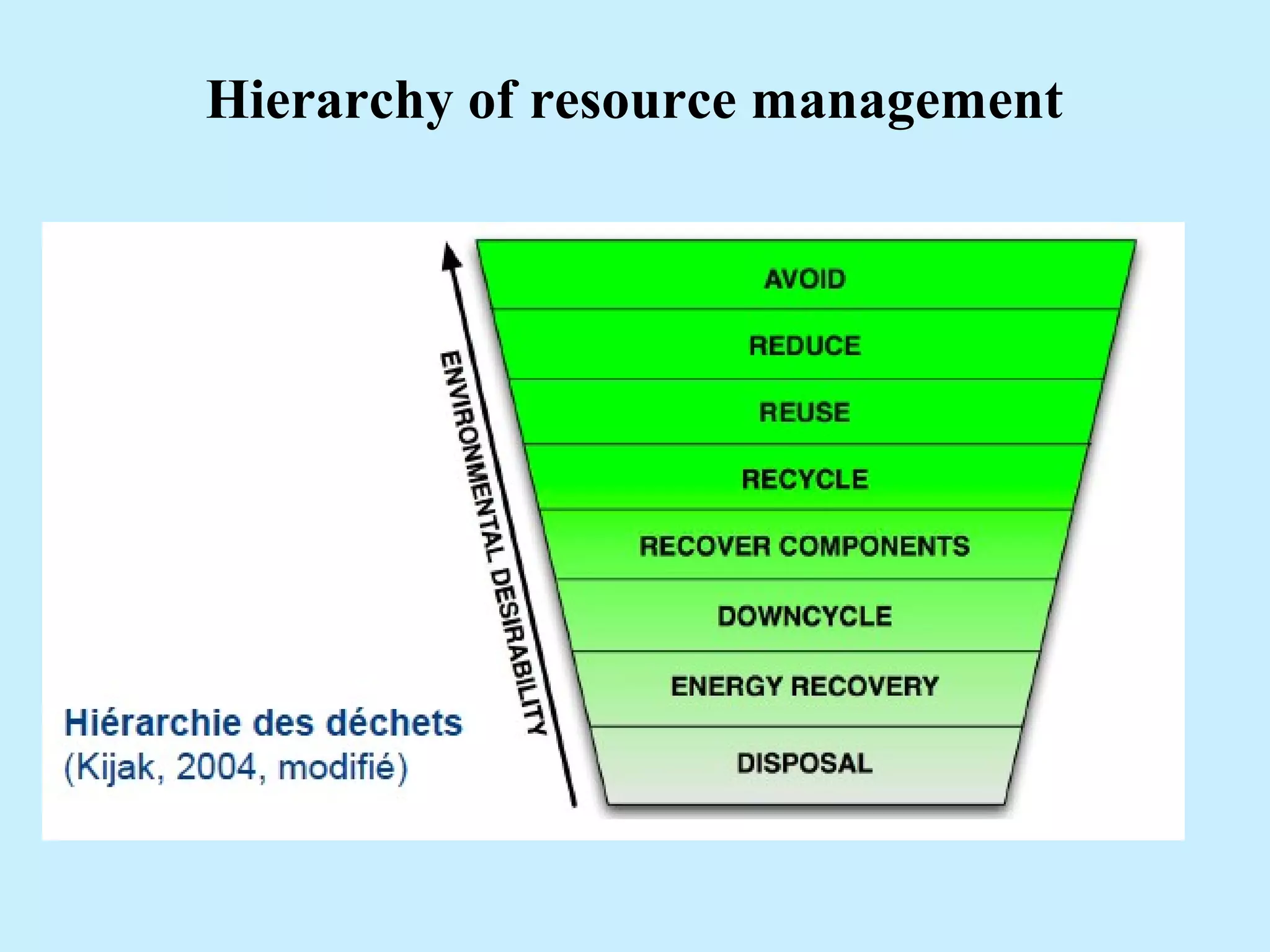
Hierarchy of resource management
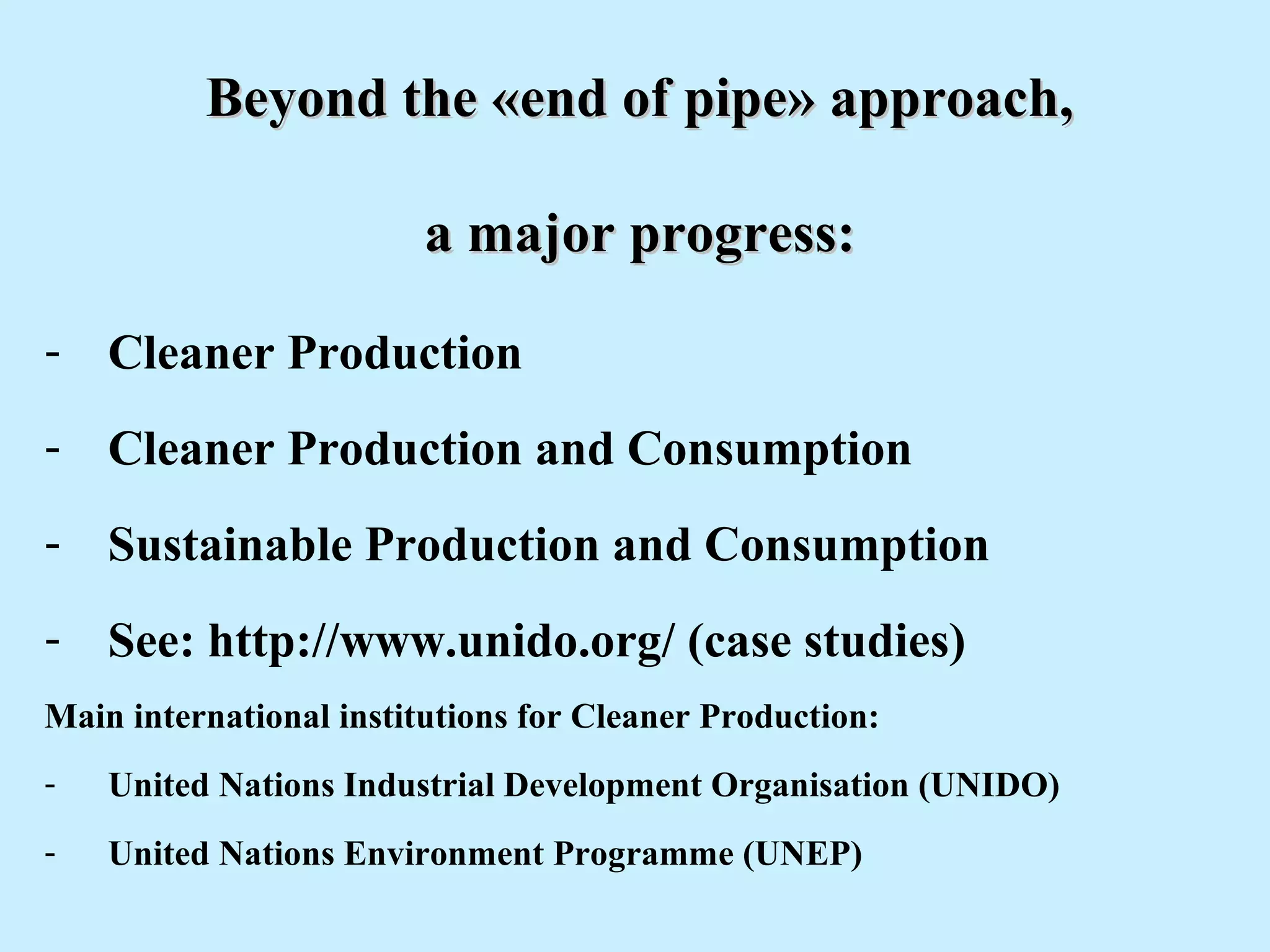
Beyond the «end of pipe» approach,Beyond the «end of pipe» approach,
aa major progress:major progress:
- Cleaner Production
- Cleaner Production and Consumption
- Sustainable Production and Consumption
- See: http://www.unido.org/ (case studies)
Main international institutions for Cleaner Production:
- United Nations Industrial Development Organisation (UNIDO)
- United Nations Environment Programme (UNEP)
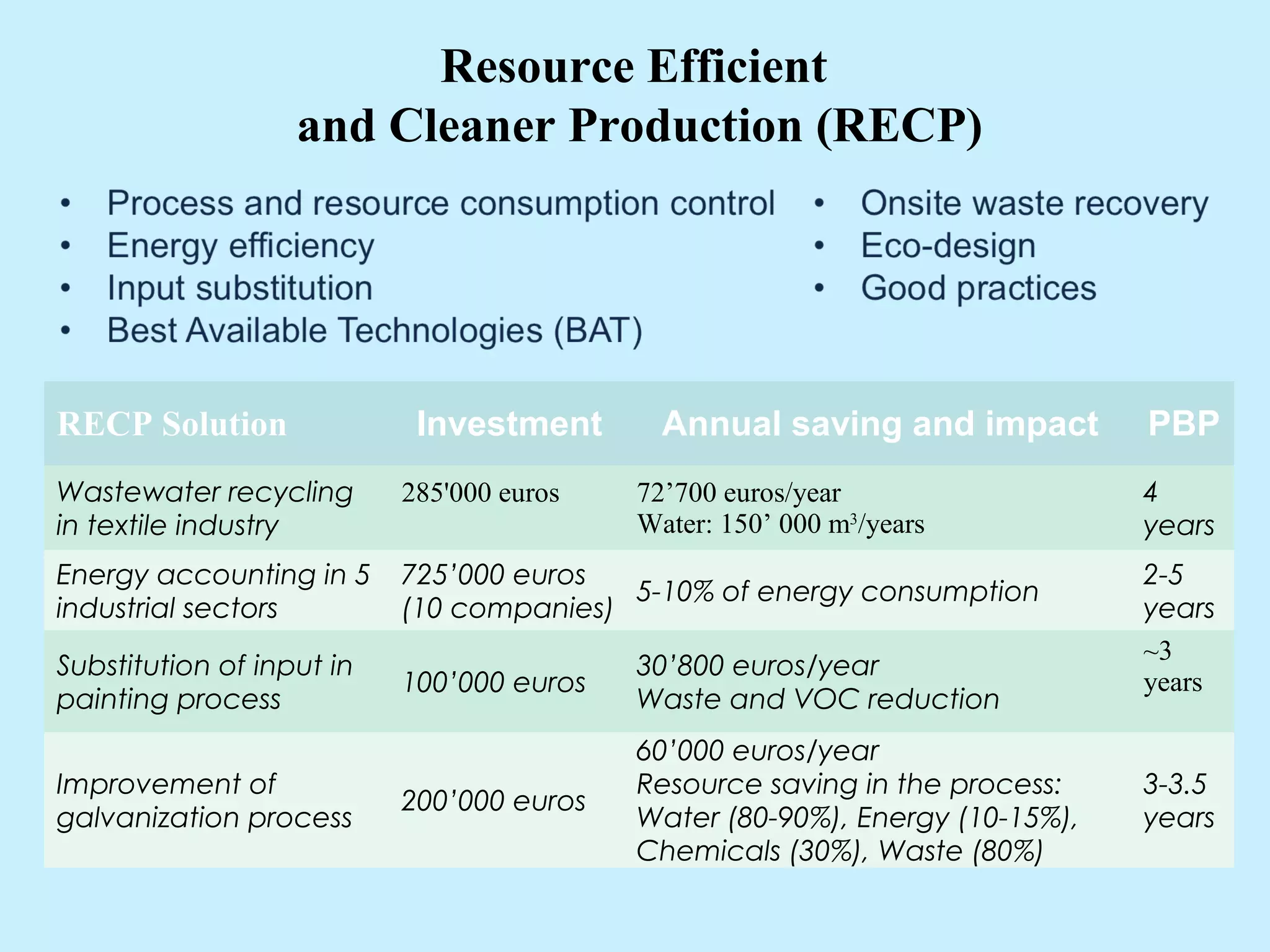
Resource Efficient
and Cleaner Production (RECP)
RECP Solution Investment Annual saving and impact PBP
Wastewater recycling
in textile industry
285'000 euros 72’700 euros/year
Water: 150’ 000 m3
/years
4
years
Energy accounting in 5
industrial sectors
725’000 euros
(10 companies)
5-10% of energy consumption
2-5
years
Substitution of input in
painting process
100’000 euros
30’800 euros/year
Waste and VOC reduction
~3
years
Improvement of
galvanization process
200’000 euros
60’000 euros/year
Resource saving in the process:
Water (80-90%), Energy (10-15%),
Chemicals (30%), Waste (80%)
3-3.5
years
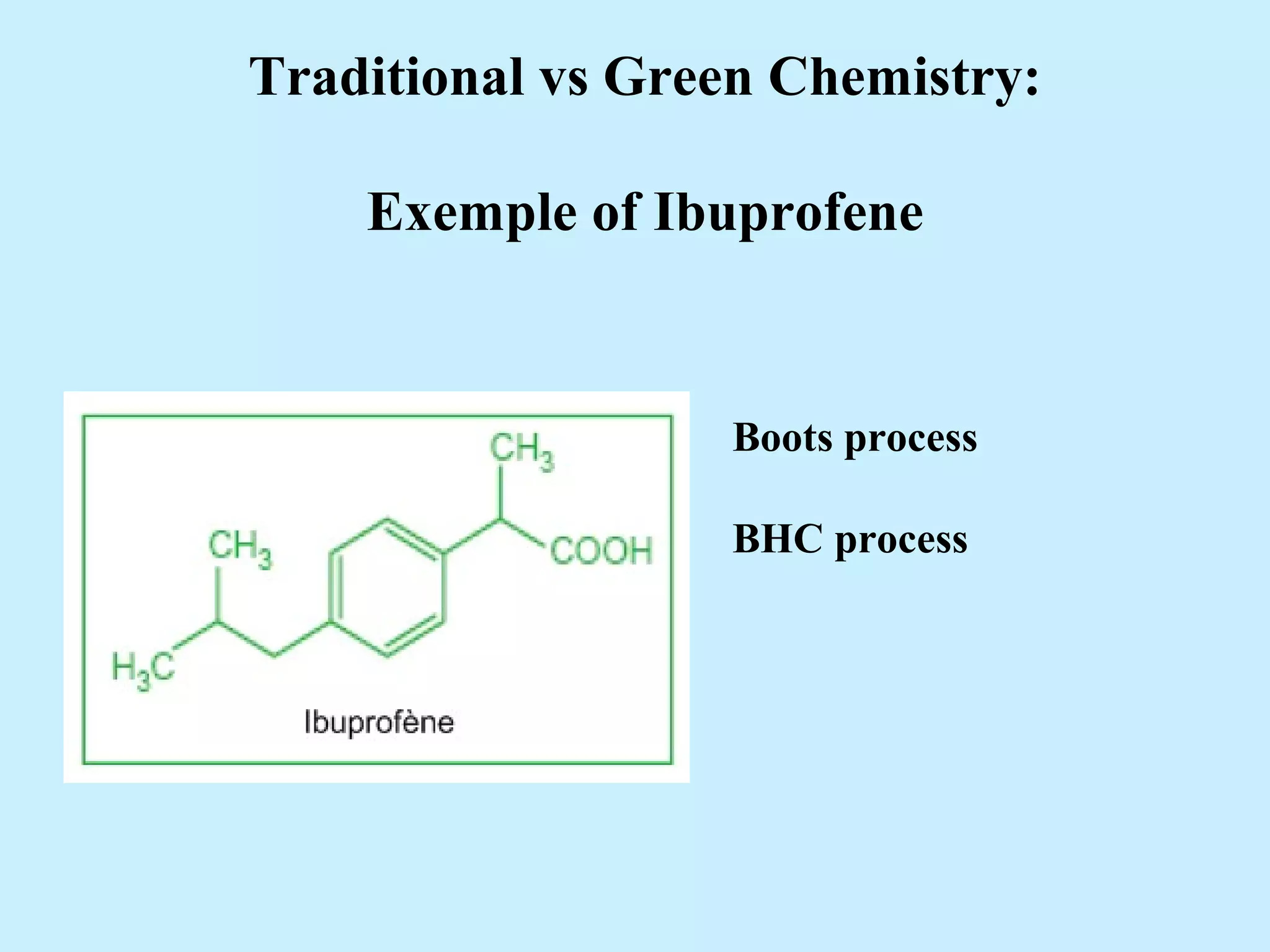
Traditional vs Green Chemistry:
Exemple of Ibuprofene
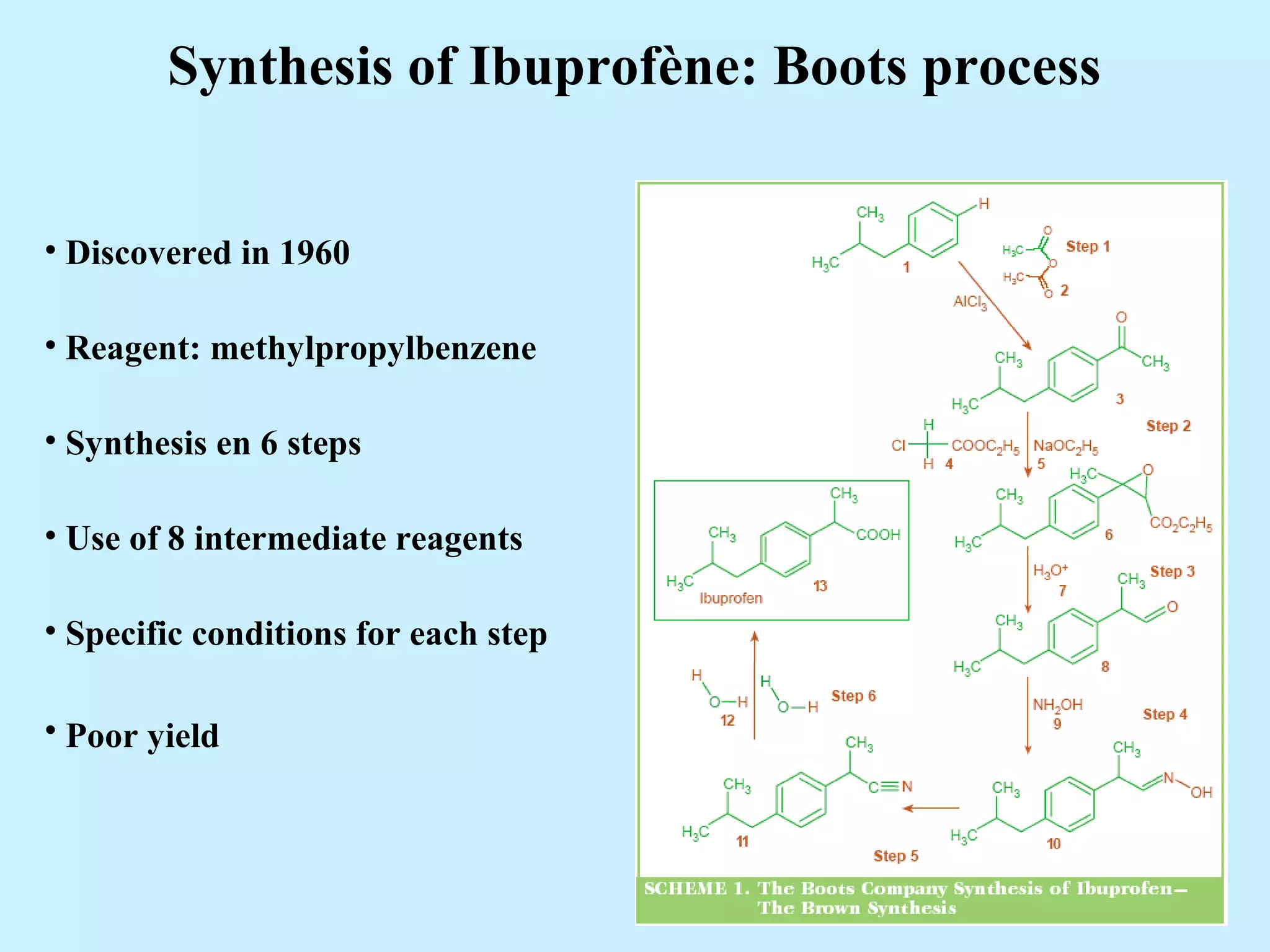
Boots process
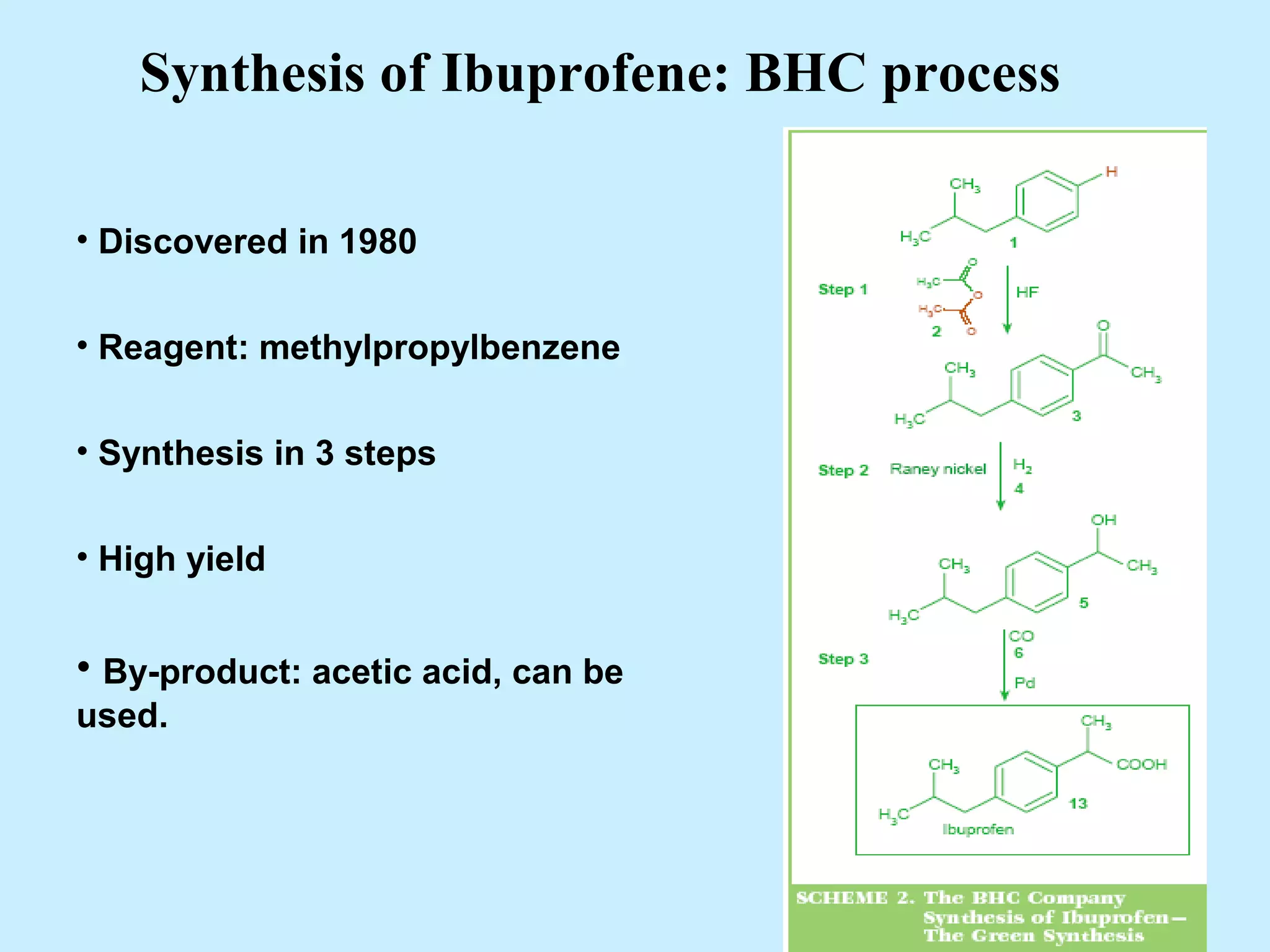
BHC process
Synthesis of Ibuprofène: Boots process
• Discovered in 1960
• Reagent: methylpropylbenzene
• Synthesis en 6 steps
• Use of 8 intermediate reagents
• Specific conditions for each step
• Poor yield
Synthesis of Ibuprofene: BHC process
• Discovered in 1980
• Reagent: methylpropylbenzene
• Synthesis in 3 steps
• High yield
• By-product: acetic acid, can be
used.
Economic aspects:
Flux [tonnes/an] Procédé Boots Procédé BHC
Réactifs 33'000 17'000
Produits 13'000 13'000
Déchets 20'000 4'000
Total 66'000 34'000
• Annual production: 13'000 tons
• Materials consumption divided by 2
• BHC process: no waste
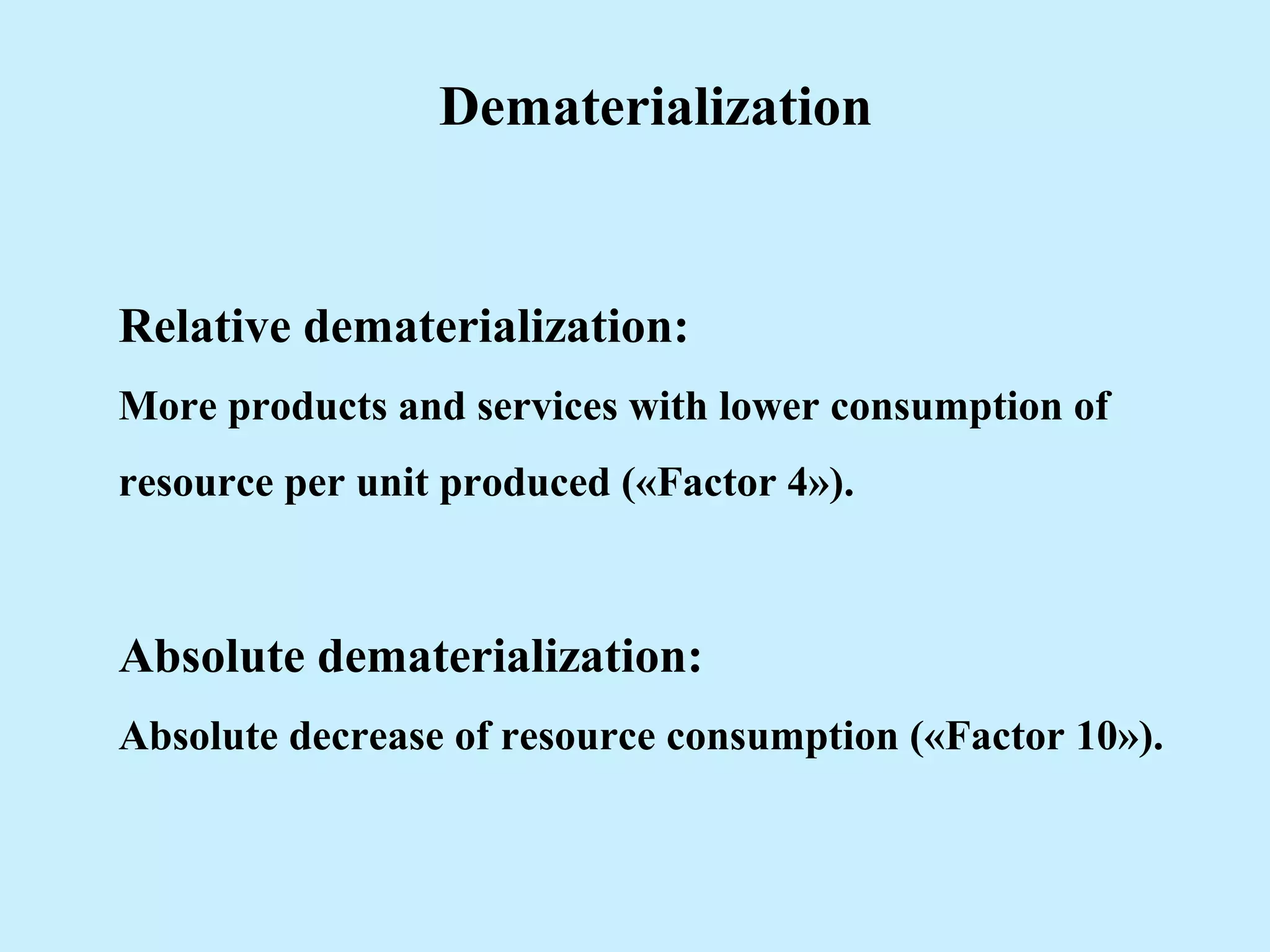
Dematerialization
Relative dematerialization:
More products and services with lower consumption of
resource per unit produced («Factor 4»).
Absolute dematerialization:
Absolute decrease of resource consumption («Factor 10»).
Source: Catalogue de la prévention des déchets, ministère de l’environnement, Paris
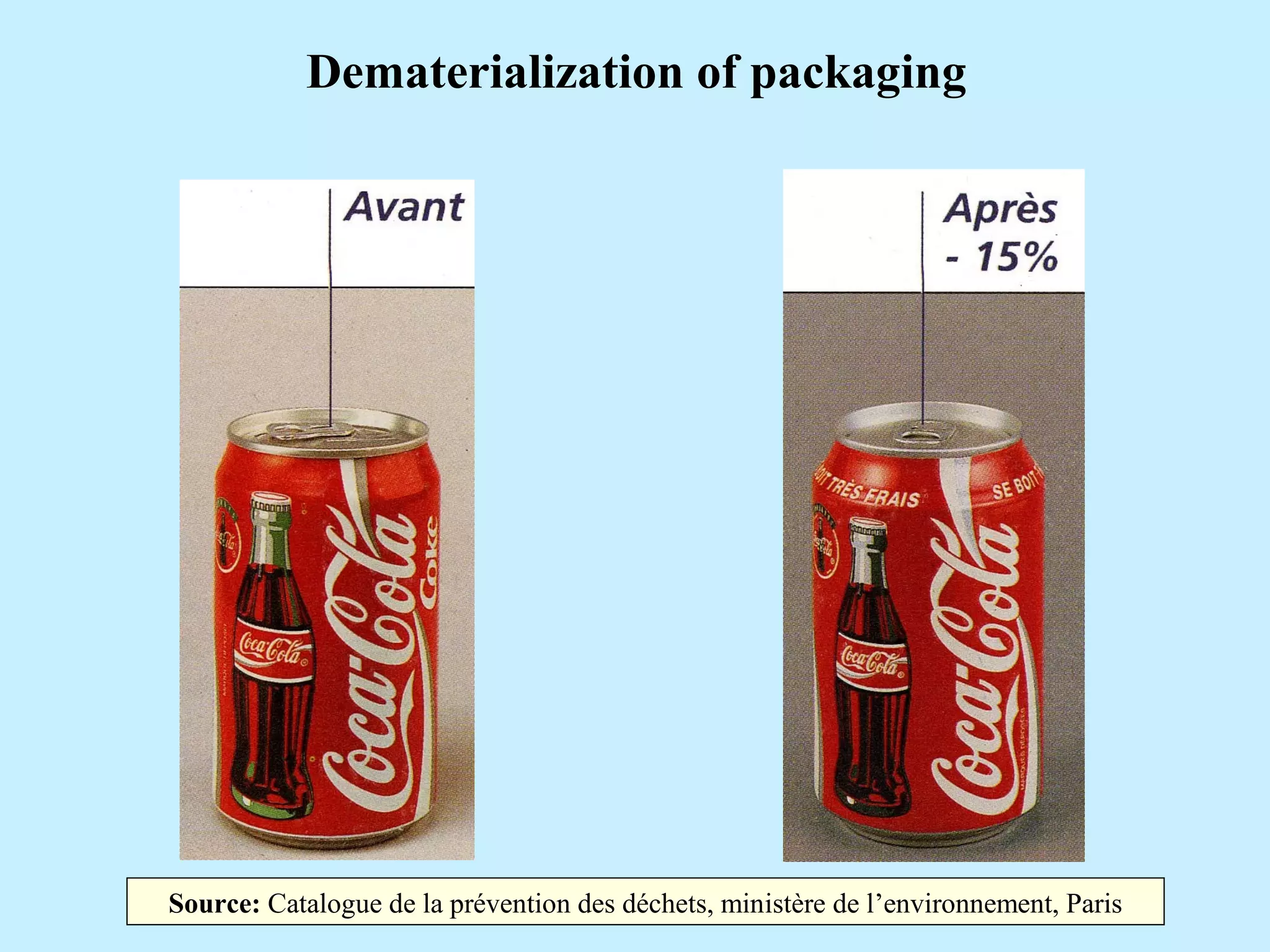
Dematerialization of packaging
Source: Catalogue de la prévention des déchets, ministère de l’environnement, Paris
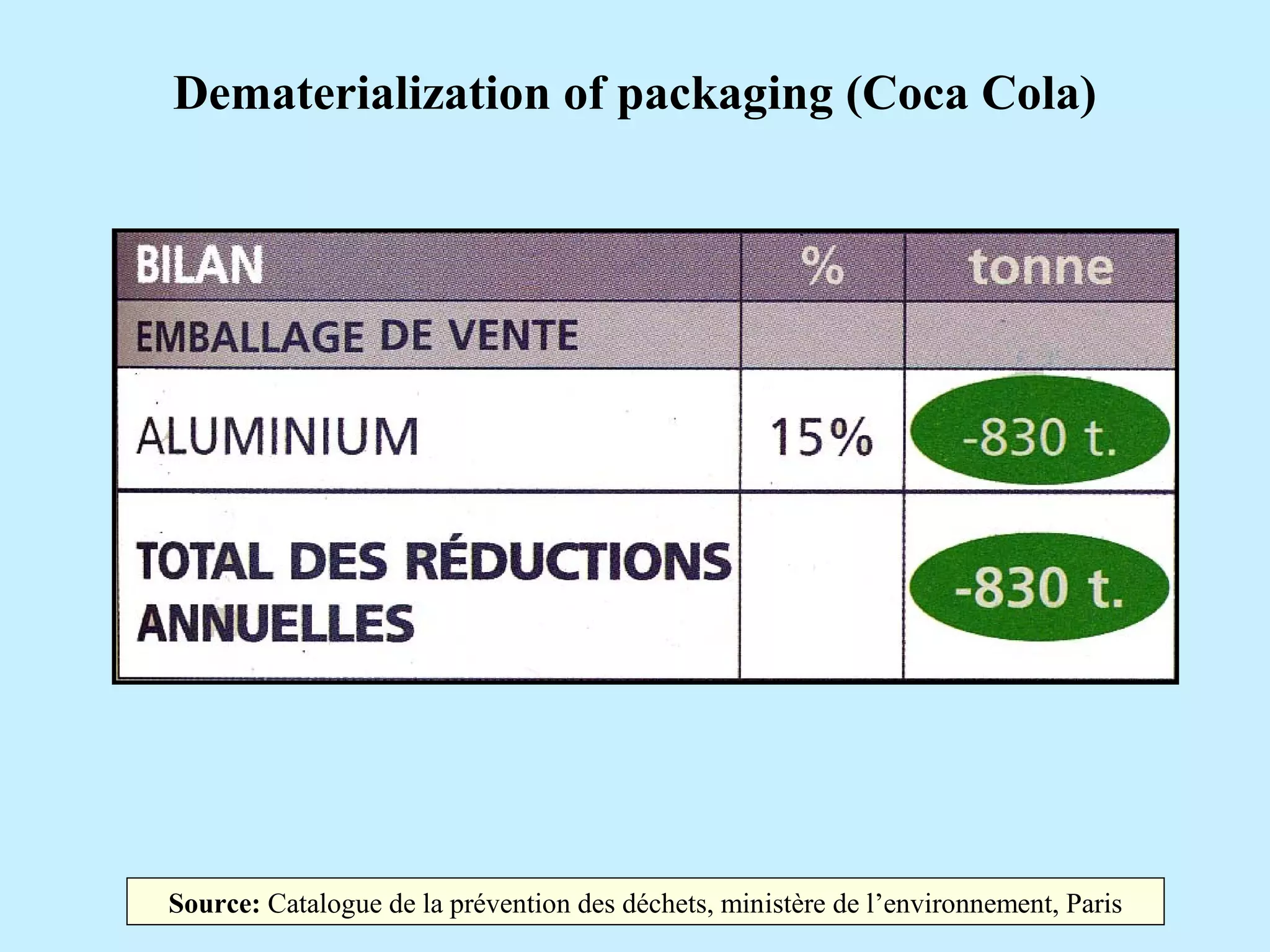
Dematerialization of packaging (Coca Cola)
Source: Catalogue de la prévention des déchets, ministère de l’environnement, Paris
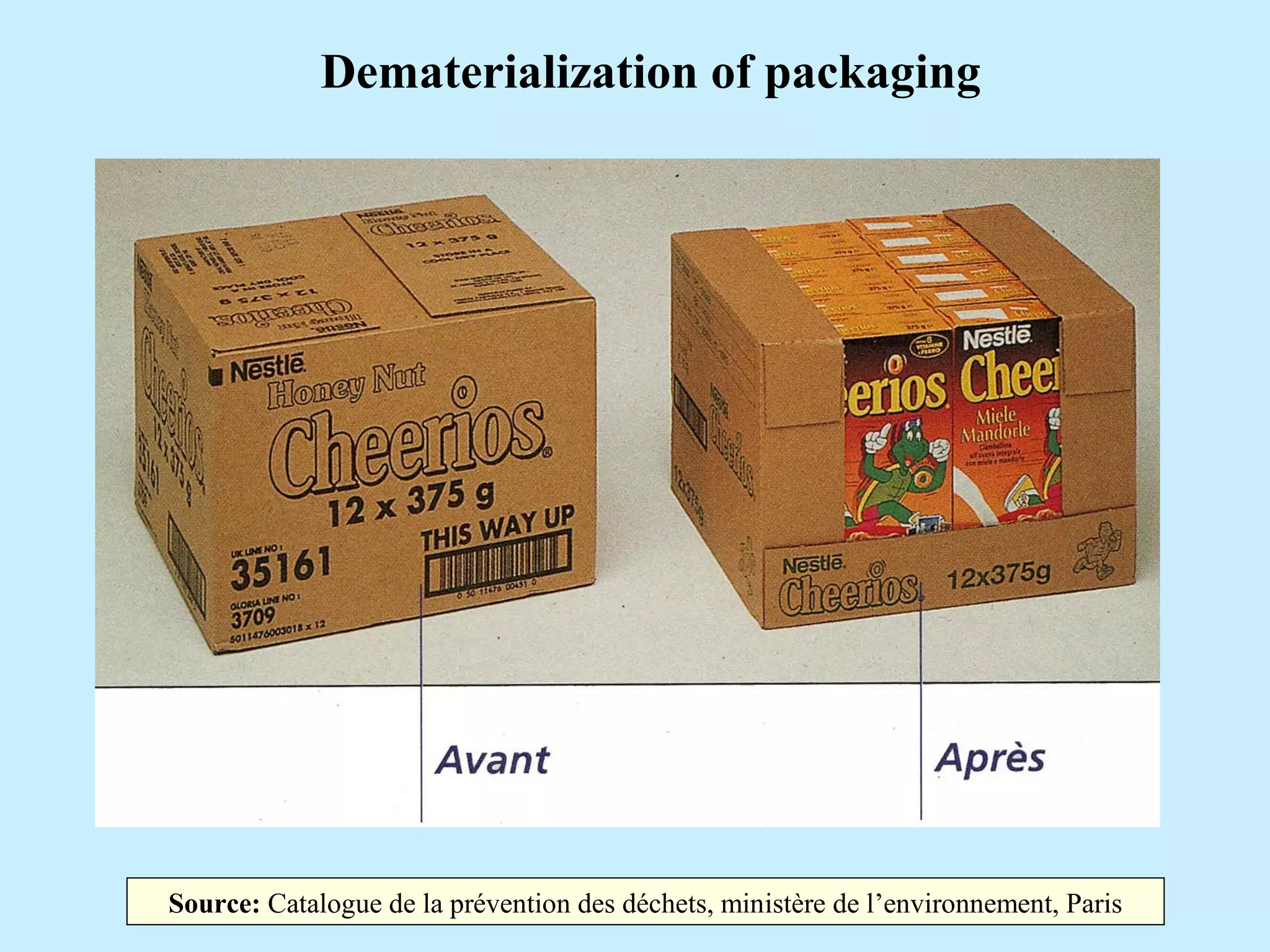
Dematerialization of packaging
Source: Catalogue de la prévention des déchets, ministère de l’environnement, Paris
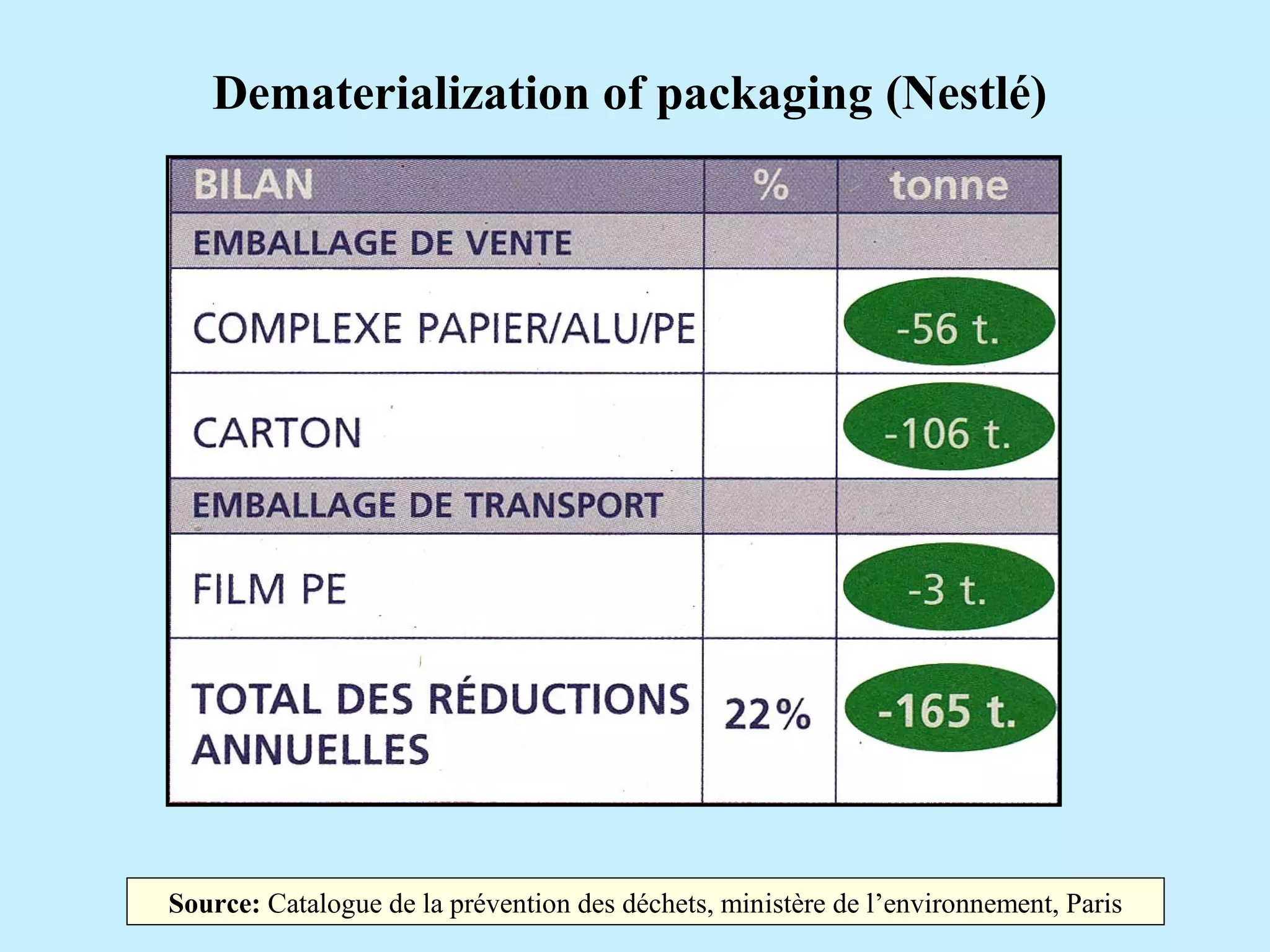
Dematerialization of packaging (Nestlé)
Source: Catalogue de la prévention des déchets, ministère de l’environnement,
Paris
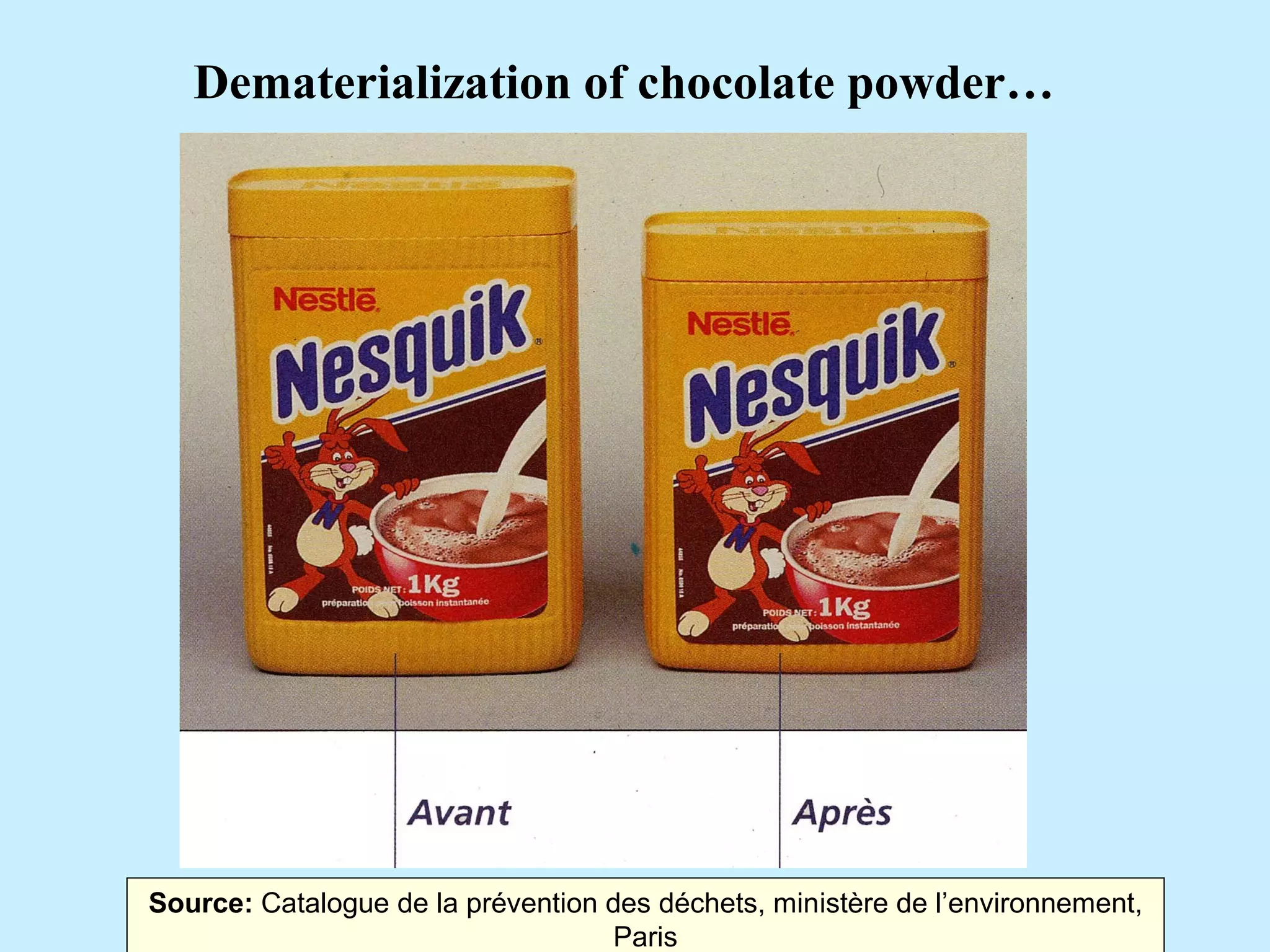
Dematerialization of chocolate powder…
Source: Catalogue de la prévention des déchets, ministère de l’environnement,
Paris
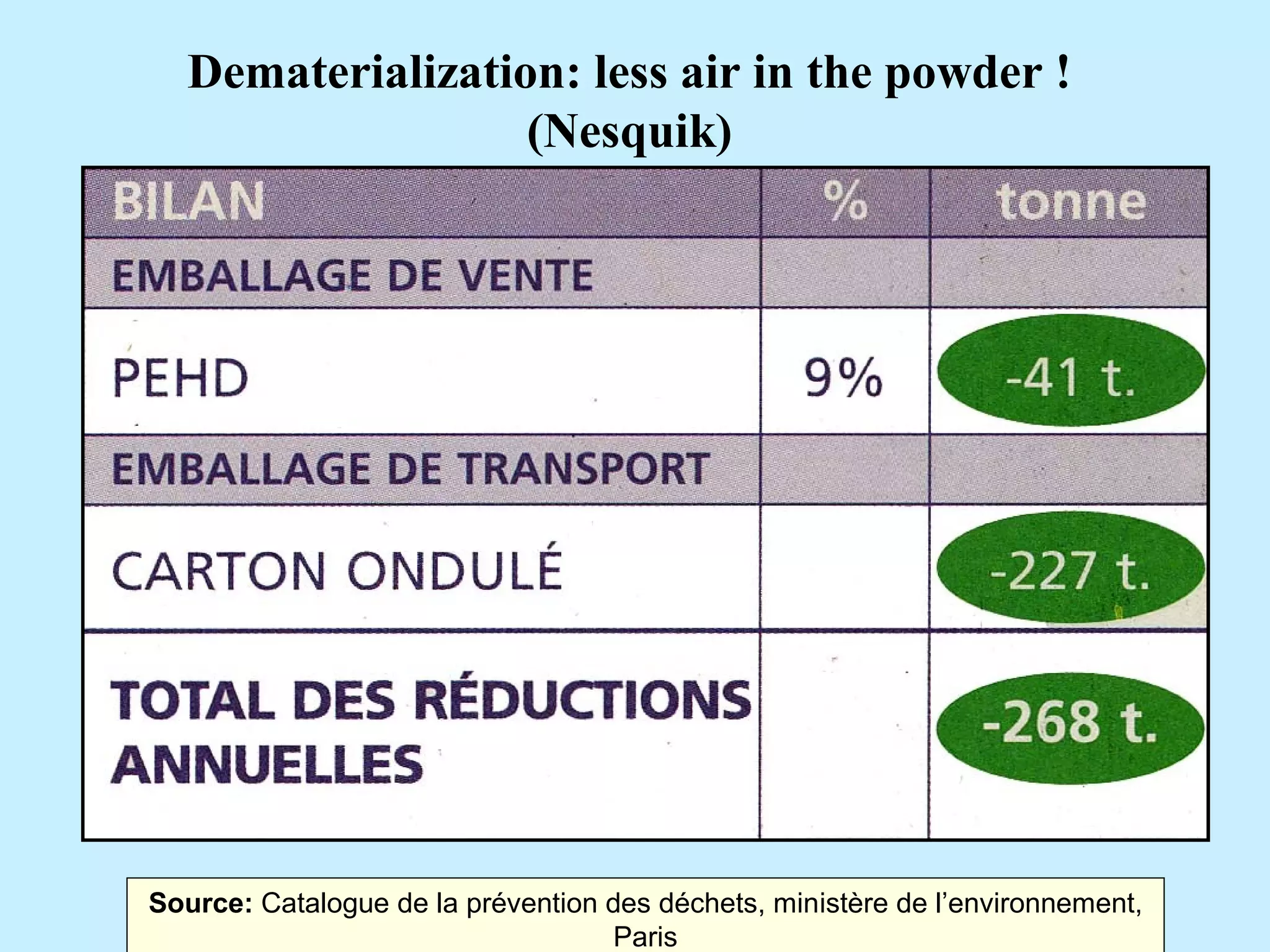
Dematerialization: less air in the powder !
(Nesquik)
Aspects of dematerialization (4)
The strategy of product life extension:
1) Reuse
2) Repair
3) Remanufacture
4) Recycle (the last option!)
Source: Walter Stahel: http://www.product-life.org
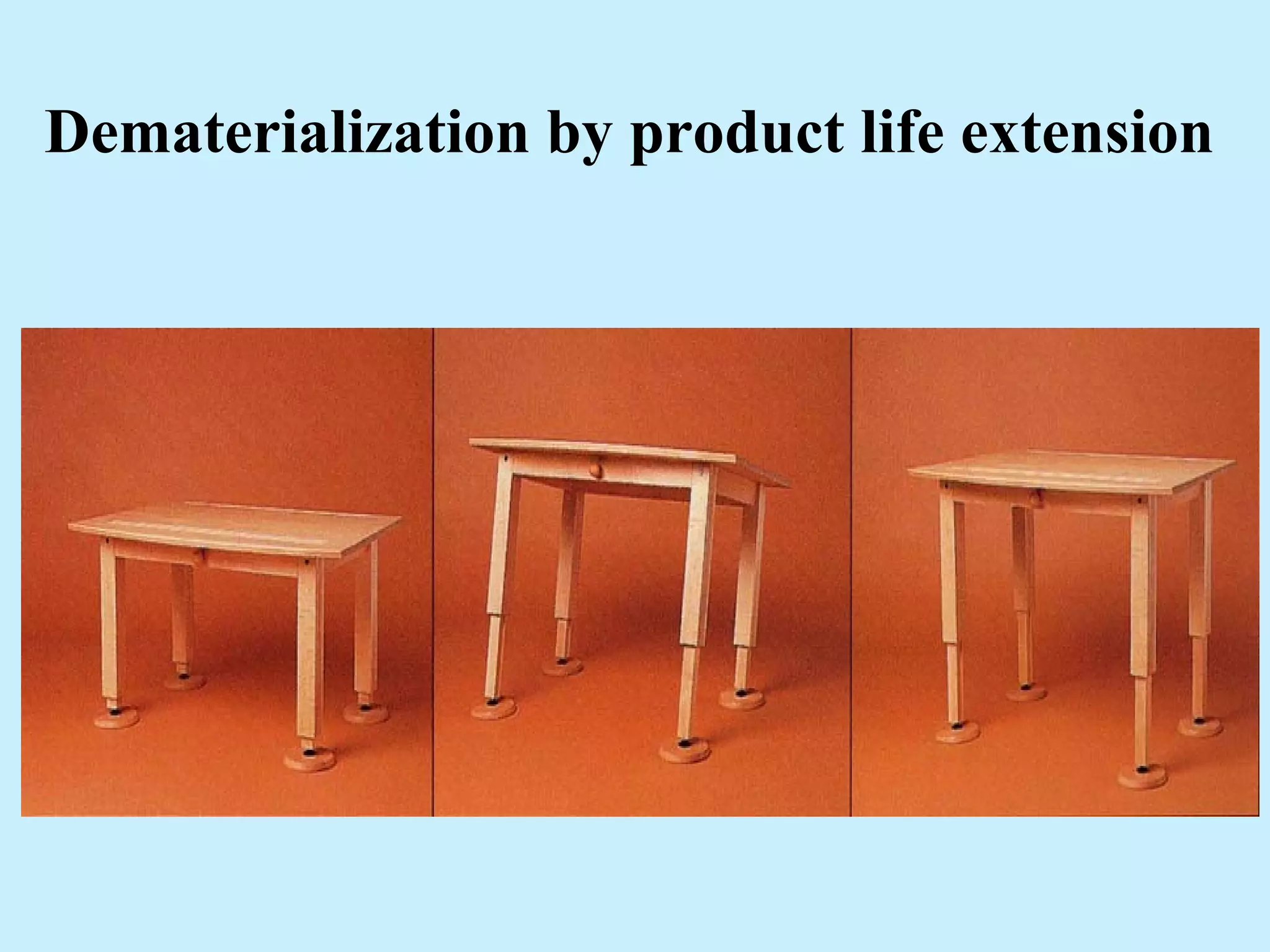
Dematerialization by product life extension
«Functionality Economy»
(or Product Service System - PSS)
Sell the function (or the performance),
instead of the product !
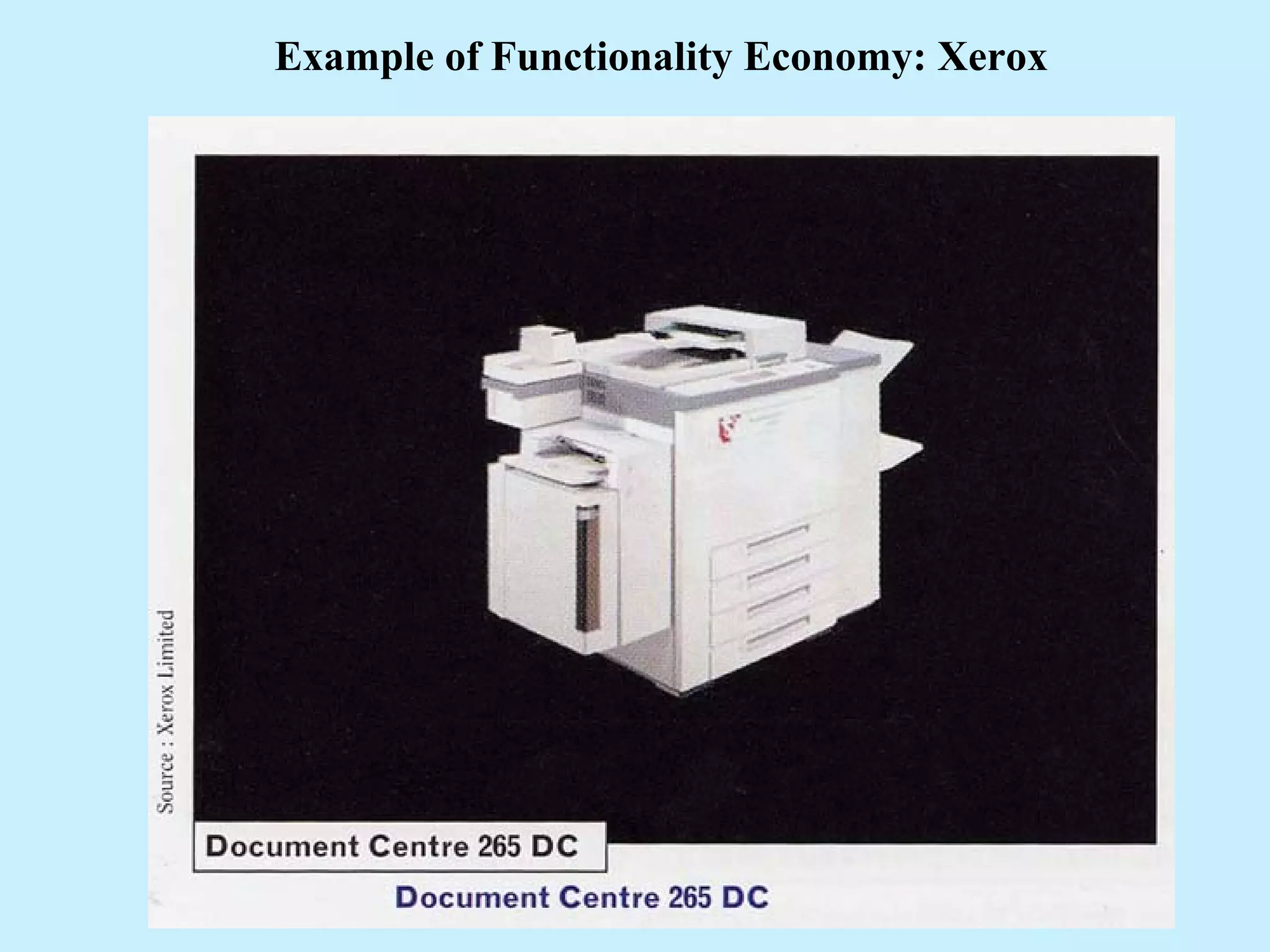
Example of Functionality Economy: Xerox
(c) Tomohiko Sakao, Linköping University
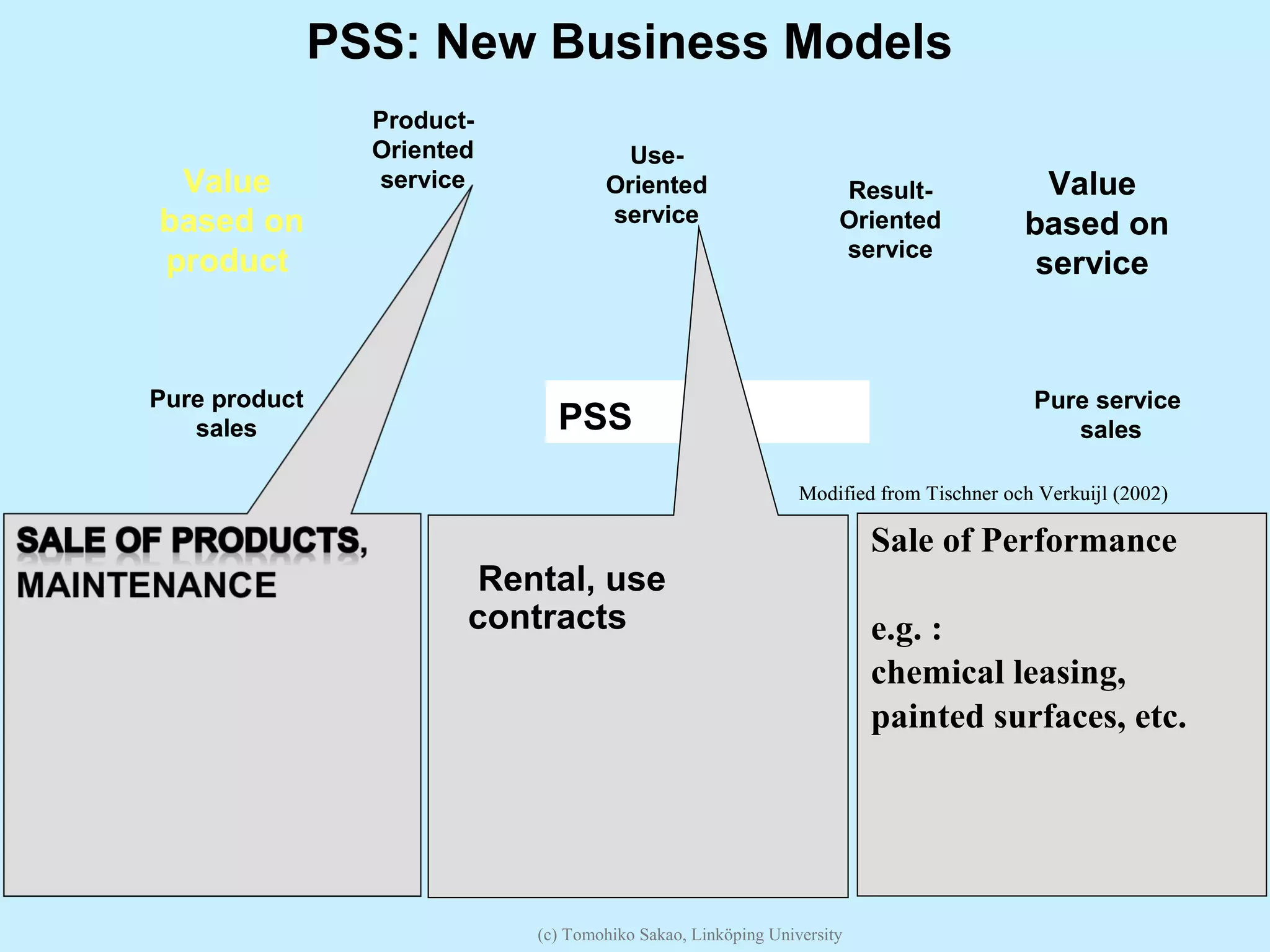
PSS: New Business Models
Modified from Tischner och Verkuijl (2002)
Value
based on
product
Value
based on
service
IPSO
Pure product
sales
Product-
Oriented
service
Pure service
sales
Use-
Oriented
service
Result-
Oriented
service
Modified from Tischner och Verkuijl (2002)
Value
based on
product
Value
based on
service
IPSO
Pure product
sales
Product-
Oriented
service
Pure service
sales
Use-
Oriented
service
Result-
Oriented
service
Sale of Performance
e.g. :
chemical leasing,
painted surfaces, etc.
PSS
Rental, use
contracts
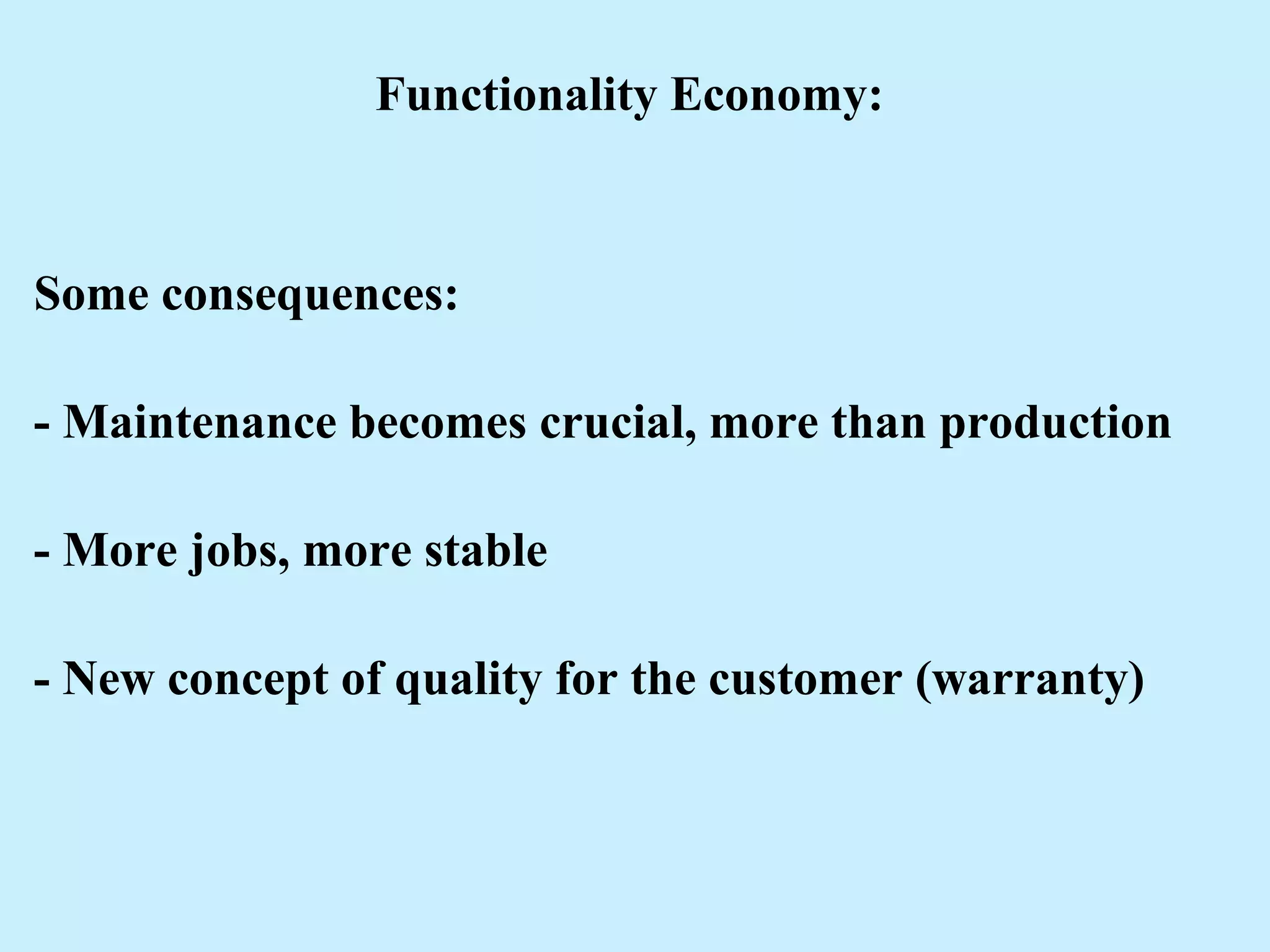
Functionality Economy:
Some consequences:
-Maintenance becomes crucial, more than production
Functionality Economy:
Some consequences:
- Maintenance becomes crucial, more than production
-More jobs, more stable
Functionality Economy:
Some consequences:
- Maintenance becomes crucial, more than production
- More jobs, more stable
- New concept of quality for the customer (warranty)
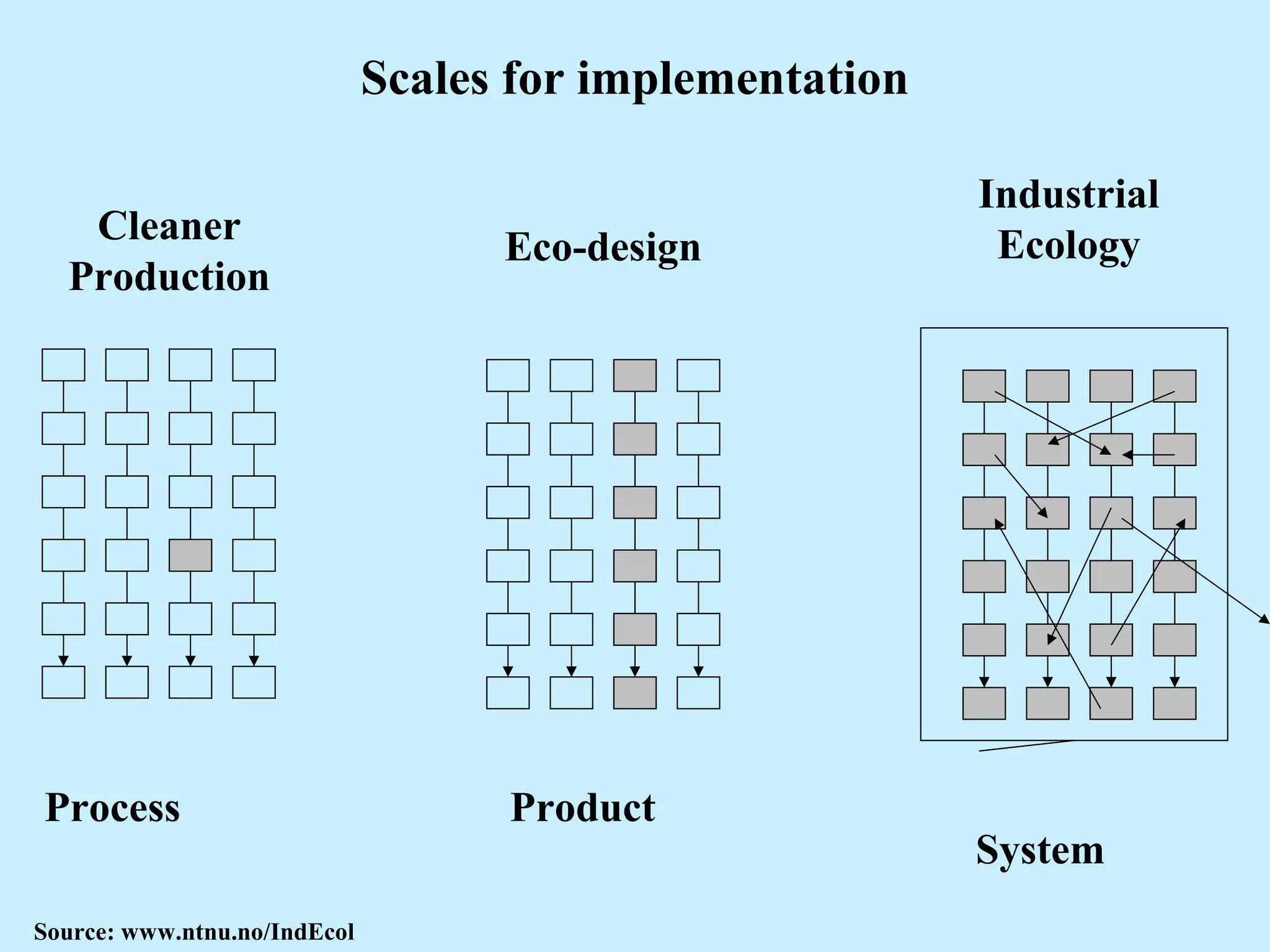
Scales for implementation
Cleaner
Production
Eco-design
Source: www.ntnu.no/IndEcol
Industrial
Ecology
Process Product
System
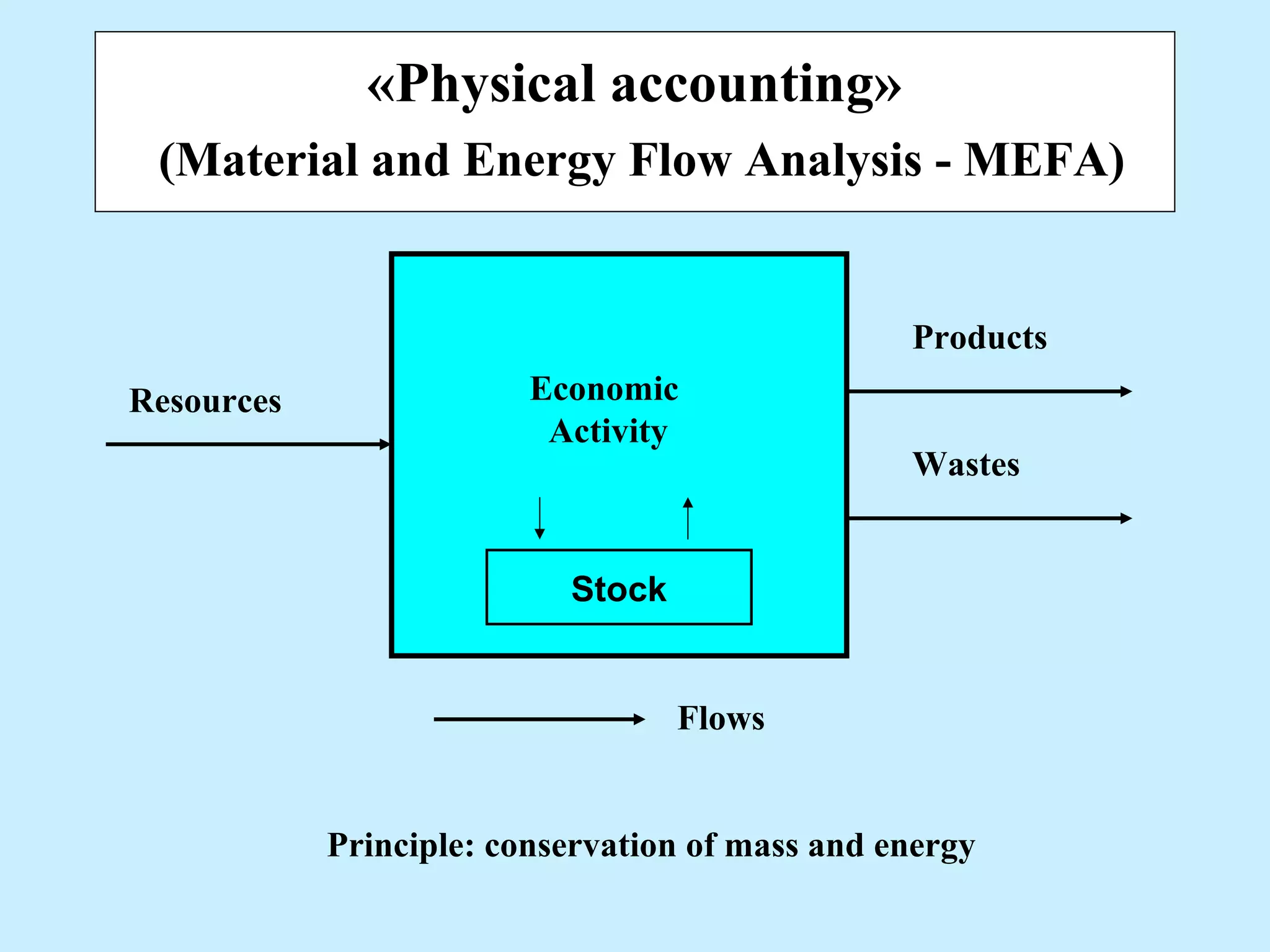
«Physical accounting»
(Material and Energy Flow Analysis - MEFA)
Resources
Products
Wastes
Economic
Activity
Stock
Flows
Principle: conservation of mass and energy
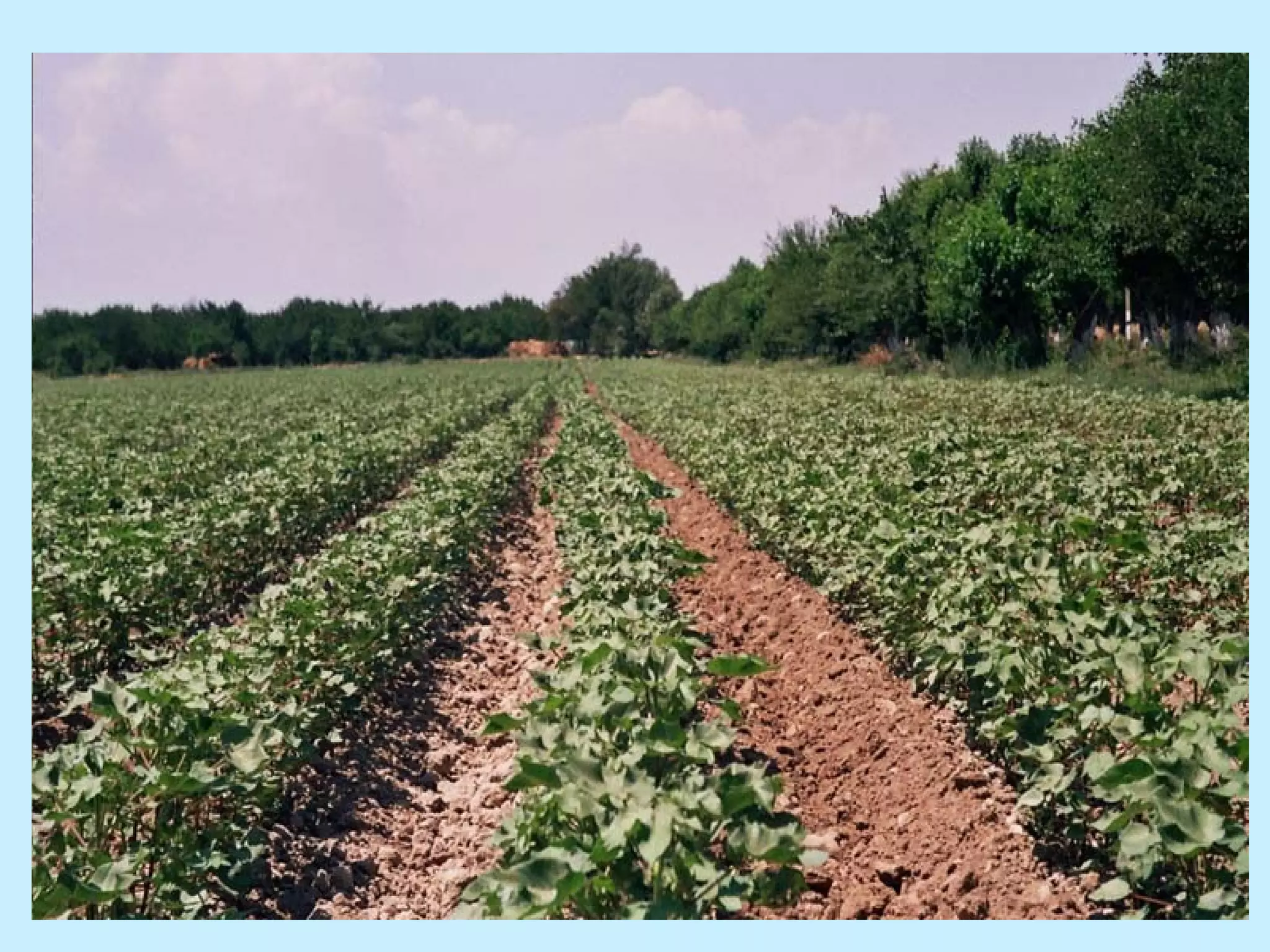
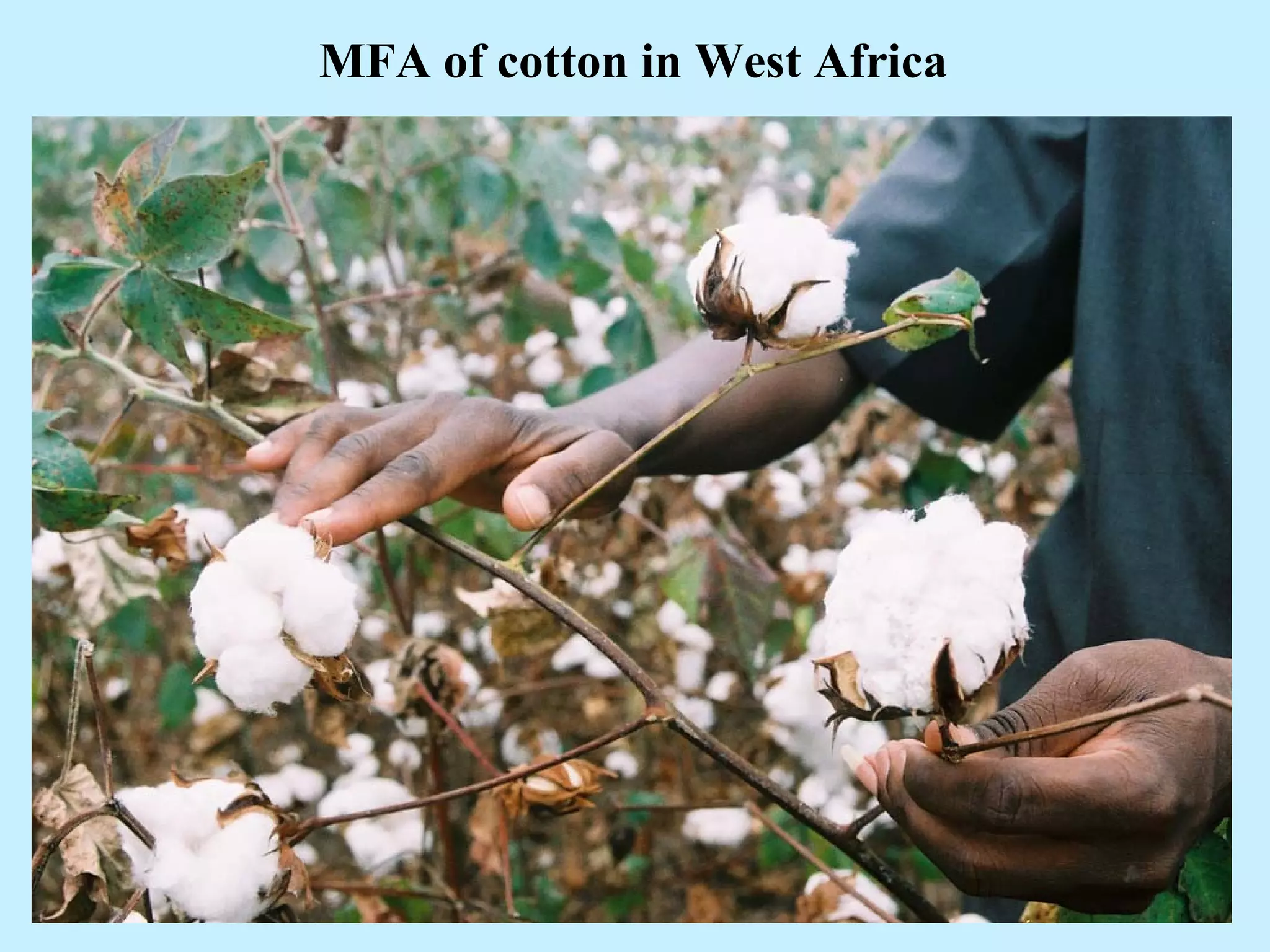
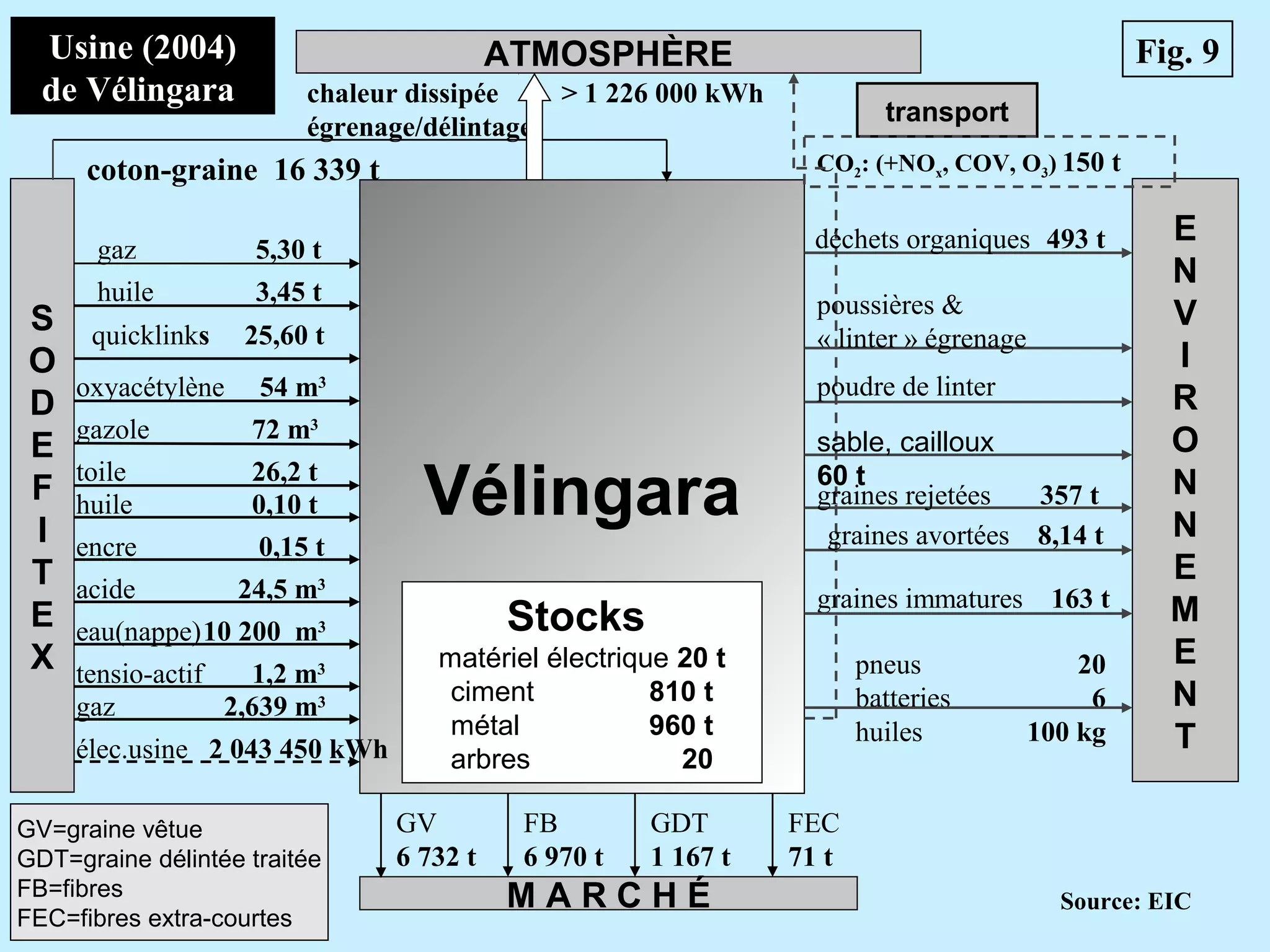
MFA of cotton in West Africa
Vélingara
élec.usine 2 043 450 kWh
gaz 5,30 t
huile 3,45 t
quicklinks 25,60 t
oxyacétylène 54 m3
S
O
D
E
F
I
T
E
X
E
N
V
I
R
O
N
N
E
M
E
N
T
transport
ATMOSPHÈRE
encre 0,15 t
M A R C H É
gazole 72 m3
CO2: (+NOx, COV, O3) 150 t
pneus 20
batteries 6
huiles 100 kg
huile 0,10 t
GV=graine vêtue
GDT=graine délintée traitée
FB=fibres
FEC=fibres extra-courtes
déchets organiques 493 t
acide 24,5 m3
poudre de linter
sable, cailloux
60 t
graines rejetées 357 t
poussières &
« linter » égrenage
GDT
1 167 t
GV
6 732 t
FB
6 970 t
toile 26,2 t
eau(nappe)10 200 m3
tensio-actif 1,2 m3
gaz 2,639 m3
FEC
71 t
chaleur dissipée > 1 226 000 kWh
égrenage/délintage
coton-graine 16 339 t
Fig. 9
Stocks
matériel électrique 20 t
ciment 810 t
métal 960 t
arbres 20
graines avortées 8,14 t
Usine (2004)
de Vélingara
graines immatures 163 t
Source: EIC
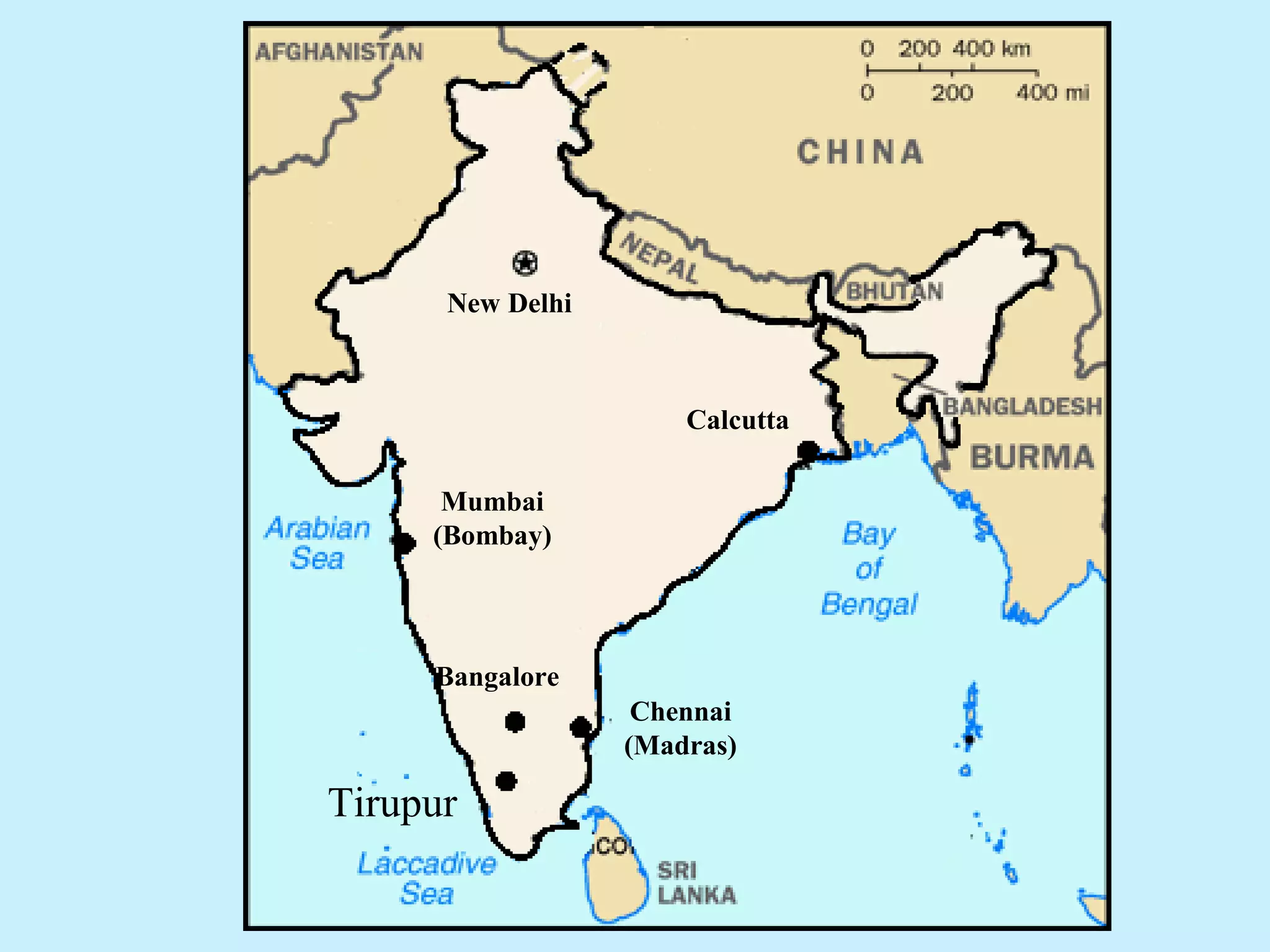
Tirupur
New Delhi
Mumbai
(Bombay)
Calcutta
Bangalore
Chennai
(Madras)
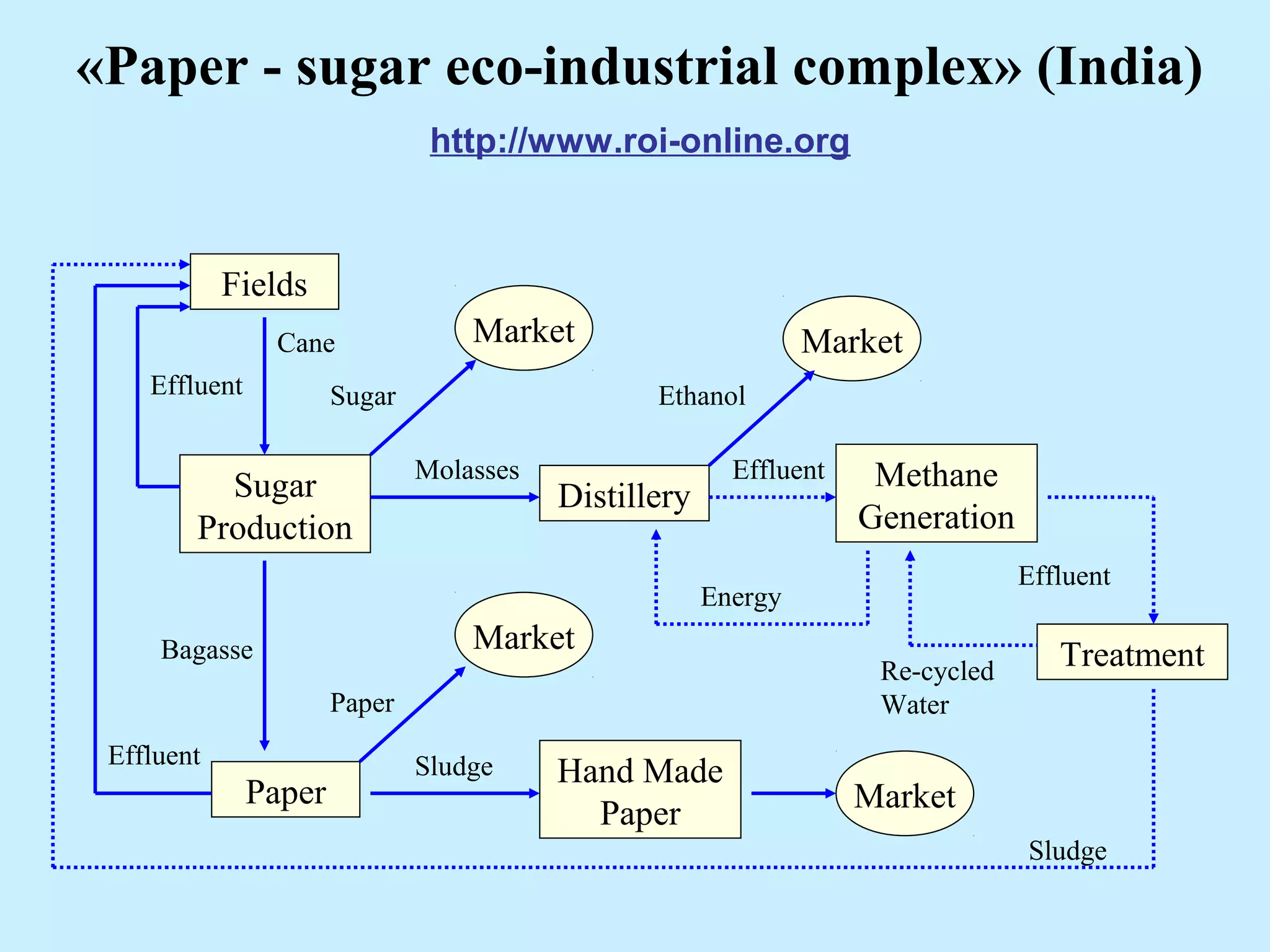
«Paper - sugar eco-industrial complex» (India)
http://www.roi-online.org
Fields
Sugar
Production
Paper
Distillery
Hand Made
Paper
Methane
Generation
Treatment
Market
Market Market
Market
Effluent
Effluent
Effluent
Effluent
Bagasse
Paper
Sludge
Energy
EthanolSugar
Cane
Sludge
Re-cycled
Water
Molasses
Tirupur
New Delhi
Mumbai
(Bombay)
Calcutta
Bangalore
Chennai
(Madras)
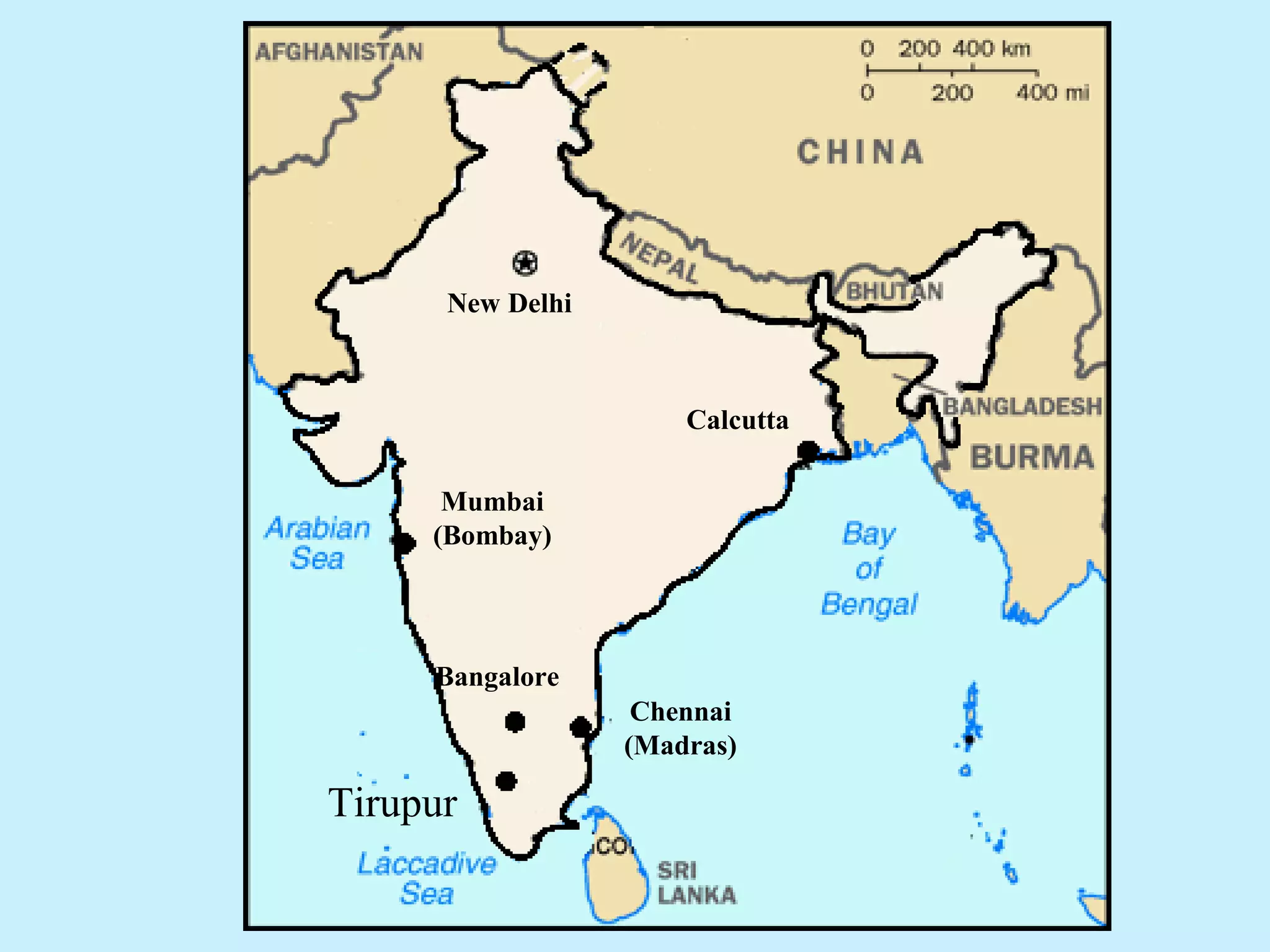
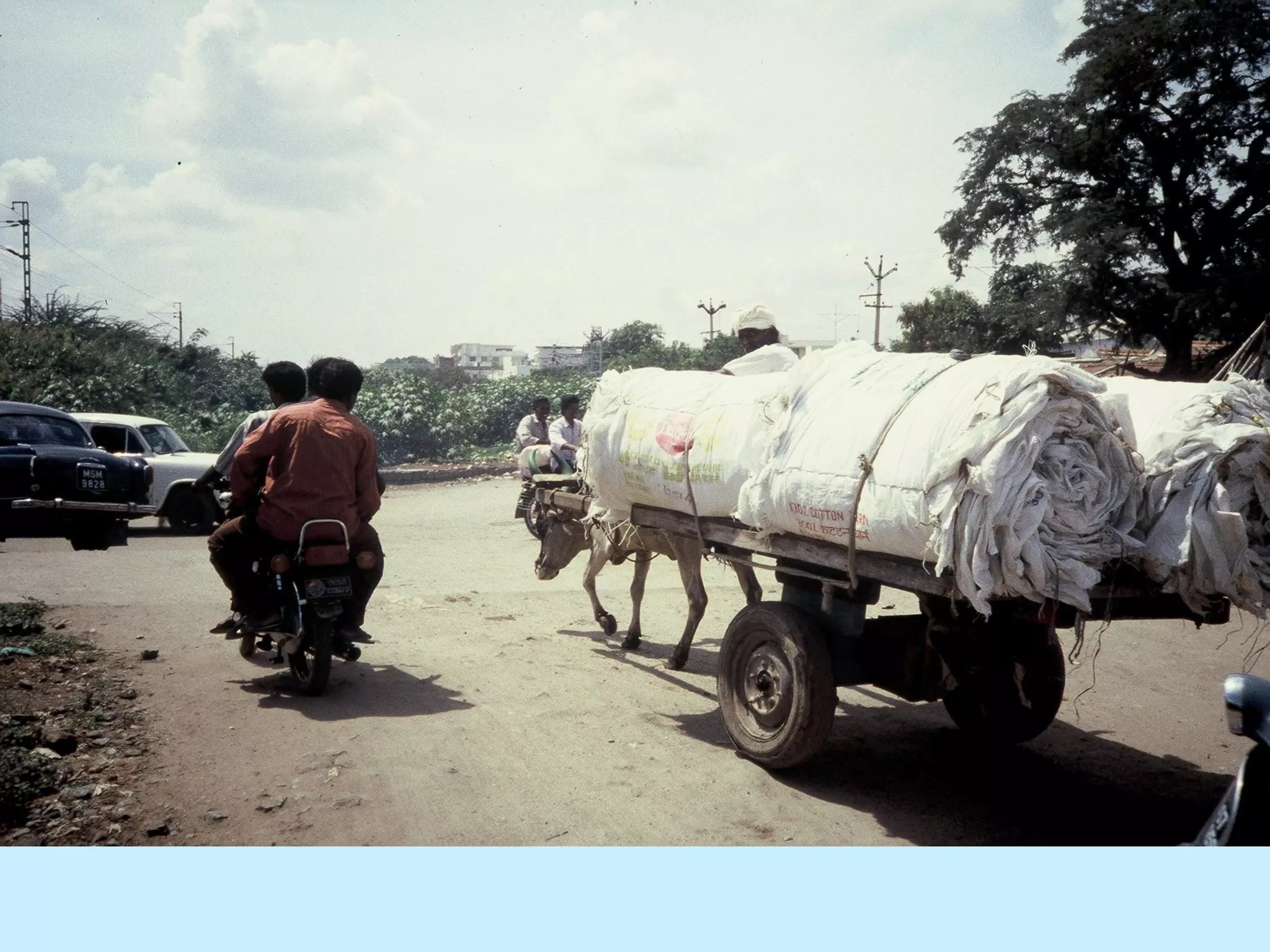
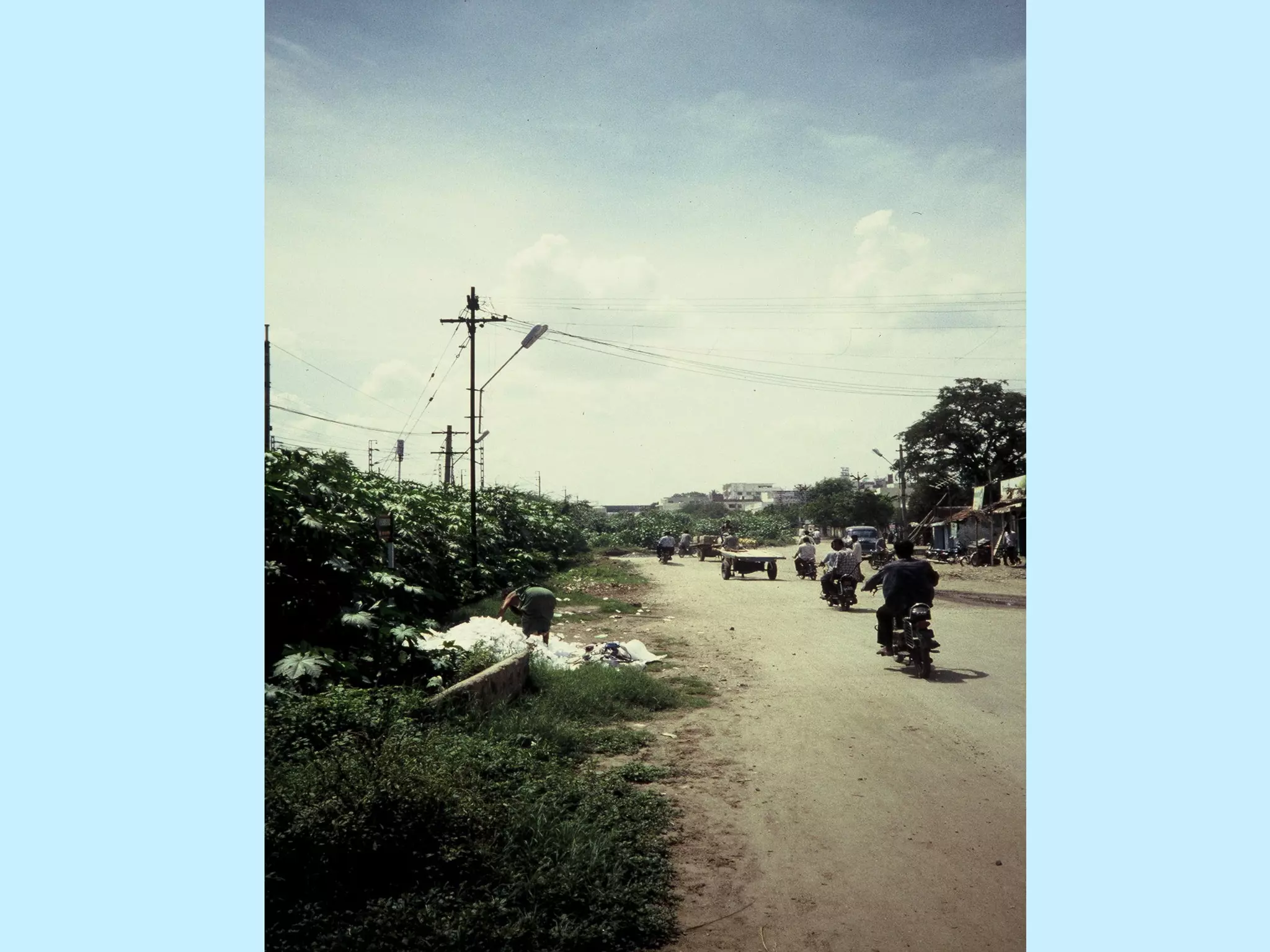
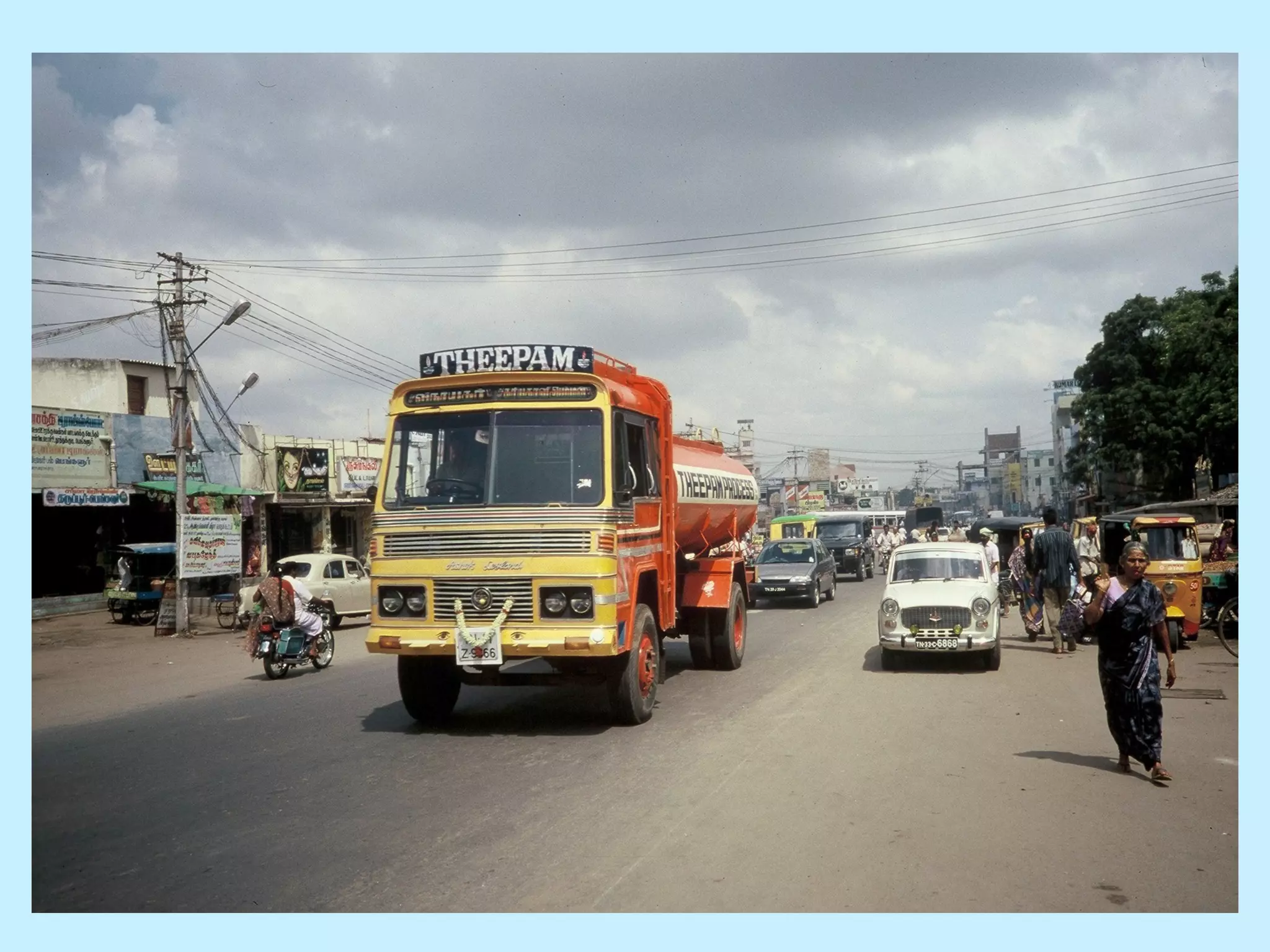
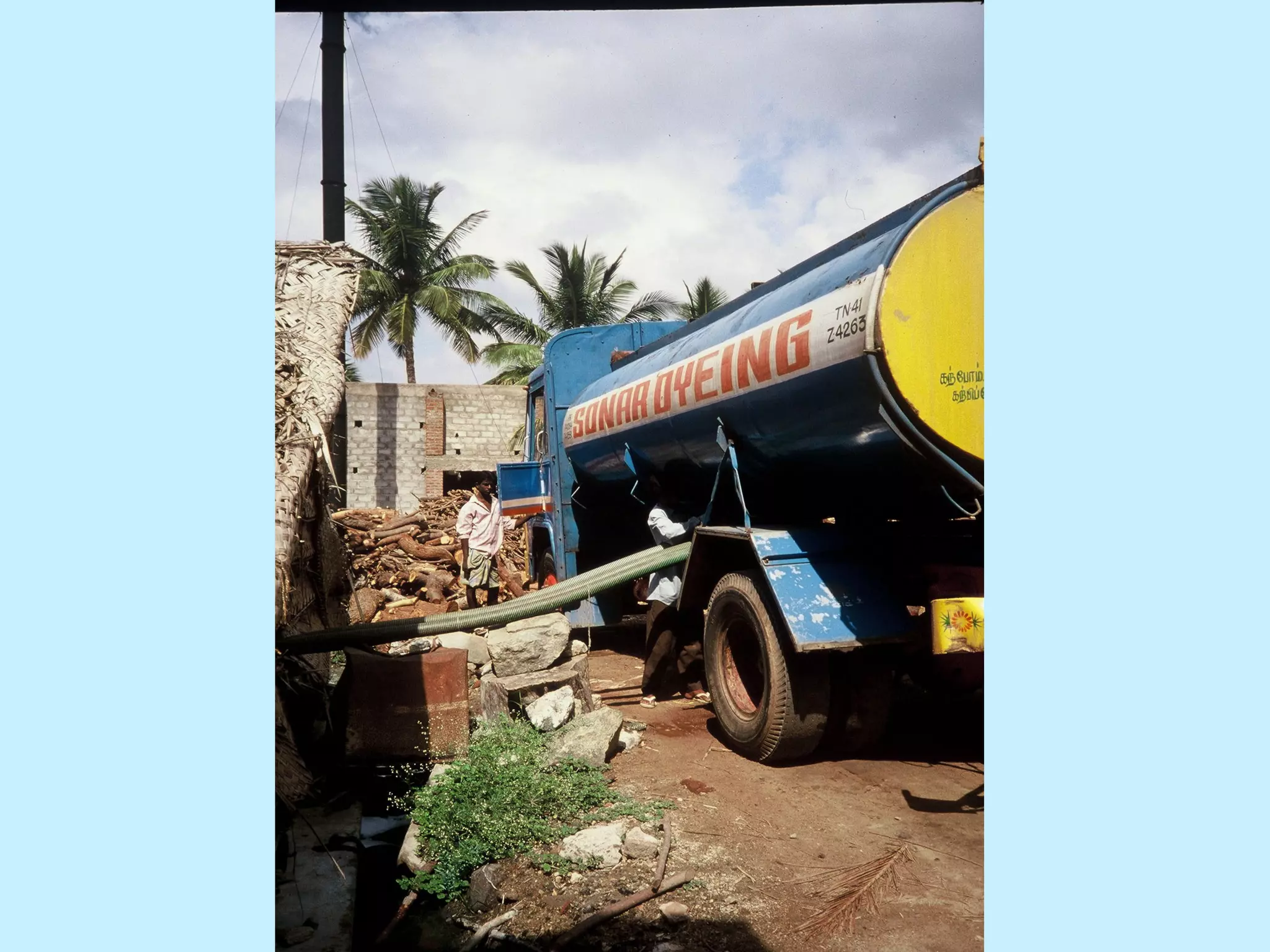
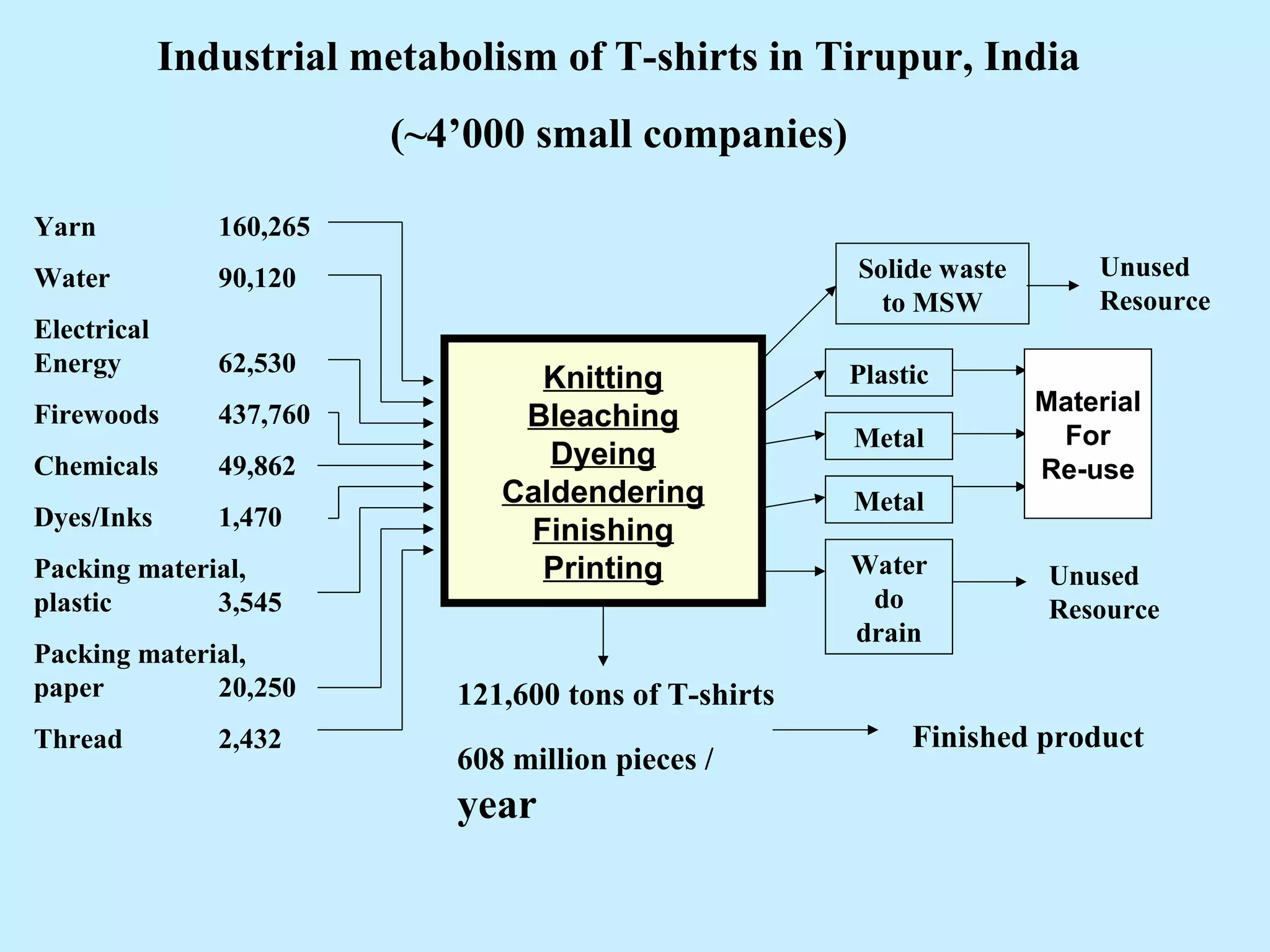
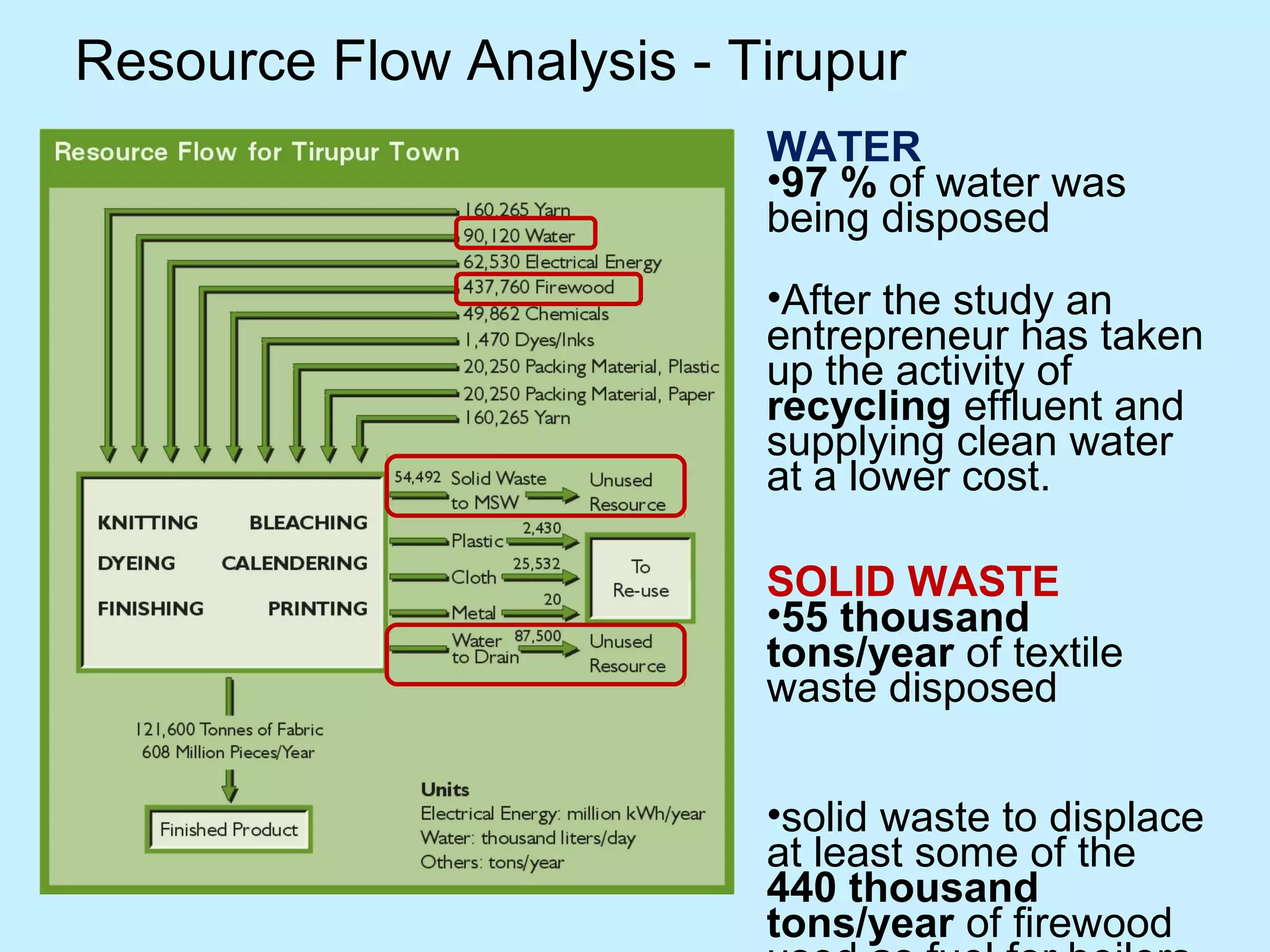
Industrial metabolism of T-shirts in Tirupur, India
(~4’000 small companies)
Yarn 160,265
Water 90,120
Electrical
Energy 62,530
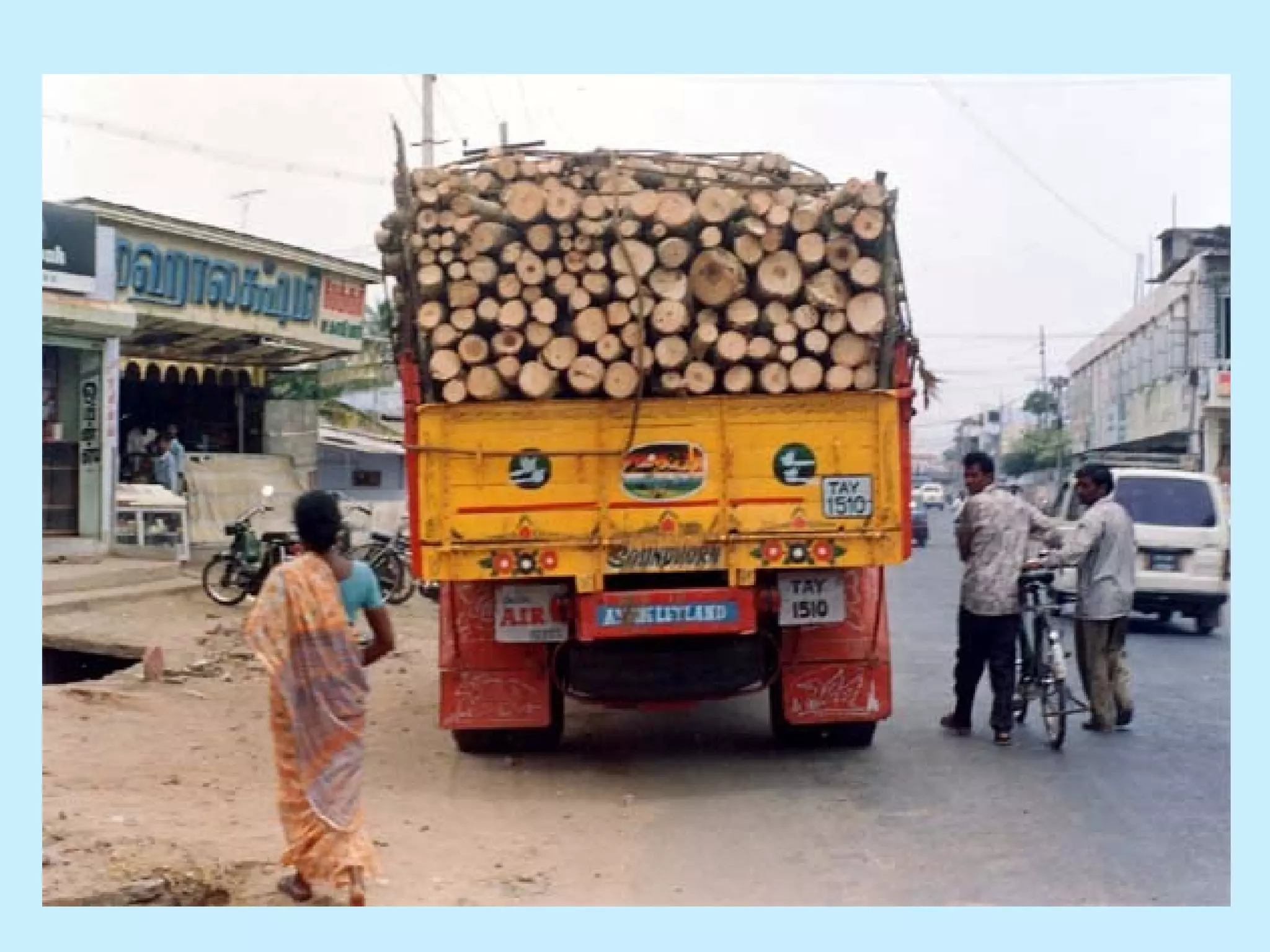
Firewoods 437,760
Chemicals 49,862
Dyes/Inks 1,470
Packing material,
plastic 3,545
Packing material,
paper 20,250
Thread 2,432
Knitting
Bleaching
Dyeing
Caldendering
Finishing
Printing
121,600 tons of T-shirts
608 million pieces /
year
Finished product
Solide waste
to MSW
Plastic
Metal
Water
do
drain
Metal
Material
For
Re-use
Unused
Resource
Unused
Resource
Resource Flow Analysis - Tirupur
WATER
•97 % of water was
being disposed
•After the study an
entrepreneur has taken
up the activity of
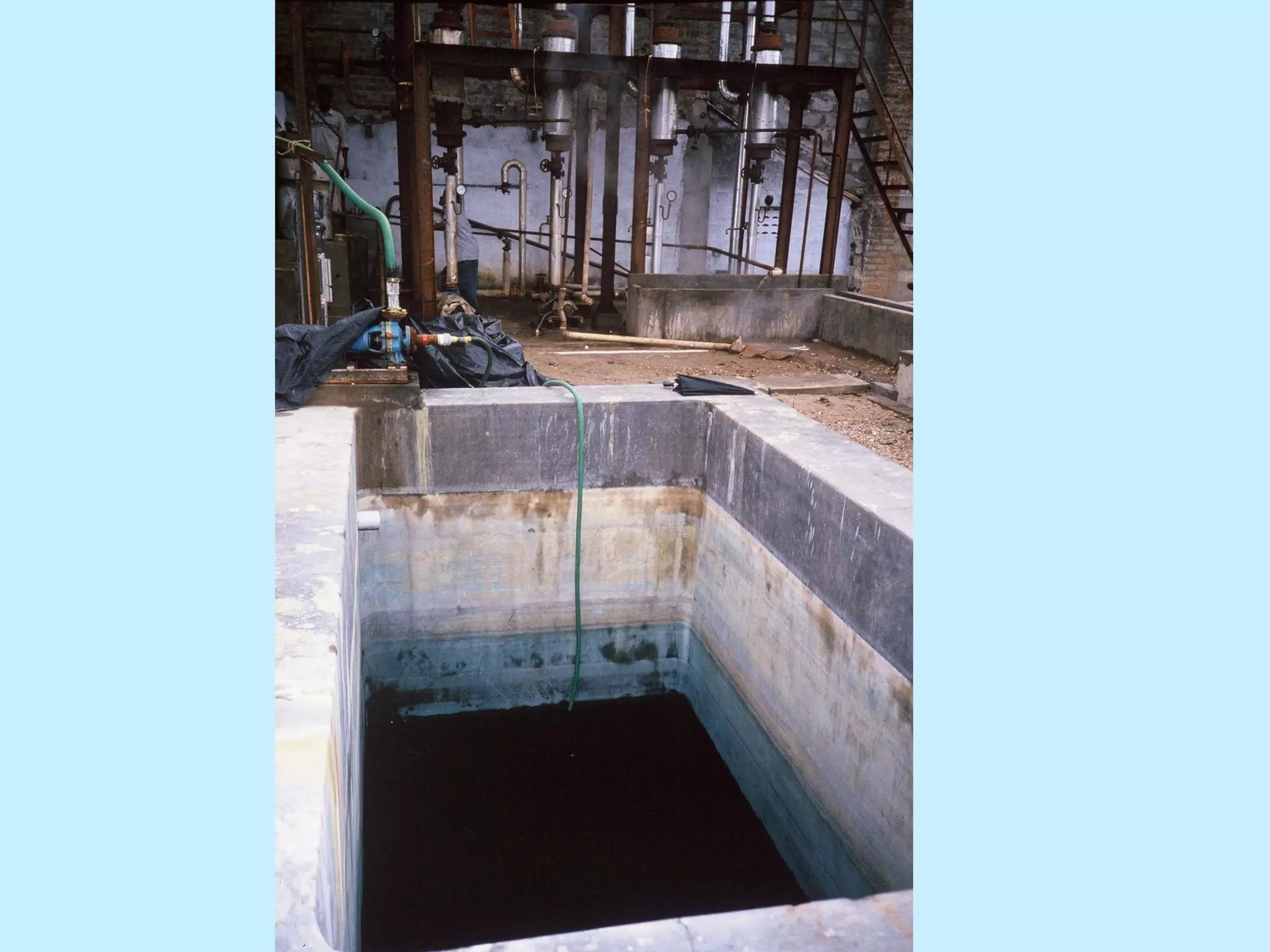
recycling effluent and
supplying clean water
at a lower cost.
SOLID WASTE
•55 thousand
tons/year of textile
waste disposed
•solid waste to displace
at least some of the
440 thousand
tons/year of firewood
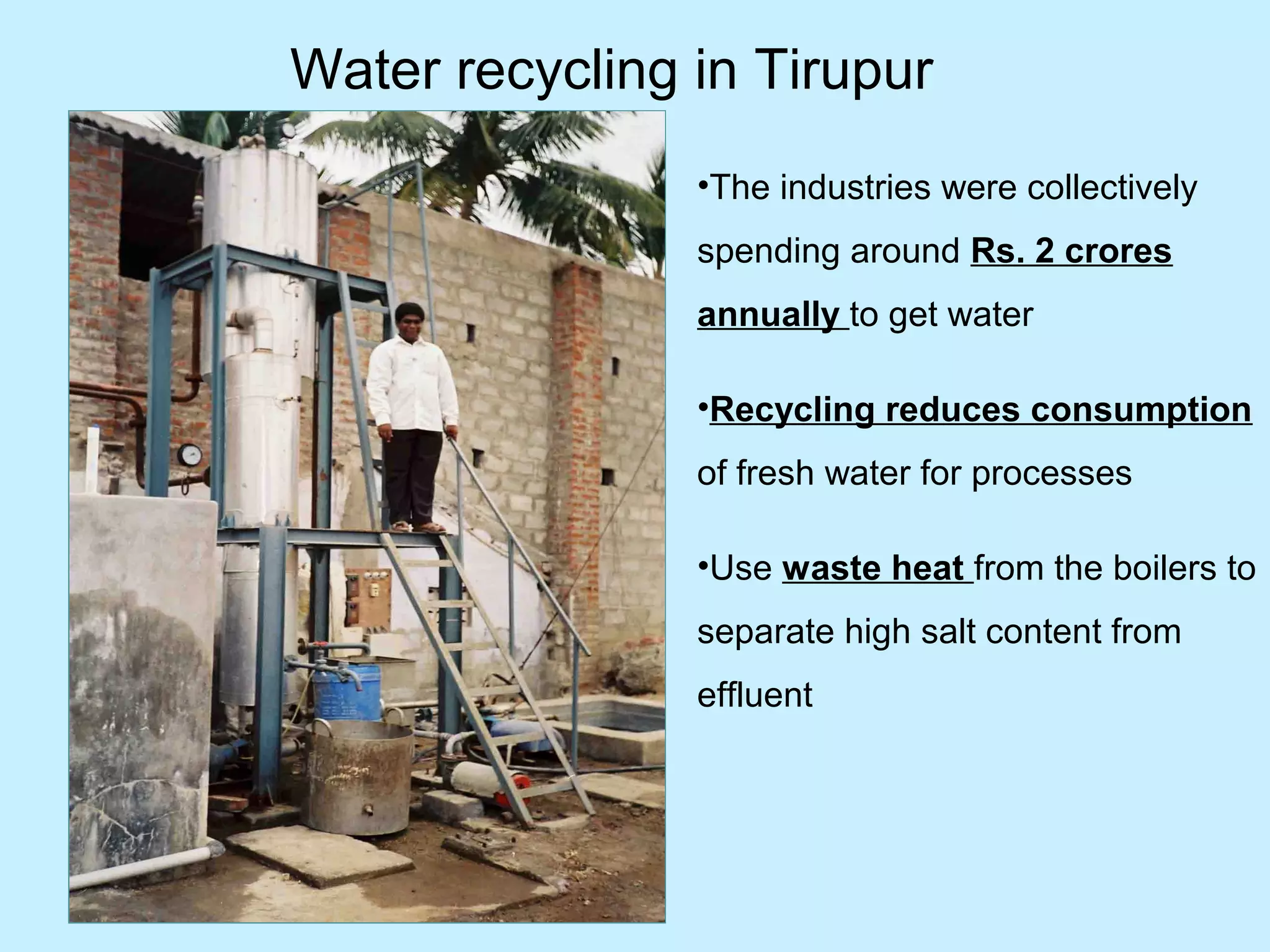
•The industries were collectively
spending around Rs. 2 crores
annually to get water
•Recycling reduces consumption
of fresh water for processes
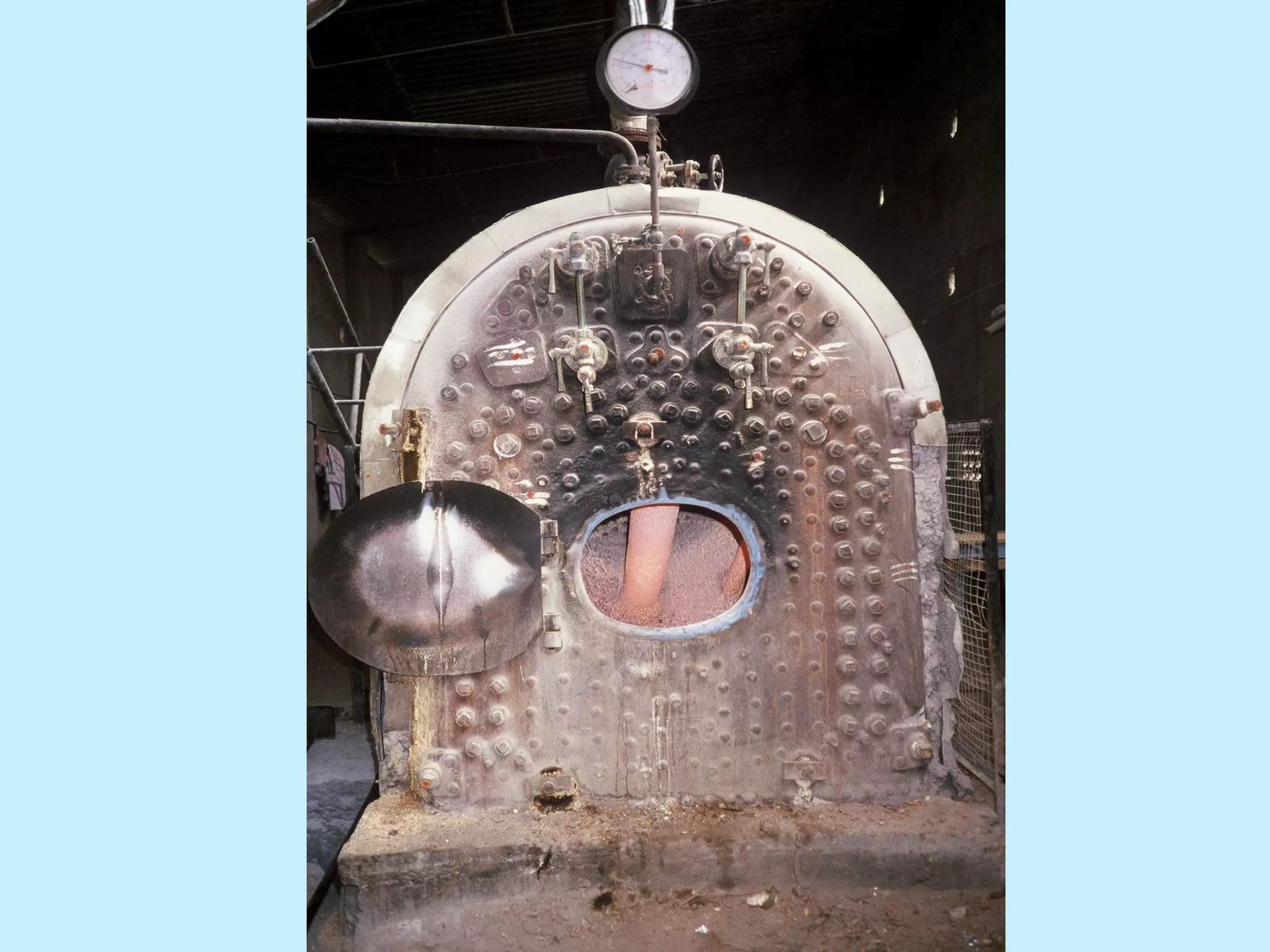
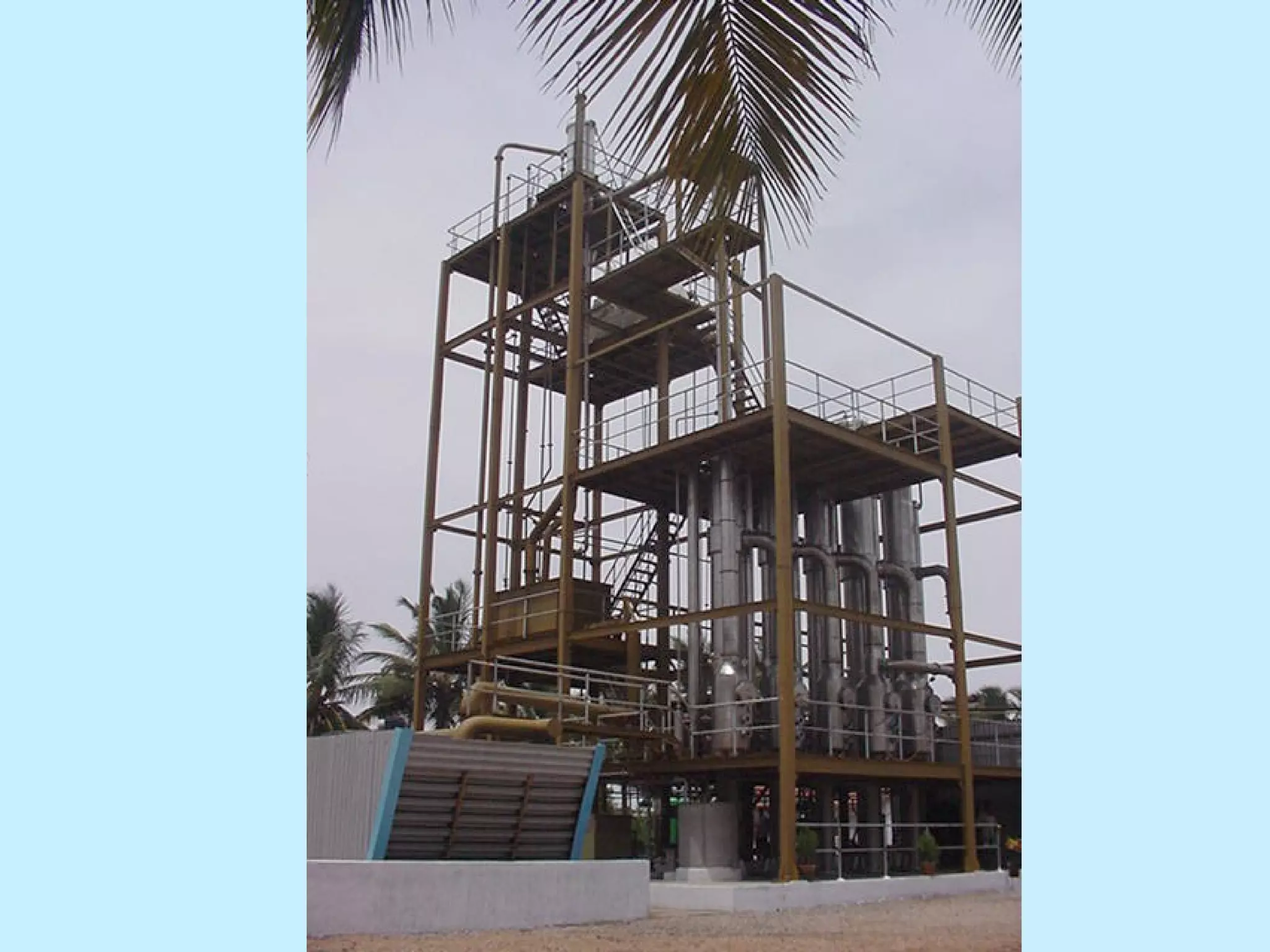
•Use waste heat from the boilers to
separate high salt content from
effluent
Water recycling in Tirupur
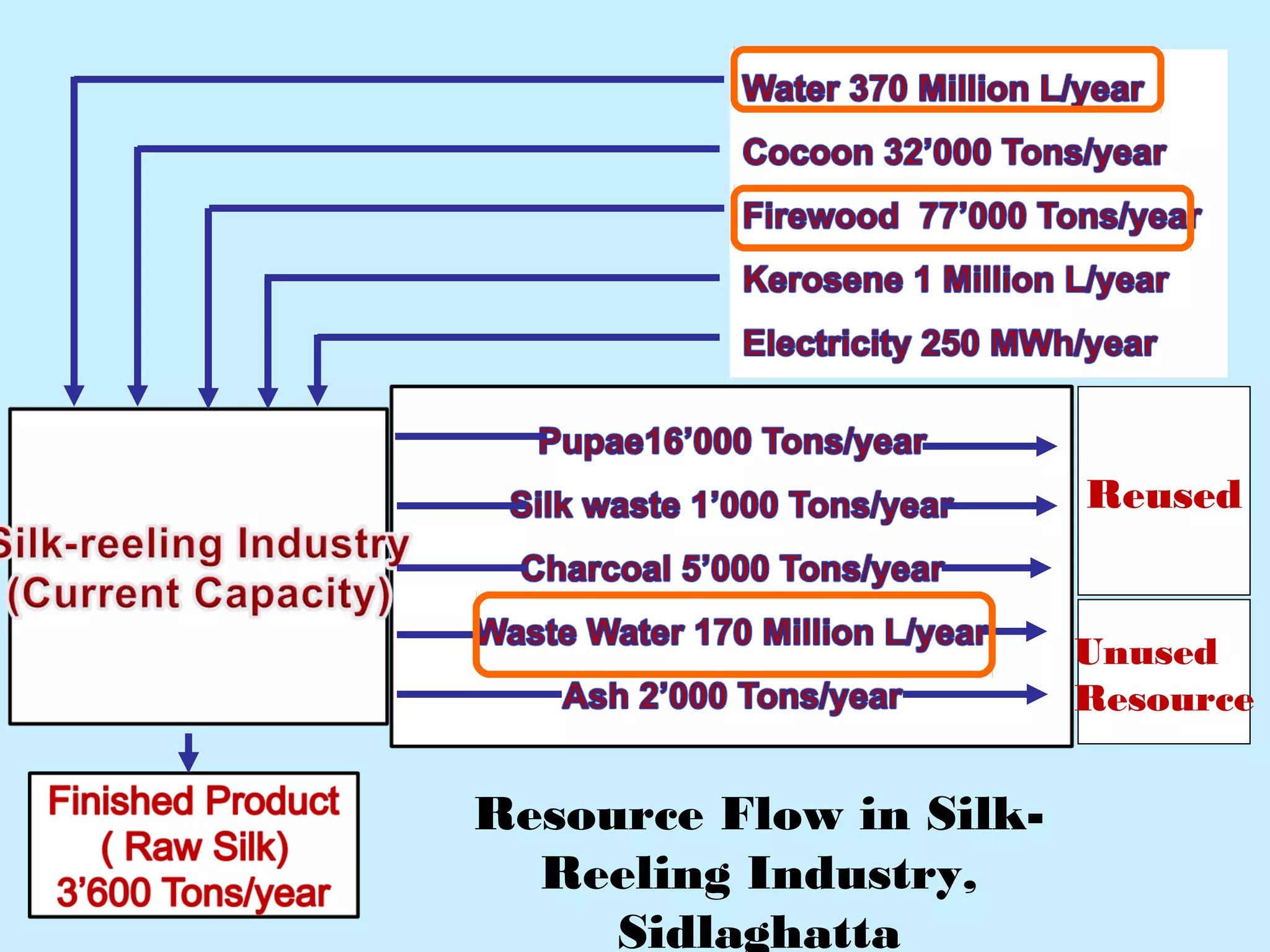
Reused
Unused
Resource
Resource Flow in Silk-
Reeling Industry,
Sidlaghatta
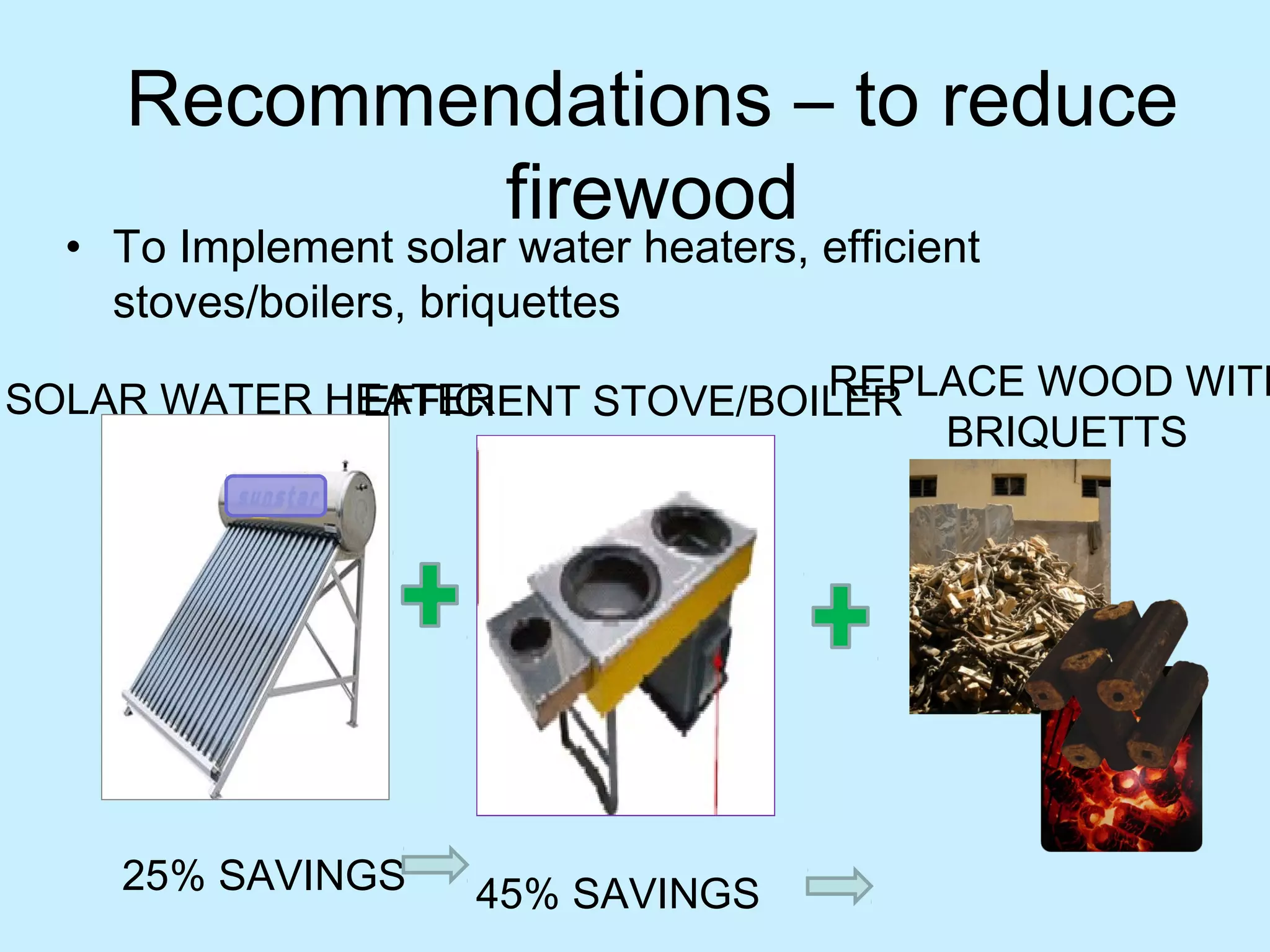
Recommendations – to reduce
firewood
• To Implement solar water heaters, efficient
stoves/boilers, briquettes
SOLAR WATER HEATER
25% SAVINGS
EFFICIENT STOVE/BOILER
45% SAVINGS
REPLACE WOOD WITH
BRIQUETTS
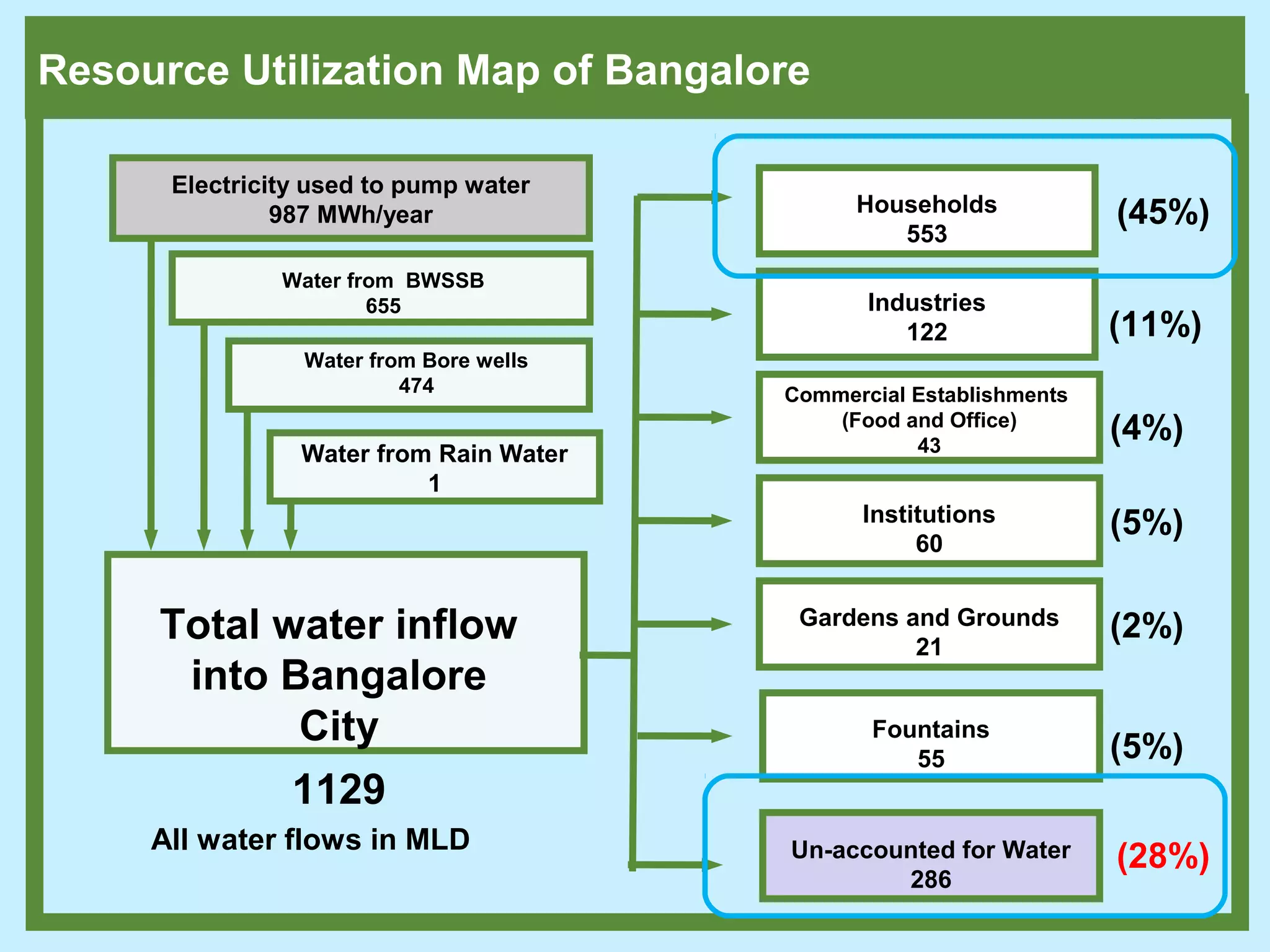
2007
Total water inflow
into Bangalore
City
1129
(5%)
(11%)
(4%)
(45%)
(2%)
(5%)
(28%)
Households
553
Industries
122
Commercial Establishments
(Food and Office)
43
Institutions
60
Gardens and Grounds
21
Fountains
55
Un-accounted for Water
286
All water flows in MLD
Resource Utilization Map of Bangalore
Electricity used to pump water
987 MWh/year
Water from Rain Water
1
Water from Bore wells
474
Water from BWSSB
655
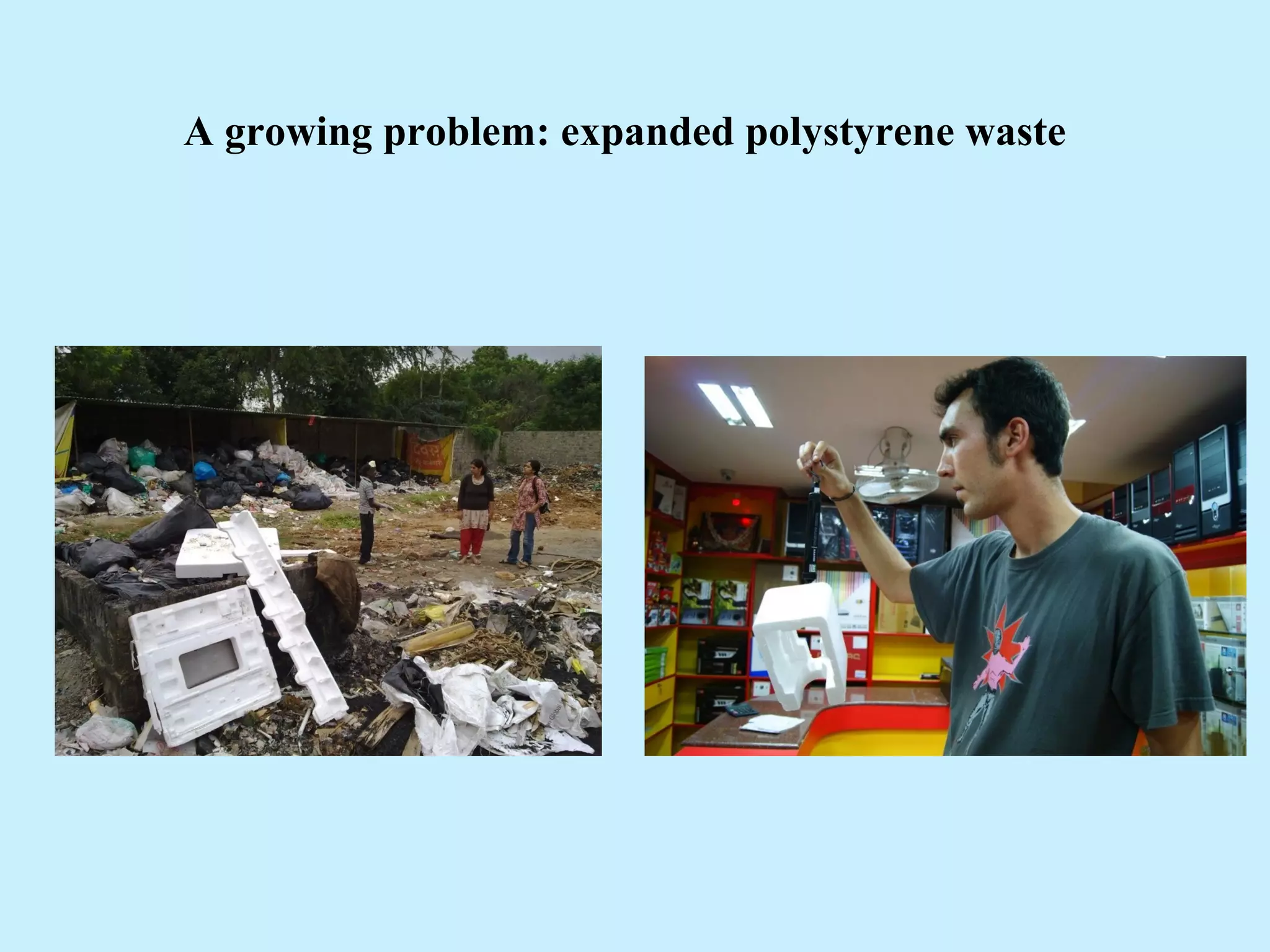
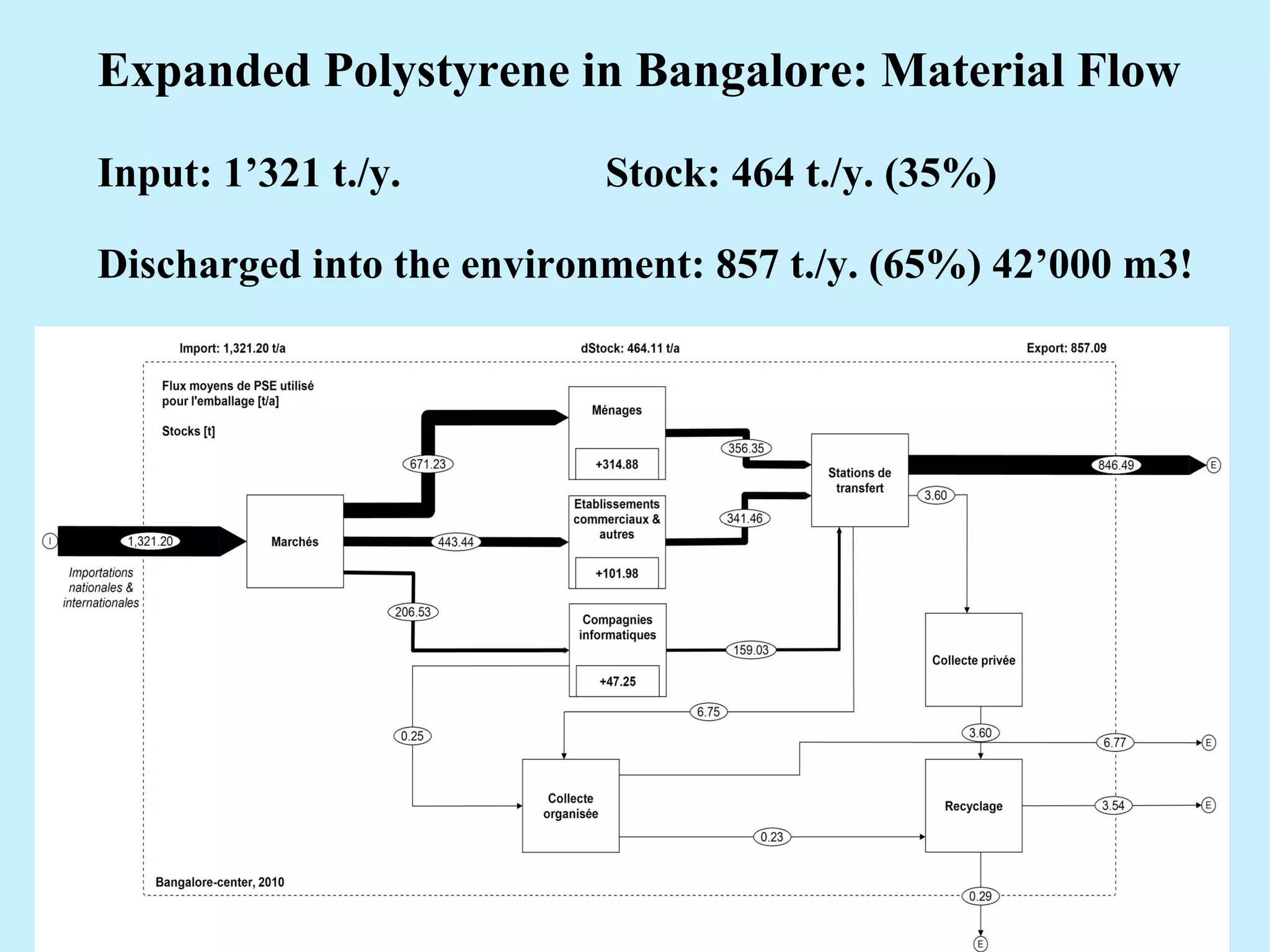
A growing problem: expanded polystyrene waste
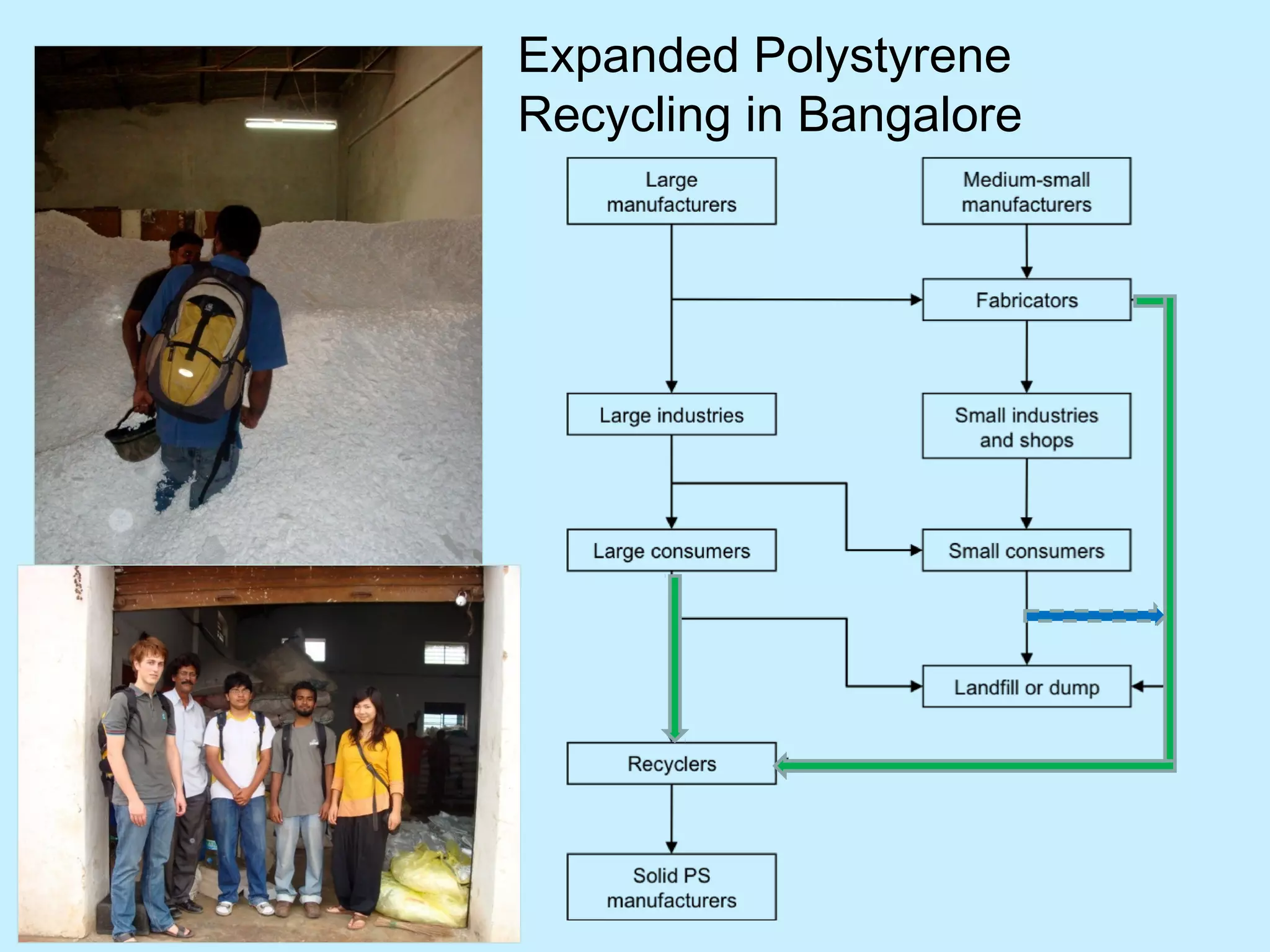
Expanded Polystyrene
Recycling in Bangalore
Expanded Polystyrene in Bangalore: Material Flow
Input: 1’321 t./y. Stock: 464 t./y. (35%)
Discharged into the environment: 857 t./y. (65%) 42’000 m3!
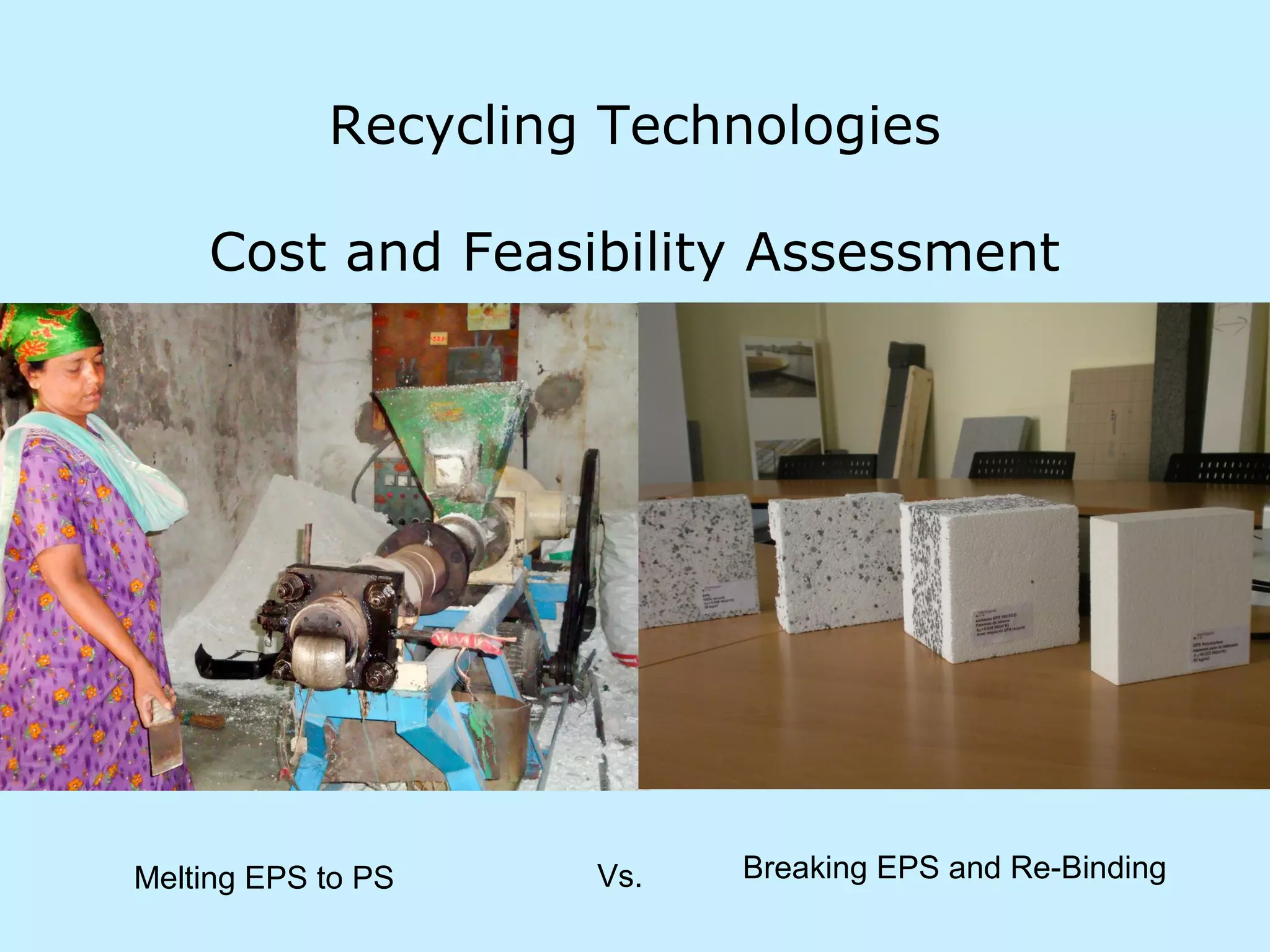
Recycling Technologies
Cost and Feasibility Assessment
Melting EPS to PS Breaking EPS and Re-BindingVs.
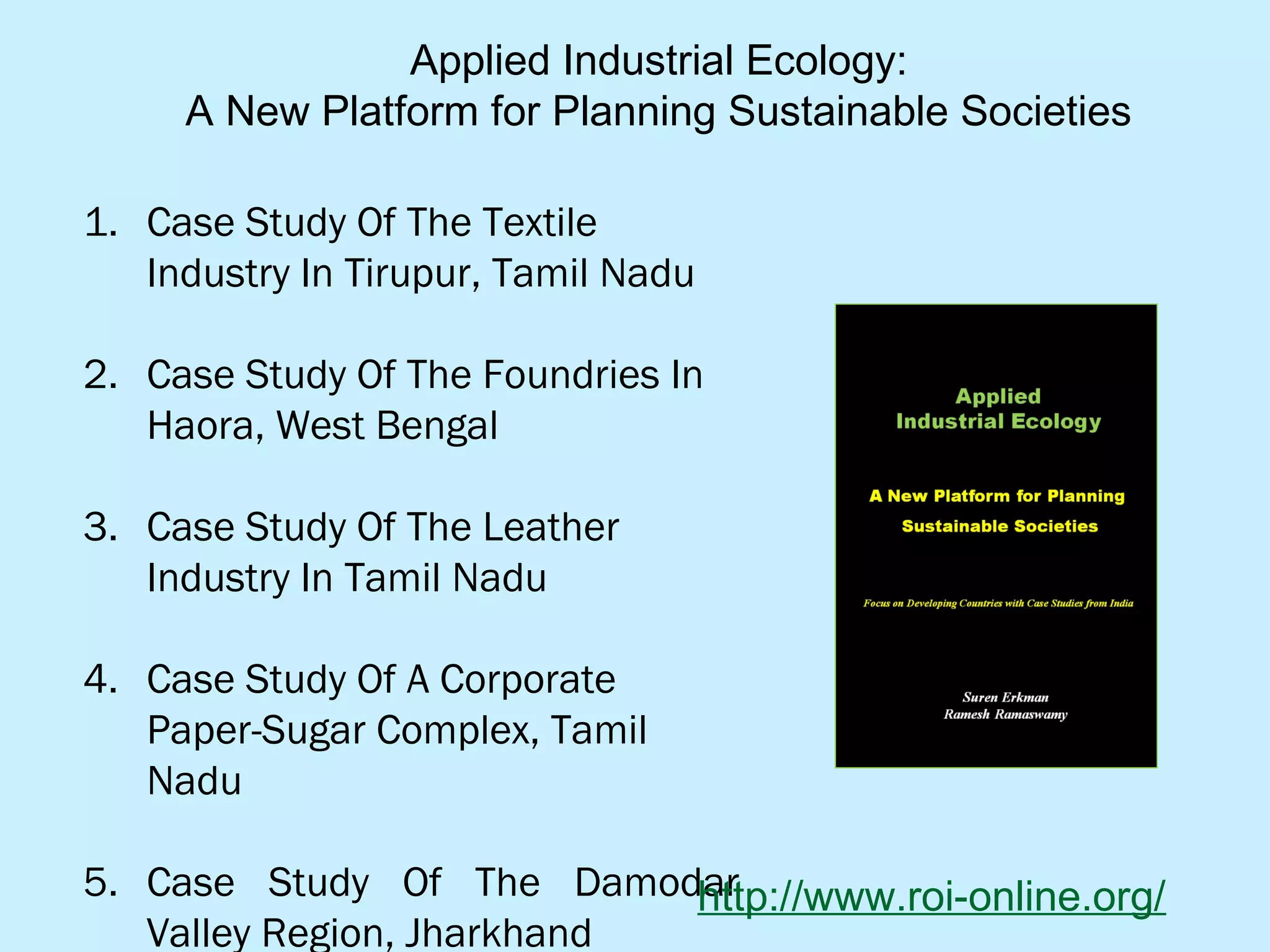
Applied Industrial Ecology:
A New Platform for Planning Sustainable Societies
1. Case Study Of The Textile
Industry In Tirupur, Tamil Nadu
2. Case Study Of The Foundries In
Haora, West Bengal
3. Case Study Of The Leather
Industry In Tamil Nadu
4. Case Study Of A Corporate
Paper-Sugar Complex, Tamil
Nadu
5. Case Study Of The Damodar
Valley Region, Jharkhand
http://www.roi-online.org/
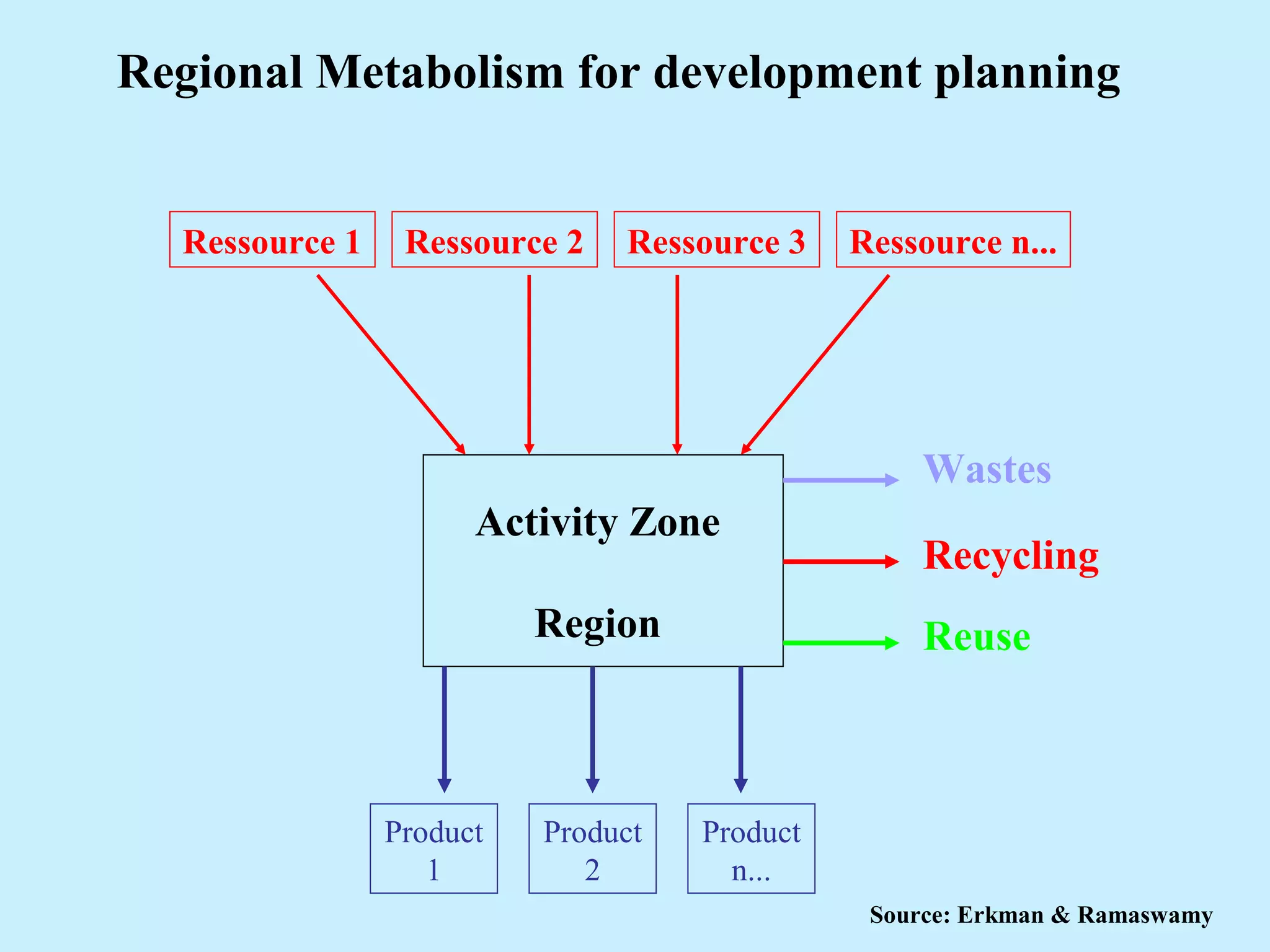
Regional Metabolism for development planning
Activity Zone
Region
Wastes
Recycling
Reuse
Product
1
Product
2
Product
n...
Ressource 1 Ressource 2 Ressource 3 Ressource n...
Source: Erkman & Ramaswamy
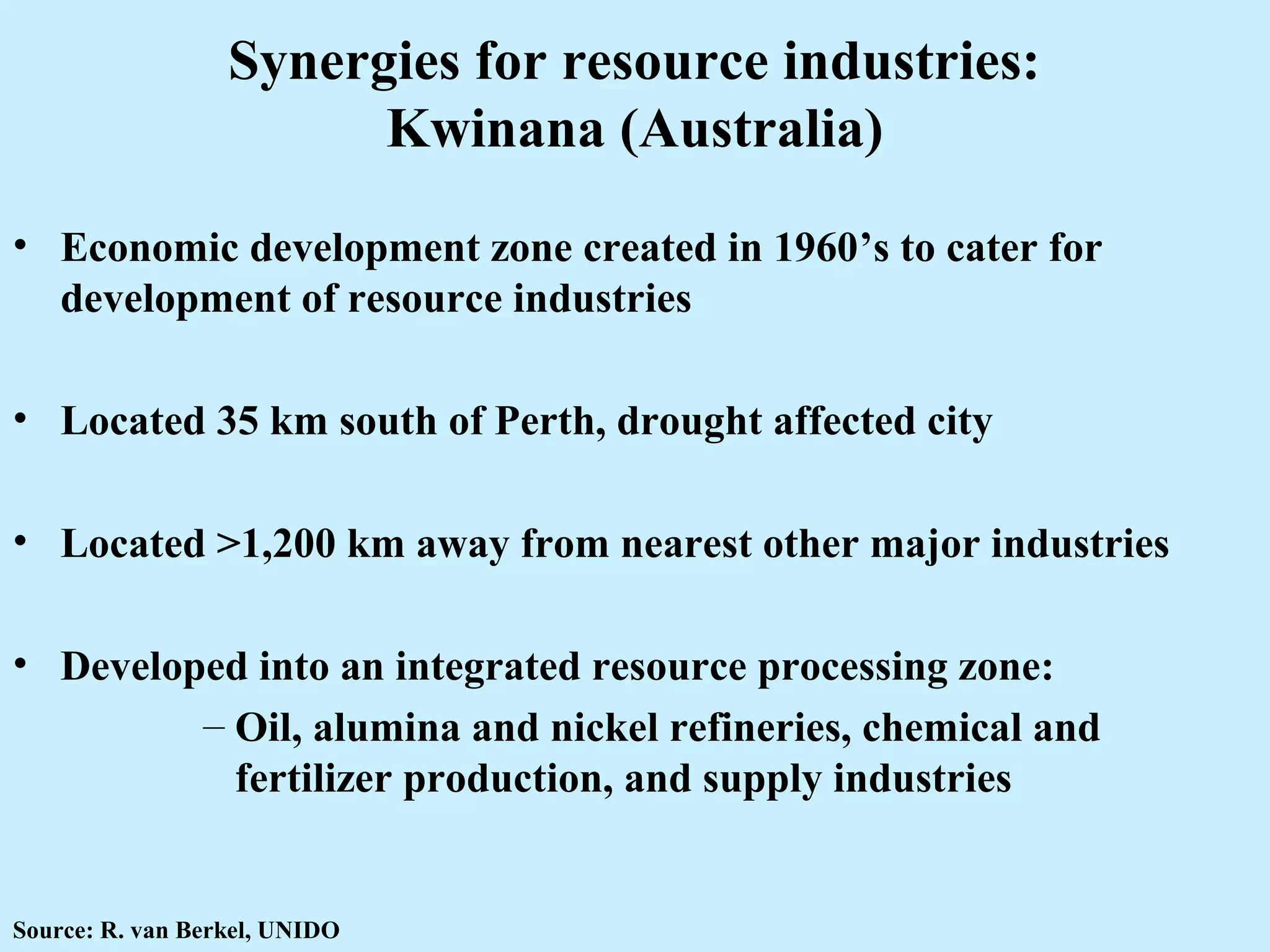
Synergies for resource industries:
Kwinana (Australia)
• Economic development zone created in 1960’s to cater for
development of resource industries
• Located 35 km south of Perth, drought affected city
• Located >1,200 km away from nearest other major industries
• Developed into an integrated resource processing zone:
– Oil, alumina and nickel refineries, chemical and
fertilizer production, and supply industries
Source: R. van Berkel, UNIDO
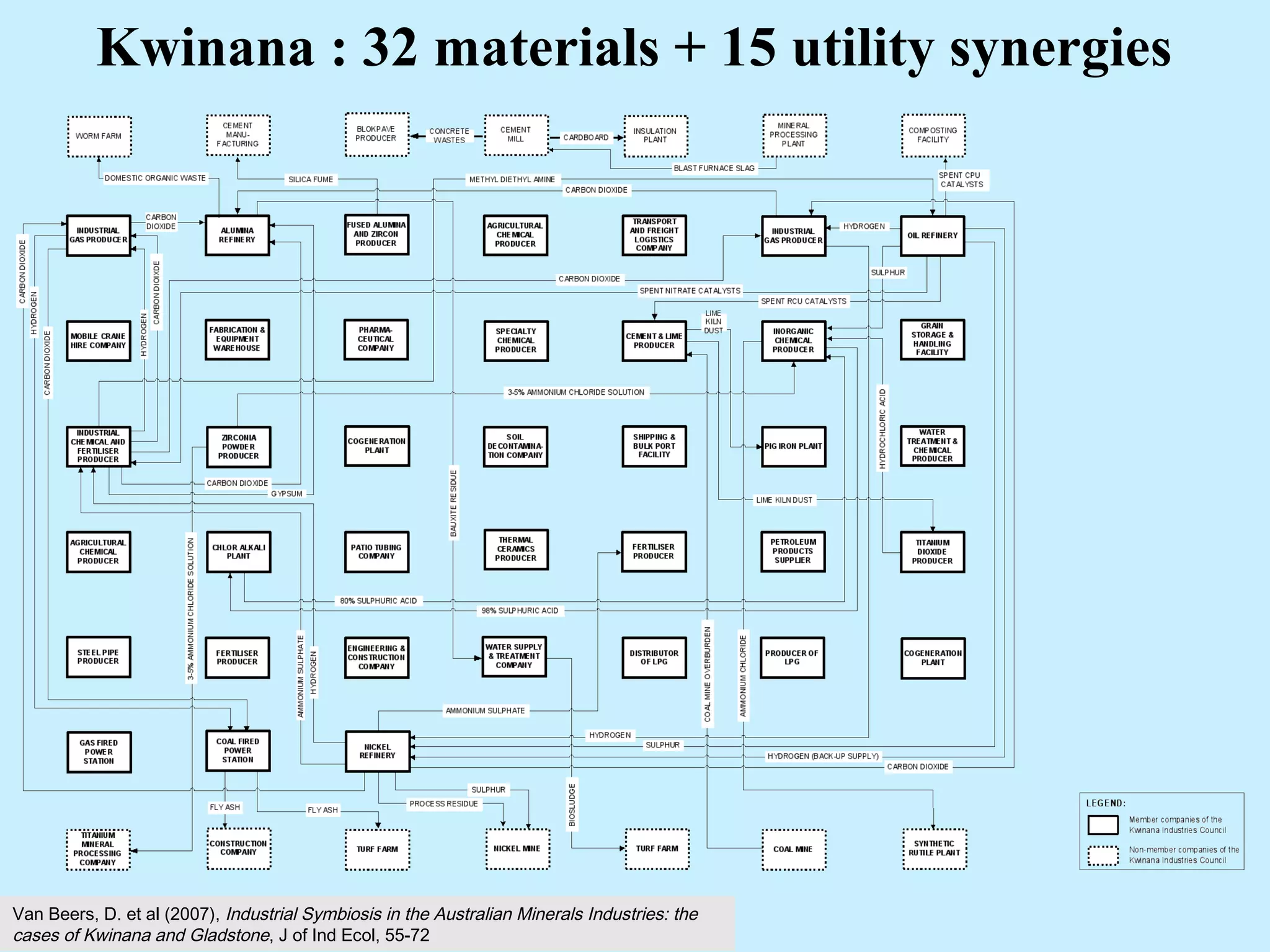
Kwinana : 32 materials + 15 utility synergies
Van Beers, D. et al (2007), Industrial Symbiosis in the Australian Minerals Industries: the
cases of Kwinana and Gladstone, J of Ind Ecol, 55-72
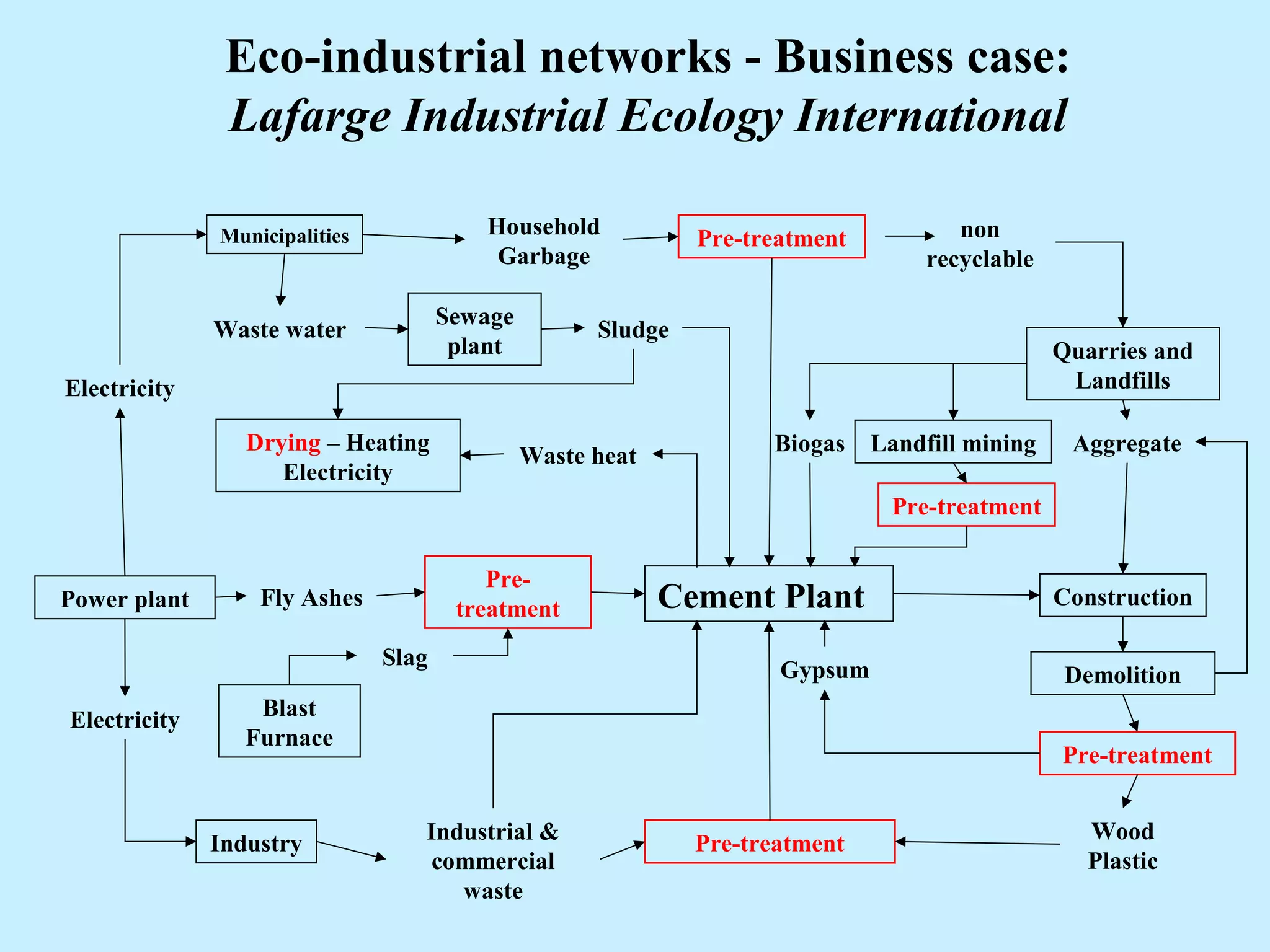
Cement Plant
Municipalities
Quarries and
Landfills
Industry
Power plant
Pre-treatmentHousehold
Garbage
Waste water
Sewage
plant
Sludge
Electricity
Electricity
Pre-treatment
Fly Ashes
Industrial &
commercial
waste
non
recyclable
Construction
Demolition
Aggregate
Gypsum
Biogas
Waste heat
Drying – Heating
Electricity
Wood
Plastic
Blast
Furnace
Slag
Pre-
treatment
Pre-treatment
Landfill mining
Pre-treatment
Eco-industrial networks - Business case:
Lafarge Industrial Ecology International
Page 75
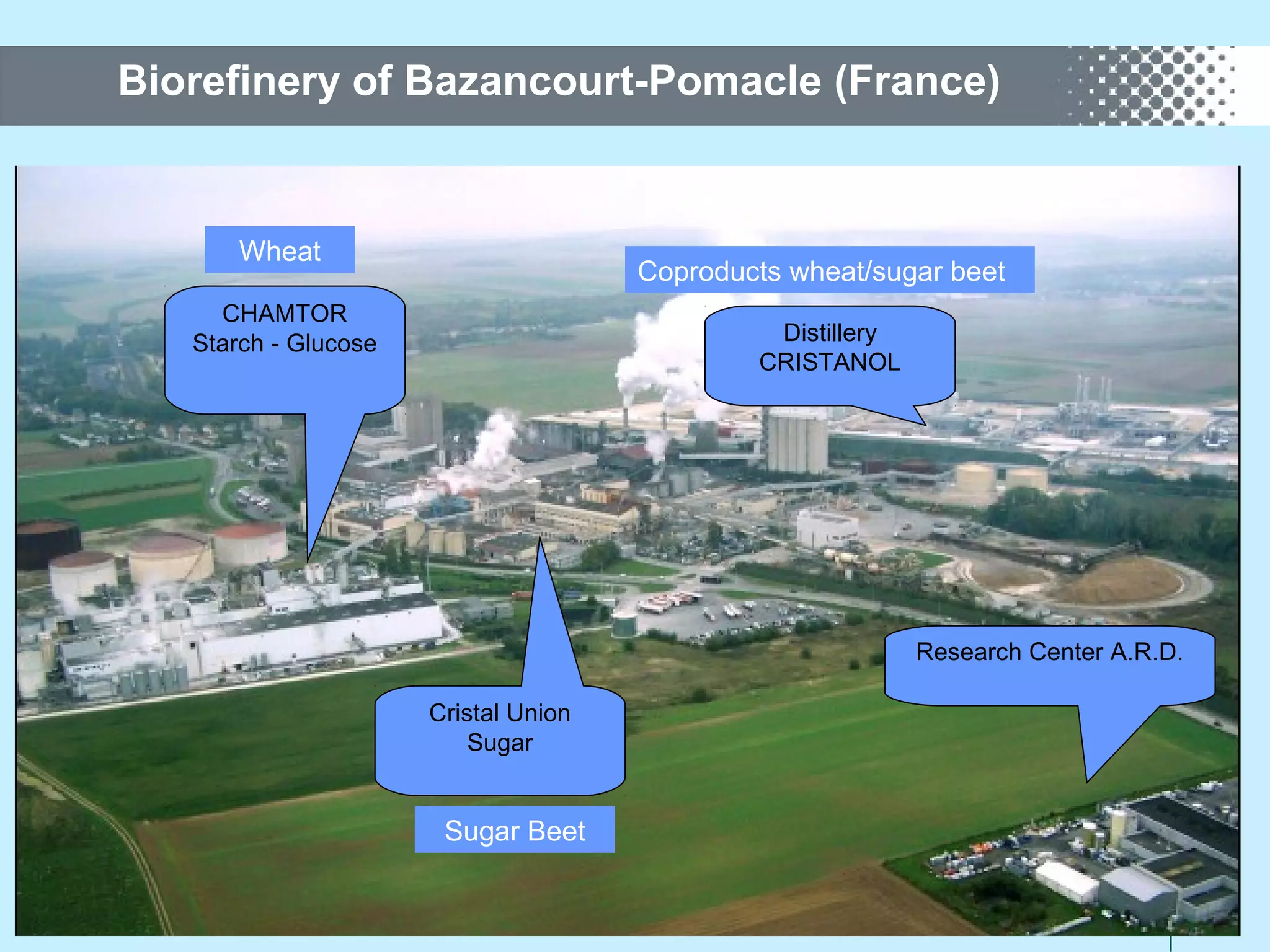
Distillery
CRISTANOL
Research Center A.R.D.
Cristal Union
Sugar
CHAMTOR
Starch - Glucose
Coproducts wheat/sugar beet
Sugar Beet
Wheat
Biorefinery of Bazancourt-Pomacle (France)
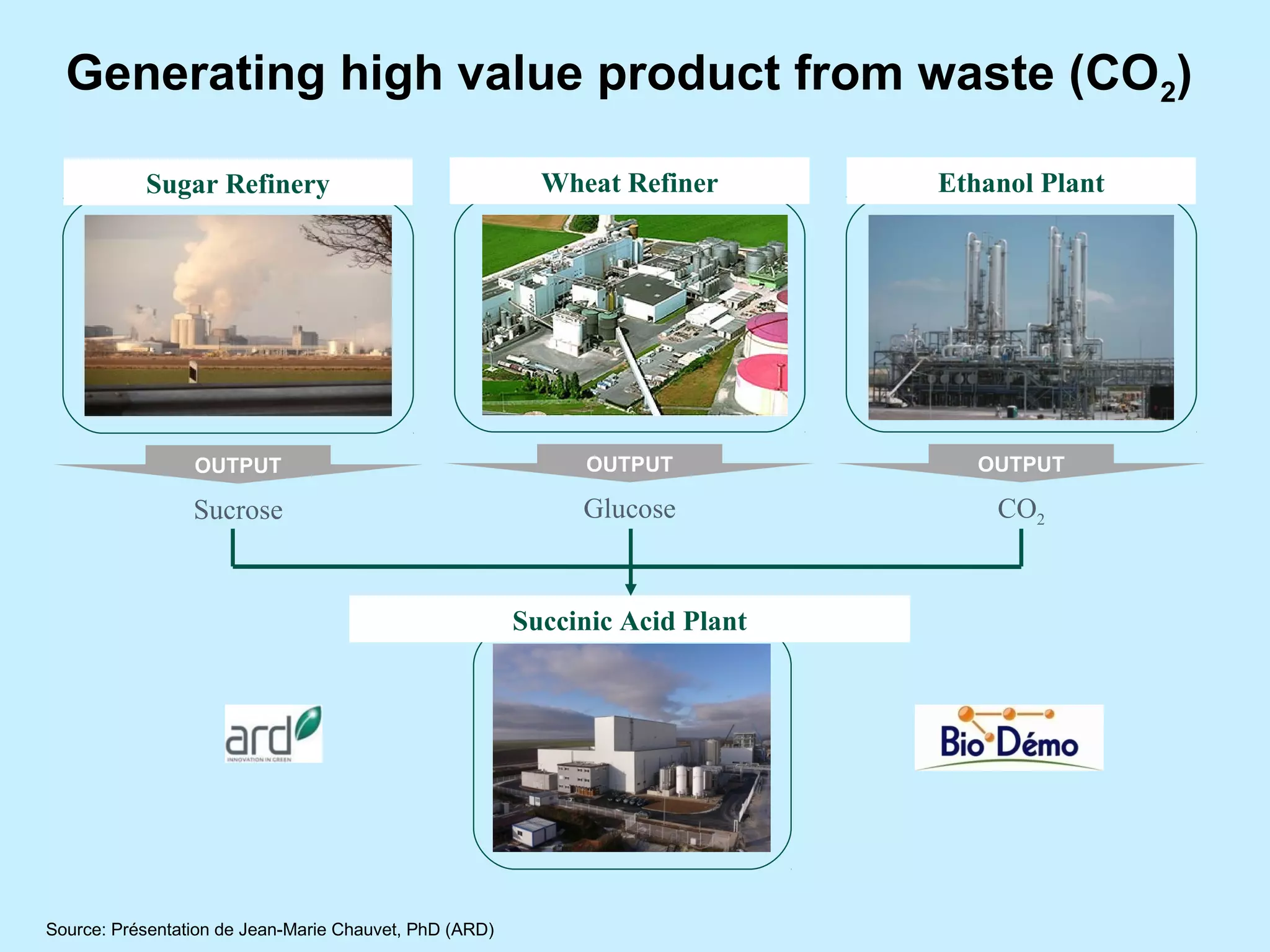
OUTPUT
Sucrose
Sugar Refinery
Succinic Acid Plant
OUTPUT
Glucose
Wheat Refiner
OUTPUT
CO2
Ethanol Plant
Generating high value product from waste (CO2)
Source: Présentation de Jean-Marie Chauvet, PhD (ARD)
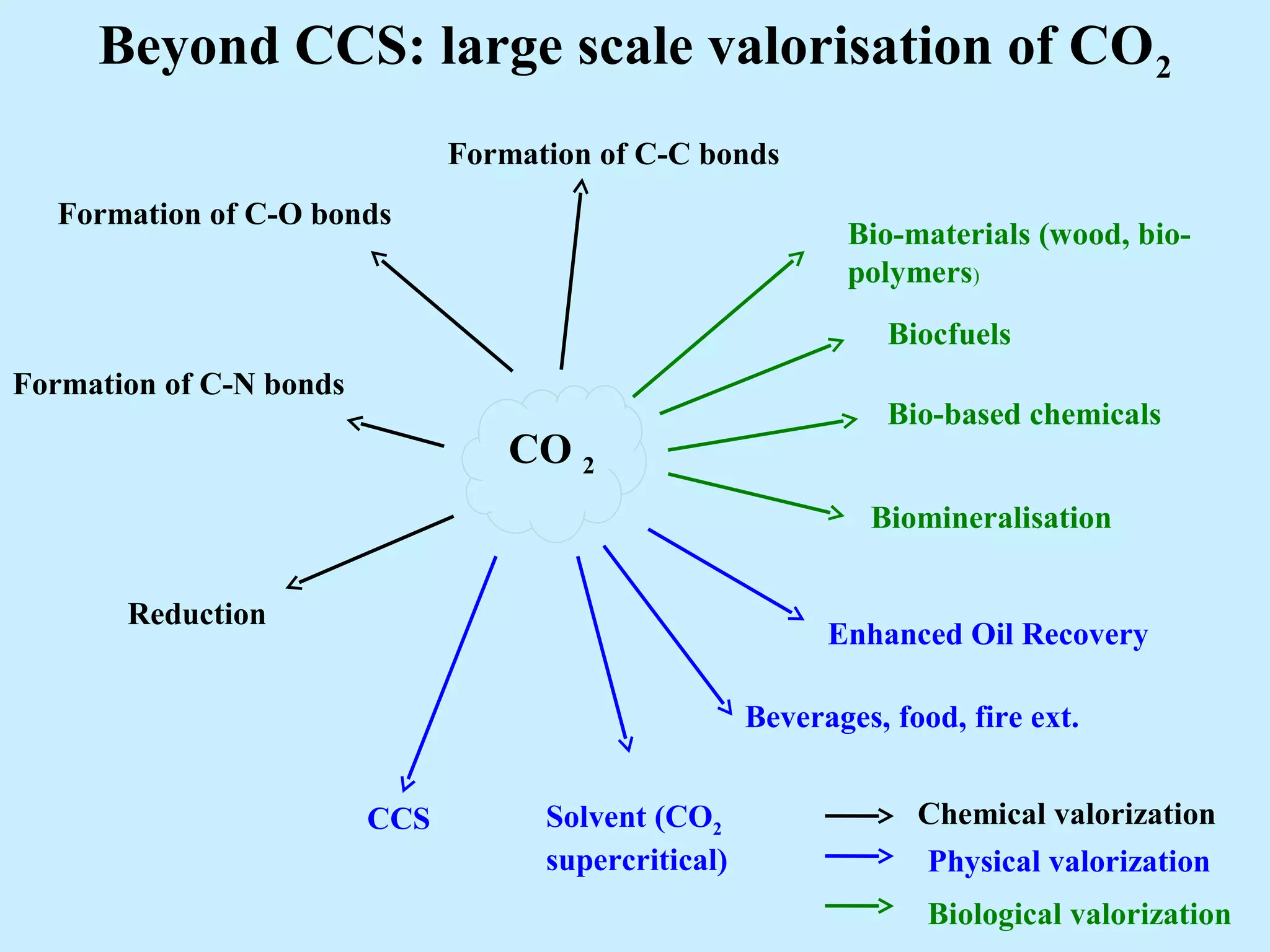
Beyond CCS: large scale valorisation of CO2
Chemical valorization
Physical valorization
Biological valorization
CO 2
Bio-materials (wood, bio-
polymers)
Biocfuels
Biomineralisation
Enhanced Oil Recovery
Beverages, food, fire ext.
Solvent (CO2
supercritical)
Formation of C-C bonds
CCS
Formation of C-O bonds
Formation of C-N bonds
Reduction
Bio-based chemicals
Industrial ecology:
What is being done ?
a) Measure, analyze, evaluate, anticipate
b) Practical implementation at various scales
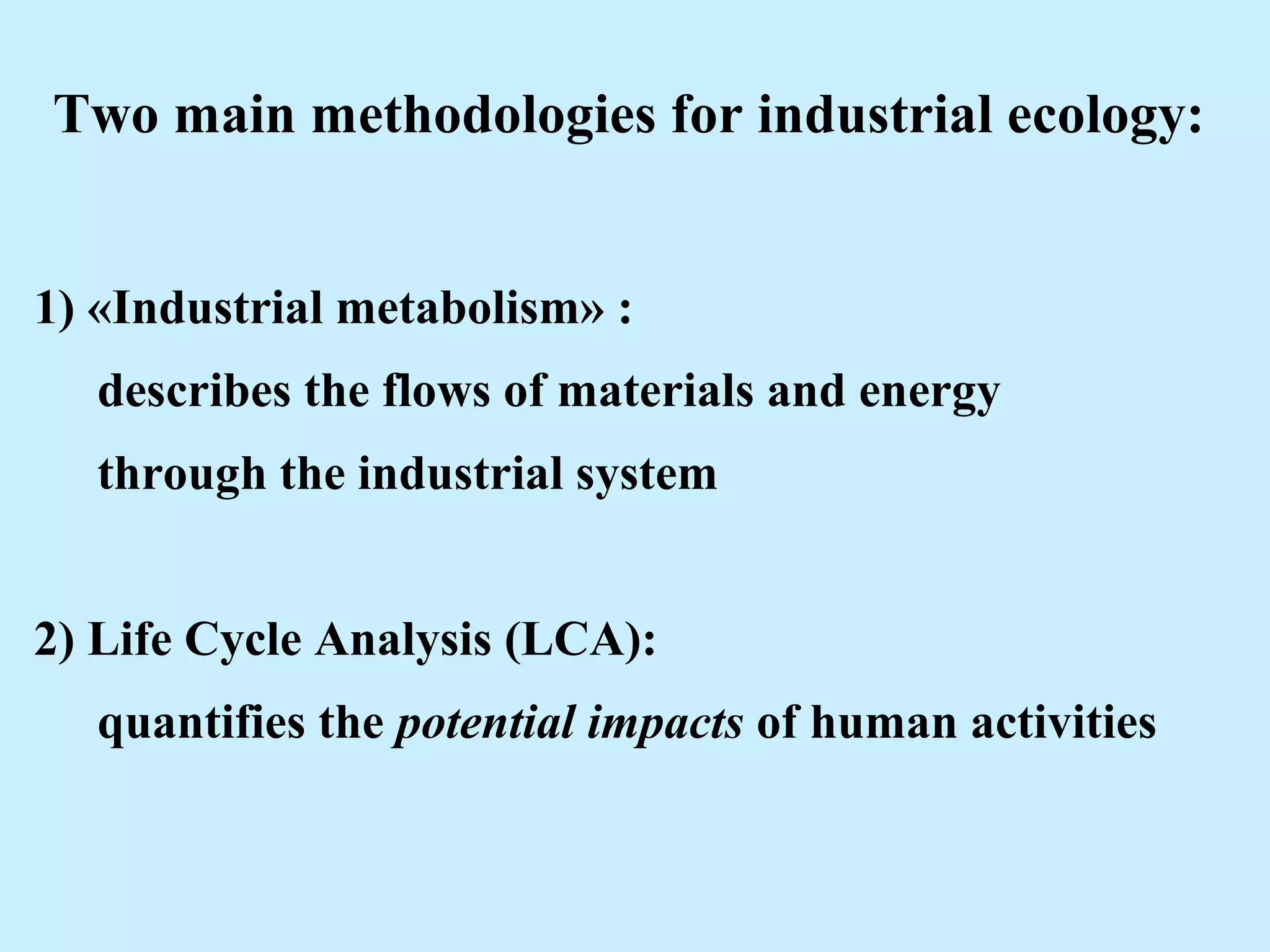
Two main methodologies for industrial ecology:
1) «Industrial metabolism» :
describes the flows of materials and energy
through the industrial system
2) Life Cycle Analysis (LCA):
quantifies the potential impacts of human activities
Thank you !
suren.erkman@unil.ch
suren.erkman@sofiesonline.com
www.unil.ch
www.sofiesonline.com

1 course green_academy_erkman-copie

  • 1.
    Industrial Ecology: Implementing theGreen Economy Prof. Suren Erkman University of Lausanne, Switzerland Green Academy Master Class, Astana, 1st October 2013
  • 2.
    Three main reasons: Secureaccess to resources, minimize pollution Secure access to foreign and domestic markets Sustain growing international constraints/oppportunities Green Economy: why care? what is the point?
  • 3.
    Growing importance ofeco-labels and certifications
  • 5.
    : “…that resultsin improved human well-being and social equity, while significantly reducing environmental risks and ecological scarcities.” “…new model for economic development aimed at achieving improved wellbeing and social equity while simultaneously diminishing environmental risks and reducing ecological scarcities.”  “…low carbon, resource efficient & socially inclusive.” UNEP Green Economy: definition
  • 6.
    To provide morevalue with less environmental impact To de-link advances in welfare from the natural resource use To improve both economic and ecological efficiency = ECO-EFFICIENCY (Dematerialization of our society, Resource productivity) UNEP / UNIDO Green Economy Strategy
  • 8.
  • 9.
    Focus on pollution: « end of pipe » strategy: « end of pipe » strategy Source: L'écosystème Belgique, 1983 Market: > 1’200 billion $ / year
  • 10.
    The market ofpollution treatmentThe market of pollution treatment ( « end of pipe » approach):( « end of pipe » approach): 3 components:3 components: 1. Technical equipement for waste treatment (filters, etc.)
  • 11.
    The market ofpollution treatmentThe market of pollution treatment ( « end of pipe » approach):( « end of pipe » approach): 3 components:3 components: 2. Buildings, facilities, etc., needed to operate the technical equipment
  • 12.
    The market ofpollution treatmentThe market of pollution treatment ( « end of pipe » approach):( « end of pipe » approach): 3 components:3 components: 3. High value added services: monitoring, control of performance and quality, consulting, impact studies, etc.
  • 13.
    The «end ofpipe» approach is very useful,The «end of pipe» approach is very useful, but… : - It is too narrow - It does not really solve the problems - It is not in favour of developping countries
  • 14.
  • 15.
    Beyond the «endof pipe» approach,Beyond the «end of pipe» approach, aa major progress:major progress: - Cleaner Production - Cleaner Production and Consumption - Sustainable Production and Consumption - See: http://www.unido.org/ (case studies) Main international institutions for Cleaner Production: - United Nations Industrial Development Organisation (UNIDO) - United Nations Environment Programme (UNEP)
  • 16.
    Resource Efficient and CleanerProduction (RECP) RECP Solution Investment Annual saving and impact PBP Wastewater recycling in textile industry 285'000 euros 72’700 euros/year Water: 150’ 000 m3 /years 4 years Energy accounting in 5 industrial sectors 725’000 euros (10 companies) 5-10% of energy consumption 2-5 years Substitution of input in painting process 100’000 euros 30’800 euros/year Waste and VOC reduction ~3 years Improvement of galvanization process 200’000 euros 60’000 euros/year Resource saving in the process: Water (80-90%), Energy (10-15%), Chemicals (30%), Waste (80%) 3-3.5 years
  • 17.
    Traditional vs GreenChemistry: Exemple of Ibuprofene Boots process BHC process
  • 18.
    Synthesis of Ibuprofène:Boots process • Discovered in 1960 • Reagent: methylpropylbenzene • Synthesis en 6 steps • Use of 8 intermediate reagents • Specific conditions for each step • Poor yield
  • 19.
    Synthesis of Ibuprofene:BHC process • Discovered in 1980 • Reagent: methylpropylbenzene • Synthesis in 3 steps • High yield • By-product: acetic acid, can be used.
  • 20.
    Economic aspects: Flux [tonnes/an]Procédé Boots Procédé BHC Réactifs 33'000 17'000 Produits 13'000 13'000 Déchets 20'000 4'000 Total 66'000 34'000 • Annual production: 13'000 tons • Materials consumption divided by 2 • BHC process: no waste
  • 21.
    Dematerialization Relative dematerialization: More productsand services with lower consumption of resource per unit produced («Factor 4»). Absolute dematerialization: Absolute decrease of resource consumption («Factor 10»).
  • 22.
    Source: Catalogue dela prévention des déchets, ministère de l’environnement, Paris Dematerialization of packaging
  • 23.
    Source: Catalogue dela prévention des déchets, ministère de l’environnement, Paris Dematerialization of packaging (Coca Cola)
  • 24.
    Source: Catalogue dela prévention des déchets, ministère de l’environnement, Paris Dematerialization of packaging
  • 25.
    Source: Catalogue dela prévention des déchets, ministère de l’environnement, Paris Dematerialization of packaging (Nestlé)
  • 26.
    Source: Catalogue dela prévention des déchets, ministère de l’environnement, Paris Dematerialization of chocolate powder…
  • 27.
    Source: Catalogue dela prévention des déchets, ministère de l’environnement, Paris Dematerialization: less air in the powder ! (Nesquik)
  • 28.
    Aspects of dematerialization(4) The strategy of product life extension: 1) Reuse 2) Repair 3) Remanufacture 4) Recycle (the last option!) Source: Walter Stahel: http://www.product-life.org
  • 29.
  • 30.
    «Functionality Economy» (or ProductService System - PSS) Sell the function (or the performance), instead of the product !
  • 31.
  • 32.
    (c) Tomohiko Sakao,Linköping University PSS: New Business Models Modified from Tischner och Verkuijl (2002) Value based on product Value based on service IPSO Pure product sales Product- Oriented service Pure service sales Use- Oriented service Result- Oriented service Modified from Tischner och Verkuijl (2002) Value based on product Value based on service IPSO Pure product sales Product- Oriented service Pure service sales Use- Oriented service Result- Oriented service Sale of Performance e.g. : chemical leasing, painted surfaces, etc. PSS Rental, use contracts
  • 33.
    Functionality Economy: Some consequences: -Maintenancebecomes crucial, more than production
  • 34.
    Functionality Economy: Some consequences: -Maintenance becomes crucial, more than production -More jobs, more stable
  • 35.
    Functionality Economy: Some consequences: -Maintenance becomes crucial, more than production - More jobs, more stable - New concept of quality for the customer (warranty)
  • 36.
    Scales for implementation Cleaner Production Eco-design Source:www.ntnu.no/IndEcol Industrial Ecology Process Product System
  • 37.
    «Physical accounting» (Material andEnergy Flow Analysis - MEFA) Resources Products Wastes Economic Activity Stock Flows Principle: conservation of mass and energy
  • 39.
    MFA of cottonin West Africa
  • 40.
    Vélingara élec.usine 2 043450 kWh gaz 5,30 t huile 3,45 t quicklinks 25,60 t oxyacétylène 54 m3 S O D E F I T E X E N V I R O N N E M E N T transport ATMOSPHÈRE encre 0,15 t M A R C H É gazole 72 m3 CO2: (+NOx, COV, O3) 150 t pneus 20 batteries 6 huiles 100 kg huile 0,10 t GV=graine vêtue GDT=graine délintée traitée FB=fibres FEC=fibres extra-courtes déchets organiques 493 t acide 24,5 m3 poudre de linter sable, cailloux 60 t graines rejetées 357 t poussières & « linter » égrenage GDT 1 167 t GV 6 732 t FB 6 970 t toile 26,2 t eau(nappe)10 200 m3 tensio-actif 1,2 m3 gaz 2,639 m3 FEC 71 t chaleur dissipée > 1 226 000 kWh égrenage/délintage coton-graine 16 339 t Fig. 9 Stocks matériel électrique 20 t ciment 810 t métal 960 t arbres 20 graines avortées 8,14 t Usine (2004) de Vélingara graines immatures 163 t Source: EIC
  • 41.
  • 44.
    «Paper - sugareco-industrial complex» (India) http://www.roi-online.org Fields Sugar Production Paper Distillery Hand Made Paper Methane Generation Treatment Market Market Market Market Effluent Effluent Effluent Effluent Bagasse Paper Sludge Energy EthanolSugar Cane Sludge Re-cycled Water Molasses
  • 45.
  • 58.
    Industrial metabolism ofT-shirts in Tirupur, India (~4’000 small companies) Yarn 160,265 Water 90,120 Electrical Energy 62,530 Firewoods 437,760 Chemicals 49,862 Dyes/Inks 1,470 Packing material, plastic 3,545 Packing material, paper 20,250 Thread 2,432 Knitting Bleaching Dyeing Caldendering Finishing Printing 121,600 tons of T-shirts 608 million pieces / year Finished product Solide waste to MSW Plastic Metal Water do drain Metal Material For Re-use Unused Resource Unused Resource
  • 60.
    Resource Flow Analysis- Tirupur WATER •97 % of water was being disposed •After the study an entrepreneur has taken up the activity of recycling effluent and supplying clean water at a lower cost. SOLID WASTE •55 thousand tons/year of textile waste disposed •solid waste to displace at least some of the 440 thousand tons/year of firewood
  • 61.
    •The industries werecollectively spending around Rs. 2 crores annually to get water •Recycling reduces consumption of fresh water for processes •Use waste heat from the boilers to separate high salt content from effluent Water recycling in Tirupur
  • 63.
    Reused Unused Resource Resource Flow inSilk- Reeling Industry, Sidlaghatta
  • 64.
    Recommendations – toreduce firewood • To Implement solar water heaters, efficient stoves/boilers, briquettes SOLAR WATER HEATER 25% SAVINGS EFFICIENT STOVE/BOILER 45% SAVINGS REPLACE WOOD WITH BRIQUETTS
  • 65.
    2007 Total water inflow intoBangalore City 1129 (5%) (11%) (4%) (45%) (2%) (5%) (28%) Households 553 Industries 122 Commercial Establishments (Food and Office) 43 Institutions 60 Gardens and Grounds 21 Fountains 55 Un-accounted for Water 286 All water flows in MLD Resource Utilization Map of Bangalore Electricity used to pump water 987 MWh/year Water from Rain Water 1 Water from Bore wells 474 Water from BWSSB 655
  • 66.
    A growing problem:expanded polystyrene waste
  • 67.
  • 68.
    Expanded Polystyrene inBangalore: Material Flow Input: 1’321 t./y. Stock: 464 t./y. (35%) Discharged into the environment: 857 t./y. (65%) 42’000 m3!
  • 69.
    Recycling Technologies Cost andFeasibility Assessment Melting EPS to PS Breaking EPS and Re-BindingVs.
  • 70.
    Applied Industrial Ecology: ANew Platform for Planning Sustainable Societies 1. Case Study Of The Textile Industry In Tirupur, Tamil Nadu 2. Case Study Of The Foundries In Haora, West Bengal 3. Case Study Of The Leather Industry In Tamil Nadu 4. Case Study Of A Corporate Paper-Sugar Complex, Tamil Nadu 5. Case Study Of The Damodar Valley Region, Jharkhand http://www.roi-online.org/
  • 71.
    Regional Metabolism fordevelopment planning Activity Zone Region Wastes Recycling Reuse Product 1 Product 2 Product n... Ressource 1 Ressource 2 Ressource 3 Ressource n... Source: Erkman & Ramaswamy
  • 72.
    Synergies for resourceindustries: Kwinana (Australia) • Economic development zone created in 1960’s to cater for development of resource industries • Located 35 km south of Perth, drought affected city • Located >1,200 km away from nearest other major industries • Developed into an integrated resource processing zone: – Oil, alumina and nickel refineries, chemical and fertilizer production, and supply industries Source: R. van Berkel, UNIDO
  • 73.
    Kwinana : 32materials + 15 utility synergies Van Beers, D. et al (2007), Industrial Symbiosis in the Australian Minerals Industries: the cases of Kwinana and Gladstone, J of Ind Ecol, 55-72
  • 74.
    Cement Plant Municipalities Quarries and Landfills Industry Powerplant Pre-treatmentHousehold Garbage Waste water Sewage plant Sludge Electricity Electricity Pre-treatment Fly Ashes Industrial & commercial waste non recyclable Construction Demolition Aggregate Gypsum Biogas Waste heat Drying – Heating Electricity Wood Plastic Blast Furnace Slag Pre- treatment Pre-treatment Landfill mining Pre-treatment Eco-industrial networks - Business case: Lafarge Industrial Ecology International
  • 75.
    Page 75 Distillery CRISTANOL Research CenterA.R.D. Cristal Union Sugar CHAMTOR Starch - Glucose Coproducts wheat/sugar beet Sugar Beet Wheat Biorefinery of Bazancourt-Pomacle (France)
  • 76.
    OUTPUT Sucrose Sugar Refinery Succinic AcidPlant OUTPUT Glucose Wheat Refiner OUTPUT CO2 Ethanol Plant Generating high value product from waste (CO2) Source: Présentation de Jean-Marie Chauvet, PhD (ARD)
  • 77.
    Beyond CCS: largescale valorisation of CO2 Chemical valorization Physical valorization Biological valorization CO 2 Bio-materials (wood, bio- polymers) Biocfuels Biomineralisation Enhanced Oil Recovery Beverages, food, fire ext. Solvent (CO2 supercritical) Formation of C-C bonds CCS Formation of C-O bonds Formation of C-N bonds Reduction Bio-based chemicals
  • 78.
    Industrial ecology: What isbeing done ? a) Measure, analyze, evaluate, anticipate b) Practical implementation at various scales
  • 79.
    Two main methodologiesfor industrial ecology: 1) «Industrial metabolism» : describes the flows of materials and energy through the industrial system 2) Life Cycle Analysis (LCA): quantifies the potential impacts of human activities
  • 80.

Editor's Notes

  • #15 What is the aime of IS: reuse, reduce and avoid… With IS we are the top of the waste hierarchy. Which is even much more efficient than recycling or energy recovering. We change the way we treat the wastes.
  • #17 PBP: payback period 5 industrial sectors: Textile, leather, metal plating, food, hotels VOC: volatile organic compound
  • #23 Coca-cola France Conception d’une nouvelle boîte boisson (corps en aluminium ou en acier) munie du couvercle « 202 » en aluminium. Ce couvercle de diamètre 60 mm et réalise une économie de 1 g d’aluminium par boîte. La modification est rendue possible par l’amélioration des techniques de fabrication: capacité à restreindre le corps de boîte à un diamètre inférieur et à sertir le couvercle sur ce diamètre
  • #24 Coca-cola France Conception d’une nouvelle boîte boisson (corps en aluminium ou en acier) munie du couvercle « 202 » en aluminium. Ce couvercle de diamètre 60 mm et réalise une économie de 1 g d’aluminium par boîte. La modification est rendue possible par l’amélioration des techniques de fabrication: capacité à restreindre le corps de boîte à un diamètre inférieur et à sertir le couvercle sur ce diamètre
  • #25 Nestlé La conception d’une nouvelle caisse de regroupement en substitution de la traditionnelle caisse américaine, a été menée en deux étapes: la caisse « à rabats courts » a permis une première réduction du carton utilisé. Puis la caisse dite « à trottoirs » a permis une nouvelle réduction. Au total l’économie atteint 57 % du carton ondulé utilisé pour la caisse américaine. Par ailleurs les plans de palettisation ont été améliorés.
  • #26 Nestlé La conception d’une nouvelle caisse de regroupement en substitution de la traditionnelle caisse américaine, a été menée en deux étapes: la caisse « à rabats courts » a permis une première réduction du carton utilisé. Puis la caisse dite « à trottoirs » a permis une nouvelle réduction. Au total l’économie atteint 57 % du carton ondulé utilisé pour la caisse américaine. Par ailleurs les plans de palettisation ont été améliorés.
  • #27 Nestlé Les modifications des techniques de remplissage permettent de réduire la hauteur de la boîte en PEHD de 225 mm à 205 mm, soit une économie de matière de 9 %. Cette modification autorise une réduction de la hauteur des caisses de regroupement en carton ondulé. Par ailleurs les boites sont regroupées par 12 au lieu de 6, ce qui entraîne des économies supplémentaires de carton.
  • #28 Nestlé Les modifications des techniques de remplissage permettent de réduire la hauteur de la boîte en PEHD de 225 mm à 205 mm, soit une économie de matière de 9 %. Cette modification autorise une réduction de la hauteur des caisses de regroupement en carton ondulé. Par ailleurs les boites sont regroupées par 12 au lieu de 6, ce qui entraîne des économies supplémentaires de carton.
  • #33 IPSO has different types. This figure is an example of well known explanation of a variety of IPSO. The degree of value from services within the whole offering is different. As you notice, this is also a difference of business models. IPSO can adopt different types of business models. A business model is represented by a contract between a provider and a customer.
  • #38 La méthode consiste à considérer une industrie ou une branche X, et à déterminer combien de ressources elle utilise, quels produits et quels déchets sortent. Il peut se former des stocks si les entrants sont en plus grande quantité que les sortants. Déterminer tous les flux du Canton de Genève dépasserait largement le budget en temps et en argent de cette étude, c‘est pour cela que le cahier des charges prévoit de se concentrer sur certaines ressources les plus importantes, qui sont nommées indicateurs-clé..