Architecting Estonia:
A System Architecture Perspective on Digital Government
Andres Kütt
Information System Authority, architect
21.10.2015
Agenda today
1. Motivation
2. Some thoughts on system architecture
3. Architecture of a country
4. Application of the model in Estonian case
How to architect a country?
And not mess up doing it
The challenge
• There are many architects in public sector but few (if any) with a
similar scope
• No literature to go back to
• Enterprise architecture does not help much
• Although Estonia is comparable to a large enterprise
• Regardless of what they say, EA is usually focused on information
systems, rather than the enterprise per se
• Value generation in public sector is much different
• No real way to tie in legal structures important in public setting
That one can’t influence something does not
mean one does not need to understand it
While I can’t change Estonian constitution or organisational structure, I need to
understand it so the things I can change fit
Some thoughts on system
architecture
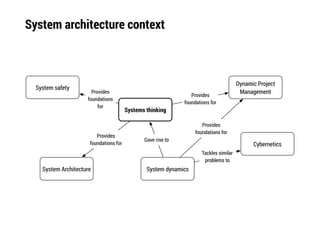
System architecture context
Systems thinking
System dynamics
Gave rise to
Cybernetics
Tackles similar
problems to
System Architecture
Provides
foundations for
Dynamic Project
Management
Provides
foundations for
Provides
foundations for
System safety
Provides
foundations
for
Systems thinking is thinking about a
question, circumstance, or problem
explicitly as a system
System is a set of interrelated entities whose functionality is greater than the
sum of the individual entities. Crawley et al 2015.
Architecture is an abstract depiction of the
entities of a system and the relationships
between those entities
A man-made system can also be seen as a set of decisions
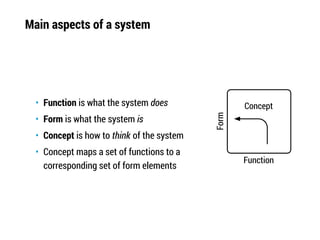
Main aspects of a system
• Function is what the system does
• Form is what the system is
• Concept is how to think of the system
• Concept maps a set of functions to a
corresponding set of form elements
Function
Form
Concept
Form drives cost, function drives value.
The difference determines
maximum possible profit
You can’t make more than this, but you can certainly make less. In public
sector, we are interested in ratio - bang per buck - rather than difference
The concept is the part that makes the silver
bullet so elusive
Brooks 1995. Form and function we have robust mechanisms to deal with,
but not concept
Form, concept and function are a logical
entity. Change in one drives change in other
Change the culture sufficiently and the office layout changes
Architecture of a country
What if we applied systems thinking
to a country?
“Let’s think of Estonia as a system and see what happens“
Concept of a country
How to think about a country?
• Many equally feasible approaches
• “It is a way to organise us living together“
• “It is a hostile entity that is not to be trusted“
• “It is a conduct of Gods will“
• The domain of legal and philosophical thinkers
• Embodied, to an extent, in constitution
• Thus very hard (if at all possible) to influence
• Has a massive influence on acceptable ways the functions of a
state can be executed
Function of a country
What does a country do anyway?
• Function of a system is emergent by definition
• Remember the “…greater than the sum of its parts“ thing
• Not all emergence can be predicted
• Not all emergence is desirable
• Function is fundamentally driven by whoever has the highest power
in the current setting
• The people, in Estonian case
• Partly captured in legislation
• There are many ways to think of the function
• Business process analysis, use case analysis etc.
Form of a country
What is a country?
• Three main categories of form
• Peopleware
• How are the people embodying the country organised?
• Administrative setup, business processes
• Organisational entities and their roles
• Software
• The obvious bureaucracy automation
• But also e-mail servers, sensor networks etc.
• Hardware
• The physical artefacts supporting the first two
• Cold rooms, cables and servers
• But also physical office buildings and their layout
Architectural model of a country
Constitution
Functions
Peopleware
Software
Infrastructure
The model explained
• Simply the elements seen previously stacked in order of abstraction
• Each layer can be seen as a system in itself
• Apply the same principles recursively
• The model can be seen as a stack of different architectures
• Methods for structuring each layer differ, of course
Main idea: A holistic model of a country allowing to explore complex
relationships spanning disciplines
Application of the model
The data embassies
• Digital continuity is important for a digital-heavy country
• Estonia is too small to physically host two server rooms providing
adequate risk mitigation
• Recommended distance is about 250 km
• Which, while geographically possible, is not sensible in Estonia
• What if we hosted some services abroad?
• Rent server rooms from friendly countries
• Or use Estonian embassies
• Both running the services and maintaining contingency backups
can be considered
This is a problem of the “Hardware“ layer
Applying the model
• Software: Is the software built to survive loss of access to other
services?
• Peopleware: How can responsibility for data be executed across
borders and physical distance?
• Functions: Does the function make sense in isolation (people
registry without document registry)?
• Constitution: To what extent can a country exist in exile?
Conclusion
Common EA frameworks are lacking
Usually, the “concept“ part is especially difficult to reflect.
All models are wrong, some models are useful
Using systems thinking, a more useful model
can be derived
There are probably other models but this one is abstract enough to cover a lot
of ground
The model is useful in dissecting a problem
looking trivial in common EA context
A lot of cloud-oriented problems are very similar in nature. Cloud, as a technical
construct, has profound implications for organisations.
Thank you!
Andres Kütt
andres.kutt@ria.ee

Architecting estonia

  • 1.
    Architecting Estonia: A SystemArchitecture Perspective on Digital Government Andres Kütt Information System Authority, architect 21.10.2015
  • 2.
    Agenda today 1. Motivation 2.Some thoughts on system architecture 3. Architecture of a country 4. Application of the model in Estonian case
  • 3.
    How to architecta country? And not mess up doing it
  • 4.
    The challenge • Thereare many architects in public sector but few (if any) with a similar scope • No literature to go back to • Enterprise architecture does not help much • Although Estonia is comparable to a large enterprise • Regardless of what they say, EA is usually focused on information systems, rather than the enterprise per se • Value generation in public sector is much different • No real way to tie in legal structures important in public setting
  • 5.
    That one can’tinfluence something does not mean one does not need to understand it While I can’t change Estonian constitution or organisational structure, I need to understand it so the things I can change fit
  • 6.
    Some thoughts onsystem architecture
  • 7.
    System architecture context Systemsthinking System dynamics Gave rise to Cybernetics Tackles similar problems to System Architecture Provides foundations for Dynamic Project Management Provides foundations for Provides foundations for System safety Provides foundations for
  • 8.
    Systems thinking isthinking about a question, circumstance, or problem explicitly as a system System is a set of interrelated entities whose functionality is greater than the sum of the individual entities. Crawley et al 2015.
  • 9.
    Architecture is anabstract depiction of the entities of a system and the relationships between those entities A man-made system can also be seen as a set of decisions
  • 10.
    Main aspects ofa system • Function is what the system does • Form is what the system is • Concept is how to think of the system • Concept maps a set of functions to a corresponding set of form elements Function Form Concept
  • 11.
    Form drives cost,function drives value. The difference determines maximum possible profit You can’t make more than this, but you can certainly make less. In public sector, we are interested in ratio - bang per buck - rather than difference
  • 12.
    The concept isthe part that makes the silver bullet so elusive Brooks 1995. Form and function we have robust mechanisms to deal with, but not concept
  • 13.
    Form, concept andfunction are a logical entity. Change in one drives change in other Change the culture sufficiently and the office layout changes
  • 14.
  • 15.
    What if weapplied systems thinking to a country? “Let’s think of Estonia as a system and see what happens“
  • 16.
    Concept of acountry How to think about a country? • Many equally feasible approaches • “It is a way to organise us living together“ • “It is a hostile entity that is not to be trusted“ • “It is a conduct of Gods will“ • The domain of legal and philosophical thinkers • Embodied, to an extent, in constitution • Thus very hard (if at all possible) to influence • Has a massive influence on acceptable ways the functions of a state can be executed
  • 17.
    Function of acountry What does a country do anyway? • Function of a system is emergent by definition • Remember the “…greater than the sum of its parts“ thing • Not all emergence can be predicted • Not all emergence is desirable • Function is fundamentally driven by whoever has the highest power in the current setting • The people, in Estonian case • Partly captured in legislation • There are many ways to think of the function • Business process analysis, use case analysis etc.
  • 18.
    Form of acountry What is a country? • Three main categories of form • Peopleware • How are the people embodying the country organised? • Administrative setup, business processes • Organisational entities and their roles • Software • The obvious bureaucracy automation • But also e-mail servers, sensor networks etc. • Hardware • The physical artefacts supporting the first two • Cold rooms, cables and servers • But also physical office buildings and their layout
  • 19.
    Architectural model ofa country Constitution Functions Peopleware Software Infrastructure
  • 20.
    The model explained •Simply the elements seen previously stacked in order of abstraction • Each layer can be seen as a system in itself • Apply the same principles recursively • The model can be seen as a stack of different architectures • Methods for structuring each layer differ, of course Main idea: A holistic model of a country allowing to explore complex relationships spanning disciplines
  • 21.
  • 22.
    The data embassies •Digital continuity is important for a digital-heavy country • Estonia is too small to physically host two server rooms providing adequate risk mitigation • Recommended distance is about 250 km • Which, while geographically possible, is not sensible in Estonia • What if we hosted some services abroad? • Rent server rooms from friendly countries • Or use Estonian embassies • Both running the services and maintaining contingency backups can be considered This is a problem of the “Hardware“ layer
  • 23.
    Applying the model •Software: Is the software built to survive loss of access to other services? • Peopleware: How can responsibility for data be executed across borders and physical distance? • Functions: Does the function make sense in isolation (people registry without document registry)? • Constitution: To what extent can a country exist in exile?
  • 24.
  • 25.
    Common EA frameworksare lacking Usually, the “concept“ part is especially difficult to reflect. All models are wrong, some models are useful
  • 26.
    Using systems thinking,a more useful model can be derived There are probably other models but this one is abstract enough to cover a lot of ground
  • 27.
    The model isuseful in dissecting a problem looking trivial in common EA context A lot of cloud-oriented problems are very similar in nature. Cloud, as a technical construct, has profound implications for organisations.
  • 28.