Interoperability framework 
and 
Taverna 
Succeed is supported by the European Union under FP7-ICT and coordinated by Universidad de Alicante.
The final conference / 2014 
Interoperability framework 
 The IMPACT Interoperability Framework (IIF) 
provides the interoperability layer for the software 
components and content developed in the IMPACT 
project. 
 The technical and research partners in IMPACT 
developed more than 20 different tools for various 
stages in the OCR process. 
 IMPACT has therefore also developed an overall 
technical framework that allows for a loose coupling 
of these tools and the exchange of data between 
them. 
Succeed is supported by the European Union under FP7-ICT and coordinated by Universidad de Alicante.
The final conference / 2014 
Interoperability framework 
 With this framework it is possible to form a pipeline 
of the tools, where the output of one tool is used as 
input for the next tool. 
 There is no optimal combination of tools (called a 
workflow) for every purpose. 
 Users have to be enabled to try and evaluate 
certain combinations to find their optimal workflow. 
Succeed is supported by the European Union under FP7-ICT and coordinated by Universidad de Alicante.
The final conference / 2014 
Interoperability framework 
 To fulfil these requirements, each IMPACT tool was 
wrapped as a web service, using a generic Java-wrapper. 
 All the web services together with common open 
source components from the Apache Software 
Foundation form the basic layer of the 
Interoperability Framework. 
Succeed is supported by the European Union under FP7-ICT and coordinated by Universidad de Alicante.
The final conference / 2014 
Workflows 
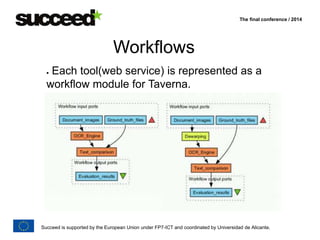
 Each tool(web service) is represented as a 
workflow module for Taverna. 
Succeed is supported by the European Union under FP7-ICT and coordinated by Universidad de Alicante.
The final conference / 2014 
Taverna 
A workflow language based on a dataflow 
model. 
A graphical editing environment for that 
language. 
An invocation system to run instances of that 
language on data supplied by a user of the 
system. 
When you download it you get all this rolled into 
a single piece of desktop software 
Succeed is supported by the European Union under FP7-ICT and coordinated by Universidad de Alicante.
The final conference / 2014 
Taverna 
To easily create complex workflows from single 
tools, the Taverna workflow system has been 
added as another layer to the Interoperability 
Framework. 
Taverna is an open source and domain-independent 
suite of tools to design and execute 
workflows. 
Succeed is supported by the European Union under FP7-ICT and coordinated by Universidad de Alicante.
The final conference / 2014 
Taverna 
The output of one tool can then be connected to 
the input of another by a simple drag-and-drop 
operation. 
Allows non-expert users to quickly create their 
own workflows and obtain results. 
Succeed is supported by the European Union under FP7-ICT and coordinated by Universidad de Alicante.
The final conference / 2014 
Workflows 
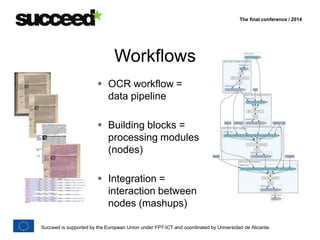
 OCR workflow = 
data pipeline 
 Building blocks = 
processing modules 
(nodes) 
 Integration = 
interaction between 
nodes (mashups) 
Succeed is supported by the European Union under FP7-ICT and coordinated by Universidad de Alicante.
The final conference / 2014 
Community 
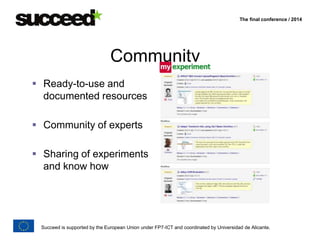
 Ready-to-use and 
documented resources 
 Community of experts 
 Sharing of experiments 
and know how 
Succeed is supported by the European Union under FP7-ICT and coordinated by Universidad de Alicante.
The final conference / 2014 
Demo 
Succeed is supported by the European Union under FP7-ICT and coordinated by Universidad de Alicante.

2. Interoperability framework and Taverna. Enrique Molla, Succeed Project.

  • 1.
    Interoperability framework and Taverna Succeed is supported by the European Union under FP7-ICT and coordinated by Universidad de Alicante.
  • 2.
    The final conference/ 2014 Interoperability framework  The IMPACT Interoperability Framework (IIF) provides the interoperability layer for the software components and content developed in the IMPACT project.  The technical and research partners in IMPACT developed more than 20 different tools for various stages in the OCR process.  IMPACT has therefore also developed an overall technical framework that allows for a loose coupling of these tools and the exchange of data between them. Succeed is supported by the European Union under FP7-ICT and coordinated by Universidad de Alicante.
  • 3.
    The final conference/ 2014 Interoperability framework  With this framework it is possible to form a pipeline of the tools, where the output of one tool is used as input for the next tool.  There is no optimal combination of tools (called a workflow) for every purpose.  Users have to be enabled to try and evaluate certain combinations to find their optimal workflow. Succeed is supported by the European Union under FP7-ICT and coordinated by Universidad de Alicante.
  • 4.
    The final conference/ 2014 Interoperability framework  To fulfil these requirements, each IMPACT tool was wrapped as a web service, using a generic Java-wrapper.  All the web services together with common open source components from the Apache Software Foundation form the basic layer of the Interoperability Framework. Succeed is supported by the European Union under FP7-ICT and coordinated by Universidad de Alicante.
  • 5.
    The final conference/ 2014 Workflows  Each tool(web service) is represented as a workflow module for Taverna. Succeed is supported by the European Union under FP7-ICT and coordinated by Universidad de Alicante.
  • 6.
    The final conference/ 2014 Taverna A workflow language based on a dataflow model. A graphical editing environment for that language. An invocation system to run instances of that language on data supplied by a user of the system. When you download it you get all this rolled into a single piece of desktop software Succeed is supported by the European Union under FP7-ICT and coordinated by Universidad de Alicante.
  • 7.
    The final conference/ 2014 Taverna To easily create complex workflows from single tools, the Taverna workflow system has been added as another layer to the Interoperability Framework. Taverna is an open source and domain-independent suite of tools to design and execute workflows. Succeed is supported by the European Union under FP7-ICT and coordinated by Universidad de Alicante.
  • 8.
    The final conference/ 2014 Taverna The output of one tool can then be connected to the input of another by a simple drag-and-drop operation. Allows non-expert users to quickly create their own workflows and obtain results. Succeed is supported by the European Union under FP7-ICT and coordinated by Universidad de Alicante.
  • 9.
    The final conference/ 2014 Workflows  OCR workflow = data pipeline  Building blocks = processing modules (nodes)  Integration = interaction between nodes (mashups) Succeed is supported by the European Union under FP7-ICT and coordinated by Universidad de Alicante.
  • 10.
    The final conference/ 2014 Community  Ready-to-use and documented resources  Community of experts  Sharing of experiments and know how Succeed is supported by the European Union under FP7-ICT and coordinated by Universidad de Alicante.
  • 11.
    The final conference/ 2014 Demo Succeed is supported by the European Union under FP7-ICT and coordinated by Universidad de Alicante.