Foundations Of ModernPhysics Steven Weinberg
download
https://ebookbell.com/product/foundations-of-modern-physics-
steven-weinberg-24658620
Explore and download more ebooks at ebookbell.com
2.
Here are somerecommended products that we believe you will be
interested in. You can click the link to download.
From Physics To Politics The Metaphysical Foundations Of Modern
Philosophy 2nd Ed 2nd Edition Robert Trundle
https://ebookbell.com/product/from-physics-to-politics-the-
metaphysical-foundations-of-modern-philosophy-2nd-ed-2nd-edition-
robert-trundle-52446296
Ea Burtt Historian And Philosopher A Study Of The Author Of The
Metaphysical Foundations Of Modern Physical Science 1st Edition Diane
Davis Villemaire Auth
https://ebookbell.com/product/ea-burtt-historian-and-philosopher-a-
study-of-the-author-of-the-metaphysical-foundations-of-modern-
physical-science-1st-edition-diane-davis-villemaire-auth-4488924
Nishina Memorial Lectures Creators Of Modern Physics Nishina Memorial
Foundation
https://ebookbell.com/product/nishina-memorial-lectures-creators-of-
modern-physics-nishina-memorial-foundation-4125234
Nishina Memorial Lectures Creators Of Modern Physics Nishina Memorial
Foundation
https://ebookbell.com/product/nishina-memorial-lectures-creators-of-
modern-physics-nishina-memorial-foundation-995054
3.
A Snapshot OfFoundational Attitudes Toward Quantum Mechanics Studies
In History And Philosophy Of Modern Physics 44 1st Edition Maximilian
Schlosshauer
https://ebookbell.com/product/a-snapshot-of-foundational-attitudes-
toward-quantum-mechanics-studies-in-history-and-philosophy-of-modern-
physics-44-1st-edition-maximilian-schlosshauer-49543708
Foundations Of Modern Probability 3rd Edition Olav Kallenberg
https://ebookbell.com/product/foundations-of-modern-probability-3rd-
edition-olav-kallenberg-23277544
Foundations Of Modern Cosmology 2nd Edition John F Hawley Katherine A
Holcomb
https://ebookbell.com/product/foundations-of-modern-cosmology-2nd-
edition-john-f-hawley-katherine-a-holcomb-2627078
Foundations Of Modern Global Seismology 2nd Edition Charles J Ammon
https://ebookbell.com/product/foundations-of-modern-global-
seismology-2nd-edition-charles-j-ammon-33645792
Foundations Of Modern Slavery Profiles Of Unfree And Coerced Labor
Through The Ages Caf Dowlah
https://ebookbell.com/product/foundations-of-modern-slavery-profiles-
of-unfree-and-coerced-labor-through-the-ages-caf-dowlah-33790120
6.
Foundations of ModernPhysics
In addition to his ground-breaking research, Nobel Laureate Steven Weinberg
is known for a series of highly praised texts on various aspects of physics, com-
bining exceptional physical insight with a gift for clear exposition. Describing
the foundations of modern physics in their historical context and with some
new derivations, Weinberg introduces topics ranging from early applications
of atomic theory through thermodynamics, statistical mechanics, transport
theory, special relativity, quantum mechanics, nuclear physics, and quantum
field theory. This volume provides the basis for advanced undergraduate and
graduate physics courses as well as being a handy introduction to aspects of
modern physics for working scientists.
steven weinberg is a member of the Physics and Astronomy Departments
at the University of Texas at Austin. He has been honored with numerous
awards, including the Nobel Prize in Physics, the National Medal of Science,
the Heinemann Prize in Mathematical Physics, and most recently a Special
Breakthrough Prize in Fundamental Physics. He is a member of the US National
Academy of Sciences, the UK’s Royal Society, and other academies in the US
and internationally. The American Philosophical Society awarded him the
Benjamin Franklin medal, with a citation that said he is “considered by many
to be the preeminent theoretical physicist alive in the world today.” He has
written several highly regarded books, including Gravitation and Cosmology,
the three-volume work The Quantum Theory of Fields, Cosmology, Lectures on
Quantum Mechanics, and Lectures on Astrophysics.
Contents
PREFACE page xiii
1EARLY ATOMIC THEORY 1
1.1 Gas Properties 2
Air pressure Boyle’s law Temperature Scales Charles’ law
Explanation of gas laws Ideal gas law
1.2 Chemistry 6
Elements Law of combining weights Dalton’s atomic weights Law of
combining volumes Avogadro’s principle The gas constant Avogadro’s
number
1.3 Electrolysis 10
Early electricity Early magnetism Electromagnetism Discovery of
electrolysis Faraday’s theory The faraday
1.4 The Electron 14
Cathode rays Thomson’s experiments Electrons as atomic constituents
2 THERMODYNAMICS AND KINETIC THEORY 16
2.1 Heat and Energy 16
Caloric Heat as energy Kinetic energy Specific heat Energy density
and pressure Adiabatic changes
vii
13.
viii Contents
2.2 AbsoluteTemperature 21
Carnot cycles Theorems on efficiency Absolute temperature defined
Relation to gas thermometers
2.3 Entropy 27
Definition of entropy Independence of path Increase of entropy
Thermodynamic relations Entropy of ideal gases Neutral matter
Radiation energy Laws of thermodynamics
2.4 Kinetic Theory and Statistical Mechanics 33
Maxwell–Boltzmann distribution General H-theorem Time reversal
Canonical and grand-canonical distributions Connection with thermodynamics
Compound systems Probability distribution in gases Equipartition of
energy Entropy as disorder
2.5 Transport Phenomena 42
Conservation laws Galilean relativity Navier–Stokes equation Viscosity
Mean free path Diffusion
2.6 The Atomic Scale 53
Nineteenth century estimates Electronic charge Brownian motion
Consistency of constants Appendix: Einstein’s diffusion constant rederived
3 EARLY QUANTUM THEORY 61
3.1 Black Body Radiation 61
Absorption and energy density Degrees of freedom of electromagnetic fields
Rayleigh–Jeans distribution Planck distribution Measurement of
Boltzmann constant Radiation energy constant
3.2 Photons 67
Quantization of radiation energy Derivation of Planck distribution
Photoelectric effect Particles of light
3.3 The Nuclear Atom 71
Radioactivity Alpha and beta rays Discovery of the nucleus Nuclear mass
Nuclear size Scattering pattern Nuclear charge
3.4 Atomic Energy Levels 77
Spectral lines Electron orbits Combination principle Bohr’s quantization
condition Correspondence principle Comparison with observed one-electron
atomic spectra Reduced mass Atomic number Outstanding questions
14.
Contents ix
3.5 Emissionand Absorption of Radiation 84
Einstein A and B coefficients Equilibrium with black body radiation Relations
among coefficients Lasers Suppressed absorption
4 RELATIVITY 88
4.1 Early Relativity 88
Motion of the Earth Relativity of motion Speed of light
Michelson–Morley experiment Lorentz–Fitzgerald contraction
4.2 Einsteinian Relativity 94
Postulate of invariance of electrodynamics Lorentz transformations Space
inversion, time reversal The Galilean limit Maximum speed Boosts in
general directions Special and general relativity
4.3 Clocks, Rulers, Light Waves 103
Clocks and time dilation Rulers and length contraction Transformation of
frequency and wave number
4.4 Mass, Energy, Momentum, Force 106
Einstein’s thought experiment Formulas for energy and momentum E = mc2
Force in relativistic dynamics
4.5 Photons as Particles 111
Photon momentum Compton scattering Other massless particles
4.6 Maxwell’s Equations 114
The inhomogeneous and homogeneous equations Density and current of electric
charge Relativistic formulation of inhomogeneous Maxwell equations Indices
upstairs and downstairs Relativistic formulation of homogeneous Maxwell
equations Electric and magnetic forces
4.7 Causality 121
Causes precede effects Invariance of temporal order Maximum signal speed
Light cone
5 QUANTUM MECHANICS 124
5.1 De Broglie Waves 125
Free-particle wave functions Group velocity Application to hydrogen
Davisson–Germer experiment Electron microscopes Appendix: Derivation
of the Bragg formula
15.
x Contents
5.2 TheSchrödinger Equation 129
Wave equation for particle in potential Boundary conditions Spherical
symmetry Radial and angular wave functions Angular multiplicity
Spherical harmonics Hydrogenic energy levels Degeneracy
5.3 General Principles of Quantum Mechanics 138
States and wave functions Observables and operators Hamiltonian
Adjoints Expectation values Probabilities Continuum limit
Momentum space Commutation relations Uncertainty principle Time
dependent wave functions Conservation laws Heisenberg and
Schrödinger pictures
5.4 Spin and Orbital Angular Momentum 151
Doubling of sodium D-line The idea of spin General action of rotations on
wave functions Total angular momentum operator Commutation relations
Spin and orbital angular momentum Multiplets Adding angular momenta
Atomic fine structure and space inversion Hyperfine structure Appendix:
Clebsch–Gordan Coefficients
5.5 Bosons and Fermions 165
Identical particles Symmetric and antisymmetric wave functions Bosons and
fermions in statistical mechanics Hartree approximation Slater determinant
Pauli exclusion principle Periodic table of elements Diatomic molecules:
para and ortho Astrophysical cooling
5.6 Scattering 175
Scattering wave function Representations of the delta function Calculation of
the Green’s function Scattering amplitude Probabilistic interpretation
Cross section Born approximation Scattering by shielded Coulomb
potential Appendix: General transition rates
5.7 Canonical Formalism 190
Hamiltonian formalism Canonical commutation relations Lagrangian
formalism Action principle Connection of formalisms Noether’s theorem:
symmetries and conservation laws Space translation and momentum
5.8 Charged Particles in Electromagnetic Fields 195
Vector and scalar potential Charged particle Hamiltonian Equations of motion
Gauge transformations Magnetic interactions Spin coupling
5.9 Perturbation Theory 199
Perturbative expansion First-order perturbation theory Dealing with
degeneracy The Zeeman effect Second-order perturbation theory
16.
Contents xi
5.10 BeyondWave Mechanics 206
State vectors Linear operators First postulate: values of observables
Second postulate: expectation values Probabilities Continuum limit
Wave functions as vector components
6 NUCLEAR PHYSICS 210
6.1 Protons and Neutrons 210
Discovery of the proton Integer atomic weights Nuclei as protons and
electrons? Trouble with diatomic nitrogen Discovery of the neutron
Nuclear radius and binding energy Liquid drop model Stable valley and
decay modes
6.2 Isotopic Spin Symmetry 216
Neutron–proton and proton–proton forces Isotopic spin rotations Isotopic spin
multiplets Quark model Pions Appendix: The three–three resonance
6.3 Shell Structure 224
Harmonic oscillator approximation Raising and lowering operators
Degenerate multiplets Magic numbers Spin–orbit coupling
6.4 Alpha Decay 229
Coulomb barrier Barrier suppression factors Semi-classical estimate of alpha
decay rate Level splitting Geiger–Nuttall law Radium alpha decay
Appendix: Quantum theory of barrier penetration rates
6.5 Beta Decay 243
Electron energy distribution Neutrinos proposed Fermi theory
Gamow–Teller modification Selection rules Strength of weak interactions
Neutrinos discovered Violation of left–right and matter–antimatter symmetries
Neutrino helicities Varieties of neutrino
7 QUANTUM FIELD THEORY 251
7.1 Canonical Formalism for Fields 252
Action, Lagrangian, Lagrangian density Functional derivatives
Euler–Lagrange field equations Commutation relations Energy and
momentum of fields
7.2 Free Real Scalar Field 255
Lagrangian density Field equation Creation and annihilation operators
Energy and momentum Vacuum state Multiparticle states
17.
xii Contents
7.3 Interactions261
Time-ordered perturbation theory Requirements for Lorentz invariance
Example: Scattering of neutral spinless particles Feynman diagram
Calculation of the propagator Yukawa potential
7.4 Antiparticles, Spin, Statistics 270
Antiparticles needed Complex scalar field General fields Lorentz
transformation Spin–statistics connection Appendix: Dirac fields
7.5 Quantum Theory of Electromagnetism 280
Lagrangian density for electrodynamics Four-vector potential Gauge
transformations Coulomb gauge Commutation relations Free fields
Photon momentum and helicity Radiative decay rates Selection rules
Gauge invariance and charge conservation Local phase invariance Standard
model
ASSORTED PROBLEMS 296
BIBLIOGRAPHY 301
AUTHOR INDEX 303
SUBJECT INDEX 307
18.
Preface
This book grewout of the notes for a course I gave for undergraduate physics
students at the University of Texas. In this book I think I go farther forward
than is usual in undergraduate courses, giving readers a taste of nuclear physics
and quantum field theory. I also go farther back than is usual, starting with the
struggle in the nineteenth century to establish the existence and properties of
atoms, including the development of thermodynamics that both aided in this
struggle and offered an alternative program.
I fear that some readers may want to skim through this early part and hurry
on to what they regard as the good stuff, quantum mechanics and relativity. That
would be a pity. In my experience physics students who aim at a career in atomic
or nuclear or elementary particle physics often manage to get through their
formal education without ever becoming familiar with entropy, or equipartition,
or viscosity, or diffusion. That was true in my own case. This book, or a course
based on it, may provide some students with their last chance to learn about
these and other matters needed to understand the macroscopic world.
Readers may find this book unusual also in its strong emphasis on history.
I make a point of saying a little about the welter of theoretical guesswork and ill-
understood experiments out of which modern physics emerged in the twentieth
century. This, it seems to me, is a help in understanding what otherwise may
seem an arbitrary set of postulates for relativity and quantum mechanics. It is
also a matter of personal taste. Research in physics seems to me to lose some of
its excitement if we do not see it as part of a great historical progression. Some
valuable historical works are listed in a bibliography, along with collections of
original articles that I have found most helpful.
But this is not a work of history. Historians aim at uncovering how the scien-
tists of the past thought about their own problems – for instance, how Einstein
in 1905 thought about the measurement of space and time separations in de-
veloping the special theory of relativity. For this aim of historical writing it is
necessary to go deeply into personal accounts, institutional development, and
xiii
19.
xiv Preface
false starts,and to put aside our knowledge of subsequent progress. I try to
be accurate in describing the state of physics in past times, but the aim of this
book in discussing the problems of the past is different: it is to make clear how
physicists think about these things today.
This book is intended chiefly for physics students who are well into their time
as undergraduates, and for working scientists who want a brief introduction to
some area of modern physics. I have therefore not hesitated to use calculus and
matrix algebra, though not in advanced versions. As required by the subject
matter, the mathematical level here slopes upwards through the book. Where
possible I have chosen concrete rather than abstract formulations of physical
theories. For instance, in Chapter 5, on quantum mechanics, I mostly represent
physical states as wave functions, only coming at the end of the chapter to their
representation as vectors in Hilbert space. In some sections detailed material
that can be skipped without losing the thread of the theory is put into appendices.
Two of these appendices present what in my unbiased opinion are improved
derivations of important results: the appendix to Section 2.6 gives a revised
version of Einstein’s derivation of his formula for the diffusion constant in
Brownian motion, and the appendix to Section 6.4 presents a revision of Fermi’s
calculation of the rate of alpha decay.
In my experience, with some judicious pruning, the material of the book up
to about the middle of Chapter 5 can be covered in a one-term undergraduate
course. But I think that to go over the whole book would take a full two-term
academic year.
This book treats such a broad range of topics that it is impossible to go very
far into any of them. Certainly its treatment of quantum mechanics, statistical
mechanics, transport theory, nuclear physics, and quantum field theory is no
substitute for graduate-level courses on these topics, any one of which would
occupy at least a whole year. This book presents what I think, in an ideal
world, the ambitious physics student would already know when he or she enters
graduate school. At least, it is what I wish that I had known when I entered
graduate school.
In any case, I hope that the student or reader may be sufficiently interested in
what I do discuss that they will want to go into these topics in greater detail in
more specialized books or courses, and that they will find in this book a good
preparation for such further studies.
I am grateful to many students and colleagues for pointing out errors in
the lecture notes on which this book is based and for the expert and friendly
assistance I have received from Simon Capelin and Vince Higgs, the editors at
Cambridge University Press who guided the publication of this book.
STEVEN WEINBERG
20.
1
Early Atomic Theory
Itis an old idea that matter consists of atoms, tiny indivisible particles moving
in empty space. This theory can be traced to Democritus, working in the Greek
city of Abdera, on the north shore of the Aegean sea. In the late 400s BC
Democritus proclaimed that “atoms and void alone exist in reality.” He offered
neither evidence for this hypothesis nor calculations on which to base predic-
tions that could confirm it. Nevertheless, this idea was tremendously influential,
if only as an example of how it might be possible to account for natural phe-
nomena without invoking the gods. Atoms were brought into the materialistic
philosophy of Epicurus of Samos, who a little after 300 BC founded one of
the four great schools of Athens, the Garden. In turn, the idea of atoms and
the philosophy of Epicurus were invoked in the poem On the Nature of Things
by the Roman Lucretius. After this poem was rediscovered in 1417 it influ-
enced Machiavelli, More, Shakespeare, Montaigne, and Newton, among others.
Newton in his Opticks speculated that the properties of matter arise from the
clustering of atoms into larger particles, which themselves cluster into larger
particles, and so on. As we will see, Newton made a stab at an atomic theory of
air pressure, but without significant success.
The serious scientific application of the atomic theory began in the eighteenth
century, with calculations of the properties of gases, which had been studied
experimentally since the century before. This is the topic with which we begin
this chapter. Applications to chemistry and electrolysis followed in the nine-
teenth century and will be considered in subsequent sections. The final section
of this chapter describes how the nature of atoms began to be clarified with the
discovery of the electron. In the following chapter we will see how it became
possible to estimate the atoms’ masses and sizes.1
1 Further historical details about some of these matters can be found in Weinberg, The Discovery of
Subatomic Particles, listed in the bibliography.
1
21.
2 1 EarlyAtomic Theory
1.1 Gas Properties
Experimental Relations
The upsurge of enthusiasm for experiment in the seventeenth century was
largely concentrated on the properties of air. The execution and reports of these
experiments did not depend on hypotheses regarding atoms, but we need to
recall them here because their results provided the background for later theories
of gas properties that did rely on assumptions about atoms.
It had been thought by Aristotle and his followers that the suction observed
in pumps and bellows arises from nature’s abhorrence of a vacuum. This notion
was challenged in the 1640s by the invention of the barometer by the Florentine
polymath Evangelista Torricelli (1608–1647). If nature abhors a vacuum, then
when a long glass tube with one end closed is filled with mercury and set
upright with the closed end on top, why does the mercury flow out of the bottom
until the column is only 760 mm high, with empty space appearing above the
mercury? Is there a limit to how much nature abhors a vacuum? Torricelli
argued that the mercury is held up instead by the pressure of the air acting
on the open end of the glass tube (or on the surface of a bath of mercury in
which the open end of the tube is immersed), which is just sufficient to support
a column of mercury 760 mm high. If so, then it should be possible to measure
variations in air pressure using a column of mercury in a vertical glass tube, a
device that we know as a barometer. Such measurements were made from 1648
to 1651 by Blaise Pascal (1623–1662), who found that the height of mercury
in a barometer is decreased by moving to the top of a mountain, where less air
extends above the barometer.
The quantitative properties of air pressure soon began to be studied
experimentally, before there was any correct theoretical understanding of gas
properties. In 1662, in the second edition of his book New Experiments Physico-
Mechanical Concerning the Spring of the Air and its Effects, the Anglo-Irish
aristocrat Robert Boyle (1627–1691) described experiments relating the pres-
sure (the “spring of the air”) and volume of a fixed mass of air. He studied a
sample of air enclosed at the end of a glass tube by a column of mercury in
the tube. The air was compressed at constant temperature by pushing on the
mercury’s surface, revealing what came to be known as Boyle’s law, that for
constant temperature the volume of a gas of fixed mass and composition is
inversely proportional to the pressure, now defined by Boyle as the force per
area exerted on the gas.
Temperature Scales
A word must be said about the phrase “at constant temperature.” Boyle lived
before the establishment of our modern Fahrenheit and Celsius scales, whose
22.
1.1 Gas Properties3
forerunners go back respectively to 1724 and 1742. But, although in Boyle’s
time no meaningful numerical value could be given to the temperature of any
given body, it was nevertheless possible to speak with precision of two bodies
being at the same temperature: they are at the same temperature if when put in
contact neither body is felt to grow appreciably hotter or colder. Boyle’s glass
tube could be kept at constant temperature by immersing it in a large bath, say of
water from melting ice. Later the Fahrenheit temperature scale was established
by defining the temperature of melting ice as 32 ◦F and the temperature of
boiling water at mean atmospheric pressure as 212 ◦F, and defining a 1 ◦F
increase of temperature by etching 212 − 32 equal divisions between 32 and
212 on the glass tube of a mercury thermometer. Likewise, in the Celsius scale,
the temperatures of melting ice and boiling water are 0 ◦C and 100 ◦C, and
1 ◦C is the temperature difference required to increase the volume of mercury
in a thermometer by 1% of the volume change in heating from melting ice
to boiling water. As we will see in the next chapter, there is a more sophis-
ticated universal definition of temperature, to which scales based on mercury
thermometers provide only a good approximation.
After the temperature scale was established it became possible to carry out a
quantitative study of the relation between volume and temperature, with pres-
sure and mass kept fixed by enclosing the air in a vessel with flexible walls,
which expand or contract to keep the pressure inside equal to the air pressure
outside. This relation was announced in an 1802 lecture by Joseph Louis Gay-
Lussac (1775–1850), who attributed it to unpublished work in the 1780s by
Jacques Charles (1746–1823). The relation, subsequently known as Charles’
Law, is that at constant pressure and mass the volume of gas is proportional
to T − T0, where T is the temperature measured for instance with a mercury
thermometer and T0 is a constant whose numerical value naturally depends
on the units used for temperature: T0 = −459.67 ◦F = −273.15 ◦C. Thus
T0 is absolute zero, the minimum possible temperature, at which the gas vol-
ume vanishes. Using Celsius units for temperature differences, the absolute
temperature T ≡ T − T0 is known today as the temperature in degrees Kelvin,
denoted K.
Theoretical Explanations
In Proposition 23 of his great book, the Principia, Isaac Newton (1643–1727)
made an attempt to account for Boyle’s law by considering air to consist of
particles repelling each other at a distance. Using little more than dimensional
analysis, he showed that the pressure p of a fixed mass of air is inversely
proportional to the volume V if the repulsive force between particles separated
by a distance r falls off as 1/r. But as he pointed out, if the repulsive force goes
as 1/r2, then p ∝ V −4/3. He did not claim to offer any reason why the repulsive
force should go as 1/r and, as we shall see, it is not forces that go as 1/r but
23.
4 1 EarlyAtomic Theory
rather forces of very short range that act only in collisions that mostly account
for the properties of gases.
It was the Swiss mathematical physicist Daniel Bernoulli (1700–1782) who
made the first attempt to understand the properties of gases theoretically, on the
assumption that a gas consists of many tiny particles moving freely except in
very brief collisions. In 1738, in the chapter, “On the Properties and Motions of
Elastic Fluids, Especially Air” of his book Hydrodynamics, he argued that in a
gas (then called an “elastic fluid”) with n particles per unit volume moving with
a velocity v that is the same (because of collisions) in all directions, the pressure
is proportional to n and to v2, because the number of particles that hit any given
area of the wall in a given time is proportional to the number in any given
volume, to the rate at which they hit the wall, which is proportional to v, and to
the force that each particle exerts on the wall, which is also proportional to v.
For a fixed mass of gas n is inversely proportional to the volume V , so pV is
proportional to v2. If (as Bernoulli thought) v2 depends only on the temperature,
this explains Boyle’s law. If v2 is proportional to the absolute temperature, it
also gives Charles’ law.
Bernoulli did not give much in the way of mathematical details, and did not
try to say to what else the pressure might be proportional besides nv2, a matter
crucial for the history of chemistry. These details were provided by Rudolf
Clausius (1822–1888) in 1857, in an article entitled “The Nature of the Motion
which We Call Heat.” Below is a more-or-less faithful description of Clausius’
derivation, in a somewhat different notation.
Suppose a particle hits the wall of a vessel and remains in contact with it for a
small time t, during which it exerts a force with component F along the inward
normal to the wall. Its momentum in the direction of the inward normal to the
wall will decrease by an amount Ft, so if the component of the velocity of the
particle before it strikes the wall is v⊥ 0, and it bounces back elastically with
normal velocity component −v⊥, the change in the inward normal component
of momentum is −2mv⊥, where m is the particle mass, so
F = 2mv⊥/t .
Now, suppose that this goes on with many particles hitting the wall over a time
interval T t, all particles with the same velocity vector v. The number N of
particles that will hit an area A of the wall in this time is the number of particles
in a cylinder with base A and height v⊥T , or
N = nAv⊥T ,
where n is the number density, the number of particles per volume. Each of
these particles is in contact with the wall for a fraction t/T of the time T , so the
total force exerted on the wall is
FN(t/T ) = 2mv⊥/t × nAv⊥T × (t/T ) = 2nmv2
⊥A .
24.
1.1 Gas Properties5
We see that all dependence on the times t and T cancels. The pressure p is
defined as the force per area, so this gives the relation
p = 2nmv2
⊥ . (1.1.1)
This is for the unphysical case in which every particle has the same value of v⊥,
positive in the sense that the particles are assumed to be going toward the wall.
In the real world, different particles will be moving with different speeds in
different directions, and Eq. (1.1.1) should be replaced with
p = 2nm ×
1
2
v2
⊥ = nmv2
⊥ , (1.1.2)
the brackets indicating an average over all gas particles, with the factor 1/2
inserted in the first expression because only 50% of these particles will be going
toward any given wall area.
To express v2
⊥ in terms of the root mean square velocity, Clausius assumed
without proof that “on the average each direction [of the particle velocities]
is equally represented.” In this case, the average square of each component of
velocity equals v2
⊥, and the average of the squared velocity vector is then
v2
= v2
1 + v2
2 + v2
3 = 3v2
⊥
and therefore Eq. (1.1.2) reads
p = nmv2
/3 . (1.1.3)
This is essentially the result p ∝ nv2 of Bernoulli, except that, with the
factor m/3, Eq. (1.1.3) is now an equality, not just a statement of proportion-
ality. For a fixed mass M of gas occupying a volume V , the number density
is n = M/mV , so Clausius could use Boyle’s law (which he called Mariotte’s
law), which states that pV is constant for fixed temperature, to conclude that
for a given gas v2 depends only on the temperature. Further, as Clausius
remarked, Eq. (1.1.3) together with Charles’ law (which Clausius called the
law of Gay-Lussac) indicates that v2 is proportional to the absolute temper-
ature T . If we like, we can adopt a modern notation and write the constant of
proportionality as 3k/m, so that
mv2
/3 = kT , (1.1.4)
and therefore Eq. (1.1.3) reads
p = nkT , (1.1.5)
where k is a constant, in the sense of being independent of p, n, and T . But
the choice of notation does not tell us whether k varies from one type of gas
to another or whether it depends on the molecular mass m. Clausius could not
answer this question, and did not offer any theoretical justification for Boyle’s
25.
6 1 EarlyAtomic Theory
law or Charles’ law. Clausius deserves to be called the founder of thermo-
dynamics, discussed in Sections 2.2 and 2.3, but these are not questions that
can be answered by thermodynamics alone. As we will see in the following
section, experiments in the chemistry of gases indicated that k is the same for
all gases, a universal constant now known as Boltzmann’s constant, but the
theoretical explanation for this and for Boyle’s law and Charles’ law had to
wait for the development of kinetic theory and statistical mechanics, the subject
of Section 2.4.
As indicated by the title of his article, “The Nature of the Motion which We
Call Heat,” Clausius was concerned to show that, at least in gases, the phe-
nomenon of heat is explained by the motion of the particles of which gases are
composed. He defended this view by using his theory to calculate the specific
heat of gases, a topic to be considered in the next chapter.
1.2 Chemistry
Elements
The idea that all matter is composed of a limited number of elements goes back
to the earliest speculations about the nature of matter. At first, in the century
before Socrates, it was supposed that there is just one element: water (Thales) or
air (Anaximenes) or fire (Heraclitus) or earth (perhaps Xenophanes). The idea of
four elements was proposed around 450 BC by Empedocles of Acragas (modern
Agrigento). In On Nature he identified the elements as “fire and water and earth
and the endless height of air.” Classical Chinese sources list five elements: water,
fire, earth, wood, and metal.
Like the theory of atoms, these early proposals of elements did not come
accompanied with any evidence that these really are elements, or any suggestion
how such evidence might be gained. Plato in Timaeus even doubled down and
stated that the difference between one element and another arises from the
shapes of the atoms of which the elements are composed: earth atoms are tiny
cubes, while the atoms of fire, air, and water are other regular polyhedra –
solids bounded respectively by 4, 8, or 20 identical regular polygons, with every
edge and every vertex of each solid the same as every other edge or vertex of
that solid.
By the end of the middle ages this list of elements had come to seem implau-
sible. It is difficult to identify any particular sample of dirt as the element earth,
and fire seems more like a process than a substance. Alchemists narrowed the
list of elements to just three: mercury, sulfur, and salt.
Modern chemistry began around the end of the eighteenth century, with
careful experiments by Joseph Priestley (1733–1804), Henry Cavendish (1743–
1810), Antoine Lavoisier (1743–1794), and others. By 1787 Lavoisier had
26.
1.2 Chemistry 7
workedout a list of 55 elements. In place of air there were several gases:
hydrogen, oxygen, and nitrogen; air was identified as a mixture of nitrogen and
oxygen. There were other non-metals on the list of elements: sulfur, carbon,
and phosphorus, and a number of common metals: iron, copper, tin, lead, silver,
gold, mercury. Lavoisier also listed as elements some chemicals that we now
know are tightly bound compounds: lime, soda, and potash. And the list also
included heat and light, which of course are not substances at all.
Law of Combining Weights
Chemistry was first used to provide quantitative information about atoms by
John Dalton (1766–1844), the son of a poor weaver. His laboratory notebooks
from 1802 to 1804 describe careful measurements of the weights of elements
combining in compounds. He discovered that these weights are always in fixed
ratios. For instance, he found that when hydrogen burns in oxygen, 1 gram of
hydrogen combines with 5.5 grams of oxygen, giving 6.5 grams of water, with
nothing left over. Under the assumption that one particle of water consists of
one atom of hydrogen and one atom of oxygen, one oxygen atom must weigh
5.5 times as much as one hydrogen atom.
As we will see, water was soon discovered to be H2O: two atoms of
hydrogen to each atom of oxygen. If Dalton had known this, he would have
concluded that an oxygen atom weighs 5.5 times as much as two hydrogen
atoms, i.e., 11 times the weight of one hydrogen atom. Of course, more accurate
measurements later revealed that 1 gram of hydrogen combines with about 8
grams of oxygen, so one oxygen atom weighs eight times the weight of two
hydrogen atoms, or 16 times as much as one hydrogen atom. Atomic weights
soon became defined as the weights of atoms relative to the weight of one
hydrogen atom, so the atomic weight of oxygen is 16. (This is only approximate.
Today the atomic weight of the atoms of the most common isotope of carbon
is defined to be precisely 12; with this definition, the atomic weights of the
most common isotopes of hydrogen and oxygen are measured to be 1.007825
and 15.99491.)
The following table compares Dalton’s assumed formulas for a few common
compounds with the correct formulas:
Compound Dalton formula True formula
Water HO H2O
Carbon dioxide CO2 CO2
Ammonia NH NH3
Sulfuric acid SO2 H2SO4
27.
8 1 EarlyAtomic Theory
Here is a list of the approximate true atomic weights for a few elements,
the weights deduced by Dalton, and (in the column marked with an asterisk) the
weights Dalton would have calculated if he had known the true chemical
formulas.
Element True Dalton Dalton*
H 1 1 1
C 12 4.3 8.6
N 14 4.2 12.6
O 16 5.5 11
S 32 14.4 57.6
To make progress in measuring atomic weights, it was evidently necessary
to find some way of working out the correct formulas for various chemical
compounds. This was provided by the study of chemical reactions in gases.
Law of Combining Volumes
On December 31, 1808, Gay-Lussac read a paper to the Societe Philomathique
in Paris, in which he announced his observation that gases at the same tem-
perature and pressure always combine in definite proportions of volumes. For
instance, two liters of hydrogen combine with one liter of oxygen to give water
vapor, with no hydrogen or oxygen left over. Likewise, one liter of nitrogen
combines with three liters of hydrogen to give ammonia gas, with nothing left
over. And so on.
The correct interpretation of this experimental result was given in 1811 by
Count Amadeo Avogadro (1776–1856) in Turin. Avogadro’s principle states
that equal volumes of gases at the same temperature and pressure always con-
tain equal numbers of the gas particles, which Avogadro called “molecules,”
particles that may consist of single atoms or of several atoms of the same or
different elements joined together. The observation that water vapor is formed
from a volume of oxygen combined with a volume of hydrogen twice as large
shows, according to Avogadro’s principle, that molecules of water are formed
from twice as many molecules of hydrogen as molecules of oxygen, which is
not what Dalton had assumed.
There was a further surprise in the data. Two liters of hydrogen combined
with one liter of oxygen give not one but two liters of water vapor. This is not
what one would expect if oxygen and hydrogen molecules consist of single
atoms and water molecules consist of two atoms of hydrogen and one atom
of oxygen. In that case two liters of hydrogen plus one liter of oxygen would
produce one liter of water vapor. Avogadro could conclude that if, as seemed
28.
1.2 Chemistry 9
plausible,molecules of water contain two atoms of hydrogen and one atom of
oxygen, the molecules of oxygen and hydrogen must each contain two atoms.
That is, taking water molecules as H2O, the reaction for producing molecules
of water is
2H2 + O2 → 2H2O .
The use of Avogadro’s principle rapidly provided the correct formulas for gases
such as CO2, NH3, NO, and so on. Knowing these formulas and measuring
the weights of gases participating in various reactions, it was possible to cor-
rect Dalton’s atomic weights and calculate more reliable values for the atomic
weights of the atoms in gas molecules, relative to any one of them. Taking the
atomic weight of hydrogen as unity, this gave atomic weights close to 12 for
carbon, 14 for nitrogen, 16 for oxygen, 32 for sulfur, and so on. Then, knowing
these atomic weights, it became possible to find atomic weights for many other
elements, not just those commonly found in gases, by measuring the weights of
elements combining in various chemical reactions.
The Gas Constant
As we saw in the previous section, in 1857 Clausius had shown that in a gas
consisting of n particles of mass m per volume with mean square velocity v2,
the pressure is p = nmv2/3. Using Charles’ law, he concluded that v2 is
proportional to absolute temperature. Writing this relation as mv2/3 = kT
with k some constant gives Eq. (1.1.5), p = nkT . But this in itself does not
tell us how k varies from one gas to another. This is answered by Avogadro’s
principle. With N particles in a volume V , the number density is n = N/V , so
Eq. (1.1.5) can be written
pV = NkT . (1.2.1)
If as stated by Avogadro the number of molecules in a gas with a given pressure,
volume, and temperature is the same for any gas, then k = pV/NT must be the
same for any gas. Clausius did not draw this conclusion, perhaps because there
was then no known theoretical basis for Avogadro’s principle. The universality
of the constant k, and hence Avogadro’s principle, were explained later by
kinetic theory, to be covered in the next chapter. The constant k came to be
called Boltzmann’s constant, after Ludwig Boltzmann, who as we shall see was
one of the chief founders of kinetic theory.
The molecular weight μ of any compound is defined as the sum of the atomic
weights of the atoms in a single molecule. The actual mass m of a molecule
is its molecular weight times the mass m1 of a hypothetical atom with atomic
weight unity:
m = μm1 . (1.2.2)
29.
10 1 EarlyAtomic Theory
In the modern system of atomic weights, with the atomic weight of the most
common isotope of carbon defined as precisely 12, m1 = 1.660539 × 10⁻²⁴ g,
which of course was not known in Avogadro’s time. A mass M contains
N = M/m = M/m1μ molecules, so the ideal gas law (1.2.1) can be written
pV = MkT/m1μ = (M/μ)RT (1.2.3)
where R is the gas constant
R = k/m1 . (1.2.4)
Physicists in the early nineteenth century could use Eq. (1.2.3) to measure R,
and they found a value close to the modern value R = 8.314 J/K. This would
have allowed a determination of m1 and hence of the masses of all atoms of
known atomic weight if k were known, but k did not become known until the
developments described in Section 2.6.
Avogadro’s Number
Incidentally, a mole of any element or compound of molecular weight μ is
defined as μ grams, so in Eq. (1.2.3) the ratio M/μ expressed in grams equals
the number of moles of gas. Since N = M/m1μ, one mole contains a number of
molecules equal to 1/m1 with m1 given in grams. This is known as Avogadro’s
number. But of course Avogadro did not know Avogadro’s number. It is now
known to be 6.02214 × 10²³ molecules per mole, corresponding to unit molec-
ular weight m1 = 1.66054 × 10⁻²⁴ grams. The measurement of Avogadro’s
number was widely recognized in the late nineteenth century as one of the great
challenges facing physics.
1.3 Electrolysis
Early Electricity
Electricity was known in the ancient world, as what we now call static
electricity. Amber rubbed with fur was seen to attract or repel small bits of light
material. Plato in Timaeus mentions “marvels concerning the attraction of
amber.” (This is where the word electricity comes from; the Greek word for
amber is “elektron.”)
Electricity began to be studied scientifically in the eighteenth century. Two
kinds of electricity were distinguished: resinous electricity is left on an amber
rod when rubbed with fur, while vitreous electricity is left on a glass rod when
rubbed with silk. Unlike charges were found to attract each other, while like
charges repel each other. Benjamin Franklin (1706–1790) gave our modern
terms positive and negative to vitreous and resinous electricity, respectively.
30.
1.3 Electrolysis 11
In1785 Charles-Augustin de Coulomb (1736–1806) reported that the force
F between two bodies carrying charges q1 and q2 separated by a distance r is
F =
keq1q2
r2
(1.3.1)
where ke is a universal constant. For like and unlike charges the product q1q2
is positive or negative, respectively, indicating a repulsive or attractive force.
Coulomb had no way of actually measuring these charges, but he could reduce
the charge on a body by a factor 2 by touching it to an uncharged body of the
same material and size, and observe that this reduces the force between it and
any other charged body by the same factor 2. The introduction of our modern
units of electric charge had to wait until the quantitative study of magnetism.
Early Magnetism
Magnetism too was known in the ancient world, as what we now call per-
manent magnetism. The Greeks knew of naturally occurring lodestones that
could attract or repel small bits of iron. Plato’s Timaeus refers to lodestones as
“Heraclean stones.” (Our word magnet comes from the city Magnesia in Asia
Minor, near where lodestones were commonly found.)
Very early the Chinese also discovered the lodestone and used it as a magnetic
compass (a “south-seeking stone”) for purposes of geomancy and navigation.
Each lodestone has a south-seeking pole at one end, attracted to a point near the
South Pole of the Earth, and a north-seeking pole at the other end, attracted to a
point near the Earth’s North Pole. Magnetism was first studied scientifically by
William Gilbert (1544–1603), court physician to Elizabeth I. It was observed
that the south-seeking poles of different lodestones repel each other, and like-
wise for the north-seeking poles, while the south-seeking pole of one lodestone
attracts the north-seeking pole of another lodestone. Gilbert concluded that one
pole of a lodestone is pulled toward the north and the other toward the south
because the Earth itself is a magnet, with what in a lodestone would be its
south-seeking and north-seeking poles respectively near the Earth’s North Pole
and South Pole.
Electromagnetism
It began to be possible to explore the relations between electricity and mag-
netism quantitatively with the invention in 1809 of electric batteries by Count
Alessandro Volta (1745–1827). These were stacks of disks of two different
metals separated by cardboard disks soaked in salt water. Such batteries drive
steady currents of electricity through wires attached to the ends of the stacks,
with positive and negative terminals identified respectively as the ends of the
stacks from which and towards which electric current flows.
31.
12 1 EarlyAtomic Theory
In July 1820 Hans Christian Oersted (1777–1851) in Copenhagen noticed that
turning on an electric current deflected a nearby compass needle, and concluded
that electric currents exert force on magnets. Conversely, he found also that
magnets exert force on wires carrying electric currents.
These discoveries were carried further in Paris a few months later by Andrè-
Marie Ampère (1775–1836), who found that wires carrying electric current
exert force on each other. For two parallel wires of length L carrying electric
currents (charge per second) I1 and I2, and separated by a distance r L, the
force is
F =
kmI1I2L
r
, (1.3.2)
where km is another universal constant. The force is repulsive if the currents
are in the same direction; attractive if in opposite directions. One ampere is
defined so that F = 10−7 × L/r newtons if I1 = I2 = 1 ampere. (That
is, km ≡ 10−7 N/ampere2.) The electromagnetic unit of electric charge, the
coulomb, is defined as the electric charge carried in one second by a current
of one ampere. A modern ammeter measures electric currents by observing the
magnetic force produced by current flowing through a wire loop.
The connection between electricity and magnetism was strengthened in 1831
by Michael Faraday (1791–1867), at the Royal Institution in London. He dis-
covered that changing magnetic fields generate electric forces that can drive
currents in conducting wires. This is the principle underlying the generation of
electric currents today. Electricity began soon after to have important practical
applications, with the invention in 1831 of the electric telegraph by the Ameri-
can painter Samuel F. B. Morse (1791–1872).
Finally, in the 1870s, the great Scottish physicist James Clerk Maxwell
(1831–1879) showed that the consistency of the equation for the generation
of magnetic fields by electric currents required that magnetic fields are also
generated by changing electric fields. In particular, while oscillating magnetic
fields produce oscillating electric fields, also oscillating electric fields produce
oscillating magnetic fields, so a self-sustaining oscillation in both electric and
magnetic fields can propagate in apparently empty space. Maxwell calculated
the speed of its propagation and found it to equal
√
2ke/km,2 numerically about
equal to the measured speed of light, suggesting strongly that light is such a
self-sustaining oscillation in electric and magnetic fields. We will see more of
Maxwell’s equations in subsequent chapters, especially in Chapters 4 and 5.
2 This quantity is independent of the units used for electric charge as long as the currents appearing in
Eq. (1.3.2) are defined as the rates of flow of charge in the same units as used in Eq. (1.3.1). It is obviously
also independent of the units used for force, as long as the same force units are used in Eqs. (1.3.1) and
(1.3.2).
32.
1.3 Electrolysis 13
Discoveryof Electrolysis
Electrolysis was discovered in 1800 by the chemist William Nicholson (1753–
1815) and the surgeon Anthony Carlisle (1768–1840). They found that bubbles
of hydrogen and oxygen would be produced where wires attached respectively
to the negative and positive terminals of a Volta-style battery were inserted in
water. Sir Humphrey Davy (1778–1829), Faraday’s boss at the Royal Institution,
carried out extensive experiments on the electrolysis of molten salts, finding
for instance that, in the electrolysis of molten table salt, sodium, a previously
unknown metal, was produced at the wire attached to the negative terminal of
the battery and a greenish gas, chlorine, was produced at the wire attached
to the other, positive, terminal. Davy’s electrolysis experiments added several
metals aside from sodium to Lavoisier’s list of elements, including aluminum,
potassium, calcium, and magnesium.
A theory of electrolysis was worked out by Faraday. In modern terms, a
small fraction (1.8 × 10⁻⁹ at room temperature) of water molecules are nor-
mally dissociated into positive hydrogen ions (H+), which are attracted to the
wire attached to the negative terminal of a battery, and negative hydroxyl ions
(OH−), which are attracted to the wire attached to the positive terminal. At the
wire attached to the negative terminal, two H+ ions combine with two units of
negative charge from the battery to form a neutral H2 molecule. At the wire
attached to the positive terminal, four OH− ions give one O2 molecule plus
two H2O molecules plus four units of negative charge, which flow through the
battery to the negative terminal.3
Likewise, a small fraction of molten table salt (NaCl) molecules are normally
dissociated into Na+ ions and Cl− ions. At the wire attached to the negative
terminal of a battery, one Na+ ion plus one unit of negative charge gives one
atom of metallic sodium (Na); at the wire attached to the positive terminal, two
Cl− ions give one chlorine (Cl2) molecule and two units of negative charge,
which flow through the battery to the negative terminal.
In Faraday’s theory, it takes one unit of electric charge to convert a singly
charged ion such as H+ or Cl− to a neutral atom or molecule, so since molecules
of molecular weight μ have mass μm1, it takes M/m1μ units of electric charge
to convert a mass M of singly charged ions to a mass M of neutral atoms
or molecules of molecular weight μ. Experiment showed that it takes about
96 500 coulombs (e.g., one ampere for about 96 500 seconds) to convert μ
grams (that is, one mole) of singly charged ions to neutral atoms or molecules.
(This is called a faraday; the modern value is 96 486.3 coulombs/mole.) Hence
3 We now know that it is negative charge, i.e., electrons, that flows through a battery. As far as Faraday knew,
it was equally possible that positive charges flow through a battery, in which case at the wire attached to the
negative terminal two H+ ions would give an H2 molecule plus two units of positive charge, which would
flow though the battery to the wire attached to the positive terminal, where four OH− ions plus four units
of positive charge would give an O2 molecule and two H2O molecules.
33.
14 1 EarlyAtomic Theory
Faraday knew that e/m1 96 500 coulombs/gram, where e is the unit of
electric charge, which was called an “electrine” in 1874 by the Irish physi-
cist George Johnstone Stoney (1826–1911). Having measured the faraday, if
physicists knew the value of e then they would know m1, but they didn’t have
this information until later. Also, no one then knew that e is the charge of an
actual particle.
1.4 The Electron
As sometimes happens, in 1858 a new path in fundamental physics was opened
with the invention of a practical device, in this case an improved air pump. In his
pump the Bonn craftsman Heinrich Johann Geissler (1814–1879) used a column
of mercury as a piston, in this way greatly reducing the leakage of air through
the piston that had troubled all previous air pumps. With his pump Geissler was
able to reduce the pressure in a closed glass tube to about a ten-thousandth of
the typical air pressure on the Earth’s surface.
With such a near vacuum in a glass tube, electric currents could travel without
wires through the tube. It was discovered that an electric current would flow
from a cathode, a metal plate attached to the negative terminal of a powerful
electric battery, fly through a hole in an anode, another metal plate attached to
the positive pole of the battery, and light up a spot on the far wall of the tube.
Adding small amounts of various gases to the interior of the tube caused these
cathode rays to light up, with orange or pink or blue-green light emitted along
the path of the ray, when neon, helium, or mercury vapor was added. Using
Geissler’s pumps, Julius Plücker (1801–1868) in 1858–1859 found that cathode
rays could be deflected by magnetic fields, thus moving the spot of light where
the ray hits the glass at the tube end.
In 1897 Joseph John Thomson (1856–1940), the successor to Maxwell as
Cavendish Professor at Cambridge, began a series of measurements of the
deflection of cathode rays. In his experiments, after the ray particles pass
through the anode they feel an electric or magnetic force F exerted at a right
angle to their direction of motion for a distance d along the ray. They then drift
in a force-free region for a distance D d until they hit the end of the tube. If
a ray particle has velocity v along the direction of the ray, it feels the electric
or magnetic force for a time d/v and then drifts for a longer time D/v. A force
F normal to the ray gives ray particles of mass m a component of velocity
perpendicular to the ray that is equal to the acceleration F/m times the time
d/v, so by the time they hit the end of the tube they have been displaced by an
amount
displacement = (F/m) × (d/v) × (D/v) =
FdD
mv2
.
34.
1.4 The Electron15
The forces exerted on a charge e by an electric field E or a magnetic field B at
right angles to the ray are
Felec = eE , Fmag = evB
so
electric displacement =
eEdD
mv2
,
magnetic displacement =
eBdD
mv
.
Thomson wanted to measure e/m. He knew D, d, E, and B, but not v. He
could eliminate v from these equations if he could measure both the electric and
magnetic displacements, but the electric displacement was difficult to measure.
A strong electric field tends to ionize any residual air in the tube, with positive
and negative ions pulled to the negatively and positively charged plates that
produce the electric fields, neutralizing their charges. Finally Thomson suc-
ceeded in measuring the electric as well as the magnetic deflection by using
a cathode ray tube with very low air pressure. (Both the electric and magnetic
displacements were only a few inches.) This gave results for the ratio of charge
to mass ranging from 6 × 10⁷ to 108 coulombs per gram.
Thomson compared this with the result that Faraday had found in measure-
ments of electrolysis, that e/m1 ≈ 105 coulombs per gram, where e is the
electric charge of a singly ionized atom or molecule (such as a sodium ion in
the electrolysis of NaCl) and m1 is the mass of a hypothetical atom of atomic
weight unity, close to the mass of the hydrogen atom. He reasoned that if the
particles in his cathode rays are the same as those transferred in electrolysis,
then their charge must be the same as e, so their mass must be about 10−3m1.
Thomson concluded that since the cathode ray particles are so much lighter than
ions or atoms, they must be the basic constituents of ions and atoms.
Thomson had still not measured e or m. He had not even shown that cathode
rays are streams of particles; they might be streams of electrically charged fluid,
with any volume of fluid having a ratio of charge to mass equal to his measured
e/m. Nevertheless, in the following decade it became widely accepted that
Thomson had indeed discovered a particle present in atoms, and the particle
came to be called the electron.
35.
2
Thermodynamics and KineticTheory
The successful uses of atomic theory described in the previous chapter did not
settle the existence of atoms in all scientists’ minds. This was in part because
of the appearance in the first half of the nineteenth century of an attractive
competitor, the physical theory of thermodynamics. As we shall see in the first
three sections of this chapter, with thermodynamics one may derive powerful
results of great generality without ever committing oneself to the existence of
atoms or molecules. But thermodynamics could not do everything. Section 2.4
will describe the advent of kinetic theory, which is based on the assumption that
matter consists of very large numbers of particles, and its generalization to sta-
tistical mechanics. From these thermodynamics could be derived, and together
with the atomic hypothesis it yielded results far more powerful than could be
obtained from thermodynamics alone. Even so, it was not until the appearance
of direct evidence for the graininess of matter, described in Section 2.5, that
the existence of atoms became almost universally accepted.
2.1 Heat and Energy
The first step in the development of thermodynamics was the recognition that
heat is a form of energy. Though so familiar to us today, this was far from
obvious to the physicists and chemists of the early nineteenth century. Until the
1840s heat was widely regarded as a fluid, named caloric by Lavoisier. Caloric
theory was used to calculate the speed of sound by Pierre-Simon Laplace
(1749–1827) in 1816, the conduction of heat by Joseph Fourier (1768–1830) in
1807 and 1822, and the efficiency of steam engines by Sadi Carnot (1796–1832)
in 1824, whose work as we will see in the next section became a foundation
of thermodynamics. Adding to the confusion, other scientists considered heat
as some sort of wave. This reflected uncertainty regarding the nature of what
is now called infrared radiation, discovered by William Herschel (1738–1822)
in 1800.
16
36.
2.1 Heat andEnergy 17
Heat as Energy
In 1798 Benjamin Thompson (1753–1814), an American expatriate in Eng-
land, offered evidence against the idea that heat is a fluid. (Thompson is also
known as Count Rumford, a title he was given when he later served as military
adviser in Austria.) It was well known that boring a cannon produces heat,
which might be supposed to be due to the liberation of caloric from the iron,
but Rumford observed that if the heat is carried away by immersing the cannon
in running water while it is being bored there is no limit to the heat that can be
produced.
The first measurement of the energy in heat was provided in the mid-1840s
by James Prescott Joule (1818–1889). In his apparatus a falling weight turned
paddles in a tank of water, heating the water. The gravitational force on a mass m
kilograms is m times the acceleration of gravity, 9.8 meters/sec2 or 9.8 newtons
per kilogram. Work is force times distance, so dropping one kilogram a distance
of one meter gave it an energy equal to 9.8 newton meters, now also known as
9.8 joules. Joule found that the paddles driven by this dropping weight would
raise the temperature of 100 grams of water by 0.023 ◦C, so the paddles pro-
duced heat equal to 0.023 × 100 calories, the calorie being defined as the heat
required to raise the temperature of one gram of water by one degree Celsius.
Hence Joule could conclude that 9.8 joules is equivalent to 2.3 calories, so one
calorie is equivalent to 9.8/2.3 = 4.3 joules. The modern value is 4.184 joules.
In 1847 the Prussian physician and physicist Hermann von Helmholtz
(1821–1894) put forward the idea of the universal conservation of energy,
whether in the form of kinetic or potential or chemical energy or heat. But
what sort of energy is heat? For some nineteenth century physicists the question
was irrelevant. They developed the science of heat known as thermodynamics,
which did not depend on any detailed model of heat energy. But there was one
context in which the nature of heat energy seemed evident. In his great 1857
paper, The Nature of the Motion which We Call Heat, Clausius found that at
least part of the heat energy of gases is the kinetic energy of their molecules.
Kinetic Energy
The concept of kinetic energy was long familiar. If a steady force F is exerted
on a particle of mass m, it produces an acceleration F/m, so after a time t the
velocity of the body is v = Ft/m. The distance traveled in this time is t times
the average velocity v/2, and the work done on the particle is the force times
this distance:
F × t × Ft/2m = F2
t2
/2m = mv2
/2 .
Instead of this work going into heating a tub of water, as in the experiment of
Joule, it goes into giving the particle an energy mv2/2.
37.
18 2 Thermodynamicsand Kinetic Theory
This energy has the special property of being conserved when bodies come
into contact in collisions. Consider a collision between two rigid balls A and B
with initial vector velocities vA and vB. For the moment suppose that the time
interval t over which this force acts is sufficiently brief that the forces acting on
the balls do not change appreciably during this time. The force that A exerts on
B is equal and opposite to the force F that B exerts on A, so Newton’s second
law tells us that the final velocities of A and B are v
A = vA + Ft/mA and
v
B = vB − Ft/mB. Hence, as Newton showed, momentum is conserved:
mAv
A + mBv
B = mAvA + mBvB . (2.1.1)
Neglecting changes in acceleration during the brief time t, the vector displace-
ments traveled by A and B equal t times the average velocities, [vA + v
A]/2
and [vB + v
B]/2, respectively. If the balls remain in contact during this time
interval, then these displacements must be the same, so
vA + v
A = vB + v
B . (2.1.2)
To derive a second conservation law, rewrite Eq. (2.1.2) as v
B − v
A = vA − vB
and square this, giving
v2
B − 2v
B · v
A + v2
A = v2
B − 2vB · vA + v2
A .
Multiply this with mAmB and add the square of Eq. (2.1.1), so that the scalar
products cancel. Dividing by 2(mA+mB), the result is another conservation law,
mA
2
v2
A +
mB
2
v2
B =
mA
2
v2
A +
mB
2
v2
B . (2.1.3)
Equations (2.1.1) and (2.1.3) have been derived here only for the case in
which the particles are in contact only for a brief time interval during which
the force acting between the bodies is constant, but this is not an essential
requirement for we can break up any time interval into a large number of brief
intervals in each of which the change in the force is negligible, Then, since
mAvA + mBvB and mAv2
A/2+mBv2
B/2 do not change in each interval, they do
not change at all, as long as the bodies exert forces on each other only when they
are in contact.
In 1669 Christiaan Huygens (1629–1695) reported in Journal des Sçavans
that he had confirmed the conservation of the total of mv2/2, probably by
observing collisions of pendulum bobs, for which initial and final velocities
could be precisely determined. Newton in the Principia called the conserved
quantity mv the quantity of motion, while Huygens gave the name vis viva
(“living force”) to the conserved quantity mv2/2. These two quantities have
since become known as momentum and kinetic energy.
On the other hand, it was essential in deriving the conservation of kinetic
energy that we assumed that particles interact only when in contact. This is
generally a good approximation in gases, but it is not valid in the presence of
38.
2.1 Heat andEnergy 19
long range forces, such as electromagnetic or gravitational forces. In such cases
kinetic energy is not conserved – it is only the sum of kinetic energy plus some
sort of potential energy that does not change.
Specific Heat
The total kinetic energy of N molecules of gas of mass m and mean square
velocity v2 is Nmv2/2. Clausius had found the relation (1.1.4) between
mean square velocity and absolute temperature, according to which mv2/2 =
3kT/2, where k is some constant (later identified as a universal constant of
nature), so the total kinetic energy is 3NkT/2. A mass M of gas of molecu-
lar weight μ contains N = M/μm1 molecules, so the total kinetic energy is
3MRT/2μ, where R = k/m1 is the gas constant (1.2.4). Clausius concluded
that to raise the temperature of a mass M of gas of molecular weight μ by
an amount dT at constant volume, so that the gas does no work on its con-
tainer, requires an energy dE = 3MRdT/2μ. The ratio dE/MdT is known as
the specific heat, so Clausius found that the specific heat of a gas at constant
volume is
Cv = 3R/2μ . (2.1.4)
This result must be distinguished from the value for a different sort of specific
heat, measured at constant pressure, such as when the gas is in a container with
an expandable wall, for which the volume V can change to keep the pressure p
equal to the pressure of the surrounding air or other medium. When pressure
pushes a surface of area A a small distance dL, the work done is the force pA
times dL, which equals pdV where dV = AdL is the change in volume.
According to the ideal gas law (1.2.3), pV = RT M/μ, so if the temperature
is increased by an amount dT , then at constant pressure the gas does work
pdV = RMdT/μ, and this temperature increase therefore requires an energy
3MRdT/2μ + MRdT/μ = 5MRdT/3. In other words, the specific heat at
constant pressure is
Cp = 5R/2μ . (2.1.5)
This result is often expressed in terms of the ratio of specific heats,
γ ≡ Cp/Cv . (2.1.6)
So Clausius found that if all the heat of a gas is contained in the kinetic energy
of its molecules then γ = 5/3.
This did not agree with measurements of the specific heats of common
diatomic gases, such as oxygen or hydrogen, which Clausius cited as giving
γ = 1.421. Later, it was found that γ does indeed equal 5/3 for a monatomic
gas like mercury vapor, but this left the question, in what form is the energy in
ordinary gases that are not monatomic?
39.
20 2 Thermodynamicsand Kinetic Theory
To deal with this issue, Clausius suggested that the internal energy of a gas is
larger than the kinetic energy of the molecules, say by a factor 1 + f , with f
some positive number. Then instead of Eq. (2.1.4) we have
Cv = (1 + f ) × 3R/2μ , (2.1.7)
and in place of Eq. (2.1.5),
Cp = (1 + f )3R/2μ + R/μ . (2.1.8)
The specific heat ratio is then
γ = 1 +
2
3(1 + f )
. (2.1.9)
This is often expressed (especially in astrophysics) as a formula for the internal
energy density E in terms of the pressure and γ :
E = 3RT M(1 + f )/2μV = 3(1 + f )p/2 = p/(γ − 1) . (2.1.10)
The observation that γ 1.4 for diatomic gases like O2 and H2 indicated
that the internal energy of these gases is larger than the kinetic energy of its
molecules by a factor 1 + f 5/3. Measurements gave values of γ for more
complicated molecules like H2O or CO2 even closer to unity, indicating that
f is even larger for these molecules. The reason for these values for f and γ
did not become clear until the formulation of the equipartition of energy, to be
discussed in Section 2.4.
Adiabatic Changes
It often happens that work is done adiabatically, that is, without the transfer of
heat. In this case the conservation of energy tells us that the work done by an
expanding fluid must be balanced by a decrease in its internal energy EV :
0 = p dV + d(EV ) = (p + E)dV + V dE . (2.1.11)
For an ideal gas, the internal energy per unit volume E is given by Eq. (2.1.10),
so this tells us that
0 = γp dV + V dp
and so, in an adiabatic process,
p ∝ V −γ
∝ ργ
, (2.1.12)
or, since for a fixed mass p ∝ T/V ,
T ∝ V 1−γ
∝ ργ −1
. (2.1.13)
This is in contrast with an isothermal process, for which T is constant and
p ∝ V −1.
40.
2.2 Absolute Temperature21
Equation (2.1.12) has an immediate consequence for the speed of sound. At
audible frequencies the conduction of heat is typically too slow to be effective,
so the expansion and compression of a fluid carrying a sound wave is adiabatic.
It is a standard result of hydrodynamics, proved by Newton, that the speed of
sound is
cs =
∂p
∂ρ
.
Newton thought that p would be proportional to ρ in a sound wave, which would
give cs =
√
p/ρ, but in fact at audible frequencies the pressure is given by the
adiabatic relation (2.1.12), and cs is larger than Newton’s value by a factor
√
γ .
2.2 Absolute Temperature
We have been casually discussing temperature, but what precisely do we mean
by this? It is not hard to give a precise meaning to a statement that one body has a
higher temperature than another, by a generalization of common experience that
is sometimes known as the second law of thermodynamics (the first law being
the conservation of energy). Observation of heat flow shows that if heat can flow
spontaneously from a body A to a body B, then it cannot flow spontaneously
from B to A. We can say then that the temperature tA of A is higher than
the temperature tB of B. Likewise, we say that two bodies are at the same
temperature if heat cannot flow from either one to the other spontaneously,
without work being done on these bodies. Temperature defined in this way is
observed to be transitive: If heat can flow spontaneously from a body A to a
body B, and from B to a body C, then it can flow spontaneously from A to C.
This is a property shared with real numbers – if a number a is larger than number
b, and if b is larger than c, then a is larger than c – and is a necessary condition
for temperatures to be represented by real numbers.
But this does not give a precise meaning to any particular numerical value of
temperature, or even to numerical ratios of temperatures. If, for some definition
of temperature t, a comparison of values of t tells us the direction of heat flow
then the same would be true of any monotonic function T (t). Conventionally
temperatures are defined by thermometers. With a column of some liquid such
as mercury or alcohol in a glass tube, we mark off the heights of the column
when the tube is placed in freezing or boiling water, and for a Celsius tem-
perature scale etch on the tube marks that divide the distance from freezing to
boiling to a hundred equal parts. The trouble is that different liquids expand
differently with increasing temperature, and the temperatures measured in this
way with a mercury or alcohol thermometer will not be precisely equal. We can
try instead to give significance to numerical values of temperature by using a
41.
22 2 Thermodynamicsand Kinetic Theory
gas thermometer, relying on the ideal gas law pV = MRT/μ, but this law
is approximate, holding precisely only for molecules of negligible size that
interact only in contact in collisions. How can we give precise meaning to
numerical values of temperature without relying on approximate relations?
Surprisingly, as shown by Rudolf Clausius in his 1850 paper1 “On the Mov-
ing Force of Heat,” it is possible by find a definition of temperature T with
absolute significance by the study of thermodynamic engines known as Carnot
cycles.
Sadi Carnot (1796–1832) was a French military engineer, the son of Lazare
Carnot, organizer of military victory in the French Revolution, and uncle of
a later president of the Third Republic. In 1824 Carnot in Reflections on the
Motive Power of Fire set out to study the efficiency of steam engines, explaining
that “Already the steam engine works our mines, impels our ships, excavates
our ports and our rivers, forges iron, fashions wood, grinds grains, spins and
weaves our clothes, transports our heaviest burdens, etc.” (A few years later he
might also have mentioned the beginning of steam-propelled locomotives, with
the opening of the Liverpool–Manchester railroad in 1830.) Carnot invented an
idealized engine, known as a Carnot cycle, which as we shall see is maximally
efficient and provides a natural definition of absolute temperature.
In the Carnot cycle, a working fluid (such as steam in a cylinder fitted with a
piston) goes through four frictionless steps:
1. Isothermal: The working fluid does work on its environment, for instance
by pushing a piston against external pressure, but keeping a constant tem-
perature by absorbing heat Q2 from a hot reservoir at temperature t2. (We
will continue to use lower case t to indicate temperature defined in any
way that indicates the direction of heat flow, without specifying any physical
significance to its particular numerical values.)
2. Adiabatic: The working fluid, perfectly insulated from its environment and
with no internal friction, does more work, with its temperature dropping to
the temperature t1 of a cold reservoir but with no heat flowing in or out.
3. Isothermal: Work is done on the fluid, for instance by pushing in the piston,
with its temperature kept constant by its giving up heat Q1 to the cold
reservoir.
4. Adiabatic: With the working fluid again completely insulated from its envi-
ronment, work is done on it, bringing its volume back down to its original
value and its temperature back up to the temperature t2 of the hot reservoir.
1 This paper is reprinted in Brush, The Kinetic Theory of Gases – An Anthology of Classic Papers with
Historical Commentary, listed in the bibliography.
42.
2.2 Absolute Temperature23
C
B
1
2
3
4
p
D
A
V
Figure 2.1 A Carnot cycle (not drawn to scale).
A graph of the pressure versus the volume of the working fluid in this cycle is
a closed curve, with the net work W done on the environment equal to
pdV –
that is, to the area enclosed by the curve. (See Figure 2.1.) As long as steps 2
and 4 are truly adiabatic, the conservation of energy tells us that this work is
W = Q2 − Q1 (2.2.1)
and the efficiency of this cycle is
W/Q2 =
Q2 − Q1
Q2
1 . (2.2.2)
(We call this the efficiency, having in mind that, as for a steam engine, we have
to pay for the heat Q2 taken up at the higher temperature t2, while the heat Q1
given up at the lower temperature t1 is wasted.)
Any Carnot cycle is reversible, because any frictionless adiabatic or isother-
mal process follows the same track, depending only on its endpoints, whichever
direction the process takes. But not all thermodynamic cycles, which take a
working fluid through a series of steps back to the original temperature and
volume, are reversible even though of course they all conserve energy. For
reversibility it is not enough that all steps be either isothermal or adiabatic –
there also should be no friction, which if present would provide an internal
source of heat that is not available to do work.
43.
24 2 Thermodynamicsand Kinetic Theory
The importance of Carnot cycles in thermodynamics rests on the following
theorem:
I. The efficiency of the Carnot cycle C described above is at least as great as
that for any general thermodynamical cycle C, not necessarily reversible, which
begins with the working fluid absorbing a heat Q
2 from a reservoir at the same
high temperature t2, then emitting heat at the same lower temperature t1, and
then returning to its original temperature and volume, in the process doing net
work W. That is,
W/Q2 ≥ W
/Q
2 . (2.2.3)
II. All Carnot cycles that take heat from a reservoir at the same temperature t2,
using it to do work, and giving up waste heat to a reservoir at the same lower
temperature t1, have the same efficiency, which depends only on t2 and t1.
Proof:2 Like any positive real number, the ratio of the work done in the Carnot
cycle C and in a general cycle C can be approximated to an arbitrary accuracy
by a ratio of positive real integers N and N:
W/W
= N
/N . (2.2.4)
Since any Carnot cycle by definition is reversible, the cycle C has an inverse
C−1. This is a refrigeration cycle, following the same steps as for C but in the
opposite order, so that by doing work W on the fluid an amount of heat Q1 is
taken from the reservoir at temperature t1 and heat Q2 Q1 is delivered to
the reservoir at temperature t2 t1. Suppose we perform a compound cycle
C∗, consisting of N repetitions of C−1 and N repetitions of C. According to
Eq. (2.2.4), the net work done by the working fluid is
W∗
= N
W
− NW = 0 .
Also, the net heat taken from the hot reservoir at temperature t2 is
Q∗
2 = N
Q
2 − NQ2 .
Now, since no work is done in the compound cycle, according to the fundamen-
tal property of temperature t, it is not possible for positive-definite net heat to
be transferred to a reservoir at temperature t2 from a lower temperature t1, so the
net heat Q∗
2 taken from the hot reservoir in the cycle C∗ must be positive-definite
or zero. Hence, using Eq. (2.2.4),
0 ≤
Q∗
2
NW
=
NQ
2 − NQ2
NW
=
Q
2
W
−
Q2
W
,
2 This treatment and that of the following section is based on that given by Fermi, Thermodynamics, listed
in the bibliography.
44.
2.2 Absolute Temperature25
and therefore
W
Q2
≥
W
Q
2
(2.2.5)
as was to be proved in the first part of the theorem.
As to the second part of the theorem, note that if C is also a Carnot cycle
then, by the same reasoning,
W
Q
2
≥
W
Q2
,
so the efficiencies are equal:
W
Q2
=
W
Q
2
. (2.2.6)
This has now been proved for any pair of Carnot cycles, operating between the
same temperatures t2 and t1, whatever the values of the heat taken from the
reservoir at temperature t2 and given up to the reservoir at temperature t1, so
the common efficiency can only depend on t2 and t1, as was to be proved.
We shall write this relation in terms of the inefficiency:
1 −
W
Q2
=
Q1
Q2
≡ F(t1, t2) (2.2.7)
with F the same function for all Carnot cycles. We next prove that the function
F(t1, t2) takes the form
F(t1, t2) = T (t1)/T (t2) (2.2.8)
for some function T (t). For this purpose we consider a compound cycle consist-
ing of a Carnot cycle operating between the temperatures t2 and t0 ≤ t2 followed
by a Carnot cycle operating between the temperatures t0 and t1 ≤ t0, with all the
waste heat that is given to the reservoir at temperature t0 in the first cycle taken
up from this reservoir in the second cycle. Since (Q0/Q2)(Q1/Q0) = Q1/Q2,
the inefficiency (2.2.7) of the compound cycle is the product of the inefficiencies
of the individual cycles, so
F(t1, t2) = F(t1, t0)F(t0, t2) . (2.2.9)
From Eq. (2.2.7) it is evident that F(t2, t0)F(t0, t2) = 1, so Eq. (2.2.9) may be
written
F(t1, t2) =
F(t1, t0)
F(t2, t0)
. (2.2.10)
This holds for any t0 with t2 ≥ t0 ≥ t1, so we can define T (t) ≡ F(t, t0) with
an arbitrary choice of t0 in this range, and then Eq. (2.2.10) is the desired result
(2.2.8).
45.
26 2 Thermodynamicsand Kinetic Theory
Now, efficiencies are never greater than 100%, so the ratio F(t1, t2) =
T (t1)/T (t2) in Eq. (2.2.7) must be positive, and so T (t) has the same sign
for all temperatures. Since only the ratios of the T s appear in the efficiency,
we are free to choose this sign to be positive, so that T (t) ≥ 0 for all t.
Also, inefficiencies are never greater than 100%, so Eq. (2.2.8) shows that
T (t1) ≤ T (t2) for any t1 and t2 with t1 ≤ t2. That is, T (t) is a monotonically
increasing function of t and can therefore be used to judge the direction of
spontaneous heat flow as well as t itself.
We can therefore define the absolute temperature T by just using T (t) as
the temperature in place of t. That is, using Eqs. (2.2.7) and (2.2.8), we define
absolute temperature T by the statement that a Carnot cycle running between
any two temperatures T2 and T1 has
Q1
Q2
=
T1
T2
. (2.2.11)
A Carnot cycle running between an upper temperature T2 and a lower tempera-
ture T1 has an efficiency
W
Q2
=
Q2 − Q1
Q2
=
T2 − T1
T2
. (2.2.12)
Of course, this only defines T up to a constant factor, leaving us free to use
what units we like for temperature. But we are not free to shift T (t) by adding
a constant term. Indeed, since in this Carnot cycle heat flows from a reservoir at
temperature T2 to one at temperature T1, we must have T2 T1, and therefore in
order for the efficiency (2.2.11) to be a positive quantity, the lower temperature
must have T1 0. Because any heat reservoir must have T positive-definite, we
see that T is the absolute temperature, in the same sense as was found for gases
by Charles.
The temperature defined by Carnot cycles is identical (up to a choice of
units) to the temperature given by a gas thermometer, which for the moment
we will call T g, in the approximation that the gas is ideal. To see this, let us
label the states of the gas as A at the start of the isothermal expansion 1 (and
at the end of the adiabatic compression 4); as B at the start of the adiabatic
expansion 2 (and the end of the isothermal expansion 1); as C at the start of
the isothermal compression 3 (and the end of the adiabatic expansion 2); and
as D at the start of the adiabatic compression 4 (and the end of the isothermal
compression 3). Since the expansion from A to B is isothermal, during this
phase the internal energy of the gas, which is given by Eqs. (1.2.3) and (2.1.10)
as EV = RT M/(γ − 1)μ, does not change, and so the heat drawn from the hot
reservoir is the work done:
Q2 =
B
A
pdV =
MRT
g
2
μ
B
A
dV
V
=
MRT
g
2
μ
ln
VB
VA
.
46.
2.3 Entropy 27
Likewise,the heat given up to the cold reservoir in the isothermal compression
from C to D is
Q1 =
MRT
g
1
μ
ln
VC
VD
.
Further, since the expansion from B to C and the contraction from D to A are
adiabatic, Eq. (2.1.13) gives V ∝ (T g)−1/(γ −1), and so during these parts of the
cycle
VC/VB = VD/VA =
T
g
2
T
g
1
1/(γ −1)
,
and therefore VB/VA = VC/VD, and the logarithmic factors in Q2 and Q1 are
equal. The efficiency is then
Q2 − Q1
Q2
=
T
g
2 − T
g
1
T
g
2
in agreement with Eq. (2.2.12) if T = T g, up to a possible constant factor.
2.3 Entropy
In macroscopic classical thermodynamics we characterize the state of a system
by a set of variables that can be specified independently. For instance, for a fluid
of fixed mass and chemical composition, in a vessel with adjustable volume
(say, with a movable piston) the state is specified by giving the values of any
two of the thermodynamic variables – pressure, volume, temperature, energy,
etc. – the remaining variables being determined in equilibrium or in adiabatic
variations by these two values and some equation of state, such as the ideal
gas law (1.2.3). Many of the consequences of macroscopic classical thermody-
namics can be deduced from the existence of another thermodynamic variable,
known as the entropy, introduced in 1854 by Rudolf Clausius, that like other
thermodynamic variables depends only on the state of the system, although its
definition seems to indicate that it also depends on the way that the system is
prepared.
Suppose a system is prepared in a given state 1 by starting with it in a standard
state (labeled 0 below) and then taken to 1 on a path P through the space
of independent variables used to define thermodynamic states, in which by a
series of small reversible changes at varying absolute temperatures T it picks up
small net amounts dQ of heat energy from the environment. (The heat energy
increment dQ is taken as positive if the system takes heat from the environment
and negative if it gives up heat.) Then the entropy of this state is defined by
47.
28 2 Thermodynamicsand Kinetic Theory
S1 = S0 +
P
dQ
T
, (2.3.1)
where the integral is taken over any reversible path from state 0 to state 1, and S0
is whatever entropy we choose to ascribe to the standard state 0. The remarkable
thing is that the integral here is independent of the particular reversible path
chosen, so that this really defines the entropy S1 up to a common constant
term S0 as a function of the state of the system, not of how it is prepared,
provided that T is the absolute temperature defined, as in the previous section,
by the efficiency of Carnot cycles. Furthermore, with the entropy defined in this
way, for any path P from state 0 to state 1 that may or may not be reversible,
we have
P
dQ
T
≤ S1 − S0 . (2.3.2)
Proof: The first step in proving these results is to prove the following lemma:
for an arbitrary cycle, reversible or irreversible, that takes a system from any
state back to the same state, taking in and giving up heat at various temperatures,
we have
dQ
T
≤ 0 . (2.3.3)
After establishing this lemma, the rest of the proof will be straightforward.
To prove this lemma we can approximate the cycle by a sequence of brief
isothermal steps, in each of which the system takes in heat (if dQ is positive)
or gives heat up (if dQ is negative) at a momentary temperature T . We can
imagine that, at each step, the heat taken in or given up is given up or taken
in by another system, which undergoes a Carnot cycle between the momentary
temperature T and a fixed temperature T0. In this Carnot cycle, the ratio of the
heat dQ given up by the Carnot cycle to and the heat dQ0 taken by the Carnot
cycle from the reservoir at temperature T0 is given by Eq. (2.2.11):
dQ
dQ0
=
T
T0
,
or in other words
dQ0 = T0
dQ
T
.
Hence in the complete cycle the Carnot cycles take in a total net heat T0
dQ/T
from the reservoir at temperature T0. Since the system and each of the Carnot
cycles return to their original states, if this heat taken in at temperature T0 were
positive-definite then it would have to go into work, which is impossible since
work cannot be done by taking heat from a reservoir at a fixed temperature with
no changes elsewhere. (If it could, then this work by producing friction could
48.
2.3 Entropy 29
beused to transfer some heat to any body, even one at a temperature higher
than T0.) So we conclude that the integral
dQ/T is at most zero, as was to be
shown.
The rest is easy. Note that if two paths P and P are both reversible paths
that go from state 0 to state 1, then PP −1 is a closed cycle, where P −1 is path
P taken in reverse, from state 1 to state 0. It follows then from the inequality
(2.3.3) that
0 ≥
PP−1
dQ
T
=
P
dQ
T
−
P
dQ
T
.
But P P−1 is also a closed cycle, so
0 ≥
PP−1
dQ
T
=
P
dQ
T
−
P
dQ
T
.
These two results are consistent only if for reversible paths both cyclic integrals
vanish, in which case
P
dQ
T
=
P
dQ
T
. (2.3.4)
We can therefore define the entropy up to an additive constant as in Eq. (2.3.1),
where P is any reversible path.
Finally, if P is a general path from state 0 to state 1, reversible or irreversible,
while P is a reversible path from state 0 to state 1, then P P−1 (but not neces-
sarily PP−1 !) is a closed cycle, so the inequality (2.3.3) gives
0 ≥
PP−1
dQ
T
=
P
dQ
T
−
P
dQ
T
,
and therefore, using Eq. (2.3.1),
P
dQ
T
≤ S1 − S0
as was to be shown.
In the special case of a completely isolated system , no heat can be taken
into or given up by , so the integrand in the integral on the left-hand side of
Eq. (2.3.2) must vanish and therefore S1 ≥ S0. In isolated systems the entropy
can only increase. On the other hand, if an isolated system is undergoing only
reversible changes, then according to Eq. (2.3.1) the entropy is constant.
There is another definition of entropy, used in information theory as well as
in physics. If a system can be in any one of a number of states characterized
by a continuous (generally multidimensional) parameter α, with a probability
P(α) dα of being in states with this parameter in a narrow range dα around α,
then the entropy is
49.
30 2 Thermodynamicsand Kinetic Theory
S = −k
P(α) ln P(α) dα , (2.3.5)
where k is the universal constant, known as Boltzmann’s constant, appearing
in Eq. (1.2.1). As we shall see in the next section, according to kinetic the-
ory, with a suitable choice of S0 the thermodynamic entropy (2.3.1) equals the
information-theoretic entropy (2.3.5).
The mere fact that the entropy S defined by (2.3.1) depends only on the ther-
modynamic state has far-reaching consequences. Consider a fixed mass of fluid
in a vessel with variable volume. The independent thermodynamic variables
here can be taken as the volume V and the temperature T , with pressure p,
internal energy E, and entropy S all functions of V and T . The work done by
the fluid pressure p in increasing the fluid volume by a small amount dV is
pdV , so the heat required to change the temperature by an infinitesimal amount
dT and the volume by an infinitesimal amount dV is
dQ = dE + pdV ,
so according to Eq. (2.3.1), the change in the entropy is given by
T dS = dE + pdV . (2.3.6)
In other words
∂S(V , T )
∂T
=
1
T
∂E(V , T )
∂T
(2.3.7)
∂S(V , T )
∂V
=
1
T
∂E(V , T )
∂V
+
p(V , T )
T
. (2.3.8)
To squeeze information about pressure and internal energy from these formulas,
we use the fact that partial derivatives commute. From Eq. (2.3.7) we have
∂
∂V
∂S(V , T )
∂T
=
1
T
∂2E(V , T )
∂T ∂V
while, from Eq. (2.3.8),
∂
∂T
∂S(V , T )
∂V
=
1
T
∂2E(V , T )
∂T ∂V
−
1
T 2
∂E(V , T )
∂V
+
∂(p(V , T )/T )
∂T
.
Setting these equal gives a relation between the derivatives of E and p:
0 = −
1
T 2
∂E(V , T )
∂V
+
∂ p(V , T )/T
∂T
. (2.3.9)
This is for a fixed mass. Since E(V , T ) is an extensive variable, it must be
proportional to this mass but does not otherwise have to depend on volume.
In fact, it is frequently a good approximation to suppose that, apart from its
proportionality to mass, E(V , T ) is independent of volume. This is the case if
50.
2.3 Entropy 31
thefluid consists of infinitesimal particles that interact only in contact in colli-
sions; since there is nothing with the dimensions of length that can enter in the
calculation of the energy, E(V , T ) cannot here depend on volume. In this case
Eq. (2.3.9) yields Charles’ law, that for fixed volume V the pressure p(V , T ) is
proportional to T . This shows again that the absolute temperature T in the ideal
gas law (1.2.3) is the same up to a constant factor as the temperature T defined
by the efficiency (2.2.11) of Carnot cycles.
Although this result was obtained without having a formula for the entropy,
for some purposes it is useful actually to know what the entropy is. In a homo-
geneous medium, the entropy S of any mass M of matter may conveniently be
written as S = Ms, where s is the entropy per unit mass, a function of temper-
ature and various densities known as the specific entropy. Dividing Eq. (2.3.6)
by M, we have then
T ds = d(E/ρ) + pd(1/ρ) , (2.3.10)
where as before E ≡ E/V is the internal energy density and ρ ≡ M/V is the
mass density. We consider an ideal gas, for which T = pμ/Rρ while E and p
are related by Eq. (2.1.10): E = p/(γ − 1). Then Eq. (2.3.10) gives
pμ
Rρ
ds =
1
γ − 1
dp
ρ
+ γpd
1
ρ
=
ργ −1
γ − 1
d
p
ργ
,
so
ds =
R/μ
γ − 1
ργ
p
d
p
ργ
.
The solution is
s =
R/μ
γ − 1
ln
p
ργ
+ constant . (2.3.11)
We see that the result of Section 2.2 that p ∝ ργ for adiabatic processes is just
the statement that s is constant in these processes, which of course it must be
since in an adiabatic process the heat input dQ vanishes.
In many stars there are regions in which convection effectively mixes matter
from various depths. Since heat conduction is usually ineffective in stars, little
heat flows into or out of a bit of matter as it rises or falls, and so it keeps the
same specific entropy. These regions therefore have a uniform specific entropy,
and therefore a uniform value for the ratio p/ργ . For instance, this is the case in
the Sun for distances from the center greater than about 65% of the Sun’s radius
out to a thin surface layer.
Neutral Matter
We have been mostly concerned with matter in which in each mass there is a
non-vanishing conserved quantity, the number of particles. There is a different
51.
32 2 Thermodynamicsand Kinetic Theory
context, with no similar conserved numbers, in which thermodynamics yields
more detailed information about pressure and energy. In the early universe, at
temperatures above about 1010 K, there is so much energy in radiation and
electron–antielectron pairs that the contribution to the energy of the excess of
matter over antimatter may be neglected. Here there is no number density on
which the pressure and energy density E ≡ E/V can significantly depend,
so here E(V , T ) = V E(T ) and p(V , T ) = p(T ); thus here Eq. (2.3.9) is an
ordinary differential equation for p(T ):
0 = −
E(T )
T 2
+
d
dT
p(T )
T
or, in other words,
p
(T ) =
E(T ) + p(T )
T
. (2.3.12)
Thermodynamics alone does not fix any relation between E(T ) and p(T ), but
given such a relation this result gives both as functions of temperature. For
instance, as an example of the power of thermodynamics, it was known in the
nineteenth century as a consequence of Maxwell’s theory of electromagnetism
that the pressure of electromagnetic radiation is one-third of its energy density.
Setting p = E/3 in Eq. (2.3.12) gives E(T ) = 4E(T ), so
E(T ) = 3p(T ) = aT 4
, (2.3.13)
where a is a constant, known as the radiation energy constant. But, as we shall
see in Section 3.1, it was not possible to understand the value of a until the
advent of quantum mechanics in the early twentieth century.
The Laws of Thermodynamics
It is common to summarize the content of classical thermodynamics in three
laws. As already mentioned, the first law is just the conservation of energy,
discussed in the context of heat energy in Section 2.1, and the second, usually
attributed to Clausius, on which the discussion of thermodynamic efficiency in
Section 2.2 is based, can be stated as the principle that without doing work it is
not possible to transfer heat from a cold reservoir to one at higher temperature.
We have seen that this leads to the existence of a quantity, the entropy, which
depends only on the thermodynamic state and satisfies Eq. (2.3.1) when
reversible changes are made in this state. This can instead be taken as the
second law of thermodynamics.
There are several formulations of the third law, some given by Walther Nernst
(1864–1941) in 1906–1912. The most fruitful, it seems, is that it is possible
to assign a common value to the entropy (conventionally taken as zero) for
all systems at absolute zero temperature, so that at absolute zero the integral
52.
2.4 Kinetic Theoryand Statistical Mechanics 33
in Eq. (2.3.1) must converge. This has the consequence, in particular, that the
specific heat dQ/dT must vanish for T → 0. This seems to contradict the
results of Section 2.1 for ideal gases, which give a temperature-independent
specific heat whether for fixed volume or fixed pressure. The contradiction is
avoided in practice because no substance remains close to an ideal gas as the
temperature approaches absolute zero. We will see when we come to quantum
mechanics that if an otherwise free particle is confined in any fixed volume, then
it cannot have precisely zero momentum, as required for a classical ideal gas at
absolute zero temperature. On the other hand, solids can exist at absolute zero
temperature, and in that limit their specific heats do approach zero.
2.4 Kinetic Theory and Statistical Mechanics
We saw in the previous chapter how by the mid nineteenth century the ideal gas
law had been established through the work especially of Bernoulli and Clausius.
But, though derived by considering the motions of individual gas molecules, in
its conclusions it dealt only with bulk gas properties such as pressure, tem-
perature, mass density, and energy density. For many purposes, including the
calculation of chemical or transport processes, it was necessary to go further
and work out the detailed probability distribution of the motion of individual
gas particles. This was done in the kinetic theory of James Clerk Maxwell and
Ludwig Boltzmann (1844–1906). Kinetic theory was later generalized to the
formalism known as statistical mechanics, especially by the American theorist
Josiah Willard Gibbs (1839–1906). As it turned out, these methods went a
long way toward not only establishing a correspondence with thermodynamics
but also explaining the principles of thermodynamics on the assumption that
macroscopic matter is composed of very many particles, and thereby helping to
establish the reality of atoms.
The Maxwell–Boltzmann Distribution
Maxwell in 1860 considered the form of the probability distribution function
P(vx, vy, vz) for the x, y, and z components of the velocity of any molecule in a
gas in equilibrium.3 The probability distribution function is defined so that the
probability that these components are respectively between vx and vx + dvx,
between vy and vy + dvy, and between vz and vz + dvz, is of the form
P(vx, vy, vz)dvxdvydvz .
3 J. C. Maxwell, Phil. Mag. 19, 19; 20, 21 (1860). This article is included in Brush, The Kinetic Theory of
Gases – An Anthology of Classic Papers with Historical Commentary, listed in the bibliography.
53.
34 2 Thermodynamicsand Kinetic Theory
He assumed (without offering a real justification) that the probability that any
component of velocity of a particle is in a particular range is not correlated with
the other components of the velocity. Then P(vx, vy, vz) must be proportional
to a function of vx alone, with a coefficient that depends only on vy and vz, and
likewise for vy and vz, so P(vx, vy, vz) must take the form of a product:
P(vx, vy, vz) = f (vx)g(vy)h(vz) .
Rotational symmetry requires further that P can depend only on the magnitude
of the velocity, not on its direction, and hence only on v2
x + v2
y + v2
z . The only
function of v2
x + v2
y + v2
z that takes the form f (vx)g(vy)h(vz) is proportional to
an exponential:
P(vx, vy, vz) ∝ exp − C(v2
x + v2
y + v2
z ) .
The constant C must be positive in order that P should not blow up for large
velocity, which would make it impossible to set the total probability equal to
unity, as it must be. Taking C to be positive, and setting the total probability
(the integral of P over all velocities) for each particle equal to one, gives the
factor of proportionality:
P(vx, vy, vz) =
C
π
3/2
exp − C(v2
x + v2
y + v2
z ) .
We can use this to calculate the mean square velocity components:
v2
x = v2
y = v2
z =
1
2C
.
Clausius had introduced an absolute temperature T by setting mv2
⊥ = kT ,
where k is a constant to be determined experimentally and v⊥ is the component
of the velocity in a direction normal to the container wall, which for an isotropic
velocity distribution can be taken as any direction, so the constant C must be
given by C = m/2kT and the Maxwell distribution takes the form
P(vx, vy, vz) =
m
2πkT
3/2
exp − m(v2
x + v2
y + v2
z )/2kT . (2.4.1)
As we saw at the end of Section 2.2, the requirement that in an ideal gas mv⊥
2 =
kT , which led here to C = m/2kT , also ensures that, up to an arbitrary constant
factor, T is the absolute temperature defined by the efficiency of Carnot cycles.
The formula for the probability distribution P was derived in 1868 in a more
convincing way by Boltzmann.4 He defined a quantity
4 L. Boltzmann, Sitz. Ber. Akad. Wiss. (Vienna), part II, 66, 875 (1872). A translation into English of this
article is included in Brush, The Kinetic Theory of Gases – An Anthology of Classic Papers with Historical
Commentary, listed in the bibliography.
54.
2.4 Kinetic Theoryand Statistical Mechanics 35
H ≡ ln P =
+∞
−∞
dvx
+∞
−∞
dvy
+∞
−∞
dvz P(v) ln P(v) ,
and showed that collisions of gas particles always lead to a decrease in H until
a minimum is reached, at which P(v) is the Maxwell–Boltzmann distribution
function. A generalization of this H-theorem was given in 1901 by Gibbs.5 The
generalization and proof are given below, along with the application to gases.
The General H-Theorem
Consider a large system with many degrees of freedom, such as a gas with many
molecules (but not necessarily a gas). The states of the system are parameterized
by many variables, which we summarize with a symbol α. (For instance, for a
monatomic gas α stands for the set of positions x1, x2, etc. and momenta p1, p2,
etc. of atoms 1, 2, . . . For a gas of multi-atom molecules, α would also include
the orientations and their rates of change for each molecule.) We denote an
infinitesimal range of these parameters by dα. (For instance, for a monatomic
gas dα stands for the product d3x1d3p1d3x2d3p2 . . ., known as the phase space
volume.) We define P(α) so that the probability that the parameters of the
system are in an infinitesimal range dα around α is P(α)dα, with P normalized
so that
dαP(α) = 1. Define
H ≡ ln P =
P(α) dα ln P(α) . (2.4.2)
Gibbs showed that H always decreases until it reaches a minimum value, at
which P(α) is proportional to the exponential of a linear combination of con-
served quantities, such as the total energy.
Proof: Define a differential rate (α → β) such that the rate at which a system
in state α makes a transition to a state within a range dβ around state β is
(α → β) dβ. The probability P(α)dα can either increase because the system
in a range dβ of states around β makes a transition to the range dα of states
around α, or decrease because the system in the range of states dα around α
makes a transition to some other state in a range dβ around β, so
dP(α)dα
dt
=
dβ [P(β) (β → α)dα − P(α) dα(α → β)] ,
or, cancelling the differentials dα,
dP(α)
dt
=
dβ [P(β) (β → α) − P(α)(α → β)] . (2.4.3)
5 J. W. Gibbs, Elementary Principles of Statistical Mechanics, Developed with Especial Reference to The
Rational Foundation of Thermodynamics (Scribner, New York, 1902).
CHAPTER XI
GALILEE
Neither old“sacred” [123] himself, nor any of his helpers, knew the
road which I meant to take from Nazareth to the Sea of Galilee and
from thence to Jerusalem, so I was forced to add another to my
party by hiring a guide. The associations of Nazareth, as well as my
kind feeling towards the hospitable monks, whose guest I had been,
inclined me to set at naught the advice which I had received against
employing Christians. I accordingly engaged a lithe, active young
Nazarene, who was recommended to me by the monks, and who
affected to be familiar with the line of country through which I
intended to pass. My disregard of the popular prejudices against
Christians was not justified in this particular instance by the result of
my choice. This you will see by and by.
I passed by Cana and the house in which the water had been turned
into wine; I came to the field in which our Saviour had rebuked the
Scotch Sabbath-keepers of that period, by suffering His disciples to
pluck corn on the Lord’s Day; I rode over the ground on which the
fainting multitude had been fed, and they showed me some massive
fragments—the relics, they said, of that wondrous banquet, now
turned into stone. The petrifaction was most complete.
I ascended the height on which our Lord was standing when He
wrought the miracle. The hill was lofty enough to show me the
fairness of the land on all sides, but I have an ancient love for the
mere features of a lake, and so forgetting all else when I reached
the summit, I looked away eagerly to the eastward. There she lay,
57.
the Sea ofGalilee. Less stern than Wast Water, less fair than gentle
Windermere, she had still the winning ways of an English lake; she
caught from the smiling heavens unceasing light and changeful
phases of beauty, and with all this brightness on her face, she yet
clung so fondly to the dull he-looking mountain at her side, as
though she would
“Soothe him with her finer fancies,
Touch him with her lighter thought.” [124]
If one might judge of men’s real thoughts by their writings, it would
seem that there are people who can visit an interesting locality and
follow up continuously the exact train of thought that ought to be
suggested by the historical associations of the place. A person of
this sort can go to Athens and think of nothing later than the age of
Pericles; can live with the Scipios as long as he stays in Rome; can
go up in a balloon, and think how resplendently in former times the
now vacant and desolate air was peopled with angels, how prettily it
was crossed at intervals by the rounds of Jacob’s ladder! I don’t
possess this power at all; it is only by snatches, and for few
moments together, that I can really associate a place with its proper
history.
“There at Tiberias, and along this western shore towards the north,
and upon the bosom too of the lake, our Saviour and His disciples”—
away flew those recollections, and my mind strained eastward,
because that that farthest shore was the end of the world that
belongs to man the dweller, the beginning of the other and veiled
world that is held by the strange race, whose life (like the pastime of
Satan) is a “going to and fro upon the face of the earth.” From
those grey hills right away to the gates of Bagdad stretched forth
the mysterious “desert”—not a pale, void, sandy tract, but a land
abounding in rich pastures, a land without cities or towns, without
any “respectable” people or any “respectable” things, yet yielding its
eighty thousand cavalry to the beck of a few old men. But once
more—“Tiberias—the plain of Gennesareth—the very earth on which
58.
I stood—that thedeep low tones of the Saviour’s voice should have
gone forth into eternity from out of the midst of these hills and these
valleys!”—Ay, ay, but yet again the calm face of the lake was
uplifted, and smiled upon my eyes with such familiar gaze, that the
“deep low tones” were hushed, the listening multitudes all passed
away, and instead there came to me a dear old memory from over
the seas in England, a memory sweeter than Gospel to that poor
wilful mortal, me.
I went to Tiberias, and soon got afloat upon the water. In the
evening I took up my quarters in the Catholic church, and the
building being large enough, the whole of my party were admitted to
the benefit of the same shelter. With portmanteaus and carpet
bags, and books and maps, and fragrant tea, Mysseri soon made me
a home on the southern side of the church. One of old Shereef’s
helpers was an enthusiastic Catholic, and was greatly delighted at
having so sacred a lodging. He lit up the altar with a number of
tapers, and when his preparations were complete, he began to
perform his orisons in the strangest manner imaginable. His lips
muttered the prayers of the Latin Church, but he bowed himself
down and laid his forehead to the stones beneath him after the
manner of a Mussulman. The universal aptness of a religious
system for all stages of civilisation, and for all sorts and conditions of
men, well befits its claim of divine origin. She is of all nations, and
of all times, that wonderful Church of Rome!
Tiberias is one of the four holy cities, [126] according to the Talmud,
and it is from this place, or the immediate neighbourhood of it, that
the Messiah is to arise.
Except at Jerusalem, never think of attempting to sleep in a “holy
city.” Old Jews from all parts of the world go to lay their bones upon
the sacred soil, and as these people never return to their homes, it
follows that any domestic vermin which they may bring with them
are likely to become permanently resident, so that the population is
continually increasing. No recent census had been taken when I
59.
was at Tiberias,but I know that the congregation of fleas which
attended at my church alone must have been something enormous.
It was a carnal, self-seeking congregation, wholly inattentive to the
service which was going on, and devoted to the one object of having
my blood. The fleas of all nations were there. The smug, steady,
importunate flea from Holywell Street; the pert, jumping puce from
hungry France, the wary, watchful pulce with his poisoned stiletto;
the vengeful pulga of Castile with his ugly knife; the German floh
with his knife and fork, insatiate, not rising from table; whole
swarms from all the Russias, and Asiatic hordes unnumbered—all
these were there, and all rejoiced in one great international feast. I
could no more defend myself against my enemies than if I had been
pain à discretion in the hands of a French patriot, or English gold in
the claws of a Pennsylvanian Quaker. After passing a night like this
you are glad to pick up the wretched remains of your body long,
long before morning dawns. Your skin is scorched, your temples
throb, your lips feel withered and dried, your burning eyeballs are
screwed inwards against the brain. You have no hope but only in
the saddle and the freshness of the morning air.
60.
CHAPTER XII
MY FIRSTBIVOUAC
The course of the Jordan is from the north to the south, and in that
direction, with very little of devious winding, it carries the shining
waters of Galilee straight down into the solitudes of the Dead Sea.
Speaking roughly, the river in that meridian is a boundary between
the people living under roofs and the tented tribes that wander on
the farther side. And so, as I went down in my way from Tiberias
towards Jerusalem, along the western bank of the stream, my
thinking all propended to the ancient world of herdsmen and
warriors that lay so close over my bridle arm.
If a man, and an Englishman, be not born of his mother with a
natural Chiffney-bit in his mouth, there comes to him a time for
loathing the wearisome ways of society; a time for not liking tamed
people; a time for not dancing quadrilles, not sitting in pews; a time
for pretending that Milton and Shelley, and all sorts of mere dead
people, were greater in death than the first living Lord of the
Treasury; a time, in short, for scoffing and railing, for speaking
lightly of the very opera, and all our most cherished institutions. It
is from nineteen to two or three and twenty perhaps that this war of
the man against men is like to be waged most sullenly. You are yet
in this smiling England, but you find yourself wending away to the
dark sides of her mountains, climbing the dizzy crags, exulting in the
fellowship of mists and clouds, and watching the storms how they
gather, or proving the mettle of your mare upon the broad and
dreary downs, because that you feel congenially with the yet
unparcelled earth. A little while you are free and unlabelled, like the
61.
ground that youcompass; but civilisation is coming and coming; you
and your much-loved waste lands will be surely enclosed, and
sooner or later brought down to a state of mere usefulness; the
ground will be curiously sliced into acres and roods and perches, and
you, for all you sit so smartly in your saddle, you will be caught, you
will be taken up from travel as a colt from grass, to be trained and
tried, and matched and run. All this in time, but first come
Continental tours and the moody longing for Eastern travel. The
downs and the moors of England can hold you no longer; with large
strides you burst away from these slips and patches of free land; you
thread your path through the crowds of Europe, and at last, on the
banks of Jordan, you joyfully know that you are upon the very
frontier of all accustomed respectabilities. There, on the other side
of the river (you can swim it with one arm), there reigns the people
that will be like to put you to death for not being a vagrant, for not
being a robber, for not being armed and houseless. There is comfort
in that—health, comfort, and strength to one who is dying from very
weariness of that poor, dear, middle-aged, deserving, accomplished,
pedantic, and painstaking governess, Europe.
I had ridden for some hours along the right bank of Jordan when I
came to the Djesr el Medjamé (an old Roman bridge, I believe),
which crossed the river. My Nazarene guide was riding ahead of the
party, and now, to my surprise and delight, he turned leftwards, and
led on over the bridge. I knew that the true road to Jerusalem must
be mainly by the right bank of Jordan, but I supposed that my guide
was crossing the bridge at this spot in order to avoid some bend in
the river, and that he knew of a ford lower down by which we should
regain the western bank. I made no question about the road, for I
was but too glad to set my horse’s hoofs upon the land of the
wandering tribes. None of my party except the Nazarene knew the
country. On we went through rich pastures upon the eastern side of
the water. I looked for the expected bend of the river, but far as I
could see it kept a straight southerly course; I still left my guide
unquestioned.
62.
The Jordan isnot a perfectly accurate boundary betwixt roofs and
tents, for soon after passing the bridge I came upon a cluster of
huts. Some time afterwards the guide, upon being closely
questioned by my servants, confessed that the village which we had
left behind was the last that we should see, but he declared that he
knew a spot at which we should find an encampment of friendly
Bedouins, who would receive me with all hospitality. I had long
determined not to leave the East without seeing something of the
wandering tribes, but I had looked forward to this as a pleasure to
be found in the desert between El Arish and Egypt; I had no idea
that the Bedouins on the east of Jordan were accessible. My delight
was so great at the near prospect of bread and salt in the tent of an
Arab warrior, that I wilfully allowed my guide to go on and mislead
me. I saw that he was taking me out of the straight route towards
Jerusalem, and was drawing me into the midst of the Bedouins; but
the idea of his betraying me seemed (I know not why) so utterly
absurd, that I could not entertain it for a moment. I fancied it
possible that the fellow had taken me out of my route in order to
attempt some little mercantile enterprise with the tribe for which he
was seeking, and I was glad of the opportunity which I might thus
gain of coming in contact with the wanderers.
Not long after passing the village a horseman met us. It appeared
that some of the cavalry of Ibrahim Pasha had crossed the river for
the sake of the rich pastures on the eastern bank, and that this man
was one of the troopers. He stopped and saluted; he was obviously
surprised at meeting an unarmed, or half-armed, cavalcade, and at
last fairly told us that we were on the wrong side of the river, and
that if we proceeded we must lay our account with falling amongst
robbers. All this while, and throughout the day, my Nazarene kept
well ahead of the party, and was constantly up in his stirrups,
straining forward and searching the distance for some objects which
still remained unseen.
For the rest of the day we saw no human being; we pushed on
eagerly in the hope of coming up with the Bedouins before nightfall.
63.
Night came, andwe still went on in our way till about ten o’clock.
Then the thorough darkness of the night, and the weariness of our
beasts (which had already done two good days’ journey in one),
forced us to determine upon coming to a standstill. Upon the
heights to the eastward we saw lights; these shone from caves on
the mountain-side, inhabited, as the Nazarene told us, by rascals of
a low sort—not real Bedouins, men whom we might frighten into
harmlessness, but from whom there was no willing hospitality to be
expected.
We heard at a little distance the brawling of a rivulet, and on the
banks of this it was determined to establish our bivouac. We soon
found the stream, and following its course for a few yards, came to
a spot which was thought to be fit for our purpose. It was a sharply
cold night in February, and when I dismounted I found myself
standing upon some wet rank herbage that promised ill for the
comfort of our resting-place. I had bad hopes of a fire, for the
pitchy darkness of the night was a great obstacle to any successful
search for fuel, and, besides, the boughs of trees or bushes would
be so full of sap in this early spring, that they would not be easily
persuaded to burn. However, we were not likely to submit to a dark
and cold bivouac without an effort, and my fellows groped forward
through the darkness, till after advancing a few paces they were
happily stopped by a complete barrier of dead prickly bushes.
Before our swords could be drawn to reap this welcome harvest it
was found to our surprise that the fuel was already hewn and
strewed along the ground in a thick mass. A spot for the fire was
found with some difficulty, for the earth was moist and the grass
high and rank. At last there was a clicking of flint and steel, and
presently there stood out from darkness one of the tawny faces of
my muleteers, bent down to near the ground, and suddenly lit up by
the glowing of the spark which he courted with careful breath.
Before long there was a particle of dry fibre or leaf that kindled to a
tiny flame; then another was lit from that, and then another. Then
small crisp twigs, little bigger than bodkins, were laid athwart the
glowing fire. The swelling cheeks of the muleteer, laid level with the
64.
earth, blew tenderlyat first and then more boldly upon the young
flame, which was daintily nursed and fed, and fed more plentifully
when it gained good strength. At last a whole armful of dry bushes
was piled up over the fire, and presently, with a loud cheery
crackling and crackling, a royal tall blaze shot up from the earth and
showed me once more the shapes and faces of my men, and the
dim outlines of the horses and mules that stood grazing hard by.
My servants busied themselves in unpacking the baggage as though
we had arrived at an hotel—Shereef and his helpers unsaddled their
cattle. We had left Tiberias without the slightest idea that we were
to make our way to Jerusalem along the desolate side of the Jordan,
and my servants (generally provident in those matters) had brought
with them only, I think, some unleavened bread and a rocky
fragment of goat’s-milk cheese. These treasures were produced.
Tea and the contrivances for making it were always a standing part
of my baggage. My men gathered in circle round the fire. The
Nazarene was in a false position from having misled us so strangely,
and he would have shrunk back, poor devil, into the cold and outer
darkness, but I made him draw near and share the luxuries of the
night. My quilt and my pelisse were spread, and the rest of my
party had all their capotes or pelisses, or robes of some sort, which
furnished their couches. The men gathered in circle, some kneeling,
some sitting, some lying reclined around our common hearth.
Sometimes on one, sometimes on another, the flickering light would
glare more fiercely. Sometimes it was the good Shereef that seemed
the foremost, as he sat with venerable beard the image of manly
piety—unknowing of all geography, unknowing where he was or
whither he might go, but trusting in the goodness of God and the
clinching power of fate and the good star of the Englishman.
Sometimes, like marble, the classic face of the Greek Mysseri would
catch the sudden light, and then again by turns the ever-perturbed
Dthemetri, with his old Chinaman’s eye and bristling, terrier-like
moustache, shone forth illustrious.
65.
I always likedthe men who attended me on these Eastern travels,
for they were all of them brave, cheery-hearted fellows; and
although their following my career brought upon them a pretty large
share of those toils and hardships which are so much more amusing
to gentlemen than to servants, yet not one of them ever uttered or
hinted a syllable of complaint, or even affected to put on an air of
resignation. I always liked them, but never perhaps so much as
when they were thus grouped together under the light of the
bivouac fire. I felt towards them as my comrades rather than as my
servants, and took delight in breaking bread with them, and merrily
passing the cup.
The love of tea is a glad source of fellow-feeling between the
Englishman and the Asiatic. In Persia it is drunk by all, and although
it is a luxury that is rarely within the reach of the Osmanlees, there
are few of them who do not know and love the blessed tchäi. Our
camp-kettle, filled from the brook, hummed doubtfully for a while,
then busily bubbled under the sidelong glare of the flames; cups
clinked and rattled; the fragrant steam ascended, and soon this little
circlet in the wilderness grew warm and genial as my lady’s drawing-
room.
And after this there came the tchibouque—great comforter of those
that are hungry and wayworn. And it has this virtue—it helps to
destroy the gêne and awkwardness which one sometimes feels at
being in company with one’s dependants; for whilst the amber is at
your lips, there is nothing ungracious in your remaining silent, or
speaking pithily in short inter-whiff sentences. And for us that night
there was pleasant and plentiful matter of talk; for the where we
should be on the morrow, and the wherewithal we should be fed,
whether by some ford we should regain the western bank of Jordan,
or find bread and salt under the tents of a wandering tribe, or
whether we should fall into the hands of the Philistines, and so come
to see death—the last and greatest of all “the fine sights” that there
be—these were questionings not dull nor wearisome to us, for we
were all concerned in the answers. And it was not an all-imagined
66.
morrow that weprobed with our sharp guesses, for the lights of
those low Philistines, the men of the caves, still hung over our
heads, and we knew by their yells that the fire of our bivouac had
shown us.
At length we thought it well to seek for sleep. Our plans were laid
for keeping up a good watch through the night. My quilt and my
pelisse and my cloak were spread out so that I might lie spokewise,
with my feet towards the central fire. I wrapped my limbs daintily
round, and gave myself positive orders to sleep like a veteran
soldier. But I found that my attempt to sleep upon the earth that
God gave me was more new and strange than I had fancied it. I
had grown used to the scene which was before me whilst I was
sitting or reclining by the side of the fire, but now that I laid myself
down at length it was the deep black mystery of the heavens that
hung over my eyes—not an earthly thing in the way from my own
very forehead right up to the end of all space. I grew proud of my
boundless bedchamber. I might have “found sermons” in all this
greatness (if I had I should surely have slept), but such was not
then my way. If this cherished self of mine had built the universe, I
should have dwelt with delight on “the wonders of creation.” As it
was, I felt rather the vain-glory of my promotion from out of mere
rooms and houses into the midst of that grand, dark, infinite palace.
And then, too, my head, far from the fire, was in cold latitudes, and
it seemed to me strange that I should be lying so still and passive,
whilst the sharp night breeze walked free over my cheek, and the
cold damp clung to my hair, as though my face grew in the earth
and must bear with the footsteps of the wind and the falling of the
dew as meekly as the grass of the field. Besides, I got puzzled and
distracted by having to endure heat and cold at the same time, for I
was always considering whether my feet were not over-devilled and
whether my face was not too well iced. And so when from time to
time the watch quietly and gently kept up the languishing fire, he
seldom, I think, was unseen to my restless eyes. Yet, at last, when
they called me and said that the morn would soon be dawning, I
67.
rose from astate of half-oblivion not much unlike to sleep, though
sharply qualified by a sort of vegetable’s consciousness of having
been growing still colder and colder for many and many an hour.
68.
CHAPTER XIII
THE DEADSEA
The grey light of the morning showed us for the first time the ground
which we had chosen for our resting-place. We found that we had
bivouacked upon a little patch of barley plainly belonging to the men
of the caves. The dead bushes which we found so happily placed in
readiness for our fire had been strewn as a fence for the protection
of the little crop. This was the only cultivated spot of ground which
we had seen for many a league, and I was rather sorry to find that
our night fire and our cattle had spread so much ruin upon this poor
solitary slip of corn-land.
The saddling and loading of our beasts was a work which generally
took nearly an hour, and before this was half over daylight came.
We could now see the men of the caves. They collected in a body,
amounting, I should think, to nearly fifty, and rushed down towards
our quarters with fierce shouts and yells. But the nearer they got
the slower they went; their shouts grew less resolute in tone, and
soon ceased altogether. The fellows, however, advanced to a thicket
within thirty yards of us, and behind this “took up their position.” My
men without premeditation did exactly that which was best; they
kept steadily to their work of loading the beasts without fuss or
hurry; and whether it was that they instinctively felt the wisdom of
keeping quiet, or that they merely obeyed the natural inclination to
silence which one feels in the early morning, I cannot tell, but I
know that, except when they exchanged a syllable or two relative to
the work they were about, not a word was said. I now believe that
this quietness of our party created an undefined terror in the minds
69.
of the cave-holdersand scared them from coming on; it gave them a
notion that we were relying on some resources which they knew not
of. Several times the fellows tried to lash themselves into a state of
excitement which might do instead of pluck. They would raise a
great shout and sway forward in a dense body from behind the
thicket; but when they saw that their bravery thus gathered to a
head did not even suspend the strapping of a portmanteau or the
tying of a hatbox, their shout lost its spirit, and the whole mass was
irresistibly drawn back like a wave receding from the shore.
These attempts at an onset were repeated several times, but always
with the same result. I remained under the apprehension of an
attack for more than half an hour, and it seemed to me that the
work of packing and loading had never been done so slowly. I felt
inclined to tell my fellows to make their best speed, but just as I was
going to speak I observed that every one was doing his duty
already; I therefore held my peace and said not a word, till at last
Mysseri led up my horse and asked me if I were ready to mount.
We all marched off without hindrance.
After some time we came across a party of Ibrahim’s cavalry, which
had bivouacked at no great distance from us. The knowledge that
such a force was in the neighbourhood may have conduced to the
forbearance of the cave-holders.
We saw a scraggy-looking fellow nearly black, and wearing nothing
but a cloth round the loins; he was tending flocks. Afterwards I
came up with another of these goatherds, whose helpmate was with
him. They gave us some goat’s milk, a welcome present. I pitied
the poor devil of a goat-herd for having such a very plain wife. I
spend an enormous quantity of pity upon that particular form of
human misery.
About midday I began to examine my map and to question my
guide, who at last fell on his knees and confessed that he knew
nothing of the country in which we were. I was thus thrown upon
70.
my own resources,and calculating that on the preceding day we had
nearly performed a two days’ journey, I concluded that the Dead Sea
must be near. In this I was right, for at about three or four o’clock
in the afternoon I caught a first sight of its dismal face.
I went on and came near to those waters of death. They stretched
deeply into the southern desert, and before me, and all around, as
far away as the eye could follow, blank hills piled high over hills,
pale, yellow, and naked, walled up in her tomb for ever the dead
and damned Gomorrah. There was no fly that hummed in the
forbidden air, but instead a deep stillness; no grass grew from the
earth, no weed peered through the void sand; but in mockery of all
life there were trees borne down by Jordan in some ancient flood,
and these, grotesquely planted upon the forlorn shore, spread out
their grim skeleton arms, all scorched and charred to blackness by
the heats of the long silent years.
I now struck off towards the débouchure of the river; but I found
that the country, though seemingly quite flat, was intersected by
deep ravines, which did not show themselves until nearly
approached. For some time my progress was much obstructed; but
at last I came across a track which led towards the river, and which
might, as I hoped, bring me to a ford. I found, in fact, when I came
to the river’s side that the track reappeared upon the opposite bank,
plainly showing that the stream had been fordable at this place.
Now, however, in consequence of the late rains the river was quite
impracticable for baggage-horses. A body of waters about equal to
the Thames at Eton, but confined to a narrower channel, poured
down in a current so swift and heavy, that the idea of passing with
laden baggage-horses was utterly forbidden. I could have swum
across myself, and I might, perhaps, have succeeded in swimming a
horse over; but this would have been useless, because in such case
I must have abandoned not only my baggage, but all my attendants,
for none of them were able to swim, and without that resource it
would have been madness for them to rely upon the swimming of
their beasts across such a powerful stream. I still hoped, however,
71.
that there mightbe a chance of passing the river at the point of its
actual junction with the Dead Sea, and I therefore went on in that
direction.
Night came upon us whilst labouring across gullies and sandy
mounds, and we were obliged to come to a standstill quite suddenly
upon the very edge of a precipitous descent. Every step towards the
Dead Sea had brought us into a country more and more dreary; and
this sandhill, which we were forced to choose for our resting-place,
was dismal enough. A few slender blades of grass, which here and
there singly pierced the sand, mocked bitterly the hunger of our
jaded beasts, and with our small remaining fragment of goat’s-milk
rock by way of supper, we were not much better off than our
horses. We wanted, too, the great requisite of a cheery bivouac-
fire. Moreover, the spot on which we had been so suddenly brought
to a standstill was relatively high and unsheltered, and the night
wind blew swiftly and cold.
The next morning I reached the débouchure of the Jordan, where I
had hoped to find a bar of sand that might render its passage
possible. The river, however, rolled its eddying waters fast down to
the “sea” in a strong, deep stream that shut out all hope of crossing.
It now seemed necessary either to construct a raft of some kind, or
else to retrace my steps and remount the banks of the Jordan. I
had once happened to give some attention to the subject of military
bridges—a branch of military science which includes the construction
of rafts and contrivances of the like sort—and I should have been
very proud indeed if I could have carried my party and my baggage
across by dint of any idea gathered from Sir Howard Douglas or
Robinson Crusoe. But we were all faint and languid from want of
food, and besides there were no materials. Higher up the river there
were bushes and river plants, but nothing like timber; and the cord
with which my baggage was tied to the pack-saddles amounted
altogether to a very small quantity, not nearly enough to haul any
sort of craft across the stream.
72.
And now itwas, if I remember rightly, that Dthemetri submitted to
me a plan for putting to death the Nazarene, whose misguidance
had been the cause of our difficulties. There was something
fascinating in this suggestion, for the slaying of the guide was of
course easy enough, and would look like an act of what politicians
call “vigour.” If it were only to become known to my friends in
England that I had calmly killed a fellow-creature for taking me out
of my way, I might remain perfectly quiet and tranquil for all the rest
of my days, quite free from the danger of being considered “slow”; I
might ever after live on upon my reputation, like “single-speech
Hamilton” in the last century, or “single sin—” in this, without being
obliged to take the trouble of doing any more harm in the world.
This was a great temptation to an indolent person, but the motive
was not strengthened by any sincere feeling of anger with the
Nazarene. Whilst the question of his life and death was debated he
was riding in front of our party, and there was something in the
anxious writhing of his supple limbs that seemed to express a sense
of his false position, and struck me as highly comic. I had no
crotchet at that time against the punishment of death, but I was
unused to blood, and the proposed victim looked so thoroughly
capable of enjoying life (if he could only get to the other side of the
river), that I thought it would be hard for him to die merely in order
to give me a character for energy. Acting on the result of these
considerations, and reserving to myself a free and unfettered
discretion to have the poor villain shot at any future moment, I
magnanimously decided that for the present he should live, and not
die.
I bathed in the Dead Sea. The ground covered by the water sloped
so gradually, that I was not only forced to “sneak in,” but to walk
through the water nearly a quarter of a mile before I could get out
of my depth. When at last I was able to attempt to dive, the salts
held in solution made my eyes smart so sharply, that the pain which
I thus suffered, together with the weakness occasioned by want of
food, made me giddy and faint for some moments, but I soon grew
better. I knew beforehand the impossibility of sinking in this buoyant
73.
water, but Iwas surprised to find that I could not swim at my
accustomed pace; my legs and feet were lifted so high and dry out
of the lake, that my stroke was baffled, and I found myself kicking
against the thin air instead of the dense fluid upon which I was
swimming. The water is perfectly bright and clear; its taste
detestable. After finishing my attempts at swimming and diving, I
took some time in regaining the shore, and before I began to dress I
found that the sun had already evaporated the water which clung to
me, and that my skin was thickly encrusted with salts.
74.
CHAPTER XIV
THE BLACKTENTS
My steps were reluctantly turned towards the north. I had ridden
some way, and still it seemed that all life was fenced and barred out
from the desolate ground over which I was journeying. On the west
there flowed the impassable Jordan, on the east stood an endless
range of barren mountains, and on the south lay that desert sea that
knew not the plashing of an oar; greatly therefore was I surprised
when suddenly there broke upon my ear the long, ludicrous,
persevering bray of a donkey. I was riding at this time some few
hundred yards ahead of all my party except the Nazarene (who by a
wise instinct kept closer to me than to Dthemetri), and I instantly
went forward in the direction of the sound, for I fancied that where
there were donkeys, there too most surely would be men. The
ground on all sides of me seemed thoroughly void and lifeless, but at
last I got down into a hollow, and presently a sudden turn brought
me within thirty yards of an Arab encampment. The low black tents
which I had so long lusted to see were right before me, and they
were all teeming with live Arabs—men, women, and children.
I wished to have let my party behind know where I was, but I
recollected that they would be able to trace me by the prints of my
horse’s hoofs in the sand; and having to do with Asiatics, I felt the
danger of the slightest movement which might be looked upon as a
sign of irresolution. Therefore, without looking behind me, without
looking to the right or to the left, I rode straight up towards the
foremost tent. Before this was strewed a semi-circular fence of dead
boughs, through which there was an opening opposite to the front
75.
of the tent.As I advanced, some twenty or thirty of the most
uncouth-looking fellows imaginable came forward to meet me. In
their appearance they showed nothing of the Bedouin blood; they
were of many colours, from dingy brown to jet black, and some of
these last had much of the negro look about them. They were tall,
powerful fellows, but awfully ugly. They wore nothing but the Arab
shirts, confined at the waist by leathern belts.
I advanced to the gap left in the fence, and at once alighted from
my horse. The chief greeted me after his fashion by alternately
touching first my hand and then his own forehead, as if he were
conveying the virtue of the touch like a spark of electricity. Presently
I found myself seated upon a sheepskin, which was spread for me
under the sacred shade of Arabian canvas. The tent was of a long,
narrow, oblong form, and contained a quantity of men, women, and
children so closely huddled together, that there was scarcely one of
them who was not in actual contact with his neighbour. The
moment I had taken my seat the chief repeated his salutations in
the most enthusiastic manner, and then the people having gathered
densely about me, got hold of my unresisting hand and passed it
round like a claret jug for the benefit of everybody. The women
soon brought me a wooden bowl full of buttermilk, and welcome
indeed came the gift to my hungry and thirsty soul.
After some time my party, as I had expected, came up, and when
poor Dthemetri saw me on my sheepskin, “the life and soul” of this
ragamuffin party, he was so astounded, that he even failed to check
his cry of horror; he plainly thought that now, at last, the Lord had
delivered me (interpreter and all) into the hands of the lowest
Philistines.
Mysseri carried a tobacco-pouch slung at his belt, and as soon as its
contents were known the whole population of the tent began
begging like spaniels for bits of the beloved weed. I concluded from
the abject manner of these people that they could not possibly be
thoroughbred Bedouins, and I saw, too, that they must be in the
very last stage of misery, for poor indeed is the man in these climes
76.
who cannot commanda pipeful of tobacco. I began to think that I
had fallen amongst thorough savages, and it seemed likely enough
that they would gain their very first knowledge of civilisation by
ravishing and studying the contents of my dearest portmanteaus,
but still my impression was that they would hardly venture upon
such an attempt. I observed, indeed, that they did not offer me the
bread and salt which I had understood to be the pledges of peace
amongst wandering tribes, but I fancied that they refrained from this
act of hospitality, not in consequence of any hostile determination,
but in order that the notion of robbing me might remain for the
present an “open question.” I afterwards found that the poor fellows
had no bread to offer. They were literally “out at grass.” It is true
that they had a scanty supply of milk from goats, but they were
living almost entirely upon certain grass stems, which were just in
season at that time of the year. These, if not highly nourishing, are
pleasant enough to the taste, and their acid juices come gratefully to
thirsty lips.
77.
CHAPTER XV
PASSAGE OFTHE JORDAN
And now Dthemetri began to enter into a negotiation with my hosts
for a passage over the river. I never interfered with my worthy
dragoman upon these occasions, because from my entire ignorance
of the Arabic I should have been quite unable to exercise any real
control over his words, and it would have been silly to break the
stream of his eloquence to no purpose. I have reason to fear,
however, that he lied transcendently, and especially in representing
me as the bosom friend of Ibrahim Pasha. The mention of that
name produced immense agitation and excitement, and the Sheik
explained to Dthemetri the grounds of the infinite respect which he
and his tribe entertained for the Pasha. A few weeks before Ibrahim
had craftily sent a body of troops across the Jordan. The force went
warily round to the foot of the mountains on the east, so as to cut
off the retreat of this tribe, and then surrounded them as they lay
encamped in the vale; their camels, and indeed all their possessions
worth taking, were carried off by the soldiery, and moreover the
then Sheik, together with every tenth man of the tribe, was brought
out and shot. You would think that this conduct on the part of the
Pasha might not procure for his “friend” a very gracious reception
amongst the people whom he had thus despoiled and decimated;
but the Asiatic seems to be animated with a feeling of profound
respect, almost bordering upon affection, for all who have done him
any bold and violent wrong; and there is always, too, so much of
vague and undefined apprehension mixed up with his really well-
78.
founded alarms, thatI can see no limit to the yielding and bending
of his mind when it is wrought upon by the idea of power.
After some discussion the Arabs agreed, as I thought, to conduct me
to a ford, and we moved on towards the river, followed by seventeen
of the most able-bodied of the tribe, under the guidance of several
grey-bearded elders, and Sheik Ali Djoubran at the head of the
whole detachment. Upon leaving the encampment a sort of
ceremony was performed, for the purpose, it seemed, of ensuring, if
possible, a happy result for the undertaking. There was an uplifting
of arms, and a repeating of words that sounded like formulæ, but
there were no prostrations, and I did not understand that the
ceremony was of a religious character. The tented Arabs are looked
upon as very bad Mahometans. [149]
We arrived upon the banks of the river—not at a ford, but at a deep
and rapid part of the stream, and I now understood that it was the
plan of these men, if they helped me at all, to transport me across
the river by some species of raft. But a reaction had taken place in
the opinions of many, and a violent dispute arose upon a motion
which seemed to have been made by some honourable member with
a view to robbery. The fellows all gathered together in circle, at a
little distance from my party, and there disputed with great
vehemence and fury for nearly two hours. I can’t give a correct
report of the debate, for it was held in a barbarous dialect of the
Arabic unknown to my dragoman. I recollect I sincerely felt at the
time that the arguments in favour of robbing me must have been
almost unanswerable, and I gave great credit to the speakers on my
side for the ingenuity and sophistry which they must have shown in
maintaining the fight so well.
During the discussion I remained lying in front of my baggage, which
had all been taken from the pack-saddles and placed upon the
ground. I was so languid from want of food, that I had scarcely
animation enough to feel as deeply interested as you would suppose
in the result of the discussion. I thought, however, that the
79.
pleasantest toys toplay with during this interval were my pistols,
and now and then, when I listlessly visited my loaded barrels with
the swivel ramrods, or drew a sweet, musical click from my English
firelocks, it seemed to me that I exercised a slight and gentle
influence on the debate. Thanks to Ibrahim Pasha’s terrible
visitation the men of the tribe were wholly unarmed, and my
advantage in this respect might have counterbalanced in some
measure the superiority of numbers.
Mysseri (not interpreting in Arabic) had no duty to perform, and he
seemed to be faint and listless as myself. Shereef looked perfectly
resigned to any fate. But Dthemetri (faithful terrier!) was bristling
with zeal and watchfulness. He could not understand the debate,
which indeed was carried on at a distance too great to be easily
heard, even if the language had been familiar; but he was always on
the alert, and now and then conferring with men who had straggled
out of the assembly. At last he found an opportunity of making a
proposal, which at once produced immense sensation; he offered,
on my behalf, that if the tribe should bear themselves loyally towards
me, and take my party and my baggage in safety to the other bank
of the river, I should give them a teskeri, or written certificate of
their good conduct, which might avail them hereafter in the hour of
their direst need. This proposal was received and instantly accepted
by all the men of the tribe there present with the utmost
enthusiasm. I was to give the men, too, a baksheish, that is, a
present of money, which is usually made upon the conclusion of any
sort of treaty; but although the people of the tribe were so miserably
poor, they seemed to look upon the pecuniary part of the
arrangement as a matter quite trivial in comparison with the teskeri.
Indeed the sum which Dthemetri promised them was extremely
small, and not the slightest attempt was made to extort any further
reward.
The council now broke up, and most of the men rushed madly
towards me, and overwhelmed me with vehement gratulations; they
80.
caressed my bootswith much affection, and my hands were severely
kissed.
The Arabs now went to work in right earnest to effect the passage of
the river. They had brought with them a great number of the skins
which they use for carrying water in the desert; these they filled
with air, and fastened several of them to small boughs which they
cut from the banks of the river. In this way they constructed a raft
not more than about four or five feet square, but rendered buoyant
by the inflated skins which supported it. On this a portion of my
baggage was placed, and was firmly tied to it by the cords used on
my pack-saddles. The little raft with its weighty cargo was then
gently lifted into the water, and I had the satisfaction to see that it
floated well.
Twelve of the Arabs now stripped, and tied inflated skins to their
loins; six of the men went down into the river, got in front of the
little raft, and pulled it off a few feet from the bank. The other six
then dashed into the stream with loud shouts, and swam along after
the raft, pushing it from behind. Off went the craft in capital style at
first, for the stream was easy on the eastern side; but I saw that the
tug was to come, for the main torrent swept round in a bend near
the western bank of the river.
The old men, with their long grey grisly beards, stood shouting and
cheering, praying and commanding. At length the raft entered upon
the difficult part of its course; the whirling stream seized and twisted
it about, and then bore it rapidly downwards; the swimmers flagged,
and seemed to be beaten in the struggle. But now the old men on
the bank, with their rigid arms uplifted straight, sent forth a cry and
a shout that tore the wide air into tatters, and then to make their
urging yet more strong they shrieked out the dreadful syllables,
“’Brahim Pasha!” The swimmers, one moment before so blown and
so weary, found lungs to answer the cry, and shouting back the
name of their great destroyer, they dashed on through the torrent,
and bore the raft in safety to the western bank.
81.
Afterwards the swimmersreturned with the raft, and attached to it
the rest of my baggage. I took my seat upon the top of the cargo,
and the raft thus laden passed the river in the same way, and with
the same struggle as before. The skins, however, not being
perfectly air-tight, had lost a great part of their buoyancy, so that I,
as well as the luggage that passed on this last voyage, got wet in
the waters of Jordan. The raft could not be trusted for another trip,
and the rest of my party passed the river in a different and (for
them) much safer way. Inflated skins were fastened to their loins,
and thus supported, they were tugged across by Arabs swimming on
either side of them. The horses and mules were thrown into the
water and forced to swim over. The poor beasts had a hard struggle
for their lives in that swift stream; and I thought that one of the
horses would have been drowned, for he was too weak to gain a
footing on the western bank, and the stream bore him down. At
last, however, he swam back to the side from which he had come.
Before dark all had passed the river except this one horse and old
Shereef. He, poor fellow, was shivering on the eastern bank, for his
dread of the passage was so great, that he delayed it as long as he
could, and at last it became so dark that he was obliged to wait till
the morning.
I lay that night on the banks of the river, and at a little distance from
me the Arabs kindled a fire, round which they sat in a circle. They
were made most savagely happy by the tobacco with which I
supplied them, and they soon determined that the whole night
should be one smoking festival. The poor fellows had only a cracked
bowl, without any tube at all, but this morsel of a pipe they handed
round from one to the other, allowing to each a fixed number of
whiffs. In that way they passed the whole night.
The next morning old Shereef was brought across. It was a strange
sight to see this solemn old Mussulman, with his shaven head and
his sacred beard, sprawling and puffing upon the surface of the
water. When at last he reached the bank the people told him that by
his baptism in Jordan he had surely become a mere Christian. Poor
82.
Shereef!—the holy man!the descendant of the Prophet!—he was
sadly hurt by the taunt, and the more so as he seemed to feel that
there was some foundation for it, and that he really might have
absorbed some Christian errors.
When all was ready for departure I wrote the teskeri in French and
delivered it to Sheik Ali Djoubran, together with the promised
baksheish; he was exceedingly grateful, and I parted in a very
friendly way from this ragged tribe.
In two or three hours I gained Rihah, a village said to occupy the
site of ancient Jericho. There was one building there which I
observed with some emotion, for although it may not have been
actually standing in the days of Jericho, it contained at this day a
most interesting collection of—modern loaves.
Some hours after sunset I reached the convent of Santo Saba, and
there remained for the night.
83.
CHAPTER XVI
TERRA SANTA
Theenthusiasm that had glowed, or seemed to glow, within me for
one blessed moment when I knelt by the shrine of the Virgin at
Nazareth, was not rekindled at Jerusalem. In the stead of the
solemn gloom and the deep stillness that of right belonged to the
Holy City, there was the hum and the bustle of active life. It was the
“height of the season.” The Easter ceremonies drew near. The
pilgrims were flocking in from all quarters; and although their
objects were partly at least of a religious character, yet their
“arrivals” brought as much stir and liveliness to the city as if they
had come up to marry their daughters.
The votaries who every year crowd to the Holy Sepulchre are chiefly
of the Greek and Armenian Churches. They are not drawn into
Palestine by a mere sentimental longing to stand upon the ground
trodden by our Saviour, but rather they perform the pilgrimage as a
plain duty strongly inculcated by their religion. A very great
proportion of those who belong to the Greek Church contrive at
some time or other in the course of their lives to achieve the
enterprise. Many in their infancy and childhood are brought to the
holy sites by their parents, but those who have not had this
advantage will often make it the main object of their lives to save
money enough for this holy undertaking.
The pilgrims begin to arrive in Palestine some weeks before the
Easter festival of the Greek Church. They come from Egypt, from all
parts of Syria, from Armenia and Asia Minor, from Stamboul, from
84.
Roumelia, from theprovinces of the Danube, and from all the
Russias. Most of these people bring with them some articles of
merchandise, but I myself believe (notwithstanding the common
taunt against pilgrims) that they do this rather as a mode of paying
the expenses of their journey, than from a spirit of mercenary
speculation. They generally travel in families, for the women are of
course more ardent than their husbands in undertaking these pious
enterprises, and they take care to bring with them all their children,
however young; for the efficacy of the rites does not depend upon
the age of the votary, so that people whose careful mothers have
obtained for them the benefit of the pilgrimage in early life, are
saved from the expense and trouble of undertaking the journey at a
later age. The superior veneration so often excited by objects that
are distant and unknown shows not perhaps the wrongheadedness
of a man, but rather the transcendent power of his imagination.
However this may be, and whether it is by mere obstinacy that they
poke their way through intervening distance, or whether they come
by the winged strength of fancy, quite certainly the pilgrims who
flock to Palestine from the most remote homes are the people most
eager in the enterprise, and in number too they bear a very high
proportion to the whole mass.
The great bulk of the pilgrims make their way by sea to the port of
Jaffa. A number of families charter a vessel amongst them, all
bringing their own provisions, which are of the simplest and
cheapest kind. On board every vessel thus freighted there is, I
believe, a priest, who helps the people in their religious exercises,
and tries (and fails) to maintain something like order and harmony.
The vessels employed in this service are usually Greek brigs or
brigantines and schooners, and the number of passengers stowed in
them is almost always horribly excessive. The voyages are sadly
protracted, not only by the land-seeking, storm-flying habits of the
Greek seamen, but also by their endless schemes and speculations,
which are for ever tempting them to touch at the nearest port. The
voyage, too, must be made in winter, in order that Jerusalem may be
reached some weeks before the Greek Easter, and thus by the time
85.
they attain tothe holy shrines the pilgrims have really and truly
undergone a very respectable quantity of suffering. I once saw one
of these pious cargoes put ashore on the coast of Cyprus, where
they had touched for the purpose of visiting (not Paphos, but) some
Christian sanctuary; I never saw (no, never even in the most horridly
stuffy ballroom) such a discomfortable collection of human beings.
Long huddled together in a pitching and rolling prison, fed on beans,
exposed to some real danger and to terrors without end, they had
been tumbled about for many wintry weeks in the chopping seas of
the Mediterranean. As soon as they landed they stood upon the
beach and chanted a hymn of thanks; the chant was morne and
doleful, but really the poor people were looking so miserable that
one could not fairly expect from them any lively outpouring of
gratitude.
When the pilgrims have landed at Jaffa they hire camels, horses,
mules, or donkeys, and make their way as well as they can to the
Holy City. The space fronting the Church of the Holy Sepulchre soon
becomes a kind of bazaar, or rather, perhaps, reminds you of an
English fair. On this spot the pilgrims display their merchandise, and
there too the trading residents of the place offer their goods for
sale. I have never, I think, seen elsewhere in Asia so much
commercial animation as upon this square of ground by the church
door; the “money-changers” seemed to be almost as brisk and lively
as if they had been within the temple.
When I entered the church I found a babel of worshippers. Greek,
Roman, and Armenian priests were performing their different rites in
various nooks and corners, and crowds of disciples were rushing
about in all directions, some laughing and talking, some begging,
but most of them going round in a regular and methodical way to
kiss the sanctified spots, and speak the appointed syllables, and lay
down the accustomed coin. If this kissing of the shrines had
seemed as though it were done at the bidding of enthusiasm, or of
any poor sentiment even feebly approaching to it, the sight would
have been less odd to English eyes; but as it was, I stared to see
86.
grown men thussteadily and carefully embracing the sticks and the
stones, not from love or from zeal (else God forbid that I should
have stared!), but from a calm sense of duty; they seemed to be not
“working out,” but transacting the great business of salvation.
Dthemetri, however, who generally came with me when I went out,
in order to do duty as interpreter, really had in him some
enthusiasm. He was a zealous and almost fanatical member of the
Greek Church, and had long since performed the pilgrimage, so now
great indeed was the pride and delight with which he guided me
from one holy spot to another. Every now and then, when he came
to an unoccupied shrine, he fell down on his knees and performed
devotion; he was almost distracted by the temptations that
surrounded him; there were so many stones absolutely requiring to
be kissed, that he rushed about happily puzzled and sweetly teased,
like “Jack among the maidens.”
A Protestant, familiar with the Holy Scriptures, but ignorant of
tradition and the geography of modern Jerusalem, finds himself a
good deal “mazed” when he first looks for the sacred sites. The
Holy Sepulchre is not in a field without the walls, but in the midst,
and in the best part of the town, under the roof of the great church
which I have been talking about. It is a handsome tomb of oblong
form, partly subterranean and partly above ground, and closed in on
all sides except the one by which it is entered. You descend into the
interior by a few steps, and there find an altar with burning tapers.
This is the spot which is held in greater sanctity than any other at
Jerusalem. When you have seen enough of it you feel perhaps
weary of the busy crowd, and inclined for a gallop; you ask your
dragoman whether there will be time before sunset to procure
horses and take a ride to Mount Calvary. Mount Calvary, signor?—
eccolo! it is upstairs—on the first floor. In effect you ascend, if I
remember rightly, just thirteen steps, and then you are shown the
now golden sockets in which the crosses of our Lord and the two
thieves were fixed. All this is startling, but the truth is, that the city
having gathered round the Sepulchre, which is the main point of
87.
interest, has creptnorthward, and thus in great measure are
occasioned the many geographical surprises that puzzle the “Bible
Christian.”
The Church of the Holy Sepulchre comprises very compendiously
almost all the spots associated with the closing career of our Lord.
Just there, on your right, He stood and wept; by the pillar, on your
left, He was scourged; on the spot, just before you, He was crowned
with the crown of thorns; up there He was crucified, and down here
He was buried. A locality is assigned to every, the minutest, event
connected with the recorded history of our Saviour; even the spot
where the cock crew when Peter denied his Master is ascertained,
and surrounded by the walls of an Armenian convent. Many
Protestants are wont to treat these traditions contemptuously, and
those who distinguish themselves from their brethren by the
appellation of “Bible Christians” are almost fierce in their
denunciation of these supposed errors.
It is admitted, I believe, by everybody that the formal sanctification
of these spots was the act of the Empress Helena, the mother of
Constantine, but I think it is fair to suppose that she was guided by
a careful regard to the then prevailing traditions. Now the nature of
the ground upon which Jerusalem stands is such, that the localities
belonging to the events there enacted might have been more easily,
and permanently, ascertained by tradition than those of any city that
I know of. Jerusalem, whether ancient or modern, was built upon
and surrounded by sharp, salient rocks intersected by deep ravines.
Up to the time of the siege Mount Calvary of course must have been
well enough known to the people of Jerusalem; the destruction of
the mere buildings could not have obliterated from any man’s
memory the names of those steep rocks and narrow ravines in the
midst of which the city had stood. It seems to me, therefore, highly
probable that in fixing the site of Calvary the Empress was rightly
guided. Recollect, too, that the voice of tradition at Jerusalem is
quite unanimous, and that Romans, Greeks, Armenians, and Jews,
all hating each other sincerely, concur in assigning the same
88.
localities to theevents told in the Gospel. I concede, however, that
the attempt of the Empress to ascertain the sites of the minor
events cannot be safely relied upon. With respect, for instance, to
the certainty of the spot where the cock crew, I am far from being
convinced.
Supposing that the Empress acted arbitrarily in fixing the holy sites,
it would seem that she followed the Gospel of St. John, and that the
geography sanctioned by her can be more easily reconciled with that
history than with the accounts of the other Evangelists.
The authority exercised by the Mussulman Government in relation to
the holy sites is in one view somewhat humbling to the Christians,
for it is almost as an arbitrator between the contending sects (this
always, of course, for the sake of pecuniary advantage) that the
Mussulman lends his contemptuous aid; he not only grants, but
enforces toleration. All persons, of whatever religion, are allowed to
go as they will into every part of the Church of the Holy Sepulchre,
but in order to prevent indecent contests, and also from motives
arising out of money payments, the Turkish Government assigns the
peculiar care of each sacred spot to one of the ecclesiastic bodies.
Since this guardianship carries with it the receipt of the coins which
the pilgrims leave upon the shrines, it is strenuously fought for by all
the rival Churches, and the artifices of intrigue are busily exerted at
Stamboul in order to procure the issue or revocation of the firmans
by which the coveted privilege is granted. In this strife the Greek
Church has of late years signally triumphed, and the most famous of
the shrines are committed to the care of their priesthood. They
possess the golden socket in which stood the cross of our Lord,
whilst the Latins are obliged to content themselves with the
apertures in which were inserted the crosses of the two thieves.
They are naturally discontented with that poor privilege, and
sorrowfully look back to the days of their former glory—the days
when Napoleon was Emperor, and Sebastiani ambassador at the
Porte. It seems that the “citizen” sultan, old Louis Philippe, has
done very little indeed for Holy Church in Palestine.
89.
Welcome to ourwebsite – the perfect destination for book lovers and
knowledge seekers. We believe that every book holds a new world,
offering opportunities for learning, discovery, and personal growth.
That’s why we are dedicated to bringing you a diverse collection of
books, ranging from classic literature and specialized publications to
self-development guides and children's books.
More than just a book-buying platform, we strive to be a bridge
connecting you with timeless cultural and intellectual values. With an
elegant, user-friendly interface and a smart search system, you can
quickly find the books that best suit your interests. Additionally,
our special promotions and home delivery services help you save time
and fully enjoy the joy of reading.
Join us on a journey of knowledge exploration, passion nurturing, and
personal growth every day!
ebookbell.com




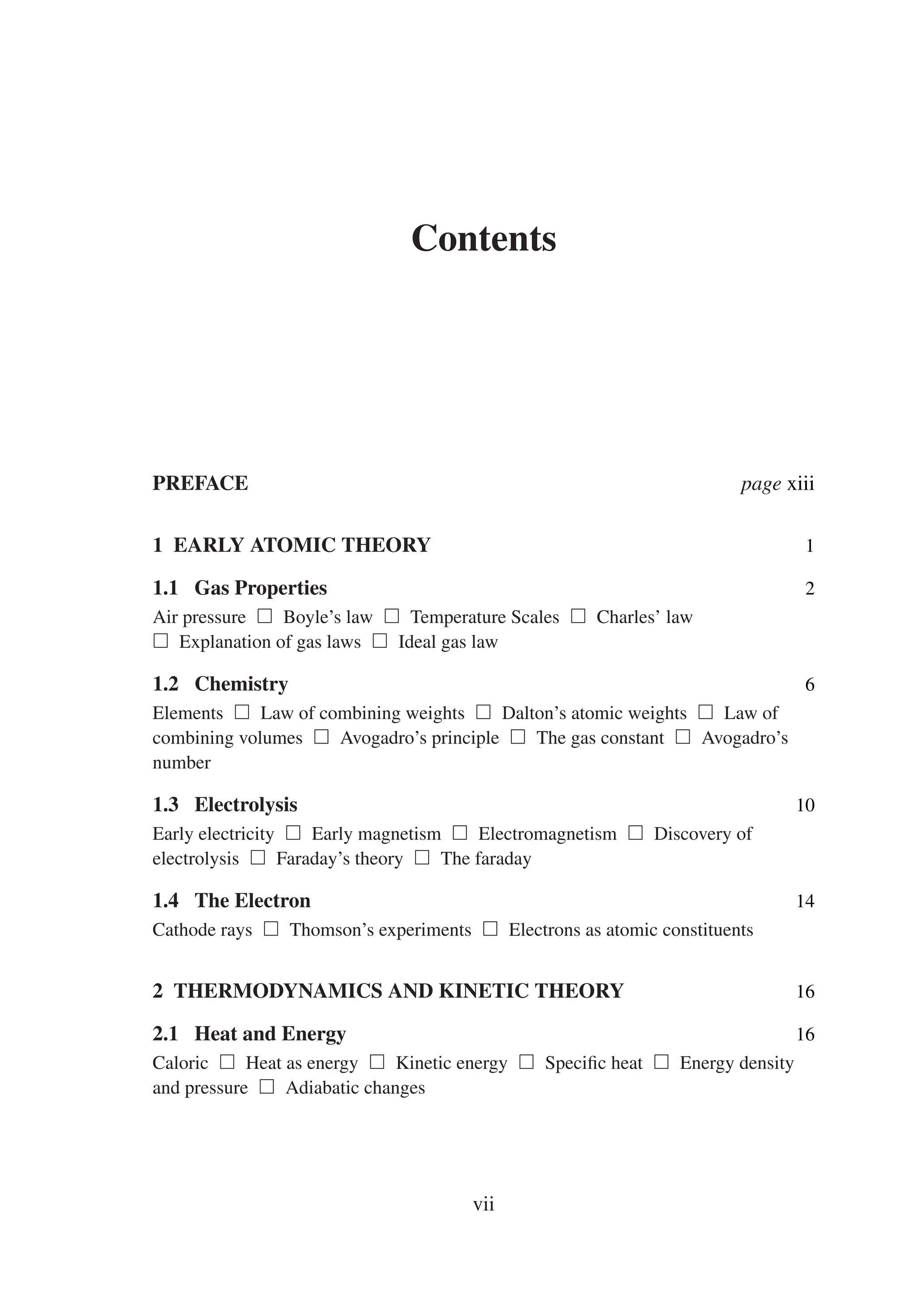
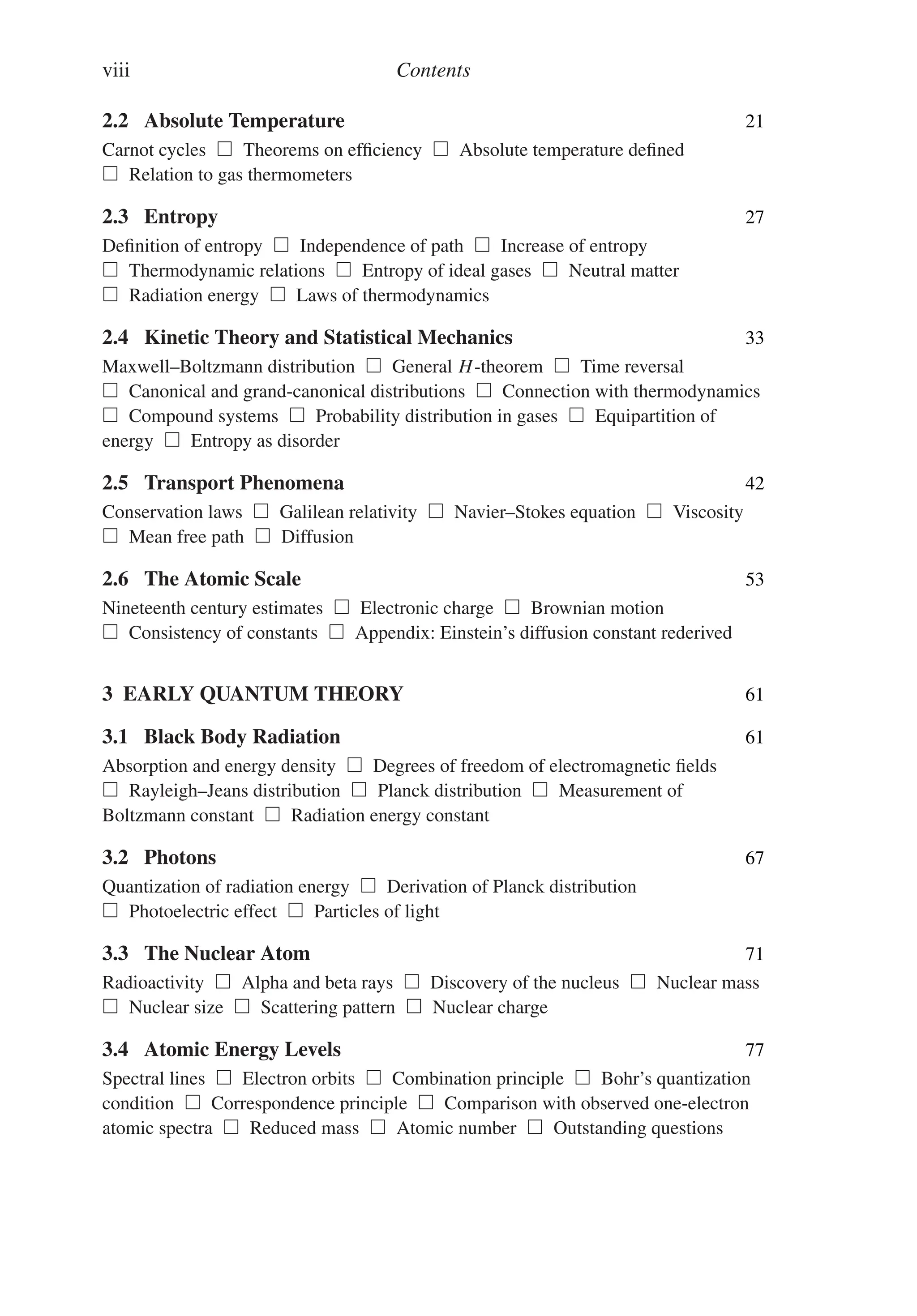
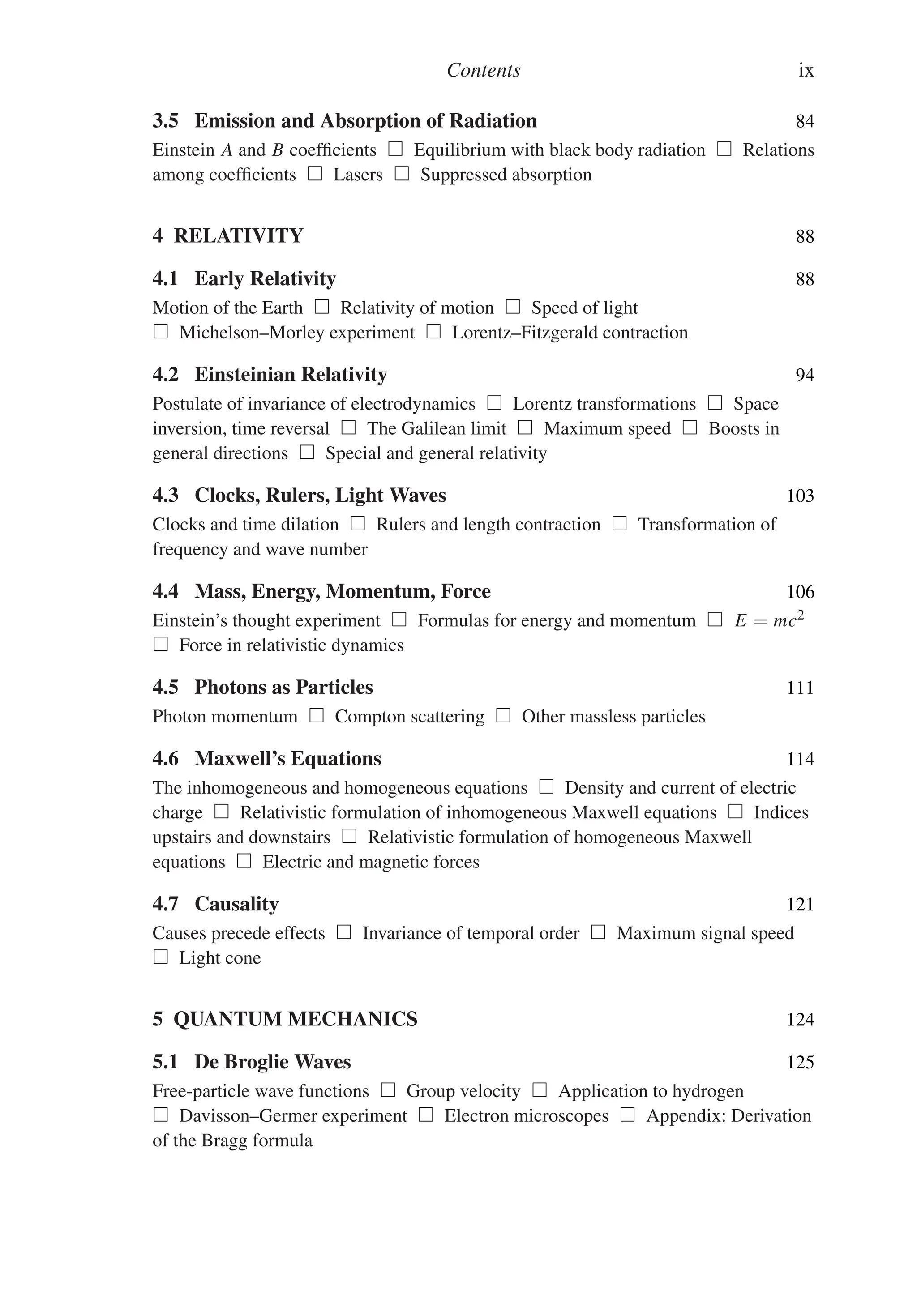
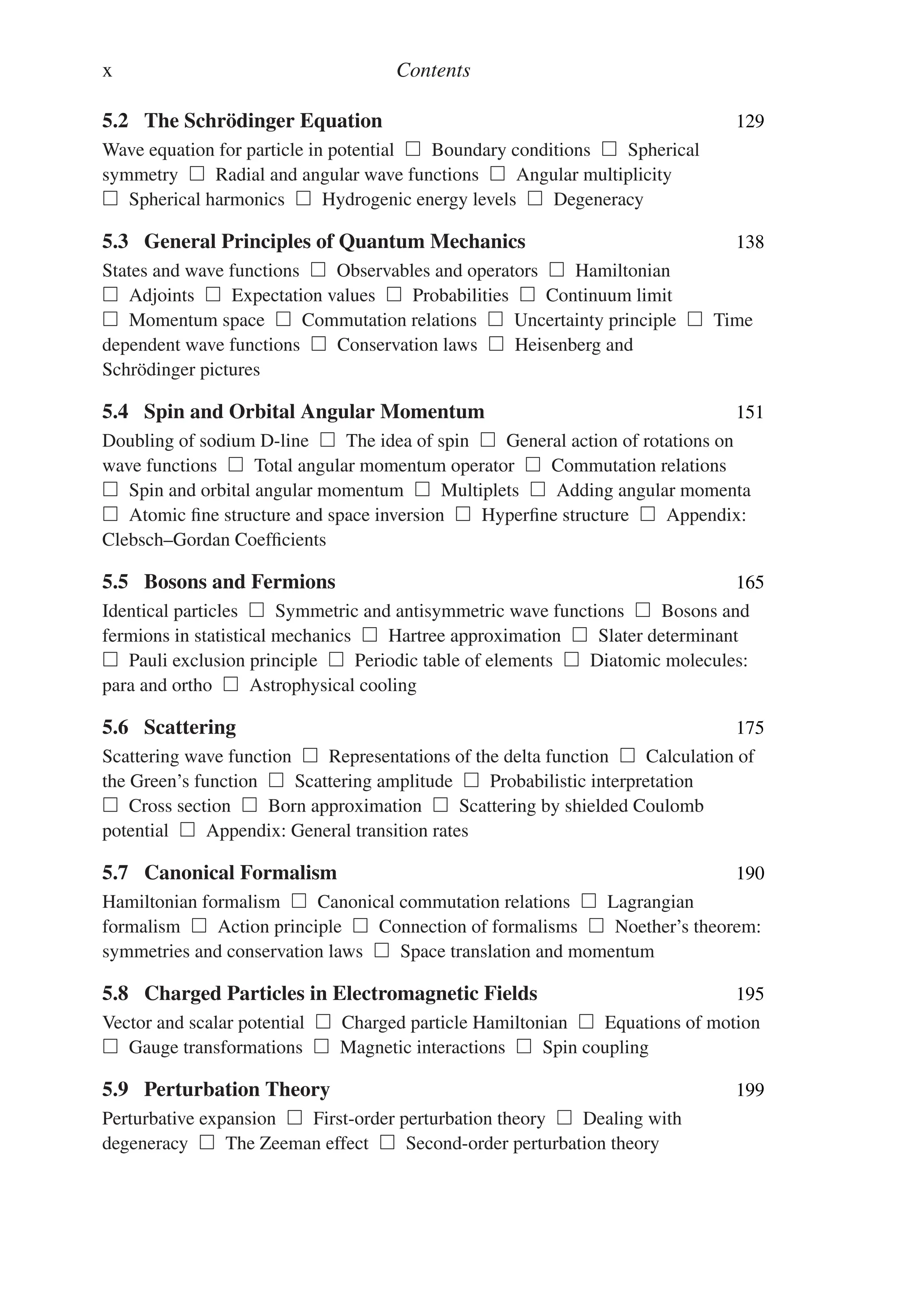
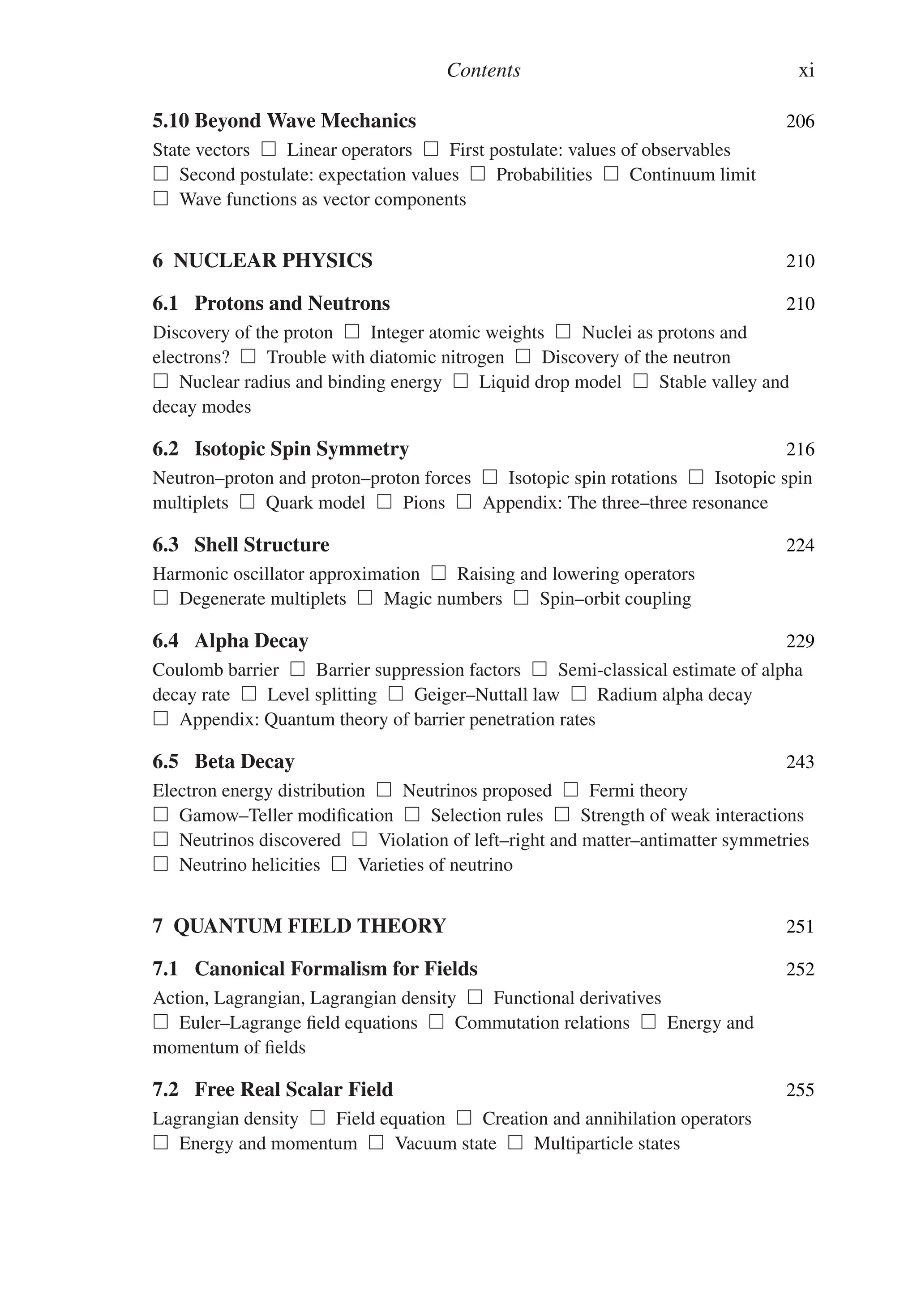
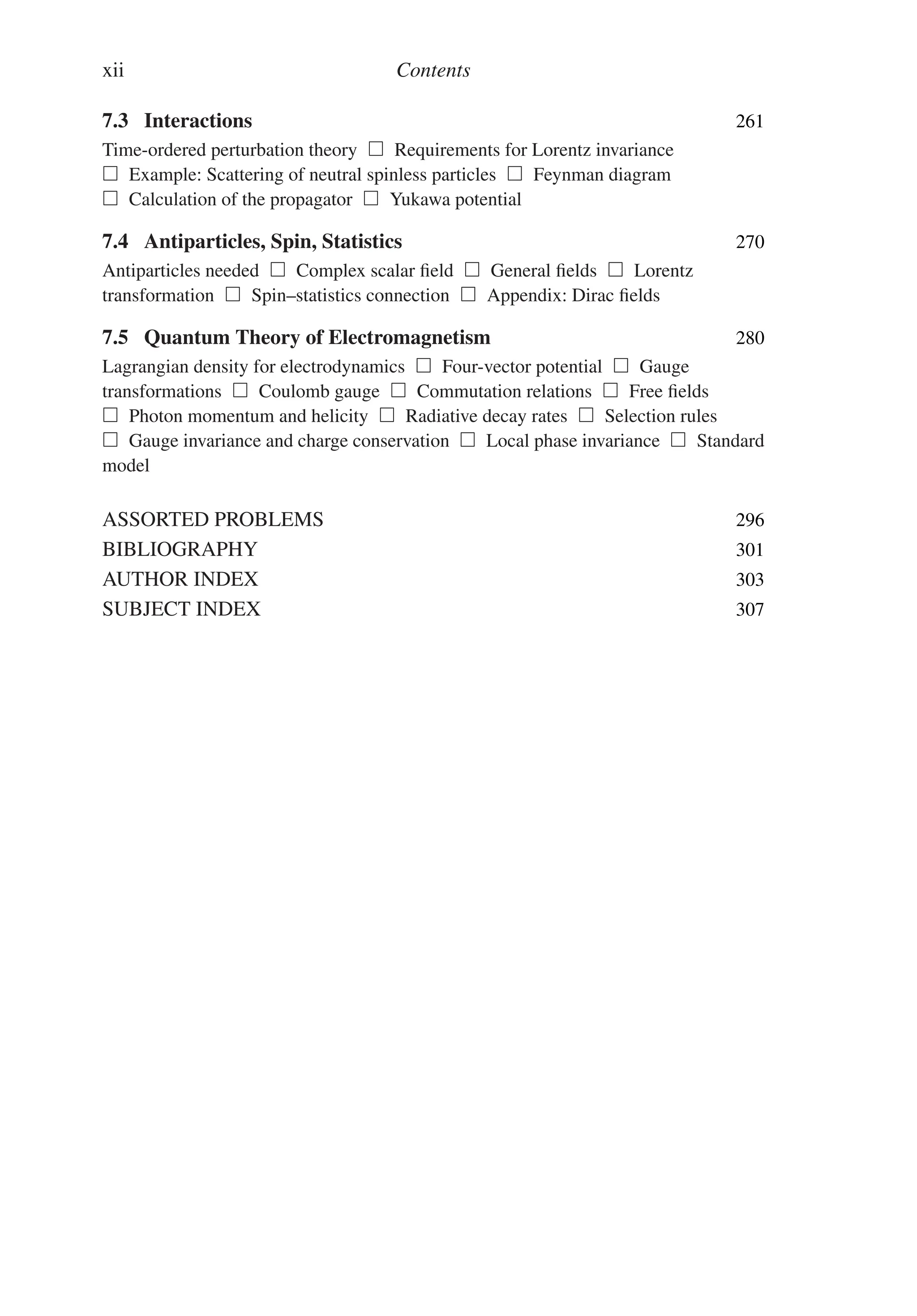
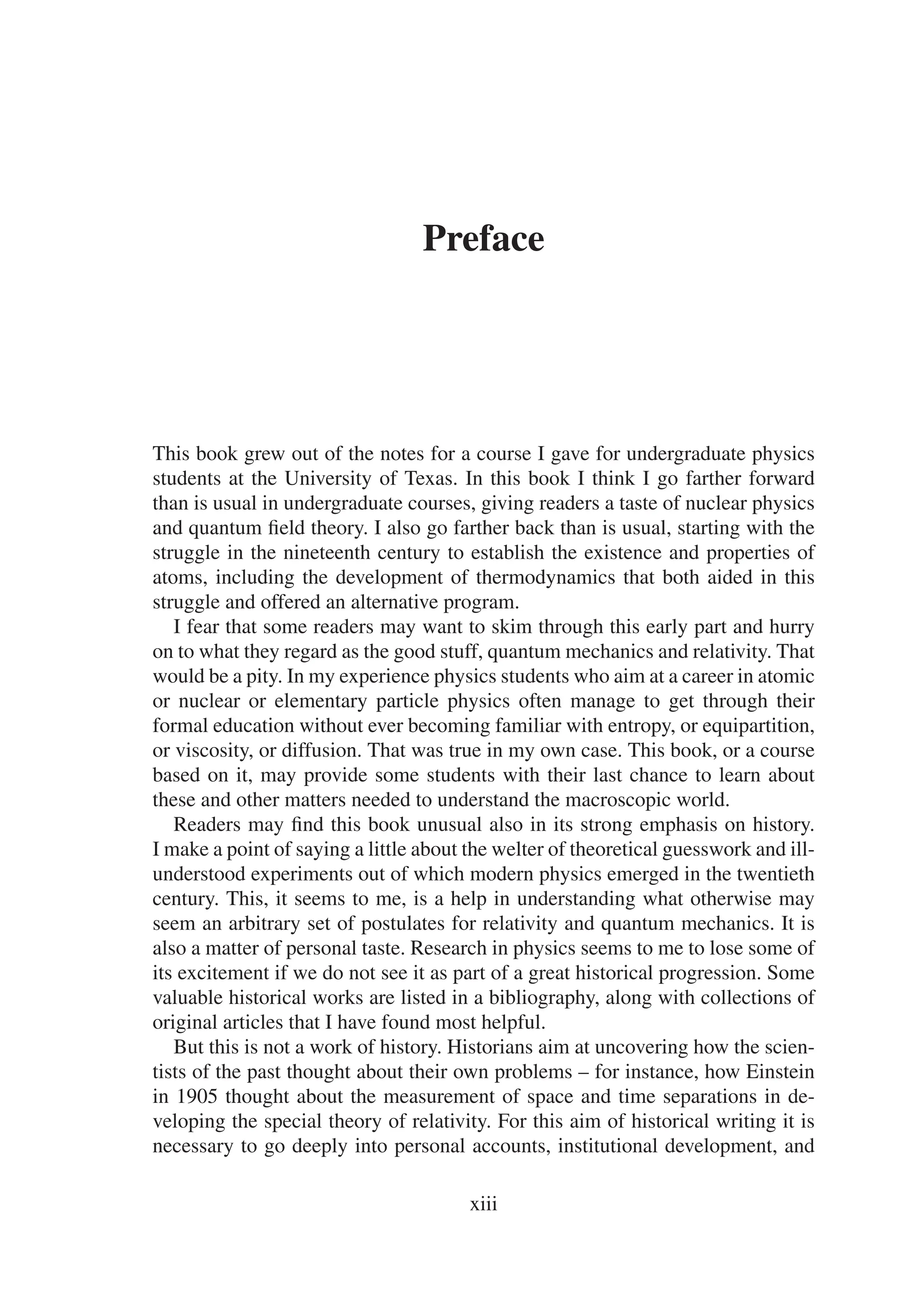
![1.1 Gas Properties 5
We see that all dependence on the times t and T cancels. The pressure p is
defined as the force per area, so this gives the relation
p = 2nmv2
⊥ . (1.1.1)
This is for the unphysical case in which every particle has the same value of v⊥,
positive in the sense that the particles are assumed to be going toward the wall.
In the real world, different particles will be moving with different speeds in
different directions, and Eq. (1.1.1) should be replaced with
p = 2nm ×
1
2
v2
⊥ = nmv2
⊥ , (1.1.2)
the brackets indicating an average over all gas particles, with the factor 1/2
inserted in the first expression because only 50% of these particles will be going
toward any given wall area.
To express v2
⊥ in terms of the root mean square velocity, Clausius assumed
without proof that “on the average each direction [of the particle velocities]
is equally represented.” In this case, the average square of each component of
velocity equals v2
⊥, and the average of the squared velocity vector is then
v2
= v2
1 + v2
2 + v2
3 = 3v2
⊥
and therefore Eq. (1.1.2) reads
p = nmv2
/3 . (1.1.3)
This is essentially the result p ∝ nv2 of Bernoulli, except that, with the
factor m/3, Eq. (1.1.3) is now an equality, not just a statement of proportion-
ality. For a fixed mass M of gas occupying a volume V , the number density
is n = M/mV , so Clausius could use Boyle’s law (which he called Mariotte’s
law), which states that pV is constant for fixed temperature, to conclude that
for a given gas v2 depends only on the temperature. Further, as Clausius
remarked, Eq. (1.1.3) together with Charles’ law (which Clausius called the
law of Gay-Lussac) indicates that v2 is proportional to the absolute temper-
ature T . If we like, we can adopt a modern notation and write the constant of
proportionality as 3k/m, so that
mv2
/3 = kT , (1.1.4)
and therefore Eq. (1.1.3) reads
p = nkT , (1.1.5)
where k is a constant, in the sense of being independent of p, n, and T . But
the choice of notation does not tell us whether k varies from one type of gas
to another or whether it depends on the molecular mass m. Clausius could not
answer this question, and did not offer any theoretical justification for Boyle’s](https://image.slidesharecdn.com/12329310-250612201056-6e30f95b/75/Foundations-Of-Modern-Physics-Steven-Weinberg-24-2048.jpg)
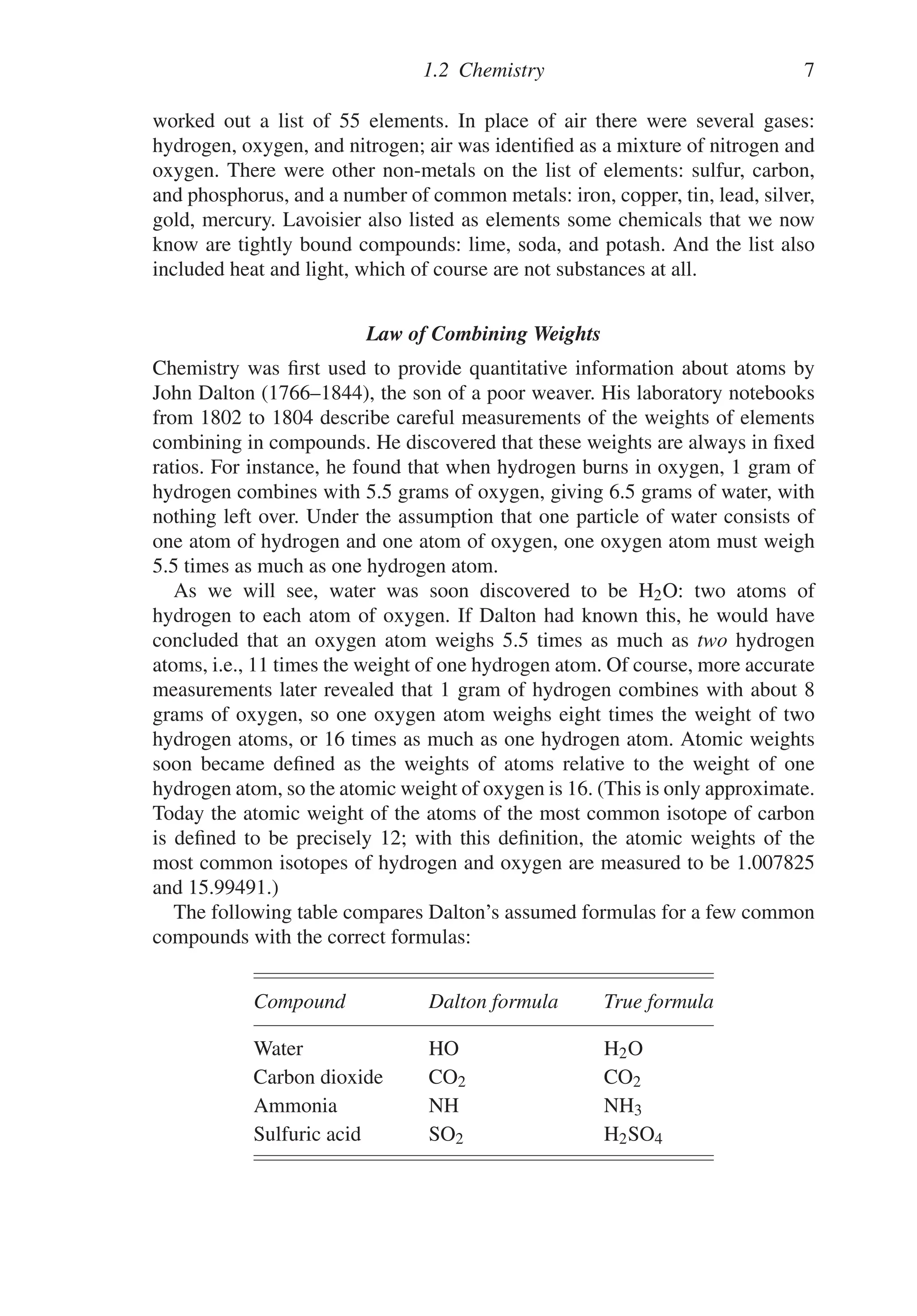
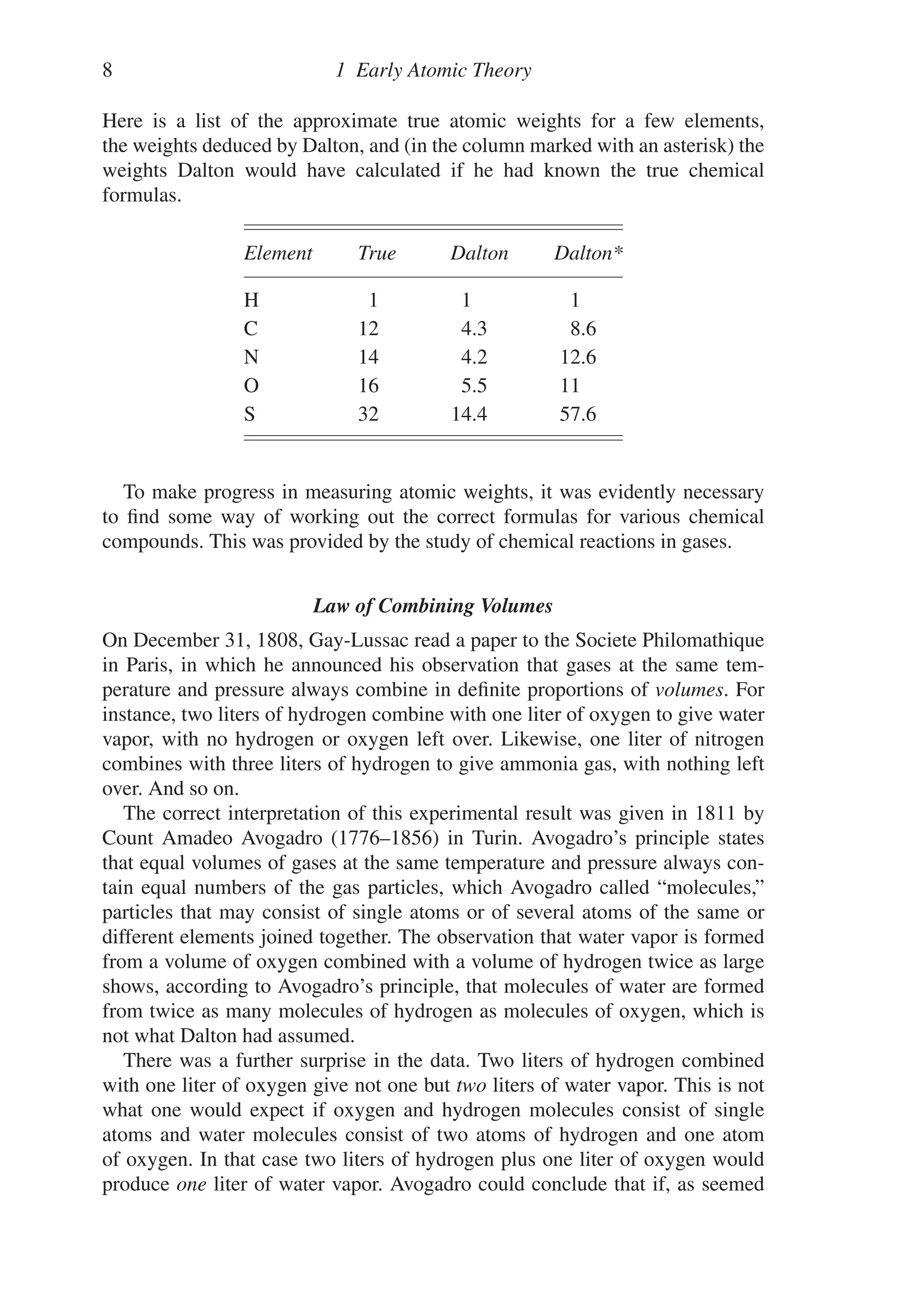
![18 2 Thermodynamics and Kinetic Theory
This energy has the special property of being conserved when bodies come
into contact in collisions. Consider a collision between two rigid balls A and B
with initial vector velocities vA and vB. For the moment suppose that the time
interval t over which this force acts is sufficiently brief that the forces acting on
the balls do not change appreciably during this time. The force that A exerts on
B is equal and opposite to the force F that B exerts on A, so Newton’s second
law tells us that the final velocities of A and B are v
A = vA + Ft/mA and
v
B = vB − Ft/mB. Hence, as Newton showed, momentum is conserved:
mAv
A + mBv
B = mAvA + mBvB . (2.1.1)
Neglecting changes in acceleration during the brief time t, the vector displace-
ments traveled by A and B equal t times the average velocities, [vA + v
A]/2
and [vB + v
B]/2, respectively. If the balls remain in contact during this time
interval, then these displacements must be the same, so
vA + v
A = vB + v
B . (2.1.2)
To derive a second conservation law, rewrite Eq. (2.1.2) as v
B − v
A = vA − vB
and square this, giving
v2
B − 2v
B · v
A + v2
A = v2
B − 2vB · vA + v2
A .
Multiply this with mAmB and add the square of Eq. (2.1.1), so that the scalar
products cancel. Dividing by 2(mA+mB), the result is another conservation law,
mA
2
v2
A +
mB
2
v2
B =
mA
2
v2
A +
mB
2
v2
B . (2.1.3)
Equations (2.1.1) and (2.1.3) have been derived here only for the case in
which the particles are in contact only for a brief time interval during which
the force acting between the bodies is constant, but this is not an essential
requirement for we can break up any time interval into a large number of brief
intervals in each of which the change in the force is negligible, Then, since
mAvA + mBvB and mAv2
A/2+mBv2
B/2 do not change in each interval, they do
not change at all, as long as the bodies exert forces on each other only when they
are in contact.
In 1669 Christiaan Huygens (1629–1695) reported in Journal des Sçavans
that he had confirmed the conservation of the total of mv2/2, probably by
observing collisions of pendulum bobs, for which initial and final velocities
could be precisely determined. Newton in the Principia called the conserved
quantity mv the quantity of motion, while Huygens gave the name vis viva
(“living force”) to the conserved quantity mv2/2. These two quantities have
since become known as momentum and kinetic energy.
On the other hand, it was essential in deriving the conservation of kinetic
energy that we assumed that particles interact only when in contact. This is
generally a good approximation in gases, but it is not valid in the presence of](https://image.slidesharecdn.com/12329310-250612201056-6e30f95b/75/Foundations-Of-Modern-Physics-Steven-Weinberg-37-2048.jpg)
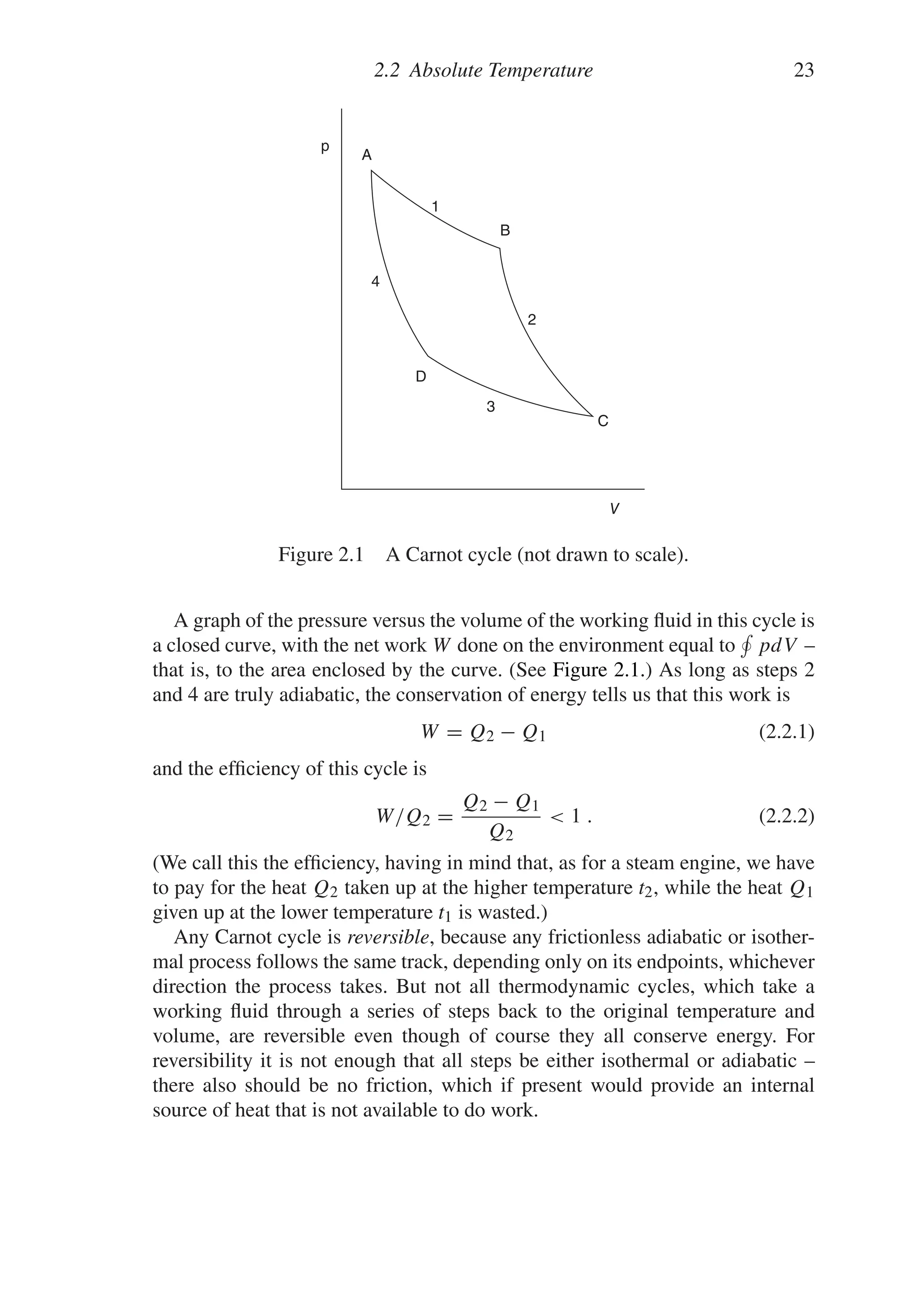
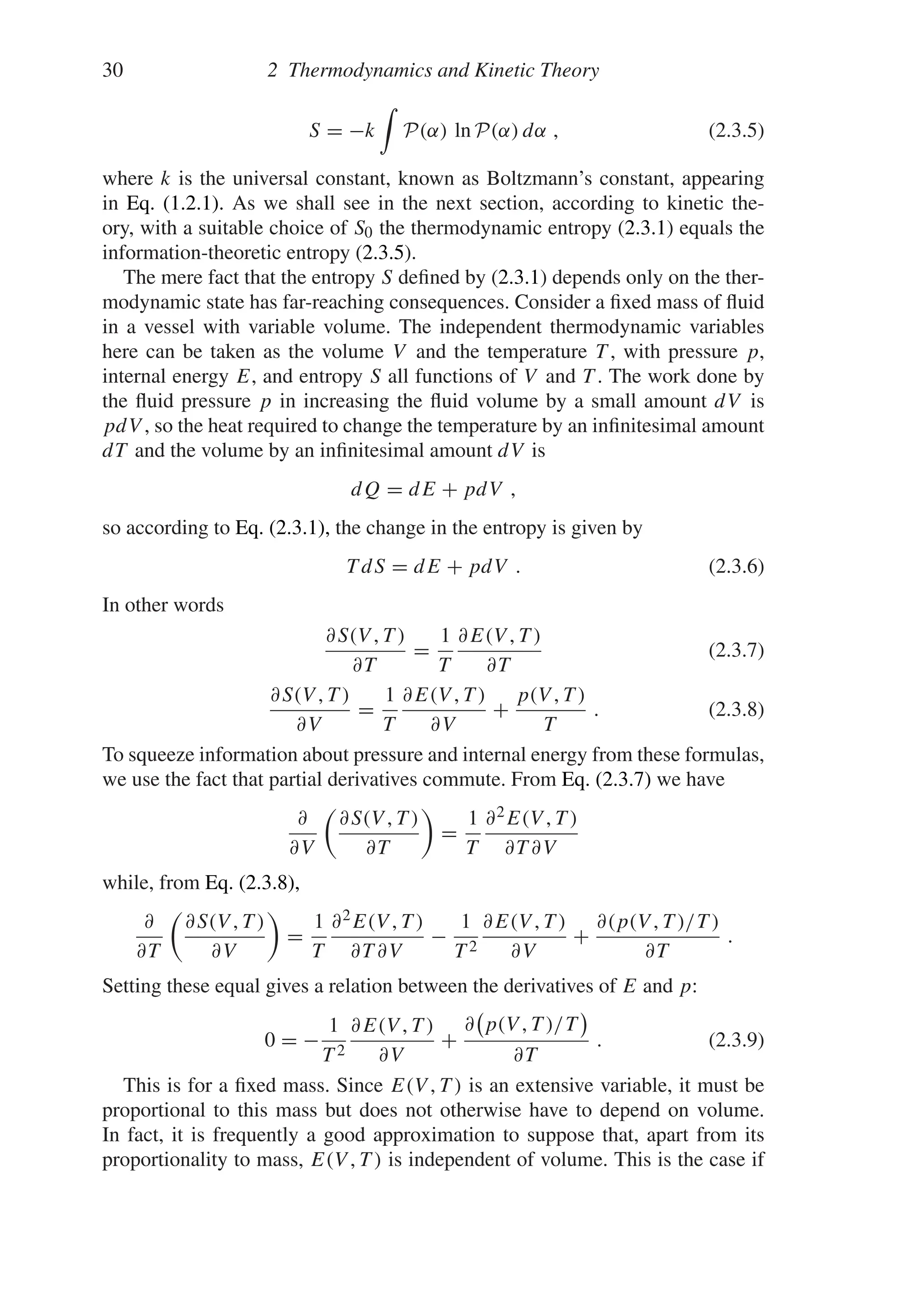
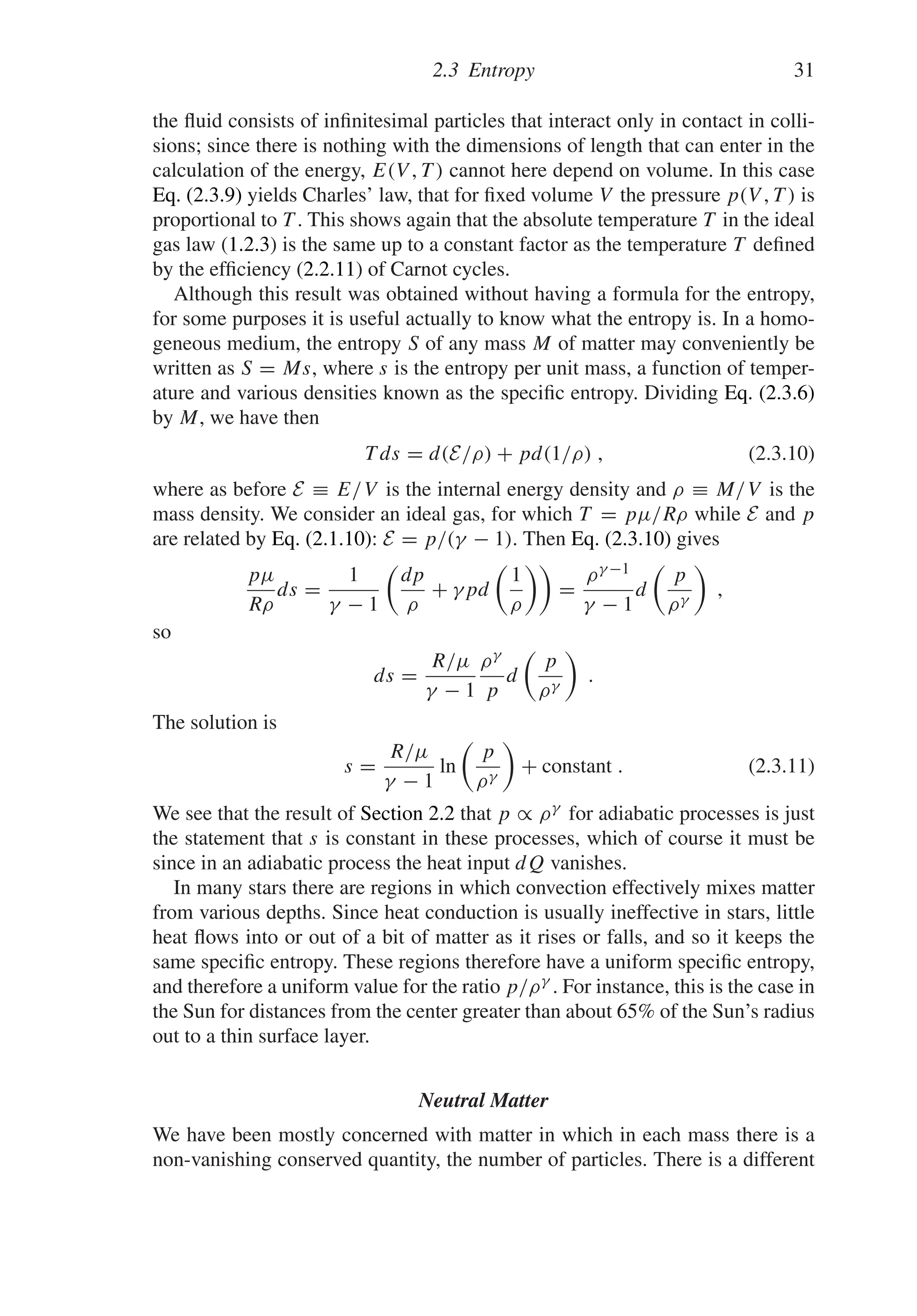
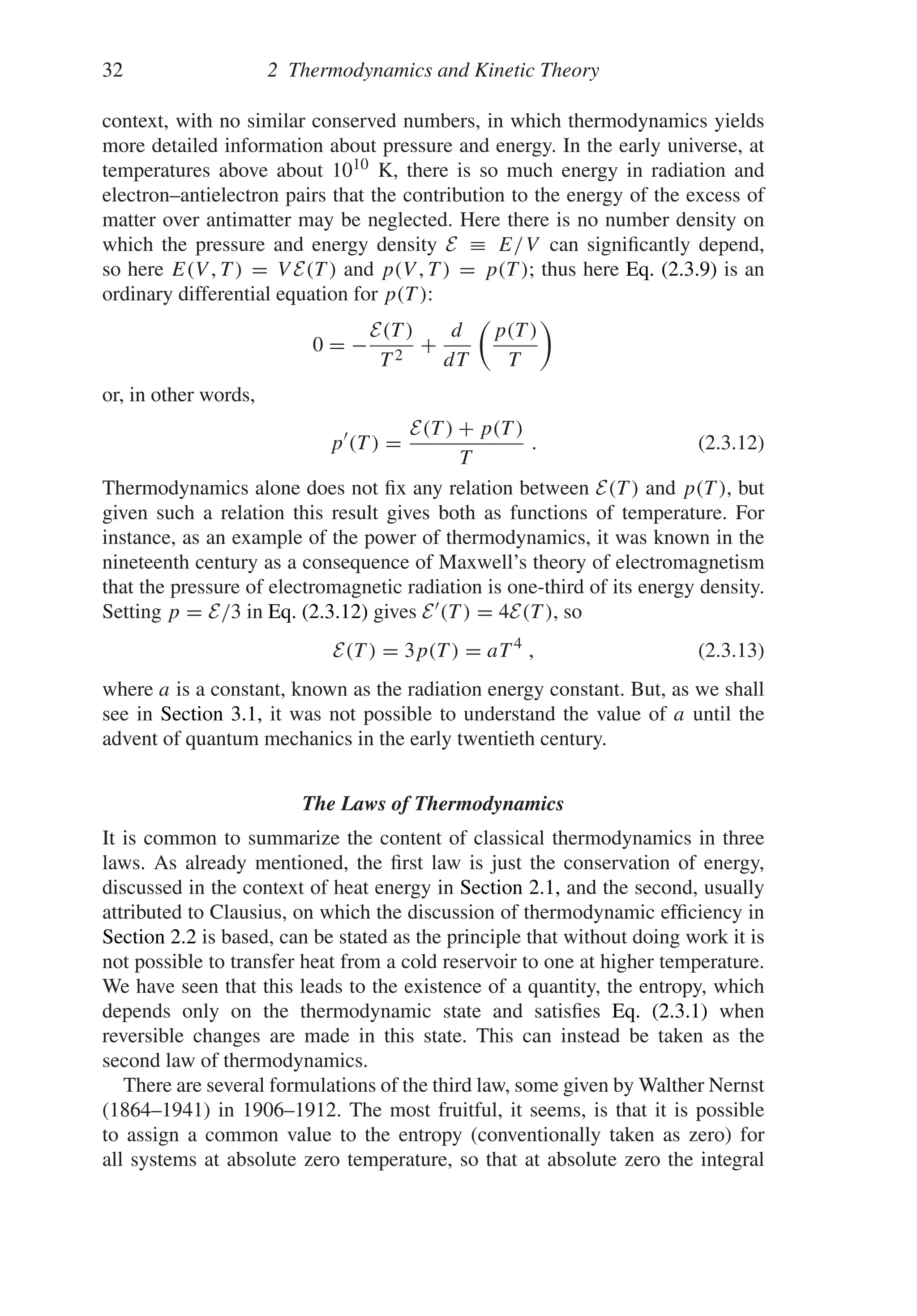
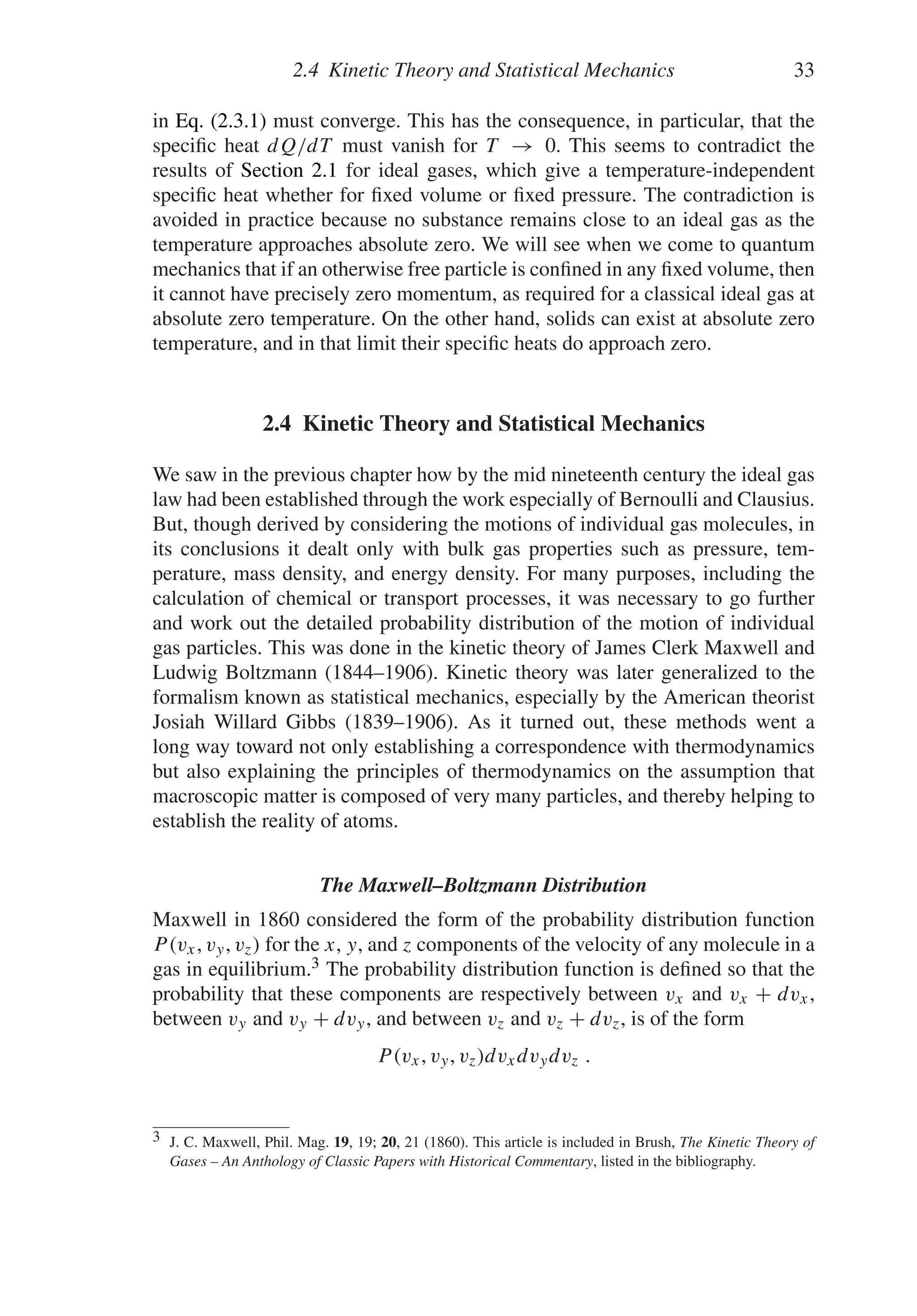
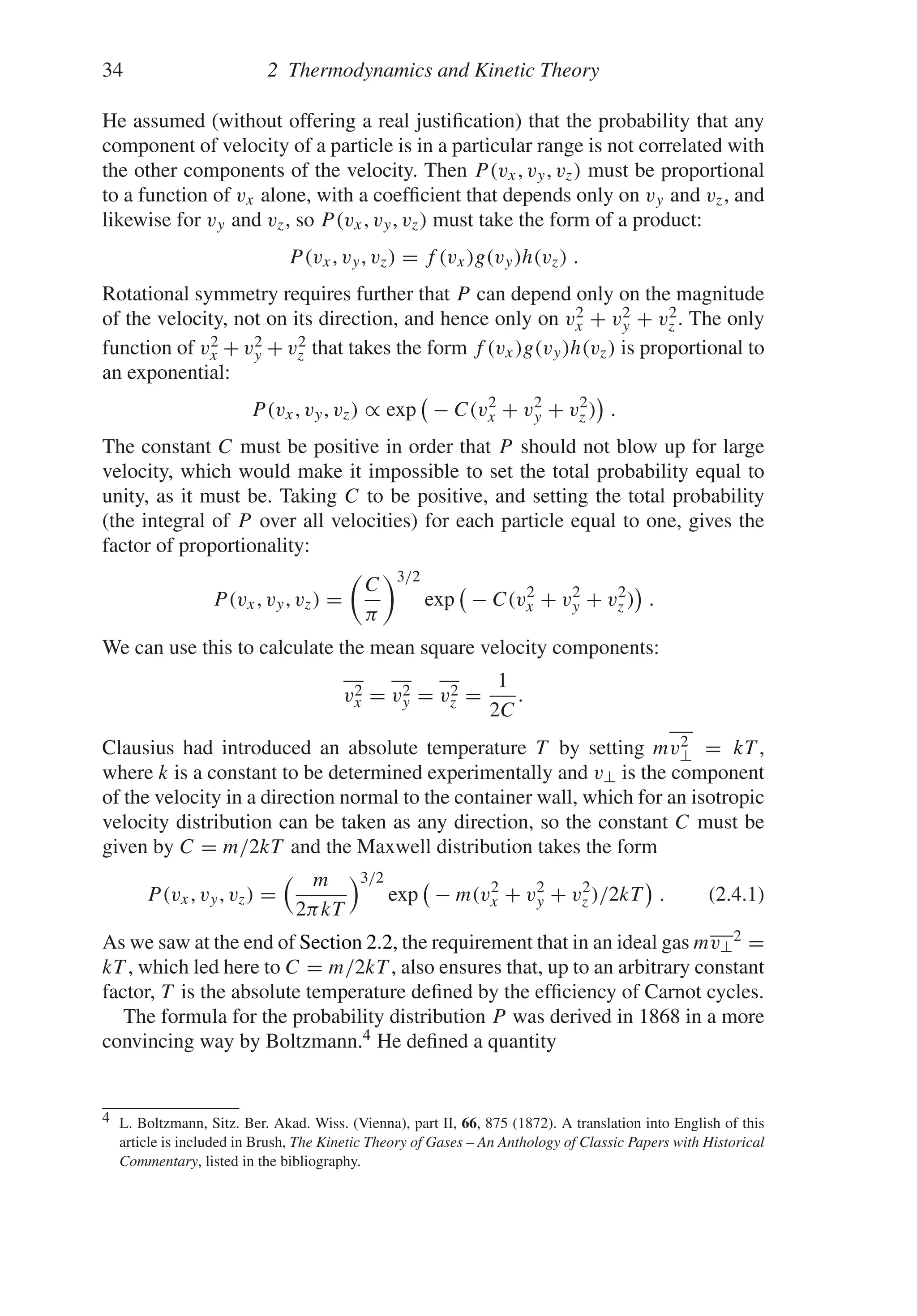
![2.4 Kinetic Theory and Statistical Mechanics 35
H ≡ ln P =
+∞
−∞
dvx
+∞
−∞
dvy
+∞
−∞
dvz P(v) ln P(v) ,
and showed that collisions of gas particles always lead to a decrease in H until
a minimum is reached, at which P(v) is the Maxwell–Boltzmann distribution
function. A generalization of this H-theorem was given in 1901 by Gibbs.5 The
generalization and proof are given below, along with the application to gases.
The General H-Theorem
Consider a large system with many degrees of freedom, such as a gas with many
molecules (but not necessarily a gas). The states of the system are parameterized
by many variables, which we summarize with a symbol α. (For instance, for a
monatomic gas α stands for the set of positions x1, x2, etc. and momenta p1, p2,
etc. of atoms 1, 2, . . . For a gas of multi-atom molecules, α would also include
the orientations and their rates of change for each molecule.) We denote an
infinitesimal range of these parameters by dα. (For instance, for a monatomic
gas dα stands for the product d3x1d3p1d3x2d3p2 . . ., known as the phase space
volume.) We define P(α) so that the probability that the parameters of the
system are in an infinitesimal range dα around α is P(α)dα, with P normalized
so that
dαP(α) = 1. Define
H ≡ ln P =
P(α) dα ln P(α) . (2.4.2)
Gibbs showed that H always decreases until it reaches a minimum value, at
which P(α) is proportional to the exponential of a linear combination of con-
served quantities, such as the total energy.
Proof: Define a differential rate (α → β) such that the rate at which a system
in state α makes a transition to a state within a range dβ around state β is
(α → β) dβ. The probability P(α)dα can either increase because the system
in a range dβ of states around β makes a transition to the range dα of states
around α, or decrease because the system in the range of states dα around α
makes a transition to some other state in a range dβ around β, so
dP(α)dα
dt
=
dβ [P(β) (β → α)dα − P(α) dα(α → β)] ,
or, cancelling the differentials dα,
dP(α)
dt
=
dβ [P(β) (β → α) − P(α)(α → β)] . (2.4.3)
5 J. W. Gibbs, Elementary Principles of Statistical Mechanics, Developed with Especial Reference to The
Rational Foundation of Thermodynamics (Scribner, New York, 1902).](https://image.slidesharecdn.com/12329310-250612201056-6e30f95b/75/Foundations-Of-Modern-Physics-Steven-Weinberg-54-2048.jpg)

![CHAPTER XI
GALILEE
Neither old “sacred” [123] himself, nor any of his helpers, knew the
road which I meant to take from Nazareth to the Sea of Galilee and
from thence to Jerusalem, so I was forced to add another to my
party by hiring a guide. The associations of Nazareth, as well as my
kind feeling towards the hospitable monks, whose guest I had been,
inclined me to set at naught the advice which I had received against
employing Christians. I accordingly engaged a lithe, active young
Nazarene, who was recommended to me by the monks, and who
affected to be familiar with the line of country through which I
intended to pass. My disregard of the popular prejudices against
Christians was not justified in this particular instance by the result of
my choice. This you will see by and by.
I passed by Cana and the house in which the water had been turned
into wine; I came to the field in which our Saviour had rebuked the
Scotch Sabbath-keepers of that period, by suffering His disciples to
pluck corn on the Lord’s Day; I rode over the ground on which the
fainting multitude had been fed, and they showed me some massive
fragments—the relics, they said, of that wondrous banquet, now
turned into stone. The petrifaction was most complete.
I ascended the height on which our Lord was standing when He
wrought the miracle. The hill was lofty enough to show me the
fairness of the land on all sides, but I have an ancient love for the
mere features of a lake, and so forgetting all else when I reached
the summit, I looked away eagerly to the eastward. There she lay,](https://image.slidesharecdn.com/12329310-250612201056-6e30f95b/75/Foundations-Of-Modern-Physics-Steven-Weinberg-56-2048.jpg)
![the Sea of Galilee. Less stern than Wast Water, less fair than gentle
Windermere, she had still the winning ways of an English lake; she
caught from the smiling heavens unceasing light and changeful
phases of beauty, and with all this brightness on her face, she yet
clung so fondly to the dull he-looking mountain at her side, as
though she would
“Soothe him with her finer fancies,
Touch him with her lighter thought.” [124]
If one might judge of men’s real thoughts by their writings, it would
seem that there are people who can visit an interesting locality and
follow up continuously the exact train of thought that ought to be
suggested by the historical associations of the place. A person of
this sort can go to Athens and think of nothing later than the age of
Pericles; can live with the Scipios as long as he stays in Rome; can
go up in a balloon, and think how resplendently in former times the
now vacant and desolate air was peopled with angels, how prettily it
was crossed at intervals by the rounds of Jacob’s ladder! I don’t
possess this power at all; it is only by snatches, and for few
moments together, that I can really associate a place with its proper
history.
“There at Tiberias, and along this western shore towards the north,
and upon the bosom too of the lake, our Saviour and His disciples”—
away flew those recollections, and my mind strained eastward,
because that that farthest shore was the end of the world that
belongs to man the dweller, the beginning of the other and veiled
world that is held by the strange race, whose life (like the pastime of
Satan) is a “going to and fro upon the face of the earth.” From
those grey hills right away to the gates of Bagdad stretched forth
the mysterious “desert”—not a pale, void, sandy tract, but a land
abounding in rich pastures, a land without cities or towns, without
any “respectable” people or any “respectable” things, yet yielding its
eighty thousand cavalry to the beck of a few old men. But once
more—“Tiberias—the plain of Gennesareth—the very earth on which](https://image.slidesharecdn.com/12329310-250612201056-6e30f95b/75/Foundations-Of-Modern-Physics-Steven-Weinberg-57-2048.jpg)
![I stood—that the deep low tones of the Saviour’s voice should have
gone forth into eternity from out of the midst of these hills and these
valleys!”—Ay, ay, but yet again the calm face of the lake was
uplifted, and smiled upon my eyes with such familiar gaze, that the
“deep low tones” were hushed, the listening multitudes all passed
away, and instead there came to me a dear old memory from over
the seas in England, a memory sweeter than Gospel to that poor
wilful mortal, me.
I went to Tiberias, and soon got afloat upon the water. In the
evening I took up my quarters in the Catholic church, and the
building being large enough, the whole of my party were admitted to
the benefit of the same shelter. With portmanteaus and carpet
bags, and books and maps, and fragrant tea, Mysseri soon made me
a home on the southern side of the church. One of old Shereef’s
helpers was an enthusiastic Catholic, and was greatly delighted at
having so sacred a lodging. He lit up the altar with a number of
tapers, and when his preparations were complete, he began to
perform his orisons in the strangest manner imaginable. His lips
muttered the prayers of the Latin Church, but he bowed himself
down and laid his forehead to the stones beneath him after the
manner of a Mussulman. The universal aptness of a religious
system for all stages of civilisation, and for all sorts and conditions of
men, well befits its claim of divine origin. She is of all nations, and
of all times, that wonderful Church of Rome!
Tiberias is one of the four holy cities, [126] according to the Talmud,
and it is from this place, or the immediate neighbourhood of it, that
the Messiah is to arise.
Except at Jerusalem, never think of attempting to sleep in a “holy
city.” Old Jews from all parts of the world go to lay their bones upon
the sacred soil, and as these people never return to their homes, it
follows that any domestic vermin which they may bring with them
are likely to become permanently resident, so that the population is
continually increasing. No recent census had been taken when I](https://image.slidesharecdn.com/12329310-250612201056-6e30f95b/75/Foundations-Of-Modern-Physics-Steven-Weinberg-58-2048.jpg)
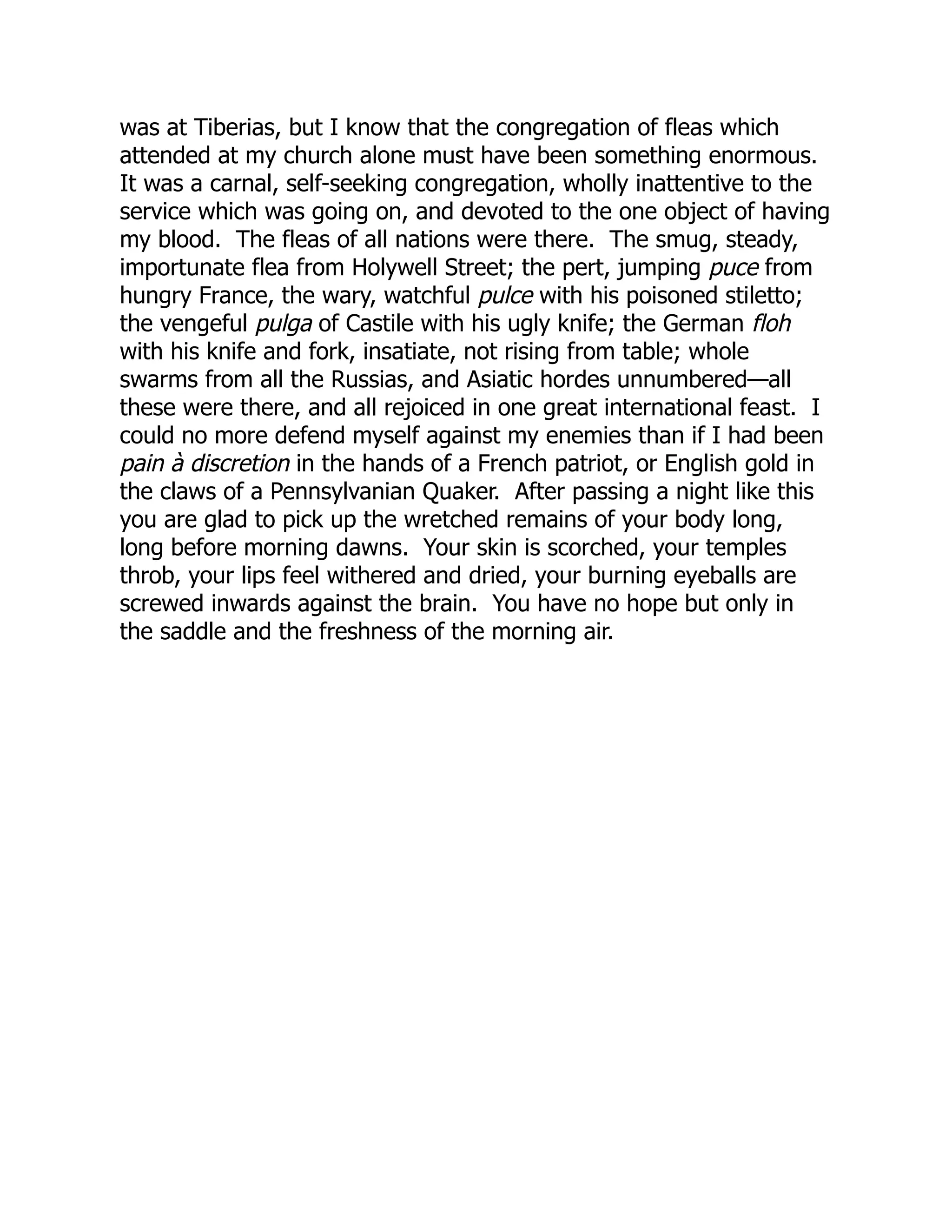


![founded alarms, that I can see no limit to the yielding and bending
of his mind when it is wrought upon by the idea of power.
After some discussion the Arabs agreed, as I thought, to conduct me
to a ford, and we moved on towards the river, followed by seventeen
of the most able-bodied of the tribe, under the guidance of several
grey-bearded elders, and Sheik Ali Djoubran at the head of the
whole detachment. Upon leaving the encampment a sort of
ceremony was performed, for the purpose, it seemed, of ensuring, if
possible, a happy result for the undertaking. There was an uplifting
of arms, and a repeating of words that sounded like formulæ, but
there were no prostrations, and I did not understand that the
ceremony was of a religious character. The tented Arabs are looked
upon as very bad Mahometans. [149]
We arrived upon the banks of the river—not at a ford, but at a deep
and rapid part of the stream, and I now understood that it was the
plan of these men, if they helped me at all, to transport me across
the river by some species of raft. But a reaction had taken place in
the opinions of many, and a violent dispute arose upon a motion
which seemed to have been made by some honourable member with
a view to robbery. The fellows all gathered together in circle, at a
little distance from my party, and there disputed with great
vehemence and fury for nearly two hours. I can’t give a correct
report of the debate, for it was held in a barbarous dialect of the
Arabic unknown to my dragoman. I recollect I sincerely felt at the
time that the arguments in favour of robbing me must have been
almost unanswerable, and I gave great credit to the speakers on my
side for the ingenuity and sophistry which they must have shown in
maintaining the fight so well.
During the discussion I remained lying in front of my baggage, which
had all been taken from the pack-saddles and placed upon the
ground. I was so languid from want of food, that I had scarcely
animation enough to feel as deeply interested as you would suppose
in the result of the discussion. I thought, however, that the](https://image.slidesharecdn.com/12329310-250612201056-6e30f95b/75/Foundations-Of-Modern-Physics-Steven-Weinberg-78-2048.jpg)