A BRIEF HISTORY OF PHYSICS
PRESENTED BY
1.KAZI TAKBIR HOSSAIN (221903003)
2.MD JUNAED HOSSEN (221903012)
3.MOHAMMAD FAHAD (221903014)
4.SHOUROV KHAN (221903015)
5.DOLON NAIMUL (221903016)
6.SABBIR AHMED (221903017)
7.SIFAT SARKER (221903018)
8.MD. TAKI AL JADID SAMI (221903019)
PRESENTED TO
MS PRIANKA MONDOL
LECTURER
DEPARTMENT OF TEXTILE
GREEN UNIVERSITY OF BANGLADESH
7/03/2022
content
N/A
1.THE GREEKS
2.THE COPERNICAN
REVOLUTION
3.THE TIME OF
GALILEO AND
NEWTONIAN
MECHANICS
4.AFTER NEWTON
ELECTROMAGNETISM 5.LIGHT 6.RELATIVITY
7.QUANTUM THEORY
8.THE GRAND
UNIFICATION
9.Importance of
physics
1.THE GREEKS
1
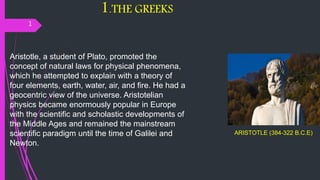
ARISTOTLE (384-322 B.C.E)
Aristotle, a student of Plato, promoted the
concept of natural laws for physical phenomena,
which he attempted to explain with a theory of
four elements, earth, water, air, and fire. He had a
geocentric view of the universe. Aristotelian
physics became enormously popular in Europe
with the scientific and scholastic developments of
the Middle Ages and remained the mainstream
scientific paradigm until the time of Galilei and
Newton.
2
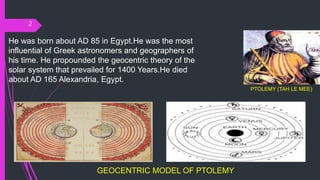
PTOLEMY (TAH LE MEE)
He was born about AD 85 in Egypt.He was the most
influential of Greek astronomers and geographers of
his time. He propounded the geocentric theory of the
solar system that prevailed for 1400 Years.He died
about AD 165 Alexandria, Egypt.
GEOCENTRIC MODEL OF PTOLEMY
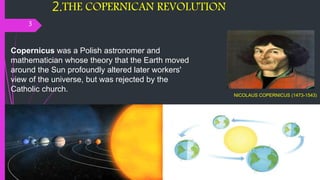
2.THE COPERNICAN REVOLUTION
3
NICOLAUS COPERNICUS (1473-1543)
Copernicus was a Polish astronomer and
mathematician whose theory that the Earth moved
around the Sun profoundly altered later workers'
view of the universe, but was rejected by the
Catholic church.
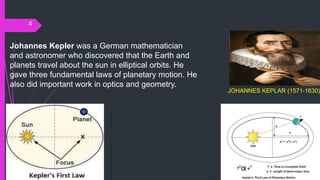
4
JOHANNES KEPLAR (1571-1630)
Johannes Kepler was a German mathematician
and astronomer who discovered that the Earth and
planets travel about the sun in elliptical orbits. He
gave three fundamental laws of planetary motion. He
also did important work in optics and geometry.
3.THE TIME OF GALILEO AND NEWTONIAN
MECHANICS
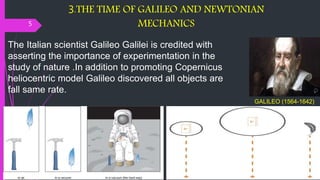
5
GALILEO (1564-1642)
The Italian scientist Galileo Galilei is credited with
asserting the importance of experimentation in the
study of nature .In addition to promoting Copernicus
heliocentric model Galileo discovered all objects are
fall same rate.
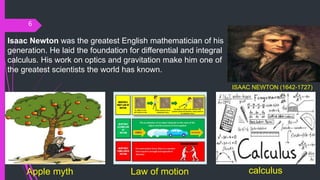
6
ISAAC NEWTON (1642-1727)
Isaac Newton was the greatest English mathematician of his
generation. He laid the foundation for differential and integral
calculus. His work on optics and gravitation make him one of
the greatest scientists the world has known.
Apple myth Law of motion calculus
4.AFTER NEWTON ELECTROMAGNETISM
7
CHARLES COULOMB
(1736-1806)
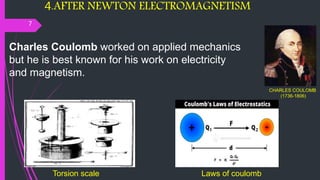
Charles Coulomb worked on applied mechanics
but he is best known for his work on electricity
and magnetism.
Torsion scale Laws of coulomb
8
James clerk Maxwell
(1831-1889)
James Clerk Maxwell was a Scottish
mathematician who did revolutionary work on
electricity, magnetism, optics and on the kinetic
theory of gases.
ELECTROMAGNETISM COLOR VISION
KINETIC THEORY OF GASES
5.LIGHT
9
THOMAS YOUNG
(1773-1827)
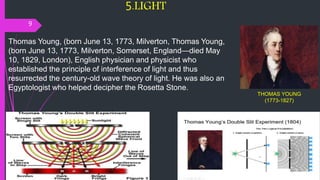
Thomas Young, (born June 13, 1773, Milverton, Thomas Young,
(born June 13, 1773, Milverton, Somerset, England—died May
10, 1829, London), English physician and physicist who
established the principle of interference of light and thus
resurrected the century-old wave theory of light. He was also an
Egyptologist who helped decipher the Rosetta Stone.
6.RELATIVITY
10
ALBERT MICHELSON
(1852-1931)
EDWARD MORLEY
(1838-1923)
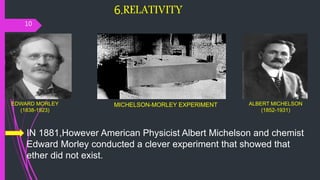
MICHELSON-MORLEY EXPERIMENT
IN 1881,However American Physicist Albert Michelson and chemist
Edward Morley conducted a clever experiment that showed that
ether did not exist.
11
ALBERT EINSTEIN
(1879-1955)
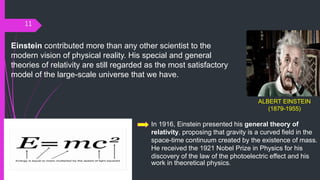
In 1916, Einstein presented his general theory of
relativity, proposing that gravity is a curved field in the
space-time continuum created by the existence of mass.
He received the 1921 Nobel Prize in Physics for his
discovery of the law of the photoelectric effect and his
work in theoretical physics.
Einstein contributed more than any other scientist to the
modern vision of physical reality. His special and general
theories of relativity are still regarded as the most satisfactory
model of the large-scale universe that we have.
7.QUANTUM THEORY
12
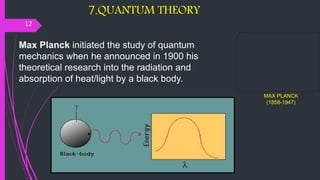
Max Planck initiated the study of quantum
mechanics when he announced in 1900 his
theoretical research into the radiation and
absorption of heat/light by a black body.
MAX PLANCK
(1858-1947)
13
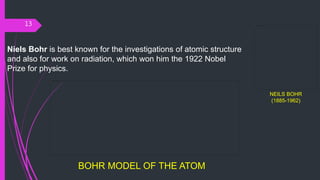
NEILS BOHR
(1885-1962)
Niels Bohr is best known for the investigations of atomic structure
and also for work on radiation, which won him the 1922 Nobel
Prize for physics.
BOHR MODEL OF THE ATOM
14
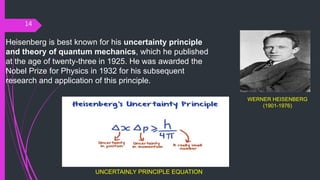
Heisenberg is best known for his uncertainty principle
and theory of quantum mechanics, which he published
at the age of twenty-three in 1925. He was awarded the
Nobel Prize for Physics in 1932 for his subsequent
research and application of this principle.
WERNER HEISENBERG
(1901-1976)
UNCERTAINLY PRINCIPLE EQUATION
8.THE GREAT UNIFICATION
15
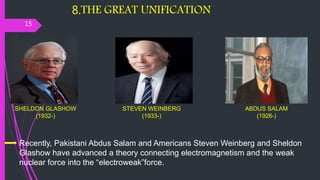
ABDUS SALAM
(1926-)
STEVEN WEINBERG
(1933-)
SHELDON GLASHOW
(1932-)
Recently, Pakistani Abdus Salam and Americans Steven Weinberg and Sheldon
Glashow have advanced a theory connecting electromagnetism and the weak
nuclear force into the “electroweak”force.
9.What is the importance of physics?
16
19
20

a brief history in physics

  • 1.
    A BRIEF HISTORYOF PHYSICS PRESENTED BY 1.KAZI TAKBIR HOSSAIN (221903003) 2.MD JUNAED HOSSEN (221903012) 3.MOHAMMAD FAHAD (221903014) 4.SHOUROV KHAN (221903015) 5.DOLON NAIMUL (221903016) 6.SABBIR AHMED (221903017) 7.SIFAT SARKER (221903018) 8.MD. TAKI AL JADID SAMI (221903019) PRESENTED TO MS PRIANKA MONDOL LECTURER DEPARTMENT OF TEXTILE GREEN UNIVERSITY OF BANGLADESH 7/03/2022
  • 2.
    content N/A 1.THE GREEKS 2.THE COPERNICAN REVOLUTION 3.THETIME OF GALILEO AND NEWTONIAN MECHANICS 4.AFTER NEWTON ELECTROMAGNETISM 5.LIGHT 6.RELATIVITY 7.QUANTUM THEORY 8.THE GRAND UNIFICATION 9.Importance of physics
  • 3.
    1.THE GREEKS 1 ARISTOTLE (384-322B.C.E) Aristotle, a student of Plato, promoted the concept of natural laws for physical phenomena, which he attempted to explain with a theory of four elements, earth, water, air, and fire. He had a geocentric view of the universe. Aristotelian physics became enormously popular in Europe with the scientific and scholastic developments of the Middle Ages and remained the mainstream scientific paradigm until the time of Galilei and Newton.
  • 4.
    2 PTOLEMY (TAH LEMEE) He was born about AD 85 in Egypt.He was the most influential of Greek astronomers and geographers of his time. He propounded the geocentric theory of the solar system that prevailed for 1400 Years.He died about AD 165 Alexandria, Egypt. GEOCENTRIC MODEL OF PTOLEMY
  • 5.
    2.THE COPERNICAN REVOLUTION 3 NICOLAUSCOPERNICUS (1473-1543) Copernicus was a Polish astronomer and mathematician whose theory that the Earth moved around the Sun profoundly altered later workers' view of the universe, but was rejected by the Catholic church.
  • 6.
    4 JOHANNES KEPLAR (1571-1630) JohannesKepler was a German mathematician and astronomer who discovered that the Earth and planets travel about the sun in elliptical orbits. He gave three fundamental laws of planetary motion. He also did important work in optics and geometry.
  • 7.
    3.THE TIME OFGALILEO AND NEWTONIAN MECHANICS 5 GALILEO (1564-1642) The Italian scientist Galileo Galilei is credited with asserting the importance of experimentation in the study of nature .In addition to promoting Copernicus heliocentric model Galileo discovered all objects are fall same rate.
  • 8.
    6 ISAAC NEWTON (1642-1727) IsaacNewton was the greatest English mathematician of his generation. He laid the foundation for differential and integral calculus. His work on optics and gravitation make him one of the greatest scientists the world has known. Apple myth Law of motion calculus
  • 9.
    4.AFTER NEWTON ELECTROMAGNETISM 7 CHARLESCOULOMB (1736-1806) Charles Coulomb worked on applied mechanics but he is best known for his work on electricity and magnetism. Torsion scale Laws of coulomb
  • 10.
    8 James clerk Maxwell (1831-1889) JamesClerk Maxwell was a Scottish mathematician who did revolutionary work on electricity, magnetism, optics and on the kinetic theory of gases. ELECTROMAGNETISM COLOR VISION KINETIC THEORY OF GASES
  • 11.
    5.LIGHT 9 THOMAS YOUNG (1773-1827) Thomas Young,(born June 13, 1773, Milverton, Thomas Young, (born June 13, 1773, Milverton, Somerset, England—died May 10, 1829, London), English physician and physicist who established the principle of interference of light and thus resurrected the century-old wave theory of light. He was also an Egyptologist who helped decipher the Rosetta Stone.
  • 12.
    6.RELATIVITY 10 ALBERT MICHELSON (1852-1931) EDWARD MORLEY (1838-1923) MICHELSON-MORLEYEXPERIMENT IN 1881,However American Physicist Albert Michelson and chemist Edward Morley conducted a clever experiment that showed that ether did not exist.
  • 13.
    11 ALBERT EINSTEIN (1879-1955) In 1916,Einstein presented his general theory of relativity, proposing that gravity is a curved field in the space-time continuum created by the existence of mass. He received the 1921 Nobel Prize in Physics for his discovery of the law of the photoelectric effect and his work in theoretical physics. Einstein contributed more than any other scientist to the modern vision of physical reality. His special and general theories of relativity are still regarded as the most satisfactory model of the large-scale universe that we have.
  • 14.
    7.QUANTUM THEORY 12 Max Planckinitiated the study of quantum mechanics when he announced in 1900 his theoretical research into the radiation and absorption of heat/light by a black body. MAX PLANCK (1858-1947)
  • 15.
    13 NEILS BOHR (1885-1962) Niels Bohris best known for the investigations of atomic structure and also for work on radiation, which won him the 1922 Nobel Prize for physics. BOHR MODEL OF THE ATOM
  • 16.
    14 Heisenberg is bestknown for his uncertainty principle and theory of quantum mechanics, which he published at the age of twenty-three in 1925. He was awarded the Nobel Prize for Physics in 1932 for his subsequent research and application of this principle. WERNER HEISENBERG (1901-1976) UNCERTAINLY PRINCIPLE EQUATION
  • 17.
    8.THE GREAT UNIFICATION 15 ABDUSSALAM (1926-) STEVEN WEINBERG (1933-) SHELDON GLASHOW (1932-) Recently, Pakistani Abdus Salam and Americans Steven Weinberg and Sheldon Glashow have advanced a theory connecting electromagnetism and the weak nuclear force into the “electroweak”force.
  • 18.
    9.What is theimportance of physics? 16
  • 19.
  • 20.