Social Studies for 8th E.G.B. | Teacher:
Mauricio Torres

 Mesopotamia was not the only place where
civilizations developed.
 The Nile River helped develop another civilization:
Egypt.
 This river, the longest in the world, brought life to
the people settled around it.
 Herodotus, a Greek historian called Egypt “the gift of
the Nile”.
Introduction

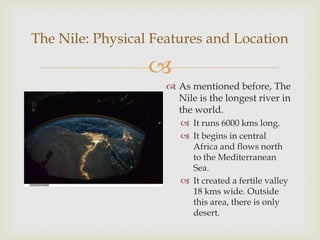
 As mentioned before, The
Nile is the longest river in
the world.
 It runs 6000 kms long.
 It begins in central
Africa and flows north
to the Mediterranean
Sea.
 It created a fertile valley
18 kms wide. Outside
this area, there is only
desert.
The Nile: Physical Features and Location

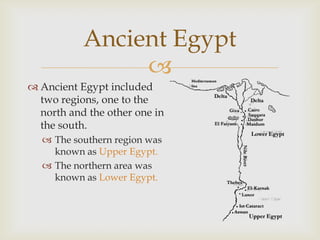
 Ancient Egypt included
two regions, one to the
north and the other one in
the south.
 The southern region was
known as Upper Egypt.
 The northern area was
known as Lower Egypt.
Ancient Egypt

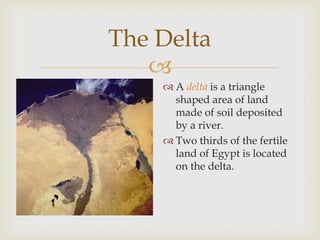
 A delta is a triangle
shaped area of land
made of soil deposited
by a river.
 Two thirds of the fertile
land of Egypt is located
on the delta.
The Delta

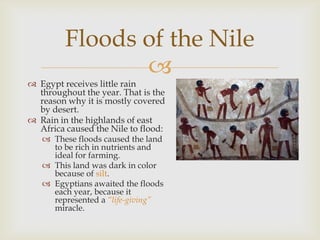
 Egypt receives little rain
throughout the year. That is the
reason why it is mostly covered
by desert.
 Rain in the highlands of east
Africa caused the Nile to flood:
 These floods caused the land
to be rich in nutrients and
ideal for farming.
 This land was dark in color
because of silt.
 Egyptians awaited the floods
each year, because it
represented a “life-giving”
miracle.
Floods of the Nile

 Explain
 Where were Upper and Lower Egypt?
 Draw Conclusions:
 Why was it important to the Egyptian’s that the Nile´s
flooding was consistent?
Ask Yourself

 Burstein, S. M., & Shek, R. (2012). World History
(Teacher´s Edition) (1st Edition ed.). (H.
McDougal, Ed.) Orlando, Florida, US.: Houghton
Mifflin Harcourt Publishing Company.
 Images taken from www.google.com
Bibliography

1 3 egyptian geography

  • 1.
    Social Studies for8th E.G.B. | Teacher: Mauricio Torres
  • 2.
      Mesopotamia wasnot the only place where civilizations developed.  The Nile River helped develop another civilization: Egypt.  This river, the longest in the world, brought life to the people settled around it.  Herodotus, a Greek historian called Egypt “the gift of the Nile”. Introduction
  • 3.
      As mentionedbefore, The Nile is the longest river in the world.  It runs 6000 kms long.  It begins in central Africa and flows north to the Mediterranean Sea.  It created a fertile valley 18 kms wide. Outside this area, there is only desert. The Nile: Physical Features and Location
  • 4.
      Ancient Egyptincluded two regions, one to the north and the other one in the south.  The southern region was known as Upper Egypt.  The northern area was known as Lower Egypt. Ancient Egypt
  • 5.
      A deltais a triangle shaped area of land made of soil deposited by a river.  Two thirds of the fertile land of Egypt is located on the delta. The Delta
  • 6.
      Egypt receiveslittle rain throughout the year. That is the reason why it is mostly covered by desert.  Rain in the highlands of east Africa caused the Nile to flood:  These floods caused the land to be rich in nutrients and ideal for farming.  This land was dark in color because of silt.  Egyptians awaited the floods each year, because it represented a “life-giving” miracle. Floods of the Nile
  • 7.
      Explain  Wherewere Upper and Lower Egypt?  Draw Conclusions:  Why was it important to the Egyptian’s that the Nile´s flooding was consistent? Ask Yourself
  • 8.
      Burstein, S.M., & Shek, R. (2012). World History (Teacher´s Edition) (1st Edition ed.). (H. McDougal, Ed.) Orlando, Florida, US.: Houghton Mifflin Harcourt Publishing Company.  Images taken from www.google.com Bibliography