© 2010 Pearson Education, Inc.
• Heredity is the transmission of traits from one generation to
the next.
• Gregor Mendel
– Worked in the 1860s
– Was the first person to analyze patterns of inheritance
– Deduced the fundamental principles of genetics
HERITABLE VARIATION AND PATTERNS
OF INHERITANCE
Figure 9.1
© 2010 Pearson Education, Inc.
In an Abbey Garden
• Mendel studied garden peas because they
– Are easy to grow
– Come in many readily distinguishable varieties
– Are easily manipulated
– Can self-fertilize
Carpel
(produces eggs)
Stamen
(makes sperm-
producing
pollen)
Petal
Figure 9.2
© 2010 Pearson Education, Inc.
• A character is a heritable feature that varies among individuals.
• A trait is a variant of a character.
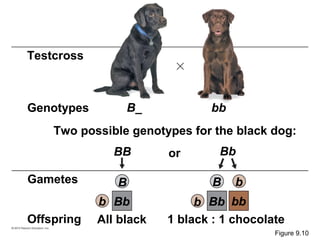
• Each of the characters Mendel studied occurred in two distinct
forms.
© 2010 Pearson Education, Inc.
• Mendel
– Created true-breeding varieties of plants
– Crossed two different true-breeding varieties
• Hybrids are the offspring of two different true-breeding
varieties.
– The parental plants are the P generation.
– Their hybrid offspring are the F1 generation.
– A cross of the F1 plants forms the F2 generation.
Removed
stamens
from purple
flower.
White
Stamens
Purple
Transferred pollen from
stamens of white flower
to carpel of purple
flower.
Parents
(P)
Carpel
Figure 9.3-1
Removed
stamens
from purple
flower.
White
Stamens
Purple
Transferred pollen from
stamens of white flower
to carpel of purple
flower.
Parents
(P)
Carpel
Pollinated carpel
matured into pod.
Figure 9.3-2
Removed
stamens
from purple
flower.
White
Stamens
Purple
Transferred pollen from
stamens of white flower
to carpel of purple
flower.
Parents
(P)
Carpel
Offspring
(F1)
Pollinated carpel
matured into pod.
Planted seeds
from pod.
Figure 9.3-3
© 2010 Pearson Education, Inc.
Mendel’s Law of Segregation
• Mendel performed many experiments.
• He tracked the inheritance of characters that occur as two
alternative traits.
WhitePurple
RecessiveDominant
GreenYellow
TerminalAxial
WrinkledRound
Green Yellow
Seed shape
Seed color
Flower position
Flower color
Pod color
RecessiveDominant
Pod shape
Stem length
Inflated Constricted
Tall Dwarf
Figure 9.4
© 2010 Pearson Education, Inc.
Monohybrid Crosses
• A monohybrid cross is a cross between parent plants that differ in
only one character.
Blast Animation: Single-Trait Crosses
Purple flowers White flowers
P Generation
(true-breading
parents)
Figure 9.5-1
Purple flowers
F1 Generation
White flowers
P Generation
(true-breading
parents)
All plants have
purple flowers
Figure 9.5-2
Purple flowers
F1 Generation
White flowers
P Generation
(true-breading
parents)
All plants have
purple flowers
F2 Generation
Fertilization
among F1 plants
(F1 × F1)
of plants
have purple flowers
of plants
have white flowers
3
4
1
4
Figure 9.5-3
Figure 9.5
© 2010 Pearson Education, Inc.
• Mendel developed four hypotheses from the monohybrid cross:
1. There are alternative versions of genes, called alleles.
2. For each character, an organism inherits two alleles, one from each parent.
– An organism is homozygous for that gene if both alleles are
identical.
– An organism is heterozygous for that gene if the alleles are different.
© 2010 Pearson Education, Inc.
3. If two alleles of an inherited pair differ
– The allele that determines the organism’s appearance is the
dominant allele
– The other allele, which has no noticeable effect on the appearance, is
the recessive allele
© 2010 Pearson Education, Inc.
4. Gametes carry only one allele for each inherited character.
– The two members of an allele pair segregate (separate) from each
other during the production of gametes.
– This statement is the law of segregation.
© 2010 Pearson Education, Inc.
• Do Mendel’s hypotheses account for the 3:1 ratio he observed in
the F2 generation?
• A Punnett square highlights the four possible combinations of
gametes and offspring that result from each cross.
Blast Animation: Genetic Variation: Fusion of Gametes
Purple flowers White flowers
P Generation Genetic makeup (alleles)
Gametes
Alleles carried
by parents
PP
P
pp
pAll All
Figure 9.6-1
Purple flowers
F1 Generation
(hybrids)
White flowers
P Generation Genetic makeup (alleles)
Gametes
Alleles carried
by parents
PP
P
pp
pAll All
All Pp
Purple flowers
Gametes
Alleles
segregate
P p1
2
1
2
Figure 9.6-2
Purple flowers
F1 Generation
(hybrids)
White flowers
P Generation Genetic makeup (alleles)
Gametes
Alleles carried
by parents
PP
P
pp
pAll All
All Pp
Purple flowers
Gametes
Alleles
segregate
P p
F2 Generation
(hybrids)
Sperm from
F1 plant
P p
P
p
PP
pp
Pp
Pp
Eggs from
F1 plant
Phenotypic ratio
3 purple : 1 white
Genotypic ratio
1 PP : 2 Pp : 1 pp
1
2
1
2
Figure 9.6-3
© 2010 Pearson Education, Inc.
• Geneticists distinguish between an organism’s physical traits and
its genetic makeup.
– An organism’s physical traits are its phenotype.
– An organism’s genetic makeup is its genotype.
© 2010 Pearson Education, Inc.
Genetic Alleles and Homologous Chromosomes
• Homologous chromosomes have
– Genes at specific loci
– Alleles of a gene at the same locus
Homologous
chromosomes
P
Genotype:
Gene loci
P
a
aa
b
B
Dominant
allele
Recessive
allele
BbPP
Homozygous
for the
dominant allele
Homozygous
for the
recessive allele
Heterozygous
a
Figure 9.7
© 2010 Pearson Education, Inc.
Mendel’s Law of Independent Assortment
• A dihybrid cross is the crossing of parental varieties differing in
two characters.
Blast Animation: Two-Trait Crosses
Using a Testcross to Determine an Unknown
Genotype
• A testcross is a mating between
– An individual of dominant phenotype (but unknown genotype)
– A homozygous recessive individual
© 2010 Pearson Education, Inc.
Two possible genotypes for the black dog:
B_ bb
Testcross
Genotypes
Bb
B b
orBB
B
b Bb Bb bbb
Gametes
Offspring All black 1 black : 1 chocolate
Figure 9.10
© 2010 Pearson Education, Inc.
Family Pedigrees
• Mendel’s principles apply to the inheritance of many human
traits.
Freckles No freckles
Figure 9.12a
Widow’s peak Straight hairline
Figure 9.12b
Free earlobe Attached earlobe
Figure 9.12c
© 2010 Pearson Education, Inc.
• Dominant traits are not necessarily
– Normal or
– More common
© 2010 Pearson Education, Inc.
• A family pedigree
– Shows the history of a trait in a family
– Allows geneticists to analyze human traits
Female Male
Attached
Free
Third generation
(brother and
sister)
Second generation
(parents, aunts, and
uncles)
First generation
(grandparents) Ff Ff
FfFF ff ff
or
Ff
ff FF
or
Ff
Ffff
Ff ff
Figure 9.13
Figure 9.13a
Figure 9.13b
Figure 9.13c
© 2010 Pearson Education, Inc.
Human Disorders Controlled by a Single Gene
• Many human traits
– Show simple inheritance patterns
– Are controlled by single genes on autosomes
Table 9.1
© 2010 Pearson Education, Inc.
Recessive Disorders
• Most human genetic disorders are recessive.
• Individuals who have the recessive allele but appear normal are
carriers of the disorder.
Parents
Offspring
Dd
Hearing Hearing
Dd
Sperm
Eggs
D
Hearing
D
Dd
d
Hearing
(carrier)
DD
Dd
Hearing
(carrier)
dd
Deaf
d
Figure 9.14
© 2010 Pearson Education, Inc.
• Cystic fibrosis
– Is the most common lethal genetic disease in the United States
– Is caused by a recessive allele carried by about one in 25 people of
European ancestry
© 2010 Pearson Education, Inc.
Dominant Disorders
• Some human genetic disorders are dominant.
– Huntington’s disease, which leads to degeneration of the nervous
system, does not begin until middle age.
– Achondroplasia is a form of dwarfism.
– The homozygous dominant genotype causes death of the embryo.
– Thus, only heterozygotes have this disorder.
Figure 9.15
Parents
Sperm
Eggs
d
Dwarf
D
Dd
d
Dd
dd
d
Normal
(no achondroplasia)
Molly Jo
Dwarf
(achondroplasia)
Dddd
Normal
dd
Normal
Dwarf
Matt Amy JakeZachary Jeremy
Figure 9.16
Parents
Sperm
Eggs
d
Dwarf
D
Dd
d
Dd
dd
d
Normal
(no achondroplasia)
Dwarf
(achondroplasia)
Dddd
Normal
dd
Normal
Dwarf
Figure 9.16a
Molly Jo Matt Amy JakeZachary Jeremy
Figure 9.16b
© 2010 Pearson Education, Inc.
Genetic Testing
• Today many tests can detect the presence of disease-causing
alleles.
• Most genetic testing is performed during pregnancy.
– Amniocentesis collects cells from amniotic fluid.
– Chorionic villus sampling removes cells from placental tissue.
• Genetic counseling helps patients understand the results and
implications of genetic testing.
© 2010 Pearson Education, Inc.
VARIATIONS ON MENDEL’S LAWS
• Some patterns of genetic inheritance are not explained by
Mendel’s laws.
© 2010 Pearson Education, Inc.
Incomplete Dominance in Plants and People
• In incomplete dominance, F1 hybrids have an appearance in
between the phenotypes of the two parents.
RR rr
P Generation
Gametes
Red White
R r
Figure 9.18-1
F1 Generation
RR rr
Gametes
P Generation
Gametes
Red White
R r
Rr
Pink
R r
1
2
1
2
Figure 9.18-2
F1 Generation
RR rr
Gametes
P Generation
F2 Generation Sperm
Gametes
Red White
R r
Rr
Pink
R r
R r
R
r
RR Rr
rrRr
Eggs
1
2
1
2
1
2
1
2
1
2
1
2
Figure 9.18-3
ABO Blood Groups: An Example of Multiple
Alleles and Codominance
• The ABO blood groups in humans are an example of multiple
alleles.
© 2010 Pearson Education, Inc.
Pleiotropy and Sickle-Cell Disease
• Pleiotropy is the impact of a single gene on more than one
character.
• Sickle-cell disease
– Exhibits pleiotropy
– Results in abnormal hemoglobin production
– Causes disk-shaped red blood cells to deform into a sickle shape with
jagged edges
© 2010 Pearson Education, Inc.
Polygenic Inheritance
• Polygenic inheritance is the additive effects of two or more
genes on a single phenotype.
Figure 9.23
© 2010 Pearson Education, Inc.
The Role of Environment
• Many human characters result from a combination of heredity and
environment.
• Only genetic influences are inherited.
© 2010 Pearson Education, Inc.
Linked Genes
• Linked genes
– Are located close together on a chromosome
– May be inherited together
© 2010 Pearson Education, Inc.
Linkage Maps
• Early studies of crossing over were performed using the fruit fly
Drosophila melanogaster.
• Alfred H. Sturtevant, a student of Morgan, developed a method
for mapping gene loci, which resulted in the creation of linkage
maps.
– A diagram of relative gene locations on a chromosome is a linkage map.
ColorizedSEM
Y X
Figure 9.29
© 2010 Pearson Education, Inc.
SEX CHROMOSOMES AND SEX-LINKED
GENES
• Sex chromosomes influence the inheritance of certain traits.
© 2010 Pearson Education, Inc.
Sex Determination in Humans
• Nearly all mammals have a pair of sex chromosomes designated
X and Y.
– Males have an X and Y.
– Females have XX.
© 2010 Pearson Education, Inc.
Sex-Linked Genes
• Any gene located on a sex chromosome is called a sex-linked
gene.
– Most sex-linked genes are found on the X chromosome.
– Red-green color blindness is a common human sex-linked disorder.
Figure 9.30
Unaffected individual
Sperm
Eggs
XN
XN Xn
Y
Xn Y
Sperm
XN
Xn
XN
Y
XN Y
Sperm
XN
Xn Xn
Y
Xn Y
XN
Xn
XN
YXN
XN XN
Xn
XN
Y
Eggs
XN
XN
XN
YXN
Xn Xn
YXN
Xn
Eggs
XN
Xn
XN
YXN
Xn Xn
YXn
Xn
Normal female
×
colorblind male
Key
(a)
Carrier female
×
normal male
(b)
Carrier female
×
colorblind male
(c)
Colorblind individualCarrier
Figure 9.31
© 2010 Pearson Education, Inc.
• Hemophilia
– Is a sex-linked recessive blood-clotting trait that may result in excessive
bleeding and death after relatively minor cuts and bruises
– Has plagued royal families of Europe
AlbertQueen
Victoria
Alice Louis
Alexandra Czar
Nicholas II
of Russia
Alexis
Figure 9.32
© 2010 Pearson Education, Inc.
• In 2005 researchers sequenced the complete genome of a dog.
• An evolutionary tree of dog breeds was created.
Meiosis
Haploid gametes
(allele pairs separate)
Diploid cell
(contains paired
alleles, alternate
forms of a gene)
Diploid zygote
(contains
paired alleles)
Gamete
from other
parent
Alleles
Fertilization
Figure 9.UN1
Phenotype
P ?
Phenotype
Genotype
Conclusion
RecessiveDominant
pp
All dominant
or
Unknown parent
is PP
1 dominant : 1 recessive
Unknown parent
is Pp
Figure 9.UN2
Dominant phenotype
(RR)
Recessive phenotype
(rr)
Intermediate phenotype
(incomplete dominance)
(Rr)
Figure 9.UN3
Pleiotropy Multiple traits
(e.g., sickle-cell
disease)
Single
gene
Figure 9.UN4
Multiple genes
Polygenic
inheritance Single trait
(e.g., skin color)
Figure 9.UN5
Female
Somatic
cells
Male
44
+
XY
44
+
XX
Figure 9.UN6
Figure 9.UN7

09 lecture presentation

  • 1.
    © 2010 PearsonEducation, Inc. • Heredity is the transmission of traits from one generation to the next. • Gregor Mendel – Worked in the 1860s – Was the first person to analyze patterns of inheritance – Deduced the fundamental principles of genetics HERITABLE VARIATION AND PATTERNS OF INHERITANCE
  • 2.
  • 3.
    © 2010 PearsonEducation, Inc. In an Abbey Garden • Mendel studied garden peas because they – Are easy to grow – Come in many readily distinguishable varieties – Are easily manipulated – Can self-fertilize
  • 4.
  • 5.
    © 2010 PearsonEducation, Inc. • A character is a heritable feature that varies among individuals. • A trait is a variant of a character. • Each of the characters Mendel studied occurred in two distinct forms.
  • 6.
    © 2010 PearsonEducation, Inc. • Mendel – Created true-breeding varieties of plants – Crossed two different true-breeding varieties • Hybrids are the offspring of two different true-breeding varieties. – The parental plants are the P generation. – Their hybrid offspring are the F1 generation. – A cross of the F1 plants forms the F2 generation.
  • 7.
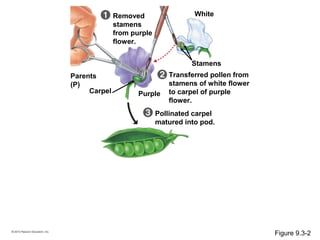
    Removed stamens from purple flower. White Stamens Purple Transferred pollenfrom stamens of white flower to carpel of purple flower. Parents (P) Carpel Figure 9.3-1
  • 8.
    Removed stamens from purple flower. White Stamens Purple Transferred pollenfrom stamens of white flower to carpel of purple flower. Parents (P) Carpel Pollinated carpel matured into pod. Figure 9.3-2
  • 9.
    Removed stamens from purple flower. White Stamens Purple Transferred pollenfrom stamens of white flower to carpel of purple flower. Parents (P) Carpel Offspring (F1) Pollinated carpel matured into pod. Planted seeds from pod. Figure 9.3-3
  • 10.
    © 2010 PearsonEducation, Inc. Mendel’s Law of Segregation • Mendel performed many experiments. • He tracked the inheritance of characters that occur as two alternative traits.
  • 11.
    WhitePurple RecessiveDominant GreenYellow TerminalAxial WrinkledRound Green Yellow Seed shape Seedcolor Flower position Flower color Pod color RecessiveDominant Pod shape Stem length Inflated Constricted Tall Dwarf Figure 9.4
  • 12.
    © 2010 PearsonEducation, Inc. Monohybrid Crosses • A monohybrid cross is a cross between parent plants that differ in only one character. Blast Animation: Single-Trait Crosses
  • 13.
    Purple flowers Whiteflowers P Generation (true-breading parents) Figure 9.5-1
  • 14.
    Purple flowers F1 Generation Whiteflowers P Generation (true-breading parents) All plants have purple flowers Figure 9.5-2
  • 15.
    Purple flowers F1 Generation Whiteflowers P Generation (true-breading parents) All plants have purple flowers F2 Generation Fertilization among F1 plants (F1 × F1) of plants have purple flowers of plants have white flowers 3 4 1 4 Figure 9.5-3
  • 16.
  • 17.
    © 2010 PearsonEducation, Inc. • Mendel developed four hypotheses from the monohybrid cross: 1. There are alternative versions of genes, called alleles. 2. For each character, an organism inherits two alleles, one from each parent. – An organism is homozygous for that gene if both alleles are identical. – An organism is heterozygous for that gene if the alleles are different.
  • 18.
    © 2010 PearsonEducation, Inc. 3. If two alleles of an inherited pair differ – The allele that determines the organism’s appearance is the dominant allele – The other allele, which has no noticeable effect on the appearance, is the recessive allele
  • 19.
    © 2010 PearsonEducation, Inc. 4. Gametes carry only one allele for each inherited character. – The two members of an allele pair segregate (separate) from each other during the production of gametes. – This statement is the law of segregation.
  • 20.
    © 2010 PearsonEducation, Inc. • Do Mendel’s hypotheses account for the 3:1 ratio he observed in the F2 generation? • A Punnett square highlights the four possible combinations of gametes and offspring that result from each cross. Blast Animation: Genetic Variation: Fusion of Gametes
  • 21.
    Purple flowers Whiteflowers P Generation Genetic makeup (alleles) Gametes Alleles carried by parents PP P pp pAll All Figure 9.6-1
  • 22.
    Purple flowers F1 Generation (hybrids) Whiteflowers P Generation Genetic makeup (alleles) Gametes Alleles carried by parents PP P pp pAll All All Pp Purple flowers Gametes Alleles segregate P p1 2 1 2 Figure 9.6-2
  • 23.
    Purple flowers F1 Generation (hybrids) Whiteflowers P Generation Genetic makeup (alleles) Gametes Alleles carried by parents PP P pp pAll All All Pp Purple flowers Gametes Alleles segregate P p F2 Generation (hybrids) Sperm from F1 plant P p P p PP pp Pp Pp Eggs from F1 plant Phenotypic ratio 3 purple : 1 white Genotypic ratio 1 PP : 2 Pp : 1 pp 1 2 1 2 Figure 9.6-3
  • 24.
    © 2010 PearsonEducation, Inc. • Geneticists distinguish between an organism’s physical traits and its genetic makeup. – An organism’s physical traits are its phenotype. – An organism’s genetic makeup is its genotype.
  • 25.
    © 2010 PearsonEducation, Inc. Genetic Alleles and Homologous Chromosomes • Homologous chromosomes have – Genes at specific loci – Alleles of a gene at the same locus
  • 26.
  • 27.
    © 2010 PearsonEducation, Inc. Mendel’s Law of Independent Assortment • A dihybrid cross is the crossing of parental varieties differing in two characters. Blast Animation: Two-Trait Crosses
  • 28.
    Using a Testcrossto Determine an Unknown Genotype • A testcross is a mating between – An individual of dominant phenotype (but unknown genotype) – A homozygous recessive individual © 2010 Pearson Education, Inc.
  • 29.
    Two possible genotypesfor the black dog: B_ bb Testcross Genotypes Bb B b orBB B b Bb Bb bbb Gametes Offspring All black 1 black : 1 chocolate Figure 9.10
  • 30.
    © 2010 PearsonEducation, Inc. Family Pedigrees • Mendel’s principles apply to the inheritance of many human traits.
  • 31.
  • 32.
    Widow’s peak Straighthairline Figure 9.12b
  • 33.
    Free earlobe Attachedearlobe Figure 9.12c
  • 34.
    © 2010 PearsonEducation, Inc. • Dominant traits are not necessarily – Normal or – More common
  • 35.
    © 2010 PearsonEducation, Inc. • A family pedigree – Shows the history of a trait in a family – Allows geneticists to analyze human traits
  • 36.
    Female Male Attached Free Third generation (brotherand sister) Second generation (parents, aunts, and uncles) First generation (grandparents) Ff Ff FfFF ff ff or Ff ff FF or Ff Ffff Ff ff Figure 9.13
  • 37.
  • 38.
  • 39.
  • 40.
    © 2010 PearsonEducation, Inc. Human Disorders Controlled by a Single Gene • Many human traits – Show simple inheritance patterns – Are controlled by single genes on autosomes
  • 41.
  • 42.
    © 2010 PearsonEducation, Inc. Recessive Disorders • Most human genetic disorders are recessive. • Individuals who have the recessive allele but appear normal are carriers of the disorder.
  • 43.
  • 44.
    © 2010 PearsonEducation, Inc. • Cystic fibrosis – Is the most common lethal genetic disease in the United States – Is caused by a recessive allele carried by about one in 25 people of European ancestry
  • 45.
    © 2010 PearsonEducation, Inc. Dominant Disorders • Some human genetic disorders are dominant. – Huntington’s disease, which leads to degeneration of the nervous system, does not begin until middle age. – Achondroplasia is a form of dwarfism. – The homozygous dominant genotype causes death of the embryo. – Thus, only heterozygotes have this disorder.
  • 46.
  • 47.
  • 48.
  • 49.
    Molly Jo MattAmy JakeZachary Jeremy Figure 9.16b
  • 50.
    © 2010 PearsonEducation, Inc. Genetic Testing • Today many tests can detect the presence of disease-causing alleles. • Most genetic testing is performed during pregnancy. – Amniocentesis collects cells from amniotic fluid. – Chorionic villus sampling removes cells from placental tissue. • Genetic counseling helps patients understand the results and implications of genetic testing.
  • 51.
    © 2010 PearsonEducation, Inc. VARIATIONS ON MENDEL’S LAWS • Some patterns of genetic inheritance are not explained by Mendel’s laws.
  • 52.
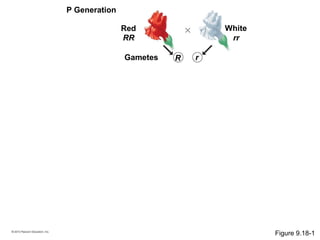
    © 2010 PearsonEducation, Inc. Incomplete Dominance in Plants and People • In incomplete dominance, F1 hybrids have an appearance in between the phenotypes of the two parents.
  • 53.
    RR rr P Generation Gametes RedWhite R r Figure 9.18-1
  • 54.
    F1 Generation RR rr Gametes PGeneration Gametes Red White R r Rr Pink R r 1 2 1 2 Figure 9.18-2
  • 55.
    F1 Generation RR rr Gametes PGeneration F2 Generation Sperm Gametes Red White R r Rr Pink R r R r R r RR Rr rrRr Eggs 1 2 1 2 1 2 1 2 1 2 1 2 Figure 9.18-3
  • 56.
    ABO Blood Groups:An Example of Multiple Alleles and Codominance • The ABO blood groups in humans are an example of multiple alleles. © 2010 Pearson Education, Inc.
  • 57.
    © 2010 PearsonEducation, Inc. Pleiotropy and Sickle-Cell Disease • Pleiotropy is the impact of a single gene on more than one character. • Sickle-cell disease – Exhibits pleiotropy – Results in abnormal hemoglobin production – Causes disk-shaped red blood cells to deform into a sickle shape with jagged edges
  • 58.
    © 2010 PearsonEducation, Inc. Polygenic Inheritance • Polygenic inheritance is the additive effects of two or more genes on a single phenotype.
  • 59.
  • 60.
    © 2010 PearsonEducation, Inc. The Role of Environment • Many human characters result from a combination of heredity and environment. • Only genetic influences are inherited.
  • 61.
    © 2010 PearsonEducation, Inc. Linked Genes • Linked genes – Are located close together on a chromosome – May be inherited together
  • 62.
    © 2010 PearsonEducation, Inc. Linkage Maps • Early studies of crossing over were performed using the fruit fly Drosophila melanogaster. • Alfred H. Sturtevant, a student of Morgan, developed a method for mapping gene loci, which resulted in the creation of linkage maps. – A diagram of relative gene locations on a chromosome is a linkage map.
  • 63.
  • 64.
    © 2010 PearsonEducation, Inc. SEX CHROMOSOMES AND SEX-LINKED GENES • Sex chromosomes influence the inheritance of certain traits.
  • 65.
    © 2010 PearsonEducation, Inc. Sex Determination in Humans • Nearly all mammals have a pair of sex chromosomes designated X and Y. – Males have an X and Y. – Females have XX.
  • 66.
    © 2010 PearsonEducation, Inc. Sex-Linked Genes • Any gene located on a sex chromosome is called a sex-linked gene. – Most sex-linked genes are found on the X chromosome. – Red-green color blindness is a common human sex-linked disorder.
  • 67.
  • 68.
    Unaffected individual Sperm Eggs XN XN Xn Y XnY Sperm XN Xn XN Y XN Y Sperm XN Xn Xn Y Xn Y XN Xn XN YXN XN XN Xn XN Y Eggs XN XN XN YXN Xn Xn YXN Xn Eggs XN Xn XN YXN Xn Xn YXn Xn Normal female × colorblind male Key (a) Carrier female × normal male (b) Carrier female × colorblind male (c) Colorblind individualCarrier Figure 9.31
  • 69.
    © 2010 PearsonEducation, Inc. • Hemophilia – Is a sex-linked recessive blood-clotting trait that may result in excessive bleeding and death after relatively minor cuts and bruises – Has plagued royal families of Europe
  • 70.
  • 71.
    © 2010 PearsonEducation, Inc. • In 2005 researchers sequenced the complete genome of a dog. • An evolutionary tree of dog breeds was created.
  • 72.
    Meiosis Haploid gametes (allele pairsseparate) Diploid cell (contains paired alleles, alternate forms of a gene) Diploid zygote (contains paired alleles) Gamete from other parent Alleles Fertilization Figure 9.UN1
  • 73.
    Phenotype P ? Phenotype Genotype Conclusion RecessiveDominant pp All dominant or Unknownparent is PP 1 dominant : 1 recessive Unknown parent is Pp Figure 9.UN2
  • 74.
    Dominant phenotype (RR) Recessive phenotype (rr) Intermediatephenotype (incomplete dominance) (Rr) Figure 9.UN3
  • 75.
    Pleiotropy Multiple traits (e.g.,sickle-cell disease) Single gene Figure 9.UN4
  • 76.
    Multiple genes Polygenic inheritance Singletrait (e.g., skin color) Figure 9.UN5
  • 77.
  • 78.

Editor's Notes

  • #3 Figure 9.1 Gregor Mendel.
  • #5 Figure 9.2 The structure of a pea flower.
  • #8 Figure 9.3 Mendel's technique for cross-fertilizing pea plants. (Step 1)
  • #9 Figure 9.3 Mendel's technique for cross-fertilizing pea plants. (Step 2)
  • #10 Figure 9.3 Mendel's technique for cross-fertilizing pea plants. (Step 3)
  • #12 Figure 9.4 The seven characters of pea plants studied by Mendel.
  • #14 Figure 9.5 Mendel's cross tracking one character (flower color). (Step 1)
  • #15 Figure 9.5 Mendel's cross tracking one character (flower color). (Step 2)
  • #16 Figure 9.5 Mendel's cross tracking one character (flower color). (Step 3)
  • #17 Figure 9.5 Photo of Mendel in garden.
  • #22 Figure 9.6 The law of segregation. (Step 1)
  • #23 Figure 9.6 The law of segregation. (Step 2)
  • #24 Figure 9.6 The law of segregation. (Step 3)
  • #27 Figure 9.7 The relationship between alleles and homologous chromosomes.
  • #30 Figure 9.10 A Labrador retriever testcross
  • #32 Figure 9.12a Examples of inherited traits thought to be controlled by a single gene.
  • #33 Figure 9.12b Examples of inherited traits thought to be controlled by a single gene.
  • #34 Figure 9.12c Examples of inherited traits thought to be controlled by a single gene.
  • #37 Figure 9.13 A family pedigree showing inheritance of free versus attached earlobes.
  • #38 Figure 9.13a A family pedigree showing inheritance of free versus attached earlobes.
  • #39 Figure 9.13b A family pedigree showing inheritance of free versus attached earlobes.
  • #40 Figure 9.13c A family pedigree showing inheritance of free versus attached earlobes.
  • #42 Table 9.1 Some Autosomal Disorders in Humans
  • #44 Figure 9.14 Predicted offspring when both parents are carriers for a recessive disorder.
  • #47 Figure 9.15 Achondroplasia, a dominant trait.
  • #48 Figure 9.16 A family with and without achondroplasia.
  • #49 Figure 9.16a A family with and without achondroplasia.
  • #50 Figure 9.16b A family with and without achondroplasia.
  • #54 Figure 9.18 Incomplete dominance in snapdragons. (Step 1)
  • #55 Figure 9.18 Incomplete dominance in snapdragons. (Step 2)
  • #56 Figure 9.18 Incomplete dominance in snapdragons. (Step 3)
  • #60 Figure 9.23 As a result of environmental influences, even identical twins can look different.
  • #64 Figure 9.29 The chromosomal basis of sex determination.
  • #68 Figure 9.30 A test for red-green colorblindness.
  • #69 Figure 9.31 Inheritance of colorblindness, a sex-linked recessive trait.
  • #71 Figure 9.32 Hemophilia in the royal family of Russia.
  • #73 Figure 9.UN1 Summary: Law of Segregation
  • #74 Figure 9.UN2 Summary: Testcross
  • #75 Figure 9.UN3 Summary: Incomplete Dominance
  • #76 Figure 9.UN4 Summary: Pleiotropy
  • #77 Figure 9.UN5 Summary:Polygenic Inheritance
  • #78 Figure 9.UN6 Summary: Sex Determination in Humans
  • #79 Figure 9.UN7 Summary: Sex Linked Traits