
9

                FEVERS


           In this chapter, you will learn:
                                Page Number
1. What are fevers              9-1
2. Types of fevers              9-2 to 9-3
3. Malaria                      9-5 to 9-7
4. Typhoid                      9-8
5. Viral fever                  9-9
6. Thermometer Reading          9-10 to 9-12
9-1
                                FEVERS
The human body has a normal hotness (temperature) of 98.4 degrees F
or 37 degrees C. At this temperature, the body systems work the best.
The body does not work so well if the temperature is hotter or colder.
And if the temperature gets very hot (above 107 degrees, or very cold
(below 90 degrees) the working of the body may become absolutely
crazy. Different parts and organs of the body may fail for a short while
until things become normal. If the temperature continues to be very high
or very low, permanent failure may set in and the person may die.

Low temperatures below normal may set in if our surroundings are very
cold. Anyone without adequate clothing and food may die if exposed to such cold climate for too long.
But children who have been born much before nine months in the mothers’ wombs and those who are
much below normal weight can die of cold if exposed to low surrounding temperatures for a few hours.
Such children need to be well wrapped up during cold.

What we usually find amongst our people are illnesses in which the body temperature has become
high. A body temperature above 99° F is called fever. We as health workers will often be called upon
to help out, as people are very scared of fevers.


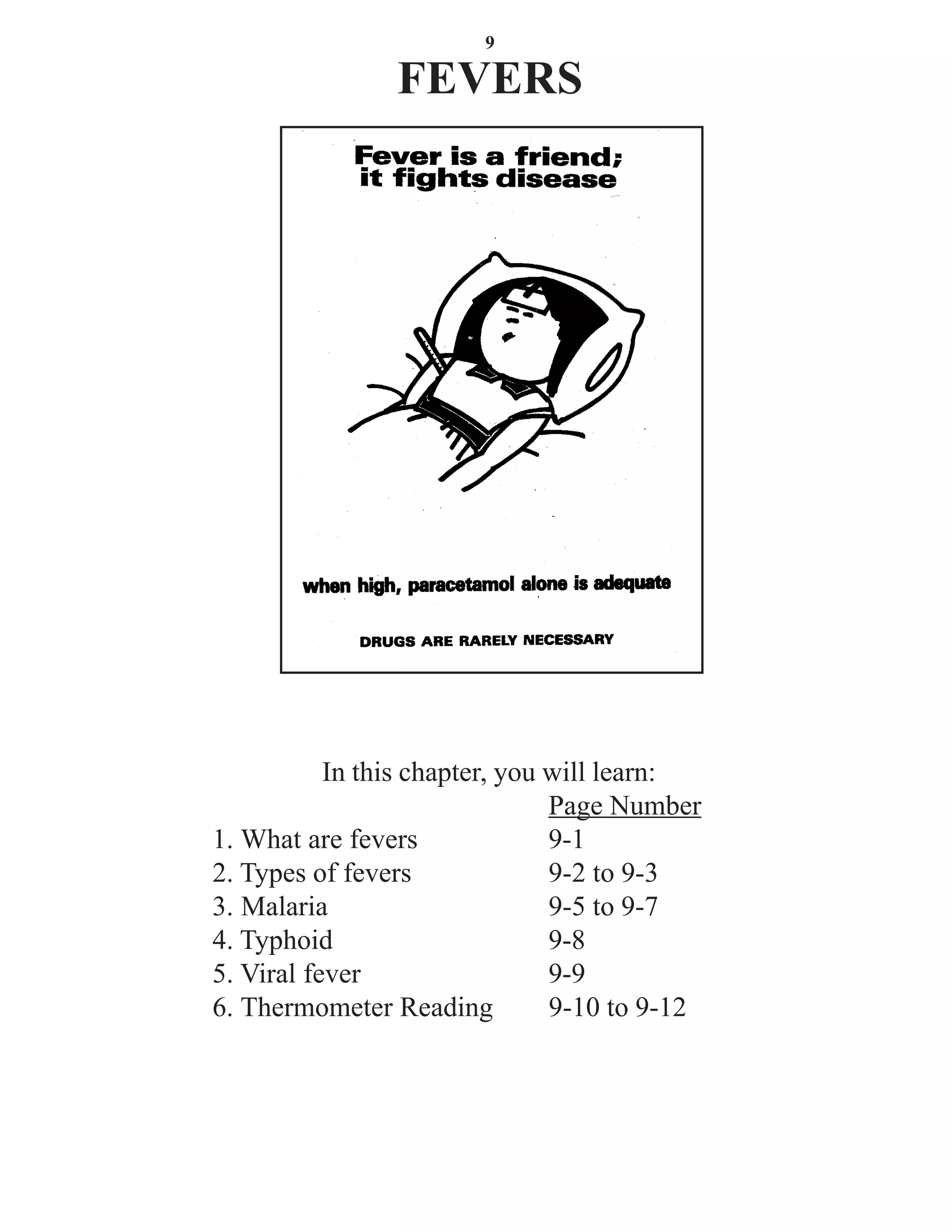
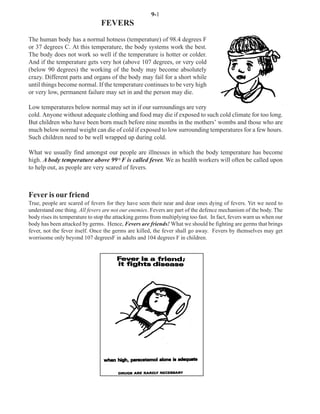
Fever is our friend
True, people are scared of fevers for they have seen their near and dear ones dying of fevers. Yet we need to
understand one thing. All fevers are not our enemies. Fevers are part of the defence mechanism of the body. The
body rises its temperature to stop the attacking germs from multiplying too fast. In fact, fevers warn us when our
body has been attacked by germs. Hence, Fevers are friends! What we should be fighting are germs that brings
fever, not the fever itself. Once the germs are killed, the fever shall go away. Fevers by themselves may get
worrisome only beyond 107 degreesF in adults and 104 degrees F in children.
9-2
KNOW THE FEVERS
Instead of taking fever - reducing medicines every time there is fever, it may be better to see its pattern
of rise and fall. Just by seeing some of the points below, we can get good hints as to the possible reason
of the fever:
                    whether the fever is low or high
                    whether there are also complaints specific to a body organ system
                    whether there is a rise & fall pattern of temperature


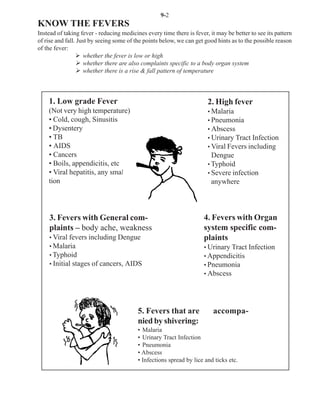
    1. Low grade Fever                                                 2. High fever
    (Not very high temperature)                                        • Malaria
    • Cold, cough, Sinusitis                                           • Pneumonia
    • Dysentery                                                        • Abscess
    • TB                                                               • Urinary Tract Infection
    • AIDS                                                             • Viral Fevers including
    • Cancers                                                            Dengue
    • Boils, appendicitis, etc                                         • Typhoid
    • Viral hepatitis, any small infec-                                • Severe infection
    tion                                                                 anywhere


    3. Fevers with General com-                                       4. Fevers with Organ
    plaints – body ache, weakness                                     system specific com-
    • Viral fevers including Dengue                                   plaints
    • Malaria                                                         • Urinary Tract Infection
    • Typhoid                                                         • Appendicitis
    • Initial stages of cancers, AIDS                                 • Pneumonia
                                                                      • Abscess


                                          5. Fevers that are             accompa-
                                          nied by shivering:
                                          • Malaria
                                          • Urinary Tract Infection
                                          • Pneumonia
                                          • Abscess
                                          • Infections spread by lice and ticks etc.
9-3
                             Fevers that show a pattern:
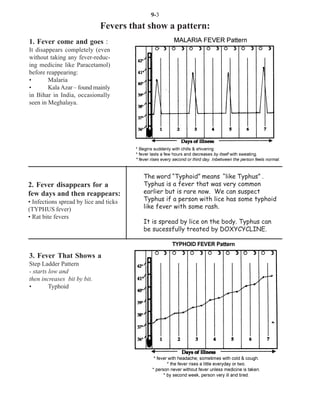
1. Fever come and goes :
It disappears completely (even
without taking any fever-reduc-
ing medicine like Paracetamol)
before reappearing:
•       Malaria
•       Kala Azar – found mainly
in Bihar in India, occasionally
seen in Meghalaya.


                                        The word “Typhoid” means “like Typhus” .
2. Fever disappears for a               Typhus is a fever that was very common
few days and then reappears:            earlier but is rare now. We can suspect
• Infections spread by lice and ticks   Typhus if a person with lice has some typhoid
(TYPHUS fever)                          like fever with some rash.
• Rat bite fevers
                                        It is spread by lice on the body. Typhus can
                                        be sucessfully treated by DOXYCYCLINE.


3. Fever That Shows a
Step Ladder Pattern
- starts low and
then increases bit by bit.
•        Typhoid
9-4


 Some Common Fevers to know

1. MALARIA               2. TYPHOID
                         or ENTERIC
                            FEVER


             3. VIRAL FEVER
9-5
                                      1. MALARIA Fever
                             Malaria is a disease caused by a small germ called Plas-
                             modium that can be tested by checking our blood under a
                             microscope. Usually of two types, Plasmodium falciparum
                             and Plasmodium vivax are also commonly - and more
                             easily — referred to as PF and PV.

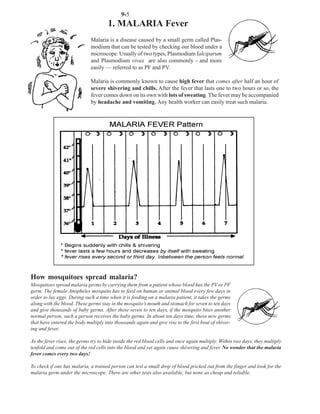
                             Malaria is commonly known to cause high fever that comes after half an hour of
                             severe shivering and chills. After the fever that lasts one to two hours or so, the
                             fever comes down on its own with lots of sweating. The fever may be accompanied
                             by headache and vomiting. Any health worker can easily treat such malaria.


How mosquitoes spread malaria?
Mosquitoes spread malaria germs by carrying them from a patient whose blood has the PV or PF
germ. The female Anopheles mosquito has to feed on human or animal blood every few days in
order to lay eggs. During such a time when it is feeding on a malaria patient, it takes the germs
along with the blood. These germs stay in the mosquito’s mouth and stomach for seven to ten days
and give thousands of baby germs. After these seven to ten days, if the mosquito bites another
normal person, such a person receives the baby germs. In about ten days time, these new germs
that have entered the body multiply into thousands again and give rise to the first bout of shiver-
ing and fever.

As the fever rises, the germs try to hide inside the red blood cells and once again multiply. Within two days, they multiply
tenfold and come out of the red cells into the blood and yet again cause shivering and fever. No wonder that the malaria
fever comes every two days!

To check if one has malaria, a trained person can test a small drop of blood pricked out from the finger and look for the
malaria germ under the microscope. There are other tests also available, but none as cheap and reliable.
9-6
Treatment for Malaria                                              Dangerous malaria
Replace fluids in body:As sweating and fever cause loss of         Although both PV and PF cause similar prob-
lots of fluid, it is important to drink plenty of watery sub-      lems as given above, PF can get very danger-
stances like soups, milk, lime juice, etc. Water with some salt    ous and kill the patient. It can give rise to com-
and sugar is also excellent.                                       plications by blocking the blood supply to:

Keep fever down:        If the fever is very high, it may be a     - the brain: the patient may
good idea to bring the fever down by applying again and            •get very severe headache
again some cloth dipped in cool water to the forehead and          •start talking irrelevantly
body. Paracetamol may also be taken to bring down the tem-         •may get fits or convulsions
perature.                                                          •become unconscious or
                                                                   •get a new squint (both eyes
                                                                   look in different directions)
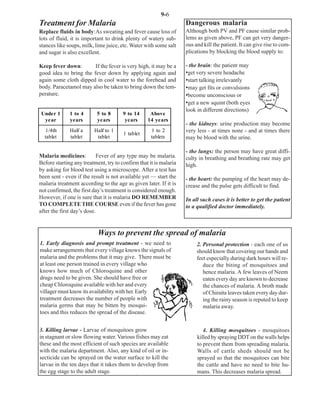
Under 1       1 to 4       5 to 8      9 to 14     Above
 ye ar        years        ye ars       ye ars    14 ye ars
                                                                   - the kidneys: urine production may become
   1/4th      Half a     Half to 1                  1 to 2         very less - at times none - and at times there
                                       1 tablet
  tablet      tablet      tablet                    tablets        may be blood with the urine.

                                                                   - the lungs: the person may have great diffi-
Malaria medicines:         Fever of any type may be malaria.       culty in breathing and breathing rate may get
Before starting any treatment, try to confirm that it is malaria   high.
by asking for blood test using a microscope. After a test has
been sent - even if the result is not available yet — start the    - the heart: the pumping of the heart may de-
malaria treatment according to the age as given later. If it is    crease and the pulse gets difficult to find.
not confirmed, the first day’s treatment is considered enough.
However, if one is sure that it is malaria DO REMEMBER             In all such cases it is better to get the patient
TO COMPLETE THE COURSE even if the fever has gone                  to a qualified doctor immediately.
after the first day’s dose.


                           Ways to prevent the spread of malaria
1. Early diagnosis and prompt treatment - we need to                    2. Personal protection - each one of us
make arrangements that every village knows the signals of               should know that covering our hands and
malaria and the problems that it may give. There must be                feet especially during dark hours will re-
at least one person trained in every village who                           duce the biting of mosquitoes and
knows how much of Chloroquine and other                                    hence malaria. A few leaves of Neem
drugs need to be given. She should have free or                            eaten every day are known to decrease
cheap Chloroquine available with her and every                             the chances of malaria. A broth made
villager must know its availability with her. Early                        of Chiraita leaves taken every day dur-
treatment decreases the number of people with                              ing the rainy season is reputed to keep
malaria germs that may be bitten by mosqui-                                malaria away.
toes and this reduces the spread of the disease.


3. Killing larvae - Larvae of mosquitoes grow                              4. Killing mosquitoes - mosquitoes
in stagnant or slow flowing water. Various fishes may eat               killed by spraying DDT on the walls helps
these and the most efficient of such species are available              to prevent them from spreading malaria.
with the malaria department. Also, any kind of oil or in-               Walls of cattle sheds should not be
secticide can be sprayed on the water surface to kill the               sprayed so that the mosquitoes can bite
larvae in the ten days that it takes them to develop from               the cattle and have no need to bite hu-
the egg stage to the adult stage.                                       mans. This decreases malaria spread.
9-7
2. TYPHOID or ENTERIC FEVER
Typhoid fever is also called enteric fever because                            What Causes Typhoid?
it is due to an infection of the intestines. It has been            Typhoid is caused by bacteria that come to stay
an old problem with us. Before we found good an-                    in the intestine along with food that has been ‘dirt-
tibiotics to take care of typhoid, it used to kill                  ied’ by flies, dirt and unwashed hands. Water
people in the third week of fever because the infec-                brought from rivers and canals or water from wells
tion would puncture the intestine. Nowadays, al-                    and from hand pumps that are close to where
most all fevers attract a dose of antibiotics from                  people shit is a known source of spreading ty-
                                                                    phoid. At times, people who pass typhoid germs
doctors and hence even typhoid gets treated be-
                                                                    in their shit do not suffer from any illness and
fore anyone can die of it. Rarely do people die of it
                                                                    may ‘silently’ pass the germ to many others if
these days. Yet, it remains a common illness that                   they are cooks or handle water and food.
leads to a lot of misery and is badly treated.


What is the typhoid fever like?
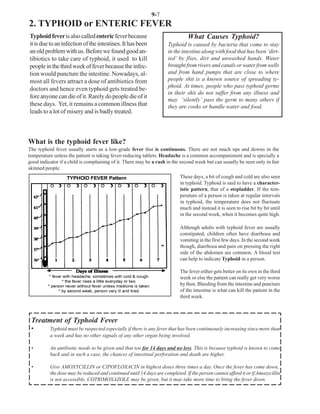
The typhoid fever usually starts as a low-grade fever that is continuous. There are not much ups and downs in the
temperature unless the patient is taking fever-reducing tablets. Headache is a common accompaniment and is specially a
good indicator if a child is complaining of it. There may be a rash in the second week but can usually be seen only in fair
skinned people.
                                                                          These days, a bit of cough and cold are also seen
                                                                          in typhoid. Typhoid is said to have a character-
                                                                          istic pattern, that of a stepladder. If the tem-
                                                                          perature of a person is taken at regular intervals
                                                                          in typhoid, the temperature does not fluctuate
                                                                          much and instead it is seen to rise bit by bit until
                                                                          in the second week, when it becomes quite high.

                                                                          Although adults with typhoid fever are usually
                                                                          constipated, children often have diarrhoea and
                                                                          vomiting in the first few days. In the second week
                                                                          though, diarrhoea and pain on pressing the right
                                                                          side of the abdomen are common. A blood test
                                                                          can help to indicate Typhoid in a person.

                                                                          The fever either gets better on its own in the third
                                                                          week or else the patient can really get very worse
                                                                          by then. Bleeding from the intestine and puncture
                                                                          of the intestine is what can kill the patient in the
                                                                          third week.


 Treatment of Typhoid Fever
 •        Typhoid must be suspected especially if there is any fever that has been continuously increasing since more than
          a week and has no other signals of any other organ being involved.

 •        An antibiotic needs to be given and that too for 14 days and no less. This is because typhoid is known to come
          back and in such a case, the chances of intestinal perforation and death are higher.

 •        Give AMOXYCILLIN or CIPOFLOXACIN in highest doses three times a day. Once the fever has come down,
          the dose may be reduced and continued until 14 days are completed. If the person cannot afford it or if Amoxycillin
          is not accessible, COTRIMOXAZOLE may be given, but it may take more time to bring the fever down.
9-8
3. VIRAL FEVER
Learn to Differentiate TYPHOID from VIRAL FEVER and also DENGUE
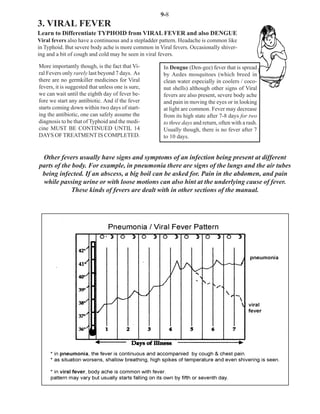
Viral fevers also have a continuous and a stepladder pattern. Headache is common like
in Typhoid. But severe body ache is more common in Viral fevers. Occasionally shiver-
ing and a bit of cough and cold may be seen in viral fevers.

More importantly though, is the fact that Vi-        In Dengue (Den-gee) fever that is spread
ral Fevers only rarely last beyond 7 days. As        by Aedes mosquitoes (which breed in
there are no germkiller medicines for Viral          clean water especially in coolers / coco-
fevers, it is suggested that unless one is sure,     nut shells) although other signs of Viral
we can wait until the eighth day of fever be-        fevers are also present, severe body ache
fore we start any antibiotic. And if the fever       and pain in moving the eyes or in looking
starts coming down within two days of start-         at light are common. Fever may decrease
ing the antibiotic, one can safely assume the        from its high state after 7-8 days for two
diagnosis to be that of Typhoid and the medi-        to three days and return, often with a rash.
cine MUST BE CONTINUED UNTIL 14                      Usually though, there is no fever after 7
DAYS OF TREATMENT IS COMPLETED.                      to 10 days.


 Other fevers usually have signs and symptoms of an infection being present at different
parts of the body. For example, in pneumonia there are signs of the lungs and the air tubes
 being infected. If an abscess, a big boil can be asked for. Pain in the abdomen, and pain
 while passing urine or with loose motions can also hint at the underlying cause of fever.
             These kinds of fevers are dealt with in other sections of the manual.
9-10


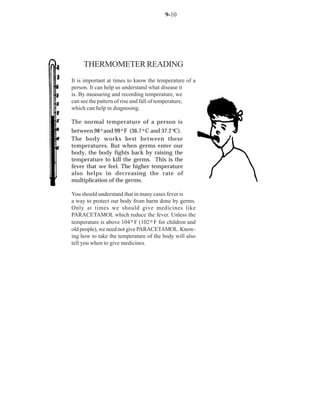
     THERMOMETER READING
It is important at times to know the temperature of a
person. It can help us understand what disease it
is. By measuring and recording temperature, we
can see the pattern of rise and fall of temperature,
which can help in diagnosing.

The normal temperature of a person is
between 98°and 99°F (36.7°C and 37.2°  C).
The body works best between these
temperatures. But when germs enter our
body, the body fights back by raising the
temperature to kill the germs. This is the
fever that we feel. The higher temperature
also helps in decreasing the rate of
multiplication of the germs.

You should understand that in many cases fever is
a way to protect our body from harm done by germs.
Only at times we should give medicines like
PARACETAMOL which reduce the fever. Unless the
temperature is above 104° F (102° F for children and
old people), we need not give PARACETAMOL. Know-
ing how to take the temperature of the body will also
tell you when to give medicines.
9-11
Thermometer
Temperature is measured by a THERMOMETER. Thermometers can be of different types. The simplest ther-
mometer is a plastic strip that can be kept pressed on the forehead and one can directly read the temperature off
it. But the surrounding temperature can affect this reading – it shows a lesser temperature if the room is cold and
a higher reading if the person is sitting in the sun.

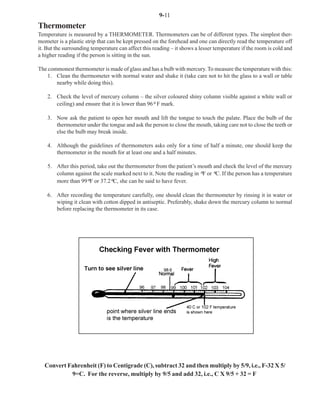
The commonest thermometer is made of glass and has a bulb with mercury. To measure the temperature with this:
   1. Clean the thermometer with normal water and shake it (take care not to hit the glass to a wall or table
       nearby while doing this).

    2. Check the level of mercury column – the silver coloured shiny column visible against a white wall or
       ceiling) and ensure that it is lower than 96°F mark.

    3. Now ask the patient to open her mouth and lift the tongue to touch the palate. Place the bulb of the
       thermometer under the tongue and ask the person to close the mouth, taking care not to close the teeth or
       else the bulb may break inside.

    4. Although the guidelines of thermometers asks only for a time of half a minute, one should keep the
       thermometer in the mouth for at least one and a half minutes.

    5. After this period, take out the thermometer from the patient’s mouth and check the level of the mercury
       column against the scale marked next to it. Note the reading in ° or ° If the person has a temperature
                                                                        F    C.
       more than 99° or 37.2° she can be said to have fever.
                      F          C,

    6. After recording the temperature carefully, one should clean the thermometer by rinsing it in water or
       wiping it clean with cotton dipped in antiseptic. Preferably, shake down the mercury column to normal
       before replacing the thermometer in its case.


  Convert Fahrenheit (F) to Centigrade (C), subtract 32 and then multiply by 5/9, i.e., F-32 X 5/
           9=C. For the reverse, multiply by 9/5 and add 32, i.e., C X 9/5 + 32 = F
9-12
Measuring Temperature of Children
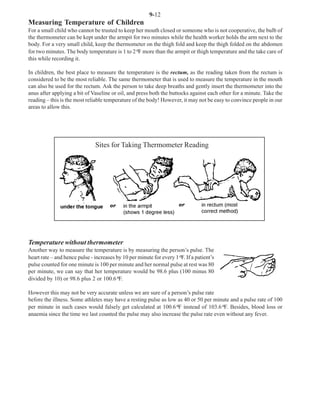
For a small child who cannot be trusted to keep her mouth closed or someone who is not cooperative, the bulb of
the thermometer can be kept under the armpit for two minutes while the health worker holds the arm next to the
body. For a very small child, keep the thermometer on the thigh fold and keep the thigh folded on the abdomen
for two minutes. The body temperature is 1 to 2° more than the armpit or thigh temperature and the take care of
                                                 F
this while recording it.

In children, the best place to measure the temperature is the rectum, as the reading taken from the rectum is
considered to be the most reliable. The same thermometer that is used to measure the temperature in the mouth
can also be used for the rectum. Ask the person to take deep breaths and gently insert the thermometer into the
anus after applying a bit of Vaseline or oil, and press both the buttocks against each other for a minute. Take the
reading – this is the most reliable temperature of the body! However, it may not be easy to convince people in our
areas to allow this.


                              Sites for Taking Thermometer Reading


Temperature without thermometer
Another way to measure the temperature is by measuring the person’s pulse. The
heart rate – and hence pulse - increases by 10 per minute for every 1° If a patient’s
                                                                      F.
pulse counted for one minute is 100 per minute and her normal pulse at rest was 80
per minute, we can say that her temperature would be 98.6 plus (100 minus 80
divided by 10) or 98.6 plus 2 or 100.6°   F.

However this may not be very accurate unless we are sure of a person’s pulse rate
before the illness. Some athletes may have a resting pulse as low as 40 or 50 per minute and a pulse rate of 100
per minute in such cases would falsely get calculated at 100.6° instead of 103.6° Besides, blood loss or
                                                                  F                   F.
anaemia since the time we last counted the pulse may also increase the pulse rate even without any fever.
9-13

                               Know the Answers
                                            Fevers
1. Mark whether “Right” or “Wrong”

       a. Fevers harm the body and should be brought down with
       medicines immediately.

       b. All fevers should be treated with germkillers.

       c. Typhoid fevers should be treated with germkillers for at least
          14 days.

       d. Malaria fever can quickly result in death unless treated.

       e. It is difficult to make a difference between Typhoid and Urine
         Infection.

2. Please answer the follwing questions:

       a. How can you make out Typhoid fever from Malaria?

       b. Can we give Chloroquine to pregnant women?

       c. How can you make out the difference between typhoid and
         viral fevers?

       d. What are the methods that we can use to lower temperature?
9-14

My Notes

09 fevers

  • 1.
    9 FEVERS In this chapter, you will learn: Page Number 1. What are fevers 9-1 2. Types of fevers 9-2 to 9-3 3. Malaria 9-5 to 9-7 4. Typhoid 9-8 5. Viral fever 9-9 6. Thermometer Reading 9-10 to 9-12
  • 2.
    9-1 FEVERS The human body has a normal hotness (temperature) of 98.4 degrees F or 37 degrees C. At this temperature, the body systems work the best. The body does not work so well if the temperature is hotter or colder. And if the temperature gets very hot (above 107 degrees, or very cold (below 90 degrees) the working of the body may become absolutely crazy. Different parts and organs of the body may fail for a short while until things become normal. If the temperature continues to be very high or very low, permanent failure may set in and the person may die. Low temperatures below normal may set in if our surroundings are very cold. Anyone without adequate clothing and food may die if exposed to such cold climate for too long. But children who have been born much before nine months in the mothers’ wombs and those who are much below normal weight can die of cold if exposed to low surrounding temperatures for a few hours. Such children need to be well wrapped up during cold. What we usually find amongst our people are illnesses in which the body temperature has become high. A body temperature above 99° F is called fever. We as health workers will often be called upon to help out, as people are very scared of fevers. Fever is our friend True, people are scared of fevers for they have seen their near and dear ones dying of fevers. Yet we need to understand one thing. All fevers are not our enemies. Fevers are part of the defence mechanism of the body. The body rises its temperature to stop the attacking germs from multiplying too fast. In fact, fevers warn us when our body has been attacked by germs. Hence, Fevers are friends! What we should be fighting are germs that brings fever, not the fever itself. Once the germs are killed, the fever shall go away. Fevers by themselves may get worrisome only beyond 107 degreesF in adults and 104 degrees F in children.
  • 3.
    9-2 KNOW THE FEVERS Insteadof taking fever - reducing medicines every time there is fever, it may be better to see its pattern of rise and fall. Just by seeing some of the points below, we can get good hints as to the possible reason of the fever: whether the fever is low or high whether there are also complaints specific to a body organ system whether there is a rise & fall pattern of temperature 1. Low grade Fever 2. High fever (Not very high temperature) • Malaria • Cold, cough, Sinusitis • Pneumonia • Dysentery • Abscess • TB • Urinary Tract Infection • AIDS • Viral Fevers including • Cancers Dengue • Boils, appendicitis, etc • Typhoid • Viral hepatitis, any small infec- • Severe infection tion anywhere 3. Fevers with General com- 4. Fevers with Organ plaints – body ache, weakness system specific com- • Viral fevers including Dengue plaints • Malaria • Urinary Tract Infection • Typhoid • Appendicitis • Initial stages of cancers, AIDS • Pneumonia • Abscess 5. Fevers that are accompa- nied by shivering: • Malaria • Urinary Tract Infection • Pneumonia • Abscess • Infections spread by lice and ticks etc.
  • 4.
    9-3 Fevers that show a pattern: 1. Fever come and goes : It disappears completely (even without taking any fever-reduc- ing medicine like Paracetamol) before reappearing: • Malaria • Kala Azar – found mainly in Bihar in India, occasionally seen in Meghalaya. The word “Typhoid” means “like Typhus” . 2. Fever disappears for a Typhus is a fever that was very common few days and then reappears: earlier but is rare now. We can suspect • Infections spread by lice and ticks Typhus if a person with lice has some typhoid (TYPHUS fever) like fever with some rash. • Rat bite fevers It is spread by lice on the body. Typhus can be sucessfully treated by DOXYCYCLINE. 3. Fever That Shows a Step Ladder Pattern - starts low and then increases bit by bit. • Typhoid
  • 5.
    9-4 Some CommonFevers to know 1. MALARIA 2. TYPHOID or ENTERIC FEVER 3. VIRAL FEVER
  • 6.
    9-5 1. MALARIA Fever Malaria is a disease caused by a small germ called Plas- modium that can be tested by checking our blood under a microscope. Usually of two types, Plasmodium falciparum and Plasmodium vivax are also commonly - and more easily — referred to as PF and PV. Malaria is commonly known to cause high fever that comes after half an hour of severe shivering and chills. After the fever that lasts one to two hours or so, the fever comes down on its own with lots of sweating. The fever may be accompanied by headache and vomiting. Any health worker can easily treat such malaria. How mosquitoes spread malaria? Mosquitoes spread malaria germs by carrying them from a patient whose blood has the PV or PF germ. The female Anopheles mosquito has to feed on human or animal blood every few days in order to lay eggs. During such a time when it is feeding on a malaria patient, it takes the germs along with the blood. These germs stay in the mosquito’s mouth and stomach for seven to ten days and give thousands of baby germs. After these seven to ten days, if the mosquito bites another normal person, such a person receives the baby germs. In about ten days time, these new germs that have entered the body multiply into thousands again and give rise to the first bout of shiver- ing and fever. As the fever rises, the germs try to hide inside the red blood cells and once again multiply. Within two days, they multiply tenfold and come out of the red cells into the blood and yet again cause shivering and fever. No wonder that the malaria fever comes every two days! To check if one has malaria, a trained person can test a small drop of blood pricked out from the finger and look for the malaria germ under the microscope. There are other tests also available, but none as cheap and reliable.
  • 7.
    9-6 Treatment for Malaria Dangerous malaria Replace fluids in body:As sweating and fever cause loss of Although both PV and PF cause similar prob- lots of fluid, it is important to drink plenty of watery sub- lems as given above, PF can get very danger- stances like soups, milk, lime juice, etc. Water with some salt ous and kill the patient. It can give rise to com- and sugar is also excellent. plications by blocking the blood supply to: Keep fever down: If the fever is very high, it may be a - the brain: the patient may good idea to bring the fever down by applying again and •get very severe headache again some cloth dipped in cool water to the forehead and •start talking irrelevantly body. Paracetamol may also be taken to bring down the tem- •may get fits or convulsions perature. •become unconscious or •get a new squint (both eyes look in different directions) Under 1 1 to 4 5 to 8 9 to 14 Above ye ar years ye ars ye ars 14 ye ars - the kidneys: urine production may become 1/4th Half a Half to 1 1 to 2 very less - at times none - and at times there 1 tablet tablet tablet tablet tablets may be blood with the urine. - the lungs: the person may have great diffi- Malaria medicines: Fever of any type may be malaria. culty in breathing and breathing rate may get Before starting any treatment, try to confirm that it is malaria high. by asking for blood test using a microscope. After a test has been sent - even if the result is not available yet — start the - the heart: the pumping of the heart may de- malaria treatment according to the age as given later. If it is crease and the pulse gets difficult to find. not confirmed, the first day’s treatment is considered enough. However, if one is sure that it is malaria DO REMEMBER In all such cases it is better to get the patient TO COMPLETE THE COURSE even if the fever has gone to a qualified doctor immediately. after the first day’s dose. Ways to prevent the spread of malaria 1. Early diagnosis and prompt treatment - we need to 2. Personal protection - each one of us make arrangements that every village knows the signals of should know that covering our hands and malaria and the problems that it may give. There must be feet especially during dark hours will re- at least one person trained in every village who duce the biting of mosquitoes and knows how much of Chloroquine and other hence malaria. A few leaves of Neem drugs need to be given. She should have free or eaten every day are known to decrease cheap Chloroquine available with her and every the chances of malaria. A broth made villager must know its availability with her. Early of Chiraita leaves taken every day dur- treatment decreases the number of people with ing the rainy season is reputed to keep malaria germs that may be bitten by mosqui- malaria away. toes and this reduces the spread of the disease. 3. Killing larvae - Larvae of mosquitoes grow 4. Killing mosquitoes - mosquitoes in stagnant or slow flowing water. Various fishes may eat killed by spraying DDT on the walls helps these and the most efficient of such species are available to prevent them from spreading malaria. with the malaria department. Also, any kind of oil or in- Walls of cattle sheds should not be secticide can be sprayed on the water surface to kill the sprayed so that the mosquitoes can bite larvae in the ten days that it takes them to develop from the cattle and have no need to bite hu- the egg stage to the adult stage. mans. This decreases malaria spread.
  • 8.
    9-7 2. TYPHOID orENTERIC FEVER Typhoid fever is also called enteric fever because What Causes Typhoid? it is due to an infection of the intestines. It has been Typhoid is caused by bacteria that come to stay an old problem with us. Before we found good an- in the intestine along with food that has been ‘dirt- tibiotics to take care of typhoid, it used to kill ied’ by flies, dirt and unwashed hands. Water people in the third week of fever because the infec- brought from rivers and canals or water from wells tion would puncture the intestine. Nowadays, al- and from hand pumps that are close to where most all fevers attract a dose of antibiotics from people shit is a known source of spreading ty- phoid. At times, people who pass typhoid germs doctors and hence even typhoid gets treated be- in their shit do not suffer from any illness and fore anyone can die of it. Rarely do people die of it may ‘silently’ pass the germ to many others if these days. Yet, it remains a common illness that they are cooks or handle water and food. leads to a lot of misery and is badly treated. What is the typhoid fever like? The typhoid fever usually starts as a low-grade fever that is continuous. There are not much ups and downs in the temperature unless the patient is taking fever-reducing tablets. Headache is a common accompaniment and is specially a good indicator if a child is complaining of it. There may be a rash in the second week but can usually be seen only in fair skinned people. These days, a bit of cough and cold are also seen in typhoid. Typhoid is said to have a character- istic pattern, that of a stepladder. If the tem- perature of a person is taken at regular intervals in typhoid, the temperature does not fluctuate much and instead it is seen to rise bit by bit until in the second week, when it becomes quite high. Although adults with typhoid fever are usually constipated, children often have diarrhoea and vomiting in the first few days. In the second week though, diarrhoea and pain on pressing the right side of the abdomen are common. A blood test can help to indicate Typhoid in a person. The fever either gets better on its own in the third week or else the patient can really get very worse by then. Bleeding from the intestine and puncture of the intestine is what can kill the patient in the third week. Treatment of Typhoid Fever • Typhoid must be suspected especially if there is any fever that has been continuously increasing since more than a week and has no other signals of any other organ being involved. • An antibiotic needs to be given and that too for 14 days and no less. This is because typhoid is known to come back and in such a case, the chances of intestinal perforation and death are higher. • Give AMOXYCILLIN or CIPOFLOXACIN in highest doses three times a day. Once the fever has come down, the dose may be reduced and continued until 14 days are completed. If the person cannot afford it or if Amoxycillin is not accessible, COTRIMOXAZOLE may be given, but it may take more time to bring the fever down.
  • 9.
    9-8 3. VIRAL FEVER Learnto Differentiate TYPHOID from VIRAL FEVER and also DENGUE Viral fevers also have a continuous and a stepladder pattern. Headache is common like in Typhoid. But severe body ache is more common in Viral fevers. Occasionally shiver- ing and a bit of cough and cold may be seen in viral fevers. More importantly though, is the fact that Vi- In Dengue (Den-gee) fever that is spread ral Fevers only rarely last beyond 7 days. As by Aedes mosquitoes (which breed in there are no germkiller medicines for Viral clean water especially in coolers / coco- fevers, it is suggested that unless one is sure, nut shells) although other signs of Viral we can wait until the eighth day of fever be- fevers are also present, severe body ache fore we start any antibiotic. And if the fever and pain in moving the eyes or in looking starts coming down within two days of start- at light are common. Fever may decrease ing the antibiotic, one can safely assume the from its high state after 7-8 days for two diagnosis to be that of Typhoid and the medi- to three days and return, often with a rash. cine MUST BE CONTINUED UNTIL 14 Usually though, there is no fever after 7 DAYS OF TREATMENT IS COMPLETED. to 10 days. Other fevers usually have signs and symptoms of an infection being present at different parts of the body. For example, in pneumonia there are signs of the lungs and the air tubes being infected. If an abscess, a big boil can be asked for. Pain in the abdomen, and pain while passing urine or with loose motions can also hint at the underlying cause of fever. These kinds of fevers are dealt with in other sections of the manual.
  • 10.
    9-10 THERMOMETER READING It is important at times to know the temperature of a person. It can help us understand what disease it is. By measuring and recording temperature, we can see the pattern of rise and fall of temperature, which can help in diagnosing. The normal temperature of a person is between 98°and 99°F (36.7°C and 37.2° C). The body works best between these temperatures. But when germs enter our body, the body fights back by raising the temperature to kill the germs. This is the fever that we feel. The higher temperature also helps in decreasing the rate of multiplication of the germs. You should understand that in many cases fever is a way to protect our body from harm done by germs. Only at times we should give medicines like PARACETAMOL which reduce the fever. Unless the temperature is above 104° F (102° F for children and old people), we need not give PARACETAMOL. Know- ing how to take the temperature of the body will also tell you when to give medicines.
  • 11.
    9-11 Thermometer Temperature is measuredby a THERMOMETER. Thermometers can be of different types. The simplest ther- mometer is a plastic strip that can be kept pressed on the forehead and one can directly read the temperature off it. But the surrounding temperature can affect this reading – it shows a lesser temperature if the room is cold and a higher reading if the person is sitting in the sun. The commonest thermometer is made of glass and has a bulb with mercury. To measure the temperature with this: 1. Clean the thermometer with normal water and shake it (take care not to hit the glass to a wall or table nearby while doing this). 2. Check the level of mercury column – the silver coloured shiny column visible against a white wall or ceiling) and ensure that it is lower than 96°F mark. 3. Now ask the patient to open her mouth and lift the tongue to touch the palate. Place the bulb of the thermometer under the tongue and ask the person to close the mouth, taking care not to close the teeth or else the bulb may break inside. 4. Although the guidelines of thermometers asks only for a time of half a minute, one should keep the thermometer in the mouth for at least one and a half minutes. 5. After this period, take out the thermometer from the patient’s mouth and check the level of the mercury column against the scale marked next to it. Note the reading in ° or ° If the person has a temperature F C. more than 99° or 37.2° she can be said to have fever. F C, 6. After recording the temperature carefully, one should clean the thermometer by rinsing it in water or wiping it clean with cotton dipped in antiseptic. Preferably, shake down the mercury column to normal before replacing the thermometer in its case. Convert Fahrenheit (F) to Centigrade (C), subtract 32 and then multiply by 5/9, i.e., F-32 X 5/ 9=C. For the reverse, multiply by 9/5 and add 32, i.e., C X 9/5 + 32 = F
  • 12.
    9-12 Measuring Temperature ofChildren For a small child who cannot be trusted to keep her mouth closed or someone who is not cooperative, the bulb of the thermometer can be kept under the armpit for two minutes while the health worker holds the arm next to the body. For a very small child, keep the thermometer on the thigh fold and keep the thigh folded on the abdomen for two minutes. The body temperature is 1 to 2° more than the armpit or thigh temperature and the take care of F this while recording it. In children, the best place to measure the temperature is the rectum, as the reading taken from the rectum is considered to be the most reliable. The same thermometer that is used to measure the temperature in the mouth can also be used for the rectum. Ask the person to take deep breaths and gently insert the thermometer into the anus after applying a bit of Vaseline or oil, and press both the buttocks against each other for a minute. Take the reading – this is the most reliable temperature of the body! However, it may not be easy to convince people in our areas to allow this. Sites for Taking Thermometer Reading Temperature without thermometer Another way to measure the temperature is by measuring the person’s pulse. The heart rate – and hence pulse - increases by 10 per minute for every 1° If a patient’s F. pulse counted for one minute is 100 per minute and her normal pulse at rest was 80 per minute, we can say that her temperature would be 98.6 plus (100 minus 80 divided by 10) or 98.6 plus 2 or 100.6° F. However this may not be very accurate unless we are sure of a person’s pulse rate before the illness. Some athletes may have a resting pulse as low as 40 or 50 per minute and a pulse rate of 100 per minute in such cases would falsely get calculated at 100.6° instead of 103.6° Besides, blood loss or F F. anaemia since the time we last counted the pulse may also increase the pulse rate even without any fever.
  • 13.
    9-13 Know the Answers Fevers 1. Mark whether “Right” or “Wrong” a. Fevers harm the body and should be brought down with medicines immediately. b. All fevers should be treated with germkillers. c. Typhoid fevers should be treated with germkillers for at least 14 days. d. Malaria fever can quickly result in death unless treated. e. It is difficult to make a difference between Typhoid and Urine Infection. 2. Please answer the follwing questions: a. How can you make out Typhoid fever from Malaria? b. Can we give Chloroquine to pregnant women? c. How can you make out the difference between typhoid and viral fevers? d. What are the methods that we can use to lower temperature?
  • 14.