A project report on

“ Implementation of Kirkpatrick Model”
                  At
             JSPL Raigarh

  A project submitted for partial fulfillment
                     of
   “Masters of Business Administration”


          Department of Management Studies
      Indian School of Mines Dhanbad, Jharkhand


                          1
I certify that the Project Report entitled “Implementation of
Kirkpatrick Model” in JSPL Raigarh is the result of the bonfide
study carried out by Veer Chhatarashal under my guidance and
supervision and that no part of the report has been submitted in
any other form or for any other degree.


Place :
Date :                                         Prof. G.S Pathak


                                 2
I do hereby declare that the project entitled “Implementation of
Kirkpatrick Model” in JSPL Raigarh, submitted by me to the
department has been compiled by me under the guidance of Mr.
R.P Pandey, Sr. Manager(HR), and bears no imitation of any kind
from anywhere.

This project is a product of my own effort and it has not been
submitted or published ever before.


                                              Veer Chhatarashal

                                          Adm. No. 2011mb0019


                                3
I owe my deepest sense of gratitude and regards to the
Human Resource department of JSPL Raigarh , for having
given me this immense opportunity of doing my summer
internship from this renowned organization. I am heartily
thankful to Mr. R.S Dabas, Sr. AVP(P&A), Mr. C.D Mathew ,
AVP(HR) , JSPL ,and Ms. Romsha Sharma, Dy. Manager(HR),
JSPL, who so readily cooperated and provided us all the
relevant information.

I am also grateful to my department and all of my faculties
who ensured we were possibly acquainted with all the
necessary topics and information related to the field of
human resource              management, so that we might
not face any kind of difficulty in the completion of our
project.

Apart from them , my acknowledgements are also due to
my friends and co-trainees at JSPL Raigarh, who have also
been of tremendous help throughout the completion of this
project.


PLACE :
DATE :                                  Veer Chhatarashal
                             4
Sr No                        Topic                             Page No.

  1.                       Introduction                           6


  2.                  Research Methodology                        7


  3.                   Organizational Profile                     10


  4.            The Training Process at JSPL Raigarh              17


  5.        Evaluation of Training Effectiveness at JSPL          24


  6.    Implementation of Kirkpatrick Model, at JSPL Raigarh      29


  7.                 Conclusion & Suggestions                     61


  8.                       Bibliography                           63


  9.                         Annexure                             64


                                5
The Evaluation of any training program has certain aims to fulfill. These are concerned
with the determination of change in the organizational behavior and the change needed
in the organizational structure.
Hence evaluation of any training program must inform us whether the training program
has been able to deliver the goals and objectives in terms of cost incurred and benefits
achieved.
The analysis of the information is the concluding part of any evaluation program.
The analysis of data should be summarized and then compared with the data of other
training programs similar nature.
On the basis of these comparisons, problems and strength should be identified which
would help the trainer in this future training programs, to stop short of completion of the
training systems design methodology, by avoiding the evaluation ,our training
effectiveness is reneging on ou2r commitment to our employees.
The future requires more precise, reliable evaluation strategies, we like to think of
training effectiveness evaluation in the same way that we think of surveillance tests in the
plant, we perform training effectiveness evaluations to ensure our programs work
effectively.

A. Objective of the study :

   The study aims towards the partial fulfillment of the master of business
   administration. Apart from this the study aims to measure the training effectiveness
   in JSPL , RAIGARH, to detect the strong points underlying the training as well as the
   places that need to be considered for improvement.

B. Scope of the study :

   The respondents here includes employees who have undergone the training and
   supervisors under whom those employees perform. The employees views with regard
   to the training program were recorded and similarly the opinions of the supervisors
   with regard to the performance of the employees were recorded. Information
   gathered from both the respondents were then analyzed and conclusions pertaining
   to the strengths and weaknesses of the training programs were then finally deduced.


                                              6
Research methodology is a purely and simply the framework or a plans for the study that
guides the collection and analysis of data. Research is the scientific way to solve the
problems and it’s increasingly used to improve market potential. This involves exploring
the possible methods, one by one, and arriving at the best solution, considering the
resource s at the disposal of research.

Research in common parlance refers to search for knowledge. In fact, research is an
art of scientific investigation. Research methodology is the science of collecting,
identifying and presenting facts in such a way that it leads to unearthing some truths
or angles of reality.

Research Steps:

       Study about organization
       Setting of objectives
       Instrument design
       Main-study
       Tabulated and cross tabulation
       Analysis and impetration
       Findings
       Conclusion
       Suggestion and recommendation

Research Design :

A research design is the specification of methods and procedure for acquiring the
information needed. It is the over- all operation pattern or framework of the project that
stipulates what information is to be collected from which source by what procedure. It is
also refers to the blue print of the research process.
                   Key issue                                     Options
                Research design                                 Descriptive
                      Data                             Primary data, secondary data


                                             7
Research                                    Survey method
              Research Method                     Questionnaire, Expert Interviews, Studies
                                                         and Cost Benefit analysis
Research design consists of:

       A clear statement of the research problem.
       Procedure and techniques to be used for gathering information.
       The population to be studied.
       Method to be used in processing and analyzing the data

There are four types in research design :

       Exploratory of formative study
       Diagnostic study
       Experimental study
       Descriptive study

Descriptive study :

A study, which wants to portray the characteristics of a group of individual or situation, is
known as descriptive study.


Universe of study :

The first step in developing any sample design is to clearly define the set of objects
technically called the universe to be studied. In this case the universe includes all
employees of JSPL Raigarh who attended the training program. The study has been
conducted at JSPL Raigarh.


Period of coverage :

The study has been undertaken for a period of 4 months started from Jan 1, to April
30, 2012

Type of research :


                                              8
In this study, descriptive research is used. Descriptive research is carried out for the
purpose of collecting descriptive information like employee’s opinion, benefits,
personal details, awareness, etc about the training program they have attended.


Sampling procedure:

Types of sampling used in this survey were Simple Random Sampling (probability
sampling). In this method, the sampling units chosen randomly from the total
employees who had attended the training program at all level in the organization.

Data collection method:

Two techniques were used for collecting data, namely –

     A. Primary data collection technique
     B. Secondary data collection technique

A) Primary data:

Primary data are collected afresh and for the first time. It is the data originated by the
researcher specifically to address the research problem. In this study, Primary data was
collected through the Study, Interview Schedule with a well Structured Questionnaire to
know the reaction and learning of trainees and cost benefit analysis of training program.

B) Secondary data:

In this study Secondary data, are those which have already been collected by
someone else and which have already been passed through the statistical process.
Secondary Data was collected from the publications, internets, journals, books and
company records.

Data collection instrument:

Data is collected by questionnaire and interview schedule, the questionnaire
consists of a list of questions, which are relevant in getting the facts. Questionnaires
are likely any scientific experiment. One does not collect data and then see if they
are found something interesting. One form a hypothesis and an experiment that will
help prove or disprove the hypothesis.


                                             9
Sampling design:

A sample design is a definite plan for obtaining a sample from a given population. It
refers to a technique or the procedure the researcher would adopt in selecting items
for the sample.

Population:

The universe of the current study comprises of 300 employees.

Sample units:

Sample units consist of employees who had attended the training program
organized by the organization and who supervise the participants.

Research Instrument:

      Questionnaire
      Test
      Expert interviews
      Studies
      Human resource factor
      Cost benefit analysis


Various areas from where the data were gathered :

The various departments of JSPL from where all the necessary information had been
gathered are:

   1. HR Department
   2. CMC Department
   3. EPS Department


                                          10
Introduction:

With an annual turnover of over US $2.3 billion (Rs. 11,000
crore), Jindal Steel & Power Limited is a part of about US $ 12
billion diversified O. P. Jindal Group. It is a leading player in
Steel, Power, Mining, Coal to Liquid, Oil & Gas and
Infrastructure, consistently tapping new opportunities by
increasing production capacity, diversifying investments, and
leveraging its core capabilities to venture into new businesses. JSPL’s investment
commitments in steel, power, oil & gas and mining have touched more than US $ 30
billion today. In the recent past, JSPL has expanded its steel, power and mining businesses
to various parts of the world particularly in Asia, Africa, South America and Australia. The
company, today, is the largest private sector investor in the state of Chhattisgarh with an
investment commitment of over US$ 6 billion (Rs. 30,000 crore).Mr. Naveen Jindal, the
youngest son of the legendry late Shri. O P Jindal, spearheads Jindal Steel & Power
Limited and its group companies Jindal Power Ltd, Jindal Steel Bolivia, Jindal Petroleum
Ltd. and Jindal Cement with a belief in the concept of self-sufficiency. The company
produces economical and efficient steel and power through backward integration from its
own captive coal and iron-ore mines. An enterprising spirit and ability to discern future
trends have been the driving force behind the company's remarkable growth. And the
recognition it has received only further lends credence to this. Jindal Steel & Power
Limited has recently been rated as the second highest value creator in the world by
Boston Consulting Group. The company has also been rated as one of the Best Blue Chip
companies by Dalal Street Journal; One of the Fab 50 Companies by Forbes Asia as well as
the Highest Wealth Creator by the Dalal Street Journal. It has also won several awards for
its efficient operations and commitment to environment & safety. The company has
scaled new heights with the combined force of innovation, adaptation of new technology
and the collective skills of its 15,000 strong, committed workforce.

JSPL has set its foot in the international arena by acquiring the development rights of 20
billion tonne of Iron Ore in Bolivia. The company plans to invest US$ 2.1 billion (Rs. 10,500


                                              11
crore) over the coming years in Bolivia by setting up a 10 MTPA capacity Iron Ore
pelletization plant, a 6 MTPA capacity DRI plant, a 1.7 MTPA capacity steel planted a 450
MW power plant besides mining. The company recently acquired Shadeed Iron & Steel
Co. LLC (SISCO) a company incorporated under the laws of the Sultanate of Oman. The
project is under commissioning and is expected to commence commercial operations in
the first quarter of FY 2011/12.

With coal reserves in Indonesia and South Africa, the search for mines continues from
Mozambique to Madagascar. The company has also forayed into exploration and mining
of high value minerals like diamonds, etc. in states like Chhattisgarh, Jharkhand and the
Democratic Republic of Congo in Africa.

JSPL endeavors to strengthen India’s industrial base by aiding infrastructural
development, through sustainable development approaches and inclusive growth. The
company deploys its resources to the extent it can reasonably afford to improve
infrastructure, education, health, water, sanitation, environment etc. in the area it
operates.
As JSPL contributes to India’s growth, it has also set in place a global expansion plan in
order to become one of the most prestigious and dynamic business groups of the
country. The future is studded with challenges and JSPL is taking them on with vigor and
courage.

ABOUT THE FOUNDER & ADVENT OF JSPL


                    BABUJI – “The Man of Destiny”
(1930 – 2005)
“The Jindal Organization owes its brilliant growth to the dedicated endeavors of its
employees. With a strong emphasis on quality and on-time delivery to our customers as
per their specifications, our progressive as well as successful achievements have made
the Jindal Organization a leading name in India.
                                                                     - Late Shri O P Jindal


                                             12
Late Shri Om Prakash Jindal more popularly known as O.P. Jindal was born on August 7,
1930 to a farmer Late Netram Jindal of village Nalwa of district Hisar in Haryana. Since his
childhood the weng Jindal had interested in technical work. He started his industrial
career with a small bucket-manufacturing unit in Hisar. In 1964, he commissioned a Pipe
Unit Jindal India Limited, followed by a large factory in 1969 under the name Jindal Strips
Limited.
Shri Jindal always had the conviction that India should be self-reliant in every sector of
industry. He visited several foreign countries to elicit latest industrial technical
development and know-how. He acquired a great deal of knowledge, which he aptly
applied to enhance production of his industrial establishments. At present, there are
twenty factories under the flagship of the Jindal Organization, which are worth over
Rs.17,500 crores, under whose umbrella thousands of families directly or indirectly
benefit themselves.
Shri O.P. Jindal was the Chairman of the Jindal Organization. In November 2004, Shri
Jindal was conferred the prestigious "Life Time Achievement Award" for his outstanding
contribution to the Indian Steel Industry by the Bengal Chamber of Commerce & Industry.
According to the latest Forbes' List, Shri O.P. Jindal has been ranked 13th amongst the
richest Indians of the country and placed 548th amongst the richest persons of the world.
He was a successful industry visionary and would remain as a role model for others. On
account of his dedicated services to various sections of society particularly, of the poor
and backward classes, he was revered by all. Shri Jindal always advocated for granting a
rightful place for weaker sections in politics. He was above caste politics and wanted all to
come up regardless of their caste, colour and creed. Shri Jindal's philosophy was that
without the upliftment of weaker and backward sections of society our dream of being a
leading nation of the world shall remain unfulfilled. Shri Jindal's mantra was “where
others saw walls he saw doors”. Then whether it was opening doors or breaking down
walls he always led the way. The life journey of Shri Jindal from a farmer's son to a
successful industrialist, a philanthropist, a politician and a leader would serve as a great
source of inspiration for generations to come.


                                              13
Mr. Naveen Jindal, a Member of Parliament, Executive Vice
Chairman       and Managing Director of Jindal Steel and Power Ltd
(JSPL), and a sports enthusiast, is the youngest son of Late Sh. O.P.
Jindal, the steel visionary and Minister of Power in the government
of Haryana. At a very young age, Mr. Naveen Jindal has transformed JSPL, a moderately
performing company in the steel sector, into a world class company, the highest wealth
creator in the country. After consolidating its position as a leading player in the steel,
power, mining and infrastructure sectors, JSPL has recently diversified into the oil & gas
sector.


Mr. Jindal is a management graduate from the University of Texas at Dallas, USA.
Mr. Naveen Jindal is not only a successful entrepreneur but also a caring politician and an
effective parliamentarian. He represents Haryana state’s Kurukshetra constituency in
parliament. He started active participation in politics during his college days. He was the
President of the Student Government and recipient of the ‘Student Leader of the Year
Award’ - the honour for a student at the University of Texas at Dallas.
Weeding out corruption, stabilizing the population, aiming for a hunger free society,
promotion of sports at all levels, promoting a clean environment and providing health and
educational facilities in his constituency are on top of his political agenda. His ideology is
to incorporate the best practices of business management into politics.
As issues of national pride and self-esteem have always been uppermost in his mind, Mr.
Jindal single-handedly took up the cause of restoring in Indians a national pride, choosing
the Tricolour as his symbol. As a result of his decade long crusade, the Hon’ble Supreme
Court of India, in a historic judgment on 23rd January 2004 held that the right to fly the
National Flag freely, with respect and dignity is a Fundamental Right of Every Indian
Citizen.
Mr. Jindal is a national record holder in skeet shooting and an accomplished Polo player.
Currently, he is taking a lot of interest in promoting hockey, the national game of India.


                                              14
To create a competitive advantage for all stakeholders through effective management of the
people. To strengthen India’s industrial base and improve Quality of Life through Sustainable
Development approaches.


The Company embraces 6 missions in order to function ethically, effectively and prosper
further:

       Respect for Individual: Recognize each individual’s contribution in the growth and
       development of the Company. Treat all Jindalites with respect and dignity.
       Integrity: Conduct all business dealings along transparent lines.
       Meritocracy: Foster an environment of excellence in performance.
       Dynamic Thinking: Demonstrate a winner’s attitude, with a clear focus to deliver
       sustained values for all stakeholders.
       Creativity & Innovation: Encourage creative experimentation, embrace new ideas and
       institutionalize continuous improvement in all aspects of business and performance.
       Social Responsibility: Work on social and environmental issues to enrich the quality of
       life within the community we serve.


       Passion for People
       Business Excellence
       Integrity, Ownership & Sense of Belonging
       Sustainable Development


                                              15
JSPL is known all over the world for its pioneering and highly customized premium grade steel
products. These products are a result of JSPL’s strong commitment to innovation and are
designed to offer greater flexibility, reduced project cost and lower consumption of steel.
Some of the products are:


Certifications :

   Quality Management System – ISO 9001:2008.
   Environmental Management System – ISO 14001:2004.
   Occupational Health & Safety Management System.


                                              16
Environment Management Awards :

    Golden Peacock Environment Management Award – 2008.
      Greentech Environment Excellence Award – 2008.
      Greentech Environment Excellence Award – 2007.
      Srishti Green Cube Award for Good Green Governance – 2007.
      Golden peacock Eco-innovation Award – 2007.

Energy Conservation Awards :

    National Energy Conservation Award – 2008.
    National Energy Conservation Award – 2007.

Performance Awards :

    JSPL ranked 36th among India’s 100 Most Profitable Companies by Business &
     Economy Magazine, September 2009.
    2nd most investor friendly company, Business Today – 2008.
    Golden Peacock National Quality Award – 2008.

Safety Awards :

    National Safety Award (Mines) 2006, by the Ministry of Labour.
    National Safety Award (Mines) 2005, by the Ministry of Labour.

HR Awards :

    SAIL-HR Award for excellence in Human Resource Management 2009.
    JSPL among Top-20 “Best Companies To Work For” by Business Today – 2009.
    CII National HR Excellence, for Strong Commitment In HR-2009

Corporate Social Responsibility Awards :

    JSPL bags Think Orrisa Leadership Award in Corporate Social Responsibility 2008.
    Golden Peacock CSR Award 2006.

Achievements :

    Manufacturer of longest rail of 121 meter long in the world.
    Largest coal based sponge iron facility in the world.
    First Company to produce power from waste heat recovery boiler from sponge iron.


                                            17
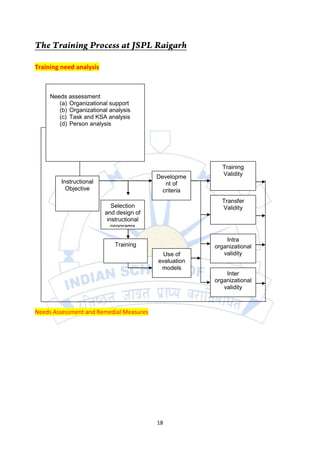
Training need analysis


     Needs assessment
        (a) Organizational support
        (b) Organizational analysis
        (c) Task and KSA analysis
        (d) Person analysis


                                                         Training
                                          Developme      Validity
         Instructional                       nt of
           Objective                        criteria
                                                         Transfer
                            Selection                    Validity
                         and design of
                          instructional
                            programs

                                                           Intra
                             Training                  organizational
                                            Use of        validity
                                          evaluation
                                           models
                                                           Inter
                                                       organizational
                                                          validity


Needs Assessment and Remedial Measures


                                          18
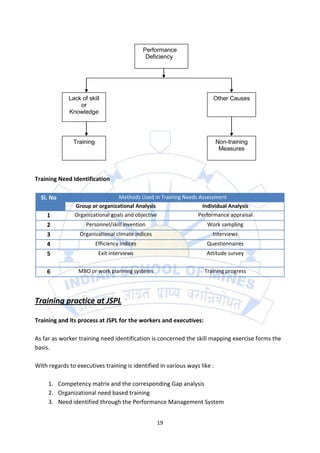
Performance
                                                Deficiency


             Lack of skill                                             Other Causes
                 or
             Knowledge


               Training                                                    Non-training
                                                                            Measures


Training Need Identification

  Sl. No                         Methods Used in Training Needs Assessment
               Group or organizational Analysis                  Individual Analysis
    1          Organizational goals and objective               Performance appraisal
    2               Personnel/skill invention                        Work sampling
    3             Organizational climate indices                       Interviews
    4                     Efficiency indices                         Questionnaires
    5                      Exit interviews                           Attitude survey


    6            MBO or work planning systems                       Training progress


Training practice at JSPL

Training and its process at JSPL for the workers and executives:

As far as worker training need identification is concerned the skill mapping exercise forms the
basis.

With regards to executives training is identified in various ways like :

     1. Competency matrix and the corresponding Gap analysis
     2. Organizational need based training
     3. Need identified through the Performance Management System


                                                   19
4. In line with business strategy of the organization/ request from employees
     5. Training necessitated due to technological up gradation.
     6. Through questionnaire ( to be implemented)

Thereafter the training department goes about its business in the following manner:

     1. Preparation of training calendar (both monthly as well as well on an annual basis)
     2. Contacting the respective faculty members and coordinating with them
     3. Informing respective departments about the training program. In case of open
        nomination the department head is free to send in people from his department on
        his own accord.
     4. The Training and Development cell then has to take care of all the facilities that are
        to be provided with regards to the training program. If the program is an outbound
        one then the entire activity is to be coordinated like-wise.
     5. The Training & Development cell is entrusted with maintenance of attendance
        record of the programs along with collecting immediate reaction feedback with the
        help of ‘smile sheets’.
     6. The entire data in this regard is constantly uploaded on to SAP.
     7. According to company policy a learning evaluation form is sent to the respective
        departmental HOD’s at least two-months after the training program had been
        conducted.
     8. On the basis of the feedback received the program is rated on a scale of 10.


Types Of Training Programs

On the basis of subject matter covered training can be classified into :

     1. Behavioral
     2. Functional
     3. Technical (On the basis of the location it can classified as):
               External training programs (it also includes various seminars, MDP’s etc)
               Internal training programs


                                                20
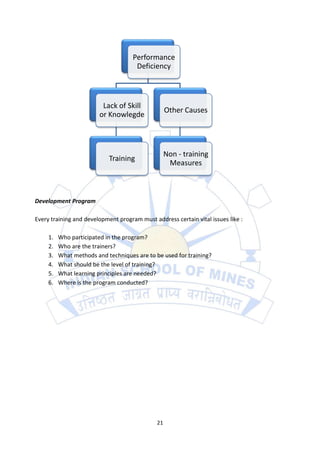
Performance
                                      Deficiency


                          Lack of Skill
                                                   Other Causes
                         or Knowlegde


                                                   Non - training
                            Training
                                                    Measures


Development Program

Every training and development program must address certain vital issues like :

     1.   Who participated in the program?
     2.   Who are the trainers?
     3.   What methods and techniques are to be used for training?
     4.   What should be the level of training?
     5.   What learning principles are needed?
     6.   Where is the program conducted?


                                              21
What methods
   Who are the                       Who are the
                                                                         and
    trainees?                         trainers?
                                                                     techniques?


     Where to                             What                       What should
    conduct the                       principles of                 be the level of
     program?                          learning?                      training?


Who are the Trainees?

Trainees should be selected on the basis of self nomination, recommendations of supervisors
or by the HR department itself. Whatever is the basis, it is advisable to have two or more
target audiences. For example, rank-and-file employees and their supervisors may effectively
learn together about a new work process and their respective roles. Bringing several target
audience together can also facilitate group processes such as problem solving and decision
making, elements useful in quality circle projects.

Who are the Trainers?

Training and development programs may be conducted by several people, including the
following:

     1.   Immediate supervisors,
     2.   Co-workers, as in buddy systems,
     3.   Members of the personnel staff,
     4.   Specialists in other parts of the company,
     5.   Outside consultants,
     6.   Industry associations, and
     7.   Faculty members at universities.

Who among these are selected to teach, often, depends on where the program is held and
the skill that is being taught. For example, programs teaching basic skills are usually done by
the members of the HR department or specialists in other departments of the company. On

                                                22
the other hand, interpersonal and conceptual skills for managers are taught at universities.
Large organizations generally maintain their own training departments whose staff conducts
the programs. In addition, many organizations arrange basic-skills training for computer
literacy.


Methods and Techniques of Training:

A multitude of methods of training are used to train employees. On-the-job methods refer to
methods that are applied in the workplace, while the employee is actually working. Off-the-
job methods are used away from workplaces.
Training techniques represent the medium of imparting skills and knowledge to employees.
Obviously, training techniques are the means employed in the training methods. Among the
most commonly used techniques are lectures, films, audio cassettes, case studies, role
playing, video-tapes and simulations.

Lectures:

Lecture is a verbal presentation of information by an instructor to a large audience. The
lecturer is presumed to possess a considerable depth of knowledge of the subject at hand. A
virtue of this method is that is can be used for very large groups, and hence the cost per
trainee is low. This method is mainly used in colleges and universities, though its application
is restricted in training factory employees.


Audio-visual:

Visuals Audio-visuals include television slides, overheads, video-types and films. These can be
used to provide a wide range of realistic examples of job conditions and situations in the
condensed period of time. Further, the quality of the presentation can be controlled and will
remain equal for

Simulation:

A simulator is any kind of equipment or technique that duplicates as nearly as possible the
actual conditions encountered on the job. Simulation then, is an attempt to create a realistic
decision-making environment for the trainee. Simulations present likely problem situation
and alternatives to the trainee. For example, activities of an organization may be simulated
and the trainee may be asked to make a decision in support to those activities.


                                               23
Case Study:

Taken from the actual experiences of organizations, these cases represent to describe, as
accurately as possible, real problems that managers have faced. Trainee studies the cases to
determine problems, analyses causes, develop alternative solutions, select the best one, and
implement it.

Role playing:

Generally focuses on emotional (mainly human relations) issues rather than actual ones. The
essence of role playing is to create a realistic situation, as in case study, and then have the
trainee assume the parts of specific personalities in the situation. For example, a male worker
may assume the role of a female supervisor, and the supervisor may assume the role of a
male worker. Then, both may be given a typical work situation and asked to respond as they
expect others to do. The consequences are a better understanding among individuals. Role
playing helps promote interpersonal relation. Attitude change is another result of role
playing. Case study and role playing are used in MDPs


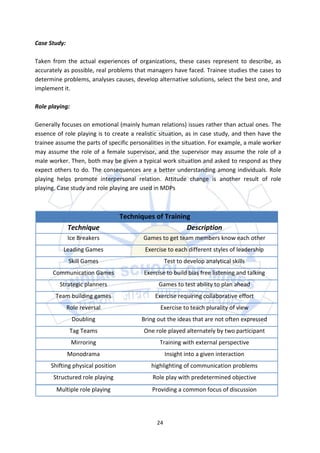
                                   Techniques of Training
              Technique                                 Description
              Ice Breakers                Games to get team members know each other
           Leading Games                  Exercise to each different styles of leadership
              Skill Games                           Test to develop analytical skills
      Communication Games                 Exercise to build bias free listening and talking
         Strategic planners                    Games to test ability to plan ahead
        Team building games                   Exercise requiring collaborative effort
              Role reversal                     Exercise to teach plurality of view
                Doubling                 Bring out the ideas that are not often expressed
               Tag Teams                  One role played alternately by two participant
                Mirroring                       Training with external perspective
              Monodrama                             Insight into a given interaction
      Shifting physical position            highlighting of communication problems
       Structured role playing               Role play with predetermined objective
        Multiple role playing                Providing a common focus of discussion


                                               24
Expected Results Of Training Program

      Higher Productivity: Training helps to improve the level of Performance. Trained
       employees perform better by using better method of work.
      Better Quality Of Work: In formal training, the best methods are standardized and
       taught to employees perform better by using better method of work.
      Cost Reduction: Trained employees make more economical use of materials and
       machinery. Reduction in wastages and spoilage together with increase in
       productivity help to minimize cost of operation per unit.
      Reduction Supervision: Well-trained employees tend to be self reliant and
       motivated.


Evaluation of Training Effectiveness at JSPL

Every year JSPL sends a large number of its employees on training to update them with all
the recent changes in skills, technologies, and information pertaining to their job. This
involves a huge expenditure every year on the part of the organization. Therefore it
becomes a matter of concern for JSPL to ensure that it is investing in the right direction, that
its employees are actually deriving full benefits out of the training programs so organised
and that the programs are successfully educating the employees in the manner it ought to
and is able to bring change in the knowledge and skills of the employees, which can be
attributed to the program.

JSPL follows the Donald Kirkpatrickk’s model of training. Therefore, I would first like to
discuss Kirkpatrickk’s model.

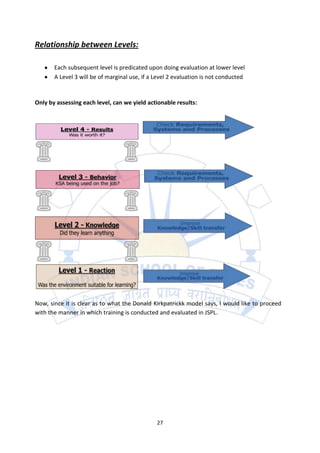
Donald Kirkpatrickk’s model comprises of four stages :

1. Reaction

The first, stage called reaction deals with the immediate reaction of the employees who just
undergone a training program. This reaction of theirs is recorded through the use of feedback
forms.

2. Learning

Subsequently follows the stage of learning, where any kind of changes pertaining to
employee’s skills, knowledge and attitude are measured. Generally pre-post test measures
are used to check on the learning that has occurred. such measurement of change is


                                               25
important because it gives an indication of the quantum of change that has occurred among
the employees post the training program.

3. Transfer of learning

The third level is one where the application of whatever had been learnt through the program
is measured. Again, for this purpose, questionnaires are used which are in the form of
feedback forms. Various factors such as opportunities for applying the knowledge gained
through the training, enablers and barriers for applying the knowledge, increase in
confidence and improvement in performance are recorded and measured. This is done after a
certain period of time has passed since the training program was conducted. The main
concern is whether the transfer of learning took place and if it did not, then to detect the
possible reasons behind it. It helps the organization recognize the flaws in its system that
possibly pose constraints in the path of application of whatever had been learnt through the
training programs and overcome them to facilitate transfer of learning to the workplace to as
much extent as possible.

4. Results

The final stage in Kirkpatrickk’s model deals with results. In this stage, the effectiveness of
program is measured in terms that managers and executives can understand like increase in
productivity, low defects, employee retention, decreased accidents, lower costs, etc.

The process under Donald Kirkpatrickk’s model takes place in the following manner :


    Level 1 : Reaction              • Did they like it?


    Level 2 : Learning              • Did they learn it?


   Level 3 : Behaviour              • Did they use it?


      Level 4 : Result              • Did it impact the bottom line

                                    • What is the Return on
        Level 5 : ROI
                                      Investment?

                                               26
Relationship between Levels:

       Each subsequent level is predicated upon doing evaluation at lower level
       A Level 3 will be of marginal use, if a Level 2 evaluation is not conducted


Only by assessing each level, can we yield actionable results:


Now, since it is clear as to what the Donald Kirkpatrickk model says, I would like to proceed
with the manner in which training is conducted and evaluated in JSPL.


                                               27
Return on Investment (ROI) in training and development (T&D) is a measure of the monetary
benefits obtained by an organization over a specified time period in return for a given
investment in a training program or is the extent to which the benefits (outputs) of training
exceed the costs (inputs) or is a measure of all the economic returns generated from an
investment in a T&D program. These returns are then compared with the true cost of the
program to determine an average annual rate of return of the investment. All capital assets
need to earn a rate of return for the business to make a profit and stay in business, ROI is
about judging the investment in T&D on similar criteria to other investment in the business.
ROI is the extent to which the benefits (outputs) of training exceed the costs (inputs).

Some returns can be easily measured, such as increase in sales after a sales training program,
but others such as customer/employee satisfaction, turnover rate, and complaint levels
require conversion to a monetary amount. Some costs can also be easily measured, such as
hire of training rooms, however other costs need further analysis to determine, such as the
cost of administration of the T&D department.

The intense focus on performance in public companies has made ROI increasingly important.
The only way to guarantee that projects and programs receive funding is to show how they
boost the bottom line. An ROI evaluation fulfils senior managements requirement to justify
training budgets and investments.

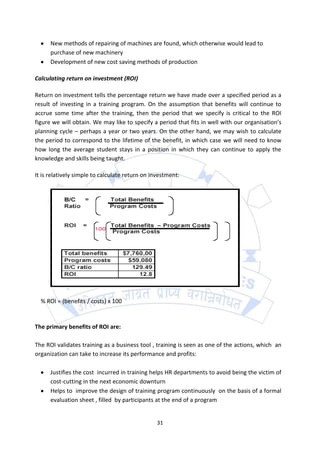
The idea of ROI was first proposed by Jack Phillips. He tried to express in terms of percentage
or ratio & named it as the fifth stage of Kirkpatrickk model. The formula for it is as follows :-

                                  (Net Benefits / Costs) x 100

There was a research conducted and it was found that about $5.6 billion to $16.8 billion is
wasted annually in ineffective training program. A study of 15 countries in the organization
for Economic cooperation and development found that majority of the employees believe
employee training is responsible for “ productive improvements, greater workforce flexibility,
saving on material and capital cost, improved quality of final products or service and a more
motivated workforce”
However, many companies have not measured the benefits and related them to the cost of
training in a way that reveals the rate of return on a firm's investment. Apparently there is no
other workplace issue on which so much money is spent with as little accountability as
training.


                                                28
“American industry is spending billions and billions on training programs and
doing no evaluation of their effectiveness. We have to measure it.”

                                             -Cary Cherniss, Rutgers University

The process of calculating ROI :

To calculate ROI we must first make estimates or obtain measurements of the costs and
benefits associated with a training program. As we will see, the calculation of ROI is then a
relatively simple process. Let's start with the costs forecasting and measuring costs

Design and development costs :

The first category of cost to be considered is the design and development of the training
program, whether this comprises classroom events, self-study materials, simple coaching
sessions or some combination. We will need to consider:

      internal days of design and development
      costs of external designers and developers
      other direct design and development costs (purchase of copyrights, travel, expenses,
      etc.)
      outright purchase of off-the-shelf materials

Faculty costs :

The next category of costs relates to the delivery of the training, whether this is mediated by
faculty (tutors, instructors, coaches, etc.) or is self-administered (workbooks, CBT, online
training, etc.). Let’s start with the information needed to calculate faculty costs:

      the number of students who will be going through the program
      hours of group training (whether classroom-based or delivered in real time, online)
      hours of one-to-one training (typically face-to-face, but could conceivably be conducted
      by telephone, video conferencing link or in real-time, online)
      hours of self-study training
      additional faculty hours (preparation time, the time needed to review or mark
      submitted work or the time needed to correspond by email or bulletin boards with
      online students)
      faculty expenses (travel, accommodation, subsistence, etc.).


                                               29
Materials :

Then there's the cost of materials:

       cost per student of training materials (books, manuals, consumables, etc.)
       license cost per student for use off-the-shelf materials

Facilities :

We will also need to allow for the cost of our training facilities, whether these are internal or
external. Make sure to include the rental or notional internal cost of the following:

       training rooms
       open learning / self-study rooms
       equipment used

Finally, don't forget to include any direct student expenses - travel, accommodation and
subsistence.

Evaluation costs :

We also need to make an allowance for the time spent on evaluating the training, whether
this is an ROI analysis or some other method forecasting and measuring benefits.

The financial benefits of training cannot be measured in terms of student reactions, nor the
amount of learning that has been achieved; not even the extent to which behavior may have
changed. The real benefits come from improved performance – traditionally the hardest
training outcome to forecast or measure these categories are not necessarily mutually
exclusive - in some respects they provide alternative ways of looking at the same underlying
benefit. Because of this, we should be extremely careful not to include the same basic benefit
under more than one of these headings.

Cost savings :

Cost savings can be achieved in a variety of ways, not just through savings in labour, and this
category allows we to take account of these. Examples include:

       fewer machine breakdowns, resulting in lower maintenance costs
       less mean time taken to repair a machine
       amount saved when these trained persons would give internal training to the other
       staff of free of cost
       The increase in the availability of machines


                                                30
New methods of repairing of machines are found, which otherwise would lead to
      purchase of new machinery
      Development of new cost saving methods of production

Calculating return on investment (ROI)

Return on investment tells the percentage return we have made over a specified period as a
result of investing in a training program. On the assumption that benefits will continue to
accrue some time after the training, then the period that we specify is critical to the ROI
figure we will obtain. We may like to specify a period that fits in well with our organisation’s
planning cycle – perhaps a year or two years. On the other hand, we may wish to calculate
the period to correspond to the lifetime of the benefit, in which case we will need to know
how long the average student stays in a position in which they can continue to apply the
knowledge and skills being taught.

It is relatively simple to calculate return on investment:


  % ROI = (benefits / costs) x 100


The primary benefits of ROI are:

The ROI validates training as a business tool , training is seen as one of the actions, which an
organization can take to increase its performance and profits:

      Justifies the cost incurred in training helps HR departments to avoid being the victim of
      cost-cutting in the next economic downturn
      Helps to improve the design of training program continuously on the basis of a formal
      evaluation sheet , filled by participants at the end of a program


                                                 31
Helps select training methods allows a rational selection of delivery mechanisms, from
     classroom-based to e-learning


Project Report on “Implementation of Kirkpatrickk Model” in JSPL Raigarh.

Survey And Data Analysis:


            Sample taken for “ Implementation of Kirkpatrick Model”

                      Level                          Sample(Training Programs)

           Level-1 (Reaction Feedback)                             25

           Level-2 (Learning Feedback)                             15

           Level-3 (Behavioral Changes)                            15

                 Level-4 (Result)                                  15

                       ROI                                          9


                                            32
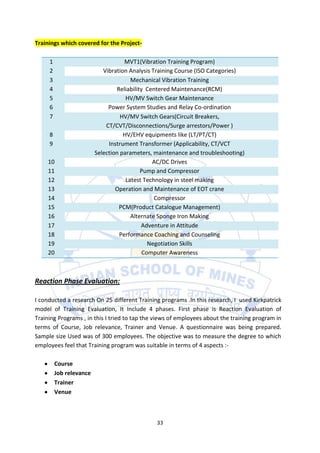
Trainings which covered for the Project-

     1                               MVT1(Vibration Training Program)
     2                      Vibration Analysis Training Course (ISO Categories)
     3                                 Mechanical Vibration Training
     4                            Reliability Centered Maintenance(RCM)
     5                               HV/MV Switch Gear Maintenance
     6                        Power System Studies and Relay Co-ordination
     7                             HV/MV Switch Gears(Circuit Breakers,
                             CT/CVT/Disconnections/Surge arrestors/Power )
     8                              HV/EHV equipments like (LT/PT/CT)
     9                        Instrument Transformer (Applicability, CT/VCT
                         Selection parameters, maintenance and troubleshooting)
     10                                         AC/DC Drives
     11                                     Pump and Compressor
     12                              Latest Technology in steel making
     13                          Operation and Maintenance of EOT crane
     14                                          Compressor
     15                            PCM(Product Catalogue Management)
     16                                Alternate Sponge Iron Making
     17                                     Adventure in Attitude
     18                            Performance Coaching and Counseling
     19                                        Negotiation Skills
     20                                      Computer Awareness


Reaction Phase Evaluation:

I conducted a research On 25 different Training programs .In this research, I used Kirkpatrick
model of Training Evaluation, It Include 4 phases. First phase is Reaction Evaluation of
Training Programs , in this I tried to tap the views of employees about the training program in
terms of Course, Job relevance, Trainer and Venue. A questionnaire was being prepared.
Sample size Used was of 300 employees. The objective was to measure the degree to which
employees feel that Training program was suitable in terms of 4 aspects :-

         Course
         Job relevance
         Trainer
         Venue


                                               33
Employee Feedback-Results and Interpretations:

The evaluation of reaction has been done Cluster wise, as follows:

Cluster 1st(Course)

Parameters include:

   a. The training was well organized and clearly structured
   b. The objective and aim of training was explained clearly
   c. The training covered a variety of useful topics
   d. The content and material of the training were relevant
   e. The medium of presentations(lecture/discussion/exercise/ games/ case studies, AV's)
      was appropriate
   f. The examples and references used were effective
   g. The pace of training was appropriate.

The participants immediate reaction about above parameters are depicted in following
Graph :-


                                               Course content
                                 10
                                  8
                  scale(10)


                                  6
                                  4
                                  2
                                  0
                                        a     b     c   d     e     f   g     over
                                                                               all
                              Ratings   8.2   8.6   8   7.2   7.8   8   6.6    7.8


Interpretation:

Out of 300 Employees (I have taken for my study), It was found that participants rated
7.8(scale-10) to the Course content of the training programs .So after looking at the results it
can be said that participants are satisfied with the design of the programs.


                                                        34
Cluster-2nd(Relevance to job)

Parameters include:

   a.   This course gave me ideas/information/material which I can use in my normal job
   b.   I will suggest this course to my colleagues
   c.   This course was time well spent and met my expectations
   d.   I will be able to apply my learning's immediately at the workplace

The participants acknowledge with the following rating to the Relevance parameters.


                                             Relevance to job
                                 9
                  scale(10)


                               8.5
                                 8
                               7.5
                                        a        b         c    d    over all
                              Rating   8.8      8.8        8   8.8     8.6


Interpretation:

It is observed that on rating of relevant to jobs is 8.6 on scale(10) .So after looking at the
results it can be said that participants are satisfied with the relevancy of the programs and it
is well related to their jobs.


Cluster-3rd(Trainer)

Parameters include:

   a. The trainers were friendly and approachable
   b. The trainer conveyed enthusiasm for the subject and responded positively to the ideas
      and questions of the participants
   c. The trainers were clear in their communication and encouraged participation
   d. The trainer had strong subject knowledge
   e. The trainer was able to answer my questions


                                                      35
Trainer
                                     9

                  scale(10)
                                   8.5
                                     8
                                   7.5
                                             a      b       c         d          e     over all
                              Ratings       8.4    8.6     8.2       8.6         8      8.36


Interpretation:

The participants rated 8.4(scale-10) to the trainer, it is very clear that participants are
satisfied with trainer.

Cluster-4th (Venue)

Parameters include:

  a.   The venue was suitable
  b.   The facilities and food were satisfactory
  c.   The course material (handouts/ writing pads/ stationary) were adequate & helpful
  d.   The batch size was about right


                                                         Venue
                                     10
                       scale(10)


                                      5

                                      0
                                              a       b          c          d        over all
                                   Rating    8.4     6.8         7         7.8         7.5


Interpretation:

The participants rated venue facilities 7.5(10), which is satisfactorily but need to be enhanced.

Over all reaction feedback is clearly seen in graph:-


                                                            36
Over all Reaction
                                    9
                                  8.5

                     scale(10)
                                    8
                                  7.5
                                    7
                                  6.5
                                          Course   Relevanc   Trainer   Venue   Over all
                                                       e
                                 Rating    7.8        8.6       8.4      7.5      8.1


   Over all reaction feedback is 81%, which means training is useful to participants and they
   are satisfied with all parameters of reaction feedback of training program.


    Analysis of Level – 2(Learning)


   This level of ” Kirkpatrick Model” evaluates learning of participants from the training.

   We adopted following parameters to evaluate learning of participants:-

 Pre -training marks and post training marks of participants .
 Knowledge sharing (Giving in house training to subordinates and peers.)
 Structured questionnaires(Filled by HOD and Participants)


   Pre -training marks and post training marks of participants


    For the purpose of level- 2 ,analysis, in order to find out whether learning has taken place or
   not, pre-post test measure was applied.
   Employees were made to take certain tests or assessments on the basis of which their
   knowledge/skill was measured.

   Thereafter, these employees were sent on training and after the completion of the training,
   these employees again had to take the tests. The purpose was to reevaluate the employees
   through the tests, in order to find out whether there has been any increase in their
   knowledge/skills post the program.
   The following table shows the programs concerning which the assessments were taken and
   the learning percentage :

                                                              37
Sr.                     Program Name                           Pretest Post Test Learning
  No.                                                            (avg. ) (avg.)     Index

   1            MVT1(Vibration Training Program)                  23.21   40.23      73.3
   2    Vibration Analysis Training Course (ISO Categories)       25.22   30.12      19.4
   3              Mechanical Vibration Training                   32.67   38.54      18.0
   4         Reliability Centered Maintenance(RCM)                24.2    43.65      80.4
   5            HV/MV Switch Gear Maintenance                     27.12   40.22      48.3
   6         Power System Studies and Relay Co-ordination         23.09   38.9       68.5
   7             HV/MV Switch Gears(Circuit Breakers,             21.23   34.87      64.2
             CT/CVT/Disconnections/Surge arrestors/Power
                             Transformer)
   8              HV/EHV equipments like (LT/PT/CT)               28.9    39.76      37.6
   9    Instrument Transformer(Applicability, CT/VCT Selection    24.11   41.11      70.5
             parameters, maintenance and troubleshooting)

  10                      AC/DC Drives                            26.66   40.45      51.7
  11                 Pump and Compressor                          23.33   43.22      85.3
  12            Latest Technology in steel making                 22.11   40.99      85.4
  13         Operation and Maintenance of EOT crane               25.55   36.44      42.6
  14                       Compressor                             26.92   35.87      33.2
  15          PCM(Product Catalogue Management                    23.77   39.34      65.5
                               Over all                           25.21   38.91      54.4


The above table shows the learning as the difference of pre-test marks and post-test marks,
which shows 54.38% increment. Hence level of learning is justified.


                                               38
Learning index
                  90.0
                  80.0
                  70.0
                  60.0
                  50.0
    %tage


                  40.0
                  30.0
                  20.0
                  10.0
                   0.0
                         1    2   3   4    5   6    7   8   9   10   11   12   13   14
                                                                                   15 Ove
                                                                                       r all
            Learning index 73. 19. 18. 80. 48. 68. 64. 37. 70. 51. 85. 85. 42. 33. 65. 54.


The following graph shows the level of knowledge/skills of the employees before the
programs were conducted, compared against the level of knowledge after the programs were
conducted.

From this, we can come to know that there has been an increment in the average of the post
tests marks, which indicates that learning has taken place among the employees.

The program wise learning ,that took place among the employees can best be demonstrated
with the help of the following graph :

It is clearly visible that the percentage learning took place is significant , hence good leaning
took place, so training were effective.


Learning Evaluation based on Questionnaires (Self Evaluation)

To evaluate learning we present questionnaires to the participants (Which is attached in
annexure) and asked to fill the parameters on the basis of pre-training subject knowledge
and post training subject knowledge. The below mentioned table shows the same for a
training conducted by ABB Ltd. Badodra.


                                                   39
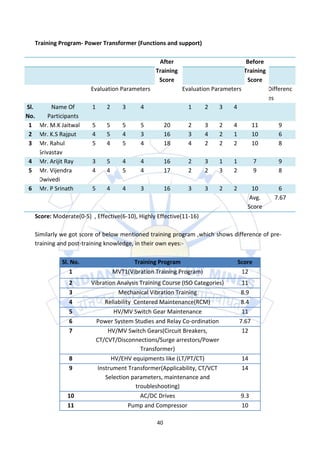
Training Program- Power Transformer (Functions and support)

                                                  After                              Before
                                                 Training                           Training
                                                  Score                              Score
                        Evaluation Parameters               Evaluation Parameters              Differenc
                                                                                               es
Sl.      Name Of         1    2      3      4                 1      2   3    4
No.     Participants
 1 Mr. M.K Jaitwal       5    5      5      5         20      2      3   2    4          11       9
 2 Mr. K.S Rajput        4    5      4      3         16      3      4   2    1          10       6
 3 Mr. Rahul             5    4      5      4         18      4      2   2    2          10       8
    Srivastav
 4 Mr. Arijit Ray        3    5      4      4         16      2      3   1    1           7       9
 5 Mr. Vijendra          4    4      5      4         17      2      2   3    2           9       8
    Dwivedi
 6 Mr. P Srinath         5    4      4      3         16      3      3   2    2        10         6
                                                                                      Avg.       7.67
                                                                                     Score
   Score: Moderate(0-5) , Effective(6-10), Highly Effective(11-16)

   Similarly we got score of below mentioned training program ,which shows difference of pre-
   training and post-training knowledge, in their own eyes:-

             Sl. No.                     Training Program                         Score
                1                 MVT1(Vibration Training Program)                 12
                2       Vibration Analysis Training Course (ISO Categories)        11
                3                  Mechanical Vibration Training                  8.9
                4             Reliability Centered Maintenance(RCM)               8.4
                5                HV/MV Switch Gear Maintenance                     11
                6         Power System Studies and Relay Co-ordination            7.67
                7              HV/MV Switch Gears(Circuit Breakers,                12
                          CT/CVT/Disconnections/Surge arrestors/Power
                                             Transformer)
                8               HV/EHV equipments like (LT/PT/CT)                   14
                9          Instrument Transformer(Applicability, CT/VCT             14
                              Selection parameters, maintenance and
                                           troubleshooting)
               10                            AC/DC Drives                          9.3
               11                       Pump and Compressor                        10

                                                 40
12                         Latest Technology in steel making           12
            13                    Operation and Maintenance of EOT crane           11
            14                                    Compressor                       12
            15                       PCM(Product Catalogue Management              15
                           Over all score                                          11.22

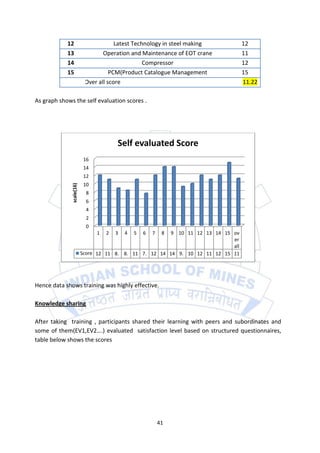
As graph shows the self evaluation scores .


                                        Self evaluated Score
                           16
                           14
                           12
                           10
              scale(16)


                            8
                            6
                            4
                            2
                            0
                                1   2   3   4   5   6   7    8
                                                        9 10 11 12 13 14 15 ov
                                                                             er
                                                                             all
                          Score 12 11 8. 8. 11 7. 12 14 14 9. 10 12 11 12 15 11


Hence data shows training was highly effective.

Knowledge sharing

After taking training , participants shared their learning with peers and subordinates and
some of them(EV1,EV2….) evaluated satisfaction level based on structured questionnaires,
table below shows the scores


                                                            41
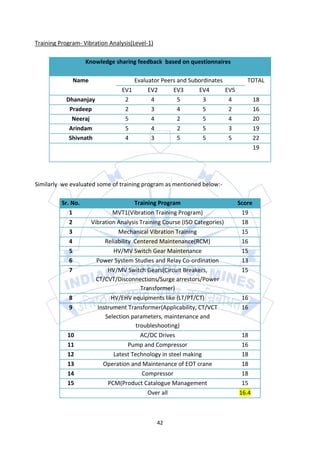
Training Program- Vibration Analysis(Level-1)

                    Knowledge sharing feedback based on questionnaires

                Name                    Evaluator Peers and Subordinates              TOTAL
                                  EV1        EV2      EV3      EV4           EV5
           Dhananjay               2          4         5        3            4            18
            Pradeep                2          3         4        5            2            16
             Neeraj                5          4         2        5            4            20
            Arindam                5          4         2        5            3            19
            Shivnath               4          3         5        5            5            22
                                                                                           19


Similarly we evaluated some of training program as mentioned below:-

          Sr. No.                        Training Program                          Score
             1                  MVT1(Vibration Training Program)                    19
             2         Vibration Analysis Training Course (ISO Categories)          18
             3                    Mechanical Vibration Training                     15
             4               Reliability Centered Maintenance(RCM)                  16
             5                  HV/MV Switch Gear Maintenance                       15
             6           Power System Studies and Relay Co-ordination               13
             7                HV/MV Switch Gears(Circuit Breakers,                  15
                         CT/CVT/Disconnections/Surge arrestors/Power
                                            Transformer)
            8                  HV/EHV equipments like (LT/PT/CT)                    16
            9             Instrument Transformer(Applicability, CT/VCT              16
                             Selection parameters, maintenance and
                                          troubleshooting)
            10                              AC/DC Drives                            18
            11                         Pump and Compressor                          16
            12                  Latest Technology in steel making                   18
            13              Operation and Maintenance of EOT crane                  18
            14                               Compressor                             18
            15                PCM(Product Catalogue Management                      15
                                               Over all                            16.4


                                                42
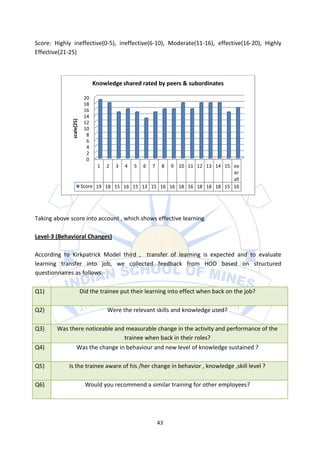
Score: Highly ineffective(0-5), ineffective(6-10), Moderate(11-16), effective(16-20), Highly
Effective(21-25)


                                Knowledge shared rated by peers & subordinates

                           20
                           18
                           16
                           14
              scale(25)


                           12
                           10
                            8
                            6
                            4
                            2
                            0
                                 1   2   3   4   5   6   7    8
                                                        9 10 11 12 13 14 15 ov
                                                                             er
                                                                             all
                          Score 19 18 15 16 15 13 15 16 16 18 16 18 18 18 15 16


Taking above score into account , which shows effective learning.

Level-3 (Behavioral Changes)

According to Kirkpatrick Model third , transfer of learning is expected and to evaluate
learning transfer into job, we collected feedback from HOD based on structured
questionnaires as follows:-

Q1)                       Did the trainee put their learning into effect when back on the job?

Q2)                                  Were the relevant skills and knowledge used?

Q3)     Was there noticeable and measurable change in the activity and performance of the
                                trainee when back in their roles?
Q4)           Was the change in behaviour and new level of knowledge sustained ?

Q5)          Is the trainee aware of his /her change in behavior , knowledge ,skill level ?

Q6)                         Would you recommend a similar training for other employees?


                                                             43
Q7).    Overall do you think the employee has demonstrated the learning’s from trainings in
                                    his / her day to day work?


Graphical presentation of behavioral parameters:-


                                           Behavioral Changes
                             8.6
                             8.4
                             8.2
                scale(10)


                               8
                             7.8
                             7.6
                             7.4
                             7.2
                               7
                                     Q1     Q2    Q3    Q4    Q5    Q6    Q7    Over
                                                                                 all
                            Rating   7.8    8.6   8.6   7.6   7.8   8.6   8.2    8.2


Q.1) Did the trainee put their learning into effect when back on the job?

Analysis:
Employees have actually used the knowledge/skills gained from the program after completing
the program to a great extent, the usage of the skills at the workplace has increased and
supervisors rated this parameter 7.8(10) point, which also support the above statement.

Q2) Were the relevant skills and knowledge used?

Analysis:
Supervisors of employees are agree that , relevant skills/knowledge learnt from training has
been used in workplace, after noticing the rating point 8.6(10) in above table ,which is coming
under excellent range of rating. Hence program met the expectation.


                                                        44
Q3) Was there noticeable and measurable change in the activity and performance of the
trainees when back in their roles?

Analysis:
Performance of the employees has increased , according to the supervisors the average
increase in the level of performance exceeded the expectation and they rated 8.6(10), hence
training program has been justified.

Q4) Was the change in behaviour and new level of knowledge sustained ?

Analysis:
Yes, supervisors rated 7.6(10) , hence supervisors acknowledged and liked the change in
behavior of participants and their knowledge sustenance

Q5. Is the trainee aware of his /her change in behavior , knowledge ,skill level ?

Analysis:
Confidence of the employees are a serious concern as it can be judged from the above graph
of knowledge/skill level, which are deriver of performance of the employees has been rated
well(7.8).


Q6) Would you recommend a similar training for other employees?

Analysis:
As we observed that overall rating is 8.2(10), it means supervisors are satisfied with such
types of training program and can suggest to arrange such types of program in near future .


Level-4 (Result)

For the fourth level of Kirkpatrick Model , we took following training program.


 Key technique introduced by Dr. Phillips ‘Isolation’ a major barrier to evaluating the business
impact of training was taken into account and selected only two department for the said
evaluation

The below mentioned table shows name of training program selected for ROI calculation and
concerned department


                                               45
Sl. No.                       Training Program                          Department
    1                 MVT1(Vibration Training Program)
    2        Vibration Analysis Training Course (ISO Categories)
    3                   Mechanical Vibration Training                        CMC
    4              Reliability Centered Maintenance(RCM)
    5                 HV/MV Switch Gear Maintenance
    6          Power System Studies and Relay Co-ordination
    7               HV/MV Switch Gears(Circuit Breakers,
               CT/CVT/Disconnections/Surge arrestors/Power                   EPS
                                  Transformer)
   8                 HV/EHV equipments like (LT/PT/CT)
   9            Instrument Transformer(Applicability, CT/VCT
                   Selection parameters, maintenance and
                                troubleshooting)


           CMC Department


Introduction:-

Central CMC is engaged in the Integrated Condition Monitoring of critical Plant machinery
and tries to adopt the latest techniques available in the market for accurate Diagnosis and
trouble shooting. With this objective, it becomes imperative to keep updated with the current
condition monitoring technique and methods followed internationally so as to ensure better
Reliability, Availability and Maintainability of their Machinery. The Training program provide
all the necessary information required for re-defining our existing methods of Condition
Monitoring.

Evaluation Tools of Trainings for CMC Dept.:
Monitoring of overall business performance in terms of

       Measure reduction in number of breakdown, Mean time to repair and breakdown
       hour
       Measure increment in availability of equipments and Mean time between failure
       Cost saving in operation

                                               46
Reduction in number of defects and severity of accidents
       Reduction in time to complete tasks and calls to the help desk
       Improved use of software or system (ex:- SAP model in HR, MM, SD, FI&CO, PM)
       Measure changes in staff turnover, number of complaints, growth, attrition rate,
       waste utilization, failures, non-compliance, quality ratings, achievement of
       standards and accreditations and customer retention

Intangible Benefits

Apart from tangible benefits department also contributed significantly to enhance some

Industrial parameters in combined efforts with other departments.

   1. MTTR(Mean Time to Repair):- This parameter should be minimum ,which means fault
      in machine was quickly corrected and machine came immediately into running state.
   2. MTBF(Mean Time Between Failure):- This parameter shows the time distance
      between two consecutive failures, which should be maximum , so that machine will
      available for work for maximum time.
   3. Availability:- This parameter shows in 24 hrs cycle , how long machine was available
      for work. This parameter should be high , which means machine was available for
      work at maximum time.
   4. Breakdown Hours:- This parameter shows , how long machine was interrupted
      because of fault. This data should be minimum , which means maximum time machine
      was available for work.
   5. No. of Breakdown(Avg.):- This data should be minimum , which means minimum
      numbers of interruption occurs.

Data Interpretation

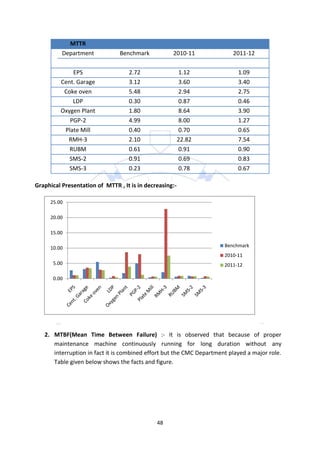
   1. MTTR:- As mentioned table below , it is clearly seen that in each department ,
      repairing work has done quickly and raised the availability. Combined effort made
      significant enhancement in MTTR


                                             47
MTTR
          Department            Benchmark           2010-11              2011-12

             EPS                   2.72                  1.12              1.09
         Cent. Garage              3.12                  3.60              3.40
          Coke oven                5.48                  2.94              2.75
             LDP                   0.30                  0.87              0.46
         Oxygen Plant              1.80                  8.64              3.90
            PGP-2                  4.99                  8.00              1.27
          Plate Mill               0.40                  0.70              0.65
           RMH-3                   2.10                  22.82             7.54
            RUBM                   0.61                  0.91              0.90
            SMS-2                  0.91                  0.69              0.83
            SMS-3                  0.23                  0.78              0.67

Graphical Presentation of MTTR , It is in decreasing:-

     25.00

     20.00

     15.00

     10.00                                                            Benchmark
                                                                      2010-11
      5.00                                                            2011-12

      0.00


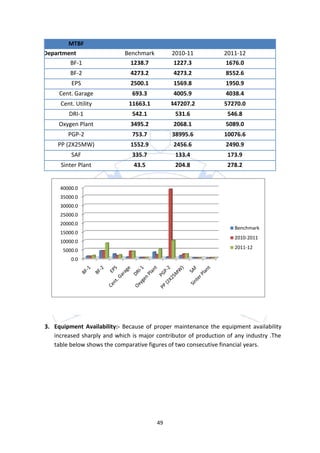
   2. MTBF(Mean Time Between Failure) :- It is observed that because of proper
      maintenance machine continuously running for long duration without any
      interruption in fact it is combined effort but the CMC Department played a major role.
      Table given below shows the facts and figure.


                                              48
MTBF
Department                   Benchmark        2010-11            2011-12
        BF-1                   1238.7          1227.3             1676.0
         BF-2                  4273.2          4273.2            8552.6
         EPS                   2500.1          1569.8            1950.9
     Cent. Garage              693.3           4005.9            4038.4
     Cent. Utility            11663.1         447207.2           57270.0
        DRI-1                  542.1           531.6              546.8
     Oxygen Plant              3495.2          2068.1            5089.0
        PGP-2                  753.7          38995.6            10076.6
    PP (2X25MW)                1552.9          2456.6            2490.9
         SAF                   335.7           133.4              173.9
     Sinter Plant               43.5           204.8              278.2


     40000.0
     35000.0
     30000.0
     25000.0
     20000.0
                                                                     Benchmark
     15000.0
                                                                     2010-2011
     10000.0
                                                                     2011-12
      5000.0
         0.0


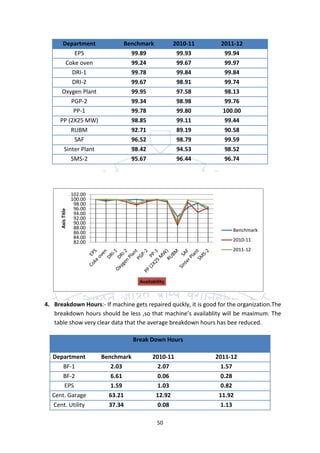
3. Equipment Availability:- Because of proper maintenance the equipment availability
   increased sharply and which is major contributor of production of any industry .The
   table below shows the comparative figures of two consecutive financial years.


                                         49
Department                  Benchmark              2010-11    2011-12
           EPS                      99.89                 99.93       99.94
       Coke oven                    99.24                 99.67       99.97
          DRI-1                     99.78                 99.84       99.84
          DRI-2                     99.67                 98.91       99.74
      Oxygen Plant                  99.95                 97.58       98.13
         PGP-2                      99.34                 98.98       99.76
          PP-1                      99.78                 99.80      100.00
     PP (2X25 MW)                   98.85                 99.11       99.44
         RUBM                       92.71                 89.19       90.58
           SAF                      96.52                 98.79       99.59
      Sinter Plant                  98.42                 94.53       98.52
         SMS-2                      95.67                 96.44       96.74


                   102.00
                   100.00
                    98.00
                    96.00
      Axis Title


                    94.00
                    92.00
                    90.00
                    88.00                                               Benchmark
                    86.00
                    84.00                                               2010-11
                    82.00
                                                                        2011-12


                                          Availability


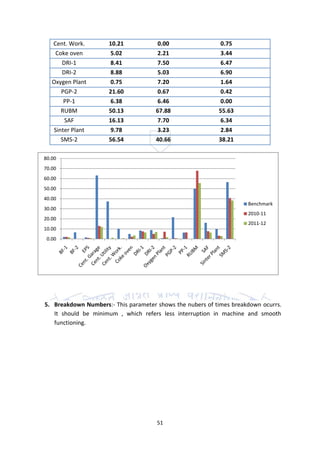
4. Breakdown Hours:- If machine gets repaired quckly, it is good for the organization.The
   breakdown hours should be less ,so that machine’s availablity will be maximum. The
   table show very clear data that the average breakdown hours has bee reduced.

                                        Break Down Hours

  Department                Benchmark           2010-11            2011-12
      BF-1                     2.03               2.07               1.57
      BF-2                     6.61               0.06               0.28
      EPS                      1.59               1.03               0.82
  Cent. Garage                63.21              12.92              11.92
  Cent. Utility               37.34               0.08               1.13

                                                  50
Cent. Work.       10.21            0.00                 0.75
    Coke oven        5.02             2.21                 3.44
      DRI-1          8.41             7.50                 6.47
      DRI-2          8.88             5.03                 6.90
   Oxygen Plant      0.75             7.20                 1.64
      PGP-2          21.60            0.67                 0.42
       PP-1          6.38             6.46                 0.00
      RUBM           50.13            67.88                55.63
       SAF           16.13            7.70                 6.34
   Sinter Plant      9.78             3.23                 2.84
      SMS-2          56.54            40.66                38.21

80.00
70.00
60.00
50.00
40.00
                                                                     Benchmark
30.00
                                                                     2010-11
20.00
                                                                     2011-12
10.00
 0.00


5. Breakdown Numbers:- This parameter shows the nubers of times breakdown ocurrs.

   It should be minimum , which refers less interruption in machine and smooth
   functioning.


                                      51
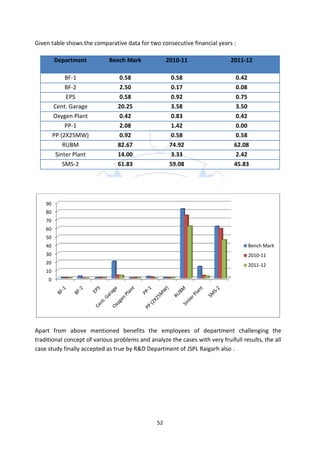
Given table shows the comparative data for two consecutive financial years :

         Department          Bench Mark              2010-11                 2011-12

              BF-1              0.58                  0.58                    0.42
              BF-2              2.50                  0.17                    0.08
              EPS               0.58                  0.92                    0.75
         Cent. Garage           20.25                 3.58                    3.50
         Oxygen Plant           0.42                  0.83                    0.42
              PP-1              2.08                  1.42                    0.00
         PP (2X25MW)            0.92                  0.58                    0.58
             RUBM               82.67                 74.92                   62.08
          Sinter Plant          14.00                 3.33                    2.42
             SMS-2              61.83                 59.08                   45.83


    90
    80
    70
    60
    50
    40                                                                             Bench Mark
    30                                                                             2010-11
    20                                                                             2011-12
    10
     0


Apart from above mentioned benefits the employees of department challenging the
traditional concept of various problems and analyze the cases with very fruifull results, the all
case study finally accepted as true by R&D Department of JSPL Raigarh also .


                                                52
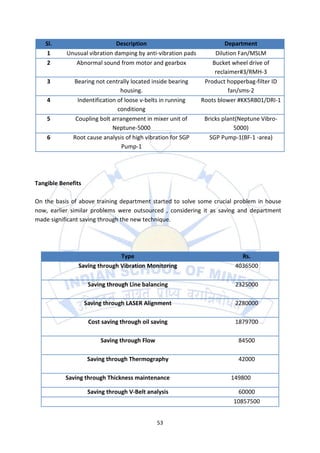
Sl.                       Description                               Department
    1      Unusual vibration damping by anti-vibration pads        Dilution Fan/MSLM
    2         Abnormal sound from motor and gearbox               Bucket wheel drive of
                                                                   reclaimer#3/RMH-3
    3         Bearing not centrally located inside bearing     Product hopperbag-filter ID
                                 housing.                               fan/sms-2
    4           Indentification of loose v-belts in running   Roots blower #KK5RB01/DRI-1
                                conditiong
    5          Coupling bolt arrangement in mixer unit of      Bricks plant(Neptune Vibro-
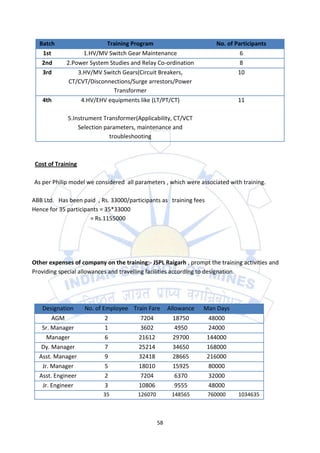
                              Neptune-5000                                5000)
    6         Root cause analysis of high vibration for SGP      SGP Pump-1(BF-1 -area)
                                 Pump-1


Tangible Benefits

On the basis of above training department started to solve some crucial problem in house
now, earlier similar problems were outsourced , considering it as saving and department
made significant saving through the new technique.


                               Type                                         Rs.
                Saving through Vibration Monitoring                       4036500

                     Saving through Line balancing                        2325000

                    Saving through LASER Alignment                        2280000

                     Cost saving through oil saving                       1879700

                         Saving through Flow                               84500

                     Saving through Thermography                           42000

           Saving through Thickness maintenance                         149800

                     Saving through V-Belt analysis                       60000
                                                                         10857500


                                               53
The above calculation of saving is based on the service charge fixed by external companies ,
   till previous financial year.

   Cost of Training :

   In the calculation of training cost , we followed Dr. Philip Model. In our project we calculated
   cost of the entire training program. We consider all associated cost of training , as per JSPL
   Rule book.


                                                    To &                Tution   Mandays
 Name       Allowance Location      Class FARE                TOTAL                              CTC
                                                     fro                 fee      cost


Dhananjay     9800      Mumbai      AC-3 1080       2160      11960     15993      18000        45953


Pradeep       39750     Hydrabad AC-1 1600          3200      42950     35000      30000        98950


 Neeraj       12075       Delhi     AC-2 1700       3400      15475     17500      15000        47975

Arindam       4900        Pune     2nd SL 440          880     5780     14000      15000        34780

Shivnath      9900      Mumbai      AC-2 1800       3600      13500     27000     12000         52500
                                                                                 Total CTC     280158


   The participants of external training , shared his/her learning with peers and subordinates as
   in house training.
   Cost incurred to arrange in house training for subordinates and peers .


                                                  54
In house training cost:-

          Designation       No.         of Details of cost
                            participants
           Chargemans              3       Stationary                         30
                                           Snacks                             60
                                           venue                             100
                                           Mandays(Participant)             1500
                                           Mandays
                                           Trainers
                                                                            3000
                                          total                             4690


            Designation     No.         of Details of cost
                            participants
            Technician                     Stationary                       150
                              15           Snacks                           240
                                           venue                            100
                                           Mandays(Participant)            7500
                                           Mandays
                                           Trainers
                                                                           3000
                                           Total                   10990


             Designation     No.         of Details of cost
                             participants
             Technician &          19       Stationary                  190
             Jr. Manager                    Snacks                      300
                                            venue                       100
                                            Mandays(Participant)       9500
                                            Mandays
                                            Trainers
                                                                       3000
                                                                      13090


                                              55
Designation      No.         of Details of cost
                 participants
Jr. Manager             2       Stationary                 20
                                Snacks                     45
                                venue                     100
                                Mandays(Participant)     1000
                                Mandays
                                Trainers
                                                         3000
                                                         4165


Designation      No.         of Details of cost
                 participants
Sr. Technician         20       Stationary                 40
                                Snacks                     60
                                venue                     100
                                Mandays(Participant)     1500
                                Mandays
                                Trainers
                                                         3000
                                                         4700


Designation      No.         of Details of cost
                 participants
 Technician &           4       Stationary                 40
     Asst.                      Snacks                     75
   Foreman                      venue                     100
                                Mandays(Participant)     2000
                                Mandays                3000
                                Trainers

                                                        5215


                                56
Designation       No.         of Details of cost
                              participants
            Asst.                    4       Stationary                       40
            Foreman                          Snacks                           75
                                             venue                           100
                                             Mandays(Participant)           2000
                                             Mandays                 3000
                                             Trainers

                                             total                          5215


Total Inhouse training cost = Rs. 56950

Total Cost cost =280158+56950 =Rs. 337108


ROI (Return on investment) of training:-

ROI=[ (SAVING-COST)/COST]*100

Total savings = Rs. 10857500
Taking 5% level of significance in saving = Rs. 10314625


EPS(Electrical Power System) Department


The EPS(Electrical Power System) department is one of the major contributors to the
production . The department is responsible to provide electrical power to all possible units.

The selected 35 employees of the department have undergone training with ABB Ltd. at
Vadodra and Bangalore in four different batches. The training modules were fully equipped
with new ,efficient and safety measured techniques.


                                              57
Batch                    Training Program                          No. of Participants
   1st             1.HV/MV Switch Gear Maintenance                            6
   2nd       2.Power System Studies and Relay Co-ordination                   8
   3rd           3.HV/MV Switch Gears(Circuit Breakers,                      10
              CT/CVT/Disconnections/Surge arrestors/Power
                             Transformer
   4th            4.HV/EHV equipments like (LT/PT/CT)                        11

             5.Instrument Transformer(Applicability, CT/VCT
                 Selection parameters, maintenance and
                             troubleshooting


 Cost of Training

As per Philip model we considered all parameters , which were associated with training.

ABB Ltd. Has been paid , Rs. 33000/participants as training fees
Hence for 35 participants = 35*33000
                      = Rs.1155000


Other expenses of company on the training:- JSPL Raigarh , prompt the training activities and
Providing special allowances and travelling facilities according to designation.


   Designation      No. of Employee Train Fare       Allowance   Man Days
       AGM                 2            7204          18750         48000
   Sr. Manager             1            3602          4950          24000
     Manager               6            21612         29700        144000
   Dy. Manager             7            25214         34650        168000
  Asst. Manager            9            32418         28665        216000
   Jr. Manager             5            18010         15925         80000
  Asst. Engineer           2            7204          6370          32000
   Jr. Engineer            3            10806         9555          48000
                          35           126070         148565       760000    1034635


                                                58
Total Cost of training =2189635


Benefits:-

The EPS department has managed some savings by implementation of training knowledge in
the organization.

                                    Aug-11     Sep-11       Oct-11     Nov-11
 Sl. Testing/Condition Unit Rate       Total       Total        Total      Total
 No.    Monitoring       in Rs.  Qty. saving Qty. saving Qty. saving Qty. saving
        performed                      in Rs.     in Rs.       in Rs.     in Rs.
       Transformer
  1                     40,000                       0
          Testing                 3 120000 0              4 160000 7 280000

  2    Circuit Breaker       1500                     4500
           Testing                  6     9000    3           5     7500    12   18000
  3       CT Testing      8000/8hrs 4    32000    0     0     1     8000    1     8000
  4       PT Testing      8000/hrs 6     48000    3   24000   0      0      0      0
         Total saving in Rs.        19   209000   6   28500   10   175500   20   306000


                                            59
Dec-11         Jan-12         Feb-12         Mar-12
       Total          Total          Total          Total
Qty. saving in Qty. saving in Qty. saving in Qty. saving in
        Rs.            Rs.            Rs.            Rs.

 9    360000    14   560000     10   400000     17   680000


2      3000     2     3000      45    67500     23    34500
2      16000           0        7     56000     3     24000
4      32000           0                0               0
17    411000    16   563000     62   523500     43   738500 2955000


ROI= [ (Profit- Cost)/cost]*100
   = [(2955000-2189635)/ 2189635]*100
   = [646557/2189635]*100 = 35%


On the overall analysis of the data of all levels, we can conclude that the immediate reaction
rated 8.1 point(scale-10), means the participants were satisfied with all four mentioned i.e
Course, Relevance , Trainer, and Venue.

However the learning was also good in all three parameters i.e Learning index (54.38%) , Self
evaluation (Effective), Knowledge sharing (Effective) .

 Evaluators of change in behavior rated 8.1(10) ,which justified the program expectation. The
reasons that imparted improvement to the performance are increased number of coaching
and feedbacks, better supervision on job by the supervisors, increase in the actual usage of
knowledge/skills gained through the program, and the availability of necessary equipments
and materials for performing on the job.

In the last level of “Kirkpatrick Model” , we saw new initiative by the employees like case
study, New attempt and high ROI(Return on investment)


                                              60
In the course of my study and the analysis that followed thereafter, I came across certain
setbacks in the various levels as well as in the system, regarding whom, I would like to make
the following suggestions :


For level 1:

        The employees should be given sufficient time to study the subject matter of the
        program.
        The study material should be adequate and relevant according to the program.
        More practical example should be given.
        Proper agenda should be made for the program.
        Venue facilities should be enhanced.


For level - 2 :

Proper facilitation of learning should be made and the knowledge/skills of the employees
should be increased.

For level - 3 :

        Confidence of the employees to perform on the job needs to be increased.
        The programs should be made more relevant to the job requirements.
        Opportunities provided to the employees to use the knowledge/skills gained from the
        program needs to be increased.
        Necessary equipments and materials required for the job should be made easily
        available.

For Level- 4

        Each department should be instructed to maintain data based on training impact for
        future reference:-
             Major work done based on training
             Cost saving
             Accident avoided
             New initiative


                                              61
Apart from these, I would like to make the following suggestions, too on increase training’s
effectiveness in JSPL.


1. Each and every individual of the company should be taught what “ Kirkpatrick model” is,
   so that they give genuine feedback when desired.

2. After training program there should be suitable rewarding system for the excellent
   performers and the average and poor performer’s problems should be identified and
   necessary motivation dose and support should be given for their improvement.

3. Training facility should be more job relevant and should be given to those whose job
   profile is related to that particular training program.

4. Sometimes the communication pattern itself becomes an obstacle, so according to

   situations, Hindi should also be used.

5. Apprehensions in the minds of employees restrain them from cooperating with the
   management, proper care should be taken to remove such apprehensions.


                                              62
Bibliography:

 1.Int. J. of Human Resource Management 14:6 September 2003 on
 “Effects of training on business results” by
 Antonio Arago´n-Sa´nchez,
  Isabel Barba-Arago´n and
 Raquel Sanz-Valle
 Interdisciplinary Journal Of Contemporary Research In Business on
 “How Organizations Evaluate their Trainings? An evidence from Pakistani
 Organizations”
 By
 Ishfaq Ahmed
 Muhammad Musarrat Nawaz
 Ahmad Usman
 Muhammad Zeeshan Shaukat
 Naveed Ahmed
 Wasim-ul-Rehman

 www. ijcrb.webs.com
 www.citehr.com
 www.jspl.com
www.google.com


                                            63
Self Evaluation Sheet
    Employee Name                                     Employee Code                            Designation                                         Department
    Training                                          Training Date                            Training Institute                                  Location


                                                 TO BE FILLED BY THE PARTICIPANT Mr. / Ms. .………………………………..
                                                                                                                    High                Medium                                  Low
    Your knowledge on the subject matter taught during the training                     Before training        5            4           3              2              1
                                                                                        After training         5            4           3              2              1

    Your skill level in doing the task that was addressed during                        Before training        5            4           3              2              1
    the training.                                                                       After training         5            4           3              2              1

    Your ability to learn and apply that has been taught to you.                        Before training        5            4           3              2              1
                                                                                        After training         5            4           3              2              1

    Overall level of learning in the area you have just been trained.                   Before training        5            4           3              2              1
                                                                                        After training         5            4           3              2              1


     Overall learning based on the above score          Highly Ineffective(0-4)     Ineffective(5-8)       Moderate(9-12)       Effective(13-16)      Highly Effective(17-20)


.


                                                                            Signature of HOD / In-Charge


                                                                                   64
Training Program Effectiveness Measurement
                                                  Learning Evaluation(Knowledge sharing)
 .
     Employee Name-                          Employee Code -                        Designation-                                     Department-
     Training-                               Training Date-                         Training Institute -                             Location-


 I have attended above training/seminar/workshop/course and shared learning with …………number of employees. The feedback of some
  of the employees( selected on sample basis) is given below :

                                                                                        FEEDBACK ON TRAINING
                      Employee Code/Name      Highly Effective(5)        Effective(4)           Moderate(3)       Ineffective(2)        Highly Ineffective(1)
1.
2.
3.
4.
5.


     Overall Feedback based on above score    Highly Ineffective(0-5)    Ineffective(6-10)      Moderate(11-15)   Effective(16-20)      Highly Effective(21-25)


                                                                        65
Training Program Effectiveness Measurement
                                     Behavior Evaluation
.
    Employee Name-   Employee Code -    Signature of HOD / In-Charge
                                                     Designation-      Department-


                                            66
Training-                                              Training Date-                    Training Institute -                            Location-


                                                                    TO BE FILLED BY THE HOD/In-Charge

     You are requested to assess the change, relevance of change and sustainability of change based on your observation to measure the impact / effectiveness of the
     training program of the candidate.

                                                                                                                                Feedback
                                                                                                             5                                               1
                                                                                                                         4         3           2
                                            Feedback Question                                            Strongly
                                                                                                                       Agree   Undecided   Disagree
                                                                                                                                                         Strongly
                                                                                                          Agree                                          Disagree
1.   Did the trainee put their learning into effect when back on the job?
2.   Were the relevant skills and knowledge used?

3.   Was there noticeable and measurable change in the activity and performance of the trainees
     when back in their roles?
4.   Was the change in behavior and new level of knowledge sustained?
5.   Is the trainee aware of his / her change in behavior, knowledge, skill level?
6.   Overall do you think the employee has demonstrated the learning’s from trainings in his / her day
     to day work?
     0-7                                  8-14                                15-21                            22-28                            29-35
     Highly
                                          Ineffective                         Moderate                         Effective                        Highly Effective
     Ineffective


     The learning evaluation confirms that the training was beneficial / non-beneficial (Please Tick) & is recommended / not recommended (Please Tick) to be
     conducted again for the benefit of our employee.
     Thank you for taking out your time and filling up this evaluation form.


                   HR Department                                                                 Signature of HOD / In-Charge


                                                                                         67
EVALUATION PARAMETERS                        1   2   3   4 5
The training was well organized and clearly structured
The objective and aim of training was explained clearly
The training covered a variety of useful topics
The content and material of the training were relevant
The                         medium                     of
presentations(lecture/discussion/exercise/ games/ case
studies, AV's) was appropriate
The examples and references used were effective
The pace of training was appropriate
COURSE AVERAGE RATING
                 EVALUATION PARAMETERS
This course gave me ideas/information/material which I
can use in my normal job
I will suggest this course to my colleagues
This course was time well spent and met my expectations
I will be able to apply my learning's immediately at the
workplace
RELEVANCE TO JOB AVERAGE RATING
                 EVALUATION PARAMETERS
The trainers were friendly and approachable
The trainer conveyed enthusiasm for the subject and
responded positively to the ideas and questions of the
participants
The trainers were clear in their communication and
encouraged participation
The trainer had strong subject knowledge
The trainer was able to answer my questions
TRAINER AVERAGE RATING
                 EVALUATION PARAMETERS
The venue was suitable
The facilities and food were satisfactory


                                      68
The course material (handouts/ writing pads/ stationary)
were adequate & helpful
The batch size was about right
VENUE AVERAGE RATING
EVALUATION PARAMETERS
OVERALL AVERAGE RATING


                                    69

JSPL RAIGARHS HR PROJECT

  • 1.
    A project reporton “ Implementation of Kirkpatrick Model” At JSPL Raigarh A project submitted for partial fulfillment of “Masters of Business Administration” Department of Management Studies Indian School of Mines Dhanbad, Jharkhand 1
  • 2.
    I certify thatthe Project Report entitled “Implementation of Kirkpatrick Model” in JSPL Raigarh is the result of the bonfide study carried out by Veer Chhatarashal under my guidance and supervision and that no part of the report has been submitted in any other form or for any other degree. Place : Date : Prof. G.S Pathak 2
  • 3.
    I do herebydeclare that the project entitled “Implementation of Kirkpatrick Model” in JSPL Raigarh, submitted by me to the department has been compiled by me under the guidance of Mr. R.P Pandey, Sr. Manager(HR), and bears no imitation of any kind from anywhere. This project is a product of my own effort and it has not been submitted or published ever before. Veer Chhatarashal Adm. No. 2011mb0019 3
  • 4.
    I owe mydeepest sense of gratitude and regards to the Human Resource department of JSPL Raigarh , for having given me this immense opportunity of doing my summer internship from this renowned organization. I am heartily thankful to Mr. R.S Dabas, Sr. AVP(P&A), Mr. C.D Mathew , AVP(HR) , JSPL ,and Ms. Romsha Sharma, Dy. Manager(HR), JSPL, who so readily cooperated and provided us all the relevant information. I am also grateful to my department and all of my faculties who ensured we were possibly acquainted with all the necessary topics and information related to the field of human resource management, so that we might not face any kind of difficulty in the completion of our project. Apart from them , my acknowledgements are also due to my friends and co-trainees at JSPL Raigarh, who have also been of tremendous help throughout the completion of this project. PLACE : DATE : Veer Chhatarashal 4
  • 5.
    Sr No Topic Page No. 1. Introduction 6 2. Research Methodology 7 3. Organizational Profile 10 4. The Training Process at JSPL Raigarh 17 5. Evaluation of Training Effectiveness at JSPL 24 6. Implementation of Kirkpatrick Model, at JSPL Raigarh 29 7. Conclusion & Suggestions 61 8. Bibliography 63 9. Annexure 64 5
  • 6.
    The Evaluation ofany training program has certain aims to fulfill. These are concerned with the determination of change in the organizational behavior and the change needed in the organizational structure. Hence evaluation of any training program must inform us whether the training program has been able to deliver the goals and objectives in terms of cost incurred and benefits achieved. The analysis of the information is the concluding part of any evaluation program. The analysis of data should be summarized and then compared with the data of other training programs similar nature. On the basis of these comparisons, problems and strength should be identified which would help the trainer in this future training programs, to stop short of completion of the training systems design methodology, by avoiding the evaluation ,our training effectiveness is reneging on ou2r commitment to our employees. The future requires more precise, reliable evaluation strategies, we like to think of training effectiveness evaluation in the same way that we think of surveillance tests in the plant, we perform training effectiveness evaluations to ensure our programs work effectively. A. Objective of the study : The study aims towards the partial fulfillment of the master of business administration. Apart from this the study aims to measure the training effectiveness in JSPL , RAIGARH, to detect the strong points underlying the training as well as the places that need to be considered for improvement. B. Scope of the study : The respondents here includes employees who have undergone the training and supervisors under whom those employees perform. The employees views with regard to the training program were recorded and similarly the opinions of the supervisors with regard to the performance of the employees were recorded. Information gathered from both the respondents were then analyzed and conclusions pertaining to the strengths and weaknesses of the training programs were then finally deduced. 6
  • 7.
    Research methodology isa purely and simply the framework or a plans for the study that guides the collection and analysis of data. Research is the scientific way to solve the problems and it’s increasingly used to improve market potential. This involves exploring the possible methods, one by one, and arriving at the best solution, considering the resource s at the disposal of research. Research in common parlance refers to search for knowledge. In fact, research is an art of scientific investigation. Research methodology is the science of collecting, identifying and presenting facts in such a way that it leads to unearthing some truths or angles of reality. Research Steps: Study about organization Setting of objectives Instrument design Main-study Tabulated and cross tabulation Analysis and impetration Findings Conclusion Suggestion and recommendation Research Design : A research design is the specification of methods and procedure for acquiring the information needed. It is the over- all operation pattern or framework of the project that stipulates what information is to be collected from which source by what procedure. It is also refers to the blue print of the research process. Key issue Options Research design Descriptive Data Primary data, secondary data 7
  • 8.
    Research Survey method Research Method Questionnaire, Expert Interviews, Studies and Cost Benefit analysis Research design consists of: A clear statement of the research problem. Procedure and techniques to be used for gathering information. The population to be studied. Method to be used in processing and analyzing the data There are four types in research design : Exploratory of formative study Diagnostic study Experimental study Descriptive study Descriptive study : A study, which wants to portray the characteristics of a group of individual or situation, is known as descriptive study. Universe of study : The first step in developing any sample design is to clearly define the set of objects technically called the universe to be studied. In this case the universe includes all employees of JSPL Raigarh who attended the training program. The study has been conducted at JSPL Raigarh. Period of coverage : The study has been undertaken for a period of 4 months started from Jan 1, to April 30, 2012 Type of research : 8
  • 9.
    In this study,descriptive research is used. Descriptive research is carried out for the purpose of collecting descriptive information like employee’s opinion, benefits, personal details, awareness, etc about the training program they have attended. Sampling procedure: Types of sampling used in this survey were Simple Random Sampling (probability sampling). In this method, the sampling units chosen randomly from the total employees who had attended the training program at all level in the organization. Data collection method: Two techniques were used for collecting data, namely – A. Primary data collection technique B. Secondary data collection technique A) Primary data: Primary data are collected afresh and for the first time. It is the data originated by the researcher specifically to address the research problem. In this study, Primary data was collected through the Study, Interview Schedule with a well Structured Questionnaire to know the reaction and learning of trainees and cost benefit analysis of training program. B) Secondary data: In this study Secondary data, are those which have already been collected by someone else and which have already been passed through the statistical process. Secondary Data was collected from the publications, internets, journals, books and company records. Data collection instrument: Data is collected by questionnaire and interview schedule, the questionnaire consists of a list of questions, which are relevant in getting the facts. Questionnaires are likely any scientific experiment. One does not collect data and then see if they are found something interesting. One form a hypothesis and an experiment that will help prove or disprove the hypothesis. 9
  • 10.
    Sampling design: A sampledesign is a definite plan for obtaining a sample from a given population. It refers to a technique or the procedure the researcher would adopt in selecting items for the sample. Population: The universe of the current study comprises of 300 employees. Sample units: Sample units consist of employees who had attended the training program organized by the organization and who supervise the participants. Research Instrument: Questionnaire Test Expert interviews Studies Human resource factor Cost benefit analysis Various areas from where the data were gathered : The various departments of JSPL from where all the necessary information had been gathered are: 1. HR Department 2. CMC Department 3. EPS Department 10
  • 11.
    Introduction: With an annualturnover of over US $2.3 billion (Rs. 11,000 crore), Jindal Steel & Power Limited is a part of about US $ 12 billion diversified O. P. Jindal Group. It is a leading player in Steel, Power, Mining, Coal to Liquid, Oil & Gas and Infrastructure, consistently tapping new opportunities by increasing production capacity, diversifying investments, and leveraging its core capabilities to venture into new businesses. JSPL’s investment commitments in steel, power, oil & gas and mining have touched more than US $ 30 billion today. In the recent past, JSPL has expanded its steel, power and mining businesses to various parts of the world particularly in Asia, Africa, South America and Australia. The company, today, is the largest private sector investor in the state of Chhattisgarh with an investment commitment of over US$ 6 billion (Rs. 30,000 crore).Mr. Naveen Jindal, the youngest son of the legendry late Shri. O P Jindal, spearheads Jindal Steel & Power Limited and its group companies Jindal Power Ltd, Jindal Steel Bolivia, Jindal Petroleum Ltd. and Jindal Cement with a belief in the concept of self-sufficiency. The company produces economical and efficient steel and power through backward integration from its own captive coal and iron-ore mines. An enterprising spirit and ability to discern future trends have been the driving force behind the company's remarkable growth. And the recognition it has received only further lends credence to this. Jindal Steel & Power Limited has recently been rated as the second highest value creator in the world by Boston Consulting Group. The company has also been rated as one of the Best Blue Chip companies by Dalal Street Journal; One of the Fab 50 Companies by Forbes Asia as well as the Highest Wealth Creator by the Dalal Street Journal. It has also won several awards for its efficient operations and commitment to environment & safety. The company has scaled new heights with the combined force of innovation, adaptation of new technology and the collective skills of its 15,000 strong, committed workforce. JSPL has set its foot in the international arena by acquiring the development rights of 20 billion tonne of Iron Ore in Bolivia. The company plans to invest US$ 2.1 billion (Rs. 10,500 11
  • 12.
    crore) over thecoming years in Bolivia by setting up a 10 MTPA capacity Iron Ore pelletization plant, a 6 MTPA capacity DRI plant, a 1.7 MTPA capacity steel planted a 450 MW power plant besides mining. The company recently acquired Shadeed Iron & Steel Co. LLC (SISCO) a company incorporated under the laws of the Sultanate of Oman. The project is under commissioning and is expected to commence commercial operations in the first quarter of FY 2011/12. With coal reserves in Indonesia and South Africa, the search for mines continues from Mozambique to Madagascar. The company has also forayed into exploration and mining of high value minerals like diamonds, etc. in states like Chhattisgarh, Jharkhand and the Democratic Republic of Congo in Africa. JSPL endeavors to strengthen India’s industrial base by aiding infrastructural development, through sustainable development approaches and inclusive growth. The company deploys its resources to the extent it can reasonably afford to improve infrastructure, education, health, water, sanitation, environment etc. in the area it operates. As JSPL contributes to India’s growth, it has also set in place a global expansion plan in order to become one of the most prestigious and dynamic business groups of the country. The future is studded with challenges and JSPL is taking them on with vigor and courage. ABOUT THE FOUNDER & ADVENT OF JSPL BABUJI – “The Man of Destiny” (1930 – 2005) “The Jindal Organization owes its brilliant growth to the dedicated endeavors of its employees. With a strong emphasis on quality and on-time delivery to our customers as per their specifications, our progressive as well as successful achievements have made the Jindal Organization a leading name in India. - Late Shri O P Jindal 12
  • 13.
    Late Shri OmPrakash Jindal more popularly known as O.P. Jindal was born on August 7, 1930 to a farmer Late Netram Jindal of village Nalwa of district Hisar in Haryana. Since his childhood the weng Jindal had interested in technical work. He started his industrial career with a small bucket-manufacturing unit in Hisar. In 1964, he commissioned a Pipe Unit Jindal India Limited, followed by a large factory in 1969 under the name Jindal Strips Limited. Shri Jindal always had the conviction that India should be self-reliant in every sector of industry. He visited several foreign countries to elicit latest industrial technical development and know-how. He acquired a great deal of knowledge, which he aptly applied to enhance production of his industrial establishments. At present, there are twenty factories under the flagship of the Jindal Organization, which are worth over Rs.17,500 crores, under whose umbrella thousands of families directly or indirectly benefit themselves. Shri O.P. Jindal was the Chairman of the Jindal Organization. In November 2004, Shri Jindal was conferred the prestigious "Life Time Achievement Award" for his outstanding contribution to the Indian Steel Industry by the Bengal Chamber of Commerce & Industry. According to the latest Forbes' List, Shri O.P. Jindal has been ranked 13th amongst the richest Indians of the country and placed 548th amongst the richest persons of the world. He was a successful industry visionary and would remain as a role model for others. On account of his dedicated services to various sections of society particularly, of the poor and backward classes, he was revered by all. Shri Jindal always advocated for granting a rightful place for weaker sections in politics. He was above caste politics and wanted all to come up regardless of their caste, colour and creed. Shri Jindal's philosophy was that without the upliftment of weaker and backward sections of society our dream of being a leading nation of the world shall remain unfulfilled. Shri Jindal's mantra was “where others saw walls he saw doors”. Then whether it was opening doors or breaking down walls he always led the way. The life journey of Shri Jindal from a farmer's son to a successful industrialist, a philanthropist, a politician and a leader would serve as a great source of inspiration for generations to come. 13
  • 14.
    Mr. Naveen Jindal,a Member of Parliament, Executive Vice Chairman and Managing Director of Jindal Steel and Power Ltd (JSPL), and a sports enthusiast, is the youngest son of Late Sh. O.P. Jindal, the steel visionary and Minister of Power in the government of Haryana. At a very young age, Mr. Naveen Jindal has transformed JSPL, a moderately performing company in the steel sector, into a world class company, the highest wealth creator in the country. After consolidating its position as a leading player in the steel, power, mining and infrastructure sectors, JSPL has recently diversified into the oil & gas sector. Mr. Jindal is a management graduate from the University of Texas at Dallas, USA. Mr. Naveen Jindal is not only a successful entrepreneur but also a caring politician and an effective parliamentarian. He represents Haryana state’s Kurukshetra constituency in parliament. He started active participation in politics during his college days. He was the President of the Student Government and recipient of the ‘Student Leader of the Year Award’ - the honour for a student at the University of Texas at Dallas. Weeding out corruption, stabilizing the population, aiming for a hunger free society, promotion of sports at all levels, promoting a clean environment and providing health and educational facilities in his constituency are on top of his political agenda. His ideology is to incorporate the best practices of business management into politics. As issues of national pride and self-esteem have always been uppermost in his mind, Mr. Jindal single-handedly took up the cause of restoring in Indians a national pride, choosing the Tricolour as his symbol. As a result of his decade long crusade, the Hon’ble Supreme Court of India, in a historic judgment on 23rd January 2004 held that the right to fly the National Flag freely, with respect and dignity is a Fundamental Right of Every Indian Citizen. Mr. Jindal is a national record holder in skeet shooting and an accomplished Polo player. Currently, he is taking a lot of interest in promoting hockey, the national game of India. 14
  • 15.
    To create acompetitive advantage for all stakeholders through effective management of the people. To strengthen India’s industrial base and improve Quality of Life through Sustainable Development approaches. The Company embraces 6 missions in order to function ethically, effectively and prosper further: Respect for Individual: Recognize each individual’s contribution in the growth and development of the Company. Treat all Jindalites with respect and dignity. Integrity: Conduct all business dealings along transparent lines. Meritocracy: Foster an environment of excellence in performance. Dynamic Thinking: Demonstrate a winner’s attitude, with a clear focus to deliver sustained values for all stakeholders. Creativity & Innovation: Encourage creative experimentation, embrace new ideas and institutionalize continuous improvement in all aspects of business and performance. Social Responsibility: Work on social and environmental issues to enrich the quality of life within the community we serve. Passion for People Business Excellence Integrity, Ownership & Sense of Belonging Sustainable Development 15
  • 16.
    JSPL is knownall over the world for its pioneering and highly customized premium grade steel products. These products are a result of JSPL’s strong commitment to innovation and are designed to offer greater flexibility, reduced project cost and lower consumption of steel. Some of the products are: Certifications :  Quality Management System – ISO 9001:2008.  Environmental Management System – ISO 14001:2004.  Occupational Health & Safety Management System. 16
  • 17.
    Environment Management Awards:  Golden Peacock Environment Management Award – 2008.  Greentech Environment Excellence Award – 2008.  Greentech Environment Excellence Award – 2007.  Srishti Green Cube Award for Good Green Governance – 2007.  Golden peacock Eco-innovation Award – 2007. Energy Conservation Awards :  National Energy Conservation Award – 2008.  National Energy Conservation Award – 2007. Performance Awards :  JSPL ranked 36th among India’s 100 Most Profitable Companies by Business & Economy Magazine, September 2009.  2nd most investor friendly company, Business Today – 2008.  Golden Peacock National Quality Award – 2008. Safety Awards :  National Safety Award (Mines) 2006, by the Ministry of Labour.  National Safety Award (Mines) 2005, by the Ministry of Labour. HR Awards :  SAIL-HR Award for excellence in Human Resource Management 2009.  JSPL among Top-20 “Best Companies To Work For” by Business Today – 2009.  CII National HR Excellence, for Strong Commitment In HR-2009 Corporate Social Responsibility Awards :  JSPL bags Think Orrisa Leadership Award in Corporate Social Responsibility 2008.  Golden Peacock CSR Award 2006. Achievements :  Manufacturer of longest rail of 121 meter long in the world.  Largest coal based sponge iron facility in the world.  First Company to produce power from waste heat recovery boiler from sponge iron. 17
  • 18.
    Training need analysis Needs assessment (a) Organizational support (b) Organizational analysis (c) Task and KSA analysis (d) Person analysis Training Developme Validity Instructional nt of Objective criteria Transfer Selection Validity and design of instructional programs Intra Training organizational Use of validity evaluation models Inter organizational validity Needs Assessment and Remedial Measures 18
  • 19.
    Performance Deficiency Lack of skill Other Causes or Knowledge Training Non-training Measures Training Need Identification Sl. No Methods Used in Training Needs Assessment Group or organizational Analysis Individual Analysis 1 Organizational goals and objective Performance appraisal 2 Personnel/skill invention Work sampling 3 Organizational climate indices Interviews 4 Efficiency indices Questionnaires 5 Exit interviews Attitude survey 6 MBO or work planning systems Training progress Training practice at JSPL Training and its process at JSPL for the workers and executives: As far as worker training need identification is concerned the skill mapping exercise forms the basis. With regards to executives training is identified in various ways like : 1. Competency matrix and the corresponding Gap analysis 2. Organizational need based training 3. Need identified through the Performance Management System 19
  • 20.
    4. In linewith business strategy of the organization/ request from employees 5. Training necessitated due to technological up gradation. 6. Through questionnaire ( to be implemented) Thereafter the training department goes about its business in the following manner: 1. Preparation of training calendar (both monthly as well as well on an annual basis) 2. Contacting the respective faculty members and coordinating with them 3. Informing respective departments about the training program. In case of open nomination the department head is free to send in people from his department on his own accord. 4. The Training and Development cell then has to take care of all the facilities that are to be provided with regards to the training program. If the program is an outbound one then the entire activity is to be coordinated like-wise. 5. The Training & Development cell is entrusted with maintenance of attendance record of the programs along with collecting immediate reaction feedback with the help of ‘smile sheets’. 6. The entire data in this regard is constantly uploaded on to SAP. 7. According to company policy a learning evaluation form is sent to the respective departmental HOD’s at least two-months after the training program had been conducted. 8. On the basis of the feedback received the program is rated on a scale of 10. Types Of Training Programs On the basis of subject matter covered training can be classified into : 1. Behavioral 2. Functional 3. Technical (On the basis of the location it can classified as): External training programs (it also includes various seminars, MDP’s etc) Internal training programs 20
  • 21.
    Performance Deficiency Lack of Skill Other Causes or Knowlegde Non - training Training Measures Development Program Every training and development program must address certain vital issues like : 1. Who participated in the program? 2. Who are the trainers? 3. What methods and techniques are to be used for training? 4. What should be the level of training? 5. What learning principles are needed? 6. Where is the program conducted? 21
  • 22.
    What methods Who are the Who are the and trainees? trainers? techniques? Where to What What should conduct the principles of be the level of program? learning? training? Who are the Trainees? Trainees should be selected on the basis of self nomination, recommendations of supervisors or by the HR department itself. Whatever is the basis, it is advisable to have two or more target audiences. For example, rank-and-file employees and their supervisors may effectively learn together about a new work process and their respective roles. Bringing several target audience together can also facilitate group processes such as problem solving and decision making, elements useful in quality circle projects. Who are the Trainers? Training and development programs may be conducted by several people, including the following: 1. Immediate supervisors, 2. Co-workers, as in buddy systems, 3. Members of the personnel staff, 4. Specialists in other parts of the company, 5. Outside consultants, 6. Industry associations, and 7. Faculty members at universities. Who among these are selected to teach, often, depends on where the program is held and the skill that is being taught. For example, programs teaching basic skills are usually done by the members of the HR department or specialists in other departments of the company. On 22
  • 23.
    the other hand,interpersonal and conceptual skills for managers are taught at universities. Large organizations generally maintain their own training departments whose staff conducts the programs. In addition, many organizations arrange basic-skills training for computer literacy. Methods and Techniques of Training: A multitude of methods of training are used to train employees. On-the-job methods refer to methods that are applied in the workplace, while the employee is actually working. Off-the- job methods are used away from workplaces. Training techniques represent the medium of imparting skills and knowledge to employees. Obviously, training techniques are the means employed in the training methods. Among the most commonly used techniques are lectures, films, audio cassettes, case studies, role playing, video-tapes and simulations. Lectures: Lecture is a verbal presentation of information by an instructor to a large audience. The lecturer is presumed to possess a considerable depth of knowledge of the subject at hand. A virtue of this method is that is can be used for very large groups, and hence the cost per trainee is low. This method is mainly used in colleges and universities, though its application is restricted in training factory employees. Audio-visual: Visuals Audio-visuals include television slides, overheads, video-types and films. These can be used to provide a wide range of realistic examples of job conditions and situations in the condensed period of time. Further, the quality of the presentation can be controlled and will remain equal for Simulation: A simulator is any kind of equipment or technique that duplicates as nearly as possible the actual conditions encountered on the job. Simulation then, is an attempt to create a realistic decision-making environment for the trainee. Simulations present likely problem situation and alternatives to the trainee. For example, activities of an organization may be simulated and the trainee may be asked to make a decision in support to those activities. 23
  • 24.
    Case Study: Taken fromthe actual experiences of organizations, these cases represent to describe, as accurately as possible, real problems that managers have faced. Trainee studies the cases to determine problems, analyses causes, develop alternative solutions, select the best one, and implement it. Role playing: Generally focuses on emotional (mainly human relations) issues rather than actual ones. The essence of role playing is to create a realistic situation, as in case study, and then have the trainee assume the parts of specific personalities in the situation. For example, a male worker may assume the role of a female supervisor, and the supervisor may assume the role of a male worker. Then, both may be given a typical work situation and asked to respond as they expect others to do. The consequences are a better understanding among individuals. Role playing helps promote interpersonal relation. Attitude change is another result of role playing. Case study and role playing are used in MDPs Techniques of Training Technique Description Ice Breakers Games to get team members know each other Leading Games Exercise to each different styles of leadership Skill Games Test to develop analytical skills Communication Games Exercise to build bias free listening and talking Strategic planners Games to test ability to plan ahead Team building games Exercise requiring collaborative effort Role reversal Exercise to teach plurality of view Doubling Bring out the ideas that are not often expressed Tag Teams One role played alternately by two participant Mirroring Training with external perspective Monodrama Insight into a given interaction Shifting physical position highlighting of communication problems Structured role playing Role play with predetermined objective Multiple role playing Providing a common focus of discussion 24
  • 25.
    Expected Results OfTraining Program  Higher Productivity: Training helps to improve the level of Performance. Trained employees perform better by using better method of work.  Better Quality Of Work: In formal training, the best methods are standardized and taught to employees perform better by using better method of work.  Cost Reduction: Trained employees make more economical use of materials and machinery. Reduction in wastages and spoilage together with increase in productivity help to minimize cost of operation per unit.  Reduction Supervision: Well-trained employees tend to be self reliant and motivated. Evaluation of Training Effectiveness at JSPL Every year JSPL sends a large number of its employees on training to update them with all the recent changes in skills, technologies, and information pertaining to their job. This involves a huge expenditure every year on the part of the organization. Therefore it becomes a matter of concern for JSPL to ensure that it is investing in the right direction, that its employees are actually deriving full benefits out of the training programs so organised and that the programs are successfully educating the employees in the manner it ought to and is able to bring change in the knowledge and skills of the employees, which can be attributed to the program. JSPL follows the Donald Kirkpatrickk’s model of training. Therefore, I would first like to discuss Kirkpatrickk’s model. Donald Kirkpatrickk’s model comprises of four stages : 1. Reaction The first, stage called reaction deals with the immediate reaction of the employees who just undergone a training program. This reaction of theirs is recorded through the use of feedback forms. 2. Learning Subsequently follows the stage of learning, where any kind of changes pertaining to employee’s skills, knowledge and attitude are measured. Generally pre-post test measures are used to check on the learning that has occurred. such measurement of change is 25
  • 26.
    important because itgives an indication of the quantum of change that has occurred among the employees post the training program. 3. Transfer of learning The third level is one where the application of whatever had been learnt through the program is measured. Again, for this purpose, questionnaires are used which are in the form of feedback forms. Various factors such as opportunities for applying the knowledge gained through the training, enablers and barriers for applying the knowledge, increase in confidence and improvement in performance are recorded and measured. This is done after a certain period of time has passed since the training program was conducted. The main concern is whether the transfer of learning took place and if it did not, then to detect the possible reasons behind it. It helps the organization recognize the flaws in its system that possibly pose constraints in the path of application of whatever had been learnt through the training programs and overcome them to facilitate transfer of learning to the workplace to as much extent as possible. 4. Results The final stage in Kirkpatrickk’s model deals with results. In this stage, the effectiveness of program is measured in terms that managers and executives can understand like increase in productivity, low defects, employee retention, decreased accidents, lower costs, etc. The process under Donald Kirkpatrickk’s model takes place in the following manner : Level 1 : Reaction • Did they like it? Level 2 : Learning • Did they learn it? Level 3 : Behaviour • Did they use it? Level 4 : Result • Did it impact the bottom line • What is the Return on Level 5 : ROI Investment? 26
  • 27.
    Relationship between Levels: Each subsequent level is predicated upon doing evaluation at lower level A Level 3 will be of marginal use, if a Level 2 evaluation is not conducted Only by assessing each level, can we yield actionable results: Now, since it is clear as to what the Donald Kirkpatrickk model says, I would like to proceed with the manner in which training is conducted and evaluated in JSPL. 27
  • 28.
    Return on Investment(ROI) in training and development (T&D) is a measure of the monetary benefits obtained by an organization over a specified time period in return for a given investment in a training program or is the extent to which the benefits (outputs) of training exceed the costs (inputs) or is a measure of all the economic returns generated from an investment in a T&D program. These returns are then compared with the true cost of the program to determine an average annual rate of return of the investment. All capital assets need to earn a rate of return for the business to make a profit and stay in business, ROI is about judging the investment in T&D on similar criteria to other investment in the business. ROI is the extent to which the benefits (outputs) of training exceed the costs (inputs). Some returns can be easily measured, such as increase in sales after a sales training program, but others such as customer/employee satisfaction, turnover rate, and complaint levels require conversion to a monetary amount. Some costs can also be easily measured, such as hire of training rooms, however other costs need further analysis to determine, such as the cost of administration of the T&D department. The intense focus on performance in public companies has made ROI increasingly important. The only way to guarantee that projects and programs receive funding is to show how they boost the bottom line. An ROI evaluation fulfils senior managements requirement to justify training budgets and investments. The idea of ROI was first proposed by Jack Phillips. He tried to express in terms of percentage or ratio & named it as the fifth stage of Kirkpatrickk model. The formula for it is as follows :- (Net Benefits / Costs) x 100 There was a research conducted and it was found that about $5.6 billion to $16.8 billion is wasted annually in ineffective training program. A study of 15 countries in the organization for Economic cooperation and development found that majority of the employees believe employee training is responsible for “ productive improvements, greater workforce flexibility, saving on material and capital cost, improved quality of final products or service and a more motivated workforce” However, many companies have not measured the benefits and related them to the cost of training in a way that reveals the rate of return on a firm's investment. Apparently there is no other workplace issue on which so much money is spent with as little accountability as training. 28
  • 29.
    “American industry isspending billions and billions on training programs and doing no evaluation of their effectiveness. We have to measure it.” -Cary Cherniss, Rutgers University The process of calculating ROI : To calculate ROI we must first make estimates or obtain measurements of the costs and benefits associated with a training program. As we will see, the calculation of ROI is then a relatively simple process. Let's start with the costs forecasting and measuring costs Design and development costs : The first category of cost to be considered is the design and development of the training program, whether this comprises classroom events, self-study materials, simple coaching sessions or some combination. We will need to consider: internal days of design and development costs of external designers and developers other direct design and development costs (purchase of copyrights, travel, expenses, etc.) outright purchase of off-the-shelf materials Faculty costs : The next category of costs relates to the delivery of the training, whether this is mediated by faculty (tutors, instructors, coaches, etc.) or is self-administered (workbooks, CBT, online training, etc.). Let’s start with the information needed to calculate faculty costs: the number of students who will be going through the program hours of group training (whether classroom-based or delivered in real time, online) hours of one-to-one training (typically face-to-face, but could conceivably be conducted by telephone, video conferencing link or in real-time, online) hours of self-study training additional faculty hours (preparation time, the time needed to review or mark submitted work or the time needed to correspond by email or bulletin boards with online students) faculty expenses (travel, accommodation, subsistence, etc.). 29
  • 30.
    Materials : Then there'sthe cost of materials: cost per student of training materials (books, manuals, consumables, etc.) license cost per student for use off-the-shelf materials Facilities : We will also need to allow for the cost of our training facilities, whether these are internal or external. Make sure to include the rental or notional internal cost of the following: training rooms open learning / self-study rooms equipment used Finally, don't forget to include any direct student expenses - travel, accommodation and subsistence. Evaluation costs : We also need to make an allowance for the time spent on evaluating the training, whether this is an ROI analysis or some other method forecasting and measuring benefits. The financial benefits of training cannot be measured in terms of student reactions, nor the amount of learning that has been achieved; not even the extent to which behavior may have changed. The real benefits come from improved performance – traditionally the hardest training outcome to forecast or measure these categories are not necessarily mutually exclusive - in some respects they provide alternative ways of looking at the same underlying benefit. Because of this, we should be extremely careful not to include the same basic benefit under more than one of these headings. Cost savings : Cost savings can be achieved in a variety of ways, not just through savings in labour, and this category allows we to take account of these. Examples include: fewer machine breakdowns, resulting in lower maintenance costs less mean time taken to repair a machine amount saved when these trained persons would give internal training to the other staff of free of cost The increase in the availability of machines 30
  • 31.
    New methods ofrepairing of machines are found, which otherwise would lead to purchase of new machinery Development of new cost saving methods of production Calculating return on investment (ROI) Return on investment tells the percentage return we have made over a specified period as a result of investing in a training program. On the assumption that benefits will continue to accrue some time after the training, then the period that we specify is critical to the ROI figure we will obtain. We may like to specify a period that fits in well with our organisation’s planning cycle – perhaps a year or two years. On the other hand, we may wish to calculate the period to correspond to the lifetime of the benefit, in which case we will need to know how long the average student stays in a position in which they can continue to apply the knowledge and skills being taught. It is relatively simple to calculate return on investment: % ROI = (benefits / costs) x 100 The primary benefits of ROI are: The ROI validates training as a business tool , training is seen as one of the actions, which an organization can take to increase its performance and profits: Justifies the cost incurred in training helps HR departments to avoid being the victim of cost-cutting in the next economic downturn Helps to improve the design of training program continuously on the basis of a formal evaluation sheet , filled by participants at the end of a program 31
  • 32.
    Helps select trainingmethods allows a rational selection of delivery mechanisms, from classroom-based to e-learning Project Report on “Implementation of Kirkpatrickk Model” in JSPL Raigarh. Survey And Data Analysis: Sample taken for “ Implementation of Kirkpatrick Model” Level Sample(Training Programs) Level-1 (Reaction Feedback) 25 Level-2 (Learning Feedback) 15 Level-3 (Behavioral Changes) 15 Level-4 (Result) 15 ROI 9 32
  • 33.
    Trainings which coveredfor the Project- 1 MVT1(Vibration Training Program) 2 Vibration Analysis Training Course (ISO Categories) 3 Mechanical Vibration Training 4 Reliability Centered Maintenance(RCM) 5 HV/MV Switch Gear Maintenance 6 Power System Studies and Relay Co-ordination 7 HV/MV Switch Gears(Circuit Breakers, CT/CVT/Disconnections/Surge arrestors/Power ) 8 HV/EHV equipments like (LT/PT/CT) 9 Instrument Transformer (Applicability, CT/VCT Selection parameters, maintenance and troubleshooting) 10 AC/DC Drives 11 Pump and Compressor 12 Latest Technology in steel making 13 Operation and Maintenance of EOT crane 14 Compressor 15 PCM(Product Catalogue Management) 16 Alternate Sponge Iron Making 17 Adventure in Attitude 18 Performance Coaching and Counseling 19 Negotiation Skills 20 Computer Awareness Reaction Phase Evaluation: I conducted a research On 25 different Training programs .In this research, I used Kirkpatrick model of Training Evaluation, It Include 4 phases. First phase is Reaction Evaluation of Training Programs , in this I tried to tap the views of employees about the training program in terms of Course, Job relevance, Trainer and Venue. A questionnaire was being prepared. Sample size Used was of 300 employees. The objective was to measure the degree to which employees feel that Training program was suitable in terms of 4 aspects :- Course Job relevance Trainer Venue 33
  • 34.
    Employee Feedback-Results andInterpretations: The evaluation of reaction has been done Cluster wise, as follows: Cluster 1st(Course) Parameters include: a. The training was well organized and clearly structured b. The objective and aim of training was explained clearly c. The training covered a variety of useful topics d. The content and material of the training were relevant e. The medium of presentations(lecture/discussion/exercise/ games/ case studies, AV's) was appropriate f. The examples and references used were effective g. The pace of training was appropriate. The participants immediate reaction about above parameters are depicted in following Graph :- Course content 10 8 scale(10) 6 4 2 0 a b c d e f g over all Ratings 8.2 8.6 8 7.2 7.8 8 6.6 7.8 Interpretation: Out of 300 Employees (I have taken for my study), It was found that participants rated 7.8(scale-10) to the Course content of the training programs .So after looking at the results it can be said that participants are satisfied with the design of the programs. 34
  • 35.
    Cluster-2nd(Relevance to job) Parametersinclude: a. This course gave me ideas/information/material which I can use in my normal job b. I will suggest this course to my colleagues c. This course was time well spent and met my expectations d. I will be able to apply my learning's immediately at the workplace The participants acknowledge with the following rating to the Relevance parameters. Relevance to job 9 scale(10) 8.5 8 7.5 a b c d over all Rating 8.8 8.8 8 8.8 8.6 Interpretation: It is observed that on rating of relevant to jobs is 8.6 on scale(10) .So after looking at the results it can be said that participants are satisfied with the relevancy of the programs and it is well related to their jobs. Cluster-3rd(Trainer) Parameters include: a. The trainers were friendly and approachable b. The trainer conveyed enthusiasm for the subject and responded positively to the ideas and questions of the participants c. The trainers were clear in their communication and encouraged participation d. The trainer had strong subject knowledge e. The trainer was able to answer my questions 35
  • 36.
    Trainer 9 scale(10) 8.5 8 7.5 a b c d e over all Ratings 8.4 8.6 8.2 8.6 8 8.36 Interpretation: The participants rated 8.4(scale-10) to the trainer, it is very clear that participants are satisfied with trainer. Cluster-4th (Venue) Parameters include: a. The venue was suitable b. The facilities and food were satisfactory c. The course material (handouts/ writing pads/ stationary) were adequate & helpful d. The batch size was about right Venue 10 scale(10) 5 0 a b c d over all Rating 8.4 6.8 7 7.8 7.5 Interpretation: The participants rated venue facilities 7.5(10), which is satisfactorily but need to be enhanced. Over all reaction feedback is clearly seen in graph:- 36
  • 37.
    Over all Reaction 9 8.5 scale(10) 8 7.5 7 6.5 Course Relevanc Trainer Venue Over all e Rating 7.8 8.6 8.4 7.5 8.1 Over all reaction feedback is 81%, which means training is useful to participants and they are satisfied with all parameters of reaction feedback of training program. Analysis of Level – 2(Learning) This level of ” Kirkpatrick Model” evaluates learning of participants from the training. We adopted following parameters to evaluate learning of participants:-  Pre -training marks and post training marks of participants .  Knowledge sharing (Giving in house training to subordinates and peers.)  Structured questionnaires(Filled by HOD and Participants) Pre -training marks and post training marks of participants For the purpose of level- 2 ,analysis, in order to find out whether learning has taken place or not, pre-post test measure was applied. Employees were made to take certain tests or assessments on the basis of which their knowledge/skill was measured. Thereafter, these employees were sent on training and after the completion of the training, these employees again had to take the tests. The purpose was to reevaluate the employees through the tests, in order to find out whether there has been any increase in their knowledge/skills post the program. The following table shows the programs concerning which the assessments were taken and the learning percentage : 37
  • 38.
    Sr. Program Name Pretest Post Test Learning No. (avg. ) (avg.) Index 1 MVT1(Vibration Training Program) 23.21 40.23 73.3 2 Vibration Analysis Training Course (ISO Categories) 25.22 30.12 19.4 3 Mechanical Vibration Training 32.67 38.54 18.0 4 Reliability Centered Maintenance(RCM) 24.2 43.65 80.4 5 HV/MV Switch Gear Maintenance 27.12 40.22 48.3 6 Power System Studies and Relay Co-ordination 23.09 38.9 68.5 7 HV/MV Switch Gears(Circuit Breakers, 21.23 34.87 64.2 CT/CVT/Disconnections/Surge arrestors/Power Transformer) 8 HV/EHV equipments like (LT/PT/CT) 28.9 39.76 37.6 9 Instrument Transformer(Applicability, CT/VCT Selection 24.11 41.11 70.5 parameters, maintenance and troubleshooting) 10 AC/DC Drives 26.66 40.45 51.7 11 Pump and Compressor 23.33 43.22 85.3 12 Latest Technology in steel making 22.11 40.99 85.4 13 Operation and Maintenance of EOT crane 25.55 36.44 42.6 14 Compressor 26.92 35.87 33.2 15 PCM(Product Catalogue Management 23.77 39.34 65.5 Over all 25.21 38.91 54.4 The above table shows the learning as the difference of pre-test marks and post-test marks, which shows 54.38% increment. Hence level of learning is justified. 38
  • 39.
    Learning index 90.0 80.0 70.0 60.0 50.0 %tage 40.0 30.0 20.0 10.0 0.0 1 2 3 4 5 6 7 8 9 10 11 12 13 14 15 Ove r all Learning index 73. 19. 18. 80. 48. 68. 64. 37. 70. 51. 85. 85. 42. 33. 65. 54. The following graph shows the level of knowledge/skills of the employees before the programs were conducted, compared against the level of knowledge after the programs were conducted. From this, we can come to know that there has been an increment in the average of the post tests marks, which indicates that learning has taken place among the employees. The program wise learning ,that took place among the employees can best be demonstrated with the help of the following graph : It is clearly visible that the percentage learning took place is significant , hence good leaning took place, so training were effective. Learning Evaluation based on Questionnaires (Self Evaluation) To evaluate learning we present questionnaires to the participants (Which is attached in annexure) and asked to fill the parameters on the basis of pre-training subject knowledge and post training subject knowledge. The below mentioned table shows the same for a training conducted by ABB Ltd. Badodra. 39
  • 40.
    Training Program- PowerTransformer (Functions and support) After Before Training Training Score Score Evaluation Parameters Evaluation Parameters Differenc es Sl. Name Of 1 2 3 4 1 2 3 4 No. Participants 1 Mr. M.K Jaitwal 5 5 5 5 20 2 3 2 4 11 9 2 Mr. K.S Rajput 4 5 4 3 16 3 4 2 1 10 6 3 Mr. Rahul 5 4 5 4 18 4 2 2 2 10 8 Srivastav 4 Mr. Arijit Ray 3 5 4 4 16 2 3 1 1 7 9 5 Mr. Vijendra 4 4 5 4 17 2 2 3 2 9 8 Dwivedi 6 Mr. P Srinath 5 4 4 3 16 3 3 2 2 10 6 Avg. 7.67 Score Score: Moderate(0-5) , Effective(6-10), Highly Effective(11-16) Similarly we got score of below mentioned training program ,which shows difference of pre- training and post-training knowledge, in their own eyes:- Sl. No. Training Program Score 1 MVT1(Vibration Training Program) 12 2 Vibration Analysis Training Course (ISO Categories) 11 3 Mechanical Vibration Training 8.9 4 Reliability Centered Maintenance(RCM) 8.4 5 HV/MV Switch Gear Maintenance 11 6 Power System Studies and Relay Co-ordination 7.67 7 HV/MV Switch Gears(Circuit Breakers, 12 CT/CVT/Disconnections/Surge arrestors/Power Transformer) 8 HV/EHV equipments like (LT/PT/CT) 14 9 Instrument Transformer(Applicability, CT/VCT 14 Selection parameters, maintenance and troubleshooting) 10 AC/DC Drives 9.3 11 Pump and Compressor 10 40
  • 41.
    12 Latest Technology in steel making 12 13 Operation and Maintenance of EOT crane 11 14 Compressor 12 15 PCM(Product Catalogue Management 15 Over all score 11.22 As graph shows the self evaluation scores . Self evaluated Score 16 14 12 10 scale(16) 8 6 4 2 0 1 2 3 4 5 6 7 8 9 10 11 12 13 14 15 ov er all Score 12 11 8. 8. 11 7. 12 14 14 9. 10 12 11 12 15 11 Hence data shows training was highly effective. Knowledge sharing After taking training , participants shared their learning with peers and subordinates and some of them(EV1,EV2….) evaluated satisfaction level based on structured questionnaires, table below shows the scores 41
  • 42.
    Training Program- VibrationAnalysis(Level-1) Knowledge sharing feedback based on questionnaires Name Evaluator Peers and Subordinates TOTAL EV1 EV2 EV3 EV4 EV5 Dhananjay 2 4 5 3 4 18 Pradeep 2 3 4 5 2 16 Neeraj 5 4 2 5 4 20 Arindam 5 4 2 5 3 19 Shivnath 4 3 5 5 5 22 19 Similarly we evaluated some of training program as mentioned below:- Sr. No. Training Program Score 1 MVT1(Vibration Training Program) 19 2 Vibration Analysis Training Course (ISO Categories) 18 3 Mechanical Vibration Training 15 4 Reliability Centered Maintenance(RCM) 16 5 HV/MV Switch Gear Maintenance 15 6 Power System Studies and Relay Co-ordination 13 7 HV/MV Switch Gears(Circuit Breakers, 15 CT/CVT/Disconnections/Surge arrestors/Power Transformer) 8 HV/EHV equipments like (LT/PT/CT) 16 9 Instrument Transformer(Applicability, CT/VCT 16 Selection parameters, maintenance and troubleshooting) 10 AC/DC Drives 18 11 Pump and Compressor 16 12 Latest Technology in steel making 18 13 Operation and Maintenance of EOT crane 18 14 Compressor 18 15 PCM(Product Catalogue Management 15 Over all 16.4 42
  • 43.
    Score: Highly ineffective(0-5),ineffective(6-10), Moderate(11-16), effective(16-20), Highly Effective(21-25) Knowledge shared rated by peers & subordinates 20 18 16 14 scale(25) 12 10 8 6 4 2 0 1 2 3 4 5 6 7 8 9 10 11 12 13 14 15 ov er all Score 19 18 15 16 15 13 15 16 16 18 16 18 18 18 15 16 Taking above score into account , which shows effective learning. Level-3 (Behavioral Changes) According to Kirkpatrick Model third , transfer of learning is expected and to evaluate learning transfer into job, we collected feedback from HOD based on structured questionnaires as follows:- Q1) Did the trainee put their learning into effect when back on the job? Q2) Were the relevant skills and knowledge used? Q3) Was there noticeable and measurable change in the activity and performance of the trainee when back in their roles? Q4) Was the change in behaviour and new level of knowledge sustained ? Q5) Is the trainee aware of his /her change in behavior , knowledge ,skill level ? Q6) Would you recommend a similar training for other employees? 43
  • 44.
    Q7). Overall do you think the employee has demonstrated the learning’s from trainings in his / her day to day work? Graphical presentation of behavioral parameters:- Behavioral Changes 8.6 8.4 8.2 scale(10) 8 7.8 7.6 7.4 7.2 7 Q1 Q2 Q3 Q4 Q5 Q6 Q7 Over all Rating 7.8 8.6 8.6 7.6 7.8 8.6 8.2 8.2 Q.1) Did the trainee put their learning into effect when back on the job? Analysis: Employees have actually used the knowledge/skills gained from the program after completing the program to a great extent, the usage of the skills at the workplace has increased and supervisors rated this parameter 7.8(10) point, which also support the above statement. Q2) Were the relevant skills and knowledge used? Analysis: Supervisors of employees are agree that , relevant skills/knowledge learnt from training has been used in workplace, after noticing the rating point 8.6(10) in above table ,which is coming under excellent range of rating. Hence program met the expectation. 44
  • 45.
    Q3) Was therenoticeable and measurable change in the activity and performance of the trainees when back in their roles? Analysis: Performance of the employees has increased , according to the supervisors the average increase in the level of performance exceeded the expectation and they rated 8.6(10), hence training program has been justified. Q4) Was the change in behaviour and new level of knowledge sustained ? Analysis: Yes, supervisors rated 7.6(10) , hence supervisors acknowledged and liked the change in behavior of participants and their knowledge sustenance Q5. Is the trainee aware of his /her change in behavior , knowledge ,skill level ? Analysis: Confidence of the employees are a serious concern as it can be judged from the above graph of knowledge/skill level, which are deriver of performance of the employees has been rated well(7.8). Q6) Would you recommend a similar training for other employees? Analysis: As we observed that overall rating is 8.2(10), it means supervisors are satisfied with such types of training program and can suggest to arrange such types of program in near future . Level-4 (Result) For the fourth level of Kirkpatrick Model , we took following training program. Key technique introduced by Dr. Phillips ‘Isolation’ a major barrier to evaluating the business impact of training was taken into account and selected only two department for the said evaluation The below mentioned table shows name of training program selected for ROI calculation and concerned department 45
  • 46.
    Sl. No. Training Program Department 1 MVT1(Vibration Training Program) 2 Vibration Analysis Training Course (ISO Categories) 3 Mechanical Vibration Training CMC 4 Reliability Centered Maintenance(RCM) 5 HV/MV Switch Gear Maintenance 6 Power System Studies and Relay Co-ordination 7 HV/MV Switch Gears(Circuit Breakers, CT/CVT/Disconnections/Surge arrestors/Power EPS Transformer) 8 HV/EHV equipments like (LT/PT/CT) 9 Instrument Transformer(Applicability, CT/VCT Selection parameters, maintenance and troubleshooting) CMC Department Introduction:- Central CMC is engaged in the Integrated Condition Monitoring of critical Plant machinery and tries to adopt the latest techniques available in the market for accurate Diagnosis and trouble shooting. With this objective, it becomes imperative to keep updated with the current condition monitoring technique and methods followed internationally so as to ensure better Reliability, Availability and Maintainability of their Machinery. The Training program provide all the necessary information required for re-defining our existing methods of Condition Monitoring. Evaluation Tools of Trainings for CMC Dept.: Monitoring of overall business performance in terms of Measure reduction in number of breakdown, Mean time to repair and breakdown hour Measure increment in availability of equipments and Mean time between failure Cost saving in operation 46
  • 47.
    Reduction in numberof defects and severity of accidents Reduction in time to complete tasks and calls to the help desk Improved use of software or system (ex:- SAP model in HR, MM, SD, FI&CO, PM) Measure changes in staff turnover, number of complaints, growth, attrition rate, waste utilization, failures, non-compliance, quality ratings, achievement of standards and accreditations and customer retention Intangible Benefits Apart from tangible benefits department also contributed significantly to enhance some Industrial parameters in combined efforts with other departments. 1. MTTR(Mean Time to Repair):- This parameter should be minimum ,which means fault in machine was quickly corrected and machine came immediately into running state. 2. MTBF(Mean Time Between Failure):- This parameter shows the time distance between two consecutive failures, which should be maximum , so that machine will available for work for maximum time. 3. Availability:- This parameter shows in 24 hrs cycle , how long machine was available for work. This parameter should be high , which means machine was available for work at maximum time. 4. Breakdown Hours:- This parameter shows , how long machine was interrupted because of fault. This data should be minimum , which means maximum time machine was available for work. 5. No. of Breakdown(Avg.):- This data should be minimum , which means minimum numbers of interruption occurs. Data Interpretation 1. MTTR:- As mentioned table below , it is clearly seen that in each department , repairing work has done quickly and raised the availability. Combined effort made significant enhancement in MTTR 47
  • 48.
    MTTR Department Benchmark 2010-11 2011-12 EPS 2.72 1.12 1.09 Cent. Garage 3.12 3.60 3.40 Coke oven 5.48 2.94 2.75 LDP 0.30 0.87 0.46 Oxygen Plant 1.80 8.64 3.90 PGP-2 4.99 8.00 1.27 Plate Mill 0.40 0.70 0.65 RMH-3 2.10 22.82 7.54 RUBM 0.61 0.91 0.90 SMS-2 0.91 0.69 0.83 SMS-3 0.23 0.78 0.67 Graphical Presentation of MTTR , It is in decreasing:- 25.00 20.00 15.00 10.00 Benchmark 2010-11 5.00 2011-12 0.00 2. MTBF(Mean Time Between Failure) :- It is observed that because of proper maintenance machine continuously running for long duration without any interruption in fact it is combined effort but the CMC Department played a major role. Table given below shows the facts and figure. 48
  • 49.
    MTBF Department Benchmark 2010-11 2011-12 BF-1 1238.7 1227.3 1676.0 BF-2 4273.2 4273.2 8552.6 EPS 2500.1 1569.8 1950.9 Cent. Garage 693.3 4005.9 4038.4 Cent. Utility 11663.1 447207.2 57270.0 DRI-1 542.1 531.6 546.8 Oxygen Plant 3495.2 2068.1 5089.0 PGP-2 753.7 38995.6 10076.6 PP (2X25MW) 1552.9 2456.6 2490.9 SAF 335.7 133.4 173.9 Sinter Plant 43.5 204.8 278.2 40000.0 35000.0 30000.0 25000.0 20000.0 Benchmark 15000.0 2010-2011 10000.0 2011-12 5000.0 0.0 3. Equipment Availability:- Because of proper maintenance the equipment availability increased sharply and which is major contributor of production of any industry .The table below shows the comparative figures of two consecutive financial years. 49
  • 50.
    Department Benchmark 2010-11 2011-12 EPS 99.89 99.93 99.94 Coke oven 99.24 99.67 99.97 DRI-1 99.78 99.84 99.84 DRI-2 99.67 98.91 99.74 Oxygen Plant 99.95 97.58 98.13 PGP-2 99.34 98.98 99.76 PP-1 99.78 99.80 100.00 PP (2X25 MW) 98.85 99.11 99.44 RUBM 92.71 89.19 90.58 SAF 96.52 98.79 99.59 Sinter Plant 98.42 94.53 98.52 SMS-2 95.67 96.44 96.74 102.00 100.00 98.00 96.00 Axis Title 94.00 92.00 90.00 88.00 Benchmark 86.00 84.00 2010-11 82.00 2011-12 Availability 4. Breakdown Hours:- If machine gets repaired quckly, it is good for the organization.The breakdown hours should be less ,so that machine’s availablity will be maximum. The table show very clear data that the average breakdown hours has bee reduced. Break Down Hours Department Benchmark 2010-11 2011-12 BF-1 2.03 2.07 1.57 BF-2 6.61 0.06 0.28 EPS 1.59 1.03 0.82 Cent. Garage 63.21 12.92 11.92 Cent. Utility 37.34 0.08 1.13 50
  • 51.
    Cent. Work. 10.21 0.00 0.75 Coke oven 5.02 2.21 3.44 DRI-1 8.41 7.50 6.47 DRI-2 8.88 5.03 6.90 Oxygen Plant 0.75 7.20 1.64 PGP-2 21.60 0.67 0.42 PP-1 6.38 6.46 0.00 RUBM 50.13 67.88 55.63 SAF 16.13 7.70 6.34 Sinter Plant 9.78 3.23 2.84 SMS-2 56.54 40.66 38.21 80.00 70.00 60.00 50.00 40.00 Benchmark 30.00 2010-11 20.00 2011-12 10.00 0.00 5. Breakdown Numbers:- This parameter shows the nubers of times breakdown ocurrs. It should be minimum , which refers less interruption in machine and smooth functioning. 51
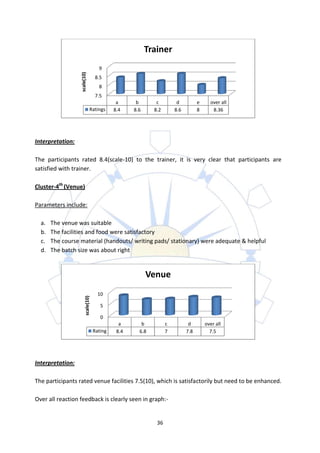
  • 52.
    Given table showsthe comparative data for two consecutive financial years : Department Bench Mark 2010-11 2011-12 BF-1 0.58 0.58 0.42 BF-2 2.50 0.17 0.08 EPS 0.58 0.92 0.75 Cent. Garage 20.25 3.58 3.50 Oxygen Plant 0.42 0.83 0.42 PP-1 2.08 1.42 0.00 PP (2X25MW) 0.92 0.58 0.58 RUBM 82.67 74.92 62.08 Sinter Plant 14.00 3.33 2.42 SMS-2 61.83 59.08 45.83 90 80 70 60 50 40 Bench Mark 30 2010-11 20 2011-12 10 0 Apart from above mentioned benefits the employees of department challenging the traditional concept of various problems and analyze the cases with very fruifull results, the all case study finally accepted as true by R&D Department of JSPL Raigarh also . 52
  • 53.
    Sl. Description Department 1 Unusual vibration damping by anti-vibration pads Dilution Fan/MSLM 2 Abnormal sound from motor and gearbox Bucket wheel drive of reclaimer#3/RMH-3 3 Bearing not centrally located inside bearing Product hopperbag-filter ID housing. fan/sms-2 4 Indentification of loose v-belts in running Roots blower #KK5RB01/DRI-1 conditiong 5 Coupling bolt arrangement in mixer unit of Bricks plant(Neptune Vibro- Neptune-5000 5000) 6 Root cause analysis of high vibration for SGP SGP Pump-1(BF-1 -area) Pump-1 Tangible Benefits On the basis of above training department started to solve some crucial problem in house now, earlier similar problems were outsourced , considering it as saving and department made significant saving through the new technique. Type Rs. Saving through Vibration Monitoring 4036500 Saving through Line balancing 2325000 Saving through LASER Alignment 2280000 Cost saving through oil saving 1879700 Saving through Flow 84500 Saving through Thermography 42000 Saving through Thickness maintenance 149800 Saving through V-Belt analysis 60000 10857500 53
  • 54.
    The above calculationof saving is based on the service charge fixed by external companies , till previous financial year. Cost of Training : In the calculation of training cost , we followed Dr. Philip Model. In our project we calculated cost of the entire training program. We consider all associated cost of training , as per JSPL Rule book. To & Tution Mandays Name Allowance Location Class FARE TOTAL CTC fro fee cost Dhananjay 9800 Mumbai AC-3 1080 2160 11960 15993 18000 45953 Pradeep 39750 Hydrabad AC-1 1600 3200 42950 35000 30000 98950 Neeraj 12075 Delhi AC-2 1700 3400 15475 17500 15000 47975 Arindam 4900 Pune 2nd SL 440 880 5780 14000 15000 34780 Shivnath 9900 Mumbai AC-2 1800 3600 13500 27000 12000 52500 Total CTC 280158 The participants of external training , shared his/her learning with peers and subordinates as in house training. Cost incurred to arrange in house training for subordinates and peers . 54
  • 55.
    In house trainingcost:- Designation No. of Details of cost participants Chargemans 3 Stationary 30 Snacks 60 venue 100 Mandays(Participant) 1500 Mandays Trainers 3000 total 4690 Designation No. of Details of cost participants Technician Stationary 150 15 Snacks 240 venue 100 Mandays(Participant) 7500 Mandays Trainers 3000 Total 10990 Designation No. of Details of cost participants Technician & 19 Stationary 190 Jr. Manager Snacks 300 venue 100 Mandays(Participant) 9500 Mandays Trainers 3000 13090 55
  • 56.
    Designation No. of Details of cost participants Jr. Manager 2 Stationary 20 Snacks 45 venue 100 Mandays(Participant) 1000 Mandays Trainers 3000 4165 Designation No. of Details of cost participants Sr. Technician 20 Stationary 40 Snacks 60 venue 100 Mandays(Participant) 1500 Mandays Trainers 3000 4700 Designation No. of Details of cost participants Technician & 4 Stationary 40 Asst. Snacks 75 Foreman venue 100 Mandays(Participant) 2000 Mandays 3000 Trainers 5215 56
  • 57.
    Designation No. of Details of cost participants Asst. 4 Stationary 40 Foreman Snacks 75 venue 100 Mandays(Participant) 2000 Mandays 3000 Trainers total 5215 Total Inhouse training cost = Rs. 56950 Total Cost cost =280158+56950 =Rs. 337108 ROI (Return on investment) of training:- ROI=[ (SAVING-COST)/COST]*100 Total savings = Rs. 10857500 Taking 5% level of significance in saving = Rs. 10314625 EPS(Electrical Power System) Department The EPS(Electrical Power System) department is one of the major contributors to the production . The department is responsible to provide electrical power to all possible units. The selected 35 employees of the department have undergone training with ABB Ltd. at Vadodra and Bangalore in four different batches. The training modules were fully equipped with new ,efficient and safety measured techniques. 57
  • 58.
    Batch Training Program No. of Participants 1st 1.HV/MV Switch Gear Maintenance 6 2nd 2.Power System Studies and Relay Co-ordination 8 3rd 3.HV/MV Switch Gears(Circuit Breakers, 10 CT/CVT/Disconnections/Surge arrestors/Power Transformer 4th 4.HV/EHV equipments like (LT/PT/CT) 11 5.Instrument Transformer(Applicability, CT/VCT Selection parameters, maintenance and troubleshooting Cost of Training As per Philip model we considered all parameters , which were associated with training. ABB Ltd. Has been paid , Rs. 33000/participants as training fees Hence for 35 participants = 35*33000 = Rs.1155000 Other expenses of company on the training:- JSPL Raigarh , prompt the training activities and Providing special allowances and travelling facilities according to designation. Designation No. of Employee Train Fare Allowance Man Days AGM 2 7204 18750 48000 Sr. Manager 1 3602 4950 24000 Manager 6 21612 29700 144000 Dy. Manager 7 25214 34650 168000 Asst. Manager 9 32418 28665 216000 Jr. Manager 5 18010 15925 80000 Asst. Engineer 2 7204 6370 32000 Jr. Engineer 3 10806 9555 48000 35 126070 148565 760000 1034635 58
  • 59.
    Total Cost oftraining =2189635 Benefits:- The EPS department has managed some savings by implementation of training knowledge in the organization. Aug-11 Sep-11 Oct-11 Nov-11 Sl. Testing/Condition Unit Rate Total Total Total Total No. Monitoring in Rs. Qty. saving Qty. saving Qty. saving Qty. saving performed in Rs. in Rs. in Rs. in Rs. Transformer 1 40,000 0 Testing 3 120000 0 4 160000 7 280000 2 Circuit Breaker 1500 4500 Testing 6 9000 3 5 7500 12 18000 3 CT Testing 8000/8hrs 4 32000 0 0 1 8000 1 8000 4 PT Testing 8000/hrs 6 48000 3 24000 0 0 0 0 Total saving in Rs. 19 209000 6 28500 10 175500 20 306000 59
  • 60.
    Dec-11 Jan-12 Feb-12 Mar-12 Total Total Total Total Qty. saving in Qty. saving in Qty. saving in Qty. saving in Rs. Rs. Rs. Rs. 9 360000 14 560000 10 400000 17 680000 2 3000 2 3000 45 67500 23 34500 2 16000 0 7 56000 3 24000 4 32000 0 0 0 17 411000 16 563000 62 523500 43 738500 2955000 ROI= [ (Profit- Cost)/cost]*100 = [(2955000-2189635)/ 2189635]*100 = [646557/2189635]*100 = 35% On the overall analysis of the data of all levels, we can conclude that the immediate reaction rated 8.1 point(scale-10), means the participants were satisfied with all four mentioned i.e Course, Relevance , Trainer, and Venue. However the learning was also good in all three parameters i.e Learning index (54.38%) , Self evaluation (Effective), Knowledge sharing (Effective) . Evaluators of change in behavior rated 8.1(10) ,which justified the program expectation. The reasons that imparted improvement to the performance are increased number of coaching and feedbacks, better supervision on job by the supervisors, increase in the actual usage of knowledge/skills gained through the program, and the availability of necessary equipments and materials for performing on the job. In the last level of “Kirkpatrick Model” , we saw new initiative by the employees like case study, New attempt and high ROI(Return on investment) 60
  • 61.
    In the courseof my study and the analysis that followed thereafter, I came across certain setbacks in the various levels as well as in the system, regarding whom, I would like to make the following suggestions : For level 1: The employees should be given sufficient time to study the subject matter of the program. The study material should be adequate and relevant according to the program. More practical example should be given. Proper agenda should be made for the program. Venue facilities should be enhanced. For level - 2 : Proper facilitation of learning should be made and the knowledge/skills of the employees should be increased. For level - 3 : Confidence of the employees to perform on the job needs to be increased. The programs should be made more relevant to the job requirements. Opportunities provided to the employees to use the knowledge/skills gained from the program needs to be increased. Necessary equipments and materials required for the job should be made easily available. For Level- 4 Each department should be instructed to maintain data based on training impact for future reference:-  Major work done based on training  Cost saving  Accident avoided  New initiative 61
  • 62.
    Apart from these,I would like to make the following suggestions, too on increase training’s effectiveness in JSPL. 1. Each and every individual of the company should be taught what “ Kirkpatrick model” is, so that they give genuine feedback when desired. 2. After training program there should be suitable rewarding system for the excellent performers and the average and poor performer’s problems should be identified and necessary motivation dose and support should be given for their improvement. 3. Training facility should be more job relevant and should be given to those whose job profile is related to that particular training program. 4. Sometimes the communication pattern itself becomes an obstacle, so according to situations, Hindi should also be used. 5. Apprehensions in the minds of employees restrain them from cooperating with the management, proper care should be taken to remove such apprehensions. 62

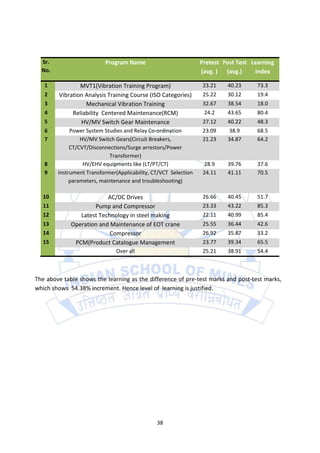

  • 63.
    Bibliography: 1.Int. J.of Human Resource Management 14:6 September 2003 on “Effects of training on business results” by Antonio Arago´n-Sa´nchez, Isabel Barba-Arago´n and Raquel Sanz-Valle Interdisciplinary Journal Of Contemporary Research In Business on “How Organizations Evaluate their Trainings? An evidence from Pakistani Organizations” By Ishfaq Ahmed Muhammad Musarrat Nawaz Ahmad Usman Muhammad Zeeshan Shaukat Naveed Ahmed Wasim-ul-Rehman www. ijcrb.webs.com www.citehr.com www.jspl.com www.google.com 63
  • 64.
    Self Evaluation Sheet Employee Name Employee Code Designation Department Training Training Date Training Institute Location TO BE FILLED BY THE PARTICIPANT Mr. / Ms. .……………………………….. High Medium Low Your knowledge on the subject matter taught during the training Before training 5 4 3 2 1 After training 5 4 3 2 1 Your skill level in doing the task that was addressed during Before training 5 4 3 2 1 the training. After training 5 4 3 2 1 Your ability to learn and apply that has been taught to you. Before training 5 4 3 2 1 After training 5 4 3 2 1 Overall level of learning in the area you have just been trained. Before training 5 4 3 2 1 After training 5 4 3 2 1 Overall learning based on the above score Highly Ineffective(0-4) Ineffective(5-8) Moderate(9-12) Effective(13-16) Highly Effective(17-20) . Signature of HOD / In-Charge 64
  • 65.
    Training Program EffectivenessMeasurement Learning Evaluation(Knowledge sharing) . Employee Name- Employee Code - Designation- Department- Training- Training Date- Training Institute - Location- I have attended above training/seminar/workshop/course and shared learning with …………number of employees. The feedback of some of the employees( selected on sample basis) is given below : FEEDBACK ON TRAINING Employee Code/Name Highly Effective(5) Effective(4) Moderate(3) Ineffective(2) Highly Ineffective(1) 1. 2. 3. 4. 5. Overall Feedback based on above score Highly Ineffective(0-5) Ineffective(6-10) Moderate(11-15) Effective(16-20) Highly Effective(21-25) 65
  • 66.
    Training Program EffectivenessMeasurement Behavior Evaluation . Employee Name- Employee Code - Signature of HOD / In-Charge Designation- Department- 66
  • 67.
    Training- Training Date- Training Institute - Location- TO BE FILLED BY THE HOD/In-Charge You are requested to assess the change, relevance of change and sustainability of change based on your observation to measure the impact / effectiveness of the training program of the candidate. Feedback 5 1 4 3 2 Feedback Question Strongly Agree Undecided Disagree Strongly Agree Disagree 1. Did the trainee put their learning into effect when back on the job? 2. Were the relevant skills and knowledge used? 3. Was there noticeable and measurable change in the activity and performance of the trainees when back in their roles? 4. Was the change in behavior and new level of knowledge sustained? 5. Is the trainee aware of his / her change in behavior, knowledge, skill level? 6. Overall do you think the employee has demonstrated the learning’s from trainings in his / her day to day work? 0-7 8-14 15-21 22-28 29-35 Highly Ineffective Moderate Effective Highly Effective Ineffective The learning evaluation confirms that the training was beneficial / non-beneficial (Please Tick) & is recommended / not recommended (Please Tick) to be conducted again for the benefit of our employee. Thank you for taking out your time and filling up this evaluation form. HR Department Signature of HOD / In-Charge 67
  • 68.
    EVALUATION PARAMETERS 1 2 3 4 5 The training was well organized and clearly structured The objective and aim of training was explained clearly The training covered a variety of useful topics The content and material of the training were relevant The medium of presentations(lecture/discussion/exercise/ games/ case studies, AV's) was appropriate The examples and references used were effective The pace of training was appropriate COURSE AVERAGE RATING EVALUATION PARAMETERS This course gave me ideas/information/material which I can use in my normal job I will suggest this course to my colleagues This course was time well spent and met my expectations I will be able to apply my learning's immediately at the workplace RELEVANCE TO JOB AVERAGE RATING EVALUATION PARAMETERS The trainers were friendly and approachable The trainer conveyed enthusiasm for the subject and responded positively to the ideas and questions of the participants The trainers were clear in their communication and encouraged participation The trainer had strong subject knowledge The trainer was able to answer my questions TRAINER AVERAGE RATING EVALUATION PARAMETERS The venue was suitable The facilities and food were satisfactory 68
  • 69.
    The course material(handouts/ writing pads/ stationary) were adequate & helpful The batch size was about right VENUE AVERAGE RATING EVALUATION PARAMETERS OVERALL AVERAGE RATING 69