METHODS OF COOKING
FOOD
“NO ONE IS BORN A GREAT COOK, ONE LEARNS BY
DOING”
HEAT TRANSFER
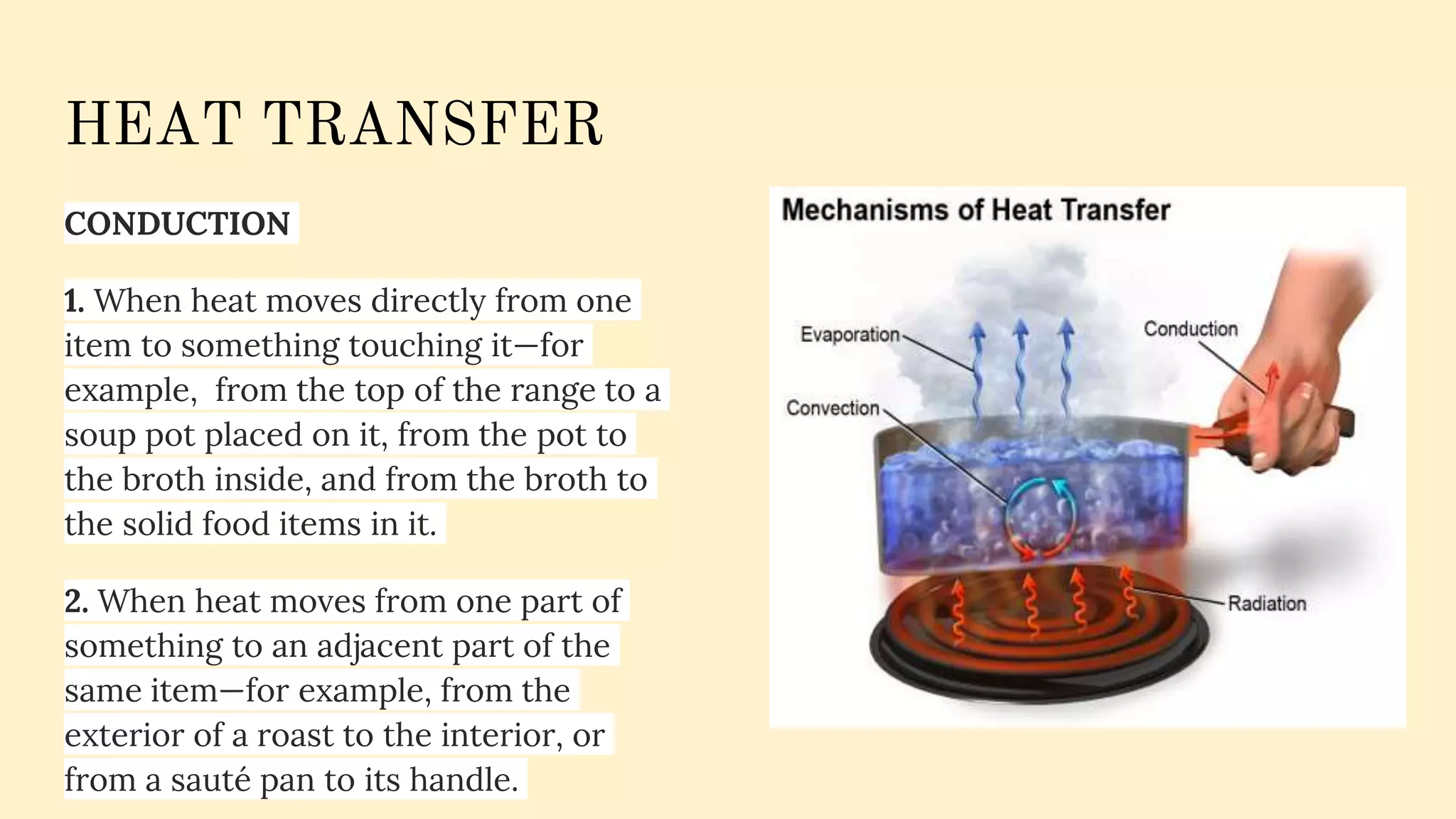
CONDUCTION
1. When heat moves directly from one
item to something touching it—for
example, from the top of the range to a
soup pot placed on it, from the pot to
the broth inside, and from the broth to
the solid food items in it.
2. When heat moves from one part of
something to an adjacent part of the
same item—for example, from the
exterior of a roast to the interior, or
from a sauté pan to its handle.
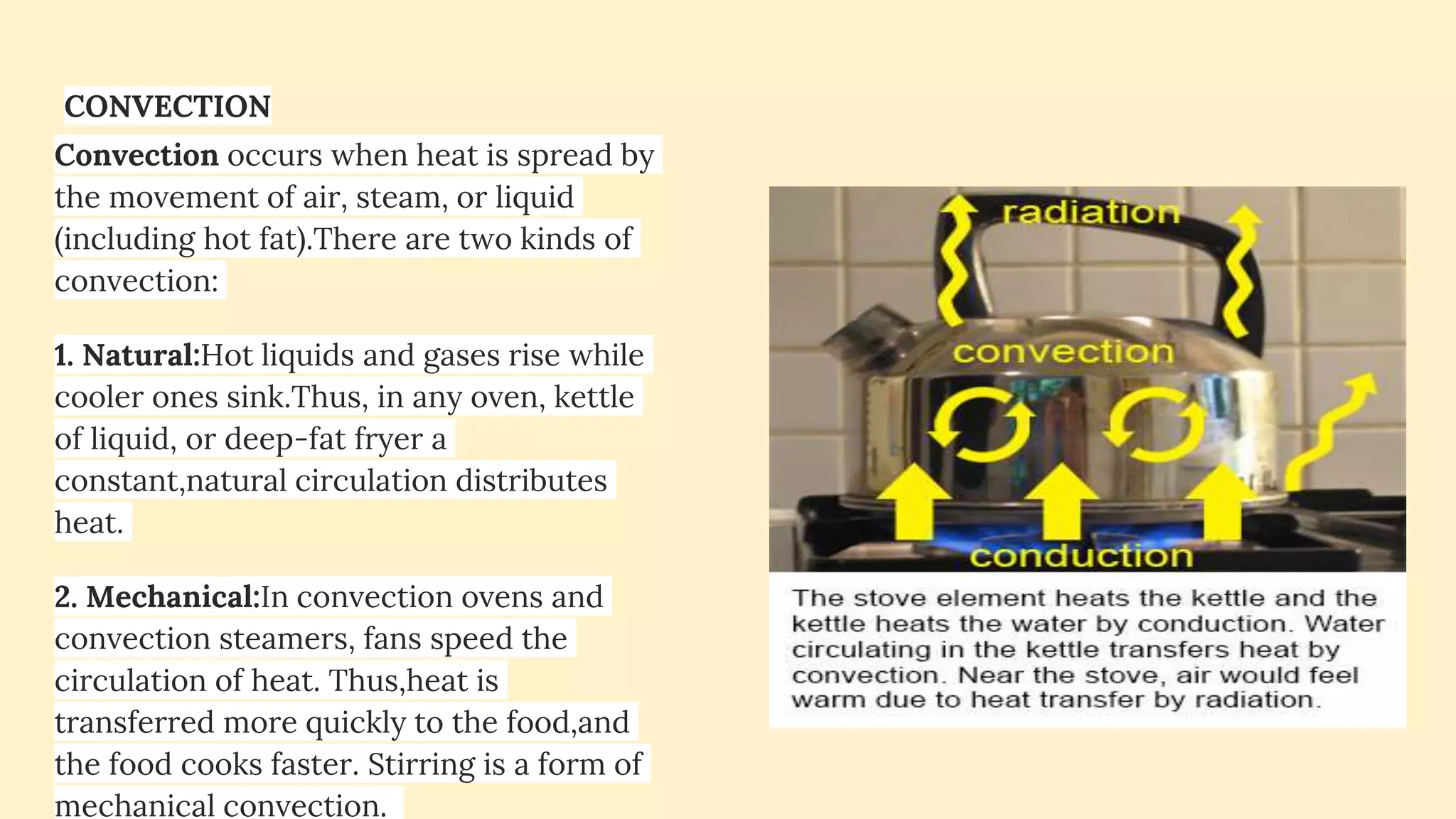
CONVECTION
Convection occurs when heat is spread by
the movement of air, steam, or liquid
(including hot fat).There are two kinds of
convection:
1. Natural:Hot liquids and gases rise while
cooler ones sink.Thus, in any oven, kettle
of liquid, or deep-fat fryer a
constant,natural circulation distributes
heat.
2. Mechanical:In convection ovens and
convection steamers, fans speed the
circulation of heat. Thus,heat is
transferred more quickly to the food,and
the food cooks faster. Stirring is a form of
mechanical convection.
RADIATION
Radiation occurs when energy is transferred by waves from a source to
the food. The waves themselves are not actually heat energy but are
changed into heat energy when they strike the food being cooked.
1. Infrared: Broiling is the most familiar example of infrared cooking. In a
broiler, an electric element or a ceramic element heated by a gas flame
becomes so hot that it gives off infrared radiation, which cooks the
food.High-intensity infrared ovens are designed to heat food rapidly.
RADIATION
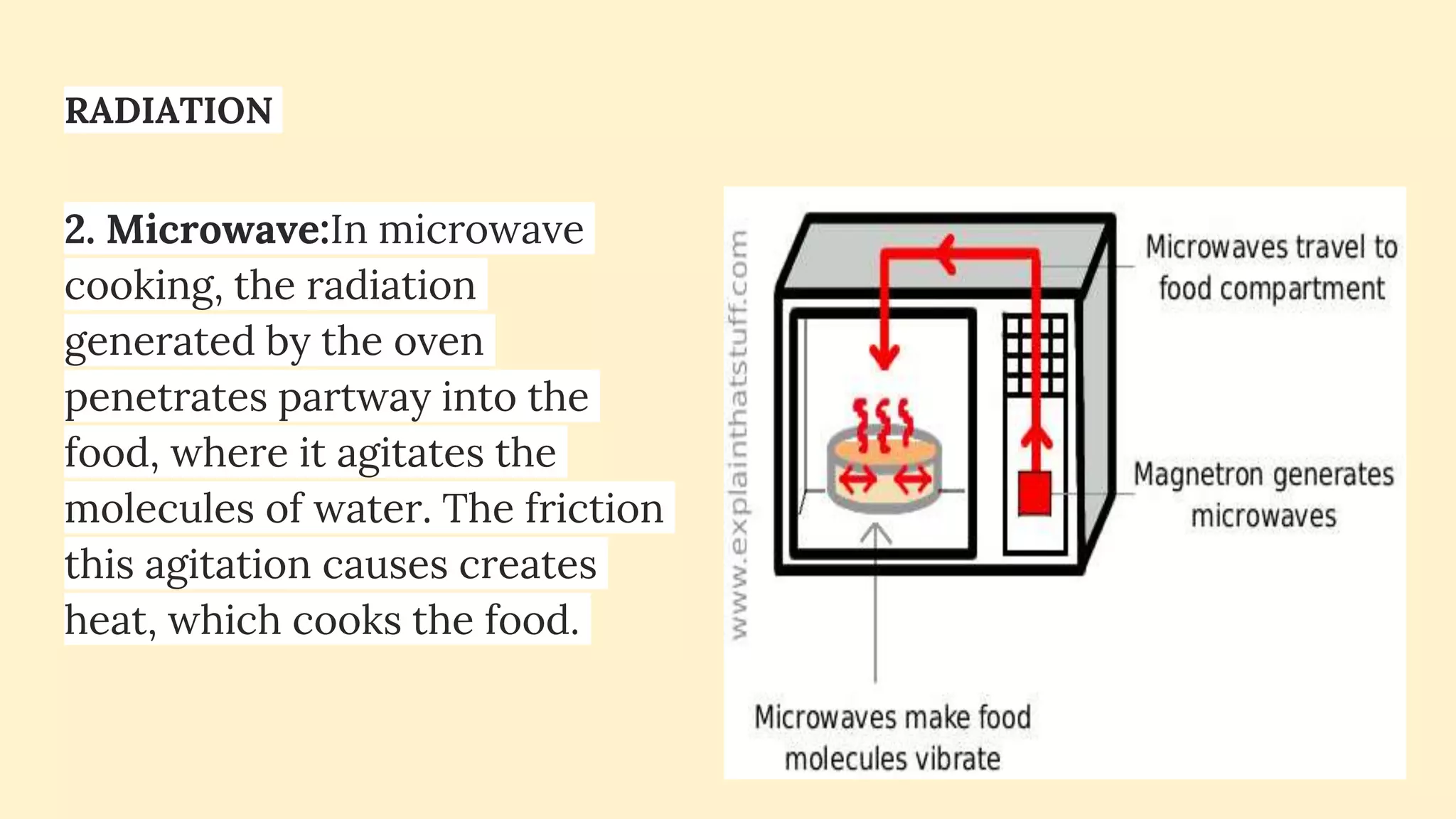
2. Microwave:In microwave
cooking, the radiation
generated by the oven
penetrates partway into the
food, where it agitates the
molecules of water. The friction
this agitation causes creates
heat, which cooks the food.
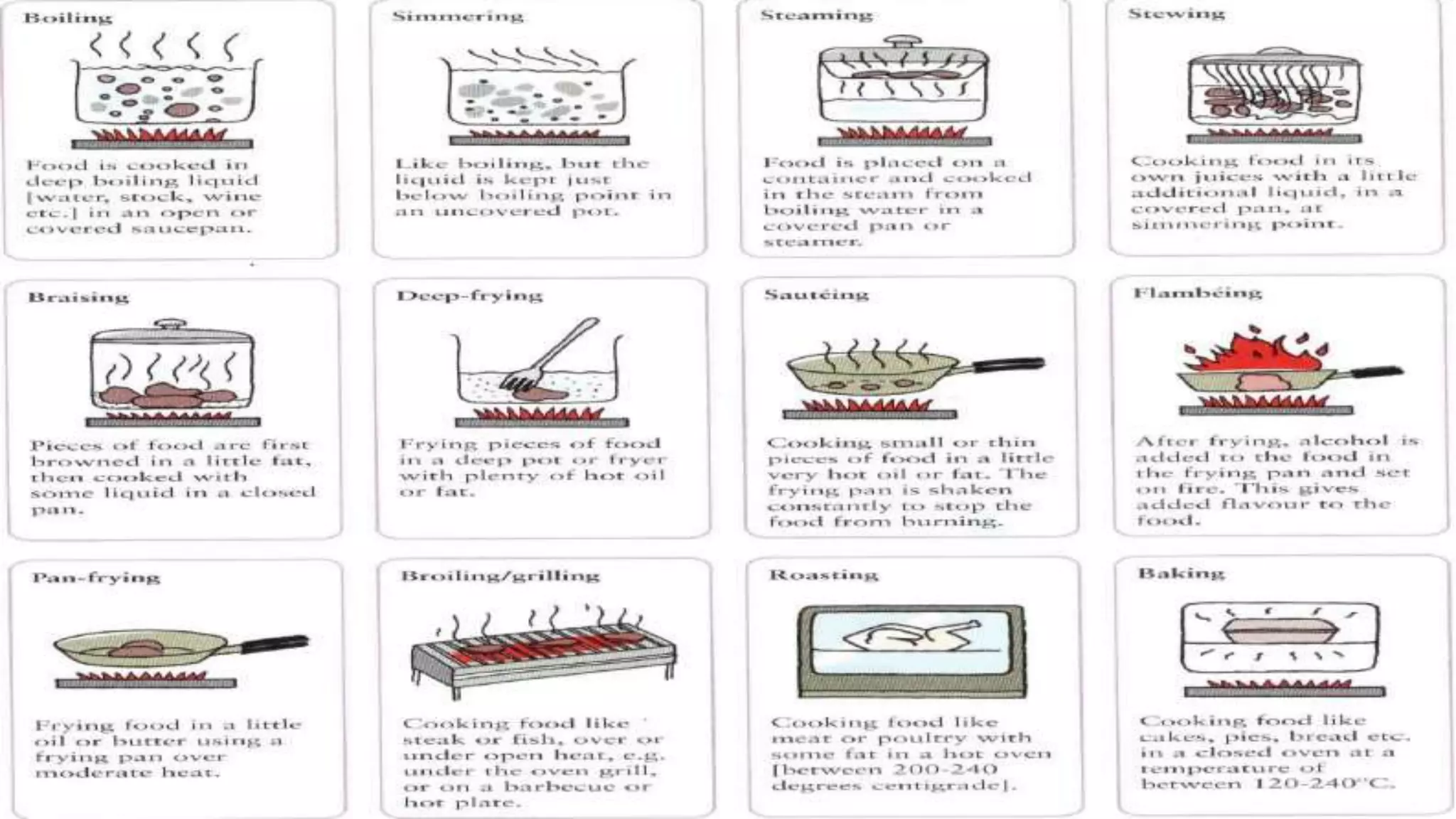
Cooking Methods
a) Boiling
b) Poaching
c) Stewing
d) Braising
e) Steaming
f) Baking
g) Roasting
h) Pot roasting
i) Grilling
j) Shallow Frying
k) Deep Frying
l) Microwaving
(COOKING METHODS)
Boiling
Definition
is cooking prepared foods in a liquid
(water, bouillon, stock, milk) at
boiling point.
a) food is placed into boiling liquid,
reboiled, then the heat is reduced, so
that the liquid boils gently – simmering;
b) food is covered with cold liquid,
brought to the boil, then the heat is
reduced, so that the food simmers.
Examples of foods which might be cooked
by boiling
- stocks (beef, mutton, chicken, fish)
- sauces (brown, white, curry)
- glazes (fish, meat)
- soup (tomato, lentil)
- farinaceous (pasta)
- fish (cod, salmon)
- meat (beef, leg of mutton)
- vegetables (carrots, cabbage, potatoes).
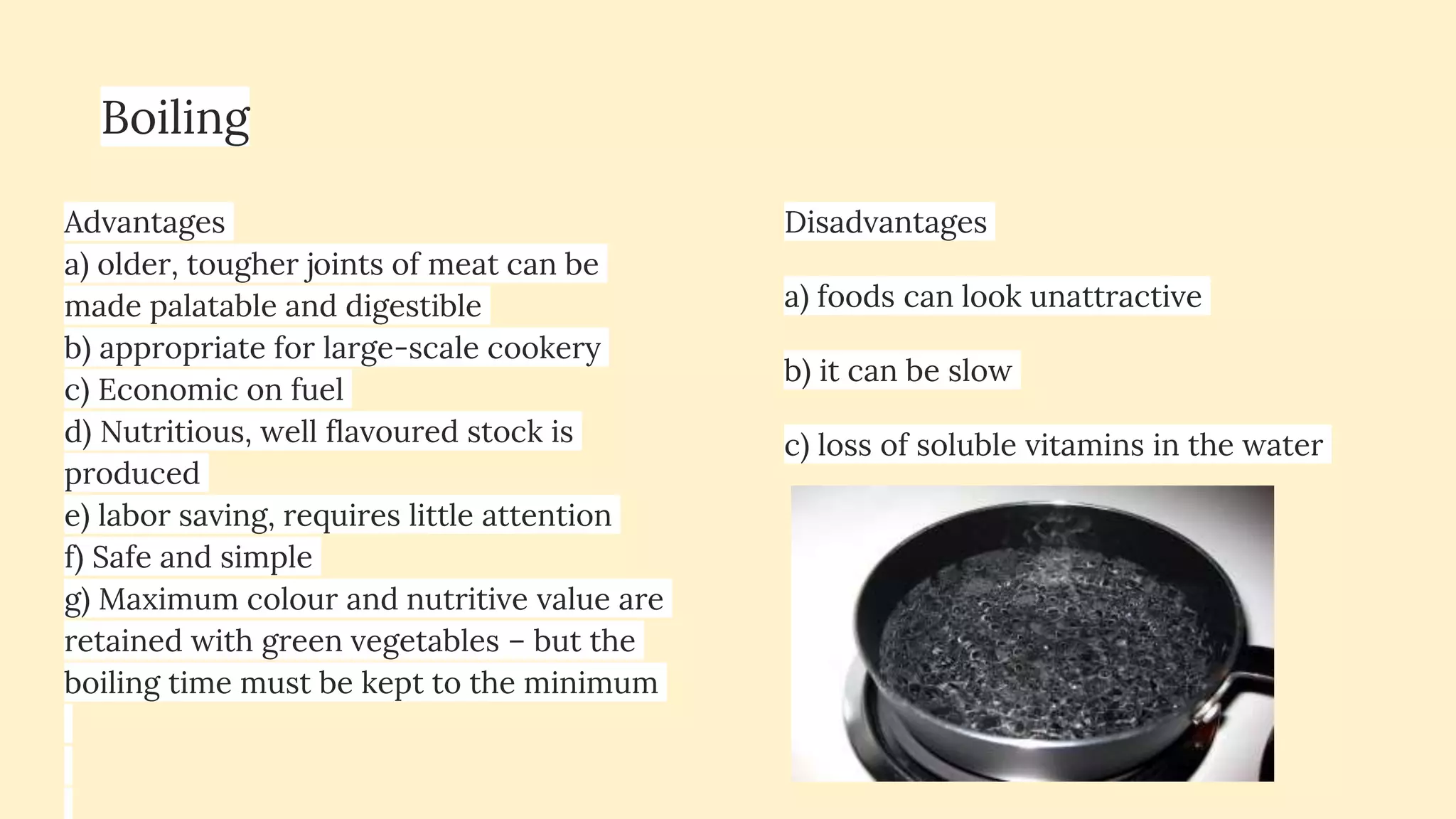
Boiling
Advantages
a) older, tougher joints of meat can be
made palatable and digestible
b) appropriate for large-scale cookery
c) Economic on fuel
d) Nutritious, well flavoured stock is
produced
e) labor saving, requires little attention
f) Safe and simple
g) Maximum colour and nutritive value are
retained with green vegetables – but the
boiling time must be kept to the minimum
Disadvantages
a) foods can look unattractive
b) it can be slow
c) loss of soluble vitamins in the water
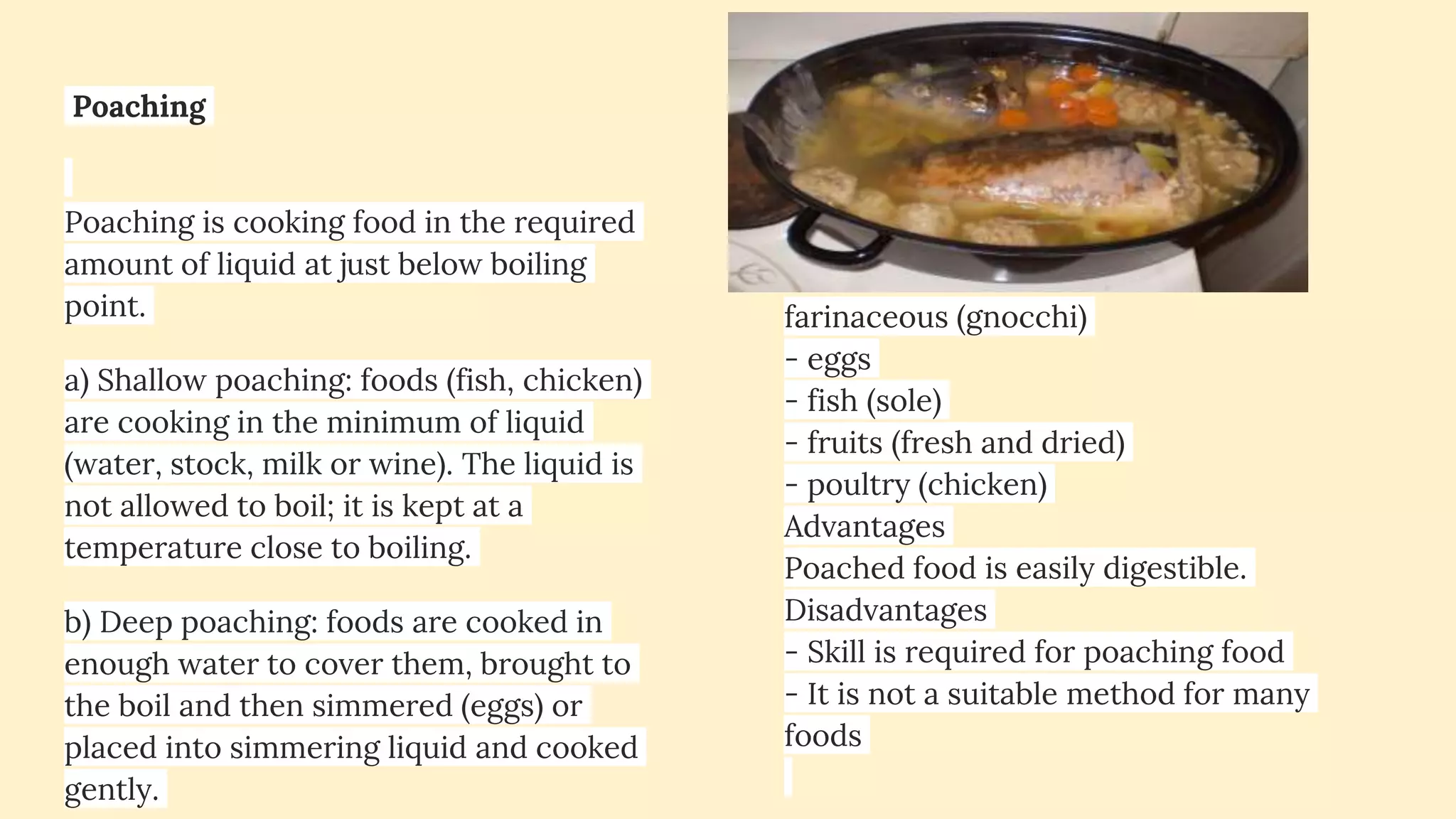
Poaching
Poaching is cooking food in the required
amount of liquid at just below boiling
point.
a) Shallow poaching: foods (fish, chicken)
are cooking in the minimum of liquid
(water, stock, milk or wine). The liquid is
not allowed to boil; it is kept at a
temperature close to boiling.
b) Deep poaching: foods are cooked in
enough water to cover them, brought to
the boil and then simmered (eggs) or
placed into simmering liquid and cooked
gently.
farinaceous (gnocchi)
- eggs
- fish (sole)
- fruits (fresh and dried)
- poultry (chicken)
Advantages
Poached food is easily digestible.
Disadvantages
- Skill is required for poaching food
- It is not a suitable method for many
foods
Stewing
Stewing is a long, slow cooking method
where food is cut into pieces and cooked
in the minimum amount of liquid, water,
stock or sauce. The food and the cooking
liquid are served together.
All stews have a thickened consistency.
Stewed foods may be cooked
- in a covered pan on the stove;
- in a covered pan in the oven.
fish (e.g. bouillabaisse – French fish soup /
stew)
- meat (goulash, minced beef, Irish stew,
white stew of veal)
- poultry (chicken fricassee, curried
chicken)
- vegetables (ratatouille)
Stewing
Advantage
a) Meat juices are retained as part of the stew
b) Correct slow cooking results and very little evaporation
c) Economic on fuel
d) Nutrients are conserved
e) Tough foods are tenderised
f) Economical in labour because the foods can be bulk cooked
Disadvantages
Stewing is a slow cooking method.
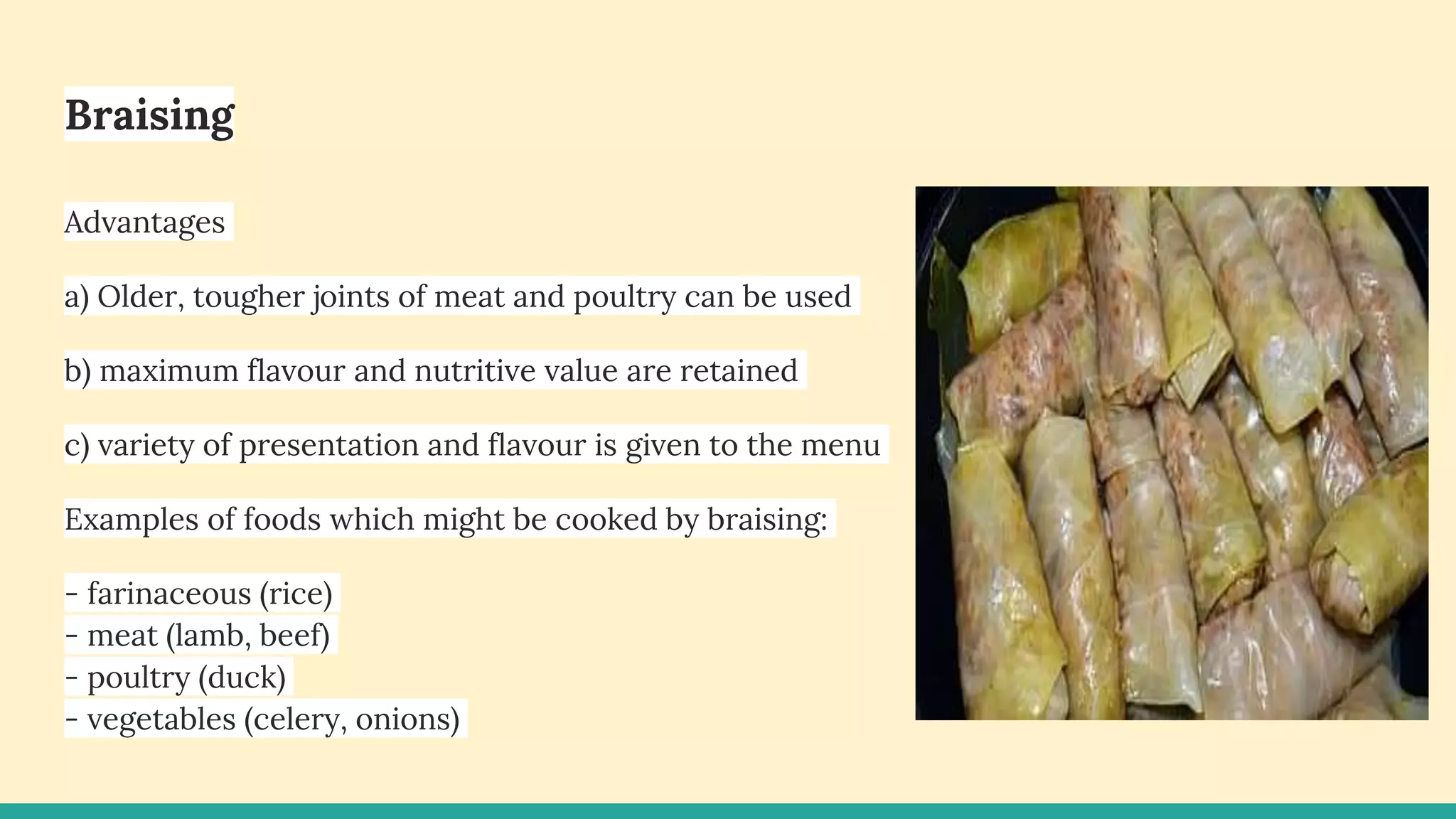
Braising
Braising is a method of cooking in the oven. The food is cooked in liquid in a
covered pan or casserole. It is a combination of stewing and pot roasting
a) Brown braising: joints and portion cuts of meat are marinated and may be larded
and then sealed quickly by browning on all sides in a hot oven or in a pan on the
stove. Joints are then placed on a bed of root vegetables in a braising pan, with the
liquid and other flavourings, covered with a lid and cooked slowly in the oven.
b) White braising: vegetables and sweetbreads are blanched, refreshed and cooked
on a bed of root vegetables with white stock in a covered container in the oven.
Braising
Advantages
a) Older, tougher joints of meat and poultry can be used
b) maximum flavour and nutritive value are retained
c) variety of presentation and flavour is given to the menu
Examples of foods which might be cooked by braising:
- farinaceous (rice)
- meat (lamb, beef)
- poultry (duck)
- vegetables (celery, onions)
Steaming
Steaming is cooking prepared foods by steam (moist heat) under varying degrees
of pressure.
a) Atmospheric or low pressure steaming: food may be cooked by direct or indirect
contact with the steam:
- direct: in a steamer or in a pan of boiling water (steak);
- indirect between two plates over a pan of boiling water.
b) High pressure steaming: in purpose-built equipment which does not allow
steam to escape; steam pressure builds up, the temperature increases and cooking
time is reduced.
Steaming
Advantage
a) Retention of nutritional value
b) Some foods become lighter and easier to digest
c) Low pressure steaming reduces the risk of overcooking
d) High pressure steaming enables food to be cooked quickly, because steam is
forced through the food, cooking it rapidly
e) Labour-saving and suitable for large-scale cookery
f) High speed steamers enable frequent cooking of small quantities of vegetables.
Vegetables are freshly cooked, retaining colour, flavour and nutritive value.
g) With steamed fish, natural juices can be retained; they are served with the fish
or used to make an accompanying sauce.
h) Economical on fuel (low heat is needed and a multi-tiered steamer can be used).
Steaming
Disadvantages
a) Foods can look unattractive
b) It can be a slow method
Examples of foods which might be cooked by steaming:
- fish (sole)
- meat (tongue, ham, bacon)
- vegetables (almost all)
Baking
Baking is cooking food by dry heat in an
oven (the action is modified by steam).
a) Dry baking: during the baking process
steam rises from the water content of the
food; it combines with the dry heat of the
oven to cook the food (cakes, pastry,
baked jacket potatoes).
b) Increased humidity baking: during the
baking process with some foods (bread)
the oven humidity is increased by placing
a bowl of water into the oven to increase
the water content of the food and to
improve eating quality.
c) Bain marie: during the baking process
food is placed in a container of water (bain
marie) to cook the food more slowly.
Examples of foods which might be cooked
by baking:
- eggs
- meat (steak, cornish pastries)
- chicken
- vegetables (potatoes)
- apples
- fruit flans
- cakes
- bread.
Baking
Advantages
a) A wide range of savoury and sweet foods can be produced.
b) Bakery products are appealing to the eye and to the mouth.
c) Bulk cooking can be achieved with uniformity of colour and degree of
cooking.
d) Baking ovens have effective manual or automatic controls
e) Straightforward access for loading and removal of items.
Disadvantages
a) Requires regular attention
b) Expensive energy
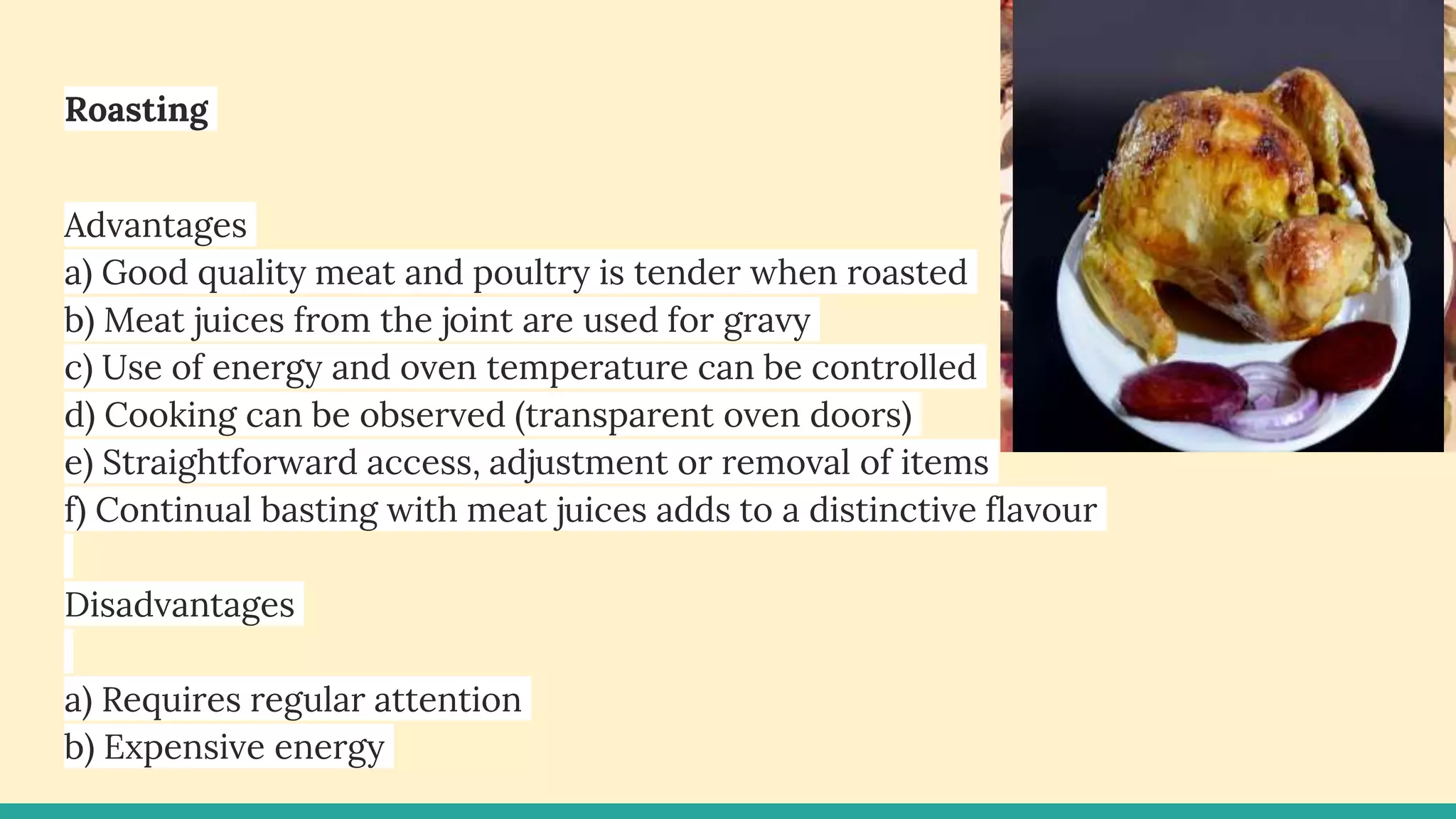
Roasting
Roasting is cooking in dry heat in an
oven or on a spit with the aid of fat or
oil.
a) Placing prepared foods (meat,
poultry) on a roosting spit over/in front
of radiating heat;
b) Placing prepared foods in an oven
with:
- dry heat
- forced air convected heat
- convected heat combined with
microwave energy
Examples of foods which might be
cooked by roasting:
- meat (lamb, beef, pork, veal)
- poultry and game (duck, chicken,
pheasant)
- vegetables (potatoes, parsnips)
Roasting
Advantages
a) Good quality meat and poultry is tender when roasted
b) Meat juices from the joint are used for gravy
c) Use of energy and oven temperature can be controlled
d) Cooking can be observed (transparent oven doors)
e) Straightforward access, adjustment or removal of items
f) Continual basting with meat juices adds to a distinctive flavour
Disadvantages
a) Requires regular attention
b) Expensive energy
Pot roasting
Pot roasting is cooking on a bed of
root vegetables in a covered pan. This
method retains maximum flavour of
all ingredients.
Food is placed on a bed of root
vegetables and herbs, coated with
butter or oil, covered with a lid and
cooked in an oven.
Advantages
a) Maximum flavour is retained
b) Nutrients are retained
c) Cheaper cuts of meat can be used
d) Vegetables used in pot roasting
can be served as an accompaniment
Disadvantages
Pot roasting is a slow cooking
method.
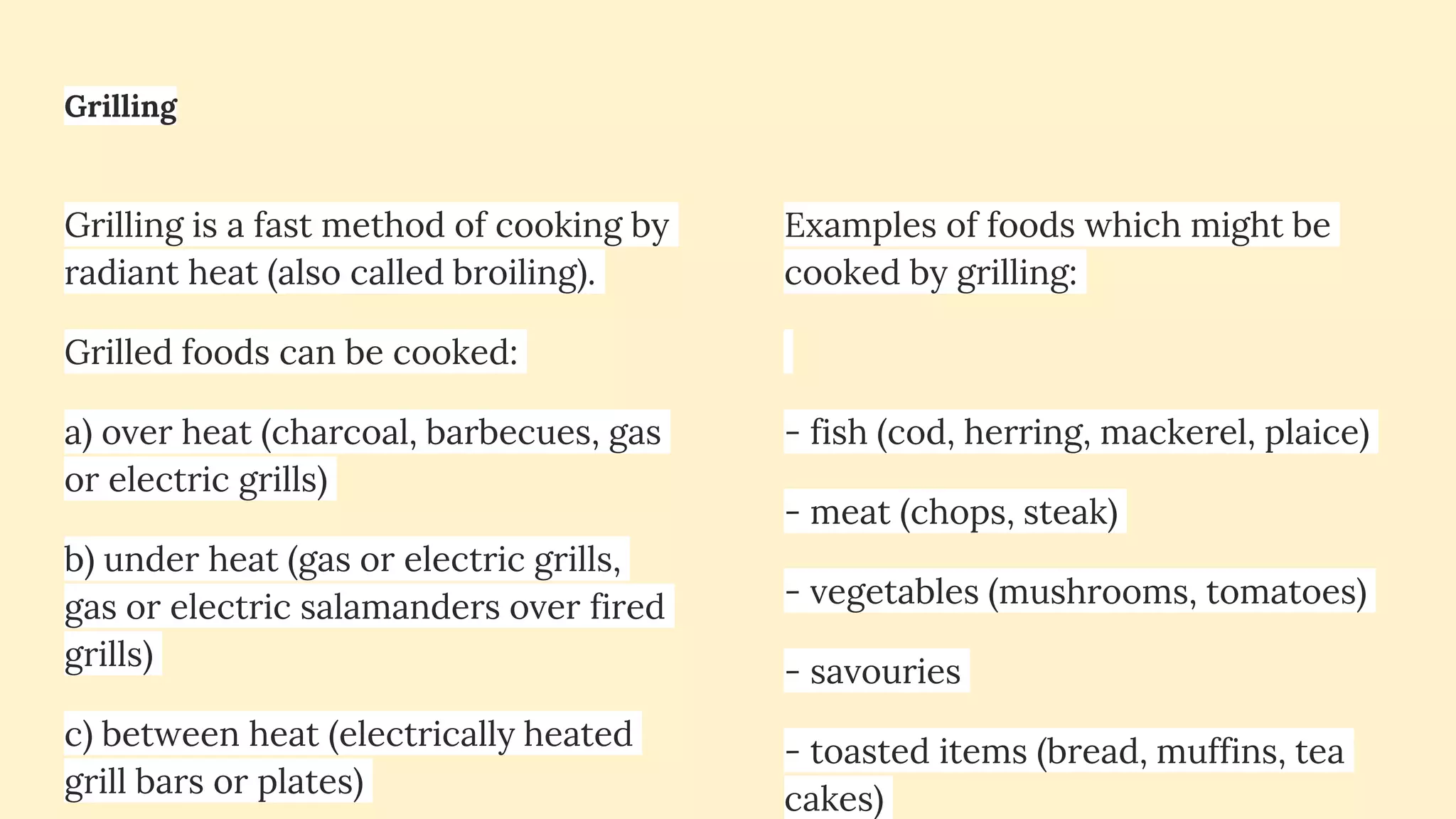
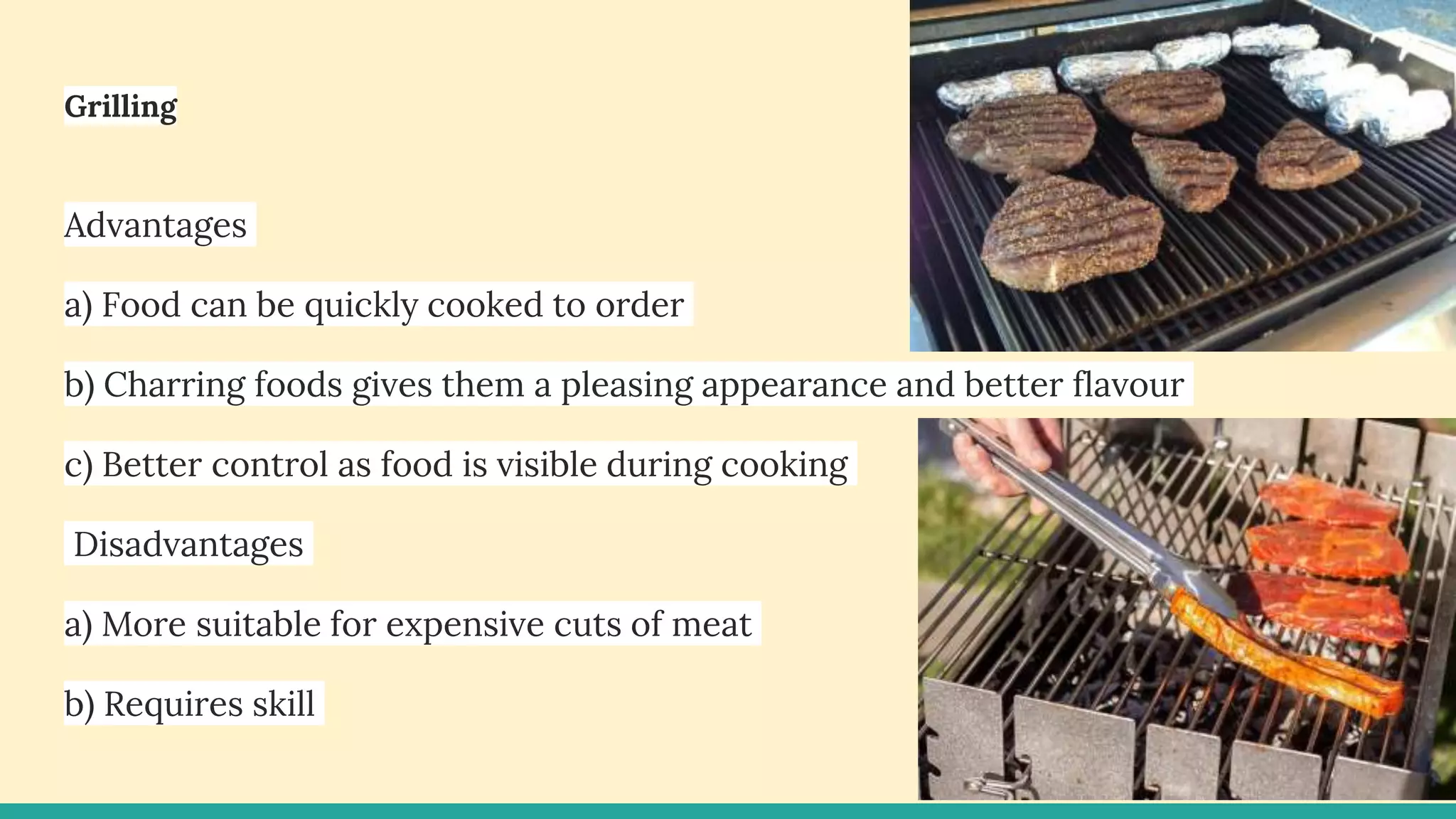
Grilling
Grilling is a fast method of cooking by
radiant heat (also called broiling).
Grilled foods can be cooked:
a) over heat (charcoal, barbecues, gas
or electric grills)
b) under heat (gas or electric grills,
gas or electric salamanders over fired
grills)
c) between heat (electrically heated
grill bars or plates)
Examples of foods which might be
cooked by grilling:
- fish (cod, herring, mackerel, plaice)
- meat (chops, steak)
- vegetables (mushrooms, tomatoes)
- savouries
- toasted items (bread, muffins, tea
cakes)
Grilling
Advantages
a) Food can be quickly cooked to order
b) Charring foods gives them a pleasing appearance and better flavour
c) Better control as food is visible during cooking
Disadvantages
a) More suitable for expensive cuts of meat
b) Requires skill
Shallow frying
Shallow frying is cooking food in a small quantity of pre-heated fat or oil in a shallow
pan or on a flat surface.
a) Shallow fry: cooking food in a small amount of fat or oil in a frying pan or saute pan.
The food is first fried on the presentation side, then turned, so that both sides are
cooked and coloured.
b) Saute: cooking tender cuts of meat and poultry in a saute or frying pan. After cooking
the fat is discarded and the pan is deglazed with stock or wine as a part of the finished
sauce.
- cooking potatoes or onions which are cut into slices and tossed into hot shallow fat or
oil in a frying pan till golden brown.
c) Griddle: Hamburgers, sausages, sliced onions are placed on a lightly oiled, pre-heated
griddle (solid metal plate) and turned frequently during cooking.
d) Stir Fry: fast frying in a wok or a frying pan in a little fat or oil (vegetables, strips of
beef or chicken).
Shallow frying
Advantages
a) Quick cooking method
b) No loss of soluble
nutrients
c) Good colour
Disadvantages
a) Suitable for expensive
cuts of meat
b) Not easily digested
c) Requires constant
supervision
Examples of foods which might be
cooked by shallow frying:
- eggs (omelettes)
- fish (sole, plaice, trout, cod, herring)
- meat (lamb, kidneys, beef
Stroganoff)
- poultry (chicken)
- vegetables (potatoes, onions,
cauliflower, chicory)
- sweets and pastries (pancakes)
- savouries.
Deep frying
Deep frying is cooking food in pre-
heated deep oil or fat.
Conventional deep-fried foods (except
potatoes) are coated with milk and
flour, egg and crumbs, batter or pastry
to protect the surface of the food from
the intense heat, to prevent the escape
of moisture and nutrients ad to modify
the rapid penetration of the intense
heat.
The food is placed into deep pre-heated
oil or fat, fried until cooked and golden
brown, drained and served.
Examples of foods which might be
cooked by deep frying:
- eggs (Scotch eggs)
- fish (haddock)
- chicken (cutlets)
- savoury (cheese fritters)
- potatoes (croquettes, chips)
- vegetables (onions)
- pastry and sweets (pineapple fritters,
doughnuts)
Deep frying
Advantages
a) Quick cooking method
b) No loss of soluble nutrients
c) Ensures good colour
Disadvantages
a) Not easily digested
b) Safety hazard
Microwaving
Microwave cookery is cooking or
reheating food using
electromagnetic waves in a
microwave oven powered by
electricity. Microwaves activate
the water molecules or particles
of food, causing heat by friction
which cooks or reheats the food.
Examples of foods which might be
cooked by microwave:
- farinaceous (pasta)
- fish (trout, salmon)
- vegetables (potatoes)
- pre-cooked meals
Microwaving
Advantages
a) Very fast method of cooking
b) Fast method of defrosting
c) Economical on electricity and
labour
d) Food is cooked in its own juices, so
its flavour is retained
e) Minimises food shrinkage and
drying-out
Disadvantages
a) Not suitable for all foods
b) Limited space
c) Can only penetrate 5 cm into food
(from all sides)

Methods of cooking food

  • 1.
    METHODS OF COOKING FOOD “NOONE IS BORN A GREAT COOK, ONE LEARNS BY DOING”
  • 2.
    HEAT TRANSFER CONDUCTION 1. Whenheat moves directly from one item to something touching it—for example, from the top of the range to a soup pot placed on it, from the pot to the broth inside, and from the broth to the solid food items in it. 2. When heat moves from one part of something to an adjacent part of the same item—for example, from the exterior of a roast to the interior, or from a sauté pan to its handle.
  • 3.
    CONVECTION Convection occurs whenheat is spread by the movement of air, steam, or liquid (including hot fat).There are two kinds of convection: 1. Natural:Hot liquids and gases rise while cooler ones sink.Thus, in any oven, kettle of liquid, or deep-fat fryer a constant,natural circulation distributes heat. 2. Mechanical:In convection ovens and convection steamers, fans speed the circulation of heat. Thus,heat is transferred more quickly to the food,and the food cooks faster. Stirring is a form of mechanical convection.
  • 4.
    RADIATION Radiation occurs whenenergy is transferred by waves from a source to the food. The waves themselves are not actually heat energy but are changed into heat energy when they strike the food being cooked. 1. Infrared: Broiling is the most familiar example of infrared cooking. In a broiler, an electric element or a ceramic element heated by a gas flame becomes so hot that it gives off infrared radiation, which cooks the food.High-intensity infrared ovens are designed to heat food rapidly.
  • 5.
    RADIATION 2. Microwave:In microwave cooking,the radiation generated by the oven penetrates partway into the food, where it agitates the molecules of water. The friction this agitation causes creates heat, which cooks the food.
  • 6.
    Cooking Methods a) Boiling b)Poaching c) Stewing d) Braising e) Steaming f) Baking g) Roasting h) Pot roasting i) Grilling j) Shallow Frying k) Deep Frying l) Microwaving
  • 8.
  • 9.
    Boiling Definition is cooking preparedfoods in a liquid (water, bouillon, stock, milk) at boiling point. a) food is placed into boiling liquid, reboiled, then the heat is reduced, so that the liquid boils gently – simmering; b) food is covered with cold liquid, brought to the boil, then the heat is reduced, so that the food simmers. Examples of foods which might be cooked by boiling - stocks (beef, mutton, chicken, fish) - sauces (brown, white, curry) - glazes (fish, meat) - soup (tomato, lentil) - farinaceous (pasta) - fish (cod, salmon) - meat (beef, leg of mutton) - vegetables (carrots, cabbage, potatoes).
  • 10.
    Boiling Advantages a) older, tougherjoints of meat can be made palatable and digestible b) appropriate for large-scale cookery c) Economic on fuel d) Nutritious, well flavoured stock is produced e) labor saving, requires little attention f) Safe and simple g) Maximum colour and nutritive value are retained with green vegetables – but the boiling time must be kept to the minimum Disadvantages a) foods can look unattractive b) it can be slow c) loss of soluble vitamins in the water
  • 11.
    Poaching Poaching is cookingfood in the required amount of liquid at just below boiling point. a) Shallow poaching: foods (fish, chicken) are cooking in the minimum of liquid (water, stock, milk or wine). The liquid is not allowed to boil; it is kept at a temperature close to boiling. b) Deep poaching: foods are cooked in enough water to cover them, brought to the boil and then simmered (eggs) or placed into simmering liquid and cooked gently. farinaceous (gnocchi) - eggs - fish (sole) - fruits (fresh and dried) - poultry (chicken) Advantages Poached food is easily digestible. Disadvantages - Skill is required for poaching food - It is not a suitable method for many foods
  • 12.
    Stewing Stewing is along, slow cooking method where food is cut into pieces and cooked in the minimum amount of liquid, water, stock or sauce. The food and the cooking liquid are served together. All stews have a thickened consistency. Stewed foods may be cooked - in a covered pan on the stove; - in a covered pan in the oven. fish (e.g. bouillabaisse – French fish soup / stew) - meat (goulash, minced beef, Irish stew, white stew of veal) - poultry (chicken fricassee, curried chicken) - vegetables (ratatouille)
  • 13.
    Stewing Advantage a) Meat juicesare retained as part of the stew b) Correct slow cooking results and very little evaporation c) Economic on fuel d) Nutrients are conserved e) Tough foods are tenderised f) Economical in labour because the foods can be bulk cooked Disadvantages Stewing is a slow cooking method.
  • 14.
    Braising Braising is amethod of cooking in the oven. The food is cooked in liquid in a covered pan or casserole. It is a combination of stewing and pot roasting a) Brown braising: joints and portion cuts of meat are marinated and may be larded and then sealed quickly by browning on all sides in a hot oven or in a pan on the stove. Joints are then placed on a bed of root vegetables in a braising pan, with the liquid and other flavourings, covered with a lid and cooked slowly in the oven. b) White braising: vegetables and sweetbreads are blanched, refreshed and cooked on a bed of root vegetables with white stock in a covered container in the oven.
  • 15.
    Braising Advantages a) Older, tougherjoints of meat and poultry can be used b) maximum flavour and nutritive value are retained c) variety of presentation and flavour is given to the menu Examples of foods which might be cooked by braising: - farinaceous (rice) - meat (lamb, beef) - poultry (duck) - vegetables (celery, onions)
  • 16.
    Steaming Steaming is cookingprepared foods by steam (moist heat) under varying degrees of pressure. a) Atmospheric or low pressure steaming: food may be cooked by direct or indirect contact with the steam: - direct: in a steamer or in a pan of boiling water (steak); - indirect between two plates over a pan of boiling water. b) High pressure steaming: in purpose-built equipment which does not allow steam to escape; steam pressure builds up, the temperature increases and cooking time is reduced.
  • 17.
    Steaming Advantage a) Retention ofnutritional value b) Some foods become lighter and easier to digest c) Low pressure steaming reduces the risk of overcooking d) High pressure steaming enables food to be cooked quickly, because steam is forced through the food, cooking it rapidly e) Labour-saving and suitable for large-scale cookery f) High speed steamers enable frequent cooking of small quantities of vegetables. Vegetables are freshly cooked, retaining colour, flavour and nutritive value. g) With steamed fish, natural juices can be retained; they are served with the fish or used to make an accompanying sauce. h) Economical on fuel (low heat is needed and a multi-tiered steamer can be used).
  • 18.
    Steaming Disadvantages a) Foods canlook unattractive b) It can be a slow method Examples of foods which might be cooked by steaming: - fish (sole) - meat (tongue, ham, bacon) - vegetables (almost all)
  • 19.
    Baking Baking is cookingfood by dry heat in an oven (the action is modified by steam). a) Dry baking: during the baking process steam rises from the water content of the food; it combines with the dry heat of the oven to cook the food (cakes, pastry, baked jacket potatoes). b) Increased humidity baking: during the baking process with some foods (bread) the oven humidity is increased by placing a bowl of water into the oven to increase the water content of the food and to improve eating quality. c) Bain marie: during the baking process food is placed in a container of water (bain marie) to cook the food more slowly. Examples of foods which might be cooked by baking: - eggs - meat (steak, cornish pastries) - chicken - vegetables (potatoes) - apples - fruit flans - cakes - bread.
  • 20.
    Baking Advantages a) A widerange of savoury and sweet foods can be produced. b) Bakery products are appealing to the eye and to the mouth. c) Bulk cooking can be achieved with uniformity of colour and degree of cooking. d) Baking ovens have effective manual or automatic controls e) Straightforward access for loading and removal of items. Disadvantages a) Requires regular attention b) Expensive energy
  • 21.
    Roasting Roasting is cookingin dry heat in an oven or on a spit with the aid of fat or oil. a) Placing prepared foods (meat, poultry) on a roosting spit over/in front of radiating heat; b) Placing prepared foods in an oven with: - dry heat - forced air convected heat - convected heat combined with microwave energy Examples of foods which might be cooked by roasting: - meat (lamb, beef, pork, veal) - poultry and game (duck, chicken, pheasant) - vegetables (potatoes, parsnips)
  • 22.
    Roasting Advantages a) Good qualitymeat and poultry is tender when roasted b) Meat juices from the joint are used for gravy c) Use of energy and oven temperature can be controlled d) Cooking can be observed (transparent oven doors) e) Straightforward access, adjustment or removal of items f) Continual basting with meat juices adds to a distinctive flavour Disadvantages a) Requires regular attention b) Expensive energy
  • 23.
    Pot roasting Pot roastingis cooking on a bed of root vegetables in a covered pan. This method retains maximum flavour of all ingredients. Food is placed on a bed of root vegetables and herbs, coated with butter or oil, covered with a lid and cooked in an oven. Advantages a) Maximum flavour is retained b) Nutrients are retained c) Cheaper cuts of meat can be used d) Vegetables used in pot roasting can be served as an accompaniment Disadvantages Pot roasting is a slow cooking method.
  • 24.
    Grilling Grilling is afast method of cooking by radiant heat (also called broiling). Grilled foods can be cooked: a) over heat (charcoal, barbecues, gas or electric grills) b) under heat (gas or electric grills, gas or electric salamanders over fired grills) c) between heat (electrically heated grill bars or plates) Examples of foods which might be cooked by grilling: - fish (cod, herring, mackerel, plaice) - meat (chops, steak) - vegetables (mushrooms, tomatoes) - savouries - toasted items (bread, muffins, tea cakes)
  • 25.
    Grilling Advantages a) Food canbe quickly cooked to order b) Charring foods gives them a pleasing appearance and better flavour c) Better control as food is visible during cooking Disadvantages a) More suitable for expensive cuts of meat b) Requires skill
  • 26.
    Shallow frying Shallow fryingis cooking food in a small quantity of pre-heated fat or oil in a shallow pan or on a flat surface. a) Shallow fry: cooking food in a small amount of fat or oil in a frying pan or saute pan. The food is first fried on the presentation side, then turned, so that both sides are cooked and coloured. b) Saute: cooking tender cuts of meat and poultry in a saute or frying pan. After cooking the fat is discarded and the pan is deglazed with stock or wine as a part of the finished sauce. - cooking potatoes or onions which are cut into slices and tossed into hot shallow fat or oil in a frying pan till golden brown. c) Griddle: Hamburgers, sausages, sliced onions are placed on a lightly oiled, pre-heated griddle (solid metal plate) and turned frequently during cooking. d) Stir Fry: fast frying in a wok or a frying pan in a little fat or oil (vegetables, strips of beef or chicken).
  • 28.
    Shallow frying Advantages a) Quickcooking method b) No loss of soluble nutrients c) Good colour Disadvantages a) Suitable for expensive cuts of meat b) Not easily digested c) Requires constant supervision Examples of foods which might be cooked by shallow frying: - eggs (omelettes) - fish (sole, plaice, trout, cod, herring) - meat (lamb, kidneys, beef Stroganoff) - poultry (chicken) - vegetables (potatoes, onions, cauliflower, chicory) - sweets and pastries (pancakes) - savouries.
  • 29.
    Deep frying Deep fryingis cooking food in pre- heated deep oil or fat. Conventional deep-fried foods (except potatoes) are coated with milk and flour, egg and crumbs, batter or pastry to protect the surface of the food from the intense heat, to prevent the escape of moisture and nutrients ad to modify the rapid penetration of the intense heat. The food is placed into deep pre-heated oil or fat, fried until cooked and golden brown, drained and served. Examples of foods which might be cooked by deep frying: - eggs (Scotch eggs) - fish (haddock) - chicken (cutlets) - savoury (cheese fritters) - potatoes (croquettes, chips) - vegetables (onions) - pastry and sweets (pineapple fritters, doughnuts)
  • 30.
    Deep frying Advantages a) Quickcooking method b) No loss of soluble nutrients c) Ensures good colour Disadvantages a) Not easily digested b) Safety hazard
  • 31.
    Microwaving Microwave cookery iscooking or reheating food using electromagnetic waves in a microwave oven powered by electricity. Microwaves activate the water molecules or particles of food, causing heat by friction which cooks or reheats the food. Examples of foods which might be cooked by microwave: - farinaceous (pasta) - fish (trout, salmon) - vegetables (potatoes) - pre-cooked meals
  • 32.
    Microwaving Advantages a) Very fastmethod of cooking b) Fast method of defrosting c) Economical on electricity and labour d) Food is cooked in its own juices, so its flavour is retained e) Minimises food shrinkage and drying-out Disadvantages a) Not suitable for all foods b) Limited space c) Can only penetrate 5 cm into food (from all sides)