Workplace Evolution
Sherri Petro, VPI Strategies
Emily Davis, EDA Consulting LLC

Workplace Evolution - Leveraging Every
Generation
Welcome and Introductions
 What is Workplace Evolution?
 Sherri Petro, VPI Strategies
 Emily Davis, EDA Consulting LLC

Workplace Evolution - Leveraging Every
Generation
Outcomes
 Define the generational mix
 Identify leadership gaps
 Address issues that will affect recruitment and

retention.
 Provide creative strategies and solutions for leveraging
every generation for your organization’s mission or
bottom line

Workplace Evolution - Leveraging Every
Generation
What is the generational mix?
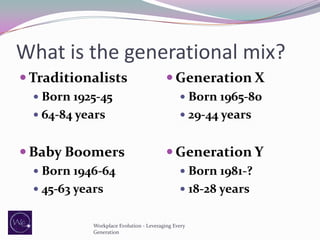
 Traditionalists

 Generation X

 Born 1925-45

 Born 1965-80

 64-84 years

 29-44 years

 Baby Boomers

 Generation Y

 Born 1946-64

 Born 1981-?

 45-63 years

 18-28 years

Workplace Evolution - Leveraging Every
Generation
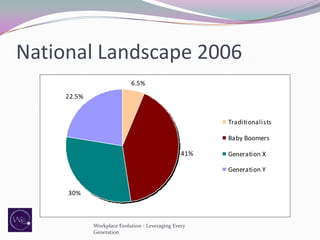
National Landscape 2006
6.5%
22.5%

Traditionalists
Baby Boomers
41%

Generation X
Generation Y

30%

Workplace Evolution - Leveraging Every
Generation
Why leverage generational knowledge?





Attracting and retaining talent is a big concern
More employees going out than coming in
Workers are changing jobs frequently
Productivity decreases and turnover costs increase
when workers change jobs
 Performance problems are more about relationships
than skills or motivations
 You already have answers to your issues

Workplace Evolution - Leveraging Every
Generation
Defining the Leadership Gap
 The period of time when executive Boomers are

preparing to leave their leadership roles to when new
leadership is installed.

 Describes not only temporal gaps, but perceptual gaps

in what well-qualified leaders look like.

 The lack of communication, preparation, and support

available among multiple generations of leaders.

Workplace Evolution - Leveraging Every
Generation
Leadership Gap – Crisis or Opportunity?
According to a 2004 Annie E. Casey Foundation
survey, “more than 2,200 nonprofit organizations
found that 65 percent of respondents expected to go
through a leadership transition by 2009, while just 57
percent had experienced a transition during the past
10 years (2005, p.2).”

Workplace Evolution - Leveraging Every
Generation
How has this affected your org?
 Work ethic

 Work priorities

 Time sensitivities

 Company loyalty

 Different

 Meeting management

communication vehicles
 Retention
 Subscription to
technology

 Change
 Level of respect
 Entitlement
 Training

Workplace Evolution - Leveraging Every
Generation
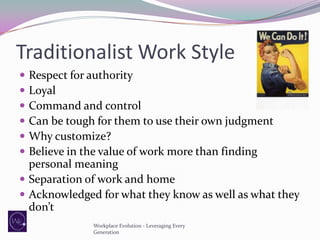
Traditionalist Work Style







Respect for authority
Loyal
Command and control
Can be tough for them to use their own judgment
Why customize?
Believe in the value of work more than finding
personal meaning
 Separation of work and home
 Acknowledged for what they know as well as what they
don’t
Workplace Evolution - Leveraging Every
Generation
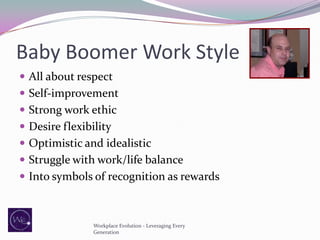
Baby Boomer Work Style
 All about respect
 Self-improvement
 Strong work ethic
 Desire flexibility

 Optimistic and idealistic
 Struggle with work/life balance
 Into symbols of recognition as rewards

Workplace Evolution - Leveraging Every
Generation
Gen X Work Style
 Stay in a job for 3.5







years, 2 years in high
tech
Money-motivated
Like to solve their own
problems
Multi-taskers
Fiercely independent
Direct communicators
versus reading in
between the lines

 Job movement
 Want to be valued







immediately for their
skills
Informal
Results-oriented
Quick study
Sound byte processing
Work solo and yet on
teams
Need for external
recognition as reward

Workplace Evolution - Leveraging Every
Generation
Millennials Work Style






Digital natives
Menu-driven thinking
Work on their own terms
Think globally
Have positive
expectations
 Want customization
 Desire interactivity
 Express to express -- not
impress







Multi-taskers
Desire mutual respect
Ready for collaboration
Are looking for a cause
Want to make a
difference
 Celebrate diversity
 Acknowledgement for
being here
 Looking for an
experience

Workplace Evolution - Leveraging Every
Generation
Motivations of Emerging Leaders
 Reasons for working for an NPO:











Enjoy giving back to the community - 82%
Personal sense of satisfaction - 81.5%)
Positive work environment - 58.3%
Professional challenges - 57.2%
Co-workers - 56%
Working with clients: 42.7%
Encouraging and supportive leadership: 40%
Professional development opportunities: 37%
Other: 3.4%
Financial compensation: 2.8%
Workplace Evolution - Leveraging Every
Generation
Where are we similar*?
 We receive great reward
 For the work we do
 From the people we work with
 And the belief that we are contributing to society and
our current jobs
 We receive great satisfaction from our

accomplishments at work
*CCL Emerging Leaders Research by Ross DePinto, 2003

Workplace Evolution - Leveraging Every
Generation
Generational Similarities
 We have
 A desire to learn
 A desire to be acknowledged
 A desire to be rewarded
 We want
 To be trusted, valued and respected
 To succeed

Workplace Evolution - Leveraging Every
Generation
Generational Similarities
 Harmony is preferred
 We want to be on the same wavelength
 We all need clear communication
 People do not like to operate out of fear

 Everyone likes to have fun

Workplace Evolution - Leveraging Every
Generation
Org Dynamics and Leadership
 Anticipate shifts in leadership styles along with
personal and professional boundaries from young
nonprofit professionals which may require more
flexibility than in the past;

 “…valuing new ideas...by setting aside biases borne
of [Boomers’] early movement experience and by
nurturing young leadership with contemporary
and critically needed perspectives both within and
outside of their organizations (Kunreuther, 2005).”
Workplace Evolution - Leveraging Every
Generation
Org Dynamics and Leadership






Set a foundation of trust and confidence.
Collaboration.
Identify and nurture more leaders of color.
Examine current organizational structures.
Consider the benefits and limitations of any new
management and leadership style and
 Be willing to take calculated risks.
 Process for communication.

Workplace Evolution - Leveraging Every
Generation
Communication Mindset
 Commit to educating and leveraging generational

differences. Concentrate on similarities.
 Employ a student and teacher mindset
 Enlarge ideas instead of taking sides
 Dialogue vs. debate

Workplace Evolution - Leveraging Every
Generation
Communication Tactics
 Conduct a temperature check survey on being
valued, trusted and respected
 Have informal & scheduled times to
brainstorm, update and coach
 Create healthy conflict resolution guidelines
 Honor energy, intuition and instincts
 Delegate well
 Define the objective
 Agree that getting to the objective is the most important

and not necessarily HOW – unless unethical
Workplace Evolution - Leveraging Every
Generation
Communication Technology
 Think wiki (open systems)
 Internal blog
 SharePoint
 Virtual candidate skill assessment techniques

 Facebook – social utility
 LinkedIn

Workplace Evolution - Leveraging Every
Generation
Next steps
 Acknowledge each





generation’s value
Recruit more emerging
leaders into board roles
Promote work/life balance
Create
internships/mentorships
Invest in professional
development

 Consider succession






planning
Plan for retirement
Make it possible to hand
over leadership
Create opportunities to
share information cross
generationally
Learn communication
strategies

Workplace Evolution - Leveraging Every
Generation

Leveraging Every Generation for Your Bottom Line

  • 1.
    Workplace Evolution Sherri Petro,VPI Strategies Emily Davis, EDA Consulting LLC Workplace Evolution - Leveraging Every Generation
  • 2.
    Welcome and Introductions What is Workplace Evolution?  Sherri Petro, VPI Strategies  Emily Davis, EDA Consulting LLC Workplace Evolution - Leveraging Every Generation
  • 3.
    Outcomes  Define thegenerational mix  Identify leadership gaps  Address issues that will affect recruitment and retention.  Provide creative strategies and solutions for leveraging every generation for your organization’s mission or bottom line Workplace Evolution - Leveraging Every Generation
  • 4.
    What is thegenerational mix?  Traditionalists  Generation X  Born 1925-45  Born 1965-80  64-84 years  29-44 years  Baby Boomers  Generation Y  Born 1946-64  Born 1981-?  45-63 years  18-28 years Workplace Evolution - Leveraging Every Generation
  • 5.
    National Landscape 2006 6.5% 22.5% Traditionalists BabyBoomers 41% Generation X Generation Y 30% Workplace Evolution - Leveraging Every Generation
  • 6.
    Why leverage generationalknowledge?     Attracting and retaining talent is a big concern More employees going out than coming in Workers are changing jobs frequently Productivity decreases and turnover costs increase when workers change jobs  Performance problems are more about relationships than skills or motivations  You already have answers to your issues Workplace Evolution - Leveraging Every Generation
  • 7.
    Defining the LeadershipGap  The period of time when executive Boomers are preparing to leave their leadership roles to when new leadership is installed.  Describes not only temporal gaps, but perceptual gaps in what well-qualified leaders look like.  The lack of communication, preparation, and support available among multiple generations of leaders. Workplace Evolution - Leveraging Every Generation
  • 8.
    Leadership Gap –Crisis or Opportunity? According to a 2004 Annie E. Casey Foundation survey, “more than 2,200 nonprofit organizations found that 65 percent of respondents expected to go through a leadership transition by 2009, while just 57 percent had experienced a transition during the past 10 years (2005, p.2).” Workplace Evolution - Leveraging Every Generation
  • 9.
    How has thisaffected your org?  Work ethic  Work priorities  Time sensitivities  Company loyalty  Different  Meeting management communication vehicles  Retention  Subscription to technology  Change  Level of respect  Entitlement  Training Workplace Evolution - Leveraging Every Generation
  • 10.
    Traditionalist Work Style       Respectfor authority Loyal Command and control Can be tough for them to use their own judgment Why customize? Believe in the value of work more than finding personal meaning  Separation of work and home  Acknowledged for what they know as well as what they don’t Workplace Evolution - Leveraging Every Generation
  • 11.
    Baby Boomer WorkStyle  All about respect  Self-improvement  Strong work ethic  Desire flexibility  Optimistic and idealistic  Struggle with work/life balance  Into symbols of recognition as rewards Workplace Evolution - Leveraging Every Generation
  • 12.
    Gen X WorkStyle  Stay in a job for 3.5      years, 2 years in high tech Money-motivated Like to solve their own problems Multi-taskers Fiercely independent Direct communicators versus reading in between the lines  Job movement  Want to be valued       immediately for their skills Informal Results-oriented Quick study Sound byte processing Work solo and yet on teams Need for external recognition as reward Workplace Evolution - Leveraging Every Generation
  • 13.
    Millennials Work Style      Digitalnatives Menu-driven thinking Work on their own terms Think globally Have positive expectations  Want customization  Desire interactivity  Express to express -- not impress      Multi-taskers Desire mutual respect Ready for collaboration Are looking for a cause Want to make a difference  Celebrate diversity  Acknowledgement for being here  Looking for an experience Workplace Evolution - Leveraging Every Generation
  • 14.
    Motivations of EmergingLeaders  Reasons for working for an NPO:           Enjoy giving back to the community - 82% Personal sense of satisfaction - 81.5%) Positive work environment - 58.3% Professional challenges - 57.2% Co-workers - 56% Working with clients: 42.7% Encouraging and supportive leadership: 40% Professional development opportunities: 37% Other: 3.4% Financial compensation: 2.8% Workplace Evolution - Leveraging Every Generation
  • 15.
    Where are wesimilar*?  We receive great reward  For the work we do  From the people we work with  And the belief that we are contributing to society and our current jobs  We receive great satisfaction from our accomplishments at work *CCL Emerging Leaders Research by Ross DePinto, 2003 Workplace Evolution - Leveraging Every Generation
  • 16.
    Generational Similarities  Wehave  A desire to learn  A desire to be acknowledged  A desire to be rewarded  We want  To be trusted, valued and respected  To succeed Workplace Evolution - Leveraging Every Generation
  • 17.
    Generational Similarities  Harmonyis preferred  We want to be on the same wavelength  We all need clear communication  People do not like to operate out of fear  Everyone likes to have fun Workplace Evolution - Leveraging Every Generation
  • 18.
    Org Dynamics andLeadership  Anticipate shifts in leadership styles along with personal and professional boundaries from young nonprofit professionals which may require more flexibility than in the past;  “…valuing new ideas...by setting aside biases borne of [Boomers’] early movement experience and by nurturing young leadership with contemporary and critically needed perspectives both within and outside of their organizations (Kunreuther, 2005).” Workplace Evolution - Leveraging Every Generation
  • 19.
    Org Dynamics andLeadership      Set a foundation of trust and confidence. Collaboration. Identify and nurture more leaders of color. Examine current organizational structures. Consider the benefits and limitations of any new management and leadership style and  Be willing to take calculated risks.  Process for communication. Workplace Evolution - Leveraging Every Generation
  • 20.
    Communication Mindset  Committo educating and leveraging generational differences. Concentrate on similarities.  Employ a student and teacher mindset  Enlarge ideas instead of taking sides  Dialogue vs. debate Workplace Evolution - Leveraging Every Generation
  • 21.
    Communication Tactics  Conducta temperature check survey on being valued, trusted and respected  Have informal & scheduled times to brainstorm, update and coach  Create healthy conflict resolution guidelines  Honor energy, intuition and instincts  Delegate well  Define the objective  Agree that getting to the objective is the most important and not necessarily HOW – unless unethical Workplace Evolution - Leveraging Every Generation
  • 22.
    Communication Technology  Thinkwiki (open systems)  Internal blog  SharePoint  Virtual candidate skill assessment techniques  Facebook – social utility  LinkedIn Workplace Evolution - Leveraging Every Generation
  • 23.
    Next steps  Acknowledgeeach     generation’s value Recruit more emerging leaders into board roles Promote work/life balance Create internships/mentorships Invest in professional development  Consider succession     planning Plan for retirement Make it possible to hand over leadership Create opportunities to share information cross generationally Learn communication strategies Workplace Evolution - Leveraging Every Generation