Northern New Jersey OD Network Retaining Employees in the Upturn: Restoring Trust Newark 7 May 2010 Kate Sweetman
 
“ I don’t know how long our employees can keep working this hard before they start to burn out – and leave.” “ We survived the recession, but now our people need to focus on hope, not fear.”  “ Fire fighting is one thing, but what we really need is sustained good will and engagement – a culture of positivity and collaboration.” “ We keep losing women at the executive level.  Why can’t we keep them?” What’s your situation?
The sun revolves around the earth  Animal species never change  Tomatoes are poisonous  You have to wait an hour after eating to swim Humans can’t fly to the moon  Telephones are only for talking and listening  What do these have in common?
What’s going on with our multi-faceted workforce  What kind of leadership meets their needs How this understanding translates into skills and behaviors individual leaders must have In this session, we will address: Goal: improve retention and release discretionary energy
What’s going on with our employees?
 
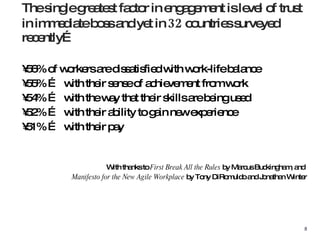
56% of workers are dissatisfied with work-life balance 55% …  with their sense of achievement from work 54% …  with the way that their skills are being used 52% …  with their ability to gain new experience 51% …  with their pay With thanks to  First Break All the Rules  by Marcus Buckingham, and  Manifesto for the New Agile Workplace  by Tony DiRomuldo and Jonathan Winter The single greatest factor in engagement is level of trust in immediate boss and yet in  32  countries surveyed recently…
Is 2010 really so special? Trust in what?  In whom?
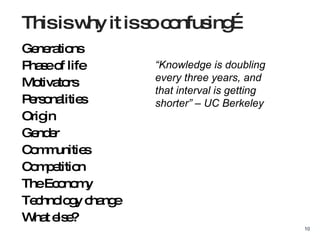
Generations Phase of life Motivators Personalities Origin Gender Communities Competition The Economy Technology change What else? This is why it is so confusing… “ Knowledge is doubling every three years, and that interval is getting shorter” – UC Berkeley
Chchchanges…
“ Burned-out, bottlenecked and bored.  That’s the current lot of millions of mid-career employees…the manager who was beginning to realize that he’d never become company president, the senior executive who felt she’s sacrificed her life - and her spirit – for her job, and the technician who was bored stiff with his unchallenging assignments…  ‘This isn’t how my life and career were supposed to play out,’ [one productive and well-respected middle manager in his late 40’s] told the employee counselor.  ‘I don’t know how much longer I can cope.’”  “ Managing Middlesence,”  Harvard Business Review, March 2006,  Robert Morison, Tamara Erickson, Ken Dychtwald  Yes, there is a Gen X
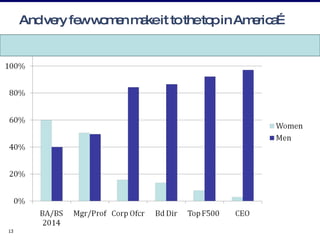
And very few women make it to the top in America…
“ The first generation to grow up digital, you are an irresistible force of creativity meeting an immovable object –  traditional ways of working .”  Don Tapscott, author of  Wikinomics And a Gen Y…
“ My research reveals two distinct groups: 1) people who believe large organizations to be fundamentally dysfunctional and who have opted out – nothing to do with the recession.  These are the people off starting their own businesses; 2) the ones who are still trying to make organizations work.  They are the ones doing all the slashing. Many of them are effectively as trapped in those organizations as anyone else, and may well be looking for a way out.”  Prof. Nick Holley, Henley School of Business And dysfunctional organizations…
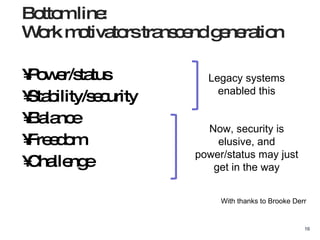
Power/status Stability/security Balance Freedom Challenge Bottom line: Work motivators transcend generation Legacy systems enabled this Now, security is elusive, and power/status may just get in the way With thanks to Brooke Derr
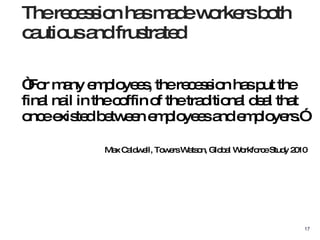
“ For many employees, the recession has put the final nail in the coffin of the traditional deal that  once existed between employees and employers.” Max Caldwell, Towers Watson, Global Workforce Study 2010 The recession has made workers both cautious and frustrated
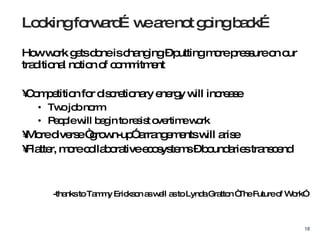
How work gets done is changing – putting more pressure on our traditional notion of commitment Competition for discretionary energy will increase Two job norm People will begin to resist overtime work More diverse “grown-up” arrangements will arise Flatter, more collaborative ecosystems – boundaries transcend -thanks to Tammy Erickson as well as to Lynda Gratton “The Future of Work” Looking forward…we are not going back…
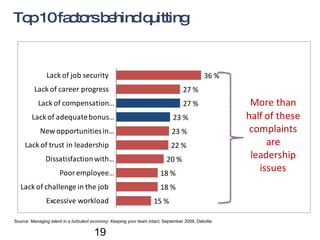
Top 10 factors behind quitting Source:  Managing talent in a turbulent economy: Keeping your team intact,  September 2009, Deloitte.
Bottom Line: the work context has changed, and the leadership that guides actions must change, too
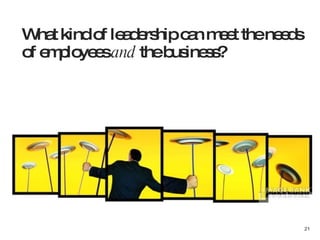
What kind of leadership can meet the needs of employees  and  the business?
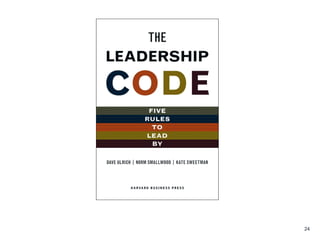
Top Companies for Leaders (with Hewitt and Fortune magazine) Singapore MOM The Leadership Code Does leadership matter?
The What:  The organization is doing the right thing (goals and strategies) The How:  We know how to execute (make decisions, take actions) The Why:  Trust in the people leading the organization -- and they in you  “ The Trusted Leader”, Rob Galford and Annie Drapeau The Employee Value Proposition is met by the Leadership Value Proposition:  “ I am getting from my leadership at least as much as I am giving”  @ the Heart of Engagement:  Trust in Leadership
 
Are all trusted leaders the same or different?
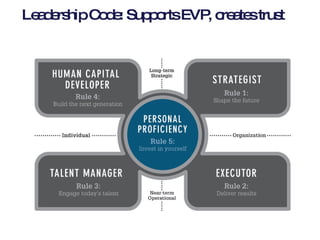
Leadership Code: Supports EVP, creates trust
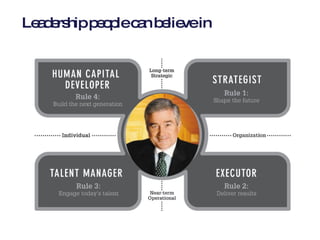
Leadership people can believe in
Leaders create culture “ I came to see, in my time at IBM, that culture isn’t just one aspect of the game -- it is the game.  In the end, the organization is nothing more than the collective capacity of the organization to create value.  Vision, strategy, marketing, financial management – any management system, in fact – can set you on the right path and can carry you for a while.  But no enterprise…will succeed over the long haul if [the right cultural] elements aren’t part of its DNA.” Who Says Elephants Can’t Dance ?, Louis Gerstner
Culture must serve the business need “ Successful institutions always develop strong cultures that make the institution great. They reflect the environment from which they emerged.  When the environment shifts, it is very hard for the culture to change. In fact, it becomes an enormous impediment to the institution’s ability to adapt.”  Who Says Elephants Can’t Dance ?, Louis Gerstner
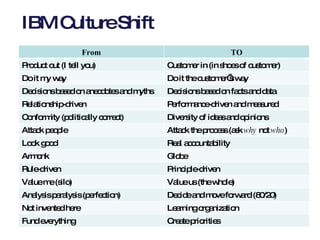
IBM Culture Shift From TO Product out (I tell you) Customer in (in shoes of customer) Do it my way Do it the customer’s way Decisions based on anecdotes and myths Decisions based on facts and data Relationship-driven Performance-driven and measured Conformity (politically correct) Diversity of ideas and opinions Attack people Attack the process (ask  why  not  who ) Look good Real accountability Armonk Globe Rule-driven Principle-driven Value me (silo) Value us (the whole) Analysis paralysis (perfection) Decide and move forward (80/20) Not invented here Learning organization Fund everything Create priorities
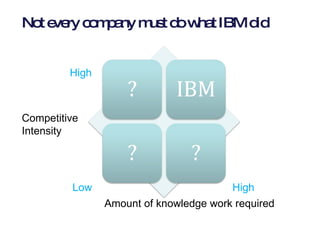
Not every company must do what IBM did Amount of knowledge work required Competitive Intensity Low High High
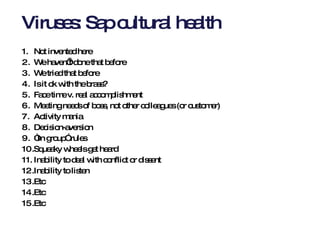
Viruses: Sap cultural health Not invented here We haven’t done that before We tried that before Is it ok with the brass? Face time v. real accomplishment Meeting needs of boss, not other colleagues (or customer) Activity mania Decision-aversion “ In group” rules Squeaky wheels get heard Inability to deal with conflict or dissent Inability to listen Etc Etc Etc
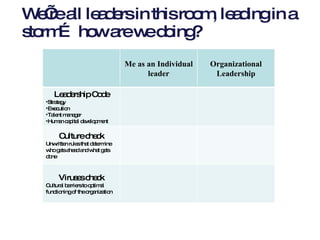
We’re all leaders in this room, leading in a storm… how are we doing? Me as an Individual leader Organizational Leadership Leadership Code Strategy Execution Talent manager Human capital development Culture check Unwritten rules that determine who gets ahead and what gets done Viruses check Cultural barriers to optimal functioning of the organization
Do we understand the power of the individual leader?
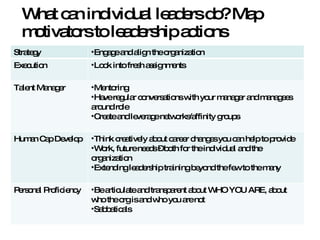
What can individual leaders do? Map motivators to leadership actions Strategy Engage and align the organization Execution Look into fresh assignments  Talent Manager Mentoring  Have regular conversations with your manager and managees around role Create and leverage networks/affinity groups Human Cap Develop Think creatively about career changes you can help to provide Work, future needs – both for the individual and the organization  Extending leadership training beyond the few to the many  Personal Proficiency Be articulate and transparent about WHO YOU ARE, about who the org is and who you are not Sabbaticals
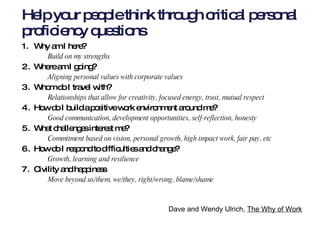
Help your people think through critical personal proficiency questions Why am I here?  Build on my strengths Where am I going? Aligning personal values with corporate values Whom do I travel with? Relationships that allow for creativity, focused energy, trust, mutual respect How do I build a positive work environment around me? Good communication, development opportunities, self-reflection, honesty What challenges interest me? Commitment based on vision, personal growth, high impact work, fair pay, etc  How do I respond to difficulties and change? Growth, learning and resilience Civility and happiness Move beyond us/them, we/they, right/wrong, blame/shame Dave and Wendy Ulrich,  The Why of Work
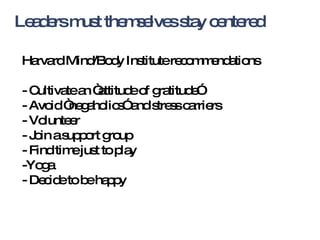
Leaders must themselves stay centered Harvard Mind/Body Institute recommendations - Cultivate an “attitude of gratitude” - Avoid “negaholics” and stress carriers  - Volunteer - Join a support group - Find time just to play -Yoga - Decide to be happy
Go to the people: Live with them, learn from them Love them Start with what they know Build with what they have. But of the best leaders, When the job is done, The task accomplished. The people will say: “ We have done it ourselves.” --Lao Tsu
Would love to stay in touch!  Email:  [email_address]   Blog:  Decoding Leadership   (http://www.fastcompany.com/blog/kate-sweetman/decoding-leadership-0) Video:  Thinkers50 video   (http://www.thinkers50.com/video/20) Website version1.0:   Sweetman & Associates Leadership Consulting www.sweetmanconsulting.org

Retaining Employees in the Upturn

  • 1.
    Northern New JerseyOD Network Retaining Employees in the Upturn: Restoring Trust Newark 7 May 2010 Kate Sweetman
  • 2.
  • 3.
    “ I don’tknow how long our employees can keep working this hard before they start to burn out – and leave.” “ We survived the recession, but now our people need to focus on hope, not fear.” “ Fire fighting is one thing, but what we really need is sustained good will and engagement – a culture of positivity and collaboration.” “ We keep losing women at the executive level. Why can’t we keep them?” What’s your situation?
  • 4.
    The sun revolvesaround the earth Animal species never change Tomatoes are poisonous You have to wait an hour after eating to swim Humans can’t fly to the moon Telephones are only for talking and listening What do these have in common?
  • 5.
    What’s going onwith our multi-faceted workforce What kind of leadership meets their needs How this understanding translates into skills and behaviors individual leaders must have In this session, we will address: Goal: improve retention and release discretionary energy
  • 6.
    What’s going onwith our employees?
  • 7.
  • 8.
    56% of workersare dissatisfied with work-life balance 55% … with their sense of achievement from work 54% … with the way that their skills are being used 52% … with their ability to gain new experience 51% … with their pay With thanks to First Break All the Rules by Marcus Buckingham, and Manifesto for the New Agile Workplace by Tony DiRomuldo and Jonathan Winter The single greatest factor in engagement is level of trust in immediate boss and yet in 32 countries surveyed recently…
  • 9.
    Is 2010 reallyso special? Trust in what? In whom?
  • 10.
    Generations Phase oflife Motivators Personalities Origin Gender Communities Competition The Economy Technology change What else? This is why it is so confusing… “ Knowledge is doubling every three years, and that interval is getting shorter” – UC Berkeley
  • 11.
  • 12.
    “ Burned-out, bottleneckedand bored. That’s the current lot of millions of mid-career employees…the manager who was beginning to realize that he’d never become company president, the senior executive who felt she’s sacrificed her life - and her spirit – for her job, and the technician who was bored stiff with his unchallenging assignments… ‘This isn’t how my life and career were supposed to play out,’ [one productive and well-respected middle manager in his late 40’s] told the employee counselor. ‘I don’t know how much longer I can cope.’” “ Managing Middlesence,” Harvard Business Review, March 2006, Robert Morison, Tamara Erickson, Ken Dychtwald Yes, there is a Gen X
  • 13.
    And very fewwomen make it to the top in America…
  • 14.
    “ The firstgeneration to grow up digital, you are an irresistible force of creativity meeting an immovable object – traditional ways of working .” Don Tapscott, author of Wikinomics And a Gen Y…
  • 15.
    “ My researchreveals two distinct groups: 1) people who believe large organizations to be fundamentally dysfunctional and who have opted out – nothing to do with the recession. These are the people off starting their own businesses; 2) the ones who are still trying to make organizations work. They are the ones doing all the slashing. Many of them are effectively as trapped in those organizations as anyone else, and may well be looking for a way out.” Prof. Nick Holley, Henley School of Business And dysfunctional organizations…
  • 16.
    Power/status Stability/security BalanceFreedom Challenge Bottom line: Work motivators transcend generation Legacy systems enabled this Now, security is elusive, and power/status may just get in the way With thanks to Brooke Derr
  • 17.
    “ For manyemployees, the recession has put the final nail in the coffin of the traditional deal that once existed between employees and employers.” Max Caldwell, Towers Watson, Global Workforce Study 2010 The recession has made workers both cautious and frustrated
  • 18.
    How work getsdone is changing – putting more pressure on our traditional notion of commitment Competition for discretionary energy will increase Two job norm People will begin to resist overtime work More diverse “grown-up” arrangements will arise Flatter, more collaborative ecosystems – boundaries transcend -thanks to Tammy Erickson as well as to Lynda Gratton “The Future of Work” Looking forward…we are not going back…
  • 19.
    Top 10 factorsbehind quitting Source: Managing talent in a turbulent economy: Keeping your team intact, September 2009, Deloitte.
  • 20.
    Bottom Line: thework context has changed, and the leadership that guides actions must change, too
  • 21.
    What kind ofleadership can meet the needs of employees and the business?
  • 22.
    Top Companies forLeaders (with Hewitt and Fortune magazine) Singapore MOM The Leadership Code Does leadership matter?
  • 23.
    The What: The organization is doing the right thing (goals and strategies) The How: We know how to execute (make decisions, take actions) The Why: Trust in the people leading the organization -- and they in you “ The Trusted Leader”, Rob Galford and Annie Drapeau The Employee Value Proposition is met by the Leadership Value Proposition: “ I am getting from my leadership at least as much as I am giving” @ the Heart of Engagement: Trust in Leadership
  • 24.
  • 25.
    Are all trustedleaders the same or different?
  • 26.
    Leadership Code: SupportsEVP, creates trust
  • 27.
  • 28.
    Leaders create culture“ I came to see, in my time at IBM, that culture isn’t just one aspect of the game -- it is the game. In the end, the organization is nothing more than the collective capacity of the organization to create value. Vision, strategy, marketing, financial management – any management system, in fact – can set you on the right path and can carry you for a while. But no enterprise…will succeed over the long haul if [the right cultural] elements aren’t part of its DNA.” Who Says Elephants Can’t Dance ?, Louis Gerstner
  • 29.
    Culture must servethe business need “ Successful institutions always develop strong cultures that make the institution great. They reflect the environment from which they emerged. When the environment shifts, it is very hard for the culture to change. In fact, it becomes an enormous impediment to the institution’s ability to adapt.” Who Says Elephants Can’t Dance ?, Louis Gerstner
  • 30.
    IBM Culture ShiftFrom TO Product out (I tell you) Customer in (in shoes of customer) Do it my way Do it the customer’s way Decisions based on anecdotes and myths Decisions based on facts and data Relationship-driven Performance-driven and measured Conformity (politically correct) Diversity of ideas and opinions Attack people Attack the process (ask why not who ) Look good Real accountability Armonk Globe Rule-driven Principle-driven Value me (silo) Value us (the whole) Analysis paralysis (perfection) Decide and move forward (80/20) Not invented here Learning organization Fund everything Create priorities
  • 31.
    Not every companymust do what IBM did Amount of knowledge work required Competitive Intensity Low High High
  • 32.
    Viruses: Sap culturalhealth Not invented here We haven’t done that before We tried that before Is it ok with the brass? Face time v. real accomplishment Meeting needs of boss, not other colleagues (or customer) Activity mania Decision-aversion “ In group” rules Squeaky wheels get heard Inability to deal with conflict or dissent Inability to listen Etc Etc Etc
  • 33.
    We’re all leadersin this room, leading in a storm… how are we doing? Me as an Individual leader Organizational Leadership Leadership Code Strategy Execution Talent manager Human capital development Culture check Unwritten rules that determine who gets ahead and what gets done Viruses check Cultural barriers to optimal functioning of the organization
  • 34.
    Do we understandthe power of the individual leader?
  • 35.
    What can individualleaders do? Map motivators to leadership actions Strategy Engage and align the organization Execution Look into fresh assignments Talent Manager Mentoring Have regular conversations with your manager and managees around role Create and leverage networks/affinity groups Human Cap Develop Think creatively about career changes you can help to provide Work, future needs – both for the individual and the organization Extending leadership training beyond the few to the many Personal Proficiency Be articulate and transparent about WHO YOU ARE, about who the org is and who you are not Sabbaticals
  • 36.
    Help your peoplethink through critical personal proficiency questions Why am I here? Build on my strengths Where am I going? Aligning personal values with corporate values Whom do I travel with? Relationships that allow for creativity, focused energy, trust, mutual respect How do I build a positive work environment around me? Good communication, development opportunities, self-reflection, honesty What challenges interest me? Commitment based on vision, personal growth, high impact work, fair pay, etc How do I respond to difficulties and change? Growth, learning and resilience Civility and happiness Move beyond us/them, we/they, right/wrong, blame/shame Dave and Wendy Ulrich, The Why of Work
  • 37.
    Leaders must themselvesstay centered Harvard Mind/Body Institute recommendations - Cultivate an “attitude of gratitude” - Avoid “negaholics” and stress carriers - Volunteer - Join a support group - Find time just to play -Yoga - Decide to be happy
  • 38.
    Go to thepeople: Live with them, learn from them Love them Start with what they know Build with what they have. But of the best leaders, When the job is done, The task accomplished. The people will say: “ We have done it ourselves.” --Lao Tsu
  • 39.
    Would love tostay in touch! Email: [email_address] Blog: Decoding Leadership (http://www.fastcompany.com/blog/kate-sweetman/decoding-leadership-0) Video: Thinkers50 video (http://www.thinkers50.com/video/20) Website version1.0: Sweetman & Associates Leadership Consulting www.sweetmanconsulting.org