Forest Honey:
-Sustainable Livelihoods and Developing Social Enterprises
an experience from India
Robert Leo
Deputy Director
Keystone
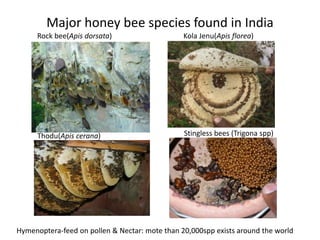
Major honey bee species found in India
Rock bee(Apis dorsata)
Thodu(Apis cerana)
Kola Jenu(Apis florea)
Stingless bees (Trigona spp)
Hymenoptera-feed on pollen & Nectar: mote than 20,000spp exists around the world
Sustainable harvesting practice: collect honey part only, save brood and queen cells.
21 tonnes of honey is collected with above principles and methods
Sustainable harvest
techniques
1. collect honey part only
2. save all brood
3. save queen cells
4. which allows colony to
multiply
5. use only smoke
6. collect honey at capped
stage
7. protect the habitat
8. protect melliferous plant
9. promote melliferous
plants
Honey cells are deeper than brood
cells
Large storage of pollen is underneath
honey cells, these storage is evident
all along the mid rib
Honey cells and store
of honey
Pollen is observed
underneath honey
Bees stores Pollen in honey cells-underneath
A demonstration with Jenu kurubas Tribes:
Note- mid rib cutting and draining is free from bees-free from contamination.
straining through clean nylon filter is important for transparent/clear honey
Hygienic handling assures long life to honey while storing & marketing
Traditional Honey Gathering in Apis cerana
nests by Toda tribal men in Nilgiris
• Traditional honey collection begins
with Toda attire and cane stick : an
important ritual-bees are considered
sacred among Toda
• Toda observes flowering, forage etc.
• Traditional ownership for about 30-40 cavities
(20 -25 are productive)
• 5-8 kg of honey is collected per cavity
• Honey is sold @ Rs.500-600per kg(8-10USD)
• All indigenous community members follow
strict norms regarding cavity ownership and
there is no over riding other’s right.
Destructive honey gathering by some communities
- through training the method is changed in
to sustainable harvest practices
Appropriate bee keeping is promoted
• Top bar hives for colony multiplication
• Frames for super chamber
• Local resources are used for building hives-bamboo,
forest wine, clay or logs
• Self fabrication
• Easy to handle- swarm controls,
Bamboo stick-split in to a fork
Sustainable honey collecting technique in Apis florea bee colonies
Traditional knowledge is strengthened with scientific inputs which enhances sustainable
livelihoods amongst indigenous communities
0
200
400
600
800
1000
1200
1400
1600
Apankapu Bedaguli Kalidambam
Density ha-1 of bee-pollinated trees (>10cm gbh)
Bees
Others
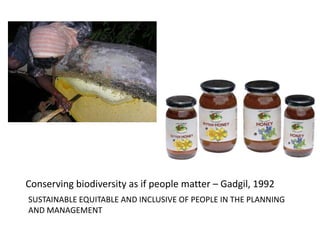
SUSTAINABLE EQUITABLE AND INCLUSIVE OF PEOPLE IN THE PLANNING
AND MANAGEMENT
Conserving biodiversity as if people matter – Gadgil, 1992
Wax value addition: soaps 9 types, Lip balms 7 types,
Pain palms 5 types, candles 5 types, warp 2sizes
Aadhimalai
Pazhangudiyinar
Producer Company Ltd
 An apex institution for number of village
enterprise units.- 1605 share holders, 73846 USD
 Provides technical support for value addition of
forest and farm produces
 Supports ecological monitoring and sustainable
forest collection.
 Fair price is given to collectors and producers.
 Supports village forest council operations and
leadership building
 It involves in continuous product development and
skill up gradation with its members
 It provide opportunity for sharing profit with its
members and provide 7006 labourdays
 It supports rural level markets-Annual turn over of
184615 USD
Natural & Diverse
•Hive honey
•Forest-multi floral
honey
•Bitter honey
•Kurinji honey
•Dammer honey
•Florea honey
Flavoured:
• Ginger
•Pepper
•Saffron
•Cinnamon
With nuts-fruits-spice
Dry grape, cashew,
dates,
Amla fruits
Green shop
 Fair trade shops
 PGS certification
 Producer groups
 Urban & metros
 Linking the customers to
conservation initiatives
LAST FOREST ENTERPRISE
Observes 54% of it goods from Appcl
-Product development
-innovation
-trends
-sharing profits
-PES
Annual turn over of 492307 USD
06 india eng

06 india eng

  • 1.
    Forest Honey: -Sustainable Livelihoodsand Developing Social Enterprises an experience from India Robert Leo Deputy Director Keystone
  • 2.
    Major honey beespecies found in India Rock bee(Apis dorsata) Thodu(Apis cerana) Kola Jenu(Apis florea) Stingless bees (Trigona spp) Hymenoptera-feed on pollen & Nectar: mote than 20,000spp exists around the world
  • 3.
    Sustainable harvesting practice:collect honey part only, save brood and queen cells. 21 tonnes of honey is collected with above principles and methods
  • 4.
    Sustainable harvest techniques 1. collecthoney part only 2. save all brood 3. save queen cells 4. which allows colony to multiply 5. use only smoke 6. collect honey at capped stage 7. protect the habitat 8. protect melliferous plant 9. promote melliferous plants
  • 5.
    Honey cells aredeeper than brood cells Large storage of pollen is underneath honey cells, these storage is evident all along the mid rib Honey cells and store of honey Pollen is observed underneath honey Bees stores Pollen in honey cells-underneath
  • 6.
    A demonstration withJenu kurubas Tribes: Note- mid rib cutting and draining is free from bees-free from contamination. straining through clean nylon filter is important for transparent/clear honey Hygienic handling assures long life to honey while storing & marketing
  • 7.
    Traditional Honey Gatheringin Apis cerana nests by Toda tribal men in Nilgiris • Traditional honey collection begins with Toda attire and cane stick : an important ritual-bees are considered sacred among Toda • Toda observes flowering, forage etc. • Traditional ownership for about 30-40 cavities (20 -25 are productive) • 5-8 kg of honey is collected per cavity • Honey is sold @ Rs.500-600per kg(8-10USD) • All indigenous community members follow strict norms regarding cavity ownership and there is no over riding other’s right.
  • 8.
    Destructive honey gatheringby some communities - through training the method is changed in to sustainable harvest practices
  • 9.
    Appropriate bee keepingis promoted • Top bar hives for colony multiplication • Frames for super chamber • Local resources are used for building hives-bamboo, forest wine, clay or logs • Self fabrication • Easy to handle- swarm controls,
  • 10.
    Bamboo stick-split into a fork Sustainable honey collecting technique in Apis florea bee colonies
  • 11.
    Traditional knowledge isstrengthened with scientific inputs which enhances sustainable livelihoods amongst indigenous communities
  • 12.
    0 200 400 600 800 1000 1200 1400 1600 Apankapu Bedaguli Kalidambam Densityha-1 of bee-pollinated trees (>10cm gbh) Bees Others
  • 13.
    SUSTAINABLE EQUITABLE ANDINCLUSIVE OF PEOPLE IN THE PLANNING AND MANAGEMENT Conserving biodiversity as if people matter – Gadgil, 1992
  • 14.
    Wax value addition:soaps 9 types, Lip balms 7 types, Pain palms 5 types, candles 5 types, warp 2sizes
  • 15.
    Aadhimalai Pazhangudiyinar Producer Company Ltd An apex institution for number of village enterprise units.- 1605 share holders, 73846 USD  Provides technical support for value addition of forest and farm produces  Supports ecological monitoring and sustainable forest collection.  Fair price is given to collectors and producers.  Supports village forest council operations and leadership building  It involves in continuous product development and skill up gradation with its members  It provide opportunity for sharing profit with its members and provide 7006 labourdays  It supports rural level markets-Annual turn over of 184615 USD
  • 16.
    Natural & Diverse •Hivehoney •Forest-multi floral honey •Bitter honey •Kurinji honey •Dammer honey •Florea honey Flavoured: • Ginger •Pepper •Saffron •Cinnamon With nuts-fruits-spice Dry grape, cashew, dates, Amla fruits Green shop  Fair trade shops  PGS certification  Producer groups  Urban & metros  Linking the customers to conservation initiatives LAST FOREST ENTERPRISE Observes 54% of it goods from Appcl -Product development -innovation -trends -sharing profits -PES Annual turn over of 492307 USD