UNIT II -- PROCESS AND
SYNCHRONIZATION
Processes – Threads - Communication and
Invocation - Clocks, Events and Process States -
Synchronization Physical Clocks - Logical Time
and Logical Clocks - Global States – Distributed
Mutual Exclusion - Elections- Distributed
Transactions.
PROCESSES:
• Processes play a crucial role in distributed systems.
• The concept of a process originates from the field of operating
systems where it is generally defined as a program in
execution
• a process consists of an execution environment together with
one or more threads.
• A thread is the operating system abstraction of an activity
• An execution environment primarily consists of:
• an address space;
• thread synchronization and communication resources
such as semaphores and communication interfaces (for
example, sockets);
• higher-level resources such as open files and windows.
• Threads can be created and destroyed dynamically, as needed.
• The central aim of having multiple threads of execution is to
maximize the degree of concurrent execution between
operations.
• As many older operating systems allow only one thread per
process, we shall sometimes use the term multi-threaded
process for emphasis.
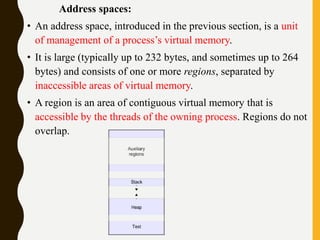
Address spaces:
• An address space, introduced in the previous section, is a unit
of management of a process’s virtual memory.
• It is large (typically up to 232 bytes, and sometimes up to 264
bytes) and consists of one or more regions, separated by
inaccessible areas of virtual memory.
• A region is an area of contiguous virtual memory that is
accessible by the threads of the owning process. Regions do not
overlap.
• Each region is specified by the following properties:
– its extent (lowest virtual address and size);
– read/write/execute permissions for the process’s threads;
– whether it can be grown upwards or downwards.
• A shared memory region (or shared region for short) is one that
is backed by the same physical memory as one or more regions
belonging to other address spaces.
The uses of shared regions include the following:
– Libraries: Library code can be very large and would waste
considerable memory if it was loaded separately into every
process that used it.
– Kernel: Often the kernel code and data are mapped into
every address space at the same location. When a process
makes a system call or an exception occurs, there is no
need to switch to a new set of address mappings.
– Data sharing and communication: Two processes, or a
process and the kernel, might need to share data in order to
cooperate on some task.
Creation of a new process:
• The creation of a new process has traditionally been an
indivisible operation provided by the operating system.
• For example, the UNIX fork system call creates a process with
an execution environment copied from the caller (except for
the return value from fork).
• The UNIX exec system call transforms the calling process into
one executing the code of a named program.
Creation of a new execution environment:
• Once the host computer has been selected, a new process
requires an execution environment consisting of an address
space with initialized contents.
• There are two approaches to defining and initializing the
address space of a newly created process.
• The first approach is used where the address space is of a
statically defined format. For example, it could contain just a
program text region, heap region and stack region. In this case,
the address space regions are created from a list specifying
their extent.
• Alternatively, the address space can be defined with respect to
an existing execution environment. In the case of UNIX fork
semantics, for example, the newly created child process
physically shares the parent’s text region and has heap and
stack regions that are copies of the parent’s in extent
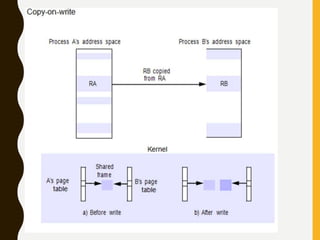
• Copy-on-write is a general technique – for example, it is also
used in copying large messages – so we take some time to
explain its operation here.
• Let us follow through an example of regions RA and RB,
whose memory is shared copy-on-write between two
processes, A and B .
• For the sake of definiteness, let us assume that process A set
region RA to be copy-inherited by its child, process B, and that
the region RB was thus created in process B.
Threads:
• Threads communicate and synchronize with each other using
fast shared memory mechanisms.
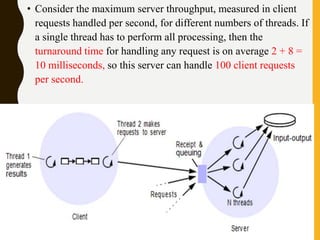
• The server has a pool of one or more threads, each of which
repeatedly removes a request from a queue of received
requests and processes it.
• each thread applies the same procedure to process the requests.
• Let us assume that each request takes, on average, 2
milliseconds of processing plus 8 milliseconds of I/O
(input/output) delay when the server reads from a disk.
• Let us further assume for the moment that the server executes
at a single-processor computer.
• Consider the maximum server throughput, measured in client
requests handled per second, for different numbers of threads. If
a single thread has to perform all processing, then the
turnaround time for handling any request is on average 2 + 8 =
10 milliseconds, so this server can handle 100 client requests
per second.
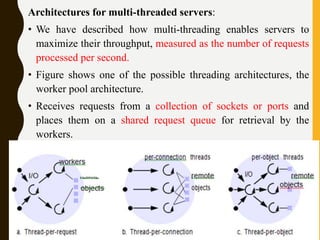
Architectures for multi-threaded servers:
• We have described how multi-threading enables servers to
maximize their throughput, measured as the number of requests
processed per second.
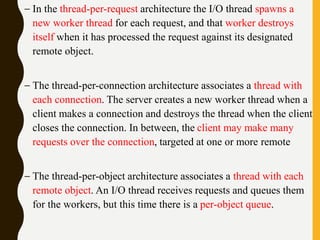
• Figure shows one of the possible threading architectures, the
worker pool architecture.
• Receives requests from a collection of sockets or ports and
places them on a shared request queue for retrieval by the
workers.
– In the thread-per-request architecture the I/O thread spawns a
new worker thread for each request, and that worker destroys
itself when it has processed the request against its designated
remote object.
– The thread-per-connection architecture associates a thread with
each connection. The server creates a new worker thread when a
client makes a connection and destroys the thread when the client
closes the connection. In between, the client may make many
requests over the connection, targeted at one or more remote
– The thread-per-object architecture associates a thread with each
remote object. An I/O thread receives requests and queues them
for the workers, but this time there is a per-object queue.
Threads within clients
• Client process with two threads.
• The first thread generates results to be passed to a server by
remote method invocation, but does not require a reply. Remote
method invocations typically block the caller, even when there
is strictly no need to wait.
• This client process can incorporate a second thread, which
performs the remote method invocations and blocks while the
first thread is able to continue computing further results.
Thread scheduling
• An important distinction is between preemptive and non-
preemptive scheduling of threads. In preemptive scheduling, a
thread may be suspended at any point to make way for another
thread,
Threads implementation
• Many kernels provide native support for multi-threaded
processes, including Windows, Linux, Solaris, Mach and Mac
OS X.
• These kernels provide thread-creation and -management system
calls, and they schedule individual threads.
• A threads runtime library organizes the scheduling of threads.
• A thread would block the process, and therefore all threads
within it, if it made a blocking system call, so the asynchronous
(non-blocking) I/O facilities of the underlying kernel are
exploited.
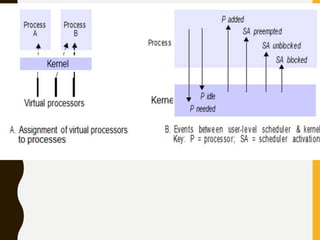
• The number of virtual processors assigned to a process can also
vary.
• if process A has requested an extra virtual processor and B
terminates, then the kernel can assign one to A.
• Figure shows that a process notifies the kernel when either of
two types of event occurs: when a virtual processor is ‘idle’ and
no longer needed, or when an extra virtual processor is
required.
• Figure also shows that the kernel notifies the process when any
of four types of event occurs. A scheduler activation (SA) is a
call from the kernel to a process, which notifies the process’s
scheduler of an event.
COMMUNICATION AND INVOCATION
• Some kernels designed for distributed systems have provided
communication primitives tailored to the types of invocation.
• For example, provides doOperation, getRequest and sendReply
as primitives.
• Placing relatively high-level communication functionality in
the kernel has the advantage of efficiency.
• If, for example, middleware provides RMI over UNIX’s
connected (TCP) sockets, then a client must make two
communication system calls (socket write and read) for each
remote invocation.
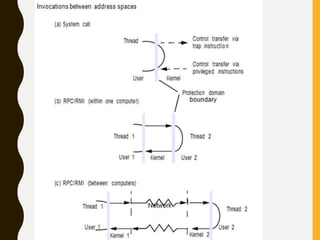
Invocation performance:
• Invocation performance is a critical factor in distributed system
design.
• RPC and RMI implementations have been the subject of study
because of the widespread acceptance of these mechanisms for
general-purpose client-server processing.
• Calling a conventional procedure or invoking a conventional
method, making a system call, sending a message, remote
procedure calling and remote method invocation are all
examples of invocation mechanisms.
Invocation over the network
• A null RPC (and similarly, a null RMI) is defined as an RPC
without parameters that executes a null procedure and returns
no values. Its execution involves an exchange of messages
carrying some system data but no user data.
• Null invocation (RPC, RMI) costs are important because they
measure a fixed overhead, the latency.
The following are the main components accounting for remote
invocation delay, besides network transmission times:
• Marshalling: Marshalling and unmarshalling, which involve
copying and converting data, create a significant overhead as the
amount of data grows.
• Waiting for acknowledgements: The choice of RPC protocol
may influence delay, particularly when large amounts of data are
sent.
• Memory sharing - Data is communicated by writing to and
reading from the shared region.
• Choice of protocol • The delay that a client experiences during
request-reply interactions over TCP is not necessarily worse
than for UDP and in fact is sometimes better, particularly for
large messages.
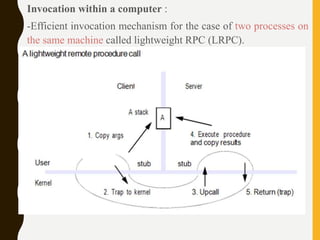
Invocation within a computer :
-Efficient invocation mechanism for the case of two processes on
the same machine called lightweight RPC (LRPC).
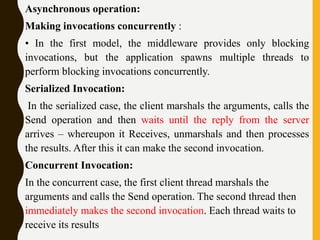
Asynchronous operation:
Making invocations concurrently :
• In the first model, the middleware provides only blocking
invocations, but the application spawns multiple threads to
perform blocking invocations concurrently.
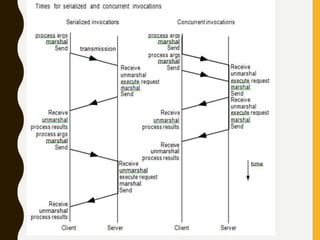
Serialized Invocation:
In the serialized case, the client marshals the arguments, calls the
Send operation and then waits until the reply from the server
arrives – whereupon it Receives, unmarshals and then processes
the results. After this it can make the second invocation.
Concurrent Invocation:
In the concurrent case, the first client thread marshals the
arguments and calls the Send operation. The second thread then
immediately makes the second invocation. Each thread waits to
receive its results
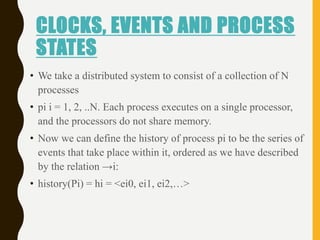
CLOCKS, EVENTS AND PROCESS
STATES
• We take a distributed system to consist of a collection of N
processes
• pi i = 1, 2, ..N. Each process executes on a single processor,
and the processors do not share memory.
• Now we can define the history of process pi to be the series of
events that take place within it, ordered as we have described
by the relation →i:
• history(Pi) = hi = <ei0, ei1, ei2,…>
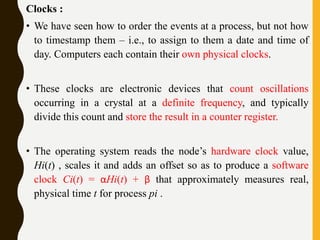
Clocks :
• We have seen how to order the events at a process, but not how
to timestamp them – i.e., to assign to them a date and time of
day. Computers each contain their own physical clocks.
• These clocks are electronic devices that count oscillations
occurring in a crystal at a definite frequency, and typically
divide this count and store the result in a counter register.
• The operating system reads the node’s hardware clock value,
Hi(t) , scales it and adds an offset so as to produce a software
clock Ci(t) = αHi(t) + β that approximately measures real,
physical time t for process pi .
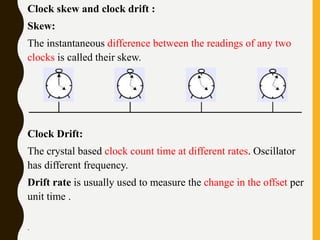
Clock skew and clock drift :
Skew:
The instantaneous difference between the readings of any two
clocks is called their skew.
Clock Drift:
The crystal based clock count time at different rates. Oscillator
has different frequency.
Drift rate is usually used to measure the change in the offset per
unit time .
.
Coordinated Universal Time :
• Computer clocks can be synchronized to external sources of
highly accurate time. The most accurate physical clocks use
atomic oscillators.
• UTC signals are synchronized and broadcast regularly from
land- based radio stations and satellites covering many parts of
the world.
• Computers with receivers attached can synchronize their clocks
with these timing signals.
SYNCHRONIZATION PHYSICAL CLOCKS:
• distributed systems do not follow common clock, each system
functions based on its own internal clock and its own notion of
time.
• The time in distributed systems is measured in the
following contexts:
-The time of the day at which an event happened on a
specific machine in the network.
-The time interval between two events that happened on
different machines in the network.
-The relative ordering of events that happened on different
machines in the network.
Clock synchronization is the process of ensuring that
physically distributed processors have a common notion of
time.
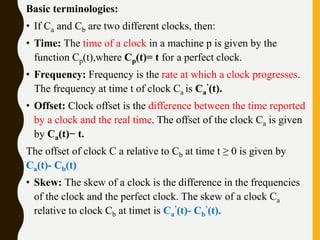
Basic terminologies:
• If Ca and Cb are two different clocks, then:
• Time: The time of a clock in a machine p is given by the
function Cp(t),where Cp(t)= t for a perfect clock.
• Frequency: Frequency is the rate at which a clock progresses.
The frequency at time t of clock Ca is Ca
’(t).
• Offset: Clock offset is the difference between the time reported
by a clock and the real time. The offset of the clock Ca is given
by Ca(t)− t.
The offset of clock C a relative to Cb at time t ≥ 0 is given by
Ca(t)- Cb(t)
• Skew: The skew of a clock is the difference in the frequencies
of the clock and the perfect clock. The skew of a clock Ca
relative to clock Cb at timet is Ca
’(t)- Cb
’(t).
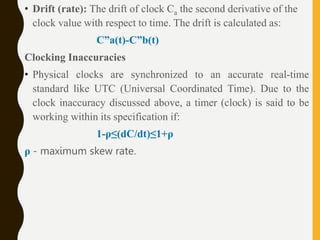
• Drift (rate): The drift of clock Ca the second derivative of the
clock value with respect to time. The drift is calculated as:
C”a(t)-C”b(t)
Clocking Inaccuracies
• Physical clocks are synchronized to an accurate real-time
standard like UTC (Universal Coordinated Time). Due to the
clock inaccuracy discussed above, a timer (clock) is said to be
working within its specification if:
1-ρ≤(dC/dt)≤1+ρ
ρ - maximum skew rate.
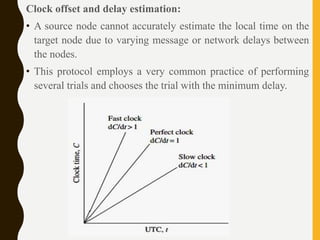
Clock offset and delay estimation:
• A source node cannot accurately estimate the local time on the
target node due to varying message or network delays between
the nodes.
• This protocol employs a very common practice of performing
several trials and chooses the trial with the minimum delay.
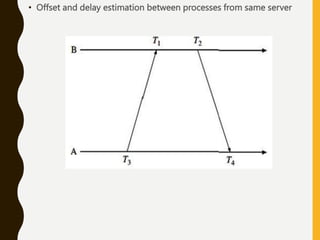
• Offset and delay estimation between processes from same server
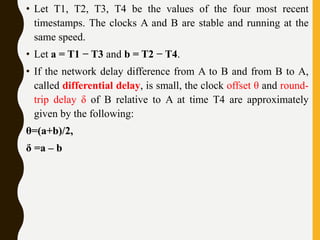
• Let T1, T2, T3, T4 be the values of the four most recent
timestamps. The clocks A and B are stable and running at the
same speed.
• Let a = T1 − T3 and b = T2 − T4.
• If the network delay difference from A to B and from B to A,
called differential delay, is small, the clock offset θ and round-
trip delay δ of B relative to A at time T4 are approximately
given by the following:
θ=(a+b)/2,
δ =a – b
LOGICAL TIME AND LOGICAL CLOCKS:
• Logical clocks are based on capturing chronological and
causal relationships of processes and ordering events based on
these relationships.
• Three types of logical clock are maintained in distributed
systems:
• Scalar clock
• Vector clock
• Matrix clock
A Framework for a system of logical clocks:
• The logical clock C is a function that maps an event e in a
distributed system to an element in the time domain T denoted
as C(e).
C : H αT such that
• for any two events ei and ej,. ei → ej C(ei)< C(ej).
• This monotonicity property is called the clock consistency
condition.When T and C satisfy the following condition,
ei, → ej  C(ei) < C(ej) Then the system of clocks is strongly
consistent.
Implementing logical clocks:
The two major issues in implanting logical clocks are:
• Data structures: representation of each process
• Protocols: rules for updating the data structures to ensure
consistent conditions.
Data structures:
• A local logical clock (lci), that helps process pi measure its own
progress.
• A logical global clock (gci), that is a representation of process
pi’s local view of the logical global time.
Protocol:
• Rule 1: Decides the updates of the logical clock by a process. It
controls send, receive and other operations.
• Rule 2: Decides how a process updates its global logical clock
to update its view of the global time and global progress.
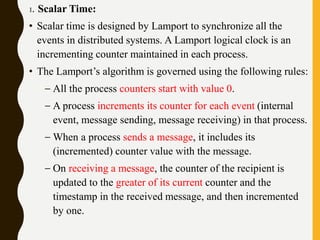
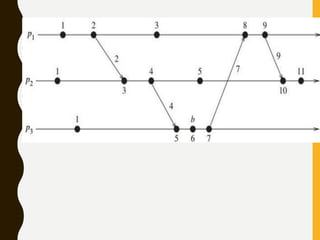
1. Scalar Time:
• Scalar time is designed by Lamport to synchronize all the
events in distributed systems. A Lamport logical clock is an
incrementing counter maintained in each process.
• The Lamport’s algorithm is governed using the following rules:
– All the process counters start with value 0.
– A process increments its counter for each event (internal
event, message sending, message receiving) in that process.
– When a process sends a message, it includes its
(incremented) counter value with the message.
– On receiving a message, the counter of the recipient is
updated to the greater of its current counter and the
timestamp in the received message, and then incremented
by one.
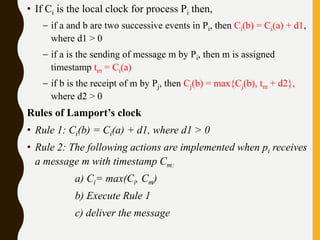
• If Ci is the local clock for process Pi then,
– if a and b are two successive events in Pi, then Ci(b) = Ci(a) + d1,
where d1 > 0
– if a is the sending of message m by Pi, then m is assigned
timestamp tm = Ci(a)
– if b is the receipt of m by Pj, then Cj(b) = max{Cj(b), tm + d2},
where d2 > 0
Rules of Lamport’s clock
• Rule 1: Ci(b) = Ci(a) + d1, where d1 > 0
• Rule 2: The following actions are implemented when pi receives
a message m with timestamp Cm:
a) Ci= max(Ci, Cm)
b) Execute Rule 1
c) deliver the message
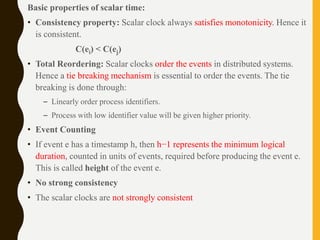
Basic properties of scalar time:
• Consistency property: Scalar clock always satisfies monotonicity. Hence it
is consistent.
C(ei) < C(ej)
• Total Reordering: Scalar clocks order the events in distributed systems.
Hence a tie breaking mechanism is essential to order the events. The tie
breaking is done through:
– Linearly order process identifiers.
– Process with low identifier value will be given higher priority.
• Event Counting
• If event e has a timestamp h, then h−1 represents the minimum logical
duration, counted in units of events, required before producing the event e.
This is called height of the event e.
• No strong consistency
• The scalar clocks are not strongly consistent
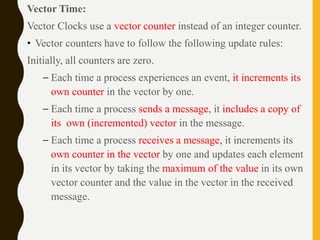
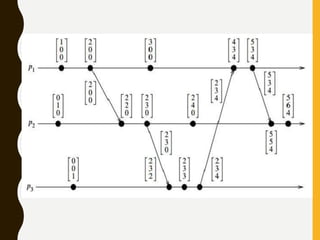
Vector Time:
Vector Clocks use a vector counter instead of an integer counter.
• Vector counters have to follow the following update rules:
Initially, all counters are zero.
– Each time a process experiences an event, it increments its
own counter in the vector by one.
– Each time a process sends a message, it includes a copy of
its own (incremented) vector in the message.
– Each time a process receives a message, it increments its
own counter in the vector by one and updates each element
in its vector by taking the maximum of the value in its own
vector counter and the value in the vector in the received
message.
Rules of Vector Time
• Rule 1: Before executing an event, process pi updates its local
logical time as follows:
• uti[i] : =uti[i] + d (d >0)
• Rule 2: Each message m is piggybacked with the vector clock
vt of the sender process at sending time. On the receipt of such
a message (m,vt), process
• pi executes the following sequence of actions:
• update its global logical time
• 1 ≤k ≤n : uti[k] : =max (uti[k], ut[k])
• execute R1
• deliver the message m
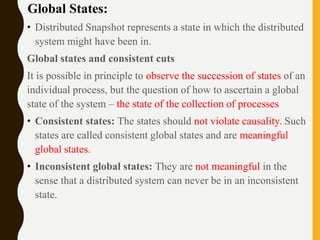
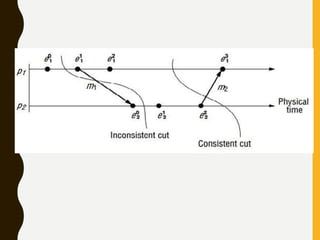
Global States:
• Distributed Snapshot represents a state in which the distributed
system might have been in.
Global states and consistent cuts
It is possible in principle to observe the succession of states of an
individual process, but the question of how to ascertain a global
state of the system – the state of the collection of processes
• Consistent states: The states should not violate causality. Such
states are called consistent global states and are meaningful
global states.
• Inconsistent global states: They are not meaningful in the
sense that a distributed system can never be in an inconsistent
state.
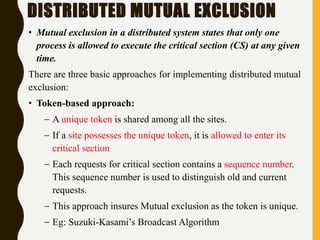
DISTRIBUTED MUTUAL EXCLUSION
• Mutual exclusion in a distributed system states that only one
process is allowed to execute the critical section (CS) at any given
time.
There are three basic approaches for implementing distributed mutual
exclusion:
• Token-based approach:
– A unique token is shared among all the sites.
– If a site possesses the unique token, it is allowed to enter its
critical section
– Each requests for critical section contains a sequence number.
This sequence number is used to distinguish old and current
requests.
– This approach insures Mutual exclusion as the token is unique.
– Eg: Suzuki-Kasami’s Broadcast Algorithm
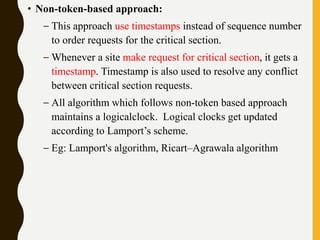
• Non-token-based approach:
– This approach use timestamps instead of sequence number
to order requests for the critical section.
– Whenever a site make request for critical section, it gets a
timestamp. Timestamp is also used to resolve any conflict
between critical section requests.
– All algorithm which follows non-token based approach
maintains a logicalclock. Logical clocks get updated
according to Lamport’s scheme.
– Eg: Lamport's algorithm, Ricart–Agrawala algorithm
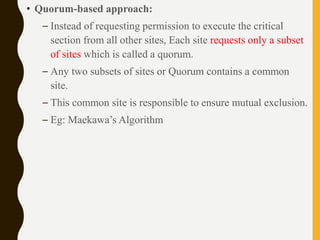
• Quorum-based approach:
– Instead of requesting permission to execute the critical
section from all other sites, Each site requests only a subset
of sites which is called a quorum.
– Any two subsets of sites or Quorum contains a common
site.
– This common site is responsible to ensure mutual exclusion.
– Eg: Maekawa’s Algorithm
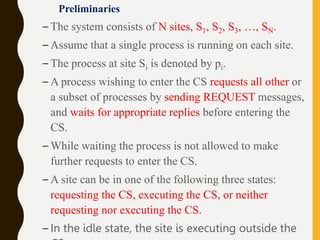
Preliminaries
– The system consists of N sites, S1, S2, S3, …, SN.
– Assume that a single process is running on each site.
– The process at site Si is denoted by pi.
– A process wishing to enter the CS requests all other or
a subset of processes by sending REQUEST messages,
and waits for appropriate replies before entering the
CS.
– While waiting the process is not allowed to make
further requests to enter the CS.
– A site can be in one of the following three states:
requesting the CS, executing the CS, or neither
requesting nor executing the CS.
– In the idle state, the site is executing outside the
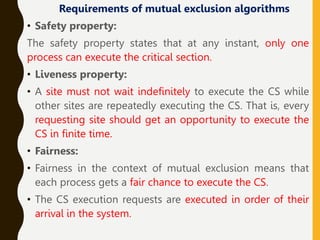
Requirements of mutual exclusion algorithms
• Safety property:
The safety property states that at any instant, only one
process can execute the critical section.
• Liveness property:
• A site must not wait indefinitely to execute the CS while
other sites are repeatedly executing the CS. That is, every
requesting site should get an opportunity to execute the
CS in finite time.
• Fairness:
• Fairness in the context of mutual exclusion means that
each process gets a fair chance to execute the CS.
• The CS execution requests are executed in order of their
arrival in the system.
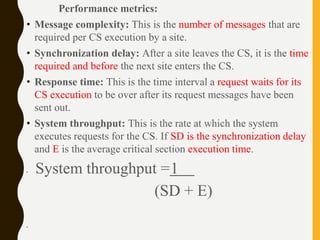
Performance metrics:
• Message complexity: This is the number of messages that are
required per CS execution by a site.
• Synchronization delay: After a site leaves the CS, it is the time
required and before the next site enters the CS.
• Response time: This is the time interval a request waits for its
CS execution to be over after its request messages have been
sent out.
• System throughput: This is the rate at which the system
executes requests for the CS. If SD is the synchronization delay
and E is the average critical section execution time.
• System throughput =1
(SD + E)
•
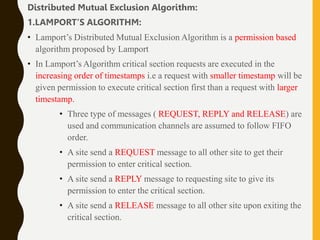
Distributed Mutual Exclusion Algorithm:
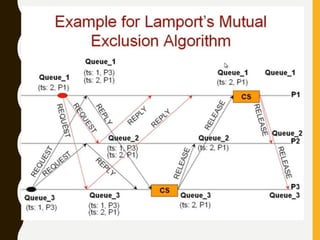
1.LAMPORT’S ALGORITHM:
• Lamport’s Distributed Mutual Exclusion Algorithm is a permission based
algorithm proposed by Lamport
• In Lamport’s Algorithm critical section requests are executed in the
increasing order of timestamps i.e a request with smaller timestamp will be
given permission to execute critical section first than a request with larger
timestamp.
• Three type of messages ( REQUEST, REPLY and RELEASE) are
used and communication channels are assumed to follow FIFO
order.
• A site send a REQUEST message to all other site to get their
permission to enter critical section.
• A site send a REPLY message to requesting site to give its
permission to enter the critical section.
• A site send a RELEASE message to all other site upon exiting the
critical section.
• Message Complexity:
• Lamport’s Algorithm requires invocation of 3(N – 1) messages
per critical section execution. These 3(N – 1) messages
involves
• (N – 1) request messages
• (N – 1) reply messages
• (N – 1) release messages
2.RICART–AGRAWALAALGORITHM
• Ricart–Agrawala algorithm is an algorithm to for mutual
exclusion in a distributed system proposed by Glenn Ricart
and Ashok Agrawala.
• This algorithm is an extension and optimization of Lamport’s
Distributed Mutual
• Exclusion Algorithm.
• It follows permission based approach to ensure mutual
exclusion.
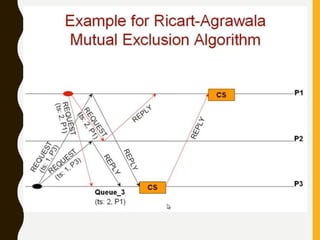
• Two type of messages ( REQUEST and REPLY) are used and
communication channels are assumed to follow FIFO order.
• A site send a REQUEST message to all other site to get their
permission to enter critical section.
• A site send a REPLY message to other site to give its
permission to enter the critical section.
• Message Complexity:
• Ricart–Agrawala algorithm requires invocation of 2(N – 1)
messages per critical section execution. These 2(N – 1)
messages involve:
• (N – 1) request messages
• (N – 1) reply messages
3. MAEKAWA‘s ALGORITHM
• Maekawa’s Algorithm is quorum based approach to ensure
mutual exclusion in distributed systems.
• In permission based algorithms like Lamport’s Algorithm,
Ricart-Agrawala Algorithm etc. a site request permission from
every other site but in quorum based approach, a site does not
request permission from every other site but from a subset of
sites which is called quorum.
• Three type of messages ( REQUEST, REPLY and RELEASE)
are used.
• A site send a REQUEST message to all other site in its request
set or quorum to get their permission to enter critical section.
• A site send a REPLY message to requesting site to give its
permission to enter the critical section.
• A site send a RELEASE message to all other site in its request
set or quorum upon exiting the critical section.
• Message Complexity:
• Maekawa’s Algorithm requires invocation of 3√N messages per
critical section
• execution as the size of a request set is √N. These 3√N
messages involves.
– √N request messages
– √N reply messages
– √N release messages
4.Suzuki-Kasami’s Broadcast Algorithm
• If a site wants to enter the CS and it does not have the token, it
broadcasts a REQUEST message for the token to all other sites.
• A site which possesses the token sends it to the requesting site
upon the receipt of its REQUEST message.
• If a site receives a REQUEST message when it is executing the
CS, it sends the token only after it has completed the execution
of the CS.
Message Complexity:
• No message is needed and the synchronization delay is zero if
a site holds the idle token at the time of its request.
• If a site does not hold the token when it makes a request, the
algorithm requires N messages to obtain the token.
Synchronization delay in this algorithm is 0 or T.
Elections:
• An algorithm for choosing a unique process to play a particular
role is called an election algorithm.
• In a variant of our central-server algorithm for mutual
exclusion, the ‘server’ is chosen from among the processes Pi,
(i = 1, 2, 3,……. N) that need to use the critical section.
• An election algorithm is needed for this choice. It is essential
that all the processes agree on the choice.
• if the process that plays the role of server wishes to retire then
another election is required to choose a replacement.
• An individual process does not call more than one election at a
time, but in principle the N processes could call N concurrent
elections.
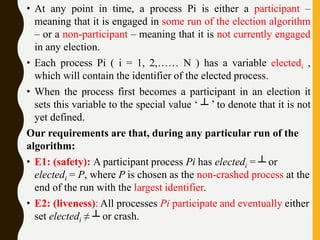
• At any point in time, a process Pi is either a participant –
meaning that it is engaged in some run of the election algorithm
– or a non-participant – meaning that it is not currently engaged
in any election.
• Each process Pi ( i = 1, 2,…… N ) has a variable electedi ,
which will contain the identifier of the elected process.
• When the process first becomes a participant in an election it
sets this variable to the special value ‘ ┴ ’ to denote that it is not
yet defined.
Our requirements are that, during any particular run of the
algorithm:
• E1: (safety): A participant process Pi has electedi = ┴ or
electedi = P, where P is chosen as the non-crashed process at the
end of the run with the largest identifier.
• E2: (liveness): All processes Pi participate and eventually either
set electedi ≠ ┴ or crash.
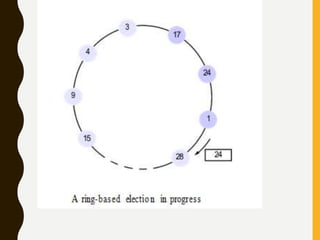
1. A ring-based election algorithm
• The algorithm of Chang and Roberts [1979] is suitable for a
collection of processes arranged in a logical ring.
• Each process Pi has a communication channel to the next
process in the ring, P(i + 1)mod N , and all messages are sent
clockwise around the ring.
• We assume that no failures occur, and that the system is
asynchronous.
• The goal of this algorithm is to elect a single process called the
coordinator, which is the process with the largest identifier.
• Initially, every process is marked as a non-participant in an
election. Any process can begin an election. It proceeds by
marking itself as a participant, placing its identifier in an
election message and sending it to its clockwise neighbor.
2. The bully algorithm:
The bully algorithm [Garcia-Molina 1982] allows processes to
crash during an election, although it assumes that message
delivery between processes is reliable.
• The bully algorithm, on the other hand, assumes that each
process knows which processes have higher identifiers, and that
it can communicate with all such processes.
• There are three types of message in this algorithm:
• an election message is sent to announce an election;
• an answer message is sent in response to an election message
• a coordinator message is sent to announce the identity of the
elected process – the new coordinator’.
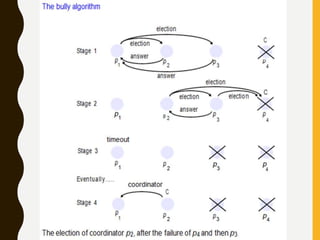
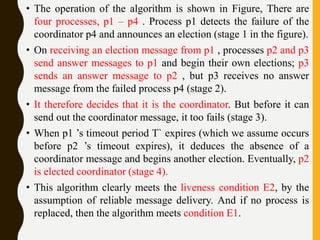
• The operation of the algorithm is shown in Figure, There are
four processes, p1 – p4 . Process p1 detects the failure of the
coordinator p4 and announces an election (stage 1 in the figure).
• On receiving an election message from p1 , processes p2 and p3
send answer messages to p1 and begin their own elections; p3
sends an answer message to p2 , but p3 receives no answer
message from the failed process p4 (stage 2).
• It therefore decides that it is the coordinator. But before it can
send out the coordinator message, it too fails (stage 3).
• When p1 ’s timeout period T` expires (which we assume occurs
before p2 ’s timeout expires), it deduces the absence of a
coordinator message and begins another election. Eventually, p2
is elected coordinator (stage 4).
• This algorithm clearly meets the liveness condition E2, by the
assumption of reliable message delivery. And if no process is
replaced, then the algorithm meets condition E1.
Distributed Transactions:
• A distributed transaction is a set of operations on data that is
performed across two or more data repositories (especially
databases).
• It is typically coordinated across separate nodes connected by a
network, but may also span multiple databases on a single
server.
• The atomicity property of transactions requires that either all of
the servers involved commit the transaction or all of them abort
the transaction.
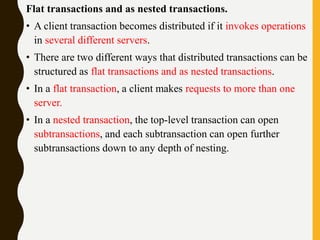
Flat transactions and as nested transactions.
• A client transaction becomes distributed if it invokes operations
in several different servers.
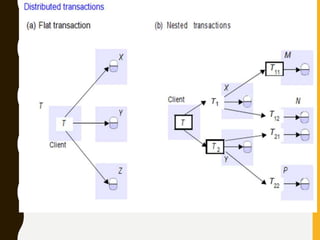
• There are two different ways that distributed transactions can be
structured as flat transactions and as nested transactions.
• In a flat transaction, a client makes requests to more than one
server.
• In a nested transaction, the top-level transaction can open
subtransactions, and each subtransaction can open further
subtransactions down to any depth of nesting.
The coordinator of a distributed transaction:
• Servers that execute requests as part of a distributed transaction
need to be able to communicate with one another to coordinate
their actions when the transaction commits.
• A client starts a transaction by sending an openTransaction
request to a coordinator.
• The coordinator that is contacted carries out the
openTransaction and returns the resulting transaction identifier
(TID) to the client.
• Transaction identifiers for distributed transactions must be
unique within a distributed system.

UNIT II DIS.pptx

  • 1.
    UNIT II --PROCESS AND SYNCHRONIZATION Processes – Threads - Communication and Invocation - Clocks, Events and Process States - Synchronization Physical Clocks - Logical Time and Logical Clocks - Global States – Distributed Mutual Exclusion - Elections- Distributed Transactions.
  • 2.
    PROCESSES: • Processes playa crucial role in distributed systems. • The concept of a process originates from the field of operating systems where it is generally defined as a program in execution • a process consists of an execution environment together with one or more threads. • A thread is the operating system abstraction of an activity
  • 3.
    • An executionenvironment primarily consists of: • an address space; • thread synchronization and communication resources such as semaphores and communication interfaces (for example, sockets); • higher-level resources such as open files and windows. • Threads can be created and destroyed dynamically, as needed. • The central aim of having multiple threads of execution is to maximize the degree of concurrent execution between operations. • As many older operating systems allow only one thread per process, we shall sometimes use the term multi-threaded process for emphasis.
  • 4.
    Address spaces: • Anaddress space, introduced in the previous section, is a unit of management of a process’s virtual memory. • It is large (typically up to 232 bytes, and sometimes up to 264 bytes) and consists of one or more regions, separated by inaccessible areas of virtual memory. • A region is an area of contiguous virtual memory that is accessible by the threads of the owning process. Regions do not overlap.
  • 5.
    • Each regionis specified by the following properties: – its extent (lowest virtual address and size); – read/write/execute permissions for the process’s threads; – whether it can be grown upwards or downwards. • A shared memory region (or shared region for short) is one that is backed by the same physical memory as one or more regions belonging to other address spaces.
  • 6.
    The uses ofshared regions include the following: – Libraries: Library code can be very large and would waste considerable memory if it was loaded separately into every process that used it. – Kernel: Often the kernel code and data are mapped into every address space at the same location. When a process makes a system call or an exception occurs, there is no need to switch to a new set of address mappings. – Data sharing and communication: Two processes, or a process and the kernel, might need to share data in order to cooperate on some task.
  • 7.
    Creation of anew process: • The creation of a new process has traditionally been an indivisible operation provided by the operating system. • For example, the UNIX fork system call creates a process with an execution environment copied from the caller (except for the return value from fork). • The UNIX exec system call transforms the calling process into one executing the code of a named program.
  • 8.
    Creation of anew execution environment: • Once the host computer has been selected, a new process requires an execution environment consisting of an address space with initialized contents. • There are two approaches to defining and initializing the address space of a newly created process. • The first approach is used where the address space is of a statically defined format. For example, it could contain just a program text region, heap region and stack region. In this case, the address space regions are created from a list specifying their extent. • Alternatively, the address space can be defined with respect to an existing execution environment. In the case of UNIX fork semantics, for example, the newly created child process physically shares the parent’s text region and has heap and stack regions that are copies of the parent’s in extent
  • 10.
    • Copy-on-write isa general technique – for example, it is also used in copying large messages – so we take some time to explain its operation here. • Let us follow through an example of regions RA and RB, whose memory is shared copy-on-write between two processes, A and B . • For the sake of definiteness, let us assume that process A set region RA to be copy-inherited by its child, process B, and that the region RB was thus created in process B.
  • 11.
    Threads: • Threads communicateand synchronize with each other using fast shared memory mechanisms. • The server has a pool of one or more threads, each of which repeatedly removes a request from a queue of received requests and processes it. • each thread applies the same procedure to process the requests. • Let us assume that each request takes, on average, 2 milliseconds of processing plus 8 milliseconds of I/O (input/output) delay when the server reads from a disk. • Let us further assume for the moment that the server executes at a single-processor computer.
  • 12.
    • Consider themaximum server throughput, measured in client requests handled per second, for different numbers of threads. If a single thread has to perform all processing, then the turnaround time for handling any request is on average 2 + 8 = 10 milliseconds, so this server can handle 100 client requests per second.
  • 13.
    Architectures for multi-threadedservers: • We have described how multi-threading enables servers to maximize their throughput, measured as the number of requests processed per second. • Figure shows one of the possible threading architectures, the worker pool architecture. • Receives requests from a collection of sockets or ports and places them on a shared request queue for retrieval by the workers.
  • 14.
    – In thethread-per-request architecture the I/O thread spawns a new worker thread for each request, and that worker destroys itself when it has processed the request against its designated remote object. – The thread-per-connection architecture associates a thread with each connection. The server creates a new worker thread when a client makes a connection and destroys the thread when the client closes the connection. In between, the client may make many requests over the connection, targeted at one or more remote – The thread-per-object architecture associates a thread with each remote object. An I/O thread receives requests and queues them for the workers, but this time there is a per-object queue.
  • 15.
    Threads within clients •Client process with two threads. • The first thread generates results to be passed to a server by remote method invocation, but does not require a reply. Remote method invocations typically block the caller, even when there is strictly no need to wait. • This client process can incorporate a second thread, which performs the remote method invocations and blocks while the first thread is able to continue computing further results. Thread scheduling • An important distinction is between preemptive and non- preemptive scheduling of threads. In preemptive scheduling, a thread may be suspended at any point to make way for another thread,
  • 16.
    Threads implementation • Manykernels provide native support for multi-threaded processes, including Windows, Linux, Solaris, Mach and Mac OS X. • These kernels provide thread-creation and -management system calls, and they schedule individual threads. • A threads runtime library organizes the scheduling of threads. • A thread would block the process, and therefore all threads within it, if it made a blocking system call, so the asynchronous (non-blocking) I/O facilities of the underlying kernel are exploited.
  • 17.
    • The numberof virtual processors assigned to a process can also vary. • if process A has requested an extra virtual processor and B terminates, then the kernel can assign one to A. • Figure shows that a process notifies the kernel when either of two types of event occurs: when a virtual processor is ‘idle’ and no longer needed, or when an extra virtual processor is required. • Figure also shows that the kernel notifies the process when any of four types of event occurs. A scheduler activation (SA) is a call from the kernel to a process, which notifies the process’s scheduler of an event.
  • 19.
    COMMUNICATION AND INVOCATION •Some kernels designed for distributed systems have provided communication primitives tailored to the types of invocation. • For example, provides doOperation, getRequest and sendReply as primitives. • Placing relatively high-level communication functionality in the kernel has the advantage of efficiency. • If, for example, middleware provides RMI over UNIX’s connected (TCP) sockets, then a client must make two communication system calls (socket write and read) for each remote invocation.
  • 20.
    Invocation performance: • Invocationperformance is a critical factor in distributed system design. • RPC and RMI implementations have been the subject of study because of the widespread acceptance of these mechanisms for general-purpose client-server processing. • Calling a conventional procedure or invoking a conventional method, making a system call, sending a message, remote procedure calling and remote method invocation are all examples of invocation mechanisms.
  • 22.
    Invocation over thenetwork • A null RPC (and similarly, a null RMI) is defined as an RPC without parameters that executes a null procedure and returns no values. Its execution involves an exchange of messages carrying some system data but no user data. • Null invocation (RPC, RMI) costs are important because they measure a fixed overhead, the latency.
  • 23.
    The following arethe main components accounting for remote invocation delay, besides network transmission times: • Marshalling: Marshalling and unmarshalling, which involve copying and converting data, create a significant overhead as the amount of data grows. • Waiting for acknowledgements: The choice of RPC protocol may influence delay, particularly when large amounts of data are sent. • Memory sharing - Data is communicated by writing to and reading from the shared region. • Choice of protocol • The delay that a client experiences during request-reply interactions over TCP is not necessarily worse than for UDP and in fact is sometimes better, particularly for large messages.
  • 24.
    Invocation within acomputer : -Efficient invocation mechanism for the case of two processes on the same machine called lightweight RPC (LRPC).
  • 25.
    Asynchronous operation: Making invocationsconcurrently : • In the first model, the middleware provides only blocking invocations, but the application spawns multiple threads to perform blocking invocations concurrently. Serialized Invocation: In the serialized case, the client marshals the arguments, calls the Send operation and then waits until the reply from the server arrives – whereupon it Receives, unmarshals and then processes the results. After this it can make the second invocation. Concurrent Invocation: In the concurrent case, the first client thread marshals the arguments and calls the Send operation. The second thread then immediately makes the second invocation. Each thread waits to receive its results
  • 27.
    CLOCKS, EVENTS ANDPROCESS STATES • We take a distributed system to consist of a collection of N processes • pi i = 1, 2, ..N. Each process executes on a single processor, and the processors do not share memory. • Now we can define the history of process pi to be the series of events that take place within it, ordered as we have described by the relation →i: • history(Pi) = hi = <ei0, ei1, ei2,…>
  • 28.
    Clocks : • Wehave seen how to order the events at a process, but not how to timestamp them – i.e., to assign to them a date and time of day. Computers each contain their own physical clocks. • These clocks are electronic devices that count oscillations occurring in a crystal at a definite frequency, and typically divide this count and store the result in a counter register. • The operating system reads the node’s hardware clock value, Hi(t) , scales it and adds an offset so as to produce a software clock Ci(t) = αHi(t) + β that approximately measures real, physical time t for process pi .
  • 29.
    Clock skew andclock drift : Skew: The instantaneous difference between the readings of any two clocks is called their skew. Clock Drift: The crystal based clock count time at different rates. Oscillator has different frequency. Drift rate is usually used to measure the change in the offset per unit time . .
  • 30.
    Coordinated Universal Time: • Computer clocks can be synchronized to external sources of highly accurate time. The most accurate physical clocks use atomic oscillators. • UTC signals are synchronized and broadcast regularly from land- based radio stations and satellites covering many parts of the world. • Computers with receivers attached can synchronize their clocks with these timing signals.
  • 31.
    SYNCHRONIZATION PHYSICAL CLOCKS: •distributed systems do not follow common clock, each system functions based on its own internal clock and its own notion of time. • The time in distributed systems is measured in the following contexts: -The time of the day at which an event happened on a specific machine in the network. -The time interval between two events that happened on different machines in the network. -The relative ordering of events that happened on different machines in the network. Clock synchronization is the process of ensuring that physically distributed processors have a common notion of time.
  • 32.
    Basic terminologies: • IfCa and Cb are two different clocks, then: • Time: The time of a clock in a machine p is given by the function Cp(t),where Cp(t)= t for a perfect clock. • Frequency: Frequency is the rate at which a clock progresses. The frequency at time t of clock Ca is Ca ’(t). • Offset: Clock offset is the difference between the time reported by a clock and the real time. The offset of the clock Ca is given by Ca(t)− t. The offset of clock C a relative to Cb at time t ≥ 0 is given by Ca(t)- Cb(t) • Skew: The skew of a clock is the difference in the frequencies of the clock and the perfect clock. The skew of a clock Ca relative to clock Cb at timet is Ca ’(t)- Cb ’(t).
  • 33.
    • Drift (rate):The drift of clock Ca the second derivative of the clock value with respect to time. The drift is calculated as: C”a(t)-C”b(t) Clocking Inaccuracies • Physical clocks are synchronized to an accurate real-time standard like UTC (Universal Coordinated Time). Due to the clock inaccuracy discussed above, a timer (clock) is said to be working within its specification if: 1-ρ≤(dC/dt)≤1+ρ ρ - maximum skew rate.
  • 34.
    Clock offset anddelay estimation: • A source node cannot accurately estimate the local time on the target node due to varying message or network delays between the nodes. • This protocol employs a very common practice of performing several trials and chooses the trial with the minimum delay.
  • 35.
    • Offset anddelay estimation between processes from same server
  • 36.
    • Let T1,T2, T3, T4 be the values of the four most recent timestamps. The clocks A and B are stable and running at the same speed. • Let a = T1 − T3 and b = T2 − T4. • If the network delay difference from A to B and from B to A, called differential delay, is small, the clock offset θ and round- trip delay δ of B relative to A at time T4 are approximately given by the following: θ=(a+b)/2, δ =a – b
  • 37.
    LOGICAL TIME ANDLOGICAL CLOCKS: • Logical clocks are based on capturing chronological and causal relationships of processes and ordering events based on these relationships. • Three types of logical clock are maintained in distributed systems: • Scalar clock • Vector clock • Matrix clock
  • 38.
    A Framework fora system of logical clocks: • The logical clock C is a function that maps an event e in a distributed system to an element in the time domain T denoted as C(e). C : H αT such that • for any two events ei and ej,. ei → ej C(ei)< C(ej). • This monotonicity property is called the clock consistency condition.When T and C satisfy the following condition, ei, → ej  C(ei) < C(ej) Then the system of clocks is strongly consistent.
  • 39.
    Implementing logical clocks: Thetwo major issues in implanting logical clocks are: • Data structures: representation of each process • Protocols: rules for updating the data structures to ensure consistent conditions. Data structures: • A local logical clock (lci), that helps process pi measure its own progress. • A logical global clock (gci), that is a representation of process pi’s local view of the logical global time. Protocol: • Rule 1: Decides the updates of the logical clock by a process. It controls send, receive and other operations. • Rule 2: Decides how a process updates its global logical clock to update its view of the global time and global progress.
  • 40.
    1. Scalar Time: •Scalar time is designed by Lamport to synchronize all the events in distributed systems. A Lamport logical clock is an incrementing counter maintained in each process. • The Lamport’s algorithm is governed using the following rules: – All the process counters start with value 0. – A process increments its counter for each event (internal event, message sending, message receiving) in that process. – When a process sends a message, it includes its (incremented) counter value with the message. – On receiving a message, the counter of the recipient is updated to the greater of its current counter and the timestamp in the received message, and then incremented by one.
  • 41.
    • If Ciis the local clock for process Pi then, – if a and b are two successive events in Pi, then Ci(b) = Ci(a) + d1, where d1 > 0 – if a is the sending of message m by Pi, then m is assigned timestamp tm = Ci(a) – if b is the receipt of m by Pj, then Cj(b) = max{Cj(b), tm + d2}, where d2 > 0 Rules of Lamport’s clock • Rule 1: Ci(b) = Ci(a) + d1, where d1 > 0 • Rule 2: The following actions are implemented when pi receives a message m with timestamp Cm: a) Ci= max(Ci, Cm) b) Execute Rule 1 c) deliver the message
  • 43.
    Basic properties ofscalar time: • Consistency property: Scalar clock always satisfies monotonicity. Hence it is consistent. C(ei) < C(ej) • Total Reordering: Scalar clocks order the events in distributed systems. Hence a tie breaking mechanism is essential to order the events. The tie breaking is done through: – Linearly order process identifiers. – Process with low identifier value will be given higher priority. • Event Counting • If event e has a timestamp h, then h−1 represents the minimum logical duration, counted in units of events, required before producing the event e. This is called height of the event e. • No strong consistency • The scalar clocks are not strongly consistent
  • 44.
    Vector Time: Vector Clocksuse a vector counter instead of an integer counter. • Vector counters have to follow the following update rules: Initially, all counters are zero. – Each time a process experiences an event, it increments its own counter in the vector by one. – Each time a process sends a message, it includes a copy of its own (incremented) vector in the message. – Each time a process receives a message, it increments its own counter in the vector by one and updates each element in its vector by taking the maximum of the value in its own vector counter and the value in the vector in the received message.
  • 45.
    Rules of VectorTime • Rule 1: Before executing an event, process pi updates its local logical time as follows: • uti[i] : =uti[i] + d (d >0) • Rule 2: Each message m is piggybacked with the vector clock vt of the sender process at sending time. On the receipt of such a message (m,vt), process • pi executes the following sequence of actions: • update its global logical time • 1 ≤k ≤n : uti[k] : =max (uti[k], ut[k]) • execute R1 • deliver the message m
  • 47.
    Global States: • DistributedSnapshot represents a state in which the distributed system might have been in. Global states and consistent cuts It is possible in principle to observe the succession of states of an individual process, but the question of how to ascertain a global state of the system – the state of the collection of processes • Consistent states: The states should not violate causality. Such states are called consistent global states and are meaningful global states. • Inconsistent global states: They are not meaningful in the sense that a distributed system can never be in an inconsistent state.
  • 49.
    DISTRIBUTED MUTUAL EXCLUSION •Mutual exclusion in a distributed system states that only one process is allowed to execute the critical section (CS) at any given time. There are three basic approaches for implementing distributed mutual exclusion: • Token-based approach: – A unique token is shared among all the sites. – If a site possesses the unique token, it is allowed to enter its critical section – Each requests for critical section contains a sequence number. This sequence number is used to distinguish old and current requests. – This approach insures Mutual exclusion as the token is unique. – Eg: Suzuki-Kasami’s Broadcast Algorithm
  • 50.
    • Non-token-based approach: –This approach use timestamps instead of sequence number to order requests for the critical section. – Whenever a site make request for critical section, it gets a timestamp. Timestamp is also used to resolve any conflict between critical section requests. – All algorithm which follows non-token based approach maintains a logicalclock. Logical clocks get updated according to Lamport’s scheme. – Eg: Lamport's algorithm, Ricart–Agrawala algorithm
  • 51.
    • Quorum-based approach: –Instead of requesting permission to execute the critical section from all other sites, Each site requests only a subset of sites which is called a quorum. – Any two subsets of sites or Quorum contains a common site. – This common site is responsible to ensure mutual exclusion. – Eg: Maekawa’s Algorithm
  • 52.
    Preliminaries – The systemconsists of N sites, S1, S2, S3, …, SN. – Assume that a single process is running on each site. – The process at site Si is denoted by pi. – A process wishing to enter the CS requests all other or a subset of processes by sending REQUEST messages, and waits for appropriate replies before entering the CS. – While waiting the process is not allowed to make further requests to enter the CS. – A site can be in one of the following three states: requesting the CS, executing the CS, or neither requesting nor executing the CS. – In the idle state, the site is executing outside the
  • 53.
    Requirements of mutualexclusion algorithms • Safety property: The safety property states that at any instant, only one process can execute the critical section. • Liveness property: • A site must not wait indefinitely to execute the CS while other sites are repeatedly executing the CS. That is, every requesting site should get an opportunity to execute the CS in finite time. • Fairness: • Fairness in the context of mutual exclusion means that each process gets a fair chance to execute the CS. • The CS execution requests are executed in order of their arrival in the system.
  • 54.
    Performance metrics: • Messagecomplexity: This is the number of messages that are required per CS execution by a site. • Synchronization delay: After a site leaves the CS, it is the time required and before the next site enters the CS. • Response time: This is the time interval a request waits for its CS execution to be over after its request messages have been sent out. • System throughput: This is the rate at which the system executes requests for the CS. If SD is the synchronization delay and E is the average critical section execution time. • System throughput =1 (SD + E) •
  • 55.
    Distributed Mutual ExclusionAlgorithm: 1.LAMPORT’S ALGORITHM: • Lamport’s Distributed Mutual Exclusion Algorithm is a permission based algorithm proposed by Lamport • In Lamport’s Algorithm critical section requests are executed in the increasing order of timestamps i.e a request with smaller timestamp will be given permission to execute critical section first than a request with larger timestamp. • Three type of messages ( REQUEST, REPLY and RELEASE) are used and communication channels are assumed to follow FIFO order. • A site send a REQUEST message to all other site to get their permission to enter critical section. • A site send a REPLY message to requesting site to give its permission to enter the critical section. • A site send a RELEASE message to all other site upon exiting the critical section.
  • 57.
    • Message Complexity: •Lamport’s Algorithm requires invocation of 3(N – 1) messages per critical section execution. These 3(N – 1) messages involves • (N – 1) request messages • (N – 1) reply messages • (N – 1) release messages
  • 58.
    2.RICART–AGRAWALAALGORITHM • Ricart–Agrawala algorithmis an algorithm to for mutual exclusion in a distributed system proposed by Glenn Ricart and Ashok Agrawala. • This algorithm is an extension and optimization of Lamport’s Distributed Mutual • Exclusion Algorithm. • It follows permission based approach to ensure mutual exclusion. • Two type of messages ( REQUEST and REPLY) are used and communication channels are assumed to follow FIFO order. • A site send a REQUEST message to all other site to get their permission to enter critical section. • A site send a REPLY message to other site to give its permission to enter the critical section.
  • 60.
    • Message Complexity: •Ricart–Agrawala algorithm requires invocation of 2(N – 1) messages per critical section execution. These 2(N – 1) messages involve: • (N – 1) request messages • (N – 1) reply messages
  • 61.
    3. MAEKAWA‘s ALGORITHM •Maekawa’s Algorithm is quorum based approach to ensure mutual exclusion in distributed systems. • In permission based algorithms like Lamport’s Algorithm, Ricart-Agrawala Algorithm etc. a site request permission from every other site but in quorum based approach, a site does not request permission from every other site but from a subset of sites which is called quorum. • Three type of messages ( REQUEST, REPLY and RELEASE) are used. • A site send a REQUEST message to all other site in its request set or quorum to get their permission to enter critical section. • A site send a REPLY message to requesting site to give its permission to enter the critical section. • A site send a RELEASE message to all other site in its request set or quorum upon exiting the critical section.
  • 62.
    • Message Complexity: •Maekawa’s Algorithm requires invocation of 3√N messages per critical section • execution as the size of a request set is √N. These 3√N messages involves. – √N request messages – √N reply messages – √N release messages
  • 63.
    4.Suzuki-Kasami’s Broadcast Algorithm •If a site wants to enter the CS and it does not have the token, it broadcasts a REQUEST message for the token to all other sites. • A site which possesses the token sends it to the requesting site upon the receipt of its REQUEST message. • If a site receives a REQUEST message when it is executing the CS, it sends the token only after it has completed the execution of the CS. Message Complexity: • No message is needed and the synchronization delay is zero if a site holds the idle token at the time of its request. • If a site does not hold the token when it makes a request, the algorithm requires N messages to obtain the token. Synchronization delay in this algorithm is 0 or T.
  • 64.
    Elections: • An algorithmfor choosing a unique process to play a particular role is called an election algorithm. • In a variant of our central-server algorithm for mutual exclusion, the ‘server’ is chosen from among the processes Pi, (i = 1, 2, 3,……. N) that need to use the critical section. • An election algorithm is needed for this choice. It is essential that all the processes agree on the choice. • if the process that plays the role of server wishes to retire then another election is required to choose a replacement. • An individual process does not call more than one election at a time, but in principle the N processes could call N concurrent elections.
  • 65.
    • At anypoint in time, a process Pi is either a participant – meaning that it is engaged in some run of the election algorithm – or a non-participant – meaning that it is not currently engaged in any election. • Each process Pi ( i = 1, 2,…… N ) has a variable electedi , which will contain the identifier of the elected process. • When the process first becomes a participant in an election it sets this variable to the special value ‘ ┴ ’ to denote that it is not yet defined. Our requirements are that, during any particular run of the algorithm: • E1: (safety): A participant process Pi has electedi = ┴ or electedi = P, where P is chosen as the non-crashed process at the end of the run with the largest identifier. • E2: (liveness): All processes Pi participate and eventually either set electedi ≠ ┴ or crash.
  • 66.
    1. A ring-basedelection algorithm • The algorithm of Chang and Roberts [1979] is suitable for a collection of processes arranged in a logical ring. • Each process Pi has a communication channel to the next process in the ring, P(i + 1)mod N , and all messages are sent clockwise around the ring. • We assume that no failures occur, and that the system is asynchronous. • The goal of this algorithm is to elect a single process called the coordinator, which is the process with the largest identifier. • Initially, every process is marked as a non-participant in an election. Any process can begin an election. It proceeds by marking itself as a participant, placing its identifier in an election message and sending it to its clockwise neighbor.
  • 68.
    2. The bullyalgorithm: The bully algorithm [Garcia-Molina 1982] allows processes to crash during an election, although it assumes that message delivery between processes is reliable. • The bully algorithm, on the other hand, assumes that each process knows which processes have higher identifiers, and that it can communicate with all such processes. • There are three types of message in this algorithm: • an election message is sent to announce an election; • an answer message is sent in response to an election message • a coordinator message is sent to announce the identity of the elected process – the new coordinator’.
  • 70.
    • The operationof the algorithm is shown in Figure, There are four processes, p1 – p4 . Process p1 detects the failure of the coordinator p4 and announces an election (stage 1 in the figure). • On receiving an election message from p1 , processes p2 and p3 send answer messages to p1 and begin their own elections; p3 sends an answer message to p2 , but p3 receives no answer message from the failed process p4 (stage 2). • It therefore decides that it is the coordinator. But before it can send out the coordinator message, it too fails (stage 3). • When p1 ’s timeout period T` expires (which we assume occurs before p2 ’s timeout expires), it deduces the absence of a coordinator message and begins another election. Eventually, p2 is elected coordinator (stage 4). • This algorithm clearly meets the liveness condition E2, by the assumption of reliable message delivery. And if no process is replaced, then the algorithm meets condition E1.
  • 71.
    Distributed Transactions: • Adistributed transaction is a set of operations on data that is performed across two or more data repositories (especially databases). • It is typically coordinated across separate nodes connected by a network, but may also span multiple databases on a single server. • The atomicity property of transactions requires that either all of the servers involved commit the transaction or all of them abort the transaction.
  • 72.
    Flat transactions andas nested transactions. • A client transaction becomes distributed if it invokes operations in several different servers. • There are two different ways that distributed transactions can be structured as flat transactions and as nested transactions. • In a flat transaction, a client makes requests to more than one server. • In a nested transaction, the top-level transaction can open subtransactions, and each subtransaction can open further subtransactions down to any depth of nesting.
  • 74.
    The coordinator ofa distributed transaction: • Servers that execute requests as part of a distributed transaction need to be able to communicate with one another to coordinate their actions when the transaction commits. • A client starts a transaction by sending an openTransaction request to a coordinator. • The coordinator that is contacted carries out the openTransaction and returns the resulting transaction identifier (TID) to the client. • Transaction identifiers for distributed transactions must be unique within a distributed system.