© www.akvaplan.niva.no
Carrying capacity estimation in
common water bodies
Case studies in the Philippines
USSEC Southeast Asia Regional
Symposium on Aquaculture Carrying
Capacity Modeling for Common Water
bodies
10-13 June 2013 Bangkok, Thailand
Scope of the presentation
• Aquaculture park development
• Planning sustainable aquaculture
– Minimising aquaculture impact on the environment
– Optimising aquaculture production
• Integrated Multi-Trophic Aquaculture
Planning and management of
aquaculture parks for sustainable
development of cage farms in the
Philippines
Partners
BFAR, NIFTDC, Map and Marine, Akvaplan-niva
Funded by Norad, Norway
www.aqua-park.asia
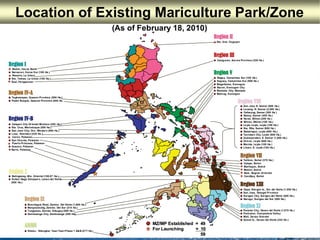
Philippine Mariculture park locations
#
#
#
#
#
Badoc, Ilocos Norte
Narvacan, Ilocos Sur (100 Ha.)
Rosario, La Union
Sto. Tomas, La Union (100 Ha.)
Sual, Pangasinan
Tagkawayan, Quezon Province (500 Ha.)
Padre Burgos, Quezon Province (500 Ha.
Region VIIIRegion VIII
Panabo City, Davao del Norte (1,075 Ha.)
Pantukan, Compostela Valley
Mati, Davao Oriental
Samal Is., Davao del Norte (224 Ha.)
Talibon, Bohol (370 Ha.)
Calape, Bohol
Maribujoc, Bohol
Mabini, Bohol
Bais, Negros Orriental
Candijay, Bohol
Region IRegion I
Region IVRegion IV--AA
Region VIIRegion VII
Region IXRegion IX
Region XIRegion XI
Region VRegion V
Region IVRegion IV--BB
Sibutu - Sitangkai, Tawi-Tawi Phase 1 A&B (27T Ha.)
ARMMARMM
Balingasag, Mis. Oriental (195.07 Ha.)
Sultan Naga Dimaporo, Lanao del Norte
(500 Ha.)
Region XRegion X
Dapa, Siargao Is., Sur del Norte (1,000 Ha.)
San Jose, Dinagat Province
Surigao City, Surigao del Norte (500 Ha.)
Barugo, Surigao del Sur (500 Ha.)
Region XIIIRegion XIII
Mursilagos Rizal, Zambo. Del Norte (1,000 Ha.)
Margosatubig, Zambo. Del Sur (214 Ha.)
Tungawan, Zambo. Sibugay (500 Ha.)
Zamboanga City, Zamboanga (200 Ha)
Calapan City Oriental Mindoro (200 Ha.)
Sta. Cruz, Marinduque (500 Ha.)
San Jose City, Occ. Mindoro (500 Ha.)
Looc, Romblon (435 Ha.)
Coron, Palawan
San Vicente, Palawan
Puerto Princesa, Palawan
Quezon, Palawan
Narra, Palawan
San Jose N. Samar (800 Ha.)
Laoang, N. Samar (2,500 Ha.)
Calbayog, Samar (300 Ha.)
Basey, Samar (400 Ha.)
Naval, Biliran (200 Ha.)
Biliran, Biliran (100 Ha.)
Leyte Leyte, Leyte (100 Ha.)
Sta. Rita, Samar (600 Ha.)
Babatngon, Leyte (600 Ha.)
Tacloban City, Leyte (800 Ha.)
Quinapondan, E. Samar (1,000 Ha.)
Ormoc, Leyte (600 Ha.)
Merida, Leyte (100 Ha.)
Liloan, S. Leyte (100 Ha.)
Ragay, Camarines Sur (105 Ha.)
Sagnay, Camarines Sur (500 Ha.)
Magallanes, Sorsogon
Bacon, Sorsogon City
Masbate City, Masbate
Matnog, Sorsogon
Region IIRegion II
Sta. Ana, Cagayan
Casiguran, Aurora Province (320 Ha.)
Region IIIRegion III
Location of Existing Mariculture Park/Zone
(As of February 18, 2010)
MZ/MP Established = 49MZ/MP Established = 49
For LaunchingFor Launching = 10= 10
5959
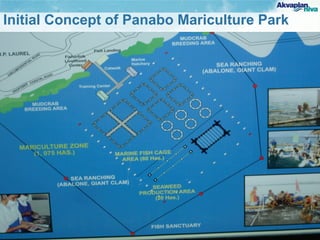
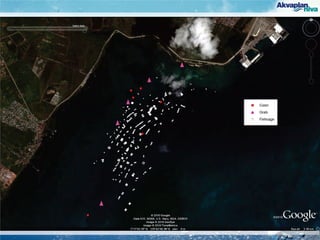
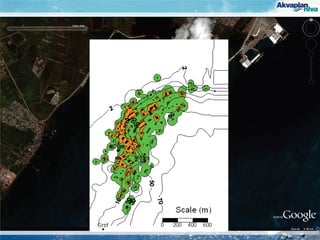
Initial Concept of Panabo Mariculture Park
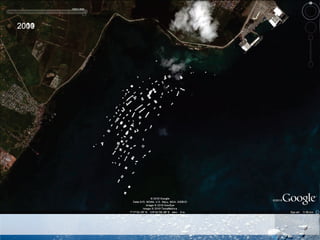
200120092010
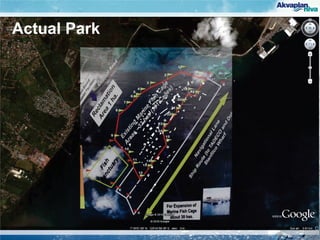
Actual Park
Using modelling for planning for
sustainable development
• Reorganisation of the Mariculture Park to reduce
environmental impact
• Planning for further expansion (modelling for
exposure)
• Integrating fed production with unfed production –
IMTA (recapture of nutrients and provide further
livelihoods)
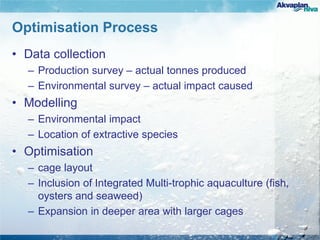
Optimisation Process
• Data collection
– Production survey – actual tonnes produced
– Environmental survey – actual impact caused
• Modelling
– Environmental impact
– Location of extractive species
• Optimisation
– cage layout
– Inclusion of Integrated Multi-trophic aquaculture (fish,
oysters and seaweed)
– Expansion in deeper area with larger cages
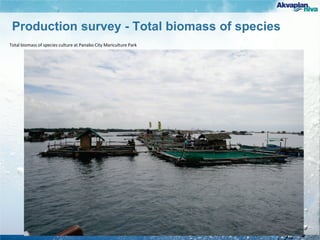
Production survey - Total biomass of species
SPECIES CULTURED BIOMASS (kg) Total Biomass (%)
Milkfish monoculture 275,896.25 84.97
Milkfish-Siganid polyculture 48,470* 14.93
Grouper culture 186.85 0.06
Pomfret (Pampano) Culture 117.5 0.04
TOTAL 324,670.60
Total biomass of species culture at Panabo City Mariculture Park
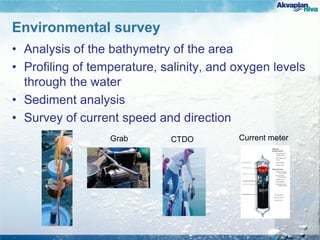
Environmental survey
• Analysis of the bathymetry of the area
• Profiling of temperature, salinity, and oxygen levels
through the water
• Sediment analysis
• Survey of current speed and direction
CTDO Current meterGrab
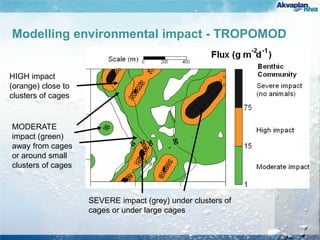
Modelling environmental impact - TROPOMOD
HIGH impact
(orange) close to
clusters of cages
SEVERE impact (grey) under clusters of
cages or under large cages
MODERATE
impact (green)
away from cages
or around small
clusters of cages
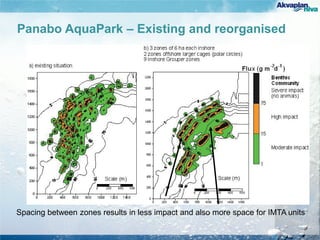
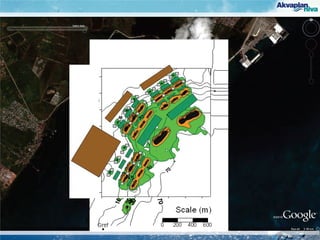
Panabo AquaPark – Existing and reorganised
Spacing between zones results in less impact and also more space for IMTA units
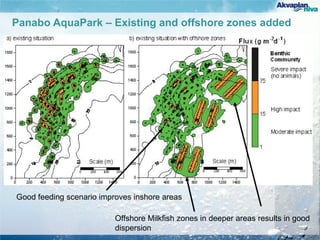
Panabo AquaPark – Existing and offshore zones added
Good feeding scenario improves inshore areas
Offshore Milkfish zones in deeper areas results in good
dispersion
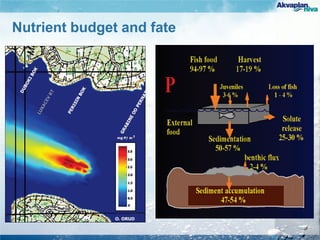
Nutrient budget and fate
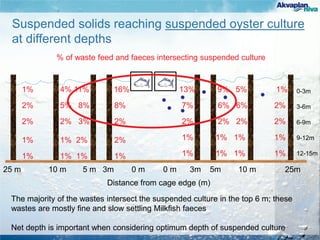
Distance from cage edge (m)
25 m 10 m 5 m 3m 0 m 0 m 3m 5m 10 m 25m
1% 4% 11% 16%
% of waste feed and faeces intersecting suspended culture
Suspended solids reaching suspended oyster culture
at different depths
The majority of the wastes intersect the suspended culture in the top 6 m; these
wastes are mostly fine and slow settling Milkfish faeces
Net depth is important when considering optimum depth of suspended culture
0-3m
3-6m
6-9m
9-12m
12-15m
2% 5% 8% 8%
2% 2% 3% 2%
1% 1% 2% 2%
1% 1% 1% 1%
13% 9% 5% 1%
7% 6% 6% 2%
2% 2% 2% 2%
1% 1% 1% 1%
1% 1% 1% 1%
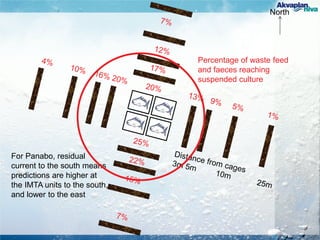
North
Percentage of waste feed
and faeces reaching
suspended culture
For Panabo, residual
current to the south means
predictions are higher at
the IMTA units to the south,
and lower to the east
Distance from cage edge (m)
25 m 10 m 5 m 3m 0 m
9% 18% 26% 32%
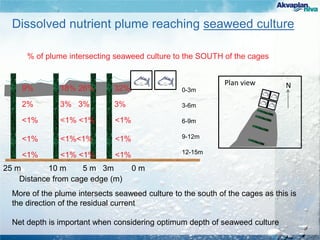
Dissolved nutrient plume reaching seaweed culture
More of the plume intersects seaweed culture to the south of the cages as this is
the direction of the residual current
Net depth is important when considering optimum depth of seaweed culture
0-3m
3-6m
6-9m
9-12m
12-15m
2% 3% 3% 3%
<1% <1% <1% <1%
<1% <1%<1% <1%
<1% <1% <1% <1%
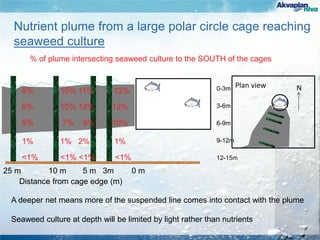
Plan view N
% of plume intersecting seaweed culture to the SOUTH of the cages
Distance from cage edge (m)
25 m 10 m 5 m 3m 0 m
6% 10% 11% 12%
Nutrient plume from a large polar circle cage reaching
seaweed culture
A deeper net means more of the suspended line comes into contact with the plume
Seaweed culture at depth will be limited by light rather than nutrients
0-3m
3-6m
6-9m
9-12m
12-15m
6% 10% 12% 12%
5% 7% 9% 10%
1% 1% 2% 1%
<1% <1% <1% <1%
Plan view N
% of plume intersecting seaweed culture to the SOUTH of the cages
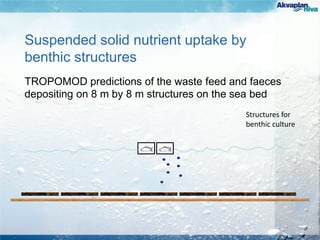
Suspended solid nutrient uptake by
benthic structures
TROPOMOD predictions of the waste feed and faeces
depositing on 8 m by 8 m structures on the sea bed
Structures for
benthic culture
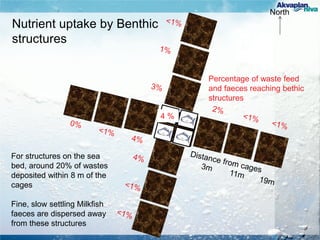
North
Nutrient uptake by Benthic
structures
Percentage of waste feed
and faeces reaching bethic
structures
For structures on the sea
bed, around 20% of wastes
deposited within 8 m of the
cages
Fine, slow settling Milkfish
faeces are dispersed away
from these structures
4 %
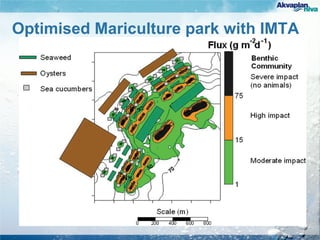
Optimised Mariculture park with IMTA
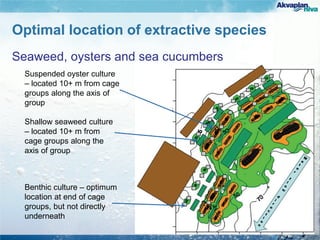
Optimal location of extractive species
Seaweed, oysters and sea cucumbers
Shallow seaweed culture
– located 10+ m from
cage groups along the
axis of group
Benthic culture – optimum
location at end of cage
groups, but not directly
underneath
Suspended oyster culture
– located 10+ m from cage
groups along the axis of
group
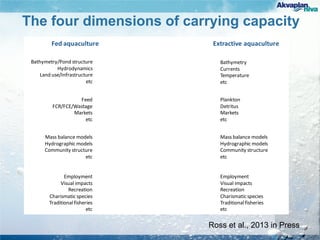
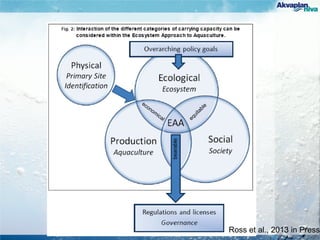
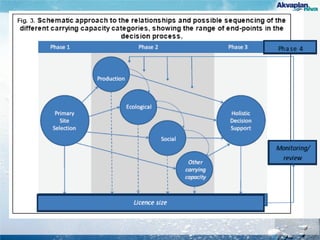
The four dimensions of carrying capacity
Productioncarrying capacity
Physicalcarrying capacity
(primary site selection)
Fed aquaculture Extractive aquaculture
Ecologicalcarrying capacity
Socialcarrying capacity
Guidance/
feedback
Bathymetry
Currents
Temperature
etc
Mass balance models
Hydrographic models
Community structure
etc
Plankton
Detritus
Markets
etc
Employment
Visual impacts
Recreation
Charismatic species
Traditionalfisheries
etc
Bathymetry/Pond structure
Hydrodynamics
Land use/Infrastructure
etc
Feed
FCR/FCE/Wastage
Markets
etc
Mass balance models
Hydrographic models
Community structure
etc
Employment
Visual impacts
Recreation
Charismatic species
Traditionalfisheries
etc
Ross et al., 2013 in Press
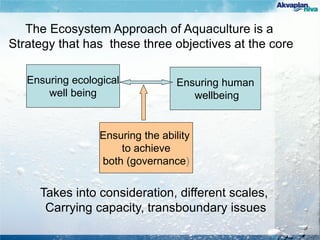
Ensuring ecological
well being
Ensuring human
wellbeing
Ensuring the ability
to achieve
both (governance)
The Ecosystem Approach of Aquaculture is a
Strategy that has these three objectives at the core
Takes into consideration, different scales,
Carrying capacity, transboundary issues
Ross et al., 2013 in Press
bearable
05. Carrying capacity estimation case study White 2

05. Carrying capacity estimation case study White 2

  • 1.
    © www.akvaplan.niva.no Carrying capacityestimation in common water bodies Case studies in the Philippines USSEC Southeast Asia Regional Symposium on Aquaculture Carrying Capacity Modeling for Common Water bodies 10-13 June 2013 Bangkok, Thailand
  • 2.
    Scope of thepresentation • Aquaculture park development • Planning sustainable aquaculture – Minimising aquaculture impact on the environment – Optimising aquaculture production • Integrated Multi-Trophic Aquaculture
  • 3.
    Planning and managementof aquaculture parks for sustainable development of cage farms in the Philippines Partners BFAR, NIFTDC, Map and Marine, Akvaplan-niva Funded by Norad, Norway www.aqua-park.asia
  • 4.
    Philippine Mariculture parklocations # # # # # Badoc, Ilocos Norte Narvacan, Ilocos Sur (100 Ha.) Rosario, La Union Sto. Tomas, La Union (100 Ha.) Sual, Pangasinan Tagkawayan, Quezon Province (500 Ha.) Padre Burgos, Quezon Province (500 Ha. Region VIIIRegion VIII Panabo City, Davao del Norte (1,075 Ha.) Pantukan, Compostela Valley Mati, Davao Oriental Samal Is., Davao del Norte (224 Ha.) Talibon, Bohol (370 Ha.) Calape, Bohol Maribujoc, Bohol Mabini, Bohol Bais, Negros Orriental Candijay, Bohol Region IRegion I Region IVRegion IV--AA Region VIIRegion VII Region IXRegion IX Region XIRegion XI Region VRegion V Region IVRegion IV--BB Sibutu - Sitangkai, Tawi-Tawi Phase 1 A&B (27T Ha.) ARMMARMM Balingasag, Mis. Oriental (195.07 Ha.) Sultan Naga Dimaporo, Lanao del Norte (500 Ha.) Region XRegion X Dapa, Siargao Is., Sur del Norte (1,000 Ha.) San Jose, Dinagat Province Surigao City, Surigao del Norte (500 Ha.) Barugo, Surigao del Sur (500 Ha.) Region XIIIRegion XIII Mursilagos Rizal, Zambo. Del Norte (1,000 Ha.) Margosatubig, Zambo. Del Sur (214 Ha.) Tungawan, Zambo. Sibugay (500 Ha.) Zamboanga City, Zamboanga (200 Ha) Calapan City Oriental Mindoro (200 Ha.) Sta. Cruz, Marinduque (500 Ha.) San Jose City, Occ. Mindoro (500 Ha.) Looc, Romblon (435 Ha.) Coron, Palawan San Vicente, Palawan Puerto Princesa, Palawan Quezon, Palawan Narra, Palawan San Jose N. Samar (800 Ha.) Laoang, N. Samar (2,500 Ha.) Calbayog, Samar (300 Ha.) Basey, Samar (400 Ha.) Naval, Biliran (200 Ha.) Biliran, Biliran (100 Ha.) Leyte Leyte, Leyte (100 Ha.) Sta. Rita, Samar (600 Ha.) Babatngon, Leyte (600 Ha.) Tacloban City, Leyte (800 Ha.) Quinapondan, E. Samar (1,000 Ha.) Ormoc, Leyte (600 Ha.) Merida, Leyte (100 Ha.) Liloan, S. Leyte (100 Ha.) Ragay, Camarines Sur (105 Ha.) Sagnay, Camarines Sur (500 Ha.) Magallanes, Sorsogon Bacon, Sorsogon City Masbate City, Masbate Matnog, Sorsogon Region IIRegion II Sta. Ana, Cagayan Casiguran, Aurora Province (320 Ha.) Region IIIRegion III Location of Existing Mariculture Park/Zone (As of February 18, 2010) MZ/MP Established = 49MZ/MP Established = 49 For LaunchingFor Launching = 10= 10 5959
  • 5.
    Initial Concept ofPanabo Mariculture Park
  • 6.
  • 7.
  • 8.
    Using modelling forplanning for sustainable development • Reorganisation of the Mariculture Park to reduce environmental impact • Planning for further expansion (modelling for exposure) • Integrating fed production with unfed production – IMTA (recapture of nutrients and provide further livelihoods)
  • 9.
    Optimisation Process • Datacollection – Production survey – actual tonnes produced – Environmental survey – actual impact caused • Modelling – Environmental impact – Location of extractive species • Optimisation – cage layout – Inclusion of Integrated Multi-trophic aquaculture (fish, oysters and seaweed) – Expansion in deeper area with larger cages
  • 10.
    Production survey -Total biomass of species SPECIES CULTURED BIOMASS (kg) Total Biomass (%) Milkfish monoculture 275,896.25 84.97 Milkfish-Siganid polyculture 48,470* 14.93 Grouper culture 186.85 0.06 Pomfret (Pampano) Culture 117.5 0.04 TOTAL 324,670.60 Total biomass of species culture at Panabo City Mariculture Park
  • 11.
    Environmental survey • Analysisof the bathymetry of the area • Profiling of temperature, salinity, and oxygen levels through the water • Sediment analysis • Survey of current speed and direction CTDO Current meterGrab
  • 13.
    Modelling environmental impact- TROPOMOD HIGH impact (orange) close to clusters of cages SEVERE impact (grey) under clusters of cages or under large cages MODERATE impact (green) away from cages or around small clusters of cages
  • 15.
    Panabo AquaPark –Existing and reorganised Spacing between zones results in less impact and also more space for IMTA units
  • 16.
    Panabo AquaPark –Existing and offshore zones added Good feeding scenario improves inshore areas Offshore Milkfish zones in deeper areas results in good dispersion
  • 17.
  • 18.
    Distance from cageedge (m) 25 m 10 m 5 m 3m 0 m 0 m 3m 5m 10 m 25m 1% 4% 11% 16% % of waste feed and faeces intersecting suspended culture Suspended solids reaching suspended oyster culture at different depths The majority of the wastes intersect the suspended culture in the top 6 m; these wastes are mostly fine and slow settling Milkfish faeces Net depth is important when considering optimum depth of suspended culture 0-3m 3-6m 6-9m 9-12m 12-15m 2% 5% 8% 8% 2% 2% 3% 2% 1% 1% 2% 2% 1% 1% 1% 1% 13% 9% 5% 1% 7% 6% 6% 2% 2% 2% 2% 2% 1% 1% 1% 1% 1% 1% 1% 1%
  • 19.
    North Percentage of wastefeed and faeces reaching suspended culture For Panabo, residual current to the south means predictions are higher at the IMTA units to the south, and lower to the east
  • 20.
    Distance from cageedge (m) 25 m 10 m 5 m 3m 0 m 9% 18% 26% 32% Dissolved nutrient plume reaching seaweed culture More of the plume intersects seaweed culture to the south of the cages as this is the direction of the residual current Net depth is important when considering optimum depth of seaweed culture 0-3m 3-6m 6-9m 9-12m 12-15m 2% 3% 3% 3% <1% <1% <1% <1% <1% <1%<1% <1% <1% <1% <1% <1% Plan view N % of plume intersecting seaweed culture to the SOUTH of the cages
  • 21.
    Distance from cageedge (m) 25 m 10 m 5 m 3m 0 m 6% 10% 11% 12% Nutrient plume from a large polar circle cage reaching seaweed culture A deeper net means more of the suspended line comes into contact with the plume Seaweed culture at depth will be limited by light rather than nutrients 0-3m 3-6m 6-9m 9-12m 12-15m 6% 10% 12% 12% 5% 7% 9% 10% 1% 1% 2% 1% <1% <1% <1% <1% Plan view N % of plume intersecting seaweed culture to the SOUTH of the cages
  • 22.
    Suspended solid nutrientuptake by benthic structures TROPOMOD predictions of the waste feed and faeces depositing on 8 m by 8 m structures on the sea bed Structures for benthic culture
  • 23.
    North Nutrient uptake byBenthic structures Percentage of waste feed and faeces reaching bethic structures For structures on the sea bed, around 20% of wastes deposited within 8 m of the cages Fine, slow settling Milkfish faeces are dispersed away from these structures 4 %
  • 24.
  • 26.
    Optimal location ofextractive species Seaweed, oysters and sea cucumbers Shallow seaweed culture – located 10+ m from cage groups along the axis of group Benthic culture – optimum location at end of cage groups, but not directly underneath Suspended oyster culture – located 10+ m from cage groups along the axis of group
  • 27.
    The four dimensionsof carrying capacity Productioncarrying capacity Physicalcarrying capacity (primary site selection) Fed aquaculture Extractive aquaculture Ecologicalcarrying capacity Socialcarrying capacity Guidance/ feedback Bathymetry Currents Temperature etc Mass balance models Hydrographic models Community structure etc Plankton Detritus Markets etc Employment Visual impacts Recreation Charismatic species Traditionalfisheries etc Bathymetry/Pond structure Hydrodynamics Land use/Infrastructure etc Feed FCR/FCE/Wastage Markets etc Mass balance models Hydrographic models Community structure etc Employment Visual impacts Recreation Charismatic species Traditionalfisheries etc Ross et al., 2013 in Press
  • 28.
    Ensuring ecological well being Ensuringhuman wellbeing Ensuring the ability to achieve both (governance) The Ecosystem Approach of Aquaculture is a Strategy that has these three objectives at the core Takes into consideration, different scales, Carrying capacity, transboundary issues
  • 29.
    Ross et al.,2013 in Press bearable