ADVANCED SOIL SHEAR
STRENGTH – Fine-grained Soils
Donald C. Wotring, Ph.D., P.E.
December 2008
CLAY MINERALOGY
Bonding
• Primary Chemical Bonds – a net attractive force
  between atoms
  ▫ Ionic – removal and gain of electron(s) from one atom
    to the other
  ▫ Covalent – sharing of electrons to complete outer shell
    of electrons for both atoms
• Secondary Hydrogen Bond – intermolecular force
  between hydrogen atom of one molecule and an
  electron of another molecule (dipoles)
• Secondary van der Waals forces – instantaneous
  dipole attraction forces due to fluctuating electrons
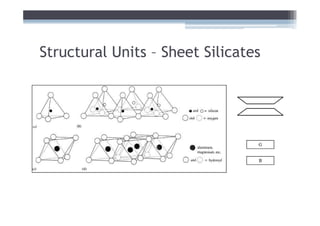
Structural Units – Sheet Silicates


                                 G


                                 B
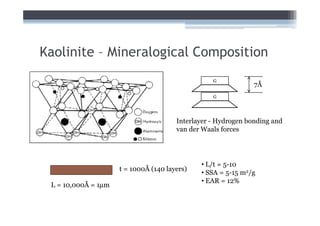
Kaolinite – Mineralogical Composition
                                                  G
                                                               7Å
                                                  G


                                       Interlayer - Hydrogen bonding and
                                       van der Waals forces


                                              • L/t = 5-10
                     t = 1000Å (140 layers)
                                              • SSA = 5-15 m2/g
                                              • EAR = 12%
 L = 10,000Å = 1µm
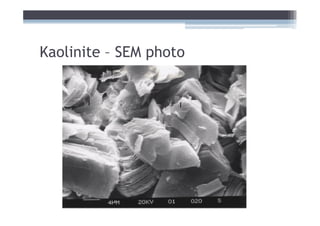
Kaolinite – SEM photo
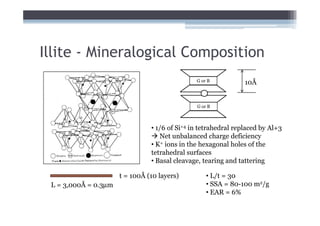
Illite - Mineralogical Composition
                                               G or B           10Å


                                               G or B


                                • 1/6 of Si+4 in tetrahedral replaced by Al+3
                                   Net unbalanced charge deficiency
                                • K+ ions in the hexagonal holes of the
                                tetrahedral surfaces
                                • Basal cleavage, tearing and tattering

                      t = 100Å (10 layers)         • L/t = 30
 L = 3,000Å = 0.3µm                                • SSA = 80-100 m2/g
                                                   • EAR = 6%
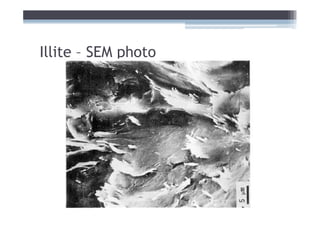
Illite – SEM photo
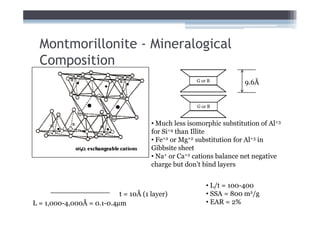
Montmorillonite - Mineralogical
  Composition
                                                     G or B          9.6Å


                                                     G or B


                                      • Much less isomorphic substitution of Al+3
                                      for Si+4 than Illite
                                      • Fe+2 or Mg+2 substitution for Al+3 in
                                      Gibbsite sheet
                                      • Na+ or Ca+2 cations balance net negative
                                      charge but don’t bind layers


                                                         • L/t = 100-400
                           t = 10Å (1 layer)             • SSA = 800 m2/g
L = 1,000-4,000Å = 0.1-0.4µm                             • EAR = 2%
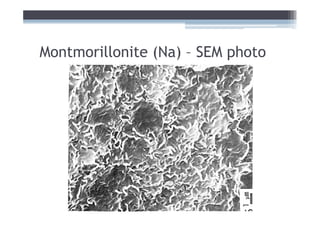
Montmorillonite (Na) – SEM photo
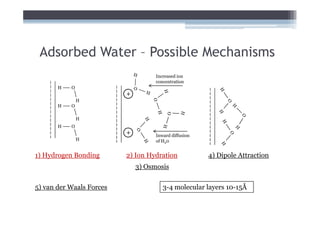
Adsorbed Water – Possible Mechanisms
                                    Increased ion
                                    concentration
       H   O
                          +
               H
       H   O

               H
       H   O
                          +         Inward diffusion
               H                    of H20


1) Hydrogen Bonding       2) Ion Hydration             4) Dipole Attraction
                              3) Osmosis

5) van der Waals Forces                3-4 molecular layers 10-15Å
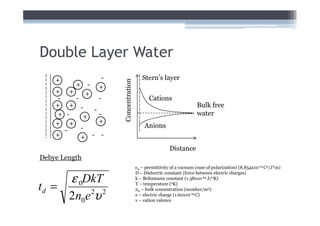
Double Layer Water
    +                -                      Stern’s layer


                         Concentration
          +     -   +
    + +        +
     -   -      -                              Cations
    + + -                                                              Bulk free
              -
     + -    +   -                                                      water
    + +         +
           -                                 Anions
       -
    +      + - -
                                                          Distance
Debye Length
                                         ε0 – permittivity of a vacuum (ease of polarization) (8.854x10⁻¹² C2/J*m)

     ε 0DkT
                                         D – Dielectric constant (force between electric charges)
                                         k – Boltzmann constant (1.38x10⁻²³ J/oK)

td =                                     T – temperature (oK)


     2n0 e υ
                                         n0 – bulk concentration (number/m3)
          2 2                            e – electric charge (1.60x10⁻¹⁹ C)
                                         v – cation valence
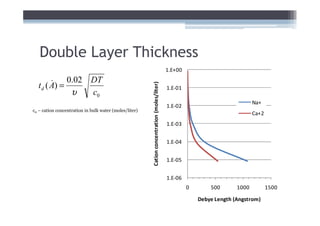
Double Layer Thickness
                                                                                             1.E+00
             0.02 DT
  t d ( A) =
        &


                                                        Cation concentration (moles/liter)
              υ
                                                                                             1.E-01
                  c0
                                                                                                                               Na+
                                                                                             1.E-02
c0 – cation concentration in bulk water (moles/liter)
                                                                                                                               Ca+2
                                                                                             1.E-03


                                                                                             1.E-04


                                                                                             1.E-05


                                                                                             1.E-06
                                                                                                      0       500       1000          1500

                                                                                                          Debye Length (Angstrom)
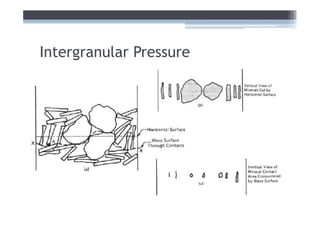
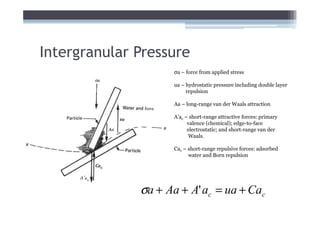
Intergranular Pressure
                     σa – force from applied stress

                     ua – hydrostatic pressure including double layer
                          repulsion

                     Aa – long-range van der Waals attraction

                     A’ac – short-range attractive forces: primary
                           valence (chemical); edge-to-face
                           electrostatic; and short-range van der
                           Waals.

                     Cac – short-range repulsive forces: adsorbed
                           water and Born repulsion


              σa + Aa + A' ac = ua + Cac
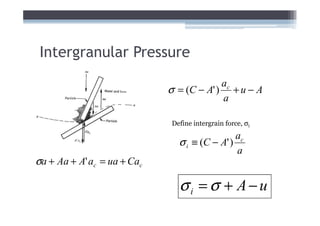
Intergranular Pressure
                                          ac
                             σ = (C − A' ) + u − A
                                          a

                             Define intergrain force, σi
                                               ac
                               σ i ≡ (C − A' )
                                               a
σa + Aa + A' ac = ua + Cac

                               σi = σ + A−u
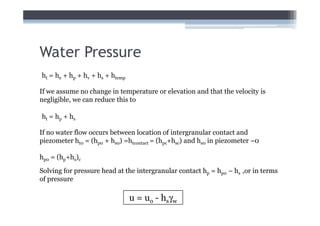
Water Pressure
ht = he + hp + hv + hs + htemp

If we assume no change in temperature or elevation and that the velocity is
negligible, we can reduce this to

ht = hp + hs

If no water flow occurs between location of intergranular contact and
piezometer ht0 = (hp0 + hs0) =htcontact = (hpc+hsc) and hs0 in piezometer ~0

hp0 = (hp+hs)c

Solving for pressure head at the intergranular contact hp = hp0 – hs ,or in terms
of pressure

                                 u = uo - hsγw
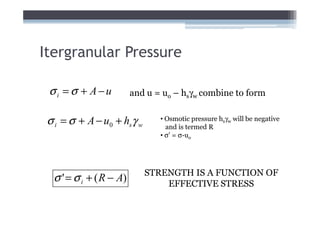
Itergranular Pressure

 σi = σ + A −u           and u = uo – hsγw combine to form


 σ i = σ + A − u0 + hsγ w       • Osmotic pressure hsγw will be negative
                                  and is termed R
                                • σ’ = σ-uo


                            STRENGTH IS A FUNCTION OF
  σ ' = σ i + ( R − A)          EFFECTIVE STRESS
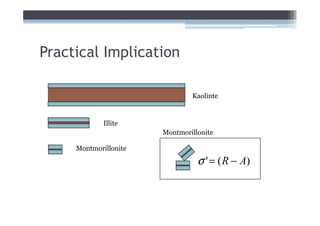
Practical Implication

                               Kaolinte


             Illite
                       Montmorillonite

     Montmorillonite

                                 σ ' = ( R − A)
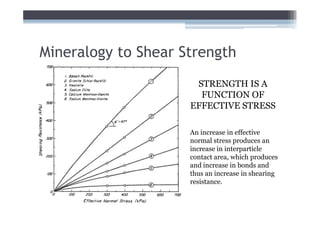
Mineralogy to Shear Strength
                      STRENGTH IS A
                       FUNCTION OF
                     EFFECTIVE STRESS

                     An increase in effective
                     normal stress produces an
                     increase in interparticle
                     contact area, which produces
                     and increase in bonds and
                     thus an increase in shearing
                     resistance.
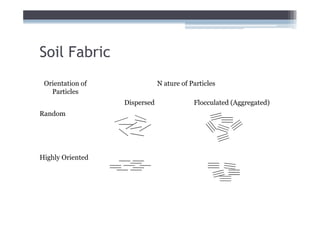
Soil Fabric
 Orientation of               N ature of Particles
   Particles
                  Dispersed               Flocculated (Aggregated)
Random


Highly Oriented
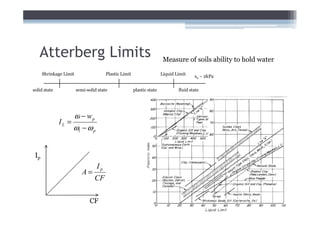
Atterberg Limits                                                     Measure of soils ability to hold water

      Shrinkage Limit                  Plastic Limit                   Liquid Limit    su ~ 2kPa


solid state             semi-solid state               plastic state           fluid state


                   ω − wp
              IL =
                   ωl − ω p


 Ip
                                  Ip
                           A=
                                 CF

                               CF
SOIL SAMPLING
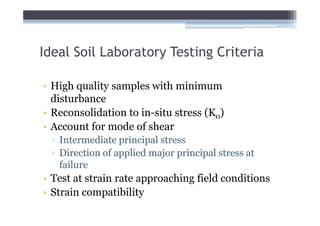
Ideal Soil Laboratory Testing Criteria

• High quality samples with minimum
  disturbance
• Reconsolidation to in-situ stress (K0)
• Account for mode of shear
  ▫ Intermediate principal stress
  ▫ Direction of applied major principal stress at
    failure
• Test at strain rate approaching field conditions
• Strain compatibility
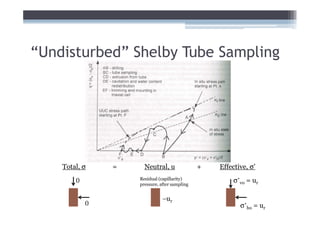
“Undisturbed” Shelby Tube Sampling


    Total, σ    =     Neutral, u               +   Effective, σ’

        0           Residual (capillarity)
                    pressure, after sampling
                                                       σ’vo = ur

                               −ur
            0                                             σ’ho = ur
Minimize Sampling Disturbance
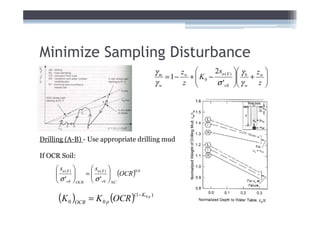
                                                  γm      zw          2s        γ  z 
                                                     = 1−      +
                                                                 K 0 − u ( E )  b + w 
                                                  γw       z          σ 'v 0  γ w z 
                                                                                       


Drilling (A-B) - Use appropriate drilling mud

If OCR Soil:
      su ( E )    su ( E ) 
     
     σ'        =
                              (OCR )0.8
                              
      v 0 OCR  σ 'v 0  NC

      (K 0 )OCR = K 0 p (OCR )(1− K         0p)
Minimize Sampling Disturbance
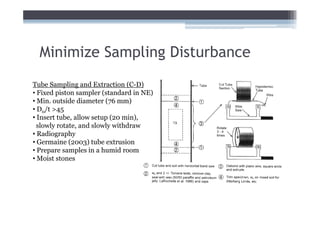
Tube Sampling and Extraction (C-D)
• Fixed piston sampler (standard in NE)
• Min. outside diameter (76 mm)
• D0/t >45
• Insert tube, allow setup (20 min),
  slowly rotate, and slowly withdraw
• Radiography
• Germaine (2003) tube extrusion
• Prepare samples in a humid room
• Moist stones
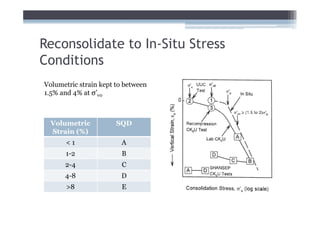
Reconsolidate to In-Situ Stress
Conditions
Volumetric strain kept to between
1.5% and 4% at σ’v0


  Volumetric           SQD
  Strain (%)
       <1               A
      1-2               B
      2-4               C
      4-8               D
       >8               E
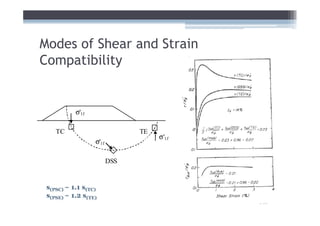
Modes of Shear and Strain
Compatibility


           σ'1f

    TC                         TE
                                    σ'1f
                  σ'1f

                         DSS


 s(PSC) ~ 1.1 s(TC)
 s(PSE) ~ 1.2 s(TE)
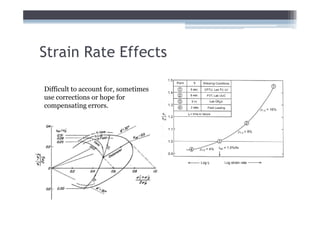
Strain Rate Effects

Difficult to account for, sometimes
use corrections or hope for
compensating errors.
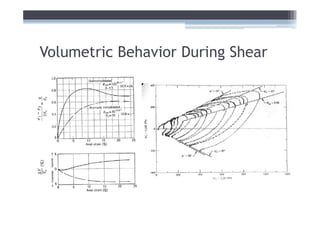
VOLUMETRIC BEHAVIOR DURING
SHEAR
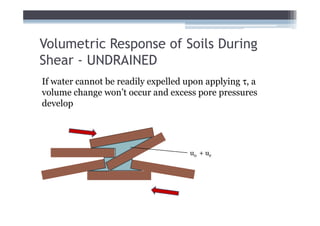
Volumetric Response of Soils During
Shear - UNDRAINED
If water cannot be readily expelled upon applying τ, a
volume change won’t occur and excess pore pressures
develop


                                     uo + ue
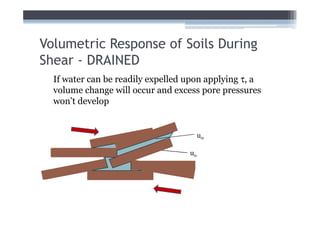
Volumetric Response of Soils During
Shear - DRAINED
  If water can be readily expelled upon applying τ, a
  volume change will occur and excess pore pressures
  won’t develop


                                        u0

                                   uo
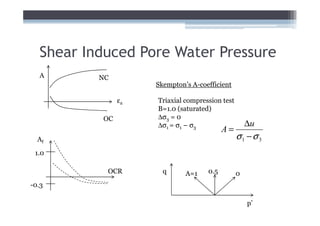
Shear Induced Pore Water Pressure
  A       NC
                    Skempton’s A-coefficient

               εa   Triaxial compression test
                    B=1.0 (saturated)
          OC        ∆σ3 = 0
                    ∆σ1 = σ1 – σ3                 ∆u
                                          A=
  Af                                            σ1 − σ 3
 1.0

           OCR        q      A=1    0.5         0
-0.3

                                                    p’
Volumetric Behavior During Shear
DRAINED SHEAR STRENGTH
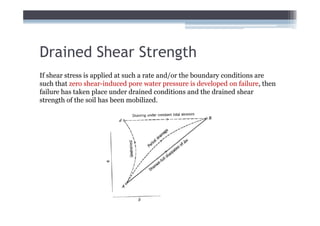
Drained Shear Strength
If shear stress is applied at such a rate and/or the boundary conditions are
such that zero shear-induced pore water pressure is developed on failure, then
failure has taken place under drained conditions and the drained shear
strength of the soil has been mobilized.
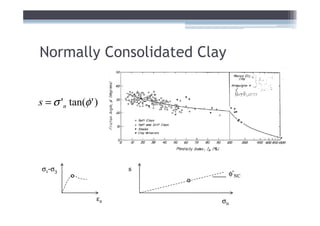
Normally Consolidated Clay


s = σ 'n tan(φ ' )


σ1-σ3                 s
                               φ’NC


                 εa       σn
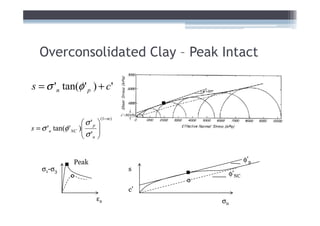
Overconsolidated Clay – Peak Intact

s = σ 'n tan(φ ' p ) + c'

                                (1− m )
                      σ 'p 
s = σ 'n tan(φ ' NC )
                     σ'   
                      n


                 Peak                                      φ’p
    σ1-σ3                                 s
                                                    φ’NC

                                          c’
                           εa                  σn
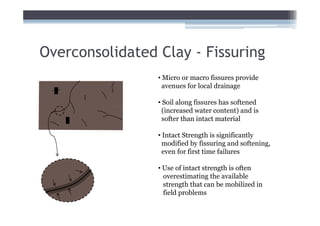
Overconsolidated Clay - Fissuring
                 • Micro or macro fissures provide
                   avenues for local drainage

                 • Soil along fissures has softened
                   (increased water content) and is
                   softer than intact material

                 • Intact Strength is significantly
                   modified by fissuring and softening,
                   even for first time failures

                 • Use of intact strength is often
                   overestimating the available
                   strength that can be mobilized in
                   field problems
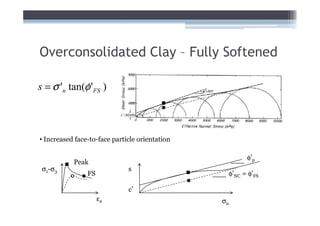
Overconsolidated Clay – Fully Softened

s = σ 'n tan(φ 'FS )


• Increased face-to-face particle orientation

                                                           φ’p
           Peak
 σ1-σ3                        s
                FS                                   φ’NC = φ’FS

                              c’
                     εa                         σn
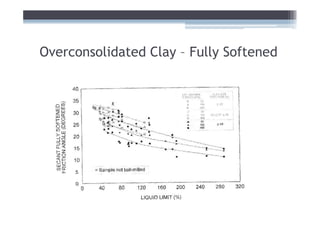
Overconsolidated Clay – Fully Softened
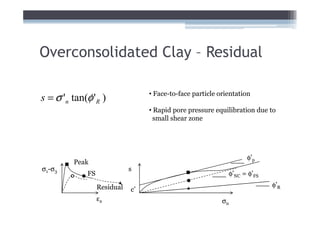
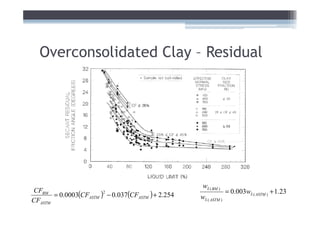
Overconsolidated Clay – Residual

s = σ 'n tan(φ 'R )               • Face-to-face particle orientation

                                  • Rapid pore pressure equilibration due to
                                    small shear zone


                                                                      φ’p
         Peak
σ1-σ3                        s
             FS                                                 φ’NC = φ’FS
                  Residual                                                    φ’R
                             c’
                  εa                                       σn
Overconsolidated Clay – Residual


                                                     wL ( BM )
CFBM
       = 0.0003(CFASTM ) − 0.037(CFASTM ) + 2.254
                        2                                         = 0.003wL ( ASTM ) + 1.23
CFASTM                                              wL ( ASTM )
UNDRAINED SHEAR STRENGTH
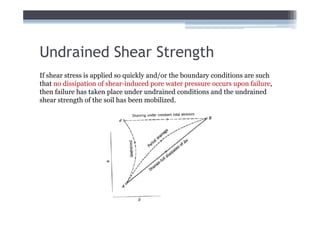
Undrained Shear Strength
If shear stress is applied so quickly and/or the boundary conditions are such
that no dissipation of shear-induced pore water pressure occurs upon failure,
then failure has taken place under undrained conditions and the undrained
shear strength of the soil has been mobilized.
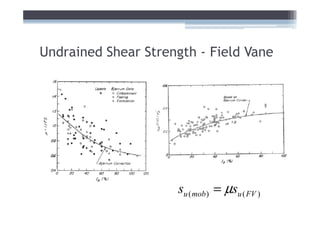
Undrained Shear Strength - Field Vane


                     su ( mob ) = µsu ( FV )
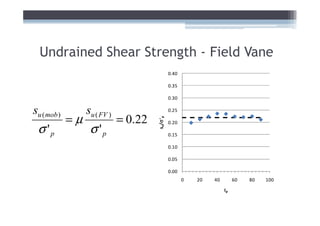
Undrained Shear Strength - Field Vane
                                                 0.40

                                                 0.35

                                                 0.30

su ( mob )        su ( FV )                      0.25

             =µ               = 0.22


                                       su/σ 'p
 σ 'p              σ 'p

                                          σ
                                                 0.20

                                                 0.15

                                                 0.10

                                                 0.05

                                                 0.00
                                                        0   20   40        60   80   100

                                                                      Ip
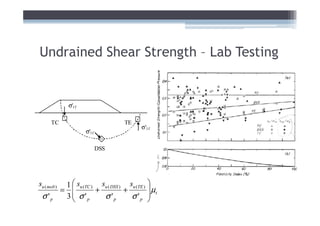
Undrained Shear Strength – Lab Testing


                σ'1f

      TC                              TE
                                            σ'1f
                       σ'1f

                              DSS


su ( mob )    1  su (TC ) su ( DSS ) su (TE ) 
             =           +          +          µt
 σ 'p         3  σ 'p
                           σ 'p       σ 'p   
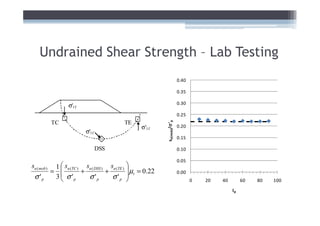
Undrained Shear Strength – Lab Testing
                                                                            0.40

                                                                            0.35

                    σ'1f                                                    0.30

                                                                            0.25


                                                             su(mob)/σ 'p
             TC                              TE
                                                    σ'1f


                                                                     σ
                                                                            0.20
                            σ'1f
                                                                            0.15

                                   DSS                                      0.10

                                                                            0.05
su ( mob )    1  su (TC ) su ( DSS ) su (TE ) 
             =           +          +          µt = 0.22
 σ 'p         3 σ'        σ 'p       σ 'p 
                                                                            0.00
                       p                                                          0   20   40        60   80   100

                                                                                                 Ip
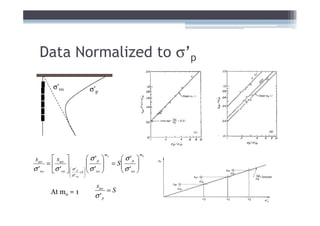
Data Normalized to σ’p

         σ’vo                 σ’p


                         σ 'p              σ' 
                                    mo               mo
 suo  suo 
     =       σ '   σ '            = S p 
σ 'vo σ 'vo   p =1   vo  
                                            σ ' 
                                             vo 
                     
                 σ 'vo   

                               suo
       At mo = 1                    =S
                               σ 'p
Example New Baltimore Data
                                           Stress (tsf)
                  0                  1                    2             3
              0


             10
                                                              Suo(FV)

                                                              Suo(HP)
             20
                                                              Suo(DSS)
                                         σ’vo
Depth (ft)


             30

                      su ( mob )
                                   = 0.22
                       σ 'p
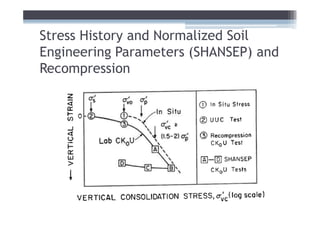
Stress History and Normalized Soil
Engineering Parameters (SHANSEP) and
Recompression
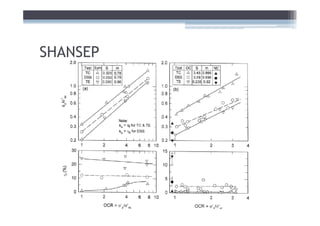
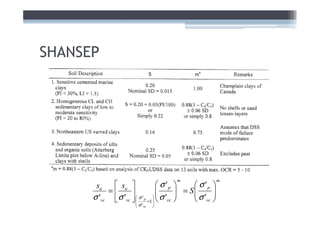
SHANSEP
SHANSEP


                                   σ 'p      σ' 
                                      m                 m
       su    su 
           =                             = S p 
      σ 'vc σ 'vc   σ ' p =1   σ 'vc 
                                      
                                               σ ' 
                                                vc 
                               
                       σ 'vc   
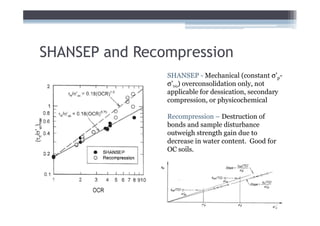
SHANSEP and Recompression
                SHANSEP - Mechanical (constant σ’p-
                σ’vo) overconsolidation only, not
                applicable for dessication, secondary
                compression, or physicochemical

                Recompression – Destruction of
                bonds and sample disturbance
                outweigh strength gain due to
                decrease in water content. Good for
                OC soils.
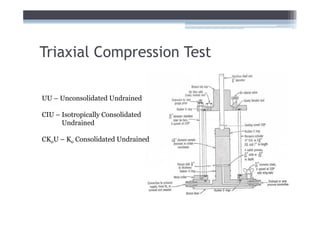
Triaxial Compression Test

UU – Unconsolidated Undrained

CIU – Isotropically Consolidated
      Undrained

CKoU – Ko Consolidated Undrained
Mohr’s Circle Review
                             α

                          (p’,q)
p’ = (σ’1+σ’3)/2
q = (σ1-σ3)/2


                   Pole
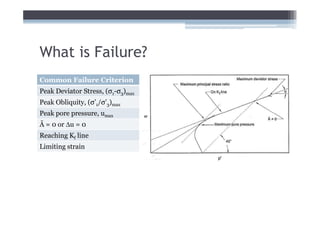
What is Failure?
Common Failure Criterion
Peak Deviator Stress, (σ1-σ3)max
Peak Obliquity, (σ’1/σ’3)max
Peak pore pressure, umax
Ā = 0 or ∆u = 0
Reaching Kf line
Limiting strain
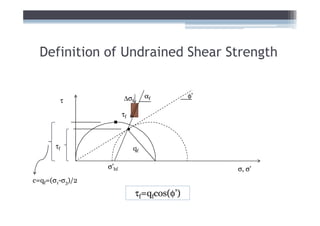
Definition of Undrained Shear Strength


                        ∆σf       αf         φ’
        τ

                        τf


       τf                    qf

                 σ’hf                             σ, σ’
c=qf=(σ1-σ3)/2
                              τf=qfcos(φ’)
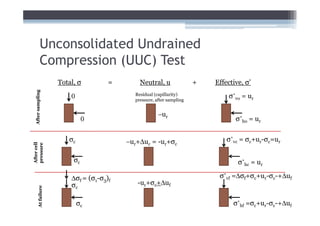
Unconsolidated Undrained
             Compression (UUC) Test
                      Total, σ         =       Neutral, u               +   Effective, σ’
  After sampling


                          0                  Residual (capillarity)
                                             pressure, after sampling
                                                                                σ’vo = ur

                                                        −ur
                                0                                                  σ’ho = ur


                         σc                −ur+∆uc = -ur+σc                     σ’vc = σc+ur-σc=ur
After cell
pressure


                           σc                                                       σ’hc = ur

                          ∆σf = (σ1-σ3)f                                     σ’vf =∆σf+σc+ur-σc-+∆uf
                          σc                  -ur+σc+∆uf
         At failure


                              σc                                                  σ’hf =σc+ur-σc-+∆uf
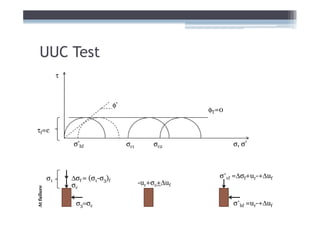
UUC Test
                  τ


                                       φ’
                                                               φT=0


τf=c

                      σ’hf                  σc1       σc2             σ, σ’


             σ1       ∆σf = (σ1-σ3)f                              σ’vf =∆σf+ur-+∆uf
                      σc                          -ur+σc+∆uf
At failure


                       σ3=σc                                          σ’hf =ur-+∆uf
UUC Test
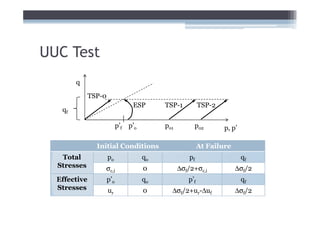
        q

              TSP-0
                                 ESP       TSP-1          TSP-2
   qf

                            p’f p’o        po1        po2         p, p’

                Initial Conditions                        At Failure
   Total              po              qo             pf                   qf
  Stresses        σc,i                0          ∆σf/2+σc,i            ∆σf/2
  Effective           p’o             qo            p’f                   qf
  Stresses            ur              0      ∆σf/2+ur-∆uf              ∆σf/2
UUC Test
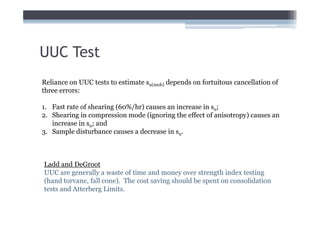
Reliance on UUC tests to estimate su(mob) depends on fortuitous cancellation of
three errors:

1. Fast rate of shearing (60%/hr) causes an increase in su;
2. Shearing in compression mode (ignoring the effect of anisotropy) causes an
   increase in su; and
3. Sample disturbance causes a decrease in su.


Ladd and DeGroot
UUC are generally a waste of time and money over strength index testing
(hand torvane, fall cone). The cost saving should be spent on consolidation
tests and Atterberg Limits.
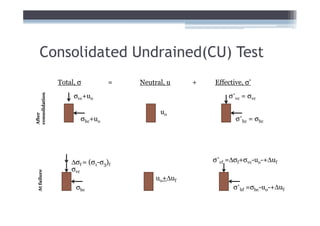
Consolidated Undrained(CU) Test
                Total, σ         =   Neutral, u    +   Effective, σ’

                     σvc+uo                                 σ’vc = σvc
consolidation


                                           uo
After


                       σhc+uo                                 σ’hc = σhc


                    ∆σf = (σ1-σ3)f                     σ’vf =∆σf+σvc-uo-+∆uf
                    σvc
  At failure


                                          uo+∆uf
                      σhc                                    σ’hf =σhc-uo-+∆uf
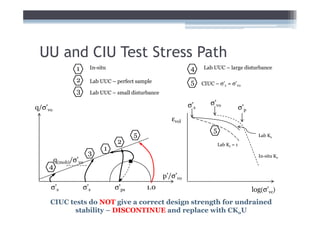
UU and CIU Test Stress Path
                 1     In-situ                                  4    Lab UUC – large disturbance

                 2     Lab UUC – perfect sample                 5    CIUC – σ’c = σ’vo
                 3     Lab UUC – small disturbance

                                                               σ’s      σ’vo
q/σ’vo                                                                                     σ’p
                                                        εvol
                                                                          5
                                        5                                                          Lab Ko
                                  2                                           Lab Kc = 1
                             1
                       3                                                                           In-situ Ko
         q(mob)/σ’vo
    4
                                                     p’/σ’vo
     σ’s             σ’s         σ’ps        1.0                                                 log(σ’vc)
     CIUC tests do NOT give a correct design strength for undrained
            stability – DISCONTINUE and replace with CKoU
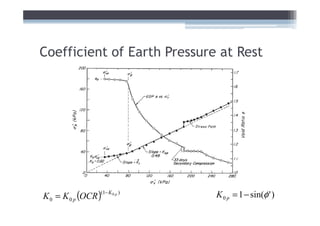
Coefficient of Earth Pressure at Rest


K 0 = K 0 p (OCR )             K 0 p = 1 − sin(φ ' )
                 (1− K 0 p )
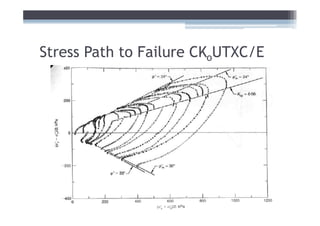
Stress Path to Failure CKoUTXC/E
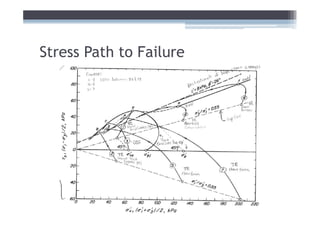
Stress Path to Failure
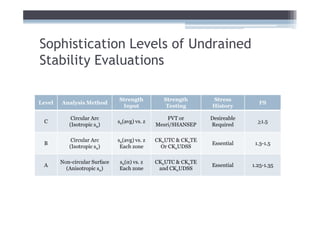
Sophistication Levels of Undrained
Stability Evaluations

                               Strength          Strength       Stress
Level   Analysis Method                                                        FS
                                Input             Testing       History

            Circular Arc                           FVT or       Desireable
 C                             su(avg) vs. z                                   >1.5
           (Isotropic su)                      Mesri/SHANSEP    Required

            Circular Arc       su(avg) vs. z   CKoUTC & CKoTE
 B                                                              Essential     1.3-1.5
           (Isotropic su)       Each zone        Or CKoUDSS

        Non-circular Surface   su(α) vs. z     CKoUTC & CKoTE
 A                                                              Essential    1.25-1.35
          (Anisotropic su)     Each zone        and CKoUDSS
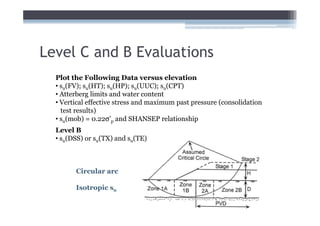
Level C and B Evaluations
  Plot the Following Data versus elevation
  • su(FV); su(HT); su(HP); su(UUC); su(CPT)
  • Atterberg limits and water content
  • Vertical effective stress and maximum past pressure (consolidation
    test results)
  • su(mob) = 0.22σ’p and SHANSEP relationship
  Level B
  • su(DSS) or su(TX) and su(TE)


        Circular arc

        Isotropic su
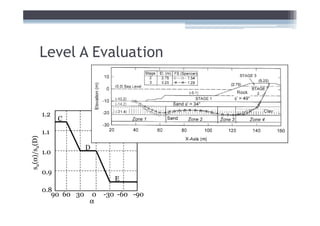
Level A Evaluation


              1.2
                    C
              1.1
su(α)/su(D)


                            D
              1.0

              0.9
                                    E
              0.8
                 90 60 30    0   -30 -60 -90
                            α
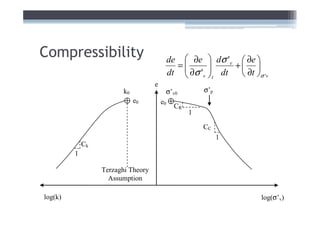
COMPRESSIBILITY
Compressibility                              de  ∂e  dσ 'v  ∂e 
                                               =
                                                 ∂σ '  dt +  ∂t 
                                                        
                                             dt      v t     σ 'v
                                    e
                        k0               σ’v0          σ’p
                             e0         e0
                                              CR
                                                   1

                                                       CC
                                                             1
             Ck
         1

                  Terzaghi Theory
                    Assumption

log(k)                                                             log(σ’v)
Compressibility
 de  ∂e  dσ 'v  ∂e 
   =
     ∂σ '  dt +  ∂t 
            
 dt      v t     σ 'v


        ∂e  de  ∂e  
      tp                             t
                                        ∂e 
∆e = ∫ 
         ∂σ '  dt +  dt   dt + ∫  dt  dt
                
     0 
             v t     σ 'v 
                                   tp     σ ' v
For Primary Consolidation, Terzaghi Theory Assumes

            ∂e                  ∂e 
            ∂σ '  = − av
                                 =0
                v t             ∂t σ 'v
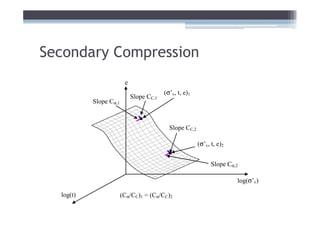
Secondary Compression
                         e
                                          (σ’v, t, e)1
                             Slope CC,1
           Slope Cα,1


                                            Slope CC,2

                                                         (σ’v, t, e)2


                                                               Slope Cα,2

                                                                        log(σ’v)

  log(t)                (Cα/CC)1 = (Cα/CC)2
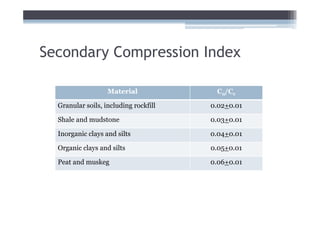
Secondary Compression Index

                   Material             Cα/Cc

  Granular soils, including rockfill   0.02+0.01

  Shale and mudstone                   0.03+0.01

  Inorganic clays and silts            0.04+0.01

  Organic clays and silts              0.05+0.01

  Peat and muskeg                      0.06+0.01
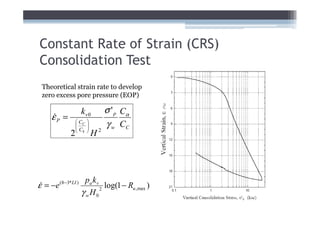
Constant Rate of Strain (CRS)
Consolidation Test
 Theoretical strain rate to develop
 zero excess pore pressure (EOP)

                   kv 0         σ ' p Cα
     εP =
     &           CC
                
                C
                       
                       
                               γ w CC
                 k    
            2              H2


                     pa k v
ε = −e (8−3*LI )
&                             log(1 − Ru ,max )
                   γ wH0    2
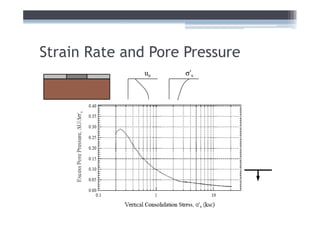
Strain Rate and Pore Pressure
               ue    σ’v
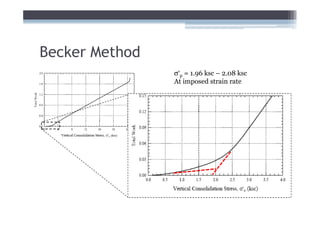
Becker Method
                σ‘p = 1.96 ksc – 2.08 ksc
                At imposed strain rate
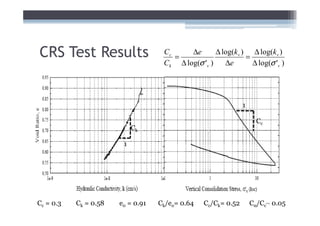
CRS Test Results                    Cc
                                       =
                                           ∆e       ∆ log(kv ) ∆ log(kv )
                                                              =
                                    Ck ∆ log(σ 'v )    ∆e       ∆ log(σ 'v )


                                                               1

                                                                     Cc
                            Ck

                        1


Cc = 0.3   Ck = 0.58   e0 = 0.91   Ck/eo= 0.64   Cc/Ck= 0.52       Cα/Cc~ 0.05
Adjust for EOP conditions

  [σ ' ]
     p ε
       &p    εp 
               &
                       Cα
                      
                      C
                       C
                             
                             
                             
                             
            =                  = 0.94
  [σ ' ]
     p ε
       &I
             ε 
              &I 


EOP Maximum Past Pressure

σ’p = 1.88 kg/cm2

Soil Strength 2009

  • 1.
    ADVANCED SOIL SHEAR STRENGTH– Fine-grained Soils Donald C. Wotring, Ph.D., P.E. December 2008
  • 2.
  • 3.
    Bonding • Primary ChemicalBonds – a net attractive force between atoms ▫ Ionic – removal and gain of electron(s) from one atom to the other ▫ Covalent – sharing of electrons to complete outer shell of electrons for both atoms • Secondary Hydrogen Bond – intermolecular force between hydrogen atom of one molecule and an electron of another molecule (dipoles) • Secondary van der Waals forces – instantaneous dipole attraction forces due to fluctuating electrons
  • 4.
    Structural Units –Sheet Silicates G B
  • 5.
    Kaolinite – MineralogicalComposition G 7Å G Interlayer - Hydrogen bonding and van der Waals forces • L/t = 5-10 t = 1000Å (140 layers) • SSA = 5-15 m2/g • EAR = 12% L = 10,000Å = 1µm
  • 6.
  • 7.
    Illite - MineralogicalComposition G or B 10Å G or B • 1/6 of Si+4 in tetrahedral replaced by Al+3 Net unbalanced charge deficiency • K+ ions in the hexagonal holes of the tetrahedral surfaces • Basal cleavage, tearing and tattering t = 100Å (10 layers) • L/t = 30 L = 3,000Å = 0.3µm • SSA = 80-100 m2/g • EAR = 6%
  • 8.
  • 9.
    Montmorillonite - Mineralogical Composition G or B 9.6Å G or B • Much less isomorphic substitution of Al+3 for Si+4 than Illite • Fe+2 or Mg+2 substitution for Al+3 in Gibbsite sheet • Na+ or Ca+2 cations balance net negative charge but don’t bind layers • L/t = 100-400 t = 10Å (1 layer) • SSA = 800 m2/g L = 1,000-4,000Å = 0.1-0.4µm • EAR = 2%
  • 10.
  • 11.
    Adsorbed Water –Possible Mechanisms Increased ion concentration H O + H H O H H O + Inward diffusion H of H20 1) Hydrogen Bonding 2) Ion Hydration 4) Dipole Attraction 3) Osmosis 5) van der Waals Forces 3-4 molecular layers 10-15Å
  • 12.
    Double Layer Water + - Stern’s layer Concentration + - + + + + - - - Cations + + - Bulk free - + - + - water + + + - Anions - + + - - Distance Debye Length ε0 – permittivity of a vacuum (ease of polarization) (8.854x10⁻¹² C2/J*m) ε 0DkT D – Dielectric constant (force between electric charges) k – Boltzmann constant (1.38x10⁻²³ J/oK) td = T – temperature (oK) 2n0 e υ n0 – bulk concentration (number/m3) 2 2 e – electric charge (1.60x10⁻¹⁹ C) v – cation valence
  • 13.
    Double Layer Thickness 1.E+00 0.02 DT t d ( A) = & Cation concentration (moles/liter) υ 1.E-01 c0 Na+ 1.E-02 c0 – cation concentration in bulk water (moles/liter) Ca+2 1.E-03 1.E-04 1.E-05 1.E-06 0 500 1000 1500 Debye Length (Angstrom)
  • 14.
  • 15.
    Intergranular Pressure σa – force from applied stress ua – hydrostatic pressure including double layer repulsion Aa – long-range van der Waals attraction A’ac – short-range attractive forces: primary valence (chemical); edge-to-face electrostatic; and short-range van der Waals. Cac – short-range repulsive forces: adsorbed water and Born repulsion σa + Aa + A' ac = ua + Cac
  • 16.
    Intergranular Pressure ac σ = (C − A' ) + u − A a Define intergrain force, σi ac σ i ≡ (C − A' ) a σa + Aa + A' ac = ua + Cac σi = σ + A−u
  • 17.
    Water Pressure ht =he + hp + hv + hs + htemp If we assume no change in temperature or elevation and that the velocity is negligible, we can reduce this to ht = hp + hs If no water flow occurs between location of intergranular contact and piezometer ht0 = (hp0 + hs0) =htcontact = (hpc+hsc) and hs0 in piezometer ~0 hp0 = (hp+hs)c Solving for pressure head at the intergranular contact hp = hp0 – hs ,or in terms of pressure u = uo - hsγw
  • 18.
    Itergranular Pressure σi= σ + A −u and u = uo – hsγw combine to form σ i = σ + A − u0 + hsγ w • Osmotic pressure hsγw will be negative and is termed R • σ’ = σ-uo STRENGTH IS A FUNCTION OF σ ' = σ i + ( R − A) EFFECTIVE STRESS
  • 19.
    Practical Implication Kaolinte Illite Montmorillonite Montmorillonite σ ' = ( R − A)
  • 20.
    Mineralogy to ShearStrength STRENGTH IS A FUNCTION OF EFFECTIVE STRESS An increase in effective normal stress produces an increase in interparticle contact area, which produces and increase in bonds and thus an increase in shearing resistance.
  • 21.
    Soil Fabric Orientationof N ature of Particles Particles Dispersed Flocculated (Aggregated) Random Highly Oriented
  • 22.
    Atterberg Limits Measure of soils ability to hold water Shrinkage Limit Plastic Limit Liquid Limit su ~ 2kPa solid state semi-solid state plastic state fluid state ω − wp IL = ωl − ω p Ip Ip A= CF CF
  • 23.
  • 24.
    Ideal Soil LaboratoryTesting Criteria • High quality samples with minimum disturbance • Reconsolidation to in-situ stress (K0) • Account for mode of shear ▫ Intermediate principal stress ▫ Direction of applied major principal stress at failure • Test at strain rate approaching field conditions • Strain compatibility
  • 25.
    “Undisturbed” Shelby TubeSampling Total, σ = Neutral, u + Effective, σ’ 0 Residual (capillarity) pressure, after sampling σ’vo = ur −ur 0 σ’ho = ur
  • 26.
    Minimize Sampling Disturbance γm zw  2s  γ z  = 1− +  K 0 − u ( E )  b + w  γw z  σ 'v 0  γ w z    Drilling (A-B) - Use appropriate drilling mud If OCR Soil:  su ( E )   su ( E )   σ'   =   (OCR )0.8   v 0 OCR  σ 'v 0  NC (K 0 )OCR = K 0 p (OCR )(1− K 0p)
  • 27.
    Minimize Sampling Disturbance TubeSampling and Extraction (C-D) • Fixed piston sampler (standard in NE) • Min. outside diameter (76 mm) • D0/t >45 • Insert tube, allow setup (20 min), slowly rotate, and slowly withdraw • Radiography • Germaine (2003) tube extrusion • Prepare samples in a humid room • Moist stones
  • 28.
    Reconsolidate to In-SituStress Conditions Volumetric strain kept to between 1.5% and 4% at σ’v0 Volumetric SQD Strain (%) <1 A 1-2 B 2-4 C 4-8 D >8 E
  • 29.
    Modes of Shearand Strain Compatibility σ'1f TC TE σ'1f σ'1f DSS s(PSC) ~ 1.1 s(TC) s(PSE) ~ 1.2 s(TE)
  • 30.
    Strain Rate Effects Difficultto account for, sometimes use corrections or hope for compensating errors.
  • 31.
  • 32.
    Volumetric Response ofSoils During Shear - UNDRAINED If water cannot be readily expelled upon applying τ, a volume change won’t occur and excess pore pressures develop uo + ue
  • 33.
    Volumetric Response ofSoils During Shear - DRAINED If water can be readily expelled upon applying τ, a volume change will occur and excess pore pressures won’t develop u0 uo
  • 34.
    Shear Induced PoreWater Pressure A NC Skempton’s A-coefficient εa Triaxial compression test B=1.0 (saturated) OC ∆σ3 = 0 ∆σ1 = σ1 – σ3 ∆u A= Af σ1 − σ 3 1.0 OCR q A=1 0.5 0 -0.3 p’
  • 35.
  • 36.
  • 37.
    Drained Shear Strength Ifshear stress is applied at such a rate and/or the boundary conditions are such that zero shear-induced pore water pressure is developed on failure, then failure has taken place under drained conditions and the drained shear strength of the soil has been mobilized.
  • 38.
    Normally Consolidated Clay s= σ 'n tan(φ ' ) σ1-σ3 s φ’NC εa σn
  • 39.
    Overconsolidated Clay –Peak Intact s = σ 'n tan(φ ' p ) + c' (1− m )  σ 'p  s = σ 'n tan(φ ' NC ) σ'    n Peak φ’p σ1-σ3 s φ’NC c’ εa σn
  • 40.
    Overconsolidated Clay -Fissuring • Micro or macro fissures provide avenues for local drainage • Soil along fissures has softened (increased water content) and is softer than intact material • Intact Strength is significantly modified by fissuring and softening, even for first time failures • Use of intact strength is often overestimating the available strength that can be mobilized in field problems
  • 41.
    Overconsolidated Clay –Fully Softened s = σ 'n tan(φ 'FS ) • Increased face-to-face particle orientation φ’p Peak σ1-σ3 s FS φ’NC = φ’FS c’ εa σn
  • 42.
  • 43.
    Overconsolidated Clay –Residual s = σ 'n tan(φ 'R ) • Face-to-face particle orientation • Rapid pore pressure equilibration due to small shear zone φ’p Peak σ1-σ3 s FS φ’NC = φ’FS Residual φ’R c’ εa σn
  • 44.
    Overconsolidated Clay –Residual wL ( BM ) CFBM = 0.0003(CFASTM ) − 0.037(CFASTM ) + 2.254 2 = 0.003wL ( ASTM ) + 1.23 CFASTM wL ( ASTM )
  • 45.
  • 46.
    Undrained Shear Strength Ifshear stress is applied so quickly and/or the boundary conditions are such that no dissipation of shear-induced pore water pressure occurs upon failure, then failure has taken place under undrained conditions and the undrained shear strength of the soil has been mobilized.
  • 47.
    Undrained Shear Strength- Field Vane su ( mob ) = µsu ( FV )
  • 48.
    Undrained Shear Strength- Field Vane 0.40 0.35 0.30 su ( mob ) su ( FV ) 0.25 =µ = 0.22 su/σ 'p σ 'p σ 'p σ 0.20 0.15 0.10 0.05 0.00 0 20 40 60 80 100 Ip
  • 49.
    Undrained Shear Strength– Lab Testing σ'1f TC TE σ'1f σ'1f DSS su ( mob ) 1  su (TC ) su ( DSS ) su (TE )  =  + +  µt σ 'p 3  σ 'p  σ 'p σ 'p  
  • 50.
    Undrained Shear Strength– Lab Testing 0.40 0.35 σ'1f 0.30 0.25 su(mob)/σ 'p TC TE σ'1f σ 0.20 σ'1f 0.15 DSS 0.10 0.05 su ( mob ) 1  su (TC ) su ( DSS ) su (TE )  =  + +  µt = 0.22 σ 'p 3 σ' σ 'p σ 'p  0.00 p  0 20 40 60 80 100 Ip
  • 51.
    Data Normalized toσ’p σ’vo σ’p  σ 'p   σ'  mo mo suo  suo  =  σ '   σ '  = S p  σ 'vo σ 'vo   p =1   vo   σ '   vo     σ 'vo  suo At mo = 1 =S σ 'p
  • 52.
    Example New BaltimoreData Stress (tsf) 0 1 2 3 0 10 Suo(FV) Suo(HP) 20 Suo(DSS) σ’vo Depth (ft) 30 su ( mob ) = 0.22 σ 'p
  • 53.
    Stress History andNormalized Soil Engineering Parameters (SHANSEP) and Recompression
  • 54.
  • 55.
    SHANSEP  σ 'p  σ'  m m su  su  =   = S p  σ 'vc σ 'vc   σ ' p =1   σ 'vc      σ '   vc     σ 'vc 
  • 56.
    SHANSEP and Recompression SHANSEP - Mechanical (constant σ’p- σ’vo) overconsolidation only, not applicable for dessication, secondary compression, or physicochemical Recompression – Destruction of bonds and sample disturbance outweigh strength gain due to decrease in water content. Good for OC soils.
  • 57.
    Triaxial Compression Test UU– Unconsolidated Undrained CIU – Isotropically Consolidated Undrained CKoU – Ko Consolidated Undrained
  • 58.
    Mohr’s Circle Review α (p’,q) p’ = (σ’1+σ’3)/2 q = (σ1-σ3)/2 Pole
  • 59.
    What is Failure? CommonFailure Criterion Peak Deviator Stress, (σ1-σ3)max Peak Obliquity, (σ’1/σ’3)max Peak pore pressure, umax Ā = 0 or ∆u = 0 Reaching Kf line Limiting strain
  • 60.
    Definition of UndrainedShear Strength ∆σf αf φ’ τ τf τf qf σ’hf σ, σ’ c=qf=(σ1-σ3)/2 τf=qfcos(φ’)
  • 61.
    Unconsolidated Undrained Compression (UUC) Test Total, σ = Neutral, u + Effective, σ’ After sampling 0 Residual (capillarity) pressure, after sampling σ’vo = ur −ur 0 σ’ho = ur σc −ur+∆uc = -ur+σc σ’vc = σc+ur-σc=ur After cell pressure σc σ’hc = ur ∆σf = (σ1-σ3)f σ’vf =∆σf+σc+ur-σc-+∆uf σc -ur+σc+∆uf At failure σc σ’hf =σc+ur-σc-+∆uf
  • 62.
    UUC Test τ φ’ φT=0 τf=c σ’hf σc1 σc2 σ, σ’ σ1 ∆σf = (σ1-σ3)f σ’vf =∆σf+ur-+∆uf σc -ur+σc+∆uf At failure σ3=σc σ’hf =ur-+∆uf
  • 63.
    UUC Test q TSP-0 ESP TSP-1 TSP-2 qf p’f p’o po1 po2 p, p’ Initial Conditions At Failure Total po qo pf qf Stresses σc,i 0 ∆σf/2+σc,i ∆σf/2 Effective p’o qo p’f qf Stresses ur 0 ∆σf/2+ur-∆uf ∆σf/2
  • 64.
    UUC Test Reliance onUUC tests to estimate su(mob) depends on fortuitous cancellation of three errors: 1. Fast rate of shearing (60%/hr) causes an increase in su; 2. Shearing in compression mode (ignoring the effect of anisotropy) causes an increase in su; and 3. Sample disturbance causes a decrease in su. Ladd and DeGroot UUC are generally a waste of time and money over strength index testing (hand torvane, fall cone). The cost saving should be spent on consolidation tests and Atterberg Limits.
  • 65.
    Consolidated Undrained(CU) Test Total, σ = Neutral, u + Effective, σ’ σvc+uo σ’vc = σvc consolidation uo After σhc+uo σ’hc = σhc ∆σf = (σ1-σ3)f σ’vf =∆σf+σvc-uo-+∆uf σvc At failure uo+∆uf σhc σ’hf =σhc-uo-+∆uf
  • 66.
    UU and CIUTest Stress Path 1 In-situ 4 Lab UUC – large disturbance 2 Lab UUC – perfect sample 5 CIUC – σ’c = σ’vo 3 Lab UUC – small disturbance σ’s σ’vo q/σ’vo σ’p εvol 5 5 Lab Ko 2 Lab Kc = 1 1 3 In-situ Ko q(mob)/σ’vo 4 p’/σ’vo σ’s σ’s σ’ps 1.0 log(σ’vc) CIUC tests do NOT give a correct design strength for undrained stability – DISCONTINUE and replace with CKoU
  • 67.
    Coefficient of EarthPressure at Rest K 0 = K 0 p (OCR ) K 0 p = 1 − sin(φ ' ) (1− K 0 p )
  • 68.
    Stress Path toFailure CKoUTXC/E
  • 69.
  • 70.
    Sophistication Levels ofUndrained Stability Evaluations Strength Strength Stress Level Analysis Method FS Input Testing History Circular Arc FVT or Desireable C su(avg) vs. z >1.5 (Isotropic su) Mesri/SHANSEP Required Circular Arc su(avg) vs. z CKoUTC & CKoTE B Essential 1.3-1.5 (Isotropic su) Each zone Or CKoUDSS Non-circular Surface su(α) vs. z CKoUTC & CKoTE A Essential 1.25-1.35 (Anisotropic su) Each zone and CKoUDSS
  • 71.
    Level C andB Evaluations Plot the Following Data versus elevation • su(FV); su(HT); su(HP); su(UUC); su(CPT) • Atterberg limits and water content • Vertical effective stress and maximum past pressure (consolidation test results) • su(mob) = 0.22σ’p and SHANSEP relationship Level B • su(DSS) or su(TX) and su(TE) Circular arc Isotropic su
  • 72.
    Level A Evaluation 1.2 C 1.1 su(α)/su(D) D 1.0 0.9 E 0.8 90 60 30 0 -30 -60 -90 α
  • 73.
  • 74.
    Compressibility de  ∂e  dσ 'v  ∂e  =  ∂σ '  dt +  ∂t   dt  v t  σ 'v e k0 σ’v0 σ’p e0 e0 CR 1 CC 1 Ck 1 Terzaghi Theory Assumption log(k) log(σ’v)
  • 75.
    Compressibility de ∂e  dσ 'v  ∂e  =  ∂σ '  dt +  ∂t   dt  v t  σ 'v  ∂e  de  ∂e   tp t  ∂e  ∆e = ∫   ∂σ '  dt +  dt   dt + ∫  dt  dt  0   v t  σ 'v   tp  σ ' v For Primary Consolidation, Terzaghi Theory Assumes  ∂e   ∂e   ∂σ '  = − av     =0  v t  ∂t σ 'v
  • 76.
    Secondary Compression e (σ’v, t, e)1 Slope CC,1 Slope Cα,1 Slope CC,2 (σ’v, t, e)2 Slope Cα,2 log(σ’v) log(t) (Cα/CC)1 = (Cα/CC)2
  • 77.
    Secondary Compression Index Material Cα/Cc Granular soils, including rockfill 0.02+0.01 Shale and mudstone 0.03+0.01 Inorganic clays and silts 0.04+0.01 Organic clays and silts 0.05+0.01 Peat and muskeg 0.06+0.01
  • 78.
    Constant Rate ofStrain (CRS) Consolidation Test Theoretical strain rate to develop zero excess pore pressure (EOP) kv 0 σ ' p Cα εP = &  CC  C    γ w CC  k  2 H2 pa k v ε = −e (8−3*LI ) & log(1 − Ru ,max ) γ wH0 2
  • 79.
    Strain Rate andPore Pressure ue σ’v
  • 80.
    Becker Method σ‘p = 1.96 ksc – 2.08 ksc At imposed strain rate
  • 81.
    CRS Test Results Cc = ∆e ∆ log(kv ) ∆ log(kv ) = Ck ∆ log(σ 'v ) ∆e ∆ log(σ 'v ) 1 Cc Ck 1 Cc = 0.3 Ck = 0.58 e0 = 0.91 Ck/eo= 0.64 Cc/Ck= 0.52 Cα/Cc~ 0.05
  • 82.
    Adjust for EOPconditions [σ ' ] p ε &p εp  &  Cα  C  C     =  = 0.94 [σ ' ] p ε &I ε   &I  EOP Maximum Past Pressure σ’p = 1.88 kg/cm2