Mr. Abraham Ansong
Lecturer
Department of Management Studies
School of Business
U. C. C
4/7/2015 Abraham Ansong 1
International Business
Meaning of International Business
Differences between domestic and foreign business
Why go international
Market Entry Strategies
International Trade Theories
Free Trade
Instrument of Trade Policy and Trade Protection
Economic Integration
BOP and Terms of Trade
4/7/2015 Abraham Ansong 2
International Trade
 International trade refers to buying and selling of
goods and services between two or more countries
 Home trade: is the process of buying and selling of
goods and services between parties within the national
boundaries of a country.
 Foreign and Domestic trade operate in different
environment and are affected by different
environmental forces
4/7/2015 Abraham Ansong 3
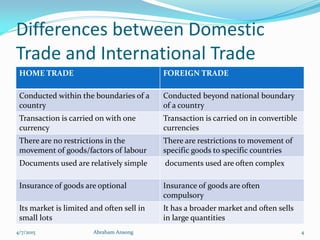
Differences between Domestic
Trade and International Trade
HOME TRADE FOREIGN TRADE
Conducted within the boundaries of a
country
Conducted beyond national boundary
of a country
Transaction is carried on with one
currency
Transaction is carried on in convertible
currencies
There are no restrictions in the
movement of goods/factors of labour
There are restrictions to movement of
specific goods to specific countries
Documents used are relatively simple documents used are often complex
Insurance of goods are optional Insurance of goods are often
compulsory
Its market is limited and often sell in
small lots
It has a broader market and often sells
in large quantities
4/7/2015 Abraham Ansong 4
Why International Trade
 To gain access to new customers
 To achieve lower cost and enhance the firm’s
competitiveness
 To capitalize on its core competencies
 To spread its business risk across a wider market
 To protect domestic market
 Boosts economic growth
 Expands markets
 More efficient production systems
4/7/2015 Abraham Ansong 5
Demerits of International Trade
1. Language barriers
2. Socio-cultural issues-Taste and preferences
3. Environmental issues-Rules and regulations
4. Political risk-Political instability
5. Foreign exchange risk
4/7/2015 Abraham Ansong 6
How to enter and compete in
foreign Market
 Maintain a national (one country) production
base and export goods to foreign markets, using
either company-owned or foreign-controlled
forward distribution channels
 License foreign firms to use the company’s
technology or to produce and distribute the
company’s product.
 Employ a franchising strategy
4/7/2015 Abraham Ansong 7
How to enter and compete in
foreign Market
 Follow global strategy
 Follow a multi-country/multi-domestic strategy,
varying the country’s strategic approach from
country to country in accordance with local
conditions and differing buyer tastes and
preferences.
 Use strategic alliances or joint ventures with
foreign companies as the primary vehicle for
entering foreign markets and perhaps also using
them as an on-going strategic arrangement aimed at
maintaining or strengthening its competitiveness.
4/7/2015 Abraham Ansong 8
Exporting
 Advantages:
 Avoids cost of establishing manufacturing operations.
 May help achieve experience curve and location
economies.
 Disadvantages:
 May compete with low-cost location manufacturers.
 Possible high transportation costs.
 Tariff barriers.
 Possible lack of control over marketing representatives.
Exporting
4/7/2015 Abraham Ansong 9
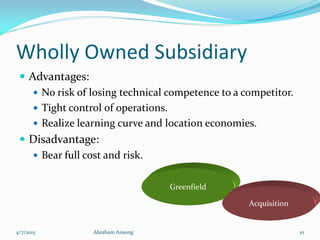
Wholly Owned Subsidiary
 Advantages:
 No risk of losing technical competence to a competitor.
 Tight control of operations.
 Realize learning curve and location economies.
 Disadvantage:
 Bear full cost and risk.
Greenfield
Acquisition
4/7/2015 Abraham Ansong 10
Licensing
It is an agreement where the licensor grants rights to intangible property
to a licensee for a specified period in return for royalties
 Advantages:
 Reduces development costs and risks of establishing foreign
enterprise.
 Lack capital for venture.
 Unfamiliar or politically volatile market.
 Overcomes restrictive investment barriers.
 Others can develop business applications of intangible property.
 Disadvantages:
 Lack of control.
 Cross-border licensing may be difficult.
 Creating a competitor
4/7/2015 Abraham Ansong 11
Franchising
It is an agreement where the franchisor sells intangible
property and insist on strict adherence on the rules for
operating business.
 Advantages:
 Reduces costs and risk of establishing enterprise.
 Disadvantages:
 May prohibit movement of profits from one country to
support operations in another country.
 Quality control.
4/7/2015 Abraham Ansong 12
Joint Venture
 Advantages:
 Benefit from local partner’s knowledge.
 Shared costs/risks with partner.
 Reduced political risk.
 Disadvantages:
 Risk giving control of technology to partner.
 May not realize experience curve effects/benefits.
 Shared ownership can lead to conflict.
4/7/2015 Abraham Ansong 13
Strategic Alliance
 Advantages:
 Facilitate entry into market.
 Share fixed costs.
 Bring together skills and assets that neither company
has or can develop.
 Establish industry technology standards.
 Disadvantage:
 Competitors get low cost route to technology and
markets.
 Problems of partner selection
Cooperative agreements between
potential or actual competitors.
4/7/2015 Abraham Ansong 14
Turnkey Projects
 Advantages:
 Can earn a return on knowledge asset.
 Less risky than conventional FDI.
 Disadvantages:
 No long-term interest in the foreign country.
 May create a competitor.
 Selling process technology may be selling competitive
advantage as well.
Contractor agrees
to handle every
detail of project
for foreign client.
4/7/2015 Abraham Ansong 15
International Trade Theories
These theories helps to understand, explain and predict
what nations exports and imports with what other
nations.
4/7/2015 Abraham Ansong 16
International Trade Theories
 Mercantilism: it states that the power and
strength of a nation increases as the wealth of the
nation increases.
 Thus, Nations should accumulate wealth through
exports(inflow) and discourage imports
 The trade policy implication was the generation
of national trade surplus paid for by accumulation
of gold reserves
 This was accomplished through trade surpluses,
government intervention and colonization.
4/7/2015 Abraham Ansong 17
International Trade Theories
Absolute Cost Advantage Theory: Absolute Cost Advantage
refers to a nation’s ability to produce more of a good than other
nation’s using the same amount of resources. Or a country has an
absolute advantage in the production of a product when it is more
efficient and cheaper in producing it than any other country.
It was propounded by Adams Smith. Smith(1776) made the
following propositions:
1. It was impossible for all nations to become rich simultaneously
2. Wealth of Nations depends upon the goods and services
available to their citizens rather than their gold reserves
He was a strong advocate of free trade
4/7/2015 Abraham Ansong 18
International Trade Theories
Absolute Cost Advantage
It differs from the mercantilism in that:
1. It measures a nation’s wealth by the living standards
of its people
2. It destroys the Mercantilist idea since there are gains
to be had by both countries to the exchange
3. It challenges the objective of the national
government to acquire wealth through restrictive
trade policies
4/7/2015 Abraham Ansong 19
Assumptions
Assumptions of Absolute Cost Advantage
 No opportunity cost
 Only two countries
 Only two goods involved
 No barrier to labor mobility
 No transportation costs
 No other barriers of trade such as tariffs and quotas
4/7/2015 Abraham Ansong 20
International Trade Theories
Comparative Advantage
 David Ricardo (1817) developed this theory
 A country enjoys a comparative advantage in the
production of a good if that good can be produced at a
lower cost in terms of other goods.
 Countries have advantage in a good if it has a lower
opportunity cost of producing the good than others
4/7/2015 Abraham Ansong 21
International Trade Theories
Comparative Advantage
Question: Suppose one country is more efficient than
another in everything?
 There are still global gains to be made if a country
specializes in products it produces relatively more
efficiently than other products
4/7/2015 Abraham Ansong 22
International Trade Theories
Heckscher-Ohlin Theory: It holds that countries must
export goods that intensively use factor endowment
which are locally abundant while importing goods that
make intensive use of factors that are locally scarce.
Patterns of trade are determined by differences in factor
endowments.
4/7/2015 Abraham Ansong 23
International Trade Theories
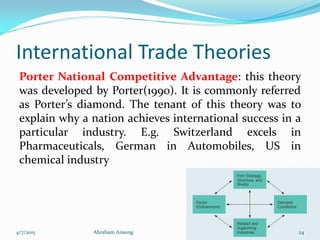
Porter National Competitive Advantage: this theory
was developed by Porter(1990). It is commonly referred
as Porter’s diamond. The tenant of this theory was to
explain why a nation achieves international success in a
particular industry. E.g. Switzerland excels in
Pharmaceuticals, German in Automobiles, US in
chemical industry
4/7/2015 Abraham Ansong 24
International Trade Theories
 Factor endowments: a nation’s position in factors of
production are necessary to determine what they should produce
and how to compete in a given industry.
 Demand conditions: the nature and sophistication of home
demand for the industry’s product or service is critical for its
ongoing innovation thereby creating competitive advantage.
 Relating and supporting industries: the presence of strong,
efficient supporting and related industries are crucial for
gaining international competitiveness.
 Firm strategy, structure, and rivalry: the conditions
governing how companies are created, organized, and managed
and the nature of domestic rivalry can affect a firms
competitiveness .
4/7/2015 Abraham Ansong 25
International Trade Theories
Trade implications of Porters diamond:
 Firms are most likely to succeed in industries or
industry segments where the diamond is most
favorable.
 The diamond is a mutually reinforcing system. The
effect of one attribute is contingent on the state of
others. For example, favorable demand condition is
required to make factor endowments useful for
competitive advantage.
4/7/2015 Abraham Ansong 26
Free Trade
 Free trade refers to a situation where a government
does not attempt to restrict what its citizens can buy
from another country or what they can sell to another
country.
 While many nations are nominally committed to free
trade, they tend to intervene in international trade to
protect the interests of politically important groups
4/7/2015 Abraham Ansong 27
Advantages of Free Trade
 Benefits to Consumers- Greater variety of goods
available for consumption.
 Increased production
 Efficiency in production
 Employment
 Foreign exchange gains
 Economic growth
4/7/2015 Abraham Ansong 28
Disadvantages of Free Trade
1. It destroys infant industries
2. It promotes dumping
3. It may leads to unemployment
4/7/2015 Abraham Ansong 29
Instruments of Trade Policy
There are seven main instruments of trade
policy
1. Tariffs
2. Subsidies
3. Import quotas
4. Voluntary export restraints
5. Local content requirements
6. Anti-dumping policies
7. Administrative policies
4/7/2015 Abraham Ansong 30
Tariffs
 A tariff is a tax levied on imports that effectively
raises the cost of imported products relative to
domestic products
 Specific tariffs are levied as a fixed charge for each unit
of a good imported
 Ad valorem tariffs are levied as a proportion of the value
of the imported good
4/7/2015 Abraham Ansong 31
Tariffs
Why do governments impose tariffs?
 Tariffs
 increase government revenues
 provide protection to domestic producers against
foreign competitors by increasing the cost of
imported foreign goods
 force consumers to pay more for certain imports
 So, tariffs are unambiguously pro-producer and anti-
consumer, and tariffs reduce the overall efficiency of
the world economy
4/7/2015 Abraham Ansong 32
Subsidies
 A subsidy is a government payment to a domestic
producer
 Subsidies help domestic producers
 compete against low-cost foreign imports
 gain export markets
4/7/2015 Abraham Ansong 33
Import quotas and voluntary
Export Restrictions
 An import quota is a direct restriction on the quantity
of some good that may be imported into a country
 Tariff rate quotas are a hybrid of a quota and a tariff
where a lower tariff is applied to imports within the
quota than to those over the quota
 Voluntary export restraints are quotas on trade
imposed by the exporting country, typically at the
request of the importing country’s government
4/7/2015 Abraham Ansong 34
Local Content Requirements
 A local content requirement demands that some
specific fraction of a good be produced
domestically
 The requirement can be in physical terms or in value
terms
 Local content requirements benefit domestic
producers and jobs, but consumers face higher
prices.
4/7/2015 Abraham Ansong 35
Administrative Policies
 Administrative trade polices are bureaucratic rules
that are designed to make it difficult for imports to
enter a country.
 These polices hurt consumers by denying access to
possibly superior foreign products.
4/7/2015 Abraham Ansong 36
Dumping
 Dumping is selling goods in a foreign market below
their cost of production, or selling goods in a foreign
market at below their “fair” market value.
 It can be a way for firms to unload excess production in
foreign markets
 Some dumping may be predatory behaviour, with
producers using substantial profits from their home
markets to subsidize prices in a foreign market with a
view to driving indigenous competitors out of that
market, and later raising prices and earning
substantial profits
4/7/2015 Abraham Ansong 37
Anti-Dumping Policies
 Antidumping polices are designed to punish
foreign firms that engage in dumping
 The goal is to protect domestic producers from
“unfair” foreign competition
4/7/2015 Abraham Ansong 38
The Case for Trade Protection
1. Protection saves jobs
2. As a defense against unfair trade practices
3. Cheap foreign labour makes competition unfair
4. Protection safeguards national security
5. Protection discourages dependency
6. Protection safeguards infant and sunset industries
7. As a means to retaliate
8. To help the balance of payment
4/7/2015 Abraham Ansong 39
International Institutions and
Agreement
 International Monetary Fund (IMF): it mission is to
provide exchange rate stability, encourage cooperation on
international monetary issues, systems of payments while
providing short loans to member countries
 World Trade Organization (WTO): it aims to foster free
trade by eliminating discrimination in international trade,
reducing barrier and tariffs
 United Nations Conference on Trade and Devt
(UNCTAD): it acted as a pressure group for the less rich
countries to influence other trade groups to provide special
and favourable terms for underprivileged economies
4/7/2015 Abraham Ansong 40
International Institutions and
Agreement
 Organization for Economic Cooperation and
Devt. (OECD): it was commonly regarded as the rich
man’s club. It was formed out of the cold war as
economic response to the then eastern bloc.
 International Bank for Reconstruction and Devt.
(IBRD): it is now referred as the World Bank. It was
formed after the world war II to provide economic aid
for the rebuilding of Europe and far East. It recent
mission is to build the economies of developing
countires
4/7/2015 Abraham Ansong 41
Balance of Payment
 The balance of payments is the difference between
money coming into a country (from exports) and money
leaving the country (for imports) plus money coming into
or leaving a country from other factors such as tourism,
foreign aid, military expenditures, and foreign investment.
 The goal is always to have more money flowing into the
country than flowing out.
 A favourable balance of payments means more money
flowing into a country than flowing out.
 An unfavourable balance of payments is when more money
is flowing out of a country than coming in.
4/7/2015 Abraham Ansong 42
Balance of Payments Accounts
 The balance of payments accounts are those that record all
transactions between the residents of a country and residents of
all foreign nations.
 The balance of payment accounts are separated into 3 broad
accounts:
 current account: accounts for flows of goods and services
(imports and exports).
 financial account: accounts for flows of financial assets
(financial capital).
 capital account: flows of special categories of assets
(capital), typically non-market, non-produced, or intangible
assets like debt forgiveness, copyrights and trademarks.
4/7/2015 Abraham Ansong 43
Factors which cause a current
account deficit in the BOP
1. Fixed exchange rate-If a country’s currency is
overvalued, imports would be cheaper and exports
would be uneconomical.
2. Higher Inflation-This makes exports less competitive
and imports more competitive.
3. Decline in competiveness of local firms vis a vis
foreign firms. E.g. Ghanaian versus Chinese firms.
4. Recession in trading partners’ countries.
5. Borrowing money: Excessive borrowing that have not
been channeled to productive investments.
4/7/2015 Abraham Ansong 44
Means of Correcting BOP deficits
1. Restricting home trade to foreigners
2. Building an import substitute industries
3. Devaluing of currency
4. Adopting deflationary policies
5. Financing projects from IGF by government rather
than borrowing
6. Instituting intensive drive by granting export bonus
and tax holidays
4/7/2015 Abraham Ansong 45
Balance of Trade
 The balance of trade is the difference between the
monetary value of exports and imports of output in an
economy over a certain period.
 A favourable balance of trade is known as a trade
surplus and consists of exporting more than is
imported.
 An unfavourable balance is known as trade deficit.
4/7/2015 Abraham Ansong 46
Terms of Trade
 Terms of trade is the relationship between the prices of
a country’s export and the prices of her imports.
 Terms of trade can be favourable or unfavourable.
 Favourable terms of trade occurs if country concerned
can now obtain more imports with the same amount
of exports than previously.
4/7/2015 Abraham Ansong 47

Lecture 9; international trade

  • 1.
    Mr. Abraham Ansong Lecturer Departmentof Management Studies School of Business U. C. C 4/7/2015 Abraham Ansong 1
  • 2.
    International Business Meaning ofInternational Business Differences between domestic and foreign business Why go international Market Entry Strategies International Trade Theories Free Trade Instrument of Trade Policy and Trade Protection Economic Integration BOP and Terms of Trade 4/7/2015 Abraham Ansong 2
  • 3.
    International Trade  Internationaltrade refers to buying and selling of goods and services between two or more countries  Home trade: is the process of buying and selling of goods and services between parties within the national boundaries of a country.  Foreign and Domestic trade operate in different environment and are affected by different environmental forces 4/7/2015 Abraham Ansong 3
  • 4.
    Differences between Domestic Tradeand International Trade HOME TRADE FOREIGN TRADE Conducted within the boundaries of a country Conducted beyond national boundary of a country Transaction is carried on with one currency Transaction is carried on in convertible currencies There are no restrictions in the movement of goods/factors of labour There are restrictions to movement of specific goods to specific countries Documents used are relatively simple documents used are often complex Insurance of goods are optional Insurance of goods are often compulsory Its market is limited and often sell in small lots It has a broader market and often sells in large quantities 4/7/2015 Abraham Ansong 4
  • 5.
    Why International Trade To gain access to new customers  To achieve lower cost and enhance the firm’s competitiveness  To capitalize on its core competencies  To spread its business risk across a wider market  To protect domestic market  Boosts economic growth  Expands markets  More efficient production systems 4/7/2015 Abraham Ansong 5
  • 6.
    Demerits of InternationalTrade 1. Language barriers 2. Socio-cultural issues-Taste and preferences 3. Environmental issues-Rules and regulations 4. Political risk-Political instability 5. Foreign exchange risk 4/7/2015 Abraham Ansong 6
  • 7.
    How to enterand compete in foreign Market  Maintain a national (one country) production base and export goods to foreign markets, using either company-owned or foreign-controlled forward distribution channels  License foreign firms to use the company’s technology or to produce and distribute the company’s product.  Employ a franchising strategy 4/7/2015 Abraham Ansong 7
  • 8.
    How to enterand compete in foreign Market  Follow global strategy  Follow a multi-country/multi-domestic strategy, varying the country’s strategic approach from country to country in accordance with local conditions and differing buyer tastes and preferences.  Use strategic alliances or joint ventures with foreign companies as the primary vehicle for entering foreign markets and perhaps also using them as an on-going strategic arrangement aimed at maintaining or strengthening its competitiveness. 4/7/2015 Abraham Ansong 8
  • 9.
    Exporting  Advantages:  Avoidscost of establishing manufacturing operations.  May help achieve experience curve and location economies.  Disadvantages:  May compete with low-cost location manufacturers.  Possible high transportation costs.  Tariff barriers.  Possible lack of control over marketing representatives. Exporting 4/7/2015 Abraham Ansong 9
  • 10.
    Wholly Owned Subsidiary Advantages:  No risk of losing technical competence to a competitor.  Tight control of operations.  Realize learning curve and location economies.  Disadvantage:  Bear full cost and risk. Greenfield Acquisition 4/7/2015 Abraham Ansong 10
  • 11.
    Licensing It is anagreement where the licensor grants rights to intangible property to a licensee for a specified period in return for royalties  Advantages:  Reduces development costs and risks of establishing foreign enterprise.  Lack capital for venture.  Unfamiliar or politically volatile market.  Overcomes restrictive investment barriers.  Others can develop business applications of intangible property.  Disadvantages:  Lack of control.  Cross-border licensing may be difficult.  Creating a competitor 4/7/2015 Abraham Ansong 11
  • 12.
    Franchising It is anagreement where the franchisor sells intangible property and insist on strict adherence on the rules for operating business.  Advantages:  Reduces costs and risk of establishing enterprise.  Disadvantages:  May prohibit movement of profits from one country to support operations in another country.  Quality control. 4/7/2015 Abraham Ansong 12
  • 13.
    Joint Venture  Advantages: Benefit from local partner’s knowledge.  Shared costs/risks with partner.  Reduced political risk.  Disadvantages:  Risk giving control of technology to partner.  May not realize experience curve effects/benefits.  Shared ownership can lead to conflict. 4/7/2015 Abraham Ansong 13
  • 14.
    Strategic Alliance  Advantages: Facilitate entry into market.  Share fixed costs.  Bring together skills and assets that neither company has or can develop.  Establish industry technology standards.  Disadvantage:  Competitors get low cost route to technology and markets.  Problems of partner selection Cooperative agreements between potential or actual competitors. 4/7/2015 Abraham Ansong 14
  • 15.
    Turnkey Projects  Advantages: Can earn a return on knowledge asset.  Less risky than conventional FDI.  Disadvantages:  No long-term interest in the foreign country.  May create a competitor.  Selling process technology may be selling competitive advantage as well. Contractor agrees to handle every detail of project for foreign client. 4/7/2015 Abraham Ansong 15
  • 16.
    International Trade Theories Thesetheories helps to understand, explain and predict what nations exports and imports with what other nations. 4/7/2015 Abraham Ansong 16
  • 17.
    International Trade Theories Mercantilism: it states that the power and strength of a nation increases as the wealth of the nation increases.  Thus, Nations should accumulate wealth through exports(inflow) and discourage imports  The trade policy implication was the generation of national trade surplus paid for by accumulation of gold reserves  This was accomplished through trade surpluses, government intervention and colonization. 4/7/2015 Abraham Ansong 17
  • 18.
    International Trade Theories AbsoluteCost Advantage Theory: Absolute Cost Advantage refers to a nation’s ability to produce more of a good than other nation’s using the same amount of resources. Or a country has an absolute advantage in the production of a product when it is more efficient and cheaper in producing it than any other country. It was propounded by Adams Smith. Smith(1776) made the following propositions: 1. It was impossible for all nations to become rich simultaneously 2. Wealth of Nations depends upon the goods and services available to their citizens rather than their gold reserves He was a strong advocate of free trade 4/7/2015 Abraham Ansong 18
  • 19.
    International Trade Theories AbsoluteCost Advantage It differs from the mercantilism in that: 1. It measures a nation’s wealth by the living standards of its people 2. It destroys the Mercantilist idea since there are gains to be had by both countries to the exchange 3. It challenges the objective of the national government to acquire wealth through restrictive trade policies 4/7/2015 Abraham Ansong 19
  • 20.
    Assumptions Assumptions of AbsoluteCost Advantage  No opportunity cost  Only two countries  Only two goods involved  No barrier to labor mobility  No transportation costs  No other barriers of trade such as tariffs and quotas 4/7/2015 Abraham Ansong 20
  • 21.
    International Trade Theories ComparativeAdvantage  David Ricardo (1817) developed this theory  A country enjoys a comparative advantage in the production of a good if that good can be produced at a lower cost in terms of other goods.  Countries have advantage in a good if it has a lower opportunity cost of producing the good than others 4/7/2015 Abraham Ansong 21
  • 22.
    International Trade Theories ComparativeAdvantage Question: Suppose one country is more efficient than another in everything?  There are still global gains to be made if a country specializes in products it produces relatively more efficiently than other products 4/7/2015 Abraham Ansong 22
  • 23.
    International Trade Theories Heckscher-OhlinTheory: It holds that countries must export goods that intensively use factor endowment which are locally abundant while importing goods that make intensive use of factors that are locally scarce. Patterns of trade are determined by differences in factor endowments. 4/7/2015 Abraham Ansong 23
  • 24.
    International Trade Theories PorterNational Competitive Advantage: this theory was developed by Porter(1990). It is commonly referred as Porter’s diamond. The tenant of this theory was to explain why a nation achieves international success in a particular industry. E.g. Switzerland excels in Pharmaceuticals, German in Automobiles, US in chemical industry 4/7/2015 Abraham Ansong 24
  • 25.
    International Trade Theories Factor endowments: a nation’s position in factors of production are necessary to determine what they should produce and how to compete in a given industry.  Demand conditions: the nature and sophistication of home demand for the industry’s product or service is critical for its ongoing innovation thereby creating competitive advantage.  Relating and supporting industries: the presence of strong, efficient supporting and related industries are crucial for gaining international competitiveness.  Firm strategy, structure, and rivalry: the conditions governing how companies are created, organized, and managed and the nature of domestic rivalry can affect a firms competitiveness . 4/7/2015 Abraham Ansong 25
  • 26.
    International Trade Theories Tradeimplications of Porters diamond:  Firms are most likely to succeed in industries or industry segments where the diamond is most favorable.  The diamond is a mutually reinforcing system. The effect of one attribute is contingent on the state of others. For example, favorable demand condition is required to make factor endowments useful for competitive advantage. 4/7/2015 Abraham Ansong 26
  • 27.
    Free Trade  Freetrade refers to a situation where a government does not attempt to restrict what its citizens can buy from another country or what they can sell to another country.  While many nations are nominally committed to free trade, they tend to intervene in international trade to protect the interests of politically important groups 4/7/2015 Abraham Ansong 27
  • 28.
    Advantages of FreeTrade  Benefits to Consumers- Greater variety of goods available for consumption.  Increased production  Efficiency in production  Employment  Foreign exchange gains  Economic growth 4/7/2015 Abraham Ansong 28
  • 29.
    Disadvantages of FreeTrade 1. It destroys infant industries 2. It promotes dumping 3. It may leads to unemployment 4/7/2015 Abraham Ansong 29
  • 30.
    Instruments of TradePolicy There are seven main instruments of trade policy 1. Tariffs 2. Subsidies 3. Import quotas 4. Voluntary export restraints 5. Local content requirements 6. Anti-dumping policies 7. Administrative policies 4/7/2015 Abraham Ansong 30
  • 31.
    Tariffs  A tariffis a tax levied on imports that effectively raises the cost of imported products relative to domestic products  Specific tariffs are levied as a fixed charge for each unit of a good imported  Ad valorem tariffs are levied as a proportion of the value of the imported good 4/7/2015 Abraham Ansong 31
  • 32.
    Tariffs Why do governmentsimpose tariffs?  Tariffs  increase government revenues  provide protection to domestic producers against foreign competitors by increasing the cost of imported foreign goods  force consumers to pay more for certain imports  So, tariffs are unambiguously pro-producer and anti- consumer, and tariffs reduce the overall efficiency of the world economy 4/7/2015 Abraham Ansong 32
  • 33.
    Subsidies  A subsidyis a government payment to a domestic producer  Subsidies help domestic producers  compete against low-cost foreign imports  gain export markets 4/7/2015 Abraham Ansong 33
  • 34.
    Import quotas andvoluntary Export Restrictions  An import quota is a direct restriction on the quantity of some good that may be imported into a country  Tariff rate quotas are a hybrid of a quota and a tariff where a lower tariff is applied to imports within the quota than to those over the quota  Voluntary export restraints are quotas on trade imposed by the exporting country, typically at the request of the importing country’s government 4/7/2015 Abraham Ansong 34
  • 35.
    Local Content Requirements A local content requirement demands that some specific fraction of a good be produced domestically  The requirement can be in physical terms or in value terms  Local content requirements benefit domestic producers and jobs, but consumers face higher prices. 4/7/2015 Abraham Ansong 35
  • 36.
    Administrative Policies  Administrativetrade polices are bureaucratic rules that are designed to make it difficult for imports to enter a country.  These polices hurt consumers by denying access to possibly superior foreign products. 4/7/2015 Abraham Ansong 36
  • 37.
    Dumping  Dumping isselling goods in a foreign market below their cost of production, or selling goods in a foreign market at below their “fair” market value.  It can be a way for firms to unload excess production in foreign markets  Some dumping may be predatory behaviour, with producers using substantial profits from their home markets to subsidize prices in a foreign market with a view to driving indigenous competitors out of that market, and later raising prices and earning substantial profits 4/7/2015 Abraham Ansong 37
  • 38.
    Anti-Dumping Policies  Antidumpingpolices are designed to punish foreign firms that engage in dumping  The goal is to protect domestic producers from “unfair” foreign competition 4/7/2015 Abraham Ansong 38
  • 39.
    The Case forTrade Protection 1. Protection saves jobs 2. As a defense against unfair trade practices 3. Cheap foreign labour makes competition unfair 4. Protection safeguards national security 5. Protection discourages dependency 6. Protection safeguards infant and sunset industries 7. As a means to retaliate 8. To help the balance of payment 4/7/2015 Abraham Ansong 39
  • 40.
    International Institutions and Agreement International Monetary Fund (IMF): it mission is to provide exchange rate stability, encourage cooperation on international monetary issues, systems of payments while providing short loans to member countries  World Trade Organization (WTO): it aims to foster free trade by eliminating discrimination in international trade, reducing barrier and tariffs  United Nations Conference on Trade and Devt (UNCTAD): it acted as a pressure group for the less rich countries to influence other trade groups to provide special and favourable terms for underprivileged economies 4/7/2015 Abraham Ansong 40
  • 41.
    International Institutions and Agreement Organization for Economic Cooperation and Devt. (OECD): it was commonly regarded as the rich man’s club. It was formed out of the cold war as economic response to the then eastern bloc.  International Bank for Reconstruction and Devt. (IBRD): it is now referred as the World Bank. It was formed after the world war II to provide economic aid for the rebuilding of Europe and far East. It recent mission is to build the economies of developing countires 4/7/2015 Abraham Ansong 41
  • 42.
    Balance of Payment The balance of payments is the difference between money coming into a country (from exports) and money leaving the country (for imports) plus money coming into or leaving a country from other factors such as tourism, foreign aid, military expenditures, and foreign investment.  The goal is always to have more money flowing into the country than flowing out.  A favourable balance of payments means more money flowing into a country than flowing out.  An unfavourable balance of payments is when more money is flowing out of a country than coming in. 4/7/2015 Abraham Ansong 42
  • 43.
    Balance of PaymentsAccounts  The balance of payments accounts are those that record all transactions between the residents of a country and residents of all foreign nations.  The balance of payment accounts are separated into 3 broad accounts:  current account: accounts for flows of goods and services (imports and exports).  financial account: accounts for flows of financial assets (financial capital).  capital account: flows of special categories of assets (capital), typically non-market, non-produced, or intangible assets like debt forgiveness, copyrights and trademarks. 4/7/2015 Abraham Ansong 43
  • 44.
    Factors which causea current account deficit in the BOP 1. Fixed exchange rate-If a country’s currency is overvalued, imports would be cheaper and exports would be uneconomical. 2. Higher Inflation-This makes exports less competitive and imports more competitive. 3. Decline in competiveness of local firms vis a vis foreign firms. E.g. Ghanaian versus Chinese firms. 4. Recession in trading partners’ countries. 5. Borrowing money: Excessive borrowing that have not been channeled to productive investments. 4/7/2015 Abraham Ansong 44
  • 45.
    Means of CorrectingBOP deficits 1. Restricting home trade to foreigners 2. Building an import substitute industries 3. Devaluing of currency 4. Adopting deflationary policies 5. Financing projects from IGF by government rather than borrowing 6. Instituting intensive drive by granting export bonus and tax holidays 4/7/2015 Abraham Ansong 45
  • 46.
    Balance of Trade The balance of trade is the difference between the monetary value of exports and imports of output in an economy over a certain period.  A favourable balance of trade is known as a trade surplus and consists of exporting more than is imported.  An unfavourable balance is known as trade deficit. 4/7/2015 Abraham Ansong 46
  • 47.
    Terms of Trade Terms of trade is the relationship between the prices of a country’s export and the prices of her imports.  Terms of trade can be favourable or unfavourable.  Favourable terms of trade occurs if country concerned can now obtain more imports with the same amount of exports than previously. 4/7/2015 Abraham Ansong 47