Introduction to Audio Content Analysis
module 3.7.1: feature post-processing
alexander lerch
overview intro derived normalization aggregation summary
introduction
overview
corresponding textbook section
sections 3.7.1–3.7.3
lecture content
• derived features
• feature aggregation
• feature normalization
learning objectives
• discuss the advantages of specific derived features
• summarize the principles of feature aggregation
• list two forms of feature normalization and explain their usefulness
module 3.7.1: feature post-processing 1 / 8
overview intro derived normalization aggregation summary
introduction
overview
corresponding textbook section
sections 3.7.1–3.7.3
lecture content
• derived features
• feature aggregation
• feature normalization
learning objectives
• discuss the advantages of specific derived features
• summarize the principles of feature aggregation
• list two forms of feature normalization and explain their usefulness
module 3.7.1: feature post-processing 1 / 8
overview intro derived normalization aggregation summary
feature post-processing
introduction 1/2
extracting multiple instantaneous features leads to
→ one feature vector per block, or
→ one feature matrix per audio file
V = [v(0) v(1) . . . v(N − 1)]
=





v0(0) v0(1) . . . v0(N − 1)
v1(0) v1(1) . . . v1(N − 1)
.
.
.
.
.
.
...
.
.
.
vF−1(0) vF−1(1) . . . vF−1(N − 1)





dimensions: F × N (number of features and number of blocks, resp.)
module 3.7.1: feature post-processing 2 / 8
overview intro derived normalization aggregation summary
feature post-processing
introduction 2/2
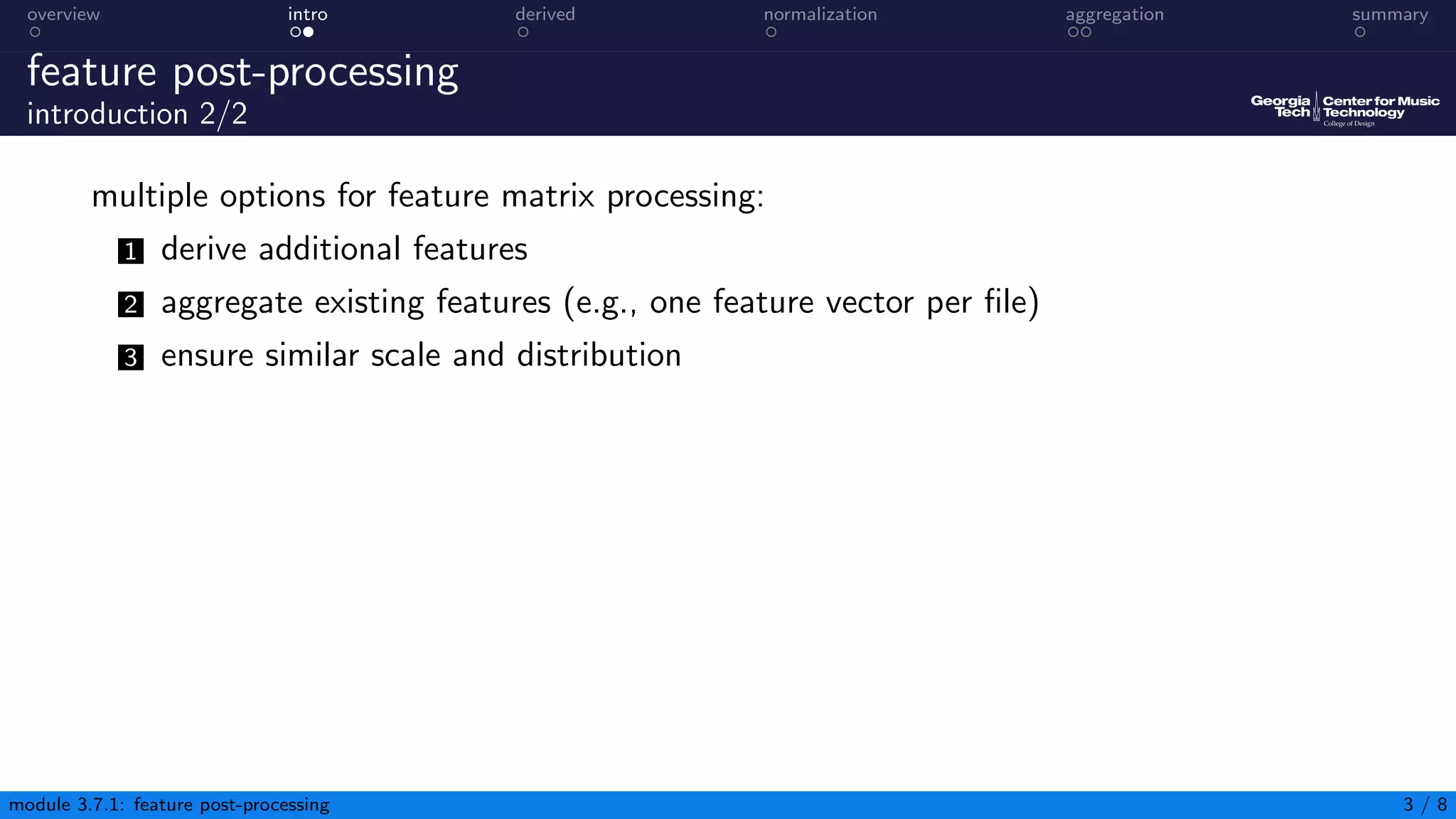
multiple options for feature matrix processing:
1 derive additional features
2 aggregate existing features (e.g., one feature vector per file)
3 ensure similar scale and distribution
module 3.7.1: feature post-processing 3 / 8
overview intro derived normalization aggregation summary
feature post-processing
examples of derived features
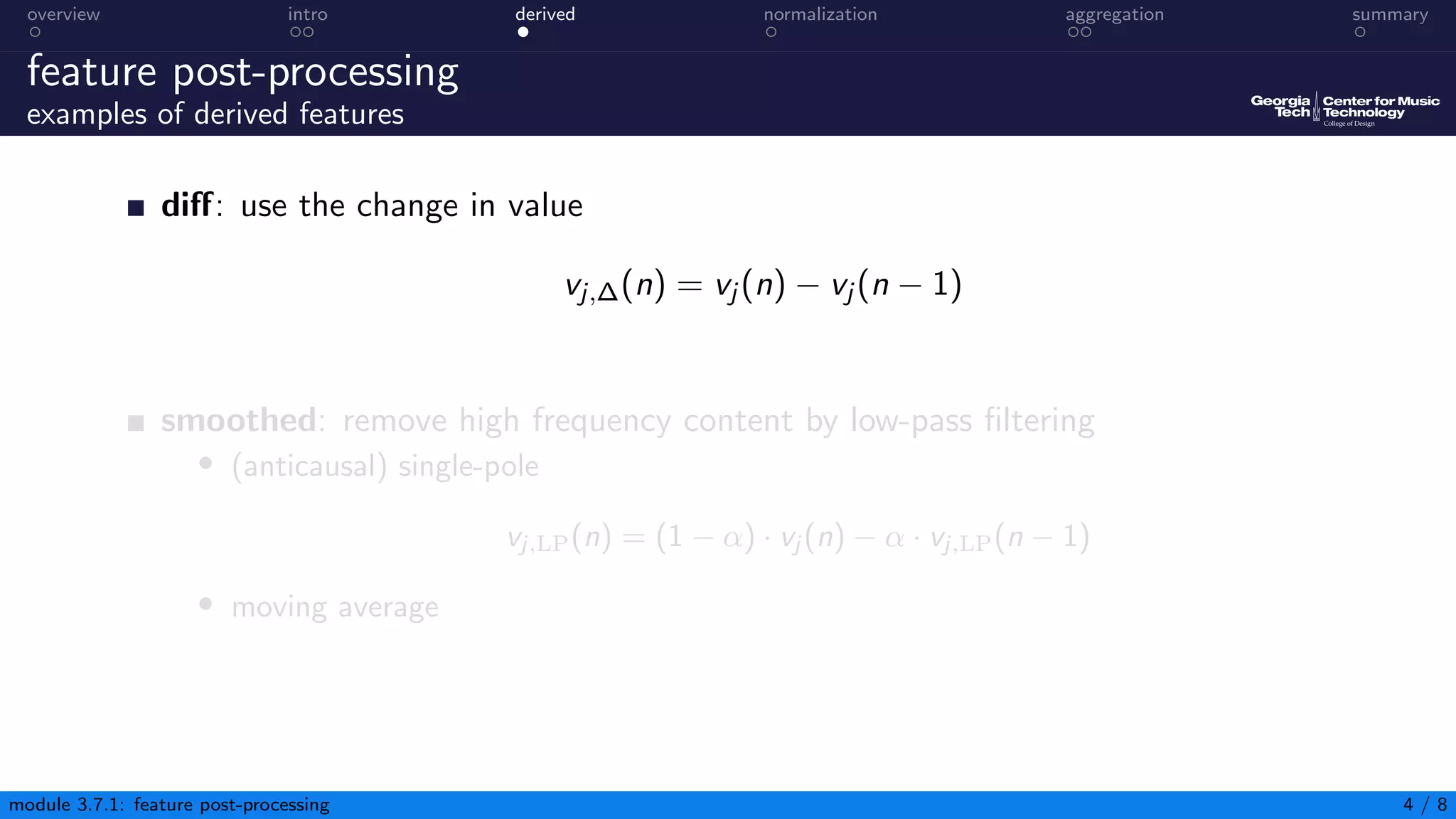
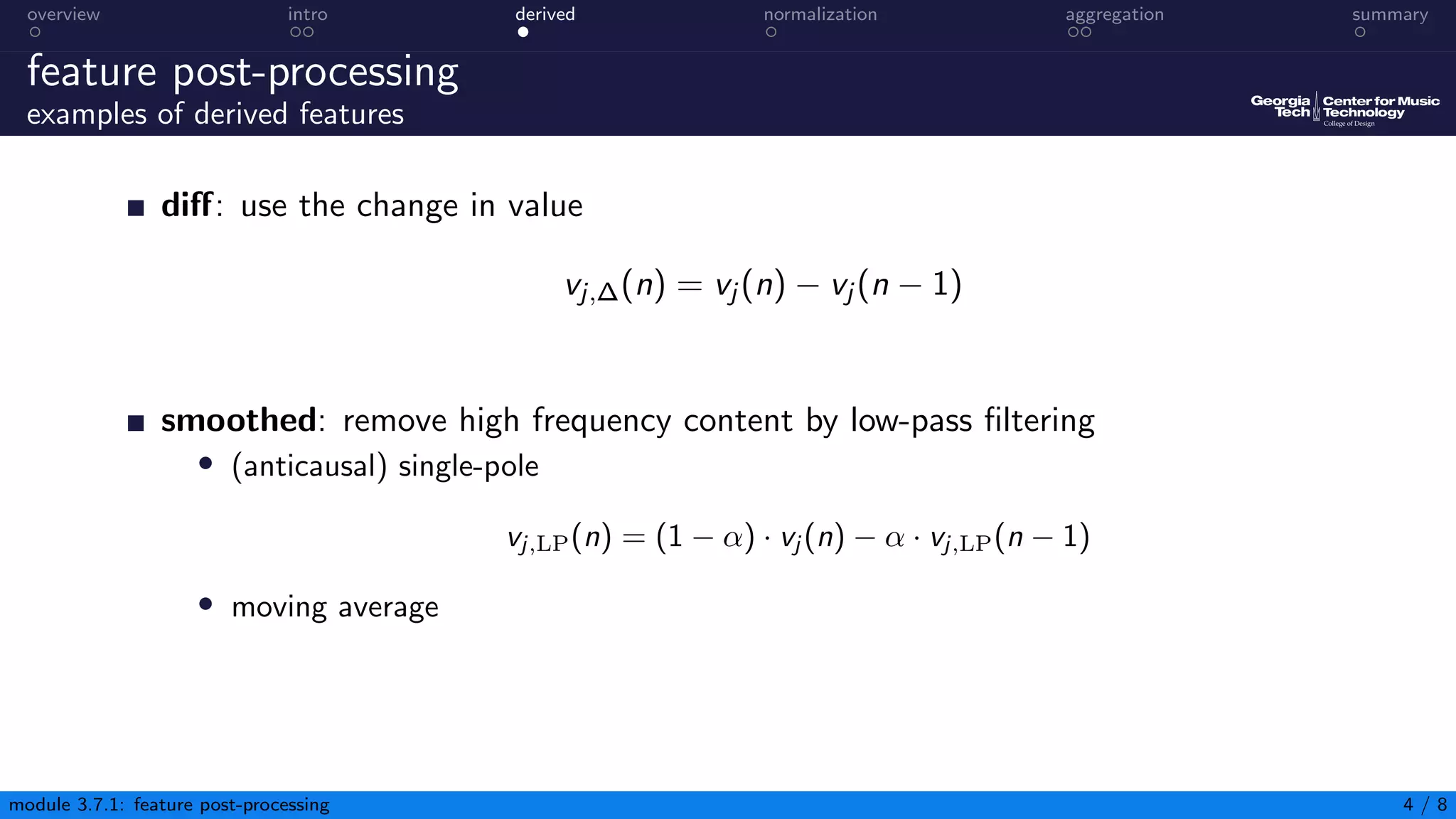
diff: use the change in value
vj,∆(n) = vj (n) − vj (n − 1)
smoothed: remove high frequency content by low-pass filtering
• (anticausal) single-pole
vj,LP(n) = (1 − α) · vj (n) − α · vj,LP(n − 1)
• moving average
module 3.7.1: feature post-processing 4 / 8
overview intro derived normalization aggregation summary
feature post-processing
examples of derived features
diff: use the change in value
vj,∆(n) = vj (n) − vj (n − 1)
smoothed: remove high frequency content by low-pass filtering
• (anticausal) single-pole
vj,LP(n) = (1 − α) · vj (n) − α · vj,LP(n − 1)
• moving average
module 3.7.1: feature post-processing 4 / 8
overview intro derived normalization aggregation summary
feature post-processing
feature normalization
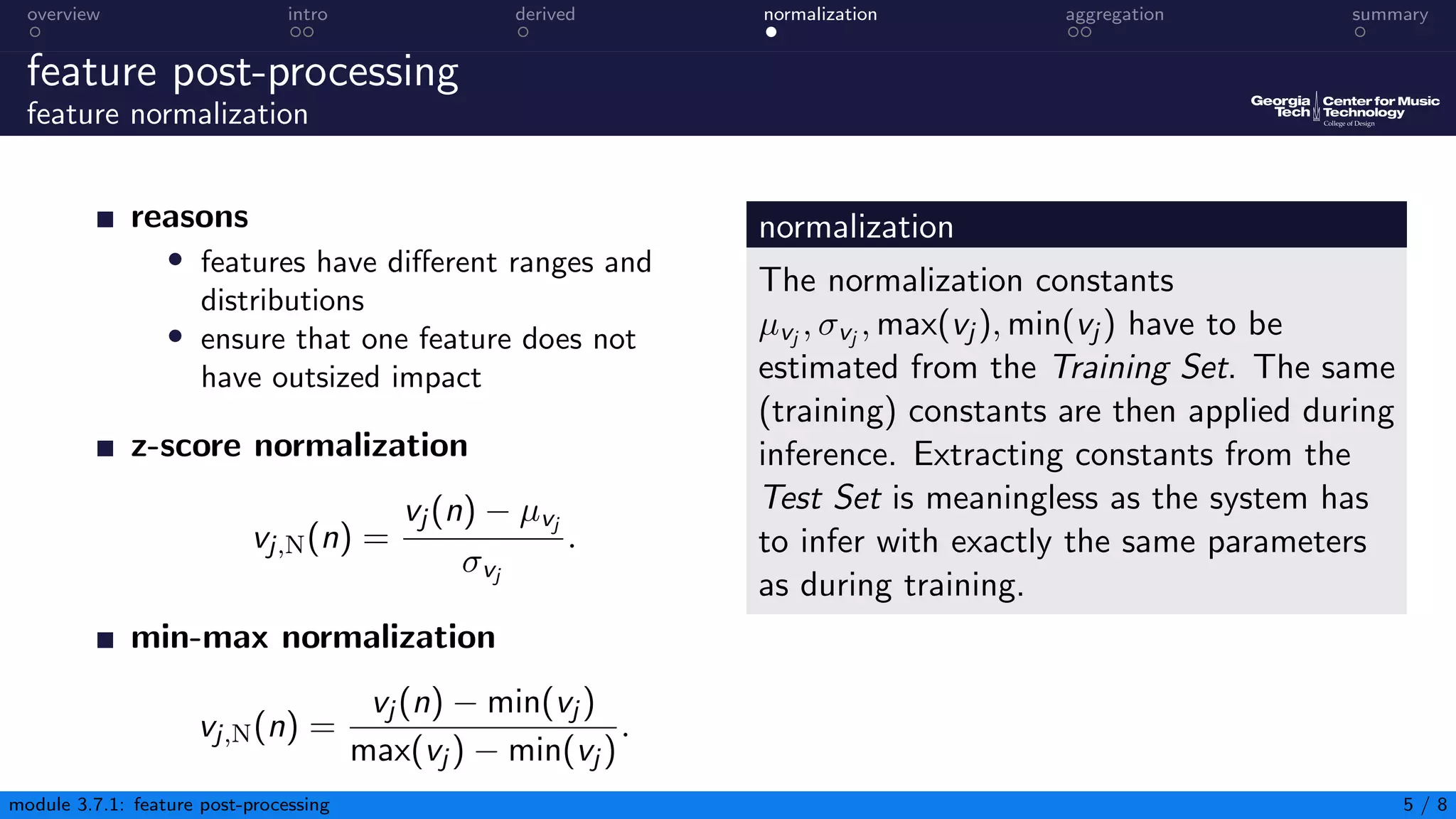
reasons
• features have different ranges and
distributions
• ensure that one feature does not
have outsized impact
z-score normalization
vj,N(n) =
vj (n) − µvj
σvj
.
min-max normalization
vj,N(n) =
vj (n) − min(vj )
max(vj ) − min(vj )
.
normalization
The normalization constants
µvj , σvj , max(vj ), min(vj ) have to be
estimated from the Training Set. The same
(training) constants are then applied during
inference. Extracting constants from the
Test Set is meaningless as the system has
to infer with exactly the same parameters
as during training.
module 3.7.1: feature post-processing 5 / 8
overview intro derived normalization aggregation summary
feature post-processing
feature aggregation
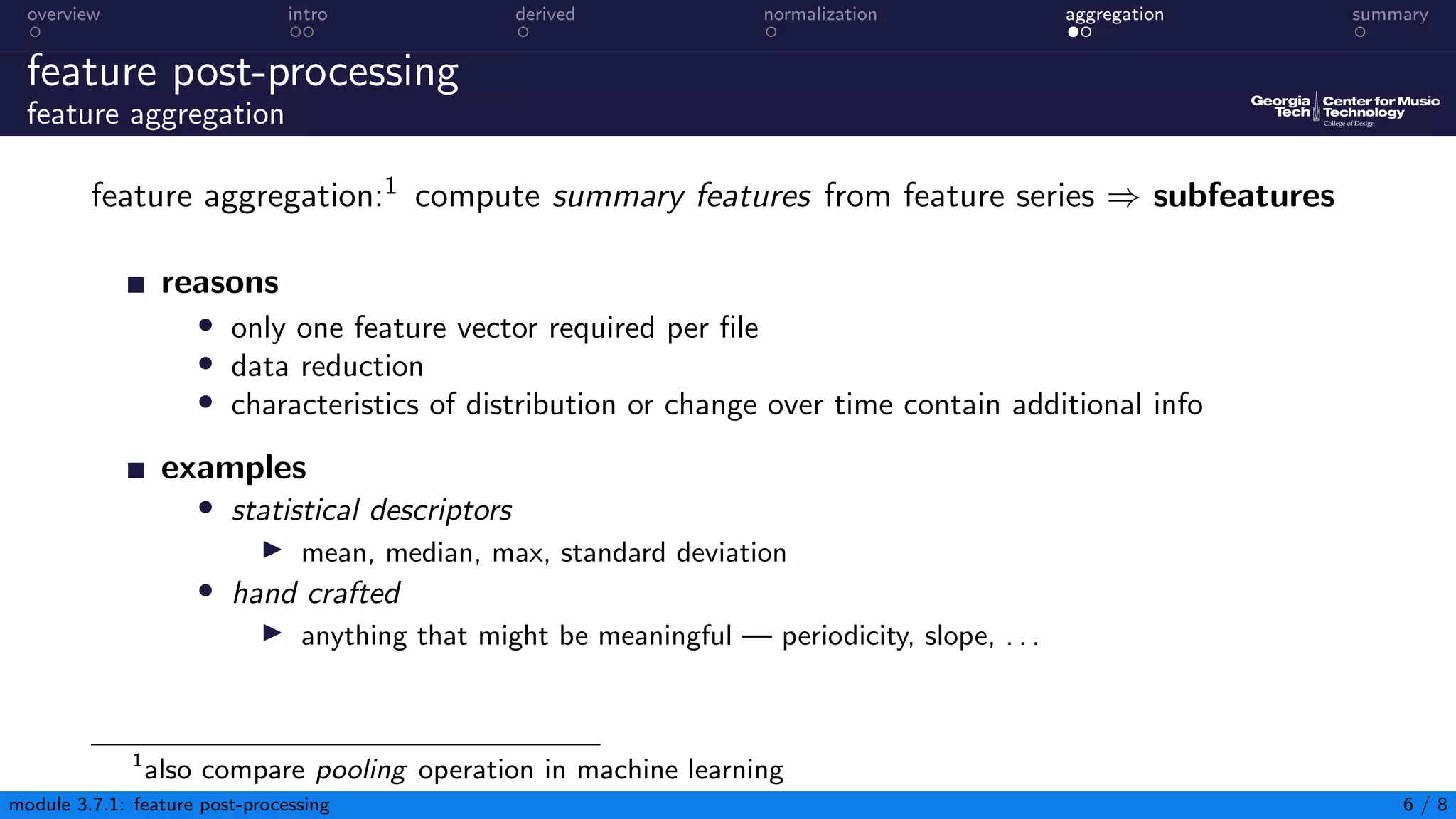
feature aggregation:1 compute summary features from feature series ⇒ subfeatures
reasons
• only one feature vector required per file
• data reduction
• characteristics of distribution or change over time contain additional info
examples
• statistical descriptors
▶ mean, median, max, standard deviation
• hand crafted
▶ anything that might be meaningful — periodicity, slope, . . .
1
also compare pooling operation in machine learning
module 3.7.1: feature post-processing 6 / 8
overview intro derived normalization aggregation summary
feature post-processing
feature aggregation
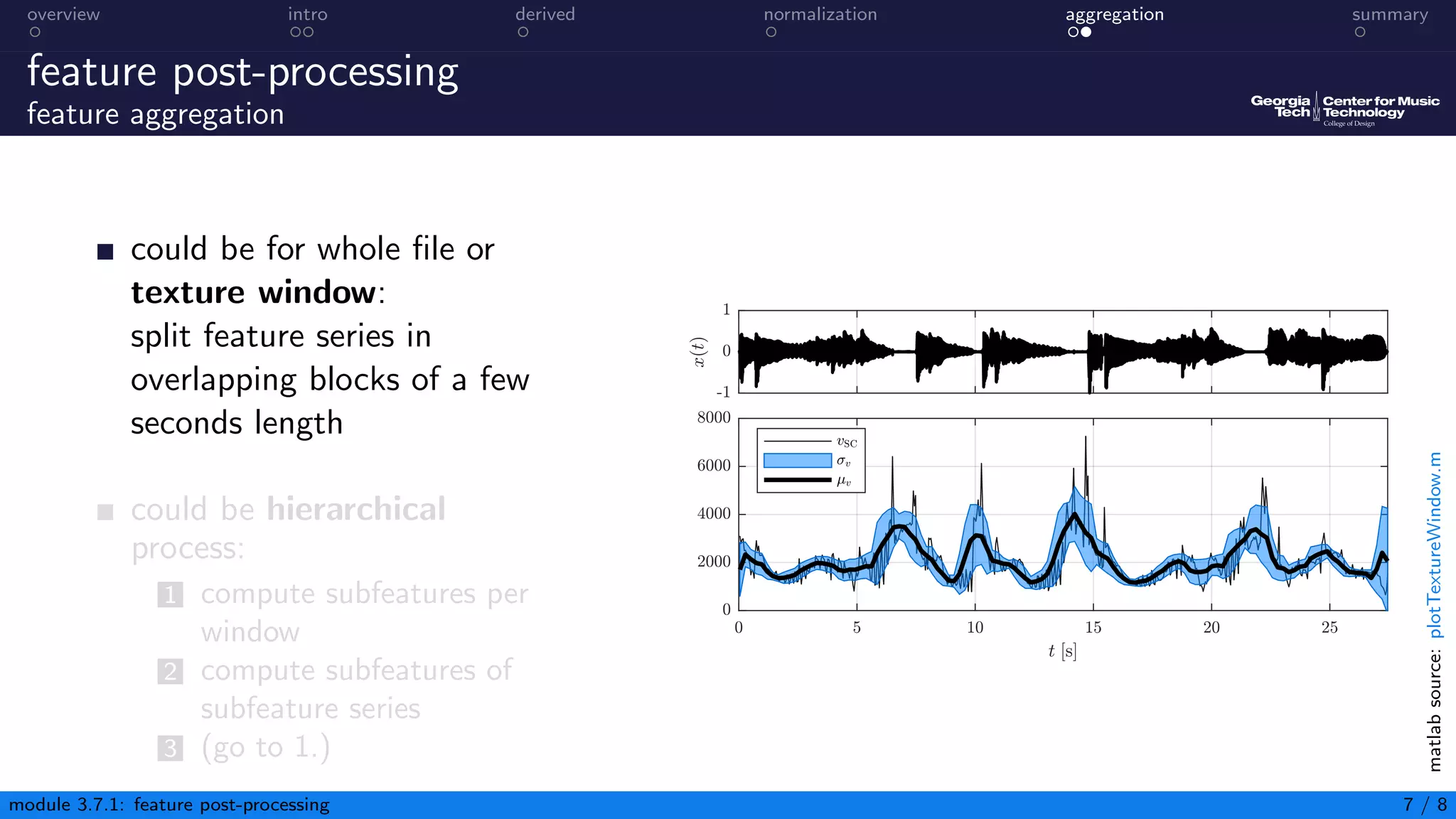
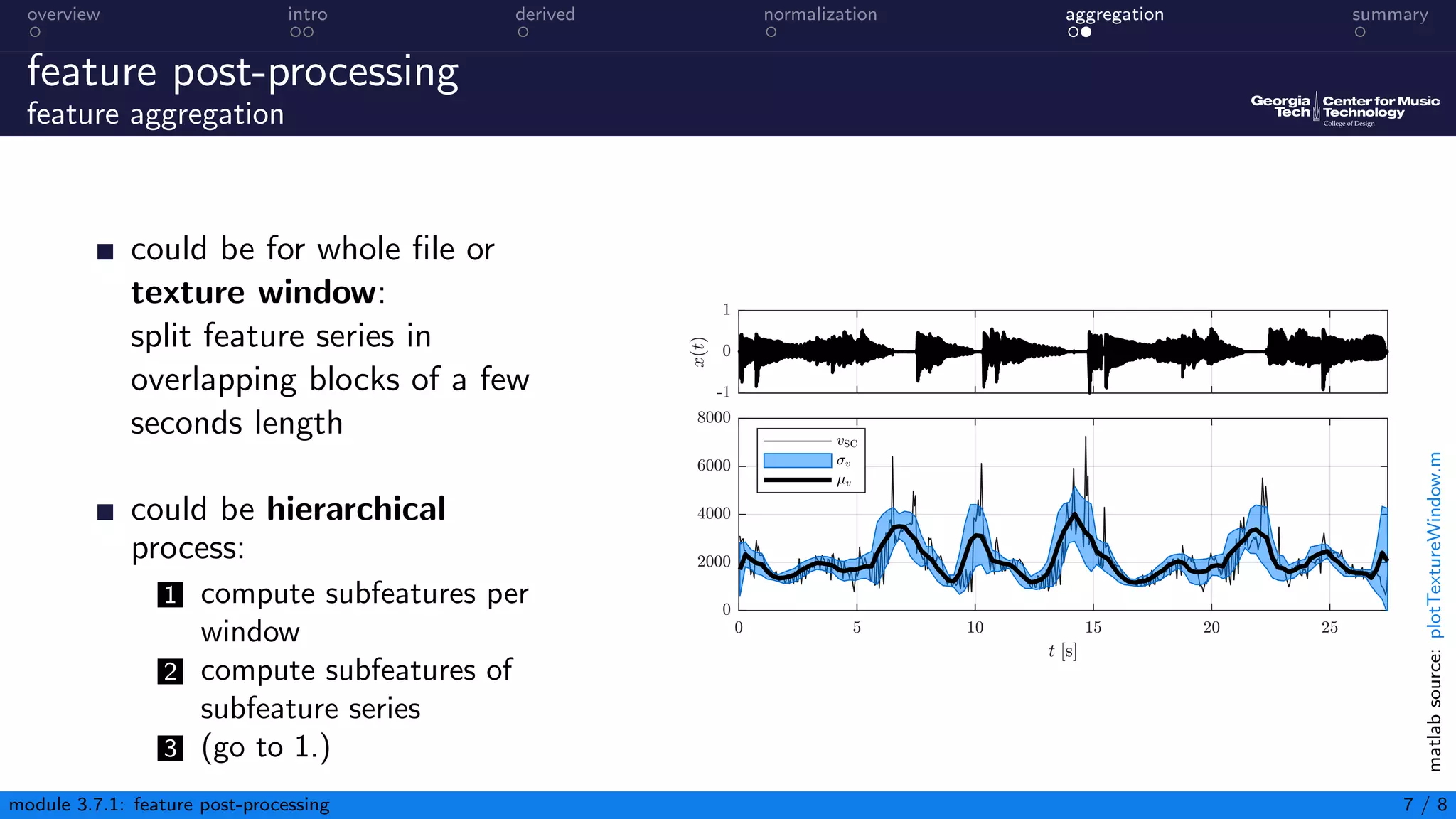
could be for whole file or
texture window:
split feature series in
overlapping blocks of a few
seconds length
could be hierarchical
process:
1 compute subfeatures per
window
2 compute subfeatures of
subfeature series
3 (go to 1.)
module 3.7.1: feature post-processing 7 / 8
matlab
source:
plotTextureWindow.m
overview intro derived normalization aggregation summary
feature post-processing
feature aggregation
could be for whole file or
texture window:
split feature series in
overlapping blocks of a few
seconds length
could be hierarchical
process:
1 compute subfeatures per
window
2 compute subfeatures of
subfeature series
3 (go to 1.)
module 3.7.1: feature post-processing 7 / 8
matlab
source:
plotTextureWindow.m
overview intro derived normalization aggregation summary
summary
lecture content
feature matrix should be processed to adapt to task and classifier
• derive additional features
• aggregate features
• normalize features
derived features
• take existing features and “create” new ones
feature normalization
• avoid different value ranges might impacting classifier
• handle different feature distributions
aggregate features: subfeatures
• combine blocks of features by computing, e.g., statistical features from them (mean,
standard deviation, . . . )
• subfeature vector is used as classifier input or as intermediate feature series
module 3.7.1: feature post-processing 8 / 8

03-07-01-ACA-Input-Post-Processing.pdf

  • 1.
    Introduction to AudioContent Analysis module 3.7.1: feature post-processing alexander lerch
  • 2.
    overview intro derivednormalization aggregation summary introduction overview corresponding textbook section sections 3.7.1–3.7.3 lecture content • derived features • feature aggregation • feature normalization learning objectives • discuss the advantages of specific derived features • summarize the principles of feature aggregation • list two forms of feature normalization and explain their usefulness module 3.7.1: feature post-processing 1 / 8
  • 3.
    overview intro derivednormalization aggregation summary introduction overview corresponding textbook section sections 3.7.1–3.7.3 lecture content • derived features • feature aggregation • feature normalization learning objectives • discuss the advantages of specific derived features • summarize the principles of feature aggregation • list two forms of feature normalization and explain their usefulness module 3.7.1: feature post-processing 1 / 8
  • 4.
    overview intro derivednormalization aggregation summary feature post-processing introduction 1/2 extracting multiple instantaneous features leads to → one feature vector per block, or → one feature matrix per audio file V = [v(0) v(1) . . . v(N − 1)] =      v0(0) v0(1) . . . v0(N − 1) v1(0) v1(1) . . . v1(N − 1) . . . . . . ... . . . vF−1(0) vF−1(1) . . . vF−1(N − 1)      dimensions: F × N (number of features and number of blocks, resp.) module 3.7.1: feature post-processing 2 / 8
  • 5.
    overview intro derivednormalization aggregation summary feature post-processing introduction 2/2 multiple options for feature matrix processing: 1 derive additional features 2 aggregate existing features (e.g., one feature vector per file) 3 ensure similar scale and distribution module 3.7.1: feature post-processing 3 / 8
  • 6.
    overview intro derivednormalization aggregation summary feature post-processing examples of derived features diff: use the change in value vj,∆(n) = vj (n) − vj (n − 1) smoothed: remove high frequency content by low-pass filtering • (anticausal) single-pole vj,LP(n) = (1 − α) · vj (n) − α · vj,LP(n − 1) • moving average module 3.7.1: feature post-processing 4 / 8
  • 7.
    overview intro derivednormalization aggregation summary feature post-processing examples of derived features diff: use the change in value vj,∆(n) = vj (n) − vj (n − 1) smoothed: remove high frequency content by low-pass filtering • (anticausal) single-pole vj,LP(n) = (1 − α) · vj (n) − α · vj,LP(n − 1) • moving average module 3.7.1: feature post-processing 4 / 8
  • 8.
    overview intro derivednormalization aggregation summary feature post-processing feature normalization reasons • features have different ranges and distributions • ensure that one feature does not have outsized impact z-score normalization vj,N(n) = vj (n) − µvj σvj . min-max normalization vj,N(n) = vj (n) − min(vj ) max(vj ) − min(vj ) . normalization The normalization constants µvj , σvj , max(vj ), min(vj ) have to be estimated from the Training Set. The same (training) constants are then applied during inference. Extracting constants from the Test Set is meaningless as the system has to infer with exactly the same parameters as during training. module 3.7.1: feature post-processing 5 / 8
  • 9.
    overview intro derivednormalization aggregation summary feature post-processing feature aggregation feature aggregation:1 compute summary features from feature series ⇒ subfeatures reasons • only one feature vector required per file • data reduction • characteristics of distribution or change over time contain additional info examples • statistical descriptors ▶ mean, median, max, standard deviation • hand crafted ▶ anything that might be meaningful — periodicity, slope, . . . 1 also compare pooling operation in machine learning module 3.7.1: feature post-processing 6 / 8
  • 10.
    overview intro derivednormalization aggregation summary feature post-processing feature aggregation could be for whole file or texture window: split feature series in overlapping blocks of a few seconds length could be hierarchical process: 1 compute subfeatures per window 2 compute subfeatures of subfeature series 3 (go to 1.) module 3.7.1: feature post-processing 7 / 8 matlab source: plotTextureWindow.m
  • 11.
    overview intro derivednormalization aggregation summary feature post-processing feature aggregation could be for whole file or texture window: split feature series in overlapping blocks of a few seconds length could be hierarchical process: 1 compute subfeatures per window 2 compute subfeatures of subfeature series 3 (go to 1.) module 3.7.1: feature post-processing 7 / 8 matlab source: plotTextureWindow.m
  • 12.
    overview intro derivednormalization aggregation summary summary lecture content feature matrix should be processed to adapt to task and classifier • derive additional features • aggregate features • normalize features derived features • take existing features and “create” new ones feature normalization • avoid different value ranges might impacting classifier • handle different feature distributions aggregate features: subfeatures • combine blocks of features by computing, e.g., statistical features from them (mean, standard deviation, . . . ) • subfeature vector is used as classifier input or as intermediate feature series module 3.7.1: feature post-processing 8 / 8