Clinical errors
by paramedic
staff
Medication errors
• Medication errors, broadly defined as any
error in the administration, prescription or
dispensing of a drug.
• These can occur in anyway along the route
from the doctor who prescribes it to the
ultimate deliverance to the patient.
• The fragmented nature of the healthcare
system has resulted in the increase in various
medical errors.
Various medication errors
• Omission errors
• Wrong time errors
• Improper dosing errors
• Wrong dose errors 
• Improper administration technique errors 
• Wrong drug preparation errors
• Fragmented care errors
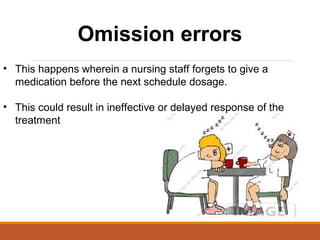
Omission errors
• This happens wherein a nursing staff forgets to give a 
medication before the next schedule dosage.
• This could result in ineffective or delayed response of the 
treatment
Wrong time error
• Sometimes medication is given outside the predetermined 
interval from its scheduled time.
• Again this might have its impact on the overall therapy 
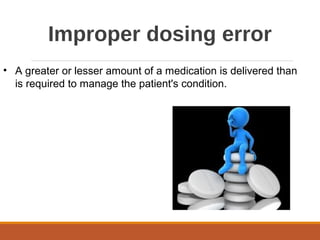
Improper dosing error
• A greater or lesser amount of a medication is delivered than 
is required to manage the patient's condition.
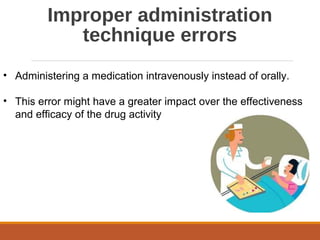
Improper administration
technique errors
• Administering a medication intravenously instead of orally.
• This error might have a greater impact over the effectiveness 
and efficacy of the drug activity
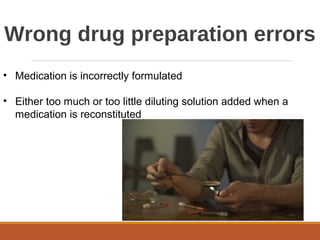
Wrong drug preparation errors
• Medication is incorrectly formulated
• Either too much or too little diluting solution added when a
medication is reconstituted
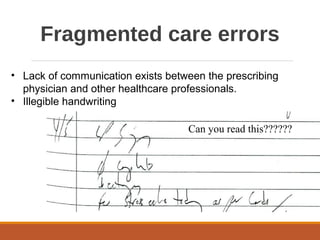
Fragmented care errors
• Lack of communication exists between the prescribing
physician and other healthcare professionals.
• Illegible handwriting
Can you read this??????
Causes of medication errors
• Distraction
• Environmental factors
• Lack of knowledge / understanding
• Incomplete patient information
• Memory lapses
• Systemic problems
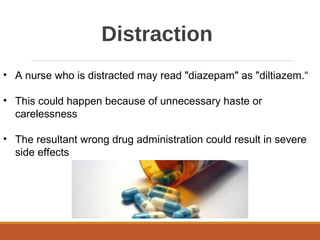
Distraction
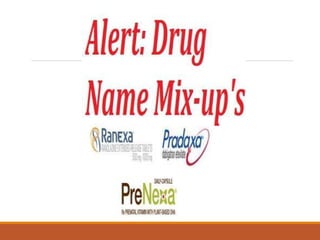
• A nurse who is distracted may read "diazepam" as "diltiazem.“
• This could happen because of unnecessary haste or
carelessness
• The resultant wrong drug administration could result in severe
side effects
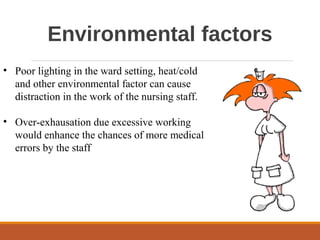
Environmental factors
• Poor lighting in the ward setting, heat/cold
and other environmental factor can cause
distraction in the work of the nursing staff.
• Over-exhausation due excessive working
would enhance the chances of more medical
errors by the staff
Lack of knowledge /
understanding
• Lack of appropriate knowledge regarding drug, its effects and side
effect would lead to wrong identification or non identification of the
symptoms that might arise
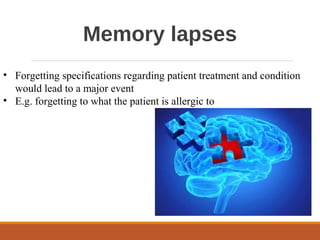
Memory lapses
• Forgetting specifications regarding patient treatment and condition
would lead to a major event
• E.g. forgetting to what the patient is allergic to
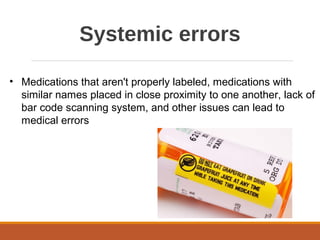
Systemic errors
• Medications that aren't properly labeled, medications with
similar names placed in close proximity to one another, lack of
bar code scanning system, and other issues can lead to
medical errors
Preventing medication errors
Some steps should be taken care of in order to minimize
various errors
•Know the patient
•Know the drug
•Keep lines of communication open
•Double check the high alert medicines
•Keep proper documentation
•Participate actively in correcting issues identified
•Keep the patient well informed regarding the treatment
•Ask for continuing education
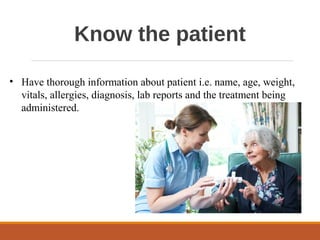
Know the patient
• Have thorough information about patient i.e. name, age, weight,
vitals, allergies, diagnosis, lab reports and the treatment being
administered.
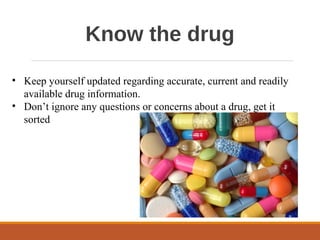
Know the drug
• Keep yourself updated regarding accurate, current and readily
available drug information.
• Don’t ignore any questions or concerns about a drug, get it
sorted
Keep the lines of
communication open
• Communication is vitally important, as it is the root cause of
many sentinel events, according to the Joint Commission
(TJC).
• Miscommunication amongst the hospital staff. i.e.
physician, nurses, pharmacist and others can lead to the
medication errors.
• Practice a habit of electronic prescription.
http://www.jointcommission.org/assets/1/18/Root_Causes_Event_Type_2004-3Q_2015.pdf
Double check on high alert
medicine
• High alert medicines can be proved to be devastating results if not
administered with proper care.
• A tragic case involving the death of three infant patients after
receiving massive heparin overdoses happened as a result of
misleading packaging. Since this incident, the drug manufacturer
now uses larger font sizes, tear-off cautionary labels, and different
colors to distinguish drug doses.
• Medications often look alike and sound alike-this can be a source of
errors. Double check high alert medications with another nurse to
prevent accidental overdoses and other medication errors.
http://www.ncbi.nlm.nih.gov/pmc/articles/PMC3462065/
Document each drug
administered
• Accurate documentation is essential and should include accurate
recording of the drug information, the name of the drug, the dose,
route, time, patient response, and any refusal of the drug by the
patient.
• This would help alleviating the miscommunication error during shift
changes too.
Participate actively in correcting issues
identified
• If you see that look-alike or sound-alike medications are stored
next to each other, ask your supervisor to correct the problem,
emphasizing the increased risk of medication errors.
• Request that medications be properly labelled.
• Request that a bar coding system be implemented that allows for
the verification of the six medication rights (right individual,
right medication, right dose, right time, right route, right
documentation).
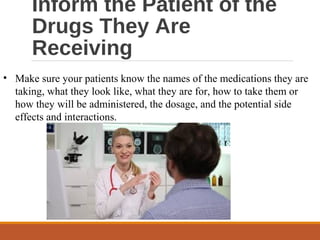
Inform the Patient of the
Drugs They Are
Receiving
• Make sure your patients know the names of the medications they are
taking, what they look like, what they are for, how to take them or
how they will be administered, the dosage, and the potential side
effects and interactions.
Ask for continuing
education
• Ask for mandatory training sessions about medications that are
introduced to your facility.
• Training should include medication-related policies, procedures, and
protocols. Updates like these empower nurses and can help prevent
medication errors.
• Nurse educators and continuing education providers should include
all of these prevention tips, and more, in nurse education programs to
help nurses avoid medication errors that could have detrimental or
even deadly consequences for patients, and significant consequences
for nurses, including disciplinary action, job dismissal, criminal
charges, and mental anguish.
Clinical errors by nursing / paramedic staff

Clinical errors by nursing / paramedic staff

  • 1.
  • 2.
    Medication errors • Medicationerrors, broadly defined as any error in the administration, prescription or dispensing of a drug. • These can occur in anyway along the route from the doctor who prescribes it to the ultimate deliverance to the patient. • The fragmented nature of the healthcare system has resulted in the increase in various medical errors.
  • 3.
    Various medication errors •Omission errors • Wrong time errors • Improper dosing errors • Wrong dose errors  • Improper administration technique errors  • Wrong drug preparation errors • Fragmented care errors
  • 4.
  • 5.
    Wrong time error •Sometimes medication is given outside the predetermined  interval from its scheduled time. • Again this might have its impact on the overall therapy 
  • 6.
    Improper dosing error •A greater or lesser amount of a medication is delivered than  is required to manage the patient's condition.
  • 7.
    Improper administration technique errors •Administering a medication intravenously instead of orally. • This error might have a greater impact over the effectiveness  and efficacy of the drug activity
  • 8.
    Wrong drug preparationerrors • Medication is incorrectly formulated • Either too much or too little diluting solution added when a medication is reconstituted
  • 9.
    Fragmented care errors •Lack of communication exists between the prescribing physician and other healthcare professionals. • Illegible handwriting Can you read this??????
  • 10.
    Causes of medicationerrors • Distraction • Environmental factors • Lack of knowledge / understanding • Incomplete patient information • Memory lapses • Systemic problems
  • 11.
    Distraction • A nursewho is distracted may read "diazepam" as "diltiazem.“ • This could happen because of unnecessary haste or carelessness • The resultant wrong drug administration could result in severe side effects
  • 12.
    Environmental factors • Poorlighting in the ward setting, heat/cold and other environmental factor can cause distraction in the work of the nursing staff. • Over-exhausation due excessive working would enhance the chances of more medical errors by the staff
  • 13.
    Lack of knowledge/ understanding • Lack of appropriate knowledge regarding drug, its effects and side effect would lead to wrong identification or non identification of the symptoms that might arise
  • 14.
    Memory lapses • Forgettingspecifications regarding patient treatment and condition would lead to a major event • E.g. forgetting to what the patient is allergic to
  • 15.
    Systemic errors • Medicationsthat aren't properly labeled, medications with similar names placed in close proximity to one another, lack of bar code scanning system, and other issues can lead to medical errors
  • 16.
    Preventing medication errors Somesteps should be taken care of in order to minimize various errors •Know the patient •Know the drug •Keep lines of communication open •Double check the high alert medicines •Keep proper documentation •Participate actively in correcting issues identified •Keep the patient well informed regarding the treatment •Ask for continuing education
  • 17.
    Know the patient •Have thorough information about patient i.e. name, age, weight, vitals, allergies, diagnosis, lab reports and the treatment being administered.
  • 18.
    Know the drug •Keep yourself updated regarding accurate, current and readily available drug information. • Don’t ignore any questions or concerns about a drug, get it sorted
  • 19.
    Keep the linesof communication open • Communication is vitally important, as it is the root cause of many sentinel events, according to the Joint Commission (TJC). • Miscommunication amongst the hospital staff. i.e. physician, nurses, pharmacist and others can lead to the medication errors. • Practice a habit of electronic prescription. http://www.jointcommission.org/assets/1/18/Root_Causes_Event_Type_2004-3Q_2015.pdf
  • 20.
    Double check onhigh alert medicine • High alert medicines can be proved to be devastating results if not administered with proper care. • A tragic case involving the death of three infant patients after receiving massive heparin overdoses happened as a result of misleading packaging. Since this incident, the drug manufacturer now uses larger font sizes, tear-off cautionary labels, and different colors to distinguish drug doses. • Medications often look alike and sound alike-this can be a source of errors. Double check high alert medications with another nurse to prevent accidental overdoses and other medication errors. http://www.ncbi.nlm.nih.gov/pmc/articles/PMC3462065/
  • 22.
    Document each drug administered •Accurate documentation is essential and should include accurate recording of the drug information, the name of the drug, the dose, route, time, patient response, and any refusal of the drug by the patient. • This would help alleviating the miscommunication error during shift changes too.
  • 23.
    Participate actively incorrecting issues identified • If you see that look-alike or sound-alike medications are stored next to each other, ask your supervisor to correct the problem, emphasizing the increased risk of medication errors. • Request that medications be properly labelled. • Request that a bar coding system be implemented that allows for the verification of the six medication rights (right individual, right medication, right dose, right time, right route, right documentation).
  • 24.
    Inform the Patientof the Drugs They Are Receiving • Make sure your patients know the names of the medications they are taking, what they look like, what they are for, how to take them or how they will be administered, the dosage, and the potential side effects and interactions.
  • 25.
    Ask for continuing education •Ask for mandatory training sessions about medications that are introduced to your facility. • Training should include medication-related policies, procedures, and protocols. Updates like these empower nurses and can help prevent medication errors. • Nurse educators and continuing education providers should include all of these prevention tips, and more, in nurse education programs to help nurses avoid medication errors that could have detrimental or even deadly consequences for patients, and significant consequences for nurses, including disciplinary action, job dismissal, criminal charges, and mental anguish.