Copyright © Richard N. Taylor, Nenad Medvidovic, and Eric M. Dashofy. All rights reserved.
Architectures
in Context
Software Architecture
Lecture 2
Foundations, Theory, and Practice
Software Architecture
2
Fundamental Understanding
 Architecture is a set of principal design decisions about a
software system
 Three fundamental understandings of software
architecture
 Every application has an architecture
 Every application has at least one architect
 Architecture is not a phase of development
Foundations, Theory, and Practice
Software Architecture
3
Wrong View: Architecture as a
Phase
 Treating architecture as a phase denies its
foundational role in software development
 More than “high-level design”
 Architecture is also represented, e.g., by object code,
source code, …
Foundations, Theory, and Practice
Software Architecture
4
Context of Software Architecture
 Requirements
 Design
 Implementation
 Analysis and Testing
 Evolution
 Development Process
Foundations, Theory, and Practice
Software Architecture
5
Requirements Analysis
 Traditional SE suggests requirements analysis should
remain unsullied by any consideration for a design
 However, without reference to existing architectures it
becomes difficult to assess practicality, schedules, or
costs
 In building architecture we talk about specific rooms…
 …rather than the abstract concept “means for
providing shelter”
 In engineering new products come from the observation
of existing solution and their limitations
Foundations, Theory, and Practice
Software Architecture
6
New Perspective on Requirements
Analysis
 Existing designs and architectures provide the solution
vocabulary
 Our understanding of what works now, and how it
works, affects our wants and perceived needs
 The insights from our experiences with existing systems
 helps us imagine what might work and
 enables us to assess development time and costs
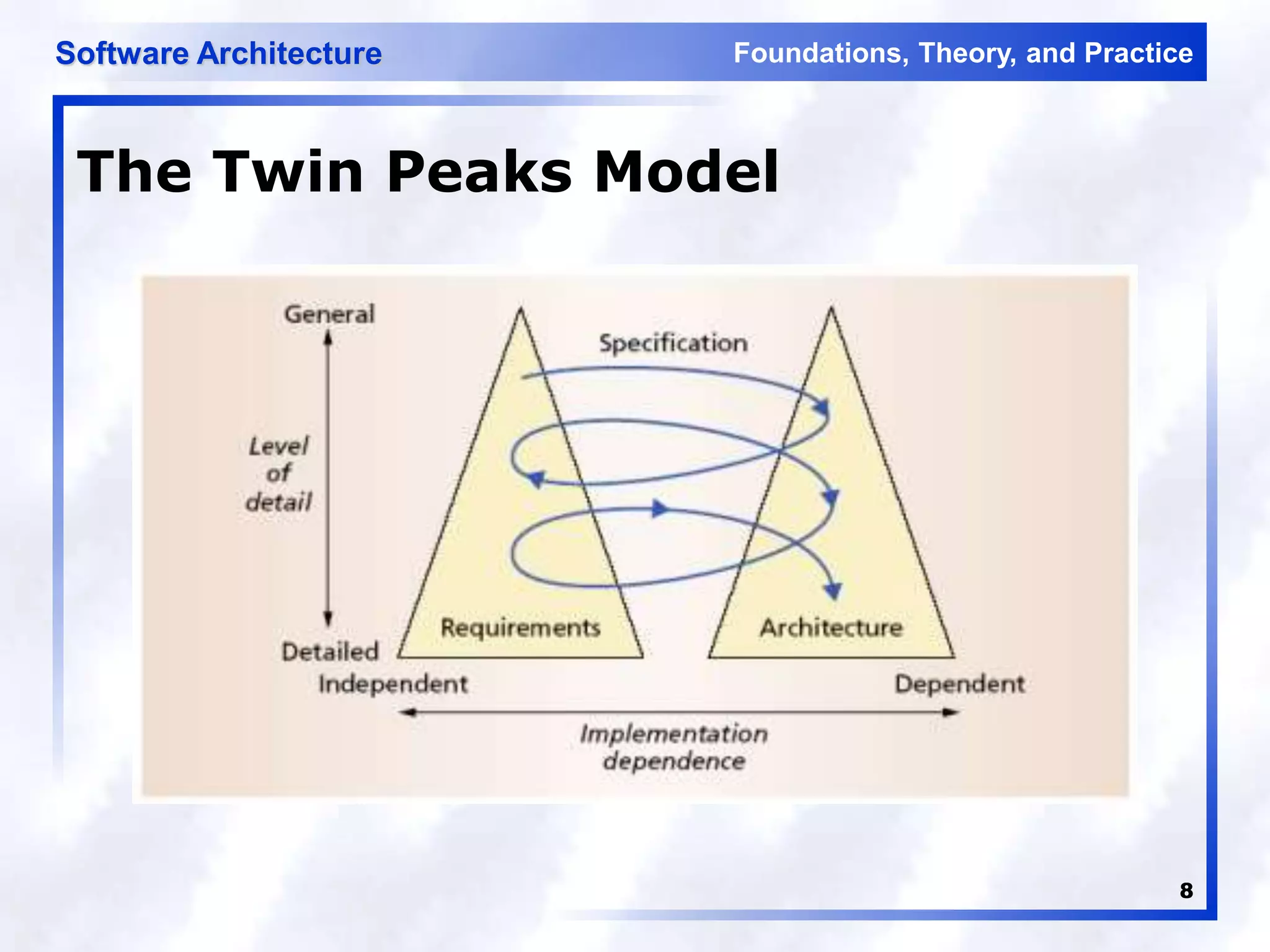
  Requirements analysis and consideration of design
must be pursued at the same time
Foundations, Theory, and Practice
Software Architecture
7
Non-Functional Properties (NFP)
 NFPs are the result of architectural choices
 NFP questions are raised as the result of architectural
choices
 Specification of NFP might require an architectural
framework to even enable their statement
 An architectural framework will be required for
assessment of whether the properties are achievable
Foundations, Theory, and Practice
Software Architecture
8
The Twin Peaks Model
Foundations, Theory, and Practice
Software Architecture
9
Design and Architecture
 Design is an activity that pervades software development
 It is an activity that creates part of a system’s architecture
 Typically in the traditional Design Phase decisions concern
 A system’s structure
 Identification of its primary components
 Their interconnections
 Architecture denotes the set of principal design decisions
about a system
 That is more than just structure
Foundations, Theory, and Practice
Software Architecture
10
Architecture-Centric Design
 Traditional design phase suggests translating the
requirements into algorithms, so a programmer can
implement them
 Architecture-centric design
 stakeholder issues
 decision about use of COTS component
 overarching style and structure
 package and primary class structure
 deployment issues
 post implementation/deployment issues
Foundations, Theory, and Practice
Software Architecture
11
Design Techniques
 Basic conceptual tools
 Separation of concerns
 Abstraction
 Modularity
 Two illustrative widely adapted strategies
 Object-oriented design
 Domain-specific software architectures (DSSA)
Foundations, Theory, and Practice
Software Architecture
12
Object-Oriented Design (OOD)
 Objects
 Main abstraction entity in OOD
 Encapsulations of state with functions for accessing
and manipulating that state
Foundations, Theory, and Practice
Software Architecture
13
Pros and Cons of OOD
 Pros
 UML modeling notation
 Design patterns
 Cons
 Provides only
 One level of encapsulation (the object)
 One notion of interface
 One type of explicit connector (procedure call)
 Even message passing is realized via procedure calls
 OO programming language might dictate important design
decisions
 OOD assumes a shared address space
Foundations, Theory, and Practice
Software Architecture
14
DSSA
 Capturing and characterizing the best solutions and best
practices from past projects within a domain
 Production of new applications can focus on the points
of novel variation
 Reuse applicable parts of the architecture and
implementation
 Applicable for product lines
 Recall the Philips Koala example discussed in the
previous lecture
Foundations, Theory, and Practice
Software Architecture
15
Implementation
 The objective is to create machine-executable source
code
 That code should be faithful to the architecture
 Alternatively, it may adapt the architecture
 How much adaptation is allowed?
 Architecturally-relevant vs. -unimportant
adaptations
 It must fully develop all outstanding details of the
application
Foundations, Theory, and Practice
Software Architecture
16
Faithful Implementation
 All of the structural elements found in the architecture
are implemented in the source code
 Source code must not utilize major new computational
elements that have no corresponding elements in the
architecture
 Source code must not contain new connections between
architectural elements that are not found in the
architecture
 Is this realistic?
Overly constraining?
What if we deviate from this?
Foundations, Theory, and Practice
Software Architecture
17
Unfaithful Implementation
 The implementation does have an architecture
 It is latent, as opposed to what is documented.
 Failure to recognize the distinction between planned and
implemented architecture
 robs one of the ability to reason about the
application’s architecture in the future
 misleads all stakeholders regarding what they believe
they have as opposed to what they really have
 makes any development or evolution strategy that is
based on the documented (but inaccurate)
architecture doomed to failure
Foundations, Theory, and Practice
Software Architecture
18
Implementation Strategies
 Generative techniques
 e.g. parser generators
 Frameworks
 collections of source code with identified places
where the engineer must “fill in the blanks”
 Middleware
 CORBA, DCOM, RPC, …
 Reuse-based techniques
 COTS, open-source, in-house
 Writing all code manually
Foundations, Theory, and Practice
Software Architecture
19
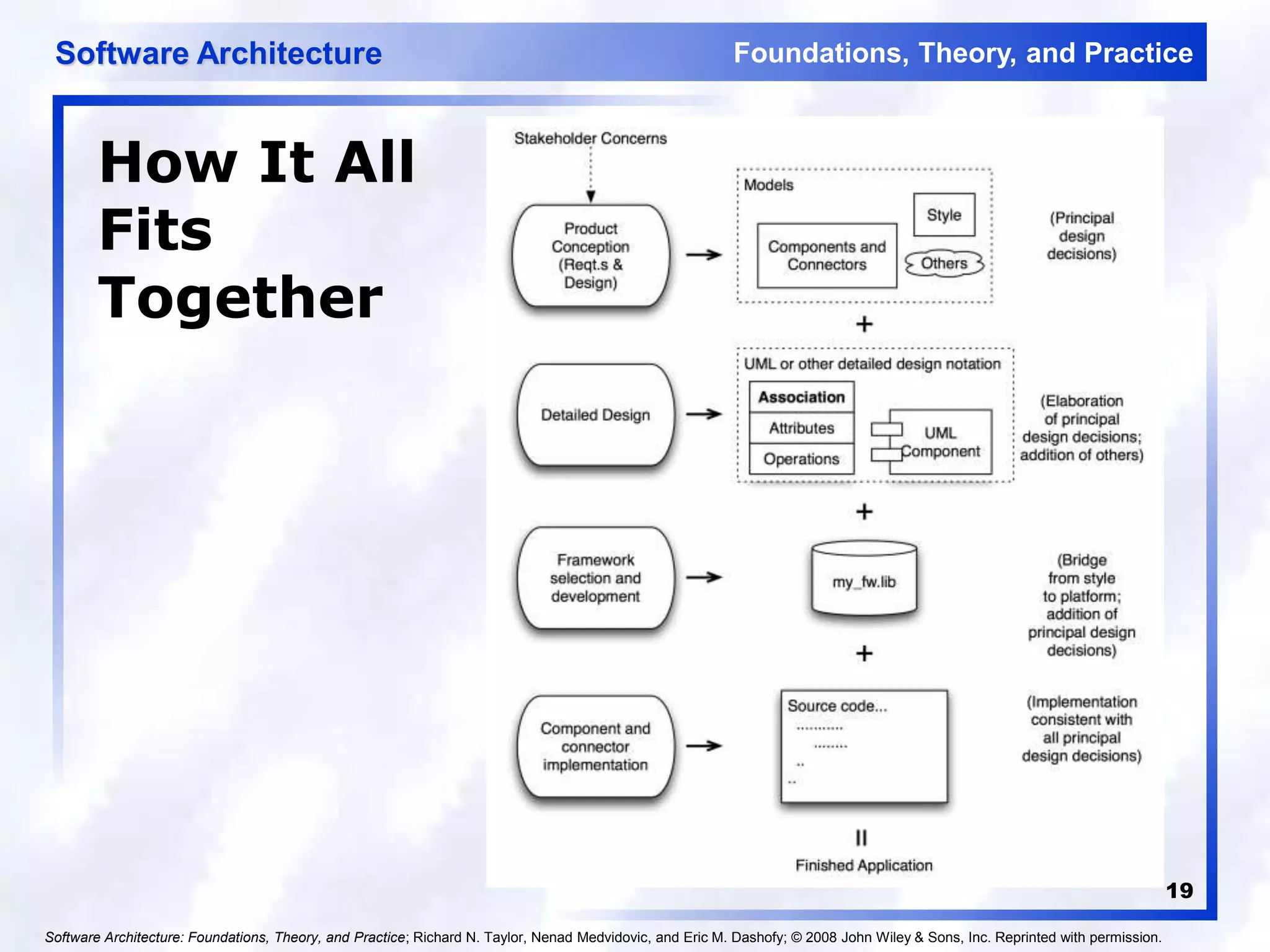
How It All
Fits
Together
Software Architecture: Foundations, Theory, and Practice; Richard N. Taylor, Nenad Medvidovic, and Eric M. Dashofy; © 2008 John Wiley & Sons, Inc. Reprinted with permission.
Foundations, Theory, and Practice
Software Architecture
20
Analysis and Testing
 Analysis and testing are activities undertaken to assess
the qualities of an artifact
 The earlier an error is detected and corrected the lower
the aggregate cost
 Rigorous representations are required for analysis, so
precise questions can be asked and answered
Foundations, Theory, and Practice
Software Architecture
21
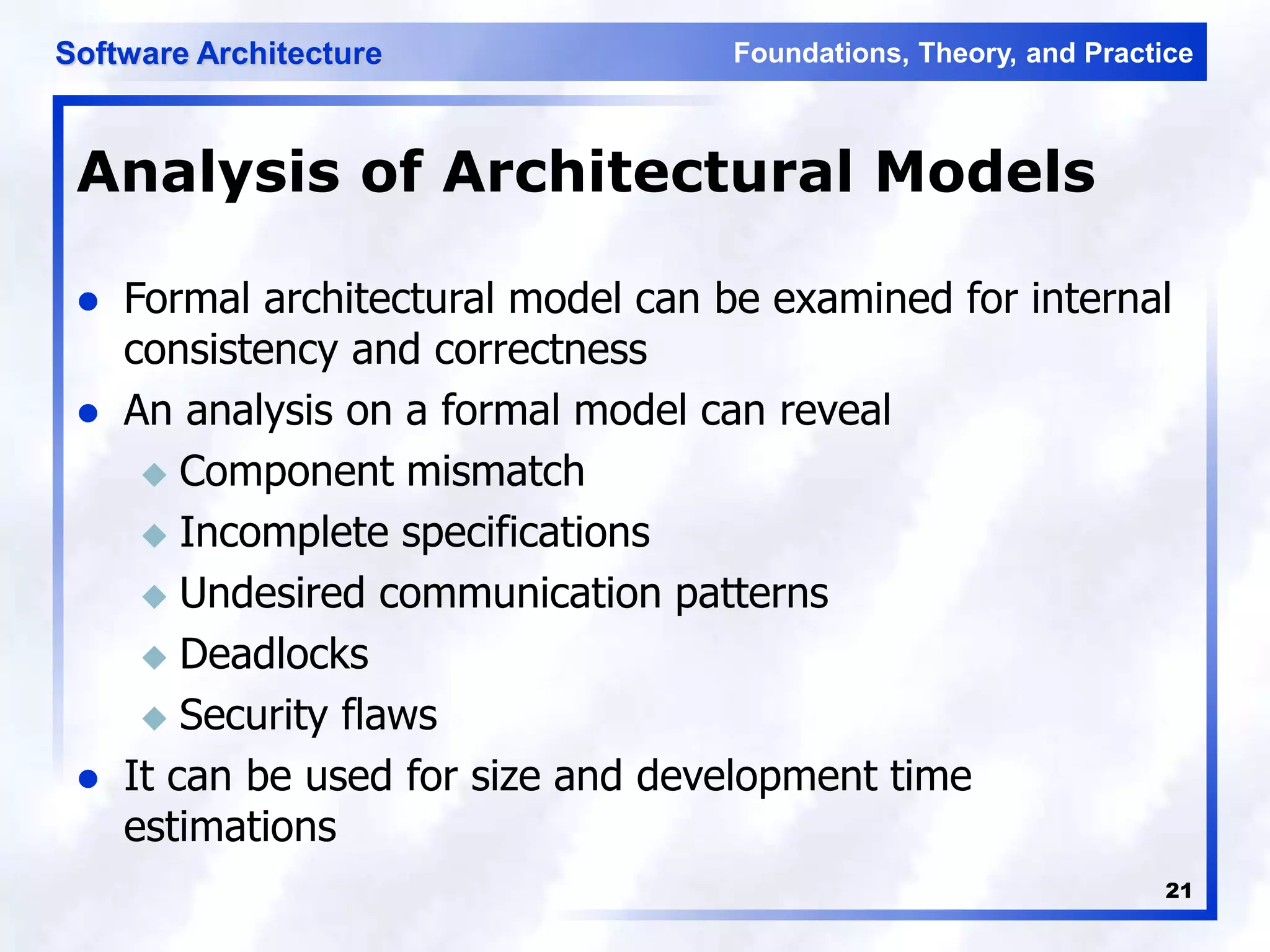
Analysis of Architectural Models
 Formal architectural model can be examined for internal
consistency and correctness
 An analysis on a formal model can reveal
 Component mismatch
 Incomplete specifications
 Undesired communication patterns
 Deadlocks
 Security flaws
 It can be used for size and development time
estimations
Foundations, Theory, and Practice
Software Architecture
22
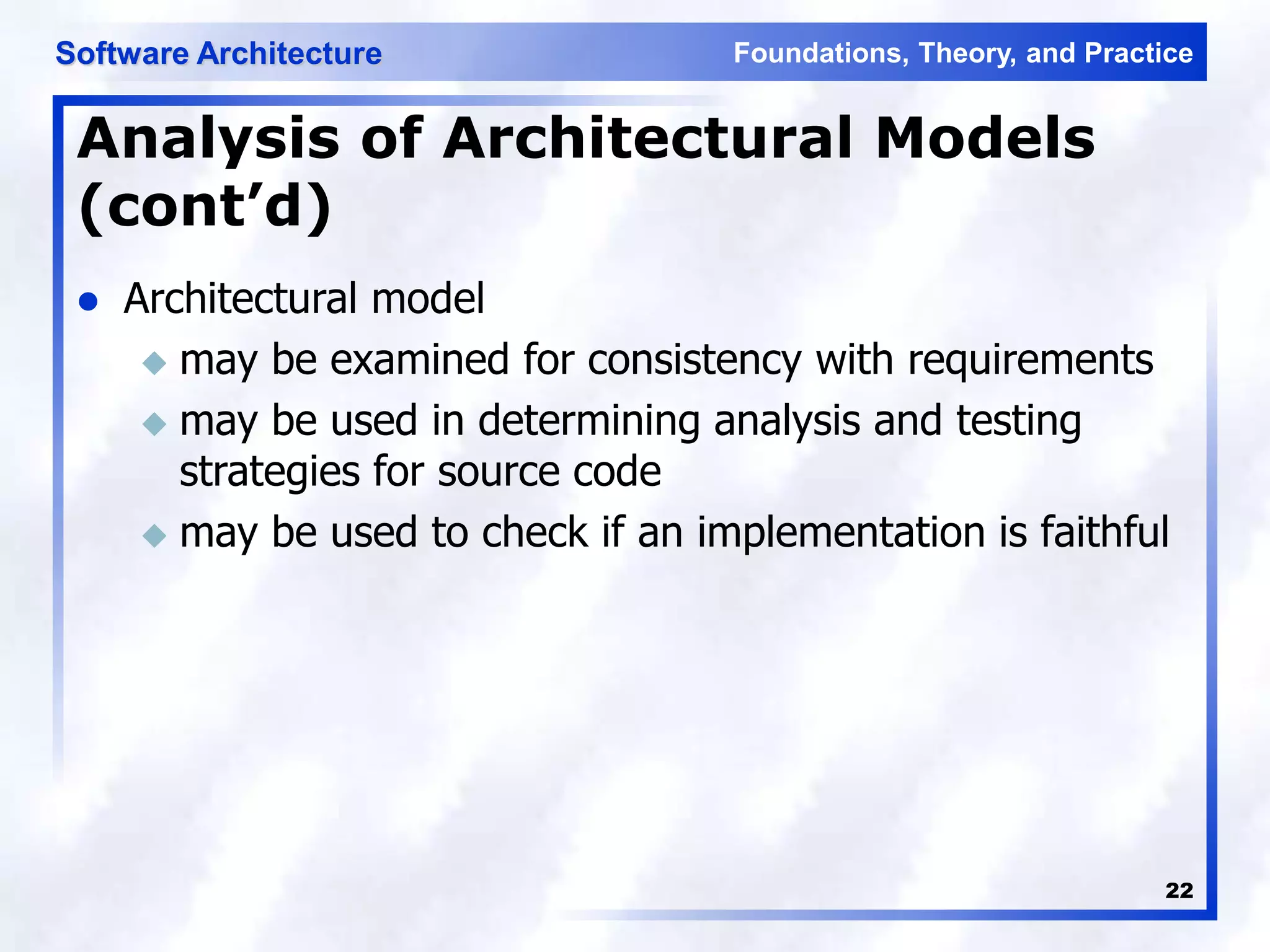
Analysis of Architectural Models
(cont’d)
 Architectural model
 may be examined for consistency with requirements
 may be used in determining analysis and testing
strategies for source code
 may be used to check if an implementation is faithful
Foundations, Theory, and Practice
Software Architecture
23
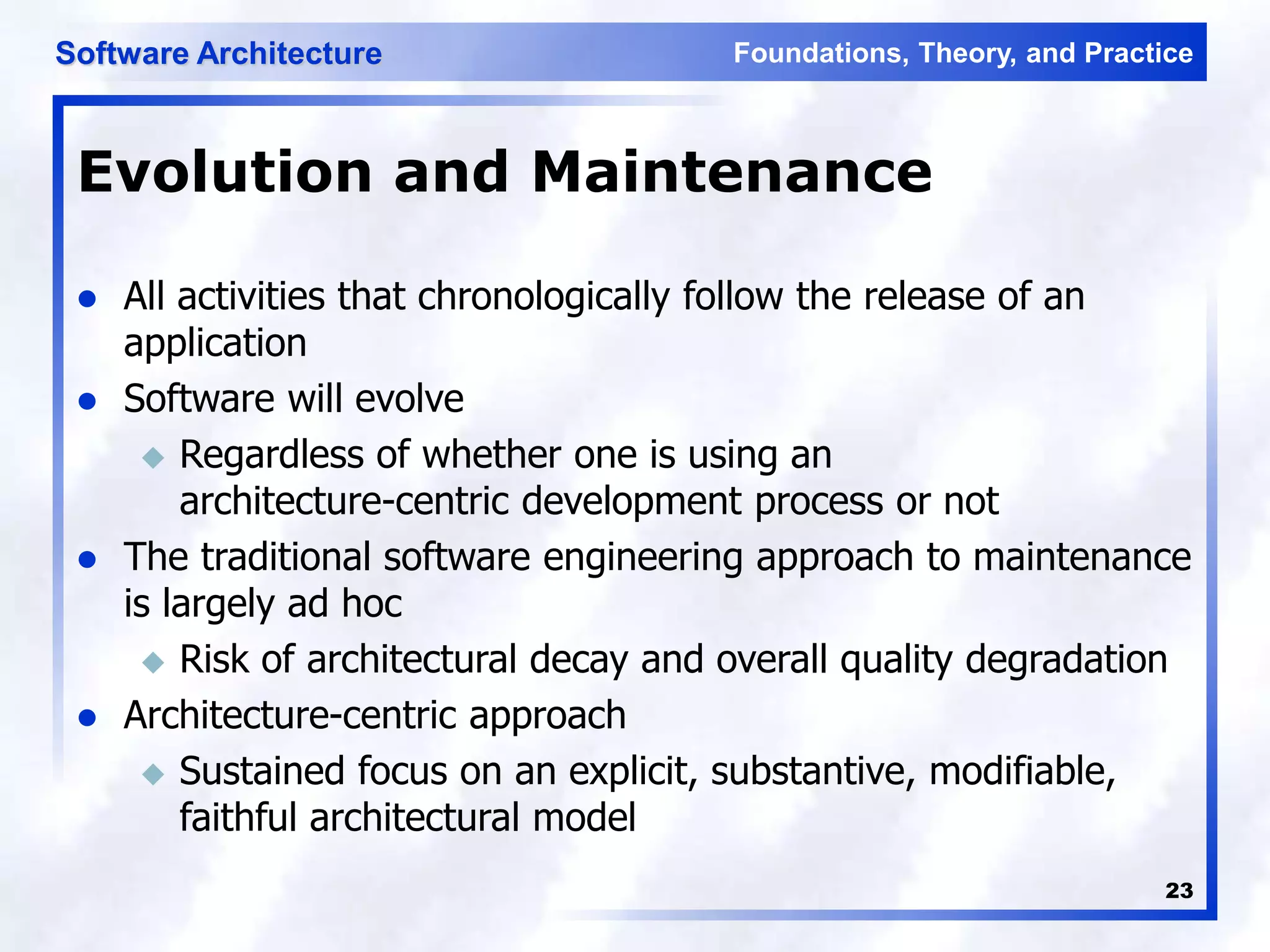
Evolution and Maintenance
 All activities that chronologically follow the release of an
application
 Software will evolve
 Regardless of whether one is using an
architecture-centric development process or not
 The traditional software engineering approach to maintenance
is largely ad hoc
 Risk of architectural decay and overall quality degradation
 Architecture-centric approach
 Sustained focus on an explicit, substantive, modifiable,
faithful architectural model
Foundations, Theory, and Practice
Software Architecture
24
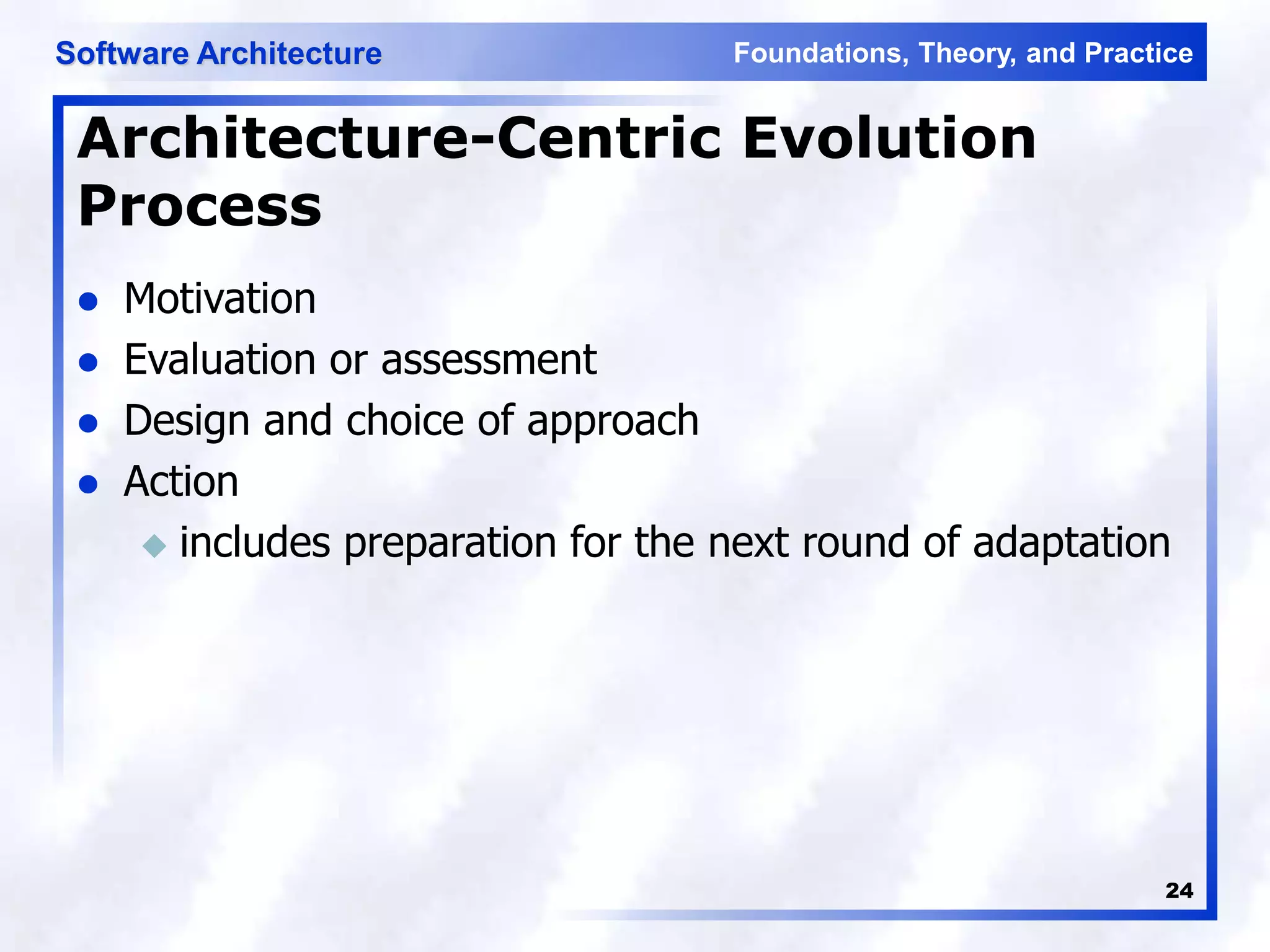
Architecture-Centric Evolution
Process
 Motivation
 Evaluation or assessment
 Design and choice of approach
 Action
 includes preparation for the next round of adaptation
Foundations, Theory, and Practice
Software Architecture
25
Processes
 Traditional software process discussions make the
process activities the focal point
 In architecture-centric software engineering the product
becomes the focal point
 No single “right” software process for architecture-
centric software engineering exists
Foundations, Theory, and Practice
Software Architecture
26
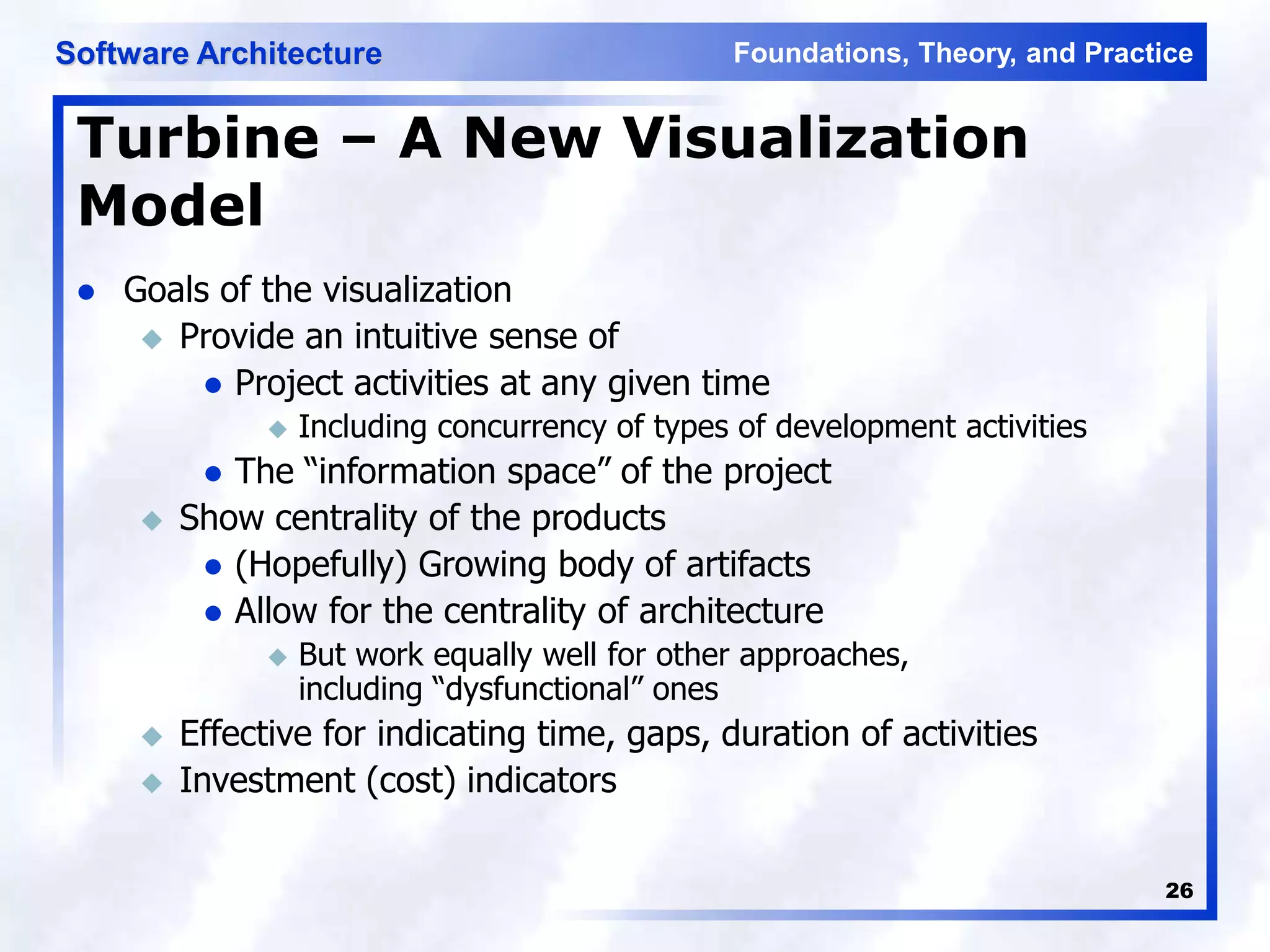
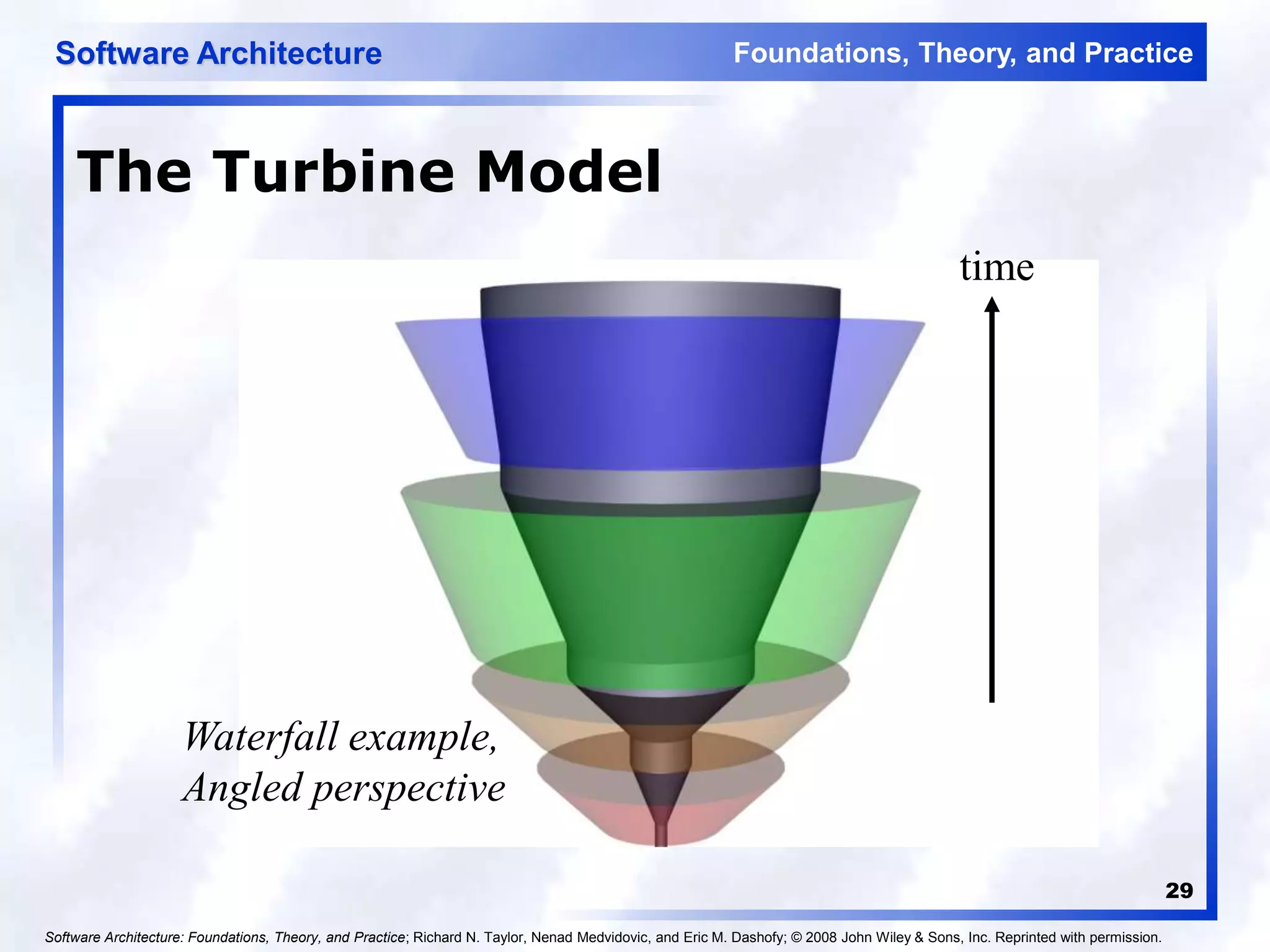
Turbine – A New Visualization
Model
 Goals of the visualization
 Provide an intuitive sense of
 Project activities at any given time
 Including concurrency of types of development activities
 The “information space” of the project
 Show centrality of the products
 (Hopefully) Growing body of artifacts
 Allow for the centrality of architecture
 But work equally well for other approaches,
including “dysfunctional” ones
 Effective for indicating time, gaps, duration of activities
 Investment (cost) indicators
Foundations, Theory, and Practice
Software Architecture
27
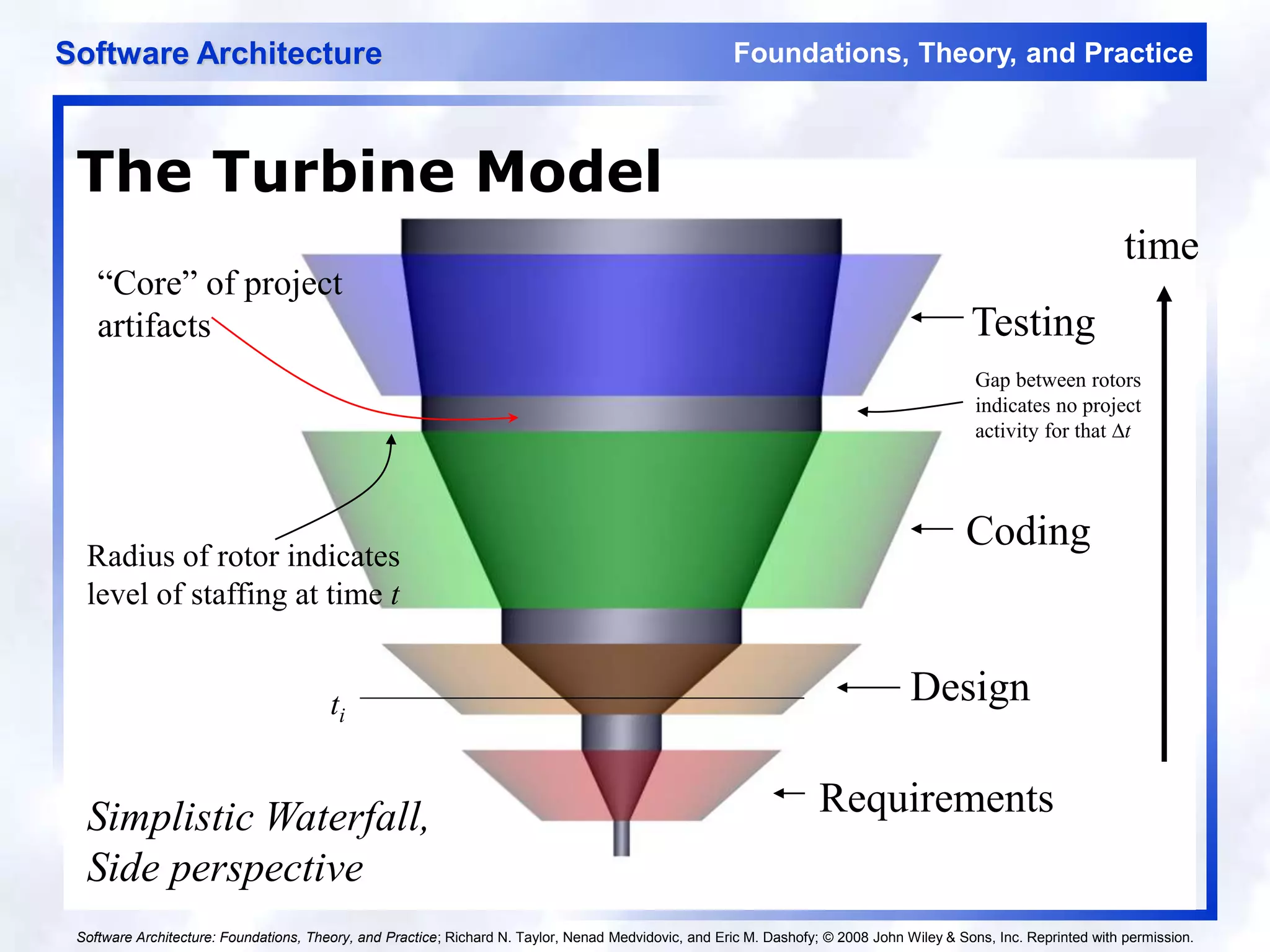
Coding
Design
Requirements
Testing
Simplistic Waterfall,
Side perspective
time
The Turbine Model
“Core” of project
artifacts
Radius of rotor indicates
level of staffing at time t
Gap between rotors
indicates no project
activity for that t
ti
Software Architecture: Foundations, Theory, and Practice; Richard N. Taylor, Nenad Medvidovic, and Eric M. Dashofy; © 2008 John Wiley & Sons, Inc. Reprinted with permission.
Foundations, Theory, and Practice
Software Architecture
28
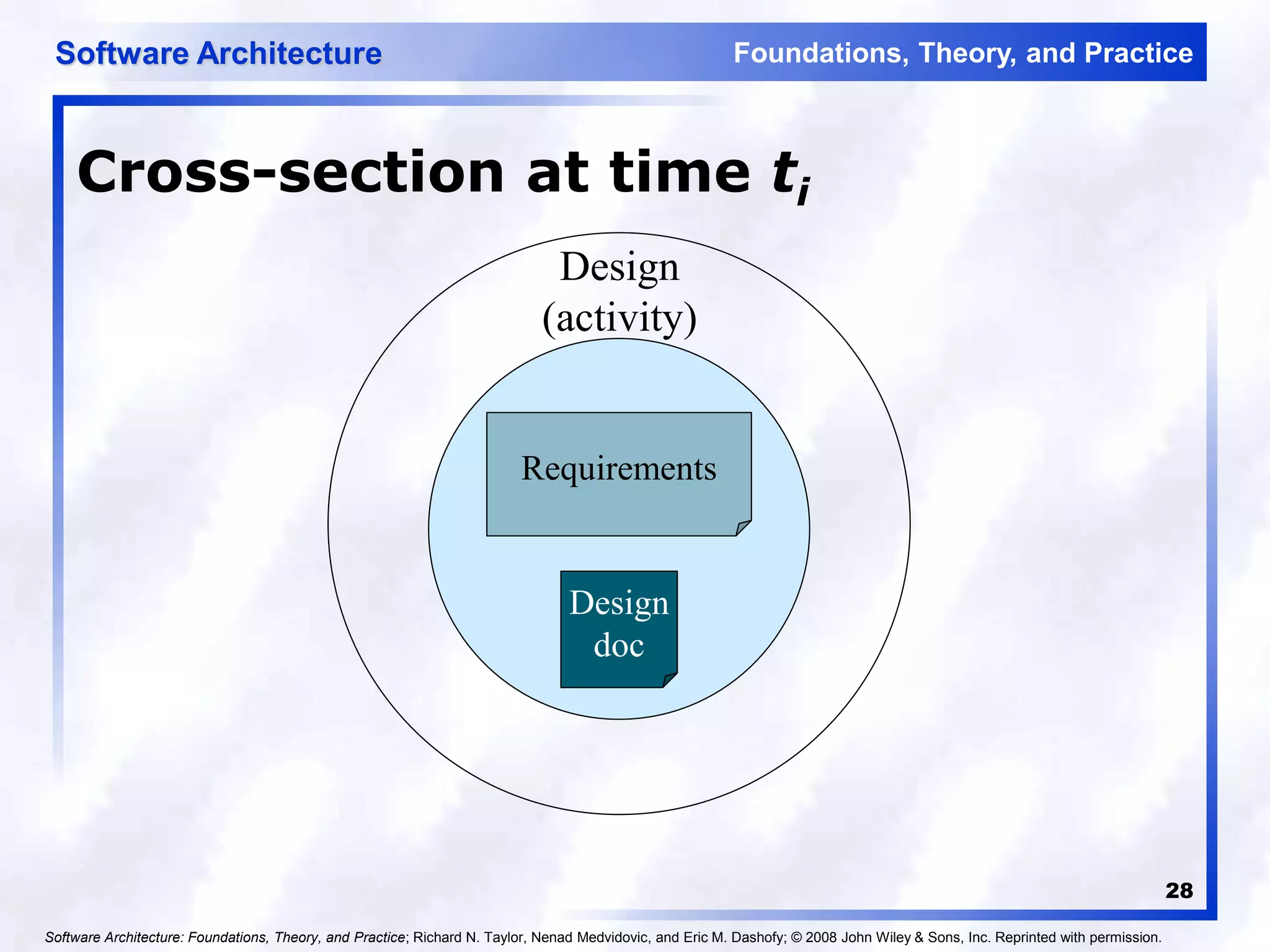
Cross-section at time ti
Design
(activity)
Requirements
Design
doc
Software Architecture: Foundations, Theory, and Practice; Richard N. Taylor, Nenad Medvidovic, and Eric M. Dashofy; © 2008 John Wiley & Sons, Inc. Reprinted with permission.
Foundations, Theory, and Practice
Software Architecture
29
The Turbine Model
Waterfall example,
Angled perspective
time
Software Architecture: Foundations, Theory, and Practice; Richard N. Taylor, Nenad Medvidovic, and Eric M. Dashofy; © 2008 John Wiley & Sons, Inc. Reprinted with permission.
Foundations, Theory, and Practice
Software Architecture
30
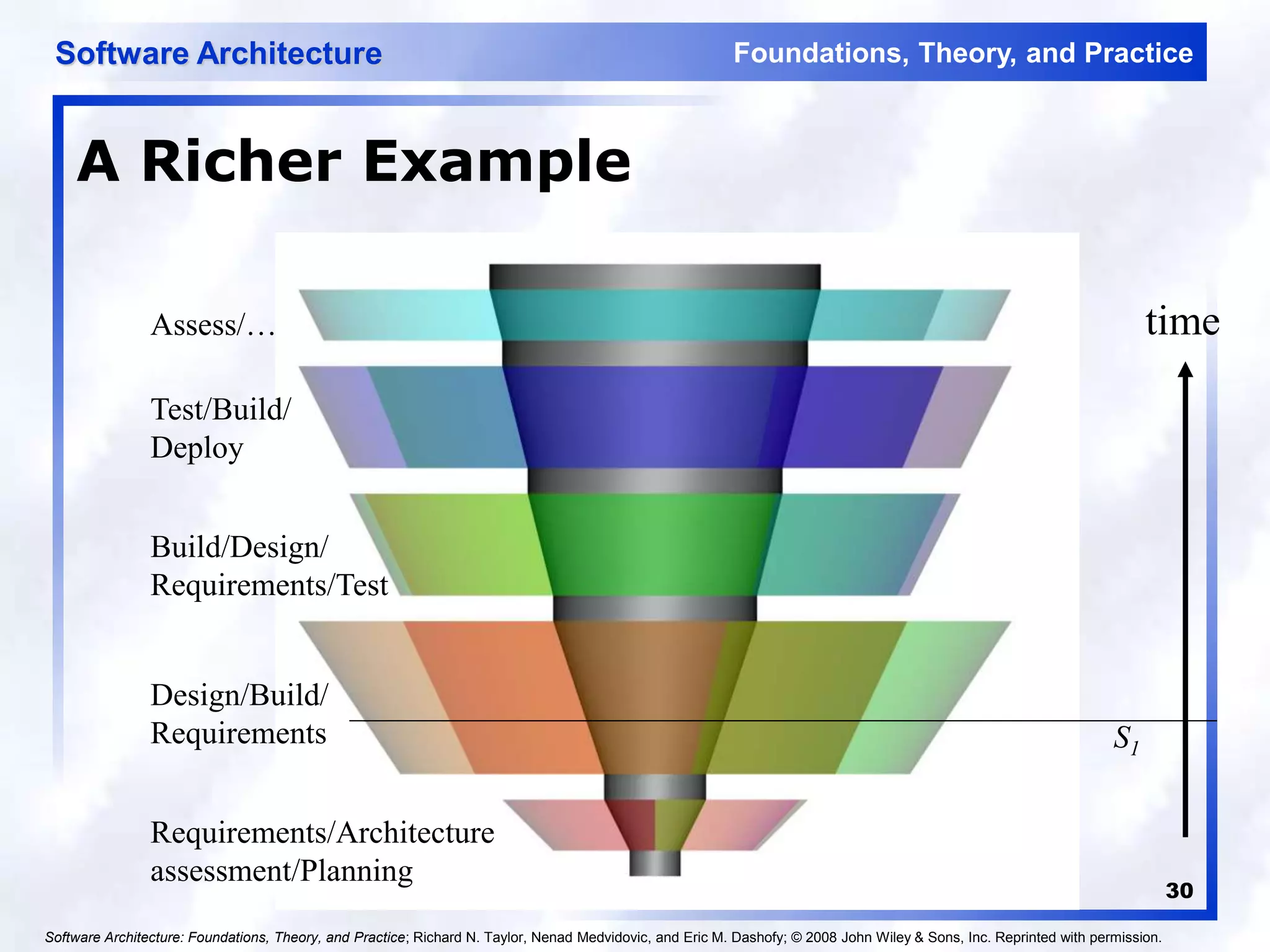
A Richer Example
S1
Design/Build/
Requirements
Test/Build/
Deploy
Assess/…
Requirements/Architecture
assessment/Planning
Build/Design/
Requirements/Test
time
Software Architecture: Foundations, Theory, and Practice; Richard N. Taylor, Nenad Medvidovic, and Eric M. Dashofy; © 2008 John Wiley & Sons, Inc. Reprinted with permission.
Foundations, Theory, and Practice
Software Architecture
31
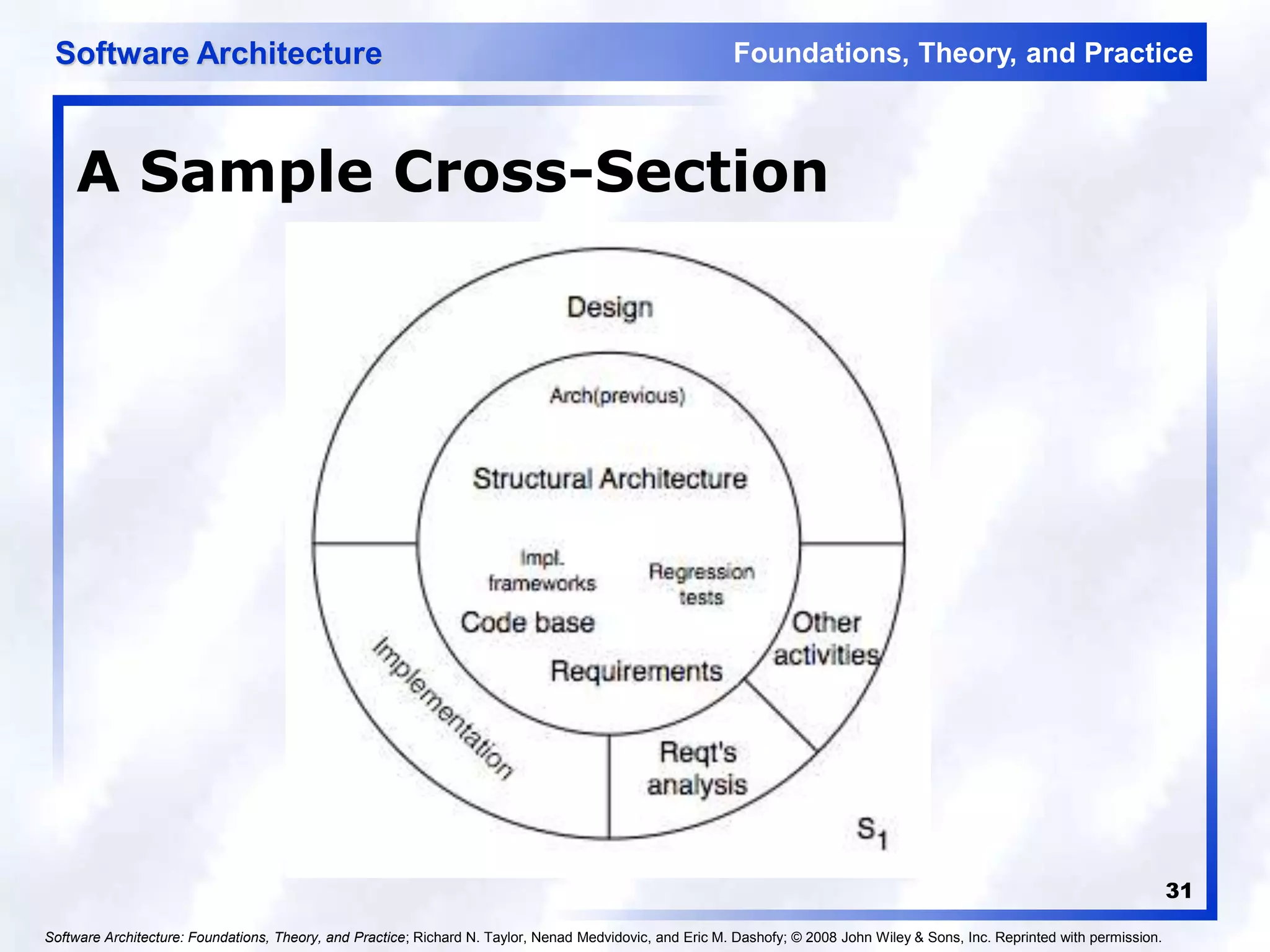
A Sample Cross-Section
Software Architecture: Foundations, Theory, and Practice; Richard N. Taylor, Nenad Medvidovic, and Eric M. Dashofy; © 2008 John Wiley & Sons, Inc. Reprinted with permission.
Foundations, Theory, and Practice
Software Architecture
32
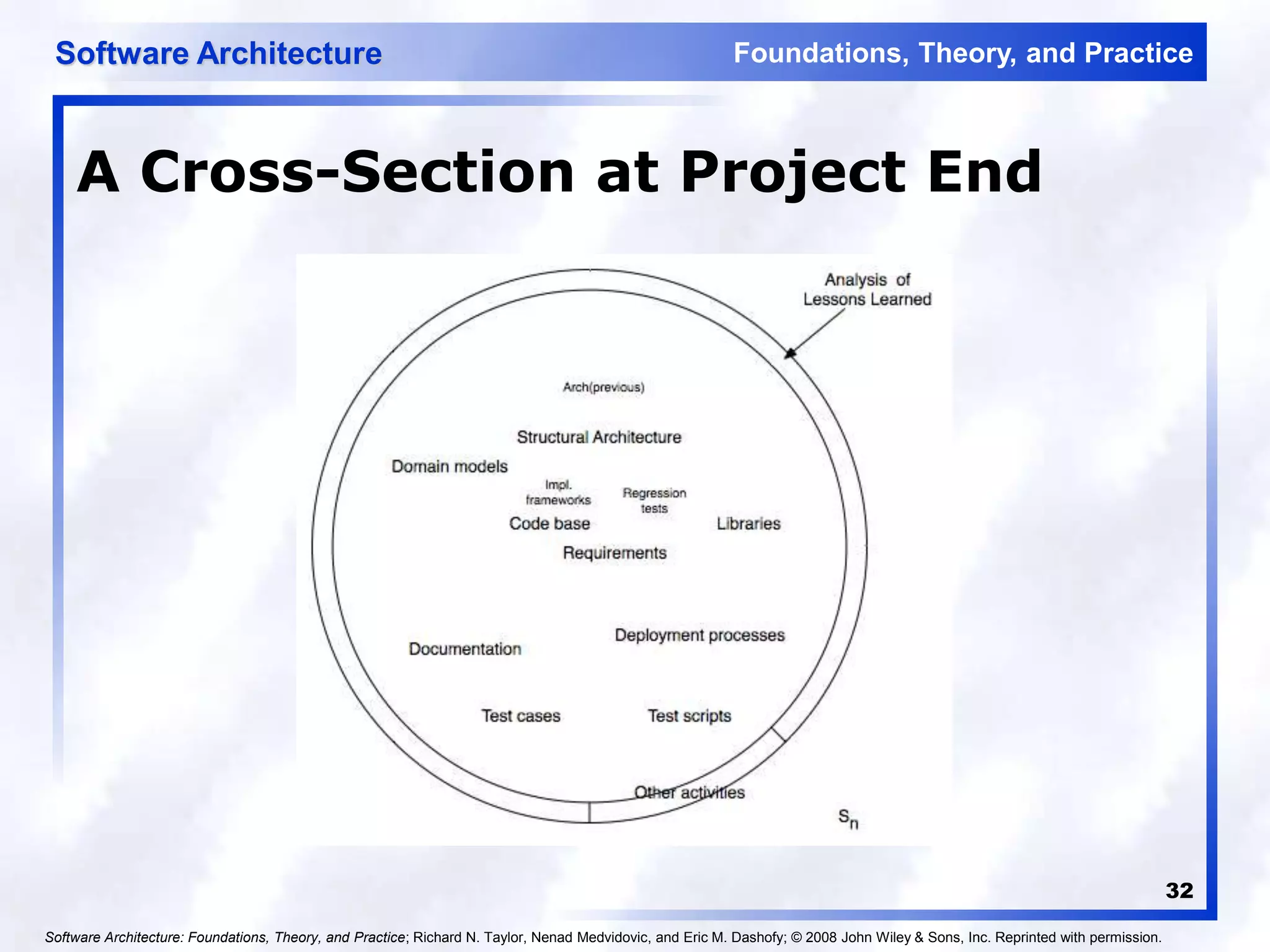
A Cross-Section at Project End
Software Architecture: Foundations, Theory, and Practice; Richard N. Taylor, Nenad Medvidovic, and Eric M. Dashofy; © 2008 John Wiley & Sons, Inc. Reprinted with permission.
Foundations, Theory, and Practice
Software Architecture
33
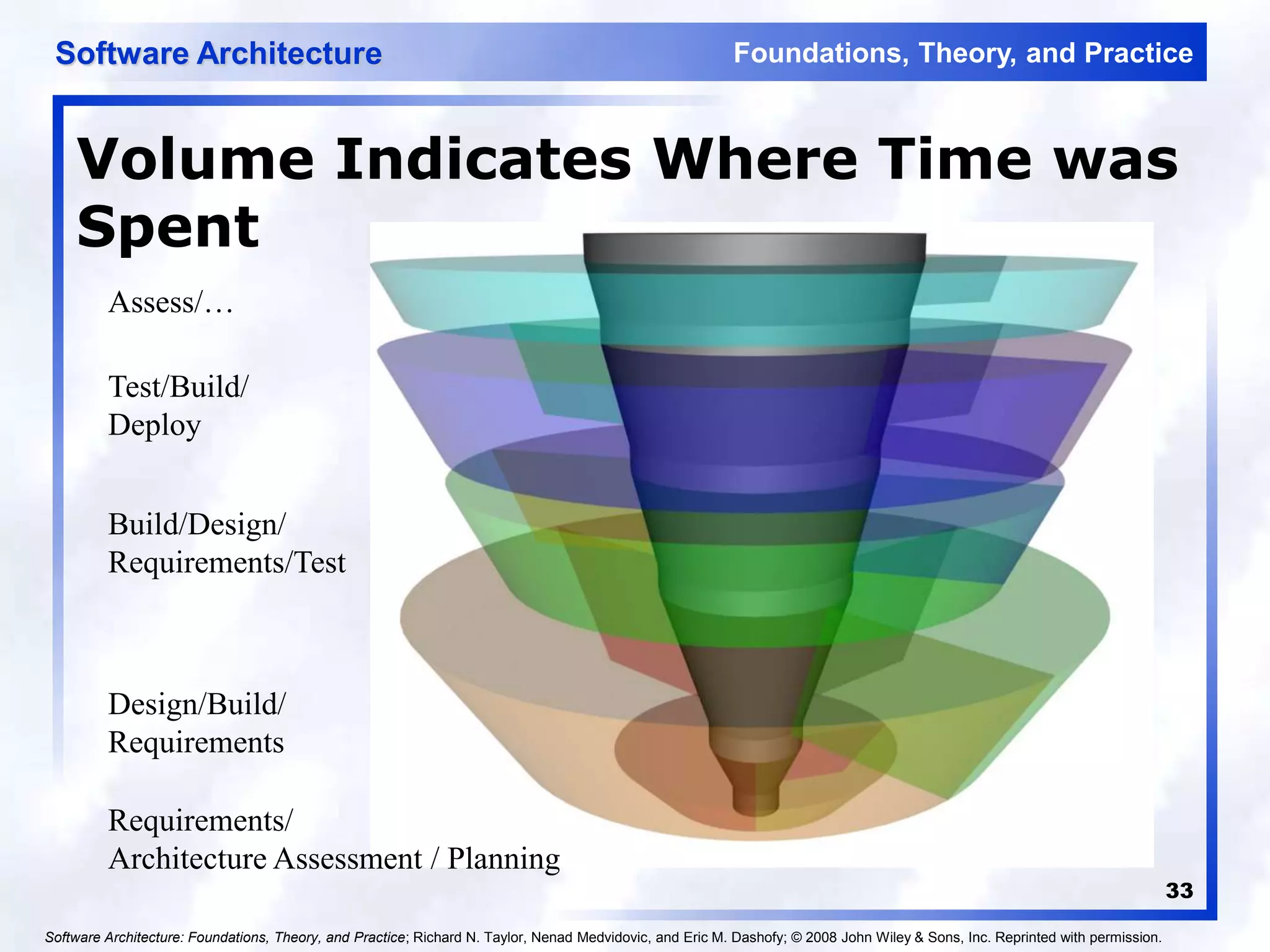
Volume Indicates Where Time was
Spent
Design/Build/
Requirements
Test/Build/
Deploy
Assess/…
Requirements/
Architecture Assessment / Planning
Build/Design/
Requirements/Test
Software Architecture: Foundations, Theory, and Practice; Richard N. Taylor, Nenad Medvidovic, and Eric M. Dashofy; © 2008 John Wiley & Sons, Inc. Reprinted with permission.
Foundations, Theory, and Practice
Software Architecture
34
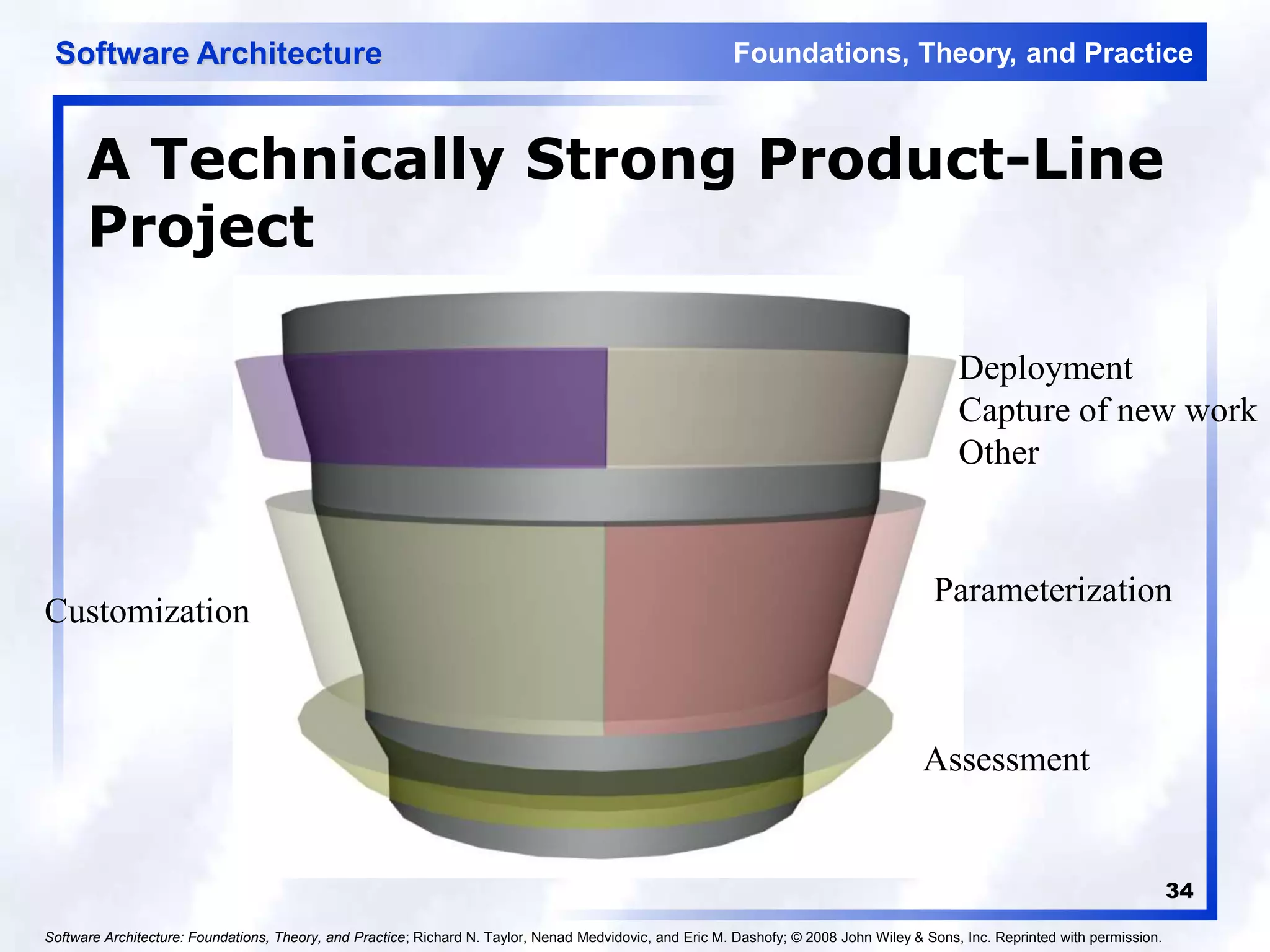
A Technically Strong Product-Line
Project
Assessment
Parameterization
Customization
Deployment
Capture of new work
Other
Software Architecture: Foundations, Theory, and Practice; Richard N. Taylor, Nenad Medvidovic, and Eric M. Dashofy; © 2008 John Wiley & Sons, Inc. Reprinted with permission.
Foundations, Theory, and Practice
Software Architecture
35
Visualization Summary
 It is illustrative, not prescriptive
 It is an aid to thinking about what’s going on in a project
 Can be automatically generated based on input of
monitored project data
 Can be extended to illustrate development of the
information space (artifacts)
 The preceding slides have focused primarily on the
development activities
Foundations, Theory, and Practice
Software Architecture
36
Processes Possible in this Model
 Traditional, straight-line waterfall
 Architecture-centric development
 DSSA-based project
 Agile development
 Dysfunctional process
Foundations, Theory, and Practice
Software Architecture
37
Summary (1)
 A proper view of software architecture affects every
aspect of the classical software engineering activities
 The requirements activity is a co-equal partner with
design activities
 The design activity is enriched by techniques that exploit
knowledge gained in previous product developments
 The implementation activity
 is centered on creating a faithful implementation of
the architecture
 utilizes a variety of techniques to achieve this in a
cost-effective manner
Foundations, Theory, and Practice
Software Architecture
38
Summary (2)
 Analysis and testing activities can be focused on and
guided by the architecture
 Evolution activities revolve around the product’s
architecture.
 An equal focus on process and product results from a
proper understanding of the role of software architecture

02_Architectures_In_Context.ppt

  • 1.
    Copyright © RichardN. Taylor, Nenad Medvidovic, and Eric M. Dashofy. All rights reserved. Architectures in Context Software Architecture Lecture 2
  • 2.
    Foundations, Theory, andPractice Software Architecture 2 Fundamental Understanding  Architecture is a set of principal design decisions about a software system  Three fundamental understandings of software architecture  Every application has an architecture  Every application has at least one architect  Architecture is not a phase of development
  • 3.
    Foundations, Theory, andPractice Software Architecture 3 Wrong View: Architecture as a Phase  Treating architecture as a phase denies its foundational role in software development  More than “high-level design”  Architecture is also represented, e.g., by object code, source code, …
  • 4.
    Foundations, Theory, andPractice Software Architecture 4 Context of Software Architecture  Requirements  Design  Implementation  Analysis and Testing  Evolution  Development Process
  • 5.
    Foundations, Theory, andPractice Software Architecture 5 Requirements Analysis  Traditional SE suggests requirements analysis should remain unsullied by any consideration for a design  However, without reference to existing architectures it becomes difficult to assess practicality, schedules, or costs  In building architecture we talk about specific rooms…  …rather than the abstract concept “means for providing shelter”  In engineering new products come from the observation of existing solution and their limitations
  • 6.
    Foundations, Theory, andPractice Software Architecture 6 New Perspective on Requirements Analysis  Existing designs and architectures provide the solution vocabulary  Our understanding of what works now, and how it works, affects our wants and perceived needs  The insights from our experiences with existing systems  helps us imagine what might work and  enables us to assess development time and costs   Requirements analysis and consideration of design must be pursued at the same time
  • 7.
    Foundations, Theory, andPractice Software Architecture 7 Non-Functional Properties (NFP)  NFPs are the result of architectural choices  NFP questions are raised as the result of architectural choices  Specification of NFP might require an architectural framework to even enable their statement  An architectural framework will be required for assessment of whether the properties are achievable
  • 8.
    Foundations, Theory, andPractice Software Architecture 8 The Twin Peaks Model
  • 9.
    Foundations, Theory, andPractice Software Architecture 9 Design and Architecture  Design is an activity that pervades software development  It is an activity that creates part of a system’s architecture  Typically in the traditional Design Phase decisions concern  A system’s structure  Identification of its primary components  Their interconnections  Architecture denotes the set of principal design decisions about a system  That is more than just structure
  • 10.
    Foundations, Theory, andPractice Software Architecture 10 Architecture-Centric Design  Traditional design phase suggests translating the requirements into algorithms, so a programmer can implement them  Architecture-centric design  stakeholder issues  decision about use of COTS component  overarching style and structure  package and primary class structure  deployment issues  post implementation/deployment issues
  • 11.
    Foundations, Theory, andPractice Software Architecture 11 Design Techniques  Basic conceptual tools  Separation of concerns  Abstraction  Modularity  Two illustrative widely adapted strategies  Object-oriented design  Domain-specific software architectures (DSSA)
  • 12.
    Foundations, Theory, andPractice Software Architecture 12 Object-Oriented Design (OOD)  Objects  Main abstraction entity in OOD  Encapsulations of state with functions for accessing and manipulating that state
  • 13.
    Foundations, Theory, andPractice Software Architecture 13 Pros and Cons of OOD  Pros  UML modeling notation  Design patterns  Cons  Provides only  One level of encapsulation (the object)  One notion of interface  One type of explicit connector (procedure call)  Even message passing is realized via procedure calls  OO programming language might dictate important design decisions  OOD assumes a shared address space
  • 14.
    Foundations, Theory, andPractice Software Architecture 14 DSSA  Capturing and characterizing the best solutions and best practices from past projects within a domain  Production of new applications can focus on the points of novel variation  Reuse applicable parts of the architecture and implementation  Applicable for product lines  Recall the Philips Koala example discussed in the previous lecture
  • 15.
    Foundations, Theory, andPractice Software Architecture 15 Implementation  The objective is to create machine-executable source code  That code should be faithful to the architecture  Alternatively, it may adapt the architecture  How much adaptation is allowed?  Architecturally-relevant vs. -unimportant adaptations  It must fully develop all outstanding details of the application
  • 16.
    Foundations, Theory, andPractice Software Architecture 16 Faithful Implementation  All of the structural elements found in the architecture are implemented in the source code  Source code must not utilize major new computational elements that have no corresponding elements in the architecture  Source code must not contain new connections between architectural elements that are not found in the architecture  Is this realistic? Overly constraining? What if we deviate from this?
  • 17.
    Foundations, Theory, andPractice Software Architecture 17 Unfaithful Implementation  The implementation does have an architecture  It is latent, as opposed to what is documented.  Failure to recognize the distinction between planned and implemented architecture  robs one of the ability to reason about the application’s architecture in the future  misleads all stakeholders regarding what they believe they have as opposed to what they really have  makes any development or evolution strategy that is based on the documented (but inaccurate) architecture doomed to failure
  • 18.
    Foundations, Theory, andPractice Software Architecture 18 Implementation Strategies  Generative techniques  e.g. parser generators  Frameworks  collections of source code with identified places where the engineer must “fill in the blanks”  Middleware  CORBA, DCOM, RPC, …  Reuse-based techniques  COTS, open-source, in-house  Writing all code manually
  • 19.
    Foundations, Theory, andPractice Software Architecture 19 How It All Fits Together Software Architecture: Foundations, Theory, and Practice; Richard N. Taylor, Nenad Medvidovic, and Eric M. Dashofy; © 2008 John Wiley & Sons, Inc. Reprinted with permission.
  • 20.
    Foundations, Theory, andPractice Software Architecture 20 Analysis and Testing  Analysis and testing are activities undertaken to assess the qualities of an artifact  The earlier an error is detected and corrected the lower the aggregate cost  Rigorous representations are required for analysis, so precise questions can be asked and answered
  • 21.
    Foundations, Theory, andPractice Software Architecture 21 Analysis of Architectural Models  Formal architectural model can be examined for internal consistency and correctness  An analysis on a formal model can reveal  Component mismatch  Incomplete specifications  Undesired communication patterns  Deadlocks  Security flaws  It can be used for size and development time estimations
  • 22.
    Foundations, Theory, andPractice Software Architecture 22 Analysis of Architectural Models (cont’d)  Architectural model  may be examined for consistency with requirements  may be used in determining analysis and testing strategies for source code  may be used to check if an implementation is faithful
  • 23.
    Foundations, Theory, andPractice Software Architecture 23 Evolution and Maintenance  All activities that chronologically follow the release of an application  Software will evolve  Regardless of whether one is using an architecture-centric development process or not  The traditional software engineering approach to maintenance is largely ad hoc  Risk of architectural decay and overall quality degradation  Architecture-centric approach  Sustained focus on an explicit, substantive, modifiable, faithful architectural model
  • 24.
    Foundations, Theory, andPractice Software Architecture 24 Architecture-Centric Evolution Process  Motivation  Evaluation or assessment  Design and choice of approach  Action  includes preparation for the next round of adaptation
  • 25.
    Foundations, Theory, andPractice Software Architecture 25 Processes  Traditional software process discussions make the process activities the focal point  In architecture-centric software engineering the product becomes the focal point  No single “right” software process for architecture- centric software engineering exists
  • 26.
    Foundations, Theory, andPractice Software Architecture 26 Turbine – A New Visualization Model  Goals of the visualization  Provide an intuitive sense of  Project activities at any given time  Including concurrency of types of development activities  The “information space” of the project  Show centrality of the products  (Hopefully) Growing body of artifacts  Allow for the centrality of architecture  But work equally well for other approaches, including “dysfunctional” ones  Effective for indicating time, gaps, duration of activities  Investment (cost) indicators
  • 27.
    Foundations, Theory, andPractice Software Architecture 27 Coding Design Requirements Testing Simplistic Waterfall, Side perspective time The Turbine Model “Core” of project artifacts Radius of rotor indicates level of staffing at time t Gap between rotors indicates no project activity for that t ti Software Architecture: Foundations, Theory, and Practice; Richard N. Taylor, Nenad Medvidovic, and Eric M. Dashofy; © 2008 John Wiley & Sons, Inc. Reprinted with permission.
  • 28.
    Foundations, Theory, andPractice Software Architecture 28 Cross-section at time ti Design (activity) Requirements Design doc Software Architecture: Foundations, Theory, and Practice; Richard N. Taylor, Nenad Medvidovic, and Eric M. Dashofy; © 2008 John Wiley & Sons, Inc. Reprinted with permission.
  • 29.
    Foundations, Theory, andPractice Software Architecture 29 The Turbine Model Waterfall example, Angled perspective time Software Architecture: Foundations, Theory, and Practice; Richard N. Taylor, Nenad Medvidovic, and Eric M. Dashofy; © 2008 John Wiley & Sons, Inc. Reprinted with permission.
  • 30.
    Foundations, Theory, andPractice Software Architecture 30 A Richer Example S1 Design/Build/ Requirements Test/Build/ Deploy Assess/… Requirements/Architecture assessment/Planning Build/Design/ Requirements/Test time Software Architecture: Foundations, Theory, and Practice; Richard N. Taylor, Nenad Medvidovic, and Eric M. Dashofy; © 2008 John Wiley & Sons, Inc. Reprinted with permission.
  • 31.
    Foundations, Theory, andPractice Software Architecture 31 A Sample Cross-Section Software Architecture: Foundations, Theory, and Practice; Richard N. Taylor, Nenad Medvidovic, and Eric M. Dashofy; © 2008 John Wiley & Sons, Inc. Reprinted with permission.
  • 32.
    Foundations, Theory, andPractice Software Architecture 32 A Cross-Section at Project End Software Architecture: Foundations, Theory, and Practice; Richard N. Taylor, Nenad Medvidovic, and Eric M. Dashofy; © 2008 John Wiley & Sons, Inc. Reprinted with permission.
  • 33.
    Foundations, Theory, andPractice Software Architecture 33 Volume Indicates Where Time was Spent Design/Build/ Requirements Test/Build/ Deploy Assess/… Requirements/ Architecture Assessment / Planning Build/Design/ Requirements/Test Software Architecture: Foundations, Theory, and Practice; Richard N. Taylor, Nenad Medvidovic, and Eric M. Dashofy; © 2008 John Wiley & Sons, Inc. Reprinted with permission.
  • 34.
    Foundations, Theory, andPractice Software Architecture 34 A Technically Strong Product-Line Project Assessment Parameterization Customization Deployment Capture of new work Other Software Architecture: Foundations, Theory, and Practice; Richard N. Taylor, Nenad Medvidovic, and Eric M. Dashofy; © 2008 John Wiley & Sons, Inc. Reprinted with permission.
  • 35.
    Foundations, Theory, andPractice Software Architecture 35 Visualization Summary  It is illustrative, not prescriptive  It is an aid to thinking about what’s going on in a project  Can be automatically generated based on input of monitored project data  Can be extended to illustrate development of the information space (artifacts)  The preceding slides have focused primarily on the development activities
  • 36.
    Foundations, Theory, andPractice Software Architecture 36 Processes Possible in this Model  Traditional, straight-line waterfall  Architecture-centric development  DSSA-based project  Agile development  Dysfunctional process
  • 37.
    Foundations, Theory, andPractice Software Architecture 37 Summary (1)  A proper view of software architecture affects every aspect of the classical software engineering activities  The requirements activity is a co-equal partner with design activities  The design activity is enriched by techniques that exploit knowledge gained in previous product developments  The implementation activity  is centered on creating a faithful implementation of the architecture  utilizes a variety of techniques to achieve this in a cost-effective manner
  • 38.
    Foundations, Theory, andPractice Software Architecture 38 Summary (2)  Analysis and testing activities can be focused on and guided by the architecture  Evolution activities revolve around the product’s architecture.  An equal focus on process and product results from a proper understanding of the role of software architecture