Telecommunications for the
future
Rob Parker
CERN IT Division
Email: Rob.Parker@cern.ch
R. Parker - CERN 2
Telecommunications
• Past
• Present technology
• New technical developments
• A personal view of:
– Which of these technologies will become
widely adopted, and in what way
– The possible effect of these new technologies
on our everyday life
R. Parker - CERN 3
Timetable
Day 1: History & background
Day 2: Fixed (cabled) systems – present
& future
Day 3: Mobile (wireless) systems –
present & future
Day 4: Applications – present & future
Day 5: Personal view of where will we
be in 10 years
Debate
R. Parker - CERN 4
Early telecommunications
Physical Delivery
• Runners
• Horses
• Carrier pigeons
• Stage coaches
– Postal service
• Trains
• Motor vehicles
R. Parker - CERN 5
Early telecommunications
Message Transmission
• “Transmission” = “to send across”
• Using:
– Noise
• Megaphones (Egyptians)
• Church bells and cannon booms (Renaissance times)
– Optical effects
• flashing light heliographs (Greeks)
• Watch towers and smoke signals (Middle Ages)
• Flashing lights and semaphores (18th. And 19th. Centuries)
R. Parker - CERN 6
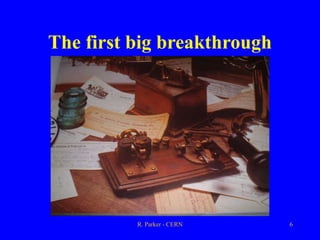
The first big breakthrough
R. Parker - CERN 7
The Telegraph
• 1838: the invention of the telegraph
• 1844: first “long distance” telegraph
connection (between Baltimore &
Washington)
• characteristics:
– Morse code
– approximately 100 bits/sec
– very fast delivery
R. Parker - CERN 8
Some important parameters in
a communications system
• Bandwidth
– On a point-to point link
– Global bandwidth
• End-to-end transmission delay
• Intrinsic error rate
• Maximum link (point-to-point) distance
R. Parker - CERN 9
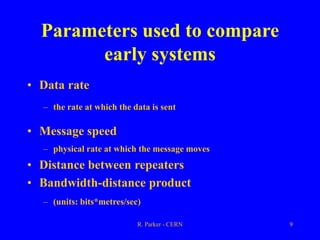
Parameters used to compare
early systems
• Data rate
– the rate at which the data is sent
• Message speed
– physical rate at which the message moves
• Distance between repeaters
• Bandwidth-distance product
– (units: bits*metres/sec)
R. Parker - CERN 10
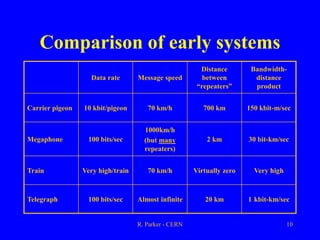
Comparison of early systems
Data rate Message speed
Distance
between
“repeaters”
Bandwidth-
distance
product
Carrier pigeon 10 kbit/pigeon 70 km/h 700 km 150 kbit-m/sec
Megaphone 100 bits/sec
1000km/h
(but many
repeaters)
2 km 30 bit-km/sec
Train Very high/train 70 km/h Virtually zero Very high
Telegraph 100 bits/sec Almost infinite 20 km 1 kbit-km/sec
R. Parker - CERN 11
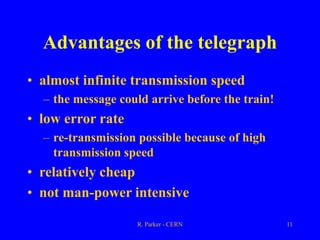
Advantages of the telegraph
• almost infinite transmission speed
– the message could arrive before the train!
• low error rate
– re-transmission possible because of high
transmission speed
• relatively cheap
• not man-power intensive
R. Parker - CERN 12
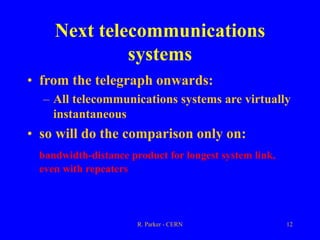
Next telecommunications
systems
• from the telegraph onwards:
– All telecommunications systems are virtually
instantaneous
• so will do the comparison only on:
bandwidth-distance product for longest system link,
even with repeaters
R. Parker - CERN 13
1858: the first transatlantic
telephone cable
• the first official message (90 words) took
67 minutes
• the cable insulation failed after three
weeks (the next cable was laid in 1866)
• by 1905, there were many telegraph
cables
R. Parker - CERN 14
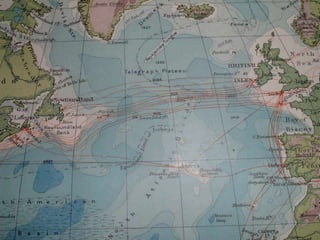
Telegraph cables in 1905
R. Parker - CERN 15
Early telephony
• 1876: the first telephone message
– 7 words from one room to the next
• by 1890, many cities had primitive
telephone systems
R. Parker - CERN 16
1901: the first transatlantic
wireless transmission
• The letter “S” in Morse code across
the Atlantic
• It took another 10 years to establish
worldwide wireless telegraph links
R. Parker - CERN 17
1920’s: worldwide radio links
for telephony
• each major country had a small number
of High Frequency radio stations for
long-distance telephony
• an estimated 100 such stations worldwide
• calls had to be booked long in advance
• the quality was very poor
• the cost was very high
R. Parker - CERN 18
1956: the first transatlantic
telephone cable
• 36 simultaneous telephone channels between
Europe & North America
• this was such an increase on the existing
number of radio links (six) that it was
estimated to be sufficient for the next 15 years,
to the radio stations were closed
• a few months later, availability had triggered
demand to such an extent that they had to be
re-opened!
R. Parker - CERN 19
1965: the first commercial
geostationary communications
satellite
• Intelsat I (Early Bird): 240 telephone
circuits
• some subsequent satellites
– 1980: Intelsat V: 12,500 telephone circuits
– 1989: Intelsat VI: 33,000 telephone circuits
R. Parker - CERN 20
1988: the first transatlantic
fibre optic cable
• TAT-8: 40,000 telephone circuits
• some subsequent fibre optic cables
– 1992: TAT-9: 80,000 telephone circuits
– 1996: TAT-12: 300,000 telephone circuits
• there are now about 10 cables in service,
and another 10 under construction or
planned
R. Parker - CERN 21
Data networking
• 1970’s:
– limited long distance (wide area networking)
• 1980’s:
– emergence of local area networks (LANs)
with standards
• 1990’s
– integration of these
– data networks become ubiquitous
R. Parker - CERN 22
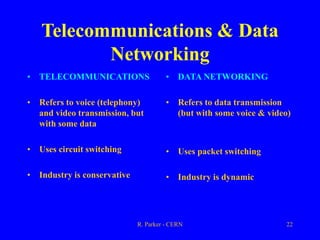
Telecommunications & Data
Networking
• TELECOMMUNICATIONS
• Refers to voice (telephony)
and video transmission, but
with some data
• Uses circuit switching
• Industry is conservative
• DATA NETWORKING
• Refers to data transmission
(but with some voice & video)
• Uses packet switching
• Industry is dynamic
R. Parker - CERN 23
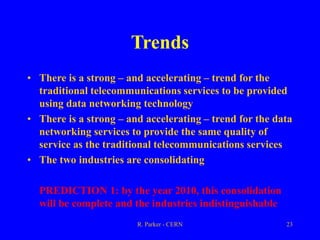
Trends
• There is a strong – and accelerating – trend for the
traditional telecommunications services to be provided
using data networking technology
• There is a strong – and accelerating – trend for the data
networking services to provide the same quality of
service as the traditional telecommunications services
• The two industries are consolidating
PREDICTION 1: by the year 2010, this consolidation
will be complete and the industries indistinguishable
R. Parker - CERN 24
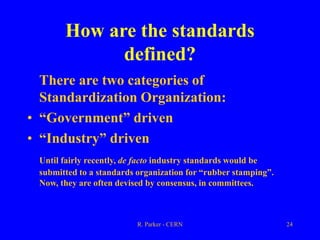
How are the standards
defined?
There are two categories of
Standardization Organization:
• “Government” driven
• “Industry” driven
Until fairly recently, de facto industry standards would be
submitted to a standards organization for “rubber stamping”.
Now, they are often devised by consensus, in committees.
R. Parker - CERN 25
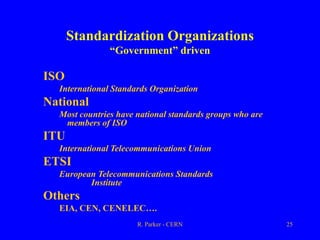
Standardization Organizations
“Government” driven
ISO
International Standards Organization
National
Most countries have national standards groups who are
members of ISO
ITU
International Telecommunications Union
ETSI
European Telecommunications Standards
Institute
Others
EIA, CEN, CENELEC….
R. Parker - CERN 26
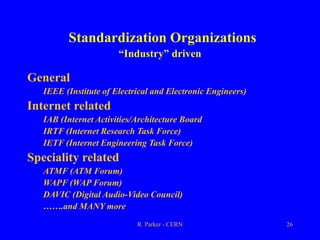
Standardization Organizations
“Industry” driven
General
IEEE (Institute of Electrical and Electronic Engineers)
Internet related
IAB (Internet Activities/Architecture Board
IRTF (Internet Research Task Force)
IETF (Internet Engineering Task Force)
Speciality related
ATMF (ATM Forum)
WAPF (WAP Forum)
DAVIC (Digital Audio-Video Council)
…….and MANY more
R. Parker - CERN 27
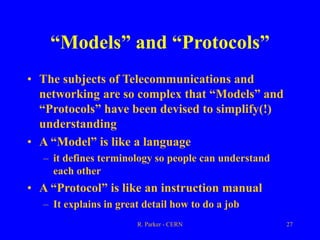
“Models” and “Protocols”
• The subjects of Telecommunications and
networking are so complex that “Models” and
“Protocols” have been devised to simplify(!)
understanding
• A “Model” is like a language
– it defines terminology so people can understand
each other
• A “Protocol” is like an instruction manual
– It explains in great detail how to do a job
R. Parker - CERN 28
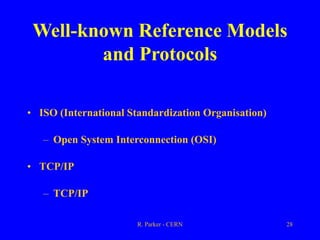
Well-known Reference Models
and Protocols
• ISO (International Standardization Organisation)
– Open System Interconnection (OSI)
• TCP/IP
– TCP/IP
R. Parker - CERN 29
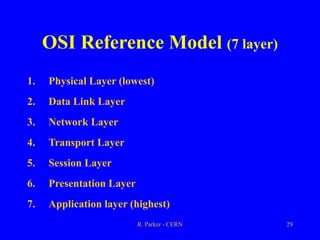
OSI Reference Model (7 layer)
1. Physical Layer (lowest)
2. Data Link Layer
3. Network Layer
4. Transport Layer
5. Session Layer
6. Presentation Layer
7. Application layer (highest)
R. Parker - CERN 30
OSI Model – Physical Layer (1)
• Interfaces to the physical transmission medium
(cable/fibre/radio)
• Defines physical connection (connector)
• Transmits data as an un-structured bit stream
• BITS are exchanged
DOES NOT GUARANTEE CORRECT DELIVERY, OR
EVEN, DELIVERY
R. Parker - CERN 31
OSI Model – Data Link Layer
(2)
• Reliable point-to-point connections between
adjacent nodes in a network
• “Framing” of data
• Detection of faulty transmission (error
detection)
• Correction of errors (typically by
retransmission)
• FRAMES are exchanged
R. Parker - CERN 32
OSI Model – Network Layer
(3)
• Selects a route to the intended
destination, based on:
– availability
– transmission time
– cost
• PACKETS are exchanged
R. Parker - CERN 33
OSI Model – Transport Layer
(4)
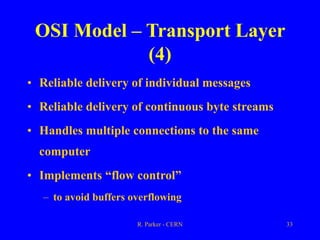
• Reliable delivery of individual messages
• Reliable delivery of continuous byte streams
• Handles multiple connections to the same
computer
• Implements “flow control”
– to avoid buffers overflowing
R. Parker - CERN 34
OSI Model – Session &
Presentation Layers (5,6)
In many network systems the session and
presentation layers are very “thin” or
even non-existent, and so will not be
considered further
R. Parker - CERN 35
OSI Model – Application Layer
(7)
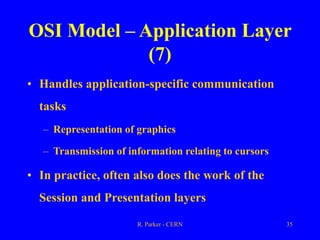
• Handles application-specific communication
tasks
– Representation of graphics
– Transmission of information relating to cursors
• In practice, often also does the work of the
Session and Presentation layers
R. Parker - CERN 36
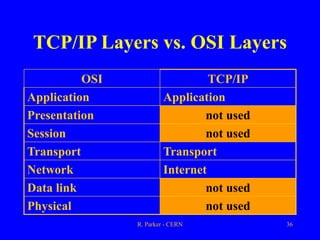
TCP/IP Layers vs. OSI Layers
OSI TCP/IP
Application Application
Presentation not used
Session not used
Transport Transport
Network Internet
Data link not used
Physical not used
R. Parker - CERN 37
Some specific terms defined
(but there will be more later!)
R. Parker - CERN 38
Circuit switching
(Connection oriented service)
• Establishes connection
• Transfers information
• Releases connection
• Like the telephone service
R. Parker - CERN 39
Packet switching
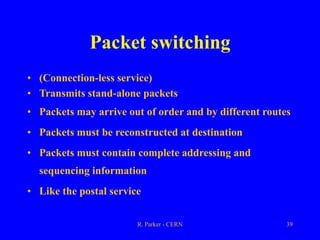
• (Connection-less service)
• Transmits stand-alone packets
• Packets may arrive out of order and by different routes
• Packets must be reconstructed at destination
• Packets must contain complete addressing and
sequencing information
• Like the postal service
R. Parker - CERN 40
Quality of Service
Parameters such as:
• Guaranteed bandwidth
– for different types of information transfer
– bandwidth on demand
• Guaranteed error-free end-to-end data transfer
• Guaranteed maximum transmission delays
R. Parker - CERN 41
Present technology & new
developments
• Fixed systems (cabled)
– Distribution
– Transmission
• Mobile systems (wireless)
– Wide area
– Local area
– Short distance
R. Parker - CERN 42
Distribution & Transmission
• Distribution
– the transport of this information between the
delivery points and the end users
• Transmission
– the transport of information over (relatively) long
distances between delivery points near the end users
– Messages for different users are often combined
together for transmission
R. Parker - CERN 43
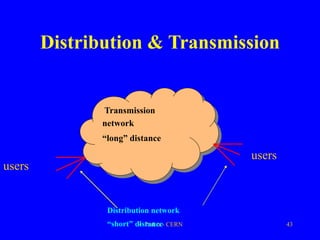
Distribution & Transmission
Transmission
network
“long” distance
users
users
Distribution network
“short” distance
R. Parker - CERN 44
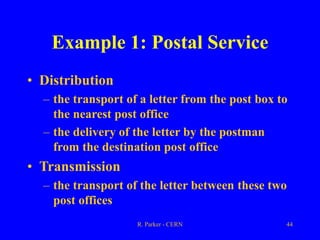
Example 1: Postal Service
• Distribution
– the transport of a letter from the post box to
the nearest post office
– the delivery of the letter by the postman
from the destination post office
• Transmission
– the transport of the letter between these two
post offices
R. Parker - CERN 45
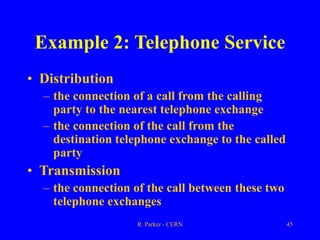
Example 2: Telephone Service
• Distribution
– the connection of a call from the calling
party to the nearest telephone exchange
– the connection of the call from the
destination telephone exchange to the called
party
• Transmission
– the connection of the call between these two
telephone exchanges
R. Parker - CERN 46
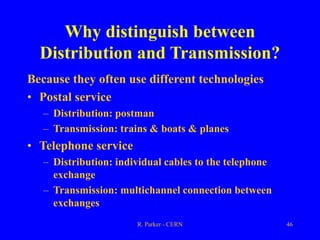
Why distinguish between
Distribution and Transmission?
Because they often use different technologies
• Postal service
– Distribution: postman
– Transmission: trains & boats & planes
• Telephone service
– Distribution: individual cables to the telephone
exchange
– Transmission: multichannel connection between
exchanges

Telecom1.ppt

  • 1.
    Telecommunications for the future RobParker CERN IT Division Email: Rob.Parker@cern.ch
  • 2.
    R. Parker -CERN 2 Telecommunications • Past • Present technology • New technical developments • A personal view of: – Which of these technologies will become widely adopted, and in what way – The possible effect of these new technologies on our everyday life
  • 3.
    R. Parker -CERN 3 Timetable Day 1: History & background Day 2: Fixed (cabled) systems – present & future Day 3: Mobile (wireless) systems – present & future Day 4: Applications – present & future Day 5: Personal view of where will we be in 10 years Debate
  • 4.
    R. Parker -CERN 4 Early telecommunications Physical Delivery • Runners • Horses • Carrier pigeons • Stage coaches – Postal service • Trains • Motor vehicles
  • 5.
    R. Parker -CERN 5 Early telecommunications Message Transmission • “Transmission” = “to send across” • Using: – Noise • Megaphones (Egyptians) • Church bells and cannon booms (Renaissance times) – Optical effects • flashing light heliographs (Greeks) • Watch towers and smoke signals (Middle Ages) • Flashing lights and semaphores (18th. And 19th. Centuries)
  • 6.
    R. Parker -CERN 6 The first big breakthrough
  • 7.
    R. Parker -CERN 7 The Telegraph • 1838: the invention of the telegraph • 1844: first “long distance” telegraph connection (between Baltimore & Washington) • characteristics: – Morse code – approximately 100 bits/sec – very fast delivery
  • 8.
    R. Parker -CERN 8 Some important parameters in a communications system • Bandwidth – On a point-to point link – Global bandwidth • End-to-end transmission delay • Intrinsic error rate • Maximum link (point-to-point) distance
  • 9.
    R. Parker -CERN 9 Parameters used to compare early systems • Data rate – the rate at which the data is sent • Message speed – physical rate at which the message moves • Distance between repeaters • Bandwidth-distance product – (units: bits*metres/sec)
  • 10.
    R. Parker -CERN 10 Comparison of early systems Data rate Message speed Distance between “repeaters” Bandwidth- distance product Carrier pigeon 10 kbit/pigeon 70 km/h 700 km 150 kbit-m/sec Megaphone 100 bits/sec 1000km/h (but many repeaters) 2 km 30 bit-km/sec Train Very high/train 70 km/h Virtually zero Very high Telegraph 100 bits/sec Almost infinite 20 km 1 kbit-km/sec
  • 11.
    R. Parker -CERN 11 Advantages of the telegraph • almost infinite transmission speed – the message could arrive before the train! • low error rate – re-transmission possible because of high transmission speed • relatively cheap • not man-power intensive
  • 12.
    R. Parker -CERN 12 Next telecommunications systems • from the telegraph onwards: – All telecommunications systems are virtually instantaneous • so will do the comparison only on: bandwidth-distance product for longest system link, even with repeaters
  • 13.
    R. Parker -CERN 13 1858: the first transatlantic telephone cable • the first official message (90 words) took 67 minutes • the cable insulation failed after three weeks (the next cable was laid in 1866) • by 1905, there were many telegraph cables
  • 14.
    R. Parker -CERN 14 Telegraph cables in 1905
  • 15.
    R. Parker -CERN 15 Early telephony • 1876: the first telephone message – 7 words from one room to the next • by 1890, many cities had primitive telephone systems
  • 16.
    R. Parker -CERN 16 1901: the first transatlantic wireless transmission • The letter “S” in Morse code across the Atlantic • It took another 10 years to establish worldwide wireless telegraph links
  • 17.
    R. Parker -CERN 17 1920’s: worldwide radio links for telephony • each major country had a small number of High Frequency radio stations for long-distance telephony • an estimated 100 such stations worldwide • calls had to be booked long in advance • the quality was very poor • the cost was very high
  • 18.
    R. Parker -CERN 18 1956: the first transatlantic telephone cable • 36 simultaneous telephone channels between Europe & North America • this was such an increase on the existing number of radio links (six) that it was estimated to be sufficient for the next 15 years, to the radio stations were closed • a few months later, availability had triggered demand to such an extent that they had to be re-opened!
  • 19.
    R. Parker -CERN 19 1965: the first commercial geostationary communications satellite • Intelsat I (Early Bird): 240 telephone circuits • some subsequent satellites – 1980: Intelsat V: 12,500 telephone circuits – 1989: Intelsat VI: 33,000 telephone circuits
  • 20.
    R. Parker -CERN 20 1988: the first transatlantic fibre optic cable • TAT-8: 40,000 telephone circuits • some subsequent fibre optic cables – 1992: TAT-9: 80,000 telephone circuits – 1996: TAT-12: 300,000 telephone circuits • there are now about 10 cables in service, and another 10 under construction or planned
  • 21.
    R. Parker -CERN 21 Data networking • 1970’s: – limited long distance (wide area networking) • 1980’s: – emergence of local area networks (LANs) with standards • 1990’s – integration of these – data networks become ubiquitous
  • 22.
    R. Parker -CERN 22 Telecommunications & Data Networking • TELECOMMUNICATIONS • Refers to voice (telephony) and video transmission, but with some data • Uses circuit switching • Industry is conservative • DATA NETWORKING • Refers to data transmission (but with some voice & video) • Uses packet switching • Industry is dynamic
  • 23.
    R. Parker -CERN 23 Trends • There is a strong – and accelerating – trend for the traditional telecommunications services to be provided using data networking technology • There is a strong – and accelerating – trend for the data networking services to provide the same quality of service as the traditional telecommunications services • The two industries are consolidating PREDICTION 1: by the year 2010, this consolidation will be complete and the industries indistinguishable
  • 24.
    R. Parker -CERN 24 How are the standards defined? There are two categories of Standardization Organization: • “Government” driven • “Industry” driven Until fairly recently, de facto industry standards would be submitted to a standards organization for “rubber stamping”. Now, they are often devised by consensus, in committees.
  • 25.
    R. Parker -CERN 25 Standardization Organizations “Government” driven ISO International Standards Organization National Most countries have national standards groups who are members of ISO ITU International Telecommunications Union ETSI European Telecommunications Standards Institute Others EIA, CEN, CENELEC….
  • 26.
    R. Parker -CERN 26 Standardization Organizations “Industry” driven General IEEE (Institute of Electrical and Electronic Engineers) Internet related IAB (Internet Activities/Architecture Board IRTF (Internet Research Task Force) IETF (Internet Engineering Task Force) Speciality related ATMF (ATM Forum) WAPF (WAP Forum) DAVIC (Digital Audio-Video Council) …….and MANY more
  • 27.
    R. Parker -CERN 27 “Models” and “Protocols” • The subjects of Telecommunications and networking are so complex that “Models” and “Protocols” have been devised to simplify(!) understanding • A “Model” is like a language – it defines terminology so people can understand each other • A “Protocol” is like an instruction manual – It explains in great detail how to do a job
  • 28.
    R. Parker -CERN 28 Well-known Reference Models and Protocols • ISO (International Standardization Organisation) – Open System Interconnection (OSI) • TCP/IP – TCP/IP
  • 29.
    R. Parker -CERN 29 OSI Reference Model (7 layer) 1. Physical Layer (lowest) 2. Data Link Layer 3. Network Layer 4. Transport Layer 5. Session Layer 6. Presentation Layer 7. Application layer (highest)
  • 30.
    R. Parker -CERN 30 OSI Model – Physical Layer (1) • Interfaces to the physical transmission medium (cable/fibre/radio) • Defines physical connection (connector) • Transmits data as an un-structured bit stream • BITS are exchanged DOES NOT GUARANTEE CORRECT DELIVERY, OR EVEN, DELIVERY
  • 31.
    R. Parker -CERN 31 OSI Model – Data Link Layer (2) • Reliable point-to-point connections between adjacent nodes in a network • “Framing” of data • Detection of faulty transmission (error detection) • Correction of errors (typically by retransmission) • FRAMES are exchanged
  • 32.
    R. Parker -CERN 32 OSI Model – Network Layer (3) • Selects a route to the intended destination, based on: – availability – transmission time – cost • PACKETS are exchanged
  • 33.
    R. Parker -CERN 33 OSI Model – Transport Layer (4) • Reliable delivery of individual messages • Reliable delivery of continuous byte streams • Handles multiple connections to the same computer • Implements “flow control” – to avoid buffers overflowing
  • 34.
    R. Parker -CERN 34 OSI Model – Session & Presentation Layers (5,6) In many network systems the session and presentation layers are very “thin” or even non-existent, and so will not be considered further
  • 35.
    R. Parker -CERN 35 OSI Model – Application Layer (7) • Handles application-specific communication tasks – Representation of graphics – Transmission of information relating to cursors • In practice, often also does the work of the Session and Presentation layers
  • 36.
    R. Parker -CERN 36 TCP/IP Layers vs. OSI Layers OSI TCP/IP Application Application Presentation not used Session not used Transport Transport Network Internet Data link not used Physical not used
  • 37.
    R. Parker -CERN 37 Some specific terms defined (but there will be more later!)
  • 38.
    R. Parker -CERN 38 Circuit switching (Connection oriented service) • Establishes connection • Transfers information • Releases connection • Like the telephone service
  • 39.
    R. Parker -CERN 39 Packet switching • (Connection-less service) • Transmits stand-alone packets • Packets may arrive out of order and by different routes • Packets must be reconstructed at destination • Packets must contain complete addressing and sequencing information • Like the postal service
  • 40.
    R. Parker -CERN 40 Quality of Service Parameters such as: • Guaranteed bandwidth – for different types of information transfer – bandwidth on demand • Guaranteed error-free end-to-end data transfer • Guaranteed maximum transmission delays
  • 41.
    R. Parker -CERN 41 Present technology & new developments • Fixed systems (cabled) – Distribution – Transmission • Mobile systems (wireless) – Wide area – Local area – Short distance
  • 42.
    R. Parker -CERN 42 Distribution & Transmission • Distribution – the transport of this information between the delivery points and the end users • Transmission – the transport of information over (relatively) long distances between delivery points near the end users – Messages for different users are often combined together for transmission
  • 43.
    R. Parker -CERN 43 Distribution & Transmission Transmission network “long” distance users users Distribution network “short” distance
  • 44.
    R. Parker -CERN 44 Example 1: Postal Service • Distribution – the transport of a letter from the post box to the nearest post office – the delivery of the letter by the postman from the destination post office • Transmission – the transport of the letter between these two post offices
  • 45.
    R. Parker -CERN 45 Example 2: Telephone Service • Distribution – the connection of a call from the calling party to the nearest telephone exchange – the connection of the call from the destination telephone exchange to the called party • Transmission – the connection of the call between these two telephone exchanges
  • 46.
    R. Parker -CERN 46 Why distinguish between Distribution and Transmission? Because they often use different technologies • Postal service – Distribution: postman – Transmission: trains & boats & planes • Telephone service – Distribution: individual cables to the telephone exchange – Transmission: multichannel connection between exchanges