Basic Concepts Software Architecture Lecture 3
What is Software Architecture? Definition: A software system’s architecture is the set of  principal design decisions  about the system Software architecture is the blueprint for a software system’s construction and evolution Design decisions encompass every facet of the system under development Structure Behavior Interaction Non-functional properties
What is “Principal”? “ Principal” implies a degree of importance that grants a design decision “architectural status” It implies that not all design decisions are architectural That is, they do not necessarily impact a system’s architecture How one defines “principal” will depend on what the stakeholders define as the system goals
Other Definitions of Software Architecture Perry and Wolf Software Architecture = { Elements, Form, Rationale }   what  how  why Shaw and Garlan Software architecture [is a level of design that] involves  the description of elements from which systems are built,  interactions among those elements,  patterns that guide their composition, and  constraints on these patterns. Kruchten Software architecture deals with the design and implementation of the high-level structure of software. Architecture deals with abstraction, decomposition, composition, style, and  aesthetics .
Temporal Aspect Design decisions are and unmade over a system’s lifetime    Architecture has a temporal aspect At any given point in time the system has only one architecture A system’s architecture will change over time
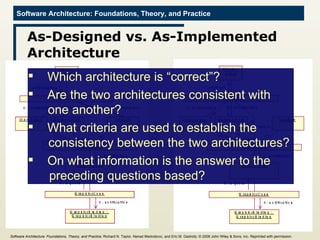
Prescriptive vs. Descriptive Architecture A system’s  prescriptive architecture  captures the design decisions made prior to the system’s construction It is the  as-conceived  or  as-intended  architecture A system’s  descriptive architecture  describes how the system has been built It is the  as-implemented  or  as-realized  architecture
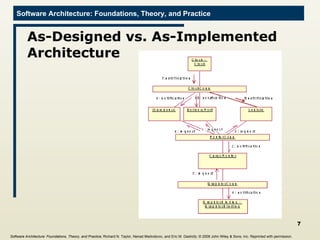
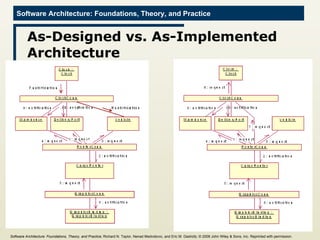
As-Designed vs. As-Implemented Architecture Software Architecture: Foundations, Theory, and Practice ; Richard N. Taylor, Nenad Medvidovic, and Eric M. Dashofy;  © 2008 John Wiley & Sons, Inc. Reprinted with permission.
As-Designed vs. As-Implemented Architecture Which architecture is “correct”?  Are the two architectures consistent with    one another?  What criteria are used to establish the   consistency between the two architectures?  On what information is the answer to the   preceding questions based?  Software Architecture: Foundations, Theory, and Practice ; Richard N. Taylor, Nenad Medvidovic, and Eric M. Dashofy;  © 2008 John Wiley & Sons, Inc. Reprinted with permission.
Architectural Evolution When a system evolves, ideally its prescriptive architecture is modified first In practice, the system – and thus its descriptive architecture – is often directly modified  This happens because of Developer sloppiness Perception of short deadlines which prevent thinking through and documenting  Lack of documented prescriptive architecture Need or desire for code optimizations Inadequate techniques or tool support
Architectural Degradation Two related concepts Architectural drift Architectural erosion Architectural drift  is introduction of principal design decisions into a system’s descriptive architecture that  are not included in, encompassed by, or implied by the prescriptive architecture but which do not violate any of the prescriptive architecture’s design decisions Architectural erosion  is the introduction of architectural design decisions into a system’s descriptive architecture that violate its prescriptive architecture
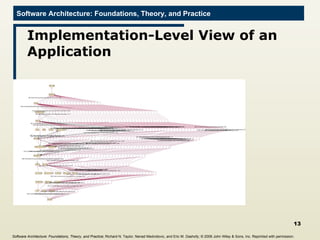
Architectural Recovery If architectural degradation is allowed to occur, one will be forced to  recover  the system’s architecture sooner or later  Architectural recovery  is the process of determining a software system’s architecture from its implementation-level artifacts Implementation-level artifacts can be Source code Executable files Java .class files
Implementation-Level View of an Application Software Architecture: Foundations, Theory, and Practice ; Richard N. Taylor, Nenad Medvidovic, and Eric M. Dashofy;  © 2008 John Wiley & Sons, Inc. Reprinted with permission.
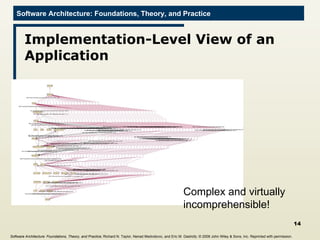
Implementation-Level View of an Application Complex and virtually incomprehensible! Software Architecture: Foundations, Theory, and Practice ; Richard N. Taylor, Nenad Medvidovic, and Eric M. Dashofy;  © 2008 John Wiley & Sons, Inc. Reprinted with permission.
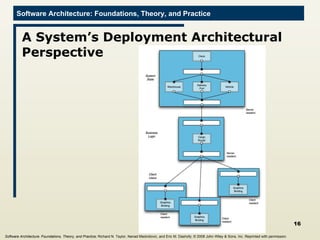
Deployment A software system cannot fulfill its purpose until it is  deployed Executable modules are physically placed on the hardware devices on which they are supposed to run  The deployment view of an architecture can be critical in assessing whether the system will be able to satisfy its requirements Possible assessment dimensions Available memory Power consumption Required network bandwidth
A System’s Deployment Architectural Perspective Software Architecture: Foundations, Theory, and Practice ; Richard N. Taylor, Nenad Medvidovic, and Eric M. Dashofy;  © 2008 John Wiley & Sons, Inc. Reprinted with permission.
Software Architecture’s Elements A software system’s architecture typically is not (and should not be) a uniform monolith A software system’s architecture should be a composition and interplay of different elements Processing  Data, also referred as information or state Interaction
Components Elements that encapsulate processing and data in a system’s architecture are referred to as  software components Definition A  software component  is an architectural entity that  encapsulates a subset of the system’s functionality and/or data restricts access to that subset via an explicitly defined interface has explicitly defined dependencies on its required execution context Components typically provide application-specific services
Connectors In complex systems  interaction  may become more important and challenging than the functionality of the individual components Definition A  software connector  is an architectural building block tasked with effecting and regulating interactions among components In many software systems connectors are usually simple procedure calls or shared data accesses Much more sophisticated and complex connectors are possible! Connectors typically provide application-independent interaction facilities
Examples of Connectors Procedure call connectors  Shared memory connectors  Message passing connectors  Streaming connectors  Distribution connectors Wrapper/adaptor connectors
Configurations Components and connectors are composed in a specific way in a given system’s architecture to accomplish that system’s objective Definition An  architectural configuration , or topology, is a set of specific associations between the components and connectors of a software system’s architecture
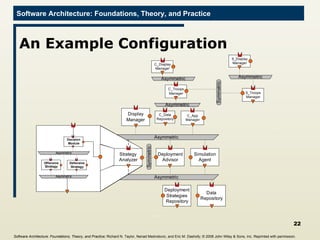
An Example Configuration Software Architecture: Foundations, Theory, and Practice ; Richard N. Taylor, Nenad Medvidovic, and Eric M. Dashofy;  © 2008 John Wiley & Sons, Inc. Reprinted with permission.
Architectural Styles Certain design choices regularly result in solutions with superior properties  Compared to other possible alternatives, solutions such as this are more elegant, effective, efficient, dependable, evolvable, scalable, and so on  Definition An  architectural style  is a named collection of architectural design decisions that  are applicable in a given development context constrain architectural design decisions that are specific to a particular system within that context elicit beneficial qualities in each resulting system
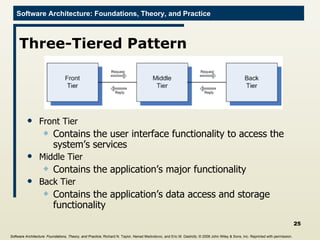
Architectural Patterns Definition An  architectural pattern  is a set of architectural design decisions that are applicable to a recurring design problem, and parameterized to account for different software development contexts in which that problem appears   A widely used pattern in modern distributed systems is the  three-tiered system  pattern  Science Banking E-commerce Reservation systems
Three-Tiered Pattern Front Tier Contains the user interface functionality to access the system’s services Middle Tier Contains the application’s major functionality Back Tier Contains the application’s data access and storage functionality Software Architecture: Foundations, Theory, and Practice ; Richard N. Taylor, Nenad Medvidovic, and Eric M. Dashofy;  © 2008 John Wiley & Sons, Inc. Reprinted with permission.
Architectural Models, Views, and Visualizations Architecture Model An artifact documenting some or all of the architectural design decisions about a system Architecture Visualization A way of depicting some or all of the architectural design decisions about a system to a stakeholder Architecture View A subset of related architectural design decisions
Architectural Processes Architectural design Architecture modeling and visualization Architecture-driven system analysis Architecture-driven system implementation  Architecture-driven system deployment, runtime redeployment, and mobility Architecture-based design for non-functional properties, including security and trust  architectural adaptation
Stakeholders in a System’s Architecture Architects Developers Testers Managers Customers Users Vendors

03 basic concepts

  • 1.
    Basic Concepts SoftwareArchitecture Lecture 3
  • 2.
    What is SoftwareArchitecture? Definition: A software system’s architecture is the set of principal design decisions about the system Software architecture is the blueprint for a software system’s construction and evolution Design decisions encompass every facet of the system under development Structure Behavior Interaction Non-functional properties
  • 3.
    What is “Principal”?“ Principal” implies a degree of importance that grants a design decision “architectural status” It implies that not all design decisions are architectural That is, they do not necessarily impact a system’s architecture How one defines “principal” will depend on what the stakeholders define as the system goals
  • 4.
    Other Definitions ofSoftware Architecture Perry and Wolf Software Architecture = { Elements, Form, Rationale } what how why Shaw and Garlan Software architecture [is a level of design that] involves the description of elements from which systems are built, interactions among those elements, patterns that guide their composition, and constraints on these patterns. Kruchten Software architecture deals with the design and implementation of the high-level structure of software. Architecture deals with abstraction, decomposition, composition, style, and aesthetics .
  • 5.
    Temporal Aspect Designdecisions are and unmade over a system’s lifetime  Architecture has a temporal aspect At any given point in time the system has only one architecture A system’s architecture will change over time
  • 6.
    Prescriptive vs. DescriptiveArchitecture A system’s prescriptive architecture captures the design decisions made prior to the system’s construction It is the as-conceived or as-intended architecture A system’s descriptive architecture describes how the system has been built It is the as-implemented or as-realized architecture
  • 7.
    As-Designed vs. As-ImplementedArchitecture Software Architecture: Foundations, Theory, and Practice ; Richard N. Taylor, Nenad Medvidovic, and Eric M. Dashofy; © 2008 John Wiley & Sons, Inc. Reprinted with permission.
  • 8.
    As-Designed vs. As-ImplementedArchitecture Software Architecture: Foundations, Theory, and Practice ; Richard N. Taylor, Nenad Medvidovic, and Eric M. Dashofy; © 2008 John Wiley & Sons, Inc. Reprinted with permission.
  • 9.
    As-Designed vs. As-ImplementedArchitecture Which architecture is “correct”? Are the two architectures consistent with one another? What criteria are used to establish the consistency between the two architectures? On what information is the answer to the preceding questions based? Software Architecture: Foundations, Theory, and Practice ; Richard N. Taylor, Nenad Medvidovic, and Eric M. Dashofy; © 2008 John Wiley & Sons, Inc. Reprinted with permission.
  • 10.
    Architectural Evolution Whena system evolves, ideally its prescriptive architecture is modified first In practice, the system – and thus its descriptive architecture – is often directly modified This happens because of Developer sloppiness Perception of short deadlines which prevent thinking through and documenting Lack of documented prescriptive architecture Need or desire for code optimizations Inadequate techniques or tool support
  • 11.
    Architectural Degradation Tworelated concepts Architectural drift Architectural erosion Architectural drift is introduction of principal design decisions into a system’s descriptive architecture that are not included in, encompassed by, or implied by the prescriptive architecture but which do not violate any of the prescriptive architecture’s design decisions Architectural erosion is the introduction of architectural design decisions into a system’s descriptive architecture that violate its prescriptive architecture
  • 12.
    Architectural Recovery Ifarchitectural degradation is allowed to occur, one will be forced to recover the system’s architecture sooner or later Architectural recovery is the process of determining a software system’s architecture from its implementation-level artifacts Implementation-level artifacts can be Source code Executable files Java .class files
  • 13.
    Implementation-Level View ofan Application Software Architecture: Foundations, Theory, and Practice ; Richard N. Taylor, Nenad Medvidovic, and Eric M. Dashofy; © 2008 John Wiley & Sons, Inc. Reprinted with permission.
  • 14.
    Implementation-Level View ofan Application Complex and virtually incomprehensible! Software Architecture: Foundations, Theory, and Practice ; Richard N. Taylor, Nenad Medvidovic, and Eric M. Dashofy; © 2008 John Wiley & Sons, Inc. Reprinted with permission.
  • 15.
    Deployment A softwaresystem cannot fulfill its purpose until it is deployed Executable modules are physically placed on the hardware devices on which they are supposed to run The deployment view of an architecture can be critical in assessing whether the system will be able to satisfy its requirements Possible assessment dimensions Available memory Power consumption Required network bandwidth
  • 16.
    A System’s DeploymentArchitectural Perspective Software Architecture: Foundations, Theory, and Practice ; Richard N. Taylor, Nenad Medvidovic, and Eric M. Dashofy; © 2008 John Wiley & Sons, Inc. Reprinted with permission.
  • 17.
    Software Architecture’s ElementsA software system’s architecture typically is not (and should not be) a uniform monolith A software system’s architecture should be a composition and interplay of different elements Processing Data, also referred as information or state Interaction
  • 18.
    Components Elements thatencapsulate processing and data in a system’s architecture are referred to as software components Definition A software component is an architectural entity that encapsulates a subset of the system’s functionality and/or data restricts access to that subset via an explicitly defined interface has explicitly defined dependencies on its required execution context Components typically provide application-specific services
  • 19.
    Connectors In complexsystems interaction may become more important and challenging than the functionality of the individual components Definition A software connector is an architectural building block tasked with effecting and regulating interactions among components In many software systems connectors are usually simple procedure calls or shared data accesses Much more sophisticated and complex connectors are possible! Connectors typically provide application-independent interaction facilities
  • 20.
    Examples of ConnectorsProcedure call connectors Shared memory connectors Message passing connectors Streaming connectors Distribution connectors Wrapper/adaptor connectors
  • 21.
    Configurations Components andconnectors are composed in a specific way in a given system’s architecture to accomplish that system’s objective Definition An architectural configuration , or topology, is a set of specific associations between the components and connectors of a software system’s architecture
  • 22.
    An Example ConfigurationSoftware Architecture: Foundations, Theory, and Practice ; Richard N. Taylor, Nenad Medvidovic, and Eric M. Dashofy; © 2008 John Wiley & Sons, Inc. Reprinted with permission.
  • 23.
    Architectural Styles Certaindesign choices regularly result in solutions with superior properties Compared to other possible alternatives, solutions such as this are more elegant, effective, efficient, dependable, evolvable, scalable, and so on Definition An architectural style is a named collection of architectural design decisions that are applicable in a given development context constrain architectural design decisions that are specific to a particular system within that context elicit beneficial qualities in each resulting system
  • 24.
    Architectural Patterns DefinitionAn architectural pattern is a set of architectural design decisions that are applicable to a recurring design problem, and parameterized to account for different software development contexts in which that problem appears A widely used pattern in modern distributed systems is the three-tiered system pattern Science Banking E-commerce Reservation systems
  • 25.
    Three-Tiered Pattern FrontTier Contains the user interface functionality to access the system’s services Middle Tier Contains the application’s major functionality Back Tier Contains the application’s data access and storage functionality Software Architecture: Foundations, Theory, and Practice ; Richard N. Taylor, Nenad Medvidovic, and Eric M. Dashofy; © 2008 John Wiley & Sons, Inc. Reprinted with permission.
  • 26.
    Architectural Models, Views,and Visualizations Architecture Model An artifact documenting some or all of the architectural design decisions about a system Architecture Visualization A way of depicting some or all of the architectural design decisions about a system to a stakeholder Architecture View A subset of related architectural design decisions
  • 27.
    Architectural Processes Architecturaldesign Architecture modeling and visualization Architecture-driven system analysis Architecture-driven system implementation Architecture-driven system deployment, runtime redeployment, and mobility Architecture-based design for non-functional properties, including security and trust architectural adaptation
  • 28.
    Stakeholders in aSystem’s Architecture Architects Developers Testers Managers Customers Users Vendors