AUTOMOBILES
Dimitris Milakis, Transport Institute, Delft
University of Technology
Envisioning Automated Vehicles within the Built Environment: 2020, 2035, 2050
Ancillary Workshop to the TRB Automated Vehicles Symposium 2014, Friday, 18 July
Envisioning Automated Vehicles within the Built Environment: 2020, 2035, 2050
Ancillary Workshop to the TRB Automated Vehicles Symposium 2014, Friday, 18 July
2014 CURRENTLY
AVAILABLE TECHNOLOGY
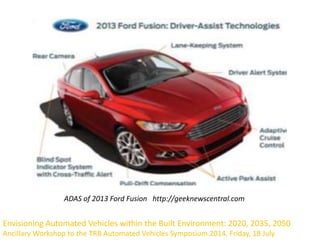
NHTSA Level 2: Limited
automation (available on some
new vehicles)
AUTOMOBILES
Dimitris Milakis, Transport Institute, Delft University of Technology
ADAS of 2013 Ford Fusion http://geeknewscentral.com
Envisioning Automated Vehicles within the Built Environment: 2020, 2035, 2050
Ancillary Workshop to the TRB Automated Vehicles Symposium 2014, Friday, 18 July
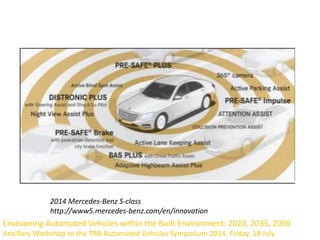
2014 Mercedes-Benz S-class
http://www5.mercedes-benz.com/en/innovation
Envisioning Automated Vehicles within the Built Environment: 2020, 2035, 2050
Ancillary Workshop to the TRB Automated Vehicles Symposium 2014, Friday, 18 July
2020
NHTSA Level 3: Limited Self-Driving
Automation
(The Google car is an example of
this level of automation)
Envisioning Automated Vehicles within the Built Environment: 2020, 2035, 2050
Ancillary Workshop to the TRB Automated Vehicles Symposium 2014, Friday, 18 July
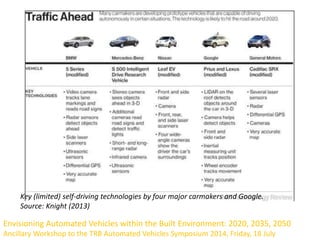
Key (limited) self-driving technologies by four major carmakers and Google.
Source: Knight (2013)
Envisioning Automated Vehicles within the Built Environment: 2020, 2035, 2050
Ancillary Workshop to the TRB Automated Vehicles Symposium 2014, Friday, 18 July
2030
NHTSA Level 4: Full self-driving automation
Envisioning Automated Vehicles within the Built Environment: 2020, 2035, 2050
Ancillary Workshop to the TRB Automated Vehicles Symposium 2014, Friday, 18 July
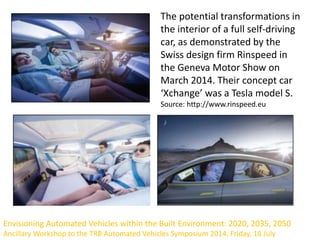
The potential transformations in
the interior of a full self-driving
car, as demonstrated by the
Swiss design firm Rinspeed in
the Geneva Motor Show on
March 2014. Their concept car
‘Xchange’ was a Tesla model S.
Source: http://www.rinspeed.eu
Envisioning Automated Vehicles within the Built Environment: 2020, 2035, 2050
Ancillary Workshop to the TRB Automated Vehicles Symposium 2014, Friday, 18 July
2050
During the 2050s, nearly all of the vehicles
in use are likely to be self-driving cars, with
full self-driving automation being a
standard feature on most new vehicles
(Litman, 2013; Juliussen & Carlson, 2014).
Envisioning Automated Vehicles within the Built Environment: 2020, 2035, 2050
Ancillary Workshop to the TRB Automated Vehicles Symposium 2014, Friday, 18 July
GLOSSARY
Adaptive cruise control: a system that monitors distances to
adjacent vehicles in the same lane, adjusting the speed with
the flow of traffic.
Lane keeping assist: a system that monitors the vehicle’s
position in the lane, and either warns the driver
when the vehicle is leaving its lane, or, less commonly,
takes corrective actions
Parking assist: a system that assists the driver in the task of parallel
parking.
Collision avoidance (or prevention) assist: an automobile safety
system designed to reduce the severity of an accident. It uses
radar and sometimes laser and camera sensors to detect an
imminent crash.
Envisioning Automated Vehicles within the Built Environment: 2020, 2035, 2050
Ancillary Workshop to the TRB Automated Vehicles Symposium 2014, Friday, 18 July
Adaptive cruise control: a system that monitors distances to
adjacent vehicles in the same lane, adjusting the speed with
the flow of traffic.
Lane keeping assist: a system that monitors the vehicle’s position in
the lane, and either warns the driver when the vehicle is
leaving its lane, or, less commonly, takes corrective actions.
Parking assist: a system that assists the driver in the task of parallel
parking.
Collision avoidance (or prevention) assist: an automobile safety
system designed to reduce the severity of an accident. It uses
radar and sometimes laser and camera sensors to detect an
imminent crash.
Envisioning Automated Vehicles within the Built Environment: 2020, 2035, 2050
Ancillary Workshop to the TRB Automated Vehicles Symposium 2014, Friday, 18 July
GLOSSARY
GLOSSARY
LIDAR (Light Detection and Ranging): a remote sensing technology
that measures and maps the distance to targets, as well as
other property characteristics of objects in its path. LIDAR
allows the vehicle to generate a detailed 3D map of its
environment. The LIDAR system used in the Google car cost
$70,000.
Platoon: a group of vehicles that can travel very closely together,
safely at high speed. Each vehicle communicates with the
other vehicles in the platoon. There is a lead vehicle that
controls the speed and direction, and all following vehicles
respond to the lead vehicle’s movement.
Envisioning Automated Vehicles within the Built Environment: 2020, 2035, 2050
Ancillary Workshop to the TRB Automated Vehicles Symposium 2014, Friday, 18 July
GLOSSARY
Vehicle-to-Vehicle (V2V) communications: the dynamic wireless
exchange of data between nearby vehicles. Dedicated Short-
Range Communication (DSRC) is currently the wireless
medium for V2V communications.
Vehicle-to-Infrastructure (V2I) communications: the wireless
exchange of critical safety and operational data between
vehicles and infrastructure. Dedicated Short-Range
Communication (DSRC) is currently the wireless medium for
V2I communications. DSRC works in 5.9GHz band with
bandwidth of 75 MHz and approximate range of 1000 m
Envisioning Automated Vehicles within the Built Environment: 2020, 2035, 2050
Ancillary Workshop to the TRB Automated Vehicles Symposium 2014, Friday, 18 July

Automobile-pathway.pptx

  • 1.
    AUTOMOBILES Dimitris Milakis, TransportInstitute, Delft University of Technology Envisioning Automated Vehicles within the Built Environment: 2020, 2035, 2050 Ancillary Workshop to the TRB Automated Vehicles Symposium 2014, Friday, 18 July
  • 2.
    Envisioning Automated Vehicleswithin the Built Environment: 2020, 2035, 2050 Ancillary Workshop to the TRB Automated Vehicles Symposium 2014, Friday, 18 July 2014 CURRENTLY AVAILABLE TECHNOLOGY NHTSA Level 2: Limited automation (available on some new vehicles) AUTOMOBILES Dimitris Milakis, Transport Institute, Delft University of Technology
  • 3.
    ADAS of 2013Ford Fusion http://geeknewscentral.com Envisioning Automated Vehicles within the Built Environment: 2020, 2035, 2050 Ancillary Workshop to the TRB Automated Vehicles Symposium 2014, Friday, 18 July
  • 4.
    2014 Mercedes-Benz S-class http://www5.mercedes-benz.com/en/innovation EnvisioningAutomated Vehicles within the Built Environment: 2020, 2035, 2050 Ancillary Workshop to the TRB Automated Vehicles Symposium 2014, Friday, 18 July
  • 5.
    2020 NHTSA Level 3:Limited Self-Driving Automation (The Google car is an example of this level of automation) Envisioning Automated Vehicles within the Built Environment: 2020, 2035, 2050 Ancillary Workshop to the TRB Automated Vehicles Symposium 2014, Friday, 18 July
  • 6.
    Key (limited) self-drivingtechnologies by four major carmakers and Google. Source: Knight (2013) Envisioning Automated Vehicles within the Built Environment: 2020, 2035, 2050 Ancillary Workshop to the TRB Automated Vehicles Symposium 2014, Friday, 18 July
  • 7.
    2030 NHTSA Level 4:Full self-driving automation Envisioning Automated Vehicles within the Built Environment: 2020, 2035, 2050 Ancillary Workshop to the TRB Automated Vehicles Symposium 2014, Friday, 18 July
  • 8.
    The potential transformationsin the interior of a full self-driving car, as demonstrated by the Swiss design firm Rinspeed in the Geneva Motor Show on March 2014. Their concept car ‘Xchange’ was a Tesla model S. Source: http://www.rinspeed.eu Envisioning Automated Vehicles within the Built Environment: 2020, 2035, 2050 Ancillary Workshop to the TRB Automated Vehicles Symposium 2014, Friday, 18 July
  • 9.
    2050 During the 2050s,nearly all of the vehicles in use are likely to be self-driving cars, with full self-driving automation being a standard feature on most new vehicles (Litman, 2013; Juliussen & Carlson, 2014). Envisioning Automated Vehicles within the Built Environment: 2020, 2035, 2050 Ancillary Workshop to the TRB Automated Vehicles Symposium 2014, Friday, 18 July
  • 10.
    GLOSSARY Adaptive cruise control:a system that monitors distances to adjacent vehicles in the same lane, adjusting the speed with the flow of traffic. Lane keeping assist: a system that monitors the vehicle’s position in the lane, and either warns the driver when the vehicle is leaving its lane, or, less commonly, takes corrective actions Parking assist: a system that assists the driver in the task of parallel parking. Collision avoidance (or prevention) assist: an automobile safety system designed to reduce the severity of an accident. It uses radar and sometimes laser and camera sensors to detect an imminent crash. Envisioning Automated Vehicles within the Built Environment: 2020, 2035, 2050 Ancillary Workshop to the TRB Automated Vehicles Symposium 2014, Friday, 18 July
  • 11.
    Adaptive cruise control:a system that monitors distances to adjacent vehicles in the same lane, adjusting the speed with the flow of traffic. Lane keeping assist: a system that monitors the vehicle’s position in the lane, and either warns the driver when the vehicle is leaving its lane, or, less commonly, takes corrective actions. Parking assist: a system that assists the driver in the task of parallel parking. Collision avoidance (or prevention) assist: an automobile safety system designed to reduce the severity of an accident. It uses radar and sometimes laser and camera sensors to detect an imminent crash. Envisioning Automated Vehicles within the Built Environment: 2020, 2035, 2050 Ancillary Workshop to the TRB Automated Vehicles Symposium 2014, Friday, 18 July GLOSSARY
  • 12.
    GLOSSARY LIDAR (Light Detectionand Ranging): a remote sensing technology that measures and maps the distance to targets, as well as other property characteristics of objects in its path. LIDAR allows the vehicle to generate a detailed 3D map of its environment. The LIDAR system used in the Google car cost $70,000. Platoon: a group of vehicles that can travel very closely together, safely at high speed. Each vehicle communicates with the other vehicles in the platoon. There is a lead vehicle that controls the speed and direction, and all following vehicles respond to the lead vehicle’s movement. Envisioning Automated Vehicles within the Built Environment: 2020, 2035, 2050 Ancillary Workshop to the TRB Automated Vehicles Symposium 2014, Friday, 18 July
  • 13.
    GLOSSARY Vehicle-to-Vehicle (V2V) communications:the dynamic wireless exchange of data between nearby vehicles. Dedicated Short- Range Communication (DSRC) is currently the wireless medium for V2V communications. Vehicle-to-Infrastructure (V2I) communications: the wireless exchange of critical safety and operational data between vehicles and infrastructure. Dedicated Short-Range Communication (DSRC) is currently the wireless medium for V2I communications. DSRC works in 5.9GHz band with bandwidth of 75 MHz and approximate range of 1000 m Envisioning Automated Vehicles within the Built Environment: 2020, 2035, 2050 Ancillary Workshop to the TRB Automated Vehicles Symposium 2014, Friday, 18 July