THE HOLY QUR’AN
BASED ON THE WORKS OF HARUN YAHYA WWW.HARUNYAHAY.COM and others
PREPARED BY fereidoun.dejahang@ntlworld.com
The Holy
Qur'an is the
Word of Allah
24:35
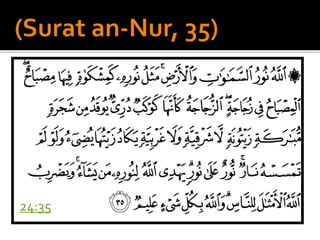
Allah is the light of the heavens and the Earth.
The metaphor of His light is that of a niche in
which is a lamp, the lamp inside a glass, the glass
like a brilliant star, lit from a blessed tree, an
olive, neither of the east nor of the west, its oil
all butgiving off light even if no fire touches it.
Light upon light. Allah guides to His light
whoever He wills and Allah makes metaphors for
mankind and Allah has knowledge of all things.
(Surat an-Nur, 35)
24:35
God is the Light of the heavens and the
earth, in other words, He illumines both
of them with the sun and the moon.The
likeness of His Light, that is, the
description of it [as it resides] in the
heart of a believer, is as a niche wherein
is a lamp.
The lamp is in a glass — this [glass] is
the [case for the] lantern and the
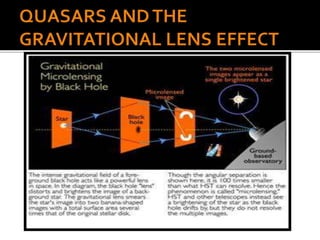
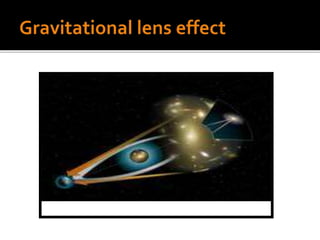
misbāh is the torch, that is, the wick
that is lit; al-mishkāt is a recess that
does not penetrate [to the other
side], in other words, the tube inside
the lantern, the glass,
with the light inside it [is], as it were a
glittering star, that is, a light-giving
[star] (read dirrī’un or durrī’un, derived
from al-dar‘, ‘to repel’, because it repels
darkness; or read durriyyun, derived
from al-durr, ‘pearls’) kindled, is this
lamp (read past tense tawaqqada;
a variant reading has the imperfect tense of
awqada, in the passive voice: yūqadu; another
reading has tūqadu, in which case the reference
is to al-zujāja, ‘the glass’) from, the oil of, a
BlessedTree, an olive neither of the east nor of
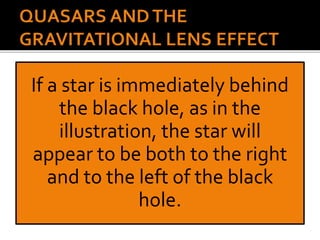
the west, but in between the two, so that no
harmful cold or heat affects it; whose oil would
almost glow forth [of itself], though no fire
touched it, because of [the extent of] its purity.
 Light, by Him, upon light, by fire; the light of
God is His guidance of the believer, light upon
the light of faith. God guides to His Light, that is,
[to] the religion of Islam, whom He will. And God
strikes, He illustrates, similitudes for men, by
approximating [such similitudes] to their
comprehension, so that they might take heed
and believe; and God is Knower of all things,
including [knowledge of] how to strike
similitudes.
24:35
Allah is the Light of the heavens and the earth.
The example of His light is like a niche within
which is a lamp, the lamp is within glass, the
glass as if it were a pearly [white] star lit from
[the oil of] a blessed olive tree, neither of the
east nor of the west, whose oil would almost
glow even if untouched by fire. Light upon
light. Allah guides to His light whom He wills.
And Allah presents examples for the people,
and Allah is Knowing of all things.
24:35
Allah is the Light of the heavens and the earth.The
parable of His Light is as (if there were) a niche and
within it a lamp, the lamp is in glass, the glass as it were
a brilliant star, lit from a blessed tree, an olive, neither
of the east (i.e. neither it gets sun-rays only in the
morning) nor of the west (i.e. nor it gets sun-rays only
in the afternoon, but it is exposed to the sun all day
long), whose oil would almost glow forth (of itself),
though no fire touched it. Light upon Light! Allah
guides to His Light whom He wills. AndAllah sets forth
parables for mankind, and Allah is All-Knower of
everything24:35
‫خداوند‬ ‫نور‬ ‫مثل‬ ‫است؛‬ ‫زمین‬ ‫و‬ ‫آسمانها‬ ‫نور‬ ‫خداوند‬
‫چراغی‬ ‫آن‬ ‫در‬ ‫که‬ ‫است‬ ‫چراغدانی‬ ‫همانند‬(‫فروغ‬ ‫پر‬)
‫شفاف‬ ‫حبابی‬ ،‫گیرد‬ ‫قرار‬ ‫حبابی‬ ‫در‬ ‫چراغ‬ ‫آن‬ ،‫باشد‬‫و‬
‫با‬ ‫چراغ‬ ‫این‬ ،‫فروزان‬ ‫ستاره‬ ‫یک‬ ‫همچون‬ ‫درخشنده‬
‫زیتون‬ ‫پربرکت‬ ‫درخت‬ ‫از‬ ‫که‬ ‫شود‬‫می‬ ‫افروخته‬ ‫روغنی‬‫ی‬
‫غربی؛‬ ‫نه‬ ‫و‬ ‫است‬ ‫شرقی‬ ‫نه‬ ‫که‬ ‫شده‬ ‫گرفته‬
(‫که‬ ‫است‬ ‫خالص‬ ‫و‬ ‫صاف‬ ‫آنچنان‬ ‫روغنش‬)‫نزدیک‬
‫است‬ ‫نوری‬ ‫شود؛‬ ‫ور‬‫شعله‬ ‫آتش‬ ‫با‬ ‫تماس‬ ‫بدون‬ ‫است‬
‫خود‬ ‫نور‬ ‫به‬ ‫بخواهد‬ ‫را‬ ‫کس‬ ‫هر‬ ‫خدا‬ ‫و‬ ‫نوری؛‬ ‫فراز‬ ‫بر‬
‫داناست‬ ‫چیزی‬ ‫هر‬ ‫به‬ ‫خداوند‬ ‫و‬ ،‫کند‬‫می‬ ‫هدایت‬.
24:35
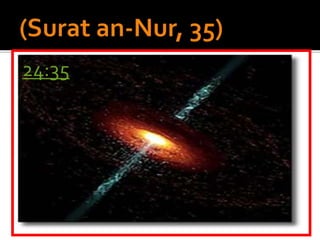
Quasar is the name given
to extremely dense and
bright bodies that look
like stars and emit radio
waves in space.
Quasars are the
brightest known
bodies in the
universe.
The brightness of the brightest
quasar in the universe is more than
2 trillion times greater than that of
the Sun ; it is approximately 100
times greater than the total light
emitted by a galaxy such as the
MilkyWay.1
The word "noor" in the
verse means “light,
brightness, daylight,
shining, illumination.”
The light referred to in
the verse is suggestive,
in terms of its brightness,
of these celestial bodies
known as quasars
Because other expressions
in the verse describe the
visibility of quasar light and
the source of that light in
the very wisest terms.
(Allah knows the truth.)
The word “durriyyun”, meaning
“bright,” in the expression
"kaannaha kawkabun durriyyun” in
the verse, itself meaning “like a
brilliant star,” is highly compatible
with the scientific description of
quasars as “bright, stellar bodies”.2
In addition, the verse
speaks of “giving off
light even if no fire
touches it.”
It is probable that this is
a reference to the way
quasars burn without
fire - nuclear fusion.
Since oxygen is not
naturally present in space,
there can be no question of
the brightness of quasars
having anything to do with
fire.
The burning taking place here
does so as hydrogen atoms are
compressed and produce
helium.
The energy released during this
process then illuminates space.
The expression “light upon
light” in the verse may well be
a reference to the
“gravitational lens effect” in
astronomy. (Allah knows the
truth.)
Many astronomers
investigating the sources
of light in the universe will
easily understand this
description in the verse.
The effect in question refers to
the way light from a source
behind a body with a very dense
mass, such as a black hole,
departs under the effect of that
dense body and reaches us.
It appears that there is therefore more
than one source of light of the images
we see.
Due to this “gravitational lens effect,”
an object appears to be somewhere
different to where it actually is, and in
greater numbers.
The term “a niche in which is a lamp” in
the verse may be interpreted as the
niche being the area of gravitational
lens effect of a black hole. (Allah knows
the truth.) It is significant that in
describing the effect that arises, NASA
scientists use the analogy of the effect
of a drinking glass:
The gravitational effect of the
galaxy on the distant quasar
was similar to the lens effect of
a drinking glass on a distant
street light – it created multiple
images lenses here too.3
• In his book TheWhole Shebang,
regarded as one of the leading
books of the 20th century by
the NewYorkTimes, the science
writerTimothy Ferris clarifies
the subject as follows:
As light from a Quasar travels towards
us… it may pass through either side of
an intervening cluster of galaxies.
The warped space surrounding the
cluster can act as a lens, with a result
that we see two images of what is (or
was) actually one quasar.4
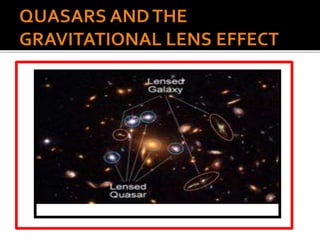
NASA's Hubble SpaceTelescope caught a
single quasar in space producing images of
five separate stars for the very first time.
Bodies with a high density – a group of
galaxies here – produce more than one
image by giving rise to the gravitational
lens effect, bending the light from objects
behind them, in this case quasars.
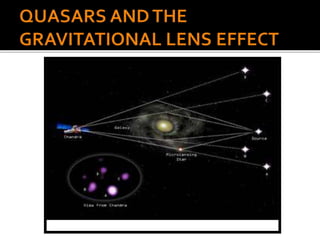
The illustration shows a quasar
appearing to be in four separate
places due to the gravitational lens
effect.
The images, obtained by the Hubble
SpaceTelescope (Chandra), represent
a distance of 11 billion light years.
 The reference in the verse to “light on
light” may be a description of reflected
light forming more than one image.
 In addition, the term “neither of the east
nor of the west” in the verse is in all
likelihood a reference to the uncertainty
of the light’s source. (Allah knows the
truth.)
 Quasars are the brightest objects in the
universe, and are the nuclei of growing
galaxies with the black holes in their
center.
 Black holes, that arise as the result of
the contraction of stars and gasses
belonging to galaxies, are the source of
quasar energy.
Thinking of the “lamp” in the verse as a
quasar, the “niche” may well be a
reference to the “black hole” that feeds
the quasar. (Allah knows the truth.)
Quasars’ brightness is spread by stars falling
into the black holes at the centers of
galaxies.5
Einstein suggested that due to the effect
described as the “gravitational lens,” bodies in
space could bend light and that it was possible
for an observer to see several images from
one single source.6
However, this effect was only
observed for the first time in the
quasar known as the “Twin Quasar”
in 1979.
Quasars were first discovered
in 1963, 14 centuries after the
revelation of the Qur’an.
The status of the heavenly bodies
described in verse 35 of Surat an-Nur is
in surprising agreement with our
current scientific knowledge.
This and a great many
other scientific miracles are
clear proof that the Holy
Qur’an is the revelation of
our Omniscient Lord, the
Creator of all things.
If a star is immediately behind
the black hole, as in the
illustration, the star will
appear to be both to the right
and to the left of the black
hole.
 1 http://en.wikipedia.org/wiki/Quasar
 2 http://www.thefreedictionary.com/quasar;
http://antwrp.gsfc.nasa.gov/apod/ap951022.html
 3 http://antwrp.gsfc.nasa.gov/apod/ap950711.html
 4Timothy Ferris, TheWhole Shebang, 1997, p. 61.
 5
http://www.tiscali.co.uk/reference/encyclopaedia/hut
chinson/m0028790.html;
http://antwrp.gsfc.nasa.gov/apod/quasars.html
 6 http://en.wikipedia.org/wiki/Gravitational_lensing

028 the gravitational lens effect

  • 1.
    THE HOLY QUR’AN BASEDON THE WORKS OF HARUN YAHYA WWW.HARUNYAHAY.COM and others PREPARED BY fereidoun.dejahang@ntlworld.com
  • 2.
    The Holy Qur'an isthe Word of Allah
  • 3.
  • 4.
    Allah is thelight of the heavens and the Earth. The metaphor of His light is that of a niche in which is a lamp, the lamp inside a glass, the glass like a brilliant star, lit from a blessed tree, an olive, neither of the east nor of the west, its oil all butgiving off light even if no fire touches it. Light upon light. Allah guides to His light whoever He wills and Allah makes metaphors for mankind and Allah has knowledge of all things. (Surat an-Nur, 35) 24:35
  • 5.
    God is theLight of the heavens and the earth, in other words, He illumines both of them with the sun and the moon.The likeness of His Light, that is, the description of it [as it resides] in the heart of a believer, is as a niche wherein is a lamp.
  • 6.
    The lamp isin a glass — this [glass] is the [case for the] lantern and the misbāh is the torch, that is, the wick that is lit; al-mishkāt is a recess that does not penetrate [to the other side], in other words, the tube inside the lantern, the glass,
  • 7.
    with the lightinside it [is], as it were a glittering star, that is, a light-giving [star] (read dirrī’un or durrī’un, derived from al-dar‘, ‘to repel’, because it repels darkness; or read durriyyun, derived from al-durr, ‘pearls’) kindled, is this lamp (read past tense tawaqqada;
  • 8.
    a variant readinghas the imperfect tense of awqada, in the passive voice: yūqadu; another reading has tūqadu, in which case the reference is to al-zujāja, ‘the glass’) from, the oil of, a BlessedTree, an olive neither of the east nor of the west, but in between the two, so that no harmful cold or heat affects it; whose oil would almost glow forth [of itself], though no fire touched it, because of [the extent of] its purity.
  • 9.
     Light, byHim, upon light, by fire; the light of God is His guidance of the believer, light upon the light of faith. God guides to His Light, that is, [to] the religion of Islam, whom He will. And God strikes, He illustrates, similitudes for men, by approximating [such similitudes] to their comprehension, so that they might take heed and believe; and God is Knower of all things, including [knowledge of] how to strike similitudes.
  • 10.
  • 11.
    Allah is theLight of the heavens and the earth. The example of His light is like a niche within which is a lamp, the lamp is within glass, the glass as if it were a pearly [white] star lit from [the oil of] a blessed olive tree, neither of the east nor of the west, whose oil would almost glow even if untouched by fire. Light upon light. Allah guides to His light whom He wills. And Allah presents examples for the people, and Allah is Knowing of all things. 24:35
  • 12.
    Allah is theLight of the heavens and the earth.The parable of His Light is as (if there were) a niche and within it a lamp, the lamp is in glass, the glass as it were a brilliant star, lit from a blessed tree, an olive, neither of the east (i.e. neither it gets sun-rays only in the morning) nor of the west (i.e. nor it gets sun-rays only in the afternoon, but it is exposed to the sun all day long), whose oil would almost glow forth (of itself), though no fire touched it. Light upon Light! Allah guides to His Light whom He wills. AndAllah sets forth parables for mankind, and Allah is All-Knower of everything24:35
  • 13.
    ‫خداوند‬ ‫نور‬ ‫مثل‬‫است؛‬ ‫زمین‬ ‫و‬ ‫آسمانها‬ ‫نور‬ ‫خداوند‬ ‫چراغی‬ ‫آن‬ ‫در‬ ‫که‬ ‫است‬ ‫چراغدانی‬ ‫همانند‬(‫فروغ‬ ‫پر‬) ‫شفاف‬ ‫حبابی‬ ،‫گیرد‬ ‫قرار‬ ‫حبابی‬ ‫در‬ ‫چراغ‬ ‫آن‬ ،‫باشد‬‫و‬ ‫با‬ ‫چراغ‬ ‫این‬ ،‫فروزان‬ ‫ستاره‬ ‫یک‬ ‫همچون‬ ‫درخشنده‬ ‫زیتون‬ ‫پربرکت‬ ‫درخت‬ ‫از‬ ‫که‬ ‫شود‬‫می‬ ‫افروخته‬ ‫روغنی‬‫ی‬ ‫غربی؛‬ ‫نه‬ ‫و‬ ‫است‬ ‫شرقی‬ ‫نه‬ ‫که‬ ‫شده‬ ‫گرفته‬ (‫که‬ ‫است‬ ‫خالص‬ ‫و‬ ‫صاف‬ ‫آنچنان‬ ‫روغنش‬)‫نزدیک‬ ‫است‬ ‫نوری‬ ‫شود؛‬ ‫ور‬‫شعله‬ ‫آتش‬ ‫با‬ ‫تماس‬ ‫بدون‬ ‫است‬ ‫خود‬ ‫نور‬ ‫به‬ ‫بخواهد‬ ‫را‬ ‫کس‬ ‫هر‬ ‫خدا‬ ‫و‬ ‫نوری؛‬ ‫فراز‬ ‫بر‬ ‫داناست‬ ‫چیزی‬ ‫هر‬ ‫به‬ ‫خداوند‬ ‫و‬ ،‫کند‬‫می‬ ‫هدایت‬. 24:35
  • 14.
    Quasar is thename given to extremely dense and bright bodies that look like stars and emit radio waves in space.
  • 15.
    Quasars are the brightestknown bodies in the universe.
  • 16.
    The brightness ofthe brightest quasar in the universe is more than 2 trillion times greater than that of the Sun ; it is approximately 100 times greater than the total light emitted by a galaxy such as the MilkyWay.1
  • 17.
    The word "noor"in the verse means “light, brightness, daylight, shining, illumination.”
  • 18.
    The light referredto in the verse is suggestive, in terms of its brightness, of these celestial bodies known as quasars
  • 19.
    Because other expressions inthe verse describe the visibility of quasar light and the source of that light in the very wisest terms. (Allah knows the truth.)
  • 20.
    The word “durriyyun”,meaning “bright,” in the expression "kaannaha kawkabun durriyyun” in the verse, itself meaning “like a brilliant star,” is highly compatible with the scientific description of quasars as “bright, stellar bodies”.2
  • 21.
    In addition, theverse speaks of “giving off light even if no fire touches it.”
  • 22.
    It is probablethat this is a reference to the way quasars burn without fire - nuclear fusion.
  • 23.
    Since oxygen isnot naturally present in space, there can be no question of the brightness of quasars having anything to do with fire.
  • 24.
    The burning takingplace here does so as hydrogen atoms are compressed and produce helium. The energy released during this process then illuminates space.
  • 25.
    The expression “lightupon light” in the verse may well be a reference to the “gravitational lens effect” in astronomy. (Allah knows the truth.)
  • 26.
    Many astronomers investigating thesources of light in the universe will easily understand this description in the verse.
  • 27.
    The effect inquestion refers to the way light from a source behind a body with a very dense mass, such as a black hole, departs under the effect of that dense body and reaches us.
  • 28.
    It appears thatthere is therefore more than one source of light of the images we see. Due to this “gravitational lens effect,” an object appears to be somewhere different to where it actually is, and in greater numbers.
  • 29.
    The term “aniche in which is a lamp” in the verse may be interpreted as the niche being the area of gravitational lens effect of a black hole. (Allah knows the truth.) It is significant that in describing the effect that arises, NASA scientists use the analogy of the effect of a drinking glass:
  • 30.
    The gravitational effectof the galaxy on the distant quasar was similar to the lens effect of a drinking glass on a distant street light – it created multiple images lenses here too.3
  • 31.
    • In hisbook TheWhole Shebang, regarded as one of the leading books of the 20th century by the NewYorkTimes, the science writerTimothy Ferris clarifies the subject as follows:
  • 32.
    As light froma Quasar travels towards us… it may pass through either side of an intervening cluster of galaxies. The warped space surrounding the cluster can act as a lens, with a result that we see two images of what is (or was) actually one quasar.4
  • 33.
    NASA's Hubble SpaceTelescopecaught a single quasar in space producing images of five separate stars for the very first time. Bodies with a high density – a group of galaxies here – produce more than one image by giving rise to the gravitational lens effect, bending the light from objects behind them, in this case quasars.
  • 35.
    The illustration showsa quasar appearing to be in four separate places due to the gravitational lens effect. The images, obtained by the Hubble SpaceTelescope (Chandra), represent a distance of 11 billion light years.
  • 37.
     The referencein the verse to “light on light” may be a description of reflected light forming more than one image.  In addition, the term “neither of the east nor of the west” in the verse is in all likelihood a reference to the uncertainty of the light’s source. (Allah knows the truth.)
  • 38.
     Quasars arethe brightest objects in the universe, and are the nuclei of growing galaxies with the black holes in their center.  Black holes, that arise as the result of the contraction of stars and gasses belonging to galaxies, are the source of quasar energy.
  • 39.
    Thinking of the“lamp” in the verse as a quasar, the “niche” may well be a reference to the “black hole” that feeds the quasar. (Allah knows the truth.) Quasars’ brightness is spread by stars falling into the black holes at the centers of galaxies.5
  • 40.
    Einstein suggested thatdue to the effect described as the “gravitational lens,” bodies in space could bend light and that it was possible for an observer to see several images from one single source.6 However, this effect was only observed for the first time in the quasar known as the “Twin Quasar” in 1979.
  • 41.
    Quasars were firstdiscovered in 1963, 14 centuries after the revelation of the Qur’an. The status of the heavenly bodies described in verse 35 of Surat an-Nur is in surprising agreement with our current scientific knowledge.
  • 42.
    This and agreat many other scientific miracles are clear proof that the Holy Qur’an is the revelation of our Omniscient Lord, the Creator of all things.
  • 44.
    If a staris immediately behind the black hole, as in the illustration, the star will appear to be both to the right and to the left of the black hole.
  • 46.
     1 http://en.wikipedia.org/wiki/Quasar 2 http://www.thefreedictionary.com/quasar; http://antwrp.gsfc.nasa.gov/apod/ap951022.html  3 http://antwrp.gsfc.nasa.gov/apod/ap950711.html  4Timothy Ferris, TheWhole Shebang, 1997, p. 61.  5 http://www.tiscali.co.uk/reference/encyclopaedia/hut chinson/m0028790.html; http://antwrp.gsfc.nasa.gov/apod/quasars.html  6 http://en.wikipedia.org/wiki/Gravitational_lensing