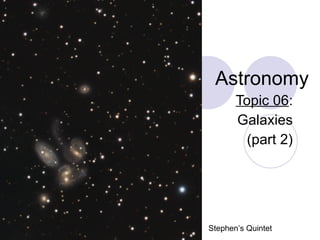
Astronomy Topic 06 : Galaxies (part 2) Stephen’s Quintet
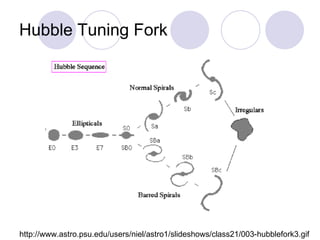
Galaxy Classification Edwin Hubble (1926) Three Classes Spiral Barred-spiral Regular spiral Elliptical Irregular Hubble’s famous “tuning fork”
Hubble Tuning Fork http://www.astro.psu.edu/users/niel/astro1/slideshows/class21/003-hubblefork3.gif
Elliptical Galaxies (E) Spheres of hundreds of billions of stars.  Largest known galaxies E, are egg shaped E0, nearly perfect spheres, to flattest, E7 No gas and dust The oldest galaxies, population II stars
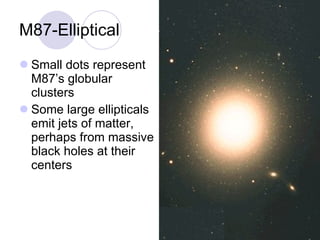
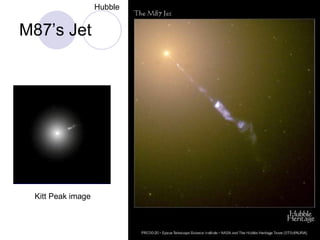
M87-Elliptical Small dots represent M87’s globular clusters Some large ellipticals emit jets of matter, perhaps from massive black holes at their centers
M87’s Jet Kitt Peak image Hubble
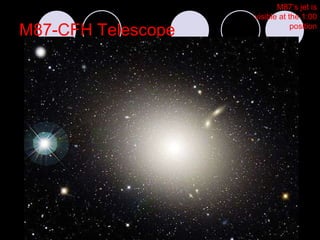
M87-CFH Telescope M87’s jet is visible at the 1:00 position
Spiral Galaxies Normal Spiral (S), and Barred Spiral (SB) Flat, pancake shaped with central bulge and spiral arms Young, large amounts of gas and dust Population I and II stars
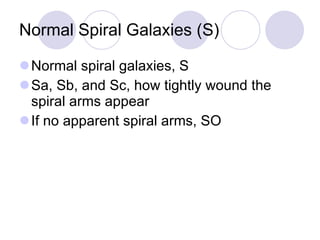
Normal Spiral Galaxies (S) Normal spiral galaxies, S Sa, Sb, and Sc, how tightly wound the spiral arms appear If no apparent spiral arms, SO
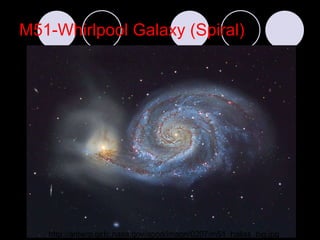
M51-Whirlpool Galaxy (Spiral) http://antwrp.gsfc.nasa.gov/apod/image/0207/m51_hallas_big.jpg
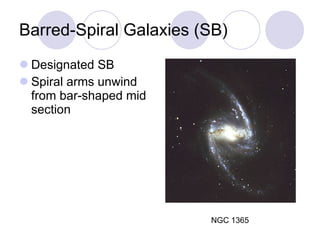
Barred-Spiral Galaxies (SB) Designated SB Spiral arms unwind from bar-shaped mid section NGC 1365
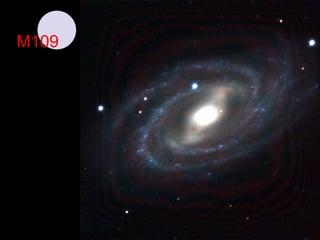
M109 http://www.astronomysight.com/as/images/pics/
Irregular Galaxies Irregular galaxies, Irr No regular, geometric shape Contain gas and dust Ex: Small and Large Magellanic Clouds
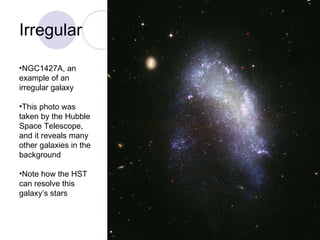
Irregular NGC1427A, an example of an irregular galaxy This photo was taken by the Hubble Space Telescope, and it reveals many other galaxies in the background  Note how the HST can resolve this galaxy’s stars
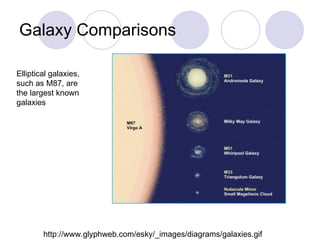
Galaxy Comparisons http://www.glyphweb.com/esky/_images/diagrams/galaxies.gif Elliptical galaxies, such as M87, are the largest known galaxies
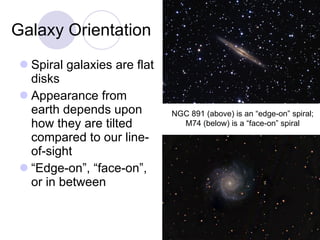
Galaxy Orientation Spiral galaxies are flat disks Appearance from earth depends upon how they are tilted compared to our line-of-sight “ Edge-on”, “face-on”, or in between NGC 891 (above) is an “edge-on” spiral; M74 (below) is a “face-on” spiral
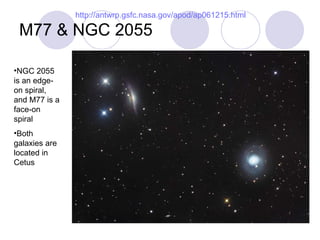
M77 & NGC 2055 http://antwrp.gsfc.nasa.gov/apod/ap061215.html NGC 2055 is an edge-on spiral, and M77 is a face-on spiral Both galaxies are located in Cetus
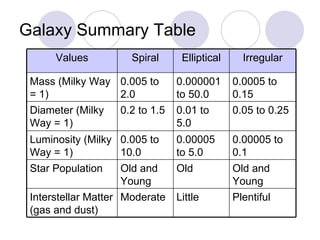
Galaxy Summary Table Values Spiral Elliptical Irregular Mass (Milky Way = 1) 0.005 to 2.0 0.000001 to 50.0 0.0005 to 0.15 Diameter (Milky Way = 1) 0.2 to 1.5 0.01 to 5.0 0.05 to 0.25 Luminosity (Milky Way = 1) 0.005 to 10.0 0.00005 to 5.0 0.00005 to 0.1 Star Population Old and Young Old Old and Young Interstellar Matter (gas and dust) Moderate Little Plentiful
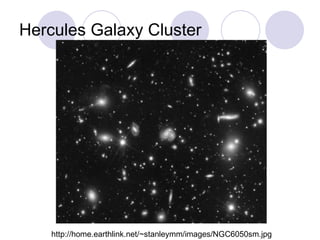
Groups of Galaxies Galaxy clusters, contain dozens to thousands of galaxies held together as a unit by gravity  A supercluster is a cluster of galaxy clusters, the largest known structures in the universe
Hercules Galaxy Cluster http://home.earthlink.net/~stanleymm/images/NGC6050sm.jpg
Local Group Our galaxy cluster The Local Group contains about 30 galaxies Spirals Milky Way, Andromeda Galaxy, and M33.  Others are small elliptical and irregular (dwarf galaxies) Local Group is part of the Virgo Cluster of galaxies, part of the Local Supercluster
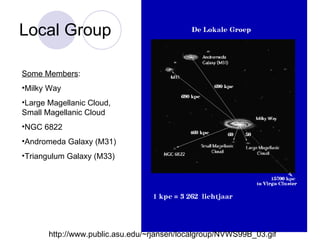
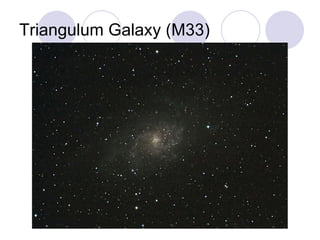
Local Group http://www.public.asu.edu/~rjansen/localgroup/NVWS99B_03.gif Some Members : Milky Way Large Magellanic Cloud, Small Magellanic Cloud NGC 6822 Andromeda Galaxy (M31) Triangulum Galaxy (M33)
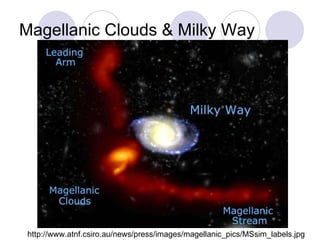
Magellanic Clouds Magellanic Clouds are two small, nearby galaxies Large Magellanic Cloud (LMC) and the Small Magellanic Cloud (SMC) Appear as hazy spots in the night sky, visible only from the southern hemisphere Clouds are gravitationally bound satellites of the Milky Way They lie at distances of 169,000 LY and 210,000 LY A supernova in the LMC was discovered in 1987, the first bright nearby supernova in 300 years (since Kepler and Tycho)
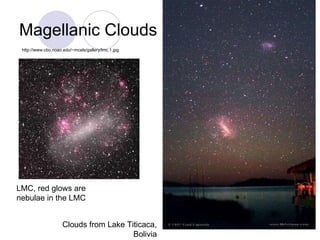
Magellanic Clouds LMC, red glows are nebulae in the LMC Clouds from Lake Titicaca, Bolivia http://www.ctio.noao.edu/~mcels/gallery/lmc.1.jpg
Magellanic Clouds & Milky Way http://www.atnf.csiro.au/news/press/images/magellanic_pics/MSsim_labels.jpg
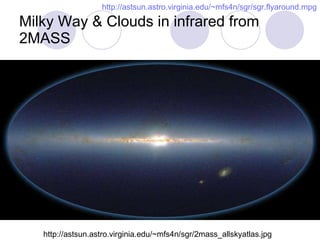
Milky Way & Clouds in infrared from 2MASS http://astsun.astro.virginia.edu/~mfs4n/sgr/2mass_allskyatlas.jpg http://astsun.astro.virginia.edu/~mfs4n/sgr/sgr.flyaround.mpg
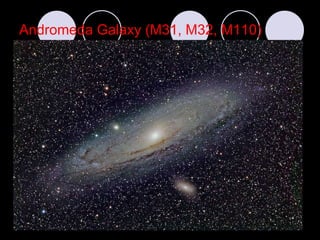
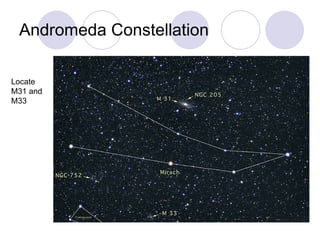
Andromeda Galaxy Our nearest large neighbor Similar in size and shape to Milky Way Andromeda Galaxy is visible to the naked eye as a glowing spot in the constellation of Andromeda 2.3 million light years distant (wave!)
Andromeda Galaxy (M31, M32, M110)
Andromeda Constellation Locate M31 and M33
Triangulum Galaxy (M33)
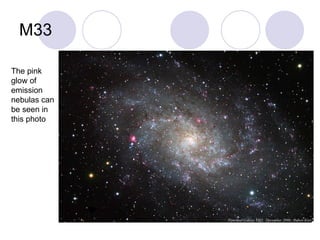
M33 The pink glow of emission nebulas can be seen in this photo
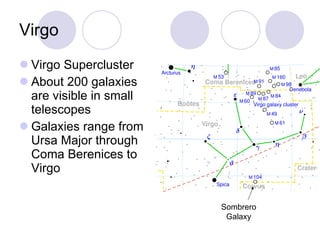
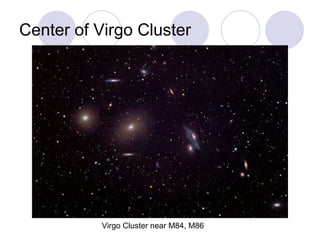
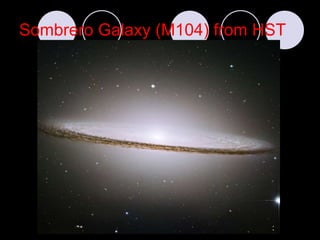
Virgo Virgo Supercluster  About 200 galaxies are visible in small telescopes  Galaxies range from Ursa Major through Coma Berenices to Virgo Sombrero Galaxy
Center of Virgo Cluster Virgo Cluster near M84, M86 M86
Sombrero Galaxy (M104) from HST
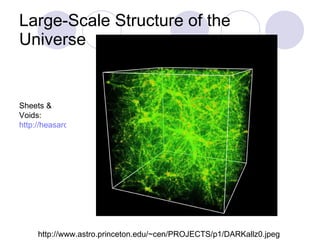
Sheets and Voids Superclusters are located in thin sheets of galaxies Sheets border empty voids Voids resemble gigantic bubbles The universe resembles a sponge
Large-Scale Structure of the Universe http://www.astro.princeton.edu/~cen/PROJECTS/p1/DARKallz0.jpeg Sheets & Voids: http://heasarc.nasa.gov/docs/cosmic/sheets_voids.html
Active Galaxies (AGN) An active galaxy emits large amounts of energy from its nucleus AGNs exhibit jets of hydrogen racing outward along an axis Massive black holes? Mysterious quasars might represent extremely active galaxies
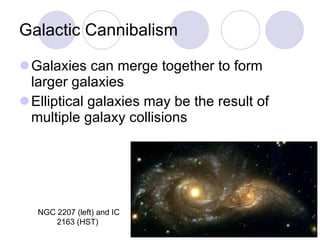
Galactic Cannibalism Galaxies can merge together to form larger galaxies Elliptical galaxies may be the result of multiple galaxy collisions NGC 2207 (left) and IC 2163 (HST)
Quasars Resemble faint stars, are strong radio sources Acronym for Quasi-Stellar Radio Source Small objects, yet emit energy egual to thousands of galaxies combined Most distant and powerful objects known Might represent early stage of galaxy growth Seyfert galaxies are active galaxies with nuclei that resemble quasars
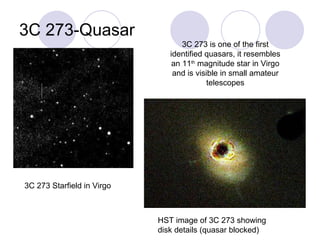
3C 273-Quasar HST image of 3C 273 showing disk details (quasar blocked) 3C 273 Starfield in Virgo 3C 273 is one of the first identified quasars, it resembles an 11 th  magnitude star in Virgo and is visible in small amateur telescopes

06 Galaxies Mc Neely Part 2

  • 1.
    Astronomy Topic 06: Galaxies (part 2) Stephen’s Quintet
  • 2.
    Galaxy Classification EdwinHubble (1926) Three Classes Spiral Barred-spiral Regular spiral Elliptical Irregular Hubble’s famous “tuning fork”
  • 3.
    Hubble Tuning Forkhttp://www.astro.psu.edu/users/niel/astro1/slideshows/class21/003-hubblefork3.gif
  • 4.
    Elliptical Galaxies (E)Spheres of hundreds of billions of stars. Largest known galaxies E, are egg shaped E0, nearly perfect spheres, to flattest, E7 No gas and dust The oldest galaxies, population II stars
  • 5.
    M87-Elliptical Small dotsrepresent M87’s globular clusters Some large ellipticals emit jets of matter, perhaps from massive black holes at their centers
  • 6.
    M87’s Jet KittPeak image Hubble
  • 7.
    M87-CFH Telescope M87’sjet is visible at the 1:00 position
  • 8.
    Spiral Galaxies NormalSpiral (S), and Barred Spiral (SB) Flat, pancake shaped with central bulge and spiral arms Young, large amounts of gas and dust Population I and II stars
  • 9.
    Normal Spiral Galaxies(S) Normal spiral galaxies, S Sa, Sb, and Sc, how tightly wound the spiral arms appear If no apparent spiral arms, SO
  • 10.
    M51-Whirlpool Galaxy (Spiral)http://antwrp.gsfc.nasa.gov/apod/image/0207/m51_hallas_big.jpg
  • 11.
    Barred-Spiral Galaxies (SB)Designated SB Spiral arms unwind from bar-shaped mid section NGC 1365
  • 12.
  • 13.
    Irregular Galaxies Irregulargalaxies, Irr No regular, geometric shape Contain gas and dust Ex: Small and Large Magellanic Clouds
  • 14.
    Irregular NGC1427A, anexample of an irregular galaxy This photo was taken by the Hubble Space Telescope, and it reveals many other galaxies in the background Note how the HST can resolve this galaxy’s stars
  • 15.
    Galaxy Comparisons http://www.glyphweb.com/esky/_images/diagrams/galaxies.gifElliptical galaxies, such as M87, are the largest known galaxies
  • 16.
    Galaxy Orientation Spiralgalaxies are flat disks Appearance from earth depends upon how they are tilted compared to our line-of-sight “ Edge-on”, “face-on”, or in between NGC 891 (above) is an “edge-on” spiral; M74 (below) is a “face-on” spiral
  • 17.
    M77 & NGC2055 http://antwrp.gsfc.nasa.gov/apod/ap061215.html NGC 2055 is an edge-on spiral, and M77 is a face-on spiral Both galaxies are located in Cetus
  • 18.
    Galaxy Summary TableValues Spiral Elliptical Irregular Mass (Milky Way = 1) 0.005 to 2.0 0.000001 to 50.0 0.0005 to 0.15 Diameter (Milky Way = 1) 0.2 to 1.5 0.01 to 5.0 0.05 to 0.25 Luminosity (Milky Way = 1) 0.005 to 10.0 0.00005 to 5.0 0.00005 to 0.1 Star Population Old and Young Old Old and Young Interstellar Matter (gas and dust) Moderate Little Plentiful
  • 19.
    Groups of GalaxiesGalaxy clusters, contain dozens to thousands of galaxies held together as a unit by gravity A supercluster is a cluster of galaxy clusters, the largest known structures in the universe
  • 20.
    Hercules Galaxy Clusterhttp://home.earthlink.net/~stanleymm/images/NGC6050sm.jpg
  • 21.
    Local Group Ourgalaxy cluster The Local Group contains about 30 galaxies Spirals Milky Way, Andromeda Galaxy, and M33. Others are small elliptical and irregular (dwarf galaxies) Local Group is part of the Virgo Cluster of galaxies, part of the Local Supercluster
  • 22.
    Local Group http://www.public.asu.edu/~rjansen/localgroup/NVWS99B_03.gifSome Members : Milky Way Large Magellanic Cloud, Small Magellanic Cloud NGC 6822 Andromeda Galaxy (M31) Triangulum Galaxy (M33)
  • 23.
    Magellanic Clouds MagellanicClouds are two small, nearby galaxies Large Magellanic Cloud (LMC) and the Small Magellanic Cloud (SMC) Appear as hazy spots in the night sky, visible only from the southern hemisphere Clouds are gravitationally bound satellites of the Milky Way They lie at distances of 169,000 LY and 210,000 LY A supernova in the LMC was discovered in 1987, the first bright nearby supernova in 300 years (since Kepler and Tycho)
  • 24.
    Magellanic Clouds LMC,red glows are nebulae in the LMC Clouds from Lake Titicaca, Bolivia http://www.ctio.noao.edu/~mcels/gallery/lmc.1.jpg
  • 25.
    Magellanic Clouds &Milky Way http://www.atnf.csiro.au/news/press/images/magellanic_pics/MSsim_labels.jpg
  • 26.
    Milky Way &Clouds in infrared from 2MASS http://astsun.astro.virginia.edu/~mfs4n/sgr/2mass_allskyatlas.jpg http://astsun.astro.virginia.edu/~mfs4n/sgr/sgr.flyaround.mpg
  • 27.
    Andromeda Galaxy Ournearest large neighbor Similar in size and shape to Milky Way Andromeda Galaxy is visible to the naked eye as a glowing spot in the constellation of Andromeda 2.3 million light years distant (wave!)
  • 28.
  • 29.
  • 30.
  • 31.
    M33 The pinkglow of emission nebulas can be seen in this photo
  • 32.
    Virgo Virgo Supercluster About 200 galaxies are visible in small telescopes Galaxies range from Ursa Major through Coma Berenices to Virgo Sombrero Galaxy
  • 33.
    Center of VirgoCluster Virgo Cluster near M84, M86 M86
  • 34.
  • 35.
    Sheets and VoidsSuperclusters are located in thin sheets of galaxies Sheets border empty voids Voids resemble gigantic bubbles The universe resembles a sponge
  • 36.
    Large-Scale Structure ofthe Universe http://www.astro.princeton.edu/~cen/PROJECTS/p1/DARKallz0.jpeg Sheets & Voids: http://heasarc.nasa.gov/docs/cosmic/sheets_voids.html
  • 37.
    Active Galaxies (AGN)An active galaxy emits large amounts of energy from its nucleus AGNs exhibit jets of hydrogen racing outward along an axis Massive black holes? Mysterious quasars might represent extremely active galaxies
  • 38.
    Galactic Cannibalism Galaxiescan merge together to form larger galaxies Elliptical galaxies may be the result of multiple galaxy collisions NGC 2207 (left) and IC 2163 (HST)
  • 39.
    Quasars Resemble faintstars, are strong radio sources Acronym for Quasi-Stellar Radio Source Small objects, yet emit energy egual to thousands of galaxies combined Most distant and powerful objects known Might represent early stage of galaxy growth Seyfert galaxies are active galaxies with nuclei that resemble quasars
  • 40.
    3C 273-Quasar HSTimage of 3C 273 showing disk details (quasar blocked) 3C 273 Starfield in Virgo 3C 273 is one of the first identified quasars, it resembles an 11 th magnitude star in Virgo and is visible in small amateur telescopes