Chapter 2 The Foundingand the Constitution
Clicker QuestionWhich of the following is NOT a Collective or Public Good?a. A Freewayb. An Emergency Roomc. A Paid Parking Lotd. Airport Security
Which do you agree with Most?In order to curb terrorism in this country, it will be necessary to give up some civil liberties. We should preserve our freedoms above all, even if there remains some risk of terrorism?
Which do you agree with Most?Everyone should be required to carry a national identity card at all times to show to a police officer upon request. Being required to carry an identity card would violate people’s freedom of association and right to privacy.
Which do you agree with Most?Some people say it should be a crime for anyone to belong to or contribute money to any organization that supports international terrorism. Others say that a person’s guilt or innocence should not be determined only by who they associate with or the organizations to which they belong.
Clicker QuestionHow do you believe the Founding Fathers would view the contemporary U.S. Government? Strongly approveApprove, but with some concernsDisapproveStrongly disapprove
Clicker QuestionDo you believe the U.S. Constitution with its included amendments would be ratified by a majority of Americans if put forward as a referendum during the next election?YesNo
Clicker QuestionDo you believe our government should do more, the same, or less for the citizens of our country?MoreAbout the sameLessNo Opinion
Clicker Question
Clicker Question
Clicker Question
Clicker Question
Clicker Question
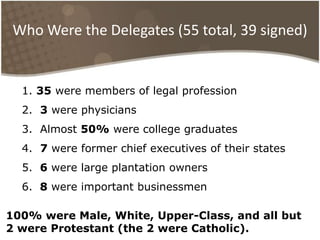
Who Were the Delegates (55 total, 39 signed)	1. 35 were members of legal profession2.  3 were physicians3.  Almost 50% were college graduates4.  7 were former chief executives of their states5. 	6 were large plantation owners6. 	8 were important businessmen100% were Male, White, Upper-Class, and all but 2 were Protestant (the 2 were Catholic).
Clicker QuestionDo you believe that the particular demographics of the men at the Constitutional Convention played a role in shaping that document?A big roleA little bitNot at all
“A Marriage of Interests and Principles”The framers’ economic interests were reinforced by their philosophical and ethical principles. They sought to create a government to promote commerce and to protect property. At the same time, they hoped to fashion a government less susceptible than existing state and national regimes to populist forces hostile to the interests of the commercial and propertied classes.
republicanism and Excessive DemocracyWhile the founders believed in a (1) limited government based on (2) popular consent, with (3) protections against majority tyranny…They also held Elitist concerns about excessive popular democracy in the states…They didn’t want to give too much authority to “average” citizens who lacked the capability to make reasonable decisions about government.
Clicker QuestionShould their be a basic knowledge exam to be able to vote?YesNoMaybe
Clicker QuestionWho becomes President of the United States if the President and Vice-President should die?Speaker of the HouseAttorney GeneralSecretary of State
Clicker QuestionCan you name a senator from your state?DealIsaksonZaxbysLinder
Clicker QuestionCan you name the representative from your district?YesNo
Constitutional Convention:The Great CompromiseTwo factions emerged:Virginia PlanBicameral legislature
Representation based on populationNew Jersey PlanUnicameral legislature
Representation equal for each stateConnecticut (Great) CompromiseBicameral legislature
Upper House: equal representation
Lower House: based on populationClicker QuestionWhich of the following statements is true about the Three-fifths Compromise?It settled the question of how many senators each state would get.It created a system to elect the President of the United States.Under this compromise, five slaves would count as three free persons in apportioning seats in the House of Representatives. Only three-fifths of all slaves were allowed to vote in national elections.
Constitutional Convention:The Three-Fifths CompromiseTwo primary questions concerning slavery:

02 - U.S. Constitution

  • 1.
    Chapter 2 TheFoundingand the Constitution
  • 2.
    Clicker QuestionWhich ofthe following is NOT a Collective or Public Good?a. A Freewayb. An Emergency Roomc. A Paid Parking Lotd. Airport Security
  • 3.
    Which do youagree with Most?In order to curb terrorism in this country, it will be necessary to give up some civil liberties. We should preserve our freedoms above all, even if there remains some risk of terrorism?
  • 4.
    Which do youagree with Most?Everyone should be required to carry a national identity card at all times to show to a police officer upon request. Being required to carry an identity card would violate people’s freedom of association and right to privacy.
  • 5.
    Which do youagree with Most?Some people say it should be a crime for anyone to belong to or contribute money to any organization that supports international terrorism. Others say that a person’s guilt or innocence should not be determined only by who they associate with or the organizations to which they belong.
  • 6.
    Clicker QuestionHow doyou believe the Founding Fathers would view the contemporary U.S. Government? Strongly approveApprove, but with some concernsDisapproveStrongly disapprove
  • 7.
    Clicker QuestionDo youbelieve the U.S. Constitution with its included amendments would be ratified by a majority of Americans if put forward as a referendum during the next election?YesNo
  • 8.
    Clicker QuestionDo youbelieve our government should do more, the same, or less for the citizens of our country?MoreAbout the sameLessNo Opinion
  • 9.
  • 10.
  • 11.
  • 12.
  • 13.
  • 14.
    Who Were theDelegates (55 total, 39 signed) 1. 35 were members of legal profession2. 3 were physicians3. Almost 50% were college graduates4. 7 were former chief executives of their states5. 6 were large plantation owners6. 8 were important businessmen100% were Male, White, Upper-Class, and all but 2 were Protestant (the 2 were Catholic).
  • 15.
    Clicker QuestionDo youbelieve that the particular demographics of the men at the Constitutional Convention played a role in shaping that document?A big roleA little bitNot at all
  • 16.
    “A Marriage ofInterests and Principles”The framers’ economic interests were reinforced by their philosophical and ethical principles. They sought to create a government to promote commerce and to protect property. At the same time, they hoped to fashion a government less susceptible than existing state and national regimes to populist forces hostile to the interests of the commercial and propertied classes.
  • 17.
    republicanism and ExcessiveDemocracyWhile the founders believed in a (1) limited government based on (2) popular consent, with (3) protections against majority tyranny…They also held Elitist concerns about excessive popular democracy in the states…They didn’t want to give too much authority to “average” citizens who lacked the capability to make reasonable decisions about government.
  • 18.
    Clicker QuestionShould theirbe a basic knowledge exam to be able to vote?YesNoMaybe
  • 19.
    Clicker QuestionWho becomesPresident of the United States if the President and Vice-President should die?Speaker of the HouseAttorney GeneralSecretary of State
  • 20.
    Clicker QuestionCan youname a senator from your state?DealIsaksonZaxbysLinder
  • 21.
    Clicker QuestionCan youname the representative from your district?YesNo
  • 22.
    Constitutional Convention:The GreatCompromiseTwo factions emerged:Virginia PlanBicameral legislature
  • 23.
    Representation based onpopulationNew Jersey PlanUnicameral legislature
  • 24.
    Representation equal foreach stateConnecticut (Great) CompromiseBicameral legislature
  • 25.
    Upper House: equalrepresentation
  • 26.
    Lower House: basedon populationClicker QuestionWhich of the following statements is true about the Three-fifths Compromise?It settled the question of how many senators each state would get.It created a system to elect the President of the United States.Under this compromise, five slaves would count as three free persons in apportioning seats in the House of Representatives. Only three-fifths of all slaves were allowed to vote in national elections.
  • 27.
    Constitutional Convention:The Three-FifthsCompromiseTwo primary questions concerning slavery:

Editor's Notes

  • #23 Conflict Between Large and Small States
  • #25 Conflict between Slave (Southern) and Non-slave (Northern) States90% of slaves resided in 5 states (GA, MD, NC, SC, VA) where they accounted for 30% of the total population.Requirement that 2/3 of the states ratify required that Southern states be compromised with