Energy balance

Nutritional Screening
  and Assessment
            Lubos Sobotka
 Charles University - Medical Faculty
           Hradec Kralove
            Czech Republic
Learning Objectives

 To the principles of measurement of
 energy expenditure
 To now how to diagnose a risk of
 malnutrition
 To know the methods for measurement
 of body composition
 To be able to estimate energy intake in
 hospitalized patients
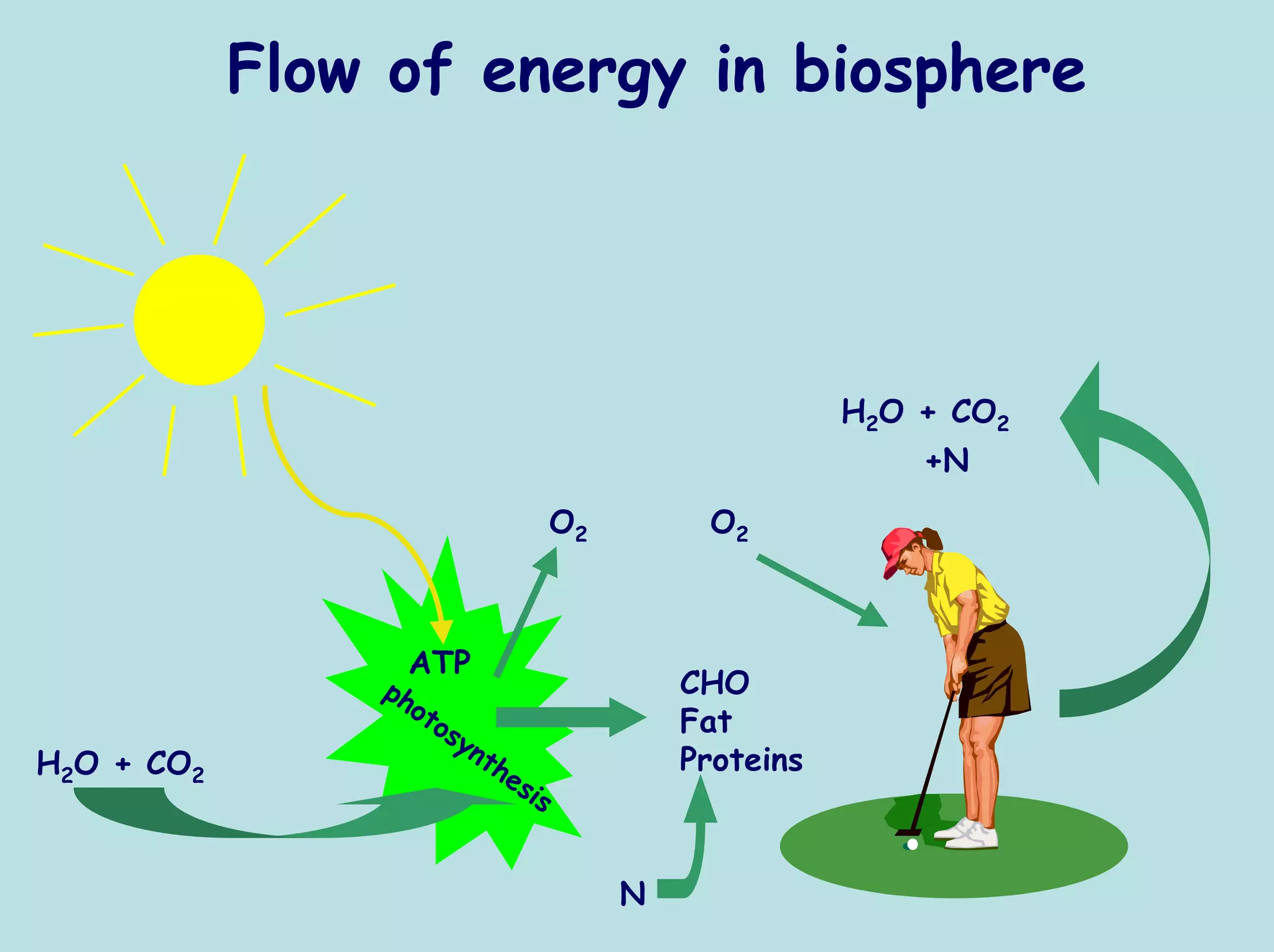
Flow of energy in biosphere


                                                       H2O + CO2
                                                           +N
                                   O2        O2


                  ATP
                ph                          CHO
                  ot
                    os                      Fat
                      yn
H2O + CO2                th                 Proteins
                            es
                              is


                                        N
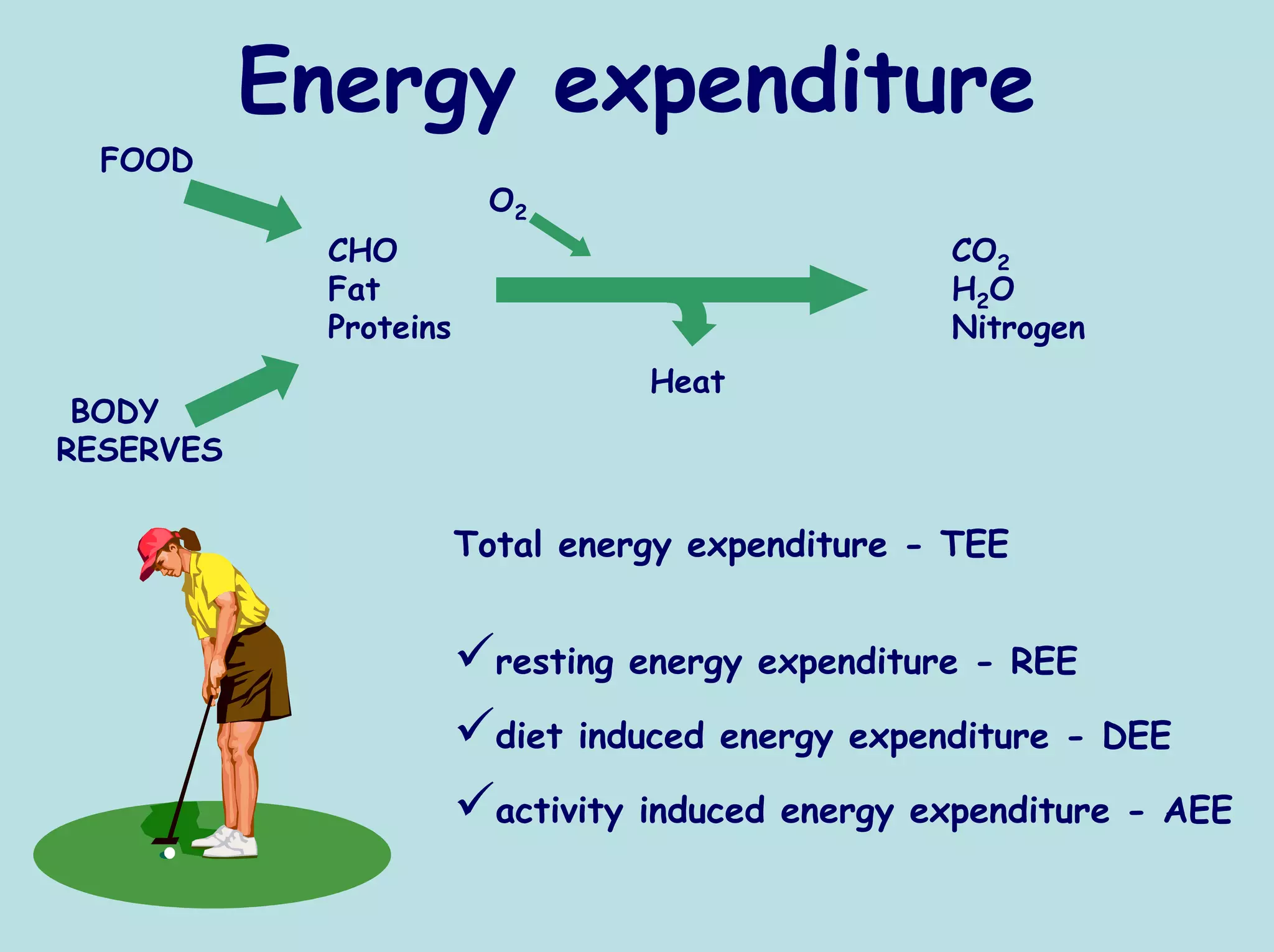
Energy expenditure
  FOOD
                         O2
             CHO                                   CO2
             Fat                                   H 2O
             Proteins                              Nitrogen
                                  Heat
 BODY
RESERVES

                        Total energy expenditure - TEE


                          resting energy expenditure - REE

                          diet induced energy expenditure - DEE

                          activity induced energy expenditure - AEE
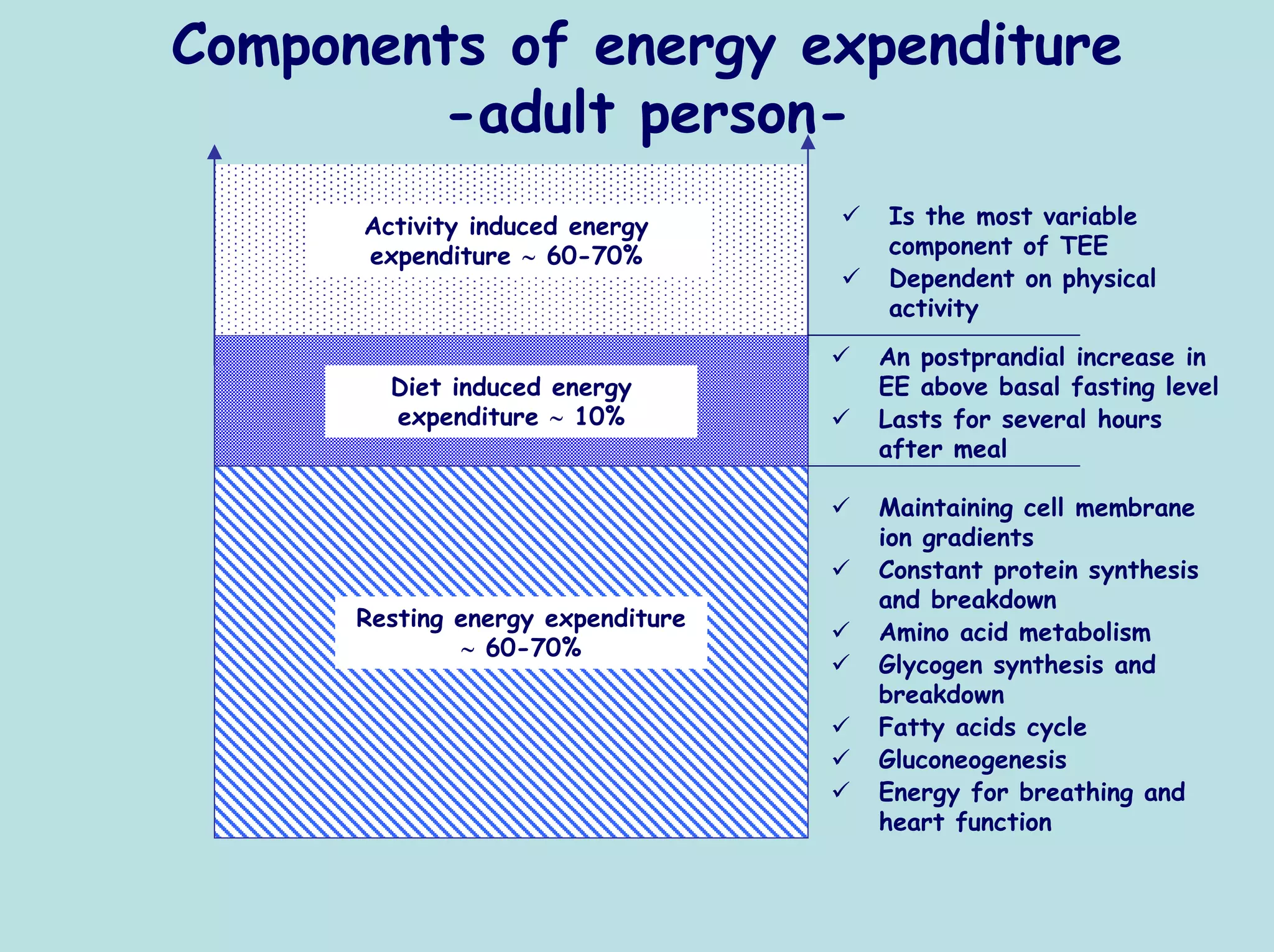
Components of energy expenditure
        -adult person-
      Activity induced energy      Is the most variable
      expenditure ∼ 60-70%         component of TEE
                                   Dependent on physical
                                   activity
                                   An postprandial increase in
        Diet induced energy        EE above basal fasting level
        expenditure ∼ 10%          Lasts for several hours
                                   after meal

                                   Maintaining cell membrane
                                   ion gradients
                                   Constant protein synthesis
                                   and breakdown
      Resting energy expenditure
                                   Amino acid metabolism
              ∼ 60-70%
                                   Glycogen synthesis and
                                   breakdown
                                   Fatty acids cycle
                                   Gluconeogenesis
                                   Energy for breathing and
                                   heart function
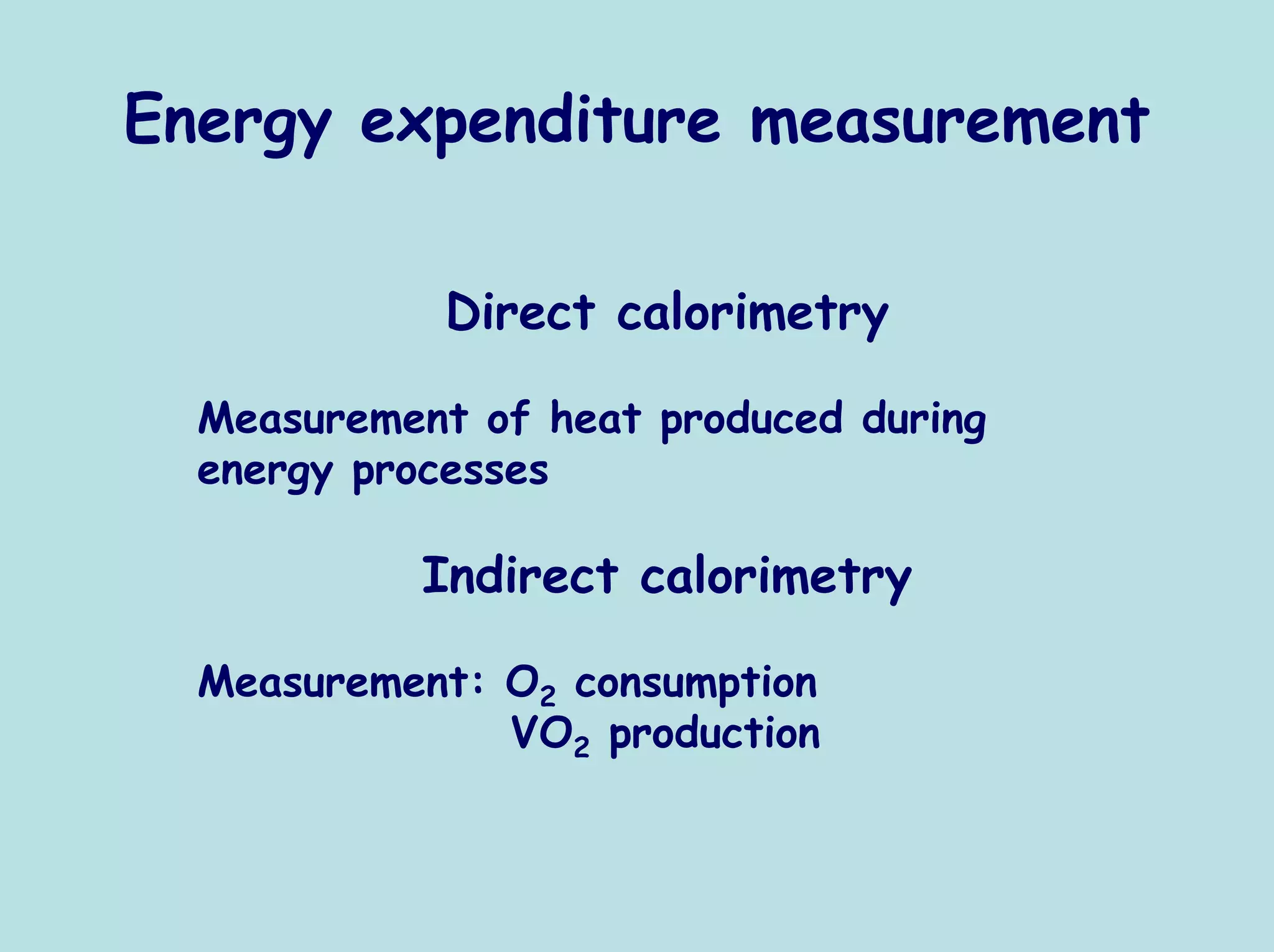
Energy expenditure measurement

            Direct calorimetry

  Measurement of heat produced during
  energy processes

           Indirect calorimetry

  Measurement: O2 consumption
               VO2 production
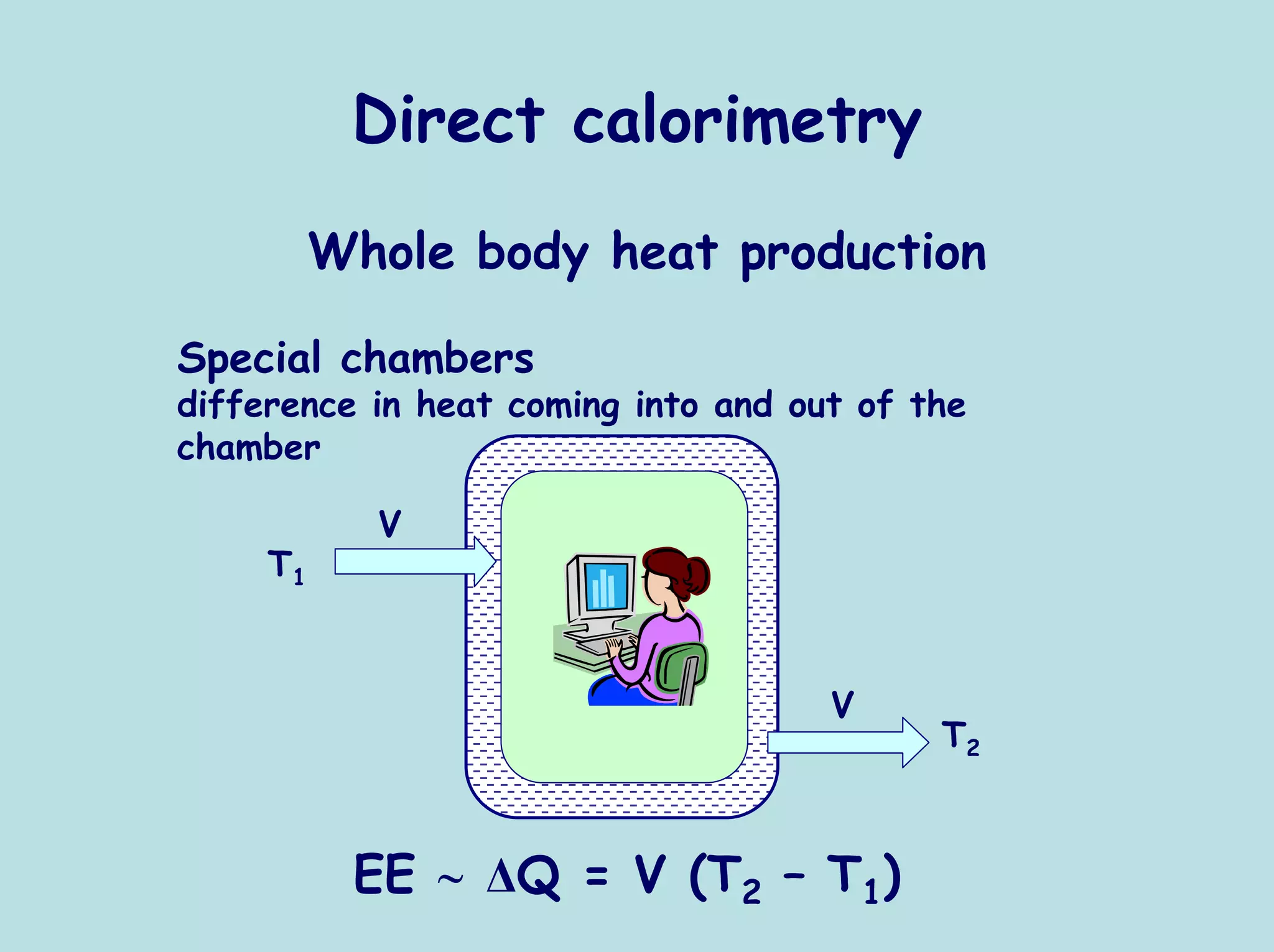
Direct calorimetry
          Whole body heat production

Special chambers
difference in heat coming into and out of the
chamber

            V
     T1


                                     V
                                           T2


           EE ∼ ∆Q = V (T2 – T1)
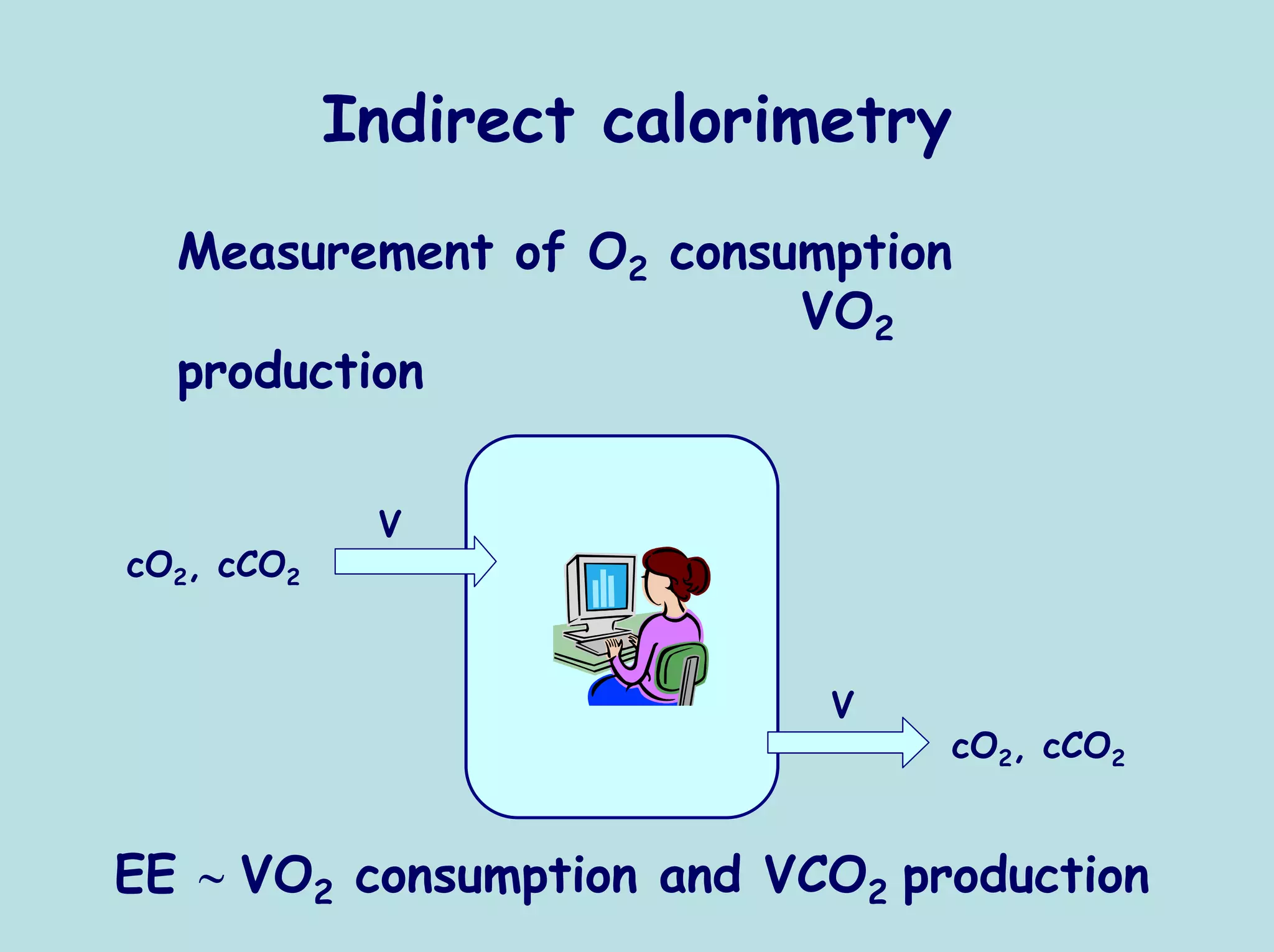
Indirect calorimetry
  Measurement of O2 consumption
                         VO2
  production

             V
cO2, cCO2


                            V
                                cO2, cCO2


EE ∼ VO2 consumption and VCO2 production
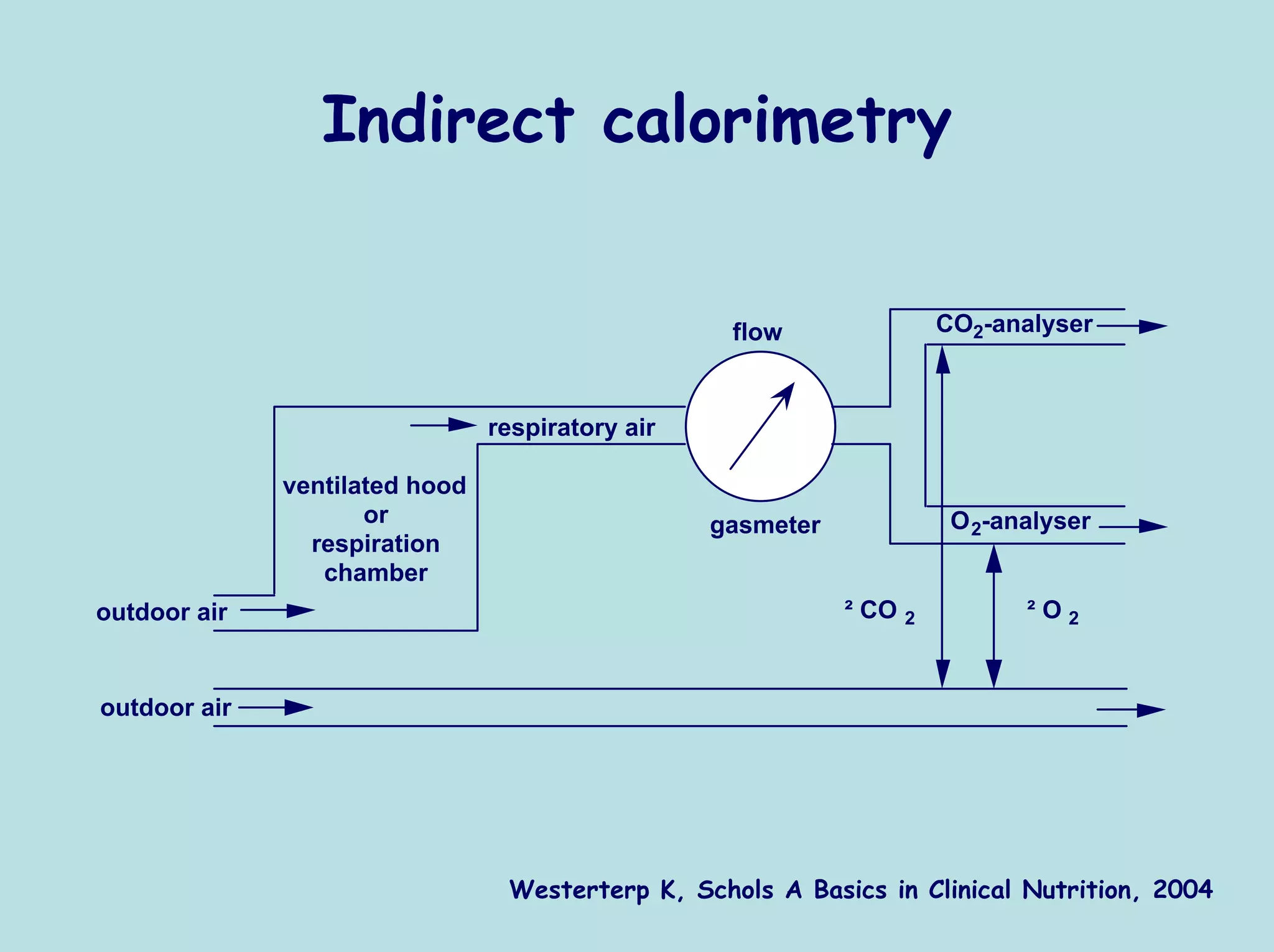
Indirect calorimetry


                                                   flow                 CO2-analyser


                                respiratory air

              ventilated hood
                     or                           gasmeter               O 2-analyser
                respiration
                 chamber
outdoor air                                                  ² CO   2          ²O2


outdoor air


                                 Westerterp K, Schols A Basics in Clinical Nutrition, 2004
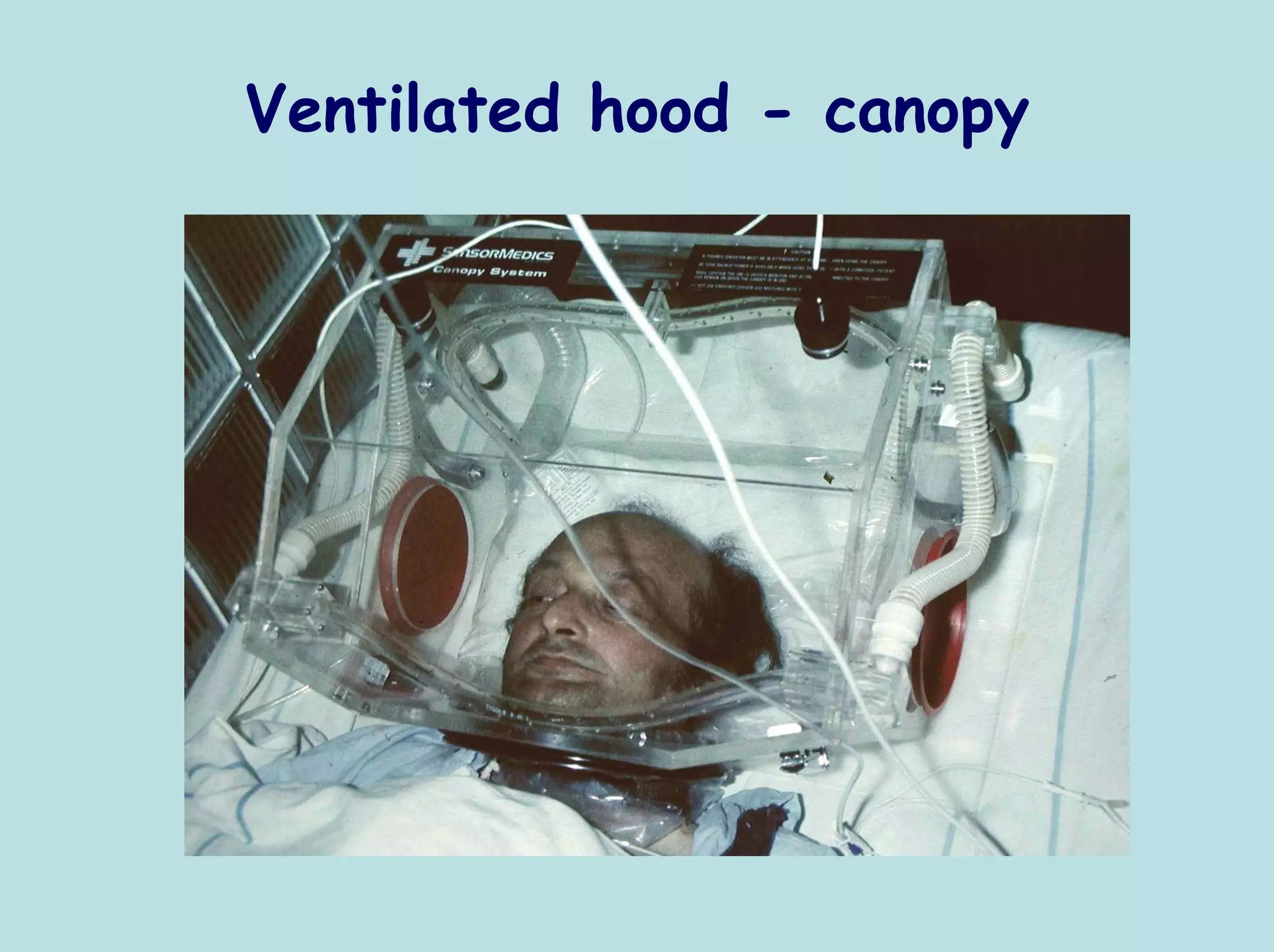
Ventilated hood - canopy
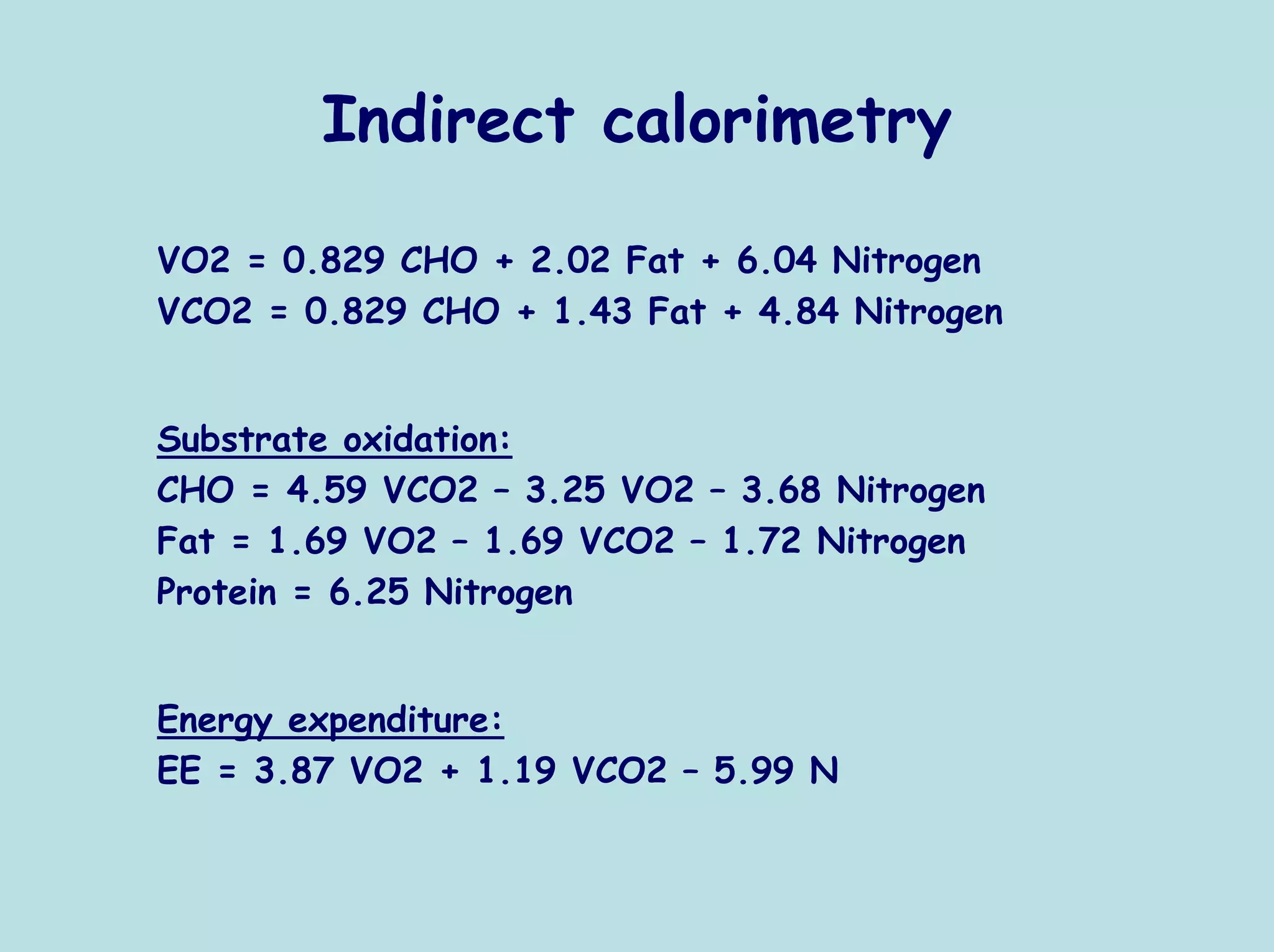
Indirect calorimetry

VO2 = 0.829 CHO + 2.02 Fat + 6.04 Nitrogen
VCO2 = 0.829 CHO + 1.43 Fat + 4.84 Nitrogen


Substrate oxidation:
CHO = 4.59 VCO2 – 3.25 VO2 – 3.68 Nitrogen
Fat = 1.69 VO2 – 1.69 VCO2 – 1.72 Nitrogen
Protein = 6.25 Nitrogen


Energy expenditure:
EE = 3.87 VO2 + 1.19 VCO2 – 5.99 N
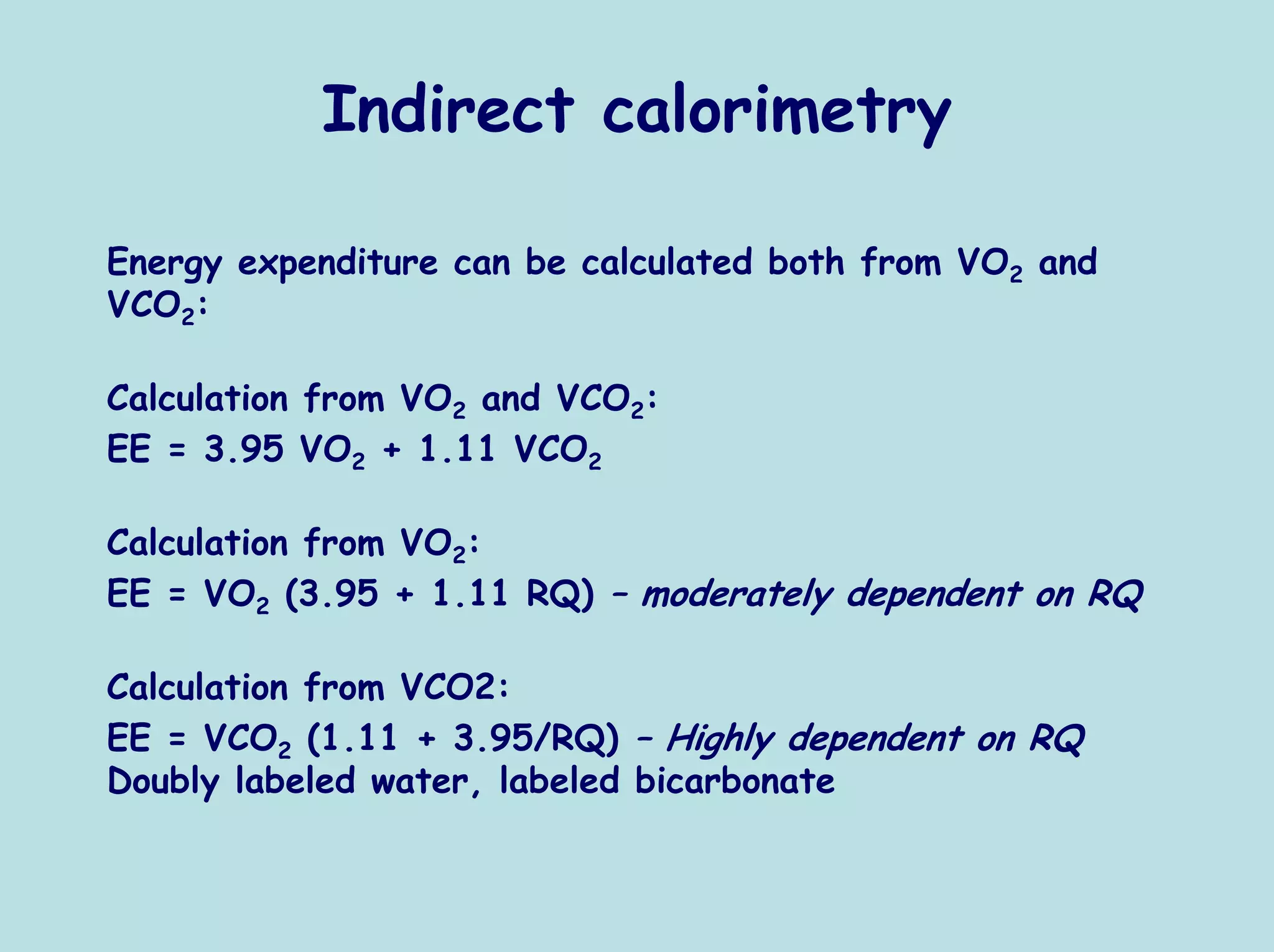
Indirect calorimetry

Energy expenditure can be calculated both from VO2 and
VCO2:

Calculation from VO2 and VCO2:
EE = 3.95 VO2 + 1.11 VCO2

Calculation from VO2:
EE = VO2 (3.95 + 1.11 RQ) – moderately dependent on RQ

Calculation from VCO2:
EE = VCO2 (1.11 + 3.95/RQ) – Highly dependent on RQ
Doubly labeled water, labeled bicarbonate
Relationship between REE and RQ
[REE calculation based on VO2 or on VCO2]

                            120,0

                            115,0
    Difference in REE [%]


                            110,0

                            105,0
                                                                               VCO2
                            100,0
                                                                               VO2
                             95,0                                              VO2 a VCO2
                             90,0

                             85,0

                             80,0
                                    0,7   0,75   0,8   0,85   0,9   0,95   1
                                                       RQ
   REE calculated from VCO2 is more dependent on RQ (possible
   mistake 15%) then if calculated from VO2 (possible mistake
   4%)
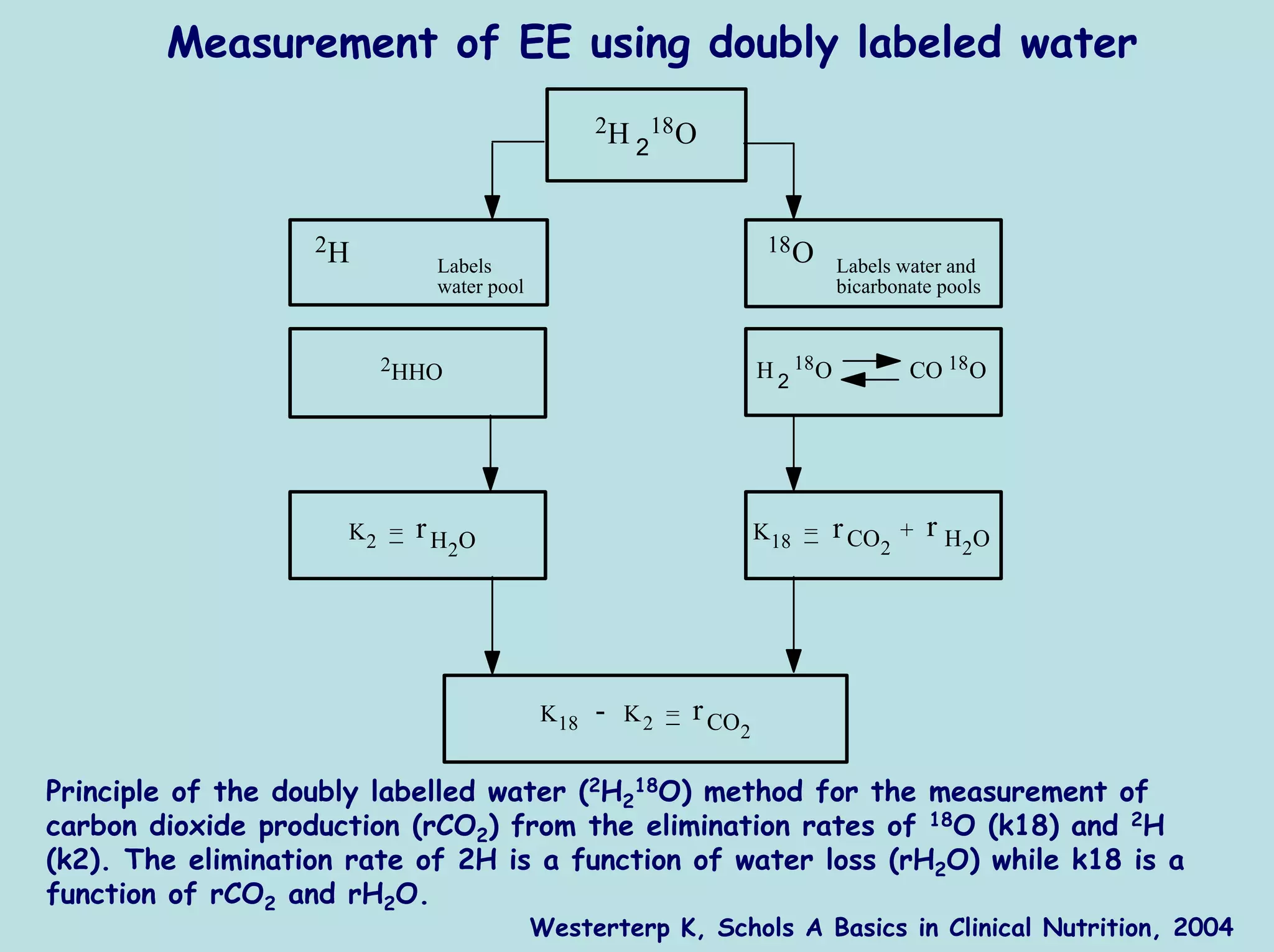
Measurement of EE using doubly labeled water
                                                2H 18 O
                                                  2


                   2H                                                  18 O
                             Labels                                              Labels water and
                             water pool                                          bicarbonate pools


                        2HHO                                          H 2 18 O              CO 18 O


                     K2 =   rH                                        K18 =      r CO       +   rH
                                 2O                                                     2            2O


                                          K18   -   K2 =   r CO
                                                                  2


Principle of the doubly labelled water (2H218O) method for the measurement of
carbon dioxide production (rCO2) from the elimination rates of 18O (k18) and 2H
(k2). The elimination rate of 2H is a function of water loss (rH2O) while k18 is a
function of rCO2 and rH2O.
                                          Westerterp K, Schols A Basics in Clinical Nutrition, 2004
Relationship between heart rate and energy
                expenditure
                     12,00


                     10,00


                      8,00
Energy expenditure
    [kcal/min.]


                      6,00


                      4,00


                      2,00


                      0,00
                             40   50   60   70      80        90      100   110   120   130   140
                                                 Heart rate [b/min]
Relationship between heart rate and energy
          expenditure –whole group
                         14


                         12


                         10
    Energy expenditure


                          8
        [cal/min.]


                          6


                          4


                          2


                          0
                              75   95   115           135    155   175
                                        Heart rate [b/min]
Relationship between heart rate and energy
       expenditure –individual patients
                        18

                        16

                        14

                        12
   Energy expenditure
       [cal/min.]


                        10

                        8

                        6

                        4

                        2

                        0
                             95   105   115          125           135   145   155
                                              Heart rate [b/min]
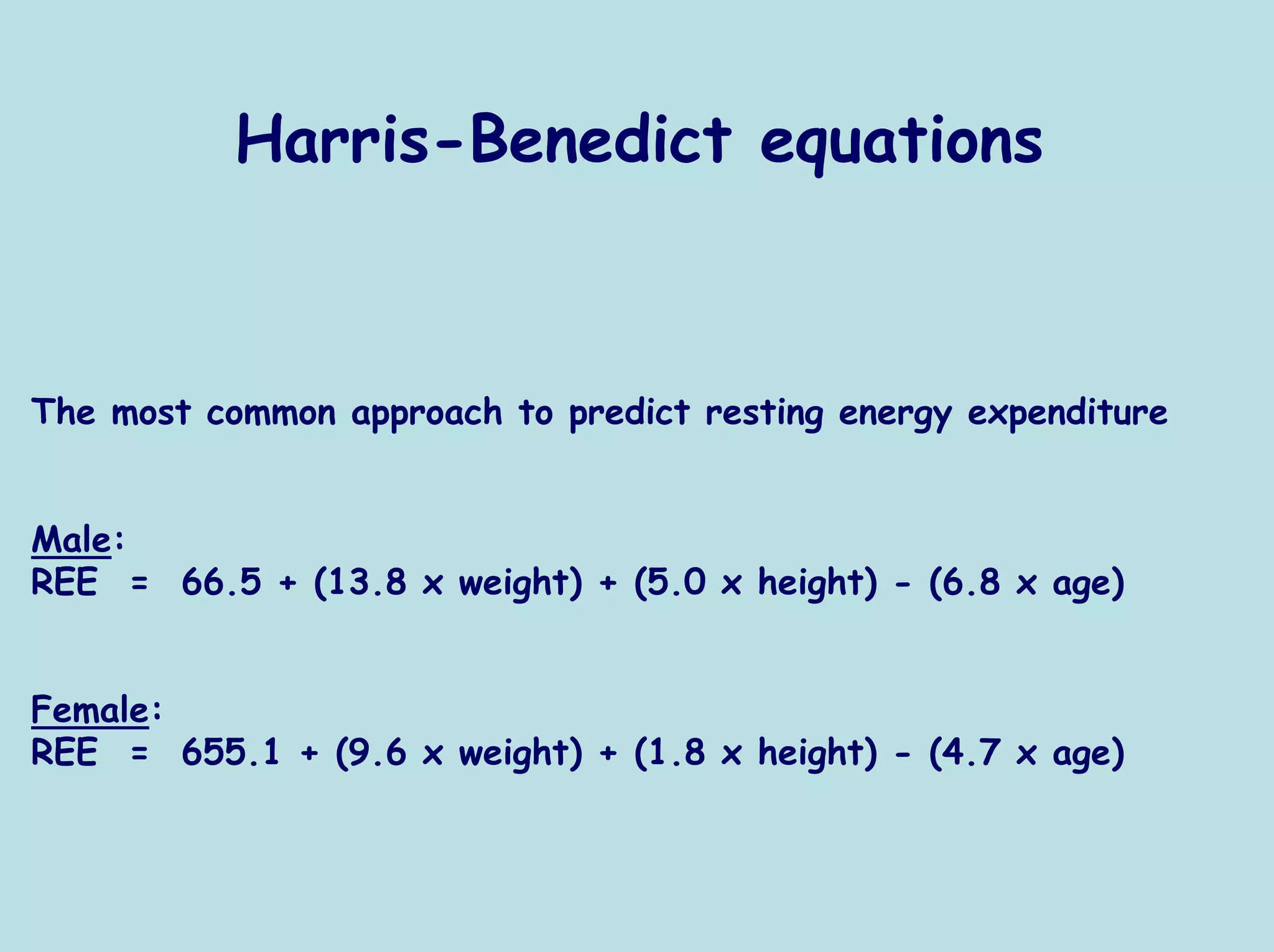
Harris-Benedict equations


The most common approach to predict resting energy expenditure


Male:
REE = 66.5 + (13.8 x weight) + (5.0 x height) - (6.8 x age)


Female:
REE = 655.1 + (9.6 x weight) + (1.8 x height) - (4.7 x age)
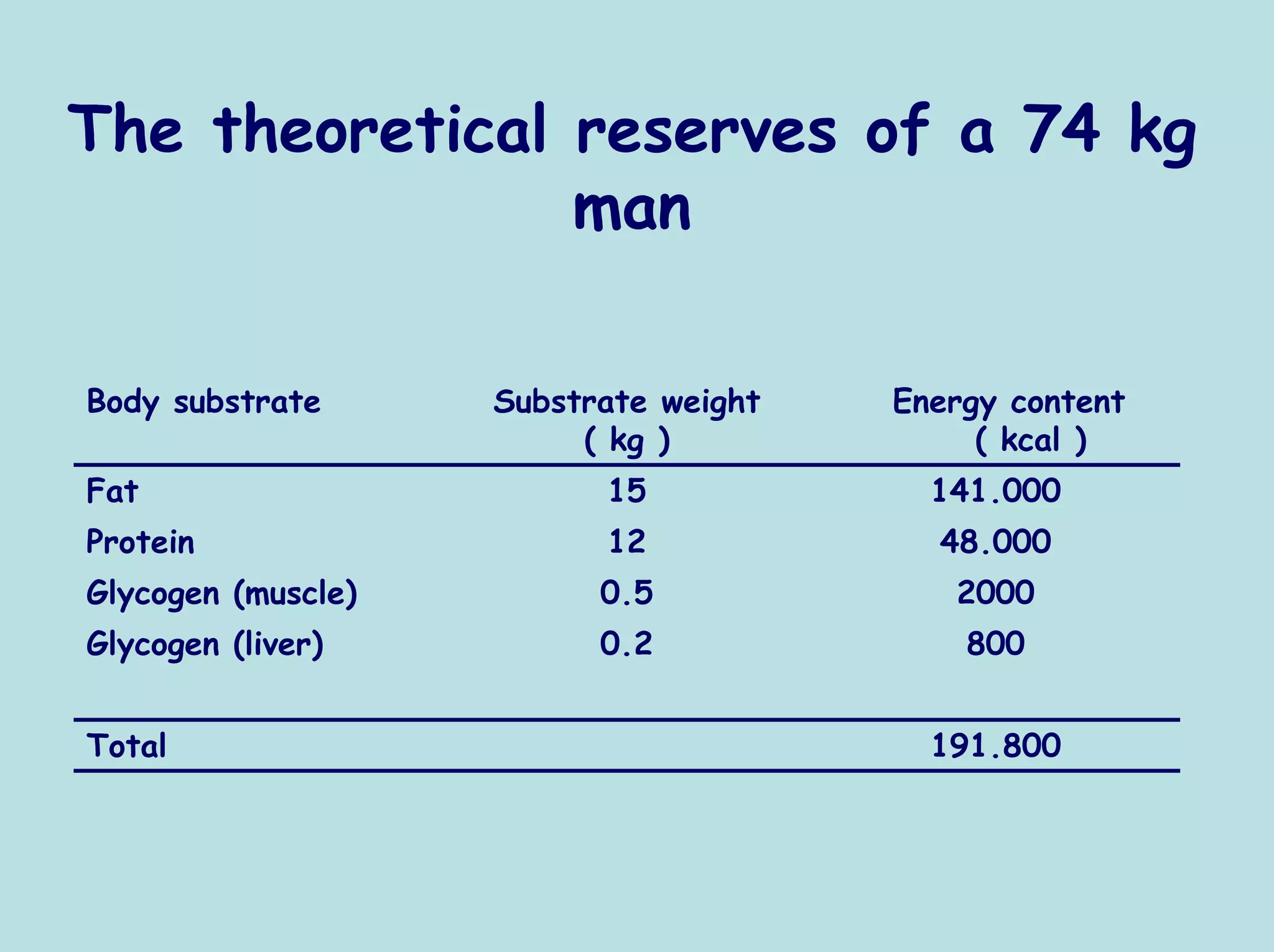
The theoretical reserves of a 74 kg
                man

Body substrate      Substrate weight   Energy content
                         ( kg )             ( kcal )
Fat                       15             141.000
Protein                   12             48.000
Glycogen (muscle)         0.5             2000
Glycogen (liver)          0.2              800


Total                                    191.800
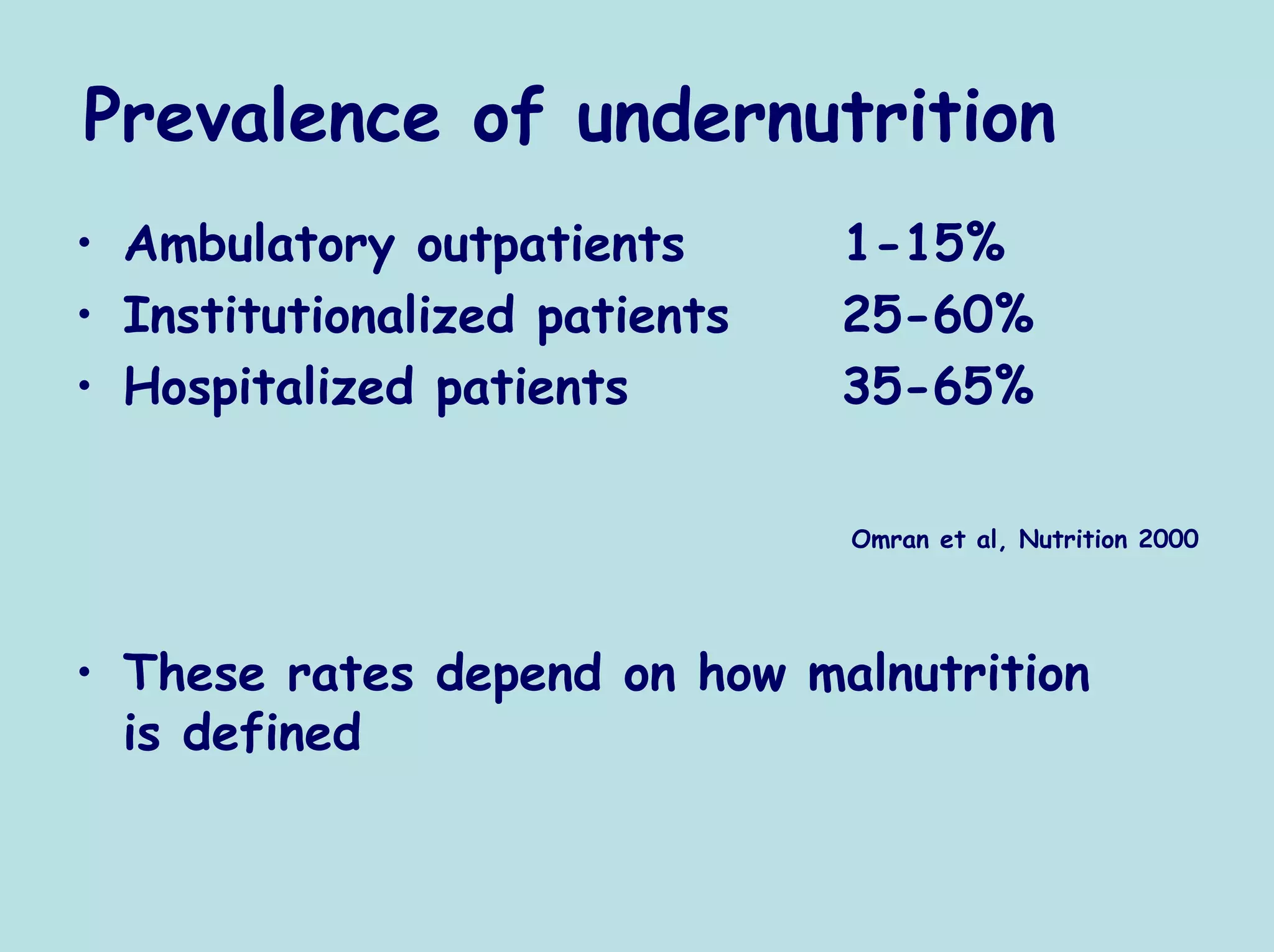
Prevalence of undernutrition
• Ambulatory outpatients       1-15%
• Institutionalized patients   25-60%
• Hospitalized patients        35-65%

                               Omran et al, Nutrition 2000


• These rates depend on how malnutrition
  is defined
Assessment of
Nutritional status
  1. Screening
 2. Assessment
ESPEN Guidelines
   for Nutrition Screening
 • All patients should be screened on admission to the
   hospital
 • If the patient is at risk, a nutrition plan is worked
   out by the staff
 • Monitoring and defining outcome has to be
   organized
 • Results of screening, assessment and nutrition care
   plans should be communicated to healthcare
   professionals to which the patient is transferred
 • Outcome should be audited and communicated to
   furnish the data on which future policy decisions
   can be made
Nutrition Screening 2002, Clin Nutr 2003
www.espen.org → Education → Guidelines
Nutritional screening


Is a tool to rapidly and simply
evaluate whether the patient is
at risk to be or to become
malnourished
Nutritional screening

History:
• Weight loss over time
• Anorexia, nausea
• Food intake
First measurements:
• Body weight
• Height
   BMI (kg/m2)
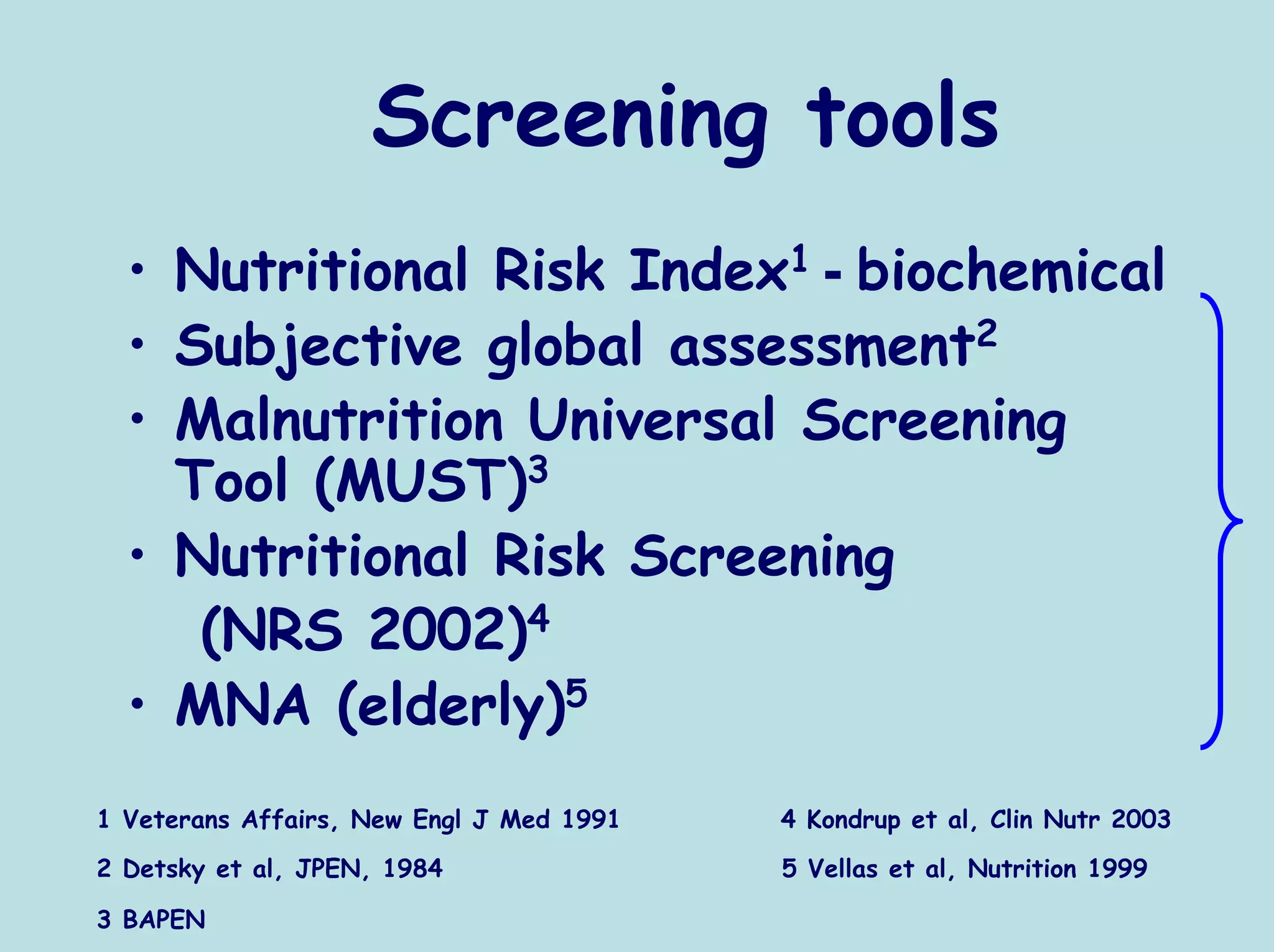
Screening tools
  • Nutritional Risk Index1 - biochemical
  • Subjective global assessment2
  • Malnutrition Universal Screening
    Tool (MUST)3
  • Nutritional Risk Screening
     (NRS 2002)4
  • MNA (elderly)5
1 Veterans Affairs, New Engl J Med 1991   4 Kondrup et al, Clin Nutr 2003
2 Detsky et al, JPEN, 1984                5 Vellas et al, Nutrition 1999

3 BAPEN
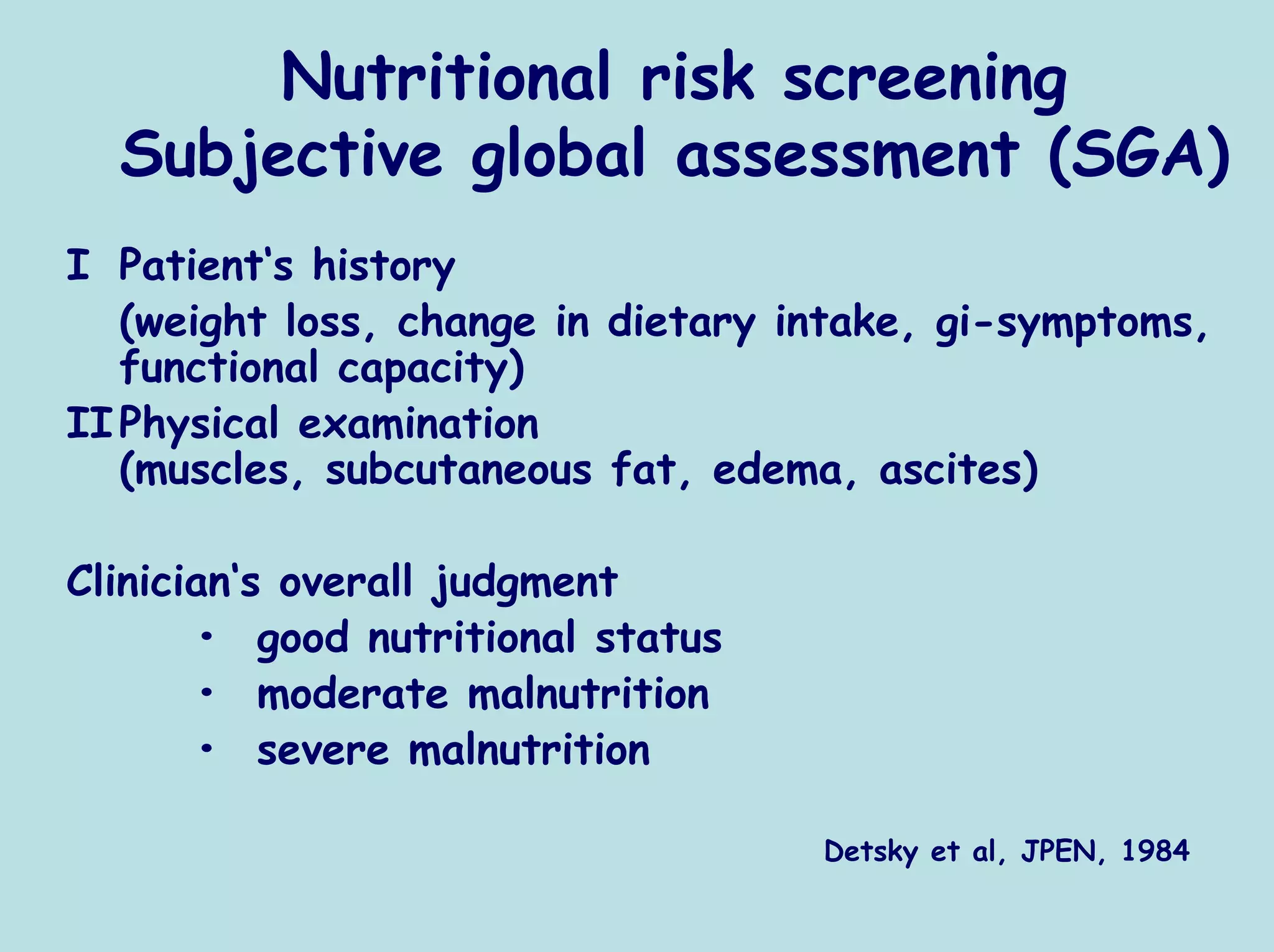
Nutritional risk screening
  Subjective global assessment (SGA)
I Patient‘s history
   (weight loss, change in dietary intake, gi-symptoms,
   functional capacity)
II Physical examination
   (muscles, subcutaneous fat, edema, ascites)

Clinician‘s overall judgment
       • good nutritional status
       • moderate malnutrition
       • severe malnutrition

                                    Detsky et al, JPEN, 1984
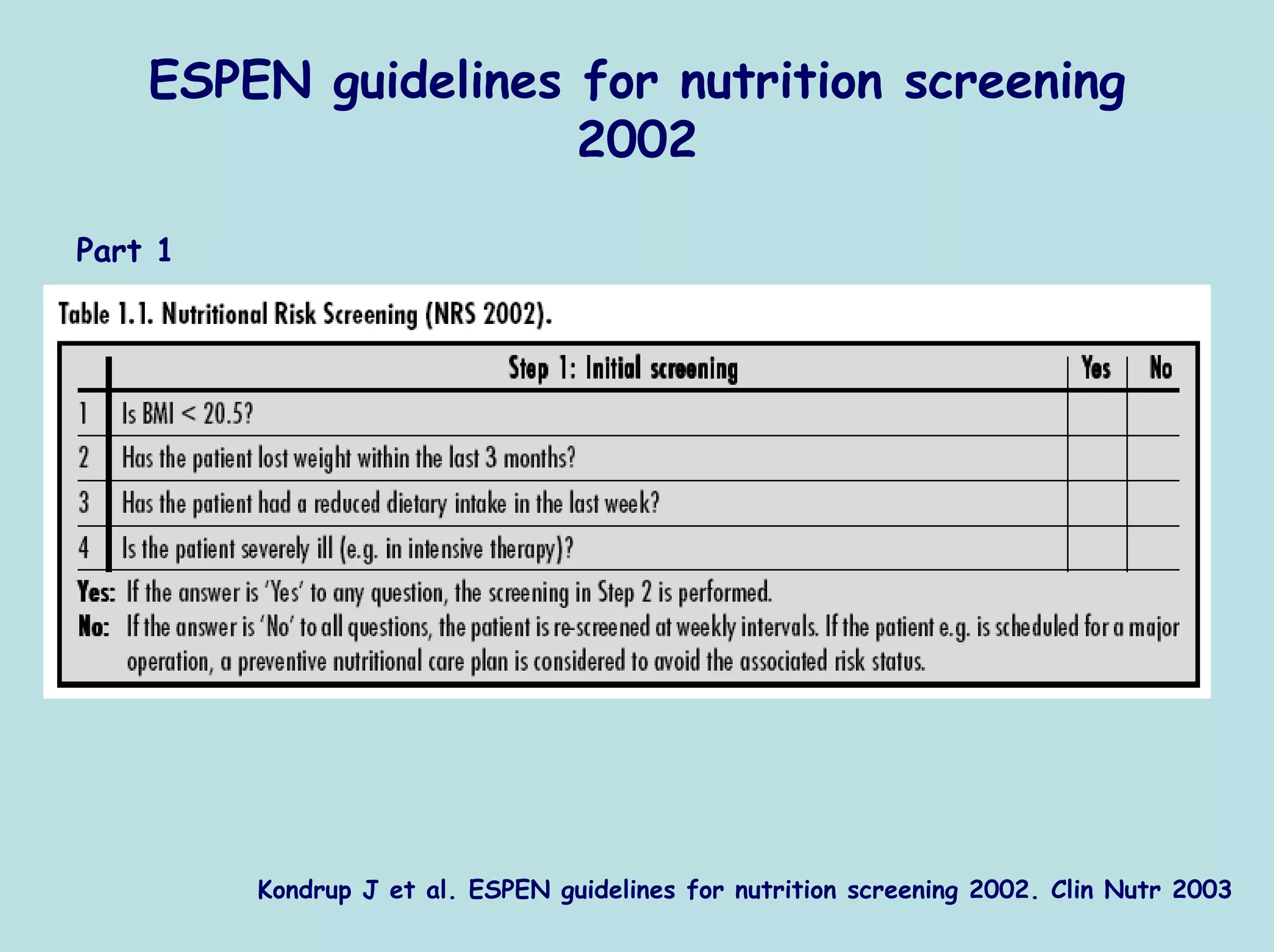
ESPEN guidelines for nutrition screening
                     2002

Part 1


         Kondrup J et al. ESPEN guidelines for nutrition screening 2002. Clin Nutr 2003
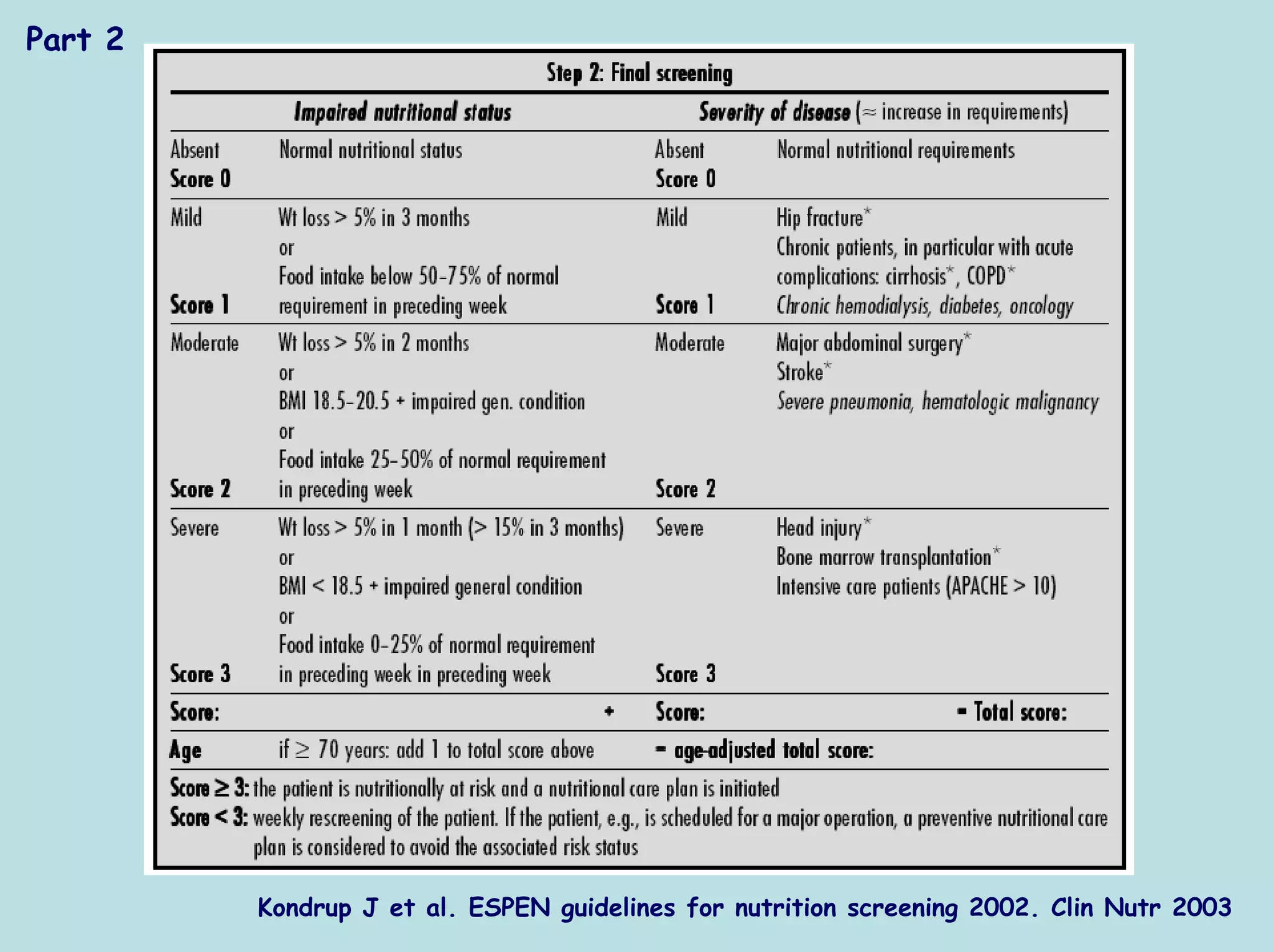
Part 2


         Kondrup J et al. ESPEN guidelines for nutrition screening 2002. Clin Nutr 2003
Nutritional Assessment

Is the actual measurement of
nutritional state and has to be done
in patients that are considered to be at
risk by the nutritional screening
                   or
when metabolic or functional problems
prevent a standard plan being carried out
Normal body composition
• Normal body cell mass (BCM) is the major
  determinant of an adequate nutritional state:
  – Living, actively metabolizing part of the body
  – Extra-cellular mass may increase
    disproportionately in malnutrition, disease,
    whereas fat free cell mass decreases
• Normal macronutrients, electrolytes,
  trace-elements, vitamins
• Normal organ sizes
What can be measured?

• Fat body mass
     Body fat percentage
      Fat distribution (visceral fat)
• Lean body mass
     Water: extra and intracellular
     Body cell mass
     Muscle mass
     Bone
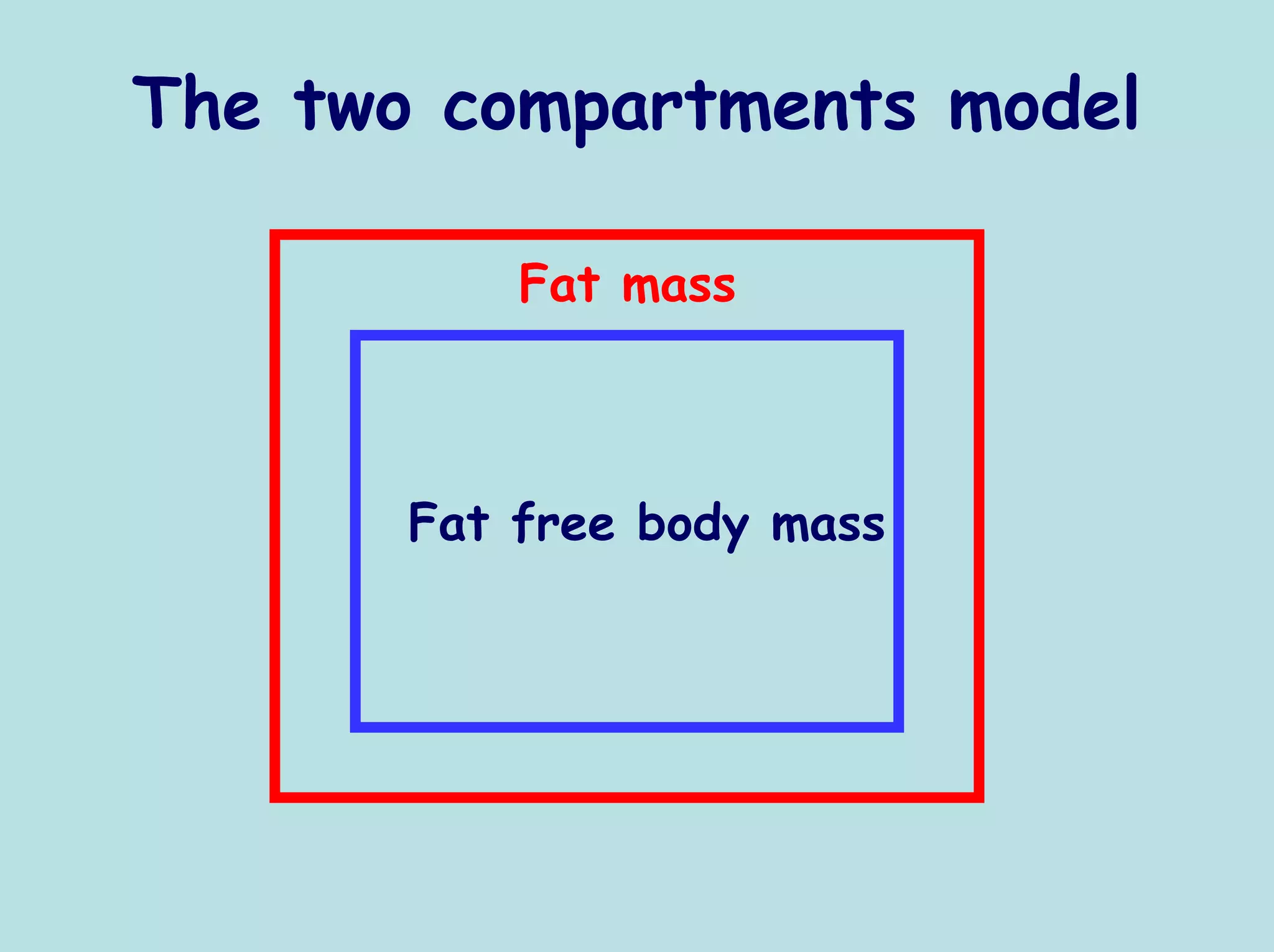
The two compartments model

           Fat mass


       Fat free body mass
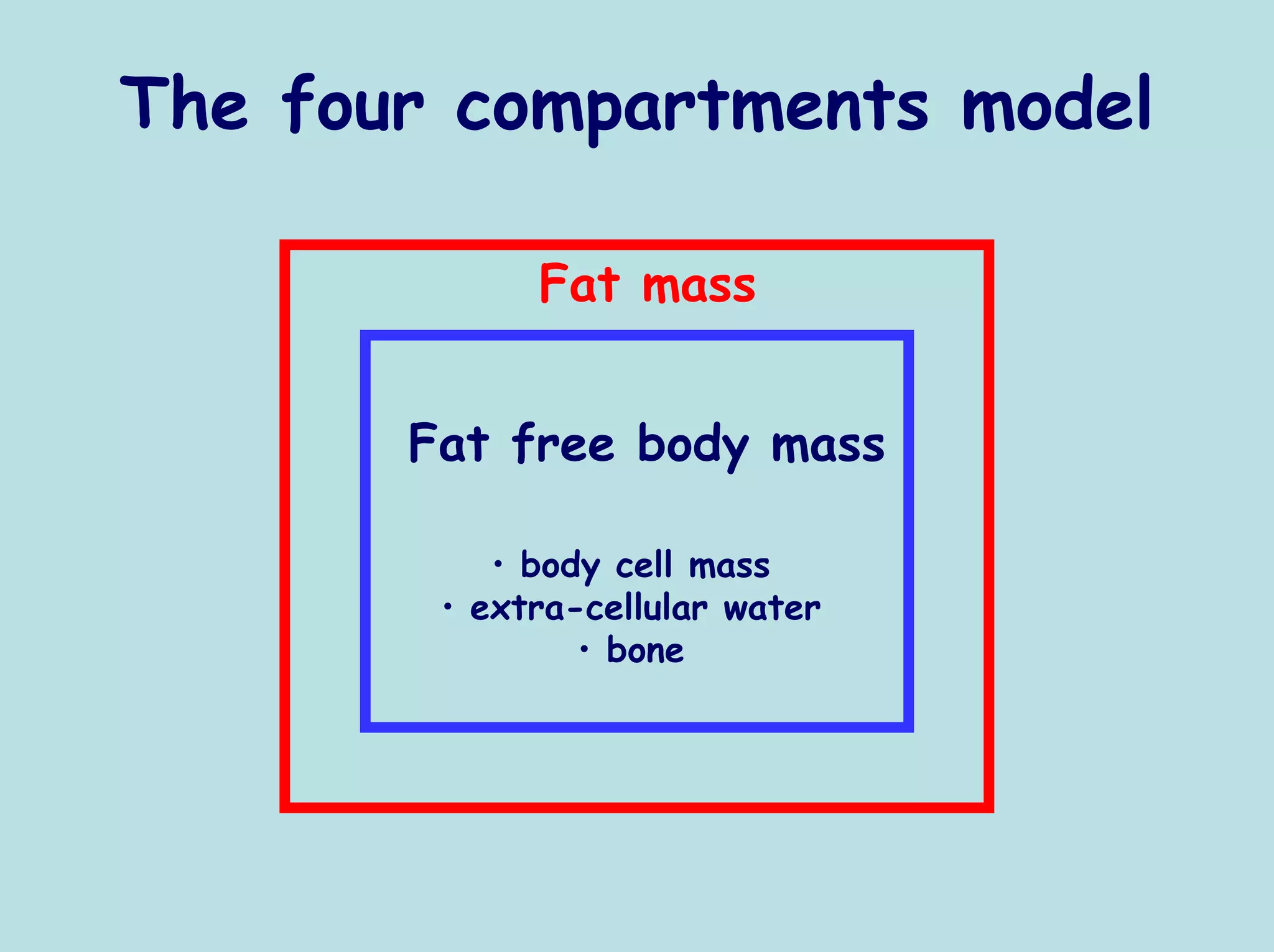
The four compartments model

             Fat mass


       Fat free body mass

           • body cell mass
        • extra-cellular water
                • bone
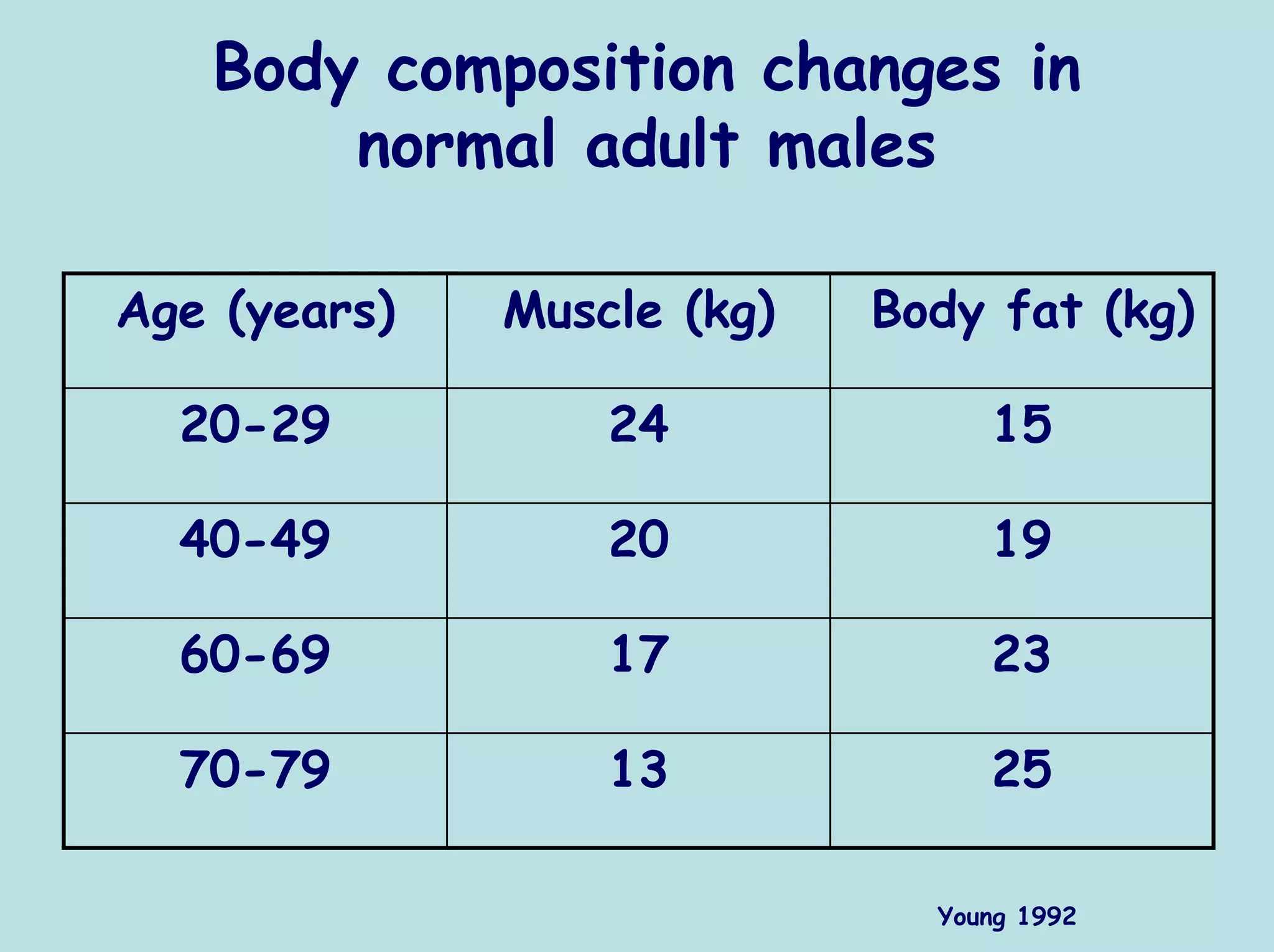
Body composition changes in
       normal adult males

Age (years)   Muscle (kg)   Body fat (kg)
  20-29           24             15

  40-49           20             19

  60-69           17             23

  70-79           13             25

                              Young 1992
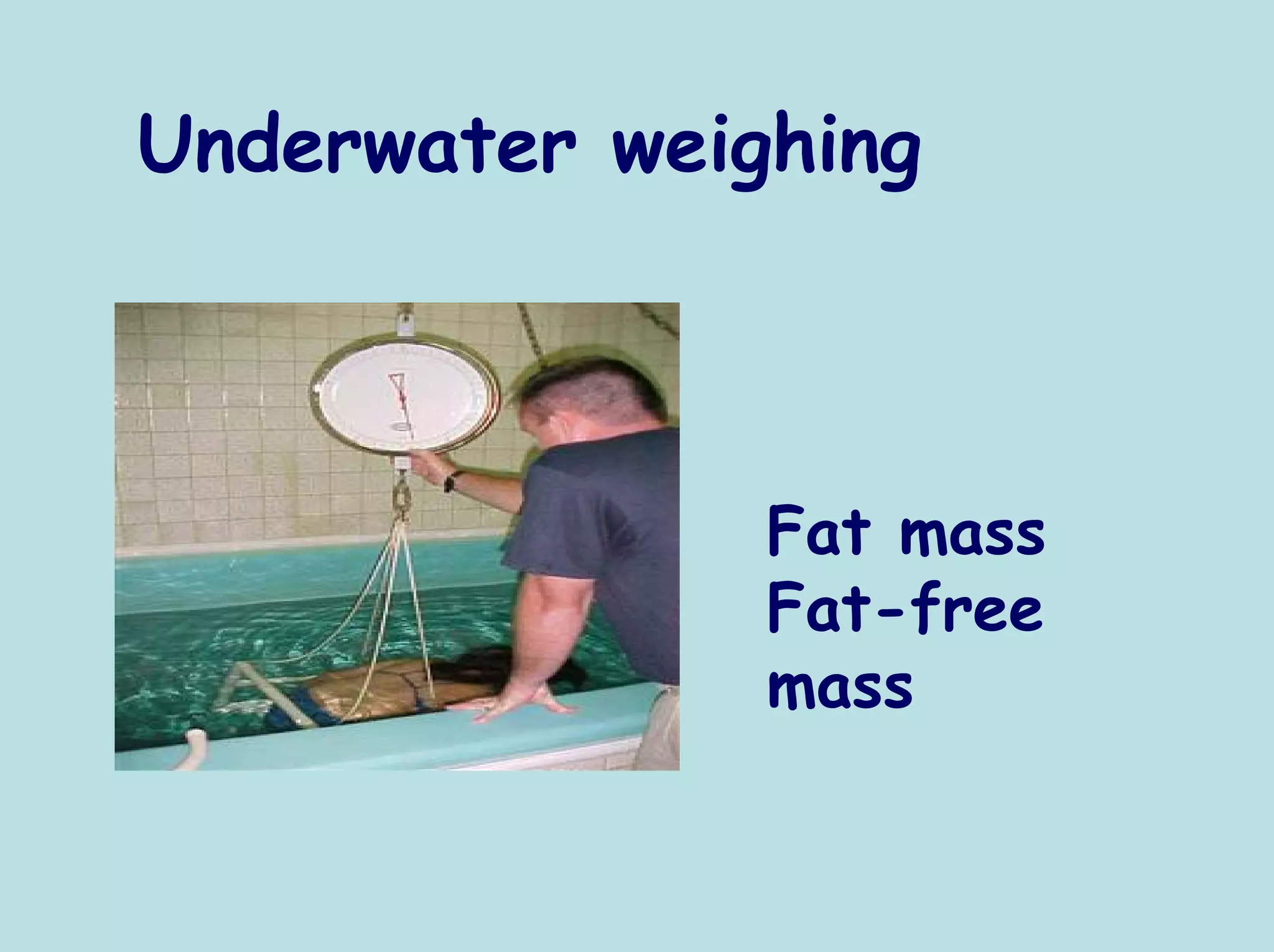
Underwater weighing


               Fat mass
               Fat-free
               mass
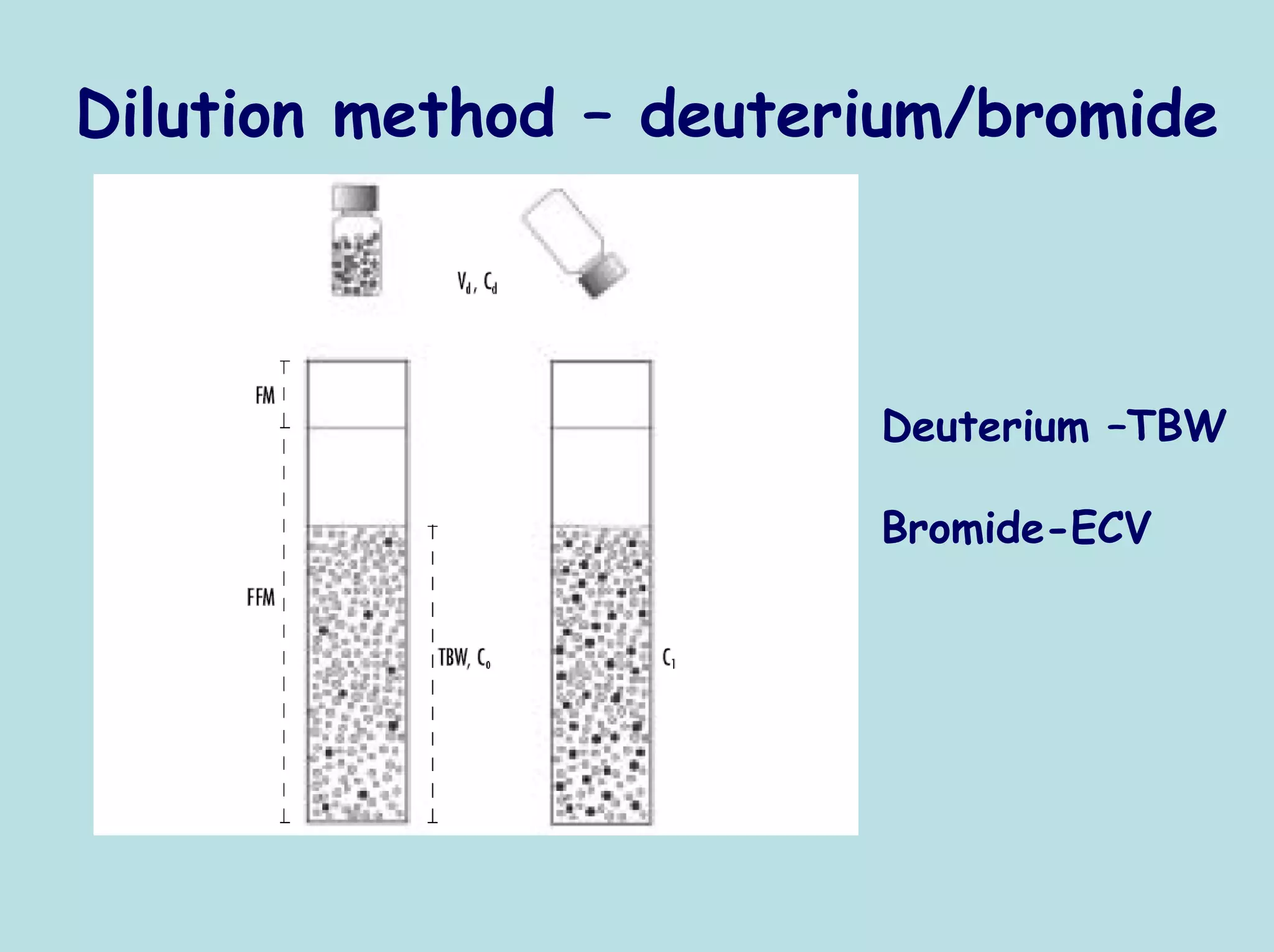
Dilution method – deuterium/bromide


                        Deuterium –TBW

                        Bromide-ECV
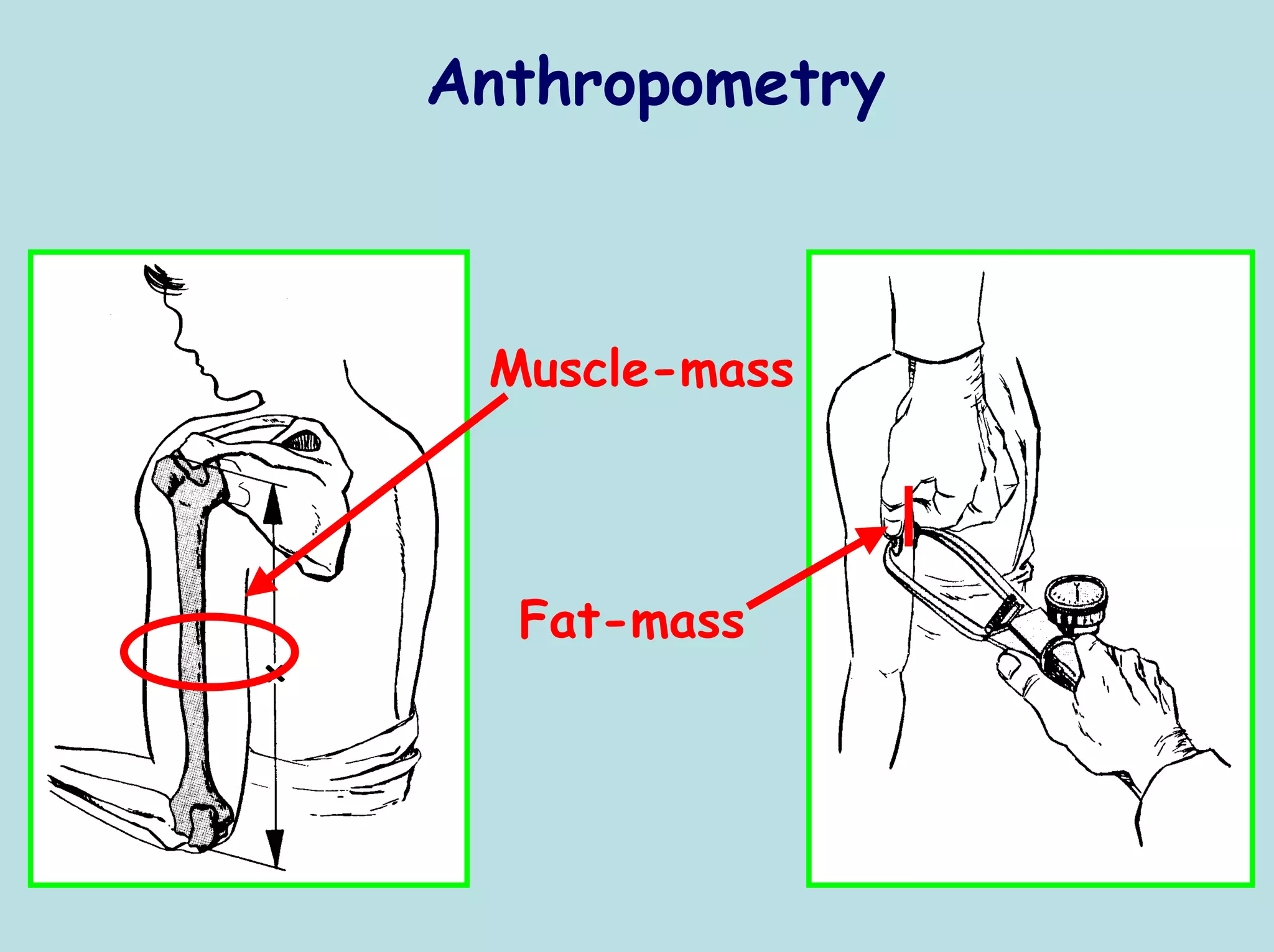
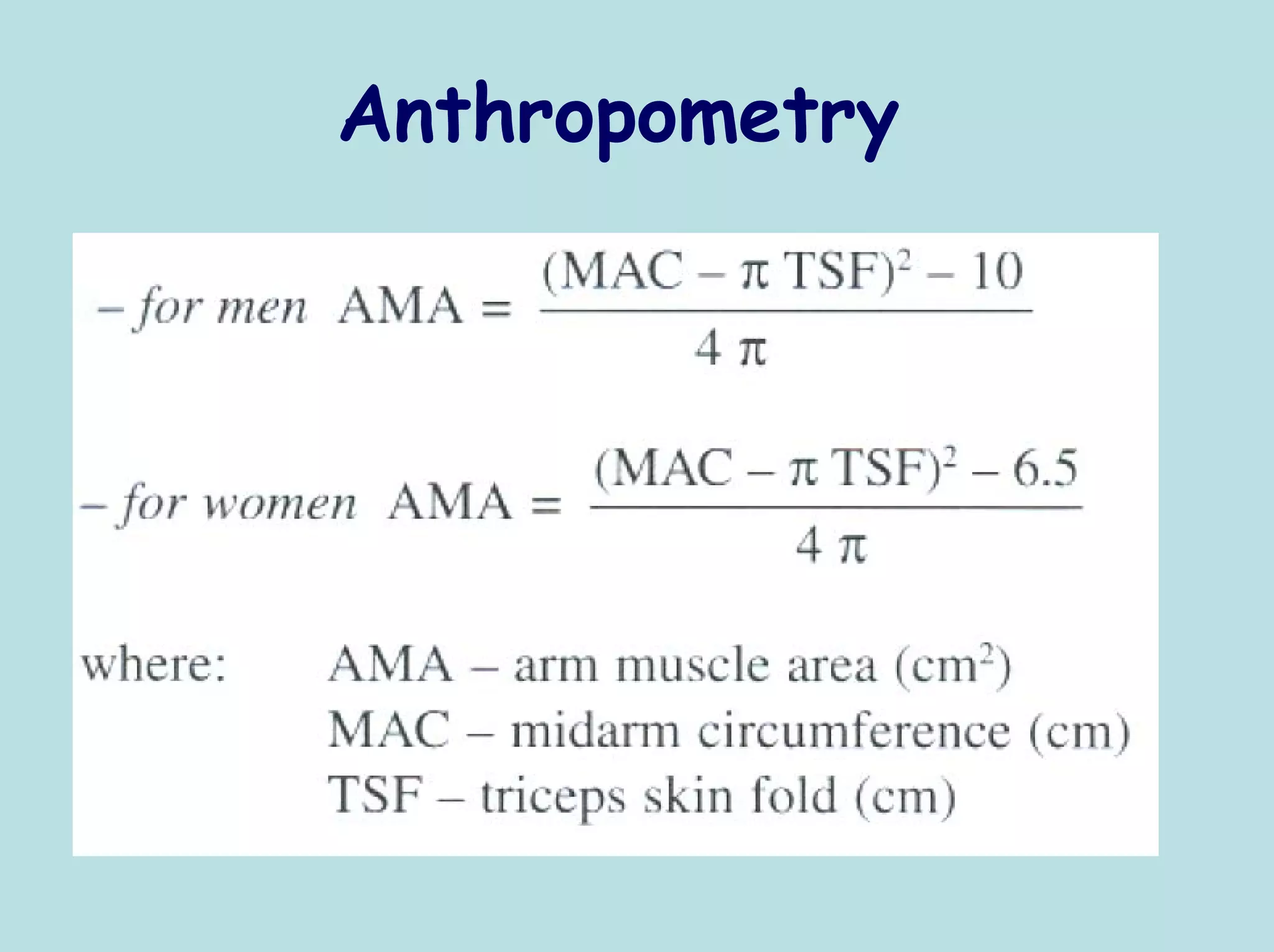
Anthropometry


 Muscle-mass


  Fat-mass
Anthropometry
Anthropometric measurement


• Validation only partially performed
• Large inter-individual variability
• Good intra-individual variability if
  the investigator is properly trained
Creatinine excretion in urine
• Creatinine excretion correlates with
  lean body mass and body weight
• 18-20 kg of muscle produce 1 g
  of creatinine
• Dietary protein sources contribute
  up to 20% of excreted creatinine
• Urinary creatinine excretion
  is proportional to skeletal muscle mass
  (stable renal function; no dialysis
  or hemofiltration)
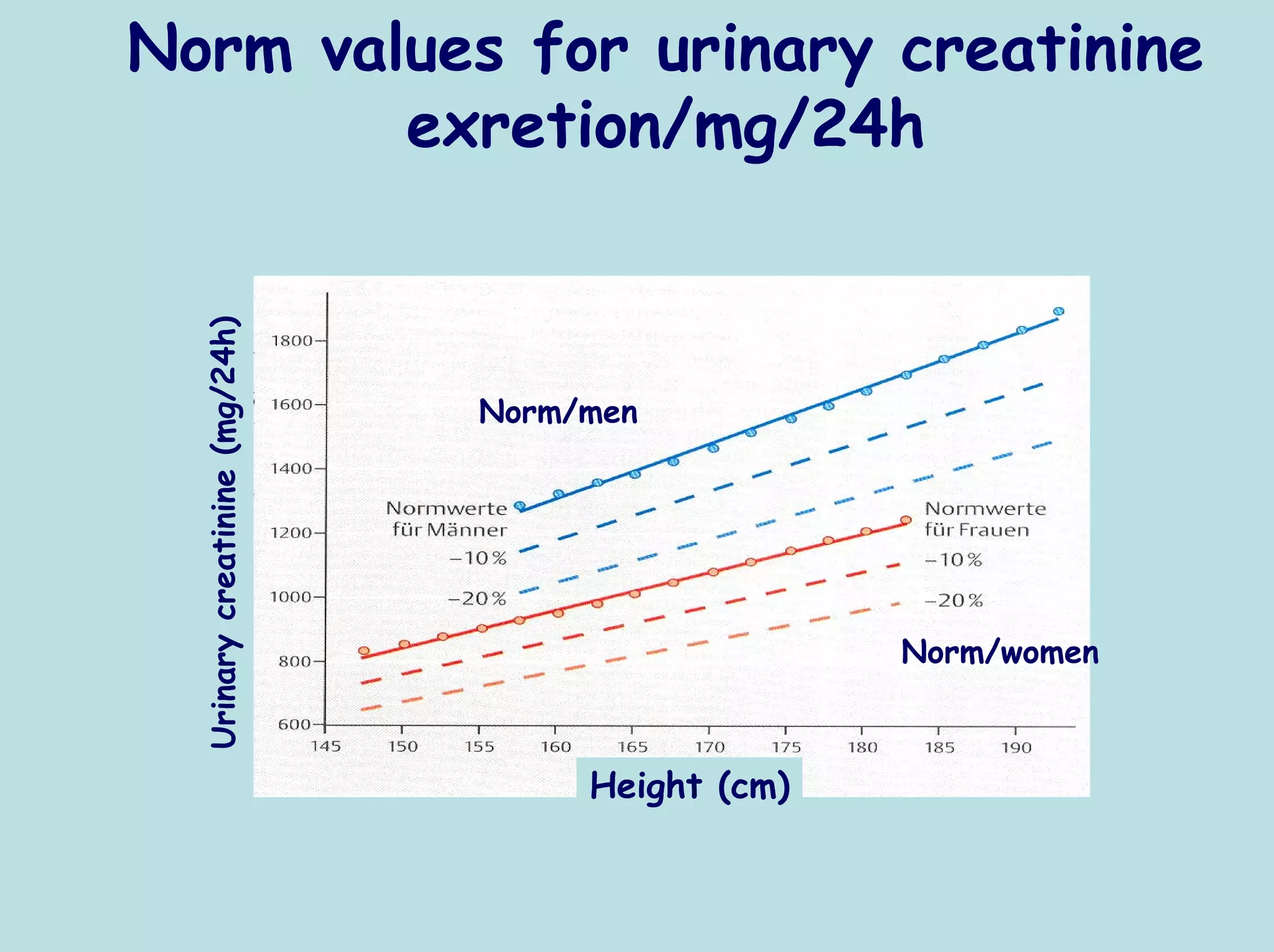
Norm values for urinary creatinine
        exretion/mg/24h

  Urinary creatinine (mg/24h)


                                Norm/men


                                                   Norm/women


                                     Height (cm)
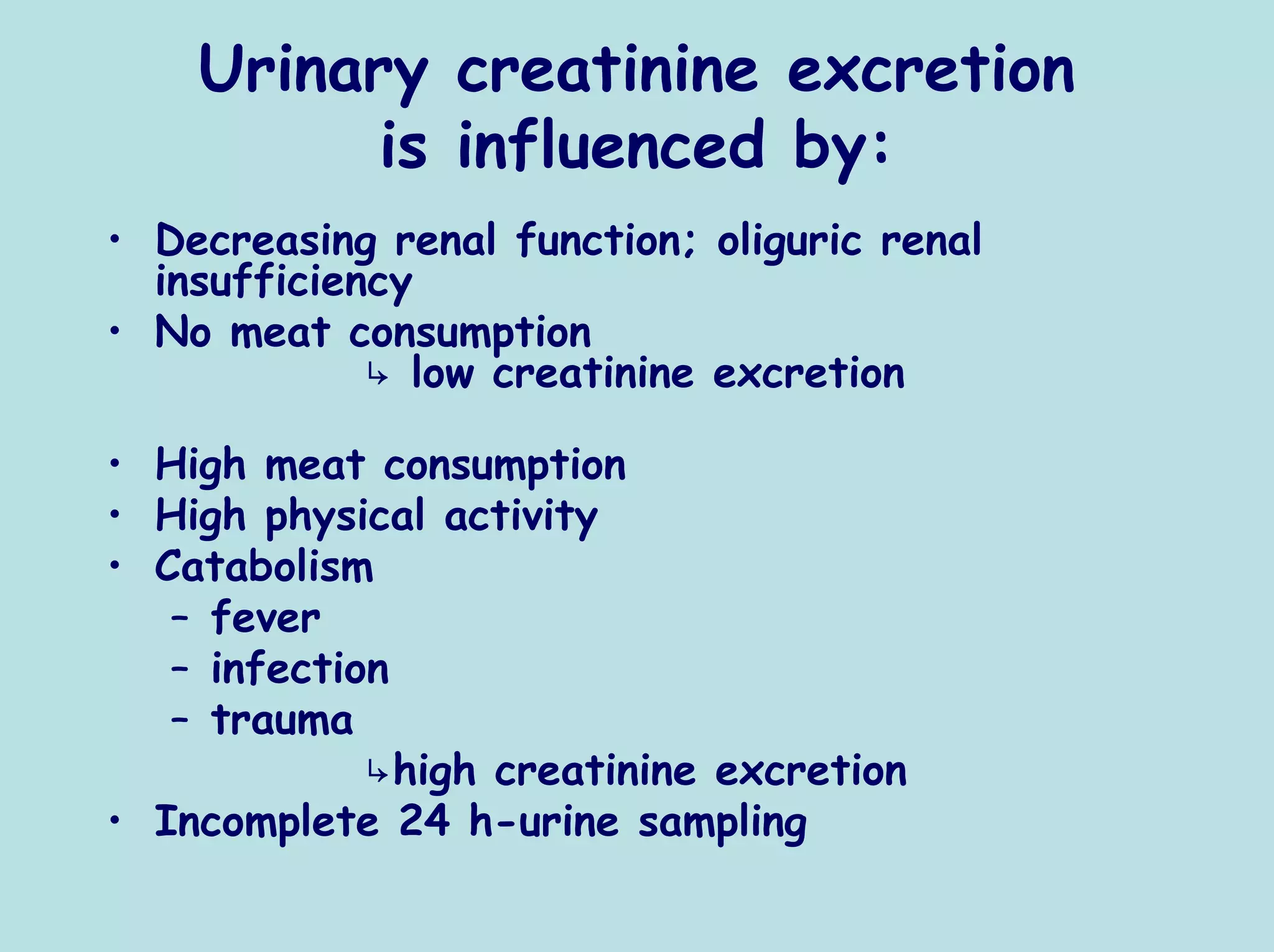
Urinary creatinine excretion
          is influenced by:
• Decreasing renal function; oliguric renal
  insufficiency
• No meat consumption
             ↳ low creatinine excretion

• High meat consumption
• High physical activity
• Catabolism
   – fever
   – infection
   – trauma
             ↳high creatinine excretion
• Incomplete 24 h-urine sampling
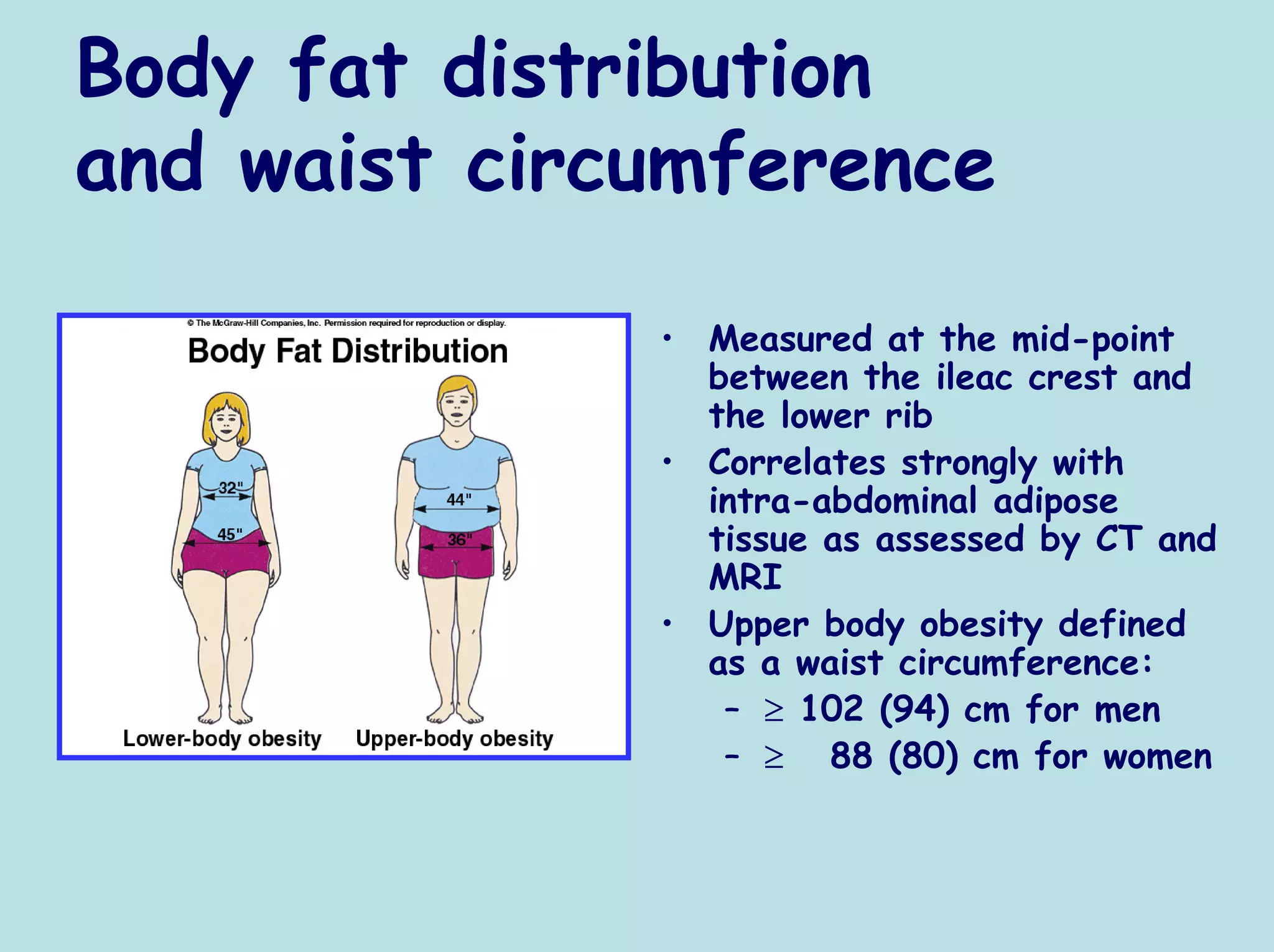
Body fat distribution
and waist circumference

              • Measured at the mid-point
                between the ileac crest and
                the lower rib
              • Correlates strongly with
                intra-abdominal adipose
                tissue as assessed by CT and
                MRI
              • Upper body obesity defined
                as a waist circumference:
                 – ≥ 102 (94) cm for men
                 – ≥ 88 (80) cm for women
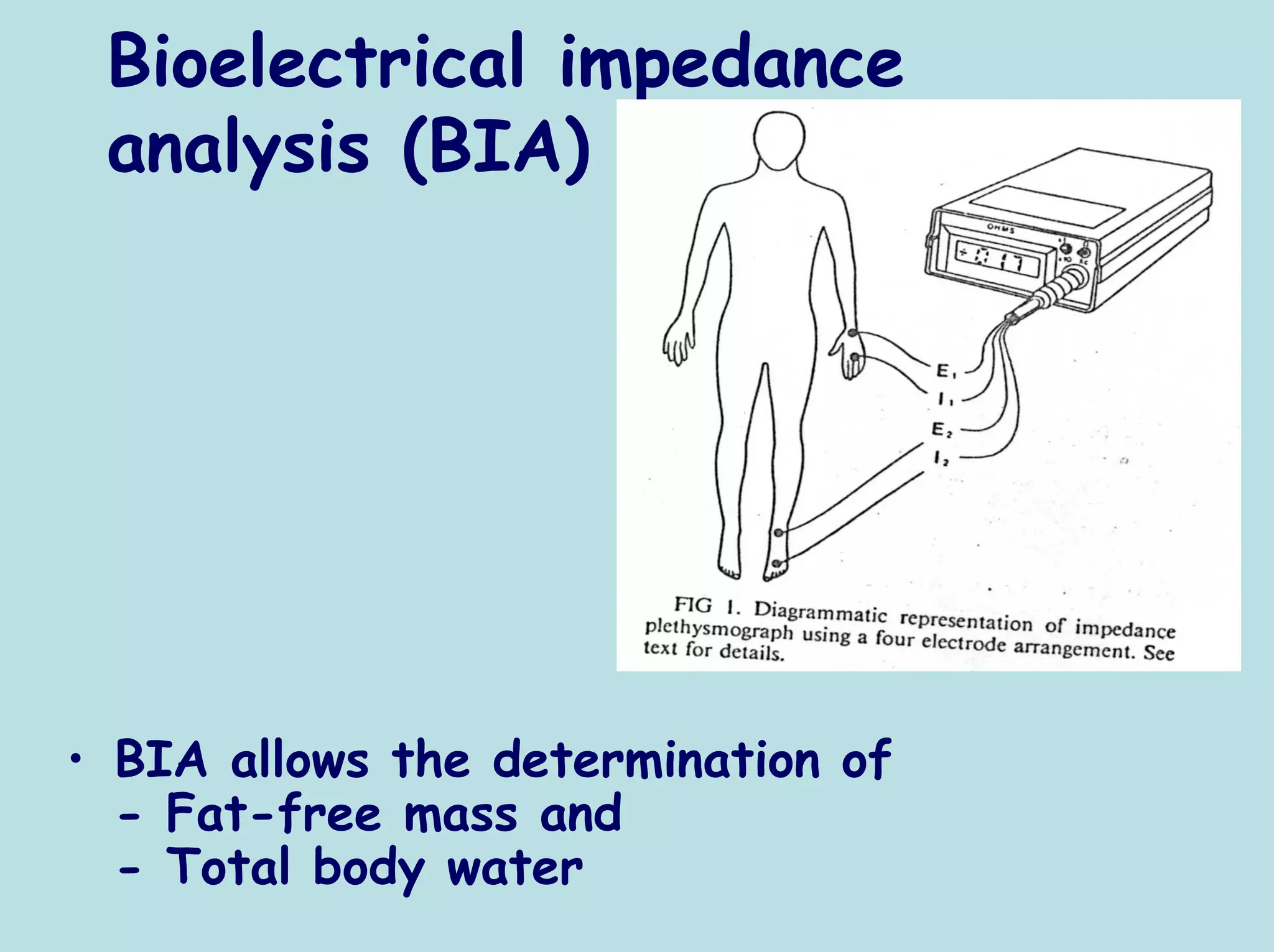
Bioelectrical impedance
 analysis (BIA)


• BIA allows the determination of
  - Fat-free mass and
  - Total body water
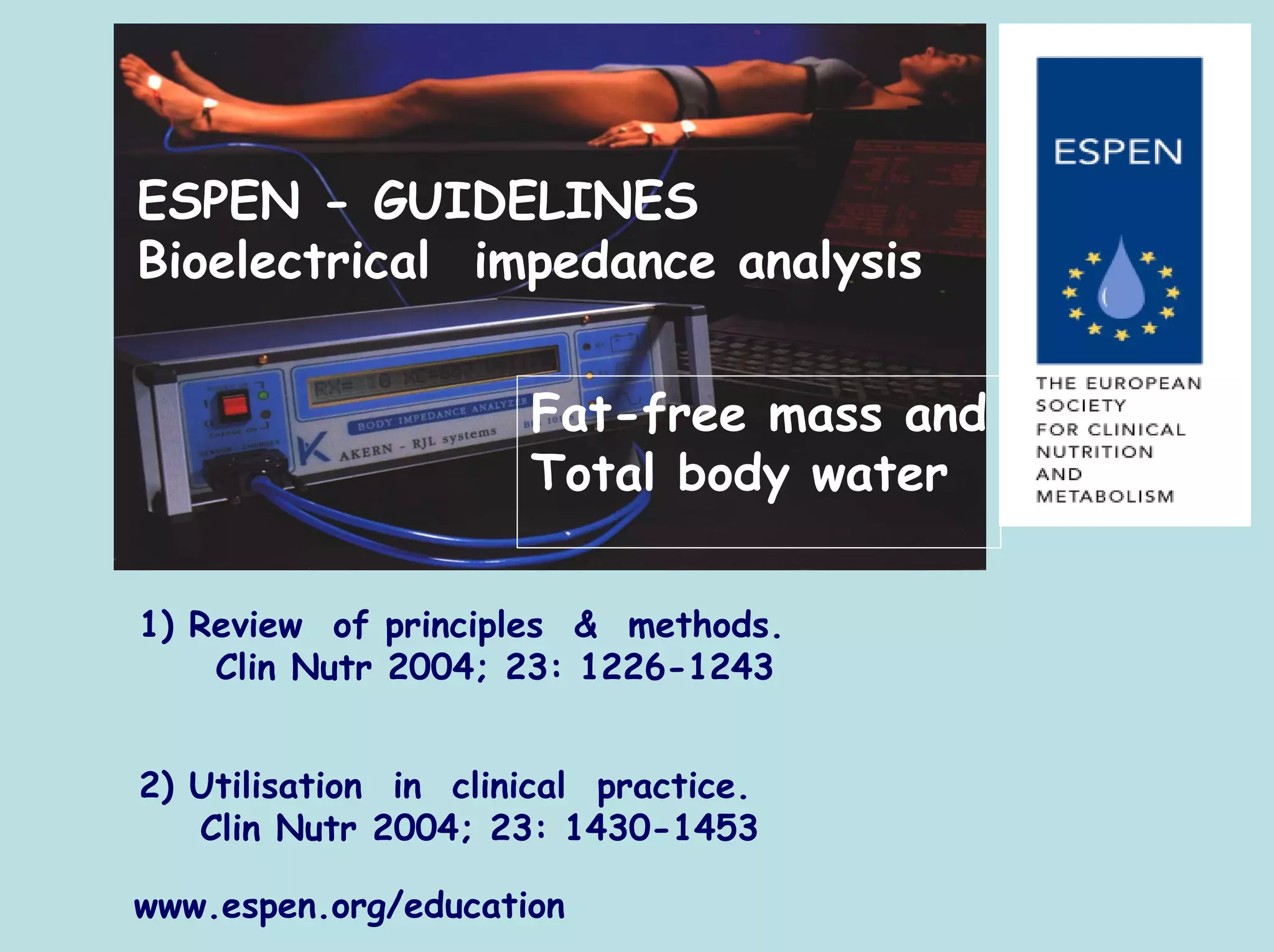
ESPEN - GUIDELINES
Bioelectrical impedance analysis


                      Fat-free mass and
                      Total body water

1) Review of principles & methods.
    Clin Nutr 2004; 23: 1226-1243


2) Utilisation in clinical practice.
   Clin Nutr 2004; 23: 1430-1453

www.espen.org/education
Bioelectrical impedance
           analysis (BIA)
• BIA allows the determination of
  - FFM on the basis of TBW measurement

• in subjects without significant fluid and
  electrolyte abnormalities when using appropriate
  equations (age, sex, race)

• BIA in subjects at extremes of BMI ranges
  (16-34 kg/m2) or with abnormal hydration
  status is not reliable

• Disease almost always includes inflammatory
  activity (ICW/ECW ratio decreases; TBW
  increases; BIA unreliable)
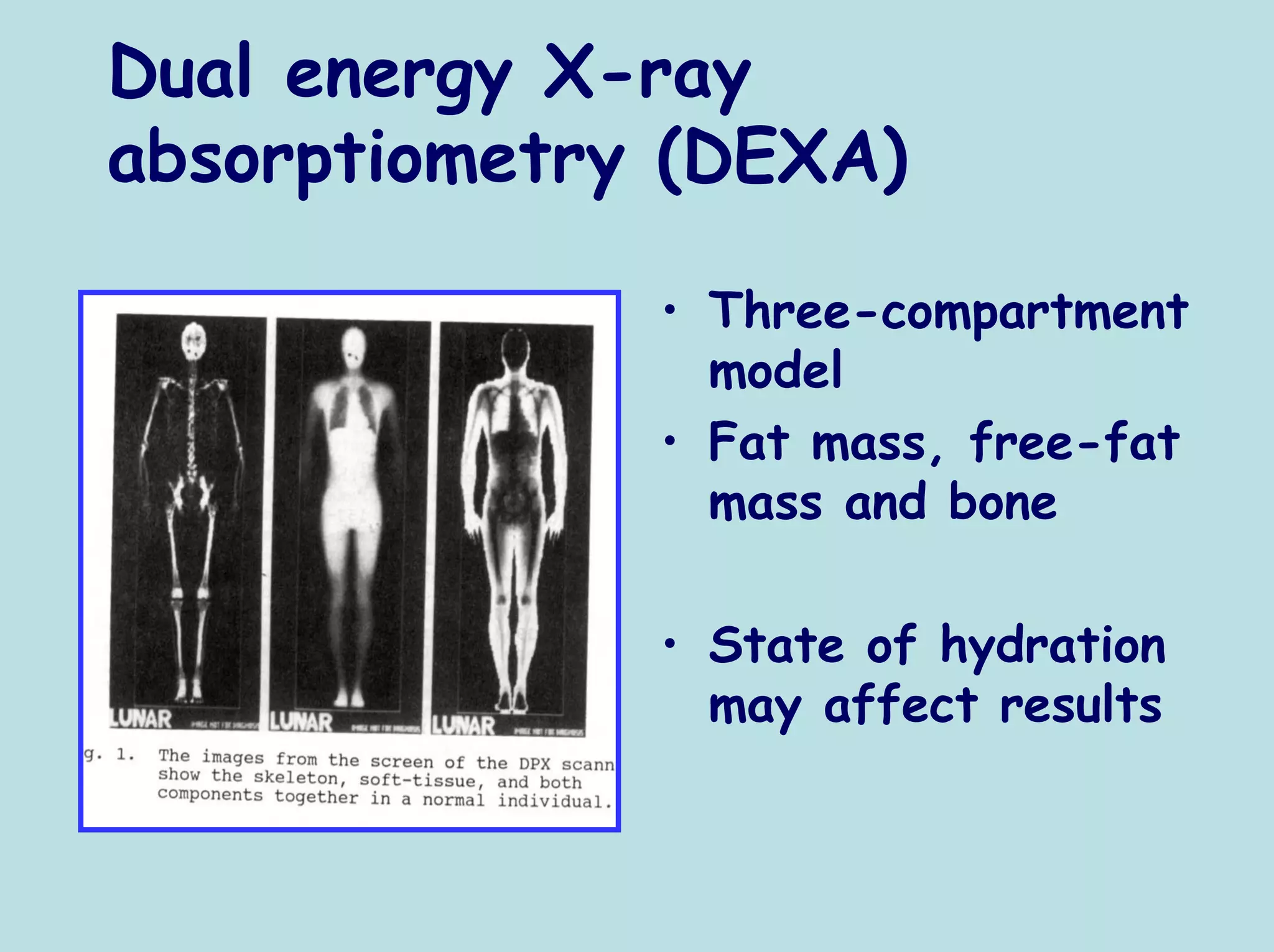
Dual energy X-ray
absorptiometry (DEXA)

              • Three-compartment
                model
              • Fat mass, free-fat
                mass and bone

              • State of hydration
                may affect results
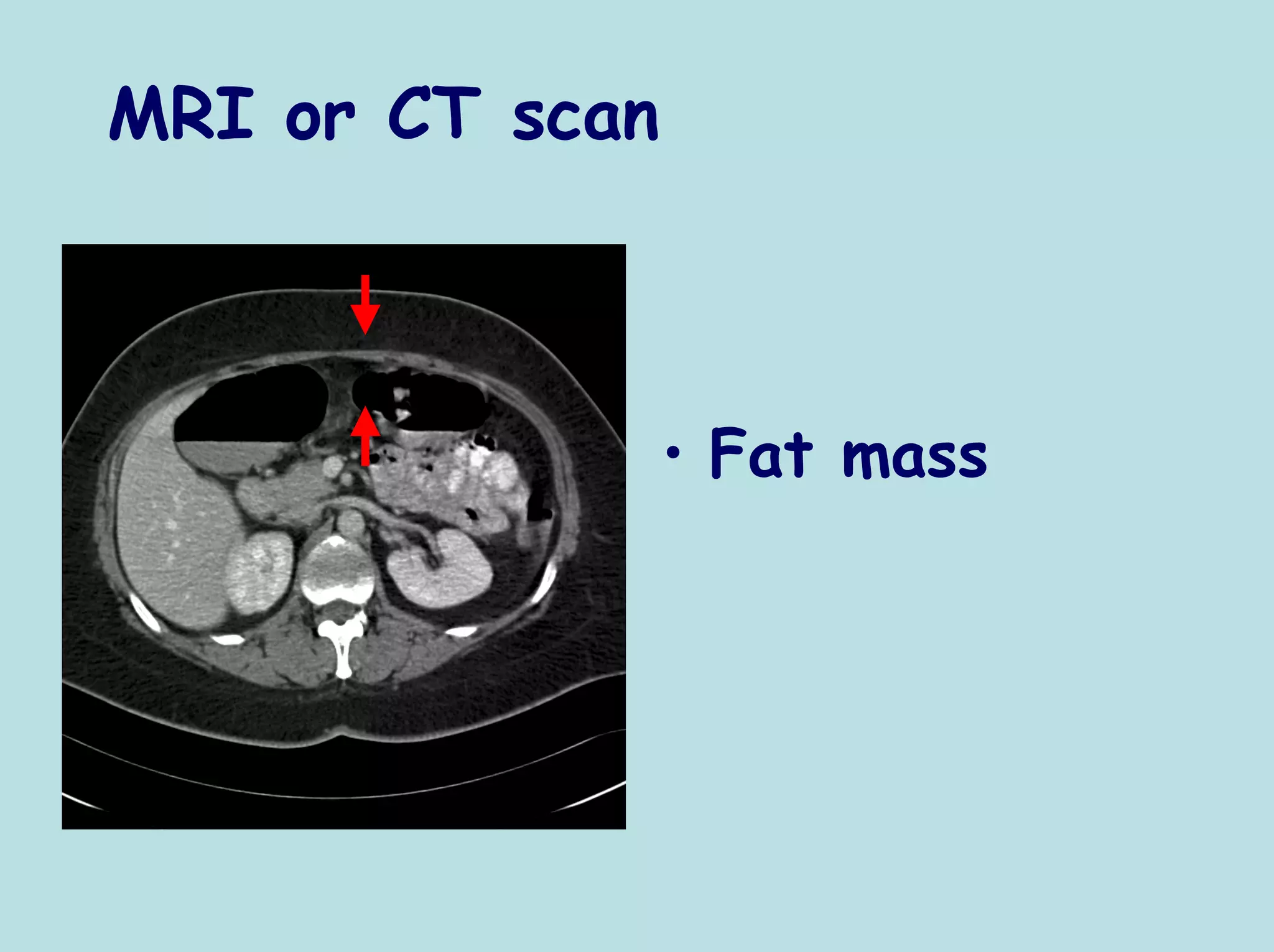
MRI or CT scan


                 • Fat mass
Creatinine excretion in urine
• Creatinine excretion correlates with
  lean body mass and body weight
• 18-20 kg of muscle produce 1 g of
  creatinine
• Dietary protein sources contribute up
  to 20% of excreted creatinine
• Urinary creatinine excretion is
  proportional to skeletal muscle mass
  (stable renal function; no dialysis or
  hemofiltration)
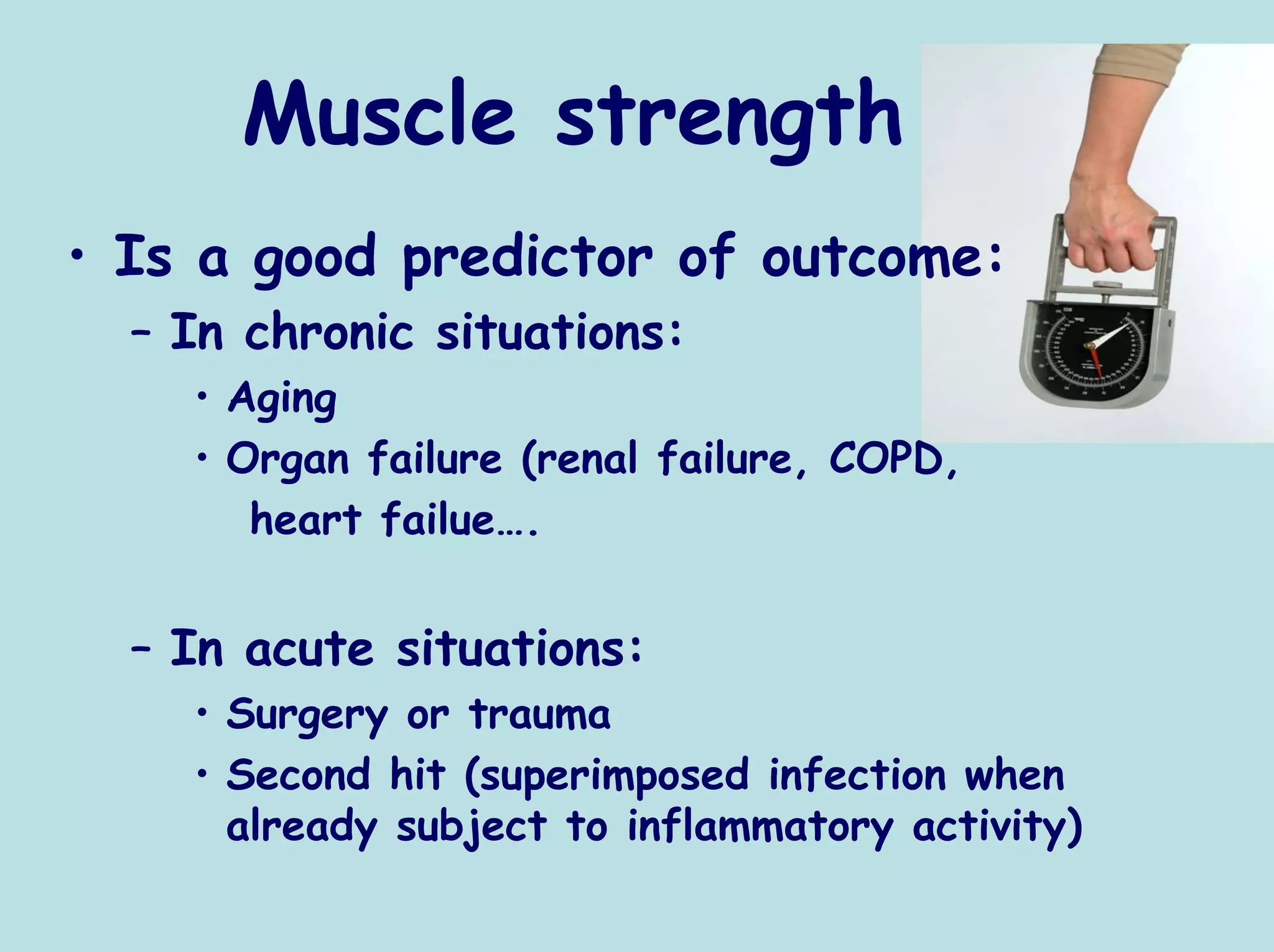
Muscle strength
Muscle strength
• Is a good predictor of outcome:
  – In chronic situations:
    • Aging
    • Organ failure (renal failure, COPD,
       heart failue….


  – In acute situations:
    • Surgery or trauma
    • Second hit (superimposed infection when
      already subject to inflammatory activity)
Summary
Practical methods for
 measuring: Fat mass

• Subcutaneous
   skin folds measurements
• DEXA
• MRI, CT scan
• BIA
Summary
  Practical methods for
measuring: Fat-free mass

 • DEXA
 • BIA
 • (Underwater weighing)
Summary
      Practical methods for
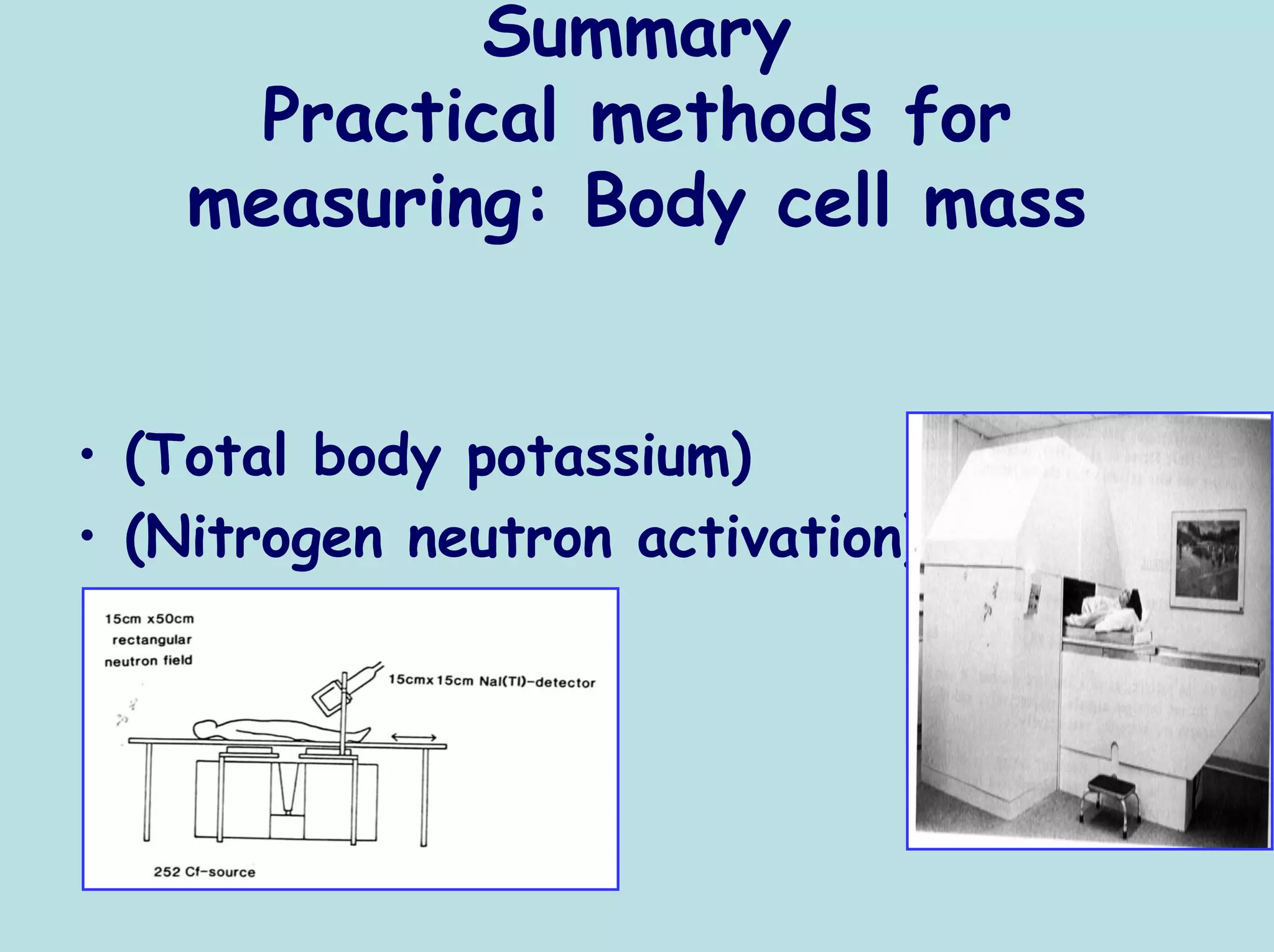
    measuring: Body cell mass


• (Total body potassium)
• (Nitrogen neutron activation)
Summary
 Practical methods for
measuring: Muscle mass

• Mid-arm circumference
• Creatinine height index
• Urinary 3-Methylhistidine
Summary
Practical methods for
measuring: Body-water
 • Total body water
   (- Isotopic labeling of water)
   - BIA
 • Extracellular water
   (- Bromide space)
Summary
Practical methods for measuring:
           Bone mass


  • DEXA
  • Total body calcium-measured
     by isotopes methods
Inflammatory and disease
         activity
Disease always includes inflammatory
activity
• Clinical evaluation
  - Pre-existing inflammation or disease
• Plasma Albumin levels
  - Already significant when ≤ 35 g/L
• Cytokine levels (TNF-α, IL 6, ...)
• CRP
  - Very volatile, is a rough correlations, but not
    suitable for the individual patient
Serum proteins


• Albumin              (T½):      20 days
• Transferrin           (T½):     8-10 days
• Transthyretin        (T½):      2-3 days
   (Prealbumin)
• Retinol-binding protein (T½):   ∼ 12 h
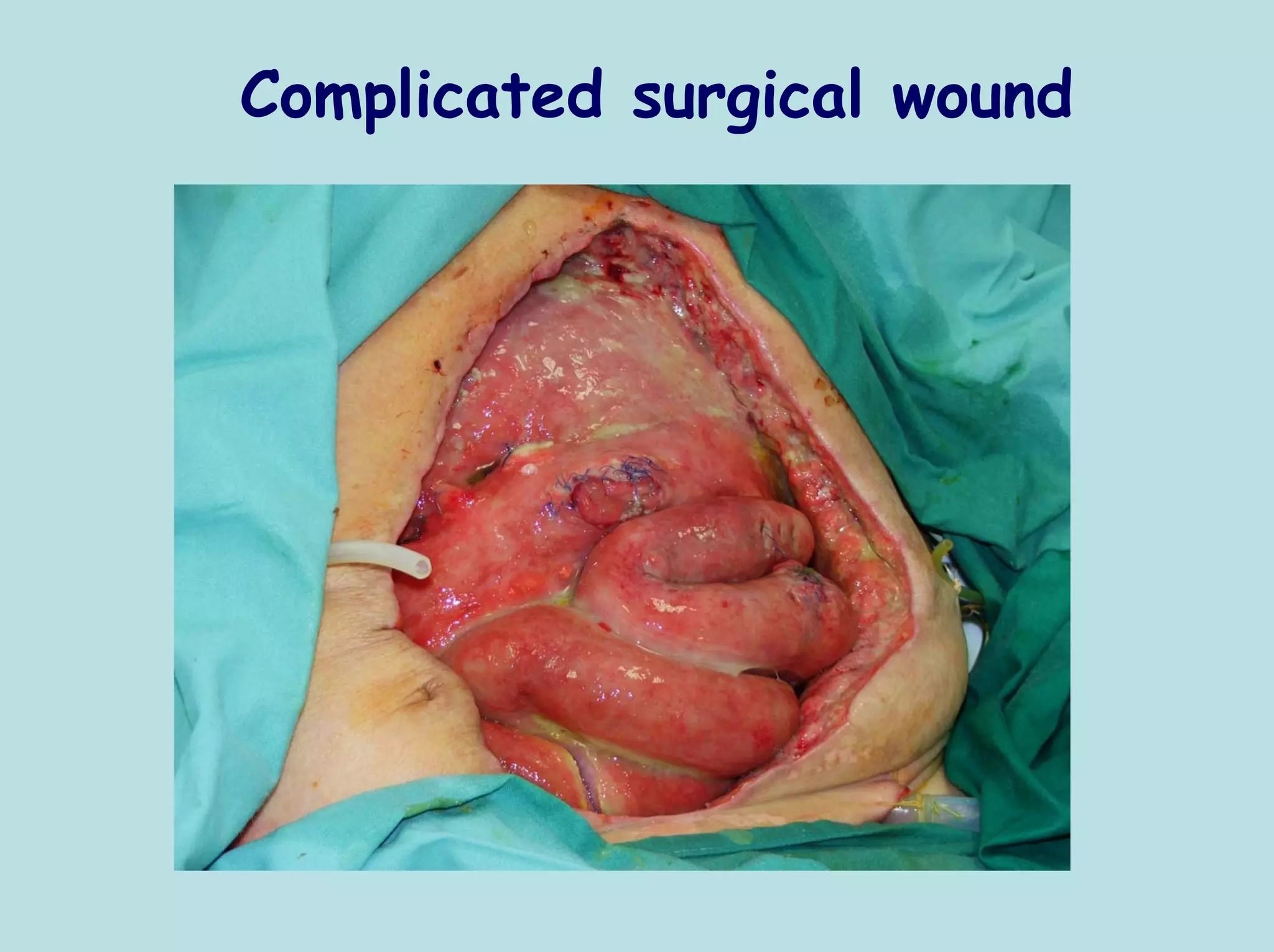
Wound healing is dependent of
       endogenous substrates
  Undernutrition

                       poor wound healing
                       (dehiscence, infections)


Loss body cell mass


 Deficit endogenous
substrates for wound
      healing.
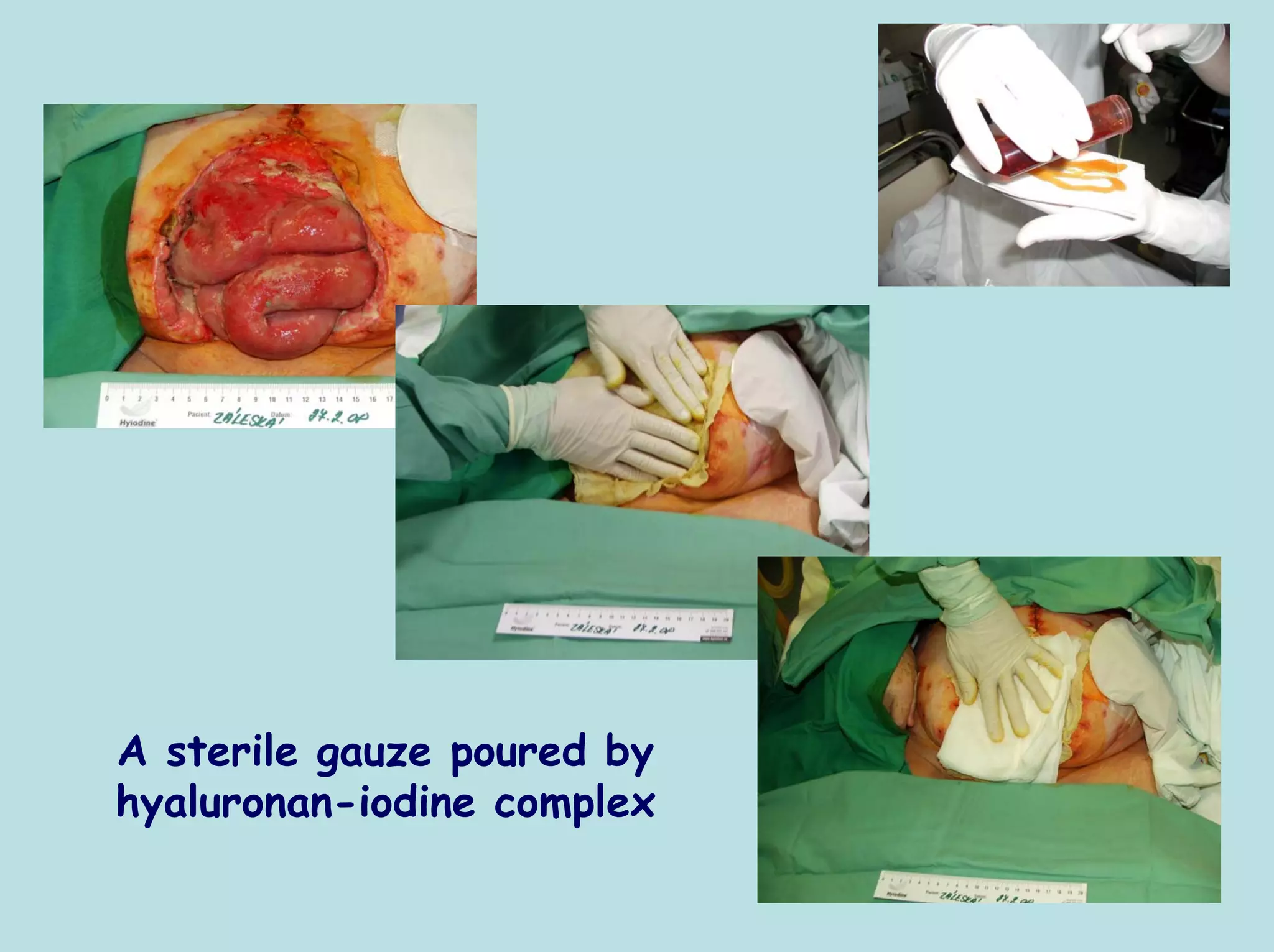
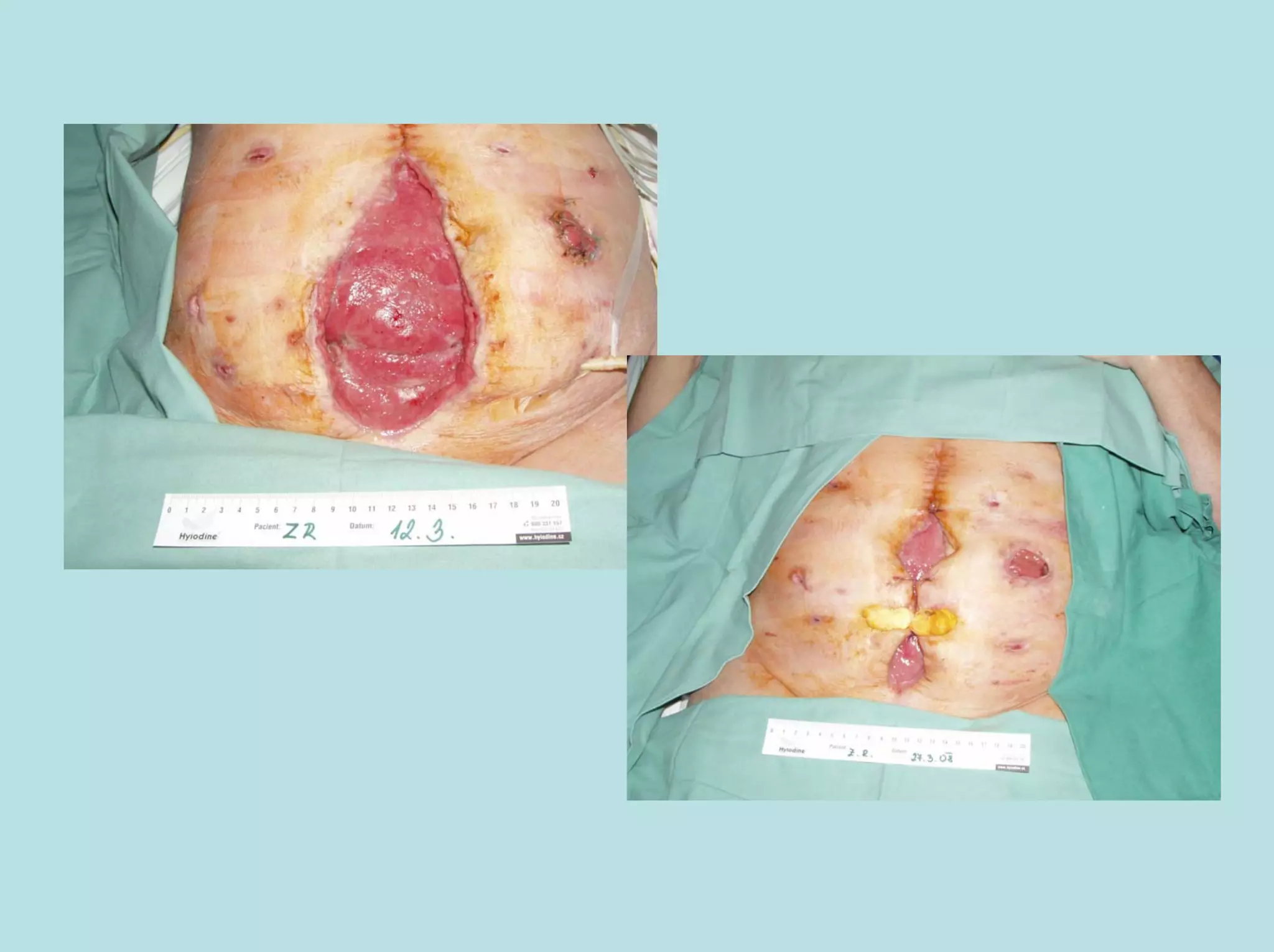
Complicated surgical wound
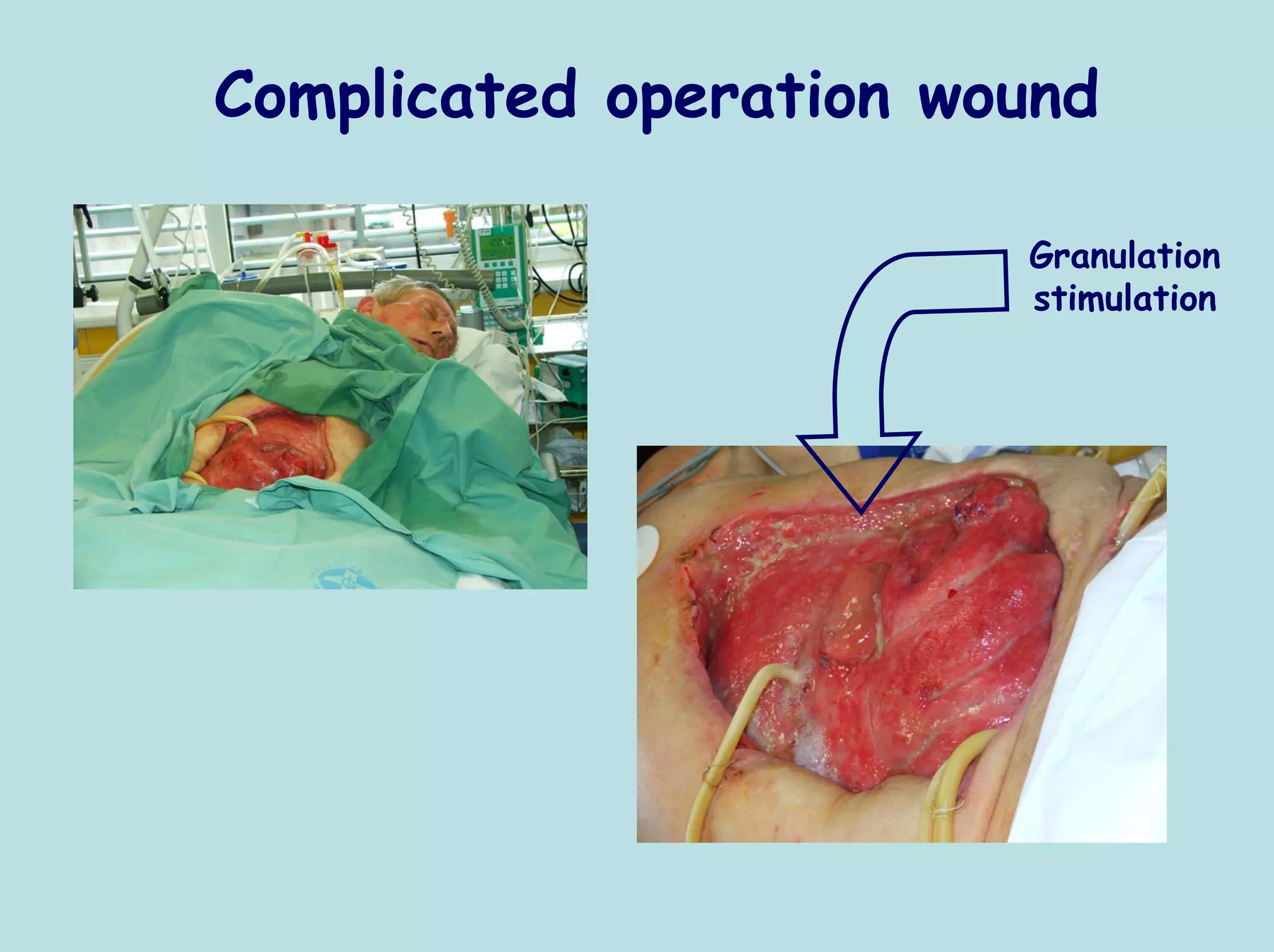
Complicated operation wound

                        Granulation
                        stimulation
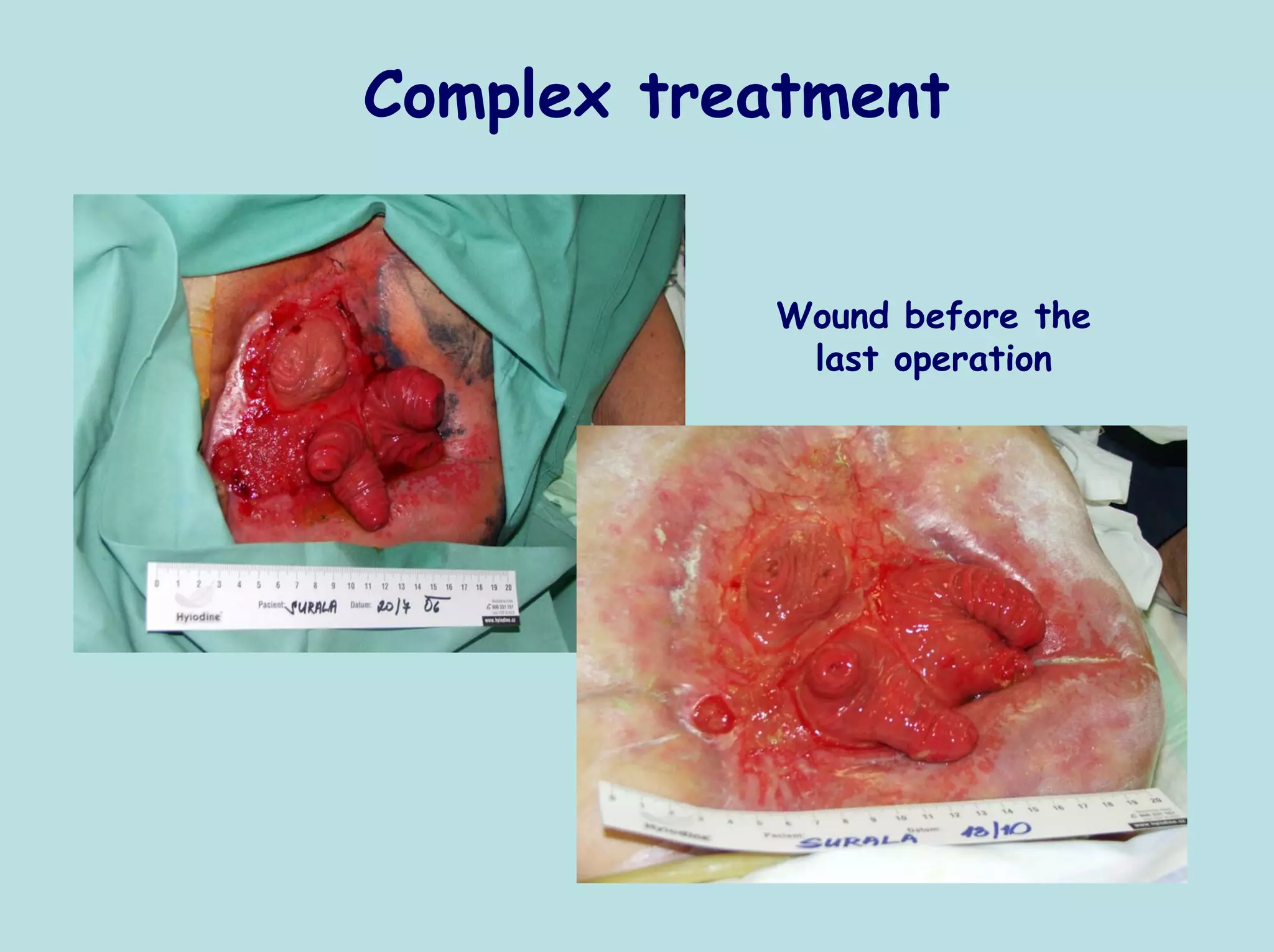
Complex treatment


           Wound before the
            last operation
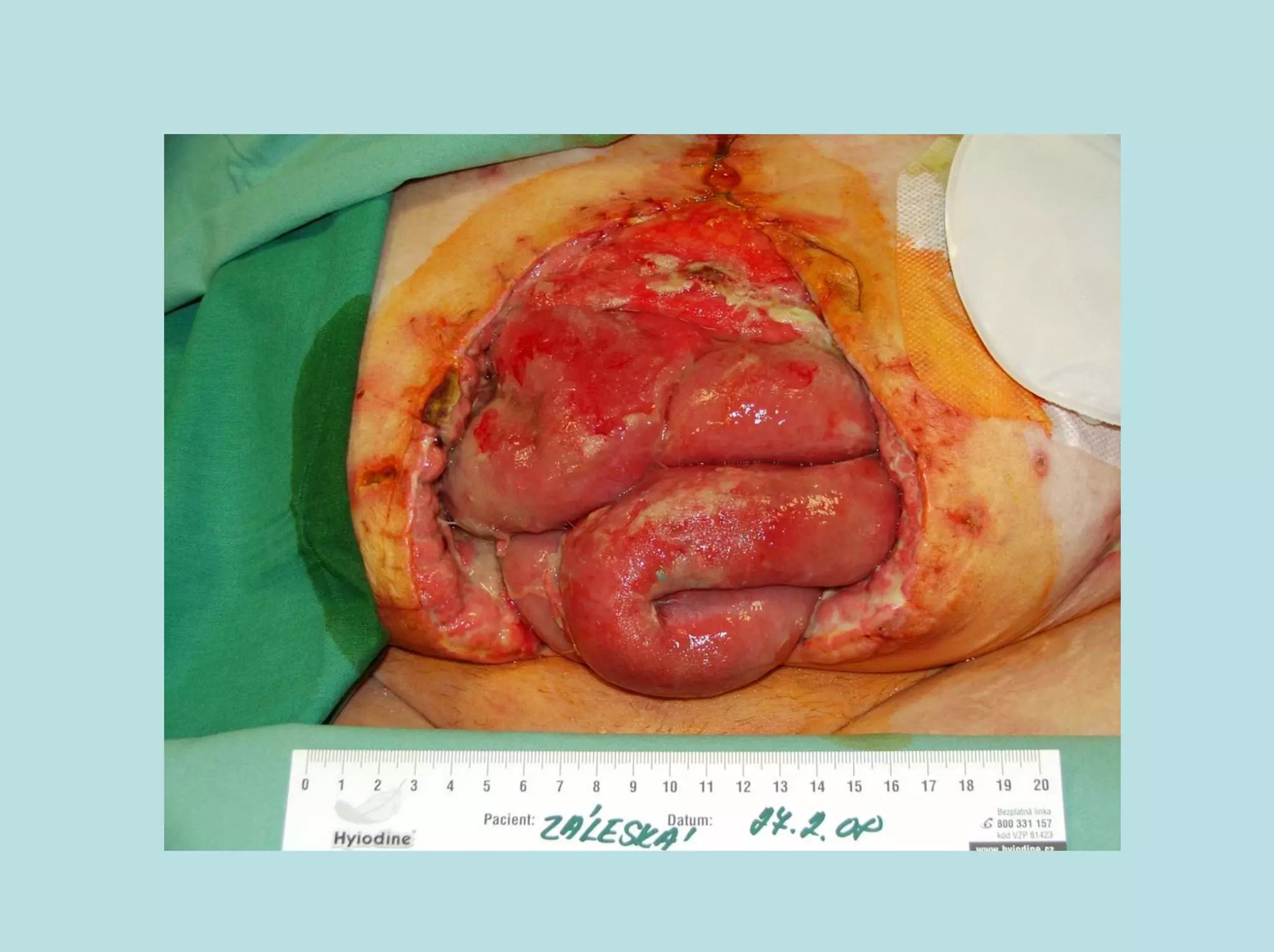
A sterile gauze poured by
hyaluronan-iodine complex
Infectious complications
      and albumin


                  Kudsk et al, JPEN 2003
How to measure food intake


• Bomb calorimetry of food before and after
  meal (double plate method)
• Weighing of food before and after meal
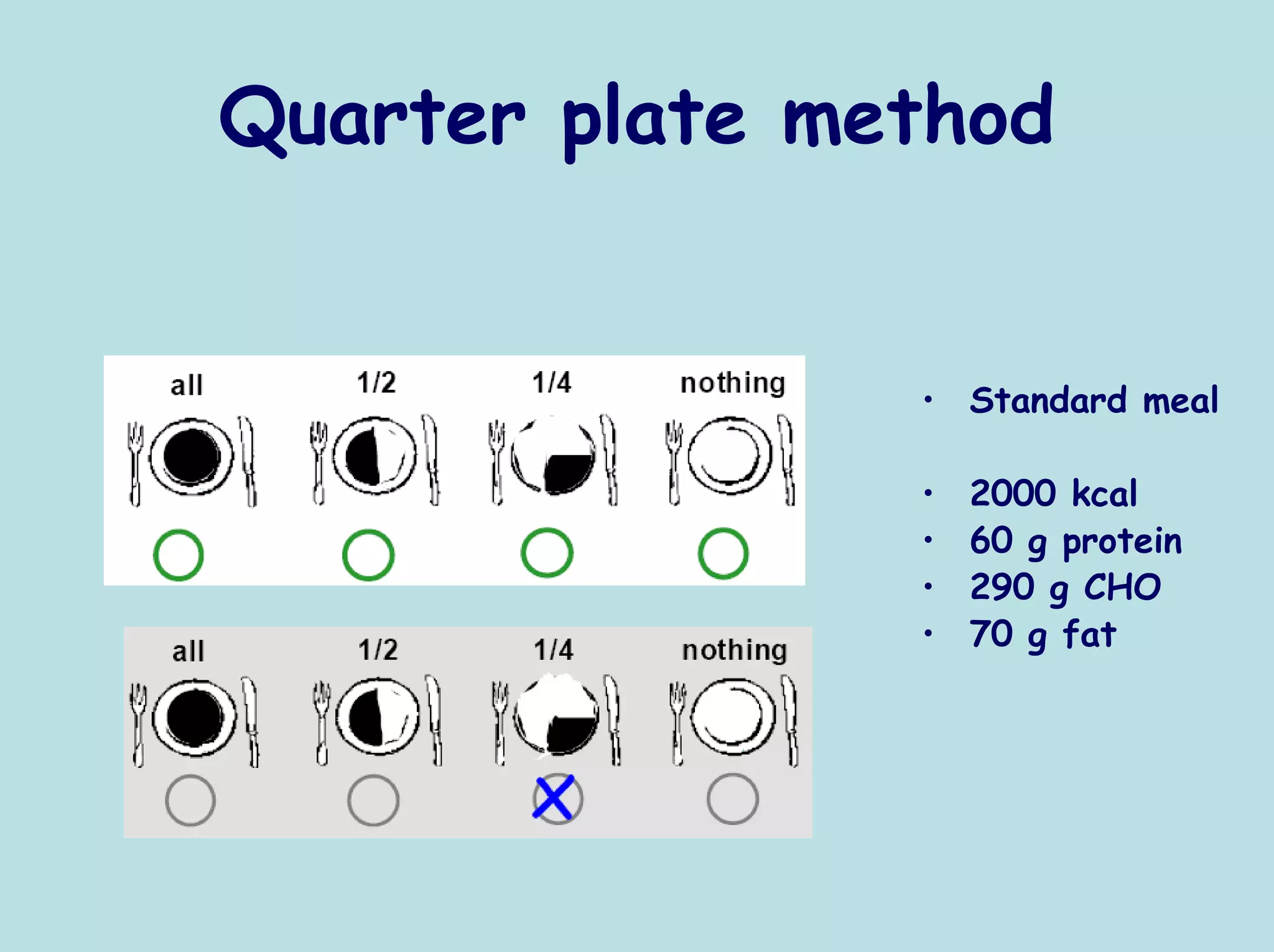
• Quarter plate method
Quarter plate method


                • Standard meal

                •   2000 kcal
                •   60 g protein
                •   290 g CHO
                •   70 g fat
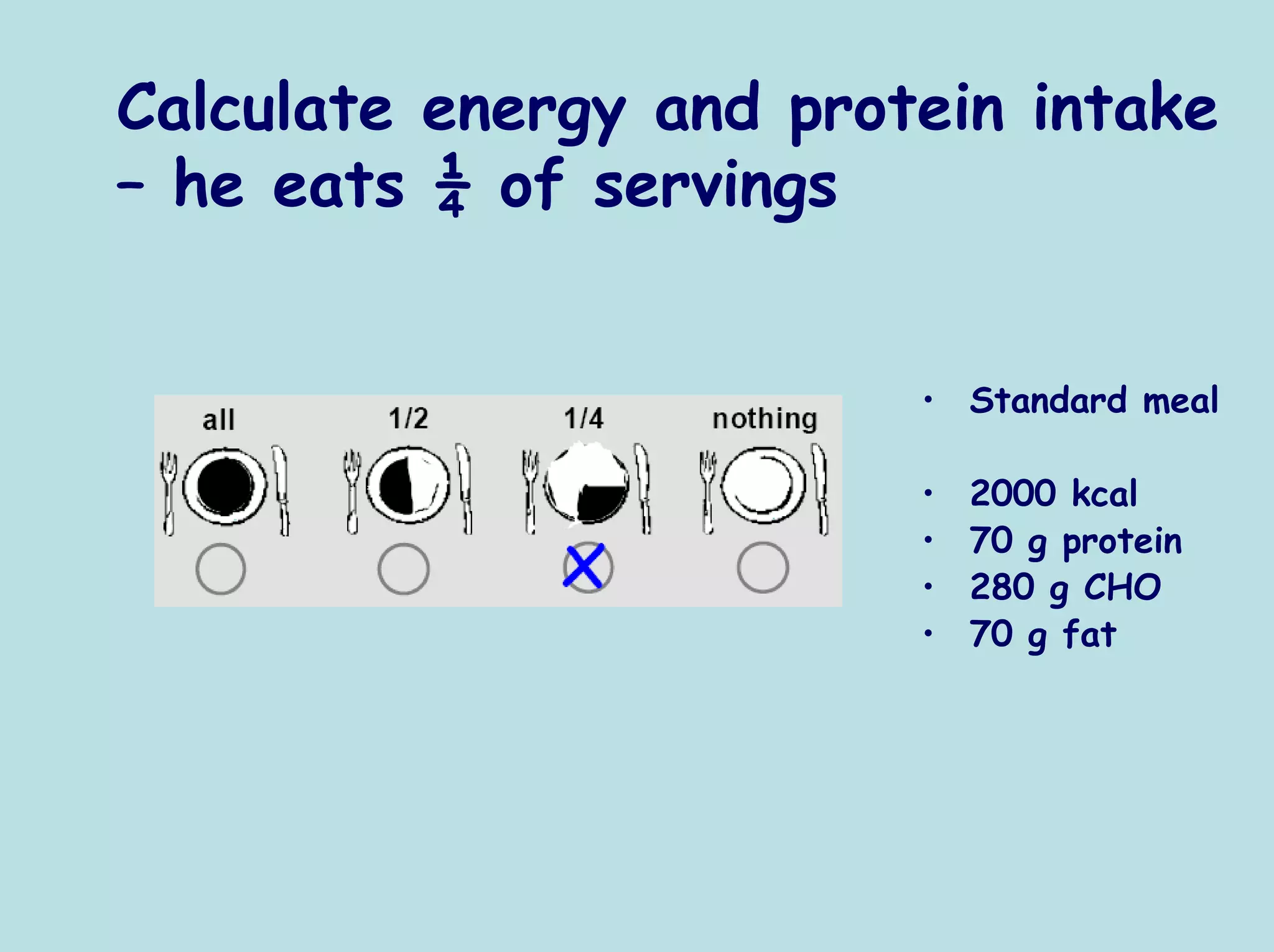
Calculate energy and protein intake
– he eats ¼ of servings


                         • Standard meal

                         •   2000 kcal
                         •   70 g protein
                         •   280 g CHO
                         •   70 g fat
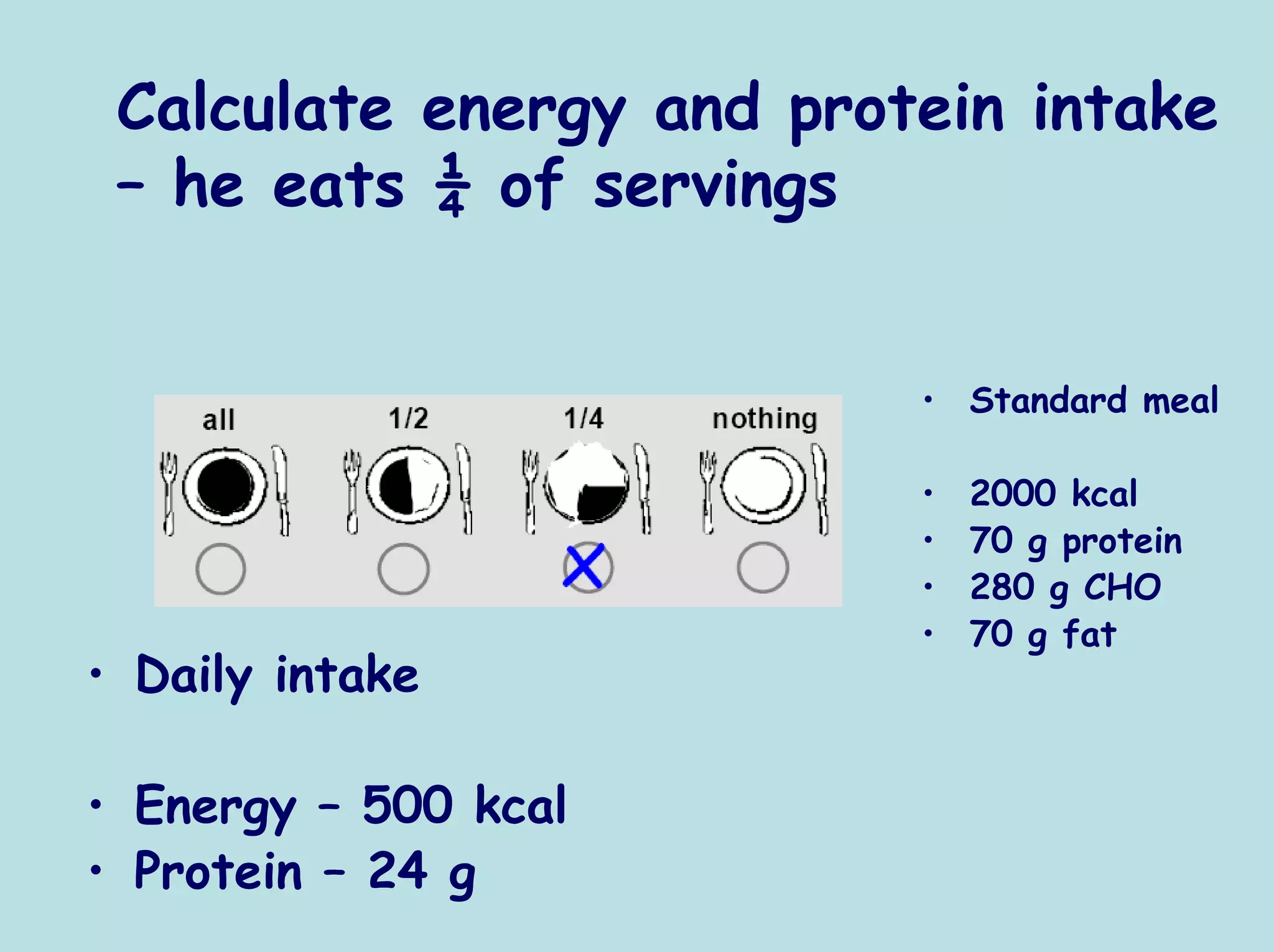
Calculate energy and protein intake
 – he eats ¼ of servings


                          • Standard meal

                          •   2000 kcal
                          •   70 g protein
                          •   280 g CHO
                          •   70 g fat
• Daily intake

• Energy – 500 kcal
• Protein – 24 g
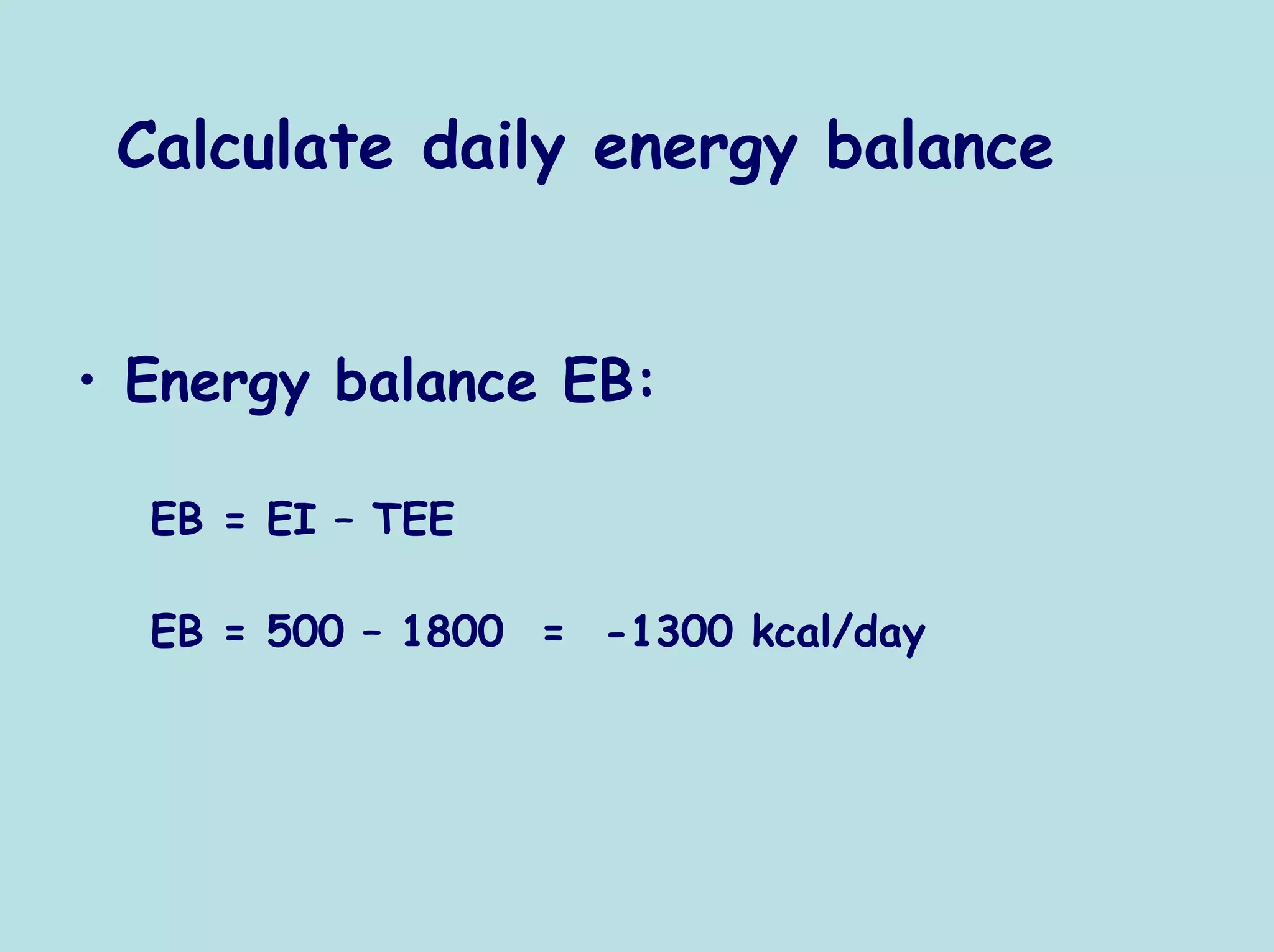
Calculate daily energy balance


• Energy balance EB:

  EB = EI – TEE

  EB = 500 – 1800 = -1300 kcal/day
Calculate daily need of supplements


• Energy deficit: 1300 kcal/day
• Protein deficit: 30.4 g day

Standard supplement (sipping)
= 150 kcal & 6 g Prot/100 ml
Recommendation
= 1000 ml of standard nutrition (e.g. sipping)
Thank you!

02 sobotka how

  • 1.
    Energy balance Nutritional Screening and Assessment Lubos Sobotka Charles University - Medical Faculty Hradec Kralove Czech Republic
  • 2.
    Learning Objectives Tothe principles of measurement of energy expenditure To now how to diagnose a risk of malnutrition To know the methods for measurement of body composition To be able to estimate energy intake in hospitalized patients
  • 3.
    Flow of energyin biosphere H2O + CO2 +N O2 O2 ATP ph CHO ot os Fat yn H2O + CO2 th Proteins es is N
  • 4.
    Energy expenditure FOOD O2 CHO CO2 Fat H 2O Proteins Nitrogen Heat BODY RESERVES Total energy expenditure - TEE resting energy expenditure - REE diet induced energy expenditure - DEE activity induced energy expenditure - AEE
  • 5.
    Components of energyexpenditure -adult person- Activity induced energy Is the most variable expenditure ∼ 60-70% component of TEE Dependent on physical activity An postprandial increase in Diet induced energy EE above basal fasting level expenditure ∼ 10% Lasts for several hours after meal Maintaining cell membrane ion gradients Constant protein synthesis and breakdown Resting energy expenditure Amino acid metabolism ∼ 60-70% Glycogen synthesis and breakdown Fatty acids cycle Gluconeogenesis Energy for breathing and heart function
  • 6.
    Energy expenditure measurement Direct calorimetry Measurement of heat produced during energy processes Indirect calorimetry Measurement: O2 consumption VO2 production
  • 7.
    Direct calorimetry Whole body heat production Special chambers difference in heat coming into and out of the chamber V T1 V T2 EE ∼ ∆Q = V (T2 – T1)
  • 8.
    Indirect calorimetry Measurement of O2 consumption VO2 production V cO2, cCO2 V cO2, cCO2 EE ∼ VO2 consumption and VCO2 production
  • 9.
    Indirect calorimetry flow CO2-analyser respiratory air ventilated hood or gasmeter O 2-analyser respiration chamber outdoor air ² CO 2 ²O2 outdoor air Westerterp K, Schols A Basics in Clinical Nutrition, 2004
  • 10.
  • 11.
    Indirect calorimetry VO2 =0.829 CHO + 2.02 Fat + 6.04 Nitrogen VCO2 = 0.829 CHO + 1.43 Fat + 4.84 Nitrogen Substrate oxidation: CHO = 4.59 VCO2 – 3.25 VO2 – 3.68 Nitrogen Fat = 1.69 VO2 – 1.69 VCO2 – 1.72 Nitrogen Protein = 6.25 Nitrogen Energy expenditure: EE = 3.87 VO2 + 1.19 VCO2 – 5.99 N
  • 12.
    Indirect calorimetry Energy expenditurecan be calculated both from VO2 and VCO2: Calculation from VO2 and VCO2: EE = 3.95 VO2 + 1.11 VCO2 Calculation from VO2: EE = VO2 (3.95 + 1.11 RQ) – moderately dependent on RQ Calculation from VCO2: EE = VCO2 (1.11 + 3.95/RQ) – Highly dependent on RQ Doubly labeled water, labeled bicarbonate
  • 13.
    Relationship between REEand RQ [REE calculation based on VO2 or on VCO2] 120,0 115,0 Difference in REE [%] 110,0 105,0 VCO2 100,0 VO2 95,0 VO2 a VCO2 90,0 85,0 80,0 0,7 0,75 0,8 0,85 0,9 0,95 1 RQ REE calculated from VCO2 is more dependent on RQ (possible mistake 15%) then if calculated from VO2 (possible mistake 4%)
  • 14.
    Measurement of EEusing doubly labeled water 2H 18 O 2 2H 18 O Labels Labels water and water pool bicarbonate pools 2HHO H 2 18 O CO 18 O K2 = rH K18 = r CO + rH 2O 2 2O K18 - K2 = r CO 2 Principle of the doubly labelled water (2H218O) method for the measurement of carbon dioxide production (rCO2) from the elimination rates of 18O (k18) and 2H (k2). The elimination rate of 2H is a function of water loss (rH2O) while k18 is a function of rCO2 and rH2O. Westerterp K, Schols A Basics in Clinical Nutrition, 2004
  • 15.
    Relationship between heartrate and energy expenditure 12,00 10,00 8,00 Energy expenditure [kcal/min.] 6,00 4,00 2,00 0,00 40 50 60 70 80 90 100 110 120 130 140 Heart rate [b/min]
  • 16.
    Relationship between heartrate and energy expenditure –whole group 14 12 10 Energy expenditure 8 [cal/min.] 6 4 2 0 75 95 115 135 155 175 Heart rate [b/min]
  • 17.
    Relationship between heartrate and energy expenditure –individual patients 18 16 14 12 Energy expenditure [cal/min.] 10 8 6 4 2 0 95 105 115 125 135 145 155 Heart rate [b/min]
  • 18.
    Harris-Benedict equations The mostcommon approach to predict resting energy expenditure Male: REE = 66.5 + (13.8 x weight) + (5.0 x height) - (6.8 x age) Female: REE = 655.1 + (9.6 x weight) + (1.8 x height) - (4.7 x age)
  • 19.
    The theoretical reservesof a 74 kg man Body substrate Substrate weight Energy content ( kg ) ( kcal ) Fat 15 141.000 Protein 12 48.000 Glycogen (muscle) 0.5 2000 Glycogen (liver) 0.2 800 Total 191.800
  • 20.
    Prevalence of undernutrition •Ambulatory outpatients 1-15% • Institutionalized patients 25-60% • Hospitalized patients 35-65% Omran et al, Nutrition 2000 • These rates depend on how malnutrition is defined
  • 21.
    Assessment of Nutritional status 1. Screening 2. Assessment
  • 22.
    ESPEN Guidelines for Nutrition Screening • All patients should be screened on admission to the hospital • If the patient is at risk, a nutrition plan is worked out by the staff • Monitoring and defining outcome has to be organized • Results of screening, assessment and nutrition care plans should be communicated to healthcare professionals to which the patient is transferred • Outcome should be audited and communicated to furnish the data on which future policy decisions can be made Nutrition Screening 2002, Clin Nutr 2003 www.espen.org → Education → Guidelines
  • 23.
    Nutritional screening Is atool to rapidly and simply evaluate whether the patient is at risk to be or to become malnourished
  • 24.
    Nutritional screening History: • Weightloss over time • Anorexia, nausea • Food intake First measurements: • Body weight • Height BMI (kg/m2)
  • 25.
    Screening tools • Nutritional Risk Index1 - biochemical • Subjective global assessment2 • Malnutrition Universal Screening Tool (MUST)3 • Nutritional Risk Screening (NRS 2002)4 • MNA (elderly)5 1 Veterans Affairs, New Engl J Med 1991 4 Kondrup et al, Clin Nutr 2003 2 Detsky et al, JPEN, 1984 5 Vellas et al, Nutrition 1999 3 BAPEN
  • 26.
    Nutritional risk screening Subjective global assessment (SGA) I Patient‘s history (weight loss, change in dietary intake, gi-symptoms, functional capacity) II Physical examination (muscles, subcutaneous fat, edema, ascites) Clinician‘s overall judgment • good nutritional status • moderate malnutrition • severe malnutrition Detsky et al, JPEN, 1984
  • 27.
    ESPEN guidelines fornutrition screening 2002 Part 1 Kondrup J et al. ESPEN guidelines for nutrition screening 2002. Clin Nutr 2003
  • 28.
    Part 2 Kondrup J et al. ESPEN guidelines for nutrition screening 2002. Clin Nutr 2003
  • 29.
    Nutritional Assessment Is theactual measurement of nutritional state and has to be done in patients that are considered to be at risk by the nutritional screening or when metabolic or functional problems prevent a standard plan being carried out
  • 30.
    Normal body composition •Normal body cell mass (BCM) is the major determinant of an adequate nutritional state: – Living, actively metabolizing part of the body – Extra-cellular mass may increase disproportionately in malnutrition, disease, whereas fat free cell mass decreases • Normal macronutrients, electrolytes, trace-elements, vitamins • Normal organ sizes
  • 31.
    What can bemeasured? • Fat body mass Body fat percentage Fat distribution (visceral fat) • Lean body mass Water: extra and intracellular Body cell mass Muscle mass Bone
  • 32.
    The two compartmentsmodel Fat mass Fat free body mass
  • 33.
    The four compartmentsmodel Fat mass Fat free body mass • body cell mass • extra-cellular water • bone
  • 34.
    Body composition changesin normal adult males Age (years) Muscle (kg) Body fat (kg) 20-29 24 15 40-49 20 19 60-69 17 23 70-79 13 25 Young 1992
  • 35.
    Underwater weighing Fat mass Fat-free mass
  • 36.
    Dilution method –deuterium/bromide Deuterium –TBW Bromide-ECV
  • 37.
  • 38.
  • 39.
    Anthropometric measurement • Validationonly partially performed • Large inter-individual variability • Good intra-individual variability if the investigator is properly trained
  • 40.
    Creatinine excretion inurine • Creatinine excretion correlates with lean body mass and body weight • 18-20 kg of muscle produce 1 g of creatinine • Dietary protein sources contribute up to 20% of excreted creatinine • Urinary creatinine excretion is proportional to skeletal muscle mass (stable renal function; no dialysis or hemofiltration)
  • 41.
    Norm values forurinary creatinine exretion/mg/24h Urinary creatinine (mg/24h) Norm/men Norm/women Height (cm)
  • 42.
    Urinary creatinine excretion is influenced by: • Decreasing renal function; oliguric renal insufficiency • No meat consumption ↳ low creatinine excretion • High meat consumption • High physical activity • Catabolism – fever – infection – trauma ↳high creatinine excretion • Incomplete 24 h-urine sampling
  • 43.
    Body fat distribution andwaist circumference • Measured at the mid-point between the ileac crest and the lower rib • Correlates strongly with intra-abdominal adipose tissue as assessed by CT and MRI • Upper body obesity defined as a waist circumference: – ≥ 102 (94) cm for men – ≥ 88 (80) cm for women
  • 44.
    Bioelectrical impedance analysis(BIA) • BIA allows the determination of - Fat-free mass and - Total body water
  • 45.
    ESPEN - GUIDELINES Bioelectricalimpedance analysis Fat-free mass and Total body water 1) Review of principles & methods. Clin Nutr 2004; 23: 1226-1243 2) Utilisation in clinical practice. Clin Nutr 2004; 23: 1430-1453 www.espen.org/education
  • 46.
    Bioelectrical impedance analysis (BIA) • BIA allows the determination of - FFM on the basis of TBW measurement • in subjects without significant fluid and electrolyte abnormalities when using appropriate equations (age, sex, race) • BIA in subjects at extremes of BMI ranges (16-34 kg/m2) or with abnormal hydration status is not reliable • Disease almost always includes inflammatory activity (ICW/ECW ratio decreases; TBW increases; BIA unreliable)
  • 47.
    Dual energy X-ray absorptiometry(DEXA) • Three-compartment model • Fat mass, free-fat mass and bone • State of hydration may affect results
  • 48.
    MRI or CTscan • Fat mass
  • 49.
    Creatinine excretion inurine • Creatinine excretion correlates with lean body mass and body weight • 18-20 kg of muscle produce 1 g of creatinine • Dietary protein sources contribute up to 20% of excreted creatinine • Urinary creatinine excretion is proportional to skeletal muscle mass (stable renal function; no dialysis or hemofiltration)
  • 50.
  • 51.
    Muscle strength • Isa good predictor of outcome: – In chronic situations: • Aging • Organ failure (renal failure, COPD, heart failue…. – In acute situations: • Surgery or trauma • Second hit (superimposed infection when already subject to inflammatory activity)
  • 52.
    Summary Practical methods for measuring: Fat mass • Subcutaneous skin folds measurements • DEXA • MRI, CT scan • BIA
  • 53.
    Summary Practicalmethods for measuring: Fat-free mass • DEXA • BIA • (Underwater weighing)
  • 54.
    Summary Practical methods for measuring: Body cell mass • (Total body potassium) • (Nitrogen neutron activation)
  • 55.
    Summary Practical methodsfor measuring: Muscle mass • Mid-arm circumference • Creatinine height index • Urinary 3-Methylhistidine
  • 56.
    Summary Practical methods for measuring:Body-water • Total body water (- Isotopic labeling of water) - BIA • Extracellular water (- Bromide space)
  • 57.
    Summary Practical methods formeasuring: Bone mass • DEXA • Total body calcium-measured by isotopes methods
  • 58.
    Inflammatory and disease activity Disease always includes inflammatory activity • Clinical evaluation - Pre-existing inflammation or disease • Plasma Albumin levels - Already significant when ≤ 35 g/L • Cytokine levels (TNF-α, IL 6, ...) • CRP - Very volatile, is a rough correlations, but not suitable for the individual patient
  • 59.
    Serum proteins • Albumin (T½): 20 days • Transferrin (T½): 8-10 days • Transthyretin (T½): 2-3 days (Prealbumin) • Retinol-binding protein (T½): ∼ 12 h
  • 60.
    Wound healing isdependent of endogenous substrates Undernutrition poor wound healing (dehiscence, infections) Loss body cell mass Deficit endogenous substrates for wound healing.
  • 61.
  • 62.
    Complicated operation wound Granulation stimulation
  • 63.
    Complex treatment Wound before the last operation
  • 65.
    A sterile gauzepoured by hyaluronan-iodine complex
  • 67.
    Infectious complications and albumin Kudsk et al, JPEN 2003
  • 68.
    How to measurefood intake • Bomb calorimetry of food before and after meal (double plate method) • Weighing of food before and after meal • Quarter plate method
  • 69.
    Quarter plate method • Standard meal • 2000 kcal • 60 g protein • 290 g CHO • 70 g fat
  • 70.
    Calculate energy andprotein intake – he eats ¼ of servings • Standard meal • 2000 kcal • 70 g protein • 280 g CHO • 70 g fat
  • 71.
    Calculate energy andprotein intake – he eats ¼ of servings • Standard meal • 2000 kcal • 70 g protein • 280 g CHO • 70 g fat • Daily intake • Energy – 500 kcal • Protein – 24 g
  • 72.
    Calculate daily energybalance • Energy balance EB: EB = EI – TEE EB = 500 – 1800 = -1300 kcal/day
  • 73.
    Calculate daily needof supplements • Energy deficit: 1300 kcal/day • Protein deficit: 30.4 g day Standard supplement (sipping) = 150 kcal & 6 g Prot/100 ml Recommendation = 1000 ml of standard nutrition (e.g. sipping)
  • 74.