Chapter 1 - Section A - Mathcad Solutions
1.4 The equation that relates deg F to deg C is: t(F) = 1.8 t(C) + 32. Solve this
equation by setting t(F) = t(C).
Guess solution:

t

t = 1.8t

Given

0

Find t
()

32

Ans.

40

P=

1.5 By definition:

F
A

F = mass g

A

P

3000bar

D

4mm

F

PA

g

9.807

m

D

4

F

mass

2

g

s

P=

1.6 By definition:

F
A

A

3000atm

D

0.17in

F

PA

g

32.174

ft

4

D

mass

2

sec

gh

13.535

1.8

gm
3

101.78kPa

13.535

g

9.832

mass

2

384.4 kg

Ans.

2

F
g

A

mass

2

0.023 in

1000.7 lbm

Ans.

gm
3

29.86in_Hg

m

h

2

56.38cm

s

Pabs

g

gh

32.243

Patm

ft

Pabs

h

2

176.808 kPa Ans.

25.62in

s

cm

Patm

12.566 mm

Patm

cm

Patm

A

F = mass g

P

1.7 Pabs =

2

Note: Pressures are in
gauge pressure.

Pabs

gh

1

Patm

Pabs

27.22 psia

Ans.
1.10 Assume the following:

13.5

gm

g

3

m

9.8

2

s

cm

P

1.11

P

h

400bar

h

g

Ans.

302.3 m

The force on a spring is described by: F = Ks x where Ks is the spring
constant. First calculate K based on the earth measurement then gMars
based on spring measurement on Mars.
On Earth:

F = mass g = K x

mass

g

0.40kg

9.81

m

x

2

1.08cm

s

F

F

mass g

F
x

Ks

3.924 N

Ks

363.333

N
m

On Mars:

x

0.40cm

gMars

1.12 Given:

FMars

gMars

FMars
mass

d
P=
dz

g

0.01

FMars

Kx

and:

mK

=

4

MP
RT

Substituting:

Separating variables and integrating:

1
dP =
P

Psea

1atm

ln

M

29

2

mK

PDenver
Psea

=

PDenver = Psea e
gm
mol

d
P=
dz

zDenver

Mg
zDenver
RT
Mg
zDenver
RT

g

9.8

MP
g
RT

Mg
dz
RT

0

Psea

Taking the exponential of both sides
and rearranging:

3

Ans.

kg

PDenver

After integrating:

10

m
2

s
3

R

82.06

cm atm

T

mol K

Mg
zDenver
RT
Mg
RT

(
10

zDenver

273.15)
K

0.194

zDenver

Psea e

PDenver

0.823 atm

Ans.

PDenver

PDenver

1 mi

0.834 bar

Ans.

1.13 The same proportionality applies as in Pb. 1.11.

gearth

ft

32.186

gmoon

2

5.32

M

lmoon

1.14

gearth
gmoon

costbulb

Ans.

18.767 lbf

Ans.

hr
0.1dollars
70W
10
day
kW hr

hr
5.00dollars
10
day
1000hr

costelec

dollars
yr

costelec

25.567

dollars
yr

costtotal

43.829

dollars
yr Ans.

18.262

costtotal

costbulb

D

18.76

113.498

113.498 lbm

wmoon

M gmoon

costbulb

1.15

learth

M

learth lbm

wmoon

lmoon

2

s

s

learth

ft

1.25ft

costelec

mass

250lbm

g

32.169

ft
2

s

3
Patm

(a) F

30.12in_Hg

Patm A

l

Work

1.7ft

D

D

2

3

10 lbf

Work

PE

mass g l

mass

1.227 ft

2

Ans.

Ans.

16.208 psia

F l

0.47m

A

2.8642

Pabs

PE

1.16

4

F

mass g

F
A

(b) Pabs

(c)

A

3
10 ft lbf Ans.

4.8691

Ans.

424.9 ft lbf

g

150kg

9.813

m
2

s

Patm

(a) F

Patm A

l

0.83m

EP

1.18

mass

EK

2

A
4

110.054 kPa

Work

EP

mass g l

u

1250kg

1
2
mass u
2

40

EK

m
s

Work

EK

Wdot =

200W

Ans.

1000 kJ

mass g h
0.91 0.92
time

Wdot

Ans.

1000 kJ

g

9.8

m
2

s

4

h

2

0.173 m

Ans.

10 N

F l

Work

1.19

1.909

Pabs

Work

D

4

F

mass g

F
A

(b) Pabs

(c)

A

101.57kPa

50m

Ans.

15.848 kJ Ans.

1.222 kJ

Ans.
Wdot

mdot

1.22
a) cost_coal

mdot

g h 0.91 0.92

0.488

25.00
ton

cost_coal

MJ
29
kg

cost_gasoline

0.95 GJ

kg
s

1

2.00
gal

37

GJ

cost_gasoline

Ans.

14.28 GJ

1

3

m

cost_electricity

0.1000
kW hr

cost_electricity

27.778 GJ

1

b) The electrical energy can directly be converted to other forms of energy
whereas the coal and gasoline would typically need to be converted to heat
and then into some other form of energy before being useful.
The obvious advantage of coal is that it is cheap if it is used as a heat
source. Otherwise it is messy to handle and bulky for tranport and
storage.
Gasoline is an important transportation fuel. It is more convenient to
transport and store than coal. It can be used to generate electricity by
burning it but the efficiency is limited. However, fuel cells are currently
being developed which will allow for the conversion of gasoline to electricity
by chemical means, a more efficient process.
Electricity has the most uses though it is expensive. It is easy to transport
but expensive to store. As a transportation fuel it is clean but batteries to
store it on-board have limited capacity and are heavy.

5
1.24 Use the Matcad genfit function to fit the data to Antoine's equation.
The genfit function requires the first derivatives of the function with
respect to the parameters being fitted.
B
T C

A

Function being fit:

f ( A B C)
T

e

First derivative of the function with respect to parameter A

d
f ( A B C)
T
dA

B

exp A

T

C

First derivative of the function with respect to parameter B

d
f ( A B C)
T
dB

1
T

C

B

exp A

T

C

First derivative of the function with respect to parameter C

d
f ( A B C)
T
dC

B
(
T

2

exp A

C)

18.5

3.18

9.5

5.48

0.2
11.8
t

9.45
16.9

23.1
32.7

Psat

28.2
41.9

44.4

66.6

52.1

89.5

63.3

129

75.5

187

6

B
T

C
T

t

273.15

lnPsat

ln ( )
Psat

Array of functions used by Mathcad. In this case, a0 = A, a1 = B and a2 = C.

exp a0
exp a0

F ( a)
T

a1
T

a2
a1

T

1
exp a0
T a2
a1
T

a2

2

Guess values of parameters

15

a2

guess

a1
T

exp a0

3000
50

a2
a1
T

a2

Apply the genfit function

A

13.421

A

B

B

genfit ( Psat guess F)
T

C

2.29

C

3

10

Ans.

69.053

Compare fit with data.
200

150
Psat
f ( A B C)
T

100

50

0
240

260

280

300

320

340

360

T

To find the normal boiling point, find the value of T for which Psat = 1 atm.

7
Psat

1atm

B

Tnb
A

Tnb
1.25
a) t1

1970

C2

C1 ( 1

t2
i)

273.15K

2000

dollars
gal

C1

0.35

1.513

329.154 K

Ans.

56.004 degC

C2

t2 t1

Tnb

C K

Psat
ln
kPa

i

5%

dollars
gal

The increase in price of gasoline over this period kept pace with the rate of
inflation.
b) t1

1970
Given

t2
C2
C1

= (1

2000
i)

C1

t2 t1

i

16000

dollars
yr

Find ( i)

i

C2

80000

dollars
yr

5.511 %

The salary of a Ph. D. engineer over this period increased at a rate of 5.5%,
slightly higher than the rate of inflation.
c) This is an open-ended problem. The strategy depends on age of the child,
and on such unpredictable items as possible financial aid, monies earned
by the child, and length of time spent in earning a degree.

8
Chapter 2 - Section A - Mathcad Solutions
2.1 (a)

Mwt

g

35 kg

9.8

m

z

2

5m

s

Work

(b)

Work

Mwt g z

Utotal

Utotal

Work

(c) By Eqs. (2.14) and (2.21):

dU

1.715 kJ Ans.

1.715 kJ

Ans.

d ( )= CP dT
PV

Since P is constant, this can be written:

MH2O CP dT = MH2O dU

MH2O P dV

Take Cp and V constant and integrate: MH2O CP t2 t1 = Utotal
kJ
MH2O 30 kg
CP
4.18
t1 20 degC
kg degC
t2

t1

Utotal
MH2O CP

t2

20.014 degC Ans.

(d) For the restoration process, the change in internal energy is equal but of
opposite sign to that of the initial process. Thus

Q

(e)

Utotal

Q

1.715 kJ

Ans.

In all cases the total internal energy change of the universe is zero.

2.2 Similar to Pb. 2.1 with mass of water = 30 kg.
Answers are:

(a) W = 1.715 kJ
(b) Internal energy change of
the water = 1.429 kJ
(c) Final temp. = 20.014 deg C
(d) Q = -1.715 kJ
9
2.4

The electric power supplied to the motor must equal the work done by the
motor plus the heat generated by the motor.

E

i 9.7amp

Wdotelect

Qdot

2.5

i
E

Wdotelect
t

Eq. (2.3):

U = Q

Step 1 to 2:

Ut12

Wdotelect

1.067

3

134.875 W

Ans.

W

W12

200J

Ut12

Q34

Q12

800J

Ut34

1.25hp

10 W

Qdot

Wdotmech

Q12

Step 3 to 4:

Wdotmech

110V

W12

6000J

W34

Q34

Ut34

W34

3

5.8

Ans.

10 J

300J

Ans.

500 J
t

t

Step 1 to 2 to 3 to 4 to 1: Since U is a state function, U for a series of steps
that leads back to the initial state must be zero. Therefore, the sum of the
t

U values for all of the steps must sum to zero.

Ut41

4700J

Ut23
Step 2 to 3:

Ut23

W23

Ut34

Ut41

Ans.

4000 J

Ut23

Ut12

4

Ut23

3

Q23

Q23

3800J

W23

10 J

200 J

Ans.

For a series of steps, the total work done is the sum of the work done for each
step.

W12341

1400J
10
W41

W12341

Step 4 to 1:

W12

W23

Ut41

Ut41

Ans.

10 J
3

4.5

Q41

W41

3

4.5

W41

4700J

Q41

Note:

W41

W34

10 J

200 J

Ans.

Q12341 = W12341

2.11 The enthalpy change of the water = work done.

M

Wdot

2.12 Q

CP

20 kg

4.18

kJ
kg degC

t

10 degC

M CP t

0.25 kW

0.929 hr

Wdot

Ans.

U

Q

12 kJ

W

U

19.5 kJ

Ans.

Q

12 kJ

U

W

U

7.5 kJ

Q

12 kJ

Ans.

2.13Subscripts: c, casting; w, water; t, tank. Then

mc Uc

mw Uw

mt Ut = 0

Let C represent specific heat,

C = CP = CV

Then by Eq. (2.18)

mc Cc tc

mw Cw tw

mt Ct tt = 0

mc

2 kg

mw

Cc

0.50

kJ
kg degC

Ct

mt

40 kg

tc

500 degC

Given

t1

mc Cc t2

t2

0.5

5 kg

kJ
kg degC

Cw

25 degC

t2

30 degC

tc = mw Cw

mt Ct

t2

Find t2
11

t2

4.18

kJ
kg degC

(guess)

t1

27.78 degC

Ans.
2.15

mass

(a)

(b)

T

g

CV

1 kg

Ut

1K

9.8

m

Ut

mass CV T

EP

2

kJ
kg K

4.18

Ans.

4.18 kJ

Ut

s

z

(c)

2.17

EP

EK

z

z

mass g

426.531 m Ans.

EK

u

Ut

1
mass
2

1000

50m

u

kg

5

A

3

A

2m

mdot

Wdot

uA

mdot

mdot g z Wdot

4

D

2

(b)

2

4 kg

1.571 10

7.697

s
3

10 kW

U1

P1

1002.7 kPa

U1

H1

763.131

U2

kJ
2784.4
kg

H2

U2

P1 V 1

kJ
kg

kJ
kg

cm
1.128
gm

V1

Ans.
3

P2

U

P2 V 2

2022.4

Ans.
3

kJ
762.0
kg

U

Ans.

3.142 m

H1

2.18 (a)

m
s

m
s

u

m

D

91.433

Ans.

1500 kPa

U2

U1

H

12

cm
169.7
gm

V2

H

2275.8

kJ
kg

H2

H1

Ans.
2.22

D1

(a)

u1

2.5cm

m
s

D2

5cm

For an incompressible fluid, =constant. By a mass balance,
mdot = constant = u 1A1 = u2A2

u2
(b)

D1

u1

u2

D2
1

EK

2

2

2

u2

1
2

2.23 Energy balance:

Mass balance:

u1

2

mdot3 H3

mdot1

1.0

Qdot

30

Qdot

H1

T1

CP

4.18

s

mdot1

mdot2 H2 = Qdot

H2 = Qdot

mdot2 CP T3

25degC

kJ

Ans.

kg

mdot2 H3

T1

kg
s

J

mdot2 = 0

mdot2 = Qdot

mdot1 CP T1

Ans.

1.875

mdot1

mdot Cp T3

T3 CP mdot1

m
s

mdot1 H1

mdot1 H3

or

0.5

EK

mdot3

Therefore:

T3

2

T2 = Qdot

mdot1 CP T1

mdot2 CP T2

mdot2

0.8

kg
s

T2

75degC

kJ
kg K

mdot2 CP T2

mdot2 CP

T3

43.235 degC

2

2.25By Eq. (2.32a):

By continuity,
incompressibility

H

u
= 0
2
A1

u2 = u1

13

A2

H = CP T

CP

4.18

kJ
kg degC

Ans.
2
u = u1

u1

u1

2

2 CP

D2

2
u = u1

1

m
s

14

D1

D1

2

1

A2

SI units:

T

2

A1

2

4

1

D2

D1

D2

2.5 cm

3.8 cm

4

T

0.019 degC

Ans.

T

D2

0.023 degC

Ans.

7.5cm

u1

T

2

2 CP

D1

1

4

D2

Maximum T change occurrs for infinite D2:

D2

cm

u1

T

2.26 T1

2 CP

300K

Wsdot

H

2

D1

1

T

D2

T2

u1

520K

ndot

98.8kW

CP T2

4

50

H

T1

10

0.023 degC

m
s

u2

kmol
hr

3.5

10

molwt

29

kg
kmol

7
R
2

CP

6.402

m
s

Ans.

3 kJ

kmol

By Eq. (2.30):

Qdot

H

2

u2
2

2

u1
2

molwt ndot

Wsdot Qdot

2

2.27By Eq. (2.32b):

By continunity,
constant area

H=

u2 = u1

u

2 gc

V2

u2 = u1

V1
14

also

T 2 P1
T 1 P2

Ans.

9.904 kW

V2
V1

=
2

T 2 P1
T 1 P2
2

u = u2

u1

2
2
u = u1

P1

R

T2

T2

P2

molwt

mol rankine

7
2

u1

20 psi

ft lbf

28

20

7
R T2
2

ft
s

T1

T1

579.67 rankine

H2

2726.5

kJ
kg

kJ
kg

Ans.

gm
mol

(guess)

578 rankine

Given

H = CP T =

1

T 1 P2

100 psi

3.407

2

T 2 P1

2

2

R T2

T1 =
T2

Find T2

u1
2

2

T 2 P1
T 1 P2

1 molwt

Ans.

578.9 rankine

(
119.15 degF)

2.28 u1

3

m
s

u2

200

m
s

H1
2

By Eq. (2.32a):

2.29 u1

u2

m
s
m
500
s

30

By Eq. (2.32a):

Q

H2

H1

3112.5

u1

u2

H1

334.9

kJ
kg

2

Q

2

kJ

H2

kg

2411.6

2945.7

(guess)
2

H2

Given

u2

578.36

m
s

H1 =

u2

u1

2

5 cm

V1

388.61

u2

2

Ans.
3

3

D1

kJ
kg

cm

gm
15

V2

667.75

cm

gm

Find u2
Continuity:

2.30 (a)

t1

D2

t2

30 degC

CV

u1 V2
u2 V1

D1

D2

Ans.

1.493 cm

n

250 degC

3 mol

J
mol degC

20.8

By Eq. (2.19):

Q

n CV t2

Q

t1

Ans.

13.728 kJ

Take into account the heat capacity of the vessel; then

cv

mv

Q

(b)

100 kg

mv cv

t1

200 degC

CP

29.1

n CV

CV

Q

Q

Ans.

11014 kJ

n

40 degC

4 mol

joule
mol degC
Q

n CP t2

t2

70 degF

5

kJ
kg degC

t1

t2

By Eq. (2.23):

2.31 (a) t1

t2

0.5

BTU
mol degF

n CV t2

Q

t1

18.62 kJ

n

350 degF

3 mol

By Eq. (2.19):

Q

t1

4200 BTU

Ans.

Take account of the heat capacity of the vessel:

mv

Q

mv cv

cv

200 lbm

(b) t1

400 degF

n CV

t2

0.12

BTU
lbm degF

Q

t1

t2

150 degF

16

10920 BTU

n

Ans.

4 mol

Ans.
CP

7

BTU
mol degF

Q

H1

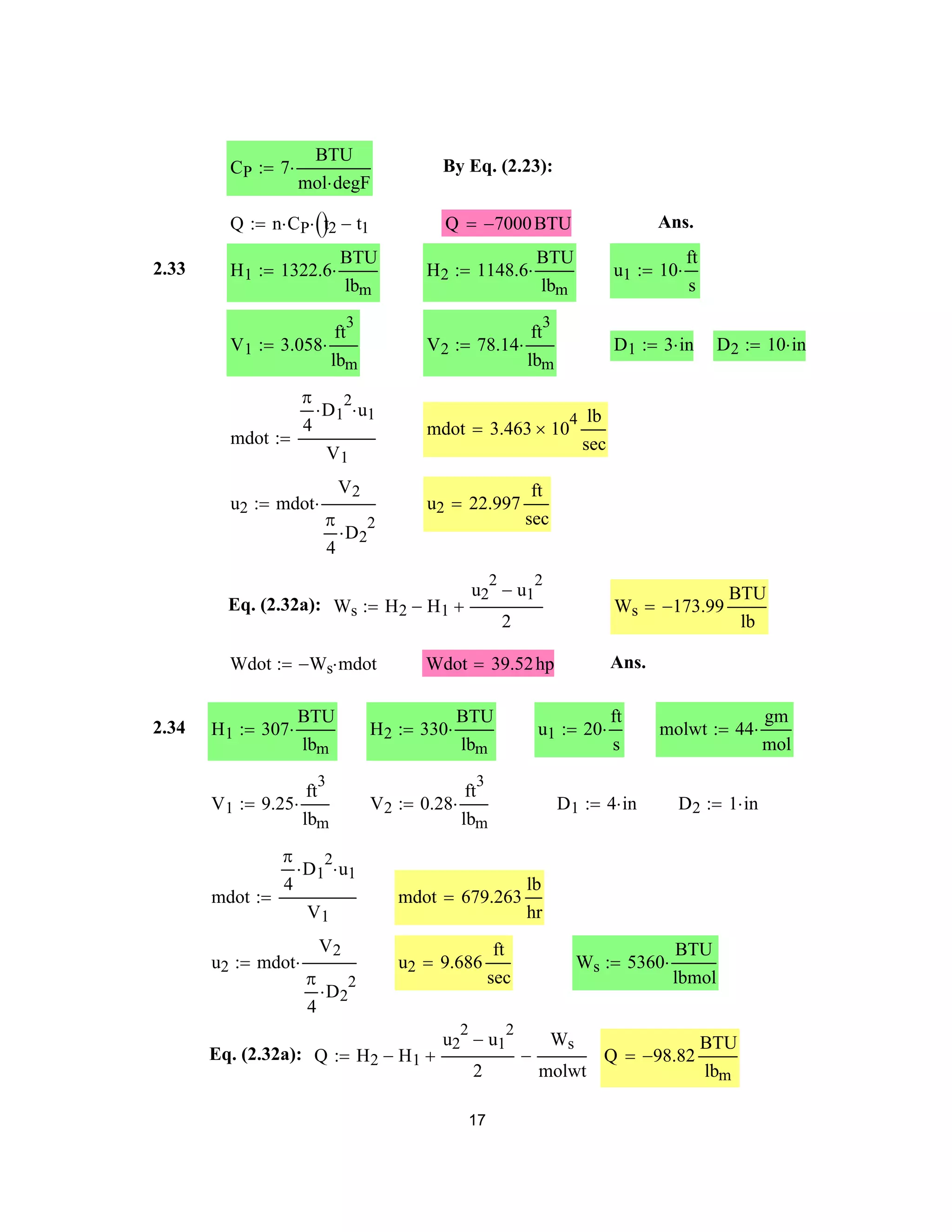
2.33

n CP t2

1322.6

V1

Q

t1

BTU

BTU
lbm

1148.6

3

V2

lbm

78.14

ft

4

mdot

mdot

V2

10

22.997

u2

Wdot

2.34

H1

V1

H2

307

9.25

BTU
lbm

ft

H2

330

V2

u1

lbm

ft

0.28

173.99

BTU
lb

Ans.

39.52 hp

BTU

3

lbm

Ws

2

Wdot

Ws mdot

u1

u2

H1

20

ft
s

molwt

44

3

D1

lbm

D2

4 in

1 in

2

mdot

u2

4

D1 u1

mdot

V1

V2

mdot

u2

679.263

9.686

2

4

D2

2

Eq. (2.32a): Q

H2

H1

10 in

sec

2

D2

Eq. (2.32a): Ws

D2

ft
sec

2

4

3 in

4 lb

3.463

V1

mdot

10

D1

lbm

2

u2

ft
s

u1

3

2

D 1 u1

Ans.

7000 BTU

H2

lbm

ft

3.058

By Eq. (2.23):

ft
sec

u1

u2

2
17

lb
hr

2

Ws

Ws
molwt

5360

Q

BTU
lbmol

98.82

BTU
lbm

gm
mol
Qdot

2.36

T1

Qdot

mdot Q

P

300 K

67128

BTU
hr

Ans.

1 kg

n

1 bar

28.9

V1

n

gm

34.602 mol

mol
3

3
bar cm T1
83.14
mol K P

cm
24942
mol

V1

V2

P dV = n P V 1

W= n

V2 = n P V1

3 V1

V1

Whence

W

Given:

V2
V1

joule

29

Q

n H

U

mol K

Q

= T1 3

Whence

T1

Q

W

U

n

CP T2

602.08 kJ

12.41

kJ
mol

Ans.

172.61 kJ

H

T2 = T1

CP

W

n P 2 V1

T2
H

3 T1

17.4

kJ
mol

Ans.

Ans.

Ans.

2.37 Work exactly like Ex. 2.10: 2 steps, (a) & (b). A value is required for PV/T,
namely R.

R

8.314

T1

(a) Cool at const V1 to P2
(b) Heat at const P2 to T2

Ta2

T1

P2
P1

Ta2

293.15 K

T2

333.15 K

P1

J
mol K

1000 kPa

P2

100 kPa

7
R
2

CP

29.315 K
18

CV

5
R
2
Tb

T2

Hb

C P Tb

Hb

Ua

CV Ta

Ua

R T1

V1

P1

Ta2

Tb

V1

303.835 K

2.437

8.841

Ta

10

5.484

10

mol

Ha

Ua

V 1 P2

P1

Ha

Ub

Hb

P2 V 2

V1

Ub

U

Ub

U

0.831

H

2.39

Ua
Ha

Hb

H

1.164

996

kg

9.0 10

3

D

5
2

kJ
mol

ms

1
cm

u

5

1 m
5 s
5
22133

Re

D

u

Re

Ta

263.835 K

mol
3 J

mol
V2

3

R T2

V2

P2

7.677

6.315

0.028

m

mol

3 J

10

mol

3 J

10

mol

Ans.

mol

4 kg

m
2

kJ

T1

3 J

3
3 m

10

Ta2

55333
110667
276667

19

Ans.

D

0.0001 Note: D = /D
in this solution
0.00635
fF

0.3305 ln 0.27 D

7
Re

0.9

2

0.00517

fF

0.00452
0.0039

0.313

mdot

u

4

D

2

mdot

1.956 kg
1.565 s

Ans.

9.778

0.632
P L

2
fF
D

2

P L

u

0.206

kPa
11.254 m

Ans.

3.88

2.42 mdot

4.5

kg
s

H1

761.1

kJ
kg

H2

536.9

kJ
kg

Assume that the compressor is adiabatic (Qdot = 0). Neglect changes in
KE and PE.
Wdot
Cost

mdot H2
15200

H1

Wdot

Wdot

1.009

3

10 kW

0.573

Cost

kW

20

799924 dollars Ans.
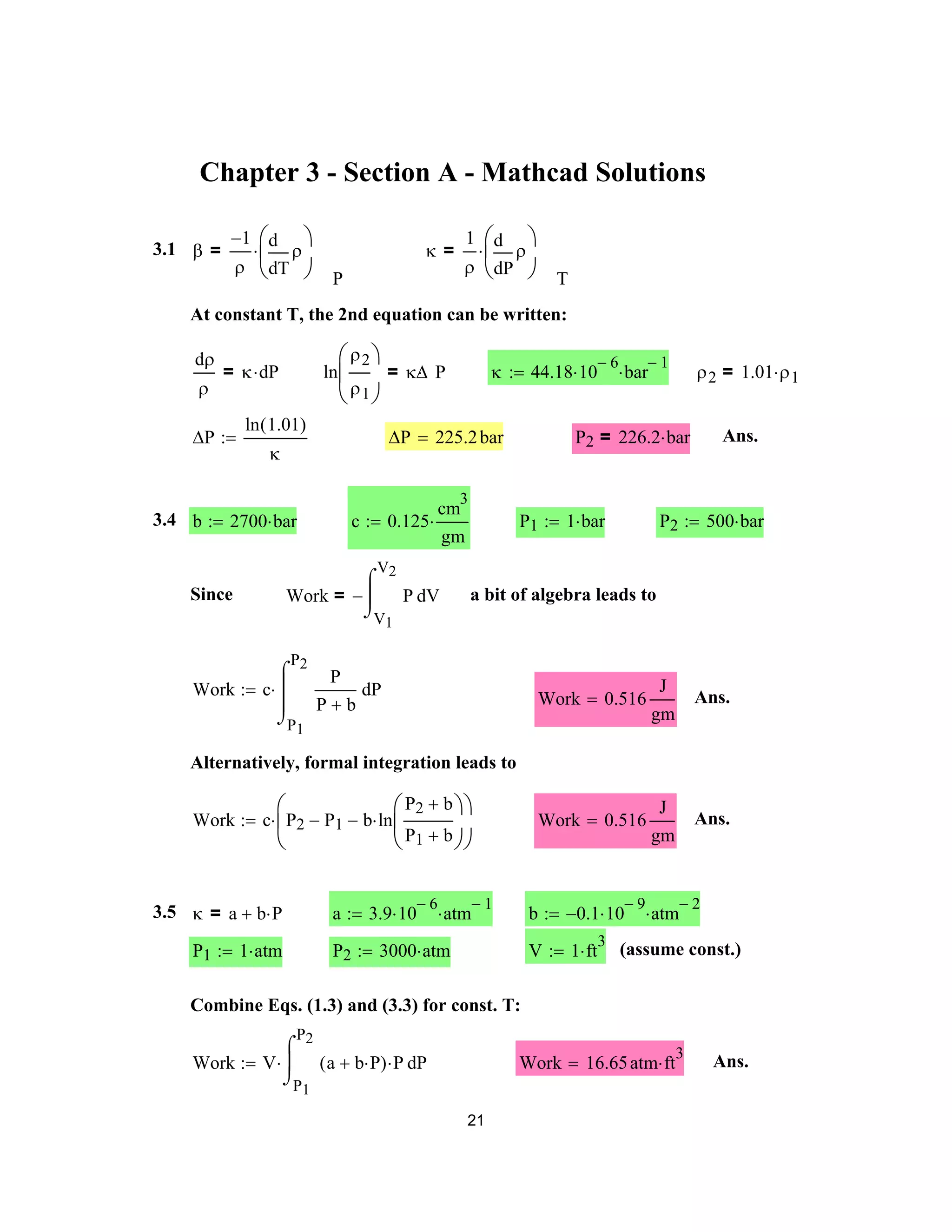
Chapter 3 - Section A - Mathcad Solutions
3.1

1 d

=

1

=

dT

d
dP

P

T

At constant T, the 2nd equation can be written:

d

=

2

ln

dP

6

44.1810

P

=

1

bar

2 = 1.01

1

ln ( )
1.01

P

P

Ans.

P2 = 226.2 bar

225.2 bar
3

3.4 b

cm
0.125
gm

c

2700 bar

P1

P2

1 bar

500 bar

V2

Since

Work =

a bit of algebra leads to

P dV
V1

P2

Work

c

P
P

b

dP

Work

0.516

Work

0.516

P1

J

Ans.

gm

Alternatively, formal integration leads to

Work

3.5

= a

P1

c P2

P1

a

bP

P2

1 atm

b ln

P2

b

P1

b

3.9 10

6

atm

1

b

V

3000 atm

0.1 10

1 ft

3

9

J
gm

Ans.

atm

2

(assume const.)

Combine Eqs. (1.3) and (3.3) for const. T:
P2

Work

(
a

V

Work

b P)P dP

P1
21

16.65 atm ft

3

Ans.

1
3.6

1.2 10

V1

3

degC

1

CP

0.84

kJ
kg degC

M

5 kg

t2

20 degC

3

m

1

P

1590 kg

t1

1 bar

0 degC

With beta independent of T and with P=constant,

dV
=
V

V2

dT

Vtotal

Vtotal

M V

Work

V1 exp

P Vtotal

M CP t2

P2

(a) Constant V:

T2

T1

U

H

R T1 ln

(c) Adiabatic:

T1

P1

Ans.

84 kJ

84 kJ

Ans.

83.99 kJ

Ans.

T

T1

U

10.91

15.28

H= 0

Q= 0
22

kJ
mol

kJ
mol

Work

and

CV

U = Q = CV T

T2

and

7
R
2

CP

600 K

and

Q

Ans.

Utotal

U=

P2

7.638 joule

Work

H

CP T

(b) Constant T:

Work

Q

1 bar

V1

Ans.

Q

Q and

CV T

m

t1

T

P1

3

V2

Htotal

W= 0

P2

10

Q

Utotal

8 bar

5

V

Work

7.638

Htotal

P1

t1

(Const. P)

Q

3.8

t2

525 K

Ans.

Ans.

and
10.37

Q= W
kJ
mol

Ans.

U = W = CV T

5
2

R
1

CP

T2

CV

P2

T1

U

and

U

5.586

3.9 P4

2bar

CP

H

kJ

7
R
2

10bar

T1

Step 41: Adiabatic

T

331.227 K

Ans.

mol

T4

R T1
P1

V1

P4

T1

kJ
mol

Ans.

5
R
2

CV

600K

7.821

T2

CP T

H

CV T

W

P1

T2

P1

V1

4.988

T4

3
3 m

10

378.831 K

mol

R
CP

P1

3 J

U41

CV T1

T4

U41

4.597

10

H41

CP T1

T4

H41

6.436

10

Q41

3bar

T2

Step 12: Isothermal

Q41

U41

W41

4.597

mol

J
0
mol

W41

P2

J
0
mol

mol
3 J

V2

600K

U12

0

J
mol

H12

0

J
mol

23

R T2
P2

3 J

10
3

V2

m
0.017
mol

U12

0

J
mol

H12

0

J
mol

mol

T1
Q12
W12

P3

2bar

V3

Q12

Q12

P1

W12

P3 V 3

T3

V2

Step 23: Isochoric

P2

R T1 ln

T3

R

U23

CV T3

H23

CP T3

T2

Q23

2 bar

T4

CV T3

W23

P4

0

T2

R T4

V4

3 J

10

mol
3 J

6.006

10

400 K
3 J

4.157

10

P4

3

V4

m
0.016
mol

U34

CV T4

T3

U34

439.997

H34

CP T4

T3

H34

615.996

Q34

CP T4

T3

Q34

W34

R T4

T3

W34

3.10 For all parts of this problem: T2 = T1

mol

mol
3 J
H23
5.82 10
mol
3 J
Q23
4.157 10
mol
J
W23 0
mol

J
mol

378.831 K

Step 34: Isobaric

U23

T2

6.006

615.996

175.999

J
mol
J

mol

J
mol
J

mol

and

Also
Q = Work and all that remains is
U= H= 0
to calculate Work. Symbol V is used for total volume in this problem.

P1

1 bar

P2

V1

12 bar
24

3

12 m

V2

3

1m
(a)

P2

Work = n R T ln

Work

P1
Work

P1 V1 ln

P2
P1
Ans.

2982 kJ

(b) Step 1: adiabatic compression to P2
1

5
3

Vi

P2 V i

W1

V1

P1
P2

(intermediate V)

P1 V 1

Vi

W1

3063 kJ

W2

1

3

2.702 m

2042 kJ

Step 2: cool at const P2 to V2

W2

P2 V 2

Work

W1

Vi

W2

Work

5106 kJ

Ans.

(c) Step 1: adiabatic compression to V2
Pi

W1

P1

V1

(intermediate P)

V2

Pi V 2

1

Step 2: No work.

Work

(d) Step 1: heat at const V1 to P2

62.898 bar

W1

P1 V 1

Pi

7635 kJ

W1

Work

7635 kJ

Ans.

W2

Work

13200 kJ

Ans.

W1 = 0

Step 2: cool at const P2 to V2

W2

P2 V 2

V1

Work

(e) Step 1: cool at const P1 to V2

W1

P1 V 2

W1

V1
25

1100 kJ
Step 2: heat at const V2 to P2

Work

3.17(a)

W2 = 0

Work

W1

No work is done; no heat is transferred.
t

U =

(b)

T= 0

Not reversible

T2 = T1 = 100 degC

The gas is returned to its initial state by isothermal compression.

Work = n R T ln
3

V1

3.18 (a) P1

P2 V2 ln

7
2

but

V2
4
3

3

P2

V1

6 bar

878.9 kJ Ans.

Work

V2

T1

500 kPa

303.15 K

CP

5
R
2

CV

R

n R T = P2 V 2

m

P2

100 kPa

CP

V1

V2

4m

Work

CV

Adiabatic compression from point 1 to point 2:

Q12

0

kJ
mol

1

U12 = W12 = CV T12

U12

CV T2

U12

3.679

T1

kJ
mol

T2

H12

CP T2

W12

H12

5.15

T1

kJ

W12

mol

T1

3.679

P2
P1
U12

kJ
mol

Cool at P2 from point 2 to point 3:

T3

Ans.

1100 kJ

H23

T1

U23

CV T3

CP T3

W23

T2

26

Q23

T2

U23

Q23

H23

Ans.
H23

5.15

Q23

5.15

kJ

U23

mol

kJ

W23

mol

kJ
mol

3.679

Ans.

kJ

1.471

Ans.

mol

Isothermal expansion from point 3 to point 1:

U31 =

H31 = 0

Q31

4.056

W31

P2

P1

R T3 ln

P3

W31

W31

P3

kJ
mol

FOR THE CYCLE:

Q

Q

Q12

1.094

Q23

Q31

U=

4.056

kJ
mol

Ans.

H= 0

Work

kJ
mol

W12

Work

Q31

1.094

W23

W31

kJ
mol

(b) If each step that is 80% efficient accomplishes the same change of state,
all property values are unchanged, and the delta H and delta U values
are the same as in part (a). However, the Q and W values change.
Step 12:

W12

Q12

Step 23:

W23

Q23

Step 31:

W31

Q31

W12

W12

W23
0.8

U23

4.598

Q12

0.92

kJ
mol

W23

0.8

U12

kJ

W12

1.839

kJ
mol

mol

W31 0.8

W31

Q23

5.518

kJ
mol

W31

W23

3.245

kJ
mol

Q31
27

3.245

kJ
mol
FOR THE CYCLE:

Q

Q12

Q

Q23

3.192

Work

kJ
mol

W12

Work

Q31

3.192

W23

W31

kJ
mol

3.19Here, V represents total volume.

P1

CP

21

CV

joule
mol K

CP

T2

208.96 K

P1 V 1

n

P1 V 1

T2

Work
n CV

P2

P1

V2

Ans.

T1

P2 V 2
P1 V 1

69.65 kPa

Ans.

Work

Work =

Work

Pext V2

994.4 kJ Ans,

U = Pext V

V1

Work

U = n CV T

R T1

V1

Ans.

1609 kJ

V2

P2

P1

200 kPa

T2

1

100 kPa

V2

V1

P1

(c) Restrained adiabatic:

Pext

P2

Work

P2

P2 V 2

V1

P2

600 K

T2

Work

CV

V2

(b) Adiabatic:

600 K

CP

V1

P1 V1 ln

T1

5 V1

R

Work = n R T1 ln

T1

Work

V2

1m

(a) Isothermal:
T2

3

V1

1000 kPa

T2

V 1 T2
V 2 T1
28

442.71 K

Ans.

P2

T1

147.57 kPa

Ans.

400 kJ Ans.
3.20

T1

CP

P1

423.15 K

7
2

Step 12:

If

V1
V2

=

2.502

Step 23:

V1
V3

kJ
mol
0

Process:

2.079

U12

mol

mol

R T1 ln r
()

Q12

2.502

CV T3

CP T3

T2

2.079

W23

kJ
mol

H23

Work

Q

Q23

2.502

0.424

2.91

kJ
mol

kJ
mol

kJ
mol

H

H12

H23

H

2.91

U

U12

U23

U

2.079

29

kJ
mol

T2

H23

W12

Q12

kJ

U23

U23

Q

323.15 K

W12

W12

U23

Work

0

T 3 P1

kJ
mol

kJ
mol

T3

T 1 P3

r

Q12

W23

T1

kJ

Then

Q23

Q23

0

3 bar

T2

R

2

H12

r=

W12

5

CV

R

P3

8bar

kJ
mol

kJ
mol

Ans.

Ans.

Ans.

Ans.
3.21 By Eq. (2.32a), unit-mass basis:

But

CP

u1

2.5

t2

3.22

28

Whence

H = CP T

R
7
2 molwt

molwt

u2

1
2

H

u2

T=

m
s

u2

t1

gm
mol
2

2

u1

2 CP

50

m
s

t1

u1

t2

2 CP

7
R
2

CV

5
R
2

P1

1 bar

P3

148.8 degC

Ans.

10 bar

CV T3

U

2.079

T1

mol

CP T3

H

Ans.

T3

303.15 K

H

T1

kJ

2.91

T1

kJ
mol

Each part consists of two steps, 12 & 23.
(a) T2

W23

T3

R T2 ln

P2

P3
P2

P1

150 degC

2

2

CP

U

2

u = 0

T2
T1
Work

W23

Work

6.762

Q

U

Q

4.684

30

kJ
mol

Ans.

Work

kJ
mol

Ans.

Ans.

403.15 K
(b) P2

T2

P1

H12

CP T2

W12

U12

W23

R T2 ln

Work

W12

Q

(c)

U

T2

U12

T3

CV T2

Q12

Q12

P3

H12

W12

T1

0.831

W23

P2

Work

W23

Q

Work

P2

T1

P3

T1

W12

kJ
mol

7.718

6.886

4.808

kJ
mol

kJ
mol

kJ
mol

CP T3

T2

Q23

CV T3

T2

W23

U23

Work

4.972

P1

H23

U23

Ans.

P2

R T1 ln

H23

Ans.

Work

Q

W12

U

W23

Q

Work

2.894

Q23

kJ
mol

kJ
mol

For the second set of heat-capacity values, answers are (kJ/mol):

U = 2.079

U = 1.247

(a)

Work = 6.762

Q = 5.515

(b)

Work = 6.886

Q = 5.639

(c)

Work = 4.972

Q = 3.725

31

Ans.

Ans.
3.23

T1

303.15 K

T2

T1

T3

393.15 K

P1

1 bar

P3

12 bar

CP

7
R
2

For the process:

U

U

Step 12:

W12

CV T3

1.871

P2

5.608

kJ
mol

mol

For the process:

Work

W12

Q

3.24

Work

5.608

W12 = 0

Work = W23 = P2 V3

But

T3 = T1

Also

W = R T1 ln

ln

P

T2 T1
P
=
P1
T1

P1 exp

T2

T2

R T1 ln

5.608

P
P1

Ans.

P2

U

P1

kJ
mol

W23

kJ

Q

mol

3.737

V 2 = R T3

kJ
mol

Ans.

T2

Work = R T2

So...

mol

Q23

kJ
mol

W23

Q23

kJ

Q12

W12

Step 23:

Q12

2.619

T1

W12

T3

0

CP T3

H

kJ

T1

P3

Q12

H

T1

5
R
2

CV

T1

Therefore

T1

T1

32

T1

800 K

P

350 K

2.279 bar

P1

Ans.

4 bar
3.25

3

VA

P

Define:

256 cm

P1

r

0.0639

VB

3750.3 cm

CV

= r

CP

Assume ideal gas; let V represent total volume:

P1 V B = P 2 V A

P
P1

3.26

T1

=

VA
VA

VA ( 1)
r

VB

VB

300 K

From this one finds:

VB

P1

r

1 atm

CP

7
R
2

3

Ans.

CP

R

CV

The process occurring in section B is a reversible, adiabatic compression. Let

TA ( )= TA
final

P ( )= P2
final

TB ( )= TB
final

Since the total volume is constant,

nA = nB

nA R TA
2 nA R T1
=
P2
P1

TB

TA TB
2 T1
=
P2
P1

or

(1)

1

(a)

P2
TA

2 T1

TB

1.25 atm
P2
P1

Q = nA

TB

Define

q=

TB

TA

319.75 K

T1

Q
nA

q

430.25 K

33

P2

(2)

P1
UA

CV TA

q

UB

TB

2 T1

3.118

kJ
mol

(3)

Ans.
(b)

Combine Eqs. (1) & (2) to eliminate the ratio of pressures:

(guess)

425 K

TB

300 K

TB

Find TB

TB

TA

319.02 K

Ans.

P2

1.24 atm

Ans.

kJ
mol

Ans.

1

TB = T1

Given

P2

P1

q

(c)

TA

P1

TA

2 T1

P2

P2

(1)

TB

P1

kJ
mol

2.993

1

T1

CV TA

3

q

2 T1

By Eq. (2),

TB

Eliminate

q

(1)

TB

TB

P2

(d)

2 T1

TB

325 K

q

TB

2 T1

CV TA

TB

TA

Ans.

TA

469 K

Ans.

q

2 T1

TA

1.323 atm

TB

q P1
2 T1 C V

4.032

kJ
mol

Ans.

from Eqs. (1) & (3):

P2

1.241 atm

Ans.

(2)

P2

TB

319.06 K

Ans.

(1)

TA

425.28 K

Ans.

P1

1

TB

T1

TA

2 T1

P2
P1
P2
P1

TB

34
6

3

3.30 B

P1

B'

cm

242.5

C

25200

mol

mol

P2

7.817

T

B

C

10

3 1

bar

B
2

373.15 K

2

55 bar

B'

1 bar

RT

C'

cm

R T

2

C'

2

3.492

10

5 1
2

bar

(a) Solve virial eqn. for initial V.

RT
P1

Guess:

V1

Given

P1 V 1
= 1
RT

B
V1

3

C

V1

2

V1

V2

Find V1

cm
30780
mol

cm
241.33
mol

V1

Solve virial eqn. for final V.
Guess:

RT
P2

V2

P2 V 2

Given

RT

= 1

B
V2

3

C

V2

2
V2

Find V2

Eliminate P from Eq. (1.3) by the virial equation:
V2

Work

RT

1

B
V

C
V

2

1
dV
V

Work

12.62

kJ
mol

V1

(b)

Eliminate dV from Eq. (1.3) by the virial equation in P:
P2

1

dV = R T
P

C' dP

W

1
P

RT

2
P1

W
35

12.596

kJ
mol

Ans.

C' P dP

Ans.
Note: The answers to (a) & (b) differ because the relations between the two
sets of parameters are exact only for infinite series.
3.32 Tc

282.3 K

T

298.15 K

Pc

50.4 bar

P

12 bar

T
Tc

Tr

Pr

Tr

Pr

P
Pc
6

3

B

Given

cm

140

C

mol

PV
= 1
RT

7200

cm

mol

B
V

V

(b)

B0

V

Find ( )
V

Tr

V

Tr

Z

1

(c)

B0

cm
1919
mol

B1

B1

4.2

Tr

Z

PV
RT

Z

B0

1.6

Pr

3

V

2066

cm

mol

2

0.172

0.139

RT
P

C

0.422

0.083

V

2

3

B1

0.238

(guess)

0.087
(a)

1.056

Ans.

Z

0.929

V

cm
Ans.
1924
mol

0.304

2.262

0.932

10

V

3

3

ZRT
P

For Redlich/Kwong EOS:

0

1

( )
Tr

T r Pr

Tr

0.5

Pr
Tr

Table 3.1

Eq. (3.53)

36

Table 3.1

0.42748

0.08664

q Tr

Tr
Tr

Eq. (3.54)
Calculate Z

Guess:

Given

T r Pr

0.9

Eq. (3.52)

Z= 1

Z

Z

Z

Find Z)
(

(d)

q Tr

Z

T r Pr

Z

T r Pr

Z

T r Pr
3

Z RT

V

0.928

T r Pr

V

P

1916.5

cm

mol

Ans.

For SRK EOS:

2

1

Tr

1

0.480
Tr

q Tr

(e)

1

Tr

Guess:

Z

Table 3.1

2

Pr

T r Pr

Tr

T r Pr

q Tr

Z

Find Z)
(

0.9

Z

T r Pr

Z

V

0.928

T r Pr

T r Pr

Z

T r Pr
3

Z RT

V

P

1918

1

2

0.45724

0.07779

2

1

q Tr

cm

mol

Ans.

For Peng/Robinson EOS:

1

Tr

Eq. (3.53)

Tr

Eq. (3.52)

Given

Z

0.176

Eq. (3.54)

Calculate Z

Z= 1

1.574

2

Table 3.1

0.42748

0.08664

0

1

1

0.37464
Tr

1.54226

0.26992

Eq. (3.54)

Tr
37

2

T r Pr

1

Tr
Pr
Tr

2

Table 3.1

2

Table 3.1

Eq. (3.53)
Calculate Z

Guess:

0.9

Eq. (3.52)

Given

Z= 1

T r Pr

Z

Z

Find ( Z)

q Tr

Z

Z

T r Pr

Z

T r Pr
3

V

1900.6

cm

mol

305.3 K

Pc

T

323.15 K

Tr

T
Tc

Tr

P

15 bar

Pr

P
Pc

Pr

0.308

(guess)

0.100
6

3

(a)

cm
156.7
mol

B

Given

PV
= 1
RT

B
V

C

9650

cm

mol

V

(b)

B0

V

Find ( V)

Tr

B1

V

Tr

(c)

B0

cm
1625
mol

B1

B1

4.2

Tr

Z

PV

Z

B0

1.6

Pr

3

V

cm
1791
mol

2

0.172

0.139

RT
P

C

0.422

0.083

V

2

3

1

Ans.

1.058

48.72 bar

3.33 Tc

Z

Z

T r Pr

ZRT
P

V

0.92

T r Pr

Ans.

Z

RT

0.907

V

cm
Ans.
1634
mol

0.302

3.517

0.912

V

10

3

ZRT
P

3

For Redlich/Kwong EOS:

1

0

0.08664
38

0.42748

Table 3.1
( )
Tr

0.5

Tr

Table 3.1

Pr

T r Pr

Tr

q Tr

Eq. (3.54)

Tr

Eq. (3.53)

Tr

Calculate Z

Guess:

Given

T r Pr

0.9

Eq. (3.52)

Z= 1

Z

Z

Z

Find Z)
(

(d)

q Tr

Z

T r Pr

Z

Z

T r Pr

cm
1622.7
mol

V

P

Ans.

For SRK EOS:

0.42748

0.08664

0

1

Tr

1

0.480
Tr

q Tr

0.176

Eq. (3.54)

Guess:

2

1

Tr

T r Pr

Tr

Calculate Z

Z

Table 3.1

2

Pr

Eq. (3.53)

Tr

0.9

Eq. (3.52)

Given

Z= 1

Z

1.574

Table 3.1

2

1

(e)

T r Pr
3

Z RT

V

0.906

T r Pr

T r Pr

Find Z)
(

q Tr

Z

T r Pr

Z
Z

V

0.907

T r Pr

Z RT
P

T r Pr
Z

T r Pr
3

V

1624.8

cm

mol

Ans.

For Peng/Robinson EOS:

1

2

1

0.07779

2
39

0.45724

Table 3.1
1

Tr

1

0.37464
Tr

q Tr

1.54226

0.26992

Eq. (3.54)

1

Guess:

Z

Tr

Table 3.1

2

Pr

T r Pr

Tr

Calculate Z

2

2

Eq. (3.53)

Tr

0.9

Eq. (3.52)

Given

Z= 1

T r Pr

q Tr

Z

Z

T r Pr

Z

T r Pr

Z

T r Pr
3

ZRT

V

0.896

T r Pr

cm
1605.5
mol

V

Z

Find ( Z)

3.34 Tc

318.7 K

T

348.15 K

Tr

T
Tc

Tr

Pc

37.6 bar

P

15 bar

Pr

P
Pc

Pr

Ans.

1.092

0.399

P

0.286
(guess)
6

3

(a)

B

Given

194

cm

C

mol

PV
= 1
RT

15300

cm

mol

B

V

V

cm
1722
mol

Find ( V)

(b)

B0

0.083

V

1930

mol

2

3

V

3

cm

C

V

V

2

RT
P

0.422
Tr

1.6

B0

40

Z

0.283

PV
RT

Z

0.893

Ans.
B1

0.172

0.139

Tr

Z

1

B0

(c)

B1

4.2

Pr

B1

Z

Tr

0.02

V

0.899

3

Z RT

V

P

1734

cm

mol

Ans.

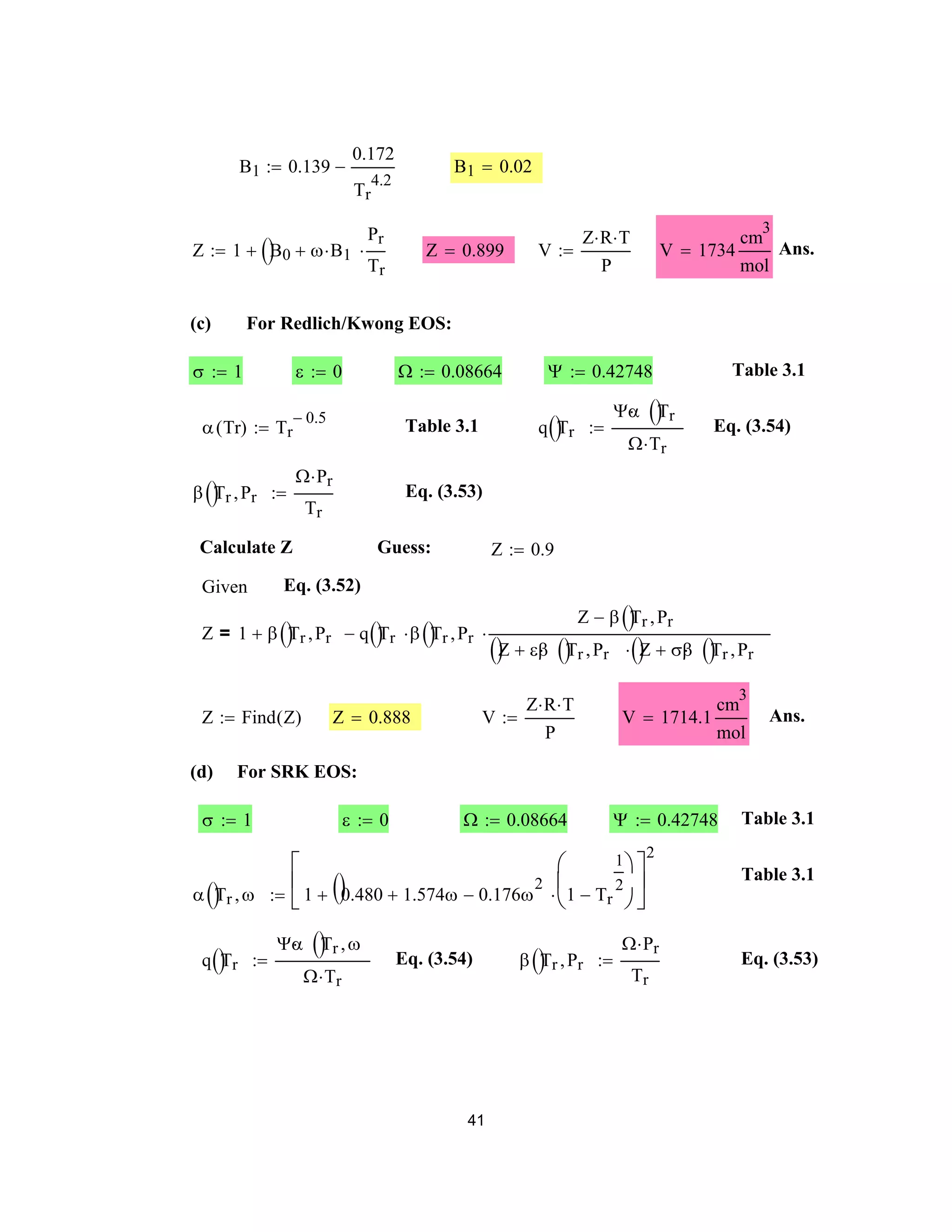
For Redlich/Kwong EOS:

( )
Tr

Tr

0.5

Table 3.1

Pr

T r Pr

Table 3.1

0.42748

0.08664

0

1

Tr

q Tr

Eq. (3.54)

Tr

Eq. (3.53)

Tr

Calculate Z

Guess:

Given

T r Pr

0.9

Eq. (3.52)

Z= 1

Z

Z

Find Z)
(

(d)

q Tr

Z

Z

T r Pr

Z

T r Pr

Z

T r Pr
3

Z RT

V

0.888

T r Pr

cm
1714.1
mol

V

P

Ans.

For SRK EOS:

0.42748

0.08664

0

1

1

Tr
q Tr

1

0.480
Tr

1.574

0.176

Eq. (3.54)

Tr

41

2

1

T r Pr

Tr

Table 3.1

2

Table 3.1

2

Pr
Tr

Eq. (3.53)
Calculate Z
Guess:
Eq. (3.52)
Given

Z= 1

T r Pr

Z

(e)

q Tr

Z

Find ( Z)

Z

0.9

Z

T r Pr

Z

Z

T r Pr

T r Pr
3

ZRT
P

V

0.895

T r Pr

V

1726.9

Ans.

mol

For Peng/Robinson EOS:

1

1

2

0.45724

0.07779

2

1

Tr

1

0.37464
Tr

q Tr

T r Pr

Guess:

Z

T r Pr

q Tr

Z

Find ( Z)

Tr

2

Table 3.1

2

Pr

Eq. (3.53)

Tr

0.9

523.15 K

Z

T r Pr

Z

ZRT
P

V

0.882

P

T r Pr

cm
152.5
mol

B

Given

Z

PV
RT

T r Pr
Z

T r Pr
3

cm
1701.5
mol

V

Ans.

1800 kPa
6

3

(a)

1

Table 3.1

Eq. (3.52)

Z= 1

T

2

0.26992

Tr

Given

Z

1.54226

Eq. (3.54)

Calculate Z

3.35

cm

C

mol

C

B
V

PV
= 1
RT

V

2

2

V

RT
(guess)
P

V

5800

cm

Find ( V)

3

V

2250
42

cm

mol

Z

0.931

Ans.
(b) Tc

Tr

Tr

B1

647.1 K

Pc

T
Tc

Pr

0.139

0.172
Tr

(c) Table F.2:

B0

Pc

4.2

0.422

0.083

Tr

B0

0.082

B1

0.51

Z

0.281

1.6

1

B0

B1

Pr
Tr

3

Z RT
P

V

P

Pr

0.808

0.345

220.55 bar

Z

molwt

V

V

cm
molwt
124.99
gm

V

0.939

cm
2268
mol

cm
2252
mol

Ans.
3

gm
18.015
mol

3

or

cm
53.4
mol

B

T

Zi

Z1i

C

2620

cm

mol

2

D

5000

cm

mol

3

n

mol

273.15 K

PV

Given

i

9

6

3

3.37

Ans.

RT

0 10

Pi

fPi Vi Pi
RT

1

B Pi
RT

= 1

10

B
V
10

C
V

2

D
V

fP V)
(

3

RT
Pi

Vi

20 i bar

Find V)
(

(guess)

Eq. (3.12)

Eq. (3.38)

43

Z2i

1
2

1
4

B Pi
RT

Eq. (3.39)
1·10 -10

Z2i

Z1i

Zi

20

1

1

1

40

0.953

0.953

0.951

60

0.906

0.906

0.895

0.861

0.859

0.83
0.749

80

Pi

100

bar

0.819

0.812

120

0.784

0.765

0.622

140

0.757

0.718

0.5+0.179i

160

0.74

0.671

0.5+0.281i

180

0.733

0.624

0.5+0.355i

200

0.735

0.577

0.5+0.416i

0.743

0.53

0.5+0.469i

Note that values of Z from Eq. (3.39) are not physically meaningful for
pressures above 100 bar.
1

0.9
Zi

0.8

Z1 i
Z2 i

0.7

0.6

0.5

0

50

100
Pi bar

44

150
1

200
3.38 (a) Propane:

Tc

Tc

313.15 K

P

Tr

T

Pc

T

Tr

369.8 K

0.847

Pr

0.152

42.48 bar

13.71 bar

P
Pc

Pr

0.323

For Redlich/Kwong EOS:

( )
Tr

Tr

0.5

Table 3.1

Pr

T r Pr

Table 3.1

0.42748

0.08664

0

1

Tr

q Tr

Eq. (3.54)

Tr

Eq. (3.53)

Tr

Calculate Z for liquid by Eq. (3.56) Guess:

Z

0.01

Given

Z=

Z

T r Pr

Z

Find Z) Z
(

T r Pr

0.057

Z

Calculate Z for vapor by Eq. (3.52)

Z

T r Pr

q Tr

T r Pr
3

Z RT
P

V

1

T r Pr

V

Guess:

108.1

cm

Ans.

mol

Z

0.9

V

cm
1499.2
mol

Given

Z= 1

Z

T r Pr

Find Z)
(

q Tr

Z

T r Pr

Z
Z Z

V

0.789

45

T r Pr
T r Pr

Z RT
P

3

Ans.
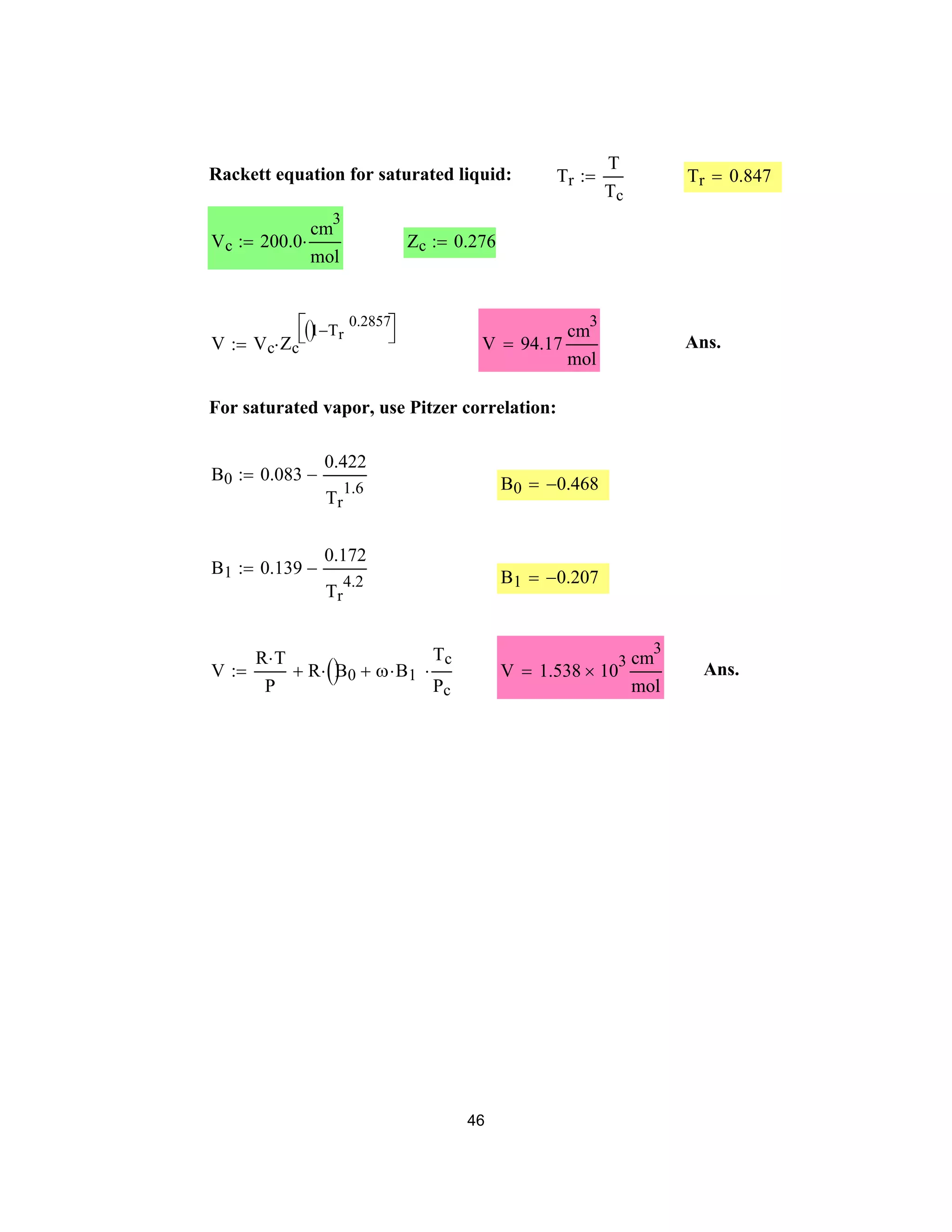
Rackett equation for saturated liquid:

T
Tc

Tr

Tr

0.847

3

Vc

V

200.0

V c Zc

cm

Zc

mol

1 Tr

0.276

3

0.2857

V

94.17

cm

Ans.

mol

For saturated vapor, use Pitzer correlation:

B0

0.083

0.422
Tr

B1

0.139

V

0.468

B1

0.207

0.172
Tr

RT
P

B0

1.6

4.2

R B0

B1

Tc

V

Pc

46

1.538

3
3 cm

10

mol

Ans.
Parts (b) through (t) are worked exactly the same way. All results are
summarized as follows. Volume units are cu.cm./mole.
R/K, Liq. R/K, Vap. Rackett Pitzer
(a) 108.1
1499.2
94.2 1537.8
(b) 114.5

1174.7

98.1

1228.7

(c) 122.7

920.3

102.8

990.4

(d) 133.6

717.0

109.0

805.0

(e) 148.9

1516.2

125.4

1577.0

(f) 158.3

1216.1

130.7

1296.8

(g) 170.4

971.1

137.4

1074.0

(h) 187.1

768.8

146.4

896.0

(i) 153.2

1330.3

133.9

1405.7

(j) 164.2

1057.9

140.3

1154.3

(k) 179.1

835.3

148.6

955.4

(l) 201.4

645.8

160.6

795.8

(m)

61.7

1252.5

53.5

1276.9

(n)

64.1

1006.9

55.1

1038.5

(o)

66.9

814.5

57.0

853.4

(p)

70.3

661.2

59.1

707.8

(q)

64.4

1318.7

54.6

1319.0

(r)

67.4

1046.6

56.3

1057.2

(s)

70.8

835.6

58.3

856.4

(t)

74.8

669.5

60.6

700.5
47
3.39 (a) Propane

T

Tc

273.15)K

T

Tr

(
40

T
Tc

Tr

Pc

369.8 K

Pr

0.847

0.152

42.48 bar

P

P
Pc

13.71 bar

Pr

313.15 K

0.323

From Table 3.1 for SRK:

0.42748

0.08664

0

1

2

1

Tr

1

0.480

Tr

q Tr

1.574

0.176

Eq. (3.54)

2

1

2

Tr

Pr

T r Pr

Tr

Calculate Z for liquid by Eq. (3.56) Guess:

Eq. (3.53)

Tr
Z

0.01

Given

Z=

Z

T r Pr

Find Z)
(

Z

Z

T r Pr

0.055

Z

Calculate Z for vapor by Eq. (3.52)

Z

T r Pr

q Tr

T r Pr
3

Z RT
P

V

1

T r Pr

cm
104.7
mol

V

Guess:

Z

Ans.

0.9

Given

Z= 1

Z

T r Pr

Find Z)
(

q Tr

Z

0.78

Z

T r Pr

Z

V

48

T r Pr
Z

T r Pr

Z RT
P

T r Pr
3

V

1480.7

cm

mol

Ans.
Parts (b) through (t) are worked exactly the same way. All results are
summarized as follows. Volume units are cu.cm./mole.
SRK, Liq. SRK, Vap. Rackett Pitzer
(a) 104.7
1480.7
94.2 1537.8
(b) 110.6

1157.8

98.1

1228.7

(c) 118.2

904.9

102.8

990.4

(d) 128.5

703.3

109.0

805.0

(e) 142.1

1487.1

125.4

1577.0

(f) 150.7

1189.9

130.7

1296.8

(g) 161.8

947.8

137.4

1074.0

(h) 177.1

747.8

146.4

896.0

(i) 146.7

1305.3

133.9

1405.7

(j) 156.9

1035.2

140.3

1154.3

(k) 170.7

815.1

148.6

955.4

(l) 191.3

628.5

160.6

795.8

(m)

61.2

1248.9

53.5

1276.9

(n)

63.5

1003.2

55.1

1038.5

(o)

66.3

810.7

57.0

853.4

(p)

69.5

657.4

59.1

707.8

(q)

61.4

1296.8

54.6

1319.0

(r)

63.9

1026.3

56.3

1057.2

(s)

66.9

817.0

58.3

856.4

(t)

70.5

652.5

60.6

700.5
49
3.40 (a) Propane

T

(
40

Tr

Tc

T
Tc

Pc

369.8 K

T

273.15)K

Tr

P

P
Pc

13.71 bar

Pr

313.15 K

Pr

0.847

0.152

42.48 bar

0.323

From Table 3.1 for PR:
2

1

Tr

1
1

0.37464
1

2

0.26992

2

Eq. (3.54)

1

2

Pr

T r Pr

Tr

Tr

0.45724

0.07779

2

Tr

q Tr

1.54226

Calculate Z for liquid by Eq. (3.56) Guess:

Eq. (3.53)

Tr
Z

0.01

Given

Z=

Z

T r Pr

Find Z)
(

Z

Z

T r Pr

0.049

Z

Calculate Z for vapor by Eq. (3.52)

Z

T r Pr

q Tr

T r Pr
3

Z RT
P

V

1

T r Pr

cm
92.2
mol

V

Guess:

Z

Ans.

0.6

Given

Z= 1

Z

T r Pr

Find Z)
(

q Tr

Z

0.766

Z

T r Pr

Z

V

50

T r Pr
Z

T r Pr

Z RT
P

T r Pr
3

V

1454.5

cm

mol

Ans.
Parts (b) through (t) are worked exactly the same way. All results are
summarized as follows. Volume units are cu.cm./mole.
PR, Liq. PR, Vap. Rackett Pitzer
(a) 92.2
1454.5
94.2 1537.8
(b)

97.6

1131.8

98.1

1228.7

(c) 104.4

879.2

102.8

990.4

(d) 113.7

678.1

109.0

805.0

(e) 125.2

1453.5

125.4

1577.0

(f) 132.9

1156.3

130.7

1296.8

(g) 143.0

915.0

137.4

1074.0

(h) 157.1

715.8

146.4

896.0

(i) 129.4

1271.9

133.9

1405.7

(j) 138.6

1002.3

140.3

1154.3

(k) 151.2

782.8

148.6

955.4

(l) 170.2

597.3

160.6

795.8

(m)

54.0

1233.0

(n)

56.0

987.3

55.1

1038.5

(o)

58.4

794.8

57.0

853.4

(p)

61.4

641.6

59.1

707.8

(q)

54.1

1280.2

54.6

1319.0

(r)

56.3

1009.7

56.3

1057.2

(s)

58.9

800.5

58.3

856.4

(t)

62.2

636.1

60.6

700.5

53.5

1276.9

51
3.41 (a) For ethylene,

molwt

28.054

gm
Tc
mol

282.3 K

Pc

50.40 bar

0.087

T

Tr

Tc

328.15 K

P

35 bar

P
Pc

Pr

T

Tr

1.162

Pr

0.694

From Tables E.1 & E.2:

Z

Z0

Z1

Z

Z0

Z1

0.838

0.033

0.841

Vtotal

ZnRT
P

Vtotal

0.421 m

P

115 bar

Vtotal

0.25 m

Tr

1.145

Pr

P
Pc

From Tables E.3 & E.4: Z0

0.482

Z1

0.126

18 kg

n

molwt

(b) T

323.15 K

T
Tc

Tr

Z

Z0

Z

Z1

mass

Pr

ZRT

mass

n molwt

Ans.

3

P Vtotal

n

0.493

3

n

2.282

2171 mol

Ans.

60.898 kg

3.42 Assume validity of Eq. (3.38).
3

P1

1bar

Z1

P1 V 1
R T1

T1

Z1

300K

0.922

cm
23000
mol

V1

R T1
Z1
P1

B

With this B, recalculate at P2

Z2

1

B P2
R T1

Z2

0.611

P2

V2
52

R T1 Z2
P2

B

1

3
3 cm

1.942 10

mol

5bar

V2

3.046

10

3
3 cm

mol

Ans.
3.43 T

753.15 K

Tc

513.9 K

Tr

T
Tc

Tr

1.466

P

6000 kPa

Pc

61.48 bar

Pr

P
Pc

Pr

0.976

0.645

B0

0.083

0.422
Tr

B1

0.172

0.139

Tr

RT
P

V

B0

For an ideal gas:

3.44 T

320 K

0.104

3

V

cm
989
mol

V

Pc

cm
1044
mol

Ans.
3

RT
P

V

P

0.146

B1

4.2

Tc

B1 R

B0

1.6

Tc

369.8 K

Pc

Zc

16 bar

42.48 bar

0.276

molwt

3

Vc

0.152

Tr

Vliq

Vtank

cm
200
mol

T
Tc

Tr

V c Zc

1 Tr

3

B0

0.083

Tr

B1

0.139

1.6

0.172
Tr

4.2

Pr

gm
mol

0.377
3

cm

Vliq

0.8 Vtank
Vliq
molwt

0.422

P
Pc

0.2857

mliq

0.35 m

Pr

0.865

44.097

B0

0.449

B1

0.177

53

96.769

mliq

127.594 kg

mol

Ans.
RT
P

Vvap

B0

B1 R

Tc

3
3 cm

Vvap

1.318

mvap

Pc

10

2.341 kg

mol

0.2 Vtank

mvap

Vvap

Ans.

molwt

3.45 T

B0

Tc

425.1 K

2.43 bar

Pc

37.96 bar

Pr

Vvap

0.083

0.422
Tr

B1

0.139

RT
P

1.6

0.172
Tr

V

T

Tr

0.200

P

298.15 K

4.2

B0

3

gm
mol

0.624

Tc

B1 R

V

Pc

Vvap

mvap

0.064

0.661

B1

58.123

0.701

Pr

Pc

molwt

16 m

B0

Tr

Tc
P

mvap

V
molwt

9.469

98.213 kg

3
3 cm

10

mol

Ans.

P

333.15 K

Tc

305.3 K

Tr

T
Tc

Tr

1.091

14000 kPa

Pc

48.72 bar

Pr

P
Pc

Pr

2.874

0.100

3.46 (a) T

Vtotal

From tables E.3 & E.4: Z0

3

molwt

0.15 m

0.463
54

Z1

0.037

30.07

gm
mol
Z

Z0

Vtotal

methane

(b)

Z

Z1

methane

V
molwt

Vtotal

V

P

40 kg

or

Tr =

Whence

V

0.459

Z

Tr =

PV

29.548

R Tc

at

90.87

mol

P V = Z R T = Z R Tr Tc

20000 kPa

0.889
Z

V

P

cm

Ans.

49.64 kg

where

3

Z RT

Pr

P
Pc

Pr

mol
kg

4.105

This equation giving Tr as a function of Z and Eq. (3.57) in conjunction with
Tables E.3 & E.4 are two relations in the same variables which must be
satisfied at the given reduced pressure. The intersection of these two
relations can be found by one means or another to occur at about:

Tr

Whence

T

V

or

T

or

3

0.15 m

Vtotal

T

298.15 K

molwt

0.087

50.40 bar
P V = P r Pc V = Z R T

40 kg
molwt

Whence

0.693

118.5 degC Ans.

Pc

282.3 K

Pr =

Z

Tr Tc

391.7 K

3.47 Vtotal

Tc

and

1.283

Z

RT
Pc V

where

Pr = 4.675 Z

at

Tr

55

T
Tc

4.675

Tr

1.056

28.054

gm
mol
This equation giving Pr as a function of Z and Eq. (3.57) in conjunction with
Tables E.3 & E.4 are two relations in the same variables which must be
satisfied at the given reduced temperature. The intersection of these two
relations can be found by one means or another to occur at about:

Pr

and

1.582

3.48 mwater

Z

P

Pc Pr

3

Vtotal

15 kg

P

0.338

V

0.4 m

Interpolate in Table F.2 at 400 degC to find:

298.15 K

Tc

305.3 K

Tr1

P1

2200 kPa

Pc

48.72 bar

Pr1

3

T2

Z0

mwater

T1
Tc
P1
Pc

3

V

26.667

Z

Z1

Z1

0.422
Tr2

B1

0.139

T2
Tc

Z R T1
P1

Tr2

0.806

B0

1.6

0.172
Tr2

Tr1

0.977

Pr1

0.452

1.615

3

V1

B1

4.2

0.113

0.116

R T2

P2
V1

B0

gm

0.0479

V1

.8105

Tr2

493.15 K

0.083

cm

Ans.

Assume Eq. (3.38) applies at the final state.

B0

Ans.

0.100

0.35 m

From Tables E.1 & E.2: Z0

Z

Vtotal

P = 9920 kPa

3.49 T1

Vtotal

79.73 bar

B1 R

P2

Tc
Pc
56

42.68 bar

Ans.

cm
908
mol
3.50 T

B0

0.5 m

0.083

0.139

73.83 bar

0.422
Tr

B1

304.2 K

Pc

3

Vtotal

B0

4.2

V

10 kg
molwt

0.224

0.997

molwt

44.01

0.036

Vtotal

V

Tr

Tc

0.341

B1

1.6

0.172
Tr

T

Tr

Tc

303.15 K

3
3 cm

2.2

10

mol

RT

P
V

B0

B1 R

P

Tc

10.863 bar

Ans.

Pc

3.51 Basis: 1 mole of LIQUID nitrogen

P

B0

Tc

126.2 K

Tr

1 atm

Pc

34.0 bar

Pr

0.038

Tn

molwt

77.3 K

0.083

0.139

1

B0

4.2

B1

Pr
Tr

0.842

B1

0.172
Tr

Z

mol

B0

1.6

1.209

Z

0.957

57

Tr

P
Pc

Vliq

0.613

Pr

Tc

gm

0.422
Tr

B1

28.014

Tn

0.03

3

34.7 cm

gm
mol
P Vliq

nvapor

nvapor

Z R Tn

5.718

10

3

mol

Final conditions:

ntotal

T

1 mol

V

nvapor

RT

Pig

Pig

V

V

T
Tc

69.005

Tr

ntotal

Tr

298.15 K

3

2 Vliq

cm

2.363

mol

359.2 bar

Use Redlich/Kwong at so high a P.

2

2

a

Tr R Tc
Pc

a

3
3 bar cm
0.901 m
2

b

Eq. (3.42)

RT
V b

Tr

.5

R Tc

Tr

0.651

Eq. (3.43)

Pc
3

b

mol

P

( )
Tr

0.42748

0.08664

a
V ( b)
V

Eq. (3.44)

cm
26.737
mol

P

450.1 bar

Ans.

3

3.52 For isobutane:

T1

Tr1

Tr1

300 K

T1
Tc

0.735

Tc

408.1 K

Pc

36.48 bar

V1

1.824

P1

4 bar

T2

415 K

P2

cm

75 bar

Pr1

Pr1

P1

Tr2

Pc

Tr2

0.11

58

T2
Tc

1.017

Pr2

Pr2

P2
Pc

2.056

gm
From Fig. (3.17):

r1

2.45

The final T > Tc, and Fig. 3.16 probably should not be used. One can easily
show that
r=

P Vc

with Z from Eq. (3.57) and
Tables E.3 and E.4. Thus

Z RT
3

Vc

Z

262.7

Z0

cm

Z0

0.181

mol

Z

Z1

Eq. (3.75):

V1

r2

Tc

3

r1

cm
2.519
gm

V2

Pc

469.7 K

1.774

r2

Z R T2

r2

3.53 For n-pentane:

0.0756

P2 V c

0.322

V2

Z1

0.3356

33.7 bar

Ans.

0.63

1

gm
3

cm

T1

Tr1
Tr1

P1

291.15 K

T1

Pr1

Tc

T2

1 bar
P1

Tr2

Pc

T2

0.03

Tr2

2.69

r2

r2
2

2

1

0.532

r1

3.54 For ethanol: Tc

Pc

Pc

3.561

gm
3

Ans.

cm

513.9 K

T

453.15 K

Tr

T
Tc

Tr

0.882

61.48 bar

P

200 bar

Pr

P
Pc

Pr

3.253

3

Vc

P2

2.27

From Fig. (3.16):

By Eq. (3.75),

Pr2

0.88

r1

120 bar

Pr2

Tc

Pr1

0.62

P2

413.15 K

167

cm

mol

molwt
59

46.069

gm
mol
From Fig. 3.16:

r

2.28

=

r

r

c=

0.629

Vc

r

Vc

gm

Ans.

3

cm

molwt

3.55 For ammonia:

Tc

405.7 K

T

293.15 K

Tr

T
Tc

Tr

0.723

Pc

112.8 bar

P

857 kPa

Pr

P
Pc

Pr

0.076

Vc

cm
72.5
mol

Zc

0.242

3

Eq. (3.72):

B0

Vliquid

0.083

0.139

Vvapor

cm
27.11
mol

Vliquid

B0

4.2

B0

B1 R

0.627

B1

1.6

0.172
Tr

RT
P

3

0.2857

0.422
Tr

B1

V c Zc

1 Tr

0.253

0.534

Tc
Pc

3

Vvapor

cm
2616
mol
3

V

Vvapor

Vliquid

V

60

cm
2589
mol

Ans.
Alternatively, use Tables E.1 & E.2 to get the vapor volume:

Z0

Z1

0.929

Vvapor

Z

0.071

Z0

Z

Z1

0.911

3

ZRT
P

Vvapor

cm

2591

mol
3

V

Vvapor

V

Vliquid

cm

2564

Ans.

mol

3.5810 gal. of gasoline is equivalent to 1400 cu ft. of methane at 60 degF and 1
atm. Assume at these conditions that methane is an ideal gas:
3

R

ft atm
0.7302
lbmol rankine

V

1400 ft

T

P

1 atm

n

3

519.67 rankine

PV
RT

n

3.689 lbmol

For methane at 3000 psi and 60 degF:

Tc

190.6 1.8 rankine

T

519.67 rankine

Tr

T
Tc

Tr

1.515

Pc

45.99 bar

P

3000 psi

Pr

P
Pc

Pr

4.498

Z

0.822

0.012
From Tables E.3 & E.4:

Z0

0.819

Vtank

ZnRT
P

Z1

Z

0.234

Vtank

61

5.636 ft

Z0
3

Z1
Ans.
3.59 T

P

25K

3.213bar

Calculate the effective critical parameters for hydrogen by equations (3.58)
and (3.56)

43.6

Tc
1

K

1

30.435 K

Pc

10.922 bar

2.016T

20.5

Pc

Tc

bar

21.8K

44.2K
2.016T

0

P
Pc

Pr

Pr

Initial guess of volume:

T

Tr

0.294

Tr

cm
646.903
mol

3

RT
P

V

0.821

V

Tc

Use the generalized Pitzer correlation

B0

0.083

0.422
Tr

Z

1

B0

1.6

B0

B1

0.495

B1

0.139

0.172
Tr

Pr
Tr

Z

0.823

Ans.

4.2

B1

0.254

Experimental: Z = 0.7757

For Redlich/Kwong EOS:

0

1

Tr

T r Pr

Tr

0.5

Pr
Tr

Table 3.1

Eq. (3.53)

62

Table 3.1

0.42748

0.08664

q Tr

Tr
Tr

Eq. (3.54)
Calculate Z

Guess:

Given

T r Pr

0.9

Eq. (3.52)

Z= 1

Z

Z

q Tr

Z

Find Z)
(

3.61For methane:

Z Z

Tc

0.012

T

T r Pr
T r Pr

Ans.

0.791

At standard condition:

Z

T r Pr

Experimental: Z = 0.7757

Pc

190.6K

(
60

32)

5
9

45.99bar

273.15 K

T

P

Tr

T
Tc

B0

0.083

Z0

Z

1

Tr

0.422
Tr
Pr

B0

Z0

1.6

Pitzer correlations:

T
Tc

Tr

0.083

0.422
Tr

B1

0.139

1.6

0.172
Tr

4.2

0.134

B1

0.139

0.172

T
T

Tr

Z RT
P

(
50

32)

5
9

0.109

Tr

0.00158
3

V1

273.15 K

m
0.024
mol
P

300psi

Pr

0.45

283.15 K

1.486

B0

B1

B1

V1

0.998

B1

Pr

Z1

0.998

4.2

0.022

Z1

P
Pc

Tr

Z

Z1

(a) At actual condition:

B0

B0

Z0

Tr

Pr

1.515

1atm

Pr

Pitzer correlations:

288.706 K

0.141

0.106

63

Pr

P
Pc
Z0

Z

1

B0

Z0

Pr
Tr

Z1

6 ft

q1

150 10

(b) n1

(c) D

u

Z0

0.957

Z

Z1

0.958

q1

n1

7.485

q2

V1

q1
V1

22.624in
q2
A

A

u

4

D

8.738

2

m
s

64

3 kmol

10

hr

A

Ans.

0.0322
3

V2

P

V2

q2

day

Z1

Tr

ZRT

V2

3

Pr

B1

6.915

Ans.

2

0.259 m

0.00109

10

6 ft

m

mol

3

day

Ans.
3.62

0.012

0.286

0.087

0.281

0.1

0.279

0.140

0.289

0.152

0.276

0.181

0.282

0.187

0.271

0.19

0.267

0.191

0.277

0.194

0.275

0.196

0.273

0.2

0.274

0.205

0.273

0.21

0.273

0.21

ZC

Use the first 29 components in Table B.1
sorted so that values are in ascending
order. This is required for the Mathcad
slope and intercept functions.

0.271
m

slope

b

intercept

r

corr

0.212

0.272

0.218

0.275

0.23

0.272

0.235

0.269

0.252

0.264

0.28

0.265

ZC

0.297

0.256

m

0.301

0.266

0.302

0.266

0.303

0.263

0.31

0.263

0.322

0.26

0.326

0.261

( 0.091)

0.27

0.262

ZC

ZC

ZC

(
0.291)
2

( 0.878) r

0.771

0.29
0.28

b 0.27
0.26
0.25

0

0.1

0.2

The equation of the line is:
Zc = 0.291 0.091
65

0.3

0.4

Ans.
5

7
R
2

Cv

298.15K

P1

P2

T1

T3

5bar

P3

Cp

1bar

5bar

3.65 Cp

T1

2

R

1.4

Cv

Step 1->2 Adiabatic compression
1

T2

T1

P2

T2

P1

472.216 K

U12

Cv T2

T1

U12

3.618

H12

Cp T2

T1

H12

5.065

Q12

W12

0

kJ
mol
kJ

mol

kJ
mol

kJ
mol

Q12

0

U12

W12

3.618

Ans.

Ans.

Ans.
kJ
mol

Ans.

Step 2->3 Isobaric cooling

U23

Cv T3

T2

U23

3.618

H23

Cp T3

T2

H23

5.065

Q23

W23

R T3

Q23

H23

W23

T2

5.065

1.447

kJ
mol
kJ

mol
kJ

mol
kJ

mol

Ans.

Ans.

Ans.

Ans.

Step 3->1 Isothermal expansion

U31

Cv T1

T3

U31

0

H31

Cp T1

T3

H31

0

66

kJ
mol
kJ

mol

Ans.
Ans.
Q31

R T3 ln

W31

P1

Q31

Q31

P3

W31

kJ
mol
kJ
3.99
mol

3.99

Ans.

Ans.

For the cycle

Qcycle

Q12

Wcycle

Q23

W12

Qcycle

Q31

W23

Wcycle

W31

1.076

1.076

kJ
Ans.
mol

kJ
Ans.
mol

Now assume that each step is irreversible with efficiency:

80%

Step 1->2 Adiabatic compression

W12

Q12

W12

U12

W12

Q12

W12

4.522

kJ
mol

kJ
mol

0.904

Ans.

Ans.

Step 2->3 Isobaric cooling

W23

Q23

W23

U23

W23

1.809

kJ
mol

kJ
mol

Q23

5.427

W31

W23

3.192

Ans.

Ans.

Step 3->1 Isothermal expansion

W31

Q31

W31

U31

Q31

W31

3.192

kJ
mol
kJ

mol

Ans.

Ans.

For the cycle

Qcycle

Q12

Wcycle

W12

Q23

W23

Qcycle

Q31

Wcycle

W31

67

kJ
Ans.
mol
kJ
3.14
mol Ans.
3.14
3.67 a) PV data are taken from Table F.2 at pressures above 1atm.

125
150

1757.0

175
P

2109.7

1505.1

200

1316.2

cm

1169.2

gm

V

kPa

225
250

300
Z

955.45

T

(
300

273.15)
K

M

1051.6

275

3

18.01

gm
mol

875.29

1
VM

PVM
RT

i

0 7

If a linear equation is fit to the points then the value of B is the y-intercept.
Use the Mathcad intercept function to find the y-intercept and hence, the
value of B
Yi

Zi

1

3

Xi

B

intercept ( Y)
X

A

i

slope ( Y)
X

Ans.

6
5 cm
10
2

i

A

cm
128.42
mol

1.567

B

mol

X

0

mol
3

cm

10

5 mol
3

cm

8 10

5 mol
3

cm

Below is a plot of the data along with the linear fit and the extrapolation to
the y-intercept.
68
115

(Z-1)/p

120

125

130
0

2 10

5

4 10

5

6 10

p

5

8 10

5

(Z-1)/p
Linear fit

b) Repeat part a) for T = 350 C
PV data are taken from Table F.2 at pressures above 1atm.

125
150

1912.2

175
P

2295.6

1638.3

200

1432.8

225

V

kPa

1273.1

250

300
Z

1040.7

T

( 350

273.15)K

M

1145.2

275

3

cm
gm

18.01

gm
mol

953.52

1
VM

PVM
RT

i

0 7

If a linear equation is fit to the points then the value of B is the y-intercept.
Use the Mathcad intercept function to find the y-intercept and hence, the
value of B
Yi

Zi

1

3

Xi

i

B

intercept ( X Y)

i
69

B

105.899

cm

mol

Ans.
A

A

slope ( X Y)

6
5 cm
10
2

1.784

mol

X

0

mol
3

10

cm

5 mol
3

8 10

5 mol
3

cm

cm

Below is a plot of the data along with the linear fit and the extrapolation to
the y-intercept.
90

(Z-1)/p

95

100

105

110
0

2 10

5

4 10

5

6 10

p

5

8 10

5

(Z-1)/p
Linear fit

c) Repeat part a) for T = 400 C
PV data are taken from Table F.2 at pressures above 1atm.

125
150

2066.9

175
P

2481.2

1771.1

200

1549.2

225

kPa

V

1376.6

250

1238.5

275

1125.5

300

1031.4
70

3

cm
gm

T

( 400

273.15)K

M

18.01

gm
mol
1
VM

PV M
RT

Z

i

0 7

If a linear equation is fit to the points then the value of B is the
y-intercept.
Use the Mathcad intercept function to find the y-intercept and hence,
the value of B

Yi

Zi

1

3

Xi

B

i

intercept ( X Y)

B

i

A

A

slope ( X Y)

89.902

cm

mol

Ans.

6
5 cm
10
2

2.044

mol

X

0

mol
3

cm

10

5 mol
3

8 10

5 mol
3

cm

cm

Below is a plot of the data along with the linear fit and the extrapolation to
the y-intercept.
70

(Z-1)/p

75

80

85

90
0

2 10

5

4 10
p

(Z-1)/p
Linear fit

71

5

6 10

5

8 10

5
3.70

Create a plot of

(Z

1) Z Tr

vs

Pr

Pr
Z Tr

Data from Appendix E at Tr = 1
0.01

0.9967

0.05

0.9832

0.10

0.9659
Z

0.20

Pr

0.9300

0.40

X

0.7574

0.80

1

0.8509

0.60

Tr

0.6355

Pr

(Z

Y

Z Tr

1) Z Tr
Pr

Create a linear fit of Y vs X
Slope

slope ( X Y)

Intercept
Rsquare

Slope

intercept ( X Y)

0.033

Intercept

corr ( X Y)

Rsquare

0.332
0.9965

0.28
0.3

Y
Slope X Intercept

0.32
0.34

0

0.2

0.4

0.6

0.8

1

1.2

1.4

X

The second virial coefficient (Bhat) is the value when X -> 0
Bhat

Intercept

By Eqns. (3.65) and (3.66)

Bhat
B0

0.083

0.422
Tr

These values differ by 2%.
72

1.6

B0

0.332
0.339

Ans.
Ans.
3.71 Use the SRK equation to calculate Z

T

T
273.15)Kr

Tc

150.9 K

T

(
30

Pc

48.98 bar

P

300 bar

Tr

Pr

Pc

2.009

Pr

Tc
P

6.125

0.0

0.42748 Table 3.1

0.08664

0

1

2

1

Tr

1

0.480

Tr

q Tr

0.176

Eq. (3.54)

1

Tr

Table 3.1

2

Pr

T r Pr

Tr

Calculate Z

Guess:

Z

Eq. (3.53)

Tr

0.9

Eq. (3.52)

Given

Z= 1

Z

1.574

2

T r Pr

q Tr

Z

Find Z)
(

Z

T r Pr

Z

V

1.025

T r Pr

T r Pr

Z

T r Pr
3

Z RT
P

cm
Ans.
86.1
mol

V

This volume is within 2.5% of the ideal gas value.

3.72 After the reaction is complete, there will be 5 moles of C 2H2 and 5 moles of
Ca(OH)2.
First calculate the volume available for the gas.

n

5mol

V

Vt

3

0.4 1800 cm

3

cm
5 mol 33.0
mol

Vt
n

Vt

3

555 cm

3

V

73

111

cm

mol
Use SRK equation to calculate pressure.

T

Tc

308.3 K

Pc

( 125

61.39 bar

T
Tc

Tr

273.15) K

Tr

0.0

0.42748 Table 3.1

0.08664

0

1

2

1

Tr

1

1.574

0.176

2

2

2

Pc

Eq. (3.45)

3
3 bar cm
3.995 m
2

RT
V b

3.73 mass

b

Tc

0.152

( 10

Vc

Pc

369.8K

200.0

197.8 bar

Ans.

273.15)K

3

0.276

cm
36.175
mol

P

b)
T

35000kg

Eq. (3.46)

Pc
3

a
V (V

R Tc

b

mol

Zc

Tr

Eq. (3.54)

R Tc

Tr

P

1

Table 3.1

2

Tr

a

a

0.480

Tr

q Tr

1.291

cm

mol

n

M

42.48bar

mass
M

n

44.097
7.937

gm
mol
5

10 mol

a) Estimate the volume of gas using the truncated virial equation

Tr

B0

T

Tr

Tc

0.083

0.422
Tr

B0

1.6

0.766

P

Eq. (3-65)

B1

Pr

1atm

0.139

0.172
Tr

B1

0.564
74

0.389

4.2

P
Pc

Eq. (3-66)
Z

1

B0

B1

Pr

Z

Tr

ZnRT

Vt

0.981

Vt

P

3

This would require a very large tank. If the
D
tank were spherical the diameter would be:

7 3

2.379
6

Vt

3

10 m m

D

32.565 m

b) Calculate the molar volume of the liquid with the Rackett equation(3.72)
Vliq

V c Zc

P

1

0.2857

Vvap

3

Vliq

6.294atm

Z

1 Tr

P
Pc

Pr

B0

B1

85.444

Pr

0.878

Pr
Tr

ZRT
P

Vvap

Guess:

Vtank

Given

90%

mol

0.15

Z

cm

3
3 cm

3.24 10

mol

90% Vliq n

Vtank

10%

Vtank

= n

Vvap

Vtank

Find Vtank

Vtank

Vliq

75.133 m

This would require a small tank. If the tank
D
were spherical, the diameter would be:

3

3

6

Vtank

D

5.235 m

Although the tank is smaller, it would need to accomodate a pressure of 6.294
atm (92.5 psi). Also, refrigeration would be required to liquify the gaseous
propane stream.

75
Chapter 4 - Section A - Mathcad Solutions
4.1 (a) T0

T

473.15 K

For SO2: A

B

5.699

n

1373.15 K

0.801 10

H

47.007

C

5

D

0.0

1.015 10

R ICPH T0 T A B C D

H

3

10 mol

kJ

T

523.15 K

For propane:A

28.785 10

H

161.834

3

Ans.

12 mol

C

6

8.824 10

D

0

R ICPH T0 T A B C 0.0

H

470.073 kJ

n

1473.15 K

B

1.213

n H

Q
(b) T0

Q

mol

kJ
mol

n

473.15 K

For ethylene:

A

2 (guess)

Q= nR

A T0

3

10 kJ Ans.

800 kJ
3

14.394 10
K

B

B
2
T0
2

1

n

A

1.967

2

T

2.905

533.15 K

For 1-butene:

1.424

1.942

6

4.392 10

C

K

2

Given

Find

(b) T0

Q

10 mol

n H

Q

4.2 (a) T0

Q

C
3
T0
3

1

T

T0

15 mol

Q

31.630 10
K

B

76

3

1

Ans.

1374.5 K

2500 kJ
3

C

9.873 10
K

2

6
(guess)

3

Q= nR

Given

A T0

2

n

500 degF

C
3
T0
3

1

T

2.652

Find

(c) T0

B
2
T0
2

1

3

T

T0

1

Ans.

1413.8 K
6

Q

40 lbmol

10 BTU

Values converted to SI units

T0

n

533.15K

For ethylene:

A

Q= nR

Q

10 mol

B

14.394 10
K

1.424

2 (guess)

4

1.814

6

1.055 10 kJ

3

4.392 10

C

K

Given

A T0

1

Find

B
2
T0
2

2

T

2.256

C
3
T0
3

1

T

T0

3

6

2

1

1202.8 K
Ans.

T = 1705.4degF
4.3 Assume air at the given conditions an ideal gas. Basis of calculation is 1 second.
P

T0

1 atm

(
T

T

PV
R T0

T0

773.15 K

n

For air:

H

32degF) 273.15K

T0

n

A

T

250 ft

V

Convert given values to SI units

T

3

V

122 degF

932 degF

7.079 m

3

T0

32degF

273.15K

323.15 K

266.985 mol

3.355

B

0.575 10

R ICPH T0 T A B C D
77

3

C

0.0

D

0.016 10

5
kJ

13.707

4.4 molwt

Q

gm
mol

100.1

T0

10000 kg
molwt

n

n

For CaCO3: A

323.15 K

B

10 mol

2.637 10

H

9.441

3

C

D

0.0

3.120 10

5

R ICPH T0 T A B C D

H

1153.15 K

3
10 BTU Ans.

4

9.99

12.572

3.469

T

mol

n H

Q

H

4 J

10

Q

mol

n H

6

Q

Ans.

9.4315 10 kJ

4.7 Let step 12 represent the initial reversible adiabatic expansion, and step 23
the final constant-volume heating.

T1

298.15 K

T3

298.15 K

P1

121.3 kPa

P2

101.3 kPa

P3

104.0 kPa

T2

T3

CP

30

T2

290.41 K

Given

J
mol K

T2 = T1

4.9a) Acetone: Tc

Hn

(guess)

29.10

P2

P2
P3

R
CP

CP

P1
Pc

508.2K

kJ

47.01bar

Tn

Trn

mol

CP

Find CP

Tc

56.95

Tn

329.4K

Trn

J
Ans.
mol K

0.648

Use Eq. (4.12) to calculate H at Tn ( Hncalc)

1.092 ln
Hncalc

R Tn

Pc

1.013

bar

0.930

Trn

78

Hncalc

30.108

kJ
mol

Ans.
To compare with the value listed in Table B.2, calculate the % error.

%error

Hncalc

Hn

%error

Hn

3.464 %

Values for other components in Table B.2 are given below. Except for
acetic acid, acetonitrile. methanol and nitromethane, agreement is within
5% of the reported value.
Acetone
Acetic Acid
Acetonitrile
Benz
ene
iso-Butane
n-Butane
1-Butanol
Carbon tetrachloride
Chlorobenz
ene
Chloroform
Cyclohexane
Cyclopentane
n-Decane
Dichloromethane
Diethyl ether
Ethanol
Ethylbenz
ene
Ethylene glycol
n-Heptane
n-Hexane
M ethanol
M ethyl acetate
M ethyl ethyl k
etone
Nitromethane
n-Nonane
iso-Octane
n-Octane
n-Pentane
Phenol
1-Propanol
2-Propanol
Toluene
W ater
o-Xylene
m-Xylene
p-Xylene

Hn (k mol)
J/
30.1
40.1
33.0
30.6
21.1
22.5
41.7
29.6
35.5
29.6
29.7
27.2
40.1
27.8
26.6
40.2
35.8
51.5
32.0
29.0
38
.3
30.6
32.0
36.3
37.2
30.7
34.8
25.9
46.6
41.1
39.8
33.4
42.0
36.9
36.5
36.3

79

% error
3.4%
69.4%
9.3%
-0.5%
-0.7%
0.3%
-3.6%
-0.8
%
0.8
%
1.1%
-0.9%
-0.2%
3.6%
-1.0%
0.3%
4.3%
0.7%
1.5%
0.7%
0.5%
8
.7%
1.1%
2.3%
6.7%
0.8
%
-0.2%
1.2%
0.3%
1.0%
-0.9%
-0.1%
0.8
%
3.3%
1.9%
2.3%
1.6%
b)

33.70

469.7
Tc

507.6
562.2

30.25

Pc

K

48.98

36.0
68.7

H25

273.15 K

80.0

366.1

72.150
J

M

433.3 gm
392.5

Tn

Tr2

Tc

(
25

273.15)
K
Tc

H2

H25 M

0.673

H2

0.628

H1

31.533

Hn

31.549

kJ
33.847 mol

32.242
1

Tr2

1

0.38

Tr1

Eq. (4.13) %error

26.448
H2calc

H1

26.429

0.631
H2calc

86.177 gm
78.114 mol
82.145

0.658
Tr1

kJ
30.72 mol

29.97

366.3

80.7

Tr1

28.85

Hn

bar

43.50

560.4

Tn

25.79

kJ
Ans.
33.571 mol

32.816

31.549

kJ
33.847 mol

32.242

H2

H2
0.072

26.429
H2

H2calc

%error

0.052
0.814

%

1.781

The values calculated with Eq. (4.13) are within 2% of the handbook values.

4.10 The ln P vs. 1/T relation over a short range is very nearly linear. Our
procedure is therefore to take 5 points, including the point at the
temperature of interest and two points on either side, and to do a linear
least-squares fit, from which the required derivative in Eq. (4.11) can be
found. Temperatures are in rankines, pressures in psia, volumes in cu
ft/lbm, and enthalpies in Btu/lbm. The molar mass M of tetrafluoroethane is
102.04. The factor 5.4039 converts energy units from (psia)(cu ft) to Btu.

80
(a) T

459.67

V

5

1.934

18.787

P

0

23.767

t

5

26.617

dPdT

T

H

2

ti

1
459.67

yi

ln Pi

15

slope ( x y) slope

( P) 3

xi

10

29.726
slope

1 5

5

21.162
Data:

i

0.012

4952

slopedPdT

T V dPdT
5.4039

H

0.545

90.078

Ans.

The remaining parts of the problem are worked in exactly the same
way. All answers are as follows, with the Table 9.1 value in ( ):
(a)

H = 90.078

( 90.111)

(b)

H = 85.817

( 85.834)

(c)

H = 81.034

( 81.136)

(d)

H = 76.007

( 75.902)

(e)

H = 69.863

( 69.969)

119.377

4.11

M

32.042
153.822

H is the value at
0 degC.

536.4
mol

Tc

334.3

512.6 K Pc

80.97 bar Tn

337.9 K

556.4

gm

54.72

45.60

349.8

Hexp is the given
value at the normal
boiling point.
81

Tr1

273.15K
Tc

Tr2

Tn
Tc
270.9
H

1189.5

0.509

246.9
J
gm

Hexp

217.8

J
gm

1099.5

Hn

Hn

Hexp
Hexp

Hn

PCE

0.38

Tr1

0.52

Hexp

1195.3

1.092 ln

R Tn

Hn

Hexp

4.03 %

M

Pc

1.013

bar

0.930

Tr2

100%

0.34

247.7
Hn

1

H

Tr2

0.77

J
1055.2
gm
193.2

(b) By Eq. (4.12):

PCE

1

0.629

This is the % error

100%

245
Hn

0.659

Tr2

0.491

194.2

(a) By Eq. (4.13)

PCE

0.533

Tr1

0.623

J
gm

PCE

8.72

%

0.96

192.3

4.12 Acetone
0.307

Tc

508.2K

Pc

Tn

329.4K

P

1atm

Pr

P
Pc

47.01bar

Zc

0.233

3

Vc
Tr

cm
209
mol
Tn
Tc

Tr

0.648

82

Hn

29.1
Pr

kJ
mol

0.022
Generalized Correlations to estimate volumes
Vapor Volume
B0

0.422

0.083

Tr
B1

Tr

4.2

Pr

Z

1

V

B1

Pr

Z R Tn
P

Tr

Tr

0.762

Eq. (3.65)

B1

0.172

0.139

B0

B0

1.6

0.924

Eq. (3.66)

Z

V

(Pg. 102)

0.965

3
4 cm

2.609

10

mol

Liquid Volume
2

Vsat

V c Zc

1 Tr

3

7

Eq. (3.72)

Vsat

Combining the Clapyeron equation (4.11)

gives

A

Vsat

14.3145

V
B

2.602

A

B

H= T V

V

2

e

C)

3
4 cm

10

d
Psat
dT

T C

Psat = e

(
T

V

H= T V

B

A

with Antoine's Equation

cm
70.917
mol

mol

2756.22

C

83

228.060

B
( C)
T
B

A

Tn 273.15K

Hcalc

B

Tn V
Tn

C

K

e
2

273.15K

kPa
K

C
K

Hcalc

29.662

kJ
Ans.
mol

%error

Hcalc

Hn

%error

1.9 %

Hn

The table below shows the values for other components in Table B.2. Values
agree within 5% except for acetic acid.
Acetone
Acetic Acid
Acetonitrile
Benz
ene
isoButane
nButane
1Butanol
Carbon tetrachloride
Chlorobenz
ene
Chloroform
Cyclohexane
Cyclopentane
nDecane
Dichloromethane
Diethyl ether
Ethanol
Ethylbenz
ene
Ethylene glycol
nHeptane
nHexane
M ethanol
M ethyl acetate
M ethyl ethyl k
etone
Nitromethane
nNonane
isoOctane
nOctane
nPentane
Phenol
1- panol
Pro

Hn ( J/
k mol)
29
.7
37.6
31.3
30.8
21.2
22.4
43.5
29
.9
35.3
29
.3
29
.9
27.4
39
.6
28
.1
26
.8
39
.6
35.7
53.2
31.9
29
.0
36
.5
30.4
31.7
34.9
37.2
30.8
34.6
25.9
45.9
41.9
84

% error
1.9
%
58
.7%
3.5%
0.2%
0.7%
0.0%
0.6
%
0.3%
0.3%
0.1%
0.1%
0.4%
2.2%
0.2%
0.9
%
2.8
%
0.5%
4.9
%
0.4%
0.4%
3.6
%
0.2%
1.3%
2.6
%
0.7%
0.1%
0.6
%
0.2%
- %
0.6
1.1%
p
2-Propanol
Toluene
W ater
o-Xylene
m-Xylene
p-Xylene

40.5
33.3
41.5
36.7
36.2
35.9

1.7%
0.5%
2.0%
1.2%
1.4%
0.8%

4.13 Let P represent the vapor pressure.

T

ln

Given

P

P

348.15 K

P
= 48.157543
kPa

Find ( ) dPdT
P

P

5622.7 K
T

P

Clapeyron equation:

B

dPdT =

Pc

AL

13.431

BL

2.211

0.029

bar
K
3

cm
96.49
mol

Vliq

H
T dPdT

1

512.6K

AV

dPdT

3

4.14 (a) Methanol: Tc

AL

4.70504
T

T
K

4.70504 ln

H
T V Vliq

Vliq

PV
V
RT

CPL ( )
T

5622.7 K
T

joule
31600
mol

V = vapor molar volume. V

Eq. (3.39)

2

H

87.396 kPa

(guess)

100 kPa

BL
K
BV
85

cm
1369.5
mol

B

Tn

80.97bar

51.28 10

T

CL
K

2

T

2

3

Ans.

337.9K

CL

131.13 10

CV

3.450 10

6

R

12.216 10

3

6
CPV ( )
T

P

BV

AV

CV

T

K

K

Tsat

3bar

2

T

2

R

T1

368.0K

T2

300K

500K

Estimate Hv using Riedel equation (4.12) and Watson correction (4.13)

Tn

Trn

Trn

Tc

1.092 ln
Hn

Pc

Hv

Trsat

1

Trn

kJ
mol

35.645

kJ
mol

T2

CPL ( ) T
T d

100

38.301

Hv

Hv

CPV ( ) T
T d

T1

n

0.718

0.38

Tsat

H

Trsat

Hn

Tc

R Tn

Trn

1

Hn

Tsat

1.013

bar

0.930

Trsat

0.659

kmol
hr

H

49.38

T sat

Q

n H

Q

1.372

3

10 kW

kJ
mol
Ans.

(b) Benzene:

Hv = 28.273

kJ
mol

H = 55.296

kJ
mol

Q = 1.536 10 kW

(c) Toluene

Hv = 30.625

kJ
mol

H = 65.586

kJ
mol

Q = 1.822 10 kW

4.15 Benzene

Tc

T1sat

562.2K

451.7K

Pc

48.98bar

T2sat

86

358.7K

3

3

Tn

353.2K

Cp

162

J
mol K
Estimate Hv using Riedel equation (4.12) and Watson correction (4.13)

Trn

Tn

Trn

Tc

Hn

Hv

Hn

30.588

30.28

R Tn

Trn

Tr2sat

1

0.638

Hn

Tc

1.013

bar

0.930

1

Tr2sat

Hv

Pc

1.092 ln

T2sat

Tr2sat

0.628

0.38

Trn

kJ
mol

kJ
mol

Assume the throttling process is adiabatic and isenthalpic.
Guess vapor fraction (x): x

Given

Cp T1sat

0.5

4.16 (a) For acetylene:

Tc

Tn

ln
Hn

R Tn 1.092
1

Tr

1

Hn

Hf

227480

0.498

Tn

61.39 bar

Tr

0.614

Pc
bar

J
mol

T
Tc

Tr

1.013
Trn

16.91

Hv

0.930

Hn

6.638

0.38

Trn

Hv

x

Find ( x)

Ans.

189.4 K

298.15 K

Trn

Tc

Pc

308.3 K

T

Trn

x

T2sat = x Hv

H298

Hf

87

Hv

0.967

kJ
mol
kJ
mol

H298

220.8

kJ
mol

Ans.
kJ
mol

(b) For 1,3-butadiene:

H298 = 88.5

(c) For ethylbenzene:

H298 = 12.3

(d) For n-hexane:

H298 = 198.6

(e) For styrene:

H298 = 103.9

4.17

1st law:

dQ = dU

Ideal gas:

Since

mol

kJ
mol

and

V dP = R dT

V dP = P

P

(B)
1

V

R dT

which reduces to

or

dQ =

P dV =

R

1

R dT
1

dQ = CV dT

R dT
1

R dT
1

dQ = CP dT

CP

dV = V dP

dV

Combines with (A) to give:

dQ = CP dT

V dP = R dT

P dV

Combines with (B) to yield:

or

(A)

P dV

P dV

then

P V = const

from which

kJ

dW = CV dT

PV= RT

Whence

kJ
mol

R dT

1

R dT

(C)

Since CP is linear in T, the mean heat capacity is the value of
CP at the arithmetic mean temperature. Thus
Tam

88

675
CPm

R 3.85

0.57 10

Integrate (C):

P1

4.18

R

950 K

P2

P1

T1

400 K

1.55

J

Q

6477.5

P2

11.45 bar

H298 = 4 058 910 J

R T2

1

1 bar

Tam

T2

CPm

Q

3

Ans.

Ans.

T1

mol

1

T2
T1

Ans.

For the combustion of methanol:
CH3OH(g) + (3/2)O2(g) = CO2(g) + 2H2O(g)
H298

393509

H298

676485

For 6 MeOH:

2 ( 241818) ( 200660)

For the combustion of 1-hexene:
C6H12(g) + 9O2(g) = 6CO2(g) + 6H2O(g)
H298
H298

6 ( 393509) 6 ( 241818) ( 41950)
3770012

H298 = 3 770 012 J

Ans.

Comparison is on the basis of equal numbers of C atoms.

4.19

C2H4 + 3O2 = 2CO2 + 2H2O(g)
H298

[ ( 241818) 2 ( 393509) 52510]
2

J
mol

Parts (a) - (d) can be worked exactly as Example 4.7. However, with
Mathcad capable of doing the iteration, it is simpler to proceed differently.
89
Index the product species with the numbers:
1 = oxygen
2 = carbon dioxide
3 = water (g)
4 = nitrogen
(a) For the product species, no excess air:

0

3.639

0.506

2

5.457

1.045

n

A

10

B

2

3.470
3.280

3

1.157

10 K

0.593

ni Ai B

A

1 4

A

0.121
0.040

D

ni Bi

ni D i
i

i

i

B

54.872

5 2

D

K

1.450

11.286
i

0.227

0.012

1
K

5 2

D

1.621 10 K

T0

298.15K

T

For the products,

CP

HP = R

dT

R
T0

The integral is given by Eq. (4.7). Moreover, by an energy balance,

H298

HP = 0

(guess)

2

H298 = R A T0

Given

8.497

Find

1

T

T0

B
2
T0
2

2

T

1

D
T0

2533.5 K

1

Ans.

Parts (b), (c), and (d) are worked the same way, the only change being in the
numbers of moles of products.
(b)

nO = 0.75

nn = 14.107

T = 2198.6 K

Ans.

(c)

nO = 1.5

nn = 16.929

T = 1950.9 K

Ans.

(d)

nO = 3.0

nn = 22.571

T = 1609.2 K

Ans.

2

2

2

2

2

2

90
(e) 50% xs air preheated to 500 degC. For this process,
Hair

H298

HP = 0

Hair = MCPH (
298.15

773.15)

For one mole of air:
3

MCPH 773.15 298.15 3.355 0.575 10

0.0

0.016 10

5

= 3.65606

For 4.5/0.21 = 21.429 moles of air:
Hair = n R MCPH T
Hair
Hair

21.429 8.314 3.65606 (
298.15
309399

J
mol

J
mol

The energy balance here gives:

H298

1.5
n

773.15)

3.639
5.457

HP = 0

0.227

0.506

2

Hair

1.045

A

2

B

3.470

1.450

3.280

16.929

A

3

ni Ai

B

B

5

10 K

0.121

2

0.040

ni Bi

D

i

78.84

1.157

D

0.593

i

A

10
K

ni D i
i

1
0.016
K

D

5 2

1.735

10 K

2 (guess)

H298

Find

Hair = R A T0

1

D
T0

Given

B
2
T0
2

2

1

1

7.656

T
91

T0 K

T

2282.5 K K

Ans.
4.20

n-C5H12 + 8O2 = 5CO2 + 6H2O(l)
By Eq. (4.15) with data from Table C.4:

H298

5 ( 393509) 6 ( 285830) ( 146760)

H298 = 3 535 765 J
4.21

Ans.

The following answers are found by application of Eq. (4.15) with
data from Table C.4.
(a) -92,220 J

(n) 180,500 J

(b) -905,468 J

(o) 178,321 J

(c) -71,660 J

(p) -132,439 J

(d) -61,980 J

(q) -44,370 J

(e) -367,582 J

(r) -68,910 J

(f) -2,732,016 J

(s) -492,640 J

(g) -105,140 J

(t) 109,780 J

(h) -38,292 J

(u) 235,030 J

(i) 164,647 J

(v) -132,038 J

(j) -48,969 J

(w) -1,807,968 J

(k) -149,728 J

(x) 42,720 J

(l) -1,036,036 J

(y) 117,440 J

(m) 207,436 J

(z) 175,305 J

92
4.22

The solution to each of these problems is exactly like that shown in
Example 4.6. In each case the value of Ho298 is calculated in Problem
4.21. Results are given in the following table. In the first column the

letter in ( ) indicates the part of problem 4.21 appropriate to the
value.

T/
K

(a)
(b
)
(f
)
(i
)
(j
)
(l
)
(m)
(n
)
(o
)
(r
)
(t
)
(u
)
(v
)
(w)
(x
)
(y
)

4.23

A

873.15
773.15
923.15
973.15
583.15
683.15
850.00
1350.00
1073.15
723.15
733.15
750.00
900.00
673.15
648.15
1083.15

-5.871
1.861
6.048
9.811
-9.523
-0.441
4.575
-0.145
-1.011
-1.424
4.016
7.297
2.418
2.586
0.060
4.175

103 B
4.181
-3.394
-9.779
-9.248
11.355
0.004
-2.323
0.159
-1.149
1.601
-4.422
-9.285
-3.647
-4.189
0.173
-4.766

106 C
0.000
0.000
0.000
2.106
-3.450
0.000
0.000
0.000
0.000
0.156
0.991
2.520
0.991
0.000
0.000
1.814

10-5 D
-0.661
2.661
7.972
-1.067
1.029
-0.643
-0.776
0.215
0.916
-0.083
0.083
0.166
0.235
1.586
-0.191
0.083

IDCPH/
J

-17,575
4,729
15,635
25,229
-10,949
-2,416
13,467
345
-9,743
-2,127
7,424
12,172
3,534
4,184
125
12,188

Ho298

J
HoT/
-109,795
-900,739
-2,716,381
189,876
-59,918
-1,038,452
220,903
180,845
168,578
-71,037
117,204
247,202
-128,504
-1,803,784
42,845
129,628

This is a simple application of a combination of Eqs. (4.18) & (4.19) with
evaluated parameters. In each case the value of Ho298 is calculated in Pb.

4.21. The values of A, B, C and D are given for all cases except for
Parts (e), (g), (h), (k), and (z) in the preceding table. Those missing are as
follows:
Part No.
A
103 B 106 C 10-5 D
(e)
-7.425 20.778
0.000
3.737
(g)
-3.629
8.816 -4.904
0.114
(h)
-9.987 20.061 -9.296
1.178
(k)
1.704 -3.997
1.573
0.234
(z)
-3.858 -1.042
0.180
0.919

93
4.24 q

6 ft

150 10

3

T

day

(
60

5
32) K
9

T

273.15K

288.71 K

P

1atm

The higher heating value is the negative of the heat of combustion with water
as liquid product.
Calculate methane standard heat of combustion with water as liquid product:
CH4 + 2O2 --> CO2 +2H2O
Standard Heats of Formation:

J
mol

HfCH4

74520

HfCO2

393509

Hc

HfCO2

HfO2

J
mol

J
mol

HfH2Oliq

2 HfH2Oliq

HigherHeatingValue

0

285830

HfCH4

J
mol

2 HfO2
5 J

Hc

Hc

8.906 10

mol

Assuming methane is an ideal gas at standard conditions:
n

q

P
RT

n HigherHeatingValue
4.25

8 mol

n

1.793 10
5dollar
GJ

day
5 dollar

7.985 10

day

Ans.

Calculate methane standard heat of combustion with water as liquid product
Standard Heats of Formation: CH4 + 2O2 --> CO2 +2H2O
J
mol

HfCH4

74520

HfCO2

393509

HcCH4

HfCO2

HcCH4

890649

J
mol

HfO2

0

J
mol

HfH2Oliq

2 HfH2Oliq
J
mol
94

HfCH4

285830

J
mol

2 HfO2
Calculate ethane standard heat of combustion with water as liquid product:
Standard Heats of Formation:C2H6 + 7/2O2 --> 2CO2 +3H2O

J
mol

HfC2H6

83820

HcC2H6

2 HfCO2

HcC2H6

1560688

3 HfH2Oliq

HfC2H6

7
2

HfO2

J
mol

Calculate propane standard heat of combustion with water as liquid product
Standard Heats of Formation:C3H8 + 5O2 --> 3CO2 +4H2O

J
mol

HfC3H8

104680

HcC3H8

3 HfCO2

HcC3H8

2219.167

4 HfH2Oliq

HfC3H8

5 HfO2

kJ
mol

Calculate the standard heat of combustion for the mixtures

a) 0.95 HcCH4

0.02 HcC2H6

0.02 HcC3H8

921.714

kJ
mol

b) 0.90 HcCH4

0.05 HcC2H6

0.03 HcC3H8

946.194

kJ
mol

c) 0.85 HcCH4

0.07 HcC2H6

0.03 HcC3H8

932.875

kJ
mol

Gas b) has the highest standard heat of combustion.
4.26

2H2 + O2 = 2H2O(l)

Hf1

C + O2 = CO2(g)

Hf2

N2(g)+2H2O(l)+CO2(g)=(NH2)2CO(s)+3/2O2

H

Ans.

2 ( 285830) J

393509 J

631660 J

.
N2(g)+2H2(g)+C(s)+1/2O2(g)=(NH2)2CO(s)

H298

Hf1

Hf2

H298

H
95

333509 J

Ans.
4.28

On the basis of 1 mole of C10H18
(molar mass = 162.27)
Q

43960 162.27 J

6

Q

7.133 10 J

This value is for the constant-volume reaction:
C10H18(l) + 14.5O2(g) = 10CO2(g) + 9H2O(l)
Assuming ideal gases and with symbols representing total properties,
Q=
T

U=

H

( )=
PV

298.15 K

H

Q

H

R T ngas

ngas

R T ngas

(
10

14.5)mol
6

H

7.145 10 J

This value is for the constant-V reaction, whereas the STANDARD
reaction is at const. P.However, for ideal gases H = f(T), and for liquids H
is a very weak function of P. We therefore take the above value as the
standard value, and for the specified reaction:

C10H18(l) + 14.5O2(g) = 10CO2(g) + 9H2O(l)

H

9H2O(l) = 9H2O(g)
Hvap 9 44012 J
___________________________________________________
C10H18(l) + 14.5O2(g) = 10CO2(g) + 9H2O(g)
H298
4.29

H

Hvap

H298

6748436 J

Ans.

FURNACE: Basis is 1 mole of methane burned with 30% excess air.
CH4 + 2O2 = CO2 + 2H2O(g)
Entering:

Moles methane

n1

1

Moles oxygen

n2

2 1.3

Moles nitrogen

n3

2.6

96

79
21

n2

2.6

n3

9.781
Total moles of dry gases entering

n

n1

n2

n

n3

13.381

At 30 degC the vapor pressure of water is
4.241 kPa. Moles of water vapor entering:

n4

Leaving:

4.241
13.381
101.325 4.241

n4

CO2 -- 1 mol
H2O -- 2.585 mol
O2 -- 2.6 - 2 = 0.6 mol
N2 -- 9.781 mol

0.585

(1)
(2)
(3)
(4)

By an energy balance on the furnace:

Q=

H=

H298

For evaluation of

1
A

0.6
9.781

i

HP we number species as above.
5.457

2.585

n

HP

3.470
3.639

1.045
1.450

B

R

8.314

B

48.692

0.121

D

0.227
0.040

D

ni Bi

i

i

10.896983 10

3

ni Di

C

D

0

4

5.892 10

The TOTAL value for MCPH of the product stream:

HP

R M CPH ( 303.15K 1773.15K A B C D) ( 1773.15

HP

732.013

kJ
mol

From Example 4.7:

Q

HP

H298

5

10

J
mol K

i

A

3

0.593

ni Ai B

A

10

0.506

3.280

1 4

1.157

H298

802625

Q = 70 612 J
97

J
mol

Ans.

303.15)K
HEAT EXCHANGER: Flue gases cool from 1500 degC to
50 degC. The partial pressure of the water in the flue gases leaving the
furnace (in kPa) is
pp

n2
n1

n2

n3

n4

101.325

pp

18.754

The vapor pressure of water at 50 degC (exit of heat exchanger) is 12.34
kPa, and water must condense to lower its partial pressure to this value.
Moles of dry flue gases:

n

n1

n3

n4

n

11.381

Moles of water vapor leaving the heat exchanger:
n2

12.34
n
101.325 12.34

n2

Moles water condensing:

1.578

n

2.585

1.578

Latent heat of water at 50 degC in J/mol:
H50

2382.918.015

J
mol

Sensible heat of cooling the flue gases to 50 degC with all the water as
vapor (we assumed condensation at 50 degC):
Q

R MCPH (
323.15 K 1773.15 K A B C D)(
323.15

1773.15)
K

Q = 766 677 J

4.30

4NH3(g) + 5O2(g) = 4NO(g) + 6H2O(g)
BASIS: 4 moles ammonia entering reactor
Moles O2 entering = (5)(1.3) = 6.5
Moles N2 entering = (6.5)(79/21) = 24.45
Moles NH3 reacting = moles NO formed = (4)(0.8) = 3.2
Moles O2 reacting = (5)(0.8) = 4.0
Moles water formed = (6)(0.8) = 4.8
98

n H50
Ans.
ENERGY BALANCE:

H=

HR

H298

HP = 0

REACTANTS: 1=NH3; 2=O2; 3=N2

4
n

3.578

6.5

A

3.639

24.45
i

3.020
B

0.506 10

3.280

A

1 3

118.161

ni Ai

B

3

5

D

0.227 10

0.593

B

0.040

D

ni Bi

ni Di
i

i

i

A

0.186

C

0.02987

5

D

0.0

1.242 10

TOTAL mean heat capacity of reactant stream:

HR

HR

R MCPH ( 348.15K 298.15K A B C D) ( 298.15K

52.635

348.15K)

kJ
mol

The result of Pb. 4.21(b) is used to get
J
H298 0.8 ( 905468)
mol
PRODUCTS: =NH3; 2=O2; 3=NO; 4=H2O; 5=N2
1

0.8

3.020

2.5
n

3.578
3.639

0.506

3.2

A

3.387

B

0.629

0.186
10
K

0.227

3

D

0.014

4.8

1.450

3.280

0.593

2

0.121

24.45
i

3.470

5

10 K

0.040

1 5

A

ni Ai

B

119.65

D

B

1
0.027
K

By the energy balance and Eq. (4.7), we can write:
(guess)
2
T0 298.15K

99

ni Di
i

i

i

A

ni Bi

D

4

8.873 10 K

2
H298

B
2
T0
2

1

2

1

1

T

3.283

Find

4.31

H R = R A T0

D
T0

Given

T

T0

Ans.

978.9 K

C2H4(g) + H2O(g) = C2H5OH(l)

n

BASIS: 1 mole ethanol produced

H= Q=

Energy balance:

H298

[ 277690

HR

(
52510

1mol

H298

241818)
]

J
mol

4 J

H298

8.838 10

mol

Reactant stream consists of 1 mole each of C2H4 and H2O.

1 2 n

i

1.424

A

3.470

1
1
14.394

B

1.450

ni Ai B

A

B

HR

Q

4.392

C

10

0.0

C

6

D

C

0.01584

0.0

ni Di
i

4.392 10

6

D

R M CP (
H 298.15K 593.15K A B C D)(
298.15K

4

1.21 10

593.15K)

4 J

2.727 10

HR

mol

Q

H298 1mol

100

5

10

0.121

D

ni Ci
i

i

4.894

HR

3

ni Bi

i

A

10

115653 J

Ans.
4.32 One way to proceed is as in Example 4.8 with the alternative pair of reactions:
CH4 + H2O = CO + 3H2

H298a

205813

CH4 + 2H2O = CO2 + 4H2

H298b

164647

BASIS: 1 mole of product gases containing 0.0275 mol CO2; 0.1725 mol CO;
& H2O 0.6275 mol H2
Entering gas, by carbon & oxygen balances:
0.0275 + 0.1725 = 0.2000 mol CH4
0.1725 + 0.1725 + 2(0.0275) = 0.4000 mol H2O
J
H298
0.1725 H298a 0.0275 H298b
mol
The energy balance is written

Q=

HR

H298

1.702
3.470

9.081

B

1.450

ni Ai B

A

HR

HR

10

i

3

B

2.164

C

0.0

0.4
10

6

D

2.396 10

3

C

0.0

5

10

0.121

D

ni Ci

ni Di
i

i

i

1.728

mol

0.2

n

1 2

C

ni Bi

i

A

4.003 10

HP

REACTANTS: 1=CH4; 2=H2O

A

4 J

H298

4.328 10

7

D

3

4.84 10

RI
CPH ( 773.15K 298.15K A B C D)
4 J

1.145 10

mol

PRODUCTS: 1=CO2; 2=CO; 3=H2O; 4=H2

0.0275
n

0.1725
0.1725
0.6275

5.457
A

3.376
3.470

1.045
B

3.249

0.557
1.450
0.422

101

1.157
10

3

D

0.031
0.121
0.083

5

10
i

A

1 4

B

ni Ai

HP

B

3.37

ni Di
i

i

i

A

D

ni Bi

6.397 10

4

C

3

D

0.0

3.579 10

RI
CPH (
298.15K 1123.15K A B C D)
4 J
2.63 10
mol

HP

Q

HR

H298

Q

HP mol

4.33 CH4 + 2O2 = CO2 + 2H2O(g)

Ans.

54881 J

H298a

H298b

C2H6 + 3.5O2 = 2CO2 + 3H2O(g)

802625

1428652

BASIS: 1 mole fuel (0.75 mol CH4; 0.25 mol C2H6) burned completely with
80% xs. air.
O2 in = 1.8[(0.75)(2) + (0.25)(3.5)] = 4.275 mol
N2 in = 4.275(79/21) = 16.082 mol
Product gases: CO2 = 0.75 + 2(0.25) = 1.25 mol
H2O = 2(0.75) + 3(0.25) = 2.25 mol
O2 = (0.8/1.8)(4.275) = 1.9 mol
N2 = 16.082 mol

H298

0.75 H298a

0.25 H298b

J
mol

Energy balance:
Q = H = H298
HP
PRODUCTS: 1=CO2; 2=H2O; 3=O2; 4=N2

1.25
n

5.457
3.470

1.450

A

1.9

1 4

B

3.639

16.082
i

8 10

HP = Q

1.045

2.25

5

Q

3.280

74.292

10
K

3

D

B

102

0.227

D

ni Bi

0.015

0.121

5

10 K

0.040

ni Di
i

i

i

H298
1.157

0.593

ni Ai B

A

A

0.506

J
mol

1
K

C

0.0

D

4 2

9.62 10 K

2
By the energy balance and Eq. (4.7), we can write:
T0

303.15K

Q

2

(guess)

H298 = R A T0

2

1

1

1.788

4.34

B
2
T0
2

1

D
T0

Given

T

T0

T

Find

Ans.

542.2 K

BASIS: 1 mole of entering gases containing 0.15 mol SO2; 0.20 mol
O2; 0.65 mol N2

SO2 + 0.5O2 = SO3

Conversion = 86%

SO2 reacted = SO3 formed = (0.15)(0.86) = 0.129 mol

O2 reacted = (0.5)(0.129) = 0.0645 mol

Energy balance:

H773 =

HR

H298

HP

Since HR and HP cancel for the gas that passes through the converter
unreacted, we need consider only those species that react or are formed.
Moreover, the reactants and products experience the same temperature
change, and can therefore be considered together. We simply take the
number of moles of reactants as being negative. The energy balance is
then written: H773 = H298
Hnet
H298

[ 395720

( 296830) ]0.129

J
mol

1: SO2; 2: O2; 3: SO3

0.129
n

0.0645

5.699
A

0.129

i

1 3

3.639

B

8.060

A

A

0.06985

0.506 10

3

5

D

0.227 10
2.028

1.056

ni Ai B
i

1.015

0.801

ni Bi

D

ni Di

i

B

2.58 10
103

i
7

C

0

D

4

1.16 10
Hnet

R M CPH (
298.15K 773.15K A B C D)(
773.15K

Hnet

77.617

H773

298.15K)

J
mol

H298

H773

Hnet

12679

J
mol

Ans.

4.35 CO(g) + H2O(g) = CO2(g) + H2(g)
BASIS: 1 mole of feed consisting of 0.5 mol CO and 0.5 mol H2O.
Moles CO reacted = moles H2O reacted = moles CO2 formed = moles H2
formed = (0.6)(0.5) = 0.3
Product stream:

moles CO = moles H2O = 0.2
moles CO2 = moles H2 = 0.3

Energy balance:

Q=

H298

0.3 [ 393509

H=

HR

H298

J
214818)
]
mol

( 110525

HP
4 J

H298

2.045 10

mol

Reactants: 1: CO 2: H2O

0.5

n
i

0.5

3.376

A

3.470

1.450

ni Ai B

A

1 2

0.557

B

HR

HR

0.031

D

B

ni Di
i

i

3.423

5

10

0.121

D

1.004 10

3

0 D

C

R M CPH (
298.15K 398.15K A B C D)(
298.15K

3

4.5 10

398.15K)

3 J

3.168 10

Products:

0.2
0.3
0.3

mol

1: CO 2: H2O 3: CO2 4: H2

0.2
n

3

ni Bi

i

A

10

3.376
A

3.470
5.457

0.557
B

3.249

1.450
1.045
0.422

104

0.031
10

3

D

0.121
1.157
0.083

5

10
i

1 4 A

ni Ai

B

i

A

ni Bi

D

i

3.981

B

8.415 10

i
4

C

4

0 D

HP

R MCPH ( 298.15K 698.15K A B C D) ( 698.15K

HP

1.415 10

Q

ni Di
3.042 10

298.15K)

4 J

HR

mol

H298

HP mol

Q

9470 J Ans.

4.36 BASIS: 100 lbmol DRY flue gases containing 3.00 lbmol CO2 and 11.80
lbmol CO x lbmol O2 and 100-(14.8-x)= 85.2-x lbmol N2. The oil therefore
contains 14.80 lbmol carbon;a carbon balance gives the mass of oil burned:
14.8

12.011
lbm
0.85

209.133 lbm

The oil also contains H2O:
209.133 0.01
lbmol 0.116 lbmol
18.015
Also H2O is formed by combustion of H2 in the oil in the amount
209.133 0.12
lbmol
2.016

12.448 lbmol

Find amount of air entering by N2 & O2 balances.
N2 entering in oil:
209.133 0.02
lbmol
28.013

0.149 lbmol

lbmol N2 entering in the air=(85.2-x)-0.149 =85.051-x
lbmol O2 in flue gas entering with dry air =
3.00 + 11.8/2 + x + 12.448/2
=
15.124 + x lbmol
(CO2) (CO) (O2) (H2O from combustion)
Total dry air = N2 in air + O2 in air = 85.051 - x + 15.124 + x = 100.175 lbmol
105
Since air is 21 mol % O2,

0.21 =

15.124 x
100.175

x

(
0.21 100.175

15.124)lbmol

x

5.913 lbmol

O2 in air = 15.124 + x = 21.037 lbmols
N2 in air = 85.051 - x = 79.138 lbmoles
N2 in flue gas = 79.138 + 0.149 = 79.287 lbmols
[CHECK: Total dry flue gas
= 3.00 + 11.80 + 5.913 + 79.287
= 100.00 lbmol]
Humidity of entering air, sat. at 77 degF in lbmol H2O/lbmol dry air,
P(sat)=0.4594(psia)
0.4594
14.696 0.4594

0.03227

lbmol H2O entering in air:
0.03227 100.175 lbmol

3.233 lbmol

If y = lbmol H2O evaporated in the drier, then
lbmol H2O in flue gas = 0.116+12.448+3.233+y
= 15.797 + y
Entering the process are oil, moist air, and the wet material to be dried, all at
77 degF. The "products" at 400 degF consist of:
3.00 lbmol CO2
11.80 lbmol CO
5.913 lbmol O2
79.287 lbmol N2
(15.797 + y) lbmol H2O(g)
Energy balance:

Q=

H=

H298

HP

where Q = 30% of net heating value of the oil:

Q

0.3 19000

BTU
209.13 lbm
lbm

Reaction upon which net heating value is based:
106

Q

6

1.192 10 BTU
OIL + (21.024)O2 = (14.8)CO2 + (12.448 + 0.116)H2O(g) + (0.149)N2
H298a

19000 209.13 BTU

6

H298a

3.973 10 BTU

To get the "reaction" in the drier, we add to this the following:
(11.8)CO2 = (11.8)CO + (5.9)O2
H298b

11.8 ( 110525

(y)H2O(l) = (y)H2O(g)
H298c ( y)

393509) 0.42993 BTU
Guess: y

50

44012 0.42993 y BTU

[The factor 0.42993 converts from joules on the basis of moles to Btu on the
basis of lbmol.]
Addition of these three reactions gives the "reaction" in the drier, except for
some O2, N2, and H2O that pass through unchanged. Addition of the
corresponding delta H values gives the standard heat of reaction at 298 K:
H298 ( y)

H298a

H298b

H298c ( y)

For the product stream we need MCPH:
1: CO2 2: CO 3:O2 4: N2 5: H2O
T0

298.15

r

1.986

400

T

459.67
1.8

T

477.594

3

1.045

1.157

11.8
n y)
(

5.457
3.376

0.557

0.031

5.913

A

i

B

3

5

D

0.227 10

0.593

0.040

3.470

y

1 5 A ( y)

1.450

0.121

n y) i Ai B ( y)
(
i

T
T0

0.506 10

3.280

79.278
15.797

3.639

1.602

n y) i Bi D ( y)
(

n y) i Di
(

i

CP ( y)

107

r A ( y)

i

B ( y)
T0
2

1

D ( y)
T0

2
CP ()(
y 400

Given

y

y

H298 ()
y

Find y
()

(lbmol H2O evaporated)

49.782

y 18.015
209.13

Whence

77)BTU = Q

(lb H2O evap. per lb oil burned)
Ans.

4.288

4.37 BASIS: One mole of product gas containing 0.242 mol HCN, and
(1-0.242)/2 = 0.379 mol each of N2 and C2H2. The energy balance is

Q=

H=

H298

H298

HP

( 135100
2

227480)

0.242
J
2

3

H298

5.169 10 J

Products:

0.242
n

4.736

0.379

A

3.280

0.379

ni Ai

0.725
3

0.593 10

D

0.040

1.952

B

4.7133

B

D

ni Bi

1.2934 10

ni Di
i

3

4

0 D

C

HP

R M CPH (
298.15K 873.15K A B C D)(
873.15K

HP

6.526 10

2.495 10 J

Q

298.15K)mol

4

HP

H298

Q

HP

4

2.495 10 J

30124 J

Ans.

4.38 BASIS: 1 mole gas entering reactor, containing 0.6 mol HCl, 0.36 mol O2,
and 0.04 mol N2.
HCl reacted = (0.6)(0.75) = 0.45 mol
4HCl(g) + O2(g) = 2H2O(g) + 2Cl2(g)
108

5

10

1.299

i

i

A

B

6.132

1 3 A

i

1.359
For this reaction,

H298

[ ( 241818)
2

Evaluate

T0

4 ( 92307) ]

5 J

H298

1.144 10

mol

by Eq. (4.21) with

H823

T

298.15K

J
mol

823.15K

1: H2O 2: Cl2 3: HCl 4=O2

2

3.470

2

n

4.442

A

4

0.089

B

3.156

1
i

1.45

0.623

3.639

A

1 4

ni Ai

10

3

D

0.344
0.151

0.506

B

D

ni Di
i

i

0.439

H823

H298

MCPH T0 T

H823

117592

B

5

8 10
A

B

5

10

0.227

ni Bi

i

A

0.121

C

0

D R T

4

D

T0

C

8.23 10

J
mol

Heat transferred per mol of entering gas mixture:

Q

H823
4

Q

0.45 mol

4.39 CO2 + C = 2CO

Ans.

J
(a)
mol
J
(b)
221050
mol

H298a

2C + O2 = 2CO

13229 J

172459

H298b

Eq. (4.21) applies to each reaction:

For (a):

2
n

1
1

3.376
A

1.771

0.557
B

0.771 10

5.457

1.045
109

0.031
3

D

5

0.867 10
1.157
i

A

1 3

B

ni Ai

H1148a

B

0.476

i

4

7.02 10

H298a
R M CP 298.15K 1148.15K
H

H1148a

ni Di

i

i

A

D

ni Bi

A

C

B

C

D

0

5

1.962 10

D (
1148.15K

298.15K)

5 J

1.696 10

mol

For (b):

2
n

3.376

1

A

3.639

2
i

1 3

0.557
B

H1148b

ni Ai

5

D

0.227 10

B

0.867

ni Bi

D

ni Di

i

0.429

B

9.34 10

H298b
R M CP 298.15K 1148.15K
H

H1148b

3

0.771

i

A

0.506 10

1.771

A

0.031

i
4

C

A

B

0

C

D

D (
1148.15K

5 J

2.249 10

mol

The combined heats of reaction must be zero:
nCO

2

H1148a

nO

H1148b = 0

2

nCO

Define:

r=

2

nO

H1148b

r

H1148a

2

110

r

5

1.899 10

1.327

298.15K)
For 100 mol flue gas and x mol air, moles are:
Flue gas
Air
Feed mix
CO2

12.8

0

12.8

CO

3.7

0

3.7

O2

5.4

0.21x

5.4 + 0.21x

N2

78.1

0.79x

78.1 + 0.79x

Whence in the feed mix:

r=

12.5
5.4
r
mol
0.21

x

12.8
5.4 0.21 x

x

19.155 mol

100
19.155

Flue gas to air ratio =

Ans.

5.221

Product composition:

nCO

3.7

nN

78.1

2

2 ( 12.8

0.21 19.155)

0.79 19.155

nCO

Mole % N2 =

100

48.145
93.232

2

nCO

Mole % CO =

nCO
nN

5.4

nN

100

34.054
Ans.

2

34.054

65.946

H298a

802625

J
mol

H298b

4.40 CH4 + 2O2 = CO2 + 2H2O(g)

519641

J
mol

CH4 + (3/2)O2 = CO + 2H2O(g)

BASIS: 1 mole of fuel gas consisting of 0.94 mol CH4 and 0.06 mol N2
Air entering contains:

1.35 2 0.94

2.538

79
21

2.538

9.548

mol O2

mol N2
111
Moles CO2 formed by reaction =

0.94 0.7

0.658

Moles CO formed by reaction =

0.94 0.3

0.282

H298

0.658 H298a

5 J

H298

0.282 H298b

Moles H2O formed by reaction =

0.94 2.0

Moles O2 consumed by reaction =

2 0.658

6.747 10

mol

1.88

3
0.282
2

1.739

Product gases contain the following numbers of moles:
(1)
(2)
(3)
(4)
(5)

CO2: 0.658
CO: 0.282
H2O: 1.880
O2: 2.538 - 1.739 = 0.799
N2: 9.548 + 0.060 = 9.608

0.658

1.045

1.157

0.282
n

5.457
3.376

0.557

0.031

1.880

A

3.470

B

1.450 10

0.799

3.280

D

0.593

0.121

0.506

9.608
i

3.639

3

1 5 A

ni Ai

B

A

0.227
0.040

ni Bi

i

D

B

9.6725 10

i
3

C

R M CPH (
298.15K 483.15K A B C D)(
483.15K

HP

7.541 10

HH2O mdotH2O

4

0 D

HP

Energy balance:

ni Di

i

45.4881

5

10

3.396 10
298.15K)

4 J

mol
Hrx

H298

Hrx ndotfuel = 0

112

HP

Hrx

kJ
mol
kg
34.0
sec

599.252

mdotH2O
From Table C.1:

HH2O

( 398.0

104.8)

kJ
kg

HH2O mdotH2O

ndotfuel

ndotfuel

Hrx

16.635

mol
sec

Volumetric flow rate of fuel, assuming ideal gas:

ndotfuel R 298.15 K

V

3

m
0.407
sec

V

101325 Pa

4.41 C4H8(g) = C4H6(g) + H2(g)

Ans.

H298

109780

J
mol

BASIS: 1 mole C4H8 entering, of which 33% reacts.
The unreacted C4H8 and the diluent H2O pass throught the reactor
unchanged, and need not be included in the energy balance. Thus

T

T0

1

n

by Eq. (4.21):
Evaluate
H798
1: C4H6 2: H2 3: C4H8

1
2.734
A

3.249

26.786
B

0.422

1.967
i

298.15 K

798.15 K

1

8.882
10

3

C

0.0

0.0

31.630

6

10

D

9.873

5

0.083 10
0.0

1 3

ni Ai B

A

4.016

B

H298

H798

1.179 10

Q

3

C

9.91 10

MCPH 298.15K 798.15K
5 J

0.33 mol H798

mol

Q

38896 J
113

Ans.

ni Di
i

i

4.422 10

H798

D

ni Ci

i

i

A

C

ni Bi

A

B

7

D

C

3

8.3 10

D R T

T0
4.42Assume Ideal Gas and P = 1 atm

P

R

1atm

a) T0

(
70

T0

3 BTU

7.88 10

mol K

T

294.261 K

ICPH T0 T 3.355 0.575 10

3

T0

T

459.67)
rankine

BTU
sec

305.372 K
5

0

0.016 10

R ICPH T0 T 3.355 0.575 10

Vdot

b) T0

38.995 K

(
24

3

5

0

0.016 10

T

T0

ndot

39.051

Vdot

ft
33.298
sec
Q

13K

12

kJ
s

3

5

0

0.016 10

45.659 K

Q
R ICPH T0 T 3.355 0.575 10

3

0

5

0.016 10

Vdot

4.43Assume Ideal Gas and P = 1 atm

(
94

459.67)
rankine

1.61 10

3

Vdot

31.611

P

T

(
68

m
0.7707
s

1atm

459.67)
rankine

3

atm ft
mol rankine

3

ft
50
sec

ndot

mol
s

3

ndot R T0
P

a) T0

Ans.

kJ
mol K

ndot

Vdot

mol
s

3

m
0.943
s

Vdot

273.15)
K

8.314 10

3

3

ndot R T0
P

ICPH T0 T 3.355 0.575 10

R

12

Q

ndot

R

Q

20rankine

ndot

P Vdot
R T0
114

ndot

56.097

mol
s

Ans.
T0

307.594 K

T

ICPH T0 T 3.355 0.575 10

3

293.15 K
5

0

0.016 10

50.7 K

3 BTU

R

7.88 10

Q

R ICPH T0 T 3.355 0.575 10

mol K
3

0

5

0.016 10

ndot

Q

b) T0

R

( 35

273.15)K

T

273.15)K

mol K

3

m
1.5
sec

3

P Vdot
R T0

ndot

ICPH T0 T 3.355 0.575 10

3

0

ndot
5

0.016 10

59.325

8.314 10

Q

R ICPH T0 T 3.355 0.575 10

35.119 K

3

0

5

0.016 10

Q

ndot
17.3216

4.44 First calculate the standard heat of combustion of propane
C3H8 + 5O2 = 3CO2(g) + 4H2O (g)

H298

Cost

3

393509

J
mol

4

241818

6 J

2.043 10

2.20

mol
s

kJ
mol K

R

H298

BTU
Ans.
sec

3
5 atm m

8.205 10

Vdot

( 25

22.4121

dollars
gal

mol
80%

115

J
mol

104680

J
mol

kJ
Ans.
s
Estimate the density of propane using the Rackett equation
3

Tc
T

Vsat

369.8K
(
25

Zc

273.15)
K

V c Zc

Heating_cost

1 Tr

0.276
Tr

Vc

T
Tc

Tr

cm
200.0
mol
0.806

3

0.2857

Vsat

Vsat Cost

cm
89.373
mol

Heating_cost

H298

Heating_cost

0.032

dollars
MJ

33.528

Ans.

dollars
6

10 BTU
4.45 T0

(
25

a) Acetylene

273.15)
K

T

(
500

273.15)
K

Q

R ICPH T0 T 6.132 1.952 10

Q

2.612 10

3

0

5

1.299 10

4 J

mol

The calculations are repeated and the answers are in the following table:
J/mol
a) Acetylene
26,
120
b) Ammonia
20,
200
c) nbutane
71,
964
d) Carbon diox
ide
21,
779
e) Carbon monox
ide
14,
457
f) Ethane
3 420
8,
g) Hydrogen
13866
,
h) Hydrogen chloride
14,
040
i) M ethane
233
,18
j Nitric ox
)
ide
14, 0
73
k) Nitrogen
14,
276
l) Nitrogen diox
ide
20,
846
m) Nitrous ox
ide
22,
019
n) Ox
ygen
15,
052
o) Propylene
46,
147
116
4.46 T0

( 25

Q

273.15)K

30000

a) Acetylene

T

( 500

273.15)K

J
mol
Given Q = R ICPH T0 T 6.132 1.952 10

T

Find ( T)

T

835.369 K

T

3

273.15K

0

5

1.299 10

562.2 degC

The calculations are repeated and the answers are in the following table:

a) Acetylene
b) Ammonia
c) n-butane
d) Carbon dioxide
e) Carbon monoxide
f) Ethane
g) Hydrogen
h) Hydrogen chloride
i) Methane
j) Nitric oxide
k) Nitrogen
l) Nitrogen dioxide
m) Nitrous oxide
n) Oxygen
o) Propylene

4.47 T0

( 25

273.15)K

T(
K)
835.4
964.0
534.4
932.9
1248.0
690.2
1298.4
1277.0
877.3
1230.2
1259.7
959.4
927.2
1209.9
636.3

T

T(
C)
562.3
690.9
261.3
659.8
974.9
417.1
1025.3
1003.9
604.2
957.1
986.6
686.3
654.1
936.8
363.2

( 250

a) Guess mole fraction of methane:

y

273.15) K

Q

11500

0.5

Given
y ICPH T0 T 1.702 9.081 10
(1
y

3

2.164 10

y) ICPH T0 T 1.131 19.225 10
Find ( y)

y

0.637

Ans.
117

3

6

= Q

0 R

5.561 10

6

0 R

J
mol
b) T0

(
100

273.15)
K

T

(
400

Guess mole fraction of benzene

273.15)K

y

Q

54000

J
mol

0.5

Given
y ICPH T0 T
(
1

3

0.206 39.064 10

y)ICPH T0 T

y

Find y
()

y

c) T0

(
150

3

3.876 63.249 10

273.15)
K

6

13.301 10

= Q

0 R
6

20.928 10

0 R

Ans.

0.245
T

(
250

Guess mole fraction of toluene

273.15)K

y

Q

17500

J
mol

0.5

Given
y ICPH T0 T 0.290 47.052 10
(
1
y

3

15.716 10

y)ICPH T0 T 1.124 55.380 10
Find y
()

y

0.512

3

6

= Q

0 R

18.476 10

6

0 R

Ans.

4.48 Temperature profiles for the air and water are shown in the figures below.
There are two possible situations. In the first case the minimum
temperature difference, or "pinch" point occurs at an intermediate location
in the exchanger. In the second case, the pinch occurs at one end of the
exchanger. There is no way to know a priori which case applies.
Pi h a End
nc t

I e m e a e Pi h
nt r di t nc

TH1

Se ton I
ci I

Se ton I
ci
TH1

Se ton I
ci

THi

Se ton I
ci I

THi
T
TH2 TC1

TC1
TCi

TCi
TC2

118

TH2
T
TC2
To solve the problem, apply an energy balance around each section of the
exchanger.
T H1

Section I balance:

mdotC HC1

HCi = ndotH

CP dT
THi

T Hi

Section II balance:

HC2 = ndotH

mdotC HCi

CP dT
TH2

If the pinch is intermediate, then THi = TCi + T. If the pinch is at the end,

then TH2 = TC2 + T.

a) TH1

T

10degC

TC1

2676.0

TCi

For air from Table C.1:A

kJ
kg

3.355 B

100degC

TC2

25degC

HCi

100degC

HC1

1000degC

419.1

kJ
kg

HC2

104.8

0.575 10

3

C

0 D

kJ
kg
5

0.016 10

kmol
s

Assume as a basis ndot = 1 mol/s.

ndotH

Assume pinch at end:

TH2

TC2

THi

110degC

Guess:

mdotC

1

kg
s

1

T

Given

mdotC HC1

mdotC HCi

mdotC
THi
mdotC
ndotH

THi

TCi

HCi = ndotH R ICPH THi TH1 A B C D Energy balances
on Section I and
HC2 = ndotH R ICPH TH2 THi A B C D II

170.261 degC mdotC

Find mdotC THi THi

0.011

kg
mol

70.261 degC

Ans.

TH2
119

TC2

10 degC

11.255

kg
s
Since the intermediate temperature difference, THi - TCi is greater than
the temperature difference at the end point, TH2 - TC2, the assumption of a
pinch at the end is correct.
b) TH1

TC1

T

10degC

2676.0

TCi

kJ
kg

100degC

TC2

25degC

HCi

100degC

HC1

500degC

419.1

kJ
kg

HC2

104.8

1

kmol
s

THi

TCi

T

TH2

110degC

Assume as a basis ndot = 1 mol/s.

ndotH

Assume pinch is intermediate:

Guess:

mdotC

1

kg
s

kJ
kg

Given
mdotC HC1

mdotC HCi

mdotC
TH2

mdotC
ndotH

THi

TCi

HCi = ndotH R ICPH THi TH1 A B C D Energy balances
on Section I and
HC2 = ndotH R ICPH TH2 THi A B C D II
Find mdotC TH2 TH2

5.03 10

3 kg

10 degC

mol

48.695 degC

mdotC

5.03

kg
s

Ans.

TH2

TC2

23.695 degC

Since the intermediate temperature difference, THi - TCi is less than the
temperature difference at the end point, TH2 - TC2, the assumption of an
intermediate pinch is correct.
4.50a) C6H12O6(s) + 6 O2(g)= 6 CO2(g) + 6 H2O(l)
1 = C6H12O6 , 2 = O2 , 3 = CO2 , 4 = H2O

H0f1

1274.4

kJ
mol

H0f2
120

0

kJ
mol

M1

180

gm
mol
H0f3

H0r

393.509

6 H0f3

kJ
mol

6 H0f4

b) energy_per_kg

mass_glucose

H0f4

150

kJ
kg

H0f1

285.830

mass_person energy_per_kg
H0r

M3

H0r

6 H0f2

mass_person

kJ
mol

44

2801.634

gm
mol

kJ
mol

Ans.

57kg

mass_glucose

M1

0.549 kg Ans.

c) 6 moles of CO2 are produced for every mole of glucose consumed. Use
molecular mass to get ratio of mass CO2 produced per mass of glucose.
6

275 10 mass_glucose

6 M3
M1

8

Ans.

2.216 10 kg

4.51 Assume as a basis, 1 mole of fuel.
0.85 (CH4(g) + 2 O2(g) = CO2(g) + 2 H2O(g))
0.10(C2H6 (g) + 3.5 O2(g) = 2 CO2(g) + 3 H2O(g))
-----------------------------------------------------------------0.85 CH4(g) + 0.10 C2H6(g) + 2.05 O2(g) = 1.05 CO2(g) + 2 H2O(g)
1 = CH4, 2 = C2H6, 3 = O2, 4 = CO2, 5 = H2O 6 = N2

kJ
mol

H0f1

74.520

H0f4

393.509

a) H0c

H0c

825.096

kJ
mol

2 H0f5

83.820

H0f5

kJ
mol

1.05 H0f4

kJ
mol

H0f2

241.818

0.85 H0f1

H0f3

0

kJ
mol

kJ
mol

0.10 H0f2

1.05 H0f3

Ans.

b) For complete combustion of 1 mole of fuel and 50% excess air, the exit
gas will contain the following numbers of moles:

n3

n3

0.5 2.05mol
121

1.025 mol

Excess O2
n4

1.05mol

n5

2mol

n6

0.05mol

79
1.5 2.05mol
21

n6

11.618 mol

Total N2

Air and fuel enter at 25 C and combustion products leave at 600 C.

T1

A

B

C

D

Q

(
25

T2

273.15)
K

n3 3.639

n4 6.311

(
600

n5 3.470

273.15)
K

n6 3.280

mol

n3 0.506

n4 0.805

n5 1.450

n6 0.593 10

3

mol

n3 0

n4 0

n5 0

n6 0 10

6

mol

n3 ( 0.227) n4 ( 0.906) n5 0.121

5

n6 0.040 10

mol

H0c

ICPH T1 T2 A B C D R

122

Q

529.889

kJ
mol

Ans.
Chapter 5 - Section A - Mathcad Solutions
5.2 Let the symbols Q and Work represent rates in kJ/s. Then by Eq. (5.8)

Work

=

QH

TC

TC

= 1

TH

TH

323.15 K

Work

TC

QH 1

250

kJ
s

kJ
s

Work
or

148.78

Work

TH

By Eq. (5.1),

QH

798.15 K

148.78 kW which is the power. Ans.

QC

QH

QC

Work

101.22

kJ
s

Ans.

5.3 (a) Let symbols Q and Work represent rates in kJ/s

TH

TC

750 K

By Eq. (5.8):

But

TC

1
Work

=

QH

Work

300 K

0.6

TH

Whence

95000 kW

QH

Work

QH

QC
(b)

QH
QH

0.35

QC

5.4 (a) TC

303.15 K

Carnot

1

TC
TH

QC

Work
QH

TH

Work

6.333

QH

Work

5
1.583 10 kW Ans.

5
2.714 10 kW Ans.

QC

1.764

4
10 kW Ans.

5
10 kW Ans.

623.15 K

0.55
123

Carnot

0.282

Ans.
(b)

0.35

Carnot

By Eq. (5.8),

Carnot

0.55

TC

TH

1

0.636

833.66 K Ans.

TH

Carnot

5.7 Let the symbols represent rates where appropriate. Calculate mass rate of
LNG evaporation:
3

V

9000

molwt

m

P

s

17

gm

mLNG

mol

T

1.0133 bar

PV
molwt
RT

298.15 K

mLNG

6254

kg
s

Maximum power is generated by a Carnot engine, for which

Work

QH

=

QC

QC

TH

512

Work

QH

QC

TH
TC

QH

1=

QC

TH
TC

1

1

113.7 K

QC

kJ
mLNG
kg

QC

=

TC

303.15 K

QC

5.8

QC

3.202

Work

QH

Work

6

10 kW
6

10 kW

8.538

Ans.

6

5.336

Ans.

10 kW

Take the heat capacity of water to be constant at the valueCP

(a) T1

273.15 K

SH2O
Sres

CP ln
Q
T2

T2

T2
T1

373.15 K

Q

CP T2

SH2O

1.305

1.121

kJ
kg K

Q

kJ
kg K

Sres

T1

124

Ans.

4.184

418.4

kJ
kg K
kJ

kg
Stotal

SH2O

Sres

Stotal

0.184

kJ

Ans.

kgK

(b) The entropy change of the water is the same as in (a), and the total
heat transfer is the same, but divided into two halves.

Q

Sres

2

Stotal

1
373.15 K

1
323.15 K

Sres

Sres

Stotal

SH2O

0.097

1.208

kJ

kJ
kgK

Ans.

kgK

(c) The reversible heating of the water requires an infinite number of heat
reservoirs covering the range of temperatures from 273.15 to 373.15 K,
each one exchanging an infinitesimal quantity of heat with the water and
raising its temperature by a differential increment.

5.9

P1

T1

P1 V

n

R T1

(a) Const.-V heating;

T2

T1

Q
n CV

But

P2
P1

=

1.443 mol

U= Q

T2

By Eq. (5.18),

1

T1

Whence

3

0.06m

5

CV

2

R

W = Q = n CV T2

Q

15000 J

T1

3

10 K

S = n CP ln
T2

V

500 K

n

1 bar

S

T2
T1

R ln

n CV ln

T2
T1

P2
P1

S

20.794

(b) The entropy change of the gas is the same as in (a). The entropy
change of the surroundings is zero. Whence

Stotal = 10.794

J
K

Ans.

The stirring process is irreversible.
125

J
K

Ans.
5.10 (a) The temperature drop of the second stream (B) in either
case is the same as the temperature rise of the first stream CP
(A), i.e., 120 degC. The exit temperature of the second
stream is therefore 200 degC. In both cases we therefore
have:

SA
SA

8.726

463.15

CP ln

SB

343.15
J
mol K

473.15
593.15

CP ln

SB

7
R
2

6.577

J

Ans.

mol K

(b) For both cases:

Stotal

SA

Stotal

SB

2.149

J
mol K

Ans.

(c) In this case the final temperature of steam B is 80 degC, i.e., there is
a 10-degC driving force for heat transfer throughout the exchanger.
Now

SA
SA

8.726

463.15
343.15

CP ln

Stotal

SB

J
mol K

SA

SB

SB

dQ

Since dQ/T = dS,

8.512

Stotal

dW

5.16 By Eq. (5.8),

Ans.

J
mol K

dW = dQ

T

dW = dQ

J
mol K

0.214

T

= 1

353.15
473.15

CP ln

Ans.

T

dQ
T

T dS

Integration gives the required result.

T1

Q

CP T2

T2

600 K

T1

Q

5.82

T

400 K

126

3 J

10

mol

300 K
S

CP ln

Work

Q

Q

T2
T1
T

Q

5.17 TH1

11.799

Work

S

Q

Work

Q

Sreservoir

S

S

2280

3540

Sreservoir

T

J
mol K

Sreservoir

0

600 K

TC1

J
mol K

J
mol

Ans.

J
mol

11.8

Ans.

J

Ans.

mol K

Process is reversible.

300 K

TH2

For the Carnot engine, use Eq. (5.8):

W
QH1

TC2

300 K

=

TH1

250 K

TC1

TH1

The Carnot refrigerator is a reverse Carnot engine. W
TH2 TC2
=
Combine Eqs. (5.8) & (5.7) to get:
TC2
QC2
Equate the two work quantities and solve for the required ratio of the heat
quantities:
TC2 TH1 TC1
Ans.
r
r 2.5
TH1 TH2 TC2

5.18 (a) T1

H

S

(b)

C p T2

Cp ln

T2
T1

T2

1.2bar

T1
R ln

P2

mol

4.365

S

P1

3 J

H = 5.82 10

450K

H

P1

300K

1.582

S = 1.484

127

P2

6bar

3 J

10

mol

J
mol K

J
mol K

Ans.

Ans.

Cp

7
R
2
3 J

(c)

H = 3.118 10

(d)

H = 3.741 10

(e)

H = 6.651 10

S = 4.953

mol
3 J

S = 2.618

mol
3 J

J
mol K

J
mol K

S = 3.607

mol

J
mol K

5.19This cycle is the same as is shown in Fig. 8.10 on p. 305. The equivalent states
are A=3, B=4, C=1, and D=2. The efficiency is given by Eq. (A) on p. 305.
Temperature T4 is not given and must be calaculated. The following equations
are used to derive and expression for T4.
For adiabatic steps 1 to 2 and 3 to 4:

T1 V 1

1

= T2 V 2

1

1

T3 V 3

For constant-volume step 4 to 1:

P2
T2

=

P3
T3

Solving these 4 equations for T4 yields: T4 = T1
7
R
2

T1

(
200

T4

T1

T3

Eq. (A) p. 306

1

(
1000

T4

T2

T3

1.4

Cv

T2

273.15)
K

T2

Cp

5
R
2

Cv

1

V1 = V4

For isobaric step 2 to 3:

Cp

= T4 V 4

T3

(
1700

873.759 K

1

T4

T1

T3

T2

128

273.15)
K

0.591

Ans.

273.15)
K
5.21 CV

CP

P1

R

P2

2 bar

CP

7 bar

T1

298.15 K

1.4

CV

With the reversible work given by Eq. (3.34), we get for the actual W:
1

Work

1.35

P2

R T1

1

3 J

Work

3.6 10

P1

1
But Q = 0, and W =

mol

Whence

S

5.25 P

T2

CP ln

T1

T

4

R ln

T1

Work

P2

S

2.914

P1

T2

T1

T2

U = C V T2

471.374 K

J
mol K

CV

Ans.

800

Step 1-2: Volume decreases at constant P.
Heat flows out of the system. Work is done on the system.

W12 =

P V2

V1

=

R T2

T1

Step 2-3: Isothermal compression. Work is done on the system. Heat flows
out of the system.

W23 = R T2 ln

P3
P2

= R T2 ln

P3
P1

Step 3-1: Expansion process that produces work. Heat flows into the
system. Since the PT product is constant,

P dT

T dP = 0

PV= RT

P dV = R dT

T

dP
= dT
P

P dV

V dP = R dT

(A)

V dP = R dT

RT

dP
P

129
In combination with (A) this becomes
P dV = R dT

R dT = 2 R dT

Moreover,

P3 = P 1

T1
T3

= P1

T1
T2

V1

P dV = 2 R T 1

W31 =

T3 = 2 R T1

T2

V3

Q31 =

U31

Q31 = CV

=

CP

W31 = CV T1
2R

Wnet

W12

=

Qin

T1

T3

2 R T1

T3 = C P
W23

R

T1

T3
T2

W31

Q31

7
R
2

W23
W31
Q31

R T2

R T2 ln

W12

T2

350 K

1.5 bar

P3

P1

T1

W23

T2
3 J

T1

T2

2.017

10

W31

T2

2.91

W23

P1

R

T1

W12

P3

2 R T1
CP

700 K

P1
W12

T1

5.82

10

Q31

1.309

10

W31

0.068

Q31

130

10

mol
3 J

mol
3 J

mol

4 J

mol

Ans.
5.26 T

403.15 K

P1

By Eq. (5.18),

S

P2

2.5 bar

R ln

P2
P1

S

7.944

Tres

6.5 bar

298.15 K

J
mol K

Ans.

With the reversible work given by Eq. (3.27), we get for the actual W:

Work

Q

1.3 R T ln

Work

P2
P1

(Isothermal compresion) Work

4.163

10

3 J

mol

Q here is with respect to the system.

So for the heat reservoir, we have

Sres

Q

Sres

Tres

Stotal

S

Stotal

Sres

13.96

6.02

J

Ans.

mol K
J
mol K

Ans.

5.27 (a) By Eq. (5.14) with P = const. and Eq. (5.15), we get for the entropy change
of 10 moles

n

10 mol

S

n R ICPS 473.15K 1373.15K 5.699 0.640 10

S

536.1

J
K

3

0.0

5

1.015 10

Ans.

(b) By Eq. (5.14) with P = const. and Eq. (5.15), we get for the entropy
change of 12 moles

n

12 mol

S

n R ICPS 523.15K 1473.15K 1.213 28.785 10

S

2018.7

J
K

Ans.

131

3

8.824 10

6

0.0
5.28 (a) The final temperature for this process was found in Pb. 4.2a to be 1374.5 K.
The entropy change for 10 moles is then found as follows
n

10 mol
S

n R ICPS 473.15K 1374.5K 1.424 14.394 10

S

900.86

J
K

3

4.392 10

6

0.0

Ans.

(b) The final temperature for this process was found in Pb. 4.2b to be 1413.8 K.
The entropy change for 15 moles is then found as follows:

n

15 mol
S

n R ICPS 533.15K 1413.8K 1.967 31.630 10

S

2657.5

J

3

9.873 10

6

0.0

Ans.

K

(c) The final temperature for this process was found in Pb. 4.2c to be 1202.9 K.
The entropy change for 18.14 kg moles is then found as follows
n

18140 mol
S

S

n R ICPS 533.15K 1202.9K 1.424 14.394 10
6 J

1.2436 10

K

3

4.392 10

6

0.0

Ans.

5.29 The relative amounts of the two streams are determined by an energy
balance. Since Q = W = 0, the enthalpy changes of the two streams must
cancel. Take a basis of 1 mole of air entering, and let x = moles of chilled air.
Then 1 - x = the moles of warm air.
T0

298.15 K

Temperature of entering air

T1

248.15 K

Temperature of chilled air

T2

348.15 K

Temperature of warm air

x C P T1
x

0.3

T0

(
1

x)CP T2

T0 = 0

(guess)
132
x

Given

1

x

=

T2

T0

T1

T0

x

x

Find x
()

0.5

Thus x = 0.5, and the process produces equal amounts of chilled and warmed
air. The only remaining question is whether the process violates the second
law. On the basis of 1 mole of entering air, the total entropy change is as
follows.

CP

7
2

P0

R

Stotal

x CP ln

Stotal

12.97

P

5 bar

T1

(
1

T0

J
mol K

1 bar

T2

x)CP ln

R ln

T0

P
P0

Ans.

Since this is positive, there is no violation of the second law.

5.30

T1

Tres

303.15 K

CV

CP

R

Q=
Sres

Tres

CP ln

Stotal

S

T2
T1

R ln

Sres

P1

353.15 K

Work

Q

Sres

S

T2

523.15 K

1800

U

J
mol

Work
5.718

Q

J
mol K

P2

CP

Q

S

P1

Stotal

133

3.42

3 bar

7
2

P2

1 bar

R

C V T2

T1

Work

3 J

1.733 10

2.301

mol

J
mol K

J
PROCESS IS POSSIBLE.
mol K
5.33 For the process of cooling the brine:

kJ

T

mdot

40 K

CP

3.5

T1

( 273.15

25) K

T1

( 273.15

15) K

T2

( 273.15

30) K

T

0.27

258.15 K

T

kg
sec

298.15 K

T2

20

303.15 K

kg K

H

S

CP ln

kJ
kg

H

T2
T1

Eq. (5.26):

Wdotideal

By Eq. (5.28):

140

S

CP T

0.504

mdot

H

kJ
kg K

T

S Wdotideal

Wdotideal

Wdot

t

Wdot

256.938 kW

951.6 kW

Ans.

t

5.34 E

i

110 volt

Wdotmech

1.25 hp

Wdotelect

At steady state: Qdot

Wdotelect

Qdot
T

SdotG =

Qdot

SdotG

Wdotelect

T

9.7 amp

300 K

Wdotelect

iE

Wdotmech =

1.067

d t
U = 0
dt

d t
S = 0
dt

Qdot

Qdot
T

134

134.875 W

SdotG

Wdotmech

0.45

W
K

Ans.

3

10 W
5.35

i

25 ohm
2

Wdotelect

T

10 amp

Wdotelect

i

At steady state:

300 K
3

2.5

10 W

d t
U = 0
dt

SdotG

8.333

kmol
hr

T1

(
25

Cp

R

T2

Cp 1
R T

dT

ln

watt
K

P2

10bar

P2

1.2bar

7
5

Cv

T2

Qdot
T

Ans.

Cp

(a) Assuming an isenthalpic process:

S
(b)
=
R

Wdotelect

SdotG

P1

273.15)
K

Cv

10

Qdot

d t
S = 0
dt

10 watt

7
R
2

Cp

SdotG =

3

2.5

5.38 mdot

Wdotelect =

Qdot
T

Qdot

Qdot

T2

T1

298.15 K

Ans.

Eq. (5.14)

P1

T1

T2
7
R ln
T1
2

S

(c) SdotG

(d) T

5.39(a) T1

T

H

R ln

mdot S

(
20

273.15)
K

P2
P1

SdotG

48.966

Wlost

T

500K

P1

300K

Basis: 1 mol

n C p T2

T1

S

6bar

T2

n

Ws
135

17.628

W
K

S

371K

J
mol K

Ans.

Ans.

Wlost

P2

5.168

3 J

10

1.2bar

mol

Cp

Ans.

7
R
2

1mol

H

Ws

3753.8 J

Ans.
S

n Cp ln

T2
T1

P2

R ln

S

P1

Eq. (5.27)

Wideal

H

Eq. (5.30)

Wlost

Wideal

Eq. (5.39)

SG

T

S

Ws

SG

T

K
Ans.

1409.3 J

Wlost

Wlost

J

5163 J

Ans.

J
K

Ans.

Wideal

Wideal

Ws

4.698

4.698

Wlost

SG

(a)

5163J

1409.3J

4.698

J
K

(b)

2460.9J

2953.9J

493J

1.643

J
K

(c)

3063.7J

4193.7J

1130J

3.767

J
K

(d)

3853.5J

4952.4J

1098.8J

3.663

(e)

5.41

3753.8J

3055.4J

4119.2J

1063.8J

3.546

P1

S

R ln

SdotG

QH

P2

S

P1

mdot S

Wdotlost
5.42

P2

2500kPa

1kJ

W

0.023

SdotG

T SdotG

W
QH

actual

K

mdot

20

mol
sec

mol K
kJ
sec K

Ans.

140.344 kW

Ans.

TH

( 250

TC
actual

300K

K
J

kJ

0.468

Wdotlost

0.45kJ

T

150kPa

J

( 25

0.45

136

273.15)K
273.15)K

TH

523.15 K

TC

298.15 K
TC

1

max

actual> max,

Since

5.43 QH

the process is impossible.

50 kJ

Q2

100 kJ

T1

350 K

T2

250 K

QH

Q1

Q2

TH

T1

T2

SG

0.27

550 K

(a)

SG

(b)

Wlost

5.44

0.43

Q1

150 kJ

TH

max

TH

Wlost

T SG

(a)

TH

750 MW

1

max

Ans.

Ans.

81.039 kJ

TC

(
20

TC

273.15)K

273.15)K

293.15 K

Ans.

0.502

max

TH

300 K

kJ
K

588.15 K

TC

Wdot

QdotH

(
315

TH

Wdot

T

QdotC

QdotH

Wdot

QdotC

745.297 MW

max

(b)

0.6

QdotC

QdotH

Wdot

QdotH

max

Wdot

QdotC

1.742

(minimum value)

QdotH
3

Cp

1

cal
gm K

T

m
165
s

QdotC
Vdot

137

Cp

1

9

10 W

(actual value)

10 MW

3

River temperature rise: Vdot

2.492

gm
3

cm

T

2.522 K

Ans.
5.46 T1

( 20

P1

273.15)K

T2
P2

5bar

( 27

273.15) K

1atm

T3

( 22

273.15)K

First check the First Law using Eqn. (2.33) neglect changes in kinetic and
potential energy.
6

H

7

1
7
H

3

R ICPH T1 T2 3.355 0.575 10

ICPH T1 T3 3.355 0.575 10

8.797

10

4 kJ

mol

3

5

0

0

0.016 10

0.016 10

5

R

H is essentially zero so the first law is satisfied.

Calculate the rate of entropy generation using Eqn. (5.23)

6

SG

R ICPS T1 T2 3.355 0.575 10

7

1
7
SG

P

R ICPS T1 T3 3.355 0.575 10

0.013

5.47
a) Vdot

3

kJ
mol K

Since SG

5

0
3

0.016 10

5

0

0.016 10

R ln

P2
P1

0, this process is possible.

3

ft
100000
hr

T1

459.67)rankine T2

T

1atm

( 70
( 70

459.67)rankine

( 20

459.67)rankine

Assume air is an Ideal Gas
ndot

P Vdot
R T1

ndot

258.555

lbmol
hr

Calculate ideal work using Eqn. (5.26)

Wideal

ndot R ICPH T1 T2 3.355 0.575 10
T

Wideal

3

0

R ICPS T1 T2 3.355 0.575 10

1.776 hp

138

5

0.016 10
3

0

5

0.016 10
3

b) Vdot
P

3000

m

T1

1atm

(
25

273.15)
K

T

hr

(
25

273.15)
K

T2

(8

273.15)
K

0

0.016 10

Assume air is an Ideal Gas
P Vdot

ndot

ndot

34.064

mol
s

R T1
Calculate ideal work using Eqn. (5.26)

Wideal

ndot R ICPH T1 T2 3.355 0.575 10
T

Wideal
5.48 T1

R ICPS T1 T2 3.355 0.575 10

3

5
5

0

0.016 10

1.952 kW

(
2000

Cp ( )
T
T

3

459.67)
rankine

3.83

(
70

0.000306

T2

T
rankine

(
300

Hv

R

459.67)
rankine

Tsteam

970

459.67)
rankine

BTU

M

lbm

(
212

29

gm
mol

459.67)
rankine

a) First apply an energy balance on the boiler to get the ratio of steam flow
rate to gas flow rate.:
T2

ndotgas

Cp ( ) T
T d

mdotsteam Hv = 0

T1
T2

Cp ( ) T
T d
mdotndot

T1

mdotndot

Hv

15.043

lb
lbmol

Calculate the rate of entropy generation in the boiler. This is the sum of the
entropy generation of the steam and the gas.
SdotG = SdotGsteam

SdotGgas

139
Calculate entropy generation per lbmol of gas:
SdotG
ndotgas

mdotsteam

=

Ssteam

ndotgas

Sgas

Hv

Ssteam

Ssteam

Tsteam
T2

Sgas

C p ( T)

dT

1.444

Sgas

9.969

SdotG

11.756

Wlost

T

6227

BTU
lb rankine

10

3 kg

mol lb rankine

T1

SdotG

mdotndot Ssteam

Sgas

BTU

BTU
lbmol rankine

Calculate lost work by Eq. (5.34)
Wlost

SdotG T

b) Hsteam

Hv

Wideal

Hsteam

Hv

Ssteam

T

Ssteam

Tsteam

Ssteam

BTU
Ans.
lbmol

Wideal

1.444

BTU
lb rankine

205.071

BTU
lb

Calculate lbs of steam generated per lbmol of gas cooled.
T2

C p ( T ) dT
mn

T1

mn

Hv

15.043

lb
lbmol

Use ratio to calculate ideal work of steam per lbmol of gas
Wideal mn

3.085

10

3 BTU

lbmol

Ans.

T2

c)

Cp ( T) dT

Hgas
T1

Wideal

Hgas

T

Sgas

Wideal

140

9.312

3 BTU

10

lbmol

Ans.
5.49 T1

(
1100

Cp ( )
T
T

273.15)
K

3.83

(
25

T2

0.000551

T
R
K

(
150

Hv

273.15)
K

273.15)
K

2256.9

Tsteam

(
100

kJ
kg

M

29

gm
mol

273.15)
K

a) First apply an energy balance on the boiler to get the ratio of steam flow rate to
gas flow rate.:
T2

Cp ( ) T
T d

ndotgas

mdotsteam Hv = 0

T1
T2

Cp ( ) T
T d
T1

mdotndot

mdotndot

Hv

15.135

gm
mol

Calculate the rate of entropy generation in the boiler. This is the sum of the
entropy generation of the steam and the gas.
SdotG = SdotGsteam

SdotGgas

Calculate entropy generation per lbmol of gas:
SdotG
ndotgas
Ssteam

=

mdotsteam
ndotgas

Ssteam

Sgas

Hv

Ssteam

Tsteam
T2

Sgas

Cp ( )
T
dT
T

Sgas

6.048

41.835

T1

SdotG

mdotndot Ssteam

Sgas

SdotG

49.708

Wlost

14.8

3

10

J
kg K

J
mol K

J
mol K

Calculate lost work by Eq. (5.34)
Wlost

SdotG T

141

kJ
mol

Ans.
b) Hsteam

Hv

Wideal

Hsteam

Hv

Ssteam

T

Ssteam

Tsteam

Ssteam

3

6.048

Wideal

10

453.618

J
kg K

kJ
kg

Calculate lbs of steam generated per lbmol of gas cooled.
T2

Cp ( T) dT
T1

mn

mn

Hv

15.135

gm
mol

Use ratio to calculate ideal work of steam per lbmol of gas
Wideal mn

6.866

kJ
mol

Ans.

T2

c)

Cp ( T) dT

Hgas
T1

Wideal

5.50 T1
a)

Hgas

( 830

Sethylene
Sethylene
Qethylene

T

Sgas

273.15)K

T2

( 35

21.686

0.09

kJ
mol

273.15)K

R ICPS T1 T2 1.424 14.394 10

3

Ans.

T
4.392 10

( 25
6

273.15)K

0

kJ
mol K

R ICPH T1 T2 1.424 14.394 10

3

4.392 10

6

0

kJ
mol

Qethylene

60.563

Wlost

Sethylene

T

Wideal

Qethylene

Wlost

33.803

kJ
mol

Now place a heat engine between the ethylene and the surroundings. This
would constitute a reversible process, therefore, the total entropy generated
must be zero. calculate the heat released to the surroundings for Stotal = 0.
142
Sethylene

QC
T

= 0

Solving for QC gives:

QC

QC

T

Sethylene

26.76

kJ
mol

Now apply an energy balance around the heat engine to find the work
produced. Note that the heat gained by the heat engine is the heat lost by
the ethylene.

QH

Qethylene

WHE

QH

QC

WHE

33.803

kJ
mol

The lost work is exactly equal to the work that could be produced by the heat
engine

143
Chapter 6 - Section A - Mathcad Solutions
6.7

At constant temperature Eqs. (6.25) and (6.26) can be written:

dS =

and

V dP

dH = 1

T V dP

For an estimate, assume properties independent
of pressure.

T

V

S

S

6.8

P1

270 K

1.551 10

3
3 m

2.661

P1

P2

1200 kPa
3

K

H

Ans.

Tc

551.7

Zc

408.1 K

1

1

H

P1

J
kg K

Isobutane:

2.095 10

kg

V P2

P2

381 kPa

T V P2

J
kg

Ans.

0.282

CP

2.78

Vc

cm
262.7
mol

4000 kPa

molwt

2000 kPa

P1

gm
58.123
mol

J
gm K
3

Eq. (3.63) for volume of a saturated liquid may be used for the volume of a
compressed liquid if the effect of pressure on liquid volume is neglected.

359
T

0.88

360 K

Tr

361

T
Tc

Tr

0.882
0.885

(The elements are denoted by subscripts 1, 2, & 3
2

V

V c Zc

1 Tr

131.604

7

V

132.138

3

cm
mol

132.683
Assume that changes in T and V are negligible during throtling. Then Eq.
(6.8) is integrated to yield:
144
H= T S

V 1 P2
T1

S

but

V P

Then at 360 K,

H= 0

P1

S

0.733

J

Ans.

mol K

We use the additional values of T and V to estimate the volume expansivity:
3

V

V3

V

V1

1

V

V1

T

1.079

cm

T

mol

4.098835

3

10

T3

T

T1

2K

1

K

Assuming properties independent of pressure,
Eq. (6.29) may be integrated to give

S = CP

Whence

6.9

T

T
T

S

T1

T

6

P

P1

V1 P

P1
K

P2

T

molwt

CP

298.15 K
250 10

P

V P

1

1 bar

P2
6

45 10

bar

3

2

10 kPa

Ans.

0.768 K

1500 bar
3

1

cm
1003
kg

V1

3

By Eq. (3.5),

Vave

V2

V1

Vave

2

Vave 1

H

134.6

S

S

T

kJ
kg

P2

970.287

cm

P1

V2

U

kJ
kg K

Ans. Q

Q

H

U

P1

P1

By Eqs. (6.28) & (6.29),

kg

Ans.

Vave P2

0.03636

P2
3

V2

H

V1 exp

cm
937.574
kg

5.93

T S

10.84
145

P2 V 2

kJ
kg

P1 V 1

Ans.

Work

kJ
Ans. Work
kg

4.91

U

kJ
kg

Q

Ans.
6.10

For a constant-volume change, by Eq. (3.5),
T2

T1

36.2 10
T2

P2
6.14 --- 6.16

P2
5

K

T1

P1 = 0

T1

1

298.15 K

4.42 10

P1

P2

5

205.75 bar

Vectors containing T, P, Tc, Pc, and

T2

bar

P1

1

323.15 K
1 bar

Ans.
for Parts (a) through (n):

300

40

308.3

61.39

.187

175

75

150.9

48.98

.000

575

30

562.2

48.98

.210

500

50

425.1

37.96

.200

325

60

304.2

73.83

.224

175

60

132.9

34.99

.048

575
T

35
K

P

556.4
bar Tc

45.60
K Pc

.193
bar

650

50

553.6

40.73

.210

300

35

282.3

50.40

.087

400

70

373.5

89.63

.094

150

50

126.2

34.00

.038

575

15

568.7

24.90

.400

375

25

369.8

42.48

.152

475

75

365.6

46.65

.140

Tr

T
Tc

Pr

P
Pc

146
6.14

Redlich/Kwong equation:
Pr
Tr

Eq. (3.53) q

z

Given

z= 1

i

q

z

q

Eq. (3.52)

z z

Find z
()
Ii

HRi

R Ti

SRi

R ln Z

i qi

Eq. (3.54)

1.5

1

1 14

Z

0.42748

Tr

Guess:

Z

0.08664

Z

ln

Z

i qi

Z

i

Eq. (6.65b)

i qi

1

i qi

1.5 qi Ii Eq. (6.67) The derivative in these

i

i qi

0.5 qi Ii Eq. (6.68) equations equals -0.5

HRi

SRi

-2.302·103

J

0.695

-5.461

0.605

-2.068·103

mol

-8.767

0.772

-3.319·103

-4.026

0.685

-4.503·103

-6.542

0.729

-2.3·103

-5.024

0.75

-1.362·103

-5.648

0.709

-4.316·103

-5.346

0.706

-5.381·103

-5.978

0.771

-1.764·103

-4.12

0.744

-2.659·103

-4.698

0.663

-1.488·103

-7.257

0.766

-3.39·103

-4.115

0.775

-2.122·103

-3.939

0.75

-3.623·103

-5.523

147

J
mol K

Ans.
6.15

Soave/Redlich/Kwong equation:
0.08664

1

0.42748
2

0.5

c 1

z
z= 1

0.480

1.574

0.176

z

q

Eq. (3.52)

Tr

Z

z z

The derivative in the following equations equals: ci

q

Tri

Find z
()

0.5

i

i

1 14

HRi

R Ti Z

Ii

i qi

ln

1

Z

i qi

Z

Eq. (6.65b)

i qi
0.5

Tri

ci

i

1 qi Ii

Eq. (6.67)

i

SRi

R ln Z

i qi

i

ci

Tri

0.5

qi Ii

Eq. (6.68)

i

Z

i qi

HRi

SRi

J
mol

0.691

-2.595·103

0.606

-2.099·103

0.774

-3.751·103

0.722

-7.408

0.741

-2.585·103

-5.974

0.768

-1.406·103

-6.02

0.715

-4.816·103

-6.246

0.741

-5.806·103

-6.849

0.774

-1.857·103

-4.451

0.749

-2.807·103

-5.098

0.673

-1.527·103

-7.581

0.769

-4.244·103

-5.618

0.776

-2.323·103

-4.482

0.787

-3.776·103

-6.103

J
mol K

-4.795

-4.821·103

148

-6.412
-8.947

2

Eq. (3.54)

Eq. (3.53) q

1

Given

Pr
Tr

Tr

Guess:

c

Ans.
6.16 Peng/Robinson equation:

Guess:

Given

c

2

0.5

c 1

0.37464

Pr
Tr

Tr
z

1

2

0.45724

0.07779

1

1

2

1.54226

0.26992

Eq. (3.53) q

Eq. (3.54)

Tr

1

z= 1

z

q

z

Eq. (3.52) Z

z

The derivative in the following equations equals: ci

Tri

q

Find ( z)

0.5

i

i

1 14

HRi

1

Ii

R Ti Z

2
i qi

Z

2
1

i qi

i

Z

ln

i qi

i

ci

R ln Z

i qi

i

ci

Eq. (6.65b)

0.5

Tri

1 qi Ii

i

SRi

Eq. (6.67)

0.5

Tri

Eq. (6.68)

qi Ii

i

Z

i qi

2

HRi

SRi

0.667

-2.655·103

J

-6.41

0.572

-2.146·103

mol

-8.846

0.754

-3.861·103

-4.804

0.691

-4.985·103

-7.422

0.716

-2.665·103

-5.993

0.732

-1.468·103

-6.016

0.69

-4.95·103

-6.256

0.71

-6.014·103

-6.872

0.752

-1.917·103

-4.452

0.725

-2.896·103

-5.099

0.64

-1.573·103

-7.539

0.748

-4.357·103

-5.631

0.756

-2.39·103

-4.484

0.753

-3.947·103

-6.126

149

J
mol K

Ans.
Lee/Kesler Correlation --- By linear interpolation in Tables E.1--E.12:
0

h0 equals

( )
HR
RTc

1

h1 equals

0

s0 equals

( )
SR
R

.686

( )
HR
RTc
( )
SR

SR
R

s equals

R
.950

.471

.705

.024

1.003

1.709

.155

.774

RTc

1

s1 equals

.093

.590

HR

h equals

.591

.675

1.319

.437

.725

.008

.993

.635

.744
Z0

.118

.165

1.265

.184

.705
.699
.770

Z1

.019

.962

h0

.102

1.200

.001

h1

.751
.444

.770

.550

.742

.007

.875

.598

.651

.144

1.466

.405

.767

.034

.723

.631

.776

.032

.701

.604

1.216

.211

.746

Z

Z0

.154

Z1 Eq. (3.57)

h

150

h0

h1

(6.85)

HR

( Tc R)
h
.711
1.110

.492

.497

.549

.829

.443

.631

.590

.710
s0

.961

.276

.674
.750

.700

s1

.441

.517

.287

0.669

-1.138

SRi

HRi

si

hi

Zi

Eq. (6.86)

.563

.688

( s R)

.589

.491

SR

.429

.511

s1

.555

.917

s0

.509

.587

s

-0.891

-2.916·103

J
mol

-7.405

0.59

-1.709

-1.11

-2.144·103

0.769

-0.829

-0.612

-3.875·103

-5.091

0.699

-1.406

-0.918

-4.971·103

-7.629

0.727

-1.135

-0.763

-2.871·103

-6.345

0.752

-1.274

-0.723

-1.407·103

-6.013

0.701

-1.107

-0.809

-5.121·103

-6.727

0.72

-1.293

-0.843

-5.952·103

-7.005

0.77

-0.818

-0.561

-1.92·103

-4.667

0.743

-0.931

-0.639

-2.892·103

-5.314

0.656

-1.481

-0.933

-1.554·103

-7.759

0.753

-0.975

-0.747

-4.612·103

-6.207

0.771

-0.793

-0.577

-2.438·103

-4.794

0.768

-1.246

-0.728

-3.786·103

-6.054

J
mol K

151

-9.229

Ans.
6.17

T

t 50
273.15
K
The pressure is the vapor pressure given by the Antoine equation:
T

P ()
t
d

t

323.15 K

2788.51
t 220.79

exp 13.8858

P ( ) 36.166
50

P

P () 1.375
t

dPdt

36.166 kPa

1.375

kPa

dt

K

(a) The entropy change of vaporization is equal to the latent heat divided by
the temperature. For the Clapeyron equation, Eq. (6.69), we need the
volume change of vaporization. For this we estimate the liquid volume by
Eq. (3.63) and the vapor volume by the generalized virial correlation. For
benzene:

Tc

T
Tc

3

Vc

259

cm

mol

Pc

562.2 K

Tr

0.210

Tr

Zc

48.98 bar

P
Pc

Pr

0.575

Pr

0.271

0.007

By Eqs. (3.65), (3.66), (3.61), & (3.63)

B0

0.422

0.083

Tr

Vvap

RT
P

1.6

1

By Eq. (3.72),

B0

B1

0.941

0.139

0.172
Tr

B0

Vliq

B1

Pr

Vvap

Tr

V c Zc

1 Tr

B1

4.2

1.621

3
4 cm

7.306

10

mol
3

2/7

Vliq

93.151

cm

mol

Solve Eq. (6.72) for the latent heat and divide by T to get the entropy change
of vaporization:

S

dPdt Vvap

S

Vliq

100.34

J
mol K

Ans.

102.14

J
mol K

Ans.

(b) Here for the entropy change of vaporization:

S

RT
dPdt
P

S
152
6.20 The process may be assumed to occur adiabatically and at constant
pressure. It is therefore isenthalpic, and may for calculational purposes be
considered to occur in two steps:
(1) Heating of the water from -6 degC to the final equilibrium temperature
of 0 degC.
(2) Freezing of a fraction x of the water at the equilibrium T.
Enthalpy changes for these two steps sum to zero:

CP t

CP

x Hfusion = 0

Hfusion

333.4

joule
gm

J
gm K

4.226

t

CP t

x

x

Hfusion

6K

0.076

Ans.

The entropy change for the two steps is:

T2

S

T1

273.15 K

CP ln

( 273.15

x Hfusion
T2

T2
T1

6) K

S

1.034709

10

3

J
Ans.
gm K

The freezing process itself is irreversible, because it does not occur at the
equilibrium temperature of 0 degC.
H1

1156.3

BTU
lbm

H2

1.7320

BTU
S2
lbm rankine

1.9977

BTU

1533.4

S1

6.21 Data, Table F.4:

H

H2

H1

S

S2

H

377.1

BTU
lbm

S

0.266

lbm

BTU
lbm rankine

S1

BTU
Ans.
lbm rankine

For steam as an ideal gas, apply Eqs. (4.9) and (5.18). [t in degF]

T1

( 227.96

P1

20 psi

T1

382.017 K

T2

459.67)rankine

P2

50 psi

T2

810.928 K
153

( 1000

459.67)rankine
molwt

18

lb
lbmol

R MCPH T1 T2 3.470 1.450 10
molwt

H
H

372.536

BTU
lbm

3

5

0.0 0.121 10

T2

T1

Ans.

R MCPS T1 T2 3.470 1.450 10
S

3

5

0.0 0.121 10

ln

T2
T1

ln

P2
P1

molwt

S

0.259

BTU
lbm rankine

Ans.

6.22 Data, Table F.2 at 8000 kPa:
3

Vliq

cm
1.384
gm

Hliq

1317.1

J
gm

3

Vvap

cm
23.525
gm

Hvap

2759.9

6

mliq
mliq

mvap

54.191 kg
mliq Hliq

Stotal

mliq Sliq

J
gm

Svap

J
gm K

5.7471

J
gm K

6

0.15 10
3
cm
2
Vliq

Htotal

3.2076

Sliq

mvap
mvap Hvap

0.15 10
3
cm
2
Vvap
3.188 kg
Htotal

154

Ans.

Stotal

mvap Svap

80173.5 kJ
192.145

kJ
K

Ans.
6.23

Data, Table F.2 at 1000 kPa:
3

Vliq

1.127

Hliq

gm

762.605

J
gm

Sliq

Hvap

cm

2776.2

J
gm

Svap

3

Vvap

194.29

cm

gm

Let x = fraction of mass that is vapor (quality)

x Vvap

70
30

x

2.1382

6.5828

0.5

(
1

H

(
1

x)Hliq

H

789.495

J
gm

(
1

2.198

J
gm K

(Guess)

0.013

S

x Hvap

gm K

Find x
()

S

x)Vliq

=

x

x

Given

J

x)Sliq

x Svap

J
gm K

Ans.

6.24 Data, Table F.3 at 350 degF:
3

3

Vliq

Hliq

321.76

Vvap

mliq

3 lbm
1

Htotal

lbm

1192.3

BTU
lbm

mvap = 3 lbm mvap Vvap = 50 mliq Vliq mliq

mliq

mvap

BTU

ft
3.342
lbm

Hvap

ft
0.01799
lbm

mliq

50 Vliq

50 mliq Vliq
= 3 lbm
Vvap

2.364 lb

Vvap

3 lbm

mvap

mliq

mliq Hliq

mvap Hvap

Htotal

155

0.636 lb

1519.1 BTU

Ans.
3

6.25

1 cm
0.025 gm

V

Data, Table F.1 at 230 degC:
3

Vliq

1.209

cm

Hliq

gm

990.3

J
gm

3

Vvap

71.45

cm

Hvap

gm

J
gm

2802.0

x Vvap

x

H

(
1

x)Hliq

x Hvap

S

x

6.26

x)Vliq

0.552

Vtotal = mtotal Vliq

Vtotal

3

0.15 m

mtotal

(
1

Vliq

x)Sliq

S

4.599

x Svap

J
gm K

0.382 kg

mliq

mtotal

mvap

mliq

377.72 gm

Ans.

3

Table F.1,
150 degC:

Vvap

Vtotal

Vlv

mtotal Vliq
Vlv

mvap

4.543

3

10

Vtot.liq

Vtot.liq

379.23 cm

kg

mliq Vliq

156

cm
392.4
gm

3

cm
1.004
gm

mvap

Vvap

J
gm K

mvap Vlv

Vliq

Vtotal

J
gm K

Vliq

Vvap

J
gm

6.2107

3

Table F.1,
30 degC:

mtotal

1991

2.6102

Svap

V

V= (
1

H

Sliq

3

Ans.

cm
32930
gm
6.27

Table F.2, 1100 kPa:

Hliq

781.124

J
gm

Hvap

Interpolate @101.325 kPa & 105 degC:

Const.-H throttling:

H2 = Hliq

H2

x

6.28

Hvap

H2

x Hvap

2779.7

2686.1

J
gm
J

gm

Hliq

Hliq

x

Hliq

Ans.

0.953

Data, Table F.2 at 2100 kPa and 260 degC, by interpolation:

H1

H2

J

2923.5

2923.5

gm
J

gm

S1

6.5640

J
gm K

molwt

18.015

gm
mol

Final state is at this enthalpy and a pressure of 125
kPa.

By interpolation at these conditions, the final temperature is 224.80 degC and

S2

7.8316

J
gm K

S

S2

S

S1

1.268

J
gm K

Ans.

For steam as an ideal gas, there would be no temperature change and the
entropy change would be given by:

P1

2100 kPa

P2

125 kPa

S

P2
R
ln
P1
molwt

S

1.302

J
gm K

Ans.

6.29 Data, Table F.4 at 300(psia) and 500 degF:

H1

1257.7

H2

1257.7

BTU
lbm

BTU
lbm

S1

1.5703

BTU
lbm rankine

Final state is at this enthalpy and a pressure of
20(psia).

By interpolation at these conditions, the final temperature is 438.87 degF and

S2

1.8606

BTU
lbm rankine

S
157

S2

S1

S

0.29

BTU
lbm rankine
For steam as an ideal gas, there would be no temperature change and the
entropy change would be given by:

P1

P2

300 psi

6.30

lb
lbmol

P1

S

molwt

0.299

BTU
lbm rankine

Ans.

Data, Table F.2 at 500 kPa and 300 degC

S1

7.4614

J
gm K

1.0912

Hliq

340.564

S2 = S1 = Sliq

H2

Hliq

The final state is at this entropy and a pressure of
50 kPa. This is a state of wet steam, for which

J
gm K

Sliq

6.31

18

P2

R ln
S

molwt

20 psi

Svap

Hvap

J
gm

x Svap

x Hvap

7.5947

J
gm K

2646.9

Sliq

x

H2

Hliq

J
gm

S1
Svap

Sliq
Sliq

x

0.98

J
gm

Ans.

xwater

0.031

Ans.

xwater

0.122

Ans.

2599.6

Vapor pressures of water from Table F.1:
At 25 degC:

Psat

P

xwater

101.33 kPa

At 50 degC:

Psat

xwater

3.166 kPa

Psat
P

12.34 kPa

Psat
P

158
6.32 Process occurs at constant total volume:

Vtotal

3

(
0.014

0.021)m

Data, Table F.1 at 100 degC: Uliq

419.0

J
gm

1.044

cm

1673.0

mvap

0.014 m
Vvap

Vliq

mvap

x

mass

V2

4

4.158 10
3

Vtotal

V2

mass

mliq

gm
3

3

x

mass

gm

cm

Vvap

gm

0.021 m

mliq

J

2506.5

3

3

Vliq

Uvap

cm
1.739
gm

mvap

(initial quality)
This state is first reached as
saturated liquid at 349.83 degC

For this state, P = 16,500.1 kPa, and

U2
Q

1641.7

U2

J
gm

Uliq

Q

U1

U1

1221.8

x Uvap

J
gm

Uliq

U1

419.868

J
gm

Ans.

3

6.33 Vtotal

0.25 m

Data, Table F.2, sat. vapor at 1500 kPa:
3

V1

cm
131.66
gm

U1

2592.4

J
gm

Of this total mass, 25% condenses making the quality 0.75
Since the total volume and mass don't change,
we have for the final state:

V2 = V1 = Vliq

x=

V1
Vvap

Vliq
Vliq

x Vvap

(A)

Vtotal

mass

V1

x

Whence

Vliq

Find P for which (A) yields the value
x = 0.75 for wet steam
159

0.75
Since the liquid volume is much smaller than the vapor volume, we make a
preliminary calculation to estimate:

Vvap

V1

3

Vvap

x

175.547

cm

gm

This value occurs at a pressure a bit above 1100 kPa. Evaluate x at 1100
and 1150 kPa by (A). Interpolate on x to find P = 1114.5 kPa and

Uliq

U2

Q

782.41

Uliq

J
gm

x Uvap

mass U2

Uvap

2584.9

J
gm

U2

2134.3

Q

Uliq

869.9 kJ

U1

J
gm

Ans.

3

3

Vliq

Uvap

6.34 Table F.2,101.325 kPa:

Uliq

J
418.959
gm

Vvap

J
2506.5
gm

cm
1673.0
gm

mliq

cm
1.044
gm

0.02 m
Vliq

3

3

mvap

1.98 m
Vvap

mtotal

mliq

mvap

x

mvap
mtotal

3

V1

Vliq

x Vvap

Vliq

U1

Uliq

x Uvap

Uliq

cm

V1

98.326

U1

540.421

x

gm

0.058

J
gm

Since the total volume and the total mass do not change during the process,
the initial and final specific volumes are the same. The final state is
therefore the state for which the specific volume of saturated vapor is
98.326 cu cm/gm. By interpolation in Table F.1, we find t = 213.0 degC and
U2

2598.4

J
gm

Q

mtotal U2

160

U1

Q

41860.5 kJ

Ans.
6.35 Data, Table F.2 at 800 kPa and 350 degC:
3

V1

cm

354.34

U1

gm

2878.9

J
gm

Vtotal

3

0.4 m

The final state at 200 degC has the same specific volume as the initial
state, and this occurs for superheated steam at a pressure between 575 and
600 kPa. By interpolation, we find P = 596.4 kPa and

U2

J
gm

2638.7

Q

Vtotal
V1

U2

Q

U1

271.15 kJ

Ans.

6.36 Data, Table F.2 at 800 kPa and 200 degC:

U1

J
gm

2629.9

S1

6.8148

J
gm K

mass

1 kg

(a) Isothermal expansion to 150 kPa and 200 degC

U2

J
gm

2656.3

Q

mass T S2

Also:

J
gm K

S2
Q

S1

Work

7.6439

392.29 kJ

mass U2

U1

T

473.15 K

Ans.

Work

Q

365.89 kJ

(b) Constant-entropy expansion to 150 kPa. The final state is wet steam:

J
gm K

Svap

7.2234

J
gm K

J
gm

Uvap

2513.4

J
gm

Sliq

1.4336

Uliq

444.224

x

S1
Svap

Sliq

x

Sliq

U2

Uliq

x Uvap

W

mass U2

U2

Uliq

W

U1

161

0.929

2.367

3 J

10

262.527 kJ

gm

Ans.
6.37 Data, Table F.2 at 2000 kPa:

x

H1

Hvap

0.94

Hliq

x Hvap

2797.2

H1

Hliq

J

Hliq

gm

2.684

10

908.589

3 J

mass

gm

J
gm

1 kg

For superheated vapor at 2000 kPa and 575 degC, by interpolation:

H2

3633.4

J
gm

6.38 First step:

Q

mass H2

Q

H1

Ans.

949.52 kJ

Q12 = 0

W12 = U2

U1

Second step:

W23 = 0

Q23 = U3

U2

For process:

Q = U3

Table F.2,
2700 kPa:

Uliq

977.968

Sliq

2.5924

x1

0.9

U1

S1

Uliq

Sliq

W = U2

U2

U1

J
gm

Uvap

2601.8

J
gm

J
gm K

Svap

6.2244

J
gm K

x1 Uvap

x1 Svap

Uliq U1

Sliq

S1

3 J

2.439

10

5.861

2
3 m
10
2

gm

s K

Table F.2, 400 kPa:

J
gm K

Svap

6.8943

J
gm K

J
gm

Uvap

2552.7

J
gm

Sliq

1.7764

Uliq

604.237

Vliq

cm
1.084
gm

3

3

162

Vvap

462.22

cm

gm
Since step 1 is isentropic,

S2 = S1 = Sliq

U2

Uliq

x2 Svap

x2 Uvap

S1

x2

Sliq

Svap

x2

Sliq

2.159

U2

Uliq

Sliq

10

0.798

3 J

gm
3

V2

Vliq

x2 Vvap

V2

Vliq

369.135

cm

gm

V3 = V2

and the final state is sat. vapor with this specific volume.
Interpolate to find that this V occurs at T = 509.23 degC and

U3

J
gm

Q

2560.7

401.317

Whence

J
gm

Q

Ans.

U3

Work

U2

Work

280.034

U2

J
gm

Ans.

U1

2605.8

J
gm

S1

7.0548

Table F.1,sat. vapor,
175 degC

U2

2578.8

J
gm

S2

6.6221

mass

T

6.39 Table F.2, 400 kPa &
175 degC:

4 kg

Q

mass T S2

Q

S1

775.66 kJ

Ans.

(
175

273.15)K

W

mass U2

W

U1

667.66 kJ

6.40 (a)Table F.2, 3000 kPa and 450 degC:

H1

3344.6

J
gm

S1

7.0854

J
gm K

Table F.2, interpolate 235 kPa and 140 degC:

H2

2744.5

J
gm

S2

7.2003

163

J
gm K

Ans.

U1

Q

J
gm K

J
gm K
H

H2

S

S2

(b) T1

H

H1

S1

(
450

S

J
gm

Ans.

J
gm K

Ans.

600.1

0.115

T2

273.15)K

(
140

273.15)K

T1

723.15 K

T2

413.15 K

P1

3000 kPa

P2

235 kPa

gm
mol
3
5
R ICPH T1 T2 3.470 1.450 10
0.0 0.121 10

Eqs. (6.95) & (6.96) for an ideal gas:

Hig

molwt

molwt
3

R ICPS T1 T2 3.470 1.450 10
Sig

Tr1

Tr1

5

ln

0.0 0.121 10

620.6

J
gm

647.1 K

T1

Sig
Pc

Pr1

H

S

S

P1

Tc

1.11752

Pr1

Tr2

Pc

0.13602

J
gm K

Tr2

T2
Tc

0.63846

HRB Tr1 Pr1
R Tc HRB Tr2 Pr2
molwt
J
Ans.
593.95
gm
Hig

Sig

0.078

R SRB Tr2 Pr2

J
gm K

SRB Tr1 Pr1
molwt

Ans.
164

Ans.

0.345

220.55 bar

P1

0.0605

Pr2

Pr2

The generalized virial-coefficient correlation is suitable here

H

P2

molwt

Hig
(c) Tc

18

P2
Pc

0.01066
6.41

Data, Table F.2 superheated steam at 550 kPa and 200 degC:
3

V1

385.19

cm

U1

gm

2640.6

J
gm

S1

J
gm K

7.0108

Step 1--2: Const.-V heating to 800 kPa. At the initial specific volume
and this P, interpolation gives t = 401.74 degC, and

U2

2963.1

J
gm

S2

7.5782

J
gm K

Q12

S3

S3 = S 2

Q23 = 0

7.5782

U1

Q12

Step 2--3: Isentropic expansion to initial T.

U2

322.5

J
gm

J
gm K

Step 3--1: Constant-T compression to initial P.

T

473.15 K

Q31

T S1

Q31

S3

268.465

J
gm

For the cycle, the internal energy change = 0.
Wcycle = Qcycle = Q12

1

Q31

Q31

=

0.1675

Q12

Wcycle
Q12

Ans.

6.42 Table F.4, sat.vapor, 300(psi):

T1

T1

459.67) rankine H1

( 417.35

1202.9

877.02 rankine

S1

1.5105

BTU
lbm

BTU
lbm rankine

Superheated steam at 300(psi) & 900 degF

H2

Q12

1473.6

H2

BTU
lbm

H1

S2

Q31

1.7591

BTU
lbm rankine

T 1 S1

165

S3

S3

Q31

S2

218.027

BTU
lbm
For the cycle, the internal energy change = 0.

Wcycle = Qcycle = Q12

1

6.43

Q31

Q31

Q12

Whence

Ans.

0.1946

Q12

Wcycle

=

Data, Table F.2, superheated steam at 4000 kPa and 400 degC:

S1

6.7733

J
gm K

For both parts of the problem:

S2

S1

(a)So we are looking for the pressure at which saturated vapor has the given
entropy. This occurs at a pressure just below 575 kPa. By interpolation,

P2 = 572.83 kPa

Ans.

(b)For the wet vapor the entropy is given by
x

S2 = Sliq

0.95

x Svap

Sliq

So we must find the presure for which this equation is satisfied. This
occurs at a pressure just above 250 kPa. At 250 kPa:

Sliq

1.6071

S2

Sliq

S2

6.7798

J
gm K

x Svap

Svap

7.0520

J
gm K

Sliq

J
gm K

Slightly > 6.7733

By interpolation

P2 = 250.16 kPa

Ans.

6.44 (a) Table F.2 at the final conditions of saturated vapor at 50 kPa:

S2

7.5947

kJ
kg K

H2

2646.0

kJ
kg

S1

S2

Find the temperature of superheated vapor at 2000 kPa with this
entropy. It occurs between 550 and 600 degC. By interpolation
166
t1

(degC)

559.16

Superheat:

(b) mdot

5

t

kg
sec

H1

(
559.16

t

212.37)K

Wdot

kJ
kg

3598.0

mdot H2

H1

Ans.

346.79 K

4760 kW Ans.

Wdot

6.45 Table F.2 for superheated vapor at the initial conditions, 1350 kPa and 375
degC, and for the final condition of sat. vapor at 10 kPa:

H1

kJ
kg

3205.4

S1

7.2410

kJ
kg K

H2

2584.8

kJ
kg

If the turbine were to operate isentropically, the final entropy would be

S2

S1

Table F.2 for sat. liquid and vapor at 10 kPa:
kJ
kg K

Svap

8.1511

kJ
kg K

kJ
kg

Hvap

2584.8

kJ
kg

Sliq

0.6493

Hliq

191.832

x2

S2
Svap

Sliq
Sliq

x2

H' Hliq

0.879

x2 Hvap

H' 2.294

H2

H1

3 kJ

10

kg

Ans.

0.681

H' H1

Hliq

6.46 Table F.2 for superheated vapor at the initial conditions, 1300 kPa and 400
degC, and for the final condition of 40 kPa and 100 degC:

H1

3259.7

kJ
kg

S1

7.3404

kJ
kg K

H2

2683.8

kJ
kg

If the turbine were to operate isentropically, the final entropy would be

S2

S1

Table F.2 for sat. liquid and vapor at 40 kPa:
167
Sliq

1.0261

kJ
kg K

Svap

7.6709

Hliq

317.16

kJ
kg

Hvap

2636.9

S2

x2

Sliq

Svap

H2

x2

Sliq

kJ
kg K

kJ
kg

H' Hliq

0.95

H' 2.522

H1

6.47 Table F.2 at 1600 kPa and 225 degC:

H

3 kJ

kg

P

1600 kPa

S

6.5503

J
gm K

P0

1 kPa

498.15 K

VR

V

3

cm
132.85
gm

10

Hliq

Ans.

0.78

H' H1

V

x2 Hvap

J
gm

2856.3

J
gm K

Table F.2 (ideal-gas values, 1 kPa and 225 degC)

Hig

T

J
gm

2928.7

(
225

Sig

10.0681

T

273.15)K

T
R
molwt P

The enthalpy of an ideal gas is independent of pressure, but the entropy
DOES depend on P:

HR

H

Sig

Hig

R
molwt

3

VR

10.96

cm

gm

HR

Reduced conditions:

Tr

T
Tc

72.4

ln

P
P0

SR

J
gm

S

SR

Sig

0.11

Sig

J
Ans.
gm K

0.345

Tr

Tc

647.1 K

Pc

220.55 bar

0.76982

Pr

P
Pc

Pr

0.072546

The generalized virial-coefficient correlation is suitable here

B0

0.083

0.422
Tr

1.6

B0

0.558

B1

0.139

0.172
Tr

168

4.2

B1

0.377
By Eqs. (3.61) + (3.62) & (3.63) along with Eq. (6.40)

Z

1

B0

B1

R Tc

HR

Pr

Z

Tr

molwt

R

SR

HRB Tr Pr

molwt

3

VR

6.48

9.33

P

cm

HR

gm

53.4

T

1000 kPa

(Table F.2)

SR

273.15) K

18.015

J
gm

Hv

2776.2

J
gm K

Sv

6.5828

762.605

Sl

2.1382

(b)

(c)

Slv

VR

T Sl G l

4.445

Vv

453.03 K

J
gm K

T
R
molwt P

Hlv

206.06

gm

r

10

Gv

3 J

Hv

Hl

Sv

Slv

gm

Hv

Vl

Slv

J
gm K

Vv

Hlv

gm

2.014

J

Vlv

J

3

cm
193.163
gm

Hl

Ans.

gm K

gm
mol

Vv

Hl

J

T

cm
194.29
gm

Vl

(a) Gl

0.077

3

3

cm
1.127
gm

Vlv

SRB Tr Pr

J
gm

( 179.88

molwt

RT
( Z 1)
P molwt

VR

0.935

4.445

T Sv G v

Hlv

r

T

Sl

J
gm K

206.01

4.445

J
gm K

3

VR

cm
14.785
gm

Ans.

For enthalpy and entropy, assume that steam at 179.88 degC and 1 kPa
is an ideal gas. By interpolation in Table F.2 at 1 kPa:
169

J
gm
Hig

2841.1

J
gm

Sig

9.8834

J

P0

gm K

1 kPa

The enthalpy of an ideal gas is independent of pressure; the entropy
DOES depend on P:

HR

Hv

SR

Sv

Sig

P
R
ln
P0
molwt

Sig

Hig

HR

Sig

64.9

J
gm

Sig

3.188

Ans. SR

0.1126

J
gm K

J
gm K

Ans.

(d) Assume ln P vs. 1/T linear and fit three data pts @ 975, 1000, & 1050 kPa.

975
Data:

pp

178.79

1000 kPa

t

1050
xi

1
yi
273.15

ti

P

dPdT

T

Slv

2

ln

ppi

Slope

kPa

dPdT

Slope K

1 3

slope ( y) Slope
x

22.984

4717

kPa
K

J
gm K

Ans.

Slv

4.44

0.345

Reduced conditions:

T
Tc

i

182.02

Tc

647.1 K

Pc

220.55 bar

0.7001

Pr

P
Pc

Pr

0.0453

Vlv dPdT

Tr

(degC)

179.88

Tr

The generalized virial-coefficient correlation is suitable here

B0

0.083

0.422
Tr

1.6

B0

0.664

B1

0.139

0.172
Tr

4.2

B1

0.63

By Eqs. (3.61) + (3.62) & (3.63) along with Eq. (6.40)

Z

1

B0

B1

Pr
Tr

Z

170

0.943

VR

RT
( 1)
Z
P molwt
R Tc

HR

molwt

R
SRB Tr Pr
molwt

SR

HRB Tr Pr
3

VR

cm

11.93

6.49 T

HR

gm

( 358.43

43.18

J

SR

gm

T

459.67) rankine

(Table F.4)

Vv

BTU
lbm

Hv

1194.1

BTU
lbm rankine

Sv

1.5695

330.65

Sl

0.5141

Gl

(b)

(c)

Slv

VR

Gv

Hv

Gv

BTU
lbm rankine

T
R
molwt P

r

T

VR

Hl

Sv

Sl

T Sv

89.91

Hlv

r

Hv

BTU
lbm

863.45

BTU
lbm

1.055

Vv

Hlv

Vl

Slv

lbm rankine

Vv

Hlv

BTU

T Sl

89.94

150 psi

Vlv

BTU
lbm

3

ft
2.996
lbm

Hl

P

gm
mol

ft
3.014
lbm

Hl

(a) Gl

18.015

Ans.

gm K

3

3

Vl

J

818.1 rankine

molwt

ft
0.0181
lbm

Vlv

0.069

0.235

ft

BTU
lbm

1.055

BTU
lbm rankine

3

Ans.

lbm

For enthalpy and entropy, assume that steam at 358.43 degF and 1 psi is
an ideal gas. By interpolation in Table F.4 at 1 psi:

Hig

1222.6

BTU
lbm

Sig

2.1492
171

BTU
lbm rankine

P0

1 psi
The enthalpy of an ideal gas is independent of pressure; the entropy DOES
depend on P:

HR

Hv

P
R
ln
P0
molwt

Sig

SR

HR

Hig

Sv

Sig

28.5

Sig

0.0274

Ans.

BTU
lbm rankine

0.552

SR

Sig

BTU
lbm

BTU
lbm rankine

Ans.

(d) Assume ln P vs. 1/T linear and fit threedata points (@ 145, 150, & 155
psia)

145
Data:

pp

355.77

150 psi

t

155
xi

ti

1
459.67

(degF)

358.43

P
T

Slv

2

yi

ln

ppi

Slope

psi

slope ( y)
x

Slv

Vlv dPdT

T
Tc

Tr

0.345

Tc

1.905

1.056

10

psi
rankine

BTU
Ans.
lbm rankine

Pc

647.1 K

Pr

0.7024

3

8.501

dPdT

Slope rankine

Reduced conditions:

Tr

1 3

361.02

Slope

dPdT

i

P
Pc

220.55 bar

Pr

0.0469

The generalized virial-coefficient correlation is suitable here

B0

0.083

0.422
Tr

1.6

B0

0.66

B1

0.139

0.172
Tr

172

4.2

B1

0.62
By Eqs. (3.61) + (3.62) & (3.63) along with Eq. (6.40)

Z

1

HR

VR

6.50

B0

R

Tc

ft

Z

Tr

HR

lbm

19.024

For propane:

Tc

T

( 195

T

Tr

T
Tc

273.15) K

Tr

BTU
lbm

SR

(Z

BTU
lbm rankine

1)

P0

135 bar

P
Pc

Pr

Ans.

0.152

42.48 bar

P

468.15 K

1.266

0.0168

Pc

369.8 K

P molwt

R
SRB Tr Pr
molwt

SR

3

RT

VR

0.942

HRB Tr Pr

molwt

0.1894

Pr

B1

Pr

1 bar

3.178

Use the Lee/Kesler correlation; by interpolation,

Z0

V

Z

Z1

ZRT
P

0.1636

V

0.6141

cm
184.2
mol

0.586 R Tc

HR1

1.802

SR1

0.717 R

J
mol K

SR1

5.961

HR1

SR

HR0

7.674

SR0

1.463 R

SR0

12.163

HR

H

0.639

Ans.

HR1

2.496 R Tc

HR0

Z

Z1

3

HR0

HR

Z0

3 J

10

mol

3 J

7.948 10

SR0

SR

mol

R ICPH 308.15K T 1.213 28.785 10
173

13.069
3

10

3 J

mol

J
mol K

SR1

J
mol K

8.824 10

6

0.0

HR
S

R ICPS 308.15K T 1.213 28.785 10

H

6734.9

J
mol

Ans.

6.51 For propane:

T

(
70

Tr

T
Tc

S

Tr

6

8.824 10

15.9

J
mol K

0.0

ln

P
P0

SR

Ans.

369.8 K

Pc

42.48 bar

0.152

343.15 K

P0

101.33 kPa P

1500 kPa

Tc

T

273.15)K

3

P
Pc

Pr

0.92793

Pr

0.35311

Assume propane an ideal gas at the initial conditions. Use
generalized virial correlation at final conditions.

H

S

H

R SRB Tr Pr

P
P0

ln

6.52 For propane:

1431.3

J
mol

Ans.

S

R Tc HRB Tr Pr

25.287

J
mol K

Ans.

0.152

3

cm
Vc 200.0
Zc 0.276
Pc 42.48 bar
Tc 369.8 K
mol
If the final state is a two-phase mixture, it must exist at its saturation
temperature at 1 bar. This temperature is found from the vapor pressure
equation:

P

A

1 bar

D
1.38551
Given

P = Pc exp
T

()
T

A () B
T

Find T)
(

B

6.72219

T
Tc

1

()
T

1.5

C

Guess:

C

1
T

1.33236

()
T

230.703 K

174

()
T

3

D

T

()
T

6

2.13868

200 K
The latent heat of vaporization at the final conditions will be needed for an
energy balance. It is found by the Clapeyron equation. We proceed
exactly as in Pb. 6.17.

P ( T)

A ( T)

Pc exp

P

d
P ( T)
dT

230.703 K

1 bar

Tr
Vvap

Vvap

Hlv

3

( T)

D

kPa
K

Pr

0.815

B1

6

( T)

dPdT

0.024

B1

0.139

Pr

Vliq

Tr

4.428124

T

Tr

Tc
0.172
Tr

B0

4.2

V c Zc

3
4 cm

10

T Vvap

B0

1.6

1

1.847

C

4.428

Pc

0.422

RT
P

1.5

( T)

P

Pr

0.083

( T)

1

T

B0

B

Tr

kPa
K

0.624

B1

1.109
2

1 Tr

7

3

Vliq

mol
Vliq dPdT

Hlv

75.546

1.879

cm

mol
4 J

10

mol

ENERGY BALANCE: For the throttling process there is no enthalpy
change. The calculational path from the initial state to the final is made up
of the following steps:
(1) Transform the initial gas into an ideal gas at the initial T & P.
(2) Carry out the temperature and pressure changes to the final T & P in
the ideal-gas state.
(3) Transform the ideal gas into a real gas at the final T & P.
(4) Partially condense the gas at the final T & P.
The sum of the enthalpy changes for these steps is set equal to zero, and
the resulting equation is solved for the fraction of the stream that is liquid.
For Step (1), use the generalized correlation of Tables E.7 & E.8, and let

r0 =

H

R

R Tc

0

and

r1 =
175

H

R

R Tc

1
T1

Tr

P1

370 K

T1

Tr

Tc

By Eq. (6.85)

r0

H1

P1

Pr

1.001

By interpolation, find:

200 bar

r1

3.773

R Tc r0

Pr

Pc

3.568

H1

r1

4.708

4 J

1.327

10

mol

For Step (2) the enthalpy change is given by Eq. (6.95), for which

H2

R ICPH T1 T 1.213 28.785 10

3

6

8.824 10

0.0

4 J

H2

1.048 10

mol

For Step (3) the enthalpy change is given by Eq. (6.87), for which

Tr

H3

230.703 K
Tc

Tr

R Tc HRB Tr Pr

H3

232.729

H1

Pr

For Step (4),

0.0235

H4 = x Hlv

J
mol

For the process,

x

1 bar
Pc

Pr

0.6239

H2

H1

H3

x

H2

0.136

H3

x Hlv = 0

Ans.

Hlv

6.53 For 1,3-butadiene:

Tc

425.2 K

Vc

0.190

cm
220.4
mol

Tn

268.7 K

101.33 kPa

3

Pc

T

Tr

42.77 bar

380 K

T
Tc

Zc

0.267

P

1919.4 kPa

T0

273.15 K

P0

Tr

0.894

Pr

P
Pc

Pr

176

0.449
Use Lee/Kesler correlation. HOWEVER, the values for a saturated vapor lie
on the very edge of the vapor region, and some adjacent numbers are for the
liquid phase. These must NOT be used for interpolation. Rather,
EXTRAPOLATIONS must be made from the vapor side. There may be
some choice in how this is done, but the following values are as good as any:
Z0

0.7442

Z1

0.1366

Z

Z0

Z1

0.718

3

Vvap

ZRT
P

Vvap

HR0

0.689 R Tc

HR1

0.892 R Tc

HR0

2.436

HR1

3.153

SR0

0.540 R

SR1

0.888 R

SR0

4.49

SR1

7.383

HR
HR
Hvap

Svap

Z

10

3 J

mol

J
mol K

HR0
3.035

HR1

SR

3 J

10

SR0

SR

mol

6315.9

J
mol

Ans.

3

Svap

Ans.

mol

3 J

10

mol

J
mol K
SR1

5.892

R ICPH T0 T 2.734 26.786 10

R ICPS T0 T 2.734 26.786 10
Hvap

1182.2

cm

J
mol K

3

6

8.882 10

8.882 10

1.624

6

0.0

J
mol K

0.0

ln

HR

P
P0

SR

Ans.

For saturated vapor, by Eqs. (3.63) & (4.12)
2

Vliq

V c Zc

1 Tr

3

7

Vliq

177

cm
109.89
mol

Ans.
1.092 ln
Hn

R Tn

Pc

Hn

Tn

0.930

By Eq. (4.13)

1.013

bar
Tc

H

Hn

1

Tr

Hvap

Sliq

Svap

0.38

H

Tn

1

Hliq

14003

J
mol

Tc

H

Hliq

7687.4

H
T

Sliq

38.475

6.54 For n-butane:

J
mol

22449

J

Ans.

mol

J
mol K

Ans.

Tc

425.1 K

Vc

0.200

cm
255
mol

Tn

272.7 K
101.33 kPa

3

Pc

T
Tr

Zc

37.96 bar

370 K

0.274

P

T0

273.15 K

P0

Tr

T
Tc

1435 kPa

0.87

Pr

P
Pc

Pr

0.378

Use Lee/Kesler correlation. HOWEVER, the values for a saturated vapor lie
on the very edge of the vapor region, and some adjacent numbers are for the
liquid phase. These must NOT be used for interpolation. Rather,
EXTRAPOLATIONS must be made from the vapor side. There may be
some choice in how this is done, but the following values are as good as any:

Z0

V

Z

0.1372

ZRT
P

Z0

V

Z1

0.7692

Z

Z1

cm
1590.1
mol

3

HR0

2.145

HR1

10

3 J

mol
178

0.831 R Tc

HR1

0.607 R Tc

HR0

Ans.

2.937

3 J

10

mol

0.742
SR0

0.485 R

SR0

4.032

HR
HR
Hvap

Svap

SR1
SR1

J
mol K

HR0
2.733

HR1
mol

R ICPH T0 T 1.935 36.915 10

7427.4

J
mol

SR0

SR

3

R ICPS T0 T 1.935 36.915 10

Hvap

6.942

SR

3 J

10

0.835 R

Ans.

SR1

5.421
3

J
mol K
6

11.402 10

11.402 10

Svap

J
mol K

6

4.197

0.0

0.0

HR

P

ln

SR

P0

J
mol K

Ans.

For saturated vapor, by Eqs. (3.72) & (4.12)

Vliq

V c Zc

1 Tr

3

2/7

Vliq

1.092 ln
Hn

R Tn

Pc

By Eq. (4.13)

H

Hvap

Sliq

Svap

J
mol

Hn

22514

H

Tn

15295.2

Tc

1

Hn

1

Hliq

Ans.

1.013

bar

0.930

cm
123.86
mol

Tr

0.38

Tn
Tc

H

Hliq

7867.8

J
mol

Ans.

H
T

Sliq

37.141

J
mol K

Ans.

179

J
mol
6.55 Under the stated conditions the worst possible cycling of demand can be
represented as follows:
10, kg/
000
hr
1/ hr
3

2/ hr
3

Dem and
( hr
kg/ )

1 hr

tm e
i

6,
000

4, kg/
000
hr

netst age
or
ofst
eam

netdepl i
eton
ofst
eam

This situation is also represented by the equation:
4000

= 6000

10000 1

= time of storage liquid
2
Solution gives
hr
3
The steam stored during this leg is: mprime
where

6000

mprime

kg
hr

4000

kg
hr

1333.3 kg

We consider this storage leg, and for this process of steam addition to
a tank the equation developed in Problem 6-74 is applicable:
m1 Hprime

H1

Vtank P2

m2 =
Hprime

Hf2

Vf2

P1

Hfg2
Vfg2

Hfg2

Vfg2
We can replace Vtank by m2V2, and rearrange to get

m2
m1

Hprime

Hf2

Vf2

Hfg2
Vfg2

V 2 P2

However M1 v1 = m2 V2 = Vtank

P1

Hfg2

and therefore

180

= Hprime

Vfg2
m2
m1

=

V1
V2

H1
Eq. (A)
Making this substitution and rearranging we get
Hprime

Hf2

Vf2

Hfg2
Vfg2

P2

V2

Hfg2

P1

Vfg2

Hprime

=

H1

V1

In this equation we can determine from the given information everything
except Hprime and Vprime. These quantities are expressed by
H1 = Hf1

and

x1 Hfg1

V1 = Vf1

x1 Vfg1

Therefore our equation becomes (with Hprime = Hg2)

Hg2

Hf2

Hfg2

Vf2

Vfg2

P2

V2

P1

Hfg2
Vfg2

=

Hg2

Hf1

Vf1

x1 Hfg1
Eq. (B)
x1 Vfg1

In this equation only x1 is unknown and we can solve for it as follows. First
we need V2:
From the given information we can write:
0.95V2 = 1

x2 Vf2

therefore

19 =

Then

V2 =

1

0.05V2 = x2 Vg2

x2 Vf2
x2 Vg2

Vf2

Vg2
0.05

or

19Vg2

Vf2

Vf2

x2 =

=

19Vg2

20
19
Vf2

Vf2

Eq. (C)

1
Vg2

Now we need property values:
Initial state in accumulator is wet steam at 700 kPa.

P1

700kPa

We find from the steam tables
Hf1

697.061

kJ
Hg1
kg

2762.0

kJ
kg

181

Hfg1

Hg1

Hf1 Hfg1

2064.939

kJ
kg
Vf1

1.108

3

3

3

cm

Vg1

gm

272.68

cm

Vfg1

gm

Vf1 Vfg1

Vg1

Final state in accumulator is wet steam at 1000 kPa.
From the steam tables

Hf2

762.605

kJ
kg

Hg2

2776.2

1.127

Hfg2

Hf2 Hfg2

Hg2

cm

Vg2

gm

194.29

gm

1000kPa

2013.595

kJ
kg
3

3

3

Vf2

kJ
kg

P2

271.572

cm

cm

Vfg2

gm

Vf2 Vfg2

Vg2

193.163

cm

gm

Solve Eq. (C) for V2

Vf2

Vg2

V2

19Vg2

0.05

V2

Vf2

Next solve Eq. (B) for x1

1.18595

Guess: x1

10

3
3m

kg

0.1

Given

Hg2

Hf2

Hfg2

Vf2

Vfg2

P2

V2

x1

x1

Find x1

4.279

Hfg2

P1

10

Vfg2

=

Hg2

Hf1

Vf1

x1 Hfg1
x1 Vfg1

4

3

Thus

V1

Vf1

V1

x1 Vfg1

V1
m2
=
V2
m1

Eq. (A) gives

1.22419

and

cm

gm

mprime = m2

m1 = 2667kg

Solve for m1 and m2 using a Mathcad Solve Block:
mprime
Guess: m1
m2 m1
2

Given
m1

m2
m1
3.752

=
4

V1
V2

10 kg

m2

m1 = 2667lb

m2

3.873
182

4

10 kg

m1
m2

Find m1 m2
Finally, find the tank volume Vtank

m2 V2

3

Vtank

45.9 m

Ans.

Note that just to store 1333.3 kg of saturated vapor at 1000 kPa would
require a volume of:
3

1333.3kg Vg2

259 m

One can work this problem very simply and almost correctly by ignoring the
vapor present. By first equation of problem 3-15
m2
m1

Hprime

=

Hprime

Hprime

U1
U2

Hg2

=

Hprime

Uf1

Hprime

Uf2

Hprime

2.776

=

Hprime

Hf1

Hprime

Hf2

3 kJ

10

kg

Given
m2
m1

=

Hprime
Hprime

m1

Hf1
Hf2

m2

3.837

V

m2

m1 = 2667lb

m2

Find m1 m2

4

10 kg

m2 Vf2
0.95

V

6.56 Propylene:

3

45.5 m

Ans.

0.140
T

Tc

400.15 K

P

365.6 K
38 bar

Pc

46.65 bar

P0

1 bar

The throttling process, occurring at constant enthalpy, may be split into two
steps:
(1) Transform into an ideal gas at the initial conditions, evaluating property
changes from a generalized correlation.
(2) Change T and P in the ideal-gas state to the
final conditions, evaluating property changes by equations for an ideal gas.
Property changes for the two steps sum to the property change for the
process. For the initial conditions:

183
T
Tc

Tr

Tr

P
Pc

Pr

1.095

Pr

0.815

Step (1): Use the Lee/Kesler correlation, interpolate.

H0

H0

2.623 10

S0

4.697

mol

J
mol K

H1

1.623

0.496 R

S1

3 J

4.124

HR

0.534 R Tc

S1

0.565 R

S0

H1

0.863 R Tc

3 J

10

mol

HR

SR

J
mol K

H0

H1
3 J

2.85

S0

SR

10

mol

S1

5.275

J
mol K

Step (2): For the heat capacity of propylene,
A

B

1.637

22.706 10
K

3

6.915 10

C

K

6

2

Solve energy balance for final T. See Eq. (4.7).

(guess)

1

HR = R

AT

Given

1

B 2
T
2

2

Tf

0.908

Find

C 3
T
3

1

3

Tf

T

Sig

R ICPS T Tf 1.637 22.706 10

Sig

22.774

SR

Sig

S

184

6.915 10

6

363.27 K Ans.

J
mol K

S

3

1

28.048

J
mol K

0.0

ln

Ans.

P0
P
6.57 Propane:

Tc

0.152

Pc

369.8 K

42.48 bar

P0
1 bar
P
22 bar
T
423 K
The throttling process, occurring at constant enthalpy, may be split into
two steps:
(1) Transform into an ideal gas at the initial conditions, evaluating property
changes from a generalized correlation.
(2) Change T and P in the ideal-gas state to the
final conditions, evaluating property changes by equations for an ideal gas.
Property changes for the two steps sum to the property change for the
process. For the initial conditions:

Tr

T
Tc

Tr

P
Pc

Pr

1.144

Pr

0.518

Step (1): Use the generalized virial correlation
3 J

HR

R Tc HRB Tr Pr

HR

1.366

10

SR

R SRB Tr Pr

SR

2.284

J
mol K

mol

Step (2): For the heat capacity of propane,
A

B

1.213

3

28.785 10
K

8.824 10

C

K

6

2

Solve energy balance for final T. See Eq. (4.7).

1 (guess)

HR = R

AT

Given

1

B
2

T

0.967

Find

2

2

C 3
T
3

1
Tf

Sig

R ICPS T Tf 1.213 28.785 10

Sig

22.415

J
mol K

S

SR

Sig

S

24.699
185

J
mol K

1

Tf

T
3

3

8.824 10

Ans.

6

Ans.

408.91 K

0.0

ln

P0
P
6.58 For propane:

T

(
100

T
Tc

Pc

42.48 bar

T

273.15)K

Tr

0.152

369.8 K

Tc

P0

1 bar

P

10 bar

Pr

P
Pc

Pr

0.235

373.15 K

Tr

1.009

Assume ideal gas at initial conditions. Use virial correlation at final conditions.

H

S

R SRB Tr Pr

6.59 H2S:

T1

Tr1

Tr1

J
mol

Ans.

J
mol K

Ans.

H

ln

P
P0

801.9

S

R Tc HRB Tr Pr

20.639

0.094

P1

400 K

T1

Tc

373.5 K

Pc

89.63 bar

5 bar

T2

600 K

P2

25 bar

P1

Pr1

Tc

Pr1

1.071

T2

Tr2

Pc

Tc

Tr2

0.056

Pr2

Pr2

1.606

P2
Pc

0.279

Use generalized virial-coefficient correlation for both sets of conditions.
Eqs. (6.91) & (6.92) are written
3

5

H

R ICPH T1 T2 3.931 1.490 10
0.0 0.232 10
R Tc HRB Tr2 Pr2
HRB Tr1 Pr1

S

R ICPS T1 T2 3.931 1.490 10
R SRB Tr2 Pr2

H

7407.3

J
mol

3

0.0

5

0.232 10

ln

P2
P1

SRB Tr1 Pr1

S

186

1.828

J
mol K

Ans.
6.60 Carbon dioxide:

Tc

0.224

Pc

304.2 K

73.83 bar

P0
101.33 kPa
P
1600 kPa
T
318.15 K
Throttling process, constant enthalpy, may be split into two steps:
(1) Transform to ideal gas at initial conditions, generalized correlation
for property changes.
(2) Change T and P of ideal gas to final T & P.
Property changes by equations for an ideal gas.
Assume ideal gas at final T & P. Sum property changes for the process.
For the initial T & P:

T
Tc

Tr

Tr

P

Pr

1.046

Pr

Pc

0.217

Step (1): Use the generalized virial correlation

R Tc HRB Tr Pr

SR

HR

R SRB Tr Pr

587.999

SR

HR

1.313

J
mol

J
mol K

Step (2): For the heat capacity of carbon dioxide,
A

1.045 10
K

B

5.457

3

5

D

1.157 10 K

2

Solve energy balance for final T. See Eq. (4.7).
Given
1 (guess)

HR = R A T

1

2

1

R ICPS T Tf 5.457 1.045 10

Sig

21.047

SR

Sig

T
Tf

T
3

0.0

S

22.36

J
mol K

187

302.71 K
5

1.157 10

J
mol K

S

1

D

Tf

0.951

Find

Sig

B 2
T
2

Ans.

ln

P0
P

Ans.
6.61

T0

P0

523.15 K

S

J
mol K

0

A

P

3800 kPa

120 kPa

For the heat capacity of ethylene:

14.394 10

B

1.424

3

C

K

4.392 10

6

2

K
(a) For the entropy change of an ideal gas, combine Eqs. (5.14) & (5.15)
with D = 0:

(guess)

0.4

Given

S = R A ln

Hig

Tf

1.185

Ws

10

3

308.19 K

4.392 10

6

Ans.

0.0

mol
Ws

(b) Ethylene:

11852

Tc

0.087

Tr0

Tc

Tf

T0

ln

4 J

Hig

T0

P
P0

1

2

R ICPH T0 Tf 1.424 14.394 10

Hig

Tr0

C T0

0.589

Find

1

2

B T0

1.85317

Pr0

J
mol

Ans.

282.3 K

P0
Pc

Pc

50.40 bar

Pr0

0.75397

At final conditions as calculated in (a)

Tr

T
Tc

Tr

1.12699

Pr

P
Pc

Use virial-coefficient correlation.
The entropy change is now given by Eq. (6.92):

0.5

(guess)

Given

188

Pr

0.02381
S = R A ln
SRB

C T0

Pr

Tc

Tc

2

T

T0

Tr

T

1

ln

P
P0

SRB Tr0 Pr0

T

Find

Tr

T0

1

2

B T0

303.11 K

Ans.

1.074

The work is given by Eq. (6.91):

Hig

R ICPH T0 T 1.424 14.394 10

Hig

Ws

Hig

Ws

6.62 T0
S

A

1.208

11567

0.0

HRB Tr0 Pr0

Ans.

P0

P

30 bar

2.6 bar

For the heat capacity of ethane:

B

1.131

6

mol

J
mol

J
mol K

4.392 10

4 J

R Tc HRB Tr Pr

493.15 K
0

10

3

19.225 10
K

3

C

5.561 10

6

2

K
(a) For the entropy change of an ideal gas, combine Eqs. (5.14) & (5.15)
with D = 0:
(guess)
Given
0.4

S = R A ln
Find

Hig

B T0

1

2

C T0

2
T

0.745

R ICPH T0 T 1.131 19.225 10
189

T0
3

P
P0

1

ln

T

367.59 K

5.561 10

6

0.0

Ans.
Hig

8.735

Ws

3 J

10

mol

Ws

Hig

(b) Ethane:

J
mol

Tr0

Tc

Ans.

Tc

0.100

T0

Tr0

8735

Pc

48.72 bar

Pr0

P0

Pr0

1.6153

Pc

305.3 K

0.61576

At final conditions as calculated in (a)

T
Tc

Tr ( )
T

P
Pc

Pr

Tr ( ) 1.20404
T

Pr

0.05337

Use virial-coefficient correlation.
The entropy change is now given by Eq. (6.83):

(guess)

0.5

S = R A ln

B T0

SRB

Tr

Given

T0
Tc

Pr

2

T

T0

Tr

Tc

ln

1

P
P0

SRB Tr0 Pr0

T

Find
T

1

2

C T0

362.73 K

1.188

The work is given by Eq. (6.91):

Hig

Hig

R ICPH T0 T 1.131 19.225 10

9.034

Ws

Hig

Ws

8476

10

5.561 10

3 J

mol

R Tc HRB Tr Pr

J
mol

3

Ans.
190

HRB Tr0 Pr0

6

0.0

Ans.
6.63

n-Butane:

T0

S

A

425.1 K

Pc

P0

1 bar

37.96 bar

P

7.8 bar

For the heat capacity of n-butane:

36.915 10
K

B

1.935

T0

Tr0

323.15 K

J
mol K

0

Tc

0.200

Tr0

Tc

3

C

K

Pr0

Pc
P

Pr

HRB Tr0 Pr0

2

P0

Pr0

0.76017

6

11.402 10

Pr

Pc

= 0.05679

0.02634

0.205

HRB0

0.05679

The entropy change is given by Eq. (6.92) combined with Eq. (5.15) with D = 0:
(guess)

0.4

S = R A ln

Given

B T0

SRB

T0
Tc

Find

T
Tc

Tr

Pr

Tr

1

2

ln

T

T0

381.43 K

0.89726

The work is given by Eq. (6.91):

Hig

R ICPH T0 T 1.935 36.915 10

Hig

6.551

Ws

Hig

Ws

5680

3

11.402 10

3 J

10

mol

R Tc HRB Tr Pr

J
mol

P
P0

SRB Tr0 Pr0

T

1.18

1

2

C T0

HRB Tr0 Pr0

Ans.
191

6

0.0

Ans.
6.64

The maximum work results when the 1 kg of steam is reduced in a
completely reversible process to the conditions of the surroundings,
where it is liquid at 300 K (26.85 degC). This is the ideal work.
From Table F.2 for the initial state of superheated steam:

H1

kJ

3344.6

S1

kg

7.0854

kJ
kg K

From Table F.1, the state of sat. liquid at 300 K is essentially correct:

H2

112.5

kJ
kg

S2

0.3928

kJ
kg K

T

300 K

By Eq. (5.27),

Wideal

6.65

H2

H1

T

S2

Wideal

S1

1224.3

kJ
kg

Ans.

Sat. liquid at 325 K (51.85 degC), Table F.1:

Hliq

kJ
217.0
kg

Psat

12.87 kPa

P1

Sliq

325 K

H1

Hliq

S1

Sliq

cm
1.013
gm

Vliq

For the compressed liquid at
325 K and 8000 kPa, apply
Eqs. (6.28) and (6.29) with

8000 kPa

T

3

kJ
0.7274
kg K

460 10

Vliq 1

T

Vliq P1

P1

6

K

1

H1

Psat

223.881

S1

Psat

0.724

kJ
kg

kJ
kg K

For sat. vapor at 8000 kPa, from Table F.2:

H2

2759.9

kJ
kg

S2

Q

Heat added in boiler:

5.7471

H2

kJ
kg K

H1

T

Q

300 K

2536

kJ
kg

Maximum work from steam, by Eq. (5.27):

Wideal

H1

H2

T

S1

S2
192

Wideal

1029

kJ
kg
Work as a fraction of heat added:

Frac

Wideal

Frac

Q

Ans.

0.4058

The heat not converted to work ends up in the surroundings.

Q

SdotG.surr

Wideal
T

SdotG.system

S1

kg

10

SdotG.surr

sec

S2 10

kg

50.234

SdotG.system

sec

kW
K

50.234

kW
K

Obviously the TOTAL rate of entropy generation is zero. This is because
the ideal work is for a completely reversible process.
6.66

Treat the furnace as a heat reservoir, for which

kg
sec
kg
kW
Qdot
50.234
K
T

Qdot

2536

SdotG

kJ

T

10

(
600

SdotG

273.15)K

21.19

kW
K

T

873.15 K

Ans.

By Eq. (5.34)

T

6.67

Wdotlost

300 K

Wdotlost

T SdotG

For sat. liquid water at 20 degC, Table F.1:

H1

kJ
kg

83.86

S1

0.2963

kJ
kg K

For sat. liquid water at 0 degC, Table F.1:

H0

0.04

kJ

S0

kg

0.0000

kJ
kg K

For ice at at 0 degC:

H2

H0

333.4

kJ
kg

S2

S0

193

333.4 kJ
273.15 kg K

6356.9 kW

Ans.
kJ

H2

333.44

T

S2

293.15 K

kg

1.221

mdot

0.5

kJ
kg K

kg

0.32

t

sec

By Eqs. (5.26) and (5.28):

Wdotideal

mdot H2

H1

T

S2

Wdotideal

Wdot

S1

Wdotideal

Wdot

42.77 kW

13.686 kW

Ans.

t

6.68

This is a variation on Example 5.6., pp. 175-177, where all property values
are given. We approach it here from the point of view that if the process
is completely reversible then the ideal work is zero. We use the notation of
Example 5.6:

H1

2676.0

S2

0.0

kJ
kg

kJ
kg K

S1
Q'

2000

kJ
kg K

7.3554

kJ
kg

H2
T

kJ
kg

0.0

273.15 K

The system consists of two parts: the apparatus and the heat reservoir at
elevated temperature, and in the equation for ideal work, terms must be
included for each part.

Wideal =

Happaratus.reservoir

Happaratus.reservoir = H2

Sapparatus.reservoir = S2

T'

450 K

Given

H1

S1

(Guess)
kJ
0
= H2 H1
kg

T'

T

Sapparatus.reservoir

Q'

Wideal = 0.0

Q'
T'

Q'

T

S2

S1
T'

Find ( )
T'

Q'
T'
409.79 K

(136.64 degC)

194

kJ
kg

Ans.
6.69 From Table F.4 at 200(psi):

H1

BTU

1222.6

S1

lbm

Hliq

BTU
355.51
lbm

Sliq

0.5438

Hliq

H2

1.165 10

BTU

x Hvap

(at 420 degF)

lbm rankine

Hvap

BTU
lbm rankine

H2

1.5737

1198.3

Svap

1.5454

(Sat. liq.
and vapor)

BTU
lbm

BTU

x

lbm rankine

S2

3 BTU

lbm

Sliq

x Svap

S2

Hliq

1.505

0.96

Sliq

BTU
lbm rankine

Neglecting kinetic- and potential-energy changes,
on the basis of 1 pound mass of steam after mixing, Eq. (2.30) yields for
the exit stream:

H

x

S

0.5 H1
H
Hvap

Sliq

H

Hliq

x Svap

Sliq

1.54

BTU
lbm

0.994

S

Hliq

1193.6

x

0.5 H2

(wet steam)

Ans.

BTU
lbm rankine

By Eq. (5.22) on the basis of 1 pound mass of exit steam,

SG

6.70

S

0.5 S1

SG

0.5 S2

2.895

10

4

BTU
lbm rankine

Ans.

From Table F.3 at 430 degF (sat. liq. and vapor):
3

3

Vliq

ft
0.01909
lbm

Vvap

ft
1.3496
lbm

Uliq

406.70

BTU
lbm

Uvap

1118.0

VOLliq

BTU
lbm

VOLliq

mliq Vliq
195

Vtank

mliq

79.796 ft

3

80 ft

3

4180 lbm
VOLvap

Vtank

VOLliq

VOLvap

VOLvap

mvap

mvap

Vvap
mliq Uliq

U1

mvap Uvap

mliq

U1

mvap

0.204 ft

3

0.151 lbm
406.726

BTU
lbm

By Eq. (2.29) multiplied through by dt, we can write,
d mt Ut

H dm = 0

(Subscript t denotes the contents of the tank.
H and m refer to the exit stream.)
m

Integration gives:

m2 U2

m1 U1

H dm = 0
0

From Table F.3 we see that the enthalpy of saturated vapor changes
from 1203.9 to 1203.1(Btu/lb) as the temperature drops from 430 to 420
degF. This change is so small that use of an average value for H of
1203.5(Btu/lb) is fully justified. Then
m2 U2
m1

m1 U1

mliq

Have m = 0

Have

mvap

1203.5

m2 (
mass)

m1

Property values below are for sat. liq. and vap. at 420 degF
3

3

Vliq

ft
0.01894
lbm

Vvap

ft
1.4997
lbm

Uliq

395.81

BTU
lbm

Uvap

1117.4

V2 (
mass)
U2 (
mass)
mass

Vtank
m2 (
mass)
Uliq

x mass)
(

x mass) Uvap
(

50 lbm (Guess)
196

Uliq

BTU
lbm

V2 (
mass) Vliq
Vvap

Vliq

BTU
lbm
mass
m1 U1 U2 ( mass)
Have U2 ( mass)

Given

mass =

mass

Find ( mass)

mass

Ans.

55.36 lbm

6.71 The steam remaining in the tank is assumed to have expanded isentropically.
Data from Table F.2 at 4500 kPa and 400 degC:

S1

6.7093

3

J
gm K

S2 = S1 = 6.7093

J
gm K

V1

64.721

cm

Vtank

gm

3

50 m

By interpolation in Table F.2
at this entropy and 3500 kPa:

3

cm
78.726
gm

V2

Vtank

m1

6.72

m2

V1

Ans.

t2 = 362.46 C

Vtank
V2

m

m1

m2

m

137.43 kg Ans.

This problem is similar to Example 6.8, where it is shown that

Q=

mt Ht

H mt

Here, the symbols with subscript t refer to the contents of the tank,
whereas H refers to the entering stream.
We illustrate here development of a simple expression for the first term on
the right. The1500 kg of liquid initially in the tank is unchanged during the
process. Similarly, the vapor initially in the tank that does NOT condense
is unchanged. The only two enthalpy changes within the tank result from:
1. Addition of 1000 kg of liquid water. This contributes an enthalpy change of

Hliq mt
2. Condensation of y kg of sat. vapor to sat. liq.
This contributes an enthalpy change of

y Hliq
Thus

Hvap = y Hlv

mt Ht = Hliq mt

y Hlv
197
Similarly,

mt Vt = Vliq mt

Whence
mt

Q = Hliq mt

H

At 250 degC:

209.3

Hliq

Vliq mt

6.73

y

Vlv
mt Hliq

H

Given:
C

kJ
kg K

3

Vliq

cm

1.251

gm
3

kJ
1714.7
kg

cm
48.79
gm

Vlv

25.641 kg

y Hlv

Vtank

0.43

kJ
kg

kJ
1085.8
kg

Hlv

Q

H mt

Required data from Table F.1 are:

1000 kg

At 50 degC:

y

y Hlv

y Vlv = 0

T1

Q

Ans.

832534 kJ

3

0.5 m
295 K

kJ
kg

Hin

120.8

mtank

30 kg

Data for saturated nitrogen vapor:

80

0.1640

85

2.287

0.1017

90
T

1.396

3.600

0.06628

95

K

P

5.398 bar

V

0.04487

100

7.775

0.03126

105

10.83

0.02223

110

14.67

0.01598

198

3

m
kg
78.9
At the point when liquid nitrogen starts to
accumulate in the tank, it is filled with saturated
vapor nitrogen at the final temperature and having
properties

82.3
85.0
H

kJ
kg

86.8
87.7

mvap Tvap Vvap Hvap Uvap

87.4
85.6

By Eq. (2.29) multiplied through by dt, d nt Ut

H dm = dQ

Subscript t denotes the contents of the tank; H and m refer to the inlet
stream. Since the tank is initially evacuated, integration gives
mvap Uvap

Hin mvap = Q = mtank C Tvap

Also,

mvap =

(A)

T1

Vtank

(B)

Vvap

Calculate internal-energy values for saturated vapor nitrogen at the given
values of T:
56.006

U

(
H

59.041

P V)

61.139
U

62.579

kJ
kg

63.395
63.325
62.157
Fit tabulated data with cubic spline:
Us

lspline ( U)
T

Uvap ()
t
Tvap

Vs

interp ( T U t)
Us

100 K

lspline ( V)
T

Vvap ()
t

(guess)

Combining Eqs. (A) & (B) gives:

199

interp ( T V t)
Vs
Given
Uvap Tvap
Tvap
mvap

6.74

Hin =

mtank C T1

Tvap Vvap Tvap
Vtank

Find Tvap

Tvap

97.924 K

mvap

13.821 kg

Vtank
Vvap Tvap

Ans.

The result of Part (a) of Pb. 3.15 applies, with m replacing n:
m2 U2

H

m1 U1

H = Q= 0

Whence
Also

m2 H

U2 = m1 H

U2 = Uliq.2

x2 Ulv.2

V2 = Vliq.2

x2 Vlv.2

U1

V2 =

Vtank
m2

Eliminating x2 from these equations gives

Vtank
m2 H

m2

Uliq.2

Vliq.2

Vlv.2

Ulv.2 = m1 H

U1

which is later solved for m2
Vtank

3

50 m

m1

16000 kg

V1
V1

Data from Table F.1

@ 25 degC:

3

Vliq.1

cm
1.003
gm

Uliq.1

104.8

kJ
kg

3

Vlv.1

cm
43400
gm

Ulv.1

2305.1

200

kJ
kg

Vtank
m1
3.125

10

3
3m

kg
V1

x1
x1

Vliq.1

U1

4.889

10

5

Uliq.1

x1 Ulv.1

U1

Vlv.1

104.913

kJ
kg

Data from Table F.2 @ 800 kPa:
Vliq.2

1.115

720.043

kJ
kg

Ulv.2

(
2575.3

Ulv.2

3

cm

1.855

Uliq.2

gm
3

Vlv.2

(
240.26

Vlv.2

1.115)

cm

m
0.239
kg

gm

720.043)

3

Data from Table F.2 @ 1500 kPa:

m1 H

U1

Vtank

m2
H

msteam

6.75

Uliq.2

m2

Vliq.2

m1

H

2789.9

3 kJ

10

kg

kJ
kg

Ulv.2
Vlv.2

m2

Ulv.2

2.086

4

10 kg

Vlv.2

msteam

4.855

3

10 kg

The result of Part (a) of Pb. 3.15 applies, with
Whence

kJ
kg

Ans.

n1 = Q = 0

U2 = H

From Table F.2 at 400 kPa and 240 degC

H = 2943.9

kJ
kg

Interpolation in Table F.2 will produce values of t
and V for a given P where U = 2943.9 kJ/kg.
201
1

384.09

303316

100

384.82

3032.17
1515.61

V2

385.57

t2

200

P2

300

387.08

gm

1010.08

400

i

386.31

3

cm

757.34

1 5

Vtank

3

1.75 m

Vtank

massi

V2

i

5.77

10

3

T rises very slowly as P increases

0.577
mass

1.155

3

kg

1.733

2
massi

2.311

1
0

0

200
P2

6.76

3

Vtank

400

i

Data from Table F.2 @ 3000 kPa:

2m

3

3

Vliq

cm
1.216
gm

Vvap

cm
66.626
gm

Hliq

1008.4

kJ
kg

Hvap

2802.3

x1

0.1

V1

V1

Vliq

kJ
kg

x1 Vvap

7.757 10

3
3m

kg

Vliq

m1

m1

Vtank
V1

257.832 kg

The process is the same as that of Example 6.8, except that the stream
flows out rather than in. The energy balance is the same, except for a sign:
Q=

mt Ht

H mtank
202
where subscript t denotes conditions in the tank, and H is the enthalpy of
the stream flowing out of the tank. The only changes affecting the
enthalpy of the contents of the tank are:
1. Evaporation of y kg of sat. liq.:

y Hvap

Hliq

2. Exit of

of liquid from the tank:

0.6 m1 kg

0.6 m1 Hliq
Thus

mt Ht = y Hvap

Hliq

0.6 m1 Hliq

Similarly, since the volume of the tank is constant, we can write,

mt Vt = y Vvap
Whence

Q=

But

y=

Vliq

0.6 m1 Vliq = 0

0.6 m1 Vliq
Vvap Vliq

0.6 m1 Vliq
Hvap
Vvap Vliq

Hliq

and

H = Hliq

0.6 m1 Hliq
0.6 m1 =

H mtank

mtank

and therefore the last two terms of the energy equation cancel:
Q

6.77

0.6 m1 Vliq
Hvap
Vvap Vliq

Hliq

Q

5159 kJ

Ans.

Data from Table F.1 for sat. liq.:
H1

100.6

kJ
kg

(24 degC)

H3

355.9

kJ
kg

(85 degC)

Data from Table F.2 for sat. vapor @ 400 kPa:
H2

2737.6

kJ
kg

By Eq. (2.30), neglecting kinetic and potential energies and setting the
heat and work terms equal to zero:
H3 mdot3

H1 mdot1

H2 mdot2 = 0
203
Also

mdot1 = mdot3

Whence

mdot3 H1

mdot2

mdot1

mdot3

mdot2

0.484

H1

kg

mdot3

mdot2

5

kg
sec

Ans.

sec

H3

H2

mdot2

kg
sec

Ans.

mdot1

4.516

6.78 Data from Table F.2 for sat. vapor @ 2900 kPa:

H3

2802.2

kJ
kg

S3

6.1969

kJ
kg K

mdot3

15

kg
sec

Table F.2, superheated vap., 3000 kPa, 375 degC:

H2

3175.6

kJ
kg

S2

6.8385

kJ
kg K

Table F.1, sat. liq. @ 50 degC:
3

Vliq

cm
1.012
gm

Hliq

Psat

12.34 kPa

T

209.3

kJ
kg

Sliq

0.7035

kJ
kg K

323.15 K

Find changes in H and S caused by pressure increase from 12.34 to 3100
kPa. First estimate the volume expansivity from sat. liq, data at 45 and 55
degC:
3

V

V

(
1.015

5 10

1.010)

cm

T

gm

3
3 cm

P

10 K

1
Vliq

gm

V
T

3100 kPa

4.941

Apply Eqs. (6.28) & (6.29) at constant T:

H1

Hliq

S1

Sliq

Vliq 1

Vliq P

T

P

kJ
kg
kJ

Psat
204

H1

211.926

S1

Psat

0.702

kg K

10

4

K

1
By Eq. (2.30), neglecting kinetic and potential energies and setting the heat
and work terms equal to zero:

H3 mdot3

H1 mdot1

H2 mdot2 = 0

Also

mdot2 = mdot3

Whence

mdot1

mdot2

mdot3

mdot1

mdot3 H3 H2
H1 H2

kg
sec

mdot1

mdot2

mdot1

1.89

13.11

Ans.

kg
sec

For adiabatic conditions, Eq. (5.22) becomes

SdotG

S3 mdot3

SdotG

1.973

S1 mdot1

kJ
sec K

S2 mdot2

Ans.

The mixing of two streams at different temperatures is irreversible.
6.79

Table F.2, superheated vap. @ 700 kPa, 200 degC:

H3

2844.2

kJ
kg

S3

6.8859

kJ
kg K

Table F.2, superheated vap. @ 700 kPa, 280 degC:

H1

3017.7

kJ
kg

S1

7.2250

kJ
kg K

mdot1

50

kg
sec

Table F.1, sat. liq. @ 40 degC:

Hliq

167.5

kJ
kg

Sliq

0.5721

kJ
kg K

By Eq. (2.30), neglecting kinetic and potential energies and setting the heat
and work terms equal to zero:

H2

Also

mdot2

H3 mdot3

Hliq

mdot3 = mdot2

mdot1 H1
H3

H1 mdot1

H2 mdot2 = 0

mdot1

H3

mdot2

H2

For adiabatic conditions, Eq. (5.22) becomes
205

3.241

kg
sec

Ans.
S2

mdot3

Sliq

SdotG

S3 mdot3

SdotG

3.508

mdot2

S1 mdot1

mdot1

S2 mdot2

kJ
sec K

Ans.

The mixing of two streams at different temperatures is irreversible.
6.80

Basis: 1 mol air at 12 bar and 900 K

(1)

+ 2.5 mol air at 2 bar and 400 K (2)
= 3.5 mol air at T and P.

T1

900 K

T2

400 K

P1

n1

1 mol

n2

2.5 mol

CP

600 K

2 bar

CP

29.099

(guess)

1st law:

T

Given

n1 CP T

T

T1

n2 CP T

P

Given

T

5 bar

T
P
R ln
T1
P1
T
P
n2 CP ln
R ln
T2
P2
P

Find ( )
P

molwt

28.014

lb
lbmol

CP

Ms

542.857 K

4.319 bar

R
7
2 molwt

= nitrogen rate in lbm/sec

= 0

Ans.

J
K

Ans.

CP

0.248

BTU
lbm rankine

= steam rate in lbm/sec

Mn

J
mol K

(guess)

n1 CP ln

P

7
R
2

T2 = 0 J

Find ( )
T

2nd law:

6.81

P2

12 bar

Mn

206

40

lbm
sec
(1) = sat. liq. water @ 212 degF entering
(2) = exit steam at 1 atm and 300 degF
(3) = nitrogen in at 750 degF

T3

1209.67 rankine

(4) = nitrogen out at 325 degF

T4

784.67 rankine

H1

180.17

H2

1192.6

BTU
lbm

S1

lbm

BTU
lbm rankine

(Table F.3)

S2

BTU

0.3121

1.8158

BTU
lbm rankine

(Table F.4)

Eq. (2.30) applies with negligible kinetic and potential energies and with the
work term equal to zero and with the heat transfer rate given by
Ms

3

Given
Ms

lbm

(guess)

sec
Ms H2

H1

Q = 60
Mn CP T4

Find Ms

Ms

T3 = 60

3.933

lbm
sec

BTU
Ms
lbm

BTU
lbm

Ms

Ans.

Eq. (5.22) here becomes
SdotG = Ms S2

S4

S3 = CP ln

T

S1

Mn S4

T4

Q

T3

Q
T

S3

60

BTU
Ms
lbm

529.67 rankine

SdotG

Ms S2

SdotG

2.064

S1

Mn CP ln

BTU
sec rankine

T4
T3

Ans.

207

Q
T

Q

235.967

BTU
sec
6.82 molwt

28.014

gm

CP

mol

R
2 molwt
7

CP

1.039

J
gm K

Ms = steam rate in kg/sec
Mn= nitrogen rate in kg/sec

kg
sec

Mn

20

(3) = nitrogen in @ 400 degC

T3

673.15 K

(4) = nitrogen out at 170 degC

T4

443.15 K

(1) = sat. liq. water @ 101.33 kPa entering
(2) = exit steam at 101.33 kPa and 150 degC

H1

419.064

H2

2776.2

kJ
kg

S1

S2

kJ
kg

1.3069

7.6075

kJ
kg K

(Table F.2)

kJ
(Table F.2)

kg K

By Eq. (2.30), neglecting kinetic and potential energies and setting
the work term to zero and with the heat transfer rate given by

Ms

1

Given

Ms

kg
sec

(guess)

Ms H2

H1

Ms

Find Ms

Q = 80

Mn CP T4

1.961

T3 = 80

kg

kJ
Ms
kg

kJ
Ms
kg

Ans.

sec

Eq. (5.22) here becomes

SdotG = Ms S2

S4

S3 = CP ln

SdotG

Ms S2

SdotG

4.194

S1

Mn S4

T4

T

T3
S1

kJ
sec K

Q
T

S3

Mn CP ln
Ans.

208

T4
T3

298.15 K
Q
T

Q

80

kJ
kg

Ms
6.86

Methane = 1; propane = 2

T

363.15 K
1

Tc1

0.012

2

190.6 K

y2

Tc2

0.5

1

y1

5500 kPa

P

y1

0.152

Zc1

0.286

Zc2

0.276

369.8 K

Pc1

45.99 bar

Pc2

42.48 bar

The elevated pressure here requires use of either an equation of state or
the Lee/Kesler correlation with pseudocritical parameters. We choose the
latter.

Tpc

y1 Tc1

Tpc

Ppc

Tpr

T

Tpr

Tpc

1.296

44.235 bar

Ppr

280.2 K

y1 Pc1

Ppc

y2 Tc2

y2 Pc2

P
Ppc

Ppr

1.243

By interpolation in Tables E.3 and E.4:

Z0

Z1

0.8010

y1

1

y2

2

0.1100

Z

0.082

Z0

For the molar mass of the mixture, we have:
gm
molwt
molwt
y1 16.043 y2 44.097
mol

V

Vdot

D

ZRT
P molwt

V mdot

4A

30.07

3

V

Vdot

D

cm
14.788
gm

mdot
3
4 cm

2.07

10

2.964 cm

209

sec

Ans.

Z

Z1

1.4

A

Vdot
u

0.81

gm
mol

kg
sec

u

A

30

m
sec
2

6.901 cm
6.87

Vectors containing T, P, Tc, and Pc for the calculation of Tr and Pr:

500

425.2

20

42.77

400

304.2

200

73.83

450

552.0

60

79.00

600

617.7

20

21.10

620
T

617.2
Tc

20
P

36.06
Pc

250

190.6

90

45.99

150

154.6

20

469.7

10

33.70

450

430.8

35

78.84

400

374.2

15

Pr

P
Pc

40.60

1.176

0.468

1.315

2.709

0.815

0.759

0.971

Tr

T
Tc

50.43

500

Tr

0.948

1.005

Pr

0.555

1.312

1.957

0.97

0.397

1.065

0.297

1.045

0.444

1.069

0.369

Parts (a), (g), (h), (i), and (j) --- By virial equation:

500

425.2

42.77

.190

150
T

20
20

154.6

50.43

.022

500 K P

10 bar Tc

469.7 K Pc

33.70 bar

.252

450

35

430.8

78.84

.245

400

15

374.2

40.6

.327

Tr

T
Tc

Pr

P
Pc

210
1.176
0.97
Tr

0.468
0.397

1.065

Pr

0.297

1.045

0.444

1.069

0.369

B0

0.073

0.422

Eq. (3.65) B1

1.6

0.172

0.139

4.2

Tr

DB0

0.675
2.6

Tr

Eq. (6.89)

DB1

Tr

0.052

0.37
B1

0.321

6.718
4.217

0.306

5.2

Eq. (6.90)

0.443

9.009

10
10
10

3

DB0

3

0.311

0.73

0.056

0.309

0.722
Tr

0.253

B0

Eq. (3.66)

0.845

0.574

DB1

0.522

0.603
0.568

3

0.576
0.51

Combine Eqs. (3.61) + (3.62), (3.63), and (6.40) and the definitions of Tr and
Pr to get:

Tc
B0
Pc

B1

VR

R

HR

R Tc Pr B0

Tr DB0

SR

R Pr DB0

DB1

(
B1

Tr DB1)

Eq. (6.88)

211

Eq. (6.87)
3

1.377 10

200.647
94.593
VR

355.907
146.1

1.952

559.501
3

cm

2.469
3

HR

1.226 10

mol

3

J

SR

mol

2.745

1.746 10

2.256

3

232.454

J
mol K

1.74

1.251 10

Parts (b), (c), (d), (e), and (f) --- By Lee/Kesler correlation:
By linear interpolation in Tables E.1--E.12:
0

DEFINE: h0 equals

1

( )
HR

( )
HR
h1 equals
RTc

RTc
0

s0 equals

h equals

HR
RTc

s equals

SR
R

1

( )
SR
R

s1 equals

( )
SR
R

.663

2.008

0.233

.124
Z0

0.208
.050

4.445

5.121

.278

Z1

.088

h0

3.049

h1

2.970

.783

.036

0.671

0.596

.707

0.138

1.486

0.169

1.137
4.381
s0

0.405
5.274

2.675

s1

2.910

0.473

0.557

0.824

0.289

400

304.2

.224

450
T

200
60

552.0

.111

617.7 K

.492

600 K

P

20

Tc

bar

620

20

617.2

.303

250

90

190.6

.012

212
Z
s

Z1 Eq. (3.57)

Z0
s0

HR

s1

h0

( h Tc R)

SR

Eq. (6.85)

( s R)
3

5.21

10

2.301

0.118
0.235

h1

(6.86)

0.71

Z

h

10.207
4

10

4

HR

2.316 10

0.772

4.37

41.291
J
mol

SR

J
mol K

5.336

3

10

0.709

34.143

6.88

3

2.358 10

48.289

VR

T
(Z
R
P

549.691

1)

VR

3

3

1.909 10

cm
mol

And.

587.396
67.284
The Lee/Kesler tables indicate that the state in Part (c) is liquid.
6.88 Vectors containing T, P, Tc1, Tc2, Pc1, Pc2, 1, and 2 for Parts (a) through (h)

650

562.2

553.6

300

100

304.2

132.9

600
T

60

100

304.2

568.7

350
400

K

P

75
150

bar

Tc1

305.3
373.5

K

Tc2

282.3
190.6

200

75

190.6

126.2

450

80

190.6

469.7

250

100

126.2

154.6

213

K
48.98

.210

.210

73.83

34.99

.224

.048

73.83
Pc1

40.73

24.90

.224

.400

48.72

bar

89.63

50.40

Pc2

45.99

1

bar

.100

.087

2

.094

.012

45.99

34.00

.012

.038

45.99

33.70

.012

.252

34.00

50.43

.038

.022

Tpc

( Tc1
.5

Tpr

T
Tpc

.5 Tc2) Ppc

( Pc1
.5

.5 Pc2)

.5

P
Ppc

Ppr

557.9

0.21

218.55

54.41

0.136

436.45
Tpc

44.855

49.365

0.312

293.8
282.05

K

Ppc

49.56
67.81

bar

0.094
0.053

158.4

39.995

0.025

330.15

39.845

0.132

140.4

42.215

0.03

1.165
1.373

1.838

1.375
Tpr

1.338

2.026

1.191
1.418

Ppr

1.513
2.212

1.263

1.875

1.363

2.008

1.781

2.369
214

1

.5

2
Lee/Kesler Correlation --- By linear interpolation in Tables E.1--E.12:

.6543

1.395

.461

.7706

.1749

1.217

.116

.7527
Z0

.1219

.1929

1.346

.097

.6434

Z1

.7744

.1501

1.510

h0

.1990

1.340

h1

.400
.049

.6631

.1853

1.623

.254

.7436

.1933

1.372

.110

.9168

.1839

0.820

0.172

.890

.466

.658

.235

.729

.242

.944

s0

.430

s1

.704

.224

.965

.348

.750

.250

.361

.095
0

h0 equals

s0 equals

Z

Z0

s

s0

( HR)
RTpc
( SR)
R

1

h1 equals

0

s1 equals

Z1 Eq. (3.57)

s1

h

Eq. (6.86)

215

( HR)
RTpc
( SR)

h equals

s equals

SR
R

1

R

h0

HR
RTpc

h1

Eq. (6.85)
HR

(
hTpc R)

SR

( R)
s

0.68

8.213

0.794

2239.984

5.736

0.813
Z

6919.583

4993.974

6.689

0.657

3779.762

HR

0.785

J

SR

3148.341 mol

8.183

5.952 mol K Ans.

0.668

2145.752

8.095

0.769

3805.813

6.51

0.922
6.95 Tc

J

951.151

3.025

Pc

647.1K

At Tr = 0.7:

T

220.55bar

T

0.7 Tc

452.97 K

Find Psat in the Saturated Steam Tables at T = 452.97 K

T1

P1

451.15K

P2
T2

Psat

P1
(
T
T1

Psat
Pc

Psatr

T2

957.36kPa

Psat

T1) P1

Psatr

453.15K

998.619 kPa

1

0.045

P2

Psat

1002.7kPa

9.986 bar

0.344

log Psatr

Ans.

This is very close to the value reported in Table B.1 ( = 0.345).

6.96 Tc

At Tr = 0.7:

T

Pc

374.2K

T

T

T

471.492 rankine

T

0.7 Tc

459.67rankine

40.60bar

11.822 degF

Find Psat in Table 9.1 at T = 11.822 F

T1

10degF

P1

T2

26.617psi

216

15degF

P2

29.726psi
P2
T2

Psat

P1
(T
T1

Psat
Pc

Psatr

T1)

Psatr

P1

Psat

Psat

27.75 psi

1

0.047

1.913 bar

Ans.

0.327

log Psatr

This is exactly the same as the value reported in Table B.1.

6.101 For benzene
a)

Tc

Tn

Trn

Tc

562.2K

Pc

Trn

0.210

0.628

Psatrn

lnPr0 ( Tr)

5.92714

lnPr1 ( Tr)

15.2518

6.09648
Tr
15.6875
Tr

lnPr0 ( Tr)

atm
Pc

Psatrn

353.2K

0.021

6

0.169347 Tr

Eqn. (6.79)

13.4721 ln ( Tr)

0.43577 Tr

6

Eqn. (6.80)

Eqn. (6.81).

lnPr1 Trn

lnPsatr ( Tr)

1

Tn

0.271

1.28862 ln ( Tr)

lnPr0 Trn

ln Psatrn

Zc

48.98bar

lnPr1 ( Tr)

0.207

Eqn. (6.78)

2

Zsatliq

B0

Psatrn
Trn
0.083

Zc

0.422

B1

Eqn. (3.73)

Eqn. (3.65)

1.6

0.805

0.139

0.172
Trn

B1

7

Zsatliq

4.2

Eqn. (3.66)

Z0

1

Z0

Trn

B0

1 1 T rn

Z1

B1

217

Psatrn

Eqn. (3.64)

0.974

Z1

1.073

B0

0.00334

Trn

Psatrn
Trn

0.035

Equation
following
Eqn. (3.64)
Zsatvap

Z0

Zlv

Zsatvap

d

Hhatlv

Hlv

Eqn. (3.57)

Z1

dTrn

Zsatvap

0.966

Zlv

Zsatliq

lnPsatr Trn Trn

2

0.963

Hhatlv

Zlv

Hlv

R Tc Hhatlv

6.59

30.802

kJ
mol

Ans.

This compares well with the value in Table B.2 of 30.19 kJ/mol
The results for the other species are given in the table below.
EstimatedValue (kJ/mol) Table B.2 (kJ/mol)
30.80
30.72
Benz
ene
21.39
21.30
isoButane
29.81
29.82
Carbon tetrachlorid
e
30.03
29.97
Cy
clohex
ane
39.97
38.75
nDecane
29.27
28.85
n- ane
Hex
34.70
34.41
nOctane
33.72
33.18
Toluene
37.23
36.24
o- lene
Xy

6.103 For CO2:

Tc

a) At Tr = 0.7

Ttr

Tt

Ttr

Tc

Pc

73.83bar

216.55K

Pt

5.170bar

T

At the triple point:

304.2K

Tt

0.224

0.7Tc

T

Ptr

0.712

212.94 K

Pt

Ptr

Pc

0.07

lnPr0 ( )
Tr

5.92714

6.09648
Tr

1.28862 ln ( ) 0.169347 Tr
Tr

Eqn. (6.79)

lnPr1 ( )
Tr

15.2518

15.6875
Tr

13.4721 ln ( ) 0.43577 Tr
Tr

6

Eqn. (6.80)

ln Ptr

lnPr0 Ttr

lnPr1 Ttr

6

Eqn. (6.81).
218

0.224

Ans.
This is exactly the same value as given in Table B.1
b) Psatr

1atm
Pc

0.014

ln Psatr = lnPr0 Trn

Given

Trn

Psatr

0.609

Tn

Trn Tc

Guess: Trn

lnPr1 Trn

0.7

Trn

Tn

Find Trn

185.3 K

Ans.

This seems reasonable; a Trn of about 0.6 is common for triatomic species.

219
Chapter 7 - Section A - Mathcad Solutions
7.1

u2

325

m

R

sec

8.314

J
mol K

molwt

28.9

7

gm
CP
mol

R

2 molwt

With the heat, work, and potential-energy terms set equal to zero and
with the initial velocity equal to zero, Eq. (2.32a) reduces to

H

2

u2

Whence

7.4

But

= 0

2

T

u2

H = CP T

2

T

2 CP

52.45 K

Ans.

From Table F.2 at 800 kPa and 280 degC:

H1

kJ
kg

3014.9

S1

7.1595

kJ
kg K

Interpolation in Table F.2 at P = 525 kPa and S = 7.1595 kJ/(kg*K) yields:

H2

kJ
2855.2
kg

3

V2

cm
531.21
gm

mdot

0.75

kg
sec

With the heat, work, and potential-energy terms set equal to zero and
with the initial velocity equal to zero, Eq. (2.32a) reduces to:

H

2

u2
2

Whence

= 0

u2

2 H2

H1

m
sec

u2

By Eq. (2.27),

7.5

A2

mdot V2
u2

565.2

A2

7.05 cm

2

Ans.

Ans.

The calculations of the preceding problem may be carried out for a
series of exit pressures until a minimum cross-sectional area is found.
The corresponding pressure is the minimum obtainable in the converging
nozzle. Initial property values are as in the preceding problem.

220
H1

3014.9

kJ

S1

kg

7.1595

kJ

S2 = S 1

kg K

Interpolations in Table F.2 at several pressures and at the given
entropy yield the following values:

400
425
P

531.21

2855.2
2868.2

450 kPa

507.12
kJ
kg

2880.7

H2

485.45

V2

475

465.69

500

mdot

2892.5
2903.9

447.72

0.75

kg
sec

u2

2 H2

565.2

7.022

m
518.1
sec
494.8

u2

u2

7.05

541.7

mdot V2

A2

H1

A2

2

7.028 cm
7.059
7.127

471.2

Fit the P vs. A2 data with cubic spline and find
the minimum P at the point where the first
derivative of the spline is zero.
i

1 5

s

cspline P A2

pmin

pi

400 kPa

Pi

a2
A( )
P

i

A2

i

interp s p a2 P

(guess)
2

Given
pmin

cm
d
A pmin = 0
kPa
dpmin
431.78 kPa

Ans.

pmin
A pmin

221

Find pmin
2

7.021 cm

Ans.

3

cm

gm
Show spline fit graphically:

p

400 kPa 401 kPa 500 kPa

7.13

7.11
A2

7.09

i

2

cm

7.07

A( )
p
2

cm

7.05

7.03

7.01
400

420

440

460
Pi

480

500

p

kPa kPa

7.9

From Table F.2 at 1400 kPa and 325 degC:

H1

3096.5

kJ
kg

S1

7.0499

kJ
kg K

S2

S1

Interpolate in Table F.2 at a series of downstream pressures and at S =
7.0499 kJ/(kg*K) to find the minimum cross-sectional area.

800

294.81

775
P

2956.0
2948.5

302.12

750 kPa

H2

2940.8

kJ
kg

V2

309.82

725

317.97

700

u2

2932.8
2924.9

326.69

2 H2

H1

A2 =

222

V2
u2

mdot

3

cm
gm
Since mdot is constant,
the quotient V2/u2 is a
measure of the area. Its
minimum value occurs very
close to the value at
vector index i = 3.

5.561
5.553

V2

5.552

u2

2

cm sec
kg

5.557
5.577

At the throat,

A2

A2 u2
3
V2

mdot

2

6 cm

mdot

1.081

3

kg

Ans.

sec

At the nozzle exit, P = 140 kPa and S = S1, the initial value. From
Table F.2 we see that steam at these conditions is wet. By
interpolation,
Sliq

x

7.10

u1

kJ
kg K

1.4098
S1
Svap

230

Sliq

Svap

x

Sliq
ft
sec

7.2479

kJ
kg K

0.966

u2

2000

ft
sec

From Table F.4 at 130(psi) and 420 degF:
H1

Btu
lbm

1233.6

S1

2

By Eq. (2.32a),

H2

H1

1.6310

H

H

H2

Btu
lbm rankine
u2

u1

2

H

2
1154.8

78.8

Btu
lbm

From Table F.4 at 35(psi), we see that the final state is wet steam:
Hliq

228.03

Sliq

0.3809

Btu
lbm
Btu
lbm rankine

Hvap

1167.1

Svap

1.6872

223

Btu
lbm
Btu
lbm rankine

Btu
lbm
H2

x

Hvap

S2

u2

x Svap

S2

580

x

Sliq

(
273.15

By Eq. (2.32a),

But

T

1.67

BTU
lbm rankine

0.039

15)K molwt

H=

u1

28.9

u2
2

gm
CP
mol

Ans.

R
2 molwt
7

2

2

2

Btu
lbm rankine

=

u2
2

Whence

H = CP T
u2

(quality)

SdotG

S1

m
T2
sec

0.987

S2

Hliq

Sliq

SdotG

7.11

Hliq

2

T

2 CP

Ans.

167.05 K

Initial t = 15 + 167.05 = 182.05 degC Ans.

7.12

Values from the steam tables for saturated-liquid water:
3

At 15 degC: V

cm
1.001
gm

T

288.15 K

Enthalpy difference for saturated liquid for a temperature change from
14 to 15 degC:

H

(
67.13

1.5 10
K

58.75)

J
gm

t

2K

4

P

4 atm

Cp

Cp

H
t

4.19

J
gm K

Apply Eq. (7.25) to the constant-enthalpy throttling process. Assumes
very small temperature change and property values independent of P.

224
T

V 1

joule

1

P

T

T

9.86923 cm3 atm

Cp

0.093 K

The entropy change for this process is given by Eq. (7.26):

S

T

Cp ln

T
T

Apply Eq. (5.36) with Q=0:
Wlost

T

S

Wlost

7.13--7.15

P2
350

T1

350
250

T
J

gm

Wlost

80
P1

K

60
60

bar

20
73.83

282.3
126.2

Pc

K

369.8

.224

50.40

.087

bar

34.00

.038

42.48

.152

5.457

1.045

1.424

14.394

B

3.280
1.213

10

4.392
0.0

3

K

.593
28.785

0.0
C

or

1.2bar

304.2

A

1.408 10

1.157
6

10
K

2

3

J
gm K

293.15 K

0.413

400

Tc

S

V P

D

8.824

0.0
0.040
0.0

225

5

10 K

2

0.413

kJ
kg

Ans.
As in Example 7.4, Eq. (6.93) is applied to this constant-enthalpy
process. If the final state at 1.2 bar is assumed an ideal gas, then Eq.
(A) of Example 7.4 (pg. 265) applies. Its use requires expressions for HR
and Cp at the initial conditions.
1.151

T1

Tr

1.24

Tr

Tc

1.084
P1
Pc

Pr

1.981

Pr

1.082
7.13

0.42748

0.08664

Eq. (3.53)

Tr

1.765
0.471

Redlich/Kwong equation:

Pr

1.19

q

Eq. (3.54)

1.5

Tr

Guess:

z

Given

z= 1

Z

q

Find z
()

i

1 4

1

q

Ii

HRi

R T1i

Z

SRi

R ln Z

i qi
i qi

z

Eq. (3.52)

z z

ln

1
i

Z

i qi

Z

i

Eq. (6.65b)

i qi

1.5 qi Ii Eq. (6.67) The derivative in these
0.5 qi Ii

Eq. (6.68) equations equals -0.5

The simplest procedure here is to iterate by guessing T2, and then
calculating it.
280
Guesses

T2

302
232

K

385

226
Z

i qi

2.681

5.177

0.721
0.773

2.253

kJ
0.521 mol

HR

0.956
0.862

Cp

HR
Cp

2.33

B
T1
2

R A

C
2
T1
3

1

T1

S

Cp ln

302.026

K

232.062

0.480

Guess:

P2
P1

SR

Ans.

0.42748

1

c 1

0.5

2

Tr

Eq. (3.54)

q

Tr

1

Given

z= 1

i

Ii

HRi

R ln

0.08664

2

0.176

Eq. (3.53)

z

1 4

T2
T1

2

22.163

1.574

Pr
Tr

T1

J
31.953 mol K

Soave/Redlich/Kwong equation:

c

D

1

29.947

S

Ans.

384.941
7.14

2

31.545

279.971
T2

J
mol K

1.59

1.396

T2
T1

T2

4.346

SR

R T1i Z

ln

z

q

Z

i qi

Eq. (3.52) Z

z z

i qi

Z

i

q

Eq. (6.65b)

i qi

1

ci

Tri
i

227

0.5

1 qi Ii

Eq. (6.67)

Find ( z)
SRi

R ln Z

i qi

Tri

ci

i

0.5

Eq. (6.68)

qi Ii

i

The derivative in these equations equals:

Tri

ci

0.5

i

Now iterate for T2:

273
Guesses

300

T2

232

K

384
Z

i qi

2.936

0.75
0.79

HR

0.975
0.866

6.126

2.356

kJ
0.526 mol

4.769

J
1.789 mol K

SR

1.523

T2
T1

Cp

R A

2.679

B
T1
2

1

C
2
T1
3

2

1

D
T1

2

272.757
T2

HR
Cp

T1

299.741

T2

231.873

K

Ans.

383.554
31.565

S

Cp ln

T2
T1

R ln

P2
P1

SR

S

30.028

32.128 mol K
22.18

228

J

Ans.
7.15

Peng/Robinson equation:
1

c

2

1

0.37464

1.54226

Pr
Tr

z

q

i

1 4

HRi

2

1

c 1

Tr

z

q

Eq. (3.52)

z

z

Find z
()
1

Ii

R T1i Z

2

ln

Z

i qi

i

Z

i qi

i

2

i qi

1

ci

Tri

Eq. (6.65b)

0.5

1 qi Ii

R ln Z

i qi

i

ci

Tri

Eq. (6.67)

0.5

Eq. (6.68)

qi Ii

i

The derivative in these equations equals:

ci

Tri
i

Now iterate for T2:
270
Guesses

T2

297
229

K

383

229

0.5

0.5

Tr

Eq. (3.54)

q

i

SRi

0.45724

1

z= 1

Z

0.07779

0.26992

Eq. (3.53)

Guess:
Given

2

2
Z

i qi

3.041

6.152

0.722
0.76

HR

0.95
0.85

2.459
0.6

kJ
mol

4.784

J
1.847 mol K

SR

1.581

T2
T1

Cp

R A

2.689

B
T1
2

C
2
T1
3

1

2

D

1

T1

2

269.735
HR
Cp

T2

T1

297.366

T2

Ans.

K

229.32
382.911

31.2
S

T2
T1

Cp ln

R ln

P2
P1

SR

29.694

J
31.865 mol K

S

Ans.

22.04

7.18

Wdot
H1

3500 kW
3462.9

kJ
kg

Data from Table F.2:
2609.9

H2

kJ
kg

S1

4.103

kg
sec

Ans.

7.3439

kJ
kg K

S2

S1

By Eq. (7.13),
Wdot
H2 H1

mdot

mdot

For isentropic expansion, exhaust is wet steam:
Sliq

x

0.8321
S2
Svap

kJ
kg K

Sliq
Sliq

Svap

x

230

7.9094

0.92

kJ
kg K

(quality)
Hliq

H'2

251.453

Hliq

x Hvap

H2

Hvap

Hliq

H'2

H1

2609.9

2.421

kJ
kg
3 kJ

10

kg

H1

H'2

7.19

kJ
kg

0.819

Ans.

The following vectors contain values for Parts (a) through (g). For intake
conditions:

3274.3

kJ
kg

6.5597

3509.8

kJ
kg

6.8143

kJ
3634.5
kg
H1

kJ
3161.2
kg

1389.6

Btu
lbm

Btu
lbm

kg K

kJ
kg K

kJ
6.9813
kg K

6.4536

S1

kJ
2801.4
kg

1444.7

kJ

kJ
kg K

kJ
6.4941
kg K

1.6000

1.5677

231

Btu
lbm rankine

Btu
lbm rankine

0.80
0.77
0.82
0.75
0.75
0.80
0.75
For discharge conditions:

0.9441

0.8321

0.6493

Sliq

1.0912

1.5301

kJ

7.7695

kg K

kJ
kg K

7.9094

kJ

8.1511

kg K

kJ
kg K

kJ
kg K

7.1268

Btu

0.1750

1.9200

lbm rankine

Btu
lbm rankine

0.2200

7.5947

Svap

1.8625

kJ
kg K

kJ
kg K

kJ
kg K

kJ
kg K

S'2 = S1

kJ
kg K

Btu
lbm rankine

Btu
lbm rankine

289.302

2625.4

kJ
kg

80

kg
sec

251.453

kJ
kg

2609.9

kJ
kg

90

kg
sec

191.832

Hliq

kJ
kg

kJ
kg

2584.8

kJ
kg

70

kg
sec

340.564

kJ
kg

2646.0

kJ
kg

65

kg
sec

504.701

kJ
kg

2706.3

kJ
kg

50

kg
sec

Btu
lbm

1116.1

Btu
lbm

150

Btu
lbm

1127.3

Btu
lbm

100

94.03

120.99

Hvap

232

mdot

lbm
sec

lbm
sec
x'2

S1
Svap

H

x2

Sliq

H'2
H2
Hvap

H2
H2
H2
H2
H2
H2
H2

1

H'2

Sliq

H1

Hliq
Hliq

Hliq

H2

H1

S2

Sliq

Wdot

x2 Svap

Sliq

3

S2

kJ
2467.8
kg
2471.4

2

7.6873
7.7842

S2

4

2543.4

kJ
kg K

7.1022

3

S2

Ans.

6.7127

5

S2

1031.9 Btu
1057.4 lbm

6

S2

7

1.7762

Btu
1.7484 lbm rankine

68030

91230

87653

117544

81672
Wdot

H mdot

7.1808

S2

5

7

H

1

2423.9
2535.9

6

Hliq

S2

2

4

x'2 Hvap

109523

44836 kW

Wdot

60126

12900

17299

65333

87613

35048

46999

233

hp

Ans.
7.20

T

P0

423.15 K

P

8.5 bar

1 bar

For isentropic expansion,

S

J

0

mol K

For the heat capacity of nitrogen:

A

B

3.280

3

0.593 10
K

5

D

0.040 10 K

2

For the entropy change of an ideal gas, combine Eqs. (5.14) & (5.15)
with C = 0. Substitute:

(guess)

0.5

Given

S = R A ln

B

1

D

T

1

T

2

2
T

T0

Find

ln

P
P0

T0

Ans.

762.42 K

Thus the initial temperature is 489.27 degC

7.21

T1

CP

32

P1

1223.15 K

J
mol K

P2

10 bar

1.5 bar

0.77

Eqs. (7.18) and (7.19) derived for isentropic compression apply equally well
for isentropic expansion. They combine to give:

W's

C P T1

Ws

W's

P2

R
CP

W's

1

P1
H

Ws
234

15231

J
mol

Ws

11728

J
mol

Ans.
Eq. (7.21) also applies to expansion:

T2

7.22

H

T1

T2

CP

Isobutane:

Tc

408.1 K

Pc

T0

P0

5000 kPa

P

523.15 K

S

0

J
mol K

A

0.181

36.48 bar

500 kPa

For the heat capacity of isobutane:

37.853 10
K

B

1.677

T0

Tr0

Ans.

856.64 K

Tr0

Tc

3

C

K
Pr0

1.282

11.945 10

Pr

P0

2

Pr0

Pc
P

Pr

Pc

6

1.3706

0.137

The entropy change is given by Eq. (6.92) combined with Eq. (5.15) with D = 0:

0.5

(guess)

Given

S = R A ln
SRB

B T0
T0
Tc

Find

T

Tr

Pr

1

2

C T0

2

SRB Tr0 Pr0

T0

T
Tc

T

Tr

235

445.71 K

1.092

1

ln

P
P0
The enthalpy change is given by Eq. (6.91):
Hig

R ICPH T0 T 1.677 37.853 10

Hig

11.078

H'

Hig

H'

8331.4

3

6

11.945 10

0.0

kJ
mol

R Tc HRB Tr Pr

HRB Tr0 Pr0

J
mol

The actual enthalpy change from Eq. (7.16):
0.8
Wdot

ndot

700

mol
sec

ndot H

H
Wdot

H'

H

6665.1

J
mol

Ans.

4665.6 kW

The actual final temperature is now found from Eq. (6.91) combined with Eq
(4.7), written:
0.7

(guess)

Given

H = R A T0

1

Tc HRB
Find

7.23

B
2
T0
2
T0
Pr
Tc
0.875

2

C

1

3

3

3

T0

1

HRB Tr0 Pr0

T

T0

T

457.8 K

Ans.

From Table F.2 @ 1700 kPa & 225 degC:
H1

2851.0

At 10 kPa:

kJ
kg

S1

6.5138

x2

0.95
236

kJ
kg K
Sliq

0.6493

kJ
kg K
Hliq

kJ

191.832

mdot

0.5

Hvap

kg

kg

2584.8

Wdot

sec

Svap

8.1511

H

H1

2.465

10

(a)

Qdot

mdot H

(b)

For isentropic expansion to 10 kPa, producing wet steam:

S1
Svap

x'2

Hliq

H2

Hliq

H2

3 kJ

H

Wdot

Sliq

H'2

T0

mdot H'2

Hliq

H'2

Sliq

2.063

385.848

Qdot

kg

0.782

Wdot'

7.24

kJ
kg K

180 kW

H2

x'2

x2 Hvap

kJ
kg

12.92

x'2 Hvap

P0

673.15 K

8 bar

P

For isentropic expansion,
For the heat capacity of carbon dioxide:

A

5.457

B

Ans.

Hliq

kg
Ans.

394.2 kW

1 bar

S

0

J
mol K

3

1.045 10
K

kJ
sec

3 kJ

10

Wdot'

H1

kJ
kg

5

D

1.157 10 K

2

For the entropy change of an ideal gas, combine Eqs. (5.14) & (5.15) with C = 0:
(guess)
0.5

Given

S = R A ln

B T0

T0
Find

1

D
2

2
T'

0.693
237

1

T0

T'

ln

P
P0

466.46 K
H'

H'

9.768

0.0

1.157 10

5

kJ
mol

0.75
H

3

R ICPH T0 T' 5.457 1.045 10

Work

Work

H'

H

7.326

Work

7.326

kJ
mol

Ans.

kJ
mol

For the enthalpy change of an ideal gas, combine Eqs. (4.2) and (4.7)
with C = 0:
Given

H = R A T0

B
2
T0
2

1

Find

2

0.772

1

T

D
T0
T0

1

T

Ans.

519.9 K

Thus the final temperature is 246.75 degC

7.25

Vectors containing data for Parts (a) through (e):

500

371

1.2

3.5

450
T1

6
5

376

2.0

4.0

525

P1

10

T2

458

P2

3.0

Cp

5.5 R

475

HS

372

1.5

4.5

550
H

7
4

403

1.2

2.5

[ (
Cp T2

Cp T1

Ideal gases with constant heat capacities

T1)
]

P2
P1

R
Cp

Eq. (7.22) Applies to expanders as
well as to compressors

1

238
0.7
0.803
H

0.649

HS

0.748
0.699

7.26

Cp

7
2

R

ndot

Guesses:

mol

175

T1

sec

0.75

Wdot

550K

P1

6bar

P2

1.2bar

600kW

Given

Wdot =

0.065

Wdot

.08 ln

Wdot
kW

Find ( Wdot)

0.065

ndot Cp T1

Wdot

P2
P1

1

Ans.

594.716 kW

Wdot
kW

0.08 ln

R
Cp

0.576

Ans.

For an expander operating with an ideal gas with constant Cp, one can
show that:

T2

P2
P1

T1 1

R
Cp

1

T2

433.213 K

By Eq. (5.14):

S

R

T2
Cp
ln
T1
R

ln

P2
P1

S

6.435

J
mol K

By Eq. (5.37), for adiabatic operation :
SdotG

ndot S

SdotG

1.126
239

3

10

J
K sec

Ans.
7.27

Properties of superheated steam at 4500 kPa and 400 C from Table F.2,
p. 742.
H1

3207.1

S1

6.7093

If the exhaust steam (Point 2, Fig. 7.4) is "dry," i.e., saturated vapor, then
isentropicexpansion to the same pressure (Point 2', Fig. 7.4) must produce
"wet" steam, withentropy:
S2 = S1 = 6.7093 = (x)(Svap) + (1-x)(Sliq)

[x is quality]

A second relation follows from Eq. (7.16), written:

HS) = (0.75)[ (x)(Hvap) + (1-x)(Hliq) - 3207.1]

H = Hvap - 3207.1 = (

Each of these equations may be solved for x. Given a final temperature
and the corresponding vapor pressure, values for Svap, Sliq, Hvap, and
Hliq are found from the table for saturated steam, and substitution into the
equations for x produces two values. The required pressure is the one for
which the two values of x agree. This is clearly a trial process. For a final
trial temperature of 120 degC, the following values of H and S for
saturated liquid and saturated vapor are found in the steam table:
Hl

503.7

Hv

2706.0

Sl

1.5276

Sv

7.1293

The two equations for x are:
xH

Hv 801.7 .75 Hl
.75 (
Hv Hl)

xS

The trial values given produce: xH

6.7093 Sl
Sv Sl
0.924

xS

0.925

These are sufficiently close, and we conclude that:
t=120 degC;

P=198.54 kPa

If were 0.8, the pressure would be higher, because a smaller pressure
drop would be required to produce the same work and H.

240
7.29

P1

5 atm

P2

1 atm

T1

15 degC

0.55

Data in Table F.1 for saturated liquid water at 15 degC give:
3

V

1001

cm

kg

Cp

4.190

kJ
kg degC

Eqs. (7.16) and (7.24) combine to give:
Ws

H

(7.14)

Ws

0.223

Eq. (7.25) with =0 is solved for T:

H

P1)

kJ
kg
T
T

7.30

V ( P2

H

V ( P2

P1)

Cp
Ans.

0.044 degC

Assume nitrogen an ideal gas. First find the temperature after isentropic
expansion from a combination of Eqs. (5.14) & (5.15) with C = 0. Then
find the work (enthalpy change) of isentropic expansion by a combination
of Eqs. (4.2) and (4.7) with C = 0. The actual work (enthalpy change) is
found from Eq. (7.20). From this value, the actual temperature is found by
a second application of the preceding equation, this time solving it for the
temperature. The following vectors contain values for Parts (a) through
(e):

753.15

1 bar

673.15
T0

6 bar
5 bar

1 bar

P0

773.15 K

7 bar

P

1 bar

723.15

8 bar

2 bar

755.37

95 psi

15 psi

200
150
ndot

0.80
0.75

175

mol
sec

0.78

100

0.85

0.5 453.59

0.80
241

S
i

0
1 5

J
mol K
For the heat capacity of nitrogen:
A

3.280

3

0.593 10

B

5

D

0.040 10 K

2

K
(guess)

0.5
Given

S = R A ln

B T0

1

D
2 2

2

T0
Tau T0 P0 P

Find

ln

1

P
P0

Tau T0 P0 Pi
i
i

i

460.67
431.36
Ti

T0

i

T

i

453.48 K
494.54
455.14

H'i

3

R ICPH T0 Ti 3.280 0.593 10

5

0.0 0.040 10

i

8879.2
7279.8
H'

7103.4
5459.8

9714.4

J
mol

H

H

H'

7577.2

6941.7

0.5

5900.5

9112.1

J
mol

7289.7

(guess)

Given

H = R A T0
Tau T0

H

1

B
2
T0
2

2

Find

i

242

1

1

D
T0

Tau T0

i

Hi

Ti

T0

i

i
520.2
492.62
T

1421
819

525.14 K

Ans.

Wdot

ndot H

1326 kW Ans.

Wdot

529.34
516.28

7.31

590
1653

Property values and data from Example 7.6:

kg

H1

3391.6

kJ
kg

S1

6.6858

kJ
kg K

mdot

H2

2436.0

kJ
kg

S2

7.6846

kJ
kg K

Wdot

56400 kW

T

300 K

Wdotideal

74084 kW

Wdotideal
t

59.02

sec

By Eq. (5.26)

mdot H2

H1

Wdot
Wdotideal

T
t

S2

S1
Ans.

0.761

The process is adiabatic; Eq. (5.33) becomes:

SdotG

mdot S2

Wdotlost

7.32

SdotG

S1

Wdotlost

T SdotG

58.949

kW
K

17685 kW

Ans.

Ans.

For sat. vapor steam at 1200 kPa, Table F.2:

H2

2782.7

kJ
kg

S2

6.5194

kJ
kg K

The saturation temperature is 187.96 degC.
The exit temperature of the exhaust gas is therefore 197.96 degC, and
the temperature CHANGE of the exhaust gas is -202.04 K.
For the water at 20 degC from Table F.1,

H1

83.86

kJ
kg

S1

0.2963

243

kJ
kg K
The turbine exhaust will be wet vapor steam.
For sat. liquid and sat. vapor at the turbine exhaust pressure of 25 kPa, the
best property values are found from Table F.1 by interpolation between 64
and 65 degC:
kJ
kJ
Hliq
272.0
Hlv
2346.3
kg
kg

Sliq

0.8932

kJ
kg K

Slv

6.9391

kJ
kg K

0.72

For isentropic expansion of steam in the turbine:
S'3

S2

S'3

6.519

x'3
kJ
kg K

x'3

S'3

Sliq

H'3

0.811

Hliq

H'3

Slv

2.174

H23

H'3

H2

H3

H2

H23

H23

437.996

kJ
kg

H3

2.345

10

S3

Sliq

x3 Slv

S3

7.023

kJ
kg K

For the exhaust gases:

ndot 125

mol
sec

T1

(
273.15

T2

(
273.15

T1

673.15 K

T2

471.11 K

H3

x3
x3

Hliq
Hlv

0.883

molwt

18

400)K

3 kJ

kg

197.96)K

gm
mol

Hgas

R MCPH T1 T2 3.34 1.12 10

Sgas

R MCPS T1 T2 3.34 1.12 10

244

3

3

0.0 0.0

T2

0.0 0.0 ln

T2
T1

T1

x'3 Hlv
3 kJ

10

kg
Hgas

6.687

3 kJ

10

Sgas

kmol

11.791

kJ
kmol K

Energy balance on boiler:

mdot

ndot Hgas
H2 H1

(a) Wdot

mdot

mdot H3

T

314.302 kW

S1

Wdot
Wdotideal

t

sec

293.15 K

ndot Hgas mdot H3 H1
T
ndot Sgas mdot S3

Wdotideal

kg

135.65 kW Ans.

Wdot

H2

(b) By Eq. (5.25):

Wdotideal

0.30971

t

Ans.

0.4316

(c) For both the boiler and the turbine, Eq. (5.33) applies with Q = 0.
For the boiler:
SdotG

ndot Sgas

Boiler:

mdot S2

SdotG

S1

0.4534

kW
K

For the turbine: SdotG

mdot S3

Turbine:

SdotG

0.156

(d) Wdotlost.boiler

0.4534

Wdotlost.turbine

Fractionboiler

kW

0.1560

K

T

kW
T
K

Wdotlost.boiler
Wdotideal

245

kW
K

Ans.

S2

Ans.

Wdotlost.boiler

132.914 kW

Wdotlost.turbine

45.731 kW

Fractionboiler

0.4229

Ans.
Wdotlost.turbine

Fractionturbine
Note that:

7.34

t

0.1455 Ans.

Fractionturbine

Wdotideal
Fractionboiler

Fractionturbine

1

From Table F.2 for sat. vap. at 125 kPa:
H1

kJ
kg

2685.2

S1

7.2847

kJ
kg K

For isentropic expansion, S'2 = S1 = 7.2847

kJ
kg K

Interpolation in Table F.2 at 700 kPa for the enthalpy of steam with this
entropy gives
H'2

3051.3

H2

H1

kJ
kg

H

0.78

H2

H

3154.6

H'2

kJ
kg

H1

H

469.359

kJ
kg

Ans.

Interpolation in Table F.2 at 700 kPa for the entropy of steam with this
enthalpy gives
S2
mdot

2.5

kg
sec

Wdot

7.4586

kJ
kg K

mdot H

246

Ans.

Wdot

1173.4 kW

Ans.
7.35

Assume air an ideal gas. First find the temperature after isentropic
compression from a combination of Eqs. (5.14) & (5.15) with C = 0. Then
find the work (enthalpy change) of isentropic compression by a
combination of Eqs. (4.2) and (4.7) with C = 0. The actual work (enthalpy
change) is found from Eq. (7.20). From this value, the actual temperature
is found by a second application of the preceding equation, this time
solving it for the temperature. The following vectors contain values for
Parts (a) through (f):

298.15

101.33 kPa

375 kPa

353.15

375 kPa

1000 kPa

303.15

T0

373.15

100 kPa

P0

K

500 kPa

P

500 kPa

1300 kPa

299.82

14.7 psi

55 psi

338.71

55 psi

135 psi

100

0.75

100

0.70

150

ndot

0.80

mol
sec

50

S

0.75

0.5 453.59

1 6

0.75

0.5 453.59

i

J
mol K

0

0.70

For the heat capacity of air:
A

3.355

0.5

0.575 10
K

3

5

2

(guess)

B

D

0.016 10 K

Given

S = R A ln

B T0

2 2

T0
Tau T0 P0 P

1

D

Find

1

2

i
247

ln

P
P0

Tau T0 P0 Pi
i
i
431.06
464.5
Ti

T0

i

476.19

i

T

K

486.87
434.74
435.71
H'i

3

R ICPH T0 Ti 3.355 0.575 10

5

0.0

0.016 10

i

3925.2
3314.6
5133.2

J
3397.5 mol

H'

3986.4
2876.6

5233.6
4735.1

H'

H

6416.5
H
4530

J
mol

5315.2
4109.4

1.5

(guess)

Given

H = R A T0

Tau T0

H

Wdot

1

B
2
T0
2

ndot H

Find

i

248

2

1

Tau T0

i

D
T0
Hi

1

Ti

T0

i

i
474.68

702

523

511.58

635

474

518.66

T

524.3

1291

Wdot

K

304

962

Wdot

hp

479.01

1617

1205

476.79

7.36

1250

932

Ammonia:

0

Tc

405.7 K

Pc

294.15 K

P0

200 kPa

J
mol K

A

P

1000 kPa

For the heat capacity of ammonia:

3.020 10
K

B

3.578

T0

Tr0

0.253

112.8 bar

T0

S

Ans.

kW

227

Tr0

Tc

3

0.186 10 K

P0

Pr0

0.725

5

D

Pr0

Pc
P

Pr

Pr

Pc

2

0.0177

0.089

Use generalized second-virial correlation:
The entropy change is given by Eq. (6.92) combined with Eq. (5.15); C = 0:

1.4

(guess)

Given

S = R A ln

B T0

T0
SRB

Find

T0
Tc

1

D
2

ln

1

2

Pr

T

P0

SRB Tr0 Pr0

1.437

P

Tr
249

T0

T
Tc

T

Tr

422.818 K

1.042
Hig
Hig

4.826

H'

Hig

H'

4652

3

R ICPH T0 T 3.578 3.020 10

0.0

5

0.186 10

kJ
mol
R Tc HRB Tr Pr

HRB Tr0 Pr0

J
mol

The actual enthalpy change from Eq. (7.17):
0.82

H'

H

H

5673.2

J
mol

The actual final temperature is now found from Eq. (6.91) combined with Eq
(4.7), written:
(guess)

1.4
Given

1

Tc HRB

Find

B
2
T0
2
T0
Pr
Tc

2

1.521

H = R A T0

T

R A ln

B T0

SRB Tr Pr

S

2.347

J
mol K

T0
T
Tc

D
2
2
T0
SRB Tr0 Pr0

Ans.

250

1

HRB Tr0 Pr0

Tr

S

D
T0

1

1

T

447.47 K

Tr

1.103

1

ln

P
P0

Ans.
7.37

Propylene:

0

A

365.6 K

Pc

303.15 K

P0

11.5 bar

J

22.706 10

B

1.637

3

K

P0

Pr0

0.8292

6.915 10

C

K

Tr0

Tc

P

18 bar

For the heat capacity of propylene:

mol K

T0

Tr0

0.140

46.65 bar

T0

S

Tc

Pr

2

Pr0

Pc
P

Pr

Pc

6

0.2465
0.386

Use generalized second-virial correlation:
The entropy change is given by Eq. (6.92) combined with Eq. (5.15) with D = 0:

(guess)

1.1

Given

S = R A ln

B T0
T0

1

2

C T0

2

Tc

Find

Pr

T

P
P0

SRB Tr0 Pr0

1.069

SRB

ln

1

T0

T

T
Tc

Tr

324.128 K

Tr

0.887

The enthalpy change for the final T is given by Eq. (6.91), with HRB for
this T:

Hig

R ICPH T0 T 1.637 22.706 10

Hig

1.409

H'

Hig

3

6.915 10

3 J

10

mol

R Tc HRB Tr Pr
251

HRB Tr0 Pr0

6

0.0
H'

J
mol

964.1

The actual enthalpy change from Eq. (7.17):

ndot

H'

H

0.80

1000

mol

Wdot

H

Wdot

ndot H

J
mol

1205.2

Ans.

1205.2 kW

sec

The actual final temperature is now found from Eq. (6.91) combined with Eq
(4.7), written:
(guess)

1.1

Given

H = R A T0

B
2
T0
2
T0
Pr
Tc

1

Tc HRB

7.38 Methane:

C
3
T0
3

1

T

T0

0

Tr0

Tc

190.6 K

Pc

T0
Tc

Ans.

308.15 K

P0

0.012

45.99 bar

3500 kPa

J
mol K

A

1

327.15 K

T0

S

3

HRB Tr0 Pr0

T

1.079

Find

2

P

5500 kPa

For the heat capacity of methane:

B

1.702

Tr0

9.081 10
K

1.6167

3

C

K

Pr0

Pr

252

2.164 10

P0
Pc
P

Pc

6

2

Pr0

Pr

0.761

1.196
Use generalized second-virial correlation:
The entropy change is given by Eq. (6.92) combined with Eq. (5.15) with D = 0:
(guess)

1.1
Given

S = R A ln

B T0
T0

1

2

C T0

2

Tc

Find

Pr

T

P
P0

SRB Tr0 Pr0

1.114

SRB

ln

1

T0

T

T
Tc

Tr

343.379 K

Tr

1.802

The enthalpy change for the final T is given by Eq. (6.91), with HRB for
this T:
Hig
Hig

1.298 10

H'

Hig

H'

1158.8

3

R ICPH T0 T 1.702 9.081 10

2.164 10

6

0.0

3 J

mol

R Tc HRB Tr Pr

HRB Tr0 Pr0

J
mol

The actual enthalpy change from Eq. (7.17):
0.78

ndot

1500

H
mol
sec

Wdot

H'

ndot H

H

Wdot

1485.6

J
mol

2228.4 kW

Ans.

The actual final temperature is now found from Eq. (6.91) combined with Eq
(4.7), written:
1.1

(guess)
253
Given

H = R A T0

B
2
T0
2
T0
Pr
Tc

1

Tc HRB

7.39

C
3
T0
3

1

3

1

HRB Tr0 Pr0

T

1.14

Find

2

T

T0

Ans.

351.18 K

From the data and results of Example 7.9,

T1

Work

T2

293.15 K

5288.3

P1

428.65 K

J
T
mol

R ICPH T1 T2 1.702 9.081 10

H

5288.2

S

3

R ICPS T1 T2 1.702 9.081 10

3.201

560 kPa

293.15 K

H

S

P2

140 kPa

6

2.164 10

0.0

J
mol
3

6

2.164 10

0.0

ln

P2
P1

J
mol K

Since the process is adiabatic: SG

Wideal

Wlost

H

T

SG

S

T

S

S

Wideal

Wlost

Wideal
t

Work

254

3.2012

t

J
mol K

4349.8

938.4

0.823

J
mol

J
mol

Ans.

Ans.

Ans.

Ans.
7.42

P1

1atm

T1

(
35

P2

50atm

T2

(
200

T1

473.15 K

Cp

273.15)
K

308.15 K

T2

273.15)
K

3.5 R

3

0.65

V

Vdot

R T1
P1

0.5

ndot

m

sec

Vdot

ndot

V

19.775

mol
sec

With compression from the same initial conditions (P1,T1) to the same
final conditions (P2,T2) in each stage, the same efficiency in each stage,
and the same power delivered to each stage, the applicable equations are:

P2
P1

r=

1
N

(where r is the pressure ratio in each stage and N is
the number of stages.)

Eq. (7.23) may be solved for T2prime: T'2
T'2

N

R
Cp

P2
P1

ln
ln

T1)

T1

Eq. (7.18) written for a single stage is:

415.4 K

T'2 = T1

(
T2

R1
N Cp

Put in logarithmic form and solve for N:

P2
P1

N

T'2

(a) Although any number of
stages greater than this
would serve, design for 4
stages.

3.743

T1

(b) Calculate r for 4 stages: N

4

r

P2
P1

1
N

r

2.659

Power requirement per stage follows from Eq. (7.22). In kW/stage:

Wdotr

ndot Cp T1 r

R
Cp

1

Wdotr
255

87.944 kW

Ans.
(c) Because the gas (ideal) leaving the intercooler and the gas entering
the compressor are at the same temperature (308.15 K), there is no
enthalpy change for the compressor/interchanger system, and the first law
yields:
Qdotr

Wdotr

Qdotr

87.944 kW

Ans.

Heat duty = 87.94 kW/interchanger
(d) Energy balance on each interchanger (subscript w denotes water):
With data for saturated liquid water from the steam tables:
kJ
kJ
Hw (
188.4 104.8)
Hw 83.6
kg
kg
Qdotr

mdotw

mdotw

Hw

1.052

kg
sec

Ans.

(in each interchanger)

7.44

300
290
T1

2.0
1.5

295 K

P1

1.2 bar

300
305

1.5

464

6

3.5

547
T2

1.1

5

2.5

455 K

P2

6 bar

Cp

4.5 R

505

HS

5.5

496

H

8
7

4.0

[ (
Cp T2

Cp T1

Ideal gases with constant heat capacities

T1)
]

P2
P1

R
Cp

(7.22)

1
256
3.219

0.675

3.729
HS

kJ
mol

4.745

0.698

HS
H

5.959

0.636

4.765

7.47

Ans.

0.793

0.75

The following vectors contain values for Parts (a) through (e). Intake
conditions first:

298.15

20 kg

363.15
T1

100 kPa
200 kPa

30 kg

P1

333.15 K

20 kPa

mdot

15 kg

294.26

1 atm

50 lb

366.48

15 psi

80 lb

2000 kPa

0.75

257.2

5000 kPa

0.70

696.2

5000 kPa

0.75

523.1

20 atm

0.70
0.75

10
K

6

217.3

1500 psi

P2

1
sec

714.3

From the steam tables for sat.liq. water at the initial temperature (heat
capacity calculated from enthalpy values):

1.003
1.036
V

1.017

4.15
4.20

3

cm
gm

4.20

CP

1.002

4.185

1.038

kJ
kg K

4.20

By Eq. (7.24)

HS

V P2

257

P1

H

HS
1.906
4.973
HS

2.541
7.104
kJ

5.065

H

kg

6.753

1.929

kg

2.756

10.628

kJ

14.17
0.188

By Eq. (7.25)

T

H

V 1

T1

P2

0.807

P1

T

CP

0.612 K
0.227
1.506

50.82
213.12
Wdot

H mdot

Wdot

68.15
285.8

101.29 kW Wdot

135.84 hp

62.5

83.81

514.21

689.56

298.338
363.957
T2

T1

T

T2

333.762 K
294.487
367.986

t2
t2

T2
K

273.15

t2
t2

t2

T2
K

t2

1.8

459.67

t2

1

25.19

2

90.81

degC

60.61
3

4
5

258

70.41
202.7

degF

Ans.
7.48 Results from Example 7.10:

H

kJ

11.57

W

kg

11.57

Wideal

300 K

H

T

Wideal

T

8.87

kJ
kg

S

kJ
kg

0.0090

kJ
kg K

Wideal

S

t

Ans.

t

W

0.767

Ans.

Since the process is adiabatic.

SG

S

Wlost

7.53

SG

T

T1

(
25

T3

S

(
200

Cpv

105

9

3 kJ

10

Wlost

2.7

kJ
kg

P1

273.15)
K

J
mol K

Ans.

1.2bar

P3

273.15)
K

Ans.

kg K

5bar

Hlv

30.72

P2

5bar

kJ
mol

0.7

Estimate the specific molar volume of liquid benzene using the Rackett
equation (3.72).
3

From Table B.1 for benzene: Tc

562.2K

From Table B.2 for benzene: Tn

(
80.0

Zc

0.271 Vc

273.15)
K

Trn

259

cm

mol

Tn
Tc

2

Assume

Vliq

=

Vsat:

V

V c Zc

1 T rn

3

7

Eq. (3.72)

Calculate pump power

Ws

V P2

P1

Ws

259

0.053

kJ
mol

Ans.

V

cm
96.802
mol
Assume that no temperature change occurs during the liquid compression.
Therefore:

T2

T1

Estimate the saturation temperature at P = 5 bar using the Antoine
Equation and values from Table B.2
For benzene from
A
Table B.2:

B

Tsat
A

ln

13.7819

B

C degC Tsat

P2
kPa

Tsat

2726.81

C

217.572

Tsat

415.9 K

142.77 degC
Tsat

273.15K

Estimate the heat of vaporization at Tsat using Watson's method
From Table B.2
Hlv
At 80 C:

(
80

Tr1

Hlv2

273.15)
K
Tc

Hlv

1

Tr2

1

Tr1

30.72

kJ
mol

Tr1

0.628

Tr2

Tsat

Tr2

Tc

0.38

Eq. (4.13)

Hlv2

26.822

Calculate the heat exchanger heat duty.
Q

R ICPH T2 Tsat 0.747 67.96 10
Hlv2 Cpv T3 Tsat

Q

51.1

kJ
mol

Ans.

260

3

37.78 10

6

0

0.74

kJ
mol
7.54

T1

( 25

T3

( 200

Cpv

273.15)K

273.15)K

105

P1

P3

P2

1.2bar

1.2bar

5bar

J
mol K

0.75

Calculate the compressor inlet temperature.
Combining equations (7.17), (7.21) and (7.22) yields:

T3

T2

1

P3

1

T2

1

P2

408.06 K

T2

R
Cpv

273.15K

134.91 degC

Calculate the compressor power

Ws

Cpv T3

T2

Ws

6.834

kJ
mol

Ans.

Calculate the heat exchanger duty. Note that the exchanger outlet
temperature, T2, is equal to the compressor inlet temperature. The
benzene enters the exchanger as a subcooled liquid. In the exchanger the
liquid is first heated to the saturation temperature at P1, vaporized and
finally the vapor is superheated to temperature T 2.
Estimate the saturation temperature at P = 1.2 bar using the
Antoine Equation and values from Table B.2
For benzene from
A
Table B.2:

B

Tsat
A

ln

P1

B

13.7819

C degC Tsat

kPa

Tsat

2726.81

C

217.572

Tsat

358.7 K

85.595 degC

Tsat

273.15K

Estimate the heat of vaporization at Tsat using Watson's method
From Table B.2
At 25 C:

Hlv

30.72

kJ
mol
261

From Table B.1
for benzene:

Tc

562.2K
(
80

Tr1

273.15)
K

Tr1

Tc

Hlv2

Hlv

1

Tr2

1

Tr1

Eq. (4.13)

Q

44.393

3

R ICPH T1 Tsat 0.747 67.96 10
Hlv2 Cpv T2 Tsat

7.57 ndot

Cp

100

50.6

mol

Tr2

Tc

0.638

0.38

Q

kJ

Tsat

Tr2

0.628

Hlv2

37.78 10

30.405
6

kJ
mol

0

Ans.

kmol
hr

P1

T1

1.2bar

J
mol K

P2

300K

6bar

0.70

Assume the compressor is adaiabatic.

T2

P2
P1

Wdots
Wdote

T1

(Pg. 77)

ndot Cp T2

T2

T1

Wdots

127.641 kW

Wdote

3040dollars

380dollars

390.812 K

Wdots

Wdots

C_compressor

C_motor

R
Cp

182.345 kW

0.952

C_compressor

kW

Wdote

307452 dollars Ans.

0.855

C_motor

kW

262

32572 dollars Ans.
7.59

T1

18bar

For ethylene:

T1

Tr1

Tr1

Tc

P2

1.2bar

0.087

P1

375K

Tc

282.3K

P2

Pr2

A

B

1.424

14.394 10

3

Pc

C

4.392 10

6

0.357

Pr2

Pc

50.40bar

Pr1

P1

Pr1

1.328

Pc

0.024

D

0

a) For throttling process, assume the process is adiabatic. Find T2 such that
H = 0.
H = Cpmig T2

T1

HR2

Eq. (6-93)

HR1

Use the MCPH function to calculate the mean heat capacity and the HRB
function for the residual enthalpy.
Guess:

T2

T1

Given

0

J
mol

T2

= MCPH T1 T2 A B C D R T2 T1
T2
Pr2
R Tc HRB
R Tc HRB Tr1 Pr1
Tc

Find T2

T2

365.474 K

Ans.

Tr2

T2
Tc

Tr2

1.295

Calculate change in entropy using Eq. (6-94) along with MCPS function for
the mean heat capacity and SRB function for the residual entropy.

S

R MCPS T1 T2 A B C D ln
R SRB Tr2 Pr2

S

22.128

J
mol K

T2

T1
R SRB Tr1 Pr1

Ans.

263

R ln

P2
P1

Eq. (6-94)
b) For expansion process.

70%

First find T2 for isentropic expansion. Solve Eq. (6-94) with S = 0.
Guess:

T2

T1

Given

0

T2
P2
J
R ln
= R MCPS T1 T2 A B C D ln
T1
mol K
P1
T2
Pr2
SRB
R
R SRB Tr1 Pr1
Tc
T2

Find T2

T2

219.793 K

Tr2

T2

Eq. (6-94)

Tr2

Tc

Now calculate the isentropic enthalpy change, HS.
HR2

HS

HS

HRB Tr2 Pr2

R Tc

R MCPH T1 T2 A B C D T2 T1
HRB Tr2 Pr2
R Tc HRB Tr1 Pr1
6.423

R Tc

3 J

10

mol

Calculate actual enthalpy change using the expander efficiency.
H

HS

H

4.496

3 J

10

mol

Find T2 such that H matches the value above.
Given

HS = MCPH T1 T2 A B C D R T2 T1
T2
Pr2
R Tc HRB
R Tc HRB Tr1 Pr1
Tc
T2

Find T2

T2

268.536 K

264

Ans.

0.779
Now recalculate S at calculated T2

S

R MCPS T1 T2 A B C D ln

T1
R SRB Tr1 Pr1

R SRB Tr2 Pr2

S

7.77

J
mol K

T2

R ln

P2

Eq. (6-94)

P1

Ans.

Calculate power produced by expander
kJ
Ans.
P
H
P
3.147
mol
The advantage of the expander is that power can be produced in the
expander which can be used in the plant. The disadvantages are the extra
capital and operating cost of the expander and the low temperature of the
gas leaving the expander compared to the gas leaving the throttle valve.

7.60

Hydrocarbon gas:

T1

500degC

Light oil:

25degC Cpoil

Exit stream:
b)

T2
T3

Cpgas

150

J
mol K

J
mol K
J
mol

200degC

200

Hlv

35000

Assume that the oil vaporizes at 25 C. For an adiabatic column, the overall
energy balance is as follows.

F Cpgas T3

T1

D

Hlv

Coilp T3

T2

= 0

DF

0.643

Solving for D/F gives:

DF

c)

Cpgas T3
Hlv

T1

Cpoil T3

T2

Ans.

Using liquid oil to quench the gas stream requires a smaller oil flow rate.
This is because a significant portion of the energy lost by the gas is used
to vaporize the oil.

265
Chapter 8 - Section A - Mathcad Solutions
8.1

With reference to Fig. 8.1, SI units,
At point 2: Table F.2,

H2

3531.5

At point 4: Table F.1,

H4

209.3

At point 1:

H1

H4

At point 3: Table F.1,

Hliq

H4

x3

H3

Hliq

0.96

Sliq
For isentropic expansion,

x'3

H'3

S'3

Slv

x'3 Hlv

H3
turbine

Ws

Ws

H3

Hlv

x3 Hlv

H2

S'3

S2

0.855

H'3

2246

H2

H'3

1.035

3

10

H2

QH

3.322

Ws
cycle

QH

cycle

266

Ans.

0.805

turbine

QH

H2

H3

Slv

0.7035

x'3

Sliq

Hliq

S2

H1

10

0.311

3

Ans.

6.9636

2382.9

2496.9

7.3241
8.2

1.0 (kg/s)

mdot

The following property values are found by linear interpolation in Table F.1:
State 1, Sat. Liquid at TH: H1

860.7

S1

2.3482

P1

3.533

State 2, Sat. Vapor at TH: H2

2792.0

S2

6.4139

P2

3.533

State 3, Wet Vapor at TC: Hliq

112.5

Hvap

2550.6

P3

1616.0

State 4, Wet Vapor at TC: Sliq

0.3929

Svap

8.5200

P4

1616.0

(a) The pressures in kPa appear above.
(b) Steps 2--3 and 4--1 (Fig. 8.2) are isentropic, for which S3=S2 and S1=S4.
Thus by Eq. 6.82):

x3

S2 Sliq
Svap Sliq

x3

S1 Sliq
Svap Sliq

x4

0.741

x4

0.241

(c) The rate of heat addition, Step 1--2:

Qdot12

mdot (
H2

Qdot12

H1)

1.931

3

10

(kJ/s)

(d) The rate of heat rejection, Step 3--4:

Hliq

x3 (
Hvap Hliq)

H3

1.919

H4

10

Qdot34

3

mdot (
H4

(e) Wdot12

699.083

1.22

873.222

mdot (
H3

H2)

Wdot23

Wdot41

mdot (
H1

H4)

Wdot41

Wdot23 Wdot41
Qdot12

161.617

0.368

Note that the first law is satisfied:

Q

Qdot12

Q

W

Qdot34

W

Wdot23

0

267

Wdot41

3

10

0

Wdot23

(f)

x4 (
Hvap Hliq)

Qdot34

H3)

Wdot34

0

Hliq

H4

H3

(kJ/s)
8.3

The following vectors contain values for Parts (a) through (f).
Enthalpies and entropies for superheated vapor, Tables F.2 and F.4 @ P2
and T2 (see Fig. 8.4):

3622.7

6.9013

kJ
kg K

3529.6

kJ
kg

6.9485

kJ
kg K

3635.4
H2

kJ
kg

kJ
kg

6.9875

kJ
kg K

6.9145

kJ
kg K

S2

kJ
3475.6
kg

1507.0

BTU
lbm

1.6595

BTU
lbm rankine

1558.8

BTU
lbm

1.6759

BTU
lbm rankine

Sat. liq. and sat. vap. values from Tables F.2 and F.4 @ P3 = P4:

191.832

2584.8

kJ
kg

251.453

kJ
kg

2609.9

kJ
kg

191.832
Hliq

kJ
kg

kJ
kg

2584.8

kJ
kg

2676.0

kJ
kg

Hvap

kJ
419.064
kg

180.17

BTU
lbm

1150.5

BTU
lbm

69.73

BTU
lbm

1105.8

BTU
lbm

268
0.6493

kJ
kg K

8.1511

kJ
kg K

0.8321

kJ
kg K

7.9094

kJ
kg K

kJ

0.6493

kg K

Sliq

0.1326

Svap

kJ

1.3069

0.3121

8.1511

7.3554

kg K

BTU
lbm rankine

1.7568

BTU

1.9781

lbm rankine

kJ
kg K

kJ
kg K

BTU
lbm rankine

BTU
lbm rankine

3

cm
1.010
gm

3

cm
1.017
gm

0.80

1.010

cm
gm

Vliq

3

cm
1.044
gm

0.0167

ft

0.75

0.75

3

0.75

0.80
turbine

0.78

0.80
pump

0.75

0.78
0.80

3

lbm
3

ft
0.0161
lbm

269

0.75
0.75
80

10000 kPa

10 kPa

100

7000 kPa

20 kPa

70

Wdot

50

3

8500 kPa

P1

10 kW

10 kPa

P4

6500 kPa

101.33 kPa

50

950 psi

14.7 psi

80

1125 psi

1 psi

Vliq P1

Wpump

P4
H4

pump

S'3 = S2

H3

H2

x'3

S2

Sliq

Svap

turbine H'3

Sliq

H2

Hliq

H1

H'3

Hliq

H4

Wpump

x'3 Hvap

Hliq

H2

QdotH

Wdot
Wturbine Wpump

H3

H2

H1 mdot

QdotC

mdot

Wturbine

QdotH

Wdot

Answers follow:

QdotH

mdot1
mdot2

108.64

mdot3

62.13

mdot4

1

70.43

67.29

QdotH

kg
sec

2

QdotH

3

QdotH

240705
355111

kJ
213277 sec
205061

4

mdot5
mdot6

153.598

QdotH

145.733 lbm

5

sec

QdotH

6

270

192801 BTU
228033 sec
0.332

QdotC

1

160705

0.282

QdotC

255111

kJ

Wdot

0.328

QdotC

143277 sec

QdotH

0.244

2
3

155061

QdotC

0.246

4

0.333

QdotC

145410 BTU

5

QdotC

152208

6

8.4

sec

Subscripts refer to Fig. 8.3.
Saturated liquid at 50 kPa (point 4)
3

V4

cm
1.030
gm

H4

P4

3300 kPa

P1

kJ
kg

340.564

50 kPa

Saturated liquid and vapor at 50 kPa:
Hliq

H4

Sliq

1.0912

Hvap
kJ
kg K

2646.0

Svap

7.5947

By Eq. (7.24),

Wpump

H1

H1

H4

Wpump

kJ
kg
kJ
kg K

V 4 P4

343.911

P1

Wpump

3.348

kJ
kg

kJ
kg

The following vectors give values for temperatures of 450, 550, and 650 degC:

3340.6
H2

3565.3

7.0373
kJ
kg

S2

3792.9

7.3282
7.5891

271

kJ
kg K
S'3

S2

H'3

Hliq

QH

H2

S'3

x'3
x'3 Hvap

Hliq

Sliq

Svap

Wturbine

Sliq
H'3

Wturbine

H1

H2
Wpump

QH

0.914

8.5

0.959

0.314

0.999

x'3

0.297

0.332

Ans.

Subscripts refer to Fig. 8.3.
Saturated liquid at 30 kPa (point 4)
3

V4

cm
1.022
gm

H4

289.302

kJ
kg

P1

30 kPa

Saturated liquid and vapor at 30 kPa:
Hliq

H4

Hvap

5000

kJ
kg

2625.4

P4

7500
10000

Sliq

0.9441

kJ
kg K

By Eq. (7.24),

Svap

Wpump

7.7695

V 4 P4

kJ
kg K

P1

294.381
H1

H4

Wpump

H1

296.936

kJ
kg

299.491
The following vectors give values for pressures of 5000, 7500, and
10000 kPa at 600 degC

3664.5
H2

3643.7

7.2578
kJ
kg

S2

3622.7

7.0526
6.9013

272

kJ
kg K

kPa
S'3

S2

H'3

Hliq

QH

H2

S'3

x'3
x'3 Hvap

Hliq

Sliq

Svap

Sliq

Wturbine

H'3

H2

Wturbine

H1

Wpump

QH

0.925

8.6

0.895

0.375

0.873

x'3

0.359

0.386

Ans.

From Table F.2 at 7000 kPa and 640 degC:
H1

kJ

3766.4

S1

kg

7.2200

kJ
kg K

S'2

S1

For sat. liq. and sat. vap. at 20 kPa:
kJ
kg

Hvap

2609.9

kJ
kg

kJ
kg K

Svap

7.9094

kJ
kg K

Hliq

251.453

Sliq

0.8321

The following enthalpies are interpolated in Table F.2 at four values for
intermediate pressure P2:

3023.9

725
P2

750
775

H'2

kPa

W12

H'2

579.15
W12

572.442 kJ
565.89 kg
559.572

3040.9

kJ
kg

3049.0

800

0.78

3032.5

H1

H2

3187.3
H2

3194

kJ
3200.5 kg

3206.8
273

H1

W12

7.4939
S2

7.4898
7.4851
7.4797

kJ
kg K
where the entropy values are by interpolation in Table F.2 at P2.
x'3

S2
Svap

W23
W

Sliq

H'3

Sliq
H'3

W12

Hliq

H2

x'3 Hvap

Hliq

20.817

W23

W

7.811

kJ
kg

5.073
17.723

The work difference is essentially linear in P2, and we interpolate linearly to
find the value of P2 for which the work difference is zero:

linterp

W
P2 0.0
kJ
kg

(P2)

765.16 kPa

Also needed are values of H2 and S2 at this pressure. Again we do linear
interpolations:
linterp P2 H2 765.16 kPa

3197.9

kJ
kg

H2

3197.9

kJ
kg

linterp P2 S2 765.16 kPa

7.4869

kJ
kg K

S2

7.4869

kJ
kg K

We can now find the temperature at this state by interplation in Table F.2.
This gives an intermediate steam temperature t2 of 366.6 degC.
The work calculations must be repeated for THIS case:
W12
W12

H2

H1

568.5

H'3

Hliq

H'3

2.469

x'3

kJ

x'3

kg

x'3 Hvap
10

Hliq

W23

3 kJ

W23

kg
274

S2
Svap

Sliq
Sliq

0.94
H'3
568.46

H2
kJ
kg
Work

W12

Work

W23

1137

kJ
kg

For a single isentropic expansion from the initial pressure to the
final pressure, which yields a wet exhaust:

x'3

S1
Svap

x'3

H'3

H'3

Hliq

x'3 Hvap

H'3

Sliq

0.903

W'

Sliq

2.38

10

W'

H1

Hliq

3 kJ

1386.2

kg

kJ
kg

Whence the overall efficiency is:

Work
overall

overall

W'

275

0.8202

Ans.
8.7

From Table F.2 for steam at 4500 kPa and 500 degC:
H2

3439.3

kJ
kg

S2

7.0311

kJ
kg K

S'3

S2

By interpolation at 350 kPa and this entropy,
H'3

2770.6

H3

H2

kJ

0.78

kg

WI

H3

WI

2.918

10

3 kJ

kg

Isentropic expansion to 20 kPa:
S'4

Exhaust is wet: for sat. liq. & vap.:

S2

Hliq

251.453

Sliq

0.8321

kJ
kg
kJ

kg K

Hvap

2609.9

Svap

7.9094

276

kJ
kg
kJ
kg K

H'3

H2

WI

521.586

kJ
kg
x'4

S'4

Sliq

Svap

x'4

H2

H'4

2.317

10

H4

H2

Hliq

H'4

0.876

H4

H'4

Sliq

x'4 Hvap

2.564

10

Hliq

3 kJ

kg

3 kJ

kg

3

H5

Hliq

V5
V 5 P6

Wpump
Wpump

5.841

cm

1.017

P5

20 kPa

H6

H5

Wpump

H6

257.294

gm

P5

kJ
kg

P6

4500 kPa

kJ
kg

For sat. liq. at 350 kPa (Table F.2):
H7

584.270

kJ
kg

t7

138.87

(degC)

We need the enthalpy of compressed liquid at point 1, where the pressure is
4500 kPa and the temperature is:
t1

138.87

6

T1

t1

273.15 K

t1

132.87

At this temperature, 132.87 degC, interpolation in Table F.1 gives:
3

kJ
558.5
kg

Hsat.liq

Psat

294.26 kPa

Vsat.liq

1.073

Also by approximation, the definition of the volume expansivity yields:

1

1.083
20

Vsat.liq
9.32 10

1.063

3

cm
gm K

4 1

K

277

P1

P6

cm

gm
By Eq. (7.25),

H1

Hsat.liq

Vsat.liq 1

T1

P1

H1

Psat

561.305

kJ
kg

By an energy balance on the feedwater heater:

mass

H1

H6

H3

H7

mass

kg

Ans.

0.13028 kg

Work in 2nd section of turbine:

WII

( kg
1

Wnet

mass) H4

WI

Wpump 1 kg

QH

QH

8.8

H2

WII

WII

2878 kJ

307.567 kJ

Wnet

H3

823.3 kJ

H1 1 kg

Wnet

Ans.

0.2861

QH

Refer to figure in preceding problem.
Although entropy values are not needed for most points in the process, they are
recorded here for future use in Problem 15.8.
From Table F.4 for steam at 650(psia) & 900 degF:

H2

1461.2

BTU
lbm

S2

1.6671

BTU
lbm rankine

S'3

S2

By interpolation at 50(psia) and this entropy,

H'3

1180.4

H3

H2

S3

1.7431

BTU
lbm

WI

WI

0.78

H3

1242.2

BTU
lbm rankine

278

BTU
lbm

H'3

WI

219.024

H2

BTU
lbm
S'4

Isentropic expansion to 1(psia):

S2

Exhaust is wet: for sat. liq. & vap.:

69.73

Sliq

0.1326

x'4

S'4

Hvap

BTU
lbm rankine

Sliq

1.9781

BTU
lbm rankine

H2

H'4

H4
Hvap

Hliq

0.944

1047.8

S4

Hliq

931.204

H4

H2

Hliq

Sliq

S4

H4

H'4

Sliq

0.831

x4

BTU
lbm

H'4

Svap

x'4

x4

1105.8

Svap

BTU
lbm

Hliq

x'4 Hvap

1.8748

Hliq

BTU
lbm

BTU
lbm

x4 Svap

Sliq

BTU
lbm rankine
3

P5

Wpump

P6

H5

1 psi

V 5 P6

P5

Wpump

H6

650 psi

V5

Hliq

H5

2.489

ft
0.0161
lbm

H6

72.219

BTU
lbm

Wpump

BTU
lbm

For sat. liq. at 50(psia) (Table F.4):

H7

250.21

BTU
lbm

t7

281.01

S7

0.4112

BTU
lbm rankine

We need the enthalpy of compressed liquid at point 1, where the pressure is
650(psia) and the temperature is

t1

281.01

11

T1

t1

279

459.67 rankine

t1

270.01
At this temperature, 270.01 degF, interpolation in Table F.3 gives:

Psat

41.87 psi

Hsat.liq

Vsat.liq

238.96

0.1717

Ssat.liq

0.3960

ft

3

lbm

BTU
lbm

BTU
lbm rankine

The definition of the volume expansivity yields:

0.01726

1

ft

20

Vsat.liq
4.95

0.01709

10

5

3

P1

P6

H1

257.6

BTU
lbm

S1

lbm rankine

0.397

BTU
lbm rankine

1
rankine

By Eq. (7.25) and (7.26),

H1

Hsat.liq

S1

Vsat.liq 1

Ssat.liq

Vsat.liq

T1
P1

P1

Psat

Psat

By an energy balance on the feedwater heater:

mass

H1

H6

H3

H7

lbm

mass

0.18687 lbm Ans.

WII

158.051 BTU

Work in 2nd section of turbine:

WII

1 lbm

Wnet

WI

QH

H2
Wnet
QH

mass

H4

H3

Wpump 1 lbm

WII

Wnet

H1 1 lbm

QH
0.3112

280

Ans.

374.586 BTU
1.204

3

10 BTU
8.9

Steam at 6500 kPa & 600 degC (point 2) Table F.2:

H2

3652.1

kJ
kg

S2

7.1258

kJ
kg K

P2

6500 kPa

At point 3 the pressure must be such that the steam has a condensation
temperature in feedwater heater I of 195 degC, 5 deg higher than the
temperature of the feed water to the boiler at point 1. Its saturation pressure,
corresponding to 195 degC, from Table F.1, is 1399.0 kPa. The steam at point 3
is superheated vapor at this pressure, and if expansion from P2 to P3 is
isentropic,

S'3

S2

H'3

3142.6

H3

H2

By double interpolation in Table F.2,

kJ
kg

WI

From Table F.1:

0.80
H3
H10

3.244

WI

829.9

281

3 kJ

10

kJ
kg

kg

H'3

WI

407.6

H2
kJ
kg
Similar calculations are required for feedwater heater II.
At the exhaust conditions of 20 kPa, the properties of sat. liq. and sat.
vap. are:

Hliq

kJ
251.453
kg

Sliq

0.8321

Hvap
Svap

kJ
kg K

2609.9

7.9094

3

kJ

Vliq

kg

1.017

cm

gm

kJ
kg K

If we find t7, then t8 is the mid-temperature between t7 and t1(190 degC), and
that fixes the pressure of stream 4 so that its saturation temperature is 5 degC
higher. At point 6, we have saturated liquid at 20 kPa, and its properties from
Table F.2 are:

tsat

60.09

Tsat

H6

Hliq

V6

Wpump
Wpump

V 6 P2

8.238

P6

tsat

273.15 K

Vliq

P6

20 kPa

[Eq. (7.24)]

kJ
kg

H67

Wpump

We apply Eq. (7.25) for the calculation of the temperature change from point 6
to point 7. For this we need values of the heat capacity and volume expansivity
of water at about 60 degC. They can be estimated from data in Table F.1:

1
Vliq
5.408

1.023

1.012
20

10

3

cm

CP

gm K

4 1

CP

K

272.0

kJ
kg K

230.2
10

4.18

kJ
kg K

Solving Eq. (7.25) for delta T gives:

H67

T67

t7

Vliq 1

Tsat

P2

P6

190

t7

T67

CP
tsat

T67
K

t9

2
282

t7

t8

0.678 K

t9

5
t7

60.768

t8

130.38

H7

Hliq

H67

H7

259.691

kJ
kg

H8

From Table F.1:

t9

T9

125.38

547.9

kJ
kg

273.15

t9 K

At points 9 and 1, the streams are compressed liquid (P=6500 kPa), and we
find the effect of pressure on the liquid by Eq. (7.25). Values by
interpolation in Table F.1 at saturation temperatures t9 and t1:

Hsat.9

kJ
526.6
kg

Hsat.1

kJ
807.5
kg

3

Vsat.9

cm
1.065
gm

Vsat.1

cm
1.142
gm

Psat.9

234.9 kPa

Psat.1

1255.1 kPa

3

3

3

V9

T

cm
1.056)
gm

(
1.075

V1

1

20 K

9

9

H9

Hsat.9

Vsat.9 1

T1

(
273.15

Hsat.1

Vsat.1 1

1

T

1

V1

Vsat.1

T

4 1

9 T9

10

1 T1

P2

1

K

P2

Psat.9

Psat.1

1.226

H9

530.9

T1

8.92

190)K

H1

(
1.156

V9

Vsat.9

cm
1.128)
gm

10

463.15 K

H1

810.089

kJ
kg

kJ
kg

Now we can make an energy balance on feedwater heater I to find the
mass of steam condensed:

mI

H1

H9

H3

H10

mI

kg
283

0.11563 kg

Ans.

3 1

K
The temperature at point 8, t8 = 130.38 (see above) is the saturation temperture in
feedwater heater II. The saturation pressure by interpolation in Table F.1 is
273.28 kPa.
Isentropic expansion of steam from the initial conditions to this pressure results in
a slightly superheated vapor, for which by double interpolation in Table F.2:

H'4

2763.2

kJ

H4

H2

H4

Then

kg

H'4

2.941

H2

3 kJ

10

kg

We can now make an energy balance on feedwater heater II to find the mass of
steam condensed:

mII

H9

H7 1 kg
H4

mI H10
H8

H8

mII

0.09971 kg

Ans.

The final stage of expansion in the turbine is to 20 kPa, where the exhaust is wet.
For isentropic expansion,

x'5
x'5

S2
Svap

Sliq

H'5

0.889

H5

Then

H2

Hliq

H'5

Sliq

2.349

H'5

x'5 Hvap

Hliq

3 kJ

10

kg

H2

H5

2609.4

kJ
kg

The work of the turbine is:

Wturbine

Wturbine

WI 1 kg
1 kg mI H4 H3
1 kg mI mII H5 H4
936.2 kJ

Wturbine

QH

H2

Wpump 1 kg

H1 1 kg

0.3265

QH

284

QH

Ans.

3

2.842 10 kJ
8.10

Tc

Isobutane:

Pc

408.1 K

0.181

36.48 bar

For isentropic expansion in the turbine, let the initial state be represented by
symbols with subscript zero and the final state by symbols with no subscript.
Then

T0

P0

533.15 K

S

0

J
mol K

A

37.853 10
K

B

Tr0

Tc

450 kPa

For the heat capacity of isobutane:

1.677

T0

Tr0

P

4800 kPa

3

11.945 10

C

K

Pr0

1.3064

Pr

6

2

P0

Pr0

Pc
P
Pc

Pr

1.3158
0.123

Use generalized second-virial correlation:
The entropy change is given by Eq. (6.92) combined with Eq. (5.15) with D = 0:

0.8 (guess)
Given

S = R A ln
SRB

B T0
T0
Tc

Pr

1

2

C T0

2

ln

P
P0

SRB Tr0 Pr0

T

0.852

Find

1

Tr

T

T0

T
Tc

Tr

454.49 K

1.114

The enthalpy change for this final temperature is given by Eq. (6.91), with HRB at
the above T:

Hig

Hig

R ICPH T0 T 1.677 37.853 10

1.141

10

4 J

mol
285

3

11.945 10

6

0.0
Hturbine

Hig

R Tc HRB Tr Pr

Hturbine

8850.6

J
mol

HRB Tr0 Pr0
Wturbine

Hturbine

The work of the pump is given by Eq. (7.24), and for this we need an estimate of
the molar volume of isobutane as a saturated liquid at 450 kPa. This is given by
Eq. (3.72). The saturation temperature at 450 kPa is given by the Antoine
equation solved for t degC:

VP

450 kPa

Avp

14.57100

Bvp

Bvp

tsat
Avp

Cvp

VP
ln
kPa

2606.775

tsat

Cvp

34

Tsat

tsat

Tsat

3

Vc

274.068

cm
262.7
mol

Zc

0.282

Trsat

273.15 K

307.15 K

Tsat

Trsat

Tc

0.753

2

Vliq
Wpump

V c Zc

1 T rsat

Vliq P0

3

7

Vliq
P

cm
112.362
mol

Wpump

488.8

J
mol

The flow rate of isobutane can now be found:

mdot

1000 kW
Wturbine Wpump

mdot

119.59

mol
sec

Ans.

The enthalpy change of the isobutane in the cooler/condenser is calculated in
two steps:
a. Cooling of the vapor from 454.48 to 307.15 K
b. Condensation of the vapor at 307.15 K
Enthalpy change of cooling: HRB at the initial state has already been calculated.
For saturated vapor at 307.15 K:

Hig

R ICPH T Tsat 1.677 37.853 10
286

3

11.945 10

6

0.0
Hig

4 J

1.756

Ha

Hig

Ha

18082

10

mol

R Tc HRB Trsat Pr

HRB Tr Pr

J
mol

For the condensation process, we estimate the latent heat by Eqs. (4.12) and (4.13):

Tn

261.4 K

R Tn 1.092 ln
Hn

0.930

Hb

Hn

1

Trsat

1

Pc
bar

mdot

Qdotin

Wturbine

0.641

1.013

Hn

Trn

4 J

2.118

10

0.38

Hb

Ha

18378

mol

J
mol

Hb

Wpump mdot

4360 kW

8.11 Isobutane: Tc

Trn

Tc

Trn

Qdotout

Qdotout

Tn

Trn

Qdotout

1000 kW
Qdotin

Qdotin

408.1 K

5360 kW

0.187

Pc

36.48 bar

0.181

Ans.

For isentropic expansion in the turbine, let the initial (inlet) state be
represented by symbols with subscript zero and the final (exit) state by
symbols with no subscript. Then
T0
S

413.15 K
0

P0

3400 kPa

J
mol K

287

P

450 kPa

molwt

58.123

gm
mol
For the heat capacity of isobutane:
A

1.677

B

T0

Tr0

37.853 10

11.945 10

C

K

Tr0

Tc

3

K

1.0124

2

P0

Pr0

Pr0

Pc
P
Pc

Pr

6

Pr

0.932
0.123

Use Lee/Kesler correlation for turbine-inlet state, designating values
by HRLK and SRLK:
HRLK0

1.530

SRLK0

1.160

The entropy change is given by Eq. (6.92) combined with Eq. (5.15) with D = 0:
(guess)

0.8
Given

S = R A ln

B T0
T0

SRB

Pr

Tc

Find

1

2

C T0

1

2

ln

P
P0

SRLK0

0.809

T

T0

T

T
Tc

Tr

Tr

334.08 K
0.819

The enthalpy change for this final temperature is given by Eq. (6.91), with
HRB at the above T:
Hig

R ICPH T0 T 1.677 37.853 10

Hig

9.3

3

11.945 10

6

0.0

3 J

10

mol

Hturbine

Hig

R Tc HRB Tr Pr

Hturbine

4852.6

J
mol

HRLK0
Wturbine

288

Hturbine
The work of the pump is given by Eq. (7.24), and the required value for the
molar volume of saturated-liquid isobutane at 450 kPa (34 degC) is the
value calculated in Problem 8.10:
3

Vliq

112.36

cm

mol

Wpump

Vliq P0

P

Wpump

331.462

J
mol

For the cycle the net power OUTPUT is:
mdot

kg
75
molwt sec

Wdot
Wdot

mdot Wturbine

Wpump
Ans.

5834 kW

The enthalpy change of the isobutane in the cooler/condenser is calculated in
two steps:
a. Cooling of the vapor from 334.07 to 307.15 K
b. Condensation of the vapor at 307.15 K
Enthalpy change of cooling: HRB at the initial state has already been
calculated. For saturated vapor at 307.15 K it was found in Problem 8.10 as:
Tsat
Hig

307.15K

Tsat

Trsat

Trsat

Tc

R ICPH T Tsat 1.677 37.853 10

Hig

2.817

Hig

R Tc HRB Trsat Pr

Ha

2975

11.945 10

6

0.0

kJ
mol

Ha

3

0.753

HRB Tr Pr

J
mol

For the condensation process, the enthalpy change was found in Problem
8.10:
Hb

18378

J
mol

Qdotout
Qdotout
289

mdot

Ha

Hb

27553 kW Ans.
For the heater/boiler:

Qdotin

Wdot

Qdotout

Qdotin

Wdot
Qdotin

33387 kW Ans.
Ans.

0.175

We now recalculate results for a cycle for which the turbine and pump each
have an efficiency of 0.8. The work of the turbine is 80% of the value
calculated above, i.e.,
W'turbine

0.8 Wturbine

W'turbine

3882

J
mol

The work of the pump is:
W'pump
Wdot

Wpump

W'pump

0.8
mdot W'turbine

W'pump

Wdot

414.3

J
mol

4475 kW

Ans.

The decrease in the work output of the turbine shows up as an increase in
the heat transferred out of the cooler condenser. Thus
Qdotout

Qdotout

Qdotout

Wturbine

28805 kW

W'turbine mdot

Ans.

The increase in pump work shows up as a decrease in the heat added in the
heater/boiler. Thus
Qdotin

Qdotin

Wdot
Qdotin

W'pump

Wpump mdot
0.134

290

Ans.

Qdotin

33280 kW

Ans.
CP

PC

1 bar

By Eq. (3.30c):

7
R
2

TC

8.13 Refer to Fig. 8.10.

293.15 K

PD

PC V C = PD V D

1

VC
VD

1

PD

=

1.4

5 bar

or

PD

r

PC

r

PC

Ans.

3.157

1

Eq. (3.30b):

TD

QDA = CP TA

TC

PD

QDA

PC
QDA

TA

TD

CP

TD

1500

TA

J
mol

515.845 K

R TC

re =

VB
VA

=

VC
VA

=

PC

R TA

PA

PD

T C PA

re

T A PC

PA

re
8.14

2.841

Ans.

3
5

Ratio

Ratio =

7

PB
PA

1.35

9
Eq. (8.12) now becomes:
0.248

1

1

0.341

1
Ratio

0.396
0.434

291

Ans.
8.16

Figure shows the air-standard turbojet power plant on a PV diagram.
7
TA 303.15 K
TC 1373.15 K
R
CP
2
By Eq. (7.22)

WAB = CP TA

WCD = CP TC

PB

R
CP

1 = CP TA cr

PA

PD

2

R
CP

1

2

1 = CP TC er

PC

7

7

1

where cr is the compression ratio and er is the expansion ratio. Since the two
work terms are equal but of opposite signs,
cr

6.5

er

0.5 (guess)

2

Given

TC er

7

2

1 = TA cr

7

er

Find er)
(

er

292

1

0.552
By Eq. (7.18):

PD

TD = TC

R
CP

PC
2

This may be written:

TD

TC er

7

1

By Eq. (7.11)

uE

2

2

2

uD =

PD V D
1

PE

1

(A)

PD

We note the following:

er =

PD

cr =

PC

PB
PA

=

PC

cr er =

PE

PD
PE

The following substitutions are made in (A):

1

uD = 0

=

2
R
=
7
CP

Then

molwt

uE

2

PE

8.17 TA

R
7
TD 1
2 molwt

PD

1 bar

305 K

PA

PE

PD V D = R T D

1
cr er

29

2
7

cr er PE

PB

1.05bar

PD

=

1
cr er

gm
mol

uE

843.4

m
sec

Ans.

PD

3.589 bar

Ans.

0.8

7.5bar

Assume air to be an ideal gas with mean heat capacity (final temperature by
iteration):

Cpmair

MCPH 298.15K 582K 3.355 0.575 10

Cpmair

29.921

J
mol K
293

3

0.0

0.016 10

5

R
Compressor:

TB

PB

Cpmair TA

Wsair

R
Cpmair

PA
Wsair

TA

TB

Cpmair

Combustion:

Wsair

1

8.292

10

3 J

mol

582.126 K

CH4 + 2O2 = CO2 + 2H2O

Basis: Complete combustion of 1 mol CH4. Reactants are N mol of
air and 1mol CH4.
Because the combustion is adiabatic, the basic equation is:
HR

H298

HP = 0

For H_R, the mean heat capacities for air and methane are required.
The value for air is given above. For methane the temperature change
is very small; use the value given in Table C.1 for 298 K: 4.217*R.
The solution process requires iteration for N. Assume a value for N until
the above energy balance is satisfied.
(a) TC

1000K

HR

57.638 (This is the final value after iteration)

N

Cpmair N (
298.15

HR

4.896

582.03)K

4.217 R (
298.15

300)K

5 J

10

mol

The product stream contains:
1 mol CO2, 2mol H2O, 0.79N mol N2, and (0.21N-2) mol O2

1

5.457

2

n

A

.79 N
.21 N
i

2

3.470
3.280

1.045
B

3.639

1.450
0.593
0.506

1 4
294

1.157
10

3

D

0.121
0.040
0.227

5

10
ni

58.638

A

ni Ai

i

i

A
CpmP
HP

ni Bi

D

i

198.517

B

CpmP TC

298.15K

HP

H298

802625

H298

HP

136.223

ni D i
i

0.036

D

MCPH 298.15K 1000.K 198.517 0.0361 0.0

From Ex. 4.7:

HR

B

1.292

1.387

10

5

1.3872 10

5

R

6 J

10

mol

J
mol

J
(This result is sufficiently close to zero.)
mol

Thus, N = 57.638 moles of air per mole of methane fuel. Ans.
Assume expansion of the combustion products in the turbine is to 1(atm),
i.e., to 1.0133 bar:
PD

1.0133bar

PC

7.5bar

The pertinent equations are analogous to those for the compressor. The
mean heat capacity is that of the combustion gases, and depends on the
temperature of the exhaust gases from the turbine, which must therefore be
found by iteration. For an initial calculation use the mean heat capacity
already determined. This calculation yields an exhaust temperature of
about 390 K. Thus iteration starts with this value. Parameters A, B, and D
have the final values determined above.
Cpm
Cpm

MCPH 1000K 343.12K 198.517 0.0361 0.0
1.849

10

3

5

1.3872 10

R

J
For 58.638 moles of combustion product:

mol K

R

Ws

TD

58.638 Cpm TC

PD

Cpm

1

PC
TC

Ws
Cpm

TD

343.123 K
295

Ws

6 J

1.214 10

mol

(Final result of iteration.) Ans.
Wsnet

Ws

Wsair N

Wsnet

5 J

7.364

10

Ans.

mol

(J per mole of methane)
Parts (b) and (c) are solved in exactly the same way, with the following
results:
5

(b) TC

N

37.48

Wsnet

7.365 10

(c)

8.18

1200

1500

N

24.07

Wsnet

5.7519 10

me

0.95

line_losses

TC

0.35

tm

TD

TD

5

343.123

598.94

20% Cost_fuel

4.00

dollars
GJ

Cost_fuel

Cost_electricity
tm

Cost_electricity

0.05

1
me (

cents
kW hr

line_losses)

Ans.

This is about 1/2 to 1/3 of the typical cost charged to residential customers.

8.19 TC

TH

111.4K

1

Carnot

TC
Carnot

TH

Assume as a basis:

QH

W

W

QH

Hnlv

300K

0.629

QC

2.651 kJ

QC

W

0.201

mol
kJ

0.6

kJ
mol

Carnot

HE

0.377

1kJ

HE

Hnlv

HE

8.206

Ans.

296

QH 1

HE

QC

1.651 kJ
8.20 TH

( 27

a) Carnot

b) actual

TC

273.15)K

1

(6

TC
Carnot

TH

Carnot 0.6

273.15)K

0.07

Ans.

actual

0.028

Ans.

2
3

c) The thermal efficiency is low and high fluid rates are required to generate
reasonable power. This argues for working fluids that are relatively
inexpensive. Candidates that provide reasonable pressures at the
required temperature levels include ammonia, n-butane, and propane.

297
Chapter 9 - Section A - Mathcad Solutions
9.2

TH

(
20

TC

( 20

QdotC

0.08

Cost

9.4

TC

QdotC

Wdot

kW hr

253.15 K

kJ
day

TC
TH

293.15 K

TC

273.15)
K

125000

Carnot

TH

273.15)
K

(9.3)

0.6

(9.2)

Wdot

Wdot

Cost

3.797

Carnot

0.381 kW

267.183

dollars
yr

Ans.

Basis: 1 lbm of tetrafluoroethane
The following property values are found from Table 9.1:
State 1, Sat. Liquid at TH: H1

44.943

S1

0.09142

P1

138.83

State 2, Sat. Vapor at TH: H2

116.166 S2

0.21868

P2

138.83

State 3, Wet Vapor at TC: Hliq

15.187

Hvap

104.471 P3

26.617

State 4, Wet Vapor at TC: Sliq

0.03408 Svap

0.22418 P4

26.617

(a) The pressures in (psia) appear above.
(b) Steps 3--2 and 1--4 (Fig. 8.2) are isentropic, for which S3=S2 and S1=S4.
Thus by Eq. 6.82):
x3

0.971

x4

S1 Sliq
Svap Sliq

x3 (
Hvap Hliq)

H4

Hliq

H4

42.118

Q43

59.77

S2 Sliq
Svap Sliq

x3

x4

0.302

(c) Heat addition, Step 4--3:

H3

Hliq

H3

101.888

Q43

(
H3

H4)
298

x4 (
Hvap Hliq)

(Btu/lbm)
(d) Heat rejection, Step 2--1:

W21

( H2

W14

( H4

0

H3)

W32

14.278

H1)

W14

2.825

H2)

Q43
W14 W32

(f)

(Btu/lbm)

71.223

0

W32

(e)

( H1

Q21

W43

Q21

5.219

Note that the first law is satisfied:

Q

9.7

Q21

W

Q43

W32

Q

W14

W

TC

298.15 K

TH

523.15 K

(Engine)

T'C

273.15 K

T'H

298.15 K

0

(Refrigerator)

By Eq. (5.8):

Carnot

By Eq. (9.3):

Carnot

By definition:

=

But

TH

T'H

T'C

Wengine

0.43

Carnot

10.926

=

QH

Given that:

0.6

QH

Wrefrig
kJ
sec

35

QH

7.448

Carnot

0.6

Carnot

20.689

Q'C

Q'C

Q'C

QH

Carnot

Q'C

Carnot

T'C

Wengine = Wrefrig

Whence

QH

TC

1

kJ

Ans.

sec

299

Carnot

kJ
sec

Ans.

6.556
9.8

(a) QC

kJ
sec

4

W

QC

(c)

QC

TH

TC

(
40

TC

1

5.5

TH

TC

TH

kJ

QH

W

TC

=

Ans.

2.667

W

(b) QH

1.5 kW

227.75 K

Ans.

sec

273.15)K

TH

313.15 K

Ans.

or -45.4 degC
9.9

The following vectors contain data for parts (a) through (e). Subscripts
refer to Fig. 9.1. Values of H2 and S2 for saturated vapor come from
Table 9.1.

489.67

600

479.67

0.78

500

469.67 rankine

0.77

459.67

0.76

300

449.67

T2

0.79

0.75

200

107.320

H2

0.22325

104.471
103.015

Btu
lbm

S2

Btu
lbm rankine

0.22647

539.67 rankine

S'3 = S2

0.22418
0.22525

101.542

T4

400

0.22244

105.907

QdotC

H4

37.978

Btu
lbm

(isentropic compression)

300

From Table 9.1
for sat. liquid

Btu
sec
The saturation pressure at Point 4 from Table 9.1 is 101.37(psia). For
isentropic compression, from Point 2 to Point 3', we must read values for
the enthalpy at Point 3' from Fig. G.2 at this pressure and at the entropy
values S2. This cannot be done with much accuracy. The most
satisfactory procedure is probably to read an enthalpy at S=0.22 (H=114)
and at S=0.24 (H=126) and interpolate linearly for intermediate values of
H. This leads to the following values (rounded to 1 decimal):
115.5
116.0
Btu
lbm

H23

H'3

H2

117.2
117.9

H3

H2

H1

116.5

H'3

H23

H4

88.337

kJ
kg

H23

273.711

30.098
H1

24.084

276.438

36.337

kJ
kg

H3

279.336

43.414

283.026

50.732

kJ
kg

286.918
8.653

mdot

7.361

QdotC
H2

mdot

H1

6.016

lbm
sec

Ans.

4.613
3.146
689.6
595.2

QdotH

mdot H4

H3

QdotH

Btu
sec

494

Ans.

386.1
268.6
94.5
100.5
Wdot

mdot H23

Wdot

99.2
90.8
72.4

301

kW

Ans.
6.697
QdotC

5.25

Wdot

4.256

Ans.

3.485
2.914
TC

T2

TH

T4

9.793
7.995

TC
Carnot

TH

Carnot

TC

Ans.

6.71
5.746
4.996

9.10

Subscripts in the following refer to Fig. 9.1. All property values come from
Tables F.1 and F.2.
T2

(
4

QdotC
H4

273.15)K
1200

142.4

kJ
sec

kJ
kg

T4

(
34

H2

2508.9

S'2 = S2

273.15)K
kJ
kg

0.76
S2

9.0526

kJ
kg K

(isentropic compression)

The saturation pressure at Point 4 from Table F.1 is 5.318 kPa. We must
find in Table F.2 the enthalpy (Point 3') at this pressure and at the
entropy S2. This requires double interpolation. The pressure lies
between entries for pressures of 1 and 10 kPa, and linear interpolation
with P is unsatisfactory. Steam is here very nearly an ideal gas, for
which the entropy is linear in the logarithm of P, and interpolation must
be in accord with this relation. The enthalpy, on the other hand, changes
very little with P and can be interpolated linearly. Linear interpolation
with temperture is satisfactory in either case.
The result of interpolation is
H'3

2814.7

kJ
kg

H23
H23

H'3

H2

402.368
302

kJ
kg

H1

H4
H3

H2

H23

H3

QdotC

mdot

H2

mdot

H1

QdotH

mdot H4

Wdot

mdot H23
QdotC

H3

0.507

9.11

T2

kg
Ans.
sec
kJ
Ans.
sec

204 kW

Ans.

T2
T4

kg

1404

QdotH
Wdot

10

Ans.

5.881

Wdot
Carnot

3 kJ

2.911

Carnot

9.238

Ans.

Parts (a) & (b): subscripts refer to Fig. 9.1

At the conditions of Point 2 [t = -15 degF and
P = 14.667(psia)] for sat. liquid and sat. vapor from Table 9.1:
Hliq

7.505

Btu
lbm

Hvap
303

100.799

Btu
lbm

H2

Hvap
Sliq

Btu
lbm rankine

0.01733

Svap

0.22714

Btu
lbm rankine

For sat. liquid at Point 4 (80 degF):

H4

37.978

Btu

S4

lbm

(a) Isenthalpic expansion:

QdotC

Btu
sec

5

H1

0.07892

H2

mdot

H1

(b) Isentropic expansion:

S1

x1

Sliq

Svap

H1

Sliq

QdotC

mdot

H2

S1

Hliq

x1 Hvap

mdot

H1

lbm rankine

H4

QdotC

mdot

Btu

0.0759

0.0796

sec

Ans.

S4

H1

Hliq

lbm

lbm

34.892

BTU
lbm

Ans.

sec

(c) The sat. vapor from the evaporator is superheated in the heat
exchanger to 70 degF at a pressure of 14.667(psia). Property values
for this state are read (with considerable uncertainty) from Fig. G.2:

H2A

mdot

117.5

Btu
lbm

H4

0.262

mdot

QdotC
H2A

Btu

S2A

0.0629

lbm rankine

lbm
sec

Ans.

(d) For isentropic compression of the sat. vapor at Point 2,

S3

Svap

and from Fig. G.2 at this entropy and P=101.37(psia)

H3

118.3

Btu
lbm

Eq. (9.4) may now be
applied to the two cases:

In the first case H1 has the value of H4:

H2
a

H4

H3

H2

a
304

3.5896

Ans.
In the second case H1 has its last calculated value [Part (b)]:
H2

H1

H3

b

H2

Ans.

3.7659

b

In Part (c), compression is at constant entropy of 0.262 to the
final pressure. Again from Fig. G.2:
H3

138

Btu

H3

Wdot

lbm

Wdot

1.289

QdotC
c

9.12

c

Wdot

H2A mdot

(Last calculated
value of mdot)

BTU
sec

Ans.

3.8791

Subscripts: see figure of the preceding problem.
At the conditions of Point 2 [sat. vapor, t = 20 degF and P = 33.110(psia)]
from Table 9.1:
H2

105.907

Btu
lbm

S2

0.22325

Btu
lbm rankine

At Point 2A we have a superheated vapor at the same pressure and at
70 degF. From Fig. G.2:
H2A

116

Btu
lbm

S2A

Btu
lbm rankine

0.2435

For sat. liquid at Point 4 (80 degF):
H4

37.978

Btu
lbm

S4

0.07892

Btu
lbm R

Energy balance, heat exchanger:
H1

QdotC

H4

H2A

2000

H2

Btu
sec

H1

mdot

305

27.885

BTU
lbm

QdotC
H2

H1

mdot

25.634

lbm
sec
For compression at constant entropy of 0.2435 to the final pressure of
101.37(psia), by Fig. G.2:
H'3

Wdot

mdot

127

Btu
lbm

0.75

mdot Hcomp
25.634

lbm
sec

Hcomp
Wdot

H'3

Hcomp

396.66 kW

H2A

14.667

Btu
lbm

Ans.

If the heat exchanger is omitted, then H1 = H4.
Points 2A & 2 coincide, and compression is at a constant entropy of
0.22325 to P = 101.37(psia).
mdot

Wdot

mdot

9.13

QdotC
H2

H4

H'3

116

Btu
lbm

mdot Hcomp

29.443

lbm
sec

Hcomp

Wdot

H'3

Hcomp

418.032 kW

H2

13.457

Btu
lbm

Ans.

Subscripts refer to Fig. 9.1.
At Point 2 [sat. vapor @ 10 degF] from Table 9.1:
H2

104.471

Btu
lbm

S2

0.22418

Btu
lbm R

S'3

S2

H values for sat. liquid at Point 4 come from Table 9.1 and H values
for Point 3` come from Fig. G.2. The vectors following give values for
condensation temperatures of 60, 80, & 100 degF at pressures of
72.087, 101.37, & 138.83(psia) respectively.

31.239
H4

37.978
44.943

113.3
Btu
lbm

H'3

116.5
119.3

306

Btu
lbm

H1

H4
(a)

By Eq. (9.4):

8.294

H2
H'3

(b)

H1
H2

H

Ans.

5.528
4.014

H'3

H2

0.75

Since

H = H3

H2

Eq. (9.4) now becomes

H2

6.221

H1

9.14

Ans.

4.146

H

3.011

WINTER

TH

Wdot

293.15

1.5

QdotH = 0.75 TH

TC

TH TC
Wdot
=
QdotH
TH

TC

250

(Guess)

Given
TH TC
Wdot
=
TH
0.75 TH TC
TC

Find TC

TC

268.94 K

Ans.

Minimum t = -4.21 degC

307
SUMMER

TC

298.15

QdotC

0.75 TH

TC

TH TC
Wdot
=
TC
QdotC

TH

(Guess)

300

Given

Wdot
0.75 TH

TC

TH

322.57 K

TH

TC

TC

Find TH

TH

=

Ans.

Maximum t = 49.42 degC
9.15 and 9.16 Data in the following vectors for Pbs. 9.15 and 9.16 come from
Perry's Handbook, 7th ed.
H4

1033.5
785.3

kJ
kg

By Eq. (9.8):

9.17

H9

z

284.7

kJ
kg

H4

H15

H9

1186.7

H15

H15

z

1056.4

0.17

kJ
kg

Ans.

0.351

Advertized combination unit:

TH

(
150

TH

50000

Btu
hr

WCarnot

(
30

TC

609.67 rankine

QC

TC

459.67)rankine

489.67 rankine

QC
308

TH

TC

TC

459.67)rankine

WCarnot

12253

Btu
hr
WI

WI

1.5 WCarnot

18380

Btu
hr

This is the TOTAL power requirement for the advertized combination unit.
The amount of heat rejected at the higher temperature of
150 degF is

QH

WI

QH

QC

68380

Btu
hr

For the conventional water heater, this amount of energy must be supplied
by resistance heating, which requires power in this amount.
For the conventional cooling unit,

TH

( 120

459.67) rankine

WCarnot

QC

Work

TH

TC

WCarnot

TC

Work

1.5 WCarnot

9190

Btu
hr

Btu
hr

13785

The total power required is

WII

9.18

QH

TC

210

WII

Work

T'H

82165

T'C

260

Btu
hr

NO CONTEST

TH

255

305

By Eq. (9.3):

TC
TH

WCarnot =

TC

QC

I

0.65

TC
T'H

WI =

II

TC

QC

WII =

0.65

9.19

TH

T'C

QC
II

I

Define r as the ratio of the
actual work, WI + WII, to the r
Carnot work:

T'C

1

1
I

r

1.477

Ans.

II

This problem is just a reworking of Example 9.3 with different values of x.
It could be useful as a group project.
309
9.22 TH

TC

290K

Ws

250K

TC
Carnot

TH

4.063

65% Carnot

6.25

Carnot

TC

0.40kW

Ans.

QC
9.23

QC

Ws

3

-3
Q
10 kgm sec H

1.625

2

Ws

QC

QH

2.025 kW

Follow the notation from Fig. 9.1
With air at 20 C and the specification of a minimum approach T = 10 C:

T1

(
10

T4

273.15)
K

(
30

T2

273.15)
K

T1

Calculate the high and low operating pressures using the given vapor
pressure equation
Guess:

PL

PH

1bar

2bar
PL

PL

Given ln

4104.67

= 45.327

bar

T1

5.146 ln

T1

615.0

K

T1

K

PL

PL

Find PL

bar
2

K

6.196 bar
PH

PH

Given ln

4104.67

= 45.327

bar

T4

5.146 ln

T4

615.0

K

T4

K

PH

Find PH

PH

bar
2

K

11.703 bar

Calculate the heat load

ndottoluene

50

kmol
hr

T1

(
100

273.15)
K

T2

(
20

273.15)
K

Using values from Table C.3

QdotC

QdotC

ndottoluene R ICPH T1 T2 15.133 6.79 10

177.536 kW
310

3

16.35 10

6

0
Since the throttling process is adiabatic:

But:

Hliq4 = Hliq1

H4 = H1

x1 Hlv1 so:

Hliq4

Hliq1 = x1 Hlv

T4

and:

Hliq4

Hliq1 = Vliq P4

P1

Cpliq ( T) dT
T1

Estimate Vliq using the Rackett Eqn.

Pc

112.80bar

Vc

cm
72.5
mol

Tn

239.7K

273.15)K
Tc

Tr

0.723

Tc

0.253

405.7K
3

Zc

0.242

( 20

Tr

Hlvn

23.34

kJ
mol

2

Vliq

1 Tr

V c Zc

3

7

cm
27.112
mol

Vliq

Estimate Hlv at 10C using Watson correlation
T1
Tn
Tr1
Trn 0.591
Trn
Tc
Tc

Hlv
Hliq41

Hlvn
Vliq PH

Hliq41

1.621

1

Tr1

1

0.698

0.38

Trn

PL

Tr1

Hlv

20.798

R ICPH T1 T4 22.626

kJ
mol

100.75 10

Hliq41

x1

kJ
mol

x1

Hlv

3

192.71 10

0.078

For the evaporator

H12 = H2

H1 = H1vap

H12

x1

ndot

1

QdotC
H12

Hlv

H1liq

x1 Hlv = 1

H12
ndot
311

19.177

9.258

x1

Hlv

kJ
mol

mol
sec

Ans.

6

0
Chapter 10 - Section A - Mathcad Solutions
10.1

Benzene:

A1 := 13.7819

B1 := 2726.81

C1 := 217.572

Toluene:

A2 := 13.9320

B2 := 3056.96

C2 := 217.625

B1

A1 −

Psat1 ( T) := e

T
degC

(a) Given: x1 := 0.33
Given

+C1

A2 −

⋅ kPa

Psat2 ( T) := e
Guess:

T := 100⋅ degC

B2
T
degC

y1 := 0.5

+C2

⋅ kPa

P := 100⋅ kPa

x1⋅ Psat1 ( T) + ( 1 − x1) ⋅ Psat2 ( T) = P
x1⋅ Psat1 ( T) = y1⋅ P

⎛ y1 ⎞
:= Find ( y1 , P)
⎜
⎝P⎠
(b) Given: y1 := 0.33
Given

Ans.

y1 = 0.545

P = 109.303 kPa

Guess:

T := 100⋅ degC

Ans.

x1 := 0.33 P := 100⋅ kPa

x1⋅ Psat1 ( T) + ( 1 − x1) ⋅ Psat2 ( T) = P
x1⋅ Psat1 ( T) = y1⋅ P

⎛ x1 ⎞
:= Find ( x1 , P)
⎜
⎝P⎠
(c) Given: x1 := 0.33
Given

x1 = 0.169

P := 120⋅ kPa

Ans.

Guess:

P = 92.156 kPa

y1 := 0.5

Ans.

T := 100⋅ degC

x1⋅ Psat1 ( T) + ( 1 − x1) ⋅ Psat2 ( T) = P
x1⋅ Psat1 ( T) = y1⋅ P

⎛ y1 ⎞
:= Find ( y1 , T)
⎜
T⎠
⎝

y1 = 0.542
312

Ans.

T = 103.307 degC Ans.
(d) Given: y1 := 0.33

P := 120⋅ kPa

Guess: x1 := 0.33

T := 100⋅ degC

x1⋅ Psat1 ( T) + ( 1 − x1) ⋅ Psat2 ( T) = P

Given

x1⋅ Psat1 ( T) = y1⋅ P

⎛ x1 ⎞
:= Find ( x1 , T)
⎜
T⎠
⎝
(e) Given:
Given

x1 = 0.173

Ans.

T = 109.131 degC Ans.

T := 105⋅ degC P := 120⋅ kPa Guess:

x1 := 0.33

y1 := 0.5

x1⋅ Psat1 ( T) + ( 1 − x1) ⋅ Psat2 ( T) = P
x1⋅ Psat1 ( T) = y1⋅ P

⎛ x1 ⎞
:= Find ( x1 , y1)
⎜
y1 ⎠
⎝

x1 = 0.282

z1 := 0.33

x1 = 0.282

y1 = 0.484

Guess:

L := 0.5

V := 0.5

Given

z1 = L⋅ x1 + V⋅ y1

(f)

Ans.

y1 = 0.484

Ans.

L+V = 1

⎛L ⎞
:= Find ( L , V)
⎜
⎝V ⎠
(g)

Vapor Fraction:

V = 0.238

Ans.

Liquid Fraction:

L = 0.762

Ans.

Benzene and toluene are both non-polar and similar in shape and
size. Therefore one would expect little chemical interaction
between the components. The temperature is high enough and
pressure low enough to expect ideal behavior.

313
10.2

Pressures in kPa; temperatures in degC
(a) Antoine coefficients: Benzene=1; Ethylbenzene=2
A1 := 13.7819

B1 := 2726.81

C1 := 217.572

A2 := 13.9726

B2 := 3259.93

C2 := 212.300

⎛

Psat1 ( T) := exp ⎜ A1 −

B1 ⎞
T + C1 ⎠

⎝
B2 ⎞
⎛
Psat2 ( T) := exp ⎜ A2 −
T + C2 ⎠
⎝
P-x-y diagram:

T := 90

P ( x1) := x1⋅ Psat1 ( T) + ( 1 − x1) ⋅ Psat2 ( T)
T-x-y diagram:

y1 ( x1) :=

x1⋅ Psat1 ( T)
P ( x1 )

P' := 90

Guess t for root function: t := 90
T ( x1) := root ⎡x1⋅ Psat1 ( t) + ( 1 − x1) ⋅ Psat2 ( t) − P' , t⎤
⎣
⎦
y'1 ( x1) :=

x1⋅ Psat1 ( T ( x1) )

x1⋅ Psat1 ( T ( x1) ) + ( 1 − x1) ⋅ Psat2 ( T ( x1) )

x1 := 0 , 0.05 .. 1.0
150

140
130

P ( x1 )

120

100

T ( x1 ) 110
100
T ( x1 )
90

P ( x1 )
50

80
70
0

0

0.5

x1 , y1 ( x1 )

60

1

314

0

0.5

x1 , y'1 ( x1 )

1
(b) Antoine coefficients: 1-Chlorobutane=1; Chlorobenzene=2
A1 := 13.7965

B1 := 2723.73

C1 := 218.265

A2 := 13.8635

B2 := 3174.78

C2 := 211.700

⎛

Psat1 ( T) := exp ⎜ A1 −

⎝

P-x-y diagram:

⎛

B1 ⎞
T + C1 ⎠

⎝

T := 90

P ( x1) := x1⋅ Psat1 ( T) + ( 1 − x1) ⋅ Psat2 ( T)
T-x-y diagram:

B2 ⎞
T + C2 ⎠

Psat2 ( T) := exp ⎜ A2 −

y1 ( x1) :=

x1⋅ Psat1 ( T)
P ( x1 )

P' := 90

Guess t for root function: t := 90
T ( x1) := root ⎡x1⋅ Psat1 ( t) + ( 1 − x1) ⋅ Psat2 ( t) − P' , t⎤
⎣
⎦
y'1 ( x1) :=

x1⋅ Psat1 ( T ( x1) )

x1⋅ Psat1 ( T ( x1) ) + ( 1 − x1) ⋅ Psat2 ( T ( x1) )

x1 := 0 , 0.05 .. 1.0
130

160

122.5
115
113.33

107.5
T ( x1 )
100
T ( x1 )

P ( x1 )
P ( x1 )

92.5

66.67

85
77.5
20

0

0.5

x1 , y1 ( x1 )

70

1

315

0

0.5

x1 , y'1 ( x1 )

1
10.3

Pressures in kPa; temperatures in degC
(a) Antoine coefficinets: n-Pentane=1; n-Heptane=2
A1 := 13.7667

B1 := 2451.88

C1 := 232.014

A2 := 13.8622

B2 := 2911.26

C2 := 216.432

⎛

B1 ⎞
T + C1 ⎠

Psat1 ( T) := exp ⎜ A1 −

⎝

⎛

Psat2 ( T) := exp ⎜ A2 −

⎝

⎛ Psat1 ( T) + Psat2 ( T) ⎞
2
⎝
⎠

P := ⎜

T := 55

B2 ⎞
T + C2 ⎠

P = 104.349

Since for Raoult's law P is linear in x, at the specified P, x1 must be 0.5:
x1 := 0.5

y1 :=

x1⋅ Psat1 ( T)

y1 = 0.89

P

For a given pressure, z1 ranges from the liquid composition at the bubble
point to the vapor composition at the dew point. Material balance:
z1 = x1⋅ ( 1 − V) + y1⋅ V
V ( z1) :=

z1 := x1 , x1 + 0.01 .. y1

z1 − x1
y1 − x1

V is obviously linear in z1:
1
x1

y1

V ( z1 ) 0.5

0
0.45

0.5

0.55

0.6

0.65

0.7
z1

316

0.75

0.8

0.85
(b) At fixed T and z1, calculate x1, y1 and P as functions of fraction vapor (V).
z1 := 0.5
Guess:

x := 0.5

⎛ Psat1 ( T) + Psat2 ( T) ⎞
2
⎝
⎠

p := ⎜

y := 0.5

Three equations relate x1, y1, & P for given V:

Given

p = x⋅ Psat1 ( T) + ( 1 − x) ⋅ Psat2 ( T)
y⋅ p = x⋅ Psat1 ( T)
z1 = ( 1 − V) ⋅ x + V⋅ y
f ( V) := Find ( x , y , p)
x1 ( V) := f ( V) 1

y1 ( V) := f ( V) 2

Plot P, x1 and y1 vs. vapor fraction (V)

P ( V) := f ( V) 3
V := 0 , 0.1 .. 1.0

150

1

100

x1 ( V)

P ( V)
50

0

0.5

y1 ( V)

0

0.5

0

1

0

0.5

1

V

V

10.4

Each part of this problem is exactly like Problem 10.3, and is worked in
exactly the same way. All that is involved is a change of numbers. In
fact, the Mathcad solution for Problem 10.3 can be converted into the
solution for any part of this problem simply by changing one number, the
temperature.

10.7

Benzene:

A1 := 13.7819

B1 := 2726.81

C1 := 217.572

Ethylbenzene A2 := 13.9726

B2 := 3259.93

C2 := 212.300

A1 −

Psat1 ( T) := e

B1
T
degC

+C1

A2 −

⋅ kPa

Psat2 ( T) := e
317

B2
T
degC

+C2

⋅ kPa
y1 := 0.70 Guess: T := 116⋅ degC P := 132⋅ kPa

(a) Given: x1 := 0.35
Given

x1⋅ Psat1 ( T) + ( 1 − x1) ⋅ Psat2 ( T) = P
x1⋅ Psat1 ( T) = y1⋅ P

⎛T ⎞
⎜ := Find ( T , P)
⎝P ⎠

Ans.

T = 134.1 degC

P = 207.46 kPa

Ans.

For parts (b), (c) and (d) use the same structure. Set the defined variables
and change the variables in the Find statement at the end of the solve
block.
(b) T = 111.88⋅ deg_C

P = 118.72⋅ kPa

(c)

T = 91.44⋅ deg_C

P = 66.38⋅ kPa

(d) T = 72.43⋅ deg_C

P = 36.02⋅ kPa

To calculate the relative amounts of liquid and vapor phases, one must
know the composition of the feed.
10.8 To increase the relative amount of benzene in the vapor phase, the
temperature and pressure of the process must be lowered. For parts (c)
and (d), the process must be operated under vacuum conditions. The
temperatures are well within the bounds of typical steam and cooling water
temperatures.
10.9

⎛ 13.7819 ⎞
(1) = benzene
⎜
A := ⎜ 13.9320 ⎟
(2) = toluene
(3) = ethylbenzene
⎜ 13.9726
⎠
⎝
(a) n := rows ( A)
Ai−

Psat ( i , T) := e

i := 1 .. n

⎛ 2726.81 ⎞
⎜
B := ⎜ 3056.96 ⎟
⎜ 3259.93
⎠
⎝

T := 110⋅ degC

⎛ 217.572 ⎞
⎜
C := ⎜ 217.625 ⎟
⎜ 212.300
⎠
⎝

P := 90⋅ kPa

zi :=

1
n

Bi
T
degC

+Ci

⋅ kPa

ki :=

318

Psat ( i , T)
P

Guess:

V := 0.5
n

zi⋅ ki

∑

1 + V⋅ ( ki − 1)

V := Find ( V)

V = 0.836

Given

i=1

yi :=

xi :=

zi⋅ ki

1 + V⋅ ( ki − 1)

= 1

Ans.

Psat ( i , T)

T = 110⋅ deg_C

Ans.

V = 0.575

⎛ 0.441 ⎞
⎜
y = ⎜ 0.333 ⎟
⎜ 0.226
⎠
⎝

V = 0.352

⎛ 0.238 ⎞
⎜
x = ⎜ 0.345 ⎟
⎜ 0.417
⎠
⎝

⎛ 0.508 ⎞
⎜
y = ⎜ 0.312 ⎟
⎜ 0.18
⎠
⎝

V = 0.146

⎛ 0.293 ⎞
⎜
x = ⎜ 0.342 ⎟
⎜ 0.366
⎠
⎝

⎛ 0.572 ⎞
⎜
y = ⎜ 0.284 ⎟
⎜ 0.144
⎠
⎝

P = 110⋅ kPa

(d) T = 110⋅ deg_C

Ans.

⎛ 0.188 ⎞
⎜
x = ⎜ 0.334 ⎟
⎜ 0.478
⎠
⎝

P = 100⋅ kPa
(c)

⎛ 0.371 ⎞
⎜
y = ⎜ 0.339 ⎟
⎜ 0.29
⎠
⎝
⎛ 0.142 ⎞
⎜
x = ⎜ 0.306 ⎟
⎜ 0.552
⎠
⎝

Eq. (10.16)

yi⋅ P

(b) T = 110⋅ deg_C

Eq. (10.17)

P = 120⋅ kPa

10.10 As the pressure increases, the fraction of vapor phase formed (V)
decreases, the mole fraction of benzene in both phases increases and the
the mole fraction of ethylbenzene in both phases decreases.

319
⎛ 14.3145 ⎞
⎛ 2756.22 ⎞
⎛ 228.060 ⎞
10.11 (a) (1) = acetone
A := ⎜
B := ⎜
C := ⎜
(2) = acetonitrile
⎝ 14.8950 ⎠
⎝ 3413.10 ⎠
⎝ 250.523 ⎠
n := rows ( A)

i := 1 .. n

z1 := 0.75

T := ( 340 − 273.15) ⋅ degC

P := 115⋅ kPa

z2 := 1 − z1
Bi

Ai−

degC

Psat ( i , T) := e
Guess:

T

+Ci

⋅ kPa

ki :=

Psat ( i , T)
P

V := 0.5
n

zi⋅ ki

∑

Given

i=1

1 + V⋅ ( ki − 1)

V := Find ( V)

= 1
Ans.

V = 0.656

Eq. (10.16)

yi :=

xi :=

r :=

Eq. (10.17)

zi⋅ ki

yi⋅ P
Psat ( i , T)
y1⋅ V
z1

y1 = 0.805

Ans.

x1 = 0.644

Ans.

r = 0.705

1 + V⋅ ( ki − 1)

Ans.

(b)

x1 = 0.285

y1 = 0.678

V = 0.547

r = 0.741

(c)

x1 = 0.183

y1 = 0.320

V = 0.487

r = 0.624

(d)

x1 = 0.340

y1 = 0.682

V = 0.469

r = 0.639

320
10.13 H1 := 200⋅ bar

Psat2 := 0.10⋅ bar

P := 1⋅ bar

Assume at 1 bar that the vapor is an ideal gas. The vapor-phase fugacities
are then equal to the partial presures. Assume the Lewis/Randall rule
applies to concentrated species 2 and that Henry's law applies to dilute
species 1. Then:
y1⋅ P = H1⋅ x1

y2⋅ P = x2⋅ Psat2

P = y1⋅ P + y2⋅ P

P = H1⋅ x1 + ( 1 − x1) ⋅ Psat2

x1 + x2 = 1
Solve for x1 and y1:
x1 :=

P − Psat2

y1 :=

H1 − Psat2
−3

x1 = 4.502 × 10

H1⋅ x1
P
Ans.

y1 = 0.9

10.16 Pressures in kPa
Psat1 := 32.27

Psat2 := 73.14

(

γ 1 ( x1 , x2) := exp A⋅ x2

2

)

A := 0.67

z1 := 0.65

(

γ 2 ( x1 , x2) := exp A⋅ x1

2

)

P ( x1 , x2) := x1⋅ γ 1 ( x1 , x2) ⋅ Psat1 + x2⋅ γ 2 ( x1 , x2) ⋅ Psat2
(a) BUBL P calculation:

x1 := z1

x2 := 1 − x1

Pbubl := P ( x1 , x2)

Pbubl = 56.745

DEW P calculation:

y1 := z1

Guess:

P' :=

Given

x1 := 0.5

Ans.
y2 := 1 − y1

Psat1 + Psat2
2

y1⋅ P' = x1⋅ γ 1 ( x1 , 1 − x1) ⋅ Psat1
P' = x1⋅ γ 1 ( x1 , 1 − x1) ⋅ Psat1 ...
+ ( 1 − x1) ⋅ γ 2 ( x1 , 1 − x1) ⋅ Psat2

⎛ x1 ⎞
:= Find ( x1 , P')
⎜
Pdew ⎠
⎝

Pdew = 43.864
321

Ans.
The pressure range for two phases is from the dewpoint to the
bubblepoint:
From 43.864 to 56.745 kPa
(b)

BUBL P calculation:
y1 ( x1) :=

x1 := 0.75

x2 := 1 − x1

x1⋅ γ 1 ( x1 , 1 − x1) ⋅ Psat1
P ( x1 , 1 − x1)

The fraction vapor, by material balance is:
V :=

z1 − x1

V = 0.379

y1 ( x1) − x1

P ( x1 , x2) = 51.892

Ans.

(c) See Example 10.3(e).
γ 1 ( 0 , 1) ⋅ Psat1

α 12.0 :=

α 12.1 :=

Psat2

α 12.0 = 0.862

Psat1
γ 2 ( 1 , 0) ⋅ Psat2

α 12.1 = 0.226

Since alpha does not pass through 1.0 for 0<x1<1, there is no
azeotrope.
10.17 Psat1 := 79.8

Psat2 := 40.5

(

γ 1 ( x1 , x2) := exp A⋅ x2

2

)

A := 0.95

(

γ 2 ( x1 , x2) := exp A⋅ x1

P ( x1 , x2) := x1⋅ γ 1 ( x1 , x2) ⋅ Psat1 + x2⋅ γ 2 ( x1 , x2) ⋅ Psat2
y1 ( x1) :=

x1⋅ γ 1 ( x1 , 1 − x1) ⋅ Psat1
P ( x1 , 1 − x1)

(a) BUBL P calculation:
Pbubl := P ( x1 , x2)

x1 := 0.05

x2 := 1 − x1

Pbubl = 47.971

Ans.

y1 ( x1) = 0.196
(b) DEW P calculation:
Guess:

y1 := 0.05

x1 := 0.1

P' :=

322

y2 := 1 − y1
Psat1 + Psat2
2

2

)
y1⋅ P' = x1⋅ γ 1 ( x1 , 1 − x1) ⋅ Psat1

Given

P' = x1⋅ γ 1 ( x1 , 1 − x1) ⋅ Psat1 ...
+ ( 1 − x1) ⋅ γ 2 ( x1 , 1 − x1) ⋅ Psat2

⎛ x1 ⎞
:= Find ( x1 , P')
⎜
Pdew ⎠
⎝

Pdew = 42.191

Ans.

x1 = 0.0104

(c) Azeotrope Calculation:
Guess:

x1 := 0.8

y1 := x1

x1⋅ γ 1 ( x1 , 1 − x1) ⋅ Psat1

Given
y1 =

P

P :=

Psat1 + Psat2

x1 ≥ 0

2
x1 ≤ 1

x1 = y1

P = x1⋅ γ 1 ( x1 , 1 − x1) ⋅ Psat1 + ( 1 − x1) ⋅ γ 2 ( x1 , 1 − x1) ⋅ Psat2

⎛ xaz1 ⎞
⎜
⎜ yaz ⎟ := Find ( x , y , P)
1 1
⎜ 1⎟
⎜ Paz
⎠
⎝
10.18 Psat1 := 75.20⋅ kPa

y1 = x1
γ2
γ1

2

=

Psat1

and

γi =

lnγ2 = A⋅ x1

⎛ Psat1 ⎞

⎛ γ2⎞

ln ⎜

⎝ γ1⎠

A :=

⎝ Psat2 ⎠
2

A = 2.0998

2

x2 − x1
For

x1 := 0.6

x2 := 1 − x1
323

x2 := 1 − x1

(

2

2

= A⋅ x1 − x2

ln ⎜
Whence

P
Psati

x1 := 0.294

Psat2
2

lnγ1 = A⋅ x2

Ans.

Psat2 := 31.66⋅ kPa

At the azeotrope:
Therefore

⎛ xaz1 ⎞
⎜
⎛ 0.857 ⎞
⎜
⎜ yaz ⎟ = ⎜ 0.857 ⎟
⎜ 1⎟ ⎜
⎜ Paz
⎝ 81.366 ⎠
⎠
⎝

)
(

γ 1 := exp A⋅ x2

)

(

2

x1⋅ γ 1⋅ Psat1

y1 :=

)

2

γ 2 := exp A⋅ x1
P = 90.104 kPa

P

10.19 Pressures in bars:

P := x1⋅ γ 1⋅ Psat1 + x2⋅ γ 2⋅ Psat2
Ans.

y1 = 0.701

Psat1 := 1.24
x1 := 0.65

A := 1.8

(

γ 1 := exp A⋅ x2

Psat2 := 0.89
x2 := 1 − x1

)

(

2

γ 2 := exp A⋅ x1

P := x1⋅ γ 1⋅ Psat1 + x2⋅ γ 2⋅ Psat2
y1 = 0.6013

y1 :=

)

2

x1⋅ γ 1⋅ Psat1
P

Answer to Part (b)

P = 1.671

By a material balance,
V=

z1 − x1

For

y1 − x1

(c)

0≤V ≤1

Ans. (a)

Azeotrope calculation:

Guess:

x1 := 0.6

y1 := x1

2
γ 1 ( x1) := exp ⎡ A⋅ ( 1 − x1) ⎤
⎣
⎦

Given

y1 =

0.6013 ≤ z1 ≤ 0.65

P :=

Psat1 + Psat2
2

(

γ 2 ( x1) := exp A⋅ x1

)

2

P = x1⋅ γ 1 ( x1) ⋅ Psat1 + ( 1 − x1) ⋅ γ 2 ( x1) ⋅ Psat2

x1⋅ γ 1 ( x1) ⋅ Psat1
P

x1 ≥ 0

⎛ x1 ⎞
⎜
⎜ y1 ⎟ := Find ( x1 , y1 , P)
⎜
⎝P⎠

x1 ≤ 1

x1 = y1

⎛ x1 ⎞ ⎛ 0.592 ⎞
⎜
⎜
⎜ y1 ⎟ = ⎜ 0.592 ⎟
⎜
⎜
⎝ P ⎠ ⎝ 1.673 ⎠

324

Ans.
10.20 Antoine coefficients:

P in kPa; T in degC

Acetone(1):

A1 := 14.3145

B1 := 2756.22

C1 := 228.060

Methanol(2):

A2 := 16.5785

B2 := 3638.27

C2 := 239.500

⎛

P1sat ( T) := exp ⎜ A1 −

⎝

A := 0.64

x1 := 0.175

(

⎛

B1 ⎞
T + C1 ⎠

γ 1 ( x1 , x2) := exp A⋅ x2

2

⎝

z1 := 0.25

)

p := 100 (kPa)

(

γ 2 ( x1 , x2) := exp A⋅ x1

P ( x1 , T) := x1⋅ γ 1 ( x1 , 1 − x1) ⋅ P1sat ( T) ...
+ ( 1 − x1) ⋅ γ 2 ( x1 , 1 − x1) ⋅ P2sat ( T)
y1 ( x1 , T) :=
Guesses:

x1⋅ γ 1 ( x1 , 1 − x1) ⋅ P1sat ( T)
P ( x1 , T )

V := 0.5

L := 0.5

F := 1
T := 100

Given
F= L+V

z1⋅ F = x1⋅ L + y1 ( x1 , T) ⋅ V

⎛L ⎞
⎜
⎜ V ⎟ := Find ( L , V , T)
⎜T
⎝ ⎠
T = 59.531

(degC)

B2 ⎞
T + C2 ⎠

P2sat ( T) := exp ⎜ A2 −

p = P ( x1 , T)

⎛ L ⎞ ⎛ 0.431 ⎞
⎜
⎜
⎜ V ⎟ = ⎜ 0.569 ⎟
⎜T
⎜
⎝ ⎠ ⎝ 59.531 ⎠
y1 ( x1 , T) = 0.307 Ans.

325

2

)
10.22 x1 := 0.002

y1 := 0.95
B1 := 2572.0

A1 := 10.08
A1 −

Psat1 ( T) := e
x2 := 1 − x1
Given

P :=

Guess:

A2 := 11.63

B1

Psat2 ( T) := e
0.93 ⋅ x2

y2 := 1 − y1

Psat2 ( T)

=

x1⋅ γ 1⋅ Psat1 ( T)

B2 := 6254.0
A2 −

⎛T⎞
⎜
⎝ K ⎠ ⋅ bar

Psat1 ( T)

y1

T := 300⋅ K

2

γ 1 := e

x2⋅ γ 2⋅ y1
x1⋅ γ 1⋅ y2

T := Find ( T)

P = 0.137 bar

326

Ans.

B2

⎛T⎞
⎜
⎝ K ⎠ ⋅ bar
0.93 ⋅ x1

2

γ 2 := e

T = 376.453 K

Ans.
Problems 10.25 to 10.34 have been solved using MS-EXCEL 2000
We give the resulting spreadsheets.
Problem 10.25
a) BUBL P

T=-60 F (-51.11 C)

Component
methane
ethylene
ethane

xi
0.100
0.500
0.400

b) DEW P

T=-60 F (-51.11 C)

Component
methane
ethylene
ethane

yi
0.500
0.250
0.250

c) BUBL T

P=250 psia (17.24 bar)

Component
methane
ethylene
ethane

T=-50 F
T=-60 F
T=-57 F (-49.44 C)
ANSWER
xi
Ki
yi=Ki*xi
Ki
yi=Ki*xi
Ki
yi=Ki*xi
0.120 4.900
0.588
4.600
0.552
4.700
0.564
0.400 0.680
0.272
0.570
0.228
0.615
0.246
0.480 0.450
0.216
0.380
0.182
0.405
0.194
SUM = 1.076
SUM = 0.962
SUM = 1.004 close enough

d) DEW T

P=250 psia (17.24 bar)

Component
methane
ethylene
ethane

yi
0.430
0.360
0.210

P=200 psia
P=250 psia
P=215 psia (14.824 bar) ANSWER
Ki
yi=Ki*xi
Ki
yi=Ki*xi
Ki
yi=Ki*xi
5.600
0.560
4.600
0.460
5.150
0.515
0.700
0.350
0.575
0.288
0.650
0.325
0.445
0.178
0.380
0.152
0.420
0.168
SUM = 1.088
SUM = 0.900
SUM = 1.008 close enough

P=190 psia
P=200 psia (13.79 bar)
ANSWER
Ki
xi=yi/Ki
Ki
xi=yi/Ki
5.900
0.085
5.600
0.089
0.730
0.342
0.700
0.357
0.460
0.543
0.445
0.562
SUM = 0.971
SUM = 1.008
close enough

T=-40 F
T = -50 F
T = -45 F (-27.33 C)
ANSWER
Ki
xi=yi/Ki
Ki
xi=yi/Ki
Ki
xi=yi/Ki
5.200
0.083
4.900
0.088
5.050
0.085
0.800
0.450
0.680
0.529
0.740
0.486
0.520
0.404
0.450
0.467
0.485
0.433
SUM = 0.937
SUM = 1.084
SUM = 1.005 close enough

327
Problem 10.26
a) BUBL P

Component
ethane
propane
isobutane
isopentane

b) DEW P

Component
ethane
propane
isobutane
isopentane

c) BUBL T

Component
ethane
propane
isobutane
isopentane

d) DEW T

Component
ethane
propane
isobutane
isopentane

T=60 C (140 F)

xi
0.10
0.20
0.30
0.40

P=200 psia
P=50 psia
P=80 psia (5.516 bar)
ANSWER
Ki
yi=Ki*xi
Ki
yi=Ki*xi
Ki
yi=Ki*xi
2.015
0.202
6.800
0.680
4.950
0.495
0.620
0.124
2.050
0.410
1.475
0.295
0.255
0.077
0.780
0.234
0.560
0.168
0.071
0.028
0.205
0.082
0.12
0.048
SUM = 0.430
SUM = 1.406
SUM = 1.006 close enough

T=60 C (140 F)

yi
0.48
0.25
0.15
0.12

P=80 psia
P=50 psia
P=52 psia (3.585 bar)
ANSWER
Ki
xi=yi/Ki
Ki
xi=yi/Ki
Ki
xi=yi/Ki
4.950
0.097
6.800
0.071
6.600
0.073
1.475
0.169
2.050
0.122
2.000
0.125
0.560
0.268
0.780
0.192
0.760
0.197
0.12
1.000
0.205
0.585
0.195
0.615
SUM = 1.534
SUM = 0.970
SUM = 1.010 close enough

P=15 bar (217.56 psia)

xi
0.14
0.13
0.25
0.48

T=220 F
T=150 F
T=145 F (62.78 C)
ANSWER
Ki
yi=Ki*xi
Ki
yi=Ki*xi
Ki
yi=Ki*xi
5.350
0.749
3.800
0.532
3.700
0.518
2.500
0.325
1.525
0.198
1.475
0.192
1.475
0.369
0.760
0.190
0.720
0.180
0.57
0.274
0.27
0.130
0.25
0.120
SUM = 1.716
SUM = 1.050
SUM = 1.010 close enough

P=15 bar (217.56 psia)

yi
0.42
0.30
0.15
0.13

T=150 F
Ki
xi=yi/Ki
3.800
0.111
1.525
0.197
0.760
0.197
0.27
0.481
SUM = 0.986

T=145 F
T=148 F (64.44 C)
ANSWER
Ki
xi=yi/Ki
Ki
xi=yi/Ki
3.700
0.114
3.800
0.111
1.475
0.203
1.500
0.200
0.720
0.208
0.740
0.203
0.25
0.520
0.26
0.500
SUM = 1.045
SUM = 1.013 close enough

328
Problem 10.27
FLASH

Component
methane
ethane
propane
n-butane

T=80 F (14.81 C)

zi
0.50
0.10
0.20
0.20

V= 0.855
Ki
yi
10.000
0.575
2.075
0.108
0.680
0.187
0.21
0.129
SUM = 1.000

P=250 psia (17.24 bar)
Fraction condensed
L= 0.145
ANSWER
xi=yi/Ki
0.058
0.052
0.275
0.616
SUM = 1.001

Problem 10.28
First calculate equilibrium composition
T=95 C (203 F)

Component
n-butane
n-hexane

xi
0.25
0.75

P=80 psia
P=65 psia
P=69 psia (4.83 bar)
ANSWER
Ki
yi=Ki*xi
Ki
yi=Ki*xi
Ki
yi=Ki*xi
2.25
0.5625
2.7
0.675
2.6
0.633
0.45
0.3375
0.51
0.3825
0.49
0.3675
SUM = 0.9000 SUM = 1.0575 SUM = 1.0005 Close enough

Now calculate liquid fraction from mole balances

ANSWER

z1=
x1=
y1=
L=

0.5
0.25
0.633
0.347

Problem 10.29
FLASH

Component
n-pentane
n-hexane
n-heptane

P = 2.00 atm (29.39 psia)
T = 200 F (93.3 C)

zi
0.25
0.45
0.30

V= 0.266
Ki
yi
2.150
0.412
0.960
0.437
0.430
0.152
SUM = 1.000

Fraction condensed
L= 0.73
ANSWER
xi=yi/Ki
0.191
0.455
0.354
SUM = 1.000

329
Problem 10.30
FLASH

Component
ethane
propane
n-butane

T=40 C (104 F)

V= 0.60
P=110 psia
zi
Ki
yi
0.15
5.400
0.223
0.35
1.900
0.432
0.50
0.610
0.398
SUM = 1.053

Fraction condensed
L= 0.40
P=100 psia
xi=yi/Ki
Ki
yi
0.041
4.900
0.220
0.227
1.700
0.419
0.653
0.540
0.373
0.921
SUM = 1.012

ANSWER
P=120 psia (8.274 bar)
xi=yi/Ki
Ki
yi
xi=yi/Ki
0.045 4.660 0.219
0.047
0.246 1.620 0.413
0.255
0.691 0.525 0.367
0.699
0.982 SUM = 0.999
1.001

Fraction condensed
L= 0.80
P=40 psia
xi=yi/Ki
Ki
yi
0.004
9.300
0.035
0.039
3.000
0.107
0.508
1.150
0.558
0.472
0.810
0.370
1.023
SUM = 1.071

ANSWER
P=44 psia (3.034 bar)
xi=yi/Ki
Ki
yi
xi=yi/Ki
0.004 8.500 0.034
0.004
0.036 2.700 0.101
0.037
0.485 1.060 0.524
0.494
0.457 0.740 0.343
0.464
0.982 SUM = 1.002
1.000

Problem 10.31
FLASH

Component
ethane
propane
i-butane
n-butane

T=70 F (21.11 C)

zi
0.01
0.05
0.50
0.44

V= 0.20
P=50 psia
Ki
yi
7.400
0.032
2.400
0.094
0.925
0.470
0.660
0.312
SUM = 0.907

330
Problem 10.32
FLASH

Component
methane
ethane
propane
n-butane

Component
methane
ethane
propane
n-butane

Component
methane
ethane
propane
n-butane

T=-15 C (5 F)

zi
0.30
0.10
0.30
0.30

zi
0.30
0.10
0.30
0.30

zi
0.30
0.10
0.30
0.30

Target: y1=0.8

P=300 psia
V= 0.1855
Ki
yi
5.600
0.906
0.820
0.085
0.200
0.070
0.047
0.017
SUM = 1.079

L= 0.8145
xi=yi/Ki
0.162
0.103
0.352
0.364
SUM = 0.982

P=150 psia
V= 0.3150
Ki
yi
10.900
0.794
1.420
0.125
0.360
0.135
0.074
0.031
SUM = 1.086

L= 0.6850
xi=yi/Ki
0.073
0.088
0.376
0.424
SUM = 0.960

P=270 psia (18.616 bar)
V= 0.2535
L= 0.7465 ANSWER
Ki
yi
xi=yi/Ki
6.200
0.802
0.129
0.900
0.092
0.103
0.230
0.086
0.373
0.0495
0.020
0.395
SUM = 1.000
SUM = 1.000

331
Problem 10.33
First calculate vapor composition and temperature on top tray
BUBL T:

P=20 psia

Component
n-butane
n-pentane

xi
0.50
0.50

T=70 F
T=60 F
T=69 F (20.56 C)
ANSWER
Ki
yi=Ki*xi
Ki
yi=Ki*xi
Ki
yi=Ki*xi
1.575
0.788
1.350
0.675
1.550
0.775
0.450
0.225
0.360
0.180
0.440
0.220
SUM = 1.013
SUM = 0.855
SUM = 0.995 close enough

Using calculated vapor composition from top tray, calculate composition out of condenser
FLASH

P=20 psia (1.379 bar)
V= 0.50

Component
n-butane
n-pentane

L= 0.50
T=70 F
zi
Ki
yi
0.78
1.575
0.948
0.22
0.450
0.137
SUM = 1.085

xi=yi/Ki
0.602
0.303
0.905

T=60 F (15.56 C)
Ki
yi
1.350
0.890
0.360
0.116
SUM = 1.007

ANSWER
xi=yi/Ki
0.660
0.324
0.983

Problem 10.34
FLASH

T=40 C (104 F)
V= 0.60

Component
methane
n-butane

L= 0.40
P=350 psia
zi
Ki
yi
0.50
7.900
0.768
0.50
0.235
0.217
SUM = 0.986

P=250 psia
xi=yi/Ki
Ki
yi
0.097
11.000
0.786
0.924
0.290
0.253
1.021
SUM = 1.038

332

ANSWER
P=325 psia (7.929 bar)
xi=yi/Ki
Ki
yi
xi=yi/Ki
0.071 8.400 0.772
0.092
0.871 0.245 0.224
0.914
0.943 SUM = 0.996
1.006
close enough
Eq. (1)

10.35 a) The equation from NIST is: Mi = ki yi P

The equation for Henry's Law is:i Hi = yi P
x

Solving to eliminate P gives:

By definition:

Mi

Hi

ni

=

ns Ms

Eq. (2)

Mi

Eq. (3)
ki xi
where M is the molar mass and the
subscript s refers to the solvent.
=

Dividing by the toal number of moles gives: Mi =

Combining Eqs. (3) and (4) gives: Hi =

xi

1
xs Ms ki

If xi is small, then x s is approximately equal to 1 and: Hi =
b) For water as solvent: Ms

For CO2 in H2O:

By Eq. (5):

Hi

ki

Eq. (4)

xs Ms

gm
mol
mol

1
Ms ki

Eq. (5)

18.015

0.034

kg bar

1
Ms ki

Hi

1633 bar Ans.

The value is Table 10.1 is 1670 bar. The values agree within about 2%.

10.36

14.3145

Acetone:

Psat1 ( )
T

Psat2 ( )
T

T
degC

e
14.8950

Acetonitrile

2756.22

T

a) Find BUBL P and DEW P values

T

50degC

x1

0.5

y1

333

kPa

3413.10
degC

e

228.060

0.5

250.523

kPa
BUBLP

x1 Psat1 ( T)

1

x1 Psat2 ( T)

BUBLP

DEWP

1

DEWP

1

y1
Psat1 ( T)

y1

0.573 atm Ans.

0.478 atm Ans.

Psat2 ( T)

At T = 50 C two phases will form between P = 0.478 atm and 0.573 atm
b) Find BUBL T and DEW T values

P

0.5atm

Given

y1

0.5

x1 Psat1 ( T)

BUBLT

Given

x1

1

BUBLT
1

x1 Psat1 ( T) = y1 P

DEWT

T

50degC

x1 Psat2 ( T) = P

Find ( T)

x1

Guess:

0.5

Find x1 T

DEWT

Ans.

46.316 degC

x1 Psat2 ( T) = 1
51.238 degC

y1 P

Ans.

At P = 0.5 atm, two phases will form between T = 46.3 C and 51.2 C

10.37 Calculate x and y at T = 90 C and P = 75 kPa
13.7819

Benzene:

Psat1 ( T)

Psat2 ( T)

T
degC

e
13.9320

Toluene:

2726.81

kPa

3056.96
T
degC

e

217.572

217.625

kPa

a) Calculate the equilibrium composition of the liquid and vapor at the flash T and P

T

90degC

P

75kPa

Guess:

334

x1

0.5

y1

0.5
1

x1 Psat1 ( )= y1 P
T

Given

x1 Psat2 ( )= 1
T

y1 P

x1
x1

Find x1 y1

y1

y1

0.252

0.458

The equilibrium compositions do not agree with the measured values.
b) Assume that the measured values are correct. Since air will not dissolve
in the liquid to any significant extent, the mole fractions of toluene in the
liquid can be calculated.

x1

y1

0.1604

x2

0.2919

1

x1

x2

0.8396

Now calculate the composition of the vapor. y3 represents the mole
fraction of air in the vapor.
Guess:

y2

0.5

y3

1

y2

y1

Given
1

y3

y1

y3 P

Find y2 y3

y2

0.1

y1

y2

y3 = 1

0.608

y3

y2

x1 Psat2 ( )= 1
T

Ans.

Conclusion: An air leak is consistent with the measured compositions.

10.38 yO21

ndot

yN21

0.0387

10

kmol

T1

hr

16.3872

PsatH2O ( )
T

e

yCO21

0.7288

T2

100degC
3885.70
T
degC

230.170

kPa

335

0.0775 yH2O1

25degC

P

1atm

0.1550
Calculate the mole fraction of water in the exit gas if the exit gas is
saturated with water.
PsatH2O T2

yH2O2

yH2O2

P

0.0315

This is less than the mole fraction of water in the feed. Therefore, some
of the water will condense.
Assume that two streams leave the process: a liquid water stream at rate
ndotliq and a vapor stream at rate ndotvap. Apply mole balances around
the cooler to calculate the exit composition of the vapor phase.
ndotvap

Given

ndot
2

yO22

Guess:

0.0387

ndot = ndotliq

ndot
2

ndotliq
yN22

0.7288

yCO22

ndotvap

0.0775

Overall balance

ndot yO21 = ndotvap yO22

O2 balance

ndot yN21 = ndotvap yN22

N2 balance

ndot yCO21 = ndotvap yCO22

CO2 balance

yO22

yN22

yCO22

yH2O2 = 1

Summation equation

ndotliq
ndotvap
yO22

Find ndotliq ndotvap yO22 yN22 yCO22

yN22
yCO22
ndotliq
yO22

1.276
0.044

kmol
hr
yN22

ndotvap
0.835

8.724

yCO22
336

kmol
hr
0.089

yH2O2

0.031
Apply an energy balance around the cooler to calculate heat transfer rate.
HlvH2O
Qdot

40.66

kJ

T1

mol

T1

273.15K

T2

ndotvap yO22 R ICPH T1 T2 3.639 0.506 10

3

ndotvap yN22 R ICPH T1 T2 3.280 0.539 10

3

ndotvap yH2O2 R ICPH T1 T2 3.470 1.450 10
HlvH2O ndotliq

0.227 10

5

0 0.040 10
3
3

0

0 0.121 10

10.39 Assume the liquid is stored at the bubble point at T = 40 F
Taking values from Fig 10.14 at pressure:
xC3

0.05

KC3

3.9

xC4

0.85

KC4

0.925

xC5

0.10

KC5

0.23

The vapor mole fractions must sum to 1.
xC3 KC3

xC4 KC4

xC5 KC5

1.004

337

P

18psia

5

1.157 10

Ans.

19.895 kW

273.15K
5

0

ndotvap yCO22 R ICPH T1 T2 5.457 1.045 10

Qdot

T2

Ans.

5
10.40 H2S + 3/2 O2 -> H2O + SO2
By a stoichiometric balance, calculate the following total molar flow rates

kmol

Feed:

ndotH2S

10

Products

ndotSO2

ndotH2S

hr

3
ndotH2S
2

ndotO2

ndotH2O

ndotH2S

Exit conditions:

P

T2

1atm

3885.70

16.3872

70degC

PsatH2O ( )
T

T
degC

e

230.170

kPa

a)
Calculate the mole fraction of H2O and SO2 in the exiting vapor stream
assuming vapor is saturated with H2O

PsatH2O T2

yH2Ovap
ySO2

P
1

yH2Ovap

yH2Ovap

ySO2

Ans.

0.308

Ans.

0.692

b)
Calculate the vapor stream molar flow rate using balance on SO 2

ndotvap

ndotSO2

ndotvap

ySO2

14.461

kmol
hr

Ans.

Calculate the liquid H2O flow rate using balance on H2O

ndotH2Ovap

ndotH2Oliq

ndotH2Ovap

ndotvap yH2Ovap

ndotH2O

ndotH2Ovap

338

ndotH2Oliq

4.461

5.539

kmol
hr

kmol
Ans.
hr
10.41 NCL

a)

0.01

YH2O

yH2O

b)

P

kg

Mair
MH2O

YH2O
1

YH2O

PsatH2O ( )
T

e

10.42 ndot1

Tdp

kmol
hr

Tdp1

T
degC

e

PsatH2O Tdp1
P

1.606 kPa Ans.

ppH2O

yH2O P

230.170

Guess:

kPa

Tdp

32degF

20degC

Tdp2

Tdp

T

20degC

Find ( )
T

57.207 degF Ans.

P

10degC

y1

MH2O

230.170

18.01

kPa

y2

0.023

By a mole balances on the process
Guess: ndot2liq

mol

1atm

3885.70

16.3872

y1

T

14.004 degC

PsatH2O ( )
T

gm

Ans.

yH2O P = PsatH2O ( ) Tdp
T

50

29

3885.70
degC

Given
Tdp

0.0158

ppH2O

1atm

Mair

0.0161

yH2O

16.3872

c)

18.01

YH2O

kg

NCL

gm
mol

MH2O

ndot1 ndot2vap

ndot1

339

PsatH2O Tdp2
P

y2

gm
mol

0.012
ndot1 y1 = ndot2vap y2

Given

ndot1 = ndot2vap

ndot2liq

kmol
hr

ndot2liq

ndot2vap

49.441

mdot2liq

ndot2liq MH2O

10.43Benzene:

mdot2liq

Given

kmol

10.074

hr

kg
hr

Ans.

13.7819

B1

2726.81

C1

217.572

A2

13.6568

B2

2723.44

C2

220.618

exp A1

B1
T
degC

Guess: T

0.559

A1

Cyclohexane:

Psat2 ( T)

Overall balance

ndot2liq

Find ndot2liq ndot2vap

ndot2vap

Psat1 ( T)

H2O balance

ndot2liq

exp A2

kPa

C1

B2
T
degC

kPa

C2

66degC

Psat1 ( T) = Psat2 ( T)

T

Find ( T)

The Bancroft point for this system is:

Psat1 ( T)

39.591 kPa

Com ponent1
Benzene
2- t
Bu anol
Acet ti
oni le
r

Com ponent2
Cyclohexane
W at
er
Et
hanol

T

52.321 degC

T (C)
52.3
8 .7
7
65.8

340

P ( Pa)
k
39.6
64
.2
60
.6

Ans.
Chapter 11 - Section A - Mathcad Solutions
11.1

For an ideal gas mole fraction = volume fraction
3

CO2 (1):

x1

0.7

V1

0.7m

N2 (2):

x2

0.3

V2

0.3m

i

P

1bar

T

1 2

P

3

(
25

273.15)
K

Vi
i

n

n

RT

S

nR

40.342 mol

S

xi ln xi

204.885

J
K

Ans.

i

11.2

For a closed, adiabatic, fixed-volume system, U =0. Also, for an ideal
gas, U = Cv T. First calculate the equilibrium T and P.

nN2

4 mol

TN2

[75
(

273.15)K]

PN2

30 bar

nAr

2.5 mol

TAr

(
130

273.15)K

PAr

20 bar

TN2

348.15 K

TAr

403.15 K

ntotal

nN2

x1

nAr

x1

CvAr

CpAr

CvAr

CvN2

3
R
2

R

CvN2

nN2
ntotal

0.615

x2

1 2

nAr
ntotal

x2

0.385

T

T

5
R
2

CpN2

i

R

Find T after mixing by energy balance:

T

TN2

Given

TAr
2

nN2 CvN2 T

(guess)

TN2 = nAr CvAr TAr
341

Find T)
(
T

273.15 K

90 degC

Find P after mixing:
PN2

P

PAr

(guess)

2

Given
nN2

nAr R T
P

=

nN2 R TN2

nAr R TAr

PN2

PAr

P
Find ( P)
P 24.38 bar
Calculate entropy change by two-step path:
1) Bring individual stream to mixture T and P.
2) Then mix streams at mixture T and P.

SN2

SAr

nAr CpAr ln

T
TN2

nN2 CpN2 ln

Smix

ntotal

T
TAr

R

R ln

SN2

P
PAr

xi ln xi

J
K

SAr

P
PN2

11.806

9.547

J
K

Smix

R ln

36.006

J
K

i

S

11.3

SN2

mdotN2
molwtN2

SAr

2

Smix

kg
sec

molarflowtotal

38.27

mdotH2

28.014

molarflowN2

S

gm
mol

mdotN2
molwtN2
molarflowN2

molwtH2

J
K

0.5

Ans.

kg
sec

2.016

molarflowH2

gm
mol

i

mdotH2
molwtH2

molarflowH2 molarflowtotal
342

1 2

319.409

mol
sec
y1

molarflowN2

y1

molarflowtotal

S

R molarflowtotal

molarflowH2

y2

0.224

y2

molarflowtotal

S

yi ln yi

J
secK

1411

0.776

Ans.

i

11.4

T1

T2

448.15 K

P1

308.15 K

P2

3 bar

1 bar

For methane:

MCPHm

MCPSm

3

MCPH T1 T2 1.702 9.081 10

MCPS T1 T2 1.702 9.081 10

6

2.164 10

3

6

2.164 10

0.0

0.0

For ethane:

MCPHe

MCPH T1 T2 1.131 19.225 10

MCPSe

MCPS T1 T2 1.131 19.225 10

3

6

5.561 10

3

6

5.561 10

0.0

0.0

MCPHmix

0.5 MCPHm

0.5 MCPHe

MCPHmix

6.21

MCPSmix

0.5 MCPSm

0.5 MCPSe

MCPSmix

6.161

H

R MCPHmix T2

S

R MCPSmix ln

H

T1

T2
T1

R ln

P2

7228

J
mol

R 2 0.5 ln ( )
0.5

P1

The last term is the entropy change of UNmixing
J
T
300 K
S
15.813
mol K

Wideal

H

T

Wideal

S

2484

J
mol

Ans.

11.5 Basis: 1 mole entering air.

y1

0.21

y2

0.79

t

0.05

T

300 K

Assume ideal gases; then
H= 0
The entropy change of mixing for ideal gases is given by the equation
following Eq. (11.26). For UNmixing of a binary mixture it becomes:
343
S

R y1 ln y1

S

y2 ln y2

By Eq. (5.27):

Wideal

By Eq. (5.28):

Work

T

4.273

J
mol K

Wideal

Wideal

25638

t

0

40

mol

Ans.

0.942

60
P

0.970

J

mol

0.985

20

10

1.000

10

11.16

3 J

1.282

Work

S

0.913

80

Z

bar

ln 1

0

end

1

rows ( P)

1

0.885

100

0.869

200

0.765

300

0.762

400

0.824

500

0.910

i

2 end
Zi

Fi

1

Pi

Fi is a well behaved function; use the trapezoidal rule to integrate Eq.
(11.35) numerically.

Fi

Ai
i

Fi 1
Pi
2

Pi 1

ln i

fi

exp ln i

ln i 1

Ai

i Pi

Generalized correlation for fugacity coefficient:
For CO2:

Tc

Pc

304.2 K

T

( 150

273.15) K

Tr

T
Tc

0.224

73.83 bar

Tr

P
G ( P)

exp

Pc

Tr

B0 Tr

B1 Tr
344

fG ( P)

G ( P) P

1.391
Pi

fi

bar

bar

i

10

0.993

9.925

20

0.978

19.555

40

0.949

37.973

60

0.922

55.332

80

0.896

71.676

100

0.872

87.167

200

0.77

153.964

300

0.698

209.299

400

0.656

262.377

500

0.636

317.96

Calculate values:

400
300

fi

0.8
i

bar

G Pi

f G Pi

200
0.6

0.4

bar

0

200

400

100
0

600

0

200

400

Pi

Pi

bar

600

bar

Agreement looks good up to about 200 bar (Pr=2.7 @ Tr=1.39)

11.17 For SO2:

Tc

430.8 K

Pc

T
Tr

T
Tc

600 K

P

Tr

1.393

Pr

78.84 bar

0.245

300 bar
P
Pc

Pr

For the given conditions, we see from Fig. 3.14 that the Lee/Kesler
correlation is appropriate.

345

3.805
Data from Tables E.15 & E.16 and by Eq. (11.67):
0

0.672

1.354

1

f

GRRT

P

f

417.9 K

a) At 280 degC and 20 bar:

Tr ( )
T

T
Tc

T

ln

GRRT

217.14 bar

Tc

11.18 Isobutylene:

0.724

0 1

Pc

(
280

0.194

40.00 bar

P

273.15)K

Pr ( )
P

Tr ( ) 1.3236
T

Ans.

0.323

P
Pc

20 bar

Pr ( ) 0.5
P

At these conditions use the generalized virial-coeffieicnt correlation.

f

PHIB Tr ( )Pr ( )
T
P

f

P

b) At 280 degC and 100 bar:

T

(
280

Ans.

18.76 bar

P

273.15)K

100 bar

Pr ( ) 2.5
P

Tr ( ) 1.3236
T

At these conditions use the Lee/Kesler correlation, Tables E.15 & E.16 and
Eq. (11.67).

1

0.7025

0 1

f

0.732

0

f

1.2335

P

Ans.

73.169 bar

11.19 The following vectors contain data for Parts (a) and (b):
(a) = Cyclopentane; (b) = 1-butene

Tc

Zc

T

511.8
420.0

K

0.273

Vc

0.277
383.15
393.15

Pc

K

P

45.02
40.43

239.3

34
346

0.191
3

258

275

0.196

bar

bar

cm
mol

Tn

Psat

322.4
266.9
5.267
25.83

K

bar
T

Tr

0.7486

Tr

Tc

Psat
Pc

Psatr

0.9361

Psatr

0.117
0.6389

Calculate the fugacity coefficient at the vapor pressure by Eq. (11.68):
(a)

PHIB Tr Psatr

(b)

PHIB Tr Psatr

1

2

1

2

0.900

2

1

0.76

Eq. (3.72), the Rackett equation:

T
Tc

Tr

0.749

Tr

0.936

Eq. (11.44):
2

Vsat

f

f

11.21

V c Zc

1 Tr

PHIB Tr Psatr
11.78
20.29

107.546 cm3
133.299 mol

7

Vsat

Psat exp

Vsat ( Psat)
P
RT

Ans.

bar

Table F.1, 150 degC:

Psat

molwt

476.00 kPa

18

3

cm
molwt
gm

Vsat

1.091

Vsat

cm
19.638
mol

T

(
150

T

P

273.15)K

150 bar

= 1.084

Ans.

423.15 K

3

Equation Eq. (11.44) with

r

exp

Vsat P
RT

Psat

satPsat = fsat

r

1.084

347

r=

f
fsat

gm
mol
11.22 The following vectors contain data for Parts (a) and (b): molwt

18

gm
mol

Table F.2: (a) 9000 kPa & 400 degC; (b) 1000(psia) & 800 degF:

T1

( 400
( 800

459.67) rankine

3121.2
H1

273.15) K

J
gm

6.2915
S1

Btu
1389.6
lbm

1.5677

J
gm K

Btu
lbm rankine

Table F.2: (a) 300 kPa & 400 degC; (b) 50(psia) & 800 degF: T2
3275.2
H2

J
gm

8.0338
S2

Btu
1431.7
lbm

1.9227

J
gm K

Btu
lbm rankine

Eq. (A) on page 399 may be recast for this problem as:

r

(a)

exp

r=

molwt
R

f2
f1

H2

H1

S2

T1

= 0.0377

(b)

r=

0.0377

r

S1
f2

0.0542

= 0.0542

f1

Ans.

11.23 The following vectors contain data for Parts (a), (b), and (c):
(a) = n-pentane
(b) = Isobutylene
(c) = 1-Butene:

469.7
Tc

417.9 K

33.70
Pc

40.0

420.0

Zc

313.0

0.194

bar

40.43

0.270

0.252

0.275
0.277

Vc

238.9
239.3
348

0.191
309.2

3

cm

mol

Tn

266.3
266.9

K

T1
200
P

1.01325

300 bar

Psat

1.01325 bar

150

Tr

1.01325
0.6583

Tn

0.6372

Tr

Tc

0.0301
Psat
Pc

Pr

0.6355

0.0253

Pr

0.0251

Calculate the fugacity coefficient at the nbp by Eq. (11.68):
(a)

(b)

(c)

PHIB Tr Pr
1
1
PHIB Tr Pr

1

0.9572

2

0.9618

PHIB Tr Pr
3
3

3

0.9620

2

Eq. (3.72):

Eq. (11.44):

2

Vsat

f

V c Zc

1 Tr

PHIB Tr Pr

0.2857

Psat exp

Vsat ( Psat)
P
R Tn

2.445
f

Ans.

3.326 bar
1.801

11.24 (a) Chloroform: Tc

Pc

334.3 K

0.882

Trn

0.222

54.72 bar

Tn

536.4 K
3

Zc

T

0.293

473.15 K

Eq. (3.72):

Vc

cm
239.0
mol

Tr

T
Tc

Vsat

Tr

2

V c Zc

1 Trn

349

Psat

Tn
Tc

Trn

22.27 bar

0.623
3

7

Vsat

cm
94.41
mol
Calculate fugacity coefficients by Eqs. (11.68):

Pr ( P )

P
Pc

f ( P)

if P

Psat

( P) P

( P)

if P

Psat

( P)

P

( P)

exp

Pr ( P )

B0 Tr

Tr

( Psat) Psat exp

Psat

( Psat)

P

B1 Tr

Vsat ( P Psat)
RT

Vsat ( P

exp

Psat)

RT

0 bar 0.5 bar 40 bar
40

f ( P)

Psat
bar

30

Psat
bar

0.8

bar

P

20

( P)

0.6

bar

10

0

0

20

0.4

40

0

20

P
P
bar bar

(b) Isobutane

Tc

40

P
bar

408.1 K

Pc

36.48 bar

Tn

261.4 K

0.767

Trn

0.181

3

Zc
T

0.282

313.15 K

Eq. (3.72):

Vc
Tr

262.7
T
Tc
Vsat

cm

mol
Tr

2

V c Zc

1 Trn

350

Psat
Tn
Tc

Trn

5.28 bar

0.641
3

7

Vsat

cm
102.107
mol
Calculate fugacity coefficients by Eq. (11.68):
Pr ( )
P

P
Pc

fP)
(

if P

Psat

( )P
P

()
P

if P

Psat

() ( )
P
Psat

P

()
P

exp

Pr ( )
P

P

exp

B1 Tr

Vsat ( Psat)
P
RT

( )Psat exp
Psat

Psat

B0 Tr

Tr

Vsat (
P

Psat)

RT

0 bar 0.5 bar 10 bar
10
Psat
bar

fP)
(

Psat
bar

0.8

bar

5

P

()
P

bar

0.6

0

0

5

0.4

10

0

P
P
bar bar

5

10

P
bar

11.25 Ethylene = species 1; Propylene = species 2

282.3

Tc

365.6

Pc

K

0.281

Zc

Vc

0.289

T

423.15 K

P

n

2

i

30 bar
1 n

50.40
46.65

131.0
188.4
y1

0.140

3

cm
mol

0.35

j 1 n
351

0.087

w

bar

y2

1

k

1 n

y1
By Eqs. (11.70) through (11.74)
wi

wj

i j

Tc

i j

2
1
3

Vci

Vc

Vc j

i j

Tr

Tci Tc j

Zc

i j

1.499 1.317

Tr

Tc

157.966 cm3
157.966 188.4 mol
131

0.087 0.114

1.317 1.157
50.345 48.189

Pc

48.189 46.627

282.3

321.261

321.261

Tc

0.114 0.14

2

R Tc
i j
Vc

i j

i j

Vc

Zc j

i j

Pc

T
i j

i j

1 3
3

2

Zci

Zc

365.6

bar

0.281 0.285

K Zc

0.285 0.289

By Eqs. (3.65) and (3.66):
B0i j
B0

Bi j

B0 Tr

B1i j

i j

0.138

0.189

0.189

0.251

B1

R Tc
i j
B0i j
Pc

i j B1i j

B

i j

B1 Tr

i j

0.108 0.085
0.085 0.046
99.181 cm3
159.43 mol

59.892
99.181

By Eq. (11.64):
i j

2 Bi j

hatk

exp

Bi i
P
RT

20.96 cm3
mol
20.96
0
0

Bj j

Bk k

1
2

yi y j 2 i k
i

fhatk

hatk yk P

hat

0.957
0.875
352

i j

j

fhat

10.053
17.059

bar

Ans.
For an ideal solution , id = pure species

Pr

P
k

Pr

Pck

fhatid

idk

0.643

exp

0.95

id

idk yk P

k

Pr

0.595

Tr

k

B0k k

k k

9.978

fhatid

0.873

k k B1k k

Ans.

bar

17.022

Alternatively,

Pr

Pr

P
i j

idk

Pc

exp

i j

k k

Tr

B0k k

T

0.873

35 bar

0.012
w

0.43

0.286

0.100

Zc

0.279

0.152

0.276

45.99

0.36

98.6

190.6
305.3 K

Pc

48.72 bar

369.8

n

P

373.15 K

0.21

Tc

0.95

id

k k

11.27 Methane = species 1
Ethane = species 2
Propane = species 3

y

k k B1k k

Vc

145.5

42.48

i

3

j

1 n

200.0

k

1 n

1 n

By Eqs. (11.70) through (11.74)

wi
i j

Vc

i j

wj

Tc

i j

2

Vci

1
3

Vc j

Tci Tc j

Zc

Zci

i j

1 3
3

Pc

i j

2

Zc j
2

Zc

R Tc
i j
Vc

i j

i j

353

3

cm
mol
1.958 1.547 1.406
Tr

T
i j

1.547 1.222 1.111

Tr

Tc

i j

1.406 1.111 1.009

98.6
Vc

120.533 143.378

120.533

145.5

171.308

143.378 171.308

3

cm

mol

200

45.964 47.005 43.259
47.005 48.672 45.253 bar

0.056

43.259 45.253 42.428

Pc

0.012 0.056 0.082

0.082 0.126 0.152

190.6
Tc

305.3

265.488 336.006

0.126

0.286 0.282 0.281

241.226 265.488

241.226

0.1

Zc

336.006 K

0.282 0.279 0.278
0.281 0.278 0.276

369.8

By Eqs. (3.65) and (3.66):
B0i j

Bi j

B0 Tr

B1i j

B1 Tr
i j

i j

R Tc
i j
B0i j
Pc

i j B1i j

i j

By Eq. (11.64):
i j

2 Bi j

0

Bi i

Bj j

30.442 107.809

30.442

0

23.482

107.809 23.482

hatk

exp

P
RT

Bk k

1
2

yi y j 2 i k
i

fhatk

hatk yk P

0.881
0.775
354

mol

0

i j

j

1.019
hat

3

cm

7.491
fhat

13.254 bar
9.764

Ans.
For an ideal solution , id = pure species
0.761
P
Pck

Prk

Pr

idk

0.718

exp

0.824

Prk
Tr

idk yk P

k

id

7.182
fhatid

0.88

GE
RT

2.6 x1

=

13.251 bar
9.569

0.759

11.28 Given:

k k B1k k

k k

0.977
fhatid

B0k k

1.8 x2 x1 x2

Substitute x2 = 1 - x1:

(a)

GE
=
RT

.8 x1

1.8 x1 1

2

x1 = 1.8 x1

x1

3

0.8 x1

Apply Eqs. (11.15) & (11.16) for M = GE/RT:

ln 1 =

d

GE
RT
dx1

GE
RT

ln 2 =

1

= 1.8

ln 1 = 1.8
2
x1

GE
RT

d
x1

dx1

2 x1

2 x1

ln 2 =

2.4 x1

1.4 x1

2

2

1.6 x1

3

Ans.

3
1.6 x1

(b) Apply Eq. (11.100):
GE
= x1
RT

1.8
1

2 x1

x1

x1

1.4 x1
2

2

1.6 x1

1.6 x1
3

This reduces to the initial condition:
355

3

GE
RT

d
x1

GE
RT
dx1

Ans.
(c) Divide Gibbs/Duhem eqn. (11.100) by dx1:

x1

d ln 1
dx1

x2

d ln 2

= 0

dx1

Differentiate answers to Part (a):
d ln 1
= 2
dx1

2.8 x1

x1

d ln 1
= 2 x1
dx1

x2

d ln 1
= 1
dx1

4.8 x1

4.8 x1

2

3

2

4.8 x1

2.8 x1

x1

d ln 2
= 2 x1
dx1

2

2 x1

4.8 x1

2

These two equations sum to zero in agreement with the
Gibbs/Duhem equation.
(d) When x1 = 1, we see
from the 2nd eq. of
Part (c) that

d ln 1

When x1 = 0, we see
from the 3rd eq. of
Part (c) that

d ln 2

dx1

dx1

= 0

Q.E.D.

= 0

Q.E.D.

(e) DEFINE: g = GE/RT
g x1

1.8 x1

ln 1 x1

1.8

ln 2 x1

x1

ln 1 ()
0

1.8

2

2

3

x1

0.8 x1

2 x1

1.4 x1

2

1.6 x1

3

1.6 x1

3

ln 2 ()
1

356

2.6

x1

0 0.1 1.0
0

g x1

1

ln 1 x1
ln 2 x1

0
ln 1 ( )

2
ln 2 ( )
1

3

0

0.2

0.4

0.6

0.8

x1
H
H1bar
H2bar

0.02715
0.09329

417.4

0.32760

534.5

0.40244

531.7

0.56689

421.1

0.63128
x1

265.6

0.17490

11.32

87.5

347.1

0.66233
0.69984

253

VE

321.7
276.4

0.72792

252.9

0.77514

190.7

0.79243

178.1

0.82954

138.4

0.86835

98.4

0.93287

37.6

0.98233

10.0
357

n

x1

rows x1

i 1 n

0 0.01 1
(a) Guess:

a

x1 1
2

x1

F x1

3000

x1

1

3000 c

a

x1

3
x1 1

b

a

b

3.448

3

10

b

3.202 10

c

linfitx1 VE F

c

x1

250

3

Ans.

244.615

600

400

VEi
x1 ( 1 x1) a b x1 c ( x1)

2

200

0

0

0.2

0.4

0.6

0.8

x1 x1
i

By definition of the excess properties
E

V = x1 x2 a

b x1

d
3
E
V = 4 c x1
dx1
Vbar1

Vbar2

E

E

= x2
= x1

2

2

c x1
3 (c

b) x1

a

a

2

2 b x1

b

2

3 c x1

2 (b

c) x1

2 (b

a) x1

a

2

3 c x1

2

(b) To find the maximum, set dVE/dx1 = 0 and solve for x1. Then use x1 to
find VEmax.
Guess:

x1

0.5

Given
4 c ( x1)
x1

3

3 (c

Find ( x1)

b) ( x1)
x1

2

2 (b

0.353

a) x1

Ans.
358

a= 0
VEmax

x1 (
1

x1) a

(c) VEbar1 ( )
x1

(
1

x1

c x1

( ) a
x1

b

VEmax

2 b x1

2

x1) a
2

VEbar2 ( )
x1

2

b x1

Ans.

3c( )
x1

2(
b

536.294
2

c)x1

2

3c( )
x1

0 0.01 1
4000

2000
VEbar 1 ( )
x1
x1
VEbar 2 ( )

0

2000

0

0.2

0.4

0.6

0.8

x1 x1

Discussion:
a) Partial property for species i goes to zero WITH ZERO SLOPE as xi -> 1.
b) Interior extrema come in pairs: VEbar min for species 1 occurs at the
same x1 as VEbar max for species 2, and both occur at an inflection point on
the VE vs. x1 plot.
c) At the point where the VEbar lines cross, the VE plot shows a maximum.
11.33

Propane = 1; n-Pentane = 2
T
B

(
75

273.15)K

276

466

466

809

By Eq. (11.61):

P

2 bar

y1

n

2

i

0.5

y2

1

1 n

j

1 n

y1

3

cm
mol

B

yi y j Bi j
i
359

j

3

B

504.25

cm

mol
Use a spline fit of B as a function of T to
find derivatives:

331
b11

980

3

cm

276

b22

mol

809

b12

mol

466

684

235

50
t

558

3

cm

3

cm

mol

399
323.15

75

t

273.15 K

348.15 K

100

373.15
3

lspline ( t b11) B11 ( T)

vs11

interp ( vs11 t b11 T)

B11 ( T)

cm
276
mol

B22 ( T)

cm
809
mol

B12 ( T)

cm
466
mol

1.92 3.18

3

3

lspline ( t b22) B22 ( T)

vs22

interp ( vs22 t b22 T)

3

lspline ( t b12) B12 ( T)

vs12

dBdT

interp ( vs12 t b12 T)

d
d
B12 ( T)
B11 ( T)
dT
dT
d

B12 ( T)

dT

dBdT

d
B22 ( T)
dT

cm
3.18 5.92 mol K
3

Differentiate Eq. (11.61): dBdT

yi y j dBdTi dBdT
j
i

By Eq. (3.38): Z

1

By Eq. (6.55): HRRT
By Eq. (6.56):

BP
RT

P
R

3

V

13968

cm

mol

HR

348.037
360

ZR T
P

V

0.965

dBdT HRRT

P
dBdT
R

SRR

j

Z

B
T

cm
3.55
mol K

0.12

SRR

0.085

J
mol

SR

HR

SR

0.71

HRRT R T

SRR R

J
mol K

Ans.
11.34 Propane = 1; n-Pentane = 2
T

(
75

273.15)K

P

2 bar

y1

3

276

ij

cm

n

466

B

466

2

809

mol

0.5

y2

j 1 n

i 1 n

2 Bi j Bii B j j

By Eqs. (11.63a) and (11.63b):

hat1 ( )
y1

exp

P
B1 1
RT

hat2 ( )
y1

exp

P
B2 2
RT

y1

(
1
2

y1

2

y1) 1 2

1 2

0 0.1 1.0
1

0.99

0.98

hat1 ( )
y1
0.97
hat2 ( )
y1

0.96

0.95

0.94

0

0.2

0.4

0.6
y1

361

0.8

1

y1
0.0426
0.0817

45.7

0.1177

66.5

0.1510

86.6

0.2107

118.2

0.2624

144.6

0.3472

11.36

23.3

176.6

0.4158

x1

195.7

HE

0.5163
0.6156

85.6

0.9276

43.5

0.9624

22.6

(a) Guess:

a

x1 1
2

x1

3

x1

0 0.01 1

116.8

0.8650

1 n

141.0

0.8181

i

174.1

0.7621

rows x1

x1

191.7

0.6810

F x1

n

204.2

x1

1

x1

1

x1

500

b

100

c

0.01
a

b

linfit x1 HE F

c

539.653

b

1.011 10

c

a

913.122

0

100

HEi
x1 ( 1 x1) a b x1 c ( x1)

2

200

300

0

0.2

0.4

0.6

x1 x1
i

362

0.8

3

Ans.
By definition of the excess properties
E

H = x1 x2 a
d

b x1

E

dx1

H = 4 c x1

Hbar1

Hbar2

E

E

2

= x2

3(
c

b) x1

a

2 b x1

a

2

= x1

3

2

c x1

b

2

2(
b

3 c x1

2(
b

a)x1

a

2

c)x1

3 c x1

2

(b) To find the minimum, set dHE/dx1 = 0 and solve for x1. Then use x1 to
find HEmin.
Guess:

x1

HE ( )
x1
3

Given
x1

0.5

4c( )
x1
Find ( )
x1

HEmin

x1

x1 (
1

x1) a

3(
c

x1 (
1
2

b)( )
x1

x1) a

2(
b

a)x1

x1

2

b x1

c x1

HEmin

HEbar1 ( )
x1

HE ( ) (
x1
1

a= 0

HE ( ) x1
x1

204.401

d
x1)
HE ( )
x1
dx1

d
HE ( )
x1
dx1

0 0.01 1
500

HEbar 1 ( )
x1
x1
HEbar 2 ( )

0
500

1000

0

2

c x1

Ans.

0.512

HEbar2 ( )
x1

(c)

b x1

0.2

0.4

0.6
x1

363

0.8

Ans.
Discussion:
a) Partial property for species i goes to zero WITH ZERO SLOPE as xi -> 1.
b) Interior extrema come in pairs: HEbar min for species 1 occurs at the same
x1 as HEbar max for species 2, and both occur at an inflection point on the H E
vs. x1 plot.
c) At the point where the HEbar lines cross, the HE plot shows a minimum.
11.37 (a)

y1

(1) = Acetone

0.28

0.307

w
n

0.190
2

(2) = 1,3-butadiene

y2

T

1

508.2

Tc

i

y1

j

ki j

170 kPa

209

Vc

0.267

1 n

P

273.15) K

0.233

K Zc

425.2

1 n

( 60

220.4

3

cm
mol

0
0.307 0.2485 0.082

Eq. (11.70)

wi

wj

0.2485

2

0.19

0.082

i j

0.126

0.126 0.152

508.2
Tc Tc
i

Zc
Eq. (11.73) Zci j

j

Zc

i

1

ki j

Zc

0

K

3

Vc

i

2

209

3
j

0.25 0.267
0.276

1 3

1

Eq. (11.74) Vci j

425.2

0.233 0.25
j

2

Vc

Tc

464.851
369.8

Eq. (11.71) Tci j

464.851

Vc

0
214.65

214.65 220.4
200

3

cm

mol

0

47.104 45.013
Eq. (11.72) Pci j

Zci j R Tci j
Vci j

Pc

45.013 42.826 bar
42.48

0

Note: the calculated pure species Pc values in the matrix above do not agree
exactly with the values in Table B.1 due to round-off error in the calculations.
364
Tri j

Tr

T
Tci j

0.036 0.038

0.656 0.717

Pr

0.717 0.784

Eq. (3.65)

P
Pci j

Pri j

0.038 0.04
0.824

B0i j

0

B0 Tri j

0.74636

B1i j

0.5405

0.27382

0.16178
Eq. (3.66)

0.16178

0.6361

B0

0.6361

0.27382

0.33295

B1 Tri j

0.874
0.558

B1

0.558 0.098
0.34

0.098

Eq. (11.69a) + (11.69b)

0.028

910.278
665.188
n

1

V

1 j

RT Z
P

Eq. (6.89) dB0dTri j

665.188 cm3
499.527 mol
3

yi y j Bi j

BP
RT

Z

i j B1i j

n

B
i

Eq. (3.38)

0.027

R Tci j
B0i j
Pci j

Bi j

B

Eq. (11.61)

0.028

V

Tri j

2.6

365

598.524

mol

1

Z

0.675

B

cm

0.963
1.5694

Eq. (6.90)

3
4 cm

10

mol

dB1dTri j

Ans.
0.722
Tri j

5.2
Differentiating Eq. (11.61) and using Eq. (11.69a) + (11.69b)
n

n

dBdT

yi y j
i

1 j

1

Eq. (6.55) HR

Eq. (6.56) SR

Eq. (6.54) GR

PT

B
T

R
dB0dTri j
Pci j

dBdT

i j dB1dTri j

0.727

GR

BP

344.051

SR

P dBdT

HR

101.7

mol K
J

mol

3

(b)

cm
V = 15694
mol
SR = 1.006

HR = 450.322

J
mol K

GR = 125.1

3

(c)

V = 24255

cm

mol

GR = 53.3

V = 80972

cm

HR = 36.48

mol

SR = 0.097

J
mol K

GR = 8.1

J
mol

J
mol

3

(e)

cm
V = 56991
mol

SR = 0.647

HR = 277.96

J

GR = 85.2

mol K

366

J
mol

J
mol

3

(d)

J
mol

J
mol

HR = 175.666

J
SR = 0.41
mol K

J
mol
J

J
mol

J
mol

Ans.

Ans.

Ans.
Data for Problems 11.38 - 11.40

325

15

308.3

61.39

.187

200

100

150.9

48.98

.000

575

40

562.2

48.98

.210

73.83

.224

50.40

.087

350

T

300

P

35

304.2

Tc

50

Pc

282.3

525

10

507.6

30.25

.301

225

25

190.6

45.99

.012

200

75

126.2

34.00

.038

1.054
1.325

T
Tc

Tr

2.042

1.023
Tr

0.244

0.817

1.151

Pr

1.063

P
Pc

Pr

0.474
0.992

1.034

0.331

1.18

0.544

1.585

2.206

11.38 Redlich/Kwong Equation:

0.08664

0.42748

0.02
0.133

Eq. (3.53)

3.234

0.069
Pr
Tr

4.559

4.77

0.036
0.081

q

1.5

Tr

Eq. (3.54) q

3.998
4.504

0.028
0.04

z

3.847

0.121
Guess:

4.691

2.473

1
367
Given

i

z= 1

Ii

1 8

exp Z

i

fi

z

q

Z

ln

i qi

Eq. (3.52)

Z

z z
i qi

Z

1

ln Z

i

q

Find z
()

Eq. (6.65)

i qi
i qi

i

qi Ii Eq. (11.37)

i Pi

Z

i qi

fi

i

0.925

0.93

13.944

0.722

0.744

74.352

0.668

0.749

29.952

0.887

0.896

31.362

0.639

0.73

36.504

0.891

0.9

8.998

0.881

0.89

22.254

0.859

0.85

63.743

11.39 Soave/Redlich/Kwong Equation

c

0.480

1.574

0.176

0.08664

2

1

c 1

0.42748
0.5

2

Tr

0.02
0.133

Eq. (3.53)

3.202

0.069
Pr
Tr

4.49

4.737

0.036
0.081

q

Tr

Eq. (3.54) q

3.79
4.468

0.028
0.04

z

3.827

0.121
Guess:

4.62

2.304

1

368
Given

i

z= 1

Ii

1 8

exp Z

i

fi
Z

z

q

i qi

Eq. (3.52)

z z

ln

Z

i qi

i

i qi

q

Find z
()

Eq. (6.65)

i qi

ln Z

1

Z

Z

i

qi Ii Eq. (11.37)

i Pi
i qi

fi

i

0.927

0.931

13.965

0.729

0.748

74.753

0.673

0.751

30.05

0.896

0.903

31.618

0.646

0.733

36.66

0.893

0.902

9.018

0.882

0.891

22.274

0.881

0.869

65.155

11.40 Peng/Robinson Equation
1

c

2

0.37464

1

1.54226

2

0.07779

0.26992

0.45724

2

1

c 1

0.5

Tr

0.018
0.12

Eq.(3.53)

3.946

0.062
Pr
Tr

5.383

5.658

0.032
0.073

q

Tr

Eq.(3.54) q

4.598
5.359

0.025

5.527

0.036

4.646

0.108

2.924
369

2
Guess:

z

1

Given z = 1

i

exp Z

fi

z

i qi

i Pi

Z

2

1

Eq. (3.52) Z

z

1

Ii

1 8

i

z

q

ln
2

ln Z

Z

i qi

i

Z

i qi

q

Find ( z)

i

i qi

i qi

i

Eq. (6.65)

qi Ii Eq. (11.37)
fi

i

0.918

0.923

13.842

0.69

0.711

71.113

0.647

0.73

29.197

0.882

0.89

31.142

0.617

0.709

35.465

0.881

0.891

8.91

0.865

0.876

21.895

0.845

0.832

62.363

BY GENERALIZED CORRELATIONS
Parts (a), (d), (f), and (g) --- Virial equation:
325
T

350
525

308.3
Tc

225

Tr

T
Tc

304.2
507.6

15
P

190.6

Pr

35
10
25

61.39
73.83

.224

30.25

.301

45.99

Pc

.187

.012

P
Pc

Evaluation of :

B0

B0 ( Tr)

Eq. (3.65)

370

B1

B1 ( Tr)

Eq. (3.66)
0.675

DB0

Eq. (6.89)

2.6

0.722

DB1

5.2

Tr

Eq. (6.90)

Tr

0.932
Pr
B0
exp
Tr

Eq. (11.60)

B1

(a)
(d)
(f)
(g)

0.904
0.903
0.895

Parts (b), (c), (e), and (h) --- Lee/Kesler correlation:
Interpolate in Tables E.13 - E.16:

.7454
0

1.1842
0.9634
0.9883

1

.7316
.8554

0.210
0.087

1.2071

.7517

0.000

0.038

0.745
0 1

(b)
(c)
(e)
(h)

0.746

Eq. (11.67):

0.731
0.862

11.43 ndot1
x1

2

kmol
hr

ndot1
ndot3

ndot2
x1

4

kmol
hr

0.333

ndot3
x2

1

x1

ndot1

ndot2

x2

0.667

a) Assume an ideal solution since n-octane and iso-octane are non-polar and
very similar in chemical structure. For an ideal solution, there is no heat of
mixing therefore the heat transfer rate is zero.
b) St

R x1 ln x1

x2 ln x2

ndot3

371

St

8.82

W
K

Ans.
11.44 For air entering the process:

0.21

xN21

0.79

For the enhanced air leaving the process: xO22

0.5

xN22

0.5

ndot2

50

xO21

mol
sec

a) Apply mole balances to find rate of air and O2 fed to process
Guess:

ndotair

40

mol
sec

ndotO2

10

mol
sec

Given

xO21 ndotair

ndotO2 = xO22 ndot2

Mole balance on N2

xN21 ndotair = xN22 ndot2
ndotair
ndotO2

ndotair

Mole balance on O 2

Find ndotair ndotO2

31.646

mol
sec

Ans.

ndotO2

18.354

mol
sec

Ans.

b) Assume ideal gas behavior. For an ideal gas there is no heat of mixing,
therefore, the heat transfer rate is zero.
c) To calculate the entropy change, treat the process in two steps:
1. Demix the air to O2 and N2
2. Mix the N2 and combined O2 to produce the enhanced air
Entropy change of demixing

S12

Entropy change of mixing

S23

R xO21 ln xO21

R xO22 ln xO22

Total rate of entropy generation: SdotG

SdotG

372

ndotair S12

152.919

W
K

xN21 ln xN21

xN22 ln xN22

ndot2 S23

Ans.
10
11.50 T

932.1

544.0

30 K

GE

273.15K

J
mol

513.0

50

HE

893.4

J
mol

845.9

494.2

Assume Cp is constant. Then HE is of the form:

HE = c

aT

Find a and c using the given HE and T values.
a

slope ( HE)
T

a

c

intercept ( HE)
T

c

2.155

mol K
3 J

1.544

GE is of the form: GE = a T ln

J

10

mol

T
K

T

bT

c

Rearrange to find b using estimated a and c values along with GE and T data.

GE

a T ln

B

T
K

T

13.543

c

B

T

13.559

J
mol K

13.545

Use averaged b value
3

Bi
b

i

1

b

3

13.549

J
mol K

Now calculate HE, GE and T*SE at 25 C using a, b and c values.
HE ( )
T

aT

HE [25
(

c

T
K

GE ( )
T

a T ln

TSE ( )
T

HE ( ) GE ( )
T
T

T

bT

273.15) ] 901.242
K

J Ans.
mol

(
c GE [25

273.15) ] 522.394
K

J
Ans.
mol

TSE [25
(

373

273.15) ] 378.848
K

J
Ans.
mol
Chapter 12 - Section A - Mathcad Solutions
12.1

Methanol(1)/Water(2)-- VLE data:

T

333.15 K

39.223

0.5714

42.984

0.2167

0.6268

48.852

0.3039

0.6943

52.784
P

0.1686

0.3681

0.7345

56.652
60.614

0.4461

x1

kPa

0.7742

y1

0.5282

0.8085

63.998

0.6044

0.8383

67.924

0.6804

0.8733

70.229

0.7255

0.8922

72.832

0.7776

0.9141

Number of data points:

n

Calculate x2 and y2:

x2

rows ( )
P
1

n

10

y2

x1

i 1 n

1

y1

Vapor Pressures from equilibrium data:
Psat1

84.562 kPa

Psat2

19.953 kPa

Calculate EXPERIMENTAL values of activity coefficients and
excess Gibbs energy.

y1 P
1

x1 Psat1

y2 P
2

GERT

x2 Psat2

374

x1 ln 1

x2 ln 2
1

i

ln 2
i

ln 1
i

2

i

i

GERTi

1

1.572

1.013

0.452

0.013

0.087

2

1.47

1.026

0.385

0.026

0.104

3

1.32

1.075

0.278

0.073

0.135

4

1.246

1.112

0.22

0.106

0.148

5

1.163

1.157

0.151

0.146

0.148

6

1.097

1.233

0.093

0.209

0.148

7

1.05

1.311

0.049

0.271

0.136

8

1.031

1.35

0.031

0.3

0.117

9

1.021

1.382

0.021

0.324

0.104

10

1.012

1.41

0.012

0.343

0.086

0.2

0.4

0.5

0.4

ln 1
i

0.3

ln 2
i
GERT i

0.2

0.1

0

0

0.6

x1

0.8

i

(a) Fit GE/RT data to Margules eqn. by linear least squares:
VXi

Slope
Slope

x1

i

slope ( VX VY)
0.208

VYi

GERTi
x1 x2
i
i

Intercept

intercept ( VX VY)

Intercept

0.683

A12

Intercept

A21

Slope

A12

0.683

A21

0.475
375

A12
Ans.
The following equations give CALCULATED values:
2

1 ( x2)
x1
2 ( x2)
x1
j

exp x2
exp x1

2

X1

j

j

X1
Y1calc

2 A21

A12 x1

A21

2 A12

A21 x2

X1

1 101

pcalc

A12

j

.01 j

1 X1 X2 Psat1
j
j
j

j

X2

.01

X2

j

2 X1 X2 Psat2
j
j

j

1 X1 X2 Psat1
j
j
pcalc
j

P-x,y Diagram: Margules eqn. fit to GE/RT data.
90
80
Pi
kPa

70

Pi

60

kPa

pcalc

50
j

kPa

pcalc
kPa

40
j

30
20
10

0

0.2

0.4

0.6

x1 y1 X1 Y1calc
i

P-x data
P-y data
P-x calculated
P-y calculated

376

i

j

0.8
j

1

X1

j
Pcalc

x1 1 x1 x2 Psat1
i
i
i

i

y1calc

x2 2 x1 x2 Psat2
i
i
i

x1 1 x1 x2 Psat1
i
i
i
Pcalc

i

i

RMS deviation in P:
Pi
RMS

2

Pcalc

i

RMS

n

0.399 kPa

i

(b) Fit GE/RT data to van Laar eqn. by linear least squares:
VXi

x1

VYi

i

x1 x2
i
i
GERTi

Slope

slope ( VX VY)

Intercept

intercept ( VX VY)

Slope

0.641

Intercept

1.418

a12
a12

1
Intercept
0.705

1 ( x1 x2)

2 ( x1 x2)

j

a21

1 101

a21
a12 x1

exp a12 1

X2

j
j

0.485

Ans.

2

a21 x2

exp a21 1
X1

1
( Slope Intercept)

a21 x2
a12 x1

.01 j
1

2

X1

.00999
j

377

(To avoid singularities)
pcalc

Pcalc

X1

j

1 X1 X2 Psat1
j
j

j

x1 1 x1 x2 Psat1
i
i
i

i

X1
Y1calc

j

j

X2

j

2 X1 X2 Psat2
j
j

x2 2 x1 x2 Psat2
i
i
i

1 X1 X2 Psat1
j
j
pcalc

y1calc

x1 1 x1 x2 Psat1
i
i
i
Pcalc

i

i

j

P-x,y Diagram: van Laar eqn. fit to GE/RT data.
90
80
Pi

70

kPa

Pi

60

kPa

pcalc

50
j

kPa

pcalc
kPa

40
j

30
20
10

0

0.2

0.4

0.6

x1 y1 X1 Y1calc
i

i

j

0.8
j

P-x data
P-y data
P-x calculated
P-y calculated

RMS deviation in P:

Pi
RMS

Pcalc
n

2
i

RMS

i
378

0.454 kPa

1
(c) Fit GE/RT data to Wilson eqn. by non-linear least squares.
Minimize the sum of the squared errors using the Mathcad Minimize function.
Guesses:
SSE

0.5

12

12

GERTi

21

1.0

21

x1 ln x1
i

i

2

x2

i

12

i

x2 ln x2
i
i

x1

Minimize SSE

12
12

x1

exp

Pcalc

X1

j

x1

X1

j

X1
Y1calc

j

x1

21

12

21

x2

x2

12

x1

x1

21

21

.01 j

.01

1 X1 X2 Psat1
j
j

X2

j

x1 1 x1 x2 Psat1
i
i
i

i

x2

x2

1 101

x2

12

12

x1

2 ( x2)
x1

pcalc

x2
x1

Ans.

21

12

1 ( x2)
x1

1.026

21

21

exp x2

0.476

21

12

j

21

i

j

X2

j

1

X1

j

2 X1 X2 Psat2
j
j

x2 2 x1 x2 Psat2
i
i
i

1 X1 X2 Psat1
j
j
j
pcalc

y1calc

i

x1 1 x1 x2 Psat1
i
i
i
Pcalc
i

j

379
P-x,y diagram: Wilson eqn. fit to GE/RT data.
90
80
Pi
kPa

70

Pi

60

kPa

pcalc

50
j

kPa

pcalc

40
j

30

kPa
20
10

0

0.2

0.4

0.6

x1 y1 X1 Y1calc
i

i

j

0.8
j

P-x data
P-y data
P-x calculated
P-y calculated

RMS deviation in P:

Pi
RMS

Pcalc
n

2
i

RMS

0.48 kPa

i

(d) BARKER'S METHOD by non-linear least squares.
Margules equation.
Guesses for parameters: answers to Part (a).
2

1 x1 x2 A 12 A 21

exp ( ) A12
x2

2 x1 x2 A 12 A 21

exp ( ) A21
x1

2

380

2 A21

A12 x1

2 A12

A21 x2

1
Minimize the sum of the squared errors using the Mathcad Minimize function.
Guesses:

A12

SSE A12 A21

0.5

A21

Pi

x1

i

x2

X1

j

X2
X1
Y1calc

A21

2 X 1 j X 2 j A 12 A 21 Psat2

j

1 X 1 j X 2 j A 12 A 21 Psat1

pcalc

j

1 x1i x2i A 12 A 21 Psat1

i

x2

2 x1i x2i A 12 A 21 Psat2

x1

1 x1i x2i A 12 A 21 Psat1

i

y1calc

0.435

j

j

x1

i

0.758

1 X 1 j X 2 j A 12 A 21 Psat1

j

i

i

Pcalc

i

RMS deviation in P:
Pi
RMS

Pcalc
n

2
i

2

2 x1i x2i A 12 A 21 Psat2

i

Minimize SSE A12 A21

A21

Pcalc

x1 x2 A12 A21 Psat1
i 1
i
i

A12

A12

pcalc

1.0

RMS

i

381

0.167 kPa

Ans.
P-x-y diagram, Margules eqn. by Barker's method
90
80

Pi
kPa

70

Pi

60

kPa

pcalc

50
j

kPa

pcalc

40
j

30

kPa
20
10

0

0.2

0.4

0.6

x1 y1 X1 Y1calc
i

i

j

0.8

1

j

P-x data
P-y data
P-x calculated
P-y calculated

Residuals in P and y1
1

Pi Pcalc

0.5

i

kPa

y1 y1calc 100
i

i

0

0.5

0

0.2

0.4

x1
Pressure residuals
y1 residuals

382

i

0.6

0.8
(e) BARKER'S METHOD by non-linear least squares.
van Laar equation.
Guesses for parameters: answers to Part (b).
j

X1

1 101

1 x1 x2 a12 a21

.01 j

j

.00999

exp a12 1

2 x1 x2 a12 a21

exp a21 1

X2

j

1

X1

j

2

a12 x1
a21 x2

2

a21 x2
a12 x1

Minimize the sum of the squared errors using the Mathcad Minimize function.
Guesses:

a12

SSE a12 a21

0.5

a21

Pi

x1

i

a12

X1

j

x2

i

X1
Y1calc

j

a12

x1

i

2 X 1 j X 2 j a12 a21 Psat2

j

1 X 1 j X 2 j a12 a21 Psat1
j

1 x1i x2i a12 a21 Psat1

i

x2

2 x1i x2i a12 a21 Psat2

x1

1 x1i x2i a12 a21 Psat1

i

y1calc

i

i

Pcalc

i

383

0.83

a21

j

pcalc

2

2 x1i x2i a12 a21 Psat2

1 X 1 j X 2 j a12 a21 Psat1

j

X2

Pcalc

x1 x2 a12 a21 Psat1
i 1
i
i

Minimize SSE a12 a21

a21

pcalc

1.0

0.468

Ans.
RMS deviation in P:

Pi
RMS

Pcalc

2
i

RMS

n

0.286 kPa

i

P-x,y diagram, van Laar Equation by Barker's Method
90

80

70
Pi
kPa

60

Pi
kPa

pcalc

50
j

kPa

pcalc

j

40

kPa

30

20

10

0

0.2

0.4

0.6

x1 y1 X1 Y1calc
i

i

P-x data
P-y data
P-x calculated
P-y calculated

384

j

0.8
j

1
Residuals in P and y1.
1

Pi Pcalc

0.5

i

kPa

y1 y1calc 100
i

i

0

0.5

0

0.2

0.4

x1

0.6

0.8

i

Pressure residuals
y1 residuals

(f)

BARKER'S METHOD by non-linear least squares.
Wilson equation.
Guesses for parameters: answers to Part (c).

j

1 101
1 x1 x2

X1
12

21

.01 j

j

exp

ln x1
x2

2 x1 x2

12

21

exp

.01
x2

x1

x2

x1

X1

j

21
12

x2

x1

21

21

21

12

x1

1

j

12
12

ln x2
x1

X2

x2

12

x2

x1

21

Minimize the sum of the squared errors using the Mathcad Minimize function.
Guesses:

12

0.5

21
385

1.0
SSE

12

Pi

21

x1

i

x1 x2
i 1
i
i

x2

2 x1i x2i

i

12

X1

j

1 X1 j X2 j

j

X2

X1
Y1calc

2 X1 j X2 j

12

21 Psat2

j

1 X1 j X2 j

12

21 Psat1

pcalc

x1

1 x1i x2i

i

j

21 Psat1

12

x2

2 x1i x2i

12

21 Psat2

x1

1 x1i x2i

12

21 Psat1

i

y1calc

1.198

21 Psat1

12

j

j

i

0.348

21

i

i

Pcalc

i

RMS deviation in P:

Pi
RMS

Pcalc

2
i

RMS

n
i

386

2

21 Psat2

12

Minimize SSE

21

Pcalc

12

21

12

pcalc

21 Psat1

12

0.305kPa

Ans.
P-x,y diagram, Wilson Equation by Barker's Method
90
80

Pi
kPa

70

Pi

60

kPa

pcalc

50
j

kPa

pcalc

40
j

30

kPa
20
10

0

0.2

0.4

0.6

x1 y1 X1 Y1calc
i

i

j

0.8

1

j

P-x data
P-y data
P-x calculated
P-y calculated

Residuals in P and y1.
1

Pi Pcalc
i

0.5

kPa

y1 y1calc 100
i

i

0

0.5

0

0.2

0.4

x1
Pressure residuals
y1 residuals

387

i

0.6

0.8
12.3

Acetone(1)/Methanol(2)-- VLE data:

T

328.15 K

72.278

0.0647

75.279

0.0570

0.1295

77.524

0.0858

0.1848

78.951

0.1046

0.2190

82.528

0.1452

0.2694

86.762

0.2173

0.3633

90.088

0.2787

0.4184

93.206

0.3579

0.4779

95.017
P

0.0287

0.4050

0.5135

96.365
97.646

kPa

0.4480

x1

y1

0.5052

0.5512
0.5844

98.462

0.5432

0.6174

99.811

0.6332

0.6772

99.950

0.6605

0.6926

100.278

0.6945

0.7124

100.467

0.7327

0.7383

100.999

0.7752

0.7729

101.059

0.7922

0.7876

99.877

0.9080

0.8959

99.799

0.9448

0.9336

Number of data points:

n

Calculate x2 and y2:

x2

rowsP)
(
1

x1

n
y2

Vapor Pressures from equilibrium data:
Psat1

96.885 kPa

Psat2

388

68.728 kPa

20

i 1 n

1

y1
Calculate EXPERIMENTAL values of activity coefficients and
excess Gibbs energy.

y1 P
1

x1 Psat1

ln 1
i

i

i

GERT

x2 Psat2
2

1

i

y2 P
2

x1 ln 1

ln 2
i

x2 ln 2

GERTi
0.013

0.027

0.568

0.011

0.043

0.544

5.815·10-3

0.052

1.002

0.534

1.975·10-3

0.058

1.58

1.026

0.458

0.026

0.089

6

1.497

1.027

0.404

0.027

0.108

7

1.396

1.057

0.334

0.055

0.133

8

1.285

1.103

0.25

0.098

0.152

9

1.243

1.13

0.218

0.123

0.161

10

1.224

1.14

0.202

0.131

0.163

11

1.166

1.193

0.153

0.177

0.165

12

1.155

1.2

0.144

0.182

0.162

13

1.102

1.278

0.097

0.245

0.151

14

1.082

1.317

0.079

0.275

0.145

15

1.062

1.374

0.06

0.317

0.139

16

1.045

1.431

0.044

0.358

0.128

17

1.039

1.485

0.039

0.395

0.119

18

1.037

1.503

0.036

0.407

0.113

19

1.017

1.644

0.017

0.497

0.061

20

1.018

1.747

0.018

0.558

0.048

1

1.682

1.013

0.52

2

1.765

1.011

3

1.723

1.006

4

1.706

5

389
0.6

0.4

ln 1
i
ln 2
i
GERTi

0.2

0

0

0.2

0.4

0.6
x1

0.8

i

(a) Fit GE/RT data to Margules eqn. by linear least squares:
VXi

x1

Slope

VYi

i

slope (
VX VY)

Slope

GERTi
x1 x2
i
i

Intercept
Intercept

0.018

intercept (
VX VY)
0.708

A12

Intercept

A21

Slope

A12

0.708

A21

0.69

A12
Ans.

The following equations give CALCULATED values:
2

1 ( x2)
x1

2 ( x2)
x1
j

exp x2

exp x1

X1

j

j

A12 x1

2 A12

A21 x2

X1

j

X1
Y1calc

2 A21

A21

2

1 101

pcalc

A12

.01 j

j

1 X1 X2 Psat1
j
j
j

1 X1 X2
j

pcalc

j

.01
X2

j

Psat1

j

390

X2

2 X1 X2 Psat2
j
j

j

1

X1

j
P-x,y Diagram: Margules eqn. fit to GE/RT data.
105
100
Pi
kPa

95

Pi

90

kPa

pcalc

85
j

kPa

pcalc

80
j

75

kPa

70
65

0

0.2

0.4

0.6

x1 y1 X1 Y1calc
i

i

j

0.8
j

P-x data
P-y data
P-x calculated
P-y calculated

Pcalc

x1 1 x1 x2 Psat1

i

y1calc

i

i

i

i

x2 2 x1 x2 Psat2
i

i

i

x1 1 x1 x2 Psat1
i
i
i
Pcalc
i

RMS deviation in P:

Pi
RMS

Pcalc
n

2
i

RMS

i

391

0.851 kPa
(b) Fit GE/RT data to van Laar eqn. by linear least squares:
x1 x2

VXi

x1

i

VYi

i

i

GERTi

Slope

slope (
VX VY)

Intercept

intercept (
VX VY)

Slope

0.015

Intercept

1.442

1

a12

Intercept

a12

0.693

X1
X2

Pcalc

X1

j

j

1 X1 X2
j

j

i

X1
j

i

j

i

2

a12 x1

X1

(To avoid singularities)

.00999
j

Psat1

x1 1 x1 x2 Psat1

i

Y1calc

1

j

2

a21 x2

.01 j

j

Ans.

a21 x2

exp a21 1

1 101

Intercept)

0.686

a12 x1

exp a12 1

2 ( x2)
x1

pcalc

(
Slope

a21

1 ( x2)
x1

j

1

a21

X2

j

2 X1 X2
j

j

Psat2

x2 2 x1 x2 Psat2
i

i

1 X1 X2 Psat1
j
j
pcalc

i

y1calc

j

i

x1 1 x1 x2 Psat1
i
i
i
Pcalc
i

392
P-x,y Diagram: van Laar eqn. fit to GE/RT data.
105
100
Pi

95

kPa

Pi

90

kPa

pcalc

85
j

kPa

80

pcalc

j

kPa

75
70
65

0

0.2

0.4

0.6

0.8

x1 y1 X1 Y1calc
i

i

j

1

j

P-x data
P-y data
P-x calculated
P-y calculated

RMS deviation in P:

Pi
RMS

Pcalc

2
i

n

RMS

0.701 kPa

i

(c) Fit GE/RT data to Wilson eqn. by non-linear least squares.
Minimize the sum of the squared errors using the Mathcad Minimize function.
Guesses:

SSE

12

12

0.5

GERTi

21
i

1.0

21

x1 ln x1
i
i

393

12

i

x2 ln x2
i

2

x2
i

x1

i

21
Minimize SSE

12
12

x1

exp

pcalc

Pcalc

X1

j

x1

X1

j

X1
Y1calc

j

x1

21

12

21

x2

x2

12

x1

.01 j

1 X1 X2 Psat1
j
j

X2

x1

21

21

X2

.01

j

x1 1 x1 x2 Psat1
i
i
i

i

x2

x2

1 101

x2

12

12

x1

2 ( x2)
x1

j

x2
x1

Ans.

21

12

1 ( x2)
x1

0.681

21

21

exp x2

0.71

21

12

j

j

1

X1

j

2 X1 X2 Psat2
j
j

x2 2 x1 x2 Psat2
i
i
i

1 X1 X2 Psat1
j
j
j
pcalc

y1calc

i

x1 1 x1 x2 Psat1
i
i
i
Pcalc
i

j

394
P-x,y diagram: Wilson eqn. fit to GE/RT data.
105
100
Pi
kPa

95

Pi

90

kPa

pcalc

85
j

kPa

pcalc

80
j

75

kPa
70
65

0

0.2

0.4

0.6

x1 y1 X1 Y1calc
i

i

j

0.8
j

P-x data
P-y data
P-x calculated
P-y calculated

RMS deviation in P:

Pi
RMS

Pcalc

2
i

n

RMS

0.361 kPa

i

(d) BARKER'S METHOD by non-linear least squares.
Margules equation.
Guesses for parameters: answers to Part (a).
1 x1 x2 A 12 A 21

exp ( x2)

2 x1 x2 A 12 A 21

exp ( x1)

2
2

A12

2 A21

A12 x1

A21

2 A12

A21 x2

395

1
Minimize the sum of the squared errors using the Mathcad Minimize function.
Guesses:

A12

SSE A12 A21

0.5

A21

Pi

x1

i

x2

X1

j

X2
X1
Y1calc

A21

2 X 1 j X 2 j A 12 A 21 Psat2

j

1 X 1 j X 2 j A 12 A 21 Psat1

pcalc

j

1 x1i x2i A 12 A 21 Psat1

i

x2

2 x1i x2i A 12 A 21 Psat2

x1

1 x1i x2i A 12 A 21 Psat1

i

y1calc

0.672

j

j

x1

i

0.644

1 X 1 j X 2 j A 12 A 21 Psat1

j

i

i

Pcalc

i

RMS deviation in P:
Pi
RMS

Pcalc
n

2
i

2

2 x1i x2i A 12 A 21 Psat2

i

Minimize SSE A12 A21

A21

Pcalc

x1 x2 A12 A21 Psat1
i 1
i
i

A12

A12

pcalc

1.0

RMS

i

396

0.365 kPa

Ans.
P-x-y diagram, Margules eqn. by Barker's method
105
100

Pi
kPa

95

Pi

90

kPa

pcalc

85
j

kPa

pcalc

80
j

75

kPa
70
65

0

0.2

0.4

0.6

x1 y1 X1 Y1calc
i

i

j

0.8
j

P-x data
P-y data
P-x calculated
P-y calculated

Residuals in P and y1
2

Pi Pcalc

1

i

kPa

y1 y1calc 100
i

i

0

1

0

0.2

0.4

0.6
x1

Pressure residuals
y1 residuals

397

i

0.8

1
(e) BARKER'S METHOD by non-linear least squares.
van Laar equation.
Guesses for parameters: answers to Part (b).
j

X1

1 101

1 x1 x2 a12 a21

.01 j

j

.00999

exp a12 1

2 x1 x2 a12 a21

exp a21 1

X2

j

1

X1

j

2

a12 x1
a21 x2

2

a21 x2
a12 x1

Minimize the sum of the squared errors using the Mathcad Minimize function.
Guesses:

a12

SSE a12 a21

0.5

a21

Pi

x1

i

a12

X1

j

x2

i

X1
Y1calc

j

a12

x1

i

2 X 1 j X 2 j a12 a21 Psat2

j

1 X 1 j X 2 j a12 a21 Psat1
j

1 x1i x2i a12 a21 Psat1

i

x2

2 x1i x2i a12 a21 Psat2

x1

1 x1i x2i a12 a21 Psat1

i

y1calc

i

i

Pcalc

i

398

0.644

a21

j

pcalc

2

2 x1i x2i a12 a21 Psat2

1 X 1 j X 2 j a12 a21 Psat1

j

X2

Pcalc

x1 x2 a12 a21 Psat1
i 1
i
i

Minimize SSE a12 a21

a21

pcalc

1.0

0.672

Ans.
RMS deviation in P:

Pi
RMS

Pcalc

2
i

RMS

n

0.364 kPa

i

P-x,y diagram, van Laar Equation by Barker's Method
105

100

95
Pi
kPa

90

Pi
kPa

pcalc

85
j

kPa

pcalc

j

80

kPa

75

70

65

0

0.2

0.4

0.6

x1 y1 X1 Y1calc
i

i

P-x data
P-y data
P-x calculated
P-y calculated

399

j

0.8
j

1
Residuals in P and y1.
1.5
1
Pi Pcalc

i

0.5

kPa

y1 y1calc 100
i

0

i

0.5
1

0

0.2

0.4

0.6
x1

0.8

i

Pressure residuals
y1 residuals

(f)

j

BARKER'S METHOD by non-linear least squares.
Wilson equation.
Guesses for parameters: answers to Part (c).
1 101

1 x1 x2

X1
12

21

.01 j

j

exp ln x1
x2

2 x1 x2

12

21

.01
x2

x1

x2

x1

X1

j

21
12

x2

x1

21

21

21

12

x1

1

j

12
12

exp ln x2
x1

X2

x2

12

x2

x1

21

Minimize the sum of the squared errors using the Mathcad Minimize function.
Guesses:

12

0.5

21
400

1.0
SSE

12

Pi

21

x1

i

x1 x2
i 1
i
i

x2

2 x1i x2i

i

12

X1

j

1 X1 j X2 j

j

X2

X1
Y1calc

RMS

2 X1 j X2 j

12

j

1 X1 j X2 j

12

21 Psat1

1 x1i x2i

i

j

21 Psat1

12

x2

2 x1i x2i

12

21 Psat2

x1

1 x1i x2i

12

21 Psat1

i

y1calc

0.35 kPa

21 Psat2

pcalc

x1

0.663

21 Psat1

12

j

j

i

0.732

21

i

i

Pcalc

i

RMS deviation in P:

Pi
RMS

Pcalc

2
i

n
i

401

2

21 Psat2

12

Minimize SSE

21

Pcalc

12

21

12

pcalc

21 Psat1

12

Ans.
P-x,y diagram, Wilson Equation by Barker's Method
105
100

Pi
kPa

95

Pi

90

kPa

pcalc

85
j

kPa

pcalc

80
j

75

kPa
70
65

0

0.2

0.4

0.6

x1 y1 X1 Y1calc
i

i

j

0.8
j

P-x data
P-y data
P-x calculated
P-y calculated

Residuals in P and y1.
2

Pi Pcalc

1

i

kPa

y1 y1calc 100
i

i

0

1

0

0.2

0.4

0.6
x1

Pressure residuals
y1 residuals

402

i

0.8

1
12.6

Methyl t-butyl ether(1)/Dichloromethane--VLE data: T

308.15 K

83.402

0.0141

82.202

0.0579

0.0253

80.481

0.0924

0.0416

76.719

0.1665

0.0804

72.442

0.2482

0.1314

68.005
P

0.0330

0.3322

0.1975

65.096
59.651

0.3880

x1

kPa

y1

0.5036

0.2457
0.3686

56.833

0.6736

0.5882

51.620

0.7676

0.7176

50.455

0.8476

0.8238

49.926

0.9093

0.9002

49.720

Psat1

0.4564

53.689

x2

0.5749

0.9529

0.9502

1

y2

x1

49.624 kPa

1

Psat2

y1
85.265 kPa

Calculate EXPERIMENTAL values of activity coefficients and excess
Gibbs energy.

y1 P
1

x1 Psat1

GERTx1x2

y2 P
2

GERT
x1 x2

GERT

x2 Psat2

n

rows ( )
P

403

x1 ln 1

n

14

x2 ln 2

i

1 n
(a) Fit GE/RT data to Margules eqn. by nonlinear least squares.
Minimize sum of the squared errors using the Mathcad Minimize function.
Guesses:

A12

0.3

SSE A12 A21 C

A21

C

A21 x1

GERTi

0.5

A12 x2

i

0.2
C x1 x2

i

i

x1 x2
i

i

i

A12

A21

Minimize SSE A12 A21 C

0.336

A21

A12

0.535
0.195

C

C

Ans.

(b) Plot data and fit
GeRTx1x2 ( x2)
x1
GeRT ( x2)
x1

A21 x1

C x1 x2

GeRTx1x2 ( x2)x1 x2
x1
2

ln 1 ( x2)
x1

x2

ln 2 ( x2)
x1

x1

j

A12 x2

2

A12

A12

C x1

3 C x1

A21

2

2 A21

2 A12

A21

C x2

3 C x2

1 101

X1

j

.01 j

2

.01

X2

1

j

0

GERTx1x2 i
GeRTx1x2 X1 X2
j

ln 1
i

j

0.1
0.2

ln 1 X1 X2
j

j

ln 2
i

0.3
0.4

ln 2 X1 X2
j

j

0.5
0.6

0

0.2

0.4

0.6

0.8

x1 X1 x1 X1 x1 X1
i

404

j

i

j

i

j

X1

j

i

2
(c) Plot Pxy diagram with fit and data

1 ( x1 x2)

exp ln 1 ( x1 x2)

2 ( x1 x2)

exp ln 2 ( x1 x2)

Pcalc

X1

j

X1
y1calc

1 X1 X2 Psat1
j
j

j

j

j

X2

j

2 X1 X2 Psat2
j
j

1 X1 X2 Psat1
j
j
Pcalc
j

P-x,y Diagram from Margules Equation fit to GE/RT data.
90
Pi

80

kPa

Pi

70

kPa

Pcalc

j

60

kPa

Pcalc

j

kPa

50

40

0

0.2

0.4

0.6

x1 y1 X1 y1calc
i

i

j

0.8
j

P-x data
P-y data
P-x calculated
P-y calculated

(d) Consistency Test:

ln 1 2i

ln

1 x1 x2
i
i
2 x1 x2
i
i

GERTi

ln

1i
2

i

405

GeRT x1 x2
i
i

GERTi
0.004
0

GERTi

0

ln 1 2i
0.025

0.004

0

0.5

x1

0.05

1

0

0.5

x1

i

1

i

Calculate mean absolute deviation of residuals

mean

GERT

9.391

4

10

mean

ln 1 2

0.021

(e) Barker's Method by non-linear least squares:
Margules Equation
2

1 x1 x2 A 12 A 21 C

exp ( ) A12
x2

2 A21

A12

C x1

A21

C x2

2

3 C x1
2

2 x1 x2 A 12 A 21 C

exp ( ) A21
x1

2 A12
2

3 C x2

Minimize sum of the squared errors using the Mathcad Minimize function.
Guesses:

A12

0.3

SSE A12 A21 C

Pi
i

A21

C

0.2

x1 x2 A12 A21 C Psat1
i 1
i
i

x1

x2

i

A12
A21

0.5

2 x1i x2i A 12 A 21 C Psat2

A12
Minimize SSE A12 A21 C

C

0.364

A21

0.521

C

406

2

0.23

Ans.
Plot P-x,y diagram for Margules Equation with parameters from Barker's
Method.

Pcalc

X1

j

1 X 1 j X 2 j A 12 A 21 C Psat1

j

X2

X1
y1calc

j

j

j

2 X 1 j X 2 j A 12 A 21 C Psat2

1 X 1 j X 2 j A 12 A 21 C Psat1

Pcalc

j

90

Pi

80

kPa

Pi

70

kPa

Pcalc

j

60

kPa

Pcalc
kPa

j

50

40

0

0.2

0.4

0.6

x1 y1 X1 y1calc
i

i

j

P-x data
P-y data
P-x calculated
P-y calculated

Pcalc

x1

i

1 x1i x2i A 12 A 21 C Psat1

i

x2

2 x1i x2i A 12 A 21 C Psat2

x1

1 x1i x2i A 12 A 21 C Psat1

i

y1calc

i

i

Pcalc

i

407

0.8
j
Plot of P and y1 residuals.
0.8

0.6
Pi Pcalc
i

0.4

kPa

y1 y1calc 100 0.2
i
i
0

0.2

0

0.5

x1

1

i

Pressure residuals
y1 residuals

RMS deviations in P:

Pi
RMS

Pcalc
n

2
i

RMS

i

408

0.068 kPa
12.8

(a)

Data:

0.0523

1.002

0.1299

1.307

1.004

0.2233

1.295

1.006

0.2764

1.228

1.024

0.3482

1.234

1.022

0.4187
x1

1.202

1.180

1.049

0.5001

2

1.129

1

1.092

0.5637

1.102

0.6469

1.076

1.170

0.7832

1.032

1.298

0.8576

1.016

1.393

0.9388

1.001

1.600

0.9813

n

1.120

1.003

1.404

rows x1

GERTi

i

x1 ln 1
i
i

1 n

n

13

x2

i

1

x1

i

x2 ln 2
i
i

(b) Fit GE/RT data to Margules eqn. by linear least-squares procedure:
Xi

x1

Yi

i

GERTi
x1 x2
i
i

Slope

slope ( Y)
X

Intercept

intercept ( Y)
X

Slope

0.247

Intercept

0.286

A12

Intercept

A21

Slope

A12

0.286

A21

0.534

2

1 ( x2)
x1

exp x2

2 ( x2)
x1

exp x1

GeRT ( x2)
x1

2

A12

A12

2 A21

A12 x1

A21

2 A12

Ans.

A21 x2

x1 ln 1 ( x2)
x1

x2 ln 2 ( x2)
x1
409
Plot of data and correlation:

0.5
GERT i
GeRT x1 x2
i
i

0.4

ln 1
i
ln 1 x1 x2
i
i
ln 2
i

0.3

0.2

ln 2 x1 x2
i
i

0.1

0

0

0.2

0.4

0.6
x1

i

(c) Calculate and plot residuals for consistency test:

GERTi

ln 1 2i

GeRT x1 x2
i
i

ln

1 x1 x2
i
i
2 x1 x2
i

i

GERTi

ln

1i
2

i

410

0.8
ln 1 2i

GERTi
3.314·10-3
-2.264·10-3

-9.153·10-5

-3.14·10-3

0.1

0.098

-0.021

-2.998·10-3

0.026

-2.874·10-3

-0.019

-2.22·10-3

5.934·10-3

-2.174·10-3

0.028

-1.553·10-3

-9.59·10-3

-8.742·10-4

9.139·10-3

2.944·10-4

-5.617·10-4

5.962·10-5

-0.011

9.025·10-5

ln 1 2i
0

0.028

4.236·10-4

0.05

-0.168

0

0.5
x1

1

i

Calculate mean absolute deviation of residuals:

mean

GERT

1.615 10

3

mean

ln 1 2

0.03

Based on the graph and mean absolute deviations,
the data show a high degree of consistency
12.9 Acetonitrile(1)/Benzene(2)-- VLE data

T

318.15 K

31.957

0.1056

33.553

0.0940

0.1818

35.285

0.1829

0.2783

36.457

0.2909

0.3607

36.996
P

0.0455

0.3980

0.4274

37.068
36.978

kPa

x1

0.5069
0.5458

y1

0.4885
0.5098

36.778

0.5946

0.5375

35.792

0.7206

0.6157

34.372

0.8145

0.6913

32.331

0.8972

0.7869

30.038

0.9573

0.8916

411
x2

1

Psat1

x1

y2

1

Psat2

27.778 kPa

y1

29.819 kPa

Calculate EXPERIMENTAL values of activity coefficients and excess
Gibbs energy.

y1 P
1

y2 P
2

x1 Psat1

GERTx1x2

GERT

x2 Psat2

GERT
x1 x2

n

x1 ln 1

n

rows ( )
P

x2 ln 2

i

12

1 n

(a) Fit GE/RT data to Margules eqn. by nonlinear least squares.
Minimize sum of the squared errors using the Mathcad Minimize function.
Guesses:
A12
0.3
A21
0.5
C
0.2
SSE A12 A21 C

GERTi

A21 x1
i

A12 x2
i

C x1 x2
i

x1 x2
i
i

i

i

A12
Minimize SSE A12 A21 C

C

1.155

C

A21

1.128

A21

A12

0.53

Ans.

(b) Plot data and fit
GeRTx1x2 ( x2)
x1
GeRT ( x2)
x1

2

x2

ln 2 ( x2)
x1

x1

1 101

A12 x2

C x1 x2

GeRTx1x2 ( x2)x1 x2
x1

ln 1 ( x2)
x1

j

A21 x1

2

2

A12

2 A21

A12

C x1

3 C x1

A21

2 A12

A21

C x2

3 C x2

X1

j

.01 j

412

.01

2

X2

j

1

X1

j

2
1.2

GERTx1x2 i

1

GeRTx1x2 X1 X2
j

j

0.8

ln 1
i
ln 1 X1 X2
j

0.6
j

ln 2
i

0.4

ln 2 X1 X2
j

j

0.2

0

0

0.2

0.4

0.6

0.8

x1 X1 x1 X1 x1 X1
i

j

i

j

i

(c) Plot Pxy diagram with fit and data

1 ( x1 x2)

exp ln 1 ( x1 x2)

2 ( x1 x2)

exp ln 2 ( x1 x2)

Pcalc

X1

j

X1
y1calc

j

1 X1 X2

j

j

j

j

Psat1

X2

j

1 X1 X2 Psat1
j
j
Pcalc
j

413

2 X1 X2
j

j

Psat2

j
P-x,y Diagram from Margules Equation fit to GE/RT data.
38
Pi

36

kPa

34

Pi
kPa

Pcalc

32
j

kPa
30

Pcalc

j

kPa

28

26

0

0.2

0.4

0.6

x1 y1 X1 y1calc
i

i

j

0.8
j

P-x data
P-y data
P-x calculated
P-y calculated

(d) Consistency Test:

ln 1 2i

ln

1 x1 x2
i
i
2 x1 x2
i
i

GERTi

ln

GeRT x1 x2
i

i

GERTi

1i
2

i

0.004

0
GERTi

0

ln 1 2i
0.025

0.004

0

0.5

x1

0.05

1

0

0.5

x1

i

414

i

1
Calculate mean absolute deviation of residuals

mean

GERT

6.237

4

10

mean

ln 1 2

0.025

(e) Barker's Method by non-linear least squares:
Margules Equation
2

1 x1 x2 A 12 A 21 C

exp ( ) A12
x2

2 A21

A12

C x1

A21

C x2

2

3 C x1
2

2 x1 x2 A 12 A 21 C

exp ( ) A21
x1

2 A12
2

3 C x2

Minimize sum of the squared errors using the Mathcad Minimize function.
Guesses:

A12

0.3

SSE A12 A21 C

A21

0.5

C

0.2

x1 x2 A12 A21 C Psat1
i 1
i
i

Pi

x1

i

x2

i

2 x1i x2i A 12 A 21 C Psat2

A12
Minimize SSE A12 A21 C

1.114

A21

1.098

C

A12
A21

2

0.387

C

Ans.

Plot P-x,y diagram for Margules Equation with parameters from Barker's
Method.
Pcalc

X1

j

1 X 1 j X 2 j A 12 A 21 C Psat1

j

X2
X1
y1calc

j

j

j

2 X 1 j X 2 j A 12 A 21 C Psat2
1 X 1 j X 2 j A 12 A 21 C Psat1

Pcalc

j

415
38

36

Pi
kPa

34

Pi
kPa

Pcalc

32
j

kPa

Pcalc
kPa

30
j

28

26

0

0.2

0.4

0.6

x1 y1 X1 y1calc
i

i

j

P-x data
P-y data
P-x calculated
P-y calculated

Pcalc

x1

i

1 x1i x2i A 12 A 21 C Psat1

i

x2

2 x1i x2i A 12 A 21 C Psat2

x1

1 x1i x2i A 12 A 21 C Psat1

i

y1calc

i

i

Pcalc

i

416

0.8
j
Plot of P and y1 residuals.
0.6
0.4

Pi Pcalc
i

0.2

kPa

y1 y1calc 100
i

i

0
0.2
0.4

0

0.5

x1

1

i

Pressure residuals
y1 residuals

RMS deviations in P:

Pi
RMS

Pcalc
n

2
i

RMS

i

417

0.04 kPa
12.12 It is impractical to provide solutions for all of the systems listed in the
table on Page 474 we present as an example only the solution for the
system 1-propanol(1)/water(2). Solutions for the other systems can be
obtained by rerunning the following Mathcad program with the appropriate
parameter values substituted for those given. The file WILSON.mcd
reproduces the table of Wilson parameters on Page 474 and includes the
necessary Antoine coefficients.
Antoine coefficients:
1-Propanol:

A1

16.1154

B1

3483.67 K

C1

205.807 K

Water:

A2

16.3872

B2

3885.70 K

C2

230.170 K

Psat1 ( T)

exp A1

Psat2 ( )
T

exp A2

(T

B1
273.15 K)

C1

(T

B2
273.15 K)

C2

kPa

kPa

Parameters for the Wilson equation:
3

V1

a12

775.48

3

cm
75.14
mol

12 ( )
T

V2

a21

cal
mol

cm
18.07
mol
1351.90

a12
V2
exp
RT
V1

exp x2
1 ( x2 T)
x1

2 ( x2 T)
x1

21 ( )
T

x1

x2 12 ( ) x2
T

x1

x2

x1
418

21 ( )
T

21 ( )
T

x2 12 ( ) x2
T
x2

x1

12 ( )
T

12 ( )
T
x1

a21
V1
exp
RT
V2
21 ( )
T

12 ( )
T
x1

exp

cal
mol

21 ( )
T

x1

21 ( )
T
P-x,y diagram at

T

( 60

273.15) K

Guess:

P

Given

P = x1 1 ( x1 1 x1 T) Psat1 ( T)
( 1 x1) 2 ( x1 1 x1 T) Psat2 ( T)

Peq x1)
(

Find P)
(

yeq x1)
(

70 kPa

x1 1 ( x1 1

Peq x1)
(

yeq x)
(

x

x1 T) Psat1 ( T)

Peq x)
(
kPa

0

0

20.007

0.05

0.315

28.324

0.1

0.363

30.009

0.15

0.383

30.639

0.2

0.395

30.97

0.25

0.404

31.182

0.3

0.413

31.331

0.35

0.421

31.435

0.4

0.431

31.496

0.45

0.441

31.51

0.5

0.453

31.467

0.55

0.466

31.353

0.6

0.483

31.148

0.65

0.502

30.827

0.7

0.526

30.355

0.75

0.556

29.686

0.8

0.594

28.759

0.85

0.646

27.491

0.9

0.718

25.769

0.95

0.825

23.437

1

1

20.275

419

x

0 0.05 1.0
P,x,y Diagram at T

333.15 K

32

30

28
Peq x)
(
kPa

Peq x)
(

26

kPa

24

22

20

0

0.2

0.4

0.6

0.8

x yeq x)
(

12.13 It is impractical to provide solutions for all of the systems listed in the
table on Page 474; we present as an example only the solution for the
system 1-propanol(1)/water(2). Solutions for the other systems can be
obtained by rerunning the following Mathcad program with the
appropriate parameter values substituted for those given. The file
WILSON.mcd reproduces the table of Wilson parameters on Page 474
and includes the necessary Antoine coefficients.
Antoine coefficients:
1-Propanol: A1

16.1154

B1

3483.67 K

C1

205.807 K

Water:

16.3872

B2

3885.70 K

C2

230.170 K

A2

Psat1 ( )
T

exp A1

Psat2 ( )
T

exp A2

(
T

B1
273.15 K) C1

kPa

(
T

B2
273.15 K) C2

kPa

420
Parameters for the Wilson equation:
3

V1

75.14

a12

775.48

12 ( T)

3

cm

cm

V2

cal
mol

18.07

a21

mol

1351.90

a12
V2
exp
RT
V1

21 ( T)

x1

1 ( x1 x2 T)

x1

x2

x2

T-x,y diagram at P

x2

x1 21 ( T)

21 ( T)

101.33 kPa

Guess:

x1

273.15) K

Given

Teq ( x1)
yeq ( x1)
x

T

( 90

P = x1 1 ( x1 1 x1 T) Psat1 ( T)
( 1 x1) 2 ( x1 1 x1 T) Psat2 ( T)
Find T)
(
x1 1 ( x1 1

x1 Teq ( x1) ) Psat1 ( Teq ( x1) )
P

0 0.05 1.0

421

21 ( T)

21 ( T)

x2 12 ( T)
x2

x1

12 ( T)

12 ( T)
x1

a21
V1
exp
RT
V2
21 ( T)

x2 12 ( T)
x1

2 ( x1 x2 T)

cal
mol

12 ( T)

exp x2

exp

mol
Teq x
()
K

yeq x
()

x
0

0

373.149

0.05

0.304

364.159

0.1

0.358

362.476

0.15

0.381

361.836

0.2

0.395

361.49

0.25

0.407

361.264

0.3

0.418

361.101

0.35

0.429

360.985

0.4

0.44

360.911

0.45

0.453

360.881

0.5

0.468

360.904

0.55

0.484

360.99

0.6

0.504

361.154

0.65

0.527

361.418

0.7

0.555

361.809

0.75

0.589

362.364

0.8

0.631

363.136

0.85

0.686

364.195

0.9

0.759

365.644

0.95

0.858

367.626

1

1

370.349

T,x,y Diagram at P

101.33 kPa

375

Teq( ) 370
x
K

Teq( )
x
K

365

360

0

0.2

0.4

0.6

x yeq x)
(
422

0.8

1
12.14 It is impractical to provide solutions for all of the systems listed in the
table on Page 474; we present as an example only the solution for the
system 1-propanol(1)/water(2). Solutions for the other systems can be
obtained by rerunning the following Mathcad program with the
appropriate parameter values substituted for those given. The file
NRTL.mcd reproduces the table of NRTL parameters on Page 474 and
includes the necessary Antoine coefficients.
Antoine coefficients:
1-Propanol: A1

16.1154

B1

3483.67 K

C1

205.807 K

Water:

16.3872

B2

3885.70 K

C2

230.170 K

A2

Psat1 ( T)

exp A1

Psat2 ( T)

exp A2

(T

B1
273.15 K)

C1

(T

B2
273.15 K)

C2

kPa

kPa

Parameters for the NRTL equation:
b12

500.40

12 ( T)

exp

b21

1636.57

b12
RT

G12 ( T)

cal
mol

1 ( x1 x2 T)

0.5081

21 ( T)

2

exp x2

2

exp x1

b21
RT

G21 ( T)

12 ( T)

exp

G21 ( T)
x1 x2 G21 ( T)
G12 ( T) 12 ( T)

21 ( T)
2

21 ( T)

( x2

2 ( x1 x2 T)

cal
mol

x1 G12 ( T) )

2

G12 ( T)

12 ( T)

x2 x1 G12 ( T)
G21 ( T) 21 ( T)

( x1

x2 G21 ( T) )
423

2

2
P-x,y diagram at

T

(
60

273.15)K

Guess:

P

Given

P = x1 1 ( 1 x1 T)Psat1 ( )
x1
T
( x1) 2 ( 1 x1 T)Psat2 ( )
1
x1
T

Peq x1)
(

Find P)
(

yeq x1)
(

70 kPa

x1 1 ( 1
x1

Peq x1)
(

yeq x
()

x

x1 T)Psat1 ( )
T

Peq x
()
kPa

0

20.007

0.05

0.33

28.892

0.1

0.373

30.48

0.15

0.382

30.783

0.2

0.386

30.876

0.25

0.39

30.959

0.3

0.395

31.048

0.35

0.404

31.127

0.4

0.414

31.172

0.45

0.427

31.163

0.5

0.442

31.085

0.55

0.459

30.922

0.6

0.479

30.657

0.65

0.503

30.271

0.7

0.531

29.74

0.75

0.564

29.03

0.8

0.606

28.095

0.85

0.659

26.868

0.9

0.732

25.256

0.95

0.836

23.124

1

1

20.275

0

424

x

0 0.05 1.0
P,x,y Diagram at T

333.15 K

35

Peq ( x)

30

kPa

Peq ( x)
kPa

25

20

0

0.2

0.4

0.6

0.8

x yeq ( x)

12.15 It is impractical to provide solutions for all of the systems listed in the
table on Page 474; we present as an example only the solution for the
system 1-propanol(1)/water(2). Solutions for the other systems can be
obtained by rerunning the following Mathcad program with the
appropriate parameter values substituted for those given. The file
NRTL.mcd reproduces the table of NRTL parameters on Page 474 and
includes the necessary Antoine coefficients.
Antoine coefficients:
1-Propanol: A1
16.1154

B1

3483.67 K

C1

205.807 K

Water:

B2

3885.70 K

C2

230.170 K

A2

Psat1 ( T)

exp A1

Psat2 ( T)

exp A2

16.3872

(T

B1
273.15 K)

C1

(T

B2
273.15 K)

C2

kPa

kPa

Parameters for the NRTL equation:
b12

500.40

cal
mol

b21

1636.57
425

cal
mol

0.5081
12 ( )
T

G12 ( )
T

b12
RT

21 ( )
T

exp

1 ( x2 T)
x1

G21 ( )
T

12 ( )
T

2

exp x2

2 ( x2 T)
x1

exp x1

RT

exp

G21 ( )
T
21 ( )
T
x1 x2 G21 ( )
T
G12 ( ) 12 ( )
T
T

2

2

(
x2

2

b21

x1 G12 ( )
T)

G12 ( )
T
12 ( )
T
x2 x1 G12 ( )
T
G21 ( ) 21 ( )
T
T

2

2

(
x1

x2 G21 ( )
T)

T-x,y diagram at

P

Guess:

T

273.15)K

Given

P = x1 1 ( 1 x1 T)Psat1 ( )
x1
T
( x1) 2 ( 1 x1 T)Psat2 ( )
1
x1
T

Teq x1)
(

yeq x1)
(

(
90

101.33 kPa

Find T)
(

x1 1 ( 1
x1

x1 Teq x1) Psat1 ( ( )
( )
Teq x1 )
P

426

21 ( )
T
x

0 0.05 1.0

Teq ( x)
K

yeq ( x)

x

0

373.149

0.05

0.32

363.606

0.1

0.377

361.745

0.15

0.394

361.253

0.2

0.402

361.066

0.25

0.408

360.946

0.3

0.415

360.843

0.35

0.424

360.757

0.4

0.434

360.697

0.45

0.447

360.676

0.5

0.462

360.709

0.55

0.48

360.807

0.6

0.5

360.985

0.65

0.524

361.262

0.7

0.552

361.66

0.75

0.586

362.215

0.8

0.629

362.974

0.85

0.682

364.012

0.9

0.754

365.442

0.95

0.853

367.449

1

1

370.349

0

T,x,y Diagram at P

101.33 kPa

375

Teq ( x) 370
K

Teq ( x)
K

365

360

0

0.2

0.4
x yeq ( x)
427

0.6

0.8

1
12.16 It is impractical to provide solutions for all of the systems listed in the
table on Page 474; we present as an example only the solution for the
system 1-propanol(1)/water(2). Solutions for the other systems can be
obtained by rerunning the following Mathcad program with the appropriate
parameter values substituted for those given. The file WILSON.mcd
reproduces the table of Wilson parameters on Page 474 and includes the
necessary Antoine coefficients.
Antoine coefficients:
1-Propanol:

A1

16.1154

B1

3483.67 K

C1

205.807 K

Water:

A2

16.3872

B2

3885.70 K

C2

230.170 K

Psat1 ( )
T

exp A1

Psat2 ( )
T

exp A2

(
T

B1
273.15 K) C1

kPa

(
T

B2
273.15 K) C2

kPa

Parameters for the Wilson equation:
3

V1

a12

775.48

3

cm
75.14
mol

12 ( )
T

V2

a21

cal
mol

cm
18.07
mol
1351.90

a12
V2
exp
RT
V1

exp x2
1 ( x2 T)
x1

2 ( x2 T)
x1

a21
V1
exp
RT
V2

21 ( )
T

21 ( )
T

12 ( )
T
x2 12 ( ) x2
T

x1

x1

exp

cal
mol

x1

x2

x1

12 ( )
T

21 ( )
T

12 ( )
T
x1

x2 12 ( ) x2
T
x2

x1
428

21 ( )
T

21 ( )
T

x1

21 ( )
T
(a) BUBL P:

T

( 60

Guess:

P

101.33 kPa

Given

x1

0.3

x2

1

x1

y1

273.15) K

0.4

y2

1

y1

y1

y2 = 1

y1 P = x1 1 ( x1 x2 T) Psat1 ( T)

y2 P = x2 2 ( x1 x2 T) Psat2 ( T)

Pbubl
Find ( P y1 y2)

y1
y2
Pbubl

0.413

y2

0.587

Ans.

273.15) K

y1

0.3

y2

1

y1

x1

0.1

x2

1

x1

y1

31.33 kPa

(b) DEW P:

T

( 60

Guess:

P

101.33 kPa

y1 P = x1 1 ( x1 x2 T) Psat1 ( T)

Given

x1

x2 = 1

y2 P = x2 2 ( x1 x2 T) Psat2 ( T)

Pdew
Find ( P x1 x2)

x1
x2
Pdew

x1

27.79 kPa

x2

0.042

Ans.

0.958

(c) P,T-flash Calculation

P

Pdew

Guess:

Pbubl

T

2

V

Given

y1 =

y2 =

0.5

x1
y1

( 60

0.1
0.1

x2
y2

z1

273.15) K

x1 1 ( x1 x2 T) Psat1 ( T)
P

x2 2 ( x1 x2 T) Psat2 ( T)
P
429

1
1

x1

x2 = 1

y1

y2 = 1

y1
x1

0.3
x1 (
1

Eq. (10.15)

V) y1 V = z1

x1
x2
y1

Find x1 x2 y1 y2 V)
(

y2
V
x1

x2

0.08

0.92

y1

y2

0.351

V

0.649

0.813

(d) Azeotrope Calculation
Test for azeotrope at:

T

1 ( 1 T)Psat1 ( )
0
T

120

Psat1 ( )
T
2 ( 0 T)Psat2 ( )
1
T

21.581

121

Psat2 ( )
T

121

273.15)K

2 ( 0 T) 4.683
1

1 ( 1 T) 21.296
0

120

(
60

0.216

Since one of these values is >1 and the other is <1, an azeotrope exists.
See Ex. 10.3(e)
Guess:

Given

P

101.33 kPa

x1
y1

x2
y2

0.3
0.3

1
1

y1
x1

y1 P = x1 1 ( x2 T)Psat1 ( )
x1
T

y2 P = x2 2 ( x2 T)Psat2 ( )
x1
T

x1

y1

x2 = 1

x1 = y1

y2 = 1

x1
x2
y1

Find x1 x2 y1 y2 P)
(

y2
Paz
Paz

31.511 kPa

x1

0.4386
430

y1

0.4386

Ans.
12.17

It is impractical to provide solutions for all of the systems listed in the
table on Page 474; we present as an example only the solution for the
system 1-propanol(1)/water(2). Solutions for the other systems can be
obtained by rerunning the following Mathcad program with the
appropriate parameter values substituted for those given. The file
NRTL.mcd reproduces the table of NRTL parameters on Page 474 and
includes the necessary Antoine coefficients.
Antoine coefficients:
1-Propanol: A1

16.1154

B1

3483.67 K

C1

205.807 K

Water:

16.3872

B2

3885.70 K

C2

230.170 K

A2

Psat1 ( T)

exp A1

Psat2 ( T)

exp A2

(T

B1
273.15 K)

C1

(T

B2
273.15 K)

C2

kPa

kPa

Parameters for the NRTL equation:
b12

500.40

12 ( T)

G12 ( T)

cal
mol

b21

1636.57

b12
RT
exp

1 ( x1 x2 T)

0.5081
b21

21 ( T)
12 ( T)

2

exp x2

2

exp x1

RT

G21 ( T)

exp

G21 ( T)
x1 x2 G21 ( T)
G12 ( T) 12 ( T)

21 ( T)
2

21 ( T)

( x2

2 ( x1 x2 T)

cal
mol

x1 G12 ( T) )

2

G12 ( T)

12 ( T)

x2 x1 G12 ( T)
G21 ( T) 21 ( T)

( x1

x2 G21 ( T) )
431

2

2
(a) BUBL P: T

(
60

Guess:

P

101.33 kPa

Given

y1 P = x1 1 ( x2 T)Psat1 ( )
x1
T

x1

0.3

x2

1

x1

y1

273.15)K

0.4

y2

1

y1

y1

y2 P = x2 2 ( x2 T)Psat2 ( )
x1
T

y2 = 1

Pbubl
Find ( y1 y2)
P

y1
y2
Pbubl

y1

31.05 kPa

y2

0.395

(b) DEW P:

T

(
60

Guess:

P

101.33 kPa

Given

Ans.

0.605

y1

0.3

y2

1

y1

x1

273.15)K

0.1

x2

1

x1

y1 P = x1 1 ( x2 T)Psat1 ( )
x1
T

y2 P = x2 2 ( x2 T)Psat2 ( )
x1
T

x1

x2 = 1

Pdew
Find ( x1 x2)
P

x1
x2
Pdew

x1

27.81 kPa

x2

0.037

0.963

Ans.

(c) P,T-flash Calculation

P

Pdew

Pbubl

Guess:

Given

T

2

V

y1 =

y2 =

x1 (
1

0.5

(
60

x1
y1

273.15)K

0.1
0.1

x1 1 ( x2 T)Psat1 ( )
x1
T
P

x2 2 ( x2 T)Psat2 ( )
x1
T
P

V) y1 V = z1

Eq. (10.15)
432

z1

0.3

x2
y2

1
1

x1

x2 = 1

y1

y2 = 1

y1
x1
x1
x2
y1

Find ( x1 x2 y1 y2 V)

y2
V
x1

x2

0.06

y1

0.94

y2

0.345

V

0.655

0.843

(d) Azeotrope Calculation
Test for azeotrope at: T

1 ( 0 1 T)

( 60

273.15) K

2 ( 1 0 T)

19.863

1 ( 0 1 T) Psat1 ( T)
Psat2 ( T)

120

120

2 ( 1 0 T) Psat2 ( T)

20.129

121

Psat1 ( T)

121

4.307

0.235

Since one of these values is >1 and the other is <1, an azeotrope exists.
See Ex. 10.3(e).
Guess:

Given

P

101.33 kPa

x1
y1

x2
y2

0.3
0.3

1
1

x1
x1

y1 P = x1 1 ( x1 x2 T) Psat1 ( T)

y2 P = x2 2 ( x1 x2 T) Psat2 ( T)

x1

y1

x2 = 1

x1 = y1

y2 = 1

x1
x2
y1

Find ( x1 x2 y1 y2 P)

y2
Paz
Paz

31.18 kPa

x1

0.4187
433

y1

0.4187

Ans.
12.18

It is impractical to provide solutions for all of the systems listed in the
table on Page 474; we present as an example only the solution for the
system 1-propanol(1)/water(2). Solutions for the other systems can be
obtained by rerunning the following Mathcad program with the
appropriate parameter values substituted for those given. The file
WILSON.mcd reproduces the table of Wilson parameters on Page 474
and includes the necessary Antoine coefficients.
Antoine coefficients:
1-Propanol:

A1

16.1154

B1

3483.67 K

C1

205.807 K

Water:

A2

16.3872

B2

3885.70 K

C2

230.170 K

Psat1 ( )
T

exp A1

Psat2 ( )
T

exp A2

(
T

B1
273.15 K) C1

kPa

(
T

B2
273.15 K) C2

kPa

Parameters for the Wilson equation:
3

V1

a12

775.48

3

cm
75.14
mol

12 ( )
T

V2

a21

cal
mol

cm
18.07
mol
1351.90

a12
V2
exp
RT
V1

exp x2
1 ( x2 T)
x1

a21
V1
exp
RT
V2
21 ( )
T

12 ( )
T
x2 12 ( ) x2
T

x1

x1

exp
2 ( x2 T)
x1

21 ( )
T

cal
mol

x1

x2

x1

12 ( )
T

21 ( )
T

12 ( )
T
x1

x2 12 ( ) x2
T
x2

434

x1

21 ( )
T

21 ( )
T

x1

21 ( )
T
(a) BUBL T:

P

x1

Guess:

T

Given

0.3

x2

1

x1

y1

101.33 kPa

0.3

y2

1

y1

y1 P = x1 1 ( x1 x2 T) Psat1 ( T)

( 60

273.15) K

y1

y2 = 1

y2 P = x2 2 ( x1 x2 T) Psat2 ( T)

Tbubl
y1

Find ( T y1 y2)

y2
Tbubl

y1

361.1 K

y2

0.418

Ans.

0.582

(b) DEW T:

P

101.33 kPa

y1

0.3

y2

1

x1

Guess:

T

( 60

x1

0.1

x2

1

y1

x1

x2 = 1

Given

273.15) K

y1 P = x1 1 ( x1 x2 T) Psat1 ( T)

y2 P = x2 2 ( x1 x2 T) Psat2 ( T)

Tdew
x1

Find ( T x1 x2)

x2
Tdew

x1

364.28 K

0.048

x2

Ans.

0.952

(c) P,T-flash Calculation

T

Tbubl

Tdew

Guess:

Given

P

2

V

y1 =

y2 =

x1 ( 1

x1
y1

0.5

101.33 kPa

0.1
0.1

x1 1 ( x1 x2 T) Psat1 ( T)
P

x2 2 ( x1 x2 T) Psat2 ( T)
P

V)

y1 V = z1

Eq. (10.15)
435

z1

0.3

x2
y2

1
1

y1
x1

x1

x2 = 1

y1

y2 = 1
x1
x2
y1

Find x1 x2 y1 y2 V)
(

y2
V
x1

x2

0.09

y1

0.91

y2

0.35

V

0.65

0.807

(d) Azeotrope Calculation
Test for azeotrope at: P

B1

Tb1
A1

C1

A2

P
ln
kPa

273.15 K

Tb1

370.349 K

C2

P
ln
kPa
B2

Tb2

101.33 kPa

273.15 K

Tb2

373.149 K

2 ( 0 Tb1) 3.779
1

1 ( 1 Tb2) 16.459
0

1 ( 1 T)Psat1 ( )
0
Tb2

120

120

P

121

2 ( 0 T)Psat2 ( )
1
Tb1

19.506

121

P

0.281

Since one of these values is >1 and the other is <1, an azeotrope exists.
See Ex. 10.3(e). Guesses:
T

(
60

Given

273.15)K

x1

0.4 x2

1

y1 y1

y1 P = x1 1 ( x2 T)Psat1 ( ) x1
x1
T

y2 = 1

y2

1

x2 = 1

y2 P = x2 2 ( x2 T)Psat2 ( ) y1
x1
T

0.4

436

x1 = y1

x1
x1
x2
y1

Find ( x1 x2 y1 y2 T)

y2
Taz
Taz

360.881 K

x1

0.4546

y1

0.4546

Ans.

12.19 It is impractical to provide solutions for all of the systems listed in the
table on page 474; we present as an example only the solution for the
system 1-propanol(1)/water(2). Solutions for the other systems can be
obtained by rerunning the following Mathcad program with the
appropriate parameter values substituted for those given. The file
NRTL.mcd reproduces the table of NRTL parameters on Page 474 and
includes the necessary Antoine coefficients.
Antoine coefficients:
1-Propanol: A1

16.1154

B1

3483.67 K

C1

205.807 K

Water:

16.3872

B2

3885.70 K

C2

230.170 K

A2

Psat1 ( T)

exp A1

Psat2 ( T)

exp A2

(T

B1
273.15 K)

C1

(T

B2
273.15 K)

C2

kPa

kPa

Parameters for the NRTL equation:
b12

500.40

12 ( T)
G12 ( T)

cal
mol

b21

1636.57

b12
RT
exp

cal
mol

21 ( T)
12 ( T)

G21 ( T)

437

0.5081
b21
RT
exp

21 ( T)
1 ( x2 T)
x1

G21 ( )
T
x1 x2 G21 ( )
T
G12 ( ) 12 ( )
T
T

2

exp x2

2

(
x2

2 ( x2 T)
x1

2

21 ( )
T

x1 G12 ( )
T)

G12 ( )
T
x2 x1 G12 ( )
T
G21 ( ) 21 ( )
T
T

2

exp x1

2

12 ( )
T

2

(
x1

x2 G21 ( )
T)

(a) BUBL T:

P

101.33 kPa

x1

0.3

x2

1

x1

Guess:

T

(
60

y1

0.3

y2

1

y1

Given

273.15)K

y1 P = x1 1 ( x2 T)Psat1 ( )
x1
T

y1

y2 P = x2 2 ( x2 T)Psat2 ( )
x1
T

y2 = 1

Tbubl
y1

Find ( y1 y2)
T

y2
Tbubl

y1

360.84 K

0.415

y2

Ans.

0.585

(b) DEW T:

P

101.33 kPa

y1

0.3

y2

1

x1

Guess:

T

(
90

x1

0.05

x2

1

y1

Given

273.15)K

y1 P = x1 1 ( x2 T)Psat1 ( )
x1
T

x1

y2 P = x2 2 ( x2 T)Psat2 ( )
x1
T

x2 = 1

Tdew
x1

Find ( x1 x2)
T

x2
Tdew

364.27 K

x1

0.042

438

x2

0.958

Ans.
(c) P,T-flash Calculation

Tdew

T

Tbubl

P

2

Guess:

Given

V

x1
y1

0.5

0.1
0.1

x1 1 ( x1 x2 T) Psat1 ( T)

y1 =

P

V)

1
1

y1
x1

x2 = 1

y1

x2 2 ( x1 x2 T) Psat2 ( T)

x1 ( 1

0.3

x1

P

y2 =

z1

x2
y2

101.33 kPa

y2 = 1

y1 V = z1 Eq. (10.15)

x1
x2
y1

Find ( x1 x2 y1 y2 V)

y2
V
x1

0.069

x2

y1

0.931

0.352

y2

0.648

V

0.816

(d) Azeotrope Calculation
Test for azeotrope at: P

B1

Tb1
A1

P
ln
kPa
B2

Tb2
A2

1 ( 0 1 Tb2)

P
ln
kPa

101.33 kPa

C1

273.15 K

Tb1

370.349 K

C2

273.15 K

Tb2

373.149 K

2 ( 1 0 Tb1)

14.699

439

4.05
1 ( 1 T)Psat1 ( )
0
Tb2

120

120

P

121

2 ( 0 T)Psat2 ( )
1
Tb1

17.578

121

P

0.27

Since one of these values is >1 and the other is <1, an azeotrope exists.
See Ex. 10.3(e). Guesses:

T

(
90

x1

273.15)K

0.4 x2

1

y1 y1

y1 P = x1 1 ( x2 T)Psat1 ( ) x1
x1
T

y2 = 1

1

x1

x2 = 1

y2 P = x2 2 ( x2 T)Psat2 ( ) y1
x1
T

Given

y2

0.4

x1 = y1

x1
x2
y1

Find x1 x2 y1 y2 T)
(

y2
Taz
Taz

360.676 K

x1

0.4461

y1

Ans.

0.4461

12.20 Molar volumes & Antoine coefficients:

74.05
V

40.73

14.3145
A

18.07

Psat ( T)
i

2756.22

16.5785

B

16.3872

exp Ai

3638.27

kPa

273.15

239.500

a

230.170

T

(
65

583.11

161.88 291.27
0

1448.01 469.55
440

273.15)
K

Ci
0

Wilson parameters:

C

3885.70

Bi
T
K

228.060

107.38
0

cal
mol
Vj

( i j T)

Vi

exp

ai j
RT

i

j

1 3

(a)

0.3

p

1 3

BUBL P calculation: No iteration required.

x1

1 3

x2

( i x T)

exp 1

x3

0.4

ln

xj

1

x1

x2

( i j T)

j

xp

( p i T)

xj

p

( p j T)

j

Pbubl

xi ( i x T) Psat ( i T)

yi

xi ( i x T) Psat ( i T)

Pbubl

i

0.527
y

0.367

Pbubl

Ans.

117.1 kPa

0.106
(b) DEW P calculation:

y1
Guess:

0.3

y2

0.4

y3

1

y1

y2

x1

0.05

x2

0.2

x3

1

x1

x2

P

Pbubl

Given
P y1 = x1 ( 1 x T) Psat ( 1 T)

P y2 = x2 ( 2 x T) Psat ( 2 T)

P y3 = x3 ( 3 x T) Psat ( 3 T)
i

x1
x2
x3

xi = 1

Find x1 x2 x3 P

Pdew
441
0.035
x

0.19

Pdew

69.14 kPa

Ans.

0.775
(c) P,T-flash calculation:
z1

0.3

Guess:

V

z2

Pdew

P

0.4

Pbubl

T

2
z3

1

z1

338.15 K

z2

Use x from DEW P and y from BUBL P as initial
guess.

0.5

Given
P y1 = x1 ( x T)Psat1 T)
1
(

x1 (
1

V) y1 V = z1

P y2 = x2 ( x T)Psat2 T)
2
(

x2 (
1

V) y2 V = z2

P y3 = x3 ( x T)Psat3 T)
3
(

x3 (
1

V) y3 V = z3

xi = 1

yi = 1

i

i

x1
x2
x3
y1

Find x1 x2 x3 y1 y2 y3 V

y2
y3
V

0.391

0.109
x

0.345
0.546

y

0.426

V

0.183
442

0.677

Ans.
12.21 Molar volumes & Antoine coefficients:
Antoine coefficients:

74.05
V

14.3145

40.73

A

16.5785

18.07
T

( 65

B

Psat ( i T)

0

T
K

i

1 3

0
b

0.2994

0.5343 0.2994

j

230.170
Bi

exp Ai

0.3084 0.5343

0.3084

0.4

bi j
RT

x3

1

x1

Ci

253.88

1197.41 845.21

1 3

x2

273.15

0

Gi j
l 1 3
k
1 3
(a) BUBL P calculation: No iteration required.
0.3

kPa

184.70 631.05

222.64

0

i j

x1

239.500

3885.70

NRTL parameters:

0

C

3638.27

16.3872

273.15)K

228.060

2756.22

cal
mol

0

exp

i j i j

x2

j i G j i xj

( i x T)

exp

j

Gl i xl
l

xk k j G k j
x j Gi j

k

Gl j xl

j

i j

G l j xl
l

l

Pbubl

xi ( i x T) Psat ( i T)

yi

i

0.525
y

0.37

Pbubl

115.3 kPa

0.105
443

Ans.

xi ( i x T) Psat ( i T)
Pbubl
(b) DEW P calculation:

y1

y2

0.4

y3

1

y1

y2

x1

Guess:

0.3

0.05

x2

0.2

x3

1

x1

x2

P

Pbubl

Given

2
(
P y1 = x1 ( x T)Psat1 T) P y2 = x2 ( x T)Psat2 T)
1
(

xi = 1

P y3 = x3 ( x T)Psat3 T)
3
(
i

x1
x2

Find x1 x2 x3 P

x3
Pdew
0.038
x

0.192

Pdew

68.9 kPa

Ans.

0.77
(c) P,T-flash calculation:

z1

z2

0.3

Guess:

V

0.5

0.4

Pdew

P

Pbubl
2

z3

1

z1

T

338.15 K

z2

Use x from DEW P and y from BUBL P as initial
guess.

1
(
Given P y1 = x1 ( x T)Psat1 T)

x1 (
1

V) y1 V = z1

P y2 = x2 ( x T)Psat2 T)
2
(

x2 (
1

V) y2 V = z2

P y3 = x3 ( x T)Psat3 T)
3
(

x3 (
1

V) y3 V = z3

yi = 1

xi = 1
i

i
444
x1
x2
x3
y1

Find x1 x2 x3 y1 y2 y3 V

y2
y3
V

0.391

0.118
x

y

0.347

0.426

V

Ans.

0.667

0.183

0.534

12.22 Molar volumes & Antoine coefficients:

74.05
V

14.3145

40.73

A

16.5785

18.07

Psat ( i T)

2756.22
B

3638.27

16.3872

T
K

C

273.15

Wilson parameters:

230.170

P

kPa

a

161.88 291.27

583.11

0

1448.01 469.55

Vj
Vi

exp

ai j
RT

(a)

0.3

1 3

j

BUBL T calculation:

x1

i

x2

0.4

x3
445

101.33kPa

Ci

0

( i j T)

239.500

3885.70

Bi

exp Ai

228.060

1

x1

x2

1 3

107.38

cal
mol

0

p

1 3
( x T)
i

exp 1

ln

xj

( j T)
i

j

xp

( i T)
p

xj

p

( j T)
p

j

Guess:

T

300K

y1

0.3

y2

0.3

y3

1

y1

y2

Given
P y1 = x1 ( x T)Psat1 T)
1
(

P y2 = x2 ( x T)Psat2 T)
2
(

P y3 = x3 ( x T)Psat3 T)
3
(

P=

xi ( x T)Psati T)
i
(
i

y1
y2

Find y1 y2 y3 T

y3
Tbubl

0.536
y

0.361

Tbubl

Ans.

334.08K

0.102
(b) DEW T calculation:
y1
Guess:

0.3

y2

0.4

y3

1

y1

y2

x1

0.05

x2

0.2

x3

1

x1

x2

T

Tbubl

Given
P y1 = x1 ( x T)Psat1 T) P y2 = x2 ( x T)Psat2 T)
1
(
2
(
P y3 = x3 ( x T)Psat3 T)
3
(

xi = 1
i

446
x1
x2

Find x1 x2 x3 T

x3
Tdew

0.043
x

0.204

Tdew

Ans.

347.4 K

0.753
(c) P,T-flash calculation:
z1

0.3

Guess:

V

z2
0.5

0.2

Tdew

T

Tbubl
2

z3

1

z1

T

340.75 K

z2

Use x from DEW P and y from BUBL P as initial
guess.

Given P y1 = x1 ( 1 x T) Psat ( 1 T)

x1 ( 1

V)

y1 V = z1

P y2 = x2 ( 2 x T) Psat ( 2 T)

x2 ( 1

V)

y2 V = z2

P y3 = x3 ( 3 x T) Psat ( 3 T)

x3 ( 1

V)

y3 V = z3

xi = 1
i

yi = 1
i

x1
x2
x3
y1

Find x1 x2 x3 y1 y2 y3 V

y2
y3
V
447
0.536

0.125
x

y

0.17

0.241

V

Ans.

0.426

0.223

0.705

12.23 Molar volumes & Antoine coefficients:
Antoine coefficients:

74.05
V

14.3145

40.73

A

16.5785

18.07
P

B

Psati T)
(

0

T
K

i

0

1 3

j

b

0.2994

0.5343 0.2994

273.15

0

1 3

G ( j T)
i

1 3

exp

( j T)
i

i j

cal
mol

0

( j T)
i
k

Ci

253.88

1197.41 845.21
l

kPa

184.70 631.05

222.64

0

1 3

230.170
Bi

exp Ai

0.3084 0.5343

0.3084

239.500

3885.70

NRTL parameters:

0

C

3638.27

16.3872

101.33kPa

228.060

2756.22

bi j
RT

(a) BUBL T calculation:
x1

0.3

x2

0.4

x3

1

x1

x2

( i T)G ( i T)x j
j
j
( x T)
i

exp

j

G ( i T)xl
l
l

xk ( j T)G ( j T)
k
k
x j G ( j T)
i

( j T)
i

k

G ( j T)xl
l

G ( j T)xl
l

j

l

l

448
Guess:

T

y1

300K

y2

0.3

y3

0.3

1

y1

y2

Given

P y1 = x1 ( 1 x T) Psat ( 1 T)

P y2 = x2 ( 2 x T) Psat ( 2 T)

P y3 = x3 ( 3 x T) Psat ( 3 T)

P=

xi ( i x T) Psat ( i T)
i

y1
y2

Find y1 y2 y3 T

y3
Tbubl
0.533
y

0.365

Tbubl

Ans.

334.6 K

0.102
(b) DEW T calculation:

y1
Guess:

0.3

y2

0.4

y3

1

y1

y2

x1

0.05

x2

0.2

x3

1

x1

x2

T

Tbubl

Given

P y1 = x1 ( 1 x T) Psat ( 1 T)

P y2 = x2 ( 2 x T) Psat ( 2 T)

xi = 1

P y3 = x3 ( 3 x T) Psat ( 3 T)
i

x1
x2

Find x1 x2 x3 T

x3
Tdew
0.046
x

0.205

Tdew

347.5 K

0.749
449

Ans.
(c) P,T-flash calculation:
z1

0.3

Guess:

V

z2

Tdew

T

0.2

Tbubl
2

z3

1

z1

T

341.011 K

z2

Use x from DEW P and y from BUBL P as initial
guess.

0.5

Given P y1 = x1 ( x T)Psat1 T)
1
(

x1 (
1

V) y1 V = z1

P y2 = x2 ( x T)Psat2 T)
2
(

x2 (
1

V) y2 V = z2

P y3 = x3 ( x T)Psat3 T)
3
(

x3 (
1

V) y3 V = z3

xi = 1

yi = 1

i

i

x1
x2
x3
y1

Find x1 x2 x3 y1 y2 y3 V

y2
y3
V

0.537

0.133
x

0.173
0.694

y

0.238

V

0.225

450

0.414

Ans.
3

3

12.26

x1

x2

0.4

1

V1

x1

110

cm

V2

mol

90

x1 x2 45 x1

25 x2

By Eq. (12.27): V x1 x2

cm

VE x1 x2

mol

VE x1 x2

mol
3

3

VE x1 x2

cm

x1 V1

7.92

cm

mol

x2 V2
3

V x1 x2

105.92

cm

mol

By Eqs. (11.15) & (11.16):

Vbar1

V x 1 x2

Vbar2

3

d
x2
V x1 x2
dx1

V x1 x2

x1

cm
190.28
mol

Vbar1

Ans.
3

d
dx1

V x1 x2

Vbar2

49.68

cm
mol

Check by Eq. (11.11):
3

V

x1 Vbar1

x2 Vbar2

V

cm
58.63
mol

moles

V2

3

x1

750 cm
V1

moles1

moles2

moles

moles2

moles1

x1

moles

1500 cm
V2

25.455 mol

x2

0.503

1

x1 x2

1.026

0.220 x1

x2

cm
mol

x1
3

3

VE

OK

cm
118.46
mol

3

moles1

cm
mol

3

3

12.27 V1

105.92

VE

cm
0.256
mol
3

By Eq. (12.27),

V

VE x1 V1
451

x2 V 2

V

88.136

cm

mol
Vtotal

Vtotal

V moles

3

2243 cm

Ans.

For an ideal solution, Eq. (11.81) applies:

Vtotal

x1 V 1

x2 V2 moles

Vtotal

3

2250 cm

Ans.

12.28 LiCl.2H2O ---> Li + 1/2 Cl2 + 2 H2 + O2 (1)
Li + 1/2 Cl2 + 10 H2O ---> LiCl(10 H2O) (2)
2(H2 + 1/2 O2 ---> H2O)
(3)
-------------------------------------------------------------------LiCl.2H2O + 8 H2O(l) ---> LiCl(10 H2O)

H1

( 1012650)J

(Table C.4)

H2

441579 J

(Pg. 457)

H3

H

H1

H

589 J

(Table C.4)

2 ( 285830 J)

H2

H3

(On the basis of 1 mol of solute)

Since there are 11 moles of solution per mole of solute, the result on the
basis of 1 mol of solution is

H
11

12.29

53.55 J

Ans.

2(HCl + 2.25 H2O -----> HCl(2.25 H2O)) (1)
HCl(4.5 H2O) -----> HCl + 4.5 H2O (2)
---------------------------------------------HCl(4.5 H2O) + HCl -----> 2 HCl(2.25 H2O)

H1

2 ( 50.6 kJ)

(Fig. 12.14 @ n=2.25)

H2

62 kJ

(Fig. 12.14 @ n=4.5 with sign change)

H

H1

H

39.2 kJ

H2

Ans.
452
12.30 Calculate moles of LiCl and H2O in original solution:
nLiCl
nLiCl

0.1 125

kmol

42.39

0.295 kmol

3

20
kmol
42.39

nH2O

n'LiCl

0.472 kmol

21.18

nLiCl

nH2O

Mole ratio, final solution:

kmol

6.245 10 mol

n'LiCl

Mole ratio, original solution:

n'LiCl

18.015

nH2O

Moles of LiCl added:

nLiCl

0.9 125

nH2O

nLiCl

n'LiCl

8.15

0.7667 kmol

0.2949(LiCl(21.18 H2O) ---> LiCl + 21.18 H2O) (1)
0.7667(LiCl + 8.15 H2O ---> LiCl(8.15 H2O)) (2)
--------------------------------------------------------------------------------------0.2949 LiCL(21.18 H2O) + 0.4718 LiCl ---> 0.7667 LiCl(8.145 H2O)

H1

H2

Q

nLiCl 35

nLiCl
H1

kJ
mol

(Fig. 12.14, n=21.18)

n'LiCl

H2

32

Q

kJ
mol

(Fig. 12.14, n=8.15)

14213 kJ

Ans.

12.31 Basis: 1 mole of 20% LiCl solution entering the process.
Assume 3 steps in the process:
1. Heat M1 moles of water from 10 C to 25 C
2. Unmix 1 mole (0.8 moles water + 0.2 moles LiCl) of 20 % LiCl solution
3. Mix (M1 + 0.8) moles of water and 0.2 moles of LiCl
453
Step 1: From Steam Tables

H1

104.8

H1

1.132

kJ
kg

41.99

kJ
kg
18.015
kg
kmol

kJ
mol

Step 2: From Fig. 12.14 with n = 4 moles H2O/mole solute:
H2

kJ
mol

25.5

Step 3: Guess M1 and find H3 solution from Figure 12.14. Calculate H
for process. Continue to guess M1 until H =0 for adiabatic process.
M1

1.3 mol

n3
n3

H

M1 H1

0.2 mol H2

H

0.061 kJ

M1

H3

0.2 mol

33.16

kJ
mol

10.5
0.2 mol H3

Close enough

0.2 mol
M1 1 mol

x

0.8 mol

x

Ans.

0.087

12.32 H2O @ 5 C
----->
H2O @ 25 C
(1)
LiCl(3 H2O)
----->
LiCl + 3 H2O (2)
LiCl + 4 H2O
----->
LiCl(4 H2O)
(3)
-------------------------------------------------------------------------H2O @ 5 C + LiCl(3 H2O) -----> LiCl(4 H2O)

H1

104.8

H2

20.756

H3

25.5

H

H1

kJ
kg
kJ
mol

kJ
mol
H2

21.01

kJ
gm
18.015
kg
mol

H1

1.509

kJ
mol

From p. 457 ( H LiCl(s) - H LiCl in 3 mol H2O)
From Figure 12.14
H3 0.2 mol
454

H

646.905 J

Ans.
12.33

(a) LiCl + 4 H2O -----> LiCl(4H2O) H

0.2 mol H

5.1 kJ

25.5

kJ
From Figure 12.14
mol

Ans.

(b) LiCl(3 H2O)
-----> LiCl + 3 H2O (1)
LiCl + 4 H2O
-----> LiCl(4 H2O) (2)
----------------------------------------------------LiCl(3 H2O) + H2O -----> LiCl(4 H2O)

H1

20.756

H2

25.5

H

kJ
mol From p. 457 ( H LiCl(s) - H LiCl in 3 mol H2O)

kJ
From Figure 12.14
mol

0.2 mol

H1

H

H2

0.949 kJ Ans.

(c) LiCl*H2O
----->
Li +1/2 Cl2 + H2 + 1/2 O2 (1)
H2 + 1/2 O2
----->
H2O
(2)
Li + 1/2 Cl2
----->
LiCl
(3)
LiCl + 4 H2O
----->
LiCl(4 H2O)
(4)
---------------------------------------------------------------------LiCl*H2O + 3 H2O -----> LiCl(4 H2O)
H1

712.58

kJ
mol

H2

285.83

kJ
mol

H3

408.61

kJ
mol

H4

25.5

H
(d)

0.2 mol

kJ
mol
H1

From p. 457 for LiCl.H2O
From Table C.4 Hf H2O(l)
From p. 457 for LiCl

From Figure 12.14
H2

H3

H4

H

LiCl + 4 H2O
----->
LiCl(4 H2O) (1)
4/9 (LiCl(9 H2O)
----->
LiCl + 9 H2O) (2)
--------------------------------------------------------------5/9 LiCl + 4/9 LiCl(9 H2O) -----> LiCl(4 H2O)
455

1.472 kJ

Ans.
H1

25.5
4

H2
H
(e)

9

kJ
mol

( )
32.4

0.2 mol

From Figure 12.14
kJ

From Figure 12.14

mol
H1

H2

H

2.22 kJ

Ans.

5/6 (LiCl(3 H2O)
----->
LiCl + 3 H2O) (1)
1/6 (LiCl(9 H2O)
----->
LiCl + 9 H2O) (2)
LiCl + 4 H2O
----->
LiCl(4 H2O) (3)
-----------------------------------------------------------------------5/6 LiCl(3 H2O) + 1/6 LiCl(9 H2O) -----> LiCl(4 H2O)
H1

kJ
5
(
20.756)
mol
6

From p. 457 ( H LiCl(s) - H LiCl in 3 mol H2O)

H2

kJ
1
( )
32.4
mol
6

From Figure 12.14

H3

H
(f)

kJ
mol

25.5

0.2 mol

H1

From Figure 12.14

H2

H3

H

0.561 kJ

Ans.

5/8 (LiCl*H2O
----->
Li +1/2 Cl2 + H2 + 1/2 O2) (1)
5/8 (H2 + 1/2 O2
----->
H2O)
(2)
3/8 (LiCl(9 H2O)
----->
LiCl + 9 H2O)
(3)
5/8 (Li + 1/2 Cl2
----->
LiCl
(4)
LiCl + 4 H2O
----->
LiCl(4 H2O)
(5)
---------------------------------------------------------------------------------------5/8 LiCl*H2O + 3/8 LiCl(9 H2O) -----> LiCl(4 H2O)

H1
H2

kJ
5
(
712.58)
mol
8
5
8

( 285.83)

kJ
mol

From p. 457 for LiCl.H2O
From Table C.4 Hf H2O(l)

456
kJ
3
( 32.4)
mol
8

H3

5

H4

8

H5

H

12.34

( 408.61)

kJ
mol

From p. 457 for LiCl

kJ

25.5

0.2 mol

From Figure 12.14

From Figure 12.14

mol

H1

H2

H3

H4

H

H5

0.403 kJ

Ans.

BASIS: 1 second, during which the following are mixed:
(1) 12 kg hydrated (6 H2O) copper nitrate
(2) 15 kg H2O

n1

n1

12 kmol
295.61 sec
0.041

15 kmol
18.015 sec

n2

kmol
sec

n2

0.833

6 n1

Mole ratio, final solution:

kmol
sec

n2

26.51

n1

6(H2 + 1/2 O2 ---> H2O(l))
Cu + N2 + 3 O2 ---> Cu(NO3)2

(1)
(2)

Cu(NO3)2.6H2O ---> Cu + N2 + 6 O2 + 6 H2
(3)
Cu(NO3)2 + 20.51 H2O ---> Cu(NO3)2(20.51 H2O) (4)
-----------------------------------------------------------------------------------------------Cu(NO3)2.6H2O + 14.51 H2O(l) ---> Cu(NO3)2(20.51 H2O)

H1

H2

H

(Table C.4)

6 ( 285.83 kJ)

H3

302.9 kJ

H1

H2

H3

H4

( 2110.8 kJ)

H

H4

457

45.08 kJ

47.84 kJ
This value is for 1 mol of the hydrated copper nitrate. On the basis of 1
second,
kJ
H
Ans.
Q 1830
Q
n
1
sec
mol

12.35 LiCl.3H2O ---> Li + 1/2 Cl2 + 3H2 + 3/2 O2 (1)
3(H2 + 1/2 O2 ---> H2O(l))
(2)
2(Li + 1/2 Cl2 + 5 H2O ---> LiCl(5H2O)) (3)
LiCl(7H2O) ---> Li + 1/2 Cl2 + 7 H2O
(4)
------------------------------------------------------------------------------LiCl(7H2O) + LiCl.3H2O ---> 2 LiCl(5H2O)

H1

1311.3 kJ

H2

H3

2 ( 436.805 kJ)

H4

( 439.288 kJ)

H

H1

(Table C.4)

3 ( 285.83 kJ)

Q

H2

Q

H

H3

H

H4

(Pg. 457)

19.488 kJ

Ans.

19.488 kJ

12.36 Li + 1/2 Cl2 + (n+2)H2O ---> LiCl(n+2 H2O) (1)
2(H2 + 1/2 O2 ---> H2O)
(2)
LiCl.2H2O ---> Li + 1/2 Cl2 + 2H2 + O2
(3)
-------------------------------------------------------------------------------------LiCl.2H2O + n H2O ---> LiCl(n+2 H2O)

2 ( 285.83 kJ)

H3

1012.65 kJ

Since the process is isothermal,

H=

H1

H2

Since it is also adiabatic,

Therefore,

H1

H2

H2

(Table C.4)

H3

H= 0

H1

H3

440.99 kJ

Interpolation in the table on pg. 457 shows that the LiCl is dissolved in
8.878 mol H2O.

xLiCl

1
9.878

xLiCl

Ans.

0.1012

458
10

867.85

20

870.06

25
n

862.74

15

12.37 Data:

871.07
Hf

50

872.91 kJ

100

873.82

300

874.79

500

875.13

1000

875.54

Ca + Cl2 + n H2O ---> CaCl2(n H2O)
CaCl2(s) ---> Ca + Cl2

HfCaCl2

-------------------------------------------CaCl2(s) + n H2O ---> CaCl2(n H2O)
From Table C.4:
i

Hf

HfCaCl2

Htilde
795.8 kJ

1 rows ( n)
65

70
Hf

i

HfCaCl2
kJ

75

80

10

100
ni
459

1 10

3
12.38

CaCl2 ---> Ca + Cl2
(1)
2(Ca + Cl2 + 12.5 H2O ---> CaCl2(12.5 H2O) (2)
CaCl2(25 H2O) ---> Ca + Cl2 + 25 H2O
(3)
-----------------------------------------------------------------------------------CaCl2(25 H2O) + CaCl2 ---> 2 CaCl2(12.5 H2O)

(Table C.4)

H1

H2

2 ( 865.295 kJ)

H

12.39

795.8 kJ

H1

H2

H3

Q

H3

871.07 kJ

H

Q

63.72 kJ

Ans.

The process may be considered in two steps:
Mix at 25 degC, then heat/cool solution to the final temperature. The two
steps together are adiabatic and the overall enthalpy change is 0.
Calculate moles H2O needed to form solution:
85
18.015

n

15
110.986

n

34.911 Moles of H2O per mol CaCl2 in final solution.

Moles of water added per mole of CaCl2.6H2O:

n

6

28.911

Basis: 1 mol of Cacl2.6H2O dissolved
CaCl2.6H2O(s) ---> Ca + Cl2 + 6 H2 + 3 O2 (1)
Ca + Cl2 + 34.991 H2O --->CaCl2(34.911 H2O) (2)
6(H2 + 1/2 O2 ---> H2O) (3)
--------------------------------------------------------------------------------------CaCl2.6H2O + 28.911 H2O ---> CaCl2(34.911 H2O)

H1

H2

H3

2607.9 kJ

871.8 kJ

H298

H1

H298

21.12 kJ

6 ( 285.83 kJ)

(Table C.4)

(Pb. 12.37)

H2

H3

for reaction at 25 degC

msoln

(
110.986

msoln

739.908 gm

460

34.911 18.015)gm
CP

T

12.43 m1

H1

3.28

kJ
kg degC

8

25 % m2
m2

m1

47.5 %

m2

m3 H3

23

m2 H2

BTU

(Fig. 12.17)

lbm

(Final soln.)

H3

m1 H1

(25% soln.)

350 lb

H2

msoln CP

16.298 degC Ans.

T

T

m2

BTU
lbm

H298

T

CP T = 0

25 degC

150 lb (H2SO4)

m1

Q

T

8.702 degC

100 % m1

m3

H298

90

Q

BTU
lbm

(Fig. 12.17)

38150 BTU

Ans.

12.44 Enthalpies from Fig. 12.17.
x1

H1

20

HE

H

x2

0.5

BTU

1

H

(pure H2SO4)

lbm

x1 H1

69

H2

x1

108

HE

x2 H2

BTU
lbm

BTU
lbm

133

12.45 (a) m1

400 lbm

175 lbm

(10% soln. at 200 degF)

H1

100

35 % m1

BTU
lbm

10 % m2

m1

m3

m2

m1

m2

H2

BTU

152

lbm

H3

41

(Fig. 12.19)

(Final soln)

27.39 %

BTU
lbm

461

(pure H2O)

BTU
Ans.
lbm

(35% soln. at 130 degF)

m2

(50 % soln)

(Fig. 12.19)
Q

m3 H3

m1 H1

Q

43025 BTU Ans.

H3

m2 H2

115.826

(b) Adiabatic process, Q = 0.

m1 H1

H3

m2 H2

m3

BTU
lbm

From Fig. 12.19 the final soln. with this enthalpy has a temperature of
about 165 degF.

12.46 m1

25

lbm

(feed rate)

sec

x1

0.2

H1

24

BTU
lbm

(Fig. 12.17 at 20% & 80 degF)

H2

55

BTU
lbm

(Fig. 12.17 at 70% and 217 degF)
[Slight extrapolation]

x2

0.7

H3

1157.7

x1 m1

m2

Q

x2
m2 H2

BTU
lbm

(Table F.4, 1.5(psia) & 217 degF]

lbm

m2

7.143

m3 H3

m1 H1

m3

m2

m3

Q

sec

m1

17.857

20880

BTU
sec

Ans.

12.47 Mix m1 lbm NaOH with m2 lbm 10% soln. @ 68 degF.
BASIS: m2

1 lbm

x3

m1

1 lbm

(guess)

m2 = m3

m1

x2 m2 = x3 m3

m1

0.385 lbm

Given

m1

0.35

x2

0.1

m3

m1

m2

m1
m3

Find m1 m3

462

m3

1.385 lbm

lbm
sec
From Example 12.8 and Fig. 12.19
H1

BTU
lbm

478.7

H3

m1 H1

H2

m3

BTU
lbm

H3

m2 H2

43

164

BTU
lbm

From Fig. 12.19 at 35% and this enthalpy, we find the temperature to be
about 205 degF.

12.48 First react 1 mol SO3(l) with 1 mol H2O(l) to form 1 mol H2SO4(l):
SO3(l) + H2O(l) ---> H2SO4(l)
With data from Table C.4:
H298

[ 813989

( 441040

285830)
]J

H298

8.712

4

10 J

Mix 1 mol or 98.08 gm H2SO4(l) with m gm H2O to form a 50% solution.
mH2SO4
mH2O

98.08 gm
msoln

msoln

mH2SO4
0.5

mH2SO4

Data from Fig. 12.17:
HH2SO4
HH2O
Hsoln

0

45

70

BTU
lbm

[pure acid @ 77 degF (25 degC)]

BTU
lbm

[pure water @ 77 degF (25 degC)]

BTU

[50% soln. @ 140 degF (40 deg C)]

lbm

Hmix

msoln Hsoln

Hmix

18.145 kg

Q

H298
msoln

mH2SO4 HH2SO4

mH2O HH2O

BTU
lbm

Hmix

Q

283

463

BTU
lbm

Ans.
12.49

m1

H1

65

x1

140 lbm

H2

BTU
lb

m2

0.15

0.8

(Fig. 12.17 at 160 degF)

BTU
lb

(Fig. 12.17 at 100 degF)

m2

102

x2

230 lbm

x3

m3

m1

Q

20000 BTU

H3

92.9

BTU
lbm

H3

m1 x1

m2 x2

x3

m3

Q

m1 H1

55.4 %

m2 H2

m3

From Fig. 12.17 find temperature about 118 degF

12.50 Initial solution (1) at 60 degF; Fig. 12.17:
m1

x1

1500 lbm

H1

0.40

98

BTU
lbm

Saturated steam at 1(atm); Table F.4:

m3 m2

x3 m2

m2

m1

x1 m1
m1

125 lbm

H2

m2

m2

H3 m2

x3 m2

m1 H1

1150.5

BTU
lbm

m2 H2

m3 m2

36.9 %

H3 m2

2

BTU
lbm

The question now is whether this result is in agreement with the value read
from Fig. 12.17 at 36.9% and 180 degF. It is close, but we make a second
calculation:

m2

120 lbm

x3 m2

37%

This is about as good a result as we can get.

464

H3 m2

5.5

BTU
lbm
12.51 Initial solution (1) at 80 degF; Fig. 12.17:

m1

x1

1 lbm

H1

0.45

95

BTU
lbm

Saturated steam at 40(psia); Table F.4:

m3 m2

m1

H2

m2

x1 m1

x3 m2

m2

m1

m2

0.05 lbm

m1 H1

H3 m2

x3 m2

1169.8

BTU
lbm

m2 H2

m3 m2

42.9 %

H3 m2

34.8

BTU
lbm

The question now is whether this result is in agreement with the value read
from Fig. 12.17 at 36.9% and 180 degF. It is close, but we make a second
calculation:

m2

0.048 lbm

x3 m2

42.9 %

H3 m2

37.1

BTU
lbm

This is about as good a result as we can get.

12.52 Initial solution (1) at 80 degF; Fig. 12.19:

m1

x1

1 lbm

0.40

H1

77

BTU
lbm

Saturated steam at 35(psia); Table F.4:

BTU
lbm

H2

1161.1

m3

m1

H3

x3

0.38

m2

m3

1.053 lbm

m2

x1 m1

m1

m1 H1 m2 H2
m3

H3

131.2

m2

BTU
lbm

x3

0.053 lbm

We see from Fig. 12.19 that for this enthalpy
at 38% the temperature is about 155 degF.

465
12.53 Read values for H, H1, & H2 from Fig. 12.17 at 100 degF:

H1

56

x1

0.35

8

BTU
lbm

x2

BTU
lbm

H

1

x1

H2

68

H

BTU
lbm

H

H

x1 H 1

x2 H2

BTU
lbm

Ans.

103

12.54 BASIS: 1(lbm) of soln.
Read values for H1 & H2 from Fig. 12.17 at 80 degF:

BTU
lbm

H1

4

Q=

H2

H= H

H

x1 H 1

x1 H 1

x2 H2

48

BTU
lbm

x1

0.4

x2

1

x1

x2 H2 = 0

H

30.4

BTU
lbm

From Fig. 12.17, for a 40% soln. to have this enthalpy the temperature is
well above 200 degF, probably about 250 degF.

12.55 Initial solution:

Final solution:

x1

x2

2 98.08
2 98.08 15 18.015

3 98.08
3 98.08

14 18.015

Data from Fig. 12.17 at 100 degF:

HH2O

H1

68

75

BTU
lbm

BTU
lbm

HH2SO4

H2

9

101

466

BTU
lbm

BTU
lbm

x1

0.421

x2

0.538
Unmix the initial solution:

Hunmix

x1 HH2SO4

Hunmix

118.185

1

x1 HH2O

H1

BTU
lbm

React 1 mol SO3(g) with 1 mol H2O(l) to form 1 mol H2SO4(l). We
neglect the effect of Ton the heat of reaction, taking the value at 100 degF
equal to the value at 77 degF (25 degC)

HfSO3

395720

HfH2SO4
Hrx

J
mol

285830

J
mol

J
mol

813989

HfH2SO4

HfH2O

HfH2O

HfSO3

Hrx

1.324

5 J

10

mol

Finally, mix the constituents to form the final solution:

Hmix
Q

H2

x2 HH2SO4

1

x2 HH2O

Hunmix ( 98.08
2
1 lbmol Hrx

14 18.015)lb

137.231

BTU
lbm

15 18.015)lb

Hmix ( 98.08
3

Hmix

Q

76809 BTU

Ans.

12.56 Read values for H(x1=0.65), H1, & H2 from Fig. 12.17 at 77 degF:
H

125

x1

0.65

BTU

H1

lbm
x2

0

1

BTU

x1

45

H

lbm

H2

H

H

467

BTU
lbm
x1 H 1

140.8

BTU
lbm

x2 H2
Ans.
From the intercepts of a tangent line drawn to the 77 degF curve of Fig.
12.17 at 65%, find the approximate values:

Hbar1

BTU
lbm

136

Hbar2

103

BTU
lbm

Ans.

12.57 Graphical solution: If the mixing is adiabatic and water is added to bring
the temperature to 140 degF, then the point on the H-x diagram of Fig.
12.17 representing the final solution is the intersection of the 140-degF
isotherm with a straight line between points representing the 75 wt %
solution at 140 degF and pure water at 40 degF. This intersection gives
x3, the wt % of the final solution at 140 degF:

x3

m1

42 %

1 lb

By a mass balance:

x3 =

0.75 m1
m1

12.58 (a) m1
x1

0.75 m1

m2

m2

m1

x3

25 lbm

m2

40 lbm

0

x2

m2

1

Ans.

0.786 lbm

m3

75 lbm

x3

0.25

H3

7

x4

0.42

Enthalpy data from Fig. 12.17 at 120 degF:

H1

88

BTU
lbm

m4

m1

m2

x4

x1 m1

BTU
lbm

H2

m4

m3

x2 m2

14

140 lbm

x3 m3

m4

BTU
lbm

H4

63

Q

m4 H4

BTU
lbm

(Fig. 12.17)

m1 H1

m2 H2

m3 H3

468

Q

11055 BTU Ans.
(b) First step: m1

40 lb

x1

1

H1

14

m2

75 lb

x2

0.25

H2

7

m3

m1

x3

m2

x3

x1 m1

x2 m2

H3

m3

H3

0.511

Q

m1 H1

BTU
lbm

BTU
lbm

m2 H2

m3

95.8

BTU
lbm

From Fig. 12.17 at this enthalpy and wt % the temperature is about 100
degF.

12.59 BASIS: 1 mol NaOH neutralized.
For following reaction; data from Table C.4:
NaOH(s) + HCl(g) ---> NaCl(s) + H2O(l)
H298

[ 411153

H298

1.791

285830

( 425609

92307)
]J

5

10 J

NaOH(s) + HCl(g) ---> NaCl(s) + H2O(l) (1)
NaOH(inf H2O) ---> NaOH(s) + inf H2O
(2)
HCl(9 H2O) ---> HCl(g) + 9 H2O(l)
(3)
NaCl(s) + inf H2O ---> NaCl(inf H2O)
(4)
---------------------------------------------------------------------------------------NaOH(inf H2O) + HCl(9 H2O) ---> NaCl(inf H2O)

H1

H298

H2

H4

3.88 kJ

H

H1

H3

44.50 kJ

Q

H

Q

62187 J

469

H2

H3

Ans.

H4

68.50 kJ
12.60 First, find heat of solution of 1 mole of NaOH in 9 moles of H2O
at 25 degC (77 degF).
Weight % of 10 mol-% NaOH soln:
1 40.00
1 40.00 9 18.015

x1

x1

19.789 %

HH2O

45

BTU
lbm

(Table F.3, sat. liq. at 77 degF)

Hsoln

35

BTU
lbm

(Fig. 12.19 at x1 and 77 degF)

HNaOH

BTU
lbm

478.7

[Ex. 12.8 (p. 468 at 68 degF]

Correct NaOH enthalpy to 77 degF with heat capacity at 72.5 degF
(295.65 K); Table C.2:
T

295.65 K

Cp

R
molwt

HNaOH

H
H

molwt

0.121

HNaOH

Hsoln
0.224

16.316 10
K

Cp (
77

x1 HNaOH
kJ
gm

40.00
3

T

Cp

68)rankine

1

H
x1

molwt

This is for 1 gm of SOLUTION.

H

45.259

kJ
mol

470

0.245

HNaOH

x1 HH2O

However, for 1 mol of NaOH, it becomes:
H

gm
mol

BTU
lbm rankine

480.91

BTU
lbm
Now, on the BASIS of 1 mol of HCl neutralized:
NaOH(s) + HCl(g) ---> NaCl(s) + H2O(l) (1)
HCl(inf H2O) ---> HCl(g) + inf H2O
(2)
NaOH(9 H2O) ---> NaOH(s) + 9 H2O
(3)
NaCl + inf H2O ---> NaCl(inf H2O)
(4)
--------------------------------------------------------------------------------------HCl(inf H2O) + NaOH(9 H2O) ---> NaCl(inf H2O)
H1

179067 J

(Pb. 12.59)
(Fig. 12.14 with sign change)

H2

74.5 kJ

H3

45.259 kJ

H4

3.88 kJ

H

H1

(See above; note sign change)
(given)

H2

H3

H3

Q

H

14049 J Ans.

Q

12.61 Note: The derivation of the equations in part a) can be found in Section B
of this manual.

0.1
0.2

144.21

0.3

208.64

0.4

262.83

0.5
x1

73.27

302.84

0.6

HE

323.31

0.7

320.98

0.8

279.58

0.85

237.25

0.9

178.87

0.95

100.71

471

kJ
kg

x2

1

x1

H

HE
x1 x2
In order to take the necessary derivatives of H, we will fit the data to a
HE
3
2
third order polynomial of the form H =
= a bx.1 c x1
d x1 .
x1 x2

Use the Mathcad regress function to find the parameters a, b, c and d.

w

w

3

w

w

3

n

3

n
a

H

regress x1

kJ
kg

b

a

735.28

b

3

824.518

c

c

d

d

H

x1

a

b x1

c x1

2

d x1

3

195.199
914.579

kJ
kg

Using the equations given in the problem statement and taking the
derivatives of the polynomial analytically:

HEbar1 x1

1

HEbar2 x1

x1

2

x1

H

2

x1

H

x1

1

x1

x1

472

b

2 c x1

3 d x1

b

2 c x1

3 d x1

2

2

kJ
kg
kJ
kg
0

500

(kJ/kg)

1000

1500

2000

2500

0

0.2

0.4

0.6

0.8

x1

H/x1x2
HEbar1
HEbar2

12.62 Note: This problem uses data from problem 12.61

0.1
0.2

144.21

0.3

208.64

0.4

262.83

0.5
x1

73.27

302.84

0.6

HE

323.31

0.7

320.98

0.8

279.58

0.85

237.25

0.9

178.87

0.95

100.71

473

kJ
kg

x2

1

x1

H

HE
x1 x2
Fit a third order polynomial of the form

HE
x1 x2

= a

bx.1

c x1

2

d x1

3

Use the Mathcad regress function to find the parameters a, b, c and d.
w

w

3

w

w

3

n

n

3

a

H

regress x1

b

a

735.28

b

3

kJ
kg

824.518

c

c

d

d

195.199
914.579

By the equations given in problem 12.61
x1

a

H x1

H

H

b x1

c x1

x1 x1 1

Hbar1 x1

1

Hbar2 x1

x1

x1
2

H

2

d x1

3

kJ
kg

x1
2

H

x1

x1

1

x1

x1

2

kJ
kg

2

kJ

b

2 c x1

3 d x1

b

2 c x1

3 d x1

kg

At time , let:
x1 = mass fraftion of H2SO4 in tank
m = total mass of 90% H2SO4 added up to time
H = enthalpy of H2SO4 solution in tank at 25 C
H2 = enthalpy of pure H2O at 25 C
H1 = enthalpy of pure H2SO4 at 25 C
H3 = enthalpy of 90% H2SO4 at 25 C
Material and energy balances are then written as:
x1 ( 4000
Q=

m) = 0.9m

Ht = ( 4000

m) H

Solving for m:

4000H2

m H3
474

m x1

( 4000kg)x1
0.9

x1

Eq. (A)

.
x1 H1 x2 H2 and since T is constant at 25 C, we set
H1 = H2 = 0 at this T, making H = H. The energy balance then
becomes:
Eq. (B)
Q= (
4000 m) H m H3
Since H = H

Applying these equations to the overall process, for which:
6hr

x1

0.5

H3

H( )
0.9

H3

178.737

H

H( )
0.5

H

303.265

kJ
kg
kJ
kg

Define quantities as a function of x 1

Q x1
m x1

4000kg

m x1

H x1

m x1 H3

(
4000kg) 1
x
0.9

Qtx1

m ( ) 5000 kg
0.5

x1

4000kg

m x1

H

m x1 H3

Qt0.5)
(

1.836

6

10 kJ

Since the heat transfer rate q is constant:
q

Qtx1

and

x1

Q x1

Eq. (C)

q

The following is probably the most elegant solution to this problem, and it
leads to the direct calculation of the required rates,
dm
r=
d
When 90% acid is added to the tank it undergoes an enthalpy change equal
to: 0.9Hbar1+0.1Hbar2-H3, where Hbar1 and Hbar2 are the partial
enthalpies of H2SO4 and H2O in the solution of mass fraction x1 existing in
the tank at the instant of addition. This enthalpy change equals the heat
required per kg of 90% acid to keep the temperature at 25 C. Thus,
r x1

q
0.9 Hbar1 x1

0.1 Hbar2 x1
475

H3
Plot the rate as a function of time

x1

0 0.01 0.5

1200

1100

1000
r x1
kg

900

hr

800

700

600

0

1

2

3

4

5

6

x1
hr

12.64 mdot1

20000

lb
hr

x1

0.8

T1

120degF

H1

Enthalpies from Fig. 12.17 x2

0.0

T2

40degF

H2

x3

0.5

T3

140degF

H3

92

BTU
lb

7

70

a) Use mass balances to find feed rate of cold water and product rate.
Guess:

mdot2

Given

mdot1

mdot1

mdot3

mdot2 = mdot3

mdot1 x1

mdot2 x2 = mdot3 x3
476

2mdot1
Total balance
H2SO4 balance

BTU
lb

BTU
lb
mdot2
mdot3

Find mdot2 mdot3 mdot2

12000

lb
mdot3
hr

32000

lb
Ans.
hr

b) Apply an energy balance on the mixer
Qdot

mdot3 H3

mdot1 H1

mdot2 H2

Qdot

484000

BTU
hr

Since Qdot is negative, heat is removed from the mixer.
c) For an adiabatic process, Qdot is zero. Solve the energy balance to find H3
H3

mdot1 H1

mdot2 H2

mdot3

H3

54.875

BTU
lb

From Fig. 12.17, this corresponds to a temperature of about 165 F

12.65 Let L = total moles of liquid at any point in time and Vdot = rate at
which liquid boils and leaves the system as vapor.
dL
= Vdot
dt
d L x1
An unsteady state species balance on water yields:
= y1 Vdot
dt

An unsteady state mole balance yields:

Expanding the derivative gives:

Substituting -Vdot for dL/dt:

L

Rearranging this equation gives:

L

Substituting -dL/dt for Vdot:

dx1

L

L

Eliminating dt and rearranging:

x1

dt
dx1

x1 ( Vdot)= y1 Vdot

dt
dx1
dt
dx1
dt

= x1

y1 Vdot

= y1

x1

dx1
y1
477

dL
= Vdot y1
dt

x1

=

dL
L

dL
dt
At low concentrations y1 and x1 can be related by:

y1 =

Psat1
inf1

where:

x1 = K1 x1

P

dx1

Substituting gives:

K1

1 x1

=

Integrating this equation yields:

Psat1

K1 = inf1

P

dL
L

ln

Lf

1

=

L0

K1

x1f

ln

1

x10

where L0 and x10 are the initial conditions of the system
For this problem the following values apply:
L0

1mol

600

x10

10
T

130degC

Psat1

P

exp 16.3872

inf1

Lf

L0 exp

6

T
degC
K1

K1

norg0

L0 1

norg0

1

ln

kPa

Psat1

230.170

270.071 kPa

15.459

x1f
Lf

x10

x10

norg0

5.8

inf1

0.999 mole

%lossorg

6

10

3885.70

P

1

50

1atm

Psat1

K1

x1f

0.842 mole

norgf
norgf

norgf

Lf 1

0.842 mole

%lossorg

norg0

x1f

15.744 %

Ans.

The water can be removed but almost 16% of the organic liquid will
be removed with the water.

478
12.69 1 - Acetone

2- Methanol

T

(
50

273.15)
K

For Wilson equation

a12

161.88

V2
12

V1

exp

cal
mol

a21

a12
RT

V1

74.05
V1

0.708

12

3

3

cal
583.11
mol

21

V2

exp

cm

mol

V2

40.73

a21
21

RT

cm

mol

0.733

ln inf1

ln

12

1

21

ln inf1

0.613

Ans.

ln inf2

ln

21

1

12

ln inf2

0.603

Ans.

From p. 445

From Fig. 12.9(b)

ln inf2 = 0.61

ln inf1 = 0.62

For NRTL equation

b12

184.70

cal
mol

b21

b12
12

G12

cal
mol

12

0.3048

b21

12

RT

exp

222.64

0.288

21

G12

0.916

G21

21

RT

exp

21

0.347

G21

0.9

ln inf1

21

12 exp

12

ln inf1

0.611

ln inf2

From p. 446

12

21 exp

21

ln inf2

0.600

Both estimates are in close agreement with the values from Fig. 12.9 (b)

479
12.71 Psat1

x1

Psat2

183.4kPa

y1

0.253

96.7kPa

P

0.456

139.1kPa

Check whether or not the system is ideal using Raoult's Law (RL)

PRL

x1 Psat1

Since PRL<P,

1

1

and

PRL

x1 Psat2
2

118.635 kPa

are not equal to 1. Therefore, we need a model for

GE/RT. A two parameter model will work.

GE
= x1 x2 A21 x1
RT

From Margules Equation:

ln 1 = x2
ln 2 = x1
Find

1

and

2

Use the values of
find A12 and A21.

Given

A12

1

and

A21

2

A12 x1

Eq. (12.10a)

A21

2 A12

A21 x2

Eq. (12.10b)

A21

ln 1 = 1

x1

2

2

A21

exp

1

2 x1

exp x1

2

x1

2

A21

A12

1

2

x1 Psat2

1.048

A12

0.5

2 A21

2 A12
A12

Find A12 A21

1 x1

y1 P

1
2

at x1=0.253 and Eqs. (12.10a) and (12.10b) to

0.5

ln 2 = x1
A12

2 A21

1.367

1

x1 Psat1

Guess:

2

A12

at x1=0.253 from the given data.

y1 P
1

2

A12 x2

1

A21

480

A12 x1
1

x1

A21

0.644

2 A21

2 A12

A21

A12 x1

x1

Eq. (12.10a)
Eq. (12.10b)

0.478
a) x1

x1 1 x1 Psat1
P

y1

0.5

P

x1 1 x1 Psat1

b) 1inf

1

exp A12

12

1.904

3.612

P

0.743

121

Ans.

160.148 kPa

exp A21

2inf

120

Psat2

Since

2 x1 Psat2

1inf

1inf Psat1

120

x1

y1

Psat1
2inf Psat2

Ans.

2inf

1.614

121

1.175

remains above a value of 1, an azeotrope is unlikely based on the

assumption that the model of GE/RT is reliable.

12.72 P

T

x1

108.6kPa

(
35

0.389

Psat1

273.15)
K

Psat2

120.2kPa

73.9kPa

Check whether or not the system is ideal using Raoult's Law (RL)

PRL

x1 Psat1

Since PRL < P,

1

1

and

x1 Psat2
2

PRL

91.911 kPa

are not equal to 1. Therefore, we need a model for

GE/RT. A one parameter model will work.
Assume a model of the form:

GE
= A x1 x2
RT
2
1 = exp A x2

2 = exp A x.1

2

Since we have no y1 value, we must use the following equation to find A:

P = x1 1 Psat1

x2 2 Psat2

481
Use the data to find the value of A
Guess: A
1
Given

A

Find A)
(

1 x1

a) y1
b) P
c) 1inf
120

P = x1 exp A 1
A

exp A 1
x1 1 x1

exp ( A)
1inf Psat1

2

Psat1

1

x1 exp A x1

2

Psat2

0.677

x1

2

Psat1

2 x1

y1

P

x1 1 x1 Psat1

Psat2

x1

1
1inf

120

x1

0.554

2inf

3.201

2

Ans.

2 x1 Psat2

1.968

exp A x1

121

P

110.228 kPa

exp ( A)
Psat1
2inf Psat2

2inf

121

Ans.
1.968

0.826

Since 12 ranges from less than 1 to greater than 1 an azeotrope is likely
based on the assumption that our model is reliable.

482
Chapter 13 - Section A - Mathcad Solutions
Note: For the following problems the variable kelvin is used for the SI
unit of absolute temperature so as not to conflict with the variable K
used for the equilibrium constant
13.4

H2(g) + CO2(g) = H2O(g) + CO(g)
=

i=

1

1

1

1= 0

n0 = 1

1= 2

i

By Eq. (13.5).

yH = yCO =
2

1

2

yH2O = yCO =

2

2

By Eq. (A) and with data from Example 13.13 at 1000 K:
T

1000 kelvin

1

G

2

RT 2

Guess:

e

d

Given

J
mol
1

( 395790)

G

d e

1
2

ln

2

2

( 192420
2

2

ln

200240)

J
mol

2

0.5
e = 0

J
e

mol

Find e

e

0.3 0.31 0.6
2.082

2.084

G
5

10

2.086

2.088

0.2

0.3

0.4

483

0.5

0.6

0.45308
13.5

(a) H2(g) + CO2(g) = H2O(g) + CO(g)
=

i=

1

1

1

1= 0

n0 = 1

1= 2

i

By Eq. (13.5).

1

yH = yCO =
2

2

yH2O = yCO =

2

2

By Eq. (A) and with data from Example 13.13 at 1100 K:
T

1100 kelvin

1

G

( 395960)

2

RT 2

Guess:

1
2

d

G

d e

2

( 187000
2

2

2

ln

209110)

J
mol

2

0.5

e

Given

ln

J
mol
1

e = 0

J
mol

e

Find e

e

0.502

Ans.

0.35 0.36 0.65
2.102

2.103

2.104
G
5

10

2.105

2.106

2.107

0.3

0.35

0.4

0.45

484

0.5

0.55

0.6

0.65
(b)

H2(g) + CO2(g) = H2O(g) + CO(g)

=

i=

1

1

1

1= 0

n0 = 1

1= 2

i

By Eq. (13.5),

1

yH = yCO =
2
2

yH2O = yCO =

2

2

By Eq. (A) and with data from Example 13.13 at 1200 K:
T

1200 kelvin

1

G

( 396020)

2

RT 2

Guess:

e

d

Given

G

d e

1

ln

2

J

2

mol
1

( 181380
2

2

2

ln

217830)

J
mol

2

0.1
e = 0

J
mol

e

Find e

e

0.53988

0.6

0.65

Ans.

0.4 0.41 0.7
2.121

2.122

2.123
G
5 2.124

10

2.125

2.126

2.127
0.35

0.4

0.45

485

0.5

0.55

0.7
(c)

H2(g) + CO2(g) = H2O(g) + CO(g)
=

i=

1

1

1

1= 0

n0 = 1

1= 2

i

By Eq, (13.5),

yH = yCO =
2

1

2

yH2O = yCO =

2

2

By Eq. (A) and with data from Example 13.13 at 1300 K:
T

1300 kelvin

1

G

( 396080)

2

RT 2

Guess:

e

d

Given

G

d e

1

ln

2

J
mol
1

2

( 175720
2

2

2

ln

226530)

J
mol

2

0.6

e = 0

J
mol

e

Find e

e

0.57088

Ans.

0.4 0.41 0.7
2.14

2.142

G
5

2.144

10

2.146

2.148
0.35

0.4

0.45

486

0.5

0.55

0.6

0.65

0.7
13.6

H2(g) + CO2(g) = H2O(g) + CO(g)
=

1

i=

1

1

1= 0

n0 = 1

1= 2

i

By Eq, (13.5),

1

yH = yCO =
2

2

yH2O = yCO =

2

2

With data from Example 13.13, the following vectors represent values for
Parts (a) through (d):

1000

3130

1100

T

1200

150

G

kelvin

3190

1300

J
mol

6170

Combining Eqs. (13.5), (13.11a), and (13.28) gives

2
1

2

2

=

1
2

1

2

= K = exp

G
RT

2

0.4531
exp

0.5021

G
RT

Ans.

0.5399

1

0.5709

13.11 4HCl(g) + O2(g) = 2H2O(g) + 2Cl(g)
= 1
H298

n0 = 6
114408

J
mol

T

773.15 kelvin

G298

487

75948

T0
J

mol

298.15 kelvin
The following vectors represent the species of the reaction in the order in
which they appear:

4

3.156

1

3.639

A

2

A

3

B

G

1.267

0.121

D

i Bi

i Di
i

8

5

10

C

D

0

4

8.23

10

H298

G

B

5

10

0.344

i

0.439

0.227

1 end

i

A

D

0.089

i

i Ai

10

1.450

4.442

rowsA)
(

0.151

0.506

B

3.470

2
end

0.623

K

T
H298
G298
T0
R IDCPH T0 T A B C D
R T IDCPS T0 T A B C D

10

4 J

mol

G
RT

exp

K

By Eq. (13.5)

yO2 =

yHCl =

1

yH2O =

6

Apply Eq. (13.28);

yHCl

5
5

4

4

0.3508

6
1

yO2

6

yO2

5

4

6
2

0.0397

yCl2 =

6

2
6

(guess)

0.5
4

2

Given

yHCl

7.18041

1

yH2O

6

yH2O
488

0.793

Find

= 2K

0.3048

2
6

yCl2

yCl2

0.3048

2
6

Ans.
13.12 N2(g) + C2H2(g) = 2HCN(g)

n0 = 2

= 0

This is the reaction of Pb. 4.21(x). From the answers for Pbs. 4.21(x),
4.22(x), and 13.7(x), find the following values:

H298

A

T

J
mol

42720

G298

B

0.060

T0

C

J
mol
5

D

0

0.191 10

298.15 kelvin

T

H298
G298
T0
R IDCPH T0 T A B C D
R T IDCPS T0 T A B C D

G

G

3

0.173 10

923.15 kelvin

39430

H298

3.242

4 J

10

K

mol

exp

G
RT

K

0.01464

By Eq. (13.5),
yN2 =

1

yC2H4 =

2

By Eq. (13.28),

2

Given

yN2

yN2

0.5

1
1
2

0.4715

1

yHCN =

2

2e
2

=

(guess)

2

yC2H4

yC2H4

0.057

Find

= K

1
2

0.4715

yHCN

yHCN

0.057 Ans.

Given the assumption of ideal gases, P has no effect on the equilibrium
composition.

489
13.13

CH3CHO(g) + H2(g) = C2H5OH(g)

n0 = 2.5

= 1

This is the reaction of Pb. 4.21(r). From the answers for Pbs. 4.21(r),
4.22(r), and 13.7(r), find the following values:

H298

A

T

J

68910

mol

B

1.424

G298
3

1.601 10

T0

623.15 kelvin

39630

C

J
mol

0.156 10

6

5

D

0.083 10

298.15 kelvin

T

H298
G298
T0
R IDCPH T0 T A B C D
R T IDCPS T0 T A B C D

G

H298

G

6.787

10

3 J

K

mol

By Eq. (13.5), yCH3CHO =

1

Given

yCH3CHO

yCH3CHO

yH2 =

2.5

By Eq. (13.28),

exp

0.5
2.5

1

1.5

= 3K

1
2.5

yH2

0.108

yH2

1.5
2.5

0.4053

G
RT

K

1.5

3.7064

yC2H5OH =

2.5

2.5

(guess)
0.818

Find

yC2H5OH

yC2H5OH

2.5

0.4867 Ans.

If the pressure is reduced to 1 bar,

Given

yCH3CHO

yCH3CHO

2.5
1

1.5

= 1K

1
2.5

0.1968

yH2

yH2

1.5
2.5

0.4645
490

0.633

Find

yC2H5OH

yC2H5OH

2.5

0.3387 Ans.
13.14 C6H5CH:CH2(g) + H2(g) = C6H5.C2H5(g)

n0 = 2.5

= 1

This is the REVERSE reaction of Pb. 4.21(y). From the answers for Pbs.
4.21(y), 4.22(y), and 13.7(y) WITH OPPOSITE SIGNS, find the following
values:

H298

J

117440

mol

G298

B

923.15 kelvin

T

3

4.766 10

T0

A

4.175

J
mol

83010

C

1.814 10

6

D

0.083 10

5

298.15 kelvin

T
H298
G298
T0
R IDCPH T0 T A B C D
R T IDCPS T0 T A B C D

G

H298

G

2.398

10

3 J

mol

By Eq. (13.5),

yH2 =

K

G

1.5

yC6H5C2H5 =

2.5

0.5

2.5
1

yC6H5CHCH2

yC6H5CHCH2

1.5

1
2.5

0.2794

yH2

491

1.36672

1
2.5

2.5

(guess)

= 1.0133 K

yH2

K

RT

yC6H5CHCH2 =

By Eq. (13.28),

Given

exp

1.5
2.5

0.5196

0.418

Find

yC6H5C2H5

yC6H5C2H5

2.5

0.201

Ans.
13.15 Basis: 1 mole of gas entering, containing 0.15 mol SO2, 0.20 mol O2,
and 0.65 mol N2.
SO2 + 0.5O2 = SO3

n0 = 1

= 0.5

By Eq. (13.5),

ySO2 =

0.15
1

0.20

yO2 =

0.5

1

0.5

ySO3 =

0.5

1

0.5

From data in Table C.4,

H298

J
mol

98890

G298

70866

J
mol

The following vectors represent the species of the reaction in the order
in which they appear:

1

5.699

0.5

A

3.639

1
end

A

i Ai

1.015

0.506 10

3

2.028

D

i Bi

2

10

T0

753.15 kelvin

i Di
i

i

B

0.227 10

1 end

B

0.5415

5

D

1.056

i

i

T

B

8.060

rowsA)
(

A

0.801

6

C

0

D

8.995

4

10

298.15 kelvin

T

H298
G298
T0
R IDCPH T0 T A B C D
R T IDCPS T0 T A B C D

G

H298

G

2.804

10

4 J

mol

K

By Eq. (13.28),

0.1

1

Given

0.15

exp

0.5
0.2

G
RT

K

88.03675

(guess)

0.5

0.5

0.5
492

= K

Find

0.1455
By Eq. (13.4),

nSO3 =

= 0.1455

By Eq. (4.18),

H753

H298

J
mol

R IDCPH T0 T

Q

Q

H753

13.16 C3H8(g) = C2H4(g) + CH4(g)

A

B

14314

C

D

J
Ans.
mol

= 1

H753

98353

Basis: 1 mole C3H8 feed. By Eq. (13.4)

n0

Fractional conversion of C3H8 =

By Eq. (13.5),

nC3H8
n0

1

yC3H8 =

nC3H8 = 1

yC2H4 =

1

=

1

1
1

=

yCH4 =

1

1

From data in Table C.4,

H298

82670

J
mol

G298

42290

J
mol

The following vectors represent the species of the reaction in the order
in which they appear:

1

1.213

1

A

1
end

1.424

i

rowsA)
(
i Ai

8.824

14.394 10

3

625 kelvin

B

4.392 10

6

2.164

1 end

C

i Bi

i Ci
i

i

1.913

C

9.081

B

i

(a) T

B

1.702

A

A

28.785

5.31 10

T0

493

3

C

2.268

298.15 kelvin

10

6

D

0
T

H298
G298
T0
R IDCPH T0 T A B C D
R T IDCPS T0 T A B C D

G

H298

G

2187.9

J
mol

K

G
RT

exp

By Eq. (13.28),

K

1.52356

(guess)

0.5
2

Given

1

1

Find

= K

This value of epsilon IS the fractional conversion. Ans.

0.777

2

(b)

K

0.85

G

R T ln ( K)

G

1

K

1

4972.3

J
mol

2.604

Ans.

The problem now is to find the T which generates this value.
It is not difficult to find T by trial. This leads to the value:

T = 646.8 K Ans.
13.17 C2H6(g) = H2(g) + C2H4(g)

= 1

Basis: 1 mole entering C2H6 + 0.5 mol H2O.

By Eq. (13.5),

n0 = 1.5

yC2H6 =

1

yH =

1.5

1.5

yC2H4 =

1.5

From data in Table C.4,

H298

136330

J
mol

G298

100315

J
mol

The following vectors represent the species of the reaction in the order in
which they appear:
494
1

1.131

1

A

19.225

3.249

1

B

0.422

1.424

14.394

5.561
C

0.0

0.0

6

10

5

D

0.083 10

4.392
end

i

rowsA)
(

A

i Ai

A

T

0.0

1 end

B

C

i Bi

3.542

B

i Di
i

i

3

4.409 10

T0

1100 kelvin

D

i Ci

i

i

3

10

C

1.169

10

6

D

8.3

3

10

298.15 kelvin

T
H298
G298
T0
R IDCPH T0 T A B C D
R T IDCPS T0 T A B C D

G

H298

G

5.429

10

3 J

K

mol

By Eq. (13.28),

0.5

exp

G
RT

K

1.81048

(guess)

2

Given

1.5

1

By Eq. (13.4), nC2H6 = 1

yC2H6

yC2H6

1
1

0.0899

0.83505

Find

= K

n= 1

nH2 = nC2H4 =

yH2

yC2H4

1

yC2H4

495

0.4551

yH2

1

0.4551

Ans.
13.18 C2H5CH:CH2(g) = CH2:CHCH:CH2(g) + H2(g)
(1)

(2)

= 1

(3)

Number the species as shown. Basis is 1 mol species 1 + x mol steam.
n0 = 1

x

By Eq. (13.5),

y1 =

1
1

y2 = y3 =

x

1

= 0.10

x

From data in Table C.4,
H298

109780

J
mol

G298

79455

J
mol

The following vectors represent the species of the reaction in the
order in which they appear:

1

1.967

1

A

31.630

2.734

1

B

26.786 10

3.249

0.422

0.0

9.873
C

8.882 10

6

D

rows ( A)

A

i

i Ai
i

4.016

T

950 kelvin
G

B

B

i Bi

C

D

i

4.422 10
T0

i Ci

3

C

9.91

298.15 kelvin

T

H298
G298
T0
R IDCPH T0 T A B C D
R T IDCPS T0 T A B C D

H298

5

10

1 end

i

A

0.0
0.083

0.0

end

3

496

i Di
i

10

7

D

8.3

3

10
G

3 J

4.896

10

K

mol

G

exp

( )( ) 1
0.1 0.1

By Eq. (13.28),

K

RT
x

= K

1

Since

0.10 1

x

(a)

y1

13.19

K

=

K

x

1

0.10

1

y1

(b)

x

1

0.843

0.10

6.5894

yH2O

6.5894
7.5894

1

yH2O

x

0.0186

ysteam

0.7814

ysteam

0.2

Number the species as shown. Basis is
1 mol species 1 + x mol steam entering.

y1 =

1
1

x

235030

= 2

n0 = 1

x

1

x

2

= 0.12

y3 = 2 y2 = 0.24

From data in Table C.4,

H298

Ans.

0.8682

y2 =

2

y1

Ans.

C4H10(g) = CH2:CHCH:CH2(g) + 2H2(g)
(1)
(2)
(3)

By Eq. (13.5),

0.53802

J

G298

mol

166365

J
mol

The following vectors represent the species of the reaction in the order in
which they appear:

1
1
2

1.935
A

36.915

2.734

B

3.249

26.786 10
0.422

497

3
11.402
C

0.0

8.882

6

10

D

0.0
end

i

rows ( A)

A

A

B

D

i Ci

i

3

T0

C

2.52 10

6

D

1.66

298.15 kelvin

T
H298
G298
T0
R IDCPH T0 T A B C D
R T IDCPS T0 T A B C D

G

H298

3 J

9.242

10

K

mol

G
RT

exp

( 0.12) ( 0.24)

By Eq. (13.28),

2

K
1

x

2

Because

0.12 1

x

2

K

=

K

1

0.12

1

(a) y1

y1

x

2

1

x

2

0.023

(b) ysteam

4.3151
5.3151

0.30066

= K

1

x

i Di

i

9.285 10

925 kelvin

G

C

i

7.297

T

1 end
i Bi

i

10

0.083

B

i Ai

5

0.0

0.839

4.3151

yH2O

1

yH2O

0.617

ysteam

498

( 0.24)

0.36

0.812

y1

Ans.

Ans.

2

4

10
13.20

1/2N2(g) + 3/2H2(g) = NH3(g)

= 1

Basis: 1/2 mol N2, 3/2 mol H2 feed

n0 = 2

This is the reaction of Pb. 4.21(a) with all stoichiometric coefficients divided
by two. From the answers to Pbs. 4.21(a), 4.22(a), and 13.7(a) ALL
DIVIDED BY 2, find the following values:

H298

J
mol

46110

A

B

2.9355

(a)

T

G298

2.0905 10

T0

300 kelvin

16450
3

J
mol

C

0

D

5

0.3305 10

298.15 kelvin

T
H298
G298
T0
R IDCPH T0 T A B C D
R T IDCPS T0 T A B C D

G

H298

G

1.627

P

10

4 J

P0

1

K

mol

exp

G
RT

K

679.57

1

From Pb. 13.9 for ideal gases:

1

1

yNH3

P
P0

yNH3 = 0.5

2
3

0.5

0.9664

yNH3

2

(b) For

0.9349

Ans.

by the preceding equation

Solving the next-to-last equation for K with P = P0 gives:

1
K

1.299 K

2

1
1.299

1

K

6.1586

499
Find by trial the value of T for which this is correct. It turns out to be

Ans.

T = 399.5 kelvin

(c) For P = 100, the preceding equation becomes

1

2

1

1

K

K

129.9

0.06159

T = 577.6 kelvin Ans.

Another solution by trial for T yields

(d)

Eq. (13.27) applies, and requires fugacity coefficients, which can be
evaluated by the generalized second-virial correlation. Since iteration
will be necessary, we assume a starting T of 583 K for which:

T

583kelvin

P

For NH3(1): Tc1

Pc1

405.7kelvin

T
Tc1

Tr1
For N2(2):

100bar

Tr1

Tc2

Tr2

583
126.2

1.437
Pc2

126.2kelvin

Tr2

4.62

1

P
Pc1

Pr1

34.0bar

Pr2

100
34.0

0.253

Pr1

0.887

2

112.8bar

0.038

Pr2

2.941

For H2(3), estimate critical constants using Eqns. (3.58) and (3.59)

Tc3
1

43.6
21.8
2.016

Pc3
1

3

kelvin

T
kelvin

20.5
44.2

Tc3

Tr3

42.806 K

T
Tc3

Pc3

T
2.016
kelvin

0
500

P
Pc3

13.62

Pr3

5.061

19.757 bar

Pr3

bar

Tr3
Therefore,

i

1 3

PHIB Tr1 Pr1

1

0.924

PHIB Tr2 Pr2

2

1.034

PHIB Tr3 Pr3

3

1.029

1
i

i

0.5

1.184

i

1.5

The expression used for K in Part (c) now becomes:

1

2

1

K

1

K

0.07292

129.9
1.184

Another solution by trial for T yields T = 568.6 K

Ans.

Of course, the INITIAL assumption made for T was not so close to the
final T as is shown here, and several trials were in fact made, but not
shown here. The trials are made by simply changing numbers in the
given expressions, without reproducing them.

13.21 CO(g) + 2H2(g) = CH3OH(g)

= 2

Basis: 1 mol CO, 2 mol H2 feed

n0 = 3

From the data of Table C.4,

H298

90135

J
mol

G298

24791

J
mol

This is the reaction of Ex. 4.6, Pg. 142 from which:
A
(a) T

7.663

B

300 kelvin

10.815 10
T0

3

C

298.15 kelvin
501

3.45 10

6

D

5

0.135 10
T
H298
G298
T0
R IDCPH T0 T A B C D
R T IDCPS T0 T A B C D

G

H298

G

2.439

P

10

P0

1

4 J

K

mol

exp

G
RT

K

1.762

4

10

1

By Eq. (13.5), with the species numbered in the order in which they appear
in the reaction,

y1 =

1
3

y2 =

2

2

2

3

2

By Eq. (13.28),

2

4 1
y3
(b)

3
y3

2
3

=

y3

2

2

P
P0

2

K

Find

0.9752

0.9291 Ans.

By the preceding equation

0.5
3 y3
2 y3

3

(guess)

0.8

3

Given

y3 =

0.75

1

Solution of the equilibrium equation for K gives
K

3
4 1

2

2
3

K

27

Find by trial the value of T for which this is correct. It turns out to be:
T = 364.47 kelvin Ans.

502
(c) For P = 100 bar, the preceding equation becomes

3

K

2

2

2

100

K

2.7

10

3

3

4 1

Another solution by trial for T yields T = 516.48 kelvin Ans.

(d) Eq. (13.27) applies, and requires fugacity coefficients. Since iteration
will be necessary, assume a starting T of 528 K, for which:

T

P

528kelvin

For CO(1): Tc1

T
Tc1

For CH3OH(3):

T

Tc3

Tr

Tc3

Tr1

1.03

P
Pc1

Pr1

2.858

3

0.564

Pr1

Pc3

P
Pc3

Pr

0.048

34.99bar

3.973

512.6kelvin

1

80.97bar

Pc1

132.9kelvin

Tr1

Tr

100bar

Pr

1.235

By Eq. (11.67) and data from Tables E.15 & E.16.
3

0.6206 0.9763

3

3

0.612

For H2(2), the reduced temperature is so large that it may be
assumed ideal:

Therefore:

i

1 3

PHIB Tr1 Pr1

1.032

1

1.0

1

0.612

0.612

1
i

2
1

i
i
503

0.5933
The expression used for K in Part (c) now becomes:
3

K

2

2

100

2

0.593

K

1.6011

10

3

3

4 1

Another solution by trial for T yields: T = 528.7 kelvin Ans.

13.22 CaCO3(s) = CaO(s) + CO2(g)
Each species exists PURE as an individual phase, for which the activity is
f/f0. For the two species existing as solid phases, f and f0 are for practical
purposes the same, and the activity is unity. If the pure CO2 is assumed
an ideal gas at 1(atm), then for CO2 the activity is f/f0 = P/P0 = P (in bar).
As a result, Eq. (13.10) becomes K = P = 1.0133, and we must find the T
for which K has this value.
From the data of Table C.4,
H298

J

178321

G298

mol

130401

J
mol

The following vectors represent the species of the reaction in the order in
which they appear:

1

12.572

1

A

1

i

6.104

B

0.443 10

5.457

1 3

A

T

1.011

i Ai

1151.83 kelvin

G

B

3

5

D

1.047 10
1.157

1.045

B

i Bi

i

A

3.120

2.637

D

i

1.149 10
T0

3

i

C

298.15 kelvin

T
H298
G298
T0
R IDCPH T0 T A B C D
R T IDCPS T0 T A B C D

H298

504

i Di

0

D

9.16

4

10
G

J
mol

126.324

Thus

K

exp

G

K

RT

1.0133

T = 1151.83 kelvin Ans.

Although a number of trials were required to reach this result, only the
final trial is shown. A handbook value for this temperature is 1171 K.
13.23 NH4Cl(s) = NH3(g) + HCl(g)
The NH4Cl exists PURE as a solid phase, for which the activity is f/f0.
Since f and f0 are for practical purposes the same, the activity is unity. If
the equimolar mixture of NH3 and HCl is assumed an ideal gas mixture at
1.5 bar, then with f0 = 1 bar the activity of each gas species is its partial
pressure, (0.5)(1.5) = 0.75. As a result, Eq. (13.10) becomes K =
(0.75)(0.75) = 0.5625 , and we must find the T for which K has this value.
From the given data and the data of Table C.4,
H298

176013

J
mol

G298

J
mol

91121

The following vectors represent the species of the reaction in the order in
which they appear:

1
1

5.939
A

3.578

1

i

B

3.156

1 3

A

3.020

T

0.795

i Ai

623.97 kelvin

G

B

3

10

5

D

0.186 10
0.151

0.623

B

i

A

0.0

16.105

i Bi

D

i

0.012462
T0

C

298.15 kelvin

T
H298
G298
T0
R IDCPH T0 T A B C D
R T IDCPS T0 T A B C D

H298

505

i Di
i

0

D

3.5

3

10
G

3 J

2.986

Thus

10

K

mol

exp

G

K

RT

0.5624

Ans.

T = 623.97 K

Although a number of trials were required to reach this result, only the
final trial is shown.
13.25

NO(g) + (1/2)O2(g) = NO2(g)

yNO2
yNO yO2

0.5

yNO2

=

0.5

= 0.5

= K

T

From the data of Table C.4,

K

Given
yNO
yNO2

G298

G298

exp

yNO

298.15 kelvin

yNO ( )
0.21

K

RT

10

12

yNO2
0.5

yNO2 = ( )
0.21

10

6

1.493

7 10

6

6

10

yNO2

yNO = 5 10

yNO

K yNO

ppm

7.307

J
mol

12

= 0.5

See Example 13.9, Pg. 508-510 From Table C.4,

105140

10

6

(a negligible concentration) Ans.

13.26 C2H4(g) + (1/2)O2(g) = <(CH2)2>O(g)

H298

J
mol

(guesses)

Find yNO yNO2

This is about

35240

G298

81470

J
mol

Basis: 1 mol C2H4 entering reactor.
Moles O2 entering:
nO2

1.25 0.5

Moles N2 entering:

nO2

nN2

506

79
21
n0 1 nO2 nN2
n0 3.976
Index the product species with the numbers:
1 = ethylene
2 = oxygen
3 = ethylene oxide
4 = nitrogen
The numbers of moles in the product stream are given by Eq. (13.5).

For the product stream, data from Table C.1:
Guess:

0.8
1
nO2

n

1.424
0.5

3.639

A

23.463

3.280

4.392
0.0

10

9.296

6

1

kelvin

0.227

D

2

0.0

5

0.5

2

10 kelvin

1
0

0.040

1 4

A

n

i Ai

B

n

i

n

i Ci

D

i

n
n0

0.5

i Bi

i

C

y

3

10
kelvin

0.593

0.0

0.0

i

0.506

B

0.385

nN2

C

14.394

n

i Di

i

K

y

i

i

K

15.947

i

The energy balance for the adiabatic reactor is:
H298

HP = 0

For the second term, we combine Eqs. (4.3) & (4.7).

The three equations together provide the energy balance.

507
For the equilibrium state, apply a combination of Eqs. (13.11a) &
(13.18).The reaction considered here is that of Pb. 4.21(g), for which the
following values are given in Pb. 4.23(g):
A
D

3.629

B
5

0.114 10 kelvin

T0

8.816

idcph

A T0

C

B

1

2

3

3

T0

3

C

kelvin

4.904

A ln

T0

2

2

1

1

D
T0

1

1

2

B T0

C T0
D

130.182 kelvin

1

2
2

idcps

0.417

Given
H298 = R A

T0

C

3

3

K

= exp

Find

1

T0

H298
R T0

3

G298

B

2

T0

2

2

1

1

D

1

T0
H298

R T0
0.88244
3.18374

508

idcps

10

6
2

kelvin

298.15 kelvin

T0
idcph

3

3

Guess:

idcps

2

10

1
T0

idcph
0.0333
0.052

y 0.88244)
(

Ans.

0.2496
0.6651

T

13.27

T0

949.23 kelvin Ans.

T

CH4(g) = C(s) + 2H2(g)

(gases only)

= 1

The carbon exists PURE as an individual phase, for which the activity is
unity. Thus we leave it out of consideration.
From the data of Table C.4,
H298

74520

J

G298

mol

50460

J
mol

The following vectors represent the species of the reaction in the order in
which they appear:

1

9.081

1.702

1

A

2

B

1.771

0.422

3.249

0.0

2.164
i

1 3

C

0.0

10

6

5

D

0.867 10
0.083

0.0

A

i Ai
i

A

6.567
T

B

i Bi

C

i

B

923.15 kelvin

7.466 10
T0

3

0.771 10

i Ci

D

i
3

C

2.164

298.15 kelvin

509

i Di
i

10

6

D

4

7.01 10
T
H298
G298
T0
R IDCPH T0 T A B C D
R T IDCPS T0 T A B C D

G

H298

G

1.109

10

4 J

mol

By Eq. (13.5),

(a)

K

exp

G
RT

yCH4 =

n0 = 1

K

1

2

1

K
4

yCH4

1

2

yH2

1

=

1

4

2

yCH4

1

By Eq. (13.28),

2

0.7893

yCH4

yH2

1
2

0.5659

= K

0.1646
Ans.

0.8354

(b) For a feed of 1 mol CH4 and 1 mol N2,

Given

1

2

1

yH2

2

2

(fraction decomposed)

0.7173

K

yH2 =

1

2

By Eq. (13.28),

4.2392

n0 = 2

.8

(guess)

2

Find

= K

1

(fraction decomposed)

yH2

yCH4

2

yN2

2

0.0756

510

1

yCH4

yN2

0.3585

yH2

Ans.
13.28 1/2N2(g) + 1/2O2(g) = NO(g)

(1)

= 0

This is the reaction of Pb. 4.21(n) with all stoichiometric coefficients
divided by two. From the answers to Pbs. 4.21(n), 4.22(n), and 13.7(n) ALL
DIVIDED BY 2, find the following values:

H298

A

T

90250

J
mol

G298

B

0.0725

0.0795 10

T0

2000 kelvin

86550
3

J
mol

C

0

D

5

0.1075 10

298.15 kelvin

T
H298
G298
T0
R IDCPH T0 T A B C D
R T IDCPS T0 T A B C D

G

H298

G

6.501 10

4 J

K1

mol

G
RT

exp

1/2N2(g) + O2(g) = NO2(g)

K1

0.02004

= 0.5

(2)

From the data of Table C.4,

H298

33180

J
mol

G298

51310

J
mol

The following vectors represent the species of the reaction in the order in
which they appear:

0.5

3.280

1

A

3.639

1
i

1 3

0.593
B

0.506 10

4.982

A

T

0.297

2000 kelvin

3

5

D

0.227 10

1.195

B

i Ai

0.792

D

i Bi

B

3.925

T0

10

4

298.15 kelvin
511

i Di
i

i

i

A

0.040

C

0

D

5.85

4

10
T
H298
G298
T0
R IDCPH T0 T A B C D
R T IDCPS T0 T A B C D

G

H298

G

5 J

1.592

10

K2

mol

exp

G

K2

RT

6.9373 10

5

With the assumption of ideal gases, we apply Eq. (13.28):
yNO

(1)
yN2

0.5

yNO
(2)

K1 ( )
0.7
P0

1

yNO2
yN2

0.5

yNO2

13.29

0.5

0.5

0.5

0.5

= K1

( )
0.05

yNO

3.74962

3

10

Ans.

200

yNO2

=

0.5

( )
0.7

( )
0.05

P

0.5

( )
0.7

yO2

P
P0

yO2

yNO

=

0.5

P
P0

=

( )
0.05
0.5

K2 ( )
0.7

( )
0.05

0.5

K2

yNO2

4.104

10

5

Ans.

2H2S(g) + SO2(g) = 3S(s) + 2H2O(g)
The sulfur exists PURE as a solid phase, for which the activity is f/f0. Since
f and f0 are for practical purposes the same, the activity is unity, and it is
omitted from the equilibrium equation. Thus for the gases only,
= 1
From the given data and the data of Table C.4,
H298

145546

J
mol

G298

512

89830

J
mol
The following vectors represent the species of the reaction in the order in
which they appear:

2

3.931

1

5.699

A

3

A

B

i Ai

T

1.015

D

0.783

D

i Bi

6.065 10

T0

723.15 kelvin

i Di
i

3

C

D

0

6.28

298.15 kelvin

T
H298
G298
T0
R IDCPH T0 T A B C D
R T IDCPS T0 T A B C D

G

H298

G

1.538 10

4 J

K

mol

By Eq. (13.5), gases only:

yH2S =

2

2

n0 = 3

ySO2 =

3

By Eq. (13.28),

Given

2

2

1

3
2

G
RT

K

3

1

Percent conversion of reactants = PC

PC =

ni0
ni0

ni

100 =

i

ni0

[By Eq. (13.4)]

100

513

2
3

(guess)

Find

= 8K

12.9169

(basis)

yH2O =

0.5
2

2

exp

5

10

0.121

i

B

5.721

3

1.450

i

A

10

1.728

3.470

1 4

0.232

0.801

B

4.114

2
i

1.490

0.767

4

10
Since the reactants are present in the stoichiometric proportions, for each
reactant,

ni0 =

Whence

i

PC

PC

100

13.30 N2O4(g) = 2NO2(g)
(a)
(b)

76.667

Ans.

= 1

Data from Tables C.4 and C.1 provide the following values:

H298

T0

57200

J
mol

G298

T

298.15 kelvin

A

G

3.968

J
mol

350 kelvin

0.133 10

3

0

D

G
RT

K

C

5

1.203 10

H298

G

B

1.696

5080

T
H298
G298
T0
R IDCPH T0 T A B C D
R T IDCPS T0 T A B C D

10

3 J

K

mol

exp

3.911

Basis: 1 mol species (a) initially. Then

ya =

(a)

1
1

P

ya

(b)

yb =

P

5

1

1

P0

ya

1

P0

=

1
K
4P K

1

1

1

2

2

2

0.4241

514

1

K

0.4044

Ans.

K
4P K

1

P
P0

0.7031
By Eq. (4.18), at 350 K:

H

H298

R IDCPH T0 T

A

B

C

H

D

56984

J
mol

This is Q per mol of reaction, which is

0.7031

0.299

0.4044

Whence

Q

Q

H

13.31 By Eq. (13.32),

K=

K=

K=

1

2
exp 0.1 xB

xA
xA

G

exp 0.1 2 xA

1000

xA

xA A

xA

B

xA A

Whence

J
mol

1
=

xA
xA

1

T

2

exp 0.1 xA

K = exp

2

xB

G
RT

298.15 kelvin

(guess)

.5

Given
xA

exp 0.1 xA

xA

=

Ans.

mol

ln b = 0.1 xA
2

xA

1

xB B

J

2

2

ln a = 0.1 xB

1

17021

1

xA
xA

exp 0.1 2 xA

1

= exp

G
RT

xA

Find xA

Ans.

0.3955

For an ideal solution, the exponential term is unity:

Given

1

xA
xA

= exp

G
RT

xA

This result is high by 0.0050. Ans.

515

Find xA

xA

0.4005
13.32 H2O(g) + CO(g) = H2(g) + CO2(g)

= 0

From the the data of Table C.4,

H298

T0

A

J

41166

G298

mol

T

298.15 kelvin

B

1.860

28618

J
mol

800 kelvin
3

0.540 10

C

5

D

0

1.164 10

T
H298
G298
T0
R IDCPH T0 T A B C D
R T IDCPS T0 T A B C D

G

H298

G

9.668

10

3 J

mol

(a) No. Since

= 0

K

exp

G
RT

K

4.27837

, at low pressures P has no effect

(b) No. K decreases with increasing T. (The standard heat of reaction is
negative.).
(c) Basis: 1 mol CO, 1 mol H2, w mol H2O feed.
From the problem statement,

nCO
nCO

nH2

nCO2

= 0.02

By Eq. (13.4),

1
1

1

nCO = 1

=

1
2

NCO2 =

nH2 = 1

0.96
1.02

= 0.02

0.941

Let z = w/2 = moles H2O/mole "Water gas".
By Eq. (13.5),

yH2O =

2z
w
=
2 2z
2 w

yCO =

516

1
2 2z

yH2 =

1
2 2z
yCO2 =

2

By Eq. (13.28)

2z

1

Given

2z

(d)

1

z

z

= K

Find z
()

(guess)

2

z

Ans.

4.1

= 1 (gases)

2CO(g) = CO2(g) + C(s)

Data from Tables C.4 and C.1:

H298

A

172459

J
mol

B

0.476

G298

0.702 10

120021

3

C

J
mol
5

D

0

1.962 10

T
H298
G298
T0
R IDCPH T0 T A B C D
R T IDCPS T0 T A B C D

G

H298

G

3.074

10

4 J

K

mol

G
RT

exp

K

101.7

By Eq. (13.28), gases only, with P = P0 = 1 bar

yCO2
yCO

2

= K = 101.7

for the reaction AT EQUILIBRIUM.

If the ACTUAL value of this ratio is GREATER than this value, the
reaction tries to shift left to reduce the ratio. But if no carbon is present, no
reaction is possible, and certainly no carbon is formed. The actual value of
the ratio in the equilibrium mixture of Part (c) is

yCO2

yCO2

RATIO

2

2z

yCO

0.092

yCO2
yCO

1
2 2z

yCO

2

5.767

RATIO

10

2.775

3

3

10

No carbon can deposit from the equilibrium mixture.
517
13.33 CO(g) + 2H2(g) = CH3OH(g)

(1)

= 2

This is the reaction of Pb. 13.21, where the following parameter values are
given:

H298

T

90135

J
mol

G298

T0

550 kelvin

A

G

B

7.663

H298

10.815 10

3

J
mol

24791

298.15 kelvin

C

3.45 10

6

5

D

0.135 10

T

H298
G298
T0
R IDCPH T0 T A B C D
R T IDCPS T0 T A B C D

G

3.339

4 J

10

K1

mol

exp

G
RT

K1

H2(g) + CO2(g) = CO(g) + H2O(g)

6.749

10

4

(2)

= 0

From the the data of Table C.4,

H298

T

41166

J
mol

G298

T0

550 kelvin

J
mol

28618

298.15 kelvin

The following vectors represent the species of the reaction in the order in
which they appear:

1
1
1

3.249
5.457

A

1 4

B

3.376

1
i

0.422

3.470

A

1.86

B

i Ai

B

0.557

3

10

1.157

D

0.031

1.450

5.4

10

4

D

i Bi

518

C

5

10

0.121
i Di
i

i

i

A

1.045

0.083

0

D

1.164

5

10
T
H298
G298
T0
R IDCPH T0 T A B C D
R T IDCPS T0 T A B C D

G

H298

G

1.856 10

4 J

K2

mol

G
RT

exp

K2

0.01726

Basis: 1 mole of feed gas containing 0.75 mol H2,
0.15 mol CO, 0.05 mol CO2, and 0.05 mol N2.
Stoichiometric numbers,

i=

H2

CO

i.j

CO2

CH3OH

H2O

_______________________________________________

j
1
2

-2
-1

-1
1

0
-1

1
0

0
1

By Eq. (13.7)

0.75
yH2 =

2 1

1

1

yCO =

2 1

0.05
yCO2 =

0.15

2

2

1

yCH3OH =

2 1

100

P0
1

2

2 1
1

1

yH2O =

2 1

0.1

2

1

2 1

1

By Eq. (13.40),

1

P

2

0.1

(guesses)

Given
1 1

0.75

0.75

2

2 1
0.15
2 1

2 1

2
2

=

0.15

2

1

2

1

2

0.05

2

= K2
2

P
P0

2

K1

1
2

519

Find 1 2
1

0.1186

0.75
yH2

2 1

1

1

1

yH2

0.6606

yCH3OH

yCO

yCO2

2 1

1

2

yH2O

2 1

0.0528

yH2O

2

1

yCH3OH

yCO

0.1555

1

1

yCH3OH

2 1

yH2

13.34

yCO

2

yN2

3

10

0.15

2

2 1

0.05
yCO2

8.8812

2

1

2 1

yH2O

yCO2

0.0539
Ans.

yN2

0.0116

CH4(g) + H2O(g) = CO(g) + 3H2(g)

0.0655

(1)

= 2

From the the data of Table C.4,

H298

J
mol

205813

G298

141863

J
mol

The following vectors represent the species of the reaction in the order in
which they appear:

1

1.702

1

A

1
3

3.470

3.249

0.0
0.0

10

6

D

A

7.951

B

0.422

0.121
0.031

5

i

10

C

i Bi

1 4

8.708 10

i Ci

D

3

C
520

2.164

i Di
i

i

i

i

0.557

3

10

0.083

B

i Ai

1.450

0.0

0.0

A

B

3.376

2.164
C

9.081

10

6

D

9.7

3

10
T

1300 kelvin

T0

298.15 kelvin

T
H298
G298
T0
R IDCPH T0 T A B C D
R T IDCPS T0 T A B C D

G

H298

G

1.031

10

5 J

K1

mol

exp

G

K1

RT

13845

H2O(g) + CO(g) = H2(g) + CO2(g)

= 0 (2)
This is the reaction of Pb. 13.32, where parameter values are given:
H298
A
G

G

41166

1.860

J

G298

mol

B

0.540 10

3

28618

C

0.0

J
mol
D

5

1.164 10

T
H298
G298
T0
R IDCPH T0 T A B C D
R T IDCPS T0 T A B C D

H298

5.892

3 J

10

mol

K2

exp

G
RT

K2

0.5798

(a) No. Primary reaction (1) shifts left with increasing P.

(b) No. Primary reaction (1) shifts left with increasing T.
(c) The value of K1 is so large compared with the value of K2 that for all
practical purposes reaction (1) may be considered to go to
completion. With a feed equimolar in CH4 and H2O, no H2O then
remains for reaction (2). In this event the ratio, moles H2/moles CO
is very nearly equal to 3.0.

521
(d) With H2O present in an amount greater than the stoichiometric
ratio, reaction (2) becomes important. However, reaction (1) for all
practical purposes still goes to completion, and may be considered
to provide the feed for reaction (2). On the basis of 1 mol CH4 and
2 mol H2O initially, what is left as feed for reaction (2) is: 1 mol
H2O, 1 mol CO, and 3 mol H2; n0 = 5. Thus, for reaction (2) at
equilibrium by Eq. (13.5):

yCO = yH2O =

1

yCO2 =

5

By Eq. (13.28),

2

1

Ratio =

5

yH2
yCO

0.1375

Find

= K2

Ratio

5

(guess)

0.5

3

Given

3

yH2 =

3

Ratio

1

3.638

Ans.

(e) One practical way is to add CO2 to the feed. Some H2 then reacts
with the CO2 by reaction (2) to form additional CO and to lower the
H2/CO ratio.
(f) 2CO(g) = CO2(g) + C(s)
= 1 (gases)
This reaction is considered in the preceding problem, Part (d), from
which we get the necessary parameter values:

H298

172459

J
mol

For T = 1300 K,

A

G

0.476

G298

T

B

0.702 10

3

120021

1300 kelvin

C

0.0

T
H298
G298
T0
R IDCPH T0 T A B C D
R T IDCPS T0 T A B C D

H298

522

J
mol

T0

298.15 kelvin

D

5

1.962 10
G

4 J

5.673

10

K

mol

exp

G
RT

K

5.255685

10

3

As explained in Problem 13.32(d), the question of carbon deposition
depends on:

yCO2

RATIO =

yCO

2

When for ACTUAL compositions the value of this ratio is greater than the
equilibrium value as given by K, there can be no carbon deposition. Thus
in Part (c), where the CO2 mole fraction approaches zero, there is danger
of carbon deposition. However, in Part (d) there can be no carbon
deposition, because Ratio > K:

5

Ratio

Ratio

2

1

0.924

13.37 Formation reactions:
C + 2H2 = CH4
H2 + (1/2)O2 = H2O
C + (1/2)O2 = CO
C + O2 = CO2
Elimination first of C and then of O2 leads to a pair of reactions:
CH4 + H2O = CO + 3H2

(1)

CO + H2O = CO2 + H2

(2)

There are alternative equivalent pairs, but for these:
Stoichiometric numbers,
i=

CH4

H2O

i.j

CO

CO2

H2

j

_________________________________________________

j
1
2

-1
0

-1
-1

1
-1

0
1
523

3
1

2
0
For initial amounts: 2 mol CH4 and 3 mol H2O, n0 = 5, and by Eq. (13.7):
2
yCH4 =
yCO2 =

3

1

5

yH2O =

2 1
2

5

yH2 =

2 1

1

5

1

yCO =

2 1

3 1
5

2

5

2

2 1

2

2 1

By Eq. (13.40), with P = P0 = 1 bar
3

yCO yH2
= k1
yCH4 yH2O

yCO2 yH2
yCO yH2O

= k2

From the data given in Example 13.14,
G1

J
mol

27540

G2

G1

K1

exp

K1

K2

RT

1.5

2

2

3

1

1

5

2

3

1

Find 1 2

G2
RT

2

2

2

1000 kelvin

3

3 1

2 3 1
1

T

(guesses)

2

1

J
mol

1.457

1

1

Given

exp

K2

27.453

1

3130

2 1

2

= K1

= K2
2

1

1.8304

2

0.3211

2

2
yCH4

5

1

2 1

3
yH2O

1

5
524

2 1

2

yCO

1

5

2

2 1
2

yCO2

3 1

yH2

5 2 1

yCH4

0.0196

0.0371

yH2

5 2 1

yH2O

yCO2

2

yCO

0.098

0.1743

0.6711

These results are in agreement with those of Example 13.14.

13.39Phase-equilibrium equations:
Ethylene oxide(1): p1 = y1 P = 415x1 P

Water(2):

x2 Psat2 = y2 P

x1 =

101.33 kPa

Psat2

3.166 kPa

x2 =

y1 P
415kPa
y2 P
Psat2

(steam tables)
Ethylene glycol(3):

Therefore, y2 = 1

Psat3 = 0.0

y1

and

y3 = 0.0

x3 = 1

x2

x3

For the specified standard states:
(CH2)2O(g) + H2O(l) = CH2OH.CH2OH(l)
By Eq. (13.40) and the stated assumptions,
3 x3

k=
y1

P
P0

=
2 x2

x3

T

y1 x2

Data from Table C.4:

k

exp

298.15kelvin

G298

G298

k

RT

525

6.018

72941
12

10

J
mol
Ans.
So large a value of k requires either y1 or x2 to approach zero. If y1
approaches zero, y2 approaches unity, and the phase-equilibrium
expression for water(2) makes x2 = 32, which is impossible. Thus x2
must approach zero, and the phase-equilibrium equation requires y2 also
to approach zero. This means that for all practical purposes the reaction
goes to completion. For initial amounts of 3 moles of ethylene oxide and
1 mole of water, the water present is entirely reacted along with 1 mole of
the ethylene oxide. Conversion of the oxide is therefore
33.3 %.

1
13.41

1

1

1

0

vj

i j

v

i

Initial
numbers of n0
moles

1 0

a) Stoichiometric coefficients:

Number of components: i

50
50 kmol
hr
0

1

0

Number of reactions:

1 4

1

n0

1

Given values:

yA

0.05

yB

yC

0.4

yD

n0

n0i

1 2
kmol
hr

100

i

0.10

Guess:

j

0.4

1

1

kmol
hr

2

1

kmol
hr

Given

yA =

yC =

n01

1

2

n0

1

2

n03

1

2

n0

1

2

n02

yB =

1

n0

yD =

1

n04
n0

2

Eqn. (13.7)

2
1

2

yC
yD
Find yC yD 1 2
1

1

2

526

44.737

kmol
hr

2

2.632

kmol
hr
(i) nA

n01

1

nB

n02

1

nC

n03

1

nD

n04

2

n

nA

yC

(ii)

nB

nB

42.105

nD

nC

5.263

nC

2

2.632

2.632

n

nD

52.632

yD

0.8

1

i j

v

i

hr
kmol

Ans.

hr

Ans.
40

Initial
numbers of n0
moles

0

0
i

hr
kmol

0.05

2

1

Number of components:

hr
kmol

1

1

b) Stoichiometric coefficients:

vj

kmol
hr
kmol

nA

2

40 kmol
hr
0

1

0
Number of reactions:

1 4

1

Given values:

yC

0.52

yD

yA

0.4

yB

0.4

n0

80

kmol
hr

2

1

1

1

Given

yA =

yC =

n01
n0

1
1

n03
n0

2

2 2
1

1

2 2

yB =

yD =

n02

1

2 2

n0

1

2 2

n04
n0

527

2
1

kmol
hr

i

0.04

Guess:

1 2

n0i

n0

2

j

2 2

Eqn. (13.7)

kmol
hr
yA
yB
Find yA yB 1 2

1

26

1

kmol
hr

2

2

kmol
hr

2

yA

nA

n01

1

2

nA

12

nB

n02

1

2 2

nB

10

nC

n03

1

nC

26

nD

n04

2

nD

2

hr
kmol

hr

1

1

vj

i j

100

Initial
numbers of n0
moles

1
0

0
i

Ans.

hr
kmol

1

Number of components:

0

Number of reactions:

1 4

n0

Given values:

yC

0.3

yD

Guess:

yA

0.4

yB

n0i

j

1 2

100

kmol
hr

n0

i

0.1

0.4

1

1

kmol
hr

2

Given

yA =

yC =

n01

1

2

n0

1

n02

1

2

n0

1

2

2

n03
n0

1
1

0

yB =

yD =
2

n04
n0

528

kmol
hr

0

1

i

0

1

1

v

0.2

kmol
hr
kmol

1
c) Stoichiometric coefficients:

yB

0.24

2
1

2

Eqn. (13.7)

1

kmol
hr
yA
yB
Find yA yB 1 2

kmol
hr

37.5

2

0.4

12.5

yB

1

yA

1

kmol

0.2

hr

2

kmol
hr
kmol

nA

n01

1

2

nA

50

nB

n02

1

2

nB

25

nC

n03

1

nC

37.5

nD

n04

2

nD

12.5

hr
kmol

hr
kmol

hr

1

1

1
d)
Stoichiometric coefficients:

1

i j

Guess:

yA

1

0.2

kmol
hr

0
0
0

n0

n0i

j

n0

1 2

100

kmol
hr

i

yD

yB

60

Initial
numbers of n0
moles

Number of reactions:

1 5

0
0.25

40

1

1

v

i

Given values: yC

i

0

0

vj

1
0

Number of components:

Ans.

0.20

0.4

529

yE

0.1

1

1

kmol
hr

2

1

kmol
hr
Given

n01

yA =

1

n0

n02

yB =

1

n0

1

n0

1

n03

yC =

2

2

n0

1

Eqn. (13.7)

1

n04

yD =

2

n05

2

n0

1

1

yE =

yA
yB
yE

Find yA yB yE

1

1

2

20

kmol
hr

16

2

kmol
hr

1
2

(i)

kmol
hr
kmol
24
hr
kmol
20
hr

nA

n01

1

2

nA

nB

n02

1

2

nB

nC

n03

1

nC

nD

n04

2

nD

16

nE

13.45

(ii)

n05

2

nE

16

yA

hr

yC

0.25
0.2

yE

kmol
hr
kmol

0.3

yD

Ans.

0.05

yB

4

0.2

C2H4(g) + H2O(g) -> C2H5OH(g)

T0

298.15kelvin

P0

T

1bar

J
mol

1 = C2H4(g)

H0f1

2 = H2O(g)

H0f2

241818

3 = C2H5OH(g)

H0f3

235100

52500

400kelvin

G0f1

J
mol
J

mol

530

P

2bar

68460

J
mol

G0f2

228572

G0f3

168490

J
mol
J

mol
H0

H0f1

H0f2

H0f3

H0

45.782

G0

G0f1

G0f2

G0f3

G0

8.378

A

A

B

[(
14.394) (
1.450) (
20.001)
]10

C

[ ( 4.392) () ( 6.002)
0
]10

D

[ () (
0
0.121) ()
0 ]10

exp

G0
R T0

b) K1

exp

H0
1
R T0

K2

mol

(
1.424) (
3.470) (
3.518)

a) K0

K0 K1 K2

1.376

B

6

4.157

3

10

6

C

1.61 10

D

5

1.21 10

4

K298

K0

Eqn. (13.22)

K2

Eqn. (13.20)

Ans.

29.366

K1

1
IDCPH T0 T A B C D
T
IDCPS T0 T A B C D

exp

K400

3

Eqn. (13.21) K298

T0
T

kJ
mol
kJ

9.07

3

Eqn. (13.23)

0.989

K400

10

0.263

Ans.

c) Assume as a basis there is initially 1 mol of C2H4 and 1 mol of H2O

1
y1 =

2

e
e

1
y2 =

2

Assuming ideal gas behavior

e

y3 =

e

y3
y1 y2

= K

e

2

e

P
P0
e

2

Substituting results in the following expression:

e

= K400

1

e

2

531

e 1
e 2

e

P
P0
e using

Solve for

a Mathcad solve block.

Guess:

e

0.5

e

2

Given

e

= K400

1

e 1

e

2

e 2

y1

Find e

e

P0

0.191

e

e

1
y1

P

1

e

2

y2

2

e

0.447

y2

e

e

y3

2

e

0.447

y3

e

Ans.

0.105

d) Since
a decrease in pressure will cause a shift on the reaction
to the left and the mole fraction of ethanol will decrease.

13.46 H2(g) + O2(g) -> H2O2(g)
H0fH2O2
S0H2

130.680

S0H2O2

S0fH2O2
G0f

136.1064

kJ
mol

T

J
mol kelvin

232.95

S0O2

205.152

1bar

J
mol kelvin

J
mol kelvin

S0H2
H0fH2O2

298.15kelvin P

S0O2

S0H2O2

T S0fH2O2

S0fH2O2
G0f

532

102.882

105.432

kJ
mol

J
mol kelvin
Ans.
13.48

C3H8(g) -> C3H6(g) + H2(g) (I)
C3H8(g) -> C2H4(g) + CH4(g) (II)

T0

P0

298.15kelvin

T

1bar

1 = C3H8 (g)

H0f1

2 = C3H6 (g)

H0f2

19710

3 = H2 (g)

H0f3

0

4 = C2H4 (g)

H0f4

52510

5 = CH4 (g)

H0f5

104680

P

750kelvin

J

G0f1

mol

J
mol

1.2bar

G0f2

J
mol

74520

J
mol

0

G0f4

mol

62205

G0f3

J

J

24290

68460

G0f5

mol

J
mol

J
mol

J
mol

J
mol

50460

Calculate equilibrium constant for reaction I:
H0I

H0f1

H0f2

H0f3

H0I

124.39

G0I

G0f1

G0f2

G0f3

G0I

86.495

AI

BI

[(
28.785) (
22.706) (
0.422)
]10

CI

[ ( 8.824) ( 6.915) ()
0 ]10

DI

3

[ () () (
0
0
0.083)
]10

6

KI1

exp

KI2

exp

3.673

BI

5.657

CI

1.909

DI

5

exp

mol

AI

(
1.213) (
1.637) (
3.249)

KI0

kJ
mol
kJ

8.3

3

10

10

6

3

10

G0I
R T0
H0I
1
R T0

Eqn. (13.21)

T0
T

Eqn. (13.22)

1

IDCPH T0 T AI BI CI DI
T
IDCPS T0 T AI BI CI DI
533

KI0

0

KI1

1.348

KI2

1.714

13

10

Eqn. (13.23)
KI

Eqn. (13.20)

KI0 KI1 KI2

KI

0.016

Calculate equilibrium constant for reaction II:

H0II

H0f1

H0f4

H0f5

H0II

82.67

G0II

G0f1

G0f4

G0f5

G0II

42.29

AII

( 1.213)

( 1.424)

( 1.702)

BII

[ ( 28.785)

( 14.394)

( 9.081) ] 10

CII

[ ( 8.824)

( 4.392)

( 2.164) ] 10

DII

[ ( 0)

kJ

( 0) ] 10

( 0)

KII0

exp

G0II
R T0

KII1

exp

H0II
1
R T0

KII2

exp

KII

mol
kJ

mol

AII

BII

5

Eqn. (13.21)

T0
T

10

2.268

10

DII

6

5.31

CII

3

1.913

0
3.897

10

KII1

5.322

10

1
IDCPH T0 T AII BII CII DII
T
IDCPS T0 T AII BII CII DII

KII0 KII1 KII2 Eqn. (13.20)

KII2

Eqn. (13.23)

21.328

Assume an ideal gas and 1 mol of C3H8 initially.

1
y1 =

y4 =

1

I

II

I

II

II

1

I

y2 =

I

1

y5 =
II

y3 =

I

II

II

1

I

I

1

I

y4 y5
y1

= KII

534

II

Eqn. (13.7)
II

The equilibrium relationships are:

y2 y3
P0
= KI
P
y1

P0
P

8

1.028

KII

Eqn. (13.28)

6

8

KII0

Eqn. (13.22)

3
Substitution yields the following equations:
I

1

I

I

1

II

I

1

I
I

II

II

1

P0
P

= KI

II

1

II

II

I

1

II

I

1

I
I

P0

= KII

P

II

1

II

II

Use a Mathcad solve block to solve these two equations for I and II. Note
that the equations have been rearranged to facilitate the numerical
solution.
Guess:
0.5
0.5
I
II
Given
I

I

1

II 1

I

I

1

II 1

I

1

I

II

P

1

I

II

P0
P

1

I

II

1

I

II

II

II

II

P0

= KI

= KII

I

II

I

Find I

0.026

I

II

0.948

II

II

1
y1

y4
y1

1

I

II

I

II

II

1

y2

y5

I

1

I

II

I

1

I

II

II

II

1

0.01298 y2

0.0132 y3

I

y3

I

II

0.0132 y4
535

0.4803 y5

0.4803
A summary of the values for the other temperatures is given in the table below.
T=
y1
y2
y3
y4
y5

7 K
50
0.0130
0.0132
0.0132
0.48
03
0.48
03

1000 K
0.00047
0.034
0.034
0.46
58
0.46
58

1250 K
0.00006
0.059
3
0.059
3
0.4407
0.4407

13.49 n-C4H10(g) -> iso-C4H10(g)

T0

P0

298.15kelvin

T

1bar

1 = n-C4H10(g)

H0f1

125790

2 = iso-C4H10(g)

H0f2

134180

J
mol
J

H0f1

H0f2

H0

8.39

G0

G0f1

G0f2

G0

4.19

C

[11.402) ( 11.945)
(
]10

D

3

[(
36.915) (
37.853)
]10

[ () ()
0
0 ]10

6

5

exp

G0
R T0

b) K1

exp

H0
1
R T0

K2

exp

20760

T0
T

Eqn. (13.22)

1
IDCPH T0 T A B C D
T
IDCPS T0 T A B C D
536

mol

mol
kJ

mol
0.258

B

9.38 10

C

5.43 10

D

Eqn. (13.21)

J
mol
J

kJ

A

B

a) K0

16570

G0f2

mol

(
1.935) (
1.677)

15bar

G0f1

H0

A

P

425kelvin

4

7

0

K0

5.421

K1

Ans.

0.364

K2

1

Eqn. (13.23)
Ke

Eqn. (13.20)

K0 K1 K2

Ke

Ans.

1.974

Assume as a basis there is initially 1 mol of n-C4H10(g)

y1 = 1

y2 = e

e

y2

a) Assuming ideal gas behavior

= Ke

y1

e

Substitution results in the following expression:

1

= Ke
e

Solving for Ke yields the following analytical expression for

1
e

1

1

y1

e

e

y1

0.664

0.336

y2

Ke

e

e

y2

0.336

Ans.

b) Assume the gas is an ideal solution. In this case Eqn. (13.27) applies.

yi i =

P
P0

Eqn. (13.27)

K

i

1

Substituting for yi yields:

e

2

= K

e 1

This can be solved analytically for

e

to get:

2

e=
2

Ke 1

Calculate i for each pure component using the PHIB function.

For n-C4H10:

Tr1
1

0.200

Tc1

Tr1

1

Pr1

PHIB Tr1 Pr1

1

1

T
Tc1

For iso-C4H10:

Tr2

T
Tc2

1

2

0.181

Tc2

Tr2

1.041

Pr2
537

425.1kelvin

P
Pc1

Pc1

37.96bar

Pr1

0.395

Pc2

36.48bar

Pr2

0.411

0.872

408.1kelvin

P
Pc2
2

PHIB Tr2 Pr2

Solving for

e

2

2

2

yields:

e
2

y1

1

e

0.884

y1

0.661

y2

e

Ke 1
e

y2

0.339

0.339

Ans.

The values of y1 and y2 calculated in parts a) and b) differ by less than 1%.
Therefore, the effects of vapor-phase nonidealities is here minimal.

538
Chapter 14 - Section A - Mathcad Solutions
14.1

A12 := 0.59

A21 := 1.42

T := ( 55 + 273.15) ⋅ K

Margules equations:
γ 1 ( x1) := exp ⎡ ( 1 − x1) ⋅ ⎡ A12 + 2⋅ ( A21 − A12) ⋅ x1 ⎤ ⎤
⎣
⎣
⎦⎦
2

γ 2 ( x1) := exp ⎡ x1 ⋅ ⎡ A21 + 2⋅ ( A12 − A21) ⋅ ( 1 − x1) ⎤ ⎤
⎣
⎣
⎦⎦
2

Psat1 := 82.37⋅ kPa
(a)

Psat2 := 37.31⋅ kPa

BUBL P calculations based on Eq. (10.5):
Pbubl ( x1) := x1⋅ γ 1 ( x1) ⋅ Psat1 + ( 1 − x1) ⋅ γ 2 ( x1) ⋅ Psat2
y1 ( x1) :=

x1⋅ γ 1 ( x1) ⋅ Psat1
Pbubl ( x1)

x1 := 0.25

y1 ( x1) = 0.562

x1 := 0.50

Pbubl ( x1) = 80.357 kPa

y1 ( x1) = 0.731

x1 := 0.75
(b)

Pbubl ( x1) = 64.533 kPa

Pbubl ( x1) = 85.701 kPa

y1 ( x1) = 0.808

BUBL P calculations with virial coefficients:
3

B11 := −963⋅

cm

mol

3

B22 := −1523⋅

cm

mol

δ 12 := 2⋅ B12 − B11 − B22

⎡ B11⋅ ( P − Psat1) + P⋅ y22⋅ δ 12 ⎤
⎥
Φ 1 ( P , T , y1 , y2) := exp ⎢
R⋅ T
⎣
⎦
⎡ B22⋅ ( P − Psat2) + P⋅ y12⋅ δ 12 ⎤
⎥
Φ 2 ( P , T , y1 , y2) := exp ⎢
R⋅ T
⎣
⎦
539

3

B12 := 52⋅

cm

mol
Guess:
x1 := 0.25

P :=

Psat1 + Psat2

y1 := 0.5

2

y2 := 1 − y1

Given

y1⋅ Φ 1 ( P , T , y1 , y2) ⋅ P = x1⋅ γ 1 ( x1) ⋅ Psat1
y2⋅ Φ 2 ( P , T , y1 , y2) ⋅ P = ( 1 − x1) ⋅ γ 2 ( x1) ⋅ Psat2
y2 = 1 − y1

⎛ y1 ⎞
⎜
⎛ 0.558 ⎞
y2 ⎟ ⎜
⎜
= ⎜ 0.442 ⎟
⎜ P ⎟ ⎜
⎜
⎝ 63.757 ⎠
⎝ kPa ⎠

⎛ y1 ⎞
⎜
⎜ y2 ⎟ := Find ( y1 , y2 , P)
⎜
⎝P⎠
x1 := 0.50

Given

y1⋅ Φ 1 ( P , T , y1 , y2) ⋅ P = x1⋅ γ 1 ( x1) ⋅ Psat1
y2⋅ Φ 2 ( P , T , y1 , y2) ⋅ P = ( 1 − x1) ⋅ γ 2 ( x1) ⋅ Psat2
y2 = 1 − y1

⎛ y1 ⎞
⎜
⎛ 0.733 ⎞
⎜
⎜ y2 ⎟ = ⎜ 0.267 ⎟
⎜ P ⎟ ⎜
⎜
⎝ 79.621 ⎠
⎝ kPa ⎠

⎛ y1 ⎞
⎜
⎜ y2 ⎟ := Find ( y1 , y2 , P)
⎜
⎝P⎠
x1 := 0.75

Given

y1⋅ Φ 1 ( P , T , y1 , y2) ⋅ P = x1⋅ γ 1 ( x1) ⋅ Psat1
y2⋅ Φ 2 ( P , T , y1 , y2) ⋅ P = ( 1 − x1) ⋅ γ 2 ( x1) ⋅ Psat2
y2 = 1 − y1

⎛ y1 ⎞
⎜
⎛ 0.812 ⎞
⎜
⎜ y2 ⎟ = ⎜ 0.188 ⎟
⎜ P ⎟ ⎜
⎜
⎝ 85.14 ⎠
⎝ kPa ⎠

⎛ y1 ⎞
⎜
⎜ y2 ⎟ := Find ( y1 , y2 , P)
⎜
⎝P⎠

540
T := 200⋅ K

P := 30⋅ bar

H1 := 200⋅ bar

14.3

B := −105⋅

y1 := 0.95
3

cm

mol

Assume Henry's law applies to methane(1) in the liquid phase, and that the
Lewis/Randall rule applies to the methane in the vapor:
l

v

fhat1 = H1⋅ x1

fhat1 = y1⋅ φ 1⋅ P

By Eq. (11.36):

φ 1 := exp ⎛
⎜

B⋅ P ⎞
⎝ R⋅ T ⎠

φ 1 = 0.827

Equate the liquid- and vapor-phase fugacities and solve for x1:
x1 :=

14.4

y1⋅ φ 1⋅ P

x1 = 0.118

H1

Ans.

Pressures in kPa
Data:

⎛ 0.000 ⎞
⎜
⎜ 0.0895 ⎟
⎜ 0.1981 ⎟
⎜
⎟
⎜ 0.3193 ⎟
x1 :=
⎜ 0.4232 ⎟
⎜
⎟
⎜ 0.5119 ⎟
⎜ 0.6096 ⎟
⎜
⎝ 0.7135 ⎠

i := 2 .. rows ( P)
(a)

⎛ 12.30 ⎞
⎜
⎜ 15.51 ⎟
⎜ 18.61 ⎟
⎜
⎟
⎜ 21.63 ⎟
P :=
⎜ 24.01 ⎟
⎜
⎟
⎜ 25.92 ⎟
⎜ 27.96 ⎟
⎜
⎝ 30.12 ⎠
x2 := 1 − x1

⎛ 0.000 ⎞
⎜
⎜ 0.2716 ⎟
⎜ 0.4565 ⎟
⎜
⎟
⎜ 0.5934 ⎟
y1 :=
⎜ 0.6815 ⎟
⎜
⎟
⎜ 0.7440 ⎟
⎜ 0.8050 ⎟
⎜
⎝ 0.8639 ⎠
Psat2 := P1

It follows immediately from Eq. (12.10a) that:
∞
ln ⎛ γ 1 ⎞ = A12
⎝ ⎠

Combining this with Eq. (12.10a) yields the required expression

541
(b)

Henry's constant will be found as part of the solution to Part (c)

(c)

BARKER'S METHOD by non-linear least squares.
Margules equation.

The most satisfactory procedure for reduction of this set of data is to find
the value of Henry's constant by regression along with the Margules
parameters.
γ 1 ( x1 , x2 , A12 , A21) := exp ⎡ ( x2) ⋅ ⎡ A12 + 2⋅ ( A21 − A12) ⋅ x1 ⎤ ⎤
⎣
⎣
⎦⎦
2

γ 2 ( x1 , x2 , A12 , A21) := exp ⎡ ( x1) ⋅ ⎡ A21 + 2⋅ ( A12 − A21) ⋅ x2 ⎤ ⎤
⎣
⎣
⎦⎦
2

H1 := 50

Guesses:

A21 := 0.2

A12 := 0.4

Mininize the sums of the squared errors by
setting sums of derivatives equal to zero.
Given
0=

∑
i

0=

∑
i

0=

∑
i

2⎤
⎡d ⎡
H1
⎞⎤ ⎥
⎛
⎢
⎢Pi − ⎜ x1 ⋅ γ 1 x1 , x2 , A12 , A21 ⋅
... ⎥
i
i
i
exp ( A12) ⎟⎥ ⎥
⎢ dA12 ⎢
⎜
⎢
⎢
⎜ + x2i⋅ γ 2 x1i , x2i , A12 , A21 ⋅ Psat2
⎥ ⎥
⎠⎦ ⎦
⎣
⎣
⎝

(

)

(

)

2⎤
⎡d ⎡
H1
⎞⎤ ⎥
⎛
⎢
⎢Pi − ⎜ x1 ⋅ γ 1 x1 , x2 , A12 , A21 ⋅
... ⎥
i
i
i
exp ( A12) ⎟⎥ ⎥
⎢ dA21 ⎢
⎜
⎢
⎢
⎜ + x2i⋅ γ 2 x1i , x2i , A12 , A21 ⋅ Psat2
⎥ ⎥
⎠⎦ ⎦
⎣
⎣
⎝

(

)

(

)

2⎤
⎡d ⎡
H1
⎞⎤ ⎥
⎛
⎢
⎢Pi − ⎜ x1 ⋅ γ 1 x1 , x2 , A12 , A21 ⋅
... ⎥
i
i
i
exp ( A12) ⎟⎥ ⎥
⎢ dH1 ⎢
⎜
⎢
⎢
⎜ + x2i⋅ γ 2 x1i , x2i , A12 , A21 ⋅ Psat2
⎥ ⎥
⎠⎦ ⎦
⎣
⎣
⎝

(

(

⎛ A12 ⎞
⎜
⎜ A21 ⎟ := Find ( A12 , A21 , H1)
⎜H
⎝ 1⎠

)

)

⎛ A12 ⎞ ⎛ 0.348 ⎞
⎜
⎜
A21 ⎟ = ⎜ 0.178 ⎟
⎜
⎜
⎜H
⎝ 1 ⎠ ⎝ 51.337 ⎠

542

Ans.
(d) γ1 ( x1 , x2) := exp ⎡ x22⋅ ⎡ A12 + 2⋅ ( A21 − A12) ⋅ x1 ⎤ ⎤
⎣
⎣
⎦⎦
γ2 ( x1 , x2) := exp ⎡ x1 ⋅ ⎡ A21 + 2⋅ ( A12 − A21) ⋅ x2 ⎤ ⎤
⎣
⎣
⎦⎦
2

(

) exp( A12) + x2i⋅ γ2 ( x1i , x2i) ⋅ Psat2
H1

Pcalc := x1 ⋅ γ1 x1 , x2 ⋅
i

i

y1calc :=

i

(

i

)

H1
x1 ⋅ γ1 x1 , x2 ⋅
i
i
i exp ( A 12)

i

Pcalc

i

0.2
0
Pi−Pcalc

i

(y1i−y1calci)⋅ 100

0.2

0.4

0.6

0

0.2

0.4
x1

0.6

0.8

i

Pressure residuals
y1 residuals

Fit GE/RT data to Margules eqn. by least squares:
i := 2 .. rows ( P)
Given
0=

∑
i

y2 := 1 − y1
y1 ⋅ Pi
⎞
⎡⎛
⎛
i
d
⎢ ⎜ x1 ⋅ ln⎜
H1
⎟
dA12 ⎢ ⎜ i ⎜
⎜ x1i⋅ exp ( A )
⎢⎜
12 ⎠
⎝
⎢⎜
y ⋅P
⎢ ⎜ + x ⋅ ln⎛ 2i i ⎞
⎜
⎢ ⎜ 2i ⎜ x2 ⋅ Psat2
⎣⎝
⎝ i
⎠
543

⎞

⎤
... − ⎛ A21⋅ x1 ... ⎞ ⋅ x1 ⋅ x2 ⎥
i
i
i⎥
⎟ ⎜
⎟ ⎜ + A12⋅ x2i ⎠
⎥
⎝
⎟
⎥
⎟
⎥
⎥
⎦
⎠

2
0=

∑
i

0=

∑
i

y1 ⋅ Pi
⎞
⎡⎛
⎛
i
d
⎢ ⎜ x1 ⋅ ln⎜
H1
⎟
dA21 ⎢ ⎜ i ⎜
⎜ x1i⋅ exp ( A )
⎢⎜
12 ⎠
⎝
⎢⎜
y ⋅P
⎢ ⎜ + x ⋅ ln⎛ 2i i ⎞
⎜
⎢ ⎜ 2i ⎜ x2 ⋅ Psat2
⎣⎝
⎝ i
⎠
y1 ⋅ Pi
⎞
⎛
i
d ⎡⎛
⎢ ⎜ x1 ⋅ ln ⎜
H1
⎟
dH1 ⎢ ⎜ i ⎜
x1 ⋅
⎜ i exp ( A )
⎢⎜
12 ⎠
⎝
⎢⎜
y2 ⋅ Pi ⎞
⎢ ⎜ + x ⋅ ln ⎛ i
⎜
⎢ ⎜ 2i ⎜ x2 ⋅ Psat2
⎣⎝
⎝ i
⎠

⎛ A12 ⎞
⎜
⎜ A21 ⎟ := Find ( A12 , A21 , H1)
⎜H
⎝ 1⎠

⎞

⎤
... − ⎛ A21⋅ x1 ... ⎞ ⋅ x1 ⋅ x2 ⎥
i
i
i⎥
⎟ ⎜
⎟ ⎜ + A12⋅ x2i ⎠
⎥
⎝
⎟
⎥
⎟
⎥
⎥
⎦
⎠
⎞

⎤
... − ⎛ A21⋅ x1 ... ⎞ ⋅ x1 ⋅ x2 ⎥
i
i
i⎥
⎟ ⎜
⎜ + A12⋅ x2i
⎟ ⎝
⎥
⎠
⎟
⎥
⎟
⎥
⎥
⎦
⎠

⎛ A12 ⎞ ⎛ 0.375 ⎞
⎜
⎜
⎜ A21 ⎟ = ⎜ 0.148 ⎟
⎜
⎜H
⎝ 1 ⎠ ⎝ 53.078 ⎠

γ1 ( x1 , x2) := exp ⎡ x2 ⋅ ⎡ A12 + 2⋅ ( A21 − A12) ⋅ x1 ⎤ ⎤
⎣
⎣
⎦⎦
2

γ2 ( x1 , x2) := exp ⎡ x1 ⋅ ⎡ A21 + 2⋅ ( A12 − A21) ⋅ x2 ⎤ ⎤
⎣
⎣
⎦⎦
H1
Pcalc := x1 ⋅ γ1 x1 , x2 ⋅
+ x2 ⋅ γ2 x1 , x2 ⋅ Psat2
i
i
i
i exp ( A 12)
i
i
i
2

(

y1calc :=
i

)

(

(

)

H1
x1 ⋅ γ1 x1 , x2 ⋅
i
i
i exp ( A 12)
Pcalc

i

544

)

Ans.

2

2
0

0.2
Pi−Pcalc

i

(y1i−y1calci)⋅ 100

0.4

0.6

0.8

0

0.2

0.4
x1

0.6

0.8

i

Pressure residuals
y1 residuals

14.5

Pressures in kPa

Data:

i := 1 .. 7

⎛ 0.3193 ⎞
⎜
⎜ 0.4232 ⎟
⎜ 0.5119 ⎟
⎜
⎟
0.6096 ⎟
x1 := ⎜
⎜ 0.7135 ⎟
⎜
⎟
0.7934
⎜
⎟
⎜ 0.9102 ⎟
⎜
⎝ 1.000 ⎠

⎛ 21.63 ⎞
⎜
⎜ 24.01 ⎟
⎜ 25.92 ⎟
⎜
⎟
27.96 ⎟
P := ⎜
⎜ 30.12 ⎟
⎜
⎟
31.75
⎜
⎟
⎜ 34.15 ⎟
⎜
⎝ 36.09 ⎠

x2 := 1 − x1

⎛ 0.5934 ⎞
⎜
⎜ 0.6815 ⎟
⎜ 0.7440 ⎟
⎜
⎟
0.8050 ⎟
y1 := ⎜
⎜ 0.8639 ⎟
⎜
⎟
0.9048
⎜
⎟
⎜ 0.9590 ⎟
⎜
⎝ 1.000 ⎠
Psat1 := P8

(a) It follows immediately from Eq. (12.10a) that:
∞
ln ⎛ γ 2 ⎞ = A21
⎝ ⎠

Combining this with Eq. (12.10a) yields the required expression.
(b) Henry's constant will be found as part of the solution to Part (c).

545
(c) BARKER'S METHOD by non-linear least squares.
Margules equation.
The most satisfactory procedure for reduction of this set of data is to find
the value of Henry's constant by regression along with the Margules
parameters.
γ 1 ( x1 , x2 , A12 , A21) := exp ⎡ ( x2) ⋅ ⎡ A12 + 2⋅ ( A21 − A12) ⋅ x1 ⎤ ⎤
⎣
⎣
⎦⎦
2

γ 2 ( x1 , x2 , A12 , A21) := exp ⎡ ( x1) ⋅ ⎡ A21 + 2⋅ ( A12 − A21) ⋅ x2 ⎤ ⎤
⎣
⎣
⎦⎦
2

H2 := 14

Guesses:

A21 := 0.148

A12 := 0.375

Mininize the sums of the squared errors by
setting sums of derivatives equal to zero.
Given 0 =

∑
i

0=

(

)

(

)

⎡d

∑ ⎢ dA21 ⎡Pi − ⎛x1 ⋅γ 1 ( x1 , x2 , A12 , A21) ⋅ Psat1 ...
⎢
⎜
⎢
i

0=

⎡d
2⎤
⎞⎤ ⎥
⎢ dA ⎡Pi − ⎛ x1i⋅ γ 1 x1i , x2i , A12 , A21 ⋅ Psat1 ...
⎢
⎜
⎥
⎢ 12 ⎢
H2
⎟⎥ ⎥
⎜
⎢
⎢
⎜ + x2i⋅ γ 2 x1i , x2i , A12 , A21 ⋅ exp ( A21) ⎥ ⎥
⎠⎦ ⎦
⎣
⎣
⎝

∑
i

⎢
⎣

i

⎢
⎢
⎣

i

i

H2
⎜
+ x2 ⋅ γ 2 x1 , x2 , A12 , A21 ⋅
⎜ i
i
i
exp ( A21)
⎝

(

)

⎞⎤
⎥
⎟⎥
⎥
⎠⎦

2⎤

⎥
⎥
⎥
⎦

⎡d
2⎤
⎞⎤ ⎥
⎢ dH ⎡Pi − ⎛ x1i⋅ γ 1 x1i , x2i , A12 , A21 ⋅ Psat1 ...
⎢
⎜
⎥
⎢ 2⎢
H2
⎟⎥ ⎥
⎜
+ x2 ⋅ γ 2 x1 , x2 , A12 , A21 ⋅
⎢
⎥
⎢
⎜ i
i
i
exp ( A21) ⎠⎥ ⎦
⎣
⎣
⎝
⎦

(

)

(

⎛ A12 ⎞
⎜
⎜ A21 ⎟ := Find ( A12 , A21 , H2)
⎜H
⎝ 2⎠

)

⎛ A12 ⎞ ⎛ 0.469 ⎞
⎜
⎜
A21 ⎟ = ⎜ 0.279 ⎟
⎜
⎜
⎜H
⎝ 2 ⎠ ⎝ 14.87 ⎠

(d) γ1 ( x1 , x2) := exp ⎡ x22⋅ ⎡ A12 + 2⋅ ( A21 − A12) ⋅ x1 ⎤ ⎤
⎣
⎣
⎦⎦
γ2 ( x1 , x2) := exp ⎡ x1 ⋅ ⎡ A21 + 2⋅ ( A12 − A21) ⋅ x2 ⎤ ⎤
⎣
⎣
⎦⎦
2

546

Ans.
(

)

(

)

H2
Pcalc := x1 ⋅ γ1 x1 , x2 ⋅ Psat1 + x2 ⋅ γ2 x1 , x2 ⋅
i
i
i
i
i
i
i exp ( A 21)

(

)

x1 ⋅ γ1 x1 , x2 ⋅ Psat1
i
i
i
y1calc :=
i
Pcalc
i

The plot of residuals below shows that the procedure used (Barker's
method with regression for H2) is not in this case very satisfactory, no
doubt because the data do not extend close enough to x1 = 0.
1
0
Pi−Pcalc

i

1

(y1i−y1calci)⋅ 100

2
3
4

0.2

0.4

0.6
x1

0.8

i

Pressure residuals
y1 residuals

Fit GE/RT data to Margules eqn. by least squares:
i := 1 .. 7

y2 := 1 − y1

Given
0=

∑
i

⎡⎛
⎛ y1 ⋅ Pi ⎞
d
⎢ ⎜ x1 ⋅ ln⎜ i
...
dA12 ⎢ ⎜ i ⎜ x1i⋅ Psat1
⎝
⎠
⎢⎜
y2 ⋅ Pi
⎞
⎛
i
⎢ ⎜ + x ⋅ ln⎜
⎢ ⎜ 2i ⎜
H2
⎟
x2 ⋅
⎢⎜
⎜ i exp ( A )
21 ⎠
⎣⎝
⎝

547

⎞

⎤
− ⎛ A21⋅ x1 ... ⎞ ⋅ x1 ⋅ x2 ⎥
i
i
i⎥
⎟ ⎜
⎟ ⎜ + A12⋅ x2i ⎠
⎥
⎝
⎟
⎥
⎟
⎥
⎥
⎦
⎠

2
0=

∑
i

0=

∑
i

⎡⎛
⎛ y1 ⋅ Pi ⎞
d
⎢ ⎜ x1 ⋅ ln⎜ i
...
dA21 ⎢ ⎜ i ⎜ x1i⋅ Psat1
⎝
⎠
⎢⎜
y2 ⋅ Pi
⎞
⎛
i
⎢ ⎜ + x ⋅ ln⎜
⎢ ⎜ 2i ⎜
H2
⎟
⎢⎜
⎜ x2i⋅ exp ( A )
21 ⎠
⎣⎝
⎝

⎛ y1 ⋅ Pi ⎞
d ⎡⎛
⎢ ⎜ x1 ⋅ ln ⎜ i
...
dH2 ⎢ ⎜ i ⎜ x1i⋅ Psat1
⎝
⎠
⎢⎜
y2 ⋅ Pi
⎞
⎛
i
⎢ ⎜ + x ⋅ ln ⎜
⎢ ⎜ 2i ⎜
H2
⎟
x2 ⋅
⎢⎜
⎜ i exp ( A )
21 ⎠
⎣⎝
⎝

⎛ A12 ⎞
⎜
⎜ A21 ⎟ := Find ( A12 , A21 , H2)
⎜H
⎝ 2⎠

⎞

⎤
− ⎛ A21⋅ x1 ... ⎞ ⋅ x1 ⋅ x2 ⎥
i
i
i⎥
⎟ ⎜
⎜ + A12⋅ x2i
⎟ ⎝
⎥
⎠
⎟
⎥
⎟
⎥
⎥
⎦
⎠

⎞

⎤
− ⎛ A21⋅ x1 ... ⎞ ⋅ x1 ⋅ x2 ⎥
i
i
i⎥
⎟ ⎜
⎟ ⎜ + A12⋅ x2i ⎠
⎥
⎝
⎟
⎥
⎟
⎥
⎥
⎦
⎠

⎛ A12 ⎞ ⎛ 0.37 ⎞
⎜
⎜
A21 ⎟ = ⎜ 0.204 ⎟
⎜
⎜
⎜H
⎝ 2 ⎠ ⎝ 15.065 ⎠

γ1 ( x1 , x2) := exp ⎡ x2 ⋅ ⎡ A12 + 2⋅ ( A21 − A12) ⋅ x1 ⎤ ⎤
⎣
⎣
⎦⎦
2

γ2 ( x1 , x2) := exp ⎡ x1 ⋅ ⎡ A21 + 2⋅ ( A12 − A21) ⋅ x2 ⎤ ⎤
⎣
⎣
⎦⎦
2

(

)

(

)

H2
Pcalc := x1 ⋅ γ1 x1 , x2 ⋅ Psat1 + x2 ⋅ γ2 x1 , x2 ⋅
i
i
i
i
i
i
i exp ( A 21)
y1calc :=
i

(

)

x1 ⋅ γ1 x1 , x2 ⋅ Psat1
i

i

Pcalc

i

i

548

Ans.

2

2
0

Pi−Pcalc

0.2
i

(y1i−y1calci)⋅ 100
0.4

0.6

0.3

0.4

0.5

0.6

0.7
x1

0.8

0.9

1

i

Pressure residuals
y1 residuals

This result is considerably improved over that obtained with Barker's method.
14.6

Pressures in kPa
Data:

⎛ 15.79 ⎞
⎜
⎜ 17.51 ⎟
⎜ 18.15 ⎟
⎟
⎜
19.30 ⎟
⎜
⎜ 19.89 ⎟
P := ⎜
⎟
21.37 ⎟
⎜
⎜ 24.95 ⎟
⎟
⎜
⎜ 29.82 ⎟
⎜ 34.80 ⎟
⎜
⎝ 42.10 ⎠

i := 2 .. rows ( P)
(a)

⎛ 0.0 ⎞
⎜
⎜ 0.0932 ⎟
⎜ 0.1248 ⎟
⎟
⎜
0.1757 ⎟
⎜
⎜ 0.2000 ⎟
x1 := ⎜
⎟
0.2626 ⎟
⎜
⎜ 0.3615 ⎟
⎟
⎜
⎜ 0.4750 ⎟
⎜ 0.5555 ⎟
⎜
⎝ 0.6718 ⎠

x2 := 1 − x1

⎛ 0.0 ⎞
⎜
⎜ 0.1794 ⎟
⎜ 0.2383 ⎟
⎟
⎜
0.3302 ⎟
⎜
⎜ 0.3691 ⎟
y1 := ⎜
⎟
0.4628 ⎟
⎜
⎜ 0.6184 ⎟
⎟
⎜
⎜ 0.7552 ⎟
⎜ 0.8378 ⎟
⎜
⎝ 0.9137 ⎠

Psat2 := P1

It follows immediately from Eq. (12.10a) that:
∞
ln ⎛ γ 1 ⎞ = A12
⎝ ⎠

Combining this with Eq. (12.10a) yields the required expression
549
(b) Henry's constant will be found as part of the solution to Part (c)
(c) BARKER'S METHOD by non-linear least squares.
Margules equation.
The most satisfactory procedure for reduction of this set of data is to
find the value of Henry's constant by regression along with the
Margules parameters.
γ 1 ( x1 , x2 , A12 , A21) := exp ⎡ ( x2) ⋅ ⎡ A12 + 2⋅ ( A21 − A12) ⋅ x1 ⎤ ⎤
⎣
⎣
⎦⎦
2

γ 2 ( x1 , x2 , A12 , A21) := exp ⎡ ( x1) ⋅ ⎡ A21 + 2⋅ ( A12 − A21) ⋅ x2 ⎤ ⎤
⎣
⎣
⎦⎦
2

H1 := 35

Guesses:

A21 := −1.27

A12 := −0.70

Mininize the sums of the squared errors by
setting sums of derivatives equal to zero.
Given
0=

∑
i

0=

∑
i

0=

∑
i

2⎤
⎡d ⎡
H1
⎞⎤ ⎥
⎛
⎢
⎢Pi − ⎜ x1 ⋅ γ 1 x1 , x2 , A12 , A21 ⋅
... ⎥
i
i
i
exp ( A12) ⎟⎥ ⎥
⎢ dA12 ⎢
⎜
⎢
⎢
⎜ + x2i⋅ γ 2 x1i , x2i , A12 , A21 ⋅ Psat2
⎥ ⎥
⎠⎦ ⎦
⎣
⎣
⎝

(

)

(

)

2⎤
⎡d ⎡
H1
⎞⎤ ⎥
⎛
⎢
⎢Pi − ⎜ x1 ⋅ γ 1 x1 , x2 , A12 , A21 ⋅
... ⎥
i
i
exp ( A12) ⎟⎥ ⎥
⎢ dA21 ⎢
⎜ i
⎢
⎢
⎜ + x2i⋅ γ 2 x1i , x2i , A12 , A21 ⋅ Psat2
⎥ ⎥
⎠⎦ ⎦
⎣
⎣
⎝

(

)

(

)

2⎤
⎡d ⎡
H1
⎞⎤ ⎥
⎛
⎢
⎢Pi − ⎜ x1 ⋅ γ 1 x1 , x2 , A12 , A21 ⋅
... ⎥
i
i
i
exp ( A12) ⎟⎥ ⎥
⎢ dH1 ⎢
⎜
⎢
⎢
⎜ + x2i⋅ γ 2 x1i , x2i , A12 , A21 ⋅ Psat2
⎥ ⎥
⎠⎦ ⎦
⎣
⎣
⎝

(

⎛ A12 ⎞
⎜
⎜ A21 ⎟ := Find ( A12 , A21 , H1)
⎜H
⎝ 1⎠

(

)

)

⎛ A12 ⎞ ⎛ −0.731 ⎞
⎜
⎜
A21 ⎟ = ⎜ −1.187 ⎟
⎜
⎜
⎜H
⎝ 1 ⎠ ⎝ 32.065 ⎠
550

Ans.
(d)

γ1 ( x1 , x2) := exp ⎡ x2 ⋅ ⎡ A12 + 2⋅ ( A21 − A12) ⋅ x1 ⎤ ⎤
⎣
⎣
⎦⎦
2

γ2 ( x1 , x2) := exp ⎡ x1 ⋅ ⎡ A21 + 2⋅ ( A12 − A21) ⋅ x2 ⎤ ⎤
⎣
⎣
⎦⎦
2

(

) exp( A12) + x2i⋅ γ2 ( x1i , x2i) ⋅ Psat2
H1

Pcalc := x1 ⋅ γ1 x1 , x2 ⋅
i

i

y1calc :=

i

i

(

)

H1
x1 ⋅ γ1 x1 , x2 ⋅
i
i
i exp ( A 12)

i

Pcalc

i

0.5
0
Pi−Pcalc

0.5

i

(y1i−y1calci)⋅ 100

1
1.5
2

0

0.1

0.2

0.3

0.4
x1

0.5

0.6

0.7

i

Pressure residuals
y1 residuals

Fit GE/RT data to Margules eqn. by least squares:
i := 2 .. rows ( P)
Given
0=

∑
i

y2 := 1 − y1

y1 ⋅ Pi
⎞
⎡⎛
⎛
i
d
⎢ ⎜ x1 ⋅ ln⎜
H1
⎟
dA12 ⎢ ⎜ i ⎜
x1 ⋅
⎜ i exp ( A )
⎢⎜
12 ⎠
⎝
⎢⎜
y2 ⋅ Pi ⎞
⎢ ⎜ + x ⋅ ln⎛ i
⎜
⎢ ⎜ 2i ⎜ x2 ⋅ Psat2
⎣⎝
⎝ i
⎠
551

⎞

⎤
... − ⎛ A21⋅ x1 ... ⎞ ⋅ x1 ⋅ x2 ⎥
i
i
i⎥
⎟ ⎜
⎜ + A12⋅ x2i
⎟ ⎝
⎥
⎠
⎟
⎥
⎟
⎥
⎥
⎦
⎠

2
0=

∑
i

0=

∑
i

y1 ⋅ Pi
⎞
⎡⎛
⎛
i
d
⎢ ⎜ x1 ⋅ ln⎜
H1
⎟
dA21 ⎢ ⎜ i ⎜
x1 ⋅
⎜ i exp ( A )
⎢⎜
12 ⎠
⎝
⎢⎜
y2 ⋅ Pi ⎞
⎢ ⎜ + x ⋅ ln⎛ i
⎜
⎢ ⎜ 2i ⎜ x2 ⋅ Psat2
⎣⎝
⎝ i
⎠
y1 ⋅ Pi
⎞
⎛
i
d ⎡⎛
⎢ ⎜ x1 ⋅ ln ⎜
H1
⎟
dH1 ⎢ ⎜ i ⎜
⎜ x1i⋅ exp ( A )
⎢⎜
12 ⎠
⎝
⎢⎜
y ⋅P
⎢ ⎜ + x ⋅ ln ⎛ 2i i ⎞
⎜
⎢ ⎜ 2i ⎜ x2 ⋅ Psat2
⎣⎝
⎝ i
⎠

⎛ A12 ⎞
⎜
⎜ A21 ⎟ := Find ( A12 , A21 , H1)
⎜H
⎝ 1⎠

⎞

⎤
... − ⎛ A21⋅ x1 ... ⎞ ⋅ x1 ⋅ x2 ⎥
i
i
i⎥
⎟ ⎜
⎜ + A12⋅ x2i
⎟ ⎝
⎥
⎠
⎟
⎥
⎟
⎥
⎥
⎦
⎠
⎞

⎤
... − ⎛ A21⋅ x1 ... ⎞ ⋅ x1 ⋅ x2 ⎥
i
i
i⎥
⎟ ⎜
⎟ ⎜ + A12⋅ x2i ⎠
⎥
⎝
⎟
⎥
⎟
⎥
⎥
⎦
⎠

⎛ A12 ⎞ ⎛ −0.707 ⎞
⎜
⎜
A21 ⎟ = ⎜ −1.192 ⎟
⎜
⎜
⎜H
⎝ 1 ⎠ ⎝ 33.356 ⎠

γ1 ( x1 , x2) := exp ⎡ x2 ⋅ ⎡ A12 + 2⋅ ( A21 − A12) ⋅ x1 ⎤ ⎤
⎣
⎣
⎦⎦
2

γ2 ( x1 , x2) := exp ⎡ x1 ⋅ ⎡ A21 + 2⋅ ( A12 − A21) ⋅ x2 ⎤ ⎤
⎣
⎣
⎦⎦
2

(

)

(

)

H1
Pcalc := x1 ⋅ γ1 x1 , x2 ⋅
+ x2 ⋅ γ2 x1 , x2 ⋅ Psat2
i
i
i
i exp ( A 12)
i
i
i

(

) exp( A12)

x1 ⋅ γ1 x1 , x2 ⋅
y1calc :=
i

i

i

i

Pcalc

H1

i

552

Ans.

2

2
0
0.5
Pi−Pcalc

1

i

(y1i−y1calci)⋅ 100

1.5
2
2.5

0

0.1

0.2

0.3

0.4
x1

0.5

0.6

0.7

i

Pressure residuals
y1 residuals

14.7

Pressures in kPa

Data:

⎛ 0.1757 ⎞
⎜
⎜ 0.2000 ⎟
⎜ 0.2626 ⎟
⎟
⎜
⎜ 0.3615 ⎟
⎜ 0.4750 ⎟
x1 := ⎜
⎟
⎜ 0.5555 ⎟
⎜ 0.6718 ⎟
⎟
⎜
0.8780 ⎟
⎜
⎜ 0.9398 ⎟
⎜
⎝ 1.0000 ⎠

i := 1 .. 9
(a)

⎛ 19.30 ⎞
⎜
⎜ 19.89 ⎟
⎜ 21.37 ⎟
⎟
⎜
⎜ 24.95 ⎟
⎜ 29.82 ⎟
P := ⎜
⎟
⎜ 34.80 ⎟
⎜ 42.10 ⎟
⎟
⎜
60.38 ⎟
⎜
⎜ 65.39 ⎟
⎜
⎝ 69.36 ⎠

x2 := 1 − x1

⎛ 0.3302 ⎞
⎜
⎜ 0.3691 ⎟
⎜ 0.4628 ⎟
⎟
⎜
⎜ 0.6184 ⎟
⎜ 0.7552 ⎟
y1 := ⎜
⎟
⎜ 0.8378 ⎟
⎜ 0.9137 ⎟
⎟
⎜
0.9860 ⎟
⎜
⎜ 0.9945 ⎟
⎜
⎝ 1.0000 ⎠
Psat1 := P10

It follows immediately from Eq. (12.10a) that:
∞
ln ⎛ γ 2 ⎞ = A21
⎝ ⎠

Combining this with Eq. (12.10a) yields the required expression.
(b)

Henry's constant will be found as part of the solution to Part (c).
553
(c)

BARKER'S METHOD by non-linear least squares.
Margules equation.
The most satisfactory procedure for reduction of this set of data is to
find the value of Henry's constant by regression along with the
Margules parameters.

γ 1 ( x1 , x2 , A12 , A21) := exp ⎡ ( x2) ⋅ ⎡ A12 + 2⋅ ( A21 − A12) ⋅ x1 ⎤ ⎤
⎣
⎣
⎦⎦
2

γ 2 ( x1 , x2 , A12 , A21) := exp ⎡ ( x1) ⋅ ⎡ A21 + 2⋅ ( A12 − A21) ⋅ x2 ⎤ ⎤
⎣
⎣
⎦⎦
2

H2 := 4

Guesses:

A21 := −1.37

A12 := −0.68

Mininize the sums of the squared errors by
setting sums of derivatives equal to zero.
Given
0=

⎡d

∑ ⎢ dA12 ⎡Pi − ⎛x1 ⋅γ 1 ( x1 , x2 , A12 , A21) ⋅ Psat1 ...
⎢
⎜
⎢
i

0=

∑
i

0=

⎢
⎣

⎢
⎢
⎣

i

i

i

H2
⎜
+ x2 ⋅ γ 2 x1 , x2 , A12 , A21 ⋅
⎜ i
i
i
exp ( A21)
⎝

(

)

2⎤

⎥
⎥
⎥
⎦

⎡d
2⎤
⎞⎤ ⎥
⎢ dA ⎡Pi − ⎛ x1i⋅ γ 1 x1i , x2i , A12 , A21 ⋅ Psat1 ...
⎢
⎜
⎥
⎢ 21 ⎢
H2
⎟⎥ ⎥
⎜
⎢
⎢
⎜ + x2i⋅ γ 2 x1i , x2i , A12 , A21 ⋅ exp ( A21) ⎥ ⎥
⎠⎦ ⎦
⎣
⎣
⎝

(

)

(

)

⎡d

∑ ⎢ dH2 ⎡Pi − ⎛x1 ⋅ γ 1 ( x1 , x2 , A12 , A21) ⋅Psat1 ...
⎢
⎜
⎢
i

⎞⎤
⎥
⎟⎥
⎥
⎠⎦

⎢
⎣

⎢
⎢
⎣

i

i

i

H2
⎜
+ x2 ⋅ γ 2 x1 , x2 , A12 , A21 ⋅
⎜ i
i
i
exp ( A21)
⎝

(

⎛ A12 ⎞
⎜
⎜ A21 ⎟ := Find ( A12 , A21 , H2)
⎜H
⎝ 2⎠

)

⎛ A12 ⎞ ⎛ −0.679 ⎞
⎜
⎜
A21 ⎟ = ⎜ −1.367 ⎟
⎜
⎜
⎜H
⎝ 2 ⎠ ⎝ 3.969 ⎠

554

⎞⎤
⎥
⎟⎥
⎥
⎠⎦

2⎤

⎥
⎥
⎥
⎦

Ans.
(d) γ1 ( x1 , x2) := exp ⎡ x22⋅ ⎡ A12 + 2⋅ ( A21 − A12) ⋅ x1 ⎤ ⎤
⎣
⎣
⎦⎦
γ2 ( x1 , x2) := exp ⎡ x1 ⋅ ⎡ A21 + 2⋅ ( A12 − A21) ⋅ x2 ⎤ ⎤
⎣
⎣
⎦⎦
2

(

)

(

)

H2
Pcalc := x1 ⋅ γ1 x1 , x2 ⋅ Psat1 + x2 ⋅ γ2 x1 , x2 ⋅
i
i
i
i
i
i
i exp ( A 21)
y1calc :=

(

)

x1 ⋅ γ1 x1 , x2 ⋅ Psat1
i

i

i

Pcalc

i

i

1

Pi−Pcalc

0
i

(y1i−y1calci)⋅ 100
1

2

0

0.2

0.4

0.6
x1

0.8

i

Pressure residuals
y1 residuals

Fit GE/RT data to Margules eqn. by least squares:
i := 1 .. 9
Given
0=

y2 := 1 − y1

∑
i

⎡⎛
⎛ y1 ⋅ Pi ⎞
d
⎢ ⎜ x1 ⋅ ln⎜ i
...
dA12 ⎢ ⎜ i ⎜ x1i⋅ Psat1
⎝
⎠
⎢⎜
y2 ⋅ Pi
⎞
⎛
i
⎢ ⎜ + x ⋅ ln⎜
⎢ ⎜ 2i ⎜
H2
⎟
x2 ⋅
⎢⎜
⎜ i exp ( A )
21 ⎠
⎣⎝
⎝

555

⎞

⎤
− ⎛ A21⋅ x1 ... ⎞ ⋅ x1 ⋅ x2 ⎥
i
i
i⎥
⎟ ⎜
⎟ ⎜ + A12⋅ x2i ⎠
⎥
⎝
⎟
⎥
⎟
⎥
⎥
⎦
⎠

2
0=

∑
i

0=

⎡⎛
⎛ y1 ⋅ Pi ⎞
d
⎢ ⎜ x1 ⋅ ln⎜ i
...
dA21 ⎢ ⎜ i ⎜ x1i⋅ Psat1
⎝
⎠
⎢⎜
y2 ⋅ Pi
⎞
⎛
i
⎢ ⎜ + x ⋅ ln⎜
⎢ ⎜ 2i ⎜
H2
⎟
x2 ⋅
⎢⎜
⎜ i exp ( A )
21 ⎠
⎣⎝
⎝

⎞

⎤
− ⎛ A21⋅ x1 ... ⎞ ⋅ x1 ⋅ x2 ⎥
i
i
i⎥
⎟ ⎜
⎟ ⎜ + A12⋅ x2i ⎠
⎥
⎝
⎟
⎥
⎟
⎥
⎥
⎦
⎠

2

⎛ y1 ⋅ Pi ⎞
d ⎡⎛
⎢ ⎜ x1 ⋅ ln ⎜ i
...
dH2 ⎢ ⎜ i ⎜ x1i⋅ Psat1
⎝
⎠
⎢⎜
y2 ⋅ Pi
⎞
⎛
i
⎢ ⎜ + x ⋅ ln ⎜
⎢ ⎜ 2i ⎜
H2
⎟
⎢⎜
⎜ x2i⋅ exp ( A )
21 ⎠
⎣⎝
⎝

⎞

2

∑
i

⎛ A12 ⎞
⎜
⎜ A21 ⎟ := Find ( A12 , A21 , H2)
⎜H
⎝ 2⎠

⎤
− ⎛ A21⋅ x1 ... ⎞ ⋅ x1 ⋅ x2 ⎥
i
i
i⎥
⎟ ⎜
⎜ + A12⋅ x2i
⎟ ⎝
⎥
⎠
⎟
⎥
⎟
⎥
⎥
⎦
⎠

⎛ A12 ⎞ ⎛ −0.845 ⎞
⎜
⎜
⎜ A21 ⎟ = ⎜ −1.229 ⎟
⎜
⎜H
⎝ 2 ⎠ ⎝ 4.703 ⎠

γ1 ( x1 , x2) := exp ⎡ x2 ⋅ ⎡ A12 + 2⋅ ( A21 − A12) ⋅ x1 ⎤ ⎤
⎣
⎣
⎦⎦
2

γ2 ( x1 , x2) := exp ⎡ x1 ⋅ ⎡ A21 + 2⋅ ( A12 − A21) ⋅ x2 ⎤ ⎤
⎣
⎣
⎦⎦
2

(

)

(

)

H2
Pcalc := x1 ⋅ γ1 x1 , x2 ⋅ Psat1 + x2 ⋅ γ2 x1 , x2 ⋅
i
i
i
i
i
i
i exp ( A 21)
y1calc :=
i

(

)

x1 ⋅ γ1 x1 , x2 ⋅ Psat1
i

i

Pcalc

i

i

556

Ans.
1

Pi−Pcalc

0
i

(y1i−y1calci)⋅ 100
1

2

0

0.2

0.4

0.6
x1

0.8

i

Pressure residuals
y1 residuals

14.8 (a)

Data from Table 12.1

⎛ 15.51 ⎞
⎜ 18.61
⎟
⎜
⎜ 21.63 ⎟
⎜ 24.01 ⎟
⎟
⎜
P := ⎜ 25.92 ⎟ kPa x1 :=
⎜ 27.96 ⎟
⎟
⎜
⎜ 30.12 ⎟
⎜ 31.75 ⎟
⎜
⎝ 34.15 ⎠
n := rows ( P)
Psat1 := 36.09kPa

⎛ 0.0895 ⎞
⎜ 0.1981
⎟
⎜
⎜ 0.3193 ⎟
⎜ 0.4232 ⎟
⎟
⎜
0.5119 ⎟ y1 :=
⎜
⎜ 0.6096 ⎟
⎟
⎜
⎜ 0.7135 ⎟
⎜ 0.7934 ⎟
⎜
⎝ 0.9102 ⎠
n=9

⎛ 0.2716 ⎞
⎜ 0.4565
⎟
⎜
⎜ 0.5934 ⎟
⎜ 0.6815 ⎟
⎟
⎜
0.7440 ⎟ γ 1 :=
⎜
⎜ 0.8050 ⎟
⎟
⎜
⎜ 0.8639 ⎟
⎜ 0.9048 ⎟
⎜
⎝ 0.9590 ⎠

i := 1 .. n

Psat2 := 12.30kPa

⎛ 1.304 ⎞
⎜ 1.188
⎟
⎜
⎜ 1.114 ⎟
⎜ 1.071 ⎟
⎟
⎜
1.044 ⎟ γ 2 :=
⎜
⎜ 1.023 ⎟
⎟
⎜
⎜ 1.010 ⎟
⎜ 1.003 ⎟
⎜
⎝ 0.997 ⎠

x2 := 1 − x1
i

i

γ 1 :=
i

y1 ⋅ Pi
i

x1 ⋅ Psat1
i

γ 2 :=
i

y2 ⋅ Pi
i

x2 ⋅ Psat2
i

557

y2 := 1 − y1

T := ( 50 + 273.15)K

Data reduction with the Margules equation and Eq. (10.5):

⎛ 1.009 ⎞
⎜ 1.026
⎟
⎜
⎜ 1.050 ⎟
⎜ 1.078 ⎟
⎟
⎜
1.105 ⎟
⎜
⎜ 1.135 ⎟
⎟
⎜
⎜ 1.163 ⎟
⎜ 1.189 ⎟
⎜
⎝ 1.268 ⎠

i

i
( )

( )

i := 1 .. n

GERTi := x1 ⋅ ln γ 1 + x2 ⋅ ln γ 2
i
i
i
i

Guess:

A12 := 0.1

f ( A12 , A21) :=

A21 := 0.3

n

∑

i=1

(

)

2
⎡ GERTi − A21⋅ x1i + A12⋅ x2i ⋅ x1i⋅ x2i ⎤
⎣
⎦

⎛ A12 ⎞
:= Minimize ( f , A12 , A21)
⎜
A21 ⎠
⎝

A12 = 0.374

A21 = 0.197

(

)

n

∑

RMS Error: RMS :=

i=1

−3

RMS = 1.033 × 10

Ans.

2
⎡ GERTi − A21⋅ x1i + A12⋅ x2i ⋅ x1i⋅ x2i ⎤
⎣
⎦

n
x1 := 0 , 0.01 .. 1
0.1

GERT i

⎡ A21⋅ x1+A12⋅ ( 1−x1) ⎤ ⋅ x1⋅ ( 1−x1)
⎣
⎦

0.05

0

0

0.2

0.4

0.6

0.8

x1 , x1
i

Data reduction with the Margules equation and Eq. (14.1):
3

cm
B11 := −1840
mol

3

cm
B22 := −1800
mol

3

cm
B12 := −1150
mol

δ 12 := 2⋅ B12 − B11 − B22

( )

⎡ ⎡ B11⋅ ( Pi − Psat1) + Pi⋅ y2 2⋅ δ 12 ⎤ ⎤
⎢
i
⎦⎥
Φ 1 := exp ⎢ ⎣
⎥
i
R⋅ T
⎣
⎦
558

γ 1 :=
i

y1 ⋅ Φ 1 ⋅ Pi
i

i

x1 ⋅ Psat1
i
( )

⎡ ⎡ B22⋅ ( Pi − Psat2) + Pi⋅ y1 2⋅ δ 12 ⎤ ⎤
⎢
i
⎦⎥
Φ 2 := exp ⎢ ⎣
⎥
i
R⋅ T
⎣
⎦
i := 1 .. n

( )

i

i

i

x2 ⋅ Psat2
i

( )

GERTi := x1 ⋅ ln γ 1 + x2 ⋅ ln γ 2
i
i
i
i

Guess:
f ( A12 , A21) :=

A12 := 0.1

A21 := 0.3

n

∑

i=1

(

)

2
⎡ GERTi − A21⋅ x1i + A12⋅ x2i ⋅ x1i⋅ x2i ⎤
⎣
⎦

⎛ A12 ⎞
:= Minimize ( f , A12 , A21)
⎜
A21 ⎠
⎝

RMS :=

∑

A12 = 0.379

(

−4

Ans.

)

n

i=1

RMS = 9.187 × 10

A21 = 0.216

2
⎡ GERTi − A21⋅ x1i + A12⋅ x2i ⋅ x1i⋅ x2i ⎤
⎣
⎦

n

RMS Error:

γ 2 :=

y2 ⋅ Φ 2 ⋅ Pi

x1 := 0 , 0.01 .. 1
0.1

GERT i

⎡ A21⋅ x1+A12⋅ ( 1−x1) ⎤ ⋅ x1⋅ ( 1−x1)
⎣
⎦

0.05

0

0

0.5

1

x1 , x1
i

The RMS error with Eqn. (14.1) is about 11% lower than the RMS error
with Eqn. (10.5).
Note: The following problem was solved with the temperature (T) set at
the normal boiling point. To solve for another temperature, simply change
T to the approriate value.
559
14.9

(a) Acetylene:

Tc := 308.3K

T := Tn

Tr :=

T
Tc

Pc := 61.39bar

Tn := 189.4K

Tr = 0.614

For Redlich/Kwong EOS:
σ := 1

ε := 0

Ω := 0.08664

Ψ := 0.42748

−1

α ( Tr) := Tr
q ( Tr) :=

2

Ψ ⋅ α ( Tr )
Ω ⋅ Tr

α ( Tr ) ⋅ R ⋅ Tc

β ( Tr , Pr) :=

Eq. (3.54)

Define Z for the vapor (Zv)
Given

a ( Tr) := Ψ ⋅

Table 3.1

Table 3.1

Guess:

2

2

Eq. (3.45)

Pc
Ω ⋅ Pr

Eq. (3.53)

Tr
zv := 0.9

Eq. (3.52)

zv = 1 + β ( Tr , Pr) − q ( Tr) ⋅ β ( Tr , Pr) ⋅

zv − β ( Tr , Pr)

( zv + ε ⋅ β ( Tr , Pr) ) ⋅ ( zv + σ ⋅ β ( Tr , Pr) )

Zv ( Tr , Pr) := Find ( zv)
Define Z for the liquid (Zl)

Guess:

zl := 0.01

Given Eq. (3.56)

(

)(

)

⎛ 1 + β ( Tr , Pr) − zl ⎞

zl = β ( Tr , Pr) + zl + ε ⋅ β ( Tr , Pr) ⋅ zl + σ ⋅ β ( Tr , Pr) ⋅ ⎜

⎝ q ( T r ) ⋅ β ( T r , Pr ) ⎠

To find liquid root, restrict search for zl to values less than 0.2, zl < 0.2
Zl ( Tr , Pr) := Find ( zl)
Define I for liquid (Il) and vapor (Iv)
Il ( Tr , Pr) :=

Iv ( Tr , Pr) :=

1
σ−ε
1
σ−ε

⎛ Zl ( Tr , Pr) + σ ⋅ β ( Tr , Pr) ⎞

⋅ ln ⎜

⎝ Zl ( Tr , Pr) + ε ⋅ β ( Tr , Pr) ⎠
⎛ Zv ( Tr , Pr) + σ ⋅ β ( Tr , Pr) ⎞

⋅ ln ⎜

⎝ Zv ( Tr , Pr) + ε ⋅ β ( Tr , Pr) ⎠
560

Eq. (6.65b)
(

)

lnφl ( Tr , Pr) := Zl ( Tr , Pr) − 1 − ln Zl ( Tr , Pr) − β ( Tr , Pr) − q ( Tr) ⋅ Il ( Tr , Pr)
Eq. (11.37)

(

)

lnφv ( Tr , Pr) := Zv ( Tr , Pr) − 1 − ln Zv ( Tr , Pr) − β ( Tr , Pr) − q ( Tr) ⋅ Iv ( Tr , Pr)
Guess Psat: Psatr :=
Given

1bar
Pc

lnφl ( Tr , Psatr) = lnφv ( Tr , Psatr)

Psatr = 0.026

Zl ( Tr , Psatr) = 4.742 × 10

Psat := Psatr⋅ Pc

Psat = 1.6 bar

−3

Psatr := Find ( Psatr)
Zv ( Tr , Psatr) = 0.965

Ans.

The following table lists answers for all parts. Literature values are interpolated
from tables in Perry's Chemical Engineers' Handbook, 6th ed. The last column
shows the percent difference between calculated and literature values at 0.85Tc.
These range from 0.1 to 27%. For the normal boiling point (Tn), Psat should be
1.013 bar. Tabulated results for Psat do not agree well with this value.
Differences range from 3 to > 100%.
Tn (K) Psat (bar) 0.85 Tc (K) Psat (bar) Psat (bar) % Difference
@ Tn
@ 0.85 Tc Lit. Values
189.4
1.60
262.1
20.27
19.78
2.5%
Acetylene
87.3
0.68
128.3
20.23
18.70
8.2%
Argon
353.2
1.60
477.9
16.028
15.52
3.2%
Benzene
272.7
1.52
361.3
14.35
12.07
18.9%
n-Butane
0.92
113.0
15.2
12.91
17.7%
Carbon Monoxide 81.7
447.3
2.44
525.0
6.633
5.21
27.3%
n-Decane
169.4
1.03
240.0
17.71
17.69
0.1%
Ethylene
371.6
2.06
459.2
7.691
7.59
1.3%
n-Heptane
111.4
0.71
162.0
19.39
17.33
11.9%
Methane
77.3
0.86
107.3
14.67
12.57
16.7%
Nitrogen

14.10 (a) Acetylene: ω := 0.187
T := Tn

Tc := 308.3K

Pc := 61.39bar

Note: For solution at 0.85T c, set T := 0.85Tc.

ε := 0

Tr :=

T
Tc

Tr = 0.614

For SRK EOS:
σ := 1

Tn := 189.4K

Ω := 0.08664
561

Ψ := 0.42748

Table 3.1
1⎞ ⎤
⎡
⎛
⎢
2 ⎜
2 ⎥
α ( Tr , ω ) := ⎣ 1 + ( 0.480 + 1.574ω − 0.176ω ) ⋅ ⎝ 1 − Tr ⎠ ⎦

(

)

(

)

2

Ψ ⋅ α Tr , ω

Define Z for the vapor (Zv)
Given

Eq. (3.45)

Eq. (3.54)

Ω ⋅ Tr

Table 3.1

2

α Tr , ω ⋅ R ⋅ Tc
a ( Tr) := Ψ ⋅
Pc
q ( Tr) :=

2

β ( Tr , Pr) :=

Guess:

Ω ⋅ Pr

Eq. (3.53)

Tr

zv := 0.9

Eq. (3.52)

zv = 1 + β ( Tr , Pr) − q ( Tr) ⋅ β ( Tr , Pr) ⋅

zv − β ( Tr , Pr)

( zv + ε ⋅ β ( Tr , Pr) ) ⋅ ( zv + σ ⋅ β ( Tr , Pr) )

Zv ( Tr , Pr) := Find ( zv)
Define Z for the liquid (Zl)
Given

Guess:

zl := 0.01

Eq. (3.56)

(

)(

)

⎛ 1 + β ( Tr , Pr) − zl ⎞

zl = β ( Tr , Pr) + zl + ε ⋅ β ( Tr , Pr) ⋅ zl + σ ⋅ β ( Tr , Pr) ⋅ ⎜

⎝ q ( T r ) ⋅ β ( T r , Pr ) ⎠

To find liquid root, restrict search for zl to values less than 0.2, zl < 0.2
Zl ( Tr , Pr) := Find ( zl)
Define I for liquid (Il) and vapor (Iv)
Il ( Tr , Pr) :=

Iv ( Tr , Pr) :=

1
σ−ε
1
σ−ε

⎛ Zl ( Tr , Pr) + σ ⋅ β ( Tr , Pr) ⎞

⋅ ln ⎜

⎝ Zl ( Tr , Pr) + ε ⋅ β ( Tr , Pr) ⎠
⎛ Zv ( Tr , Pr) + σ ⋅ β ( Tr , Pr) ⎞

⋅ ln ⎜

⎝ Zv ( Tr , Pr) + ε ⋅ β ( Tr , Pr) ⎠

562

Eq. (6.65b)
(

)

lnφl ( Tr , Pr) := Zl ( Tr , Pr) − 1 − ln Zl ( Tr , Pr) − β ( Tr , Pr) − q ( Tr) ⋅ Il ( Tr , Pr)
Eq. (11.37)

(

)

lnφv ( Tr , Pr) := Zv ( Tr , Pr) − 1 − ln Zv ( Tr , Pr) − β ( Tr , Pr) − q ( Tr) ⋅ Iv ( Tr , Pr)
Guess Psat: Psatr :=
Given

2bar
Pc

lnφl ( Tr , Psatr) = lnφv ( Tr , Psatr)

Psatr = 0.017
Psat := Psatr⋅ Pc

Zl ( Tr , Psatr) = 3.108 × 10

−3

Psatr := Find ( Psatr)
Zv ( Tr , Psatr) = 0.975

Psat = 1.073 bar Ans.

The following table lists answers for all parts. Literature values are interpolated
from tables in Perry's Chemical Engineers' Handbook, 6th ed. The last column
shows the percent difference between calculated and literature values at 0.85Tc.
These range from less than 0.1 to 2.5%. For the normal boiling point (Tn), Psat
should be 1.013 bar. Tabulated results for Psat agree well with this value.
Differences range from near 0 to 6%.

Acetylene
Argon
Benzene
n-Butane
Carbon Monoxide
n-Decane
Ethylene
n-Heptane
Methane
Nitrogen

14.10

Tn (K) Psat (bar) 0.85 Tc (K) Psat (bar) Psat (bar) % Difference
@ Tn
@ 0.85 Tc Lit. Values
189.4
1.073
262.1
20.016
19.78
1.2%
87.3
0.976
128.3
18.79
18.70
0.5%
353.2
1.007
477.9
15.658
15.52
0.9%
272.7
1.008
361.3
12.239
12.07
1.4%
81.7
1.019
113.0
12.871
12.91
-0.3%
447.3
1.014
525.0
5.324
5.21
2.1%
169.4
1.004
240.0
17.918
17.69
1.3%
371.6
1.011
459.2
7.779
7.59
2.5%
111.4
0.959
162.0
17.46
17.33
0.8%
77.3
0.992
107.3
12.617
12.57
0.3%

(b) Acetylene: ω := 0.187
T := Tn

Tc := 308.3K

Pc := 61.39bar

Note: For solution at 0.85T c, set T := 0.85Tc.

For PR EOS:
σ := 1 +

2 ε := 1 −

Tn := 189.4K
Tr :=

T
Tc

Tr = 0.614
2 Ω := 0.07779
563

Ψ := 0.45724

Table 3.1
2

1⎞ ⎤
⎡
⎛
⎢
2 ⎜
2 ⎥ Table 3.1
α ( Tr , ω ) := ⎣ 1 + ( 0.37464 + 1.54226ω − 0.26992ω ) ⋅ ⎝ 1 − Tr ⎠ ⎦

a ( Tr) := Ψ ⋅
q ( Tr) :=

(

)

2

Eq. (3.45)

Pc

(

Ψ ⋅ α Tr , ω

)

Ω ⋅ Tr

Define Z for the vapor (Zv)
Given

2

α Tr , ω ⋅ R ⋅ Tc

Eq. (3.54)

β ( Tr , Pr) :=

Guess:

Ω ⋅ Pr

Eq. (3.53)

Tr

zv := 0.9

Eq. (3.52)

zv = 1 + β ( Tr , Pr) − q ( Tr) ⋅ β ( Tr , Pr) ⋅

zv − β ( Tr , Pr)

( zv + ε ⋅ β ( Tr , Pr) ) ⋅ ( zv + σ ⋅ β ( Tr , Pr) )

Zv ( Tr , Pr) := Find ( zv)
Define Z for the liquid (Zl)

Guess:

zl := 0.01

Given Eq. (3.56)

(

)(

)

⎛ 1 + β ( Tr , Pr) − zl ⎞

zl = β ( Tr , Pr) + zl + ε ⋅ β ( Tr , Pr) ⋅ zl + σ ⋅ β ( Tr , Pr) ⋅ ⎜

⎝ q ( T r ) ⋅ β ( T r , Pr ) ⎠

To find liquid root, restrict search for zl to values less than 0.2,zl < 0.2
Zl ( Tr , Pr) := Find ( zl)
Define I for liquid (Il) and vapor (Iv)
Il ( Tr , Pr) :=

Iv ( Tr , Pr) :=

1
σ−ε
1
σ−ε

⎛ Zl ( Tr , Pr) + σ ⋅ β ( Tr , Pr) ⎞

⋅ ln ⎜

⎝ Zl ( Tr , Pr) + ε ⋅ β ( Tr , Pr) ⎠
⎛ Zv ( Tr , Pr) + σ ⋅ β ( Tr , Pr) ⎞

⋅ ln ⎜

⎝ Zv ( Tr , Pr) + ε ⋅ β ( Tr , Pr) ⎠

564

Eq. (6.65b)
(

)

lnφl ( Tr , Pr) := Zl ( Tr , Pr) − 1 − ln Zl ( Tr , Pr) − β ( Tr , Pr) − q ( Tr) ⋅ Il ( Tr , Pr)
Eq. (11.37)

(

)

lnφv ( Tr , Pr) := Zv ( Tr , Pr) − 1 − ln Zv ( Tr , Pr) − β ( Tr , Pr) − q ( Tr) ⋅ Iv ( Tr , Pr)
2bar
Pc

Guess Psat:

Psatr :=

Given

lnφl ( Tr , Psatr) = lnφv ( Tr , Psatr)

Psatr = 0.018

Zl ( Tr , Psatr) = 2.795 × 10

Psat := Psatr⋅ Pc

Psat = 1.09 bar

Psatr := Find ( Psatr)
Zv ( Tr , Psatr) = 0.974

−3

Ans.

The following table lists answers for all parts. Literature values are interpolated
from tables in Perry's Chemical Engineers' Handbook, 6th ed. The last column
shows the percent difference between calculated and literature values at 0.85Tc.
These range from less than 0.1 to 1.2%. For the normal boiling point (Tn), Psat
should be 1.013 bar. Tabulated results for Psat agree well with this value.
Differences range from near 0 to 7.6%.

Acetylene
Argon
Benzene
n-Butane
Carbon Monoxide
n-Decane
Ethylene
n-Heptane
Methane
Nitrogen

14.12

(a)

van der Waals Eqn.

σ := 0
q ( Tr) :=

Given

Tn (K) Psat (bar) 0.85 Tc (K) Psat (bar) Psat (bar) % Difference
@ Tn
@ 0.85 Tc Lit. Values
189.4
1.090
262.1
19.768
19.78
-0.1%
87.3
1.015
128.3
18.676
18.70
-0.1%
353.2
1.019
477.9
15.457
15.52
-0.4%
272.7
1.016
361.3
12.084
12.07
0.1%
81.7
1.041
113.0
12.764
12.91
-1.2%
447.3
1.016
525.0
5.259
5.21
0.9%
169.4
1.028
240.0
17.744
17.69
0.3%
371.6
1.012
459.2
7.671
7.59
1.1%
111.4
0.994
162.0
17.342
17.33
0.1%
77.3
1.016
107.3
12.517
12.57
-0.4%

ε := 0
Ψ ⋅ α ( Tr)
Ω ⋅ Tr

Ω :=

Tr := 0.7
1
8

Ψ :=

β ( Tr , Pr) :=

Ω ⋅ Pr
Tr

zv = 1 + β ( Tr , Pr) − q ( Tr) ⋅ β ( Tr , Pr) ⋅

α ( Tr) := 1

27
64

zv := 0.9 (guess)
zv − β ( Tr , Pr)
( zv)

565

2

Eq. (3.52)
Zv ( Tr , Pr) := Find ( zv)
zl := .01

(guess)
2 1 + β ( Tr , Pr) − zl

zl = β ( Tr , Pr) + ( zl) ⋅

Given

q ( Tr) ⋅ β ( Tr , Pr)

Eq. (3.56)

zl < 0.2

Zl ( Tr , Pr) := Find ( zl)
Iv ( Tr , Pr) :=

β ( Tr , Pr)
Zv ( Tr , Pr)

Il ( Tr , Pr) :=

β ( Tr , Pr)
Zl ( Tr , Pr)

Case II, pg. 218.

By Eq. (11.39):
lnφv ( Tr , Pr) := Zv ( Tr , Pr) − 1 − ln ( Zv ( Tr , Pr) − β ( Tr , Pr) ) − q ( Tr) ⋅ Iv ( Tr , Pr)
lnφl ( Tr , Pr) := Zl ( Tr , Pr) − 1 − ln ( Zl ( Tr , Pr) − β ( Tr , Pr) ) − q ( Tr) ⋅ Il ( Tr , Pr)
Psatr := .1
Given

lnφl ( Tr , Psatr) − lnφv ( Tr , Psatr) = 0

Psatr := Find ( Psatr)

Zv ( Tr , Psatr) = 0.839

Zl ( Tr , Psatr) = 0.05

lnφl ( Tr , Psatr) = −0.148

lnφv ( Tr , Psatr) = −0.148 β ( Tr , Psatr) = 0.036

ω := −1 − log ( Psatr)

ω = −0.302

(b)

Psatr = 0.2

Ans.

Redlich/Kwong Eqn.Tr := 0.7

σ := 1

ε := 0

Ω := 0.08664

Ψ := 0.42748

− .5

α ( Tr) := Tr
q ( Tr) :=

Ψ ⋅ α ( Tr)

β ( Tr , Pr) :=

Ω ⋅ Tr

Ω ⋅ Pr
Tr

Given zv = 1 + β ( Tr , Pr) − q ( Tr) ⋅ β ( Tr , Pr) ⋅
Zv ( Tr , Pr) := Find ( zv)
Guess:

zl := .01

566

Guess:

zv := 0.9

zv − β ( Tr , Pr)

zv⋅ ( zv + β ( Tr , Pr) )

Eq. (3.52)
Given

zl = β ( Tr , Pr) + zl⋅ ( zl + β ( Tr , Pr) ) ⋅

zl < 0.2

1 + β ( Tr , Pr) − zl
q ( Tr) ⋅ β ( Tr , Pr)

Eq. (3.55)

Zl ( Tr , Pr) := Find ( zl)

⎛ Zv ( Tr , Pr) + β ( Tr , Pr) ⎞ Il ( Tr , Pr) := ln⎛ Zl ( Tr , Pr) + β ( Tr , Pr) ⎞
⎜
Zv ( Tr , Pr)
Zl ( Tr , Pr)
⎝
⎠
⎝
⎠

Iv ( Tr , Pr) := ln ⎜

By Eq. (11.39):
lnφv ( Tr , Pr) := Zv ( Tr , Pr) − 1 − ln ( Zv ( Tr , Pr) − β ( Tr , Pr) ) − q ( Tr) ⋅ Iv ( Tr , Pr)
lnφl ( Tr , Pr) := Zl ( Tr , Pr) − 1 − ln ( Zl ( Tr , Pr) − β ( Tr , Pr) ) − q ( Tr) ⋅ Il ( Tr , Pr)
Psatr := .1
Given

lnφl ( Tr , Psatr) = lnφv ( Tr , Psatr)

Zv ( Tr , Psatr) = 0.913

Psatr := Find ( Psatr)

Zl ( Tr , Psatr) = 0.015

lnφv ( Tr , Psatr) = −0.083 lnφl ( Tr , Psatr) = −0.083
ω := −1 − log ( Psatr)

14.15 (a) x1α := 0.1
Guess:

ω = 0.058

x2α := 1 − x1α
A12 := 2

Psatr = 0.087
β ( Tr , Psatr) = 0.011

Ans.

x1β := 0.9

x2β := 1 − x1β

A21 := 2

γ1α ( A21 , A12) := exp ⎡ x2α ⋅ ⎡ A12 + 2⋅ ( A21 − A12) ⋅ x1α ⎤ ⎤
⎣
⎣
⎦⎦
2

γ1β( A21 , A12) := exp ⎡ x2β ⋅ ⎡ A12 + 2⋅ ( A21 − A12) ⋅ x1β ⎤ ⎤
⎣
⎣
⎦⎦
2

γ2α ( A21 , A12) := exp ⎡ x1α ⋅ ⎡ A21 + 2⋅ ( A12 − A21) ⋅ x2α ⎤ ⎤
⎣
⎣
⎦⎦
2

γ2β( A21 , A12) := exp ⎡ x1β ⋅ ⎡ A21 + 2⋅ ( A12 − A21) ⋅ x2β ⎤ ⎤
⎣
⎣
⎦⎦
2

567
Given

x1α⋅ γ1α ( A21 , A12) = x1β⋅ γ1β( A21 , A12)
x2α⋅ γ2α ( A21 , A12) = x2β⋅ γ2β( A21 , A12)

⎛ A12 ⎞
:= Find ( A12 , A21)
⎜
A21 ⎠
⎝
(b) x1α := 0.2
Guess:

A21 = 2.747

A12 = 2.747

x2α := 1 − x1α

x1β := 0.9

A12 := 2

Ans.

x2β := 1 − x1β

A21 := 2

γ1α ( A21 , A12) := exp ⎡ x2α ⋅ ⎡ A12 + 2⋅ ( A21 − A12) ⋅ x1α ⎤ ⎤
⎣
⎣
⎦⎦
2

γ1β( A21 , A12) := exp ⎡ x2β ⋅ ⎡ A12 + 2⋅ ( A21 − A12) ⋅ x1β ⎤ ⎤
⎣
⎣
⎦⎦
2

γ2α ( A21 , A12) := exp ⎡ x1α ⋅ ⎡ A21 + 2⋅ ( A12 − A21) ⋅ x2α ⎤ ⎤
⎣
⎣
⎦⎦
2

γ2β( A21 , A12) := exp ⎡ x1β ⋅ ⎡ A21 + 2⋅ ( A12 − A21) ⋅ x2β ⎤ ⎤
⎣
⎣
⎦⎦
2

Given

x1α⋅ γ1α ( A21 , A12) = x1β⋅ γ1β( A21 , A12)
x2α⋅ γ2α ( A21 , A12) = x2β⋅ γ2β( A21 , A12)

⎛ A12 ⎞
:= Find ( A12 , A21)
⎜
A21 ⎠
⎝
(c) x1α := 0.1
Guess:

A12 = 2.148

A21 = 2.781

x2α := 1 − x1α

x1β := 0.8

A12 := 2

A21 := 2

x2β := 1 − x1β

γ1α ( A21 , A12) := exp ⎡ x2α ⋅ ⎡ A12 + 2⋅ ( A21 − A12) ⋅ x1α ⎤ ⎤
⎣
⎣
⎦⎦
2

γ1β( A21 , A12) := exp ⎡ x2β ⋅ ⎡ A12 + 2⋅ ( A21 − A12) ⋅ x1β ⎤ ⎤
⎣
⎣
⎦⎦
2

γ2α ( A21 , A12) := exp ⎡ x1α ⋅ ⎡ A21 + 2⋅ ( A12 − A21) ⋅ x2α ⎤ ⎤
⎣
⎣
⎦⎦
2

γ2β( A21 , A12) := exp ⎡ x1β ⋅ ⎡ A21 + 2⋅ ( A12 − A21) ⋅ x2β ⎤ ⎤
⎣
⎣
⎦⎦
2

568

Ans.
Given

x1α⋅ γ1α ( A21 , A12) = x1β⋅ γ1β( A21 , A12)
x2α⋅ γ2α ( A21 , A12) = x2β⋅ γ2β( A21 , A12)

⎛ A12 ⎞
:= Find ( A12 , A21)
⎜
A21 ⎠
⎝
14.16 (a) x1α := 0.1
Guess:
Given

A12 = 2.781

A21 = 2.148

x2α := 1 − x1α

x1β := 0.9

a12 := 2

Ans.

x2β := 1 − x1β

a21 := 2

− 2⎤
− 2⎤
⎡
⎡
⎛ a12⋅ x1α ⎞ ⎥
⎛ a12⋅ x1β ⎞ ⎥
⎢
⎢
exp a12⋅ ⎜ 1 +
⋅ x1α = exp a12⋅ ⎜ 1 +
⋅ x1β
⎢
⎢
a21⋅ x2α ⎠ ⎥
a21⋅ x2β ⎠ ⎥
⎣
⎝
⎦
⎣
⎝
⎦
− 2⎤
− 2⎤
⎡
⎡
⎛ a21⋅ x2α ⎞ ⎥
⎛ a21⋅ x2β ⎞ ⎥
⎢
⎢
exp a21⋅ ⎜ 1 +
⋅ x2α = exp a21⋅ ⎜ 1 +
⋅ x2β
⎢
⎢
a12⋅ x1α ⎠ ⎥
a12⋅ x1β ⎠ ⎥
⎣
⎝
⎦
⎣
⎝
⎦

⎛ a12 ⎞
:= Find ( a12 , a21)
⎜
a21 ⎠
⎝
(b) x1α := 0.2
Guess:
Given

a12 = 2.747

x2α := 1 − x1α
a12 := 2

a21 = 2.747

x1β := 0.9

Ans.

x2β := 1 − x1β

a21 := 2

− 2⎤
− 2⎤
⎡
⎡
⎛ a12⋅ x1α ⎞ ⎥
⎛ a12⋅ x1β ⎞ ⎥
⎢
⎢
exp a12⋅ ⎜ 1 +
⋅ x1α = exp a12⋅ ⎜ 1 +
⋅ x1β
⎢
⎢
a21⋅ x2α ⎠ ⎥
a21⋅ x2β ⎠ ⎥
⎣
⎝
⎦
⎣
⎝
⎦
− 2⎤
− 2⎤
⎡
⎡
⎛ a21⋅ x2α ⎞ ⎥
⎛ a21⋅ x2β ⎞ ⎥
⎢
⎢
exp a21⋅ ⎜ 1 +
⋅ x2α = exp a21⋅ ⎜ 1 +
⋅ x2β
⎢
⎢
a12⋅ x1α ⎠ ⎥
a12⋅ x1β ⎠ ⎥
⎣
⎝
⎦
⎣
⎝
⎦

⎛ a12 ⎞
:= Find ( a12 , a21)
⎜
a21 ⎠
⎝

a12 = 2.199

569

a21 = 2.81

Ans.
x1α := 0.1

x2α := 1 − x1α

x1β := 0.8

Guess:

a12 := 2

a21 := 2

(c)

Given

x2β := 1 − x1β

− 2⎤
− 2⎤
⎡
⎡
⎛ a12⋅ x1α ⎞ ⎥
⎛ a12⋅ x1β ⎞ ⎥
⎢
⎢
exp a12⋅ ⎜ 1 +
⋅ x1α = exp a12⋅ ⎜ 1 +
⋅ x1β
⎢
⎢
a21⋅ x2α ⎠ ⎥
a21⋅ x2β ⎠ ⎥
⎣
⎝
⎦
⎣
⎝
⎦
− 2⎤
− 2⎤
⎡
⎡
⎛ a21⋅ x2α ⎞ ⎥
⎛ a21⋅ x2β ⎞ ⎥
⎢
⎢
exp a21⋅ ⎜ 1 +
⋅ x2α = exp a21⋅ ⎜ 1 +
⋅ x2β
⎢
⎢
a12⋅ x1α ⎠ ⎥
a12⋅ x1β ⎠ ⎥
⎣
⎝
⎦
⎣
⎝
⎦

⎛ a12 ⎞
:= Find ( a12 , a21)
⎜
a21 ⎠
⎝

14.18

(a) a := 975

a12 = 2.81

b := −18.4

T := 250 .. 450

A ( T) :=

a21 = 2.199

Ans.

c := −3

a
+ b − c⋅ ln ( T)
T

2.1

A ( T)

2

1.9
250

300

350

400

450

T

Parameter A = 2 at two temperatures. The lower one is an UCST,
because A decreases to 2 as T increases. The higher one is a LCST,
because A decreases to 2 as T decreases.
Guess:
Given
x≥0

x := 0.25
1 − x⎞
⎝ x ⎠

A ( T) ⋅ ( 1 − 2⋅ x) = ln ⎛
⎜
x ≤ 0.5

x1 ( T) := Find ( x)
570

Eq. (E), Ex. 14.5
x2 ( T) := 1 − x1 ( T)
UCST := 300 (guess)
Given

A ( UCST) = 2

UCST := Find ( UCST)

UCST = 272.93

LCST := Find ( LCST)

LCST = 391.21

LCST := 400 (guess)
Given

A ( LCST) = 2

Plot phase diagram as a function of T
T1 := 225 , 225.1 .. UCST

T2 := LCST .. 450

500

T1

400

T1
T2
T2

300

200
0.2

0.3

0.4

0.5

0.6

x1 ( T1 ) , x2 ( T1 ) , x1 ( T2 ) , x2 ( T2 )

(b) a := 540

b := −17.1

T := 250 .. 450

A ( T) :=

c := −3

a
+ b − c⋅ ln ( T)
T

2.5

A ( T)

2

1.5
250

300

350

400

450

T

Parameter A = 2 at a single temperature. It is
a LCST, because A decreases to 2 as T decreases.
571

0.7

0.8
Guess:

x := 0.25

Given

A ( T) ⋅ ( 1 − 2⋅ x) = ln ⎛
⎜

1 − x⎞
⎝ x ⎠

x≥0

x ≤ 0.5

Eq. (E), Ex. 14.5

x1 ( T) := Find ( x)

LCST := 350 (guess)
LCST := Find ( LCST)

A ( LCST) = 2

Given

Plot phase diagram as a function of T

LCST = 346

T := LCST .. 450

450

400

T
T

350

300
0.1

0.2

0.3

0.4

0.5

0.6

x1 ( T ) , 1−x1 ( T)

a := 1500

b := −19.9

T := 250 .. 450

(c)

A ( T) :=

c := −3

a
+ b − c⋅ ln ( T)
T

3
2.5
A ( T)
2
1.5
250

300

350

400

450

T

Parameter A = 2 at a single temperature. It is
an UCST, because A decreases to 2 as T increases.
572

0.7

0.8
Guess:

x := 0.25

Given

A ( T) ⋅ ( 1 − 2⋅ x) = ln ⎛
⎜

1 − x⎞
⎝ x ⎠

x≥0

x ≤ 0.5

Eq. (E), Ex. 14.5

x1 ( T) := Find ( x)

UCST := 350 (guess)
A ( UCST) = 2

Given

UCST := Find ( UCST)

Plot phase diagram as a function of T

UCST = 339.66

T := UCST .. 250

350

T
300

T

250

0

0.2

0.4

0.6

0.8

x1 ( T ) , 1−x1 ( T)

x1α := 0.5

14.20 Guess:

x1β := 0.5

Write Eq. (14.74) for species 1:

Given

2
2
x1α⋅ exp ⎡ 0.4⋅ ( 1 − x1α) ⎤ = x1β⋅ exp ⎡ 0.8⋅ ( 1 − x1β) ⎤
⎣
⎦
⎣
⎦

x1α
1 − x1α

+

x1β
1 − x1β

= 1

⎛ x1α ⎞
:= Find ( x1α , x1β)
⎜
x1β ⎠
⎝

(Material balance)

x1α = 0.371

573

x1β = 0.291

Ans.
14.22 Temperatures in kelvins; pressures in kPa.
P1sat ( T) := exp ⎛ 19.1478 −
⎜

⎝

P2sat ( T) := exp ⎛ 14.6511 −
⎜

⎝

5363.7 ⎞
T ⎠

water

2048.97 ⎞
T ⎠

SF6

P := 1600

Find 3-phase equilibrium temperature and vapor-phase composition (pp.
594-5 of text):
Guess:
Given

T := 300
P = P1sat ( T) + P2sat ( T)

Tstar := Find ( T)

Tstar = 281.68

P1sat ( Tstar)
6
y1star⋅ 10 = 695
P
Find saturation temperatures of pure species 2:
y1star :=

Guess:
Given

T := 300
P2sat ( T) = P

T2 := Find ( T)

T2 = 281.71

P2sat ( T)
P
P1sat ( T)
TI := Tstar , Tstar + 0.01 .. Tstar + 6
y1I ( T) :=
P
Because of the very large difference in scales appropriate to regions I and
II [Fig. 14.21(a)], the txy diagram is presented on the following page in two
parts, showing regions I and II separately.
TII := Tstar , Tstar + 0.0001 .. T2

y1II ( T) := 1 −

281.7
TII
Tstar
281.69

281.68

0

100

200

300

400
6

500
6

y1II ( TII) ⋅ 10 , y1II ( TII) ⋅ 10
574

600

700
288

286
TI
Tstar

284

282

280
650

700

750

800

850

900

6

950

1000

1050

6

y1I ( TI) ⋅ 10 , y1I ( TI) ⋅ 10

14.24 Temperatures in deg. C; pressures in kPa
P1sat ( T) := exp ⎛ 13.9320 −
⎜

⎝

3056.96 ⎞
T + 217.625 ⎠

3885.70 ⎞
P2sat ( T) := exp ⎛ 16.3872 −
⎜
T + 230.170 ⎠
⎝

Toluene
P := 101.33
Water

Find the three-phase equilibrium T and y:
T := 25

Guess:

P = P1sat ( T) + P2sat ( T)

Given
y1star :=

P1sat ( Tstar)
P

Tstar := Find ( T)
y1star = 0.444

For z1 < y1*, first liquid is pure species 2.
y1 := 0.2
Given

Guess:

y1 = 1 −

Tdew := Tstar

P2sat ( Tdew)
P

Tdew := Find ( Tdew)
Tdew = 93.855

For z1 > y1*, first liquid is pure species 1.

575

Ans.

Tstar = 84.3
y1 := 0.7

Guess:
y1 =

Given

Tdew := Tstar

P1sat ( Tdew)
P

Tdew := Find ( Tdew)
Tdew = 98.494

Ans.

In both cases the bubblepoint temperature is T*, and the mole fraction of
the last vapor is y1*.
14.25 Temperatures in deg. C; pressures in kPa.
P1sat ( T) := exp ⎛ 13.8622 −
⎜

⎝

P2sat ( T) := exp ⎛ 16.3872 −
⎜

⎝

2910.26 ⎞
T + 216.432 ⎠

n-heptane

3885.70 ⎞
T + 230.170 ⎠

water

P := 101.33

Find the three-phase equilibrium T and y:
Guess:

T := 50

Given

P = P1sat ( T) + P2sat ( T)

y1star :=

P1sat ( Tstar)
P

Tstar := Find ( T)

Tstar = 79.15

y1star = 0.548

Since 0.35<y1*, first liquid is pure species 2.
y1 ( T) := 1 −

P2sat ( T)
P

Find temperature of initial condensation at y1=0.35:
y10 := 0.35
Given

Guess:

y1 ( Tdew) = y10

Tdew := Tstar
Tdew := Find ( Tdew)

Tdew = 88.34

Define the path of vapor mole fraction above and below the dew point.
y1path ( T) := if ( T > Tdew , y10 , y1 ( T) )

T := 100 , 99.9 .. Tstar

Path of mole fraction heptane in residual vapor as temperature is
decreased. No vapor exists below Tstar.
576
100
95
Tdew

90
T
85

Tstar

80
75

0.3

0.35

0.4

0.45

0.5

0.55

y1path ( T )

P1sat := 75

14.26 Pressures in kPa.

P2sat := 110

A := 2.25

(

2
γ1 ( x1) := exp ⎡ A⋅ ( 1 − x1) ⎤
⎣
⎦

γ2 ( x1) := exp A⋅ x1

)

2

Find the solubility limits:
Guess:

x1α := 0.1

Given

A⋅ ( 1 − 2⋅ x1α) = ln ⎜

⎛ 1 − x1α ⎞
⎝ x1α ⎠

x1α = 0.224

x1β := 1 − x1α

x1α := Find ( x1α)
x1β = 0.776

Find the conditions for VLLE:
Guess:

Given

Pstar := P1sat

y1star := 0.5

Pstar = x1β⋅ γ1 ( x1β) ⋅ P1sat + ( 1 − x1α) ⋅ γ2 ( x1α) ⋅ P2sat
y1star⋅ Pstar = x1α⋅ γ1 ( x1α) ⋅ P1sat

⎛ Pstar ⎞
:= Find ( Pstar , y1star)
⎜
⎝ y1star ⎠

Pstar = 160.699

Calculate VLE in two-phase region.
Modified Raoult's law; vapor an ideal gas.
Guess:

x1 := 0.1

P := 50
577

y1star = 0.405
P = x1⋅ γ1 ( x1) ⋅ P1sat + ( 1 − x1) ⋅ γ2 ( x1) ⋅ P2sat

Given

P ( x1) := Find ( P)

y1 ( x1) :=

x1⋅ γ1 ( x1) ⋅ P1sat
P ( x1)

Plot the phase diagram.
Define liquid equilibrium line:
PL ( x1) := if ( P ( x1) < Pstar , P ( x1) , Pstar)
Define vapor equilibrium line:
PV ( x1) := if ( P ( x1) < Pstar , P ( x1) , Pstar)
Define pressures for liquid phases above Pstar:
Pliq := Pstar .. Pstar + 10
x1 := 0 , 0.01 .. 1
200
175

Pstar

PL ( x1) 150
PV ( x1)
125

Pliq
Pliq

100
75
50

0

0.2

0.4

0.6

x1 , y1 ( x1) , x1α , x1β

x1 := 0 , 0.05 .. 0.2
x1 =

PL ( x1) =

y1 ( x1) =

0

110

0

0.05

133.66

0.214

0.1

147.658

0.314

0.15

155.523

0.368

0.2

159.598

0.397

578

0.8

1
x1 := 1 , 0.95 .. 0.8
x1 =

PL ( x1) =

y1 ( x1) =

1

75

1

0.95

113.556

0.631

0.9

137.096

0.504

0.85

150.907

0.444

0.8

158.506

0.414

x1α = 0.224

x1β = 0.776

y1star = 0.405

14.27 Temperatures in deg. C; pressures in kPa.
Water:

P1sat ( T) := exp ⎛ 16.3872 −
⎜

3885.70 ⎞
T + 230.170 ⎠

n-Pentane:

P2sat ( T) := exp ⎛ 13.7667 −
⎜

2451.88 ⎞
T + 232.014 ⎠

n-Heptane:

P3sat ( T) := exp ⎛ 13.8622 −
⎜

2910.26 ⎞
T + 216.432 ⎠

P := 101.33

z1 := 0.45

(a)

⎝
⎝
⎝

z2 := 0.30

z3 := 1 − z1 − z2

Calculate dew point T and liquid composition
assuming the hydrocarbon layer forms first:

Guess:

Tdew1 := 100

x2α := z2

x3α := 1 − x2α

Given

P = x2α⋅ P2sat ( Tdew1) + x3α⋅ P3sat ( Tdew1)
z3⋅ P = x3α⋅ P3sat ( Tdew1)
x2α + x3α = 1

⎛ x2α ⎞
⎜
⎜ x3α ⎟ := Find ( x2α , x3α , Tdew1)
⎜ Tdew1
⎠
⎝
Tdew1 = 66.602

x3α = 0.706
579

x2α = 0.294
Calculate dew point temperature assuming the water layer forms first:
x1β := 1

Tdew2 := 100

Guess:

x1β⋅ P1sat ( Tdew2) = z1⋅ P

Given

Tdew2 := Find ( Tdew2)
Tdew2 = 79.021

Since Tdew2 > Tdew1, the water layer forms first
(b) Calculate the temperature at which the second layer forms:
Tdew3 := 100

Given

x2α := z2

x3α := 1 − x2α

y1 := z1

Guess:

y2 := z2

y3 := z3

P = P1sat ( Tdew3) + x2α⋅ P2sat ( Tdew3) + x3α⋅ P3sat ( Tdew3)
y1⋅ P = P1sat ( Tdew3)
y2
z2
=
y3
z3

y1 + y2 + y3 = 1

y2⋅ P = x2α⋅ P2sat ( Tdew3)

x2α + x3α = 1

⎛ y1 ⎞
⎜
⎜ y2 ⎟
⎜ y3 ⎟
⎟ := Find ( y1 , y2 , y3 , Tdew3 , x2α , x3α)
⎜
Tdew3 ⎟
⎜
⎜ x2α ⎟
⎜
⎝ x3α ⎠
y1 = 0.288

y2 = 0.388

y3 = 0.324

Tdew3 = 68.437

x2α = 0.1446

x3α = 0.8554

(c)

Calculate the bubble point given the total molar composition of the
two phases

Tbubble := Tdew3

x2α :=

z2
z2 + z3

x2α = 0.545

580

x3α :=

z3
z2 + z3

x3α = 0.455
Given
P = P1sat ( Tbubble) + x2α⋅ P2sat ( Tbubble) + x3α⋅ P3sat ( Tbubble)
Tbubble := Find ( Tbubble)

Tbubble = 48.113

P1sat ( Tbubble)
P
x2α⋅ P2sat ( Tbubble)
y2 :=
P
x3α⋅ P3sat ( Tbubble)
y3 :=
P

y1 = 0.111

y1 :=

y2 = 0.81
y3 = 0.078

14.28 Temperatures in deg. C; pressures in kPa.
Water:

P1sat ( T) := exp ⎛ 16.3872 −
⎜

3885.70 ⎞
T + 230.170 ⎠

n-Pentane:

P2sat ( T) := exp ⎛ 13.7667 −
⎜

2451.88 ⎞
T + 232.014 ⎠

n-Heptane:

P3sat ( T) := exp ⎛ 13.8622 −
⎜

2910.26 ⎞
T + 216.432 ⎠

⎝
⎝
⎝

P := 101.33
(a)
Guess:
Given

z1 := 0.32

z2 := 0.45

z3 := 1 − z1 − z2

Calculate dew point T and liquid composition
assuming the hydrocarbon layer forms first:
Tdew1 := 70

x2α := z2

x3α := 1 − x2α

P = x2α⋅ P2sat ( Tdew1) + x3α⋅ P3sat ( Tdew1)
z3⋅ P = x3α⋅ P3sat ( Tdew1)

x2α + x3α = 1

⎛ x2α ⎞
⎜
⎜ x3α ⎟ := Find ( x2α , x3α , Tdew1)
⎜ Tdew1
⎠
⎝
Tdew1 = 65.122

x3α = 0.686
581

x2α = 0.314
Calculate dew point temperature assuming the water layer forms first:
x1β := 1

Tdew2 := 70

Guess:

x1β⋅ P1sat ( Tdew2) = z1⋅ P

Given

Tdew2 := Find ( Tdew2)
Tdew2 = 70.854

Since Tdew1>Tdew2, a hydrocarbon layer forms first
(b) Calculate the temperature at which the second layer forms:
Tdew3 := 100

Given

x2α := z2

x3α := 1 − x2α

y1 := z1

Guess:

y2 := z2

y3 := z3

P = P1sat ( Tdew3) + x2α⋅ P2sat ( Tdew3) + x3α⋅ P3sat ( Tdew3)
y1⋅ P = P1sat ( Tdew3)

y2
z2
=
y3
z3

y2⋅ P = x2α⋅ P2sat ( Tdew3)

y1 + y2 + y3 = 1
x2α + x3α = 1

⎛ y1 ⎞
⎜
⎜ y2 ⎟
⎜ y3 ⎟
⎟ := Find ( y1 , y2 , y3 , Tdew3 , x2α , x3α)
⎜
Tdew3 ⎟
⎜
⎜ x2α ⎟
⎜
⎝ x3α ⎠
y1 = 0.24

y2 = 0.503

y3 = 0.257

Tdew3 = 64.298

x2α = 0.2099

x3α = 0.7901

(c)

Calculate the bubble point given the total
molar composition of the two phases

Tbubble := Tdew3

x2α :=

z2
z2 + z3

x2α = 0.662
582

x3α :=

z3
z2 + z3

x3α = 0.338
Given

P = P1sat ( Tbubble) + x2α⋅ P2sat ( Tbubble) + x3α⋅ P3sat ( Tbubble)

Tbubble := Find ( Tbubble)

Tbubble = 43.939

P1sat ( Tbubble)
P
x2α⋅ P2sat ( Tbubble)
y2 :=
P
x3α⋅ P3sat ( Tbubble)
y3 :=
P

y1 = 0.09

y1 :=

⎛ 0.302 ⎞
⎝ 0.224 ⎠

y2 = 0.861
y3 = 0.049

⎛ 748.4 ⎞
K
⎝ 304.2 ⎠

14.32 ω := ⎜

⎛ 40.51 ⎞
bar
⎝ 73.83 ⎠

Tc := ⎜

Pc := ⎜

P := 10bar , 20bar .. 300bar
⎯
→
T
Tr :=
Tc

T := 353.15K
Use SRK EOS

From Table 3.1, p. 98 of text:
σ := 1

ε := 0

Ω := 0.08664

Ψ := 0.42748

⎯⎯⎯⎯⎯⎯⎯⎯⎯⎯⎯⎯⎯⎯⎯⎯⎯⎯⎯⎯
→

(

)(

α := ⎡ 1 + 0.480 + 1.574⋅ ω − 0.176⋅ ω ⋅ 1 − Tr
⎣
2

0.5

) ⎤2
⎦

⎯⎯⎯⎯⎯
→
2
2
Ψ ⋅ α ⋅ R ⋅ Tc
Eq. (14.31)
a :=
Pc

⎯⎯⎯
→
Ω ⋅ R⋅ Tc
b :=
Pc

⎛ 6.842 ⎞ kg m5
a=⎜
⎝ 0.325 ⎠ s2 mol2

⎛ 1.331 × 10− 4 ⎞ m3
b=⎜
⎜ 2.968 × 10− 5 mol
⎝
⎠

β 2 ( P) :=
z2 := 1

b2⋅ P
R⋅ T

q2 :=

Eq. (14.33)

(guess)
583

a2
b2⋅ R⋅ T

Eq. (14.32)

Eq. (14.34)
Given
z2 = 1 + β 2 ( P) − q2⋅ β 2 ( P) ⋅

(

z2 − β 2 ( P)

)(

z2 + ε ⋅ β 2 ( P) ⋅ z2 + σ ⋅ β 2 ( P)

Eq. (14.36)

)

Z2 ( P) := Find ( z2)

⎛ Z 2 ( P) + β 2 ( P) ⎞

I2 ( P) := ln ⎜

⎝

Z 2 ( P)

Eq. (6.65b)

⎠

For simplicity, let φ1 represent the infinite-dilution value of the fugacity
coefficient of species 1 in solution.
l12 := 0.088

Eq. (14.103):

⎡ ⎡ ⎡ b1
⎤ ⎤⎤
⋅ ( Z2 ( P) − 1) − ln ( Z2 ( P) − β 2 ( P) )⎥ ... ⎥ ⎥
⎦ ⎥⎥
⎢ ⎢ ⎣ b2
0.5
⎡
⎢⎢
⎥⎥
b1 ⎤
⎛ a1 ⎞
+ −q2⋅ ⎢2⋅ ( 1 − l12) ⋅ ⎜
− ⎥ ⋅ I2 ( P) ⎥ ⎥
⎢⎢
b2 ⎦
⎣⎣
⎣
⎝ a2 ⎠
⎦⎦

φ 1 ( P) := exp ⎢ ⎢ ⎢

3

Psat1 := 0.0102bar

V1 := 124.5

cm

mol

Eqs. (14.98) and (14.99), with φsat1 = 1 and (P - Psat1) = P, combine to give:
y1 ( P) :=

Psat1
P ⋅ φ 1 ( P)

⎛ P⋅ V 1 ⎞
⎝ R⋅ T ⎠

⋅ exp ⎜

0.1

0.01
y1 ( P)
1 .10

3

1 .10

4

0

50

100

150
P
bar

584

200

250

300
⎛ 0.302 ⎞
⎝ 0.038 ⎠

⎛ 748.4 ⎞
K
⎝ 126.2 ⎠

14.33 ω := ⎜

⎛ 40.51 ⎞
bar
⎝ 34.00 ⎠

Tc := ⎜

Pc := ⎜

P := 10bar , 20bar .. 300bar
⎯
→
T
Tr :=
Tc

T := 308.15K (K)
Use SRK EOS

From Table 3.1, p. 98 of text:
σ := 1

ε := 0

Ω := 0.08664

Ψ := 0.42748

⎯⎯⎯⎯⎯⎯⎯⎯⎯⎯⎯⎯⎯⎯⎯⎯⎯⎯⎯⎯
→

(

)(

)

2
0.5 ⎤
α := ⎡ 1 + 0.480 + 1.574⋅ ω − 0.176⋅ ω ⋅ 1 − Tr
⎣
⎦

⎯⎯⎯⎯⎯
→
2
2
Ψ ⋅ α ⋅ R ⋅ Tc
a :=
Pc

⎯⎯⎯
→
Ω ⋅ R⋅ Tc
b :=
Pc

Eq. (14.31)

b2⋅ P
R⋅ T

z2 := 1

Eq. (14.32)

⎛ 1.331 × 10− 4 ⎞ m3
b=⎜
⎜ 2.674 × 10− 5 mol
⎝
⎠

⎛ 7.298 ⎞ kg m5
a=⎜
⎝ 0.067 ⎠ s2 mol2
β 2 ( P) :=

2

q2 :=

Eq. (14.33)

a2
b2⋅ R⋅ T

Eq. (14.34)

(guess)

Given
z2 = 1 + β 2 ( P) − q2⋅ β 2 ( P) ⋅

(

z2 − β 2 ( P)

)(

z2 + ε ⋅ β 2 ( P) ⋅ z2 + σ ⋅ β 2 ( P)

)

Eq. (14.36)

Z2 ( P) := Find ( z2)

⎛ Z 2 ( P) + β 2 ( P) ⎞

I2 ( P) := ln ⎜

⎝

Z 2 ( P)

⎠

Eq. (6.65b)

For simplicity, let φ1 represent the infinite-dilution value of the fugacity
coefficient of species 1 in solution.
585
l12 := 0.0

Eq. (14.103):

⎡ ⎡ ⎡ b1
⎤ ⎤⎤
⋅ ( Z2 ( P) − 1) − ln ( Z2 ( P) − β 2 ( P) )⎥ ... ⎥ ⎥
⎦ ⎥⎥
⎢ ⎢ ⎣ b2
0.5
⎡
⎢⎢
⎥⎥
b1 ⎤
⎛ a1 ⎞
+ −q2⋅ ⎢2⋅ ( 1 − l12) ⋅ ⎜
− ⎥ ⋅ I2 ( P) ⎥ ⎥
⎢⎢
b2 ⎦
⎣⎣
⎣
⎝ a2 ⎠
⎦⎦

φ 1 ( P) := exp ⎢ ⎢ ⎢

3

−4

Psat1 := 2.9⋅ 10

V1 := 125

bar

cm

mol

Eqs. (14.98) and (14.99), with φsat1 = 1 and (P - Psat1) = P, combine to
give:
y1 ( P) :=

Psat1
P ⋅ φ 1 ( P)

⎛ P⋅ V 1 ⎞
⎝ R⋅ T ⎠

⋅ exp ⎜

10

5

y1 ( P) ⋅ 10

1

0

50

100

150
P
bar

Note: y axis is log scale.

586

200

250

300
14.45 A labeled diagram of the process is given below. The feed stream is taken as
the α phase and the solvent stream is taken as the β phase.

F
nF
xF1 = 0.99
xF2 = 0.01

R
nR
xα1
xα2 = 0.001

Feed
Mixer/
Settler

S
nS
xS3 = 1.0

E
nE
xβ2
xβ3

Solvent

Define the values given in the problem statement. Assume as a basis a feed
rate nF = 1 mol/s.
nF := 1

mol
s

xF1 := 0.99

xF2 := 0.01

xS3 := 1

xα2 := 0.001

xα1 := 1 − xα2

Apply mole balances around the process as well as an equilibrium relationship
A12 := 1.5

From p. 585

2
γα 2 ( x2) := exp ⎡ A12⋅ ( 1 − x2) ⎤
⎣
⎦

A23 := −0.8

2
γβ 2 ( x2) := exp ⎡ A23⋅ ( 1 − x2) ⎤
⎣
⎦

Material Balances
nS + nF = nE + nR

(Total)

nS = xβ3⋅ nE

(Species 3)

xF1⋅ nF = xα1⋅ nR

(Species 1)

Substituting the species balances into the total balance yields
xF1
1
nS + nF =
⋅ nS +
⋅ nF
xβ3
xα1
Solving for the ratio of solvent to feed (nS/nF) gives
nS
nF

⎛ xα1 − xF1 ⎞ ⎛ xβ3 ⎞
⋅⎜
1 − xβ3 ⎠ ⎝ xα1 ⎠
⎝

= ⎜

587
We need xβ3. Assume exiting streams are at equilibrium. Here, the only
distributing species is 2. Then
xα2⋅ γα 2 = xβ2⋅ γβ 2
Substituting for γα2 and γβ2

(

)

(

)

(

)

2
2
xα2⋅ exp ⎡ A12⋅ 1 − xα2 ⎤ = xβ2⋅ exp ⎡ A23⋅ 1 − xβ2 ⎤
⎣
⎦
⎣
⎦

Solve for xβ2 using Mathcad Solve Block
xβ2 := 0.5

Guess:
Given

(

)

2
2
xα2⋅ exp ⎡ A12⋅ 1 − xα2 ⎤ = xβ2⋅ exp ⎡ A23⋅ 1 − xβ2 ⎤
⎣
⎦
⎣
⎦

( )

xβ2 := Find xβ2

xβ2 = 0.00979

xβ3 := 1 − xβ2

xβ3 = 0.9902

From above, the equation for the ratio nS/nF is:

⎛ xα1 − xF1 ⎞ ⎛ xβ3 ⎞
⋅⎜
1 − xβ3 ⎠ ⎝ xα1 ⎠
⎝

nSnF := ⎜

a) nSnF = 0.9112

Ans.

b) xβ2 = 0.00979

Ans.

c) "Good chemistry" here means that species 2 and 3 "like" each other, as
evidenced by the negative GE23. "Bad chemistry" would be reflected in a
positive GE23, with values less than (essential) but perhaps near to GE12.
14.46 1 - n-hexane
2 - water
Since this is a dilute system in both phases, Eqns. (C) and (D) from Example
14.4 on p. 584 can be used to find γ1α and γ2β.
xα1 :=

520
6

xα2 := 1 − xα1

xβ2 :=

10

2
6

10
588

xβ1 := 1 − xβ2
γα 1 :=
γβ 2 :=

xβ1

3

Ans.

5

Ans.

γα 1 = 1.923 × 10

xα1
1 − xα1

γβ 2 = 4.997 × 10

1 − xβ1

3

14.50 1 - butanenitrile Psat1 := 0.07287bar

V1 := 90

cm

Psat2 := 0.29871bar

V2 := 92

cm

mol
3

2- benzene

3

B1 , 1 := −7993

cm

mol

T := 318.15K
i := 1 .. 2

mol

3

B2 , 2 := −1247

cm

mol

3

B1 , 2 := −2089

P := 0.20941bar

j := 1 .. 2

cm

mol

B2 , 1 := B1 , 2

x1 := 0.4819
x2 := 1 − x1

k := 1 .. 2

y1 := 0.1813
y2 := 1 − y1

Term A is calculated using the given data.
term_Ai :=

yi⋅ P
xi⋅ Psati

Term B is calculated using Eqns. (14.4) and (14.5)
δ j , i := 2⋅ B j , i − B j , j − Bi , i
φhati := exp ⎡
⎢

P ⎡
1
⋅ ⎢ Bi , i + ⋅ ⎡
2 ⎢
⎢ R⋅ T ⎢

⎣

⎣

⎣

⎛ Bi , i⋅ Psati ⎞
⎝ R⋅ T ⎠

φsati := exp ⎜

⎤⎤

⎣
⎦⎤⎥
∑ ⎡ ∑ ⎡y j⋅yk⋅( 2 δ j , i − δ j , k)⎤ ⎥ ⎤ ⎥ ⎥
⎢
⎥⎥
j

⎣

⎦⎦⎦⎦

k

term_Bi :=

φhati
φsati

Term C is calculated using Eqn. (11.44)
fsati := φsati⋅ Psati

⎛ 1.081 ⎞
⎝ 1.108 ⎠

term_A = ⎜

⎡ ⎡Vi⋅ ( P − Psati)⎤ ⎤
⎦
fi := φsati⋅ Psati⋅ exp ⎢ ⎣
⎥
R⋅ T
⎣
⎦
⎛ 0.986 ⎞
⎝ 1.006 ⎠

term_B = ⎜
589

term_Ci :=

⎛1 ⎞
⎝1 ⎠

term_C = ⎜

fsati
fi

Ans.
14.51 a) Equivalent to d2(∆G/RT)/dx12 = 0, use d2(GE/RT)/dx12 = -1/x1x2
For GE/RT = Ax1x2 = A(x1-x12)
d(GE/RT)/dx1 = A(1-2x1)
d2(GE/RT)/dx12 = -2A
Thus, -2A = -1/x1x2 or 2Ax1x2 = 1.
Substituting for x2: x1-x12 = 1/(2A) or x12-x1+1/(2A) = 0.
1+
The solution to this equation yields two roots:

x1 =

2
A

2
1−

and

1−

x1 =

1−

2
A

2

The two roots are symmetrical around x1 = 1/2
Note that for:
A<2: No real roots
A = 2: One root, x1 = 1/3 (consolute point)
A>2: Two real roots, x1 > 0 and x1 <1
b) Plot the spinodal curve along with the solubility curve
−540K
T⎞
+ 21.1 − 3 ln ⎛
⎜
T
⎝K⎠
Both curves are symmetrical around x1 = 1/2. Create functions to
represent the left and right halves of the curves.
From Fig. 14.15:

A ( T) :=

From above, the equations for the spinodal curves are:
xspr1 ( T) :=

1 1 A ( T) − 2
+ ⋅
2 2
A ( T)

xr := 0.7

xl := 0.3

xspl1 ( T) :=

1 1 A ( T) − 2
− ⋅
2 2
A ( T)

From Eq. (E) in Example 14.5, the solubility curves are solved using
a Solve Block:
590
1 − xr ⎞
⎝ xr ⎠

xr > 0.5

xr1 ( T) := Find ( xr)

1 − xl ⎞
⎝ xl ⎠

xl < 0.5

xl1 ( T) := Find ( xl)

Given

A ( T) ⋅ ( 1 − 2xr) = ln ⎛
⎜

Given

A ( T) ⋅ ( 1 − 2xl) = ln ⎛
⎜

Find the temperature of the upper consolute point.
T := 300K

A ( T) = 2

Tu := Find ( T)

0.3

Given

0.5

Tu = 345.998 K

T := 250K .. 346K
360
340
320
300
280
260
240

0.1

0.2

0.4

0.6

0.7

0.8

xl1
xr1
xspl1
xpr1

14.54 The solution is presented for one of the systems given. The solutions for the
other systems follow in the same manner.
f) 1- Carbon tetrachloride
ω 1 := 0.193

Tc1 := 556.4K

Pc1 := 45.60bar

A1 := 14.0572

B1 := 2914.23

C1 := 232.148

⎡

Psat1 ( T) := exp ⎢ A1 −

⎢
⎣

⎤
⎥ kPa
⎛ T − 273.15⎞ + C ⎥
⎜
1
⎝K
⎠
⎦
B1

591
2 - n-heptane
ω 2 := 0.350

Tc2 := 540.2K

Pc2 := 27.40bar

A2 := 13.8622

B2 := 2910.26

C2 := 216.432

⎡

Psat2 ( T) := exp ⎢ A2 −

⎢
⎣

⎤
⎥ kPa
⎛ T − 273.15⎞ + C ⎥
⎜
2
⎝K
⎠
⎦
B2

T := ( 100 + 273.15)K
Tr1 :=

T
Tc1

Tr1 = 0.671

Psat1r :=

Tr2 :=

T
Tc2

Tr2 = 0.691

Psat2r :=

Psat1 ( T)
Pc1
Psat2 ( T)
Pc2

Λ 12 := 1.5410

Using Wilson's equation

Psat1r = 0.043
Psat2r = 0.039

Λ 21 := 0.5197

γ 1 ( x1) := exp ⎡ −ln ⎡ x1 + ( 1 − x1) ⋅ Λ 12 ⎤ ...
⎦
⎢ ⎣
Λ 12
Λ 21
⎤
⎡
⎢+ 1 − x ⋅
( 1) ⎢ x + 1 − x ⋅ Λ − 1 − x + x ⋅ Λ ⎥
⎢
( 1) 1 21 ⎦
1) 12
⎣
⎣ 1 (
γ 2 ( x1) := exp ⎡ −ln ⎡( 1 − x1) + x1⋅ Λ 21⎤ ...
⎦
⎢ ⎣
Λ 12
Λ 21
⎤
⎡
⎢ + −x ⋅
( 1) ⎢ x + 1 − x ⋅ Λ − 1 − x + x ⋅ Λ ⎥
⎢
( 1) 1 21 ⎦
1) 12
⎣
⎣ 1 (

⎤
⎥
⎥
⎥
⎦

⎤
⎥
⎥
⎥
⎦

For part i, use the modified Raoult's Law. Define the pressure and vapor
mole fraction y1 as functions of the liquid mole fraction, x 1.
Pi ( x1) := x1⋅ γ 1 ( x1) ⋅ Psat1 ( T) + ( 1 − x1) ⋅ γ 2 ( x1) ⋅ Psat2 ( T)
yi1 ( x1) :=

x1⋅ γ 1 ( x1) ⋅ Psat1 ( T)
Pi ( x1)

Modified Raoult's Law: Eqn. (10.5)

592
For part ii, assume the vapor phase is an ideal solution. Use Eqn. (11.68)
and the PHIB function to calculate φhat and φsat.

(

φsat1 := PHIB Tr1 , Psat1r , ω 1

)

φsat1 = 0.946

P
⎞
φhat1 ( P) := PHIB ⎛ Tr1 ,
, ω1
⎜
P

(

⎝

c1

φsat2 := PHIB Tr2 , Psat2r , ω 2

)

φ 1 ( P) :=

⎠

c2

φsat1

φsat2 = 0.95

P
⎞
φhat2 ( P) := PHIB ⎛ Tr2 ,
, ω2
⎜
P

⎝

φhat1 ( P)

φ 2 ( P) :=

⎠

φhat2 ( P)
φsat2

Solve Eqn. (14.1) for y1 and P given x1.
Guess:

y1 := 0.5

P := 1bar

Given
y1⋅ φ 1 ( P) ⋅ P = x1⋅ γ 1 ( x1) ⋅ Psat1 ( T)

( 1 − y1) ⋅ φ2 (P)⋅ P = ( 1 − x1) ⋅ γ 2 ( x1) ⋅ Psat2 (T)

Eqn. (14.1)

fii ( x1) := Find ( P , y1)
fii is a vector containing the values of P and y 1. Extract the pressure, P and
vapor mole fraction, y1 as functions of the liquid mole fraction.
Pii ( x1) := fii ( x1) 0

yii1 ( x1) := fii ( x1) 1

Plot the results in Mathcad

x1 := 0 , 0.1 .. 1.0

593
2
1.9
1.8
Pi ( x1 )

1.7

bar
Pi ( x1 )

1.6

bar
Pii ( x1 )
bar
Pii ( x1 )
bar

1.5
1.4
1.3
1.2
1.1
1

0

0.2

0.4

0.6

x1 , yi1 ( x1 ) , x1 , yii1 ( x1 )

P-x Raoult's
P-y Raoult's
P-x Gamma/Phi
P-y Gamma/Phi

594

0.8
Chapter 15 - Section A - Mathcad Solutions
15.1

Initial state: Liquid water at 70 degF.

H1

38.05

BTU
lbm

S1

0.0745

BTU

(Table F.3)

lbm rankine

Final state: Ice at 32 degF.

H2

( 0.02

T

(
70

143.3)

BTU

S2

lbm

0.0

143.3
491.67

BTU
lbm rankine

459.67)rankine

(a)

Point A: sat. vapor at 32 degF.
Point C: sat. liquid at 70 degF. P = 85.79(psia).
Point D: Mix of sat. liq. & sat. vapor at 32 degF with the enthalpy of Point C.
Point B: Superheated vapor at 85.79(psia) and the entropy of Point A.
Data for Points A, C, & D from Table 9.1. Data for Point B from Fig. G.2.

595
Wideal

H2

Wideal

12.466

Wdotideal

H1

T

S2

S1

BTU

mdot

lbm

lbm

1

sec

Wdotideal

mdot Wideal

13.15 kW

Ans.

(b) For the Carnot heat pump, heat equal to the enthalpy change of the
water is extracted from a cold reservoir at 32 degF, with heat
rejection to the surroundings at 70 degF.

TC

Work

Wdot

TH

491.67 rankine
TH

QC

QC

T

TC

H2

QC

mdot Work

14.018

Wdot

TC

14.79 kW

t

Wdot

0.889

181.37

BTU
lbm

BTU
lbm

Work

Wdotideal
t

H1

Ans.

Ans.

The only irreversibility is the transfer of heat from the water as it cools
from 70 to 32 degF to the cold reservoir of the Carnot heat pump at 70
degF.
(c) Conventional refrigeration cycle under ideal conditions of operation:
Isentropic compression, infinite flow rate of cooling water, &
minimum temp. difference for heat transfer = 0.
For sat. liquid and vapor at 32 degF, by interpolation in the table:
HA

107.60

BTU
lbm

SA

0.2223

BTU
lbm rankine

For sat. liquid at 70 degF:
HC

34.58

BTU
lbm

HD

HC

For superheated vapor at 85.79(psia) and S = 0.2223:
HB

114

BTU
lbm
596
Refrigerent circulation rate:
H1 1

H2
mdot

Wdot

HA

lbm
sec

HA

2.484

Wdot

HD

mdot HB

16.77 kW

Wdotideal
t

lbm

mdot

Ans.
Ans.

0.784

t

Wdot

sec

The irreversibilities are in the throttling process and in heat transfer in
both the condenser and evaporator, where there are finite temperature
differences.
(d)

Practical cycle.

0.75

Point A: Sat. vapor at 24 degF.
Point B: Superheated vapor at 134.75(psia).
Point D: Mix of sat. liq. and sat. vapor at 24 degF with H of point C,
Point C: Sat. Liquid at 98 degF.
(Note that minimum temp. diff. is not at end of condenser, but it is not
practical to base design on 8-degF temp. diff. at pinch. See sketch.)

For sat. liquid and vapor at 24 degF:
Hliq

19.58

Sliq

0.0433

BTU
lbm
BTU
lbm rankine

Hvap

106.48

Svap

0.2229

597

BTU
lbm
BTU
lbm rankine

HA

Hvap

SA

Svap
For sat. liquid at 98 degF, P=134.75(psia):
HC

BTU
lbm

44.24

SC

0.0902

BTU
lbm rankine

For isentropic compression, the entropy of Point B is 0.2229 at
P=134.75(psia). From Fig. G.2,
H'B

BTU
lbm

118

HB

121.84

SB

0.228

SD

Sliq

HB

BTU

H'B

HA

HA

The entropy at this H is
read from Fig. G.2 at
P=134.75(psia)

lbm
BTU

lbm rankine
xD Svap

HD

HC

Sliq

xD

SD

HD

Hliq

Hvap
0.094

Hliq

xD

0.284

BTU
lbm rankine

Refrigerent circulation rate:

H2
mdot

Wdot

H1 1

HA

lbm
sec

HA

2.914

Wdot

HD

mdot HB

47.22 kW

Wdotideal
t

t

Wdot

THERMODYNAMIC ANALYSIS
Wdotlost.compressor
Qdotcondenser

mdot T

mdot HC

Wdotlost.condenser

mdot T

lbm

mdot

SB

T

0.279
(
70

sec

Ans.
459.67)rankine

SA

HB
SC
598

SB

Ans.

Qdotcondenser
Wdotlost.throttle

mdot T

Wdotlost.evaporator

T

SD

SC

mdot SA SD
lbm
S 2 S1
1
sec

13.152 kW

27.85%

Wdotlost.compressor

8.305 kW

17.59%

Wdotlost.condenser

14.178 kW

30.02%

Wdotlost.throttle

6.621 kW

14.02%

Wdotlost.evaporator

4.968 kW

10.52%

Wdotideal

The percent values above express each quantity as a percentage of the
actual work, to which the quantities sum.

15.2

Assume ideal gases. Data from Table C.4
H298
S298

282984 J
H298

G298
G298

S298

298.15 K

257190 J

86.513

J
K

BASIS: 1 mol CO and 1/2 mol O2 entering with
accompanying N2=(1/2)(79/21)=1.881 mol
nCO

1 mol

nair

2.381 mol

599

nCO2

1 mol

nN2

1.881 mol
(a) Isothermal process at 298.15 K:

Since the enthalpy change of mixing for ideal gases is zero, the overall
enthalpy change for the process is
H
y1

For unmixing the air, define

H298
nN2

y1

nair

0.79

y2

1

y1

By Eq. (12.35) with no minus sign:
Sunmixing

nair R y1 ln y1

Sunmixing

10.174

y2 ln y2

J
K

For mixing the products of reaction, define
y1

nCO2
nN2

Smixing

S
T

y1

nCO2
nCO2

Sunmixing
300 K

0.347

y2

nN2 R y1 ln y1

S298
Wideal

600

T

y1

y2 ln y2

S

Smixing

S

Smixing
H

1

81.223

Wideal

15.465

J
K

J
K

259 kJ

Ans.
(b) Adiabatic combustion:

Heat-capacity data for the product gases from Table C.1:
A

nCO2 5.457

nN2 3.280

A

11.627

B

2.16

mol
B

nCO2 1.045

nN2 0.593

3

10

10

3

mol
D

nCO2 1.157

nN2 0.040

5

10

D

1.082

5

10

mol
T

For the products,

CP

HP = R

dT

T0

R

298.15 K

T0

The integral is given by Eq. (4.7). Moreover, by an energy balance,
H298
Guess

HP = 0
2

.
A

11.627

B

3

2.160 10
K

D

5

1.082 10 K

Given

H298 = R mol A T0
Find

8.796

1

B
2
T0
2
T
601

T0

2

D
T0

1
T

1

2622.603 K

2
For the cooling process from this temperature to the final temperature of
298.15 K, the entropy change is calculated by
ICPS 2622.6 298.15 11.627 2.160 10
ICPS

29.701

H

H298

H

2.83

S

5

0.0

1.082 10

R mol ICPS
H

Wideal.cooling

5

10 J

208904 J

0.8078

t

Wideal

= 29.701

S

Wideal.cooling

Wideal.cooling
t

3

T

246.934

J
K

S
Ans.

Ans.

The surroundings increase in entropy in the amount:
Q

H298

Wideal.cooling

S

Q
T

The irreversibility is in the combustion reaction. Ans.

15.3

For the sat. steam at 2700 kPa, Table F.2:
H1

2801.7

kJ
kg

S1

6.2244

kJ
kg K

For the sat. steam at 275 kPa, Table F.2:
H2

2720.7

kJ
kg

S2

7.0201
602

kJ
kg K

S

246.93

J
K
For sat. liquid and vapor at 1000 kPa, Table F.2:
Hliq

762.6

Hvap

kJ
kg

2776.2

Sliq

kJ
kg

Svap

2.1382

6.5828

kJ
kg K
kJ

Tsat

kg K

453.03K

(a) Assume no heat losses, no shaft work, and negligible changes in kinetic
and potential energy. Then by Eqs. (2.30) and (5.22) for a completely
reversible process:
H
fs ( mdot)= 0

S
fs ( mdot)= 0

We can also write a material balance, a quantity requirement, and relation
between H3 and S3 which assumes wet steam at point 3.
The five equations (in 5 unknowns) are as follows:
Guesses: mdot1

0.1
H1

H3

kg
s

mdot2

H2

mdot1

S3

2

Sliq

mdot3
H3

mdot1

Hliq

Tsat

Given
H3 mdot3

H1 mdot1

S3 mdot3

S1 mdot1

mdot3 = mdot1
S3 = Sliq

H3

H2 mdot2 = 0
S2 mdot2 = 0

mdot2

H3

kJ
s

kJ
sK
Hliq mdot3 = 300

Hliq

Tsat

mdot1
mdot2
mdot3

Find mdot1 mdot2 mdot3 H3 S3

H3
S3
603

kJ
s

mdot2
mdot1
H3

0.086

2.767

kg
s

10

mdot2

3 kJ

S3

kg

0.064

6.563

kg
s

kJ
kg K

mdot3

0.15

kg
s

Ans.

Steam at Point 3 is indeed wet.
(b) Turbine: Constant-S expansion of steam from Point 1 to 1000 kPa
results in wet steam of quality
x'turb

S1

Sliq

turb

xturb
xturb

Hliq

0.919

H'turb

2.614

10

0.78

Hturb

H1

turb H'turb

Hturb

x'turb

H'turb

2.655

10

Sturb

Sliq

xturb Svap

Sturb

6.316

kJ
kg K

Svap

Sliq

Hturb

Hliq

Hvap

Hliq

0.94

x'turb Hvap

Hliq

3 kJ

kg
H1

3 kJ

kg

Sliq

Compressor: Constant-S compression of steam from Point 2 to 1000 kPa
results in superheated steam. Interpolation in Table F.2 yields
H'comp

Hcomp

H2

kJ

2993.5

comp

kg

H'comp

H2

Hcomp

comp

By interpolation:

Scomp

7.1803

604

kJ
kg K

0.75

3084.4

kJ
kg
The energy balance, mass balance, and quantity requirement equations of
Part (a) are still valid. In addition, The work output of the turbine equals
the work input of the compressor. Thus we have 4 equations (in 4
unknowns):
kg
kg
Guesses:
mdot1
0.086
mdot2
0.064
s
s
mdot3

0.15

kg

H3

s

2770.

kJ
kg

Given
Hcomp

H2 mdot2 =

H3 mdot3

H1 mdot1

mdot3 = mdot1

Hturb

H1 mdot1

H2 mdot2 = 0

mdot2

kJ
s

H3

Hliq mdot3 = 300

kJ
s

mdot1
mdot2
Find mdot1 mdot2 mdot3 H3

mdot3
H3

mdot1
mdot3

0.10608

0.14882

kg
s
kg
s

mdot2
H3

0.04274

2.77844

kg
s

3 kJ
10
kg

Ans.

Steam at Point 3 is slightly superheated.
By interpolation,

S3

THERMODYNAMIC ANALYSIS

6.5876

T

kJ
kg K
300K

By Eq. (5.25), with the enthalpy term equal to zero:
Wdotideal

T

mdot3 S3

mdot1 S1
605

mdot2 S2

(assumed)
Wdotideal

6.014 kW

Wdotlost.turb

T mdot1 Sturb

Wdotlost.comp

S1

T mdot2 Scomp

Wdotlost.mixing
Wdotlost.turb

T

mdot3 S3

S2

mdot1 Sturb

2.9034 kW

48.2815%

2.054 kW

mdot2 Scomp

34.1565%

Wdotlost.comp
Wdotlost.mixing

1.0561 kW

17.5620%

The percent values above express each quantity as a percentage of the
absolute value of the ideal work, to which the quantities sum.
15.4

Some property values with reference to Fig. 9.1 are given in Example 9.1.
Others come from Table 9.1 or Fig. G.2.
For sat. liquid and vapor at the evaporator temperature of 0 degF:
BTU
lbm

Hliq

12.090

Svap

0.22525

Hvap
BTU

Sliq

lbm rankine

103.015

0.02744

BTU
lbm

BTU
lbm rankine

For sat. liquid at the condenser outlet temperature of 80 degF:
H4

37.978

H2

BTU
lbm

Hvap

x1
x1

H1
Hvap

S4

S2

H1

Hliq

0.285
606

Sliq

S1

Hliq

0.084

BTU
lbm rankine

H4

S1

Svap

0.07892

x1 Svap
BTU
lbm rankine

Sliq
From Example 9.1(b) for the compression step:
H

BTU
lbm

17.48

H3

H2

H

H3

120.5

BTU
lbm

From Fig. G.2 at H3 and P = 101.37(psia):
S3

0.231

Wdot

BTU
lbm rankine

mdot

Wdot

mdot H

1845.1

3.225

lbm
hr
10

4 BTU

hr

The purpose of the condenser is to transfer heat to the surroundings. Thus
the heat transferred in the condenser is Q in the sense of Chapter 15; i.e.,
it is heat transfer to the SURROUNDINGS, taken here to be at a
temperature of 70 degF.
Internal heat transfer (within the system) is not Q. The heat transferred in
the evaporator comes from a space maintained at 10 degF, which is part of
the system, and is treated as an internal heat reservoir.
The ideal work of the process is that of a Carnot engine operating between
the temperature of the refrigerated space and the temperature of the
surroundings.
T

(
70

QdotC

459.67)rankine
120000

Wdotideal

Qdot

H4

TH

T

TC

BTU
hr

QdotC

Wdotlost.comp

TH

(
10

TC

Wdotideal

TC

T mdot S3

Wdotlost.throttle

T mdot S4
T mdot S1

1.533

4 BTU

10

hr

S2

H3 mdot

Wdotlost.cond

459.67)rankine

Qdot

S3
S4
607

Qdot

5 BTU

1.523 10

hr
Wdotlost.evap

T mdot S2 S1
H1 H2
mdot
T
TC
The final term accounts for the entropy change of the refrigerated space (an
internal heat reservoir).
BTU

47.53%

Wdotideal

15329.9

Wdotlost.comp

5619.4

BTU
hr

17.42%

Wdotlost.cond

3625.2

BTU
hr

11.24%

Wdotlost.throttle

4730.2

BTU
hr

14.67%

Wdotlost.evap

2947.6

BTU
hr

9.14%

hr

The percent values above express each quantity as a percentage of the
actual work, to which they sum:
Wdot

15.5

32252.3

BTU
hr

The discussion at the top of the second page of the solution to the
preceding problem applies equally here. In each case,
T

( 70

459.67) rankine

TH

T

The following vectors refer to Parts (a)-(e):

40
30
tC

600
500

20

QdotC

400

10

300

0

200
608

BTU
sec
TC

tC

Wdotideal

459.67 rankine

QdotC

TH

TC

TC

For sat. liquid and vapor at the evaporator temperature, Table 9.1:

21.486
18.318
Hliq

107.320
105.907
BTU

15.187

lbm

12.090

104.471

Hvap

103.015

9.026

Sliq

Hvap

0.22244

0.04065

H2

lbm

101.542

0.04715

BTU

0.22325
BTU
Svap
lbm rankine

0.03408
0.02744

0.22418
0.22525

BTU
lbm rankine

S2

Svap

0.22647

0.02073

For sat. liquid at the condenser temperature:
H4

x1

37.978

H1
Hvap

BTU
lbm

Hliq
Hliq

S4

0.07892

S1

Sliq

BTU
lbm rankine

x1 Svap

H1

H4

Sliq

From the results of Pb. 9.9, we find:
117.7
118.9
H3

120.1
121.7

BTU
lbm

From these values we must find the
corresponding entropies from Fig. G.2.
They are read at the vapor pressure for
80 degF of 101.37 kPa. The flow rates
come from Problem 9.9:

123.4

609
8.653

0.227

7.361

0.229
0.231

S3

0.234

BTU
lbm rankine

mdot

H4

Wdotlost.cond

S2

H3 mdot

T mdot S4

Wdotlost.throttle
Wdotlost.evap

sec

3.146
T mdot S3

Qdot

lbm

4.613

0.237

Wdotlost.comp

6.016

S3

T mdot S1

S4

T mdot S2
T

H1

S1

H2

TC

Qdot

mdot

The final term accounts for the entropy change of the refrigerated space (an
internal heat reservoir).

Wdot

mdot H3

H2

36.024
40.844
Wdotideal

20.9
22.419

BTU
41.695
sec
38.325

Wdotlost.comp

21.732
21.379
17.547

30.457

610

BTU
sec
11.149

8.754

10.52
9.444

Wdotlost.cond

10.589
BTU
sec

11.744

Wdotlost.throttle

7.292

11.826

5.322

10.322

89.818

12.991

95.641

11.268
9.406

Wdotlost.evap

BTU
sec

BTU

Wdot

sec

BTU

94.024

7.369
5.122

sec

86.194
68.765

In each case the ideal work and the lost work terms sum to give the actual
work, and each term may be expressed as a percentage of the actual work.

15.6

The discussion at the top of the second page of the solution to Problem
15.4 applies equally here.
T

(
70

459.67)rankine

TH

TC

(
30

459.67)rankine

QdotC

Wdotideal

QdotC

TH

TC

T

Wdotideal

TC

2000

BTU
sec

163.375

BTU
sec

For sat. liquid and vapor at the evaporator temperature, Table 9.1:
Hliq

Hvap
H2

18.318

BTU
lbm

105.907
Hvap

BTU
lbm

Sliq

Svap
S2

611

0.04065

0.22325
Svap

BTU
lbm rankine
BTU
lbm rankine
For sat. liquid at the condenser temperature:
H4

37.978

BTU
lbm

S4

0.07892

BTU
lbm rankine

From Problem 9.12,
H2A

H3

BTU
lbm

116.

H2A

S2A

14.667

BTU
lbm

H3

0.2435

130.67

BTU
lbm rankine

BTU
lbm

From Fig. G.2 at this enthalpy and 33.11(psia):
S3

0.2475

BTU
lbm rankine

Energy balance on heat exchanger:
H1
x1
x1

H4

H2A

H1

Hliq

Hvap

H2

BTU
lbm

H1
S1

0.109

Sliq

x1 Svap

S1

Hliq

27.885

0.061

BTU
lbm rankine

Sliq

Upstream from the throttle (Point 4A) the state is subcooled liquid with
the enthalpy:
H4A

H1

The entropy at this point is essentially that of sat. liquid with this
enthalpy; by interpolation in Table 9.1:
S4A

0.05986

BTU
lbm rankine

From Problem 9.12:

mdot

25.634
612

lbm
sec
Wdotlost.comp
Qdot

H4

T mdot S3

S2A

H3 mdot

Wdotlost.cond

T mdot S4

Wdotlost.throttle

Wdotlost.evap

T mdot S1

S3

Qdot

S4A

T mdot S2 S1
H1 H2
T
mdot
TC

The final term accounts for the entropy change of the refrigerated space (an
internal heat reservoir).
Wdotlost.exchanger

T mdot S2A

Wdot

H2A

mdot H3

54.31

BTU
sec

14.45%

87.08

BTU
sec

S4

43.45%

23.16%

163.38

Wdotlost.comp
Wdotlost.cond
Wdotlost.throttle

9.98

BTU
sec

Wdotlost.evap

45.07

Wdotlost.exchanger

16.16

375.97

S4A

BTU
sec

Wdotideal

Wdot

S2

BTU
sec

2.65%

BTU
sec

11.99%

BTU

4.30%

sec

The figures on the right are percentages of the
actual work, to which the terms sum.

613
15.7

Compression to a pressure at which condensation in coils occurs at
110 degC. Table F.1 gives this sat. pressure as 143.27 kPa
0.75

comp

kJ
kg

H1

419.1

H2

2676.0

S1

kJ
kg K

(sat. liquid)

S2

kJ
kg

1.3069

7.3554

kJ
kg K

(sat. vapor)

For isentropic compression to 143.27 kPa, we find by double interpolation in
Table F.2:
H'3

2737.0

kJ
kg

H3

H2

H'3

H2

H3

comp

2757.3

kJ
kg

By more double interpolation in Table F.2 at 143.27 kPa,
S3

7.4048

kJ
kg K

By an energy balance, assuming the slurry passes through unchanged,
H4

H1

H3

H2

H4

614

500.4

kJ
kg
This enthalpy is a bit larger than that of sat. liquid at 110 degC; find quality
and then the entropy:
Hliq

461.3

Slv

Sliq

T

Hlv

kJ
kg K

x4

5.8203

S4

kJ
kg

kJ
kg K

300 K

x4 Slv

Wdotideal

Wdotlost.comp
Wdot

Wdotideal
Wdotlost.evap
Wdotlost.comp
Wdot

H1

mdot T

S4

mdot T

mdot H3

H4

S3

Hliq
Hlv

S4

mdot H4

Wdotlost.evap

15.8

kJ
kg

2230.0

1.5206

T

S4

S3

S2

kJ
kg K

Sliq
x4

mdot

1.4185

0.018

0.5

kg
sec

S1
S1

S2

H2

8.606 kW

21.16%

24.651 kW

60.62%

7.41 kW

18.22%

40.667 kW

The figures on the right are percentages of the
actual work, to which the terms sum.

A thermodynamic analysis requires an exact definition of the overall
process considered, and in this case we must therefore specify the source
of the heat transferred to the boiler.
Since steam leaves the boiler at 900 degF, the heat source may be
considered a heat reservoir at some higher temperature. We assume in
the following that this temperature is 950 degF.
The assumption of a different temperature would provide a variation in the
solution.

615
The ideal work of the process in this case is given by a Carnot engine
operating between this temperature and that of the surroundings, here
specified to be 80 degF.
We take as a basis 1 lbm of H2O passing through the boiler. Required
property values come from Pb. 8.8.
TH

(
459.67

950)rankine

TC

(
459.67

80)rankine

T

TC

Subscripts below correspond to points on figure of Pb. 8.7.

H1

257.6

S1

0.3970

H2

1461.2

S2

1.6671

H3

1242.2

S3

1.7431

H4

1047.8

S4

1.8748

H5

69.7

S5

0.1326

H7

250.2

S7

0.4112

QH

H2

BTU
lbm

H1 1 lbm

Wideal

QH 1

BTU
lbm rankine

TC
TH

For purposes of thermodynamic analysis, we consider the following 4 parts
of the process:
The boiler/heat reservoir combination
The turbine
The condenser and throttle valve
The pump and feedwater heater

Wlost.boiler.reservoir
m

T

T

S1 1 lbm

QH
TH

(From Pb. 8.8)

0.18688 lbm

Wlost.turbine

S2

m S3

S2

1 lbm

m

S4

S2

The purpose of the condenser is to transfer heat to the surroundings. The
amount of heat is
Q
1 lbm H5
1 lbm m H4 m H7
Q

829.045 BTU
616
Wlost.cond.valve

T

Wlost.pump.heater

T

1 lbm S5

1 lbm

m S4

m S7

S5

m S7

S3

1 lbm S1

Q

The absolute value of the actual work comes from Pb. 8.8:
Wabs.value = 374.61 BTU
Wlost.boiler.reservoir

50.43%

224.66 BTU

30.24%

Wlost.turbine

98.81 BTU

13.30%

Wlost.cond.valve

36.44 BTU

4.90%

8.36 BTU

1.13%

Wlost.pump.heater
Wideal

742.82 BTU

(absolute value)

15.9

The numbers on the right are percentages of the
absolute value of the ideal work, to which they
sum.

Refer to Figure 9.7, page 330 The analysis presented here is for
the liquefaction section to the right of the dashed line. Enthalpy and
entropy values are those given in Ex. 9.3 plus additional values from
the reference cited on page 331 at conditions given in Ex. 9.3.
Property values:
H4

1140.0

kJ
kg

S4

9.359

kJ
kg K

H5

1009.7

kJ
kg

S5

8.894

kJ
kg K

H7

719.8

kJ
kg

S7

7.544

H9

285.4

kJ
kg

S9

4.928

H10

796.9

kJ
kg

S10

617

9.521

kJ
kg K
kJ
kg K
kJ
kg K
H14

1042.1

kJ
kg

S14

11.015

kJ
kg K

H15

1188.9

kJ
kg

S15

11.589

kJ
kg K

H11

H5 S11

S5

H13

H10 S13

S10

H6

S6

H5

S5

H10 S12

H12

T

S10

295K

The basis for all calculations is 1 kg of methane entering at point 4. All
work quantities are in kJ. Results given in Ex. 9.3 on this basis are:
Fraction of entering methane that is liquefied:
Fraction of entering methane passing through the expander:
On this basis also Eq. (5.26) for Ideal Work, Eq. (5.33) for Entropy
Generation,and Eq. (5.34) for Lost Work can be written:

z

x

0.113

0.25

Q
Wlost = T SG
T
______________________________________________________________

Wideal =

( m)
H fs

Wideal

H15 (
1

Wideal

489.001

Wout

H12

T

( m) SG =
S fs

z) H9 z

0.044

H11 x

kJ
kg K

Wout

Wlost.a

(b) Heat Exchanger II: SG.b
SG.b

0.313

kJ
kg K

T

S15 (
1

z) S9 z

S4

S14 (
1

z)

kJ
kg

(a) Heat Exchanger I: SG.a
SG.a

H4

( m)
S fs

Wlost.b

kJ
kg

S5

S4

T SG.a

S7

S6 (
1

T SG.b

618

S15

Wlost.a

x)
Wlost.b

13.021

S14

kJ
kg

S13 (
1

92.24

kJ
kg

z)
(c) Expander:

SG.c

0.157

kJ
kg K

(d) Throttle:
SG.d

0.964

SG.c

S12

Wlost.c

SG.d
kJ
kg K

S9 z
Wlost.d

S11 x

Wlost.c

T SG.c

S10 (
1
T SG.d

z

46.241

x) S7 (
1

x)

Wlost.d

Entropy-generation analysis:
kJ/kg-K

Percent of

S_Ga

0.044

2.98%

S_Gb

0.313

21.18%

S_Gc

0.157

10.62%

S_Gd

0.964

65.22%

1.478

100.00%

Work analysis, Eq. (15.3):
kJ/kg

Percent of

Wout

53.20

10.88%

Wlost.a

13.02

2.66%

Wlost.b

92.24

18.86%

Wlost.c

46.24

9.46%

Wlost.d

284.30

58.14%

489.00

100.00%

Note that:

= Wideal

619

kJ
kg

284.304

kJ
kg
Chapter 16 - Section A - Mathcad Solutions
16.10(Planck's constant)

h

P

34

6.626 10

Js

T

1bar

(Boltzmann's constant)
23 J
k
1.381 10
K

M

6.023 10 mol
3

RT

V

P

0.025

R ln

MkT

5
2

2

Ve
NA

2

h

83.800
b) For Krypton: M

Sig

R ln

MkT

2

131.30
M

R ln

NIST value: 154.84

J
mol K

Sig

164.08

J
mol K

J
mol K

Ans.

Ve
NA

Ans.

gm
mol

NA
3

Sig

J
mol K

5
2

2

2

mol

NA

h

c) For Xenon

154.84

Sig

gm
mol

3

2

m

NA

NIST value: 164.05

Sig

1

mol

3

2

23

NA

gm

39.948
a) For Argon:

V

298.15K

(Avagodro's number)

MkT
2

h

2

5
2

Sig

Ve
NA

164.08

NIST value: 169.68
620

J
mol K
J
mol K

Ans.
Chapter 1 - Section B - Non-Numerical Solutions
1.1 This system of units is the English-system equivalent of SI. Thus,
gc = 1(lbm )(ft)(poundal)−1 (s)−2
1.2 (a) Power is power, electrical included. Thus,

kg·m2
N·m
energy
[=]
[=]
s3
s
time
(b) Electric current is by definition the time rate of transfer of electrical charge. Thus
Power [=]

Charge [=] (electric current)(time) [=] A·s
(c) Since power is given by the product of current and electric potential, then

kg·m2
power
[=]
current
A·s3
(d) Since (by Ohm’s Law) current is electric potential divided by resistance,
Electric potential [=]

kg·m2
electric potential
[=]
3
current
A2 ·s
(e) Since electric potential is electric charge divided by electric capacitance,
Resistance [=]

4

A2 ·s
charge
[=]
Capacitance [=]
electric potential
kg·m2

1.3 The following are general:
ln x = ln 10 × log10 x
P sat /kPa = P sat /torr ×

(A)

100 kPa
750.061 torr

(B)

t/∞ C = T /K − 273.15

(C)

By Eqs. (B) and (A),
ln P sat /kPa = ln 10 × log10 P sat /torr + ln

100
750.061

The given equation for log10 P sat /torr is:
log10 P sat /torr = a −

b
t/∞ C + c

Combining these last two equations with Eq. (C) gives:
ln P sat /kPa = ln 10 a −

b
T /K − 273.15 + c

= 2.3026 a −

b
T /K − 273.15 + c

+ ln

100
750.061

− 2.0150

Comparing this equation with the given equation for ln P sat /kPa shows that:
A = 2.3026 a − 2.0150

B = 2.3026 b
621

C = c − 273.15
1.9 Reasons result from the fact that a spherical container has the minimum surface area for a given interior
volume. Therefore:
(a) A minimum quantity of metal is required for tank construction.
(b) The tensile stress within the tank wall is everywhere uniform, with no sites of stress concentration.
Moreover, the maximum stress within the tank wall is kept to a minimum.
(c) The surface area that must be insulated against heat transfer by solar radiation is minimized.
1.17 Kinetic energy as given by Eq. (1.5) has units of mass·velocity2 . Its fundamental units are therefore:
E K [=] kg·m2 ·s−2 [=] N·m [=] J
Potential energy as given by Eq. (1.7) has units of mass·length·acceleration. Its fundamental units are
therefore:
E P [=] kg·m·m·s−2 [=] N·m [=] J
1.20 See Table A.1, p. 678, of text.
• 1(atm) ≈ 1 bar = 1/0.986923 = 1.01325 bar
• 1(Btu) ≈ 1 kJ = 1/0.947831 = 1.05504 kJ
• 1(hp) ≈ 0.75 kW = 1/1.34102 = 0.745701 kW
• 1(in) ≈ 2.5 cm = 2.54 cm exactly, by definition (see p. 651 of text)
• 1(lbm ) ≈ 0.5 kg = 0.45359237 kg exactly, by definition (see p. 651 of text)
• 1(mile) ≈ 1.6 km = 5280/3280.84 = 1.60934 km
• 1(quart) ≈ 1 liter = 1000/(264.172 × 4) = 0.94635 liter (1 liter ≡ 1000 cm3 )
• 1(yard) ≈ 1 m = (0.0254)(36) = 0.9144 m exactly, by definition of the (in) and the (yard)
An additional item could be:
• 1(mile)(hr)−1 ≈ 0.5 m s−1 = (5280/3.28084)(1/3600) = 0.44704 m s−1
1.21 One procedure here, which gives results that are internally consistent, though not exact, is to assume:
1 Year [=] 1 Yr [=] 364 Days
This makes 1 Year equivalent to exactly 52 7-Day Weeks. Then the average Month contains 30 1 Days
3
and 4 1 Weeks. With this understanding,
3

1 Year [=] 1 Yr [=] 364 Days [=] (364)(24)(3600) = 31,449,600 Seconds
Whence,
• 1 Sc [=] 31.4496 Second
• 1 Mn [=] 314.496 Second

1 Second [=] 0.031797 Sc
1 Minute [=] 60 Second [=] 0.19078 Mn

• 1 Hr [=] 3144.96 Second

1 Hour [=] 3600 Second [=] 1.14469 Hr

• 1 Dy [=] 31449.6 Second

1 Day [=] (24)(3600) Second [=] 2.74725 Dy

• 1 Wk [=] 314496. Second

1 Week [=] (7)(24)(3600) Second [=] 1.92308 Wk

• 1 Mo [=] 3144960 Second

1 Month [=] (4 1 )(7)(24)(3600) Second[=] 0.83333 Mo
3

The final item is obviously also the ratio 10/12.
622
Chapter 2 - Section B - Non-Numerical Solutions
2.3 Equation (2.2) is here written:

∂U t + ∂E P + ∂E K = Q + W

(a) In this equation W does not include work done by the force of gravity on the system. This is
accounted for by the ∂E K term. Thus, W = 0.
(b) Since the elevation of the egg decreases, sign(∂E P ) is (−).
(c) The egg is at rest both in its initial and final states; whence ∂E K = 0.
(d) Assuming the egg does not get scrambled, its internal energy does not change; thus ∂U t = 0.
(e) The given equation, with ∂U t = ∂E K = W = 0, shows that sign(Q) is (−). A detailed examination of the process indicates that the kinetic energy of the egg just before it strikes the surface
appears instantly as internal energy of the egg, thus raising its temperature. Heat transfer to the
surroundings then returns the internal energy of the egg to its initial value.
2.6 If the refrigerator is entirely contained within the kitchen, then the electrical energy entering the refrigerator must inevitably appear in the kitchen. The only mechanism is by heat transfer (from the
condenser of the refrigerator, usually located behind the unit or in its walls). This raises, rather than
lowers, the temperature of the kitchen. The only way to make the refrigerator double as an air conditioner is to place the condenser of the refrigerator outside the kitchen (outdoors).
2.7 According to the phase rule [Eq. (2.7)], F = 2 − κ + N . According to the laboratory report a pure
material (N = 1) is in 4-phase (κ = 4) equilibrium. If this is true, then F = 2 − 4 + 1 = −1. This is
not possible; the claim is invalid.
2.8 The phase rule [Eq. (2.7)] yields: F = 2 − κ + N = 2 − 2 + 2 = 2. Specification of T and P fixes the
intensive state, and thus the phase compositions, of the system. Since the liquid phase is pure species
1, addition of species 2 to the system increases its amount in the vapor phase. If the composition of
the vapor phase is to be unchanged, some of species 1 must evaporate from the liquid phase, thus
decreasing the moles of liquid present.
2.9 The phase rule [Eq. (2.7)] yields: F = 2 − κ + N = 2 − 2 + 3 = 3. With only T and P fixed,
one degree of freedom remains. Thus changes in the phase compositions are possible for the given
T and P. If ethanol is added in a quantity that allows T and P to be restored to their initial values,
the ethanol distributes itself between the phases so as to form new equilibrium phase compostions and
altered amounts of the vapor and liquid phases. Nothing remains the same except T and P.
2.10 (a) Since F = 3, fixing T and P leaves a single additional phase-rule variable to be chosen.
(b) Adding or removing liquid having the composition of the liquid phase or adding or removing
vapor having the composition of the vapor phase does not change the phase compositions, and
does not alter the intensive state of the system. However, such additions or removals do alter the
overall composition of the system, except for the unusual case where the two phase compositions
are the same. The overall composition, depending on the relative amounts of the two phases, can
range from the composition of the liquid phase to that of the vapor phase.
2.14 If the fluid density is constant, then the compression becomes a constant-V process for which the work
is zero. Since the cylinder is insulated, we presume that no heat is transferred. Equation (2.10) then
shows that ∂U = 0 for the compression process.
623
2.16 Electrical and mechanical irreversibilities cause an increase in the internal energy of the motor, manifested by an elevated temperature of the motor. The temperature of the motor rises until a dynamic
equilibrium is established such that heat transfer from the motor to the srroundings exactly compensates for the irreversibilities. Insulating the motor does nothing to decrease the irreversibilities in
the motor and merely causes the temperature of the motor to rise until heat-transfer equilibrium is
reestablished with the surroundings. The motor temperature could rise to a level high enough to cause
damage.
2.19 Let symbols without subscripts refer to the solid and symbols with subscript w refer to the water.
Heat transfer from the solid to the water is manifested by changes in internal energy. Since energy is
t
conserved, U t = − Uw . If total heat capacity of the solid is C t (= mC) and total heat capacity of
t
the water is Cw (= m w Cw ), then:
t
C t (T − T0 ) = −Cw (Tw − Tw0 )

or

Tw = Tw0 −

Ct
(T − T0 )
t
Cw

(A)

This equation relates instantaneous values of Tw and T . It can be written in the alternative form:
t
t
T C t − T0 C t = Tw0 Cw − Tw Cw
t
t
Tw0 Cw + T0 C t = Tw Cw + T C t

or

(B)

˙
The heat-transfer rate from the solid to the water is given as Q = K (Tw − T ). [This equation implies
that the solid is the system.] It may also be written:
Ct

dT
= K (Tw − T )
dτ

(C)

In combination with Eq. (A) this becomes:
Ct

or

dT
=K
dτ

Define:

Ct
dT
= K Tw0 − t (T − T0 ) − T
Cw
dτ

T − T0
Tw0 − T
−
t
t
Cw
C

β≡K

1
1
+ t
t
Cw
C

= −T K

1
1
+ t
Cw
Ct

α≡K

+K

T0
Tw0
+ t
t
Cw
C

T0
Tw0
+ t
Cw
Ct

where both α and β are constants. The preceding equation may now be written:
dT
= α − βT
dτ

Rearrangement yields:

1 d(α − βT )
dT
= dτ
=−
β α − βT
α − βT

Integration from T0 to T and from 0 to τ gives:
−

α − βT
1
ln
α − βT0
β

624

=τ
α − βT
= exp(−βτ )
α − βT0

which may be written:

When solved for T and rearranged, this becomes:

T =

where by the definitions of α and β,

α
α
+ T0 −
β
β

exp(−βτ )

Tw C t + T0 C t
α
= 0 tw
Cw + C t
β

When τ = 0, the preceding equation reduces to T = T0 , as it should. When τ = ∞ , it reduces to
T = α/β. Another form of the equation for α/β is found when the numerator on the right is replaced
by Eq. (B):
t
Tw Cw + T C t
α
=
t
Cw + C t
β

By inspection, T = α/β when Tw = T , the expected result.
2.20 The general equation applicable here is Eq. (2.30):

˙
H + 1 u 2 + zg m
2

fs

˙
˙
= Q + Ws

(a) Write this equation for the single stream flowing within the pipe, neglect potential- and kineticenergy changes, and set the work term equal to zero. This yields:
˙
( H )m = Q
˙
(b) The equation is here written for the two streams (I and II) flowing in the two pipes, again neglecting
any potential- and kinetic-energy changes. There is no work, and the the heat transfer is internal,
˙
between the two streams, making Q = 0. Thus,
( H )I m I + ( H )II m II = 0
˙
˙
(c) For a pump operating on a single liquid stream, the assumption of negligible potential- and kineticenergy changes is reasonable, as is the assumption of negligible heat transfer to the surroundings.
Whence,
˙
( H )m = W
˙
(d) For a properly designed gas compressor the result is the same as in Part (c).
(e) For a properly designed turbine the result is the same as in Part (c).
(f ) The purpose of a throttle is to reduce the pressure on a flowing stream. One usually assumes
adiabatic operation with negligible potential- and kinetic-energy changes. Since there is no work,
the equation is:
H =0
(g) The sole purpose of the nozzle is to produce a stream of high velocity. The kinetic-energy change
must therefore be taken into account. However, one usually assumes negligible potential-energy
change. Then, for a single stream, adiabatic operation, and no work:

˙
H + 1 u2 m = 0
2
The usual case is for a negligible inlet velocity. The equation then reduces to:
H + 1 u2 = 0
2 2

625
2.21 We reformulate the definition of Reynolds number, with mass flowrate m replacing velocity u:
˙
m = u Aρ = u
˙

Solution for u gives:

u=

Whence,

Re ≡

π 2
D ρ
4

˙
4 m
π D2ρ

˙
4 m
˙
4 m ρD
uρ D
=
=
2ρ µ
π Dµ
πD
µ

(a) Clearly, an increase in m results in an increase in Re.
˙
(b) Clearly, an increase in D results in a decrease in Re.
2.24 With the tank as control volume, Eqs. (2.25) and (2.29) become:
dm
+m =0
˙
dt

d(mU )
˙
+Hm =0
dt

and

Expanding the derivative in the second equation, and eliminating m by the first equation yields:
˙
m

dm
dm
dU
=0
−H
+U
dt
dt
dt

dm
dU
=
m
H −U

Multiply by dt and rearrange:

Substitution of H for H requires the assumption of uniform (though not constant) conditions throughout the tank. This requires the absence of any pressure or temperature gradients in the gas in the tank.
2.32 From the given equation:

By Eq. (1.3),

P=

W =−

RT
V −b
V2
V1

W = RT ln

Whence,

2.35 Recall:
Whence,

By Eq. (2.4),

d(P V ) = P d V + V d P
d W = V d P − d(P V )

V2
V1

RT
d(V − b)
V −b

V1 − b
V2 − b

and
and

d W = −P d V

W =

V dP −

(P V )

d Q = dU − d W

By Eq. (2.11), U = H − P V
With d W = −P d V
Whence,

P dV = −

Q=

and

dU = d H − P d V − V d P

the preceding equation becomes d Q = d H − V d P

H−

V dP

626
.
.
2.38 (a) By Eq. (2.24a),
m = u Aρ
With m, A, and ρ all constant, u must also be constant. With
q = u A, q is also constant.
.
.
.
(b) Because mass is conserved, m must be constant. But n = M/m may change, because M may
change. At the very least, ρ depends on T and P. Hence u and q can both change.
2.40 In accord with the phase rule, the system has 2 degrees of freedom. Once T and P are specified, the
intensive state of the system is fixed. Provided the two phases are still present, their compositions
cannot change.
2.41 In accord with the phase rule, the system has 6 degrees of freedom. Once T and P are specified, 4
remain. One can add liquid with the liquid-phase composition or vapor with the vapor-phase composition or both. In other words, simply change the quantities of the phases.
.
2.43 Let n represent the moles of air leaving the home. By an energy balance,
.
dn
dU
d(nU )
.
.
+U
=n H +n
Q=nH+
dt
dt
dt

dn
.
n =−
dt
.
dU
dn
+n
Q = −(H − U )
dt
dt

But a material balance yields

Then

.
dU
dn
+n
Q = −P V
dt
dt

or

H2 − H1 + 1 (u 2 − u 2 ) = 0
1
2 2
.
.
4 m
m
=
u=
π ρ D2
Aρ

2.44 (a) By Eq. (2.32a):

By Eq. (2.24a):

Then

u2
2

−

u2
1

=

4
π

2

.
m2
ρ2

1
1
− 4
4
D1
D2

1
1
(P2 − P1 ) +
2
ρ

.
Solve for m:

and given

4
π

2

π
.
m = 2ρ(P1 − P2 )
4

.
m2
ρ2
2

H2 − H1 =

4
4
D1 − D2
4 4
D1 D2

4 4
D1 D2
4
4
D1 − D2

1
(P2 − P1 )
ρ

=0
1/2

.
(b) Proceed as in part (a) with an extra term, Here solution for m yields:
.
m = 2 ρ(P1 − P2 ) − ρ 2 C(T2 − T1 )

π
4

2

4 4
D1 D2
4
4
D1 − D2

1/2

Because the quantity in the smaller square brackets is smaller than the leading term of the preceding result, the effect is to decrease the mass flowrate.

627
Chapter 3 - Section B - Non-Numerical Solutions
3.2 Differentiate Eq. (3.2) with respect to P and Eq. (3.3) with respect to T :
πξ
πP

π
πT

T

=
P

πV
πP

1
V2

=−

1
V2

πV
πT

T

P

πV
πT

πV
πP

+
P

−
T

π2V
πT π P

1
V

=ξ +

π2V
π Pπ T

= −ξ −

π2V
π Pπ T

π2V
π Pπ T

1
V

Addition of these two equations leads immediately to the given equation.
One could of course start with Eq. (3.4) and apply the condition for an exact differential, but this topic
is not covered until Chapter 6.
3.3 The Tait equation is given as:

V = V0 1 −

AP
B+P

where V0 , A, and B are constants. Application of Eq. (3.3), the definition of , requires the derivative
of this equation:
πV
πP

T

= V0 −

AV0
AP
A
=
+
2
B+P
(B + P)
B+P

−1 +

P
B+P

Multiplication by −1/V in accord with Eq. (3.3), followed by substitution for V0 /V by the Tait equation leads to:
AB
=
(B + P)[B + (1 − A)P]

dV
= − dP
V
Integration from the initial state (P1 , V1 ) to an intermediate state (P, V ) for constant

3.7 (a) For constant T , Eq. (3.4) becomes:

ln

Whence,

gives:

V
= − (P − P1 )
V1

V = V1 exp[− (P − P1 )] = V1 exp(− P) exp( P1 )

If the given equation applies to the process, it must be valid for the initial state; then, A(T ) =
V1 exp( P1 ), and

V = A(T ) exp(− P)

(b) Differentiate the preceding equation:
Therefore,

W =−
=

V2
V1

A(T )

d V = − A(T ) exp(− P)d P

P d V = A(T )

P2
P1

P exp(− P)d P

[( P1 + 1) exp(− P1 ) − ( P2 + 1) exp(− P2 )]
628
With V1 = A(T ) exp(−κ P1 ) and V2 = A(T ) exp(−κ P2 ), this becomes:
W =

1
[(κ P1 + 1)V1 − (κ P2 + 1)V2 ]
κ

W = P1 V1 − P2 V2 +

or

V1 − V2
κ

3.11 Differentiate Eq. (3.35c) with respect to T :
T

1−δ
δ

P [(1−δ)/δ]−1

dT
dP
=T
+ P (1−δ)/δ
dz
dz

dT
P (1−δ)/δ d P
=0
+ P (1−δ)/δ
dz
dz
P

1−δ
δ

Algebraic reduction and substitution for d P/dz by the given equation yields:

dT
1−δ
=0
(−Mρg) +
dz
δ

T
P

For an ideal gas Tρ/P = 1/R. This substitution reduces the preceding equation to:

δ−1
δ

Mg
dT
=−
R
dz

3.12 Example 2.13 shows that U2 = H . If the gas is ideal,
H = U + P V = U + RT
For constant C V ,

and

U2 − U = RT

U2 − U = C V (T2 − T )

and

C V (T2 − T ) = RT

C P − CV
R
T2 − T
=
=
CV
CV
T

Whence,

T2 = γ T

When C P /C V is set equal to γ , this reduces to:

This result indicates that the final temperature is independent of the amount of gas admitted to the
tank, a result strongly conditioned by the assumption of no heat transfer between gas and tank.
3.13 Isobaric case (δ = 0). Here, Eqs. (3.36) and (3.37) reduce to:
W = −RT1 (1∞ − 1)

and

Q=

γ RT1 ∞
(1 − 1)
γ −1

Both are indeterminate. The easiest resolution is to write Eq. (3.36) and (3.37) in the alternative but
equivalent forms:
W =

RT1
δ−1

T2
−1
T1

and

Q=

(δ − γ )RT1
(δ − 1)(γ − 1)

T2
−1
T1

from which we find immediately for δ = 0 that:
W = −R(T2 − T1 )

and

Q=

629

γR
(T2 − T1 ) = C P (T2 − T1 )
γ −1
Isothermal case (δ = 1). Equations (3.36) and (3.37) are both indeterminate of form 0/0. Application
of l’Hˆ pital’s rule yields the appropriate results:
o
W = RT1 ln

Note that if

P2
P1

y≡

P2
P1

and

(δ−1)/δ

Q = −RT1 ln
(δ−1)/δ

P2
P1

1
dy
= 2
δ
dδ

then

P2
P1

ln

P2
P1

Adiabatic case (δ = γ ). In this case simple substitution yields:
W =

P2
P1

RT1
γ −1

(γ −1)/γ

−1

and

Q=0

Isochoric case (δ = ∞). Here, simple substitution yields:
W =0

and

Q=

RT1
P2
−1 =
γ −1
P1

RT1
γ −1

T2
− 1 = C V (T2 − T1 )
T1

3.14 What is needed here is an equation relating the heat transfer to the quantity of air admitted to the tank
and to its temperature change. For an ideal gas in a tank of total volume V t at temperature T ,
n1 =

P1 V t
RT

and

n2 =

P2 V t
RT

The quantity of air admitted to the tank is therefore:
V t (P2 − P1 )
RT
The appropriate energy balance is given by Eq. (2.29), which here becomes:
n =

(A)

d(nU )tank
˙
−n H = Q
˙
dt

where the prime ( ) identifies the entrance stream of constant properties. Multiplying by dt and integrating over the time of the process yields:
n 2 U2 − n 1 U1 − n H = Q
With n = n 2 − n 1 ,

n 2 (U2 − H ) − n 1 (U1 − H ) = Q

Because U2 = H2 − RT and U1 = H1 − RT , this becomes:
n 2 (H2 − H − RT ) − n 1 (U1 − H − RT ) = Q
or

n 2 [C P (T − T ) − RT ] − n 1 [C P (T − T ) − RT ] = Q

Because n = n 2 − n 1 , this reduces to:

Q = n [C P (T − T ) − RT ]

Given:

V t = 100, 000 cm3

T = 298.15 K

T = 318.15 K

630

P1 = 101.33 kPa

P2 = 1500 kPa
By Eq. (A) with R = 8, 314 cm3 kPa mol−1 K−1 ,
n =

(100, 000)(1500 − 101.33)
= 56.425 mol
(8, 314)(298.15)

With R = 8.314 J mol−1 K−1 and C P = (7/2)R, the energy equation gives:
Q = (56.425)(8.314)

7
(298.15 − 318.15) − 298.15 = −172, 705.6 J
2

Q = −172.71 kJ

or

3.15 (a) The appropriate energy balance is given by Eq. (2.29), here written:
d(nU )tank
˙
−n H = Q
˙
dt

where the prime ( ) identifies the entrance stream of constant properties. Multiplying by dt and
integrating over the time of the process yields:
n 2 U2 − n 1 U1 − n H = Q
Since n = n 2 − n 1 , rearrangement gives:

n 2 (U2 − H ) − n 1 (U1 − H ) = Q

(b) If the gas is ideal,

H = U + P V = U + RT

Whence for an ideal gas with constant heat capacities,
U2 − H = U2 − U − RT = C V (T2 − T ) − RT
Substitute R = C P − C V :
Similarly,
and

Note also:

(c) If n 1 = 0,

(d) If in addition Q = 0,

Whence,

U2 − H = C V T2 − C V T − C P T + C V T = C V T2 − C P T
U1 − H = C V T1 − C P T

n 2 (C V T2 − C P T ) − n 1 (C V T1 − C P T ) = Q

n2 =

P2 Vtank
RT2

n1 =

P1 Vtank
RT1

n 2 (C V T2 − C P T ) = Q

C V T2 = C P T

and

T2 =

CP
CV

T

T2 = γ T

(e) 1. Apply the result of Part (d), with γ = 1.4 and T = 298.15 K:
T2 = (1.4)(298.15) = 417.41 K
631
Then, with R = 83.14 bar cm3 mol−1 K−1 :

n2 =

(3)(4 × 10⁶ )
P2 Vtank
= 345.8 mol
=
(83.14)(417.41)
RT2

2. Heat transfer between gas and tank is: Q = −m tank C(T2 − T )
where C is the specific heat of the tank. The equation of Part (c) now becomes:
n 2 (C V T2 − C P T ) = −m tank C(T2 − T )
Moreover

n2 =

P2 Vtank
RT2

These two equations combine to give:
P2 Vtank
(C V T2 − C P T ) = −m tank C(T2 − T )
RT2

With C P = (7/2)R and C V = C P − R = (7/2)R − R = (5/2)R, this equation becomes:

R
P2 Vtank
(5T2 − 7T ) = −m tank C(T2 − T )
2
RT2

Note: R in the denominator has the units of P V ; R in the numerator has energy units.
Given values in the appropriate units are:
m tank = 400 kg

C = 460 J mol−1 kg−1

T = 298.15 K

Vtank = 4 × 106 cm3

P2 = 3 bar
Appropriate values for R are therefore:

R(denominator) = 83.14 bar cm3 mol−1 K−1

R(numerator) = 8.314 J mol−1 K−1

Numerically,

8.314
(3)(4 × 10⁶ )
= −(400)(460)(T2 − 298.15)
[(5)(T2 ) − (7)(298.15)]
2
(83.14)(T2 )

Solution for T2 is by trial, by an iteration scheme, or by the solve routine of a software package.
The result is T2 = 304.217 K. Then,

n2 =

(3)(4 × 10⁶ )
P2 Vtank
= 474.45 mol
=
(83.14)(304.217)
RT2

3.16 The assumption made in solving this problem is that the gas is ideal with constant heat capacities.
The appropriate energy balance is given by Eq. (2.29), here written:
d(nU )tank
˙
+Hn =Q
˙
dt

Multiplied by dt it becomes:

d(nU ) + H dn = d Q
632
where n and U refer to the contents of the tank, and H ≡ and n ≡ refer to the exit stream. Since the stream
bled from the tank is merely throttled, H ≡ = H , where H is the enthalpy of the contents of the tank.
By material balance, dn ≡ = −dn. Thus,
n dU + U dn − H dn = Q
Also,

dU = C V dT

or

n dU − (H − U )dn = d Q

H − U = P V = RT

d Q = −mC dT

where m is the mass of the tank, and C is its specific heat.
nC V dT − RT dn = −mC dT

Thus,

R d(nC V + mC)
R d(nC V )
R
dT
=
dn =
=
C V nC V + mC
C V nC V + mC
nC V + mC
T

or

Integration yields:

ln

T2
T1

=

n 2 C V + mC
R
ln
n 1 C V + mC
CV

T2
=
T1

or

In addition,

n1 =

n 2 C V + mC
n 1 C V + mC

P1 Vtank
RT1

and

R/C V

P2 Vtank
RT2

n2 =

These equations may be solved for T2 and n 2 . If mC >>> nC V , then T2 = T1 . If mC = 0, then we
recover the isentropic expansion formulas.
3.27 For an ideal gas,

U = CV T

P V = RT

Whence,

But

U=

1
CV
CV
=
=
γ −1
C P − CV
R

CV
R

The isothermal work is then:

Whence,

W =−

W = RT ln

3.29 Solve the given equation of state for V :

U=

Therefore :

dV = −

V1

P2
P1

V =

P d V = RT

P2
P1

1
dP
P

Compared with Eq. (3.27)

V =

633

1
(P V )
γ −1

RT
+ B ≡ RT
P

RT
dP
P2
V2

T

(P V )

3.28 Since Z = P V /RT the given equation can be written:

Differentiate at constant T :

(P V ) = R

θ
RT
+b−
RT
P
∂V
∂P

Whence,

By definition [Eq. (3.3)]:

T

∂V
∂P

−1
V

κ≡

RT
P2

=−

T

Substitution for both V and the derivative yields:

RT
θ
RT
+b−
RT
P

κ=

P2

Solve the given equation of state for P:

RT

P=

V −b+

∂P
∂T

Differentiate:

R

=

+

θ
V −b+
RT

V

θ
RT
dθ
θ
−
dT
T

V −b+

θ
RT

2

By the equation of state, the quantity in parentheses is RT /P; substitution leads to:

∂P
∂T

V

P
+
=
T

P
RT

2

dθ
θ
−
dT
T

3.31 When multiplied by V /RT , Eq. (3.42) becomes:
Z=

a(T )V /RT
V
a(T )V /RT
V
− 2
=
−
V − b V + ( + σ )bV + σ b2
V − b (V + b)(V + σ b)

Substitute V = 1/ρ:

Z=

1
a(T )ρ
1
−
RT 1 + ( + σ )bρ + σ (bρ)2
1 − bρ

Expressed in series form, the first term on the right becomes:

1
= 1 + bρ + (bρ)2 + · · ·
1 − bρ

The final fraction of the second term becomes:
1
= 1 − ( + σ )bρ + [( + σ )2 − σ ](bρ)2 + · · ·
1 + ( + σ )bρ + σ (bρ)2

Combining the last three equations gives, after reduction:
Z =1+ b−

Equation (3.12) may be written:
Comparison shows:

B =b−

( + σ )a(T )b 2
a(T )
ρ + ···
ρ + b2 +
RT
RT

Z = 1 + Bρ + Cρ 2 + · · ·

a(T )
RT

and

634

C = b2 +

( + σ )ba(T )
RT
For the Redlich/Kwong equation, the second equation becomes:
C = b2 +

a(T )
ba(T )
=b b+
RT
RT

Values for a(T ) and b are found from Eqs. (3.45) and (3.46), with numerical values from Table 3.1:
b=

0.42748RTc
a(T )
=
Tr1.5 Pc
RT

0.08664RTc
Pc

The numerical comparison is an open-ended problem, the scope of which must be decided by the
instructor.
3.36 Differentiate Eq. (3.11):

∂Z
∂P

= B + 2C P + 3D P 2 + · · ·
T

∂Z
∂P

Whence,

=B
T,P=0

Z = 1 + Bρ + Cρ 2 + Dρ 3 + · · ·

Equation (3.12) with V = 1/ρ:

∂Z
∂ρ

Differentiate:

= B + 2Cρ + 3Dρ 2 + · · ·
T

∂Z
∂ρ

Whence,

=B
T,ρ=0

3.56 The compressibility factor is related to the measured quantities by:
Z=

By Eq. (3.39),

(a) By Eq. (A),

Thus

M PV t
PV t
=
m RT
n RT

B = (Z − 1)V =

(A)

(Z − 1)M V t
m

dT
dm
dV t
dP
dM
dZ
−
+ t −
+
=
T
m
V
P
M
Z

(B)

(C)

Max |% δ Z | ≈ |% δ M| + |% δ P| + |% δV t | + |% δm| + |% δT |

Assuming approximately equal error in the five variables, a ±1% maximum error in Z requires
errors in the variables of <0.2%.
(b) By Eq. (B),

By Eq. (C),

dm
dM
dV t
Z dZ
dB
−
+ t +
=
m
M
V
Z −1 Z
B

Z
dB
=
Z −1
B

dT
dP
−
T
P

Therefore
635

+

2Z − 1
Z −1

dm
dM
dV t
−
+
t
m
M
V
Max |% δ B| ≈

+

Z
Z −1

|% δ P| + |% δT |

2Z − 1
Z −1

|% δV t | + |% δ M| + |% δm|

For Z ≈ 0.9 and for approximately equal error in the five variables, a ±1% maximum error in B
requires errors in the variables of less than about 0.02%. This is because the divisor Z − 1 ≈ 0.1.
In the limit as Z → 1, the error in B approaches infinity.
3.57 The Redlich/Kwong equation has the following equivalent forms, where a and b are constants:
Z=

a
V
−
3/2 (V + b)
RT
V −b

P=

a
RT
− 1/2
V − b T V (V + b)

From these by differentiation,
∂Z
∂V

∂P
∂V

=
T

a(V − b)2 − b RT 3/2 (V + b)2
RT 3/2 (V − b)2 (V + b)2

(A)

a(2V + b)(V − b)2 − RT 3/2 V 2 (V + b)2
T 1/2 V 2 (V − b)2 (V + b)2

(B)

=
T

In addition, we have the mathematical relation:

(∂ Z /∂ V )T
(∂ P/∂ V )T

(C)

aV 2 (V − b)2 − b RT 3/2 V 2 (V + b)2
a RT (2V + b)(V − b)2 − R 2 T 5/2 V 2 (V + b)2

(D)

∂Z
∂P

=
T

Combining these three equations gives
∂Z
∂P

=
T

lim

For P → 0, V → ∞, and Eq. (D) becomes:

P→0

lim

For P → ∞, V → b, and Eq. (D) becomes:

P→∞

∂Z
∂P

∂Z
∂P

=
T

b − a/RT 3/2
RT

=
T

b
RT

3.60 (a) Differentiation of Eq. (3.11) gives:
∂Z
∂P

= B + 2C P + 3D P 2 + ·

whence

T

If the limiting value of the derivative is zero, then B = 0, and

lim

P→0

∂Z
∂P

=B
T

B = B RT = 0

(b) For simple fluids, ω = 0, and Eqs. (3.52) and (3.53) combine to give B 0 = B Pc /RTc . If B = 0,
then by Eq. (3.65),
0.422
B 0 = 0.083 − 1.6 = 0
Tr

636
and

Tr =

0.422
0.083

(1/1.6)

= 2.763

3.63 Linear isochores require that (γ P/γ T )V = Constant.
γP
γT

(a) By Eq. (3.4) applied to a constant-V process:
γP
γT

(b) For an ideal gas P V = RT , and

=
V

=
V

β
κ

R
V

(c) Because a and b are constants, differentiation of Eq. (3.42) yields:

γP
γT

=
V

R
V −b

In each case the quantities on the right are constant, and so therefore is the derivative.
3.64 (a) Ideal gas: Low P, or low ρ, or large V and/or high T . See Fig. 3.15 for quantitative guidance.
(b) Two-term virial equation: Low to modest P. See Fig. 3.14 for guidance.
(c) Cubic EOS: Gases at (in principle) any conditions.
(d) Lee/Kesler correlation: Same as (c), but often more accurate. Note that corresponding states
correlations are strictly valid for non-polar fluids.
(e) Incompressible liquids: Liquids at normal T s and Ps. Inappropriate where changes in V are
required.
(f ) Rackett equation: Saturated liquids; a corresponding states application.
(g) Constant β, κ liquids: Useful where changes in V are required. For absolute values of V , a
reference volume is required.
(h) Lydersen correlation for liquids: a corresponding-states method applicable to liquids at extreme
conditions.
3.66 Write Eq. (3.12) with 1/ρ substituted everywhere for V . Subtract 1 from each side of the equation
and divide by ρ. Take the limit as ρ → 0.
3.68 Follow the procedure laid out on p. 93 with respect to the van der Waals equation to obtain from
Eq. (3.42) the following three more-general equations:
1 + (1 − − σ )
σ

2

− ( + σ) (
σ

2

(

= 3Z c

+ 1) +

+ 1) +

2
= 3Z c

3
= Zc

where by definition [see Eqs. (3.45) and (3.46)]:
≡

b Pc
RTc

and

≡

ac Pc
R 2 Tc2

For a given EOS, and σ are fixed, and the above set represents 3 equations in 3 unknowns, , ,
and Z c . Thus, for a given EOS the value of Z c is preordained, unrelated to experimental values of Z c .
637
PROPRIETARY MATERIAL. © 2005 The McGraw-Hill Companies, Inc. Limited distribution permitted only to teachers
and educators for course preparation. If you are a student using this Manual, you are using it without permission.
(a, b) For the Redlich/Kwong and Soave/Redlich/Kwong equations, = 0 and σ = 1. Substitution
of these values into the 3-equation set allows their solution to yield:
Zc =

1
3

= 0.086640

= 0.427480

√
√
(c) For the Peng/Robinson equation, = 1 − 2 and σ = 1 + 2. As for the Soave and SRK
equations the 3-equation set can be solved (with considerably greater difficulty) to yield:

Z c = 0.30740
3.69 Equation (3.12):

Z = 1 + Bρ + Cρ 2 + . . .

Eliminate ρ:

Z =1+

= 0.077796

Z =1+

= 0.457236
where

ρ = P/Z RT

C P2
BP
+ 2 2 2 + ...
Z R T
Z RT

2
P2
C P2
B Pc Pr
ˆ
ˆ Pr + C · Pr + . . .
+ 2 c2 · 2 r 2 + . . . = 1 + B ·
·
Z 2 Tr2
Z Tr
R Tc Z Tr
RTc Z Tr

(Z − 1)Z Tr
ˆ
ˆ Pr + . . .
= B +C ·
Z Tr
Pr

Rearrange:

ˆ
B = lim (Z − 1)Z Tr /Pr
Pr →0

3.74 In a cylinder filled with 1 mole of an ideal gas, the molecules have kinetic energy only, and for a given
T and P occupy a volume V ig .
(a) For 1 mole of a gas with molecules having kinetic energy and purely attractive interactions at the
same T and P, the intermolecular separations are smaller, and V < V ig . In this case Z < 1.
(b) For 1 mole of a gas with molecules having kinetic energy and purely repulsive interactions at the
same T and P, the intermolecular separations are larger, and V > V ig . In this case Z > 1.
(c) If attractive and repulsive interactions are both present, they tend to cancel each other. If in balance, then the average separation is the same as for an ideal gas, and V = V ig . In this case
Z = 1.
3.75 van der Waals EOS:

Set V = 1/ρ:

whence

P=

a
RT
− 2
V −b V

Z=

Z rep =

Z=

a
V
−
V − b V RT

aρ
bρ
aρ
1
−
=1+
−
RT
1 − bρ
RT
1 − bρ

bρ
1 − bρ

Z attr =

638

aρ
RT
3.76 Write each modification in “Z -form,”
(a)

Z=

a
V
−
RT
V −b

lim Z = 1 −

V →∞

The required behavior is:
(b)

Z=

lim Z = 1

V →∞

a
V
−
2
RT
(V − b)

lim Z = −

V →∞

Z=

V →∞

a
1
−
V − b V RT

lim Z = 0

V →∞

lim Z = 1

The required behavior is:
(d)

Z =1−

a
RT

lim Z = 1

The required behavior is:
(c)

a
RT

V →∞

aρ
a
=1−
RT
V RT

Although lim Z = 1 as required, the equation makes Z linear in ρ; i.e., a 2-term virial EOS in
V →∞

ρ. Such an equation is quite inappropriate at higher densities.

3.77 Refer to Pb. 2.43, where the general equation was developed;

For an ideal gas,

n=

Also for an ideal gas,

PV t
RT

dn
=−
dt

and

dU = C V dT

whence

.
PV t
Q = −RT −
RT 2

ln

Integration yields:

3.78 By Eq. (3.4),

Integrate:

ln

PV t
RT 2

D2
Vt
V2
= ln 2t = ln 2 = ln
2
V1
V1
D1

Note that P V t /R = const.

dT
dU
= CV
dt
dt

P V t dT
dT
PV t
dT
= CP
CV
+
RT dt
dt
RT
dt
t2

R
T2
=
CP PV t
T1

dV
= β dT − κ d P
V

dT
dt

.
dU
dn
+n
Q = −P V
dt
dt

t1

.
Q dt

where β and κ are average values

D1 + δ D
D1

2

= ln 1 +

δD
D1

2

= β(T2 − T1 ) − κ(P2 − P1 )

ln(1.0035)2 = 250 × 10−6 (40 − 10) − 45 × 10−6 (P2 − 6)
Solution for P2 yields:

P2 = 17.4 bar

639
Chapter 4 - Section B - Non-Numerical Solutions
4.5 For consistency with the problem statement, we rewrite Eq. (4.8) as:
CP = A +

C
B
T1 (ν + 1) + T12 (ν 2 + ν + 1)
3
2

where ν ≡ T2 /T1 . Define C Pam as the value of C P evaluated at the arithmetic mean temperature Tam .
Then:
2
C Pam = A + BTam + C Tam
where

Tam ≡

T1 (ν + 1)
T1 ν + T1
T2 + T1
=
=
2
2
2

and

2
Tam =

T12 2
(ν + 2ν + 1)
4

C
B
T1 (ν + 1) + T12 (ν 2 + 2ν + 1)
4
2
Define ε as the difference between the two heat capacities:
C Pam = A +

Whence,

ν 2 + ν + 1 ν 2 + 2ν + 1
−
4
3

ε ≡ C P − C Pam = C T12

C T12
(ν − 1)2
12
Making the substitution ν = T2 /T1 yields the required answer.

This readily reduces to:

ε=

4.6 For consistency with the problem statement, we rewrite Eq. (4.8) as
CP = A +

D
B
T1 (ν + 1) +
2
ν T12

where ν ≡ T2 /T1 . Define C Pam as the value of C P evaluated at the arithmetic mean temperature Tam .
Then:
D
C Pam = A + BTam + 2
Tam

As in the preceding problem,
Tam =

Whence,

T1 (ν + 1)
2

C Pam = A +

and

2
Tam =

T12 2
(ν + 2ν + 1)
4

4D
B
T1 (ν + 1) + 2 2
2
T1 (ν + 2ν + 1)

Define ε as the difference between the two heat capacities:
ε ≡ C P − C Pam =

This readily reduces to:

ε=

D
T12

D
T12 ν

4
1
− 2
ν + 2ν + 1
ν

ν −1
ν +1

2

Making the substitution ν = T2 /T1 yields the required answer.
640
4.8 Except for the noble gases [Fig. (4.1)], C P increases with increasing T . Therefore, the estimate is
likely to be low.
4.27 (a) When the water formed as the result of combustion is condensed to a liquid product, the resulting
latent-heat release adds to the heat given off as a result of the combustion reaction, thus yielding a
higher heating value than the lower heating value obtained when the water is not condensed.
(b) Combustion of methane(g) with H2 O(g) as product (LHV):
C(s) + O2 (g) → CO2 (g)

◦
H298 = −393,509

2H2 (g) + O2 (g) → 2H2 O(g)

◦
H298 = (2)(−241,818)

CH4 (g) → C(s) + 2H2 (g)

CH4 (g) + 2O2 (g) → CO2 (g) + 2H2 O(g)

◦
H298 = 74,520

◦
H298 = −802,625 J (LHV)

Combustion of methane(g) with H2 O(l) as product (HHV):
CH4 (g) + 2O2 (g) → CO2 (g) + 2H2 O(g)
2H2 O(g) → 2H2 O(l)

◦
H298 = −802,625
◦
H298 = (2)(−44,012)

CH4 (g) + 2O2 (g) → CO2 (g) + 2H2 O(l)

◦
H298 = −890,649 J (HHV)

(c) Combustion of n-decane(l) with H2 O(g) as product (LHV):
10 C(s) + 10 O2 (g) → 10 CO2 (g)

◦
H298 = (10)(−393,509)

11 H2 (g) + 5 1 O2 (g) → 11 H2 O(g)
2

◦
H298 = (11)(−241,818)

C10 H22 (l) → 10 C(s) + 11 H2 (g)

C10 H22 (l) + 15 1 O2 (g) → 10 CO2 (g) + 11 H2 O(g)
2

◦
H298 = 249,700

◦
H298 = −6,345,388 J (LHV)

Combustion of n-decane(l) with H2 O(l) as product (HHV):
C10 H22 (l) + 15 1 O2 (g) → 10 CO2 (g) + 11 H2 O(g)
2

11 H2 O(g) → 11 H2 O(l)

C10 H22 (l) + 15 1 O2 (g) → 10 CO2 (g) + 11 H2 O(l)
2

4.49 Saturated because the large

◦
H298 = −6,345,388
◦
H298 = (11)(−44,012)

◦
H298 = −6,829,520 J (HHV)

H lv overwhelms the sensible heat associated with superheat.

Water because it is cheap, available, non-toxic, and has a large

H lv .

The lower energy content is a result of the decrease in H lv with increasing T , and hence P.
However, higher pressures allow higher temperature levels.

641
Chapter 5 - Section B - Non-Numerical Solutions
5.1

Shown to the right is a P V diagram with two adiabatic lines 1 ∞ 2 and 2 ∞ 3, assumed to intersect at point 2. A cycle is formed by an isothermal
line from 3 ∞ 1. An engine traversing this cycle
would produce work. For the cycle πU = 0, and
therefore by the first law, Q + W = 0. Since
W is negative, Q must be positive, indicating that
heat is absorbed by the system. The net result
is therefore a complete conversion of heat taken
in by a cyclic process into work, in violation of
Statement 1a of the second law (Pg. 160). The
assumption of intersecting adiabatic lines is therefore false.
Q = πU t + πE K + πE P

5.5 The energy balance for the over-all process is written:

Assuming the egg is not scrambled in the process, its internal-energy change after it returns to its initial
temperature is zero. So too is its change in kinetic energy. The potential-energy change, however, is
negative, and by the preceding equation, so is Q. Thus heat is transferred to the surroundings.
The total entropy change of the process is:

t
πStotal = πS t + πSsurr

Just as πU t for the egg is zero, so is πS t . Therefore,
t
πStotal = πSsurr =

−Q
Q surr
=
Tξ
Tξ

Since Q is negative, πStotal is positive, and the process is irreversible.
T
= 1 − TC
H

5.6 By Eq. (5.8) the thermal efficiency of a Carnot engine is:

Differentiate:

TC TH

=−

1
TH

and

TH TC

=

TC 1
TC
=
2
TH TH
TH

Since TC /TH is less unity, the efficiency changes more rapidly with TC than with TH . So in theory it is
more effective to decrease TC . In practice, however, TC is fixed by the environment, and is not subject
to control. The practical way to increase is to increase TH . Of course, there are limits to this too.
5.11 For an ideal gas with constant heat capacities, and for the changes T1 ∞ T2 and P1 ∞ P2 , Eq. (5.14)
can be rewritten as:
P2
T2
− R ln
πS = C P ln
P1
T1

(a) If P2 = P1 ,

Whence,

πS P = C P ln

If V2 = V1 ,

T2
T1

πSV = C P ln

T2
T1

− R ln

642

T2
P2
=
T1
P1

T2
T1

T2
T1

= C V ln
Since C P > C V , this demonstrates that
(b) If

T2 = T1 ,

ST = −R ln

Whence,

SP >

SV .

P2
P1

If

P2
P1

SV = C P ln

This demonstrates that the signs for

− R ln

ST and

V2 = V1 ,

P2
P1

= C V ln

P2
T2
=
P1
T1

P2
P1

SV are opposite.

5.12 Start with the equation just preceding Eq. (5.14) on p. 170:
ig

ig
dP
C dT
C dT
dS
−
− d ln P = P
= P
P
R T
R T
R

For an ideal gas P V = RT , and ln P + ln V = ln R + ln T . Therefore,

dT
dV
dP
=
+
T
V
P
ig

dV
dT
C dT
dS
=
+
−
= P
V
T
R T
R

Whence,

dV
dT
dP
−
=
V
T
P

or
ig

dT
CP
+ d ln V
−1
T
R

ig

ig

Because (C P /R) − 1 = C V /R, this reduces to:
ig

C dT
dS
+ d ln V
= V
R T
R

S
=
R

Integration yields:

T
T0

ig

V
C V dT
+ ln
V0
R T

**********************
As an additional part of the problem, one could ask for the following proof, valid for constant heat
capacities. Return to the original equation and substitute dT /T = d P/P + d V /V :
ig

ig

ig

ig

C dV
C dP
dP
C dV
C dP
dS
+ P
= V
−
+ P
= P
R V
R P
P
R V
R P
R
ig

Integration yields:

5.13

ig

V
C
C
P
S
+ P ln
= V ln
V0
R
P0
R
R

As indicated in the problem statement the
basic differential equations are:
d W − d Q H − d QC = 0

(A)

TH
d QH
=−
TC
d QC

(B)

where Q C and Q H refer to the reservoirs.
643
t
t
(a) With d Q H = C H dTH and d Q C = CC dTC , Eq. (B) becomes:
t
TH
C H dTH
=−
t
TC
CC dTC

Whence,

C t dTH
dTC
=− H
t
C C TH
TC

or

d ln TC = − d ln TH

where

≡

t
CH
t
CC

Integration from TH0 and TC0 to TH and TC yields:

TH
TH0

TC
=
TC0

TH
TH0

−

TC = TC0

or

−

t
t
(b) With d Q H = C H dTH and d Q C = CC dTC , Eq. (A) becomes:
t
t
d W = C H dTH + CC dTC
t
t
W = C H (TH − TH0 ) + CC (TC − TC0 )

Integration yields:

Eliminate TC by the boxed equation of Part (a) and rearrange slightly:

W =

TH
TH0

TH
t
− 1 + CC TC0
TH0

t
C H TH0

−

−1

(c) For infinite time, TH = TC ≡ T , and the boxed equation of Part (a) becomes:
T = TC0

From which:

T

T = (TC0 )1/(

Because

/(

+1)

(TH0 )

TC0
TH0

+1

−

= TC0

TH0
T

= TC0 (TH0 )
and

/( +1)

+ 1) − 1 = −1/(
T
=
TH0

T
TH0

T
= (TC0 )1/(
TH0

+1)

(TH0 )

/( +1)−1

+ 1), then:

1/( +1)

and

T
TH0

−

=

TC0
TH0

− /( +1)

Because TH = T , substitution of these quantities in the boxed equation of Part (b) yields:

W =

5.14

t
C H TH0

TC0
TH0

1/( +1)

−1 +

As indicated in the problem statement the
basic differential equations are:
d W − d Q H − d QC = 0

(A)

TH
d QH
=−
TC
d QC

(B)

where Q C and Q H refer to the reservoirs.
644

t
CC TC0

TC0
TH0

− /( +1)

−1
t
(a) With d Q C = CC dTC , Eq. (B) becomes:

TH
d QH
=−
t
TC
CC dTC

t
d Q H = −CC

or

TH
dTC
TC

Substitute for d Q H and d Q C in Eq. (A):
t
d W = −CC TH

Integrate from TC0 to TC :
t
W = −CC TH ln

TC
t
+ CC (TC − TC0 )
TC0

dTC
t
+ CC dTC
TC

t
W = CC TH ln

or

TC0
+ TC − TC0
TC

(b) For infinite time, TC = TH , and the boxed equation above becomes:
t
W = CC TH ln

TC0
+ TH − TC0
TH

.
5.15 Write Eqs. (5.8) and (5.1) in rate form and combine to eliminate | Q H |:
.
.
.
.
|W |
TC
|W |
= |W | + | Q|
= 1−r
or
.
. =1−
1−r
TH
|W | + | Q C |
.
With | Q C | = k A(TC )4 = k A(r TH )4 , this becomes:

.
|W |

.
r
1
− 1 = |W |
1−r
1−r

= k Ar 4 (TH )4

or

where

A=

Differentiate, noting that the quantity in square brackets is constant:
.
.
|W |
1
−3
|W |
dA
=
+
=
k(TH )4
(1 − r )r 4 (1 − r )2r 3
k(TH )4
dr

Equating this equation to zero, leads immediately to:

4r = 3

.
|W |
k(TH )4

r≡

TC
TH

1
(1 − r )r 3

4r − 3
(1 − r )2r 4

r = 0.75

or

5.20 Because W = 0, Eq. (2.3) here becomes:
Q=

U t = mC V T

A necessary condition for T to be zero when Q is non-zero is that m = ∞ . This is the reason that
natural bodies (air and water) that serve as heat reservoirs must be massive (oceans) or continually
renewed (rivers).
5.22 An appropriate energy balance here is:

Q=

Ht = 0

Applied to the process described, with T as the final temperature, this becomes:
m 1 C P (T − T1 ) + m 2 C P (T − T2 ) = 0

whence

If m 1 = m 2 ,
645

T =

T = (T1 + T2 )/2

m 1 T1 + m 2 T2
m1 + m2

(1)
The total entropy change as a result of temperature changes of the two masses of water:

T
T
+ m 2 C P ln
T2
T1
Equations (1) and (2) represent the general case. If m 1 = m 2 = m,
S t = m 1 C P ln

S t = mC P ln

Because T = (T1 + T2 )/2 >

√

T2
T1 T2

S t = 2mC P ln √

or

(2)

T
T1 T2

S t is positive.

T1 T2 ,

5.23 Isentropic processes are not necessarily reversible and adiabatic. The term isentropic denotes a process for which the system does not change in entropy. There are two causes for entropy changes in a
system: The process may be internally irreversible, causing the entropy to increase; heat may be transferred between system amd surroundings, causing the entropy of the system to increase or decrease.
For processes that are internally irreversible, it is possible for heat to be transferred out of the system
in an amount such that the entropy changes from the two causes exactly compensate each other. One
can imagine irreversible processes for which the state of the system is the same at the end as at the
beginning of the process. The process is then necessarily isentropic, but neither reversible nor adiabatic. More generally, the system conditions may change in such a way that entropy changes resulting
from temperature and pressure changes compensate each other. Such a process is isentropic, but not
necessarily reversible. Expansion of gas in a piston/cylinder arrangement is a case in point. It may be
reversible and adiabatic, and hence isentropic. But the same change of state may be irreversible with
heat transfer to the surroundings. The process is still isentropic, but neither reversible nor adiabatic.
An isentropic process must be either reversible and adiabatic or irreversible and non-adiabatic.
T
T0

C P dT

T0
T

C P dT
T0 − T
T − T0
By inspection, one sees that for both T > T0 and T0 > T the numerators and denominators of the
above fractions have the same sign. Thus, for both cases C P H is positive.

5.24 By definition,

CP

Similarly,

CP

H

=

dT
dT
T0
T CP
T
T =
=
ln(T0 /T )
ln(T /T0 )
T
T0

S

=

CP

By inspection, one sees that for both T > T0 and T0 > T the numerators and denominators of the
above fractions have the same sign. Thus, for both cases C P S is positive.
When T = T0 , both the numerators and denominators of the above fractions become zero, and the
fractions are indeterminate. Application of l’Hˆ pital’s rule leads to the result: C P H = C P S = C P .
o
5.31 The process involves three heat reservoirs: the house, a heat sink; the furnace, a heat source; and the
surroundings, a heat source. Notation is as follows:
|Q|
|Q F |
|Q σ |

Heat transfer to the house at temperature T
Heat transfer from the furnace at TF
Heat transfer from the surroundings at Tσ

The first and second laws provide the two equations:
|Q| = |Q F | + |Q σ |

and

646

|Q σ |
|Q| |Q F |
=0
−
−
Tσ
TF
T
Combine these equations to eliminate |Q σ |, and solve for |Q F |:

|Q F | = |Q|

With

T = 295 K

TF = 810 K

T − Tσ
TF − Tσ

TF
T

Tσ = 265 K

and |Q| = 1000 kJ

|Q F | = 151.14 kJ

The result is:

Shown to the right is a scheme designed to accomplish this result. A Carnot heat engine operates with the furnace as heat source and the
house as heat sink. The work produced by the engine drives a Carnot refrigerator (reverse Carnot
engine) which extracts heat from the surroundings and discharges heat to the house. Thus the
heat rejected by the Carnot engine (|Q 1 |) and by
the Carnot refrigerator (|Q 2 |) together provide the
heat |Q| for the house. The energy balances for
the engine and refrigerator are:
|W |engine = |Q F | − |Q 1 |
|W |refrig = |Q 2 | − |Q σ |

Equation (5.7) may be applied to both the engine
and the refrigerator:

Tσ
|Q σ |
TF
|Q F |
=
=
T
|Q 2 |
T
|Q 1 |
Combine the two pairs of equations:

|W |engine = |Q 1 |

TF − T
TF
− 1 = |Q 1 |
T
T

|W |refrig = |Q 2 | 1 −

Tσ
T

= |Q 2 |

T − Tσ
T

Since these two quantities are equal,
|Q 1 |

T − Tσ
TF − T
= |Q 2 |
T
T

or

|Q 2 | = |Q 1 |

Because the total heat transferred to the house is |Q| = |Q 1 | + |Q 2 |,
|Q| = |Q 1 | + |Q 1 |

But

|Q 1 | = |Q F |

T
TF

TF − T
TF − T
= |Q 1 | 1 +
T − Tσ
T − Tσ

whence

|Q| = |Q F |

= |Q 1 |

T
TF

TF − T
T − Tσ

TF − Tσ
T − Tσ

TF − Tσ
T − Tσ

Solution for |Q F | yields the same equation obtained more easily by direct application of the two laws
of thermodynamics to the overall result of the process.
5.32 The process involves three heat reservoirs: the house, a heat source; the tank, a heat source; and the
surroundings, a heat sink. Notation is as follows:
647
Heat transfer from the tank at temperature T
Heat transfer from the house at T
Heat transfer to the surroundings at Tσ

|Q|
|Q |
|Q σ |

The first and second laws provide the two equations:

|Q |
|Q σ | |Q|
=0
−
−
T
T
Tσ

and

|Q| + |Q | = |Q σ |

Combine these equations to eliminate |Q σ |, and solve for |Q|:

Tσ − T
T − Tσ

|Q| = |Q |

With

T = 448.15 K

T = 297.15 K

T
T

Tσ = 306.15 K

and |Q | = 1500 kJ

|Q| = 143.38 kJ

The result is:

Shown to the right is a scheme designed to accomplish this result. A Carnot heat engine operates
with the tank as heat source and the surroundings
as heat sink. The work produced by the engine
drives a Carnot refrigerator (reverse Carnot engine) which extracts heat |Q | from the house and
discharges heat to the surroundings. The energy
balances for the engine and refrigerator are:
|W |engine = |Q| − |Q σ1 |
|W |refrig = |Q σ2 | − |Q |

Equation (5.7) may be applied to both the engine
and the refrigerator:

Tσ
|Q σ1 |
=
T
|Q|

Tσ
|Q σ2 |
=
T
|Q |

|W |engine = |Q| 1 −

Tσ
T

Combine the two pairs of equations:

= |Q|

|W |refrig = |Q |

T − Tσ
T

Tσ
T

= |Q |

|Q| = |Q |

Tσ − T
T − Tσ

T
T

Since these two quantities are equal,
|Q|

Tσ − T
T − Tσ
= |Q |
T
T

or

5.36 For a closed system the first term of Eq. (5.21) is zero, and it becomes:
.
.
Qj
d(m S)cv
= SG ≥ 0
+
Tσ, j
dt
j

648

Tσ − t
T
.
where Q j is here redefined to refer to the system rather than to the surroundings. Nevertheless, the sect
ond term accounts for the entropy changes of the surroundings, and can be written simply as d Ssurr /dt:
t
.
d(m S)cv d Ssurr
= SG ≥ 0
−
dt
dt

or

T
t
.
d Scv d Ssurr
= SG ≥ 0
−
dt
dt

Multiplication by dt and integration over finite time yields:
t
Scv +

t
Ssurr ≥ 0

or

Stotal ≥ 0

5.37 The general equation applicable here is Eq. (5.22):

.
(S m)fs −

j

.
.
Qj
= SG ≥ 0
Tσ, j

(a) For a single stream flowing within the pipe and with a single heat source in the surroundings, this
becomes:
.
.
Q
.
= SG ≥ 0
( S)m −
Tσ

(b) The equation is here written for two streams (I and II) flowing in two pipes. Heat transfer is
.
internal, between the two streams, making Q = 0. Thus,
.
.
.
( S)I m I + ( S)II m II = SG ≥ 0
(c) For a pump operatiing on a single stream and with the assumption of negligible heat transfer to
the surroundings:
.
.
( S)m = SG ≥ 0
(d) For an adiabatic gas compressor the result is the same as for Part (c).
(e) For an adiabatic turbine the result is the same as for Part (c).
(f ) For an adiabatic throttle valve the result is the same as for Part (c).
(g) For an adiabatic nozzle the result is the same as for Part (c).
5.40 The figure on the left below indicates the direct, irreversible transfer of heat |Q| from a reservoir at T1
to a reservoir at T2 . The figure on the right depicts a completely reversible process to accomplish the
same changes in the heat reservoirs at T1 and T2 .

649
The entropy generation for the direct heat-transfer process is:

1
1
−
T1
T2

SG = |Q|

T1 − T2
T1 T2

= |Q|

For the completely reversible process the net work produced is Wideal :
T1 − Tσ
T1

|W1 | = |Q|

and

|W2 | = |Q|

Wideal = |W1 | − |W2 | = Tσ |Q|

T2 − Tσ
T2

T1 − T2
T1 T2

This is the work that is lost, Wlost , in the direct, irreversible transfer of heat |Q|. Therefore,

Wlost = Tσ |Q|

T1 − T2
= Tσ SG
T1 T2

Note that a Carnot engine operating between T1 and T2 would not give the correct Wideal or Wlost ,
because the heat it transfers to the reservoir at T2 is not Q.
5.45 Equation (5.14) can be written for both the reversible and irreversible processes:
Sirrev =

By difference, with

Since

Tirrev
T0

ig

CP

Srev = 0:

P
dT
− ln ◦
P
T

Sirrev =

Srev =
Tirrev
Trev

ig

CP

Trev
T0

dT
T

Sirrev must be greater than zero, Tirrev must be greater than Trev .

650

ig

CP

P
dT
− ln ◦
P
T
Chapter 6 - Section B - Non-Numerical Solutions
νH
νS

6.1 By Eq. (6.8),

and isobars have positive slope

=T
P

ν2 H
ν S2

Differentiate the preceding equation:

ν2 H
ν S2

Combine with Eq. (6.17):

νT
νS

=
P

T
CP

=
P

P

and isobars have positive curvature.

6.2 (a) Application of Eq. (6.12) to Eq. (6.20) yields:
νC P
νP

νC P
νP

or

ν{V − T (ν V /ν T ) P }
νT

=
T

νV
νT

=
T

νC P
νP

Whence,

νV
νT

For an ideal gas:

=
P

ν2V
νT 2

−T
P

= −T
T

R
P

P

νV
νT

−
P

ν2V
νT 2

P

ν2V
νT 2

and

P

=0
P

(b) Equations (6.21) and (6.33) are both general expressions for d S, and for a given change of state
both must give the same value of d S. They may therefore be equated to yield:
(C P − C V )

dT
=
T

νP
νT

νV
νT

By Eqs. (3.2) and (6.34):

V

νP
νT

C P = CV + T

Restrict to constant P:

dV +

V

νV
νT

P

C P − C V = εT V

Combine with the boxed equation:

dP
P

P

νP
νT

and

= εV

νV
νT

=
V

ε
ρ

ε
ρ

6.3 By the definition of H , U = H − P V . Differentiate:
νU
νT

=
P

νH
νT

−P
P

νV
νT

or
P

651

νU
νT

= CP − P
P

νV
νT

P
Substitute for the final derivative by Eq. (3.2), the definition of β:

∂U
∂T

= CP − β PV
P

Divide Eq. (6.32) by dT and restrict to constant P. The immediate result is:

∂U
∂T

∂P
∂T

= CV + T
P

−P
V

∂V
∂T

P

Solve for the two derivatives by Eqs. (6.34) and (3.2); substitution gives:

∂U
∂T

6.4 (a) In general,

= CV +
P

β
(βT − κ P)V
κ

∂P
∂T

dU = C V dT + T

By the equation of state,

P=

RT
V −b

− P dV

(6.32)

V

∂P
∂T

whence

=
V

P
R
=
T
V −b

Substituting this derivative into Eq. (6.32) yields dU = C V dT , indicating that U = f (T )
only.
(b) From the definition of H ,
From the equation of state,

d H = dU + d(P V )
d(P V ) = R dT + b d P

Combining these two equations and the definition of part (a) gives:
d H = C V dT + R dT + b d P = (C V + R)dT + b d P
∂H
∂T

Then,

= CV + R
P

By definition, this derivative is C P . Therefore C P = C V + R. Given that C V is constant, then
so is C P and so is γ ≡ C P /C V .
(c) For a mechanically reversible adiabatic process, dU = d W . Whence, by the equation of state,
C V dT = −P d V = −

d(V − b)
RT
d V = −RT
V −b
V −b

R
dT
d ln(V − b)
=−
CV
T
But from part (b), R/C V = (C P − C V )/C V = γ − 1. Then

or

d ln T = −(γ − 1)d ln(V − b)
From which:

d ln T + d ln(V − b)γ −1 = 0

or

T (V − b)γ −1 = const.

Substitution for T by the equation of state gives
P(V − b)(V − b)γ −1
= const.
R

652

or

P(V − b)γ = const.
6.5 It follows immediately from Eq. (6.10) that:
V =

∂G
∂P

and

S=−

T

∂G
∂T

P

Differentation of the given equation of state yields:
V =

RT
P

and

S=−

d (T )
− R ln P
dT

Once V and S (as well as G) are known, we can apply the equations:
H = G +TS

and

U = H − P V = H − RT

These become:
H = (T ) − T

d (T )
dT

and

U = (T ) − T

d (T )
− RT
dT

By Eqs. (2.16) and (2.20),
CP =

Because

∂H
∂T

and

CV =

P

∂U
∂T

V

is a function of temperature only, these become:
C P = −T

d2
dT 2

and

C V = −T

d2
− R = CP − R
dT 2

The equation for V gives the ideal-gas value. The equations for H and U show these properties to
be functions of T only, which conforms to ideal-gas behavior. The equation for S shows its relation
to P to be that of an ideal gas. The equations for C P and C V show these properties to be functions
of T only, which conforms to ideal-gas behavior, as does the result, C P = C V + R. We conclude
that the given equation of state is consistent with the model of ideal-gas behavior.
6.6 It follows immediately from Eq. (6.10) that:
V =

∂G
∂P

and

S=−

T

∂G
∂T

P

Differentation of the given equation of state yields:
V =K

and

S=−

d F(T )
dT

Once V and S (as well as G) are known, we can apply the equations:
H = G +TS

and

U = H − PV = H − PK

These become:
H = F(T ) + K P − T

d F(T )
dT

and

U = F(T ) − T

By Eqs. (2.16) and (2.20),
CP =

∂H
∂T

and
P

653

CV =

∂U
∂T

V

d F(T )
dT
Because F is a function of temperature only, these become:
C P = −T

d2 F
dT 2

and

C V = −T

d2 F
= CP
dT 2

The equation for V shows it to be constant, independent of both T and P. This is the definition of
an incompressible fluid. H is seen to be a function of both T and P, whereas U , S, C P , and C V are
functions of T only. We also have the result that C P = C V . All of this is consistent with the model
of an incompressible fluid, as discussed in Ex. 6.2.
6.11 Results for this problem are given in the text on page 217 by Eqs. (6.61), (6.62) and (6.63) for G R ,
H R , and S R respectively.
6.12 Parameter values for the van der Waals equation are given by the first line of Table 3.1, page 98. At
the bottom of page 215, it is shown that I = ∂/Z . Equation (6.66b) therefore becomes:

q∂
GR
= Z − 1 − ln(Z − ∂) −
Z
RT

For given T and P, Z is found by solution of Eq. (3.52) for a vapor phase or Eq. (3.56) for a liquid
phase with σ = δ = 0. Equations (3.53) and (3.54) for the van der Waals equation are:
∂=

Pr
8Tr

and

q=

27
8Tr

With appropriate substitutions, Eqs. (6.67) and (6.68) become:

q∂
HR
= Z −1−
Z
RT

and

SR
= ln(Z − ∂)
R

6.13 This equation does not fall within the compass of the generic cubic, Eq. (3.42); so we start anew.
First, multiply the given equation of state by V /RT :

−a
V
PV
exp
=
V RT
V −b
RT

Substitute:

Then,

Z≡

PV
RT

V =

Z=

1
ρ

a
≡q
b RT

1
exp(−qbρ)
1 − bρ

With the definition, ξ ≡ bρ, this becomes:
Z=

Because ρ = P/Z RT ,

1
exp(−qξ )
1−ξ

ξ=

bP
Z RT

Given T and P, these two equations may be solved iteratively for Z and ξ .
Because b is a constant, Eqs. (6.58) and (6.59) may be rewritten as:
654

(A)
GR
=
RT

ξ
0

(Z − 1)

HR
=
RT

ξ
0

dξ
+ Z − 1 − ln Z
ξ

(B)

dξ
+ Z −1
ξ

(C)

∂Z
∂T

ξ

In these equations, Z is given by Eq. (A), from which is also obtained:
ln Z = − ln(1 − ξ ) − qξ

∂Z
∂T

and

=
ξ

qξ
exp(−qξ )
T (1 − ξ )

The integrals in Eqs. (B) and (C) must be evaluated through the exponential integral, E(x), a special
function whose values are tabulated in handbooks and are also found from such software packages
as MAPLE R . The necessary equations, as found from MAPLE R , are:
ξ
0

(Z − 1)

dξ
= exp(−q){E[−q(1 − ξ )] − E(−q)} − E(qξ ) − ln(qξ ) − γ
ξ

where γ is Euler’s constant, equal to 0.57721566. . . .
ξ

and

−T
0

∂Z
∂T

ξ

sξ
= q exp(−q){E[−q(1 − ξ )] − E(−q)}
ξ

Once values for G R /RT and H R /RT are known, values for S R /R come from Eq. (6.47). The
difficulties of integration here are one reason that cubic equations have found greater favor.
6.18 Assume the validity for purposes of interpolation of Eq. (6.75), and write it for T2 , T , and T1 :
ln P2sat = A −

B
T2

(A)

ln P sat = A −

B
T

(B)

ln P1sat = A −

B
T1

(C)

Subtract (C) from (A):

ln

P2sat
=B
P1sat

1
1
−
T2
T1

=B

(T2 − T1 )
T1 T2

Subtract (C) from (B):

ln

P sat
=B
P1sat

1
1
−
T
T1

=B

(T − T1 )
T1 T

The ratio of these two equations, upon rearrangement, yields the required result.
B
T

(A)

B
Tc

(B)

6.19 Write Eq. (6.75) in log10 form:

log P sat = A −

Apply at the critical point:

log Pc = A −

655
By difference,

1
1
−
T
Tc

log Pr sat = B

=B

Tr − 1
T

(C)

If P sat is in (atm), then application of (A) at the normal boiling point yields:
B
Tn

log 1 = A −

or

A=

=B

Tc − Tn
Tn Tc

=B

Tn
1−θ

B
Tn

log Pc

With θ ≡ Tn /Tc , Eq. (B) can now be written:

1
1
−
Tc
Tn

log Pc = B

Whence,

B=

Equation (C) then becomes:

Tr − 1
log Pc =
T

Tn
1−θ

log Pr sat =

log(Pr sat )Tr =0.7 = −

Apply at Tr = 0.7:

3
7

1−θ
Tn

Tr − 1
log Pc
Tr

θ
1−θ

θ
1−θ

log Pc

By Eq. (3.48),

ω = −1.0 − log(Pr sat )Tr =0.7

Whence,

ω=

3
7

θ
1−θ

log Pc − 1

6.83 The slopes of isobars and isochores on a T S diagram are given by Eqs. (6.17) and (6.30):
∂T
∂S

=
P

T
CP

∂T
∂S

and

=
V

T
CV

Both slopes are necessarily positive. With C P > C V , isochores are steeper.
An expression for the curvature of isobars results from differentiation of the first equation above:
∂2T
∂ S2

=
P

1
CP

∂T
∂S

With C P = a + bT ,

−
P

T
C2
P

∂C P
∂S

∂C P
∂T

=
P

=b

T
T
− 2
2
CP CP

and

P

∂C P
∂T

1−

P

T
CP

∂T
∂S

∂C P
∂T

=
P

T
T
1−
2
CP
CP

=1−
P

6.84 Division of Eq. (6.8) by d S and restriction to constant T yields:

Therefore,

=T +V
T

∂P
∂S

By Eq. (6.25),
T

∂H
∂S

=T−
T

656

1
1
= (βT − 1)
β
β

∂P
∂S

P

a
bT
=
a + bT
a + bT

Because this quantity is positive, so then is the curvature of an isobar.

∂H
∂S

∂C P
∂T

=
T

−1
βV
∂2 H
∂ S2

Also,

=
T

1
β2

∂β
∂S

=
T

1
β2

∂2 H
∂ S2

Whence,

By Eqs. (3.2) and (3.38):

∂V
∂T

Whence,

β=

=
P

1
V

∂β
∂P

=−
T

∂V
∂T

∂P
∂S

T

1

=
T

∂β
∂P

β3V

1
β2

∂β
∂P

T

and

V =

P

dB
R
+
dT
P

and

T

−1
βV

β=

1
V

RT
+B
P

dB
R
+
dT
P

Differentiation of the second preceding equation yields:
∂β
∂P

=−
T

∂V
∂P

From the equation of state,

∂β
∂P

Whence,

=−
T

∂V
∂P

1
V2

dB
R
+
dT
P

R
−
V P2

=−
T

=−
T

1
R
− (βV ) 2
V
V P2

∂V
∂P

T

RT
P2

R
β RT
R
(βT − 1)
=
+
2
2
V P2
V P
VP

Clearly, the signs of quantity (βT − 1) and the derivative on the left are the same. The sign is
determined from the relation of β and V to B and d B/dT :

βT − 1 =

T
V

dB
R
+
dT
P

dB
dB
RT
−B
T
+T
dT − 1 = dT
−1= P
RT
RT
+B
+B
P
P

In this equation d B/dT is positive and B is negative. Because RT /P is greater than |B|, the quantity
βT − 1 is positive. This makes the derivative in the first boxed equation positive, and the second
derivative in the second boxed equation negative.
6.85 Since a reduced temperature of Tr = 2.7 is well above ”normal” temperatures for most gases, we
expect on the basis of Fig. 3.10 that B is (−) and that d B/dT is (+). Moreover, d 2 B/dT 2 is (−).
GR = BP

By Eqs. (6.54) and (6.56),

S R = −P(d B/dT )

and

Whence, both G R and S R are (−). From the definition of G R , H R = G R + T S R , and H R is (−).
V R = B,

By Eqs. (3.38) and (6.40),

and V R is (−).

Combine the equations above for G R , S R , and H R :
HR = P B − T

R
Therefore, C P

dB
dT

∂HR
∂T

Whence,

is (+).

∂HR
∂T

=P
P

(See Fig. 6.5.)

P

657

dB
d2 B
dB
−
−T
2
dT
dT
dT

= −P T

d2 B
dT 2
6.89 By Eq. (3.5) at constant T :

(a) Work

−P =

d W = −P d V =

W =

W =

=

1
κ

V
1
− P1
ln
κ V1

1
1
V
1
− P1 d V = ln V d V − P1 + ln V1 d V
ln
κ
κ
κ V1
V2
V1

ln V d V − P1 +

1
ln V1 (V2 − V1 )
κ

1
1
[(V2 ln V2 − V2 ) − (V1 ln V1 − V1 )] − P1 (V2 − V1 ) − (V2 ln V1 − V1 ln V1 )
κ
κ

V2
1
+ V1 − V2 − P1 (V2 − V1 )
V2 ln
V1
κ

By Eq. (3.5),

ln

(b) Entropy

V2
= −κ(P2 − P1 )
V1

ln V1
ln V
− P1
−
κ
κ

dS =

β
βV
d ln V = d V
κ
κ

and

1
d ln V
κ

−d P =

S=

and

By Eq. (6.28),

Substitute for d P:

V2 − V1
κ

d S = −βV d P

−P =

(c) Enthalpy

W = P1 V1 − P2 V2 −

whence

By Eq. (6.29),

By Eq. (A),

(A)

β
(V2 − V1 )
κ

d H = (1 − βT )V d P

d H = −(1 − βT )V ·

H=

1 − βT
1
dV
d ln V = −
κ
κ

1 − βT
(V1 − V2 )
κ

These equations are so simple that little is gained through use of an average V . For the conditions
given in Pb. 6.9, calculations give:
W = 4.855 kJ kg−1

S = −0.036348 kJ kg−1 K−1
∂M
∂P

6.90 The given equation will be true if and only if

H = 134.55 kJ kg−1

dP = 0
T

The two circumstances for which this condition holds are when (∂ M/∂ P)T = 0 or when d P = 0.
The former is a property feature and the latter is a process feature.
6.91
ig

Neither C P

∂T
∂ H ig
∂ H ig
∂ H ig
ig
= CP
+
=
∂T P ∂ P V
∂P T
∂P V
nor (∂ T /∂ P)V is in general zero for an ideal gas.

∂ H ig
∂P

=
S

∂ H ig
∂P

+
T

658

∂ H ig
∂T

P

∂T
∂P

∂T
∂P

ig

S

= CP

V

∂T
∂P

S
∂T
∂P

∂T
∂ S ig

=−
S

∂ S ig
∂P

P

∂ H ig
∂P

=
T

∂ S ig
∂P

=T
S

∂ S ig
∂P

T
ig

CP

T

T

ig

Neither T nor (∂ S /∂ P)T is in general zero for an ideal gas. The difficulty here is that the
expression independent of pressure is imprecise.
6.92 For S = S(P, V ):

∂S
∂P

dS =

∂S
∂V

dP +
V

dV
P

By the chain rule for partial derivatives,
∂S
∂T

dS =

∂T
∂P

V

P

V

∂T
∂V

∂T
∂V

∂S
∂T

dP +

P

dV
P

With Eqs. (6.30) and (6.17), this becomes:

dS =

6.93 By Eq. (6.31),

P=T

(a) For an ideal gas,

Therefore

RT
RT
−
=
V
V

(b) For a van der Waals gas,

Therefore

∂P
∂T

RT
V

P=

∂T
∂P

CV
T

−
V

dP +
V

∂U
∂V

∂P
∂T

and

∂U
∂V

P=

CP
T

T

=
V

∂U
∂V

T

a
RT
− 2
V −b V

∂U
∂V

=0
T

∂P
∂T

and

=
V

T

∂U
∂V

=
T

A = a(Tc ) · Tc

6.94 (a) The derivatives of G with respect to T and P follow from Eq, (6.10):
∂G
∂T

and

V =

P

Combining the definition of Z with the second of these gives:

Z≡

P
PV
=
RT
RT

659

∂G
∂P

T

=
T

(3/2)A
+ b)

T 1/2 V (V

1
2

−S =

R
V −b

∂U
∂V

and

(c) Similarly, for a Redlich/Kwong fluid find:

where

R
V

and

RT
a
RT
−
− 2 =
V −b
V −b V

dV

∂G
∂P

T

a
V2
Combining Eqs. (2.11) and (3.63) and solving for U gives U = G + T S − P V .

∂G
∂T

U =G−T

Replacing S and V by their derivatives gives:

−P
P

∂G
∂P

T

Developing an equation for C V is much less direct. First differentiate the above equation for U
with respect to T and then with respect to P: The two resulting equations are:
∂U
∂T

∂2G
∂T 2

= −T
P

P

2

∂U
∂P

∂ G
∂T ∂ P

= −T
T

∂2G
∂T ∂ P

−P

∂2G
∂ P2

−P

T

From the definition of C V and an equation relating partial derivatives:
∂U
∂T

CV

∂U
∂T

=
V

∂U
∂P

+
P

∂P
∂T

T

V

Combining the three equations yields:
C V = −T

∂2G
∂T 2

−P
P

∂2G
∂T ∂ P

− T

∂2G
∂T ∂ P

∂2G
∂ P2

+P

T

∂P
∂T

V

Evaluate (∂ P/∂ T )V through use of the chain rule:
∂P
∂T

=−
V

∂P
∂V

∂V
∂T

T

=
P

−(∂ V /∂ T ) P
(∂ V /∂ P)T

The two derivatives of the final term come from differentiation of V = (∂G/∂ P)T :
∂V
∂T

=
P

∂2G
∂ P∂ T

∂P
∂T

Then

and C V = −T

∂2G
∂T 2

−P
P

∂V
∂P

and

∂2G
∂T ∂ P

=
V

∂2G
∂ P2

=
T

T

−(∂ 2 G/∂ T ) P
(∂ 2 G/∂ P 2 )T

∂2G
∂T ∂ P

+ T

+P

∂2G
∂ P2

T

(∂ 2 G/∂ P∂ T )
(∂ 2 G/∂ P 2 )T

Some algebra transforms this equation into a more compact form:

C V = −T

∂2G
∂T 2

+T
P

(∂ 2 G/∂ T ∂ P)2
(∂ 2 G/∂ P 2 )T

(b) The solution here is analogous to that of part (a), but starting with the derivatives inherent in
Eq. (6.9).
6.97 Equation (6.74) is exact:

H lv
d ln P sat
=−
R Z lv
d(1/T )

The right side is approximately constant owing to the qualitatively similar behaviior of
Z lv . Both decrease monotonically as T increases, becoming zero at the critical point.

660

H lv and
H sl
S sl
d P sat
=
=
T V sl
V sl
dT
sl
V is assumed approximately constant, then

6.98 By the Clapeyron equation:

S sl to

If the ratio

P sat = A + BT
H sl to

If the ratio

V sl is assumed approximately constant, then
P sat = A + B ln T

6.99 By Eq, (6.73) and its analog for sv equilibrium:

=

−

dT

Because

Htsv

−

=

t

Htsl

t

sat
d Plv
dT

≈
t

Pt
RTt2

Htsv −

Htlv

is positive, then so is the left side of the preceding equation.

H lv
d P sat
=
T V lv
dT

6.100 By Eq. (6.72):

But

Htlv

Pt Htlv
Pt Htlv
≈
RTt2
RTt2 Z tlv

t

sat
d Plv
dT

sat
d Psv

Pt Htsv
Pt Htsv
≈
RTt2
RTt2 Z tsv

=

sat
d Psv
dT

V lv =

RT
P sat

Z lv

H lv
d ln P sat
=
RT 2 Z lv
dT

whence

(6.73)
lv

H
1
H lv
Tc H lv
d ln Pr sat
=
· 2
=
=
2 Z lv
lv
2 Z lv
Tr
RTc Tr Z
RT
dTr

6.102 Convert αc to reduced conditions:
αc ≡

d ln P sat
d ln T

=
T =Tc

d ln Prsat
d ln Tr

= Tr
Tr =1

d ln Prsat
dTr

=
Tr =1

d ln Prsat
dTr

Tr =1

From the Lee/Kesler equation, find that
d ln Prsat
dTr

= 5.8239 + 4.8300 ω
Tr =1

Thus, αc (L/K) = 5.82 for ω = 0, and increases with increasing molecular complexity as quantified
by ω.

661
Chapter 7 - Section B - Non-Numerical Solutions
7.2 (a) Apply the general equation given in the footnote on page 266 to the particular derivative of interest
here:
∂S
∂T
∂T
=−
∂S P ∂P T
∂P S

The two partial derivatives on the right are found from Eqs. (6.17) and (6.16); thus,

∂T
∂P

=
S

∂V
∂T

T
CP

P

For gases, this derivative is positive. It applies to reversible adiabatic expansions and compressions
in turbines and compressors.
(b) Application of the same general relation (page 266) yields:
∂T
∂V

∂T
∂U

=−
U

∂U
∂V

V

T

The two partial derivatives on the right are found from Eqs. (2.16) and (6.31); thus,

∂T
∂V

=
U

1
CV

∂P
∂T

P−T

V

For gases, this may be positive or negative, depending on conditions. Note that it is zero for an
ideal gas. It applies directly to the Joule expansion, an adiabatic expansion of gas confined in a
portion of a container to fill the entire container.
7.3 The equation giving the thermodynamic sound speed appears in the middle of page 257. As written,
it implicitly requires that V represent specific volume. This is easily confirmed by a dimensional
analysis. If V is to be molar volume, then the right side must be divided by molar mass:
c2 = −

V2
M

∂P
∂V

(A)
S

Applying the equation given in the footnote on page 266 to the derivative yields:
∂P
∂V

∂P
∂S

=−
S

V

∂S
∂V

P

This can also be written:
∂P
∂V

=−
S

∂P
∂T

V

∂T
∂S

∂S
∂T

V

P

∂T
∂V

=−
P

∂T
∂S

V

∂S
∂T

P

∂P
∂T

V

∂T
∂V

P

Division of Eq. (6.17) by Eq. (6.30) shows that the first product in square brackets on the far right is
the ratio C P /C V . Reference again to the equation of the footnote on page 266 shows that the second
product in square brackets on the far right is −(∂ P/∂ V )T , which is given by Eq. (3.3).
Therefore,

∂P
∂V

=
S

CP
CV

∂P
∂V

662

=
T

CP
CV

−1
κV
c2 =

Substitute into Eq. (A):

V CP
MC V κ

V CP
MC V κ

c=

or

(a) For an ideal gas, V = RT /P and κ = 1/P. Therefore,

cig =

RT C P
M CV

(b) For an incompressible liquid, V is constant, and κ = 0, leading to the result: c = ∞ . This of
course leads to the conclusion that the sound speed in liquids is much greater than in gases.
7.6

As P2 decreases from an initial value of P2 = P1 , both u 2 and m steadily increase until the critical˙
pressure ratio is reached. At this value of P2 , u 2 equals the speed of sound in the gas, and further
reduction in P2 does not affect u 2 or m.
˙
7.7 The mass-flow rate m is of course constant throughout the nozzle from entrance to exit.
˙
The velocity u rises monotonically from nozzle entrance (P/P1 = 1) to nozzle exit as P and P/P1
decrease.
The area ratio decreases from A/A1 = 1 at the nozzle entrance to a minimum value at the throat and
thereafter increases to the nozzle exit.
7.8 Substitution of Eq. (7.12) into (7.11), with u 1 = 0 gives:
u2
throat =

2
2γ P1 V1
1−
γ +1
γ −1

= γ P1 V1

2
γ +1

where V1 is specific volume in m3 ·kg−1 and P1 is in Pa. The units of u 2
throat are then:
N
· m3 · kg−1 = N · m · kg−1 = kg · m · s−2 · m · kg−1 = m2 · s−2
m2
With respect to the final term in the preceding equation, note that P1 V1 has the units of energy per unit
mass. Because 1 N · m = 1 J, equivalent units are J·kg−1 . Moreover, P1 V1 = RT1 /M; whence
Pa · m3 · kg−1 =

u2
throat =

γ RT1
M

2
γ +1

With R in units of J·(kg mol)−1 ·K−1 , RT1 /M has units of J·kg−1 or m2 ·s−2 .
663
7.16 It is shown at the end of Ex. 7.5 that the Joule/Thomson inversion curve is the locus of states for which
(∂ Z /∂ T ) P = 0. We apply the following general equation of differential calculus:
∂x
∂y

z

∂Z
∂T

Because

P

P = ρ Z RT ,

ρ

ρ=

w

+
ρ

∂Z
∂T

=

∂x
∂w

+

∂Z
∂T

=

∂Z
∂T

Whence,

∂x
∂y

=

∂Z
∂ρ

−
P

P
Z RT

∂Z
∂ρ

y

∂w
∂y

z

T

∂ρ
∂T

P

T

∂ρ
∂T

P

∂ρ
∂T

and

P
R

=
P

−1
Z +T
(Z T )2

∂Z
∂T

P

Setting (∂ Z /∂ T ) P = 0 in each of the two preceding equations reduces them to:
∂Z
∂T

=−
ρ

∂Z
∂ρ

T

∂ρ
∂T

∂ρ
∂T

and
P

=−
P

ρ
P
=−
2
T
Z RT

Combining these two equations yields:

∂Z
∂T

T

=ρ
ρ

∂Z
∂ρ

T

(a) Equation (3.42) with van der Waals parameters becomes:

a
RT
− 2
V −b V

P=

Multiply through by V /RT , substitute Z = P V /RT , V = 1/ρ, and rearrange:
Z=

aρ
1
−
RT
1 − bρ

In accord with Eq. (3.51), define q ≡ a/b RT . In addition, define ξ ≡ bρ. Then,
Z=

∂Z
∂T

Differentiate:

1
− qξ
1−ξ

=
ρ

∂Z
∂T

(A)

= −ξ
ξ

dq
dT

By Eq. (3.54) with α (Tr ) = 1 for the van der Waals equation, q =
dq
=
dT

∂Z
∂T

Then,

In addition,

∂Z
∂ρ

Tr2 Tc

= (−ξ ) −
ρ

=b
T

1

dTr
=−
dT

−1
Tr2

∂Z
∂ξ

664

=
T

q
T

=−

=

/ Tr . Whence,

q
1
=−
T
T Tr

qξ
T

b
− qb
(1 − ξ )2
Substitute for the two partial derivatives in the boxed equation:
T

bρ
qξ
− qbρ
=
(1 − ξ )2
T

or

qξ =

1
ξ =1− √
2q

Whence,

ξ
− qξ
(1 − ξ )2

(B)

By Eq. (3.46), Pc = RTc /b. Moreover, P = Zρ RT . Division of the second equation by the
first gives Pr = ZρbT / Tc . Whence
Pr =

Z ξ Tr

(C)

These equations allow construction of a Tr vs. Pr inversion curve as in Fig. 7.2. For a given value
of Tr , calculate q. Equation (B) then gives ξ , Eq. (A) gives Z , and Eq. (C) gives Pr .
(b) Proceed exactly as in Part (a), with exactly the same definitions. This leads to a new Eq. (A):
Z=

qξ
1
−
1+ξ
1−ξ

(A)

By Eq. (3.54) with α(Tr ) = Tr−0.5 for the Redlich/Kwong equation, q =

1.5 q
dq
=−
T
dT

∂Z
∂ρ

Moreover,

∂Z
∂T

and

T

=

ρ

=

/ Tr1.5 . This leads to:

1.5 qξ
T (1 + ξ )

bq
b
−
2
(1 + ξ )2
(1 − ξ )

Substitution of the two derivatives into the boxed equation leads to a new Eq. (B):
q=

1+ξ
1−ξ

2

1
2.5 + 1.5 ξ

(B)

As in Part (a), for a given Tr , calculate q, and solve Eq. (B) for ξ , by trial or a by a computer
routine. As before, Eq. (A) then gives Z , and Eq. (C) of Part (a) gives Pr .
7.17 (a) Equal to.

(b) Less than.

(c) Less than.

(d) Equal to.

(e) Equal to.

7.28 When a saturated liquid is expanded in a turbine some of the liquid vaporizes. A turbine properly
designed for expansion of liquids cannot handle the much larger volumes resulting from the formation
of vapor. For example, if saturated liquid at 5 bar expands isentropically to 1 bar, the fraction of the
original liquid that vaporizes is found as follows:
l
v
v
l
S2 = S2 + x2 (S2 − S2 ) = S1

or

v
x2 =

l
1.8604 − 1.3027
S1 − S2
= 0.0921
=
l
v
7.3598 − 1.3027
S2 − S2

Were the expansion irreversible, the fraction of liquid vaporized would be even greater.
7.33 Apply Eq. (2.29) to this non-steady-state process, with n replacing m, with the tank as control volume,
and with a single inlet stream. Since the process is adiabatic and the only work is shaft work, this
equation may be multiplied by dt to give:
d(nU )tank − H dn = d Ws
665
Because the inlet stream has constant properties, integration from beginning to end of the process
yields:
Ws = n 2 U 2 − n 1 U 1 − n H
where the subscripted quantities refer to the contents of the tank and n and H refer to the inlet stream.
Substitute n = n 2 − n 1 and H = U + P V = U + RT :
Ws = n 2U2 − n 1U1 − (n 2 − n 1 )(U + RT ) = n 2 (U2 − U − RT ) − n 1 (U1 − U − RT )
With

U = C V T for an ideal gas with constant heat capacities, this becomes:
Ws = n 2 [C V (T2 − T ) − RT ] − n 1 [C V (T1 − T ) − RT ]

However, T = T1 , and therefore:

Ws = n 2 [C V (T2 − T1 ) − RT1 ] + n 1 RT1

By Eq. (3.30b),

n1 =

Moreover,

(γ −1)/γ )

P2
P1

T2 =

P1 Vtank
RT1

and

n2 =

P2 Vtank
RT2

With γ = 1.4, T2 = 573.47 K. Then, with R = 8.314 m3 kPa kmol−1 K−1 ,
n1 =

(101.33)(20)
= 0.8176 kmol
(8.314)(298.15)

and

n2 =

(1000)(20)
= 4.1948 kmol
(8.314)(573.47)

Substitution of numerical values into the boxed equation, with R = 8.314 kJ kmol−1 K−1 , gives:

Ws = 15, 633 kJ

7.40 Combine Eqs. (7.13) and (7.17):
˙
˙
Ws = n

By Eq. (6.8),
Assume now that
RT1 /P1 . Then

H =n
˙

( H )S
η

V dP = V

( H )S =

P

P is small enough that V , an average value, can be approximated by V1 =
( H )S =

RT1
P1

P

RT1
˙
Ws = n
˙
η P1

and

P

Equation (7.22) is the usual equation for isentropic compression of an ideal gas with constant heat
capacities. For irreversible compression it can be rewritten:
nC P T1
˙
˙
Ws =
η

For

P2
P1

R/C P

−1

P sufficiently small, the quantity in square brackets becomes:
P2
P1

R/C P

−1= 1+

P
P1

R/C P

−1

The boxed equation is immediately recovered from this result.
666

1+

R P
C P P1

−1
7.41 The equation immediately preceding Eq. (7.22) page 276 gives T2 = T1 π . With this substitution,
Eq. (7.23) becomes:
π −1
T1 π − T1
= T1 1 +
T2 = T1 +
η
η

The entropy generation SG is simply S for the compression process, for which Eq. (5.14) may be
rewritten:
P2 R/C P
C P T2 C P
P2
C P T2
S
ln
−
ln
=
− ln
ln
=
P1
R
T1
R
P1
T1
R
R

Combine the two preceding equations:

CP
ln
− ln π =
R

π −1
CP
S
ln 1 +
=
η
R
R

1+

π −1
η
π

η+π −1
CP
SG
ln
=
ηπ
R
R

Whence,

7.43 The relevant fact here is that C P increases with increasing molecular complexity. Isentropic compression work on a mole basis is given by Eq. (7.22), which can be written:
Ws = C P T1 (π − 1)

where

π≡

P2
P1

R/C P

This equation is a proper basis, because compressor efficiency η and flowrate n are fixed. With all
˙
other variables constant, differentiation yields:

dπ
d Ws
= T1 (π − 1) + C P
dC P
dC P

From the definition of π,
ln π =

Then,

and

P2
R
ln
P1
CP

whence

P2
R
1 dπ
d ln π
ln
=−
=
2
P1
π dC P
dC P
CP

P2
πR
dπ
ln
=−
2
P1
dC P
CP

π R P2
d Ws
ln
= T1 π − 1 −
P1
CP
dC P

= T1 (π − 1 − π ln π )

When π = 1, the derivative is zero; for π > 1, the derivative is negative (try some values). Thus, the
work of compression decreases as C P increases and as the molecular complexity of the gas increases.
7.45 The appropriate energy balance can be written: W = H − Q. Since Q is negative (heat transfer is
out of the system), the work of non-adiabatic compression is greater than for adiabatic compression.
Note that in order to have the same change in state of the air, i.e., the same H , the irreversibilities of
operation would have to be quite different for the two cases.
7.46 There is in fact no cause for concern, as adiabatic compression sends the steam further into the superheat region.
667
7.49 (a) This result follows immediately from the last equation on page 267 of the text.
(b) This result follows immediately from the middle equation on page 267 of the text.
(c) This result follows immediately from Eq. (6.19) on page 267 of the text.
∂T
∂Z
∂Z
but by (a), this is zero.
=
(d)
∂T P ∂V P
∂V P

∂V
(∂ P/∂ T )V
V
=−
=−
∂P
(∂ P/∂ V )T
T

(e) Rearrange the given equation:

∂P
∂T

T

=
V

∂V
∂T

P

For the final equality see footnote on p. 266. This result is the equation of (c).

V CP 1
·
·
M CV κ

7.50 From the result of Pb. 7.3: c =

With

Then

V =

RT
+B
P

c = PV

∂V
∂P

then

=−
T

where

RT
P2

κ=−

Also, let γ =

B
γ RT
+
RT
M

T

CP
CV

γ RT
M

BP
γ
γ
= 1+
= (RT + B P)
RT
MRT
MRT

c=

∂V
∂P

1
V

γ RT
·P
M

A value for B at temperature T may be extracted from a linear fit of c vs. P.
7.51 (a) On the basis of Eq. (6.8), write:
ig

HS =

HS =

V dP =

RT
dP
P

(const S)

Z RT
dP
P

(const S)

V ig d P =

HS
ig

HS

=

Z RT
d P (const S)
P
≡ Z
RT
d P (const S)
P

By extension, and with equal turbine efficiencies,

7.52 By Eq. (7.16),

H = η( H ) S

.
W
H
= . ig = Z
H ig
W

For C P = constant,

T2 − T1 = η[(T2 ) S − T1 ]

For an ideal gas with constant C P , (T2 ) S is related to T1 by (see p. 77): (T2 ) S = T1

Combine the last two equations, and solve for T2 :

668

T2 = T1 1 + η

P2
P1

R/C P

P2
P1

−1

R/C P
From which

η=

T2
−1
T1

P2
P1

R/C P

Note that η < 1
−1

Results: For T2 = 318 K, η = 1.123; For T2 = 348 K, η = 1.004; For T2 = 398 K, η = 0.805.
Only T2 = 398 K is possible.
7.55 The proposal of Pb. 7.53, i.e., pumping of liquid followed by vaporization. The reason is that pumping
a liquid is much less expensive than vapor compression.
7.56 What is required here is the lowest saturated steam temperature that satisfies the T constraint. Data
from Tables F.2 and B.2 lead to the following:
Benzene/4.5 bar; n-Decane/17 bar; Ethylene glycol/33 bar; o-Xylene/9 bar

669
Chapter 8 - Section B - Non-Numerical Solutions
8.12 (a) Because Eq. (8.7) for the efficiency ηDiesel includes the expansion ratio, re ≡ VB /V A , we relate
this quantity to the compression ratio, r ≡ VC /VD , and the Diesel cutoff ratio, rc ≡ V A /VD . Since
VC = VB , re = VC /V A . Whence,

VA
VC /VD
r
= rc
=
=
VD
VC /V A
re

rc
1
=
r
re

or

Equation (8.7) can therefore be written:
1
=1−
γ

ηDiesel

ηDiesel = 1 −

or

1 (1/r )γ
=1−
γ 1/r

(rc /r )γ − (1/r )γ
rc /r − 1/r

1
r

γ −1

γ

rc − 1
rc − 1

γ

rc − 1
γ (rc − 1)

(b) We wish to show that:
γ

rc − 1
>1
γ (rc − 1)

or more simply

xa − 1
>1
a(x − 1)

Taylor’s theorem with remainder, taken to the 1st derivative, is written:
g = g(1) + g (1) · (x − 1) + R
where,

Then,

R≡

g [1 + θ (x − 1)]
· (x − 1)2
2!

(0 < θ < 1)

x a = 1 + a · (x − 1) + 1 a · (a − 1) · [1 + θ (x − 1)]a−2 · (x − 1)2
2

Note that the final term is R. For a > 1 and x > 1, R > 0. Therefore:
x a > 1 + a · (x − 1)

x a − 1 > a · (x − 1)
γ

rc − 1
>1
γ (rc − 1)

and

(c) If γ = 1.4 and r = 8, then by Eq. (8.6):
1
8

0.4

ηOtto = 1 −

ηDesiel = 1 −

1
8

0.4

• rc = 2

ηDesiel = 1 −

1
8

0.4

• rc = 3

ηOtto = 0.5647

and

21.4 − 1
1.4(2 − 1)

and

ηDiesel = 0.4904

31.4 − 1
1.4(3 − 1)

and

ηDiesel = 0.4317

670
8.15 See the figure below. In the regenerative heat exchanger, the air temperature is raised in step B → B ∗ ,
while the air temperature decreases in step D → D ∗ . Heat addition (replacing combustion) is in step
B ∗ → C.
By definition,

η≡

where,

−W AB − WC D
Q B∗C

W AB = (H B − H A ) = C P (TB − TA )
WC D = (H D − HC ) = C P (TD − TC )
Q B ∗ C = C P (TC − TB ∗ ) = C P (TC − TD )

Whence,

η=

TB − T A
TA − TB + TC − TD
=1−
TC − TD
TC − TD

By Eq. (3.30b),
TB = T A

PB
PA

(γ −1)/γ

and

PB
PA

TA
Then,

PD
PC

TD = TC

η =1−

TC 1 −

(γ −1)/γ

(γ −1)/γ

−1

PA
PB

(γ −1)/γ

Multiplication of numerator and denominator by (PB /PA )(γ −1)/γ gives:

η =1−

TA
TC

671

PB
PA

(γ −1)/γ

= TC

PA
PB

(γ −1)/γ
8.21 We give first a general treatment of paths on a P T diagram for an ideal gas with constant heat capacities
undergoing reversible polytropic processes. Equation (3.35c), p. 78, may be rewritten as
P = K T δ/(δ−1)

ln P = ln K +

δ P
dP
=
δ−1T
dT

δ = 0 −→ d P/dT = 0
δ = 1 −→ d P/dT = ∞

δ
d2 P
=
2
δ−1
dT

P
1 dP
− 2
T
T dT

P
δ
d2 P
=
(δ − 1)2 T 2
dT 2

δ dT
dP
=
δ−1 T
P

Sign of d P/dT is that of δ − 1, i.e., +

(A)

Special cases
By Eq. (A),

δ
ln T
δ−1

=

δ 1
δ−1T

Constant P
Constant T

P
δ P
−
T
δ−1T

Sign of d 2 P/dT 2 is that of δ, i.e., +

(B)

For a constant-V process, P varies with T in accord with the ideal-gas law: P = RT /V or P = K T
With respect to the initial equation, P = K T δ/(δ−1) , this requires δ = ∞ . Moreover, d P/dT = K
and d 2 P/dT 2 = 0. Thus a constant-V process is represented on a P T diagram as part of a straight
line passing through the origin. The slope K is determined by the initial P T coordinates.
For a reversible adiabatic process (an isentropic process), δ = γ . In this case Eqs. (A) and (B) become:

P
γ
d2 P
=
(γ − 1)2 T 2
dT 2

γ P
dP
=
γ −1T
dT

We note here that γ /(γ − 1) and γ /(γ − 1)2 are both > 1. Thus in relation to a constant-V process
the isentropic process is represented by a line of greater slope and greater curvature for the same T
and P. Lines characteristic of the various processes are shown on the following diagram.

δ=γ
δ=1

δ=∞

P

δ=0

0
0

T

The required sketches appear on the following page. (Courtesy of Prof. Mark T. Swihart, State University of New York at Buffalo.)

672
P

P

0

0
0

0

T

T
Figure 2: The Otto cycle

Figure 1: The Carnot cycle

P

P

0

0
0

0

T

T
Figure 4: The Brayton cycle

Figure 3: The Diesel cycle

8.23 This is a challenging and open-ended problem for which we offer no solution. Problem 8.21 may offer
some insight.

673
Chapter 9 - Section B - Non-Numerical Solutions
9.1 Since the object of doing work |W | on a heat pump is to transfer heat |Q H | to a heat sink, then:
What you get = |Q H |
What you pay for = |W |
Whence ν

For a Carnot heat pump,
ν=

|Q H |
|W |

TH
|Q H |
=
TH − TC
|Q H | − |Q C |

9.3 Because the temperature of the finite cold reservoir (contents of the refrigerator) is a variable, use
differential forms of Carnot’s equations, Eqs. (5.7) and (5.8):

TH
d QH
=−
TC
d QC

and

dW = 1 −

TC
TH

d QH

In these equations Q C and Q H refer to the reservoirs. With d Q H = C t dTC , the first of Carnot’s
equations becomes:
dTC
d Q H = −C t TH
TC
Combine this equation with the second of Carnot’s equations:

d W = −C t TH

dTC
+ C t dTC
TC

Integration from TC = TH to TC = TC yields:
W = −C t TH ln

TC
+ C t (TC − TH )
TH

or

W = C t TH ln

TC
TH
−1
+
TH
TC

9.5 Differentiation of Eq. (9.3) yields:
ερ
ε TC

=
TH

TH
TC
1
=
+
2
(TH − TC )2
(TH − TC )
TH − TC

and

ερ
ε TH

=−
TC

TC
(TH − TC )2

Because TH > TC , the more effective procedure is to increase TC .
For a real refrigeration system, increasing TC is hardly an option if refrigeration is required at a particular value of TC . Decreasing TH is no more realistic, because for all practical purposes, TH is fixed by
environmental conditions, and not subject to control.
9.6 For a Carnot refrigerator, ρ is given by Eq. (9.3). Write this equation for the two cases:
ρ=

TC
TH − TC

and

ρσ =

TσC
Tσ H − TσC

Because the directions of heat transfer require that TH > Tσ H and TC < TσC , a comparison shows that
ρ < ρσ and therefore that ρ is the more conservative value.
674
9.20 On average, the coefficient of performance will increase, thus providing savings on electric casts. On
the other hand, installation casts would be higher. The proposed arrangement would result in cooling of
the kitchen, as the refrigerator would act as an air conditioner. This would be detrimental in the winter,
but beneficial in the summer, at least in temperate climates.
9.21
= 0.6

If

Carnot

= 0.6

TC
TH − TC

< 1, then TC < TH /1.6. For TH = 300 K, then TC < 187.5 K, which is most unlikely.

675
Chapter 10 - Section B - Non-Numerical Solutions
10.5 For a binary system, the next equation following Eq. (10.2) shows that P is linear in x1 . Thus no
maximum or minimum can exist in this relation. Since such an extremum is required for the existence
of an azeotrope, no azeotrope is possible.
10.6 (a) Because benzene and toluene are chemically similar and the pressure is only 1(atm), this system
can be modeled by Raoult’s law to a good approximation.
(b) Although n-hexane and n-heptane are chemically similar, a pressure of 25 bar is too high for
modeling this system by Raoult’s law.
(c) At 200 K, hydrogen is supercritical, and modeling the hydrogen/propane system at this temperature by Raoult’s law is out of the question, because no value of P sat for hydrogen is known.
(d) Because isooctane and n-octane are chemically similar and at a temperature (373.15 K) close to
their normal boiling points, this system can be modeled by Raoult’s law to a good approximation.
(e) Water and n-decane are much too dissimilar to be modeled by Raoult’s law, and are in fact only
slightly soluble in one another at 300 K.
10.12 For a total volume V t of an ideal gas, P V t = n RT . Multiply both sides by yi , the mole fraction of
species i in the mixture:
yi P V t = n i RT

or

pi V t =

mi
RT
Mi

where m i is the mass of species i, Mi is its molar mass, and pi is its partial pressure, defined as
pi ≡ yi P. Solve for m i :
Mi pi V t
mi =
RT
Applied to moist air, considered a binary mixture of air and water vapor, this gives:

m H2 O =

M H 2 O p H2 O V t
RT

(a) By definition,
h≡

and

m H2 O
m air

or

m air =

h=

Mair pair V t
RT

MH2 O pH2 O
Mair pair

Since the partial pressures must sum to the total pressure, pair = P − pH2 O ; whence,

h=

p H2 O
MH2 O
Mair P − pH2 O

(b) If air is in equilibrium with liquid water, then the partial pressure of water vapor in the air equals
the vapor pressure of the water, and the preceding equation becomes:

h sat =

PHsat
MH2 O
2O
Mair P − PHsat
2O

676
(c) Percentage humidity and relative humidity are defined as follows:
h pc

pH2 O P − PHsat
h
2O
(100)
≡ sat = sat
PH2 O P − pH2 O
h

and

h rel ≡

p H2 O
(100)
PHsat
2O

Combining these two definitions to eliminate pH2 O gives:

P − PHsat
2O

h pc = h rel

P − PHsat (h rel /100)
2O

10.14 Because the vapor space above the liquid phase is nearly pure gas, Eq. (10.4) becomes P = xi Hi .
For the same mole fraction of gas dissolved in the liquid phase, P is then proportional to Hi . Values
given in Table 10.1 indicate that were air used rather than CO2 , P would be about 44 times greater,
much too high a pressure to be practical.
10.15 Because Henry’s constant for helium is very high, very little of this gas dissolves in the blood streams
of divers at approximately atmospheric pressure.
10.21 By Eq. (10.5) and the given equations for ln γ1 and ln γ2 ,
2
y1 P = x1 exp(Ax2 )P1sat

2
y2 P = x2 exp(Ax1 )P2sat

and

These equations sum to give:
2
2
P = x1 exp(Ax2 )P1sat + x2 exp(Ax1 )P2sat

Dividing the equation for y1 P by the preceding equation yields:
y1 =

2
x1 exp(Ax2 )P1sat
2
2
x1 exp(Ax2 )P1sat + x2 exp(Ax1 )P2sat

For x1 = x2 this equation obviously reduces to:

P=

P1sat
P1sat + P2sat

10.23 A little reflection should convince anyone that there is no other way that BOTH the liquid-phase and
vapor-phase mole fractions can sum to unity.
10.24 By the definition of a K -value, y1 = K 1 x1 and y2 = K 2 x2 . Moreover, y1 + y2 = 1. These equations
combine to yield:
K 1 x1 + K 2 x2 = 1
Solve for x1 :

or

x1 =

K 1 x1 + K 2 (1 − x1 ) = 1

1 − K2
K1 − K2

Substitute for x1 in the equation y1 = K 1 x1 :

y1 =

K 1 (1 − K 2 )
K1 − K2

677
Note that when two phases exist both x1 and y1 are independent of z 1 .
By a material balance on the basis of 1 mole of feed,
x1 L + y1 V = z 1

or

x1 (1 − V) + y1 V = z 1

Substitute for both x1 and y1 by the equations derived above:

K 1 (1 − K 2 )
1 − K2
V = z1
(1 − V) +
K1 − K2
K1 − K2

Solve this equation for V:

V=

z 1 (K 1 − K 2 ) − (1 − K 2 )
(K 1 − 1)(1 − K 2 )

Note that the relative amounts of liquid and vapor phases do depend on z 1 .
10.35 Molality ≡ Mi =

xi
ni
=
x s Ms
ms

where subscript s denotes the solvent and Ms is the molar mass of the solvent. The given equation
may therefore be written:
xi
= ki yi P
x s Ms

or

xi

1
x s Ms k i

= yi P

Comparison with Eq. (10.4) shows that
Hi =

1
x s Ms k i

For water, Ms = 18.015 g mol−1
Thus,

or

Hi =

or for xi → 0

Hi =

0.018015 kg mol−1 .

1
= 1633 bar
(0.018015)(0.034)

This is in comparison with the value of 1670 bar in Table 10.1.

678

1
Ms k i
Chapter 11 - Section B - Non-Numerical Solutions
11.6 Apply Eq. (11.7):
ν(nT )
νn i

¯
Ti

νn
νn i

=T
P,T,n j

=T

ν(n P)
νn i

¯
Pi

T,P,n j

=P
P,T,n j

νn
νn i

νm
νn i

11.7 (a) Let m be the mass of the solution, and define the partial molar mass by: m i
¯

=P
T,P,n j

T,P,n j

Let Mk be the molar mass of species k. Then
m=

ε nk Mk = ni Mi + ε n j M j
k

and

νm
νn i

=
T,P,n j

( j = i)

j

ν(n i Mi )
νn i

Whence,

= Mi

m i = Mi
¯

T,P,n j

νM t
νm i

˜
(b) Define a partial specific property as: Mi

If Mi is the molar mass of species i,

=
T,P,m j

mi
Mi

ni =

νM t
νn i

νn i
νm i

and

T,P,m j

νn i
νm i

=
T,P,m j

1
Mi

Because constant m j implies constant n j , the initial equation may be written:

11.8 By Eqs. (10.15) and (10.16),

Because

V = ρ −1

then

dV
¯
V1 = V + x2
d x1

−1 dρ
dV
= 2
ρ d x1
d x1

¯
Mi
˜
Mi =
Mi

dV
¯
V2 = V − x1
d x1

and

whence

1
x2 dρ
1
¯
=
V1 = − 2
ρ
ρ d x1
ρ

1−

x2 dρ
ρ d x1

=

dρ
1
ρ − x2
2
d x1
ρ

1
x1 dρ
1
¯
=
V2 = + 2
ρ
ρ d x1
ρ

With

T,P,m j

1+

x1 dρ
ρ d x1

=

dρ
1
ρ + x1
2
d x1
ρ

2
ρ = a0 + a1 x 1 + a2 x 1

and

dρ
= a1 + 2a2 x1
d x1

1
2
¯
V1 = 2 [a0 − a1 + 2(a1 − a2 )x1 + 3a2 x1 ]
ρ

679

and

these become:

1
2
¯
V2 = 2 (a0 + 2a1 x1 + 3a2 x1 )
ρ
11.9 For application of Eq. (11.7) all mole fractions must be eliminated from the given equation by the
relation xi = n i /n:
n1n2n3
C
n M = n 1 M1 + n 2 M2 + n 3 M3 +
n2

∂(n M)
∂n 1

¯
For M1 ,

T,P,n 2 ,n 3

2n 1
1
− 3
2
n
n

= M1 + n 2 n 3 C

∂n
∂n 1

Because n = n 1 + n 2 + n 3 ,

∂n
∂n 1

T,P,n 2 ,n 3

=1
T,P,n 2 ,n 3

Whence,

n1
n2n3
¯
C
M1 = M1 + 2 1 − 2
n
n

and

¯
M1 = M1 + x2 x3 [1 − 2x1 ]C

Similarly,

¯
M2 = M2 + x1 x3 [1 − 2x2 ]C

and

¯
M3 = M3 + x1 x2 [1 − 2x3 ]C

One can readily show that application of Eq. (11.11) regenerates the original equation for M. The
infinite dilution values are given by:

¯
Mi∞ = Mi + x j xk C

( j, k = i)

Here x j and xk are mole fractions on an i-free basis.
11.10 With the given equation and the Dalton’s-law requirement that P =
P=

RT
V

i

pi , then:

yi Z i
i

For the mixture, P = Z RT /V . These two equations combine to give Z =

i

yi Z i .

11.11 The general principle is simple enough:
¯
¯
¯
Given equations that represent partial properties Mi , MiR , or MiE as functions of composition, one may combine them by the summability relation to yield a mixture property.
Application of the defining (or equivalent) equations for partial properties then regenerates
the given equations if and only if the given equations obey the Gibbs/Duhen equation.
11.12 (a) Multiply Eq. (A) of Ex. 11.4 by n (= n 1 + n 2 ) and eliminate x1 by x1 = n 1 /(n 1 + n 2 ):
n H = 600(n 1 + n 2 ) − 180 n 1 − 20

n3
1
(n 1 + n 2 )2

Form the partial derivative of n H with respect to n 1 at constant n 2 :
¯
H1 = 600 − 180 − 20

n3
n2
2n 3
3n 2
1
1
1
1
+ 40
= 420 − 60
−
(n 1 + n 2 )3
(n 1 + n 2 )2
(n 1 + n 2 )2 (n 1 + n 2 )3
3
2
¯
H1 = 420 − 60 x1 + 40 x1

Whence,

Form the partial derivative of n H with respect to n 2 at constant n 1 :
¯
H2 = 600 + 20

2 n3
1
(n 1 + n 2 )3

680

or

3
¯
H2 = 600 + 40 x1
(b) In accord with Eq. (11.11),
2
3
3
H = x1 (420 − 60 x1 + 40 x1 ) + (1 − x2 )(600 + 40 x1 )

Whence,

3
H = 600 − 180 x1 − 20 x1

(c) Write Eq. (11.14) for a binary system and divide by d x1 : x1

¯
¯
d H2
d H1
=0
+ x2
d x1
d x1

Differentiate the the boxed equations of part (a):
¯
d H1
2
= −120 x1 + 120 x1 = −120 x1 x2
d x1

and

¯
d H2
2
= 120 x1
d x1

Multiply each derivative by the appropriate mole fraction and add:
2
2
−120 x1 x2 + 120x1 x2 = 0

(d) Substitute x1 = 1 and x2 = 0 in the first derivative expression of part (c) and substitute x1 = 0
in the second derivative expression of part (c). The results are:

¯
d H1
d x1

=
x1 =1

¯
d H2
d x1

=0
x1 =0

(e)

11.13 (a) Substitute x2 = 1 − x1 in the given equation for V and reduce:
3
2
V = 70 + 58 x1 − x1 − 7 x1

¯
¯
Apply Eqs. (11.15) and (11.16) to find expressions for V1 and V2 . First,
dV
2
= 58 − 2 x1 − 21 x1
d x1

Then,

3
2
¯
V1 = 128 − 2 x1 − 20 x1 + 14 x1

681

and

3
2
¯
V2 = 70 + x1 + 14 x1
(b) In accord with Eq. (11.11),
2
3
2
3
V = x1 (128 − 2 x1 − 20 x1 + 14 x1 ) + (1 − x1 )(70 + x1 + 14 x1 )

3
2
V = 70 + 58 x1 − x1 − 7 x1

Whence,

which is the first equation developed in part (a).

(c) Write Eq. (11.14) for a binary system and divide by d x1 : x1

¯
¯
d V2
d V1
=0
+ x2
d x1
d x1

Differentiate the the boxed equations of part (a):
¯
d V1
2
= −2 − 40 x1 + 42 x1
d x1

¯
d V2
2
= 2 x1 + 42 x1
d x1

and

Multiply each derivative by the appropriate mole fraction and add:
2
2
x1 (−2 − 40 x1 + 42 x1 ) + (1 − x1 )(2 x1 + 42 x1 ) = 0

The validity of this equation is readily confirmed.
(d) Substitute x1 = 1 in the first derivative expression of part (c) and substitute x1 = 0 in the second
derivative expression of part (c). The results are:

¯
d V1
d x1

=
x1 =1

¯
d V2
d x1

=0
x1 =0

(e)

11.14 By Eqs. (11.15) and (11.16):
dH
¯
H1 = H + x2
d x1

and

682

dH
¯
H2 = H − x1
d x1
Given that:

H = x1 (a1 + b1 x1 ) + x2 (a2 + b2 x2 )
dH
= a1 + 2b1 x1 − (a2 + 2b2 x2 )
d x1

Then, after simplification,

Combining these equations gives after reduction:
¯
H1 = a1 + b1 x1 + x2 (x1 b1 − x2 b2 )

¯
H2 = a2 + b2 x2 − x1 (x1 b1 − x2 b2 )

and

These clearly are not the same as the suggested expressions, which are therefore not correct. Note
that application of the summability equation to the derived partial-property expressions reproduces
the original equation for H . Note further that differentiation of these same expressions yields results
that satisfy the Gibbs/Duhem equation, Eq. (11.14), written:
x1

¯
¯
d H2
d H1
=0
+ x2
d x1
d x1

The suggested expresions do not obey this equation, further evidence that they cannot be valid.
11.15 Apply the following general equation of differential calculus:
∂x
∂y

∂(n M)
∂n i

=
T,P,n j

∂x
∂y

=
z

∂(n M)
∂n i

+
w

∂x
∂w

y

∂w
∂y

∂(n M)
∂V

+
T,V,n j

z

∂V
∂n i

T,n

T,P,n j

Whence,
∂M
¯
˜
Mi = Mi + n
∂V

T,n

∂V
∂n i

or
T,P,n j

∂M
˜
¯
Mi = Mi − n
∂V

T,n

∂V
∂n i

T,P,n j

By definition,
∂(nV )
¯
Vi ≡
∂n i

=n
T,P,n j

∂V
∂n i

+V

or

T,P,n j

∂M
˜
¯
¯
Mi = Mi + (V − Vi )
∂V

Therefore,

n

∂V
∂n i

¯
= Vi − V
T,P,n j

T,x

ˆ
ˆ
11.20 Equation (11.59) demonstrates that ln φi is a partial property with respect to G R /RT . Thus ln φi =
¯
G i /RT . The partial-property analogs of Eqs. (11.57) and (11.58) are:

ˆ
∂ ln φi
∂P

=
T,x

¯
Vi R
RT

ˆ
∂ ln φi
∂T

and

=−
P,x

¯
HiR
RT 2

The summability and Gibbs/Duhem equations take on the following forms:

GR
=
RT

ˆ
xi ln φi

and

i

i

683

ˆ
xi d ln φi = 0

(const T, P)
11.26 For a pressure low enough that Z and ln φ are given approximately by Eqs. (3.38) and (11.36):
Z =1+

BP
RT

and

ln φ =

BP
RT

ln φ ≈ Z − 1

then:

11.28 (a) Because Eq. (11.96) shows that ln γi is a partial property with respect to G E/RT , Eqs. (11.15)
and (11.16) may be written for M ≡ G E/RT :
ln γ1 =

d(G E/RT )
GE
+ x2
d x1
RT

ln γ2 =

d(G E/RT )
GE
− x1
d x1
RT

Substitute x2 = 1 − x1 in the given equaiton for G E/RT and reduce:
GE
2
3
= −1.8 x1 + x1 + 0.8 x1
RT

Then,

d(G E/RT )
2
= −1.8 + 2 x1 + 2.4 x1
d x1

whence

3
2
ln γ1 = −1.8 + 2 x1 + 1.4 x1 − 1.6 x1

3
2
ln γ2 = −x1 − 1.6 x1

and

(b) In accord with Eq. (11.11),
GE
2
3
2
3
= x1 ln γ1 + x2 ln γ2 = x1 (−1.8 + 2 x1 + 1.4 x1 − 1.6 x1 ) + (1 − x1 )(−x1 − 1.6 x1 )
RT

Whence,

GE
3
2
= −1.8 x1 + x1 + 0.8 x1
RT

which is the first equation developed in part (a).
¯
(c) Write Eq. (11.14) for a binary system with Mi = ln γi and divide by d x1 :
x1

d ln γ2
d ln γ1
=0
+ x2
d x1
d x1

Differentiate the the boxed equations of part (a):
d ln γ1
2
= 2 + 2.8 x1 − 4.8 x1
d x1

d ln γ2
2
= −2 x1 − 4.8 x1
d x1

and

Multiply each derivative by the appropriate mole fraction and add:
2
2
x1 (2 + 2.8 x1 − 4.8 x1 ) + (1 − x1 )(−2 x1 − 4.8 x1 ) = 0

The validity of this equation is readily confirmed.
(d) Substitute x1 = 1 in the first derivative expression of part (c) and substitute x1 = 0 in the second
derivative expression of part (c). The results are:

d ln γ1
d x1

=
x1 =1

684

d ln γ2
d x1

=0
x1 =0
(e)

11.29 Combine definitions of the activity coefficient and the fugacity coefficients:
γi ≡

fˆi /xi P
f i /P

or

γi =

ˆ
φi
φi

Note: See Eq. (14.54).
E
11.30 For C P = const., the following equations are readily developed from those given in the last column
of Table 11.1 (page 415):
E
H E = CP

T

SE = −

and

∂G E
∂T

P,x

T
T

E
= CP

Working equations are then:
E
S1 =

E
H1E − G 1
T1

E
H2E = H1E + C P

T
T

and

and

T

E
E
E
S2 = S1 + C P

E
E
G 2 = H2E − T2 S2

For T1 = 298.15, T2 = 328.15, T = 313.15 and
given in the following table:

T = 30, results for all parts of the problem are
E
II. For C P = 0

I.
E
G1

(a)
(b)
(c)
(d)
(e)
(f)
(g)

H1E

E
S1

E
CP

E
S2

H2E

E
G2

E
S2

H2E

E
G2

−622
1095
407
632
1445
734
759

−1920
1595
984
−208
605
−416
1465

−4.354
1.677
1.935
−2.817
−2.817
−3.857
2.368

4.2
3.3
−2.7
23.0
11.0
11.0
−8.0

−3.951
1.993
1.677
−0.614
−1.764
−2.803
1.602

−1794
1694
903
482
935
−86
1225

−497.4
1039.9
352.8
683.5
1513.7
833.9
699.5

−4.354
1.677
1.935
−2.817
−2.817
−3.857
2.368

−1920
1595
984
−208
605
−416
1465

−491.4
1044.7
348.9
716.5
1529.5
849.7
688.0

685
11.31 (a) Multiply the given equation by n (= n 1 + n 2 ), and convert remaining mole fractions to ratios of
mole numbers:
n2n3
n1n3
n1n2
nG E
+ A23
+ A13
= A12
n
n
n
RT
Differentiation with respect to n 1 in accord with Eq. (11.96) yields [(∂n/∂n 1 )n 2 ,n 3 = 1]:

ln γ1 = A12 n 2

1 n1
−
n n2

1 n1
−
n n2

+ A13 n 3

− A23

n2n3
n2

= A12 x2 (1 − x1 ) + A13 x3 (1 − x1 ) − A23 x2 x3
Similarly,

ln γ2 = A12 x1 (1 − x2 ) − A13 x1 x3 + A23 x3 (1 − x2 )
ln γ3 = −A12 x1 x2 + A13 x1 (1 − x3 ) + A23 x2 (1 − x3 )

(b) Each ln γi is multiplied by xi , and the terms are summed. Consider the first terms on the right of
each expression for ln γi . Multiplying each of these terms by the appropriate xi and adding gives:
2
2
A12 (x1 x2 − x1 x2 + x2 x1 − x2 x1 − x1 x2 x3 ) = A12 x1 x2 (1 − x1 + 1 − x2 − x3 )

= A12 x1 x2 [2 − (x1 + x2 + x3 )] = A12 x1 x2
An analogous result is obtained for the second and third terms on the right, and adding them
yields the given equation for G E/RT .
x1 = 0:

ln γ1 (x1 = 0) = A12 x2 + A13 x3 − A23 x2 x3

For pure species 1,

x1 = 1:

ln γ1 (x1 = 1) = 0

For infinite dilution of species 2,

x2 = 0:

2
ln γ1 (x2 = 0) = A13 x3

For infinite dilution of species 3,

x3 = 0:

2
ln γ1 (x3 = 0) = A12 x2

(c) For infinite dilution of species 1,

GE = GR −

11.35 By Eq. (11.87), written with M ≡ G and with x replaced by y:

i

yi G iR

Equations (11.33) and (11.36) together give G iR = Bii P. Then for a binary mixture:
G E = B P − y1 B11 P − y2 B22 P

G E = P(B − y1 B11 − y2 B22 )

or

G E = δ12 P y1 y2

Combine this equation with the last equation on Pg. 402:

∂G E
∂T

From the last column of Table 11.1 (page 415): S E = −

Because δ12 is a function of T only:

SE = −

P,x

dδ12
P y1 y2
dT

H E = δ12 − T

By the definition of G E , H E = G E + T S E ; whence,

E
Again from the last column of Table 11.1: C P =

This equation and the preceding one lead directly to:

686

∂HE
∂T

dδ12
dT

P,x

E
C P = −T

d 2 δ12
P y1 y2
dT 2

P y1 y2
∂(G E /RT )
∂T

11.41 From Eq. (11.95):

=
P

To an excellent approximation, write:

−H E
RT 2

∂(G E /T )
∂T

or

∂(G E /T )
∂T

=
P

−H E
T2

−H E
(G E /T )
≈ 2
Tmean
T

≈
P

−0.271
785/323 − 805/298
(G E /T )
= −0.01084
=
=
25
323 − 298
T

From the given data:

−1060
−H E
= −0.01082
=
2
3132
Tmean

and

The data are evidently thermodynamically consistent.
11.42 By Eq. (11.14), the Gibbs/Duhem equation,

Given that

¯
M1 = M1 + Ax2

and

x1

¯
¯
d M2
d M1
=0
+ x2
d x1
d x1

¯
M2 = M2 + Ax1

then

¯
d M1
= −A
d x1

and

¯
d M2
=A
d x1

¯
¯
d M2
d M1
= −x1 A + x2 A = A(x2 − x1 ) = 0
+ x2
d x1
d x1
The given expressions cannot be correct.

Then

11.45 (a) For

x1

2 2
M E = Ax1 x2

find

2
¯E
M1 = Ax1 x2 (2 − 3x1 )

and

Note that at both x1 = 0 (x2 = 1) and x1 = 1 (x2 = 0),
In particular,

2
¯E
M2 = Ax1 x2 (2 − 3x2 )

¯E
¯E
M1 = M2 = 0

¯E
¯E
( M1 )∞ = ( M2 )∞ = 0

¯E
¯E
Although M E has the same sign over the whole composition range, both M1 and M2 change
sign, which is unusual behavior. Find also that

¯E
¯E
d M2
d M1
= −2Ax1 (1 − 6x1 x2 )
= 2Ax2 (1 − 6x1 x2 ) and
d x1
d x1
The two slopes are thus of opposite sign, as required; they also change sign, which is unusual.
¯E
¯E
d M2
d M1
=0
= 2A and
For x1 = 0
d x1
d x1

For

(b) For

x1 = 1

¯E
d M1
=0
d x1

and

¯E
d M2
= −2A
d x1

M E = A sin(π x1 ) find:
¯E
M1 = A sin(π x1 ) + Aπ x2 cos(π x1 )

and

¯E
M2 = A sin(π x1 ) − Aπ x1 cos(π x1 )

¯E
¯E
d M2
d M1
= Aπ 2 x1 sin(π x1 )
= −Aπ 2 x2 sin(π x1 ) and
d x1
d x1
The two slopes are thus of opposite sign, as required. But note the following, which is unusual:

For

x1 = 0

and

x1 = 1

¯E
d M1
=0
d x1

and

¯E
d M2
=0
d x1

PLOTS OF THE FUNCTIONS ARE SHOWN ON THE FOLLOWING PAGE.
687
10

A

Pb. 11.45 (a)

i

A . xi

MEi

MEbar2i

xi

0 .. 100

2.

xi 2

1

A . xi . xi . 1

MEbar1i

xi . 2

3. 1

.01 . i

.00001

A . xi . 1

xi

xi

2
1.5
MEi

MEbar1

1

i

MEbar2i

0.5
0
0.5

0

MEi

Pb. 11.45 (b)

0.2

0.4

A . sin

p

.x

0.6

xi

0.8

1

(pi prints as bf p)

i

MEbar1i

A . sin

p

.x

i

A.p . 1

xi . cos

MEbar2i

A . sin

p

.x

i

A . p . xi . cos

p

.x

p

.x

i

i

40
30
MEi

MEbar1

20

i

MEbar2i

10
0
10

0

0.2

0.4

xi

687A

0.6

0.8

1

2

2

3 . xi
∂(n M)
¯
Mi =
∂n i

11.46 By Eq. (11.7),

At constant T and P,

∂M
∂n i

= M +n
T,P,n j

∂M
∂ xk

dM =
k

T,P,n j

d xk
T,P,x j

Divide by dn i with restriction to constant n j ( j = i):
∂M
∂n i

∂M
∂n i

T,P,n j

k

∂ xk
∂n i

nk
xk =
n

With

=−
T,P,n j

=

1
n

∂M
∂ xk

=

1
n

k=i

∂M
∂ xi

T,P,x j

(k = i)

∂M
1
+ (1 − xi )
∂ xi
n

∂M
∂ xk

xk
k

xk

−
T,P,x j

(k = i)

1
 − ni

n n2

T,P,x j

1
n

nj

 n
− k

 n2

=

−

∂M
∂ xi

¯
Mi = M +

T,P,x j

nj

∂M
∂ xk

xk

∂ xk
∂n i

k

∂M
∂ xk

T,P,x j

T,P,x j

T,P,x j

For species 1 of a binary mixture (all derivatives at constant T and P):
¯
M1 = M +

∂M
∂ x1

x2

∂M
∂ x1

− x1

x2

− x2

∂M
∂ x2

= M + x2

x1

∂M
∂ x1

−
x2

∂M
∂ x2

x1

Because x1 + x2 = 1, the partial derivatives in this equation are physically unrealistic; however, they
do have mathematical significance. Because M = M(x1 , x2 ), we can quite properly write:
∂M
∂ x1

dM =

x2

d x1 +

∂M
∂ x2

x1

d x2

Division by d x1 yields:
dM
=
d x1

∂M
∂ x1

∂M
∂ x2

+
x2

x1

d x2
=
d x1

∂M
∂ x1

−
x2

∂M
∂ x2

x1

wherein the physical constraint on the mole fractions is recognized. Therefore

dM
¯
M1 = M + x 2
d x1

¯
The expression for M2 is found similarly.
688
11.47 (a) Apply Eq. (11.7) to species 1:

∂(n M E )
¯E
M1 =
∂n 1

n2

Multiply the given equation by n and eliminate the mole fractions in favor of mole numbers:
n M E = An 1 n 2

1
1
+
n 1 + Bn 2 n 2 + Bn 1

1
1
+
n 1 + Bn 2 n 2 + Bn 1

¯E
M1 = An 2

+ n1

B
−1
−
(n 1 + Bn 2 )2 (n 2 + Bn 1 )2

− x1

B
1
+
2
(x2 + Bx1 )2
(x1 + Bx2 )

Conversion back to mole fractions yields:

1
1
+
x2 + Bx1
x1 + Bx2

¯E
M1 = Ax2

The first term in the first parentheses is combined with the first term in the second parentheses
and the second terms are similarly combined:
¯E
M1 = Ax2

x1
1
1−
x1 + Bx2
x1 + Bx2

+

Bx1
1
1−
x2 + Bx1
x2 + Bx1

Reduction yields:
2
¯E
M1 = Ax2

1
B
+
(x1 + Bx2 )2 (x2 + Bx1 )2

2
¯E
M2 = Ax1

B
1
+
2
(x2 + Bx1 )2
(x1 + Bx2 )

Similarly,

(b) The excess partial properties should obey the Gibbs/Duhem equation, Eq. (11.14), when written
for excess properties in a binary system at constant T and P:
x1

¯E
¯E
d M2
d M1
=0
+ x2
d x1
d x1

If the answers to part (a) are mathematically correct, this is inevitable, because they were derived
¯
from a proper expression for M E . Furthermore, for each partial property MiE , its value and
derivative with respect to xi become zero at xi = 1.
1
1
¯E
¯E
+1
( M 2 )∞ = A 1 +
(c)
( M 1 )∞ = A
B
B

11.48 By Eqs. (11.15) and (11.16), written for excess properties, find:

¯E
d2 M E
d M2
= −x1
2
d x1
d x1

¯E
d2 M E
d M1
= x2
2
d x1
d x1

¯E
At x1 = 1, d M1 /d x1 = 0, and by continuity can only increase or decrease for x1 < 1. Therefore the
2
E
¯ 1 /d x1 is the same as the sign of d 2 M E /d x1 . Similarly, at x1 = 0, d M2 /d x1 = 0, and by
¯E
sign of d M
2
E
2
E
¯
the same argument the sign of d M2 /d x1 is of opposite sign as the sign of d M /d x1 .
689
11.49 The claim is not in general valid.
β≡

1
V

∂V
∂T

1

β id =
i

xi Vi

V id =
P

∂ Vi
∂T

xi
i

xi Vi
i

The claim is valid only if all the Vi are equal.

690

1

=
P

i

xi Vi

xi Vi βi
i
Chapter 12 - Section B - Non-Numerical Solutions
12.2 Equation (12.1) may be written: yi P = xi πi Pi sat .
Summing for i = 1, 2 gives: P = x1 π1 P1sat + x2 π2 P2sat .

dπ2
dπ1
dP
− π2
+ π1 + P2sat x2
= P1sat x1
d x1
d x1
d x1

Differentiate at constant T :

Apply this equation to the limiting conditions:
For x1 = 0 :

x2 = 1

π1 = π1∞

π2 = 1

For x1 = 1 :

x2 = 0

π1 = 1

π2 = π2∞

= P1sat π1∞ − P2sat

or

Then,

dP
d x1

dP
d x1

Since both Pi

sat

and

x1 =0

x1 =1

πi∞

= P1sat − P2sat π2∞

Whence,

x1 =0

−P2sat

and

2
ln π1 = Ax2

12.4 By Eqs. (12.15),

By Eq. (12.1),

dP
d x1

dP
d x1

x1 =0

x1 =1

+ P2sat = P1sat π1∞

− P1sat = −P2sat π2∞

are always positive definite, it follows that:

dP
d x1

Therefore,

or

dπ2
=0
d x1
dπ1
=0
d x1

ln

and

dP
d x1

x1 =1

P1sat

2
ln π2 = Ax1

π1
2
2
= A(x2 − x1 ) = A(x2 − x1 ) = A(1 − 2x1 )
π2

y1 x2 P2sat
π1
=
=
y2 x1 P1sat
π2

y1 /x1
y2 /x2

P2sat
P1sat

= ξ12 r

ln(ξ12 r ) = A(1 − 2x1 )

If an azeotrope exists, ξ12 = 1 at 0

az
x1

1. At this value of x1 ,

az
ln r = A(1 − 2x1 )

The quantity A(1 − 2x1 ) is linear in x1 , and there are two possible relationships, depending on the
sign of A. An azeotrope exhists whenever |A| | ln r |. NO azeotrope can exist when |A| < | ln r |.
12.5 Perhaps the easiest way to proceed here is to note that an extremum in ln π1 is accompanied by the
opposite extremum in ln π2 . Thus the difference ln π1 − ln π2 is also an extremum, and Eq. (12.8)
becomes useful:
d(G E/RT
π1
=
ln π1 − ln π2 = ln
d x1
π2

Thus, given an expression for G E/RT = g(x1 ), we locate an extremum through:

d ln(π1 /π2 )
d 2 (G E/RT )
=0
=
2
d x1
d x1

691
For the van Laar equation, write Eq. (12.16), omitting the primes ( ):

x1 x2
GE
= A12 A21
A
RT

dA
= A12 − A21
d x1

Moreover,

d 2A
=0
2
d x1

and

d(G E/RT )
= A12 A21
d x1

Then,

A ≡ A12 x1 + A21 x2

where

x1 x2 d A
x2 − x1
− 2
A d x1
A

x2 − x1
2x1 x2 d A
dA
x1 x2 d 2A
x2 − x1 d A
2
d 2 (G E/RT )
+
−
−
− 2
= A12 A21 − −
2
2
3 dx
2
A2
A
d x1
A d x1
d x1
A
A
d x1
1

dA
d x1

2

dA
dA
2A12 A21
+ x1 x2
−A2 − (x2 − x1 )A
3
d x1
d x1
A

2

=

=

2A12 A21
A3

= A12 A21 −

2x1 x2
2(x2 − x1 ) d A
2
+
−
2
A3
d x1
A
A

A + x2

dA
d x1

x1

dA
−A
d x1

This equation has a zero value if either A12 or A21 is zero. However, this makes G E/RT everywhere
zero, and no extremum is possible. If either quantity in parentheses is zero, substitution for A and
d A/d x1 reduces the expression to A12 = 0 or A21 = 0, again making G E/RT everywhere zero. We
conclude that no values of the parameters exist that provide for an extremum in ln(γ1 /γ2 ).
The Margules equation is given by Eq. (12.9b), here written:
GE
= Ax1 x2
RT

where

d 2A
=0
2
d x1

dA
= A21 − A12
d x1

A = A21 x1 + A12 x2

dA
d(G E/RT )
= A(x2 − x1 ) + x1 x2
d x1
d x1

Then,

d 2A
dA
dA
d 2 (G E/RT )
+ x1 x2 2
+ (x2 − x1 )
= −2A + (x2 − x1 )
2
d x1
d x1
d x1
d x1

= −2A + 2(x2 − x1 )

dA
dA
−A
= 2 (x1 − x2 )
d x1
d x1

This equation has a zero value when the quantity in square brackets is zero. Then:
(x2 − x1 )

dA
− A = (x2 − x1 )(A21 − A12 ) − A21 x1 − A12 x2 = A21 x2 + A12 x1 − 2(A21 x1 + A12 x2 ) = 0
d x1

Substituting x2 = 1 − x1 and solving for x1 yields:
x1 =

A21 − 2A12
3(A21 − A12 )

or

692

x1 =

(r − 2)
3(r − 1)

r≡

A21
A12
When r = 2, x1 = 0, and the extrema in ln γ1 and ln γ2 occur at the left edge of a diagram such
as those of Fig. 12.9. For values of r > 2, the extrema shift to the right, reaching a limiting value for
r = ∞ at x1 = 1/3. For positive values of the parameters, in all of these cases A21 > A12 , and the
intercepts of the ln γ2 curves at x1 = 1 are larger than the intercepts of the ln γ1 curves at x1 = 0.
When r = 1/2, x1 = 1, and the extrema in ln γ1 and ln γ2 occur at the right edge of a diagram
such as those of Fig. 12.9. For values of r < 1/2, the extrema shift to the left, reaching a limiting
value for r = 0 at x1 = 2/3. For positive values of the parameters, in all of these cases A21 < A12 ,
and the intercepts of the ln γ1 curves at x1 = 0 are larger than the intercepts of the ln γ2 curves at
x1 = 1.
No extrema exist for values of r between 1/2 and 2.
12.7 Equations (11.15) and (11.16) here become:
ln γ1 =

d(G E/RT )
GE
+ x2
d x1
RT

and

ln γ2 =

d(G E/RT )
GE
− x1
d x1
RT

(a) For simplicity of notation, omit the primes that appear on the parameters in Eqs. (12.16) and
(12.17), and write Eq. (12.16) as:

x1 x2
GE
= A12 A21
D
RT

where

D ≡ A12 x1 + A21 x2

x1 x2
x2 − x1
d(G E/RT )
− 2 (A12 − A21 )
= A12 A21
D
D
d x1

Then,

and ln γ1 = A12 A21

x1 x2
+ x2
D

x1 x2
x2 − x1
− 2 (A12 − A21 )
D
D

=

2
x1 x2
A12 A21
2
(A12 − A21 )
x1 x2 + x2 − x1 x2 −
D
D

=

2
2
A12 A21 x2
A12 A21 x2
(A21 x2 + A21 x1 )
(D − A12 x1 + A21 x1 ) =
D2
D2

=

2
A12 A2 x2
21
= A12
D2

A21 x2
D

2

= A12

ln γ1 = A12 1 +

D
A21 x2

−2

A12 x1
A21 x2

−2

= A12

A12 x1 + A21 x2
A21 x2

The equation for ln γ2 is derived in analogous fashion.
(b) With the understanding that T and P are constant,

ln γ1 =

∂(nG E/RT )
∂n 1

n2

and Eq. (12.16) may be written:

A12 A21 n 1 n 2
nG E
=
nD
RT

where
693

n D = A12 n 1 + A21 n 2

−2
Differentiation in accord with the first equation gives:
ln γ1 = A12 A21 n 2

ln γ1 =

=

n1
1
−
n D (n D)2

∂(n D)
∂n 1

n2

A12 x1
A12 A21 x2
n1
A12 A21 n 2
1−
A12 =
1−
D
D
nD
nD
2
A12 A2 x2
A12 A21 x2
A12 A21 x2
21
A21 x2 =
(D − A12 x1 ) =
D2
D2
D2

The remainder of the derivation is the same as in Part (a).
12.10 This behavior requires positive deviations from Raoult’s law over part of the composition range and
negative deviations over the remainder. Thus a plot of G E vs. x1 starts and ends with G E = 0 at
x1 = 0 and x1 = 1 and shows positive values over part of the composition range and negative values
over the remainder, with an intermediate crossing of the x1 axis. Because these deviations are usually
quite small, the vapor pressures P1sat and P2sat must not be too different, otherwise the dewpoint and
bubblepoint curves cannot exhibit extrema.
12.11 Assume the Margules equation, Eq. (12.9b), applies:
GE
= x1 x2 (A21 x1 + A12 x2 )
RT

But [see page 438, just below Eq. (12.10b)]:

A12 = ln γ1∞

1
GE
(equimolar) = (ln γ1∞ + ln γ2∞ )
8
RT

12.24 (a) By Eq. (12.6):

1
GE
(equimolar) = (A12 + A21 )
8
RT

and

or

A21 = ln γ2∞

1
GE
(equimolar) = ln(γ1∞ γ2∞ )
8
RT

GE
= x1 ln γ1 + x2 ln γ2
RT
2
2
= x1 x2 (0.273 + 0.096 x1 ) + x2 x1 (0.273 − 0.096 x2 )

= x1 x2 (0.273 x2 + 0.096 x1 x2 + 0.273 x1 − 0.096 x1 x2 )
= x1 x2 (0.273)(x1 + x2 )

GE
= 0.273 x1 x2
RT

(b) The preceding equation is of the form from which Eqs. (12.15) are derived. From these,
2
ln γ1 = 0.273 x2

and

2
ln γ2 = 0.273 x1

(c) The equations of part (b) are not the reported expressions, which therefore cannot be correct. See
Problem 11.11.
12.25 Write Eq. (11.100) for a binary system, and divide through by d x1 :
x1

d ln γ2
d ln γ1
=0
+ x2
d x1
d x1

whence

694

x1 d ln γ1
x1 d ln γ1
d ln γ2
=
=−
x2 d x2
x2 d x1
d x1
Integrate, recalling that ln γ2 = 1 for x1 = 0:
ln γ2 = ln(1) +

x1
0

x1 d ln γ1
d x1 =
x2 d x2

0

x1 d ln γ1
d x1
x2 d x2

d ln γ1
= 2Ax2
d x2

2
(a) For ln γ1 = Ax2 ,

Whence

x1

x1

ln γ2 = 2A

0

x1 d x1

2
ln γ2 = Ax1

or

GE
= Ax1 x2
RT

By Eq. (12.6),
2
(b) For ln γ1 = x2 (A + Bx2 ),

d ln γ1
2
2
= 2x2 (A + Bx2 ) + x2 B = 2Ax2 + 3Bx2 = 2Ax2 + 3Bx2 (1 − x1 )
d x2

Whence

ln γ2 = 2A

2
ln γ2 = Ax1 +

3B 2
3
x − Bx1
2 1

x1
0

x1 d x1 + 3B

x1
0

x1 d x1 − 3B

2
ln γ2 = x1 A +

or

x1
0

2
x1 d x1

B
3B
2
− Bx1 = x1 A + (1 + 2x2 )
2
2

3B
GE
2
2
− Bx1 )
= x1 x2 (A + Bx2 ) + x2 x1 (A +
2
RT

Apply Eq. (12.6):

Algebraic reduction can lead to various forms of this equation; e.g.,

B
GE
= x1 x2 A + (1 + x2 )
2
RT
2
2
(c) For ln γ1 = x2 (A + Bx2 + C x2 ),

d ln γ1
2
2
2
3
= 2x2 (A + Bx2 + C x2 ) + x2 (B + 2C x2 ) = 2Ax2 + 3Bx2 + 4C x2
d x2
= 2Ax2 + 3Bx2 (1 − x1 ) + 4C x2 (1 − x1 )2

Whence
or

ln γ2 = 2A

x1
0

x1 d x1 + 3B

ln γ2 = (2A + 3B + 4C)
ln γ2 =

x1
0

x1
0

x1 (1 − x1 )d x1 + 4C

x1 d x1 − (3B + 8C)

2A + 3B + 4C
2

2
ln γ2 = x1 A +

2
x1 −

x1
0

695

0

x1 (1 − x1 )2 d x1

2
x1 d x1 + 4C

3B + 8C
3

8C
3B
+ 2C − B +
3
2

x1

3
4
x1 + C x1

2
x1 + C x1

x1
0

3
x1 d x1
or

2
ln γ2 = x1 A +

C
B
2
(1 + 2x2 ) + (1 + 2x2 + 3x2 )
3
2

The result of application of Eq. (12.6) reduces to equations of various forms; e.g.:

C
B
GE
2
= x1 x2 A + (1 + x2 ) + (1 + x2 + x2 )
3
2
RT

12.40 (a) As shown on page 458,

x1 =

1
1+n
˜

Eliminating 1 + n gives:
˜

Differentiation yields:

H=

H=

(A)

H
1 d H
− 2
x1 d x1
x1

−1
d x1
2
= −x1
=
(1 + n)2
˜
dn
˜

d H
=
dn
˜

H − x1

dHE
d H
= H E − x1
d x1
d x1
E

dH
¯
H2E = H E − x1
d x1

Comparison with Eq. (11.16) written with M ≡ H E ,

d H
¯
= H2E
dn
˜

shows that

(b) By geometry, with reference to the following figure,

Combining this with the result of Part (a) gives:

From which,
Substitute:

H (1 + n)
˜

H
x1

H d x1
1 d H
d H
=
− 2
=
˜
˜
x1 d n
dn
˜
x1 d n

where

Whence,

and

I =
H=

¯
H2E =

H−I
n
˜

H − n H2E
˜ ¯

HE
H
=
x1
x1

696

H−I
n
˜

d H
=
dn
˜

and

n=
˜

x2
x1

d x1
dn
˜
Whence,

¯
H E − x2 H2E
x2 ¯
HE
− H2E =
x1
x1
x1

I =

¯
¯
However, by the summability equation, H E − x2 H2E = x1 H1E

¯
I = H1E

Then,

12.41 Combine the given equation with Eq. (A) of the preceding problem:
H = x2 (A21 x1 + A12 x2 )
With x2 = 1 − x1 and x1 = 1/(1 + n) (page 458): x2 =
˜

n
˜
1+n
˜

The preceding equations combine to give:
H=

˜
A12 n
A21
+
˜
1+n 1+n
˜

n
˜
1+n
˜

lim

(a) It follows immediately from the preceding equation that:

lim

(b) Because n/(1 + n) → 1 for n → ∞, it follows that:
˜
˜
˜

H =0

n→0
˜

H = A12

n→∞
˜

2
¯
H2E = x1 [A21 + 2(A12 − A21 )x2 ]

(c) Analogous to Eq. (12.10b), page 438, we write:
Eliminate the mole fractions in favor of n:
˜
1
1+n
˜

¯
H2E =

2

A21 + 2(A12 − A21 )

n
˜
1+n
˜

In the limit as n → 0, this reduces to A21 . From the result of Part (a) of the preceding problem,
˜
it follows that

lim

n→0
˜

12.42 By Eq. (12.29) with M ≡ H ,

H=H−

∂ H
∂t

With

∂H
∂t

Therefore,

≡ CP,

=
P,x

i

d H
= A21
dn
˜

xi Hi . Differentiate:

∂H
∂t

H0

d( H ) =

t
t0

C P dt

697

P,x

i

∂ H
∂t

this becomes

P,x

H

xi

−

∂ Hi
∂t

P,x

P,x

xi C Pi =

= CP −

H=

i

H0 +

t
t0

C P dt

CP
M E = x1 x2 M

(A)

dM
dME
= M(x2 − x1 ) + x1 x2
d x1
d x1

(B)

12.61 (a) From the definition of M:
Differentiate:

Substitution of Eqs. ( A) & (B) into Eqs. (11.15) & (11.16), written for excess properties, yields
the required result.
(b) The requested plots are found in Section A.
12.63 In this application the microscopic “state” of a particle is its species identity, i.e., 1, 2, 3, . . . . By
assumption, this label is the only thing distinguishing one particle from another. For mixing,
t
t
t
S t = Smixed − Sunmixed = Smixed −

i

Sit

where the total emtropies are given by Eq. (5.42). Thus, for an unmixed species i, and for the mixed
system of particles,
Sit = k ln

i

= k ln

Ni !
=0
Ni !

t
Smixed = k ln

S t = k ln

Combining the last three equations gives:

N!
N1 ! N2 ! N3 ! · · ·

N!
N1 ! N2 ! N3 ! · · ·

1
N!
1
St
St
S
= (ln N ! −
ln
=
=
=
N
N1 ! N2 ! N3 ! · · ·
N
kN
R(N /N A )
R

From which:

ln N ! ≈ N ln N − N

1
S
≈ (N ln N − N −
N
R

=

1
(N ln N −
N

ln Ni ! ≈ Ni ln Ni − Ni

and

Ni ) =

Ni ln Ni +
i

i

xi N ln xi −
i

ln Ni !)
i

1
(N ln N −
N

xi N ln N ) = −
i

xi N ln xi N )
i

xi ln x1
i

12.66 Isobaric data reduction is complicated by the fact that both composition and temperature vary from
point to point, whereas for isothermal data composition is the only significant variable. (The effect
of pressure on liquid-phase properties is assumed negligible.) Because the activity coefficients are
strong functions of both liquid composition and T , which are correlated, it is quite impossible without
additional information to separate the effect of composition from that of T . Moreover, the Pi sat values
depend strongly on T , and one must have accurate vapor-pressure data over a temperature range.
12.67 (a) Written for G E , Eqs. (11.15) and (11.16) become:
E

dG
¯E
G 1 = G E + x2
d x1

Divide through by RT ;

Then

Given:

define G ≡

ln γ1 = G + x2

and

GE
;
RT

dG
d x1

GE
= A1/k
x! x2 RT

and

with
698

E

dG
¯E
G 2 = G E − x1
d x1

note by Eq. (11.91) that

ln γ2 = G − x1

dG
d x1

A ≡ x 1 Ak + x 2 Ak
21
12

¯
G iE
= ln γi
RT
G = x1 x2 A1/k

Whence:

d A1/k
dG
+ A1/k (x2 − x1 )
= x1 x2
d x1
d x1

and

1 A1/k k
dA
1
d A1/k
(A21 −Ak )
=
= A(1/k)−1
12
k A
d x1
k
d x1
2
ln γ1 = x2 A1/k

Finally,

(Ak − Ak )x1
21
12
+1
kA

2
ln γ2 = x1 A1/k 1 −

Similarly,

A1/k k
dG
(A21 −Ak )+A1/k (x2 −x1 )
= x1 x2
12
kA
d x1

and

(Ak − Ak )x2
21
12
kA

(b) Appropriate substitition in the preceding equations of x1 = 1 and x1 = 0 yields:
ln γ2∞ = A1/k = (Ak )1/k = A21
21

ln γ1∞ = A1/k = (Ak )1/k = A12
12

GE
= A1/k = (x1 Ak + x2 Ak )1/k
12
21
x1 x2 RT
g = x1 A21 + x2 A12
(Margules equation)

(c) Let

g≡

If k = 1,

A21 A12
(van Laar equation)
x1 A12 + x2 A21
For k = 0, −∞, +∞, indeterminate forms appear, most easily resolved by working with the
logarithm:
1
ln g = ln(x1 Ak + x2 Ak )1/k = ln x1 Ak + x2 Ak
21
12
21
12
k
g = (x1 A−1 + x2 A−1 )−1 =
21
12

If k = −1,

Apply l’Hˆ pital’s rule to the final term:
o
d ln x1 Ak + x2 Ak
x1 Ak ln A21 + x2 Ak ln A12
21
12
21
12
=
k
dk
x1 A21 + x2 Ak
12

(A)

Consider the limits of the quantity on the right as k approaches several limiting values.
• For k → 0,

x1
x2
ln g → x1 ln A21 + x2 ln A12 = ln A21 + ln A12

and

x1 x2
g = A21 A12

• For k → ± ∞, Assume A12 /A21 > 1, and rewrite the right member of Eq. (A) as
x1 ln A21 + x2 (A12 /A21 )k ln A12
x1 + x2 (A12 /A21 )k

• For k → −∞,

lim (A12 /A21 )k → 0

k→−∞

Whence
• For k → +∞,
Whence

g = A21

lim ln g = ln A21

k→−∞

except at x1 = 0 where g = A12

lim (A12 /A21 )k → ∞

k→∞

g = A12

and

and

lim ln g = ln A12

k→∞

except at x1 = 1 where g = A21

If A12 /A21 < 1 rewrite Eq. (A) to display A21 /A12 .
699
12.68 Assume that Eq. (12.1) is the appropriate equilibrium relation, written as
xe γe Pesat = xe γe∞ Pesat = ye P

e ≡ EtOH

Because P is low, we have assumed ideal gases, and for small xe let γe ≈ γe∞ . For volume fraction
ξe in the vapor, the ideal-gas assumption provides ξev ≈ ye , and for the liquid phase, with xe small

xe Vel
xe Vel
xe Vel
≈
≈
Vb
xb Vb
xe Vel + xb Vb

l
ξe =

Ve P
volume % EtOH in blood
≈
Vb γe∞ Pesat
volume % EtOH in gas

Vb l ∞ sat
ξ γ P ≈ ξev P
Ve e e e

Then

12.70 By Eq. (11.95),

κ(G E /RT )
κT

HE
= −T
RT

b ≡ blood

P,x

E

G
= −x1 ln(x1 + x2
RT

κ(G E /RT )
κT

12 )

− x2 ln(x2 + x1

d 21
d 12
x2 x1
dT
dT −
=−
x2 + x1 21
x1 + x2 12

x

d 12
H

dT
= x1 x2 T 
x1 + x2
RT
ij

=

Vj
d ij
=
Vi
dT

H E = x1 x2

12

d 21
dT
+
x2 + x1

−ai j
Vj
exp
RT
Vi

exp

12 a12

x1 + x2

+
12

21




(i = j)

ai j
=
RT 2

−ai j
RT



ij

(12.24)

ai j
RT 2

21 a21

x2 + x1

21

E
Because C P = d H E /dT , differentiate the preceding expression and reduce to get:
E
x2 21 (a21 /RT )2
x1 12 (a12 /RT )2
CP
+
= x1 x2
(x2 + x1 21 )2
(x1 + x2 12 )2
R

Because

12

and

21

(12.18)

x1 x2



E

21 )

E
must always be positive numbers, C P must always be positive.

700
Chapter 13 - Section B - Non-Numerical Solutions
13.1 (a)

4NH3 (g) + 5O2 (g) ∞ 4NO(g) + 6H2 O(g)
νi = −4 − 5 + 4 + 6 = 1

ν=

n0 =

=2+5=7

i

i0

By Eq. (13.5),
yNH3 =

2 − 4ε
7+ε

yO2 =

5 − 5ε
7+ε

4ε
7+ε

yNO =

yH2 O =

6ε
7+ε

2H2 S(g) + 3O2 (g) ∞ 2H2 O(g) + 2SO2 (g)

(b)

νi = −2 − 3 + 2 + 2 = −1

ν=

=3+5=8

n0 =
i0

i

By Eq. (13.5),
yH2 S =

3 − 2ε
8−ε

yO2 =

5 − 3ε
8−ε

yH2 O =

2ε
8−ε

ySO2 =

2ε
8−ε

6NO2 (g) + 8NH3 (g) ∞ 7N2 (g) + 12H2 O(g)

(c)

νi = −6 − 8 + 7 + 12 = 5

ν=

n0 =

=3+4+1=8
i0

i

By Eq. (13.5),
yNO2 =

3 − 6ε
8 + 5ε

yNH3 =

4 − 8ε
8 + 5ε

yN2 =

1 + 7ε
8 + 5ε

yH2 O =

12ε
8 + 5ε

C2 H4 (g) + 1 O2 (g) ∞ (CH2 )2 O(g)
2

13.2

(1)

C2 H4 (g) + 3O2 (g) ∞ 2CO2 (g) + 2H2 O(g)

(2)

The stoichiometric numbers νi, j are as follows:

i=

C2 H4

O2

(CH2 )2 O

CO2

H2 O

j

νj

1

−1

−1
2

1

0

0

−1
2

2

−1

−3

0

2

2

0

n0 =

=2+3=5
i0

By Eq. (13.7),
yC2 H4 =

2 − ε1 − ε2
5 − 1 ε1
2

yCO2 =

yO2 =

3 − 1 ε1 − 3ε2
2

2ε2
5 − 1 ε1
2

701

5−

1
ε
2 1

yH2 O =

y (CH2 )2

2ε2
5 − 1 ε1
2

O

=

ε1
5 − 1 ε1
2
13.3

CO2 (g) + 3H2 (g) → CH3 OH(g) + H2 O(g)

(1)

CO2 (g) + H2 (g) → CO(g) + H2 O(g)

(2)

The stoichiometric numbers νi, j are as follows:

i=

CO2

H2

CH3 OH

CO

H2 O

j

νj

1
2

−1
−1

1
0

−3
−1

n0 =

0
1

1
1

−2
0

=2+5+1=8
i0

By Eq. (13.7),
yCO2 =

2 − ε1 − ε2
8 − 2ε1

13.7 The equation for

5 − 3ε1 − ε2
8 − 2ε1

yH2 =

yCH3 OH =

ε1
8 − 2ε1

yCO =

1 + ε2
8 − 2ε1

yH2 O =

ε 1 + ε2
8 − 2ε1

G ◦ , appearing just above Eq. (13.18) is:
◦
H0 −

G◦ =

T
◦
( H0 −
T0

G ◦) + R
0

T

◦
CP
dT − RT
R

T0

T

◦
C P dT
R T

T0

To calculate values of G ◦ , one combines this equation with Eqs. (4.19) and (13.19), and evaluates
◦
◦
parameters. In each case the value of H0 = H298 is tabulated in the solution to Pb. 4.21. In
addition, the values of A, B, C, and D are given in the solutions to Pb. 4.22. The required
values of G ◦ = G ◦ in J mol−1 are:
0
298
(a) −32,900; (f ) −2,919,124; (i) 113,245; (n) 173,100; (r) −39,630; (t) 79,455; (u) 166,365;
(x) 39,430; (y) 83,010
13.8 The relation of K y to P and K is given by Eq. (13.28), which may be concisely written:
P
P◦

Ky =

−ν

K

(a) Differentiate this equation with respect to T and combine with Eq. (13.14):
∂ Ky
∂T

=
P

P
P◦

−ν

Ky H◦
d ln K
Ky d K
dK
=
= Ky
=
RT 2
dT
K dT
dT

Substitute into the given equation for (∂εe /∂ T ) P :

∂εe
∂T

=
P

K y dεe
RT 2 d K y

H◦

(b) The derivative of K y with respect to P is:
∂ Ky
∂P

= −ν
T

P
P◦

−ν−1

1
K = −ν K
P◦

702

P
P◦

−ν

P
P◦

−1

−ν K y
1
◦ =
P
P
Substitute into the given equation for (∂εe /∂ P)T :

∂εe
∂P

(c) With K y

i

(yi )νi , ln K y =

K y dεe
(−ν)
P d Ky

=
T

νi ln yi . Differentiation then yields:

i

1 d Ky
=
K y dεe

i

νi dyi
yi dεe

(A)

dn
dn i
− yi
dεe
dεe

Because yi = n i /n,

1
n i dn
1 dn i
dyi
=
− 2
=
n
n dεe
n dεe
dεe

But

n i = n i0 + νi εe

and

n = n 0 + νεe

dn i
= νi
dεe

and

dn
=ν
dεe

Whence,

νi − yi ν
dyi
=
n 0 + νεe
dεe

Therefore,

Substitution into Eq. (A) gives
1 d Ky
K y dεe

νi − yi ν
n 0 + νεe

νi
yi

=
i

1
n 0 + νεe

=

m

=

νi2
− νi
yi

i=1

1
n 0 + νεe

νi2
− νi ν
yi

i

m

νk
k=1

In this equation, both K y and n 0 + νεe (= n) are positive. It remains to show that the summation
term is positive. If m = 2, this term becomes
2
(y2 ν1 − y1 ν2 )2
ν2
ν1
− ν1 (ν1 + ν2 ) + 2 − ν2 (ν1 + ν2 ) =
y1 y2
y2
y1

where the expression on the right is obtained by straight-forward algebraic manipulation. One
can proceed by induction to find the general result, which is
m

νi2
− νi
yi

i=1

m

m

νk

m

i

k

=

k=1

(yk νi − yi νk )2
yi yk

(i < k)

All quantities in the sum are of course positive.
1
N (g)
2 2

13.9

+ 3 H2 (g) → NH3 (g)
2

For the given reaction, ν = −1, and for the given amounts of reactants, n 0 = 2.
By Eq. (13.5),

By Eq. (13.28),

yN2 =

1
(1
2

− εe )
2 − εe

yNH3
1/2 3/2
yN2 yH2

=

yH2 =

[ 1 (1
2

3
(1
2

− εe )
2 − εe

yNH3 =

εe
2 − εe

P
εe (2 − εe )
=K ◦
3
P
− εe )]1/2 [ 2 (1 − εe )]3/2

703
Whence,

1/2

1
2

εe (2 − εe )
=
(1 − εe )2

3/2

3
2

K

P
P
◦ = 1.299K
P◦
P

r εe 2 − 2 r εe + (r − 1) = 0

This may be written:
where,

r ≡ 1 + 1.299K

The roots of the quadratic are:

P
P◦

1
= 1 ± r −1/2
r 1/2

εe = 1 ±

εe = 1 − 1 + 1.299K

Because εe < 1, εe = 1 − r −1/2 ,

−1/2

P
P◦

13.10 The reactions are written:
Mary:

2NH3 + 3NO → 3H2 O + 5 N2
2

(A)

Paul:

4NH3 + 6NO → 6H2 O + 5N2

(B)

Peter:

3H2 O + 5 N2 → 2NH3 + 3NO
2

(C)

Each applied Eqs. (13.11b) and (13.25), here written:
ln K = − G ◦ /RT

and

( fˆi )νi

K = (P ◦ )−ν
i

For reaction (A),

G ◦ = 3 G ◦fH
A

2O

− 2 G ◦fNH − 3 G ◦fNO
3

For Mary’s reaction ν = 1 , and:
2
5/2
fˆfN

fˆf3H

◦ −1
2

2O

K A = (P )

and

2

fˆf2NH fˆf3NO

− G◦
A
RT

ln K A =

3

For Paul’s reaction ν = 1, and
fˆf6H

K B = (P )

◦ −1

2O

fˆf5N

2

and

fˆf4NH fˆf6NO

ln K B =

3

−2 G ◦
A
RT

For Peter’s reaction ν = − 1 , and:
2

K C = (P )
◦

1
2

fˆf2NH fˆf3NO

and

3

fˆf3H

2O

5/2
fˆfN

ln K C =

2

In each case the two equations are combined:
Mary:

◦ −1
2

(P )

fˆf3H

2O

5/2
fˆfN
2

fˆf2NH fˆf3NO
3

704

= exp

− G◦
A
RT

G◦
A
RT
Paul:

◦ −1

(P )

fˆf6H

2O

fˆf5N

− G◦
A
= exp
RT

2

fˆf4NH fˆf6NO
3

2

Taking the square root yields Mary’s equation.
1

Peter:

(P ◦ ) 2

fˆf2NH fˆf3NO
3

fˆf3H

2O

5/2
fˆfN

= exp

2

− G◦
A
RT

−1

Taking the reciprocal yields Mary’s equation.
13.24 Formation reactions:

1
N
2 2

+ 3 H2 → NH3
2

(1)

1
N
2 2

+ 1 O2 → NO
2

(2)

1
N
2 2

+ O2 → NO2

(3)

H 2 + 1 O2 → H 2 O
2

(4)

Combine Eq. (3) with Eq. (1) and with Eq. (2) to eliminate N2 :
NO2 + 3 H2 → NH3 + O2
2

(5)

NO2 → 1 O2 + NO
2

(6)

The set now comprises Eqs. (4), (5), and (6); combine Eq. (4) with Eq. (5) to eliminate H2 :

(7)
NO2 + 3 H2 O → NH3 + 1 3 O2
4
2
Equations (6) and (7) represent a set of independent reactions for which r = 2. Other equivalent sets
of two reactions may be obtained by different combination procedures. By the phase rule,
F = 2−π + N −r −s = 2−1+5−2−0

13.35 (a) Equation (13.28) here becomes:

yB
=
yA

P
P◦

F =4

0

K =K

yB
= K (T )
1 − yB

Whence,

(b) The preceding equation indicates that the equilibrium composition depends on temperature only.
However, application of the phase rule, Eq. (13.36), yields:
F =2+2−1−1=2
This result means in general for single-reaction equilibrium between two species A and B that
two degrees of freedom exist, and that pressure as well as temperature must be specified to fix the
equilibrium state of the system. However, here, the specification that the gases are ideal removes
ˆ
the pressure dependence, which in the general case appears through the φi s.
13.36 For the isomerization reaction in the gas phase at low pressure, assume ideal gases. Equation (13.28)
then becomes:
yB
=
yA

P
P◦

0

K =K

whence

705

1 − yA
= K (T )
yA
Assume that vapor/liquid phase equilibrium can be represented by Raoult’s law, because of the low
pressure and the similarity of the species:
xA PAsat (T ) = yA P

(1 − xA )PBsat (T ) = (1 − yA )P

and

F = 2−π + N −r = 2−2+2−1 = 1

(a) Application of Eq. (13.36) yields:

(b) Given T , the reaction-equilibriuum equation allows solution for yA . The two phase-equilibrium
equations can then be solved for xA and P. The equilibrium state therefore depends solely on T .
13.38 (a) For low pressure and a temperature of 500 K, the system is assumed to be a mixture of ideal
gases, for which Eq. (13.28) is appropriate. Therefore,

yMX
=
yOX

P
P◦

0

yPX
=
yOX

KI = KI

P
P◦

0

yEB
=
yOX

K II = K II

P
P◦

0

K III = K III

(b) These equation equations lead to the following set:

yMX = K I yOX

yPX = K II yOX

(1)

yEB = K III yOX

(2)

(3)

The mole fractions must sum to unity, and therefore:
yOX + K I yOX + K II yOX + K III yOX = yOX (1 + K I + K II + K III ) = 1

yOX =

(c) With the assumption that
combine to give:

(4)

◦
C P = 0 and therefore that K 2 = 1, Eqs. (13.20), (13.21), and (13.22)

K = K 0 K 1 = exp

Whence,

1
1 + K I + K II + K III




K = exp 


− G◦
298
exp
RT0

◦
H298
T0
1−
T
RT0

298.15
−
500
(8.314)(298.15)

◦
H298 1 −

G◦
298






The data provided lead to the following property changes of reaction and equilibrium constants
at 500 K:
Reaction

I
II
III

◦
H298

G◦
298

−1,750
−1,040
10,920

−3,300
−1,000
8,690

706

K

2.8470
1.2637
0.1778
(d) Substitution of numerical values into Eqs. (1), (2), (3), and (4) yields the following values for the
mole fractions:

yOX = 0.1891

13.40 For the given flowrates,

yMX = 0.5383

n A0 = 10

yPX = 0.2390

and n B0 = 15,
nA
nB
nC
nD
n

yEB = 0.0336

with n A0 the limiting reactant without (II)

= n A0 − εI − εII
= n B0 − εI
= εI − εII
= εII
= n 0 − εI − εII

Use given values of YC and SC/D to find εI and εII :
YC =

εI − εII
n A0

and

εI − εII
εII

SC/D =

Solve for εI and εII :

εII =

= 10 − 6 − 2
= 15 − 6
=6−2
=2
= 17

nA
nB
nC
nD
n

2+1
2

SC/D + 1
n A0 YC =
SC/D

εI =

× 10 × 0.40 = 6

10 × 0.40
n A0 YC
=2
=
2
SC/D

yA
yB
yC
yD

=2
=9
=4
=2

= 2/17
= 9/17
= 4/17
= 2/17
=1

= 0.1176
= 0.5295
= 0.2353
= 0.1176

13.42 A compound with large positive G ◦f has a disposition to decompose into its constituent elements.
Moreover, large positive G ◦f often implies large positive H ◦ . Thus, if any decomposition product
f
is a gas, high pressures can be generated in a closed system owing to temperature increases resulting
from exothermic decomposition.
13.44 By Eq. (13.12),

G◦ ≡

νi G i◦
∂ G◦
∂P◦

i

and from Eq. (6.10), (∂G i◦ /∂ P)T = Vi◦

=

For the ideal-gas standard state,
∂ G◦
∂P◦

=
T

νi
i

RT
P◦

Vi◦

T

νi
i

∂G i◦
∂P◦

=
T

i

νi Vi◦

= RT /P . Therefore
◦

=

ν RT
P◦

and

G ◦ (P2◦ ) −

G ◦ (P1◦ ) = ν RT ln

13.47 (a) For isomers at low pressure Raoult’s law should apply:
P = x A PAsat + x B PBsat = PBsat + x A (PAsat − PBsat )
For the given reaction with an ideal solution in the liquid phase, Eq. (13.33) becomes:
Kl =

1 − xA
xB
=
xA
xA

from which

707

xA =

1
Kl + 1

P2◦
P1◦
The preceding equation now becomes,
P = 1−

P=

Kl

Kl
Kl + 1

For K l = 0

1
+1

PBsat +

PBsat +

Kl

Kl

1
+1

1
+1

PAsat

For K l = ∞

P = PAsat

PAsat

(A)
P = PBsat

(b) Given Raoult’s law:
1 = x A + x B = yA

P=

y A /PAsat

yB
yA
sat +
PBsat
PA

P
P
=P
sat + y B
PBsat
PA

PAsat PBsat
PAsat PBsat
1
sat
sat
sat =
sat =
PA + y A (PBsat − PAsat )
y A PB + y B PA
+ y B /PB

For the given reaction with ideal gases in the vapor phase, Eq. (13.28) becomes:
yB
= Kv
yA

whence

yA =

Kv

1
+1

Elimination of y A from the preceding equation and reduction gives:

P=

For K v = 0

(K v + 1)PAsat PBsat
K v PAsat + PBsat

P = PAsat

(B)

For K v = ∞

P = PBsat

(c) Equations (A) and (B) must yield the same P. Therefore
Kl
Kl + 1

Some algebra reduces this to:

PBsat +

1
l +1
K

PAsat =

(K v + 1)PAsat PBsat
K v PAsat + PBsat

P sat
Kv
= Bsat
PA
Kl

(d) As mentioned already, the species (isomers) are chemically similar, and the low pressure favors
ideal-gas behavior.
(e) F = N + 2 − π − r = 2 + 2 − 2 − 1 = 1

708

Thus fixing T should suffice.
Chapter 14 - Section B - Non-Numerical Solutions
14.2 Start with the equation immediately following Eq. (14.49), which can be modified slightly to read:
ˆ
ln νi =

ε ln Z
ε(nG R/RT ) ε(n Z )
+1
+n
−
εn i
εn i
εn i

where the partial derivatives written here and in the following development without subscripts are
understood to be at constant T , n/ρ (or ρ/n), and n j . Equation (6.61) after multiplication by n can
be written:
ρ 2
3
ρ
nG R
− n ln Z
+ n 2 (nC)
= 2n(n B)
n
2
n
RT
Differentiate:

3 ρ
ρ
ε(nG R/RT )
¯
(n B + n Bi ) +
=2
2 n
n
εn i

or

By definition,

2

¯
(2n 2 C + n 2 Ci ) − n

ε ln Z
− ln Z
εn i

ε ln Z
3
ε(nG R/RT )
¯
¯
− ln Z
= 2ρ(B + Bi ) + ρ 2 (2C + Ci ) − n
εn i
2
εn i

ε(n B)
εn i

¯
Bi

and
T,n j

¯
Ci

ε(nC)
εn i

T,n j

The equation of state, Eq. (3.40), can be written:
Z = 1 + Bρ + Cρ 2

Differentiate:

or

n Z = n + n(n B)

ρ
ρ
ε(n Z )
¯
(n B + n Bi ) +
=1+
n
n
εn i

2

ρ
ρ
+ n 2 (nC)
n
n

2

¯
(2n 2 C + n 2 Ci )

ε(n Z )
¯
¯
= 1 + ρ(B + Bi ) + ρ 2 (2C + Ci )
εn i

or

When combined with the two underlined equations, the initial equation reduces to:

¯
¯
ˆ
ln νi = 1 + ρ(B + Bi ) + 1 ρ 2 (2C + Ci )
2

The two mixing rules are:

2
2
B = y1 B11 + 2y1 y2 B12 + y2 B22
3
2
2
3
C = y1 C111 + 3y1 y2 C112 + 3y1 y2 C122 + y2 C222

¯
¯
Application of the definitions of Bi and Ci to these mixing rules yields:
2
2
¯
B1 = y1 (2 − y1 )B11 + 2y2 B12 − y2 B22
2
2
2
3
¯
C1 = y1 (3 − 2y1 )C111 + 6y1 y2 C112 + 3y2 (1 − 2y1 )C122 − 2y2 C222
2
2
¯
B2 = −y1 B11 + 2y1 B12 + y2 (2 − y2 )B22

3
2
2
2
¯
C2 = −2y1 C111 + 3y1 (1 − 2y2 )C112 + 6y1 y2 C122 + 2y2 (3 − 2y2 )C222

709
In combination with the mixing rules, these give:
¯
B + B1 = 2(y1 B11 + y2 B12 )
2
2
¯
2C + C1 = 3(y1 C111 + 2y1 y2 C112 + y2 C122 )
¯
B + B2 = 2(y2 B22 + y1 B12 )
2
2
¯
2C + C2 = 3(y2 C222 + 2y1 y2 C122 + y1 C112 )

In combination with the boxed equation these expressions along with Eq. (3.40) allow calculation of
ˆ
ˆ
ln φ1 and ln φ2 .
14.11 For the case described, Eqs. (14.1) and (14.2) combine to give:

yi P = xi Pi sat

φisat
ˆ
φi

ˆ
If the vapor phase is assumed an ideal solution, φi = φi , and

yi P = xi Pi sat

φisat
φi

When Eq. (3.38) is valid, the fugacity coefficient of pure species i is given by Eq. (11.36):
ln φi =

Therefore,

ln

Bii P
RT

and

φisat =

Bii Pi sat
RT

Bii (Pi sat − P)
Bii P
Bii Pi sat
φisat
=
−
= ln φisat − ln φi =
RT
RT
RT
φi

For small values of the final term, this becomes approximately:

Bii (Pi sat − P)
φisat
=1+
RT
φi

yi P = xi Pi sat 1 +

Whence,

yi P − xi Pi sat =

or

Bii (Pi sat − P)
RT

xi Pi sat Bii (Pi sat − P)
RT

Write this equation for species 1 and 2 of a binary mixture, and sum. This yields on the left the
difference between the actual pressure and the pressure given by Raoult’s law:
P − P(RL) =

x1 B11 P1sat (P1sat − P) + x2 B22 P2sat (P2sat − P)
RT

Because deviations from Raoult’s law are presumably small, P on the right side may be replaced by
its Raoult’s-law value. For the two terms,
P1sat − P = P1sat − x1 P1sat − x2 P2sat = P1sat − (1 − x2 )P1sat − x2 P2sat = x2 (P1sat − P2sat )
P2sat − P = P2sat − x1 P1sat − x2 P2sat = P2sat − x1 P1sat − (1 − x1 )P2sat = x1 (P2sat − P1sat )
Combine the three preceding equations:
P − P(RL) =

=

x1 x2 B11 (P1sat − P2sat )P1sat − x1 x2 B22 (P1sat − P2sat )P2sat
RT

x1 x2 (P1sat − P2sat )
(B11 P1sat − B22 P2sat )
RT

710
Rearrangement yields the following:
P − P(RL) =

x1 x2 (P1sat − P2sat )2
RT

B11 P1sat − B22 P2sat
P1sat − P2sat

=

(B11 − B22 )P2sat
x1 x2 (P1sat − P2sat )2
B11 +
P1sat − P2sat
RT

=

B22
x1 x2 (P1sat − P2sat )2
(B11 ) 1 + 1 −
B11
RT

P2sat
P1sat − P2sat

Clearly, when B22 = B11 , the term in square brackets equals 1, and the pressure deviation from the
Raoult’s-law value has the sign of B11 ; this is normally negative. When the virial coefficients are not
equal, a reasonable assumption is that species 2, taken here as the ”heavier” species (the one with
the smaller vapor pressure) has the more negative second virial coefficient. This has the effect of
making the quantity in parentheses negative and the quantity in square brackets < 1. However, if this
latter quantity remains positive (the most likely case), the sign of B11 still determines the sign of the
deviations.
14.13 By Eq. (11.90), the definition of γi ,
Whence,

ln γi = ln fˆi − ln xi − ln f i

1
1 d fˆi
1
d ln fˆi
d ln γi
−
=
−
=
ˆi d xi
xi
xi
d xi
d xi
f

1 d fˆi
>0
fˆi d xi

Combination of this expression with Eq. (14.71) yields:

Because fˆi ≥ 0,

d fˆi
>0
d xi

(const T, P)

RT d fˆi
d ln fˆi
dµi
=
= RT
d xi
d xi
fˆi d xi

By Eq. (11.46), the definition of fˆi ,

dµi
>0
d xi

Combination with Eq. (14.72) yields:

(const T, P)

14.14 Stability requires that
G < 0 (see Pg. 575). The limiting case obtains when
event Eq. (12.30) becomes:
G E = −RT
xi ln xi

G = 0, in which

i

For an equimolar solution xi = 1/N where N is the number of species. Therefore,
G E (max) = −RT
i

1
1
= RT
ln
N
N

For the special case of a binary solution, N = 2, and

711

i

1
ln N = RT ln N
N

G E (max) = RT ln 2
G E = δ12 P y1 y2

14.17 According to Pb. 11.35,

This equation has the form:

or

δ12 P
GE
y1 y2
=
RT
RT

GE
= Ax1 x2
RT

for which it is shown in Examples 14.5 and 14.6 that phase-splitting occurs for A > 2. Thus, the
formation of two immiscible vapor phases requires: δ12 P/RT > 2.
Suppose T = 300 K and P = 5 bar. The preceding condition then requires: δ12 > 9977 cm3 mol−1
for vapor-phase immiscibility. Such large positive values for δ12 are unknown for real mixtures.
(Examples of gas/gas equilibria are known, but at conditions outside the range of applicability of the
two-term virial EOS.)
GE
= Ax1 x2
RT

14.19 Consider a quadratic mixture, described by:

It is shown in Example 14.5 that phase splitting occurs for such a mixture if A > 2; the value of
A = 2 corresponds to a consolute point, at x1 = x2 = 0.5. Thus, for a quadratic mixture,
phase-splitting obtains if:
1 1
G E > 2 · · · RT = 0.5RT
2 2
This is a model-dependent result. Many liquid mixtures are known which are stable as single phases,
even though G E > 0.5RT for equimolar composition.

14.21 Comparison of the Wilson equation, Eq. (12.18) with the modified Wilson equation shows that
(G E/RT )m = C(G E/RT ), where subscript m distinguishes the modified Wilson equation from
the original Wilson equation. To simplify, define g ≡ (G E/RT ); then
gm = Cg

ngm = Cng

∂(ng)
∂(ngm )
=C
∂n 1
∂n 1

ln(γ1 )m = C ln γ1

where the final equality follows from Eq. (11.96). Addition and subtraction of ln x1 on the left side
of this equation and of C ln x1 on the right side yields:
ln(x1 γ1 )m − ln x1 = C ln(x1 γ1 ) − C ln x1
or
Differentiate:

ln(x1 γ1 )m = C ln(x1 γ1 ) − (C − 1) ln x1

d ln(x1 γ1 ) C − 1
d ln(x1 γ1 )m
−
=C
x1
d x1
d x1

As shown in Example 14.7, the derivative on the right side of this equation is always positive. However, for C sufficiently greater than unity, the contribution of the second term on the right can make
d ln(x1 γ1 )M
<0
d x1

over part of the composition range, thus violating the stability condition of Eq. (14.71) and implying
the formation of two liquid phases.
14.23 (a) Refer to the stability requirement of Eq. (14.70). For instability, i.e., for the formation of two
liquid phases,
1
d 2 (G E /RT )
<−
2
x1 x2
d x1

712
over part of the composition range. The second derivative of G E must be sufficiently negative so
as to satisfy this condition for some range of x1 . Negative curvature is the norm for mixtures for
which G E is positive; see, e.g., the sketches of G E vs. x1 for systems (a), (b), (d), (e), and (f ) in
Fig. 11.4. Such systems are candidates for liquid/liquid phase splitting, although it does not in
fact occur for the cases shown. Rather large values of G E are usually required.
(b) Nothing in principle precludes phase-splitting in mixtures for which G E < 0; one merely requires that the curvature be sufficiently negative over part of the composition range. However,
positive curvature is the norm for such mixtures. We know of no examples of liquid/liquid phasesplitting in systems exhibiting negative deviations from ideal-solution behavior.
14.29 The analogy is Raoult’s law, Eq. (10.1), applied at constant P (see Fig. 10.12): yi P = xi Pi sat
If the vapor phase in VLE is ideal and the liquid molar volumes are negligible (assumptions inherent
in Raoult’s law), then the Clausius/Clapeyron equation applies (see Ex. 6.5):

Hilv
d ln Pi sat
=
RT 2
dT

Integration from the boiling temperature Tbi at pressure P (where Pi sat = P) to the actual temperature
T (where Pi sat = Pi sat ) gives:
T
Hilv
P sat
dT
ln i =
2
P
Tbi RT

Combination with Eq. (10.1) yields:
yi = xi exp

T
Tbi

Hilv
dT
RT 2

which is an analog of the Case I SLE equations.
14.30 Consider binary (two-species) equilibrium between two phases of the same kind. Equation (14.74)
applies:
β β
xiα γiα = xi γi
(i = 1, 2)
β

β

α
If phase β is pure species 1 and phase α is pure species 2, then x1 = γ1 = 1 and x2 = γ2α = 1.

Hence,

β

β

α
x1 γ1α = x1 γ1 = 1

and

β

β

α
x2 γ2α = x2 γ2 = 1

The reasoning applies generally to (degenerate) N -phase equilibrium involving N mutually immiscible species. Whence the cited result for solids.
14.31 The rules of thumb are based on Case II binary SLE behavior. For concreteness, let the solid be pure
species 1 and the solvent be liquid species 2. Then Eqs. (14.93) and (14.92a) apply:
x1 = ψ1 = exp

(a) Differentiate:

sl
H1
RTm 1

T − Tm 1
T

sl
H1
d x1
= ψ1 ·
RT 2
dT

Thus d x1 /dT is necessarily positive: the solid solubility x1 increases with increasing T .
(b) Equation (14.92a) contains no information about species 2. Thus, to the extent that Eqs. (14.93)
and (14.92a) are valid, the solid solubility x1 is independent of the identity of species 2.
713
(c) Denote the two solid phases by subscripts A and B. Then, by Eqs. (14.93) and (14.92a), the
solubilities x A and x B are related by:

H sl (Tm B − Tm A )
RTm A Tm B

xA
= exp
xB
sl
HA =

where by assumption,

sl
HB ≡

H sl

Accordingly, x A /x B > 1 if and only if TA < TB , thus validating the rule of thumb.
(d) Identify the solid species as in Part (c). Then x A and x B are related by:
sl
sl
( H B − H A )(Tm − T )
xA
= exp
RTm T
xB

where by assumption,

Tm A = Tm B ≡ Tm

Notice that Tm > T (see Fig. 14.21b). Then x A /x B > 1 if and only if
accord with the rule of thumb.

sl
HA <

sl
H B , in

14.34 The shape of the solubility curve is characterized in part by the behavior of the derivative dyi /d P
(constant T ). A general expression is found from Eq. (14.98), y1 = P1sat P/F1 , where the enhancement factor F1 depends (at constant T ) on P and y1 . Thus,

P sat
P sat
dy1
= − 1 2 F1 + 1
P
P
dP

=−

∂ ln F1
∂P

y1
+ y1
P

dy1
=
dP

Whence,

∂ F1
∂P

y1

y1

+
y1

∂ ln F1
∂P

∂ ln F1
∂ y1

−
y1

∂ ln F1
∂ y1

1 − y1

∂ F1
∂ y1

+

P

P

dy1
dP

dy1
dP

1
P

(A)
P

This is a general result. An expression for F1 is given by Eq. (14.99):
sat
V s (P − P1sat )
φ1
exp 1
ˆ
RT
φ1

F1 ≡

From this, after some reduction:
∂ ln F1
∂P

=−
y1

Whence, by Eq. (A),

ˆ
∂ ln φ1
∂P

+
y1

dy1
=
dP

V1s
RT

∂ ln F1
∂ y1

and



ˆ
∂ ln φ1
y1 −
∂P

1 + y1

714

y1


1
V1s
−
+
P
RT

ˆ
∂ ln φ1
∂ y1

P

=−
P

ˆ
∂ ln φ1
∂ y1

P

(B)
ˆ
This too is a general result. If the two-term virial equation in pressure applies, then ln φ1 is given by
Eq. (11.63a), from which:
ˆ
∂ ln φ1
∂P

=
y1

1
2
(B11 + y2 δ12 )
RT

dy1
=
dP

Whence, by Eq. (B),

and

ˆ
∂ ln φ1
∂ y1

=−
P

2y2 δ12 P
RT

2
1
V1s − B11 − y2 δ12
−
P
RT
2y1 y2 δ12 P
1−
RT

y1

The denominator of this equation is positive at any pressure level for which Eq. (3.38) is likely to be
valid. Hence, the sign of dy1 /d P is determined by the sign of the group in parentheses. For very low
pressures the 1/P term dominates and dy1 /d P is negative. For very high pressures, 1/P is small,
and dy1 /d P can be positive. If this is the case, then dy1 /d P is zero for some intermediate pressure,
and the solubility y1 exhibits a minimum with respect to pressure. Qualitatively, these features are
consistent with the behavior illustrated by Fig. 14.23. However, the two-term virial equation is only
valid for low to moderate pressures, and is unable to mimic the change in curvature and “flattening”
of the y1 vs. P curve observed for high pressures for the naphthalene/CO2 system.
14.35 (a) Rewrite the UNILAN equation:
m
ln(c + Pes ) − ln(c + Pe−s )
(A)
2s
As s → 0, this expression becomes indeterminate. Application of l’Hˆ pital’s rule gives:
o
n=

Pe−s
Pes
+
c + Pe−s
c + Pes

m
s→0 2

lim n = lim

s→0

=

P
P
+
c+P
c+P

m
2

lims→0 n =

or

mP
c+P

which is the Langmuir isotherm.
(b) Henry’s constant, by definition:

Differentiate Eq. (A):

Whence,

k=

m
2s

k ≡ lim

P→0

m
dn
=
2s
dP

e−s
es
−
c
c

=

m
cs

dn
dP

e−s
es
−
c + Pe−s
c + Pes

es − e−s
2

or

k=

m
sinh s
cs

(c) All derivatives of n with respect to P are well-behaved in the zero-pressure limit:
lim

P→0

m
dn
sinh s
=
cs
dP

715
m
d 2n
= − 2 sinh 2s
P→0 d P 2
c s
2m
d 3n
= 3 sinh 3s
lim
3
P→0 d P
c s
lim

Etc.
Numerical studies show that the UNILAN equation, although providing excellent overall correlation of adsorption data at low-to-moderate surface coverage, tends to underestimate Henry’s
constant.
14.36 Start with Eq. (14.109), written as:
ln(P/n) = − ln k +

n
0

(z − 1)

dn
+z−1
n

2

With z = 1 + Bn + Cn + · · ·, this becomes:
3
ln(P/n) = − ln k + 2Bn + Cn 2 + · · ·
2
Thus a plot of ln(P/n) vs. n produces − ln k as the intercept and 2B as the limiting slope (for
n → 0). Alternatively, a polynomial curve fit of ln(P/n) in n yields − ln k and 2B as the first
two coefficients.

14.37 For species i in a real-gas mixture, Eqs. (11.46) and (11.52) give:
g

µi =

i (T )

ˆ
+ RT ln yi φi P

g

ˆ
dµi = RT d ln yi φi P

At constant temperature,
g

With dµi = dµi , Eq. (14.105) then becomes:
a
ˆ
d + d ln P +
xi d ln yi φi = 0
−
RT
i

(const T )

For pure-gas adsorption, this simplifies to:
a
d = d ln P + d ln φ
(const T )
(A)
RT
which is the real-gas analog of Eq. (14.107). On the left side of Eq. (A), introduce the adsorbate
compressibility factor z through z ≡ a/RT = A/n RT :

dn
a
d = dz + z
n
RT
where n is moles adsorbed. On the right side of Eq. (A), make the substitution:

(B)

dP
(C)
P
which follows from Eq. (11.35). Combination of Eqs. ( A), (B), and (C) gives on rearrangement (see
Sec. 14.8):
dP
dn
n
− dz + (Z − 1)
d ln = (1 − z)
P
n
P
which yields on integration and rearrangement:
d ln φ = (Z − 1)

n = k P · exp

P
0

(Z − 1)

dP
· exp
P

This equation is the real-gas analog of Eq. (14.109).
716

n
0

(1 − z)

dn
+1−z
n
14.39 & 14.40 Start with Eq. (14.109). With z = (1 − bm)−1 , one obtains the isotherm:
n = k P(1 − bn) exp −

bn
1 − bn

bn
1 − bn

bn
1 − bn

For bn sufficiently small,

Whence, by Eq. (A),

exp −

n ≈ k P(1 − 2bn)

≈1−

or

n≈

(A)

kP
1 + 2bk P

which is the Langmuir isotherm.
With z = 1 + βn, the adsorption isotherm is:

n = k P exp(−2βn)

from which, for βn sufficiently small, the Langmuir isotherm is again recovered.

dP
Ad
=n
P
RT

14.41 By Eq. (14.107) with a = A/n,

The definition of ψ and its derivative are:
ψ≡

A
RT

and

Whence,

dψ =

dψ = n

Ad
RT

dP
P

(A)

By Eq. (14.128), the Raoult’s law analogy, xi = yi P/Pi ◦ . Summation for given P yields:
yi
xi = P
Pi ◦
i
i

(B)

By general differentiation,
xi = P d

d
i

i

yi
+
Pi ◦

yi
dP
Pi ◦

i

(C)

The equation,
i x i = 1, is an approximation that becomes increasingly accurate as the solution
procedure converges. Thus, by rearrangement of Eq. (B),

i

yi
=
Pi ◦

xi

i

P

=

1
P

With P fixed, Eq. (C) can now be written in the simple but approximate form:
xi =

d
i

dP
P

Equation (A) then becomes:
xi

dψ = n d

or

xi

δψ = n δ
i

i

where we have replaced differentials by deviations. The deviation in
value must be unity. Therefore,
yi
−1
δ
xi = P
Pi ◦
i
i

717

i

xi is known, since the true
By Eq. (14.132),

1

n=

(xi /n i◦ )

i

Combine the three preceding equations:
yi
−1
Pi ◦

P
i

δψ =

(xi /n i◦ )

i

When xi = yi P/Pi , the Raoult’s law analogy, is substituted the required equation is reproduced:
◦

P
δψ =

i

P
i

yi
−1
Pi ◦
yi
Pi ◦ n i◦

14.42 Multiply the given equation for G E/RT by n and convert all mole fractions to mole numbers:

n2n3
n1n3
n1n2
nG E
+ A23
+ A13
= A12
n
n
n
RT

Apply Eq. (11.96) for i = 1:

n2n3
1 n1
1 n1
− A23 2
−
+ A13 n 3
−
n
n n2
n n2
= A12 x2 (1 − x1 ) + A13 x3 (1 − x1 ) − A23 x2 x3

ln γ1 = A12 n 2

Introduce solute-free mole fractions:
x2
x2
=
x2 ≡
1 − x1
x2 + x3

Whence,

and

x3 =

x3
1 − x1

ln γ1 = A12 x2 (1 − x1 )2 + A13 x3 (1 − x1 )2 − A23 x2 x3 (1 − x1 )2

For x1 → 0,

ln γ1∞ = A12 x2 + A13 x3 − A23 x2 x3

Apply this equation to the special case of species 1 infinitely dilute in pure solvent 2. In this case,
x2 = 1, x3 = 0, and
∞
ln γ1,2 = A12

Whence,

Also

∞
ln γ1,3 = A13

∞
∞
ln γ1∞ = x2 ln γ1,2 + x3 ln γ1,3 − A23 x2 x3

In logarithmic form the equation immediately following Eq. (14.24) on page 552 may be applied to
the several infinite-dilution cases:
ln H1 = ln f 1 + ln γ1∞
Whence,
or

∞
ln H1,2 = ln f 1 + ln γ1,2

∞
ln H1,3 = ln f 1 + ln γ1,3

ln H1 − ln f 1 = x2 (ln H1,2 − ln f 1 ) + x3 (ln H1,3 − ln f 1 ) − A23 x2 x3

ln H1 = x2 ln H1,2 + x3 ln H1,3 − A23 x2 x3

718
14.43 For the situation described, Figure 14.12 would have two regions like the one shown from α to β,
probably one on either side of the minimum in curve II.
V2
= − ln(x2 γ2 )
RT

¯
14.44 By Eq. (14.136) with V2 = V2 :

Represent ln γ2 by a Taylor series:
ln γ2 = ln γ2 |x1 =0 +

d ln γ2
d x1

x1 =0

x1 +

1 d 2 ln γ2
2
2 d x1

x1 =0

2
x1 + · · ·

But at x1 = 0 (x2 = 1), both ln γ2 and its first derivative are zero. Therefore,
ln γ2 =

Also,

Therefore,

and

1
2

d 2 ln γ2
2
d x1

x1 =0

ln x2 = ln(1 − x1 ) = −x1 −

ln(x2 γ2 ) = + ln x2 + ln γ2 = −x1 −

1
1
V2
1−
=1+
2
2
x1 RT

Comparison with the given equation shows that:

∂(G E/RT )
∂T

14.47 Equation (11.95) applies:

1
2

2
x4
x3
x1
− 1 − 1 − ···
4
3
2

1−

1
2

d 2 ln γ2
2
d x1

B=

d 2 ln γ2
2
d x1

2
x1 − · · ·

x1 =0

x1 + · · ·
x1 =0

1
1
1−
2
2

=−
P,x

2
x1 + · · ·

d 2 ln γ2
2
d x1

x1 =0

HE
RT 2

E

For the partially miscible system G /RT is necessarily ”large,” and if it is to decrease with increasing
T , the derivative must be negative. This requires that H E be positive.
14.48 (a) In accord with Eqs. (14.1) and (14.2),

α12 ≡

(b)

yi

ˆ
φi
P = xi γi Pi sat
φisat

⇒

Ki ≡

γi Pi sat φisat
yi
·
=
ˆ
P
xi
φi

ˆ
γ1 P1sat φ1sat φ2
K1
· sat
·
=
ˆ
γ2 P2sat φ1 φ2
K2

α12 (x1 = 0) =

γ ∞ P1sat φ1 (P sat )
γ1∞ P1sat φ1 (P1sat ) φ2 (P2sat )
= 1 sat · ∞ 1 sat
· ∞ sat ·
sat
ˆ
ˆ
P2
P2sat
φ1 (P2 )
φ1 (P2 ) φ2 (P2 )

α12 (x1 = 1) =

ˆ
ˆ∞
φ ∞ (P sat )
P sat
φ1 (P1sat ) φ2 (P1sat )
P1sat
= ∞1 sat · 2 1
·
·
sat
sat
∞ sat
φ2 (P2sat )
γ2 P2
φ1 (P1 ) φ2 (P2 )
γ2 P2

The final fractions represent corrections to modified Raoult’s law for vapor nonidealities.
719
ˆ
(c) If the vapor phase is an ideal solution of gases, then φi = φi for all compositions.
∂ ln γi
∂T

14.49 Equation (11.98) applies:

=−
P,x

¯
HiE
RT 2

¯
Assume that H E and HiE are functions of composition only. Then integration from Tk to T gives:
ln

¯
HE
γi (x, T )
= i
R
γi (x, Tk )

T
Tk

¯
HE
dT
= i
R
T2

1
1
−
Tk
T

γi (x, T ) = γi (x, Tk ) · exp −

14.52 (a) From Table 11.1, p. 415, find:

∂G E
∂T

∂(G E /RT )
∂T

¯
HiE
RT

T
−1
Tk

T
−1
Tk

= −S E = 0

and

G E is independent of T .

P,x

Therefore

(b) By Eq. (11.95),

¯
HiE
RT

=−

=−
P,x

FR (x)
GE
=
RT
RT

HE
=0
RT 2

GE
= FA (x)
RT

⇒

(c) For solutions exhibiting LLE, G E /RT is generally positive and large. Thus α and β are positive
for LLE. For symmetrical behavior, the magic number is A = 2:
A<2

homogeneous;

A=2

consolute point;

A>2

LLE

With respect to Eq. (A), increasing T makes G E /RT smaller. thus, the consolute point is an upper consolute point. Its value follows from:
α
=2
RTU

⇒

TU =

α
2R

The shape of the solubility curve is as shown on Fig. 14.15.
14.53 Why? Because they are both nontoxic, relatively inexpensive, and readily available. For CO2 , its
Tc is near room temperature, making it a suitable solvent for temperature-sensitive materials. It is
considereably more expensive than water, which is probably the cheapest possible solvent. However,
both Tc and Pc for water are high, which increases heating and pumping costs.

720
Chapter 16 - Section B - Non-Numerical Solutions
16.1 The potential is displayed as follows. Note that K is used in place of k as a parameter to avoid
confusion with Boltzmann’s constant.

Combination of the potential with Eq. (16.10) yields on piecewise integration the following expression
for B:
2
B = π N A d 3 1 + (K 3 − 1) 1 − e−ξ/kT − (l 3 − K 3 ) e /kT − 1
3

From this expression,

1
dB
−(K 3 − 1)ξ e−ξ/kT + (l 3 − K 3 ) e
=
kT 2
dT

/kT

and also for an intermediate temperature Tm :

according to which d B/dT = 0 for T ∞

Tm =

k ln

ξ

+ξ
K3 − 1
l3 − K 3

That Tm corresponds to a maximum is readily shown by examination of the second derivative d 2 B/dT 2 .
16.2 The table is shown below. Here, contributions to U (long range) are found from Eq. (16.3) [for U (el)],
Eq. (16.4) [for U (ind)], and Eq. (16.5) [for U (disp)]. Note the following:
1. As also seen in Table 16.2, the magnitude of the dispersion interaction in all cases is substantial.
2. U (el), hence f (el), is identically zero unless both species in a molecular pair have non-zero
permanent dipole moments.
3. As seen for several of the examples, the fractional contribution of induction forces can be substantial for unlike molecular pairs. Roughly: f (ind) is larger, the greater the difference in polarity
of the interacting species.
721
Molecular Pair

C6 /10−78 J m6

f (el)

f (ind)

f (disp)

f (el)/ f (disp)

49.8
34.3
24.9
22.1
161.9
119.1
106.1
95.0
98.3
270.3

0
0
0
0
0
0
0
0.143
0.263
0.806

0
0.008
0.088
0.188
0.008
0.096
0.205
0.087
0.151
0.052

1.000
0.992
0.912
0.812
0.992
0.904
0.795
0.770
0.586
0.142

0
0
0
0
0
0
0
0.186
0.450
5.680

CH4 /C7 H16
CH4 /CHCl3
CH4 /(CH3 )2 CO
CH4 /CH3 CN
C7 H16 /CHCl3
C7 H16 /(CH3 )2 CO
C7 H16 /CH3 CN
CHCl3 /(CH3 )2 CO
CHCl3 /CH3 CN
(CH3 )2 CO/CH3 CN

16.3 Water (H2 O), a highly polar hydrogen donor and acceptor, is the common species for all four systems;
in all four cases, it experiences strong attractive interactions with the second species. Here, interactions
between unlike molecular pairs are stronger than interactions between pairs of molecules of the same
kind, and therefore H is negative. (See the discussion of signs for H E in Sec. 16.7.)
16.4 Of the eight potential combinations of signs, two are forbidden by Eq. (16.25). Suppose that H E is
negative and S E is positive. Then, by Eq. (16.25), G E must be negative: the sign combination G E ⊕,
H E , and S E ⊕ is outlawed. Similar reasoning shows that the combination G E , H E ⊕, and S E
is inconsistent with Eq. (16.25). All other combinations are possible in principle.
16.5 In Series A, hydrogen bonding occurs between the donor hydrogens of CH2 Cl2 and the electron-rich
benzene molecule. In series B, a charge-transfer complex occurs between acetone and the aromatic
benzene molecule. Neither cyclohexane nor n-hexane offers the opportunity for these special solvation
interactions. Hence the mixtures containing benzene have more negative (smaller positive) values of
H E than those containing cyclohexane and n-hexane. (See Secs. 16.5 and 16.6.)
16.6 (a) Acetone/cyclohexane is an NA/NP system; one expects G E ⊕, H E ⊕, and S E ⊕.
(b) Acetone/dichloromethane is a solvating NA/NA mixture. Here, without question, one will see
G E , H E , and S E .
(c) Aniline/cyclohexane is an AS/NP mixture. Here, we expect either Region I or Region II behavior:
G E ⊕ and H E ⊕, with S E ⊕ or . [At 323 K (50◦ C), experiment shows that S E is ⊕ for this
system.]
(d) Benzene/carbon disulfide is an NP/NP system. We therefore expect G E ⊕, H E ⊕, and S E ⊕.
(e) Benzene/n-hexane is NP/NP. Hence, G E ⊕, H E ⊕, and S E ⊕.
(f ) Chloroform/1,4-dioxane is a solvating NA/NA mixture. Hence, G E
E

E

, HE

, and S E

.

E

(g) Chloroform/n-hexane is NA/NP. Hence, G ⊕, H ⊕, and S ⊕.
(h) Ethanol/n-nonane is an AS/NP mixture, and ethanol is a very strong associator. Hence, we expect
Region II behavior: G E ⊕, H E ⊕, and S E .
16.7 By definition,

δi j ≡ 2 Bi j −

1
2

Bii + B j j

At normal temperature levels, intermolecular attractions prevail, and the second virial coefficients are
negative. (See Sec. 16.2 for a discussion of the connection between intermolecular forces and the
second virial coefficient.) If interactions between unlike molecular pairs are weaker than interactions
between pairs of molecules of the same kind,
|Bi j | < 1 |Bii + B j j |
2

722
and hence (since each B is negative) δi j > 0. If unlike interactions are stronger than like interactions,
|Bi j | > 1 |Bii + B j j |
2

Hence δi j < 0. For identical interactions of all molecular pairs, Bi j = Bii = B j j , and δi j = 0
The rationalizations of signs for H E of binary liquid mixtures presented in Sec. 16.7 apply approximately to the signs of δ12 for binary gas mixtures. Thus, positive δ12 is the norm for NP/NP, NA/NP, and
AS/NP mixtures, whereas δ12 is usually negative for NA/NA mixtures comprising solvating species.
One expects δ12 to be essentially zero for ideal solutions of real gases, e.g., for binary gas mixtures of
the isomeric xylenes.
16.8 The magnitude of Henry’s constant Hi is reflected through Henry’s law in the solubility of solute i in a
liquid solvent: The smaller Hi , the larger the solubility [see Eq. (10.4)]. Hence, molecular factors that
influence solubility also influence Hi . In the present case, the triple bond in acetylene and the double
bond in ethylene act as proton acceptors for hydrogen-bond formation with the donor H in water, the
triple bond being the stronger acceptor. No hydrogen bonds form between ethane and water. Because
hydrogen-bond formation between unlike species promotes solubility through smaller values of G E
and γi than would otherwise obtain, the values of Hi are in the observed order.
16.9 By Eq. (6.70),
H α β = T S α β . For the same temperaature and pressure, less structure or order
means larger S. Consequently,
S sl , S lv , and S sv are all positive, and so therefore are
H sl ,
H lv , and H sv .
H lv ≡ H v − H l = (H v − H ig ) − (H l − H ig ) = H R,v − H R,l

16.11 At the normal boiling point:
Therefore

H R,l = H R,v −

H lv

At 1(atm), H R,v should be negligible relative to H lv . Then H R,l ≈ − H lv . Because the normal
boiling point is a representative T for typical liquid behavior, and because H R reflects intermolecular
forces, H lv has the stated feature. H lv (H2 O) is much larger than H lv (CH4 ) because of the strong
hydrogen bonding in liquid water.
ig

R,l
R,l
16.12 By definition, write C lP = C P +C P , where C P is the residual heat capacity for the liquid phase.
ig
R,l
Also by definition, C P = (∂ H R,l /∂ T ) P . By assumption (modest pressure levels) C P ≈ C v .
P

C lP ≈ C v +
P

Thus,

∂ H R,l
∂T

P

R,l

For liquids, H is highly negative, becoming less so as T increases, owing to diminution of interR,l
molecular forces (see, e.g., Fig. 6.5 or Tables E.5 and E.6). Thus C P is positive, and C lP > C v .
P
16.13 The ideal-gas equation may be written:

Vt =

N RT
n RT
·
=
NA P
P

⇒

RT
Vt
=
NA P
N

The quantity V t /N is the average volume available to a particle, and the average length available is
about:
RT 1/3
V t 1/3
=
NA P
N
1/3

83.14 cm3 bar mol−1 K−1 × 300 K
V t 1/3
˚
= 34.6 × 10⁻¹⁰ m or 34.6 A
=
N
6.023 × 10²³ mol−1 × 1 bar × 106 cm3 m−3
For argon, this is about 10 diameters. See comments on p. 649 with respect to separations at which
attractions become negligible.

723

Solucionario Introducción a la Termodinamica en Ingeniería Química: Smith, Van Ness & Abbott

  • 1.
    Chapter 1 -Section A - Mathcad Solutions 1.4 The equation that relates deg F to deg C is: t(F) = 1.8 t(C) + 32. Solve this equation by setting t(F) = t(C). Guess solution: t t = 1.8t Given 0 Find t () 32 Ans. 40 P= 1.5 By definition: F A F = mass g A P 3000bar D 4mm F PA g 9.807 m D 4 F mass 2 g s P= 1.6 By definition: F A A 3000atm D 0.17in F PA g 32.174 ft 4 D mass 2 sec gh 13.535 1.8 gm 3 101.78kPa 13.535 g 9.832 mass 2 384.4 kg Ans. 2 F g A mass 2 0.023 in 1000.7 lbm Ans. gm 3 29.86in_Hg m h 2 56.38cm s Pabs g gh 32.243 Patm ft Pabs h 2 176.808 kPa Ans. 25.62in s cm Patm 12.566 mm Patm cm Patm A F = mass g P 1.7 Pabs = 2 Note: Pressures are in gauge pressure. Pabs gh 1 Patm Pabs 27.22 psia Ans.
  • 2.
    1.10 Assume thefollowing: 13.5 gm g 3 m 9.8 2 s cm P 1.11 P h 400bar h g Ans. 302.3 m The force on a spring is described by: F = Ks x where Ks is the spring constant. First calculate K based on the earth measurement then gMars based on spring measurement on Mars. On Earth: F = mass g = K x mass g 0.40kg 9.81 m x 2 1.08cm s F F mass g F x Ks 3.924 N Ks 363.333 N m On Mars: x 0.40cm gMars 1.12 Given: FMars gMars FMars mass d P= dz g 0.01 FMars Kx and: mK = 4 MP RT Substituting: Separating variables and integrating: 1 dP = P Psea 1atm ln M 29 2 mK PDenver Psea = PDenver = Psea e gm mol d P= dz zDenver Mg zDenver RT Mg zDenver RT g 9.8 MP g RT Mg dz RT 0 Psea Taking the exponential of both sides and rearranging: 3 Ans. kg PDenver After integrating: 10 m 2 s
  • 3.
    3 R 82.06 cm atm T mol K Mg zDenver RT Mg RT ( 10 zDenver 273.15) K 0.194 zDenver Pseae PDenver 0.823 atm Ans. PDenver PDenver 1 mi 0.834 bar Ans. 1.13 The same proportionality applies as in Pb. 1.11. gearth ft 32.186 gmoon 2 5.32 M lmoon 1.14 gearth gmoon costbulb Ans. 18.767 lbf Ans. hr 0.1dollars 70W 10 day kW hr hr 5.00dollars 10 day 1000hr costelec dollars yr costelec 25.567 dollars yr costtotal 43.829 dollars yr Ans. 18.262 costtotal costbulb D 18.76 113.498 113.498 lbm wmoon M gmoon costbulb 1.15 learth M learth lbm wmoon lmoon 2 s s learth ft 1.25ft costelec mass 250lbm g 32.169 ft 2 s 3
  • 4.
    Patm (a) F 30.12in_Hg Patm A l Work 1.7ft D D 2 3 10lbf Work PE mass g l mass 1.227 ft 2 Ans. Ans. 16.208 psia F l 0.47m A 2.8642 Pabs PE 1.16 4 F mass g F A (b) Pabs (c) A 3 10 ft lbf Ans. 4.8691 Ans. 424.9 ft lbf g 150kg 9.813 m 2 s Patm (a) F Patm A l 0.83m EP 1.18 mass EK 2 A 4 110.054 kPa Work EP mass g l u 1250kg 1 2 mass u 2 40 EK m s Work EK Wdot = 200W Ans. 1000 kJ mass g h 0.91 0.92 time Wdot Ans. 1000 kJ g 9.8 m 2 s 4 h 2 0.173 m Ans. 10 N F l Work 1.19 1.909 Pabs Work D 4 F mass g F A (b) Pabs (c) A 101.57kPa 50m Ans. 15.848 kJ Ans. 1.222 kJ Ans.
  • 5.
    Wdot mdot 1.22 a) cost_coal mdot g h0.91 0.92 0.488 25.00 ton cost_coal MJ 29 kg cost_gasoline 0.95 GJ kg s 1 2.00 gal 37 GJ cost_gasoline Ans. 14.28 GJ 1 3 m cost_electricity 0.1000 kW hr cost_electricity 27.778 GJ 1 b) The electrical energy can directly be converted to other forms of energy whereas the coal and gasoline would typically need to be converted to heat and then into some other form of energy before being useful. The obvious advantage of coal is that it is cheap if it is used as a heat source. Otherwise it is messy to handle and bulky for tranport and storage. Gasoline is an important transportation fuel. It is more convenient to transport and store than coal. It can be used to generate electricity by burning it but the efficiency is limited. However, fuel cells are currently being developed which will allow for the conversion of gasoline to electricity by chemical means, a more efficient process. Electricity has the most uses though it is expensive. It is easy to transport but expensive to store. As a transportation fuel it is clean but batteries to store it on-board have limited capacity and are heavy. 5
  • 6.
    1.24 Use theMatcad genfit function to fit the data to Antoine's equation. The genfit function requires the first derivatives of the function with respect to the parameters being fitted. B T C A Function being fit: f ( A B C) T e First derivative of the function with respect to parameter A d f ( A B C) T dA B exp A T C First derivative of the function with respect to parameter B d f ( A B C) T dB 1 T C B exp A T C First derivative of the function with respect to parameter C d f ( A B C) T dC B ( T 2 exp A C) 18.5 3.18 9.5 5.48 0.2 11.8 t 9.45 16.9 23.1 32.7 Psat 28.2 41.9 44.4 66.6 52.1 89.5 63.3 129 75.5 187 6 B T C
  • 7.
    T t 273.15 lnPsat ln ( ) Psat Arrayof functions used by Mathcad. In this case, a0 = A, a1 = B and a2 = C. exp a0 exp a0 F ( a) T a1 T a2 a1 T 1 exp a0 T a2 a1 T a2 2 Guess values of parameters 15 a2 guess a1 T exp a0 3000 50 a2 a1 T a2 Apply the genfit function A 13.421 A B B genfit ( Psat guess F) T C 2.29 C 3 10 Ans. 69.053 Compare fit with data. 200 150 Psat f ( A B C) T 100 50 0 240 260 280 300 320 340 360 T To find the normal boiling point, find the value of T for which Psat = 1 atm. 7
  • 8.
    Psat 1atm B Tnb A Tnb 1.25 a) t1 1970 C2 C1 (1 t2 i) 273.15K 2000 dollars gal C1 0.35 1.513 329.154 K Ans. 56.004 degC C2 t2 t1 Tnb C K Psat ln kPa i 5% dollars gal The increase in price of gasoline over this period kept pace with the rate of inflation. b) t1 1970 Given t2 C2 C1 = (1 2000 i) C1 t2 t1 i 16000 dollars yr Find ( i) i C2 80000 dollars yr 5.511 % The salary of a Ph. D. engineer over this period increased at a rate of 5.5%, slightly higher than the rate of inflation. c) This is an open-ended problem. The strategy depends on age of the child, and on such unpredictable items as possible financial aid, monies earned by the child, and length of time spent in earning a degree. 8
  • 9.
    Chapter 2 -Section A - Mathcad Solutions 2.1 (a) Mwt g 35 kg 9.8 m z 2 5m s Work (b) Work Mwt g z Utotal Utotal Work (c) By Eqs. (2.14) and (2.21): dU 1.715 kJ Ans. 1.715 kJ Ans. d ( )= CP dT PV Since P is constant, this can be written: MH2O CP dT = MH2O dU MH2O P dV Take Cp and V constant and integrate: MH2O CP t2 t1 = Utotal kJ MH2O 30 kg CP 4.18 t1 20 degC kg degC t2 t1 Utotal MH2O CP t2 20.014 degC Ans. (d) For the restoration process, the change in internal energy is equal but of opposite sign to that of the initial process. Thus Q (e) Utotal Q 1.715 kJ Ans. In all cases the total internal energy change of the universe is zero. 2.2 Similar to Pb. 2.1 with mass of water = 30 kg. Answers are: (a) W = 1.715 kJ (b) Internal energy change of the water = 1.429 kJ (c) Final temp. = 20.014 deg C (d) Q = -1.715 kJ 9
  • 10.
    2.4 The electric powersupplied to the motor must equal the work done by the motor plus the heat generated by the motor. E i 9.7amp Wdotelect Qdot 2.5 i E Wdotelect t Eq. (2.3): U = Q Step 1 to 2: Ut12 Wdotelect 1.067 3 134.875 W Ans. W W12 200J Ut12 Q34 Q12 800J Ut34 1.25hp 10 W Qdot Wdotmech Q12 Step 3 to 4: Wdotmech 110V W12 6000J W34 Q34 Ut34 W34 3 5.8 Ans. 10 J 300J Ans. 500 J t t Step 1 to 2 to 3 to 4 to 1: Since U is a state function, U for a series of steps that leads back to the initial state must be zero. Therefore, the sum of the t U values for all of the steps must sum to zero. Ut41 4700J Ut23 Step 2 to 3: Ut23 W23 Ut34 Ut41 Ans. 4000 J Ut23 Ut12 4 Ut23 3 Q23 Q23 3800J W23 10 J 200 J Ans. For a series of steps, the total work done is the sum of the work done for each step. W12341 1400J 10
  • 11.
    W41 W12341 Step 4 to1: W12 W23 Ut41 Ut41 Ans. 10 J 3 4.5 Q41 W41 3 4.5 W41 4700J Q41 Note: W41 W34 10 J 200 J Ans. Q12341 = W12341 2.11 The enthalpy change of the water = work done. M Wdot 2.12 Q CP 20 kg 4.18 kJ kg degC t 10 degC M CP t 0.25 kW 0.929 hr Wdot Ans. U Q 12 kJ W U 19.5 kJ Ans. Q 12 kJ U W U 7.5 kJ Q 12 kJ Ans. 2.13Subscripts: c, casting; w, water; t, tank. Then mc Uc mw Uw mt Ut = 0 Let C represent specific heat, C = CP = CV Then by Eq. (2.18) mc Cc tc mw Cw tw mt Ct tt = 0 mc 2 kg mw Cc 0.50 kJ kg degC Ct mt 40 kg tc 500 degC Given t1 mc Cc t2 t2 0.5 5 kg kJ kg degC Cw 25 degC t2 30 degC tc = mw Cw mt Ct t2 Find t2 11 t2 4.18 kJ kg degC (guess) t1 27.78 degC Ans.
  • 12.
    2.15 mass (a) (b) T g CV 1 kg Ut 1K 9.8 m Ut mass CVT EP 2 kJ kg K 4.18 Ans. 4.18 kJ Ut s z (c) 2.17 EP EK z z mass g 426.531 m Ans. EK u Ut 1 mass 2 1000 50m u kg 5 A 3 A 2m mdot Wdot uA mdot mdot g z Wdot 4 D 2 (b) 2 4 kg 1.571 10 7.697 s 3 10 kW U1 P1 1002.7 kPa U1 H1 763.131 U2 kJ 2784.4 kg H2 U2 P1 V 1 kJ kg kJ kg cm 1.128 gm V1 Ans. 3 P2 U P2 V 2 2022.4 Ans. 3 kJ 762.0 kg U Ans. 3.142 m H1 2.18 (a) m s m s u m D 91.433 Ans. 1500 kPa U2 U1 H 12 cm 169.7 gm V2 H 2275.8 kJ kg H2 H1 Ans.
  • 13.
    2.22 D1 (a) u1 2.5cm m s D2 5cm For an incompressiblefluid, =constant. By a mass balance, mdot = constant = u 1A1 = u2A2 u2 (b) D1 u1 u2 D2 1 EK 2 2 2 u2 1 2 2.23 Energy balance: Mass balance: u1 2 mdot3 H3 mdot1 1.0 Qdot 30 Qdot H1 T1 CP 4.18 s mdot1 mdot2 H2 = Qdot H2 = Qdot mdot2 CP T3 25degC kJ Ans. kg mdot2 H3 T1 kg s J mdot2 = 0 mdot2 = Qdot mdot1 CP T1 Ans. 1.875 mdot1 mdot Cp T3 T3 CP mdot1 m s mdot1 H1 mdot1 H3 or 0.5 EK mdot3 Therefore: T3 2 T2 = Qdot mdot1 CP T1 mdot2 CP T2 mdot2 0.8 kg s T2 75degC kJ kg K mdot2 CP T2 mdot2 CP T3 43.235 degC 2 2.25By Eq. (2.32a): By continuity, incompressibility H u = 0 2 A1 u2 = u1 13 A2 H = CP T CP 4.18 kJ kg degC Ans.
  • 14.
    2 u = u1 u1 u1 2 2CP D2 2 u = u1 1 m s 14 D1 D1 2 1 A2 SI units: T 2 A1 2 4 1 D2 D1 D2 2.5 cm 3.8 cm 4 T 0.019 degC Ans. T D2 0.023 degC Ans. 7.5cm u1 T 2 2 CP D1 1 4 D2 Maximum T change occurrs for infinite D2: D2 cm u1 T 2.26 T1 2 CP 300K Wsdot H 2 D1 1 T D2 T2 u1 520K ndot 98.8kW CP T2 4 50 H T1 10 0.023 degC m s u2 kmol hr 3.5 10 molwt 29 kg kmol 7 R 2 CP 6.402 m s Ans. 3 kJ kmol By Eq. (2.30): Qdot H 2 u2 2 2 u1 2 molwt ndot Wsdot Qdot 2 2.27By Eq. (2.32b): By continunity, constant area H= u2 = u1 u 2 gc V2 u2 = u1 V1 14 also T 2 P1 T 1 P2 Ans. 9.904 kW V2 V1 = 2 T 2 P1 T 1 P2 2 u = u2 u1 2
  • 15.
    2 u = u1 P1 R T2 T2 P2 molwt molrankine 7 2 u1 20 psi ft lbf 28 20 7 R T2 2 ft s T1 T1 579.67 rankine H2 2726.5 kJ kg kJ kg Ans. gm mol (guess) 578 rankine Given H = CP T = 1 T 1 P2 100 psi 3.407 2 T 2 P1 2 2 R T2 T1 = T2 Find T2 u1 2 2 T 2 P1 T 1 P2 1 molwt Ans. 578.9 rankine ( 119.15 degF) 2.28 u1 3 m s u2 200 m s H1 2 By Eq. (2.32a): 2.29 u1 u2 m s m 500 s 30 By Eq. (2.32a): Q H2 H1 3112.5 u1 u2 H1 334.9 kJ kg 2 Q 2 kJ H2 kg 2411.6 2945.7 (guess) 2 H2 Given u2 578.36 m s H1 = u2 u1 2 5 cm V1 388.61 u2 2 Ans. 3 3 D1 kJ kg cm gm 15 V2 667.75 cm gm Find u2
  • 16.
    Continuity: 2.30 (a) t1 D2 t2 30 degC CV u1V2 u2 V1 D1 D2 Ans. 1.493 cm n 250 degC 3 mol J mol degC 20.8 By Eq. (2.19): Q n CV t2 Q t1 Ans. 13.728 kJ Take into account the heat capacity of the vessel; then cv mv Q (b) 100 kg mv cv t1 200 degC CP 29.1 n CV CV Q Q Ans. 11014 kJ n 40 degC 4 mol joule mol degC Q n CP t2 t2 70 degF 5 kJ kg degC t1 t2 By Eq. (2.23): 2.31 (a) t1 t2 0.5 BTU mol degF n CV t2 Q t1 18.62 kJ n 350 degF 3 mol By Eq. (2.19): Q t1 4200 BTU Ans. Take account of the heat capacity of the vessel: mv Q mv cv cv 200 lbm (b) t1 400 degF n CV t2 0.12 BTU lbm degF Q t1 t2 150 degF 16 10920 BTU n Ans. 4 mol Ans.
  • 17.
    CP 7 BTU mol degF Q H1 2.33 n CPt2 1322.6 V1 Q t1 BTU BTU lbm 1148.6 3 V2 lbm 78.14 ft 4 mdot mdot V2 10 22.997 u2 Wdot 2.34 H1 V1 H2 307 9.25 BTU lbm ft H2 330 V2 u1 lbm ft 0.28 173.99 BTU lb Ans. 39.52 hp BTU 3 lbm Ws 2 Wdot Ws mdot u1 u2 H1 20 ft s molwt 44 3 D1 lbm D2 4 in 1 in 2 mdot u2 4 D1 u1 mdot V1 V2 mdot u2 679.263 9.686 2 4 D2 2 Eq. (2.32a): Q H2 H1 10 in sec 2 D2 Eq. (2.32a): Ws D2 ft sec 2 4 3 in 4 lb 3.463 V1 mdot 10 D1 lbm 2 u2 ft s u1 3 2 D 1 u1 Ans. 7000 BTU H2 lbm ft 3.058 By Eq. (2.23): ft sec u1 u2 2 17 lb hr 2 Ws Ws molwt 5360 Q BTU lbmol 98.82 BTU lbm gm mol
  • 18.
    Qdot 2.36 T1 Qdot mdot Q P 300 K 67128 BTU hr Ans. 1kg n 1 bar 28.9 V1 n gm 34.602 mol mol 3 3 bar cm T1 83.14 mol K P cm 24942 mol V1 V2 P dV = n P V 1 W= n V2 = n P V1 3 V1 V1 Whence W Given: V2 V1 joule 29 Q n H U mol K Q = T1 3 Whence T1 Q W U n CP T2 602.08 kJ 12.41 kJ mol Ans. 172.61 kJ H T2 = T1 CP W n P 2 V1 T2 H 3 T1 17.4 kJ mol Ans. Ans. Ans. 2.37 Work exactly like Ex. 2.10: 2 steps, (a) & (b). A value is required for PV/T, namely R. R 8.314 T1 (a) Cool at const V1 to P2 (b) Heat at const P2 to T2 Ta2 T1 P2 P1 Ta2 293.15 K T2 333.15 K P1 J mol K 1000 kPa P2 100 kPa 7 R 2 CP 29.315 K 18 CV 5 R 2
  • 19.
    Tb T2 Hb C P Tb Hb Ua CVTa Ua R T1 V1 P1 Ta2 Tb V1 303.835 K 2.437 8.841 Ta 10 5.484 10 mol Ha Ua V 1 P2 P1 Ha Ub Hb P2 V 2 V1 Ub U Ub U 0.831 H 2.39 Ua Ha Hb H 1.164 996 kg 9.0 10 3 D 5 2 kJ mol ms 1 cm u 5 1 m 5 s 5 22133 Re D u Re Ta 263.835 K mol 3 J mol V2 3 R T2 V2 P2 7.677 6.315 0.028 m mol 3 J 10 mol 3 J 10 mol Ans. mol 4 kg m 2 kJ T1 3 J 3 3 m 10 Ta2 55333 110667 276667 19 Ans. D 0.0001 Note: D = /D in this solution
  • 20.
    0.00635 fF 0.3305 ln 0.27D 7 Re 0.9 2 0.00517 fF 0.00452 0.0039 0.313 mdot u 4 D 2 mdot 1.956 kg 1.565 s Ans. 9.778 0.632 P L 2 fF D 2 P L u 0.206 kPa 11.254 m Ans. 3.88 2.42 mdot 4.5 kg s H1 761.1 kJ kg H2 536.9 kJ kg Assume that the compressor is adiabatic (Qdot = 0). Neglect changes in KE and PE. Wdot Cost mdot H2 15200 H1 Wdot Wdot 1.009 3 10 kW 0.573 Cost kW 20 799924 dollars Ans.
  • 21.
    Chapter 3 -Section A - Mathcad Solutions 3.1 1 d = 1 = dT d dP P T At constant T, the 2nd equation can be written: d = 2 ln dP 6 44.1810 P = 1 bar 2 = 1.01 1 ln ( ) 1.01 P P Ans. P2 = 226.2 bar 225.2 bar 3 3.4 b cm 0.125 gm c 2700 bar P1 P2 1 bar 500 bar V2 Since Work = a bit of algebra leads to P dV V1 P2 Work c P P b dP Work 0.516 Work 0.516 P1 J Ans. gm Alternatively, formal integration leads to Work 3.5 = a P1 c P2 P1 a bP P2 1 atm b ln P2 b P1 b 3.9 10 6 atm 1 b V 3000 atm 0.1 10 1 ft 3 9 J gm Ans. atm 2 (assume const.) Combine Eqs. (1.3) and (3.3) for const. T: P2 Work ( a V Work b P)P dP P1 21 16.65 atm ft 3 Ans. 1
  • 22.
    3.6 1.2 10 V1 3 degC 1 CP 0.84 kJ kg degC M 5kg t2 20 degC 3 m 1 P 1590 kg t1 1 bar 0 degC With beta independent of T and with P=constant, dV = V V2 dT Vtotal Vtotal M V Work V1 exp P Vtotal M CP t2 P2 (a) Constant V: T2 T1 U H R T1 ln (c) Adiabatic: T1 P1 Ans. 84 kJ 84 kJ Ans. 83.99 kJ Ans. T T1 U 10.91 15.28 H= 0 Q= 0 22 kJ mol kJ mol Work and CV U = Q = CV T T2 and 7 R 2 CP 600 K and Q Ans. Utotal U= P2 7.638 joule Work H CP T (b) Constant T: Work Q 1 bar V1 Ans. Q Q and CV T m t1 T P1 3 V2 Htotal W= 0 P2 10 Q Utotal 8 bar 5 V Work 7.638 Htotal P1 t1 (Const. P) Q 3.8 t2 525 K Ans. Ans. and 10.37 Q= W kJ mol Ans. U = W = CV T 5 2 R
  • 23.
    1 CP T2 CV P2 T1 U and U 5.586 3.9 P4 2bar CP H kJ 7 R 2 10bar T1 Step 41:Adiabatic T 331.227 K Ans. mol T4 R T1 P1 V1 P4 T1 kJ mol Ans. 5 R 2 CV 600K 7.821 T2 CP T H CV T W P1 T2 P1 V1 4.988 T4 3 3 m 10 378.831 K mol R CP P1 3 J U41 CV T1 T4 U41 4.597 10 H41 CP T1 T4 H41 6.436 10 Q41 3bar T2 Step 12: Isothermal Q41 U41 W41 4.597 mol J 0 mol W41 P2 J 0 mol mol 3 J V2 600K U12 0 J mol H12 0 J mol 23 R T2 P2 3 J 10 3 V2 m 0.017 mol U12 0 J mol H12 0 J mol mol T1
  • 24.
    Q12 W12 P3 2bar V3 Q12 Q12 P1 W12 P3 V 3 T3 V2 Step23: Isochoric P2 R T1 ln T3 R U23 CV T3 H23 CP T3 T2 Q23 2 bar T4 CV T3 W23 P4 0 T2 R T4 V4 3 J 10 mol 3 J 6.006 10 400 K 3 J 4.157 10 P4 3 V4 m 0.016 mol U34 CV T4 T3 U34 439.997 H34 CP T4 T3 H34 615.996 Q34 CP T4 T3 Q34 W34 R T4 T3 W34 3.10 For all parts of this problem: T2 = T1 mol mol 3 J H23 5.82 10 mol 3 J Q23 4.157 10 mol J W23 0 mol J mol 378.831 K Step 34: Isobaric U23 T2 6.006 615.996 175.999 J mol J mol J mol J mol and Also Q = Work and all that remains is U= H= 0 to calculate Work. Symbol V is used for total volume in this problem. P1 1 bar P2 V1 12 bar 24 3 12 m V2 3 1m
  • 25.
    (a) P2 Work = nR T ln Work P1 Work P1 V1 ln P2 P1 Ans. 2982 kJ (b) Step 1: adiabatic compression to P2 1 5 3 Vi P2 V i W1 V1 P1 P2 (intermediate V) P1 V 1 Vi W1 3063 kJ W2 1 3 2.702 m 2042 kJ Step 2: cool at const P2 to V2 W2 P2 V 2 Work W1 Vi W2 Work 5106 kJ Ans. (c) Step 1: adiabatic compression to V2 Pi W1 P1 V1 (intermediate P) V2 Pi V 2 1 Step 2: No work. Work (d) Step 1: heat at const V1 to P2 62.898 bar W1 P1 V 1 Pi 7635 kJ W1 Work 7635 kJ Ans. W2 Work 13200 kJ Ans. W1 = 0 Step 2: cool at const P2 to V2 W2 P2 V 2 V1 Work (e) Step 1: cool at const P1 to V2 W1 P1 V 2 W1 V1 25 1100 kJ
  • 26.
    Step 2: heatat const V2 to P2 Work 3.17(a) W2 = 0 Work W1 No work is done; no heat is transferred. t U = (b) T= 0 Not reversible T2 = T1 = 100 degC The gas is returned to its initial state by isothermal compression. Work = n R T ln 3 V1 3.18 (a) P1 P2 V2 ln 7 2 but V2 4 3 3 P2 V1 6 bar 878.9 kJ Ans. Work V2 T1 500 kPa 303.15 K CP 5 R 2 CV R n R T = P2 V 2 m P2 100 kPa CP V1 V2 4m Work CV Adiabatic compression from point 1 to point 2: Q12 0 kJ mol 1 U12 = W12 = CV T12 U12 CV T2 U12 3.679 T1 kJ mol T2 H12 CP T2 W12 H12 5.15 T1 kJ W12 mol T1 3.679 P2 P1 U12 kJ mol Cool at P2 from point 2 to point 3: T3 Ans. 1100 kJ H23 T1 U23 CV T3 CP T3 W23 T2 26 Q23 T2 U23 Q23 H23 Ans.
  • 27.
    H23 5.15 Q23 5.15 kJ U23 mol kJ W23 mol kJ mol 3.679 Ans. kJ 1.471 Ans. mol Isothermal expansion frompoint 3 to point 1: U31 = H31 = 0 Q31 4.056 W31 P2 P1 R T3 ln P3 W31 W31 P3 kJ mol FOR THE CYCLE: Q Q Q12 1.094 Q23 Q31 U= 4.056 kJ mol Ans. H= 0 Work kJ mol W12 Work Q31 1.094 W23 W31 kJ mol (b) If each step that is 80% efficient accomplishes the same change of state, all property values are unchanged, and the delta H and delta U values are the same as in part (a). However, the Q and W values change. Step 12: W12 Q12 Step 23: W23 Q23 Step 31: W31 Q31 W12 W12 W23 0.8 U23 4.598 Q12 0.92 kJ mol W23 0.8 U12 kJ W12 1.839 kJ mol mol W31 0.8 W31 Q23 5.518 kJ mol W31 W23 3.245 kJ mol Q31 27 3.245 kJ mol
  • 28.
    FOR THE CYCLE: Q Q12 Q Q23 3.192 Work kJ mol W12 Work Q31 3.192 W23 W31 kJ mol 3.19Here,V represents total volume. P1 CP 21 CV joule mol K CP T2 208.96 K P1 V 1 n P1 V 1 T2 Work n CV P2 P1 V2 Ans. T1 P2 V 2 P1 V 1 69.65 kPa Ans. Work Work = Work Pext V2 994.4 kJ Ans, U = Pext V V1 Work U = n CV T R T1 V1 Ans. 1609 kJ V2 P2 P1 200 kPa T2 1 100 kPa V2 V1 P1 (c) Restrained adiabatic: Pext P2 Work P2 P2 V 2 V1 P2 600 K T2 Work CV V2 (b) Adiabatic: 600 K CP V1 P1 V1 ln T1 5 V1 R Work = n R T1 ln T1 Work V2 1m (a) Isothermal: T2 3 V1 1000 kPa T2 V 1 T2 V 2 T1 28 442.71 K Ans. P2 T1 147.57 kPa Ans. 400 kJ Ans.
  • 29.
    3.20 T1 CP P1 423.15 K 7 2 Step 12: If V1 V2 = 2.502 Step23: V1 V3 kJ mol 0 Process: 2.079 U12 mol mol R T1 ln r () Q12 2.502 CV T3 CP T3 T2 2.079 W23 kJ mol H23 Work Q Q23 2.502 0.424 2.91 kJ mol kJ mol kJ mol H H12 H23 H 2.91 U U12 U23 U 2.079 29 kJ mol T2 H23 W12 Q12 kJ U23 U23 Q 323.15 K W12 W12 U23 Work 0 T 3 P1 kJ mol kJ mol T3 T 1 P3 r Q12 W23 T1 kJ Then Q23 Q23 0 3 bar T2 R 2 H12 r= W12 5 CV R P3 8bar kJ mol kJ mol Ans. Ans. Ans. Ans.
  • 30.
    3.21 By Eq.(2.32a), unit-mass basis: But CP u1 2.5 t2 3.22 28 Whence H = CP T R 7 2 molwt molwt u2 1 2 H u2 T= m s u2 t1 gm mol 2 2 u1 2 CP 50 m s t1 u1 t2 2 CP 7 R 2 CV 5 R 2 P1 1 bar P3 148.8 degC Ans. 10 bar CV T3 U 2.079 T1 mol CP T3 H Ans. T3 303.15 K H T1 kJ 2.91 T1 kJ mol Each part consists of two steps, 12 & 23. (a) T2 W23 T3 R T2 ln P2 P3 P2 P1 150 degC 2 2 CP U 2 u = 0 T2 T1 Work W23 Work 6.762 Q U Q 4.684 30 kJ mol Ans. Work kJ mol Ans. Ans. 403.15 K
  • 31.
    (b) P2 T2 P1 H12 CP T2 W12 U12 W23 RT2 ln Work W12 Q (c) U T2 U12 T3 CV T2 Q12 Q12 P3 H12 W12 T1 0.831 W23 P2 Work W23 Q Work P2 T1 P3 T1 W12 kJ mol 7.718 6.886 4.808 kJ mol kJ mol kJ mol CP T3 T2 Q23 CV T3 T2 W23 U23 Work 4.972 P1 H23 U23 Ans. P2 R T1 ln H23 Ans. Work Q W12 U W23 Q Work 2.894 Q23 kJ mol kJ mol For the second set of heat-capacity values, answers are (kJ/mol): U = 2.079 U = 1.247 (a) Work = 6.762 Q = 5.515 (b) Work = 6.886 Q = 5.639 (c) Work = 4.972 Q = 3.725 31 Ans. Ans.
  • 32.
    3.23 T1 303.15 K T2 T1 T3 393.15 K P1 1bar P3 12 bar CP 7 R 2 For the process: U U Step 12: W12 CV T3 1.871 P2 5.608 kJ mol mol For the process: Work W12 Q 3.24 Work 5.608 W12 = 0 Work = W23 = P2 V3 But T3 = T1 Also W = R T1 ln ln P T2 T1 P = P1 T1 P1 exp T2 T2 R T1 ln 5.608 P P1 Ans. P2 U P1 kJ mol W23 kJ Q mol 3.737 V 2 = R T3 kJ mol Ans. T2 Work = R T2 So... mol Q23 kJ mol W23 Q23 kJ Q12 W12 Step 23: Q12 2.619 T1 W12 T3 0 CP T3 H kJ T1 P3 Q12 H T1 5 R 2 CV T1 Therefore T1 T1 32 T1 800 K P 350 K 2.279 bar P1 Ans. 4 bar
  • 33.
    3.25 3 VA P Define: 256 cm P1 r 0.0639 VB 3750.3 cm CV =r CP Assume ideal gas; let V represent total volume: P1 V B = P 2 V A P P1 3.26 T1 = VA VA VA ( 1) r VB VB 300 K From this one finds: VB P1 r 1 atm CP 7 R 2 3 Ans. CP R CV The process occurring in section B is a reversible, adiabatic compression. Let TA ( )= TA final P ( )= P2 final TB ( )= TB final Since the total volume is constant, nA = nB nA R TA 2 nA R T1 = P2 P1 TB TA TB 2 T1 = P2 P1 or (1) 1 (a) P2 TA 2 T1 TB 1.25 atm P2 P1 Q = nA TB Define q= TB TA 319.75 K T1 Q nA q 430.25 K 33 P2 (2) P1 UA CV TA q UB TB 2 T1 3.118 kJ mol (3) Ans.
  • 34.
    (b) Combine Eqs. (1)& (2) to eliminate the ratio of pressures: (guess) 425 K TB 300 K TB Find TB TB TA 319.02 K Ans. P2 1.24 atm Ans. kJ mol Ans. 1 TB = T1 Given P2 P1 q (c) TA P1 TA 2 T1 P2 P2 (1) TB P1 kJ mol 2.993 1 T1 CV TA 3 q 2 T1 By Eq. (2), TB Eliminate q (1) TB TB P2 (d) 2 T1 TB 325 K q TB 2 T1 CV TA TB TA Ans. TA 469 K Ans. q 2 T1 TA 1.323 atm TB q P1 2 T1 C V 4.032 kJ mol Ans. from Eqs. (1) & (3): P2 1.241 atm Ans. (2) P2 TB 319.06 K Ans. (1) TA 425.28 K Ans. P1 1 TB T1 TA 2 T1 P2 P1 P2 P1 TB 34
  • 35.
    6 3 3.30 B P1 B' cm 242.5 C 25200 mol mol P2 7.817 T B C 10 3 1 bar B 2 373.15K 2 55 bar B' 1 bar RT C' cm R T 2 C' 2 3.492 10 5 1 2 bar (a) Solve virial eqn. for initial V. RT P1 Guess: V1 Given P1 V 1 = 1 RT B V1 3 C V1 2 V1 V2 Find V1 cm 30780 mol cm 241.33 mol V1 Solve virial eqn. for final V. Guess: RT P2 V2 P2 V 2 Given RT = 1 B V2 3 C V2 2 V2 Find V2 Eliminate P from Eq. (1.3) by the virial equation: V2 Work RT 1 B V C V 2 1 dV V Work 12.62 kJ mol V1 (b) Eliminate dV from Eq. (1.3) by the virial equation in P: P2 1 dV = R T P C' dP W 1 P RT 2 P1 W 35 12.596 kJ mol Ans. C' P dP Ans.
  • 36.
    Note: The answersto (a) & (b) differ because the relations between the two sets of parameters are exact only for infinite series. 3.32 Tc 282.3 K T 298.15 K Pc 50.4 bar P 12 bar T Tc Tr Pr Tr Pr P Pc 6 3 B Given cm 140 C mol PV = 1 RT 7200 cm mol B V V (b) B0 V Find ( ) V Tr V Tr Z 1 (c) B0 cm 1919 mol B1 B1 4.2 Tr Z PV RT Z B0 1.6 Pr 3 V 2066 cm mol 2 0.172 0.139 RT P C 0.422 0.083 V 2 3 B1 0.238 (guess) 0.087 (a) 1.056 Ans. Z 0.929 V cm Ans. 1924 mol 0.304 2.262 0.932 10 V 3 3 ZRT P For Redlich/Kwong EOS: 0 1 ( ) Tr T r Pr Tr 0.5 Pr Tr Table 3.1 Eq. (3.53) 36 Table 3.1 0.42748 0.08664 q Tr Tr Tr Eq. (3.54)
  • 37.
    Calculate Z Guess: Given T rPr 0.9 Eq. (3.52) Z= 1 Z Z Z Find Z) ( (d) q Tr Z T r Pr Z T r Pr Z T r Pr 3 Z RT V 0.928 T r Pr V P 1916.5 cm mol Ans. For SRK EOS: 2 1 Tr 1 0.480 Tr q Tr (e) 1 Tr Guess: Z Table 3.1 2 Pr T r Pr Tr T r Pr q Tr Z Find Z) ( 0.9 Z T r Pr Z V 0.928 T r Pr T r Pr Z T r Pr 3 Z RT V P 1918 1 2 0.45724 0.07779 2 1 q Tr cm mol Ans. For Peng/Robinson EOS: 1 Tr Eq. (3.53) Tr Eq. (3.52) Given Z 0.176 Eq. (3.54) Calculate Z Z= 1 1.574 2 Table 3.1 0.42748 0.08664 0 1 1 0.37464 Tr 1.54226 0.26992 Eq. (3.54) Tr 37 2 T r Pr 1 Tr Pr Tr 2 Table 3.1 2 Table 3.1 Eq. (3.53)
  • 38.
    Calculate Z Guess: 0.9 Eq. (3.52) Given Z=1 T r Pr Z Z Find ( Z) q Tr Z Z T r Pr Z T r Pr 3 V 1900.6 cm mol 305.3 K Pc T 323.15 K Tr T Tc Tr P 15 bar Pr P Pc Pr 0.308 (guess) 0.100 6 3 (a) cm 156.7 mol B Given PV = 1 RT B V C 9650 cm mol V (b) B0 V Find ( V) Tr B1 V Tr (c) B0 cm 1625 mol B1 B1 4.2 Tr Z PV Z B0 1.6 Pr 3 V cm 1791 mol 2 0.172 0.139 RT P C 0.422 0.083 V 2 3 1 Ans. 1.058 48.72 bar 3.33 Tc Z Z T r Pr ZRT P V 0.92 T r Pr Ans. Z RT 0.907 V cm Ans. 1634 mol 0.302 3.517 0.912 V 10 3 ZRT P 3 For Redlich/Kwong EOS: 1 0 0.08664 38 0.42748 Table 3.1
  • 39.
    ( ) Tr 0.5 Tr Table 3.1 Pr Tr Pr Tr q Tr Eq. (3.54) Tr Eq. (3.53) Tr Calculate Z Guess: Given T r Pr 0.9 Eq. (3.52) Z= 1 Z Z Z Find Z) ( (d) q Tr Z T r Pr Z Z T r Pr cm 1622.7 mol V P Ans. For SRK EOS: 0.42748 0.08664 0 1 Tr 1 0.480 Tr q Tr 0.176 Eq. (3.54) Guess: 2 1 Tr T r Pr Tr Calculate Z Z Table 3.1 2 Pr Eq. (3.53) Tr 0.9 Eq. (3.52) Given Z= 1 Z 1.574 Table 3.1 2 1 (e) T r Pr 3 Z RT V 0.906 T r Pr T r Pr Find Z) ( q Tr Z T r Pr Z Z V 0.907 T r Pr Z RT P T r Pr Z T r Pr 3 V 1624.8 cm mol Ans. For Peng/Robinson EOS: 1 2 1 0.07779 2 39 0.45724 Table 3.1
  • 40.
    1 Tr 1 0.37464 Tr q Tr 1.54226 0.26992 Eq. (3.54) 1 Guess: Z Tr Table3.1 2 Pr T r Pr Tr Calculate Z 2 2 Eq. (3.53) Tr 0.9 Eq. (3.52) Given Z= 1 T r Pr q Tr Z Z T r Pr Z T r Pr Z T r Pr 3 ZRT V 0.896 T r Pr cm 1605.5 mol V Z Find ( Z) 3.34 Tc 318.7 K T 348.15 K Tr T Tc Tr Pc 37.6 bar P 15 bar Pr P Pc Pr Ans. 1.092 0.399 P 0.286 (guess) 6 3 (a) B Given 194 cm C mol PV = 1 RT 15300 cm mol B V V cm 1722 mol Find ( V) (b) B0 0.083 V 1930 mol 2 3 V 3 cm C V V 2 RT P 0.422 Tr 1.6 B0 40 Z 0.283 PV RT Z 0.893 Ans.
  • 41.
    B1 0.172 0.139 Tr Z 1 B0 (c) B1 4.2 Pr B1 Z Tr 0.02 V 0.899 3 Z RT V P 1734 cm mol Ans. For Redlich/KwongEOS: ( ) Tr Tr 0.5 Table 3.1 Pr T r Pr Table 3.1 0.42748 0.08664 0 1 Tr q Tr Eq. (3.54) Tr Eq. (3.53) Tr Calculate Z Guess: Given T r Pr 0.9 Eq. (3.52) Z= 1 Z Z Find Z) ( (d) q Tr Z Z T r Pr Z T r Pr Z T r Pr 3 Z RT V 0.888 T r Pr cm 1714.1 mol V P Ans. For SRK EOS: 0.42748 0.08664 0 1 1 Tr q Tr 1 0.480 Tr 1.574 0.176 Eq. (3.54) Tr 41 2 1 T r Pr Tr Table 3.1 2 Table 3.1 2 Pr Tr Eq. (3.53)
  • 42.
    Calculate Z Guess: Eq. (3.52) Given Z=1 T r Pr Z (e) q Tr Z Find ( Z) Z 0.9 Z T r Pr Z Z T r Pr T r Pr 3 ZRT P V 0.895 T r Pr V 1726.9 Ans. mol For Peng/Robinson EOS: 1 1 2 0.45724 0.07779 2 1 Tr 1 0.37464 Tr q Tr T r Pr Guess: Z T r Pr q Tr Z Find ( Z) Tr 2 Table 3.1 2 Pr Eq. (3.53) Tr 0.9 523.15 K Z T r Pr Z ZRT P V 0.882 P T r Pr cm 152.5 mol B Given Z PV RT T r Pr Z T r Pr 3 cm 1701.5 mol V Ans. 1800 kPa 6 3 (a) 1 Table 3.1 Eq. (3.52) Z= 1 T 2 0.26992 Tr Given Z 1.54226 Eq. (3.54) Calculate Z 3.35 cm C mol C B V PV = 1 RT V 2 2 V RT (guess) P V 5800 cm Find ( V) 3 V 2250 42 cm mol Z 0.931 Ans.
  • 43.
    (b) Tc Tr Tr B1 647.1 K Pc T Tc Pr 0.139 0.172 Tr (c)Table F.2: B0 Pc 4.2 0.422 0.083 Tr B0 0.082 B1 0.51 Z 0.281 1.6 1 B0 B1 Pr Tr 3 Z RT P V P Pr 0.808 0.345 220.55 bar Z molwt V V cm molwt 124.99 gm V 0.939 cm 2268 mol cm 2252 mol Ans. 3 gm 18.015 mol 3 or cm 53.4 mol B T Zi Z1i C 2620 cm mol 2 D 5000 cm mol 3 n mol 273.15 K PV Given i 9 6 3 3.37 Ans. RT 0 10 Pi fPi Vi Pi RT 1 B Pi RT = 1 10 B V 10 C V 2 D V fP V) ( 3 RT Pi Vi 20 i bar Find V) ( (guess) Eq. (3.12) Eq. (3.38) 43 Z2i 1 2 1 4 B Pi RT Eq. (3.39)
  • 44.
  • 45.
    3.38 (a) Propane: Tc Tc 313.15K P Tr T Pc T Tr 369.8 K 0.847 Pr 0.152 42.48 bar 13.71 bar P Pc Pr 0.323 For Redlich/Kwong EOS: ( ) Tr Tr 0.5 Table 3.1 Pr T r Pr Table 3.1 0.42748 0.08664 0 1 Tr q Tr Eq. (3.54) Tr Eq. (3.53) Tr Calculate Z for liquid by Eq. (3.56) Guess: Z 0.01 Given Z= Z T r Pr Z Find Z) Z ( T r Pr 0.057 Z Calculate Z for vapor by Eq. (3.52) Z T r Pr q Tr T r Pr 3 Z RT P V 1 T r Pr V Guess: 108.1 cm Ans. mol Z 0.9 V cm 1499.2 mol Given Z= 1 Z T r Pr Find Z) ( q Tr Z T r Pr Z Z Z V 0.789 45 T r Pr T r Pr Z RT P 3 Ans.
  • 46.
    Rackett equation forsaturated liquid: T Tc Tr Tr 0.847 3 Vc V 200.0 V c Zc cm Zc mol 1 Tr 0.276 3 0.2857 V 94.17 cm Ans. mol For saturated vapor, use Pitzer correlation: B0 0.083 0.422 Tr B1 0.139 V 0.468 B1 0.207 0.172 Tr RT P B0 1.6 4.2 R B0 B1 Tc V Pc 46 1.538 3 3 cm 10 mol Ans.
  • 47.
    Parts (b) through(t) are worked exactly the same way. All results are summarized as follows. Volume units are cu.cm./mole. R/K, Liq. R/K, Vap. Rackett Pitzer (a) 108.1 1499.2 94.2 1537.8 (b) 114.5 1174.7 98.1 1228.7 (c) 122.7 920.3 102.8 990.4 (d) 133.6 717.0 109.0 805.0 (e) 148.9 1516.2 125.4 1577.0 (f) 158.3 1216.1 130.7 1296.8 (g) 170.4 971.1 137.4 1074.0 (h) 187.1 768.8 146.4 896.0 (i) 153.2 1330.3 133.9 1405.7 (j) 164.2 1057.9 140.3 1154.3 (k) 179.1 835.3 148.6 955.4 (l) 201.4 645.8 160.6 795.8 (m) 61.7 1252.5 53.5 1276.9 (n) 64.1 1006.9 55.1 1038.5 (o) 66.9 814.5 57.0 853.4 (p) 70.3 661.2 59.1 707.8 (q) 64.4 1318.7 54.6 1319.0 (r) 67.4 1046.6 56.3 1057.2 (s) 70.8 835.6 58.3 856.4 (t) 74.8 669.5 60.6 700.5 47
  • 48.
    3.39 (a) Propane T Tc 273.15)K T Tr ( 40 T Tc Tr Pc 369.8K Pr 0.847 0.152 42.48 bar P P Pc 13.71 bar Pr 313.15 K 0.323 From Table 3.1 for SRK: 0.42748 0.08664 0 1 2 1 Tr 1 0.480 Tr q Tr 1.574 0.176 Eq. (3.54) 2 1 2 Tr Pr T r Pr Tr Calculate Z for liquid by Eq. (3.56) Guess: Eq. (3.53) Tr Z 0.01 Given Z= Z T r Pr Find Z) ( Z Z T r Pr 0.055 Z Calculate Z for vapor by Eq. (3.52) Z T r Pr q Tr T r Pr 3 Z RT P V 1 T r Pr cm 104.7 mol V Guess: Z Ans. 0.9 Given Z= 1 Z T r Pr Find Z) ( q Tr Z 0.78 Z T r Pr Z V 48 T r Pr Z T r Pr Z RT P T r Pr 3 V 1480.7 cm mol Ans.
  • 49.
    Parts (b) through(t) are worked exactly the same way. All results are summarized as follows. Volume units are cu.cm./mole. SRK, Liq. SRK, Vap. Rackett Pitzer (a) 104.7 1480.7 94.2 1537.8 (b) 110.6 1157.8 98.1 1228.7 (c) 118.2 904.9 102.8 990.4 (d) 128.5 703.3 109.0 805.0 (e) 142.1 1487.1 125.4 1577.0 (f) 150.7 1189.9 130.7 1296.8 (g) 161.8 947.8 137.4 1074.0 (h) 177.1 747.8 146.4 896.0 (i) 146.7 1305.3 133.9 1405.7 (j) 156.9 1035.2 140.3 1154.3 (k) 170.7 815.1 148.6 955.4 (l) 191.3 628.5 160.6 795.8 (m) 61.2 1248.9 53.5 1276.9 (n) 63.5 1003.2 55.1 1038.5 (o) 66.3 810.7 57.0 853.4 (p) 69.5 657.4 59.1 707.8 (q) 61.4 1296.8 54.6 1319.0 (r) 63.9 1026.3 56.3 1057.2 (s) 66.9 817.0 58.3 856.4 (t) 70.5 652.5 60.6 700.5 49
  • 50.
    3.40 (a) Propane T ( 40 Tr Tc T Tc Pc 369.8K T 273.15)K Tr P P Pc 13.71 bar Pr 313.15 K Pr 0.847 0.152 42.48 bar 0.323 From Table 3.1 for PR: 2 1 Tr 1 1 0.37464 1 2 0.26992 2 Eq. (3.54) 1 2 Pr T r Pr Tr Tr 0.45724 0.07779 2 Tr q Tr 1.54226 Calculate Z for liquid by Eq. (3.56) Guess: Eq. (3.53) Tr Z 0.01 Given Z= Z T r Pr Find Z) ( Z Z T r Pr 0.049 Z Calculate Z for vapor by Eq. (3.52) Z T r Pr q Tr T r Pr 3 Z RT P V 1 T r Pr cm 92.2 mol V Guess: Z Ans. 0.6 Given Z= 1 Z T r Pr Find Z) ( q Tr Z 0.766 Z T r Pr Z V 50 T r Pr Z T r Pr Z RT P T r Pr 3 V 1454.5 cm mol Ans.
  • 51.
    Parts (b) through(t) are worked exactly the same way. All results are summarized as follows. Volume units are cu.cm./mole. PR, Liq. PR, Vap. Rackett Pitzer (a) 92.2 1454.5 94.2 1537.8 (b) 97.6 1131.8 98.1 1228.7 (c) 104.4 879.2 102.8 990.4 (d) 113.7 678.1 109.0 805.0 (e) 125.2 1453.5 125.4 1577.0 (f) 132.9 1156.3 130.7 1296.8 (g) 143.0 915.0 137.4 1074.0 (h) 157.1 715.8 146.4 896.0 (i) 129.4 1271.9 133.9 1405.7 (j) 138.6 1002.3 140.3 1154.3 (k) 151.2 782.8 148.6 955.4 (l) 170.2 597.3 160.6 795.8 (m) 54.0 1233.0 (n) 56.0 987.3 55.1 1038.5 (o) 58.4 794.8 57.0 853.4 (p) 61.4 641.6 59.1 707.8 (q) 54.1 1280.2 54.6 1319.0 (r) 56.3 1009.7 56.3 1057.2 (s) 58.9 800.5 58.3 856.4 (t) 62.2 636.1 60.6 700.5 53.5 1276.9 51
  • 52.
    3.41 (a) Forethylene, molwt 28.054 gm Tc mol 282.3 K Pc 50.40 bar 0.087 T Tr Tc 328.15 K P 35 bar P Pc Pr T Tr 1.162 Pr 0.694 From Tables E.1 & E.2: Z Z0 Z1 Z Z0 Z1 0.838 0.033 0.841 Vtotal ZnRT P Vtotal 0.421 m P 115 bar Vtotal 0.25 m Tr 1.145 Pr P Pc From Tables E.3 & E.4: Z0 0.482 Z1 0.126 18 kg n molwt (b) T 323.15 K T Tc Tr Z Z0 Z Z1 mass Pr ZRT mass n molwt Ans. 3 P Vtotal n 0.493 3 n 2.282 2171 mol Ans. 60.898 kg 3.42 Assume validity of Eq. (3.38). 3 P1 1bar Z1 P1 V 1 R T1 T1 Z1 300K 0.922 cm 23000 mol V1 R T1 Z1 P1 B With this B, recalculate at P2 Z2 1 B P2 R T1 Z2 0.611 P2 V2 52 R T1 Z2 P2 B 1 3 3 cm 1.942 10 mol 5bar V2 3.046 10 3 3 cm mol Ans.
  • 53.
    3.43 T 753.15 K Tc 513.9K Tr T Tc Tr 1.466 P 6000 kPa Pc 61.48 bar Pr P Pc Pr 0.976 0.645 B0 0.083 0.422 Tr B1 0.172 0.139 Tr RT P V B0 For an ideal gas: 3.44 T 320 K 0.104 3 V cm 989 mol V Pc cm 1044 mol Ans. 3 RT P V P 0.146 B1 4.2 Tc B1 R B0 1.6 Tc 369.8 K Pc Zc 16 bar 42.48 bar 0.276 molwt 3 Vc 0.152 Tr Vliq Vtank cm 200 mol T Tc Tr V c Zc 1 Tr 3 B0 0.083 Tr B1 0.139 1.6 0.172 Tr 4.2 Pr gm mol 0.377 3 cm Vliq 0.8 Vtank Vliq molwt 0.422 P Pc 0.2857 mliq 0.35 m Pr 0.865 44.097 B0 0.449 B1 0.177 53 96.769 mliq 127.594 kg mol Ans.
  • 54.
    RT P Vvap B0 B1 R Tc 3 3 cm Vvap 1.318 mvap Pc 10 2.341kg mol 0.2 Vtank mvap Vvap Ans. molwt 3.45 T B0 Tc 425.1 K 2.43 bar Pc 37.96 bar Pr Vvap 0.083 0.422 Tr B1 0.139 RT P 1.6 0.172 Tr V T Tr 0.200 P 298.15 K 4.2 B0 3 gm mol 0.624 Tc B1 R V Pc Vvap mvap 0.064 0.661 B1 58.123 0.701 Pr Pc molwt 16 m B0 Tr Tc P mvap V molwt 9.469 98.213 kg 3 3 cm 10 mol Ans. P 333.15 K Tc 305.3 K Tr T Tc Tr 1.091 14000 kPa Pc 48.72 bar Pr P Pc Pr 2.874 0.100 3.46 (a) T Vtotal From tables E.3 & E.4: Z0 3 molwt 0.15 m 0.463 54 Z1 0.037 30.07 gm mol
  • 55.
    Z Z0 Vtotal methane (b) Z Z1 methane V molwt Vtotal V P 40 kg or Tr = Whence V 0.459 Z Tr= PV 29.548 R Tc at 90.87 mol P V = Z R T = Z R Tr Tc 20000 kPa 0.889 Z V P cm Ans. 49.64 kg where 3 Z RT Pr P Pc Pr mol kg 4.105 This equation giving Tr as a function of Z and Eq. (3.57) in conjunction with Tables E.3 & E.4 are two relations in the same variables which must be satisfied at the given reduced pressure. The intersection of these two relations can be found by one means or another to occur at about: Tr Whence T V or T or 3 0.15 m Vtotal T 298.15 K molwt 0.087 50.40 bar P V = P r Pc V = Z R T 40 kg molwt Whence 0.693 118.5 degC Ans. Pc 282.3 K Pr = Z Tr Tc 391.7 K 3.47 Vtotal Tc and 1.283 Z RT Pc V where Pr = 4.675 Z at Tr 55 T Tc 4.675 Tr 1.056 28.054 gm mol
  • 56.
    This equation givingPr as a function of Z and Eq. (3.57) in conjunction with Tables E.3 & E.4 are two relations in the same variables which must be satisfied at the given reduced temperature. The intersection of these two relations can be found by one means or another to occur at about: Pr and 1.582 3.48 mwater Z P Pc Pr 3 Vtotal 15 kg P 0.338 V 0.4 m Interpolate in Table F.2 at 400 degC to find: 298.15 K Tc 305.3 K Tr1 P1 2200 kPa Pc 48.72 bar Pr1 3 T2 Z0 mwater T1 Tc P1 Pc 3 V 26.667 Z Z1 Z1 0.422 Tr2 B1 0.139 T2 Tc Z R T1 P1 Tr2 0.806 B0 1.6 0.172 Tr2 Tr1 0.977 Pr1 0.452 1.615 3 V1 B1 4.2 0.113 0.116 R T2 P2 V1 B0 gm 0.0479 V1 .8105 Tr2 493.15 K 0.083 cm Ans. Assume Eq. (3.38) applies at the final state. B0 Ans. 0.100 0.35 m From Tables E.1 & E.2: Z0 Z Vtotal P = 9920 kPa 3.49 T1 Vtotal 79.73 bar B1 R P2 Tc Pc 56 42.68 bar Ans. cm 908 mol
  • 57.
    3.50 T B0 0.5 m 0.083 0.139 73.83bar 0.422 Tr B1 304.2 K Pc 3 Vtotal B0 4.2 V 10 kg molwt 0.224 0.997 molwt 44.01 0.036 Vtotal V Tr Tc 0.341 B1 1.6 0.172 Tr T Tr Tc 303.15 K 3 3 cm 2.2 10 mol RT P V B0 B1 R P Tc 10.863 bar Ans. Pc 3.51 Basis: 1 mole of LIQUID nitrogen P B0 Tc 126.2 K Tr 1 atm Pc 34.0 bar Pr 0.038 Tn molwt 77.3 K 0.083 0.139 1 B0 4.2 B1 Pr Tr 0.842 B1 0.172 Tr Z mol B0 1.6 1.209 Z 0.957 57 Tr P Pc Vliq 0.613 Pr Tc gm 0.422 Tr B1 28.014 Tn 0.03 3 34.7 cm gm mol
  • 58.
    P Vliq nvapor nvapor Z RTn 5.718 10 3 mol Final conditions: ntotal T 1 mol V nvapor RT Pig Pig V V T Tc 69.005 Tr ntotal Tr 298.15 K 3 2 Vliq cm 2.363 mol 359.2 bar Use Redlich/Kwong at so high a P. 2 2 a Tr R Tc Pc a 3 3 bar cm 0.901 m 2 b Eq. (3.42) RT V b Tr .5 R Tc Tr 0.651 Eq. (3.43) Pc 3 b mol P ( ) Tr 0.42748 0.08664 a V ( b) V Eq. (3.44) cm 26.737 mol P 450.1 bar Ans. 3 3.52 For isobutane: T1 Tr1 Tr1 300 K T1 Tc 0.735 Tc 408.1 K Pc 36.48 bar V1 1.824 P1 4 bar T2 415 K P2 cm 75 bar Pr1 Pr1 P1 Tr2 Pc Tr2 0.11 58 T2 Tc 1.017 Pr2 Pr2 P2 Pc 2.056 gm
  • 59.
    From Fig. (3.17): r1 2.45 Thefinal T > Tc, and Fig. 3.16 probably should not be used. One can easily show that r= P Vc with Z from Eq. (3.57) and Tables E.3 and E.4. Thus Z RT 3 Vc Z 262.7 Z0 cm Z0 0.181 mol Z Z1 Eq. (3.75): V1 r2 Tc 3 r1 cm 2.519 gm V2 Pc 469.7 K 1.774 r2 Z R T2 r2 3.53 For n-pentane: 0.0756 P2 V c 0.322 V2 Z1 0.3356 33.7 bar Ans. 0.63 1 gm 3 cm T1 Tr1 Tr1 P1 291.15 K T1 Pr1 Tc T2 1 bar P1 Tr2 Pc T2 0.03 Tr2 2.69 r2 r2 2 2 1 0.532 r1 3.54 For ethanol: Tc Pc Pc 3.561 gm 3 Ans. cm 513.9 K T 453.15 K Tr T Tc Tr 0.882 61.48 bar P 200 bar Pr P Pc Pr 3.253 3 Vc P2 2.27 From Fig. (3.16): By Eq. (3.75), Pr2 0.88 r1 120 bar Pr2 Tc Pr1 0.62 P2 413.15 K 167 cm mol molwt 59 46.069 gm mol
  • 60.
    From Fig. 3.16: r 2.28 = r r c= 0.629 Vc r Vc gm Ans. 3 cm molwt 3.55For ammonia: Tc 405.7 K T 293.15 K Tr T Tc Tr 0.723 Pc 112.8 bar P 857 kPa Pr P Pc Pr 0.076 Vc cm 72.5 mol Zc 0.242 3 Eq. (3.72): B0 Vliquid 0.083 0.139 Vvapor cm 27.11 mol Vliquid B0 4.2 B0 B1 R 0.627 B1 1.6 0.172 Tr RT P 3 0.2857 0.422 Tr B1 V c Zc 1 Tr 0.253 0.534 Tc Pc 3 Vvapor cm 2616 mol 3 V Vvapor Vliquid V 60 cm 2589 mol Ans.
  • 61.
    Alternatively, use TablesE.1 & E.2 to get the vapor volume: Z0 Z1 0.929 Vvapor Z 0.071 Z0 Z Z1 0.911 3 ZRT P Vvapor cm 2591 mol 3 V Vvapor V Vliquid cm 2564 Ans. mol 3.5810 gal. of gasoline is equivalent to 1400 cu ft. of methane at 60 degF and 1 atm. Assume at these conditions that methane is an ideal gas: 3 R ft atm 0.7302 lbmol rankine V 1400 ft T P 1 atm n 3 519.67 rankine PV RT n 3.689 lbmol For methane at 3000 psi and 60 degF: Tc 190.6 1.8 rankine T 519.67 rankine Tr T Tc Tr 1.515 Pc 45.99 bar P 3000 psi Pr P Pc Pr 4.498 Z 0.822 0.012 From Tables E.3 & E.4: Z0 0.819 Vtank ZnRT P Z1 Z 0.234 Vtank 61 5.636 ft Z0 3 Z1 Ans.
  • 62.
    3.59 T P 25K 3.213bar Calculate theeffective critical parameters for hydrogen by equations (3.58) and (3.56) 43.6 Tc 1 K 1 30.435 K Pc 10.922 bar 2.016T 20.5 Pc Tc bar 21.8K 44.2K 2.016T 0 P Pc Pr Pr Initial guess of volume: T Tr 0.294 Tr cm 646.903 mol 3 RT P V 0.821 V Tc Use the generalized Pitzer correlation B0 0.083 0.422 Tr Z 1 B0 1.6 B0 B1 0.495 B1 0.139 0.172 Tr Pr Tr Z 0.823 Ans. 4.2 B1 0.254 Experimental: Z = 0.7757 For Redlich/Kwong EOS: 0 1 Tr T r Pr Tr 0.5 Pr Tr Table 3.1 Eq. (3.53) 62 Table 3.1 0.42748 0.08664 q Tr Tr Tr Eq. (3.54)
  • 63.
    Calculate Z Guess: Given T rPr 0.9 Eq. (3.52) Z= 1 Z Z q Tr Z Find Z) ( 3.61For methane: Z Z Tc 0.012 T T r Pr T r Pr Ans. 0.791 At standard condition: Z T r Pr Experimental: Z = 0.7757 Pc 190.6K ( 60 32) 5 9 45.99bar 273.15 K T P Tr T Tc B0 0.083 Z0 Z 1 Tr 0.422 Tr Pr B0 Z0 1.6 Pitzer correlations: T Tc Tr 0.083 0.422 Tr B1 0.139 1.6 0.172 Tr 4.2 0.134 B1 0.139 0.172 T T Tr Z RT P ( 50 32) 5 9 0.109 Tr 0.00158 3 V1 273.15 K m 0.024 mol P 300psi Pr 0.45 283.15 K 1.486 B0 B1 B1 V1 0.998 B1 Pr Z1 0.998 4.2 0.022 Z1 P Pc Tr Z Z1 (a) At actual condition: B0 B0 Z0 Tr Pr 1.515 1atm Pr Pitzer correlations: 288.706 K 0.141 0.106 63 Pr P Pc
  • 64.
    Z0 Z 1 B0 Z0 Pr Tr Z1 6 ft q1 150 10 (b)n1 (c) D u Z0 0.957 Z Z1 0.958 q1 n1 7.485 q2 V1 q1 V1 22.624in q2 A A u 4 D 8.738 2 m s 64 3 kmol 10 hr A Ans. 0.0322 3 V2 P V2 q2 day Z1 Tr ZRT V2 3 Pr B1 6.915 Ans. 2 0.259 m 0.00109 10 6 ft m mol 3 day Ans.
  • 65.
    3.62 0.012 0.286 0.087 0.281 0.1 0.279 0.140 0.289 0.152 0.276 0.181 0.282 0.187 0.271 0.19 0.267 0.191 0.277 0.194 0.275 0.196 0.273 0.2 0.274 0.205 0.273 0.21 0.273 0.21 ZC Use the first29 components in Table B.1 sorted so that values are in ascending order. This is required for the Mathcad slope and intercept functions. 0.271 m slope b intercept r corr 0.212 0.272 0.218 0.275 0.23 0.272 0.235 0.269 0.252 0.264 0.28 0.265 ZC 0.297 0.256 m 0.301 0.266 0.302 0.266 0.303 0.263 0.31 0.263 0.322 0.26 0.326 0.261 ( 0.091) 0.27 0.262 ZC ZC ZC ( 0.291) 2 ( 0.878) r 0.771 0.29 0.28 b 0.27 0.26 0.25 0 0.1 0.2 The equation of the line is: Zc = 0.291 0.091 65 0.3 0.4 Ans.
  • 66.
    5 7 R 2 Cv 298.15K P1 P2 T1 T3 5bar P3 Cp 1bar 5bar 3.65 Cp T1 2 R 1.4 Cv Step 1->2Adiabatic compression 1 T2 T1 P2 T2 P1 472.216 K U12 Cv T2 T1 U12 3.618 H12 Cp T2 T1 H12 5.065 Q12 W12 0 kJ mol kJ mol kJ mol kJ mol Q12 0 U12 W12 3.618 Ans. Ans. Ans. kJ mol Ans. Step 2->3 Isobaric cooling U23 Cv T3 T2 U23 3.618 H23 Cp T3 T2 H23 5.065 Q23 W23 R T3 Q23 H23 W23 T2 5.065 1.447 kJ mol kJ mol kJ mol kJ mol Ans. Ans. Ans. Ans. Step 3->1 Isothermal expansion U31 Cv T1 T3 U31 0 H31 Cp T1 T3 H31 0 66 kJ mol kJ mol Ans. Ans.
  • 67.
    Q31 R T3 ln W31 P1 Q31 Q31 P3 W31 kJ mol kJ 3.99 mol 3.99 Ans. Ans. Forthe cycle Qcycle Q12 Wcycle Q23 W12 Qcycle Q31 W23 Wcycle W31 1.076 1.076 kJ Ans. mol kJ Ans. mol Now assume that each step is irreversible with efficiency: 80% Step 1->2 Adiabatic compression W12 Q12 W12 U12 W12 Q12 W12 4.522 kJ mol kJ mol 0.904 Ans. Ans. Step 2->3 Isobaric cooling W23 Q23 W23 U23 W23 1.809 kJ mol kJ mol Q23 5.427 W31 W23 3.192 Ans. Ans. Step 3->1 Isothermal expansion W31 Q31 W31 U31 Q31 W31 3.192 kJ mol kJ mol Ans. Ans. For the cycle Qcycle Q12 Wcycle W12 Q23 W23 Qcycle Q31 Wcycle W31 67 kJ Ans. mol kJ 3.14 mol Ans. 3.14
  • 68.
    3.67 a) PVdata are taken from Table F.2 at pressures above 1atm. 125 150 1757.0 175 P 2109.7 1505.1 200 1316.2 cm 1169.2 gm V kPa 225 250 300 Z 955.45 T ( 300 273.15) K M 1051.6 275 3 18.01 gm mol 875.29 1 VM PVM RT i 0 7 If a linear equation is fit to the points then the value of B is the y-intercept. Use the Mathcad intercept function to find the y-intercept and hence, the value of B Yi Zi 1 3 Xi B intercept ( Y) X A i slope ( Y) X Ans. 6 5 cm 10 2 i A cm 128.42 mol 1.567 B mol X 0 mol 3 cm 10 5 mol 3 cm 8 10 5 mol 3 cm Below is a plot of the data along with the linear fit and the extrapolation to the y-intercept. 68
  • 69.
    115 (Z-1)/p 120 125 130 0 2 10 5 4 10 5 610 p 5 8 10 5 (Z-1)/p Linear fit b) Repeat part a) for T = 350 C PV data are taken from Table F.2 at pressures above 1atm. 125 150 1912.2 175 P 2295.6 1638.3 200 1432.8 225 V kPa 1273.1 250 300 Z 1040.7 T ( 350 273.15)K M 1145.2 275 3 cm gm 18.01 gm mol 953.52 1 VM PVM RT i 0 7 If a linear equation is fit to the points then the value of B is the y-intercept. Use the Mathcad intercept function to find the y-intercept and hence, the value of B Yi Zi 1 3 Xi i B intercept ( X Y) i 69 B 105.899 cm mol Ans.
  • 70.
    A A slope ( XY) 6 5 cm 10 2 1.784 mol X 0 mol 3 10 cm 5 mol 3 8 10 5 mol 3 cm cm Below is a plot of the data along with the linear fit and the extrapolation to the y-intercept. 90 (Z-1)/p 95 100 105 110 0 2 10 5 4 10 5 6 10 p 5 8 10 5 (Z-1)/p Linear fit c) Repeat part a) for T = 400 C PV data are taken from Table F.2 at pressures above 1atm. 125 150 2066.9 175 P 2481.2 1771.1 200 1549.2 225 kPa V 1376.6 250 1238.5 275 1125.5 300 1031.4 70 3 cm gm T ( 400 273.15)K M 18.01 gm mol
  • 71.
    1 VM PV M RT Z i 0 7 Ifa linear equation is fit to the points then the value of B is the y-intercept. Use the Mathcad intercept function to find the y-intercept and hence, the value of B Yi Zi 1 3 Xi B i intercept ( X Y) B i A A slope ( X Y) 89.902 cm mol Ans. 6 5 cm 10 2 2.044 mol X 0 mol 3 cm 10 5 mol 3 8 10 5 mol 3 cm cm Below is a plot of the data along with the linear fit and the extrapolation to the y-intercept. 70 (Z-1)/p 75 80 85 90 0 2 10 5 4 10 p (Z-1)/p Linear fit 71 5 6 10 5 8 10 5
  • 72.
    3.70 Create a plotof (Z 1) Z Tr vs Pr Pr Z Tr Data from Appendix E at Tr = 1 0.01 0.9967 0.05 0.9832 0.10 0.9659 Z 0.20 Pr 0.9300 0.40 X 0.7574 0.80 1 0.8509 0.60 Tr 0.6355 Pr (Z Y Z Tr 1) Z Tr Pr Create a linear fit of Y vs X Slope slope ( X Y) Intercept Rsquare Slope intercept ( X Y) 0.033 Intercept corr ( X Y) Rsquare 0.332 0.9965 0.28 0.3 Y Slope X Intercept 0.32 0.34 0 0.2 0.4 0.6 0.8 1 1.2 1.4 X The second virial coefficient (Bhat) is the value when X -> 0 Bhat Intercept By Eqns. (3.65) and (3.66) Bhat B0 0.083 0.422 Tr These values differ by 2%. 72 1.6 B0 0.332 0.339 Ans. Ans.
  • 73.
    3.71 Use theSRK equation to calculate Z T T 273.15)Kr Tc 150.9 K T ( 30 Pc 48.98 bar P 300 bar Tr Pr Pc 2.009 Pr Tc P 6.125 0.0 0.42748 Table 3.1 0.08664 0 1 2 1 Tr 1 0.480 Tr q Tr 0.176 Eq. (3.54) 1 Tr Table 3.1 2 Pr T r Pr Tr Calculate Z Guess: Z Eq. (3.53) Tr 0.9 Eq. (3.52) Given Z= 1 Z 1.574 2 T r Pr q Tr Z Find Z) ( Z T r Pr Z V 1.025 T r Pr T r Pr Z T r Pr 3 Z RT P cm Ans. 86.1 mol V This volume is within 2.5% of the ideal gas value. 3.72 After the reaction is complete, there will be 5 moles of C 2H2 and 5 moles of Ca(OH)2. First calculate the volume available for the gas. n 5mol V Vt 3 0.4 1800 cm 3 cm 5 mol 33.0 mol Vt n Vt 3 555 cm 3 V 73 111 cm mol
  • 74.
    Use SRK equationto calculate pressure. T Tc 308.3 K Pc ( 125 61.39 bar T Tc Tr 273.15) K Tr 0.0 0.42748 Table 3.1 0.08664 0 1 2 1 Tr 1 1.574 0.176 2 2 2 Pc Eq. (3.45) 3 3 bar cm 3.995 m 2 RT V b 3.73 mass b Tc 0.152 ( 10 Vc Pc 369.8K 200.0 197.8 bar Ans. 273.15)K 3 0.276 cm 36.175 mol P b) T 35000kg Eq. (3.46) Pc 3 a V (V R Tc b mol Zc Tr Eq. (3.54) R Tc Tr P 1 Table 3.1 2 Tr a a 0.480 Tr q Tr 1.291 cm mol n M 42.48bar mass M n 44.097 7.937 gm mol 5 10 mol a) Estimate the volume of gas using the truncated virial equation Tr B0 T Tr Tc 0.083 0.422 Tr B0 1.6 0.766 P Eq. (3-65) B1 Pr 1atm 0.139 0.172 Tr B1 0.564 74 0.389 4.2 P Pc Eq. (3-66)
  • 75.
    Z 1 B0 B1 Pr Z Tr ZnRT Vt 0.981 Vt P 3 This would requirea very large tank. If the D tank were spherical the diameter would be: 7 3 2.379 6 Vt 3 10 m m D 32.565 m b) Calculate the molar volume of the liquid with the Rackett equation(3.72) Vliq V c Zc P 1 0.2857 Vvap 3 Vliq 6.294atm Z 1 Tr P Pc Pr B0 B1 85.444 Pr 0.878 Pr Tr ZRT P Vvap Guess: Vtank Given 90% mol 0.15 Z cm 3 3 cm 3.24 10 mol 90% Vliq n Vtank 10% Vtank = n Vvap Vtank Find Vtank Vtank Vliq 75.133 m This would require a small tank. If the tank D were spherical, the diameter would be: 3 3 6 Vtank D 5.235 m Although the tank is smaller, it would need to accomodate a pressure of 6.294 atm (92.5 psi). Also, refrigeration would be required to liquify the gaseous propane stream. 75
  • 76.
    Chapter 4 -Section A - Mathcad Solutions 4.1 (a) T0 T 473.15 K For SO2: A B 5.699 n 1373.15 K 0.801 10 H 47.007 C 5 D 0.0 1.015 10 R ICPH T0 T A B C D H 3 10 mol kJ T 523.15 K For propane:A 28.785 10 H 161.834 3 Ans. 12 mol C 6 8.824 10 D 0 R ICPH T0 T A B C 0.0 H 470.073 kJ n 1473.15 K B 1.213 n H Q (b) T0 Q mol kJ mol n 473.15 K For ethylene: A 2 (guess) Q= nR A T0 3 10 kJ Ans. 800 kJ 3 14.394 10 K B B 2 T0 2 1 n A 1.967 2 T 2.905 533.15 K For 1-butene: 1.424 1.942 6 4.392 10 C K 2 Given Find (b) T0 Q 10 mol n H Q 4.2 (a) T0 Q C 3 T0 3 1 T T0 15 mol Q 31.630 10 K B 76 3 1 Ans. 1374.5 K 2500 kJ 3 C 9.873 10 K 2 6
  • 77.
    (guess) 3 Q= nR Given A T0 2 n 500degF C 3 T0 3 1 T 2.652 Find (c) T0 B 2 T0 2 1 3 T T0 1 Ans. 1413.8 K 6 Q 40 lbmol 10 BTU Values converted to SI units T0 n 533.15K For ethylene: A Q= nR Q 10 mol B 14.394 10 K 1.424 2 (guess) 4 1.814 6 1.055 10 kJ 3 4.392 10 C K Given A T0 1 Find B 2 T0 2 2 T 2.256 C 3 T0 3 1 T T0 3 6 2 1 1202.8 K Ans. T = 1705.4degF 4.3 Assume air at the given conditions an ideal gas. Basis of calculation is 1 second. P T0 1 atm ( T T PV R T0 T0 773.15 K n For air: H 32degF) 273.15K T0 n A T 250 ft V Convert given values to SI units T 3 V 122 degF 932 degF 7.079 m 3 T0 32degF 273.15K 323.15 K 266.985 mol 3.355 B 0.575 10 R ICPH T0 T A B C D 77 3 C 0.0 D 0.016 10 5
  • 78.
    kJ 13.707 4.4 molwt Q gm mol 100.1 T0 10000 kg molwt n n ForCaCO3: A 323.15 K B 10 mol 2.637 10 H 9.441 3 C D 0.0 3.120 10 5 R ICPH T0 T A B C D H 1153.15 K 3 10 BTU Ans. 4 9.99 12.572 3.469 T mol n H Q H 4 J 10 Q mol n H 6 Q Ans. 9.4315 10 kJ 4.7 Let step 12 represent the initial reversible adiabatic expansion, and step 23 the final constant-volume heating. T1 298.15 K T3 298.15 K P1 121.3 kPa P2 101.3 kPa P3 104.0 kPa T2 T3 CP 30 T2 290.41 K Given J mol K T2 = T1 4.9a) Acetone: Tc Hn (guess) 29.10 P2 P2 P3 R CP CP P1 Pc 508.2K kJ 47.01bar Tn Trn mol CP Find CP Tc 56.95 Tn 329.4K Trn J Ans. mol K 0.648 Use Eq. (4.12) to calculate H at Tn ( Hncalc) 1.092 ln Hncalc R Tn Pc 1.013 bar 0.930 Trn 78 Hncalc 30.108 kJ mol Ans.
  • 79.
    To compare withthe value listed in Table B.2, calculate the % error. %error Hncalc Hn %error Hn 3.464 % Values for other components in Table B.2 are given below. Except for acetic acid, acetonitrile. methanol and nitromethane, agreement is within 5% of the reported value. Acetone Acetic Acid Acetonitrile Benz ene iso-Butane n-Butane 1-Butanol Carbon tetrachloride Chlorobenz ene Chloroform Cyclohexane Cyclopentane n-Decane Dichloromethane Diethyl ether Ethanol Ethylbenz ene Ethylene glycol n-Heptane n-Hexane M ethanol M ethyl acetate M ethyl ethyl k etone Nitromethane n-Nonane iso-Octane n-Octane n-Pentane Phenol 1-Propanol 2-Propanol Toluene W ater o-Xylene m-Xylene p-Xylene Hn (k mol) J/ 30.1 40.1 33.0 30.6 21.1 22.5 41.7 29.6 35.5 29.6 29.7 27.2 40.1 27.8 26.6 40.2 35.8 51.5 32.0 29.0 38 .3 30.6 32.0 36.3 37.2 30.7 34.8 25.9 46.6 41.1 39.8 33.4 42.0 36.9 36.5 36.3 79 % error 3.4% 69.4% 9.3% -0.5% -0.7% 0.3% -3.6% -0.8 % 0.8 % 1.1% -0.9% -0.2% 3.6% -1.0% 0.3% 4.3% 0.7% 1.5% 0.7% 0.5% 8 .7% 1.1% 2.3% 6.7% 0.8 % -0.2% 1.2% 0.3% 1.0% -0.9% -0.1% 0.8 % 3.3% 1.9% 2.3% 1.6%
  • 80.
    b) 33.70 469.7 Tc 507.6 562.2 30.25 Pc K 48.98 36.0 68.7 H25 273.15 K 80.0 366.1 72.150 J M 433.3 gm 392.5 Tn Tr2 Tc ( 25 273.15) K Tc H2 H25M 0.673 H2 0.628 H1 31.533 Hn 31.549 kJ 33.847 mol 32.242 1 Tr2 1 0.38 Tr1 Eq. (4.13) %error 26.448 H2calc H1 26.429 0.631 H2calc 86.177 gm 78.114 mol 82.145 0.658 Tr1 kJ 30.72 mol 29.97 366.3 80.7 Tr1 28.85 Hn bar 43.50 560.4 Tn 25.79 kJ Ans. 33.571 mol 32.816 31.549 kJ 33.847 mol 32.242 H2 H2 0.072 26.429 H2 H2calc %error 0.052 0.814 % 1.781 The values calculated with Eq. (4.13) are within 2% of the handbook values. 4.10 The ln P vs. 1/T relation over a short range is very nearly linear. Our procedure is therefore to take 5 points, including the point at the temperature of interest and two points on either side, and to do a linear least-squares fit, from which the required derivative in Eq. (4.11) can be found. Temperatures are in rankines, pressures in psia, volumes in cu ft/lbm, and enthalpies in Btu/lbm. The molar mass M of tetrafluoroethane is 102.04. The factor 5.4039 converts energy units from (psia)(cu ft) to Btu. 80
  • 81.
    (a) T 459.67 V 5 1.934 18.787 P 0 23.767 t 5 26.617 dPdT T H 2 ti 1 459.67 yi ln Pi 15 slope( x y) slope ( P) 3 xi 10 29.726 slope 1 5 5 21.162 Data: i 0.012 4952 slopedPdT T V dPdT 5.4039 H 0.545 90.078 Ans. The remaining parts of the problem are worked in exactly the same way. All answers are as follows, with the Table 9.1 value in ( ): (a) H = 90.078 ( 90.111) (b) H = 85.817 ( 85.834) (c) H = 81.034 ( 81.136) (d) H = 76.007 ( 75.902) (e) H = 69.863 ( 69.969) 119.377 4.11 M 32.042 153.822 H is the value at 0 degC. 536.4 mol Tc 334.3 512.6 K Pc 80.97 bar Tn 337.9 K 556.4 gm 54.72 45.60 349.8 Hexp is the given value at the normal boiling point. 81 Tr1 273.15K Tc Tr2 Tn Tc
  • 82.
    270.9 H 1189.5 0.509 246.9 J gm Hexp 217.8 J gm 1099.5 Hn Hn Hexp Hexp Hn PCE 0.38 Tr1 0.52 Hexp 1195.3 1.092 ln R Tn Hn Hexp 4.03% M Pc 1.013 bar 0.930 Tr2 100% 0.34 247.7 Hn 1 H Tr2 0.77 J 1055.2 gm 193.2 (b) By Eq. (4.12): PCE 1 0.629 This is the % error 100% 245 Hn 0.659 Tr2 0.491 194.2 (a) By Eq. (4.13) PCE 0.533 Tr1 0.623 J gm PCE 8.72 % 0.96 192.3 4.12 Acetone 0.307 Tc 508.2K Pc Tn 329.4K P 1atm Pr P Pc 47.01bar Zc 0.233 3 Vc Tr cm 209 mol Tn Tc Tr 0.648 82 Hn 29.1 Pr kJ mol 0.022
  • 83.
    Generalized Correlations toestimate volumes Vapor Volume B0 0.422 0.083 Tr B1 Tr 4.2 Pr Z 1 V B1 Pr Z R Tn P Tr Tr 0.762 Eq. (3.65) B1 0.172 0.139 B0 B0 1.6 0.924 Eq. (3.66) Z V (Pg. 102) 0.965 3 4 cm 2.609 10 mol Liquid Volume 2 Vsat V c Zc 1 Tr 3 7 Eq. (3.72) Vsat Combining the Clapyeron equation (4.11) gives A Vsat 14.3145 V B 2.602 A B H= T V V 2 e C) 3 4 cm 10 d Psat dT T C Psat = e ( T V H= T V B A with Antoine's Equation cm 70.917 mol mol 2756.22 C 83 228.060 B ( C) T
  • 84.
    B A Tn 273.15K Hcalc B Tn V Tn C K e 2 273.15K kPa K C K Hcalc 29.662 kJ Ans. mol %error Hcalc Hn %error 1.9% Hn The table below shows the values for other components in Table B.2. Values agree within 5% except for acetic acid. Acetone Acetic Acid Acetonitrile Benz ene isoButane nButane 1Butanol Carbon tetrachloride Chlorobenz ene Chloroform Cyclohexane Cyclopentane nDecane Dichloromethane Diethyl ether Ethanol Ethylbenz ene Ethylene glycol nHeptane nHexane M ethanol M ethyl acetate M ethyl ethyl k etone Nitromethane nNonane isoOctane nOctane nPentane Phenol 1- panol Pro Hn ( J/ k mol) 29 .7 37.6 31.3 30.8 21.2 22.4 43.5 29 .9 35.3 29 .3 29 .9 27.4 39 .6 28 .1 26 .8 39 .6 35.7 53.2 31.9 29 .0 36 .5 30.4 31.7 34.9 37.2 30.8 34.6 25.9 45.9 41.9 84 % error 1.9 % 58 .7% 3.5% 0.2% 0.7% 0.0% 0.6 % 0.3% 0.3% 0.1% 0.1% 0.4% 2.2% 0.2% 0.9 % 2.8 % 0.5% 4.9 % 0.4% 0.4% 3.6 % 0.2% 1.3% 2.6 % 0.7% 0.1% 0.6 % 0.2% - % 0.6 1.1%
  • 85.
    p 2-Propanol Toluene W ater o-Xylene m-Xylene p-Xylene 40.5 33.3 41.5 36.7 36.2 35.9 1.7% 0.5% 2.0% 1.2% 1.4% 0.8% 4.13 LetP represent the vapor pressure. T ln Given P P 348.15 K P = 48.157543 kPa Find ( ) dPdT P P 5622.7 K T P Clapeyron equation: B dPdT = Pc AL 13.431 BL 2.211 0.029 bar K 3 cm 96.49 mol Vliq H T dPdT 1 512.6K AV dPdT 3 4.14 (a) Methanol: Tc AL 4.70504 T T K 4.70504 ln H T V Vliq Vliq PV V RT CPL ( ) T 5622.7 K T joule 31600 mol V = vapor molar volume. V Eq. (3.39) 2 H 87.396 kPa (guess) 100 kPa BL K BV 85 cm 1369.5 mol B Tn 80.97bar 51.28 10 T CL K 2 T 2 3 Ans. 337.9K CL 131.13 10 CV 3.450 10 6 R 12.216 10 3 6
  • 86.
    CPV ( ) T P BV AV CV T K K Tsat 3bar 2 T 2 R T1 368.0K T2 300K 500K EstimateHv using Riedel equation (4.12) and Watson correction (4.13) Tn Trn Trn Tc 1.092 ln Hn Pc Hv Trsat 1 Trn kJ mol 35.645 kJ mol T2 CPL ( ) T T d 100 38.301 Hv Hv CPV ( ) T T d T1 n 0.718 0.38 Tsat H Trsat Hn Tc R Tn Trn 1 Hn Tsat 1.013 bar 0.930 Trsat 0.659 kmol hr H 49.38 T sat Q n H Q 1.372 3 10 kW kJ mol Ans. (b) Benzene: Hv = 28.273 kJ mol H = 55.296 kJ mol Q = 1.536 10 kW (c) Toluene Hv = 30.625 kJ mol H = 65.586 kJ mol Q = 1.822 10 kW 4.15 Benzene Tc T1sat 562.2K 451.7K Pc 48.98bar T2sat 86 358.7K 3 3 Tn 353.2K Cp 162 J mol K
  • 87.
    Estimate Hv usingRiedel equation (4.12) and Watson correction (4.13) Trn Tn Trn Tc Hn Hv Hn 30.588 30.28 R Tn Trn Tr2sat 1 0.638 Hn Tc 1.013 bar 0.930 1 Tr2sat Hv Pc 1.092 ln T2sat Tr2sat 0.628 0.38 Trn kJ mol kJ mol Assume the throttling process is adiabatic and isenthalpic. Guess vapor fraction (x): x Given Cp T1sat 0.5 4.16 (a) For acetylene: Tc Tn ln Hn R Tn 1.092 1 Tr 1 Hn Hf 227480 0.498 Tn 61.39 bar Tr 0.614 Pc bar J mol T Tc Tr 1.013 Trn 16.91 Hv 0.930 Hn 6.638 0.38 Trn Hv x Find ( x) Ans. 189.4 K 298.15 K Trn Tc Pc 308.3 K T Trn x T2sat = x Hv H298 Hf 87 Hv 0.967 kJ mol kJ mol H298 220.8 kJ mol Ans.
  • 88.
    kJ mol (b) For 1,3-butadiene: H298= 88.5 (c) For ethylbenzene: H298 = 12.3 (d) For n-hexane: H298 = 198.6 (e) For styrene: H298 = 103.9 4.17 1st law: dQ = dU Ideal gas: Since mol kJ mol and V dP = R dT V dP = P P (B) 1 V R dT which reduces to or dQ = P dV = R 1 R dT 1 dQ = CV dT R dT 1 R dT 1 dQ = CP dT CP dV = V dP dV Combines with (A) to give: dQ = CP dT V dP = R dT P dV Combines with (B) to yield: or (A) P dV P dV then P V = const from which kJ dW = CV dT PV= RT Whence kJ mol R dT 1 R dT (C) Since CP is linear in T, the mean heat capacity is the value of CP at the arithmetic mean temperature. Thus Tam 88 675
  • 89.
    CPm R 3.85 0.57 10 Integrate(C): P1 4.18 R 950 K P2 P1 T1 400 K 1.55 J Q 6477.5 P2 11.45 bar H298 = 4 058 910 J R T2 1 1 bar Tam T2 CPm Q 3 Ans. Ans. T1 mol 1 T2 T1 Ans. For the combustion of methanol: CH3OH(g) + (3/2)O2(g) = CO2(g) + 2H2O(g) H298 393509 H298 676485 For 6 MeOH: 2 ( 241818) ( 200660) For the combustion of 1-hexene: C6H12(g) + 9O2(g) = 6CO2(g) + 6H2O(g) H298 H298 6 ( 393509) 6 ( 241818) ( 41950) 3770012 H298 = 3 770 012 J Ans. Comparison is on the basis of equal numbers of C atoms. 4.19 C2H4 + 3O2 = 2CO2 + 2H2O(g) H298 [ ( 241818) 2 ( 393509) 52510] 2 J mol Parts (a) - (d) can be worked exactly as Example 4.7. However, with Mathcad capable of doing the iteration, it is simpler to proceed differently. 89
  • 90.
    Index the productspecies with the numbers: 1 = oxygen 2 = carbon dioxide 3 = water (g) 4 = nitrogen (a) For the product species, no excess air: 0 3.639 0.506 2 5.457 1.045 n A 10 B 2 3.470 3.280 3 1.157 10 K 0.593 ni Ai B A 1 4 A 0.121 0.040 D ni Bi ni D i i i i B 54.872 5 2 D K 1.450 11.286 i 0.227 0.012 1 K 5 2 D 1.621 10 K T0 298.15K T For the products, CP HP = R dT R T0 The integral is given by Eq. (4.7). Moreover, by an energy balance, H298 HP = 0 (guess) 2 H298 = R A T0 Given 8.497 Find 1 T T0 B 2 T0 2 2 T 1 D T0 2533.5 K 1 Ans. Parts (b), (c), and (d) are worked the same way, the only change being in the numbers of moles of products. (b) nO = 0.75 nn = 14.107 T = 2198.6 K Ans. (c) nO = 1.5 nn = 16.929 T = 1950.9 K Ans. (d) nO = 3.0 nn = 22.571 T = 1609.2 K Ans. 2 2 2 2 2 2 90
  • 91.
    (e) 50% xsair preheated to 500 degC. For this process, Hair H298 HP = 0 Hair = MCPH ( 298.15 773.15) For one mole of air: 3 MCPH 773.15 298.15 3.355 0.575 10 0.0 0.016 10 5 = 3.65606 For 4.5/0.21 = 21.429 moles of air: Hair = n R MCPH T Hair Hair 21.429 8.314 3.65606 ( 298.15 309399 J mol J mol The energy balance here gives: H298 1.5 n 773.15) 3.639 5.457 HP = 0 0.227 0.506 2 Hair 1.045 A 2 B 3.470 1.450 3.280 16.929 A 3 ni Ai B B 5 10 K 0.121 2 0.040 ni Bi D i 78.84 1.157 D 0.593 i A 10 K ni D i i 1 0.016 K D 5 2 1.735 10 K 2 (guess) H298 Find Hair = R A T0 1 D T0 Given B 2 T0 2 2 1 1 7.656 T 91 T0 K T 2282.5 K K Ans.
  • 92.
    4.20 n-C5H12 + 8O2= 5CO2 + 6H2O(l) By Eq. (4.15) with data from Table C.4: H298 5 ( 393509) 6 ( 285830) ( 146760) H298 = 3 535 765 J 4.21 Ans. The following answers are found by application of Eq. (4.15) with data from Table C.4. (a) -92,220 J (n) 180,500 J (b) -905,468 J (o) 178,321 J (c) -71,660 J (p) -132,439 J (d) -61,980 J (q) -44,370 J (e) -367,582 J (r) -68,910 J (f) -2,732,016 J (s) -492,640 J (g) -105,140 J (t) 109,780 J (h) -38,292 J (u) 235,030 J (i) 164,647 J (v) -132,038 J (j) -48,969 J (w) -1,807,968 J (k) -149,728 J (x) 42,720 J (l) -1,036,036 J (y) 117,440 J (m) 207,436 J (z) 175,305 J 92
  • 93.
    4.22 The solution toeach of these problems is exactly like that shown in Example 4.6. In each case the value of Ho298 is calculated in Problem 4.21. Results are given in the following table. In the first column the letter in ( ) indicates the part of problem 4.21 appropriate to the value. T/ K (a) (b ) (f ) (i ) (j ) (l ) (m) (n ) (o ) (r ) (t ) (u ) (v ) (w) (x ) (y ) 4.23 A 873.15 773.15 923.15 973.15 583.15 683.15 850.00 1350.00 1073.15 723.15 733.15 750.00 900.00 673.15 648.15 1083.15 -5.871 1.861 6.048 9.811 -9.523 -0.441 4.575 -0.145 -1.011 -1.424 4.016 7.297 2.418 2.586 0.060 4.175 103 B 4.181 -3.394 -9.779 -9.248 11.355 0.004 -2.323 0.159 -1.149 1.601 -4.422 -9.285 -3.647 -4.189 0.173 -4.766 106 C 0.000 0.000 0.000 2.106 -3.450 0.000 0.000 0.000 0.000 0.156 0.991 2.520 0.991 0.000 0.000 1.814 10-5 D -0.661 2.661 7.972 -1.067 1.029 -0.643 -0.776 0.215 0.916 -0.083 0.083 0.166 0.235 1.586 -0.191 0.083 IDCPH/ J -17,575 4,729 15,635 25,229 -10,949 -2,416 13,467 345 -9,743 -2,127 7,424 12,172 3,534 4,184 125 12,188 Ho298 J HoT/ -109,795 -900,739 -2,716,381 189,876 -59,918 -1,038,452 220,903 180,845 168,578 -71,037 117,204 247,202 -128,504 -1,803,784 42,845 129,628 This is a simple application of a combination of Eqs. (4.18) & (4.19) with evaluated parameters. In each case the value of Ho298 is calculated in Pb. 4.21. The values of A, B, C and D are given for all cases except for Parts (e), (g), (h), (k), and (z) in the preceding table. Those missing are as follows: Part No. A 103 B 106 C 10-5 D (e) -7.425 20.778 0.000 3.737 (g) -3.629 8.816 -4.904 0.114 (h) -9.987 20.061 -9.296 1.178 (k) 1.704 -3.997 1.573 0.234 (z) -3.858 -1.042 0.180 0.919 93
  • 94.
    4.24 q 6 ft 15010 3 T day ( 60 5 32) K 9 T 273.15K 288.71 K P 1atm The higher heating value is the negative of the heat of combustion with water as liquid product. Calculate methane standard heat of combustion with water as liquid product: CH4 + 2O2 --> CO2 +2H2O Standard Heats of Formation: J mol HfCH4 74520 HfCO2 393509 Hc HfCO2 HfO2 J mol J mol HfH2Oliq 2 HfH2Oliq HigherHeatingValue 0 285830 HfCH4 J mol 2 HfO2 5 J Hc Hc 8.906 10 mol Assuming methane is an ideal gas at standard conditions: n q P RT n HigherHeatingValue 4.25 8 mol n 1.793 10 5dollar GJ day 5 dollar 7.985 10 day Ans. Calculate methane standard heat of combustion with water as liquid product Standard Heats of Formation: CH4 + 2O2 --> CO2 +2H2O J mol HfCH4 74520 HfCO2 393509 HcCH4 HfCO2 HcCH4 890649 J mol HfO2 0 J mol HfH2Oliq 2 HfH2Oliq J mol 94 HfCH4 285830 J mol 2 HfO2
  • 95.
    Calculate ethane standardheat of combustion with water as liquid product: Standard Heats of Formation:C2H6 + 7/2O2 --> 2CO2 +3H2O J mol HfC2H6 83820 HcC2H6 2 HfCO2 HcC2H6 1560688 3 HfH2Oliq HfC2H6 7 2 HfO2 J mol Calculate propane standard heat of combustion with water as liquid product Standard Heats of Formation:C3H8 + 5O2 --> 3CO2 +4H2O J mol HfC3H8 104680 HcC3H8 3 HfCO2 HcC3H8 2219.167 4 HfH2Oliq HfC3H8 5 HfO2 kJ mol Calculate the standard heat of combustion for the mixtures a) 0.95 HcCH4 0.02 HcC2H6 0.02 HcC3H8 921.714 kJ mol b) 0.90 HcCH4 0.05 HcC2H6 0.03 HcC3H8 946.194 kJ mol c) 0.85 HcCH4 0.07 HcC2H6 0.03 HcC3H8 932.875 kJ mol Gas b) has the highest standard heat of combustion. 4.26 2H2 + O2 = 2H2O(l) Hf1 C + O2 = CO2(g) Hf2 N2(g)+2H2O(l)+CO2(g)=(NH2)2CO(s)+3/2O2 H Ans. 2 ( 285830) J 393509 J 631660 J . N2(g)+2H2(g)+C(s)+1/2O2(g)=(NH2)2CO(s) H298 Hf1 Hf2 H298 H 95 333509 J Ans.
  • 96.
    4.28 On the basisof 1 mole of C10H18 (molar mass = 162.27) Q 43960 162.27 J 6 Q 7.133 10 J This value is for the constant-volume reaction: C10H18(l) + 14.5O2(g) = 10CO2(g) + 9H2O(l) Assuming ideal gases and with symbols representing total properties, Q= T U= H ( )= PV 298.15 K H Q H R T ngas ngas R T ngas ( 10 14.5)mol 6 H 7.145 10 J This value is for the constant-V reaction, whereas the STANDARD reaction is at const. P.However, for ideal gases H = f(T), and for liquids H is a very weak function of P. We therefore take the above value as the standard value, and for the specified reaction: C10H18(l) + 14.5O2(g) = 10CO2(g) + 9H2O(l) H 9H2O(l) = 9H2O(g) Hvap 9 44012 J ___________________________________________________ C10H18(l) + 14.5O2(g) = 10CO2(g) + 9H2O(g) H298 4.29 H Hvap H298 6748436 J Ans. FURNACE: Basis is 1 mole of methane burned with 30% excess air. CH4 + 2O2 = CO2 + 2H2O(g) Entering: Moles methane n1 1 Moles oxygen n2 2 1.3 Moles nitrogen n3 2.6 96 79 21 n2 2.6 n3 9.781
  • 97.
    Total moles ofdry gases entering n n1 n2 n n3 13.381 At 30 degC the vapor pressure of water is 4.241 kPa. Moles of water vapor entering: n4 Leaving: 4.241 13.381 101.325 4.241 n4 CO2 -- 1 mol H2O -- 2.585 mol O2 -- 2.6 - 2 = 0.6 mol N2 -- 9.781 mol 0.585 (1) (2) (3) (4) By an energy balance on the furnace: Q= H= H298 For evaluation of 1 A 0.6 9.781 i HP we number species as above. 5.457 2.585 n HP 3.470 3.639 1.045 1.450 B R 8.314 B 48.692 0.121 D 0.227 0.040 D ni Bi i i 10.896983 10 3 ni Di C D 0 4 5.892 10 The TOTAL value for MCPH of the product stream: HP R M CPH ( 303.15K 1773.15K A B C D) ( 1773.15 HP 732.013 kJ mol From Example 4.7: Q HP H298 5 10 J mol K i A 3 0.593 ni Ai B A 10 0.506 3.280 1 4 1.157 H298 802625 Q = 70 612 J 97 J mol Ans. 303.15)K
  • 98.
    HEAT EXCHANGER: Fluegases cool from 1500 degC to 50 degC. The partial pressure of the water in the flue gases leaving the furnace (in kPa) is pp n2 n1 n2 n3 n4 101.325 pp 18.754 The vapor pressure of water at 50 degC (exit of heat exchanger) is 12.34 kPa, and water must condense to lower its partial pressure to this value. Moles of dry flue gases: n n1 n3 n4 n 11.381 Moles of water vapor leaving the heat exchanger: n2 12.34 n 101.325 12.34 n2 Moles water condensing: 1.578 n 2.585 1.578 Latent heat of water at 50 degC in J/mol: H50 2382.918.015 J mol Sensible heat of cooling the flue gases to 50 degC with all the water as vapor (we assumed condensation at 50 degC): Q R MCPH ( 323.15 K 1773.15 K A B C D)( 323.15 1773.15) K Q = 766 677 J 4.30 4NH3(g) + 5O2(g) = 4NO(g) + 6H2O(g) BASIS: 4 moles ammonia entering reactor Moles O2 entering = (5)(1.3) = 6.5 Moles N2 entering = (6.5)(79/21) = 24.45 Moles NH3 reacting = moles NO formed = (4)(0.8) = 3.2 Moles O2 reacting = (5)(0.8) = 4.0 Moles water formed = (6)(0.8) = 4.8 98 n H50 Ans.
  • 99.
    ENERGY BALANCE: H= HR H298 HP =0 REACTANTS: 1=NH3; 2=O2; 3=N2 4 n 3.578 6.5 A 3.639 24.45 i 3.020 B 0.506 10 3.280 A 1 3 118.161 ni Ai B 3 5 D 0.227 10 0.593 B 0.040 D ni Bi ni Di i i i A 0.186 C 0.02987 5 D 0.0 1.242 10 TOTAL mean heat capacity of reactant stream: HR HR R MCPH ( 348.15K 298.15K A B C D) ( 298.15K 52.635 348.15K) kJ mol The result of Pb. 4.21(b) is used to get J H298 0.8 ( 905468) mol PRODUCTS: =NH3; 2=O2; 3=NO; 4=H2O; 5=N2 1 0.8 3.020 2.5 n 3.578 3.639 0.506 3.2 A 3.387 B 0.629 0.186 10 K 0.227 3 D 0.014 4.8 1.450 3.280 0.593 2 0.121 24.45 i 3.470 5 10 K 0.040 1 5 A ni Ai B 119.65 D B 1 0.027 K By the energy balance and Eq. (4.7), we can write: (guess) 2 T0 298.15K 99 ni Di i i i A ni Bi D 4 8.873 10 K 2
  • 100.
    H298 B 2 T0 2 1 2 1 1 T 3.283 Find 4.31 H R =R A T0 D T0 Given T T0 Ans. 978.9 K C2H4(g) + H2O(g) = C2H5OH(l) n BASIS: 1 mole ethanol produced H= Q= Energy balance: H298 [ 277690 HR ( 52510 1mol H298 241818) ] J mol 4 J H298 8.838 10 mol Reactant stream consists of 1 mole each of C2H4 and H2O. 1 2 n i 1.424 A 3.470 1 1 14.394 B 1.450 ni Ai B A B HR Q 4.392 C 10 0.0 C 6 D C 0.01584 0.0 ni Di i 4.392 10 6 D R M CP ( H 298.15K 593.15K A B C D)( 298.15K 4 1.21 10 593.15K) 4 J 2.727 10 HR mol Q H298 1mol 100 5 10 0.121 D ni Ci i i 4.894 HR 3 ni Bi i A 10 115653 J Ans.
  • 101.
    4.32 One wayto proceed is as in Example 4.8 with the alternative pair of reactions: CH4 + H2O = CO + 3H2 H298a 205813 CH4 + 2H2O = CO2 + 4H2 H298b 164647 BASIS: 1 mole of product gases containing 0.0275 mol CO2; 0.1725 mol CO; & H2O 0.6275 mol H2 Entering gas, by carbon & oxygen balances: 0.0275 + 0.1725 = 0.2000 mol CH4 0.1725 + 0.1725 + 2(0.0275) = 0.4000 mol H2O J H298 0.1725 H298a 0.0275 H298b mol The energy balance is written Q= HR H298 1.702 3.470 9.081 B 1.450 ni Ai B A HR HR 10 i 3 B 2.164 C 0.0 0.4 10 6 D 2.396 10 3 C 0.0 5 10 0.121 D ni Ci ni Di i i i 1.728 mol 0.2 n 1 2 C ni Bi i A 4.003 10 HP REACTANTS: 1=CH4; 2=H2O A 4 J H298 4.328 10 7 D 3 4.84 10 RI CPH ( 773.15K 298.15K A B C D) 4 J 1.145 10 mol PRODUCTS: 1=CO2; 2=CO; 3=H2O; 4=H2 0.0275 n 0.1725 0.1725 0.6275 5.457 A 3.376 3.470 1.045 B 3.249 0.557 1.450 0.422 101 1.157 10 3 D 0.031 0.121 0.083 5 10
  • 102.
    i A 1 4 B ni Ai HP B 3.37 niDi i i i A D ni Bi 6.397 10 4 C 3 D 0.0 3.579 10 RI CPH ( 298.15K 1123.15K A B C D) 4 J 2.63 10 mol HP Q HR H298 Q HP mol 4.33 CH4 + 2O2 = CO2 + 2H2O(g) Ans. 54881 J H298a H298b C2H6 + 3.5O2 = 2CO2 + 3H2O(g) 802625 1428652 BASIS: 1 mole fuel (0.75 mol CH4; 0.25 mol C2H6) burned completely with 80% xs. air. O2 in = 1.8[(0.75)(2) + (0.25)(3.5)] = 4.275 mol N2 in = 4.275(79/21) = 16.082 mol Product gases: CO2 = 0.75 + 2(0.25) = 1.25 mol H2O = 2(0.75) + 3(0.25) = 2.25 mol O2 = (0.8/1.8)(4.275) = 1.9 mol N2 = 16.082 mol H298 0.75 H298a 0.25 H298b J mol Energy balance: Q = H = H298 HP PRODUCTS: 1=CO2; 2=H2O; 3=O2; 4=N2 1.25 n 5.457 3.470 1.450 A 1.9 1 4 B 3.639 16.082 i 8 10 HP = Q 1.045 2.25 5 Q 3.280 74.292 10 K 3 D B 102 0.227 D ni Bi 0.015 0.121 5 10 K 0.040 ni Di i i i H298 1.157 0.593 ni Ai B A A 0.506 J mol 1 K C 0.0 D 4 2 9.62 10 K 2
  • 103.
    By the energybalance and Eq. (4.7), we can write: T0 303.15K Q 2 (guess) H298 = R A T0 2 1 1 1.788 4.34 B 2 T0 2 1 D T0 Given T T0 T Find Ans. 542.2 K BASIS: 1 mole of entering gases containing 0.15 mol SO2; 0.20 mol O2; 0.65 mol N2 SO2 + 0.5O2 = SO3 Conversion = 86% SO2 reacted = SO3 formed = (0.15)(0.86) = 0.129 mol O2 reacted = (0.5)(0.129) = 0.0645 mol Energy balance: H773 = HR H298 HP Since HR and HP cancel for the gas that passes through the converter unreacted, we need consider only those species that react or are formed. Moreover, the reactants and products experience the same temperature change, and can therefore be considered together. We simply take the number of moles of reactants as being negative. The energy balance is then written: H773 = H298 Hnet H298 [ 395720 ( 296830) ]0.129 J mol 1: SO2; 2: O2; 3: SO3 0.129 n 0.0645 5.699 A 0.129 i 1 3 3.639 B 8.060 A A 0.06985 0.506 10 3 5 D 0.227 10 2.028 1.056 ni Ai B i 1.015 0.801 ni Bi D ni Di i B 2.58 10 103 i 7 C 0 D 4 1.16 10
  • 104.
    Hnet R M CPH( 298.15K 773.15K A B C D)( 773.15K Hnet 77.617 H773 298.15K) J mol H298 H773 Hnet 12679 J mol Ans. 4.35 CO(g) + H2O(g) = CO2(g) + H2(g) BASIS: 1 mole of feed consisting of 0.5 mol CO and 0.5 mol H2O. Moles CO reacted = moles H2O reacted = moles CO2 formed = moles H2 formed = (0.6)(0.5) = 0.3 Product stream: moles CO = moles H2O = 0.2 moles CO2 = moles H2 = 0.3 Energy balance: Q= H298 0.3 [ 393509 H= HR H298 J 214818) ] mol ( 110525 HP 4 J H298 2.045 10 mol Reactants: 1: CO 2: H2O 0.5 n i 0.5 3.376 A 3.470 1.450 ni Ai B A 1 2 0.557 B HR HR 0.031 D B ni Di i i 3.423 5 10 0.121 D 1.004 10 3 0 D C R M CPH ( 298.15K 398.15K A B C D)( 298.15K 3 4.5 10 398.15K) 3 J 3.168 10 Products: 0.2 0.3 0.3 mol 1: CO 2: H2O 3: CO2 4: H2 0.2 n 3 ni Bi i A 10 3.376 A 3.470 5.457 0.557 B 3.249 1.450 1.045 0.422 104 0.031 10 3 D 0.121 1.157 0.083 5 10
  • 105.
    i 1 4 A niAi B i A ni Bi D i 3.981 B 8.415 10 i 4 C 4 0 D HP R MCPH ( 298.15K 698.15K A B C D) ( 698.15K HP 1.415 10 Q ni Di 3.042 10 298.15K) 4 J HR mol H298 HP mol Q 9470 J Ans. 4.36 BASIS: 100 lbmol DRY flue gases containing 3.00 lbmol CO2 and 11.80 lbmol CO x lbmol O2 and 100-(14.8-x)= 85.2-x lbmol N2. The oil therefore contains 14.80 lbmol carbon;a carbon balance gives the mass of oil burned: 14.8 12.011 lbm 0.85 209.133 lbm The oil also contains H2O: 209.133 0.01 lbmol 0.116 lbmol 18.015 Also H2O is formed by combustion of H2 in the oil in the amount 209.133 0.12 lbmol 2.016 12.448 lbmol Find amount of air entering by N2 & O2 balances. N2 entering in oil: 209.133 0.02 lbmol 28.013 0.149 lbmol lbmol N2 entering in the air=(85.2-x)-0.149 =85.051-x lbmol O2 in flue gas entering with dry air = 3.00 + 11.8/2 + x + 12.448/2 = 15.124 + x lbmol (CO2) (CO) (O2) (H2O from combustion) Total dry air = N2 in air + O2 in air = 85.051 - x + 15.124 + x = 100.175 lbmol 105
  • 106.
    Since air is21 mol % O2, 0.21 = 15.124 x 100.175 x ( 0.21 100.175 15.124)lbmol x 5.913 lbmol O2 in air = 15.124 + x = 21.037 lbmols N2 in air = 85.051 - x = 79.138 lbmoles N2 in flue gas = 79.138 + 0.149 = 79.287 lbmols [CHECK: Total dry flue gas = 3.00 + 11.80 + 5.913 + 79.287 = 100.00 lbmol] Humidity of entering air, sat. at 77 degF in lbmol H2O/lbmol dry air, P(sat)=0.4594(psia) 0.4594 14.696 0.4594 0.03227 lbmol H2O entering in air: 0.03227 100.175 lbmol 3.233 lbmol If y = lbmol H2O evaporated in the drier, then lbmol H2O in flue gas = 0.116+12.448+3.233+y = 15.797 + y Entering the process are oil, moist air, and the wet material to be dried, all at 77 degF. The "products" at 400 degF consist of: 3.00 lbmol CO2 11.80 lbmol CO 5.913 lbmol O2 79.287 lbmol N2 (15.797 + y) lbmol H2O(g) Energy balance: Q= H= H298 HP where Q = 30% of net heating value of the oil: Q 0.3 19000 BTU 209.13 lbm lbm Reaction upon which net heating value is based: 106 Q 6 1.192 10 BTU
  • 107.
    OIL + (21.024)O2= (14.8)CO2 + (12.448 + 0.116)H2O(g) + (0.149)N2 H298a 19000 209.13 BTU 6 H298a 3.973 10 BTU To get the "reaction" in the drier, we add to this the following: (11.8)CO2 = (11.8)CO + (5.9)O2 H298b 11.8 ( 110525 (y)H2O(l) = (y)H2O(g) H298c ( y) 393509) 0.42993 BTU Guess: y 50 44012 0.42993 y BTU [The factor 0.42993 converts from joules on the basis of moles to Btu on the basis of lbmol.] Addition of these three reactions gives the "reaction" in the drier, except for some O2, N2, and H2O that pass through unchanged. Addition of the corresponding delta H values gives the standard heat of reaction at 298 K: H298 ( y) H298a H298b H298c ( y) For the product stream we need MCPH: 1: CO2 2: CO 3:O2 4: N2 5: H2O T0 298.15 r 1.986 400 T 459.67 1.8 T 477.594 3 1.045 1.157 11.8 n y) ( 5.457 3.376 0.557 0.031 5.913 A i B 3 5 D 0.227 10 0.593 0.040 3.470 y 1 5 A ( y) 1.450 0.121 n y) i Ai B ( y) ( i T T0 0.506 10 3.280 79.278 15.797 3.639 1.602 n y) i Bi D ( y) ( n y) i Di ( i CP ( y) 107 r A ( y) i B ( y) T0 2 1 D ( y) T0 2
  • 108.
    CP ()( y 400 Given y y H298() y Find y () (lbmol H2O evaporated) 49.782 y 18.015 209.13 Whence 77)BTU = Q (lb H2O evap. per lb oil burned) Ans. 4.288 4.37 BASIS: One mole of product gas containing 0.242 mol HCN, and (1-0.242)/2 = 0.379 mol each of N2 and C2H2. The energy balance is Q= H= H298 H298 HP ( 135100 2 227480) 0.242 J 2 3 H298 5.169 10 J Products: 0.242 n 4.736 0.379 A 3.280 0.379 ni Ai 0.725 3 0.593 10 D 0.040 1.952 B 4.7133 B D ni Bi 1.2934 10 ni Di i 3 4 0 D C HP R M CPH ( 298.15K 873.15K A B C D)( 873.15K HP 6.526 10 2.495 10 J Q 298.15K)mol 4 HP H298 Q HP 4 2.495 10 J 30124 J Ans. 4.38 BASIS: 1 mole gas entering reactor, containing 0.6 mol HCl, 0.36 mol O2, and 0.04 mol N2. HCl reacted = (0.6)(0.75) = 0.45 mol 4HCl(g) + O2(g) = 2H2O(g) + 2Cl2(g) 108 5 10 1.299 i i A B 6.132 1 3 A i 1.359
  • 109.
    For this reaction, H298 [( 241818) 2 Evaluate T0 4 ( 92307) ] 5 J H298 1.144 10 mol by Eq. (4.21) with H823 T 298.15K J mol 823.15K 1: H2O 2: Cl2 3: HCl 4=O2 2 3.470 2 n 4.442 A 4 0.089 B 3.156 1 i 1.45 0.623 3.639 A 1 4 ni Ai 10 3 D 0.344 0.151 0.506 B D ni Di i i 0.439 H823 H298 MCPH T0 T H823 117592 B 5 8 10 A B 5 10 0.227 ni Bi i A 0.121 C 0 D R T 4 D T0 C 8.23 10 J mol Heat transferred per mol of entering gas mixture: Q H823 4 Q 0.45 mol 4.39 CO2 + C = 2CO Ans. J (a) mol J (b) 221050 mol H298a 2C + O2 = 2CO 13229 J 172459 H298b Eq. (4.21) applies to each reaction: For (a): 2 n 1 1 3.376 A 1.771 0.557 B 0.771 10 5.457 1.045 109 0.031 3 D 5 0.867 10 1.157
  • 110.
    i A 1 3 B ni Ai H1148a B 0.476 i 4 7.0210 H298a R M CP 298.15K 1148.15K H H1148a ni Di i i A D ni Bi A C B C D 0 5 1.962 10 D ( 1148.15K 298.15K) 5 J 1.696 10 mol For (b): 2 n 3.376 1 A 3.639 2 i 1 3 0.557 B H1148b ni Ai 5 D 0.227 10 B 0.867 ni Bi D ni Di i 0.429 B 9.34 10 H298b R M CP 298.15K 1148.15K H H1148b 3 0.771 i A 0.506 10 1.771 A 0.031 i 4 C A B 0 C D D ( 1148.15K 5 J 2.249 10 mol The combined heats of reaction must be zero: nCO 2 H1148a nO H1148b = 0 2 nCO Define: r= 2 nO H1148b r H1148a 2 110 r 5 1.899 10 1.327 298.15K)
  • 111.
    For 100 molflue gas and x mol air, moles are: Flue gas Air Feed mix CO2 12.8 0 12.8 CO 3.7 0 3.7 O2 5.4 0.21x 5.4 + 0.21x N2 78.1 0.79x 78.1 + 0.79x Whence in the feed mix: r= 12.5 5.4 r mol 0.21 x 12.8 5.4 0.21 x x 19.155 mol 100 19.155 Flue gas to air ratio = Ans. 5.221 Product composition: nCO 3.7 nN 78.1 2 2 ( 12.8 0.21 19.155) 0.79 19.155 nCO Mole % N2 = 100 48.145 93.232 2 nCO Mole % CO = nCO nN 5.4 nN 100 34.054 Ans. 2 34.054 65.946 H298a 802625 J mol H298b 4.40 CH4 + 2O2 = CO2 + 2H2O(g) 519641 J mol CH4 + (3/2)O2 = CO + 2H2O(g) BASIS: 1 mole of fuel gas consisting of 0.94 mol CH4 and 0.06 mol N2 Air entering contains: 1.35 2 0.94 2.538 79 21 2.538 9.548 mol O2 mol N2 111
  • 112.
    Moles CO2 formedby reaction = 0.94 0.7 0.658 Moles CO formed by reaction = 0.94 0.3 0.282 H298 0.658 H298a 5 J H298 0.282 H298b Moles H2O formed by reaction = 0.94 2.0 Moles O2 consumed by reaction = 2 0.658 6.747 10 mol 1.88 3 0.282 2 1.739 Product gases contain the following numbers of moles: (1) (2) (3) (4) (5) CO2: 0.658 CO: 0.282 H2O: 1.880 O2: 2.538 - 1.739 = 0.799 N2: 9.548 + 0.060 = 9.608 0.658 1.045 1.157 0.282 n 5.457 3.376 0.557 0.031 1.880 A 3.470 B 1.450 10 0.799 3.280 D 0.593 0.121 0.506 9.608 i 3.639 3 1 5 A ni Ai B A 0.227 0.040 ni Bi i D B 9.6725 10 i 3 C R M CPH ( 298.15K 483.15K A B C D)( 483.15K HP 7.541 10 HH2O mdotH2O 4 0 D HP Energy balance: ni Di i 45.4881 5 10 3.396 10 298.15K) 4 J mol Hrx H298 Hrx ndotfuel = 0 112 HP Hrx kJ mol kg 34.0 sec 599.252 mdotH2O
  • 113.
    From Table C.1: HH2O (398.0 104.8) kJ kg HH2O mdotH2O ndotfuel ndotfuel Hrx 16.635 mol sec Volumetric flow rate of fuel, assuming ideal gas: ndotfuel R 298.15 K V 3 m 0.407 sec V 101325 Pa 4.41 C4H8(g) = C4H6(g) + H2(g) Ans. H298 109780 J mol BASIS: 1 mole C4H8 entering, of which 33% reacts. The unreacted C4H8 and the diluent H2O pass throught the reactor unchanged, and need not be included in the energy balance. Thus T T0 1 n by Eq. (4.21): Evaluate H798 1: C4H6 2: H2 3: C4H8 1 2.734 A 3.249 26.786 B 0.422 1.967 i 298.15 K 798.15 K 1 8.882 10 3 C 0.0 0.0 31.630 6 10 D 9.873 5 0.083 10 0.0 1 3 ni Ai B A 4.016 B H298 H798 1.179 10 Q 3 C 9.91 10 MCPH 298.15K 798.15K 5 J 0.33 mol H798 mol Q 38896 J 113 Ans. ni Di i i 4.422 10 H798 D ni Ci i i A C ni Bi A B 7 D C 3 8.3 10 D R T T0
  • 114.
    4.42Assume Ideal Gasand P = 1 atm P R 1atm a) T0 ( 70 T0 3 BTU 7.88 10 mol K T 294.261 K ICPH T0 T 3.355 0.575 10 3 T0 T 459.67) rankine BTU sec 305.372 K 5 0 0.016 10 R ICPH T0 T 3.355 0.575 10 Vdot b) T0 38.995 K ( 24 3 5 0 0.016 10 T T0 ndot 39.051 Vdot ft 33.298 sec Q 13K 12 kJ s 3 5 0 0.016 10 45.659 K Q R ICPH T0 T 3.355 0.575 10 3 0 5 0.016 10 Vdot 4.43Assume Ideal Gas and P = 1 atm ( 94 459.67) rankine 1.61 10 3 Vdot 31.611 P T ( 68 m 0.7707 s 1atm 459.67) rankine 3 atm ft mol rankine 3 ft 50 sec ndot mol s 3 ndot R T0 P a) T0 Ans. kJ mol K ndot Vdot mol s 3 m 0.943 s Vdot 273.15) K 8.314 10 3 3 ndot R T0 P ICPH T0 T 3.355 0.575 10 R 12 Q ndot R Q 20rankine ndot P Vdot R T0 114 ndot 56.097 mol s Ans.
  • 115.
    T0 307.594 K T ICPH T0T 3.355 0.575 10 3 293.15 K 5 0 0.016 10 50.7 K 3 BTU R 7.88 10 Q R ICPH T0 T 3.355 0.575 10 mol K 3 0 5 0.016 10 ndot Q b) T0 R ( 35 273.15)K T 273.15)K mol K 3 m 1.5 sec 3 P Vdot R T0 ndot ICPH T0 T 3.355 0.575 10 3 0 ndot 5 0.016 10 59.325 8.314 10 Q R ICPH T0 T 3.355 0.575 10 35.119 K 3 0 5 0.016 10 Q ndot 17.3216 4.44 First calculate the standard heat of combustion of propane C3H8 + 5O2 = 3CO2(g) + 4H2O (g) H298 Cost 3 393509 J mol 4 241818 6 J 2.043 10 2.20 mol s kJ mol K R H298 BTU Ans. sec 3 5 atm m 8.205 10 Vdot ( 25 22.4121 dollars gal mol 80% 115 J mol 104680 J mol kJ Ans. s
  • 116.
    Estimate the densityof propane using the Rackett equation 3 Tc T Vsat 369.8K ( 25 Zc 273.15) K V c Zc Heating_cost 1 Tr 0.276 Tr Vc T Tc Tr cm 200.0 mol 0.806 3 0.2857 Vsat Vsat Cost cm 89.373 mol Heating_cost H298 Heating_cost 0.032 dollars MJ 33.528 Ans. dollars 6 10 BTU 4.45 T0 ( 25 a) Acetylene 273.15) K T ( 500 273.15) K Q R ICPH T0 T 6.132 1.952 10 Q 2.612 10 3 0 5 1.299 10 4 J mol The calculations are repeated and the answers are in the following table: J/mol a) Acetylene 26, 120 b) Ammonia 20, 200 c) nbutane 71, 964 d) Carbon diox ide 21, 779 e) Carbon monox ide 14, 457 f) Ethane 3 420 8, g) Hydrogen 13866 , h) Hydrogen chloride 14, 040 i) M ethane 233 ,18 j Nitric ox ) ide 14, 0 73 k) Nitrogen 14, 276 l) Nitrogen diox ide 20, 846 m) Nitrous ox ide 22, 019 n) Ox ygen 15, 052 o) Propylene 46, 147 116
  • 117.
    4.46 T0 ( 25 Q 273.15)K 30000 a)Acetylene T ( 500 273.15)K J mol Given Q = R ICPH T0 T 6.132 1.952 10 T Find ( T) T 835.369 K T 3 273.15K 0 5 1.299 10 562.2 degC The calculations are repeated and the answers are in the following table: a) Acetylene b) Ammonia c) n-butane d) Carbon dioxide e) Carbon monoxide f) Ethane g) Hydrogen h) Hydrogen chloride i) Methane j) Nitric oxide k) Nitrogen l) Nitrogen dioxide m) Nitrous oxide n) Oxygen o) Propylene 4.47 T0 ( 25 273.15)K T( K) 835.4 964.0 534.4 932.9 1248.0 690.2 1298.4 1277.0 877.3 1230.2 1259.7 959.4 927.2 1209.9 636.3 T T( C) 562.3 690.9 261.3 659.8 974.9 417.1 1025.3 1003.9 604.2 957.1 986.6 686.3 654.1 936.8 363.2 ( 250 a) Guess mole fraction of methane: y 273.15) K Q 11500 0.5 Given y ICPH T0 T 1.702 9.081 10 (1 y 3 2.164 10 y) ICPH T0 T 1.131 19.225 10 Find ( y) y 0.637 Ans. 117 3 6 = Q 0 R 5.561 10 6 0 R J mol
  • 118.
    b) T0 ( 100 273.15) K T ( 400 Guess molefraction of benzene 273.15)K y Q 54000 J mol 0.5 Given y ICPH T0 T ( 1 3 0.206 39.064 10 y)ICPH T0 T y Find y () y c) T0 ( 150 3 3.876 63.249 10 273.15) K 6 13.301 10 = Q 0 R 6 20.928 10 0 R Ans. 0.245 T ( 250 Guess mole fraction of toluene 273.15)K y Q 17500 J mol 0.5 Given y ICPH T0 T 0.290 47.052 10 ( 1 y 3 15.716 10 y)ICPH T0 T 1.124 55.380 10 Find y () y 0.512 3 6 = Q 0 R 18.476 10 6 0 R Ans. 4.48 Temperature profiles for the air and water are shown in the figures below. There are two possible situations. In the first case the minimum temperature difference, or "pinch" point occurs at an intermediate location in the exchanger. In the second case, the pinch occurs at one end of the exchanger. There is no way to know a priori which case applies. Pi h a End nc t I e m e a e Pi h nt r di t nc TH1 Se ton I ci I Se ton I ci TH1 Se ton I ci THi Se ton I ci I THi T TH2 TC1 TC1 TCi TCi TC2 118 TH2 T TC2
  • 119.
    To solve theproblem, apply an energy balance around each section of the exchanger. T H1 Section I balance: mdotC HC1 HCi = ndotH CP dT THi T Hi Section II balance: HC2 = ndotH mdotC HCi CP dT TH2 If the pinch is intermediate, then THi = TCi + T. If the pinch is at the end, then TH2 = TC2 + T. a) TH1 T 10degC TC1 2676.0 TCi For air from Table C.1:A kJ kg 3.355 B 100degC TC2 25degC HCi 100degC HC1 1000degC 419.1 kJ kg HC2 104.8 0.575 10 3 C 0 D kJ kg 5 0.016 10 kmol s Assume as a basis ndot = 1 mol/s. ndotH Assume pinch at end: TH2 TC2 THi 110degC Guess: mdotC 1 kg s 1 T Given mdotC HC1 mdotC HCi mdotC THi mdotC ndotH THi TCi HCi = ndotH R ICPH THi TH1 A B C D Energy balances on Section I and HC2 = ndotH R ICPH TH2 THi A B C D II 170.261 degC mdotC Find mdotC THi THi 0.011 kg mol 70.261 degC Ans. TH2 119 TC2 10 degC 11.255 kg s
  • 120.
    Since the intermediatetemperature difference, THi - TCi is greater than the temperature difference at the end point, TH2 - TC2, the assumption of a pinch at the end is correct. b) TH1 TC1 T 10degC 2676.0 TCi kJ kg 100degC TC2 25degC HCi 100degC HC1 500degC 419.1 kJ kg HC2 104.8 1 kmol s THi TCi T TH2 110degC Assume as a basis ndot = 1 mol/s. ndotH Assume pinch is intermediate: Guess: mdotC 1 kg s kJ kg Given mdotC HC1 mdotC HCi mdotC TH2 mdotC ndotH THi TCi HCi = ndotH R ICPH THi TH1 A B C D Energy balances on Section I and HC2 = ndotH R ICPH TH2 THi A B C D II Find mdotC TH2 TH2 5.03 10 3 kg 10 degC mol 48.695 degC mdotC 5.03 kg s Ans. TH2 TC2 23.695 degC Since the intermediate temperature difference, THi - TCi is less than the temperature difference at the end point, TH2 - TC2, the assumption of an intermediate pinch is correct. 4.50a) C6H12O6(s) + 6 O2(g)= 6 CO2(g) + 6 H2O(l) 1 = C6H12O6 , 2 = O2 , 3 = CO2 , 4 = H2O H0f1 1274.4 kJ mol H0f2 120 0 kJ mol M1 180 gm mol
  • 121.
    H0f3 H0r 393.509 6 H0f3 kJ mol 6 H0f4 b)energy_per_kg mass_glucose H0f4 150 kJ kg H0f1 285.830 mass_person energy_per_kg H0r M3 H0r 6 H0f2 mass_person kJ mol 44 2801.634 gm mol kJ mol Ans. 57kg mass_glucose M1 0.549 kg Ans. c) 6 moles of CO2 are produced for every mole of glucose consumed. Use molecular mass to get ratio of mass CO2 produced per mass of glucose. 6 275 10 mass_glucose 6 M3 M1 8 Ans. 2.216 10 kg 4.51 Assume as a basis, 1 mole of fuel. 0.85 (CH4(g) + 2 O2(g) = CO2(g) + 2 H2O(g)) 0.10(C2H6 (g) + 3.5 O2(g) = 2 CO2(g) + 3 H2O(g)) -----------------------------------------------------------------0.85 CH4(g) + 0.10 C2H6(g) + 2.05 O2(g) = 1.05 CO2(g) + 2 H2O(g) 1 = CH4, 2 = C2H6, 3 = O2, 4 = CO2, 5 = H2O 6 = N2 kJ mol H0f1 74.520 H0f4 393.509 a) H0c H0c 825.096 kJ mol 2 H0f5 83.820 H0f5 kJ mol 1.05 H0f4 kJ mol H0f2 241.818 0.85 H0f1 H0f3 0 kJ mol kJ mol 0.10 H0f2 1.05 H0f3 Ans. b) For complete combustion of 1 mole of fuel and 50% excess air, the exit gas will contain the following numbers of moles: n3 n3 0.5 2.05mol 121 1.025 mol Excess O2
  • 122.
    n4 1.05mol n5 2mol n6 0.05mol 79 1.5 2.05mol 21 n6 11.618 mol TotalN2 Air and fuel enter at 25 C and combustion products leave at 600 C. T1 A B C D Q ( 25 T2 273.15) K n3 3.639 n4 6.311 ( 600 n5 3.470 273.15) K n6 3.280 mol n3 0.506 n4 0.805 n5 1.450 n6 0.593 10 3 mol n3 0 n4 0 n5 0 n6 0 10 6 mol n3 ( 0.227) n4 ( 0.906) n5 0.121 5 n6 0.040 10 mol H0c ICPH T1 T2 A B C D R 122 Q 529.889 kJ mol Ans.
  • 123.
    Chapter 5 -Section A - Mathcad Solutions 5.2 Let the symbols Q and Work represent rates in kJ/s. Then by Eq. (5.8) Work = QH TC TC = 1 TH TH 323.15 K Work TC QH 1 250 kJ s kJ s Work or 148.78 Work TH By Eq. (5.1), QH 798.15 K 148.78 kW which is the power. Ans. QC QH QC Work 101.22 kJ s Ans. 5.3 (a) Let symbols Q and Work represent rates in kJ/s TH TC 750 K By Eq. (5.8): But TC 1 Work = QH Work 300 K 0.6 TH Whence 95000 kW QH Work QH QC (b) QH QH 0.35 QC 5.4 (a) TC 303.15 K Carnot 1 TC TH QC Work QH TH Work 6.333 QH Work 5 1.583 10 kW Ans. 5 2.714 10 kW Ans. QC 1.764 4 10 kW Ans. 5 10 kW Ans. 623.15 K 0.55 123 Carnot 0.282 Ans.
  • 124.
    (b) 0.35 Carnot By Eq. (5.8), Carnot 0.55 TC TH 1 0.636 833.66K Ans. TH Carnot 5.7 Let the symbols represent rates where appropriate. Calculate mass rate of LNG evaporation: 3 V 9000 molwt m P s 17 gm mLNG mol T 1.0133 bar PV molwt RT 298.15 K mLNG 6254 kg s Maximum power is generated by a Carnot engine, for which Work QH = QC QC TH 512 Work QH QC TH TC QH 1= QC TH TC 1 1 113.7 K QC kJ mLNG kg QC = TC 303.15 K QC 5.8 QC 3.202 Work QH Work 6 10 kW 6 10 kW 8.538 Ans. 6 5.336 Ans. 10 kW Take the heat capacity of water to be constant at the valueCP (a) T1 273.15 K SH2O Sres CP ln Q T2 T2 T2 T1 373.15 K Q CP T2 SH2O 1.305 1.121 kJ kg K Q kJ kg K Sres T1 124 Ans. 4.184 418.4 kJ kg K kJ kg
  • 125.
    Stotal SH2O Sres Stotal 0.184 kJ Ans. kgK (b) The entropychange of the water is the same as in (a), and the total heat transfer is the same, but divided into two halves. Q Sres 2 Stotal 1 373.15 K 1 323.15 K Sres Sres Stotal SH2O 0.097 1.208 kJ kJ kgK Ans. kgK (c) The reversible heating of the water requires an infinite number of heat reservoirs covering the range of temperatures from 273.15 to 373.15 K, each one exchanging an infinitesimal quantity of heat with the water and raising its temperature by a differential increment. 5.9 P1 T1 P1 V n R T1 (a) Const.-V heating; T2 T1 Q n CV But P2 P1 = 1.443 mol U= Q T2 By Eq. (5.18), 1 T1 Whence 3 0.06m 5 CV 2 R W = Q = n CV T2 Q 15000 J T1 3 10 K S = n CP ln T2 V 500 K n 1 bar S T2 T1 R ln n CV ln T2 T1 P2 P1 S 20.794 (b) The entropy change of the gas is the same as in (a). The entropy change of the surroundings is zero. Whence Stotal = 10.794 J K Ans. The stirring process is irreversible. 125 J K Ans.
  • 126.
    5.10 (a) Thetemperature drop of the second stream (B) in either case is the same as the temperature rise of the first stream CP (A), i.e., 120 degC. The exit temperature of the second stream is therefore 200 degC. In both cases we therefore have: SA SA 8.726 463.15 CP ln SB 343.15 J mol K 473.15 593.15 CP ln SB 7 R 2 6.577 J Ans. mol K (b) For both cases: Stotal SA Stotal SB 2.149 J mol K Ans. (c) In this case the final temperature of steam B is 80 degC, i.e., there is a 10-degC driving force for heat transfer throughout the exchanger. Now SA SA 8.726 463.15 343.15 CP ln Stotal SB J mol K SA SB SB dQ Since dQ/T = dS, 8.512 Stotal dW 5.16 By Eq. (5.8), Ans. J mol K dW = dQ T dW = dQ J mol K 0.214 T = 1 353.15 473.15 CP ln Ans. T dQ T T dS Integration gives the required result. T1 Q CP T2 T2 600 K T1 Q 5.82 T 400 K 126 3 J 10 mol 300 K
  • 127.
    S CP ln Work Q Q T2 T1 T Q 5.17 TH1 11.799 Work S Q Work Q Sreservoir S S 2280 3540 Sreservoir T J molK Sreservoir 0 600 K TC1 J mol K J mol Ans. J mol 11.8 Ans. J Ans. mol K Process is reversible. 300 K TH2 For the Carnot engine, use Eq. (5.8): W QH1 TC2 300 K = TH1 250 K TC1 TH1 The Carnot refrigerator is a reverse Carnot engine. W TH2 TC2 = Combine Eqs. (5.8) & (5.7) to get: TC2 QC2 Equate the two work quantities and solve for the required ratio of the heat quantities: TC2 TH1 TC1 Ans. r r 2.5 TH1 TH2 TC2 5.18 (a) T1 H S (b) C p T2 Cp ln T2 T1 T2 1.2bar T1 R ln P2 mol 4.365 S P1 3 J H = 5.82 10 450K H P1 300K 1.582 S = 1.484 127 P2 6bar 3 J 10 mol J mol K J mol K Ans. Ans. Cp 7 R 2
  • 128.
    3 J (c) H =3.118 10 (d) H = 3.741 10 (e) H = 6.651 10 S = 4.953 mol 3 J S = 2.618 mol 3 J J mol K J mol K S = 3.607 mol J mol K 5.19This cycle is the same as is shown in Fig. 8.10 on p. 305. The equivalent states are A=3, B=4, C=1, and D=2. The efficiency is given by Eq. (A) on p. 305. Temperature T4 is not given and must be calaculated. The following equations are used to derive and expression for T4. For adiabatic steps 1 to 2 and 3 to 4: T1 V 1 1 = T2 V 2 1 1 T3 V 3 For constant-volume step 4 to 1: P2 T2 = P3 T3 Solving these 4 equations for T4 yields: T4 = T1 7 R 2 T1 ( 200 T4 T1 T3 Eq. (A) p. 306 1 ( 1000 T4 T2 T3 1.4 Cv T2 273.15) K T2 Cp 5 R 2 Cv 1 V1 = V4 For isobaric step 2 to 3: Cp = T4 V 4 T3 ( 1700 873.759 K 1 T4 T1 T3 T2 128 273.15) K 0.591 Ans. 273.15) K
  • 129.
    5.21 CV CP P1 R P2 2 bar CP 7bar T1 298.15 K 1.4 CV With the reversible work given by Eq. (3.34), we get for the actual W: 1 Work 1.35 P2 R T1 1 3 J Work 3.6 10 P1 1 But Q = 0, and W = mol Whence S 5.25 P T2 CP ln T1 T 4 R ln T1 Work P2 S 2.914 P1 T2 T1 T2 U = C V T2 471.374 K J mol K CV Ans. 800 Step 1-2: Volume decreases at constant P. Heat flows out of the system. Work is done on the system. W12 = P V2 V1 = R T2 T1 Step 2-3: Isothermal compression. Work is done on the system. Heat flows out of the system. W23 = R T2 ln P3 P2 = R T2 ln P3 P1 Step 3-1: Expansion process that produces work. Heat flows into the system. Since the PT product is constant, P dT T dP = 0 PV= RT P dV = R dT T dP = dT P P dV V dP = R dT (A) V dP = R dT RT dP P 129
  • 130.
    In combination with(A) this becomes P dV = R dT R dT = 2 R dT Moreover, P3 = P 1 T1 T3 = P1 T1 T2 V1 P dV = 2 R T 1 W31 = T3 = 2 R T1 T2 V3 Q31 = U31 Q31 = CV = CP W31 = CV T1 2R Wnet W12 = Qin T1 T3 2 R T1 T3 = C P W23 R T1 T3 T2 W31 Q31 7 R 2 W23 W31 Q31 R T2 R T2 ln W12 T2 350 K 1.5 bar P3 P1 T1 W23 T2 3 J T1 T2 2.017 10 W31 T2 2.91 W23 P1 R T1 W12 P3 2 R T1 CP 700 K P1 W12 T1 5.82 10 Q31 1.309 10 W31 0.068 Q31 130 10 mol 3 J mol 3 J mol 4 J mol Ans.
  • 131.
    5.26 T 403.15 K P1 ByEq. (5.18), S P2 2.5 bar R ln P2 P1 S 7.944 Tres 6.5 bar 298.15 K J mol K Ans. With the reversible work given by Eq. (3.27), we get for the actual W: Work Q 1.3 R T ln Work P2 P1 (Isothermal compresion) Work 4.163 10 3 J mol Q here is with respect to the system. So for the heat reservoir, we have Sres Q Sres Tres Stotal S Stotal Sres 13.96 6.02 J Ans. mol K J mol K Ans. 5.27 (a) By Eq. (5.14) with P = const. and Eq. (5.15), we get for the entropy change of 10 moles n 10 mol S n R ICPS 473.15K 1373.15K 5.699 0.640 10 S 536.1 J K 3 0.0 5 1.015 10 Ans. (b) By Eq. (5.14) with P = const. and Eq. (5.15), we get for the entropy change of 12 moles n 12 mol S n R ICPS 523.15K 1473.15K 1.213 28.785 10 S 2018.7 J K Ans. 131 3 8.824 10 6 0.0
  • 132.
    5.28 (a) Thefinal temperature for this process was found in Pb. 4.2a to be 1374.5 K. The entropy change for 10 moles is then found as follows n 10 mol S n R ICPS 473.15K 1374.5K 1.424 14.394 10 S 900.86 J K 3 4.392 10 6 0.0 Ans. (b) The final temperature for this process was found in Pb. 4.2b to be 1413.8 K. The entropy change for 15 moles is then found as follows: n 15 mol S n R ICPS 533.15K 1413.8K 1.967 31.630 10 S 2657.5 J 3 9.873 10 6 0.0 Ans. K (c) The final temperature for this process was found in Pb. 4.2c to be 1202.9 K. The entropy change for 18.14 kg moles is then found as follows n 18140 mol S S n R ICPS 533.15K 1202.9K 1.424 14.394 10 6 J 1.2436 10 K 3 4.392 10 6 0.0 Ans. 5.29 The relative amounts of the two streams are determined by an energy balance. Since Q = W = 0, the enthalpy changes of the two streams must cancel. Take a basis of 1 mole of air entering, and let x = moles of chilled air. Then 1 - x = the moles of warm air. T0 298.15 K Temperature of entering air T1 248.15 K Temperature of chilled air T2 348.15 K Temperature of warm air x C P T1 x 0.3 T0 ( 1 x)CP T2 T0 = 0 (guess) 132
  • 133.
    x Given 1 x = T2 T0 T1 T0 x x Find x () 0.5 Thus x= 0.5, and the process produces equal amounts of chilled and warmed air. The only remaining question is whether the process violates the second law. On the basis of 1 mole of entering air, the total entropy change is as follows. CP 7 2 P0 R Stotal x CP ln Stotal 12.97 P 5 bar T1 ( 1 T0 J mol K 1 bar T2 x)CP ln R ln T0 P P0 Ans. Since this is positive, there is no violation of the second law. 5.30 T1 Tres 303.15 K CV CP R Q= Sres Tres CP ln Stotal S T2 T1 R ln Sres P1 353.15 K Work Q Sres S T2 523.15 K 1800 U J mol Work 5.718 Q J mol K P2 CP Q S P1 Stotal 133 3.42 3 bar 7 2 P2 1 bar R C V T2 T1 Work 3 J 1.733 10 2.301 mol J mol K J PROCESS IS POSSIBLE. mol K
  • 134.
    5.33 For theprocess of cooling the brine: kJ T mdot 40 K CP 3.5 T1 ( 273.15 25) K T1 ( 273.15 15) K T2 ( 273.15 30) K T 0.27 258.15 K T kg sec 298.15 K T2 20 303.15 K kg K H S CP ln kJ kg H T2 T1 Eq. (5.26): Wdotideal By Eq. (5.28): 140 S CP T 0.504 mdot H kJ kg K T S Wdotideal Wdotideal Wdot t Wdot 256.938 kW 951.6 kW Ans. t 5.34 E i 110 volt Wdotmech 1.25 hp Wdotelect At steady state: Qdot Wdotelect Qdot T SdotG = Qdot SdotG Wdotelect T 9.7 amp 300 K Wdotelect iE Wdotmech = 1.067 d t U = 0 dt d t S = 0 dt Qdot Qdot T 134 134.875 W SdotG Wdotmech 0.45 W K Ans. 3 10 W
  • 135.
    5.35 i 25 ohm 2 Wdotelect T 10 amp Wdotelect i Atsteady state: 300 K 3 2.5 10 W d t U = 0 dt SdotG 8.333 kmol hr T1 ( 25 Cp R T2 Cp 1 R T dT ln watt K P2 10bar P2 1.2bar 7 5 Cv T2 Qdot T Ans. Cp (a) Assuming an isenthalpic process: S (b) = R Wdotelect SdotG P1 273.15) K Cv 10 Qdot d t S = 0 dt 10 watt 7 R 2 Cp SdotG = 3 2.5 5.38 mdot Wdotelect = Qdot T Qdot Qdot T2 T1 298.15 K Ans. Eq. (5.14) P1 T1 T2 7 R ln T1 2 S (c) SdotG (d) T 5.39(a) T1 T H R ln mdot S ( 20 273.15) K P2 P1 SdotG 48.966 Wlost T 500K P1 300K Basis: 1 mol n C p T2 T1 S 6bar T2 n Ws 135 17.628 W K S 371K J mol K Ans. Ans. Wlost P2 5.168 3 J 10 1.2bar mol Cp Ans. 7 R 2 1mol H Ws 3753.8 J Ans.
  • 136.
    S n Cp ln T2 T1 P2 Rln S P1 Eq. (5.27) Wideal H Eq. (5.30) Wlost Wideal Eq. (5.39) SG T S Ws SG T K Ans. 1409.3 J Wlost Wlost J 5163 J Ans. J K Ans. Wideal Wideal Ws 4.698 4.698 Wlost SG (a) 5163J 1409.3J 4.698 J K (b) 2460.9J 2953.9J 493J 1.643 J K (c) 3063.7J 4193.7J 1130J 3.767 J K (d) 3853.5J 4952.4J 1098.8J 3.663 (e) 5.41 3753.8J 3055.4J 4119.2J 1063.8J 3.546 P1 S R ln SdotG QH P2 S P1 mdot S Wdotlost 5.42 P2 2500kPa 1kJ W 0.023 SdotG T SdotG W QH actual K mdot 20 mol sec mol K kJ sec K Ans. 140.344 kW Ans. TH ( 250 TC actual 300K K J kJ 0.468 Wdotlost 0.45kJ T 150kPa J ( 25 0.45 136 273.15)K 273.15)K TH 523.15 K TC 298.15 K
  • 137.
    TC 1 max actual> max, Since 5.43 QH theprocess is impossible. 50 kJ Q2 100 kJ T1 350 K T2 250 K QH Q1 Q2 TH T1 T2 SG 0.27 550 K (a) SG (b) Wlost 5.44 0.43 Q1 150 kJ TH max TH Wlost T SG (a) TH 750 MW 1 max Ans. Ans. 81.039 kJ TC ( 20 TC 273.15)K 273.15)K 293.15 K Ans. 0.502 max TH 300 K kJ K 588.15 K TC Wdot QdotH ( 315 TH Wdot T QdotC QdotH Wdot QdotC 745.297 MW max (b) 0.6 QdotC QdotH Wdot QdotH max Wdot QdotC 1.742 (minimum value) QdotH 3 Cp 1 cal gm K T m 165 s QdotC Vdot 137 Cp 1 9 10 W (actual value) 10 MW 3 River temperature rise: Vdot 2.492 gm 3 cm T 2.522 K Ans.
  • 138.
    5.46 T1 ( 20 P1 273.15)K T2 P2 5bar (27 273.15) K 1atm T3 ( 22 273.15)K First check the First Law using Eqn. (2.33) neglect changes in kinetic and potential energy. 6 H 7 1 7 H 3 R ICPH T1 T2 3.355 0.575 10 ICPH T1 T3 3.355 0.575 10 8.797 10 4 kJ mol 3 5 0 0 0.016 10 0.016 10 5 R H is essentially zero so the first law is satisfied. Calculate the rate of entropy generation using Eqn. (5.23) 6 SG R ICPS T1 T2 3.355 0.575 10 7 1 7 SG P R ICPS T1 T3 3.355 0.575 10 0.013 5.47 a) Vdot 3 kJ mol K Since SG 5 0 3 0.016 10 5 0 0.016 10 R ln P2 P1 0, this process is possible. 3 ft 100000 hr T1 459.67)rankine T2 T 1atm ( 70 ( 70 459.67)rankine ( 20 459.67)rankine Assume air is an Ideal Gas ndot P Vdot R T1 ndot 258.555 lbmol hr Calculate ideal work using Eqn. (5.26) Wideal ndot R ICPH T1 T2 3.355 0.575 10 T Wideal 3 0 R ICPS T1 T2 3.355 0.575 10 1.776 hp 138 5 0.016 10 3 0 5 0.016 10
  • 139.
    3 b) Vdot P 3000 m T1 1atm ( 25 273.15) K T hr ( 25 273.15) K T2 (8 273.15) K 0 0.016 10 Assumeair is an Ideal Gas P Vdot ndot ndot 34.064 mol s R T1 Calculate ideal work using Eqn. (5.26) Wideal ndot R ICPH T1 T2 3.355 0.575 10 T Wideal 5.48 T1 R ICPS T1 T2 3.355 0.575 10 3 5 5 0 0.016 10 1.952 kW ( 2000 Cp ( ) T T 3 459.67) rankine 3.83 ( 70 0.000306 T2 T rankine ( 300 Hv R 459.67) rankine Tsteam 970 459.67) rankine BTU M lbm ( 212 29 gm mol 459.67) rankine a) First apply an energy balance on the boiler to get the ratio of steam flow rate to gas flow rate.: T2 ndotgas Cp ( ) T T d mdotsteam Hv = 0 T1 T2 Cp ( ) T T d mdotndot T1 mdotndot Hv 15.043 lb lbmol Calculate the rate of entropy generation in the boiler. This is the sum of the entropy generation of the steam and the gas. SdotG = SdotGsteam SdotGgas 139
  • 140.
    Calculate entropy generationper lbmol of gas: SdotG ndotgas mdotsteam = Ssteam ndotgas Sgas Hv Ssteam Ssteam Tsteam T2 Sgas C p ( T) dT 1.444 Sgas 9.969 SdotG 11.756 Wlost T 6227 BTU lb rankine 10 3 kg mol lb rankine T1 SdotG mdotndot Ssteam Sgas BTU BTU lbmol rankine Calculate lost work by Eq. (5.34) Wlost SdotG T b) Hsteam Hv Wideal Hsteam Hv Ssteam T Ssteam Tsteam Ssteam BTU Ans. lbmol Wideal 1.444 BTU lb rankine 205.071 BTU lb Calculate lbs of steam generated per lbmol of gas cooled. T2 C p ( T ) dT mn T1 mn Hv 15.043 lb lbmol Use ratio to calculate ideal work of steam per lbmol of gas Wideal mn 3.085 10 3 BTU lbmol Ans. T2 c) Cp ( T) dT Hgas T1 Wideal Hgas T Sgas Wideal 140 9.312 3 BTU 10 lbmol Ans.
  • 141.
    5.49 T1 ( 1100 Cp () T T 273.15) K 3.83 ( 25 T2 0.000551 T R K ( 150 Hv 273.15) K 273.15) K 2256.9 Tsteam ( 100 kJ kg M 29 gm mol 273.15) K a) First apply an energy balance on the boiler to get the ratio of steam flow rate to gas flow rate.: T2 Cp ( ) T T d ndotgas mdotsteam Hv = 0 T1 T2 Cp ( ) T T d T1 mdotndot mdotndot Hv 15.135 gm mol Calculate the rate of entropy generation in the boiler. This is the sum of the entropy generation of the steam and the gas. SdotG = SdotGsteam SdotGgas Calculate entropy generation per lbmol of gas: SdotG ndotgas Ssteam = mdotsteam ndotgas Ssteam Sgas Hv Ssteam Tsteam T2 Sgas Cp ( ) T dT T Sgas 6.048 41.835 T1 SdotG mdotndot Ssteam Sgas SdotG 49.708 Wlost 14.8 3 10 J kg K J mol K J mol K Calculate lost work by Eq. (5.34) Wlost SdotG T 141 kJ mol Ans.
  • 142.
    b) Hsteam Hv Wideal Hsteam Hv Ssteam T Ssteam Tsteam Ssteam 3 6.048 Wideal 10 453.618 J kg K kJ kg Calculatelbs of steam generated per lbmol of gas cooled. T2 Cp ( T) dT T1 mn mn Hv 15.135 gm mol Use ratio to calculate ideal work of steam per lbmol of gas Wideal mn 6.866 kJ mol Ans. T2 c) Cp ( T) dT Hgas T1 Wideal 5.50 T1 a) Hgas ( 830 Sethylene Sethylene Qethylene T Sgas 273.15)K T2 ( 35 21.686 0.09 kJ mol 273.15)K R ICPS T1 T2 1.424 14.394 10 3 Ans. T 4.392 10 ( 25 6 273.15)K 0 kJ mol K R ICPH T1 T2 1.424 14.394 10 3 4.392 10 6 0 kJ mol Qethylene 60.563 Wlost Sethylene T Wideal Qethylene Wlost 33.803 kJ mol Now place a heat engine between the ethylene and the surroundings. This would constitute a reversible process, therefore, the total entropy generated must be zero. calculate the heat released to the surroundings for Stotal = 0. 142
  • 143.
    Sethylene QC T = 0 Solving forQC gives: QC QC T Sethylene 26.76 kJ mol Now apply an energy balance around the heat engine to find the work produced. Note that the heat gained by the heat engine is the heat lost by the ethylene. QH Qethylene WHE QH QC WHE 33.803 kJ mol The lost work is exactly equal to the work that could be produced by the heat engine 143
  • 144.
    Chapter 6 -Section A - Mathcad Solutions 6.7 At constant temperature Eqs. (6.25) and (6.26) can be written: dS = and V dP dH = 1 T V dP For an estimate, assume properties independent of pressure. T V S S 6.8 P1 270 K 1.551 10 3 3 m 2.661 P1 P2 1200 kPa 3 K H Ans. Tc 551.7 Zc 408.1 K 1 1 H P1 J kg K Isobutane: 2.095 10 kg V P2 P2 381 kPa T V P2 J kg Ans. 0.282 CP 2.78 Vc cm 262.7 mol 4000 kPa molwt 2000 kPa P1 gm 58.123 mol J gm K 3 Eq. (3.63) for volume of a saturated liquid may be used for the volume of a compressed liquid if the effect of pressure on liquid volume is neglected. 359 T 0.88 360 K Tr 361 T Tc Tr 0.882 0.885 (The elements are denoted by subscripts 1, 2, & 3 2 V V c Zc 1 Tr 131.604 7 V 132.138 3 cm mol 132.683 Assume that changes in T and V are negligible during throtling. Then Eq. (6.8) is integrated to yield: 144
  • 145.
    H= T S V1 P2 T1 S but V P Then at 360 K, H= 0 P1 S 0.733 J Ans. mol K We use the additional values of T and V to estimate the volume expansivity: 3 V V3 V V1 1 V V1 T 1.079 cm T mol 4.098835 3 10 T3 T T1 2K 1 K Assuming properties independent of pressure, Eq. (6.29) may be integrated to give S = CP Whence 6.9 T T T S T1 T 6 P P1 V1 P P1 K P2 T molwt CP 298.15 K 250 10 P V P 1 1 bar P2 6 45 10 bar 3 2 10 kPa Ans. 0.768 K 1500 bar 3 1 cm 1003 kg V1 3 By Eq. (3.5), Vave V2 V1 Vave 2 Vave 1 H 134.6 S S T kJ kg P2 970.287 cm P1 V2 U kJ kg K Ans. Q Q H U P1 P1 By Eqs. (6.28) & (6.29), kg Ans. Vave P2 0.03636 P2 3 V2 H V1 exp cm 937.574 kg 5.93 T S 10.84 145 P2 V 2 kJ kg P1 V 1 Ans. Work kJ Ans. Work kg 4.91 U kJ kg Q Ans.
  • 146.
    6.10 For a constant-volumechange, by Eq. (3.5), T2 T1 36.2 10 T2 P2 6.14 --- 6.16 P2 5 K T1 P1 = 0 T1 1 298.15 K 4.42 10 P1 P2 5 205.75 bar Vectors containing T, P, Tc, Pc, and T2 bar P1 1 323.15 K 1 bar Ans. for Parts (a) through (n): 300 40 308.3 61.39 .187 175 75 150.9 48.98 .000 575 30 562.2 48.98 .210 500 50 425.1 37.96 .200 325 60 304.2 73.83 .224 175 60 132.9 34.99 .048 575 T 35 K P 556.4 bar Tc 45.60 K Pc .193 bar 650 50 553.6 40.73 .210 300 35 282.3 50.40 .087 400 70 373.5 89.63 .094 150 50 126.2 34.00 .038 575 15 568.7 24.90 .400 375 25 369.8 42.48 .152 475 75 365.6 46.65 .140 Tr T Tc Pr P Pc 146
  • 147.
    6.14 Redlich/Kwong equation: Pr Tr Eq. (3.53)q z Given z= 1 i q z q Eq. (3.52) z z Find z () Ii HRi R Ti SRi R ln Z i qi Eq. (3.54) 1.5 1 1 14 Z 0.42748 Tr Guess: Z 0.08664 Z ln Z i qi Z i Eq. (6.65b) i qi 1 i qi 1.5 qi Ii Eq. (6.67) The derivative in these i i qi 0.5 qi Ii Eq. (6.68) equations equals -0.5 HRi SRi -2.302·103 J 0.695 -5.461 0.605 -2.068·103 mol -8.767 0.772 -3.319·103 -4.026 0.685 -4.503·103 -6.542 0.729 -2.3·103 -5.024 0.75 -1.362·103 -5.648 0.709 -4.316·103 -5.346 0.706 -5.381·103 -5.978 0.771 -1.764·103 -4.12 0.744 -2.659·103 -4.698 0.663 -1.488·103 -7.257 0.766 -3.39·103 -4.115 0.775 -2.122·103 -3.939 0.75 -3.623·103 -5.523 147 J mol K Ans.
  • 148.
    6.15 Soave/Redlich/Kwong equation: 0.08664 1 0.42748 2 0.5 c 1 z z=1 0.480 1.574 0.176 z q Eq. (3.52) Tr Z z z The derivative in the following equations equals: ci q Tri Find z () 0.5 i i 1 14 HRi R Ti Z Ii i qi ln 1 Z i qi Z Eq. (6.65b) i qi 0.5 Tri ci i 1 qi Ii Eq. (6.67) i SRi R ln Z i qi i ci Tri 0.5 qi Ii Eq. (6.68) i Z i qi HRi SRi J mol 0.691 -2.595·103 0.606 -2.099·103 0.774 -3.751·103 0.722 -7.408 0.741 -2.585·103 -5.974 0.768 -1.406·103 -6.02 0.715 -4.816·103 -6.246 0.741 -5.806·103 -6.849 0.774 -1.857·103 -4.451 0.749 -2.807·103 -5.098 0.673 -1.527·103 -7.581 0.769 -4.244·103 -5.618 0.776 -2.323·103 -4.482 0.787 -3.776·103 -6.103 J mol K -4.795 -4.821·103 148 -6.412 -8.947 2 Eq. (3.54) Eq. (3.53) q 1 Given Pr Tr Tr Guess: c Ans.
  • 149.
    6.16 Peng/Robinson equation: Guess: Given c 2 0.5 c1 0.37464 Pr Tr Tr z 1 2 0.45724 0.07779 1 1 2 1.54226 0.26992 Eq. (3.53) q Eq. (3.54) Tr 1 z= 1 z q z Eq. (3.52) Z z The derivative in the following equations equals: ci Tri q Find ( z) 0.5 i i 1 14 HRi 1 Ii R Ti Z 2 i qi Z 2 1 i qi i Z ln i qi i ci R ln Z i qi i ci Eq. (6.65b) 0.5 Tri 1 qi Ii i SRi Eq. (6.67) 0.5 Tri Eq. (6.68) qi Ii i Z i qi 2 HRi SRi 0.667 -2.655·103 J -6.41 0.572 -2.146·103 mol -8.846 0.754 -3.861·103 -4.804 0.691 -4.985·103 -7.422 0.716 -2.665·103 -5.993 0.732 -1.468·103 -6.016 0.69 -4.95·103 -6.256 0.71 -6.014·103 -6.872 0.752 -1.917·103 -4.452 0.725 -2.896·103 -5.099 0.64 -1.573·103 -7.539 0.748 -4.357·103 -5.631 0.756 -2.39·103 -4.484 0.753 -3.947·103 -6.126 149 J mol K Ans.
  • 150.
    Lee/Kesler Correlation ---By linear interpolation in Tables E.1--E.12: 0 h0 equals ( ) HR RTc 1 h1 equals 0 s0 equals ( ) SR R .686 ( ) HR RTc ( ) SR SR R s equals R .950 .471 .705 .024 1.003 1.709 .155 .774 RTc 1 s1 equals .093 .590 HR h equals .591 .675 1.319 .437 .725 .008 .993 .635 .744 Z0 .118 .165 1.265 .184 .705 .699 .770 Z1 .019 .962 h0 .102 1.200 .001 h1 .751 .444 .770 .550 .742 .007 .875 .598 .651 .144 1.466 .405 .767 .034 .723 .631 .776 .032 .701 .604 1.216 .211 .746 Z Z0 .154 Z1 Eq. (3.57) h 150 h0 h1 (6.85) HR ( Tc R) h
  • 151.
    .711 1.110 .492 .497 .549 .829 .443 .631 .590 .710 s0 .961 .276 .674 .750 .700 s1 .441 .517 .287 0.669 -1.138 SRi HRi si hi Zi Eq. (6.86) .563 .688 ( sR) .589 .491 SR .429 .511 s1 .555 .917 s0 .509 .587 s -0.891 -2.916·103 J mol -7.405 0.59 -1.709 -1.11 -2.144·103 0.769 -0.829 -0.612 -3.875·103 -5.091 0.699 -1.406 -0.918 -4.971·103 -7.629 0.727 -1.135 -0.763 -2.871·103 -6.345 0.752 -1.274 -0.723 -1.407·103 -6.013 0.701 -1.107 -0.809 -5.121·103 -6.727 0.72 -1.293 -0.843 -5.952·103 -7.005 0.77 -0.818 -0.561 -1.92·103 -4.667 0.743 -0.931 -0.639 -2.892·103 -5.314 0.656 -1.481 -0.933 -1.554·103 -7.759 0.753 -0.975 -0.747 -4.612·103 -6.207 0.771 -0.793 -0.577 -2.438·103 -4.794 0.768 -1.246 -0.728 -3.786·103 -6.054 J mol K 151 -9.229 Ans.
  • 152.
    6.17 T t 50 273.15 K The pressureis the vapor pressure given by the Antoine equation: T P () t d t 323.15 K 2788.51 t 220.79 exp 13.8858 P ( ) 36.166 50 P P () 1.375 t dPdt 36.166 kPa 1.375 kPa dt K (a) The entropy change of vaporization is equal to the latent heat divided by the temperature. For the Clapeyron equation, Eq. (6.69), we need the volume change of vaporization. For this we estimate the liquid volume by Eq. (3.63) and the vapor volume by the generalized virial correlation. For benzene: Tc T Tc 3 Vc 259 cm mol Pc 562.2 K Tr 0.210 Tr Zc 48.98 bar P Pc Pr 0.575 Pr 0.271 0.007 By Eqs. (3.65), (3.66), (3.61), & (3.63) B0 0.422 0.083 Tr Vvap RT P 1.6 1 By Eq. (3.72), B0 B1 0.941 0.139 0.172 Tr B0 Vliq B1 Pr Vvap Tr V c Zc 1 Tr B1 4.2 1.621 3 4 cm 7.306 10 mol 3 2/7 Vliq 93.151 cm mol Solve Eq. (6.72) for the latent heat and divide by T to get the entropy change of vaporization: S dPdt Vvap S Vliq 100.34 J mol K Ans. 102.14 J mol K Ans. (b) Here for the entropy change of vaporization: S RT dPdt P S 152
  • 153.
    6.20 The processmay be assumed to occur adiabatically and at constant pressure. It is therefore isenthalpic, and may for calculational purposes be considered to occur in two steps: (1) Heating of the water from -6 degC to the final equilibrium temperature of 0 degC. (2) Freezing of a fraction x of the water at the equilibrium T. Enthalpy changes for these two steps sum to zero: CP t CP x Hfusion = 0 Hfusion 333.4 joule gm J gm K 4.226 t CP t x x Hfusion 6K 0.076 Ans. The entropy change for the two steps is: T2 S T1 273.15 K CP ln ( 273.15 x Hfusion T2 T2 T1 6) K S 1.034709 10 3 J Ans. gm K The freezing process itself is irreversible, because it does not occur at the equilibrium temperature of 0 degC. H1 1156.3 BTU lbm H2 1.7320 BTU S2 lbm rankine 1.9977 BTU 1533.4 S1 6.21 Data, Table F.4: H H2 H1 S S2 H 377.1 BTU lbm S 0.266 lbm BTU lbm rankine S1 BTU Ans. lbm rankine For steam as an ideal gas, apply Eqs. (4.9) and (5.18). [t in degF] T1 ( 227.96 P1 20 psi T1 382.017 K T2 459.67)rankine P2 50 psi T2 810.928 K 153 ( 1000 459.67)rankine
  • 154.
    molwt 18 lb lbmol R MCPH T1T2 3.470 1.450 10 molwt H H 372.536 BTU lbm 3 5 0.0 0.121 10 T2 T1 Ans. R MCPS T1 T2 3.470 1.450 10 S 3 5 0.0 0.121 10 ln T2 T1 ln P2 P1 molwt S 0.259 BTU lbm rankine Ans. 6.22 Data, Table F.2 at 8000 kPa: 3 Vliq cm 1.384 gm Hliq 1317.1 J gm 3 Vvap cm 23.525 gm Hvap 2759.9 6 mliq mliq mvap 54.191 kg mliq Hliq Stotal mliq Sliq J gm Svap J gm K 5.7471 J gm K 6 0.15 10 3 cm 2 Vliq Htotal 3.2076 Sliq mvap mvap Hvap 0.15 10 3 cm 2 Vvap 3.188 kg Htotal 154 Ans. Stotal mvap Svap 80173.5 kJ 192.145 kJ K Ans.
  • 155.
    6.23 Data, Table F.2at 1000 kPa: 3 Vliq 1.127 Hliq gm 762.605 J gm Sliq Hvap cm 2776.2 J gm Svap 3 Vvap 194.29 cm gm Let x = fraction of mass that is vapor (quality) x Vvap 70 30 x 2.1382 6.5828 0.5 ( 1 H ( 1 x)Hliq H 789.495 J gm ( 1 2.198 J gm K (Guess) 0.013 S x Hvap gm K Find x () S x)Vliq = x x Given J x)Sliq x Svap J gm K Ans. 6.24 Data, Table F.3 at 350 degF: 3 3 Vliq Hliq 321.76 Vvap mliq 3 lbm 1 Htotal lbm 1192.3 BTU lbm mvap = 3 lbm mvap Vvap = 50 mliq Vliq mliq mliq mvap BTU ft 3.342 lbm Hvap ft 0.01799 lbm mliq 50 Vliq 50 mliq Vliq = 3 lbm Vvap 2.364 lb Vvap 3 lbm mvap mliq mliq Hliq mvap Hvap Htotal 155 0.636 lb 1519.1 BTU Ans.
  • 156.
    3 6.25 1 cm 0.025 gm V Data,Table F.1 at 230 degC: 3 Vliq 1.209 cm Hliq gm 990.3 J gm 3 Vvap 71.45 cm Hvap gm J gm 2802.0 x Vvap x H ( 1 x)Hliq x Hvap S x 6.26 x)Vliq 0.552 Vtotal = mtotal Vliq Vtotal 3 0.15 m mtotal ( 1 Vliq x)Sliq S 4.599 x Svap J gm K 0.382 kg mliq mtotal mvap mliq 377.72 gm Ans. 3 Table F.1, 150 degC: Vvap Vtotal Vlv mtotal Vliq Vlv mvap 4.543 3 10 Vtot.liq Vtot.liq 379.23 cm kg mliq Vliq 156 cm 392.4 gm 3 cm 1.004 gm mvap Vvap J gm K mvap Vlv Vliq Vtotal J gm K Vliq Vvap J gm 6.2107 3 Table F.1, 30 degC: mtotal 1991 2.6102 Svap V V= ( 1 H Sliq 3 Ans. cm 32930 gm
  • 157.
    6.27 Table F.2, 1100kPa: Hliq 781.124 J gm Hvap Interpolate @101.325 kPa & 105 degC: Const.-H throttling: H2 = Hliq H2 x 6.28 Hvap H2 x Hvap 2779.7 2686.1 J gm J gm Hliq Hliq x Hliq Ans. 0.953 Data, Table F.2 at 2100 kPa and 260 degC, by interpolation: H1 H2 J 2923.5 2923.5 gm J gm S1 6.5640 J gm K molwt 18.015 gm mol Final state is at this enthalpy and a pressure of 125 kPa. By interpolation at these conditions, the final temperature is 224.80 degC and S2 7.8316 J gm K S S2 S S1 1.268 J gm K Ans. For steam as an ideal gas, there would be no temperature change and the entropy change would be given by: P1 2100 kPa P2 125 kPa S P2 R ln P1 molwt S 1.302 J gm K Ans. 6.29 Data, Table F.4 at 300(psia) and 500 degF: H1 1257.7 H2 1257.7 BTU lbm BTU lbm S1 1.5703 BTU lbm rankine Final state is at this enthalpy and a pressure of 20(psia). By interpolation at these conditions, the final temperature is 438.87 degF and S2 1.8606 BTU lbm rankine S 157 S2 S1 S 0.29 BTU lbm rankine
  • 158.
    For steam asan ideal gas, there would be no temperature change and the entropy change would be given by: P1 P2 300 psi 6.30 lb lbmol P1 S molwt 0.299 BTU lbm rankine Ans. Data, Table F.2 at 500 kPa and 300 degC S1 7.4614 J gm K 1.0912 Hliq 340.564 S2 = S1 = Sliq H2 Hliq The final state is at this entropy and a pressure of 50 kPa. This is a state of wet steam, for which J gm K Sliq 6.31 18 P2 R ln S molwt 20 psi Svap Hvap J gm x Svap x Hvap 7.5947 J gm K 2646.9 Sliq x H2 Hliq J gm S1 Svap Sliq Sliq x 0.98 J gm Ans. xwater 0.031 Ans. xwater 0.122 Ans. 2599.6 Vapor pressures of water from Table F.1: At 25 degC: Psat P xwater 101.33 kPa At 50 degC: Psat xwater 3.166 kPa Psat P 12.34 kPa Psat P 158
  • 159.
    6.32 Process occursat constant total volume: Vtotal 3 ( 0.014 0.021)m Data, Table F.1 at 100 degC: Uliq 419.0 J gm 1.044 cm 1673.0 mvap 0.014 m Vvap Vliq mvap x mass V2 4 4.158 10 3 Vtotal V2 mass mliq gm 3 3 x mass gm cm Vvap gm 0.021 m mliq J 2506.5 3 3 Vliq Uvap cm 1.739 gm mvap (initial quality) This state is first reached as saturated liquid at 349.83 degC For this state, P = 16,500.1 kPa, and U2 Q 1641.7 U2 J gm Uliq Q U1 U1 1221.8 x Uvap J gm Uliq U1 419.868 J gm Ans. 3 6.33 Vtotal 0.25 m Data, Table F.2, sat. vapor at 1500 kPa: 3 V1 cm 131.66 gm U1 2592.4 J gm Of this total mass, 25% condenses making the quality 0.75 Since the total volume and mass don't change, we have for the final state: V2 = V1 = Vliq x= V1 Vvap Vliq Vliq x Vvap (A) Vtotal mass V1 x Whence Vliq Find P for which (A) yields the value x = 0.75 for wet steam 159 0.75
  • 160.
    Since the liquidvolume is much smaller than the vapor volume, we make a preliminary calculation to estimate: Vvap V1 3 Vvap x 175.547 cm gm This value occurs at a pressure a bit above 1100 kPa. Evaluate x at 1100 and 1150 kPa by (A). Interpolate on x to find P = 1114.5 kPa and Uliq U2 Q 782.41 Uliq J gm x Uvap mass U2 Uvap 2584.9 J gm U2 2134.3 Q Uliq 869.9 kJ U1 J gm Ans. 3 3 Vliq Uvap 6.34 Table F.2,101.325 kPa: Uliq J 418.959 gm Vvap J 2506.5 gm cm 1673.0 gm mliq cm 1.044 gm 0.02 m Vliq 3 3 mvap 1.98 m Vvap mtotal mliq mvap x mvap mtotal 3 V1 Vliq x Vvap Vliq U1 Uliq x Uvap Uliq cm V1 98.326 U1 540.421 x gm 0.058 J gm Since the total volume and the total mass do not change during the process, the initial and final specific volumes are the same. The final state is therefore the state for which the specific volume of saturated vapor is 98.326 cu cm/gm. By interpolation in Table F.1, we find t = 213.0 degC and U2 2598.4 J gm Q mtotal U2 160 U1 Q 41860.5 kJ Ans.
  • 161.
    6.35 Data, TableF.2 at 800 kPa and 350 degC: 3 V1 cm 354.34 U1 gm 2878.9 J gm Vtotal 3 0.4 m The final state at 200 degC has the same specific volume as the initial state, and this occurs for superheated steam at a pressure between 575 and 600 kPa. By interpolation, we find P = 596.4 kPa and U2 J gm 2638.7 Q Vtotal V1 U2 Q U1 271.15 kJ Ans. 6.36 Data, Table F.2 at 800 kPa and 200 degC: U1 J gm 2629.9 S1 6.8148 J gm K mass 1 kg (a) Isothermal expansion to 150 kPa and 200 degC U2 J gm 2656.3 Q mass T S2 Also: J gm K S2 Q S1 Work 7.6439 392.29 kJ mass U2 U1 T 473.15 K Ans. Work Q 365.89 kJ (b) Constant-entropy expansion to 150 kPa. The final state is wet steam: J gm K Svap 7.2234 J gm K J gm Uvap 2513.4 J gm Sliq 1.4336 Uliq 444.224 x S1 Svap Sliq x Sliq U2 Uliq x Uvap W mass U2 U2 Uliq W U1 161 0.929 2.367 3 J 10 262.527 kJ gm Ans.
  • 162.
    6.37 Data, TableF.2 at 2000 kPa: x H1 Hvap 0.94 Hliq x Hvap 2797.2 H1 Hliq J Hliq gm 2.684 10 908.589 3 J mass gm J gm 1 kg For superheated vapor at 2000 kPa and 575 degC, by interpolation: H2 3633.4 J gm 6.38 First step: Q mass H2 Q H1 Ans. 949.52 kJ Q12 = 0 W12 = U2 U1 Second step: W23 = 0 Q23 = U3 U2 For process: Q = U3 Table F.2, 2700 kPa: Uliq 977.968 Sliq 2.5924 x1 0.9 U1 S1 Uliq Sliq W = U2 U2 U1 J gm Uvap 2601.8 J gm J gm K Svap 6.2244 J gm K x1 Uvap x1 Svap Uliq U1 Sliq S1 3 J 2.439 10 5.861 2 3 m 10 2 gm s K Table F.2, 400 kPa: J gm K Svap 6.8943 J gm K J gm Uvap 2552.7 J gm Sliq 1.7764 Uliq 604.237 Vliq cm 1.084 gm 3 3 162 Vvap 462.22 cm gm
  • 163.
    Since step 1is isentropic, S2 = S1 = Sliq U2 Uliq x2 Svap x2 Uvap S1 x2 Sliq Svap x2 Sliq 2.159 U2 Uliq Sliq 10 0.798 3 J gm 3 V2 Vliq x2 Vvap V2 Vliq 369.135 cm gm V3 = V2 and the final state is sat. vapor with this specific volume. Interpolate to find that this V occurs at T = 509.23 degC and U3 J gm Q 2560.7 401.317 Whence J gm Q Ans. U3 Work U2 Work 280.034 U2 J gm Ans. U1 2605.8 J gm S1 7.0548 Table F.1,sat. vapor, 175 degC U2 2578.8 J gm S2 6.6221 mass T 6.39 Table F.2, 400 kPa & 175 degC: 4 kg Q mass T S2 Q S1 775.66 kJ Ans. ( 175 273.15)K W mass U2 W U1 667.66 kJ 6.40 (a)Table F.2, 3000 kPa and 450 degC: H1 3344.6 J gm S1 7.0854 J gm K Table F.2, interpolate 235 kPa and 140 degC: H2 2744.5 J gm S2 7.2003 163 J gm K Ans. U1 Q J gm K J gm K
  • 164.
    H H2 S S2 (b) T1 H H1 S1 ( 450 S J gm Ans. J gm K Ans. 600.1 0.115 T2 273.15)K ( 140 273.15)K T1 723.15K T2 413.15 K P1 3000 kPa P2 235 kPa gm mol 3 5 R ICPH T1 T2 3.470 1.450 10 0.0 0.121 10 Eqs. (6.95) & (6.96) for an ideal gas: Hig molwt molwt 3 R ICPS T1 T2 3.470 1.450 10 Sig Tr1 Tr1 5 ln 0.0 0.121 10 620.6 J gm 647.1 K T1 Sig Pc Pr1 H S S P1 Tc 1.11752 Pr1 Tr2 Pc 0.13602 J gm K Tr2 T2 Tc 0.63846 HRB Tr1 Pr1 R Tc HRB Tr2 Pr2 molwt J Ans. 593.95 gm Hig Sig 0.078 R SRB Tr2 Pr2 J gm K SRB Tr1 Pr1 molwt Ans. 164 Ans. 0.345 220.55 bar P1 0.0605 Pr2 Pr2 The generalized virial-coefficient correlation is suitable here H P2 molwt Hig (c) Tc 18 P2 Pc 0.01066
  • 165.
    6.41 Data, Table F.2superheated steam at 550 kPa and 200 degC: 3 V1 385.19 cm U1 gm 2640.6 J gm S1 J gm K 7.0108 Step 1--2: Const.-V heating to 800 kPa. At the initial specific volume and this P, interpolation gives t = 401.74 degC, and U2 2963.1 J gm S2 7.5782 J gm K Q12 S3 S3 = S 2 Q23 = 0 7.5782 U1 Q12 Step 2--3: Isentropic expansion to initial T. U2 322.5 J gm J gm K Step 3--1: Constant-T compression to initial P. T 473.15 K Q31 T S1 Q31 S3 268.465 J gm For the cycle, the internal energy change = 0. Wcycle = Qcycle = Q12 1 Q31 Q31 = 0.1675 Q12 Wcycle Q12 Ans. 6.42 Table F.4, sat.vapor, 300(psi): T1 T1 459.67) rankine H1 ( 417.35 1202.9 877.02 rankine S1 1.5105 BTU lbm BTU lbm rankine Superheated steam at 300(psi) & 900 degF H2 Q12 1473.6 H2 BTU lbm H1 S2 Q31 1.7591 BTU lbm rankine T 1 S1 165 S3 S3 Q31 S2 218.027 BTU lbm
  • 166.
    For the cycle,the internal energy change = 0. Wcycle = Qcycle = Q12 1 6.43 Q31 Q31 Q12 Whence Ans. 0.1946 Q12 Wcycle = Data, Table F.2, superheated steam at 4000 kPa and 400 degC: S1 6.7733 J gm K For both parts of the problem: S2 S1 (a)So we are looking for the pressure at which saturated vapor has the given entropy. This occurs at a pressure just below 575 kPa. By interpolation, P2 = 572.83 kPa Ans. (b)For the wet vapor the entropy is given by x S2 = Sliq 0.95 x Svap Sliq So we must find the presure for which this equation is satisfied. This occurs at a pressure just above 250 kPa. At 250 kPa: Sliq 1.6071 S2 Sliq S2 6.7798 J gm K x Svap Svap 7.0520 J gm K Sliq J gm K Slightly > 6.7733 By interpolation P2 = 250.16 kPa Ans. 6.44 (a) Table F.2 at the final conditions of saturated vapor at 50 kPa: S2 7.5947 kJ kg K H2 2646.0 kJ kg S1 S2 Find the temperature of superheated vapor at 2000 kPa with this entropy. It occurs between 550 and 600 degC. By interpolation 166
  • 167.
    t1 (degC) 559.16 Superheat: (b) mdot 5 t kg sec H1 ( 559.16 t 212.37)K Wdot kJ kg 3598.0 mdot H2 H1 Ans. 346.79K 4760 kW Ans. Wdot 6.45 Table F.2 for superheated vapor at the initial conditions, 1350 kPa and 375 degC, and for the final condition of sat. vapor at 10 kPa: H1 kJ kg 3205.4 S1 7.2410 kJ kg K H2 2584.8 kJ kg If the turbine were to operate isentropically, the final entropy would be S2 S1 Table F.2 for sat. liquid and vapor at 10 kPa: kJ kg K Svap 8.1511 kJ kg K kJ kg Hvap 2584.8 kJ kg Sliq 0.6493 Hliq 191.832 x2 S2 Svap Sliq Sliq x2 H' Hliq 0.879 x2 Hvap H' 2.294 H2 H1 3 kJ 10 kg Ans. 0.681 H' H1 Hliq 6.46 Table F.2 for superheated vapor at the initial conditions, 1300 kPa and 400 degC, and for the final condition of 40 kPa and 100 degC: H1 3259.7 kJ kg S1 7.3404 kJ kg K H2 2683.8 kJ kg If the turbine were to operate isentropically, the final entropy would be S2 S1 Table F.2 for sat. liquid and vapor at 40 kPa: 167
  • 168.
    Sliq 1.0261 kJ kg K Svap 7.6709 Hliq 317.16 kJ kg Hvap 2636.9 S2 x2 Sliq Svap H2 x2 Sliq kJ kg K kJ kg H'Hliq 0.95 H' 2.522 H1 6.47 Table F.2 at 1600 kPa and 225 degC: H 3 kJ kg P 1600 kPa S 6.5503 J gm K P0 1 kPa 498.15 K VR V 3 cm 132.85 gm 10 Hliq Ans. 0.78 H' H1 V x2 Hvap J gm 2856.3 J gm K Table F.2 (ideal-gas values, 1 kPa and 225 degC) Hig T J gm 2928.7 ( 225 Sig 10.0681 T 273.15)K T R molwt P The enthalpy of an ideal gas is independent of pressure, but the entropy DOES depend on P: HR H Sig Hig R molwt 3 VR 10.96 cm gm HR Reduced conditions: Tr T Tc 72.4 ln P P0 SR J gm S SR Sig 0.11 Sig J Ans. gm K 0.345 Tr Tc 647.1 K Pc 220.55 bar 0.76982 Pr P Pc Pr 0.072546 The generalized virial-coefficient correlation is suitable here B0 0.083 0.422 Tr 1.6 B0 0.558 B1 0.139 0.172 Tr 168 4.2 B1 0.377
  • 169.
    By Eqs. (3.61)+ (3.62) & (3.63) along with Eq. (6.40) Z 1 B0 B1 R Tc HR Pr Z Tr molwt R SR HRB Tr Pr molwt 3 VR 6.48 9.33 P cm HR gm 53.4 T 1000 kPa (Table F.2) SR 273.15) K 18.015 J gm Hv 2776.2 J gm K Sv 6.5828 762.605 Sl 2.1382 (b) (c) Slv VR T Sl G l 4.445 Vv 453.03 K J gm K T R molwt P Hlv 206.06 gm r 10 Gv 3 J Hv Hl Sv Slv gm Hv Vl Slv J gm K Vv Hlv gm 2.014 J Vlv J 3 cm 193.163 gm Hl Ans. gm K gm mol Vv Hl J T cm 194.29 gm Vl (a) Gl 0.077 3 3 cm 1.127 gm Vlv SRB Tr Pr J gm ( 179.88 molwt RT ( Z 1) P molwt VR 0.935 4.445 T Sv G v Hlv r T Sl J gm K 206.01 4.445 J gm K 3 VR cm 14.785 gm Ans. For enthalpy and entropy, assume that steam at 179.88 degC and 1 kPa is an ideal gas. By interpolation in Table F.2 at 1 kPa: 169 J gm
  • 170.
    Hig 2841.1 J gm Sig 9.8834 J P0 gm K 1 kPa Theenthalpy of an ideal gas is independent of pressure; the entropy DOES depend on P: HR Hv SR Sv Sig P R ln P0 molwt Sig Hig HR Sig 64.9 J gm Sig 3.188 Ans. SR 0.1126 J gm K J gm K Ans. (d) Assume ln P vs. 1/T linear and fit three data pts @ 975, 1000, & 1050 kPa. 975 Data: pp 178.79 1000 kPa t 1050 xi 1 yi 273.15 ti P dPdT T Slv 2 ln ppi Slope kPa dPdT Slope K 1 3 slope ( y) Slope x 22.984 4717 kPa K J gm K Ans. Slv 4.44 0.345 Reduced conditions: T Tc i 182.02 Tc 647.1 K Pc 220.55 bar 0.7001 Pr P Pc Pr 0.0453 Vlv dPdT Tr (degC) 179.88 Tr The generalized virial-coefficient correlation is suitable here B0 0.083 0.422 Tr 1.6 B0 0.664 B1 0.139 0.172 Tr 4.2 B1 0.63 By Eqs. (3.61) + (3.62) & (3.63) along with Eq. (6.40) Z 1 B0 B1 Pr Tr Z 170 0.943 VR RT ( 1) Z P molwt
  • 171.
    R Tc HR molwt R SRB TrPr molwt SR HRB Tr Pr 3 VR cm 11.93 6.49 T HR gm ( 358.43 43.18 J SR gm T 459.67) rankine (Table F.4) Vv BTU lbm Hv 1194.1 BTU lbm rankine Sv 1.5695 330.65 Sl 0.5141 Gl (b) (c) Slv VR Gv Hv Gv BTU lbm rankine T R molwt P r T VR Hl Sv Sl T Sv 89.91 Hlv r Hv BTU lbm 863.45 BTU lbm 1.055 Vv Hlv Vl Slv lbm rankine Vv Hlv BTU T Sl 89.94 150 psi Vlv BTU lbm 3 ft 2.996 lbm Hl P gm mol ft 3.014 lbm Hl (a) Gl 18.015 Ans. gm K 3 3 Vl J 818.1 rankine molwt ft 0.0181 lbm Vlv 0.069 0.235 ft BTU lbm 1.055 BTU lbm rankine 3 Ans. lbm For enthalpy and entropy, assume that steam at 358.43 degF and 1 psi is an ideal gas. By interpolation in Table F.4 at 1 psi: Hig 1222.6 BTU lbm Sig 2.1492 171 BTU lbm rankine P0 1 psi
  • 172.
    The enthalpy ofan ideal gas is independent of pressure; the entropy DOES depend on P: HR Hv P R ln P0 molwt Sig SR HR Hig Sv Sig 28.5 Sig 0.0274 Ans. BTU lbm rankine 0.552 SR Sig BTU lbm BTU lbm rankine Ans. (d) Assume ln P vs. 1/T linear and fit threedata points (@ 145, 150, & 155 psia) 145 Data: pp 355.77 150 psi t 155 xi ti 1 459.67 (degF) 358.43 P T Slv 2 yi ln ppi Slope psi slope ( y) x Slv Vlv dPdT T Tc Tr 0.345 Tc 1.905 1.056 10 psi rankine BTU Ans. lbm rankine Pc 647.1 K Pr 0.7024 3 8.501 dPdT Slope rankine Reduced conditions: Tr 1 3 361.02 Slope dPdT i P Pc 220.55 bar Pr 0.0469 The generalized virial-coefficient correlation is suitable here B0 0.083 0.422 Tr 1.6 B0 0.66 B1 0.139 0.172 Tr 172 4.2 B1 0.62
  • 173.
    By Eqs. (3.61)+ (3.62) & (3.63) along with Eq. (6.40) Z 1 HR VR 6.50 B0 R Tc ft Z Tr HR lbm 19.024 For propane: Tc T ( 195 T Tr T Tc 273.15) K Tr BTU lbm SR (Z BTU lbm rankine 1) P0 135 bar P Pc Pr Ans. 0.152 42.48 bar P 468.15 K 1.266 0.0168 Pc 369.8 K P molwt R SRB Tr Pr molwt SR 3 RT VR 0.942 HRB Tr Pr molwt 0.1894 Pr B1 Pr 1 bar 3.178 Use the Lee/Kesler correlation; by interpolation, Z0 V Z Z1 ZRT P 0.1636 V 0.6141 cm 184.2 mol 0.586 R Tc HR1 1.802 SR1 0.717 R J mol K SR1 5.961 HR1 SR HR0 7.674 SR0 1.463 R SR0 12.163 HR H 0.639 Ans. HR1 2.496 R Tc HR0 Z Z1 3 HR0 HR Z0 3 J 10 mol 3 J 7.948 10 SR0 SR mol R ICPH 308.15K T 1.213 28.785 10 173 13.069 3 10 3 J mol J mol K SR1 J mol K 8.824 10 6 0.0 HR
  • 174.
    S R ICPS 308.15KT 1.213 28.785 10 H 6734.9 J mol Ans. 6.51 For propane: T ( 70 Tr T Tc S Tr 6 8.824 10 15.9 J mol K 0.0 ln P P0 SR Ans. 369.8 K Pc 42.48 bar 0.152 343.15 K P0 101.33 kPa P 1500 kPa Tc T 273.15)K 3 P Pc Pr 0.92793 Pr 0.35311 Assume propane an ideal gas at the initial conditions. Use generalized virial correlation at final conditions. H S H R SRB Tr Pr P P0 ln 6.52 For propane: 1431.3 J mol Ans. S R Tc HRB Tr Pr 25.287 J mol K Ans. 0.152 3 cm Vc 200.0 Zc 0.276 Pc 42.48 bar Tc 369.8 K mol If the final state is a two-phase mixture, it must exist at its saturation temperature at 1 bar. This temperature is found from the vapor pressure equation: P A 1 bar D 1.38551 Given P = Pc exp T () T A () B T Find T) ( B 6.72219 T Tc 1 () T 1.5 C Guess: C 1 T 1.33236 () T 230.703 K 174 () T 3 D T () T 6 2.13868 200 K
  • 175.
    The latent heatof vaporization at the final conditions will be needed for an energy balance. It is found by the Clapeyron equation. We proceed exactly as in Pb. 6.17. P ( T) A ( T) Pc exp P d P ( T) dT 230.703 K 1 bar Tr Vvap Vvap Hlv 3 ( T) D kPa K Pr 0.815 B1 6 ( T) dPdT 0.024 B1 0.139 Pr Vliq Tr 4.428124 T Tr Tc 0.172 Tr B0 4.2 V c Zc 3 4 cm 10 T Vvap B0 1.6 1 1.847 C 4.428 Pc 0.422 RT P 1.5 ( T) P Pr 0.083 ( T) 1 T B0 B Tr kPa K 0.624 B1 1.109 2 1 Tr 7 3 Vliq mol Vliq dPdT Hlv 75.546 1.879 cm mol 4 J 10 mol ENERGY BALANCE: For the throttling process there is no enthalpy change. The calculational path from the initial state to the final is made up of the following steps: (1) Transform the initial gas into an ideal gas at the initial T & P. (2) Carry out the temperature and pressure changes to the final T & P in the ideal-gas state. (3) Transform the ideal gas into a real gas at the final T & P. (4) Partially condense the gas at the final T & P. The sum of the enthalpy changes for these steps is set equal to zero, and the resulting equation is solved for the fraction of the stream that is liquid. For Step (1), use the generalized correlation of Tables E.7 & E.8, and let r0 = H R R Tc 0 and r1 = 175 H R R Tc 1
  • 176.
    T1 Tr P1 370 K T1 Tr Tc By Eq.(6.85) r0 H1 P1 Pr 1.001 By interpolation, find: 200 bar r1 3.773 R Tc r0 Pr Pc 3.568 H1 r1 4.708 4 J 1.327 10 mol For Step (2) the enthalpy change is given by Eq. (6.95), for which H2 R ICPH T1 T 1.213 28.785 10 3 6 8.824 10 0.0 4 J H2 1.048 10 mol For Step (3) the enthalpy change is given by Eq. (6.87), for which Tr H3 230.703 K Tc Tr R Tc HRB Tr Pr H3 232.729 H1 Pr For Step (4), 0.0235 H4 = x Hlv J mol For the process, x 1 bar Pc Pr 0.6239 H2 H1 H3 x H2 0.136 H3 x Hlv = 0 Ans. Hlv 6.53 For 1,3-butadiene: Tc 425.2 K Vc 0.190 cm 220.4 mol Tn 268.7 K 101.33 kPa 3 Pc T Tr 42.77 bar 380 K T Tc Zc 0.267 P 1919.4 kPa T0 273.15 K P0 Tr 0.894 Pr P Pc Pr 176 0.449
  • 177.
    Use Lee/Kesler correlation.HOWEVER, the values for a saturated vapor lie on the very edge of the vapor region, and some adjacent numbers are for the liquid phase. These must NOT be used for interpolation. Rather, EXTRAPOLATIONS must be made from the vapor side. There may be some choice in how this is done, but the following values are as good as any: Z0 0.7442 Z1 0.1366 Z Z0 Z1 0.718 3 Vvap ZRT P Vvap HR0 0.689 R Tc HR1 0.892 R Tc HR0 2.436 HR1 3.153 SR0 0.540 R SR1 0.888 R SR0 4.49 SR1 7.383 HR HR Hvap Svap Z 10 3 J mol J mol K HR0 3.035 HR1 SR 3 J 10 SR0 SR mol 6315.9 J mol Ans. 3 Svap Ans. mol 3 J 10 mol J mol K SR1 5.892 R ICPH T0 T 2.734 26.786 10 R ICPS T0 T 2.734 26.786 10 Hvap 1182.2 cm J mol K 3 6 8.882 10 8.882 10 1.624 6 0.0 J mol K 0.0 ln HR P P0 SR Ans. For saturated vapor, by Eqs. (3.63) & (4.12) 2 Vliq V c Zc 1 Tr 3 7 Vliq 177 cm 109.89 mol Ans.
  • 178.
    1.092 ln Hn R Tn Pc Hn Tn 0.930 ByEq. (4.13) 1.013 bar Tc H Hn 1 Tr Hvap Sliq Svap 0.38 H Tn 1 Hliq 14003 J mol Tc H Hliq 7687.4 H T Sliq 38.475 6.54 For n-butane: J mol 22449 J Ans. mol J mol K Ans. Tc 425.1 K Vc 0.200 cm 255 mol Tn 272.7 K 101.33 kPa 3 Pc T Tr Zc 37.96 bar 370 K 0.274 P T0 273.15 K P0 Tr T Tc 1435 kPa 0.87 Pr P Pc Pr 0.378 Use Lee/Kesler correlation. HOWEVER, the values for a saturated vapor lie on the very edge of the vapor region, and some adjacent numbers are for the liquid phase. These must NOT be used for interpolation. Rather, EXTRAPOLATIONS must be made from the vapor side. There may be some choice in how this is done, but the following values are as good as any: Z0 V Z 0.1372 ZRT P Z0 V Z1 0.7692 Z Z1 cm 1590.1 mol 3 HR0 2.145 HR1 10 3 J mol 178 0.831 R Tc HR1 0.607 R Tc HR0 Ans. 2.937 3 J 10 mol 0.742
  • 179.
    SR0 0.485 R SR0 4.032 HR HR Hvap Svap SR1 SR1 J mol K HR0 2.733 HR1 mol RICPH T0 T 1.935 36.915 10 7427.4 J mol SR0 SR 3 R ICPS T0 T 1.935 36.915 10 Hvap 6.942 SR 3 J 10 0.835 R Ans. SR1 5.421 3 J mol K 6 11.402 10 11.402 10 Svap J mol K 6 4.197 0.0 0.0 HR P ln SR P0 J mol K Ans. For saturated vapor, by Eqs. (3.72) & (4.12) Vliq V c Zc 1 Tr 3 2/7 Vliq 1.092 ln Hn R Tn Pc By Eq. (4.13) H Hvap Sliq Svap J mol Hn 22514 H Tn 15295.2 Tc 1 Hn 1 Hliq Ans. 1.013 bar 0.930 cm 123.86 mol Tr 0.38 Tn Tc H Hliq 7867.8 J mol Ans. H T Sliq 37.141 J mol K Ans. 179 J mol
  • 180.
    6.55 Under thestated conditions the worst possible cycling of demand can be represented as follows: 10, kg/ 000 hr 1/ hr 3 2/ hr 3 Dem and ( hr kg/ ) 1 hr tm e i 6, 000 4, kg/ 000 hr netst age or ofst eam netdepl i eton ofst eam This situation is also represented by the equation: 4000 = 6000 10000 1 = time of storage liquid 2 Solution gives hr 3 The steam stored during this leg is: mprime where 6000 mprime kg hr 4000 kg hr 1333.3 kg We consider this storage leg, and for this process of steam addition to a tank the equation developed in Problem 6-74 is applicable: m1 Hprime H1 Vtank P2 m2 = Hprime Hf2 Vf2 P1 Hfg2 Vfg2 Hfg2 Vfg2 We can replace Vtank by m2V2, and rearrange to get m2 m1 Hprime Hf2 Vf2 Hfg2 Vfg2 V 2 P2 However M1 v1 = m2 V2 = Vtank P1 Hfg2 and therefore 180 = Hprime Vfg2 m2 m1 = V1 V2 H1 Eq. (A)
  • 181.
    Making this substitutionand rearranging we get Hprime Hf2 Vf2 Hfg2 Vfg2 P2 V2 Hfg2 P1 Vfg2 Hprime = H1 V1 In this equation we can determine from the given information everything except Hprime and Vprime. These quantities are expressed by H1 = Hf1 and x1 Hfg1 V1 = Vf1 x1 Vfg1 Therefore our equation becomes (with Hprime = Hg2) Hg2 Hf2 Hfg2 Vf2 Vfg2 P2 V2 P1 Hfg2 Vfg2 = Hg2 Hf1 Vf1 x1 Hfg1 Eq. (B) x1 Vfg1 In this equation only x1 is unknown and we can solve for it as follows. First we need V2: From the given information we can write: 0.95V2 = 1 x2 Vf2 therefore 19 = Then V2 = 1 0.05V2 = x2 Vg2 x2 Vf2 x2 Vg2 Vf2 Vg2 0.05 or 19Vg2 Vf2 Vf2 x2 = = 19Vg2 20 19 Vf2 Vf2 Eq. (C) 1 Vg2 Now we need property values: Initial state in accumulator is wet steam at 700 kPa. P1 700kPa We find from the steam tables Hf1 697.061 kJ Hg1 kg 2762.0 kJ kg 181 Hfg1 Hg1 Hf1 Hfg1 2064.939 kJ kg
  • 182.
    Vf1 1.108 3 3 3 cm Vg1 gm 272.68 cm Vfg1 gm Vf1 Vfg1 Vg1 Final statein accumulator is wet steam at 1000 kPa. From the steam tables Hf2 762.605 kJ kg Hg2 2776.2 1.127 Hfg2 Hf2 Hfg2 Hg2 cm Vg2 gm 194.29 gm 1000kPa 2013.595 kJ kg 3 3 3 Vf2 kJ kg P2 271.572 cm cm Vfg2 gm Vf2 Vfg2 Vg2 193.163 cm gm Solve Eq. (C) for V2 Vf2 Vg2 V2 19Vg2 0.05 V2 Vf2 Next solve Eq. (B) for x1 1.18595 Guess: x1 10 3 3m kg 0.1 Given Hg2 Hf2 Hfg2 Vf2 Vfg2 P2 V2 x1 x1 Find x1 4.279 Hfg2 P1 10 Vfg2 = Hg2 Hf1 Vf1 x1 Hfg1 x1 Vfg1 4 3 Thus V1 Vf1 V1 x1 Vfg1 V1 m2 = V2 m1 Eq. (A) gives 1.22419 and cm gm mprime = m2 m1 = 2667kg Solve for m1 and m2 using a Mathcad Solve Block: mprime Guess: m1 m2 m1 2 Given m1 m2 m1 3.752 = 4 V1 V2 10 kg m2 m1 = 2667lb m2 3.873 182 4 10 kg m1 m2 Find m1 m2
  • 183.
    Finally, find thetank volume Vtank m2 V2 3 Vtank 45.9 m Ans. Note that just to store 1333.3 kg of saturated vapor at 1000 kPa would require a volume of: 3 1333.3kg Vg2 259 m One can work this problem very simply and almost correctly by ignoring the vapor present. By first equation of problem 3-15 m2 m1 Hprime = Hprime Hprime U1 U2 Hg2 = Hprime Uf1 Hprime Uf2 Hprime 2.776 = Hprime Hf1 Hprime Hf2 3 kJ 10 kg Given m2 m1 = Hprime Hprime m1 Hf1 Hf2 m2 3.837 V m2 m1 = 2667lb m2 Find m1 m2 4 10 kg m2 Vf2 0.95 V 6.56 Propylene: 3 45.5 m Ans. 0.140 T Tc 400.15 K P 365.6 K 38 bar Pc 46.65 bar P0 1 bar The throttling process, occurring at constant enthalpy, may be split into two steps: (1) Transform into an ideal gas at the initial conditions, evaluating property changes from a generalized correlation. (2) Change T and P in the ideal-gas state to the final conditions, evaluating property changes by equations for an ideal gas. Property changes for the two steps sum to the property change for the process. For the initial conditions: 183
  • 184.
    T Tc Tr Tr P Pc Pr 1.095 Pr 0.815 Step (1): Usethe Lee/Kesler correlation, interpolate. H0 H0 2.623 10 S0 4.697 mol J mol K H1 1.623 0.496 R S1 3 J 4.124 HR 0.534 R Tc S1 0.565 R S0 H1 0.863 R Tc 3 J 10 mol HR SR J mol K H0 H1 3 J 2.85 S0 SR 10 mol S1 5.275 J mol K Step (2): For the heat capacity of propylene, A B 1.637 22.706 10 K 3 6.915 10 C K 6 2 Solve energy balance for final T. See Eq. (4.7). (guess) 1 HR = R AT Given 1 B 2 T 2 2 Tf 0.908 Find C 3 T 3 1 3 Tf T Sig R ICPS T Tf 1.637 22.706 10 Sig 22.774 SR Sig S 184 6.915 10 6 363.27 K Ans. J mol K S 3 1 28.048 J mol K 0.0 ln Ans. P0 P
  • 185.
    6.57 Propane: Tc 0.152 Pc 369.8 K 42.48bar P0 1 bar P 22 bar T 423 K The throttling process, occurring at constant enthalpy, may be split into two steps: (1) Transform into an ideal gas at the initial conditions, evaluating property changes from a generalized correlation. (2) Change T and P in the ideal-gas state to the final conditions, evaluating property changes by equations for an ideal gas. Property changes for the two steps sum to the property change for the process. For the initial conditions: Tr T Tc Tr P Pc Pr 1.144 Pr 0.518 Step (1): Use the generalized virial correlation 3 J HR R Tc HRB Tr Pr HR 1.366 10 SR R SRB Tr Pr SR 2.284 J mol K mol Step (2): For the heat capacity of propane, A B 1.213 3 28.785 10 K 8.824 10 C K 6 2 Solve energy balance for final T. See Eq. (4.7). 1 (guess) HR = R AT Given 1 B 2 T 0.967 Find 2 2 C 3 T 3 1 Tf Sig R ICPS T Tf 1.213 28.785 10 Sig 22.415 J mol K S SR Sig S 24.699 185 J mol K 1 Tf T 3 3 8.824 10 Ans. 6 Ans. 408.91 K 0.0 ln P0 P
  • 186.
    6.58 For propane: T ( 100 T Tc Pc 42.48bar T 273.15)K Tr 0.152 369.8 K Tc P0 1 bar P 10 bar Pr P Pc Pr 0.235 373.15 K Tr 1.009 Assume ideal gas at initial conditions. Use virial correlation at final conditions. H S R SRB Tr Pr 6.59 H2S: T1 Tr1 Tr1 J mol Ans. J mol K Ans. H ln P P0 801.9 S R Tc HRB Tr Pr 20.639 0.094 P1 400 K T1 Tc 373.5 K Pc 89.63 bar 5 bar T2 600 K P2 25 bar P1 Pr1 Tc Pr1 1.071 T2 Tr2 Pc Tc Tr2 0.056 Pr2 Pr2 1.606 P2 Pc 0.279 Use generalized virial-coefficient correlation for both sets of conditions. Eqs. (6.91) & (6.92) are written 3 5 H R ICPH T1 T2 3.931 1.490 10 0.0 0.232 10 R Tc HRB Tr2 Pr2 HRB Tr1 Pr1 S R ICPS T1 T2 3.931 1.490 10 R SRB Tr2 Pr2 H 7407.3 J mol 3 0.0 5 0.232 10 ln P2 P1 SRB Tr1 Pr1 S 186 1.828 J mol K Ans.
  • 187.
    6.60 Carbon dioxide: Tc 0.224 Pc 304.2K 73.83 bar P0 101.33 kPa P 1600 kPa T 318.15 K Throttling process, constant enthalpy, may be split into two steps: (1) Transform to ideal gas at initial conditions, generalized correlation for property changes. (2) Change T and P of ideal gas to final T & P. Property changes by equations for an ideal gas. Assume ideal gas at final T & P. Sum property changes for the process. For the initial T & P: T Tc Tr Tr P Pr 1.046 Pr Pc 0.217 Step (1): Use the generalized virial correlation R Tc HRB Tr Pr SR HR R SRB Tr Pr 587.999 SR HR 1.313 J mol J mol K Step (2): For the heat capacity of carbon dioxide, A 1.045 10 K B 5.457 3 5 D 1.157 10 K 2 Solve energy balance for final T. See Eq. (4.7). Given 1 (guess) HR = R A T 1 2 1 R ICPS T Tf 5.457 1.045 10 Sig 21.047 SR Sig T Tf T 3 0.0 S 22.36 J mol K 187 302.71 K 5 1.157 10 J mol K S 1 D Tf 0.951 Find Sig B 2 T 2 Ans. ln P0 P Ans.
  • 188.
    6.61 T0 P0 523.15 K S J mol K 0 A P 3800kPa 120 kPa For the heat capacity of ethylene: 14.394 10 B 1.424 3 C K 4.392 10 6 2 K (a) For the entropy change of an ideal gas, combine Eqs. (5.14) & (5.15) with D = 0: (guess) 0.4 Given S = R A ln Hig Tf 1.185 Ws 10 3 308.19 K 4.392 10 6 Ans. 0.0 mol Ws (b) Ethylene: 11852 Tc 0.087 Tr0 Tc Tf T0 ln 4 J Hig T0 P P0 1 2 R ICPH T0 Tf 1.424 14.394 10 Hig Tr0 C T0 0.589 Find 1 2 B T0 1.85317 Pr0 J mol Ans. 282.3 K P0 Pc Pc 50.40 bar Pr0 0.75397 At final conditions as calculated in (a) Tr T Tc Tr 1.12699 Pr P Pc Use virial-coefficient correlation. The entropy change is now given by Eq. (6.92): 0.5 (guess) Given 188 Pr 0.02381
  • 189.
    S = RA ln SRB C T0 Pr Tc Tc 2 T T0 Tr T 1 ln P P0 SRB Tr0 Pr0 T Find Tr T0 1 2 B T0 303.11 K Ans. 1.074 The work is given by Eq. (6.91): Hig R ICPH T0 T 1.424 14.394 10 Hig Ws Hig Ws 6.62 T0 S A 1.208 11567 0.0 HRB Tr0 Pr0 Ans. P0 P 30 bar 2.6 bar For the heat capacity of ethane: B 1.131 6 mol J mol J mol K 4.392 10 4 J R Tc HRB Tr Pr 493.15 K 0 10 3 19.225 10 K 3 C 5.561 10 6 2 K (a) For the entropy change of an ideal gas, combine Eqs. (5.14) & (5.15) with D = 0: (guess) Given 0.4 S = R A ln Find Hig B T0 1 2 C T0 2 T 0.745 R ICPH T0 T 1.131 19.225 10 189 T0 3 P P0 1 ln T 367.59 K 5.561 10 6 0.0 Ans.
  • 190.
    Hig 8.735 Ws 3 J 10 mol Ws Hig (b) Ethane: J mol Tr0 Tc Ans. Tc 0.100 T0 Tr0 8735 Pc 48.72bar Pr0 P0 Pr0 1.6153 Pc 305.3 K 0.61576 At final conditions as calculated in (a) T Tc Tr ( ) T P Pc Pr Tr ( ) 1.20404 T Pr 0.05337 Use virial-coefficient correlation. The entropy change is now given by Eq. (6.83): (guess) 0.5 S = R A ln B T0 SRB Tr Given T0 Tc Pr 2 T T0 Tr Tc ln 1 P P0 SRB Tr0 Pr0 T Find T 1 2 C T0 362.73 K 1.188 The work is given by Eq. (6.91): Hig Hig R ICPH T0 T 1.131 19.225 10 9.034 Ws Hig Ws 8476 10 5.561 10 3 J mol R Tc HRB Tr Pr J mol 3 Ans. 190 HRB Tr0 Pr0 6 0.0 Ans.
  • 191.
    6.63 n-Butane: T0 S A 425.1 K Pc P0 1 bar 37.96bar P 7.8 bar For the heat capacity of n-butane: 36.915 10 K B 1.935 T0 Tr0 323.15 K J mol K 0 Tc 0.200 Tr0 Tc 3 C K Pr0 Pc P Pr HRB Tr0 Pr0 2 P0 Pr0 0.76017 6 11.402 10 Pr Pc = 0.05679 0.02634 0.205 HRB0 0.05679 The entropy change is given by Eq. (6.92) combined with Eq. (5.15) with D = 0: (guess) 0.4 S = R A ln Given B T0 SRB T0 Tc Find T Tc Tr Pr Tr 1 2 ln T T0 381.43 K 0.89726 The work is given by Eq. (6.91): Hig R ICPH T0 T 1.935 36.915 10 Hig 6.551 Ws Hig Ws 5680 3 11.402 10 3 J 10 mol R Tc HRB Tr Pr J mol P P0 SRB Tr0 Pr0 T 1.18 1 2 C T0 HRB Tr0 Pr0 Ans. 191 6 0.0 Ans.
  • 192.
    6.64 The maximum workresults when the 1 kg of steam is reduced in a completely reversible process to the conditions of the surroundings, where it is liquid at 300 K (26.85 degC). This is the ideal work. From Table F.2 for the initial state of superheated steam: H1 kJ 3344.6 S1 kg 7.0854 kJ kg K From Table F.1, the state of sat. liquid at 300 K is essentially correct: H2 112.5 kJ kg S2 0.3928 kJ kg K T 300 K By Eq. (5.27), Wideal 6.65 H2 H1 T S2 Wideal S1 1224.3 kJ kg Ans. Sat. liquid at 325 K (51.85 degC), Table F.1: Hliq kJ 217.0 kg Psat 12.87 kPa P1 Sliq 325 K H1 Hliq S1 Sliq cm 1.013 gm Vliq For the compressed liquid at 325 K and 8000 kPa, apply Eqs. (6.28) and (6.29) with 8000 kPa T 3 kJ 0.7274 kg K 460 10 Vliq 1 T Vliq P1 P1 6 K 1 H1 Psat 223.881 S1 Psat 0.724 kJ kg kJ kg K For sat. vapor at 8000 kPa, from Table F.2: H2 2759.9 kJ kg S2 Q Heat added in boiler: 5.7471 H2 kJ kg K H1 T Q 300 K 2536 kJ kg Maximum work from steam, by Eq. (5.27): Wideal H1 H2 T S1 S2 192 Wideal 1029 kJ kg
  • 193.
    Work as afraction of heat added: Frac Wideal Frac Q Ans. 0.4058 The heat not converted to work ends up in the surroundings. Q SdotG.surr Wideal T SdotG.system S1 kg 10 SdotG.surr sec S2 10 kg 50.234 SdotG.system sec kW K 50.234 kW K Obviously the TOTAL rate of entropy generation is zero. This is because the ideal work is for a completely reversible process. 6.66 Treat the furnace as a heat reservoir, for which kg sec kg kW Qdot 50.234 K T Qdot 2536 SdotG kJ T 10 ( 600 SdotG 273.15)K 21.19 kW K T 873.15 K Ans. By Eq. (5.34) T 6.67 Wdotlost 300 K Wdotlost T SdotG For sat. liquid water at 20 degC, Table F.1: H1 kJ kg 83.86 S1 0.2963 kJ kg K For sat. liquid water at 0 degC, Table F.1: H0 0.04 kJ S0 kg 0.0000 kJ kg K For ice at at 0 degC: H2 H0 333.4 kJ kg S2 S0 193 333.4 kJ 273.15 kg K 6356.9 kW Ans.
  • 194.
    kJ H2 333.44 T S2 293.15 K kg 1.221 mdot 0.5 kJ kg K kg 0.32 t sec ByEqs. (5.26) and (5.28): Wdotideal mdot H2 H1 T S2 Wdotideal Wdot S1 Wdotideal Wdot 42.77 kW 13.686 kW Ans. t 6.68 This is a variation on Example 5.6., pp. 175-177, where all property values are given. We approach it here from the point of view that if the process is completely reversible then the ideal work is zero. We use the notation of Example 5.6: H1 2676.0 S2 0.0 kJ kg kJ kg K S1 Q' 2000 kJ kg K 7.3554 kJ kg H2 T kJ kg 0.0 273.15 K The system consists of two parts: the apparatus and the heat reservoir at elevated temperature, and in the equation for ideal work, terms must be included for each part. Wideal = Happaratus.reservoir Happaratus.reservoir = H2 Sapparatus.reservoir = S2 T' 450 K Given H1 S1 (Guess) kJ 0 = H2 H1 kg T' T Sapparatus.reservoir Q' Wideal = 0.0 Q' T' Q' T S2 S1 T' Find ( ) T' Q' T' 409.79 K (136.64 degC) 194 kJ kg Ans.
  • 195.
    6.69 From TableF.4 at 200(psi): H1 BTU 1222.6 S1 lbm Hliq BTU 355.51 lbm Sliq 0.5438 Hliq H2 1.165 10 BTU x Hvap (at 420 degF) lbm rankine Hvap BTU lbm rankine H2 1.5737 1198.3 Svap 1.5454 (Sat. liq. and vapor) BTU lbm BTU x lbm rankine S2 3 BTU lbm Sliq x Svap S2 Hliq 1.505 0.96 Sliq BTU lbm rankine Neglecting kinetic- and potential-energy changes, on the basis of 1 pound mass of steam after mixing, Eq. (2.30) yields for the exit stream: H x S 0.5 H1 H Hvap Sliq H Hliq x Svap Sliq 1.54 BTU lbm 0.994 S Hliq 1193.6 x 0.5 H2 (wet steam) Ans. BTU lbm rankine By Eq. (5.22) on the basis of 1 pound mass of exit steam, SG 6.70 S 0.5 S1 SG 0.5 S2 2.895 10 4 BTU lbm rankine Ans. From Table F.3 at 430 degF (sat. liq. and vapor): 3 3 Vliq ft 0.01909 lbm Vvap ft 1.3496 lbm Uliq 406.70 BTU lbm Uvap 1118.0 VOLliq BTU lbm VOLliq mliq Vliq 195 Vtank mliq 79.796 ft 3 80 ft 3 4180 lbm
  • 196.
    VOLvap Vtank VOLliq VOLvap VOLvap mvap mvap Vvap mliq Uliq U1 mvap Uvap mliq U1 mvap 0.204ft 3 0.151 lbm 406.726 BTU lbm By Eq. (2.29) multiplied through by dt, we can write, d mt Ut H dm = 0 (Subscript t denotes the contents of the tank. H and m refer to the exit stream.) m Integration gives: m2 U2 m1 U1 H dm = 0 0 From Table F.3 we see that the enthalpy of saturated vapor changes from 1203.9 to 1203.1(Btu/lb) as the temperature drops from 430 to 420 degF. This change is so small that use of an average value for H of 1203.5(Btu/lb) is fully justified. Then m2 U2 m1 m1 U1 mliq Have m = 0 Have mvap 1203.5 m2 ( mass) m1 Property values below are for sat. liq. and vap. at 420 degF 3 3 Vliq ft 0.01894 lbm Vvap ft 1.4997 lbm Uliq 395.81 BTU lbm Uvap 1117.4 V2 ( mass) U2 ( mass) mass Vtank m2 ( mass) Uliq x mass) ( x mass) Uvap ( 50 lbm (Guess) 196 Uliq BTU lbm V2 ( mass) Vliq Vvap Vliq BTU lbm mass
  • 197.
    m1 U1 U2( mass) Have U2 ( mass) Given mass = mass Find ( mass) mass Ans. 55.36 lbm 6.71 The steam remaining in the tank is assumed to have expanded isentropically. Data from Table F.2 at 4500 kPa and 400 degC: S1 6.7093 3 J gm K S2 = S1 = 6.7093 J gm K V1 64.721 cm Vtank gm 3 50 m By interpolation in Table F.2 at this entropy and 3500 kPa: 3 cm 78.726 gm V2 Vtank m1 6.72 m2 V1 Ans. t2 = 362.46 C Vtank V2 m m1 m2 m 137.43 kg Ans. This problem is similar to Example 6.8, where it is shown that Q= mt Ht H mt Here, the symbols with subscript t refer to the contents of the tank, whereas H refers to the entering stream. We illustrate here development of a simple expression for the first term on the right. The1500 kg of liquid initially in the tank is unchanged during the process. Similarly, the vapor initially in the tank that does NOT condense is unchanged. The only two enthalpy changes within the tank result from: 1. Addition of 1000 kg of liquid water. This contributes an enthalpy change of Hliq mt 2. Condensation of y kg of sat. vapor to sat. liq. This contributes an enthalpy change of y Hliq Thus Hvap = y Hlv mt Ht = Hliq mt y Hlv 197
  • 198.
    Similarly, mt Vt =Vliq mt Whence mt Q = Hliq mt H At 250 degC: 209.3 Hliq Vliq mt 6.73 y Vlv mt Hliq H Given: C kJ kg K 3 Vliq cm 1.251 gm 3 kJ 1714.7 kg cm 48.79 gm Vlv 25.641 kg y Hlv Vtank 0.43 kJ kg kJ 1085.8 kg Hlv Q H mt Required data from Table F.1 are: 1000 kg At 50 degC: y y Hlv y Vlv = 0 T1 Q Ans. 832534 kJ 3 0.5 m 295 K kJ kg Hin 120.8 mtank 30 kg Data for saturated nitrogen vapor: 80 0.1640 85 2.287 0.1017 90 T 1.396 3.600 0.06628 95 K P 5.398 bar V 0.04487 100 7.775 0.03126 105 10.83 0.02223 110 14.67 0.01598 198 3 m kg
  • 199.
    78.9 At the pointwhen liquid nitrogen starts to accumulate in the tank, it is filled with saturated vapor nitrogen at the final temperature and having properties 82.3 85.0 H kJ kg 86.8 87.7 mvap Tvap Vvap Hvap Uvap 87.4 85.6 By Eq. (2.29) multiplied through by dt, d nt Ut H dm = dQ Subscript t denotes the contents of the tank; H and m refer to the inlet stream. Since the tank is initially evacuated, integration gives mvap Uvap Hin mvap = Q = mtank C Tvap Also, mvap = (A) T1 Vtank (B) Vvap Calculate internal-energy values for saturated vapor nitrogen at the given values of T: 56.006 U ( H 59.041 P V) 61.139 U 62.579 kJ kg 63.395 63.325 62.157 Fit tabulated data with cubic spline: Us lspline ( U) T Uvap () t Tvap Vs interp ( T U t) Us 100 K lspline ( V) T Vvap () t (guess) Combining Eqs. (A) & (B) gives: 199 interp ( T V t) Vs
  • 200.
    Given Uvap Tvap Tvap mvap 6.74 Hin = mtankC T1 Tvap Vvap Tvap Vtank Find Tvap Tvap 97.924 K mvap 13.821 kg Vtank Vvap Tvap Ans. The result of Part (a) of Pb. 3.15 applies, with m replacing n: m2 U2 H m1 U1 H = Q= 0 Whence Also m2 H U2 = m1 H U2 = Uliq.2 x2 Ulv.2 V2 = Vliq.2 x2 Vlv.2 U1 V2 = Vtank m2 Eliminating x2 from these equations gives Vtank m2 H m2 Uliq.2 Vliq.2 Vlv.2 Ulv.2 = m1 H U1 which is later solved for m2 Vtank 3 50 m m1 16000 kg V1 V1 Data from Table F.1 @ 25 degC: 3 Vliq.1 cm 1.003 gm Uliq.1 104.8 kJ kg 3 Vlv.1 cm 43400 gm Ulv.1 2305.1 200 kJ kg Vtank m1 3.125 10 3 3m kg
  • 201.
    V1 x1 x1 Vliq.1 U1 4.889 10 5 Uliq.1 x1 Ulv.1 U1 Vlv.1 104.913 kJ kg Data fromTable F.2 @ 800 kPa: Vliq.2 1.115 720.043 kJ kg Ulv.2 ( 2575.3 Ulv.2 3 cm 1.855 Uliq.2 gm 3 Vlv.2 ( 240.26 Vlv.2 1.115) cm m 0.239 kg gm 720.043) 3 Data from Table F.2 @ 1500 kPa: m1 H U1 Vtank m2 H msteam 6.75 Uliq.2 m2 Vliq.2 m1 H 2789.9 3 kJ 10 kg kJ kg Ulv.2 Vlv.2 m2 Ulv.2 2.086 4 10 kg Vlv.2 msteam 4.855 3 10 kg The result of Part (a) of Pb. 3.15 applies, with Whence kJ kg Ans. n1 = Q = 0 U2 = H From Table F.2 at 400 kPa and 240 degC H = 2943.9 kJ kg Interpolation in Table F.2 will produce values of t and V for a given P where U = 2943.9 kJ/kg. 201
  • 202.
    1 384.09 303316 100 384.82 3032.17 1515.61 V2 385.57 t2 200 P2 300 387.08 gm 1010.08 400 i 386.31 3 cm 757.34 1 5 Vtank 3 1.75 m Vtank massi V2 i 5.77 10 3 Trises very slowly as P increases 0.577 mass 1.155 3 kg 1.733 2 massi 2.311 1 0 0 200 P2 6.76 3 Vtank 400 i Data from Table F.2 @ 3000 kPa: 2m 3 3 Vliq cm 1.216 gm Vvap cm 66.626 gm Hliq 1008.4 kJ kg Hvap 2802.3 x1 0.1 V1 V1 Vliq kJ kg x1 Vvap 7.757 10 3 3m kg Vliq m1 m1 Vtank V1 257.832 kg The process is the same as that of Example 6.8, except that the stream flows out rather than in. The energy balance is the same, except for a sign: Q= mt Ht H mtank 202
  • 203.
    where subscript tdenotes conditions in the tank, and H is the enthalpy of the stream flowing out of the tank. The only changes affecting the enthalpy of the contents of the tank are: 1. Evaporation of y kg of sat. liq.: y Hvap Hliq 2. Exit of of liquid from the tank: 0.6 m1 kg 0.6 m1 Hliq Thus mt Ht = y Hvap Hliq 0.6 m1 Hliq Similarly, since the volume of the tank is constant, we can write, mt Vt = y Vvap Whence Q= But y= Vliq 0.6 m1 Vliq = 0 0.6 m1 Vliq Vvap Vliq 0.6 m1 Vliq Hvap Vvap Vliq Hliq and H = Hliq 0.6 m1 Hliq 0.6 m1 = H mtank mtank and therefore the last two terms of the energy equation cancel: Q 6.77 0.6 m1 Vliq Hvap Vvap Vliq Hliq Q 5159 kJ Ans. Data from Table F.1 for sat. liq.: H1 100.6 kJ kg (24 degC) H3 355.9 kJ kg (85 degC) Data from Table F.2 for sat. vapor @ 400 kPa: H2 2737.6 kJ kg By Eq. (2.30), neglecting kinetic and potential energies and setting the heat and work terms equal to zero: H3 mdot3 H1 mdot1 H2 mdot2 = 0 203
  • 204.
    Also mdot1 = mdot3 Whence mdot3H1 mdot2 mdot1 mdot3 mdot2 0.484 H1 kg mdot3 mdot2 5 kg sec Ans. sec H3 H2 mdot2 kg sec Ans. mdot1 4.516 6.78 Data from Table F.2 for sat. vapor @ 2900 kPa: H3 2802.2 kJ kg S3 6.1969 kJ kg K mdot3 15 kg sec Table F.2, superheated vap., 3000 kPa, 375 degC: H2 3175.6 kJ kg S2 6.8385 kJ kg K Table F.1, sat. liq. @ 50 degC: 3 Vliq cm 1.012 gm Hliq Psat 12.34 kPa T 209.3 kJ kg Sliq 0.7035 kJ kg K 323.15 K Find changes in H and S caused by pressure increase from 12.34 to 3100 kPa. First estimate the volume expansivity from sat. liq, data at 45 and 55 degC: 3 V V ( 1.015 5 10 1.010) cm T gm 3 3 cm P 10 K 1 Vliq gm V T 3100 kPa 4.941 Apply Eqs. (6.28) & (6.29) at constant T: H1 Hliq S1 Sliq Vliq 1 Vliq P T P kJ kg kJ Psat 204 H1 211.926 S1 Psat 0.702 kg K 10 4 K 1
  • 205.
    By Eq. (2.30),neglecting kinetic and potential energies and setting the heat and work terms equal to zero: H3 mdot3 H1 mdot1 H2 mdot2 = 0 Also mdot2 = mdot3 Whence mdot1 mdot2 mdot3 mdot1 mdot3 H3 H2 H1 H2 kg sec mdot1 mdot2 mdot1 1.89 13.11 Ans. kg sec For adiabatic conditions, Eq. (5.22) becomes SdotG S3 mdot3 SdotG 1.973 S1 mdot1 kJ sec K S2 mdot2 Ans. The mixing of two streams at different temperatures is irreversible. 6.79 Table F.2, superheated vap. @ 700 kPa, 200 degC: H3 2844.2 kJ kg S3 6.8859 kJ kg K Table F.2, superheated vap. @ 700 kPa, 280 degC: H1 3017.7 kJ kg S1 7.2250 kJ kg K mdot1 50 kg sec Table F.1, sat. liq. @ 40 degC: Hliq 167.5 kJ kg Sliq 0.5721 kJ kg K By Eq. (2.30), neglecting kinetic and potential energies and setting the heat and work terms equal to zero: H2 Also mdot2 H3 mdot3 Hliq mdot3 = mdot2 mdot1 H1 H3 H1 mdot1 H2 mdot2 = 0 mdot1 H3 mdot2 H2 For adiabatic conditions, Eq. (5.22) becomes 205 3.241 kg sec Ans.
  • 206.
    S2 mdot3 Sliq SdotG S3 mdot3 SdotG 3.508 mdot2 S1 mdot1 mdot1 S2mdot2 kJ sec K Ans. The mixing of two streams at different temperatures is irreversible. 6.80 Basis: 1 mol air at 12 bar and 900 K (1) + 2.5 mol air at 2 bar and 400 K (2) = 3.5 mol air at T and P. T1 900 K T2 400 K P1 n1 1 mol n2 2.5 mol CP 600 K 2 bar CP 29.099 (guess) 1st law: T Given n1 CP T T T1 n2 CP T P Given T 5 bar T P R ln T1 P1 T P n2 CP ln R ln T2 P2 P Find ( ) P molwt 28.014 lb lbmol CP Ms 542.857 K 4.319 bar R 7 2 molwt = nitrogen rate in lbm/sec = 0 Ans. J K Ans. CP 0.248 BTU lbm rankine = steam rate in lbm/sec Mn J mol K (guess) n1 CP ln P 7 R 2 T2 = 0 J Find ( ) T 2nd law: 6.81 P2 12 bar Mn 206 40 lbm sec
  • 207.
    (1) = sat.liq. water @ 212 degF entering (2) = exit steam at 1 atm and 300 degF (3) = nitrogen in at 750 degF T3 1209.67 rankine (4) = nitrogen out at 325 degF T4 784.67 rankine H1 180.17 H2 1192.6 BTU lbm S1 lbm BTU lbm rankine (Table F.3) S2 BTU 0.3121 1.8158 BTU lbm rankine (Table F.4) Eq. (2.30) applies with negligible kinetic and potential energies and with the work term equal to zero and with the heat transfer rate given by Ms 3 Given Ms lbm (guess) sec Ms H2 H1 Q = 60 Mn CP T4 Find Ms Ms T3 = 60 3.933 lbm sec BTU Ms lbm BTU lbm Ms Ans. Eq. (5.22) here becomes SdotG = Ms S2 S4 S3 = CP ln T S1 Mn S4 T4 Q T3 Q T S3 60 BTU Ms lbm 529.67 rankine SdotG Ms S2 SdotG 2.064 S1 Mn CP ln BTU sec rankine T4 T3 Ans. 207 Q T Q 235.967 BTU sec
  • 208.
    6.82 molwt 28.014 gm CP mol R 2 molwt 7 CP 1.039 J gmK Ms = steam rate in kg/sec Mn= nitrogen rate in kg/sec kg sec Mn 20 (3) = nitrogen in @ 400 degC T3 673.15 K (4) = nitrogen out at 170 degC T4 443.15 K (1) = sat. liq. water @ 101.33 kPa entering (2) = exit steam at 101.33 kPa and 150 degC H1 419.064 H2 2776.2 kJ kg S1 S2 kJ kg 1.3069 7.6075 kJ kg K (Table F.2) kJ (Table F.2) kg K By Eq. (2.30), neglecting kinetic and potential energies and setting the work term to zero and with the heat transfer rate given by Ms 1 Given Ms kg sec (guess) Ms H2 H1 Ms Find Ms Q = 80 Mn CP T4 1.961 T3 = 80 kg kJ Ms kg kJ Ms kg Ans. sec Eq. (5.22) here becomes SdotG = Ms S2 S4 S3 = CP ln SdotG Ms S2 SdotG 4.194 S1 Mn S4 T4 T T3 S1 kJ sec K Q T S3 Mn CP ln Ans. 208 T4 T3 298.15 K Q T Q 80 kJ kg Ms
  • 209.
    6.86 Methane = 1;propane = 2 T 363.15 K 1 Tc1 0.012 2 190.6 K y2 Tc2 0.5 1 y1 5500 kPa P y1 0.152 Zc1 0.286 Zc2 0.276 369.8 K Pc1 45.99 bar Pc2 42.48 bar The elevated pressure here requires use of either an equation of state or the Lee/Kesler correlation with pseudocritical parameters. We choose the latter. Tpc y1 Tc1 Tpc Ppc Tpr T Tpr Tpc 1.296 44.235 bar Ppr 280.2 K y1 Pc1 Ppc y2 Tc2 y2 Pc2 P Ppc Ppr 1.243 By interpolation in Tables E.3 and E.4: Z0 Z1 0.8010 y1 1 y2 2 0.1100 Z 0.082 Z0 For the molar mass of the mixture, we have: gm molwt molwt y1 16.043 y2 44.097 mol V Vdot D ZRT P molwt V mdot 4A 30.07 3 V Vdot D cm 14.788 gm mdot 3 4 cm 2.07 10 2.964 cm 209 sec Ans. Z Z1 1.4 A Vdot u 0.81 gm mol kg sec u A 30 m sec 2 6.901 cm
  • 210.
    6.87 Vectors containing T,P, Tc, and Pc for the calculation of Tr and Pr: 500 425.2 20 42.77 400 304.2 200 73.83 450 552.0 60 79.00 600 617.7 20 21.10 620 T 617.2 Tc 20 P 36.06 Pc 250 190.6 90 45.99 150 154.6 20 469.7 10 33.70 450 430.8 35 78.84 400 374.2 15 Pr P Pc 40.60 1.176 0.468 1.315 2.709 0.815 0.759 0.971 Tr T Tc 50.43 500 Tr 0.948 1.005 Pr 0.555 1.312 1.957 0.97 0.397 1.065 0.297 1.045 0.444 1.069 0.369 Parts (a), (g), (h), (i), and (j) --- By virial equation: 500 425.2 42.77 .190 150 T 20 20 154.6 50.43 .022 500 K P 10 bar Tc 469.7 K Pc 33.70 bar .252 450 35 430.8 78.84 .245 400 15 374.2 40.6 .327 Tr T Tc Pr P Pc 210
  • 211.
    1.176 0.97 Tr 0.468 0.397 1.065 Pr 0.297 1.045 0.444 1.069 0.369 B0 0.073 0.422 Eq. (3.65) B1 1.6 0.172 0.139 4.2 Tr DB0 0.675 2.6 Tr Eq.(6.89) DB1 Tr 0.052 0.37 B1 0.321 6.718 4.217 0.306 5.2 Eq. (6.90) 0.443 9.009 10 10 10 3 DB0 3 0.311 0.73 0.056 0.309 0.722 Tr 0.253 B0 Eq. (3.66) 0.845 0.574 DB1 0.522 0.603 0.568 3 0.576 0.51 Combine Eqs. (3.61) + (3.62), (3.63), and (6.40) and the definitions of Tr and Pr to get: Tc B0 Pc B1 VR R HR R Tc Pr B0 Tr DB0 SR R Pr DB0 DB1 ( B1 Tr DB1) Eq. (6.88) 211 Eq. (6.87)
  • 212.
    3 1.377 10 200.647 94.593 VR 355.907 146.1 1.952 559.501 3 cm 2.469 3 HR 1.226 10 mol 3 J SR mol 2.745 1.74610 2.256 3 232.454 J mol K 1.74 1.251 10 Parts (b), (c), (d), (e), and (f) --- By Lee/Kesler correlation: By linear interpolation in Tables E.1--E.12: 0 DEFINE: h0 equals 1 ( ) HR ( ) HR h1 equals RTc RTc 0 s0 equals h equals HR RTc s equals SR R 1 ( ) SR R s1 equals ( ) SR R .663 2.008 0.233 .124 Z0 0.208 .050 4.445 5.121 .278 Z1 .088 h0 3.049 h1 2.970 .783 .036 0.671 0.596 .707 0.138 1.486 0.169 1.137 4.381 s0 0.405 5.274 2.675 s1 2.910 0.473 0.557 0.824 0.289 400 304.2 .224 450 T 200 60 552.0 .111 617.7 K .492 600 K P 20 Tc bar 620 20 617.2 .303 250 90 190.6 .012 212
  • 213.
    Z s Z1 Eq. (3.57) Z0 s0 HR s1 h0 (h Tc R) SR Eq. (6.85) ( s R) 3 5.21 10 2.301 0.118 0.235 h1 (6.86) 0.71 Z h 10.207 4 10 4 HR 2.316 10 0.772 4.37 41.291 J mol SR J mol K 5.336 3 10 0.709 34.143 6.88 3 2.358 10 48.289 VR T (Z R P 549.691 1) VR 3 3 1.909 10 cm mol And. 587.396 67.284 The Lee/Kesler tables indicate that the state in Part (c) is liquid. 6.88 Vectors containing T, P, Tc1, Tc2, Pc1, Pc2, 1, and 2 for Parts (a) through (h) 650 562.2 553.6 300 100 304.2 132.9 600 T 60 100 304.2 568.7 350 400 K P 75 150 bar Tc1 305.3 373.5 K Tc2 282.3 190.6 200 75 190.6 126.2 450 80 190.6 469.7 250 100 126.2 154.6 213 K
  • 214.
    48.98 .210 .210 73.83 34.99 .224 .048 73.83 Pc1 40.73 24.90 .224 .400 48.72 bar 89.63 50.40 Pc2 45.99 1 bar .100 .087 2 .094 .012 45.99 34.00 .012 .038 45.99 33.70 .012 .252 34.00 50.43 .038 .022 Tpc ( Tc1 .5 Tpr T Tpc .5 Tc2)Ppc ( Pc1 .5 .5 Pc2) .5 P Ppc Ppr 557.9 0.21 218.55 54.41 0.136 436.45 Tpc 44.855 49.365 0.312 293.8 282.05 K Ppc 49.56 67.81 bar 0.094 0.053 158.4 39.995 0.025 330.15 39.845 0.132 140.4 42.215 0.03 1.165 1.373 1.838 1.375 Tpr 1.338 2.026 1.191 1.418 Ppr 1.513 2.212 1.263 1.875 1.363 2.008 1.781 2.369 214 1 .5 2
  • 215.
    Lee/Kesler Correlation ---By linear interpolation in Tables E.1--E.12: .6543 1.395 .461 .7706 .1749 1.217 .116 .7527 Z0 .1219 .1929 1.346 .097 .6434 Z1 .7744 .1501 1.510 h0 .1990 1.340 h1 .400 .049 .6631 .1853 1.623 .254 .7436 .1933 1.372 .110 .9168 .1839 0.820 0.172 .890 .466 .658 .235 .729 .242 .944 s0 .430 s1 .704 .224 .965 .348 .750 .250 .361 .095 0 h0 equals s0 equals Z Z0 s s0 ( HR) RTpc ( SR) R 1 h1 equals 0 s1 equals Z1 Eq. (3.57) s1 h Eq. (6.86) 215 ( HR) RTpc ( SR) h equals s equals SR R 1 R h0 HR RTpc h1 Eq. (6.85)
  • 216.
    HR ( hTpc R) SR ( R) s 0.68 8.213 0.794 2239.984 5.736 0.813 Z 6919.583 4993.974 6.689 0.657 3779.762 HR 0.785 J SR 3148.341mol 8.183 5.952 mol K Ans. 0.668 2145.752 8.095 0.769 3805.813 6.51 0.922 6.95 Tc J 951.151 3.025 Pc 647.1K At Tr = 0.7: T 220.55bar T 0.7 Tc 452.97 K Find Psat in the Saturated Steam Tables at T = 452.97 K T1 P1 451.15K P2 T2 Psat P1 ( T T1 Psat Pc Psatr T2 957.36kPa Psat T1) P1 Psatr 453.15K 998.619 kPa 1 0.045 P2 Psat 1002.7kPa 9.986 bar 0.344 log Psatr Ans. This is very close to the value reported in Table B.1 ( = 0.345). 6.96 Tc At Tr = 0.7: T Pc 374.2K T T T 471.492 rankine T 0.7 Tc 459.67rankine 40.60bar 11.822 degF Find Psat in Table 9.1 at T = 11.822 F T1 10degF P1 T2 26.617psi 216 15degF P2 29.726psi
  • 217.
    P2 T2 Psat P1 (T T1 Psat Pc Psatr T1) Psatr P1 Psat Psat 27.75 psi 1 0.047 1.913 bar Ans. 0.327 logPsatr This is exactly the same as the value reported in Table B.1. 6.101 For benzene a) Tc Tn Trn Tc 562.2K Pc Trn 0.210 0.628 Psatrn lnPr0 ( Tr) 5.92714 lnPr1 ( Tr) 15.2518 6.09648 Tr 15.6875 Tr lnPr0 ( Tr) atm Pc Psatrn 353.2K 0.021 6 0.169347 Tr Eqn. (6.79) 13.4721 ln ( Tr) 0.43577 Tr 6 Eqn. (6.80) Eqn. (6.81). lnPr1 Trn lnPsatr ( Tr) 1 Tn 0.271 1.28862 ln ( Tr) lnPr0 Trn ln Psatrn Zc 48.98bar lnPr1 ( Tr) 0.207 Eqn. (6.78) 2 Zsatliq B0 Psatrn Trn 0.083 Zc 0.422 B1 Eqn. (3.73) Eqn. (3.65) 1.6 0.805 0.139 0.172 Trn B1 7 Zsatliq 4.2 Eqn. (3.66) Z0 1 Z0 Trn B0 1 1 T rn Z1 B1 217 Psatrn Eqn. (3.64) 0.974 Z1 1.073 B0 0.00334 Trn Psatrn Trn 0.035 Equation following Eqn. (3.64)
  • 218.
    Zsatvap Z0 Zlv Zsatvap d Hhatlv Hlv Eqn. (3.57) Z1 dTrn Zsatvap 0.966 Zlv Zsatliq lnPsatr TrnTrn 2 0.963 Hhatlv Zlv Hlv R Tc Hhatlv 6.59 30.802 kJ mol Ans. This compares well with the value in Table B.2 of 30.19 kJ/mol The results for the other species are given in the table below. EstimatedValue (kJ/mol) Table B.2 (kJ/mol) 30.80 30.72 Benz ene 21.39 21.30 isoButane 29.81 29.82 Carbon tetrachlorid e 30.03 29.97 Cy clohex ane 39.97 38.75 nDecane 29.27 28.85 n- ane Hex 34.70 34.41 nOctane 33.72 33.18 Toluene 37.23 36.24 o- lene Xy 6.103 For CO2: Tc a) At Tr = 0.7 Ttr Tt Ttr Tc Pc 73.83bar 216.55K Pt 5.170bar T At the triple point: 304.2K Tt 0.224 0.7Tc T Ptr 0.712 212.94 K Pt Ptr Pc 0.07 lnPr0 ( ) Tr 5.92714 6.09648 Tr 1.28862 ln ( ) 0.169347 Tr Tr Eqn. (6.79) lnPr1 ( ) Tr 15.2518 15.6875 Tr 13.4721 ln ( ) 0.43577 Tr Tr 6 Eqn. (6.80) ln Ptr lnPr0 Ttr lnPr1 Ttr 6 Eqn. (6.81). 218 0.224 Ans.
  • 219.
    This is exactlythe same value as given in Table B.1 b) Psatr 1atm Pc 0.014 ln Psatr = lnPr0 Trn Given Trn Psatr 0.609 Tn Trn Tc Guess: Trn lnPr1 Trn 0.7 Trn Tn Find Trn 185.3 K Ans. This seems reasonable; a Trn of about 0.6 is common for triatomic species. 219
  • 220.
    Chapter 7 -Section A - Mathcad Solutions 7.1 u2 325 m R sec 8.314 J mol K molwt 28.9 7 gm CP mol R 2 molwt With the heat, work, and potential-energy terms set equal to zero and with the initial velocity equal to zero, Eq. (2.32a) reduces to H 2 u2 Whence 7.4 But = 0 2 T u2 H = CP T 2 T 2 CP 52.45 K Ans. From Table F.2 at 800 kPa and 280 degC: H1 kJ kg 3014.9 S1 7.1595 kJ kg K Interpolation in Table F.2 at P = 525 kPa and S = 7.1595 kJ/(kg*K) yields: H2 kJ 2855.2 kg 3 V2 cm 531.21 gm mdot 0.75 kg sec With the heat, work, and potential-energy terms set equal to zero and with the initial velocity equal to zero, Eq. (2.32a) reduces to: H 2 u2 2 Whence = 0 u2 2 H2 H1 m sec u2 By Eq. (2.27), 7.5 A2 mdot V2 u2 565.2 A2 7.05 cm 2 Ans. Ans. The calculations of the preceding problem may be carried out for a series of exit pressures until a minimum cross-sectional area is found. The corresponding pressure is the minimum obtainable in the converging nozzle. Initial property values are as in the preceding problem. 220
  • 221.
    H1 3014.9 kJ S1 kg 7.1595 kJ S2 = S1 kg K Interpolations in Table F.2 at several pressures and at the given entropy yield the following values: 400 425 P 531.21 2855.2 2868.2 450 kPa 507.12 kJ kg 2880.7 H2 485.45 V2 475 465.69 500 mdot 2892.5 2903.9 447.72 0.75 kg sec u2 2 H2 565.2 7.022 m 518.1 sec 494.8 u2 u2 7.05 541.7 mdot V2 A2 H1 A2 2 7.028 cm 7.059 7.127 471.2 Fit the P vs. A2 data with cubic spline and find the minimum P at the point where the first derivative of the spline is zero. i 1 5 s cspline P A2 pmin pi 400 kPa Pi a2 A( ) P i A2 i interp s p a2 P (guess) 2 Given pmin cm d A pmin = 0 kPa dpmin 431.78 kPa Ans. pmin A pmin 221 Find pmin 2 7.021 cm Ans. 3 cm gm
  • 222.
    Show spline fitgraphically: p 400 kPa 401 kPa 500 kPa 7.13 7.11 A2 7.09 i 2 cm 7.07 A( ) p 2 cm 7.05 7.03 7.01 400 420 440 460 Pi 480 500 p kPa kPa 7.9 From Table F.2 at 1400 kPa and 325 degC: H1 3096.5 kJ kg S1 7.0499 kJ kg K S2 S1 Interpolate in Table F.2 at a series of downstream pressures and at S = 7.0499 kJ/(kg*K) to find the minimum cross-sectional area. 800 294.81 775 P 2956.0 2948.5 302.12 750 kPa H2 2940.8 kJ kg V2 309.82 725 317.97 700 u2 2932.8 2924.9 326.69 2 H2 H1 A2 = 222 V2 u2 mdot 3 cm gm
  • 223.
    Since mdot isconstant, the quotient V2/u2 is a measure of the area. Its minimum value occurs very close to the value at vector index i = 3. 5.561 5.553 V2 5.552 u2 2 cm sec kg 5.557 5.577 At the throat, A2 A2 u2 3 V2 mdot 2 6 cm mdot 1.081 3 kg Ans. sec At the nozzle exit, P = 140 kPa and S = S1, the initial value. From Table F.2 we see that steam at these conditions is wet. By interpolation, Sliq x 7.10 u1 kJ kg K 1.4098 S1 Svap 230 Sliq Svap x Sliq ft sec 7.2479 kJ kg K 0.966 u2 2000 ft sec From Table F.4 at 130(psi) and 420 degF: H1 Btu lbm 1233.6 S1 2 By Eq. (2.32a), H2 H1 1.6310 H H H2 Btu lbm rankine u2 u1 2 H 2 1154.8 78.8 Btu lbm From Table F.4 at 35(psi), we see that the final state is wet steam: Hliq 228.03 Sliq 0.3809 Btu lbm Btu lbm rankine Hvap 1167.1 Svap 1.6872 223 Btu lbm Btu lbm rankine Btu lbm
  • 224.
    H2 x Hvap S2 u2 x Svap S2 580 x Sliq ( 273.15 By Eq.(2.32a), But T 1.67 BTU lbm rankine 0.039 15)K molwt H= u1 28.9 u2 2 gm CP mol Ans. R 2 molwt 7 2 2 2 Btu lbm rankine = u2 2 Whence H = CP T u2 (quality) SdotG S1 m T2 sec 0.987 S2 Hliq Sliq SdotG 7.11 Hliq 2 T 2 CP Ans. 167.05 K Initial t = 15 + 167.05 = 182.05 degC Ans. 7.12 Values from the steam tables for saturated-liquid water: 3 At 15 degC: V cm 1.001 gm T 288.15 K Enthalpy difference for saturated liquid for a temperature change from 14 to 15 degC: H ( 67.13 1.5 10 K 58.75) J gm t 2K 4 P 4 atm Cp Cp H t 4.19 J gm K Apply Eq. (7.25) to the constant-enthalpy throttling process. Assumes very small temperature change and property values independent of P. 224
  • 225.
    T V 1 joule 1 P T T 9.86923 cm3atm Cp 0.093 K The entropy change for this process is given by Eq. (7.26): S T Cp ln T T Apply Eq. (5.36) with Q=0: Wlost T S Wlost 7.13--7.15 P2 350 T1 350 250 T J gm Wlost 80 P1 K 60 60 bar 20 73.83 282.3 126.2 Pc K 369.8 .224 50.40 .087 bar 34.00 .038 42.48 .152 5.457 1.045 1.424 14.394 B 3.280 1.213 10 4.392 0.0 3 K .593 28.785 0.0 C or 1.2bar 304.2 A 1.408 10 1.157 6 10 K 2 3 J gm K 293.15 K 0.413 400 Tc S V P D 8.824 0.0 0.040 0.0 225 5 10 K 2 0.413 kJ kg Ans.
  • 226.
    As in Example7.4, Eq. (6.93) is applied to this constant-enthalpy process. If the final state at 1.2 bar is assumed an ideal gas, then Eq. (A) of Example 7.4 (pg. 265) applies. Its use requires expressions for HR and Cp at the initial conditions. 1.151 T1 Tr 1.24 Tr Tc 1.084 P1 Pc Pr 1.981 Pr 1.082 7.13 0.42748 0.08664 Eq. (3.53) Tr 1.765 0.471 Redlich/Kwong equation: Pr 1.19 q Eq. (3.54) 1.5 Tr Guess: z Given z= 1 Z q Find z () i 1 4 1 q Ii HRi R T1i Z SRi R ln Z i qi i qi z Eq. (3.52) z z ln 1 i Z i qi Z i Eq. (6.65b) i qi 1.5 qi Ii Eq. (6.67) The derivative in these 0.5 qi Ii Eq. (6.68) equations equals -0.5 The simplest procedure here is to iterate by guessing T2, and then calculating it. 280 Guesses T2 302 232 K 385 226
  • 227.
    Z i qi 2.681 5.177 0.721 0.773 2.253 kJ 0.521 mol HR 0.956 0.862 Cp HR Cp 2.33 B T1 2 RA C 2 T1 3 1 T1 S Cp ln 302.026 K 232.062 0.480 Guess: P2 P1 SR Ans. 0.42748 1 c 1 0.5 2 Tr Eq. (3.54) q Tr 1 Given z= 1 i Ii HRi R ln 0.08664 2 0.176 Eq. (3.53) z 1 4 T2 T1 2 22.163 1.574 Pr Tr T1 J 31.953 mol K Soave/Redlich/Kwong equation: c D 1 29.947 S Ans. 384.941 7.14 2 31.545 279.971 T2 J mol K 1.59 1.396 T2 T1 T2 4.346 SR R T1i Z ln z q Z i qi Eq. (3.52) Z z z i qi Z i q Eq. (6.65b) i qi 1 ci Tri i 227 0.5 1 qi Ii Eq. (6.67) Find ( z)
  • 228.
    SRi R ln Z iqi Tri ci i 0.5 Eq. (6.68) qi Ii i The derivative in these equations equals: Tri ci 0.5 i Now iterate for T2: 273 Guesses 300 T2 232 K 384 Z i qi 2.936 0.75 0.79 HR 0.975 0.866 6.126 2.356 kJ 0.526 mol 4.769 J 1.789 mol K SR 1.523 T2 T1 Cp R A 2.679 B T1 2 1 C 2 T1 3 2 1 D T1 2 272.757 T2 HR Cp T1 299.741 T2 231.873 K Ans. 383.554 31.565 S Cp ln T2 T1 R ln P2 P1 SR S 30.028 32.128 mol K 22.18 228 J Ans.
  • 229.
    7.15 Peng/Robinson equation: 1 c 2 1 0.37464 1.54226 Pr Tr z q i 1 4 HRi 2 1 c1 Tr z q Eq. (3.52) z z Find z () 1 Ii R T1i Z 2 ln Z i qi i Z i qi i 2 i qi 1 ci Tri Eq. (6.65b) 0.5 1 qi Ii R ln Z i qi i ci Tri Eq. (6.67) 0.5 Eq. (6.68) qi Ii i The derivative in these equations equals: ci Tri i Now iterate for T2: 270 Guesses T2 297 229 K 383 229 0.5 0.5 Tr Eq. (3.54) q i SRi 0.45724 1 z= 1 Z 0.07779 0.26992 Eq. (3.53) Guess: Given 2 2
  • 230.
    Z i qi 3.041 6.152 0.722 0.76 HR 0.95 0.85 2.459 0.6 kJ mol 4.784 J 1.847 molK SR 1.581 T2 T1 Cp R A 2.689 B T1 2 C 2 T1 3 1 2 D 1 T1 2 269.735 HR Cp T2 T1 297.366 T2 Ans. K 229.32 382.911 31.2 S T2 T1 Cp ln R ln P2 P1 SR 29.694 J 31.865 mol K S Ans. 22.04 7.18 Wdot H1 3500 kW 3462.9 kJ kg Data from Table F.2: 2609.9 H2 kJ kg S1 4.103 kg sec Ans. 7.3439 kJ kg K S2 S1 By Eq. (7.13), Wdot H2 H1 mdot mdot For isentropic expansion, exhaust is wet steam: Sliq x 0.8321 S2 Svap kJ kg K Sliq Sliq Svap x 230 7.9094 0.92 kJ kg K (quality)
  • 231.
    Hliq H'2 251.453 Hliq x Hvap H2 Hvap Hliq H'2 H1 2609.9 2.421 kJ kg 3 kJ 10 kg H1 H'2 7.19 kJ kg 0.819 Ans. Thefollowing vectors contain values for Parts (a) through (g). For intake conditions: 3274.3 kJ kg 6.5597 3509.8 kJ kg 6.8143 kJ 3634.5 kg H1 kJ 3161.2 kg 1389.6 Btu lbm Btu lbm kg K kJ kg K kJ 6.9813 kg K 6.4536 S1 kJ 2801.4 kg 1444.7 kJ kJ kg K kJ 6.4941 kg K 1.6000 1.5677 231 Btu lbm rankine Btu lbm rankine 0.80 0.77 0.82 0.75 0.75 0.80 0.75
  • 232.
    For discharge conditions: 0.9441 0.8321 0.6493 Sliq 1.0912 1.5301 kJ 7.7695 kgK kJ kg K 7.9094 kJ 8.1511 kg K kJ kg K kJ kg K 7.1268 Btu 0.1750 1.9200 lbm rankine Btu lbm rankine 0.2200 7.5947 Svap 1.8625 kJ kg K kJ kg K kJ kg K kJ kg K S'2 = S1 kJ kg K Btu lbm rankine Btu lbm rankine 289.302 2625.4 kJ kg 80 kg sec 251.453 kJ kg 2609.9 kJ kg 90 kg sec 191.832 Hliq kJ kg kJ kg 2584.8 kJ kg 70 kg sec 340.564 kJ kg 2646.0 kJ kg 65 kg sec 504.701 kJ kg 2706.3 kJ kg 50 kg sec Btu lbm 1116.1 Btu lbm 150 Btu lbm 1127.3 Btu lbm 100 94.03 120.99 Hvap 232 mdot lbm sec lbm sec
  • 233.
    x'2 S1 Svap H x2 Sliq H'2 H2 Hvap H2 H2 H2 H2 H2 H2 H2 1 H'2 Sliq H1 Hliq Hliq Hliq H2 H1 S2 Sliq Wdot x2 Svap Sliq 3 S2 kJ 2467.8 kg 2471.4 2 7.6873 7.7842 S2 4 2543.4 kJ kg K 7.1022 3 S2 Ans. 6.7127 5 S2 1031.9Btu 1057.4 lbm 6 S2 7 1.7762 Btu 1.7484 lbm rankine 68030 91230 87653 117544 81672 Wdot H mdot 7.1808 S2 5 7 H 1 2423.9 2535.9 6 Hliq S2 2 4 x'2 Hvap 109523 44836 kW Wdot 60126 12900 17299 65333 87613 35048 46999 233 hp Ans.
  • 234.
    7.20 T P0 423.15 K P 8.5 bar 1bar For isentropic expansion, S J 0 mol K For the heat capacity of nitrogen: A B 3.280 3 0.593 10 K 5 D 0.040 10 K 2 For the entropy change of an ideal gas, combine Eqs. (5.14) & (5.15) with C = 0. Substitute: (guess) 0.5 Given S = R A ln B 1 D T 1 T 2 2 T T0 Find ln P P0 T0 Ans. 762.42 K Thus the initial temperature is 489.27 degC 7.21 T1 CP 32 P1 1223.15 K J mol K P2 10 bar 1.5 bar 0.77 Eqs. (7.18) and (7.19) derived for isentropic compression apply equally well for isentropic expansion. They combine to give: W's C P T1 Ws W's P2 R CP W's 1 P1 H Ws 234 15231 J mol Ws 11728 J mol Ans.
  • 235.
    Eq. (7.21) alsoapplies to expansion: T2 7.22 H T1 T2 CP Isobutane: Tc 408.1 K Pc T0 P0 5000 kPa P 523.15 K S 0 J mol K A 0.181 36.48 bar 500 kPa For the heat capacity of isobutane: 37.853 10 K B 1.677 T0 Tr0 Ans. 856.64 K Tr0 Tc 3 C K Pr0 1.282 11.945 10 Pr P0 2 Pr0 Pc P Pr Pc 6 1.3706 0.137 The entropy change is given by Eq. (6.92) combined with Eq. (5.15) with D = 0: 0.5 (guess) Given S = R A ln SRB B T0 T0 Tc Find T Tr Pr 1 2 C T0 2 SRB Tr0 Pr0 T0 T Tc T Tr 235 445.71 K 1.092 1 ln P P0
  • 236.
    The enthalpy changeis given by Eq. (6.91): Hig R ICPH T0 T 1.677 37.853 10 Hig 11.078 H' Hig H' 8331.4 3 6 11.945 10 0.0 kJ mol R Tc HRB Tr Pr HRB Tr0 Pr0 J mol The actual enthalpy change from Eq. (7.16): 0.8 Wdot ndot 700 mol sec ndot H H Wdot H' H 6665.1 J mol Ans. 4665.6 kW The actual final temperature is now found from Eq. (6.91) combined with Eq (4.7), written: 0.7 (guess) Given H = R A T0 1 Tc HRB Find 7.23 B 2 T0 2 T0 Pr Tc 0.875 2 C 1 3 3 3 T0 1 HRB Tr0 Pr0 T T0 T 457.8 K Ans. From Table F.2 @ 1700 kPa & 225 degC: H1 2851.0 At 10 kPa: kJ kg S1 6.5138 x2 0.95 236 kJ kg K Sliq 0.6493 kJ kg K
  • 237.
    Hliq kJ 191.832 mdot 0.5 Hvap kg kg 2584.8 Wdot sec Svap 8.1511 H H1 2.465 10 (a) Qdot mdot H (b) For isentropicexpansion to 10 kPa, producing wet steam: S1 Svap x'2 Hliq H2 Hliq H2 3 kJ H Wdot Sliq H'2 T0 mdot H'2 Hliq H'2 Sliq 2.063 385.848 Qdot kg 0.782 Wdot' 7.24 kJ kg K 180 kW H2 x'2 x2 Hvap kJ kg 12.92 x'2 Hvap P0 673.15 K 8 bar P For isentropic expansion, For the heat capacity of carbon dioxide: A 5.457 B Ans. Hliq kg Ans. 394.2 kW 1 bar S 0 J mol K 3 1.045 10 K kJ sec 3 kJ 10 Wdot' H1 kJ kg 5 D 1.157 10 K 2 For the entropy change of an ideal gas, combine Eqs. (5.14) & (5.15) with C = 0: (guess) 0.5 Given S = R A ln B T0 T0 Find 1 D 2 2 T' 0.693 237 1 T0 T' ln P P0 466.46 K
  • 238.
    H' H' 9.768 0.0 1.157 10 5 kJ mol 0.75 H 3 R ICPHT0 T' 5.457 1.045 10 Work Work H' H 7.326 Work 7.326 kJ mol Ans. kJ mol For the enthalpy change of an ideal gas, combine Eqs. (4.2) and (4.7) with C = 0: Given H = R A T0 B 2 T0 2 1 Find 2 0.772 1 T D T0 T0 1 T Ans. 519.9 K Thus the final temperature is 246.75 degC 7.25 Vectors containing data for Parts (a) through (e): 500 371 1.2 3.5 450 T1 6 5 376 2.0 4.0 525 P1 10 T2 458 P2 3.0 Cp 5.5 R 475 HS 372 1.5 4.5 550 H 7 4 403 1.2 2.5 [ ( Cp T2 Cp T1 Ideal gases with constant heat capacities T1) ] P2 P1 R Cp Eq. (7.22) Applies to expanders as well as to compressors 1 238
  • 239.
    0.7 0.803 H 0.649 HS 0.748 0.699 7.26 Cp 7 2 R ndot Guesses: mol 175 T1 sec 0.75 Wdot 550K P1 6bar P2 1.2bar 600kW Given Wdot = 0.065 Wdot .08 ln Wdot kW Find( Wdot) 0.065 ndot Cp T1 Wdot P2 P1 1 Ans. 594.716 kW Wdot kW 0.08 ln R Cp 0.576 Ans. For an expander operating with an ideal gas with constant Cp, one can show that: T2 P2 P1 T1 1 R Cp 1 T2 433.213 K By Eq. (5.14): S R T2 Cp ln T1 R ln P2 P1 S 6.435 J mol K By Eq. (5.37), for adiabatic operation : SdotG ndot S SdotG 1.126 239 3 10 J K sec Ans.
  • 240.
    7.27 Properties of superheatedsteam at 4500 kPa and 400 C from Table F.2, p. 742. H1 3207.1 S1 6.7093 If the exhaust steam (Point 2, Fig. 7.4) is "dry," i.e., saturated vapor, then isentropicexpansion to the same pressure (Point 2', Fig. 7.4) must produce "wet" steam, withentropy: S2 = S1 = 6.7093 = (x)(Svap) + (1-x)(Sliq) [x is quality] A second relation follows from Eq. (7.16), written: HS) = (0.75)[ (x)(Hvap) + (1-x)(Hliq) - 3207.1] H = Hvap - 3207.1 = ( Each of these equations may be solved for x. Given a final temperature and the corresponding vapor pressure, values for Svap, Sliq, Hvap, and Hliq are found from the table for saturated steam, and substitution into the equations for x produces two values. The required pressure is the one for which the two values of x agree. This is clearly a trial process. For a final trial temperature of 120 degC, the following values of H and S for saturated liquid and saturated vapor are found in the steam table: Hl 503.7 Hv 2706.0 Sl 1.5276 Sv 7.1293 The two equations for x are: xH Hv 801.7 .75 Hl .75 ( Hv Hl) xS The trial values given produce: xH 6.7093 Sl Sv Sl 0.924 xS 0.925 These are sufficiently close, and we conclude that: t=120 degC; P=198.54 kPa If were 0.8, the pressure would be higher, because a smaller pressure drop would be required to produce the same work and H. 240
  • 241.
    7.29 P1 5 atm P2 1 atm T1 15degC 0.55 Data in Table F.1 for saturated liquid water at 15 degC give: 3 V 1001 cm kg Cp 4.190 kJ kg degC Eqs. (7.16) and (7.24) combine to give: Ws H (7.14) Ws 0.223 Eq. (7.25) with =0 is solved for T: H P1) kJ kg T T 7.30 V ( P2 H V ( P2 P1) Cp Ans. 0.044 degC Assume nitrogen an ideal gas. First find the temperature after isentropic expansion from a combination of Eqs. (5.14) & (5.15) with C = 0. Then find the work (enthalpy change) of isentropic expansion by a combination of Eqs. (4.2) and (4.7) with C = 0. The actual work (enthalpy change) is found from Eq. (7.20). From this value, the actual temperature is found by a second application of the preceding equation, this time solving it for the temperature. The following vectors contain values for Parts (a) through (e): 753.15 1 bar 673.15 T0 6 bar 5 bar 1 bar P0 773.15 K 7 bar P 1 bar 723.15 8 bar 2 bar 755.37 95 psi 15 psi 200 150 ndot 0.80 0.75 175 mol sec 0.78 100 0.85 0.5 453.59 0.80 241 S i 0 1 5 J mol K
  • 242.
    For the heatcapacity of nitrogen: A 3.280 3 0.593 10 B 5 D 0.040 10 K 2 K (guess) 0.5 Given S = R A ln B T0 1 D 2 2 2 T0 Tau T0 P0 P Find ln 1 P P0 Tau T0 P0 Pi i i i 460.67 431.36 Ti T0 i T i 453.48 K 494.54 455.14 H'i 3 R ICPH T0 Ti 3.280 0.593 10 5 0.0 0.040 10 i 8879.2 7279.8 H' 7103.4 5459.8 9714.4 J mol H H H' 7577.2 6941.7 0.5 5900.5 9112.1 J mol 7289.7 (guess) Given H = R A T0 Tau T0 H 1 B 2 T0 2 2 Find i 242 1 1 D T0 Tau T0 i Hi Ti T0 i i
  • 243.
    520.2 492.62 T 1421 819 525.14 K Ans. Wdot ndot H 1326kW Ans. Wdot 529.34 516.28 7.31 590 1653 Property values and data from Example 7.6: kg H1 3391.6 kJ kg S1 6.6858 kJ kg K mdot H2 2436.0 kJ kg S2 7.6846 kJ kg K Wdot 56400 kW T 300 K Wdotideal 74084 kW Wdotideal t 59.02 sec By Eq. (5.26) mdot H2 H1 Wdot Wdotideal T t S2 S1 Ans. 0.761 The process is adiabatic; Eq. (5.33) becomes: SdotG mdot S2 Wdotlost 7.32 SdotG S1 Wdotlost T SdotG 58.949 kW K 17685 kW Ans. Ans. For sat. vapor steam at 1200 kPa, Table F.2: H2 2782.7 kJ kg S2 6.5194 kJ kg K The saturation temperature is 187.96 degC. The exit temperature of the exhaust gas is therefore 197.96 degC, and the temperature CHANGE of the exhaust gas is -202.04 K. For the water at 20 degC from Table F.1, H1 83.86 kJ kg S1 0.2963 243 kJ kg K
  • 244.
    The turbine exhaustwill be wet vapor steam. For sat. liquid and sat. vapor at the turbine exhaust pressure of 25 kPa, the best property values are found from Table F.1 by interpolation between 64 and 65 degC: kJ kJ Hliq 272.0 Hlv 2346.3 kg kg Sliq 0.8932 kJ kg K Slv 6.9391 kJ kg K 0.72 For isentropic expansion of steam in the turbine: S'3 S2 S'3 6.519 x'3 kJ kg K x'3 S'3 Sliq H'3 0.811 Hliq H'3 Slv 2.174 H23 H'3 H2 H3 H2 H23 H23 437.996 kJ kg H3 2.345 10 S3 Sliq x3 Slv S3 7.023 kJ kg K For the exhaust gases: ndot 125 mol sec T1 ( 273.15 T2 ( 273.15 T1 673.15 K T2 471.11 K H3 x3 x3 Hliq Hlv 0.883 molwt 18 400)K 3 kJ kg 197.96)K gm mol Hgas R MCPH T1 T2 3.34 1.12 10 Sgas R MCPS T1 T2 3.34 1.12 10 244 3 3 0.0 0.0 T2 0.0 0.0 ln T2 T1 T1 x'3 Hlv 3 kJ 10 kg
  • 245.
    Hgas 6.687 3 kJ 10 Sgas kmol 11.791 kJ kmol K Energybalance on boiler: mdot ndot Hgas H2 H1 (a) Wdot mdot mdot H3 T 314.302 kW S1 Wdot Wdotideal t sec 293.15 K ndot Hgas mdot H3 H1 T ndot Sgas mdot S3 Wdotideal kg 135.65 kW Ans. Wdot H2 (b) By Eq. (5.25): Wdotideal 0.30971 t Ans. 0.4316 (c) For both the boiler and the turbine, Eq. (5.33) applies with Q = 0. For the boiler: SdotG ndot Sgas Boiler: mdot S2 SdotG S1 0.4534 kW K For the turbine: SdotG mdot S3 Turbine: SdotG 0.156 (d) Wdotlost.boiler 0.4534 Wdotlost.turbine Fractionboiler kW 0.1560 K T kW T K Wdotlost.boiler Wdotideal 245 kW K Ans. S2 Ans. Wdotlost.boiler 132.914 kW Wdotlost.turbine 45.731 kW Fractionboiler 0.4229 Ans.
  • 246.
    Wdotlost.turbine Fractionturbine Note that: 7.34 t 0.1455 Ans. Fractionturbine Wdotideal Fractionboiler Fractionturbine 1 FromTable F.2 for sat. vap. at 125 kPa: H1 kJ kg 2685.2 S1 7.2847 kJ kg K For isentropic expansion, S'2 = S1 = 7.2847 kJ kg K Interpolation in Table F.2 at 700 kPa for the enthalpy of steam with this entropy gives H'2 3051.3 H2 H1 kJ kg H 0.78 H2 H 3154.6 H'2 kJ kg H1 H 469.359 kJ kg Ans. Interpolation in Table F.2 at 700 kPa for the entropy of steam with this enthalpy gives S2 mdot 2.5 kg sec Wdot 7.4586 kJ kg K mdot H 246 Ans. Wdot 1173.4 kW Ans.
  • 247.
    7.35 Assume air anideal gas. First find the temperature after isentropic compression from a combination of Eqs. (5.14) & (5.15) with C = 0. Then find the work (enthalpy change) of isentropic compression by a combination of Eqs. (4.2) and (4.7) with C = 0. The actual work (enthalpy change) is found from Eq. (7.20). From this value, the actual temperature is found by a second application of the preceding equation, this time solving it for the temperature. The following vectors contain values for Parts (a) through (f): 298.15 101.33 kPa 375 kPa 353.15 375 kPa 1000 kPa 303.15 T0 373.15 100 kPa P0 K 500 kPa P 500 kPa 1300 kPa 299.82 14.7 psi 55 psi 338.71 55 psi 135 psi 100 0.75 100 0.70 150 ndot 0.80 mol sec 50 S 0.75 0.5 453.59 1 6 0.75 0.5 453.59 i J mol K 0 0.70 For the heat capacity of air: A 3.355 0.5 0.575 10 K 3 5 2 (guess) B D 0.016 10 K Given S = R A ln B T0 2 2 T0 Tau T0 P0 P 1 D Find 1 2 i 247 ln P P0 Tau T0 P0 Pi i i
  • 248.
    431.06 464.5 Ti T0 i 476.19 i T K 486.87 434.74 435.71 H'i 3 R ICPH T0Ti 3.355 0.575 10 5 0.0 0.016 10 i 3925.2 3314.6 5133.2 J 3397.5 mol H' 3986.4 2876.6 5233.6 4735.1 H' H 6416.5 H 4530 J mol 5315.2 4109.4 1.5 (guess) Given H = R A T0 Tau T0 H Wdot 1 B 2 T0 2 ndot H Find i 248 2 1 Tau T0 i D T0 Hi 1 Ti T0 i i
  • 249.
    474.68 702 523 511.58 635 474 518.66 T 524.3 1291 Wdot K 304 962 Wdot hp 479.01 1617 1205 476.79 7.36 1250 932 Ammonia: 0 Tc 405.7 K Pc 294.15 K P0 200kPa J mol K A P 1000 kPa For the heat capacity of ammonia: 3.020 10 K B 3.578 T0 Tr0 0.253 112.8 bar T0 S Ans. kW 227 Tr0 Tc 3 0.186 10 K P0 Pr0 0.725 5 D Pr0 Pc P Pr Pr Pc 2 0.0177 0.089 Use generalized second-virial correlation: The entropy change is given by Eq. (6.92) combined with Eq. (5.15); C = 0: 1.4 (guess) Given S = R A ln B T0 T0 SRB Find T0 Tc 1 D 2 ln 1 2 Pr T P0 SRB Tr0 Pr0 1.437 P Tr 249 T0 T Tc T Tr 422.818 K 1.042
  • 250.
    Hig Hig 4.826 H' Hig H' 4652 3 R ICPH T0T 3.578 3.020 10 0.0 5 0.186 10 kJ mol R Tc HRB Tr Pr HRB Tr0 Pr0 J mol The actual enthalpy change from Eq. (7.17): 0.82 H' H H 5673.2 J mol The actual final temperature is now found from Eq. (6.91) combined with Eq (4.7), written: (guess) 1.4 Given 1 Tc HRB Find B 2 T0 2 T0 Pr Tc 2 1.521 H = R A T0 T R A ln B T0 SRB Tr Pr S 2.347 J mol K T0 T Tc D 2 2 T0 SRB Tr0 Pr0 Ans. 250 1 HRB Tr0 Pr0 Tr S D T0 1 1 T 447.47 K Tr 1.103 1 ln P P0 Ans.
  • 251.
    7.37 Propylene: 0 A 365.6 K Pc 303.15 K P0 11.5bar J 22.706 10 B 1.637 3 K P0 Pr0 0.8292 6.915 10 C K Tr0 Tc P 18 bar For the heat capacity of propylene: mol K T0 Tr0 0.140 46.65 bar T0 S Tc Pr 2 Pr0 Pc P Pr Pc 6 0.2465 0.386 Use generalized second-virial correlation: The entropy change is given by Eq. (6.92) combined with Eq. (5.15) with D = 0: (guess) 1.1 Given S = R A ln B T0 T0 1 2 C T0 2 Tc Find Pr T P P0 SRB Tr0 Pr0 1.069 SRB ln 1 T0 T T Tc Tr 324.128 K Tr 0.887 The enthalpy change for the final T is given by Eq. (6.91), with HRB for this T: Hig R ICPH T0 T 1.637 22.706 10 Hig 1.409 H' Hig 3 6.915 10 3 J 10 mol R Tc HRB Tr Pr 251 HRB Tr0 Pr0 6 0.0
  • 252.
    H' J mol 964.1 The actual enthalpychange from Eq. (7.17): ndot H' H 0.80 1000 mol Wdot H Wdot ndot H J mol 1205.2 Ans. 1205.2 kW sec The actual final temperature is now found from Eq. (6.91) combined with Eq (4.7), written: (guess) 1.1 Given H = R A T0 B 2 T0 2 T0 Pr Tc 1 Tc HRB 7.38 Methane: C 3 T0 3 1 T T0 0 Tr0 Tc 190.6 K Pc T0 Tc Ans. 308.15 K P0 0.012 45.99 bar 3500 kPa J mol K A 1 327.15 K T0 S 3 HRB Tr0 Pr0 T 1.079 Find 2 P 5500 kPa For the heat capacity of methane: B 1.702 Tr0 9.081 10 K 1.6167 3 C K Pr0 Pr 252 2.164 10 P0 Pc P Pc 6 2 Pr0 Pr 0.761 1.196
  • 253.
    Use generalized second-virialcorrelation: The entropy change is given by Eq. (6.92) combined with Eq. (5.15) with D = 0: (guess) 1.1 Given S = R A ln B T0 T0 1 2 C T0 2 Tc Find Pr T P P0 SRB Tr0 Pr0 1.114 SRB ln 1 T0 T T Tc Tr 343.379 K Tr 1.802 The enthalpy change for the final T is given by Eq. (6.91), with HRB for this T: Hig Hig 1.298 10 H' Hig H' 1158.8 3 R ICPH T0 T 1.702 9.081 10 2.164 10 6 0.0 3 J mol R Tc HRB Tr Pr HRB Tr0 Pr0 J mol The actual enthalpy change from Eq. (7.17): 0.78 ndot 1500 H mol sec Wdot H' ndot H H Wdot 1485.6 J mol 2228.4 kW Ans. The actual final temperature is now found from Eq. (6.91) combined with Eq (4.7), written: 1.1 (guess) 253
  • 254.
    Given H = RA T0 B 2 T0 2 T0 Pr Tc 1 Tc HRB 7.39 C 3 T0 3 1 3 1 HRB Tr0 Pr0 T 1.14 Find 2 T T0 Ans. 351.18 K From the data and results of Example 7.9, T1 Work T2 293.15 K 5288.3 P1 428.65 K J T mol R ICPH T1 T2 1.702 9.081 10 H 5288.2 S 3 R ICPS T1 T2 1.702 9.081 10 3.201 560 kPa 293.15 K H S P2 140 kPa 6 2.164 10 0.0 J mol 3 6 2.164 10 0.0 ln P2 P1 J mol K Since the process is adiabatic: SG Wideal Wlost H T SG S T S S Wideal Wlost Wideal t Work 254 3.2012 t J mol K 4349.8 938.4 0.823 J mol J mol Ans. Ans. Ans. Ans.
  • 255.
    7.42 P1 1atm T1 ( 35 P2 50atm T2 ( 200 T1 473.15 K Cp 273.15) K 308.15 K T2 273.15) K 3.5R 3 0.65 V Vdot R T1 P1 0.5 ndot m sec Vdot ndot V 19.775 mol sec With compression from the same initial conditions (P1,T1) to the same final conditions (P2,T2) in each stage, the same efficiency in each stage, and the same power delivered to each stage, the applicable equations are: P2 P1 r= 1 N (where r is the pressure ratio in each stage and N is the number of stages.) Eq. (7.23) may be solved for T2prime: T'2 T'2 N R Cp P2 P1 ln ln T1) T1 Eq. (7.18) written for a single stage is: 415.4 K T'2 = T1 ( T2 R1 N Cp Put in logarithmic form and solve for N: P2 P1 N T'2 (a) Although any number of stages greater than this would serve, design for 4 stages. 3.743 T1 (b) Calculate r for 4 stages: N 4 r P2 P1 1 N r 2.659 Power requirement per stage follows from Eq. (7.22). In kW/stage: Wdotr ndot Cp T1 r R Cp 1 Wdotr 255 87.944 kW Ans.
  • 256.
    (c) Because thegas (ideal) leaving the intercooler and the gas entering the compressor are at the same temperature (308.15 K), there is no enthalpy change for the compressor/interchanger system, and the first law yields: Qdotr Wdotr Qdotr 87.944 kW Ans. Heat duty = 87.94 kW/interchanger (d) Energy balance on each interchanger (subscript w denotes water): With data for saturated liquid water from the steam tables: kJ kJ Hw ( 188.4 104.8) Hw 83.6 kg kg Qdotr mdotw mdotw Hw 1.052 kg sec Ans. (in each interchanger) 7.44 300 290 T1 2.0 1.5 295 K P1 1.2 bar 300 305 1.5 464 6 3.5 547 T2 1.1 5 2.5 455 K P2 6 bar Cp 4.5 R 505 HS 5.5 496 H 8 7 4.0 [ ( Cp T2 Cp T1 Ideal gases with constant heat capacities T1) ] P2 P1 R Cp (7.22) 1 256
  • 257.
    3.219 0.675 3.729 HS kJ mol 4.745 0.698 HS H 5.959 0.636 4.765 7.47 Ans. 0.793 0.75 The following vectorscontain values for Parts (a) through (e). Intake conditions first: 298.15 20 kg 363.15 T1 100 kPa 200 kPa 30 kg P1 333.15 K 20 kPa mdot 15 kg 294.26 1 atm 50 lb 366.48 15 psi 80 lb 2000 kPa 0.75 257.2 5000 kPa 0.70 696.2 5000 kPa 0.75 523.1 20 atm 0.70 0.75 10 K 6 217.3 1500 psi P2 1 sec 714.3 From the steam tables for sat.liq. water at the initial temperature (heat capacity calculated from enthalpy values): 1.003 1.036 V 1.017 4.15 4.20 3 cm gm 4.20 CP 1.002 4.185 1.038 kJ kg K 4.20 By Eq. (7.24) HS V P2 257 P1 H HS
  • 258.
    1.906 4.973 HS 2.541 7.104 kJ 5.065 H kg 6.753 1.929 kg 2.756 10.628 kJ 14.17 0.188 By Eq. (7.25) T H V1 T1 P2 0.807 P1 T CP 0.612 K 0.227 1.506 50.82 213.12 Wdot H mdot Wdot 68.15 285.8 101.29 kW Wdot 135.84 hp 62.5 83.81 514.21 689.56 298.338 363.957 T2 T1 T T2 333.762 K 294.487 367.986 t2 t2 T2 K 273.15 t2 t2 t2 T2 K t2 1.8 459.67 t2 1 25.19 2 90.81 degC 60.61 3 4 5 258 70.41 202.7 degF Ans.
  • 259.
    7.48 Results fromExample 7.10: H kJ 11.57 W kg 11.57 Wideal 300 K H T Wideal T 8.87 kJ kg S kJ kg 0.0090 kJ kg K Wideal S t Ans. t W 0.767 Ans. Since the process is adiabatic. SG S Wlost 7.53 SG T T1 ( 25 T3 S ( 200 Cpv 105 9 3 kJ 10 Wlost 2.7 kJ kg P1 273.15) K J mol K Ans. 1.2bar P3 273.15) K Ans. kg K 5bar Hlv 30.72 P2 5bar kJ mol 0.7 Estimate the specific molar volume of liquid benzene using the Rackett equation (3.72). 3 From Table B.1 for benzene: Tc 562.2K From Table B.2 for benzene: Tn ( 80.0 Zc 0.271 Vc 273.15) K Trn 259 cm mol Tn Tc 2 Assume Vliq = Vsat: V V c Zc 1 T rn 3 7 Eq. (3.72) Calculate pump power Ws V P2 P1 Ws 259 0.053 kJ mol Ans. V cm 96.802 mol
  • 260.
    Assume that notemperature change occurs during the liquid compression. Therefore: T2 T1 Estimate the saturation temperature at P = 5 bar using the Antoine Equation and values from Table B.2 For benzene from A Table B.2: B Tsat A ln 13.7819 B C degC Tsat P2 kPa Tsat 2726.81 C 217.572 Tsat 415.9 K 142.77 degC Tsat 273.15K Estimate the heat of vaporization at Tsat using Watson's method From Table B.2 Hlv At 80 C: ( 80 Tr1 Hlv2 273.15) K Tc Hlv 1 Tr2 1 Tr1 30.72 kJ mol Tr1 0.628 Tr2 Tsat Tr2 Tc 0.38 Eq. (4.13) Hlv2 26.822 Calculate the heat exchanger heat duty. Q R ICPH T2 Tsat 0.747 67.96 10 Hlv2 Cpv T3 Tsat Q 51.1 kJ mol Ans. 260 3 37.78 10 6 0 0.74 kJ mol
  • 261.
    7.54 T1 ( 25 T3 ( 200 Cpv 273.15)K 273.15)K 105 P1 P3 P2 1.2bar 1.2bar 5bar J molK 0.75 Calculate the compressor inlet temperature. Combining equations (7.17), (7.21) and (7.22) yields: T3 T2 1 P3 1 T2 1 P2 408.06 K T2 R Cpv 273.15K 134.91 degC Calculate the compressor power Ws Cpv T3 T2 Ws 6.834 kJ mol Ans. Calculate the heat exchanger duty. Note that the exchanger outlet temperature, T2, is equal to the compressor inlet temperature. The benzene enters the exchanger as a subcooled liquid. In the exchanger the liquid is first heated to the saturation temperature at P1, vaporized and finally the vapor is superheated to temperature T 2. Estimate the saturation temperature at P = 1.2 bar using the Antoine Equation and values from Table B.2 For benzene from A Table B.2: B Tsat A ln P1 B 13.7819 C degC Tsat kPa Tsat 2726.81 C 217.572 Tsat 358.7 K 85.595 degC Tsat 273.15K Estimate the heat of vaporization at Tsat using Watson's method From Table B.2 At 25 C: Hlv 30.72 kJ mol 261 From Table B.1 for benzene: Tc 562.2K
  • 262.
    ( 80 Tr1 273.15) K Tr1 Tc Hlv2 Hlv 1 Tr2 1 Tr1 Eq. (4.13) Q 44.393 3 R ICPHT1 Tsat 0.747 67.96 10 Hlv2 Cpv T2 Tsat 7.57 ndot Cp 100 50.6 mol Tr2 Tc 0.638 0.38 Q kJ Tsat Tr2 0.628 Hlv2 37.78 10 30.405 6 kJ mol 0 Ans. kmol hr P1 T1 1.2bar J mol K P2 300K 6bar 0.70 Assume the compressor is adaiabatic. T2 P2 P1 Wdots Wdote T1 (Pg. 77) ndot Cp T2 T2 T1 Wdots 127.641 kW Wdote 3040dollars 380dollars 390.812 K Wdots Wdots C_compressor C_motor R Cp 182.345 kW 0.952 C_compressor kW Wdote 307452 dollars Ans. 0.855 C_motor kW 262 32572 dollars Ans.
  • 263.
    7.59 T1 18bar For ethylene: T1 Tr1 Tr1 Tc P2 1.2bar 0.087 P1 375K Tc 282.3K P2 Pr2 A B 1.424 14.394 10 3 Pc C 4.39210 6 0.357 Pr2 Pc 50.40bar Pr1 P1 Pr1 1.328 Pc 0.024 D 0 a) For throttling process, assume the process is adiabatic. Find T2 such that H = 0. H = Cpmig T2 T1 HR2 Eq. (6-93) HR1 Use the MCPH function to calculate the mean heat capacity and the HRB function for the residual enthalpy. Guess: T2 T1 Given 0 J mol T2 = MCPH T1 T2 A B C D R T2 T1 T2 Pr2 R Tc HRB R Tc HRB Tr1 Pr1 Tc Find T2 T2 365.474 K Ans. Tr2 T2 Tc Tr2 1.295 Calculate change in entropy using Eq. (6-94) along with MCPS function for the mean heat capacity and SRB function for the residual entropy. S R MCPS T1 T2 A B C D ln R SRB Tr2 Pr2 S 22.128 J mol K T2 T1 R SRB Tr1 Pr1 Ans. 263 R ln P2 P1 Eq. (6-94)
  • 264.
    b) For expansionprocess. 70% First find T2 for isentropic expansion. Solve Eq. (6-94) with S = 0. Guess: T2 T1 Given 0 T2 P2 J R ln = R MCPS T1 T2 A B C D ln T1 mol K P1 T2 Pr2 SRB R R SRB Tr1 Pr1 Tc T2 Find T2 T2 219.793 K Tr2 T2 Eq. (6-94) Tr2 Tc Now calculate the isentropic enthalpy change, HS. HR2 HS HS HRB Tr2 Pr2 R Tc R MCPH T1 T2 A B C D T2 T1 HRB Tr2 Pr2 R Tc HRB Tr1 Pr1 6.423 R Tc 3 J 10 mol Calculate actual enthalpy change using the expander efficiency. H HS H 4.496 3 J 10 mol Find T2 such that H matches the value above. Given HS = MCPH T1 T2 A B C D R T2 T1 T2 Pr2 R Tc HRB R Tc HRB Tr1 Pr1 Tc T2 Find T2 T2 268.536 K 264 Ans. 0.779
  • 265.
    Now recalculate Sat calculated T2 S R MCPS T1 T2 A B C D ln T1 R SRB Tr1 Pr1 R SRB Tr2 Pr2 S 7.77 J mol K T2 R ln P2 Eq. (6-94) P1 Ans. Calculate power produced by expander kJ Ans. P H P 3.147 mol The advantage of the expander is that power can be produced in the expander which can be used in the plant. The disadvantages are the extra capital and operating cost of the expander and the low temperature of the gas leaving the expander compared to the gas leaving the throttle valve. 7.60 Hydrocarbon gas: T1 500degC Light oil: 25degC Cpoil Exit stream: b) T2 T3 Cpgas 150 J mol K J mol K J mol 200degC 200 Hlv 35000 Assume that the oil vaporizes at 25 C. For an adiabatic column, the overall energy balance is as follows. F Cpgas T3 T1 D Hlv Coilp T3 T2 = 0 DF 0.643 Solving for D/F gives: DF c) Cpgas T3 Hlv T1 Cpoil T3 T2 Ans. Using liquid oil to quench the gas stream requires a smaller oil flow rate. This is because a significant portion of the energy lost by the gas is used to vaporize the oil. 265
  • 266.
    Chapter 8 -Section A - Mathcad Solutions 8.1 With reference to Fig. 8.1, SI units, At point 2: Table F.2, H2 3531.5 At point 4: Table F.1, H4 209.3 At point 1: H1 H4 At point 3: Table F.1, Hliq H4 x3 H3 Hliq 0.96 Sliq For isentropic expansion, x'3 H'3 S'3 Slv x'3 Hlv H3 turbine Ws Ws H3 Hlv x3 Hlv H2 S'3 S2 0.855 H'3 2246 H2 H'3 1.035 3 10 H2 QH 3.322 Ws cycle QH cycle 266 Ans. 0.805 turbine QH H2 H3 Slv 0.7035 x'3 Sliq Hliq S2 H1 10 0.311 3 Ans. 6.9636 2382.9 2496.9 7.3241
  • 267.
    8.2 1.0 (kg/s) mdot The followingproperty values are found by linear interpolation in Table F.1: State 1, Sat. Liquid at TH: H1 860.7 S1 2.3482 P1 3.533 State 2, Sat. Vapor at TH: H2 2792.0 S2 6.4139 P2 3.533 State 3, Wet Vapor at TC: Hliq 112.5 Hvap 2550.6 P3 1616.0 State 4, Wet Vapor at TC: Sliq 0.3929 Svap 8.5200 P4 1616.0 (a) The pressures in kPa appear above. (b) Steps 2--3 and 4--1 (Fig. 8.2) are isentropic, for which S3=S2 and S1=S4. Thus by Eq. 6.82): x3 S2 Sliq Svap Sliq x3 S1 Sliq Svap Sliq x4 0.741 x4 0.241 (c) The rate of heat addition, Step 1--2: Qdot12 mdot ( H2 Qdot12 H1) 1.931 3 10 (kJ/s) (d) The rate of heat rejection, Step 3--4: Hliq x3 ( Hvap Hliq) H3 1.919 H4 10 Qdot34 3 mdot ( H4 (e) Wdot12 699.083 1.22 873.222 mdot ( H3 H2) Wdot23 Wdot41 mdot ( H1 H4) Wdot41 Wdot23 Wdot41 Qdot12 161.617 0.368 Note that the first law is satisfied: Q Qdot12 Q W Qdot34 W Wdot23 0 267 Wdot41 3 10 0 Wdot23 (f) x4 ( Hvap Hliq) Qdot34 H3) Wdot34 0 Hliq H4 H3 (kJ/s)
  • 268.
    8.3 The following vectorscontain values for Parts (a) through (f). Enthalpies and entropies for superheated vapor, Tables F.2 and F.4 @ P2 and T2 (see Fig. 8.4): 3622.7 6.9013 kJ kg K 3529.6 kJ kg 6.9485 kJ kg K 3635.4 H2 kJ kg kJ kg 6.9875 kJ kg K 6.9145 kJ kg K S2 kJ 3475.6 kg 1507.0 BTU lbm 1.6595 BTU lbm rankine 1558.8 BTU lbm 1.6759 BTU lbm rankine Sat. liq. and sat. vap. values from Tables F.2 and F.4 @ P3 = P4: 191.832 2584.8 kJ kg 251.453 kJ kg 2609.9 kJ kg 191.832 Hliq kJ kg kJ kg 2584.8 kJ kg 2676.0 kJ kg Hvap kJ 419.064 kg 180.17 BTU lbm 1150.5 BTU lbm 69.73 BTU lbm 1105.8 BTU lbm 268
  • 269.
    0.6493 kJ kg K 8.1511 kJ kg K 0.8321 kJ kgK 7.9094 kJ kg K kJ 0.6493 kg K Sliq 0.1326 Svap kJ 1.3069 0.3121 8.1511 7.3554 kg K BTU lbm rankine 1.7568 BTU 1.9781 lbm rankine kJ kg K kJ kg K BTU lbm rankine BTU lbm rankine 3 cm 1.010 gm 3 cm 1.017 gm 0.80 1.010 cm gm Vliq 3 cm 1.044 gm 0.0167 ft 0.75 0.75 3 0.75 0.80 turbine 0.78 0.80 pump 0.75 0.78 0.80 3 lbm 3 ft 0.0161 lbm 269 0.75 0.75
  • 270.
    80 10000 kPa 10 kPa 100 7000kPa 20 kPa 70 Wdot 50 3 8500 kPa P1 10 kW 10 kPa P4 6500 kPa 101.33 kPa 50 950 psi 14.7 psi 80 1125 psi 1 psi Vliq P1 Wpump P4 H4 pump S'3 = S2 H3 H2 x'3 S2 Sliq Svap turbine H'3 Sliq H2 Hliq H1 H'3 Hliq H4 Wpump x'3 Hvap Hliq H2 QdotH Wdot Wturbine Wpump H3 H2 H1 mdot QdotC mdot Wturbine QdotH Wdot Answers follow: QdotH mdot1 mdot2 108.64 mdot3 62.13 mdot4 1 70.43 67.29 QdotH kg sec 2 QdotH 3 QdotH 240705 355111 kJ 213277 sec 205061 4 mdot5 mdot6 153.598 QdotH 145.733 lbm 5 sec QdotH 6 270 192801 BTU 228033 sec
  • 271.
    0.332 QdotC 1 160705 0.282 QdotC 255111 kJ Wdot 0.328 QdotC 143277 sec QdotH 0.244 2 3 155061 QdotC 0.246 4 0.333 QdotC 145410 BTU 5 QdotC 152208 6 8.4 sec Subscriptsrefer to Fig. 8.3. Saturated liquid at 50 kPa (point 4) 3 V4 cm 1.030 gm H4 P4 3300 kPa P1 kJ kg 340.564 50 kPa Saturated liquid and vapor at 50 kPa: Hliq H4 Sliq 1.0912 Hvap kJ kg K 2646.0 Svap 7.5947 By Eq. (7.24), Wpump H1 H1 H4 Wpump kJ kg kJ kg K V 4 P4 343.911 P1 Wpump 3.348 kJ kg kJ kg The following vectors give values for temperatures of 450, 550, and 650 degC: 3340.6 H2 3565.3 7.0373 kJ kg S2 3792.9 7.3282 7.5891 271 kJ kg K
  • 272.
    S'3 S2 H'3 Hliq QH H2 S'3 x'3 x'3 Hvap Hliq Sliq Svap Wturbine Sliq H'3 Wturbine H1 H2 Wpump QH 0.914 8.5 0.959 0.314 0.999 x'3 0.297 0.332 Ans. Subscripts referto Fig. 8.3. Saturated liquid at 30 kPa (point 4) 3 V4 cm 1.022 gm H4 289.302 kJ kg P1 30 kPa Saturated liquid and vapor at 30 kPa: Hliq H4 Hvap 5000 kJ kg 2625.4 P4 7500 10000 Sliq 0.9441 kJ kg K By Eq. (7.24), Svap Wpump 7.7695 V 4 P4 kJ kg K P1 294.381 H1 H4 Wpump H1 296.936 kJ kg 299.491 The following vectors give values for pressures of 5000, 7500, and 10000 kPa at 600 degC 3664.5 H2 3643.7 7.2578 kJ kg S2 3622.7 7.0526 6.9013 272 kJ kg K kPa
  • 273.
    S'3 S2 H'3 Hliq QH H2 S'3 x'3 x'3 Hvap Hliq Sliq Svap Sliq Wturbine H'3 H2 Wturbine H1 Wpump QH 0.925 8.6 0.895 0.375 0.873 x'3 0.359 0.386 Ans. From TableF.2 at 7000 kPa and 640 degC: H1 kJ 3766.4 S1 kg 7.2200 kJ kg K S'2 S1 For sat. liq. and sat. vap. at 20 kPa: kJ kg Hvap 2609.9 kJ kg kJ kg K Svap 7.9094 kJ kg K Hliq 251.453 Sliq 0.8321 The following enthalpies are interpolated in Table F.2 at four values for intermediate pressure P2: 3023.9 725 P2 750 775 H'2 kPa W12 H'2 579.15 W12 572.442 kJ 565.89 kg 559.572 3040.9 kJ kg 3049.0 800 0.78 3032.5 H1 H2 3187.3 H2 3194 kJ 3200.5 kg 3206.8 273 H1 W12 7.4939 S2 7.4898 7.4851 7.4797 kJ kg K
  • 274.
    where the entropyvalues are by interpolation in Table F.2 at P2. x'3 S2 Svap W23 W Sliq H'3 Sliq H'3 W12 Hliq H2 x'3 Hvap Hliq 20.817 W23 W 7.811 kJ kg 5.073 17.723 The work difference is essentially linear in P2, and we interpolate linearly to find the value of P2 for which the work difference is zero: linterp W P2 0.0 kJ kg (P2) 765.16 kPa Also needed are values of H2 and S2 at this pressure. Again we do linear interpolations: linterp P2 H2 765.16 kPa 3197.9 kJ kg H2 3197.9 kJ kg linterp P2 S2 765.16 kPa 7.4869 kJ kg K S2 7.4869 kJ kg K We can now find the temperature at this state by interplation in Table F.2. This gives an intermediate steam temperature t2 of 366.6 degC. The work calculations must be repeated for THIS case: W12 W12 H2 H1 568.5 H'3 Hliq H'3 2.469 x'3 kJ x'3 kg x'3 Hvap 10 Hliq W23 3 kJ W23 kg 274 S2 Svap Sliq Sliq 0.94 H'3 568.46 H2 kJ kg
  • 275.
    Work W12 Work W23 1137 kJ kg For a singleisentropic expansion from the initial pressure to the final pressure, which yields a wet exhaust: x'3 S1 Svap x'3 H'3 H'3 Hliq x'3 Hvap H'3 Sliq 0.903 W' Sliq 2.38 10 W' H1 Hliq 3 kJ 1386.2 kg kJ kg Whence the overall efficiency is: Work overall overall W' 275 0.8202 Ans.
  • 276.
    8.7 From Table F.2for steam at 4500 kPa and 500 degC: H2 3439.3 kJ kg S2 7.0311 kJ kg K S'3 S2 By interpolation at 350 kPa and this entropy, H'3 2770.6 H3 H2 kJ 0.78 kg WI H3 WI 2.918 10 3 kJ kg Isentropic expansion to 20 kPa: S'4 Exhaust is wet: for sat. liq. & vap.: S2 Hliq 251.453 Sliq 0.8321 kJ kg kJ kg K Hvap 2609.9 Svap 7.9094 276 kJ kg kJ kg K H'3 H2 WI 521.586 kJ kg
  • 277.
    x'4 S'4 Sliq Svap x'4 H2 H'4 2.317 10 H4 H2 Hliq H'4 0.876 H4 H'4 Sliq x'4 Hvap 2.564 10 Hliq 3 kJ kg 3kJ kg 3 H5 Hliq V5 V 5 P6 Wpump Wpump 5.841 cm 1.017 P5 20 kPa H6 H5 Wpump H6 257.294 gm P5 kJ kg P6 4500 kPa kJ kg For sat. liq. at 350 kPa (Table F.2): H7 584.270 kJ kg t7 138.87 (degC) We need the enthalpy of compressed liquid at point 1, where the pressure is 4500 kPa and the temperature is: t1 138.87 6 T1 t1 273.15 K t1 132.87 At this temperature, 132.87 degC, interpolation in Table F.1 gives: 3 kJ 558.5 kg Hsat.liq Psat 294.26 kPa Vsat.liq 1.073 Also by approximation, the definition of the volume expansivity yields: 1 1.083 20 Vsat.liq 9.32 10 1.063 3 cm gm K 4 1 K 277 P1 P6 cm gm
  • 278.
    By Eq. (7.25), H1 Hsat.liq Vsat.liq1 T1 P1 H1 Psat 561.305 kJ kg By an energy balance on the feedwater heater: mass H1 H6 H3 H7 mass kg Ans. 0.13028 kg Work in 2nd section of turbine: WII ( kg 1 Wnet mass) H4 WI Wpump 1 kg QH QH 8.8 H2 WII WII 2878 kJ 307.567 kJ Wnet H3 823.3 kJ H1 1 kg Wnet Ans. 0.2861 QH Refer to figure in preceding problem. Although entropy values are not needed for most points in the process, they are recorded here for future use in Problem 15.8. From Table F.4 for steam at 650(psia) & 900 degF: H2 1461.2 BTU lbm S2 1.6671 BTU lbm rankine S'3 S2 By interpolation at 50(psia) and this entropy, H'3 1180.4 H3 H2 S3 1.7431 BTU lbm WI WI 0.78 H3 1242.2 BTU lbm rankine 278 BTU lbm H'3 WI 219.024 H2 BTU lbm
  • 279.
    S'4 Isentropic expansion to1(psia): S2 Exhaust is wet: for sat. liq. & vap.: 69.73 Sliq 0.1326 x'4 S'4 Hvap BTU lbm rankine Sliq 1.9781 BTU lbm rankine H2 H'4 H4 Hvap Hliq 0.944 1047.8 S4 Hliq 931.204 H4 H2 Hliq Sliq S4 H4 H'4 Sliq 0.831 x4 BTU lbm H'4 Svap x'4 x4 1105.8 Svap BTU lbm Hliq x'4 Hvap 1.8748 Hliq BTU lbm BTU lbm x4 Svap Sliq BTU lbm rankine 3 P5 Wpump P6 H5 1 psi V 5 P6 P5 Wpump H6 650 psi V5 Hliq H5 2.489 ft 0.0161 lbm H6 72.219 BTU lbm Wpump BTU lbm For sat. liq. at 50(psia) (Table F.4): H7 250.21 BTU lbm t7 281.01 S7 0.4112 BTU lbm rankine We need the enthalpy of compressed liquid at point 1, where the pressure is 650(psia) and the temperature is t1 281.01 11 T1 t1 279 459.67 rankine t1 270.01
  • 280.
    At this temperature,270.01 degF, interpolation in Table F.3 gives: Psat 41.87 psi Hsat.liq Vsat.liq 238.96 0.1717 Ssat.liq 0.3960 ft 3 lbm BTU lbm BTU lbm rankine The definition of the volume expansivity yields: 0.01726 1 ft 20 Vsat.liq 4.95 0.01709 10 5 3 P1 P6 H1 257.6 BTU lbm S1 lbm rankine 0.397 BTU lbm rankine 1 rankine By Eq. (7.25) and (7.26), H1 Hsat.liq S1 Vsat.liq 1 Ssat.liq Vsat.liq T1 P1 P1 Psat Psat By an energy balance on the feedwater heater: mass H1 H6 H3 H7 lbm mass 0.18687 lbm Ans. WII 158.051 BTU Work in 2nd section of turbine: WII 1 lbm Wnet WI QH H2 Wnet QH mass H4 H3 Wpump 1 lbm WII Wnet H1 1 lbm QH 0.3112 280 Ans. 374.586 BTU 1.204 3 10 BTU
  • 281.
    8.9 Steam at 6500kPa & 600 degC (point 2) Table F.2: H2 3652.1 kJ kg S2 7.1258 kJ kg K P2 6500 kPa At point 3 the pressure must be such that the steam has a condensation temperature in feedwater heater I of 195 degC, 5 deg higher than the temperature of the feed water to the boiler at point 1. Its saturation pressure, corresponding to 195 degC, from Table F.1, is 1399.0 kPa. The steam at point 3 is superheated vapor at this pressure, and if expansion from P2 to P3 is isentropic, S'3 S2 H'3 3142.6 H3 H2 By double interpolation in Table F.2, kJ kg WI From Table F.1: 0.80 H3 H10 3.244 WI 829.9 281 3 kJ 10 kJ kg kg H'3 WI 407.6 H2 kJ kg
  • 282.
    Similar calculations arerequired for feedwater heater II. At the exhaust conditions of 20 kPa, the properties of sat. liq. and sat. vap. are: Hliq kJ 251.453 kg Sliq 0.8321 Hvap Svap kJ kg K 2609.9 7.9094 3 kJ Vliq kg 1.017 cm gm kJ kg K If we find t7, then t8 is the mid-temperature between t7 and t1(190 degC), and that fixes the pressure of stream 4 so that its saturation temperature is 5 degC higher. At point 6, we have saturated liquid at 20 kPa, and its properties from Table F.2 are: tsat 60.09 Tsat H6 Hliq V6 Wpump Wpump V 6 P2 8.238 P6 tsat 273.15 K Vliq P6 20 kPa [Eq. (7.24)] kJ kg H67 Wpump We apply Eq. (7.25) for the calculation of the temperature change from point 6 to point 7. For this we need values of the heat capacity and volume expansivity of water at about 60 degC. They can be estimated from data in Table F.1: 1 Vliq 5.408 1.023 1.012 20 10 3 cm CP gm K 4 1 CP K 272.0 kJ kg K 230.2 10 4.18 kJ kg K Solving Eq. (7.25) for delta T gives: H67 T67 t7 Vliq 1 Tsat P2 P6 190 t7 T67 CP tsat T67 K t9 2 282 t7 t8 0.678 K t9 5
  • 283.
    t7 60.768 t8 130.38 H7 Hliq H67 H7 259.691 kJ kg H8 From Table F.1: t9 T9 125.38 547.9 kJ kg 273.15 t9K At points 9 and 1, the streams are compressed liquid (P=6500 kPa), and we find the effect of pressure on the liquid by Eq. (7.25). Values by interpolation in Table F.1 at saturation temperatures t9 and t1: Hsat.9 kJ 526.6 kg Hsat.1 kJ 807.5 kg 3 Vsat.9 cm 1.065 gm Vsat.1 cm 1.142 gm Psat.9 234.9 kPa Psat.1 1255.1 kPa 3 3 3 V9 T cm 1.056) gm ( 1.075 V1 1 20 K 9 9 H9 Hsat.9 Vsat.9 1 T1 ( 273.15 Hsat.1 Vsat.1 1 1 T 1 V1 Vsat.1 T 4 1 9 T9 10 1 T1 P2 1 K P2 Psat.9 Psat.1 1.226 H9 530.9 T1 8.92 190)K H1 ( 1.156 V9 Vsat.9 cm 1.128) gm 10 463.15 K H1 810.089 kJ kg kJ kg Now we can make an energy balance on feedwater heater I to find the mass of steam condensed: mI H1 H9 H3 H10 mI kg 283 0.11563 kg Ans. 3 1 K
  • 284.
    The temperature atpoint 8, t8 = 130.38 (see above) is the saturation temperture in feedwater heater II. The saturation pressure by interpolation in Table F.1 is 273.28 kPa. Isentropic expansion of steam from the initial conditions to this pressure results in a slightly superheated vapor, for which by double interpolation in Table F.2: H'4 2763.2 kJ H4 H2 H4 Then kg H'4 2.941 H2 3 kJ 10 kg We can now make an energy balance on feedwater heater II to find the mass of steam condensed: mII H9 H7 1 kg H4 mI H10 H8 H8 mII 0.09971 kg Ans. The final stage of expansion in the turbine is to 20 kPa, where the exhaust is wet. For isentropic expansion, x'5 x'5 S2 Svap Sliq H'5 0.889 H5 Then H2 Hliq H'5 Sliq 2.349 H'5 x'5 Hvap Hliq 3 kJ 10 kg H2 H5 2609.4 kJ kg The work of the turbine is: Wturbine Wturbine WI 1 kg 1 kg mI H4 H3 1 kg mI mII H5 H4 936.2 kJ Wturbine QH H2 Wpump 1 kg H1 1 kg 0.3265 QH 284 QH Ans. 3 2.842 10 kJ
  • 285.
    8.10 Tc Isobutane: Pc 408.1 K 0.181 36.48 bar Forisentropic expansion in the turbine, let the initial state be represented by symbols with subscript zero and the final state by symbols with no subscript. Then T0 P0 533.15 K S 0 J mol K A 37.853 10 K B Tr0 Tc 450 kPa For the heat capacity of isobutane: 1.677 T0 Tr0 P 4800 kPa 3 11.945 10 C K Pr0 1.3064 Pr 6 2 P0 Pr0 Pc P Pc Pr 1.3158 0.123 Use generalized second-virial correlation: The entropy change is given by Eq. (6.92) combined with Eq. (5.15) with D = 0: 0.8 (guess) Given S = R A ln SRB B T0 T0 Tc Pr 1 2 C T0 2 ln P P0 SRB Tr0 Pr0 T 0.852 Find 1 Tr T T0 T Tc Tr 454.49 K 1.114 The enthalpy change for this final temperature is given by Eq. (6.91), with HRB at the above T: Hig Hig R ICPH T0 T 1.677 37.853 10 1.141 10 4 J mol 285 3 11.945 10 6 0.0
  • 286.
    Hturbine Hig R Tc HRBTr Pr Hturbine 8850.6 J mol HRB Tr0 Pr0 Wturbine Hturbine The work of the pump is given by Eq. (7.24), and for this we need an estimate of the molar volume of isobutane as a saturated liquid at 450 kPa. This is given by Eq. (3.72). The saturation temperature at 450 kPa is given by the Antoine equation solved for t degC: VP 450 kPa Avp 14.57100 Bvp Bvp tsat Avp Cvp VP ln kPa 2606.775 tsat Cvp 34 Tsat tsat Tsat 3 Vc 274.068 cm 262.7 mol Zc 0.282 Trsat 273.15 K 307.15 K Tsat Trsat Tc 0.753 2 Vliq Wpump V c Zc 1 T rsat Vliq P0 3 7 Vliq P cm 112.362 mol Wpump 488.8 J mol The flow rate of isobutane can now be found: mdot 1000 kW Wturbine Wpump mdot 119.59 mol sec Ans. The enthalpy change of the isobutane in the cooler/condenser is calculated in two steps: a. Cooling of the vapor from 454.48 to 307.15 K b. Condensation of the vapor at 307.15 K Enthalpy change of cooling: HRB at the initial state has already been calculated. For saturated vapor at 307.15 K: Hig R ICPH T Tsat 1.677 37.853 10 286 3 11.945 10 6 0.0
  • 287.
    Hig 4 J 1.756 Ha Hig Ha 18082 10 mol R TcHRB Trsat Pr HRB Tr Pr J mol For the condensation process, we estimate the latent heat by Eqs. (4.12) and (4.13): Tn 261.4 K R Tn 1.092 ln Hn 0.930 Hb Hn 1 Trsat 1 Pc bar mdot Qdotin Wturbine 0.641 1.013 Hn Trn 4 J 2.118 10 0.38 Hb Ha 18378 mol J mol Hb Wpump mdot 4360 kW 8.11 Isobutane: Tc Trn Tc Trn Qdotout Qdotout Tn Trn Qdotout 1000 kW Qdotin Qdotin 408.1 K 5360 kW 0.187 Pc 36.48 bar 0.181 Ans. For isentropic expansion in the turbine, let the initial (inlet) state be represented by symbols with subscript zero and the final (exit) state by symbols with no subscript. Then T0 S 413.15 K 0 P0 3400 kPa J mol K 287 P 450 kPa molwt 58.123 gm mol
  • 288.
    For the heatcapacity of isobutane: A 1.677 B T0 Tr0 37.853 10 11.945 10 C K Tr0 Tc 3 K 1.0124 2 P0 Pr0 Pr0 Pc P Pc Pr 6 Pr 0.932 0.123 Use Lee/Kesler correlation for turbine-inlet state, designating values by HRLK and SRLK: HRLK0 1.530 SRLK0 1.160 The entropy change is given by Eq. (6.92) combined with Eq. (5.15) with D = 0: (guess) 0.8 Given S = R A ln B T0 T0 SRB Pr Tc Find 1 2 C T0 1 2 ln P P0 SRLK0 0.809 T T0 T T Tc Tr Tr 334.08 K 0.819 The enthalpy change for this final temperature is given by Eq. (6.91), with HRB at the above T: Hig R ICPH T0 T 1.677 37.853 10 Hig 9.3 3 11.945 10 6 0.0 3 J 10 mol Hturbine Hig R Tc HRB Tr Pr Hturbine 4852.6 J mol HRLK0 Wturbine 288 Hturbine
  • 289.
    The work ofthe pump is given by Eq. (7.24), and the required value for the molar volume of saturated-liquid isobutane at 450 kPa (34 degC) is the value calculated in Problem 8.10: 3 Vliq 112.36 cm mol Wpump Vliq P0 P Wpump 331.462 J mol For the cycle the net power OUTPUT is: mdot kg 75 molwt sec Wdot Wdot mdot Wturbine Wpump Ans. 5834 kW The enthalpy change of the isobutane in the cooler/condenser is calculated in two steps: a. Cooling of the vapor from 334.07 to 307.15 K b. Condensation of the vapor at 307.15 K Enthalpy change of cooling: HRB at the initial state has already been calculated. For saturated vapor at 307.15 K it was found in Problem 8.10 as: Tsat Hig 307.15K Tsat Trsat Trsat Tc R ICPH T Tsat 1.677 37.853 10 Hig 2.817 Hig R Tc HRB Trsat Pr Ha 2975 11.945 10 6 0.0 kJ mol Ha 3 0.753 HRB Tr Pr J mol For the condensation process, the enthalpy change was found in Problem 8.10: Hb 18378 J mol Qdotout Qdotout 289 mdot Ha Hb 27553 kW Ans.
  • 290.
    For the heater/boiler: Qdotin Wdot Qdotout Qdotin Wdot Qdotin 33387kW Ans. Ans. 0.175 We now recalculate results for a cycle for which the turbine and pump each have an efficiency of 0.8. The work of the turbine is 80% of the value calculated above, i.e., W'turbine 0.8 Wturbine W'turbine 3882 J mol The work of the pump is: W'pump Wdot Wpump W'pump 0.8 mdot W'turbine W'pump Wdot 414.3 J mol 4475 kW Ans. The decrease in the work output of the turbine shows up as an increase in the heat transferred out of the cooler condenser. Thus Qdotout Qdotout Qdotout Wturbine 28805 kW W'turbine mdot Ans. The increase in pump work shows up as a decrease in the heat added in the heater/boiler. Thus Qdotin Qdotin Wdot Qdotin W'pump Wpump mdot 0.134 290 Ans. Qdotin 33280 kW Ans.
  • 291.
    CP PC 1 bar By Eq.(3.30c): 7 R 2 TC 8.13 Refer to Fig. 8.10. 293.15 K PD PC V C = PD V D 1 VC VD 1 PD = 1.4 5 bar or PD r PC r PC Ans. 3.157 1 Eq. (3.30b): TD QDA = CP TA TC PD QDA PC QDA TA TD CP TD 1500 TA J mol 515.845 K R TC re = VB VA = VC VA = PC R TA PA PD T C PA re T A PC PA re 8.14 2.841 Ans. 3 5 Ratio Ratio = 7 PB PA 1.35 9 Eq. (8.12) now becomes: 0.248 1 1 0.341 1 Ratio 0.396 0.434 291 Ans.
  • 292.
    8.16 Figure shows theair-standard turbojet power plant on a PV diagram. 7 TA 303.15 K TC 1373.15 K R CP 2 By Eq. (7.22) WAB = CP TA WCD = CP TC PB R CP 1 = CP TA cr PA PD 2 R CP 1 2 1 = CP TC er PC 7 7 1 where cr is the compression ratio and er is the expansion ratio. Since the two work terms are equal but of opposite signs, cr 6.5 er 0.5 (guess) 2 Given TC er 7 2 1 = TA cr 7 er Find er) ( er 292 1 0.552
  • 293.
    By Eq. (7.18): PD TD= TC R CP PC 2 This may be written: TD TC er 7 1 By Eq. (7.11) uE 2 2 2 uD = PD V D 1 PE 1 (A) PD We note the following: er = PD cr = PC PB PA = PC cr er = PE PD PE The following substitutions are made in (A): 1 uD = 0 = 2 R = 7 CP Then molwt uE 2 PE 8.17 TA R 7 TD 1 2 molwt PD 1 bar 305 K PA PE PD V D = R T D 1 cr er 29 2 7 cr er PE PB 1.05bar PD = 1 cr er gm mol uE 843.4 m sec Ans. PD 3.589 bar Ans. 0.8 7.5bar Assume air to be an ideal gas with mean heat capacity (final temperature by iteration): Cpmair MCPH 298.15K 582K 3.355 0.575 10 Cpmair 29.921 J mol K 293 3 0.0 0.016 10 5 R
  • 294.
    Compressor: TB PB Cpmair TA Wsair R Cpmair PA Wsair TA TB Cpmair Combustion: Wsair 1 8.292 10 3 J mol 582.126K CH4 + 2O2 = CO2 + 2H2O Basis: Complete combustion of 1 mol CH4. Reactants are N mol of air and 1mol CH4. Because the combustion is adiabatic, the basic equation is: HR H298 HP = 0 For H_R, the mean heat capacities for air and methane are required. The value for air is given above. For methane the temperature change is very small; use the value given in Table C.1 for 298 K: 4.217*R. The solution process requires iteration for N. Assume a value for N until the above energy balance is satisfied. (a) TC 1000K HR 57.638 (This is the final value after iteration) N Cpmair N ( 298.15 HR 4.896 582.03)K 4.217 R ( 298.15 300)K 5 J 10 mol The product stream contains: 1 mol CO2, 2mol H2O, 0.79N mol N2, and (0.21N-2) mol O2 1 5.457 2 n A .79 N .21 N i 2 3.470 3.280 1.045 B 3.639 1.450 0.593 0.506 1 4 294 1.157 10 3 D 0.121 0.040 0.227 5 10
  • 295.
    ni 58.638 A ni Ai i i A CpmP HP ni Bi D i 198.517 B CpmPTC 298.15K HP H298 802625 H298 HP 136.223 ni D i i 0.036 D MCPH 298.15K 1000.K 198.517 0.0361 0.0 From Ex. 4.7: HR B 1.292 1.387 10 5 1.3872 10 5 R 6 J 10 mol J mol J (This result is sufficiently close to zero.) mol Thus, N = 57.638 moles of air per mole of methane fuel. Ans. Assume expansion of the combustion products in the turbine is to 1(atm), i.e., to 1.0133 bar: PD 1.0133bar PC 7.5bar The pertinent equations are analogous to those for the compressor. The mean heat capacity is that of the combustion gases, and depends on the temperature of the exhaust gases from the turbine, which must therefore be found by iteration. For an initial calculation use the mean heat capacity already determined. This calculation yields an exhaust temperature of about 390 K. Thus iteration starts with this value. Parameters A, B, and D have the final values determined above. Cpm Cpm MCPH 1000K 343.12K 198.517 0.0361 0.0 1.849 10 3 5 1.3872 10 R J For 58.638 moles of combustion product: mol K R Ws TD 58.638 Cpm TC PD Cpm 1 PC TC Ws Cpm TD 343.123 K 295 Ws 6 J 1.214 10 mol (Final result of iteration.) Ans.
  • 296.
    Wsnet Ws Wsair N Wsnet 5 J 7.364 10 Ans. mol (Jper mole of methane) Parts (b) and (c) are solved in exactly the same way, with the following results: 5 (b) TC N 37.48 Wsnet 7.365 10 (c) 8.18 1200 1500 N 24.07 Wsnet 5.7519 10 me 0.95 line_losses TC 0.35 tm TD TD 5 343.123 598.94 20% Cost_fuel 4.00 dollars GJ Cost_fuel Cost_electricity tm Cost_electricity 0.05 1 me ( cents kW hr line_losses) Ans. This is about 1/2 to 1/3 of the typical cost charged to residential customers. 8.19 TC TH 111.4K 1 Carnot TC Carnot TH Assume as a basis: QH W W QH Hnlv 300K 0.629 QC 2.651 kJ QC W 0.201 mol kJ 0.6 kJ mol Carnot HE 0.377 1kJ HE Hnlv HE 8.206 Ans. 296 QH 1 HE QC 1.651 kJ
  • 297.
    8.20 TH ( 27 a)Carnot b) actual TC 273.15)K 1 (6 TC Carnot TH Carnot 0.6 273.15)K 0.07 Ans. actual 0.028 Ans. 2 3 c) The thermal efficiency is low and high fluid rates are required to generate reasonable power. This argues for working fluids that are relatively inexpensive. Candidates that provide reasonable pressures at the required temperature levels include ammonia, n-butane, and propane. 297
  • 298.
    Chapter 9 -Section A - Mathcad Solutions 9.2 TH ( 20 TC ( 20 QdotC 0.08 Cost 9.4 TC QdotC Wdot kW hr 253.15 K kJ day TC TH 293.15 K TC 273.15) K 125000 Carnot TH 273.15) K (9.3) 0.6 (9.2) Wdot Wdot Cost 3.797 Carnot 0.381 kW 267.183 dollars yr Ans. Basis: 1 lbm of tetrafluoroethane The following property values are found from Table 9.1: State 1, Sat. Liquid at TH: H1 44.943 S1 0.09142 P1 138.83 State 2, Sat. Vapor at TH: H2 116.166 S2 0.21868 P2 138.83 State 3, Wet Vapor at TC: Hliq 15.187 Hvap 104.471 P3 26.617 State 4, Wet Vapor at TC: Sliq 0.03408 Svap 0.22418 P4 26.617 (a) The pressures in (psia) appear above. (b) Steps 3--2 and 1--4 (Fig. 8.2) are isentropic, for which S3=S2 and S1=S4. Thus by Eq. 6.82): x3 0.971 x4 S1 Sliq Svap Sliq x3 ( Hvap Hliq) H4 Hliq H4 42.118 Q43 59.77 S2 Sliq Svap Sliq x3 x4 0.302 (c) Heat addition, Step 4--3: H3 Hliq H3 101.888 Q43 ( H3 H4) 298 x4 ( Hvap Hliq) (Btu/lbm)
  • 299.
    (d) Heat rejection,Step 2--1: W21 ( H2 W14 ( H4 0 H3) W32 14.278 H1) W14 2.825 H2) Q43 W14 W32 (f) (Btu/lbm) 71.223 0 W32 (e) ( H1 Q21 W43 Q21 5.219 Note that the first law is satisfied: Q 9.7 Q21 W Q43 W32 Q W14 W TC 298.15 K TH 523.15 K (Engine) T'C 273.15 K T'H 298.15 K 0 (Refrigerator) By Eq. (5.8): Carnot By Eq. (9.3): Carnot By definition: = But TH T'H T'C Wengine 0.43 Carnot 10.926 = QH Given that: 0.6 QH Wrefrig kJ sec 35 QH 7.448 Carnot 0.6 Carnot 20.689 Q'C Q'C Q'C QH Carnot Q'C Carnot T'C Wengine = Wrefrig Whence QH TC 1 kJ Ans. sec 299 Carnot kJ sec Ans. 6.556
  • 300.
    9.8 (a) QC kJ sec 4 W QC (c) QC TH TC ( 40 TC 1 5.5 TH TC TH kJ QH W TC = Ans. 2.667 W (b) QH 1.5kW 227.75 K Ans. sec 273.15)K TH 313.15 K Ans. or -45.4 degC 9.9 The following vectors contain data for parts (a) through (e). Subscripts refer to Fig. 9.1. Values of H2 and S2 for saturated vapor come from Table 9.1. 489.67 600 479.67 0.78 500 469.67 rankine 0.77 459.67 0.76 300 449.67 T2 0.79 0.75 200 107.320 H2 0.22325 104.471 103.015 Btu lbm S2 Btu lbm rankine 0.22647 539.67 rankine S'3 = S2 0.22418 0.22525 101.542 T4 400 0.22244 105.907 QdotC H4 37.978 Btu lbm (isentropic compression) 300 From Table 9.1 for sat. liquid Btu sec
  • 301.
    The saturation pressureat Point 4 from Table 9.1 is 101.37(psia). For isentropic compression, from Point 2 to Point 3', we must read values for the enthalpy at Point 3' from Fig. G.2 at this pressure and at the entropy values S2. This cannot be done with much accuracy. The most satisfactory procedure is probably to read an enthalpy at S=0.22 (H=114) and at S=0.24 (H=126) and interpolate linearly for intermediate values of H. This leads to the following values (rounded to 1 decimal): 115.5 116.0 Btu lbm H23 H'3 H2 117.2 117.9 H3 H2 H1 116.5 H'3 H23 H4 88.337 kJ kg H23 273.711 30.098 H1 24.084 276.438 36.337 kJ kg H3 279.336 43.414 283.026 50.732 kJ kg 286.918 8.653 mdot 7.361 QdotC H2 mdot H1 6.016 lbm sec Ans. 4.613 3.146 689.6 595.2 QdotH mdot H4 H3 QdotH Btu sec 494 Ans. 386.1 268.6 94.5 100.5 Wdot mdot H23 Wdot 99.2 90.8 72.4 301 kW Ans.
  • 302.
    6.697 QdotC 5.25 Wdot 4.256 Ans. 3.485 2.914 TC T2 TH T4 9.793 7.995 TC Carnot TH Carnot TC Ans. 6.71 5.746 4.996 9.10 Subscripts in thefollowing refer to Fig. 9.1. All property values come from Tables F.1 and F.2. T2 ( 4 QdotC H4 273.15)K 1200 142.4 kJ sec kJ kg T4 ( 34 H2 2508.9 S'2 = S2 273.15)K kJ kg 0.76 S2 9.0526 kJ kg K (isentropic compression) The saturation pressure at Point 4 from Table F.1 is 5.318 kPa. We must find in Table F.2 the enthalpy (Point 3') at this pressure and at the entropy S2. This requires double interpolation. The pressure lies between entries for pressures of 1 and 10 kPa, and linear interpolation with P is unsatisfactory. Steam is here very nearly an ideal gas, for which the entropy is linear in the logarithm of P, and interpolation must be in accord with this relation. The enthalpy, on the other hand, changes very little with P and can be interpolated linearly. Linear interpolation with temperture is satisfactory in either case. The result of interpolation is H'3 2814.7 kJ kg H23 H23 H'3 H2 402.368 302 kJ kg H1 H4
  • 303.
    H3 H2 H23 H3 QdotC mdot H2 mdot H1 QdotH mdot H4 Wdot mdot H23 QdotC H3 0.507 9.11 T2 kg Ans. sec kJ Ans. sec 204kW Ans. T2 T4 kg 1404 QdotH Wdot 10 Ans. 5.881 Wdot Carnot 3 kJ 2.911 Carnot 9.238 Ans. Parts (a) & (b): subscripts refer to Fig. 9.1 At the conditions of Point 2 [t = -15 degF and P = 14.667(psia)] for sat. liquid and sat. vapor from Table 9.1: Hliq 7.505 Btu lbm Hvap 303 100.799 Btu lbm H2 Hvap
  • 304.
    Sliq Btu lbm rankine 0.01733 Svap 0.22714 Btu lbm rankine Forsat. liquid at Point 4 (80 degF): H4 37.978 Btu S4 lbm (a) Isenthalpic expansion: QdotC Btu sec 5 H1 0.07892 H2 mdot H1 (b) Isentropic expansion: S1 x1 Sliq Svap H1 Sliq QdotC mdot H2 S1 Hliq x1 Hvap mdot H1 lbm rankine H4 QdotC mdot Btu 0.0759 0.0796 sec Ans. S4 H1 Hliq lbm lbm 34.892 BTU lbm Ans. sec (c) The sat. vapor from the evaporator is superheated in the heat exchanger to 70 degF at a pressure of 14.667(psia). Property values for this state are read (with considerable uncertainty) from Fig. G.2: H2A mdot 117.5 Btu lbm H4 0.262 mdot QdotC H2A Btu S2A 0.0629 lbm rankine lbm sec Ans. (d) For isentropic compression of the sat. vapor at Point 2, S3 Svap and from Fig. G.2 at this entropy and P=101.37(psia) H3 118.3 Btu lbm Eq. (9.4) may now be applied to the two cases: In the first case H1 has the value of H4: H2 a H4 H3 H2 a 304 3.5896 Ans.
  • 305.
    In the secondcase H1 has its last calculated value [Part (b)]: H2 H1 H3 b H2 Ans. 3.7659 b In Part (c), compression is at constant entropy of 0.262 to the final pressure. Again from Fig. G.2: H3 138 Btu H3 Wdot lbm Wdot 1.289 QdotC c 9.12 c Wdot H2A mdot (Last calculated value of mdot) BTU sec Ans. 3.8791 Subscripts: see figure of the preceding problem. At the conditions of Point 2 [sat. vapor, t = 20 degF and P = 33.110(psia)] from Table 9.1: H2 105.907 Btu lbm S2 0.22325 Btu lbm rankine At Point 2A we have a superheated vapor at the same pressure and at 70 degF. From Fig. G.2: H2A 116 Btu lbm S2A Btu lbm rankine 0.2435 For sat. liquid at Point 4 (80 degF): H4 37.978 Btu lbm S4 0.07892 Btu lbm R Energy balance, heat exchanger: H1 QdotC H4 H2A 2000 H2 Btu sec H1 mdot 305 27.885 BTU lbm QdotC H2 H1 mdot 25.634 lbm sec
  • 306.
    For compression atconstant entropy of 0.2435 to the final pressure of 101.37(psia), by Fig. G.2: H'3 Wdot mdot 127 Btu lbm 0.75 mdot Hcomp 25.634 lbm sec Hcomp Wdot H'3 Hcomp 396.66 kW H2A 14.667 Btu lbm Ans. If the heat exchanger is omitted, then H1 = H4. Points 2A & 2 coincide, and compression is at a constant entropy of 0.22325 to P = 101.37(psia). mdot Wdot mdot 9.13 QdotC H2 H4 H'3 116 Btu lbm mdot Hcomp 29.443 lbm sec Hcomp Wdot H'3 Hcomp 418.032 kW H2 13.457 Btu lbm Ans. Subscripts refer to Fig. 9.1. At Point 2 [sat. vapor @ 10 degF] from Table 9.1: H2 104.471 Btu lbm S2 0.22418 Btu lbm R S'3 S2 H values for sat. liquid at Point 4 come from Table 9.1 and H values for Point 3` come from Fig. G.2. The vectors following give values for condensation temperatures of 60, 80, & 100 degF at pressures of 72.087, 101.37, & 138.83(psia) respectively. 31.239 H4 37.978 44.943 113.3 Btu lbm H'3 116.5 119.3 306 Btu lbm H1 H4
  • 307.
    (a) By Eq. (9.4): 8.294 H2 H'3 (b) H1 H2 H Ans. 5.528 4.014 H'3 H2 0.75 Since H= H3 H2 Eq. (9.4) now becomes H2 6.221 H1 9.14 Ans. 4.146 H 3.011 WINTER TH Wdot 293.15 1.5 QdotH = 0.75 TH TC TH TC Wdot = QdotH TH TC 250 (Guess) Given TH TC Wdot = TH 0.75 TH TC TC Find TC TC 268.94 K Ans. Minimum t = -4.21 degC 307
  • 308.
    SUMMER TC 298.15 QdotC 0.75 TH TC TH TC Wdot = TC QdotC TH (Guess) 300 Given Wdot 0.75TH TC TH 322.57 K TH TC TC Find TH TH = Ans. Maximum t = 49.42 degC 9.15 and 9.16 Data in the following vectors for Pbs. 9.15 and 9.16 come from Perry's Handbook, 7th ed. H4 1033.5 785.3 kJ kg By Eq. (9.8): 9.17 H9 z 284.7 kJ kg H4 H15 H9 1186.7 H15 H15 z 1056.4 0.17 kJ kg Ans. 0.351 Advertized combination unit: TH ( 150 TH 50000 Btu hr WCarnot ( 30 TC 609.67 rankine QC TC 459.67)rankine 489.67 rankine QC 308 TH TC TC 459.67)rankine WCarnot 12253 Btu hr
  • 309.
    WI WI 1.5 WCarnot 18380 Btu hr This isthe TOTAL power requirement for the advertized combination unit. The amount of heat rejected at the higher temperature of 150 degF is QH WI QH QC 68380 Btu hr For the conventional water heater, this amount of energy must be supplied by resistance heating, which requires power in this amount. For the conventional cooling unit, TH ( 120 459.67) rankine WCarnot QC Work TH TC WCarnot TC Work 1.5 WCarnot 9190 Btu hr Btu hr 13785 The total power required is WII 9.18 QH TC 210 WII Work T'H 82165 T'C 260 Btu hr NO CONTEST TH 255 305 By Eq. (9.3): TC TH WCarnot = TC QC I 0.65 TC T'H WI = II TC QC WII = 0.65 9.19 TH T'C QC II I Define r as the ratio of the actual work, WI + WII, to the r Carnot work: T'C 1 1 I r 1.477 Ans. II This problem is just a reworking of Example 9.3 with different values of x. It could be useful as a group project. 309
  • 310.
    9.22 TH TC 290K Ws 250K TC Carnot TH 4.063 65% Carnot 6.25 Carnot TC 0.40kW Ans. QC 9.23 QC Ws 3 -3 Q 10kgm sec H 1.625 2 Ws QC QH 2.025 kW Follow the notation from Fig. 9.1 With air at 20 C and the specification of a minimum approach T = 10 C: T1 ( 10 T4 273.15) K ( 30 T2 273.15) K T1 Calculate the high and low operating pressures using the given vapor pressure equation Guess: PL PH 1bar 2bar PL PL Given ln 4104.67 = 45.327 bar T1 5.146 ln T1 615.0 K T1 K PL PL Find PL bar 2 K 6.196 bar PH PH Given ln 4104.67 = 45.327 bar T4 5.146 ln T4 615.0 K T4 K PH Find PH PH bar 2 K 11.703 bar Calculate the heat load ndottoluene 50 kmol hr T1 ( 100 273.15) K T2 ( 20 273.15) K Using values from Table C.3 QdotC QdotC ndottoluene R ICPH T1 T2 15.133 6.79 10 177.536 kW 310 3 16.35 10 6 0
  • 311.
    Since the throttlingprocess is adiabatic: But: Hliq4 = Hliq1 H4 = H1 x1 Hlv1 so: Hliq4 Hliq1 = x1 Hlv T4 and: Hliq4 Hliq1 = Vliq P4 P1 Cpliq ( T) dT T1 Estimate Vliq using the Rackett Eqn. Pc 112.80bar Vc cm 72.5 mol Tn 239.7K 273.15)K Tc Tr 0.723 Tc 0.253 405.7K 3 Zc 0.242 ( 20 Tr Hlvn 23.34 kJ mol 2 Vliq 1 Tr V c Zc 3 7 cm 27.112 mol Vliq Estimate Hlv at 10C using Watson correlation T1 Tn Tr1 Trn 0.591 Trn Tc Tc Hlv Hliq41 Hlvn Vliq PH Hliq41 1.621 1 Tr1 1 0.698 0.38 Trn PL Tr1 Hlv 20.798 R ICPH T1 T4 22.626 kJ mol 100.75 10 Hliq41 x1 kJ mol x1 Hlv 3 192.71 10 0.078 For the evaporator H12 = H2 H1 = H1vap H12 x1 ndot 1 QdotC H12 Hlv H1liq x1 Hlv = 1 H12 ndot 311 19.177 9.258 x1 Hlv kJ mol mol sec Ans. 6 0
  • 312.
    Chapter 10 -Section A - Mathcad Solutions 10.1 Benzene: A1 := 13.7819 B1 := 2726.81 C1 := 217.572 Toluene: A2 := 13.9320 B2 := 3056.96 C2 := 217.625 B1 A1 − Psat1 ( T) := e T degC (a) Given: x1 := 0.33 Given +C1 A2 − ⋅ kPa Psat2 ( T) := e Guess: T := 100⋅ degC B2 T degC y1 := 0.5 +C2 ⋅ kPa P := 100⋅ kPa x1⋅ Psat1 ( T) + ( 1 − x1) ⋅ Psat2 ( T) = P x1⋅ Psat1 ( T) = y1⋅ P ⎛ y1 ⎞ := Find ( y1 , P) ⎜ ⎝P⎠ (b) Given: y1 := 0.33 Given Ans. y1 = 0.545 P = 109.303 kPa Guess: T := 100⋅ degC Ans. x1 := 0.33 P := 100⋅ kPa x1⋅ Psat1 ( T) + ( 1 − x1) ⋅ Psat2 ( T) = P x1⋅ Psat1 ( T) = y1⋅ P ⎛ x1 ⎞ := Find ( x1 , P) ⎜ ⎝P⎠ (c) Given: x1 := 0.33 Given x1 = 0.169 P := 120⋅ kPa Ans. Guess: P = 92.156 kPa y1 := 0.5 Ans. T := 100⋅ degC x1⋅ Psat1 ( T) + ( 1 − x1) ⋅ Psat2 ( T) = P x1⋅ Psat1 ( T) = y1⋅ P ⎛ y1 ⎞ := Find ( y1 , T) ⎜ T⎠ ⎝ y1 = 0.542 312 Ans. T = 103.307 degC Ans.
  • 313.
    (d) Given: y1:= 0.33 P := 120⋅ kPa Guess: x1 := 0.33 T := 100⋅ degC x1⋅ Psat1 ( T) + ( 1 − x1) ⋅ Psat2 ( T) = P Given x1⋅ Psat1 ( T) = y1⋅ P ⎛ x1 ⎞ := Find ( x1 , T) ⎜ T⎠ ⎝ (e) Given: Given x1 = 0.173 Ans. T = 109.131 degC Ans. T := 105⋅ degC P := 120⋅ kPa Guess: x1 := 0.33 y1 := 0.5 x1⋅ Psat1 ( T) + ( 1 − x1) ⋅ Psat2 ( T) = P x1⋅ Psat1 ( T) = y1⋅ P ⎛ x1 ⎞ := Find ( x1 , y1) ⎜ y1 ⎠ ⎝ x1 = 0.282 z1 := 0.33 x1 = 0.282 y1 = 0.484 Guess: L := 0.5 V := 0.5 Given z1 = L⋅ x1 + V⋅ y1 (f) Ans. y1 = 0.484 Ans. L+V = 1 ⎛L ⎞ := Find ( L , V) ⎜ ⎝V ⎠ (g) Vapor Fraction: V = 0.238 Ans. Liquid Fraction: L = 0.762 Ans. Benzene and toluene are both non-polar and similar in shape and size. Therefore one would expect little chemical interaction between the components. The temperature is high enough and pressure low enough to expect ideal behavior. 313
  • 314.
    10.2 Pressures in kPa;temperatures in degC (a) Antoine coefficients: Benzene=1; Ethylbenzene=2 A1 := 13.7819 B1 := 2726.81 C1 := 217.572 A2 := 13.9726 B2 := 3259.93 C2 := 212.300 ⎛ Psat1 ( T) := exp ⎜ A1 − B1 ⎞ T + C1 ⎠ ⎝ B2 ⎞ ⎛ Psat2 ( T) := exp ⎜ A2 − T + C2 ⎠ ⎝ P-x-y diagram: T := 90 P ( x1) := x1⋅ Psat1 ( T) + ( 1 − x1) ⋅ Psat2 ( T) T-x-y diagram: y1 ( x1) := x1⋅ Psat1 ( T) P ( x1 ) P' := 90 Guess t for root function: t := 90 T ( x1) := root ⎡x1⋅ Psat1 ( t) + ( 1 − x1) ⋅ Psat2 ( t) − P' , t⎤ ⎣ ⎦ y'1 ( x1) := x1⋅ Psat1 ( T ( x1) ) x1⋅ Psat1 ( T ( x1) ) + ( 1 − x1) ⋅ Psat2 ( T ( x1) ) x1 := 0 , 0.05 .. 1.0 150 140 130 P ( x1 ) 120 100 T ( x1 ) 110 100 T ( x1 ) 90 P ( x1 ) 50 80 70 0 0 0.5 x1 , y1 ( x1 ) 60 1 314 0 0.5 x1 , y'1 ( x1 ) 1
  • 315.
    (b) Antoine coefficients:1-Chlorobutane=1; Chlorobenzene=2 A1 := 13.7965 B1 := 2723.73 C1 := 218.265 A2 := 13.8635 B2 := 3174.78 C2 := 211.700 ⎛ Psat1 ( T) := exp ⎜ A1 − ⎝ P-x-y diagram: ⎛ B1 ⎞ T + C1 ⎠ ⎝ T := 90 P ( x1) := x1⋅ Psat1 ( T) + ( 1 − x1) ⋅ Psat2 ( T) T-x-y diagram: B2 ⎞ T + C2 ⎠ Psat2 ( T) := exp ⎜ A2 − y1 ( x1) := x1⋅ Psat1 ( T) P ( x1 ) P' := 90 Guess t for root function: t := 90 T ( x1) := root ⎡x1⋅ Psat1 ( t) + ( 1 − x1) ⋅ Psat2 ( t) − P' , t⎤ ⎣ ⎦ y'1 ( x1) := x1⋅ Psat1 ( T ( x1) ) x1⋅ Psat1 ( T ( x1) ) + ( 1 − x1) ⋅ Psat2 ( T ( x1) ) x1 := 0 , 0.05 .. 1.0 130 160 122.5 115 113.33 107.5 T ( x1 ) 100 T ( x1 ) P ( x1 ) P ( x1 ) 92.5 66.67 85 77.5 20 0 0.5 x1 , y1 ( x1 ) 70 1 315 0 0.5 x1 , y'1 ( x1 ) 1
  • 316.
    10.3 Pressures in kPa;temperatures in degC (a) Antoine coefficinets: n-Pentane=1; n-Heptane=2 A1 := 13.7667 B1 := 2451.88 C1 := 232.014 A2 := 13.8622 B2 := 2911.26 C2 := 216.432 ⎛ B1 ⎞ T + C1 ⎠ Psat1 ( T) := exp ⎜ A1 − ⎝ ⎛ Psat2 ( T) := exp ⎜ A2 − ⎝ ⎛ Psat1 ( T) + Psat2 ( T) ⎞ 2 ⎝ ⎠ P := ⎜ T := 55 B2 ⎞ T + C2 ⎠ P = 104.349 Since for Raoult's law P is linear in x, at the specified P, x1 must be 0.5: x1 := 0.5 y1 := x1⋅ Psat1 ( T) y1 = 0.89 P For a given pressure, z1 ranges from the liquid composition at the bubble point to the vapor composition at the dew point. Material balance: z1 = x1⋅ ( 1 − V) + y1⋅ V V ( z1) := z1 := x1 , x1 + 0.01 .. y1 z1 − x1 y1 − x1 V is obviously linear in z1: 1 x1 y1 V ( z1 ) 0.5 0 0.45 0.5 0.55 0.6 0.65 0.7 z1 316 0.75 0.8 0.85
  • 317.
    (b) At fixedT and z1, calculate x1, y1 and P as functions of fraction vapor (V). z1 := 0.5 Guess: x := 0.5 ⎛ Psat1 ( T) + Psat2 ( T) ⎞ 2 ⎝ ⎠ p := ⎜ y := 0.5 Three equations relate x1, y1, & P for given V: Given p = x⋅ Psat1 ( T) + ( 1 − x) ⋅ Psat2 ( T) y⋅ p = x⋅ Psat1 ( T) z1 = ( 1 − V) ⋅ x + V⋅ y f ( V) := Find ( x , y , p) x1 ( V) := f ( V) 1 y1 ( V) := f ( V) 2 Plot P, x1 and y1 vs. vapor fraction (V) P ( V) := f ( V) 3 V := 0 , 0.1 .. 1.0 150 1 100 x1 ( V) P ( V) 50 0 0.5 y1 ( V) 0 0.5 0 1 0 0.5 1 V V 10.4 Each part of this problem is exactly like Problem 10.3, and is worked in exactly the same way. All that is involved is a change of numbers. In fact, the Mathcad solution for Problem 10.3 can be converted into the solution for any part of this problem simply by changing one number, the temperature. 10.7 Benzene: A1 := 13.7819 B1 := 2726.81 C1 := 217.572 Ethylbenzene A2 := 13.9726 B2 := 3259.93 C2 := 212.300 A1 − Psat1 ( T) := e B1 T degC +C1 A2 − ⋅ kPa Psat2 ( T) := e 317 B2 T degC +C2 ⋅ kPa
  • 318.
    y1 := 0.70Guess: T := 116⋅ degC P := 132⋅ kPa (a) Given: x1 := 0.35 Given x1⋅ Psat1 ( T) + ( 1 − x1) ⋅ Psat2 ( T) = P x1⋅ Psat1 ( T) = y1⋅ P ⎛T ⎞ ⎜ := Find ( T , P) ⎝P ⎠ Ans. T = 134.1 degC P = 207.46 kPa Ans. For parts (b), (c) and (d) use the same structure. Set the defined variables and change the variables in the Find statement at the end of the solve block. (b) T = 111.88⋅ deg_C P = 118.72⋅ kPa (c) T = 91.44⋅ deg_C P = 66.38⋅ kPa (d) T = 72.43⋅ deg_C P = 36.02⋅ kPa To calculate the relative amounts of liquid and vapor phases, one must know the composition of the feed. 10.8 To increase the relative amount of benzene in the vapor phase, the temperature and pressure of the process must be lowered. For parts (c) and (d), the process must be operated under vacuum conditions. The temperatures are well within the bounds of typical steam and cooling water temperatures. 10.9 ⎛ 13.7819 ⎞ (1) = benzene ⎜ A := ⎜ 13.9320 ⎟ (2) = toluene (3) = ethylbenzene ⎜ 13.9726 ⎠ ⎝ (a) n := rows ( A) Ai− Psat ( i , T) := e i := 1 .. n ⎛ 2726.81 ⎞ ⎜ B := ⎜ 3056.96 ⎟ ⎜ 3259.93 ⎠ ⎝ T := 110⋅ degC ⎛ 217.572 ⎞ ⎜ C := ⎜ 217.625 ⎟ ⎜ 212.300 ⎠ ⎝ P := 90⋅ kPa zi := 1 n Bi T degC +Ci ⋅ kPa ki := 318 Psat ( i , T) P Guess: V := 0.5
  • 319.
    n zi⋅ ki ∑ 1 +V⋅ ( ki − 1) V := Find ( V) V = 0.836 Given i=1 yi := xi := zi⋅ ki 1 + V⋅ ( ki − 1) = 1 Ans. Psat ( i , T) T = 110⋅ deg_C Ans. V = 0.575 ⎛ 0.441 ⎞ ⎜ y = ⎜ 0.333 ⎟ ⎜ 0.226 ⎠ ⎝ V = 0.352 ⎛ 0.238 ⎞ ⎜ x = ⎜ 0.345 ⎟ ⎜ 0.417 ⎠ ⎝ ⎛ 0.508 ⎞ ⎜ y = ⎜ 0.312 ⎟ ⎜ 0.18 ⎠ ⎝ V = 0.146 ⎛ 0.293 ⎞ ⎜ x = ⎜ 0.342 ⎟ ⎜ 0.366 ⎠ ⎝ ⎛ 0.572 ⎞ ⎜ y = ⎜ 0.284 ⎟ ⎜ 0.144 ⎠ ⎝ P = 110⋅ kPa (d) T = 110⋅ deg_C Ans. ⎛ 0.188 ⎞ ⎜ x = ⎜ 0.334 ⎟ ⎜ 0.478 ⎠ ⎝ P = 100⋅ kPa (c) ⎛ 0.371 ⎞ ⎜ y = ⎜ 0.339 ⎟ ⎜ 0.29 ⎠ ⎝ ⎛ 0.142 ⎞ ⎜ x = ⎜ 0.306 ⎟ ⎜ 0.552 ⎠ ⎝ Eq. (10.16) yi⋅ P (b) T = 110⋅ deg_C Eq. (10.17) P = 120⋅ kPa 10.10 As the pressure increases, the fraction of vapor phase formed (V) decreases, the mole fraction of benzene in both phases increases and the the mole fraction of ethylbenzene in both phases decreases. 319
  • 320.
    ⎛ 14.3145 ⎞ ⎛2756.22 ⎞ ⎛ 228.060 ⎞ 10.11 (a) (1) = acetone A := ⎜ B := ⎜ C := ⎜ (2) = acetonitrile ⎝ 14.8950 ⎠ ⎝ 3413.10 ⎠ ⎝ 250.523 ⎠ n := rows ( A) i := 1 .. n z1 := 0.75 T := ( 340 − 273.15) ⋅ degC P := 115⋅ kPa z2 := 1 − z1 Bi Ai− degC Psat ( i , T) := e Guess: T +Ci ⋅ kPa ki := Psat ( i , T) P V := 0.5 n zi⋅ ki ∑ Given i=1 1 + V⋅ ( ki − 1) V := Find ( V) = 1 Ans. V = 0.656 Eq. (10.16) yi := xi := r := Eq. (10.17) zi⋅ ki yi⋅ P Psat ( i , T) y1⋅ V z1 y1 = 0.805 Ans. x1 = 0.644 Ans. r = 0.705 1 + V⋅ ( ki − 1) Ans. (b) x1 = 0.285 y1 = 0.678 V = 0.547 r = 0.741 (c) x1 = 0.183 y1 = 0.320 V = 0.487 r = 0.624 (d) x1 = 0.340 y1 = 0.682 V = 0.469 r = 0.639 320
  • 321.
    10.13 H1 :=200⋅ bar Psat2 := 0.10⋅ bar P := 1⋅ bar Assume at 1 bar that the vapor is an ideal gas. The vapor-phase fugacities are then equal to the partial presures. Assume the Lewis/Randall rule applies to concentrated species 2 and that Henry's law applies to dilute species 1. Then: y1⋅ P = H1⋅ x1 y2⋅ P = x2⋅ Psat2 P = y1⋅ P + y2⋅ P P = H1⋅ x1 + ( 1 − x1) ⋅ Psat2 x1 + x2 = 1 Solve for x1 and y1: x1 := P − Psat2 y1 := H1 − Psat2 −3 x1 = 4.502 × 10 H1⋅ x1 P Ans. y1 = 0.9 10.16 Pressures in kPa Psat1 := 32.27 Psat2 := 73.14 ( γ 1 ( x1 , x2) := exp A⋅ x2 2 ) A := 0.67 z1 := 0.65 ( γ 2 ( x1 , x2) := exp A⋅ x1 2 ) P ( x1 , x2) := x1⋅ γ 1 ( x1 , x2) ⋅ Psat1 + x2⋅ γ 2 ( x1 , x2) ⋅ Psat2 (a) BUBL P calculation: x1 := z1 x2 := 1 − x1 Pbubl := P ( x1 , x2) Pbubl = 56.745 DEW P calculation: y1 := z1 Guess: P' := Given x1 := 0.5 Ans. y2 := 1 − y1 Psat1 + Psat2 2 y1⋅ P' = x1⋅ γ 1 ( x1 , 1 − x1) ⋅ Psat1 P' = x1⋅ γ 1 ( x1 , 1 − x1) ⋅ Psat1 ... + ( 1 − x1) ⋅ γ 2 ( x1 , 1 − x1) ⋅ Psat2 ⎛ x1 ⎞ := Find ( x1 , P') ⎜ Pdew ⎠ ⎝ Pdew = 43.864 321 Ans.
  • 322.
    The pressure rangefor two phases is from the dewpoint to the bubblepoint: From 43.864 to 56.745 kPa (b) BUBL P calculation: y1 ( x1) := x1 := 0.75 x2 := 1 − x1 x1⋅ γ 1 ( x1 , 1 − x1) ⋅ Psat1 P ( x1 , 1 − x1) The fraction vapor, by material balance is: V := z1 − x1 V = 0.379 y1 ( x1) − x1 P ( x1 , x2) = 51.892 Ans. (c) See Example 10.3(e). γ 1 ( 0 , 1) ⋅ Psat1 α 12.0 := α 12.1 := Psat2 α 12.0 = 0.862 Psat1 γ 2 ( 1 , 0) ⋅ Psat2 α 12.1 = 0.226 Since alpha does not pass through 1.0 for 0<x1<1, there is no azeotrope. 10.17 Psat1 := 79.8 Psat2 := 40.5 ( γ 1 ( x1 , x2) := exp A⋅ x2 2 ) A := 0.95 ( γ 2 ( x1 , x2) := exp A⋅ x1 P ( x1 , x2) := x1⋅ γ 1 ( x1 , x2) ⋅ Psat1 + x2⋅ γ 2 ( x1 , x2) ⋅ Psat2 y1 ( x1) := x1⋅ γ 1 ( x1 , 1 − x1) ⋅ Psat1 P ( x1 , 1 − x1) (a) BUBL P calculation: Pbubl := P ( x1 , x2) x1 := 0.05 x2 := 1 − x1 Pbubl = 47.971 Ans. y1 ( x1) = 0.196 (b) DEW P calculation: Guess: y1 := 0.05 x1 := 0.1 P' := 322 y2 := 1 − y1 Psat1 + Psat2 2 2 )
  • 323.
    y1⋅ P' =x1⋅ γ 1 ( x1 , 1 − x1) ⋅ Psat1 Given P' = x1⋅ γ 1 ( x1 , 1 − x1) ⋅ Psat1 ... + ( 1 − x1) ⋅ γ 2 ( x1 , 1 − x1) ⋅ Psat2 ⎛ x1 ⎞ := Find ( x1 , P') ⎜ Pdew ⎠ ⎝ Pdew = 42.191 Ans. x1 = 0.0104 (c) Azeotrope Calculation: Guess: x1 := 0.8 y1 := x1 x1⋅ γ 1 ( x1 , 1 − x1) ⋅ Psat1 Given y1 = P P := Psat1 + Psat2 x1 ≥ 0 2 x1 ≤ 1 x1 = y1 P = x1⋅ γ 1 ( x1 , 1 − x1) ⋅ Psat1 + ( 1 − x1) ⋅ γ 2 ( x1 , 1 − x1) ⋅ Psat2 ⎛ xaz1 ⎞ ⎜ ⎜ yaz ⎟ := Find ( x , y , P) 1 1 ⎜ 1⎟ ⎜ Paz ⎠ ⎝ 10.18 Psat1 := 75.20⋅ kPa y1 = x1 γ2 γ1 2 = Psat1 and γi = lnγ2 = A⋅ x1 ⎛ Psat1 ⎞ ⎛ γ2⎞ ln ⎜ ⎝ γ1⎠ A := ⎝ Psat2 ⎠ 2 A = 2.0998 2 x2 − x1 For x1 := 0.6 x2 := 1 − x1 323 x2 := 1 − x1 ( 2 2 = A⋅ x1 − x2 ln ⎜ Whence P Psati x1 := 0.294 Psat2 2 lnγ1 = A⋅ x2 Ans. Psat2 := 31.66⋅ kPa At the azeotrope: Therefore ⎛ xaz1 ⎞ ⎜ ⎛ 0.857 ⎞ ⎜ ⎜ yaz ⎟ = ⎜ 0.857 ⎟ ⎜ 1⎟ ⎜ ⎜ Paz ⎝ 81.366 ⎠ ⎠ ⎝ )
  • 324.
    ( γ 1 :=exp A⋅ x2 ) ( 2 x1⋅ γ 1⋅ Psat1 y1 := ) 2 γ 2 := exp A⋅ x1 P = 90.104 kPa P 10.19 Pressures in bars: P := x1⋅ γ 1⋅ Psat1 + x2⋅ γ 2⋅ Psat2 Ans. y1 = 0.701 Psat1 := 1.24 x1 := 0.65 A := 1.8 ( γ 1 := exp A⋅ x2 Psat2 := 0.89 x2 := 1 − x1 ) ( 2 γ 2 := exp A⋅ x1 P := x1⋅ γ 1⋅ Psat1 + x2⋅ γ 2⋅ Psat2 y1 = 0.6013 y1 := ) 2 x1⋅ γ 1⋅ Psat1 P Answer to Part (b) P = 1.671 By a material balance, V= z1 − x1 For y1 − x1 (c) 0≤V ≤1 Ans. (a) Azeotrope calculation: Guess: x1 := 0.6 y1 := x1 2 γ 1 ( x1) := exp ⎡ A⋅ ( 1 − x1) ⎤ ⎣ ⎦ Given y1 = 0.6013 ≤ z1 ≤ 0.65 P := Psat1 + Psat2 2 ( γ 2 ( x1) := exp A⋅ x1 ) 2 P = x1⋅ γ 1 ( x1) ⋅ Psat1 + ( 1 − x1) ⋅ γ 2 ( x1) ⋅ Psat2 x1⋅ γ 1 ( x1) ⋅ Psat1 P x1 ≥ 0 ⎛ x1 ⎞ ⎜ ⎜ y1 ⎟ := Find ( x1 , y1 , P) ⎜ ⎝P⎠ x1 ≤ 1 x1 = y1 ⎛ x1 ⎞ ⎛ 0.592 ⎞ ⎜ ⎜ ⎜ y1 ⎟ = ⎜ 0.592 ⎟ ⎜ ⎜ ⎝ P ⎠ ⎝ 1.673 ⎠ 324 Ans.
  • 325.
    10.20 Antoine coefficients: Pin kPa; T in degC Acetone(1): A1 := 14.3145 B1 := 2756.22 C1 := 228.060 Methanol(2): A2 := 16.5785 B2 := 3638.27 C2 := 239.500 ⎛ P1sat ( T) := exp ⎜ A1 − ⎝ A := 0.64 x1 := 0.175 ( ⎛ B1 ⎞ T + C1 ⎠ γ 1 ( x1 , x2) := exp A⋅ x2 2 ⎝ z1 := 0.25 ) p := 100 (kPa) ( γ 2 ( x1 , x2) := exp A⋅ x1 P ( x1 , T) := x1⋅ γ 1 ( x1 , 1 − x1) ⋅ P1sat ( T) ... + ( 1 − x1) ⋅ γ 2 ( x1 , 1 − x1) ⋅ P2sat ( T) y1 ( x1 , T) := Guesses: x1⋅ γ 1 ( x1 , 1 − x1) ⋅ P1sat ( T) P ( x1 , T ) V := 0.5 L := 0.5 F := 1 T := 100 Given F= L+V z1⋅ F = x1⋅ L + y1 ( x1 , T) ⋅ V ⎛L ⎞ ⎜ ⎜ V ⎟ := Find ( L , V , T) ⎜T ⎝ ⎠ T = 59.531 (degC) B2 ⎞ T + C2 ⎠ P2sat ( T) := exp ⎜ A2 − p = P ( x1 , T) ⎛ L ⎞ ⎛ 0.431 ⎞ ⎜ ⎜ ⎜ V ⎟ = ⎜ 0.569 ⎟ ⎜T ⎜ ⎝ ⎠ ⎝ 59.531 ⎠ y1 ( x1 , T) = 0.307 Ans. 325 2 )
  • 326.
    10.22 x1 :=0.002 y1 := 0.95 B1 := 2572.0 A1 := 10.08 A1 − Psat1 ( T) := e x2 := 1 − x1 Given P := Guess: A2 := 11.63 B1 Psat2 ( T) := e 0.93 ⋅ x2 y2 := 1 − y1 Psat2 ( T) = x1⋅ γ 1⋅ Psat1 ( T) B2 := 6254.0 A2 − ⎛T⎞ ⎜ ⎝ K ⎠ ⋅ bar Psat1 ( T) y1 T := 300⋅ K 2 γ 1 := e x2⋅ γ 2⋅ y1 x1⋅ γ 1⋅ y2 T := Find ( T) P = 0.137 bar 326 Ans. B2 ⎛T⎞ ⎜ ⎝ K ⎠ ⋅ bar 0.93 ⋅ x1 2 γ 2 := e T = 376.453 K Ans.
  • 327.
    Problems 10.25 to10.34 have been solved using MS-EXCEL 2000 We give the resulting spreadsheets. Problem 10.25 a) BUBL P T=-60 F (-51.11 C) Component methane ethylene ethane xi 0.100 0.500 0.400 b) DEW P T=-60 F (-51.11 C) Component methane ethylene ethane yi 0.500 0.250 0.250 c) BUBL T P=250 psia (17.24 bar) Component methane ethylene ethane T=-50 F T=-60 F T=-57 F (-49.44 C) ANSWER xi Ki yi=Ki*xi Ki yi=Ki*xi Ki yi=Ki*xi 0.120 4.900 0.588 4.600 0.552 4.700 0.564 0.400 0.680 0.272 0.570 0.228 0.615 0.246 0.480 0.450 0.216 0.380 0.182 0.405 0.194 SUM = 1.076 SUM = 0.962 SUM = 1.004 close enough d) DEW T P=250 psia (17.24 bar) Component methane ethylene ethane yi 0.430 0.360 0.210 P=200 psia P=250 psia P=215 psia (14.824 bar) ANSWER Ki yi=Ki*xi Ki yi=Ki*xi Ki yi=Ki*xi 5.600 0.560 4.600 0.460 5.150 0.515 0.700 0.350 0.575 0.288 0.650 0.325 0.445 0.178 0.380 0.152 0.420 0.168 SUM = 1.088 SUM = 0.900 SUM = 1.008 close enough P=190 psia P=200 psia (13.79 bar) ANSWER Ki xi=yi/Ki Ki xi=yi/Ki 5.900 0.085 5.600 0.089 0.730 0.342 0.700 0.357 0.460 0.543 0.445 0.562 SUM = 0.971 SUM = 1.008 close enough T=-40 F T = -50 F T = -45 F (-27.33 C) ANSWER Ki xi=yi/Ki Ki xi=yi/Ki Ki xi=yi/Ki 5.200 0.083 4.900 0.088 5.050 0.085 0.800 0.450 0.680 0.529 0.740 0.486 0.520 0.404 0.450 0.467 0.485 0.433 SUM = 0.937 SUM = 1.084 SUM = 1.005 close enough 327
  • 328.
    Problem 10.26 a) BUBLP Component ethane propane isobutane isopentane b) DEW P Component ethane propane isobutane isopentane c) BUBL T Component ethane propane isobutane isopentane d) DEW T Component ethane propane isobutane isopentane T=60 C (140 F) xi 0.10 0.20 0.30 0.40 P=200 psia P=50 psia P=80 psia (5.516 bar) ANSWER Ki yi=Ki*xi Ki yi=Ki*xi Ki yi=Ki*xi 2.015 0.202 6.800 0.680 4.950 0.495 0.620 0.124 2.050 0.410 1.475 0.295 0.255 0.077 0.780 0.234 0.560 0.168 0.071 0.028 0.205 0.082 0.12 0.048 SUM = 0.430 SUM = 1.406 SUM = 1.006 close enough T=60 C (140 F) yi 0.48 0.25 0.15 0.12 P=80 psia P=50 psia P=52 psia (3.585 bar) ANSWER Ki xi=yi/Ki Ki xi=yi/Ki Ki xi=yi/Ki 4.950 0.097 6.800 0.071 6.600 0.073 1.475 0.169 2.050 0.122 2.000 0.125 0.560 0.268 0.780 0.192 0.760 0.197 0.12 1.000 0.205 0.585 0.195 0.615 SUM = 1.534 SUM = 0.970 SUM = 1.010 close enough P=15 bar (217.56 psia) xi 0.14 0.13 0.25 0.48 T=220 F T=150 F T=145 F (62.78 C) ANSWER Ki yi=Ki*xi Ki yi=Ki*xi Ki yi=Ki*xi 5.350 0.749 3.800 0.532 3.700 0.518 2.500 0.325 1.525 0.198 1.475 0.192 1.475 0.369 0.760 0.190 0.720 0.180 0.57 0.274 0.27 0.130 0.25 0.120 SUM = 1.716 SUM = 1.050 SUM = 1.010 close enough P=15 bar (217.56 psia) yi 0.42 0.30 0.15 0.13 T=150 F Ki xi=yi/Ki 3.800 0.111 1.525 0.197 0.760 0.197 0.27 0.481 SUM = 0.986 T=145 F T=148 F (64.44 C) ANSWER Ki xi=yi/Ki Ki xi=yi/Ki 3.700 0.114 3.800 0.111 1.475 0.203 1.500 0.200 0.720 0.208 0.740 0.203 0.25 0.520 0.26 0.500 SUM = 1.045 SUM = 1.013 close enough 328
  • 329.
    Problem 10.27 FLASH Component methane ethane propane n-butane T=80 F(14.81 C) zi 0.50 0.10 0.20 0.20 V= 0.855 Ki yi 10.000 0.575 2.075 0.108 0.680 0.187 0.21 0.129 SUM = 1.000 P=250 psia (17.24 bar) Fraction condensed L= 0.145 ANSWER xi=yi/Ki 0.058 0.052 0.275 0.616 SUM = 1.001 Problem 10.28 First calculate equilibrium composition T=95 C (203 F) Component n-butane n-hexane xi 0.25 0.75 P=80 psia P=65 psia P=69 psia (4.83 bar) ANSWER Ki yi=Ki*xi Ki yi=Ki*xi Ki yi=Ki*xi 2.25 0.5625 2.7 0.675 2.6 0.633 0.45 0.3375 0.51 0.3825 0.49 0.3675 SUM = 0.9000 SUM = 1.0575 SUM = 1.0005 Close enough Now calculate liquid fraction from mole balances ANSWER z1= x1= y1= L= 0.5 0.25 0.633 0.347 Problem 10.29 FLASH Component n-pentane n-hexane n-heptane P = 2.00 atm (29.39 psia) T = 200 F (93.3 C) zi 0.25 0.45 0.30 V= 0.266 Ki yi 2.150 0.412 0.960 0.437 0.430 0.152 SUM = 1.000 Fraction condensed L= 0.73 ANSWER xi=yi/Ki 0.191 0.455 0.354 SUM = 1.000 329
  • 330.
    Problem 10.30 FLASH Component ethane propane n-butane T=40 C(104 F) V= 0.60 P=110 psia zi Ki yi 0.15 5.400 0.223 0.35 1.900 0.432 0.50 0.610 0.398 SUM = 1.053 Fraction condensed L= 0.40 P=100 psia xi=yi/Ki Ki yi 0.041 4.900 0.220 0.227 1.700 0.419 0.653 0.540 0.373 0.921 SUM = 1.012 ANSWER P=120 psia (8.274 bar) xi=yi/Ki Ki yi xi=yi/Ki 0.045 4.660 0.219 0.047 0.246 1.620 0.413 0.255 0.691 0.525 0.367 0.699 0.982 SUM = 0.999 1.001 Fraction condensed L= 0.80 P=40 psia xi=yi/Ki Ki yi 0.004 9.300 0.035 0.039 3.000 0.107 0.508 1.150 0.558 0.472 0.810 0.370 1.023 SUM = 1.071 ANSWER P=44 psia (3.034 bar) xi=yi/Ki Ki yi xi=yi/Ki 0.004 8.500 0.034 0.004 0.036 2.700 0.101 0.037 0.485 1.060 0.524 0.494 0.457 0.740 0.343 0.464 0.982 SUM = 1.002 1.000 Problem 10.31 FLASH Component ethane propane i-butane n-butane T=70 F (21.11 C) zi 0.01 0.05 0.50 0.44 V= 0.20 P=50 psia Ki yi 7.400 0.032 2.400 0.094 0.925 0.470 0.660 0.312 SUM = 0.907 330
  • 331.
    Problem 10.32 FLASH Component methane ethane propane n-butane Component methane ethane propane n-butane Component methane ethane propane n-butane T=-15 C(5 F) zi 0.30 0.10 0.30 0.30 zi 0.30 0.10 0.30 0.30 zi 0.30 0.10 0.30 0.30 Target: y1=0.8 P=300 psia V= 0.1855 Ki yi 5.600 0.906 0.820 0.085 0.200 0.070 0.047 0.017 SUM = 1.079 L= 0.8145 xi=yi/Ki 0.162 0.103 0.352 0.364 SUM = 0.982 P=150 psia V= 0.3150 Ki yi 10.900 0.794 1.420 0.125 0.360 0.135 0.074 0.031 SUM = 1.086 L= 0.6850 xi=yi/Ki 0.073 0.088 0.376 0.424 SUM = 0.960 P=270 psia (18.616 bar) V= 0.2535 L= 0.7465 ANSWER Ki yi xi=yi/Ki 6.200 0.802 0.129 0.900 0.092 0.103 0.230 0.086 0.373 0.0495 0.020 0.395 SUM = 1.000 SUM = 1.000 331
  • 332.
    Problem 10.33 First calculatevapor composition and temperature on top tray BUBL T: P=20 psia Component n-butane n-pentane xi 0.50 0.50 T=70 F T=60 F T=69 F (20.56 C) ANSWER Ki yi=Ki*xi Ki yi=Ki*xi Ki yi=Ki*xi 1.575 0.788 1.350 0.675 1.550 0.775 0.450 0.225 0.360 0.180 0.440 0.220 SUM = 1.013 SUM = 0.855 SUM = 0.995 close enough Using calculated vapor composition from top tray, calculate composition out of condenser FLASH P=20 psia (1.379 bar) V= 0.50 Component n-butane n-pentane L= 0.50 T=70 F zi Ki yi 0.78 1.575 0.948 0.22 0.450 0.137 SUM = 1.085 xi=yi/Ki 0.602 0.303 0.905 T=60 F (15.56 C) Ki yi 1.350 0.890 0.360 0.116 SUM = 1.007 ANSWER xi=yi/Ki 0.660 0.324 0.983 Problem 10.34 FLASH T=40 C (104 F) V= 0.60 Component methane n-butane L= 0.40 P=350 psia zi Ki yi 0.50 7.900 0.768 0.50 0.235 0.217 SUM = 0.986 P=250 psia xi=yi/Ki Ki yi 0.097 11.000 0.786 0.924 0.290 0.253 1.021 SUM = 1.038 332 ANSWER P=325 psia (7.929 bar) xi=yi/Ki Ki yi xi=yi/Ki 0.071 8.400 0.772 0.092 0.871 0.245 0.224 0.914 0.943 SUM = 0.996 1.006 close enough
  • 333.
    Eq. (1) 10.35 a)The equation from NIST is: Mi = ki yi P The equation for Henry's Law is:i Hi = yi P x Solving to eliminate P gives: By definition: Mi Hi ni = ns Ms Eq. (2) Mi Eq. (3) ki xi where M is the molar mass and the subscript s refers to the solvent. = Dividing by the toal number of moles gives: Mi = Combining Eqs. (3) and (4) gives: Hi = xi 1 xs Ms ki If xi is small, then x s is approximately equal to 1 and: Hi = b) For water as solvent: Ms For CO2 in H2O: By Eq. (5): Hi ki Eq. (4) xs Ms gm mol mol 1 Ms ki Eq. (5) 18.015 0.034 kg bar 1 Ms ki Hi 1633 bar Ans. The value is Table 10.1 is 1670 bar. The values agree within about 2%. 10.36 14.3145 Acetone: Psat1 ( ) T Psat2 ( ) T T degC e 14.8950 Acetonitrile 2756.22 T a) Find BUBL P and DEW P values T 50degC x1 0.5 y1 333 kPa 3413.10 degC e 228.060 0.5 250.523 kPa
  • 334.
    BUBLP x1 Psat1 (T) 1 x1 Psat2 ( T) BUBLP DEWP 1 DEWP 1 y1 Psat1 ( T) y1 0.573 atm Ans. 0.478 atm Ans. Psat2 ( T) At T = 50 C two phases will form between P = 0.478 atm and 0.573 atm b) Find BUBL T and DEW T values P 0.5atm Given y1 0.5 x1 Psat1 ( T) BUBLT Given x1 1 BUBLT 1 x1 Psat1 ( T) = y1 P DEWT T 50degC x1 Psat2 ( T) = P Find ( T) x1 Guess: 0.5 Find x1 T DEWT Ans. 46.316 degC x1 Psat2 ( T) = 1 51.238 degC y1 P Ans. At P = 0.5 atm, two phases will form between T = 46.3 C and 51.2 C 10.37 Calculate x and y at T = 90 C and P = 75 kPa 13.7819 Benzene: Psat1 ( T) Psat2 ( T) T degC e 13.9320 Toluene: 2726.81 kPa 3056.96 T degC e 217.572 217.625 kPa a) Calculate the equilibrium composition of the liquid and vapor at the flash T and P T 90degC P 75kPa Guess: 334 x1 0.5 y1 0.5
  • 335.
    1 x1 Psat1 ()= y1 P T Given x1 Psat2 ( )= 1 T y1 P x1 x1 Find x1 y1 y1 y1 0.252 0.458 The equilibrium compositions do not agree with the measured values. b) Assume that the measured values are correct. Since air will not dissolve in the liquid to any significant extent, the mole fractions of toluene in the liquid can be calculated. x1 y1 0.1604 x2 0.2919 1 x1 x2 0.8396 Now calculate the composition of the vapor. y3 represents the mole fraction of air in the vapor. Guess: y2 0.5 y3 1 y2 y1 Given 1 y3 y1 y3 P Find y2 y3 y2 0.1 y1 y2 y3 = 1 0.608 y3 y2 x1 Psat2 ( )= 1 T Ans. Conclusion: An air leak is consistent with the measured compositions. 10.38 yO21 ndot yN21 0.0387 10 kmol T1 hr 16.3872 PsatH2O ( ) T e yCO21 0.7288 T2 100degC 3885.70 T degC 230.170 kPa 335 0.0775 yH2O1 25degC P 1atm 0.1550
  • 336.
    Calculate the molefraction of water in the exit gas if the exit gas is saturated with water. PsatH2O T2 yH2O2 yH2O2 P 0.0315 This is less than the mole fraction of water in the feed. Therefore, some of the water will condense. Assume that two streams leave the process: a liquid water stream at rate ndotliq and a vapor stream at rate ndotvap. Apply mole balances around the cooler to calculate the exit composition of the vapor phase. ndotvap Given ndot 2 yO22 Guess: 0.0387 ndot = ndotliq ndot 2 ndotliq yN22 0.7288 yCO22 ndotvap 0.0775 Overall balance ndot yO21 = ndotvap yO22 O2 balance ndot yN21 = ndotvap yN22 N2 balance ndot yCO21 = ndotvap yCO22 CO2 balance yO22 yN22 yCO22 yH2O2 = 1 Summation equation ndotliq ndotvap yO22 Find ndotliq ndotvap yO22 yN22 yCO22 yN22 yCO22 ndotliq yO22 1.276 0.044 kmol hr yN22 ndotvap 0.835 8.724 yCO22 336 kmol hr 0.089 yH2O2 0.031
  • 337.
    Apply an energybalance around the cooler to calculate heat transfer rate. HlvH2O Qdot 40.66 kJ T1 mol T1 273.15K T2 ndotvap yO22 R ICPH T1 T2 3.639 0.506 10 3 ndotvap yN22 R ICPH T1 T2 3.280 0.539 10 3 ndotvap yH2O2 R ICPH T1 T2 3.470 1.450 10 HlvH2O ndotliq 0.227 10 5 0 0.040 10 3 3 0 0 0.121 10 10.39 Assume the liquid is stored at the bubble point at T = 40 F Taking values from Fig 10.14 at pressure: xC3 0.05 KC3 3.9 xC4 0.85 KC4 0.925 xC5 0.10 KC5 0.23 The vapor mole fractions must sum to 1. xC3 KC3 xC4 KC4 xC5 KC5 1.004 337 P 18psia 5 1.157 10 Ans. 19.895 kW 273.15K 5 0 ndotvap yCO22 R ICPH T1 T2 5.457 1.045 10 Qdot T2 Ans. 5
  • 338.
    10.40 H2S +3/2 O2 -> H2O + SO2 By a stoichiometric balance, calculate the following total molar flow rates kmol Feed: ndotH2S 10 Products ndotSO2 ndotH2S hr 3 ndotH2S 2 ndotO2 ndotH2O ndotH2S Exit conditions: P T2 1atm 3885.70 16.3872 70degC PsatH2O ( ) T T degC e 230.170 kPa a) Calculate the mole fraction of H2O and SO2 in the exiting vapor stream assuming vapor is saturated with H2O PsatH2O T2 yH2Ovap ySO2 P 1 yH2Ovap yH2Ovap ySO2 Ans. 0.308 Ans. 0.692 b) Calculate the vapor stream molar flow rate using balance on SO 2 ndotvap ndotSO2 ndotvap ySO2 14.461 kmol hr Ans. Calculate the liquid H2O flow rate using balance on H2O ndotH2Ovap ndotH2Oliq ndotH2Ovap ndotvap yH2Ovap ndotH2O ndotH2Ovap 338 ndotH2Oliq 4.461 5.539 kmol hr kmol Ans. hr
  • 339.
    10.41 NCL a) 0.01 YH2O yH2O b) P kg Mair MH2O YH2O 1 YH2O PsatH2O () T e 10.42 ndot1 Tdp kmol hr Tdp1 T degC e PsatH2O Tdp1 P 1.606 kPa Ans. ppH2O yH2O P 230.170 Guess: kPa Tdp 32degF 20degC Tdp2 Tdp T 20degC Find ( ) T 57.207 degF Ans. P 10degC y1 MH2O 230.170 18.01 kPa y2 0.023 By a mole balances on the process Guess: ndot2liq mol 1atm 3885.70 16.3872 y1 T 14.004 degC PsatH2O ( ) T gm Ans. yH2O P = PsatH2O ( ) Tdp T 50 29 3885.70 degC Given Tdp 0.0158 ppH2O 1atm Mair 0.0161 yH2O 16.3872 c) 18.01 YH2O kg NCL gm mol MH2O ndot1 ndot2vap ndot1 339 PsatH2O Tdp2 P y2 gm mol 0.012
  • 340.
    ndot1 y1 =ndot2vap y2 Given ndot1 = ndot2vap ndot2liq kmol hr ndot2liq ndot2vap 49.441 mdot2liq ndot2liq MH2O 10.43Benzene: mdot2liq Given kmol 10.074 hr kg hr Ans. 13.7819 B1 2726.81 C1 217.572 A2 13.6568 B2 2723.44 C2 220.618 exp A1 B1 T degC Guess: T 0.559 A1 Cyclohexane: Psat2 ( T) Overall balance ndot2liq Find ndot2liq ndot2vap ndot2vap Psat1 ( T) H2O balance ndot2liq exp A2 kPa C1 B2 T degC kPa C2 66degC Psat1 ( T) = Psat2 ( T) T Find ( T) The Bancroft point for this system is: Psat1 ( T) 39.591 kPa Com ponent1 Benzene 2- t Bu anol Acet ti oni le r Com ponent2 Cyclohexane W at er Et hanol T 52.321 degC T (C) 52.3 8 .7 7 65.8 340 P ( Pa) k 39.6 64 .2 60 .6 Ans.
  • 341.
    Chapter 11 -Section A - Mathcad Solutions 11.1 For an ideal gas mole fraction = volume fraction 3 CO2 (1): x1 0.7 V1 0.7m N2 (2): x2 0.3 V2 0.3m i P 1bar T 1 2 P 3 ( 25 273.15) K Vi i n n RT S nR 40.342 mol S xi ln xi 204.885 J K Ans. i 11.2 For a closed, adiabatic, fixed-volume system, U =0. Also, for an ideal gas, U = Cv T. First calculate the equilibrium T and P. nN2 4 mol TN2 [75 ( 273.15)K] PN2 30 bar nAr 2.5 mol TAr ( 130 273.15)K PAr 20 bar TN2 348.15 K TAr 403.15 K ntotal nN2 x1 nAr x1 CvAr CpAr CvAr CvN2 3 R 2 R CvN2 nN2 ntotal 0.615 x2 1 2 nAr ntotal x2 0.385 T T 5 R 2 CpN2 i R Find T after mixing by energy balance: T TN2 Given TAr 2 nN2 CvN2 T (guess) TN2 = nAr CvAr TAr 341 Find T) (
  • 342.
    T 273.15 K 90 degC FindP after mixing: PN2 P PAr (guess) 2 Given nN2 nAr R T P = nN2 R TN2 nAr R TAr PN2 PAr P Find ( P) P 24.38 bar Calculate entropy change by two-step path: 1) Bring individual stream to mixture T and P. 2) Then mix streams at mixture T and P. SN2 SAr nAr CpAr ln T TN2 nN2 CpN2 ln Smix ntotal T TAr R R ln SN2 P PAr xi ln xi J K SAr P PN2 11.806 9.547 J K Smix R ln 36.006 J K i S 11.3 SN2 mdotN2 molwtN2 SAr 2 Smix kg sec molarflowtotal 38.27 mdotH2 28.014 molarflowN2 S gm mol mdotN2 molwtN2 molarflowN2 molwtH2 J K 0.5 Ans. kg sec 2.016 molarflowH2 gm mol i mdotH2 molwtH2 molarflowH2 molarflowtotal 342 1 2 319.409 mol sec
  • 343.
    y1 molarflowN2 y1 molarflowtotal S R molarflowtotal molarflowH2 y2 0.224 y2 molarflowtotal S yi lnyi J secK 1411 0.776 Ans. i 11.4 T1 T2 448.15 K P1 308.15 K P2 3 bar 1 bar For methane: MCPHm MCPSm 3 MCPH T1 T2 1.702 9.081 10 MCPS T1 T2 1.702 9.081 10 6 2.164 10 3 6 2.164 10 0.0 0.0 For ethane: MCPHe MCPH T1 T2 1.131 19.225 10 MCPSe MCPS T1 T2 1.131 19.225 10 3 6 5.561 10 3 6 5.561 10 0.0 0.0 MCPHmix 0.5 MCPHm 0.5 MCPHe MCPHmix 6.21 MCPSmix 0.5 MCPSm 0.5 MCPSe MCPSmix 6.161 H R MCPHmix T2 S R MCPSmix ln H T1 T2 T1 R ln P2 7228 J mol R 2 0.5 ln ( ) 0.5 P1 The last term is the entropy change of UNmixing J T 300 K S 15.813 mol K Wideal H T Wideal S 2484 J mol Ans. 11.5 Basis: 1 mole entering air. y1 0.21 y2 0.79 t 0.05 T 300 K Assume ideal gases; then H= 0 The entropy change of mixing for ideal gases is given by the equation following Eq. (11.26). For UNmixing of a binary mixture it becomes: 343
  • 344.
    S R y1 lny1 S y2 ln y2 By Eq. (5.27): Wideal By Eq. (5.28): Work T 4.273 J mol K Wideal Wideal 25638 t 0 40 mol Ans. 0.942 60 P 0.970 J mol 0.985 20 10 1.000 10 11.16 3 J 1.282 Work S 0.913 80 Z bar ln 1 0 end 1 rows ( P) 1 0.885 100 0.869 200 0.765 300 0.762 400 0.824 500 0.910 i 2 end Zi Fi 1 Pi Fi is a well behaved function; use the trapezoidal rule to integrate Eq. (11.35) numerically. Fi Ai i Fi 1 Pi 2 Pi 1 ln i fi exp ln i ln i 1 Ai i Pi Generalized correlation for fugacity coefficient: For CO2: Tc Pc 304.2 K T ( 150 273.15) K Tr T Tc 0.224 73.83 bar Tr P G ( P) exp Pc Tr B0 Tr B1 Tr 344 fG ( P) G ( P) P 1.391
  • 345.
    Pi fi bar bar i 10 0.993 9.925 20 0.978 19.555 40 0.949 37.973 60 0.922 55.332 80 0.896 71.676 100 0.872 87.167 200 0.77 153.964 300 0.698 209.299 400 0.656 262.377 500 0.636 317.96 Calculate values: 400 300 fi 0.8 i bar G Pi fG Pi 200 0.6 0.4 bar 0 200 400 100 0 600 0 200 400 Pi Pi bar 600 bar Agreement looks good up to about 200 bar (Pr=2.7 @ Tr=1.39) 11.17 For SO2: Tc 430.8 K Pc T Tr T Tc 600 K P Tr 1.393 Pr 78.84 bar 0.245 300 bar P Pc Pr For the given conditions, we see from Fig. 3.14 that the Lee/Kesler correlation is appropriate. 345 3.805
  • 346.
    Data from TablesE.15 & E.16 and by Eq. (11.67): 0 0.672 1.354 1 f GRRT P f 417.9 K a) At 280 degC and 20 bar: Tr ( ) T T Tc T ln GRRT 217.14 bar Tc 11.18 Isobutylene: 0.724 0 1 Pc ( 280 0.194 40.00 bar P 273.15)K Pr ( ) P Tr ( ) 1.3236 T Ans. 0.323 P Pc 20 bar Pr ( ) 0.5 P At these conditions use the generalized virial-coeffieicnt correlation. f PHIB Tr ( )Pr ( ) T P f P b) At 280 degC and 100 bar: T ( 280 Ans. 18.76 bar P 273.15)K 100 bar Pr ( ) 2.5 P Tr ( ) 1.3236 T At these conditions use the Lee/Kesler correlation, Tables E.15 & E.16 and Eq. (11.67). 1 0.7025 0 1 f 0.732 0 f 1.2335 P Ans. 73.169 bar 11.19 The following vectors contain data for Parts (a) and (b): (a) = Cyclopentane; (b) = 1-butene Tc Zc T 511.8 420.0 K 0.273 Vc 0.277 383.15 393.15 Pc K P 45.02 40.43 239.3 34 346 0.191 3 258 275 0.196 bar bar cm mol Tn Psat 322.4 266.9 5.267 25.83 K bar
  • 347.
    T Tr 0.7486 Tr Tc Psat Pc Psatr 0.9361 Psatr 0.117 0.6389 Calculate the fugacitycoefficient at the vapor pressure by Eq. (11.68): (a) PHIB Tr Psatr (b) PHIB Tr Psatr 1 2 1 2 0.900 2 1 0.76 Eq. (3.72), the Rackett equation: T Tc Tr 0.749 Tr 0.936 Eq. (11.44): 2 Vsat f f 11.21 V c Zc 1 Tr PHIB Tr Psatr 11.78 20.29 107.546 cm3 133.299 mol 7 Vsat Psat exp Vsat ( Psat) P RT Ans. bar Table F.1, 150 degC: Psat molwt 476.00 kPa 18 3 cm molwt gm Vsat 1.091 Vsat cm 19.638 mol T ( 150 T P 273.15)K 150 bar = 1.084 Ans. 423.15 K 3 Equation Eq. (11.44) with r exp Vsat P RT Psat satPsat = fsat r 1.084 347 r= f fsat gm mol
  • 348.
    11.22 The followingvectors contain data for Parts (a) and (b): molwt 18 gm mol Table F.2: (a) 9000 kPa & 400 degC; (b) 1000(psia) & 800 degF: T1 ( 400 ( 800 459.67) rankine 3121.2 H1 273.15) K J gm 6.2915 S1 Btu 1389.6 lbm 1.5677 J gm K Btu lbm rankine Table F.2: (a) 300 kPa & 400 degC; (b) 50(psia) & 800 degF: T2 3275.2 H2 J gm 8.0338 S2 Btu 1431.7 lbm 1.9227 J gm K Btu lbm rankine Eq. (A) on page 399 may be recast for this problem as: r (a) exp r= molwt R f2 f1 H2 H1 S2 T1 = 0.0377 (b) r= 0.0377 r S1 f2 0.0542 = 0.0542 f1 Ans. 11.23 The following vectors contain data for Parts (a), (b), and (c): (a) = n-pentane (b) = Isobutylene (c) = 1-Butene: 469.7 Tc 417.9 K 33.70 Pc 40.0 420.0 Zc 313.0 0.194 bar 40.43 0.270 0.252 0.275 0.277 Vc 238.9 239.3 348 0.191 309.2 3 cm mol Tn 266.3 266.9 K T1
  • 349.
    200 P 1.01325 300 bar Psat 1.01325 bar 150 Tr 1.01325 0.6583 Tn 0.6372 Tr Tc 0.0301 Psat Pc Pr 0.6355 0.0253 Pr 0.0251 Calculatethe fugacity coefficient at the nbp by Eq. (11.68): (a) (b) (c) PHIB Tr Pr 1 1 PHIB Tr Pr 1 0.9572 2 0.9618 PHIB Tr Pr 3 3 3 0.9620 2 Eq. (3.72): Eq. (11.44): 2 Vsat f V c Zc 1 Tr PHIB Tr Pr 0.2857 Psat exp Vsat ( Psat) P R Tn 2.445 f Ans. 3.326 bar 1.801 11.24 (a) Chloroform: Tc Pc 334.3 K 0.882 Trn 0.222 54.72 bar Tn 536.4 K 3 Zc T 0.293 473.15 K Eq. (3.72): Vc cm 239.0 mol Tr T Tc Vsat Tr 2 V c Zc 1 Trn 349 Psat Tn Tc Trn 22.27 bar 0.623 3 7 Vsat cm 94.41 mol
  • 350.
    Calculate fugacity coefficientsby Eqs. (11.68): Pr ( P ) P Pc f ( P) if P Psat ( P) P ( P) if P Psat ( P) P ( P) exp Pr ( P ) B0 Tr Tr ( Psat) Psat exp Psat ( Psat) P B1 Tr Vsat ( P Psat) RT Vsat ( P exp Psat) RT 0 bar 0.5 bar 40 bar 40 f ( P) Psat bar 30 Psat bar 0.8 bar P 20 ( P) 0.6 bar 10 0 0 20 0.4 40 0 20 P P bar bar (b) Isobutane Tc 40 P bar 408.1 K Pc 36.48 bar Tn 261.4 K 0.767 Trn 0.181 3 Zc T 0.282 313.15 K Eq. (3.72): Vc Tr 262.7 T Tc Vsat cm mol Tr 2 V c Zc 1 Trn 350 Psat Tn Tc Trn 5.28 bar 0.641 3 7 Vsat cm 102.107 mol
  • 351.
    Calculate fugacity coefficientsby Eq. (11.68): Pr ( ) P P Pc fP) ( if P Psat ( )P P () P if P Psat () ( ) P Psat P () P exp Pr ( ) P P exp B1 Tr Vsat ( Psat) P RT ( )Psat exp Psat Psat B0 Tr Tr Vsat ( P Psat) RT 0 bar 0.5 bar 10 bar 10 Psat bar fP) ( Psat bar 0.8 bar 5 P () P bar 0.6 0 0 5 0.4 10 0 P P bar bar 5 10 P bar 11.25 Ethylene = species 1; Propylene = species 2 282.3 Tc 365.6 Pc K 0.281 Zc Vc 0.289 T 423.15 K P n 2 i 30 bar 1 n 50.40 46.65 131.0 188.4 y1 0.140 3 cm mol 0.35 j 1 n 351 0.087 w bar y2 1 k 1 n y1
  • 352.
    By Eqs. (11.70)through (11.74) wi wj i j Tc i j 2 1 3 Vci Vc Vc j i j Tr Tci Tc j Zc i j 1.499 1.317 Tr Tc 157.966 cm3 157.966 188.4 mol 131 0.087 0.114 1.317 1.157 50.345 48.189 Pc 48.189 46.627 282.3 321.261 321.261 Tc 0.114 0.14 2 R Tc i j Vc i j i j Vc Zc j i j Pc T i j i j 1 3 3 2 Zci Zc 365.6 bar 0.281 0.285 K Zc 0.285 0.289 By Eqs. (3.65) and (3.66): B0i j B0 Bi j B0 Tr B1i j i j 0.138 0.189 0.189 0.251 B1 R Tc i j B0i j Pc i j B1i j B i j B1 Tr i j 0.108 0.085 0.085 0.046 99.181 cm3 159.43 mol 59.892 99.181 By Eq. (11.64): i j 2 Bi j hatk exp Bi i P RT 20.96 cm3 mol 20.96 0 0 Bj j Bk k 1 2 yi y j 2 i k i fhatk hatk yk P hat 0.957 0.875 352 i j j fhat 10.053 17.059 bar Ans.
  • 353.
    For an idealsolution , id = pure species Pr P k Pr Pck fhatid idk 0.643 exp 0.95 id idk yk P k Pr 0.595 Tr k B0k k k k 9.978 fhatid 0.873 k k B1k k Ans. bar 17.022 Alternatively, Pr Pr P i j idk Pc exp i j k k Tr B0k k T 0.873 35 bar 0.012 w 0.43 0.286 0.100 Zc 0.279 0.152 0.276 45.99 0.36 98.6 190.6 305.3 K Pc 48.72 bar 369.8 n P 373.15 K 0.21 Tc 0.95 id k k 11.27 Methane = species 1 Ethane = species 2 Propane = species 3 y k k B1k k Vc 145.5 42.48 i 3 j 1 n 200.0 k 1 n 1 n By Eqs. (11.70) through (11.74) wi i j Vc i j wj Tc i j 2 Vci 1 3 Vc j Tci Tc j Zc Zci i j 1 3 3 Pc i j 2 Zc j 2 Zc R Tc i j Vc i j i j 353 3 cm mol
  • 354.
    1.958 1.547 1.406 Tr T ij 1.547 1.222 1.111 Tr Tc i j 1.406 1.111 1.009 98.6 Vc 120.533 143.378 120.533 145.5 171.308 143.378 171.308 3 cm mol 200 45.964 47.005 43.259 47.005 48.672 45.253 bar 0.056 43.259 45.253 42.428 Pc 0.012 0.056 0.082 0.082 0.126 0.152 190.6 Tc 305.3 265.488 336.006 0.126 0.286 0.282 0.281 241.226 265.488 241.226 0.1 Zc 336.006 K 0.282 0.279 0.278 0.281 0.278 0.276 369.8 By Eqs. (3.65) and (3.66): B0i j Bi j B0 Tr B1i j B1 Tr i j i j R Tc i j B0i j Pc i j B1i j i j By Eq. (11.64): i j 2 Bi j 0 Bi i Bj j 30.442 107.809 30.442 0 23.482 107.809 23.482 hatk exp P RT Bk k 1 2 yi y j 2 i k i fhatk hatk yk P 0.881 0.775 354 mol 0 i j j 1.019 hat 3 cm 7.491 fhat 13.254 bar 9.764 Ans.
  • 355.
    For an idealsolution , id = pure species 0.761 P Pck Prk Pr idk 0.718 exp 0.824 Prk Tr idk yk P k id 7.182 fhatid 0.88 GE RT 2.6 x1 = 13.251 bar 9.569 0.759 11.28 Given: k k B1k k k k 0.977 fhatid B0k k 1.8 x2 x1 x2 Substitute x2 = 1 - x1: (a) GE = RT .8 x1 1.8 x1 1 2 x1 = 1.8 x1 x1 3 0.8 x1 Apply Eqs. (11.15) & (11.16) for M = GE/RT: ln 1 = d GE RT dx1 GE RT ln 2 = 1 = 1.8 ln 1 = 1.8 2 x1 GE RT d x1 dx1 2 x1 2 x1 ln 2 = 2.4 x1 1.4 x1 2 2 1.6 x1 3 Ans. 3 1.6 x1 (b) Apply Eq. (11.100): GE = x1 RT 1.8 1 2 x1 x1 x1 1.4 x1 2 2 1.6 x1 1.6 x1 3 This reduces to the initial condition: 355 3 GE RT d x1 GE RT dx1 Ans.
  • 356.
    (c) Divide Gibbs/Duhemeqn. (11.100) by dx1: x1 d ln 1 dx1 x2 d ln 2 = 0 dx1 Differentiate answers to Part (a): d ln 1 = 2 dx1 2.8 x1 x1 d ln 1 = 2 x1 dx1 x2 d ln 1 = 1 dx1 4.8 x1 4.8 x1 2 3 2 4.8 x1 2.8 x1 x1 d ln 2 = 2 x1 dx1 2 2 x1 4.8 x1 2 These two equations sum to zero in agreement with the Gibbs/Duhem equation. (d) When x1 = 1, we see from the 2nd eq. of Part (c) that d ln 1 When x1 = 0, we see from the 3rd eq. of Part (c) that d ln 2 dx1 dx1 = 0 Q.E.D. = 0 Q.E.D. (e) DEFINE: g = GE/RT g x1 1.8 x1 ln 1 x1 1.8 ln 2 x1 x1 ln 1 () 0 1.8 2 2 3 x1 0.8 x1 2 x1 1.4 x1 2 1.6 x1 3 1.6 x1 3 ln 2 () 1 356 2.6 x1 0 0.1 1.0
  • 357.
    0 g x1 1 ln 1x1 ln 2 x1 0 ln 1 ( ) 2 ln 2 ( ) 1 3 0 0.2 0.4 0.6 0.8 x1 H H1bar H2bar 0.02715 0.09329 417.4 0.32760 534.5 0.40244 531.7 0.56689 421.1 0.63128 x1 265.6 0.17490 11.32 87.5 347.1 0.66233 0.69984 253 VE 321.7 276.4 0.72792 252.9 0.77514 190.7 0.79243 178.1 0.82954 138.4 0.86835 98.4 0.93287 37.6 0.98233 10.0 357 n x1 rows x1 i 1 n 0 0.01 1
  • 358.
    (a) Guess: a x1 1 2 x1 Fx1 3000 x1 1 3000 c a x1 3 x1 1 b a b 3.448 3 10 b 3.202 10 c linfitx1 VE F c x1 250 3 Ans. 244.615 600 400 VEi x1 ( 1 x1) a b x1 c ( x1) 2 200 0 0 0.2 0.4 0.6 0.8 x1 x1 i By definition of the excess properties E V = x1 x2 a b x1 d 3 E V = 4 c x1 dx1 Vbar1 Vbar2 E E = x2 = x1 2 2 c x1 3 (c b) x1 a a 2 2 b x1 b 2 3 c x1 2 (b c) x1 2 (b a) x1 a 2 3 c x1 2 (b) To find the maximum, set dVE/dx1 = 0 and solve for x1. Then use x1 to find VEmax. Guess: x1 0.5 Given 4 c ( x1) x1 3 3 (c Find ( x1) b) ( x1) x1 2 2 (b 0.353 a) x1 Ans. 358 a= 0
  • 359.
    VEmax x1 ( 1 x1) a (c)VEbar1 ( ) x1 ( 1 x1 c x1 ( ) a x1 b VEmax 2 b x1 2 x1) a 2 VEbar2 ( ) x1 2 b x1 Ans. 3c( ) x1 2( b 536.294 2 c)x1 2 3c( ) x1 0 0.01 1 4000 2000 VEbar 1 ( ) x1 x1 VEbar 2 ( ) 0 2000 0 0.2 0.4 0.6 0.8 x1 x1 Discussion: a) Partial property for species i goes to zero WITH ZERO SLOPE as xi -> 1. b) Interior extrema come in pairs: VEbar min for species 1 occurs at the same x1 as VEbar max for species 2, and both occur at an inflection point on the VE vs. x1 plot. c) At the point where the VEbar lines cross, the VE plot shows a maximum. 11.33 Propane = 1; n-Pentane = 2 T B ( 75 273.15)K 276 466 466 809 By Eq. (11.61): P 2 bar y1 n 2 i 0.5 y2 1 1 n j 1 n y1 3 cm mol B yi y j Bi j i 359 j 3 B 504.25 cm mol
  • 360.
    Use a splinefit of B as a function of T to find derivatives: 331 b11 980 3 cm 276 b22 mol 809 b12 mol 466 684 235 50 t 558 3 cm 3 cm mol 399 323.15 75 t 273.15 K 348.15 K 100 373.15 3 lspline ( t b11) B11 ( T) vs11 interp ( vs11 t b11 T) B11 ( T) cm 276 mol B22 ( T) cm 809 mol B12 ( T) cm 466 mol 1.92 3.18 3 3 lspline ( t b22) B22 ( T) vs22 interp ( vs22 t b22 T) 3 lspline ( t b12) B12 ( T) vs12 dBdT interp ( vs12 t b12 T) d d B12 ( T) B11 ( T) dT dT d B12 ( T) dT dBdT d B22 ( T) dT cm 3.18 5.92 mol K 3 Differentiate Eq. (11.61): dBdT yi y j dBdTi dBdT j i By Eq. (3.38): Z 1 By Eq. (6.55): HRRT By Eq. (6.56): BP RT P R 3 V 13968 cm mol HR 348.037 360 ZR T P V 0.965 dBdT HRRT P dBdT R SRR j Z B T cm 3.55 mol K 0.12 SRR 0.085 J mol SR HR SR 0.71 HRRT R T SRR R J mol K Ans.
  • 361.
    11.34 Propane =1; n-Pentane = 2 T ( 75 273.15)K P 2 bar y1 3 276 ij cm n 466 B 466 2 809 mol 0.5 y2 j 1 n i 1 n 2 Bi j Bii B j j By Eqs. (11.63a) and (11.63b): hat1 ( ) y1 exp P B1 1 RT hat2 ( ) y1 exp P B2 2 RT y1 ( 1 2 y1 2 y1) 1 2 1 2 0 0.1 1.0 1 0.99 0.98 hat1 ( ) y1 0.97 hat2 ( ) y1 0.96 0.95 0.94 0 0.2 0.4 0.6 y1 361 0.8 1 y1
  • 362.
    0.0426 0.0817 45.7 0.1177 66.5 0.1510 86.6 0.2107 118.2 0.2624 144.6 0.3472 11.36 23.3 176.6 0.4158 x1 195.7 HE 0.5163 0.6156 85.6 0.9276 43.5 0.9624 22.6 (a) Guess: a x1 1 2 x1 3 x1 00.01 1 116.8 0.8650 1 n 141.0 0.8181 i 174.1 0.7621 rows x1 x1 191.7 0.6810 F x1 n 204.2 x1 1 x1 1 x1 500 b 100 c 0.01 a b linfit x1 HE F c 539.653 b 1.011 10 c a 913.122 0 100 HEi x1 ( 1 x1) a b x1 c ( x1) 2 200 300 0 0.2 0.4 0.6 x1 x1 i 362 0.8 3 Ans.
  • 363.
    By definition ofthe excess properties E H = x1 x2 a d b x1 E dx1 H = 4 c x1 Hbar1 Hbar2 E E 2 = x2 3( c b) x1 a 2 b x1 a 2 = x1 3 2 c x1 b 2 2( b 3 c x1 2( b a)x1 a 2 c)x1 3 c x1 2 (b) To find the minimum, set dHE/dx1 = 0 and solve for x1. Then use x1 to find HEmin. Guess: x1 HE ( ) x1 3 Given x1 0.5 4c( ) x1 Find ( ) x1 HEmin x1 x1 ( 1 x1) a 3( c x1 ( 1 2 b)( ) x1 x1) a 2( b a)x1 x1 2 b x1 c x1 HEmin HEbar1 ( ) x1 HE ( ) ( x1 1 a= 0 HE ( ) x1 x1 204.401 d x1) HE ( ) x1 dx1 d HE ( ) x1 dx1 0 0.01 1 500 HEbar 1 ( ) x1 x1 HEbar 2 ( ) 0 500 1000 0 2 c x1 Ans. 0.512 HEbar2 ( ) x1 (c) b x1 0.2 0.4 0.6 x1 363 0.8 Ans.
  • 364.
    Discussion: a) Partial propertyfor species i goes to zero WITH ZERO SLOPE as xi -> 1. b) Interior extrema come in pairs: HEbar min for species 1 occurs at the same x1 as HEbar max for species 2, and both occur at an inflection point on the H E vs. x1 plot. c) At the point where the HEbar lines cross, the HE plot shows a minimum. 11.37 (a) y1 (1) = Acetone 0.28 0.307 w n 0.190 2 (2) = 1,3-butadiene y2 T 1 508.2 Tc i y1 j ki j 170 kPa 209 Vc 0.267 1 n P 273.15) K 0.233 K Zc 425.2 1 n ( 60 220.4 3 cm mol 0 0.307 0.2485 0.082 Eq. (11.70) wi wj 0.2485 2 0.19 0.082 i j 0.126 0.126 0.152 508.2 Tc Tc i Zc Eq. (11.73) Zci j j Zc i 1 ki j Zc 0 K 3 Vc i 2 209 3 j 0.25 0.267 0.276 1 3 1 Eq. (11.74) Vci j 425.2 0.233 0.25 j 2 Vc Tc 464.851 369.8 Eq. (11.71) Tci j 464.851 Vc 0 214.65 214.65 220.4 200 3 cm mol 0 47.104 45.013 Eq. (11.72) Pci j Zci j R Tci j Vci j Pc 45.013 42.826 bar 42.48 0 Note: the calculated pure species Pc values in the matrix above do not agree exactly with the values in Table B.1 due to round-off error in the calculations. 364
  • 365.
    Tri j Tr T Tci j 0.0360.038 0.656 0.717 Pr 0.717 0.784 Eq. (3.65) P Pci j Pri j 0.038 0.04 0.824 B0i j 0 B0 Tri j 0.74636 B1i j 0.5405 0.27382 0.16178 Eq. (3.66) 0.16178 0.6361 B0 0.6361 0.27382 0.33295 B1 Tri j 0.874 0.558 B1 0.558 0.098 0.34 0.098 Eq. (11.69a) + (11.69b) 0.028 910.278 665.188 n 1 V 1 j RT Z P Eq. (6.89) dB0dTri j 665.188 cm3 499.527 mol 3 yi y j Bi j BP RT Z i j B1i j n B i Eq. (3.38) 0.027 R Tci j B0i j Pci j Bi j B Eq. (11.61) 0.028 V Tri j 2.6 365 598.524 mol 1 Z 0.675 B cm 0.963 1.5694 Eq. (6.90) 3 4 cm 10 mol dB1dTri j Ans. 0.722 Tri j 5.2
  • 366.
    Differentiating Eq. (11.61)and using Eq. (11.69a) + (11.69b) n n dBdT yi y j i 1 j 1 Eq. (6.55) HR Eq. (6.56) SR Eq. (6.54) GR PT B T R dB0dTri j Pci j dBdT i j dB1dTri j 0.727 GR BP 344.051 SR P dBdT HR 101.7 mol K J mol 3 (b) cm V = 15694 mol SR = 1.006 HR = 450.322 J mol K GR = 125.1 3 (c) V = 24255 cm mol GR = 53.3 V = 80972 cm HR = 36.48 mol SR = 0.097 J mol K GR = 8.1 J mol J mol 3 (e) cm V = 56991 mol SR = 0.647 HR = 277.96 J GR = 85.2 mol K 366 J mol J mol 3 (d) J mol J mol HR = 175.666 J SR = 0.41 mol K J mol J J mol J mol Ans. Ans. Ans.
  • 367.
    Data for Problems11.38 - 11.40 325 15 308.3 61.39 .187 200 100 150.9 48.98 .000 575 40 562.2 48.98 .210 73.83 .224 50.40 .087 350 T 300 P 35 304.2 Tc 50 Pc 282.3 525 10 507.6 30.25 .301 225 25 190.6 45.99 .012 200 75 126.2 34.00 .038 1.054 1.325 T Tc Tr 2.042 1.023 Tr 0.244 0.817 1.151 Pr 1.063 P Pc Pr 0.474 0.992 1.034 0.331 1.18 0.544 1.585 2.206 11.38 Redlich/Kwong Equation: 0.08664 0.42748 0.02 0.133 Eq. (3.53) 3.234 0.069 Pr Tr 4.559 4.77 0.036 0.081 q 1.5 Tr Eq. (3.54) q 3.998 4.504 0.028 0.04 z 3.847 0.121 Guess: 4.691 2.473 1 367
  • 368.
    Given i z= 1 Ii 1 8 expZ i fi z q Z ln i qi Eq. (3.52) Z z z i qi Z 1 ln Z i q Find z () Eq. (6.65) i qi i qi i qi Ii Eq. (11.37) i Pi Z i qi fi i 0.925 0.93 13.944 0.722 0.744 74.352 0.668 0.749 29.952 0.887 0.896 31.362 0.639 0.73 36.504 0.891 0.9 8.998 0.881 0.89 22.254 0.859 0.85 63.743 11.39 Soave/Redlich/Kwong Equation c 0.480 1.574 0.176 0.08664 2 1 c 1 0.42748 0.5 2 Tr 0.02 0.133 Eq. (3.53) 3.202 0.069 Pr Tr 4.49 4.737 0.036 0.081 q Tr Eq. (3.54) q 3.79 4.468 0.028 0.04 z 3.827 0.121 Guess: 4.62 2.304 1 368
  • 369.
    Given i z= 1 Ii 1 8 expZ i fi Z z q i qi Eq. (3.52) z z ln Z i qi i i qi q Find z () Eq. (6.65) i qi ln Z 1 Z Z i qi Ii Eq. (11.37) i Pi i qi fi i 0.927 0.931 13.965 0.729 0.748 74.753 0.673 0.751 30.05 0.896 0.903 31.618 0.646 0.733 36.66 0.893 0.902 9.018 0.882 0.891 22.274 0.881 0.869 65.155 11.40 Peng/Robinson Equation 1 c 2 0.37464 1 1.54226 2 0.07779 0.26992 0.45724 2 1 c 1 0.5 Tr 0.018 0.12 Eq.(3.53) 3.946 0.062 Pr Tr 5.383 5.658 0.032 0.073 q Tr Eq.(3.54) q 4.598 5.359 0.025 5.527 0.036 4.646 0.108 2.924 369 2
  • 370.
    Guess: z 1 Given z =1 i exp Z fi z i qi i Pi Z 2 1 Eq. (3.52) Z z 1 Ii 1 8 i z q ln 2 ln Z Z i qi i Z i qi q Find ( z) i i qi i qi i Eq. (6.65) qi Ii Eq. (11.37) fi i 0.918 0.923 13.842 0.69 0.711 71.113 0.647 0.73 29.197 0.882 0.89 31.142 0.617 0.709 35.465 0.881 0.891 8.91 0.865 0.876 21.895 0.845 0.832 62.363 BY GENERALIZED CORRELATIONS Parts (a), (d), (f), and (g) --- Virial equation: 325 T 350 525 308.3 Tc 225 Tr T Tc 304.2 507.6 15 P 190.6 Pr 35 10 25 61.39 73.83 .224 30.25 .301 45.99 Pc .187 .012 P Pc Evaluation of : B0 B0 ( Tr) Eq. (3.65) 370 B1 B1 ( Tr) Eq. (3.66)
  • 371.
    0.675 DB0 Eq. (6.89) 2.6 0.722 DB1 5.2 Tr Eq. (6.90) Tr 0.932 Pr B0 exp Tr Eq.(11.60) B1 (a) (d) (f) (g) 0.904 0.903 0.895 Parts (b), (c), (e), and (h) --- Lee/Kesler correlation: Interpolate in Tables E.13 - E.16: .7454 0 1.1842 0.9634 0.9883 1 .7316 .8554 0.210 0.087 1.2071 .7517 0.000 0.038 0.745 0 1 (b) (c) (e) (h) 0.746 Eq. (11.67): 0.731 0.862 11.43 ndot1 x1 2 kmol hr ndot1 ndot3 ndot2 x1 4 kmol hr 0.333 ndot3 x2 1 x1 ndot1 ndot2 x2 0.667 a) Assume an ideal solution since n-octane and iso-octane are non-polar and very similar in chemical structure. For an ideal solution, there is no heat of mixing therefore the heat transfer rate is zero. b) St R x1 ln x1 x2 ln x2 ndot3 371 St 8.82 W K Ans.
  • 372.
    11.44 For airentering the process: 0.21 xN21 0.79 For the enhanced air leaving the process: xO22 0.5 xN22 0.5 ndot2 50 xO21 mol sec a) Apply mole balances to find rate of air and O2 fed to process Guess: ndotair 40 mol sec ndotO2 10 mol sec Given xO21 ndotair ndotO2 = xO22 ndot2 Mole balance on N2 xN21 ndotair = xN22 ndot2 ndotair ndotO2 ndotair Mole balance on O 2 Find ndotair ndotO2 31.646 mol sec Ans. ndotO2 18.354 mol sec Ans. b) Assume ideal gas behavior. For an ideal gas there is no heat of mixing, therefore, the heat transfer rate is zero. c) To calculate the entropy change, treat the process in two steps: 1. Demix the air to O2 and N2 2. Mix the N2 and combined O2 to produce the enhanced air Entropy change of demixing S12 Entropy change of mixing S23 R xO21 ln xO21 R xO22 ln xO22 Total rate of entropy generation: SdotG SdotG 372 ndotair S12 152.919 W K xN21 ln xN21 xN22 ln xN22 ndot2 S23 Ans.
  • 373.
    10 11.50 T 932.1 544.0 30 K GE 273.15K J mol 513.0 50 HE 893.4 J mol 845.9 494.2 AssumeCp is constant. Then HE is of the form: HE = c aT Find a and c using the given HE and T values. a slope ( HE) T a c intercept ( HE) T c 2.155 mol K 3 J 1.544 GE is of the form: GE = a T ln J 10 mol T K T bT c Rearrange to find b using estimated a and c values along with GE and T data. GE a T ln B T K T 13.543 c B T 13.559 J mol K 13.545 Use averaged b value 3 Bi b i 1 b 3 13.549 J mol K Now calculate HE, GE and T*SE at 25 C using a, b and c values. HE ( ) T aT HE [25 ( c T K GE ( ) T a T ln TSE ( ) T HE ( ) GE ( ) T T T bT 273.15) ] 901.242 K J Ans. mol ( c GE [25 273.15) ] 522.394 K J Ans. mol TSE [25 ( 373 273.15) ] 378.848 K J Ans. mol
  • 374.
    Chapter 12 -Section A - Mathcad Solutions 12.1 Methanol(1)/Water(2)-- VLE data: T 333.15 K 39.223 0.5714 42.984 0.2167 0.6268 48.852 0.3039 0.6943 52.784 P 0.1686 0.3681 0.7345 56.652 60.614 0.4461 x1 kPa 0.7742 y1 0.5282 0.8085 63.998 0.6044 0.8383 67.924 0.6804 0.8733 70.229 0.7255 0.8922 72.832 0.7776 0.9141 Number of data points: n Calculate x2 and y2: x2 rows ( ) P 1 n 10 y2 x1 i 1 n 1 y1 Vapor Pressures from equilibrium data: Psat1 84.562 kPa Psat2 19.953 kPa Calculate EXPERIMENTAL values of activity coefficients and excess Gibbs energy. y1 P 1 x1 Psat1 y2 P 2 GERT x2 Psat2 374 x1 ln 1 x2 ln 2
  • 375.
    1 i ln 2 i ln 1 i 2 i i GERTi 1 1.572 1.013 0.452 0.013 0.087 2 1.47 1.026 0.385 0.026 0.104 3 1.32 1.075 0.278 0.073 0.135 4 1.246 1.112 0.22 0.106 0.148 5 1.163 1.157 0.151 0.146 0.148 6 1.097 1.233 0.093 0.209 0.148 7 1.05 1.311 0.049 0.271 0.136 8 1.031 1.35 0.031 0.3 0.117 9 1.021 1.382 0.021 0.324 0.104 10 1.012 1.41 0.012 0.343 0.086 0.2 0.4 0.5 0.4 ln1 i 0.3 ln 2 i GERT i 0.2 0.1 0 0 0.6 x1 0.8 i (a) Fit GE/RT data to Margules eqn. by linear least squares: VXi Slope Slope x1 i slope ( VX VY) 0.208 VYi GERTi x1 x2 i i Intercept intercept ( VX VY) Intercept 0.683 A12 Intercept A21 Slope A12 0.683 A21 0.475 375 A12 Ans.
  • 376.
    The following equationsgive CALCULATED values: 2 1 ( x2) x1 2 ( x2) x1 j exp x2 exp x1 2 X1 j j X1 Y1calc 2 A21 A12 x1 A21 2 A12 A21 x2 X1 1 101 pcalc A12 j .01 j 1 X1 X2 Psat1 j j j j X2 .01 X2 j 2 X1 X2 Psat2 j j j 1 X1 X2 Psat1 j j pcalc j P-x,y Diagram: Margules eqn. fit to GE/RT data. 90 80 Pi kPa 70 Pi 60 kPa pcalc 50 j kPa pcalc kPa 40 j 30 20 10 0 0.2 0.4 0.6 x1 y1 X1 Y1calc i P-x data P-y data P-x calculated P-y calculated 376 i j 0.8 j 1 X1 j
  • 377.
    Pcalc x1 1 x1x2 Psat1 i i i i y1calc x2 2 x1 x2 Psat2 i i i x1 1 x1 x2 Psat1 i i i Pcalc i i RMS deviation in P: Pi RMS 2 Pcalc i RMS n 0.399 kPa i (b) Fit GE/RT data to van Laar eqn. by linear least squares: VXi x1 VYi i x1 x2 i i GERTi Slope slope ( VX VY) Intercept intercept ( VX VY) Slope 0.641 Intercept 1.418 a12 a12 1 Intercept 0.705 1 ( x1 x2) 2 ( x1 x2) j a21 1 101 a21 a12 x1 exp a12 1 X2 j j 0.485 Ans. 2 a21 x2 exp a21 1 X1 1 ( Slope Intercept) a21 x2 a12 x1 .01 j 1 2 X1 .00999 j 377 (To avoid singularities)
  • 378.
    pcalc Pcalc X1 j 1 X1 X2Psat1 j j j x1 1 x1 x2 Psat1 i i i i X1 Y1calc j j X2 j 2 X1 X2 Psat2 j j x2 2 x1 x2 Psat2 i i i 1 X1 X2 Psat1 j j pcalc y1calc x1 1 x1 x2 Psat1 i i i Pcalc i i j P-x,y Diagram: van Laar eqn. fit to GE/RT data. 90 80 Pi 70 kPa Pi 60 kPa pcalc 50 j kPa pcalc kPa 40 j 30 20 10 0 0.2 0.4 0.6 x1 y1 X1 Y1calc i i j 0.8 j P-x data P-y data P-x calculated P-y calculated RMS deviation in P: Pi RMS Pcalc n 2 i RMS i 378 0.454 kPa 1
  • 379.
    (c) Fit GE/RTdata to Wilson eqn. by non-linear least squares. Minimize the sum of the squared errors using the Mathcad Minimize function. Guesses: SSE 0.5 12 12 GERTi 21 1.0 21 x1 ln x1 i i 2 x2 i 12 i x2 ln x2 i i x1 Minimize SSE 12 12 x1 exp Pcalc X1 j x1 X1 j X1 Y1calc j x1 21 12 21 x2 x2 12 x1 x1 21 21 .01 j .01 1 X1 X2 Psat1 j j X2 j x1 1 x1 x2 Psat1 i i i i x2 x2 1 101 x2 12 12 x1 2 ( x2) x1 pcalc x2 x1 Ans. 21 12 1 ( x2) x1 1.026 21 21 exp x2 0.476 21 12 j 21 i j X2 j 1 X1 j 2 X1 X2 Psat2 j j x2 2 x1 x2 Psat2 i i i 1 X1 X2 Psat1 j j j pcalc y1calc i x1 1 x1 x2 Psat1 i i i Pcalc i j 379
  • 380.
    P-x,y diagram: Wilsoneqn. fit to GE/RT data. 90 80 Pi kPa 70 Pi 60 kPa pcalc 50 j kPa pcalc 40 j 30 kPa 20 10 0 0.2 0.4 0.6 x1 y1 X1 Y1calc i i j 0.8 j P-x data P-y data P-x calculated P-y calculated RMS deviation in P: Pi RMS Pcalc n 2 i RMS 0.48 kPa i (d) BARKER'S METHOD by non-linear least squares. Margules equation. Guesses for parameters: answers to Part (a). 2 1 x1 x2 A 12 A 21 exp ( ) A12 x2 2 x1 x2 A 12 A 21 exp ( ) A21 x1 2 380 2 A21 A12 x1 2 A12 A21 x2 1
  • 381.
    Minimize the sumof the squared errors using the Mathcad Minimize function. Guesses: A12 SSE A12 A21 0.5 A21 Pi x1 i x2 X1 j X2 X1 Y1calc A21 2 X 1 j X 2 j A 12 A 21 Psat2 j 1 X 1 j X 2 j A 12 A 21 Psat1 pcalc j 1 x1i x2i A 12 A 21 Psat1 i x2 2 x1i x2i A 12 A 21 Psat2 x1 1 x1i x2i A 12 A 21 Psat1 i y1calc 0.435 j j x1 i 0.758 1 X 1 j X 2 j A 12 A 21 Psat1 j i i Pcalc i RMS deviation in P: Pi RMS Pcalc n 2 i 2 2 x1i x2i A 12 A 21 Psat2 i Minimize SSE A12 A21 A21 Pcalc x1 x2 A12 A21 Psat1 i 1 i i A12 A12 pcalc 1.0 RMS i 381 0.167 kPa Ans.
  • 382.
    P-x-y diagram, Marguleseqn. by Barker's method 90 80 Pi kPa 70 Pi 60 kPa pcalc 50 j kPa pcalc 40 j 30 kPa 20 10 0 0.2 0.4 0.6 x1 y1 X1 Y1calc i i j 0.8 1 j P-x data P-y data P-x calculated P-y calculated Residuals in P and y1 1 Pi Pcalc 0.5 i kPa y1 y1calc 100 i i 0 0.5 0 0.2 0.4 x1 Pressure residuals y1 residuals 382 i 0.6 0.8
  • 383.
    (e) BARKER'S METHODby non-linear least squares. van Laar equation. Guesses for parameters: answers to Part (b). j X1 1 101 1 x1 x2 a12 a21 .01 j j .00999 exp a12 1 2 x1 x2 a12 a21 exp a21 1 X2 j 1 X1 j 2 a12 x1 a21 x2 2 a21 x2 a12 x1 Minimize the sum of the squared errors using the Mathcad Minimize function. Guesses: a12 SSE a12 a21 0.5 a21 Pi x1 i a12 X1 j x2 i X1 Y1calc j a12 x1 i 2 X 1 j X 2 j a12 a21 Psat2 j 1 X 1 j X 2 j a12 a21 Psat1 j 1 x1i x2i a12 a21 Psat1 i x2 2 x1i x2i a12 a21 Psat2 x1 1 x1i x2i a12 a21 Psat1 i y1calc i i Pcalc i 383 0.83 a21 j pcalc 2 2 x1i x2i a12 a21 Psat2 1 X 1 j X 2 j a12 a21 Psat1 j X2 Pcalc x1 x2 a12 a21 Psat1 i 1 i i Minimize SSE a12 a21 a21 pcalc 1.0 0.468 Ans.
  • 384.
    RMS deviation inP: Pi RMS Pcalc 2 i RMS n 0.286 kPa i P-x,y diagram, van Laar Equation by Barker's Method 90 80 70 Pi kPa 60 Pi kPa pcalc 50 j kPa pcalc j 40 kPa 30 20 10 0 0.2 0.4 0.6 x1 y1 X1 Y1calc i i P-x data P-y data P-x calculated P-y calculated 384 j 0.8 j 1
  • 385.
    Residuals in Pand y1. 1 Pi Pcalc 0.5 i kPa y1 y1calc 100 i i 0 0.5 0 0.2 0.4 x1 0.6 0.8 i Pressure residuals y1 residuals (f) BARKER'S METHOD by non-linear least squares. Wilson equation. Guesses for parameters: answers to Part (c). j 1 101 1 x1 x2 X1 12 21 .01 j j exp ln x1 x2 2 x1 x2 12 21 exp .01 x2 x1 x2 x1 X1 j 21 12 x2 x1 21 21 21 12 x1 1 j 12 12 ln x2 x1 X2 x2 12 x2 x1 21 Minimize the sum of the squared errors using the Mathcad Minimize function. Guesses: 12 0.5 21 385 1.0
  • 386.
    SSE 12 Pi 21 x1 i x1 x2 i 1 i i x2 2x1i x2i i 12 X1 j 1 X1 j X2 j j X2 X1 Y1calc 2 X1 j X2 j 12 21 Psat2 j 1 X1 j X2 j 12 21 Psat1 pcalc x1 1 x1i x2i i j 21 Psat1 12 x2 2 x1i x2i 12 21 Psat2 x1 1 x1i x2i 12 21 Psat1 i y1calc 1.198 21 Psat1 12 j j i 0.348 21 i i Pcalc i RMS deviation in P: Pi RMS Pcalc 2 i RMS n i 386 2 21 Psat2 12 Minimize SSE 21 Pcalc 12 21 12 pcalc 21 Psat1 12 0.305kPa Ans.
  • 387.
    P-x,y diagram, WilsonEquation by Barker's Method 90 80 Pi kPa 70 Pi 60 kPa pcalc 50 j kPa pcalc 40 j 30 kPa 20 10 0 0.2 0.4 0.6 x1 y1 X1 Y1calc i i j 0.8 1 j P-x data P-y data P-x calculated P-y calculated Residuals in P and y1. 1 Pi Pcalc i 0.5 kPa y1 y1calc 100 i i 0 0.5 0 0.2 0.4 x1 Pressure residuals y1 residuals 387 i 0.6 0.8
  • 388.
    12.3 Acetone(1)/Methanol(2)-- VLE data: T 328.15K 72.278 0.0647 75.279 0.0570 0.1295 77.524 0.0858 0.1848 78.951 0.1046 0.2190 82.528 0.1452 0.2694 86.762 0.2173 0.3633 90.088 0.2787 0.4184 93.206 0.3579 0.4779 95.017 P 0.0287 0.4050 0.5135 96.365 97.646 kPa 0.4480 x1 y1 0.5052 0.5512 0.5844 98.462 0.5432 0.6174 99.811 0.6332 0.6772 99.950 0.6605 0.6926 100.278 0.6945 0.7124 100.467 0.7327 0.7383 100.999 0.7752 0.7729 101.059 0.7922 0.7876 99.877 0.9080 0.8959 99.799 0.9448 0.9336 Number of data points: n Calculate x2 and y2: x2 rowsP) ( 1 x1 n y2 Vapor Pressures from equilibrium data: Psat1 96.885 kPa Psat2 388 68.728 kPa 20 i 1 n 1 y1
  • 389.
    Calculate EXPERIMENTAL valuesof activity coefficients and excess Gibbs energy. y1 P 1 x1 Psat1 ln 1 i i i GERT x2 Psat2 2 1 i y2 P 2 x1 ln 1 ln 2 i x2 ln 2 GERTi 0.013 0.027 0.568 0.011 0.043 0.544 5.815·10-3 0.052 1.002 0.534 1.975·10-3 0.058 1.58 1.026 0.458 0.026 0.089 6 1.497 1.027 0.404 0.027 0.108 7 1.396 1.057 0.334 0.055 0.133 8 1.285 1.103 0.25 0.098 0.152 9 1.243 1.13 0.218 0.123 0.161 10 1.224 1.14 0.202 0.131 0.163 11 1.166 1.193 0.153 0.177 0.165 12 1.155 1.2 0.144 0.182 0.162 13 1.102 1.278 0.097 0.245 0.151 14 1.082 1.317 0.079 0.275 0.145 15 1.062 1.374 0.06 0.317 0.139 16 1.045 1.431 0.044 0.358 0.128 17 1.039 1.485 0.039 0.395 0.119 18 1.037 1.503 0.036 0.407 0.113 19 1.017 1.644 0.017 0.497 0.061 20 1.018 1.747 0.018 0.558 0.048 1 1.682 1.013 0.52 2 1.765 1.011 3 1.723 1.006 4 1.706 5 389
  • 390.
    0.6 0.4 ln 1 i ln 2 i GERTi 0.2 0 0 0.2 0.4 0.6 x1 0.8 i (a)Fit GE/RT data to Margules eqn. by linear least squares: VXi x1 Slope VYi i slope ( VX VY) Slope GERTi x1 x2 i i Intercept Intercept 0.018 intercept ( VX VY) 0.708 A12 Intercept A21 Slope A12 0.708 A21 0.69 A12 Ans. The following equations give CALCULATED values: 2 1 ( x2) x1 2 ( x2) x1 j exp x2 exp x1 X1 j j A12 x1 2 A12 A21 x2 X1 j X1 Y1calc 2 A21 A21 2 1 101 pcalc A12 .01 j j 1 X1 X2 Psat1 j j j 1 X1 X2 j pcalc j .01 X2 j Psat1 j 390 X2 2 X1 X2 Psat2 j j j 1 X1 j
  • 391.
    P-x,y Diagram: Marguleseqn. fit to GE/RT data. 105 100 Pi kPa 95 Pi 90 kPa pcalc 85 j kPa pcalc 80 j 75 kPa 70 65 0 0.2 0.4 0.6 x1 y1 X1 Y1calc i i j 0.8 j P-x data P-y data P-x calculated P-y calculated Pcalc x1 1 x1 x2 Psat1 i y1calc i i i i x2 2 x1 x2 Psat2 i i i x1 1 x1 x2 Psat1 i i i Pcalc i RMS deviation in P: Pi RMS Pcalc n 2 i RMS i 391 0.851 kPa
  • 392.
    (b) Fit GE/RTdata to van Laar eqn. by linear least squares: x1 x2 VXi x1 i VYi i i GERTi Slope slope ( VX VY) Intercept intercept ( VX VY) Slope 0.015 Intercept 1.442 1 a12 Intercept a12 0.693 X1 X2 Pcalc X1 j j 1 X1 X2 j j i X1 j i j i 2 a12 x1 X1 (To avoid singularities) .00999 j Psat1 x1 1 x1 x2 Psat1 i Y1calc 1 j 2 a21 x2 .01 j j Ans. a21 x2 exp a21 1 1 101 Intercept) 0.686 a12 x1 exp a12 1 2 ( x2) x1 pcalc ( Slope a21 1 ( x2) x1 j 1 a21 X2 j 2 X1 X2 j j Psat2 x2 2 x1 x2 Psat2 i i 1 X1 X2 Psat1 j j pcalc i y1calc j i x1 1 x1 x2 Psat1 i i i Pcalc i 392
  • 393.
    P-x,y Diagram: vanLaar eqn. fit to GE/RT data. 105 100 Pi 95 kPa Pi 90 kPa pcalc 85 j kPa 80 pcalc j kPa 75 70 65 0 0.2 0.4 0.6 0.8 x1 y1 X1 Y1calc i i j 1 j P-x data P-y data P-x calculated P-y calculated RMS deviation in P: Pi RMS Pcalc 2 i n RMS 0.701 kPa i (c) Fit GE/RT data to Wilson eqn. by non-linear least squares. Minimize the sum of the squared errors using the Mathcad Minimize function. Guesses: SSE 12 12 0.5 GERTi 21 i 1.0 21 x1 ln x1 i i 393 12 i x2 ln x2 i 2 x2 i x1 i 21
  • 394.
    Minimize SSE 12 12 x1 exp pcalc Pcalc X1 j x1 X1 j X1 Y1calc j x1 21 12 21 x2 x2 12 x1 .01 j 1X1 X2 Psat1 j j X2 x1 21 21 X2 .01 j x1 1 x1 x2 Psat1 i i i i x2 x2 1 101 x2 12 12 x1 2 ( x2) x1 j x2 x1 Ans. 21 12 1 ( x2) x1 0.681 21 21 exp x2 0.71 21 12 j j 1 X1 j 2 X1 X2 Psat2 j j x2 2 x1 x2 Psat2 i i i 1 X1 X2 Psat1 j j j pcalc y1calc i x1 1 x1 x2 Psat1 i i i Pcalc i j 394
  • 395.
    P-x,y diagram: Wilsoneqn. fit to GE/RT data. 105 100 Pi kPa 95 Pi 90 kPa pcalc 85 j kPa pcalc 80 j 75 kPa 70 65 0 0.2 0.4 0.6 x1 y1 X1 Y1calc i i j 0.8 j P-x data P-y data P-x calculated P-y calculated RMS deviation in P: Pi RMS Pcalc 2 i n RMS 0.361 kPa i (d) BARKER'S METHOD by non-linear least squares. Margules equation. Guesses for parameters: answers to Part (a). 1 x1 x2 A 12 A 21 exp ( x2) 2 x1 x2 A 12 A 21 exp ( x1) 2 2 A12 2 A21 A12 x1 A21 2 A12 A21 x2 395 1
  • 396.
    Minimize the sumof the squared errors using the Mathcad Minimize function. Guesses: A12 SSE A12 A21 0.5 A21 Pi x1 i x2 X1 j X2 X1 Y1calc A21 2 X 1 j X 2 j A 12 A 21 Psat2 j 1 X 1 j X 2 j A 12 A 21 Psat1 pcalc j 1 x1i x2i A 12 A 21 Psat1 i x2 2 x1i x2i A 12 A 21 Psat2 x1 1 x1i x2i A 12 A 21 Psat1 i y1calc 0.672 j j x1 i 0.644 1 X 1 j X 2 j A 12 A 21 Psat1 j i i Pcalc i RMS deviation in P: Pi RMS Pcalc n 2 i 2 2 x1i x2i A 12 A 21 Psat2 i Minimize SSE A12 A21 A21 Pcalc x1 x2 A12 A21 Psat1 i 1 i i A12 A12 pcalc 1.0 RMS i 396 0.365 kPa Ans.
  • 397.
    P-x-y diagram, Marguleseqn. by Barker's method 105 100 Pi kPa 95 Pi 90 kPa pcalc 85 j kPa pcalc 80 j 75 kPa 70 65 0 0.2 0.4 0.6 x1 y1 X1 Y1calc i i j 0.8 j P-x data P-y data P-x calculated P-y calculated Residuals in P and y1 2 Pi Pcalc 1 i kPa y1 y1calc 100 i i 0 1 0 0.2 0.4 0.6 x1 Pressure residuals y1 residuals 397 i 0.8 1
  • 398.
    (e) BARKER'S METHODby non-linear least squares. van Laar equation. Guesses for parameters: answers to Part (b). j X1 1 101 1 x1 x2 a12 a21 .01 j j .00999 exp a12 1 2 x1 x2 a12 a21 exp a21 1 X2 j 1 X1 j 2 a12 x1 a21 x2 2 a21 x2 a12 x1 Minimize the sum of the squared errors using the Mathcad Minimize function. Guesses: a12 SSE a12 a21 0.5 a21 Pi x1 i a12 X1 j x2 i X1 Y1calc j a12 x1 i 2 X 1 j X 2 j a12 a21 Psat2 j 1 X 1 j X 2 j a12 a21 Psat1 j 1 x1i x2i a12 a21 Psat1 i x2 2 x1i x2i a12 a21 Psat2 x1 1 x1i x2i a12 a21 Psat1 i y1calc i i Pcalc i 398 0.644 a21 j pcalc 2 2 x1i x2i a12 a21 Psat2 1 X 1 j X 2 j a12 a21 Psat1 j X2 Pcalc x1 x2 a12 a21 Psat1 i 1 i i Minimize SSE a12 a21 a21 pcalc 1.0 0.672 Ans.
  • 399.
    RMS deviation inP: Pi RMS Pcalc 2 i RMS n 0.364 kPa i P-x,y diagram, van Laar Equation by Barker's Method 105 100 95 Pi kPa 90 Pi kPa pcalc 85 j kPa pcalc j 80 kPa 75 70 65 0 0.2 0.4 0.6 x1 y1 X1 Y1calc i i P-x data P-y data P-x calculated P-y calculated 399 j 0.8 j 1
  • 400.
    Residuals in Pand y1. 1.5 1 Pi Pcalc i 0.5 kPa y1 y1calc 100 i 0 i 0.5 1 0 0.2 0.4 0.6 x1 0.8 i Pressure residuals y1 residuals (f) j BARKER'S METHOD by non-linear least squares. Wilson equation. Guesses for parameters: answers to Part (c). 1 101 1 x1 x2 X1 12 21 .01 j j exp ln x1 x2 2 x1 x2 12 21 .01 x2 x1 x2 x1 X1 j 21 12 x2 x1 21 21 21 12 x1 1 j 12 12 exp ln x2 x1 X2 x2 12 x2 x1 21 Minimize the sum of the squared errors using the Mathcad Minimize function. Guesses: 12 0.5 21 400 1.0
  • 401.
    SSE 12 Pi 21 x1 i x1 x2 i 1 i i x2 2x1i x2i i 12 X1 j 1 X1 j X2 j j X2 X1 Y1calc RMS 2 X1 j X2 j 12 j 1 X1 j X2 j 12 21 Psat1 1 x1i x2i i j 21 Psat1 12 x2 2 x1i x2i 12 21 Psat2 x1 1 x1i x2i 12 21 Psat1 i y1calc 0.35 kPa 21 Psat2 pcalc x1 0.663 21 Psat1 12 j j i 0.732 21 i i Pcalc i RMS deviation in P: Pi RMS Pcalc 2 i n i 401 2 21 Psat2 12 Minimize SSE 21 Pcalc 12 21 12 pcalc 21 Psat1 12 Ans.
  • 402.
    P-x,y diagram, WilsonEquation by Barker's Method 105 100 Pi kPa 95 Pi 90 kPa pcalc 85 j kPa pcalc 80 j 75 kPa 70 65 0 0.2 0.4 0.6 x1 y1 X1 Y1calc i i j 0.8 j P-x data P-y data P-x calculated P-y calculated Residuals in P and y1. 2 Pi Pcalc 1 i kPa y1 y1calc 100 i i 0 1 0 0.2 0.4 0.6 x1 Pressure residuals y1 residuals 402 i 0.8 1
  • 403.
    12.6 Methyl t-butyl ether(1)/Dichloromethane--VLEdata: T 308.15 K 83.402 0.0141 82.202 0.0579 0.0253 80.481 0.0924 0.0416 76.719 0.1665 0.0804 72.442 0.2482 0.1314 68.005 P 0.0330 0.3322 0.1975 65.096 59.651 0.3880 x1 kPa y1 0.5036 0.2457 0.3686 56.833 0.6736 0.5882 51.620 0.7676 0.7176 50.455 0.8476 0.8238 49.926 0.9093 0.9002 49.720 Psat1 0.4564 53.689 x2 0.5749 0.9529 0.9502 1 y2 x1 49.624 kPa 1 Psat2 y1 85.265 kPa Calculate EXPERIMENTAL values of activity coefficients and excess Gibbs energy. y1 P 1 x1 Psat1 GERTx1x2 y2 P 2 GERT x1 x2 GERT x2 Psat2 n rows ( ) P 403 x1 ln 1 n 14 x2 ln 2 i 1 n
  • 404.
    (a) Fit GE/RTdata to Margules eqn. by nonlinear least squares. Minimize sum of the squared errors using the Mathcad Minimize function. Guesses: A12 0.3 SSE A12 A21 C A21 C A21 x1 GERTi 0.5 A12 x2 i 0.2 C x1 x2 i i x1 x2 i i i A12 A21 Minimize SSE A12 A21 C 0.336 A21 A12 0.535 0.195 C C Ans. (b) Plot data and fit GeRTx1x2 ( x2) x1 GeRT ( x2) x1 A21 x1 C x1 x2 GeRTx1x2 ( x2)x1 x2 x1 2 ln 1 ( x2) x1 x2 ln 2 ( x2) x1 x1 j A12 x2 2 A12 A12 C x1 3 C x1 A21 2 2 A21 2 A12 A21 C x2 3 C x2 1 101 X1 j .01 j 2 .01 X2 1 j 0 GERTx1x2 i GeRTx1x2 X1 X2 j ln 1 i j 0.1 0.2 ln 1 X1 X2 j j ln 2 i 0.3 0.4 ln 2 X1 X2 j j 0.5 0.6 0 0.2 0.4 0.6 0.8 x1 X1 x1 X1 x1 X1 i 404 j i j i j X1 j i 2
  • 405.
    (c) Plot Pxydiagram with fit and data 1 ( x1 x2) exp ln 1 ( x1 x2) 2 ( x1 x2) exp ln 2 ( x1 x2) Pcalc X1 j X1 y1calc 1 X1 X2 Psat1 j j j j j X2 j 2 X1 X2 Psat2 j j 1 X1 X2 Psat1 j j Pcalc j P-x,y Diagram from Margules Equation fit to GE/RT data. 90 Pi 80 kPa Pi 70 kPa Pcalc j 60 kPa Pcalc j kPa 50 40 0 0.2 0.4 0.6 x1 y1 X1 y1calc i i j 0.8 j P-x data P-y data P-x calculated P-y calculated (d) Consistency Test: ln 1 2i ln 1 x1 x2 i i 2 x1 x2 i i GERTi ln 1i 2 i 405 GeRT x1 x2 i i GERTi
  • 406.
    0.004 0 GERTi 0 ln 1 2i 0.025 0.004 0 0.5 x1 0.05 1 0 0.5 x1 i 1 i Calculatemean absolute deviation of residuals mean GERT 9.391 4 10 mean ln 1 2 0.021 (e) Barker's Method by non-linear least squares: Margules Equation 2 1 x1 x2 A 12 A 21 C exp ( ) A12 x2 2 A21 A12 C x1 A21 C x2 2 3 C x1 2 2 x1 x2 A 12 A 21 C exp ( ) A21 x1 2 A12 2 3 C x2 Minimize sum of the squared errors using the Mathcad Minimize function. Guesses: A12 0.3 SSE A12 A21 C Pi i A21 C 0.2 x1 x2 A12 A21 C Psat1 i 1 i i x1 x2 i A12 A21 0.5 2 x1i x2i A 12 A 21 C Psat2 A12 Minimize SSE A12 A21 C C 0.364 A21 0.521 C 406 2 0.23 Ans.
  • 407.
    Plot P-x,y diagramfor Margules Equation with parameters from Barker's Method. Pcalc X1 j 1 X 1 j X 2 j A 12 A 21 C Psat1 j X2 X1 y1calc j j j 2 X 1 j X 2 j A 12 A 21 C Psat2 1 X 1 j X 2 j A 12 A 21 C Psat1 Pcalc j 90 Pi 80 kPa Pi 70 kPa Pcalc j 60 kPa Pcalc kPa j 50 40 0 0.2 0.4 0.6 x1 y1 X1 y1calc i i j P-x data P-y data P-x calculated P-y calculated Pcalc x1 i 1 x1i x2i A 12 A 21 C Psat1 i x2 2 x1i x2i A 12 A 21 C Psat2 x1 1 x1i x2i A 12 A 21 C Psat1 i y1calc i i Pcalc i 407 0.8 j
  • 408.
    Plot of Pand y1 residuals. 0.8 0.6 Pi Pcalc i 0.4 kPa y1 y1calc 100 0.2 i i 0 0.2 0 0.5 x1 1 i Pressure residuals y1 residuals RMS deviations in P: Pi RMS Pcalc n 2 i RMS i 408 0.068 kPa
  • 409.
    12.8 (a) Data: 0.0523 1.002 0.1299 1.307 1.004 0.2233 1.295 1.006 0.2764 1.228 1.024 0.3482 1.234 1.022 0.4187 x1 1.202 1.180 1.049 0.5001 2 1.129 1 1.092 0.5637 1.102 0.6469 1.076 1.170 0.7832 1.032 1.298 0.8576 1.016 1.393 0.9388 1.001 1.600 0.9813 n 1.120 1.003 1.404 rows x1 GERTi i x1 ln1 i i 1 n n 13 x2 i 1 x1 i x2 ln 2 i i (b) Fit GE/RT data to Margules eqn. by linear least-squares procedure: Xi x1 Yi i GERTi x1 x2 i i Slope slope ( Y) X Intercept intercept ( Y) X Slope 0.247 Intercept 0.286 A12 Intercept A21 Slope A12 0.286 A21 0.534 2 1 ( x2) x1 exp x2 2 ( x2) x1 exp x1 GeRT ( x2) x1 2 A12 A12 2 A21 A12 x1 A21 2 A12 Ans. A21 x2 x1 ln 1 ( x2) x1 x2 ln 2 ( x2) x1 409
  • 410.
    Plot of dataand correlation: 0.5 GERT i GeRT x1 x2 i i 0.4 ln 1 i ln 1 x1 x2 i i ln 2 i 0.3 0.2 ln 2 x1 x2 i i 0.1 0 0 0.2 0.4 0.6 x1 i (c) Calculate and plot residuals for consistency test: GERTi ln 1 2i GeRT x1 x2 i i ln 1 x1 x2 i i 2 x1 x2 i i GERTi ln 1i 2 i 410 0.8
  • 411.
    ln 1 2i GERTi 3.314·10-3 -2.264·10-3 -9.153·10-5 -3.14·10-3 0.1 0.098 -0.021 -2.998·10-3 0.026 -2.874·10-3 -0.019 -2.22·10-3 5.934·10-3 -2.174·10-3 0.028 -1.553·10-3 -9.59·10-3 -8.742·10-4 9.139·10-3 2.944·10-4 -5.617·10-4 5.962·10-5 -0.011 9.025·10-5 ln1 2i 0 0.028 4.236·10-4 0.05 -0.168 0 0.5 x1 1 i Calculate mean absolute deviation of residuals: mean GERT 1.615 10 3 mean ln 1 2 0.03 Based on the graph and mean absolute deviations, the data show a high degree of consistency 12.9 Acetonitrile(1)/Benzene(2)-- VLE data T 318.15 K 31.957 0.1056 33.553 0.0940 0.1818 35.285 0.1829 0.2783 36.457 0.2909 0.3607 36.996 P 0.0455 0.3980 0.4274 37.068 36.978 kPa x1 0.5069 0.5458 y1 0.4885 0.5098 36.778 0.5946 0.5375 35.792 0.7206 0.6157 34.372 0.8145 0.6913 32.331 0.8972 0.7869 30.038 0.9573 0.8916 411
  • 412.
    x2 1 Psat1 x1 y2 1 Psat2 27.778 kPa y1 29.819 kPa CalculateEXPERIMENTAL values of activity coefficients and excess Gibbs energy. y1 P 1 y2 P 2 x1 Psat1 GERTx1x2 GERT x2 Psat2 GERT x1 x2 n x1 ln 1 n rows ( ) P x2 ln 2 i 12 1 n (a) Fit GE/RT data to Margules eqn. by nonlinear least squares. Minimize sum of the squared errors using the Mathcad Minimize function. Guesses: A12 0.3 A21 0.5 C 0.2 SSE A12 A21 C GERTi A21 x1 i A12 x2 i C x1 x2 i x1 x2 i i i i A12 Minimize SSE A12 A21 C C 1.155 C A21 1.128 A21 A12 0.53 Ans. (b) Plot data and fit GeRTx1x2 ( x2) x1 GeRT ( x2) x1 2 x2 ln 2 ( x2) x1 x1 1 101 A12 x2 C x1 x2 GeRTx1x2 ( x2)x1 x2 x1 ln 1 ( x2) x1 j A21 x1 2 2 A12 2 A21 A12 C x1 3 C x1 A21 2 A12 A21 C x2 3 C x2 X1 j .01 j 412 .01 2 X2 j 1 X1 j 2
  • 413.
    1.2 GERTx1x2 i 1 GeRTx1x2 X1X2 j j 0.8 ln 1 i ln 1 X1 X2 j 0.6 j ln 2 i 0.4 ln 2 X1 X2 j j 0.2 0 0 0.2 0.4 0.6 0.8 x1 X1 x1 X1 x1 X1 i j i j i (c) Plot Pxy diagram with fit and data 1 ( x1 x2) exp ln 1 ( x1 x2) 2 ( x1 x2) exp ln 2 ( x1 x2) Pcalc X1 j X1 y1calc j 1 X1 X2 j j j j Psat1 X2 j 1 X1 X2 Psat1 j j Pcalc j 413 2 X1 X2 j j Psat2 j
  • 414.
    P-x,y Diagram fromMargules Equation fit to GE/RT data. 38 Pi 36 kPa 34 Pi kPa Pcalc 32 j kPa 30 Pcalc j kPa 28 26 0 0.2 0.4 0.6 x1 y1 X1 y1calc i i j 0.8 j P-x data P-y data P-x calculated P-y calculated (d) Consistency Test: ln 1 2i ln 1 x1 x2 i i 2 x1 x2 i i GERTi ln GeRT x1 x2 i i GERTi 1i 2 i 0.004 0 GERTi 0 ln 1 2i 0.025 0.004 0 0.5 x1 0.05 1 0 0.5 x1 i 414 i 1
  • 415.
    Calculate mean absolutedeviation of residuals mean GERT 6.237 4 10 mean ln 1 2 0.025 (e) Barker's Method by non-linear least squares: Margules Equation 2 1 x1 x2 A 12 A 21 C exp ( ) A12 x2 2 A21 A12 C x1 A21 C x2 2 3 C x1 2 2 x1 x2 A 12 A 21 C exp ( ) A21 x1 2 A12 2 3 C x2 Minimize sum of the squared errors using the Mathcad Minimize function. Guesses: A12 0.3 SSE A12 A21 C A21 0.5 C 0.2 x1 x2 A12 A21 C Psat1 i 1 i i Pi x1 i x2 i 2 x1i x2i A 12 A 21 C Psat2 A12 Minimize SSE A12 A21 C 1.114 A21 1.098 C A12 A21 2 0.387 C Ans. Plot P-x,y diagram for Margules Equation with parameters from Barker's Method. Pcalc X1 j 1 X 1 j X 2 j A 12 A 21 C Psat1 j X2 X1 y1calc j j j 2 X 1 j X 2 j A 12 A 21 C Psat2 1 X 1 j X 2 j A 12 A 21 C Psat1 Pcalc j 415
  • 416.
    38 36 Pi kPa 34 Pi kPa Pcalc 32 j kPa Pcalc kPa 30 j 28 26 0 0.2 0.4 0.6 x1 y1 X1y1calc i i j P-x data P-y data P-x calculated P-y calculated Pcalc x1 i 1 x1i x2i A 12 A 21 C Psat1 i x2 2 x1i x2i A 12 A 21 C Psat2 x1 1 x1i x2i A 12 A 21 C Psat1 i y1calc i i Pcalc i 416 0.8 j
  • 417.
    Plot of Pand y1 residuals. 0.6 0.4 Pi Pcalc i 0.2 kPa y1 y1calc 100 i i 0 0.2 0.4 0 0.5 x1 1 i Pressure residuals y1 residuals RMS deviations in P: Pi RMS Pcalc n 2 i RMS i 417 0.04 kPa
  • 418.
    12.12 It isimpractical to provide solutions for all of the systems listed in the table on Page 474 we present as an example only the solution for the system 1-propanol(1)/water(2). Solutions for the other systems can be obtained by rerunning the following Mathcad program with the appropriate parameter values substituted for those given. The file WILSON.mcd reproduces the table of Wilson parameters on Page 474 and includes the necessary Antoine coefficients. Antoine coefficients: 1-Propanol: A1 16.1154 B1 3483.67 K C1 205.807 K Water: A2 16.3872 B2 3885.70 K C2 230.170 K Psat1 ( T) exp A1 Psat2 ( ) T exp A2 (T B1 273.15 K) C1 (T B2 273.15 K) C2 kPa kPa Parameters for the Wilson equation: 3 V1 a12 775.48 3 cm 75.14 mol 12 ( ) T V2 a21 cal mol cm 18.07 mol 1351.90 a12 V2 exp RT V1 exp x2 1 ( x2 T) x1 2 ( x2 T) x1 21 ( ) T x1 x2 12 ( ) x2 T x1 x2 x1 418 21 ( ) T 21 ( ) T x2 12 ( ) x2 T x2 x1 12 ( ) T 12 ( ) T x1 a21 V1 exp RT V2 21 ( ) T 12 ( ) T x1 exp cal mol 21 ( ) T x1 21 ( ) T
  • 419.
    P-x,y diagram at T (60 273.15) K Guess: P Given P = x1 1 ( x1 1 x1 T) Psat1 ( T) ( 1 x1) 2 ( x1 1 x1 T) Psat2 ( T) Peq x1) ( Find P) ( yeq x1) ( 70 kPa x1 1 ( x1 1 Peq x1) ( yeq x) ( x x1 T) Psat1 ( T) Peq x) ( kPa 0 0 20.007 0.05 0.315 28.324 0.1 0.363 30.009 0.15 0.383 30.639 0.2 0.395 30.97 0.25 0.404 31.182 0.3 0.413 31.331 0.35 0.421 31.435 0.4 0.431 31.496 0.45 0.441 31.51 0.5 0.453 31.467 0.55 0.466 31.353 0.6 0.483 31.148 0.65 0.502 30.827 0.7 0.526 30.355 0.75 0.556 29.686 0.8 0.594 28.759 0.85 0.646 27.491 0.9 0.718 25.769 0.95 0.825 23.437 1 1 20.275 419 x 0 0.05 1.0
  • 420.
    P,x,y Diagram atT 333.15 K 32 30 28 Peq x) ( kPa Peq x) ( 26 kPa 24 22 20 0 0.2 0.4 0.6 0.8 x yeq x) ( 12.13 It is impractical to provide solutions for all of the systems listed in the table on Page 474; we present as an example only the solution for the system 1-propanol(1)/water(2). Solutions for the other systems can be obtained by rerunning the following Mathcad program with the appropriate parameter values substituted for those given. The file WILSON.mcd reproduces the table of Wilson parameters on Page 474 and includes the necessary Antoine coefficients. Antoine coefficients: 1-Propanol: A1 16.1154 B1 3483.67 K C1 205.807 K Water: 16.3872 B2 3885.70 K C2 230.170 K A2 Psat1 ( ) T exp A1 Psat2 ( ) T exp A2 ( T B1 273.15 K) C1 kPa ( T B2 273.15 K) C2 kPa 420
  • 421.
    Parameters for theWilson equation: 3 V1 75.14 a12 775.48 12 ( T) 3 cm cm V2 cal mol 18.07 a21 mol 1351.90 a12 V2 exp RT V1 21 ( T) x1 1 ( x1 x2 T) x1 x2 x2 T-x,y diagram at P x2 x1 21 ( T) 21 ( T) 101.33 kPa Guess: x1 273.15) K Given Teq ( x1) yeq ( x1) x T ( 90 P = x1 1 ( x1 1 x1 T) Psat1 ( T) ( 1 x1) 2 ( x1 1 x1 T) Psat2 ( T) Find T) ( x1 1 ( x1 1 x1 Teq ( x1) ) Psat1 ( Teq ( x1) ) P 0 0.05 1.0 421 21 ( T) 21 ( T) x2 12 ( T) x2 x1 12 ( T) 12 ( T) x1 a21 V1 exp RT V2 21 ( T) x2 12 ( T) x1 2 ( x1 x2 T) cal mol 12 ( T) exp x2 exp mol
  • 422.
  • 423.
    12.14 It isimpractical to provide solutions for all of the systems listed in the table on Page 474; we present as an example only the solution for the system 1-propanol(1)/water(2). Solutions for the other systems can be obtained by rerunning the following Mathcad program with the appropriate parameter values substituted for those given. The file NRTL.mcd reproduces the table of NRTL parameters on Page 474 and includes the necessary Antoine coefficients. Antoine coefficients: 1-Propanol: A1 16.1154 B1 3483.67 K C1 205.807 K Water: 16.3872 B2 3885.70 K C2 230.170 K A2 Psat1 ( T) exp A1 Psat2 ( T) exp A2 (T B1 273.15 K) C1 (T B2 273.15 K) C2 kPa kPa Parameters for the NRTL equation: b12 500.40 12 ( T) exp b21 1636.57 b12 RT G12 ( T) cal mol 1 ( x1 x2 T) 0.5081 21 ( T) 2 exp x2 2 exp x1 b21 RT G21 ( T) 12 ( T) exp G21 ( T) x1 x2 G21 ( T) G12 ( T) 12 ( T) 21 ( T) 2 21 ( T) ( x2 2 ( x1 x2 T) cal mol x1 G12 ( T) ) 2 G12 ( T) 12 ( T) x2 x1 G12 ( T) G21 ( T) 21 ( T) ( x1 x2 G21 ( T) ) 423 2 2
  • 424.
    P-x,y diagram at T ( 60 273.15)K Guess: P Given P= x1 1 ( 1 x1 T)Psat1 ( ) x1 T ( x1) 2 ( 1 x1 T)Psat2 ( ) 1 x1 T Peq x1) ( Find P) ( yeq x1) ( 70 kPa x1 1 ( 1 x1 Peq x1) ( yeq x () x x1 T)Psat1 ( ) T Peq x () kPa 0 20.007 0.05 0.33 28.892 0.1 0.373 30.48 0.15 0.382 30.783 0.2 0.386 30.876 0.25 0.39 30.959 0.3 0.395 31.048 0.35 0.404 31.127 0.4 0.414 31.172 0.45 0.427 31.163 0.5 0.442 31.085 0.55 0.459 30.922 0.6 0.479 30.657 0.65 0.503 30.271 0.7 0.531 29.74 0.75 0.564 29.03 0.8 0.606 28.095 0.85 0.659 26.868 0.9 0.732 25.256 0.95 0.836 23.124 1 1 20.275 0 424 x 0 0.05 1.0
  • 425.
    P,x,y Diagram atT 333.15 K 35 Peq ( x) 30 kPa Peq ( x) kPa 25 20 0 0.2 0.4 0.6 0.8 x yeq ( x) 12.15 It is impractical to provide solutions for all of the systems listed in the table on Page 474; we present as an example only the solution for the system 1-propanol(1)/water(2). Solutions for the other systems can be obtained by rerunning the following Mathcad program with the appropriate parameter values substituted for those given. The file NRTL.mcd reproduces the table of NRTL parameters on Page 474 and includes the necessary Antoine coefficients. Antoine coefficients: 1-Propanol: A1 16.1154 B1 3483.67 K C1 205.807 K Water: B2 3885.70 K C2 230.170 K A2 Psat1 ( T) exp A1 Psat2 ( T) exp A2 16.3872 (T B1 273.15 K) C1 (T B2 273.15 K) C2 kPa kPa Parameters for the NRTL equation: b12 500.40 cal mol b21 1636.57 425 cal mol 0.5081
  • 426.
    12 ( ) T G12( ) T b12 RT 21 ( ) T exp 1 ( x2 T) x1 G21 ( ) T 12 ( ) T 2 exp x2 2 ( x2 T) x1 exp x1 RT exp G21 ( ) T 21 ( ) T x1 x2 G21 ( ) T G12 ( ) 12 ( ) T T 2 2 ( x2 2 b21 x1 G12 ( ) T) G12 ( ) T 12 ( ) T x2 x1 G12 ( ) T G21 ( ) 21 ( ) T T 2 2 ( x1 x2 G21 ( ) T) T-x,y diagram at P Guess: T 273.15)K Given P = x1 1 ( 1 x1 T)Psat1 ( ) x1 T ( x1) 2 ( 1 x1 T)Psat2 ( ) 1 x1 T Teq x1) ( yeq x1) ( ( 90 101.33 kPa Find T) ( x1 1 ( 1 x1 x1 Teq x1) Psat1 ( ( ) ( ) Teq x1 ) P 426 21 ( ) T
  • 427.
    x 0 0.05 1.0 Teq( x) K yeq ( x) x 0 373.149 0.05 0.32 363.606 0.1 0.377 361.745 0.15 0.394 361.253 0.2 0.402 361.066 0.25 0.408 360.946 0.3 0.415 360.843 0.35 0.424 360.757 0.4 0.434 360.697 0.45 0.447 360.676 0.5 0.462 360.709 0.55 0.48 360.807 0.6 0.5 360.985 0.65 0.524 361.262 0.7 0.552 361.66 0.75 0.586 362.215 0.8 0.629 362.974 0.85 0.682 364.012 0.9 0.754 365.442 0.95 0.853 367.449 1 1 370.349 0 T,x,y Diagram at P 101.33 kPa 375 Teq ( x) 370 K Teq ( x) K 365 360 0 0.2 0.4 x yeq ( x) 427 0.6 0.8 1
  • 428.
    12.16 It isimpractical to provide solutions for all of the systems listed in the table on Page 474; we present as an example only the solution for the system 1-propanol(1)/water(2). Solutions for the other systems can be obtained by rerunning the following Mathcad program with the appropriate parameter values substituted for those given. The file WILSON.mcd reproduces the table of Wilson parameters on Page 474 and includes the necessary Antoine coefficients. Antoine coefficients: 1-Propanol: A1 16.1154 B1 3483.67 K C1 205.807 K Water: A2 16.3872 B2 3885.70 K C2 230.170 K Psat1 ( ) T exp A1 Psat2 ( ) T exp A2 ( T B1 273.15 K) C1 kPa ( T B2 273.15 K) C2 kPa Parameters for the Wilson equation: 3 V1 a12 775.48 3 cm 75.14 mol 12 ( ) T V2 a21 cal mol cm 18.07 mol 1351.90 a12 V2 exp RT V1 exp x2 1 ( x2 T) x1 2 ( x2 T) x1 a21 V1 exp RT V2 21 ( ) T 21 ( ) T 12 ( ) T x2 12 ( ) x2 T x1 x1 exp cal mol x1 x2 x1 12 ( ) T 21 ( ) T 12 ( ) T x1 x2 12 ( ) x2 T x2 x1 428 21 ( ) T 21 ( ) T x1 21 ( ) T
  • 429.
    (a) BUBL P: T (60 Guess: P 101.33 kPa Given x1 0.3 x2 1 x1 y1 273.15) K 0.4 y2 1 y1 y1 y2 = 1 y1 P = x1 1 ( x1 x2 T) Psat1 ( T) y2 P = x2 2 ( x1 x2 T) Psat2 ( T) Pbubl Find ( P y1 y2) y1 y2 Pbubl 0.413 y2 0.587 Ans. 273.15) K y1 0.3 y2 1 y1 x1 0.1 x2 1 x1 y1 31.33 kPa (b) DEW P: T ( 60 Guess: P 101.33 kPa y1 P = x1 1 ( x1 x2 T) Psat1 ( T) Given x1 x2 = 1 y2 P = x2 2 ( x1 x2 T) Psat2 ( T) Pdew Find ( P x1 x2) x1 x2 Pdew x1 27.79 kPa x2 0.042 Ans. 0.958 (c) P,T-flash Calculation P Pdew Guess: Pbubl T 2 V Given y1 = y2 = 0.5 x1 y1 ( 60 0.1 0.1 x2 y2 z1 273.15) K x1 1 ( x1 x2 T) Psat1 ( T) P x2 2 ( x1 x2 T) Psat2 ( T) P 429 1 1 x1 x2 = 1 y1 y2 = 1 y1 x1 0.3
  • 430.
    x1 ( 1 Eq. (10.15) V)y1 V = z1 x1 x2 y1 Find x1 x2 y1 y2 V) ( y2 V x1 x2 0.08 0.92 y1 y2 0.351 V 0.649 0.813 (d) Azeotrope Calculation Test for azeotrope at: T 1 ( 1 T)Psat1 ( ) 0 T 120 Psat1 ( ) T 2 ( 0 T)Psat2 ( ) 1 T 21.581 121 Psat2 ( ) T 121 273.15)K 2 ( 0 T) 4.683 1 1 ( 1 T) 21.296 0 120 ( 60 0.216 Since one of these values is >1 and the other is <1, an azeotrope exists. See Ex. 10.3(e) Guess: Given P 101.33 kPa x1 y1 x2 y2 0.3 0.3 1 1 y1 x1 y1 P = x1 1 ( x2 T)Psat1 ( ) x1 T y2 P = x2 2 ( x2 T)Psat2 ( ) x1 T x1 y1 x2 = 1 x1 = y1 y2 = 1 x1 x2 y1 Find x1 x2 y1 y2 P) ( y2 Paz Paz 31.511 kPa x1 0.4386 430 y1 0.4386 Ans.
  • 431.
    12.17 It is impracticalto provide solutions for all of the systems listed in the table on Page 474; we present as an example only the solution for the system 1-propanol(1)/water(2). Solutions for the other systems can be obtained by rerunning the following Mathcad program with the appropriate parameter values substituted for those given. The file NRTL.mcd reproduces the table of NRTL parameters on Page 474 and includes the necessary Antoine coefficients. Antoine coefficients: 1-Propanol: A1 16.1154 B1 3483.67 K C1 205.807 K Water: 16.3872 B2 3885.70 K C2 230.170 K A2 Psat1 ( T) exp A1 Psat2 ( T) exp A2 (T B1 273.15 K) C1 (T B2 273.15 K) C2 kPa kPa Parameters for the NRTL equation: b12 500.40 12 ( T) G12 ( T) cal mol b21 1636.57 b12 RT exp 1 ( x1 x2 T) 0.5081 b21 21 ( T) 12 ( T) 2 exp x2 2 exp x1 RT G21 ( T) exp G21 ( T) x1 x2 G21 ( T) G12 ( T) 12 ( T) 21 ( T) 2 21 ( T) ( x2 2 ( x1 x2 T) cal mol x1 G12 ( T) ) 2 G12 ( T) 12 ( T) x2 x1 G12 ( T) G21 ( T) 21 ( T) ( x1 x2 G21 ( T) ) 431 2 2
  • 432.
    (a) BUBL P:T ( 60 Guess: P 101.33 kPa Given y1 P = x1 1 ( x2 T)Psat1 ( ) x1 T x1 0.3 x2 1 x1 y1 273.15)K 0.4 y2 1 y1 y1 y2 P = x2 2 ( x2 T)Psat2 ( ) x1 T y2 = 1 Pbubl Find ( y1 y2) P y1 y2 Pbubl y1 31.05 kPa y2 0.395 (b) DEW P: T ( 60 Guess: P 101.33 kPa Given Ans. 0.605 y1 0.3 y2 1 y1 x1 273.15)K 0.1 x2 1 x1 y1 P = x1 1 ( x2 T)Psat1 ( ) x1 T y2 P = x2 2 ( x2 T)Psat2 ( ) x1 T x1 x2 = 1 Pdew Find ( x1 x2) P x1 x2 Pdew x1 27.81 kPa x2 0.037 0.963 Ans. (c) P,T-flash Calculation P Pdew Pbubl Guess: Given T 2 V y1 = y2 = x1 ( 1 0.5 ( 60 x1 y1 273.15)K 0.1 0.1 x1 1 ( x2 T)Psat1 ( ) x1 T P x2 2 ( x2 T)Psat2 ( ) x1 T P V) y1 V = z1 Eq. (10.15) 432 z1 0.3 x2 y2 1 1 x1 x2 = 1 y1 y2 = 1 y1 x1
  • 433.
    x1 x2 y1 Find ( x1x2 y1 y2 V) y2 V x1 x2 0.06 y1 0.94 y2 0.345 V 0.655 0.843 (d) Azeotrope Calculation Test for azeotrope at: T 1 ( 0 1 T) ( 60 273.15) K 2 ( 1 0 T) 19.863 1 ( 0 1 T) Psat1 ( T) Psat2 ( T) 120 120 2 ( 1 0 T) Psat2 ( T) 20.129 121 Psat1 ( T) 121 4.307 0.235 Since one of these values is >1 and the other is <1, an azeotrope exists. See Ex. 10.3(e). Guess: Given P 101.33 kPa x1 y1 x2 y2 0.3 0.3 1 1 x1 x1 y1 P = x1 1 ( x1 x2 T) Psat1 ( T) y2 P = x2 2 ( x1 x2 T) Psat2 ( T) x1 y1 x2 = 1 x1 = y1 y2 = 1 x1 x2 y1 Find ( x1 x2 y1 y2 P) y2 Paz Paz 31.18 kPa x1 0.4187 433 y1 0.4187 Ans.
  • 434.
    12.18 It is impracticalto provide solutions for all of the systems listed in the table on Page 474; we present as an example only the solution for the system 1-propanol(1)/water(2). Solutions for the other systems can be obtained by rerunning the following Mathcad program with the appropriate parameter values substituted for those given. The file WILSON.mcd reproduces the table of Wilson parameters on Page 474 and includes the necessary Antoine coefficients. Antoine coefficients: 1-Propanol: A1 16.1154 B1 3483.67 K C1 205.807 K Water: A2 16.3872 B2 3885.70 K C2 230.170 K Psat1 ( ) T exp A1 Psat2 ( ) T exp A2 ( T B1 273.15 K) C1 kPa ( T B2 273.15 K) C2 kPa Parameters for the Wilson equation: 3 V1 a12 775.48 3 cm 75.14 mol 12 ( ) T V2 a21 cal mol cm 18.07 mol 1351.90 a12 V2 exp RT V1 exp x2 1 ( x2 T) x1 a21 V1 exp RT V2 21 ( ) T 12 ( ) T x2 12 ( ) x2 T x1 x1 exp 2 ( x2 T) x1 21 ( ) T cal mol x1 x2 x1 12 ( ) T 21 ( ) T 12 ( ) T x1 x2 12 ( ) x2 T x2 434 x1 21 ( ) T 21 ( ) T x1 21 ( ) T
  • 435.
    (a) BUBL T: P x1 Guess: T Given 0.3 x2 1 x1 y1 101.33kPa 0.3 y2 1 y1 y1 P = x1 1 ( x1 x2 T) Psat1 ( T) ( 60 273.15) K y1 y2 = 1 y2 P = x2 2 ( x1 x2 T) Psat2 ( T) Tbubl y1 Find ( T y1 y2) y2 Tbubl y1 361.1 K y2 0.418 Ans. 0.582 (b) DEW T: P 101.33 kPa y1 0.3 y2 1 x1 Guess: T ( 60 x1 0.1 x2 1 y1 x1 x2 = 1 Given 273.15) K y1 P = x1 1 ( x1 x2 T) Psat1 ( T) y2 P = x2 2 ( x1 x2 T) Psat2 ( T) Tdew x1 Find ( T x1 x2) x2 Tdew x1 364.28 K 0.048 x2 Ans. 0.952 (c) P,T-flash Calculation T Tbubl Tdew Guess: Given P 2 V y1 = y2 = x1 ( 1 x1 y1 0.5 101.33 kPa 0.1 0.1 x1 1 ( x1 x2 T) Psat1 ( T) P x2 2 ( x1 x2 T) Psat2 ( T) P V) y1 V = z1 Eq. (10.15) 435 z1 0.3 x2 y2 1 1 y1 x1 x1 x2 = 1 y1 y2 = 1
  • 436.
    x1 x2 y1 Find x1 x2y1 y2 V) ( y2 V x1 x2 0.09 y1 0.91 y2 0.35 V 0.65 0.807 (d) Azeotrope Calculation Test for azeotrope at: P B1 Tb1 A1 C1 A2 P ln kPa 273.15 K Tb1 370.349 K C2 P ln kPa B2 Tb2 101.33 kPa 273.15 K Tb2 373.149 K 2 ( 0 Tb1) 3.779 1 1 ( 1 Tb2) 16.459 0 1 ( 1 T)Psat1 ( ) 0 Tb2 120 120 P 121 2 ( 0 T)Psat2 ( ) 1 Tb1 19.506 121 P 0.281 Since one of these values is >1 and the other is <1, an azeotrope exists. See Ex. 10.3(e). Guesses: T ( 60 Given 273.15)K x1 0.4 x2 1 y1 y1 y1 P = x1 1 ( x2 T)Psat1 ( ) x1 x1 T y2 = 1 y2 1 x2 = 1 y2 P = x2 2 ( x2 T)Psat2 ( ) y1 x1 T 0.4 436 x1 = y1 x1
  • 437.
    x1 x2 y1 Find ( x1x2 y1 y2 T) y2 Taz Taz 360.881 K x1 0.4546 y1 0.4546 Ans. 12.19 It is impractical to provide solutions for all of the systems listed in the table on page 474; we present as an example only the solution for the system 1-propanol(1)/water(2). Solutions for the other systems can be obtained by rerunning the following Mathcad program with the appropriate parameter values substituted for those given. The file NRTL.mcd reproduces the table of NRTL parameters on Page 474 and includes the necessary Antoine coefficients. Antoine coefficients: 1-Propanol: A1 16.1154 B1 3483.67 K C1 205.807 K Water: 16.3872 B2 3885.70 K C2 230.170 K A2 Psat1 ( T) exp A1 Psat2 ( T) exp A2 (T B1 273.15 K) C1 (T B2 273.15 K) C2 kPa kPa Parameters for the NRTL equation: b12 500.40 12 ( T) G12 ( T) cal mol b21 1636.57 b12 RT exp cal mol 21 ( T) 12 ( T) G21 ( T) 437 0.5081 b21 RT exp 21 ( T)
  • 438.
    1 ( x2T) x1 G21 ( ) T x1 x2 G21 ( ) T G12 ( ) 12 ( ) T T 2 exp x2 2 ( x2 2 ( x2 T) x1 2 21 ( ) T x1 G12 ( ) T) G12 ( ) T x2 x1 G12 ( ) T G21 ( ) 21 ( ) T T 2 exp x1 2 12 ( ) T 2 ( x1 x2 G21 ( ) T) (a) BUBL T: P 101.33 kPa x1 0.3 x2 1 x1 Guess: T ( 60 y1 0.3 y2 1 y1 Given 273.15)K y1 P = x1 1 ( x2 T)Psat1 ( ) x1 T y1 y2 P = x2 2 ( x2 T)Psat2 ( ) x1 T y2 = 1 Tbubl y1 Find ( y1 y2) T y2 Tbubl y1 360.84 K 0.415 y2 Ans. 0.585 (b) DEW T: P 101.33 kPa y1 0.3 y2 1 x1 Guess: T ( 90 x1 0.05 x2 1 y1 Given 273.15)K y1 P = x1 1 ( x2 T)Psat1 ( ) x1 T x1 y2 P = x2 2 ( x2 T)Psat2 ( ) x1 T x2 = 1 Tdew x1 Find ( x1 x2) T x2 Tdew 364.27 K x1 0.042 438 x2 0.958 Ans.
  • 439.
    (c) P,T-flash Calculation Tdew T Tbubl P 2 Guess: Given V x1 y1 0.5 0.1 0.1 x11 ( x1 x2 T) Psat1 ( T) y1 = P V) 1 1 y1 x1 x2 = 1 y1 x2 2 ( x1 x2 T) Psat2 ( T) x1 ( 1 0.3 x1 P y2 = z1 x2 y2 101.33 kPa y2 = 1 y1 V = z1 Eq. (10.15) x1 x2 y1 Find ( x1 x2 y1 y2 V) y2 V x1 0.069 x2 y1 0.931 0.352 y2 0.648 V 0.816 (d) Azeotrope Calculation Test for azeotrope at: P B1 Tb1 A1 P ln kPa B2 Tb2 A2 1 ( 0 1 Tb2) P ln kPa 101.33 kPa C1 273.15 K Tb1 370.349 K C2 273.15 K Tb2 373.149 K 2 ( 1 0 Tb1) 14.699 439 4.05
  • 440.
    1 ( 1T)Psat1 ( ) 0 Tb2 120 120 P 121 2 ( 0 T)Psat2 ( ) 1 Tb1 17.578 121 P 0.27 Since one of these values is >1 and the other is <1, an azeotrope exists. See Ex. 10.3(e). Guesses: T ( 90 x1 273.15)K 0.4 x2 1 y1 y1 y1 P = x1 1 ( x2 T)Psat1 ( ) x1 x1 T y2 = 1 1 x1 x2 = 1 y2 P = x2 2 ( x2 T)Psat2 ( ) y1 x1 T Given y2 0.4 x1 = y1 x1 x2 y1 Find x1 x2 y1 y2 T) ( y2 Taz Taz 360.676 K x1 0.4461 y1 Ans. 0.4461 12.20 Molar volumes & Antoine coefficients: 74.05 V 40.73 14.3145 A 18.07 Psat ( T) i 2756.22 16.5785 B 16.3872 exp Ai 3638.27 kPa 273.15 239.500 a 230.170 T ( 65 583.11 161.88 291.27 0 1448.01 469.55 440 273.15) K Ci 0 Wilson parameters: C 3885.70 Bi T K 228.060 107.38 0 cal mol
  • 441.
    Vj ( i jT) Vi exp ai j RT i j 1 3 (a) 0.3 p 1 3 BUBL P calculation: No iteration required. x1 1 3 x2 ( i x T) exp 1 x3 0.4 ln xj 1 x1 x2 ( i j T) j xp ( p i T) xj p ( p j T) j Pbubl xi ( i x T) Psat ( i T) yi xi ( i x T) Psat ( i T) Pbubl i 0.527 y 0.367 Pbubl Ans. 117.1 kPa 0.106 (b) DEW P calculation: y1 Guess: 0.3 y2 0.4 y3 1 y1 y2 x1 0.05 x2 0.2 x3 1 x1 x2 P Pbubl Given P y1 = x1 ( 1 x T) Psat ( 1 T) P y2 = x2 ( 2 x T) Psat ( 2 T) P y3 = x3 ( 3 x T) Psat ( 3 T) i x1 x2 x3 xi = 1 Find x1 x2 x3 P Pdew 441
  • 442.
    0.035 x 0.19 Pdew 69.14 kPa Ans. 0.775 (c) P,T-flashcalculation: z1 0.3 Guess: V z2 Pdew P 0.4 Pbubl T 2 z3 1 z1 338.15 K z2 Use x from DEW P and y from BUBL P as initial guess. 0.5 Given P y1 = x1 ( x T)Psat1 T) 1 ( x1 ( 1 V) y1 V = z1 P y2 = x2 ( x T)Psat2 T) 2 ( x2 ( 1 V) y2 V = z2 P y3 = x3 ( x T)Psat3 T) 3 ( x3 ( 1 V) y3 V = z3 xi = 1 yi = 1 i i x1 x2 x3 y1 Find x1 x2 x3 y1 y2 y3 V y2 y3 V 0.391 0.109 x 0.345 0.546 y 0.426 V 0.183 442 0.677 Ans.
  • 443.
    12.21 Molar volumes& Antoine coefficients: Antoine coefficients: 74.05 V 14.3145 40.73 A 16.5785 18.07 T ( 65 B Psat ( i T) 0 T K i 1 3 0 b 0.2994 0.5343 0.2994 j 230.170 Bi exp Ai 0.3084 0.5343 0.3084 0.4 bi j RT x3 1 x1 Ci 253.88 1197.41 845.21 1 3 x2 273.15 0 Gi j l 1 3 k 1 3 (a) BUBL P calculation: No iteration required. 0.3 kPa 184.70 631.05 222.64 0 i j x1 239.500 3885.70 NRTL parameters: 0 C 3638.27 16.3872 273.15)K 228.060 2756.22 cal mol 0 exp i j i j x2 j i G j i xj ( i x T) exp j Gl i xl l xk k j G k j x j Gi j k Gl j xl j i j G l j xl l l Pbubl xi ( i x T) Psat ( i T) yi i 0.525 y 0.37 Pbubl 115.3 kPa 0.105 443 Ans. xi ( i x T) Psat ( i T) Pbubl
  • 444.
    (b) DEW Pcalculation: y1 y2 0.4 y3 1 y1 y2 x1 Guess: 0.3 0.05 x2 0.2 x3 1 x1 x2 P Pbubl Given 2 ( P y1 = x1 ( x T)Psat1 T) P y2 = x2 ( x T)Psat2 T) 1 ( xi = 1 P y3 = x3 ( x T)Psat3 T) 3 ( i x1 x2 Find x1 x2 x3 P x3 Pdew 0.038 x 0.192 Pdew 68.9 kPa Ans. 0.77 (c) P,T-flash calculation: z1 z2 0.3 Guess: V 0.5 0.4 Pdew P Pbubl 2 z3 1 z1 T 338.15 K z2 Use x from DEW P and y from BUBL P as initial guess. 1 ( Given P y1 = x1 ( x T)Psat1 T) x1 ( 1 V) y1 V = z1 P y2 = x2 ( x T)Psat2 T) 2 ( x2 ( 1 V) y2 V = z2 P y3 = x3 ( x T)Psat3 T) 3 ( x3 ( 1 V) y3 V = z3 yi = 1 xi = 1 i i 444
  • 445.
    x1 x2 x3 y1 Find x1 x2x3 y1 y2 y3 V y2 y3 V 0.391 0.118 x y 0.347 0.426 V Ans. 0.667 0.183 0.534 12.22 Molar volumes & Antoine coefficients: 74.05 V 14.3145 40.73 A 16.5785 18.07 Psat ( i T) 2756.22 B 3638.27 16.3872 T K C 273.15 Wilson parameters: 230.170 P kPa a 161.88 291.27 583.11 0 1448.01 469.55 Vj Vi exp ai j RT (a) 0.3 1 3 j BUBL T calculation: x1 i x2 0.4 x3 445 101.33kPa Ci 0 ( i j T) 239.500 3885.70 Bi exp Ai 228.060 1 x1 x2 1 3 107.38 cal mol 0 p 1 3
  • 446.
    ( x T) i exp1 ln xj ( j T) i j xp ( i T) p xj p ( j T) p j Guess: T 300K y1 0.3 y2 0.3 y3 1 y1 y2 Given P y1 = x1 ( x T)Psat1 T) 1 ( P y2 = x2 ( x T)Psat2 T) 2 ( P y3 = x3 ( x T)Psat3 T) 3 ( P= xi ( x T)Psati T) i ( i y1 y2 Find y1 y2 y3 T y3 Tbubl 0.536 y 0.361 Tbubl Ans. 334.08K 0.102 (b) DEW T calculation: y1 Guess: 0.3 y2 0.4 y3 1 y1 y2 x1 0.05 x2 0.2 x3 1 x1 x2 T Tbubl Given P y1 = x1 ( x T)Psat1 T) P y2 = x2 ( x T)Psat2 T) 1 ( 2 ( P y3 = x3 ( x T)Psat3 T) 3 ( xi = 1 i 446
  • 447.
    x1 x2 Find x1 x2x3 T x3 Tdew 0.043 x 0.204 Tdew Ans. 347.4 K 0.753 (c) P,T-flash calculation: z1 0.3 Guess: V z2 0.5 0.2 Tdew T Tbubl 2 z3 1 z1 T 340.75 K z2 Use x from DEW P and y from BUBL P as initial guess. Given P y1 = x1 ( 1 x T) Psat ( 1 T) x1 ( 1 V) y1 V = z1 P y2 = x2 ( 2 x T) Psat ( 2 T) x2 ( 1 V) y2 V = z2 P y3 = x3 ( 3 x T) Psat ( 3 T) x3 ( 1 V) y3 V = z3 xi = 1 i yi = 1 i x1 x2 x3 y1 Find x1 x2 x3 y1 y2 y3 V y2 y3 V 447
  • 448.
    0.536 0.125 x y 0.17 0.241 V Ans. 0.426 0.223 0.705 12.23 Molar volumes& Antoine coefficients: Antoine coefficients: 74.05 V 14.3145 40.73 A 16.5785 18.07 P B Psati T) ( 0 T K i 0 1 3 j b 0.2994 0.5343 0.2994 273.15 0 1 3 G ( j T) i 1 3 exp ( j T) i i j cal mol 0 ( j T) i k Ci 253.88 1197.41 845.21 l kPa 184.70 631.05 222.64 0 1 3 230.170 Bi exp Ai 0.3084 0.5343 0.3084 239.500 3885.70 NRTL parameters: 0 C 3638.27 16.3872 101.33kPa 228.060 2756.22 bi j RT (a) BUBL T calculation: x1 0.3 x2 0.4 x3 1 x1 x2 ( i T)G ( i T)x j j j ( x T) i exp j G ( i T)xl l l xk ( j T)G ( j T) k k x j G ( j T) i ( j T) i k G ( j T)xl l G ( j T)xl l j l l 448
  • 449.
    Guess: T y1 300K y2 0.3 y3 0.3 1 y1 y2 Given P y1 =x1 ( 1 x T) Psat ( 1 T) P y2 = x2 ( 2 x T) Psat ( 2 T) P y3 = x3 ( 3 x T) Psat ( 3 T) P= xi ( i x T) Psat ( i T) i y1 y2 Find y1 y2 y3 T y3 Tbubl 0.533 y 0.365 Tbubl Ans. 334.6 K 0.102 (b) DEW T calculation: y1 Guess: 0.3 y2 0.4 y3 1 y1 y2 x1 0.05 x2 0.2 x3 1 x1 x2 T Tbubl Given P y1 = x1 ( 1 x T) Psat ( 1 T) P y2 = x2 ( 2 x T) Psat ( 2 T) xi = 1 P y3 = x3 ( 3 x T) Psat ( 3 T) i x1 x2 Find x1 x2 x3 T x3 Tdew 0.046 x 0.205 Tdew 347.5 K 0.749 449 Ans.
  • 450.
    (c) P,T-flash calculation: z1 0.3 Guess: V z2 Tdew T 0.2 Tbubl 2 z3 1 z1 T 341.011K z2 Use x from DEW P and y from BUBL P as initial guess. 0.5 Given P y1 = x1 ( x T)Psat1 T) 1 ( x1 ( 1 V) y1 V = z1 P y2 = x2 ( x T)Psat2 T) 2 ( x2 ( 1 V) y2 V = z2 P y3 = x3 ( x T)Psat3 T) 3 ( x3 ( 1 V) y3 V = z3 xi = 1 yi = 1 i i x1 x2 x3 y1 Find x1 x2 x3 y1 y2 y3 V y2 y3 V 0.537 0.133 x 0.173 0.694 y 0.238 V 0.225 450 0.414 Ans.
  • 451.
    3 3 12.26 x1 x2 0.4 1 V1 x1 110 cm V2 mol 90 x1 x2 45x1 25 x2 By Eq. (12.27): V x1 x2 cm VE x1 x2 mol VE x1 x2 mol 3 3 VE x1 x2 cm x1 V1 7.92 cm mol x2 V2 3 V x1 x2 105.92 cm mol By Eqs. (11.15) & (11.16): Vbar1 V x 1 x2 Vbar2 3 d x2 V x1 x2 dx1 V x1 x2 x1 cm 190.28 mol Vbar1 Ans. 3 d dx1 V x1 x2 Vbar2 49.68 cm mol Check by Eq. (11.11): 3 V x1 Vbar1 x2 Vbar2 V cm 58.63 mol moles V2 3 x1 750 cm V1 moles1 moles2 moles moles2 moles1 x1 moles 1500 cm V2 25.455 mol x2 0.503 1 x1 x2 1.026 0.220 x1 x2 cm mol x1 3 3 VE OK cm 118.46 mol 3 moles1 cm mol 3 3 12.27 V1 105.92 VE cm 0.256 mol 3 By Eq. (12.27), V VE x1 V1 451 x2 V 2 V 88.136 cm mol
  • 452.
    Vtotal Vtotal V moles 3 2243 cm Ans. Foran ideal solution, Eq. (11.81) applies: Vtotal x1 V 1 x2 V2 moles Vtotal 3 2250 cm Ans. 12.28 LiCl.2H2O ---> Li + 1/2 Cl2 + 2 H2 + O2 (1) Li + 1/2 Cl2 + 10 H2O ---> LiCl(10 H2O) (2) 2(H2 + 1/2 O2 ---> H2O) (3) -------------------------------------------------------------------LiCl.2H2O + 8 H2O(l) ---> LiCl(10 H2O) H1 ( 1012650)J (Table C.4) H2 441579 J (Pg. 457) H3 H H1 H 589 J (Table C.4) 2 ( 285830 J) H2 H3 (On the basis of 1 mol of solute) Since there are 11 moles of solution per mole of solute, the result on the basis of 1 mol of solution is H 11 12.29 53.55 J Ans. 2(HCl + 2.25 H2O -----> HCl(2.25 H2O)) (1) HCl(4.5 H2O) -----> HCl + 4.5 H2O (2) ---------------------------------------------HCl(4.5 H2O) + HCl -----> 2 HCl(2.25 H2O) H1 2 ( 50.6 kJ) (Fig. 12.14 @ n=2.25) H2 62 kJ (Fig. 12.14 @ n=4.5 with sign change) H H1 H 39.2 kJ H2 Ans. 452
  • 453.
    12.30 Calculate molesof LiCl and H2O in original solution: nLiCl nLiCl 0.1 125 kmol 42.39 0.295 kmol 3 20 kmol 42.39 nH2O n'LiCl 0.472 kmol 21.18 nLiCl nH2O Mole ratio, final solution: kmol 6.245 10 mol n'LiCl Mole ratio, original solution: n'LiCl 18.015 nH2O Moles of LiCl added: nLiCl 0.9 125 nH2O nLiCl n'LiCl 8.15 0.7667 kmol 0.2949(LiCl(21.18 H2O) ---> LiCl + 21.18 H2O) (1) 0.7667(LiCl + 8.15 H2O ---> LiCl(8.15 H2O)) (2) --------------------------------------------------------------------------------------0.2949 LiCL(21.18 H2O) + 0.4718 LiCl ---> 0.7667 LiCl(8.145 H2O) H1 H2 Q nLiCl 35 nLiCl H1 kJ mol (Fig. 12.14, n=21.18) n'LiCl H2 32 Q kJ mol (Fig. 12.14, n=8.15) 14213 kJ Ans. 12.31 Basis: 1 mole of 20% LiCl solution entering the process. Assume 3 steps in the process: 1. Heat M1 moles of water from 10 C to 25 C 2. Unmix 1 mole (0.8 moles water + 0.2 moles LiCl) of 20 % LiCl solution 3. Mix (M1 + 0.8) moles of water and 0.2 moles of LiCl 453
  • 454.
    Step 1: FromSteam Tables H1 104.8 H1 1.132 kJ kg 41.99 kJ kg 18.015 kg kmol kJ mol Step 2: From Fig. 12.14 with n = 4 moles H2O/mole solute: H2 kJ mol 25.5 Step 3: Guess M1 and find H3 solution from Figure 12.14. Calculate H for process. Continue to guess M1 until H =0 for adiabatic process. M1 1.3 mol n3 n3 H M1 H1 0.2 mol H2 H 0.061 kJ M1 H3 0.2 mol 33.16 kJ mol 10.5 0.2 mol H3 Close enough 0.2 mol M1 1 mol x 0.8 mol x Ans. 0.087 12.32 H2O @ 5 C -----> H2O @ 25 C (1) LiCl(3 H2O) -----> LiCl + 3 H2O (2) LiCl + 4 H2O -----> LiCl(4 H2O) (3) -------------------------------------------------------------------------H2O @ 5 C + LiCl(3 H2O) -----> LiCl(4 H2O) H1 104.8 H2 20.756 H3 25.5 H H1 kJ kg kJ mol kJ mol H2 21.01 kJ gm 18.015 kg mol H1 1.509 kJ mol From p. 457 ( H LiCl(s) - H LiCl in 3 mol H2O) From Figure 12.14 H3 0.2 mol 454 H 646.905 J Ans.
  • 455.
    12.33 (a) LiCl +4 H2O -----> LiCl(4H2O) H 0.2 mol H 5.1 kJ 25.5 kJ From Figure 12.14 mol Ans. (b) LiCl(3 H2O) -----> LiCl + 3 H2O (1) LiCl + 4 H2O -----> LiCl(4 H2O) (2) ----------------------------------------------------LiCl(3 H2O) + H2O -----> LiCl(4 H2O) H1 20.756 H2 25.5 H kJ mol From p. 457 ( H LiCl(s) - H LiCl in 3 mol H2O) kJ From Figure 12.14 mol 0.2 mol H1 H H2 0.949 kJ Ans. (c) LiCl*H2O -----> Li +1/2 Cl2 + H2 + 1/2 O2 (1) H2 + 1/2 O2 -----> H2O (2) Li + 1/2 Cl2 -----> LiCl (3) LiCl + 4 H2O -----> LiCl(4 H2O) (4) ---------------------------------------------------------------------LiCl*H2O + 3 H2O -----> LiCl(4 H2O) H1 712.58 kJ mol H2 285.83 kJ mol H3 408.61 kJ mol H4 25.5 H (d) 0.2 mol kJ mol H1 From p. 457 for LiCl.H2O From Table C.4 Hf H2O(l) From p. 457 for LiCl From Figure 12.14 H2 H3 H4 H LiCl + 4 H2O -----> LiCl(4 H2O) (1) 4/9 (LiCl(9 H2O) -----> LiCl + 9 H2O) (2) --------------------------------------------------------------5/9 LiCl + 4/9 LiCl(9 H2O) -----> LiCl(4 H2O) 455 1.472 kJ Ans.
  • 456.
    H1 25.5 4 H2 H (e) 9 kJ mol ( ) 32.4 0.2 mol FromFigure 12.14 kJ From Figure 12.14 mol H1 H2 H 2.22 kJ Ans. 5/6 (LiCl(3 H2O) -----> LiCl + 3 H2O) (1) 1/6 (LiCl(9 H2O) -----> LiCl + 9 H2O) (2) LiCl + 4 H2O -----> LiCl(4 H2O) (3) -----------------------------------------------------------------------5/6 LiCl(3 H2O) + 1/6 LiCl(9 H2O) -----> LiCl(4 H2O) H1 kJ 5 ( 20.756) mol 6 From p. 457 ( H LiCl(s) - H LiCl in 3 mol H2O) H2 kJ 1 ( ) 32.4 mol 6 From Figure 12.14 H3 H (f) kJ mol 25.5 0.2 mol H1 From Figure 12.14 H2 H3 H 0.561 kJ Ans. 5/8 (LiCl*H2O -----> Li +1/2 Cl2 + H2 + 1/2 O2) (1) 5/8 (H2 + 1/2 O2 -----> H2O) (2) 3/8 (LiCl(9 H2O) -----> LiCl + 9 H2O) (3) 5/8 (Li + 1/2 Cl2 -----> LiCl (4) LiCl + 4 H2O -----> LiCl(4 H2O) (5) ---------------------------------------------------------------------------------------5/8 LiCl*H2O + 3/8 LiCl(9 H2O) -----> LiCl(4 H2O) H1 H2 kJ 5 ( 712.58) mol 8 5 8 ( 285.83) kJ mol From p. 457 for LiCl.H2O From Table C.4 Hf H2O(l) 456
  • 457.
    kJ 3 ( 32.4) mol 8 H3 5 H4 8 H5 H 12.34 ( 408.61) kJ mol Fromp. 457 for LiCl kJ 25.5 0.2 mol From Figure 12.14 From Figure 12.14 mol H1 H2 H3 H4 H H5 0.403 kJ Ans. BASIS: 1 second, during which the following are mixed: (1) 12 kg hydrated (6 H2O) copper nitrate (2) 15 kg H2O n1 n1 12 kmol 295.61 sec 0.041 15 kmol 18.015 sec n2 kmol sec n2 0.833 6 n1 Mole ratio, final solution: kmol sec n2 26.51 n1 6(H2 + 1/2 O2 ---> H2O(l)) Cu + N2 + 3 O2 ---> Cu(NO3)2 (1) (2) Cu(NO3)2.6H2O ---> Cu + N2 + 6 O2 + 6 H2 (3) Cu(NO3)2 + 20.51 H2O ---> Cu(NO3)2(20.51 H2O) (4) -----------------------------------------------------------------------------------------------Cu(NO3)2.6H2O + 14.51 H2O(l) ---> Cu(NO3)2(20.51 H2O) H1 H2 H (Table C.4) 6 ( 285.83 kJ) H3 302.9 kJ H1 H2 H3 H4 ( 2110.8 kJ) H H4 457 45.08 kJ 47.84 kJ
  • 458.
    This value isfor 1 mol of the hydrated copper nitrate. On the basis of 1 second, kJ H Ans. Q 1830 Q n 1 sec mol 12.35 LiCl.3H2O ---> Li + 1/2 Cl2 + 3H2 + 3/2 O2 (1) 3(H2 + 1/2 O2 ---> H2O(l)) (2) 2(Li + 1/2 Cl2 + 5 H2O ---> LiCl(5H2O)) (3) LiCl(7H2O) ---> Li + 1/2 Cl2 + 7 H2O (4) ------------------------------------------------------------------------------LiCl(7H2O) + LiCl.3H2O ---> 2 LiCl(5H2O) H1 1311.3 kJ H2 H3 2 ( 436.805 kJ) H4 ( 439.288 kJ) H H1 (Table C.4) 3 ( 285.83 kJ) Q H2 Q H H3 H H4 (Pg. 457) 19.488 kJ Ans. 19.488 kJ 12.36 Li + 1/2 Cl2 + (n+2)H2O ---> LiCl(n+2 H2O) (1) 2(H2 + 1/2 O2 ---> H2O) (2) LiCl.2H2O ---> Li + 1/2 Cl2 + 2H2 + O2 (3) -------------------------------------------------------------------------------------LiCl.2H2O + n H2O ---> LiCl(n+2 H2O) 2 ( 285.83 kJ) H3 1012.65 kJ Since the process is isothermal, H= H1 H2 Since it is also adiabatic, Therefore, H1 H2 H2 (Table C.4) H3 H= 0 H1 H3 440.99 kJ Interpolation in the table on pg. 457 shows that the LiCl is dissolved in 8.878 mol H2O. xLiCl 1 9.878 xLiCl Ans. 0.1012 458
  • 459.
    10 867.85 20 870.06 25 n 862.74 15 12.37 Data: 871.07 Hf 50 872.91 kJ 100 873.82 300 874.79 500 875.13 1000 875.54 Ca+ Cl2 + n H2O ---> CaCl2(n H2O) CaCl2(s) ---> Ca + Cl2 HfCaCl2 -------------------------------------------CaCl2(s) + n H2O ---> CaCl2(n H2O) From Table C.4: i Hf HfCaCl2 Htilde 795.8 kJ 1 rows ( n) 65 70 Hf i HfCaCl2 kJ 75 80 10 100 ni 459 1 10 3
  • 460.
    12.38 CaCl2 ---> Ca+ Cl2 (1) 2(Ca + Cl2 + 12.5 H2O ---> CaCl2(12.5 H2O) (2) CaCl2(25 H2O) ---> Ca + Cl2 + 25 H2O (3) -----------------------------------------------------------------------------------CaCl2(25 H2O) + CaCl2 ---> 2 CaCl2(12.5 H2O) (Table C.4) H1 H2 2 ( 865.295 kJ) H 12.39 795.8 kJ H1 H2 H3 Q H3 871.07 kJ H Q 63.72 kJ Ans. The process may be considered in two steps: Mix at 25 degC, then heat/cool solution to the final temperature. The two steps together are adiabatic and the overall enthalpy change is 0. Calculate moles H2O needed to form solution: 85 18.015 n 15 110.986 n 34.911 Moles of H2O per mol CaCl2 in final solution. Moles of water added per mole of CaCl2.6H2O: n 6 28.911 Basis: 1 mol of Cacl2.6H2O dissolved CaCl2.6H2O(s) ---> Ca + Cl2 + 6 H2 + 3 O2 (1) Ca + Cl2 + 34.991 H2O --->CaCl2(34.911 H2O) (2) 6(H2 + 1/2 O2 ---> H2O) (3) --------------------------------------------------------------------------------------CaCl2.6H2O + 28.911 H2O ---> CaCl2(34.911 H2O) H1 H2 H3 2607.9 kJ 871.8 kJ H298 H1 H298 21.12 kJ 6 ( 285.83 kJ) (Table C.4) (Pb. 12.37) H2 H3 for reaction at 25 degC msoln ( 110.986 msoln 739.908 gm 460 34.911 18.015)gm
  • 461.
    CP T 12.43 m1 H1 3.28 kJ kg degC 8 25% m2 m2 m1 47.5 % m2 m3 H3 23 m2 H2 BTU (Fig. 12.17) lbm (Final soln.) H3 m1 H1 (25% soln.) 350 lb H2 msoln CP 16.298 degC Ans. T T m2 BTU lbm H298 T CP T = 0 25 degC 150 lb (H2SO4) m1 Q T 8.702 degC 100 % m1 m3 H298 90 Q BTU lbm (Fig. 12.17) 38150 BTU Ans. 12.44 Enthalpies from Fig. 12.17. x1 H1 20 HE H x2 0.5 BTU 1 H (pure H2SO4) lbm x1 H1 69 H2 x1 108 HE x2 H2 BTU lbm BTU lbm 133 12.45 (a) m1 400 lbm 175 lbm (10% soln. at 200 degF) H1 100 35 % m1 BTU lbm 10 % m2 m1 m3 m2 m1 m2 H2 BTU 152 lbm H3 41 (Fig. 12.19) (Final soln) 27.39 % BTU lbm 461 (pure H2O) BTU Ans. lbm (35% soln. at 130 degF) m2 (50 % soln) (Fig. 12.19)
  • 462.
    Q m3 H3 m1 H1 Q 43025BTU Ans. H3 m2 H2 115.826 (b) Adiabatic process, Q = 0. m1 H1 H3 m2 H2 m3 BTU lbm From Fig. 12.19 the final soln. with this enthalpy has a temperature of about 165 degF. 12.46 m1 25 lbm (feed rate) sec x1 0.2 H1 24 BTU lbm (Fig. 12.17 at 20% & 80 degF) H2 55 BTU lbm (Fig. 12.17 at 70% and 217 degF) [Slight extrapolation] x2 0.7 H3 1157.7 x1 m1 m2 Q x2 m2 H2 BTU lbm (Table F.4, 1.5(psia) & 217 degF] lbm m2 7.143 m3 H3 m1 H1 m3 m2 m3 Q sec m1 17.857 20880 BTU sec Ans. 12.47 Mix m1 lbm NaOH with m2 lbm 10% soln. @ 68 degF. BASIS: m2 1 lbm x3 m1 1 lbm (guess) m2 = m3 m1 x2 m2 = x3 m3 m1 0.385 lbm Given m1 0.35 x2 0.1 m3 m1 m2 m1 m3 Find m1 m3 462 m3 1.385 lbm lbm sec
  • 463.
    From Example 12.8and Fig. 12.19 H1 BTU lbm 478.7 H3 m1 H1 H2 m3 BTU lbm H3 m2 H2 43 164 BTU lbm From Fig. 12.19 at 35% and this enthalpy, we find the temperature to be about 205 degF. 12.48 First react 1 mol SO3(l) with 1 mol H2O(l) to form 1 mol H2SO4(l): SO3(l) + H2O(l) ---> H2SO4(l) With data from Table C.4: H298 [ 813989 ( 441040 285830) ]J H298 8.712 4 10 J Mix 1 mol or 98.08 gm H2SO4(l) with m gm H2O to form a 50% solution. mH2SO4 mH2O 98.08 gm msoln msoln mH2SO4 0.5 mH2SO4 Data from Fig. 12.17: HH2SO4 HH2O Hsoln 0 45 70 BTU lbm [pure acid @ 77 degF (25 degC)] BTU lbm [pure water @ 77 degF (25 degC)] BTU [50% soln. @ 140 degF (40 deg C)] lbm Hmix msoln Hsoln Hmix 18.145 kg Q H298 msoln mH2SO4 HH2SO4 mH2O HH2O BTU lbm Hmix Q 283 463 BTU lbm Ans.
  • 464.
    12.49 m1 H1 65 x1 140 lbm H2 BTU lb m2 0.15 0.8 (Fig. 12.17at 160 degF) BTU lb (Fig. 12.17 at 100 degF) m2 102 x2 230 lbm x3 m3 m1 Q 20000 BTU H3 92.9 BTU lbm H3 m1 x1 m2 x2 x3 m3 Q m1 H1 55.4 % m2 H2 m3 From Fig. 12.17 find temperature about 118 degF 12.50 Initial solution (1) at 60 degF; Fig. 12.17: m1 x1 1500 lbm H1 0.40 98 BTU lbm Saturated steam at 1(atm); Table F.4: m3 m2 x3 m2 m2 m1 x1 m1 m1 125 lbm H2 m2 m2 H3 m2 x3 m2 m1 H1 1150.5 BTU lbm m2 H2 m3 m2 36.9 % H3 m2 2 BTU lbm The question now is whether this result is in agreement with the value read from Fig. 12.17 at 36.9% and 180 degF. It is close, but we make a second calculation: m2 120 lbm x3 m2 37% This is about as good a result as we can get. 464 H3 m2 5.5 BTU lbm
  • 465.
    12.51 Initial solution(1) at 80 degF; Fig. 12.17: m1 x1 1 lbm H1 0.45 95 BTU lbm Saturated steam at 40(psia); Table F.4: m3 m2 m1 H2 m2 x1 m1 x3 m2 m2 m1 m2 0.05 lbm m1 H1 H3 m2 x3 m2 1169.8 BTU lbm m2 H2 m3 m2 42.9 % H3 m2 34.8 BTU lbm The question now is whether this result is in agreement with the value read from Fig. 12.17 at 36.9% and 180 degF. It is close, but we make a second calculation: m2 0.048 lbm x3 m2 42.9 % H3 m2 37.1 BTU lbm This is about as good a result as we can get. 12.52 Initial solution (1) at 80 degF; Fig. 12.19: m1 x1 1 lbm 0.40 H1 77 BTU lbm Saturated steam at 35(psia); Table F.4: BTU lbm H2 1161.1 m3 m1 H3 x3 0.38 m2 m3 1.053 lbm m2 x1 m1 m1 m1 H1 m2 H2 m3 H3 131.2 m2 BTU lbm x3 0.053 lbm We see from Fig. 12.19 that for this enthalpy at 38% the temperature is about 155 degF. 465
  • 466.
    12.53 Read valuesfor H, H1, & H2 from Fig. 12.17 at 100 degF: H1 56 x1 0.35 8 BTU lbm x2 BTU lbm H 1 x1 H2 68 H BTU lbm H H x1 H 1 x2 H2 BTU lbm Ans. 103 12.54 BASIS: 1(lbm) of soln. Read values for H1 & H2 from Fig. 12.17 at 80 degF: BTU lbm H1 4 Q= H2 H= H H x1 H 1 x1 H 1 x2 H2 48 BTU lbm x1 0.4 x2 1 x1 x2 H2 = 0 H 30.4 BTU lbm From Fig. 12.17, for a 40% soln. to have this enthalpy the temperature is well above 200 degF, probably about 250 degF. 12.55 Initial solution: Final solution: x1 x2 2 98.08 2 98.08 15 18.015 3 98.08 3 98.08 14 18.015 Data from Fig. 12.17 at 100 degF: HH2O H1 68 75 BTU lbm BTU lbm HH2SO4 H2 9 101 466 BTU lbm BTU lbm x1 0.421 x2 0.538
  • 467.
    Unmix the initialsolution: Hunmix x1 HH2SO4 Hunmix 118.185 1 x1 HH2O H1 BTU lbm React 1 mol SO3(g) with 1 mol H2O(l) to form 1 mol H2SO4(l). We neglect the effect of Ton the heat of reaction, taking the value at 100 degF equal to the value at 77 degF (25 degC) HfSO3 395720 HfH2SO4 Hrx J mol 285830 J mol J mol 813989 HfH2SO4 HfH2O HfH2O HfSO3 Hrx 1.324 5 J 10 mol Finally, mix the constituents to form the final solution: Hmix Q H2 x2 HH2SO4 1 x2 HH2O Hunmix ( 98.08 2 1 lbmol Hrx 14 18.015)lb 137.231 BTU lbm 15 18.015)lb Hmix ( 98.08 3 Hmix Q 76809 BTU Ans. 12.56 Read values for H(x1=0.65), H1, & H2 from Fig. 12.17 at 77 degF: H 125 x1 0.65 BTU H1 lbm x2 0 1 BTU x1 45 H lbm H2 H H 467 BTU lbm x1 H 1 140.8 BTU lbm x2 H2 Ans.
  • 468.
    From the interceptsof a tangent line drawn to the 77 degF curve of Fig. 12.17 at 65%, find the approximate values: Hbar1 BTU lbm 136 Hbar2 103 BTU lbm Ans. 12.57 Graphical solution: If the mixing is adiabatic and water is added to bring the temperature to 140 degF, then the point on the H-x diagram of Fig. 12.17 representing the final solution is the intersection of the 140-degF isotherm with a straight line between points representing the 75 wt % solution at 140 degF and pure water at 40 degF. This intersection gives x3, the wt % of the final solution at 140 degF: x3 m1 42 % 1 lb By a mass balance: x3 = 0.75 m1 m1 12.58 (a) m1 x1 0.75 m1 m2 m2 m1 x3 25 lbm m2 40 lbm 0 x2 m2 1 Ans. 0.786 lbm m3 75 lbm x3 0.25 H3 7 x4 0.42 Enthalpy data from Fig. 12.17 at 120 degF: H1 88 BTU lbm m4 m1 m2 x4 x1 m1 BTU lbm H2 m4 m3 x2 m2 14 140 lbm x3 m3 m4 BTU lbm H4 63 Q m4 H4 BTU lbm (Fig. 12.17) m1 H1 m2 H2 m3 H3 468 Q 11055 BTU Ans.
  • 469.
    (b) First step:m1 40 lb x1 1 H1 14 m2 75 lb x2 0.25 H2 7 m3 m1 x3 m2 x3 x1 m1 x2 m2 H3 m3 H3 0.511 Q m1 H1 BTU lbm BTU lbm m2 H2 m3 95.8 BTU lbm From Fig. 12.17 at this enthalpy and wt % the temperature is about 100 degF. 12.59 BASIS: 1 mol NaOH neutralized. For following reaction; data from Table C.4: NaOH(s) + HCl(g) ---> NaCl(s) + H2O(l) H298 [ 411153 H298 1.791 285830 ( 425609 92307) ]J 5 10 J NaOH(s) + HCl(g) ---> NaCl(s) + H2O(l) (1) NaOH(inf H2O) ---> NaOH(s) + inf H2O (2) HCl(9 H2O) ---> HCl(g) + 9 H2O(l) (3) NaCl(s) + inf H2O ---> NaCl(inf H2O) (4) ---------------------------------------------------------------------------------------NaOH(inf H2O) + HCl(9 H2O) ---> NaCl(inf H2O) H1 H298 H2 H4 3.88 kJ H H1 H3 44.50 kJ Q H Q 62187 J 469 H2 H3 Ans. H4 68.50 kJ
  • 470.
    12.60 First, findheat of solution of 1 mole of NaOH in 9 moles of H2O at 25 degC (77 degF). Weight % of 10 mol-% NaOH soln: 1 40.00 1 40.00 9 18.015 x1 x1 19.789 % HH2O 45 BTU lbm (Table F.3, sat. liq. at 77 degF) Hsoln 35 BTU lbm (Fig. 12.19 at x1 and 77 degF) HNaOH BTU lbm 478.7 [Ex. 12.8 (p. 468 at 68 degF] Correct NaOH enthalpy to 77 degF with heat capacity at 72.5 degF (295.65 K); Table C.2: T 295.65 K Cp R molwt HNaOH H H molwt 0.121 HNaOH Hsoln 0.224 16.316 10 K Cp ( 77 x1 HNaOH kJ gm 40.00 3 T Cp 68)rankine 1 H x1 molwt This is for 1 gm of SOLUTION. H 45.259 kJ mol 470 0.245 HNaOH x1 HH2O However, for 1 mol of NaOH, it becomes: H gm mol BTU lbm rankine 480.91 BTU lbm
  • 471.
    Now, on theBASIS of 1 mol of HCl neutralized: NaOH(s) + HCl(g) ---> NaCl(s) + H2O(l) (1) HCl(inf H2O) ---> HCl(g) + inf H2O (2) NaOH(9 H2O) ---> NaOH(s) + 9 H2O (3) NaCl + inf H2O ---> NaCl(inf H2O) (4) --------------------------------------------------------------------------------------HCl(inf H2O) + NaOH(9 H2O) ---> NaCl(inf H2O) H1 179067 J (Pb. 12.59) (Fig. 12.14 with sign change) H2 74.5 kJ H3 45.259 kJ H4 3.88 kJ H H1 (See above; note sign change) (given) H2 H3 H3 Q H 14049 J Ans. Q 12.61 Note: The derivation of the equations in part a) can be found in Section B of this manual. 0.1 0.2 144.21 0.3 208.64 0.4 262.83 0.5 x1 73.27 302.84 0.6 HE 323.31 0.7 320.98 0.8 279.58 0.85 237.25 0.9 178.87 0.95 100.71 471 kJ kg x2 1 x1 H HE x1 x2
  • 472.
    In order totake the necessary derivatives of H, we will fit the data to a HE 3 2 third order polynomial of the form H = = a bx.1 c x1 d x1 . x1 x2 Use the Mathcad regress function to find the parameters a, b, c and d. w w 3 w w 3 n 3 n a H regress x1 kJ kg b a 735.28 b 3 824.518 c c d d H x1 a b x1 c x1 2 d x1 3 195.199 914.579 kJ kg Using the equations given in the problem statement and taking the derivatives of the polynomial analytically: HEbar1 x1 1 HEbar2 x1 x1 2 x1 H 2 x1 H x1 1 x1 x1 472 b 2 c x1 3 d x1 b 2 c x1 3 d x1 2 2 kJ kg kJ kg
  • 473.
    0 500 (kJ/kg) 1000 1500 2000 2500 0 0.2 0.4 0.6 0.8 x1 H/x1x2 HEbar1 HEbar2 12.62 Note: Thisproblem uses data from problem 12.61 0.1 0.2 144.21 0.3 208.64 0.4 262.83 0.5 x1 73.27 302.84 0.6 HE 323.31 0.7 320.98 0.8 279.58 0.85 237.25 0.9 178.87 0.95 100.71 473 kJ kg x2 1 x1 H HE x1 x2
  • 474.
    Fit a thirdorder polynomial of the form HE x1 x2 = a bx.1 c x1 2 d x1 3 Use the Mathcad regress function to find the parameters a, b, c and d. w w 3 w w 3 n n 3 a H regress x1 b a 735.28 b 3 kJ kg 824.518 c c d d 195.199 914.579 By the equations given in problem 12.61 x1 a H x1 H H b x1 c x1 x1 x1 1 Hbar1 x1 1 Hbar2 x1 x1 x1 2 H 2 d x1 3 kJ kg x1 2 H x1 x1 1 x1 x1 2 kJ kg 2 kJ b 2 c x1 3 d x1 b 2 c x1 3 d x1 kg At time , let: x1 = mass fraftion of H2SO4 in tank m = total mass of 90% H2SO4 added up to time H = enthalpy of H2SO4 solution in tank at 25 C H2 = enthalpy of pure H2O at 25 C H1 = enthalpy of pure H2SO4 at 25 C H3 = enthalpy of 90% H2SO4 at 25 C Material and energy balances are then written as: x1 ( 4000 Q= m) = 0.9m Ht = ( 4000 m) H Solving for m: 4000H2 m H3 474 m x1 ( 4000kg)x1 0.9 x1 Eq. (A) .
  • 475.
    x1 H1 x2H2 and since T is constant at 25 C, we set H1 = H2 = 0 at this T, making H = H. The energy balance then becomes: Eq. (B) Q= ( 4000 m) H m H3 Since H = H Applying these equations to the overall process, for which: 6hr x1 0.5 H3 H( ) 0.9 H3 178.737 H H( ) 0.5 H 303.265 kJ kg kJ kg Define quantities as a function of x 1 Q x1 m x1 4000kg m x1 H x1 m x1 H3 ( 4000kg) 1 x 0.9 Qtx1 m ( ) 5000 kg 0.5 x1 4000kg m x1 H m x1 H3 Qt0.5) ( 1.836 6 10 kJ Since the heat transfer rate q is constant: q Qtx1 and x1 Q x1 Eq. (C) q The following is probably the most elegant solution to this problem, and it leads to the direct calculation of the required rates, dm r= d When 90% acid is added to the tank it undergoes an enthalpy change equal to: 0.9Hbar1+0.1Hbar2-H3, where Hbar1 and Hbar2 are the partial enthalpies of H2SO4 and H2O in the solution of mass fraction x1 existing in the tank at the instant of addition. This enthalpy change equals the heat required per kg of 90% acid to keep the temperature at 25 C. Thus, r x1 q 0.9 Hbar1 x1 0.1 Hbar2 x1 475 H3
  • 476.
    Plot the rateas a function of time x1 0 0.01 0.5 1200 1100 1000 r x1 kg 900 hr 800 700 600 0 1 2 3 4 5 6 x1 hr 12.64 mdot1 20000 lb hr x1 0.8 T1 120degF H1 Enthalpies from Fig. 12.17 x2 0.0 T2 40degF H2 x3 0.5 T3 140degF H3 92 BTU lb 7 70 a) Use mass balances to find feed rate of cold water and product rate. Guess: mdot2 Given mdot1 mdot1 mdot3 mdot2 = mdot3 mdot1 x1 mdot2 x2 = mdot3 x3 476 2mdot1 Total balance H2SO4 balance BTU lb BTU lb
  • 477.
    mdot2 mdot3 Find mdot2 mdot3mdot2 12000 lb mdot3 hr 32000 lb Ans. hr b) Apply an energy balance on the mixer Qdot mdot3 H3 mdot1 H1 mdot2 H2 Qdot 484000 BTU hr Since Qdot is negative, heat is removed from the mixer. c) For an adiabatic process, Qdot is zero. Solve the energy balance to find H3 H3 mdot1 H1 mdot2 H2 mdot3 H3 54.875 BTU lb From Fig. 12.17, this corresponds to a temperature of about 165 F 12.65 Let L = total moles of liquid at any point in time and Vdot = rate at which liquid boils and leaves the system as vapor. dL = Vdot dt d L x1 An unsteady state species balance on water yields: = y1 Vdot dt An unsteady state mole balance yields: Expanding the derivative gives: Substituting -Vdot for dL/dt: L Rearranging this equation gives: L Substituting -dL/dt for Vdot: dx1 L L Eliminating dt and rearranging: x1 dt dx1 x1 ( Vdot)= y1 Vdot dt dx1 dt dx1 dt = x1 y1 Vdot = y1 x1 dx1 y1 477 dL = Vdot y1 dt x1 = dL L dL dt
  • 478.
    At low concentrationsy1 and x1 can be related by: y1 = Psat1 inf1 where: x1 = K1 x1 P dx1 Substituting gives: K1 1 x1 = Integrating this equation yields: Psat1 K1 = inf1 P dL L ln Lf 1 = L0 K1 x1f ln 1 x10 where L0 and x10 are the initial conditions of the system For this problem the following values apply: L0 1mol 600 x10 10 T 130degC Psat1 P exp 16.3872 inf1 Lf L0 exp 6 T degC K1 K1 norg0 L0 1 norg0 1 ln kPa Psat1 230.170 270.071 kPa 15.459 x1f Lf x10 x10 norg0 5.8 inf1 0.999 mole %lossorg 6 10 3885.70 P 1 50 1atm Psat1 K1 x1f 0.842 mole norgf norgf norgf Lf 1 0.842 mole %lossorg norg0 x1f 15.744 % Ans. The water can be removed but almost 16% of the organic liquid will be removed with the water. 478
  • 479.
    12.69 1 -Acetone 2- Methanol T ( 50 273.15) K For Wilson equation a12 161.88 V2 12 V1 exp cal mol a21 a12 RT V1 74.05 V1 0.708 12 3 3 cal 583.11 mol 21 V2 exp cm mol V2 40.73 a21 21 RT cm mol 0.733 ln inf1 ln 12 1 21 ln inf1 0.613 Ans. ln inf2 ln 21 1 12 ln inf2 0.603 Ans. From p. 445 From Fig. 12.9(b) ln inf2 = 0.61 ln inf1 = 0.62 For NRTL equation b12 184.70 cal mol b21 b12 12 G12 cal mol 12 0.3048 b21 12 RT exp 222.64 0.288 21 G12 0.916 G21 21 RT exp 21 0.347 G21 0.9 ln inf1 21 12 exp 12 ln inf1 0.611 ln inf2 From p. 446 12 21 exp 21 ln inf2 0.600 Both estimates are in close agreement with the values from Fig. 12.9 (b) 479
  • 480.
    12.71 Psat1 x1 Psat2 183.4kPa y1 0.253 96.7kPa P 0.456 139.1kPa Check whetheror not the system is ideal using Raoult's Law (RL) PRL x1 Psat1 Since PRL<P, 1 1 and PRL x1 Psat2 2 118.635 kPa are not equal to 1. Therefore, we need a model for GE/RT. A two parameter model will work. GE = x1 x2 A21 x1 RT From Margules Equation: ln 1 = x2 ln 2 = x1 Find 1 and 2 Use the values of find A12 and A21. Given A12 1 and A21 2 A12 x1 Eq. (12.10a) A21 2 A12 A21 x2 Eq. (12.10b) A21 ln 1 = 1 x1 2 2 A21 exp 1 2 x1 exp x1 2 x1 2 A21 A12 1 2 x1 Psat2 1.048 A12 0.5 2 A21 2 A12 A12 Find A12 A21 1 x1 y1 P 1 2 at x1=0.253 and Eqs. (12.10a) and (12.10b) to 0.5 ln 2 = x1 A12 2 A21 1.367 1 x1 Psat1 Guess: 2 A12 at x1=0.253 from the given data. y1 P 1 2 A12 x2 1 A21 480 A12 x1 1 x1 A21 0.644 2 A21 2 A12 A21 A12 x1 x1 Eq. (12.10a) Eq. (12.10b) 0.478
  • 481.
    a) x1 x1 1x1 Psat1 P y1 0.5 P x1 1 x1 Psat1 b) 1inf 1 exp A12 12 1.904 3.612 P 0.743 121 Ans. 160.148 kPa exp A21 2inf 120 Psat2 Since 2 x1 Psat2 1inf 1inf Psat1 120 x1 y1 Psat1 2inf Psat2 Ans. 2inf 1.614 121 1.175 remains above a value of 1, an azeotrope is unlikely based on the assumption that the model of GE/RT is reliable. 12.72 P T x1 108.6kPa ( 35 0.389 Psat1 273.15) K Psat2 120.2kPa 73.9kPa Check whether or not the system is ideal using Raoult's Law (RL) PRL x1 Psat1 Since PRL < P, 1 1 and x1 Psat2 2 PRL 91.911 kPa are not equal to 1. Therefore, we need a model for GE/RT. A one parameter model will work. Assume a model of the form: GE = A x1 x2 RT 2 1 = exp A x2 2 = exp A x.1 2 Since we have no y1 value, we must use the following equation to find A: P = x1 1 Psat1 x2 2 Psat2 481
  • 482.
    Use the datato find the value of A Guess: A 1 Given A Find A) ( 1 x1 a) y1 b) P c) 1inf 120 P = x1 exp A 1 A exp A 1 x1 1 x1 exp ( A) 1inf Psat1 2 Psat1 1 x1 exp A x1 2 Psat2 0.677 x1 2 Psat1 2 x1 y1 P x1 1 x1 Psat1 Psat2 x1 1 1inf 120 x1 0.554 2inf 3.201 2 Ans. 2 x1 Psat2 1.968 exp A x1 121 P 110.228 kPa exp ( A) Psat1 2inf Psat2 2inf 121 Ans. 1.968 0.826 Since 12 ranges from less than 1 to greater than 1 an azeotrope is likely based on the assumption that our model is reliable. 482
  • 483.
    Chapter 13 -Section A - Mathcad Solutions Note: For the following problems the variable kelvin is used for the SI unit of absolute temperature so as not to conflict with the variable K used for the equilibrium constant 13.4 H2(g) + CO2(g) = H2O(g) + CO(g) = i= 1 1 1 1= 0 n0 = 1 1= 2 i By Eq. (13.5). yH = yCO = 2 1 2 yH2O = yCO = 2 2 By Eq. (A) and with data from Example 13.13 at 1000 K: T 1000 kelvin 1 G 2 RT 2 Guess: e d Given J mol 1 ( 395790) G d e 1 2 ln 2 2 ( 192420 2 2 ln 200240) J mol 2 0.5 e = 0 J e mol Find e e 0.3 0.31 0.6 2.082 2.084 G 5 10 2.086 2.088 0.2 0.3 0.4 483 0.5 0.6 0.45308
  • 484.
    13.5 (a) H2(g) +CO2(g) = H2O(g) + CO(g) = i= 1 1 1 1= 0 n0 = 1 1= 2 i By Eq. (13.5). 1 yH = yCO = 2 2 yH2O = yCO = 2 2 By Eq. (A) and with data from Example 13.13 at 1100 K: T 1100 kelvin 1 G ( 395960) 2 RT 2 Guess: 1 2 d G d e 2 ( 187000 2 2 2 ln 209110) J mol 2 0.5 e Given ln J mol 1 e = 0 J mol e Find e e 0.502 Ans. 0.35 0.36 0.65 2.102 2.103 2.104 G 5 10 2.105 2.106 2.107 0.3 0.35 0.4 0.45 484 0.5 0.55 0.6 0.65
  • 485.
    (b) H2(g) + CO2(g)= H2O(g) + CO(g) = i= 1 1 1 1= 0 n0 = 1 1= 2 i By Eq. (13.5), 1 yH = yCO = 2 2 yH2O = yCO = 2 2 By Eq. (A) and with data from Example 13.13 at 1200 K: T 1200 kelvin 1 G ( 396020) 2 RT 2 Guess: e d Given G d e 1 ln 2 J 2 mol 1 ( 181380 2 2 2 ln 217830) J mol 2 0.1 e = 0 J mol e Find e e 0.53988 0.6 0.65 Ans. 0.4 0.41 0.7 2.121 2.122 2.123 G 5 2.124 10 2.125 2.126 2.127 0.35 0.4 0.45 485 0.5 0.55 0.7
  • 486.
    (c) H2(g) + CO2(g)= H2O(g) + CO(g) = i= 1 1 1 1= 0 n0 = 1 1= 2 i By Eq, (13.5), yH = yCO = 2 1 2 yH2O = yCO = 2 2 By Eq. (A) and with data from Example 13.13 at 1300 K: T 1300 kelvin 1 G ( 396080) 2 RT 2 Guess: e d Given G d e 1 ln 2 J mol 1 2 ( 175720 2 2 2 ln 226530) J mol 2 0.6 e = 0 J mol e Find e e 0.57088 Ans. 0.4 0.41 0.7 2.14 2.142 G 5 2.144 10 2.146 2.148 0.35 0.4 0.45 486 0.5 0.55 0.6 0.65 0.7
  • 487.
    13.6 H2(g) + CO2(g)= H2O(g) + CO(g) = 1 i= 1 1 1= 0 n0 = 1 1= 2 i By Eq, (13.5), 1 yH = yCO = 2 2 yH2O = yCO = 2 2 With data from Example 13.13, the following vectors represent values for Parts (a) through (d): 1000 3130 1100 T 1200 150 G kelvin 3190 1300 J mol 6170 Combining Eqs. (13.5), (13.11a), and (13.28) gives 2 1 2 2 = 1 2 1 2 = K = exp G RT 2 0.4531 exp 0.5021 G RT Ans. 0.5399 1 0.5709 13.11 4HCl(g) + O2(g) = 2H2O(g) + 2Cl(g) = 1 H298 n0 = 6 114408 J mol T 773.15 kelvin G298 487 75948 T0 J mol 298.15 kelvin
  • 488.
    The following vectorsrepresent the species of the reaction in the order in which they appear: 4 3.156 1 3.639 A 2 A 3 B G 1.267 0.121 D i Bi i Di i 8 5 10 C D 0 4 8.23 10 H298 G B 5 10 0.344 i 0.439 0.227 1 end i A D 0.089 i i Ai 10 1.450 4.442 rowsA) ( 0.151 0.506 B 3.470 2 end 0.623 K T H298 G298 T0 R IDCPH T0 T A B C D R T IDCPS T0 T A B C D 10 4 J mol G RT exp K By Eq. (13.5) yO2 = yHCl = 1 yH2O = 6 Apply Eq. (13.28); yHCl 5 5 4 4 0.3508 6 1 yO2 6 yO2 5 4 6 2 0.0397 yCl2 = 6 2 6 (guess) 0.5 4 2 Given yHCl 7.18041 1 yH2O 6 yH2O 488 0.793 Find = 2K 0.3048 2 6 yCl2 yCl2 0.3048 2 6 Ans.
  • 489.
    13.12 N2(g) +C2H2(g) = 2HCN(g) n0 = 2 = 0 This is the reaction of Pb. 4.21(x). From the answers for Pbs. 4.21(x), 4.22(x), and 13.7(x), find the following values: H298 A T J mol 42720 G298 B 0.060 T0 C J mol 5 D 0 0.191 10 298.15 kelvin T H298 G298 T0 R IDCPH T0 T A B C D R T IDCPS T0 T A B C D G G 3 0.173 10 923.15 kelvin 39430 H298 3.242 4 J 10 K mol exp G RT K 0.01464 By Eq. (13.5), yN2 = 1 yC2H4 = 2 By Eq. (13.28), 2 Given yN2 yN2 0.5 1 1 2 0.4715 1 yHCN = 2 2e 2 = (guess) 2 yC2H4 yC2H4 0.057 Find = K 1 2 0.4715 yHCN yHCN 0.057 Ans. Given the assumption of ideal gases, P has no effect on the equilibrium composition. 489
  • 490.
    13.13 CH3CHO(g) + H2(g)= C2H5OH(g) n0 = 2.5 = 1 This is the reaction of Pb. 4.21(r). From the answers for Pbs. 4.21(r), 4.22(r), and 13.7(r), find the following values: H298 A T J 68910 mol B 1.424 G298 3 1.601 10 T0 623.15 kelvin 39630 C J mol 0.156 10 6 5 D 0.083 10 298.15 kelvin T H298 G298 T0 R IDCPH T0 T A B C D R T IDCPS T0 T A B C D G H298 G 6.787 10 3 J K mol By Eq. (13.5), yCH3CHO = 1 Given yCH3CHO yCH3CHO yH2 = 2.5 By Eq. (13.28), exp 0.5 2.5 1 1.5 = 3K 1 2.5 yH2 0.108 yH2 1.5 2.5 0.4053 G RT K 1.5 3.7064 yC2H5OH = 2.5 2.5 (guess) 0.818 Find yC2H5OH yC2H5OH 2.5 0.4867 Ans. If the pressure is reduced to 1 bar, Given yCH3CHO yCH3CHO 2.5 1 1.5 = 1K 1 2.5 0.1968 yH2 yH2 1.5 2.5 0.4645 490 0.633 Find yC2H5OH yC2H5OH 2.5 0.3387 Ans.
  • 491.
    13.14 C6H5CH:CH2(g) +H2(g) = C6H5.C2H5(g) n0 = 2.5 = 1 This is the REVERSE reaction of Pb. 4.21(y). From the answers for Pbs. 4.21(y), 4.22(y), and 13.7(y) WITH OPPOSITE SIGNS, find the following values: H298 J 117440 mol G298 B 923.15 kelvin T 3 4.766 10 T0 A 4.175 J mol 83010 C 1.814 10 6 D 0.083 10 5 298.15 kelvin T H298 G298 T0 R IDCPH T0 T A B C D R T IDCPS T0 T A B C D G H298 G 2.398 10 3 J mol By Eq. (13.5), yH2 = K G 1.5 yC6H5C2H5 = 2.5 0.5 2.5 1 yC6H5CHCH2 yC6H5CHCH2 1.5 1 2.5 0.2794 yH2 491 1.36672 1 2.5 2.5 (guess) = 1.0133 K yH2 K RT yC6H5CHCH2 = By Eq. (13.28), Given exp 1.5 2.5 0.5196 0.418 Find yC6H5C2H5 yC6H5C2H5 2.5 0.201 Ans.
  • 492.
    13.15 Basis: 1mole of gas entering, containing 0.15 mol SO2, 0.20 mol O2, and 0.65 mol N2. SO2 + 0.5O2 = SO3 n0 = 1 = 0.5 By Eq. (13.5), ySO2 = 0.15 1 0.20 yO2 = 0.5 1 0.5 ySO3 = 0.5 1 0.5 From data in Table C.4, H298 J mol 98890 G298 70866 J mol The following vectors represent the species of the reaction in the order in which they appear: 1 5.699 0.5 A 3.639 1 end A i Ai 1.015 0.506 10 3 2.028 D i Bi 2 10 T0 753.15 kelvin i Di i i B 0.227 10 1 end B 0.5415 5 D 1.056 i i T B 8.060 rowsA) ( A 0.801 6 C 0 D 8.995 4 10 298.15 kelvin T H298 G298 T0 R IDCPH T0 T A B C D R T IDCPS T0 T A B C D G H298 G 2.804 10 4 J mol K By Eq. (13.28), 0.1 1 Given 0.15 exp 0.5 0.2 G RT K 88.03675 (guess) 0.5 0.5 0.5 492 = K Find 0.1455
  • 493.
    By Eq. (13.4), nSO3= = 0.1455 By Eq. (4.18), H753 H298 J mol R IDCPH T0 T Q Q H753 13.16 C3H8(g) = C2H4(g) + CH4(g) A B 14314 C D J Ans. mol = 1 H753 98353 Basis: 1 mole C3H8 feed. By Eq. (13.4) n0 Fractional conversion of C3H8 = By Eq. (13.5), nC3H8 n0 1 yC3H8 = nC3H8 = 1 yC2H4 = 1 = 1 1 1 = yCH4 = 1 1 From data in Table C.4, H298 82670 J mol G298 42290 J mol The following vectors represent the species of the reaction in the order in which they appear: 1 1.213 1 A 1 end 1.424 i rowsA) ( i Ai 8.824 14.394 10 3 625 kelvin B 4.392 10 6 2.164 1 end C i Bi i Ci i i 1.913 C 9.081 B i (a) T B 1.702 A A 28.785 5.31 10 T0 493 3 C 2.268 298.15 kelvin 10 6 D 0
  • 494.
    T H298 G298 T0 R IDCPH T0T A B C D R T IDCPS T0 T A B C D G H298 G 2187.9 J mol K G RT exp By Eq. (13.28), K 1.52356 (guess) 0.5 2 Given 1 1 Find = K This value of epsilon IS the fractional conversion. Ans. 0.777 2 (b) K 0.85 G R T ln ( K) G 1 K 1 4972.3 J mol 2.604 Ans. The problem now is to find the T which generates this value. It is not difficult to find T by trial. This leads to the value: T = 646.8 K Ans. 13.17 C2H6(g) = H2(g) + C2H4(g) = 1 Basis: 1 mole entering C2H6 + 0.5 mol H2O. By Eq. (13.5), n0 = 1.5 yC2H6 = 1 yH = 1.5 1.5 yC2H4 = 1.5 From data in Table C.4, H298 136330 J mol G298 100315 J mol The following vectors represent the species of the reaction in the order in which they appear: 494
  • 495.
    1 1.131 1 A 19.225 3.249 1 B 0.422 1.424 14.394 5.561 C 0.0 0.0 6 10 5 D 0.083 10 4.392 end i rowsA) ( A i Ai A T 0.0 1end B C i Bi 3.542 B i Di i i 3 4.409 10 T0 1100 kelvin D i Ci i i 3 10 C 1.169 10 6 D 8.3 3 10 298.15 kelvin T H298 G298 T0 R IDCPH T0 T A B C D R T IDCPS T0 T A B C D G H298 G 5.429 10 3 J K mol By Eq. (13.28), 0.5 exp G RT K 1.81048 (guess) 2 Given 1.5 1 By Eq. (13.4), nC2H6 = 1 yC2H6 yC2H6 1 1 0.0899 0.83505 Find = K n= 1 nH2 = nC2H4 = yH2 yC2H4 1 yC2H4 495 0.4551 yH2 1 0.4551 Ans.
  • 496.
    13.18 C2H5CH:CH2(g) =CH2:CHCH:CH2(g) + H2(g) (1) (2) = 1 (3) Number the species as shown. Basis is 1 mol species 1 + x mol steam. n0 = 1 x By Eq. (13.5), y1 = 1 1 y2 = y3 = x 1 = 0.10 x From data in Table C.4, H298 109780 J mol G298 79455 J mol The following vectors represent the species of the reaction in the order in which they appear: 1 1.967 1 A 31.630 2.734 1 B 26.786 10 3.249 0.422 0.0 9.873 C 8.882 10 6 D rows ( A) A i i Ai i 4.016 T 950 kelvin G B B i Bi C D i 4.422 10 T0 i Ci 3 C 9.91 298.15 kelvin T H298 G298 T0 R IDCPH T0 T A B C D R T IDCPS T0 T A B C D H298 5 10 1 end i A 0.0 0.083 0.0 end 3 496 i Di i 10 7 D 8.3 3 10
  • 497.
    G 3 J 4.896 10 K mol G exp ( )() 1 0.1 0.1 By Eq. (13.28), K RT x = K 1 Since 0.10 1 x (a) y1 13.19 K = K x 1 0.10 1 y1 (b) x 1 0.843 0.10 6.5894 yH2O 6.5894 7.5894 1 yH2O x 0.0186 ysteam 0.7814 ysteam 0.2 Number the species as shown. Basis is 1 mol species 1 + x mol steam entering. y1 = 1 1 x 235030 = 2 n0 = 1 x 1 x 2 = 0.12 y3 = 2 y2 = 0.24 From data in Table C.4, H298 Ans. 0.8682 y2 = 2 y1 Ans. C4H10(g) = CH2:CHCH:CH2(g) + 2H2(g) (1) (2) (3) By Eq. (13.5), 0.53802 J G298 mol 166365 J mol The following vectors represent the species of the reaction in the order in which they appear: 1 1 2 1.935 A 36.915 2.734 B 3.249 26.786 10 0.422 497 3
  • 498.
    11.402 C 0.0 8.882 6 10 D 0.0 end i rows ( A) A A B D iCi i 3 T0 C 2.52 10 6 D 1.66 298.15 kelvin T H298 G298 T0 R IDCPH T0 T A B C D R T IDCPS T0 T A B C D G H298 3 J 9.242 10 K mol G RT exp ( 0.12) ( 0.24) By Eq. (13.28), 2 K 1 x 2 Because 0.12 1 x 2 K = K 1 0.12 1 (a) y1 y1 x 2 1 x 2 0.023 (b) ysteam 4.3151 5.3151 0.30066 = K 1 x i Di i 9.285 10 925 kelvin G C i 7.297 T 1 end i Bi i 10 0.083 B i Ai 5 0.0 0.839 4.3151 yH2O 1 yH2O 0.617 ysteam 498 ( 0.24) 0.36 0.812 y1 Ans. Ans. 2 4 10
  • 499.
    13.20 1/2N2(g) + 3/2H2(g)= NH3(g) = 1 Basis: 1/2 mol N2, 3/2 mol H2 feed n0 = 2 This is the reaction of Pb. 4.21(a) with all stoichiometric coefficients divided by two. From the answers to Pbs. 4.21(a), 4.22(a), and 13.7(a) ALL DIVIDED BY 2, find the following values: H298 J mol 46110 A B 2.9355 (a) T G298 2.0905 10 T0 300 kelvin 16450 3 J mol C 0 D 5 0.3305 10 298.15 kelvin T H298 G298 T0 R IDCPH T0 T A B C D R T IDCPS T0 T A B C D G H298 G 1.627 P 10 4 J P0 1 K mol exp G RT K 679.57 1 From Pb. 13.9 for ideal gases: 1 1 yNH3 P P0 yNH3 = 0.5 2 3 0.5 0.9664 yNH3 2 (b) For 0.9349 Ans. by the preceding equation Solving the next-to-last equation for K with P = P0 gives: 1 K 1.299 K 2 1 1.299 1 K 6.1586 499
  • 500.
    Find by trialthe value of T for which this is correct. It turns out to be Ans. T = 399.5 kelvin (c) For P = 100, the preceding equation becomes 1 2 1 1 K K 129.9 0.06159 T = 577.6 kelvin Ans. Another solution by trial for T yields (d) Eq. (13.27) applies, and requires fugacity coefficients, which can be evaluated by the generalized second-virial correlation. Since iteration will be necessary, we assume a starting T of 583 K for which: T 583kelvin P For NH3(1): Tc1 Pc1 405.7kelvin T Tc1 Tr1 For N2(2): 100bar Tr1 Tc2 Tr2 583 126.2 1.437 Pc2 126.2kelvin Tr2 4.62 1 P Pc1 Pr1 34.0bar Pr2 100 34.0 0.253 Pr1 0.887 2 112.8bar 0.038 Pr2 2.941 For H2(3), estimate critical constants using Eqns. (3.58) and (3.59) Tc3 1 43.6 21.8 2.016 Pc3 1 3 kelvin T kelvin 20.5 44.2 Tc3 Tr3 42.806 K T Tc3 Pc3 T 2.016 kelvin 0 500 P Pc3 13.62 Pr3 5.061 19.757 bar Pr3 bar Tr3
  • 501.
    Therefore, i 1 3 PHIB Tr1Pr1 1 0.924 PHIB Tr2 Pr2 2 1.034 PHIB Tr3 Pr3 3 1.029 1 i i 0.5 1.184 i 1.5 The expression used for K in Part (c) now becomes: 1 2 1 K 1 K 0.07292 129.9 1.184 Another solution by trial for T yields T = 568.6 K Ans. Of course, the INITIAL assumption made for T was not so close to the final T as is shown here, and several trials were in fact made, but not shown here. The trials are made by simply changing numbers in the given expressions, without reproducing them. 13.21 CO(g) + 2H2(g) = CH3OH(g) = 2 Basis: 1 mol CO, 2 mol H2 feed n0 = 3 From the data of Table C.4, H298 90135 J mol G298 24791 J mol This is the reaction of Ex. 4.6, Pg. 142 from which: A (a) T 7.663 B 300 kelvin 10.815 10 T0 3 C 298.15 kelvin 501 3.45 10 6 D 5 0.135 10
  • 502.
    T H298 G298 T0 R IDCPH T0T A B C D R T IDCPS T0 T A B C D G H298 G 2.439 P 10 P0 1 4 J K mol exp G RT K 1.762 4 10 1 By Eq. (13.5), with the species numbered in the order in which they appear in the reaction, y1 = 1 3 y2 = 2 2 2 3 2 By Eq. (13.28), 2 4 1 y3 (b) 3 y3 2 3 = y3 2 2 P P0 2 K Find 0.9752 0.9291 Ans. By the preceding equation 0.5 3 y3 2 y3 3 (guess) 0.8 3 Given y3 = 0.75 1 Solution of the equilibrium equation for K gives K 3 4 1 2 2 3 K 27 Find by trial the value of T for which this is correct. It turns out to be: T = 364.47 kelvin Ans. 502
  • 503.
    (c) For P= 100 bar, the preceding equation becomes 3 K 2 2 2 100 K 2.7 10 3 3 4 1 Another solution by trial for T yields T = 516.48 kelvin Ans. (d) Eq. (13.27) applies, and requires fugacity coefficients. Since iteration will be necessary, assume a starting T of 528 K, for which: T P 528kelvin For CO(1): Tc1 T Tc1 For CH3OH(3): T Tc3 Tr Tc3 Tr1 1.03 P Pc1 Pr1 2.858 3 0.564 Pr1 Pc3 P Pc3 Pr 0.048 34.99bar 3.973 512.6kelvin 1 80.97bar Pc1 132.9kelvin Tr1 Tr 100bar Pr 1.235 By Eq. (11.67) and data from Tables E.15 & E.16. 3 0.6206 0.9763 3 3 0.612 For H2(2), the reduced temperature is so large that it may be assumed ideal: Therefore: i 1 3 PHIB Tr1 Pr1 1.032 1 1.0 1 0.612 0.612 1 i 2 1 i i 503 0.5933
  • 504.
    The expression usedfor K in Part (c) now becomes: 3 K 2 2 100 2 0.593 K 1.6011 10 3 3 4 1 Another solution by trial for T yields: T = 528.7 kelvin Ans. 13.22 CaCO3(s) = CaO(s) + CO2(g) Each species exists PURE as an individual phase, for which the activity is f/f0. For the two species existing as solid phases, f and f0 are for practical purposes the same, and the activity is unity. If the pure CO2 is assumed an ideal gas at 1(atm), then for CO2 the activity is f/f0 = P/P0 = P (in bar). As a result, Eq. (13.10) becomes K = P = 1.0133, and we must find the T for which K has this value. From the data of Table C.4, H298 J 178321 G298 mol 130401 J mol The following vectors represent the species of the reaction in the order in which they appear: 1 12.572 1 A 1 i 6.104 B 0.443 10 5.457 1 3 A T 1.011 i Ai 1151.83 kelvin G B 3 5 D 1.047 10 1.157 1.045 B i Bi i A 3.120 2.637 D i 1.149 10 T0 3 i C 298.15 kelvin T H298 G298 T0 R IDCPH T0 T A B C D R T IDCPS T0 T A B C D H298 504 i Di 0 D 9.16 4 10
  • 505.
    G J mol 126.324 Thus K exp G K RT 1.0133 T = 1151.83kelvin Ans. Although a number of trials were required to reach this result, only the final trial is shown. A handbook value for this temperature is 1171 K. 13.23 NH4Cl(s) = NH3(g) + HCl(g) The NH4Cl exists PURE as a solid phase, for which the activity is f/f0. Since f and f0 are for practical purposes the same, the activity is unity. If the equimolar mixture of NH3 and HCl is assumed an ideal gas mixture at 1.5 bar, then with f0 = 1 bar the activity of each gas species is its partial pressure, (0.5)(1.5) = 0.75. As a result, Eq. (13.10) becomes K = (0.75)(0.75) = 0.5625 , and we must find the T for which K has this value. From the given data and the data of Table C.4, H298 176013 J mol G298 J mol 91121 The following vectors represent the species of the reaction in the order in which they appear: 1 1 5.939 A 3.578 1 i B 3.156 1 3 A 3.020 T 0.795 i Ai 623.97 kelvin G B 3 10 5 D 0.186 10 0.151 0.623 B i A 0.0 16.105 i Bi D i 0.012462 T0 C 298.15 kelvin T H298 G298 T0 R IDCPH T0 T A B C D R T IDCPS T0 T A B C D H298 505 i Di i 0 D 3.5 3 10
  • 506.
    G 3 J 2.986 Thus 10 K mol exp G K RT 0.5624 Ans. T =623.97 K Although a number of trials were required to reach this result, only the final trial is shown. 13.25 NO(g) + (1/2)O2(g) = NO2(g) yNO2 yNO yO2 0.5 yNO2 = 0.5 = 0.5 = K T From the data of Table C.4, K Given yNO yNO2 G298 G298 exp yNO 298.15 kelvin yNO ( ) 0.21 K RT 10 12 yNO2 0.5 yNO2 = ( ) 0.21 10 6 1.493 7 10 6 6 10 yNO2 yNO = 5 10 yNO K yNO ppm 7.307 J mol 12 = 0.5 See Example 13.9, Pg. 508-510 From Table C.4, 105140 10 6 (a negligible concentration) Ans. 13.26 C2H4(g) + (1/2)O2(g) = <(CH2)2>O(g) H298 J mol (guesses) Find yNO yNO2 This is about 35240 G298 81470 J mol Basis: 1 mol C2H4 entering reactor. Moles O2 entering: nO2 1.25 0.5 Moles N2 entering: nO2 nN2 506 79 21
  • 507.
    n0 1 nO2nN2 n0 3.976 Index the product species with the numbers: 1 = ethylene 2 = oxygen 3 = ethylene oxide 4 = nitrogen The numbers of moles in the product stream are given by Eq. (13.5). For the product stream, data from Table C.1: Guess: 0.8 1 nO2 n 1.424 0.5 3.639 A 23.463 3.280 4.392 0.0 10 9.296 6 1 kelvin 0.227 D 2 0.0 5 0.5 2 10 kelvin 1 0 0.040 1 4 A n i Ai B n i n i Ci D i n n0 0.5 i Bi i C y 3 10 kelvin 0.593 0.0 0.0 i 0.506 B 0.385 nN2 C 14.394 n i Di i K y i i K 15.947 i The energy balance for the adiabatic reactor is: H298 HP = 0 For the second term, we combine Eqs. (4.3) & (4.7). The three equations together provide the energy balance. 507
  • 508.
    For the equilibriumstate, apply a combination of Eqs. (13.11a) & (13.18).The reaction considered here is that of Pb. 4.21(g), for which the following values are given in Pb. 4.23(g): A D 3.629 B 5 0.114 10 kelvin T0 8.816 idcph A T0 C B 1 2 3 3 T0 3 C kelvin 4.904 A ln T0 2 2 1 1 D T0 1 1 2 B T0 C T0 D 130.182 kelvin 1 2 2 idcps 0.417 Given H298 = R A T0 C 3 3 K = exp Find 1 T0 H298 R T0 3 G298 B 2 T0 2 2 1 1 D 1 T0 H298 R T0 0.88244 3.18374 508 idcps 10 6 2 kelvin 298.15 kelvin T0 idcph 3 3 Guess: idcps 2 10 1 T0 idcph
  • 509.
    0.0333 0.052 y 0.88244) ( Ans. 0.2496 0.6651 T 13.27 T0 949.23 kelvinAns. T CH4(g) = C(s) + 2H2(g) (gases only) = 1 The carbon exists PURE as an individual phase, for which the activity is unity. Thus we leave it out of consideration. From the data of Table C.4, H298 74520 J G298 mol 50460 J mol The following vectors represent the species of the reaction in the order in which they appear: 1 9.081 1.702 1 A 2 B 1.771 0.422 3.249 0.0 2.164 i 1 3 C 0.0 10 6 5 D 0.867 10 0.083 0.0 A i Ai i A 6.567 T B i Bi C i B 923.15 kelvin 7.466 10 T0 3 0.771 10 i Ci D i 3 C 2.164 298.15 kelvin 509 i Di i 10 6 D 4 7.01 10
  • 510.
    T H298 G298 T0 R IDCPH T0T A B C D R T IDCPS T0 T A B C D G H298 G 1.109 10 4 J mol By Eq. (13.5), (a) K exp G RT yCH4 = n0 = 1 K 1 2 1 K 4 yCH4 1 2 yH2 1 = 1 4 2 yCH4 1 By Eq. (13.28), 2 0.7893 yCH4 yH2 1 2 0.5659 = K 0.1646 Ans. 0.8354 (b) For a feed of 1 mol CH4 and 1 mol N2, Given 1 2 1 yH2 2 2 (fraction decomposed) 0.7173 K yH2 = 1 2 By Eq. (13.28), 4.2392 n0 = 2 .8 (guess) 2 Find = K 1 (fraction decomposed) yH2 yCH4 2 yN2 2 0.0756 510 1 yCH4 yN2 0.3585 yH2 Ans.
  • 511.
    13.28 1/2N2(g) +1/2O2(g) = NO(g) (1) = 0 This is the reaction of Pb. 4.21(n) with all stoichiometric coefficients divided by two. From the answers to Pbs. 4.21(n), 4.22(n), and 13.7(n) ALL DIVIDED BY 2, find the following values: H298 A T 90250 J mol G298 B 0.0725 0.0795 10 T0 2000 kelvin 86550 3 J mol C 0 D 5 0.1075 10 298.15 kelvin T H298 G298 T0 R IDCPH T0 T A B C D R T IDCPS T0 T A B C D G H298 G 6.501 10 4 J K1 mol G RT exp 1/2N2(g) + O2(g) = NO2(g) K1 0.02004 = 0.5 (2) From the data of Table C.4, H298 33180 J mol G298 51310 J mol The following vectors represent the species of the reaction in the order in which they appear: 0.5 3.280 1 A 3.639 1 i 1 3 0.593 B 0.506 10 4.982 A T 0.297 2000 kelvin 3 5 D 0.227 10 1.195 B i Ai 0.792 D i Bi B 3.925 T0 10 4 298.15 kelvin 511 i Di i i i A 0.040 C 0 D 5.85 4 10
  • 512.
    T H298 G298 T0 R IDCPH T0T A B C D R T IDCPS T0 T A B C D G H298 G 5 J 1.592 10 K2 mol exp G K2 RT 6.9373 10 5 With the assumption of ideal gases, we apply Eq. (13.28): yNO (1) yN2 0.5 yNO (2) K1 ( ) 0.7 P0 1 yNO2 yN2 0.5 yNO2 13.29 0.5 0.5 0.5 0.5 = K1 ( ) 0.05 yNO 3.74962 3 10 Ans. 200 yNO2 = 0.5 ( ) 0.7 ( ) 0.05 P 0.5 ( ) 0.7 yO2 P P0 yO2 yNO = 0.5 P P0 = ( ) 0.05 0.5 K2 ( ) 0.7 ( ) 0.05 0.5 K2 yNO2 4.104 10 5 Ans. 2H2S(g) + SO2(g) = 3S(s) + 2H2O(g) The sulfur exists PURE as a solid phase, for which the activity is f/f0. Since f and f0 are for practical purposes the same, the activity is unity, and it is omitted from the equilibrium equation. Thus for the gases only, = 1 From the given data and the data of Table C.4, H298 145546 J mol G298 512 89830 J mol
  • 513.
    The following vectorsrepresent the species of the reaction in the order in which they appear: 2 3.931 1 5.699 A 3 A B i Ai T 1.015 D 0.783 D i Bi 6.065 10 T0 723.15 kelvin i Di i 3 C D 0 6.28 298.15 kelvin T H298 G298 T0 R IDCPH T0 T A B C D R T IDCPS T0 T A B C D G H298 G 1.538 10 4 J K mol By Eq. (13.5), gases only: yH2S = 2 2 n0 = 3 ySO2 = 3 By Eq. (13.28), Given 2 2 1 3 2 G RT K 3 1 Percent conversion of reactants = PC PC = ni0 ni0 ni 100 = i ni0 [By Eq. (13.4)] 100 513 2 3 (guess) Find = 8K 12.9169 (basis) yH2O = 0.5 2 2 exp 5 10 0.121 i B 5.721 3 1.450 i A 10 1.728 3.470 1 4 0.232 0.801 B 4.114 2 i 1.490 0.767 4 10
  • 514.
    Since the reactantsare present in the stoichiometric proportions, for each reactant, ni0 = Whence i PC PC 100 13.30 N2O4(g) = 2NO2(g) (a) (b) 76.667 Ans. = 1 Data from Tables C.4 and C.1 provide the following values: H298 T0 57200 J mol G298 T 298.15 kelvin A G 3.968 J mol 350 kelvin 0.133 10 3 0 D G RT K C 5 1.203 10 H298 G B 1.696 5080 T H298 G298 T0 R IDCPH T0 T A B C D R T IDCPS T0 T A B C D 10 3 J K mol exp 3.911 Basis: 1 mol species (a) initially. Then ya = (a) 1 1 P ya (b) yb = P 5 1 1 P0 ya 1 P0 = 1 K 4P K 1 1 1 2 2 2 0.4241 514 1 K 0.4044 Ans. K 4P K 1 P P0 0.7031
  • 515.
    By Eq. (4.18),at 350 K: H H298 R IDCPH T0 T A B C H D 56984 J mol This is Q per mol of reaction, which is 0.7031 0.299 0.4044 Whence Q Q H 13.31 By Eq. (13.32), K= K= K= 1 2 exp 0.1 xB xA xA G exp 0.1 2 xA 1000 xA xA A xA B xA A Whence J mol 1 = xA xA 1 T 2 exp 0.1 xA K = exp 2 xB G RT 298.15 kelvin (guess) .5 Given xA exp 0.1 xA xA = Ans. mol ln b = 0.1 xA 2 xA 1 xB B J 2 2 ln a = 0.1 xB 1 17021 1 xA xA exp 0.1 2 xA 1 = exp G RT xA Find xA Ans. 0.3955 For an ideal solution, the exponential term is unity: Given 1 xA xA = exp G RT xA This result is high by 0.0050. Ans. 515 Find xA xA 0.4005
  • 516.
    13.32 H2O(g) +CO(g) = H2(g) + CO2(g) = 0 From the the data of Table C.4, H298 T0 A J 41166 G298 mol T 298.15 kelvin B 1.860 28618 J mol 800 kelvin 3 0.540 10 C 5 D 0 1.164 10 T H298 G298 T0 R IDCPH T0 T A B C D R T IDCPS T0 T A B C D G H298 G 9.668 10 3 J mol (a) No. Since = 0 K exp G RT K 4.27837 , at low pressures P has no effect (b) No. K decreases with increasing T. (The standard heat of reaction is negative.). (c) Basis: 1 mol CO, 1 mol H2, w mol H2O feed. From the problem statement, nCO nCO nH2 nCO2 = 0.02 By Eq. (13.4), 1 1 1 nCO = 1 = 1 2 NCO2 = nH2 = 1 0.96 1.02 = 0.02 0.941 Let z = w/2 = moles H2O/mole "Water gas". By Eq. (13.5), yH2O = 2z w = 2 2z 2 w yCO = 516 1 2 2z yH2 = 1 2 2z
  • 517.
    yCO2 = 2 By Eq.(13.28) 2z 1 Given 2z (d) 1 z z = K Find z () (guess) 2 z Ans. 4.1 = 1 (gases) 2CO(g) = CO2(g) + C(s) Data from Tables C.4 and C.1: H298 A 172459 J mol B 0.476 G298 0.702 10 120021 3 C J mol 5 D 0 1.962 10 T H298 G298 T0 R IDCPH T0 T A B C D R T IDCPS T0 T A B C D G H298 G 3.074 10 4 J K mol G RT exp K 101.7 By Eq. (13.28), gases only, with P = P0 = 1 bar yCO2 yCO 2 = K = 101.7 for the reaction AT EQUILIBRIUM. If the ACTUAL value of this ratio is GREATER than this value, the reaction tries to shift left to reduce the ratio. But if no carbon is present, no reaction is possible, and certainly no carbon is formed. The actual value of the ratio in the equilibrium mixture of Part (c) is yCO2 yCO2 RATIO 2 2z yCO 0.092 yCO2 yCO 1 2 2z yCO 2 5.767 RATIO 10 2.775 3 3 10 No carbon can deposit from the equilibrium mixture. 517
  • 518.
    13.33 CO(g) +2H2(g) = CH3OH(g) (1) = 2 This is the reaction of Pb. 13.21, where the following parameter values are given: H298 T 90135 J mol G298 T0 550 kelvin A G B 7.663 H298 10.815 10 3 J mol 24791 298.15 kelvin C 3.45 10 6 5 D 0.135 10 T H298 G298 T0 R IDCPH T0 T A B C D R T IDCPS T0 T A B C D G 3.339 4 J 10 K1 mol exp G RT K1 H2(g) + CO2(g) = CO(g) + H2O(g) 6.749 10 4 (2) = 0 From the the data of Table C.4, H298 T 41166 J mol G298 T0 550 kelvin J mol 28618 298.15 kelvin The following vectors represent the species of the reaction in the order in which they appear: 1 1 1 3.249 5.457 A 1 4 B 3.376 1 i 0.422 3.470 A 1.86 B i Ai B 0.557 3 10 1.157 D 0.031 1.450 5.4 10 4 D i Bi 518 C 5 10 0.121 i Di i i i A 1.045 0.083 0 D 1.164 5 10
  • 519.
    T H298 G298 T0 R IDCPH T0T A B C D R T IDCPS T0 T A B C D G H298 G 1.856 10 4 J K2 mol G RT exp K2 0.01726 Basis: 1 mole of feed gas containing 0.75 mol H2, 0.15 mol CO, 0.05 mol CO2, and 0.05 mol N2. Stoichiometric numbers, i= H2 CO i.j CO2 CH3OH H2O _______________________________________________ j 1 2 -2 -1 -1 1 0 -1 1 0 0 1 By Eq. (13.7) 0.75 yH2 = 2 1 1 1 yCO = 2 1 0.05 yCO2 = 0.15 2 2 1 yCH3OH = 2 1 100 P0 1 2 2 1 1 1 yH2O = 2 1 0.1 2 1 2 1 1 By Eq. (13.40), 1 P 2 0.1 (guesses) Given 1 1 0.75 0.75 2 2 1 0.15 2 1 2 1 2 2 = 0.15 2 1 2 1 2 0.05 2 = K2 2 P P0 2 K1 1 2 519 Find 1 2
  • 520.
    1 0.1186 0.75 yH2 2 1 1 1 1 yH2 0.6606 yCH3OH yCO yCO2 2 1 1 2 yH2O 21 0.0528 yH2O 2 1 yCH3OH yCO 0.1555 1 1 yCH3OH 2 1 yH2 13.34 yCO 2 yN2 3 10 0.15 2 2 1 0.05 yCO2 8.8812 2 1 2 1 yH2O yCO2 0.0539 Ans. yN2 0.0116 CH4(g) + H2O(g) = CO(g) + 3H2(g) 0.0655 (1) = 2 From the the data of Table C.4, H298 J mol 205813 G298 141863 J mol The following vectors represent the species of the reaction in the order in which they appear: 1 1.702 1 A 1 3 3.470 3.249 0.0 0.0 10 6 D A 7.951 B 0.422 0.121 0.031 5 i 10 C i Bi 1 4 8.708 10 i Ci D 3 C 520 2.164 i Di i i i i 0.557 3 10 0.083 B i Ai 1.450 0.0 0.0 A B 3.376 2.164 C 9.081 10 6 D 9.7 3 10
  • 521.
    T 1300 kelvin T0 298.15 kelvin T H298 G298 T0 RIDCPH T0 T A B C D R T IDCPS T0 T A B C D G H298 G 1.031 10 5 J K1 mol exp G K1 RT 13845 H2O(g) + CO(g) = H2(g) + CO2(g) = 0 (2) This is the reaction of Pb. 13.32, where parameter values are given: H298 A G G 41166 1.860 J G298 mol B 0.540 10 3 28618 C 0.0 J mol D 5 1.164 10 T H298 G298 T0 R IDCPH T0 T A B C D R T IDCPS T0 T A B C D H298 5.892 3 J 10 mol K2 exp G RT K2 0.5798 (a) No. Primary reaction (1) shifts left with increasing P. (b) No. Primary reaction (1) shifts left with increasing T. (c) The value of K1 is so large compared with the value of K2 that for all practical purposes reaction (1) may be considered to go to completion. With a feed equimolar in CH4 and H2O, no H2O then remains for reaction (2). In this event the ratio, moles H2/moles CO is very nearly equal to 3.0. 521
  • 522.
    (d) With H2Opresent in an amount greater than the stoichiometric ratio, reaction (2) becomes important. However, reaction (1) for all practical purposes still goes to completion, and may be considered to provide the feed for reaction (2). On the basis of 1 mol CH4 and 2 mol H2O initially, what is left as feed for reaction (2) is: 1 mol H2O, 1 mol CO, and 3 mol H2; n0 = 5. Thus, for reaction (2) at equilibrium by Eq. (13.5): yCO = yH2O = 1 yCO2 = 5 By Eq. (13.28), 2 1 Ratio = 5 yH2 yCO 0.1375 Find = K2 Ratio 5 (guess) 0.5 3 Given 3 yH2 = 3 Ratio 1 3.638 Ans. (e) One practical way is to add CO2 to the feed. Some H2 then reacts with the CO2 by reaction (2) to form additional CO and to lower the H2/CO ratio. (f) 2CO(g) = CO2(g) + C(s) = 1 (gases) This reaction is considered in the preceding problem, Part (d), from which we get the necessary parameter values: H298 172459 J mol For T = 1300 K, A G 0.476 G298 T B 0.702 10 3 120021 1300 kelvin C 0.0 T H298 G298 T0 R IDCPH T0 T A B C D R T IDCPS T0 T A B C D H298 522 J mol T0 298.15 kelvin D 5 1.962 10
  • 523.
    G 4 J 5.673 10 K mol exp G RT K 5.255685 10 3 As explainedin Problem 13.32(d), the question of carbon deposition depends on: yCO2 RATIO = yCO 2 When for ACTUAL compositions the value of this ratio is greater than the equilibrium value as given by K, there can be no carbon deposition. Thus in Part (c), where the CO2 mole fraction approaches zero, there is danger of carbon deposition. However, in Part (d) there can be no carbon deposition, because Ratio > K: 5 Ratio Ratio 2 1 0.924 13.37 Formation reactions: C + 2H2 = CH4 H2 + (1/2)O2 = H2O C + (1/2)O2 = CO C + O2 = CO2 Elimination first of C and then of O2 leads to a pair of reactions: CH4 + H2O = CO + 3H2 (1) CO + H2O = CO2 + H2 (2) There are alternative equivalent pairs, but for these: Stoichiometric numbers, i= CH4 H2O i.j CO CO2 H2 j _________________________________________________ j 1 2 -1 0 -1 -1 1 -1 0 1 523 3 1 2 0
  • 524.
    For initial amounts:2 mol CH4 and 3 mol H2O, n0 = 5, and by Eq. (13.7): 2 yCH4 = yCO2 = 3 1 5 yH2O = 2 1 2 5 yH2 = 2 1 1 5 1 yCO = 2 1 3 1 5 2 5 2 2 1 2 2 1 By Eq. (13.40), with P = P0 = 1 bar 3 yCO yH2 = k1 yCH4 yH2O yCO2 yH2 yCO yH2O = k2 From the data given in Example 13.14, G1 J mol 27540 G2 G1 K1 exp K1 K2 RT 1.5 2 2 3 1 1 5 2 3 1 Find 1 2 G2 RT 2 2 2 1000 kelvin 3 3 1 2 3 1 1 T (guesses) 2 1 J mol 1.457 1 1 Given exp K2 27.453 1 3130 2 1 2 = K1 = K2 2 1 1.8304 2 0.3211 2 2 yCH4 5 1 2 1 3 yH2O 1 5 524 2 1 2 yCO 1 5 2 2 1
  • 525.
    2 yCO2 3 1 yH2 5 21 yCH4 0.0196 0.0371 yH2 5 2 1 yH2O yCO2 2 yCO 0.098 0.1743 0.6711 These results are in agreement with those of Example 13.14. 13.39Phase-equilibrium equations: Ethylene oxide(1): p1 = y1 P = 415x1 P Water(2): x2 Psat2 = y2 P x1 = 101.33 kPa Psat2 3.166 kPa x2 = y1 P 415kPa y2 P Psat2 (steam tables) Ethylene glycol(3): Therefore, y2 = 1 Psat3 = 0.0 y1 and y3 = 0.0 x3 = 1 x2 x3 For the specified standard states: (CH2)2O(g) + H2O(l) = CH2OH.CH2OH(l) By Eq. (13.40) and the stated assumptions, 3 x3 k= y1 P P0 = 2 x2 x3 T y1 x2 Data from Table C.4: k exp 298.15kelvin G298 G298 k RT 525 6.018 72941 12 10 J mol Ans.
  • 526.
    So large avalue of k requires either y1 or x2 to approach zero. If y1 approaches zero, y2 approaches unity, and the phase-equilibrium expression for water(2) makes x2 = 32, which is impossible. Thus x2 must approach zero, and the phase-equilibrium equation requires y2 also to approach zero. This means that for all practical purposes the reaction goes to completion. For initial amounts of 3 moles of ethylene oxide and 1 mole of water, the water present is entirely reacted along with 1 mole of the ethylene oxide. Conversion of the oxide is therefore 33.3 %. 1 13.41 1 1 1 0 vj i j v i Initial numbers of n0 moles 1 0 a) Stoichiometric coefficients: Number of components: i 50 50 kmol hr 0 1 0 Number of reactions: 1 4 1 n0 1 Given values: yA 0.05 yB yC 0.4 yD n0 n0i 1 2 kmol hr 100 i 0.10 Guess: j 0.4 1 1 kmol hr 2 1 kmol hr Given yA = yC = n01 1 2 n0 1 2 n03 1 2 n0 1 2 n02 yB = 1 n0 yD = 1 n04 n0 2 Eqn. (13.7) 2 1 2 yC yD Find yC yD 1 2 1 1 2 526 44.737 kmol hr 2 2.632 kmol hr
  • 527.
    (i) nA n01 1 nB n02 1 nC n03 1 nD n04 2 n nA yC (ii) nB nB 42.105 nD nC 5.263 nC 2 2.632 2.632 n nD 52.632 yD 0.8 1 i j v i hr kmol Ans. hr Ans. 40 Initial numbersof n0 moles 0 0 i hr kmol 0.05 2 1 Number of components: hr kmol 1 1 b) Stoichiometric coefficients: vj kmol hr kmol nA 2 40 kmol hr 0 1 0 Number of reactions: 1 4 1 Given values: yC 0.52 yD yA 0.4 yB 0.4 n0 80 kmol hr 2 1 1 1 Given yA = yC = n01 n0 1 1 n03 n0 2 2 2 1 1 2 2 yB = yD = n02 1 2 2 n0 1 2 2 n04 n0 527 2 1 kmol hr i 0.04 Guess: 1 2 n0i n0 2 j 2 2 Eqn. (13.7) kmol hr
  • 528.
    yA yB Find yA yB1 2 1 26 1 kmol hr 2 2 kmol hr 2 yA nA n01 1 2 nA 12 nB n02 1 2 2 nB 10 nC n03 1 nC 26 nD n04 2 nD 2 hr kmol hr 1 1 vj i j 100 Initial numbers of n0 moles 1 0 0 i Ans. hr kmol 1 Number of components: 0 Number of reactions: 1 4 n0 Given values: yC 0.3 yD Guess: yA 0.4 yB n0i j 1 2 100 kmol hr n0 i 0.1 0.4 1 1 kmol hr 2 Given yA = yC = n01 1 2 n0 1 n02 1 2 n0 1 2 2 n03 n0 1 1 0 yB = yD = 2 n04 n0 528 kmol hr 0 1 i 0 1 1 v 0.2 kmol hr kmol 1 c) Stoichiometric coefficients: yB 0.24 2 1 2 Eqn. (13.7) 1 kmol hr
  • 529.
    yA yB Find yA yB1 2 kmol hr 37.5 2 0.4 12.5 yB 1 yA 1 kmol 0.2 hr 2 kmol hr kmol nA n01 1 2 nA 50 nB n02 1 2 nB 25 nC n03 1 nC 37.5 nD n04 2 nD 12.5 hr kmol hr kmol hr 1 1 1 d) Stoichiometric coefficients: 1 i j Guess: yA 1 0.2 kmol hr 0 0 0 n0 n0i j n0 1 2 100 kmol hr i yD yB 60 Initial numbers of n0 moles Number of reactions: 1 5 0 0.25 40 1 1 v i Given values: yC i 0 0 vj 1 0 Number of components: Ans. 0.20 0.4 529 yE 0.1 1 1 kmol hr 2 1 kmol hr
  • 530.
    Given n01 yA = 1 n0 n02 yB = 1 n0 1 n0 1 n03 yC= 2 2 n0 1 Eqn. (13.7) 1 n04 yD = 2 n05 2 n0 1 1 yE = yA yB yE Find yA yB yE 1 1 2 20 kmol hr 16 2 kmol hr 1 2 (i) kmol hr kmol 24 hr kmol 20 hr nA n01 1 2 nA nB n02 1 2 nB nC n03 1 nC nD n04 2 nD 16 nE 13.45 (ii) n05 2 nE 16 yA hr yC 0.25 0.2 yE kmol hr kmol 0.3 yD Ans. 0.05 yB 4 0.2 C2H4(g) + H2O(g) -> C2H5OH(g) T0 298.15kelvin P0 T 1bar J mol 1 = C2H4(g) H0f1 2 = H2O(g) H0f2 241818 3 = C2H5OH(g) H0f3 235100 52500 400kelvin G0f1 J mol J mol 530 P 2bar 68460 J mol G0f2 228572 G0f3 168490 J mol J mol
  • 531.
    H0 H0f1 H0f2 H0f3 H0 45.782 G0 G0f1 G0f2 G0f3 G0 8.378 A A B [( 14.394) ( 1.450) ( 20.001) ]10 C [( 4.392) () ( 6.002) 0 ]10 D [ () ( 0 0.121) () 0 ]10 exp G0 R T0 b) K1 exp H0 1 R T0 K2 mol ( 1.424) ( 3.470) ( 3.518) a) K0 K0 K1 K2 1.376 B 6 4.157 3 10 6 C 1.61 10 D 5 1.21 10 4 K298 K0 Eqn. (13.22) K2 Eqn. (13.20) Ans. 29.366 K1 1 IDCPH T0 T A B C D T IDCPS T0 T A B C D exp K400 3 Eqn. (13.21) K298 T0 T kJ mol kJ 9.07 3 Eqn. (13.23) 0.989 K400 10 0.263 Ans. c) Assume as a basis there is initially 1 mol of C2H4 and 1 mol of H2O 1 y1 = 2 e e 1 y2 = 2 Assuming ideal gas behavior e y3 = e y3 y1 y2 = K e 2 e P P0 e 2 Substituting results in the following expression: e = K400 1 e 2 531 e 1 e 2 e P P0
  • 532.
    e using Solve for aMathcad solve block. Guess: e 0.5 e 2 Given e = K400 1 e 1 e 2 e 2 y1 Find e e P0 0.191 e e 1 y1 P 1 e 2 y2 2 e 0.447 y2 e e y3 2 e 0.447 y3 e Ans. 0.105 d) Since a decrease in pressure will cause a shift on the reaction to the left and the mole fraction of ethanol will decrease. 13.46 H2(g) + O2(g) -> H2O2(g) H0fH2O2 S0H2 130.680 S0H2O2 S0fH2O2 G0f 136.1064 kJ mol T J mol kelvin 232.95 S0O2 205.152 1bar J mol kelvin J mol kelvin S0H2 H0fH2O2 298.15kelvin P S0O2 S0H2O2 T S0fH2O2 S0fH2O2 G0f 532 102.882 105.432 kJ mol J mol kelvin Ans.
  • 533.
    13.48 C3H8(g) -> C3H6(g)+ H2(g) (I) C3H8(g) -> C2H4(g) + CH4(g) (II) T0 P0 298.15kelvin T 1bar 1 = C3H8 (g) H0f1 2 = C3H6 (g) H0f2 19710 3 = H2 (g) H0f3 0 4 = C2H4 (g) H0f4 52510 5 = CH4 (g) H0f5 104680 P 750kelvin J G0f1 mol J mol 1.2bar G0f2 J mol 74520 J mol 0 G0f4 mol 62205 G0f3 J J 24290 68460 G0f5 mol J mol J mol J mol J mol 50460 Calculate equilibrium constant for reaction I: H0I H0f1 H0f2 H0f3 H0I 124.39 G0I G0f1 G0f2 G0f3 G0I 86.495 AI BI [( 28.785) ( 22.706) ( 0.422) ]10 CI [ ( 8.824) ( 6.915) () 0 ]10 DI 3 [ () () ( 0 0 0.083) ]10 6 KI1 exp KI2 exp 3.673 BI 5.657 CI 1.909 DI 5 exp mol AI ( 1.213) ( 1.637) ( 3.249) KI0 kJ mol kJ 8.3 3 10 10 6 3 10 G0I R T0 H0I 1 R T0 Eqn. (13.21) T0 T Eqn. (13.22) 1 IDCPH T0 T AI BI CI DI T IDCPS T0 T AI BI CI DI 533 KI0 0 KI1 1.348 KI2 1.714 13 10 Eqn. (13.23)
  • 534.
    KI Eqn. (13.20) KI0 KI1KI2 KI 0.016 Calculate equilibrium constant for reaction II: H0II H0f1 H0f4 H0f5 H0II 82.67 G0II G0f1 G0f4 G0f5 G0II 42.29 AII ( 1.213) ( 1.424) ( 1.702) BII [ ( 28.785) ( 14.394) ( 9.081) ] 10 CII [ ( 8.824) ( 4.392) ( 2.164) ] 10 DII [ ( 0) kJ ( 0) ] 10 ( 0) KII0 exp G0II R T0 KII1 exp H0II 1 R T0 KII2 exp KII mol kJ mol AII BII 5 Eqn. (13.21) T0 T 10 2.268 10 DII 6 5.31 CII 3 1.913 0 3.897 10 KII1 5.322 10 1 IDCPH T0 T AII BII CII DII T IDCPS T0 T AII BII CII DII KII0 KII1 KII2 Eqn. (13.20) KII2 Eqn. (13.23) 21.328 Assume an ideal gas and 1 mol of C3H8 initially. 1 y1 = y4 = 1 I II I II II 1 I y2 = I 1 y5 = II y3 = I II II 1 I I 1 I y4 y5 y1 = KII 534 II Eqn. (13.7) II The equilibrium relationships are: y2 y3 P0 = KI P y1 P0 P 8 1.028 KII Eqn. (13.28) 6 8 KII0 Eqn. (13.22) 3
  • 535.
    Substitution yields thefollowing equations: I 1 I I 1 II I 1 I I II II 1 P0 P = KI II 1 II II I 1 II I 1 I I P0 = KII P II 1 II II Use a Mathcad solve block to solve these two equations for I and II. Note that the equations have been rearranged to facilitate the numerical solution. Guess: 0.5 0.5 I II Given I I 1 II 1 I I 1 II 1 I 1 I II P 1 I II P0 P 1 I II 1 I II II II II P0 = KI = KII I II I Find I 0.026 I II 0.948 II II 1 y1 y4 y1 1 I II I II II 1 y2 y5 I 1 I II I 1 I II II II 1 0.01298 y2 0.0132 y3 I y3 I II 0.0132 y4 535 0.4803 y5 0.4803
  • 536.
    A summary ofthe values for the other temperatures is given in the table below. T= y1 y2 y3 y4 y5 7 K 50 0.0130 0.0132 0.0132 0.48 03 0.48 03 1000 K 0.00047 0.034 0.034 0.46 58 0.46 58 1250 K 0.00006 0.059 3 0.059 3 0.4407 0.4407 13.49 n-C4H10(g) -> iso-C4H10(g) T0 P0 298.15kelvin T 1bar 1 = n-C4H10(g) H0f1 125790 2 = iso-C4H10(g) H0f2 134180 J mol J H0f1 H0f2 H0 8.39 G0 G0f1 G0f2 G0 4.19 C [11.402) ( 11.945) ( ]10 D 3 [( 36.915) ( 37.853) ]10 [ () () 0 0 ]10 6 5 exp G0 R T0 b) K1 exp H0 1 R T0 K2 exp 20760 T0 T Eqn. (13.22) 1 IDCPH T0 T A B C D T IDCPS T0 T A B C D 536 mol mol kJ mol 0.258 B 9.38 10 C 5.43 10 D Eqn. (13.21) J mol J kJ A B a) K0 16570 G0f2 mol ( 1.935) ( 1.677) 15bar G0f1 H0 A P 425kelvin 4 7 0 K0 5.421 K1 Ans. 0.364 K2 1 Eqn. (13.23)
  • 537.
    Ke Eqn. (13.20) K0 K1K2 Ke Ans. 1.974 Assume as a basis there is initially 1 mol of n-C4H10(g) y1 = 1 y2 = e e y2 a) Assuming ideal gas behavior = Ke y1 e Substitution results in the following expression: 1 = Ke e Solving for Ke yields the following analytical expression for 1 e 1 1 y1 e e y1 0.664 0.336 y2 Ke e e y2 0.336 Ans. b) Assume the gas is an ideal solution. In this case Eqn. (13.27) applies. yi i = P P0 Eqn. (13.27) K i 1 Substituting for yi yields: e 2 = K e 1 This can be solved analytically for e to get: 2 e= 2 Ke 1 Calculate i for each pure component using the PHIB function. For n-C4H10: Tr1 1 0.200 Tc1 Tr1 1 Pr1 PHIB Tr1 Pr1 1 1 T Tc1 For iso-C4H10: Tr2 T Tc2 1 2 0.181 Tc2 Tr2 1.041 Pr2 537 425.1kelvin P Pc1 Pc1 37.96bar Pr1 0.395 Pc2 36.48bar Pr2 0.411 0.872 408.1kelvin P Pc2
  • 538.
    2 PHIB Tr2 Pr2 Solvingfor e 2 2 2 yields: e 2 y1 1 e 0.884 y1 0.661 y2 e Ke 1 e y2 0.339 0.339 Ans. The values of y1 and y2 calculated in parts a) and b) differ by less than 1%. Therefore, the effects of vapor-phase nonidealities is here minimal. 538
  • 539.
    Chapter 14 -Section A - Mathcad Solutions 14.1 A12 := 0.59 A21 := 1.42 T := ( 55 + 273.15) ⋅ K Margules equations: γ 1 ( x1) := exp ⎡ ( 1 − x1) ⋅ ⎡ A12 + 2⋅ ( A21 − A12) ⋅ x1 ⎤ ⎤ ⎣ ⎣ ⎦⎦ 2 γ 2 ( x1) := exp ⎡ x1 ⋅ ⎡ A21 + 2⋅ ( A12 − A21) ⋅ ( 1 − x1) ⎤ ⎤ ⎣ ⎣ ⎦⎦ 2 Psat1 := 82.37⋅ kPa (a) Psat2 := 37.31⋅ kPa BUBL P calculations based on Eq. (10.5): Pbubl ( x1) := x1⋅ γ 1 ( x1) ⋅ Psat1 + ( 1 − x1) ⋅ γ 2 ( x1) ⋅ Psat2 y1 ( x1) := x1⋅ γ 1 ( x1) ⋅ Psat1 Pbubl ( x1) x1 := 0.25 y1 ( x1) = 0.562 x1 := 0.50 Pbubl ( x1) = 80.357 kPa y1 ( x1) = 0.731 x1 := 0.75 (b) Pbubl ( x1) = 64.533 kPa Pbubl ( x1) = 85.701 kPa y1 ( x1) = 0.808 BUBL P calculations with virial coefficients: 3 B11 := −963⋅ cm mol 3 B22 := −1523⋅ cm mol δ 12 := 2⋅ B12 − B11 − B22 ⎡ B11⋅ ( P − Psat1) + P⋅ y22⋅ δ 12 ⎤ ⎥ Φ 1 ( P , T , y1 , y2) := exp ⎢ R⋅ T ⎣ ⎦ ⎡ B22⋅ ( P − Psat2) + P⋅ y12⋅ δ 12 ⎤ ⎥ Φ 2 ( P , T , y1 , y2) := exp ⎢ R⋅ T ⎣ ⎦ 539 3 B12 := 52⋅ cm mol
  • 540.
    Guess: x1 := 0.25 P:= Psat1 + Psat2 y1 := 0.5 2 y2 := 1 − y1 Given y1⋅ Φ 1 ( P , T , y1 , y2) ⋅ P = x1⋅ γ 1 ( x1) ⋅ Psat1 y2⋅ Φ 2 ( P , T , y1 , y2) ⋅ P = ( 1 − x1) ⋅ γ 2 ( x1) ⋅ Psat2 y2 = 1 − y1 ⎛ y1 ⎞ ⎜ ⎛ 0.558 ⎞ y2 ⎟ ⎜ ⎜ = ⎜ 0.442 ⎟ ⎜ P ⎟ ⎜ ⎜ ⎝ 63.757 ⎠ ⎝ kPa ⎠ ⎛ y1 ⎞ ⎜ ⎜ y2 ⎟ := Find ( y1 , y2 , P) ⎜ ⎝P⎠ x1 := 0.50 Given y1⋅ Φ 1 ( P , T , y1 , y2) ⋅ P = x1⋅ γ 1 ( x1) ⋅ Psat1 y2⋅ Φ 2 ( P , T , y1 , y2) ⋅ P = ( 1 − x1) ⋅ γ 2 ( x1) ⋅ Psat2 y2 = 1 − y1 ⎛ y1 ⎞ ⎜ ⎛ 0.733 ⎞ ⎜ ⎜ y2 ⎟ = ⎜ 0.267 ⎟ ⎜ P ⎟ ⎜ ⎜ ⎝ 79.621 ⎠ ⎝ kPa ⎠ ⎛ y1 ⎞ ⎜ ⎜ y2 ⎟ := Find ( y1 , y2 , P) ⎜ ⎝P⎠ x1 := 0.75 Given y1⋅ Φ 1 ( P , T , y1 , y2) ⋅ P = x1⋅ γ 1 ( x1) ⋅ Psat1 y2⋅ Φ 2 ( P , T , y1 , y2) ⋅ P = ( 1 − x1) ⋅ γ 2 ( x1) ⋅ Psat2 y2 = 1 − y1 ⎛ y1 ⎞ ⎜ ⎛ 0.812 ⎞ ⎜ ⎜ y2 ⎟ = ⎜ 0.188 ⎟ ⎜ P ⎟ ⎜ ⎜ ⎝ 85.14 ⎠ ⎝ kPa ⎠ ⎛ y1 ⎞ ⎜ ⎜ y2 ⎟ := Find ( y1 , y2 , P) ⎜ ⎝P⎠ 540
  • 541.
    T := 200⋅K P := 30⋅ bar H1 := 200⋅ bar 14.3 B := −105⋅ y1 := 0.95 3 cm mol Assume Henry's law applies to methane(1) in the liquid phase, and that the Lewis/Randall rule applies to the methane in the vapor: l v fhat1 = H1⋅ x1 fhat1 = y1⋅ φ 1⋅ P By Eq. (11.36): φ 1 := exp ⎛ ⎜ B⋅ P ⎞ ⎝ R⋅ T ⎠ φ 1 = 0.827 Equate the liquid- and vapor-phase fugacities and solve for x1: x1 := 14.4 y1⋅ φ 1⋅ P x1 = 0.118 H1 Ans. Pressures in kPa Data: ⎛ 0.000 ⎞ ⎜ ⎜ 0.0895 ⎟ ⎜ 0.1981 ⎟ ⎜ ⎟ ⎜ 0.3193 ⎟ x1 := ⎜ 0.4232 ⎟ ⎜ ⎟ ⎜ 0.5119 ⎟ ⎜ 0.6096 ⎟ ⎜ ⎝ 0.7135 ⎠ i := 2 .. rows ( P) (a) ⎛ 12.30 ⎞ ⎜ ⎜ 15.51 ⎟ ⎜ 18.61 ⎟ ⎜ ⎟ ⎜ 21.63 ⎟ P := ⎜ 24.01 ⎟ ⎜ ⎟ ⎜ 25.92 ⎟ ⎜ 27.96 ⎟ ⎜ ⎝ 30.12 ⎠ x2 := 1 − x1 ⎛ 0.000 ⎞ ⎜ ⎜ 0.2716 ⎟ ⎜ 0.4565 ⎟ ⎜ ⎟ ⎜ 0.5934 ⎟ y1 := ⎜ 0.6815 ⎟ ⎜ ⎟ ⎜ 0.7440 ⎟ ⎜ 0.8050 ⎟ ⎜ ⎝ 0.8639 ⎠ Psat2 := P1 It follows immediately from Eq. (12.10a) that: ∞ ln ⎛ γ 1 ⎞ = A12 ⎝ ⎠ Combining this with Eq. (12.10a) yields the required expression 541
  • 542.
    (b) Henry's constant willbe found as part of the solution to Part (c) (c) BARKER'S METHOD by non-linear least squares. Margules equation. The most satisfactory procedure for reduction of this set of data is to find the value of Henry's constant by regression along with the Margules parameters. γ 1 ( x1 , x2 , A12 , A21) := exp ⎡ ( x2) ⋅ ⎡ A12 + 2⋅ ( A21 − A12) ⋅ x1 ⎤ ⎤ ⎣ ⎣ ⎦⎦ 2 γ 2 ( x1 , x2 , A12 , A21) := exp ⎡ ( x1) ⋅ ⎡ A21 + 2⋅ ( A12 − A21) ⋅ x2 ⎤ ⎤ ⎣ ⎣ ⎦⎦ 2 H1 := 50 Guesses: A21 := 0.2 A12 := 0.4 Mininize the sums of the squared errors by setting sums of derivatives equal to zero. Given 0= ∑ i 0= ∑ i 0= ∑ i 2⎤ ⎡d ⎡ H1 ⎞⎤ ⎥ ⎛ ⎢ ⎢Pi − ⎜ x1 ⋅ γ 1 x1 , x2 , A12 , A21 ⋅ ... ⎥ i i i exp ( A12) ⎟⎥ ⎥ ⎢ dA12 ⎢ ⎜ ⎢ ⎢ ⎜ + x2i⋅ γ 2 x1i , x2i , A12 , A21 ⋅ Psat2 ⎥ ⎥ ⎠⎦ ⎦ ⎣ ⎣ ⎝ ( ) ( ) 2⎤ ⎡d ⎡ H1 ⎞⎤ ⎥ ⎛ ⎢ ⎢Pi − ⎜ x1 ⋅ γ 1 x1 , x2 , A12 , A21 ⋅ ... ⎥ i i i exp ( A12) ⎟⎥ ⎥ ⎢ dA21 ⎢ ⎜ ⎢ ⎢ ⎜ + x2i⋅ γ 2 x1i , x2i , A12 , A21 ⋅ Psat2 ⎥ ⎥ ⎠⎦ ⎦ ⎣ ⎣ ⎝ ( ) ( ) 2⎤ ⎡d ⎡ H1 ⎞⎤ ⎥ ⎛ ⎢ ⎢Pi − ⎜ x1 ⋅ γ 1 x1 , x2 , A12 , A21 ⋅ ... ⎥ i i i exp ( A12) ⎟⎥ ⎥ ⎢ dH1 ⎢ ⎜ ⎢ ⎢ ⎜ + x2i⋅ γ 2 x1i , x2i , A12 , A21 ⋅ Psat2 ⎥ ⎥ ⎠⎦ ⎦ ⎣ ⎣ ⎝ ( ( ⎛ A12 ⎞ ⎜ ⎜ A21 ⎟ := Find ( A12 , A21 , H1) ⎜H ⎝ 1⎠ ) ) ⎛ A12 ⎞ ⎛ 0.348 ⎞ ⎜ ⎜ A21 ⎟ = ⎜ 0.178 ⎟ ⎜ ⎜ ⎜H ⎝ 1 ⎠ ⎝ 51.337 ⎠ 542 Ans.
  • 543.
    (d) γ1 (x1 , x2) := exp ⎡ x22⋅ ⎡ A12 + 2⋅ ( A21 − A12) ⋅ x1 ⎤ ⎤ ⎣ ⎣ ⎦⎦ γ2 ( x1 , x2) := exp ⎡ x1 ⋅ ⎡ A21 + 2⋅ ( A12 − A21) ⋅ x2 ⎤ ⎤ ⎣ ⎣ ⎦⎦ 2 ( ) exp( A12) + x2i⋅ γ2 ( x1i , x2i) ⋅ Psat2 H1 Pcalc := x1 ⋅ γ1 x1 , x2 ⋅ i i y1calc := i ( i ) H1 x1 ⋅ γ1 x1 , x2 ⋅ i i i exp ( A 12) i Pcalc i 0.2 0 Pi−Pcalc i (y1i−y1calci)⋅ 100 0.2 0.4 0.6 0 0.2 0.4 x1 0.6 0.8 i Pressure residuals y1 residuals Fit GE/RT data to Margules eqn. by least squares: i := 2 .. rows ( P) Given 0= ∑ i y2 := 1 − y1 y1 ⋅ Pi ⎞ ⎡⎛ ⎛ i d ⎢ ⎜ x1 ⋅ ln⎜ H1 ⎟ dA12 ⎢ ⎜ i ⎜ ⎜ x1i⋅ exp ( A ) ⎢⎜ 12 ⎠ ⎝ ⎢⎜ y ⋅P ⎢ ⎜ + x ⋅ ln⎛ 2i i ⎞ ⎜ ⎢ ⎜ 2i ⎜ x2 ⋅ Psat2 ⎣⎝ ⎝ i ⎠ 543 ⎞ ⎤ ... − ⎛ A21⋅ x1 ... ⎞ ⋅ x1 ⋅ x2 ⎥ i i i⎥ ⎟ ⎜ ⎟ ⎜ + A12⋅ x2i ⎠ ⎥ ⎝ ⎟ ⎥ ⎟ ⎥ ⎥ ⎦ ⎠ 2
  • 544.
    0= ∑ i 0= ∑ i y1 ⋅ Pi ⎞ ⎡⎛ ⎛ i d ⎢⎜ x1 ⋅ ln⎜ H1 ⎟ dA21 ⎢ ⎜ i ⎜ ⎜ x1i⋅ exp ( A ) ⎢⎜ 12 ⎠ ⎝ ⎢⎜ y ⋅P ⎢ ⎜ + x ⋅ ln⎛ 2i i ⎞ ⎜ ⎢ ⎜ 2i ⎜ x2 ⋅ Psat2 ⎣⎝ ⎝ i ⎠ y1 ⋅ Pi ⎞ ⎛ i d ⎡⎛ ⎢ ⎜ x1 ⋅ ln ⎜ H1 ⎟ dH1 ⎢ ⎜ i ⎜ x1 ⋅ ⎜ i exp ( A ) ⎢⎜ 12 ⎠ ⎝ ⎢⎜ y2 ⋅ Pi ⎞ ⎢ ⎜ + x ⋅ ln ⎛ i ⎜ ⎢ ⎜ 2i ⎜ x2 ⋅ Psat2 ⎣⎝ ⎝ i ⎠ ⎛ A12 ⎞ ⎜ ⎜ A21 ⎟ := Find ( A12 , A21 , H1) ⎜H ⎝ 1⎠ ⎞ ⎤ ... − ⎛ A21⋅ x1 ... ⎞ ⋅ x1 ⋅ x2 ⎥ i i i⎥ ⎟ ⎜ ⎟ ⎜ + A12⋅ x2i ⎠ ⎥ ⎝ ⎟ ⎥ ⎟ ⎥ ⎥ ⎦ ⎠ ⎞ ⎤ ... − ⎛ A21⋅ x1 ... ⎞ ⋅ x1 ⋅ x2 ⎥ i i i⎥ ⎟ ⎜ ⎜ + A12⋅ x2i ⎟ ⎝ ⎥ ⎠ ⎟ ⎥ ⎟ ⎥ ⎥ ⎦ ⎠ ⎛ A12 ⎞ ⎛ 0.375 ⎞ ⎜ ⎜ ⎜ A21 ⎟ = ⎜ 0.148 ⎟ ⎜ ⎜H ⎝ 1 ⎠ ⎝ 53.078 ⎠ γ1 ( x1 , x2) := exp ⎡ x2 ⋅ ⎡ A12 + 2⋅ ( A21 − A12) ⋅ x1 ⎤ ⎤ ⎣ ⎣ ⎦⎦ 2 γ2 ( x1 , x2) := exp ⎡ x1 ⋅ ⎡ A21 + 2⋅ ( A12 − A21) ⋅ x2 ⎤ ⎤ ⎣ ⎣ ⎦⎦ H1 Pcalc := x1 ⋅ γ1 x1 , x2 ⋅ + x2 ⋅ γ2 x1 , x2 ⋅ Psat2 i i i i exp ( A 12) i i i 2 ( y1calc := i ) ( ( ) H1 x1 ⋅ γ1 x1 , x2 ⋅ i i i exp ( A 12) Pcalc i 544 ) Ans. 2 2
  • 545.
    0 0.2 Pi−Pcalc i (y1i−y1calci)⋅ 100 0.4 0.6 0.8 0 0.2 0.4 x1 0.6 0.8 i Pressure residuals y1residuals 14.5 Pressures in kPa Data: i := 1 .. 7 ⎛ 0.3193 ⎞ ⎜ ⎜ 0.4232 ⎟ ⎜ 0.5119 ⎟ ⎜ ⎟ 0.6096 ⎟ x1 := ⎜ ⎜ 0.7135 ⎟ ⎜ ⎟ 0.7934 ⎜ ⎟ ⎜ 0.9102 ⎟ ⎜ ⎝ 1.000 ⎠ ⎛ 21.63 ⎞ ⎜ ⎜ 24.01 ⎟ ⎜ 25.92 ⎟ ⎜ ⎟ 27.96 ⎟ P := ⎜ ⎜ 30.12 ⎟ ⎜ ⎟ 31.75 ⎜ ⎟ ⎜ 34.15 ⎟ ⎜ ⎝ 36.09 ⎠ x2 := 1 − x1 ⎛ 0.5934 ⎞ ⎜ ⎜ 0.6815 ⎟ ⎜ 0.7440 ⎟ ⎜ ⎟ 0.8050 ⎟ y1 := ⎜ ⎜ 0.8639 ⎟ ⎜ ⎟ 0.9048 ⎜ ⎟ ⎜ 0.9590 ⎟ ⎜ ⎝ 1.000 ⎠ Psat1 := P8 (a) It follows immediately from Eq. (12.10a) that: ∞ ln ⎛ γ 2 ⎞ = A21 ⎝ ⎠ Combining this with Eq. (12.10a) yields the required expression. (b) Henry's constant will be found as part of the solution to Part (c). 545
  • 546.
    (c) BARKER'S METHODby non-linear least squares. Margules equation. The most satisfactory procedure for reduction of this set of data is to find the value of Henry's constant by regression along with the Margules parameters. γ 1 ( x1 , x2 , A12 , A21) := exp ⎡ ( x2) ⋅ ⎡ A12 + 2⋅ ( A21 − A12) ⋅ x1 ⎤ ⎤ ⎣ ⎣ ⎦⎦ 2 γ 2 ( x1 , x2 , A12 , A21) := exp ⎡ ( x1) ⋅ ⎡ A21 + 2⋅ ( A12 − A21) ⋅ x2 ⎤ ⎤ ⎣ ⎣ ⎦⎦ 2 H2 := 14 Guesses: A21 := 0.148 A12 := 0.375 Mininize the sums of the squared errors by setting sums of derivatives equal to zero. Given 0 = ∑ i 0= ( ) ( ) ⎡d ∑ ⎢ dA21 ⎡Pi − ⎛x1 ⋅γ 1 ( x1 , x2 , A12 , A21) ⋅ Psat1 ... ⎢ ⎜ ⎢ i 0= ⎡d 2⎤ ⎞⎤ ⎥ ⎢ dA ⎡Pi − ⎛ x1i⋅ γ 1 x1i , x2i , A12 , A21 ⋅ Psat1 ... ⎢ ⎜ ⎥ ⎢ 12 ⎢ H2 ⎟⎥ ⎥ ⎜ ⎢ ⎢ ⎜ + x2i⋅ γ 2 x1i , x2i , A12 , A21 ⋅ exp ( A21) ⎥ ⎥ ⎠⎦ ⎦ ⎣ ⎣ ⎝ ∑ i ⎢ ⎣ i ⎢ ⎢ ⎣ i i H2 ⎜ + x2 ⋅ γ 2 x1 , x2 , A12 , A21 ⋅ ⎜ i i i exp ( A21) ⎝ ( ) ⎞⎤ ⎥ ⎟⎥ ⎥ ⎠⎦ 2⎤ ⎥ ⎥ ⎥ ⎦ ⎡d 2⎤ ⎞⎤ ⎥ ⎢ dH ⎡Pi − ⎛ x1i⋅ γ 1 x1i , x2i , A12 , A21 ⋅ Psat1 ... ⎢ ⎜ ⎥ ⎢ 2⎢ H2 ⎟⎥ ⎥ ⎜ + x2 ⋅ γ 2 x1 , x2 , A12 , A21 ⋅ ⎢ ⎥ ⎢ ⎜ i i i exp ( A21) ⎠⎥ ⎦ ⎣ ⎣ ⎝ ⎦ ( ) ( ⎛ A12 ⎞ ⎜ ⎜ A21 ⎟ := Find ( A12 , A21 , H2) ⎜H ⎝ 2⎠ ) ⎛ A12 ⎞ ⎛ 0.469 ⎞ ⎜ ⎜ A21 ⎟ = ⎜ 0.279 ⎟ ⎜ ⎜ ⎜H ⎝ 2 ⎠ ⎝ 14.87 ⎠ (d) γ1 ( x1 , x2) := exp ⎡ x22⋅ ⎡ A12 + 2⋅ ( A21 − A12) ⋅ x1 ⎤ ⎤ ⎣ ⎣ ⎦⎦ γ2 ( x1 , x2) := exp ⎡ x1 ⋅ ⎡ A21 + 2⋅ ( A12 − A21) ⋅ x2 ⎤ ⎤ ⎣ ⎣ ⎦⎦ 2 546 Ans.
  • 547.
    ( ) ( ) H2 Pcalc := x1⋅ γ1 x1 , x2 ⋅ Psat1 + x2 ⋅ γ2 x1 , x2 ⋅ i i i i i i i exp ( A 21) ( ) x1 ⋅ γ1 x1 , x2 ⋅ Psat1 i i i y1calc := i Pcalc i The plot of residuals below shows that the procedure used (Barker's method with regression for H2) is not in this case very satisfactory, no doubt because the data do not extend close enough to x1 = 0. 1 0 Pi−Pcalc i 1 (y1i−y1calci)⋅ 100 2 3 4 0.2 0.4 0.6 x1 0.8 i Pressure residuals y1 residuals Fit GE/RT data to Margules eqn. by least squares: i := 1 .. 7 y2 := 1 − y1 Given 0= ∑ i ⎡⎛ ⎛ y1 ⋅ Pi ⎞ d ⎢ ⎜ x1 ⋅ ln⎜ i ... dA12 ⎢ ⎜ i ⎜ x1i⋅ Psat1 ⎝ ⎠ ⎢⎜ y2 ⋅ Pi ⎞ ⎛ i ⎢ ⎜ + x ⋅ ln⎜ ⎢ ⎜ 2i ⎜ H2 ⎟ x2 ⋅ ⎢⎜ ⎜ i exp ( A ) 21 ⎠ ⎣⎝ ⎝ 547 ⎞ ⎤ − ⎛ A21⋅ x1 ... ⎞ ⋅ x1 ⋅ x2 ⎥ i i i⎥ ⎟ ⎜ ⎟ ⎜ + A12⋅ x2i ⎠ ⎥ ⎝ ⎟ ⎥ ⎟ ⎥ ⎥ ⎦ ⎠ 2
  • 548.
    0= ∑ i 0= ∑ i ⎡⎛ ⎛ y1 ⋅Pi ⎞ d ⎢ ⎜ x1 ⋅ ln⎜ i ... dA21 ⎢ ⎜ i ⎜ x1i⋅ Psat1 ⎝ ⎠ ⎢⎜ y2 ⋅ Pi ⎞ ⎛ i ⎢ ⎜ + x ⋅ ln⎜ ⎢ ⎜ 2i ⎜ H2 ⎟ ⎢⎜ ⎜ x2i⋅ exp ( A ) 21 ⎠ ⎣⎝ ⎝ ⎛ y1 ⋅ Pi ⎞ d ⎡⎛ ⎢ ⎜ x1 ⋅ ln ⎜ i ... dH2 ⎢ ⎜ i ⎜ x1i⋅ Psat1 ⎝ ⎠ ⎢⎜ y2 ⋅ Pi ⎞ ⎛ i ⎢ ⎜ + x ⋅ ln ⎜ ⎢ ⎜ 2i ⎜ H2 ⎟ x2 ⋅ ⎢⎜ ⎜ i exp ( A ) 21 ⎠ ⎣⎝ ⎝ ⎛ A12 ⎞ ⎜ ⎜ A21 ⎟ := Find ( A12 , A21 , H2) ⎜H ⎝ 2⎠ ⎞ ⎤ − ⎛ A21⋅ x1 ... ⎞ ⋅ x1 ⋅ x2 ⎥ i i i⎥ ⎟ ⎜ ⎜ + A12⋅ x2i ⎟ ⎝ ⎥ ⎠ ⎟ ⎥ ⎟ ⎥ ⎥ ⎦ ⎠ ⎞ ⎤ − ⎛ A21⋅ x1 ... ⎞ ⋅ x1 ⋅ x2 ⎥ i i i⎥ ⎟ ⎜ ⎟ ⎜ + A12⋅ x2i ⎠ ⎥ ⎝ ⎟ ⎥ ⎟ ⎥ ⎥ ⎦ ⎠ ⎛ A12 ⎞ ⎛ 0.37 ⎞ ⎜ ⎜ A21 ⎟ = ⎜ 0.204 ⎟ ⎜ ⎜ ⎜H ⎝ 2 ⎠ ⎝ 15.065 ⎠ γ1 ( x1 , x2) := exp ⎡ x2 ⋅ ⎡ A12 + 2⋅ ( A21 − A12) ⋅ x1 ⎤ ⎤ ⎣ ⎣ ⎦⎦ 2 γ2 ( x1 , x2) := exp ⎡ x1 ⋅ ⎡ A21 + 2⋅ ( A12 − A21) ⋅ x2 ⎤ ⎤ ⎣ ⎣ ⎦⎦ 2 ( ) ( ) H2 Pcalc := x1 ⋅ γ1 x1 , x2 ⋅ Psat1 + x2 ⋅ γ2 x1 , x2 ⋅ i i i i i i i exp ( A 21) y1calc := i ( ) x1 ⋅ γ1 x1 , x2 ⋅ Psat1 i i Pcalc i i 548 Ans. 2 2
  • 549.
    0 Pi−Pcalc 0.2 i (y1i−y1calci)⋅ 100 0.4 0.6 0.3 0.4 0.5 0.6 0.7 x1 0.8 0.9 1 i Pressure residuals y1residuals This result is considerably improved over that obtained with Barker's method. 14.6 Pressures in kPa Data: ⎛ 15.79 ⎞ ⎜ ⎜ 17.51 ⎟ ⎜ 18.15 ⎟ ⎟ ⎜ 19.30 ⎟ ⎜ ⎜ 19.89 ⎟ P := ⎜ ⎟ 21.37 ⎟ ⎜ ⎜ 24.95 ⎟ ⎟ ⎜ ⎜ 29.82 ⎟ ⎜ 34.80 ⎟ ⎜ ⎝ 42.10 ⎠ i := 2 .. rows ( P) (a) ⎛ 0.0 ⎞ ⎜ ⎜ 0.0932 ⎟ ⎜ 0.1248 ⎟ ⎟ ⎜ 0.1757 ⎟ ⎜ ⎜ 0.2000 ⎟ x1 := ⎜ ⎟ 0.2626 ⎟ ⎜ ⎜ 0.3615 ⎟ ⎟ ⎜ ⎜ 0.4750 ⎟ ⎜ 0.5555 ⎟ ⎜ ⎝ 0.6718 ⎠ x2 := 1 − x1 ⎛ 0.0 ⎞ ⎜ ⎜ 0.1794 ⎟ ⎜ 0.2383 ⎟ ⎟ ⎜ 0.3302 ⎟ ⎜ ⎜ 0.3691 ⎟ y1 := ⎜ ⎟ 0.4628 ⎟ ⎜ ⎜ 0.6184 ⎟ ⎟ ⎜ ⎜ 0.7552 ⎟ ⎜ 0.8378 ⎟ ⎜ ⎝ 0.9137 ⎠ Psat2 := P1 It follows immediately from Eq. (12.10a) that: ∞ ln ⎛ γ 1 ⎞ = A12 ⎝ ⎠ Combining this with Eq. (12.10a) yields the required expression 549
  • 550.
    (b) Henry's constantwill be found as part of the solution to Part (c) (c) BARKER'S METHOD by non-linear least squares. Margules equation. The most satisfactory procedure for reduction of this set of data is to find the value of Henry's constant by regression along with the Margules parameters. γ 1 ( x1 , x2 , A12 , A21) := exp ⎡ ( x2) ⋅ ⎡ A12 + 2⋅ ( A21 − A12) ⋅ x1 ⎤ ⎤ ⎣ ⎣ ⎦⎦ 2 γ 2 ( x1 , x2 , A12 , A21) := exp ⎡ ( x1) ⋅ ⎡ A21 + 2⋅ ( A12 − A21) ⋅ x2 ⎤ ⎤ ⎣ ⎣ ⎦⎦ 2 H1 := 35 Guesses: A21 := −1.27 A12 := −0.70 Mininize the sums of the squared errors by setting sums of derivatives equal to zero. Given 0= ∑ i 0= ∑ i 0= ∑ i 2⎤ ⎡d ⎡ H1 ⎞⎤ ⎥ ⎛ ⎢ ⎢Pi − ⎜ x1 ⋅ γ 1 x1 , x2 , A12 , A21 ⋅ ... ⎥ i i i exp ( A12) ⎟⎥ ⎥ ⎢ dA12 ⎢ ⎜ ⎢ ⎢ ⎜ + x2i⋅ γ 2 x1i , x2i , A12 , A21 ⋅ Psat2 ⎥ ⎥ ⎠⎦ ⎦ ⎣ ⎣ ⎝ ( ) ( ) 2⎤ ⎡d ⎡ H1 ⎞⎤ ⎥ ⎛ ⎢ ⎢Pi − ⎜ x1 ⋅ γ 1 x1 , x2 , A12 , A21 ⋅ ... ⎥ i i exp ( A12) ⎟⎥ ⎥ ⎢ dA21 ⎢ ⎜ i ⎢ ⎢ ⎜ + x2i⋅ γ 2 x1i , x2i , A12 , A21 ⋅ Psat2 ⎥ ⎥ ⎠⎦ ⎦ ⎣ ⎣ ⎝ ( ) ( ) 2⎤ ⎡d ⎡ H1 ⎞⎤ ⎥ ⎛ ⎢ ⎢Pi − ⎜ x1 ⋅ γ 1 x1 , x2 , A12 , A21 ⋅ ... ⎥ i i i exp ( A12) ⎟⎥ ⎥ ⎢ dH1 ⎢ ⎜ ⎢ ⎢ ⎜ + x2i⋅ γ 2 x1i , x2i , A12 , A21 ⋅ Psat2 ⎥ ⎥ ⎠⎦ ⎦ ⎣ ⎣ ⎝ ( ⎛ A12 ⎞ ⎜ ⎜ A21 ⎟ := Find ( A12 , A21 , H1) ⎜H ⎝ 1⎠ ( ) ) ⎛ A12 ⎞ ⎛ −0.731 ⎞ ⎜ ⎜ A21 ⎟ = ⎜ −1.187 ⎟ ⎜ ⎜ ⎜H ⎝ 1 ⎠ ⎝ 32.065 ⎠ 550 Ans.
  • 551.
    (d) γ1 ( x1, x2) := exp ⎡ x2 ⋅ ⎡ A12 + 2⋅ ( A21 − A12) ⋅ x1 ⎤ ⎤ ⎣ ⎣ ⎦⎦ 2 γ2 ( x1 , x2) := exp ⎡ x1 ⋅ ⎡ A21 + 2⋅ ( A12 − A21) ⋅ x2 ⎤ ⎤ ⎣ ⎣ ⎦⎦ 2 ( ) exp( A12) + x2i⋅ γ2 ( x1i , x2i) ⋅ Psat2 H1 Pcalc := x1 ⋅ γ1 x1 , x2 ⋅ i i y1calc := i i ( ) H1 x1 ⋅ γ1 x1 , x2 ⋅ i i i exp ( A 12) i Pcalc i 0.5 0 Pi−Pcalc 0.5 i (y1i−y1calci)⋅ 100 1 1.5 2 0 0.1 0.2 0.3 0.4 x1 0.5 0.6 0.7 i Pressure residuals y1 residuals Fit GE/RT data to Margules eqn. by least squares: i := 2 .. rows ( P) Given 0= ∑ i y2 := 1 − y1 y1 ⋅ Pi ⎞ ⎡⎛ ⎛ i d ⎢ ⎜ x1 ⋅ ln⎜ H1 ⎟ dA12 ⎢ ⎜ i ⎜ x1 ⋅ ⎜ i exp ( A ) ⎢⎜ 12 ⎠ ⎝ ⎢⎜ y2 ⋅ Pi ⎞ ⎢ ⎜ + x ⋅ ln⎛ i ⎜ ⎢ ⎜ 2i ⎜ x2 ⋅ Psat2 ⎣⎝ ⎝ i ⎠ 551 ⎞ ⎤ ... − ⎛ A21⋅ x1 ... ⎞ ⋅ x1 ⋅ x2 ⎥ i i i⎥ ⎟ ⎜ ⎜ + A12⋅ x2i ⎟ ⎝ ⎥ ⎠ ⎟ ⎥ ⎟ ⎥ ⎥ ⎦ ⎠ 2
  • 552.
    0= ∑ i 0= ∑ i y1 ⋅ Pi ⎞ ⎡⎛ ⎛ i d ⎢⎜ x1 ⋅ ln⎜ H1 ⎟ dA21 ⎢ ⎜ i ⎜ x1 ⋅ ⎜ i exp ( A ) ⎢⎜ 12 ⎠ ⎝ ⎢⎜ y2 ⋅ Pi ⎞ ⎢ ⎜ + x ⋅ ln⎛ i ⎜ ⎢ ⎜ 2i ⎜ x2 ⋅ Psat2 ⎣⎝ ⎝ i ⎠ y1 ⋅ Pi ⎞ ⎛ i d ⎡⎛ ⎢ ⎜ x1 ⋅ ln ⎜ H1 ⎟ dH1 ⎢ ⎜ i ⎜ ⎜ x1i⋅ exp ( A ) ⎢⎜ 12 ⎠ ⎝ ⎢⎜ y ⋅P ⎢ ⎜ + x ⋅ ln ⎛ 2i i ⎞ ⎜ ⎢ ⎜ 2i ⎜ x2 ⋅ Psat2 ⎣⎝ ⎝ i ⎠ ⎛ A12 ⎞ ⎜ ⎜ A21 ⎟ := Find ( A12 , A21 , H1) ⎜H ⎝ 1⎠ ⎞ ⎤ ... − ⎛ A21⋅ x1 ... ⎞ ⋅ x1 ⋅ x2 ⎥ i i i⎥ ⎟ ⎜ ⎜ + A12⋅ x2i ⎟ ⎝ ⎥ ⎠ ⎟ ⎥ ⎟ ⎥ ⎥ ⎦ ⎠ ⎞ ⎤ ... − ⎛ A21⋅ x1 ... ⎞ ⋅ x1 ⋅ x2 ⎥ i i i⎥ ⎟ ⎜ ⎟ ⎜ + A12⋅ x2i ⎠ ⎥ ⎝ ⎟ ⎥ ⎟ ⎥ ⎥ ⎦ ⎠ ⎛ A12 ⎞ ⎛ −0.707 ⎞ ⎜ ⎜ A21 ⎟ = ⎜ −1.192 ⎟ ⎜ ⎜ ⎜H ⎝ 1 ⎠ ⎝ 33.356 ⎠ γ1 ( x1 , x2) := exp ⎡ x2 ⋅ ⎡ A12 + 2⋅ ( A21 − A12) ⋅ x1 ⎤ ⎤ ⎣ ⎣ ⎦⎦ 2 γ2 ( x1 , x2) := exp ⎡ x1 ⋅ ⎡ A21 + 2⋅ ( A12 − A21) ⋅ x2 ⎤ ⎤ ⎣ ⎣ ⎦⎦ 2 ( ) ( ) H1 Pcalc := x1 ⋅ γ1 x1 , x2 ⋅ + x2 ⋅ γ2 x1 , x2 ⋅ Psat2 i i i i exp ( A 12) i i i ( ) exp( A12) x1 ⋅ γ1 x1 , x2 ⋅ y1calc := i i i i Pcalc H1 i 552 Ans. 2 2
  • 553.
    0 0.5 Pi−Pcalc 1 i (y1i−y1calci)⋅ 100 1.5 2 2.5 0 0.1 0.2 0.3 0.4 x1 0.5 0.6 0.7 i Pressure residuals y1residuals 14.7 Pressures in kPa Data: ⎛ 0.1757 ⎞ ⎜ ⎜ 0.2000 ⎟ ⎜ 0.2626 ⎟ ⎟ ⎜ ⎜ 0.3615 ⎟ ⎜ 0.4750 ⎟ x1 := ⎜ ⎟ ⎜ 0.5555 ⎟ ⎜ 0.6718 ⎟ ⎟ ⎜ 0.8780 ⎟ ⎜ ⎜ 0.9398 ⎟ ⎜ ⎝ 1.0000 ⎠ i := 1 .. 9 (a) ⎛ 19.30 ⎞ ⎜ ⎜ 19.89 ⎟ ⎜ 21.37 ⎟ ⎟ ⎜ ⎜ 24.95 ⎟ ⎜ 29.82 ⎟ P := ⎜ ⎟ ⎜ 34.80 ⎟ ⎜ 42.10 ⎟ ⎟ ⎜ 60.38 ⎟ ⎜ ⎜ 65.39 ⎟ ⎜ ⎝ 69.36 ⎠ x2 := 1 − x1 ⎛ 0.3302 ⎞ ⎜ ⎜ 0.3691 ⎟ ⎜ 0.4628 ⎟ ⎟ ⎜ ⎜ 0.6184 ⎟ ⎜ 0.7552 ⎟ y1 := ⎜ ⎟ ⎜ 0.8378 ⎟ ⎜ 0.9137 ⎟ ⎟ ⎜ 0.9860 ⎟ ⎜ ⎜ 0.9945 ⎟ ⎜ ⎝ 1.0000 ⎠ Psat1 := P10 It follows immediately from Eq. (12.10a) that: ∞ ln ⎛ γ 2 ⎞ = A21 ⎝ ⎠ Combining this with Eq. (12.10a) yields the required expression. (b) Henry's constant will be found as part of the solution to Part (c). 553
  • 554.
    (c) BARKER'S METHOD bynon-linear least squares. Margules equation. The most satisfactory procedure for reduction of this set of data is to find the value of Henry's constant by regression along with the Margules parameters. γ 1 ( x1 , x2 , A12 , A21) := exp ⎡ ( x2) ⋅ ⎡ A12 + 2⋅ ( A21 − A12) ⋅ x1 ⎤ ⎤ ⎣ ⎣ ⎦⎦ 2 γ 2 ( x1 , x2 , A12 , A21) := exp ⎡ ( x1) ⋅ ⎡ A21 + 2⋅ ( A12 − A21) ⋅ x2 ⎤ ⎤ ⎣ ⎣ ⎦⎦ 2 H2 := 4 Guesses: A21 := −1.37 A12 := −0.68 Mininize the sums of the squared errors by setting sums of derivatives equal to zero. Given 0= ⎡d ∑ ⎢ dA12 ⎡Pi − ⎛x1 ⋅γ 1 ( x1 , x2 , A12 , A21) ⋅ Psat1 ... ⎢ ⎜ ⎢ i 0= ∑ i 0= ⎢ ⎣ ⎢ ⎢ ⎣ i i i H2 ⎜ + x2 ⋅ γ 2 x1 , x2 , A12 , A21 ⋅ ⎜ i i i exp ( A21) ⎝ ( ) 2⎤ ⎥ ⎥ ⎥ ⎦ ⎡d 2⎤ ⎞⎤ ⎥ ⎢ dA ⎡Pi − ⎛ x1i⋅ γ 1 x1i , x2i , A12 , A21 ⋅ Psat1 ... ⎢ ⎜ ⎥ ⎢ 21 ⎢ H2 ⎟⎥ ⎥ ⎜ ⎢ ⎢ ⎜ + x2i⋅ γ 2 x1i , x2i , A12 , A21 ⋅ exp ( A21) ⎥ ⎥ ⎠⎦ ⎦ ⎣ ⎣ ⎝ ( ) ( ) ⎡d ∑ ⎢ dH2 ⎡Pi − ⎛x1 ⋅ γ 1 ( x1 , x2 , A12 , A21) ⋅Psat1 ... ⎢ ⎜ ⎢ i ⎞⎤ ⎥ ⎟⎥ ⎥ ⎠⎦ ⎢ ⎣ ⎢ ⎢ ⎣ i i i H2 ⎜ + x2 ⋅ γ 2 x1 , x2 , A12 , A21 ⋅ ⎜ i i i exp ( A21) ⎝ ( ⎛ A12 ⎞ ⎜ ⎜ A21 ⎟ := Find ( A12 , A21 , H2) ⎜H ⎝ 2⎠ ) ⎛ A12 ⎞ ⎛ −0.679 ⎞ ⎜ ⎜ A21 ⎟ = ⎜ −1.367 ⎟ ⎜ ⎜ ⎜H ⎝ 2 ⎠ ⎝ 3.969 ⎠ 554 ⎞⎤ ⎥ ⎟⎥ ⎥ ⎠⎦ 2⎤ ⎥ ⎥ ⎥ ⎦ Ans.
  • 555.
    (d) γ1 (x1 , x2) := exp ⎡ x22⋅ ⎡ A12 + 2⋅ ( A21 − A12) ⋅ x1 ⎤ ⎤ ⎣ ⎣ ⎦⎦ γ2 ( x1 , x2) := exp ⎡ x1 ⋅ ⎡ A21 + 2⋅ ( A12 − A21) ⋅ x2 ⎤ ⎤ ⎣ ⎣ ⎦⎦ 2 ( ) ( ) H2 Pcalc := x1 ⋅ γ1 x1 , x2 ⋅ Psat1 + x2 ⋅ γ2 x1 , x2 ⋅ i i i i i i i exp ( A 21) y1calc := ( ) x1 ⋅ γ1 x1 , x2 ⋅ Psat1 i i i Pcalc i i 1 Pi−Pcalc 0 i (y1i−y1calci)⋅ 100 1 2 0 0.2 0.4 0.6 x1 0.8 i Pressure residuals y1 residuals Fit GE/RT data to Margules eqn. by least squares: i := 1 .. 9 Given 0= y2 := 1 − y1 ∑ i ⎡⎛ ⎛ y1 ⋅ Pi ⎞ d ⎢ ⎜ x1 ⋅ ln⎜ i ... dA12 ⎢ ⎜ i ⎜ x1i⋅ Psat1 ⎝ ⎠ ⎢⎜ y2 ⋅ Pi ⎞ ⎛ i ⎢ ⎜ + x ⋅ ln⎜ ⎢ ⎜ 2i ⎜ H2 ⎟ x2 ⋅ ⎢⎜ ⎜ i exp ( A ) 21 ⎠ ⎣⎝ ⎝ 555 ⎞ ⎤ − ⎛ A21⋅ x1 ... ⎞ ⋅ x1 ⋅ x2 ⎥ i i i⎥ ⎟ ⎜ ⎟ ⎜ + A12⋅ x2i ⎠ ⎥ ⎝ ⎟ ⎥ ⎟ ⎥ ⎥ ⎦ ⎠ 2
  • 556.
    0= ∑ i 0= ⎡⎛ ⎛ y1 ⋅Pi ⎞ d ⎢ ⎜ x1 ⋅ ln⎜ i ... dA21 ⎢ ⎜ i ⎜ x1i⋅ Psat1 ⎝ ⎠ ⎢⎜ y2 ⋅ Pi ⎞ ⎛ i ⎢ ⎜ + x ⋅ ln⎜ ⎢ ⎜ 2i ⎜ H2 ⎟ x2 ⋅ ⎢⎜ ⎜ i exp ( A ) 21 ⎠ ⎣⎝ ⎝ ⎞ ⎤ − ⎛ A21⋅ x1 ... ⎞ ⋅ x1 ⋅ x2 ⎥ i i i⎥ ⎟ ⎜ ⎟ ⎜ + A12⋅ x2i ⎠ ⎥ ⎝ ⎟ ⎥ ⎟ ⎥ ⎥ ⎦ ⎠ 2 ⎛ y1 ⋅ Pi ⎞ d ⎡⎛ ⎢ ⎜ x1 ⋅ ln ⎜ i ... dH2 ⎢ ⎜ i ⎜ x1i⋅ Psat1 ⎝ ⎠ ⎢⎜ y2 ⋅ Pi ⎞ ⎛ i ⎢ ⎜ + x ⋅ ln ⎜ ⎢ ⎜ 2i ⎜ H2 ⎟ ⎢⎜ ⎜ x2i⋅ exp ( A ) 21 ⎠ ⎣⎝ ⎝ ⎞ 2 ∑ i ⎛ A12 ⎞ ⎜ ⎜ A21 ⎟ := Find ( A12 , A21 , H2) ⎜H ⎝ 2⎠ ⎤ − ⎛ A21⋅ x1 ... ⎞ ⋅ x1 ⋅ x2 ⎥ i i i⎥ ⎟ ⎜ ⎜ + A12⋅ x2i ⎟ ⎝ ⎥ ⎠ ⎟ ⎥ ⎟ ⎥ ⎥ ⎦ ⎠ ⎛ A12 ⎞ ⎛ −0.845 ⎞ ⎜ ⎜ ⎜ A21 ⎟ = ⎜ −1.229 ⎟ ⎜ ⎜H ⎝ 2 ⎠ ⎝ 4.703 ⎠ γ1 ( x1 , x2) := exp ⎡ x2 ⋅ ⎡ A12 + 2⋅ ( A21 − A12) ⋅ x1 ⎤ ⎤ ⎣ ⎣ ⎦⎦ 2 γ2 ( x1 , x2) := exp ⎡ x1 ⋅ ⎡ A21 + 2⋅ ( A12 − A21) ⋅ x2 ⎤ ⎤ ⎣ ⎣ ⎦⎦ 2 ( ) ( ) H2 Pcalc := x1 ⋅ γ1 x1 , x2 ⋅ Psat1 + x2 ⋅ γ2 x1 , x2 ⋅ i i i i i i i exp ( A 21) y1calc := i ( ) x1 ⋅ γ1 x1 , x2 ⋅ Psat1 i i Pcalc i i 556 Ans.
  • 557.
    1 Pi−Pcalc 0 i (y1i−y1calci)⋅ 100 1 2 0 0.2 0.4 0.6 x1 0.8 i Pressure residuals y1residuals 14.8 (a) Data from Table 12.1 ⎛ 15.51 ⎞ ⎜ 18.61 ⎟ ⎜ ⎜ 21.63 ⎟ ⎜ 24.01 ⎟ ⎟ ⎜ P := ⎜ 25.92 ⎟ kPa x1 := ⎜ 27.96 ⎟ ⎟ ⎜ ⎜ 30.12 ⎟ ⎜ 31.75 ⎟ ⎜ ⎝ 34.15 ⎠ n := rows ( P) Psat1 := 36.09kPa ⎛ 0.0895 ⎞ ⎜ 0.1981 ⎟ ⎜ ⎜ 0.3193 ⎟ ⎜ 0.4232 ⎟ ⎟ ⎜ 0.5119 ⎟ y1 := ⎜ ⎜ 0.6096 ⎟ ⎟ ⎜ ⎜ 0.7135 ⎟ ⎜ 0.7934 ⎟ ⎜ ⎝ 0.9102 ⎠ n=9 ⎛ 0.2716 ⎞ ⎜ 0.4565 ⎟ ⎜ ⎜ 0.5934 ⎟ ⎜ 0.6815 ⎟ ⎟ ⎜ 0.7440 ⎟ γ 1 := ⎜ ⎜ 0.8050 ⎟ ⎟ ⎜ ⎜ 0.8639 ⎟ ⎜ 0.9048 ⎟ ⎜ ⎝ 0.9590 ⎠ i := 1 .. n Psat2 := 12.30kPa ⎛ 1.304 ⎞ ⎜ 1.188 ⎟ ⎜ ⎜ 1.114 ⎟ ⎜ 1.071 ⎟ ⎟ ⎜ 1.044 ⎟ γ 2 := ⎜ ⎜ 1.023 ⎟ ⎟ ⎜ ⎜ 1.010 ⎟ ⎜ 1.003 ⎟ ⎜ ⎝ 0.997 ⎠ x2 := 1 − x1 i i γ 1 := i y1 ⋅ Pi i x1 ⋅ Psat1 i γ 2 := i y2 ⋅ Pi i x2 ⋅ Psat2 i 557 y2 := 1 − y1 T := ( 50 + 273.15)K Data reduction with the Margules equation and Eq. (10.5): ⎛ 1.009 ⎞ ⎜ 1.026 ⎟ ⎜ ⎜ 1.050 ⎟ ⎜ 1.078 ⎟ ⎟ ⎜ 1.105 ⎟ ⎜ ⎜ 1.135 ⎟ ⎟ ⎜ ⎜ 1.163 ⎟ ⎜ 1.189 ⎟ ⎜ ⎝ 1.268 ⎠ i i
  • 558.
    ( ) ( ) i:= 1 .. n GERTi := x1 ⋅ ln γ 1 + x2 ⋅ ln γ 2 i i i i Guess: A12 := 0.1 f ( A12 , A21) := A21 := 0.3 n ∑ i=1 ( ) 2 ⎡ GERTi − A21⋅ x1i + A12⋅ x2i ⋅ x1i⋅ x2i ⎤ ⎣ ⎦ ⎛ A12 ⎞ := Minimize ( f , A12 , A21) ⎜ A21 ⎠ ⎝ A12 = 0.374 A21 = 0.197 ( ) n ∑ RMS Error: RMS := i=1 −3 RMS = 1.033 × 10 Ans. 2 ⎡ GERTi − A21⋅ x1i + A12⋅ x2i ⋅ x1i⋅ x2i ⎤ ⎣ ⎦ n x1 := 0 , 0.01 .. 1 0.1 GERT i ⎡ A21⋅ x1+A12⋅ ( 1−x1) ⎤ ⋅ x1⋅ ( 1−x1) ⎣ ⎦ 0.05 0 0 0.2 0.4 0.6 0.8 x1 , x1 i Data reduction with the Margules equation and Eq. (14.1): 3 cm B11 := −1840 mol 3 cm B22 := −1800 mol 3 cm B12 := −1150 mol δ 12 := 2⋅ B12 − B11 − B22 ( ) ⎡ ⎡ B11⋅ ( Pi − Psat1) + Pi⋅ y2 2⋅ δ 12 ⎤ ⎤ ⎢ i ⎦⎥ Φ 1 := exp ⎢ ⎣ ⎥ i R⋅ T ⎣ ⎦ 558 γ 1 := i y1 ⋅ Φ 1 ⋅ Pi i i x1 ⋅ Psat1 i
  • 559.
    ( ) ⎡ ⎡B22⋅ ( Pi − Psat2) + Pi⋅ y1 2⋅ δ 12 ⎤ ⎤ ⎢ i ⎦⎥ Φ 2 := exp ⎢ ⎣ ⎥ i R⋅ T ⎣ ⎦ i := 1 .. n ( ) i i i x2 ⋅ Psat2 i ( ) GERTi := x1 ⋅ ln γ 1 + x2 ⋅ ln γ 2 i i i i Guess: f ( A12 , A21) := A12 := 0.1 A21 := 0.3 n ∑ i=1 ( ) 2 ⎡ GERTi − A21⋅ x1i + A12⋅ x2i ⋅ x1i⋅ x2i ⎤ ⎣ ⎦ ⎛ A12 ⎞ := Minimize ( f , A12 , A21) ⎜ A21 ⎠ ⎝ RMS := ∑ A12 = 0.379 ( −4 Ans. ) n i=1 RMS = 9.187 × 10 A21 = 0.216 2 ⎡ GERTi − A21⋅ x1i + A12⋅ x2i ⋅ x1i⋅ x2i ⎤ ⎣ ⎦ n RMS Error: γ 2 := y2 ⋅ Φ 2 ⋅ Pi x1 := 0 , 0.01 .. 1 0.1 GERT i ⎡ A21⋅ x1+A12⋅ ( 1−x1) ⎤ ⋅ x1⋅ ( 1−x1) ⎣ ⎦ 0.05 0 0 0.5 1 x1 , x1 i The RMS error with Eqn. (14.1) is about 11% lower than the RMS error with Eqn. (10.5). Note: The following problem was solved with the temperature (T) set at the normal boiling point. To solve for another temperature, simply change T to the approriate value. 559
  • 560.
    14.9 (a) Acetylene: Tc :=308.3K T := Tn Tr := T Tc Pc := 61.39bar Tn := 189.4K Tr = 0.614 For Redlich/Kwong EOS: σ := 1 ε := 0 Ω := 0.08664 Ψ := 0.42748 −1 α ( Tr) := Tr q ( Tr) := 2 Ψ ⋅ α ( Tr ) Ω ⋅ Tr α ( Tr ) ⋅ R ⋅ Tc β ( Tr , Pr) := Eq. (3.54) Define Z for the vapor (Zv) Given a ( Tr) := Ψ ⋅ Table 3.1 Table 3.1 Guess: 2 2 Eq. (3.45) Pc Ω ⋅ Pr Eq. (3.53) Tr zv := 0.9 Eq. (3.52) zv = 1 + β ( Tr , Pr) − q ( Tr) ⋅ β ( Tr , Pr) ⋅ zv − β ( Tr , Pr) ( zv + ε ⋅ β ( Tr , Pr) ) ⋅ ( zv + σ ⋅ β ( Tr , Pr) ) Zv ( Tr , Pr) := Find ( zv) Define Z for the liquid (Zl) Guess: zl := 0.01 Given Eq. (3.56) ( )( ) ⎛ 1 + β ( Tr , Pr) − zl ⎞ zl = β ( Tr , Pr) + zl + ε ⋅ β ( Tr , Pr) ⋅ zl + σ ⋅ β ( Tr , Pr) ⋅ ⎜ ⎝ q ( T r ) ⋅ β ( T r , Pr ) ⎠ To find liquid root, restrict search for zl to values less than 0.2, zl < 0.2 Zl ( Tr , Pr) := Find ( zl) Define I for liquid (Il) and vapor (Iv) Il ( Tr , Pr) := Iv ( Tr , Pr) := 1 σ−ε 1 σ−ε ⎛ Zl ( Tr , Pr) + σ ⋅ β ( Tr , Pr) ⎞ ⋅ ln ⎜ ⎝ Zl ( Tr , Pr) + ε ⋅ β ( Tr , Pr) ⎠ ⎛ Zv ( Tr , Pr) + σ ⋅ β ( Tr , Pr) ⎞ ⋅ ln ⎜ ⎝ Zv ( Tr , Pr) + ε ⋅ β ( Tr , Pr) ⎠ 560 Eq. (6.65b)
  • 561.
    ( ) lnφl ( Tr, Pr) := Zl ( Tr , Pr) − 1 − ln Zl ( Tr , Pr) − β ( Tr , Pr) − q ( Tr) ⋅ Il ( Tr , Pr) Eq. (11.37) ( ) lnφv ( Tr , Pr) := Zv ( Tr , Pr) − 1 − ln Zv ( Tr , Pr) − β ( Tr , Pr) − q ( Tr) ⋅ Iv ( Tr , Pr) Guess Psat: Psatr := Given 1bar Pc lnφl ( Tr , Psatr) = lnφv ( Tr , Psatr) Psatr = 0.026 Zl ( Tr , Psatr) = 4.742 × 10 Psat := Psatr⋅ Pc Psat = 1.6 bar −3 Psatr := Find ( Psatr) Zv ( Tr , Psatr) = 0.965 Ans. The following table lists answers for all parts. Literature values are interpolated from tables in Perry's Chemical Engineers' Handbook, 6th ed. The last column shows the percent difference between calculated and literature values at 0.85Tc. These range from 0.1 to 27%. For the normal boiling point (Tn), Psat should be 1.013 bar. Tabulated results for Psat do not agree well with this value. Differences range from 3 to > 100%. Tn (K) Psat (bar) 0.85 Tc (K) Psat (bar) Psat (bar) % Difference @ Tn @ 0.85 Tc Lit. Values 189.4 1.60 262.1 20.27 19.78 2.5% Acetylene 87.3 0.68 128.3 20.23 18.70 8.2% Argon 353.2 1.60 477.9 16.028 15.52 3.2% Benzene 272.7 1.52 361.3 14.35 12.07 18.9% n-Butane 0.92 113.0 15.2 12.91 17.7% Carbon Monoxide 81.7 447.3 2.44 525.0 6.633 5.21 27.3% n-Decane 169.4 1.03 240.0 17.71 17.69 0.1% Ethylene 371.6 2.06 459.2 7.691 7.59 1.3% n-Heptane 111.4 0.71 162.0 19.39 17.33 11.9% Methane 77.3 0.86 107.3 14.67 12.57 16.7% Nitrogen 14.10 (a) Acetylene: ω := 0.187 T := Tn Tc := 308.3K Pc := 61.39bar Note: For solution at 0.85T c, set T := 0.85Tc. ε := 0 Tr := T Tc Tr = 0.614 For SRK EOS: σ := 1 Tn := 189.4K Ω := 0.08664 561 Ψ := 0.42748 Table 3.1
  • 562.
    1⎞ ⎤ ⎡ ⎛ ⎢ 2 ⎜ 2⎥ α ( Tr , ω ) := ⎣ 1 + ( 0.480 + 1.574ω − 0.176ω ) ⋅ ⎝ 1 − Tr ⎠ ⎦ ( ) ( ) 2 Ψ ⋅ α Tr , ω Define Z for the vapor (Zv) Given Eq. (3.45) Eq. (3.54) Ω ⋅ Tr Table 3.1 2 α Tr , ω ⋅ R ⋅ Tc a ( Tr) := Ψ ⋅ Pc q ( Tr) := 2 β ( Tr , Pr) := Guess: Ω ⋅ Pr Eq. (3.53) Tr zv := 0.9 Eq. (3.52) zv = 1 + β ( Tr , Pr) − q ( Tr) ⋅ β ( Tr , Pr) ⋅ zv − β ( Tr , Pr) ( zv + ε ⋅ β ( Tr , Pr) ) ⋅ ( zv + σ ⋅ β ( Tr , Pr) ) Zv ( Tr , Pr) := Find ( zv) Define Z for the liquid (Zl) Given Guess: zl := 0.01 Eq. (3.56) ( )( ) ⎛ 1 + β ( Tr , Pr) − zl ⎞ zl = β ( Tr , Pr) + zl + ε ⋅ β ( Tr , Pr) ⋅ zl + σ ⋅ β ( Tr , Pr) ⋅ ⎜ ⎝ q ( T r ) ⋅ β ( T r , Pr ) ⎠ To find liquid root, restrict search for zl to values less than 0.2, zl < 0.2 Zl ( Tr , Pr) := Find ( zl) Define I for liquid (Il) and vapor (Iv) Il ( Tr , Pr) := Iv ( Tr , Pr) := 1 σ−ε 1 σ−ε ⎛ Zl ( Tr , Pr) + σ ⋅ β ( Tr , Pr) ⎞ ⋅ ln ⎜ ⎝ Zl ( Tr , Pr) + ε ⋅ β ( Tr , Pr) ⎠ ⎛ Zv ( Tr , Pr) + σ ⋅ β ( Tr , Pr) ⎞ ⋅ ln ⎜ ⎝ Zv ( Tr , Pr) + ε ⋅ β ( Tr , Pr) ⎠ 562 Eq. (6.65b)
  • 563.
    ( ) lnφl ( Tr, Pr) := Zl ( Tr , Pr) − 1 − ln Zl ( Tr , Pr) − β ( Tr , Pr) − q ( Tr) ⋅ Il ( Tr , Pr) Eq. (11.37) ( ) lnφv ( Tr , Pr) := Zv ( Tr , Pr) − 1 − ln Zv ( Tr , Pr) − β ( Tr , Pr) − q ( Tr) ⋅ Iv ( Tr , Pr) Guess Psat: Psatr := Given 2bar Pc lnφl ( Tr , Psatr) = lnφv ( Tr , Psatr) Psatr = 0.017 Psat := Psatr⋅ Pc Zl ( Tr , Psatr) = 3.108 × 10 −3 Psatr := Find ( Psatr) Zv ( Tr , Psatr) = 0.975 Psat = 1.073 bar Ans. The following table lists answers for all parts. Literature values are interpolated from tables in Perry's Chemical Engineers' Handbook, 6th ed. The last column shows the percent difference between calculated and literature values at 0.85Tc. These range from less than 0.1 to 2.5%. For the normal boiling point (Tn), Psat should be 1.013 bar. Tabulated results for Psat agree well with this value. Differences range from near 0 to 6%. Acetylene Argon Benzene n-Butane Carbon Monoxide n-Decane Ethylene n-Heptane Methane Nitrogen 14.10 Tn (K) Psat (bar) 0.85 Tc (K) Psat (bar) Psat (bar) % Difference @ Tn @ 0.85 Tc Lit. Values 189.4 1.073 262.1 20.016 19.78 1.2% 87.3 0.976 128.3 18.79 18.70 0.5% 353.2 1.007 477.9 15.658 15.52 0.9% 272.7 1.008 361.3 12.239 12.07 1.4% 81.7 1.019 113.0 12.871 12.91 -0.3% 447.3 1.014 525.0 5.324 5.21 2.1% 169.4 1.004 240.0 17.918 17.69 1.3% 371.6 1.011 459.2 7.779 7.59 2.5% 111.4 0.959 162.0 17.46 17.33 0.8% 77.3 0.992 107.3 12.617 12.57 0.3% (b) Acetylene: ω := 0.187 T := Tn Tc := 308.3K Pc := 61.39bar Note: For solution at 0.85T c, set T := 0.85Tc. For PR EOS: σ := 1 + 2 ε := 1 − Tn := 189.4K Tr := T Tc Tr = 0.614 2 Ω := 0.07779 563 Ψ := 0.45724 Table 3.1
  • 564.
    2 1⎞ ⎤ ⎡ ⎛ ⎢ 2 ⎜ 2⎥ Table 3.1 α ( Tr , ω ) := ⎣ 1 + ( 0.37464 + 1.54226ω − 0.26992ω ) ⋅ ⎝ 1 − Tr ⎠ ⎦ a ( Tr) := Ψ ⋅ q ( Tr) := ( ) 2 Eq. (3.45) Pc ( Ψ ⋅ α Tr , ω ) Ω ⋅ Tr Define Z for the vapor (Zv) Given 2 α Tr , ω ⋅ R ⋅ Tc Eq. (3.54) β ( Tr , Pr) := Guess: Ω ⋅ Pr Eq. (3.53) Tr zv := 0.9 Eq. (3.52) zv = 1 + β ( Tr , Pr) − q ( Tr) ⋅ β ( Tr , Pr) ⋅ zv − β ( Tr , Pr) ( zv + ε ⋅ β ( Tr , Pr) ) ⋅ ( zv + σ ⋅ β ( Tr , Pr) ) Zv ( Tr , Pr) := Find ( zv) Define Z for the liquid (Zl) Guess: zl := 0.01 Given Eq. (3.56) ( )( ) ⎛ 1 + β ( Tr , Pr) − zl ⎞ zl = β ( Tr , Pr) + zl + ε ⋅ β ( Tr , Pr) ⋅ zl + σ ⋅ β ( Tr , Pr) ⋅ ⎜ ⎝ q ( T r ) ⋅ β ( T r , Pr ) ⎠ To find liquid root, restrict search for zl to values less than 0.2,zl < 0.2 Zl ( Tr , Pr) := Find ( zl) Define I for liquid (Il) and vapor (Iv) Il ( Tr , Pr) := Iv ( Tr , Pr) := 1 σ−ε 1 σ−ε ⎛ Zl ( Tr , Pr) + σ ⋅ β ( Tr , Pr) ⎞ ⋅ ln ⎜ ⎝ Zl ( Tr , Pr) + ε ⋅ β ( Tr , Pr) ⎠ ⎛ Zv ( Tr , Pr) + σ ⋅ β ( Tr , Pr) ⎞ ⋅ ln ⎜ ⎝ Zv ( Tr , Pr) + ε ⋅ β ( Tr , Pr) ⎠ 564 Eq. (6.65b)
  • 565.
    ( ) lnφl ( Tr, Pr) := Zl ( Tr , Pr) − 1 − ln Zl ( Tr , Pr) − β ( Tr , Pr) − q ( Tr) ⋅ Il ( Tr , Pr) Eq. (11.37) ( ) lnφv ( Tr , Pr) := Zv ( Tr , Pr) − 1 − ln Zv ( Tr , Pr) − β ( Tr , Pr) − q ( Tr) ⋅ Iv ( Tr , Pr) 2bar Pc Guess Psat: Psatr := Given lnφl ( Tr , Psatr) = lnφv ( Tr , Psatr) Psatr = 0.018 Zl ( Tr , Psatr) = 2.795 × 10 Psat := Psatr⋅ Pc Psat = 1.09 bar Psatr := Find ( Psatr) Zv ( Tr , Psatr) = 0.974 −3 Ans. The following table lists answers for all parts. Literature values are interpolated from tables in Perry's Chemical Engineers' Handbook, 6th ed. The last column shows the percent difference between calculated and literature values at 0.85Tc. These range from less than 0.1 to 1.2%. For the normal boiling point (Tn), Psat should be 1.013 bar. Tabulated results for Psat agree well with this value. Differences range from near 0 to 7.6%. Acetylene Argon Benzene n-Butane Carbon Monoxide n-Decane Ethylene n-Heptane Methane Nitrogen 14.12 (a) van der Waals Eqn. σ := 0 q ( Tr) := Given Tn (K) Psat (bar) 0.85 Tc (K) Psat (bar) Psat (bar) % Difference @ Tn @ 0.85 Tc Lit. Values 189.4 1.090 262.1 19.768 19.78 -0.1% 87.3 1.015 128.3 18.676 18.70 -0.1% 353.2 1.019 477.9 15.457 15.52 -0.4% 272.7 1.016 361.3 12.084 12.07 0.1% 81.7 1.041 113.0 12.764 12.91 -1.2% 447.3 1.016 525.0 5.259 5.21 0.9% 169.4 1.028 240.0 17.744 17.69 0.3% 371.6 1.012 459.2 7.671 7.59 1.1% 111.4 0.994 162.0 17.342 17.33 0.1% 77.3 1.016 107.3 12.517 12.57 -0.4% ε := 0 Ψ ⋅ α ( Tr) Ω ⋅ Tr Ω := Tr := 0.7 1 8 Ψ := β ( Tr , Pr) := Ω ⋅ Pr Tr zv = 1 + β ( Tr , Pr) − q ( Tr) ⋅ β ( Tr , Pr) ⋅ α ( Tr) := 1 27 64 zv := 0.9 (guess) zv − β ( Tr , Pr) ( zv) 565 2 Eq. (3.52)
  • 566.
    Zv ( Tr, Pr) := Find ( zv) zl := .01 (guess) 2 1 + β ( Tr , Pr) − zl zl = β ( Tr , Pr) + ( zl) ⋅ Given q ( Tr) ⋅ β ( Tr , Pr) Eq. (3.56) zl < 0.2 Zl ( Tr , Pr) := Find ( zl) Iv ( Tr , Pr) := β ( Tr , Pr) Zv ( Tr , Pr) Il ( Tr , Pr) := β ( Tr , Pr) Zl ( Tr , Pr) Case II, pg. 218. By Eq. (11.39): lnφv ( Tr , Pr) := Zv ( Tr , Pr) − 1 − ln ( Zv ( Tr , Pr) − β ( Tr , Pr) ) − q ( Tr) ⋅ Iv ( Tr , Pr) lnφl ( Tr , Pr) := Zl ( Tr , Pr) − 1 − ln ( Zl ( Tr , Pr) − β ( Tr , Pr) ) − q ( Tr) ⋅ Il ( Tr , Pr) Psatr := .1 Given lnφl ( Tr , Psatr) − lnφv ( Tr , Psatr) = 0 Psatr := Find ( Psatr) Zv ( Tr , Psatr) = 0.839 Zl ( Tr , Psatr) = 0.05 lnφl ( Tr , Psatr) = −0.148 lnφv ( Tr , Psatr) = −0.148 β ( Tr , Psatr) = 0.036 ω := −1 − log ( Psatr) ω = −0.302 (b) Psatr = 0.2 Ans. Redlich/Kwong Eqn.Tr := 0.7 σ := 1 ε := 0 Ω := 0.08664 Ψ := 0.42748 − .5 α ( Tr) := Tr q ( Tr) := Ψ ⋅ α ( Tr) β ( Tr , Pr) := Ω ⋅ Tr Ω ⋅ Pr Tr Given zv = 1 + β ( Tr , Pr) − q ( Tr) ⋅ β ( Tr , Pr) ⋅ Zv ( Tr , Pr) := Find ( zv) Guess: zl := .01 566 Guess: zv := 0.9 zv − β ( Tr , Pr) zv⋅ ( zv + β ( Tr , Pr) ) Eq. (3.52)
  • 567.
    Given zl = β( Tr , Pr) + zl⋅ ( zl + β ( Tr , Pr) ) ⋅ zl < 0.2 1 + β ( Tr , Pr) − zl q ( Tr) ⋅ β ( Tr , Pr) Eq. (3.55) Zl ( Tr , Pr) := Find ( zl) ⎛ Zv ( Tr , Pr) + β ( Tr , Pr) ⎞ Il ( Tr , Pr) := ln⎛ Zl ( Tr , Pr) + β ( Tr , Pr) ⎞ ⎜ Zv ( Tr , Pr) Zl ( Tr , Pr) ⎝ ⎠ ⎝ ⎠ Iv ( Tr , Pr) := ln ⎜ By Eq. (11.39): lnφv ( Tr , Pr) := Zv ( Tr , Pr) − 1 − ln ( Zv ( Tr , Pr) − β ( Tr , Pr) ) − q ( Tr) ⋅ Iv ( Tr , Pr) lnφl ( Tr , Pr) := Zl ( Tr , Pr) − 1 − ln ( Zl ( Tr , Pr) − β ( Tr , Pr) ) − q ( Tr) ⋅ Il ( Tr , Pr) Psatr := .1 Given lnφl ( Tr , Psatr) = lnφv ( Tr , Psatr) Zv ( Tr , Psatr) = 0.913 Psatr := Find ( Psatr) Zl ( Tr , Psatr) = 0.015 lnφv ( Tr , Psatr) = −0.083 lnφl ( Tr , Psatr) = −0.083 ω := −1 − log ( Psatr) 14.15 (a) x1α := 0.1 Guess: ω = 0.058 x2α := 1 − x1α A12 := 2 Psatr = 0.087 β ( Tr , Psatr) = 0.011 Ans. x1β := 0.9 x2β := 1 − x1β A21 := 2 γ1α ( A21 , A12) := exp ⎡ x2α ⋅ ⎡ A12 + 2⋅ ( A21 − A12) ⋅ x1α ⎤ ⎤ ⎣ ⎣ ⎦⎦ 2 γ1β( A21 , A12) := exp ⎡ x2β ⋅ ⎡ A12 + 2⋅ ( A21 − A12) ⋅ x1β ⎤ ⎤ ⎣ ⎣ ⎦⎦ 2 γ2α ( A21 , A12) := exp ⎡ x1α ⋅ ⎡ A21 + 2⋅ ( A12 − A21) ⋅ x2α ⎤ ⎤ ⎣ ⎣ ⎦⎦ 2 γ2β( A21 , A12) := exp ⎡ x1β ⋅ ⎡ A21 + 2⋅ ( A12 − A21) ⋅ x2β ⎤ ⎤ ⎣ ⎣ ⎦⎦ 2 567
  • 568.
    Given x1α⋅ γ1α (A21 , A12) = x1β⋅ γ1β( A21 , A12) x2α⋅ γ2α ( A21 , A12) = x2β⋅ γ2β( A21 , A12) ⎛ A12 ⎞ := Find ( A12 , A21) ⎜ A21 ⎠ ⎝ (b) x1α := 0.2 Guess: A21 = 2.747 A12 = 2.747 x2α := 1 − x1α x1β := 0.9 A12 := 2 Ans. x2β := 1 − x1β A21 := 2 γ1α ( A21 , A12) := exp ⎡ x2α ⋅ ⎡ A12 + 2⋅ ( A21 − A12) ⋅ x1α ⎤ ⎤ ⎣ ⎣ ⎦⎦ 2 γ1β( A21 , A12) := exp ⎡ x2β ⋅ ⎡ A12 + 2⋅ ( A21 − A12) ⋅ x1β ⎤ ⎤ ⎣ ⎣ ⎦⎦ 2 γ2α ( A21 , A12) := exp ⎡ x1α ⋅ ⎡ A21 + 2⋅ ( A12 − A21) ⋅ x2α ⎤ ⎤ ⎣ ⎣ ⎦⎦ 2 γ2β( A21 , A12) := exp ⎡ x1β ⋅ ⎡ A21 + 2⋅ ( A12 − A21) ⋅ x2β ⎤ ⎤ ⎣ ⎣ ⎦⎦ 2 Given x1α⋅ γ1α ( A21 , A12) = x1β⋅ γ1β( A21 , A12) x2α⋅ γ2α ( A21 , A12) = x2β⋅ γ2β( A21 , A12) ⎛ A12 ⎞ := Find ( A12 , A21) ⎜ A21 ⎠ ⎝ (c) x1α := 0.1 Guess: A12 = 2.148 A21 = 2.781 x2α := 1 − x1α x1β := 0.8 A12 := 2 A21 := 2 x2β := 1 − x1β γ1α ( A21 , A12) := exp ⎡ x2α ⋅ ⎡ A12 + 2⋅ ( A21 − A12) ⋅ x1α ⎤ ⎤ ⎣ ⎣ ⎦⎦ 2 γ1β( A21 , A12) := exp ⎡ x2β ⋅ ⎡ A12 + 2⋅ ( A21 − A12) ⋅ x1β ⎤ ⎤ ⎣ ⎣ ⎦⎦ 2 γ2α ( A21 , A12) := exp ⎡ x1α ⋅ ⎡ A21 + 2⋅ ( A12 − A21) ⋅ x2α ⎤ ⎤ ⎣ ⎣ ⎦⎦ 2 γ2β( A21 , A12) := exp ⎡ x1β ⋅ ⎡ A21 + 2⋅ ( A12 − A21) ⋅ x2β ⎤ ⎤ ⎣ ⎣ ⎦⎦ 2 568 Ans.
  • 569.
    Given x1α⋅ γ1α (A21 , A12) = x1β⋅ γ1β( A21 , A12) x2α⋅ γ2α ( A21 , A12) = x2β⋅ γ2β( A21 , A12) ⎛ A12 ⎞ := Find ( A12 , A21) ⎜ A21 ⎠ ⎝ 14.16 (a) x1α := 0.1 Guess: Given A12 = 2.781 A21 = 2.148 x2α := 1 − x1α x1β := 0.9 a12 := 2 Ans. x2β := 1 − x1β a21 := 2 − 2⎤ − 2⎤ ⎡ ⎡ ⎛ a12⋅ x1α ⎞ ⎥ ⎛ a12⋅ x1β ⎞ ⎥ ⎢ ⎢ exp a12⋅ ⎜ 1 + ⋅ x1α = exp a12⋅ ⎜ 1 + ⋅ x1β ⎢ ⎢ a21⋅ x2α ⎠ ⎥ a21⋅ x2β ⎠ ⎥ ⎣ ⎝ ⎦ ⎣ ⎝ ⎦ − 2⎤ − 2⎤ ⎡ ⎡ ⎛ a21⋅ x2α ⎞ ⎥ ⎛ a21⋅ x2β ⎞ ⎥ ⎢ ⎢ exp a21⋅ ⎜ 1 + ⋅ x2α = exp a21⋅ ⎜ 1 + ⋅ x2β ⎢ ⎢ a12⋅ x1α ⎠ ⎥ a12⋅ x1β ⎠ ⎥ ⎣ ⎝ ⎦ ⎣ ⎝ ⎦ ⎛ a12 ⎞ := Find ( a12 , a21) ⎜ a21 ⎠ ⎝ (b) x1α := 0.2 Guess: Given a12 = 2.747 x2α := 1 − x1α a12 := 2 a21 = 2.747 x1β := 0.9 Ans. x2β := 1 − x1β a21 := 2 − 2⎤ − 2⎤ ⎡ ⎡ ⎛ a12⋅ x1α ⎞ ⎥ ⎛ a12⋅ x1β ⎞ ⎥ ⎢ ⎢ exp a12⋅ ⎜ 1 + ⋅ x1α = exp a12⋅ ⎜ 1 + ⋅ x1β ⎢ ⎢ a21⋅ x2α ⎠ ⎥ a21⋅ x2β ⎠ ⎥ ⎣ ⎝ ⎦ ⎣ ⎝ ⎦ − 2⎤ − 2⎤ ⎡ ⎡ ⎛ a21⋅ x2α ⎞ ⎥ ⎛ a21⋅ x2β ⎞ ⎥ ⎢ ⎢ exp a21⋅ ⎜ 1 + ⋅ x2α = exp a21⋅ ⎜ 1 + ⋅ x2β ⎢ ⎢ a12⋅ x1α ⎠ ⎥ a12⋅ x1β ⎠ ⎥ ⎣ ⎝ ⎦ ⎣ ⎝ ⎦ ⎛ a12 ⎞ := Find ( a12 , a21) ⎜ a21 ⎠ ⎝ a12 = 2.199 569 a21 = 2.81 Ans.
  • 570.
    x1α := 0.1 x2α:= 1 − x1α x1β := 0.8 Guess: a12 := 2 a21 := 2 (c) Given x2β := 1 − x1β − 2⎤ − 2⎤ ⎡ ⎡ ⎛ a12⋅ x1α ⎞ ⎥ ⎛ a12⋅ x1β ⎞ ⎥ ⎢ ⎢ exp a12⋅ ⎜ 1 + ⋅ x1α = exp a12⋅ ⎜ 1 + ⋅ x1β ⎢ ⎢ a21⋅ x2α ⎠ ⎥ a21⋅ x2β ⎠ ⎥ ⎣ ⎝ ⎦ ⎣ ⎝ ⎦ − 2⎤ − 2⎤ ⎡ ⎡ ⎛ a21⋅ x2α ⎞ ⎥ ⎛ a21⋅ x2β ⎞ ⎥ ⎢ ⎢ exp a21⋅ ⎜ 1 + ⋅ x2α = exp a21⋅ ⎜ 1 + ⋅ x2β ⎢ ⎢ a12⋅ x1α ⎠ ⎥ a12⋅ x1β ⎠ ⎥ ⎣ ⎝ ⎦ ⎣ ⎝ ⎦ ⎛ a12 ⎞ := Find ( a12 , a21) ⎜ a21 ⎠ ⎝ 14.18 (a) a := 975 a12 = 2.81 b := −18.4 T := 250 .. 450 A ( T) := a21 = 2.199 Ans. c := −3 a + b − c⋅ ln ( T) T 2.1 A ( T) 2 1.9 250 300 350 400 450 T Parameter A = 2 at two temperatures. The lower one is an UCST, because A decreases to 2 as T increases. The higher one is a LCST, because A decreases to 2 as T decreases. Guess: Given x≥0 x := 0.25 1 − x⎞ ⎝ x ⎠ A ( T) ⋅ ( 1 − 2⋅ x) = ln ⎛ ⎜ x ≤ 0.5 x1 ( T) := Find ( x) 570 Eq. (E), Ex. 14.5 x2 ( T) := 1 − x1 ( T)
  • 571.
    UCST := 300(guess) Given A ( UCST) = 2 UCST := Find ( UCST) UCST = 272.93 LCST := Find ( LCST) LCST = 391.21 LCST := 400 (guess) Given A ( LCST) = 2 Plot phase diagram as a function of T T1 := 225 , 225.1 .. UCST T2 := LCST .. 450 500 T1 400 T1 T2 T2 300 200 0.2 0.3 0.4 0.5 0.6 x1 ( T1 ) , x2 ( T1 ) , x1 ( T2 ) , x2 ( T2 ) (b) a := 540 b := −17.1 T := 250 .. 450 A ( T) := c := −3 a + b − c⋅ ln ( T) T 2.5 A ( T) 2 1.5 250 300 350 400 450 T Parameter A = 2 at a single temperature. It is a LCST, because A decreases to 2 as T decreases. 571 0.7 0.8
  • 572.
    Guess: x := 0.25 Given A( T) ⋅ ( 1 − 2⋅ x) = ln ⎛ ⎜ 1 − x⎞ ⎝ x ⎠ x≥0 x ≤ 0.5 Eq. (E), Ex. 14.5 x1 ( T) := Find ( x) LCST := 350 (guess) LCST := Find ( LCST) A ( LCST) = 2 Given Plot phase diagram as a function of T LCST = 346 T := LCST .. 450 450 400 T T 350 300 0.1 0.2 0.3 0.4 0.5 0.6 x1 ( T ) , 1−x1 ( T) a := 1500 b := −19.9 T := 250 .. 450 (c) A ( T) := c := −3 a + b − c⋅ ln ( T) T 3 2.5 A ( T) 2 1.5 250 300 350 400 450 T Parameter A = 2 at a single temperature. It is an UCST, because A decreases to 2 as T increases. 572 0.7 0.8
  • 573.
    Guess: x := 0.25 Given A( T) ⋅ ( 1 − 2⋅ x) = ln ⎛ ⎜ 1 − x⎞ ⎝ x ⎠ x≥0 x ≤ 0.5 Eq. (E), Ex. 14.5 x1 ( T) := Find ( x) UCST := 350 (guess) A ( UCST) = 2 Given UCST := Find ( UCST) Plot phase diagram as a function of T UCST = 339.66 T := UCST .. 250 350 T 300 T 250 0 0.2 0.4 0.6 0.8 x1 ( T ) , 1−x1 ( T) x1α := 0.5 14.20 Guess: x1β := 0.5 Write Eq. (14.74) for species 1: Given 2 2 x1α⋅ exp ⎡ 0.4⋅ ( 1 − x1α) ⎤ = x1β⋅ exp ⎡ 0.8⋅ ( 1 − x1β) ⎤ ⎣ ⎦ ⎣ ⎦ x1α 1 − x1α + x1β 1 − x1β = 1 ⎛ x1α ⎞ := Find ( x1α , x1β) ⎜ x1β ⎠ ⎝ (Material balance) x1α = 0.371 573 x1β = 0.291 Ans.
  • 574.
    14.22 Temperatures inkelvins; pressures in kPa. P1sat ( T) := exp ⎛ 19.1478 − ⎜ ⎝ P2sat ( T) := exp ⎛ 14.6511 − ⎜ ⎝ 5363.7 ⎞ T ⎠ water 2048.97 ⎞ T ⎠ SF6 P := 1600 Find 3-phase equilibrium temperature and vapor-phase composition (pp. 594-5 of text): Guess: Given T := 300 P = P1sat ( T) + P2sat ( T) Tstar := Find ( T) Tstar = 281.68 P1sat ( Tstar) 6 y1star⋅ 10 = 695 P Find saturation temperatures of pure species 2: y1star := Guess: Given T := 300 P2sat ( T) = P T2 := Find ( T) T2 = 281.71 P2sat ( T) P P1sat ( T) TI := Tstar , Tstar + 0.01 .. Tstar + 6 y1I ( T) := P Because of the very large difference in scales appropriate to regions I and II [Fig. 14.21(a)], the txy diagram is presented on the following page in two parts, showing regions I and II separately. TII := Tstar , Tstar + 0.0001 .. T2 y1II ( T) := 1 − 281.7 TII Tstar 281.69 281.68 0 100 200 300 400 6 500 6 y1II ( TII) ⋅ 10 , y1II ( TII) ⋅ 10 574 600 700
  • 575.
    288 286 TI Tstar 284 282 280 650 700 750 800 850 900 6 950 1000 1050 6 y1I ( TI)⋅ 10 , y1I ( TI) ⋅ 10 14.24 Temperatures in deg. C; pressures in kPa P1sat ( T) := exp ⎛ 13.9320 − ⎜ ⎝ 3056.96 ⎞ T + 217.625 ⎠ 3885.70 ⎞ P2sat ( T) := exp ⎛ 16.3872 − ⎜ T + 230.170 ⎠ ⎝ Toluene P := 101.33 Water Find the three-phase equilibrium T and y: T := 25 Guess: P = P1sat ( T) + P2sat ( T) Given y1star := P1sat ( Tstar) P Tstar := Find ( T) y1star = 0.444 For z1 < y1*, first liquid is pure species 2. y1 := 0.2 Given Guess: y1 = 1 − Tdew := Tstar P2sat ( Tdew) P Tdew := Find ( Tdew) Tdew = 93.855 For z1 > y1*, first liquid is pure species 1. 575 Ans. Tstar = 84.3
  • 576.
    y1 := 0.7 Guess: y1= Given Tdew := Tstar P1sat ( Tdew) P Tdew := Find ( Tdew) Tdew = 98.494 Ans. In both cases the bubblepoint temperature is T*, and the mole fraction of the last vapor is y1*. 14.25 Temperatures in deg. C; pressures in kPa. P1sat ( T) := exp ⎛ 13.8622 − ⎜ ⎝ P2sat ( T) := exp ⎛ 16.3872 − ⎜ ⎝ 2910.26 ⎞ T + 216.432 ⎠ n-heptane 3885.70 ⎞ T + 230.170 ⎠ water P := 101.33 Find the three-phase equilibrium T and y: Guess: T := 50 Given P = P1sat ( T) + P2sat ( T) y1star := P1sat ( Tstar) P Tstar := Find ( T) Tstar = 79.15 y1star = 0.548 Since 0.35<y1*, first liquid is pure species 2. y1 ( T) := 1 − P2sat ( T) P Find temperature of initial condensation at y1=0.35: y10 := 0.35 Given Guess: y1 ( Tdew) = y10 Tdew := Tstar Tdew := Find ( Tdew) Tdew = 88.34 Define the path of vapor mole fraction above and below the dew point. y1path ( T) := if ( T > Tdew , y10 , y1 ( T) ) T := 100 , 99.9 .. Tstar Path of mole fraction heptane in residual vapor as temperature is decreased. No vapor exists below Tstar. 576
  • 577.
    100 95 Tdew 90 T 85 Tstar 80 75 0.3 0.35 0.4 0.45 0.5 0.55 y1path ( T) P1sat := 75 14.26 Pressures in kPa. P2sat := 110 A := 2.25 ( 2 γ1 ( x1) := exp ⎡ A⋅ ( 1 − x1) ⎤ ⎣ ⎦ γ2 ( x1) := exp A⋅ x1 ) 2 Find the solubility limits: Guess: x1α := 0.1 Given A⋅ ( 1 − 2⋅ x1α) = ln ⎜ ⎛ 1 − x1α ⎞ ⎝ x1α ⎠ x1α = 0.224 x1β := 1 − x1α x1α := Find ( x1α) x1β = 0.776 Find the conditions for VLLE: Guess: Given Pstar := P1sat y1star := 0.5 Pstar = x1β⋅ γ1 ( x1β) ⋅ P1sat + ( 1 − x1α) ⋅ γ2 ( x1α) ⋅ P2sat y1star⋅ Pstar = x1α⋅ γ1 ( x1α) ⋅ P1sat ⎛ Pstar ⎞ := Find ( Pstar , y1star) ⎜ ⎝ y1star ⎠ Pstar = 160.699 Calculate VLE in two-phase region. Modified Raoult's law; vapor an ideal gas. Guess: x1 := 0.1 P := 50 577 y1star = 0.405
  • 578.
    P = x1⋅γ1 ( x1) ⋅ P1sat + ( 1 − x1) ⋅ γ2 ( x1) ⋅ P2sat Given P ( x1) := Find ( P) y1 ( x1) := x1⋅ γ1 ( x1) ⋅ P1sat P ( x1) Plot the phase diagram. Define liquid equilibrium line: PL ( x1) := if ( P ( x1) < Pstar , P ( x1) , Pstar) Define vapor equilibrium line: PV ( x1) := if ( P ( x1) < Pstar , P ( x1) , Pstar) Define pressures for liquid phases above Pstar: Pliq := Pstar .. Pstar + 10 x1 := 0 , 0.01 .. 1 200 175 Pstar PL ( x1) 150 PV ( x1) 125 Pliq Pliq 100 75 50 0 0.2 0.4 0.6 x1 , y1 ( x1) , x1α , x1β x1 := 0 , 0.05 .. 0.2 x1 = PL ( x1) = y1 ( x1) = 0 110 0 0.05 133.66 0.214 0.1 147.658 0.314 0.15 155.523 0.368 0.2 159.598 0.397 578 0.8 1
  • 579.
    x1 := 1, 0.95 .. 0.8 x1 = PL ( x1) = y1 ( x1) = 1 75 1 0.95 113.556 0.631 0.9 137.096 0.504 0.85 150.907 0.444 0.8 158.506 0.414 x1α = 0.224 x1β = 0.776 y1star = 0.405 14.27 Temperatures in deg. C; pressures in kPa. Water: P1sat ( T) := exp ⎛ 16.3872 − ⎜ 3885.70 ⎞ T + 230.170 ⎠ n-Pentane: P2sat ( T) := exp ⎛ 13.7667 − ⎜ 2451.88 ⎞ T + 232.014 ⎠ n-Heptane: P3sat ( T) := exp ⎛ 13.8622 − ⎜ 2910.26 ⎞ T + 216.432 ⎠ P := 101.33 z1 := 0.45 (a) ⎝ ⎝ ⎝ z2 := 0.30 z3 := 1 − z1 − z2 Calculate dew point T and liquid composition assuming the hydrocarbon layer forms first: Guess: Tdew1 := 100 x2α := z2 x3α := 1 − x2α Given P = x2α⋅ P2sat ( Tdew1) + x3α⋅ P3sat ( Tdew1) z3⋅ P = x3α⋅ P3sat ( Tdew1) x2α + x3α = 1 ⎛ x2α ⎞ ⎜ ⎜ x3α ⎟ := Find ( x2α , x3α , Tdew1) ⎜ Tdew1 ⎠ ⎝ Tdew1 = 66.602 x3α = 0.706 579 x2α = 0.294
  • 580.
    Calculate dew pointtemperature assuming the water layer forms first: x1β := 1 Tdew2 := 100 Guess: x1β⋅ P1sat ( Tdew2) = z1⋅ P Given Tdew2 := Find ( Tdew2) Tdew2 = 79.021 Since Tdew2 > Tdew1, the water layer forms first (b) Calculate the temperature at which the second layer forms: Tdew3 := 100 Given x2α := z2 x3α := 1 − x2α y1 := z1 Guess: y2 := z2 y3 := z3 P = P1sat ( Tdew3) + x2α⋅ P2sat ( Tdew3) + x3α⋅ P3sat ( Tdew3) y1⋅ P = P1sat ( Tdew3) y2 z2 = y3 z3 y1 + y2 + y3 = 1 y2⋅ P = x2α⋅ P2sat ( Tdew3) x2α + x3α = 1 ⎛ y1 ⎞ ⎜ ⎜ y2 ⎟ ⎜ y3 ⎟ ⎟ := Find ( y1 , y2 , y3 , Tdew3 , x2α , x3α) ⎜ Tdew3 ⎟ ⎜ ⎜ x2α ⎟ ⎜ ⎝ x3α ⎠ y1 = 0.288 y2 = 0.388 y3 = 0.324 Tdew3 = 68.437 x2α = 0.1446 x3α = 0.8554 (c) Calculate the bubble point given the total molar composition of the two phases Tbubble := Tdew3 x2α := z2 z2 + z3 x2α = 0.545 580 x3α := z3 z2 + z3 x3α = 0.455
  • 581.
    Given P = P1sat( Tbubble) + x2α⋅ P2sat ( Tbubble) + x3α⋅ P3sat ( Tbubble) Tbubble := Find ( Tbubble) Tbubble = 48.113 P1sat ( Tbubble) P x2α⋅ P2sat ( Tbubble) y2 := P x3α⋅ P3sat ( Tbubble) y3 := P y1 = 0.111 y1 := y2 = 0.81 y3 = 0.078 14.28 Temperatures in deg. C; pressures in kPa. Water: P1sat ( T) := exp ⎛ 16.3872 − ⎜ 3885.70 ⎞ T + 230.170 ⎠ n-Pentane: P2sat ( T) := exp ⎛ 13.7667 − ⎜ 2451.88 ⎞ T + 232.014 ⎠ n-Heptane: P3sat ( T) := exp ⎛ 13.8622 − ⎜ 2910.26 ⎞ T + 216.432 ⎠ ⎝ ⎝ ⎝ P := 101.33 (a) Guess: Given z1 := 0.32 z2 := 0.45 z3 := 1 − z1 − z2 Calculate dew point T and liquid composition assuming the hydrocarbon layer forms first: Tdew1 := 70 x2α := z2 x3α := 1 − x2α P = x2α⋅ P2sat ( Tdew1) + x3α⋅ P3sat ( Tdew1) z3⋅ P = x3α⋅ P3sat ( Tdew1) x2α + x3α = 1 ⎛ x2α ⎞ ⎜ ⎜ x3α ⎟ := Find ( x2α , x3α , Tdew1) ⎜ Tdew1 ⎠ ⎝ Tdew1 = 65.122 x3α = 0.686 581 x2α = 0.314
  • 582.
    Calculate dew pointtemperature assuming the water layer forms first: x1β := 1 Tdew2 := 70 Guess: x1β⋅ P1sat ( Tdew2) = z1⋅ P Given Tdew2 := Find ( Tdew2) Tdew2 = 70.854 Since Tdew1>Tdew2, a hydrocarbon layer forms first (b) Calculate the temperature at which the second layer forms: Tdew3 := 100 Given x2α := z2 x3α := 1 − x2α y1 := z1 Guess: y2 := z2 y3 := z3 P = P1sat ( Tdew3) + x2α⋅ P2sat ( Tdew3) + x3α⋅ P3sat ( Tdew3) y1⋅ P = P1sat ( Tdew3) y2 z2 = y3 z3 y2⋅ P = x2α⋅ P2sat ( Tdew3) y1 + y2 + y3 = 1 x2α + x3α = 1 ⎛ y1 ⎞ ⎜ ⎜ y2 ⎟ ⎜ y3 ⎟ ⎟ := Find ( y1 , y2 , y3 , Tdew3 , x2α , x3α) ⎜ Tdew3 ⎟ ⎜ ⎜ x2α ⎟ ⎜ ⎝ x3α ⎠ y1 = 0.24 y2 = 0.503 y3 = 0.257 Tdew3 = 64.298 x2α = 0.2099 x3α = 0.7901 (c) Calculate the bubble point given the total molar composition of the two phases Tbubble := Tdew3 x2α := z2 z2 + z3 x2α = 0.662 582 x3α := z3 z2 + z3 x3α = 0.338
  • 583.
    Given P = P1sat( Tbubble) + x2α⋅ P2sat ( Tbubble) + x3α⋅ P3sat ( Tbubble) Tbubble := Find ( Tbubble) Tbubble = 43.939 P1sat ( Tbubble) P x2α⋅ P2sat ( Tbubble) y2 := P x3α⋅ P3sat ( Tbubble) y3 := P y1 = 0.09 y1 := ⎛ 0.302 ⎞ ⎝ 0.224 ⎠ y2 = 0.861 y3 = 0.049 ⎛ 748.4 ⎞ K ⎝ 304.2 ⎠ 14.32 ω := ⎜ ⎛ 40.51 ⎞ bar ⎝ 73.83 ⎠ Tc := ⎜ Pc := ⎜ P := 10bar , 20bar .. 300bar ⎯ → T Tr := Tc T := 353.15K Use SRK EOS From Table 3.1, p. 98 of text: σ := 1 ε := 0 Ω := 0.08664 Ψ := 0.42748 ⎯⎯⎯⎯⎯⎯⎯⎯⎯⎯⎯⎯⎯⎯⎯⎯⎯⎯⎯⎯ → ( )( α := ⎡ 1 + 0.480 + 1.574⋅ ω − 0.176⋅ ω ⋅ 1 − Tr ⎣ 2 0.5 ) ⎤2 ⎦ ⎯⎯⎯⎯⎯ → 2 2 Ψ ⋅ α ⋅ R ⋅ Tc Eq. (14.31) a := Pc ⎯⎯⎯ → Ω ⋅ R⋅ Tc b := Pc ⎛ 6.842 ⎞ kg m5 a=⎜ ⎝ 0.325 ⎠ s2 mol2 ⎛ 1.331 × 10− 4 ⎞ m3 b=⎜ ⎜ 2.968 × 10− 5 mol ⎝ ⎠ β 2 ( P) := z2 := 1 b2⋅ P R⋅ T q2 := Eq. (14.33) (guess) 583 a2 b2⋅ R⋅ T Eq. (14.32) Eq. (14.34)
  • 584.
    Given z2 = 1+ β 2 ( P) − q2⋅ β 2 ( P) ⋅ ( z2 − β 2 ( P) )( z2 + ε ⋅ β 2 ( P) ⋅ z2 + σ ⋅ β 2 ( P) Eq. (14.36) ) Z2 ( P) := Find ( z2) ⎛ Z 2 ( P) + β 2 ( P) ⎞ I2 ( P) := ln ⎜ ⎝ Z 2 ( P) Eq. (6.65b) ⎠ For simplicity, let φ1 represent the infinite-dilution value of the fugacity coefficient of species 1 in solution. l12 := 0.088 Eq. (14.103): ⎡ ⎡ ⎡ b1 ⎤ ⎤⎤ ⋅ ( Z2 ( P) − 1) − ln ( Z2 ( P) − β 2 ( P) )⎥ ... ⎥ ⎥ ⎦ ⎥⎥ ⎢ ⎢ ⎣ b2 0.5 ⎡ ⎢⎢ ⎥⎥ b1 ⎤ ⎛ a1 ⎞ + −q2⋅ ⎢2⋅ ( 1 − l12) ⋅ ⎜ − ⎥ ⋅ I2 ( P) ⎥ ⎥ ⎢⎢ b2 ⎦ ⎣⎣ ⎣ ⎝ a2 ⎠ ⎦⎦ φ 1 ( P) := exp ⎢ ⎢ ⎢ 3 Psat1 := 0.0102bar V1 := 124.5 cm mol Eqs. (14.98) and (14.99), with φsat1 = 1 and (P - Psat1) = P, combine to give: y1 ( P) := Psat1 P ⋅ φ 1 ( P) ⎛ P⋅ V 1 ⎞ ⎝ R⋅ T ⎠ ⋅ exp ⎜ 0.1 0.01 y1 ( P) 1 .10 3 1 .10 4 0 50 100 150 P bar 584 200 250 300
  • 585.
    ⎛ 0.302 ⎞ ⎝0.038 ⎠ ⎛ 748.4 ⎞ K ⎝ 126.2 ⎠ 14.33 ω := ⎜ ⎛ 40.51 ⎞ bar ⎝ 34.00 ⎠ Tc := ⎜ Pc := ⎜ P := 10bar , 20bar .. 300bar ⎯ → T Tr := Tc T := 308.15K (K) Use SRK EOS From Table 3.1, p. 98 of text: σ := 1 ε := 0 Ω := 0.08664 Ψ := 0.42748 ⎯⎯⎯⎯⎯⎯⎯⎯⎯⎯⎯⎯⎯⎯⎯⎯⎯⎯⎯⎯ → ( )( ) 2 0.5 ⎤ α := ⎡ 1 + 0.480 + 1.574⋅ ω − 0.176⋅ ω ⋅ 1 − Tr ⎣ ⎦ ⎯⎯⎯⎯⎯ → 2 2 Ψ ⋅ α ⋅ R ⋅ Tc a := Pc ⎯⎯⎯ → Ω ⋅ R⋅ Tc b := Pc Eq. (14.31) b2⋅ P R⋅ T z2 := 1 Eq. (14.32) ⎛ 1.331 × 10− 4 ⎞ m3 b=⎜ ⎜ 2.674 × 10− 5 mol ⎝ ⎠ ⎛ 7.298 ⎞ kg m5 a=⎜ ⎝ 0.067 ⎠ s2 mol2 β 2 ( P) := 2 q2 := Eq. (14.33) a2 b2⋅ R⋅ T Eq. (14.34) (guess) Given z2 = 1 + β 2 ( P) − q2⋅ β 2 ( P) ⋅ ( z2 − β 2 ( P) )( z2 + ε ⋅ β 2 ( P) ⋅ z2 + σ ⋅ β 2 ( P) ) Eq. (14.36) Z2 ( P) := Find ( z2) ⎛ Z 2 ( P) + β 2 ( P) ⎞ I2 ( P) := ln ⎜ ⎝ Z 2 ( P) ⎠ Eq. (6.65b) For simplicity, let φ1 represent the infinite-dilution value of the fugacity coefficient of species 1 in solution. 585
  • 586.
    l12 := 0.0 Eq.(14.103): ⎡ ⎡ ⎡ b1 ⎤ ⎤⎤ ⋅ ( Z2 ( P) − 1) − ln ( Z2 ( P) − β 2 ( P) )⎥ ... ⎥ ⎥ ⎦ ⎥⎥ ⎢ ⎢ ⎣ b2 0.5 ⎡ ⎢⎢ ⎥⎥ b1 ⎤ ⎛ a1 ⎞ + −q2⋅ ⎢2⋅ ( 1 − l12) ⋅ ⎜ − ⎥ ⋅ I2 ( P) ⎥ ⎥ ⎢⎢ b2 ⎦ ⎣⎣ ⎣ ⎝ a2 ⎠ ⎦⎦ φ 1 ( P) := exp ⎢ ⎢ ⎢ 3 −4 Psat1 := 2.9⋅ 10 V1 := 125 bar cm mol Eqs. (14.98) and (14.99), with φsat1 = 1 and (P - Psat1) = P, combine to give: y1 ( P) := Psat1 P ⋅ φ 1 ( P) ⎛ P⋅ V 1 ⎞ ⎝ R⋅ T ⎠ ⋅ exp ⎜ 10 5 y1 ( P) ⋅ 10 1 0 50 100 150 P bar Note: y axis is log scale. 586 200 250 300
  • 587.
    14.45 A labeleddiagram of the process is given below. The feed stream is taken as the α phase and the solvent stream is taken as the β phase. F nF xF1 = 0.99 xF2 = 0.01 R nR xα1 xα2 = 0.001 Feed Mixer/ Settler S nS xS3 = 1.0 E nE xβ2 xβ3 Solvent Define the values given in the problem statement. Assume as a basis a feed rate nF = 1 mol/s. nF := 1 mol s xF1 := 0.99 xF2 := 0.01 xS3 := 1 xα2 := 0.001 xα1 := 1 − xα2 Apply mole balances around the process as well as an equilibrium relationship A12 := 1.5 From p. 585 2 γα 2 ( x2) := exp ⎡ A12⋅ ( 1 − x2) ⎤ ⎣ ⎦ A23 := −0.8 2 γβ 2 ( x2) := exp ⎡ A23⋅ ( 1 − x2) ⎤ ⎣ ⎦ Material Balances nS + nF = nE + nR (Total) nS = xβ3⋅ nE (Species 3) xF1⋅ nF = xα1⋅ nR (Species 1) Substituting the species balances into the total balance yields xF1 1 nS + nF = ⋅ nS + ⋅ nF xβ3 xα1 Solving for the ratio of solvent to feed (nS/nF) gives nS nF ⎛ xα1 − xF1 ⎞ ⎛ xβ3 ⎞ ⋅⎜ 1 − xβ3 ⎠ ⎝ xα1 ⎠ ⎝ = ⎜ 587
  • 588.
    We need xβ3.Assume exiting streams are at equilibrium. Here, the only distributing species is 2. Then xα2⋅ γα 2 = xβ2⋅ γβ 2 Substituting for γα2 and γβ2 ( ) ( ) ( ) 2 2 xα2⋅ exp ⎡ A12⋅ 1 − xα2 ⎤ = xβ2⋅ exp ⎡ A23⋅ 1 − xβ2 ⎤ ⎣ ⎦ ⎣ ⎦ Solve for xβ2 using Mathcad Solve Block xβ2 := 0.5 Guess: Given ( ) 2 2 xα2⋅ exp ⎡ A12⋅ 1 − xα2 ⎤ = xβ2⋅ exp ⎡ A23⋅ 1 − xβ2 ⎤ ⎣ ⎦ ⎣ ⎦ ( ) xβ2 := Find xβ2 xβ2 = 0.00979 xβ3 := 1 − xβ2 xβ3 = 0.9902 From above, the equation for the ratio nS/nF is: ⎛ xα1 − xF1 ⎞ ⎛ xβ3 ⎞ ⋅⎜ 1 − xβ3 ⎠ ⎝ xα1 ⎠ ⎝ nSnF := ⎜ a) nSnF = 0.9112 Ans. b) xβ2 = 0.00979 Ans. c) "Good chemistry" here means that species 2 and 3 "like" each other, as evidenced by the negative GE23. "Bad chemistry" would be reflected in a positive GE23, with values less than (essential) but perhaps near to GE12. 14.46 1 - n-hexane 2 - water Since this is a dilute system in both phases, Eqns. (C) and (D) from Example 14.4 on p. 584 can be used to find γ1α and γ2β. xα1 := 520 6 xα2 := 1 − xα1 xβ2 := 10 2 6 10 588 xβ1 := 1 − xβ2
  • 589.
    γα 1 := γβ2 := xβ1 3 Ans. 5 Ans. γα 1 = 1.923 × 10 xα1 1 − xα1 γβ 2 = 4.997 × 10 1 − xβ1 3 14.50 1 - butanenitrile Psat1 := 0.07287bar V1 := 90 cm Psat2 := 0.29871bar V2 := 92 cm mol 3 2- benzene 3 B1 , 1 := −7993 cm mol T := 318.15K i := 1 .. 2 mol 3 B2 , 2 := −1247 cm mol 3 B1 , 2 := −2089 P := 0.20941bar j := 1 .. 2 cm mol B2 , 1 := B1 , 2 x1 := 0.4819 x2 := 1 − x1 k := 1 .. 2 y1 := 0.1813 y2 := 1 − y1 Term A is calculated using the given data. term_Ai := yi⋅ P xi⋅ Psati Term B is calculated using Eqns. (14.4) and (14.5) δ j , i := 2⋅ B j , i − B j , j − Bi , i φhati := exp ⎡ ⎢ P ⎡ 1 ⋅ ⎢ Bi , i + ⋅ ⎡ 2 ⎢ ⎢ R⋅ T ⎢ ⎣ ⎣ ⎣ ⎛ Bi , i⋅ Psati ⎞ ⎝ R⋅ T ⎠ φsati := exp ⎜ ⎤⎤ ⎣ ⎦⎤⎥ ∑ ⎡ ∑ ⎡y j⋅yk⋅( 2 δ j , i − δ j , k)⎤ ⎥ ⎤ ⎥ ⎥ ⎢ ⎥⎥ j ⎣ ⎦⎦⎦⎦ k term_Bi := φhati φsati Term C is calculated using Eqn. (11.44) fsati := φsati⋅ Psati ⎛ 1.081 ⎞ ⎝ 1.108 ⎠ term_A = ⎜ ⎡ ⎡Vi⋅ ( P − Psati)⎤ ⎤ ⎦ fi := φsati⋅ Psati⋅ exp ⎢ ⎣ ⎥ R⋅ T ⎣ ⎦ ⎛ 0.986 ⎞ ⎝ 1.006 ⎠ term_B = ⎜ 589 term_Ci := ⎛1 ⎞ ⎝1 ⎠ term_C = ⎜ fsati fi Ans.
  • 590.
    14.51 a) Equivalentto d2(∆G/RT)/dx12 = 0, use d2(GE/RT)/dx12 = -1/x1x2 For GE/RT = Ax1x2 = A(x1-x12) d(GE/RT)/dx1 = A(1-2x1) d2(GE/RT)/dx12 = -2A Thus, -2A = -1/x1x2 or 2Ax1x2 = 1. Substituting for x2: x1-x12 = 1/(2A) or x12-x1+1/(2A) = 0. 1+ The solution to this equation yields two roots: x1 = 2 A 2 1− and 1− x1 = 1− 2 A 2 The two roots are symmetrical around x1 = 1/2 Note that for: A<2: No real roots A = 2: One root, x1 = 1/3 (consolute point) A>2: Two real roots, x1 > 0 and x1 <1 b) Plot the spinodal curve along with the solubility curve −540K T⎞ + 21.1 − 3 ln ⎛ ⎜ T ⎝K⎠ Both curves are symmetrical around x1 = 1/2. Create functions to represent the left and right halves of the curves. From Fig. 14.15: A ( T) := From above, the equations for the spinodal curves are: xspr1 ( T) := 1 1 A ( T) − 2 + ⋅ 2 2 A ( T) xr := 0.7 xl := 0.3 xspl1 ( T) := 1 1 A ( T) − 2 − ⋅ 2 2 A ( T) From Eq. (E) in Example 14.5, the solubility curves are solved using a Solve Block: 590
  • 591.
    1 − xr⎞ ⎝ xr ⎠ xr > 0.5 xr1 ( T) := Find ( xr) 1 − xl ⎞ ⎝ xl ⎠ xl < 0.5 xl1 ( T) := Find ( xl) Given A ( T) ⋅ ( 1 − 2xr) = ln ⎛ ⎜ Given A ( T) ⋅ ( 1 − 2xl) = ln ⎛ ⎜ Find the temperature of the upper consolute point. T := 300K A ( T) = 2 Tu := Find ( T) 0.3 Given 0.5 Tu = 345.998 K T := 250K .. 346K 360 340 320 300 280 260 240 0.1 0.2 0.4 0.6 0.7 0.8 xl1 xr1 xspl1 xpr1 14.54 The solution is presented for one of the systems given. The solutions for the other systems follow in the same manner. f) 1- Carbon tetrachloride ω 1 := 0.193 Tc1 := 556.4K Pc1 := 45.60bar A1 := 14.0572 B1 := 2914.23 C1 := 232.148 ⎡ Psat1 ( T) := exp ⎢ A1 − ⎢ ⎣ ⎤ ⎥ kPa ⎛ T − 273.15⎞ + C ⎥ ⎜ 1 ⎝K ⎠ ⎦ B1 591
  • 592.
    2 - n-heptane ω2 := 0.350 Tc2 := 540.2K Pc2 := 27.40bar A2 := 13.8622 B2 := 2910.26 C2 := 216.432 ⎡ Psat2 ( T) := exp ⎢ A2 − ⎢ ⎣ ⎤ ⎥ kPa ⎛ T − 273.15⎞ + C ⎥ ⎜ 2 ⎝K ⎠ ⎦ B2 T := ( 100 + 273.15)K Tr1 := T Tc1 Tr1 = 0.671 Psat1r := Tr2 := T Tc2 Tr2 = 0.691 Psat2r := Psat1 ( T) Pc1 Psat2 ( T) Pc2 Λ 12 := 1.5410 Using Wilson's equation Psat1r = 0.043 Psat2r = 0.039 Λ 21 := 0.5197 γ 1 ( x1) := exp ⎡ −ln ⎡ x1 + ( 1 − x1) ⋅ Λ 12 ⎤ ... ⎦ ⎢ ⎣ Λ 12 Λ 21 ⎤ ⎡ ⎢+ 1 − x ⋅ ( 1) ⎢ x + 1 − x ⋅ Λ − 1 − x + x ⋅ Λ ⎥ ⎢ ( 1) 1 21 ⎦ 1) 12 ⎣ ⎣ 1 ( γ 2 ( x1) := exp ⎡ −ln ⎡( 1 − x1) + x1⋅ Λ 21⎤ ... ⎦ ⎢ ⎣ Λ 12 Λ 21 ⎤ ⎡ ⎢ + −x ⋅ ( 1) ⎢ x + 1 − x ⋅ Λ − 1 − x + x ⋅ Λ ⎥ ⎢ ( 1) 1 21 ⎦ 1) 12 ⎣ ⎣ 1 ( ⎤ ⎥ ⎥ ⎥ ⎦ ⎤ ⎥ ⎥ ⎥ ⎦ For part i, use the modified Raoult's Law. Define the pressure and vapor mole fraction y1 as functions of the liquid mole fraction, x 1. Pi ( x1) := x1⋅ γ 1 ( x1) ⋅ Psat1 ( T) + ( 1 − x1) ⋅ γ 2 ( x1) ⋅ Psat2 ( T) yi1 ( x1) := x1⋅ γ 1 ( x1) ⋅ Psat1 ( T) Pi ( x1) Modified Raoult's Law: Eqn. (10.5) 592
  • 593.
    For part ii,assume the vapor phase is an ideal solution. Use Eqn. (11.68) and the PHIB function to calculate φhat and φsat. ( φsat1 := PHIB Tr1 , Psat1r , ω 1 ) φsat1 = 0.946 P ⎞ φhat1 ( P) := PHIB ⎛ Tr1 , , ω1 ⎜ P ( ⎝ c1 φsat2 := PHIB Tr2 , Psat2r , ω 2 ) φ 1 ( P) := ⎠ c2 φsat1 φsat2 = 0.95 P ⎞ φhat2 ( P) := PHIB ⎛ Tr2 , , ω2 ⎜ P ⎝ φhat1 ( P) φ 2 ( P) := ⎠ φhat2 ( P) φsat2 Solve Eqn. (14.1) for y1 and P given x1. Guess: y1 := 0.5 P := 1bar Given y1⋅ φ 1 ( P) ⋅ P = x1⋅ γ 1 ( x1) ⋅ Psat1 ( T) ( 1 − y1) ⋅ φ2 (P)⋅ P = ( 1 − x1) ⋅ γ 2 ( x1) ⋅ Psat2 (T) Eqn. (14.1) fii ( x1) := Find ( P , y1) fii is a vector containing the values of P and y 1. Extract the pressure, P and vapor mole fraction, y1 as functions of the liquid mole fraction. Pii ( x1) := fii ( x1) 0 yii1 ( x1) := fii ( x1) 1 Plot the results in Mathcad x1 := 0 , 0.1 .. 1.0 593
  • 594.
    2 1.9 1.8 Pi ( x1) 1.7 bar Pi ( x1 ) 1.6 bar Pii ( x1 ) bar Pii ( x1 ) bar 1.5 1.4 1.3 1.2 1.1 1 0 0.2 0.4 0.6 x1 , yi1 ( x1 ) , x1 , yii1 ( x1 ) P-x Raoult's P-y Raoult's P-x Gamma/Phi P-y Gamma/Phi 594 0.8
  • 595.
    Chapter 15 -Section A - Mathcad Solutions 15.1 Initial state: Liquid water at 70 degF. H1 38.05 BTU lbm S1 0.0745 BTU (Table F.3) lbm rankine Final state: Ice at 32 degF. H2 ( 0.02 T ( 70 143.3) BTU S2 lbm 0.0 143.3 491.67 BTU lbm rankine 459.67)rankine (a) Point A: sat. vapor at 32 degF. Point C: sat. liquid at 70 degF. P = 85.79(psia). Point D: Mix of sat. liq. & sat. vapor at 32 degF with the enthalpy of Point C. Point B: Superheated vapor at 85.79(psia) and the entropy of Point A. Data for Points A, C, & D from Table 9.1. Data for Point B from Fig. G.2. 595
  • 596.
    Wideal H2 Wideal 12.466 Wdotideal H1 T S2 S1 BTU mdot lbm lbm 1 sec Wdotideal mdot Wideal 13.15 kW Ans. (b)For the Carnot heat pump, heat equal to the enthalpy change of the water is extracted from a cold reservoir at 32 degF, with heat rejection to the surroundings at 70 degF. TC Work Wdot TH 491.67 rankine TH QC QC T TC H2 QC mdot Work 14.018 Wdot TC 14.79 kW t Wdot 0.889 181.37 BTU lbm BTU lbm Work Wdotideal t H1 Ans. Ans. The only irreversibility is the transfer of heat from the water as it cools from 70 to 32 degF to the cold reservoir of the Carnot heat pump at 70 degF. (c) Conventional refrigeration cycle under ideal conditions of operation: Isentropic compression, infinite flow rate of cooling water, & minimum temp. difference for heat transfer = 0. For sat. liquid and vapor at 32 degF, by interpolation in the table: HA 107.60 BTU lbm SA 0.2223 BTU lbm rankine For sat. liquid at 70 degF: HC 34.58 BTU lbm HD HC For superheated vapor at 85.79(psia) and S = 0.2223: HB 114 BTU lbm 596
  • 597.
    Refrigerent circulation rate: H11 H2 mdot Wdot HA lbm sec HA 2.484 Wdot HD mdot HB 16.77 kW Wdotideal t lbm mdot Ans. Ans. 0.784 t Wdot sec The irreversibilities are in the throttling process and in heat transfer in both the condenser and evaporator, where there are finite temperature differences. (d) Practical cycle. 0.75 Point A: Sat. vapor at 24 degF. Point B: Superheated vapor at 134.75(psia). Point D: Mix of sat. liq. and sat. vapor at 24 degF with H of point C, Point C: Sat. Liquid at 98 degF. (Note that minimum temp. diff. is not at end of condenser, but it is not practical to base design on 8-degF temp. diff. at pinch. See sketch.) For sat. liquid and vapor at 24 degF: Hliq 19.58 Sliq 0.0433 BTU lbm BTU lbm rankine Hvap 106.48 Svap 0.2229 597 BTU lbm BTU lbm rankine HA Hvap SA Svap
  • 598.
    For sat. liquidat 98 degF, P=134.75(psia): HC BTU lbm 44.24 SC 0.0902 BTU lbm rankine For isentropic compression, the entropy of Point B is 0.2229 at P=134.75(psia). From Fig. G.2, H'B BTU lbm 118 HB 121.84 SB 0.228 SD Sliq HB BTU H'B HA HA The entropy at this H is read from Fig. G.2 at P=134.75(psia) lbm BTU lbm rankine xD Svap HD HC Sliq xD SD HD Hliq Hvap 0.094 Hliq xD 0.284 BTU lbm rankine Refrigerent circulation rate: H2 mdot Wdot H1 1 HA lbm sec HA 2.914 Wdot HD mdot HB 47.22 kW Wdotideal t t Wdot THERMODYNAMIC ANALYSIS Wdotlost.compressor Qdotcondenser mdot T mdot HC Wdotlost.condenser mdot T lbm mdot SB T 0.279 ( 70 sec Ans. 459.67)rankine SA HB SC 598 SB Ans. Qdotcondenser
  • 599.
    Wdotlost.throttle mdot T Wdotlost.evaporator T SD SC mdot SASD lbm S 2 S1 1 sec 13.152 kW 27.85% Wdotlost.compressor 8.305 kW 17.59% Wdotlost.condenser 14.178 kW 30.02% Wdotlost.throttle 6.621 kW 14.02% Wdotlost.evaporator 4.968 kW 10.52% Wdotideal The percent values above express each quantity as a percentage of the actual work, to which the quantities sum. 15.2 Assume ideal gases. Data from Table C.4 H298 S298 282984 J H298 G298 G298 S298 298.15 K 257190 J 86.513 J K BASIS: 1 mol CO and 1/2 mol O2 entering with accompanying N2=(1/2)(79/21)=1.881 mol nCO 1 mol nair 2.381 mol 599 nCO2 1 mol nN2 1.881 mol
  • 600.
    (a) Isothermal processat 298.15 K: Since the enthalpy change of mixing for ideal gases is zero, the overall enthalpy change for the process is H y1 For unmixing the air, define H298 nN2 y1 nair 0.79 y2 1 y1 By Eq. (12.35) with no minus sign: Sunmixing nair R y1 ln y1 Sunmixing 10.174 y2 ln y2 J K For mixing the products of reaction, define y1 nCO2 nN2 Smixing S T y1 nCO2 nCO2 Sunmixing 300 K 0.347 y2 nN2 R y1 ln y1 S298 Wideal 600 T y1 y2 ln y2 S Smixing S Smixing H 1 81.223 Wideal 15.465 J K J K 259 kJ Ans.
  • 601.
    (b) Adiabatic combustion: Heat-capacitydata for the product gases from Table C.1: A nCO2 5.457 nN2 3.280 A 11.627 B 2.16 mol B nCO2 1.045 nN2 0.593 3 10 10 3 mol D nCO2 1.157 nN2 0.040 5 10 D 1.082 5 10 mol T For the products, CP HP = R dT T0 R 298.15 K T0 The integral is given by Eq. (4.7). Moreover, by an energy balance, H298 Guess HP = 0 2 . A 11.627 B 3 2.160 10 K D 5 1.082 10 K Given H298 = R mol A T0 Find 8.796 1 B 2 T0 2 T 601 T0 2 D T0 1 T 1 2622.603 K 2
  • 602.
    For the coolingprocess from this temperature to the final temperature of 298.15 K, the entropy change is calculated by ICPS 2622.6 298.15 11.627 2.160 10 ICPS 29.701 H H298 H 2.83 S 5 0.0 1.082 10 R mol ICPS H Wideal.cooling 5 10 J 208904 J 0.8078 t Wideal = 29.701 S Wideal.cooling Wideal.cooling t 3 T 246.934 J K S Ans. Ans. The surroundings increase in entropy in the amount: Q H298 Wideal.cooling S Q T The irreversibility is in the combustion reaction. Ans. 15.3 For the sat. steam at 2700 kPa, Table F.2: H1 2801.7 kJ kg S1 6.2244 kJ kg K For the sat. steam at 275 kPa, Table F.2: H2 2720.7 kJ kg S2 7.0201 602 kJ kg K S 246.93 J K
  • 603.
    For sat. liquidand vapor at 1000 kPa, Table F.2: Hliq 762.6 Hvap kJ kg 2776.2 Sliq kJ kg Svap 2.1382 6.5828 kJ kg K kJ Tsat kg K 453.03K (a) Assume no heat losses, no shaft work, and negligible changes in kinetic and potential energy. Then by Eqs. (2.30) and (5.22) for a completely reversible process: H fs ( mdot)= 0 S fs ( mdot)= 0 We can also write a material balance, a quantity requirement, and relation between H3 and S3 which assumes wet steam at point 3. The five equations (in 5 unknowns) are as follows: Guesses: mdot1 0.1 H1 H3 kg s mdot2 H2 mdot1 S3 2 Sliq mdot3 H3 mdot1 Hliq Tsat Given H3 mdot3 H1 mdot1 S3 mdot3 S1 mdot1 mdot3 = mdot1 S3 = Sliq H3 H2 mdot2 = 0 S2 mdot2 = 0 mdot2 H3 kJ s kJ sK Hliq mdot3 = 300 Hliq Tsat mdot1 mdot2 mdot3 Find mdot1 mdot2 mdot3 H3 S3 H3 S3 603 kJ s mdot2
  • 604.
    mdot1 H3 0.086 2.767 kg s 10 mdot2 3 kJ S3 kg 0.064 6.563 kg s kJ kg K mdot3 0.15 kg s Ans. Steamat Point 3 is indeed wet. (b) Turbine: Constant-S expansion of steam from Point 1 to 1000 kPa results in wet steam of quality x'turb S1 Sliq turb xturb xturb Hliq 0.919 H'turb 2.614 10 0.78 Hturb H1 turb H'turb Hturb x'turb H'turb 2.655 10 Sturb Sliq xturb Svap Sturb 6.316 kJ kg K Svap Sliq Hturb Hliq Hvap Hliq 0.94 x'turb Hvap Hliq 3 kJ kg H1 3 kJ kg Sliq Compressor: Constant-S compression of steam from Point 2 to 1000 kPa results in superheated steam. Interpolation in Table F.2 yields H'comp Hcomp H2 kJ 2993.5 comp kg H'comp H2 Hcomp comp By interpolation: Scomp 7.1803 604 kJ kg K 0.75 3084.4 kJ kg
  • 605.
    The energy balance,mass balance, and quantity requirement equations of Part (a) are still valid. In addition, The work output of the turbine equals the work input of the compressor. Thus we have 4 equations (in 4 unknowns): kg kg Guesses: mdot1 0.086 mdot2 0.064 s s mdot3 0.15 kg H3 s 2770. kJ kg Given Hcomp H2 mdot2 = H3 mdot3 H1 mdot1 mdot3 = mdot1 Hturb H1 mdot1 H2 mdot2 = 0 mdot2 kJ s H3 Hliq mdot3 = 300 kJ s mdot1 mdot2 Find mdot1 mdot2 mdot3 H3 mdot3 H3 mdot1 mdot3 0.10608 0.14882 kg s kg s mdot2 H3 0.04274 2.77844 kg s 3 kJ 10 kg Ans. Steam at Point 3 is slightly superheated. By interpolation, S3 THERMODYNAMIC ANALYSIS 6.5876 T kJ kg K 300K By Eq. (5.25), with the enthalpy term equal to zero: Wdotideal T mdot3 S3 mdot1 S1 605 mdot2 S2 (assumed)
  • 606.
    Wdotideal 6.014 kW Wdotlost.turb T mdot1Sturb Wdotlost.comp S1 T mdot2 Scomp Wdotlost.mixing Wdotlost.turb T mdot3 S3 S2 mdot1 Sturb 2.9034 kW 48.2815% 2.054 kW mdot2 Scomp 34.1565% Wdotlost.comp Wdotlost.mixing 1.0561 kW 17.5620% The percent values above express each quantity as a percentage of the absolute value of the ideal work, to which the quantities sum. 15.4 Some property values with reference to Fig. 9.1 are given in Example 9.1. Others come from Table 9.1 or Fig. G.2. For sat. liquid and vapor at the evaporator temperature of 0 degF: BTU lbm Hliq 12.090 Svap 0.22525 Hvap BTU Sliq lbm rankine 103.015 0.02744 BTU lbm BTU lbm rankine For sat. liquid at the condenser outlet temperature of 80 degF: H4 37.978 H2 BTU lbm Hvap x1 x1 H1 Hvap S4 S2 H1 Hliq 0.285 606 Sliq S1 Hliq 0.084 BTU lbm rankine H4 S1 Svap 0.07892 x1 Svap BTU lbm rankine Sliq
  • 607.
    From Example 9.1(b)for the compression step: H BTU lbm 17.48 H3 H2 H H3 120.5 BTU lbm From Fig. G.2 at H3 and P = 101.37(psia): S3 0.231 Wdot BTU lbm rankine mdot Wdot mdot H 1845.1 3.225 lbm hr 10 4 BTU hr The purpose of the condenser is to transfer heat to the surroundings. Thus the heat transferred in the condenser is Q in the sense of Chapter 15; i.e., it is heat transfer to the SURROUNDINGS, taken here to be at a temperature of 70 degF. Internal heat transfer (within the system) is not Q. The heat transferred in the evaporator comes from a space maintained at 10 degF, which is part of the system, and is treated as an internal heat reservoir. The ideal work of the process is that of a Carnot engine operating between the temperature of the refrigerated space and the temperature of the surroundings. T ( 70 QdotC 459.67)rankine 120000 Wdotideal Qdot H4 TH T TC BTU hr QdotC Wdotlost.comp TH ( 10 TC Wdotideal TC T mdot S3 Wdotlost.throttle T mdot S4 T mdot S1 1.533 4 BTU 10 hr S2 H3 mdot Wdotlost.cond 459.67)rankine Qdot S3 S4 607 Qdot 5 BTU 1.523 10 hr
  • 608.
    Wdotlost.evap T mdot S2S1 H1 H2 mdot T TC The final term accounts for the entropy change of the refrigerated space (an internal heat reservoir). BTU 47.53% Wdotideal 15329.9 Wdotlost.comp 5619.4 BTU hr 17.42% Wdotlost.cond 3625.2 BTU hr 11.24% Wdotlost.throttle 4730.2 BTU hr 14.67% Wdotlost.evap 2947.6 BTU hr 9.14% hr The percent values above express each quantity as a percentage of the actual work, to which they sum: Wdot 15.5 32252.3 BTU hr The discussion at the top of the second page of the solution to the preceding problem applies equally here. In each case, T ( 70 459.67) rankine TH T The following vectors refer to Parts (a)-(e): 40 30 tC 600 500 20 QdotC 400 10 300 0 200 608 BTU sec
  • 609.
    TC tC Wdotideal 459.67 rankine QdotC TH TC TC For sat.liquid and vapor at the evaporator temperature, Table 9.1: 21.486 18.318 Hliq 107.320 105.907 BTU 15.187 lbm 12.090 104.471 Hvap 103.015 9.026 Sliq Hvap 0.22244 0.04065 H2 lbm 101.542 0.04715 BTU 0.22325 BTU Svap lbm rankine 0.03408 0.02744 0.22418 0.22525 BTU lbm rankine S2 Svap 0.22647 0.02073 For sat. liquid at the condenser temperature: H4 x1 37.978 H1 Hvap BTU lbm Hliq Hliq S4 0.07892 S1 Sliq BTU lbm rankine x1 Svap H1 H4 Sliq From the results of Pb. 9.9, we find: 117.7 118.9 H3 120.1 121.7 BTU lbm From these values we must find the corresponding entropies from Fig. G.2. They are read at the vapor pressure for 80 degF of 101.37 kPa. The flow rates come from Problem 9.9: 123.4 609
  • 610.
    8.653 0.227 7.361 0.229 0.231 S3 0.234 BTU lbm rankine mdot H4 Wdotlost.cond S2 H3 mdot Tmdot S4 Wdotlost.throttle Wdotlost.evap sec 3.146 T mdot S3 Qdot lbm 4.613 0.237 Wdotlost.comp 6.016 S3 T mdot S1 S4 T mdot S2 T H1 S1 H2 TC Qdot mdot The final term accounts for the entropy change of the refrigerated space (an internal heat reservoir). Wdot mdot H3 H2 36.024 40.844 Wdotideal 20.9 22.419 BTU 41.695 sec 38.325 Wdotlost.comp 21.732 21.379 17.547 30.457 610 BTU sec
  • 611.
    11.149 8.754 10.52 9.444 Wdotlost.cond 10.589 BTU sec 11.744 Wdotlost.throttle 7.292 11.826 5.322 10.322 89.818 12.991 95.641 11.268 9.406 Wdotlost.evap BTU sec BTU Wdot sec BTU 94.024 7.369 5.122 sec 86.194 68.765 In each casethe ideal work and the lost work terms sum to give the actual work, and each term may be expressed as a percentage of the actual work. 15.6 The discussion at the top of the second page of the solution to Problem 15.4 applies equally here. T ( 70 459.67)rankine TH TC ( 30 459.67)rankine QdotC Wdotideal QdotC TH TC T Wdotideal TC 2000 BTU sec 163.375 BTU sec For sat. liquid and vapor at the evaporator temperature, Table 9.1: Hliq Hvap H2 18.318 BTU lbm 105.907 Hvap BTU lbm Sliq Svap S2 611 0.04065 0.22325 Svap BTU lbm rankine BTU lbm rankine
  • 612.
    For sat. liquidat the condenser temperature: H4 37.978 BTU lbm S4 0.07892 BTU lbm rankine From Problem 9.12, H2A H3 BTU lbm 116. H2A S2A 14.667 BTU lbm H3 0.2435 130.67 BTU lbm rankine BTU lbm From Fig. G.2 at this enthalpy and 33.11(psia): S3 0.2475 BTU lbm rankine Energy balance on heat exchanger: H1 x1 x1 H4 H2A H1 Hliq Hvap H2 BTU lbm H1 S1 0.109 Sliq x1 Svap S1 Hliq 27.885 0.061 BTU lbm rankine Sliq Upstream from the throttle (Point 4A) the state is subcooled liquid with the enthalpy: H4A H1 The entropy at this point is essentially that of sat. liquid with this enthalpy; by interpolation in Table 9.1: S4A 0.05986 BTU lbm rankine From Problem 9.12: mdot 25.634 612 lbm sec
  • 613.
    Wdotlost.comp Qdot H4 T mdot S3 S2A H3mdot Wdotlost.cond T mdot S4 Wdotlost.throttle Wdotlost.evap T mdot S1 S3 Qdot S4A T mdot S2 S1 H1 H2 T mdot TC The final term accounts for the entropy change of the refrigerated space (an internal heat reservoir). Wdotlost.exchanger T mdot S2A Wdot H2A mdot H3 54.31 BTU sec 14.45% 87.08 BTU sec S4 43.45% 23.16% 163.38 Wdotlost.comp Wdotlost.cond Wdotlost.throttle 9.98 BTU sec Wdotlost.evap 45.07 Wdotlost.exchanger 16.16 375.97 S4A BTU sec Wdotideal Wdot S2 BTU sec 2.65% BTU sec 11.99% BTU 4.30% sec The figures on the right are percentages of the actual work, to which the terms sum. 613
  • 614.
    15.7 Compression to apressure at which condensation in coils occurs at 110 degC. Table F.1 gives this sat. pressure as 143.27 kPa 0.75 comp kJ kg H1 419.1 H2 2676.0 S1 kJ kg K (sat. liquid) S2 kJ kg 1.3069 7.3554 kJ kg K (sat. vapor) For isentropic compression to 143.27 kPa, we find by double interpolation in Table F.2: H'3 2737.0 kJ kg H3 H2 H'3 H2 H3 comp 2757.3 kJ kg By more double interpolation in Table F.2 at 143.27 kPa, S3 7.4048 kJ kg K By an energy balance, assuming the slurry passes through unchanged, H4 H1 H3 H2 H4 614 500.4 kJ kg
  • 615.
    This enthalpy isa bit larger than that of sat. liquid at 110 degC; find quality and then the entropy: Hliq 461.3 Slv Sliq T Hlv kJ kg K x4 5.8203 S4 kJ kg kJ kg K 300 K x4 Slv Wdotideal Wdotlost.comp Wdot Wdotideal Wdotlost.evap Wdotlost.comp Wdot H1 mdot T S4 mdot T mdot H3 H4 S3 Hliq Hlv S4 mdot H4 Wdotlost.evap 15.8 kJ kg 2230.0 1.5206 T S4 S3 S2 kJ kg K Sliq x4 mdot 1.4185 0.018 0.5 kg sec S1 S1 S2 H2 8.606 kW 21.16% 24.651 kW 60.62% 7.41 kW 18.22% 40.667 kW The figures on the right are percentages of the actual work, to which the terms sum. A thermodynamic analysis requires an exact definition of the overall process considered, and in this case we must therefore specify the source of the heat transferred to the boiler. Since steam leaves the boiler at 900 degF, the heat source may be considered a heat reservoir at some higher temperature. We assume in the following that this temperature is 950 degF. The assumption of a different temperature would provide a variation in the solution. 615
  • 616.
    The ideal workof the process in this case is given by a Carnot engine operating between this temperature and that of the surroundings, here specified to be 80 degF. We take as a basis 1 lbm of H2O passing through the boiler. Required property values come from Pb. 8.8. TH ( 459.67 950)rankine TC ( 459.67 80)rankine T TC Subscripts below correspond to points on figure of Pb. 8.7. H1 257.6 S1 0.3970 H2 1461.2 S2 1.6671 H3 1242.2 S3 1.7431 H4 1047.8 S4 1.8748 H5 69.7 S5 0.1326 H7 250.2 S7 0.4112 QH H2 BTU lbm H1 1 lbm Wideal QH 1 BTU lbm rankine TC TH For purposes of thermodynamic analysis, we consider the following 4 parts of the process: The boiler/heat reservoir combination The turbine The condenser and throttle valve The pump and feedwater heater Wlost.boiler.reservoir m T T S1 1 lbm QH TH (From Pb. 8.8) 0.18688 lbm Wlost.turbine S2 m S3 S2 1 lbm m S4 S2 The purpose of the condenser is to transfer heat to the surroundings. The amount of heat is Q 1 lbm H5 1 lbm m H4 m H7 Q 829.045 BTU 616
  • 617.
    Wlost.cond.valve T Wlost.pump.heater T 1 lbm S5 1lbm m S4 m S7 S5 m S7 S3 1 lbm S1 Q The absolute value of the actual work comes from Pb. 8.8: Wabs.value = 374.61 BTU Wlost.boiler.reservoir 50.43% 224.66 BTU 30.24% Wlost.turbine 98.81 BTU 13.30% Wlost.cond.valve 36.44 BTU 4.90% 8.36 BTU 1.13% Wlost.pump.heater Wideal 742.82 BTU (absolute value) 15.9 The numbers on the right are percentages of the absolute value of the ideal work, to which they sum. Refer to Figure 9.7, page 330 The analysis presented here is for the liquefaction section to the right of the dashed line. Enthalpy and entropy values are those given in Ex. 9.3 plus additional values from the reference cited on page 331 at conditions given in Ex. 9.3. Property values: H4 1140.0 kJ kg S4 9.359 kJ kg K H5 1009.7 kJ kg S5 8.894 kJ kg K H7 719.8 kJ kg S7 7.544 H9 285.4 kJ kg S9 4.928 H10 796.9 kJ kg S10 617 9.521 kJ kg K kJ kg K kJ kg K
  • 618.
    H14 1042.1 kJ kg S14 11.015 kJ kg K H15 1188.9 kJ kg S15 11.589 kJ kg K H11 H5S11 S5 H13 H10 S13 S10 H6 S6 H5 S5 H10 S12 H12 T S10 295K The basis for all calculations is 1 kg of methane entering at point 4. All work quantities are in kJ. Results given in Ex. 9.3 on this basis are: Fraction of entering methane that is liquefied: Fraction of entering methane passing through the expander: On this basis also Eq. (5.26) for Ideal Work, Eq. (5.33) for Entropy Generation,and Eq. (5.34) for Lost Work can be written: z x 0.113 0.25 Q Wlost = T SG T ______________________________________________________________ Wideal = ( m) H fs Wideal H15 ( 1 Wideal 489.001 Wout H12 T ( m) SG = S fs z) H9 z 0.044 H11 x kJ kg K Wout Wlost.a (b) Heat Exchanger II: SG.b SG.b 0.313 kJ kg K T S15 ( 1 z) S9 z S4 S14 ( 1 z) kJ kg (a) Heat Exchanger I: SG.a SG.a H4 ( m) S fs Wlost.b kJ kg S5 S4 T SG.a S7 S6 ( 1 T SG.b 618 S15 Wlost.a x) Wlost.b 13.021 S14 kJ kg S13 ( 1 92.24 kJ kg z)
  • 619.
    (c) Expander: SG.c 0.157 kJ kg K (d)Throttle: SG.d 0.964 SG.c S12 Wlost.c SG.d kJ kg K S9 z Wlost.d S11 x Wlost.c T SG.c S10 ( 1 T SG.d z 46.241 x) S7 ( 1 x) Wlost.d Entropy-generation analysis: kJ/kg-K Percent of S_Ga 0.044 2.98% S_Gb 0.313 21.18% S_Gc 0.157 10.62% S_Gd 0.964 65.22% 1.478 100.00% Work analysis, Eq. (15.3): kJ/kg Percent of Wout 53.20 10.88% Wlost.a 13.02 2.66% Wlost.b 92.24 18.86% Wlost.c 46.24 9.46% Wlost.d 284.30 58.14% 489.00 100.00% Note that: = Wideal 619 kJ kg 284.304 kJ kg
  • 620.
    Chapter 16 -Section A - Mathcad Solutions 16.10(Planck's constant) h P 34 6.626 10 Js T 1bar (Boltzmann's constant) 23 J k 1.381 10 K M 6.023 10 mol 3 RT V P 0.025 R ln MkT 5 2 2 Ve NA 2 h 83.800 b) For Krypton: M Sig R ln MkT 2 131.30 M R ln NIST value: 154.84 J mol K Sig 164.08 J mol K J mol K Ans. Ve NA Ans. gm mol NA 3 Sig J mol K 5 2 2 2 mol NA h c) For Xenon 154.84 Sig gm mol 3 2 m NA NIST value: 164.05 Sig 1 mol 3 2 23 NA gm 39.948 a) For Argon: V 298.15K (Avagodro's number) MkT 2 h 2 5 2 Sig Ve NA 164.08 NIST value: 169.68 620 J mol K J mol K Ans.
  • 621.
    Chapter 1 -Section B - Non-Numerical Solutions 1.1 This system of units is the English-system equivalent of SI. Thus, gc = 1(lbm )(ft)(poundal)−1 (s)−2 1.2 (a) Power is power, electrical included. Thus, kg·m2 N·m energy [=] [=] s3 s time (b) Electric current is by definition the time rate of transfer of electrical charge. Thus Power [=] Charge [=] (electric current)(time) [=] A·s (c) Since power is given by the product of current and electric potential, then kg·m2 power [=] current A·s3 (d) Since (by Ohm’s Law) current is electric potential divided by resistance, Electric potential [=] kg·m2 electric potential [=] 3 current A2 ·s (e) Since electric potential is electric charge divided by electric capacitance, Resistance [=] 4 A2 ·s charge [=] Capacitance [=] electric potential kg·m2 1.3 The following are general: ln x = ln 10 × log10 x P sat /kPa = P sat /torr × (A) 100 kPa 750.061 torr (B) t/∞ C = T /K − 273.15 (C) By Eqs. (B) and (A), ln P sat /kPa = ln 10 × log10 P sat /torr + ln 100 750.061 The given equation for log10 P sat /torr is: log10 P sat /torr = a − b t/∞ C + c Combining these last two equations with Eq. (C) gives: ln P sat /kPa = ln 10 a − b T /K − 273.15 + c = 2.3026 a − b T /K − 273.15 + c + ln 100 750.061 − 2.0150 Comparing this equation with the given equation for ln P sat /kPa shows that: A = 2.3026 a − 2.0150 B = 2.3026 b 621 C = c − 273.15
  • 622.
    1.9 Reasons resultfrom the fact that a spherical container has the minimum surface area for a given interior volume. Therefore: (a) A minimum quantity of metal is required for tank construction. (b) The tensile stress within the tank wall is everywhere uniform, with no sites of stress concentration. Moreover, the maximum stress within the tank wall is kept to a minimum. (c) The surface area that must be insulated against heat transfer by solar radiation is minimized. 1.17 Kinetic energy as given by Eq. (1.5) has units of mass·velocity2 . Its fundamental units are therefore: E K [=] kg·m2 ·s−2 [=] N·m [=] J Potential energy as given by Eq. (1.7) has units of mass·length·acceleration. Its fundamental units are therefore: E P [=] kg·m·m·s−2 [=] N·m [=] J 1.20 See Table A.1, p. 678, of text. • 1(atm) ≈ 1 bar = 1/0.986923 = 1.01325 bar • 1(Btu) ≈ 1 kJ = 1/0.947831 = 1.05504 kJ • 1(hp) ≈ 0.75 kW = 1/1.34102 = 0.745701 kW • 1(in) ≈ 2.5 cm = 2.54 cm exactly, by definition (see p. 651 of text) • 1(lbm ) ≈ 0.5 kg = 0.45359237 kg exactly, by definition (see p. 651 of text) • 1(mile) ≈ 1.6 km = 5280/3280.84 = 1.60934 km • 1(quart) ≈ 1 liter = 1000/(264.172 × 4) = 0.94635 liter (1 liter ≡ 1000 cm3 ) • 1(yard) ≈ 1 m = (0.0254)(36) = 0.9144 m exactly, by definition of the (in) and the (yard) An additional item could be: • 1(mile)(hr)−1 ≈ 0.5 m s−1 = (5280/3.28084)(1/3600) = 0.44704 m s−1 1.21 One procedure here, which gives results that are internally consistent, though not exact, is to assume: 1 Year [=] 1 Yr [=] 364 Days This makes 1 Year equivalent to exactly 52 7-Day Weeks. Then the average Month contains 30 1 Days 3 and 4 1 Weeks. With this understanding, 3 1 Year [=] 1 Yr [=] 364 Days [=] (364)(24)(3600) = 31,449,600 Seconds Whence, • 1 Sc [=] 31.4496 Second • 1 Mn [=] 314.496 Second 1 Second [=] 0.031797 Sc 1 Minute [=] 60 Second [=] 0.19078 Mn • 1 Hr [=] 3144.96 Second 1 Hour [=] 3600 Second [=] 1.14469 Hr • 1 Dy [=] 31449.6 Second 1 Day [=] (24)(3600) Second [=] 2.74725 Dy • 1 Wk [=] 314496. Second 1 Week [=] (7)(24)(3600) Second [=] 1.92308 Wk • 1 Mo [=] 3144960 Second 1 Month [=] (4 1 )(7)(24)(3600) Second[=] 0.83333 Mo 3 The final item is obviously also the ratio 10/12. 622
  • 623.
    Chapter 2 -Section B - Non-Numerical Solutions 2.3 Equation (2.2) is here written: ∂U t + ∂E P + ∂E K = Q + W (a) In this equation W does not include work done by the force of gravity on the system. This is accounted for by the ∂E K term. Thus, W = 0. (b) Since the elevation of the egg decreases, sign(∂E P ) is (−). (c) The egg is at rest both in its initial and final states; whence ∂E K = 0. (d) Assuming the egg does not get scrambled, its internal energy does not change; thus ∂U t = 0. (e) The given equation, with ∂U t = ∂E K = W = 0, shows that sign(Q) is (−). A detailed examination of the process indicates that the kinetic energy of the egg just before it strikes the surface appears instantly as internal energy of the egg, thus raising its temperature. Heat transfer to the surroundings then returns the internal energy of the egg to its initial value. 2.6 If the refrigerator is entirely contained within the kitchen, then the electrical energy entering the refrigerator must inevitably appear in the kitchen. The only mechanism is by heat transfer (from the condenser of the refrigerator, usually located behind the unit or in its walls). This raises, rather than lowers, the temperature of the kitchen. The only way to make the refrigerator double as an air conditioner is to place the condenser of the refrigerator outside the kitchen (outdoors). 2.7 According to the phase rule [Eq. (2.7)], F = 2 − κ + N . According to the laboratory report a pure material (N = 1) is in 4-phase (κ = 4) equilibrium. If this is true, then F = 2 − 4 + 1 = −1. This is not possible; the claim is invalid. 2.8 The phase rule [Eq. (2.7)] yields: F = 2 − κ + N = 2 − 2 + 2 = 2. Specification of T and P fixes the intensive state, and thus the phase compositions, of the system. Since the liquid phase is pure species 1, addition of species 2 to the system increases its amount in the vapor phase. If the composition of the vapor phase is to be unchanged, some of species 1 must evaporate from the liquid phase, thus decreasing the moles of liquid present. 2.9 The phase rule [Eq. (2.7)] yields: F = 2 − κ + N = 2 − 2 + 3 = 3. With only T and P fixed, one degree of freedom remains. Thus changes in the phase compositions are possible for the given T and P. If ethanol is added in a quantity that allows T and P to be restored to their initial values, the ethanol distributes itself between the phases so as to form new equilibrium phase compostions and altered amounts of the vapor and liquid phases. Nothing remains the same except T and P. 2.10 (a) Since F = 3, fixing T and P leaves a single additional phase-rule variable to be chosen. (b) Adding or removing liquid having the composition of the liquid phase or adding or removing vapor having the composition of the vapor phase does not change the phase compositions, and does not alter the intensive state of the system. However, such additions or removals do alter the overall composition of the system, except for the unusual case where the two phase compositions are the same. The overall composition, depending on the relative amounts of the two phases, can range from the composition of the liquid phase to that of the vapor phase. 2.14 If the fluid density is constant, then the compression becomes a constant-V process for which the work is zero. Since the cylinder is insulated, we presume that no heat is transferred. Equation (2.10) then shows that ∂U = 0 for the compression process. 623
  • 624.
    2.16 Electrical andmechanical irreversibilities cause an increase in the internal energy of the motor, manifested by an elevated temperature of the motor. The temperature of the motor rises until a dynamic equilibrium is established such that heat transfer from the motor to the srroundings exactly compensates for the irreversibilities. Insulating the motor does nothing to decrease the irreversibilities in the motor and merely causes the temperature of the motor to rise until heat-transfer equilibrium is reestablished with the surroundings. The motor temperature could rise to a level high enough to cause damage. 2.19 Let symbols without subscripts refer to the solid and symbols with subscript w refer to the water. Heat transfer from the solid to the water is manifested by changes in internal energy. Since energy is t conserved, U t = − Uw . If total heat capacity of the solid is C t (= mC) and total heat capacity of t the water is Cw (= m w Cw ), then: t C t (T − T0 ) = −Cw (Tw − Tw0 ) or Tw = Tw0 − Ct (T − T0 ) t Cw (A) This equation relates instantaneous values of Tw and T . It can be written in the alternative form: t t T C t − T0 C t = Tw0 Cw − Tw Cw t t Tw0 Cw + T0 C t = Tw Cw + T C t or (B) ˙ The heat-transfer rate from the solid to the water is given as Q = K (Tw − T ). [This equation implies that the solid is the system.] It may also be written: Ct dT = K (Tw − T ) dτ (C) In combination with Eq. (A) this becomes: Ct or dT =K dτ Define: Ct dT = K Tw0 − t (T − T0 ) − T Cw dτ T − T0 Tw0 − T − t t Cw C β≡K 1 1 + t t Cw C = −T K 1 1 + t Cw Ct α≡K +K T0 Tw0 + t t Cw C T0 Tw0 + t Cw Ct where both α and β are constants. The preceding equation may now be written: dT = α − βT dτ Rearrangement yields: 1 d(α − βT ) dT = dτ =− β α − βT α − βT Integration from T0 to T and from 0 to τ gives: − α − βT 1 ln α − βT0 β 624 =τ
  • 625.
    α − βT =exp(−βτ ) α − βT0 which may be written: When solved for T and rearranged, this becomes: T = where by the definitions of α and β, α α + T0 − β β exp(−βτ ) Tw C t + T0 C t α = 0 tw Cw + C t β When τ = 0, the preceding equation reduces to T = T0 , as it should. When τ = ∞ , it reduces to T = α/β. Another form of the equation for α/β is found when the numerator on the right is replaced by Eq. (B): t Tw Cw + T C t α = t Cw + C t β By inspection, T = α/β when Tw = T , the expected result. 2.20 The general equation applicable here is Eq. (2.30): ˙ H + 1 u 2 + zg m 2 fs ˙ ˙ = Q + Ws (a) Write this equation for the single stream flowing within the pipe, neglect potential- and kineticenergy changes, and set the work term equal to zero. This yields: ˙ ( H )m = Q ˙ (b) The equation is here written for the two streams (I and II) flowing in the two pipes, again neglecting any potential- and kinetic-energy changes. There is no work, and the the heat transfer is internal, ˙ between the two streams, making Q = 0. Thus, ( H )I m I + ( H )II m II = 0 ˙ ˙ (c) For a pump operating on a single liquid stream, the assumption of negligible potential- and kineticenergy changes is reasonable, as is the assumption of negligible heat transfer to the surroundings. Whence, ˙ ( H )m = W ˙ (d) For a properly designed gas compressor the result is the same as in Part (c). (e) For a properly designed turbine the result is the same as in Part (c). (f ) The purpose of a throttle is to reduce the pressure on a flowing stream. One usually assumes adiabatic operation with negligible potential- and kinetic-energy changes. Since there is no work, the equation is: H =0 (g) The sole purpose of the nozzle is to produce a stream of high velocity. The kinetic-energy change must therefore be taken into account. However, one usually assumes negligible potential-energy change. Then, for a single stream, adiabatic operation, and no work: ˙ H + 1 u2 m = 0 2 The usual case is for a negligible inlet velocity. The equation then reduces to: H + 1 u2 = 0 2 2 625
  • 626.
    2.21 We reformulatethe definition of Reynolds number, with mass flowrate m replacing velocity u: ˙ m = u Aρ = u ˙ Solution for u gives: u= Whence, Re ≡ π 2 D ρ 4 ˙ 4 m π D2ρ ˙ 4 m ˙ 4 m ρD uρ D = = 2ρ µ π Dµ πD µ (a) Clearly, an increase in m results in an increase in Re. ˙ (b) Clearly, an increase in D results in a decrease in Re. 2.24 With the tank as control volume, Eqs. (2.25) and (2.29) become: dm +m =0 ˙ dt d(mU ) ˙ +Hm =0 dt and Expanding the derivative in the second equation, and eliminating m by the first equation yields: ˙ m dm dm dU =0 −H +U dt dt dt dm dU = m H −U Multiply by dt and rearrange: Substitution of H for H requires the assumption of uniform (though not constant) conditions throughout the tank. This requires the absence of any pressure or temperature gradients in the gas in the tank. 2.32 From the given equation: By Eq. (1.3), P= W =− RT V −b V2 V1 W = RT ln Whence, 2.35 Recall: Whence, By Eq. (2.4), d(P V ) = P d V + V d P d W = V d P − d(P V ) V2 V1 RT d(V − b) V −b V1 − b V2 − b and and d W = −P d V W = V dP − (P V ) d Q = dU − d W By Eq. (2.11), U = H − P V With d W = −P d V Whence, P dV = − Q= and dU = d H − P d V − V d P the preceding equation becomes d Q = d H − V d P H− V dP 626
  • 627.
    . . 2.38 (a) ByEq. (2.24a), m = u Aρ With m, A, and ρ all constant, u must also be constant. With q = u A, q is also constant. . . . (b) Because mass is conserved, m must be constant. But n = M/m may change, because M may change. At the very least, ρ depends on T and P. Hence u and q can both change. 2.40 In accord with the phase rule, the system has 2 degrees of freedom. Once T and P are specified, the intensive state of the system is fixed. Provided the two phases are still present, their compositions cannot change. 2.41 In accord with the phase rule, the system has 6 degrees of freedom. Once T and P are specified, 4 remain. One can add liquid with the liquid-phase composition or vapor with the vapor-phase composition or both. In other words, simply change the quantities of the phases. . 2.43 Let n represent the moles of air leaving the home. By an energy balance, . dn dU d(nU ) . . +U =n H +n Q=nH+ dt dt dt dn . n =− dt . dU dn +n Q = −(H − U ) dt dt But a material balance yields Then . dU dn +n Q = −P V dt dt or H2 − H1 + 1 (u 2 − u 2 ) = 0 1 2 2 . . 4 m m = u= π ρ D2 Aρ 2.44 (a) By Eq. (2.32a): By Eq. (2.24a): Then u2 2 − u2 1 = 4 π 2 . m2 ρ2 1 1 − 4 4 D1 D2 1 1 (P2 − P1 ) + 2 ρ . Solve for m: and given 4 π 2 π . m = 2ρ(P1 − P2 ) 4 . m2 ρ2 2 H2 − H1 = 4 4 D1 − D2 4 4 D1 D2 4 4 D1 D2 4 4 D1 − D2 1 (P2 − P1 ) ρ =0 1/2 . (b) Proceed as in part (a) with an extra term, Here solution for m yields: . m = 2 ρ(P1 − P2 ) − ρ 2 C(T2 − T1 ) π 4 2 4 4 D1 D2 4 4 D1 − D2 1/2 Because the quantity in the smaller square brackets is smaller than the leading term of the preceding result, the effect is to decrease the mass flowrate. 627
  • 628.
    Chapter 3 -Section B - Non-Numerical Solutions 3.2 Differentiate Eq. (3.2) with respect to P and Eq. (3.3) with respect to T : πξ πP π πT T = P πV πP 1 V2 =− 1 V2 πV πT T P πV πT πV πP + P − T π2V πT π P 1 V =ξ + π2V π Pπ T = −ξ − π2V π Pπ T π2V π Pπ T 1 V Addition of these two equations leads immediately to the given equation. One could of course start with Eq. (3.4) and apply the condition for an exact differential, but this topic is not covered until Chapter 6. 3.3 The Tait equation is given as: V = V0 1 − AP B+P where V0 , A, and B are constants. Application of Eq. (3.3), the definition of , requires the derivative of this equation: πV πP T = V0 − AV0 AP A = + 2 B+P (B + P) B+P −1 + P B+P Multiplication by −1/V in accord with Eq. (3.3), followed by substitution for V0 /V by the Tait equation leads to: AB = (B + P)[B + (1 − A)P] dV = − dP V Integration from the initial state (P1 , V1 ) to an intermediate state (P, V ) for constant 3.7 (a) For constant T , Eq. (3.4) becomes: ln Whence, gives: V = − (P − P1 ) V1 V = V1 exp[− (P − P1 )] = V1 exp(− P) exp( P1 ) If the given equation applies to the process, it must be valid for the initial state; then, A(T ) = V1 exp( P1 ), and V = A(T ) exp(− P) (b) Differentiate the preceding equation: Therefore, W =− = V2 V1 A(T ) d V = − A(T ) exp(− P)d P P d V = A(T ) P2 P1 P exp(− P)d P [( P1 + 1) exp(− P1 ) − ( P2 + 1) exp(− P2 )] 628
  • 629.
    With V1 =A(T ) exp(−κ P1 ) and V2 = A(T ) exp(−κ P2 ), this becomes: W = 1 [(κ P1 + 1)V1 − (κ P2 + 1)V2 ] κ W = P1 V1 − P2 V2 + or V1 − V2 κ 3.11 Differentiate Eq. (3.35c) with respect to T : T 1−δ δ P [(1−δ)/δ]−1 dT dP =T + P (1−δ)/δ dz dz dT P (1−δ)/δ d P =0 + P (1−δ)/δ dz dz P 1−δ δ Algebraic reduction and substitution for d P/dz by the given equation yields: dT 1−δ =0 (−Mρg) + dz δ T P For an ideal gas Tρ/P = 1/R. This substitution reduces the preceding equation to: δ−1 δ Mg dT =− R dz 3.12 Example 2.13 shows that U2 = H . If the gas is ideal, H = U + P V = U + RT For constant C V , and U2 − U = RT U2 − U = C V (T2 − T ) and C V (T2 − T ) = RT C P − CV R T2 − T = = CV CV T Whence, T2 = γ T When C P /C V is set equal to γ , this reduces to: This result indicates that the final temperature is independent of the amount of gas admitted to the tank, a result strongly conditioned by the assumption of no heat transfer between gas and tank. 3.13 Isobaric case (δ = 0). Here, Eqs. (3.36) and (3.37) reduce to: W = −RT1 (1∞ − 1) and Q= γ RT1 ∞ (1 − 1) γ −1 Both are indeterminate. The easiest resolution is to write Eq. (3.36) and (3.37) in the alternative but equivalent forms: W = RT1 δ−1 T2 −1 T1 and Q= (δ − γ )RT1 (δ − 1)(γ − 1) T2 −1 T1 from which we find immediately for δ = 0 that: W = −R(T2 − T1 ) and Q= 629 γR (T2 − T1 ) = C P (T2 − T1 ) γ −1
  • 630.
    Isothermal case (δ= 1). Equations (3.36) and (3.37) are both indeterminate of form 0/0. Application of l’Hˆ pital’s rule yields the appropriate results: o W = RT1 ln Note that if P2 P1 y≡ P2 P1 and (δ−1)/δ Q = −RT1 ln (δ−1)/δ P2 P1 1 dy = 2 δ dδ then P2 P1 ln P2 P1 Adiabatic case (δ = γ ). In this case simple substitution yields: W = P2 P1 RT1 γ −1 (γ −1)/γ −1 and Q=0 Isochoric case (δ = ∞). Here, simple substitution yields: W =0 and Q= RT1 P2 −1 = γ −1 P1 RT1 γ −1 T2 − 1 = C V (T2 − T1 ) T1 3.14 What is needed here is an equation relating the heat transfer to the quantity of air admitted to the tank and to its temperature change. For an ideal gas in a tank of total volume V t at temperature T , n1 = P1 V t RT and n2 = P2 V t RT The quantity of air admitted to the tank is therefore: V t (P2 − P1 ) RT The appropriate energy balance is given by Eq. (2.29), which here becomes: n = (A) d(nU )tank ˙ −n H = Q ˙ dt where the prime ( ) identifies the entrance stream of constant properties. Multiplying by dt and integrating over the time of the process yields: n 2 U2 − n 1 U1 − n H = Q With n = n 2 − n 1 , n 2 (U2 − H ) − n 1 (U1 − H ) = Q Because U2 = H2 − RT and U1 = H1 − RT , this becomes: n 2 (H2 − H − RT ) − n 1 (U1 − H − RT ) = Q or n 2 [C P (T − T ) − RT ] − n 1 [C P (T − T ) − RT ] = Q Because n = n 2 − n 1 , this reduces to: Q = n [C P (T − T ) − RT ] Given: V t = 100, 000 cm3 T = 298.15 K T = 318.15 K 630 P1 = 101.33 kPa P2 = 1500 kPa
  • 631.
    By Eq. (A)with R = 8, 314 cm3 kPa mol−1 K−1 , n = (100, 000)(1500 − 101.33) = 56.425 mol (8, 314)(298.15) With R = 8.314 J mol−1 K−1 and C P = (7/2)R, the energy equation gives: Q = (56.425)(8.314) 7 (298.15 − 318.15) − 298.15 = −172, 705.6 J 2 Q = −172.71 kJ or 3.15 (a) The appropriate energy balance is given by Eq. (2.29), here written: d(nU )tank ˙ −n H = Q ˙ dt where the prime ( ) identifies the entrance stream of constant properties. Multiplying by dt and integrating over the time of the process yields: n 2 U2 − n 1 U1 − n H = Q Since n = n 2 − n 1 , rearrangement gives: n 2 (U2 − H ) − n 1 (U1 − H ) = Q (b) If the gas is ideal, H = U + P V = U + RT Whence for an ideal gas with constant heat capacities, U2 − H = U2 − U − RT = C V (T2 − T ) − RT Substitute R = C P − C V : Similarly, and Note also: (c) If n 1 = 0, (d) If in addition Q = 0, Whence, U2 − H = C V T2 − C V T − C P T + C V T = C V T2 − C P T U1 − H = C V T1 − C P T n 2 (C V T2 − C P T ) − n 1 (C V T1 − C P T ) = Q n2 = P2 Vtank RT2 n1 = P1 Vtank RT1 n 2 (C V T2 − C P T ) = Q C V T2 = C P T and T2 = CP CV T T2 = γ T (e) 1. Apply the result of Part (d), with γ = 1.4 and T = 298.15 K: T2 = (1.4)(298.15) = 417.41 K 631
  • 632.
    Then, with R= 83.14 bar cm3 mol−1 K−1 : n2 = (3)(4 × 10⁶ ) P2 Vtank = 345.8 mol = (83.14)(417.41) RT2 2. Heat transfer between gas and tank is: Q = −m tank C(T2 − T ) where C is the specific heat of the tank. The equation of Part (c) now becomes: n 2 (C V T2 − C P T ) = −m tank C(T2 − T ) Moreover n2 = P2 Vtank RT2 These two equations combine to give: P2 Vtank (C V T2 − C P T ) = −m tank C(T2 − T ) RT2 With C P = (7/2)R and C V = C P − R = (7/2)R − R = (5/2)R, this equation becomes: R P2 Vtank (5T2 − 7T ) = −m tank C(T2 − T ) 2 RT2 Note: R in the denominator has the units of P V ; R in the numerator has energy units. Given values in the appropriate units are: m tank = 400 kg C = 460 J mol−1 kg−1 T = 298.15 K Vtank = 4 × 106 cm3 P2 = 3 bar Appropriate values for R are therefore: R(denominator) = 83.14 bar cm3 mol−1 K−1 R(numerator) = 8.314 J mol−1 K−1 Numerically, 8.314 (3)(4 × 10⁶ ) = −(400)(460)(T2 − 298.15) [(5)(T2 ) − (7)(298.15)] 2 (83.14)(T2 ) Solution for T2 is by trial, by an iteration scheme, or by the solve routine of a software package. The result is T2 = 304.217 K. Then, n2 = (3)(4 × 10⁶ ) P2 Vtank = 474.45 mol = (83.14)(304.217) RT2 3.16 The assumption made in solving this problem is that the gas is ideal with constant heat capacities. The appropriate energy balance is given by Eq. (2.29), here written: d(nU )tank ˙ +Hn =Q ˙ dt Multiplied by dt it becomes: d(nU ) + H dn = d Q 632
  • 633.
    where n andU refer to the contents of the tank, and H ≡ and n ≡ refer to the exit stream. Since the stream bled from the tank is merely throttled, H ≡ = H , where H is the enthalpy of the contents of the tank. By material balance, dn ≡ = −dn. Thus, n dU + U dn − H dn = Q Also, dU = C V dT or n dU − (H − U )dn = d Q H − U = P V = RT d Q = −mC dT where m is the mass of the tank, and C is its specific heat. nC V dT − RT dn = −mC dT Thus, R d(nC V + mC) R d(nC V ) R dT = dn = = C V nC V + mC C V nC V + mC nC V + mC T or Integration yields: ln T2 T1 = n 2 C V + mC R ln n 1 C V + mC CV T2 = T1 or In addition, n1 = n 2 C V + mC n 1 C V + mC P1 Vtank RT1 and R/C V P2 Vtank RT2 n2 = These equations may be solved for T2 and n 2 . If mC >>> nC V , then T2 = T1 . If mC = 0, then we recover the isentropic expansion formulas. 3.27 For an ideal gas, U = CV T P V = RT Whence, But U= 1 CV CV = = γ −1 C P − CV R CV R The isothermal work is then: Whence, W =− W = RT ln 3.29 Solve the given equation of state for V : U= Therefore : dV = − V1 P2 P1 V = P d V = RT P2 P1 1 dP P Compared with Eq. (3.27) V = 633 1 (P V ) γ −1 RT + B ≡ RT P RT dP P2 V2 T (P V ) 3.28 Since Z = P V /RT the given equation can be written: Differentiate at constant T : (P V ) = R θ RT +b− RT P
  • 634.
    ∂V ∂P Whence, By definition [Eq.(3.3)]: T ∂V ∂P −1 V κ≡ RT P2 =− T Substitution for both V and the derivative yields: RT θ RT +b− RT P κ= P2 Solve the given equation of state for P: RT P= V −b+ ∂P ∂T Differentiate: R = + θ V −b+ RT V θ RT dθ θ − dT T V −b+ θ RT 2 By the equation of state, the quantity in parentheses is RT /P; substitution leads to: ∂P ∂T V P + = T P RT 2 dθ θ − dT T 3.31 When multiplied by V /RT , Eq. (3.42) becomes: Z= a(T )V /RT V a(T )V /RT V − 2 = − V − b V + ( + σ )bV + σ b2 V − b (V + b)(V + σ b) Substitute V = 1/ρ: Z= 1 a(T )ρ 1 − RT 1 + ( + σ )bρ + σ (bρ)2 1 − bρ Expressed in series form, the first term on the right becomes: 1 = 1 + bρ + (bρ)2 + · · · 1 − bρ The final fraction of the second term becomes: 1 = 1 − ( + σ )bρ + [( + σ )2 − σ ](bρ)2 + · · · 1 + ( + σ )bρ + σ (bρ)2 Combining the last three equations gives, after reduction: Z =1+ b− Equation (3.12) may be written: Comparison shows: B =b− ( + σ )a(T )b 2 a(T ) ρ + ··· ρ + b2 + RT RT Z = 1 + Bρ + Cρ 2 + · · · a(T ) RT and 634 C = b2 + ( + σ )ba(T ) RT
  • 635.
    For the Redlich/Kwongequation, the second equation becomes: C = b2 + a(T ) ba(T ) =b b+ RT RT Values for a(T ) and b are found from Eqs. (3.45) and (3.46), with numerical values from Table 3.1: b= 0.42748RTc a(T ) = Tr1.5 Pc RT 0.08664RTc Pc The numerical comparison is an open-ended problem, the scope of which must be decided by the instructor. 3.36 Differentiate Eq. (3.11): ∂Z ∂P = B + 2C P + 3D P 2 + · · · T ∂Z ∂P Whence, =B T,P=0 Z = 1 + Bρ + Cρ 2 + Dρ 3 + · · · Equation (3.12) with V = 1/ρ: ∂Z ∂ρ Differentiate: = B + 2Cρ + 3Dρ 2 + · · · T ∂Z ∂ρ Whence, =B T,ρ=0 3.56 The compressibility factor is related to the measured quantities by: Z= By Eq. (3.39), (a) By Eq. (A), Thus M PV t PV t = m RT n RT B = (Z − 1)V = (A) (Z − 1)M V t m dT dm dV t dP dM dZ − + t − + = T m V P M Z (B) (C) Max |% δ Z | ≈ |% δ M| + |% δ P| + |% δV t | + |% δm| + |% δT | Assuming approximately equal error in the five variables, a ±1% maximum error in Z requires errors in the variables of <0.2%. (b) By Eq. (B), By Eq. (C), dm dM dV t Z dZ dB − + t + = m M V Z −1 Z B Z dB = Z −1 B dT dP − T P Therefore 635 + 2Z − 1 Z −1 dm dM dV t − + t m M V
  • 636.
    Max |% δB| ≈ + Z Z −1 |% δ P| + |% δT | 2Z − 1 Z −1 |% δV t | + |% δ M| + |% δm| For Z ≈ 0.9 and for approximately equal error in the five variables, a ±1% maximum error in B requires errors in the variables of less than about 0.02%. This is because the divisor Z − 1 ≈ 0.1. In the limit as Z → 1, the error in B approaches infinity. 3.57 The Redlich/Kwong equation has the following equivalent forms, where a and b are constants: Z= a V − 3/2 (V + b) RT V −b P= a RT − 1/2 V − b T V (V + b) From these by differentiation, ∂Z ∂V ∂P ∂V = T a(V − b)2 − b RT 3/2 (V + b)2 RT 3/2 (V − b)2 (V + b)2 (A) a(2V + b)(V − b)2 − RT 3/2 V 2 (V + b)2 T 1/2 V 2 (V − b)2 (V + b)2 (B) = T In addition, we have the mathematical relation: (∂ Z /∂ V )T (∂ P/∂ V )T (C) aV 2 (V − b)2 − b RT 3/2 V 2 (V + b)2 a RT (2V + b)(V − b)2 − R 2 T 5/2 V 2 (V + b)2 (D) ∂Z ∂P = T Combining these three equations gives ∂Z ∂P = T lim For P → 0, V → ∞, and Eq. (D) becomes: P→0 lim For P → ∞, V → b, and Eq. (D) becomes: P→∞ ∂Z ∂P ∂Z ∂P = T b − a/RT 3/2 RT = T b RT 3.60 (a) Differentiation of Eq. (3.11) gives: ∂Z ∂P = B + 2C P + 3D P 2 + · whence T If the limiting value of the derivative is zero, then B = 0, and lim P→0 ∂Z ∂P =B T B = B RT = 0 (b) For simple fluids, ω = 0, and Eqs. (3.52) and (3.53) combine to give B 0 = B Pc /RTc . If B = 0, then by Eq. (3.65), 0.422 B 0 = 0.083 − 1.6 = 0 Tr 636
  • 637.
    and Tr = 0.422 0.083 (1/1.6) = 2.763 3.63Linear isochores require that (γ P/γ T )V = Constant. γP γT (a) By Eq. (3.4) applied to a constant-V process: γP γT (b) For an ideal gas P V = RT , and = V = V β κ R V (c) Because a and b are constants, differentiation of Eq. (3.42) yields: γP γT = V R V −b In each case the quantities on the right are constant, and so therefore is the derivative. 3.64 (a) Ideal gas: Low P, or low ρ, or large V and/or high T . See Fig. 3.15 for quantitative guidance. (b) Two-term virial equation: Low to modest P. See Fig. 3.14 for guidance. (c) Cubic EOS: Gases at (in principle) any conditions. (d) Lee/Kesler correlation: Same as (c), but often more accurate. Note that corresponding states correlations are strictly valid for non-polar fluids. (e) Incompressible liquids: Liquids at normal T s and Ps. Inappropriate where changes in V are required. (f ) Rackett equation: Saturated liquids; a corresponding states application. (g) Constant β, κ liquids: Useful where changes in V are required. For absolute values of V , a reference volume is required. (h) Lydersen correlation for liquids: a corresponding-states method applicable to liquids at extreme conditions. 3.66 Write Eq. (3.12) with 1/ρ substituted everywhere for V . Subtract 1 from each side of the equation and divide by ρ. Take the limit as ρ → 0. 3.68 Follow the procedure laid out on p. 93 with respect to the van der Waals equation to obtain from Eq. (3.42) the following three more-general equations: 1 + (1 − − σ ) σ 2 − ( + σ) ( σ 2 ( = 3Z c + 1) + + 1) + 2 = 3Z c 3 = Zc where by definition [see Eqs. (3.45) and (3.46)]: ≡ b Pc RTc and ≡ ac Pc R 2 Tc2 For a given EOS, and σ are fixed, and the above set represents 3 equations in 3 unknowns, , , and Z c . Thus, for a given EOS the value of Z c is preordained, unrelated to experimental values of Z c . 637 PROPRIETARY MATERIAL. © 2005 The McGraw-Hill Companies, Inc. Limited distribution permitted only to teachers and educators for course preparation. If you are a student using this Manual, you are using it without permission.
  • 638.
    (a, b) Forthe Redlich/Kwong and Soave/Redlich/Kwong equations, = 0 and σ = 1. Substitution of these values into the 3-equation set allows their solution to yield: Zc = 1 3 = 0.086640 = 0.427480 √ √ (c) For the Peng/Robinson equation, = 1 − 2 and σ = 1 + 2. As for the Soave and SRK equations the 3-equation set can be solved (with considerably greater difficulty) to yield: Z c = 0.30740 3.69 Equation (3.12): Z = 1 + Bρ + Cρ 2 + . . . Eliminate ρ: Z =1+ = 0.077796 Z =1+ = 0.457236 where ρ = P/Z RT C P2 BP + 2 2 2 + ... Z R T Z RT 2 P2 C P2 B Pc Pr ˆ ˆ Pr + C · Pr + . . . + 2 c2 · 2 r 2 + . . . = 1 + B · · Z 2 Tr2 Z Tr R Tc Z Tr RTc Z Tr (Z − 1)Z Tr ˆ ˆ Pr + . . . = B +C · Z Tr Pr Rearrange: ˆ B = lim (Z − 1)Z Tr /Pr Pr →0 3.74 In a cylinder filled with 1 mole of an ideal gas, the molecules have kinetic energy only, and for a given T and P occupy a volume V ig . (a) For 1 mole of a gas with molecules having kinetic energy and purely attractive interactions at the same T and P, the intermolecular separations are smaller, and V < V ig . In this case Z < 1. (b) For 1 mole of a gas with molecules having kinetic energy and purely repulsive interactions at the same T and P, the intermolecular separations are larger, and V > V ig . In this case Z > 1. (c) If attractive and repulsive interactions are both present, they tend to cancel each other. If in balance, then the average separation is the same as for an ideal gas, and V = V ig . In this case Z = 1. 3.75 van der Waals EOS: Set V = 1/ρ: whence P= a RT − 2 V −b V Z= Z rep = Z= a V − V − b V RT aρ bρ aρ 1 − =1+ − RT 1 − bρ RT 1 − bρ bρ 1 − bρ Z attr = 638 aρ RT
  • 639.
    3.76 Write eachmodification in “Z -form,” (a) Z= a V − RT V −b lim Z = 1 − V →∞ The required behavior is: (b) Z= lim Z = 1 V →∞ a V − 2 RT (V − b) lim Z = − V →∞ Z= V →∞ a 1 − V − b V RT lim Z = 0 V →∞ lim Z = 1 The required behavior is: (d) Z =1− a RT lim Z = 1 The required behavior is: (c) a RT V →∞ aρ a =1− RT V RT Although lim Z = 1 as required, the equation makes Z linear in ρ; i.e., a 2-term virial EOS in V →∞ ρ. Such an equation is quite inappropriate at higher densities. 3.77 Refer to Pb. 2.43, where the general equation was developed; For an ideal gas, n= Also for an ideal gas, PV t RT dn =− dt and dU = C V dT whence . PV t Q = −RT − RT 2 ln Integration yields: 3.78 By Eq. (3.4), Integrate: ln PV t RT 2 D2 Vt V2 = ln 2t = ln 2 = ln 2 V1 V1 D1 Note that P V t /R = const. dT dU = CV dt dt P V t dT dT PV t dT = CP CV + RT dt dt RT dt t2 R T2 = CP PV t T1 dV = β dT − κ d P V dT dt . dU dn +n Q = −P V dt dt t1 . Q dt where β and κ are average values D1 + δ D D1 2 = ln 1 + δD D1 2 = β(T2 − T1 ) − κ(P2 − P1 ) ln(1.0035)2 = 250 × 10−6 (40 − 10) − 45 × 10−6 (P2 − 6) Solution for P2 yields: P2 = 17.4 bar 639
  • 640.
    Chapter 4 -Section B - Non-Numerical Solutions 4.5 For consistency with the problem statement, we rewrite Eq. (4.8) as: CP = A + C B T1 (ν + 1) + T12 (ν 2 + ν + 1) 3 2 where ν ≡ T2 /T1 . Define C Pam as the value of C P evaluated at the arithmetic mean temperature Tam . Then: 2 C Pam = A + BTam + C Tam where Tam ≡ T1 (ν + 1) T1 ν + T1 T2 + T1 = = 2 2 2 and 2 Tam = T12 2 (ν + 2ν + 1) 4 C B T1 (ν + 1) + T12 (ν 2 + 2ν + 1) 4 2 Define ε as the difference between the two heat capacities: C Pam = A + Whence, ν 2 + ν + 1 ν 2 + 2ν + 1 − 4 3 ε ≡ C P − C Pam = C T12 C T12 (ν − 1)2 12 Making the substitution ν = T2 /T1 yields the required answer. This readily reduces to: ε= 4.6 For consistency with the problem statement, we rewrite Eq. (4.8) as CP = A + D B T1 (ν + 1) + 2 ν T12 where ν ≡ T2 /T1 . Define C Pam as the value of C P evaluated at the arithmetic mean temperature Tam . Then: D C Pam = A + BTam + 2 Tam As in the preceding problem, Tam = Whence, T1 (ν + 1) 2 C Pam = A + and 2 Tam = T12 2 (ν + 2ν + 1) 4 4D B T1 (ν + 1) + 2 2 2 T1 (ν + 2ν + 1) Define ε as the difference between the two heat capacities: ε ≡ C P − C Pam = This readily reduces to: ε= D T12 D T12 ν 4 1 − 2 ν + 2ν + 1 ν ν −1 ν +1 2 Making the substitution ν = T2 /T1 yields the required answer. 640
  • 641.
    4.8 Except forthe noble gases [Fig. (4.1)], C P increases with increasing T . Therefore, the estimate is likely to be low. 4.27 (a) When the water formed as the result of combustion is condensed to a liquid product, the resulting latent-heat release adds to the heat given off as a result of the combustion reaction, thus yielding a higher heating value than the lower heating value obtained when the water is not condensed. (b) Combustion of methane(g) with H2 O(g) as product (LHV): C(s) + O2 (g) → CO2 (g) ◦ H298 = −393,509 2H2 (g) + O2 (g) → 2H2 O(g) ◦ H298 = (2)(−241,818) CH4 (g) → C(s) + 2H2 (g) CH4 (g) + 2O2 (g) → CO2 (g) + 2H2 O(g) ◦ H298 = 74,520 ◦ H298 = −802,625 J (LHV) Combustion of methane(g) with H2 O(l) as product (HHV): CH4 (g) + 2O2 (g) → CO2 (g) + 2H2 O(g) 2H2 O(g) → 2H2 O(l) ◦ H298 = −802,625 ◦ H298 = (2)(−44,012) CH4 (g) + 2O2 (g) → CO2 (g) + 2H2 O(l) ◦ H298 = −890,649 J (HHV) (c) Combustion of n-decane(l) with H2 O(g) as product (LHV): 10 C(s) + 10 O2 (g) → 10 CO2 (g) ◦ H298 = (10)(−393,509) 11 H2 (g) + 5 1 O2 (g) → 11 H2 O(g) 2 ◦ H298 = (11)(−241,818) C10 H22 (l) → 10 C(s) + 11 H2 (g) C10 H22 (l) + 15 1 O2 (g) → 10 CO2 (g) + 11 H2 O(g) 2 ◦ H298 = 249,700 ◦ H298 = −6,345,388 J (LHV) Combustion of n-decane(l) with H2 O(l) as product (HHV): C10 H22 (l) + 15 1 O2 (g) → 10 CO2 (g) + 11 H2 O(g) 2 11 H2 O(g) → 11 H2 O(l) C10 H22 (l) + 15 1 O2 (g) → 10 CO2 (g) + 11 H2 O(l) 2 4.49 Saturated because the large ◦ H298 = −6,345,388 ◦ H298 = (11)(−44,012) ◦ H298 = −6,829,520 J (HHV) H lv overwhelms the sensible heat associated with superheat. Water because it is cheap, available, non-toxic, and has a large H lv . The lower energy content is a result of the decrease in H lv with increasing T , and hence P. However, higher pressures allow higher temperature levels. 641
  • 642.
    Chapter 5 -Section B - Non-Numerical Solutions 5.1 Shown to the right is a P V diagram with two adiabatic lines 1 ∞ 2 and 2 ∞ 3, assumed to intersect at point 2. A cycle is formed by an isothermal line from 3 ∞ 1. An engine traversing this cycle would produce work. For the cycle πU = 0, and therefore by the first law, Q + W = 0. Since W is negative, Q must be positive, indicating that heat is absorbed by the system. The net result is therefore a complete conversion of heat taken in by a cyclic process into work, in violation of Statement 1a of the second law (Pg. 160). The assumption of intersecting adiabatic lines is therefore false. Q = πU t + πE K + πE P 5.5 The energy balance for the over-all process is written: Assuming the egg is not scrambled in the process, its internal-energy change after it returns to its initial temperature is zero. So too is its change in kinetic energy. The potential-energy change, however, is negative, and by the preceding equation, so is Q. Thus heat is transferred to the surroundings. The total entropy change of the process is: t πStotal = πS t + πSsurr Just as πU t for the egg is zero, so is πS t . Therefore, t πStotal = πSsurr = −Q Q surr = Tξ Tξ Since Q is negative, πStotal is positive, and the process is irreversible. T = 1 − TC H 5.6 By Eq. (5.8) the thermal efficiency of a Carnot engine is: Differentiate: TC TH =− 1 TH and TH TC = TC 1 TC = 2 TH TH TH Since TC /TH is less unity, the efficiency changes more rapidly with TC than with TH . So in theory it is more effective to decrease TC . In practice, however, TC is fixed by the environment, and is not subject to control. The practical way to increase is to increase TH . Of course, there are limits to this too. 5.11 For an ideal gas with constant heat capacities, and for the changes T1 ∞ T2 and P1 ∞ P2 , Eq. (5.14) can be rewritten as: P2 T2 − R ln πS = C P ln P1 T1 (a) If P2 = P1 , Whence, πS P = C P ln If V2 = V1 , T2 T1 πSV = C P ln T2 T1 − R ln 642 T2 P2 = T1 P1 T2 T1 T2 T1 = C V ln
  • 643.
    Since C P> C V , this demonstrates that (b) If T2 = T1 , ST = −R ln Whence, SP > SV . P2 P1 If P2 P1 SV = C P ln This demonstrates that the signs for − R ln ST and V2 = V1 , P2 P1 = C V ln P2 T2 = P1 T1 P2 P1 SV are opposite. 5.12 Start with the equation just preceding Eq. (5.14) on p. 170: ig ig dP C dT C dT dS − − d ln P = P = P P R T R T R For an ideal gas P V = RT , and ln P + ln V = ln R + ln T . Therefore, dT dV dP = + T V P ig dV dT C dT dS = + − = P V T R T R Whence, dV dT dP − = V T P or ig dT CP + d ln V −1 T R ig ig Because (C P /R) − 1 = C V /R, this reduces to: ig C dT dS + d ln V = V R T R S = R Integration yields: T T0 ig V C V dT + ln V0 R T ********************** As an additional part of the problem, one could ask for the following proof, valid for constant heat capacities. Return to the original equation and substitute dT /T = d P/P + d V /V : ig ig ig ig C dV C dP dP C dV C dP dS + P = V − + P = P R V R P P R V R P R ig Integration yields: 5.13 ig V C C P S + P ln = V ln V0 R P0 R R As indicated in the problem statement the basic differential equations are: d W − d Q H − d QC = 0 (A) TH d QH =− TC d QC (B) where Q C and Q H refer to the reservoirs. 643
  • 644.
    t t (a) With dQ H = C H dTH and d Q C = CC dTC , Eq. (B) becomes: t TH C H dTH =− t TC CC dTC Whence, C t dTH dTC =− H t C C TH TC or d ln TC = − d ln TH where ≡ t CH t CC Integration from TH0 and TC0 to TH and TC yields: TH TH0 TC = TC0 TH TH0 − TC = TC0 or − t t (b) With d Q H = C H dTH and d Q C = CC dTC , Eq. (A) becomes: t t d W = C H dTH + CC dTC t t W = C H (TH − TH0 ) + CC (TC − TC0 ) Integration yields: Eliminate TC by the boxed equation of Part (a) and rearrange slightly: W = TH TH0 TH t − 1 + CC TC0 TH0 t C H TH0 − −1 (c) For infinite time, TH = TC ≡ T , and the boxed equation of Part (a) becomes: T = TC0 From which: T T = (TC0 )1/( Because /( +1) (TH0 ) TC0 TH0 +1 − = TC0 TH0 T = TC0 (TH0 ) and /( +1) + 1) − 1 = −1/( T = TH0 T TH0 T = (TC0 )1/( TH0 +1) (TH0 ) /( +1)−1 + 1), then: 1/( +1) and T TH0 − = TC0 TH0 − /( +1) Because TH = T , substitution of these quantities in the boxed equation of Part (b) yields: W = 5.14 t C H TH0 TC0 TH0 1/( +1) −1 + As indicated in the problem statement the basic differential equations are: d W − d Q H − d QC = 0 (A) TH d QH =− TC d QC (B) where Q C and Q H refer to the reservoirs. 644 t CC TC0 TC0 TH0 − /( +1) −1
  • 645.
    t (a) With dQ C = CC dTC , Eq. (B) becomes: TH d QH =− t TC CC dTC t d Q H = −CC or TH dTC TC Substitute for d Q H and d Q C in Eq. (A): t d W = −CC TH Integrate from TC0 to TC : t W = −CC TH ln TC t + CC (TC − TC0 ) TC0 dTC t + CC dTC TC t W = CC TH ln or TC0 + TC − TC0 TC (b) For infinite time, TC = TH , and the boxed equation above becomes: t W = CC TH ln TC0 + TH − TC0 TH . 5.15 Write Eqs. (5.8) and (5.1) in rate form and combine to eliminate | Q H |: . . . . |W | TC |W | = |W | + | Q| = 1−r or . . =1− 1−r TH |W | + | Q C | . With | Q C | = k A(TC )4 = k A(r TH )4 , this becomes: . |W | . r 1 − 1 = |W | 1−r 1−r = k Ar 4 (TH )4 or where A= Differentiate, noting that the quantity in square brackets is constant: . . |W | 1 −3 |W | dA = + = k(TH )4 (1 − r )r 4 (1 − r )2r 3 k(TH )4 dr Equating this equation to zero, leads immediately to: 4r = 3 . |W | k(TH )4 r≡ TC TH 1 (1 − r )r 3 4r − 3 (1 − r )2r 4 r = 0.75 or 5.20 Because W = 0, Eq. (2.3) here becomes: Q= U t = mC V T A necessary condition for T to be zero when Q is non-zero is that m = ∞ . This is the reason that natural bodies (air and water) that serve as heat reservoirs must be massive (oceans) or continually renewed (rivers). 5.22 An appropriate energy balance here is: Q= Ht = 0 Applied to the process described, with T as the final temperature, this becomes: m 1 C P (T − T1 ) + m 2 C P (T − T2 ) = 0 whence If m 1 = m 2 , 645 T = T = (T1 + T2 )/2 m 1 T1 + m 2 T2 m1 + m2 (1)
  • 646.
    The total entropychange as a result of temperature changes of the two masses of water: T T + m 2 C P ln T2 T1 Equations (1) and (2) represent the general case. If m 1 = m 2 = m, S t = m 1 C P ln S t = mC P ln Because T = (T1 + T2 )/2 > √ T2 T1 T2 S t = 2mC P ln √ or (2) T T1 T2 S t is positive. T1 T2 , 5.23 Isentropic processes are not necessarily reversible and adiabatic. The term isentropic denotes a process for which the system does not change in entropy. There are two causes for entropy changes in a system: The process may be internally irreversible, causing the entropy to increase; heat may be transferred between system amd surroundings, causing the entropy of the system to increase or decrease. For processes that are internally irreversible, it is possible for heat to be transferred out of the system in an amount such that the entropy changes from the two causes exactly compensate each other. One can imagine irreversible processes for which the state of the system is the same at the end as at the beginning of the process. The process is then necessarily isentropic, but neither reversible nor adiabatic. More generally, the system conditions may change in such a way that entropy changes resulting from temperature and pressure changes compensate each other. Such a process is isentropic, but not necessarily reversible. Expansion of gas in a piston/cylinder arrangement is a case in point. It may be reversible and adiabatic, and hence isentropic. But the same change of state may be irreversible with heat transfer to the surroundings. The process is still isentropic, but neither reversible nor adiabatic. An isentropic process must be either reversible and adiabatic or irreversible and non-adiabatic. T T0 C P dT T0 T C P dT T0 − T T − T0 By inspection, one sees that for both T > T0 and T0 > T the numerators and denominators of the above fractions have the same sign. Thus, for both cases C P H is positive. 5.24 By definition, CP Similarly, CP H = dT dT T0 T CP T T = = ln(T0 /T ) ln(T /T0 ) T T0 S = CP By inspection, one sees that for both T > T0 and T0 > T the numerators and denominators of the above fractions have the same sign. Thus, for both cases C P S is positive. When T = T0 , both the numerators and denominators of the above fractions become zero, and the fractions are indeterminate. Application of l’Hˆ pital’s rule leads to the result: C P H = C P S = C P . o 5.31 The process involves three heat reservoirs: the house, a heat sink; the furnace, a heat source; and the surroundings, a heat source. Notation is as follows: |Q| |Q F | |Q σ | Heat transfer to the house at temperature T Heat transfer from the furnace at TF Heat transfer from the surroundings at Tσ The first and second laws provide the two equations: |Q| = |Q F | + |Q σ | and 646 |Q σ | |Q| |Q F | =0 − − Tσ TF T
  • 647.
    Combine these equationsto eliminate |Q σ |, and solve for |Q F |: |Q F | = |Q| With T = 295 K TF = 810 K T − Tσ TF − Tσ TF T Tσ = 265 K and |Q| = 1000 kJ |Q F | = 151.14 kJ The result is: Shown to the right is a scheme designed to accomplish this result. A Carnot heat engine operates with the furnace as heat source and the house as heat sink. The work produced by the engine drives a Carnot refrigerator (reverse Carnot engine) which extracts heat from the surroundings and discharges heat to the house. Thus the heat rejected by the Carnot engine (|Q 1 |) and by the Carnot refrigerator (|Q 2 |) together provide the heat |Q| for the house. The energy balances for the engine and refrigerator are: |W |engine = |Q F | − |Q 1 | |W |refrig = |Q 2 | − |Q σ | Equation (5.7) may be applied to both the engine and the refrigerator: Tσ |Q σ | TF |Q F | = = T |Q 2 | T |Q 1 | Combine the two pairs of equations: |W |engine = |Q 1 | TF − T TF − 1 = |Q 1 | T T |W |refrig = |Q 2 | 1 − Tσ T = |Q 2 | T − Tσ T Since these two quantities are equal, |Q 1 | T − Tσ TF − T = |Q 2 | T T or |Q 2 | = |Q 1 | Because the total heat transferred to the house is |Q| = |Q 1 | + |Q 2 |, |Q| = |Q 1 | + |Q 1 | But |Q 1 | = |Q F | T TF TF − T TF − T = |Q 1 | 1 + T − Tσ T − Tσ whence |Q| = |Q F | = |Q 1 | T TF TF − T T − Tσ TF − Tσ T − Tσ TF − Tσ T − Tσ Solution for |Q F | yields the same equation obtained more easily by direct application of the two laws of thermodynamics to the overall result of the process. 5.32 The process involves three heat reservoirs: the house, a heat source; the tank, a heat source; and the surroundings, a heat sink. Notation is as follows: 647
  • 648.
    Heat transfer fromthe tank at temperature T Heat transfer from the house at T Heat transfer to the surroundings at Tσ |Q| |Q | |Q σ | The first and second laws provide the two equations: |Q | |Q σ | |Q| =0 − − T T Tσ and |Q| + |Q | = |Q σ | Combine these equations to eliminate |Q σ |, and solve for |Q|: Tσ − T T − Tσ |Q| = |Q | With T = 448.15 K T = 297.15 K T T Tσ = 306.15 K and |Q | = 1500 kJ |Q| = 143.38 kJ The result is: Shown to the right is a scheme designed to accomplish this result. A Carnot heat engine operates with the tank as heat source and the surroundings as heat sink. The work produced by the engine drives a Carnot refrigerator (reverse Carnot engine) which extracts heat |Q | from the house and discharges heat to the surroundings. The energy balances for the engine and refrigerator are: |W |engine = |Q| − |Q σ1 | |W |refrig = |Q σ2 | − |Q | Equation (5.7) may be applied to both the engine and the refrigerator: Tσ |Q σ1 | = T |Q| Tσ |Q σ2 | = T |Q | |W |engine = |Q| 1 − Tσ T Combine the two pairs of equations: = |Q| |W |refrig = |Q | T − Tσ T Tσ T = |Q | |Q| = |Q | Tσ − T T − Tσ T T Since these two quantities are equal, |Q| Tσ − T T − Tσ = |Q | T T or 5.36 For a closed system the first term of Eq. (5.21) is zero, and it becomes: . . Qj d(m S)cv = SG ≥ 0 + Tσ, j dt j 648 Tσ − t T
  • 649.
    . where Q jis here redefined to refer to the system rather than to the surroundings. Nevertheless, the sect ond term accounts for the entropy changes of the surroundings, and can be written simply as d Ssurr /dt: t . d(m S)cv d Ssurr = SG ≥ 0 − dt dt or T t . d Scv d Ssurr = SG ≥ 0 − dt dt Multiplication by dt and integration over finite time yields: t Scv + t Ssurr ≥ 0 or Stotal ≥ 0 5.37 The general equation applicable here is Eq. (5.22): . (S m)fs − j . . Qj = SG ≥ 0 Tσ, j (a) For a single stream flowing within the pipe and with a single heat source in the surroundings, this becomes: . . Q . = SG ≥ 0 ( S)m − Tσ (b) The equation is here written for two streams (I and II) flowing in two pipes. Heat transfer is . internal, between the two streams, making Q = 0. Thus, . . . ( S)I m I + ( S)II m II = SG ≥ 0 (c) For a pump operatiing on a single stream and with the assumption of negligible heat transfer to the surroundings: . . ( S)m = SG ≥ 0 (d) For an adiabatic gas compressor the result is the same as for Part (c). (e) For an adiabatic turbine the result is the same as for Part (c). (f ) For an adiabatic throttle valve the result is the same as for Part (c). (g) For an adiabatic nozzle the result is the same as for Part (c). 5.40 The figure on the left below indicates the direct, irreversible transfer of heat |Q| from a reservoir at T1 to a reservoir at T2 . The figure on the right depicts a completely reversible process to accomplish the same changes in the heat reservoirs at T1 and T2 . 649
  • 650.
    The entropy generationfor the direct heat-transfer process is: 1 1 − T1 T2 SG = |Q| T1 − T2 T1 T2 = |Q| For the completely reversible process the net work produced is Wideal : T1 − Tσ T1 |W1 | = |Q| and |W2 | = |Q| Wideal = |W1 | − |W2 | = Tσ |Q| T2 − Tσ T2 T1 − T2 T1 T2 This is the work that is lost, Wlost , in the direct, irreversible transfer of heat |Q|. Therefore, Wlost = Tσ |Q| T1 − T2 = Tσ SG T1 T2 Note that a Carnot engine operating between T1 and T2 would not give the correct Wideal or Wlost , because the heat it transfers to the reservoir at T2 is not Q. 5.45 Equation (5.14) can be written for both the reversible and irreversible processes: Sirrev = By difference, with Since Tirrev T0 ig CP Srev = 0: P dT − ln ◦ P T Sirrev = Srev = Tirrev Trev ig CP Trev T0 dT T Sirrev must be greater than zero, Tirrev must be greater than Trev . 650 ig CP P dT − ln ◦ P T
  • 651.
    Chapter 6 -Section B - Non-Numerical Solutions νH νS 6.1 By Eq. (6.8), and isobars have positive slope =T P ν2 H ν S2 Differentiate the preceding equation: ν2 H ν S2 Combine with Eq. (6.17): νT νS = P T CP = P P and isobars have positive curvature. 6.2 (a) Application of Eq. (6.12) to Eq. (6.20) yields: νC P νP νC P νP or ν{V − T (ν V /ν T ) P } νT = T νV νT = T νC P νP Whence, νV νT For an ideal gas: = P ν2V νT 2 −T P = −T T R P P νV νT − P ν2V νT 2 P ν2V νT 2 and P =0 P (b) Equations (6.21) and (6.33) are both general expressions for d S, and for a given change of state both must give the same value of d S. They may therefore be equated to yield: (C P − C V ) dT = T νP νT νV νT By Eqs. (3.2) and (6.34): V νP νT C P = CV + T Restrict to constant P: dV + V νV νT P C P − C V = εT V Combine with the boxed equation: dP P P νP νT and = εV νV νT = V ε ρ ε ρ 6.3 By the definition of H , U = H − P V . Differentiate: νU νT = P νH νT −P P νV νT or P 651 νU νT = CP − P P νV νT P
  • 652.
    Substitute for thefinal derivative by Eq. (3.2), the definition of β: ∂U ∂T = CP − β PV P Divide Eq. (6.32) by dT and restrict to constant P. The immediate result is: ∂U ∂T ∂P ∂T = CV + T P −P V ∂V ∂T P Solve for the two derivatives by Eqs. (6.34) and (3.2); substitution gives: ∂U ∂T 6.4 (a) In general, = CV + P β (βT − κ P)V κ ∂P ∂T dU = C V dT + T By the equation of state, P= RT V −b − P dV (6.32) V ∂P ∂T whence = V P R = T V −b Substituting this derivative into Eq. (6.32) yields dU = C V dT , indicating that U = f (T ) only. (b) From the definition of H , From the equation of state, d H = dU + d(P V ) d(P V ) = R dT + b d P Combining these two equations and the definition of part (a) gives: d H = C V dT + R dT + b d P = (C V + R)dT + b d P ∂H ∂T Then, = CV + R P By definition, this derivative is C P . Therefore C P = C V + R. Given that C V is constant, then so is C P and so is γ ≡ C P /C V . (c) For a mechanically reversible adiabatic process, dU = d W . Whence, by the equation of state, C V dT = −P d V = − d(V − b) RT d V = −RT V −b V −b R dT d ln(V − b) =− CV T But from part (b), R/C V = (C P − C V )/C V = γ − 1. Then or d ln T = −(γ − 1)d ln(V − b) From which: d ln T + d ln(V − b)γ −1 = 0 or T (V − b)γ −1 = const. Substitution for T by the equation of state gives P(V − b)(V − b)γ −1 = const. R 652 or P(V − b)γ = const.
  • 653.
    6.5 It followsimmediately from Eq. (6.10) that: V = ∂G ∂P and S=− T ∂G ∂T P Differentation of the given equation of state yields: V = RT P and S=− d (T ) − R ln P dT Once V and S (as well as G) are known, we can apply the equations: H = G +TS and U = H − P V = H − RT These become: H = (T ) − T d (T ) dT and U = (T ) − T d (T ) − RT dT By Eqs. (2.16) and (2.20), CP = Because ∂H ∂T and CV = P ∂U ∂T V is a function of temperature only, these become: C P = −T d2 dT 2 and C V = −T d2 − R = CP − R dT 2 The equation for V gives the ideal-gas value. The equations for H and U show these properties to be functions of T only, which conforms to ideal-gas behavior. The equation for S shows its relation to P to be that of an ideal gas. The equations for C P and C V show these properties to be functions of T only, which conforms to ideal-gas behavior, as does the result, C P = C V + R. We conclude that the given equation of state is consistent with the model of ideal-gas behavior. 6.6 It follows immediately from Eq. (6.10) that: V = ∂G ∂P and S=− T ∂G ∂T P Differentation of the given equation of state yields: V =K and S=− d F(T ) dT Once V and S (as well as G) are known, we can apply the equations: H = G +TS and U = H − PV = H − PK These become: H = F(T ) + K P − T d F(T ) dT and U = F(T ) − T By Eqs. (2.16) and (2.20), CP = ∂H ∂T and P 653 CV = ∂U ∂T V d F(T ) dT
  • 654.
    Because F isa function of temperature only, these become: C P = −T d2 F dT 2 and C V = −T d2 F = CP dT 2 The equation for V shows it to be constant, independent of both T and P. This is the definition of an incompressible fluid. H is seen to be a function of both T and P, whereas U , S, C P , and C V are functions of T only. We also have the result that C P = C V . All of this is consistent with the model of an incompressible fluid, as discussed in Ex. 6.2. 6.11 Results for this problem are given in the text on page 217 by Eqs. (6.61), (6.62) and (6.63) for G R , H R , and S R respectively. 6.12 Parameter values for the van der Waals equation are given by the first line of Table 3.1, page 98. At the bottom of page 215, it is shown that I = ∂/Z . Equation (6.66b) therefore becomes: q∂ GR = Z − 1 − ln(Z − ∂) − Z RT For given T and P, Z is found by solution of Eq. (3.52) for a vapor phase or Eq. (3.56) for a liquid phase with σ = δ = 0. Equations (3.53) and (3.54) for the van der Waals equation are: ∂= Pr 8Tr and q= 27 8Tr With appropriate substitutions, Eqs. (6.67) and (6.68) become: q∂ HR = Z −1− Z RT and SR = ln(Z − ∂) R 6.13 This equation does not fall within the compass of the generic cubic, Eq. (3.42); so we start anew. First, multiply the given equation of state by V /RT : −a V PV exp = V RT V −b RT Substitute: Then, Z≡ PV RT V = Z= 1 ρ a ≡q b RT 1 exp(−qbρ) 1 − bρ With the definition, ξ ≡ bρ, this becomes: Z= Because ρ = P/Z RT , 1 exp(−qξ ) 1−ξ ξ= bP Z RT Given T and P, these two equations may be solved iteratively for Z and ξ . Because b is a constant, Eqs. (6.58) and (6.59) may be rewritten as: 654 (A)
  • 655.
    GR = RT ξ 0 (Z − 1) HR = RT ξ 0 dξ +Z − 1 − ln Z ξ (B) dξ + Z −1 ξ (C) ∂Z ∂T ξ In these equations, Z is given by Eq. (A), from which is also obtained: ln Z = − ln(1 − ξ ) − qξ ∂Z ∂T and = ξ qξ exp(−qξ ) T (1 − ξ ) The integrals in Eqs. (B) and (C) must be evaluated through the exponential integral, E(x), a special function whose values are tabulated in handbooks and are also found from such software packages as MAPLE R . The necessary equations, as found from MAPLE R , are: ξ 0 (Z − 1) dξ = exp(−q){E[−q(1 − ξ )] − E(−q)} − E(qξ ) − ln(qξ ) − γ ξ where γ is Euler’s constant, equal to 0.57721566. . . . ξ and −T 0 ∂Z ∂T ξ sξ = q exp(−q){E[−q(1 − ξ )] − E(−q)} ξ Once values for G R /RT and H R /RT are known, values for S R /R come from Eq. (6.47). The difficulties of integration here are one reason that cubic equations have found greater favor. 6.18 Assume the validity for purposes of interpolation of Eq. (6.75), and write it for T2 , T , and T1 : ln P2sat = A − B T2 (A) ln P sat = A − B T (B) ln P1sat = A − B T1 (C) Subtract (C) from (A): ln P2sat =B P1sat 1 1 − T2 T1 =B (T2 − T1 ) T1 T2 Subtract (C) from (B): ln P sat =B P1sat 1 1 − T T1 =B (T − T1 ) T1 T The ratio of these two equations, upon rearrangement, yields the required result. B T (A) B Tc (B) 6.19 Write Eq. (6.75) in log10 form: log P sat = A − Apply at the critical point: log Pc = A − 655
  • 656.
    By difference, 1 1 − T Tc log Prsat = B =B Tr − 1 T (C) If P sat is in (atm), then application of (A) at the normal boiling point yields: B Tn log 1 = A − or A= =B Tc − Tn Tn Tc =B Tn 1−θ B Tn log Pc With θ ≡ Tn /Tc , Eq. (B) can now be written: 1 1 − Tc Tn log Pc = B Whence, B= Equation (C) then becomes: Tr − 1 log Pc = T Tn 1−θ log Pr sat = log(Pr sat )Tr =0.7 = − Apply at Tr = 0.7: 3 7 1−θ Tn Tr − 1 log Pc Tr θ 1−θ θ 1−θ log Pc By Eq. (3.48), ω = −1.0 − log(Pr sat )Tr =0.7 Whence, ω= 3 7 θ 1−θ log Pc − 1 6.83 The slopes of isobars and isochores on a T S diagram are given by Eqs. (6.17) and (6.30): ∂T ∂S = P T CP ∂T ∂S and = V T CV Both slopes are necessarily positive. With C P > C V , isochores are steeper. An expression for the curvature of isobars results from differentiation of the first equation above: ∂2T ∂ S2 = P 1 CP ∂T ∂S With C P = a + bT , − P T C2 P ∂C P ∂S ∂C P ∂T = P =b T T − 2 2 CP CP and P ∂C P ∂T 1− P T CP ∂T ∂S ∂C P ∂T = P T T 1− 2 CP CP =1− P 6.84 Division of Eq. (6.8) by d S and restriction to constant T yields: Therefore, =T +V T ∂P ∂S By Eq. (6.25), T ∂H ∂S =T− T 656 1 1 = (βT − 1) β β ∂P ∂S P a bT = a + bT a + bT Because this quantity is positive, so then is the curvature of an isobar. ∂H ∂S ∂C P ∂T = T −1 βV
  • 657.
    ∂2 H ∂ S2 Also, = T 1 β2 ∂β ∂S = T 1 β2 ∂2H ∂ S2 Whence, By Eqs. (3.2) and (3.38): ∂V ∂T Whence, β= = P 1 V ∂β ∂P =− T ∂V ∂T ∂P ∂S T 1 = T ∂β ∂P β3V 1 β2 ∂β ∂P T and V = P dB R + dT P and T −1 βV β= 1 V RT +B P dB R + dT P Differentiation of the second preceding equation yields: ∂β ∂P =− T ∂V ∂P From the equation of state, ∂β ∂P Whence, =− T ∂V ∂P 1 V2 dB R + dT P R − V P2 =− T =− T 1 R − (βV ) 2 V V P2 ∂V ∂P T RT P2 R β RT R (βT − 1) = + 2 2 V P2 V P VP Clearly, the signs of quantity (βT − 1) and the derivative on the left are the same. The sign is determined from the relation of β and V to B and d B/dT : βT − 1 = T V dB R + dT P dB dB RT −B T +T dT − 1 = dT −1= P RT RT +B +B P P In this equation d B/dT is positive and B is negative. Because RT /P is greater than |B|, the quantity βT − 1 is positive. This makes the derivative in the first boxed equation positive, and the second derivative in the second boxed equation negative. 6.85 Since a reduced temperature of Tr = 2.7 is well above ”normal” temperatures for most gases, we expect on the basis of Fig. 3.10 that B is (−) and that d B/dT is (+). Moreover, d 2 B/dT 2 is (−). GR = BP By Eqs. (6.54) and (6.56), S R = −P(d B/dT ) and Whence, both G R and S R are (−). From the definition of G R , H R = G R + T S R , and H R is (−). V R = B, By Eqs. (3.38) and (6.40), and V R is (−). Combine the equations above for G R , S R , and H R : HR = P B − T R Therefore, C P dB dT ∂HR ∂T Whence, is (+). ∂HR ∂T =P P (See Fig. 6.5.) P 657 dB d2 B dB − −T 2 dT dT dT = −P T d2 B dT 2
  • 658.
    6.89 By Eq.(3.5) at constant T : (a) Work −P = d W = −P d V = W = W = = 1 κ V 1 − P1 ln κ V1 1 1 V 1 − P1 d V = ln V d V − P1 + ln V1 d V ln κ κ κ V1 V2 V1 ln V d V − P1 + 1 ln V1 (V2 − V1 ) κ 1 1 [(V2 ln V2 − V2 ) − (V1 ln V1 − V1 )] − P1 (V2 − V1 ) − (V2 ln V1 − V1 ln V1 ) κ κ V2 1 + V1 − V2 − P1 (V2 − V1 ) V2 ln V1 κ By Eq. (3.5), ln (b) Entropy V2 = −κ(P2 − P1 ) V1 ln V1 ln V − P1 − κ κ dS = β βV d ln V = d V κ κ and 1 d ln V κ −d P = S= and By Eq. (6.28), Substitute for d P: V2 − V1 κ d S = −βV d P −P = (c) Enthalpy W = P1 V1 − P2 V2 − whence By Eq. (6.29), By Eq. (A), (A) β (V2 − V1 ) κ d H = (1 − βT )V d P d H = −(1 − βT )V · H= 1 − βT 1 dV d ln V = − κ κ 1 − βT (V1 − V2 ) κ These equations are so simple that little is gained through use of an average V . For the conditions given in Pb. 6.9, calculations give: W = 4.855 kJ kg−1 S = −0.036348 kJ kg−1 K−1 ∂M ∂P 6.90 The given equation will be true if and only if H = 134.55 kJ kg−1 dP = 0 T The two circumstances for which this condition holds are when (∂ M/∂ P)T = 0 or when d P = 0. The former is a property feature and the latter is a process feature. 6.91 ig Neither C P ∂T ∂ H ig ∂ H ig ∂ H ig ig = CP + = ∂T P ∂ P V ∂P T ∂P V nor (∂ T /∂ P)V is in general zero for an ideal gas. ∂ H ig ∂P = S ∂ H ig ∂P + T 658 ∂ H ig ∂T P ∂T ∂P ∂T ∂P ig S = CP V ∂T ∂P S
  • 659.
    ∂T ∂P ∂T ∂ S ig =− S ∂S ig ∂P P ∂ H ig ∂P = T ∂ S ig ∂P =T S ∂ S ig ∂P T ig CP T T ig Neither T nor (∂ S /∂ P)T is in general zero for an ideal gas. The difficulty here is that the expression independent of pressure is imprecise. 6.92 For S = S(P, V ): ∂S ∂P dS = ∂S ∂V dP + V dV P By the chain rule for partial derivatives, ∂S ∂T dS = ∂T ∂P V P V ∂T ∂V ∂T ∂V ∂S ∂T dP + P dV P With Eqs. (6.30) and (6.17), this becomes: dS = 6.93 By Eq. (6.31), P=T (a) For an ideal gas, Therefore RT RT − = V V (b) For a van der Waals gas, Therefore ∂P ∂T RT V P= ∂T ∂P CV T − V dP + V ∂U ∂V ∂P ∂T and ∂U ∂V P= CP T T = V ∂U ∂V T a RT − 2 V −b V ∂U ∂V =0 T ∂P ∂T and = V T ∂U ∂V = T A = a(Tc ) · Tc 6.94 (a) The derivatives of G with respect to T and P follow from Eq, (6.10): ∂G ∂T and V = P Combining the definition of Z with the second of these gives: Z≡ P PV = RT RT 659 ∂G ∂P T = T (3/2)A + b) T 1/2 V (V 1 2 −S = R V −b ∂U ∂V and (c) Similarly, for a Redlich/Kwong fluid find: where R V and RT a RT − − 2 = V −b V −b V dV ∂G ∂P T a V2
  • 660.
    Combining Eqs. (2.11)and (3.63) and solving for U gives U = G + T S − P V . ∂G ∂T U =G−T Replacing S and V by their derivatives gives: −P P ∂G ∂P T Developing an equation for C V is much less direct. First differentiate the above equation for U with respect to T and then with respect to P: The two resulting equations are: ∂U ∂T ∂2G ∂T 2 = −T P P 2 ∂U ∂P ∂ G ∂T ∂ P = −T T ∂2G ∂T ∂ P −P ∂2G ∂ P2 −P T From the definition of C V and an equation relating partial derivatives: ∂U ∂T CV ∂U ∂T = V ∂U ∂P + P ∂P ∂T T V Combining the three equations yields: C V = −T ∂2G ∂T 2 −P P ∂2G ∂T ∂ P − T ∂2G ∂T ∂ P ∂2G ∂ P2 +P T ∂P ∂T V Evaluate (∂ P/∂ T )V through use of the chain rule: ∂P ∂T =− V ∂P ∂V ∂V ∂T T = P −(∂ V /∂ T ) P (∂ V /∂ P)T The two derivatives of the final term come from differentiation of V = (∂G/∂ P)T : ∂V ∂T = P ∂2G ∂ P∂ T ∂P ∂T Then and C V = −T ∂2G ∂T 2 −P P ∂V ∂P and ∂2G ∂T ∂ P = V ∂2G ∂ P2 = T T −(∂ 2 G/∂ T ) P (∂ 2 G/∂ P 2 )T ∂2G ∂T ∂ P + T +P ∂2G ∂ P2 T (∂ 2 G/∂ P∂ T ) (∂ 2 G/∂ P 2 )T Some algebra transforms this equation into a more compact form: C V = −T ∂2G ∂T 2 +T P (∂ 2 G/∂ T ∂ P)2 (∂ 2 G/∂ P 2 )T (b) The solution here is analogous to that of part (a), but starting with the derivatives inherent in Eq. (6.9). 6.97 Equation (6.74) is exact: H lv d ln P sat =− R Z lv d(1/T ) The right side is approximately constant owing to the qualitatively similar behaviior of Z lv . Both decrease monotonically as T increases, becoming zero at the critical point. 660 H lv and
  • 661.
    H sl S sl dP sat = = T V sl V sl dT sl V is assumed approximately constant, then 6.98 By the Clapeyron equation: S sl to If the ratio P sat = A + BT H sl to If the ratio V sl is assumed approximately constant, then P sat = A + B ln T 6.99 By Eq, (6.73) and its analog for sv equilibrium: = − dT Because Htsv − = t Htsl t sat d Plv dT ≈ t Pt RTt2 Htsv − Htlv is positive, then so is the left side of the preceding equation. H lv d P sat = T V lv dT 6.100 By Eq. (6.72): But Htlv Pt Htlv Pt Htlv ≈ RTt2 RTt2 Z tlv t sat d Plv dT sat d Psv Pt Htsv Pt Htsv ≈ RTt2 RTt2 Z tsv = sat d Psv dT V lv = RT P sat Z lv H lv d ln P sat = RT 2 Z lv dT whence (6.73) lv H 1 H lv Tc H lv d ln Pr sat = · 2 = = 2 Z lv lv 2 Z lv Tr RTc Tr Z RT dTr 6.102 Convert αc to reduced conditions: αc ≡ d ln P sat d ln T = T =Tc d ln Prsat d ln Tr = Tr Tr =1 d ln Prsat dTr = Tr =1 d ln Prsat dTr Tr =1 From the Lee/Kesler equation, find that d ln Prsat dTr = 5.8239 + 4.8300 ω Tr =1 Thus, αc (L/K) = 5.82 for ω = 0, and increases with increasing molecular complexity as quantified by ω. 661
  • 662.
    Chapter 7 -Section B - Non-Numerical Solutions 7.2 (a) Apply the general equation given in the footnote on page 266 to the particular derivative of interest here: ∂S ∂T ∂T =− ∂S P ∂P T ∂P S The two partial derivatives on the right are found from Eqs. (6.17) and (6.16); thus, ∂T ∂P = S ∂V ∂T T CP P For gases, this derivative is positive. It applies to reversible adiabatic expansions and compressions in turbines and compressors. (b) Application of the same general relation (page 266) yields: ∂T ∂V ∂T ∂U =− U ∂U ∂V V T The two partial derivatives on the right are found from Eqs. (2.16) and (6.31); thus, ∂T ∂V = U 1 CV ∂P ∂T P−T V For gases, this may be positive or negative, depending on conditions. Note that it is zero for an ideal gas. It applies directly to the Joule expansion, an adiabatic expansion of gas confined in a portion of a container to fill the entire container. 7.3 The equation giving the thermodynamic sound speed appears in the middle of page 257. As written, it implicitly requires that V represent specific volume. This is easily confirmed by a dimensional analysis. If V is to be molar volume, then the right side must be divided by molar mass: c2 = − V2 M ∂P ∂V (A) S Applying the equation given in the footnote on page 266 to the derivative yields: ∂P ∂V ∂P ∂S =− S V ∂S ∂V P This can also be written: ∂P ∂V =− S ∂P ∂T V ∂T ∂S ∂S ∂T V P ∂T ∂V =− P ∂T ∂S V ∂S ∂T P ∂P ∂T V ∂T ∂V P Division of Eq. (6.17) by Eq. (6.30) shows that the first product in square brackets on the far right is the ratio C P /C V . Reference again to the equation of the footnote on page 266 shows that the second product in square brackets on the far right is −(∂ P/∂ V )T , which is given by Eq. (3.3). Therefore, ∂P ∂V = S CP CV ∂P ∂V 662 = T CP CV −1 κV
  • 663.
    c2 = Substitute intoEq. (A): V CP MC V κ V CP MC V κ c= or (a) For an ideal gas, V = RT /P and κ = 1/P. Therefore, cig = RT C P M CV (b) For an incompressible liquid, V is constant, and κ = 0, leading to the result: c = ∞ . This of course leads to the conclusion that the sound speed in liquids is much greater than in gases. 7.6 As P2 decreases from an initial value of P2 = P1 , both u 2 and m steadily increase until the critical˙ pressure ratio is reached. At this value of P2 , u 2 equals the speed of sound in the gas, and further reduction in P2 does not affect u 2 or m. ˙ 7.7 The mass-flow rate m is of course constant throughout the nozzle from entrance to exit. ˙ The velocity u rises monotonically from nozzle entrance (P/P1 = 1) to nozzle exit as P and P/P1 decrease. The area ratio decreases from A/A1 = 1 at the nozzle entrance to a minimum value at the throat and thereafter increases to the nozzle exit. 7.8 Substitution of Eq. (7.12) into (7.11), with u 1 = 0 gives: u2 throat = 2 2γ P1 V1 1− γ +1 γ −1 = γ P1 V1 2 γ +1 where V1 is specific volume in m3 ·kg−1 and P1 is in Pa. The units of u 2 throat are then: N · m3 · kg−1 = N · m · kg−1 = kg · m · s−2 · m · kg−1 = m2 · s−2 m2 With respect to the final term in the preceding equation, note that P1 V1 has the units of energy per unit mass. Because 1 N · m = 1 J, equivalent units are J·kg−1 . Moreover, P1 V1 = RT1 /M; whence Pa · m3 · kg−1 = u2 throat = γ RT1 M 2 γ +1 With R in units of J·(kg mol)−1 ·K−1 , RT1 /M has units of J·kg−1 or m2 ·s−2 . 663
  • 664.
    7.16 It isshown at the end of Ex. 7.5 that the Joule/Thomson inversion curve is the locus of states for which (∂ Z /∂ T ) P = 0. We apply the following general equation of differential calculus: ∂x ∂y z ∂Z ∂T Because P P = ρ Z RT , ρ ρ= w + ρ ∂Z ∂T = ∂x ∂w + ∂Z ∂T = ∂Z ∂T Whence, ∂x ∂y = ∂Z ∂ρ − P P Z RT ∂Z ∂ρ y ∂w ∂y z T ∂ρ ∂T P T ∂ρ ∂T P ∂ρ ∂T and P R = P −1 Z +T (Z T )2 ∂Z ∂T P Setting (∂ Z /∂ T ) P = 0 in each of the two preceding equations reduces them to: ∂Z ∂T =− ρ ∂Z ∂ρ T ∂ρ ∂T ∂ρ ∂T and P =− P ρ P =− 2 T Z RT Combining these two equations yields: ∂Z ∂T T =ρ ρ ∂Z ∂ρ T (a) Equation (3.42) with van der Waals parameters becomes: a RT − 2 V −b V P= Multiply through by V /RT , substitute Z = P V /RT , V = 1/ρ, and rearrange: Z= aρ 1 − RT 1 − bρ In accord with Eq. (3.51), define q ≡ a/b RT . In addition, define ξ ≡ bρ. Then, Z= ∂Z ∂T Differentiate: 1 − qξ 1−ξ = ρ ∂Z ∂T (A) = −ξ ξ dq dT By Eq. (3.54) with α (Tr ) = 1 for the van der Waals equation, q = dq = dT ∂Z ∂T Then, In addition, ∂Z ∂ρ Tr2 Tc = (−ξ ) − ρ =b T 1 dTr =− dT −1 Tr2 ∂Z ∂ξ 664 = T q T =− = / Tr . Whence, q 1 =− T T Tr qξ T b − qb (1 − ξ )2
  • 665.
    Substitute for thetwo partial derivatives in the boxed equation: T bρ qξ − qbρ = (1 − ξ )2 T or qξ = 1 ξ =1− √ 2q Whence, ξ − qξ (1 − ξ )2 (B) By Eq. (3.46), Pc = RTc /b. Moreover, P = Zρ RT . Division of the second equation by the first gives Pr = ZρbT / Tc . Whence Pr = Z ξ Tr (C) These equations allow construction of a Tr vs. Pr inversion curve as in Fig. 7.2. For a given value of Tr , calculate q. Equation (B) then gives ξ , Eq. (A) gives Z , and Eq. (C) gives Pr . (b) Proceed exactly as in Part (a), with exactly the same definitions. This leads to a new Eq. (A): Z= qξ 1 − 1+ξ 1−ξ (A) By Eq. (3.54) with α(Tr ) = Tr−0.5 for the Redlich/Kwong equation, q = 1.5 q dq =− T dT ∂Z ∂ρ Moreover, ∂Z ∂T and T = ρ = / Tr1.5 . This leads to: 1.5 qξ T (1 + ξ ) bq b − 2 (1 + ξ )2 (1 − ξ ) Substitution of the two derivatives into the boxed equation leads to a new Eq. (B): q= 1+ξ 1−ξ 2 1 2.5 + 1.5 ξ (B) As in Part (a), for a given Tr , calculate q, and solve Eq. (B) for ξ , by trial or a by a computer routine. As before, Eq. (A) then gives Z , and Eq. (C) of Part (a) gives Pr . 7.17 (a) Equal to. (b) Less than. (c) Less than. (d) Equal to. (e) Equal to. 7.28 When a saturated liquid is expanded in a turbine some of the liquid vaporizes. A turbine properly designed for expansion of liquids cannot handle the much larger volumes resulting from the formation of vapor. For example, if saturated liquid at 5 bar expands isentropically to 1 bar, the fraction of the original liquid that vaporizes is found as follows: l v v l S2 = S2 + x2 (S2 − S2 ) = S1 or v x2 = l 1.8604 − 1.3027 S1 − S2 = 0.0921 = l v 7.3598 − 1.3027 S2 − S2 Were the expansion irreversible, the fraction of liquid vaporized would be even greater. 7.33 Apply Eq. (2.29) to this non-steady-state process, with n replacing m, with the tank as control volume, and with a single inlet stream. Since the process is adiabatic and the only work is shaft work, this equation may be multiplied by dt to give: d(nU )tank − H dn = d Ws 665
  • 666.
    Because the inletstream has constant properties, integration from beginning to end of the process yields: Ws = n 2 U 2 − n 1 U 1 − n H where the subscripted quantities refer to the contents of the tank and n and H refer to the inlet stream. Substitute n = n 2 − n 1 and H = U + P V = U + RT : Ws = n 2U2 − n 1U1 − (n 2 − n 1 )(U + RT ) = n 2 (U2 − U − RT ) − n 1 (U1 − U − RT ) With U = C V T for an ideal gas with constant heat capacities, this becomes: Ws = n 2 [C V (T2 − T ) − RT ] − n 1 [C V (T1 − T ) − RT ] However, T = T1 , and therefore: Ws = n 2 [C V (T2 − T1 ) − RT1 ] + n 1 RT1 By Eq. (3.30b), n1 = Moreover, (γ −1)/γ ) P2 P1 T2 = P1 Vtank RT1 and n2 = P2 Vtank RT2 With γ = 1.4, T2 = 573.47 K. Then, with R = 8.314 m3 kPa kmol−1 K−1 , n1 = (101.33)(20) = 0.8176 kmol (8.314)(298.15) and n2 = (1000)(20) = 4.1948 kmol (8.314)(573.47) Substitution of numerical values into the boxed equation, with R = 8.314 kJ kmol−1 K−1 , gives: Ws = 15, 633 kJ 7.40 Combine Eqs. (7.13) and (7.17): ˙ ˙ Ws = n By Eq. (6.8), Assume now that RT1 /P1 . Then H =n ˙ ( H )S η V dP = V ( H )S = P P is small enough that V , an average value, can be approximated by V1 = ( H )S = RT1 P1 P RT1 ˙ Ws = n ˙ η P1 and P Equation (7.22) is the usual equation for isentropic compression of an ideal gas with constant heat capacities. For irreversible compression it can be rewritten: nC P T1 ˙ ˙ Ws = η For P2 P1 R/C P −1 P sufficiently small, the quantity in square brackets becomes: P2 P1 R/C P −1= 1+ P P1 R/C P −1 The boxed equation is immediately recovered from this result. 666 1+ R P C P P1 −1
  • 667.
    7.41 The equationimmediately preceding Eq. (7.22) page 276 gives T2 = T1 π . With this substitution, Eq. (7.23) becomes: π −1 T1 π − T1 = T1 1 + T2 = T1 + η η The entropy generation SG is simply S for the compression process, for which Eq. (5.14) may be rewritten: P2 R/C P C P T2 C P P2 C P T2 S ln − ln = − ln ln = P1 R T1 R P1 T1 R R Combine the two preceding equations: CP ln − ln π = R π −1 CP S ln 1 + = η R R 1+ π −1 η π η+π −1 CP SG ln = ηπ R R Whence, 7.43 The relevant fact here is that C P increases with increasing molecular complexity. Isentropic compression work on a mole basis is given by Eq. (7.22), which can be written: Ws = C P T1 (π − 1) where π≡ P2 P1 R/C P This equation is a proper basis, because compressor efficiency η and flowrate n are fixed. With all ˙ other variables constant, differentiation yields: dπ d Ws = T1 (π − 1) + C P dC P dC P From the definition of π, ln π = Then, and P2 R ln P1 CP whence P2 R 1 dπ d ln π ln =− = 2 P1 π dC P dC P CP P2 πR dπ ln =− 2 P1 dC P CP π R P2 d Ws ln = T1 π − 1 − P1 CP dC P = T1 (π − 1 − π ln π ) When π = 1, the derivative is zero; for π > 1, the derivative is negative (try some values). Thus, the work of compression decreases as C P increases and as the molecular complexity of the gas increases. 7.45 The appropriate energy balance can be written: W = H − Q. Since Q is negative (heat transfer is out of the system), the work of non-adiabatic compression is greater than for adiabatic compression. Note that in order to have the same change in state of the air, i.e., the same H , the irreversibilities of operation would have to be quite different for the two cases. 7.46 There is in fact no cause for concern, as adiabatic compression sends the steam further into the superheat region. 667
  • 668.
    7.49 (a) Thisresult follows immediately from the last equation on page 267 of the text. (b) This result follows immediately from the middle equation on page 267 of the text. (c) This result follows immediately from Eq. (6.19) on page 267 of the text. ∂T ∂Z ∂Z but by (a), this is zero. = (d) ∂T P ∂V P ∂V P ∂V (∂ P/∂ T )V V =− =− ∂P (∂ P/∂ V )T T (e) Rearrange the given equation: ∂P ∂T T = V ∂V ∂T P For the final equality see footnote on p. 266. This result is the equation of (c). V CP 1 · · M CV κ 7.50 From the result of Pb. 7.3: c = With Then V = RT +B P c = PV ∂V ∂P then =− T where RT P2 κ=− Also, let γ = B γ RT + RT M T CP CV γ RT M BP γ γ = 1+ = (RT + B P) RT MRT MRT c= ∂V ∂P 1 V γ RT ·P M A value for B at temperature T may be extracted from a linear fit of c vs. P. 7.51 (a) On the basis of Eq. (6.8), write: ig HS = HS = V dP = RT dP P (const S) Z RT dP P (const S) V ig d P = HS ig HS = Z RT d P (const S) P ≡ Z RT d P (const S) P By extension, and with equal turbine efficiencies, 7.52 By Eq. (7.16), H = η( H ) S . W H = . ig = Z H ig W For C P = constant, T2 − T1 = η[(T2 ) S − T1 ] For an ideal gas with constant C P , (T2 ) S is related to T1 by (see p. 77): (T2 ) S = T1 Combine the last two equations, and solve for T2 : 668 T2 = T1 1 + η P2 P1 R/C P P2 P1 −1 R/C P
  • 669.
    From which η= T2 −1 T1 P2 P1 R/C P Notethat η < 1 −1 Results: For T2 = 318 K, η = 1.123; For T2 = 348 K, η = 1.004; For T2 = 398 K, η = 0.805. Only T2 = 398 K is possible. 7.55 The proposal of Pb. 7.53, i.e., pumping of liquid followed by vaporization. The reason is that pumping a liquid is much less expensive than vapor compression. 7.56 What is required here is the lowest saturated steam temperature that satisfies the T constraint. Data from Tables F.2 and B.2 lead to the following: Benzene/4.5 bar; n-Decane/17 bar; Ethylene glycol/33 bar; o-Xylene/9 bar 669
  • 670.
    Chapter 8 -Section B - Non-Numerical Solutions 8.12 (a) Because Eq. (8.7) for the efficiency ηDiesel includes the expansion ratio, re ≡ VB /V A , we relate this quantity to the compression ratio, r ≡ VC /VD , and the Diesel cutoff ratio, rc ≡ V A /VD . Since VC = VB , re = VC /V A . Whence, VA VC /VD r = rc = = VD VC /V A re rc 1 = r re or Equation (8.7) can therefore be written: 1 =1− γ ηDiesel ηDiesel = 1 − or 1 (1/r )γ =1− γ 1/r (rc /r )γ − (1/r )γ rc /r − 1/r 1 r γ −1 γ rc − 1 rc − 1 γ rc − 1 γ (rc − 1) (b) We wish to show that: γ rc − 1 >1 γ (rc − 1) or more simply xa − 1 >1 a(x − 1) Taylor’s theorem with remainder, taken to the 1st derivative, is written: g = g(1) + g (1) · (x − 1) + R where, Then, R≡ g [1 + θ (x − 1)] · (x − 1)2 2! (0 < θ < 1) x a = 1 + a · (x − 1) + 1 a · (a − 1) · [1 + θ (x − 1)]a−2 · (x − 1)2 2 Note that the final term is R. For a > 1 and x > 1, R > 0. Therefore: x a > 1 + a · (x − 1) x a − 1 > a · (x − 1) γ rc − 1 >1 γ (rc − 1) and (c) If γ = 1.4 and r = 8, then by Eq. (8.6): 1 8 0.4 ηOtto = 1 − ηDesiel = 1 − 1 8 0.4 • rc = 2 ηDesiel = 1 − 1 8 0.4 • rc = 3 ηOtto = 0.5647 and 21.4 − 1 1.4(2 − 1) and ηDiesel = 0.4904 31.4 − 1 1.4(3 − 1) and ηDiesel = 0.4317 670
  • 671.
    8.15 See thefigure below. In the regenerative heat exchanger, the air temperature is raised in step B → B ∗ , while the air temperature decreases in step D → D ∗ . Heat addition (replacing combustion) is in step B ∗ → C. By definition, η≡ where, −W AB − WC D Q B∗C W AB = (H B − H A ) = C P (TB − TA ) WC D = (H D − HC ) = C P (TD − TC ) Q B ∗ C = C P (TC − TB ∗ ) = C P (TC − TD ) Whence, η= TB − T A TA − TB + TC − TD =1− TC − TD TC − TD By Eq. (3.30b), TB = T A PB PA (γ −1)/γ and PB PA TA Then, PD PC TD = TC η =1− TC 1 − (γ −1)/γ (γ −1)/γ −1 PA PB (γ −1)/γ Multiplication of numerator and denominator by (PB /PA )(γ −1)/γ gives: η =1− TA TC 671 PB PA (γ −1)/γ = TC PA PB (γ −1)/γ
  • 672.
    8.21 We givefirst a general treatment of paths on a P T diagram for an ideal gas with constant heat capacities undergoing reversible polytropic processes. Equation (3.35c), p. 78, may be rewritten as P = K T δ/(δ−1) ln P = ln K + δ P dP = δ−1T dT δ = 0 −→ d P/dT = 0 δ = 1 −→ d P/dT = ∞ δ d2 P = 2 δ−1 dT P 1 dP − 2 T T dT P δ d2 P = (δ − 1)2 T 2 dT 2 δ dT dP = δ−1 T P Sign of d P/dT is that of δ − 1, i.e., + (A) Special cases By Eq. (A), δ ln T δ−1 = δ 1 δ−1T Constant P Constant T P δ P − T δ−1T Sign of d 2 P/dT 2 is that of δ, i.e., + (B) For a constant-V process, P varies with T in accord with the ideal-gas law: P = RT /V or P = K T With respect to the initial equation, P = K T δ/(δ−1) , this requires δ = ∞ . Moreover, d P/dT = K and d 2 P/dT 2 = 0. Thus a constant-V process is represented on a P T diagram as part of a straight line passing through the origin. The slope K is determined by the initial P T coordinates. For a reversible adiabatic process (an isentropic process), δ = γ . In this case Eqs. (A) and (B) become: P γ d2 P = (γ − 1)2 T 2 dT 2 γ P dP = γ −1T dT We note here that γ /(γ − 1) and γ /(γ − 1)2 are both > 1. Thus in relation to a constant-V process the isentropic process is represented by a line of greater slope and greater curvature for the same T and P. Lines characteristic of the various processes are shown on the following diagram. δ=γ δ=1 δ=∞ P δ=0 0 0 T The required sketches appear on the following page. (Courtesy of Prof. Mark T. Swihart, State University of New York at Buffalo.) 672
  • 673.
    P P 0 0 0 0 T T Figure 2: TheOtto cycle Figure 1: The Carnot cycle P P 0 0 0 0 T T Figure 4: The Brayton cycle Figure 3: The Diesel cycle 8.23 This is a challenging and open-ended problem for which we offer no solution. Problem 8.21 may offer some insight. 673
  • 674.
    Chapter 9 -Section B - Non-Numerical Solutions 9.1 Since the object of doing work |W | on a heat pump is to transfer heat |Q H | to a heat sink, then: What you get = |Q H | What you pay for = |W | Whence ν For a Carnot heat pump, ν= |Q H | |W | TH |Q H | = TH − TC |Q H | − |Q C | 9.3 Because the temperature of the finite cold reservoir (contents of the refrigerator) is a variable, use differential forms of Carnot’s equations, Eqs. (5.7) and (5.8): TH d QH =− TC d QC and dW = 1 − TC TH d QH In these equations Q C and Q H refer to the reservoirs. With d Q H = C t dTC , the first of Carnot’s equations becomes: dTC d Q H = −C t TH TC Combine this equation with the second of Carnot’s equations: d W = −C t TH dTC + C t dTC TC Integration from TC = TH to TC = TC yields: W = −C t TH ln TC + C t (TC − TH ) TH or W = C t TH ln TC TH −1 + TH TC 9.5 Differentiation of Eq. (9.3) yields: ερ ε TC = TH TH TC 1 = + 2 (TH − TC )2 (TH − TC ) TH − TC and ερ ε TH =− TC TC (TH − TC )2 Because TH > TC , the more effective procedure is to increase TC . For a real refrigeration system, increasing TC is hardly an option if refrigeration is required at a particular value of TC . Decreasing TH is no more realistic, because for all practical purposes, TH is fixed by environmental conditions, and not subject to control. 9.6 For a Carnot refrigerator, ρ is given by Eq. (9.3). Write this equation for the two cases: ρ= TC TH − TC and ρσ = TσC Tσ H − TσC Because the directions of heat transfer require that TH > Tσ H and TC < TσC , a comparison shows that ρ < ρσ and therefore that ρ is the more conservative value. 674
  • 675.
    9.20 On average,the coefficient of performance will increase, thus providing savings on electric casts. On the other hand, installation casts would be higher. The proposed arrangement would result in cooling of the kitchen, as the refrigerator would act as an air conditioner. This would be detrimental in the winter, but beneficial in the summer, at least in temperate climates. 9.21 = 0.6 If Carnot = 0.6 TC TH − TC < 1, then TC < TH /1.6. For TH = 300 K, then TC < 187.5 K, which is most unlikely. 675
  • 676.
    Chapter 10 -Section B - Non-Numerical Solutions 10.5 For a binary system, the next equation following Eq. (10.2) shows that P is linear in x1 . Thus no maximum or minimum can exist in this relation. Since such an extremum is required for the existence of an azeotrope, no azeotrope is possible. 10.6 (a) Because benzene and toluene are chemically similar and the pressure is only 1(atm), this system can be modeled by Raoult’s law to a good approximation. (b) Although n-hexane and n-heptane are chemically similar, a pressure of 25 bar is too high for modeling this system by Raoult’s law. (c) At 200 K, hydrogen is supercritical, and modeling the hydrogen/propane system at this temperature by Raoult’s law is out of the question, because no value of P sat for hydrogen is known. (d) Because isooctane and n-octane are chemically similar and at a temperature (373.15 K) close to their normal boiling points, this system can be modeled by Raoult’s law to a good approximation. (e) Water and n-decane are much too dissimilar to be modeled by Raoult’s law, and are in fact only slightly soluble in one another at 300 K. 10.12 For a total volume V t of an ideal gas, P V t = n RT . Multiply both sides by yi , the mole fraction of species i in the mixture: yi P V t = n i RT or pi V t = mi RT Mi where m i is the mass of species i, Mi is its molar mass, and pi is its partial pressure, defined as pi ≡ yi P. Solve for m i : Mi pi V t mi = RT Applied to moist air, considered a binary mixture of air and water vapor, this gives: m H2 O = M H 2 O p H2 O V t RT (a) By definition, h≡ and m H2 O m air or m air = h= Mair pair V t RT MH2 O pH2 O Mair pair Since the partial pressures must sum to the total pressure, pair = P − pH2 O ; whence, h= p H2 O MH2 O Mair P − pH2 O (b) If air is in equilibrium with liquid water, then the partial pressure of water vapor in the air equals the vapor pressure of the water, and the preceding equation becomes: h sat = PHsat MH2 O 2O Mair P − PHsat 2O 676
  • 677.
    (c) Percentage humidityand relative humidity are defined as follows: h pc pH2 O P − PHsat h 2O (100) ≡ sat = sat PH2 O P − pH2 O h and h rel ≡ p H2 O (100) PHsat 2O Combining these two definitions to eliminate pH2 O gives: P − PHsat 2O h pc = h rel P − PHsat (h rel /100) 2O 10.14 Because the vapor space above the liquid phase is nearly pure gas, Eq. (10.4) becomes P = xi Hi . For the same mole fraction of gas dissolved in the liquid phase, P is then proportional to Hi . Values given in Table 10.1 indicate that were air used rather than CO2 , P would be about 44 times greater, much too high a pressure to be practical. 10.15 Because Henry’s constant for helium is very high, very little of this gas dissolves in the blood streams of divers at approximately atmospheric pressure. 10.21 By Eq. (10.5) and the given equations for ln γ1 and ln γ2 , 2 y1 P = x1 exp(Ax2 )P1sat 2 y2 P = x2 exp(Ax1 )P2sat and These equations sum to give: 2 2 P = x1 exp(Ax2 )P1sat + x2 exp(Ax1 )P2sat Dividing the equation for y1 P by the preceding equation yields: y1 = 2 x1 exp(Ax2 )P1sat 2 2 x1 exp(Ax2 )P1sat + x2 exp(Ax1 )P2sat For x1 = x2 this equation obviously reduces to: P= P1sat P1sat + P2sat 10.23 A little reflection should convince anyone that there is no other way that BOTH the liquid-phase and vapor-phase mole fractions can sum to unity. 10.24 By the definition of a K -value, y1 = K 1 x1 and y2 = K 2 x2 . Moreover, y1 + y2 = 1. These equations combine to yield: K 1 x1 + K 2 x2 = 1 Solve for x1 : or x1 = K 1 x1 + K 2 (1 − x1 ) = 1 1 − K2 K1 − K2 Substitute for x1 in the equation y1 = K 1 x1 : y1 = K 1 (1 − K 2 ) K1 − K2 677
  • 678.
    Note that whentwo phases exist both x1 and y1 are independent of z 1 . By a material balance on the basis of 1 mole of feed, x1 L + y1 V = z 1 or x1 (1 − V) + y1 V = z 1 Substitute for both x1 and y1 by the equations derived above: K 1 (1 − K 2 ) 1 − K2 V = z1 (1 − V) + K1 − K2 K1 − K2 Solve this equation for V: V= z 1 (K 1 − K 2 ) − (1 − K 2 ) (K 1 − 1)(1 − K 2 ) Note that the relative amounts of liquid and vapor phases do depend on z 1 . 10.35 Molality ≡ Mi = xi ni = x s Ms ms where subscript s denotes the solvent and Ms is the molar mass of the solvent. The given equation may therefore be written: xi = ki yi P x s Ms or xi 1 x s Ms k i = yi P Comparison with Eq. (10.4) shows that Hi = 1 x s Ms k i For water, Ms = 18.015 g mol−1 Thus, or Hi = or for xi → 0 Hi = 0.018015 kg mol−1 . 1 = 1633 bar (0.018015)(0.034) This is in comparison with the value of 1670 bar in Table 10.1. 678 1 Ms k i
  • 679.
    Chapter 11 -Section B - Non-Numerical Solutions 11.6 Apply Eq. (11.7): ν(nT ) νn i ¯ Ti νn νn i =T P,T,n j =T ν(n P) νn i ¯ Pi T,P,n j =P P,T,n j νn νn i νm νn i 11.7 (a) Let m be the mass of the solution, and define the partial molar mass by: m i ¯ =P T,P,n j T,P,n j Let Mk be the molar mass of species k. Then m= ε nk Mk = ni Mi + ε n j M j k and νm νn i = T,P,n j ( j = i) j ν(n i Mi ) νn i Whence, = Mi m i = Mi ¯ T,P,n j νM t νm i ˜ (b) Define a partial specific property as: Mi If Mi is the molar mass of species i, = T,P,m j mi Mi ni = νM t νn i νn i νm i and T,P,m j νn i νm i = T,P,m j 1 Mi Because constant m j implies constant n j , the initial equation may be written: 11.8 By Eqs. (10.15) and (10.16), Because V = ρ −1 then dV ¯ V1 = V + x2 d x1 −1 dρ dV = 2 ρ d x1 d x1 ¯ Mi ˜ Mi = Mi dV ¯ V2 = V − x1 d x1 and whence 1 x2 dρ 1 ¯ = V1 = − 2 ρ ρ d x1 ρ 1− x2 dρ ρ d x1 = dρ 1 ρ − x2 2 d x1 ρ 1 x1 dρ 1 ¯ = V2 = + 2 ρ ρ d x1 ρ With T,P,m j 1+ x1 dρ ρ d x1 = dρ 1 ρ + x1 2 d x1 ρ 2 ρ = a0 + a1 x 1 + a2 x 1 and dρ = a1 + 2a2 x1 d x1 1 2 ¯ V1 = 2 [a0 − a1 + 2(a1 − a2 )x1 + 3a2 x1 ] ρ 679 and these become: 1 2 ¯ V2 = 2 (a0 + 2a1 x1 + 3a2 x1 ) ρ
  • 680.
    11.9 For applicationof Eq. (11.7) all mole fractions must be eliminated from the given equation by the relation xi = n i /n: n1n2n3 C n M = n 1 M1 + n 2 M2 + n 3 M3 + n2 ∂(n M) ∂n 1 ¯ For M1 , T,P,n 2 ,n 3 2n 1 1 − 3 2 n n = M1 + n 2 n 3 C ∂n ∂n 1 Because n = n 1 + n 2 + n 3 , ∂n ∂n 1 T,P,n 2 ,n 3 =1 T,P,n 2 ,n 3 Whence, n1 n2n3 ¯ C M1 = M1 + 2 1 − 2 n n and ¯ M1 = M1 + x2 x3 [1 − 2x1 ]C Similarly, ¯ M2 = M2 + x1 x3 [1 − 2x2 ]C and ¯ M3 = M3 + x1 x2 [1 − 2x3 ]C One can readily show that application of Eq. (11.11) regenerates the original equation for M. The infinite dilution values are given by: ¯ Mi∞ = Mi + x j xk C ( j, k = i) Here x j and xk are mole fractions on an i-free basis. 11.10 With the given equation and the Dalton’s-law requirement that P = P= RT V i pi , then: yi Z i i For the mixture, P = Z RT /V . These two equations combine to give Z = i yi Z i . 11.11 The general principle is simple enough: ¯ ¯ ¯ Given equations that represent partial properties Mi , MiR , or MiE as functions of composition, one may combine them by the summability relation to yield a mixture property. Application of the defining (or equivalent) equations for partial properties then regenerates the given equations if and only if the given equations obey the Gibbs/Duhen equation. 11.12 (a) Multiply Eq. (A) of Ex. 11.4 by n (= n 1 + n 2 ) and eliminate x1 by x1 = n 1 /(n 1 + n 2 ): n H = 600(n 1 + n 2 ) − 180 n 1 − 20 n3 1 (n 1 + n 2 )2 Form the partial derivative of n H with respect to n 1 at constant n 2 : ¯ H1 = 600 − 180 − 20 n3 n2 2n 3 3n 2 1 1 1 1 + 40 = 420 − 60 − (n 1 + n 2 )3 (n 1 + n 2 )2 (n 1 + n 2 )2 (n 1 + n 2 )3 3 2 ¯ H1 = 420 − 60 x1 + 40 x1 Whence, Form the partial derivative of n H with respect to n 2 at constant n 1 : ¯ H2 = 600 + 20 2 n3 1 (n 1 + n 2 )3 680 or 3 ¯ H2 = 600 + 40 x1
  • 681.
    (b) In accordwith Eq. (11.11), 2 3 3 H = x1 (420 − 60 x1 + 40 x1 ) + (1 − x2 )(600 + 40 x1 ) Whence, 3 H = 600 − 180 x1 − 20 x1 (c) Write Eq. (11.14) for a binary system and divide by d x1 : x1 ¯ ¯ d H2 d H1 =0 + x2 d x1 d x1 Differentiate the the boxed equations of part (a): ¯ d H1 2 = −120 x1 + 120 x1 = −120 x1 x2 d x1 and ¯ d H2 2 = 120 x1 d x1 Multiply each derivative by the appropriate mole fraction and add: 2 2 −120 x1 x2 + 120x1 x2 = 0 (d) Substitute x1 = 1 and x2 = 0 in the first derivative expression of part (c) and substitute x1 = 0 in the second derivative expression of part (c). The results are: ¯ d H1 d x1 = x1 =1 ¯ d H2 d x1 =0 x1 =0 (e) 11.13 (a) Substitute x2 = 1 − x1 in the given equation for V and reduce: 3 2 V = 70 + 58 x1 − x1 − 7 x1 ¯ ¯ Apply Eqs. (11.15) and (11.16) to find expressions for V1 and V2 . First, dV 2 = 58 − 2 x1 − 21 x1 d x1 Then, 3 2 ¯ V1 = 128 − 2 x1 − 20 x1 + 14 x1 681 and 3 2 ¯ V2 = 70 + x1 + 14 x1
  • 682.
    (b) In accordwith Eq. (11.11), 2 3 2 3 V = x1 (128 − 2 x1 − 20 x1 + 14 x1 ) + (1 − x1 )(70 + x1 + 14 x1 ) 3 2 V = 70 + 58 x1 − x1 − 7 x1 Whence, which is the first equation developed in part (a). (c) Write Eq. (11.14) for a binary system and divide by d x1 : x1 ¯ ¯ d V2 d V1 =0 + x2 d x1 d x1 Differentiate the the boxed equations of part (a): ¯ d V1 2 = −2 − 40 x1 + 42 x1 d x1 ¯ d V2 2 = 2 x1 + 42 x1 d x1 and Multiply each derivative by the appropriate mole fraction and add: 2 2 x1 (−2 − 40 x1 + 42 x1 ) + (1 − x1 )(2 x1 + 42 x1 ) = 0 The validity of this equation is readily confirmed. (d) Substitute x1 = 1 in the first derivative expression of part (c) and substitute x1 = 0 in the second derivative expression of part (c). The results are: ¯ d V1 d x1 = x1 =1 ¯ d V2 d x1 =0 x1 =0 (e) 11.14 By Eqs. (11.15) and (11.16): dH ¯ H1 = H + x2 d x1 and 682 dH ¯ H2 = H − x1 d x1
  • 683.
    Given that: H =x1 (a1 + b1 x1 ) + x2 (a2 + b2 x2 ) dH = a1 + 2b1 x1 − (a2 + 2b2 x2 ) d x1 Then, after simplification, Combining these equations gives after reduction: ¯ H1 = a1 + b1 x1 + x2 (x1 b1 − x2 b2 ) ¯ H2 = a2 + b2 x2 − x1 (x1 b1 − x2 b2 ) and These clearly are not the same as the suggested expressions, which are therefore not correct. Note that application of the summability equation to the derived partial-property expressions reproduces the original equation for H . Note further that differentiation of these same expressions yields results that satisfy the Gibbs/Duhem equation, Eq. (11.14), written: x1 ¯ ¯ d H2 d H1 =0 + x2 d x1 d x1 The suggested expresions do not obey this equation, further evidence that they cannot be valid. 11.15 Apply the following general equation of differential calculus: ∂x ∂y ∂(n M) ∂n i = T,P,n j ∂x ∂y = z ∂(n M) ∂n i + w ∂x ∂w y ∂w ∂y ∂(n M) ∂V + T,V,n j z ∂V ∂n i T,n T,P,n j Whence, ∂M ¯ ˜ Mi = Mi + n ∂V T,n ∂V ∂n i or T,P,n j ∂M ˜ ¯ Mi = Mi − n ∂V T,n ∂V ∂n i T,P,n j By definition, ∂(nV ) ¯ Vi ≡ ∂n i =n T,P,n j ∂V ∂n i +V or T,P,n j ∂M ˜ ¯ ¯ Mi = Mi + (V − Vi ) ∂V Therefore, n ∂V ∂n i ¯ = Vi − V T,P,n j T,x ˆ ˆ 11.20 Equation (11.59) demonstrates that ln φi is a partial property with respect to G R /RT . Thus ln φi = ¯ G i /RT . The partial-property analogs of Eqs. (11.57) and (11.58) are: ˆ ∂ ln φi ∂P = T,x ¯ Vi R RT ˆ ∂ ln φi ∂T and =− P,x ¯ HiR RT 2 The summability and Gibbs/Duhem equations take on the following forms: GR = RT ˆ xi ln φi and i i 683 ˆ xi d ln φi = 0 (const T, P)
  • 684.
    11.26 For apressure low enough that Z and ln φ are given approximately by Eqs. (3.38) and (11.36): Z =1+ BP RT and ln φ = BP RT ln φ ≈ Z − 1 then: 11.28 (a) Because Eq. (11.96) shows that ln γi is a partial property with respect to G E/RT , Eqs. (11.15) and (11.16) may be written for M ≡ G E/RT : ln γ1 = d(G E/RT ) GE + x2 d x1 RT ln γ2 = d(G E/RT ) GE − x1 d x1 RT Substitute x2 = 1 − x1 in the given equaiton for G E/RT and reduce: GE 2 3 = −1.8 x1 + x1 + 0.8 x1 RT Then, d(G E/RT ) 2 = −1.8 + 2 x1 + 2.4 x1 d x1 whence 3 2 ln γ1 = −1.8 + 2 x1 + 1.4 x1 − 1.6 x1 3 2 ln γ2 = −x1 − 1.6 x1 and (b) In accord with Eq. (11.11), GE 2 3 2 3 = x1 ln γ1 + x2 ln γ2 = x1 (−1.8 + 2 x1 + 1.4 x1 − 1.6 x1 ) + (1 − x1 )(−x1 − 1.6 x1 ) RT Whence, GE 3 2 = −1.8 x1 + x1 + 0.8 x1 RT which is the first equation developed in part (a). ¯ (c) Write Eq. (11.14) for a binary system with Mi = ln γi and divide by d x1 : x1 d ln γ2 d ln γ1 =0 + x2 d x1 d x1 Differentiate the the boxed equations of part (a): d ln γ1 2 = 2 + 2.8 x1 − 4.8 x1 d x1 d ln γ2 2 = −2 x1 − 4.8 x1 d x1 and Multiply each derivative by the appropriate mole fraction and add: 2 2 x1 (2 + 2.8 x1 − 4.8 x1 ) + (1 − x1 )(−2 x1 − 4.8 x1 ) = 0 The validity of this equation is readily confirmed. (d) Substitute x1 = 1 in the first derivative expression of part (c) and substitute x1 = 0 in the second derivative expression of part (c). The results are: d ln γ1 d x1 = x1 =1 684 d ln γ2 d x1 =0 x1 =0
  • 685.
    (e) 11.29 Combine definitionsof the activity coefficient and the fugacity coefficients: γi ≡ fˆi /xi P f i /P or γi = ˆ φi φi Note: See Eq. (14.54). E 11.30 For C P = const., the following equations are readily developed from those given in the last column of Table 11.1 (page 415): E H E = CP T SE = − and ∂G E ∂T P,x T T E = CP Working equations are then: E S1 = E H1E − G 1 T1 E H2E = H1E + C P T T and and T E E E S2 = S1 + C P E E G 2 = H2E − T2 S2 For T1 = 298.15, T2 = 328.15, T = 313.15 and given in the following table: T = 30, results for all parts of the problem are E II. For C P = 0 I. E G1 (a) (b) (c) (d) (e) (f) (g) H1E E S1 E CP E S2 H2E E G2 E S2 H2E E G2 −622 1095 407 632 1445 734 759 −1920 1595 984 −208 605 −416 1465 −4.354 1.677 1.935 −2.817 −2.817 −3.857 2.368 4.2 3.3 −2.7 23.0 11.0 11.0 −8.0 −3.951 1.993 1.677 −0.614 −1.764 −2.803 1.602 −1794 1694 903 482 935 −86 1225 −497.4 1039.9 352.8 683.5 1513.7 833.9 699.5 −4.354 1.677 1.935 −2.817 −2.817 −3.857 2.368 −1920 1595 984 −208 605 −416 1465 −491.4 1044.7 348.9 716.5 1529.5 849.7 688.0 685
  • 686.
    11.31 (a) Multiplythe given equation by n (= n 1 + n 2 ), and convert remaining mole fractions to ratios of mole numbers: n2n3 n1n3 n1n2 nG E + A23 + A13 = A12 n n n RT Differentiation with respect to n 1 in accord with Eq. (11.96) yields [(∂n/∂n 1 )n 2 ,n 3 = 1]: ln γ1 = A12 n 2 1 n1 − n n2 1 n1 − n n2 + A13 n 3 − A23 n2n3 n2 = A12 x2 (1 − x1 ) + A13 x3 (1 − x1 ) − A23 x2 x3 Similarly, ln γ2 = A12 x1 (1 − x2 ) − A13 x1 x3 + A23 x3 (1 − x2 ) ln γ3 = −A12 x1 x2 + A13 x1 (1 − x3 ) + A23 x2 (1 − x3 ) (b) Each ln γi is multiplied by xi , and the terms are summed. Consider the first terms on the right of each expression for ln γi . Multiplying each of these terms by the appropriate xi and adding gives: 2 2 A12 (x1 x2 − x1 x2 + x2 x1 − x2 x1 − x1 x2 x3 ) = A12 x1 x2 (1 − x1 + 1 − x2 − x3 ) = A12 x1 x2 [2 − (x1 + x2 + x3 )] = A12 x1 x2 An analogous result is obtained for the second and third terms on the right, and adding them yields the given equation for G E/RT . x1 = 0: ln γ1 (x1 = 0) = A12 x2 + A13 x3 − A23 x2 x3 For pure species 1, x1 = 1: ln γ1 (x1 = 1) = 0 For infinite dilution of species 2, x2 = 0: 2 ln γ1 (x2 = 0) = A13 x3 For infinite dilution of species 3, x3 = 0: 2 ln γ1 (x3 = 0) = A12 x2 (c) For infinite dilution of species 1, GE = GR − 11.35 By Eq. (11.87), written with M ≡ G and with x replaced by y: i yi G iR Equations (11.33) and (11.36) together give G iR = Bii P. Then for a binary mixture: G E = B P − y1 B11 P − y2 B22 P G E = P(B − y1 B11 − y2 B22 ) or G E = δ12 P y1 y2 Combine this equation with the last equation on Pg. 402: ∂G E ∂T From the last column of Table 11.1 (page 415): S E = − Because δ12 is a function of T only: SE = − P,x dδ12 P y1 y2 dT H E = δ12 − T By the definition of G E , H E = G E + T S E ; whence, E Again from the last column of Table 11.1: C P = This equation and the preceding one lead directly to: 686 ∂HE ∂T dδ12 dT P,x E C P = −T d 2 δ12 P y1 y2 dT 2 P y1 y2
  • 687.
    ∂(G E /RT) ∂T 11.41 From Eq. (11.95): = P To an excellent approximation, write: −H E RT 2 ∂(G E /T ) ∂T or ∂(G E /T ) ∂T = P −H E T2 −H E (G E /T ) ≈ 2 Tmean T ≈ P −0.271 785/323 − 805/298 (G E /T ) = −0.01084 = = 25 323 − 298 T From the given data: −1060 −H E = −0.01082 = 2 3132 Tmean and The data are evidently thermodynamically consistent. 11.42 By Eq. (11.14), the Gibbs/Duhem equation, Given that ¯ M1 = M1 + Ax2 and x1 ¯ ¯ d M2 d M1 =0 + x2 d x1 d x1 ¯ M2 = M2 + Ax1 then ¯ d M1 = −A d x1 and ¯ d M2 =A d x1 ¯ ¯ d M2 d M1 = −x1 A + x2 A = A(x2 − x1 ) = 0 + x2 d x1 d x1 The given expressions cannot be correct. Then 11.45 (a) For x1 2 2 M E = Ax1 x2 find 2 ¯E M1 = Ax1 x2 (2 − 3x1 ) and Note that at both x1 = 0 (x2 = 1) and x1 = 1 (x2 = 0), In particular, 2 ¯E M2 = Ax1 x2 (2 − 3x2 ) ¯E ¯E M1 = M2 = 0 ¯E ¯E ( M1 )∞ = ( M2 )∞ = 0 ¯E ¯E Although M E has the same sign over the whole composition range, both M1 and M2 change sign, which is unusual behavior. Find also that ¯E ¯E d M2 d M1 = −2Ax1 (1 − 6x1 x2 ) = 2Ax2 (1 − 6x1 x2 ) and d x1 d x1 The two slopes are thus of opposite sign, as required; they also change sign, which is unusual. ¯E ¯E d M2 d M1 =0 = 2A and For x1 = 0 d x1 d x1 For (b) For x1 = 1 ¯E d M1 =0 d x1 and ¯E d M2 = −2A d x1 M E = A sin(π x1 ) find: ¯E M1 = A sin(π x1 ) + Aπ x2 cos(π x1 ) and ¯E M2 = A sin(π x1 ) − Aπ x1 cos(π x1 ) ¯E ¯E d M2 d M1 = Aπ 2 x1 sin(π x1 ) = −Aπ 2 x2 sin(π x1 ) and d x1 d x1 The two slopes are thus of opposite sign, as required. But note the following, which is unusual: For x1 = 0 and x1 = 1 ¯E d M1 =0 d x1 and ¯E d M2 =0 d x1 PLOTS OF THE FUNCTIONS ARE SHOWN ON THE FOLLOWING PAGE. 687
  • 688.
    10 A Pb. 11.45 (a) i A. xi MEi MEbar2i xi 0 .. 100 2. xi 2 1 A . xi . xi . 1 MEbar1i xi . 2 3. 1 .01 . i .00001 A . xi . 1 xi xi 2 1.5 MEi MEbar1 1 i MEbar2i 0.5 0 0.5 0 MEi Pb. 11.45 (b) 0.2 0.4 A . sin p .x 0.6 xi 0.8 1 (pi prints as bf p) i MEbar1i A . sin p .x i A.p . 1 xi . cos MEbar2i A . sin p .x i A . p . xi . cos p .x p .x i i 40 30 MEi MEbar1 20 i MEbar2i 10 0 10 0 0.2 0.4 xi 687A 0.6 0.8 1 2 2 3 . xi
  • 689.
    ∂(n M) ¯ Mi = ∂ni 11.46 By Eq. (11.7), At constant T and P, ∂M ∂n i = M +n T,P,n j ∂M ∂ xk dM = k T,P,n j d xk T,P,x j Divide by dn i with restriction to constant n j ( j = i): ∂M ∂n i ∂M ∂n i T,P,n j k ∂ xk ∂n i nk xk = n With =− T,P,n j = 1 n ∂M ∂ xk = 1 n k=i ∂M ∂ xi T,P,x j (k = i) ∂M 1 + (1 − xi ) ∂ xi n ∂M ∂ xk xk k xk − T,P,x j (k = i) 1  − ni  n n2 T,P,x j 1 n nj  n − k   n2 = − ∂M ∂ xi ¯ Mi = M + T,P,x j nj ∂M ∂ xk xk ∂ xk ∂n i k ∂M ∂ xk T,P,x j T,P,x j T,P,x j For species 1 of a binary mixture (all derivatives at constant T and P): ¯ M1 = M + ∂M ∂ x1 x2 ∂M ∂ x1 − x1 x2 − x2 ∂M ∂ x2 = M + x2 x1 ∂M ∂ x1 − x2 ∂M ∂ x2 x1 Because x1 + x2 = 1, the partial derivatives in this equation are physically unrealistic; however, they do have mathematical significance. Because M = M(x1 , x2 ), we can quite properly write: ∂M ∂ x1 dM = x2 d x1 + ∂M ∂ x2 x1 d x2 Division by d x1 yields: dM = d x1 ∂M ∂ x1 ∂M ∂ x2 + x2 x1 d x2 = d x1 ∂M ∂ x1 − x2 ∂M ∂ x2 x1 wherein the physical constraint on the mole fractions is recognized. Therefore dM ¯ M1 = M + x 2 d x1 ¯ The expression for M2 is found similarly. 688
  • 690.
    11.47 (a) ApplyEq. (11.7) to species 1: ∂(n M E ) ¯E M1 = ∂n 1 n2 Multiply the given equation by n and eliminate the mole fractions in favor of mole numbers: n M E = An 1 n 2 1 1 + n 1 + Bn 2 n 2 + Bn 1 1 1 + n 1 + Bn 2 n 2 + Bn 1 ¯E M1 = An 2 + n1 B −1 − (n 1 + Bn 2 )2 (n 2 + Bn 1 )2 − x1 B 1 + 2 (x2 + Bx1 )2 (x1 + Bx2 ) Conversion back to mole fractions yields: 1 1 + x2 + Bx1 x1 + Bx2 ¯E M1 = Ax2 The first term in the first parentheses is combined with the first term in the second parentheses and the second terms are similarly combined: ¯E M1 = Ax2 x1 1 1− x1 + Bx2 x1 + Bx2 + Bx1 1 1− x2 + Bx1 x2 + Bx1 Reduction yields: 2 ¯E M1 = Ax2 1 B + (x1 + Bx2 )2 (x2 + Bx1 )2 2 ¯E M2 = Ax1 B 1 + 2 (x2 + Bx1 )2 (x1 + Bx2 ) Similarly, (b) The excess partial properties should obey the Gibbs/Duhem equation, Eq. (11.14), when written for excess properties in a binary system at constant T and P: x1 ¯E ¯E d M2 d M1 =0 + x2 d x1 d x1 If the answers to part (a) are mathematically correct, this is inevitable, because they were derived ¯ from a proper expression for M E . Furthermore, for each partial property MiE , its value and derivative with respect to xi become zero at xi = 1. 1 1 ¯E ¯E +1 ( M 2 )∞ = A 1 + (c) ( M 1 )∞ = A B B 11.48 By Eqs. (11.15) and (11.16), written for excess properties, find: ¯E d2 M E d M2 = −x1 2 d x1 d x1 ¯E d2 M E d M1 = x2 2 d x1 d x1 ¯E At x1 = 1, d M1 /d x1 = 0, and by continuity can only increase or decrease for x1 < 1. Therefore the 2 E ¯ 1 /d x1 is the same as the sign of d 2 M E /d x1 . Similarly, at x1 = 0, d M2 /d x1 = 0, and by ¯E sign of d M 2 E 2 E ¯ the same argument the sign of d M2 /d x1 is of opposite sign as the sign of d M /d x1 . 689
  • 691.
    11.49 The claimis not in general valid. β≡ 1 V ∂V ∂T 1 β id = i xi Vi V id = P ∂ Vi ∂T xi i xi Vi i The claim is valid only if all the Vi are equal. 690 1 = P i xi Vi xi Vi βi i
  • 692.
    Chapter 12 -Section B - Non-Numerical Solutions 12.2 Equation (12.1) may be written: yi P = xi πi Pi sat . Summing for i = 1, 2 gives: P = x1 π1 P1sat + x2 π2 P2sat . dπ2 dπ1 dP − π2 + π1 + P2sat x2 = P1sat x1 d x1 d x1 d x1 Differentiate at constant T : Apply this equation to the limiting conditions: For x1 = 0 : x2 = 1 π1 = π1∞ π2 = 1 For x1 = 1 : x2 = 0 π1 = 1 π2 = π2∞ = P1sat π1∞ − P2sat or Then, dP d x1 dP d x1 Since both Pi sat and x1 =0 x1 =1 πi∞ = P1sat − P2sat π2∞ Whence, x1 =0 −P2sat and 2 ln π1 = Ax2 12.4 By Eqs. (12.15), By Eq. (12.1), dP d x1 dP d x1 x1 =0 x1 =1 + P2sat = P1sat π1∞ − P1sat = −P2sat π2∞ are always positive definite, it follows that: dP d x1 Therefore, or dπ2 =0 d x1 dπ1 =0 d x1 ln and dP d x1 x1 =1 P1sat 2 ln π2 = Ax1 π1 2 2 = A(x2 − x1 ) = A(x2 − x1 ) = A(1 − 2x1 ) π2 y1 x2 P2sat π1 = = y2 x1 P1sat π2 y1 /x1 y2 /x2 P2sat P1sat = ξ12 r ln(ξ12 r ) = A(1 − 2x1 ) If an azeotrope exists, ξ12 = 1 at 0 az x1 1. At this value of x1 , az ln r = A(1 − 2x1 ) The quantity A(1 − 2x1 ) is linear in x1 , and there are two possible relationships, depending on the sign of A. An azeotrope exhists whenever |A| | ln r |. NO azeotrope can exist when |A| < | ln r |. 12.5 Perhaps the easiest way to proceed here is to note that an extremum in ln π1 is accompanied by the opposite extremum in ln π2 . Thus the difference ln π1 − ln π2 is also an extremum, and Eq. (12.8) becomes useful: d(G E/RT π1 = ln π1 − ln π2 = ln d x1 π2 Thus, given an expression for G E/RT = g(x1 ), we locate an extremum through: d ln(π1 /π2 ) d 2 (G E/RT ) =0 = 2 d x1 d x1 691
  • 693.
    For the vanLaar equation, write Eq. (12.16), omitting the primes ( ): x1 x2 GE = A12 A21 A RT dA = A12 − A21 d x1 Moreover, d 2A =0 2 d x1 and d(G E/RT ) = A12 A21 d x1 Then, A ≡ A12 x1 + A21 x2 where x1 x2 d A x2 − x1 − 2 A d x1 A x2 − x1 2x1 x2 d A dA x1 x2 d 2A x2 − x1 d A 2 d 2 (G E/RT ) + − − − 2 = A12 A21 − − 2 2 3 dx 2 A2 A d x1 A d x1 d x1 A A d x1 1 dA d x1 2 dA dA 2A12 A21 + x1 x2 −A2 − (x2 − x1 )A 3 d x1 d x1 A 2 = = 2A12 A21 A3 = A12 A21 − 2x1 x2 2(x2 − x1 ) d A 2 + − 2 A3 d x1 A A A + x2 dA d x1 x1 dA −A d x1 This equation has a zero value if either A12 or A21 is zero. However, this makes G E/RT everywhere zero, and no extremum is possible. If either quantity in parentheses is zero, substitution for A and d A/d x1 reduces the expression to A12 = 0 or A21 = 0, again making G E/RT everywhere zero. We conclude that no values of the parameters exist that provide for an extremum in ln(γ1 /γ2 ). The Margules equation is given by Eq. (12.9b), here written: GE = Ax1 x2 RT where d 2A =0 2 d x1 dA = A21 − A12 d x1 A = A21 x1 + A12 x2 dA d(G E/RT ) = A(x2 − x1 ) + x1 x2 d x1 d x1 Then, d 2A dA dA d 2 (G E/RT ) + x1 x2 2 + (x2 − x1 ) = −2A + (x2 − x1 ) 2 d x1 d x1 d x1 d x1 = −2A + 2(x2 − x1 ) dA dA −A = 2 (x1 − x2 ) d x1 d x1 This equation has a zero value when the quantity in square brackets is zero. Then: (x2 − x1 ) dA − A = (x2 − x1 )(A21 − A12 ) − A21 x1 − A12 x2 = A21 x2 + A12 x1 − 2(A21 x1 + A12 x2 ) = 0 d x1 Substituting x2 = 1 − x1 and solving for x1 yields: x1 = A21 − 2A12 3(A21 − A12 ) or 692 x1 = (r − 2) 3(r − 1) r≡ A21 A12
  • 694.
    When r =2, x1 = 0, and the extrema in ln γ1 and ln γ2 occur at the left edge of a diagram such as those of Fig. 12.9. For values of r > 2, the extrema shift to the right, reaching a limiting value for r = ∞ at x1 = 1/3. For positive values of the parameters, in all of these cases A21 > A12 , and the intercepts of the ln γ2 curves at x1 = 1 are larger than the intercepts of the ln γ1 curves at x1 = 0. When r = 1/2, x1 = 1, and the extrema in ln γ1 and ln γ2 occur at the right edge of a diagram such as those of Fig. 12.9. For values of r < 1/2, the extrema shift to the left, reaching a limiting value for r = 0 at x1 = 2/3. For positive values of the parameters, in all of these cases A21 < A12 , and the intercepts of the ln γ1 curves at x1 = 0 are larger than the intercepts of the ln γ2 curves at x1 = 1. No extrema exist for values of r between 1/2 and 2. 12.7 Equations (11.15) and (11.16) here become: ln γ1 = d(G E/RT ) GE + x2 d x1 RT and ln γ2 = d(G E/RT ) GE − x1 d x1 RT (a) For simplicity of notation, omit the primes that appear on the parameters in Eqs. (12.16) and (12.17), and write Eq. (12.16) as: x1 x2 GE = A12 A21 D RT where D ≡ A12 x1 + A21 x2 x1 x2 x2 − x1 d(G E/RT ) − 2 (A12 − A21 ) = A12 A21 D D d x1 Then, and ln γ1 = A12 A21 x1 x2 + x2 D x1 x2 x2 − x1 − 2 (A12 − A21 ) D D = 2 x1 x2 A12 A21 2 (A12 − A21 ) x1 x2 + x2 − x1 x2 − D D = 2 2 A12 A21 x2 A12 A21 x2 (A21 x2 + A21 x1 ) (D − A12 x1 + A21 x1 ) = D2 D2 = 2 A12 A2 x2 21 = A12 D2 A21 x2 D 2 = A12 ln γ1 = A12 1 + D A21 x2 −2 A12 x1 A21 x2 −2 = A12 A12 x1 + A21 x2 A21 x2 The equation for ln γ2 is derived in analogous fashion. (b) With the understanding that T and P are constant, ln γ1 = ∂(nG E/RT ) ∂n 1 n2 and Eq. (12.16) may be written: A12 A21 n 1 n 2 nG E = nD RT where 693 n D = A12 n 1 + A21 n 2 −2
  • 695.
    Differentiation in accordwith the first equation gives: ln γ1 = A12 A21 n 2 ln γ1 = = n1 1 − n D (n D)2 ∂(n D) ∂n 1 n2 A12 x1 A12 A21 x2 n1 A12 A21 n 2 1− A12 = 1− D D nD nD 2 A12 A2 x2 A12 A21 x2 A12 A21 x2 21 A21 x2 = (D − A12 x1 ) = D2 D2 D2 The remainder of the derivation is the same as in Part (a). 12.10 This behavior requires positive deviations from Raoult’s law over part of the composition range and negative deviations over the remainder. Thus a plot of G E vs. x1 starts and ends with G E = 0 at x1 = 0 and x1 = 1 and shows positive values over part of the composition range and negative values over the remainder, with an intermediate crossing of the x1 axis. Because these deviations are usually quite small, the vapor pressures P1sat and P2sat must not be too different, otherwise the dewpoint and bubblepoint curves cannot exhibit extrema. 12.11 Assume the Margules equation, Eq. (12.9b), applies: GE = x1 x2 (A21 x1 + A12 x2 ) RT But [see page 438, just below Eq. (12.10b)]: A12 = ln γ1∞ 1 GE (equimolar) = (ln γ1∞ + ln γ2∞ ) 8 RT 12.24 (a) By Eq. (12.6): 1 GE (equimolar) = (A12 + A21 ) 8 RT and or A21 = ln γ2∞ 1 GE (equimolar) = ln(γ1∞ γ2∞ ) 8 RT GE = x1 ln γ1 + x2 ln γ2 RT 2 2 = x1 x2 (0.273 + 0.096 x1 ) + x2 x1 (0.273 − 0.096 x2 ) = x1 x2 (0.273 x2 + 0.096 x1 x2 + 0.273 x1 − 0.096 x1 x2 ) = x1 x2 (0.273)(x1 + x2 ) GE = 0.273 x1 x2 RT (b) The preceding equation is of the form from which Eqs. (12.15) are derived. From these, 2 ln γ1 = 0.273 x2 and 2 ln γ2 = 0.273 x1 (c) The equations of part (b) are not the reported expressions, which therefore cannot be correct. See Problem 11.11. 12.25 Write Eq. (11.100) for a binary system, and divide through by d x1 : x1 d ln γ2 d ln γ1 =0 + x2 d x1 d x1 whence 694 x1 d ln γ1 x1 d ln γ1 d ln γ2 = =− x2 d x2 x2 d x1 d x1
  • 696.
    Integrate, recalling thatln γ2 = 1 for x1 = 0: ln γ2 = ln(1) + x1 0 x1 d ln γ1 d x1 = x2 d x2 0 x1 d ln γ1 d x1 x2 d x2 d ln γ1 = 2Ax2 d x2 2 (a) For ln γ1 = Ax2 , Whence x1 x1 ln γ2 = 2A 0 x1 d x1 2 ln γ2 = Ax1 or GE = Ax1 x2 RT By Eq. (12.6), 2 (b) For ln γ1 = x2 (A + Bx2 ), d ln γ1 2 2 = 2x2 (A + Bx2 ) + x2 B = 2Ax2 + 3Bx2 = 2Ax2 + 3Bx2 (1 − x1 ) d x2 Whence ln γ2 = 2A 2 ln γ2 = Ax1 + 3B 2 3 x − Bx1 2 1 x1 0 x1 d x1 + 3B x1 0 x1 d x1 − 3B 2 ln γ2 = x1 A + or x1 0 2 x1 d x1 B 3B 2 − Bx1 = x1 A + (1 + 2x2 ) 2 2 3B GE 2 2 − Bx1 ) = x1 x2 (A + Bx2 ) + x2 x1 (A + 2 RT Apply Eq. (12.6): Algebraic reduction can lead to various forms of this equation; e.g., B GE = x1 x2 A + (1 + x2 ) 2 RT 2 2 (c) For ln γ1 = x2 (A + Bx2 + C x2 ), d ln γ1 2 2 2 3 = 2x2 (A + Bx2 + C x2 ) + x2 (B + 2C x2 ) = 2Ax2 + 3Bx2 + 4C x2 d x2 = 2Ax2 + 3Bx2 (1 − x1 ) + 4C x2 (1 − x1 )2 Whence or ln γ2 = 2A x1 0 x1 d x1 + 3B ln γ2 = (2A + 3B + 4C) ln γ2 = x1 0 x1 0 x1 (1 − x1 )d x1 + 4C x1 d x1 − (3B + 8C) 2A + 3B + 4C 2 2 ln γ2 = x1 A + 2 x1 − x1 0 695 0 x1 (1 − x1 )2 d x1 2 x1 d x1 + 4C 3B + 8C 3 8C 3B + 2C − B + 3 2 x1 3 4 x1 + C x1 2 x1 + C x1 x1 0 3 x1 d x1
  • 697.
    or 2 ln γ2 =x1 A + C B 2 (1 + 2x2 ) + (1 + 2x2 + 3x2 ) 3 2 The result of application of Eq. (12.6) reduces to equations of various forms; e.g.: C B GE 2 = x1 x2 A + (1 + x2 ) + (1 + x2 + x2 ) 3 2 RT 12.40 (a) As shown on page 458, x1 = 1 1+n ˜ Eliminating 1 + n gives: ˜ Differentiation yields: H= H= (A) H 1 d H − 2 x1 d x1 x1 −1 d x1 2 = −x1 = (1 + n)2 ˜ dn ˜ d H = dn ˜ H − x1 dHE d H = H E − x1 d x1 d x1 E dH ¯ H2E = H E − x1 d x1 Comparison with Eq. (11.16) written with M ≡ H E , d H ¯ = H2E dn ˜ shows that (b) By geometry, with reference to the following figure, Combining this with the result of Part (a) gives: From which, Substitute: H (1 + n) ˜ H x1 H d x1 1 d H d H = − 2 = ˜ ˜ x1 d n dn ˜ x1 d n where Whence, and I = H= ¯ H2E = H−I n ˜ H − n H2E ˜ ¯ HE H = x1 x1 696 H−I n ˜ d H = dn ˜ and n= ˜ x2 x1 d x1 dn ˜
  • 698.
    Whence, ¯ H E −x2 H2E x2 ¯ HE − H2E = x1 x1 x1 I = ¯ ¯ However, by the summability equation, H E − x2 H2E = x1 H1E ¯ I = H1E Then, 12.41 Combine the given equation with Eq. (A) of the preceding problem: H = x2 (A21 x1 + A12 x2 ) With x2 = 1 − x1 and x1 = 1/(1 + n) (page 458): x2 = ˜ n ˜ 1+n ˜ The preceding equations combine to give: H= ˜ A12 n A21 + ˜ 1+n 1+n ˜ n ˜ 1+n ˜ lim (a) It follows immediately from the preceding equation that: lim (b) Because n/(1 + n) → 1 for n → ∞, it follows that: ˜ ˜ ˜ H =0 n→0 ˜ H = A12 n→∞ ˜ 2 ¯ H2E = x1 [A21 + 2(A12 − A21 )x2 ] (c) Analogous to Eq. (12.10b), page 438, we write: Eliminate the mole fractions in favor of n: ˜ 1 1+n ˜ ¯ H2E = 2 A21 + 2(A12 − A21 ) n ˜ 1+n ˜ In the limit as n → 0, this reduces to A21 . From the result of Part (a) of the preceding problem, ˜ it follows that lim n→0 ˜ 12.42 By Eq. (12.29) with M ≡ H , H=H− ∂ H ∂t With ∂H ∂t Therefore, ≡ CP, = P,x i d H = A21 dn ˜ xi Hi . Differentiate: ∂H ∂t H0 d( H ) = t t0 C P dt 697 P,x i ∂ H ∂t this becomes P,x H xi − ∂ Hi ∂t P,x P,x xi C Pi = = CP − H= i H0 + t t0 C P dt CP
  • 699.
    M E =x1 x2 M (A) dM dME = M(x2 − x1 ) + x1 x2 d x1 d x1 (B) 12.61 (a) From the definition of M: Differentiate: Substitution of Eqs. ( A) & (B) into Eqs. (11.15) & (11.16), written for excess properties, yields the required result. (b) The requested plots are found in Section A. 12.63 In this application the microscopic “state” of a particle is its species identity, i.e., 1, 2, 3, . . . . By assumption, this label is the only thing distinguishing one particle from another. For mixing, t t t S t = Smixed − Sunmixed = Smixed − i Sit where the total emtropies are given by Eq. (5.42). Thus, for an unmixed species i, and for the mixed system of particles, Sit = k ln i = k ln Ni ! =0 Ni ! t Smixed = k ln S t = k ln Combining the last three equations gives: N! N1 ! N2 ! N3 ! · · · N! N1 ! N2 ! N3 ! · · · 1 N! 1 St St S = (ln N ! − ln = = = N N1 ! N2 ! N3 ! · · · N kN R(N /N A ) R From which: ln N ! ≈ N ln N − N 1 S ≈ (N ln N − N − N R = 1 (N ln N − N ln Ni ! ≈ Ni ln Ni − Ni and Ni ) = Ni ln Ni + i i xi N ln xi − i ln Ni !) i 1 (N ln N − N xi N ln N ) = − i xi N ln xi N ) i xi ln x1 i 12.66 Isobaric data reduction is complicated by the fact that both composition and temperature vary from point to point, whereas for isothermal data composition is the only significant variable. (The effect of pressure on liquid-phase properties is assumed negligible.) Because the activity coefficients are strong functions of both liquid composition and T , which are correlated, it is quite impossible without additional information to separate the effect of composition from that of T . Moreover, the Pi sat values depend strongly on T , and one must have accurate vapor-pressure data over a temperature range. 12.67 (a) Written for G E , Eqs. (11.15) and (11.16) become: E dG ¯E G 1 = G E + x2 d x1 Divide through by RT ; Then Given: define G ≡ ln γ1 = G + x2 and GE ; RT dG d x1 GE = A1/k x! x2 RT and with 698 E dG ¯E G 2 = G E − x1 d x1 note by Eq. (11.91) that ln γ2 = G − x1 dG d x1 A ≡ x 1 Ak + x 2 Ak 21 12 ¯ G iE = ln γi RT
  • 700.
    G = x1x2 A1/k Whence: d A1/k dG + A1/k (x2 − x1 ) = x1 x2 d x1 d x1 and 1 A1/k k dA 1 d A1/k (A21 −Ak ) = = A(1/k)−1 12 k A d x1 k d x1 2 ln γ1 = x2 A1/k Finally, (Ak − Ak )x1 21 12 +1 kA 2 ln γ2 = x1 A1/k 1 − Similarly, A1/k k dG (A21 −Ak )+A1/k (x2 −x1 ) = x1 x2 12 kA d x1 and (Ak − Ak )x2 21 12 kA (b) Appropriate substitition in the preceding equations of x1 = 1 and x1 = 0 yields: ln γ2∞ = A1/k = (Ak )1/k = A21 21 ln γ1∞ = A1/k = (Ak )1/k = A12 12 GE = A1/k = (x1 Ak + x2 Ak )1/k 12 21 x1 x2 RT g = x1 A21 + x2 A12 (Margules equation) (c) Let g≡ If k = 1, A21 A12 (van Laar equation) x1 A12 + x2 A21 For k = 0, −∞, +∞, indeterminate forms appear, most easily resolved by working with the logarithm: 1 ln g = ln(x1 Ak + x2 Ak )1/k = ln x1 Ak + x2 Ak 21 12 21 12 k g = (x1 A−1 + x2 A−1 )−1 = 21 12 If k = −1, Apply l’Hˆ pital’s rule to the final term: o d ln x1 Ak + x2 Ak x1 Ak ln A21 + x2 Ak ln A12 21 12 21 12 = k dk x1 A21 + x2 Ak 12 (A) Consider the limits of the quantity on the right as k approaches several limiting values. • For k → 0, x1 x2 ln g → x1 ln A21 + x2 ln A12 = ln A21 + ln A12 and x1 x2 g = A21 A12 • For k → ± ∞, Assume A12 /A21 > 1, and rewrite the right member of Eq. (A) as x1 ln A21 + x2 (A12 /A21 )k ln A12 x1 + x2 (A12 /A21 )k • For k → −∞, lim (A12 /A21 )k → 0 k→−∞ Whence • For k → +∞, Whence g = A21 lim ln g = ln A21 k→−∞ except at x1 = 0 where g = A12 lim (A12 /A21 )k → ∞ k→∞ g = A12 and and lim ln g = ln A12 k→∞ except at x1 = 1 where g = A21 If A12 /A21 < 1 rewrite Eq. (A) to display A21 /A12 . 699
  • 701.
    12.68 Assume thatEq. (12.1) is the appropriate equilibrium relation, written as xe γe Pesat = xe γe∞ Pesat = ye P e ≡ EtOH Because P is low, we have assumed ideal gases, and for small xe let γe ≈ γe∞ . For volume fraction ξe in the vapor, the ideal-gas assumption provides ξev ≈ ye , and for the liquid phase, with xe small xe Vel xe Vel xe Vel ≈ ≈ Vb xb Vb xe Vel + xb Vb l ξe = Ve P volume % EtOH in blood ≈ Vb γe∞ Pesat volume % EtOH in gas Vb l ∞ sat ξ γ P ≈ ξev P Ve e e e Then 12.70 By Eq. (11.95), κ(G E /RT ) κT HE = −T RT b ≡ blood P,x E G = −x1 ln(x1 + x2 RT κ(G E /RT ) κT 12 ) − x2 ln(x2 + x1 d 21 d 12 x2 x1 dT dT − =− x2 + x1 21 x1 + x2 12 x d 12 H  dT = x1 x2 T  x1 + x2 RT ij = Vj d ij = Vi dT H E = x1 x2 12 d 21 dT + x2 + x1 −ai j Vj exp RT Vi exp 12 a12 x1 + x2 + 12 21   (i = j) ai j = RT 2 −ai j RT  ij (12.24) ai j RT 2 21 a21 x2 + x1 21 E Because C P = d H E /dT , differentiate the preceding expression and reduce to get: E x2 21 (a21 /RT )2 x1 12 (a12 /RT )2 CP + = x1 x2 (x2 + x1 21 )2 (x1 + x2 12 )2 R Because 12 and 21 (12.18) x1 x2  E 21 ) E must always be positive numbers, C P must always be positive. 700
  • 702.
    Chapter 13 -Section B - Non-Numerical Solutions 13.1 (a) 4NH3 (g) + 5O2 (g) ∞ 4NO(g) + 6H2 O(g) νi = −4 − 5 + 4 + 6 = 1 ν= n0 = =2+5=7 i i0 By Eq. (13.5), yNH3 = 2 − 4ε 7+ε yO2 = 5 − 5ε 7+ε 4ε 7+ε yNO = yH2 O = 6ε 7+ε 2H2 S(g) + 3O2 (g) ∞ 2H2 O(g) + 2SO2 (g) (b) νi = −2 − 3 + 2 + 2 = −1 ν= =3+5=8 n0 = i0 i By Eq. (13.5), yH2 S = 3 − 2ε 8−ε yO2 = 5 − 3ε 8−ε yH2 O = 2ε 8−ε ySO2 = 2ε 8−ε 6NO2 (g) + 8NH3 (g) ∞ 7N2 (g) + 12H2 O(g) (c) νi = −6 − 8 + 7 + 12 = 5 ν= n0 = =3+4+1=8 i0 i By Eq. (13.5), yNO2 = 3 − 6ε 8 + 5ε yNH3 = 4 − 8ε 8 + 5ε yN2 = 1 + 7ε 8 + 5ε yH2 O = 12ε 8 + 5ε C2 H4 (g) + 1 O2 (g) ∞ (CH2 )2 O(g) 2 13.2 (1) C2 H4 (g) + 3O2 (g) ∞ 2CO2 (g) + 2H2 O(g) (2) The stoichiometric numbers νi, j are as follows: i= C2 H4 O2 (CH2 )2 O CO2 H2 O j νj 1 −1 −1 2 1 0 0 −1 2 2 −1 −3 0 2 2 0 n0 = =2+3=5 i0 By Eq. (13.7), yC2 H4 = 2 − ε1 − ε2 5 − 1 ε1 2 yCO2 = yO2 = 3 − 1 ε1 − 3ε2 2 2ε2 5 − 1 ε1 2 701 5− 1 ε 2 1 yH2 O = y (CH2 )2 2ε2 5 − 1 ε1 2 O = ε1 5 − 1 ε1 2
  • 703.
    13.3 CO2 (g) +3H2 (g) → CH3 OH(g) + H2 O(g) (1) CO2 (g) + H2 (g) → CO(g) + H2 O(g) (2) The stoichiometric numbers νi, j are as follows: i= CO2 H2 CH3 OH CO H2 O j νj 1 2 −1 −1 1 0 −3 −1 n0 = 0 1 1 1 −2 0 =2+5+1=8 i0 By Eq. (13.7), yCO2 = 2 − ε1 − ε2 8 − 2ε1 13.7 The equation for 5 − 3ε1 − ε2 8 − 2ε1 yH2 = yCH3 OH = ε1 8 − 2ε1 yCO = 1 + ε2 8 − 2ε1 yH2 O = ε 1 + ε2 8 − 2ε1 G ◦ , appearing just above Eq. (13.18) is: ◦ H0 − G◦ = T ◦ ( H0 − T0 G ◦) + R 0 T ◦ CP dT − RT R T0 T ◦ C P dT R T T0 To calculate values of G ◦ , one combines this equation with Eqs. (4.19) and (13.19), and evaluates ◦ ◦ parameters. In each case the value of H0 = H298 is tabulated in the solution to Pb. 4.21. In addition, the values of A, B, C, and D are given in the solutions to Pb. 4.22. The required values of G ◦ = G ◦ in J mol−1 are: 0 298 (a) −32,900; (f ) −2,919,124; (i) 113,245; (n) 173,100; (r) −39,630; (t) 79,455; (u) 166,365; (x) 39,430; (y) 83,010 13.8 The relation of K y to P and K is given by Eq. (13.28), which may be concisely written: P P◦ Ky = −ν K (a) Differentiate this equation with respect to T and combine with Eq. (13.14): ∂ Ky ∂T = P P P◦ −ν Ky H◦ d ln K Ky d K dK = = Ky = RT 2 dT K dT dT Substitute into the given equation for (∂εe /∂ T ) P : ∂εe ∂T = P K y dεe RT 2 d K y H◦ (b) The derivative of K y with respect to P is: ∂ Ky ∂P = −ν T P P◦ −ν−1 1 K = −ν K P◦ 702 P P◦ −ν P P◦ −1 −ν K y 1 ◦ = P P
  • 704.
    Substitute into thegiven equation for (∂εe /∂ P)T : ∂εe ∂P (c) With K y i (yi )νi , ln K y = K y dεe (−ν) P d Ky = T νi ln yi . Differentiation then yields: i 1 d Ky = K y dεe i νi dyi yi dεe (A) dn dn i − yi dεe dεe Because yi = n i /n, 1 n i dn 1 dn i dyi = − 2 = n n dεe n dεe dεe But n i = n i0 + νi εe and n = n 0 + νεe dn i = νi dεe and dn =ν dεe Whence, νi − yi ν dyi = n 0 + νεe dεe Therefore, Substitution into Eq. (A) gives 1 d Ky K y dεe νi − yi ν n 0 + νεe νi yi = i 1 n 0 + νεe = m = νi2 − νi yi i=1 1 n 0 + νεe νi2 − νi ν yi i m νk k=1 In this equation, both K y and n 0 + νεe (= n) are positive. It remains to show that the summation term is positive. If m = 2, this term becomes 2 (y2 ν1 − y1 ν2 )2 ν2 ν1 − ν1 (ν1 + ν2 ) + 2 − ν2 (ν1 + ν2 ) = y1 y2 y2 y1 where the expression on the right is obtained by straight-forward algebraic manipulation. One can proceed by induction to find the general result, which is m νi2 − νi yi i=1 m m νk m i k = k=1 (yk νi − yi νk )2 yi yk (i < k) All quantities in the sum are of course positive. 1 N (g) 2 2 13.9 + 3 H2 (g) → NH3 (g) 2 For the given reaction, ν = −1, and for the given amounts of reactants, n 0 = 2. By Eq. (13.5), By Eq. (13.28), yN2 = 1 (1 2 − εe ) 2 − εe yNH3 1/2 3/2 yN2 yH2 = yH2 = [ 1 (1 2 3 (1 2 − εe ) 2 − εe yNH3 = εe 2 − εe P εe (2 − εe ) =K ◦ 3 P − εe )]1/2 [ 2 (1 − εe )]3/2 703
  • 705.
    Whence, 1/2 1 2 εe (2 −εe ) = (1 − εe )2 3/2 3 2 K P P ◦ = 1.299K P◦ P r εe 2 − 2 r εe + (r − 1) = 0 This may be written: where, r ≡ 1 + 1.299K The roots of the quadratic are: P P◦ 1 = 1 ± r −1/2 r 1/2 εe = 1 ± εe = 1 − 1 + 1.299K Because εe < 1, εe = 1 − r −1/2 , −1/2 P P◦ 13.10 The reactions are written: Mary: 2NH3 + 3NO → 3H2 O + 5 N2 2 (A) Paul: 4NH3 + 6NO → 6H2 O + 5N2 (B) Peter: 3H2 O + 5 N2 → 2NH3 + 3NO 2 (C) Each applied Eqs. (13.11b) and (13.25), here written: ln K = − G ◦ /RT and ( fˆi )νi K = (P ◦ )−ν i For reaction (A), G ◦ = 3 G ◦fH A 2O − 2 G ◦fNH − 3 G ◦fNO 3 For Mary’s reaction ν = 1 , and: 2 5/2 fˆfN fˆf3H ◦ −1 2 2O K A = (P ) and 2 fˆf2NH fˆf3NO − G◦ A RT ln K A = 3 For Paul’s reaction ν = 1, and fˆf6H K B = (P ) ◦ −1 2O fˆf5N 2 and fˆf4NH fˆf6NO ln K B = 3 −2 G ◦ A RT For Peter’s reaction ν = − 1 , and: 2 K C = (P ) ◦ 1 2 fˆf2NH fˆf3NO and 3 fˆf3H 2O 5/2 fˆfN ln K C = 2 In each case the two equations are combined: Mary: ◦ −1 2 (P ) fˆf3H 2O 5/2 fˆfN 2 fˆf2NH fˆf3NO 3 704 = exp − G◦ A RT G◦ A RT
  • 706.
    Paul: ◦ −1 (P ) fˆf6H 2O fˆf5N −G◦ A = exp RT 2 fˆf4NH fˆf6NO 3 2 Taking the square root yields Mary’s equation. 1 Peter: (P ◦ ) 2 fˆf2NH fˆf3NO 3 fˆf3H 2O 5/2 fˆfN = exp 2 − G◦ A RT −1 Taking the reciprocal yields Mary’s equation. 13.24 Formation reactions: 1 N 2 2 + 3 H2 → NH3 2 (1) 1 N 2 2 + 1 O2 → NO 2 (2) 1 N 2 2 + O2 → NO2 (3) H 2 + 1 O2 → H 2 O 2 (4) Combine Eq. (3) with Eq. (1) and with Eq. (2) to eliminate N2 : NO2 + 3 H2 → NH3 + O2 2 (5) NO2 → 1 O2 + NO 2 (6) The set now comprises Eqs. (4), (5), and (6); combine Eq. (4) with Eq. (5) to eliminate H2 : (7) NO2 + 3 H2 O → NH3 + 1 3 O2 4 2 Equations (6) and (7) represent a set of independent reactions for which r = 2. Other equivalent sets of two reactions may be obtained by different combination procedures. By the phase rule, F = 2−π + N −r −s = 2−1+5−2−0 13.35 (a) Equation (13.28) here becomes: yB = yA P P◦ F =4 0 K =K yB = K (T ) 1 − yB Whence, (b) The preceding equation indicates that the equilibrium composition depends on temperature only. However, application of the phase rule, Eq. (13.36), yields: F =2+2−1−1=2 This result means in general for single-reaction equilibrium between two species A and B that two degrees of freedom exist, and that pressure as well as temperature must be specified to fix the equilibrium state of the system. However, here, the specification that the gases are ideal removes ˆ the pressure dependence, which in the general case appears through the φi s. 13.36 For the isomerization reaction in the gas phase at low pressure, assume ideal gases. Equation (13.28) then becomes: yB = yA P P◦ 0 K =K whence 705 1 − yA = K (T ) yA
  • 707.
    Assume that vapor/liquidphase equilibrium can be represented by Raoult’s law, because of the low pressure and the similarity of the species: xA PAsat (T ) = yA P (1 − xA )PBsat (T ) = (1 − yA )P and F = 2−π + N −r = 2−2+2−1 = 1 (a) Application of Eq. (13.36) yields: (b) Given T , the reaction-equilibriuum equation allows solution for yA . The two phase-equilibrium equations can then be solved for xA and P. The equilibrium state therefore depends solely on T . 13.38 (a) For low pressure and a temperature of 500 K, the system is assumed to be a mixture of ideal gases, for which Eq. (13.28) is appropriate. Therefore, yMX = yOX P P◦ 0 yPX = yOX KI = KI P P◦ 0 yEB = yOX K II = K II P P◦ 0 K III = K III (b) These equation equations lead to the following set: yMX = K I yOX yPX = K II yOX (1) yEB = K III yOX (2) (3) The mole fractions must sum to unity, and therefore: yOX + K I yOX + K II yOX + K III yOX = yOX (1 + K I + K II + K III ) = 1 yOX = (c) With the assumption that combine to give: (4) ◦ C P = 0 and therefore that K 2 = 1, Eqs. (13.20), (13.21), and (13.22) K = K 0 K 1 = exp Whence, 1 1 + K I + K II + K III   K = exp   − G◦ 298 exp RT0 ◦ H298 T0 1− T RT0 298.15 − 500 (8.314)(298.15) ◦ H298 1 − G◦ 298     The data provided lead to the following property changes of reaction and equilibrium constants at 500 K: Reaction I II III ◦ H298 G◦ 298 −1,750 −1,040 10,920 −3,300 −1,000 8,690 706 K 2.8470 1.2637 0.1778
  • 708.
    (d) Substitution ofnumerical values into Eqs. (1), (2), (3), and (4) yields the following values for the mole fractions: yOX = 0.1891 13.40 For the given flowrates, yMX = 0.5383 n A0 = 10 yPX = 0.2390 and n B0 = 15, nA nB nC nD n yEB = 0.0336 with n A0 the limiting reactant without (II) = n A0 − εI − εII = n B0 − εI = εI − εII = εII = n 0 − εI − εII Use given values of YC and SC/D to find εI and εII : YC = εI − εII n A0 and εI − εII εII SC/D = Solve for εI and εII : εII = = 10 − 6 − 2 = 15 − 6 =6−2 =2 = 17 nA nB nC nD n 2+1 2 SC/D + 1 n A0 YC = SC/D εI = × 10 × 0.40 = 6 10 × 0.40 n A0 YC =2 = 2 SC/D yA yB yC yD =2 =9 =4 =2 = 2/17 = 9/17 = 4/17 = 2/17 =1 = 0.1176 = 0.5295 = 0.2353 = 0.1176 13.42 A compound with large positive G ◦f has a disposition to decompose into its constituent elements. Moreover, large positive G ◦f often implies large positive H ◦ . Thus, if any decomposition product f is a gas, high pressures can be generated in a closed system owing to temperature increases resulting from exothermic decomposition. 13.44 By Eq. (13.12), G◦ ≡ νi G i◦ ∂ G◦ ∂P◦ i and from Eq. (6.10), (∂G i◦ /∂ P)T = Vi◦ = For the ideal-gas standard state, ∂ G◦ ∂P◦ = T νi i RT P◦ Vi◦ T νi i ∂G i◦ ∂P◦ = T i νi Vi◦ = RT /P . Therefore ◦ = ν RT P◦ and G ◦ (P2◦ ) − G ◦ (P1◦ ) = ν RT ln 13.47 (a) For isomers at low pressure Raoult’s law should apply: P = x A PAsat + x B PBsat = PBsat + x A (PAsat − PBsat ) For the given reaction with an ideal solution in the liquid phase, Eq. (13.33) becomes: Kl = 1 − xA xB = xA xA from which 707 xA = 1 Kl + 1 P2◦ P1◦
  • 709.
    The preceding equationnow becomes, P = 1− P= Kl Kl Kl + 1 For K l = 0 1 +1 PBsat + PBsat + Kl Kl 1 +1 1 +1 PAsat For K l = ∞ P = PAsat PAsat (A) P = PBsat (b) Given Raoult’s law: 1 = x A + x B = yA P= y A /PAsat yB yA sat + PBsat PA P P =P sat + y B PBsat PA PAsat PBsat PAsat PBsat 1 sat sat sat = sat = PA + y A (PBsat − PAsat ) y A PB + y B PA + y B /PB For the given reaction with ideal gases in the vapor phase, Eq. (13.28) becomes: yB = Kv yA whence yA = Kv 1 +1 Elimination of y A from the preceding equation and reduction gives: P= For K v = 0 (K v + 1)PAsat PBsat K v PAsat + PBsat P = PAsat (B) For K v = ∞ P = PBsat (c) Equations (A) and (B) must yield the same P. Therefore Kl Kl + 1 Some algebra reduces this to: PBsat + 1 l +1 K PAsat = (K v + 1)PAsat PBsat K v PAsat + PBsat P sat Kv = Bsat PA Kl (d) As mentioned already, the species (isomers) are chemically similar, and the low pressure favors ideal-gas behavior. (e) F = N + 2 − π − r = 2 + 2 − 2 − 1 = 1 708 Thus fixing T should suffice.
  • 710.
    Chapter 14 -Section B - Non-Numerical Solutions 14.2 Start with the equation immediately following Eq. (14.49), which can be modified slightly to read: ˆ ln νi = ε ln Z ε(nG R/RT ) ε(n Z ) +1 +n − εn i εn i εn i where the partial derivatives written here and in the following development without subscripts are understood to be at constant T , n/ρ (or ρ/n), and n j . Equation (6.61) after multiplication by n can be written: ρ 2 3 ρ nG R − n ln Z + n 2 (nC) = 2n(n B) n 2 n RT Differentiate: 3 ρ ρ ε(nG R/RT ) ¯ (n B + n Bi ) + =2 2 n n εn i or By definition, 2 ¯ (2n 2 C + n 2 Ci ) − n ε ln Z − ln Z εn i ε ln Z 3 ε(nG R/RT ) ¯ ¯ − ln Z = 2ρ(B + Bi ) + ρ 2 (2C + Ci ) − n εn i 2 εn i ε(n B) εn i ¯ Bi and T,n j ¯ Ci ε(nC) εn i T,n j The equation of state, Eq. (3.40), can be written: Z = 1 + Bρ + Cρ 2 Differentiate: or n Z = n + n(n B) ρ ρ ε(n Z ) ¯ (n B + n Bi ) + =1+ n n εn i 2 ρ ρ + n 2 (nC) n n 2 ¯ (2n 2 C + n 2 Ci ) ε(n Z ) ¯ ¯ = 1 + ρ(B + Bi ) + ρ 2 (2C + Ci ) εn i or When combined with the two underlined equations, the initial equation reduces to: ¯ ¯ ˆ ln νi = 1 + ρ(B + Bi ) + 1 ρ 2 (2C + Ci ) 2 The two mixing rules are: 2 2 B = y1 B11 + 2y1 y2 B12 + y2 B22 3 2 2 3 C = y1 C111 + 3y1 y2 C112 + 3y1 y2 C122 + y2 C222 ¯ ¯ Application of the definitions of Bi and Ci to these mixing rules yields: 2 2 ¯ B1 = y1 (2 − y1 )B11 + 2y2 B12 − y2 B22 2 2 2 3 ¯ C1 = y1 (3 − 2y1 )C111 + 6y1 y2 C112 + 3y2 (1 − 2y1 )C122 − 2y2 C222 2 2 ¯ B2 = −y1 B11 + 2y1 B12 + y2 (2 − y2 )B22 3 2 2 2 ¯ C2 = −2y1 C111 + 3y1 (1 − 2y2 )C112 + 6y1 y2 C122 + 2y2 (3 − 2y2 )C222 709
  • 711.
    In combination withthe mixing rules, these give: ¯ B + B1 = 2(y1 B11 + y2 B12 ) 2 2 ¯ 2C + C1 = 3(y1 C111 + 2y1 y2 C112 + y2 C122 ) ¯ B + B2 = 2(y2 B22 + y1 B12 ) 2 2 ¯ 2C + C2 = 3(y2 C222 + 2y1 y2 C122 + y1 C112 ) In combination with the boxed equation these expressions along with Eq. (3.40) allow calculation of ˆ ˆ ln φ1 and ln φ2 . 14.11 For the case described, Eqs. (14.1) and (14.2) combine to give: yi P = xi Pi sat φisat ˆ φi ˆ If the vapor phase is assumed an ideal solution, φi = φi , and yi P = xi Pi sat φisat φi When Eq. (3.38) is valid, the fugacity coefficient of pure species i is given by Eq. (11.36): ln φi = Therefore, ln Bii P RT and φisat = Bii Pi sat RT Bii (Pi sat − P) Bii P Bii Pi sat φisat = − = ln φisat − ln φi = RT RT RT φi For small values of the final term, this becomes approximately: Bii (Pi sat − P) φisat =1+ RT φi yi P = xi Pi sat 1 + Whence, yi P − xi Pi sat = or Bii (Pi sat − P) RT xi Pi sat Bii (Pi sat − P) RT Write this equation for species 1 and 2 of a binary mixture, and sum. This yields on the left the difference between the actual pressure and the pressure given by Raoult’s law: P − P(RL) = x1 B11 P1sat (P1sat − P) + x2 B22 P2sat (P2sat − P) RT Because deviations from Raoult’s law are presumably small, P on the right side may be replaced by its Raoult’s-law value. For the two terms, P1sat − P = P1sat − x1 P1sat − x2 P2sat = P1sat − (1 − x2 )P1sat − x2 P2sat = x2 (P1sat − P2sat ) P2sat − P = P2sat − x1 P1sat − x2 P2sat = P2sat − x1 P1sat − (1 − x1 )P2sat = x1 (P2sat − P1sat ) Combine the three preceding equations: P − P(RL) = = x1 x2 B11 (P1sat − P2sat )P1sat − x1 x2 B22 (P1sat − P2sat )P2sat RT x1 x2 (P1sat − P2sat ) (B11 P1sat − B22 P2sat ) RT 710
  • 712.
    Rearrangement yields thefollowing: P − P(RL) = x1 x2 (P1sat − P2sat )2 RT B11 P1sat − B22 P2sat P1sat − P2sat = (B11 − B22 )P2sat x1 x2 (P1sat − P2sat )2 B11 + P1sat − P2sat RT = B22 x1 x2 (P1sat − P2sat )2 (B11 ) 1 + 1 − B11 RT P2sat P1sat − P2sat Clearly, when B22 = B11 , the term in square brackets equals 1, and the pressure deviation from the Raoult’s-law value has the sign of B11 ; this is normally negative. When the virial coefficients are not equal, a reasonable assumption is that species 2, taken here as the ”heavier” species (the one with the smaller vapor pressure) has the more negative second virial coefficient. This has the effect of making the quantity in parentheses negative and the quantity in square brackets < 1. However, if this latter quantity remains positive (the most likely case), the sign of B11 still determines the sign of the deviations. 14.13 By Eq. (11.90), the definition of γi , Whence, ln γi = ln fˆi − ln xi − ln f i 1 1 d fˆi 1 d ln fˆi d ln γi − = − = ˆi d xi xi xi d xi d xi f 1 d fˆi >0 fˆi d xi Combination of this expression with Eq. (14.71) yields: Because fˆi ≥ 0, d fˆi >0 d xi (const T, P) RT d fˆi d ln fˆi dµi = = RT d xi d xi fˆi d xi By Eq. (11.46), the definition of fˆi , dµi >0 d xi Combination with Eq. (14.72) yields: (const T, P) 14.14 Stability requires that G < 0 (see Pg. 575). The limiting case obtains when event Eq. (12.30) becomes: G E = −RT xi ln xi G = 0, in which i For an equimolar solution xi = 1/N where N is the number of species. Therefore, G E (max) = −RT i 1 1 = RT ln N N For the special case of a binary solution, N = 2, and 711 i 1 ln N = RT ln N N G E (max) = RT ln 2
  • 713.
    G E =δ12 P y1 y2 14.17 According to Pb. 11.35, This equation has the form: or δ12 P GE y1 y2 = RT RT GE = Ax1 x2 RT for which it is shown in Examples 14.5 and 14.6 that phase-splitting occurs for A > 2. Thus, the formation of two immiscible vapor phases requires: δ12 P/RT > 2. Suppose T = 300 K and P = 5 bar. The preceding condition then requires: δ12 > 9977 cm3 mol−1 for vapor-phase immiscibility. Such large positive values for δ12 are unknown for real mixtures. (Examples of gas/gas equilibria are known, but at conditions outside the range of applicability of the two-term virial EOS.) GE = Ax1 x2 RT 14.19 Consider a quadratic mixture, described by: It is shown in Example 14.5 that phase splitting occurs for such a mixture if A > 2; the value of A = 2 corresponds to a consolute point, at x1 = x2 = 0.5. Thus, for a quadratic mixture, phase-splitting obtains if: 1 1 G E > 2 · · · RT = 0.5RT 2 2 This is a model-dependent result. Many liquid mixtures are known which are stable as single phases, even though G E > 0.5RT for equimolar composition. 14.21 Comparison of the Wilson equation, Eq. (12.18) with the modified Wilson equation shows that (G E/RT )m = C(G E/RT ), where subscript m distinguishes the modified Wilson equation from the original Wilson equation. To simplify, define g ≡ (G E/RT ); then gm = Cg ngm = Cng ∂(ng) ∂(ngm ) =C ∂n 1 ∂n 1 ln(γ1 )m = C ln γ1 where the final equality follows from Eq. (11.96). Addition and subtraction of ln x1 on the left side of this equation and of C ln x1 on the right side yields: ln(x1 γ1 )m − ln x1 = C ln(x1 γ1 ) − C ln x1 or Differentiate: ln(x1 γ1 )m = C ln(x1 γ1 ) − (C − 1) ln x1 d ln(x1 γ1 ) C − 1 d ln(x1 γ1 )m − =C x1 d x1 d x1 As shown in Example 14.7, the derivative on the right side of this equation is always positive. However, for C sufficiently greater than unity, the contribution of the second term on the right can make d ln(x1 γ1 )M <0 d x1 over part of the composition range, thus violating the stability condition of Eq. (14.71) and implying the formation of two liquid phases. 14.23 (a) Refer to the stability requirement of Eq. (14.70). For instability, i.e., for the formation of two liquid phases, 1 d 2 (G E /RT ) <− 2 x1 x2 d x1 712
  • 714.
    over part ofthe composition range. The second derivative of G E must be sufficiently negative so as to satisfy this condition for some range of x1 . Negative curvature is the norm for mixtures for which G E is positive; see, e.g., the sketches of G E vs. x1 for systems (a), (b), (d), (e), and (f ) in Fig. 11.4. Such systems are candidates for liquid/liquid phase splitting, although it does not in fact occur for the cases shown. Rather large values of G E are usually required. (b) Nothing in principle precludes phase-splitting in mixtures for which G E < 0; one merely requires that the curvature be sufficiently negative over part of the composition range. However, positive curvature is the norm for such mixtures. We know of no examples of liquid/liquid phasesplitting in systems exhibiting negative deviations from ideal-solution behavior. 14.29 The analogy is Raoult’s law, Eq. (10.1), applied at constant P (see Fig. 10.12): yi P = xi Pi sat If the vapor phase in VLE is ideal and the liquid molar volumes are negligible (assumptions inherent in Raoult’s law), then the Clausius/Clapeyron equation applies (see Ex. 6.5): Hilv d ln Pi sat = RT 2 dT Integration from the boiling temperature Tbi at pressure P (where Pi sat = P) to the actual temperature T (where Pi sat = Pi sat ) gives: T Hilv P sat dT ln i = 2 P Tbi RT Combination with Eq. (10.1) yields: yi = xi exp T Tbi Hilv dT RT 2 which is an analog of the Case I SLE equations. 14.30 Consider binary (two-species) equilibrium between two phases of the same kind. Equation (14.74) applies: β β xiα γiα = xi γi (i = 1, 2) β β α If phase β is pure species 1 and phase α is pure species 2, then x1 = γ1 = 1 and x2 = γ2α = 1. Hence, β β α x1 γ1α = x1 γ1 = 1 and β β α x2 γ2α = x2 γ2 = 1 The reasoning applies generally to (degenerate) N -phase equilibrium involving N mutually immiscible species. Whence the cited result for solids. 14.31 The rules of thumb are based on Case II binary SLE behavior. For concreteness, let the solid be pure species 1 and the solvent be liquid species 2. Then Eqs. (14.93) and (14.92a) apply: x1 = ψ1 = exp (a) Differentiate: sl H1 RTm 1 T − Tm 1 T sl H1 d x1 = ψ1 · RT 2 dT Thus d x1 /dT is necessarily positive: the solid solubility x1 increases with increasing T . (b) Equation (14.92a) contains no information about species 2. Thus, to the extent that Eqs. (14.93) and (14.92a) are valid, the solid solubility x1 is independent of the identity of species 2. 713
  • 715.
    (c) Denote thetwo solid phases by subscripts A and B. Then, by Eqs. (14.93) and (14.92a), the solubilities x A and x B are related by: H sl (Tm B − Tm A ) RTm A Tm B xA = exp xB sl HA = where by assumption, sl HB ≡ H sl Accordingly, x A /x B > 1 if and only if TA < TB , thus validating the rule of thumb. (d) Identify the solid species as in Part (c). Then x A and x B are related by: sl sl ( H B − H A )(Tm − T ) xA = exp RTm T xB where by assumption, Tm A = Tm B ≡ Tm Notice that Tm > T (see Fig. 14.21b). Then x A /x B > 1 if and only if accord with the rule of thumb. sl HA < sl H B , in 14.34 The shape of the solubility curve is characterized in part by the behavior of the derivative dyi /d P (constant T ). A general expression is found from Eq. (14.98), y1 = P1sat P/F1 , where the enhancement factor F1 depends (at constant T ) on P and y1 . Thus, P sat P sat dy1 = − 1 2 F1 + 1 P P dP =− ∂ ln F1 ∂P y1 + y1 P dy1 = dP Whence, ∂ F1 ∂P y1 y1 + y1 ∂ ln F1 ∂P ∂ ln F1 ∂ y1 − y1 ∂ ln F1 ∂ y1 1 − y1 ∂ F1 ∂ y1 + P P dy1 dP dy1 dP 1 P (A) P This is a general result. An expression for F1 is given by Eq. (14.99): sat V s (P − P1sat ) φ1 exp 1 ˆ RT φ1 F1 ≡ From this, after some reduction: ∂ ln F1 ∂P =− y1 Whence, by Eq. (A), ˆ ∂ ln φ1 ∂P + y1 dy1 = dP V1s RT ∂ ln F1 ∂ y1 and  ˆ ∂ ln φ1 y1 − ∂P 1 + y1 714 y1  1 V1s − + P RT ˆ ∂ ln φ1 ∂ y1 P =− P ˆ ∂ ln φ1 ∂ y1 P (B)
  • 716.
    ˆ This too isa general result. If the two-term virial equation in pressure applies, then ln φ1 is given by Eq. (11.63a), from which: ˆ ∂ ln φ1 ∂P = y1 1 2 (B11 + y2 δ12 ) RT dy1 = dP Whence, by Eq. (B), and ˆ ∂ ln φ1 ∂ y1 =− P 2y2 δ12 P RT 2 1 V1s − B11 − y2 δ12 − P RT 2y1 y2 δ12 P 1− RT y1 The denominator of this equation is positive at any pressure level for which Eq. (3.38) is likely to be valid. Hence, the sign of dy1 /d P is determined by the sign of the group in parentheses. For very low pressures the 1/P term dominates and dy1 /d P is negative. For very high pressures, 1/P is small, and dy1 /d P can be positive. If this is the case, then dy1 /d P is zero for some intermediate pressure, and the solubility y1 exhibits a minimum with respect to pressure. Qualitatively, these features are consistent with the behavior illustrated by Fig. 14.23. However, the two-term virial equation is only valid for low to moderate pressures, and is unable to mimic the change in curvature and “flattening” of the y1 vs. P curve observed for high pressures for the naphthalene/CO2 system. 14.35 (a) Rewrite the UNILAN equation: m ln(c + Pes ) − ln(c + Pe−s ) (A) 2s As s → 0, this expression becomes indeterminate. Application of l’Hˆ pital’s rule gives: o n= Pe−s Pes + c + Pe−s c + Pes m s→0 2 lim n = lim s→0 = P P + c+P c+P m 2 lims→0 n = or mP c+P which is the Langmuir isotherm. (b) Henry’s constant, by definition: Differentiate Eq. (A): Whence, k= m 2s k ≡ lim P→0 m dn = 2s dP e−s es − c c = m cs dn dP e−s es − c + Pe−s c + Pes es − e−s 2 or k= m sinh s cs (c) All derivatives of n with respect to P are well-behaved in the zero-pressure limit: lim P→0 m dn sinh s = cs dP 715
  • 717.
    m d 2n = −2 sinh 2s P→0 d P 2 c s 2m d 3n = 3 sinh 3s lim 3 P→0 d P c s lim Etc. Numerical studies show that the UNILAN equation, although providing excellent overall correlation of adsorption data at low-to-moderate surface coverage, tends to underestimate Henry’s constant. 14.36 Start with Eq. (14.109), written as: ln(P/n) = − ln k + n 0 (z − 1) dn +z−1 n 2 With z = 1 + Bn + Cn + · · ·, this becomes: 3 ln(P/n) = − ln k + 2Bn + Cn 2 + · · · 2 Thus a plot of ln(P/n) vs. n produces − ln k as the intercept and 2B as the limiting slope (for n → 0). Alternatively, a polynomial curve fit of ln(P/n) in n yields − ln k and 2B as the first two coefficients. 14.37 For species i in a real-gas mixture, Eqs. (11.46) and (11.52) give: g µi = i (T ) ˆ + RT ln yi φi P g ˆ dµi = RT d ln yi φi P At constant temperature, g With dµi = dµi , Eq. (14.105) then becomes: a ˆ d + d ln P + xi d ln yi φi = 0 − RT i (const T ) For pure-gas adsorption, this simplifies to: a d = d ln P + d ln φ (const T ) (A) RT which is the real-gas analog of Eq. (14.107). On the left side of Eq. (A), introduce the adsorbate compressibility factor z through z ≡ a/RT = A/n RT : dn a d = dz + z n RT where n is moles adsorbed. On the right side of Eq. (A), make the substitution: (B) dP (C) P which follows from Eq. (11.35). Combination of Eqs. ( A), (B), and (C) gives on rearrangement (see Sec. 14.8): dP dn n − dz + (Z − 1) d ln = (1 − z) P n P which yields on integration and rearrangement: d ln φ = (Z − 1) n = k P · exp P 0 (Z − 1) dP · exp P This equation is the real-gas analog of Eq. (14.109). 716 n 0 (1 − z) dn +1−z n
  • 718.
    14.39 & 14.40Start with Eq. (14.109). With z = (1 − bm)−1 , one obtains the isotherm: n = k P(1 − bn) exp − bn 1 − bn bn 1 − bn bn 1 − bn For bn sufficiently small, Whence, by Eq. (A), exp − n ≈ k P(1 − 2bn) ≈1− or n≈ (A) kP 1 + 2bk P which is the Langmuir isotherm. With z = 1 + βn, the adsorption isotherm is: n = k P exp(−2βn) from which, for βn sufficiently small, the Langmuir isotherm is again recovered. dP Ad =n P RT 14.41 By Eq. (14.107) with a = A/n, The definition of ψ and its derivative are: ψ≡ A RT and Whence, dψ = dψ = n Ad RT dP P (A) By Eq. (14.128), the Raoult’s law analogy, xi = yi P/Pi ◦ . Summation for given P yields: yi xi = P Pi ◦ i i (B) By general differentiation, xi = P d d i i yi + Pi ◦ yi dP Pi ◦ i (C) The equation, i x i = 1, is an approximation that becomes increasingly accurate as the solution procedure converges. Thus, by rearrangement of Eq. (B), i yi = Pi ◦ xi i P = 1 P With P fixed, Eq. (C) can now be written in the simple but approximate form: xi = d i dP P Equation (A) then becomes: xi dψ = n d or xi δψ = n δ i i where we have replaced differentials by deviations. The deviation in value must be unity. Therefore, yi −1 δ xi = P Pi ◦ i i 717 i xi is known, since the true
  • 719.
    By Eq. (14.132), 1 n= (xi/n i◦ ) i Combine the three preceding equations: yi −1 Pi ◦ P i δψ = (xi /n i◦ ) i When xi = yi P/Pi , the Raoult’s law analogy, is substituted the required equation is reproduced: ◦ P δψ = i P i yi −1 Pi ◦ yi Pi ◦ n i◦ 14.42 Multiply the given equation for G E/RT by n and convert all mole fractions to mole numbers: n2n3 n1n3 n1n2 nG E + A23 + A13 = A12 n n n RT Apply Eq. (11.96) for i = 1: n2n3 1 n1 1 n1 − A23 2 − + A13 n 3 − n n n2 n n2 = A12 x2 (1 − x1 ) + A13 x3 (1 − x1 ) − A23 x2 x3 ln γ1 = A12 n 2 Introduce solute-free mole fractions: x2 x2 = x2 ≡ 1 − x1 x2 + x3 Whence, and x3 = x3 1 − x1 ln γ1 = A12 x2 (1 − x1 )2 + A13 x3 (1 − x1 )2 − A23 x2 x3 (1 − x1 )2 For x1 → 0, ln γ1∞ = A12 x2 + A13 x3 − A23 x2 x3 Apply this equation to the special case of species 1 infinitely dilute in pure solvent 2. In this case, x2 = 1, x3 = 0, and ∞ ln γ1,2 = A12 Whence, Also ∞ ln γ1,3 = A13 ∞ ∞ ln γ1∞ = x2 ln γ1,2 + x3 ln γ1,3 − A23 x2 x3 In logarithmic form the equation immediately following Eq. (14.24) on page 552 may be applied to the several infinite-dilution cases: ln H1 = ln f 1 + ln γ1∞ Whence, or ∞ ln H1,2 = ln f 1 + ln γ1,2 ∞ ln H1,3 = ln f 1 + ln γ1,3 ln H1 − ln f 1 = x2 (ln H1,2 − ln f 1 ) + x3 (ln H1,3 − ln f 1 ) − A23 x2 x3 ln H1 = x2 ln H1,2 + x3 ln H1,3 − A23 x2 x3 718
  • 720.
    14.43 For thesituation described, Figure 14.12 would have two regions like the one shown from α to β, probably one on either side of the minimum in curve II. V2 = − ln(x2 γ2 ) RT ¯ 14.44 By Eq. (14.136) with V2 = V2 : Represent ln γ2 by a Taylor series: ln γ2 = ln γ2 |x1 =0 + d ln γ2 d x1 x1 =0 x1 + 1 d 2 ln γ2 2 2 d x1 x1 =0 2 x1 + · · · But at x1 = 0 (x2 = 1), both ln γ2 and its first derivative are zero. Therefore, ln γ2 = Also, Therefore, and 1 2 d 2 ln γ2 2 d x1 x1 =0 ln x2 = ln(1 − x1 ) = −x1 − ln(x2 γ2 ) = + ln x2 + ln γ2 = −x1 − 1 1 V2 1− =1+ 2 2 x1 RT Comparison with the given equation shows that: ∂(G E/RT ) ∂T 14.47 Equation (11.95) applies: 1 2 2 x4 x3 x1 − 1 − 1 − ··· 4 3 2 1− 1 2 d 2 ln γ2 2 d x1 B= d 2 ln γ2 2 d x1 2 x1 − · · · x1 =0 x1 + · · · x1 =0 1 1 1− 2 2 =− P,x 2 x1 + · · · d 2 ln γ2 2 d x1 x1 =0 HE RT 2 E For the partially miscible system G /RT is necessarily ”large,” and if it is to decrease with increasing T , the derivative must be negative. This requires that H E be positive. 14.48 (a) In accord with Eqs. (14.1) and (14.2), α12 ≡ (b) yi ˆ φi P = xi γi Pi sat φisat ⇒ Ki ≡ γi Pi sat φisat yi · = ˆ P xi φi ˆ γ1 P1sat φ1sat φ2 K1 · sat · = ˆ γ2 P2sat φ1 φ2 K2 α12 (x1 = 0) = γ ∞ P1sat φ1 (P sat ) γ1∞ P1sat φ1 (P1sat ) φ2 (P2sat ) = 1 sat · ∞ 1 sat · ∞ sat · sat ˆ ˆ P2 P2sat φ1 (P2 ) φ1 (P2 ) φ2 (P2 ) α12 (x1 = 1) = ˆ ˆ∞ φ ∞ (P sat ) P sat φ1 (P1sat ) φ2 (P1sat ) P1sat = ∞1 sat · 2 1 · · sat sat ∞ sat φ2 (P2sat ) γ2 P2 φ1 (P1 ) φ2 (P2 ) γ2 P2 The final fractions represent corrections to modified Raoult’s law for vapor nonidealities. 719
  • 721.
    ˆ (c) If thevapor phase is an ideal solution of gases, then φi = φi for all compositions. ∂ ln γi ∂T 14.49 Equation (11.98) applies: =− P,x ¯ HiE RT 2 ¯ Assume that H E and HiE are functions of composition only. Then integration from Tk to T gives: ln ¯ HE γi (x, T ) = i R γi (x, Tk ) T Tk ¯ HE dT = i R T2 1 1 − Tk T γi (x, T ) = γi (x, Tk ) · exp − 14.52 (a) From Table 11.1, p. 415, find: ∂G E ∂T ∂(G E /RT ) ∂T ¯ HiE RT T −1 Tk T −1 Tk = −S E = 0 and G E is independent of T . P,x Therefore (b) By Eq. (11.95), ¯ HiE RT =− =− P,x FR (x) GE = RT RT HE =0 RT 2 GE = FA (x) RT ⇒ (c) For solutions exhibiting LLE, G E /RT is generally positive and large. Thus α and β are positive for LLE. For symmetrical behavior, the magic number is A = 2: A<2 homogeneous; A=2 consolute point; A>2 LLE With respect to Eq. (A), increasing T makes G E /RT smaller. thus, the consolute point is an upper consolute point. Its value follows from: α =2 RTU ⇒ TU = α 2R The shape of the solubility curve is as shown on Fig. 14.15. 14.53 Why? Because they are both nontoxic, relatively inexpensive, and readily available. For CO2 , its Tc is near room temperature, making it a suitable solvent for temperature-sensitive materials. It is considereably more expensive than water, which is probably the cheapest possible solvent. However, both Tc and Pc for water are high, which increases heating and pumping costs. 720
  • 722.
    Chapter 16 -Section B - Non-Numerical Solutions 16.1 The potential is displayed as follows. Note that K is used in place of k as a parameter to avoid confusion with Boltzmann’s constant. Combination of the potential with Eq. (16.10) yields on piecewise integration the following expression for B: 2 B = π N A d 3 1 + (K 3 − 1) 1 − e−ξ/kT − (l 3 − K 3 ) e /kT − 1 3 From this expression, 1 dB −(K 3 − 1)ξ e−ξ/kT + (l 3 − K 3 ) e = kT 2 dT /kT and also for an intermediate temperature Tm : according to which d B/dT = 0 for T ∞ Tm = k ln ξ +ξ K3 − 1 l3 − K 3 That Tm corresponds to a maximum is readily shown by examination of the second derivative d 2 B/dT 2 . 16.2 The table is shown below. Here, contributions to U (long range) are found from Eq. (16.3) [for U (el)], Eq. (16.4) [for U (ind)], and Eq. (16.5) [for U (disp)]. Note the following: 1. As also seen in Table 16.2, the magnitude of the dispersion interaction in all cases is substantial. 2. U (el), hence f (el), is identically zero unless both species in a molecular pair have non-zero permanent dipole moments. 3. As seen for several of the examples, the fractional contribution of induction forces can be substantial for unlike molecular pairs. Roughly: f (ind) is larger, the greater the difference in polarity of the interacting species. 721
  • 723.
    Molecular Pair C6 /10−78J m6 f (el) f (ind) f (disp) f (el)/ f (disp) 49.8 34.3 24.9 22.1 161.9 119.1 106.1 95.0 98.3 270.3 0 0 0 0 0 0 0 0.143 0.263 0.806 0 0.008 0.088 0.188 0.008 0.096 0.205 0.087 0.151 0.052 1.000 0.992 0.912 0.812 0.992 0.904 0.795 0.770 0.586 0.142 0 0 0 0 0 0 0 0.186 0.450 5.680 CH4 /C7 H16 CH4 /CHCl3 CH4 /(CH3 )2 CO CH4 /CH3 CN C7 H16 /CHCl3 C7 H16 /(CH3 )2 CO C7 H16 /CH3 CN CHCl3 /(CH3 )2 CO CHCl3 /CH3 CN (CH3 )2 CO/CH3 CN 16.3 Water (H2 O), a highly polar hydrogen donor and acceptor, is the common species for all four systems; in all four cases, it experiences strong attractive interactions with the second species. Here, interactions between unlike molecular pairs are stronger than interactions between pairs of molecules of the same kind, and therefore H is negative. (See the discussion of signs for H E in Sec. 16.7.) 16.4 Of the eight potential combinations of signs, two are forbidden by Eq. (16.25). Suppose that H E is negative and S E is positive. Then, by Eq. (16.25), G E must be negative: the sign combination G E ⊕, H E , and S E ⊕ is outlawed. Similar reasoning shows that the combination G E , H E ⊕, and S E is inconsistent with Eq. (16.25). All other combinations are possible in principle. 16.5 In Series A, hydrogen bonding occurs between the donor hydrogens of CH2 Cl2 and the electron-rich benzene molecule. In series B, a charge-transfer complex occurs between acetone and the aromatic benzene molecule. Neither cyclohexane nor n-hexane offers the opportunity for these special solvation interactions. Hence the mixtures containing benzene have more negative (smaller positive) values of H E than those containing cyclohexane and n-hexane. (See Secs. 16.5 and 16.6.) 16.6 (a) Acetone/cyclohexane is an NA/NP system; one expects G E ⊕, H E ⊕, and S E ⊕. (b) Acetone/dichloromethane is a solvating NA/NA mixture. Here, without question, one will see G E , H E , and S E . (c) Aniline/cyclohexane is an AS/NP mixture. Here, we expect either Region I or Region II behavior: G E ⊕ and H E ⊕, with S E ⊕ or . [At 323 K (50◦ C), experiment shows that S E is ⊕ for this system.] (d) Benzene/carbon disulfide is an NP/NP system. We therefore expect G E ⊕, H E ⊕, and S E ⊕. (e) Benzene/n-hexane is NP/NP. Hence, G E ⊕, H E ⊕, and S E ⊕. (f ) Chloroform/1,4-dioxane is a solvating NA/NA mixture. Hence, G E E E , HE , and S E . E (g) Chloroform/n-hexane is NA/NP. Hence, G ⊕, H ⊕, and S ⊕. (h) Ethanol/n-nonane is an AS/NP mixture, and ethanol is a very strong associator. Hence, we expect Region II behavior: G E ⊕, H E ⊕, and S E . 16.7 By definition, δi j ≡ 2 Bi j − 1 2 Bii + B j j At normal temperature levels, intermolecular attractions prevail, and the second virial coefficients are negative. (See Sec. 16.2 for a discussion of the connection between intermolecular forces and the second virial coefficient.) If interactions between unlike molecular pairs are weaker than interactions between pairs of molecules of the same kind, |Bi j | < 1 |Bii + B j j | 2 722
  • 724.
    and hence (sinceeach B is negative) δi j > 0. If unlike interactions are stronger than like interactions, |Bi j | > 1 |Bii + B j j | 2 Hence δi j < 0. For identical interactions of all molecular pairs, Bi j = Bii = B j j , and δi j = 0 The rationalizations of signs for H E of binary liquid mixtures presented in Sec. 16.7 apply approximately to the signs of δ12 for binary gas mixtures. Thus, positive δ12 is the norm for NP/NP, NA/NP, and AS/NP mixtures, whereas δ12 is usually negative for NA/NA mixtures comprising solvating species. One expects δ12 to be essentially zero for ideal solutions of real gases, e.g., for binary gas mixtures of the isomeric xylenes. 16.8 The magnitude of Henry’s constant Hi is reflected through Henry’s law in the solubility of solute i in a liquid solvent: The smaller Hi , the larger the solubility [see Eq. (10.4)]. Hence, molecular factors that influence solubility also influence Hi . In the present case, the triple bond in acetylene and the double bond in ethylene act as proton acceptors for hydrogen-bond formation with the donor H in water, the triple bond being the stronger acceptor. No hydrogen bonds form between ethane and water. Because hydrogen-bond formation between unlike species promotes solubility through smaller values of G E and γi than would otherwise obtain, the values of Hi are in the observed order. 16.9 By Eq. (6.70), H α β = T S α β . For the same temperaature and pressure, less structure or order means larger S. Consequently, S sl , S lv , and S sv are all positive, and so therefore are H sl , H lv , and H sv . H lv ≡ H v − H l = (H v − H ig ) − (H l − H ig ) = H R,v − H R,l 16.11 At the normal boiling point: Therefore H R,l = H R,v − H lv At 1(atm), H R,v should be negligible relative to H lv . Then H R,l ≈ − H lv . Because the normal boiling point is a representative T for typical liquid behavior, and because H R reflects intermolecular forces, H lv has the stated feature. H lv (H2 O) is much larger than H lv (CH4 ) because of the strong hydrogen bonding in liquid water. ig R,l R,l 16.12 By definition, write C lP = C P +C P , where C P is the residual heat capacity for the liquid phase. ig R,l Also by definition, C P = (∂ H R,l /∂ T ) P . By assumption (modest pressure levels) C P ≈ C v . P C lP ≈ C v + P Thus, ∂ H R,l ∂T P R,l For liquids, H is highly negative, becoming less so as T increases, owing to diminution of interR,l molecular forces (see, e.g., Fig. 6.5 or Tables E.5 and E.6). Thus C P is positive, and C lP > C v . P 16.13 The ideal-gas equation may be written: Vt = N RT n RT · = NA P P ⇒ RT Vt = NA P N The quantity V t /N is the average volume available to a particle, and the average length available is about: RT 1/3 V t 1/3 = NA P N 1/3 83.14 cm3 bar mol−1 K−1 × 300 K V t 1/3 ˚ = 34.6 × 10⁻¹⁰ m or 34.6 A = N 6.023 × 10²³ mol−1 × 1 bar × 106 cm3 m−3 For argon, this is about 10 diameters. See comments on p. 649 with respect to separations at which attractions become negligible. 723